EP1681391A1 - A rail clip for securing a strip heater to a rail - Google Patents
A rail clip for securing a strip heater to a rail Download PDFInfo
- Publication number
- EP1681391A1 EP1681391A1 EP05077986A EP05077986A EP1681391A1 EP 1681391 A1 EP1681391 A1 EP 1681391A1 EP 05077986 A EP05077986 A EP 05077986A EP 05077986 A EP05077986 A EP 05077986A EP 1681391 A1 EP1681391 A1 EP 1681391A1
- Authority
- EP
- European Patent Office
- Prior art keywords
- rail
- clip
- teeth
- receiving area
- strip heater
- Prior art date
- Legal status (The legal status is an assumption and is not a legal conclusion. Google has not performed a legal analysis and makes no representation as to the accuracy of the status listed.)
- Granted
Links
Images




Classifications
-
- E—FIXED CONSTRUCTIONS
- E01—CONSTRUCTION OF ROADS, RAILWAYS, OR BRIDGES
- E01B—PERMANENT WAY; PERMANENT-WAY TOOLS; MACHINES FOR MAKING RAILWAYS OF ALL KINDS
- E01B26/00—Tracks or track components not covered by any one of the preceding groups
- E01B26/005—Means for fixing posts, barriers, fences or the like to rails
-
- B—PERFORMING OPERATIONS; TRANSPORTING
- B60—VEHICLES IN GENERAL
- B60M—POWER SUPPLY LINES, AND DEVICES ALONG RAILS, FOR ELECTRICALLY- PROPELLED VEHICLES
- B60M5/00—Arrangements along running rails or at joints thereof for current conduction or insulation, e.g. safety devices for reducing earth currents
-
- E—FIXED CONSTRUCTIONS
- E01—CONSTRUCTION OF ROADS, RAILWAYS, OR BRIDGES
- E01B—PERMANENT WAY; PERMANENT-WAY TOOLS; MACHINES FOR MAKING RAILWAYS OF ALL KINDS
- E01B19/00—Protection of permanent way against development of dust or against the effect of wind, sun, frost, or corrosion; Means to reduce development of noise
-
- E—FIXED CONSTRUCTIONS
- E01—CONSTRUCTION OF ROADS, RAILWAYS, OR BRIDGES
- E01B—PERMANENT WAY; PERMANENT-WAY TOOLS; MACHINES FOR MAKING RAILWAYS OF ALL KINDS
- E01B7/00—Switches; Crossings
- E01B7/24—Heating of switches
-
- H—ELECTRICITY
- H02—GENERATION; CONVERSION OR DISTRIBUTION OF ELECTRIC POWER
- H02G—INSTALLATION OF ELECTRIC CABLES OR LINES, OR OF COMBINED OPTICAL AND ELECTRIC CABLES OR LINES
- H02G3/00—Installations of electric cables or lines or protective tubing therefor in or on buildings, equivalent structures or vehicles
- H02G3/30—Installations of cables or lines on walls, floors or ceilings
- H02G3/32—Installations of cables or lines on walls, floors or ceilings using mounting clamps
-
- F—MECHANICAL ENGINEERING; LIGHTING; HEATING; WEAPONS; BLASTING
- F16—ENGINEERING ELEMENTS AND UNITS; GENERAL MEASURES FOR PRODUCING AND MAINTAINING EFFECTIVE FUNCTIONING OF MACHINES OR INSTALLATIONS; THERMAL INSULATION IN GENERAL
- F16B—DEVICES FOR FASTENING OR SECURING CONSTRUCTIONAL ELEMENTS OR MACHINE PARTS TOGETHER, e.g. NAILS, BOLTS, CIRCLIPS, CLAMPS, CLIPS OR WEDGES; JOINTS OR JOINTING
- F16B15/00—Nails; Staples
- F16B15/0023—Nail plates
- F16B15/003—Nail plates with teeth cut out from the material of the plate
- F16B15/0038—Nail plates with teeth cut out from the material of the plate only on the perimeter of the plate
Definitions
- This invention pertains to a bracket for securing rail heater clips, heating cable and associated equipment to a fixed or moving rail line.
- rail heater clips are specifically designed to resist removal when subjected to intense vibration or other irregular loading, such as when rail cars are passing overhead.
- Rail heater clips are used to secure a strip heater, a heat sensor or other items to a rail line (such as a commuter or freight rail). In colder climates, portions of rail lines need to be heated to prevent them from freezing. This is especially important at rail switch points or wherever the rail is to be shifted or moved. Strip heaters and other items are used at these locations to prevent snow or ice from blocking or otherwise restricting any such rail movement.
- Rail heater clips have existed for quite some time and they come in many different variations depending on the size and/or shape of the rail as well as the item they are to secure to the rail. Rail heater clips also vary depending on the part of the rail the heat is to be applied to.
- a rail heater clip that is not only easy to install, but which will also resist vibration loading.
- Another object of this invention is to develop a rail heater clip that can accommodate a variety of different rail strip heaters and associated equipment as well as secure such items in place upon the rail.
- Yet another object of this invention is to provide a rail heater clip whose gripping capability is not diminished or affected whether the heating equipment is to be secured to the side or to the bottom of the rail.
- Still another object of this invention is to provide a rail heater clip that can be altered to accommodate any variety of differently sized and/or shaped rails.
- Another feature is to provide a rail heater clip that provides a more balanced grip upon the rail and one that is specially configured to resist removal.
- This invention pertains to a rail clip for securing a strip heater or other associated equipment to a rail. It consists of a clip having a rail flange receiving area for securing the clip to the rail and a strip heater receiving area for securing a strip heater against the rail.
- the flange receiving area is generally U-shaped in configuration and has opposing teeth.
- the opposing teeth consist of a plurality of teeth on one side surface of the U-shaped configuration and at least one tooth on an opposite side surface of the U-shaped configuration.
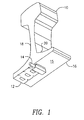
- FIG. 1 shows the first embodiment of the present invention.
- Rail clip 12 is shown securing strip heater14 against a bottom surface 15 of lower flange 16 of rail 10.
- Other figures show different versions of rail clips of the present invention which secure either a strip heater, a temperature sensor 14 or other cabling accessory against a side surface or web 18 of rail 10.
- Other rail clips of the present invention are designed to secure product against an upper surface 20 of flange 16 of rail 10.
- a strip heater14 is oftentimes held against the bottom of rail 10 and operates to detect the temperature of rail 10 to thereby provide feedback to the control system so that when strip heater14 gets to a pre-determined temperature, heat is delivered to rail 10 via strip heater 14 secured in place via clip 12.
- the term 'strip heater' will encompass the strip heater and any associated sensor, a temperature sensor or cabling component.
- Rail clip 12 is generally constructed of thin planar material, preferably metal, that is bent into a particular configuration depending on the shape of rail 10 to which clip 12 will attach. The thickness of this planar material may be varied depending on the force or bias to be applied by clip 12 upon rail 10; the thicker the material (i.e. the harder to spread open clip 12) the more bias is applied by clip 12 upon rail 10.
- Rail clip 12 is bent so as to have both a flange receiving area 22 and a strip heater receiving area 24. Generally, both of these areas 22 and 24 are 'U' shaped (but not always) so that both flange 16 and strip heater14 can be properly secured therein.
- Strip heater receiving area 24 is preferably configured so that maximum heat transfer between strip heater14 and rail 10 can be accomplished.
- Figures 2 and 3 show the flange receiving area 22 defined by opposing sides or legs 30 and 32.
- Legs 30 and 32 have upper teeth 26 and lower teeth 28, respectively.
- teeth 26 and 28 come in pairs on their respective sides 30 and 32 and preferably each of these teeth 26 and 28 are found in or near the outer edge region of their respective sides 30 and 32.
- Teeth 26 and 28 are also shown in these embodiments as coming to a point so as to better engage rail 10. They are also shown as being angled or configured with respect to their respective sides 30 and 32 such that teeth 26 and 28 resist the removal of clip 12 from rail 10. This is accomplished by having teeth 26 and 28 inclined both into flange receiving area 22 and also towards member 34 that joins sides 30 and 32.
- One common method of constructing teeth 26 and 28 is to make them of the same material as rail clip 12, such as by punching.
- teeth 26 are located opposite or generally immediately above a corresponding one or more lower teeth 28.
- the bias applied is somewhat symmetrical or balanced so that the 'pinching' forces applied by these teeth 26, 28 are preferably aligned with each other and are not greatly offset from each other.
- Teeth 26 and 28 are preferably positioned so as to provide a balanced grip upon flange 16 employing much the same mechanics as occurs when a human hand grips an object. Such alignment (or force cancellation) reduces or eliminates any imbalance between these opposing forces which thus curtails or prevents such imbalance from playing any part in any attempted dislodgment of clip 12 from rail 10.
- elongated teeth 36 Located between lower teeth 28 on side 32 are additional elongated teeth 36. These elongated teeth 36 are also configured and angled much like teeth 28 in order to resist the removal of clip 12 from rail 10 once clip 12 is installed around flange 16. In the embodiments shown, the longitudinal nature of elongated teeth 36 provide additional and increased contact surface with rail 10. This too aids in resisting the removal of clip 12 from flange 16 during periods of intense vibration. Ideally there would be three such elongated teeth 36 configured in side 32 with these three teeth 36 being somewhat evenly spaced from each other so as to better distribute their gripping capability along the full length of side 32.
- Strip heater receiving area 24 is, as previously indicated, generally U-shaped, but a review of the preferred embodiments shows that this is not always the case.
- the actual configuration of strip heater receiving area 24 will vary greatly depending on both the shape of the strip heater14 and the portion of the rail 10 that is to be in contact with strip heater14.
- strip heater receiving area 24 is to support or secure a cable, wire, pipe or conduit that is spaced slightly from rail 10 so that there is no direct contact between such strip heater14 and rail 10 (such contact instead extending through clip 12).
- Figure 3 shows strip heater receiving area including a protrusion 25 on the base of the U-shape to raise the strip heater14 so there is less contact between the clip 12 and the surface of the sensor 14.
- strip heater receiving area 24 When possible, it is desirable for strip heater receiving area 24 to be positioned opposite one or more sets of lower teeth 28 (or even elongated teeth 36). Thus, the bias applied by such strip heater14 will be balanced with the bias applied by these teeth in side 32 in order to achieve the same advantages as discussed above with respect to the alignment and gripping characteristics of upper and lower teeth 26 and 28.
- strip heater receiving area 24, as well as flange receiving area 22, is to be configured so as to closely conform to the shape of rail 10 to which clip 12 is applied. This is desirable not only so that the forces applied by clip 12 upon rail 10 are as balanced as possible, but so that during periods of intense vibration, each of teeth 26, 28 and 36 may come to bear upon rail 10 as described below in order to resist any movement of clip 12 away from rail 10 to the fullest extent possible.
- the teeth provide a set of pressure points which resist sliding. The force of the pressure points is generated by the spring in the material and shape of the rail clips 12.
- bottom surface 15 of rail 10 is flat.
- corresponding side 32 of rail clip 12 needs to be generally flat and parallel after installation so that all its teeth 28 and 36 will fully engage this bottom surface 15 as intended.
- manufacturing tolerances of both rail 10 and clip 12 will vary slightly such that in reality, some of teeth 28 and/or 36 may be levered away from any such contact (i.e. one or more teeth 28/36 acting as a fulcrum).
- bottom surface 15 is bowed or concave inwardly. This further compounds the difficulty of generating proper contact of side 32 with bottom surface 15.
- the embodiments of this invention is the purposeful configuration of side 32 so that it is not perpendicular to joining member 34 as would normally be expected. Instead, side 32 is actually bent so as to be angled or inclined towards or into flange receiving area 22. Side 32 is inclined at an angle A between about 4 degrees to about 13 degrees, more preferably between about 10 degrees and 12 degrees. Thus, not only does this overcome any possible leveraging that may arise from flat bottom surface rails, but such inclination also permits clip 12 to fully engage the bottom surface of bowed or concave flanges 16.
- lower side 32 is configured with six individual teeth 28 (or three pairs of teeth 28) along with three elongated teeth 36. These nine teeth spread the lower gripping forces of clip 12 against bottom surface 15 over a much larger area than occurs with existing rail clips 12. Hence, the point forces upon rail 10 are less than before due to these forces being spread over a larger area. Thus, less disfiguration of rail 10 occurs.
- These nine teeth 28/36 along with at least two aligned teeth 26 in upper side 30 provide an ideal balance of gripping strength, vibration resistance, low weight, cost reduction and manufacturing efficiency.
- the preferred installation manner is to be simply hammered onto flange 16 without any further drilling, welding, gluing, etc., thus ease of installation is also achieved via this new clip design.
- teeth 28 The first teeth to see any force will be teeth 28 opposite strip heater14 when clip 12 is initially hammered or knocked onto flange 16. These and subsequent pointed teeth 28 will subsequently 'give' ever so slightly upon continued installation because of their reverse angle and small (point) contact area. In equilibrium then, the greater pressure applied upon rail 10 will be via elongated teeth 36. At this stage, the contact surfaces of teeth 28 and 36 will be at the same level. However, when reverse forces due to vibration are applied to clip 12, then it is the pointed contact surfaces of teeth 28 that offer the greatest resistance (pressure over area) to withdrawal. Teeth 28 effectively stops or prevents clip 12 from sliding or vibrating off rail 10 because any such attempt simply forces pointed teeth 28 further into engagement with rail surface 15.
- the forces applied by rail clip 12 can be varied by changing the thickness of its material. Also, due to clip 12 being located in rather extreme locations under harsh environmental conditions, it is preferable to provide a protective coating to such clips so as to prolong their mechanical characteristics and prevent its deterioration.
- a protective coating may include a zinc compound as a sacrificial layer that will help maintain the integrity of the underlying material.
- FIGS 4, 5 and 6 show a foot mount rail clip 112 and 212 which is similar to rail clip 12 of Figures 1-3.
- Foot mount rail clip 112 of Figure 4 and 5 is generally "U-shaped" with ends pinched inwardly defining flange receiving area 122.
- the flange receiving area 122 is defined by upper side 130, lower side 132 and interconnecting side 134 therebetween.
- Upper side 130 includes teeth 126 projecting inwardly toward flange receiving area 122.
- the teeth 126 project inwardly at an angle B which is between about 8 and 12 degrees from the upper surface 130.
- Teeth 128 and 136 project from the lower side 132 toward the flange receiving area 122.
- Teeth 126, 128, 136 are of similar function and configuration as teeth 26, 28, 36 of Figure 3, respectively.
- Figure 5 shows angle C, which is defined by the perpendicular plane of side 134 to the angle of inwardly bend of side 132, is similar to angle A of Figure 3.
- Angle C is between about 4 to about 13 degrees, more preferably between about 10 degrees to about 12 degrees.
- the angled configuration provides securement of the rail clip 112 to the rail, as previously discussed with reference to rail clip 12 of Figure 3.
- Figure 5 shows angle D which is defined as the inward angle of the bend of side 130 from side 134. Angle D ranges between about 78 degrees to about 85 degrees.
- Figures 4 and 5 further show the strip heater receiving area 124 which is attached to the upper side 130 and extends therefrom.
- the heat receiving area 124 is generally planar with slightly inwardly angled ends.
- the heat receiving area 124 is elevated slightly above the plane of side 130 to provide for a space for the strip heater to run therethrough.
- the heat receiving area 124 of Figure 5 is located on a different part of the rail clip 112 then heat receiving area 24 of Figure 1.
- Rail clip 112 of Figure 5 provides for heat receiving area 124 depending from the upper side 130.
- the heat receiving area 124 secures a strip heater14 to the upper surface 20 of the rail 10.
- Figure 6 shows foot mount rail clip 212 which is similar to the foot mount rail clip 112 of Figures 4 and 5.
- Rail clip 212 includes a flange receiving area 222 which is defined by lower side 232, upper side 230 and side 234 therebetween. Upper side 230 and lower side 232 are similarly angled inwardly as discussed in reference to rail clip 112 of Figure 5.
- Rail clip 212 includes teeth 226, 228 and 236 which are similar in geometry and function as teeth 26, 28 and 36 of Figures 1-3.
- rail clip 212 has a strip heat receiving area 224 similar to the strip heat receiving area 124 of Figure 5 in that it depends from the upper side 130.
- the heat receiving area 224 is elevated slightly above the plane of side 230 to provide for a space for the strip heater to run therethrough, between the rail clip 212 and the upper surface 20 of the rail clip 10.
- foot mount rail clip 112 of Figure 5 differs from foot mount rail clip 212 of Figure 6 in that upper side 230 includes an angled portion 230A and planar portion 230B.
- the two-tiered geometry provides for additional securement and a frictional surface contact of planar portion 230B to rail 10.
- foot mount rail clip 212 has a smaller U-bend. Specifically, the height of side 234 is shorter then the height of side 134 of Figure 4 and 5 to accommodate a smaller rail configuration.
- the rail clips 312, 412 and 512 are similar to rail clip 12 of Figures 1-3 but they have the heat receiving area 324, 424 and 524 depending from upper side 330, 430 and 530, respectively, instead of the lower side as in rail clip 12 shown in Figure 1-3.
- the rail clips 312, 412 and 512 include lower sides 332, 432 and 532; side 334, 434 and 534; and upper side 330,430 and 530 which define flange receiving areas 322, 422, 522, respectively.
- teeth 328, 428, 528 and 336, 436, 536 on lower sides 332, 432 and 532, respectively, are similar to the teeth above-described in the other embodiments.
- the upper side 330, 430 and 530 also includes teeth 326, 426 and 526 which are similar to teeth 26 of Figures 1-3.
- the geometry of flange receiving area 322, 422 and 522 of Figures 7, 8 and 9 differ slightly.
- rail clip 512 of Figure 9 includes side 534 which is shorter in height then side 334 and 434 of Figures 7 and 8.
- the flange receiving area 522 of Figure 9 is smaller then the flange receiving area 322 and 422 of Figures 7 and 8 to accommodate a smaller rail.
- a further difference is the geometry of the heat receiving area 324, 424 and 524 which provide for different sensor attachment thereto.
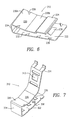
- rail clip 312 of Figure 7 includes a square cut out 313 to accept an ECS type of clip for wire suspension and cable management.
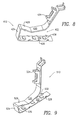
- Figures 8 and 9 do not include a square cutout instead they have a circular opening about 5mm. to about 7mm. in diameter and an attachment mechanism for allowing a cable tie block to be riveted thereto.
- FIGS 10, 11 and 12 show, further embodiments of the present invention, rail clips 612 and 712.
- Rail clips 612 and 712 are similar to rail clip 412 of Figure 8 because the heat receiving areas are similarly located on the upper side of the clip.
- the geometry of the heat receiving areas 624 and 724 differ from heat receiving area 424 of Figure 8 to accommodate different attachments, heat sensors or heat strips 14 thereto.
- the heat receiving area 624 and 724 is defined by an upper jaw and a lower jaw which are attached at one end to the upper side 630 and 730 and extend outwardly therefrom.
- the other unattached end of the upper jaw and lower jaw are curved towards each other to partially enclose the heat receiving area 624 and 724.
- a heat element slidable enters between the two jaws at the unattached ends into the heat receiving area 724.
- Figure 10 and 11 show rail clips 612 and 712 which include lower sides 632 and 732; side 634 and 734; and upper side 630 and 730 defining flange receiving areas 622 and 722, respectively. Further, teeth 628 and 728, and 636 and 736 on lower sides 632 and 732 are similar to teeth 28 and 36 of Figures 1-3.
- the upper side 630 and 730 also includes teeth 626 and 726 which are similar to teeth 26 of Figures 1-3.
- the geometry of flange receiving area 622 and 722 of Figures 10 and 11 differ slightly.
- Rail clip 712 of Figure 11 includes side 734 which is shorter in height then side 634 of Figure10. Additionally, the upper side 730 in angled inwardly toward the lower side 732 creating a flange receiving area 722 with smaller area then flange receiving area 622 of Figure 10.
- Figure 12 shows rail clip 712 attached to a rail 18.
- the rail clip 712 is mounted on the rail 18 such that the upper side 730 is frictionally engaged with surface 20 of the rail 18. Teeth 726 are shown engaged with surface 20 to secure rail clip 712 thereto. Further shown is the heat receiving area 724 protruding from the upper side 730 of the rail clip 712 and the rail 18.
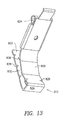
- Rail clip 812 is similar the previous described rail clips.
- Rail clip 812 includes lower side 832, side 834, and upper side 830 which defines flange receiving area 822.
- teeth 828 and 836 on lower side 832 are similar to the teeth above-described in the other embodiments.
- the upper side 830 also includes teeth 826 which are similar to teeth 26 of Figures 1-3.
- the geometry of flange receiving area 822 is different from the previous described flange receiving areas of the other embodiments to accommodate a different variety of attachments or heat strips 14.
- the flange receiving area 824 includes a planar section mounted on the upper portion of the upper side 830.
- the planar portion includes a centrally located circular hole therethrough.
- the planar portion further includes a pair of rear facing loops to accommodate wires therethough.
Landscapes
- Engineering & Computer Science (AREA)
- Architecture (AREA)
- Civil Engineering (AREA)
- Structural Engineering (AREA)
- Mechanical Engineering (AREA)
- Clamps And Clips (AREA)
- Wire Bonding (AREA)
- Machines For Laying And Maintaining Railways (AREA)
- Connection Of Plates (AREA)
Abstract
Description
- This invention pertains to a bracket for securing rail heater clips, heating cable and associated equipment to a fixed or moving rail line. These rail heater clips are specifically designed to resist removal when subjected to intense vibration or other irregular loading, such as when rail cars are passing overhead.
- Rail heater clips are used to secure a strip heater, a heat sensor or other items to a rail line (such as a commuter or freight rail). In colder climates, portions of rail lines need to be heated to prevent them from freezing. This is especially important at rail switch points or wherever the rail is to be shifted or moved. Strip heaters and other items are used at these locations to prevent snow or ice from blocking or otherwise restricting any such rail movement.
- Rail heater clips have existed for quite some time and they come in many different variations depending on the size and/or shape of the rail as well as the item they are to secure to the rail. Rail heater clips also vary depending on the part of the rail the heat is to be applied to.
- Perhaps the biggest challenge facing these clips is the need to remain attached to the rail during times of intense vibration, such as when rail cars are moving directly overhead. This requirement along with avoiding mechanical breakage and deterioration are paramount in designing and manufacturing rail heater clips.
- At the same time, ease of installation is an important consideration. If the installation is complicated or requires special equipment, there is a greater chance that the installation will be faulty. Hence, welding or gluing clips in place are less viable alternatives since both require pre-preparation to adhere properly. Furthermore, the employment of magnetic properties to secure the clip to the rail will not suffice since such magnetic properties will be adversely affected by the electro magnetic fields generated by the passing cars. The current method was seen to be the most viable for production at this point in time. However, it may transpire that at some later stage with advances in cleaning technology or capabilities to overcome electro-magnetic effects that these other methods of installation will become more viable for manufacture.
- Thus it is an object of this invention to develop a rail heater clip that is not only easy to install, but which will also resist vibration loading. Another object of this invention is to develop a rail heater clip that can accommodate a variety of different rail strip heaters and associated equipment as well as secure such items in place upon the rail. Yet another object of this invention is to provide a rail heater clip whose gripping capability is not diminished or affected whether the heating equipment is to be secured to the side or to the bottom of the rail. Still another object of this invention is to provide a rail heater clip that can be altered to accommodate any variety of differently sized and/or shaped rails. Another feature is to provide a rail heater clip that provides a more balanced grip upon the rail and one that is specially configured to resist removal. These and other objects and advantages of this invention will be come apparent upon further investigation.
- This invention pertains to a rail clip for securing a strip heater or other associated equipment to a rail. It consists of a clip having a rail flange receiving area for securing the clip to the rail and a strip heater receiving area for securing a strip heater against the rail. The flange receiving area is generally U-shaped in configuration and has opposing teeth. The opposing teeth consist of a plurality of teeth on one side surface of the U-shaped configuration and at least one tooth on an opposite side surface of the U-shaped configuration.
- Fig. 1 is a pictorial view of a first embodiment of the invention shown with a heat sensor installed on the underneath side of the rail.
- Fig. 2 is a perspective view of the first embodiment of Fig. 1 in its pre-installed state.
- Fig. 3 is a side view of the first embodiment of the invention shown in Figs. 1 and 2.
- Fig. 4 is a perspective view of a second embodiment of the invention.
- Fig. 5 is a side view of the second embodiment of the invention shown in Fig. 4.
- Fig. 6 is a perspective view of a third embodiment of the invention.
- Fig. 7 is a perspective view of a fourth embodiment of the invention.
- Fig. 8 is a perspective view of a fifth embodiment of the invention.
- Fig. 9 is a perspective view of a sixth embodiment of the invention.
- Fig. 10 is a perspective view of a seventh embodiment of the invention.
- Fig. 11 is a perspective view of a eighth embodiment of the invention.
- Fig. 12 is a perspective view of the embodiment of Fig. 11 shown secured to a rail.
- Fig. 13 is a perspective view of a ninth embodiment of the invention.
- Referring to the drawings, there is shown rail clips of various configurations to accommodate
various rail 10 configurations. Rail 10 comes in many different sizes and shapes and hence the need for many different configurations for rail clips. Figs. 1-3 show the first embodiment of the present invention.Rail clip 12 is shown securing strip heater14 against abottom surface 15 oflower flange 16 ofrail 10. Other figures show different versions of rail clips of the present invention which secure either a strip heater, atemperature sensor 14 or other cabling accessory against a side surface orweb 18 ofrail 10. Other rail clips of the present invention are designed to secure product against anupper surface 20 offlange 16 ofrail 10. A strip heater14 is oftentimes held against the bottom ofrail 10 and operates to detect the temperature ofrail 10 to thereby provide feedback to the control system so that when strip heater14 gets to a pre-determined temperature, heat is delivered torail 10 viastrip heater 14 secured in place viaclip 12. For purposes of clarification, the term 'strip heater' will encompass the strip heater and any associated sensor, a temperature sensor or cabling component. -
Rail clip 12 is generally constructed of thin planar material, preferably metal, that is bent into a particular configuration depending on the shape ofrail 10 to whichclip 12 will attach. The thickness of this planar material may be varied depending on the force or bias to be applied byclip 12 uponrail 10; the thicker the material (i.e. the harder to spread open clip 12) the more bias is applied byclip 12 uponrail 10.Rail clip 12 is bent so as to have both aflange receiving area 22 and a stripheater receiving area 24. Generally, both of theseareas flange 16 and strip heater14 can be properly secured therein. Stripheater receiving area 24 is preferably configured so that maximum heat transfer between strip heater14 andrail 10 can be accomplished. - Figures 2 and 3 show the
flange receiving area 22 defined by opposing sides orlegs upper teeth 26 andlower teeth 28, respectively. Ideallyteeth respective sides teeth respective sides rail 10. They are also shown as being angled or configured with respect to theirrespective sides teeth clip 12 fromrail 10. This is accomplished by havingteeth flange receiving area 22 and also towardsmember 34 that joinssides teeth rail clip 12, such as by punching. - It should also be noted that preferably at least one or more
upper teeth 26 are located opposite or generally immediately above a corresponding one or morelower teeth 28. In this fashion, at least for the bias applied by these teeth toflange 16, the bias applied is somewhat symmetrical or balanced so that the 'pinching' forces applied by theseteeth flange 16 employing much the same mechanics as occurs when a human hand grips an object. Such alignment (or force cancellation) reduces or eliminates any imbalance between these opposing forces which thus curtails or prevents such imbalance from playing any part in any attempted dislodgment ofclip 12 fromrail 10. - Located between
lower teeth 28 onside 32 are additionalelongated teeth 36. Theseelongated teeth 36 are also configured and angled much liketeeth 28 in order to resist the removal ofclip 12 fromrail 10 onceclip 12 is installed aroundflange 16. In the embodiments shown, the longitudinal nature ofelongated teeth 36 provide additional and increased contact surface withrail 10. This too aids in resisting the removal ofclip 12 fromflange 16 during periods of intense vibration. Ideally there would be three suchelongated teeth 36 configured inside 32 with these threeteeth 36 being somewhat evenly spaced from each other so as to better distribute their gripping capability along the full length ofside 32. - Strip
heater receiving area 24 is, as previously indicated, generally U-shaped, but a review of the preferred embodiments shows that this is not always the case. The actual configuration of stripheater receiving area 24 will vary greatly depending on both the shape of the strip heater14 and the portion of therail 10 that is to be in contact with strip heater14. In some instances, stripheater receiving area 24 is to support or secure a cable, wire, pipe or conduit that is spaced slightly fromrail 10 so that there is no direct contact between such strip heater14 and rail 10 (such contact instead extending through clip 12). Figure 3 shows strip heater receiving area including aprotrusion 25 on the base of the U-shape to raise the strip heater14 so there is less contact between theclip 12 and the surface of thesensor 14. - When possible, it is desirable for strip
heater receiving area 24 to be positioned opposite one or more sets of lower teeth 28 (or even elongated teeth 36). Thus, the bias applied by such strip heater14 will be balanced with the bias applied by these teeth inside 32 in order to achieve the same advantages as discussed above with respect to the alignment and gripping characteristics of upper andlower teeth - Furthermore, when possible, strip
heater receiving area 24, as well asflange receiving area 22, is to be configured so as to closely conform to the shape ofrail 10 to whichclip 12 is applied. This is desirable not only so that the forces applied byclip 12 uponrail 10 are as balanced as possible, but so that during periods of intense vibration, each ofteeth rail 10 as described below in order to resist any movement ofclip 12 away fromrail 10 to the fullest extent possible. The teeth provide a set of pressure points which resist sliding. The force of the pressure points is generated by the spring in the material and shape of the rail clips 12. - In
many rail 10 configurations,bottom surface 15 ofrail 10 is flat. Thus, correspondingside 32 ofrail clip 12 needs to be generally flat and parallel after installation so that all itsteeth bottom surface 15 as intended. However, manufacturing tolerances of bothrail 10 andclip 12 will vary slightly such that in reality, some ofteeth 28 and/or 36 may be levered away from any such contact (i.e. one ormore teeth 28/36 acting as a fulcrum). Additionally, in manyother rail 10 configurations,bottom surface 15 is bowed or concave inwardly. This further compounds the difficulty of generating proper contact ofside 32 withbottom surface 15. - Thus, the embodiments of this invention is the purposeful configuration of
side 32 so that it is not perpendicular to joiningmember 34 as would normally be expected. Instead,side 32 is actually bent so as to be angled or inclined towards or intoflange receiving area 22.Side 32 is inclined at an angle A between about 4 degrees to about 13 degrees, more preferably between about 10 degrees and 12 degrees. Thus, not only does this overcome any possible leveraging that may arise from flat bottom surface rails, but such inclination also permitsclip 12 to fully engage the bottom surface of bowed orconcave flanges 16. - In the embodiments shown,
lower side 32 is configured with six individual teeth 28 (or three pairs of teeth 28) along with threeelongated teeth 36. These nine teeth spread the lower gripping forces ofclip 12 againstbottom surface 15 over a much larger area than occurs with existing rail clips 12. Hence, the point forces uponrail 10 are less than before due to these forces being spread over a larger area. Thus, less disfiguration ofrail 10 occurs. - These nine
teeth 28/36 along with at least twoaligned teeth 26 inupper side 30 provide an ideal balance of gripping strength, vibration resistance, low weight, cost reduction and manufacturing efficiency. The preferred installation manner is to be simply hammered ontoflange 16 without any further drilling, welding, gluing, etc., thus ease of installation is also achieved via this new clip design. - During freestanding conditions (i.e. when
clip 12 is not experiencing any vibration due to passing rail cars), the greatest pressure point occurs between strip heater contact points andelongated teeth 36 onlower side 32. Thus, during such freestanding conditions, pointedteeth teeth elongated teeth 36 and strip heater contact points. These pointedteeth bottom surfaces flange 16.Pointed teeth - The first teeth to see any force will be
teeth 28 opposite strip heater14 whenclip 12 is initially hammered or knocked ontoflange 16. These and subsequentpointed teeth 28 will subsequently 'give' ever so slightly upon continued installation because of their reverse angle and small (point) contact area. In equilibrium then, the greater pressure applied uponrail 10 will be viaelongated teeth 36. At this stage, the contact surfaces ofteeth teeth 28 that offer the greatest resistance (pressure over area) to withdrawal.Teeth 28 effectively stops or preventsclip 12 from sliding or vibrating offrail 10 because any such attempt simply forces pointedteeth 28 further into engagement withrail surface 15. - The same can be said of
upper teeth 26 as well. During equilibrium,clip 12 is retained in place uponrail 10 via strip heater14, but during periods of vibration, the contact points ofteeth 26 act as a wedge to negate any backward sliding ofclip 12 fromrail 10. - As stated earlier, the forces applied by
rail clip 12 can be varied by changing the thickness of its material. Also, due toclip 12 being located in rather extreme locations under harsh environmental conditions, it is preferable to provide a protective coating to such clips so as to prolong their mechanical characteristics and prevent its deterioration. Such a coating may include a zinc compound as a sacrificial layer that will help maintain the integrity of the underlying material. - Figures 4, 5 and 6 show a foot
mount rail clip rail clip 12 of Figures 1-3. Footmount rail clip 112 of Figure 4 and 5 is generally "U-shaped" with ends pinched inwardly definingflange receiving area 122. Specifically, theflange receiving area 122 is defined byupper side 130,lower side 132 and interconnectingside 134 therebetween.Upper side 130 includesteeth 126 projecting inwardly towardflange receiving area 122. Theteeth 126 project inwardly at an angle B which is between about 8 and 12 degrees from theupper surface 130.Teeth lower side 132 toward theflange receiving area 122.Teeth teeth - Figure 5 shows angle C, which is defined by the perpendicular plane of
side 134 to the angle of inwardly bend ofside 132, is similar to angle A of Figure 3. Angle C is between about 4 to about 13 degrees, more preferably between about 10 degrees to about 12 degrees. The angled configuration provides securement of therail clip 112 to the rail, as previously discussed with reference torail clip 12 of Figure 3. Similarly, Figure 5 shows angle D which is defined as the inward angle of the bend ofside 130 fromside 134. Angle D ranges between about 78 degrees to about 85 degrees. Figures 4 and 5 further show the stripheater receiving area 124 which is attached to theupper side 130 and extends therefrom. Theheat receiving area 124 is generally planar with slightly inwardly angled ends. Theheat receiving area 124 is elevated slightly above the plane ofside 130 to provide for a space for the strip heater to run therethrough. - The
heat receiving area 124 of Figure 5 is located on a different part of therail clip 112 then heat receivingarea 24 of Figure 1.Rail clip 112 of Figure 5 provides forheat receiving area 124 depending from theupper side 130. Theheat receiving area 124 secures a strip heater14 to theupper surface 20 of therail 10. - Figure 6 shows foot
mount rail clip 212 which is similar to the footmount rail clip 112 of Figures 4 and 5.Rail clip 212 includes aflange receiving area 222 which is defined bylower side 232,upper side 230 andside 234 therebetween.Upper side 230 andlower side 232 are similarly angled inwardly as discussed in reference torail clip 112 of Figure 5.Rail clip 212 includesteeth teeth rail clip 212 has a stripheat receiving area 224 similar to the stripheat receiving area 124 of Figure 5 in that it depends from theupper side 130. Theheat receiving area 224 is elevated slightly above the plane ofside 230 to provide for a space for the strip heater to run therethrough, between therail clip 212 and theupper surface 20 of therail clip 10. - One difference between foot
mount rail clip 112 of Figure 5 and footmount rail clip 212 of Figure 6 is thatupper side 230 includes anangled portion 230A andplanar portion 230B. The two-tiered geometry provides for additional securement and a frictional surface contact ofplanar portion 230B to rail 10. Further, footmount rail clip 212 has a smaller U-bend. Specifically, the height ofside 234 is shorter then the height ofside 134 of Figure 4 and 5 to accommodate a smaller rail configuration. - Further embodiments of the present invention are shown in Figures 7, 8 and 9. The rail clips 312, 412 and 512 are similar to
rail clip 12 of Figures 1-3 but they have theheat receiving area upper side rail clip 12 shown in Figure 1-3. The rail clips 312, 412 and 512 includelower sides side flange receiving areas teeth lower sides upper side teeth teeth 26 of Figures 1-3. The geometry offlange receiving area rail clip 512 of Figure 9 includesside 534 which is shorter in height thenside flange receiving area 522 of Figure 9 is smaller then theflange receiving area heat receiving area rail clip 312 of Figure 7 includes a square cut out 313 to accept an ECS type of clip for wire suspension and cable management. Figures 8 and 9 do not include a square cutout instead they have a circular opening about 5mm. to about 7mm. in diameter and an attachment mechanism for allowing a cable tie block to be riveted thereto. - Figures 10, 11 and 12 show, further embodiments of the present invention, rail clips 612 and 712. Rail clips 612 and 712 are similar to
rail clip 412 of Figure 8 because the heat receiving areas are similarly located on the upper side of the clip. However, the geometry of theheat receiving areas heat receiving area 424 of Figure 8 to accommodate different attachments, heat sensors or heat strips 14 thereto. Theheat receiving area upper side heat receiving area heat receiving area 724. - Figure 10 and 11 show rail clips 612 and 712 which include
lower sides side upper side flange receiving areas teeth lower sides teeth upper side teeth teeth 26 of Figures 1-3. The geometry offlange receiving area Rail clip 712 of Figure 11 includesside 734 which is shorter in height thenside 634 of Figure10. Additionally, theupper side 730 in angled inwardly toward thelower side 732 creating aflange receiving area 722 with smaller area then flange receivingarea 622 of Figure 10. - Figure 12 shows
rail clip 712 attached to arail 18. Therail clip 712 is mounted on therail 18 such that theupper side 730 is frictionally engaged withsurface 20 of therail 18.Teeth 726 are shown engaged withsurface 20 to securerail clip 712 thereto. Further shown is theheat receiving area 724 protruding from theupper side 730 of therail clip 712 and therail 18. - Another embodiment of the present invention is
rail clip 812 shown in Figure 13.Rail clip 812 is similar the previous described rail clips.Rail clip 812 includeslower side 832,side 834, andupper side 830 which definesflange receiving area 822. Further,teeth lower side 832 are similar to the teeth above-described in the other embodiments. Theupper side 830 also includesteeth 826 which are similar toteeth 26 of Figures 1-3. The geometry offlange receiving area 822 is different from the previous described flange receiving areas of the other embodiments to accommodate a different variety of attachments or heat strips 14. Theflange receiving area 824 includes a planar section mounted on the upper portion of theupper side 830. The planar portion includes a centrally located circular hole therethrough. The planar portion further includes a pair of rear facing loops to accommodate wires therethough. - While select preferred embodiments of this invention have been illustrated, many modifications may occur to those skilled in the art and therefore it is to be understood that these modifications are incorporated within these embodiments as fully as if they were fully illustrated and described herein.
Claims (12)
- A rail clip for securing a strip heater to a rail comprising:(a) a clip having a rail flange receiving area for securing the clip to the rail and a strip heater receiving area for securing a strip heater against the rail;(b) said flange receiving area being generally U-shaped in configuration and having opposing teeth;(c) said opposing teeth comprising a plurality of teeth on one side surface of said U-shaped configuration and at least one tooth on an opposite side surface of said U-shaped configuration.
- The rail clip as set forth in claim 1 wherein said opposing teeth comprising a combination of both pointed and elongated teeth projections.
- The rail clip as set forth in claim 2 wherein said one side surface contains at least one pointed tooth and at least one elongated tooth and wherein said opposite side surface contains at least one pointed tooth.
- The rail clip as set forth in claim 3 wherein both said side surfaces each contain a plurality of teeth therein and with at least one said tooth on each said side surface being configured to engage the rail upon clip withdrawal.
- The rail clip as set forth in any of claims 1-4 wherein at least one tooth on said one side surface is aligned with another said tooth on said opposite side surface.
- The rail clip as set forth in claim 3 or 4 wherein said pointed teeth on both said side surfaces are aligned with each other.
- The rail clip as set forth in any of claims 1-6 wherein said one side surface is non-parallel with said opposite side surface.
- The rail clip as set forth in claim 7 wherein said non-parallel one side surface is inclined at an angle of between about 10 degrees to about 12 degrees with respect to said other side surface.
- A rail clip for securing a strip heater to a rail comprising(a) a clip having a rail flange receiving area and a strip heater receiving area for securing a strip heater against the rail;(b) both said flange receiving area and said strip heater receiving area being configured to closely follow the contour of the rail;(c) said flange receiving area being generally U-shaped in configuration and having opposing teeth;(d) said opposing teeth comprising a combination of pointed and elongated teeth projections;(e) said pointed and elongated teeth projections comprising a plurality of teeth on one side surface of said U-shaped configuration and at least one tooth on an opposite side surface of said U-shaped configuration.
- The rail clip as set forth in claim 9 wherein said one side surface contains at least one pointed tooth and at least one elongated tooth and wherein said opposite side surface contains at least one pointed tooth located opposite of and in alignment with one of said teeth in said one side surface.
- The rail clip as set forth in claim 10 wherein said one side surface is non-parallel with said opposite side surface.
- The rail clip as set forth in any of claims 9-11 wherein said non-parallel one side surface is inclined at an angle of between about 10 degrees to about 12 degrees with respect to said other side surface.
Applications Claiming Priority (1)
| Application Number | Priority Date | Filing Date | Title |
|---|---|---|---|
| US63939604P | 2004-12-27 | 2004-12-27 |
Publications (2)
| Publication Number | Publication Date |
|---|---|
| EP1681391A1 true EP1681391A1 (en) | 2006-07-19 |
| EP1681391B1 EP1681391B1 (en) | 2007-07-11 |
Family
ID=36000975
Family Applications (1)
| Application Number | Title | Priority Date | Filing Date |
|---|---|---|---|
| EP05077986A Expired - Lifetime EP1681391B1 (en) | 2004-12-27 | 2005-12-23 | A rail clip for securing a strip heater to a rail |
Country Status (6)
| Country | Link |
|---|---|
| US (1) | US7717387B2 (en) |
| EP (1) | EP1681391B1 (en) |
| AT (1) | ATE366845T1 (en) |
| CA (1) | CA2530839C (en) |
| DE (1) | DE602005001608T2 (en) |
| NO (1) | NO332881B1 (en) |
Cited By (6)
| Publication number | Priority date | Publication date | Assignee | Title |
|---|---|---|---|---|
| EP1876295A3 (en) * | 2006-07-03 | 2008-05-21 | Corus UK LTD. | Rail dampers |
| ITTO20090827A1 (en) * | 2009-10-28 | 2010-01-27 | Trafilplast S N C | FIXING CLIP, IN PARTICULAR FOR LAYING ON LISTELS. |
| WO2014032865A3 (en) * | 2012-08-28 | 2014-05-01 | Triple S-Gmbh | Heating device for heating a rail foot |
| EP3296461A1 (en) * | 2016-09-14 | 2018-03-21 | Multiclip Company Limited | Cable management assembly |
| US12492514B2 (en) | 2020-04-28 | 2025-12-09 | Talent Power Limited | Rail damper mounting apparatus and rail damper systems containing the same |
| EP4497181A4 (en) * | 2022-03-21 | 2026-03-18 | Shoals Tech Group Llc | CLAMP FOR MANAGING PHOTOVOLTAIC WIRES |
Families Citing this family (25)
| Publication number | Priority date | Publication date | Assignee | Title |
|---|---|---|---|---|
| US7717387B2 (en) * | 2004-12-27 | 2010-05-18 | Thomas & Betts International, Inc. | Rail heater clip |
| WO2008097931A1 (en) * | 2007-02-06 | 2008-08-14 | Smith Donald W | Machine tool shield |
| US7992797B2 (en) * | 2007-04-18 | 2011-08-09 | Fastrax Industries, Inc. | Railroad signal line attachment clip |
| WO2009082292A1 (en) | 2007-12-21 | 2009-07-02 | Volvo Lastvagnar Ab | A clip device, a system for attachment of conduits comprising said clip device as well as a heavy vehicle comprising said clip device and/or system |
| US8157186B2 (en) * | 2009-01-23 | 2012-04-17 | Fastrax Industries, Inc. | Strike attachment railroad anchor |
| US8157185B2 (en) * | 2009-01-23 | 2012-04-17 | Fastrax Industries, Inc. | Strike attachment railroad signal line connector |
| US8657244B2 (en) * | 2009-04-29 | 2014-02-25 | Francisco J. Sillik | Support hanger for insulation and other materials |
| USD623508S1 (en) * | 2010-04-14 | 2010-09-14 | Fastrax Industries, Inc. | Railroad attachment clamp |
| DE202010005512U1 (en) | 2010-05-27 | 2010-07-29 | Contec Gmbh | Arrangement for securing at least one component to a rail |
| DE102012000079B4 (en) * | 2012-01-04 | 2024-08-14 | Phoenix Contact Gmbh & Co. Kg | Electrical mandrel connector and its use |
| US9074327B2 (en) * | 2012-08-24 | 2015-07-07 | David L. Reichle | Railroad attachment clamp |
| US20150217938A1 (en) * | 2014-02-05 | 2015-08-06 | Ventura Hydraulic & Machine Works, Inc. | Hydraulic Device With Heating Element |
| USD759469S1 (en) * | 2015-06-25 | 2016-06-21 | Delta Faucet Company | Robe hook |
| WO2018081722A1 (en) * | 2016-10-31 | 2018-05-03 | Haddock Dustin M M | Metal panel electrical bonding clip |
| KR101931753B1 (en) * | 2017-02-17 | 2018-12-24 | (주)대신티앤에스 | Functional laminate floor material |
| AU2018328094B2 (en) | 2017-09-06 | 2024-02-15 | Hubbell Incorporated | Cable clips |
| USD891904S1 (en) | 2018-08-06 | 2020-08-04 | Hubbell Incorporated | Securing clip |
| US11002383B2 (en) * | 2018-08-06 | 2021-05-11 | Hubbell Incorporated | Combination securing clips |
| US12062894B2 (en) | 2019-01-09 | 2024-08-13 | Hubbell Incorporated | Cable clips for wire management |
| US10847960B1 (en) * | 2019-05-16 | 2020-11-24 | Hubbell Incorporated | Multi-directional cable clip |
| CN111041904B (en) * | 2019-12-30 | 2021-11-02 | 济南轨道交通集团有限公司 | Shock attenuation subway rail set |
| KR102286149B1 (en) * | 2021-05-03 | 2021-08-04 | 한국교통대학교산학협력단 | Heat conduction clamping device for snow melting at the bottom of railroad turnout rail |
| US20230335980A1 (en) * | 2022-04-19 | 2023-10-19 | Steven S. Kuhl | Roof clip |
| US12534916B2 (en) | 2023-04-14 | 2026-01-27 | Rmh Tech Llc | Mounting device for a metal panel |
| EP4733477A1 (en) * | 2024-10-23 | 2026-04-29 | HellermannTyton Data Limited | Rail cover cable guard made of identical pieces |
Citations (4)
| Publication number | Priority date | Publication date | Assignee | Title |
|---|---|---|---|---|
| US4429845A (en) * | 1982-04-26 | 1984-02-07 | Emerson Electric Co. | Rail track heaters |
| US5004190A (en) * | 1987-11-06 | 1991-04-02 | Bylin Heating Systems, Inc. | Rail heating apparatus |
| FR2780738A1 (en) * | 1998-07-01 | 2000-01-07 | Fabrication Ferronnerie Fixati | Fixing for railway track rail heater |
| JP2001115404A (en) * | 1999-10-20 | 2001-04-24 | Shinyosha:Kk | Metal fixture for rail snow melting device |
Family Cites Families (11)
| Publication number | Priority date | Publication date | Assignee | Title |
|---|---|---|---|---|
| US2332855A (en) * | 1942-06-26 | 1943-10-26 | United Carr Fastener Corp | Wiring clip |
| US4826078A (en) * | 1987-11-13 | 1989-05-02 | Imo Delaval Inc. | Wire-to-track-base retainer clip and keeper |
| US5127577A (en) * | 1989-05-19 | 1992-07-07 | Erico International Corporation | Track circuit retainer clip |
| US5148981A (en) * | 1989-05-19 | 1992-09-22 | Erico International Corporation | Track circuit retainer clip |
| US5463189A (en) * | 1993-12-23 | 1995-10-31 | Deneke; Bernard F. | Installation clip device for electrical cables |
| DE9405703U1 (en) * | 1994-04-06 | 1994-05-26 | Texmato GmbH & Co, 49090 Osnabrück | Device for fastening wave springs to frame struts |
| US5722509A (en) * | 1996-05-14 | 1998-03-03 | Consolidated Rail Corporation | Flange oiler |
| US6334242B1 (en) * | 1999-08-11 | 2002-01-01 | Siemens Automotive Corporation | Fuel rail to intake manifold mounting clip |
| US6186799B1 (en) * | 1999-10-21 | 2001-02-13 | Fci Usa, Inc. | Compression grounding connector for rail and structural steel |
| US7090174B2 (en) * | 2001-11-09 | 2006-08-15 | Andrew Corporation | Anchor rail adapter and hanger and method |
| US7717387B2 (en) * | 2004-12-27 | 2010-05-18 | Thomas & Betts International, Inc. | Rail heater clip |
-
2005
- 2005-12-13 US US11/301,537 patent/US7717387B2/en active Active
- 2005-12-16 CA CA002530839A patent/CA2530839C/en not_active Expired - Fee Related
- 2005-12-23 NO NO20056191A patent/NO332881B1/en not_active IP Right Cessation
- 2005-12-23 DE DE602005001608T patent/DE602005001608T2/en not_active Expired - Lifetime
- 2005-12-23 AT AT05077986T patent/ATE366845T1/en not_active IP Right Cessation
- 2005-12-23 EP EP05077986A patent/EP1681391B1/en not_active Expired - Lifetime
Patent Citations (4)
| Publication number | Priority date | Publication date | Assignee | Title |
|---|---|---|---|---|
| US4429845A (en) * | 1982-04-26 | 1984-02-07 | Emerson Electric Co. | Rail track heaters |
| US5004190A (en) * | 1987-11-06 | 1991-04-02 | Bylin Heating Systems, Inc. | Rail heating apparatus |
| FR2780738A1 (en) * | 1998-07-01 | 2000-01-07 | Fabrication Ferronnerie Fixati | Fixing for railway track rail heater |
| JP2001115404A (en) * | 1999-10-20 | 2001-04-24 | Shinyosha:Kk | Metal fixture for rail snow melting device |
Non-Patent Citations (1)
| Title |
|---|
| PATENT ABSTRACTS OF JAPAN vol. 2000, no. 21 3 August 2001 (2001-08-03) * |
Cited By (6)
| Publication number | Priority date | Publication date | Assignee | Title |
|---|---|---|---|---|
| EP1876295A3 (en) * | 2006-07-03 | 2008-05-21 | Corus UK LTD. | Rail dampers |
| ITTO20090827A1 (en) * | 2009-10-28 | 2010-01-27 | Trafilplast S N C | FIXING CLIP, IN PARTICULAR FOR LAYING ON LISTELS. |
| WO2014032865A3 (en) * | 2012-08-28 | 2014-05-01 | Triple S-Gmbh | Heating device for heating a rail foot |
| EP3296461A1 (en) * | 2016-09-14 | 2018-03-21 | Multiclip Company Limited | Cable management assembly |
| US12492514B2 (en) | 2020-04-28 | 2025-12-09 | Talent Power Limited | Rail damper mounting apparatus and rail damper systems containing the same |
| EP4497181A4 (en) * | 2022-03-21 | 2026-03-18 | Shoals Tech Group Llc | CLAMP FOR MANAGING PHOTOVOLTAIC WIRES |
Also Published As
| Publication number | Publication date |
|---|---|
| DE602005001608D1 (en) | 2007-08-23 |
| US7717387B2 (en) | 2010-05-18 |
| EP1681391B1 (en) | 2007-07-11 |
| CA2530839A1 (en) | 2006-06-27 |
| DE602005001608T2 (en) | 2007-11-22 |
| US20060150563A1 (en) | 2006-07-13 |
| NO332881B1 (en) | 2013-01-28 |
| CA2530839C (en) | 2009-02-17 |
| ATE366845T1 (en) | 2007-08-15 |
| NO20056191L (en) | 2006-06-28 |
Similar Documents
| Publication | Publication Date | Title |
|---|---|---|
| CA2530839C (en) | Rail heater clip | |
| US5619263A (en) | Box hanger and method | |
| US5775345A (en) | Hair clip | |
| US4723749A (en) | Channel clip | |
| EP1887232B1 (en) | Cable mount | |
| JP6602956B2 (en) | Blind hole mount | |
| US20030222185A1 (en) | Apparatus and method for anchoring a cable | |
| US8616512B2 (en) | Multi-purpose cable support having bendable stem | |
| US7063299B2 (en) | Suspending equipment | |
| US20060249633A1 (en) | Anchor rail adapter and hanger and method | |
| KR102570183B1 (en) | Bracket for cable management | |
| WO2009032550A1 (en) | Cable support and method | |
| EP0048574A1 (en) | A grating fastening device | |
| NZ271809A (en) | Pipe support strap: flexible band with projections that engage apertures in strap when it is looped about a pipe. | |
| US6672545B1 (en) | Device for resisting movement of a suspended pipe | |
| US6460820B1 (en) | Combination appliance hold-down plate | |
| US4658100A (en) | Trolley wire hanger | |
| US20050202692A1 (en) | Multipurpose mount | |
| FI85754C (en) | FOERFARANDE FOER FASTSAETTNING AV FAEST- ELLER UPPHAENGNINGSDON JAEMTE DON FOER FOERFARANDETS GENOMFOERANDE. | |
| US20060080933A1 (en) | Multi-rung supporting means for elongated building services supply means | |
| JP6251837B1 (en) | Cable support | |
| US4652013A (en) | Book hanger hardware | |
| US6247501B1 (en) | Clip-on stirrup mat | |
| JPH07207809A (en) | Hanger for ceiling hanging device | |
| WO1999021729A1 (en) | Vehicular accessory fastener |
Legal Events
| Date | Code | Title | Description |
|---|---|---|---|
| PUAI | Public reference made under article 153(3) epc to a published international application that has entered the european phase |
Free format text: ORIGINAL CODE: 0009012 |
|
| AK | Designated contracting states |
Kind code of ref document: A1 Designated state(s): AT BE BG CH CY CZ DE DK EE ES FI FR GB GR HU IE IS IT LI LT LU LV MC NL PL PT RO SE SI SK TR |
|
| AX | Request for extension of the european patent |
Extension state: AL BA HR MK YU |
|
| 17P | Request for examination filed |
Effective date: 20060627 |
|
| 17Q | First examination report despatched |
Effective date: 20060822 |
|
| GRAP | Despatch of communication of intention to grant a patent |
Free format text: ORIGINAL CODE: EPIDOSNIGR1 |
|
| AKX | Designation fees paid |
Designated state(s): AT BE BG CH CY CZ DE DK EE ES FI FR GB GR HU IE IS IT LI LT LU LV MC NL PL PT RO SE SI SK TR |
|
| GRAS | Grant fee paid |
Free format text: ORIGINAL CODE: EPIDOSNIGR3 |
|
| GRAA | (expected) grant |
Free format text: ORIGINAL CODE: 0009210 |
|
| AK | Designated contracting states |
Kind code of ref document: B1 Designated state(s): AT BE BG CH CY CZ DE DK EE ES FI FR GB GR HU IE IS IT LI LT LU LV MC NL PL PT RO SE SI SK TR |
|
| REG | Reference to a national code |
Ref country code: GB Ref legal event code: FG4D |
|
| REG | Reference to a national code |
Ref country code: CH Ref legal event code: EP |
|
| REF | Corresponds to: |
Ref document number: 602005001608 Country of ref document: DE Date of ref document: 20070823 Kind code of ref document: P |
|
| REG | Reference to a national code |
Ref country code: IE Ref legal event code: FG4D |
|
| REG | Reference to a national code |
Ref country code: SE Ref legal event code: TRGR |
|
| ET | Fr: translation filed | ||
| PG25 | Lapsed in a contracting state [announced via postgrant information from national office to epo] |
Ref country code: PT Free format text: LAPSE BECAUSE OF FAILURE TO SUBMIT A TRANSLATION OF THE DESCRIPTION OR TO PAY THE FEE WITHIN THE PRESCRIBED TIME-LIMIT Effective date: 20071211 Ref country code: FI Free format text: LAPSE BECAUSE OF FAILURE TO SUBMIT A TRANSLATION OF THE DESCRIPTION OR TO PAY THE FEE WITHIN THE PRESCRIBED TIME-LIMIT Effective date: 20070711 Ref country code: LT Free format text: LAPSE BECAUSE OF FAILURE TO SUBMIT A TRANSLATION OF THE DESCRIPTION OR TO PAY THE FEE WITHIN THE PRESCRIBED TIME-LIMIT Effective date: 20070711 Ref country code: IS Free format text: LAPSE BECAUSE OF FAILURE TO SUBMIT A TRANSLATION OF THE DESCRIPTION OR TO PAY THE FEE WITHIN THE PRESCRIBED TIME-LIMIT Effective date: 20071111 Ref country code: BG Free format text: LAPSE BECAUSE OF FAILURE TO SUBMIT A TRANSLATION OF THE DESCRIPTION OR TO PAY THE FEE WITHIN THE PRESCRIBED TIME-LIMIT Effective date: 20071011 Ref country code: ES Free format text: LAPSE BECAUSE OF FAILURE TO SUBMIT A TRANSLATION OF THE DESCRIPTION OR TO PAY THE FEE WITHIN THE PRESCRIBED TIME-LIMIT Effective date: 20071022 |
|
| REG | Reference to a national code |
Ref country code: CH Ref legal event code: PL |
|
| PG25 | Lapsed in a contracting state [announced via postgrant information from national office to epo] |
Ref country code: AT Free format text: LAPSE BECAUSE OF FAILURE TO SUBMIT A TRANSLATION OF THE DESCRIPTION OR TO PAY THE FEE WITHIN THE PRESCRIBED TIME-LIMIT Effective date: 20070711 Ref country code: CH Free format text: LAPSE BECAUSE OF FAILURE TO SUBMIT A TRANSLATION OF THE DESCRIPTION OR TO PAY THE FEE WITHIN THE PRESCRIBED TIME-LIMIT Effective date: 20070711 Ref country code: LI Free format text: LAPSE BECAUSE OF FAILURE TO SUBMIT A TRANSLATION OF THE DESCRIPTION OR TO PAY THE FEE WITHIN THE PRESCRIBED TIME-LIMIT Effective date: 20070711 Ref country code: PL Free format text: LAPSE BECAUSE OF FAILURE TO SUBMIT A TRANSLATION OF THE DESCRIPTION OR TO PAY THE FEE WITHIN THE PRESCRIBED TIME-LIMIT Effective date: 20070711 |
|
| PG25 | Lapsed in a contracting state [announced via postgrant information from national office to epo] |
Ref country code: LV Free format text: LAPSE BECAUSE OF FAILURE TO SUBMIT A TRANSLATION OF THE DESCRIPTION OR TO PAY THE FEE WITHIN THE PRESCRIBED TIME-LIMIT Effective date: 20070711 |
|
| PG25 | Lapsed in a contracting state [announced via postgrant information from national office to epo] |
Ref country code: GR Free format text: LAPSE BECAUSE OF FAILURE TO SUBMIT A TRANSLATION OF THE DESCRIPTION OR TO PAY THE FEE WITHIN THE PRESCRIBED TIME-LIMIT Effective date: 20071012 Ref country code: DK Free format text: LAPSE BECAUSE OF FAILURE TO SUBMIT A TRANSLATION OF THE DESCRIPTION OR TO PAY THE FEE WITHIN THE PRESCRIBED TIME-LIMIT Effective date: 20070711 |
|
| PLBE | No opposition filed within time limit |
Free format text: ORIGINAL CODE: 0009261 |
|
| STAA | Information on the status of an ep patent application or granted ep patent |
Free format text: STATUS: NO OPPOSITION FILED WITHIN TIME LIMIT |
|
| PG25 | Lapsed in a contracting state [announced via postgrant information from national office to epo] |
Ref country code: CZ Free format text: LAPSE BECAUSE OF FAILURE TO SUBMIT A TRANSLATION OF THE DESCRIPTION OR TO PAY THE FEE WITHIN THE PRESCRIBED TIME-LIMIT Effective date: 20070711 Ref country code: SK Free format text: LAPSE BECAUSE OF FAILURE TO SUBMIT A TRANSLATION OF THE DESCRIPTION OR TO PAY THE FEE WITHIN THE PRESCRIBED TIME-LIMIT Effective date: 20070711 |
|
| 26N | No opposition filed |
Effective date: 20080414 |
|
| PG25 | Lapsed in a contracting state [announced via postgrant information from national office to epo] |
Ref country code: RO Free format text: LAPSE BECAUSE OF FAILURE TO SUBMIT A TRANSLATION OF THE DESCRIPTION OR TO PAY THE FEE WITHIN THE PRESCRIBED TIME-LIMIT Effective date: 20070711 |
|
| PG25 | Lapsed in a contracting state [announced via postgrant information from national office to epo] |
Ref country code: MC Free format text: LAPSE BECAUSE OF NON-PAYMENT OF DUE FEES Effective date: 20071231 |
|
| PG25 | Lapsed in a contracting state [announced via postgrant information from national office to epo] |
Ref country code: EE Free format text: LAPSE BECAUSE OF FAILURE TO SUBMIT A TRANSLATION OF THE DESCRIPTION OR TO PAY THE FEE WITHIN THE PRESCRIBED TIME-LIMIT Effective date: 20070711 |
|
| PG25 | Lapsed in a contracting state [announced via postgrant information from national office to epo] |
Ref country code: SI Free format text: LAPSE BECAUSE OF FAILURE TO SUBMIT A TRANSLATION OF THE DESCRIPTION OR TO PAY THE FEE WITHIN THE PRESCRIBED TIME-LIMIT Effective date: 20070711 |
|
| PG25 | Lapsed in a contracting state [announced via postgrant information from national office to epo] |
Ref country code: CY Free format text: LAPSE BECAUSE OF FAILURE TO SUBMIT A TRANSLATION OF THE DESCRIPTION OR TO PAY THE FEE WITHIN THE PRESCRIBED TIME-LIMIT Effective date: 20070711 |
|
| PG25 | Lapsed in a contracting state [announced via postgrant information from national office to epo] |
Ref country code: LU Free format text: LAPSE BECAUSE OF NON-PAYMENT OF DUE FEES Effective date: 20071223 |
|
| PG25 | Lapsed in a contracting state [announced via postgrant information from national office to epo] |
Ref country code: TR Free format text: LAPSE BECAUSE OF FAILURE TO SUBMIT A TRANSLATION OF THE DESCRIPTION OR TO PAY THE FEE WITHIN THE PRESCRIBED TIME-LIMIT Effective date: 20070711 Ref country code: HU Free format text: LAPSE BECAUSE OF FAILURE TO SUBMIT A TRANSLATION OF THE DESCRIPTION OR TO PAY THE FEE WITHIN THE PRESCRIBED TIME-LIMIT Effective date: 20080112 |
|
| PG25 | Lapsed in a contracting state [announced via postgrant information from national office to epo] |
Ref country code: IT Free format text: LAPSE BECAUSE OF NON-PAYMENT OF DUE FEES Effective date: 20071231 |
|
| REG | Reference to a national code |
Ref country code: FR Ref legal event code: PLFP Year of fee payment: 11 |
|
| REG | Reference to a national code |
Ref country code: FR Ref legal event code: PLFP Year of fee payment: 12 |
|
| REG | Reference to a national code |
Ref country code: FR Ref legal event code: PLFP Year of fee payment: 13 |
|
| PGFP | Annual fee paid to national office [announced via postgrant information from national office to epo] |
Ref country code: PT Payment date: 20181204 Year of fee payment: 11 Ref country code: SE Payment date: 20181211 Year of fee payment: 14 Ref country code: IE Payment date: 20181210 Year of fee payment: 14 |
|
| PGFP | Annual fee paid to national office [announced via postgrant information from national office to epo] |
Ref country code: BE Payment date: 20181015 Year of fee payment: 14 |
|
| REG | Reference to a national code |
Ref country code: SE Ref legal event code: EUG |
|
| REG | Reference to a national code |
Ref country code: NL Ref legal event code: MM Effective date: 20200101 |
|
| REG | Reference to a national code |
Ref country code: BE Ref legal event code: MM Effective date: 20191231 |
|
| PG25 | Lapsed in a contracting state [announced via postgrant information from national office to epo] |
Ref country code: NL Free format text: LAPSE BECAUSE OF NON-PAYMENT OF DUE FEES Effective date: 20200101 |
|
| PG25 | Lapsed in a contracting state [announced via postgrant information from national office to epo] |
Ref country code: SE Free format text: LAPSE BECAUSE OF NON-PAYMENT OF DUE FEES Effective date: 20191224 Ref country code: IE Free format text: LAPSE BECAUSE OF NON-PAYMENT OF DUE FEES Effective date: 20191223 |
|
| PG25 | Lapsed in a contracting state [announced via postgrant information from national office to epo] |
Ref country code: BE Free format text: LAPSE BECAUSE OF NON-PAYMENT OF DUE FEES Effective date: 20191231 |
|
| REG | Reference to a national code |
Ref country code: DE Ref legal event code: R082 Ref document number: 602005001608 Country of ref document: DE Representative=s name: KRAUS & LEDERER PARTGMBB, DE |
|
| PGFP | Annual fee paid to national office [announced via postgrant information from national office to epo] |
Ref country code: DE Payment date: 20241210 Year of fee payment: 20 |
|
| PGFP | Annual fee paid to national office [announced via postgrant information from national office to epo] |
Ref country code: GB Payment date: 20241227 Year of fee payment: 20 |
|
| PGFP | Annual fee paid to national office [announced via postgrant information from national office to epo] |
Ref country code: FR Payment date: 20241223 Year of fee payment: 20 |
|
| REG | Reference to a national code |
Ref country code: DE Ref legal event code: R071 Ref document number: 602005001608 Country of ref document: DE |
|
| REG | Reference to a national code |
Ref country code: GB Ref legal event code: PE20 Expiry date: 20251222 |