EP1679207A1 - Ball joint for suspension element of automotive vehicles - Google Patents
Ball joint for suspension element of automotive vehicles Download PDFInfo
- Publication number
- EP1679207A1 EP1679207A1 EP06100096A EP06100096A EP1679207A1 EP 1679207 A1 EP1679207 A1 EP 1679207A1 EP 06100096 A EP06100096 A EP 06100096A EP 06100096 A EP06100096 A EP 06100096A EP 1679207 A1 EP1679207 A1 EP 1679207A1
- Authority
- EP
- European Patent Office
- Prior art keywords
- suspension
- tapered
- ball
- axis
- wheel
- Prior art date
- Legal status (The legal status is an assumption and is not a legal conclusion. Google has not performed a legal analysis and makes no representation as to the accuracy of the status listed.)
- Granted
Links
Images


Classifications
-
- B—PERFORMING OPERATIONS; TRANSPORTING
- B60—VEHICLES IN GENERAL
- B60G—VEHICLE SUSPENSION ARRANGEMENTS
- B60G7/00—Pivoted suspension arms; Accessories thereof
- B60G7/005—Ball joints
-
- A—HUMAN NECESSITIES
- A47—FURNITURE; DOMESTIC ARTICLES OR APPLIANCES; COFFEE MILLS; SPICE MILLS; SUCTION CLEANERS IN GENERAL
- A47B—TABLES; DESKS; OFFICE FURNITURE; CABINETS; DRAWERS; GENERAL DETAILS OF FURNITURE
- A47B77/00—Kitchen cabinets
- A47B77/02—General layout, e.g. relative arrangement of compartments, working surface or surfaces, supports for apparatus
- A47B77/022—Work tops
-
- A—HUMAN NECESSITIES
- A47—FURNITURE; DOMESTIC ARTICLES OR APPLIANCES; COFFEE MILLS; SPICE MILLS; SUCTION CLEANERS IN GENERAL
- A47B—TABLES; DESKS; OFFICE FURNITURE; CABINETS; DRAWERS; GENERAL DETAILS OF FURNITURE
- A47B13/00—Details of tables or desks
- A47B13/02—Underframes
- A47B13/021—Fastening devices of the feet or legs
-
- A—HUMAN NECESSITIES
- A47—FURNITURE; DOMESTIC ARTICLES OR APPLIANCES; COFFEE MILLS; SPICE MILLS; SUCTION CLEANERS IN GENERAL
- A47B—TABLES; DESKS; OFFICE FURNITURE; CABINETS; DRAWERS; GENERAL DETAILS OF FURNITURE
- A47B7/00—Tables of rigid construction
-
- B—PERFORMING OPERATIONS; TRANSPORTING
- B60—VEHICLES IN GENERAL
- B60G—VEHICLE SUSPENSION ARRANGEMENTS
- B60G7/00—Pivoted suspension arms; Accessories thereof
- B60G7/008—Attaching arms to unsprung part of vehicle
-
- A—HUMAN NECESSITIES
- A47—FURNITURE; DOMESTIC ARTICLES OR APPLIANCES; COFFEE MILLS; SPICE MILLS; SUCTION CLEANERS IN GENERAL
- A47B—TABLES; DESKS; OFFICE FURNITURE; CABINETS; DRAWERS; GENERAL DETAILS OF FURNITURE
- A47B77/00—Kitchen cabinets
- A47B77/02—General layout, e.g. relative arrangement of compartments, working surface or surfaces, supports for apparatus
- A47B77/022—Work tops
- A47B2077/025—Fixing means therfore
-
- B—PERFORMING OPERATIONS; TRANSPORTING
- B60—VEHICLES IN GENERAL
- B60G—VEHICLE SUSPENSION ARRANGEMENTS
- B60G2204/00—Indexing codes related to suspensions per se or to auxiliary parts
- B60G2204/10—Mounting of suspension elements
- B60G2204/14—Mounting of suspension arms
- B60G2204/148—Mounting of suspension arms on the unsprung part of the vehicle, e.g. wheel knuckle or rigid axle
-
- B—PERFORMING OPERATIONS; TRANSPORTING
- B60—VEHICLES IN GENERAL
- B60G—VEHICLE SUSPENSION ARRANGEMENTS
- B60G2204/00—Indexing codes related to suspensions per se or to auxiliary parts
- B60G2204/40—Auxiliary suspension parts; Adjustment of suspensions
- B60G2204/416—Ball or spherical joints
-
- Y—GENERAL TAGGING OF NEW TECHNOLOGICAL DEVELOPMENTS; GENERAL TAGGING OF CROSS-SECTIONAL TECHNOLOGIES SPANNING OVER SEVERAL SECTIONS OF THE IPC; TECHNICAL SUBJECTS COVERED BY FORMER USPC CROSS-REFERENCE ART COLLECTIONS [XRACs] AND DIGESTS
- Y10—TECHNICAL SUBJECTS COVERED BY FORMER USPC
- Y10T—TECHNICAL SUBJECTS COVERED BY FORMER US CLASSIFICATION
- Y10T29/00—Metal working
- Y10T29/49—Method of mechanical manufacture
- Y10T29/49636—Process for making bearing or component thereof
- Y10T29/49696—Mounting
Definitions
- the present invention generally relates to a wheel suspension assembly for a vehicle and more particularly, to a wheel suspension assembly having a horizontally aligned ball joint assembly.
- a wheel suspension assembly for a vehicle typically includes a knuckle or a spindle that rotatably supports one of the front and/or rear wheels of the vehicle.
- a tie rod, control arm or other suspension member may be rotatably coupled to the knuckle with a ball stud.
- the ball stud has a shank portion with a tapered external surface at one end and a substantially spherically shaped ball at the other end.
- the ball stud is vertically oriented relative to the ground. Because the stud is retained using a taper fit, it is difficult to accurately locate the center of the ball at a desired distance from the horizontally extending axis about which the wheels rotate.
- the present invention relates to a wheel suspension assembly for a vehicle operable to travel across a ground surface.
- the wheel suspension assembly includes a first suspension member, a second suspension member, a wheel rotatably coupled to the first suspension member and a ball stud interconnecting the first and second suspension members.
- the ball stud includes a ball and a tapered shaft.
- the tapered shaft extends along a longitudinal axis.
- One of the first and second suspension members includes a ball socket in receipt of the ball.
- the other of the first and second suspension members includes a tapered bore in the receipt of the tapered shaft.
- the longitudinal axis of the tapered shaft is oriented substantially parallel to the ground surface.
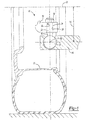
- Figure 1 is a fragmentary side view of a prior art wheel suspension assembly having a vertically oriented ball stud
- FIG. 2 is a fragmentary side view of a wheel suspension assembly constructed according to the principles of the present invention.
- FIG. 3 is a fragmentary side view depicting an alternate embodiment wheel suspension assembly
- Figure 1 depicts a portion of a prior art wheel suspension assembly 10 including a knuckle 12 and a control arm 14, Knuckle 12 is rotatably coupled to control arm 14 with a ball stud 16 and a nut 18.
- Ball stud 16 includes a tapered shank 20 and a ball 22.
- Tapered shank 20 includes an external surface 24 engaged with a surface 26 of a tapered aperture 28 formed in control arm 14. Due to the relatively small angle of the taper, small dimensional variations in the size of tapered shank 20 and/or the size of tapered aperture 28 result in a multiplied variation in the position of a center 30 of ball 22 relative to a centerline 32 of a wheel 33.
- a dimension 34 varies at a multiplied rate of 6 to 1. For example, a change in the size of tapered shank 20 of .010 inches results in a .060 inch variance in dimension 34. As discussed earlier, a positional variance of this magnitude is unacceptable in certain suspension applications.
- FIG. 2 depicts a wheel suspension assembly 50 constructed in accordance with the teachings of the present invention.
- Wheel suspension assembly 50 includes a knuckle 52 and a control arm 54 rotatably interconnected by a ball stud 56.
- Knuckle 52 is operable to rotatably support a wheel 57 for rotation about an axis 58.
- Axis 58 extends substantially parallel to a ground surface 60 over which a vehicle equipped with wheel suspension assembly 50 may travel.
- Knuckle 52 includes a tapered aperture 62 having a tapered wall surface 64.
- Ball stud 56 includes a substantially spherical ball 66 integrally formed with a tapered shank portion 68 and a threaded portion 70. Threaded portion 70 is formed at an end opposite ball 66. A nut 72 is in threaded engagement with threaded portion 70. Nut 72 reacts against a face 74 of knuckle 52 to draw tapered shank portion 68 into engagement with tapered wall 64 of aperture 62. Ball stud 56 includes a longitudinal axis 76 about which tapered shank portion 68 is formed.
- Control arm 54 includes a socket 78 in receipt of ball 66.
- Socket 78 is sized and shaped to retain ball 66 within the socket while allowing control arm 54 to rotate relative to knuckle 52.
- Axis 76 extends substantially parallel to axis 58 and ground surface 60. In this manner, geometrical variations in the size of tapered shank portion 68 and/or tapered aperture 62 do not vary a distance 80 measured from the wheel rotation axis 58 and the center of ball 66.
- a tool (not shown) is positioned distance 80 from axis 58 and translated along axis 76 to form tapered aperture 62. Accordingly, the centerline of aperture 62 is properly positioned distance 80 from axis 58. Therefore, variations in the size of aperture 62 or the size of tapered shank portion 68 will not vary the distance between the center of ball 66 and axis 58.
- FIG. 3 depicts an alternate embodiment wheel suspension assembly 100.
- Wheel suspension assembly 100 is substantially similar to wheel suspension assembly 50 except that a knuckle 102 includes a substantially spherical socket 104 and a control arm 106 includes a tapered aperture 108.
- Ball stud 56 rotatably interconnects knuckle 102 and control arm 106. Based on the horizontally aligned axis 76 of ball stud 56, wheel suspension assembly 100 provides substantially similar advantages over the prior art as wheel suspension assembly 50. Accordingly, like elements will retain their previously introduced reference numerals and wheel suspension assembly 100 will not be described in further detail.
Landscapes
- Engineering & Computer Science (AREA)
- Mechanical Engineering (AREA)
- Vehicle Body Suspensions (AREA)
- Pivots And Pivotal Connections (AREA)
Abstract
Description
- The present invention generally relates to a wheel suspension assembly for a vehicle and more particularly, to a wheel suspension assembly having a horizontally aligned ball joint assembly.
- A wheel suspension assembly for a vehicle typically includes a knuckle or a spindle that rotatably supports one of the front and/or rear wheels of the vehicle. A tie rod, control arm or other suspension member may be rotatably coupled to the knuckle with a ball stud. The ball stud has a shank portion with a tapered external surface at one end and a substantially spherically shaped ball at the other end. Typically, the ball stud is vertically oriented relative to the ground. Because the stud is retained using a taper fit, it is difficult to accurately locate the center of the ball at a desired distance from the horizontally extending axis about which the wheels rotate.
- The positioning problem exists because the taper is typically a small angle. As such, even a small dimensional change in stud diameter or tapered hole size results in a relatively large variation in the position of the center of the ball stud relative to the wheel axis of rotation. Some independent rear suspensions require very accurately positioned ball joints to maintain the desired vehicle handling characteristics.
- One solution to the present issue would be to reduce the tolerances on the tapered surfaces of the knuckle and the ball stud to position the ball within a desired tolerance. However, the cost of manufacturing such assemblies may be prohibitive. Accordingly, it is desirable to manufacture a wheel suspension assembly having an accurately positioned ball in an economically feasible manner.
- The present invention relates to a wheel suspension assembly for a vehicle operable to travel across a ground surface. The wheel suspension assembly includes a first suspension member, a second suspension member, a wheel rotatably coupled to the first suspension member and a ball stud interconnecting the first and second suspension members. The ball stud includes a ball and a tapered shaft. The tapered shaft extends along a longitudinal axis. One of the first and second suspension members includes a ball socket in receipt of the ball. The other of the first and second suspension members includes a tapered bore in the receipt of the tapered shaft. The longitudinal axis of the tapered shaft is oriented substantially parallel to the ground surface.
- Further areas of applicability of the present invention will become apparent from the detailed description provided hereinafter. It should be understood that the detailed description and specific examples, while indicating the preferred embodiment of the invention, are intended for purposes of illustration only and are not intended to limit the scope of the invention.
- The present invention will become more fully understood from the detailed description and the accompanying drawings, wherein:
- Figure 1 is a fragmentary side view of a prior art wheel suspension assembly having a vertically oriented ball stud;
- Figure 2 is a fragmentary side view of a wheel suspension assembly constructed according to the principles of the present invention; and
- Figure 3 is a fragmentary side view depicting an alternate embodiment wheel suspension assembly,
- The following description of the preferred embodiments is merely exemplary in nature and is in no way intended to limit the invention, its application, or uses.
- Figure 1 depicts a portion of a prior art
wheel suspension assembly 10 including aknuckle 12 and acontrol arm 14, Knuckle 12 is rotatably coupled tocontrol arm 14 with aball stud 16 and anut 18.Ball stud 16 includes atapered shank 20 and a ball 22. Taperedshank 20 includes anexternal surface 24 engaged with asurface 26 of atapered aperture 28 formed incontrol arm 14. Due to the relatively small angle of the taper, small dimensional variations in the size oftapered shank 20 and/or the size oftapered aperture 28 result in a multiplied variation in the position of a center 30 of ball 22 relative to acenterline 32 of awheel 33. Based on a standard taper of 4.8 degrees, adimension 34 varies at a multiplied rate of 6 to 1. For example, a change in the size oftapered shank 20 of .010 inches results in a .060 inch variance indimension 34. As discussed earlier, a positional variance of this magnitude is unacceptable in certain suspension applications. - Figure 2 depicts a
wheel suspension assembly 50 constructed in accordance with the teachings of the present invention.Wheel suspension assembly 50 includes aknuckle 52 and acontrol arm 54 rotatably interconnected by aball stud 56. Knuckle 52 is operable to rotatably support awheel 57 for rotation about anaxis 58. Axis 58 extends substantially parallel to aground surface 60 over which a vehicle equipped withwheel suspension assembly 50 may travel. Knuckle 52 includes atapered aperture 62 having atapered wall surface 64. -
Ball stud 56 includes a substantiallyspherical ball 66 integrally formed with atapered shank portion 68 and a threadedportion 70. Threadedportion 70 is formed at an end oppositeball 66. Anut 72 is in threaded engagement with threadedportion 70.Nut 72 reacts against aface 74 ofknuckle 52 to drawtapered shank portion 68 into engagement withtapered wall 64 ofaperture 62.Ball stud 56 includes alongitudinal axis 76 about whichtapered shank portion 68 is formed. -
Control arm 54 includes asocket 78 in receipt ofball 66.Socket 78 is sized and shaped to retainball 66 within the socket while allowingcontrol arm 54 to rotate relative toknuckle 52.Axis 76 extends substantially parallel toaxis 58 andground surface 60. In this manner, geometrical variations in the size oftapered shank portion 68 and/ortapered aperture 62 do not vary adistance 80 measured from thewheel rotation axis 58 and the center ofball 66. - During the manufacture of
knuckle 52, a tool (not shown) is positioneddistance 80 fromaxis 58 and translated alongaxis 76 to formtapered aperture 62. Accordingly, the centerline ofaperture 62 is properly positioneddistance 80 fromaxis 58. Therefore, variations in the size ofaperture 62 or the size oftapered shank portion 68 will not vary the distance between the center ofball 66 andaxis 58. - Figure 3 depicts an alternate embodiment
wheel suspension assembly 100.Wheel suspension assembly 100 is substantially similar towheel suspension assembly 50 except that aknuckle 102 includes a substantiallyspherical socket 104 and acontrol arm 106 includes atapered aperture 108.Ball stud 56 rotatably interconnectsknuckle 102 andcontrol arm 106. Based on the horizontally alignedaxis 76 ofball stud 56,wheel suspension assembly 100 provides substantially similar advantages over the prior art aswheel suspension assembly 50. Accordingly, like elements will retain their previously introduced reference numerals andwheel suspension assembly 100 will not be described in further detail. - Furthermore, the foregoing discussion discloses and describes merely exemplary embodiments of the present invention. One skilled in the art will readily recognize from such discussion, and from the accompanying drawings and claims, that various changes, modifications and variations may be made therein without department from the spirit and scope of the invention as defined in the following claims.
Claims (15)
- A wheel suspension assembly for a vehicle operable to travel across a ground surface, the wheel suspension assembly comprising:a first suspension member;a second suspension member;a wheel rotatably coupled to said first suspension member; anda ball stud interconnecting said first and second suspension members, said ball stud having a ball and a tapered shaft, said tapered shaft extending along a longitudinal axis; wherein one of said first and second suspension members includes a ball socket in receipt of said ball, the other of said first and second suspension members including a tapered bore in receipt of said tapered shaft, said longitudinal axis being oriented substantially parallel to the ground surface.
- The suspension assembly of claim 1 wherein said ball stud includes a threaded portion, said suspension assembly further including a nut engaging said threaded portion to fix said ball stud to one of said first and second suspension members.
- The suspension assembly of claim 2 wherein said longitudinal axis of said ball stud is offset from and extends substantially parallel to an axis of rotation of said wheel.
- The suspension assembly of claim 3 wherein said longitudinal axis of said ball stud is positioned closer to the ground than said axis of rotation of said wheel.
- A wheel suspension assembly for a vehicle operable to travel across a ground surface, the wheel suspension comprising:a control arm having a socket;a knuckle having a tapered aperture extending therethrough;a ball stud rotatably interconnecting said knuckle and said control arm, said ball stud including a substantially spherical ball portion and a tapered shank portion, said shank portion defining an axis, said ball portion being rotatably captured within said socket, said ball stud being fixed to said knuckle such that tapered shank portion is positioned within said tapered aperture and said axis of said shank portion extends substantially parallel to the ground at a predetermined distance from a datum located on said knuckle.
- The suspension assembly of claim 5 where said tapered shank engages a wall of said tapered aperture.
- The suspension assembly of claim 6 further including a nut threadingly engaging a threaded portion of said ball stud, said nut being operable to biasedly engage said wall of said tapered aperture with said tapered shank.
- The suspension assembly of claim 7 further including a wheel rotatably coupled to said knuckle.
- The suspension assembly of claim 8 wherein said wheel rotates about an axis extending substantially parallel to said axis of said shank portion.
- The suspension assembly of claim 9 wherein said shank portion axis is closer to the ground than said wheel axis.
- The suspension assembly of claim 5 wherein a change in size of said tapered shank does not change said predetermined distance.
- A method for assembling a wheel suspension having a first suspension member, a second suspension member and a ball stud, the ball stud having a ball portion and a shank portion, the tapered shank portion defining an axis, the method comprising:aligning the axis of the tapered shank portion substantially parallel to the ground;engaging the tapered shank portion with the first suspension member;mounting the ball stud to the first suspension member; androtatably coupling the ball portion to the second suspension member to rotatably interconnect the first and second suspension members.
- The method of claim 12 further including extending the tapered shank portion through a aperture formed in the first suspension member.
- The method of claim 13 further including fastening the ball stud to the first suspension member with a nut.
- The method of claim 14 further including positioning the axis of the tapered shank portion closer to the ground that an axis of a wheel rotatably coupled to one of the first and second suspension members.
Applications Claiming Priority (1)
| Application Number | Priority Date | Filing Date | Title |
|---|---|---|---|
| US11/029,960 US7234715B2 (en) | 2005-01-05 | 2005-01-05 | Horizontal ball joint assembly |
Publications (2)
| Publication Number | Publication Date |
|---|---|
| EP1679207A1 true EP1679207A1 (en) | 2006-07-12 |
| EP1679207B1 EP1679207B1 (en) | 2011-10-12 |
Family
ID=35998499
Family Applications (1)
| Application Number | Title | Priority Date | Filing Date |
|---|---|---|---|
| EP06100096A Expired - Lifetime EP1679207B1 (en) | 2005-01-05 | 2006-01-05 | Ball joint for suspension element of automotive vehicles |
Country Status (5)
| Country | Link |
|---|---|
| US (1) | US7234715B2 (en) |
| EP (1) | EP1679207B1 (en) |
| JP (1) | JP2006188227A (en) |
| KR (1) | KR20060080558A (en) |
| BR (1) | BRPI0600016A (en) |
Cited By (1)
| Publication number | Priority date | Publication date | Assignee | Title |
|---|---|---|---|---|
| EP2069152A4 (en) * | 2006-09-15 | 2011-11-09 | American Axle & Mfg Inc | BALL JOINT ASSEMBLY |
Families Citing this family (6)
| Publication number | Priority date | Publication date | Assignee | Title |
|---|---|---|---|---|
| US8052345B2 (en) * | 2005-04-07 | 2011-11-08 | Traxxas Lp | Ball joint for a model vehicle |
| DE102005035913A1 (en) * | 2005-07-28 | 2007-02-08 | Zf Friedrichshafen Ag | Motor vehicle chassis |
| USD822125S1 (en) | 2015-09-19 | 2018-07-03 | Traxxas, LP | Combined steering block and C-hub for a model vehicle |
| USD868171S1 (en) | 2017-01-27 | 2019-11-26 | Traxxas L.P. | Portable axle for a model vehicle |
| USD845398S1 (en) | 2017-01-27 | 2019-04-09 | Traxxas Lp | Portal for a model vehicle |
| USD1115950S1 (en) | 2024-02-20 | 2026-03-03 | Traxxas, L.P. | Model vehicle portal gear inner steering housing set |
Citations (2)
| Publication number | Priority date | Publication date | Assignee | Title |
|---|---|---|---|---|
| US3147025A (en) * | 1963-04-30 | 1964-09-01 | Ellis D Good | Front wheel vehicle suspension system |
| FR2760421A1 (en) * | 1997-03-10 | 1998-09-11 | Michel Raes | Method of adjusting vehicle wheel angle |
Family Cites Families (12)
| Publication number | Priority date | Publication date | Assignee | Title |
|---|---|---|---|---|
| US1641224A (en) * | 1926-08-07 | 1927-09-06 | Int Motor Co | Front-wheel construction |
| US2173973A (en) * | 1937-07-06 | 1939-09-26 | John W Leighton | Individual springing |
| US2285445A (en) * | 1939-10-02 | 1942-06-09 | Kost Inc | Motor vehicle steering stabilizer |
| BE717484A (en) * | 1967-07-25 | 1968-12-16 | ||
| US4722540A (en) | 1984-11-13 | 1988-02-02 | The Budd Company | Steering knuckle assembly |
| JPS6444259A (en) | 1987-08-10 | 1989-02-16 | Tokai Trw & Co | Production of ball joint |
| CA2153914C (en) | 1995-06-23 | 1999-11-30 | Mohawk Manufacturing & Supply, Inc. | Stabilizer link |
| US5954353A (en) | 1998-02-06 | 1999-09-21 | American Axle & Manufacturing, Inc. | Plug in direct acting stabilizer bar link |
| US6276702B1 (en) | 1999-08-09 | 2001-08-21 | Ford Global Technologies, Inc. | Wheel suspension assembly |
| US6508481B2 (en) | 2001-01-24 | 2003-01-21 | Delphi Technologies, Inc. | Outer tie rod assembly connector body |
| US6481731B2 (en) | 2001-03-21 | 2002-11-19 | Delphi Technologies, Inc. | Redundant outer tie rod assembly and method |
| DE10323262B4 (en) * | 2003-05-23 | 2006-05-04 | Daimlerchrysler Ag | Radführungsvorrichtung a steered vehicle wheel |
-
2005
- 2005-01-05 US US11/029,960 patent/US7234715B2/en not_active Expired - Lifetime
-
2006
- 2006-01-04 JP JP2006000169A patent/JP2006188227A/en active Pending
- 2006-01-05 KR KR1020060001497A patent/KR20060080558A/en not_active Withdrawn
- 2006-01-05 EP EP06100096A patent/EP1679207B1/en not_active Expired - Lifetime
- 2006-01-05 BR BRPI0600016-9A patent/BRPI0600016A/en active Search and Examination
Patent Citations (2)
| Publication number | Priority date | Publication date | Assignee | Title |
|---|---|---|---|---|
| US3147025A (en) * | 1963-04-30 | 1964-09-01 | Ellis D Good | Front wheel vehicle suspension system |
| FR2760421A1 (en) * | 1997-03-10 | 1998-09-11 | Michel Raes | Method of adjusting vehicle wheel angle |
Cited By (1)
| Publication number | Priority date | Publication date | Assignee | Title |
|---|---|---|---|---|
| EP2069152A4 (en) * | 2006-09-15 | 2011-11-09 | American Axle & Mfg Inc | BALL JOINT ASSEMBLY |
Also Published As
| Publication number | Publication date |
|---|---|
| US7234715B2 (en) | 2007-06-26 |
| BRPI0600016A (en) | 2006-09-19 |
| EP1679207B1 (en) | 2011-10-12 |
| US20060145445A1 (en) | 2006-07-06 |
| JP2006188227A (en) | 2006-07-20 |
| KR20060080558A (en) | 2006-07-10 |
Similar Documents
| Publication | Publication Date | Title |
|---|---|---|
| JPS63263114A (en) | Method and device for adjusting camber | |
| US20230219390A1 (en) | Control arm device and axle sleeve assembly of double a-arm suspension system | |
| US10850585B2 (en) | Strut-type suspension apparatus | |
| CN101415571A (en) | Suspension link with integral pivot assembly | |
| EP1679207B1 (en) | Ball joint for suspension element of automotive vehicles | |
| JPH03502312A (en) | Axle mounting structure | |
| WO2008033201A2 (en) | Ball joint assembly | |
| US6561715B2 (en) | Inner tie rod to relay rod fastening and adjustment system | |
| CN204955975U (en) | Swing arm and car | |
| CN112124425B (en) | Wheel caster angle adjusts structure, suspension and vehicle | |
| US11834118B2 (en) | Steering pin and knuckle assembly | |
| US6276702B1 (en) | Wheel suspension assembly | |
| JP2009196525A (en) | Vehicle suspension | |
| KR102016956B1 (en) | Cam Blot Assembly of Vehicle | |
| JP2012137139A (en) | Fastening structure of resin member | |
| CN213322543U (en) | Lower swing arm assembly | |
| CN1326738C (en) | Steering arm | |
| KR100290034B1 (en) | Combination structure of control arm for adjusting caster angle | |
| JP2010149626A (en) | Caster angle adjustment structure of suspension for vehicle | |
| US12195081B2 (en) | Steering sensor assembly | |
| JPH10299813A (en) | Variable damping force type hydraulic shock absorber | |
| KR0162563B1 (en) | Parallel link for tow adjustment | |
| KR100793881B1 (en) | Automotive Cam Bolt Unit | |
| JPS5939711Y2 (en) | Educational tools for automobile wheel suspension systems | |
| JPH08296617A (en) | Mounting structure for insertion member having tapered shaft |
Legal Events
| Date | Code | Title | Description |
|---|---|---|---|
| PUAI | Public reference made under article 153(3) epc to a published international application that has entered the european phase |
Free format text: ORIGINAL CODE: 0009012 |
|
| 17P | Request for examination filed |
Effective date: 20060505 |
|
| AK | Designated contracting states |
Kind code of ref document: A1 Designated state(s): AT BE BG CH CY CZ DE DK EE ES FI FR GB GR HU IE IS IT LI LT LU LV MC NL PL PT RO SE SI SK TR |
|
| AX | Request for extension of the european patent |
Extension state: AL BA HR MK YU |
|
| RIN1 | Information on inventor provided before grant (corrected) |
Inventor name: ADAMS, HERB Inventor name: DOWNS, JAMES P. |
|
| AKX | Designation fees paid |
Designated state(s): DE ES FR GB IT |
|
| GRAP | Despatch of communication of intention to grant a patent |
Free format text: ORIGINAL CODE: EPIDOSNIGR1 |
|
| GRAS | Grant fee paid |
Free format text: ORIGINAL CODE: EPIDOSNIGR3 |
|
| GRAA | (expected) grant |
Free format text: ORIGINAL CODE: 0009210 |
|
| AK | Designated contracting states |
Kind code of ref document: B1 Designated state(s): DE ES FR GB IT |
|
| REG | Reference to a national code |
Ref country code: GB Ref legal event code: FG4D |
|
| REG | Reference to a national code |
Ref country code: DE Ref legal event code: R096 Ref document number: 602006025012 Country of ref document: DE Effective date: 20111229 |
|
| PLBE | No opposition filed within time limit |
Free format text: ORIGINAL CODE: 0009261 |
|
| STAA | Information on the status of an ep patent application or granted ep patent |
Free format text: STATUS: NO OPPOSITION FILED WITHIN TIME LIMIT |
|
| PG25 | Lapsed in a contracting state [announced via postgrant information from national office to epo] |
Ref country code: IT Free format text: LAPSE BECAUSE OF FAILURE TO SUBMIT A TRANSLATION OF THE DESCRIPTION OR TO PAY THE FEE WITHIN THE PRESCRIBED TIME-LIMIT Effective date: 20111012 |
|
| 26N | No opposition filed |
Effective date: 20120713 |
|
| GBPC | Gb: european patent ceased through non-payment of renewal fee |
Effective date: 20120112 |
|
| REG | Reference to a national code |
Ref country code: FR Ref legal event code: ST Effective date: 20120928 |
|
| PG25 | Lapsed in a contracting state [announced via postgrant information from national office to epo] |
Ref country code: GB Free format text: LAPSE BECAUSE OF NON-PAYMENT OF DUE FEES Effective date: 20120112 |
|
| REG | Reference to a national code |
Ref country code: DE Ref legal event code: R097 Ref document number: 602006025012 Country of ref document: DE Effective date: 20120713 |
|
| PG25 | Lapsed in a contracting state [announced via postgrant information from national office to epo] |
Ref country code: FR Free format text: LAPSE BECAUSE OF NON-PAYMENT OF DUE FEES Effective date: 20120131 |
|
| PG25 | Lapsed in a contracting state [announced via postgrant information from national office to epo] |
Ref country code: ES Free format text: LAPSE BECAUSE OF FAILURE TO SUBMIT A TRANSLATION OF THE DESCRIPTION OR TO PAY THE FEE WITHIN THE PRESCRIBED TIME-LIMIT Effective date: 20120123 |
|
| REG | Reference to a national code |
Ref country code: DE Ref legal event code: R082 Ref document number: 602006025012 Country of ref document: DE Representative=s name: SCHAUMBURG UND PARTNER PATENTANWAELTE MBB, DE Ref country code: DE Ref legal event code: R082 Ref document number: 602006025012 Country of ref document: DE Representative=s name: SCHAUMBURG & PARTNER PATENTANWAELTE MBB, DE Ref country code: DE Ref legal event code: R082 Ref document number: 602006025012 Country of ref document: DE Representative=s name: SCHAUMBURG & PARTNER PATENTANWAELTE GBR, DE |
|
| PGFP | Annual fee paid to national office [announced via postgrant information from national office to epo] |
Ref country code: DE Payment date: 20200121 Year of fee payment: 15 |
|
| REG | Reference to a national code |
Ref country code: DE Ref legal event code: R119 Ref document number: 602006025012 Country of ref document: DE |
|
| PG25 | Lapsed in a contracting state [announced via postgrant information from national office to epo] |
Ref country code: DE Free format text: LAPSE BECAUSE OF NON-PAYMENT OF DUE FEES Effective date: 20210803 |