EP1678259B1 - Disperse azo dyestuffs - Google Patents
Disperse azo dyestuffs Download PDFInfo
- Publication number
- EP1678259B1 EP1678259B1 EP04790444.6A EP04790444A EP1678259B1 EP 1678259 B1 EP1678259 B1 EP 1678259B1 EP 04790444 A EP04790444 A EP 04790444A EP 1678259 B1 EP1678259 B1 EP 1678259B1
- Authority
- EP
- European Patent Office
- Prior art keywords
- formula
- alkyl
- hydrogen
- methyl
- ethyl
- Prior art date
- Legal status (The legal status is an assumption and is not a legal conclusion. Google has not performed a legal analysis and makes no representation as to the accuracy of the status listed.)
- Expired - Lifetime
Links
- 125000002496 methyl group Chemical group [H]C([H])([H])* 0.000 claims description 114
- 125000000449 nitro group Chemical group [O-][N+](*)=O 0.000 claims description 108
- 125000001495 ethyl group Chemical group [H]C([H])([H])C([H])([H])* 0.000 claims description 62
- 239000000203 mixture Substances 0.000 claims description 39
- 125000001997 phenyl group Chemical group [H]C1=C([H])C([H])=C(*)C([H])=C1[H] 0.000 claims description 37
- 239000000975 dye Substances 0.000 claims description 30
- 229910052739 hydrogen Inorganic materials 0.000 claims description 20
- 239000001257 hydrogen Substances 0.000 claims description 20
- 238000000034 method Methods 0.000 claims description 19
- 230000008878 coupling Effects 0.000 claims description 14
- 238000010168 coupling process Methods 0.000 claims description 14
- 238000005859 coupling reaction Methods 0.000 claims description 14
- 125000004093 cyano group Chemical group *C#N 0.000 claims description 14
- 239000000463 material Substances 0.000 claims description 14
- 229910052736 halogen Inorganic materials 0.000 claims description 12
- 150000002367 halogens Chemical class 0.000 claims description 12
- 125000004178 (C1-C4) alkyl group Chemical group 0.000 claims description 10
- 125000004169 (C1-C6) alkyl group Chemical group 0.000 claims description 10
- 125000001309 chloro group Chemical group Cl* 0.000 claims description 9
- 150000001875 compounds Chemical class 0.000 claims description 9
- UFHFLCQGNIYNRP-UHFFFAOYSA-N Hydrogen Chemical compound [H][H] UFHFLCQGNIYNRP-UHFFFAOYSA-N 0.000 claims description 8
- 150000001412 amines Chemical class 0.000 claims description 6
- -1 chloro, methoxy Chemical group 0.000 claims description 6
- 150000002431 hydrogen Chemical class 0.000 claims description 6
- 125000004435 hydrogen atom Chemical group [H]* 0.000 claims description 6
- 125000001797 benzyl group Chemical group [H]C1=C([H])C([H])=C(C([H])=C1[H])C([H])([H])* 0.000 claims description 5
- 238000004043 dyeing Methods 0.000 claims description 5
- 238000002360 preparation method Methods 0.000 claims description 5
- 239000000835 fiber Substances 0.000 claims description 4
- 125000000286 phenylethyl group Chemical group [H]C1=C([H])C([H])=C(C([H])=C1[H])C([H])([H])C([H])([H])* 0.000 claims description 4
- 125000001246 bromo group Chemical group Br* 0.000 claims description 3
- 125000001301 ethoxy group Chemical group [H]C([H])([H])C([H])([H])O* 0.000 claims description 2
- 229920002994 synthetic fiber Polymers 0.000 claims description 2
- 239000004758 synthetic textile Substances 0.000 claims description 2
- CSCPPACGZOOCGX-UHFFFAOYSA-N Acetone Chemical compound CC(C)=O CSCPPACGZOOCGX-UHFFFAOYSA-N 0.000 description 30
- 125000000484 butyl group Chemical group [H]C([*])([H])C([H])([H])C([H])([H])C([H])([H])[H] 0.000 description 30
- QTBSBXVTEAMEQO-UHFFFAOYSA-N Acetic acid Chemical compound CC(O)=O QTBSBXVTEAMEQO-UHFFFAOYSA-N 0.000 description 29
- XLYOFNOQVPJJNP-UHFFFAOYSA-N water Substances O XLYOFNOQVPJJNP-UHFFFAOYSA-N 0.000 description 21
- XBDQKXXYIPTUBI-UHFFFAOYSA-N Propionic acid Substances CCC(O)=O XBDQKXXYIPTUBI-UHFFFAOYSA-N 0.000 description 19
- 239000006185 dispersion Substances 0.000 description 17
- OKKJLVBELUTLKV-UHFFFAOYSA-N Methanol Chemical compound OC OKKJLVBELUTLKV-UHFFFAOYSA-N 0.000 description 15
- 0 Cc1nc*([N+]([O-])=O)[s]1 Chemical compound Cc1nc*([N+]([O-])=O)[s]1 0.000 description 14
- 125000001436 propyl group Chemical group [H]C([*])([H])C([H])([H])C([H])([H])[H] 0.000 description 14
- 229920000728 polyester Polymers 0.000 description 12
- VQTGUFBGYOIUFS-UHFFFAOYSA-N nitrosylsulfuric acid Chemical compound OS(=O)(=O)ON=O VQTGUFBGYOIUFS-UHFFFAOYSA-N 0.000 description 11
- 125000000664 diazo group Chemical group [N-]=[N+]=[*] 0.000 description 10
- 238000001914 filtration Methods 0.000 description 10
- 239000000047 product Substances 0.000 description 10
- 235000019260 propionic acid Nutrition 0.000 description 10
- IUVKMZGDUIUOCP-BTNSXGMBSA-N quinbolone Chemical compound O([C@H]1CC[C@H]2[C@H]3[C@@H]([C@]4(C=CC(=O)C=C4CC3)C)CC[C@@]21C)C1=CCCC1 IUVKMZGDUIUOCP-BTNSXGMBSA-N 0.000 description 10
- 238000003756 stirring Methods 0.000 description 10
- IIACRCGMVDHOTQ-UHFFFAOYSA-N sulfamic acid Chemical compound NS(O)(=O)=O IIACRCGMVDHOTQ-UHFFFAOYSA-N 0.000 description 10
- 125000000956 methoxy group Chemical group [H]C([H])([H])O* 0.000 description 7
- 239000002270 dispersing agent Substances 0.000 description 6
- MGCGMYPNXAFGFA-UHFFFAOYSA-N 2-amino-5-nitrobenzonitrile Chemical compound NC1=CC=C([N+]([O-])=O)C=C1C#N MGCGMYPNXAFGFA-UHFFFAOYSA-N 0.000 description 3
- LOCWBQIWHWIRGN-UHFFFAOYSA-N 2-chloro-4-nitroaniline Chemical compound NC1=CC=C([N+]([O-])=O)C=C1Cl LOCWBQIWHWIRGN-UHFFFAOYSA-N 0.000 description 3
- 239000003795 chemical substances by application Substances 0.000 description 3
- OMYHIMWOCFICOD-UHFFFAOYSA-N cyanomethyl 3-(3-methylanilino)propanoate Chemical compound CC1=CC=CC(NCCC(=O)OCC#N)=C1 OMYHIMWOCFICOD-UHFFFAOYSA-N 0.000 description 3
- BIXZHMJUSMUDOQ-UHFFFAOYSA-N dichloran Chemical compound NC1=C(Cl)C=C([N+]([O-])=O)C=C1Cl BIXZHMJUSMUDOQ-UHFFFAOYSA-N 0.000 description 3
- 238000009472 formulation Methods 0.000 description 3
- 239000007788 liquid Substances 0.000 description 3
- ZBNJWIHPWLJSRW-UHFFFAOYSA-N 1-cyanoethyl 3-[4-[(2-cyano-4-nitrophenyl)diazenyl]-n-ethyl-3-methylanilino]propanoate Chemical compound CC1=CC(N(CCC(=O)OC(C)C#N)CC)=CC=C1N=NC1=CC=C([N+]([O-])=O)C=C1C#N ZBNJWIHPWLJSRW-UHFFFAOYSA-N 0.000 description 2
- MIHADVKEHAFNPG-UHFFFAOYSA-N 2-Amino-5-nitrothiazole Chemical compound NC1=NC=C([N+]([O-])=O)S1 MIHADVKEHAFNPG-UHFFFAOYSA-N 0.000 description 2
- 229940018167 2-amino-5-nitrothiazole Drugs 0.000 description 2
- DZRZHFOFVWAKGT-UHFFFAOYSA-N 3,5-dinitrothiophen-2-amine Chemical compound NC=1SC([N+]([O-])=O)=CC=1[N+]([O-])=O DZRZHFOFVWAKGT-UHFFFAOYSA-N 0.000 description 2
- TYMLOMAKGOJONV-UHFFFAOYSA-N 4-nitroaniline Chemical compound NC1=CC=C([N+]([O-])=O)C=C1 TYMLOMAKGOJONV-UHFFFAOYSA-N 0.000 description 2
- JIASUGKVEFLKQN-UHFFFAOYSA-N 5-nitro-1,2-benzothiazol-7-amine Chemical compound NC1=CC([N+]([O-])=O)=CC2=C1SN=C2 JIASUGKVEFLKQN-UHFFFAOYSA-N 0.000 description 2
- GPNAVOJCQIEKQF-UHFFFAOYSA-N 6-nitro-1,3-benzothiazol-2-amine Chemical compound C1=C([N+]([O-])=O)C=C2SC(N)=NC2=C1 GPNAVOJCQIEKQF-UHFFFAOYSA-N 0.000 description 2
- PAYRUJLWNCNPSJ-UHFFFAOYSA-N Aniline Chemical compound NC1=CC=CC=C1 PAYRUJLWNCNPSJ-UHFFFAOYSA-N 0.000 description 2
- VEXZGXHMUGYJMC-UHFFFAOYSA-N Hydrochloric acid Chemical compound Cl VEXZGXHMUGYJMC-UHFFFAOYSA-N 0.000 description 2
- NBIIXXVUZAFLBC-UHFFFAOYSA-N Phosphoric acid Chemical compound OP(O)(O)=O NBIIXXVUZAFLBC-UHFFFAOYSA-N 0.000 description 2
- 125000000217 alkyl group Chemical group 0.000 description 2
- 125000000129 anionic group Chemical group 0.000 description 2
- KXFJKGRHIZXTGB-UHFFFAOYSA-N cyanomethyl 3-[3-acetamido-4-[(2-chloro-4-nitrophenyl)diazenyl]-n-ethylanilino]propanoate Chemical compound CC(=O)NC1=CC(N(CCC(=O)OCC#N)CC)=CC=C1N=NC1=CC=C([N+]([O-])=O)C=C1Cl KXFJKGRHIZXTGB-UHFFFAOYSA-N 0.000 description 2
- BVAOMPRGYOJQQW-UHFFFAOYSA-N cyanomethyl 3-[4-[(2,6-dichloro-4-nitrophenyl)diazenyl]-n-ethylanilino]propanoate Chemical compound C1=CC(N(CCC(=O)OCC#N)CC)=CC=C1N=NC1=C(Cl)C=C([N+]([O-])=O)C=C1Cl BVAOMPRGYOJQQW-UHFFFAOYSA-N 0.000 description 2
- UBJMDBBFBCVVTR-UHFFFAOYSA-N cyanomethyl 3-[4-[(2-chloro-4-nitrophenyl)diazenyl]-n-ethylanilino]-2-methylpropanoate Chemical compound C1=CC(N(CC(C)C(=O)OCC#N)CC)=CC=C1N=NC1=CC=C([N+]([O-])=O)C=C1Cl UBJMDBBFBCVVTR-UHFFFAOYSA-N 0.000 description 2
- PBGCYJMEPRDIGI-UHFFFAOYSA-N cyanomethyl 3-[n-butyl-4-[(5-nitro-1,3-thiazol-2-yl)diazenyl]anilino]propanoate Chemical compound C1=CC(N(CCC(=O)OCC#N)CCCC)=CC=C1N=NC1=NC=C([N+]([O-])=O)S1 PBGCYJMEPRDIGI-UHFFFAOYSA-N 0.000 description 2
- DAQOAXDNHMSIIE-UHFFFAOYSA-N cyanomethyl 3-[n-ethyl-3-methyl-4-[(4-nitrophenyl)diazenyl]anilino]propanoate Chemical compound CC1=CC(N(CCC(=O)OCC#N)CC)=CC=C1N=NC1=CC=C([N+]([O-])=O)C=C1 DAQOAXDNHMSIIE-UHFFFAOYSA-N 0.000 description 2
- AICYNTPPFIUMDM-UHFFFAOYSA-N cyanomethyl 3-[n-ethyl-3-methyl-4-[(5-nitro-1,2-benzothiazol-3-yl)diazenyl]anilino]propanoate Chemical compound CC1=CC(N(CCC(=O)OCC#N)CC)=CC=C1N=NC1=NSC2=CC=C([N+]([O-])=O)C=C12 AICYNTPPFIUMDM-UHFFFAOYSA-N 0.000 description 2
- UKYUHBAKUWIJFR-UHFFFAOYSA-N cyanomethyl 3-[n-ethyl-3-methyl-4-[(6-nitro-1,3-benzothiazol-2-yl)diazenyl]anilino]propanoate Chemical compound CC1=CC(N(CCC(=O)OCC#N)CC)=CC=C1N=NC1=NC2=CC=C([N+]([O-])=O)C=C2S1 UKYUHBAKUWIJFR-UHFFFAOYSA-N 0.000 description 2
- AQRTXYIAEJYIHA-UHFFFAOYSA-N cyanomethyl 5-[4-[(2-cyano-4-nitrophenyl)diazenyl]-n-ethyl-3-methylanilino]pentanoate Chemical compound CC1=CC(N(CCCCC(=O)OCC#N)CC)=CC=C1N=NC1=CC=C([N+]([O-])=O)C=C1C#N AQRTXYIAEJYIHA-UHFFFAOYSA-N 0.000 description 2
- 239000007800 oxidant agent Substances 0.000 description 2
- 239000002245 particle Substances 0.000 description 2
- 239000000843 powder Substances 0.000 description 2
- LPXPTNMVRIOKMN-UHFFFAOYSA-M sodium nitrite Chemical compound [Na+].[O-]N=O LPXPTNMVRIOKMN-UHFFFAOYSA-M 0.000 description 2
- FVNSRFMQXKMHTQ-UHFFFAOYSA-N (2-amino-1,3-benzothiazol-6-yl) thiocyanate Chemical compound C1=C(SC#N)C=C2SC(N)=NC2=C1 FVNSRFMQXKMHTQ-UHFFFAOYSA-N 0.000 description 1
- 125000000229 (C1-C4)alkoxy group Chemical group 0.000 description 1
- VOZSABVICTUWLY-UHFFFAOYSA-N 1-(2-amino-5-nitrothiophen-3-yl)ethanone Chemical compound CC(=O)C=1C=C([N+]([O-])=O)SC=1N VOZSABVICTUWLY-UHFFFAOYSA-N 0.000 description 1
- KKUUTBXPTHSGGY-UHFFFAOYSA-N 1-cyanoethyl 3-(3-methylanilino)propanoate Chemical compound N#CC(C)OC(=O)CCNC1=CC=CC(C)=C1 KKUUTBXPTHSGGY-UHFFFAOYSA-N 0.000 description 1
- LXQOQPGNCGEELI-UHFFFAOYSA-N 2,4-dinitroaniline Chemical compound NC1=CC=C([N+]([O-])=O)C=C1[N+]([O-])=O LXQOQPGNCGEELI-UHFFFAOYSA-N 0.000 description 1
- JBXZCPXEYAEMJS-UHFFFAOYSA-N 2,5-dichloro-4-nitroaniline Chemical compound NC1=CC(Cl)=C([N+]([O-])=O)C=C1Cl JBXZCPXEYAEMJS-UHFFFAOYSA-N 0.000 description 1
- YMZIFDLWYUSZCC-UHFFFAOYSA-N 2,6-dibromo-4-nitroaniline Chemical compound NC1=C(Br)C=C([N+]([O-])=O)C=C1Br YMZIFDLWYUSZCC-UHFFFAOYSA-N 0.000 description 1
- RIYSFSQPHCAGLS-UHFFFAOYSA-N 2-amino-3,5-dinitrobenzonitrile Chemical compound NC1=C(C#N)C=C([N+]([O-])=O)C=C1[N+]([O-])=O RIYSFSQPHCAGLS-UHFFFAOYSA-N 0.000 description 1
- MUHLVSZIVTURCZ-UHFFFAOYSA-N 2-amino-3-bromo-5-nitrobenzonitrile Chemical compound NC1=C(Br)C=C([N+]([O-])=O)C=C1C#N MUHLVSZIVTURCZ-UHFFFAOYSA-N 0.000 description 1
- XVYNBLCPQVDRCH-UHFFFAOYSA-N 2-amino-3-chloro-5-nitrobenzonitrile Chemical compound NC1=C(Cl)C=C([N+]([O-])=O)C=C1C#N XVYNBLCPQVDRCH-UHFFFAOYSA-N 0.000 description 1
- XIZSUYSWKGAOCN-UHFFFAOYSA-N 2-amino-4-chloro-5-formylthiophene-3-carbonitrile Chemical compound NC=1SC(C=O)=C(Cl)C=1C#N XIZSUYSWKGAOCN-UHFFFAOYSA-N 0.000 description 1
- ZBEGDHIBRPHOBV-UHFFFAOYSA-N 2-amino-5-nitrobenzene-1,3-dicarbonitrile Chemical compound NC1=C(C#N)C=C([N+]([O-])=O)C=C1C#N ZBEGDHIBRPHOBV-UHFFFAOYSA-N 0.000 description 1
- CFKZMYPOJOKAAD-UHFFFAOYSA-N 2-amino-5-nitrothiophene-3-carbonitrile Chemical compound NC=1SC([N+]([O-])=O)=CC=1C#N CFKZMYPOJOKAAD-UHFFFAOYSA-N 0.000 description 1
- KWMDHCLJYMVBNS-UHFFFAOYSA-N 2-bromo-4,6-dinitroaniline Chemical compound NC1=C(Br)C=C([N+]([O-])=O)C=C1[N+]([O-])=O KWMDHCLJYMVBNS-UHFFFAOYSA-N 0.000 description 1
- CGPPWNTVTNCHDO-UHFFFAOYSA-N 2-bromo-4-nitroaniline Chemical compound NC1=CC=C([N+]([O-])=O)C=C1Br CGPPWNTVTNCHDO-UHFFFAOYSA-N 0.000 description 1
- GLUCALKKMFBJEB-UHFFFAOYSA-N 2-bromo-6-chloro-4-nitroaniline Chemical compound NC1=C(Cl)C=C([N+]([O-])=O)C=C1Br GLUCALKKMFBJEB-UHFFFAOYSA-N 0.000 description 1
- LHRIICYSGQGXSX-UHFFFAOYSA-N 2-chloro-4,6-dinitroaniline Chemical compound NC1=C(Cl)C=C([N+]([O-])=O)C=C1[N+]([O-])=O LHRIICYSGQGXSX-UHFFFAOYSA-N 0.000 description 1
- DPJCXCZTLWNFOH-UHFFFAOYSA-N 2-nitroaniline Chemical compound NC1=CC=CC=C1[N+]([O-])=O DPJCXCZTLWNFOH-UHFFFAOYSA-N 0.000 description 1
- 125000000094 2-phenylethyl group Chemical group [H]C1=C([H])C([H])=C(C([H])=C1[H])C([H])([H])C([H])([H])* 0.000 description 1
- XJCVRTZCHMZPBD-UHFFFAOYSA-N 3-nitroaniline Chemical compound NC1=CC=CC([N+]([O-])=O)=C1 XJCVRTZCHMZPBD-UHFFFAOYSA-N 0.000 description 1
- PBGKNXWGYQPUJK-UHFFFAOYSA-N 4-chloro-2-nitroaniline Chemical compound NC1=CC=C(Cl)C=C1[N+]([O-])=O PBGKNXWGYQPUJK-UHFFFAOYSA-N 0.000 description 1
- GHKHTBMTSUEBJD-UHFFFAOYSA-N 5,6-dichloro-1,3-benzothiazol-2-amine Chemical compound ClC1=C(Cl)C=C2SC(N)=NC2=C1 GHKHTBMTSUEBJD-UHFFFAOYSA-N 0.000 description 1
- YKHFWFMWXBZUHK-UHFFFAOYSA-N 6,7-dichloro-1,3-benzothiazol-2-amine Chemical compound C1=C(Cl)C(Cl)=C2SC(N)=NC2=C1 YKHFWFMWXBZUHK-UHFFFAOYSA-N 0.000 description 1
- ZYHNHJAMVNINSY-UHFFFAOYSA-N 6-methylsulfonyl-1,3-benzothiazol-2-amine Chemical compound CS(=O)(=O)C1=CC=C2N=C(N)SC2=C1 ZYHNHJAMVNINSY-UHFFFAOYSA-N 0.000 description 1
- WKBOTKDWSSQWDR-UHFFFAOYSA-N Bromine atom Chemical compound [Br] WKBOTKDWSSQWDR-UHFFFAOYSA-N 0.000 description 1
- ZAMOUSCENKQFHK-UHFFFAOYSA-N Chlorine atom Chemical compound [Cl] ZAMOUSCENKQFHK-UHFFFAOYSA-N 0.000 description 1
- 229920000742 Cotton Polymers 0.000 description 1
- IAYPIBMASNFSPL-UHFFFAOYSA-N Ethylene oxide Chemical compound C1CO1 IAYPIBMASNFSPL-UHFFFAOYSA-N 0.000 description 1
- JTHKRIKCLXHQER-UHFFFAOYSA-N Nc(c(N=O)cc([N+]([O-])=O)c1)c1Br Chemical compound Nc(c(N=O)cc([N+]([O-])=O)c1)c1Br JTHKRIKCLXHQER-UHFFFAOYSA-N 0.000 description 1
- CBCKQZAAMUWICA-UHFFFAOYSA-N Nc(cc1)ccc1N Chemical compound Nc(cc1)ccc1N CBCKQZAAMUWICA-UHFFFAOYSA-N 0.000 description 1
- GOOHAUXETOMSMM-UHFFFAOYSA-N Propylene oxide Chemical compound CC1CO1 GOOHAUXETOMSMM-UHFFFAOYSA-N 0.000 description 1
- VMHLLURERBWHNL-UHFFFAOYSA-M Sodium acetate Chemical compound [Na+].CC([O-])=O VMHLLURERBWHNL-UHFFFAOYSA-M 0.000 description 1
- QAOWNCQODCNURD-UHFFFAOYSA-N Sulfuric acid Chemical compound OS(O)(=O)=O QAOWNCQODCNURD-UHFFFAOYSA-N 0.000 description 1
- 229960001413 acetanilide Drugs 0.000 description 1
- 230000002378 acidificating effect Effects 0.000 description 1
- 125000002877 alkyl aryl group Chemical group 0.000 description 1
- 125000002947 alkylene group Chemical group 0.000 description 1
- 229910000147 aluminium phosphate Inorganic materials 0.000 description 1
- GDTBXPJZTBHREO-UHFFFAOYSA-N bromine Substances BrBr GDTBXPJZTBHREO-UHFFFAOYSA-N 0.000 description 1
- 229910052794 bromium Inorganic materials 0.000 description 1
- 239000000969 carrier Substances 0.000 description 1
- 239000007795 chemical reaction product Substances 0.000 description 1
- 239000000460 chlorine Substances 0.000 description 1
- 229910052801 chlorine Inorganic materials 0.000 description 1
- 239000003086 colorant Substances 0.000 description 1
- BFQUKSFYKPEWQD-UHFFFAOYSA-N cyanomethyl 3-[4-[(3,5-dinitrothiophen-2-yl)diazenyl]-n-ethyl-3-methylanilino]propanoate Chemical compound CC1=CC(N(CCC(=O)OCC#N)CC)=CC=C1N=NC1=C([N+]([O-])=O)C=C([N+]([O-])=O)S1 BFQUKSFYKPEWQD-UHFFFAOYSA-N 0.000 description 1
- UCXCXTDPQHDYSO-UHFFFAOYSA-N cyanomethyl 5-(3-methylanilino)pentanoate Chemical compound CC1=CC=CC(NCCCCC(=O)OCC#N)=C1 UCXCXTDPQHDYSO-UHFFFAOYSA-N 0.000 description 1
- 235000014113 dietary fatty acids Nutrition 0.000 description 1
- 239000000986 disperse dye Substances 0.000 description 1
- 238000001035 drying Methods 0.000 description 1
- 239000000428 dust Substances 0.000 description 1
- 125000004185 ester group Chemical group 0.000 description 1
- UXDKVBJDZDRIKL-UHFFFAOYSA-N ethyl 2-amino-5-nitrothiophene-3-carboxylate Chemical compound CCOC(=O)C=1C=C([N+]([O-])=O)SC=1N UXDKVBJDZDRIKL-UHFFFAOYSA-N 0.000 description 1
- 239000000194 fatty acid Substances 0.000 description 1
- 229930195729 fatty acid Natural products 0.000 description 1
- 150000004665 fatty acids Chemical class 0.000 description 1
- 150000002191 fatty alcohols Chemical class 0.000 description 1
- 238000004108 freeze drying Methods 0.000 description 1
- 239000000417 fungicide Substances 0.000 description 1
- 125000004051 hexyl group Chemical group [H]C([H])([H])C([H])([H])C([H])([H])C([H])([H])C([H])([H])C([H])([H])* 0.000 description 1
- 125000002887 hydroxy group Chemical group [H]O* 0.000 description 1
- 125000001449 isopropyl group Chemical group [H]C([H])([H])C([H])(*)C([H])([H])[H] 0.000 description 1
- BLLFVUPNHCTMSV-UHFFFAOYSA-N methyl nitrite Chemical compound CON=O BLLFVUPNHCTMSV-UHFFFAOYSA-N 0.000 description 1
- 125000004108 n-butyl group Chemical group [H]C([H])([H])C([H])([H])C([H])([H])C([H])([H])* 0.000 description 1
- 125000004123 n-propyl group Chemical group [H]C([H])([H])C([H])([H])C([H])([H])* 0.000 description 1
- 125000001147 pentyl group Chemical group C(CCCC)* 0.000 description 1
- 150000002989 phenols Chemical class 0.000 description 1
- 229920000151 polyglycol Polymers 0.000 description 1
- 239000010695 polyglycol Substances 0.000 description 1
- 239000003755 preservative agent Substances 0.000 description 1
- 239000011541 reaction mixture Substances 0.000 description 1
- 238000004062 sedimentation Methods 0.000 description 1
- 238000010008 shearing Methods 0.000 description 1
- 239000001632 sodium acetate Substances 0.000 description 1
- 235000017281 sodium acetate Nutrition 0.000 description 1
- 235000010288 sodium nitrite Nutrition 0.000 description 1
- 238000001694 spray drying Methods 0.000 description 1
- 125000000547 substituted alkyl group Chemical group 0.000 description 1
- 239000001117 sulphuric acid Substances 0.000 description 1
- 235000011149 sulphuric acid Nutrition 0.000 description 1
- 239000004753 textile Substances 0.000 description 1
- 238000001291 vacuum drying Methods 0.000 description 1
- 239000000080 wetting agent Substances 0.000 description 1
Classifications
-
- C—CHEMISTRY; METALLURGY
- C09—DYES; PAINTS; POLISHES; NATURAL RESINS; ADHESIVES; COMPOSITIONS NOT OTHERWISE PROVIDED FOR; APPLICATIONS OF MATERIALS NOT OTHERWISE PROVIDED FOR
- C09B—ORGANIC DYES OR CLOSELY-RELATED COMPOUNDS FOR PRODUCING DYES, e.g. PIGMENTS; MORDANTS; LAKES
- C09B29/00—Monoazo dyes prepared by diazotising and coupling
- C09B29/0003—Monoazo dyes prepared by diazotising and coupling from diazotized anilines
-
- C—CHEMISTRY; METALLURGY
- C09—DYES; PAINTS; POLISHES; NATURAL RESINS; ADHESIVES; COMPOSITIONS NOT OTHERWISE PROVIDED FOR; APPLICATIONS OF MATERIALS NOT OTHERWISE PROVIDED FOR
- C09B—ORGANIC DYES OR CLOSELY-RELATED COMPOUNDS FOR PRODUCING DYES, e.g. PIGMENTS; MORDANTS; LAKES
- C09B29/00—Monoazo dyes prepared by diazotising and coupling
- C09B29/06—Monoazo dyes prepared by diazotising and coupling from coupling components containing amino as the only directing group
- C09B29/08—Amino benzenes
- C09B29/0805—Amino benzenes free of acid groups
- C09B29/0807—Amino benzenes free of acid groups characterised by the amino group
- C09B29/0809—Amino benzenes free of acid groups characterised by the amino group substituted amino group
- C09B29/0811—Amino benzenes free of acid groups characterised by the amino group substituted amino group further substituted alkylamino, alkenylamino, alkynylamino, cycloalkylamino aralkylamino or arylamino
- C09B29/0815—Amino benzenes free of acid groups characterised by the amino group substituted amino group further substituted alkylamino, alkenylamino, alkynylamino, cycloalkylamino aralkylamino or arylamino substituted by -C(=O)-
- C09B29/0816—Amino benzenes free of acid groups characterised by the amino group substituted amino group further substituted alkylamino, alkenylamino, alkynylamino, cycloalkylamino aralkylamino or arylamino substituted by -C(=O)- substituted by -COOR
-
- C—CHEMISTRY; METALLURGY
- C09—DYES; PAINTS; POLISHES; NATURAL RESINS; ADHESIVES; COMPOSITIONS NOT OTHERWISE PROVIDED FOR; APPLICATIONS OF MATERIALS NOT OTHERWISE PROVIDED FOR
- C09B—ORGANIC DYES OR CLOSELY-RELATED COMPOUNDS FOR PRODUCING DYES, e.g. PIGMENTS; MORDANTS; LAKES
- C09B29/00—Monoazo dyes prepared by diazotising and coupling
- C09B29/0025—Monoazo dyes prepared by diazotising and coupling from diazotized amino heterocyclic compounds
-
- C—CHEMISTRY; METALLURGY
- C09—DYES; PAINTS; POLISHES; NATURAL RESINS; ADHESIVES; COMPOSITIONS NOT OTHERWISE PROVIDED FOR; APPLICATIONS OF MATERIALS NOT OTHERWISE PROVIDED FOR
- C09B—ORGANIC DYES OR CLOSELY-RELATED COMPOUNDS FOR PRODUCING DYES, e.g. PIGMENTS; MORDANTS; LAKES
- C09B29/00—Monoazo dyes prepared by diazotising and coupling
- C09B29/06—Monoazo dyes prepared by diazotising and coupling from coupling components containing amino as the only directing group
- C09B29/08—Amino benzenes
-
- C—CHEMISTRY; METALLURGY
- C09—DYES; PAINTS; POLISHES; NATURAL RESINS; ADHESIVES; COMPOSITIONS NOT OTHERWISE PROVIDED FOR; APPLICATIONS OF MATERIALS NOT OTHERWISE PROVIDED FOR
- C09B—ORGANIC DYES OR CLOSELY-RELATED COMPOUNDS FOR PRODUCING DYES, e.g. PIGMENTS; MORDANTS; LAKES
- C09B31/00—Disazo and polyazo dyes of the type A->B->C, A->B->C->D, or the like, prepared by diazotising and coupling
- C09B31/02—Disazo dyes
- C09B31/04—Disazo dyes from a coupling component "C" containing a directive amino group
- C09B31/043—Amino-benzenes
-
- Y—GENERAL TAGGING OF NEW TECHNOLOGICAL DEVELOPMENTS; GENERAL TAGGING OF CROSS-SECTIONAL TECHNOLOGIES SPANNING OVER SEVERAL SECTIONS OF THE IPC; TECHNICAL SUBJECTS COVERED BY FORMER USPC CROSS-REFERENCE ART COLLECTIONS [XRACs] AND DIGESTS
- Y10—TECHNICAL SUBJECTS COVERED BY FORMER USPC
- Y10S—TECHNICAL SUBJECTS COVERED BY FORMER USPC CROSS-REFERENCE ART COLLECTIONS [XRACs] AND DIGESTS
- Y10S8/00—Bleaching and dyeing; fluid treatment and chemical modification of textiles and fibers
- Y10S8/92—Synthetic fiber dyeing
- Y10S8/922—Polyester fiber
Definitions
- the present invention relates to the field of disperse dyes.
- Disperse dyestuffs containing cyanomethyl ester groups are known from literature and are described for example in GB 909,843 , DE-A 2130992 , DE 2 811 167 , GB 1,457,532 , GB 1,536,429 , FR-A 1,531,147 , US 3,776,898 , JP 55161857 , GB 1 351 381 , GB 2,104,088 , GB 2 335 924 , EP 0 685 531 A1 , WO 95/20014 and WO 99/50357 .
- the inventor of the present invention has surprisingly found that dyeings on polyester with very good wet fastness properties can be obtained if selected dyestuffs containing one cyanomethylester group as defined below are used.
- the present invention claims dyestuffs of the formula (Ia), (Ib), (Ic), (Id), (Ie) or (If) wherein
- Alkyl groups standing for R 1 , R 6 or T 10 may be straight-chain or branched and are preferably methyl, ethyl, n-propyl, i-propyl or n-butyl. The same applies to alkyl groups standing for R 2 , which can in addition be pentyl or hexyl. Substituted alkyl groups standing for R 2 are preferably substituted by hydroxyl, (C 1 -C 4 )-alkoxy or halogen. Halogen standing for T 1 , T 2 , T 3 , T 4 , T 5 or T 8 are preferably chlorine or bromine.
- R 1 is methyl, R 2 is ethyl and n is O.
- R 2 is ethyl, benzyl or phenethyl.
- the compounds of the formula I may be obtained by usual methods for the preparation of azo compounds such as by diazotisation of an amine of the formula III D-NH 2 (III) wherein D is defined as given above, and coupling onto a compound of the formula IV wherein R 1 , R 2 , R 3 , R 4 , R 5 and R 7 are defined as given above.
- the amine of the formula (III) may be diazotised in an acidic medium, such as acetic, propionic or hydrochloric acid using a nitrosating agent such as nitrosylsulphuric acid, sodium nitrite or methylnitrite at a temperature from - 10°C to 10°C.
- Coupling onto the compound of the formula (IV) may be achieved by adding the diazotised amine to the compound of the formula (IV) under conditions described in literature and known to the skilled persons. After coupling the compound of the formula (I) may be recovered from the reaction mixture by any convenient means such as filtration.
- the compounds of the formulae (III) and (IV) are known and can be obtained by methods described in literature or known to the skilled person.
- the compounds of the formula (I) are useful for dyeing and printing of synthetic textile material particularly polyester textile materials and fibre blends thereof with for example cellulosic materials like cotton, to which they impart colours which have excellent wet fastness properties.
- Dyeing of the fibre goods mentioned with the dyestuffs of the formula (I) can be carried out in a manner known per se, preferably from aqueous dispersions, if appropriate in the presence of carriers, at between 80 and 110°C, by the exhaust process or by the HT process in a dyeing autoclave at 110 to 140°C, and by the so-called thermofixing process, in which the goods are padded with the dye liquor and then fixed at about 180 to 230°C.
- the fibre goods mentioned can as well be printed in a manner known pers e by a procedure in which the dyestuffs of the formula (I) are incorporated into a printing paste and the goods printed with the paste are treated , if appropriate in the presence of a carrier, with HT steam, pressurized steam or dry heat at temperatures between 180 and 230°C to fix the dyestuff.
- the dyestuffs of the formula (I) should be present in the finest possible dispersion in the dye liquors and printing pastes employed in the above applications.
- the fine dispersion of the dyestuffs is effected in a manner known per se by a procedure in which the dyestuff obtained during preparation is suspended ina liquid medium, preferably in water, together with dispersing agents and the mixture is exposed to the action of shearing forces, the particles originally present being comminuted mechanically to the extent that an optimum specific surface area is achieved and sedimentation of the dyestuff is as low as possible.
- the particle size of the dyestuffs is in general between 0.5 and 5 ⁇ m, preferably about 1 ⁇ m.
- the dispersing agents used can be nonionic or anionic.
- Nononic dispersing agents are, for example, reaction products of alkylene oxides, such as, for example, ethylene oxide or propylene oxide, with alkylatable compounds, such as for example fatty alcohols, fatty amines, fatty acids, phenols, alkylphenols and carboxylic acid amines.
- alkylatable compounds such as for example fatty alcohols, fatty amines, fatty acids, phenols, alkylphenols and carboxylic acid amines.
- Anionic dispersing agnets are, for example, ligninsulphonates, alkyl- or alkylarylsulphonates or alkylaryl polyglycol ethersulphates.
- the dyestuff formulations thus obtained should be pourable. The dyestuff and dispersing agent content is therefore limited in these cases.
- the dispersions are brought to a dyestuff content of up to 60 per cent by weight and a dispersing agent content of up to 25 per cent by weight.
- the dispersions can also comprise other auxiliaries, for example those which act as oxidizing agents or fungicidal agents. Such agents are well known in the art.
- the dyestuff dispersion thus obtained can be used very advantageously for the preparation of printing pastes and dye liquors.
- powder formulations are preferred. These powders comprise the dyestuff, dispersing agents and other auxiliaries, such as, for example, wetting agents, oxidizing agents, preservatives and dust removal agents.
- a preferred preparation process for pulverulent dyestuff formulations comprises removing the liquid from the liquid dyestuff dispersions described above, for example by vacuum drying, freeze drying, by drying on roller dryers, but preferably by spray drying.
- 2,6-dichloro-4-nitroaniline (6.2parts) was set stirring at 5°C with a mixture of acetic acid and propionic acid, 86:14 (40parts). Nitrosyl sulphuric acid 40% (11.4parts) was added below 5°C and the mixture was stirred for 30 minutes. The diazo solution was added gradually to a stirred coupling mixture of N-ethyl, N-2(cyanomethoxycarbonylethyl)-aniline (8.3parts), methanol (50parts), water (300parts) and sulphamic acid (1part).
- 2-amino-6-nitrobenzothiazole (3.9parts) was set stirring at 5°C with a mixture of acetic acid and propionic acid, 86:14 (40parts). Nitrosyl sulphuric acid 40% (7.6parts) was added below 5°C and the mixture was stirred for 1 hour. The diazo solution was added gradually to a stirred coupling mixture of N-ethyl, N-(2-cyanomethoxycarbonylethyl)-m-toluidine (5.9parts), methanol (25parts), water (200parts) and sulphamic acid (0.5parts).
- 2-amino-3,5-dinitrothiophene (3.1 parts) was set stirring at 5°C with a mixture of acetic acid and propionic acid, 86:14 (50parts). Nitrosyl sulphuric acid 40% (5.7parts) was added below 5°C and the mixture was stirred for 30 mins. The diazo solution was added gradually to a stirred coupling mixture of N-ethyl, N-(2-cyanomethoxycarbonyethyl)-m-toluidine (4.0parts), acetone (50parts), water (300parts) and sulphamic acid (0.5parts).
- the diazo solution was added gradually to a stirred coupling mixture of N-ethyl, N-(2-cyanomethoxycarbonylethyl)-m-toluidine (4.8parts), acetone (50parts), water (100parts) and sulphamic acid (0.5parts).
- Sodium acetate was added to increase the pH to 4.0 and the mixture was stirred for 1 hour.
- 2-amino-5-nitrothiazole (2.9parts) was was set stirring at 5°C with a mixture of acetic acid and propionic acid, 86:14 (50parts). Nitrosyl sulphuric acid 40% (7.0parts) was added below 5°C and the mixture was stirred for 30 mins. The diazo solution was added gradually to a stirred coupling mixture of N-butyl, N-2(cyanomethoxycarbonylethyl)-aniline (5.2parts, acetone (50parts), water (200parts) and sulphamic acid (0.5parts).
- 2-chloro-4-nitroaniline (3.5parts) was set stirring at 5°C with a mixture of acetic acid and propionic acid, 86:14 (40parts). Nitrosyl sulphuric acid 40% (7.0parts) was added below 5°C and the mixture was stirred for 30 minutes. The diazo solution was added gradually to a stirred coupling mixture of 3(N-ethyl, N-cyanomethoxycarbonylethyl)-amino-acetanilide (6.3parts), methanol (40parts), water (200parts) and sulphamic acid (1part).
- 2-cyano-4-nitroaniline (3.2parts) was set stirring at 5°C with a mixture of acetic acid and propionic acid, 86:14 (50parts). Nitrosyl sulphuric acid 40% (7.6parts) was added below 5°C and the mixture was stirred for 30 minutes. The diazo solution was added gradually to a stirred coupling mixture of N-ethyl, N-(4-cyanomethoxycarbonylbutyl)-m-toluidine (6.0parts), methanol (50parts), water (200parts) and sulphamic acid (1part).
- 2-cyano-4-nitroaniline (2.1 parts) was set stirring at 5°C with a mixture of acetic acid and propionic acid, 86:14 (40parts). Nitrosyl sulphuric acid 40% (4.9parts) was added below 5°C and the mixture was stirred for 30 minutes. The diazo solution was added gradually to a stirred coupling mixture of N-ethyl, N-(2-(1-cyanoethoxy)carbonylethyl)-m-toluidine (3.7pars), acetone (50parts), water (300parts) and sulphamic acid (1part).
- 2-chloro-4-nitroaniline (parts) was set stirring at 5°C with a mixture of acetic acid and propionic acid, 86:14 (40parts). Nitrosyl sulphuric acid 40% (4.9parts) was added below 5°C and the mixture was stirred for 30 minutes. The diazo solution was added gradually to a stirred coupling mixture of N-ethyl, N-2-(cyanomethoxycarbonylpropyl)-aniline (parts), acetone (50parts), water (300parts) and sulphamic acid (1part).
Landscapes
- Chemical & Material Sciences (AREA)
- Organic Chemistry (AREA)
- Coloring (AREA)
- Organic Low-Molecular-Weight Compounds And Preparation Thereof (AREA)
- Inks, Pencil-Leads, Or Crayons (AREA)
- Nitrogen And Oxygen Or Sulfur-Condensed Heterocyclic Ring Systems (AREA)
- Plural Heterocyclic Compounds (AREA)
- Compositions Of Macromolecular Compounds (AREA)
- Ink Jet (AREA)
- Thiazole And Isothizaole Compounds (AREA)
Description
- The present invention relates to the field of disperse dyes.
- Disperse dyestuffs containing cyanomethyl ester groups are known from literature and are described for example in
GB 909,843 DE-A 2130992 ,DE 2 811 167 ,GB 1,457,532 GB 1,536,429 FR-A 1,531,147 US 3,776,898 ,JP 55161857 GB 1 351 381 GB 2,104,088 GB 2 335 924 EP 0 685 531 A1 ,WO 95/20014 WO 99/50357 - The inventor of the present invention has surprisingly found that dyeings on polyester with very good wet fastness properties can be obtained if selected dyestuffs containing one cyanomethylester group as defined below are used.
- The present invention claims dyestuffs of the formula (Ia), (Ib), (Ic), (Id), (Ie) or (If)

- D is a group of the formula (IIa)

- T1, T2 and T3 are, independently, hydrogen, halogen or nitro;
- T4 is hydrogen, halogen, cyano or nitro;

- T5 is hydrogen or halogen; and
- T6 is hydrogen -SO2CH3, -SCN or nitro;


- T7 is nitro, -CHO or a group of the formula

- wherein T10 is -H, halogen, nitro and cyano;
- T8 is hydrogen or halogen; and
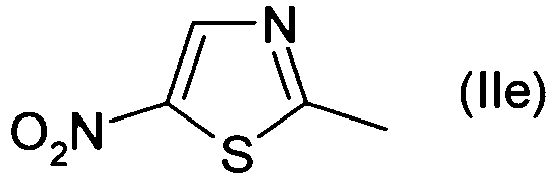
- T9 is nitro, cyano, -COCH3 or -COOT10, wherein T10 is (C1-C4)-alkyl; or a group of the formula (IIe)

- R1 is (C1-C4)-alkyl,
- R2 is unsubstituted (C1-C6)-alkyl, benzyl or phenylethyl; and
- n is 0, 1 or 2;
or
- T3 is bromo or chloro; and
- R2 is unsubstituted (C1-C6)-alkyl, substituted (C1-C6)-alkyl, benzyl or phenylethyl;
or
- D is a group of the formulae (IIa), (IIb), (IIc), (IId) or (IIe) as herinabove defined;
- R1 is hydrogen, (C1-C4)-alkyl or -NCOR6, where R6 is (C1-C4)-alkyl or phenyl;
- R2 is as hereinabove defined; and
- R3 is hydrogen and R4 is methyl or R3 is methyl and R4 is hydrogen
or

- D is a group of the formulae (IIa), (IIb), (IIc), (lid) or (IIe) as herein above defined;
- R1 is as hereinabove defined;
- R2 is as hereinabove defined; and
- R5 is methyl or phenyl;
or

- D is a group of the formulae (IIa), (IIb), (IIc), (lid) or (IIe) as hereinabove defined;
- R2 is as defined above;
- R6 is (C1-C4)-alkyl or phenyl;
- R7 is chloro, methoxy or ethoxy; and
- n is 0, 1 or 2
or

- R2 is as herein above defined;
- R8 is nitro; and
- n is 0, 1 or 2
- with the proviso that
- R2 is unsubstituted (C1-C6)-alkyl if R1 is methyl and n = 0.
- Alkyl groups standing for R1, R6 or T10 may be straight-chain or branched and are preferably methyl, ethyl, n-propyl, i-propyl or n-butyl. The same applies to alkyl groups standing for R2, which can in addition be pentyl or hexyl. Substituted alkyl groups standing for R2 are preferably substituted by hydroxyl, (C1-C4)-alkoxy or halogen.
Halogen standing for T1, T2, T3, T4, T5 or T8 are preferably chlorine or bromine. - Preferred examples for D derive from the following amines:
- 2-nitroaniline, 3-nitroaniline, 4-nitroaniline, 2-chloro-4-nitroaniline, 4-chloro-2-nitroaniline, 2-bromo-4-nitroaniline, 2,6-dichloro-4-nitroaniline, 2,6-dibromo-4-nitroaniline, 2-chloro-6-bromo-4-nitroaniline, 2,5-dichloro-4-nitroaniline, 2-cyano-4-nitroaniline, 2-cyano-6-bromo-4-nitroaniline, 2-cyano-6-chloro-4-nitroaniline, 2,4-dinitroaniline, 2-chloro-4,6-dinitroaniline, 2-bromo-4,6-dinitroaniline, 2,6-dicyano-4-nitroaniline, 2-cyano-4,6-dinitroaniline, 2-amino-5-nitrothiazole, 2-amino-3,5-dinitrothiophene, 2-amino-3-ethoxycarbonyl-5-nitrothiophene, 2-amino-3-acetyl-5-nitrothiophene, 2-amino-3-cyano-5-nitrothiophene, 2-amino-3-cyano-4-chloro-5-formylthiophene, 7-amino-5-nitrobenzoisothiazole, 2-amino-6-nitrobenzothiazole, 2-amino-6-methylsulphonylbenzothiazole; 2-amino-6-thiocyanatobenzothiazole, 2-amino-5,6-dichlorobenzothiazole and 2-amino-6,7-dichlorobenzothiazole (mixture).
- In especially preferred dyestuffs of formula (Ia) R1 is methyl, R2 is ethyl and n is O.
- In especially preferred dyestuffs of formula (Ib) R2 is ethyl, benzyl or phenethyl.
- The compounds of the formula I may be obtained by usual methods for the preparation of azo compounds such as by diazotisation of an amine of the formula III
D-NH2 (III)
wherein D is defined as given above,
and coupling onto a compound of the formula IV
- Typically the amine of the formula (III) may be diazotised in an acidic medium, such as acetic, propionic or hydrochloric acid using a nitrosating agent such as nitrosylsulphuric acid, sodium nitrite or methylnitrite at a temperature from - 10°C to 10°C. Coupling onto the compound of the formula (IV) may be achieved by adding the diazotised amine to the compound of the formula (IV) under conditions described in literature and known to the skilled persons.
After coupling the compound of the formula (I) may be recovered from the reaction mixture by any convenient means such as filtration.
The compounds of the formulae (III) and (IV) are known and can be obtained by methods described in literature or known to the skilled person. - The compounds of the formula (I) are useful for dyeing and printing of synthetic textile material particularly polyester textile materials and fibre blends thereof with for example cellulosic materials like cotton, to which they impart colours which have excellent wet fastness properties.
- Dyeing of the fibre goods mentioned with the dyestuffs of the formula (I) can be carried out in a manner known per se, preferably from aqueous dispersions, if appropriate in the presence of carriers, at between 80 and 110°C, by the exhaust process or by the HT process in a dyeing autoclave at 110 to 140°C, and by the so-called thermofixing process, in which the goods are padded with the dye liquor and then fixed at about 180 to 230°C.
The fibre goods mentioned can as well be printed in a manner known pers e by a procedure in which the dyestuffs of the formula (I) are incorporated into a printing paste and the goods printed with the paste are treated , if appropriate in the presence of a carrier, with HT steam, pressurized steam or dry heat at temperatures between 180 and 230°C to fix the dyestuff. - The dyestuffs of the formula (I) should be present in the finest possible dispersion in the dye liquors and printing pastes employed in the above applications.
The fine dispersion of the dyestuffs is effected in a manner known per se by a procedure in which the dyestuff obtained during preparation is suspended ina liquid medium, preferably in water, together with dispersing agents and the mixture is exposed to the action of shearing forces, the particles originally present being comminuted mechanically to the extent that an optimum specific surface area is achieved and sedimentation of the dyestuff is as low as possible. The particle size of the dyestuffs is in general between 0.5 and 5 µm, preferably about 1 µm.
The dispersing agents used can be nonionic or anionic. Nononic dispersing agents are, for example, reaction products of alkylene oxides, such as, for example, ethylene oxide or propylene oxide, with alkylatable compounds, such as for example fatty alcohols, fatty amines, fatty acids, phenols, alkylphenols and carboxylic acid amines. Anionic dispersing agnets are, for example, ligninsulphonates, alkyl- or alkylarylsulphonates or alkylaryl polyglycol ethersulphates. For most methods of use, the dyestuff formulations thus obtained should be pourable. The dyestuff and dispersing agent content is therefore limited in these cases. In general, the dispersions are brought to a dyestuff content of up to 60 per cent by weight and a dispersing agent content of up to 25 per cent by weight. For economic reasons, the dyestuff contents usually do not fall below 15 per cent by weight.
The dispersions can also comprise other auxiliaries, for example those which act as oxidizing agents or fungicidal agents. Such agents are well known in the art. The dyestuff dispersion thus obtained can be used very advantageously for the preparation of printing pastes and dye liquors.
For certain fields of use, powder formulations are preferred. These powders comprise the dyestuff, dispersing agents and other auxiliaries, such as, for example, wetting agents, oxidizing agents, preservatives and dust removal agents.
A preferred preparation process for pulverulent dyestuff formulations comprises removing the liquid from the liquid dyestuff dispersions described above, for example by vacuum drying, freeze drying, by drying on roller dryers, but preferably by spray drying. -

- 4-nitroaniline (4.1 parts) was set stirring at 6°C with a mixture of acetic acid and propionic acid, 86:14 (50parts). Nitrosyl sulphuric acid 40% (11.4parts) was added below 5°C and the mixture was stirred for 30 minutes.
The diazo solution obtained was added gradually to a stirred coupling mixture of N-ethyl, N-(2-cyanomethoxycarbonylethyl)-m-toluidine (7.3parts), methanol (50parts), water (200parts) and sulphamic acid (1 part). After two hours the product was isolated by filtration, washed with cold water and dried to yield, 4-(4-nitrophenylazo)-3-methyl-N-ethyl-N-(2-cyanomethoxycarbonylethyl) aniline (6.5parts) λmax = 486nm (acetone)
When applied to polyester materials from aqueous dispersion, red shades with excellent wet and light fastness properties were seen. - The following examples of dyes of formula (Iaa):

Table 1 Example T11 T12 T13 T14 R8 λmax (nm) 2 -H -H -NO2 -H -C2H5 479 3 -H -NO2 -H -H -C2H5 468 4 -NO2 -H -Cl -H -C2H5 508 5 -Cl -H -NO2 -H -C2H5 501 6 -NO2 -H -Br -H -C2H5 507 7 -NO2 -H -Cl -Cl -C2H5 450 8 -NO2 - -H -Br -Br -C2H5 449 9 -NO2 -H -Cl -Br -C2H5 449 10 -NO2 -Cl -H -Cl -C2H5 518 11 -NO2 -H -CN -H -C2H5 534 12 -NO2 -H -CN -Br -C2H5 544 13 -NO2 -H -CN -Cl -C2H5 546 14 -NO2 -H -NO2 -H -C2H5 535 15 -NO2 -H -Br -NO2 -C2H5 542 16 -NO2 -H -Cl -NO2 -C2H5 544 17 -NO2 -H -CN -CN -C2H5 582 18 -NO2 -H -CN -NO2 -C2H5 590 19 -NO2 -H -H -H -C4H9 490 20 -NO2 -H -Cl -H -C4H9 513 21 -NO2 -H -Cl -Cl -C4H9 453 22 -NO2 -H -Cl -Br -C4H9 453 23 -NO2 -H -Br -Br -C4H9 452 24 -NO2 -H -CN -H -C4H9 539 25 -NO2 -H -NO2 -H -C4H9 540 26 -NO2 -H -CN -Br -C4H9 549 27 -NO2 -H -CN -Cl -C4H9 548 28 -NO2 -H -Br -NO2 -C4H9 548 29 -NO2 -H -Cl -NO2 -C4H9 549 30 -H -H -NO2 -H -C4H9 483 31 -NO2 -H -CN -CN -C4H9 586 32 -NO2 -H -H -H -CH2[C6H5] 479 33 -NO2 -H -NO2 -H -CH2[C6H5] 530 34 -H -H -NO2 -H -CH2[C6H5] 470 35 -H -NO2 -H -H -CH2[C6H5] 460 36 -NO2 -H -Cl -H -CH2[C6H5] 498 37 -NO2 -H -Cl -Cl -CH2[C6H5] 446 38 -NO2 -H -Br -Br -CH2[C6H5] 445 39 -NO2 -H -Br -Cl -CH2[C6H5] 444 40 -NO2 -H -CN -H -CH2[C6H5] 528 41 -NO2 -H -CN -Br -CH2[C6H5] 539 42 -NO2 -H -CN -Cl -CH2[C6H5] 539 43 -NO2 -H -Br -NO2 -CH2[C6H5] 538 44 -NO2 -H -Cl -NO2 -CH2[C6H5] 537 45 -NO2 -H -CN -NO2 -CH2[C6H5] 580 46 -NO2 -H -CN -CN -CH2[C6H5] 577 47 -NO2 -H -H -H -C3H7 487 48 -NO2 -H -Cl -H -C3H7 509 49 -NO2 -H -Cl -Cl -C3H7 452 50 -NO2 -H -Cl -Br -C3H7 451 51 -NO2 -H -Br -Br -C3H7 452 52 -NO2 -H -CN -H -C3H7 536 53 -NO2 -H -NO2 -H -C3H7 537 54 -NO2 -H -CN -Br -C3H7 546 55 -NO2 -H -CN -Cl -C3H7 548 56 -NO2 -H -Br -NO2 -C3H7 544 57 -NO2 -H -Cl -NO2 -C3H7 545 58 -H -H -NO2 -H -C3H7 480 59 -NO2 -H -CN -CN -C3H7 584 60 -NO2 -H -Cl -H -CH3 504 61 -NO2 -H -CN -H -CH3 529 62 -NO2 -H -Cl -CN -CH3 543 63 -NO2 -H -Br -CN -CH3 542 64 -NO2 -H -Br -NO2 -CH3 539 -

- 2,6-dichloro-4-nitroaniline (6.2parts) was set stirring at 5°C with a mixture of acetic acid and propionic acid, 86:14 (40parts). Nitrosyl sulphuric acid 40% (11.4parts) was added below 5°C and the mixture was stirred for 30 minutes. The diazo solution was added gradually to a stirred coupling mixture of N-ethyl, N-2(cyanomethoxycarbonylethyl)-aniline (8.3parts), methanol (50parts), water (300parts) and sulphamic acid (1part). After one hour the product was isolated by filtration, washed with cold water and dried to yield, 4-(2,6-dichloro-4-nitrophenylazo)-N-ethyl-N-(2-cyanomethoxycarbonylethyl) aniline (9.5parts) λmax = 432nm (acetone)
When applied to polyester materials from aqueous dispersion, yellow brown shades with excellent wet and light fastness properties were seen. - The following examples of dyes of Formula (Iba)

Table 2 Example T15 T16 R9 λmax (nm) 66 -Cl -Cl -C3H7 433 67 -Cl -Cl -C4H9 434 68 -Cl -Cl -CH2[C6H5] 420 69 -Cl -Cl -CH3 425 70 -Cl -Br -C2H5 430 71 -Cl -Br -C3H7 431 72 -Cl -Br -C4H9 433 73 -Cl -Br -CH2[C6H5] 420 74 -Cl -Br -CH3 424 75 -Br -Br -C2H5 430 76 -Br -Br -C3H7 432 77 -Br -Br -C4H9 431 78 -Br -Br -CH2[C6H5] 421 79 -Br -Br -CH3 424 -

- 2-amino-6-nitrobenzothiazole (3.9parts) was set stirring at 5°C with a mixture of acetic acid and propionic acid, 86:14 (40parts). Nitrosyl sulphuric acid 40% (7.6parts) was added below 5°C and the mixture was stirred for 1 hour.
The diazo solution was added gradually to a stirred coupling mixture of N-ethyl, N-(2-cyanomethoxycarbonylethyl)-m-toluidine (5.9parts), methanol (25parts), water (200parts) and sulphamic acid (0.5parts). After one hour the product was isolated by fiiltration, washed with cold water and dried to yield, 4-(6-nitrobenzothiazol-yl-azo)-3-methyl-N-ethyl-N-(2-cyanomethoxycarbonyl ethyl) aniline (2.4parts) λmax = 545nm (acetone)
When applied to polyester materials from aqueous dispersion, rubine shades with excellent wet and light fastness properties were seen. - The following examples of dyes of Formula (lab):

Table 3 Example T17 T18 R10 R11 λmax nm 81 -SO2CH3 -H -CH3 -CH3 527 82 -NO2 -H -CH3 -CH3 543 83 -NO2 -H -CH3 -C3H7 545 84 -NO2 -H -CH3 -C4H9 548 85 -NO2 -H -CH3 -CH2[C6H5] 538 86 -SO2CH3 -H -CH3 -C3H7 531 87 -SO2CH3 -H -CH3 -C4H9 533 88 -SO2CH3 -H -CH3 -CH2[C6H5] 525 89 -SCN -H -CH3 -C2H5 534 90 -SCN -H -CH3 -CH3 530 91 -SCN -H -CH3 -C3H7 535 92 -SCN -H -CH3 -C4H9 537 93 -SCN -H -CH3 -CH2[C6H5] 529 94 -NO2 -H -H -C4H9 535 95 -NO2 -H -H -CH2[C6H5] 525 96 -SCN -H -H -C4H9 523 97 -SCN -H -H -CH2[C6H5] 516 98 -SO2CH3 -H -H -C4H9 521 99 -SO2CH3 -H -H -CH2[C6H5] 512 -

- 2-amino-3,5-dinitrothiophene (3.1 parts) was set stirring at 5°C with a mixture of acetic acid and propionic acid, 86:14 (50parts). Nitrosyl sulphuric acid 40% (5.7parts) was added below 5°C and the mixture was stirred for 30 mins. The diazo solution was added gradually to a stirred coupling mixture of N-ethyl, N-(2-cyanomethoxycarbonyethyl)-m-toluidine (4.0parts), acetone (50parts), water (300parts) and sulphamic acid (0.5parts). After one hour the product was isolated by filtration, washed with cold water and dried to yield, 4-(3,5-dinitrothiaphen-yl-azo)-3-methyl-N-ethyl-N-(2-cyanomethoxycarbonyl- ethyl) aniline (3.0parts) λmax = 640nm (acetone)
When applied to polyester materials from aqueous dispersion, blue shades with excellent wet and light fastness properties were seen. - The following examples of dyes of Formula (Iac):
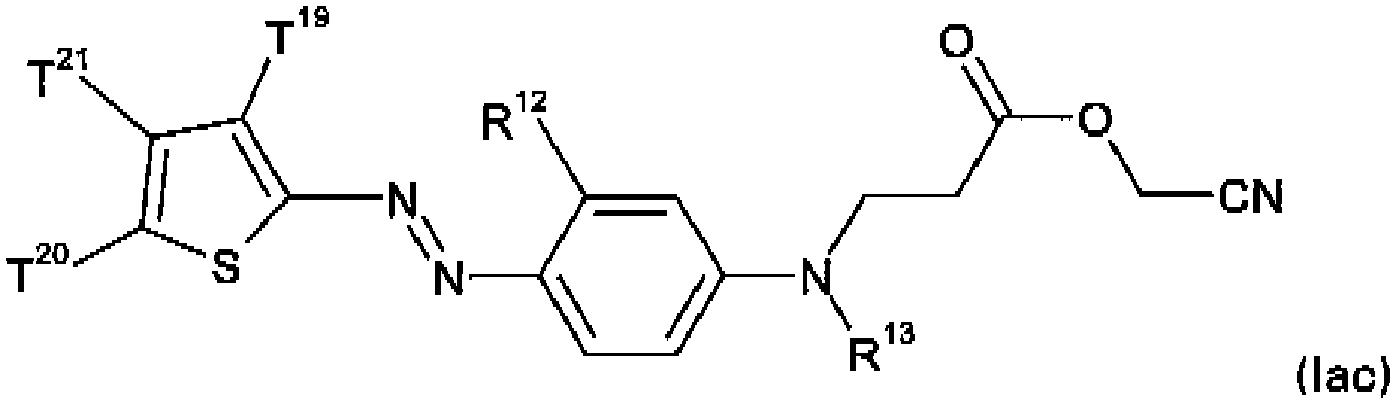
Table 4 Example T19 T20 T21 R12 R13 λmax (nm) 101 -NO2 -NO2 -H -H -C2H5 620 102 -NO2 -NO2 -H -H -C4H9 625 103 -NO2 -NO2 -H -H -C3H7 622 104 -NO2 -NO2 -H -H -CH2[C6H5] 611 105 -NO2 -NO2 -H -CH3 -C4H9 645 106 -NO2 -NO2 -H -CH3 -C3H7 640 107 -NO2 -NO2 -H -CH3 -CH2[C6H5] 632 108 -COOC2H5 -NO2 -H -CH3 -C2H5 595 109 -COOC2H6 -NO2 -H -H -C4H9 583 110 -COCH3 -NO2 -H -CH3 -C2H5 599 111 -COCH3 -NO2 -H -CH3 -C4H9 603 112 -COCH3 -NO2 -H -H -C4H9 585 113 -CN -NO2 -H -CH3 -C2H5 604 114 -CN -NO2 -H -CH3 -CH2[C6H5] 595 115 -CN -CHO -Cl -CH3 -C2H5 585 116 -CN -CHO -Cl -CH3 -C4H9 591 117 -CN -CHO -Cl -H -C4H9 679 118 -COOC2H5 -NO2 -H -H -CH2[C6H5] 565 119 -COOC2H5 -NO2 -H -CH3 -C4H9 601 - Example 120
-

- 7-amino-5-nitrobenzoisothiazole (2.9parts) was added to a mixture of sulphuric acid 98% (15parts) and phosphoric acid (4parts) stirring at room temperature. The mixture was heated to 55°C and was stirred at that temperature for 30mins. Nitrosyl sulphuric acid 40% (6.1 parts) was added below 5°C and the mixture was stirred for 2hrs.
- The diazo solution was added gradually to a stirred coupling mixture of N-ethyl, N-(2-cyanomethoxycarbonylethyl)-m-toluidine (4.8parts), acetone (50parts), water (100parts) and sulphamic acid (0.5parts). Sodium acetate was added to increase the pH to 4.0 and the mixture was stirred for 1 hour. The product was isolated by filtration, washed with cold water and dried to yield, 4-(5-nitrobenzisothiazol-yl-azo)-3-methyl-N-ethyl-N-(2-cyanomethoxycarbonylethyl) aniline (2.4parts) λmax = 601 nm (acetone)
- When applied to polyester materials from aqueous dispersion, blue shades with excellent wet and light fastness properties were seen.
- The following examples of dyes of Formula (lad)

Table 5 Example R14 R15 λmax (nm) 121 -H -C2H5 588 122 -H -CH2[C6H5] 578 123 -H -C4H9 589 124 -CH3 -C3H7 603 125 -CH3 -CH2[C6H5] 593 126 -CH3 -C4H9 608 -

- 2-amino-5-nitrothiazole (2.9parts) was was set stirring at 5°C with a mixture of acetic acid and propionic acid, 86:14 (50parts). Nitrosyl sulphuric acid 40% (7.0parts) was added below 5°C and the mixture was stirred for 30 mins.
The diazo solution was added gradually to a stirred coupling mixture of N-butyl, N-2(cyanomethoxycarbonylethyl)-aniline (5.2parts, acetone (50parts), water (200parts) and sulphamic acid (0.5parts). After one hour the product was isolated by filtration, washed with cold water and dried to yield, 4-(5-nitrothiazol-yl-azo)-N-butyl-N-(2-cyanomethoxycarbonylethyl) aniline (2.9pars) λmax = 571nm (acetone)
When applied to polyester materials from aqueous dispersion, blue shades with excellent wet and light fastness properties were seen. - The following examples of dyes of Formula (lae)

Table 6 Example R16 R17 λmax (nm) 128 -CH3 -C2H5 575 129 -CH3 -C4H9 582 130 -CH3 -CH2[C6H5] 669 -
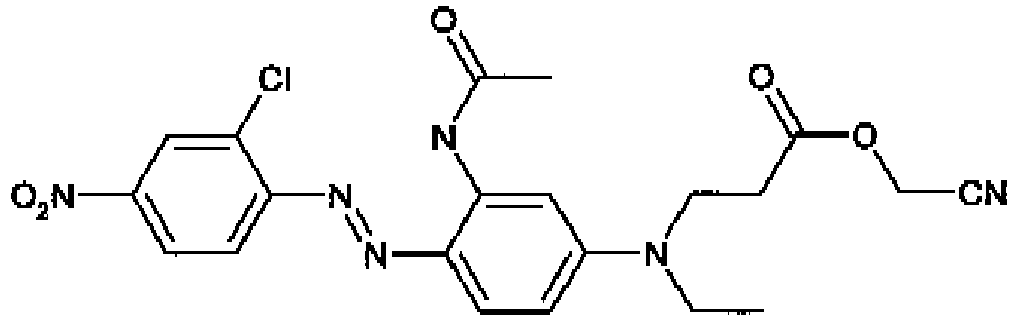
- 2-chloro-4-nitroaniline (3.5parts) was set stirring at 5°C with a mixture of acetic acid and propionic acid, 86:14 (40parts). Nitrosyl sulphuric acid 40% (7.0parts) was added below 5°C and the mixture was stirred for 30 minutes.
The diazo solution was added gradually to a stirred coupling mixture of 3(N-ethyl, N-cyanomethoxycarbonylethyl)-amino-acetanilide (6.3parts), methanol (40parts), water (200parts) and sulphamic acid (1part). After two hours the product was isolated by filtration, washed with cold water and dried to yield, 4-(2-chloro-4-nitrophenylazo)-3-acetylamino-N-ethyl-N-(2-cyanomethoxy-carbonylethyl)-aniline (4.1 parts) λmax = 525nm (acetone)
When applied to polyester materials from aqueous dispersion, rubine shades with excellent wet and light fastness properties were seen. - The following examples of dyes of formula (lea):

Table 7 Example D' R18 R19 R20 λmax (nm) 132 
-CH3 -H -C2H5 550 133 

-H -C2H6 553 134 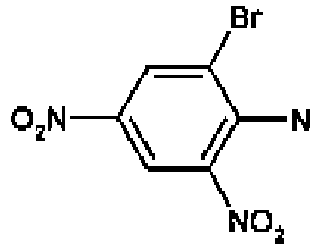
-CH3 -H -C4H9 552 135 
-C2H5 -H -C2H5 550 136 
-CH3 -OCH3 -C2H5 596 137 
-CH3 -OCH3 -C4H9 603 138 

-OCH3 -H 600 139 
-C2H5 -OCH3 -C2H5 596 140 
-CH3 -H -C4H9 551 141 
-CH3 -H -C2H5 574 142 
-C2H5 -H -C2H5 550 143 
-CH3 -H -C4H9 525 144 
-CH3 -OCH3 -C2H5 628 check 145 
-CH3 -H -C2H5 539 146 
-CH3 -OCH3 -C2H5 574 147 
-CH3 -H -C2H5 634 148 
-CH3 -OCH3 -C2H5 660 -

- 2-cyano-4-nitroaniline (3.2parts) was set stirring at 5°C with a mixture of acetic acid and propionic acid, 86:14 (50parts). Nitrosyl sulphuric acid 40% (7.6parts) was added below 5°C and the mixture was stirred for 30 minutes. The diazo solution was added gradually to a stirred coupling mixture of N-ethyl, N-(4-cyanomethoxycarbonylbutyl)-m-toluidine (6.0parts), methanol (50parts), water (200parts) and sulphamic acid (1part). After two hours the product was isolated by filtration, washed with cold water and dried to yield, 4-(2-cyano-4-nitrophenylazo)-3-methyl-N-ethyl-N-(4-cyanomethoxycarbonyl butyl)-aniline.
(5.3parts) λmax = 548nm (acetone) - When applied to polyester materials from aqueous dispersion, rubine shades with excellent wet and light fastness properties were seen.
- The following examples of dyes of Formula (Iaf)

Table 8 Example D" R21 R22 n λmax (nm) 150 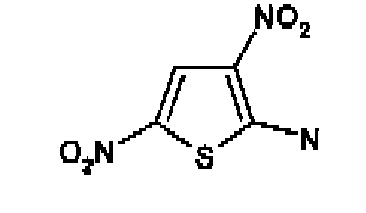
-CH3 -C2H5 4 649 151 
-CH3 -C2H6 3 642 152 
-CH3 -C2H5 4 561 153 
-CH3 -C2H5 3 556 154 
-CH3 -C3H7 3 558 155 
-CH3 -C2H5 4 548 156 
-CH3 -C2H5 3 536 -

- 2-cyano-4-nitroaniline (2.1 parts) was set stirring at 5°C with a mixture of acetic acid and propionic acid, 86:14 (40parts). Nitrosyl sulphuric acid 40% (4.9parts) was added below 5°C and the mixture was stirred for 30 minutes.
The diazo solution was added gradually to a stirred coupling mixture of N-ethyl, N-(2-(1-cyanoethoxy)carbonylethyl)-m-toluidine (3.7pars), acetone (50parts), water (300parts) and sulphamic acid (1part). After two hours the product was isolated by filtration, washed with cold water and dried to yield, 4-(2-cyano-4-nitrophenylazo)-3-methyl-N-ethyl-N-(2-(1-cyanoethoxy) carbonylethyl)-aniline (3.5parts) λmax = 534nm (acetone)
When applied to polyester materials from aqueous dispersion, rubine shades with excellent wet and light fastness properties were seen. - The following examples of dyes of Formula (Ida)

Table 9 Example D''' R23 R24 R26 λmax (nm) 158 
-CH3 -C2H5 
533 159 
-CH3 -C2H5 
544 160 
-CH3 -C2H5 
507 161 
-CH3 -C2H5 
446 162 
-CH3 -C2H5 
580 163 
-H -C2H5 
523 164 
-H -C2H5 
494 165 
-H -C2H5 -CH3 522 166 
-H -C2H5 -CH3 473 167 
-H -C4H9 -CH3 480 168 
-H -C2H5 -CH3 494 169 
-H -C2H5 -CH3 439 170 
-H -C4H9 -CH8 441 171 
-H -C2H6 -CH3 521 172 
-H -C2H5 -CH3 533 173 
-H -C2H5 -CH3 590 174 
-CH3 -C2H5 -CH3 449 175 
-CH3 -C2H5 -CH3 544 176 
-CH3 -C2H5 -CH3 581 177 
-CH3 -C2H5 -CH3 544 Example D''' R23 R24 R25 λmax (nm) 178 
-CH3 -C2H5 -CH3 533 179 
-CH3 -C2H5 -CH3 601 180 
-CH3 -C2H5 -CH3 506 181 
-H -C2H5 -CH3 640 -

- 2-chloro-4-nitroaniline (parts) was set stirring at 5°C with a mixture of acetic acid and propionic acid, 86:14 (40parts). Nitrosyl sulphuric acid 40% (4.9parts) was added below 5°C and the mixture was stirred for 30 minutes.
The diazo solution was added gradually to a stirred coupling mixture of N-ethyl, N-2-(cyanomethoxycarbonylpropyl)-aniline (parts), acetone (50parts), water (300parts) and sulphamic acid (1part). After two hours the product was isolated by filtration, washed with cold water and dried to yield, 4-(2-chloro-4-nitrophenylazo)-N-ethyl-N-(2-cyanomethoxycarbonylpropyl)-aniline (3.5pars) λmax = 534nm (acetone)
When applied to polyester materials from aqueous dispersion, red shades with excellent wet and light fastness properties were seen. - The following examples of dyes of Formula (Ica)

Table10 Example D'''' R26 R27 R28 λmax (nm) 183 
-H -H -CH3 521 184 
-H -H -CH3 473 185 
-H -H -CH3 440 186 
-H -H -CH3 521 187 
-H -H -CH3 569 188 
-CH3 -H -CH3 505 189 
-CH3 -H -CH3 448 190 
-CH3 -H -CH3 532 191 
-CH3 -H -CH3 541 192 
-CH3 -H -CH3 579 193 
-CH3 -H -CH3 525 194 
-CH3 -H -CH3 541 195 
-CH3 -H -CH3 599 196 
-H -H -CH3 588
Claims (6)
- Dyestuff of the formula (Ia), (Ib), (Ic), (Id), (Ie) or (If)
 D is a group of the formulae (IIa), (IIb), (IIc), (IId) or (IIe);
 T1, T2 and T3 are, independently, hydrogen, halogen or nitro;T4 is hydrogen, halogen, cyano or nitro;wherein at least one of T1, T2, T3 and T4 is not hydrogen;
 T5 is hydrogen or halogen; andT6 is hydrogen -SO2CH3, -SCN or nitro;wherein at least one of T5 and T6 is not hydrogen;
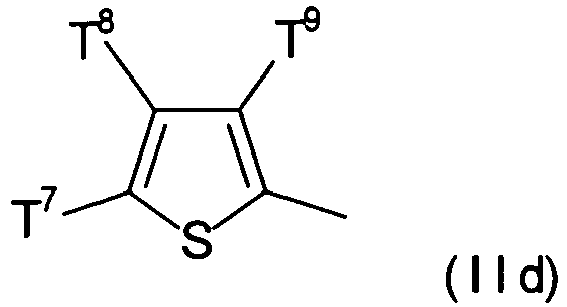 T7 is nitro, -CHO or a group of the formula
 T8 is hydrogen or halogen; andT9 is nitro, cyano, -COCH3 or -COOT10, wherein T10 is (C1-C4)-alkyl;
 R1 is (C1-C4)-alkyl;R2 is unsubstituted (C1-C6)-alkyl, benzyl or phenylethyl; andn is 0, 1 or 2; or
 T3' is bromo or chloro; andR2' is unsubstituted (C1-C6)-alkyl, substituted (C1-C6)-alkyl, benzyl or phenylethyl; or
 D is a group of the formulae (IIa), (IIb), (IIc), (IId) or (IIe) as herein above defined,R1 is hydrogen, (C1-C4)-alkyl or -NCOR6, where R6 is (C1-C4)-alkyl or phenyl;R2 is as herein above defined; andR3 is hydrogen and R4 is methyl or R3 is methyl and R4 is hydrogen; or
 D is a group of the formulae (IIa), (IIb), (IIc), (IId) or (IIe) as herein above defined,R1' is as herein above defined;R2' is as herein above defined; andR5 is methyl or phenyl; or
 D is a group of the formulae (IIa), (IIb), (IIc), (IId) or (IIe) as herein above defined,R2 is as defined above;R6 is (C1-C4)-alkyl or phenyl;R7 is chloro, methoxy or ethoxy; andn is 0, 1 or 2; or
 R2' is as herein above defined;R8 is nitro; andn is 0, 1 or 2,with the proviso that R2 is unsubstituted (C1-C6)-alkyl if R1 is methyl and n=0.
 - Dyestuff of the formula (Ia) according to claim 1, wherein R2 is unsubstituted (C1-C6)-alkyl.
- Dyestuff of the formula (Ia) according to claim 1, wherein R1 is methyl, R2 is ethyl and n=0.
- Dyestuff of the formula (Ie) according to claim 1, wherein R2" is unsubstituted (C1-C6)-alkyl.
- Process for the preparation of a dyestuff as claimed in one or more of claims 1 to 4, which comprises diazotisation of an amine of the formula III
D-NH2 (III)
wherein D is defined as given in the preceding claims, and coupling onto a compound of the formula IV
- The use of a dyestuff as claimed in one or more of claims 1 to 4 for dyeing and printing of synthetic textile material and fibre blends thereof.
Applications Claiming Priority (2)
| Application Number | Priority Date | Filing Date | Title |
|---|---|---|---|
| GBGB0324584.2A GB0324584D0 (en) | 2003-10-21 | 2003-10-21 | Disperse azo dyestuffs |
| PCT/EP2004/011590 WO2005040283A2 (en) | 2003-10-21 | 2004-10-15 | Disperse azo dyestuffs |
Publications (2)
| Publication Number | Publication Date |
|---|---|
| EP1678259A2 EP1678259A2 (en) | 2006-07-12 |
| EP1678259B1 true EP1678259B1 (en) | 2016-08-17 |
Family
ID=29595562
Family Applications (1)
| Application Number | Title | Priority Date | Filing Date |
|---|---|---|---|
| EP04790444.6A Expired - Lifetime EP1678259B1 (en) | 2003-10-21 | 2004-10-15 | Disperse azo dyestuffs |
Country Status (14)
| Country | Link |
|---|---|
| US (1) | US7358345B2 (en) |
| EP (1) | EP1678259B1 (en) |
| JP (1) | JP2007509214A (en) |
| KR (1) | KR101141572B1 (en) |
| CN (1) | CN100439450C (en) |
| BR (1) | BRPI0415469A (en) |
| CA (1) | CA2543056A1 (en) |
| ES (1) | ES2611945T3 (en) |
| GB (1) | GB0324584D0 (en) |
| MX (1) | MXPA06002919A (en) |
| PT (1) | PT1678259T (en) |
| RU (1) | RU2376334C2 (en) |
| TW (1) | TWI408176B (en) |
| WO (1) | WO2005040283A2 (en) |
Families Citing this family (12)
| Publication number | Priority date | Publication date | Assignee | Title |
|---|---|---|---|---|
| GB0604681D0 (en) | 2006-03-08 | 2006-04-19 | Dystar Textilfarben Gmbh & Co | Disperse Azo Dyestuffs |
| GB0625624D0 (en) | 2006-12-21 | 2007-01-31 | Dystar Textilfarben Gmbh & Co | Disperse dye mixtures |
| DE102007003372A1 (en) | 2007-01-23 | 2008-07-24 | Dystar Textilfarben Gmbh & Co. Deutschland Kg | Disperse dyes, their preparation and their use |
| US8506652B2 (en) * | 2009-12-23 | 2013-08-13 | Colourtex Industries Limited | Disperse dyes |
| EP2516727B1 (en) * | 2009-12-23 | 2018-05-09 | Colourtex Industries Limited | Disperse azo dyes |
| MX2013014021A (en) * | 2011-06-03 | 2014-01-23 | Procter & Gamble | Laundry care compositions containing dyes. |
| MX2015013169A (en) * | 2013-03-15 | 2015-12-15 | 3M Innovative Properties Co | Benzothiazol-2-ylazo-phenyl compound as dye, compositions including the dye, and method of determining degree of cure of such compositions. |
| CN103450707A (en) * | 2013-09-07 | 2013-12-18 | 张家港市杨舍丝印工艺厂 | Dye composition (black) and preparation method thereof |
| EP2995653A1 (en) | 2014-09-15 | 2016-03-16 | DyStar Colours Distribution GmbH | High wet-fast disperse dyes and mixtures thereof |
| WO2020002106A2 (en) | 2018-06-25 | 2020-01-02 | Basf Se | Red pigment composition for color filter |
| EP3715423B1 (en) | 2019-03-27 | 2022-05-11 | DyStar Colours Distribution GmbH | High wet fast disperse dye mixtures of n-[4-(5-fluoro-2,4-dinitro-phenylazo)-phenyl]-amine derivatives and n-[4-(4-nitro-phenylazo)-phenyl]-amine derivatives |
| EP3715424A1 (en) | 2019-03-27 | 2020-09-30 | DyStar Colours Distribution GmbH | High wet fast disperse dye mixtures of n-[4-(5-thiocyanato-2,4-dinitro-phenylazo)-phenyl]-amine derivatives and n-[4-(4-nitro-phenylazo)-phenyl]-amine derivatives |
Family Cites Families (20)
| Publication number | Priority date | Publication date | Assignee | Title |
|---|---|---|---|---|
| GB909843A (en) * | 1959-02-10 | 1962-11-07 | Ici Ltd | New monoazo dyestuffs containing ester groups |
| US3097198A (en) * | 1959-02-10 | 1963-07-09 | Ici Ltd | Azo dyestuffs |
| GB1176797A (en) * | 1966-07-15 | 1970-01-07 | Ici Ltd | Water-insoluble Monoazo Dyestuffs |
| FR1531147A (en) | 1966-07-15 | 1968-06-28 | Ici Ltd | Water-insoluble azo dyes and method of manufacturing said dyes |
| US3776898A (en) * | 1970-04-23 | 1973-12-04 | Gaf Corp | Azo dyestuffs containing as the terminal coupling component a pyrrolidonoaniline |
| CA921464A (en) * | 1970-06-22 | 1973-02-20 | Imperial Chemical Industries Limited | Monoazo dyestuffs |
| GB1321902A (en) | 1970-06-22 | 1973-07-04 | Ici Ltd | Monoazo dyestuffs |
| GB1351381A (en) | 1971-01-11 | 1974-04-24 | Ici Ltd | Disperse azo dyestuffs |
| US4119624A (en) * | 1972-06-08 | 1978-10-10 | Imperial Chemical Industries Limited | Disperse monoazo dyestuffs |
| GB1457532A (en) | 1973-09-26 | 1976-12-01 | Ici Ltd | Disperse monoazo dyestuffs |
| GB1536429A (en) | 1975-03-25 | 1978-12-20 | Ici Ltd | Disperse monoazo dyestuffs |
| GB2011483B (en) | 1977-12-29 | 1982-08-18 | Hoechst Ag | Process for preparing fast dyeings and prints on cellulosic fibre materials and mixtures thereof with synthetic fibres |
| DE2811167C2 (en) | 1978-03-15 | 1985-10-10 | Hoechst Ag, 6230 Frankfurt | Process for the production of real pad dyeings and prints on cellulose fiber materials and their mixtures with polyester fibers |
| JPS55161857A (en) | 1979-06-05 | 1980-12-16 | Nippon Kayaku Co Ltd | Water-insoluble azo compound, production thereof and dyeing and printing method using same |
| GB2104088B (en) | 1981-07-14 | 1985-06-26 | Yorkshire Chemicals Ltd | Blue monoazo disperse dyes |
| RU2068429C1 (en) * | 1993-04-09 | 1996-10-27 | Московское научно-производственное объединение "НИОПИК" | Process for preparing cyanogroups containing azo dyes |
| GB9400972D0 (en) | 1994-01-19 | 1994-03-16 | Zeneca Ltd | Process |
| DE4419622A1 (en) * | 1994-06-03 | 1995-12-07 | Cassella Ag | Monoazo dyes, their production and use |
| US6461416B1 (en) | 1998-03-31 | 2002-10-08 | Avecia Limited | 1,3,4,-thiadiazolylazo dyes and ink compositions containing the same |
| GB9806810D0 (en) | 1998-03-31 | 1998-05-27 | Zeneca Ltd | Compositions |
-
2003
- 2003-10-21 GB GBGB0324584.2A patent/GB0324584D0/en not_active Ceased
-
2004
- 2004-10-15 EP EP04790444.6A patent/EP1678259B1/en not_active Expired - Lifetime
- 2004-10-15 CN CNB2004800309950A patent/CN100439450C/en not_active Expired - Fee Related
- 2004-10-15 PT PT47904446T patent/PT1678259T/en unknown
- 2004-10-15 RU RU2006116739/04A patent/RU2376334C2/en not_active IP Right Cessation
- 2004-10-15 US US10/575,599 patent/US7358345B2/en not_active Expired - Lifetime
- 2004-10-15 CA CA002543056A patent/CA2543056A1/en not_active Abandoned
- 2004-10-15 BR BRPI0415469-0A patent/BRPI0415469A/en not_active Application Discontinuation
- 2004-10-15 ES ES04790444.6T patent/ES2611945T3/en not_active Expired - Lifetime
- 2004-10-15 JP JP2006536010A patent/JP2007509214A/en active Pending
- 2004-10-15 WO PCT/EP2004/011590 patent/WO2005040283A2/en not_active Ceased
- 2004-10-15 MX MXPA06002919A patent/MXPA06002919A/en active IP Right Grant
- 2004-10-15 KR KR1020067004769A patent/KR101141572B1/en not_active Expired - Fee Related
- 2004-10-19 TW TW093131672A patent/TWI408176B/en not_active IP Right Cessation
Also Published As
| Publication number | Publication date |
|---|---|
| WO2005040283A3 (en) | 2005-06-30 |
| US20070050928A1 (en) | 2007-03-08 |
| BRPI0415469A (en) | 2006-12-19 |
| EP1678259A2 (en) | 2006-07-12 |
| CN100439450C (en) | 2008-12-03 |
| HK1093351A1 (en) | 2007-03-02 |
| TW200523322A (en) | 2005-07-16 |
| PT1678259T (en) | 2016-11-21 |
| KR101141572B1 (en) | 2012-05-03 |
| RU2376334C2 (en) | 2009-12-20 |
| RU2006116739A (en) | 2007-11-27 |
| US7358345B2 (en) | 2008-04-15 |
| GB0324584D0 (en) | 2003-11-26 |
| TWI408176B (en) | 2013-09-11 |
| ES2611945T3 (en) | 2017-05-11 |
| MXPA06002919A (en) | 2006-05-31 |
| CN1871306A (en) | 2006-11-29 |
| CA2543056A1 (en) | 2005-05-06 |
| WO2005040283A2 (en) | 2005-05-06 |
| JP2007509214A (en) | 2007-04-12 |
| KR20060123719A (en) | 2006-12-04 |
Similar Documents
| Publication | Publication Date | Title |
|---|---|---|
| EP2084232B1 (en) | Disperse azo dyestuffs | |
| EP2167496B1 (en) | Azo dyes | |
| CN101896554A (en) | Azo dyes for dyeing and printing hydrophobic materials | |
| KR100840884B1 (en) | Phthalimidyl azo dyes and preparation method thereof | |
| CN100439450C (en) | Disperse Azo Dyes | |
| US20090123711A1 (en) | Disperse azo dyes and mixtures comprising these disperse azo dyes | |
| US7012137B2 (en) | Phthalimidyl azo dyes, process for the preparation thereof and the use thereof | |
| US7544217B2 (en) | Dye mixtures | |
| US7169909B2 (en) | Phthalimidylazo dyes, processess for the preparation thereof and the use thereof | |
| KR0172953B1 (en) | Azo dyes prepared using 2-alkylamino-3-cyano-4,6-diaminopyridine as coupling component | |
| US6540794B1 (en) | Azo dyes, a process for their preparation and their use in the dyeing or printing of hydrophobic fiber materials | |
| US5428138A (en) | Red 2,6-dicyanophenylazo dyes and the preparation and use thereof | |
| US20090209742A1 (en) | Disperse dyes, production and use | |
| EP2254950B1 (en) | 1,3-thiazolyl azo dyes, their preparation and use | |
| HK1093351B (en) | Disperse azo dyestuffs | |
| US20090064426A1 (en) | Disperse azo dyestuffs | |
| GB2024235A (en) | Water-insoluble azo dyestuffs, process for their manufacture and their use | |
| JPH04226164A (en) | Monoazo dye, and production and use thereof |
Legal Events
| Date | Code | Title | Description |
|---|---|---|---|
| PUAI | Public reference made under article 153(3) epc to a published international application that has entered the european phase |
Free format text: ORIGINAL CODE: 0009012 |
|
| 17P | Request for examination filed |
Effective date: 20060522 |
|
| AK | Designated contracting states |
Kind code of ref document: A2 Designated state(s): AT BE BG CH CY CZ DE DK EE ES FI FR GB GR HU IE IT LI LU MC NL PL PT RO SE SI SK TR |
|
| DAX | Request for extension of the european patent (deleted) | ||
| 19U | Interruption of proceedings before grant |
Effective date: 20091201 |
|
| 19W | Proceedings resumed before grant after interruption of proceedings |
Effective date: 20100901 |
|
| RAP1 | Party data changed (applicant data changed or rights of an application transferred) |
Owner name: DYSTAR COLOURS DEUTSCHLAND GMBH |
|
| 17Q | First examination report despatched |
Effective date: 20101025 |
|
| RAP1 | Party data changed (applicant data changed or rights of an application transferred) |
Owner name: DYSTAR COLOURS DISTRIBUTION GMBH |
|
| RAP1 | Party data changed (applicant data changed or rights of an application transferred) |
Owner name: DYSTAR COLOURS DISTRIBUTION GMBH |
|
| REG | Reference to a national code |
Ref country code: DE Ref legal event code: R079 Ref document number: 602004049791 Country of ref document: DE Free format text: PREVIOUS MAIN CLASS: C09B0029010000 Ipc: C09B0031043000 |
|
| RIC1 | Information provided on ipc code assigned before grant |
Ipc: C09B 29/08 20060101ALI20160309BHEP Ipc: C09B 31/043 20060101AFI20160309BHEP |
|
| GRAP | Despatch of communication of intention to grant a patent |
Free format text: ORIGINAL CODE: EPIDOSNIGR1 |
|
| INTG | Intention to grant announced |
Effective date: 20160415 |
|
| GRAS | Grant fee paid |
Free format text: ORIGINAL CODE: EPIDOSNIGR3 |
|
| GRAA | (expected) grant |
Free format text: ORIGINAL CODE: 0009210 |
|
| AK | Designated contracting states |
Kind code of ref document: B1 Designated state(s): AT BE BG CH CY CZ DE DK EE ES FI FR GB GR HU IE IT LI LU MC NL PL PT RO SE SI SK TR |
|
| REG | Reference to a national code |
Ref country code: GB Ref legal event code: FG4D |
|
| REG | Reference to a national code |
Ref country code: CH Ref legal event code: NV Representative=s name: FIAMMENGHI-FIAMMENGHI, CH Ref country code: CH Ref legal event code: EP |
|
| REG | Reference to a national code |
Ref country code: IE Ref legal event code: FG4D |
|
| REG | Reference to a national code |
Ref country code: AT Ref legal event code: REF Ref document number: 821082 Country of ref document: AT Kind code of ref document: T Effective date: 20160915 |
|
| REG | Reference to a national code |
Ref country code: DE Ref legal event code: R096 Ref document number: 602004049791 Country of ref document: DE |
|
| REG | Reference to a national code |
Ref country code: PT Ref legal event code: SC4A Ref document number: 1678259 Country of ref document: PT Date of ref document: 20161121 Kind code of ref document: T Free format text: AVAILABILITY OF NATIONAL TRANSLATION Effective date: 20161114 |
|
| REG | Reference to a national code |
Ref country code: NL Ref legal event code: MP Effective date: 20160817 |
|
| REG | Reference to a national code |
Ref country code: AT Ref legal event code: MK05 Ref document number: 821082 Country of ref document: AT Kind code of ref document: T Effective date: 20160817 |
|
| PG25 | Lapsed in a contracting state [announced via postgrant information from national office to epo] |
Ref country code: NL Free format text: LAPSE BECAUSE OF FAILURE TO SUBMIT A TRANSLATION OF THE DESCRIPTION OR TO PAY THE FEE WITHIN THE PRESCRIBED TIME-LIMIT Effective date: 20160817 Ref country code: FI Free format text: LAPSE BECAUSE OF FAILURE TO SUBMIT A TRANSLATION OF THE DESCRIPTION OR TO PAY THE FEE WITHIN THE PRESCRIBED TIME-LIMIT Effective date: 20160817 |
|
| PG25 | Lapsed in a contracting state [announced via postgrant information from national office to epo] |
Ref country code: AT Free format text: LAPSE BECAUSE OF FAILURE TO SUBMIT A TRANSLATION OF THE DESCRIPTION OR TO PAY THE FEE WITHIN THE PRESCRIBED TIME-LIMIT Effective date: 20160817 Ref country code: BE Free format text: LAPSE BECAUSE OF NON-PAYMENT OF DUE FEES Effective date: 20161031 Ref country code: GR Free format text: LAPSE BECAUSE OF FAILURE TO SUBMIT A TRANSLATION OF THE DESCRIPTION OR TO PAY THE FEE WITHIN THE PRESCRIBED TIME-LIMIT Effective date: 20161118 Ref country code: SE Free format text: LAPSE BECAUSE OF FAILURE TO SUBMIT A TRANSLATION OF THE DESCRIPTION OR TO PAY THE FEE WITHIN THE PRESCRIBED TIME-LIMIT Effective date: 20160817 Ref country code: PL Free format text: LAPSE BECAUSE OF FAILURE TO SUBMIT A TRANSLATION OF THE DESCRIPTION OR TO PAY THE FEE WITHIN THE PRESCRIBED TIME-LIMIT Effective date: 20160817 |
|
| PG25 | Lapsed in a contracting state [announced via postgrant information from national office to epo] |
Ref country code: EE Free format text: LAPSE BECAUSE OF FAILURE TO SUBMIT A TRANSLATION OF THE DESCRIPTION OR TO PAY THE FEE WITHIN THE PRESCRIBED TIME-LIMIT Effective date: 20160817 Ref country code: RO Free format text: LAPSE BECAUSE OF FAILURE TO SUBMIT A TRANSLATION OF THE DESCRIPTION OR TO PAY THE FEE WITHIN THE PRESCRIBED TIME-LIMIT Effective date: 20160817 |
|
| REG | Reference to a national code |
Ref country code: DE Ref legal event code: R119 Ref document number: 602004049791 Country of ref document: DE |
|
| REG | Reference to a national code |
Ref country code: DE Ref legal event code: R119 Ref document number: 602004049791 Country of ref document: DE |
|
| REG | Reference to a national code |
Ref country code: ES Ref legal event code: FG2A Ref document number: 2611945 Country of ref document: ES Kind code of ref document: T3 Effective date: 20170511 |
|
| REG | Reference to a national code |
Ref country code: DE Ref legal event code: R097 Ref document number: 602004049791 Country of ref document: DE |
|
| PG25 | Lapsed in a contracting state [announced via postgrant information from national office to epo] |
Ref country code: CZ Free format text: LAPSE BECAUSE OF FAILURE TO SUBMIT A TRANSLATION OF THE DESCRIPTION OR TO PAY THE FEE WITHIN THE PRESCRIBED TIME-LIMIT Effective date: 20160817 Ref country code: SK Free format text: LAPSE BECAUSE OF FAILURE TO SUBMIT A TRANSLATION OF THE DESCRIPTION OR TO PAY THE FEE WITHIN THE PRESCRIBED TIME-LIMIT Effective date: 20160817 Ref country code: BG Free format text: LAPSE BECAUSE OF FAILURE TO SUBMIT A TRANSLATION OF THE DESCRIPTION OR TO PAY THE FEE WITHIN THE PRESCRIBED TIME-LIMIT Effective date: 20161117 Ref country code: DK Free format text: LAPSE BECAUSE OF FAILURE TO SUBMIT A TRANSLATION OF THE DESCRIPTION OR TO PAY THE FEE WITHIN THE PRESCRIBED TIME-LIMIT Effective date: 20160817 |
|
| REG | Reference to a national code |
Ref country code: CH Ref legal event code: PL |
|
| PLBE | No opposition filed within time limit |
Free format text: ORIGINAL CODE: 0009261 |
|
| STAA | Information on the status of an ep patent application or granted ep patent |
Free format text: STATUS: NO OPPOSITION FILED WITHIN TIME LIMIT |
|
| REG | Reference to a national code |
Ref country code: DE Ref legal event code: R073 Ref document number: 602004049791 Country of ref document: DE |
|
| 26N | No opposition filed |
Effective date: 20170518 |
|
| GBPC | Gb: european patent ceased through non-payment of renewal fee |
Effective date: 20161117 |
|
| REG | Reference to a national code |
Ref country code: IE Ref legal event code: MM4A |
|
| REG | Reference to a national code |
Ref country code: FR Ref legal event code: ST Effective date: 20170630 |
|
| PG25 | Lapsed in a contracting state [announced via postgrant information from national office to epo] |
Ref country code: FR Free format text: LAPSE BECAUSE OF NON-PAYMENT OF DUE FEES Effective date: 20161102 Ref country code: LI Free format text: LAPSE BECAUSE OF NON-PAYMENT OF DUE FEES Effective date: 20161031 Ref country code: DE Free format text: LAPSE BECAUSE OF NON-PAYMENT OF DUE FEES Effective date: 20170510 Ref country code: CH Free format text: LAPSE BECAUSE OF NON-PAYMENT OF DUE FEES Effective date: 20161031 |
|
| PG25 | Lapsed in a contracting state [announced via postgrant information from national office to epo] |
Ref country code: SI Free format text: LAPSE BECAUSE OF FAILURE TO SUBMIT A TRANSLATION OF THE DESCRIPTION OR TO PAY THE FEE WITHIN THE PRESCRIBED TIME-LIMIT Effective date: 20160817 Ref country code: LU Free format text: LAPSE BECAUSE OF NON-PAYMENT OF DUE FEES Effective date: 20161015 |
|
| REG | Reference to a national code |
Ref country code: DE Ref legal event code: R074 Ref document number: 602004049791 Country of ref document: DE |
|
| PG25 | Lapsed in a contracting state [announced via postgrant information from national office to epo] |
Ref country code: DE Free format text: LAPSE BECAUSE OF NON-PAYMENT OF DUE FEES Effective date: 20170510 Ref country code: IT Free format text: LAPSE BECAUSE OF NON-PAYMENT OF DUE FEES Effective date: 20161015 |
|
| PGFP | Annual fee paid to national office [announced via postgrant information from national office to epo] |
Ref country code: DE Payment date: 20170504 Year of fee payment: 13 |
|
| PGRI | Patent reinstated in contracting state [announced from national office to epo] |
Ref country code: DE Effective date: 20170901 |
|
| PG25 | Lapsed in a contracting state [announced via postgrant information from national office to epo] |
Ref country code: IE Free format text: LAPSE BECAUSE OF NON-PAYMENT OF DUE FEES Effective date: 20161015 Ref country code: GB Free format text: LAPSE BECAUSE OF NON-PAYMENT OF DUE FEES Effective date: 20161117 |
|
| REG | Reference to a national code |
Ref country code: BE Ref legal event code: FP Effective date: 20161115 Ref country code: BE Ref legal event code: MM Effective date: 20161031 |
|
| REG | Reference to a national code |
Ref country code: DE Ref legal event code: R119 Ref document number: 602004049791 Country of ref document: DE |
|
| PG25 | Lapsed in a contracting state [announced via postgrant information from national office to epo] |
Ref country code: CY Free format text: LAPSE BECAUSE OF FAILURE TO SUBMIT A TRANSLATION OF THE DESCRIPTION OR TO PAY THE FEE WITHIN THE PRESCRIBED TIME-LIMIT Effective date: 20160817 Ref country code: HU Free format text: LAPSE BECAUSE OF FAILURE TO SUBMIT A TRANSLATION OF THE DESCRIPTION OR TO PAY THE FEE WITHIN THE PRESCRIBED TIME-LIMIT; INVALID AB INITIO Effective date: 20041015 |
|
| PG25 | Lapsed in a contracting state [announced via postgrant information from national office to epo] |
Ref country code: MC Free format text: LAPSE BECAUSE OF FAILURE TO SUBMIT A TRANSLATION OF THE DESCRIPTION OR TO PAY THE FEE WITHIN THE PRESCRIBED TIME-LIMIT Effective date: 20160817 |
|
| PG25 | Lapsed in a contracting state [announced via postgrant information from national office to epo] |
Ref country code: DE Free format text: LAPSE BECAUSE OF NON-PAYMENT OF DUE FEES Effective date: 20180501 |
|
| PGFP | Annual fee paid to national office [announced via postgrant information from national office to epo] |
Ref country code: TR Payment date: 20201005 Year of fee payment: 17 |
|
| PGFP | Annual fee paid to national office [announced via postgrant information from national office to epo] |
Ref country code: PT Payment date: 20201001 Year of fee payment: 17 Ref country code: ES Payment date: 20201126 Year of fee payment: 17 |
|
| PG25 | Lapsed in a contracting state [announced via postgrant information from national office to epo] |
Ref country code: TR Free format text: LAPSE BECAUSE OF NON-PAYMENT OF DUE FEES Effective date: 20211015 |
|
| PG25 | Lapsed in a contracting state [announced via postgrant information from national office to epo] |
Ref country code: PT Free format text: LAPSE BECAUSE OF NON-PAYMENT OF DUE FEES Effective date: 20220418 |
|
| REG | Reference to a national code |
Ref country code: ES Ref legal event code: FD2A Effective date: 20230203 |
|
| PG25 | Lapsed in a contracting state [announced via postgrant information from national office to epo] |
Ref country code: ES Free format text: LAPSE BECAUSE OF NON-PAYMENT OF DUE FEES Effective date: 20211016 |