EP1677445A1 - Improved blind SNR estimation - Google Patents
Improved blind SNR estimation Download PDFInfo
- Publication number
- EP1677445A1 EP1677445A1 EP04293155A EP04293155A EP1677445A1 EP 1677445 A1 EP1677445 A1 EP 1677445A1 EP 04293155 A EP04293155 A EP 04293155A EP 04293155 A EP04293155 A EP 04293155A EP 1677445 A1 EP1677445 A1 EP 1677445A1
- Authority
- EP
- European Patent Office
- Prior art keywords
- rda
- snr
- communication signal
- modulated communication
- estimated
- Prior art date
- Legal status (The legal status is an assumption and is not a legal conclusion. Google has not performed a legal analysis and makes no representation as to the accuracy of the status listed.)
- Granted
Links
- 238000000034 method Methods 0.000 claims abstract description 61
- 238000004891 communication Methods 0.000 claims abstract description 28
- 238000007476 Maximum Likelihood Methods 0.000 claims abstract description 19
- 238000006243 chemical reaction Methods 0.000 claims abstract description 10
- 238000012937 correction Methods 0.000 claims description 8
- 238000004590 computer program Methods 0.000 claims description 5
- 238000012360 testing method Methods 0.000 description 9
- 230000005540 biological transmission Effects 0.000 description 7
- 238000010586 diagram Methods 0.000 description 5
- 238000004422 calculation algorithm Methods 0.000 description 4
- 238000004364 calculation method Methods 0.000 description 4
- 238000011161 development Methods 0.000 description 4
- 230000003321 amplification Effects 0.000 description 2
- 230000008030 elimination Effects 0.000 description 2
- 238000003379 elimination reaction Methods 0.000 description 2
- 238000003199 nucleic acid amplification method Methods 0.000 description 2
- 230000010363 phase shift Effects 0.000 description 2
- 230000015556 catabolic process Effects 0.000 description 1
- 238000006731 degradation reaction Methods 0.000 description 1
- 238000001514 detection method Methods 0.000 description 1
- 239000013307 optical fiber Substances 0.000 description 1
- 238000012549 training Methods 0.000 description 1
Images


Classifications
-
- H—ELECTRICITY
- H04—ELECTRIC COMMUNICATION TECHNIQUE
- H04B—TRANSMISSION
- H04B17/00—Monitoring; Testing
- H04B17/30—Monitoring; Testing of propagation channels
- H04B17/309—Measuring or estimating channel quality parameters
- H04B17/336—Signal-to-interference ratio [SIR] or carrier-to-interference ratio [CIR]
-
- G—PHYSICS
- G01—MEASURING; TESTING
- G01R—MEASURING ELECTRIC VARIABLES; MEASURING MAGNETIC VARIABLES
- G01R29/00—Arrangements for measuring or indicating electric quantities not covered by groups G01R19/00 - G01R27/00
- G01R29/26—Measuring noise figure; Measuring signal-to-noise ratio
-
- H—ELECTRICITY
- H04—ELECTRIC COMMUNICATION TECHNIQUE
- H04B—TRANSMISSION
- H04B1/00—Details of transmission systems, not covered by a single one of groups H04B3/00 - H04B13/00; Details of transmission systems not characterised by the medium used for transmission
- H04B1/06—Receivers
- H04B1/10—Means associated with receiver for limiting or suppressing noise or interference
- H04B1/1027—Means associated with receiver for limiting or suppressing noise or interference assessing signal quality or detecting noise/interference for the received signal
-
- H—ELECTRICITY
- H04—ELECTRIC COMMUNICATION TECHNIQUE
- H04L—TRANSMISSION OF DIGITAL INFORMATION, e.g. TELEGRAPHIC COMMUNICATION
- H04L1/00—Arrangements for detecting or preventing errors in the information received
- H04L1/20—Arrangements for detecting or preventing errors in the information received using signal quality detector
- H04L1/206—Arrangements for detecting or preventing errors in the information received using signal quality detector for modulated signals
Definitions
- SNR signal to noise ratio
- a set of samples (with one sample typically corresponding to one bit) is known in advance. After a transmission of the set of samples, the received data is compared with the original data by means of a data-assisted maximum likelihood estimation.
- the known set of samples can be a preamble or a training sequence.
- blind estimation algorithm If the transmitted set of samples is not known in advance, a blind estimation algorithm must be applied.
- Known algorithms of blind SNR estimation include
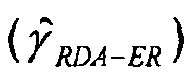
- an intermediate SNR value ( ⁇ RDA ) of the modulated communication signal is derived from a data assisted maximum-likelihood estimation, the assisting data not being known in advance but being reconstructed from samples of the modulated communication signal ( r n ), and that an estimated SNR value ( ⁇ RDA-ER ) is determined by a controlled non-linear conversion of the intermediate SNR value ( ⁇ RDA ).
- the inventive method estimates the SNR of the modulated communication signal by means of a conversion of the intermediate SNR value.
- the intermediate SNR value is obtained by a standard RDA maximum likelihood SNR estimation of the modulated communication signal.
- the intermediate SNR value ⁇ RDA deviates from the true SNR value ⁇ . In particular, for small values of the true SNR value ⁇ , i.e. ⁇ ⁇ 0, ⁇ RDA is much larger than ⁇ . This deviation is compensated for by the controlled non-linear conversion of the intermediate SNR value.
- the controlled non-linear conversion can be done by means of a conversion table based on an experimentally predetermined correlation between ⁇ RDA and ⁇ . It is preferred, however, to model the correlation between ⁇ RDA and ⁇ mathematically and to use the modelled correlation for conversion.
- information about and/or suitable assumptions for the characteristics of the modulated communication signal are useful.
- the estimated deviation function is determined by a mathematic model. Its inverse function, i.e.
- the correction function can be obtained by mirroring the estimated deviation function at the bisecting line of the first quadrant in the coordinate system. If the estimated deviation function is simple enough, its inverse function can also be calculated analytically.
- the estimated deviation function ⁇ ( ⁇ ) can be calculated by setting it equal to the intermediate SNR signal, which in turn is the ratio of the estimated signal power and the estimated noise power of the modulated communication signal.
- the estimated signal power and estimated noise power then, must be expressed as a function of ⁇ , with the latter requiring suitable assumptions, such as e.g. an infinite number of samples to be processed.
- the estimated deviation function found in this way is then applied to data with a finite number of samples, too.
- ⁇ true ( ⁇ ) can be determined accurately for N ⁇ ⁇ . The latter assumption is justified in most real situations, when sufficiently large numbers of samples are available. In particular, a number of 100 samples or more is sufficient.
- ⁇ ( ⁇ ) 1 ⁇ + 1 ( ⁇ erf ( ⁇ 2 ) + 2 ⁇ e ⁇ ⁇ 2 ) 2 ⁇ 1 .
- This choice of ⁇ ( ⁇ ) gives highly accurate results in case of a BPSK modulation of the modulated communication signal.
- ⁇ -1 is applied by means of an approximation table.
- An approximation table provides very quick access to values of the correction function, which are listed in the table.
- online numerical or analytical calculation of values of the correction function is also possible, but more time consuming.
- the correction function is available analytically, which simplifies and accelerates the determination of the estimated SNR value ⁇ RDA-ER .
- the number N of samples of the modulated communication signal ( r n ) being processed is equal or less than 500, preferably equal or less than 100.
- the inventive method already provides estimated SNR values of high accuracy, whereas known methods show worse accuracy.
- N such as an N of 1000 or larger, it is worth mentioning that the inventive method provides equally accurate estimated SNR values as known methods, but typically with less effort.
- a computer program for estimating the signal to noise ratio ( ⁇ ) of a modulated communication signal ( r n ) according to the inventive method may be saved on a storage medium, in particular a hard disk or a portable storage medium such as a compact disc.
- the invention also comprises a receiver system for estimating the signal to noise ratio ( ⁇ ) of a modulated communication signal ( r n ) according to the inventive method.
- the receiver system comprises a receiver unit.
- the receiver unit can receive transmitted signals, with the transmission carried out by radio or an optical fiber line, e.g..
- the inventive method can be performed directly with the received transmitted signals, i.e. at the receiver unit.
- the inventive method can be applied after a channel decoding, such as turbo decoding, of the received transmitted signals. In the latter case, the method is performed with "soft" signals.
- the invention is also realized in an apparatus, in particular a base station or a mobile station, comprising an inventive computer program and/or an inventive receiver system as described above.
- a typical mobile station is a mobile phone.
- An inventive apparatus can be part of a 3G or B3G network, in particular a UMTS network or a WLAN network.
- the invention deals with the estimation of SNR values in a transmission system, such as a radio telephone network.
- a transmission system for use with the invention is shown schematically in Fig. 1.
- binary data is generated.
- the binary data may contain information of a telephone call, for example.
- the binary data consists of a number of bits b n , with n : the index number of the bits, running from 0 to N -1, with N : the total number of bits of the binary data.
- Each bit may have a value of 0 or 1.
- a typical modulation is the binary phase shift keying (BPSK) modulation, resulting in values of a data symbol component s n of +1 or -1.
- BPSK binary phase shift keying
- s n At the physical transmission of the data symbol component s n , typically applying a carrier frequency, s n is amplified by a factor ⁇ . Also, noise n n is superposed by the channel to the amplified data symbol component ⁇ ⁇ s n .
- the amplification factor ⁇ and the noise level are unknown initially.
- the receiver system may be part of a mobile phone, for example.
- other data symbol components may be transmitted at the same time at other frequency ranges and/or at other (spreading) code ranges. These other data symbol components can be neglected in this context; they may affect the noise component n n , though.
- PDF noise probability density function
- a hat ⁇ above a value indicates an estimated value
- E is the estimation operation determining the mean value of its input values.
- This value ⁇ BPSK1,RDA is the result of the standard RDA maximum likelihood SNR estimation, as known from literature.
- the ⁇ BPSK1,RDA value is set equal to an estimated deviation function ⁇ ( ⁇ ).
- ⁇ E ⁇ ⁇ +
- the one-dimensional Gaussian type noise PDF as defined in the beginning has been introduced in this calculation, and it is based on the BPSK modulation (indicated by the index BPSK1, where the "1" represents the one-dimensionality of the real channel and its noise).
- ⁇ BPSK1,RDA of the standard RDA maximum likelihood estimation is used as a starting point for the actual calculation of an estimated SNR value ⁇ BPSK 1, RDA-ER in accordance with the invention. For this reason, the ⁇ BPSK1,RDA is called an intermediate SNR value.
- the "ER" index of ⁇ BPSK 1, RDA-ER indicates an extended range, i.e. an improved range of application with the invention.
- the estimated deviation function ⁇ cannot be inverted to a closed form inverse function, so numerical calculation is necessary.
- a number N of tests is performed with every method. Each test is done with a disjunctive set of N symbols (or bits, samples).
- an estimated SNR value ⁇ m of the tested set is determined by means of the currently tested method, with m : test index (or index of tested sets) running from 0 to N t -1.
- the NMSE values are, for each method, a function of the true SNR value ⁇ and a function of the number of samples N of each set.
- Test results are plotted in Fig. 3a.
- the abscissa shows the true SNR ⁇ in dB, and the ordinate shows on a logarithmic scale the NMSE values of estimated SNR values for three different methods, i.e. standard RDA maximum likelihood estimation of the state of the art, inventive RDA-ER maximum likelihood estimation with the estimated deviation function ⁇ as in Fig. 2, and inventive RDA-ERHA maximum likelihood estimation with the estimated deviation function ⁇ HA as in Fig. 2.
- standard RDA maximum likelihood estimation of the state of the art inventive RDA-ER maximum likelihood estimation with the estimated deviation function ⁇ as in Fig. 2
- inventive RDA-ERHA maximum likelihood estimation with the estimated deviation function ⁇ HA as in Fig. 2.
- the NMSE values of the inventive RDA-ER and RDA-ERHA methods are much lower than the NMSE values of the state of the art standard RDA method. In other words, the inventive methods are more accurate in this range. In particular, at -10 dB and -5 dB, the inventive methods are about 10 times more accurate than standard RDA. In said range, RDA-ER NMSE values are about half of the RDA-ERHA NMSE values. For higher SNR values (5 dB and above), all three methods are roughly equally accurate.
- NMSE values of estimated SNR values are plotted for the standard RDA maximum likelihood estimation method of the state of the art, the inventive RDA-ER maximum likelihood estimation method, the Iterative method of the state of the art, and the Kurtosis method of the state of the art.
- the inventive RDA-ER method has the lowest NMSE values, indicating the highest accuracy, over a very broad SNR range. In the range of 0 dB to 5 dB, the Iterative method is roughly equal to the inventive RDA-ER method.
- the inventive RDA-ER method, the Iterative method and the Kurtosis method are equally accurate.
- the inventive RDA-ER method clearly outperforms the Iterative method.
- the inventive RDA-ER method outperforms the Kurtosis method between 0 dB and 15 dB.
- the inventive SNR estimation method has been tested for a BPSK channel over a real AWGN channel. It outperforms or is at least equal to known blind SNR estimation algorithms.
- the inventive method can easily be used with other signal modulations over real or complex channels.
- the inventive method requires only limited effort (a little more than the well-known maximum likelihood data assisted estimation); in particular, it does neither need iteration nor decoding/re-encoding of protected data.
- a hyperbolical approximation is available which allows instantaneous computation with only minor performance degradation.
Landscapes
- Engineering & Computer Science (AREA)
- Computer Networks & Wireless Communication (AREA)
- Signal Processing (AREA)
- Quality & Reliability (AREA)
- Physics & Mathematics (AREA)
- General Physics & Mathematics (AREA)
- Electromagnetism (AREA)
- Digital Transmission Methods That Use Modulated Carrier Waves (AREA)
- Dc Digital Transmission (AREA)
- Vehicle Body Suspensions (AREA)
- Transition And Organic Metals Composition Catalysts For Addition Polymerization (AREA)
- Nitrogen And Oxygen Or Sulfur-Condensed Heterocyclic Ring Systems (AREA)
Abstract


Description
- The invention relates to a method for estimating the signal to noise ratio (=SNR) (γ) of a modulated communication signal (r n ) including a data symbol component (s n ) and a noise component (n n ).
- An overview of SNR estimation techniques is given in D. R. Pauluzzi, N.C. Beaulieu, IEEE Trans. Comm. Vol. 48, Nr. 10, P. 1681-1691 (October 2000).
- In order to provide optimal functioning of advanced mobile radio modules, accurate signal to noise ratio (=SNR) estimation of modulated communication signals is necessary. On the physical layer, SNR values are used in maximum-ratio combining and turbo-decoding. On higher layers, SNR values are used for call setup, macrodiversity and handover control.
- In environments with varying SNR, such as mobile radio networks, the determination of an SNR value must be rather quick.
- The SNR value γ is defined as the ratio of signal power and noise power, i.e.

- SNR estimation can be done data-assisted (=DA) or Non-data assisted (NDA). The latter is often called a "blind" estimation.
- In the case of data assisted SNR estimation, a set of samples (with one sample typically corresponding to one bit) is known in advance. After a transmission of the set of samples, the received data is compared with the original data by means of a data-assisted maximum likelihood estimation. The known set of samples can be a preamble or a training sequence.
- If the transmitted set of samples is not known in advance, a blind estimation algorithm must be applied. Known algorithms of blind SNR estimation include
- a) standard received data aided (=RDA) maximum likelihood SNR estimation (see e.g. D. Pauluzzi, N. Beaulieu, IEEE Trans. Comm., Vol 48,
No 10, pp. 1681-1691, October 2000), - b) iterative SNR estimation (see e.g. B. Li et al., IEEE Commun. Lett.
Vol 6, No 11, pp. 469-471, November 2002), and - c) Kurtosis SNR estimation (see e.g. R. Matzner, K. Letsch, Proc. IEEE-IMS Workshop on Information Theory and Statistics, Alexandria/VA, USA, p. 68ff, October 1994).
- However, these known algorithms are rather inaccurate for low numbers of samples. Moreover, in particular the iterative SNR estimation is cumbersome and time consuming.
- It is the object of the present invention to provide a robust SNR estimation method for a modulated communication signal, wherein the method has a high accuracy even for low numbers of processed samples.
- This object is achieved by a method as introduced in the beginning,
characterized in that an intermediate SNR value (γ̂ RDA ) of the modulated communication signal is derived from a data assisted maximum-likelihood estimation, the assisting data not being known in advance but being reconstructed from samples of the modulated communication signal (r n ),
and that an estimated SNR value (γ̂ RDA-ER ) is determined by a controlled non-linear conversion of the intermediate SNR value (γ̂ RDA ). - The inventive method estimates the SNR of the modulated communication signal by means of a conversion of the intermediate SNR value. The intermediate SNR value is obtained by a standard RDA maximum likelihood SNR estimation of the modulated communication signal. The intermediate SNR value γ̂ RDA deviates from the true SNR value γ. In particular, for small values of the true SNR value γ, i.e. γ → 0, γ̂ RDA is much larger than γ. This deviation is compensated for by the controlled non-linear conversion of the intermediate SNR value.
- The controlled non-linear conversion can be done by means of a conversion table based on an experimentally predetermined correlation between γ̂ RDA and γ. It is preferred, however, to model the correlation between γ̂ RDA and γ mathematically and to use the modelled correlation for conversion. For modelling, information about and/or suitable assumptions for the characteristics of the modulated communication signal are useful. In particular, the type of modulation should be known. It has been found that signals modulated by binary phase shift keying (=BPSK) can be handled very well by the inventive method. Moreover, the type of noise in the modulated communication signal can often be assumed to have a Gaussian distribution.
- With the aid of the highly accurate and robust estimated SNR values obtained over a broad SNR range, as determined by means of the invention, it is possible to improve receiver performance, which in turn allows for distressing of margins e.g. in network planning, in particular lower UL/DL transmission power requirements and larger distances between base stations, nodes B and the like.
- A highly preferred variant of the inventive method is characterized in that the controlled non-linear conversion is performed by a correction function Ψ-1, with γ̂ RDA-ER = Ψ-1(γ̂ RDA ), wherein the correction function Ψ-1 is the inverse function of an estimated deviation function Ψ, with the estimated deviation function Ψ approximating a true deviation function Ψ true correlating the deviation of γ̂ RDA from γ, i.e. γ̂ RDA = Ψ true (γ) and Ψ(γ) ≈ Ψ true (γ). Typically, the estimated deviation function is determined by a mathematic model. Its inverse function, i.e. the correction function, can be obtained by mirroring the estimated deviation function at the bisecting line of the first quadrant in the coordinate system. If the estimated deviation function is simple enough, its inverse function can also be calculated analytically. The estimated deviation function Ψ(γ) can be calculated by setting it equal to the intermediate SNR signal, which in turn is the ratio of the estimated signal power and the estimated noise power of the modulated communication signal. The estimated signal power and estimated noise power, then, must be expressed as a function of γ, with the latter requiring suitable assumptions, such as e.g. an infinite number of samples to be processed.
- In a preferred further development of this method, Ψ is chosen such that Ψ(γ) = Ψ true (γ) for large numbers of N, i.e. N → ∞, with N being the number of samples of the modulated communication signal (r n ) being processed. The estimated deviation function found in this way is then applied to data with a finite number of samples, too. In many cases, in particular with a BPSK modulation and Gaussian noise distribution, Ψ true (γ) can be determined accurately for N → ∞. The latter assumption is justified in most real situations, when sufficiently large numbers of samples are available. In particular, a number of 100 samples or more is sufficient.
- In a further preferred development of said variant of the inventive method,

- In an advantageous development of the variant, Ψ-1 is applied by means of an approximation table. An approximation table provides very quick access to values of the correction function, which are listed in the table. Alternatively, online numerical or analytical calculation of values of the correction function is also possible, but more time consuming.
- Further preferred is a development of said variant wherein


- In another variant of the inventive method, the number N of samples of the modulated communication signal (r n ) being processed is equal or less than 500, preferably equal or less than 100. In these cases, the inventive method already provides estimated SNR values of high accuracy, whereas known methods show worse accuracy. For higher values of N, such as an N of 1000 or larger, it is worth mentioning that the inventive method provides equally accurate estimated SNR values as known methods, but typically with less effort.
- Also in the scope of the invention is a computer program for estimating the signal to noise ratio (γ) of a modulated communication signal (r n ) according to the inventive method. The computer program may be saved on a storage medium, in particular a hard disk or a portable storage medium such as a compact disc.
- The invention also comprises a receiver system for estimating the signal to noise ratio (γ) of a modulated communication signal (r n ) according to the inventive method. The receiver system comprises a receiver unit. The receiver unit can receive transmitted signals, with the transmission carried out by radio or an optical fiber line, e.g.. The inventive method can be performed directly with the received transmitted signals, i.e. at the receiver unit. Alternatively, the inventive method can be applied after a channel decoding, such as turbo decoding, of the received transmitted signals. In the latter case, the method is performed with "soft" signals.
- Finally, the invention is also realized in an apparatus, in particular a base station or a mobile station, comprising an inventive computer program and/or an inventive receiver system as described above. A typical mobile station is a mobile phone. An inventive apparatus can be part of a 3G or B3G network, in particular a UMTS network or a WLAN network.
- Further advantages can be extracted from the description and the enclosed drawing. The features mentioned above and below can be used in accordance with the invention either individually or collectively in any combination. The embodiments mentioned are not to be understood as exhaustive enumeration but rather have exemplary character for the description of the invention.
- The invention is shown in the drawing.
- Fig. 1
- shows a binary transmission system with a noisy channel for use with the inventive method;
- Fig. 2
- shows plots of an estimated deviation function Ψ(γ) for a BPSK real channel and a hyperbolic function Ψ HA (γ) which approximates the former function, as well as their inverse functions in accordance with the invention;
- Fig. 3a
- shows a diagram plotting normalized mean square errors of estimated SNR values with respect to the true SNR values as a function of the true SNR value, for standard RDA maximum likelihood SNR estimation (state of the art), inventive RDA-ER and inventive RDA-ERHA, with 100 samples processed per SNR estimation;
- Fig. 3b
- shows a diagram corresponding to Fig. 3a, with 1000 samples per SNR estimation;
- Fig. 4a
- shows a diagram plotting normalized mean square errors of estimated SNR values with respect to the true SNR values as a function of the true SNR value, for standard RDA maximum-likelihood SNR estimation (state of the art), inventive RDA-ER, Iterative method (state of the art) and Kurtosis method (state of the art) with 100 samples processed per SNR estimation;
- Fig. 4b
- show a diagram corresponding to Fig. 4a, with 1000 samples processed per SNR estimation.
- The invention deals with the estimation of SNR values in a transmission system, such as a radio telephone network. A transmission system for use with the invention is shown schematically in Fig. 1. At a source S, binary data is generated. The binary data may contain information of a telephone call, for example. The binary data consists of a number of bits b n , with n : the index number of the bits, running from 0 to N -1, with N : the total number of bits of the binary data. Each bit may have a value of 0 or 1. In order to transport the binary data, it is modulated in a modulator M. A typical modulation is the binary phase shift keying (BPSK) modulation, resulting in values of a data symbol component s n of +1 or -1. At the physical transmission of the data symbol component s n , typically applying a carrier frequency, s n is amplified by a factor α. Also, noise n n is superposed by the channel to the amplified data symbol component α · s n . The amplification factor α and the noise level are unknown initially. Thus in total, a modulated communication signal r n = α · s n + n n is generated and ready for detection at a receiver system. The receiver system may be part of a mobile phone, for example. During the physical transport, other data symbol components may be transmitted at the same time at other frequency ranges and/or at other (spreading) code ranges. These other data symbol components can be neglected in this context; they may affect the noise component n n , though.
- In the following, a BPSK modulation is assumed as well as a real channel, with a noise probability density function (=PDF) of Gaussian type

- When making a data-aided (DA) maximum-likelihood SNR estimation, an estimated amplitude α̂ with known "pilots" s n , i.e. a set of N known data symbol component values, is calculated as


- In case of a "blind", i.e. received-data-aided (RDA) maximum likelihood SNR estimation, the "pilots" are estimated based on receiver decisions, identical to the first absolute moment. The estimated amplification factor α̂ is calculated as

- Noise power is estimated correspondingly (compare DA above). Accordingly, an SNR value is estimated, with

- This value γ̂BPSK1,RDA is the result of the standard RDA maximum likelihood SNR estimation, as known from literature.
- However, by using estimated data symbol component values ŝ n instead of the true data symbol component values s n , error is introduced. For sufficiently large SNR values γ , γ̂BPSK1,RDA approximates γ very well, but for small values of γ, the estimated values γ̂BPSK1,RDA are too large.
- According to the invention, the γ̂BPSK1,RDA value is set equal to an estimated deviation function Ψ(γ). For this purpose, the terms of γ̂BPSK1,RDA are expressed as functions of the true SNR value γ, requiring some approximations and assumptions:


- In particular, the one-dimensional Gaussian type noise PDF as defined in the beginning has been introduced in this calculation, and it is based on the BPSK modulation (indicated by the index BPSK1, where the "1" represents the one-dimensionality of the real channel and its noise).
- The result γ̂BPSK1,RDA of the standard RDA maximum likelihood estimation is used as a starting point for the actual calculation of an estimated SNR value γ̂ BPSK1,RDA-ER in accordance with the invention. For this reason, the γ̂BPSK1,RDA is called an intermediate SNR value. The "ER" index of γ̂ BPSK1,RDA-ER indicates an extended range, i.e. an improved range of application with the invention. For calculating γ̂ BPSK1,RDA-ER , the inverse function Ψ-1 of the estimated deviation function Ψ(γ) is determined, and the intermediate SNR value γ̂BPSK1,RDA is assigned to Ψ-1, with


- In the above-calculated case of BPSK over a real channel, the estimated deviation function Ψ cannot be inverted to a closed form inverse function, so numerical calculation is necessary. However, for simplification, the estimated deviation function Ψ can be approximated by a hyperbolic function Ψ HA which is easy to invert:


- Then the inventive estimated SNR value can be calculated as

- In Fig. 2, the function


- In order to quantify the accuracy of the inventive method for estimating SNR values of modulated communication signals, different SNR estimation methods of the state of the art and according to the invention have been tested.
- A number N, of tests is performed with every method. Each test is done with a disjunctive set of N symbols (or bits, samples). The corresponding modulated communication signals r n of each set, with n running from 0 to N-1, have a known true SNR value γ. In each test, an estimated SNR value γ̂ m of the tested set is determined by means of the currently tested method, with m : test index (or index of tested sets) running from 0 to N t -1. The distribution of the estimated SNR values γ̂ m as compared with the true SNR value γ is analysed by calculating a normalized mean square error (NMSE) of γ̂ m :

- Test results are plotted in Fig. 3a. The abscissa shows the true SNR γ in dB, and the ordinate shows on a logarithmic scale the NMSE values of estimated SNR values for three different methods, i.e. standard RDA maximum likelihood estimation of the state of the art, inventive RDA-ER maximum likelihood estimation with the estimated deviation function Ψ as in Fig. 2, and inventive RDA-ERHA maximum likelihood estimation with the estimated deviation function Ψ HA as in Fig. 2. For the diagram, all in all 106 SNR estimations (tests) have been calculated, with N =100 samples per SNR estimation.
- For low SNR values (0 dB and less), the NMSE values of the inventive RDA-ER and RDA-ERHA methods are much lower than the NMSE values of the state of the art standard RDA method. In other words, the inventive methods are more accurate in this range. In particular, at -10 dB and -5 dB, the inventive methods are about 10 times more accurate than standard RDA. In said range, RDA-ER NMSE values are about half of the RDA-ERHA NMSE values. For higher SNR values (5 dB and above), all three methods are roughly equally accurate.
- For Fig. 3b, the same tests as for Fig. 3a have been performed, but with N =1000 samples per SNR estimation. The relative difference in accuracy between state of the art RDA on the one hand and inventive RDA-ER and RDA-ERHA is even higher, showing the improvement by the inventive method.
- For Fig. 4a, the same tests as for Fig. 3a have been performed, with N =100 samples per SNR estimation again. The NMSE values of estimated SNR values are plotted for the standard RDA maximum likelihood estimation method of the state of the art, the inventive RDA-ER maximum likelihood estimation method, the Iterative method of the state of the art, and the Kurtosis method of the state of the art. The inventive RDA-ER method has the lowest NMSE values, indicating the highest accuracy, over a very broad SNR range. In the range of 0 dB to 5 dB, the Iterative method is roughly equal to the inventive RDA-ER method.
- For Fig. 4b, the same tests as for Fig. 4a have been performed, but with N =1000 samples per SNR estimation. For low SNR values (0 dB and less), the inventive RDA-ER method, the Iterative method and the Kurtosis method are equally accurate. For SNR values of 10 dB and above, the inventive RDA-ER method clearly outperforms the Iterative method. Moreover, the inventive RDA-ER method outperforms the Kurtosis method between 0 dB and 15 dB.
- In summary, the inventive SNR estimation method has been tested for a BPSK channel over a real AWGN channel. It outperforms or is at least equal to known blind SNR estimation algorithms. The inventive method can easily be used with other signal modulations over real or complex channels. The inventive method requires only limited effort (a little more than the well-known maximum likelihood data assisted estimation); in particular, it does neither need iteration nor decoding/re-encoding of protected data. Finally, to avoid the storage and the handling of the optimal interpolation curve Ψ-1, a hyperbolical approximation is available which allows instantaneous computation with only minor performance degradation.
Claims (10)
- Method for estimating the signal to noise ratio (=SNR) (γ) of a modulated communication signal (r n ) including a data symbol component (s n ) and a noise component (n n ),
characterized in that
an intermediate SNR value (γ̂ RDA ) of the modulated communication signal is derived from a data assisted maximum-likelihood estimation, the assisting data not being known in advance but being reconstructed from samples of the modulated communication signal (r n ),
and that an estimated SNR value (γ̂ RDA-ER ) is determined by a controlled non-linear conversion of the intermediate SNR value (γ̂ RDA ). - Method according to claim 1, characterized in that the controlled non-linear conversion is performed by a correction function Ψ-1, with γ̂ RDA-ER = Ψ -1(γ̂ RDA ), wherein the correction function Ψ-1 is the inverse function of an estimated deviation function Ψ, with the estimated deviation function Ψ approximating a true deviation function Ψ true correlating the deviation of γ̂ RDA from γ , i.e. γ̂ RDA = Ψ true (γ) and Ψ(γ) ≈ Ψ true (γ).
- Method according to claim 2, characterized in that Ψ is chosen such that Ψ (γ) = Ψ true (γ) for large numbers of N , i.e. N → ∞, with N being the number of samples of the modulated communication signal (r n ) being processed.
- Method according to claim 2, characterized in that

- Method according to claim 2, characterized in that Ψ-1 is applied by means of an approximation table.
- Method according to claim 2, characterized in that

- Method according to claim 1, characterized in that the number N of samples of the modulated communication signal (r n ) being processed is equal or less than 500, preferably equal or less than 100.
- Computer program for estimating the signal to noise ratio (γ) of a modulated communication signal (r n ) according to claim 1.
- Receiver system for estimating the signal to noise ratio (γ) of a modulated communication signal (r n ) according to claim 1.
- Apparatus, in particular a base station or a mobile station, comprising a computer program according to claim 8 and/or a receiver system according to claim 9.
Priority Applications (10)
| Application Number | Priority Date | Filing Date | Title |
|---|---|---|---|
| EP04293155A EP1677445B1 (en) | 2004-12-28 | 2004-12-28 | Improved blind SNR estimation |
| DE602004002304T DE602004002304T2 (en) | 2004-12-28 | 2004-12-28 | Improved blind SNR estimate |
| AT04293155T ATE397850T1 (en) | 2004-12-28 | 2004-12-28 | IMPROVED BLIND SNR ESTIMATION |
| PCT/EP2005/055877 WO2006069846A1 (en) | 2004-12-28 | 2005-11-10 | Improved blind snr estimation |
| MXPA05012543A MXPA05012543A (en) | 2004-12-28 | 2005-11-21 | Improved blind snr estimation. |
| KR1020050112956A KR20060076189A (en) | 2004-12-28 | 2005-11-24 | Improved blind signal-to-noise ratio estimation method |
| CNA2005101303746A CN1798120A (en) | 2004-12-28 | 2005-12-09 | Improved blind snr estimation |
| US11/298,750 US20060140312A1 (en) | 2004-12-28 | 2005-12-12 | Blind SNR estimation |
| JP2005364359A JP4331716B2 (en) | 2004-12-28 | 2005-12-19 | Improved blind SNR estimation |
| RU2005141120/09A RU2005141120A (en) | 2004-12-28 | 2005-12-27 | IMPROVED ASSESSMENT SIGNAL / NOISE RATIO "BLINDING" |
Applications Claiming Priority (1)
| Application Number | Priority Date | Filing Date | Title |
|---|---|---|---|
| EP04293155A EP1677445B1 (en) | 2004-12-28 | 2004-12-28 | Improved blind SNR estimation |
Publications (2)
| Publication Number | Publication Date |
|---|---|
| EP1677445A1 true EP1677445A1 (en) | 2006-07-05 |
| EP1677445B1 EP1677445B1 (en) | 2006-09-06 |
Family
ID=34931673
Family Applications (1)
| Application Number | Title | Priority Date | Filing Date |
|---|---|---|---|
| EP04293155A Expired - Lifetime EP1677445B1 (en) | 2004-12-28 | 2004-12-28 | Improved blind SNR estimation |
Country Status (10)
| Country | Link |
|---|---|
| US (1) | US20060140312A1 (en) |
| EP (1) | EP1677445B1 (en) |
| JP (1) | JP4331716B2 (en) |
| KR (1) | KR20060076189A (en) |
| CN (1) | CN1798120A (en) |
| AT (1) | ATE397850T1 (en) |
| DE (1) | DE602004002304T2 (en) |
| MX (1) | MXPA05012543A (en) |
| RU (1) | RU2005141120A (en) |
| WO (1) | WO2006069846A1 (en) |
Families Citing this family (10)
| Publication number | Priority date | Publication date | Assignee | Title |
|---|---|---|---|---|
| US8027437B2 (en) * | 2006-12-18 | 2011-09-27 | Nuance Communications, Inc. | System and method for improving message delivery in voice systems utilizing microphone and target signal-to-noise ratio |
| KR100867618B1 (en) * | 2007-05-04 | 2008-11-10 | 전북대학교산학협력단 | Prospecting System Of Signal To Noise Ratio And Method Thereof |
| CN101184071B (en) * | 2007-12-20 | 2011-11-09 | 清华大学 | Blind SNR estimating method based on pseudo-error rate statistics |
| DE102009025220A1 (en) * | 2009-04-24 | 2010-10-28 | Rohde & Schwarz Gmbh & Co. Kg | Method and apparatus for estimating the signal-to-noise ratio |
| CN102833191A (en) * | 2011-06-13 | 2012-12-19 | 中兴通讯股份有限公司 | Signal to noise ratio estimation method and device |
| US10330588B2 (en) * | 2012-12-11 | 2019-06-25 | International Business Machines Corporation | Real time numerical computation of corrosion rates from corrosion sensors |
| CN104426555A (en) * | 2013-09-03 | 2015-03-18 | 电子科技大学 | Quasi-cyclic code blind recognition method based on submodule space Gr*bner base |
| KR102007879B1 (en) * | 2017-02-22 | 2019-08-06 | 국방과학연구소 | Receiver of blind communication system and method for operating the same |
| IT201900002785A1 (en) * | 2019-02-26 | 2020-08-26 | Teko Telecom S R L | BASE RADIO STATION AND WIRELESS TELECOMMUNICATION PROCESS FOR HIGH MOBILITY SCENARIOS |
| CN118555025B (en) * | 2024-07-29 | 2024-11-15 | 广州海格通信集团股份有限公司 | Signal-to-noise ratio calculation method, signal-to-noise ratio calculation device, electronic equipment and storage medium |
Family Cites Families (1)
| Publication number | Priority date | Publication date | Assignee | Title |
|---|---|---|---|---|
| US4967380A (en) * | 1987-09-16 | 1990-10-30 | Varian Associates, Inc. | Dual channel signal processor using weighted integration of log-ratios and ion beam position sensor utilizing the signal processor |
-
2004
- 2004-12-28 DE DE602004002304T patent/DE602004002304T2/en not_active Expired - Fee Related
- 2004-12-28 AT AT04293155T patent/ATE397850T1/en not_active IP Right Cessation
- 2004-12-28 EP EP04293155A patent/EP1677445B1/en not_active Expired - Lifetime
-
2005
- 2005-11-10 WO PCT/EP2005/055877 patent/WO2006069846A1/en not_active Ceased
- 2005-11-21 MX MXPA05012543A patent/MXPA05012543A/en unknown
- 2005-11-24 KR KR1020050112956A patent/KR20060076189A/en not_active Withdrawn
- 2005-12-09 CN CNA2005101303746A patent/CN1798120A/en active Pending
- 2005-12-12 US US11/298,750 patent/US20060140312A1/en not_active Abandoned
- 2005-12-19 JP JP2005364359A patent/JP4331716B2/en not_active Expired - Fee Related
- 2005-12-27 RU RU2005141120/09A patent/RU2005141120A/en not_active Application Discontinuation
Non-Patent Citations (3)
| Title |
|---|
| HUA XU ET AL: "A non-data-aided SNR estimation algorithm for QAM signals", COMMUNICATIONS, CIRCUITS AND SYSTEMS, 2004. ICCCAS 2004. 2004 INTERNATIONAL CONFERENCE ON CHENGDU, CHINA 27-29 JUNE 2004, PISCATAWAY, NJ, USA,IEEE, US, 27 June 2004 (2004-06-27), pages 103 - 107Vol1, XP010731908, ISBN: 0-7803-8647-7 * |
| PAULUZZI D R ET AL: "A comparison of SNR estimation techniques for the AWGN channel", IEEE TRANSACTIONS ON COMMUNICATIONS, IEEE INC. NEW YORK, US, vol. 48, no. 10, October 2000 (2000-10-01), pages 1681 - 1691, XP002289928, ISSN: 0090-6778 * |
| WIESEL A ET AL: "Non-data-aided signal-to-noise-ratio estimation", ICC 2002. 2002 IEEE INTERNATIONAL CONFERENCE ON COMMUNICATIONS. CONFERENCE PROCEEDINGS. NEW YORK, NY, APRIL 28 - MAY 2, 2002, IEEE INTERNATIONAL CONFERENCE ON COMMUNICATIONS, NEW YORK, NY : IEEE, US, vol. VOL. 1 OF 5, 28 April 2002 (2002-04-28), pages 197 - 201, XP010589485, ISBN: 0-7803-7400-2 * |
Also Published As
| Publication number | Publication date |
|---|---|
| CN1798120A (en) | 2006-07-05 |
| DE602004002304T2 (en) | 2006-12-28 |
| WO2006069846A1 (en) | 2006-07-06 |
| DE602004002304D1 (en) | 2006-10-19 |
| US20060140312A1 (en) | 2006-06-29 |
| KR20060076189A (en) | 2006-07-04 |
| EP1677445B1 (en) | 2006-09-06 |
| MXPA05012543A (en) | 2006-06-27 |
| ATE397850T1 (en) | 2006-09-15 |
| RU2005141120A (en) | 2007-07-20 |
| JP4331716B2 (en) | 2009-09-16 |
| JP2006191565A (en) | 2006-07-20 |
Similar Documents
| Publication | Publication Date | Title |
|---|---|---|
| US5233628A (en) | Computer-based bit error simulation for digital wireless communications | |
| EP1677445B1 (en) | Improved blind SNR estimation | |
| CA2070834A1 (en) | Error rate monitor | |
| US6097716A (en) | Rate detection for multi-rate communications | |
| CN104601512B (en) | A kind of method and system for detecting phase modulated signal carrier wave frequency deviation | |
| KR101051512B1 (en) | Block Codeword Decoder with Confidence Indicator | |
| EP0674398A1 (en) | Delay spread sensor and detection switching circuit using it | |
| CN101253697A (en) | A method and apparatus for qam demodulation in a generalized rake receiver | |
| US7697639B2 (en) | Apparatus and method for robust BPSK/QPSK blind modulation classification against errors in satellite control system | |
| US10003421B2 (en) | Radio analysis apparatus and method | |
| EP2036285B1 (en) | Remote non-linearity detection via burst power dithering | |
| EP2547013A2 (en) | Radio wave propagation simulator | |
| KR101020437B1 (en) | Methods, devices, analyzers and computer programs for searching radio paths | |
| JP5097404B2 (en) | Positioning method and apparatus | |
| KR101019171B1 (en) | Frequency Error Correction Using Remodulation | |
| US20040196929A1 (en) | Signal processing apparatus and method | |
| US11742950B2 (en) | Wavelength dispersion amount calculation apparatus and wavelength dispersion amount calculation method | |
| US6680983B2 (en) | Method for noise energy estimation | |
| US6661853B1 (en) | Method and apparatus for maximal-ratio combining of received frame data | |
| US7336750B1 (en) | Optimal one-shot phase and frequency estimation for timing acquisition | |
| Qinghua et al. | Research on real-time BER estimation in satellite downlink | |
| KR100758283B1 (en) | WPS / BPS blind modulation classification apparatus and method thereof in wireless communication system | |
| EP2662999A1 (en) | Receiver, reception method, and computer program | |
| US7738544B2 (en) | Apparatus and method for measuring received signal strength indicator, and recording medium storing program embodying the same method | |
| KR100939357B1 (en) | Improved Signal Detection Device and Method in Wireless Communication System Using Multiple Antennas |
Legal Events
| Date | Code | Title | Description |
|---|---|---|---|
| GRAP | Despatch of communication of intention to grant a patent |
Free format text: ORIGINAL CODE: EPIDOSNIGR1 |
|
| PUAI | Public reference made under article 153(3) epc to a published international application that has entered the european phase |
Free format text: ORIGINAL CODE: 0009012 |
|
| 17P | Request for examination filed |
Effective date: 20050614 |
|
| AK | Designated contracting states |
Kind code of ref document: A1 Designated state(s): AT BE BG CH CY CZ DE DK EE ES FI FR GB GR HU IE IS IT LI LT LU MC NL PL PT RO SE SI SK TR |
|
| AX | Request for extension of the european patent |
Extension state: AL BA HR LV MK YU |
|
| GRAS | Grant fee paid |
Free format text: ORIGINAL CODE: EPIDOSNIGR3 |
|
| GRAA | (expected) grant |
Free format text: ORIGINAL CODE: 0009210 |
|
| AK | Designated contracting states |
Kind code of ref document: B1 Designated state(s): AT BE BG CH CY CZ DE DK EE ES FI FR GB GR HU IE IS IT LI LT LU MC NL PL PT RO SE SI SK TR |
|
| PG25 | Lapsed in a contracting state [announced via postgrant information from national office to epo] |
Ref country code: RO Free format text: LAPSE BECAUSE OF FAILURE TO SUBMIT A TRANSLATION OF THE DESCRIPTION OR TO PAY THE FEE WITHIN THE PRESCRIBED TIME-LIMIT Effective date: 20060906 Ref country code: LT Free format text: LAPSE BECAUSE OF FAILURE TO SUBMIT A TRANSLATION OF THE DESCRIPTION OR TO PAY THE FEE WITHIN THE PRESCRIBED TIME-LIMIT Effective date: 20060906 Ref country code: LI Free format text: LAPSE BECAUSE OF FAILURE TO SUBMIT A TRANSLATION OF THE DESCRIPTION OR TO PAY THE FEE WITHIN THE PRESCRIBED TIME-LIMIT Effective date: 20060906 Ref country code: SK Free format text: LAPSE BECAUSE OF FAILURE TO SUBMIT A TRANSLATION OF THE DESCRIPTION OR TO PAY THE FEE WITHIN THE PRESCRIBED TIME-LIMIT Effective date: 20060906 Ref country code: CZ Free format text: LAPSE BECAUSE OF FAILURE TO SUBMIT A TRANSLATION OF THE DESCRIPTION OR TO PAY THE FEE WITHIN THE PRESCRIBED TIME-LIMIT Effective date: 20060906 Ref country code: CH Free format text: LAPSE BECAUSE OF FAILURE TO SUBMIT A TRANSLATION OF THE DESCRIPTION OR TO PAY THE FEE WITHIN THE PRESCRIBED TIME-LIMIT Effective date: 20060906 Ref country code: SI Free format text: LAPSE BECAUSE OF FAILURE TO SUBMIT A TRANSLATION OF THE DESCRIPTION OR TO PAY THE FEE WITHIN THE PRESCRIBED TIME-LIMIT Effective date: 20060906 Ref country code: NL Free format text: LAPSE BECAUSE OF FAILURE TO SUBMIT A TRANSLATION OF THE DESCRIPTION OR TO PAY THE FEE WITHIN THE PRESCRIBED TIME-LIMIT Effective date: 20060906 Ref country code: PL Free format text: LAPSE BECAUSE OF FAILURE TO SUBMIT A TRANSLATION OF THE DESCRIPTION OR TO PAY THE FEE WITHIN THE PRESCRIBED TIME-LIMIT Effective date: 20060906 Ref country code: BE Free format text: LAPSE BECAUSE OF FAILURE TO SUBMIT A TRANSLATION OF THE DESCRIPTION OR TO PAY THE FEE WITHIN THE PRESCRIBED TIME-LIMIT Effective date: 20060906 Ref country code: FI Free format text: LAPSE BECAUSE OF FAILURE TO SUBMIT A TRANSLATION OF THE DESCRIPTION OR TO PAY THE FEE WITHIN THE PRESCRIBED TIME-LIMIT Effective date: 20060906 |
|
| REG | Reference to a national code |
Ref country code: GB Ref legal event code: FG4D |
|
| REG | Reference to a national code |
Ref country code: CH Ref legal event code: EP |
|
| REG | Reference to a national code |
Ref country code: IE Ref legal event code: FG4D |
|
| REF | Corresponds to: |
Ref document number: 602004002304 Country of ref document: DE Date of ref document: 20061019 Kind code of ref document: P |
|
| PG25 | Lapsed in a contracting state [announced via postgrant information from national office to epo] |
Ref country code: DK Free format text: LAPSE BECAUSE OF FAILURE TO SUBMIT A TRANSLATION OF THE DESCRIPTION OR TO PAY THE FEE WITHIN THE PRESCRIBED TIME-LIMIT Effective date: 20061206 Ref country code: BG Free format text: LAPSE BECAUSE OF FAILURE TO SUBMIT A TRANSLATION OF THE DESCRIPTION OR TO PAY THE FEE WITHIN THE PRESCRIBED TIME-LIMIT Effective date: 20061206 Ref country code: SE Free format text: LAPSE BECAUSE OF FAILURE TO SUBMIT A TRANSLATION OF THE DESCRIPTION OR TO PAY THE FEE WITHIN THE PRESCRIBED TIME-LIMIT Effective date: 20061206 |
|
| PG25 | Lapsed in a contracting state [announced via postgrant information from national office to epo] |
Ref country code: ES Free format text: LAPSE BECAUSE OF FAILURE TO SUBMIT A TRANSLATION OF THE DESCRIPTION OR TO PAY THE FEE WITHIN THE PRESCRIBED TIME-LIMIT Effective date: 20061217 |
|
| PG25 | Lapsed in a contracting state [announced via postgrant information from national office to epo] |
Ref country code: IE Free format text: LAPSE BECAUSE OF NON-PAYMENT OF DUE FEES Effective date: 20061228 |
|
| PG25 | Lapsed in a contracting state [announced via postgrant information from national office to epo] |
Ref country code: MC Free format text: LAPSE BECAUSE OF NON-PAYMENT OF DUE FEES Effective date: 20061231 |
|
| PG25 | Lapsed in a contracting state [announced via postgrant information from national office to epo] |
Ref country code: IS Free format text: LAPSE BECAUSE OF FAILURE TO SUBMIT A TRANSLATION OF THE DESCRIPTION OR TO PAY THE FEE WITHIN THE PRESCRIBED TIME-LIMIT Effective date: 20070106 |
|
| PG25 | Lapsed in a contracting state [announced via postgrant information from national office to epo] |
Ref country code: PT Free format text: LAPSE BECAUSE OF FAILURE TO SUBMIT A TRANSLATION OF THE DESCRIPTION OR TO PAY THE FEE WITHIN THE PRESCRIBED TIME-LIMIT Effective date: 20070219 |
|
| NLV1 | Nl: lapsed or annulled due to failure to fulfill the requirements of art. 29p and 29m of the patents act | ||
| ET | Fr: translation filed | ||
| REG | Reference to a national code |
Ref country code: CH Ref legal event code: PL |
|
| AKX | Designation fees paid |
Designated state(s): AT BE BG CH CY CZ DE DK EE ES FI FR GB GR HU IE IS IT LI LT LU MC NL PL PT RO SE SI SK TR |
|
| RAP2 | Party data changed (patent owner data changed or rights of a patent transferred) |
Owner name: ALCATEL LUCENT |
|
| PLBE | No opposition filed within time limit |
Free format text: ORIGINAL CODE: 0009261 |
|
| STAA | Information on the status of an ep patent application or granted ep patent |
Free format text: STATUS: NO OPPOSITION FILED WITHIN TIME LIMIT |
|
| 26N | No opposition filed |
Effective date: 20070607 |
|
| PG25 | Lapsed in a contracting state [announced via postgrant information from national office to epo] |
Ref country code: GR Free format text: LAPSE BECAUSE OF FAILURE TO SUBMIT A TRANSLATION OF THE DESCRIPTION OR TO PAY THE FEE WITHIN THE PRESCRIBED TIME-LIMIT Effective date: 20061207 |
|
| PG25 | Lapsed in a contracting state [announced via postgrant information from national office to epo] |
Ref country code: EE Free format text: LAPSE BECAUSE OF FAILURE TO SUBMIT A TRANSLATION OF THE DESCRIPTION OR TO PAY THE FEE WITHIN THE PRESCRIBED TIME-LIMIT Effective date: 20060906 |
|
| PG25 | Lapsed in a contracting state [announced via postgrant information from national office to epo] |
Ref country code: LU Free format text: LAPSE BECAUSE OF NON-PAYMENT OF DUE FEES Effective date: 20061228 Ref country code: TR Free format text: LAPSE BECAUSE OF FAILURE TO SUBMIT A TRANSLATION OF THE DESCRIPTION OR TO PAY THE FEE WITHIN THE PRESCRIBED TIME-LIMIT Effective date: 20060906 Ref country code: HU Free format text: LAPSE BECAUSE OF FAILURE TO SUBMIT A TRANSLATION OF THE DESCRIPTION OR TO PAY THE FEE WITHIN THE PRESCRIBED TIME-LIMIT Effective date: 20070307 |
|
| PG25 | Lapsed in a contracting state [announced via postgrant information from national office to epo] |
Ref country code: AT Free format text: LAPSE BECAUSE OF FAILURE TO SUBMIT A TRANSLATION OF THE DESCRIPTION OR TO PAY THE FEE WITHIN THE PRESCRIBED TIME-LIMIT Effective date: 20060906 |
|
| PG25 | Lapsed in a contracting state [announced via postgrant information from national office to epo] |
Ref country code: CY Free format text: LAPSE BECAUSE OF FAILURE TO SUBMIT A TRANSLATION OF THE DESCRIPTION OR TO PAY THE FEE WITHIN THE PRESCRIBED TIME-LIMIT Effective date: 20060906 |
|
| PGFP | Annual fee paid to national office [announced via postgrant information from national office to epo] |
Ref country code: IT Payment date: 20081222 Year of fee payment: 5 |
|
| PGFP | Annual fee paid to national office [announced via postgrant information from national office to epo] |
Ref country code: FR Payment date: 20081212 Year of fee payment: 5 |
|
| PGFP | Annual fee paid to national office [announced via postgrant information from national office to epo] |
Ref country code: DE Payment date: 20081219 Year of fee payment: 5 |
|
| PGFP | Annual fee paid to national office [announced via postgrant information from national office to epo] |
Ref country code: GB Payment date: 20081216 Year of fee payment: 5 |
|
| GBPC | Gb: european patent ceased through non-payment of renewal fee |
Effective date: 20091228 |
|
| REG | Reference to a national code |
Ref country code: FR Ref legal event code: ST Effective date: 20100831 |
|
| PG25 | Lapsed in a contracting state [announced via postgrant information from national office to epo] |
Ref country code: FR Free format text: LAPSE BECAUSE OF NON-PAYMENT OF DUE FEES Effective date: 20091231 |
|
| PG25 | Lapsed in a contracting state [announced via postgrant information from national office to epo] |
Ref country code: DE Free format text: LAPSE BECAUSE OF NON-PAYMENT OF DUE FEES Effective date: 20100701 |
|
| PG25 | Lapsed in a contracting state [announced via postgrant information from national office to epo] |
Ref country code: GB Free format text: LAPSE BECAUSE OF NON-PAYMENT OF DUE FEES Effective date: 20091228 |
|
| PG25 | Lapsed in a contracting state [announced via postgrant information from national office to epo] |
Ref country code: IT Free format text: LAPSE BECAUSE OF NON-PAYMENT OF DUE FEES Effective date: 20091228 |
|
| REG | Reference to a national code |
Ref country code: FR Ref legal event code: CA Effective date: 20150521 |
|
| REG | Reference to a national code |
Ref country code: FR Ref legal event code: CA Effective date: 20150521 |