EP1676852A1 - Process for producing optically active dihydropyridinephosphonic ester - Google Patents
Process for producing optically active dihydropyridinephosphonic ester Download PDFInfo
- Publication number
- EP1676852A1 EP1676852A1 EP04771582A EP04771582A EP1676852A1 EP 1676852 A1 EP1676852 A1 EP 1676852A1 EP 04771582 A EP04771582 A EP 04771582A EP 04771582 A EP04771582 A EP 04771582A EP 1676852 A1 EP1676852 A1 EP 1676852A1
- Authority
- EP
- European Patent Office
- Prior art keywords
- optically active
- active substance
- formula
- compound
- crystal
- Prior art date
- Legal status (The legal status is an assumption and is not a legal conclusion. Google has not performed a legal analysis and makes no representation as to the accuracy of the status listed.)
- Granted
Links
- 238000000034 method Methods 0.000 title claims abstract description 45
- 150000002148 esters Chemical class 0.000 title claims description 13
- 239000013543 active substance Substances 0.000 claims abstract description 118
- 150000001875 compounds Chemical class 0.000 claims abstract description 109
- 239000013078 crystal Substances 0.000 claims abstract description 90
- 239000002904 solvent Substances 0.000 claims abstract description 49
- 239000000203 mixture Substances 0.000 claims abstract description 25
- 150000001298 alcohols Chemical group 0.000 claims description 14
- 239000012453 solvate Substances 0.000 claims description 12
- 150000004945 aromatic hydrocarbons Chemical class 0.000 claims description 9
- 239000012452 mother liquor Substances 0.000 claims description 5
- 125000006273 (C1-C3) alkyl group Chemical group 0.000 claims description 4
- 125000006274 (C1-C3)alkoxy group Chemical group 0.000 claims description 4
- 125000005843 halogen group Chemical group 0.000 claims description 4
- 125000004435 hydrogen atom Chemical group [H]* 0.000 claims description 3
- NSVFSAJIGAJDMR-UHFFFAOYSA-N 2-[benzyl(phenyl)amino]ethyl 5-(5,5-dimethyl-2-oxido-1,3,2-dioxaphosphinan-2-yl)-2,6-dimethyl-4-(3-nitrophenyl)-1,4-dihydropyridine-3-carboxylate Chemical compound CC=1NC(C)=C(C(=O)OCCN(CC=2C=CC=CC=2)C=2C=CC=CC=2)C(C=2C=C(C=CC=2)[N+]([O-])=O)C=1P1(=O)OCC(C)(C)CO1 NSVFSAJIGAJDMR-UHFFFAOYSA-N 0.000 abstract description 12
- 229950003102 efonidipine Drugs 0.000 abstract description 10
- 206010002383 Angina Pectoris Diseases 0.000 abstract description 3
- 229940030600 antihypertensive agent Drugs 0.000 abstract description 3
- 239000002220 antihypertensive agent Substances 0.000 abstract description 3
- 239000003814 drug Substances 0.000 abstract description 3
- 229940124597 therapeutic agent Drugs 0.000 abstract description 3
- OKKJLVBELUTLKV-UHFFFAOYSA-N Methanol Chemical compound OC OKKJLVBELUTLKV-UHFFFAOYSA-N 0.000 description 48
- 230000003287 optical effect Effects 0.000 description 41
- LFQSCWFLJHTTHZ-UHFFFAOYSA-N Ethanol Chemical compound CCO LFQSCWFLJHTTHZ-UHFFFAOYSA-N 0.000 description 25
- 235000019441 ethanol Nutrition 0.000 description 23
- XEKOWRVHYACXOJ-UHFFFAOYSA-N Ethyl acetate Chemical compound CCOC(C)=O XEKOWRVHYACXOJ-UHFFFAOYSA-N 0.000 description 18
- YXFVVABEGXRONW-UHFFFAOYSA-N Toluene Chemical compound CC1=CC=CC=C1 YXFVVABEGXRONW-UHFFFAOYSA-N 0.000 description 15
- 239000000706 filtrate Substances 0.000 description 13
- KFZMGEQAYNKOFK-UHFFFAOYSA-N Isopropanol Chemical compound CC(C)O KFZMGEQAYNKOFK-UHFFFAOYSA-N 0.000 description 12
- BDERNNFJNOPAEC-UHFFFAOYSA-N propan-1-ol Chemical compound CCCO BDERNNFJNOPAEC-UHFFFAOYSA-N 0.000 description 12
- 238000001914 filtration Methods 0.000 description 11
- -1 or the like Chemical class 0.000 description 10
- 238000002425 crystallisation Methods 0.000 description 9
- 230000008025 crystallization Effects 0.000 description 9
- 238000000746 purification Methods 0.000 description 7
- 239000000126 substance Substances 0.000 description 7
- YMWUJEATGCHHMB-UHFFFAOYSA-N Dichloromethane Chemical compound ClCCl YMWUJEATGCHHMB-UHFFFAOYSA-N 0.000 description 6
- ZMXDDKWLCZADIW-UHFFFAOYSA-N N,N-Dimethylformamide Chemical compound CN(C)C=O ZMXDDKWLCZADIW-UHFFFAOYSA-N 0.000 description 6
- IMNFDUFMRHMDMM-UHFFFAOYSA-N N-Heptane Chemical compound CCCCCCC IMNFDUFMRHMDMM-UHFFFAOYSA-N 0.000 description 6
- 238000004519 manufacturing process Methods 0.000 description 5
- 238000001953 recrystallisation Methods 0.000 description 5
- 238000000926 separation method Methods 0.000 description 5
- CSCPPACGZOOCGX-UHFFFAOYSA-N Acetone Chemical compound CC(C)=O CSCPPACGZOOCGX-UHFFFAOYSA-N 0.000 description 4
- HEDRZPFGACZZDS-UHFFFAOYSA-N Chloroform Chemical compound ClC(Cl)Cl HEDRZPFGACZZDS-UHFFFAOYSA-N 0.000 description 4
- IAZDPXIOMUYVGZ-UHFFFAOYSA-N Dimethylsulphoxide Chemical compound CS(C)=O IAZDPXIOMUYVGZ-UHFFFAOYSA-N 0.000 description 4
- AFVFQIVMOAPDHO-UHFFFAOYSA-N Methanesulfonic acid Chemical compound CS(O)(=O)=O AFVFQIVMOAPDHO-UHFFFAOYSA-N 0.000 description 4
- WYURNTSHIVDZCO-UHFFFAOYSA-N Tetrahydrofuran Chemical compound C1CCOC1 WYURNTSHIVDZCO-UHFFFAOYSA-N 0.000 description 4
- 238000009835 boiling Methods 0.000 description 4
- 238000004090 dissolution Methods 0.000 description 4
- VLKZOEOYAKHREP-UHFFFAOYSA-N n-Hexane Chemical compound CCCCCC VLKZOEOYAKHREP-UHFFFAOYSA-N 0.000 description 4
- 238000003756 stirring Methods 0.000 description 4
- 244000309464 bull Species 0.000 description 3
- 238000009776 industrial production Methods 0.000 description 3
- 239000007787 solid Substances 0.000 description 3
- XDTMQSROBMDMFD-UHFFFAOYSA-N Cyclohexane Chemical compound C1CCCCC1 XDTMQSROBMDMFD-UHFFFAOYSA-N 0.000 description 2
- ZAFNJMIOTHYJRJ-UHFFFAOYSA-N Diisopropyl ether Chemical compound CC(C)OC(C)C ZAFNJMIOTHYJRJ-UHFFFAOYSA-N 0.000 description 2
- 102000004190 Enzymes Human genes 0.000 description 2
- 108090000790 Enzymes Proteins 0.000 description 2
- NTIZESTWPVYFNL-UHFFFAOYSA-N Methyl isobutyl ketone Chemical compound CC(C)CC(C)=O NTIZESTWPVYFNL-UHFFFAOYSA-N 0.000 description 2
- UIHCLUNTQKBZGK-UHFFFAOYSA-N Methyl isobutyl ketone Natural products CCC(C)C(C)=O UIHCLUNTQKBZGK-UHFFFAOYSA-N 0.000 description 2
- 150000001338 aliphatic hydrocarbons Chemical class 0.000 description 2
- 125000004122 cyclic group Chemical group 0.000 description 2
- 239000003480 eluent Substances 0.000 description 2
- 150000002170 ethers Chemical class 0.000 description 2
- 229910052736 halogen Inorganic materials 0.000 description 2
- 150000002367 halogens Chemical class 0.000 description 2
- 238000004128 high performance liquid chromatography Methods 0.000 description 2
- 150000002576 ketones Chemical class 0.000 description 2
- 229940098779 methanesulfonic acid Drugs 0.000 description 2
- 239000012046 mixed solvent Substances 0.000 description 2
- 239000002798 polar solvent Substances 0.000 description 2
- 239000000843 powder Substances 0.000 description 2
- YLQBMQCUIZJEEH-UHFFFAOYSA-N tetrahydrofuran Natural products C=1C=COC=1 YLQBMQCUIZJEEH-UHFFFAOYSA-N 0.000 description 2
- 238000005809 transesterification reaction Methods 0.000 description 2
- RSPWOGYLDNZLHS-NOZRDPDXSA-N (4S)-5-(5,5-dimethyl-2-oxo-1,3,2lambda5-dioxaphosphinan-2-yl)-1-[(2S)-2-methoxy-2-phenylethyl]-2,6-dimethyl-4-(3-nitrophenyl)-4H-pyridine-3-carboxylic acid Chemical compound CC1=C([C@@H](C(=C(N1C[C@H](C2=CC=CC=C2)OC)C)P3(=O)OCC(CO3)(C)C)C4=CC(=CC=C4)[N+](=O)[O-])C(=O)O RSPWOGYLDNZLHS-NOZRDPDXSA-N 0.000 description 1
- ZCYVEMRRCGMTRW-UHFFFAOYSA-N 7553-56-2 Chemical group [I] ZCYVEMRRCGMTRW-UHFFFAOYSA-N 0.000 description 1
- WKBOTKDWSSQWDR-UHFFFAOYSA-N Bromine atom Chemical group [Br] WKBOTKDWSSQWDR-UHFFFAOYSA-N 0.000 description 1
- CTQNGGLPUBDAKN-UHFFFAOYSA-N O-Xylene Chemical compound CC1=CC=CC=C1C CTQNGGLPUBDAKN-UHFFFAOYSA-N 0.000 description 1
- 230000003276 anti-hypertensive effect Effects 0.000 description 1
- 238000011914 asymmetric synthesis Methods 0.000 description 1
- 229910052801 chlorine Inorganic materials 0.000 description 1
- 125000001309 chloro group Chemical group Cl* 0.000 description 1
- 238000011437 continuous method Methods 0.000 description 1
- 238000007796 conventional method Methods 0.000 description 1
- 238000001816 cooling Methods 0.000 description 1
- 125000001559 cyclopropyl group Chemical group [H]C1([H])C([H])([H])C1([H])* 0.000 description 1
- 125000001301 ethoxy group Chemical group [H]C([H])([H])C([H])([H])O* 0.000 description 1
- 125000001495 ethyl group Chemical group [H]C([H])([H])C([H])([H])* 0.000 description 1
- 229910052731 fluorine Inorganic materials 0.000 description 1
- 125000001153 fluoro group Chemical group F* 0.000 description 1
- 230000001939 inductive effect Effects 0.000 description 1
- 229910052740 iodine Inorganic materials 0.000 description 1
- 125000001449 isopropyl group Chemical group [H]C([H])([H])C([H])(*)C([H])([H])[H] 0.000 description 1
- 239000000463 material Substances 0.000 description 1
- 125000000956 methoxy group Chemical group [H]C([H])([H])O* 0.000 description 1
- 125000002496 methyl group Chemical group [H]C([H])([H])* 0.000 description 1
- 125000003506 n-propoxy group Chemical group [H]C([H])([H])C([H])([H])C([H])([H])O* 0.000 description 1
- 125000004123 n-propyl group Chemical group [H]C([H])([H])C([H])([H])C([H])([H])* 0.000 description 1
- 238000012856 packing Methods 0.000 description 1
- 125000006239 protecting group Chemical group 0.000 description 1
- 125000001424 substituent group Chemical group 0.000 description 1
- 238000000825 ultraviolet detection Methods 0.000 description 1
- 239000008096 xylene Substances 0.000 description 1
Classifications
-
- C—CHEMISTRY; METALLURGY
- C07—ORGANIC CHEMISTRY
- C07F—ACYCLIC, CARBOCYCLIC OR HETEROCYCLIC COMPOUNDS CONTAINING ELEMENTS OTHER THAN CARBON, HYDROGEN, HALOGEN, OXYGEN, NITROGEN, SULFUR, SELENIUM OR TELLURIUM
- C07F9/00—Compounds containing elements of Groups 5 or 15 of the Periodic Table
- C07F9/02—Phosphorus compounds
- C07F9/547—Heterocyclic compounds, e.g. containing phosphorus as a ring hetero atom
- C07F9/6564—Heterocyclic compounds, e.g. containing phosphorus as a ring hetero atom having phosphorus atoms, with or without nitrogen, oxygen, sulfur, selenium or tellurium atoms, as ring hetero atoms
- C07F9/6571—Heterocyclic compounds, e.g. containing phosphorus as a ring hetero atom having phosphorus atoms, with or without nitrogen, oxygen, sulfur, selenium or tellurium atoms, as ring hetero atoms having phosphorus and oxygen atoms as the only ring hetero atoms
-
- C—CHEMISTRY; METALLURGY
- C07—ORGANIC CHEMISTRY
- C07F—ACYCLIC, CARBOCYCLIC OR HETEROCYCLIC COMPOUNDS CONTAINING ELEMENTS OTHER THAN CARBON, HYDROGEN, HALOGEN, OXYGEN, NITROGEN, SULFUR, SELENIUM OR TELLURIUM
- C07F9/00—Compounds containing elements of Groups 5 or 15 of the Periodic Table
- C07F9/02—Phosphorus compounds
- C07F9/547—Heterocyclic compounds, e.g. containing phosphorus as a ring hetero atom
- C07F9/6564—Heterocyclic compounds, e.g. containing phosphorus as a ring hetero atom having phosphorus atoms, with or without nitrogen, oxygen, sulfur, selenium or tellurium atoms, as ring hetero atoms
- C07F9/6571—Heterocyclic compounds, e.g. containing phosphorus as a ring hetero atom having phosphorus atoms, with or without nitrogen, oxygen, sulfur, selenium or tellurium atoms, as ring hetero atoms having phosphorus and oxygen atoms as the only ring hetero atoms
- C07F9/657163—Heterocyclic compounds, e.g. containing phosphorus as a ring hetero atom having phosphorus atoms, with or without nitrogen, oxygen, sulfur, selenium or tellurium atoms, as ring hetero atoms having phosphorus and oxygen atoms as the only ring hetero atoms the ring phosphorus atom being bound to at least one carbon atom
- C07F9/657181—Heterocyclic compounds, e.g. containing phosphorus as a ring hetero atom having phosphorus atoms, with or without nitrogen, oxygen, sulfur, selenium or tellurium atoms, as ring hetero atoms having phosphorus and oxygen atoms as the only ring hetero atoms the ring phosphorus atom being bound to at least one carbon atom the ring phosphorus atom and, at least, one ring oxygen atom being part of a (thio)phosphonic acid derivative
-
- A—HUMAN NECESSITIES
- A61—MEDICAL OR VETERINARY SCIENCE; HYGIENE
- A61P—SPECIFIC THERAPEUTIC ACTIVITY OF CHEMICAL COMPOUNDS OR MEDICINAL PREPARATIONS
- A61P9/00—Drugs for disorders of the cardiovascular system
- A61P9/10—Drugs for disorders of the cardiovascular system for treating ischaemic or atherosclerotic diseases, e.g. antianginal drugs, coronary vasodilators, drugs for myocardial infarction, retinopathy, cerebrovascula insufficiency, renal arteriosclerosis
-
- A—HUMAN NECESSITIES
- A61—MEDICAL OR VETERINARY SCIENCE; HYGIENE
- A61P—SPECIFIC THERAPEUTIC ACTIVITY OF CHEMICAL COMPOUNDS OR MEDICINAL PREPARATIONS
- A61P9/00—Drugs for disorders of the cardiovascular system
- A61P9/12—Antihypertensives
-
- C—CHEMISTRY; METALLURGY
- C07—ORGANIC CHEMISTRY
- C07F—ACYCLIC, CARBOCYCLIC OR HETEROCYCLIC COMPOUNDS CONTAINING ELEMENTS OTHER THAN CARBON, HYDROGEN, HALOGEN, OXYGEN, NITROGEN, SULFUR, SELENIUM OR TELLURIUM
- C07F9/00—Compounds containing elements of Groups 5 or 15 of the Periodic Table
-
- C—CHEMISTRY; METALLURGY
- C07—ORGANIC CHEMISTRY
- C07F—ACYCLIC, CARBOCYCLIC OR HETEROCYCLIC COMPOUNDS CONTAINING ELEMENTS OTHER THAN CARBON, HYDROGEN, HALOGEN, OXYGEN, NITROGEN, SULFUR, SELENIUM OR TELLURIUM
- C07F9/00—Compounds containing elements of Groups 5 or 15 of the Periodic Table
- C07F9/02—Phosphorus compounds
- C07F9/547—Heterocyclic compounds, e.g. containing phosphorus as a ring hetero atom
- C07F9/6564—Heterocyclic compounds, e.g. containing phosphorus as a ring hetero atom having phosphorus atoms, with or without nitrogen, oxygen, sulfur, selenium or tellurium atoms, as ring hetero atoms
- C07F9/6571—Heterocyclic compounds, e.g. containing phosphorus as a ring hetero atom having phosphorus atoms, with or without nitrogen, oxygen, sulfur, selenium or tellurium atoms, as ring hetero atoms having phosphorus and oxygen atoms as the only ring hetero atoms
- C07F9/6574—Esters of oxyacids of phosphorus
-
- C—CHEMISTRY; METALLURGY
- C07—ORGANIC CHEMISTRY
- C07B—GENERAL METHODS OF ORGANIC CHEMISTRY; APPARATUS THEREFOR
- C07B2200/00—Indexing scheme relating to specific properties of organic compounds
- C07B2200/07—Optical isomers
Definitions
- the present invention relates to a process for efficiently producing an optically active substance of efonidipine (2-[Benzyl(phenyl)amino]ethyl 5-(5,5-dimethyl-2-oxo-1,3,2-dioxaphosphorinan-2-yl)-1,4-dihydro-2,6-dimethyl-4-(3-nitrophenyl)-3-pyridinecarboxylate) that is useful as an antihypertensive agent or a therapeutic agent for angina pectoris.
- the present invention relates to a process for efficiently producing an optically active substance of efonidipine by preferential crystallization.
- Efonidipine (2-[Benzyl(phenyl)amino]ethyl 5-(5,5-dimethyl-2-oxo-1,3,2-dioxaphosphorinan-2-yl)-1,4-dihydro-2,6-dimethyl-4-(3-nitrophenyl)-3-pyridinecarboxylate
- an antihypertensive agent or a therapeutic agent for angina pectoris and it has been already clarified that the antihypertensive activity is attributed to one optically active substance (S(+) form) (see, for example, Patent Document 1 and Non-patent Document 1).
- the diastereomer resolution of (1) is inappropriate as an industrial production process as optically active alcohol used is expensive, a long time is required for steps, the yield of transesterification is low, and the introduction and removal of protective groups are required.
- the production method (asymmetric synthesis) by use of enzyme of (2) is good in the yield of the step for obtaining an optically active dihydropyridine-dicarboxylate, but many steps are required for inducing the optically active substance of efonidipine, and the method has disadvantages that the yield of transesterification is low, materials are expensive and the like from the standpoint of industrial production methods.
- the optical resolution by use of optical isomer-separation column of (3) is a technique that is industrially applicable, but it has problems that an expensive packing is used, a large amount of solvent is used, and a special equipment (simulated moving bed system) is required.
- the problem to be solved by the present invention is to establish a process for industrially producing an optically active substance of efonidipine that is economically excellent.
- the present inventors eagerly investigated as to processes for efficiently producing an optically active substance of efonidipine. As a result of it, they noticed that efonidipine is a racemic mixture, found that the optically active substance can be easily produced bay carrying out preferential crystallization, and completed the present invention.
- the present invention relates to
- the preferential crystallization can provide an optically active substance in a simple mode equivalent to recrystallization process of racemates if only the seed crystal is present, and is an extremely useful process from the industrial and economical standpoint. Best Mode for carrying out the Invention
- n means normal
- i means iso
- c means cyclo in this specification.
- Halogen atom includes fluorine atom, chlorine atom, bromine atom and iodine atom.
- C 1-3 alkyl group may be straight-chain, branched or cyclic, and includes for example methyl group, ethyl group, n-propyl group, i-propyl group and c-propyl group.
- C 1-3 alkoxy group may be straight-chain, branched or cyclic, and includes for example methoxy group, ethoxy group, n-propoxy group, i-propoxy group and c-propoxy group.
- the racemate of the compound of formula (1) used in the present invention can be easily produced according to the production method described in JP-A-63-233992 (1988).
- the crystal of the optically active substance of the compound of formula (1) used as a seed crystal in the present invention can be produced by use of the production method described in JP-A-2-11592 (1990), or an optical resolution with optical isomer-separation column, or the like.
- optically active substance of the compound of formula (1) is achieved by adding crystal of either one optically active substance of the compound of formula (1) as a seed crystal in a supersaturated solution of racemate of the compound of formula (1), and allowing crystal to separate out, or by adding crystal of either one optically active substance of the compound of formula (1) as a seed crystal in a supersaturated solution in which the either one optically active substance is present in excess, and allowing crystal to separate out.
- the supersaturated solution can be prepared according to any conventional method such as a method comprising dissolving with heat a racemate of the compound of the formula (1) or a mixture in which either one optically active substance is present in excess in a suitable solvent, and then cooling the resulting solution, or a method comprising concentrating the solution, or a method comprising adding a solvent that lowers solubility in the solution, or the like.
- the optically active substance of the compound of the formula (1) is produced by use of a mixture in which either one optically active substance is present in excess, the crystal of the optically active substance as a seed crystal is not necessarily added externally, and an optical resolution proceeds also by natural crystallization.
- the solvents used in the process for producing the optically active substance of the compound of the formula (1) are not specifically limited so long as the compound of the formula (1) shows a suitable solubility, and includes for example alcohols such as methyl alcohol, ethyl alcohol, 1-propanol and 2-propanol, or the like, esters such as ethyl acetate or the like, ketones such as methyl isobutyl ketone and acetone, or the like, aliphatic hydrocarbons such as n-hexane, n-heptane and cyclohexane, or the like, ethers such as isopropyl ether and tetrahydrofuran, or the like, halogen-containing solvents such as dichloromethane and chloroform, or the like, aprotic polar solvents such as dimethylformamide and dimethylsulfoxide, or the like, and mixed solvents in which two or more of the above-mentioned solvents are contained in an arbitrary proportion
- Preferable solvents include for example alcohols and esters, and particularly preferable solvents include for example alcohols.
- Preferable concrete solvents include for example methyl alcohol, ethyl alcohol, 2-propanol and ethyl acetate, more preferable solvents include for example methyl alcohol and ethyl alcohol, and further preferably it includes methyl alcohol.
- the amount of the solvent used is not specifically limited so long as it is an amount range in which a racemate of the compound of formula (1) or a mixture in which either one optically active substance is present in excess becomes supersaturation. However, it is preferable to carry out in a suitable range because in case where the used amount is too much, the resulting crystal is lowered in amount, and in case where the used amount is too small, there is fear that the optical purity of the resulting crystal is lowered.
- the solubility of the compound of formula (1) differs from each other depending on the kind of the solvents, suitable used amount of the solvents cannot be generally determined.
- the used amount of the solvent is preferably 10 to 50 times by mass, more preferably 15 to 30 times by mass based on the used amount of the racemate of the compound of formula (1) or the mixture in which either one optically active substance is present in excess.
- the added amount and grain size of the crystal of the optically active substance of the compound of formula (1) that is used as seed crystal are not specifically limited. However, it is used in an amount of 0.1 to 20 mass%, preferably 0.5 to 5 mass% based on the racemate of the compound of formula (1) or the mixture in which either one optically active substance is present in excess, in a form of ground powder.
- the temperature on preparing the supersaturated solution by dissolution with heat is not specifically limited and may range from room temperature to a boiling point of the solvent. However, it is required to be controlled so that a stably supersaturated solution could be obtained depending on the solubility of the compound of formula (1) in the used solvent. For example, in case where alcohols or esters are used as a solvent, the temperature ranging from 50°C to the boiling point of the solvent is often used as a temperature on preparing the supersaturated solution by dissolution with heat.
- the temperature on adding the crystal of the optically active substance of the compound of formula (1) as a seed crystal is not generally determined as it varies depending on the kind and used amount of the solvent used. However, for example, in case where alcohols or esters are used as a solvent, the temperature ranging from 40°C to 60°C is preferably used as a temperature on adding the crystal of the optically active substance.
- the temperature on allowing crystal to separate out is not generally determined as it varies depending on the kind and used amount of the solvent used. However, for example, in case where alcohols or esters are used as a solvent, the temperature ranging from 20°C to 40°C is preferably used as a temperature on allowing crystal to separate out.
- the time required for allowing crystal to separate out is not specifically limited so long as optical purity can be secured to some extent, but about 30 minutes to about 5 hours are sufficient therefor.
- the methods for allowing crystal to separate out include a method by permitting to stand or a method by carrying out with stirring, etc., but it is preferable to be carried out with stirring.
- the following several methods that are known as preferential crystallization can be used: a batch method in which one optically active substance and the other optically active substance are resolved alternately, a continuous method in which a supersaturated solution is continuously flowed through a column in which a seed crystal is present, or a method in which one optically active substance and the other optically active substance are immersed as seed crystals in places separated by a distance and each seed crystal is grown, or the like.
- the optically active substance obtained as mentioned above is insufficient in optical purity, the optical purity can be further increased by recrystallization or the like.
- the purification method is a means particularly effective for purifying a mixture of the compound of formula (1) having a high optical purity, for example for purifying a mixture having an optical purity of 70%ee or more, preferably 80%ee or more.
- the solvents used in the purification method are not specifically limited so long as the compound of the formula (1) shows a suitable solubility, and includes for example alcohols such as methyl alcohol, ethyl alcohol, 1-propanol and 2-propanol, or the like, esters such as ethyl acetate or the like, ketones such as methyl isobutyl ketone and acetone, or the like, aliphatic hydrocarbons such as n-hexane, n-heptane and cyclohexane, or the like, ethers such as isopropyl ether and tetrahydrofuran, or the like, halogen-containing solvents such as dichloromethane and chloroform, or the like, aprotic polar solvents such as dimethylformamide and dimethylsulfoxide, or the like, and mixed solvents in which two or more of the above-mentioned solvents are contained in an arbitrary proportion.
- alcohols such as methyl alcohol,
- Preferable solvents include for example alcohols and esters, and particularly preferable solvents include for example alcohols.
- Preferable concrete solvents include for example methyl alcohol, ethyl alcohol, 2-propanol and ethyl acetate, more preferable solvents include for example methyl alcohol and ethyl alcohol, and further preferably it includes methyl alcohol.
- condition of crystallization the condition similar to that in the process for producing optically active substance of the compound of formula (1) except that seed crystal is not used can be used.
- the crystal When the compound of formula (1) is crystallized from aromatic hydrocarbons, the crystal is obtained as a solvate of racemate, but the optically active substance of the compound of formula (1) does not form any solvate. Further, the resulting crystal of solvate of racemate of compound of formula (1) has an extremely low solubility in the used aromatic hydrocarbons, and therefore either one optically active substance of the compound of formula (1) can be produced in a high purity from the mother liquor from which the crystal is removed.
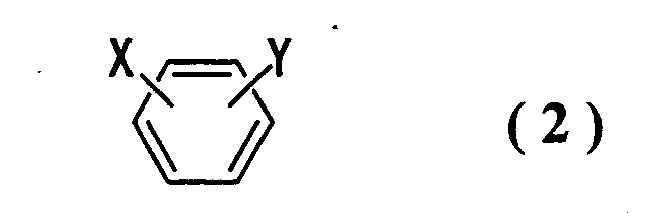
- aromatic hydrocarbons that can form the solvate of racemate of compound of formula (1) include aromatic hydrocarbons of formula (2) wherein X and Y are identical with or different from each other, hydrogen atom, C 1-3 alkyl group, halogen atom or C 1-3 alkoxy group.
- aromatic hydrocarbons include toluene and xylene.
- the amount of the solvent used is not specifically limited so long as it is an amount range so that a mixture in which either one optically active substance of the compound of formula (1) is present in excess becomes supersaturation. However, it is preferably 10 to 50 times by mass based on the used amount of the mixture in which either one optically active substance of the compound of formula (1) is present in excess.
- any seed crystal is not generally required.
- the crystal of solvate of racemate of compound of formula (1) may be added as seed crystal.
- the added amount and grain size are not specifically limited. However, it is used in an amount of 0.1 to 20 mass%, preferably 0.5 to 5 mass% based on the racemate of the compound of formula (1) or the mixture in which either one optically active substance is present in excess, in a form of ground powder.
- the temperature on preparing the supersaturated solution by dissolution with heat is not specifically limited and may range from room temperature to a boiling point of the solvent. However, it is required to be controlled so that a stably supersaturated solution could be obtained depending on the solubility of the compound of formula (1) in the used solvent.
- the temperature ranging from 50°C to a boiling point of the solvent is often used as a temperature on preparing the supersaturated solution by dissolution with heat depending on the kind and amount of the solvent used.
- the temperature on adding the crystal of solvate of racemate of the compound of formula (1) as a seed crystal is preferably 40°C to 60°C.
- the temperature on allowing crystal to separate out is preferably 0°C to 40°C.
- the time required for separating out the crystal is not specifically limited so long as optical purity can be secured to some extent, but about 30 minutes to about 5 hours are sufficient therefor.
- the methods for allowing crystal to separate out include a method by permitting to stand or a method by carrying out with stirring; but it is preferable to be carried out with stirring.
- an optically active substance of the compound of formula (1) used in the examples was prepared according to Example 25 of JP-A-63-233992 (1988) as follows: a racemate of compound of formula (1) was synthesized and then the optionally active substance was collected with HPLC through an optical isomer-separation column.
- HPLC collection condition Column: CHIRALCELOC (manufactured by Daicel Chemical Industries, Ltd.); Column Size: 20 cm ⁇ x 50 cm ⁇ Eluent: Methanol Column Temperature: Room temperature Flow Rate: 760 mL/min.
- optical purity of the optically active substance of the compound of formula (1) obtained in each example was analyzed in a condition of eluent: methanol, temperature: 40°C, flow rate: 1.0 mL/min., and UV detection: 254 nm by use of an optical isomer-separation column (CHIRALCELOC, f4.6 x 250 mm).
- optically active substance ((-) form) of compound of formula (1) having an optical purity of 12.04%ee was present in the filtrate.
- 0.602 g of a racemate of compound of formula (1) was added, dissolved with heat and cooled to 50°C over 50 minutes.
- the solution was seeded with 50 mg of an optically active substance of compound of formula (1) ((-) form: 100%ee), cooled to 30°C over 75 minutes, and then stirred at the same temperature for 60 minutes. After crystal separated out was collected through filtration, it was dried under reduced pressure at 50°C to obtain 1.364 g of optically active substance ((-) form) of compound of formula (1) having an optical purity of 86.92%ee as pale yellow crystal.
- optically active substance ((+) form) of compound of formula (1) having an optical purity of 17.87%ee was present in the filtrate.
- 1.360 g of a racemate of compound of formula (1) and 15.0 g of methanol were added, dissolved with heat again and cooled to 54°C over 35 minutes.
- the solution was seeded with 50 mg of an optically active substance of compound of formula (1) ((+) form: 100%ee), cooled to 30°C over 55 minutes, and then stirred at the same temperature for 55 minutes.
- optically active substance ((+) form) of compound of formula (1) having an optical purity of 93.05%ee was present in the filtrate.
- optically active substance ((+) form) of compound of formula (1) having an optical purity of 30.62%ee as white solid.
- optically active substance ((-) form) of compound of formula (1) present in 14.42 g of the filtrate had 3.82%ee.
- the present invention establishes a process for producing an optically active efonidipine that is economically excellent.
Landscapes
- Chemical & Material Sciences (AREA)
- Organic Chemistry (AREA)
- Health & Medical Sciences (AREA)
- General Health & Medical Sciences (AREA)
- Life Sciences & Earth Sciences (AREA)
- Molecular Biology (AREA)
- Biochemistry (AREA)
- Engineering & Computer Science (AREA)
- Bioinformatics & Cheminformatics (AREA)
- Heart & Thoracic Surgery (AREA)
- Cardiology (AREA)
- Nuclear Medicine, Radiotherapy & Molecular Imaging (AREA)
- General Chemical & Material Sciences (AREA)
- Pharmacology & Pharmacy (AREA)
- Chemical Kinetics & Catalysis (AREA)
- Animal Behavior & Ethology (AREA)
- Medicinal Chemistry (AREA)
- Public Health (AREA)
- Veterinary Medicine (AREA)
- Vascular Medicine (AREA)
- Urology & Nephrology (AREA)
- Organic Low-Molecular-Weight Compounds And Preparation Thereof (AREA)
- Pharmaceuticals Containing Other Organic And Inorganic Compounds (AREA)
- Plural Heterocyclic Compounds (AREA)
- Heterocyclic Carbon Compounds Containing A Hetero Ring Having Nitrogen And Oxygen As The Only Ring Hetero Atoms (AREA)
Abstract

- dissolving a racemate of the compound of formula (1) in a solvent to prepare a supersaturated solution; and
- adding crystal of either one optically active substance of the compound of formula (1) as a seed crystal in the supersaturated solution to allow crystal of the one optically active substance added as the seed crystal to separate out; or
- dissolving a mixture of the compound of formula (1) in which either one optically active substance thereof is present in excess in a solvent to prepare a supersaturated solution; and
- adding crystal of the one optically active substance present in excess as a seed crystal in the supersaturated solution to allow crystal of the one optically active substance present in excess to separate out.
Description
- The present invention relates to a process for efficiently producing an optically active substance of efonidipine (2-[Benzyl(phenyl)amino]ethyl 5-(5,5-dimethyl-2-oxo-1,3,2-dioxaphosphorinan-2-yl)-1,4-dihydro-2,6-dimethyl-4-(3-nitrophenyl)-3-pyridinecarboxylate) that is useful as an antihypertensive agent or a therapeutic agent for angina pectoris. Specifically, the present invention relates to a process for efficiently producing an optically active substance of efonidipine by preferential crystallization.
- Efonidipine (2-[Benzyl(phenyl)amino]ethyl 5-(5,5-dimethyl-2-oxo-1,3,2-dioxaphosphorinan-2-yl)-1,4-dihydro-2,6-dimethyl-4-(3-nitrophenyl)-3-pyridinecarboxylate) is placed on the market as an antihypertensive agent or a therapeutic agent for angina pectoris, and it has been already clarified that the antihypertensive activity is attributed to one optically active substance (S(+) form) (see, for example, Patent Document 1 and Non-patent Document 1).
- As a process for producing an optically active substance of efonidipine, the following three processes have been already reported:
- (1) Diastereomer resolution through (2S)-2-methoxy-2-phenylethyl(4S)-5-(5,5-dimethyl-2-oxo-1,3,2-dioxaphosphorinan-2-yl)-1,4-dihydro-2,6-dimethyl-4-(3-nitrophenyl)-3-pyridine-carboxylate, shown in Fig. 1 below (see, for example, Patent Document 2 and Non-patent Document 2)

- (2) Production method by utilizing enzyme shown in Fig. 2 below (see, for example, Non-patent Documents 3 and 4)

- (3) Method by optical resolution with optical isomer-separation column (see, for example, Non-patent Document 5).
- The diastereomer resolution of (1) is inappropriate as an industrial production process as optically active alcohol used is expensive, a long time is required for steps, the yield of transesterification is low, and the introduction and removal of protective groups are required.
The production method (asymmetric synthesis) by use of enzyme of (2) is good in the yield of the step for obtaining an optically active dihydropyridine-dicarboxylate, but many steps are required for inducing the optically active substance of efonidipine, and the method has disadvantages that the yield of transesterification is low, materials are expensive and the like from the standpoint of industrial production methods.
The optical resolution by use of optical isomer-separation column of (3) is a technique that is industrially applicable, but it has problems that an expensive packing is used, a large amount of solvent is used, and a special equipment (simulated moving bed system) is required. - The problem to be solved by the present invention is to establish a process for industrially producing an optically active substance of efonidipine that is economically excellent. Means for solving the Problem
- The present inventors eagerly investigated as to processes for efficiently producing an optically active substance of efonidipine. As a result of it, they noticed that efonidipine is a racemic mixture, found that the optically active substance can be easily produced bay carrying out preferential crystallization, and completed the present invention.
- That is, the present invention relates to
- 1. A process for producing an optically active substance of compound of formula (1)

- dissolving a racemate of the compound of formula (1) in a solvent to prepare a supersaturated solution; and
- adding crystal of either one optically active substance of the compound of formula (1) as a seed crystal in the supersaturated solution to allow crystal of the one optically active substance added as the seed crystal to separate out; or
- dissolving a mixture of the compound of formula (1) in which either one optically active substance thereof is present in excess in a solvent to prepare a supersaturated solution; and
- adding crystal of the one optically active substance present in excess as a seed crystal in the supersaturated solution to allow crystal of the one optically active substance present in excess to separate out;
- 2. The process for producing an optically active substance as set forth in 1., wherein the solvent is alcohols or esters;
- 3. A process for purifying an optically active substance of compound of formula (1)

- recrystallizing a mixture of the compound of formula (1) in which either one optically active substance thereof is present in excess, or
- allowing crystal to separate out from a solution of a mixture of the compound of formula (1) in which either one optically active substance thereof is present in excess, as a result of it, an optically active substance present in excess in a mother liquor from which the crystal is removed is the other optically active substance that is not one of the crystal;
- 4. The process for purifying an optically active substance as set forth in 3., wherein the solvent is alcohols or esters;
- 5. A process for producing an optically active substance of compound of formula (1)

- dissolving a mixture of the compound of formula (1) in which either one optically active substance thereof is present in excess in an aromatic hydrocarbon of formula (2)

- The preferential crystallization can provide an optically active substance in a simple mode equivalent to recrystallization process of racemates if only the seed crystal is present, and is an extremely useful process from the industrial and economical standpoint. Best Mode for carrying out the Invention
- Hereinafter, the present invention is described in further detail.
- In the meantime, "n" means normal, "i" means iso, and "c" means cyclo in this specification.
- Each substituent described in this specification is explained.
- Halogen atom includes fluorine atom, chlorine atom, bromine atom and iodine atom. C1-3 alkyl group may be straight-chain, branched or cyclic, and includes for example methyl group, ethyl group, n-propyl group, i-propyl group and c-propyl group. C1-3 alkoxy group may be straight-chain, branched or cyclic, and includes for example methoxy group, ethoxy group, n-propoxy group, i-propoxy group and c-propoxy group.
- The racemate of the compound of formula (1) used in the present invention can be easily produced according to the production method described in JP-A-63-233992 (1988). The crystal of the optically active substance of the compound of formula (1) used as a seed crystal in the present invention can be produced by use of the production method described in JP-A-2-11592 (1990), or an optical resolution with optical isomer-separation column, or the like.
- The production of the optically active substance of the compound of formula (1) according to the present invention is achieved by adding crystal of either one optically active substance of the compound of formula (1) as a seed crystal in a supersaturated solution of racemate of the compound of formula (1), and allowing crystal to separate out, or by adding crystal of either one optically active substance of the compound of formula (1) as a seed crystal in a supersaturated solution in which the either one optically active substance is present in excess, and allowing crystal to separate out.
- The supersaturated solution can be prepared according to any conventional method such as a method comprising dissolving with heat a racemate of the compound of the formula (1) or a mixture in which either one optically active substance is present in excess in a suitable solvent, and then cooling the resulting solution, or a method comprising concentrating the solution, or a method comprising adding a solvent that lowers solubility in the solution, or the like.
- When the optically active substance of the compound of the formula (1) is produced by use of a mixture in which either one optically active substance is present in excess, the crystal of the optically active substance as a seed crystal is not necessarily added externally, and an optical resolution proceeds also by natural crystallization.
- The solvents used in the process for producing the optically active substance of the compound of the formula (1) are not specifically limited so long as the compound of the formula (1) shows a suitable solubility, and includes for example alcohols such as methyl alcohol, ethyl alcohol, 1-propanol and 2-propanol, or the like, esters such as ethyl acetate or the like, ketones such as methyl isobutyl ketone and acetone, or the like, aliphatic hydrocarbons such as n-hexane, n-heptane and cyclohexane, or the like, ethers such as isopropyl ether and tetrahydrofuran, or the like, halogen-containing solvents such as dichloromethane and chloroform, or the like, aprotic polar solvents such as dimethylformamide and dimethylsulfoxide, or the like, and mixed solvents in which two or more of the above-mentioned solvents are contained in an arbitrary proportion. Preferable solvents include for example alcohols and esters, and particularly preferable solvents include for example alcohols. Preferable concrete solvents include for example methyl alcohol, ethyl alcohol, 2-propanol and ethyl acetate, more preferable solvents include for example methyl alcohol and ethyl alcohol, and further preferably it includes methyl alcohol.
- The amount of the solvent used is not specifically limited so long as it is an amount range in which a racemate of the compound of formula (1) or a mixture in which either one optically active substance is present in excess becomes supersaturation. However, it is preferable to carry out in a suitable range because in case where the used amount is too much, the resulting crystal is lowered in amount, and in case where the used amount is too small, there is fear that the optical purity of the resulting crystal is lowered.
- As the solubility of the compound of formula (1) differs from each other depending on the kind of the solvents, suitable used amount of the solvents cannot be generally determined. However, for example, when alcohols or esters are used as solvent, the used amount of the solvent is preferably 10 to 50 times by mass, more preferably 15 to 30 times by mass based on the used amount of the racemate of the compound of formula (1) or the mixture in which either one optically active substance is present in excess.
- The added amount and grain size of the crystal of the optically active substance of the compound of formula (1) that is used as seed crystal are not specifically limited. However, it is used in an amount of 0.1 to 20 mass%, preferably 0.5 to 5 mass% based on the racemate of the compound of formula (1) or the mixture in which either one optically active substance is present in excess, in a form of ground powder.
- The temperature on preparing the supersaturated solution by dissolution with heat is not specifically limited and may range from room temperature to a boiling point of the solvent. However, it is required to be controlled so that a stably supersaturated solution could be obtained depending on the solubility of the compound of formula (1) in the used solvent. For example, in case where alcohols or esters are used as a solvent, the temperature ranging from 50°C to the boiling point of the solvent is often used as a temperature on preparing the supersaturated solution by dissolution with heat.
- The temperature on adding the crystal of the optically active substance of the compound of formula (1) as a seed crystal is not generally determined as it varies depending on the kind and used amount of the solvent used. However, for example, in case where alcohols or esters are used as a solvent, the temperature ranging from 40°C to 60°C is preferably used as a temperature on adding the crystal of the optically active substance.
- The temperature on allowing crystal to separate out is not generally determined as it varies depending on the kind and used amount of the solvent used. However, for example, in case where alcohols or esters are used as a solvent, the temperature ranging from 20°C to 40°C is preferably used as a temperature on allowing crystal to separate out.
- The time required for allowing crystal to separate out is not specifically limited so long as optical purity can be secured to some extent, but about 30 minutes to about 5 hours are sufficient therefor. In addition, the methods for allowing crystal to separate out include a method by permitting to stand or a method by carrying out with stirring, etc., but it is preferable to be carried out with stirring.
- In industrial production of the optically active substance of the compound of formula (1), the following several methods that are known as preferential crystallization can be used: a batch method in which one optically active substance and the other optically active substance are resolved alternately, a continuous method in which a supersaturated solution is continuously flowed through a column in which a seed crystal is present, or a method in which one optically active substance and the other optically active substance are immersed as seed crystals in places separated by a distance and each seed crystal is grown, or the like.
When the optically active substance obtained as mentioned above is insufficient in optical purity, the optical purity can be further increased by recrystallization or the like. In this case, as an optically active substance present in excess in the mother liquor after recrystallization is different from the crystallized optically active substance, it is said to be an extremely efficient method from the standpoint of the efficiency of purification. - Similarly efficient purification can be carried out also by recrystallizing crystal of a mixture in which either one optically active substance is present in excess, or allowing crystal to separate out from a mixture in which either one optically active substance is present in excess (that is, an optically active substance that becomes excess in the mother liquor is different from the crystallized optically active substance).
The purification method is a means particularly effective for purifying a mixture of the compound of formula (1) having a high optical purity, for example for purifying a mixture having an optical purity of 70%ee or more, preferably 80%ee or more. - The solvents used in the purification method are not specifically limited so long as the compound of the formula (1) shows a suitable solubility, and includes for example alcohols such as methyl alcohol, ethyl alcohol, 1-propanol and 2-propanol, or the like, esters such as ethyl acetate or the like, ketones such as methyl isobutyl ketone and acetone, or the like, aliphatic hydrocarbons such as n-hexane, n-heptane and cyclohexane, or the like, ethers such as isopropyl ether and tetrahydrofuran, or the like, halogen-containing solvents such as dichloromethane and chloroform, or the like, aprotic polar solvents such as dimethylformamide and dimethylsulfoxide, or the like, and mixed solvents in which two or more of the above-mentioned solvents are contained in an arbitrary proportion. Preferable solvents include for example alcohols and esters, and particularly preferable solvents include for example alcohols. Preferable concrete solvents include for example methyl alcohol, ethyl alcohol, 2-propanol and ethyl acetate, more preferable solvents include for example methyl alcohol and ethyl alcohol, and further preferably it includes methyl alcohol.
- In addition, as the condition of crystallization, the condition similar to that in the process for producing optically active substance of the compound of formula (1) except that seed crystal is not used can be used.
- When the compound of formula (1) is crystallized from aromatic hydrocarbons, the crystal is obtained as a solvate of racemate, but the optically active substance of the compound of formula (1) does not form any solvate. Further, the resulting crystal of solvate of racemate of compound of formula (1) has an extremely low solubility in the used aromatic hydrocarbons, and therefore either one optically active substance of the compound of formula (1) can be produced in a high purity from the mother liquor from which the crystal is removed.
- The aromatic hydrocarbons that can form the solvate of racemate of compound of formula (1) include aromatic hydrocarbons of formula (2)
- The amount of the solvent used is not specifically limited so long as it is an amount range so that a mixture in which either one optically active substance of the compound of formula (1) is present in excess becomes supersaturation. However, it is preferably 10 to 50 times by mass based on the used amount of the mixture in which either one optically active substance of the compound of formula (1) is present in excess.
- When the crystal of solvate of racemate of compound of formula (1) is separated out, any seed crystal is not generally required. However, the crystal of solvate of racemate of compound of formula (1) may be added as seed crystal. In case where the crystal of solvate of racemate of compound of formula (1) is added as seed crystal, the added amount and grain size are not specifically limited. However, it is used in an amount of 0.1 to 20 mass%, preferably 0.5 to 5 mass% based on the racemate of the compound of formula (1) or the mixture in which either one optically active substance is present in excess, in a form of ground powder.
- The temperature on preparing the supersaturated solution by dissolution with heat is not specifically limited and may range from room temperature to a boiling point of the solvent. However, it is required to be controlled so that a stably supersaturated solution could be obtained depending on the solubility of the compound of formula (1) in the used solvent. The temperature ranging from 50°C to a boiling point of the solvent is often used as a temperature on preparing the supersaturated solution by dissolution with heat depending on the kind and amount of the solvent used. The temperature on adding the crystal of solvate of racemate of the compound of formula (1) as a seed crystal is preferably 40°C to 60°C. The temperature on allowing crystal to separate out is preferably 0°C to 40°C.
- The time required for separating out the crystal is not specifically limited so long as optical purity can be secured to some extent, but about 30 minutes to about 5 hours are sufficient therefor. In addition, the methods for allowing crystal to separate out include a method by permitting to stand or a method by carrying out with stirring; but it is preferable to be carried out with stirring.
- Hereinafter, the present invention will be concretely described based on examples to which the present invention is not limited.
In the meantime, an optically active substance of the compound of formula (1) used in the examples was prepared according to Example 25 of JP-A-63-233992 (1988) as follows: a racemate of compound of formula (1) was synthesized and then the optionally active substance was collected with HPLC through an optical isomer-separation column.
HPLC collection condition
Column: CHIRALCELOC (manufactured by Daicel Chemical Industries, Ltd.);
Column Size: 20 cmφ x 50 cmφ
Eluent: Methanol
Column Temperature: Room temperature
Flow Rate: 760 mL/min.
In addition, the optical purity of the optically active substance of the compound of formula (1) obtained in each example was analyzed in a condition of eluent: methanol, temperature: 40°C, flow rate: 1.0 mL/min., and UV detection: 254 nm by use of an optical isomer-separation column (CHIRALCELOC, f4.6 x 250 mm). - In 25.0 g of methanol, 1.00 g of a racemate of compound of formula (1) was dissolved at 62°C, and then the resulting solution was cooled to 53°C over 20 minutes. The solution was seeded with 10 mg of an optically active substance of compound of formula (1) ((+) form: 100%ee), cooled to 33°C over 45 minutes, and then stirred at 30-33°C for 1 hour. After crystal separated out was collected through filtration, it was dried under reduced pressure at 50°C to obtain 144.8 mg of optically active substance ((+) form) of compound of formula (1) having an optical purity of 88.37%ee as pale yellow crystal. On the other hand, the filtrate was concentrated to obtain 771.6 mg of optically active substance ((-) form) of compound of formula (1) having an optical purity of 13.33%ee as yellow foamy substance.
- In 25.0 g of ethanol, 1.00 g of a racemate of compound of formula (1) was dissolved at 73°C, and then the resulting solution was cooled to 53°C over 20 minutes. The solution was seeded with 10 mg of an optically active substance of compound of formula (1) ((+) form: 100%ee), cooled to 35°C over 45 minutes, and then stirred at 34-35°C for 1 hour. After crystal separated out was collected through filtration, it was dried under reduced pressure at 50°C to obtain 414.3 mg of optically active substance ((+) form) of compound of formula (1) having an optical purity of 11.42%ee as pale yellow crystal. On the other hand, the filtrate was concentrated to obtain 571.4 mg of optically active substance ((-) form) of compound of formula (1) having an optical purity of 4.35%ee as yellow foamy substance.
- In 25.0 g of 1-propanol, 1.00 g of a racemate of compound of formula (1) was dissolved at 87°C, and then the resulting solution was cooled to 47°C over 55 minutes. The solution was seeded with 10 mg of an optically active substance of compound of formula (1) ((+) form: 100%ee), cooled to 30°C over 50 minutes, and then stirred at the same temperature for 1 hour. After crystal separated out was collected through filtration, it was dried under reduced pressure at 50°C to obtain 209.9 mg of optically active substance ((+) form) of compound of formula (1) having an optical purity of 52.49%ee as pale yellow crystal. On the other hand, the filtrate was concentrated to obtain 790 mg of optically active substance ((-) form) of compound of formula (1) having an optical purity of 15.45%ee as yellow foamy substance.
- In 30.0 g of ethyl acetate, 1.00 g of a racemate of compound of formula (1) was dissolved at 73°C, and then the resulting solution was cooled to 42°C over 20 minutes. The solution was seeded with 10 mg of an optically active substance of compound of formula (1) ((+) form: 100%ee), cooled to 20°C over 40 minutes, and then stirred at the same temperature for 40 minutes. After crystal separated out was collected through filtration, it was dried under reduced pressure at 50°C to obtain 87.4 mg of optically active substance ((+) form) of compound of formula (1) having an optical purity of 93.00%ee as pale yellow crystal. On the other hand, the filtrate was concentrated to obtain 920 mg of optically active substance ((-) form) of compound of formula (1) having an optical purity of 9.14%ee as yellow foamy substance.
- In 125 g of MeOH, 5.00 g of a racemate of compound of formula (1) was dissolved at 62°C, and then the resulting solution was cooled to 51 °C over 30 minutes. The solution was seeded with 50 mg of an optically active substance of compound of formula (1) ((+) form: 100%ee), cooled to 30°C over 80 minutes, and then stirred at the same temperature for 60 minutes. After crystal separated out was collected through filtration, it was dried under reduced pressure at 50°C to obtain 0.568 g of optically active substance ((+) form) of compound of formula (1) having an optical purity of 89.97%ee as pale yellow crystal. In addition, optically active substance ((-) form) of compound of formula (1) having an optical purity of 12.04%ee was present in the filtrate. In the filtrate, 0.602 g of a racemate of compound of formula (1) was added, dissolved with heat and cooled to 50°C over 50 minutes. The solution was seeded with 50 mg of an optically active substance of compound of formula (1) ((-) form: 100%ee), cooled to 30°C over 75 minutes, and then stirred at the same temperature for 60 minutes. After crystal separated out was collected through filtration, it was dried under reduced pressure at 50°C to obtain 1.364 g of optically active substance ((-) form) of compound of formula (1) having an optical purity of 86.92%ee as pale yellow crystal. In addition, optically active substance ((+) form) of compound of formula (1) having an optical purity of 17.87%ee was present in the filtrate. In the filtrate, 1.360 g of a racemate of compound of formula (1) and 15.0 g of methanol were added, dissolved with heat again and cooled to 54°C over 35 minutes. The solution was seeded with 50 mg of an optically active substance of compound of formula (1) ((+) form: 100%ee), cooled to 30°C over 55 minutes, and then stirred at the same temperature for 55 minutes. After crystal separated out was collected through filtration, it was dried under reduced pressure at 50°C to obtain 1.270 g of optically active substance ((+) form) of compound of formula (1) having an optical purity of 93.05%ee as pale yellow crystal. In addition, optically active substance ((-) form) of compound of formula (1) having an optical purity of 14.23%ee was present in the filtrate.
- A mixture of 899.6 mg of an optically active substance of compound of formula (1) ((+) form: 100%ee) with 100.2 mg of a racemate of compound of formula (1) was dissolved in 25.0 g of ethanol at 77°C. An optical purity was 88.80%ee at this point. The resulting solution was cooled to 28°C over 35 minutes, and then cooled further to 23°C over 45 minutes. After crystal separated out was collected through filtration, it was dried under reduced pressure at 50°C to obtain 891 mg of optically active substance ((+) form) of compound of formula (1) having an optical purity of 99.71%ee as pale yellow crystal. On the other hand, the filtrate was concentrated to obtain 0.10 g of optically active substance ((-) form) of compound of formula (1) having an optical purity of 7.42%ee as yellow foamy substance.
- A mixture of 80.6 mg of an optically active substance of compound of formula (1) ((+) form: 100%ee) with 420.4 mg of a racemate of compound of formula (1) was dissolved in 12.5 g of ethanol at 76°C. An optical purity was 16.70%ee at this point. The resulting solution was cooled to a temperature of 5°C or below over 40 minutes, and stirred at the same temperature for 30 minutes. After crystal separated out was collected through filtration, it was dried under reduced pressure at 50°C to obtain 371.7 mg of optically active substance ((+) form) of compound of formula (1) having an optical purity of 26.01 %ee as yellow solid. In addition, the filtrate was concentrated to obtain 0.12 g of optically active substance ((-) form) of compound of formula (1) having an optical purity of 7.55%ee as yellow foamy substance.
- A mixture of 51.7 mg of an optically active substance of compound of formula (1) ((+) form: 100%ee) with 449.0 mg of a racemate of compound of formula (1) was dissolved in 7.50 g of toluene at 95°C. An optical purity was 10.20%ee at this point. The resulting solution was cooled to 60°C over 7 minutes. Thereafter, the solution was seeded with 5.2 mg of toluene solvate of a racemate of compound of formula (1), cooled to a temperature of 5°C or below over 40 minutes and stirred at the same temperature for 30 minutes. After crystal separated out was collected through filtration, it was dried under reduced pressure at 60°C to obtain 506.8 mg of toluene solvate of a racemate of compound of formula (1) (as actually an optically active substance ((+) form) of compound of formula (1) was in slightly excess, an optical purity was 5.65%ee) as yellow solid. In addition, the filtrate was concentrated to obtain 0.05 g of optically active substance ((+) form) of compound of formula (1) having an optical purity of 97.96%ee as yellow residue.
- In 3.00 (4.75 mmol) g of a racemate of compound of formula (1), 300 mg (3.12 mmol, 0.66 equivalent) of methanesulfonic acid was added, the resulting solution was refluxed with heat (62°C) in 15.0 g of methanol, and dissolved. The resulting solution was cooled to 50°C over 30 minutes, and then 10 mg of an optically active substance of compound of formula (1) ((+) form: 100%ee) was added, cooled to 40°C over 1 hour, and then stirred at the same temperature for 1 hour. After crystal separated out was collected through filtration, it was washed with 2 ml of methanol and dried under reduced pressure at 50°C to obtain 716.2 mg of optically active substance ((+) form) of compound of formula (1) having an optical purity of 30.62%ee as white solid. On the other hand, optically active substance ((-) form) of compound of formula (1) present in 14.42 g of the filtrate had 3.82%ee.
- The present invention establishes a process for producing an optically active efonidipine that is economically excellent.
Patent Document 2: JP-A-2-11592 (1990)
Non-patent Document 1: Y. Masuda, T. Sakai, M. Sakasita, M. Takeguti, T. Takahashi, C. Arakawa, M. Hibi, S. Tanaka, K. Shigenobu, and Y. Kasuya, Jpn. J. Pharmacol., 48, p. 266 (1988)
Non-patent Document 2: R. Sakoda, H. Matsumoto, K. Seto, Chem. Pharm. Bull., 40(9), p. 2377 (1992)
Non-patent Document 3: T. Kato, M. Teshima, H. Ebiike, and K. Achiwa: Chem. Pharm. Bull., 44, p. 1132 (1996)
Non-patent Document 4: H. Ebiike, Y. Yamazaki, and K. Achiwa: Chem. Pharm. Bull., 43, p. 1251 (1995)
Non-patent Document 5: New Development of Process Chemistry (2003), p. 253, CMC Publishing Co., Ltd., Edit.: The Japanese Society of Process Chemistry Disclosure of Invention
crystallizing a solvate of a racemate of the compound of formula (1) and the aromatic hydrocarbon from the supersaturated solution; removing resulting crystal, and then
obtaining in a high purity the one optically active substance present in excess of the compound of formula (1).
Claims (5)
- A process for producing an optically active substance of compound of formula (1)
 dissolving a racemate of the compound of formula (1) in a solvent to prepare a supersaturated solution; andadding crystal of either one optically active substance of the compound of formula (1) as a seed crystal in the supersaturated solution to allow crystal of the one optically active substance added as the seed crystal to separate out; ordissolving a mixture of the compound of formula (1) in which either one optically active substance thereof is present in excess in a solvent to prepare a supersaturated solution; andadding crystal of the one optically active substance present in excess as a seed crystal in the supersaturated solution to allow crystal of the one optically active substance present in excess to separate out.
 - The process for producing an optically active substance according to claim 1, wherein the solvent is alcohols or esters.
- A process for purifying an optically active substance of compound of formula (1)
 recrystallizing a mixture of the compound of formula (1) in which either one optically active substance thereof is present in excess, orallowing crystal to separate out from a solution of a mixture of the compound of formula (1) in which either one optically active substance thereof is present in excess, as a result of it, an optically active substance present in excess in a mother liquor from which the crystal is removed is the other optically active substance that is not one of the crystal.
 - The process for purifying an optically active substance according to claim 3, wherein the solvent is alcohols or esters.
- A process for producing an optically active substance of compound of formula (1)
 dissolving a mixture of the compound of formula (1) in which either one optically active substance thereof is present in excess in an aromatic hydrocarbon of formula (2)wherein X and Y are identical with or different from each other, hydrogen atom, C1-3alkyl group, halogen atom or C1-3alkoxy group, to prepare a supersaturated solution;
crystallizing a solvate of a racemate of the compound of formula (1) and the aromatic hydrocarbon from the supersaturated solution;
removing resulting crystal, and then
obtaining in a high purity the one optically active substance present in excess of the compound of formula (1).
Applications Claiming Priority (2)
| Application Number | Priority Date | Filing Date | Title |
|---|---|---|---|
| JP2003342761 | 2003-10-01 | ||
| PCT/JP2004/011607 WO2005033117A1 (en) | 2003-10-01 | 2004-08-12 | Process for producing optically active dihydropyridinephosphonic ester |
Publications (3)
| Publication Number | Publication Date |
|---|---|
| EP1676852A1 true EP1676852A1 (en) | 2006-07-05 |
| EP1676852A4 EP1676852A4 (en) | 2008-11-12 |
| EP1676852B1 EP1676852B1 (en) | 2011-10-05 |
Family
ID=34419273
Family Applications (1)
| Application Number | Title | Priority Date | Filing Date |
|---|---|---|---|
| EP04771582A Expired - Lifetime EP1676852B1 (en) | 2003-10-01 | 2004-08-12 | Process for producing optically active dihydropyridinephosphonic ester |
Country Status (7)
| Country | Link |
|---|---|
| US (1) | US20060276437A1 (en) |
| EP (1) | EP1676852B1 (en) |
| JP (1) | JP4530172B2 (en) |
| KR (1) | KR101031577B1 (en) |
| AT (1) | ATE527273T1 (en) |
| TW (1) | TWI361801B (en) |
| WO (1) | WO2005033117A1 (en) |
Family Cites Families (3)
| Publication number | Priority date | Publication date | Assignee | Title |
|---|---|---|---|---|
| JPH0699458B2 (en) | 1986-01-23 | 1994-12-07 | 日産化学工業株式会社 | Dihydropyridine-5-phosphonic acid cyclic ester |
| JPH0211592A (en) * | 1988-06-29 | 1990-01-16 | Nissan Chem Ind Ltd | Optically active dihydropyridinephosphonic ester |
| JP2850376B2 (en) * | 1988-08-02 | 1999-01-27 | 日産化学工業株式会社 | Anticancer drug efficacy enhancer |
-
2004
- 2004-08-12 US US10/573,972 patent/US20060276437A1/en not_active Abandoned
- 2004-08-12 WO PCT/JP2004/011607 patent/WO2005033117A1/en not_active Ceased
- 2004-08-12 EP EP04771582A patent/EP1676852B1/en not_active Expired - Lifetime
- 2004-08-12 AT AT04771582T patent/ATE527273T1/en not_active IP Right Cessation
- 2004-08-12 JP JP2005514363A patent/JP4530172B2/en not_active Expired - Fee Related
- 2004-08-12 KR KR1020067005134A patent/KR101031577B1/en not_active Expired - Fee Related
- 2004-09-22 TW TW093128737A patent/TWI361801B/en not_active IP Right Cessation
Non-Patent Citations (3)
| Title |
|---|
| ERNEST L ELIEL and SAMUEL H. WILEN: "Stereochemistry ofOrganic Compounds", 1994, JOHN WILEY & SONS, INC pages 158-163-298-305, * |
| No further relevant documents disclosed * |
| See also references of WO2005033117A1 * |
Also Published As
| Publication number | Publication date |
|---|---|
| KR101031577B1 (en) | 2011-04-27 |
| TWI361801B (en) | 2012-04-11 |
| EP1676852A4 (en) | 2008-11-12 |
| KR20060080928A (en) | 2006-07-11 |
| TW200513453A (en) | 2005-04-16 |
| EP1676852B1 (en) | 2011-10-05 |
| JP4530172B2 (en) | 2010-08-25 |
| WO2005033117A1 (en) | 2005-04-14 |
| ATE527273T1 (en) | 2011-10-15 |
| JPWO2005033117A1 (en) | 2007-10-04 |
| US20060276437A1 (en) | 2006-12-07 |
Similar Documents
| Publication | Publication Date | Title |
|---|---|---|
| RU2494090C2 (en) | Method of producing r-beta-aminophenyl-butyric acid derivatives | |
| US9932337B2 (en) | Method for the production of Praziquantel and precursors thereof | |
| WO2007013743A1 (en) | Method of preparing esomeprazole and salts thereof | |
| US20070155969A1 (en) | Processes for the preparation of s-(-)-amlodipine | |
| KR101530924B1 (en) | Separation of triazine derivatives enantiomers using tartaric acid | |
| EP1676852B1 (en) | Process for producing optically active dihydropyridinephosphonic ester | |
| CA3123170A1 (en) | Method for producing (5s)-4-[5-(3,5-dichlorophenyl)-5-(trifluoromethyl)-4h-isoxazol-3-yl]-2-methyl-benzoic acid | |
| CA2087093A1 (en) | Process for the extractive removal of 2-alkylthio-5- phenylpyrimidines from their reaction mixtures | |
| EP1973895A1 (en) | Process for isolation of desired isomers of nebivolol intermediates | |
| US20040242878A1 (en) | Method for separating methyl 4-(2-chloro-4-fluorophenyl)-2-(3,5-difluoro-2-pyridinyl)-6-methyl-1,4-dihydro-5-pyrimidine-carboxylate-racemate | |
| KR101001646B1 (en) | Method for preparing (R)-(+)-lansoprazole and intermediates used therein | |
| JP4320849B2 (en) | Method for producing purified 1,4-dihydropyridines | |
| AU2006281684B2 (en) | A process for the preparation of perindopril erbumine | |
| US20060167280A1 (en) | Method for purifying simvastatin | |
| JP4768145B2 (en) | Optical purification method of optically active 2-phenoxypropionic acid | |
| US20040220417A1 (en) | Processes for preparation of n-protected-beta-amino alcohols and n-protected-beta-amino epoxides | |
| KR20100063915A (en) | Method of preparing s-(-)-amlodipine with high optical purity and intermediate compound produced during the same | |
| KR100404965B1 (en) | Novel Hydantoin Library Using Combinatorial Chemistry | |
| JP5503930B2 (en) | Method for purifying 3-amino-1-tert-butoxycarbonylpiperidine and citrate salt thereof | |
| JP2008007457A (en) | Post-treatment method of β-hydroxycarbonyl compound | |
| JP2008143786A (en) | Optical resolution method | |
| JP2001064275A (en) | Optical resolution method for isocoumarin derivatives | |
| KR20060125218A (en) | Method for preparing optically active benzoxazine derivatives | |
| JP2002047268A (en) | Method for producing optically active dioxopyrrolidine derivative | |
| JP2003096076A (en) | Method for producing naphthyridine derivative |
Legal Events
| Date | Code | Title | Description |
|---|---|---|---|
| PUAI | Public reference made under article 153(3) epc to a published international application that has entered the european phase |
Free format text: ORIGINAL CODE: 0009012 |
|
| 17P | Request for examination filed |
Effective date: 20060425 |
|
| AK | Designated contracting states |
Kind code of ref document: A1 Designated state(s): AT BE BG CH CY CZ DE DK EE ES FI FR GB GR HU IE IT LI LU MC NL PL PT RO SE SI SK TR |
|
| AX | Request for extension of the european patent |
Extension state: AL HR LT LV MK |
|
| A4 | Supplementary search report drawn up and despatched |
Effective date: 20081009 |
|
| 17Q | First examination report despatched |
Effective date: 20091026 |
|
| GRAP | Despatch of communication of intention to grant a patent |
Free format text: ORIGINAL CODE: EPIDOSNIGR1 |
|
| GRAS | Grant fee paid |
Free format text: ORIGINAL CODE: EPIDOSNIGR3 |
|
| GRAA | (expected) grant |
Free format text: ORIGINAL CODE: 0009210 |
|
| AK | Designated contracting states |
Kind code of ref document: B1 Designated state(s): AT BE BG CH CY CZ DE DK EE ES FI FR GB GR HU IE IT LI LU MC NL PL PT RO SE SI SK TR |
|
| AX | Request for extension of the european patent |
Extension state: AL HR LT LV MK |
|
| REG | Reference to a national code |
Ref country code: GB Ref legal event code: FG4D |
|
| REG | Reference to a national code |
Ref country code: CH Ref legal event code: EP |
|
| REG | Reference to a national code |
Ref country code: IE Ref legal event code: FG4D |
|
| REG | Reference to a national code |
Ref country code: DE Ref legal event code: R096 Ref document number: 602004034708 Country of ref document: DE Effective date: 20111201 |
|
| REG | Reference to a national code |
Ref country code: NL Ref legal event code: VDEP Effective date: 20111005 |
|
| PG25 | Lapsed in a contracting state [announced via postgrant information from national office to epo] |
Ref country code: SI Free format text: LAPSE BECAUSE OF FAILURE TO SUBMIT A TRANSLATION OF THE DESCRIPTION OR TO PAY THE FEE WITHIN THE PRESCRIBED TIME-LIMIT Effective date: 20111005 |
|
| LTIE | Lt: invalidation of european patent or patent extension |
Effective date: 20111005 |
|
| REG | Reference to a national code |
Ref country code: AT Ref legal event code: MK05 Ref document number: 527273 Country of ref document: AT Kind code of ref document: T Effective date: 20111005 |
|
| PG25 | Lapsed in a contracting state [announced via postgrant information from national office to epo] |
Ref country code: BE Free format text: LAPSE BECAUSE OF FAILURE TO SUBMIT A TRANSLATION OF THE DESCRIPTION OR TO PAY THE FEE WITHIN THE PRESCRIBED TIME-LIMIT Effective date: 20111005 |
|
| PG25 | Lapsed in a contracting state [announced via postgrant information from national office to epo] |
Ref country code: NL Free format text: LAPSE BECAUSE OF FAILURE TO SUBMIT A TRANSLATION OF THE DESCRIPTION OR TO PAY THE FEE WITHIN THE PRESCRIBED TIME-LIMIT Effective date: 20111005 Ref country code: PT Free format text: LAPSE BECAUSE OF FAILURE TO SUBMIT A TRANSLATION OF THE DESCRIPTION OR TO PAY THE FEE WITHIN THE PRESCRIBED TIME-LIMIT Effective date: 20120206 Ref country code: SE Free format text: LAPSE BECAUSE OF FAILURE TO SUBMIT A TRANSLATION OF THE DESCRIPTION OR TO PAY THE FEE WITHIN THE PRESCRIBED TIME-LIMIT Effective date: 20111005 Ref country code: GR Free format text: LAPSE BECAUSE OF FAILURE TO SUBMIT A TRANSLATION OF THE DESCRIPTION OR TO PAY THE FEE WITHIN THE PRESCRIBED TIME-LIMIT Effective date: 20120106 |
|
| PG25 | Lapsed in a contracting state [announced via postgrant information from national office to epo] |
Ref country code: CY Free format text: LAPSE BECAUSE OF FAILURE TO SUBMIT A TRANSLATION OF THE DESCRIPTION OR TO PAY THE FEE WITHIN THE PRESCRIBED TIME-LIMIT Effective date: 20111005 |
|
| PG25 | Lapsed in a contracting state [announced via postgrant information from national office to epo] |
Ref country code: BG Free format text: LAPSE BECAUSE OF FAILURE TO SUBMIT A TRANSLATION OF THE DESCRIPTION OR TO PAY THE FEE WITHIN THE PRESCRIBED TIME-LIMIT Effective date: 20120105 Ref country code: CZ Free format text: LAPSE BECAUSE OF FAILURE TO SUBMIT A TRANSLATION OF THE DESCRIPTION OR TO PAY THE FEE WITHIN THE PRESCRIBED TIME-LIMIT Effective date: 20111005 Ref country code: EE Free format text: LAPSE BECAUSE OF FAILURE TO SUBMIT A TRANSLATION OF THE DESCRIPTION OR TO PAY THE FEE WITHIN THE PRESCRIBED TIME-LIMIT Effective date: 20111005 Ref country code: DK Free format text: LAPSE BECAUSE OF FAILURE TO SUBMIT A TRANSLATION OF THE DESCRIPTION OR TO PAY THE FEE WITHIN THE PRESCRIBED TIME-LIMIT Effective date: 20111005 Ref country code: SK Free format text: LAPSE BECAUSE OF FAILURE TO SUBMIT A TRANSLATION OF THE DESCRIPTION OR TO PAY THE FEE WITHIN THE PRESCRIBED TIME-LIMIT Effective date: 20111005 |
|
| PLBE | No opposition filed within time limit |
Free format text: ORIGINAL CODE: 0009261 |
|
| STAA | Information on the status of an ep patent application or granted ep patent |
Free format text: STATUS: NO OPPOSITION FILED WITHIN TIME LIMIT |
|
| PG25 | Lapsed in a contracting state [announced via postgrant information from national office to epo] |
Ref country code: IT Free format text: LAPSE BECAUSE OF FAILURE TO SUBMIT A TRANSLATION OF THE DESCRIPTION OR TO PAY THE FEE WITHIN THE PRESCRIBED TIME-LIMIT Effective date: 20111005 Ref country code: PL Free format text: LAPSE BECAUSE OF FAILURE TO SUBMIT A TRANSLATION OF THE DESCRIPTION OR TO PAY THE FEE WITHIN THE PRESCRIBED TIME-LIMIT Effective date: 20111005 Ref country code: RO Free format text: LAPSE BECAUSE OF FAILURE TO SUBMIT A TRANSLATION OF THE DESCRIPTION OR TO PAY THE FEE WITHIN THE PRESCRIBED TIME-LIMIT Effective date: 20111005 |
|
| 26N | No opposition filed |
Effective date: 20120706 |
|
| PGFP | Annual fee paid to national office [announced via postgrant information from national office to epo] |
Ref country code: GB Payment date: 20120725 Year of fee payment: 9 |
|
| REG | Reference to a national code |
Ref country code: DE Ref legal event code: R097 Ref document number: 602004034708 Country of ref document: DE Effective date: 20120706 |
|
| PGFP | Annual fee paid to national office [announced via postgrant information from national office to epo] |
Ref country code: DE Payment date: 20120820 Year of fee payment: 9 Ref country code: FR Payment date: 20120809 Year of fee payment: 9 |
|
| PG25 | Lapsed in a contracting state [announced via postgrant information from national office to epo] |
Ref country code: AT Free format text: LAPSE BECAUSE OF FAILURE TO SUBMIT A TRANSLATION OF THE DESCRIPTION OR TO PAY THE FEE WITHIN THE PRESCRIBED TIME-LIMIT Effective date: 20111005 |
|
| REG | Reference to a national code |
Ref country code: CH Ref legal event code: PL |
|
| PG25 | Lapsed in a contracting state [announced via postgrant information from national office to epo] |
Ref country code: MC Free format text: LAPSE BECAUSE OF NON-PAYMENT OF DUE FEES Effective date: 20120831 |
|
| PG25 | Lapsed in a contracting state [announced via postgrant information from national office to epo] |
Ref country code: ES Free format text: LAPSE BECAUSE OF FAILURE TO SUBMIT A TRANSLATION OF THE DESCRIPTION OR TO PAY THE FEE WITHIN THE PRESCRIBED TIME-LIMIT Effective date: 20120116 Ref country code: LI Free format text: LAPSE BECAUSE OF NON-PAYMENT OF DUE FEES Effective date: 20120831 Ref country code: CH Free format text: LAPSE BECAUSE OF NON-PAYMENT OF DUE FEES Effective date: 20120831 |
|
| REG | Reference to a national code |
Ref country code: IE Ref legal event code: MM4A |
|
| PG25 | Lapsed in a contracting state [announced via postgrant information from national office to epo] |
Ref country code: FI Free format text: LAPSE BECAUSE OF FAILURE TO SUBMIT A TRANSLATION OF THE DESCRIPTION OR TO PAY THE FEE WITHIN THE PRESCRIBED TIME-LIMIT Effective date: 20111005 |
|
| PG25 | Lapsed in a contracting state [announced via postgrant information from national office to epo] |
Ref country code: IE Free format text: LAPSE BECAUSE OF NON-PAYMENT OF DUE FEES Effective date: 20120812 |
|
| GBPC | Gb: european patent ceased through non-payment of renewal fee |
Effective date: 20130812 |
|
| PG25 | Lapsed in a contracting state [announced via postgrant information from national office to epo] |
Ref country code: DE Free format text: LAPSE BECAUSE OF NON-PAYMENT OF DUE FEES Effective date: 20140301 Ref country code: TR Free format text: LAPSE BECAUSE OF FAILURE TO SUBMIT A TRANSLATION OF THE DESCRIPTION OR TO PAY THE FEE WITHIN THE PRESCRIBED TIME-LIMIT Effective date: 20111005 |
|
| REG | Reference to a national code |
Ref country code: DE Ref legal event code: R119 Ref document number: 602004034708 Country of ref document: DE Effective date: 20140301 |
|
| REG | Reference to a national code |
Ref country code: FR Ref legal event code: ST Effective date: 20140430 |
|
| PG25 | Lapsed in a contracting state [announced via postgrant information from national office to epo] |
Ref country code: LU Free format text: LAPSE BECAUSE OF NON-PAYMENT OF DUE FEES Effective date: 20120812 |
|
| PG25 | Lapsed in a contracting state [announced via postgrant information from national office to epo] |
Ref country code: GB Free format text: LAPSE BECAUSE OF NON-PAYMENT OF DUE FEES Effective date: 20130812 Ref country code: HU Free format text: LAPSE BECAUSE OF FAILURE TO SUBMIT A TRANSLATION OF THE DESCRIPTION OR TO PAY THE FEE WITHIN THE PRESCRIBED TIME-LIMIT Effective date: 20040812 |
|
| PG25 | Lapsed in a contracting state [announced via postgrant information from national office to epo] |
Ref country code: FR Free format text: LAPSE BECAUSE OF NON-PAYMENT OF DUE FEES Effective date: 20130902 |