EP1676237B1 - Verfahren und einrichtung zur erkennung der orientierung eines bildes - Google Patents
Verfahren und einrichtung zur erkennung der orientierung eines bildes Download PDFInfo
- Publication number
- EP1676237B1 EP1676237B1 EP04764748A EP04764748A EP1676237B1 EP 1676237 B1 EP1676237 B1 EP 1676237B1 EP 04764748 A EP04764748 A EP 04764748A EP 04764748 A EP04764748 A EP 04764748A EP 1676237 B1 EP1676237 B1 EP 1676237B1
- Authority
- EP
- European Patent Office
- Prior art keywords
- image
- orientation
- attributes
- interval
- lines
- Prior art date
- Legal status (The legal status is an assumption and is not a legal conclusion. Google has not performed a legal analysis and makes no representation as to the accuracy of the status listed.)
- Expired - Lifetime
Links
Images
Classifications
-
- G—PHYSICS
- G06—COMPUTING OR CALCULATING; COUNTING
- G06T—IMAGE DATA PROCESSING OR GENERATION, IN GENERAL
- G06T7/00—Image analysis
- G06T7/70—Determining position or orientation of objects or cameras
- G06T7/73—Determining position or orientation of objects or cameras using feature-based methods
-
- G—PHYSICS
- G06—COMPUTING OR CALCULATING; COUNTING
- G06V—IMAGE OR VIDEO RECOGNITION OR UNDERSTANDING
- G06V10/00—Arrangements for image or video recognition or understanding
- G06V10/20—Image preprocessing
- G06V10/24—Aligning, centring, orientation detection or correction of the image
- G06V10/242—Aligning, centring, orientation detection or correction of the image by image rotation, e.g. by 90 degrees
Definitions
- the invention relates to a device and a method for detecting the orientation of an image.
- the invention relates more generally to the automatic detection of the orientation of an image, that may possibly also contain text.
- sensing apparatus such as digital cameras
- sensing apparatus can capture images in several senses, and in particular it is not uncommon for a user to take some of his photos in portrait mode and others in landscape mode. The photos thus taken are then transferred to a computer and all viewed in the same sense. Some will therefore be correctly viewed while others will require a 90, 180 or 270 degree rotation to be viewed correctly.
- Certain sensing devices and in particular certain digital cameras possess orientation sensors that detect a rotation of the objective and transmit a rotation cue obtained from the sensor with the image. This allows the viewing device, by virtue of the rotation cue, to automatically perform a rotation of the image so that the latter appears in the correct sense.
- the invention relates more particularly to the automatic rotation of images in viewing devices not receiving any orientation cue from the sensing device and exhibiting particular geometries.
- the invention relates to a method for detecting the orientation of an image.
- the method comprises the steps as specified by claim 1.
- the method is particularly suitable for images containing several horizontal and vertical lines. It may, advantageously, be used as a supplement to known procedures of automatic detection of orientation.
- the invention also relates to a device as specified by claim 2.
- the invention also pertains to a computer programme product, characterized in that it comprises programme code instructions able to implement the method according to claim 1 when the programme is executed on a computer.
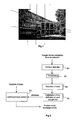
- Figure 1 represents an image whose horizontal, vertical and oblique lines have been highlighted.
- Figure 1 represents more particularly an image representing a building and therefore comprising a considerable number of horizontal and vertical lines.
- the horizontal lines of the building for example the lines delimiting the windows and the roof, have become oblique in perspective.
- the vertical lines delimiting the contours of the building and of the windows, have remained vertical.
- the orientation of such a photo can be determined by calculating a percentage between the number of horizontal lines and the number of vertical lines. Indeed, this photo contains a considerable number of vertical lines, proportionally to the number of horizontal lines. It moreover contains a considerable number of oblique lines.
- Figure 2 represents a flow chart of the operation of a method according to a preferred embodiment.
- the method comprises a first step E1 of contour detection so as to isolate the various lines present in the image.
- contours can be performed using various known procedures for detecting contours such as the proceedu res of Prewitt, Sobel or Canny-Deriche. Such procedures are described, for example, in the book by Cocquerez and Philipp entitled “Analyse d'images; filtrage et segmentation [Image analysis: filtering and segmentation]", published in 1995 by Mass on.
- This operation consists in estimating the local variation in luminance. For each pixel of the image, a modulus of the luminance gradient is computed, that is to say the intensity of the variation in luminance in a small local neighbourhood around this point. The pixels with the largest modulus of gradient are then regarded as being on contours.
- the contour detection step is followed by a thresholding step E2 making it possible to isolate the contours.
- a thresholding step E2 making it possible to isolate the contours.
- the threshold may be unique for the entire image or else it may vary as a function of the texture of the various regions of the image.
- a watershed algorithm can also be applied to obtain the contours.
- the image is thereafter transformed during step E3 by using a Hough transformation so as to identify the lines in the image.
- the Hough transform is a conventional procedure for detecting simple shapes in an image. This procedure forms part of the family of voting algorithms and may for example be used to detect straight lines or circles.
- the next step consists in measuring the predominant orientation.
- a set of K attributes are computed during step E4 (number of points on the line, dispersion of the set of points, distances between points not connected so as to favour the lines that correspond to real objects, etc.) represented in the form of a vector of attributes F.
- F f k , k ⁇ 1 K
- Each line can be weighted.
- the lines whose points are not actually aligned have little probability of being lines and can therefore undergo a weighting so as to be taken into account less in the orientation decision.
- the orientation (or the inclination) of the lines is quantized, from 0 to ⁇ and the measurements are grouped together by angular interval. Thus, for each angular interval i, a certain number Ni of straight lines whose orientation lies in this interval is obtained.
- the intervals are not of equal size but are of smaller size around ⁇ /2.
- the orientation of the image depends on the ratio of the number of horizontal to vertical lines.
- F n i represents the attributes of straight line n in angular sector i.
- the mean of the Ni vectors associated with each straight line detected in this interval or any other function that summarizes these Ni vectors into a single one.
- VSM vector support machine
- the learning-based decision system is a system which models (step E5) example images in portrait or landscape mode and which thereafter deduces attributes therefrom. It can thus, as a function of the attributes, associate a portrait or landscape type with an incoming image.
- the attributes provided by the decision system are attributes identical to those provided as input to the decision system. This association is effected by comparing the vectors of attributes and thereafter, as a function of the value of the vectors of attributes, by comparing distance with the attribute vectors of the portrait class or of the landscape class. In this way, when it receives the vector of attributes as input, it can class, by comparison, the image into the portrait or landscape category as a function of the example images that it has modeled and of the vector of attributes of this image.
- VSMs model separation hyperplanes between the classes to be detected, either portrait or landscape: thereafter, depending on whether the attributes of a new image fall on one side or the other of the boundary between the two hyperplanes, the image is classed as portrait or landscape.
- the method of detecting the orientation of an image such as proposed in the invention fits advantageously into known methods of detecting the orientation of an image. Specifically, this method is particularly advantageous for images containing a large percentage of horizontal, oblique and vertical lines but exhibits less attractive results for images containing only people or for example landscapes.
- Procedures making it possible to detect faces in images which may subsequently allow the detection of the orientation of an image are known among methods of extracting high-level characteristics.
Landscapes
- Engineering & Computer Science (AREA)
- Physics & Mathematics (AREA)
- General Physics & Mathematics (AREA)
- Theoretical Computer Science (AREA)
- Multimedia (AREA)
- Computer Vision & Pattern Recognition (AREA)
- Image Analysis (AREA)
Claims (3)
- Verfahren zum Erfassen der Orientierung eines Bilds, wobei die Bilder von Erfassungsvorrichtungen empfangen werden, die keinen Orientierungshinweis in Bezug auf die erfassten Bilder bereitstellen, und wobei die erfassten Bilder entweder im Querformatmodus oder im Hochformatmodus erfasst werden, wobei einige der Bilder gedreht werden müssen, um im richtigen Modus angezeigt zu werden, wobei das Verfahren die folgenden Schritte umfasst:- Detektieren (E1) von Umrissen- dadurch, dass für jedes Pixel des Bilds ein Modul des Helligkeitsgradienten berechnet wird,- und die Pixel mit dem größten Modul des Helligkeitsgradienten als die zum Umriss gehörenden Pixel bestimmt werden,- Bilden des Schwellenwerts des Modulgradienten und Erhalten eines Binärbilds, das Teilumrisse darstellt,- Identifizieren der Geraden in dem Bild durch Anwenden einer Hough-Transformation auf das Binärbild,- für jede detektierte Gerade Berechnen eines Vektors von Attributen, der die Anzahl der Punkte in jeder detektierten Geraden, die Streuung der Menge von Punkten, die Entfernung zwischen unverbundenen Punkten umfasst,- Quantisieren der Orientierung der Linien von 0 bis π durch Winkelintervalle, für jedes Winkelintervall i Erhalten einer Anzahl Ni von Geraden, deren Orientierung in diesem Intervall liegt,- Eingeben für jedes Winkelintervall i der Anzahl Ni von Geraden, deren Orientierung in diesem Intervall liegt, und für jedes Winkelintervall eines einzelnen Vektors von Attributen, der die Ni Vektoren von Attributen der Ni Linien jedes Intervalls summiert, in ein lerngestütztes Entscheidungssystem,- wobei das lerngestützte System jedes Bild auf der Grundlage des Vektors von Attributen in den Hochformat- oder in den Querformatmodus klassifiziert.
- Vorrichtung zum Erfassen der Orientierung eines Bilds, wobei die Bilder von Erfassungsvorrichtungen empfangen werden, die keinen Orientierungshinweis in Bezug auf die erfassten Bilder bereitstellen, und wobei die erfassten Bilder entweder im Querformatmodus oder im Hochformatmodus erfasst werden, wobei einige der Bilder gedreht werden müssen, um im richtigen Modus angezeigt zu werden, wobei die Vorrichtung Mittel umfasst zum:- Detektieren (E1) der Umrissei. dadurch, dass für jedes Pixel des Bilds ein Modul des Helligkeitsgradienten berechnet wird,ii. und die Pixel mit dem größten Modul des Helligkeitsgradienten als die zum Umriss gehörenden Pixel bestimmt werden,- Bilden des Schwellenwerts des Modulgradienten und Erhalten eines Binärbilds, das Teilumrisse darstellt,- Identifizieren der Geraden in dem Bild durch Anwenden einer Hough-Transformation auf das Binärbild,- für jede detektierte Gerade Berechnen eines Vektors von Attributen, der die Anzahl der Punkte in jeder detektierten Geraden, die Streuung der Menge von Punkten, die Entfernung zwischen unverbundenen Punkten umfasst,- Quantisieren der Orientierung der Linien von 0 bis π durch Winkelintervalle, für jedes Winkelintervall i Erhalten einer Anzahl Ni von Geraden, deren Orientierung in diesem Intervall liegt,- Eingeben für jedes Winkelintervall i der Anzahl Ni von Geraden, deren Orientierung in diesem Intervall liegt, und für jedes Winkelintervall eines einzelnen Vektors von Attributen, der die Ni Vektoren von Attributen der Ni Linien jedes Intervalls summiert, in ein lerngestütztes Entscheidungssystem,- wobei das lerngestützte System jedes Bild auf der Grundlage des Vektors von Attributen in den Hochformat- oder in den Querformatmodus klassifiziert.
- Computerprogrammprodukt, dadurch gekennzeichnet, dass es Programmcodeanweisungen umfasst, die das Verfahren nach Anspruch 1 implementieren können, wenn das Programm auf einem Computer ausgeführt wird.
Applications Claiming Priority (2)
| Application Number | Priority Date | Filing Date | Title |
|---|---|---|---|
| FR0312386A FR2861524A1 (fr) | 2003-10-23 | 2003-10-23 | Procede et dispositif de detection de l'orientation d'une image |
| PCT/EP2004/009789 WO2005041127A2 (en) | 2003-10-23 | 2004-09-02 | Method and device for detecting the orientation of an image |
Publications (2)
| Publication Number | Publication Date |
|---|---|
| EP1676237A2 EP1676237A2 (de) | 2006-07-05 |
| EP1676237B1 true EP1676237B1 (de) | 2010-04-21 |
Family
ID=34400715
Family Applications (1)
| Application Number | Title | Priority Date | Filing Date |
|---|---|---|---|
| EP04764748A Expired - Lifetime EP1676237B1 (de) | 2003-10-23 | 2004-09-02 | Verfahren und einrichtung zur erkennung der orientierung eines bildes |
Country Status (5)
| Country | Link |
|---|---|
| US (1) | US20070126737A1 (de) |
| EP (1) | EP1676237B1 (de) |
| DE (1) | DE602004026758D1 (de) |
| FR (1) | FR2861524A1 (de) |
| WO (1) | WO2005041127A2 (de) |
Families Citing this family (3)
| Publication number | Priority date | Publication date | Assignee | Title |
|---|---|---|---|---|
| US8244068B2 (en) | 2007-03-28 | 2012-08-14 | Sony Ericsson Mobile Communications Ab | Device and method for adjusting orientation of a data representation displayed on a display |
| TW200926787A (en) * | 2007-12-14 | 2009-06-16 | Altek Corp | Method for rotating an image and digital cameras using the same |
| WO2012030267A1 (en) | 2010-08-30 | 2012-03-08 | Telefonaktiebolaget L M Ericsson (Publ) | Methods of launching applications responsive to device orientation and related electronic devices |
Family Cites Families (7)
| Publication number | Priority date | Publication date | Assignee | Title |
|---|---|---|---|---|
| DE3542484A1 (de) * | 1985-11-30 | 1987-07-02 | Ant Nachrichtentech | Verfahren zur erkennung von kantenstrukturen in einem bildsignal |
| US5060276A (en) * | 1989-05-31 | 1991-10-22 | At&T Bell Laboratories | Technique for object orientation detection using a feed-forward neural network |
| CA2116600C (en) * | 1993-04-10 | 1996-11-05 | David Jack Ittner | Methods and apparatus for inferring orientation of lines of text |
| US5592572A (en) * | 1993-11-05 | 1997-01-07 | The United States Of America As Represented By The Department Of Health And Human Services | Automated portrait/landscape mode detection on a binary image |
| US6263097B1 (en) * | 1997-07-04 | 2001-07-17 | Agfa-Gevaert | Method of determining (a) symmetry line(s) in a radiation image |
| US7079707B2 (en) * | 2001-07-20 | 2006-07-18 | Hewlett-Packard Development Company, L.P. | System and method for horizon correction within images |
| US7088474B2 (en) * | 2001-09-13 | 2006-08-08 | Hewlett-Packard Development Company, Lp. | Method and system for enhancing images using edge orientation |
-
2003
- 2003-10-23 FR FR0312386A patent/FR2861524A1/fr active Pending
-
2004
- 2004-09-02 EP EP04764748A patent/EP1676237B1/de not_active Expired - Lifetime
- 2004-09-02 DE DE602004026758T patent/DE602004026758D1/de not_active Expired - Lifetime
- 2004-09-02 WO PCT/EP2004/009789 patent/WO2005041127A2/en not_active Ceased
- 2004-09-02 US US10/576,665 patent/US20070126737A1/en not_active Abandoned
Non-Patent Citations (2)
| Title |
|---|
| ADITYA VAILAYA; HONGJIANG ZHANG; CHANGJIANG YANG; FENG-I LIU; ANIL K: "Automatic Image Orientation Detection", IEEE TRANSACTIONS ON IMAGE PROCESSING, vol. 11, no. 7, 2002 - 2002, IEEE SERVICE CENTER, PISCATAWAY, NJ, US * |
| YONGMEI WANG; HONGJIANG ZHANG: "Content-based image orientation detection with support vector machines", CONTENT-BASED ACCESS OF IMAGE AND VIDEO LIBRARIES, 2001. (CBAIVL 2001), 2001 - 2001, USA, pages 17 - 23, XP010583701 * |
Also Published As
| Publication number | Publication date |
|---|---|
| US20070126737A1 (en) | 2007-06-07 |
| EP1676237A2 (de) | 2006-07-05 |
| DE602004026758D1 (de) | 2010-06-02 |
| WO2005041127A2 (en) | 2005-05-06 |
| FR2861524A1 (fr) | 2005-04-29 |
| WO2005041127A3 (en) | 2005-06-30 |
Similar Documents
| Publication | Publication Date | Title |
|---|---|---|
| JP4903854B2 (ja) | デジタル画像におけるオブジェクト検出方法 | |
| CN106960195B (zh) | 一种基于深度学习的人群计数方法及装置 | |
| US8351662B2 (en) | System and method for face verification using video sequence | |
| US7218759B1 (en) | Face detection in digital images | |
| JP4505362B2 (ja) | 赤目検出装置および方法並びにプログラム | |
| CN102007499B (zh) | 检测数字图像中的脸部表情 | |
| CN109918971B (zh) | 监控视频中人数检测方法及装置 | |
| US20030099395A1 (en) | Automatic image orientation detection based on classification of low-level image features | |
| WO2019080203A1 (zh) | 一种机器人的手势识别方法、系统及机器人 | |
| US20020136450A1 (en) | Red-eye detection based on red region detection with eye confirmation | |
| JP4098021B2 (ja) | シーン識別方法および装置ならびにプログラム | |
| JP2004519759A (ja) | 画像内の関心領域を決定するための方法及び装置及び画像伝送方法及び装置 | |
| JP2005250556A (ja) | トリミング処理方法および装置並びにプログラム | |
| CN112434647A (zh) | 一种人脸活体检测方法 | |
| CN116030396B (zh) | 一种用于视频结构化提取的精确分割方法 | |
| CN104361357B (zh) | 基于图片内容分析的相片集分类系统及分类方法 | |
| TW200529093A (en) | Face image detection method, face image detection system, and face image detection program | |
| CN108629286A (zh) | 一种基于主观感知显著模型的遥感机场目标检测方法 | |
| CN115731493A (zh) | 基于视频图像识别的降水微物理特征参量提取与分析方法 | |
| CN104268509B (zh) | 泥头车车牌检测的方法及系统 | |
| CN113468963A (zh) | 一种道路扬尘识别方法及设备 | |
| JP3962517B2 (ja) | 顔面検出方法及びその装置、コンピュータ可読媒体 | |
| CN113052234A (zh) | 一种基于图像特征和深度学习技术的玉石分类方法 | |
| CN112446300A (zh) | 车流密度分析的方法、系统及计算机存储介质 | |
| EP1676237B1 (de) | Verfahren und einrichtung zur erkennung der orientierung eines bildes |
Legal Events
| Date | Code | Title | Description |
|---|---|---|---|
| PUAI | Public reference made under article 153(3) epc to a published international application that has entered the european phase |
Free format text: ORIGINAL CODE: 0009012 |
|
| 17P | Request for examination filed |
Effective date: 20060413 |
|
| AK | Designated contracting states |
Kind code of ref document: A2 Designated state(s): DE FR GB |
|
| DAX | Request for extension of the european patent (deleted) | ||
| RBV | Designated contracting states (corrected) |
Designated state(s): DE FR GB |
|
| 17Q | First examination report despatched |
Effective date: 20080930 |
|
| GRAP | Despatch of communication of intention to grant a patent |
Free format text: ORIGINAL CODE: EPIDOSNIGR1 |
|
| RAP1 | Party data changed (applicant data changed or rights of an application transferred) |
Owner name: THOMSON LICENSING SA |
|
| GRAS | Grant fee paid |
Free format text: ORIGINAL CODE: EPIDOSNIGR3 |
|
| GRAA | (expected) grant |
Free format text: ORIGINAL CODE: 0009210 |
|
| AK | Designated contracting states |
Kind code of ref document: B1 Designated state(s): DE FR GB |
|
| REG | Reference to a national code |
Ref country code: GB Ref legal event code: FG4D |
|
| REF | Corresponds to: |
Ref document number: 602004026758 Country of ref document: DE Date of ref document: 20100602 Kind code of ref document: P |
|
| PGFP | Annual fee paid to national office [announced via postgrant information from national office to epo] |
Ref country code: FR Payment date: 20101005 Year of fee payment: 7 |
|
| PGFP | Annual fee paid to national office [announced via postgrant information from national office to epo] |
Ref country code: GB Payment date: 20100902 Year of fee payment: 7 |
|
| PLBE | No opposition filed within time limit |
Free format text: ORIGINAL CODE: 0009261 |
|
| STAA | Information on the status of an ep patent application or granted ep patent |
Free format text: STATUS: NO OPPOSITION FILED WITHIN TIME LIMIT |
|
| PGFP | Annual fee paid to national office [announced via postgrant information from national office to epo] |
Ref country code: DE Payment date: 20100916 Year of fee payment: 7 |
|
| 26N | No opposition filed |
Effective date: 20110124 |
|
| GBPC | Gb: european patent ceased through non-payment of renewal fee |
Effective date: 20110902 |
|
| REG | Reference to a national code |
Ref country code: FR Ref legal event code: ST Effective date: 20120531 |
|
| REG | Reference to a national code |
Ref country code: DE Ref legal event code: R119 Ref document number: 602004026758 Country of ref document: DE Effective date: 20120403 |
|
| PG25 | Lapsed in a contracting state [announced via postgrant information from national office to epo] |
Ref country code: DE Free format text: LAPSE BECAUSE OF NON-PAYMENT OF DUE FEES Effective date: 20120403 |
|
| PG25 | Lapsed in a contracting state [announced via postgrant information from national office to epo] |
Ref country code: GB Free format text: LAPSE BECAUSE OF NON-PAYMENT OF DUE FEES Effective date: 20110902 Ref country code: FR Free format text: LAPSE BECAUSE OF NON-PAYMENT OF DUE FEES Effective date: 20110930 |