EP1674488A1 - Process for producing resin-coated metal powder, resin-coated metal powder and circuit forming toner - Google Patents
Process for producing resin-coated metal powder, resin-coated metal powder and circuit forming toner Download PDFInfo
- Publication number
- EP1674488A1 EP1674488A1 EP04773107A EP04773107A EP1674488A1 EP 1674488 A1 EP1674488 A1 EP 1674488A1 EP 04773107 A EP04773107 A EP 04773107A EP 04773107 A EP04773107 A EP 04773107A EP 1674488 A1 EP1674488 A1 EP 1674488A1
- Authority
- EP
- European Patent Office
- Prior art keywords
- resin
- particles
- coated
- silica
- metal particles
- Prior art date
- Legal status (The legal status is an assumption and is not a legal conclusion. Google has not performed a legal analysis and makes no representation as to the accuracy of the status listed.)
- Granted
Links
Images
Classifications
-
- H—ELECTRICITY
- H05—ELECTRIC TECHNIQUES NOT OTHERWISE PROVIDED FOR
- H05K—PRINTED CIRCUITS; CASINGS OR CONSTRUCTIONAL DETAILS OF ELECTRIC APPARATUS; MANUFACTURE OF ASSEMBLAGES OF ELECTRICAL COMPONENTS
- H05K3/00—Apparatus or processes for manufacturing printed circuits
- H05K3/10—Apparatus or processes for manufacturing printed circuits in which conductive material is applied to the insulating support in such a manner as to form the desired conductive pattern
- H05K3/102—Apparatus or processes for manufacturing printed circuits in which conductive material is applied to the insulating support in such a manner as to form the desired conductive pattern by bonding of conductive powder, i.e. metallic powder
-
- C—CHEMISTRY; METALLURGY
- C08—ORGANIC MACROMOLECULAR COMPOUNDS; THEIR PREPARATION OR CHEMICAL WORKING-UP; COMPOSITIONS BASED THEREON
- C08F—MACROMOLECULAR COMPOUNDS OBTAINED BY REACTIONS ONLY INVOLVING CARBON-TO-CARBON UNSATURATED BONDS
- C08F292/00—Macromolecular compounds obtained by polymerising monomers on to inorganic materials
-
- H—ELECTRICITY
- H05—ELECTRIC TECHNIQUES NOT OTHERWISE PROVIDED FOR
- H05K—PRINTED CIRCUITS; CASINGS OR CONSTRUCTIONAL DETAILS OF ELECTRIC APPARATUS; MANUFACTURE OF ASSEMBLAGES OF ELECTRICAL COMPONENTS
- H05K2201/00—Indexing scheme relating to printed circuits covered by H05K1/00
- H05K2201/02—Fillers; Particles; Fibers; Reinforcement materials
- H05K2201/0203—Fillers and particles
- H05K2201/0206—Materials
- H05K2201/0224—Conductive particles having an insulating coating
-
- Y—GENERAL TAGGING OF NEW TECHNOLOGICAL DEVELOPMENTS; GENERAL TAGGING OF CROSS-SECTIONAL TECHNOLOGIES SPANNING OVER SEVERAL SECTIONS OF THE IPC; TECHNICAL SUBJECTS COVERED BY FORMER USPC CROSS-REFERENCE ART COLLECTIONS [XRACs] AND DIGESTS
- Y10—TECHNICAL SUBJECTS COVERED BY FORMER USPC
- Y10T—TECHNICAL SUBJECTS COVERED BY FORMER US CLASSIFICATION
- Y10T428/00—Stock material or miscellaneous articles
- Y10T428/29—Coated or structually defined flake, particle, cell, strand, strand portion, rod, filament, macroscopic fiber or mass thereof
-
- Y—GENERAL TAGGING OF NEW TECHNOLOGICAL DEVELOPMENTS; GENERAL TAGGING OF CROSS-SECTIONAL TECHNOLOGIES SPANNING OVER SEVERAL SECTIONS OF THE IPC; TECHNICAL SUBJECTS COVERED BY FORMER USPC CROSS-REFERENCE ART COLLECTIONS [XRACs] AND DIGESTS
- Y10—TECHNICAL SUBJECTS COVERED BY FORMER USPC
- Y10T—TECHNICAL SUBJECTS COVERED BY FORMER US CLASSIFICATION
- Y10T428/00—Stock material or miscellaneous articles
- Y10T428/29—Coated or structually defined flake, particle, cell, strand, strand portion, rod, filament, macroscopic fiber or mass thereof
- Y10T428/2982—Particulate matter [e.g., sphere, flake, etc.]
Definitions
- the present invention relates to a process for producing resin-coated metal particles, resin-coated metal particles, and toner for forming a circuit.
- the present invention also relates to a process for producing resin-coated metal particles, the process being suitably employed in forming a circuit pattern including an electrical circuit, an electrode, or the like by electrophotographic technology.
- the present invention also relates to resin-coated metal particles and toner for forming a circuit.
- toner which is used for forming a circuit and which contains a conductive material coated with an insulating synthetic resin has been used in forming a circuit pattern on a substrate by electrophotography.
- Patent Document 1 proposes a process for producing powdery toner, the process including preparing an aqueous dispersion (I) by emulsifying a mixture of a conductive material and a water-insoluble resin in the presence of a neutralizer, the water-insoluble resin being self-water dispersible after neutralization; preparing an aqueous dispersion (II) by subjecting an acid-group-containing resin to phase-inversion emulsification in the presence of a basic neutralizer, the acid-group-containing resin being self-water dispersible or water-soluble after neutralization; adding an acid to a homogeneous mixed solution of the aqueous dispersion (I) and the aqueous dispersion (II) to attach or deposit the acid-group-containing resin to surfaces of the resin particles coated with the conductive material; and fixing the resin to the surfaces.
- aqueous dispersion (I) by emulsifying a mixture of a conductive material and a water-insoluble resin in the presence of
- Patent Document 2 proposes metallic toner for forming a conductive pattern, the toner being produced by a process of attaching a polymerization catalyst (Ziegler-Natta catalyst) to the surface of a conductive metallic material; bringing a gaseous monomer such as ethylene into contact with the catalyst attached to the surface of the metal particles to polymerize the monomer, i.e., polymerizing the monomer by direct polymerization, and to form insulating resin layers on the surfaces of the metal particles; and providing an electrification characteristic-imparting layer composed of an electrification material around or inside the insulating resin layer.
- a polymerization catalyst Ziegler-Natta catalyst
- Patent Document 1 Japanese Unexamined Patent Application Publication No. 2001-154397
- Patent Document 2 Japanese Patent No. 3232280
- the powdery toner for forming a circuit described in Patent Document 1 it is necessary to control the pH of the aqueous dispersion (I), the aqueous dispersion (II), and the mixed solution thereof in the step of coating the conductive material with the resin.
- the surface properties (e.g. composition) of the conductive material to be coated significantly affect the condition of the resin coating.
- slight changes in pH or surface properties cause insufficient coverage, thereby leading to the complexity of the manufacturing procedure of the powdery toner.
- the incorporation of water into the interface between the metal and the resin may occur because the condition of the resin coating significantly varies depending on the condition of the metal surface.
- the resin is disadvantageously detached from the surface of the conductive material because of friction and collisions between the powdery toner particles.
- the gaseous monomer is added while the metal particles provided with the polymerization catalyst are dispersed in a gas phase to allow the polymerization to proceed on the surfaces of the particles, thereby forming an insulating layer. Therefore, the monomer used must meet two requirements described below:
- the metal particles are agitated in a gas phase.
- the metal particles easily aggregate during the formation of the resin layer.
- Ziegler-Natta catalysts are inactivated by oxygen, water, and the like.
- a reaction system is required to be highly controlled.
- large-scale facilities are required.
- the present invention is accomplished to overcome the above-described problems. It is an object of the present invention to provide a process for producing resin-coated metal particles, the metal particles having excellent adhesion to the resin coating, the resin coating being hardly detached from the metal particles, and the process being easily capable of controlling a reaction system without using large-scale facilities and complicated reaction system when the metal particles serving as a conductive material are coated with the resin. It is another object of the present invention to provide resin-coated metal particles. Furthermore, it is another object of the present invention to provide toner for forming a circuit, the toner using the inventive resin-coated metal particles and being capable of forming an excellent circuit pattern with a low fog level.
- a process for producing resin-coated metal particles includes the steps of coating surfaces of metal particles with silica; allowing a polymerizable group to adsorb onto the surfaces of the silica-coated metal particles by the use of a silane coupling agent; and coating the surfaces of the silica-coated metal particles with a polymeric resin by mixing the metal particles to which the polymerizable groups adsorb, a polymerizable monomer, a polymerization initiator, and a dispersant to polymerize the polymerizable monomer and the polymerizable groups.
- the process for producing the resin-coated metal particles according to the first aspect further includes a step of melting the polymeric resin at a temperature higher than the melting point of the polymeric resin and then rapidly cooling the polymeric resin.
- the resin-coated metal particles are toner for forming a circuit.
- the metal particles are composed of one metal selected from copper, silver, nickel, and silver-palladium.
- a resin-coated metal particle includes a core formed of a metal particle; a silica layer covering the surface of the core; and a resin layer covering the silica layer.
- the resin-coated metal particle includes one metal selected from copper, silver, nickel, and silver-palladium.
- the surface of the particle is subjected to oxidation.
- toner for forming a circuit includes a resin-coated metal particle according to any one of the fifth to seventh aspects.
- a silica coating agent prepared by hydrolyzing an alkoxide compound for forming silica is mixed with metal particles in a solvent, and the solvent is removed. Thereby, the surfaces of the metal particles are coated with silica to form silica layers on the surfaces of the metal particles.
- a conductive metal such as copper, silver, nickel, or a silver-palladium alloy, for forming a circuit pattern may be used.
- the average particle size of the metal particles is not particularly limited as long as the metal particles have an average particle size such that a circuit pattern is formed.
- the average particle size is preferably in the range of 0.5 to 20 ⁇ m.
- the surfaces of the metal particles may be subjected to oxidation.
- the silica coating agent preferably used include alkoxide compounds, such as Methoxysilane and tetraethoxysilane, for forming silica.
- the thickness of the silica layer is preferably 20 to 30 ⁇ m.
- Silica covering the metal particles after the above-described step facilitates the adsorption of a silane coupling agent onto the surfaces of the metal particles, thus improving the rate of adsorption of polymerizable groups. Furthermore, by forming the silica layers on the surfaces of the metal particles, the effect of suppressing the sintering of the metal particles and the effect of improving bonding between the metal particles and a ceramic substrate can be expected.
- the polymerizable groups (functional groups), which are polymerized with the polymerizable monomer, are attached to the silica layers on the surfaces of the metal particles. Therefore, in the following polymerization step, even when the amount of the polymerizable monomer is small, the polymerizable monomer is efficiently reacted with the polymerizable groups. As a result, the surfaces of the metal particles can be effectively coated with the polymeric resin without exposure of the metal particles at the surfaces of the toner.
- the silane coupling agent is no particularly limited.
- a silane coupling agent having a methacryl group or a mercapto group as a polymerizable group may be used.
- a silane coupling agent having a vinyl group as a polymerizable group e.g. vinyltrimethoxysilane, vinyldimethoxysilane, or vinyldiethoxysilane, may also be used.
- the metal particles on which the polymerizable groups adsorb, the polymerizable monomer, the polymerization initiator, and the dispersant are mixed in the solvent to polymerize the polymerizable groups and the polymerizable monomer.
- the surfaces of the silica-coated metal particles can be coated with the polymeric resin.
- the metal particles are chemically bonded to the polymeric resin with the silica layers, thus increasing adhesion between the metal particles and the coating resin. Therefore, the resin is difficult to be detached while friction electrification is caused by the flow of the particles; hence, satisfactory resin-coated metal particles can be produced.
- the polymerizable monomer is not particularly limited as long as the polymerizable monomer is copolymerized with the polymerizable group of the silane coupling agent in the presence of the polymerization initiator by radical polymerization or the like.
- the polymerizable monomer usable include styrenes, such as styrene and ⁇ -styrene; monoolefins, such as ethylene and propylene; and acrylic esters, such as ethyl acrylate and n-butyl acrylate.
- the polymerization initiator is not particularly limited as long as the polymerization initiator is used in radical polymerization.
- the dispersant usable include polymeric dispersant, such as hydroxypropylcellulose, poly(vinyl alcohol), and hydroxyethylcellulose.
- the step of melting the polymeric resin at a temperature higher than the melting point of the polymeric resin and then rapidly cooling the polymeric resin by melting the polymeric resin at a temperature higher than the melting point of the polymeric resin, the polymeric resin on the surface of each metal particle is formed into a sphere due to the surface tension of the molten resin. Then, the molten resin is rapidly cooled into a solid while the spherical polymeric resin is maintained. Thereby, the flowability of the resin-coated metal particles is improved, thus facilitating frictional electrification. Furthermore, in this step, the smoothness of the surfaces of the resin-coated metal particles can reduce the exposed portion of the metal particles.
- Each of the resin-coated metal particles of the present invention includes a core formed of metal particle; a silica layer covering the surface of the core; and a resin layer covering the silica layer.
- the resin-coated metal particles can be used as, for example, toner for forming a circuit. Even if the metal particle is incompletely coated with the resin layer, insulation at a defective portion is maintained by the silica layer. Therefore, a satisfactory image can be produced when a circuit is formed.
- the surfaces of the metal particles are preferably subjected to oxidation. This oxidation provides the formation of oxide films on the surfaces of the metal particles. Combined with the silica layers, the oxide films further improve the electrification characteristics of the metal particles.
- Toner of the present invention for forming a circuit includes the above-described resin-coated metal particles of the present invention and is used as an electrophotographic developer in forming a circuit.
- the toner for forming a circuit as an electrophotographic developer is applied on a ceramic green sheet by printing with a dry two-component electrophotographic printer, thus resulting in a fine-resolution circuit pattern having a low fog level.
- the silica layers can suppress the sintering of the metal particles and can suppress the breakage caused by the granulation of the metal due to the difference in the sintering temperatures of the metal and the ceramics.
- the present invention provides a process for producing resin-coated metal particles, the metal particles having excellent adhesion to the resin coating, the resin coating being hardly detached from the metal particles, and the process being easily capable of controlling a reaction system without using large-scale facilities and complicated reaction system when the metal particles serving as a conductive material are coated with the resin. Furthermore, the present invention also provides resin-coated metal particles. According to an eighth aspect of the present invention, toner for forming a circuit, the toner using the inventive resin-coated metal particles and being capable of forming an excellent circuit pattern with a low fog level.
- a process for producing metal particles coated with a resin, metal particles coated with a resin, and toner for forming a circuit, of the present invention will be described below on the basis of Examples.
- the methacrylsilane coupling agent and the mercaptosilane coupling agent were used as the silane coupling agents used for allowing polymerizable groups in the agents to adsorb on the surfaces of the copper particles coated with silica.
- Another silane coupling agent such as vinyltrimethoxysilane, vinyldimethoxysilane, or vinyldiethoxysilane, may be used in addition to those compounds.
- the ethanol mixed solution was heated to 60°C under a nitrogen atmosphere and stirred for 30 minutes. Then, 20 g of styrene, which is a polymerizable monomer, and 0.5 g of a polymerization initiator (ABN-v, manufactured by Japan Hydrazine Company, Inc.) were added to the ethanol mixed solution, and the polymerization reaction was continued for 6 hours. As a result, styrene and the polymerizable groups (methacryl groups) adsorbed on the surfaces of the copper particles coated with silica were polymerized. Thereby, the surfaces of the copper particles coated with silica were covered with the resin by the use of the methacryl groups. After the reaction was continued for 6 hours, the ethanol mixed solution was gradually added dropwise to 100 mL of ethanol to terminate the polymerization in the ethanol mixed solution.
- a polymeric dispersant such as poly(vinyl alcohol) or hydroxyethylcellulose, may be used other than hydroxypropylcellulose used in this Example.
- a polymerizable monomer that can be polymerized by radical polymerization to form a resin
- examples of such a monomer include monoolefins such as ethylene and propylene; styrenes such as ⁇ -styrene; and acrylic esters such as ethyl acrylate.
- the ethanol mixed solution was left standing. After a supernatant liquid was discarded, the washing operation of adding 100 mL of fresh ethanol and then stirring the resulting mixture was performed 3 or 4 times to produce a target copper particles coated with the resin.
- ethanol was used as the solvent.
- another solvent such as methanol, isopropanol, hexane, toluene, water, or a mixed solvent thereof, may be used.
- a solvent that dissolves a polymerizable monomer but does not dissolve a polymeric resin is preferably used as in this Example.
- a compound identical to the solvent was preferably used as the washing solution as in this Example.
- the evaluation of the condition of the resin coating of the copper particles was performed on the basis of etching resistance and printing characteristics.
- Etching resistance was evaluated as follows: The copper particles coated with the resin were immersed in an etching solution (aqueous solution of 10% ammonium persulfate) for 24 hours. Then, non-etched copper particles coated with the resin were recovered with a centrifuge. The etching resistance was evaluated according to whether the copper particles coated with the resin were recovered or not. Table 1 shows the results. When the condition of the resin coating of the copper particles coated with the resin is good, the copper particles were not etched. That is, the copper particles do not dissolve and remain. When the condition of the resin coating is poor, the copper particles dissolve. Therefore, the etching resistance is evaluated according to the evaluation criteria described below:
- a hydrophobic fine silica powder (R812, primary particle size: 7 nm, manufactured by Nippon Aerosil Co., Ltd.) as an external additive was mixed with 1 kg of the resin-coated copper particles with a dry mixer (Henschel mixer) to prepare toner for forming a circuit, and then 20 g of the toner for forming a circuit was mixed with 80 g of an electrophotographic carrier to prepare a photographic developer for forming a circuit.
- a ferrite carrier in which particles of the ferrite carrier were coated with a silicone resin was used as the electrophotographic carrier, the particles each having an average particle size of 60 ⁇ m.
- Known electrophotographic carriers disclosed in, for example, Patent Document 1 may also be used as the electrophotographic carrier other than that used in this Example.
- a sample mill, IKA mill, or the like may be used.
- the photographic developer for forming a circuit was applied to paper by electrophotography.
- the copper particles coated with the resin were evaluated for printing characteristics. Table 1 shows the results.
- the printing characteristics were evaluated according to the evaluation criteria described below:
- samples 1 to 4 the surfaces of the copper particles were oxidized and then coated with silica layers. Thus, even if the polymeric resin coating is incomplete, insulation at a defective portion is easily maintained. Therefore, when the samples are used as a toner for forming a circuit, the charge is difficult to dissipate.
- samples 5 and 6 which were out of the range of the present invention, each prepared by performing direct adsorption of the polymerizable groups to the copper particles were poor in both etching resistance and printing characteristics. This indicated that the surfaces of the copper particles were not entirely coated with the polymeric resin.
- the copper particles on which the polymerizable groups (methacryl groups) were adsorbed were subjected to thermal analysis, i.e., the particles were heated from 30°C to 500°C at a heating rate of 10°C/min. As a result, a reduction in weight resulting from the methacryl group was determined to be 0.7 percent by weight.
- Resin-coated copper particles were prepared as in Example 1 except that 10 g of styrene was added as the polymerizable monomer. That is, the resin-coated copper particles were prepared by covering the surfaces of the silica-coated copper particles with the resin by the use of the polymerizable groups.
- the resulting resin-coated copper particles were subjected to thermal analysis, i.e., the particles were heated from 30°C to 500°C at a heating rate of 10°C/min.
- a reduction in weight resulting from the methacryl groups and the resin was determined to be 5.2 percent by weight. Of a reduction in weight of 5.2 percent by weight, a reduction in weight resulting from the methacryl groups (polymerizable groups) was 0.7 percent by weight. Therefore, a reduction in weight resulting from the resin was 4.5 percent by weight.
- the resin-coated copper particles were subjected to differential thermal analysis with a differential scanning calorimeter (measurement conditions: 10°C/min, -50°C to +150°C). As a result, a glass transition temperature of 100°C attributable to styrene (polymerizable monomer) was observed. In addition, the resin-coated copper particles were observed with a scanning electron microscope (SEM). As a result, it was found that no aggregation of the resin-coated copper particles was observed, and capsules coated with the resin were produced.
- SEM scanning electron microscope
- Example 2 a sample was prepared as in Example 2 except that silica was not allowed to adsorb onto the surfaces of the copper particles.
- the resulting sample was subjected to thermal analysis under the same conditions as those in Example 2. As a result, it was found that a reduction in the weight of the sample was not observed, and no resin was attached to the copper particles.
- Example 2 a sample was prepared as in Example 2 except that adsorption treatment for allowing the polymerizable groups to adsorb by the use of a silane coupling agent was not performed.
- the resulting sample was subjected to thermal analysis under the same conditions as those in Example 2. As a result, it was found that a reduction in the weight of the sample was not observed, and no resin was attached to the copper particles.
- Example 2 From the results of Example 2 and Comparative Examples 1 and 2, it was found that the surfaces of the copper particles can be surely and firmly coated with the polymeric resin by performing silica-layer-coating treatment and adsorption treatment for allowing polymerizable groups to adsorb.
- Example 2 the resin-coated copper particles prepared in Example 2 were subjected to heat treatment at 355°C and a volume of hot air of 1,000 L/min with a Surfusion system (manufactured by Nippon Pneumatic Mfg. Co., Ltd.) to melt the coating resin, and then the coating resin was rapidly cooled into a solid to prepare heat-treated resin-coated copper particles.
- a Surfusion system manufactured by Nippon Pneumatic Mfg. Co., Ltd.
- the coating resin of the heat-treated resin-coated copper particles had smooth surfaces, and spherical capsules uniformly coated with the coating resin were produced.
- the spherical resin coating of the resin-coated copper particles improves the flowability of the resin-coated copper particles, thus facilitating frictional electrification. Furthermore, the smoothness of the surfaces of the resin-coated copper particles can reduce the exposed portion of the copper particles.
- the resin-coated copper particles of the present invention were used as toner for forming a circuit.
- a multilayer circuit board including a circuit pattern was produced by electrophotography with an electrophotographic printer or the like. Electric characteristics (in this Example, continuity) of the circuit pattern were evaluated. Satisfactory charging characteristics of the toner for forming a circuit result in an image having a low fog phenomenon (This is the state in which toner is scattered on the background. Many fogs impair line linearity, thereby degrading high-frequency characteristics and reliability).
- Example 2 In the same way as in Example 1, 5 g of a hydrophobic fine silica powder as an external additive was mixed with 1 kg of the resin-coated copper particles prepared in Example 2 to prepare toner for forming a circuit, and then 20 g of the toner for forming a circuit was mixed with 80 g of an electrophotographic carrier to prepare a photographic developer (1) for forming a circuit.
- the heat-treated resin-coated copper particles prepared in Example 3 were mixed with the external additive and the electrophotographic carrier to prepare a photographic developer (2) for forming a circuit.
- both the resulting images formed of the photographic developers (1) and (2) for forming circuits were good images with low fog levels.
- the photographic developer (2) containing the heat-treated particles for forming a circuit provided the good image with a lower fog level compared with the image formed of the photographic developer (1) containing the unheated particles. Consequently, it was found that heat treatment the resin-coated copper particles improved flowability of the particles, thereby providing an image with a lower fog level compared with the case of the unheated particles.
- the resulting ceramic green sheets having circuit patterns formed of the photographic developers (1) and (2) for forming circuits were dewaxed and fired by a known technique to form ceramic sheets having the circuit patterns.
- the electrical resistances of the resulting circuit patterns were measured. As a result, there was continuity in any one of the circuit patterns.
- Ba-Al-Si-O-based ceramic green sheets were formed.
- via holes were formed according to a predetermined pattern, and then a conductor material was injected into the via holes by a known process to form via-hole conductors.
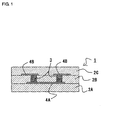
- circuit patterns were formed on predetermined ceramic green sheets by electrophotography described above with the photographic developers (1) and (2) for forming circuits. Then, lamination, dewaxing, and firing were performed to produce, for example, a multilayer circuit board 1 shown in Fig. 1.
- the multilayer circuit board 1 includes a plurality of ceramic layers 2A, 2B, and 2C; a plurality of via-hole conductors 3 formed in the intermediate ceramic layer 2B; and circuit patterns 4A and 4B, the circuit pattern 4A being provided along the interface between the ceramic layers 2A and 2B, the circuit pattern 4B being provided along the interface between the ceramic layers 2B and 2C, and the circuit patterns 4A and 4B being electrically connected through the via-hole conductors 3, wherein the circuit patterns 4A and 4B are composed of the photographic developer of this Example.
- the resin-coated copper particles prepared in Example 2 or the heat-treated resin-coated copper particles prepared in Example 3 were used, thus suppressing sintering of the copper particles during firing. Furthermore, the silica coating on the surfaces of the copper particles can prevent the breakage caused by the granulation of the copper particles due to the difference in the sintering temperatures of the copper particles and the ceramic layers 2A, 2B, and 2C.
- Example 2 the copper particles used in Example 2 and a polyester resin were melted by heating and kneaded with a kneader. The resulting mixture was cooled into a solid. Then, the cooled mixture was pulverized with a cutter mill and a jet mill. A fine powder was removed from the pulverized mixture with a classifier, thereby resulting in electrifiable particles having an average particle size of 6 ⁇ m. Subsequently, an external additive and an electrophotographic carrier were added to the electrifiable particles. The same process as that in Example 4 was performed to prepare a photographic developer (3) for forming a circuit.
- the resulting developer (3) was applied on a ceramic green sheet by printing in the same way as in Example 4, and then printing characteristics were evaluated. As a result, it was found that the image (circuit pattern) formed of the photographic developer (3) for forming a circuit of this Comparative Example had a high fog level. Furthermore, it was also found that the amount of toner applied was small, and thus a blurred image was formed.
- the ceramic green sheet containing the circuit pattern of this Comparative Example was dewaxed and fired as in Example 4. Then, the electrical resistance of the circuit pattern on the ceramic sheet was measured. As a result, there was no continuity in the fired circuit pattern.
- the present invention is not limited to the Examples described above.
- the present invention includes various modifications without departing from the spirit of the present invention.
- the copper particles are exemplified as the metal particles in Examples described above.
- Other conductive metal particles such as silver particles or nickel particles, which are used for forming a circuit, may be used.
- an alkoxide compound for forming silica is exemplified in Examples described above.
- a metal alkoxide for forming a compound other than silica may be used depending on the application of the resin-coated metal particles.
- the present invention can be suitably applied to, for example, toner for forming a circuit used in producing an electronic component having a circuit pattern.
Landscapes
- Chemical & Material Sciences (AREA)
- Engineering & Computer Science (AREA)
- Organic Chemistry (AREA)
- Manufacturing & Machinery (AREA)
- Health & Medical Sciences (AREA)
- Chemical Kinetics & Catalysis (AREA)
- Medicinal Chemistry (AREA)
- Polymers & Plastics (AREA)
- Inorganic Chemistry (AREA)
- Materials Engineering (AREA)
- Microelectronics & Electronic Packaging (AREA)
- Developing Agents For Electrophotography (AREA)
- Powder Metallurgy (AREA)
- Manufacturing Of Printed Wiring (AREA)
- Graft Or Block Polymers (AREA)
- Conductive Materials (AREA)
- Parts Printed On Printed Circuit Boards (AREA)
Abstract
[Solving Means] A process for producing resin-coated metal particles, the process includes the steps of coating surfaces of copper particles with silica; allowing a polymerizable group to adsorb onto the surfaces of the silica-coated copper particles by the use of a silane coupling agent; and coating the surfaces of the silica-coated copper particles with a polymeric resin by mixing the copper particles to which the polymerizable groups adsorb, a polymerizable monomer, a polymerization initiator, and a dispersant to polymerize the polymerizable monomer and the polymerizable groups.
Description
- The present invention relates to a process for producing resin-coated metal particles, resin-coated metal particles, and toner for forming a circuit. In particular, the present invention also relates to a process for producing resin-coated metal particles, the process being suitably employed in forming a circuit pattern including an electrical circuit, an electrode, or the like by electrophotographic technology. The present invention also relates to resin-coated metal particles and toner for forming a circuit.
- For example, toner which is used for forming a circuit and which contains a conductive material coated with an insulating synthetic resin has been used in forming a circuit pattern on a substrate by electrophotography.
- Specifically, for example, Patent Document 1 proposes a process for producing powdery toner, the process including preparing an aqueous dispersion (I) by emulsifying a mixture of a conductive material and a water-insoluble resin in the presence of a neutralizer, the water-insoluble resin being self-water dispersible after neutralization; preparing an aqueous dispersion (II) by subjecting an acid-group-containing resin to phase-inversion emulsification in the presence of a basic neutralizer, the acid-group-containing resin being self-water dispersible or water-soluble after neutralization; adding an acid to a homogeneous mixed solution of the aqueous dispersion (I) and the aqueous dispersion (II) to attach or deposit the acid-group-containing resin to surfaces of the resin particles coated with the conductive material; and fixing the resin to the surfaces.
- Patent Document 2 proposes metallic toner for forming a conductive pattern, the toner being produced by a process of attaching a polymerization catalyst (Ziegler-Natta catalyst) to the surface of a conductive metallic material; bringing a gaseous monomer such as ethylene into contact with the catalyst attached to the surface of the metal particles to polymerize the monomer, i.e., polymerizing the monomer by direct polymerization, and to form insulating resin layers on the surfaces of the metal particles; and providing an electrification characteristic-imparting layer composed of an electrification material around or inside the insulating resin layer.
- Patent Document 1: Japanese Unexamined Patent Application Publication No. 2001-154397
- Patent Document 2: Japanese Patent No. 3232280
- However, with respect to the powdery toner for forming a circuit described in Patent Document 1, it is necessary to control the pH of the aqueous dispersion (I), the aqueous dispersion (II), and the mixed solution thereof in the step of coating the conductive material with the resin. Furthermore, the surface properties (e.g. composition) of the conductive material to be coated significantly affect the condition of the resin coating. Thus, slight changes in pH or surface properties cause insufficient coverage, thereby leading to the complexity of the manufacturing procedure of the powdery toner. The incorporation of water into the interface between the metal and the resin may occur because the condition of the resin coating significantly varies depending on the condition of the metal surface. Furthermore, in the case of an insufficient resin coating, when the powdery toner is used for forming a circuit, the resin is disadvantageously detached from the surface of the conductive material because of friction and collisions between the powdery toner particles.
- In the metallic toner for forming a conductive pattern described in Patent Document 2, the gaseous monomer is added while the metal particles provided with the polymerization catalyst are dispersed in a gas phase to allow the polymerization to proceed on the surfaces of the particles, thereby forming an insulating layer. Therefore, the monomer used must meet two requirements described below:
- (1) the monomer is a gas or is easily converted into a gas; and
- (2) the monomer is polymerized with a Ziegler-Natta catalyst.
- The metal particles are agitated in a gas phase. Thus, the metal particles easily aggregate during the formation of the resin layer. Furthermore, Ziegler-Natta catalysts are inactivated by oxygen, water, and the like. Thus, a reaction system is required to be highly controlled. Moreover, since a flammable gaseous monomer is handled, large-scale facilities are required.
- The present invention is accomplished to overcome the above-described problems. It is an object of the present invention to provide a process for producing resin-coated metal particles, the metal particles having excellent adhesion to the resin coating, the resin coating being hardly detached from the metal particles, and the process being easily capable of controlling a reaction system without using large-scale facilities and complicated reaction system when the metal particles serving as a conductive material are coated with the resin. It is another object of the present invention to provide resin-coated metal particles. Furthermore, it is another object of the present invention to provide toner for forming a circuit, the toner using the inventive resin-coated metal particles and being capable of forming an excellent circuit pattern with a low fog level.
- According to a first aspect of the present invention, a process for producing resin-coated metal particles includes the steps of coating surfaces of metal particles with silica; allowing a polymerizable group to adsorb onto the surfaces of the silica-coated metal particles by the use of a silane coupling agent; and coating the surfaces of the silica-coated metal particles with a polymeric resin by mixing the metal particles to which the polymerizable groups adsorb, a polymerizable monomer, a polymerization initiator, and a dispersant to polymerize the polymerizable monomer and the polymerizable groups.
- According to a second aspect of the present invention, the process for producing the resin-coated metal particles according to the first aspect further includes a step of melting the polymeric resin at a temperature higher than the melting point of the polymeric resin and then rapidly cooling the polymeric resin.
- According to a third aspect of the present invention, in the process for producing the resin-coated metal particles according to the first or second aspect, the resin-coated metal particles are toner for forming a circuit.
- According to a fourth aspect of the present invention, in the process for producing the resin-coated metal particles according to any one of the first to third aspects, wherein the metal particles are composed of one metal selected from copper, silver, nickel, and silver-palladium.
- According to a fifth aspect of the present invention, a resin-coated metal particle includes a core formed of a metal particle; a silica layer covering the surface of the core; and a resin layer covering the silica layer.
- According to a sixth aspect of the present invention, in the resin-coated metal particle according to the fifth aspect, the resin-coated metal particle includes one metal selected from copper, silver, nickel, and silver-palladium.
- According to a seventh aspect of the present invention, in the resin-coated metal particle according to the fifth or sixth aspect, the surface of the particle is subjected to oxidation.
- According to an eighth aspect of the present invention, toner for forming a circuit includes a resin-coated metal particle according to any one of the fifth to seventh aspects.
- In the step of coating the surfaces of the metal particles with silica, a silica coating agent prepared by hydrolyzing an alkoxide compound for forming silica is mixed with metal particles in a solvent, and the solvent is removed. Thereby, the surfaces of the metal particles are coated with silica to form silica layers on the surfaces of the metal particles. As the metal particles, a conductive metal, such as copper, silver, nickel, or a silver-palladium alloy, for forming a circuit pattern may be used. The average particle size of the metal particles is not particularly limited as long as the metal particles have an average particle size such that a circuit pattern is formed. For example, the average particle size is preferably in the range of 0.5 to 20 µm. The surfaces of the metal particles may be subjected to oxidation. Examples of the silica coating agent preferably used include alkoxide compounds, such as Methoxysilane and tetraethoxysilane, for forming silica. In addition, the thickness of the silica layer is preferably 20 to 30 µm.
- Silica covering the metal particles after the above-described step facilitates the adsorption of a silane coupling agent onto the surfaces of the metal particles, thus improving the rate of adsorption of polymerizable groups. Furthermore, by forming the silica layers on the surfaces of the metal particles, the effect of suppressing the sintering of the metal particles and the effect of improving bonding between the metal particles and a ceramic substrate can be expected.
- In the step of allowing the polymerizable groups to adsorb onto the surfaces of the silica-coated metal particles with the silane coupling agent, the polymerizable groups (functional groups), which are polymerized with the polymerizable monomer, are attached to the silica layers on the surfaces of the metal particles. Therefore, in the following polymerization step, even when the amount of the polymerizable monomer is small, the polymerizable monomer is efficiently reacted with the polymerizable groups. As a result, the surfaces of the metal particles can be effectively coated with the polymeric resin without exposure of the metal particles at the surfaces of the toner.
- The silane coupling agent is no particularly limited. For example, a silane coupling agent having a methacryl group or a mercapto group as a polymerizable group may be used. Furthermore, a silane coupling agent having a vinyl group as a polymerizable group, e.g. vinyltrimethoxysilane, vinyldimethoxysilane, or vinyldiethoxysilane, may also be used.
- In the step of coating the surfaces of the silica-coated metal particles with a polymeric resin, the metal particles on which the polymerizable groups adsorb, the polymerizable monomer, the polymerization initiator, and the dispersant are mixed in the solvent to polymerize the polymerizable groups and the polymerizable monomer. Thereby, the surfaces of the silica-coated metal particles can be coated with the polymeric resin. As a result, the metal particles are chemically bonded to the polymeric resin with the silica layers, thus increasing adhesion between the metal particles and the coating resin. Therefore, the resin is difficult to be detached while friction electrification is caused by the flow of the particles; hence, satisfactory resin-coated metal particles can be produced.
- The polymerizable monomer is not particularly limited as long as the polymerizable monomer is copolymerized with the polymerizable group of the silane coupling agent in the presence of the polymerization initiator by radical polymerization or the like. Examples of the polymerizable monomer usable include styrenes, such as styrene and α-styrene; monoolefins, such as ethylene and propylene; and acrylic esters, such as ethyl acrylate and n-butyl acrylate. The polymerization initiator is not particularly limited as long as the polymerization initiator is used in radical polymerization. Examples of the dispersant usable include polymeric dispersant, such as hydroxypropylcellulose, poly(vinyl alcohol), and hydroxyethylcellulose.
- In the step of melting the polymeric resin at a temperature higher than the melting point of the polymeric resin and then rapidly cooling the polymeric resin, by melting the polymeric resin at a temperature higher than the melting point of the polymeric resin, the polymeric resin on the surface of each metal particle is formed into a sphere due to the surface tension of the molten resin. Then, the molten resin is rapidly cooled into a solid while the spherical polymeric resin is maintained. Thereby, the flowability of the resin-coated metal particles is improved, thus facilitating frictional electrification. Furthermore, in this step, the smoothness of the surfaces of the resin-coated metal particles can reduce the exposed portion of the metal particles.
- Each of the resin-coated metal particles of the present invention includes a core formed of metal particle; a silica layer covering the surface of the core; and a resin layer covering the silica layer. The resin-coated metal particles can be used as, for example, toner for forming a circuit. Even if the metal particle is incompletely coated with the resin layer, insulation at a defective portion is maintained by the silica layer. Therefore, a satisfactory image can be produced when a circuit is formed. In addition, the surfaces of the metal particles are preferably subjected to oxidation. This oxidation provides the formation of oxide films on the surfaces of the metal particles. Combined with the silica layers, the oxide films further improve the electrification characteristics of the metal particles.
- Toner of the present invention for forming a circuit includes the above-described resin-coated metal particles of the present invention and is used as an electrophotographic developer in forming a circuit. The toner for forming a circuit as an electrophotographic developer is applied on a ceramic green sheet by printing with a dry two-component electrophotographic printer, thus resulting in a fine-resolution circuit pattern having a low fog level. Furthermore, when a circuit pattern is formed on a ceramic substrate with the inventive toner for forming a circuit and is then fired, the silica layers can suppress the sintering of the metal particles and can suppress the breakage caused by the granulation of the metal due to the difference in the sintering temperatures of the metal and the ceramics. Advantage
- According to first to seventh aspects of the present invention, the present invention provides a process for producing resin-coated metal particles, the metal particles having excellent adhesion to the resin coating, the resin coating being hardly detached from the metal particles, and the process being easily capable of controlling a reaction system without using large-scale facilities and complicated reaction system when the metal particles serving as a conductive material are coated with the resin. Furthermore, the present invention also provides resin-coated metal particles. According to an eighth aspect of the present invention, toner for forming a circuit, the toner using the inventive resin-coated metal particles and being capable of forming an excellent circuit pattern with a low fog level.
-
- Fig. 1 is a fragmentary cross-sectional view of an example of a multilayer circuit board produced with inventive toner for forming a circuit.
-
- 1 multilayer circuit board
- 2A, 2B, 2C ceramic layer
- 3 via-hole conductor
- 4A, 4B circuit pattern
- A process for producing metal particles coated with a resin, metal particles coated with a resin, and toner for forming a circuit, of the present invention will be described below on the basis of Examples.
- First, 55 g of copper particles having oxidized surfaces (average particle size: 5.5 µm, manufactured by Dowa Mining Co., Ltd.) was mixed with 7.3 g of a silica coating agent prepared from a silicon alkoxide (ES-01, manufactured by Fuji Chemical Co., Ltd.; the silicon alkoxide was referred to as "silica coating agent" in Table 1) in 12 g of ethanol. Then, the solvent was removed under reduced pressure. Subsequently, the resulting mixture was left standing at a temperature of 85°C and a humidity of 85% in an oven for 1 hour or more to coat the surfaces of the copper particles with silica (samples 1 to 4). The surfaces of the copper particles do not necessarily need to be subjected to oxidation. After coating the copper particles with silica, humidification may be further performed in order to facilitate hydrolysis of the silica coating agent.
- In an ethanol solution, 10 g of the copper particles coated with silica and 0.5 g of 3-methacryloxypropyltrimethoxysilane functioning as a silane coupling agent were refluxed for 1 hour, resulting in adsorption of polymerizable groups (methacryl groups) on the surfaces of the copper particles coated with silica (samples 1 to 3 and 5 and 6). In sample 4, a mercaptosilane coupling agent (mercapto group serves as a polymerizable group) was used in place of 3-methacryloxypropyltrimethoxysilane.
- In this Example, the methacrylsilane coupling agent and the mercaptosilane coupling agent were used as the silane coupling agents used for allowing polymerizable groups in the agents to adsorb on the surfaces of the copper particles coated with silica. Another silane coupling agent, such as vinyltrimethoxysilane, vinyldimethoxysilane, or vinyldiethoxysilane, may be used in addition to those compounds.
- First, 10 g of the copper particles to which the polymerizable groups adsorb (samples 1 to 6) and 4 g of hydroxypropylcellulose serving as a dispersant were dispersed in 100 g of ethanol to form an ethanol mixed solution.
- The ethanol mixed solution was heated to 60°C under a nitrogen atmosphere and stirred for 30 minutes. Then, 20 g of styrene, which is a polymerizable monomer, and 0.5 g of a polymerization initiator (ABN-v, manufactured by Japan Hydrazine Company, Inc.) were added to the ethanol mixed solution, and the polymerization reaction was continued for 6 hours. As a result, styrene and the polymerizable groups (methacryl groups) adsorbed on the surfaces of the copper particles coated with silica were polymerized. Thereby, the surfaces of the copper particles coated with silica were covered with the resin by the use of the methacryl groups. After the reaction was continued for 6 hours, the ethanol mixed solution was gradually added dropwise to 100 mL of ethanol to terminate the polymerization in the ethanol mixed solution.
- In the adsorption of the resin on the surfaces of the copper particles coated with silica, a polymeric dispersant, such as poly(vinyl alcohol) or hydroxyethylcellulose, may be used other than hydroxypropylcellulose used in this Example.
- In the present invention, a polymerizable monomer that can be polymerized by radical polymerization to form a resin may be used. Examples of such a monomer include monoolefins such as ethylene and propylene; styrenes such as α-styrene; and acrylic esters such as ethyl acrylate.
- The ethanol mixed solution was left standing. After a supernatant liquid was discarded, the washing operation of adding 100 mL of fresh ethanol and then stirring the resulting mixture was performed 3 or 4 times to produce a target copper particles coated with the resin. In this Example, ethanol was used as the solvent. However, another solvent, such as methanol, isopropanol, hexane, toluene, water, or a mixed solvent thereof, may be used. A solvent that dissolves a polymerizable monomer but does not dissolve a polymeric resin is preferably used as in this Example. In the washing operation, a compound identical to the solvent was preferably used as the washing solution as in this Example.
- The evaluation of the condition of the resin coating of the copper particles was performed on the basis of etching resistance and printing characteristics.
- Etching resistance was evaluated as follows: The copper particles coated with the resin were immersed in an etching solution (aqueous solution of 10% ammonium persulfate) for 24 hours. Then, non-etched copper particles coated with the resin were recovered with a centrifuge. The etching resistance was evaluated according to whether the copper particles coated with the resin were recovered or not. Table 1 shows the results. When the condition of the resin coating of the copper particles coated with the resin is good, the copper particles were not etched. That is, the copper particles do not dissolve and remain. When the condition of the resin coating is poor, the copper particles dissolve. Therefore, the etching resistance is evaluated according to the evaluation criteria described below:
- Good: Non-etched copper particles coated with the resin could be recovered.
- Poor: None of non-etched copper particles coated with the resin was recovered.
- First, 5 g of a hydrophobic fine silica powder (R812, primary particle size: 7 nm, manufactured by Nippon Aerosil Co., Ltd.) as an external additive was mixed with 1 kg of the resin-coated copper particles with a dry mixer (Henschel mixer) to prepare toner for forming a circuit, and then 20 g of the toner for forming a circuit was mixed with 80 g of an electrophotographic carrier to prepare a photographic developer for forming a circuit. In this Example, a ferrite carrier in which particles of the ferrite carrier were coated with a silicone resin was used as the electrophotographic carrier, the particles each having an average particle size of 60 µm. Known electrophotographic carriers disclosed in, for example, Patent Document 1 may also be used as the electrophotographic carrier other than that used in this Example. In mixing the external additive, when the amount of the resulting mixture was small, a sample mill, IKA mill, or the like may be used.
- The photographic developer for forming a circuit was applied to paper by electrophotography. The copper particles coated with the resin were evaluated for printing characteristics. Table 1 shows the results. The printing characteristics were evaluated according to the evaluation criteria described below:
- Good: The powdery toner was not scattered to the non-printed area.
- Poor: The powdery toner was scattered to the non-printed area.
- From the results shown in Table 1, samples 1 to 4 each prepared by coating the copper particles with silica, allowing the polymerizable groups to adsorb onto the surfaces of the copper particles coated with silica, and covering the copper particles with the resin by the use of the polymerizable groups were good in etching resistance and printing characteristics. Consequently, it was found that by coating the copper particles with silica and then covering the surfaces of the silica-coated copper particles with the polymeric resin, the polymeric resin coating is hardly detached from the copper particles.
- Furthermore, in samples 1 to 4, the surfaces of the copper particles were oxidized and then coated with silica layers. Thus, even if the polymeric resin coating is incomplete, insulation at a defective portion is easily maintained. Therefore, when the samples are used as a toner for forming a circuit, the charge is difficult to dissipate.
- In contrast, samples 5 and 6, which were out of the range of the present invention, each prepared by performing direct adsorption of the polymerizable groups to the copper particles were poor in both etching resistance and printing characteristics. This indicated that the surfaces of the copper particles were not entirely coated with the polymeric resin.
- In this Example, observations on the adsorbed state of the polymerizable group and the condition of the resin coating were made.
- Copper particles were coated with silica as in Example 1.
- An ethanol solution containing 10 g of the above-described copper particles and 0.5 g of a silane coupling agent (KBM-503, manufactured by Shin-Etsu Chemical Co., Ltd.) was refluxed to allow polymerizable groups (methacryl groups) to adsorb onto the surfaces of the copper particles coated with silica. The copper particles on which the polymerizable groups (methacryl groups) were adsorbed were subjected to thermal analysis, i.e., the particles were heated from 30°C to 500°C at a heating rate of 10°C/min. As a result, a reduction in weight resulting from the methacryl group was determined to be 0.7 percent by weight.
- In this Example, an aqueous ethanol solution (ethanol/water = 80/20) was used as the solvent in place of ethanol. Resin-coated copper particles were prepared as in Example 1 except that 10 g of styrene was added as the polymerizable monomer. That is, the resin-coated copper particles were prepared by covering the surfaces of the silica-coated copper particles with the resin by the use of the polymerizable groups. The resulting resin-coated copper particles were subjected to thermal analysis, i.e., the particles were heated from 30°C to 500°C at a heating rate of 10°C/min. As a result, a reduction in weight resulting from the methacryl groups and the resin was determined to be 5.2 percent by weight. Of a reduction in weight of 5.2 percent by weight, a reduction in weight resulting from the methacryl groups (polymerizable groups) was 0.7 percent by weight. Therefore, a reduction in weight resulting from the resin was 4.5 percent by weight.
- The resin-coated copper particles were subjected to differential thermal analysis with a differential scanning calorimeter (measurement conditions: 10°C/min, -50°C to +150°C). As a result, a glass transition temperature of 100°C attributable to styrene (polymerizable monomer) was observed. In addition, the resin-coated copper particles were observed with a scanning electron microscope (SEM). As a result, it was found that no aggregation of the resin-coated copper particles was observed, and capsules coated with the resin were produced.
- In this Comparative Example, a sample was prepared as in Example 2 except that silica was not allowed to adsorb onto the surfaces of the copper particles. The resulting sample was subjected to thermal analysis under the same conditions as those in Example 2. As a result, it was found that a reduction in the weight of the sample was not observed, and no resin was attached to the copper particles. The results indicated that adsorption treatment for allowing the polymerizable groups to adsorb directly onto the surfaces of the copper particles with a silica coupling agent resulted in no adsorption of the polymerizable groups to the copper particles, and subsequent resin-coating treatment resulted in no attachment of the polymeric resin to the surfaces of the copper particles.
- In this Comparative Example, a sample was prepared as in Example 2 except that adsorption treatment for allowing the polymerizable groups to adsorb by the use of a silane coupling agent was not performed. The resulting sample was subjected to thermal analysis under the same conditions as those in Example 2. As a result, it was found that a reduction in the weight of the sample was not observed, and no resin was attached to the copper particles. The results indicated that when the surfaces of the copper particles were coated with the silica layers and then the silica layers were directly subjected to resin coating treatment, no polymeric resin was attached to the surfaces of the copper particles.
- From the results of Example 2 and Comparative Examples 1 and 2, it was found that the surfaces of the copper particles can be surely and firmly coated with the polymeric resin by performing silica-layer-coating treatment and adsorption treatment for allowing polymerizable groups to adsorb.
- In this Example, the resin-coated copper particles prepared in Example 2 were subjected to heat treatment at 355°C and a volume of hot air of 1,000 L/min with a Surfusion system (manufactured by Nippon Pneumatic Mfg. Co., Ltd.) to melt the coating resin, and then the coating resin was rapidly cooled into a solid to prepare heat-treated resin-coated copper particles.
- Observation on the heat-treated copper particles coated with the resin with a SEM indicated that the coating resin of the heat-treated resin-coated copper particles had smooth surfaces, and spherical capsules uniformly coated with the coating resin were produced. The spherical resin coating of the resin-coated copper particles improves the flowability of the resin-coated copper particles, thus facilitating frictional electrification. Furthermore, the smoothness of the surfaces of the resin-coated copper particles can reduce the exposed portion of the copper particles.
- In this Example, the resin-coated copper particles of the present invention were used as toner for forming a circuit. A multilayer circuit board including a circuit pattern was produced by electrophotography with an electrophotographic printer or the like. Electric characteristics (in this Example, continuity) of the circuit pattern were evaluated. Satisfactory charging characteristics of the toner for forming a circuit result in an image having a low fog phenomenon (This is the state in which toner is scattered on the background. Many fogs impair line linearity, thereby degrading high-frequency characteristics and reliability).
- In the same way as in Example 1, 5 g of a hydrophobic fine silica powder as an external additive was mixed with 1 kg of the resin-coated copper particles prepared in Example 2 to prepare toner for forming a circuit, and then 20 g of the toner for forming a circuit was mixed with 80 g of an electrophotographic carrier to prepare a photographic developer (1) for forming a circuit.
- In the same way as for the photographic developer (1) for forming a circuit, the heat-treated resin-coated copper particles prepared in Example 3 were mixed with the external additive and the electrophotographic carrier to prepare a photographic developer (2) for forming a circuit.
- These photographic developers (1) and (2) for forming circuits were applied to ceramic green sheets by printing with a dry two-component electrophotographic printer to form circuit patterns.
- Both the resulting images formed of the photographic developers (1) and (2) for forming circuits were good images with low fog levels. To be precise, the photographic developer (2) containing the heat-treated particles for forming a circuit provided the good image with a lower fog level compared with the image formed of the photographic developer (1) containing the unheated particles. Consequently, it was found that heat treatment the resin-coated copper particles improved flowability of the particles, thereby providing an image with a lower fog level compared with the case of the unheated particles.
- The resulting ceramic green sheets having circuit patterns formed of the photographic developers (1) and (2) for forming circuits were dewaxed and fired by a known technique to form ceramic sheets having the circuit patterns. The electrical resistances of the resulting circuit patterns were measured. As a result, there was continuity in any one of the circuit patterns.
- Ba-Al-Si-O-based ceramic green sheets were formed. In a predetermined ceramic green sheet, via holes were formed according to a predetermined pattern, and then a conductor material was injected into the via holes by a known process to form via-hole conductors. Subsequently, circuit patterns were formed on predetermined ceramic green sheets by electrophotography described above with the photographic developers (1) and (2) for forming circuits. Then, lamination, dewaxing, and firing were performed to produce, for example, a multilayer circuit board 1 shown in Fig. 1.
- As shown in Fig. 1, the multilayer circuit board 1 includes a plurality of
ceramic layers hole conductors 3 formed in the intermediateceramic layer 2B; andcircuit patterns circuit pattern 4A being provided along the interface between theceramic layers circuit pattern 4B being provided along the interface between theceramic layers circuit patterns hole conductors 3, wherein thecircuit patterns - In this Example, the resin-coated copper particles prepared in Example 2 or the heat-treated resin-coated copper particles prepared in Example 3 were used, thus suppressing sintering of the copper particles during firing. Furthermore, the silica coating on the surfaces of the copper particles can prevent the breakage caused by the granulation of the copper particles due to the difference in the sintering temperatures of the copper particles and the
ceramic layers - In this Comparative Example, the copper particles used in Example 2 and a polyester resin were melted by heating and kneaded with a kneader. The resulting mixture was cooled into a solid. Then, the cooled mixture was pulverized with a cutter mill and a jet mill. A fine powder was removed from the pulverized mixture with a classifier, thereby resulting in electrifiable particles having an average particle size of 6 µm. Subsequently, an external additive and an electrophotographic carrier were added to the electrifiable particles. The same process as that in Example 4 was performed to prepare a photographic developer (3) for forming a circuit. The resulting developer (3) was applied on a ceramic green sheet by printing in the same way as in Example 4, and then printing characteristics were evaluated. As a result, it was found that the image (circuit pattern) formed of the photographic developer (3) for forming a circuit of this Comparative Example had a high fog level. Furthermore, it was also found that the amount of toner applied was small, and thus a blurred image was formed.
- The ceramic green sheet containing the circuit pattern of this Comparative Example was dewaxed and fired as in Example 4. Then, the electrical resistance of the circuit pattern on the ceramic sheet was measured. As a result, there was no continuity in the fired circuit pattern.
- The present invention is not limited to the Examples described above. The present invention includes various modifications without departing from the spirit of the present invention. For example, the copper particles are exemplified as the metal particles in Examples described above. Other conductive metal particles such as silver particles or nickel particles, which are used for forming a circuit, may be used. In addition, an alkoxide compound for forming silica is exemplified in Examples described above. A metal alkoxide for forming a compound other than silica may be used depending on the application of the resin-coated metal particles.
- The present invention can be suitably applied to, for example, toner for forming a circuit used in producing an electronic component having a circuit pattern.
| Sample | Oxidation | Silica coating agent | Humidification | Polymerizable group | Etching resistance | Printing characteristics | ||
| 1 | Done | Methoxysilane | Done | Methacryl group | Good | Good | ||
| 2 | Not done | TEOS-aqueous ammonia mixed solution | Done | Methacryl | Good | Good | ||
| 3 | Done | Methoxysilane | Not done | Methacryl group | Good | Good | ||
| 4 | Done | Methoxysilane | Not done | Mercapto group | Good | Good | ||
| * | 5 | Not done | Nonuse | Not done | Methacryl group | Poor | Poor | |
| * | 6 | Not done | Nonuse | Not done | Methacryl group | poor | poor |
Claims (8)
- A process for producing resin-coated metal particles, the process comprising the steps of: coating surfaces of metal particles with silica; allowing a polymerizable group to adsorb onto the surfaces of the silica-coated metal particles by the use of a silane coupling agent; and coating the surfaces of the silica-coated metal particles with a polymeric resin by mixing the metal particles to which the polymerizable groups adsorb, a polymerizable monomer, a polymerization initiator, and a dispersant to polymerize the polymerizable monomer and the polymerizable groups.
- The process for producing the resin-coated metal particles according to claim 1, the process further comprising a step of: melting the polymeric resin at a temperature higher than the melting point of the polymeric resin and then rapidly cooling the polymeric resin.
- The process for producing the resin-coated metal particles according to claim 1 or 2, wherein the resin-coated metal particles are toner for forming a circuit.
- The process for producing the resin-coated metal particles according to any one of claims 1 to 3, wherein the metal particles are copper particles.
- A resin-coated metal particle comprising: a core including a metal particle; a silica layer covering the surface of the core; and a resin layer covering the silica layer.
- The resin-coated metal particle according to claim 5, wherein the particle comprises one metal selected from copper, silver, nickel, and silver-palladium.
- The resin-coated metal particle according to claim 5 or 6, wherein the surface of the particle is subjected to oxidation.
- Toner for forming a circuit, comprising: a resin-coated metal particle according to any one of claims 5 to 7.
Applications Claiming Priority (2)
| Application Number | Priority Date | Filing Date | Title |
|---|---|---|---|
| JP2003354099 | 2003-10-14 | ||
| PCT/JP2004/013444 WO2005035605A1 (en) | 2003-10-14 | 2004-09-15 | Process for producing resin-coated metal powder, resin-coated metal powder and circuit forming toner |
Publications (3)
| Publication Number | Publication Date |
|---|---|
| EP1674488A1 true EP1674488A1 (en) | 2006-06-28 |
| EP1674488A4 EP1674488A4 (en) | 2007-10-03 |
| EP1674488B1 EP1674488B1 (en) | 2008-11-12 |
Family
ID=34431179
Family Applications (1)
| Application Number | Title | Priority Date | Filing Date |
|---|---|---|---|
| EP04773107A Expired - Lifetime EP1674488B1 (en) | 2003-10-14 | 2004-09-15 | Process for producing resin-coated metal powder, resin-coated metal powder and circuit forming toner |
Country Status (7)
| Country | Link |
|---|---|
| US (1) | US8053073B2 (en) |
| EP (1) | EP1674488B1 (en) |
| JP (1) | JP4442566B2 (en) |
| CN (1) | CN100422232C (en) |
| AT (1) | ATE414115T1 (en) |
| DE (1) | DE602004017765D1 (en) |
| WO (1) | WO2005035605A1 (en) |
Families Citing this family (6)
| Publication number | Priority date | Publication date | Assignee | Title |
|---|---|---|---|---|
| DE102006062269A1 (en) * | 2006-12-22 | 2008-06-26 | Eckart Gmbh & Co. Kg | Use of spherical metal particle, that is free of antimony and/or antimony containing compounds, as laser marking or laser-weldable agent in plastics |
| JP5336680B1 (en) | 2013-06-11 | 2013-11-06 | 株式会社アフィット | Liquid developer containing conductive particles, conductive pattern forming method and conductive pattern forming apparatus using the same |
| JP6171839B2 (en) * | 2013-10-22 | 2017-08-02 | 富士ゼロックス株式会社 | Electrostatic image developing toner, electrostatic image developer, toner cartridge, process cartridge, image forming apparatus, and image forming method |
| CN108448365B (en) * | 2018-01-22 | 2019-06-25 | 航天科工防御技术研究试验中心 | A kind of contact pin of connector and the section preparation method of jack |
| KR20200013385A (en) * | 2018-07-30 | 2020-02-07 | 삼성에스디아이 주식회사 | Epoxy resin composition for encapsulating semiconductor device and semiconductor device encapsulated using the same |
| CN114393207A (en) * | 2022-01-24 | 2022-04-26 | 吉安市瑞鸿电子有限公司 | Metal powder for forming circuit on surface of three-dimensional non-metal substrate through spraying |
Family Cites Families (16)
| Publication number | Priority date | Publication date | Assignee | Title |
|---|---|---|---|---|
| JPH0725664B2 (en) | 1986-06-24 | 1995-03-22 | 新技術事業団 | Microencapsulated magnetic ultrafine particles supporting biological components |
| JPH01249880A (en) * | 1988-03-30 | 1989-10-05 | Sekisui Chem Co Ltd | Anisotropically electrically conductive adhesive sheet |
| DE69223071T2 (en) * | 1991-01-11 | 1998-03-26 | Canon Kk | Toner for developing electrostatic images |
| JP3517534B2 (en) | 1995-11-20 | 2004-04-12 | キヤノン株式会社 | Electrostatic image developing toner, image forming method, and process cartridge |
| JP3670395B2 (en) * | 1996-06-10 | 2005-07-13 | 日鉄鉱業株式会社 | Multilayer coating powder and method for producing the same |
| AU7685498A (en) * | 1997-05-14 | 1998-12-08 | Weixin Tang | Fully-coated, uniform-sized metallic particles |
| EP0999818A1 (en) * | 1997-06-19 | 2000-05-17 | Ivan Stangel | Composite materials and adhesion promoters for dental applications |
| AUPP004497A0 (en) * | 1997-10-28 | 1997-11-20 | University Of Melbourne, The | Stabilized particles |
| JP3505993B2 (en) * | 1998-03-03 | 2004-03-15 | 株式会社村田製作所 | Chargeable powder for circuit formation and multilayer wiring board using the same |
| JPH11251717A (en) * | 1998-03-03 | 1999-09-17 | Oki Electric Ind Co Ltd | Component placement method on printed circuit board |
| DE69935553T2 (en) * | 1998-07-17 | 2007-12-06 | Toda Kogyo Corp. | Magnetic particles and magnetic carrier for electrophotographic developers |
| JP3503814B2 (en) * | 1999-04-30 | 2004-03-08 | 冨士色素株式会社 | Modified silica-coated metal oxide, method for producing the same, and composition containing the same |
| WO2002035555A1 (en) * | 2000-10-23 | 2002-05-02 | Sekisui Chemical Co., Ltd. | Coated particle |
| JP2002365970A (en) * | 2001-06-05 | 2002-12-20 | Minolta Co Ltd | Non-fixing type imaging method and device |
| JP2003086926A (en) * | 2001-09-07 | 2003-03-20 | Matsushita Electric Ind Co Ltd | Chargeable particles, bonding material, electronic circuit board, their manufacturing method, bonding pattern forming method and apparatus therefor |
| JP3964659B2 (en) | 2001-11-30 | 2007-08-22 | 松下電器産業株式会社 | Chargeable particles, method for producing the same, and electronic circuit board |
-
2004
- 2004-09-15 CN CNB200480030108XA patent/CN100422232C/en not_active Expired - Fee Related
- 2004-09-15 US US10/575,662 patent/US8053073B2/en not_active Expired - Fee Related
- 2004-09-15 JP JP2005514544A patent/JP4442566B2/en not_active Expired - Fee Related
- 2004-09-15 DE DE602004017765T patent/DE602004017765D1/en not_active Expired - Lifetime
- 2004-09-15 EP EP04773107A patent/EP1674488B1/en not_active Expired - Lifetime
- 2004-09-15 WO PCT/JP2004/013444 patent/WO2005035605A1/en not_active Ceased
- 2004-09-15 AT AT04773107T patent/ATE414115T1/en not_active IP Right Cessation
Also Published As
| Publication number | Publication date |
|---|---|
| EP1674488A4 (en) | 2007-10-03 |
| ATE414115T1 (en) | 2008-11-15 |
| JP4442566B2 (en) | 2010-03-31 |
| DE602004017765D1 (en) | 2008-12-24 |
| US8053073B2 (en) | 2011-11-08 |
| EP1674488B1 (en) | 2008-11-12 |
| JPWO2005035605A1 (en) | 2007-11-22 |
| US20080081275A1 (en) | 2008-04-03 |
| CN100422232C (en) | 2008-10-01 |
| CN1867597A (en) | 2006-11-22 |
| WO2005035605A1 (en) | 2005-04-21 |
Similar Documents
| Publication | Publication Date | Title |
|---|---|---|
| TWI820157B (en) | Conductive particles, conductive materials and connection structures | |
| EP1674488B1 (en) | Process for producing resin-coated metal powder, resin-coated metal powder and circuit forming toner | |
| JPWO2019194135A1 (en) | Conductive particles with insulating particles, conductive materials and connecting structures | |
| JP3418555B2 (en) | Coated metal particles and toner for electrophotography using the same | |
| JP7463069B2 (en) | Conductive particles, conductive material, connection structure, and method for producing connection structure | |
| JP2009244573A (en) | Carrier particles for forming wiring circuit and developer | |
| JP7767300B2 (en) | Conductive particles, conductive materials and connection structures | |
| JP4543490B2 (en) | Circuit pattern forming method and wiring board formed thereby | |
| JP3994154B2 (en) | Conductive pattern forming metal toner, carrier and developer comprising the same | |
| JP7288487B2 (en) | Conductive particles, method for producing conductive particles, conductive material and connection structure | |
| CN113614852B (en) | Conductive particles, conductive material, and connection structure | |
| WO2023136204A1 (en) | Substrate particles, conductive particles, conductive material, and connection structure | |
| JP2000294977A (en) | Electromagnetic interference suppressor and method of manufacturing the same | |
| JP2006077314A (en) | Method for manufacturing resin-coated metal powder, and resin-coated metal powder | |
| JP7530523B2 (en) | Conductive particles, conductive materials and connection structures | |
| JP2002244337A (en) | Capsulated particle for electrostatic charge image developing and method for producing the same | |
| JP4811066B2 (en) | Chargeable powder for circuit formation, method for producing the same, and method for producing a glass substrate having a circuit pattern | |
| JP7506531B2 (en) | Particles, conductive particles, conductive materials and connection structures | |
| JP3303710B2 (en) | Composition for anisotropically conductive elastomer sheet, anisotropically conductive elastomer sheet and connector | |
| JP6465243B1 (en) | Electromagnetic shielding film, printed wiring board and electronic equipment. | |
| JP4457459B2 (en) | Circuit pattern forming method and wiring board formed thereby | |
| JP2001265066A (en) | Wet developer for circuit formation and circuit forming method using the developer | |
| JP3514441B2 (en) | connector | |
| WO2023171630A1 (en) | Conductive particles, adhesive film for circuit connection and method for producing same, and connection structure and method for producing same | |
| JP4427861B2 (en) | Circuit pattern forming method and wiring board formed thereby |
Legal Events
| Date | Code | Title | Description |
|---|---|---|---|
| PUAI | Public reference made under article 153(3) epc to a published international application that has entered the european phase |
Free format text: ORIGINAL CODE: 0009012 |
|
| 17P | Request for examination filed |
Effective date: 20060410 |
|
| AK | Designated contracting states |
Kind code of ref document: A1 Designated state(s): AT BE BG CH CY CZ DE DK EE ES FI FR GB GR HU IE IT LI LU MC NL PL PT RO SE SI SK TR |
|
| DAX | Request for extension of the european patent (deleted) | ||
| A4 | Supplementary search report drawn up and despatched |
Effective date: 20070830 |
|
| 17Q | First examination report despatched |
Effective date: 20071213 |
|
| GRAP | Despatch of communication of intention to grant a patent |
Free format text: ORIGINAL CODE: EPIDOSNIGR1 |
|
| GRAS | Grant fee paid |
Free format text: ORIGINAL CODE: EPIDOSNIGR3 |
|
| GRAA | (expected) grant |
Free format text: ORIGINAL CODE: 0009210 |
|
| AK | Designated contracting states |
Kind code of ref document: B1 Designated state(s): AT BE BG CH CY CZ DE DK EE ES FI FR GB GR HU IE IT LI LU MC NL PL PT RO SE SI SK TR |
|
| REG | Reference to a national code |
Ref country code: GB Ref legal event code: FG4D |
|
| REG | Reference to a national code |
Ref country code: CH Ref legal event code: EP |
|
| REG | Reference to a national code |
Ref country code: IE Ref legal event code: FG4D |
|
| REF | Corresponds to: |
Ref document number: 602004017765 Country of ref document: DE Date of ref document: 20081224 Kind code of ref document: P |
|
| PG25 | Lapsed in a contracting state [announced via postgrant information from national office to epo] |
Ref country code: ES Free format text: LAPSE BECAUSE OF FAILURE TO SUBMIT A TRANSLATION OF THE DESCRIPTION OR TO PAY THE FEE WITHIN THE PRESCRIBED TIME-LIMIT Effective date: 20090223 Ref country code: AT Free format text: LAPSE BECAUSE OF FAILURE TO SUBMIT A TRANSLATION OF THE DESCRIPTION OR TO PAY THE FEE WITHIN THE PRESCRIBED TIME-LIMIT Effective date: 20081112 |
|
| NLV1 | Nl: lapsed or annulled due to failure to fulfill the requirements of art. 29p and 29m of the patents act | ||
| PG25 | Lapsed in a contracting state [announced via postgrant information from national office to epo] |
Ref country code: FI Free format text: LAPSE BECAUSE OF FAILURE TO SUBMIT A TRANSLATION OF THE DESCRIPTION OR TO PAY THE FEE WITHIN THE PRESCRIBED TIME-LIMIT Effective date: 20081112 Ref country code: NL Free format text: LAPSE BECAUSE OF FAILURE TO SUBMIT A TRANSLATION OF THE DESCRIPTION OR TO PAY THE FEE WITHIN THE PRESCRIBED TIME-LIMIT Effective date: 20081112 Ref country code: SI Free format text: LAPSE BECAUSE OF FAILURE TO SUBMIT A TRANSLATION OF THE DESCRIPTION OR TO PAY THE FEE WITHIN THE PRESCRIBED TIME-LIMIT Effective date: 20081112 Ref country code: PL Free format text: LAPSE BECAUSE OF FAILURE TO SUBMIT A TRANSLATION OF THE DESCRIPTION OR TO PAY THE FEE WITHIN THE PRESCRIBED TIME-LIMIT Effective date: 20081112 |
|
| PG25 | Lapsed in a contracting state [announced via postgrant information from national office to epo] |
Ref country code: BE Free format text: LAPSE BECAUSE OF FAILURE TO SUBMIT A TRANSLATION OF THE DESCRIPTION OR TO PAY THE FEE WITHIN THE PRESCRIBED TIME-LIMIT Effective date: 20081112 Ref country code: BG Free format text: LAPSE BECAUSE OF FAILURE TO SUBMIT A TRANSLATION OF THE DESCRIPTION OR TO PAY THE FEE WITHIN THE PRESCRIBED TIME-LIMIT Effective date: 20090212 Ref country code: DK Free format text: LAPSE BECAUSE OF FAILURE TO SUBMIT A TRANSLATION OF THE DESCRIPTION OR TO PAY THE FEE WITHIN THE PRESCRIBED TIME-LIMIT Effective date: 20081112 Ref country code: EE Free format text: LAPSE BECAUSE OF FAILURE TO SUBMIT A TRANSLATION OF THE DESCRIPTION OR TO PAY THE FEE WITHIN THE PRESCRIBED TIME-LIMIT Effective date: 20081112 Ref country code: RO Free format text: LAPSE BECAUSE OF FAILURE TO SUBMIT A TRANSLATION OF THE DESCRIPTION OR TO PAY THE FEE WITHIN THE PRESCRIBED TIME-LIMIT Effective date: 20081112 |
|
| PG25 | Lapsed in a contracting state [announced via postgrant information from national office to epo] |
Ref country code: PT Free format text: LAPSE BECAUSE OF FAILURE TO SUBMIT A TRANSLATION OF THE DESCRIPTION OR TO PAY THE FEE WITHIN THE PRESCRIBED TIME-LIMIT Effective date: 20090413 Ref country code: SE Free format text: LAPSE BECAUSE OF FAILURE TO SUBMIT A TRANSLATION OF THE DESCRIPTION OR TO PAY THE FEE WITHIN THE PRESCRIBED TIME-LIMIT Effective date: 20090212 Ref country code: CZ Free format text: LAPSE BECAUSE OF FAILURE TO SUBMIT A TRANSLATION OF THE DESCRIPTION OR TO PAY THE FEE WITHIN THE PRESCRIBED TIME-LIMIT Effective date: 20081112 |
|
| PLBE | No opposition filed within time limit |
Free format text: ORIGINAL CODE: 0009261 |
|
| STAA | Information on the status of an ep patent application or granted ep patent |
Free format text: STATUS: NO OPPOSITION FILED WITHIN TIME LIMIT |
|
| PG25 | Lapsed in a contracting state [announced via postgrant information from national office to epo] |
Ref country code: SK Free format text: LAPSE BECAUSE OF FAILURE TO SUBMIT A TRANSLATION OF THE DESCRIPTION OR TO PAY THE FEE WITHIN THE PRESCRIBED TIME-LIMIT Effective date: 20081112 |
|
| 26N | No opposition filed |
Effective date: 20090813 |
|
| PG25 | Lapsed in a contracting state [announced via postgrant information from national office to epo] |
Ref country code: MC Free format text: LAPSE BECAUSE OF NON-PAYMENT OF DUE FEES Effective date: 20090930 |
|
| REG | Reference to a national code |
Ref country code: CH Ref legal event code: PL |
|
| GBPC | Gb: european patent ceased through non-payment of renewal fee |
Effective date: 20090915 |
|
| REG | Reference to a national code |
Ref country code: FR Ref legal event code: ST Effective date: 20100531 |
|
| PG25 | Lapsed in a contracting state [announced via postgrant information from national office to epo] |
Ref country code: IE Free format text: LAPSE BECAUSE OF NON-PAYMENT OF DUE FEES Effective date: 20090915 Ref country code: FR Free format text: LAPSE BECAUSE OF NON-PAYMENT OF DUE FEES Effective date: 20090930 |
|
| PG25 | Lapsed in a contracting state [announced via postgrant information from national office to epo] |
Ref country code: GR Free format text: LAPSE BECAUSE OF FAILURE TO SUBMIT A TRANSLATION OF THE DESCRIPTION OR TO PAY THE FEE WITHIN THE PRESCRIBED TIME-LIMIT Effective date: 20090213 Ref country code: CH Free format text: LAPSE BECAUSE OF NON-PAYMENT OF DUE FEES Effective date: 20090930 Ref country code: LI Free format text: LAPSE BECAUSE OF NON-PAYMENT OF DUE FEES Effective date: 20090930 |
|
| PG25 | Lapsed in a contracting state [announced via postgrant information from national office to epo] |
Ref country code: GB Free format text: LAPSE BECAUSE OF NON-PAYMENT OF DUE FEES Effective date: 20090915 |
|
| PG25 | Lapsed in a contracting state [announced via postgrant information from national office to epo] |
Ref country code: IT Free format text: LAPSE BECAUSE OF FAILURE TO SUBMIT A TRANSLATION OF THE DESCRIPTION OR TO PAY THE FEE WITHIN THE PRESCRIBED TIME-LIMIT Effective date: 20081112 |
|
| PG25 | Lapsed in a contracting state [announced via postgrant information from national office to epo] |
Ref country code: LU Free format text: LAPSE BECAUSE OF NON-PAYMENT OF DUE FEES Effective date: 20090915 |
|
| PG25 | Lapsed in a contracting state [announced via postgrant information from national office to epo] |
Ref country code: HU Free format text: LAPSE BECAUSE OF FAILURE TO SUBMIT A TRANSLATION OF THE DESCRIPTION OR TO PAY THE FEE WITHIN THE PRESCRIBED TIME-LIMIT Effective date: 20090513 |
|
| PG25 | Lapsed in a contracting state [announced via postgrant information from national office to epo] |
Ref country code: TR Free format text: LAPSE BECAUSE OF FAILURE TO SUBMIT A TRANSLATION OF THE DESCRIPTION OR TO PAY THE FEE WITHIN THE PRESCRIBED TIME-LIMIT Effective date: 20081112 |
|
| PG25 | Lapsed in a contracting state [announced via postgrant information from national office to epo] |
Ref country code: CY Free format text: LAPSE BECAUSE OF FAILURE TO SUBMIT A TRANSLATION OF THE DESCRIPTION OR TO PAY THE FEE WITHIN THE PRESCRIBED TIME-LIMIT Effective date: 20081112 |
|
| PGFP | Annual fee paid to national office [announced via postgrant information from national office to epo] |
Ref country code: DE Payment date: 20150922 Year of fee payment: 12 |
|
| REG | Reference to a national code |
Ref country code: DE Ref legal event code: R119 Ref document number: 602004017765 Country of ref document: DE |
|
| PG25 | Lapsed in a contracting state [announced via postgrant information from national office to epo] |
Ref country code: DE Free format text: LAPSE BECAUSE OF NON-PAYMENT OF DUE FEES Effective date: 20170401 |