EP1674456A2 - Substituted alpha-halo-beta-keto-pyridinylpropanoates - Google Patents
Substituted alpha-halo-beta-keto-pyridinylpropanoates Download PDFInfo
- Publication number
- EP1674456A2 EP1674456A2 EP05016160A EP05016160A EP1674456A2 EP 1674456 A2 EP1674456 A2 EP 1674456A2 EP 05016160 A EP05016160 A EP 05016160A EP 05016160 A EP05016160 A EP 05016160A EP 1674456 A2 EP1674456 A2 EP 1674456A2
- Authority
- EP
- European Patent Office
- Prior art keywords
- pyridin
- pyrimidin
- tetrahydro
- pyrimido
- ethyl
- Prior art date
- Legal status (The legal status is an assumption and is not a legal conclusion. Google has not performed a legal analysis and makes no representation as to the accuracy of the status listed.)
- Granted
Links
Classifications
-
- A—HUMAN NECESSITIES
- A01—AGRICULTURE; FORESTRY; ANIMAL HUSBANDRY; HUNTING; TRAPPING; FISHING
- A01N—PRESERVATION OF BODIES OF HUMANS OR ANIMALS OR PLANTS OR PARTS THEREOF; BIOCIDES, e.g. AS DISINFECTANTS, AS PESTICIDES OR AS HERBICIDES; PEST REPELLANTS OR ATTRACTANTS; PLANT GROWTH REGULATORS
- A01N43/00—Biocides, pest repellants or attractants, or plant growth regulators containing heterocyclic compounds
- A01N43/90—Biocides, pest repellants or attractants, or plant growth regulators containing heterocyclic compounds having two or more relevant hetero rings, condensed among themselves or with a common carbocyclic ring system
-
- A—HUMAN NECESSITIES
- A61—MEDICAL OR VETERINARY SCIENCE; HYGIENE
- A61P—SPECIFIC THERAPEUTIC ACTIVITY OF CHEMICAL COMPOUNDS OR MEDICINAL PREPARATIONS
- A61P3/00—Drugs for disorders of the metabolism
- A61P3/04—Anorexiants; Antiobesity agents
-
- A—HUMAN NECESSITIES
- A61—MEDICAL OR VETERINARY SCIENCE; HYGIENE
- A61P—SPECIFIC THERAPEUTIC ACTIVITY OF CHEMICAL COMPOUNDS OR MEDICINAL PREPARATIONS
- A61P17/00—Drugs for dermatological disorders
- A61P17/14—Drugs for dermatological disorders for baldness or alopecia
-
- A—HUMAN NECESSITIES
- A61—MEDICAL OR VETERINARY SCIENCE; HYGIENE
- A61P—SPECIFIC THERAPEUTIC ACTIVITY OF CHEMICAL COMPOUNDS OR MEDICINAL PREPARATIONS
- A61P21/00—Drugs for disorders of the muscular or neuromuscular system
-
- A—HUMAN NECESSITIES
- A61—MEDICAL OR VETERINARY SCIENCE; HYGIENE
- A61P—SPECIFIC THERAPEUTIC ACTIVITY OF CHEMICAL COMPOUNDS OR MEDICINAL PREPARATIONS
- A61P25/00—Drugs for disorders of the nervous system
-
- A—HUMAN NECESSITIES
- A61—MEDICAL OR VETERINARY SCIENCE; HYGIENE
- A61P—SPECIFIC THERAPEUTIC ACTIVITY OF CHEMICAL COMPOUNDS OR MEDICINAL PREPARATIONS
- A61P25/00—Drugs for disorders of the nervous system
- A61P25/02—Drugs for disorders of the nervous system for peripheral neuropathies
-
- A—HUMAN NECESSITIES
- A61—MEDICAL OR VETERINARY SCIENCE; HYGIENE
- A61P—SPECIFIC THERAPEUTIC ACTIVITY OF CHEMICAL COMPOUNDS OR MEDICINAL PREPARATIONS
- A61P25/00—Drugs for disorders of the nervous system
- A61P25/08—Antiepileptics; Anticonvulsants
-
- A—HUMAN NECESSITIES
- A61—MEDICAL OR VETERINARY SCIENCE; HYGIENE
- A61P—SPECIFIC THERAPEUTIC ACTIVITY OF CHEMICAL COMPOUNDS OR MEDICINAL PREPARATIONS
- A61P25/00—Drugs for disorders of the nervous system
- A61P25/14—Drugs for disorders of the nervous system for treating abnormal movements, e.g. chorea, dyskinesia
- A61P25/16—Anti-Parkinson drugs
-
- A—HUMAN NECESSITIES
- A61—MEDICAL OR VETERINARY SCIENCE; HYGIENE
- A61P—SPECIFIC THERAPEUTIC ACTIVITY OF CHEMICAL COMPOUNDS OR MEDICINAL PREPARATIONS
- A61P25/00—Drugs for disorders of the nervous system
- A61P25/18—Antipsychotics, i.e. neuroleptics; Drugs for mania or schizophrenia
-
- A—HUMAN NECESSITIES
- A61—MEDICAL OR VETERINARY SCIENCE; HYGIENE
- A61P—SPECIFIC THERAPEUTIC ACTIVITY OF CHEMICAL COMPOUNDS OR MEDICINAL PREPARATIONS
- A61P25/00—Drugs for disorders of the nervous system
- A61P25/24—Antidepressants
-
- A—HUMAN NECESSITIES
- A61—MEDICAL OR VETERINARY SCIENCE; HYGIENE
- A61P—SPECIFIC THERAPEUTIC ACTIVITY OF CHEMICAL COMPOUNDS OR MEDICINAL PREPARATIONS
- A61P25/00—Drugs for disorders of the nervous system
- A61P25/28—Drugs for disorders of the nervous system for treating neurodegenerative disorders of the central nervous system, e.g. nootropic agents, cognition enhancers, drugs for treating Alzheimer's disease or other forms of dementia
-
- A—HUMAN NECESSITIES
- A61—MEDICAL OR VETERINARY SCIENCE; HYGIENE
- A61P—SPECIFIC THERAPEUTIC ACTIVITY OF CHEMICAL COMPOUNDS OR MEDICINAL PREPARATIONS
- A61P25/00—Drugs for disorders of the nervous system
- A61P25/30—Drugs for disorders of the nervous system for treating abuse or dependence
- A61P25/34—Tobacco-abuse
-
- A—HUMAN NECESSITIES
- A61—MEDICAL OR VETERINARY SCIENCE; HYGIENE
- A61P—SPECIFIC THERAPEUTIC ACTIVITY OF CHEMICAL COMPOUNDS OR MEDICINAL PREPARATIONS
- A61P27/00—Drugs for disorders of the senses
- A61P27/02—Ophthalmic agents
-
- A—HUMAN NECESSITIES
- A61—MEDICAL OR VETERINARY SCIENCE; HYGIENE
- A61P—SPECIFIC THERAPEUTIC ACTIVITY OF CHEMICAL COMPOUNDS OR MEDICINAL PREPARATIONS
- A61P27/00—Drugs for disorders of the senses
- A61P27/02—Ophthalmic agents
- A61P27/06—Antiglaucoma agents or miotics
-
- A—HUMAN NECESSITIES
- A61—MEDICAL OR VETERINARY SCIENCE; HYGIENE
- A61P—SPECIFIC THERAPEUTIC ACTIVITY OF CHEMICAL COMPOUNDS OR MEDICINAL PREPARATIONS
- A61P3/00—Drugs for disorders of the metabolism
- A61P3/08—Drugs for disorders of the metabolism for glucose homeostasis
- A61P3/10—Drugs for disorders of the metabolism for glucose homeostasis for hyperglycaemia, e.g. antidiabetics
-
- A—HUMAN NECESSITIES
- A61—MEDICAL OR VETERINARY SCIENCE; HYGIENE
- A61P—SPECIFIC THERAPEUTIC ACTIVITY OF CHEMICAL COMPOUNDS OR MEDICINAL PREPARATIONS
- A61P35/00—Antineoplastic agents
-
- A—HUMAN NECESSITIES
- A61—MEDICAL OR VETERINARY SCIENCE; HYGIENE
- A61P—SPECIFIC THERAPEUTIC ACTIVITY OF CHEMICAL COMPOUNDS OR MEDICINAL PREPARATIONS
- A61P35/00—Antineoplastic agents
- A61P35/02—Antineoplastic agents specific for leukemia
-
- A—HUMAN NECESSITIES
- A61—MEDICAL OR VETERINARY SCIENCE; HYGIENE
- A61P—SPECIFIC THERAPEUTIC ACTIVITY OF CHEMICAL COMPOUNDS OR MEDICINAL PREPARATIONS
- A61P43/00—Drugs for specific purposes, not provided for in groups A61P1/00-A61P41/00
-
- A—HUMAN NECESSITIES
- A61—MEDICAL OR VETERINARY SCIENCE; HYGIENE
- A61P—SPECIFIC THERAPEUTIC ACTIVITY OF CHEMICAL COMPOUNDS OR MEDICINAL PREPARATIONS
- A61P9/00—Drugs for disorders of the cardiovascular system
-
- A—HUMAN NECESSITIES
- A61—MEDICAL OR VETERINARY SCIENCE; HYGIENE
- A61P—SPECIFIC THERAPEUTIC ACTIVITY OF CHEMICAL COMPOUNDS OR MEDICINAL PREPARATIONS
- A61P9/00—Drugs for disorders of the cardiovascular system
- A61P9/10—Drugs for disorders of the cardiovascular system for treating ischaemic or atherosclerotic diseases, e.g. antianginal drugs, coronary vasodilators, drugs for myocardial infarction, retinopathy, cerebrovascula insufficiency, renal arteriosclerosis
-
- C—CHEMISTRY; METALLURGY
- C07—ORGANIC CHEMISTRY
- C07D—HETEROCYCLIC COMPOUNDS
- C07D213/00—Heterocyclic compounds containing six-membered rings, not condensed with other rings, with one nitrogen atom as the only ring hetero atom and three or more double bonds between ring members or between ring members and non-ring members
- C07D213/02—Heterocyclic compounds containing six-membered rings, not condensed with other rings, with one nitrogen atom as the only ring hetero atom and three or more double bonds between ring members or between ring members and non-ring members having three double bonds between ring members or between ring members and non-ring members
- C07D213/04—Heterocyclic compounds containing six-membered rings, not condensed with other rings, with one nitrogen atom as the only ring hetero atom and three or more double bonds between ring members or between ring members and non-ring members having three double bonds between ring members or between ring members and non-ring members having no bond between the ring nitrogen atom and a non-ring member or having only hydrogen or carbon atoms directly attached to the ring nitrogen atom
- C07D213/24—Heterocyclic compounds containing six-membered rings, not condensed with other rings, with one nitrogen atom as the only ring hetero atom and three or more double bonds between ring members or between ring members and non-ring members having three double bonds between ring members or between ring members and non-ring members having no bond between the ring nitrogen atom and a non-ring member or having only hydrogen or carbon atoms directly attached to the ring nitrogen atom with substituted hydrocarbon radicals attached to ring carbon atoms
- C07D213/44—Radicals substituted by doubly-bound oxygen, sulfur, or nitrogen atoms, or by two such atoms singly-bound to the same carbon atom
- C07D213/46—Oxygen atoms
- C07D213/50—Ketonic radicals
-
- C—CHEMISTRY; METALLURGY
- C07—ORGANIC CHEMISTRY
- C07D—HETEROCYCLIC COMPOUNDS
- C07D213/00—Heterocyclic compounds containing six-membered rings, not condensed with other rings, with one nitrogen atom as the only ring hetero atom and three or more double bonds between ring members or between ring members and non-ring members
- C07D213/02—Heterocyclic compounds containing six-membered rings, not condensed with other rings, with one nitrogen atom as the only ring hetero atom and three or more double bonds between ring members or between ring members and non-ring members having three double bonds between ring members or between ring members and non-ring members
- C07D213/04—Heterocyclic compounds containing six-membered rings, not condensed with other rings, with one nitrogen atom as the only ring hetero atom and three or more double bonds between ring members or between ring members and non-ring members having three double bonds between ring members or between ring members and non-ring members having no bond between the ring nitrogen atom and a non-ring member or having only hydrogen or carbon atoms directly attached to the ring nitrogen atom
- C07D213/60—Heterocyclic compounds containing six-membered rings, not condensed with other rings, with one nitrogen atom as the only ring hetero atom and three or more double bonds between ring members or between ring members and non-ring members having three double bonds between ring members or between ring members and non-ring members having no bond between the ring nitrogen atom and a non-ring member or having only hydrogen or carbon atoms directly attached to the ring nitrogen atom with hetero atoms or with carbon atoms having three bonds to hetero atoms with at the most one bond to halogen, e.g. ester or nitrile radicals, directly attached to ring carbon atoms
-
- C—CHEMISTRY; METALLURGY
- C07—ORGANIC CHEMISTRY
- C07D—HETEROCYCLIC COMPOUNDS
- C07D487/00—Heterocyclic compounds containing nitrogen atoms as the only ring hetero atoms in the condensed system, not provided for by groups C07D451/00 - C07D477/00
- C07D487/02—Heterocyclic compounds containing nitrogen atoms as the only ring hetero atoms in the condensed system, not provided for by groups C07D451/00 - C07D477/00 in which the condensed system contains two hetero rings
- C07D487/04—Ortho-condensed systems
Definitions
- the present invention relates to compounds that are useful as an active ingredient of a medicament for preventive and/or therapeutic treatment of neurodegenerative diseases caused by abnormal activities of GSK3 ⁇ alone or by the combined effects of GSK3 ⁇ and cdk5/p25.
- GSK3 ⁇ (glycogen synthase kinase 3 ⁇ ) is a proline directed serine, threonine kinase that plays an important role in the control of metabolism, differentiation and survival. It was initially identified as an enzyme able to phosphorylate and hence inhibit glycogen synthase. It was later recognized that GSK3 ⁇ was identical to tau protein kinase 1 (TPK1), an enzyme that phosphorylates tau protein in epitopes that are also found to be hyperphosphorylated in Alzheimer's disease and in several tauopathies.
- TPK1 tau protein kinase 1
- GSK3 ⁇ protein kinase B phosphorylation results in a loss of its kinase activity, and it has been hypothesized that this inhibition may mediate some of the effects of neurotrophic factors.
- inhibition of GSK3 ⁇ activity may result in neurotrophic activity.
- GSK3 ⁇ may be the link between the two major pathological processes in Alzheimer's disease: abnormal APP (Amyloid Precursor Protein) processing and tau protein hyperphosphorylation.
- tau hyperphosphorylation results in a destabilization of the neuronal cytoskeleton
- the pathological consequences of abnormal GSK3 ⁇ activity are, most likely, not only due to a pathological phosphorylation of tau protein because, as mentioned above, an excessive activity of this kinase may affect survival through the modulation of the expression of apoptotic and antiapoptotic factors.
- ⁇ -amyloid-induced increase in GSK3 ⁇ activity results in the phosphorylation and, hence the inhibition of pyruvate dehydrogenase, a pivotal enzyme in energy production and acetylcholine synthesis.
- Cdk5/p25 also known as tau protein kinase 2 (TPK2), is a proline directed Ser/Thr kinase essential for central nervous system development and in particular for neuronal migration and neurite outgrowth.
- Cdk5 is a homologue of cyclin-dependent kinases and rather ubiquitously expressed. Its activator p35 (a 305 aa protein) or a truncated form p25 (208 aa, missing an N-terminal proline-rich domain not required for activity) are selectively expressed in neurons, limiting cdk5 kinase activity essentially to the CNS.
- Cdk5 is completely inactive in the absence of p35 or p25.
- the term cdk5/p25 will be used here for the active enzyme since evidence exists suggesting that p25 and less so p35 may be involved in pathological processes.
- Physiological substrates of cdk5/p25 include DARPP-32, Munc-18, PAK1, synapsin 1 and perhaps some others.
- cdk5/p25 phosphorylates tau protein epitopes which are hyperphosphorylated in Alzheimer's disease. More recently, elevated cdk5/p25 activity, mislocalization of cdk5 and an increase in p25 activator has been found in the brain of Alzheimer patients.
- tauopathies e.g. frontotemporoparietal dementia, corticobasal degeneration, Pick's disease, progressive supranuclear palsy.
- CdkS/p25 has been linked to apoptosis and neurodegeneration in more general terms. Its overexpression induces apoptosis in cultured neurons, in brain tissue apoptotic cells show strong immunoreactivity for cdk5.
- - phosphorylation by cdk5/p25 transforms DARPP-32 into an inhibitor of protein kinase A, reducing signal transduction in the striatum with obvious implications for Parkinson's disease.
- a role for cdk5 in ALS has also been proposed based on its ability to phosphorylate neurofilaments. More recently, deregulation of cdk5 was detected in a mouse model of amyotrophic lateral sclerosis.
- GSK3 ⁇ inhibitors may find application in the treatment of the neuropathological consequences and the cognitive and attention deficits associated with Alzheimer's disease, as well as other acute and chronic neurodegerierative diseases.
- these include, in a nonlimiting manner, Parkinson's disease, tauopathies (e.g. frontotemporoparietal dementia, corticobasal degeneration, Pick's disease, progressive supranuclear palsy) and other dementia including vascular dementia; acute stroke and others traumatic injuries; cerebrovascular accidents (e.g. age related macular degeneratfoh); brain and spinal cord trauma; peripheral neuropathies; retinopathies and glaucoma.
- tauopathies e.g. frontotemporoparietal dementia, corticobasal degeneration, Pick's disease, progressive supranuclear palsy
- vascular dementia e.g. frontotemporoparietal dementia, corticobasal degeneration, Pick's disease, progressive supranuclear palsy
- cerebrovascular accidents e.g. age
- GSK3 ⁇ inhibition may find application in the treatment of other diseases such as:
- GSK3 ⁇ and cdk5/p25 play a major role in the induction of apoptosis in neuronal cells
- combined inhibition of these two enzymes may find application in the treatment of not only Alzheimer's disease and the other above-mentioned tauopathies, but also in a number of other neurodegenerative disorders, in particular Parkinson's disease and amyotrophic lateral sclerosis; other dementias including vascular dementia; acute stroke and other traumatic injuries; cerebrovascular accidents (e.g. age related macular degeneration); brain and spinal cord trauma; peripheral neuropathies; retinopathies and glaucoma.
- mixed TPK1/TPK2 inhibitors may find their applications in the treatment of other diseases such as: smoking cessation and other withdrawal syndromes, epilepsy.
- An object of the present invention is to provide compounds useful as an active ingredient of a medicament for preventive and/or therapeutic treatment of a disease caused by abnormal GSK3 ⁇ or GSK3 ⁇ and cdk5/p25 activity, more particularly of neurodegenerative diseases. More specifically, the object is to provide novel compounds useful as an active ingredient of a medicament that enables prevention and/or treatment of neurodegenerative diseases such as Alzheimer's disease.
- the inventors of the present invention have identified compounds possessing inhibitory activity against GSK3 ⁇ . As a result, they found that compounds represented by the following formula (I) had the desired activity and were useful as an active ingredient of a medicament for preventive and/or therapeutic treatment of the aforementioned diseases.
- the present invention thus provides pyrimidone derivatives represented by formula (I) or salts thereof, solvates thereof or hydrates thereof: wherein:
- a medicament comprising as an active ingredient a substance selected from the group consisting of the pyrimidone derivatives represented by formula (1) and the physiologically acceptable salts thereof, and the solvates thereof and the hydrates thereof.
- the aforementioned medicament which is used for preventive and/or therapeutic treatment of diseases caused by abnormal GSK3 ⁇ or GSK3 ⁇ and cdk5/p25 activity, and the aforementioned medicament which is used for preventive and/or therapeutic treatment of neurodegenerative diseases and in addition other diseases such as:
- the aforementioned medicament wherein the diseases are neurodegenerative diseases and are selected from the group consisting of Alzheimer's disease, Parkinson's disease, amyotrophic lateral sclerosis, tauopathies (e.g. frontotemporoparietal dementia, corticobasal degeneration, Pick's disease, progressive supranuclear palsy) and other dementia including vascular dementia; acute stroke and others traumatic injuries; cerebrovascular accidents (e.g. age related macular degeneration); brain and spinal cord trauma; peripheral neuropathies; retinopathies and glaucoma, and the aforementioned medicament in the form of pharmaceutical composition containing the above substance as an active ingredient together with one or more pharmaceutical additives.
- the diseases are neurodegenerative diseases and are selected from the group consisting of Alzheimer's disease, Parkinson's disease, amyotrophic lateral sclerosis, tauopathies (e.g. frontotemporoparietal dementia, corticobasal degeneration, Pick's disease, progressive supranuclear palsy) and other dementia including vascular dementia;
- the present invention further provides an inhibitor of GSK3 ⁇ or GSK3 ⁇ and cdk5/p25 activity comprising as an active ingredient a substance selected from the group consisting of the pyrimidone derivatives of formula (I) and the salts thereof, and the solvates thereof and the hydrates thereof.
- a method for preventive and/or therapeutic treatment of neurodegenerative diseases caused by abnormal GSK3 ⁇ or GSK3 ⁇ and cdk5/p25 activity which comprises the step of administering to a patient a preventively and/or therapeutically effective amount of a substance selected from the group consisting of the pyrimidone derivatives of formula (I) and the physiologically acceptable salts thereof, and the solvates thereof and the hydrates thereof; and a use of a substance selected from the group consisting of the pyrimidone derivatives of formula (I) and the physiologically acceptable salts thereof, and the solvates thereof and the hydrates thereof for the manufacture of the aforementioned medicament.
- the C 1-6 alkyl group represents a straight or branched alkyl group having 1 to 6 carbon atoms, for example, methyl group, ethyl group, n-propyl group, isopropyl group, n-butyl group, isobutyl group, sec-butyl group, tert-butyl group, n-pentyl group, isopentyl group, neopentyl group, 1,1-dimethylpropyl group, n-hexyl group, isohexyl group, and the like;
- the C 1-4 alkoxy group represents an alkyloxy group having 1 to 4 carbon atoms for example, methoxy group, ethoxy group, propoxy group, isopropoxy group, butoxy group, isobutoxy group, sec-butoxy group, tert-butoxy group, and the like;
- the halogen atom represents a fluorine, chlorine, bromine or iodine atom;
- the dioxolan group represents the following group :
- the hydroxyiminomethylene group represents the following group :
- the ethenylene group represents the divalent group of formula:
- the ethynylene group represents the divalent group of formula:
- the leaving group represents a group which could be easily cleaved and substituted, such a group may be for example a tosyl, a mesyl, a bromide and the like.
- the compounds represented by the aforementioned formula (I) may form a salt.
- the salt include, when an acidic group exists, salts of alkali metals and alkaline earth metals such as lithium, sodium, potassium, magnesium, and calcium; salts of ammonia and amines such as methylamine, dimethylamine, trimethylamine, dicyclohexylamine, tris(hydroxymethyl)-aminomethane, N,N -bis(hydroxyethyl)piperazine, 2-amino-2-methyl-1-propanol, ethanolamine, N -methylglucamine, and L-glucamine; or salts with basic amino acids such as lysine, ⁇ -hydroxylysine, and arginine.
- the base-addition salts of acidic compounds are prepared by standard procedures well known in the art.
- examples include salts with mineral acids such as hydrochloric acid, hydrobromic acid, sulfuric acid, nitric acid, phosphoric acid; salts with organic acids such as methanesulfonic acid, benzenesulfonic acid, p-toluenesulfonic acid, acetic acid, propionic acid, tartaric acid, fumaric acid, maleic acid, malic acid, oxalic acid, succinic acid, citric acid, benzoic acid, mandelic acid, cinnamic acid, lactic acid, glycolic acid, glucuronic acid, ascorbic acid, nicotinic acid, and salicylic acid; or salts with acidic amino acids such as aspartic acid, and glutamic acid.
- mineral acids such as hydrochloric acid, hydrobromic acid, sulfuric acid, nitric acid, phosphoric acid
- organic acids such as methanesulfonic acid, benzenesulfonic acid, p-toluen
- the acid-addition salts of the basic compounds are prepared by standard procedures well know in the art which include, but are not limited thereto, dissolving the free base in an aqueous alcohol solution containing the appropriate acid and isolating the sail by evaporating the solution, or by reacting the free base and an acid in an organic solvent, in which case the salt separates directly, or is precipitated with a second organic solvent, or can be obtained by concentration of the solution.
- the acids which can be used to prepare the acid-addition salts include preferably those which produce, when combined with the free base, pharmaceutically-acceptable salts, that is, salts whose anions are relatively innocuous to the animal organism in pharmaceutical doses of the salts, so that the beneficial properties inherent in the free base are not compromised by side effects ascribable to the anions.
- pharmaceutically-acceptable salts that is, salts whose anions are relatively innocuous to the animal organism in pharmaceutical doses of the salts, so that the beneficial properties inherent in the free base are not compromised by side effects ascribable to the anions.
- the pyrimidone derivatives represented by the aforementioned formula (I) may have one or more asymmetric carbon atoms. As for the stereochemistry of such asymmetric carbon atoms, they may independently be in either (R) and (S) configuration, and the pyrimidone derivative may exist as stereoisomers such as optical isomers, or diastereoisomers. Any stereoisomers in pure form, any mixtures of stereoisomers, racemates and the like fall within the scope of the present invention.
- Preferred compounds of the present invention represented by formula (I) include also:
- More preferred compounds of the present invention represented by formula (I) include also:
- Particularly preferred compounds of the present invention represented by formula (I) include compounds of table 1:
- the present invention concerns also methods for preparing the compounds represented by the aforementioned formula (I).
- a base such as sodium hydride, sodium carbonate or potassium carbonate
- a solvent such as N,N -dimethylformamide, N -methylpyrrolidone, N , N dimethylacetamide or chloroform
- R2, X, Y and n are as defined for compound of formula (I)
- the 3-ketoester of formula (IV) is allowed to react with a compound of formula (IV).
- the reaction may be carried out in the presence of potassium carbonate, in an alcoholic solvent such as methanol, ethanol and the like or without, at a suitable temperature ranging from 25°-140°C under ordinary air.
- compounds of formula (III) wherein R5 represents a hydrogen atom may be halogenated in order to give compounds of formula (III) wherein R5 is an halogen atom such as a bromine atom or a chlorine atom.
- the reaction may be carried out in an acidic medium such as acetic acid or propionic acid, in presence of bromosuccinimide or chlorosuccinimide, or bromine.
- compounds of formula (IV), wherein R1 represent a pyridine ring optionally substituted by a C 1-4 alkyl group, C 1-4 alkoxy group or a halogen atom can be prepared by reacting a nicotinic acid optionally substituted by a C 1-4 alkyl group, C 1-4 alkoxy group or an halogen, with a malonic acid monoester.
- the reaction can be carried out using methods well known to one skilled in the art, such as for example in presence of a coupling agent such as 1,1'-carbonylbis-1 H-imidazole in a solvent such as tetrahydrofuran at a temperature ranging from 20 to 70°C.
- a suitable protecting group Pg can be chosen depending on the type of the functional group, and a method described in the literature may be applied. Examples of protecting group, of protection and deprotection methods are given for example in Protective groups in Organic Synthesis Greene et al., 2nd Ed. (John Wiley & Sons, Inc., New York).
- the compounds of the present invention have inhibitory activity against GSK3 ⁇ . Accordingly, the compounds of the present invention are useful as an active ingredient for the preparation of a medicament, which enables preventive and/or therapeutic treatment of a disease caused by abnormal GSK3 ⁇ or GSK3 ⁇ and cdk5/p25 activity and more particularly of neurodegenerative diseases such as Alzheimer's disease. In addition, the compounds of the present invention are also useful as an active ingredient for the preparation of a medicament for preventive and/or therapeutic treatment of neurodegenerative diseases such as Parkinson's disease, amyotrophic lateral sclerosis, tauopathies (e.g.
- frontotemporoparietal dementia corticobasal degeneration, Pick's disease, progressive supranuclear palsy
- dementia including vascular dementia; acute stroke and others traumatic injuries; cerebrovascular accidents (e.g. age related macular degeneration); brain and spinal cord trauma; peripheral neuropathies; retinopathies and glaucoma; and other diseases such as non-insulin dependent diabetes (such as diabetes type II ) and obesity; manic depressive illness; schizophrenia; alopecia; smoking cessation and other withdrawal syndromes, epilepsy; cancers such as breast cancer, non-small cell lung carcinoma, thyroid cancer, T or B-cell leukemia and several virus-induced tumors.
- the present invention further relates to a method for treating neurodegenerative diseases caused by abnormal activity of GSK3 ⁇ or GSK3 ⁇ and cdk5/p25 and of the aforementioned diseases which comprises administering to a mammalian organism in need thereof an effective amount of a compound of the formula (I).
- a substance may be used which is selected from the group consisting of the compound represented by the aforementioned formula (I) and pharmacologically acceptable salts thereof, and solvates thereof and hydrates thereof.
- the substance, per se, may be administered as the medicament of the present invention, however, it is desirable to administer the medicament in a form of a pharmaceutical composition which comprises the aforementioned substance as an active ingredient and one or more pharmaceutical additives.
- a pharmaceutical composition which comprises the aforementioned substance as an active ingredient and one or more pharmaceutical additives.
- two or more of the aforementioned substances may be used in combination.
- the above pharmaceutical composition may be supplemented with an active ingredient of another medicament for the treatment of the above mentioned diseases.
- the type of pharmaceutical composition is not particularly limited, and the composition may be provided as any formulation for oral or parenteral administration.
- the pharmaceutical composition may be formulated, in the form of pharmaceutical compositions for oral administration such as granules, fine granules, powders, hard capsules, soft capsules, syrups, emulsions, suspensions, solutions and the fike, or in the form of pharmaceutical compositions for parenteral administrations such as injections for intravenous, intramuscular, or subcutaneous administration, drip infusions, trànsdermal preparations, transmucosal preparations, nasal drops, inhalants, suppositories and the like.
- Injections or drip infusions may be prepared as powdery preparations such as in the form of lyophilized preparations, and may be used by dissolving just before use in an appropriate aqueous medium such as physiological saline. Sustained-release preparations such as those coated with a polymer may be directly administered intracerebrally.
- Types of pharmaceutical additives used for the manufacture of the pharmaceutical composition, content ratios of the pharmaceutical additives relative to the active ingredient, and methods for preparing the pharmaceutical composition may be appropriately chosen by those skilled in the art.
- Inorganic or organic substances, or solid or liquid substances may be used as pharmaceutical additives.
- the pharmaceutical additives may be incorporated in a ratio ranging from 1% by weight to 90% by weight based on the weight of an active ingredient.
- excipients used for the preparation of solid pharmaceutical compositions include, for example, lactose, sucrose, starch, talc, cellulose, dextrin, kaolin, calcium carbonate and the like.
- a conventional inert diluent such as water or a vegetable oil may be used.
- the liquid composition may contain, in addition to the inert diluent, auxiliaries such as moistening agents, suspension aids, sweeteners, aromatics, colorants, and preservatives.
- the liquid composition may be filled in capsules made of an absorbable material such as gelatin. Examples of solvents or suspension mediums used for the preparation of compositions for parenteral administration, e.g.
- injections, suppositories include water, propylene glycol, polyethylene glycol, benzyl alcohol, ethyl oleate, lecithin and the like.
- base materials used for suppositories include, for example, cacao butter, emulsified cacao butter, lauric lipid, witepsol.
- the dose and frequency of administration of the medicament of the present invention are not particularly limited, and they may be appropriately chosen depending on conditions such as a purpose of preventive and/or therapeutic treatment, a type of a disease, the body weight or age of a patient, severity of a disease and the like.
- a daily dose for oral administration to an adult may be 0.01 to 1,000 mg (the weight of an active ingredient), and the dose may be administered once a day or several times a day as divided portions, or once in several days.
- administrations may preferably be performed continuously or intermittently in a daily dose of 0.001 to 100 mg (the weight of an active ingredient) to an adult.
- the product was obtained by analogy with step N°1.1 and using the intermediate from step N°2.1.
- Example 4 (Compound N°48 of table 1) 9-[3-(2-Fluorophenyl)propyl]-7-methoxy-2-(pyridin-4-yl)-6,7,8,9-tetrahydro-4 H -pyrimido[1,2- a ]pyrimidin-4-one oxalate (1:1)
- Example 5 (Compound N°4 of table 1) 9-(2-Oxo-2-phenyl-ethyl)-7,7-difluoro-2-(pyridin-4-yl)-6,7,8,9-tetrahydro-4 H -pyrimido[1,2-a]pyrimidin-4-one
- the product was obtained by analogy with the method described in 2.1 and using 2,2-difluoro-1,3-propandiamine (Tetrahedron (1994) 50(29), 8617-8632) and was used as such in the next step.
- Example 6 (Compound N° 6 of table 1) 9-(2-Oxo-2-phenyl-ethyl)-3-fluoro-7,7-dimethyl-2-(pyridin-4-yl)-6,7,8,9-tetrahydro-4 H -pyrimido[1,2-a]pyrimidin-4-one hydrochloride (1:1)
- Example.7 (Compound N°21 in table 1) 9-(2-Oxo-2-phenyl-ethyl)-7,7-dimethyl-3-bromo-2-(pyridin-4-yl)-6,7,8,9-tetrahydro-4 H -pyrimido[1,2- a ]pyrimidin-4-one
- Example 8 (Compound N°38 in table 1) 9-(2-Oxo-2-phenyl-ethyl)-3-methyl-2-(pyridin-4-yl)-6,7,8,9-tetrahydro-4 H -pyrimido[1,2- a ]pyrimidin-4-one
- Example 9 (Compound N°2 in table 1) 9-(2-Oxo-2-phenyl-ethyl)-7,7-dimethyl-2-(pyridin-4-yl)-6,7,8,9-tetrahydro-4 H -pyimido[1,2-a]pyrimidin-4-one hydcochloride(1:1)
- Example 10 (Compound N°3 in table 1) 9-(2-Hydroxy-2-phenyl-ethyl)-7,7 dimethyl-2-(pyridin-4-yl)-6,7,8,9-tetrahydro-4 H -pyrimido[1,2-a]pyrimidin-4-one
- Example 11 (Compound N°34 in table 1) 9-(2-Amino-2-phenyl-ethyl)-7,7-dimethyl-2-(pyridin-4-yl)-6,7,8,9-tetrahydro-4 H -pyrimido[1,2- a ]pyrimidin-4-one hydrochloride (1:1)
- Example 12 (Compound N°1 in table 2) [3-(2-Fluoro-phenyl)-propyl]-2,2-dimethyl-7-(pyridin-4-yl)-2,3-dihydro-1H-imidazo[1,2- a ]pyrimidin-5-one hydrochloride (1:2)
- Example 13 (Compound No.1 of table 3) 9-[2-(4-Fluoro-2-methoxy-phenyl)-ethyl]-8-methyl-2-(pyndin-4-yl)-6,7,8,9-tetrahydro-pyrimido[1,2- a ]prymidin-4-one
- Example 14 (Compound No. 2 in table 3) 9-[2-(4-Fluoro-2-methoxy-phenyl)-ethyl]-8,8-dimethyl-2-(pyridin-4-yl)-6,7,8,9-tetrahydro-pyrimido[1,2- a ]pyrimidin-4-one
- Example 15 (Compound No. 8 in table 3) 9-(2(S)-Hydroxy-2-phenyl-ethyl)-8,8-dimethyl-2-pyridin-4-yl-6,7,8,9-tetrahydro-pyrimido[1,2-a]pyrimidin-4-one hydrochloride (1 : 1)
- Example 16 (Compound No. 10 in table 3) 8,8-Dimethyl-9-(2-oxo-2-phenylethyl)-2-pyridin-4-yl-6,7,8,9-tetrahydro-pyrimido[1,2- a ]pyrimidin-4-one hydrochloride (1:1).
- Example 17 (Compound No. 16 in table 3) 8-Ethyl-9-(2-oxo-2-phenyl-ethyl)-2-pyridin-4-yl-6,7,8,9-tetrahydro-pyrimido[1 ,2-a]pyrimidin-4-one hydrochloride (1 : 1).
- Example 18 (Compound No. 18 in table 3) 3-Fluoro-8-methyl-9-(2-oxo-2-phenyl-efhyl)-2-(pyridin-4-yl)-6,7,8,9-tetrahydro-pyrimido[1,2-a]pyrimidin-4-one.
- R1 is an unsubstituted 4-pyridine ring (4-py), Ph represents a phenyl group, Et represents an ethyl group, Me represents a methyl group; in the column "X”, when X represents two hydrogen atoms, only “H” is indicated, (S), (R) or (Rac.) indicates in the column “Y” the stereochemistry respectively, (S), (R) or (Rac.) of the carbon atom.
- Test Example Inhibitory activity of the medicament of the present invention against GSK3 ⁇ :
- a first protocol 7.5 ⁇ M of prephosphorylated GS1 peptide and 10 ⁇ M ATP (containing 300,000 cpm of 33P-ATP) were incubated in 25 mM Tris-HCl, pH 7.5, 0.6 mM DTT, 6 mM MgCl 2 , 0.6 mM EGTA, 0.05 mg/ml BSA buffer for 1 hour at room temperature in the presence of GSK3 ⁇ (total reaction volume : 100 microliters).
- the reaction was stopped with 100 microliters of a solution made of 25 g polyphosphoric acid (85% P 2 O 5 ), 126 ml 85% H 3 PO 4 , H 2 O to 500 ml and then diluted to 1:100 before use. An aliquot of the reaction mixture was then transferred to Whatman P81 cation exchange filters and rinsed with the solution described above. Incorporated 33P radioactivity was determined by liquid scintillation spectrometry.
- the phosphorylated GS-1 peptide had the following sequence : NH2-YRRAAVPPSPSLSRHSSPHQS(P)EDEE-COOH.
- the GSK3 ⁇ inhibitory activity of the compounds of the present invention are expressed in IC 50 , and as an illustration the range of IC 5o 's of the compounds in table 1 is between 4 nanomolar to 2 micromolar concentrations, of the compounds in table 2 is between 30 nanomolar to 2 micromolar concentrations and of the compounds in table three is between 1 nanomolar to 2 micromolar.
- Test Example 2 Inhibitory activity of the medicament of the present invention against cdk5/p25:
- Histone H1 and 10 ⁇ M ATP were incubated in 50 mM Hepes, pH 7.2, 1 mM DTT, 1 mM MgCl 2 , 1 mM EGTA, 0.02% Tween 20 buffer for 1 hour at room temperature in the presence of cdk5/p25 (total reaction volume : 100 microliters).
- Inhibitors were solubilized in DMSO (final solvent concentration in the reaction medium, 1%).
- the reaction was stopped with 100 microliters of a solution of 25 g polyphosphoric acid (85% P 2 O 5 ), 126 ml 85% H 3 PO 4 , H 2 O to 500 ml (diluted to 1:100 before use). An aliquot of the reaction mixture was then transferred to Whatman P81 cation exchange filters and rinsed with the solution described above. Incorporated 33 P radioactivity was determined by liquid scintillation spectrometry.
- cdk5/p25 inhibitory activity of the compounds of the present invention are expressed as IC 50 values. Typically, 3-fold serial dilutions of the inhibitor over at least a 1000-fold concentration range are used.
- IC 50 's of the compounds in table 1 is between 200 nanomolar to 5 micromolar concentrations.
- the compounds of the present invention have GSK3 ⁇ or GSK3 ⁇ and cdk5/p25 inhibitory activity and are useful as an active ingredient of a medicament for preventive and/or therapeutic treatment of diseases caused by abnormal activity of GSK3 ⁇ or GSK3 ⁇ and cdk5/p25 and more particularly of neurodegenerative diseases.
Landscapes
- Health & Medical Sciences (AREA)
- Chemical & Material Sciences (AREA)
- Organic Chemistry (AREA)
- Engineering & Computer Science (AREA)
- Life Sciences & Earth Sciences (AREA)
- Bioinformatics & Cheminformatics (AREA)
- General Health & Medical Sciences (AREA)
- Public Health (AREA)
- Veterinary Medicine (AREA)
- Pharmacology & Pharmacy (AREA)
- Medicinal Chemistry (AREA)
- Animal Behavior & Ethology (AREA)
- Chemical Kinetics & Catalysis (AREA)
- General Chemical & Material Sciences (AREA)
- Nuclear Medicine, Radiotherapy & Molecular Imaging (AREA)
- Neurology (AREA)
- Neurosurgery (AREA)
- Biomedical Technology (AREA)
- Psychiatry (AREA)
- Diabetes (AREA)
- Ophthalmology & Optometry (AREA)
- Hematology (AREA)
- Obesity (AREA)
- Cardiology (AREA)
- Addiction (AREA)
- Pain & Pain Management (AREA)
- Heart & Thoracic Surgery (AREA)
- Agronomy & Crop Science (AREA)
- Dentistry (AREA)
- Urology & Nephrology (AREA)
- Oncology (AREA)
- Hospice & Palliative Care (AREA)
- Emergency Medicine (AREA)
- Psychology (AREA)
- Dermatology (AREA)
- Endocrinology (AREA)
- Pest Control & Pesticides (AREA)
- Plant Pathology (AREA)
- Vascular Medicine (AREA)
- Wood Science & Technology (AREA)
Abstract

Description
- The present invention relates to compounds that are useful as an active ingredient of a medicament for preventive and/or therapeutic treatment of neurodegenerative diseases caused by abnormal activities of GSK3β alone or by the combined effects of GSK3β and cdk5/p25.
- GSK3β (glycogen synthase kinase 3β) is a proline directed serine, threonine kinase that plays an important role in the control of metabolism, differentiation and survival. It was initially identified as an enzyme able to phosphorylate and hence inhibit glycogen synthase. It was later recognized that GSK3β was identical to tau protein kinase 1 (TPK1), an enzyme that phosphorylates tau protein in epitopes that are also found to be hyperphosphorylated in Alzheimer's disease and in several tauopathies. Interestingly, protein kinase B (AKT) phosphorylation of GSK3β results in a loss of its kinase activity, and it has been hypothesized that this inhibition may mediate some of the effects of neurotrophic factors. Moreover, phosphorylation by GSK3β of β-catenin, a protein involved in cell survival, results in its degradation by an ubiquitinilation dependent proteasome pathway.
Thus, it appears that inhibition of GSK3β activity may result in neurotrophic activity. Indeed there is evidence that lithium, an non-competitive inhibitor of GSK3β, enhances neuritogenesis in some models and also increases neuronal survival, through the induction of survival factors such as Bcl-2 and the inhibition of the expression of proapoptotic factors such as P53 and Bax. Recent studies have demonstrated that β-amyloid increases the GSK3β activity and tau protein phosphorylation. Moreover, this hyperphosphorylation as well as the neurotoxic effects of β-amyloid are blocked by lithium chloride and by a GSK3β antisense mRNA. These observations strongly suggest that GSK3β may be the link between the two major pathological processes in Alzheimer's disease: abnormal APP (Amyloid Precursor Protein) processing and tau protein hyperphosphorylation.
Although tau hyperphosphorylation results in a destabilization of the neuronal cytoskeleton, the pathological consequences of abnormal GSK3β activity are, most likely, not only due to a pathological phosphorylation of tau protein because, as mentioned above, an excessive activity of this kinase may affect survival through the modulation of the expression of apoptotic and antiapoptotic factors. Moreover, it has been shown that β-amyloid-induced increase in GSK3β activity results in the phosphorylation and, hence the inhibition of pyruvate dehydrogenase, a pivotal enzyme in energy production and acetylcholine synthesis. - Cdk5/p25, also known as tau protein kinase 2 (TPK2), is a proline directed Ser/Thr kinase essential for central nervous system development and in particular for neuronal migration and neurite outgrowth. Cdk5 is a homologue of cyclin-dependent kinases and rather ubiquitously expressed. Its activator p35 (a 305 aa protein) or a truncated form p25 (208 aa, missing an N-terminal proline-rich domain not required for activity) are selectively expressed in neurons, limiting cdk5 kinase activity essentially to the CNS. Cdk5 is completely inactive in the absence of p35 or p25. The term cdk5/p25 will be used here for the active enzyme since evidence exists suggesting that p25 and less so p35 may be involved in pathological processes.
- Physiological substrates of cdk5/p25 include DARPP-32, Munc-18, PAK1, synapsin 1 and perhaps some others. In addition, it is now well established that cdk5/p25 phosphorylates tau protein epitopes which are hyperphosphorylated in Alzheimer's disease. More recently, elevated cdk5/p25 activity, mislocalization of cdk5 and an increase in p25 activator has been found in the brain of Alzheimer patients. Interestingly, prephosphorylation of tau protein by cdk5/p25 considerably enhances phosphorylation of tau by GSK3β on other epitopes, also found hyperphosphorylated in Alzheimer's disease, Moreover, neurofibrillary tangles, the hallmark of Alzheimer's disease, are labeled with antisera for GSK3β and cdk5, but not GSK3α and MAP kinase, also, GSK3β and cdk5 are associated with microtubules and both, more than PKA and CK, contribute to the AD-like phosphorylation of tau protein. These results taken together suggest that mixed inhibitors of GSK3β and cdk5/p25 should be efficient in protecting tau protein from hyperphosphorylation. Therefore, they would be useful in the treatment of any pathological disorder associated with the abnormal phosphorylation of tau protein, in particular Alzheimer's disease, but also other tauopathies (e.g. frontotemporoparietal dementia, corticobasal degeneration, Pick's disease, progressive supranuclear palsy).
- CdkS/p25 has been linked to apoptosis and neurodegeneration in more general terms. Its overexpression induces apoptosis in cultured neurons, in brain tissue apoptotic cells show strong immunoreactivity for cdk5. Neurotoxic agents, incl. Aβ(1-42), neuronal injury, ischemia or growth factor withdrawal lead to activation and mislocalization of cdk5/p25, abnormal phosphorylation of cdk5 substrates, cytoskeletal disruption and cell death. Moreover, - phosphorylation by cdk5/p25 transforms DARPP-32 into an inhibitor of protein kinase A, reducing signal transduction in the striatum with obvious implications for Parkinson's disease. A role for cdk5 in ALS has also been proposed based on its ability to phosphorylate neurofilaments. More recently, deregulation of cdk5 was detected in a mouse model of amyotrophic lateral sclerosis.
- Altogether, these experimental observations indicate that GSK3β inhibitors may find application in the treatment of the neuropathological consequences and the cognitive and attention deficits associated with Alzheimer's disease, as well as other acute and chronic neurodegerierative diseases. These include, in a nonlimiting manner, Parkinson's disease, tauopathies (e.g. frontotemporoparietal dementia, corticobasal degeneration, Pick's disease, progressive supranuclear palsy) and other dementia including vascular dementia; acute stroke and others traumatic injuries; cerebrovascular accidents (e.g. age related macular degeneratfoh); brain and spinal cord trauma; peripheral neuropathies; retinopathies and glaucoma.
- In addition GSK3β inhibition may find application in the treatment of other diseases such as:
- Non-insulin dependent diabetes (such as diabetes type II) and obesity; manic depressive illness; schizophrenia; alopecia; cancers such as breast cancer, non-small cell lung carcinoma, thyroid cancer, T or B-cell leukemia and several virus-induced tumors.
- Since it appears that both, GSK3β and cdk5/p25 play a major role in the induction of apoptosis in neuronal cells, combined inhibition of these two enzymes may find application in the treatment of not only Alzheimer's disease and the other above-mentioned tauopathies, but also in a number of other neurodegenerative disorders, in particular Parkinson's disease and amyotrophic lateral sclerosis; other dementias including vascular dementia; acute stroke and other traumatic injuries; cerebrovascular accidents (e.g. age related macular degeneration); brain and spinal cord trauma; peripheral neuropathies; retinopathies and glaucoma.
In addition mixed TPK1/TPK2 inhibitors may find their applications in the treatment of other diseases such as: smoking cessation and other withdrawal syndromes, epilepsy. - An object of the present invention is to provide compounds useful as an active ingredient of a medicament for preventive and/or therapeutic treatment of a disease caused by abnormal GSK3β or GSK3β and cdk5/p25 activity, more particularly of neurodegenerative diseases. More specifically, the object is to provide novel compounds useful as an active ingredient of a medicament that enables prevention and/or treatment of neurodegenerative diseases such as Alzheimer's disease.
- Thus, the inventors of the present invention have identified compounds possessing inhibitory activity against GSK3β. As a result, they found that compounds represented by the following formula (I) had the desired activity and were useful as an active ingredient of a medicament for preventive and/or therapeutic treatment of the aforementioned diseases.
- The present invention thus provides pyrimidone derivatives represented by formula (I) or salts thereof, solvates thereof or hydrates thereof:
wherein: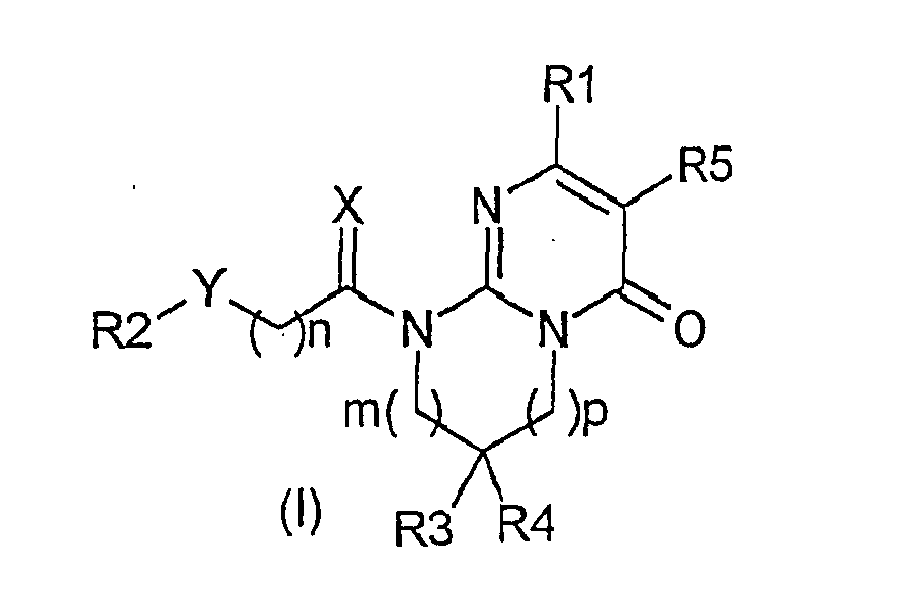
- X represents two hydrogen atoms, a sulfur atom, an oxygen atom or a C1-2 alkyl group and a hydrogen atom;
- Y represents a bond, an ethenylene group, an ethynylene group, an oxygen atom, a sulfur atom, a sulfonyl group, a sulfoxide group, a carbonyl group, a hydroxyiminomethylene group, a dioxolan group, a nitrogen atom being optionally substituted by a C1-6 alkyl group, a phenyl group or a benzyl group; or a methylene group optionally substituted by one or two groups chosen from a C1-6 alkyl group, a benzyl group, a hydroxyl group, a C1-4 alkoxy group, a C1-2 perhalogenated alkyl group, an amino group, an acetylamino group or a phenyl group;
- R1 represents a 2, 3 or 4-pyridine ring optionally substituted by a C3-6 cycloalkyl group, a C1-4 alkyl group, a C1-4 alkoxy group, a benzyl group or a halogen atom;
- when Y represents a bond, a methylene group optionally substituted , a hydroxyiminomethylene group, a dioxolan group or a carbonyl group then R2 represents a C1-6 alkyl group optionally substituted by a hydroxy group, a C6,10 aryloxy or a C6,10 arylamino group; a C3-6 cycloalkyl group, a C1-4 alkylthio group, a C1-4 alkoxy group, a C1-2 perhalogenated alkyl group, a C1-3 halogenated alkyl group, a phenylthio group, a benzyl group, a benzene ring, an indan ring, a 5,6,7,8-tetrahydronaphthalene ring, a naphthalene ring, a pyridine ring, a pyrrole ring, a thiophene-ring, a furan ring or an imidazole ring ; the benzyl group or the rings being optionally substituted by 1 to 4 substituents selected from a C1-6 alkyl group, a methylendioxy group, a halogen atom, a C1-2 perhalogenated alkyl group, a C1-3 halogenated alkyl group, a hydroxyl group, a C1-4 alkoxy group, a nitro, a cyano, an amino, a C1-5 monoalkylamino group, a C2-10 dialkylamino group, a C1-6 alkylcarbonylamino group, a C6,10 arylcarbonylamino group, a C1-4 alkylsulfonyl group, C1-4 alkylsulfonyloxy group or a phenyl group;
- when Y represents an ethenylene group, a ethynylene group, an oxygen atom, a sulfur atom, a sulfonyl group, a sulfoxide group or a nitrogen atom being optionally substituted then R2 represents a C1-6 alkyl group optionally substituted by a hydroxy group, a C6,10 aryfoxy or a C6,10 arylamino group; a C3-6 cycloalkyl group, a C1-2 perhalogenated alkyl group, a C1-3 halogenated alkyl group, a benzyl group, a benzene ring, an indan ring, a 5,6,7,8-tetrahydronaphthalene ring, a naphthalene ring, a C6,10 arylamino, a pyridine ring, a pyrrole ring, a thiophene ring, a furan ring or an imidazole ring; the benzyl group or the rings being optionally substituted by 1 to 4 substituents selected from a C1-6 alkyl group, a methylendioxy group, a halogen atom, a C1-2 perhalogenated alkyl group, a C1-3 halogenated alkyl group, a hydroxyl group, a C1-4 alkoxy group, a nitro, a cyano, an amino, a C1-5 monoalkylamino group, a C2-10 dialkylamino group, a C1-6 alkylcarbonylamino group, a C6,10 arylcarbonylamino group, a C1-4 alkylsulfonyl group, C1-4 alkylsuffonyloxy group or a phenyl group;
- R3 represents a hydrogen atom, a C1-6 alkyl group, a hydroxy group, a C1-4 alkoxy group or a halogen atom;
- R4 represents a hydrogen atom, a C1-6 alkyl group, a hydroxy group, a C1-4 alkoxy group or a halogen atom;
- R5 represents a hydrogen atom, a C1-6 alkyl group or a halogen atom; with the proviso that when R3 and R4 represent each a hydrogen atom then R5 is not a hydrogen atom;
- When m equals 0, p equals 1, 2 or 3,
- When m equals 1, p equals 0, 1 or 2,
- When m equals 2, p equals 0 or 1;
- and
- n represents 0 to 3.
- According to another aspect of the present invention, there is provided a medicament comprising as an active ingredient a substance selected from the group consisting of the pyrimidone derivatives represented by formula (1) and the physiologically acceptable salts thereof, and the solvates thereof and the hydrates thereof. As preferred embodiments of the medicament, there are provided the aforementioned medicament which is used for preventive and/or therapeutic treatment of diseases caused by abnormal GSK3β or GSK3β and cdk5/p25 activity, and the aforementioned medicament which is used for preventive and/or therapeutic treatment of neurodegenerative diseases and in addition other diseases such as:
- Non-insulin dependent diabetes (such as diabetes type II) and obesity; manic depressive illness; schizophrenia; alopecia; smoking cessation and other withdrawal syndromes, epilepsy; cancers such as breast cancer, non-small cell lung carcinoma, thyroid cancer, T or B-cell leukemia and several virus-induced tumors.
- As further preferred embodiments of the present invention, there are provided the aforementioned medicament wherein the diseases are neurodegenerative diseases and are selected from the group consisting of Alzheimer's disease, Parkinson's disease, amyotrophic lateral sclerosis, tauopathies (e.g. frontotemporoparietal dementia, corticobasal degeneration, Pick's disease, progressive supranuclear palsy) and other dementia including vascular dementia; acute stroke and others traumatic injuries; cerebrovascular accidents (e.g. age related macular degeneration); brain and spinal cord trauma; peripheral neuropathies; retinopathies and glaucoma, and the aforementioned medicament in the form of pharmaceutical composition containing the above substance as an active ingredient together with one or more pharmaceutical additives.
- The present invention further provides an inhibitor of GSK3β or GSK3β and cdk5/p25 activity comprising as an active ingredient a substance selected from the group consisting of the pyrimidone derivatives of formula (I) and the salts thereof, and the solvates thereof and the hydrates thereof.
- According to further aspects of the present invention, there is provided a method for preventive and/or therapeutic treatment of neurodegenerative diseases caused by abnormal GSK3β or GSK3β and cdk5/p25 activity, which comprises the step of administering to a patient a preventively and/or therapeutically effective amount of a substance selected from the group consisting of the pyrimidone derivatives of formula (I) and the physiologically acceptable salts thereof, and the solvates thereof and the hydrates thereof; and a use of a substance selected from the group consisting of the pyrimidone derivatives of formula (I) and the physiologically acceptable salts thereof, and the solvates thereof and the hydrates thereof for the manufacture of the aforementioned medicament.
- As used herein, the C1-6 alkyl group represents a straight or branched alkyl group having 1 to 6 carbon atoms, for example, methyl group, ethyl group, n-propyl group, isopropyl group, n-butyl group, isobutyl group, sec-butyl group, tert-butyl group, n-pentyl group, isopentyl group, neopentyl group, 1,1-dimethylpropyl group, n-hexyl group, isohexyl group, and the like;
The C1-4 alkoxy group represents an alkyloxy group having 1 to 4 carbon atoms for example, methoxy group, ethoxy group, propoxy group, isopropoxy group, butoxy group, isobutoxy group, sec-butoxy group, tert-butoxy group, and the like;
The halogen atom represents a fluorine, chlorine, bromine or iodine atom;
The C1-2 perhalogenated alkyl group represents an alkyl group wherein all the hydrogen have been substituted by a halogeno, for example a CF3 or C2F5;
The C1-3 halogenated alkyl group represents an alkyl group wherein at least one hydrogen has not been substituted by a halogen atom;
The C1-5 monoalkylamino group represents an amino group substituted by one C1-5 alkyl group, for example, methylamino group, ethylamino group, propylamino group, isopropylamino group, butylamino group, isobutylamino group, tert-butylamino group, pentylamino group and isopentylamino group;
The C2-10 dialkylamino group represents an amino group substituted by two C1-5 alkyl groups, for example, dimethylamino group, ethylmethylamino group, diethylamino group, methylpropylamino group and diisopropylamino group;
The C6,10 arylamino group represents an amino group substituted by a phenyl group or a naphthyl group;
The C6,10 aryloxy group represents a phenyloxy group and a naphthyloxy group. - The dioxolan group represents the following group :

- The hydroxyiminomethylene group represents the following group :

- The ethenylene group represents the divalent group of formula:

- The ethynylene group represents the divalent group of formula:

- The leaving group represents a group which could be easily cleaved and substituted, such a group may be for example a tosyl, a mesyl, a bromide and the like.
- The compounds represented by the aforementioned formula (I) may form a salt. Examples of the salt include, when an acidic group exists, salts of alkali metals and alkaline earth metals such as lithium, sodium, potassium, magnesium, and calcium; salts of ammonia and amines such as methylamine, dimethylamine, trimethylamine, dicyclohexylamine, tris(hydroxymethyl)-aminomethane, N,N-bis(hydroxyethyl)piperazine, 2-amino-2-methyl-1-propanol, ethanolamine, N-methylglucamine, and L-glucamine; or salts with basic amino acids such as lysine, δ-hydroxylysine, and arginine. The base-addition salts of acidic compounds are prepared by standard procedures well known in the art.
- When a basic group exists, examples include salts with mineral acids such as hydrochloric acid, hydrobromic acid, sulfuric acid, nitric acid, phosphoric acid; salts with organic acids such as methanesulfonic acid, benzenesulfonic acid, p-toluenesulfonic acid, acetic acid, propionic acid, tartaric acid, fumaric acid, maleic acid, malic acid, oxalic acid, succinic acid, citric acid, benzoic acid, mandelic acid, cinnamic acid, lactic acid, glycolic acid, glucuronic acid, ascorbic acid, nicotinic acid, and salicylic acid; or salts with acidic amino acids such as aspartic acid, and glutamic acid.
- The acid-addition salts of the basic compounds are prepared by standard procedures well know in the art which include, but are not limited thereto, dissolving the free base in an aqueous alcohol solution containing the appropriate acid and isolating the sail by evaporating the solution, or by reacting the free base and an acid in an organic solvent, in which case the salt separates directly, or is precipitated with a second organic solvent, or can be obtained by concentration of the solution. The acids which can be used to prepare the acid-addition salts include preferably those which produce, when combined with the free base, pharmaceutically-acceptable salts, that is, salts whose anions are relatively innocuous to the animal organism in pharmaceutical doses of the salts, so that the beneficial properties inherent in the free base are not compromised by side effects ascribable to the anions. Although medicinally acceptable salts of the basic compounds are preferred, all acid-addition salts are within the scope of the present invention.
- In addition to the pyrimidone derivatives represented by the aforementioned formula (I) and salts thereof, their solvates and hydrates also fall within the scope of the present invention. The pyrimidone derivatives represented by the aforementioned formula (I) may have one or more asymmetric carbon atoms. As for the stereochemistry of such asymmetric carbon atoms, they may independently be in either (R) and (S) configuration, and the pyrimidone derivative may exist as stereoisomers such as optical isomers, or diastereoisomers. Any stereoisomers in pure form, any mixtures of stereoisomers, racemates and the like fall within the scope of the present invention.
- Examples of preferred compounds of the present invention are shown in table 1 and table 2 hereinafter. However, the scope of the present invention is not limited by these compounds.
- Preferred compounds of the present invention represented by formula (I) include also:
- (1) Compounds wherein R1 represents a 3- or 4-pyridine ring and more preferably 4-pyridine ring, which may be substituted by a C1-2 alkyl group, a C1-2 alkoxy group or a halogen atom; and/or
- (2) X represents two hydrogen atoms, an oxygen atom or a C1-2 alkyl group and a hydrogen atom;
- (3) Y represents a bond, a carbonyl group, a hydroxyiminomethylene group, a dioxolan group ; or a methylene group optionally substituted by one or two groups chosen from a C1-6 alkyl group, a benzyl group, a hydroxyl group, a C1-4 alkoxy group, a C1-2 perhalogenated alkyl group, an amino group, an acetylamino group or a phenyl group.
- More preferred compounds of the present invention represented by formula (I) include also:
- (1) Compounds wherein R1 represents an unsubstituted 4-pyridine ring;
- Particularly preferred compounds of the present invention represented by formula (I) include compounds of table 1:
- 1. 9-[3-(2-Fluorophenyl)-propyl]-7,7-dimethyl-2-(pyridin-4-yl)-6,7,8,9-tetrahydro-4H-pyrimido[1,2-a]pyrimidin-4-one
- 2. 9-(2-Oxo-2-phenyl-ethyl)-7,7-dimethyl-2-(pyridin-4-yl)-6,7,8,9-tetrahydro-4H-pyrimido[1,2-a]pyrimidin-4-one
- 3. 9-(2-Hydroxy-2-phenyl-ethyl)-7,7-dimethyl-2-(pyridin-4-yl)-6,7,8,9-tetrahydro-4H-pyrimido[1,2-a]pyrimidin-4-one
- 4. 9-(2-Oxo-2-phenyl-ethyl)-7,7-difluoro-2-(pyridin-4-y()-6,7,8,9-tetrahydro-4H-pyrimido[1,2-a]pyrimidin-4-one
- 5. 9-(2(S)-Hydroxy-2-phenyl-ethyl)-7,7-difluoro-2-(pyridin-4-yl)-6,7,8,9-tetrahydro-4H-pyrimido[1,2-a]pyrimidin-4-one
- 6. 9-(2-Oxo-2-phenyl-ethyl)-3-fluoro-7,7-dimethyl-2-(pyridin-4-yl)-6,7,8,9-tetrahydro-4H-pyrimido[1,2-a]pyrimidin-4-one
- 7. 9-[2-0xo-2-(3-chlorophenyl)-ethyl]-7,7 -dimethyl-2-(pyridin-4-yl)-6,7,8,9-tetrahydro-4H-pyrimido[1,2-a]pyrimidin-4-one
- 8. 9-(2(S)-Hydroxy-2-phenyl-ethyl)-7,7-dimethyl-2-(pyridin-4-yl)-6,7,8,9-tetrahydro-4H-pyrimido[1,2-a]pyrimidin-4-one
- 9. 9-[2-Oxo-2-(3-fluorophenyl)-ethyl]-7,7-dimethyl-2-(pyridin-4-yl)-6,7,8,9-tetrahydro-4H-pyrimido[1,2-a]pyrimidin-4-one
- 10. 9-[2-Hydroxy-2-(3-chlorophenyl)-ethyl]-7,7-dimethyl-2-(pyridin-4-yl)-6,7,8,9-tetrahydro-4H-pyrimido[1,2-a]pyrimidin-4-one
- 11.9-[2-Hydroxy-2-(3-fluorophenyl)-ethyl]-7,7-dimethyl-2-(pyridin-4-yl)-6,7,8,9-tetrahydro-4H-pyrimido[1,2-a]pyrimidin-4-one
- 12. 9-(2(S)-Hydroxy-2-phenyl-ethyl)-3-fluoro-7,7-dimethyl-2-(pyridin-4-yl)-6,7,8,9-tetrahydro-4H-pyrimido[1,2-a]pyrimidin-4-one
- 13.9-[2-Oxo-2-(4-fluorophenyl)-ethyl]-7,7-dimethyl-2-(pyridin-4-yl)-6,7,8,9-tetrahydro-4H-pyrimido[1,2-a]pyrimidin-4-one
- 14. 9-[2-Oxo-2-(5,5,8,8-tetramethyl-5,6,7,8-tetrahydronaphth-2-yl)-ethyl]-7,7-dimethyl-2-(pyridin-4-yl)-6,7,8,9-tetrahydro-4H-pyrimido[1,2-a]pyrimidin-4-one
- 15.9-[2-Oxo-2-(3-methoxyphenyl)-ethyl]-7,7-dimethyl-2-(pyridin-4-yl)-6,7,8,9-tetrahydro-4H-pyrimido[1,2-a]pyrimidin-4-one
- 16.9-[2-Oxo-2-(4-phenylphenyl)-ethyl]-7,7-dimethyl-2-(pyridin-4-yl)-6,7,8,9-tetrahydro-4H-pyrimido[1,2-a]pyrimidin-4-one
- 17.9-[2-(1-Methyl-2-oxo-2-(3,4-methylendioxy-5-methoxyphenyl)-ethyl)]-7,7-dimethyl-2-(pyridin-4-yl)-6,7,8,9-tetrahydro-4H-pyrimido[1,2-a]pyrimidin-4-one
- 18.9-[2-Oxo-2-(4-chlorophenyl)ethyl]-7,7-dimethyl-2-(pyridin-4-yl)-6,7,8,9-tetrahydro-4H-pyrimido[1,2-a]pyrimidin-4-one
- 19. 9-[2-Oxo-2-(naphth-2-yl)-ethyl]-7,7-dimethyl-2-(pyridin-4-yl)-6,7,8,9-tetrahydro-4H-pyrimido[1,2-a]pyrimidin-4-one
- 20. 9-[2-Oxo-2-(4-methylphenyl)-ethyl]-7,7-dimethyl-2-(pyridin-4-yl)-6,7,8,9-tetrahydro-4H-pyrimido[1,2-a]pyrimidin-4-one
- 21. 9-(2-Oxo-2-phenyl-ethyl)-7,7-dimethyl-3-bromo-2-(pyridin-4-yl)-6,7,8,9-tetrahydro-4H-pyrimido[1,2-a]pyrimidin-4-one
- 22. 9-(2(S)-Methoxy-2-phenyl-ethyl)-7,7-dimethyl-2-(pyridin-4-yl)-6,7,8,9-tetrahydro-4H-pyrimido[1,2-a]pyrimidin-4-one
- 23.9-(3-Phenyl-propanoyl)-7,7-dimethyl-2-(pyridin-4-yl)-6,7,8,9-tetrahydro-4H-pyrimido[1,2-a]pyrimidin-4-one
- 24.9-(2-Hydroxy-2-methyl-2-phenyl-ethyl)-7,7-dimethyl-2-(pyridin-4-yl)-6,7,8,9-tetrahydro-4H-pyrimido[1,2-a]pyrimidin-4-one
- 25.9-(2-Methoxy-2-phenyl-2-trifluoromethyl-ethanoyl)-7,7-dimethyl-2-(pyridin-4-yl)-6,7,8,9-tetrahydro-4H-pyrimido[1,2-a]pyrimidin-4-one
- 26.9-(2-Hydroxy-2,2-diphenylethyl)-7,7-dimethyl-2-(pyridin-4-yl)-6,7,8,9-tetrahydro-4H-pyrimido[1,2-a]pyrimidin-4-one
- 27. 9-(2-Hydroxyimino-2-phenyl-ethyl)-7,7-dimethyl-2-(pyridin-4-yl)-6,7,8,9-tetrahydro-4H-pyrimido[1,2-a]pyrimidin-4-one
- 28.9-(2-Hydroxy-2-methyl-2-phenyl-ethyl)-7,7-dimethyl-3-fluoro-2-(pyridin-4-yl)-6,7,8,9-tetrahydro-4H-pyrimido[1,2-a]pyrimidin-4-one
- 29.7,7-Dimethyl-9-(2-phenyl-[1,3]dioxolan-2-ylmethyl)- -2-(pyridin-4-yl)-6,7,8,9-tetrahydro-4H-pyrimido[1,2-a]pyrimidin-4-one
- 30.9-(2,3-Dihydroxypropyl)-7,7-dimethyl-2-(pyridin-4-yl)-6,7,8,9-tetrahydro-4H-pyrimido[1,2-a]pyrimidin-4-one
- 31.(2(R)-Methoxy-2-phenyl-ethyl)-7,7-dimethyl-2-(pyridin-4-yl)-6,7,8,9-tetrahydro-4H-pyrimido[1,2-a]pyrimidin-4-one
- 32. 9-(2-Hydroxy-3-phenylaminopropyl)-7,7-dimethyl-2-(pyridin-4-yl)-6,7,8,9-tetrahydro-4H-pyrimido[1,2-a]pyrimidin-4-one
- 33.9-(2-Acetyiamino-2-phenyl-ethyl)-7,7-dimethyl-2-(pyridin-4-yl)-6,7,8,9-tetrahydro-4H-pyrimido[1,2-a]pyrimidin-4-one
- 34.9-(2-Amino-2-phenyl-ethyl)-7,7-dimethyl-2-(pyridin-4-yl)-6,7,8,9-tetrahydro-4H-pyrimido[1,2-a]pyrimidin-4-one
- 35.9-(2-Hydroxy-3-phenoxypropyl)-7,7-dimethyl-2-(pyridin-4-yl)-6,7,8,9-tetrahydro-4H-pyrimido[1,2-a]pyrimidin-4-one
- 36.9-(2-Oxo-2-phenyl-ethyl)-3-fluoro-2-(pyridin-4-yl)-6,7,8,9-tetrahydro-4H-pyrimido[1,2-a]pyrimidin-4-one
- 37.9-[2-Oxo-2-(3-fluorophenyl)-ethyl]-3-fluoro-2-(pyridin-4-yl)-6,7,8,9-tetrahydro-4H-pyrimido[1,2-a]pyrimidin-4-one
- 38.9-(2-Oxo-2-phenyl-ethyl)-3-methyl-2-(pyridin-4-yl)-6,7,8,9-tetrahydro-4H-pyrimido[1,2-a]pyrimidin-4-one
- 39.9-(2-Oxo-2-phenyl-ethyl)-3-chloro-2-(pyridin-4-yl)-6,7,8,9-tetrahydro-4H-pyrimido[1,2-a]pyrimidin-4-one
- 40.9-(2-Oxo-2-phenyl-ethyl)-3-bromo-2-(pyridin-4-yl)-6,7,8,9-tetrahydro-4H-pyrimido[1,2-a]pyrimidin-4-one
- 41. 2-(7-Methyl-6-oxo-8-pyridinyl-3,4-dihydro-,6H pyrimido[1,2-a]pyrimidin-1-yl)-N-phenyl-acetamide
- 42.9-(2(S)-Hydroxy-2-phenyl-ethyl)-3-chloro-2-(pyridin-4-yl)-6,7,8,9-tetrahydro-4H-pyrimido[1,2-a]pyrimidin-4-one
- 43.9-(2(S)-Hydroxy-2-phenyl-ethyl)-3-methyl-2-(pyridin-4-yl)-6,7,8,9-tetrahydro-4H-pyrimfdo[1,2-a]pyrimidin-4-one
- 44.9-(2(S)-Hydroxy-2-phenyl-ethyl)-3-fluoro-2-(pyridin-4-yl)-6,7,8,9-tetrahydro-4H-pyrimido[1,2-a]pyrimidin-4-one
- 45.9-(2(S)-Methoxy-2-phenyl-ethyl)-3-fluoro-2-(pyridin-4-yl)-6,7,8,9-tetrahydro-4H-pyrimido[1,2-a]pyrimidin-4-one
- 46.9-(2(R)-Methoxy-2-phenyl-ethyl)-3-fluoro-2-(pyridin-4-yl)-6,7,8,9-tetrahydro-4H-pyrimido[1,2-a]pynmtdin-4-one
- 47.9-[3-(2-Fluorophenyl)propyl]-7-hydroxy-2-(pyridin-4-yl)-6,7,8,9-tetrahydro-4H-pyrimido[1,2-a]pyrimidin-4-one
- 48.9-[3-(2-Fluorophenyl)propyl]-7-methoxy-2-(pyridin-4-yl)-6,7,8,9-tetrahydro-4H-pyrimido[1,2-a]pyrimidin-4-one
- 49.9-(2-Oxo-2-phenyl-ethyl)-7-methyl-2-(pyridin-4-yl)-6,7,8,9-tetrahydro-4H-pyrimido[1,2-a]pyrimidin-4-one
- 50.9-(2-Hydroxy-2-phenyl-ethyl)-7-methyl-2-(pyridin-4-yl)-6,7,8,9-tetrahydro-4H-pyrimido[1,2-a]pyrimidin-4-one
- 51.9-(2-Hydroxy-2-methyl-2-phenyl-ethyl)-7,7-dimethyl-2-(pyridin-4-yl)-6,7,8,9-tetrahydro-4H-pyrimido[1,2-a]pyrimidin-4-one
- 52.9-(2-Hydroxy-2-methyl-2-phenyl-ethyl)-7,7-dimethyl-2-(pyridin-4-yl)-6,7,8,9-tetrahydro-4H-pyrimido[1,2-a]pyrimidin-4-one
- 53.9-(2(R)-Methoxy-2-phenyl-ethyl)-7,7-dimethyl-2-(pyridin-4-yl)-6,7,8,9-tetrahydro-4H-pyrimido[1,2-a]pyrimidin-4-one
- 54.3-Fluoro-9-[2-(4-fluoro-2-methoxy-phenyl)-ethyl]-2-(pyridin-4-yl)-6,7,8,9-tetrahydro-4H-pyrimido[1,2-a]pyrimidin-4-one
- 55.9-Indan-2-ylmethyl-7,7-dimethyl-2-(pyridin-4-yl)-6,7,8,9-tetrahydro-4H-pyrimido[1,2-a]pyrimidin-4-one
- 56.3-Fluoro-9-[2-(4-fluoro-2-methoxy-phenyl)-ethyl]-7,7-dimethyl-2-(pyridin-4-yl)-6,7,8,9-tetrahydro-4H-pyrimido[1,2-a]pyrimidin-4-one
- 57.9-[2-(4-Fluoro-2-methoxy-phenyl)-ethyl]-7,7-dimethyl-2-(pyridin-4-yl)-6,7,8,9-tetrahydro-4H-pyrimido[1,2-a]pyrimidin-4-one;
- 1. [3-(2-Fluoro-phenyl)-propyl]-2,2-dimethyl-7-(pyridin-4-yl)-2,3-dihydro-1 H-imidazo[1,2-a]pyrimidin-5-one
- 2. [2-Oxo-2-phenylethyl]-2,2-dimethyl-7-(pyridin-4-yl)-2,3-dihydro-1 H-imidazo[1,2-a]pyrimidin-5-one
- 3. [2-Hydroxy-2-phenylethyl]-2,2-dimethyl-7-(pyridin-4-yl)-2,3-dihydrol-1H-imidazo[1,2-a]pyrimidin-5-one
- 4. [2-Oxo-2-(4-chlorophenyl)ethyl]-2,2-dimethyl-7-(pyridin-4-yl)-2,3-dihydro-1H-imidazo[1,2-a]pyrimidin-5-one
- 5. [2-Oxo-2-(4-methylphenyl)ethyl]-2,2-dimethyl-7-(pyridin-4-yl)-2,3-dihydro-1H-imidazo[1,2-a]pyrimidin-5-one
- 6. [2-Oxo-4-phenylphenyl]-2,2-dimethyl-7-(pyridin-4-yl)-2,3-dihydro-1 H-imidazo[1,2-a]pyrimidin-5-one
- 7. [1-Methyl-2-oxo-2-(3,4-methylendioxy-5-methoxyphenyl)-ethyl]-2,2-dimethyl-7-(pyridin-4-yl)-2,3-dihydro-1 H-imidazo[1,2-a]pyrimidin-5-one
- 8. [2-Oxo-2-(naphth-2-yl)-ethyl]-2,2-dimethyl-7-(pyridin-4-yl)-2,3-dihydro-1 H-imidazo[1,2-a]pyrimidin-5-one
- 9. [2-Oxo-2-(4-fluorophenyl)-ethyl]-2,2-dimethyl-7-(pyridin-4-yl)-2,3-dihydro-1 H-imidazo[1,2-a]pyrimidin-5-one
- 10.[2-Oxo-2-(3-methoxyphenyl)-ethyl]-2,2-dimethyl-7-(pyridin-4-yl)-2,3-dihydro-1H-imidazo[1,2-a]pyrimidin-5-one
- 11.[2-Oxo-2-(5,5,8,8-tetramethyl-5,6,7,8-tetrahydronaphth-2-yl)-ethyl]-2,2-dimethyl-7-(pyridin-4-yl)-2,3-dihydro-1H-imidazo[1,2-a]pyrimidin-5-one;
- 1. 9-[2-(4-Flucro-2-methoxy-phenyl)-ethyl]-8-methyl-2-(pyridin-4-yl)-6,7,8,9-tetrahydro-pyrimido[1,2-a]pyrimidin-4-one
- 2. 9-[2-(4-Fluoro-2-methoxy-phenyl)-ethyl]-8,8-dimethyl-2-(pyridin-4-yl)-6,7,8,9-tetrahydro-pyrimido[1,2-a]pyrimidin-4-one
- 3. 9-[2-(4-Fluoro-phenyl)-ethyl]-8-methyl-2-(pyridin-4-yl)-6,7,8,9-tetrahydro-pyrimido[1,2-a]pyrimidin-4-one
- 4. 8-Methyl-9-(2-oxo-2-phenyl-ethyl)-2-(pyridin-4-yl)-6,7,8,9-tetrahydro-pyrimido[1,2-a]pyrimidin-4-one
- 5. 9-[2-(2,5-Dimethoxy-phenyl)-ethyl]-8-methyl-2-(pyridin-4-yl)-6,7,8,9-tetrahydro-pyrimido[1,2-a]pyrimidin-4-one
- 6. 9-[2-(2-methoxy-phenyl)-ethyl]-8-methyl-2-(pyridin-4-yl)-6,7, 8,9-tetrahydro-pyrimido[1,2-a]pyrimidin-4-one.
- 7. 9-[2(S)-Hydroxy-2-phenyl-ethyl]-8-methyl-2-(pyridin-4-yl)-6,7,8,9-tetrahydro-pyrimido[1,2-a]pyrimidin-4-one
- 8. 9-[2(S)-Hydroxy-2-phenyl-ethyl]-8,8-dimethyl-2-(pyridin-4-yl)-6,7,8,9-tetrahydro-pyrimido[1,2-a]pyrimidin-4-one
- 9. 8-Methyl-9-[naphthalen-1-ylmethyl]-2-(pyridin-4-yl)- 6,7,8,9-tetrahydro-pyrimido[1,2-a]pyrimidin-4-one
- 10.8,8-Dimethyl-9-[2-oxo-2-phenyl-ethyl]-2(pyridin-4-yl)- 6,7,8,9-tetrahydro-pyrimido[1,2-a]pyrimidin-4-one
- 11.8-Methyl-9-[naphthalen-2-ylmethyl]-2-(pyridin-4-yl)-6,7,8,9-tetrahydro-pyrimido[1,2-a]pyrimidin-4-one
- 12.9-[2-(3-Methoxy-phenyl)-2-oxo-ethyl]-8-methyl-2-(pyridin-4-yl)-6,7,8,9-tetrahydro-pyrimido[1,2-a]pyrimidin-4-one
- 13.9-[2-(3-Chloro-phenyl)-2-oxo-ethyl]-8-methyl-2-(pyridin-4-yl)-6,7,8,9-tetrahydro-pyrimido[1,2-a]pyrimidin-4-one
- 14. 8,8-Dimethyl-9-[2(S)-phenyl-propyl]-2-(pyridin-4-yl)-6,7,8,9-tetrahydro-pyrimido[1,2-a]pyrimidin-4-one
- 15. 8,8-Dimethyl-9-[2(R)-phenyl-propyl]-2-(pyridin-4-yl)-6,7,8,9-tetrahydro-pyrimido[1,2]-alpyrimidin-4-one
- 16.8-Ethyl-9-[2-oxo-2-phenyl-ethyl]-2-(pyridin-4-yl)-6,7,8,9-tetrahydro-pyrimido[1,2-a]pyrimidin-4-one
- 17.8-Ethyl-9-[2(S)-hydroxy-2-phenyl-ethyl]-2-(pyridin-4-yl)-6,7,8,9-tetrahydro-pyrimido[1,2-a]pyrimidin-4-one
- 18.3-Fluoro-8-methyl-9-(2-oxo-2-phenyl-ethyl)-2-(pyridin-4-yl)-6,7,8,9-tetrahydro-pyrimido[1,2-a]pyrimidin-4-one
- 19.8,8-Dimethyl-9[naphthalen-1-ylmethyl]-2-(pyridin-4-yl)-6,7,8,9-tetrahydro-pyrimido[1,2-a]pyrimidin-4-one
- 20.9-[2-(4-Fluoro-phenyl)-2(S)-hydroxy-ethyl]-8,8-dimethyl-2-(pyridin-4-yl)-6,7,8,9-tetrahydro-pyrimido[1,2-a]pyrimidin-4-one
- 21. 9-[2-(3-Fluoro-phenyl)-2-hydroxy-ethyl]-8-methyl-2-(pyridin-4-yl)-6,7,8,9-tetrahydro-pyrimido[1,2-a]pyrimidin-4-one
- 22.9-[2-(3,5-Dichloro-phenyl)-2-hydroxy-ethyl]-8-methyl-2-(pyridin-4-yl)-6,7,8,9-tetrahydro-pyrimido[1,2-a]pyrimidin-4-one
- 23.9-[2-Benzo[1,3]dioxol-5-yl-2-oxo-ethyl]-8-methyl-2-(pyridin-4-yl)-6,7,8,9-tetrahydro-pyrimido[1,2-a]pyrimidin-4-one
- 24.9-[2-(3-Bromo-phenyl)-2(S)-hydroxy-ethyl]-8,8-dimethyl-2-(pyridin-4-yl)-6,7,8,9-tetrahydro-pyrimido[1,2-a]pyrimidin-4-one
- 25.9-[2-(2,3-Dihydro-benzo[1,4]dioxin-6-yl)-2-oxo-ethyl]-8-methyl-2-(pyridin-4-yl)-6,7,8,9-tetrahydro-pyrimido[1,2-a]pyrimidin-4-one
- 26.3-Fluoro-9-(2-(S)-hydroxy-2-phenyl-ethyl)-8-methyl-2-(pyridin-4-yl)-6,7,8,9-tetrahydro-pyrimido[1,2-a]pyrimidin-4-one
- 27.9-(2-Biphenyl-4-yl-2(S)-hydroxy-ethyl)-8,8-dimethyl-2-(pyridin-4-yl)-6,7,8,9-tetrahydro-pyrimido[1,2-a]pyrimidin-4-one
- 28.9-[2-(3-Fluoro-phenyl)-2(S)-hydroxy-ethyl]-8,8-dimethyl-2-(pyridin-4-yl)-6,7,8,9-tetrahydro-pyrimido[1,2-a]pyrimidin-4-one
- 29.9-(2(S)-Hydroxy-2-naphthalen-2-yl-ethyl)-8,8-dimethyl-2-(pyridin-4-yl)-6,7,8,9-tetrahydro-pyrimido[1,2-a]pyrimidin-4-one
- 30.9-[2-(4-Chloro-phenyl)-2(S)-hydroxy-ethyl]-8,8-dimethyl-2-(pyridin-4-yl)-6,7, 8, 9-tetrahydro-pyrimido[1, 2-a]pyrimidin-4-one
- 31.9-[2-(3,4-Dichlorophenyl)-2(S)-hydroxy-ethyl]-8,8-dimethyl-2-(pyridin-4-yl)-6,7,8,9-tetrahydro-pyrimido[1,2-a]pyrimidin-4-one
- 32.9-(2(S)-Hydroxy-2-p-tolyl-ethyl)-8,8-dimethyl-2-(pyridin-4-yl)-6,7,8,9-tetrahydro-pyrimido[1,2-a]pyrimidin-4-one
- 33.3-Bromo-8-methyl-9-(2-oxo-2-phenyl-ethyl)-2-pyridin-4-yl-6,7,8,9-tetrahydro-pyrimido[1,2-a]pyrimidin-4-one
- 34.9-[2(S)-Hydroxy-2-(3-methoxy-phenyl)-ethyl]-8,8-dimethyl-2-(pyridin-4-yl)-6,7,8,9-tetrahydro-pyrimido[1,2-a]pyrimidin-4-one
- 35. 9-[2-(2,4-Dichloro-phenyl)-2(S)-hydroxy-ethyl]-8,8-dimethyl-2-(pyridin-4-yl)-6,7,8,9-tetrahydro-pyrimido[1,2-a]pyrimidin-4-one
- 36.3-Fluoro-9-(2(S)-hydroxy-2-phenyl-ethyl)-8,8-dimethyl-2-(pyridin-4-yl)-6,7,8,9-tetrahydro-pyrimido[1,2-a]pyrimidin-4-one;
- 37.9-[2-(3-Methoxy-phenyl)-2-oxo-ethyl]-8,8-dimethyl-2-pyridin-4-yl- 6,7,8,9-tetrahydro-pyrimido[1,2-a]pyrimidin-4-one;
- 38.9-[2(S)-Hydroxy-2-phenyl-ethyl]-8-methyl-2-(pyridin-4-yl)-6,7,8,9-tetrahydro-pyrimido[1,2-a]pyrimidin-4-one (diastereoisomer 1);
- 39. 9-[2 (S)-Hydroxy-2-phenyl-ethyl]-8-methyl-2-(pyridin-4-yl)-6,7,8,9-tetrahydro-pyrimido[1,2-a]pyrimidin-4-one (diastereoisomer II);
- 40.8,8-dimethyl 9-(2-oxo-2-p-tolyl-ethyl)-ethyl)-2-pyridin-4-yl- 6,7,8,9-tetrahydro-pyrimido[1,2-a]pyrimidin-4-one;
- 41.9-[2-(3-Bromo-phenyl)-2-oxo-ethyl]-8,8-dimethyl-2-pyridin-4-yl- 6,7,8,9-tetrahydro-pyrimido[1,2-a]pyrimidin-4-one;
- 42.4-[2-(2,2-Dimethyl-6-oxo-8-pyridin-4-yl-3,4-dihydro-2H,6H-pyrimido[1,2-a]pyrimidin-1-yl)-1-hydroxy-ethyl]-benzonitrile;
- 43.9-[2-(3-Fluoro-phenyl)-2-oxo-ethyl]-8,8-dimethyl-2-pyridin-4-yl- 6,7,8,9-tetrahydro-pyrimido[1,2-a]pyrimidin-4-one;
- 44. 9-[2-(3,4-Dichloro-phenyl)-2-hydroxy-ethyl]-8, 8-dimethyl-2-pyridin-4-yl-6,7,8, 9-tetrahydro-pyrimido[1,2-a]pyrimidin-4-one;
- 45.9-[2-(4-Chloro-phenyl)-2-hydroxy-ethyl]-8-ethyl-2-pyridin-4-yl- 6,7,8,9-tetrahydro-pyrimido[1,2-a]pyrimidin-4-one;
- 46.9-[2-(3-Bromo-phenyl)-2-oxo-ethyl]-8-ethyl-2-pyridin-4-yl- 6,7,8,9-tetrahydro-pyrimido[1,2-a]pyrimidin-4-one;
- 47.9-[2-(4-chloro-phenyl)-2-oxo-ethyl]-8-ethyl-2-pyridin-4-yl- 6,7,8,9-tetrahydro-pyrimido[1,2-a]pyrimidin-4-one;
- 48.8-Ethyl-9-(2-hydroxy-2-p-tolyl-ethyl)-2-pyridin-4-yl- 6,7,8,9-tetrahydro-pyrimido[1,2-a]pyrimidin-4-one.
- As a further object, the present invention concerns also methods for preparing the compounds represented by the aforementioned formula (I).
- These compounds can be prepared, for example, according to methods explained below.
- Pyrimidone compounds represented by the aforementioned formula (I) may be prepared according to scheme 1.

- (In the above scheme the definition of R1, R2, R3, R4, R5, X, p, m and n are the same as those already described for compound of formula (I)).
- The pyrimidone derivative represented by the above formula (III), wherein R1 is as defined for compound of formula (I), is allowed to react with a base such as sodium hydride, sodium carbonate or potassium carbonate in a solvent such as N,N-dimethylformamide, N-methylpyrrolidone, N,N dimethylacetamide or chloroform at a suitable temperature ranging from O to 130°C under ordinary air, then with a compound of formula (II), wherein R2, X, Y and n are as defined for compound of formula (I) and L represents a leaving group preferably bromide or mesyl group, to obtain the compound of the aforementioned formula (I).
- Compound of formula (II) are commercially available or may be synthesized according to well-known methods of one skilled in the art. The compound of formula (III) may be prepared according to the method defined in scheme 2.

- (In the above scheme the definition of R1, R3, R4, R5, p and m are the same as already described.)
- According to this method, the 3-ketoester of formula (IV) is allowed to react with a compound of formula (IV). The reaction may be carried out in the presence of potassium carbonate, in an alcoholic solvent such as methanol, ethanol and the like or without, at a suitable temperature ranging from 25°-140°C under ordinary air.
- Alternatively, compounds of formula (III) wherein R5 represents a hydrogen atom may be halogenated in order to give compounds of formula (III) wherein R5 is an halogen atom such as a bromine atom or a chlorine atom. The reaction may be carried out in an acidic medium such as acetic acid or propionic acid, in presence of bromosuccinimide or chlorosuccinimide, or bromine.
- In addition, compounds of formula (III) wherein R5 represents a fluorine atom may be obtained by analogy to the method described in Tetrahedron Letters, Vol.30,N°45,pp 6113-6116, 1989.
- Compounds of formula (V) or (IV) are commercially available or may be synthesized according to well-known methods of one skilled in the art.
- For example compounds of formula (IV), wherein R1 represent a pyridine ring optionally substituted by a C 1-4 alkyl group, C1-4 alkoxy group or a halogen atom, can be prepared by reacting a nicotinic acid optionally substituted by a C1-4 alkyl group, C1-4 alkoxy group or an halogen, with a malonic acid monoester. The reaction can be carried out using methods well known to one skilled in the art, such as for example in presence of a coupling agent such as 1,1'-carbonylbis-1 H-imidazole in a solvent such as tetrahydrofuran at a temperature ranging from 20 to 70°C.
- Compounds of formula (I) may also be obtained starting from another compound of formula (I) using well-known methods of one skilled in the art.
- In the above reactions, protection or deprotection of a functional group may sometimes be necessary. A suitable protecting group Pg can be chosen depending on the type of the functional group, and a method described in the literature may be applied. Examples of protecting group, of protection and deprotection methods are given for example in Protective groups in Organic Synthesis Greene et al., 2nd Ed. (John Wiley & Sons, Inc., New York).
- The compounds of the present invention have inhibitory activity against GSK3β. Accordingly, the compounds of the present invention are useful as an active ingredient for the preparation of a medicament, which enables preventive and/or therapeutic treatment of a disease caused by abnormal GSK3β or GSK3β and cdk5/p25 activity and more particularly of neurodegenerative diseases such as Alzheimer's disease. In addition, the compounds of the present invention are also useful as an active ingredient for the preparation of a medicament for preventive and/or therapeutic treatment of neurodegenerative diseases such as Parkinson's disease, amyotrophic lateral sclerosis, tauopathies (e.g. frontotemporoparietal dementia, corticobasal degeneration, Pick's disease, progressive supranuclear palsy) and other dementia including vascular dementia; acute stroke and others traumatic injuries; cerebrovascular accidents (e.g. age related macular degeneration); brain and spinal cord trauma; peripheral neuropathies; retinopathies and glaucoma; and other diseases such as non-insulin dependent diabetes (such as diabetes type II ) and obesity; manic depressive illness; schizophrenia; alopecia; smoking cessation and other withdrawal syndromes, epilepsy; cancers such as breast cancer, non-small cell lung carcinoma, thyroid cancer, T or B-cell leukemia and several virus-induced tumors.
- The present invention further relates to a method for treating neurodegenerative diseases caused by abnormal activity of GSK3β or GSK3βand cdk5/p25 and of the aforementioned diseases which comprises administering to a mammalian organism in need thereof an effective amount of a compound of the formula (I).
- As the active ingredient of the medicament of the present invention, a substance may be used which is selected from the group consisting of the compound represented by the aforementioned formula (I) and pharmacologically acceptable salts thereof, and solvates thereof and hydrates thereof. The substance, per se, may be administered as the medicament of the present invention, however, it is desirable to administer the medicament in a form of a pharmaceutical composition which comprises the aforementioned substance as an active ingredient and one or more pharmaceutical additives. As the active ingredient of the medicament of the present invention, two or more of the aforementioned substances may be used in combination. The above pharmaceutical composition may be supplemented with an active ingredient of another medicament for the treatment of the above mentioned diseases. The type of pharmaceutical composition is not particularly limited, and the composition may be provided as any formulation for oral or parenteral administration. For example, the pharmaceutical composition may be formulated, in the form of pharmaceutical compositions for oral administration such as granules, fine granules, powders, hard capsules, soft capsules, syrups, emulsions, suspensions, solutions and the fike, or in the form of pharmaceutical compositions for parenteral administrations such as injections for intravenous, intramuscular, or subcutaneous administration, drip infusions, trànsdermal preparations, transmucosal preparations, nasal drops, inhalants, suppositories and the like. Injections or drip infusions may be prepared as powdery preparations such as in the form of lyophilized preparations, and may be used by dissolving just before use in an appropriate aqueous medium such as physiological saline. Sustained-release preparations such as those coated with a polymer may be directly administered intracerebrally.
- Types of pharmaceutical additives used for the manufacture of the pharmaceutical composition, content ratios of the pharmaceutical additives relative to the active ingredient, and methods for preparing the pharmaceutical composition may be appropriately chosen by those skilled in the art. Inorganic or organic substances, or solid or liquid substances may be used as pharmaceutical additives. Generally, the pharmaceutical additives may be incorporated in a ratio ranging from 1% by weight to 90% by weight based on the weight of an active ingredient.
- Examples of excipients used for the preparation of solid pharmaceutical compositions include, for example, lactose, sucrose, starch, talc, cellulose, dextrin, kaolin, calcium carbonate and the like. For the preparation of liquid compositions for oral administration, a conventional inert diluent such as water or a vegetable oil may be used. The liquid composition may contain, in addition to the inert diluent, auxiliaries such as moistening agents, suspension aids, sweeteners, aromatics, colorants, and preservatives. The liquid composition may be filled in capsules made of an absorbable material such as gelatin. Examples of solvents or suspension mediums used for the preparation of compositions for parenteral administration, e.g. injections, suppositories, include water, propylene glycol, polyethylene glycol, benzyl alcohol, ethyl oleate, lecithin and the like. Examples of base materials used for suppositories include, for example, cacao butter, emulsified cacao butter, lauric lipid, witepsol.
- The dose and frequency of administration of the medicament of the present invention are not particularly limited, and they may be appropriately chosen depending on conditions such as a purpose of preventive and/or therapeutic treatment, a type of a disease, the body weight or age of a patient, severity of a disease and the like. Generally, a daily dose for oral administration to an adult may be 0.01 to 1,000 mg (the weight of an active ingredient), and the dose may be administered once a day or several times a day as divided portions, or once in several days. When the medicament is used as an injection, administrations may preferably be performed continuously or intermittently in a daily dose of 0.001 to 100 mg (the weight of an active ingredient) to an adult.
- The present invention will be explained more specifically with reference to the following general examples, however, the scope of the present invention is not limited to these examples.
- A mixture of 5.9g (30.55 mmol) of ethyl 3-(pyridin-4-yl)-3-oxopropionate, 5.0g (30.55 mmol) of 5,5-dimethyl-1,4,5,6-tetrahydro-2-pyrimidinamine monohydrochloride
(prepared by analogy to the method described in US Patent No. 4,262,122) and 6.33g (45.82 mmol) of potassium carbonate in 60ml of ethanol was heated at reflux temperature during 12 h. The cooled suspension was filtered and the solvent removed by evaporation. The residue obtained was dissolved in dichloromethane and washed with water. The organic phase was dried and evaporated to give 6.30g (80%) of product as a beige solid. Mp. : 152-154°C. - A suspension of 0.8g (3.12 mmol) of 7,7-dimethyl-2-(pyridin-4-yl)-6,7,8,9-tetrahydro-4H-pyrimido[1,2-a]pyrimidin-4-one in 8ml of anhydrous dimethylformamide was treated with 274mg (6.86mmol) of sodium hydride (60% suspension in mineral oil) and the resulting mixture was heated at 50°C for 30 min. 0.494ml (3.74 mmol) of (S)-2-chloro-1-phenylethanol was added and the reaction mixture was heated at 50°C during 4h.
The cooled solution was treated with water and extracted with ethyl acetate. The organic phase was dried and evaporated to give crude product, which was purified by silica gel chromatography, eluting with dichloromethane/methanol in the proportions 98/2 to 90110. The 0.486g of pure product obtained in the form of free base was dissolved in hot ethanol and treated with 1 equivalent of hydrogen-chloride in isopropanol. The cooled solution was filtered to afford 0.192 g (15%) of white solid. Mp : 234-236°C. [α]D=-22.9° (c=1, CH3OH) - To a solution containing 6.7g (41.6 mmol) of 2-methyl-1,3-propandiamine hydrochloride (Tetrahedron (1994) 50(29), 8617-8632) in 50ml of methanol was added 83ml of a solution of sodium methylate in methanol (1mmol/ml) and the resulting mixture treated with 3.97g (41.6 mmol) of guanidine hydrochloride. The reaction mixture was heated at 140°C for 3h.
The solution was filtered, the solvent evaporated and the residue obtained was used directly in the next step. - The product was obtained by analogy with step N°1.1 and using the intermediate from step N°2.1.
- A suspension of 0.32g (1.34 mmol) of 7-methyl-2-(pyridin-4-yl)-6,7,8,9-tetrahydro-4H-pyrimido[1,2-a]pyrimidin-4-one in 10ml of anhydrous dimethylformamide was treated with 64mg (1.34mmol) of sodium hydride (50% suspension in mineral oil) and the resulting mixture was stirred for 40 min. 0.267g (1.34 mmol) of phenacyl bromide was added and the reaction mixture stirred at room temperature for 2h.
The solution was treated with water and extracted with ethyl acetate. The organic phase was dried and evaporated to give crude product, which was purified by silica gel chromatography, eluting with dichloromethane/methanol in the proportions 100/0 to 90/10 to give 0.235g of pure product obtained in the form of free base. Mp : 202-203°C. - The product was obtained by analogy with step N° 1.1 and using 2-amino-1,4,5,6-tetrahydro-5-pyrimidinol (Arch.Int.Pharmacodyn.Ther. (1968), 175(1), 193-211). Mp. : 305-307°C.
- A suspension of 1.0g (4.09 mmol) of 7-hydroxy-2-(pyridin-4-yl)-6,7,8,9-tetrahydro-4H-pyrimido[1,2-a]pyrimidin-4-one and 0.95g (4.09 mmol) of 1-[3-(methylsulfonyloxy)propyl]-2-fluorobenzene in 100ml of anhydrous acetonitrile was treated with 4.1g (1.42 mmol) of potassium fluoride suspended on alumina (Fluka) and the resulting mixture was heated at 80 °C for 24h.
The cooled solution was filtered and the solvent evaporated to leave a residue, which was purified by silica gel chromatography, eluting with dichloromethane/methanol/ammonia in the proportions 98/2/0.2 to 96/4/0.4. 0.96g (61 %) of pure product was obtained in the form of free base. Mp : 205-207°C. - To a suspension containing 0.12g (0.31 mmol) of 9-[3-(2-fluorophenyl)propyl]-7-hydroxy-2-(pyridin-4-yl)-6,7,8,9-tetrahydro-4H-pyrimido[1,2-a]pyrimidin-4-one in 3ml of dimethylformamide was added 14mg (0.34 mmol) of a suspension of sodium hydride in mineral oil (60%) and the resulting mixture was stirred at room temperature for 15min. The mixture was cooled to -20°C and treated with 19.6µL (0.31 mmol) of iodomethane. Stirring was continued for 1h.
Water was added and the organic phase was separated. The solvent was evaporated to leave a residue, which was purified by silica gel chromatography, eluting with dichloromethane/methanol/ammonia in the proportions 98/2/0.2. 0.1 g (85%) of pure product was obtained and transformed into a monooxalate salt by treatment with one equivalent of oxalic acid 0.085g (65%). Mp : 164-166°C. - The product was obtained by analogy with the method described in 2.1 and using 2,2-difluoro-1,3-propandiamine (Tetrahedron (1994) 50(29), 8617-8632) and was used as such in the next step.
- The product was obtained by analogy with step N°1.1 and using the intermediate from step N°5.2. Mp. : 239-240°C.
- By analogy with the method described in step N°2.3 the compound was obtained as a free base. Mp. : 217-219°C.
- To a solution of 134,88 ml (0.54 mol) of tri-n-butylphosphine in 500 ml of anhydrous tetrahydrofuran under argon was added 63.8 ml (0.54 mol) of ethyl bromofluoroacetate and the resulting mixture stirred at room temperature during 40 h.
The reaction mixture was cooled to -78°C and 237,58 ml (0.594 mol) of n-butyl lithium (2.5M in hexane) was added dropwise and allowed to stir for 1 h. 76.44 g (0.54 mol) of isonicotinoyl chloride (Heterocyclic Chemistry, 18, 519, 1981) was added and the mixture allowed to stir for 1 h.
The temperature was allowed to increase to room temperature during the night and at 0°C, 700 ml of a 5% aqueous solution of sodium bicarbonate was added and the resulting mixture allowed to stir overnight The tetrahydrofuran was evaporated under reduced pressure and the resulting aqueous phase was extracted with dichloromethane, washed with brine and dried over anhydrous sodium sulfate and evaporated to give a dark brown residue. Flash chromatography on silica gel (eluant cyclohexane/ethyl acetate 90/10 to 50/50). This product was treated with a solution of hydrochloric acid in isopropanol (6N) to give 20 g (17%) of product. Mp. 142-144 °C. - A mixture of 5.0g (20.19 mmol) of ethyl pyridin-4-yl-3-oxo-2-fluoropropanoate hydrochloride, 3.30g (20.19 mmol) 5,5-dimethyl-1,4,5,6-tetrahydro-2-pyrimidinamine hydrochloride
(prepared by analogy to the method described in US Patent No. 4262122 and 8.37g (60.57 mmol) of potassium carbonate in 30ml of ethanol were heated at reflux temperature during 18 h.
The cooled suspension was filtered and the solvent removed by evaporation. The residue obtained was treated with dichloromethane and washed with water. The organic phase was dried and evaporated to give 1.9g (34%) of product as a beige solid. Mp.: 190-192°C. - A suspension of 0.30g (1.09 mmol) of 7,7-dimethyl-3-fluoro-2-(pyridin-4-yl)-6,7,8,9-tetrahydro-4H-pyrimido[1,2-a]pyrimidin-4-one in 6ml of anhydrous dimethylformamide was treated with 53mg (1.31mmol) of sodium hydride (60% suspension in mineral oil) and the resulting mixture was stirred for 10 min.
0.261g (1.31 mmol) of phenacyl bromide was added and the reaction mixture stirred at room temperature for 3h.
The solution was treated with water and extracted with ethyl acetate. The organic phase was dried and evaporated to give crude product, which was purified by silica gel chromatography, eluting with dichloromethanelmethanol in the proportions 98/2 to 90/10 to give 0.10g of pure product obtained in the form of free base which was transformed into the hydrochloride salt. Mp : 236-238°C. - To a solution of 3.0g (11.7 mmol) of 7,7-dimethyl-2-(pyridin-4-yl)-6,7,8,9-tetrahydro-4H-pyrimido[1,2-a]pyrimidin-4-one in 75ml of acetic acid was added dropwise 0.6ml (11.7 mmol) of bromine. The mixture was allowed to stir at room temperature for 2h.
The precipitated solid was recovered by filtration, washed with ether and dried affording 4.53g (97%) of product as a yellow solid. Mp.: 270-272°C. - A solution containing 4.15g (10.43 mmol) of 3-bromo-7,7-dimethyl-2-(pyridin-4-yl)-6,7,8,9-tetrahydro-4H-pyrimido[1,2-a]pyrimidin-4-one hydrobromide in water was treated with an excess of an aqueous solution of sodium hydroxide. The free base was extracted with dichloromethane and the organics dried and evaporated. The residue was solubilized in 25ml of anhydrous dimethylformamide and 0.542g (13.56 mmol) of sodium hydride (60% suspension in mineral oil) and the resulting mixture was stirred for 40 min. 2.43g (12.49 mmol) of phenacyl bromide was added and the reaction mixture stirred at room temperature for 5h.
The solution was treated with water at 0°C and the precipitate which formed was recovered by filtration and dried, 3.5g (74%). Mp : 223-225°C. - A mixture of 14.0g (67.56 mmol) of ethyl 2-methyl-3-(pyridin-4-yl)-3-oxopropionate (prepared by analogy to the method described in French Patent FR 2529786), 9.16g (67.66 mmol) of 1,4,5,6-tetrahydro-2-pyrimidinamine monohydrochloride (prepared according to J.Org.Chem. 1955, 20, 829) and 9.33g (67.66 mmol) of potassium carbonate in 300ml of ethanol was heated at reflux temperature during 12 h.
The cooled suspension was filtered and the solvent removed by evaporation. The residue obtained was treated with water and the precipitate filtered and dried. The product was thus obtained as a brown solid. 10.5g (64%) Mp. : 242-243°C. - A suspension of 0.25g (1.03 mmol) of 3-methyl-2-(pyridin-4-yl)-6,7,8,9-tetrahydro-4H-pyrimido[1,2-a]pyrimidin-4-one in 4ml of anhydrous dimethylformamide was treated with 45mg (1.03mmol) of sodium hydride (50% suspension in mineral oil) and the resulting mixture was stirred for 1h. 0.205g (1.03 mmol) of phenacyl bromide was added and the reaction mixture stirred at room temperature for 5h.
The solution was treated with water and extracted with ethyl acetate. The organic phase was dried and evaporated to give crude product, which was purified by silica gel chromatography, eluting with dichloromethane/methanol/ammonia in the proportions 98/2/0.2 to give 0.10g (27%) of pure product obtained in the form of free base. Mp : 190-192°C. - The product was obtained by using the method described in step 2.3 and empfoying 7,7-dimethyl-2-(pyridin-4-yl)- 6,7,8,9- tetrahydro-4H-pyrimido [1,2-a]pyrimidin-4-one. Mp. : 283-285°C.
- To a solution of 2.0g (5.34 mmol) of 9-(2-Oxo-2-phenyl-ethyl)-7,7-dimethyl-2-. (pyridin-4-yl)-6,7,8,9-tetrahydro-4H-pyrimido[1,2-a]pyrimidin-4-one obtained in step
9 in 100ml of methanol at 0°C was added 0.24g (6.41 mmol) of sodium borohydride. Stirring was maintained for 30min. and the solvent was removed by evaporation.
Water was added and the resulting mixture extracted with dichloromethane. The organics were dried and evaporated and the residue was triturated with ethyl acetate to give 1.66g (83%) of product. The Z-but-2-endioate salt of the product was characterized. Mp.: 195-197°C. - To a solution of 0.2g (0.531 mmol) of 9-(2-Hydroxy-2-phenyl-ethyl)-7,7-dimethyl-2-(pyridin-4-yl)-6,7,8,9-tetrahydro-4H-pyrimido[1,2-a]pyrimidin-4-one, 0.080g (0.584 mmol) of phthalimide and 0.195g (0.742 mmol) in 30ml of anhydrous tetrahydrofuran at 0°C was added 0.142ml (0.903 mmol) of diethyl azodicarboxylate and the reaction mixture stirred for 18h.
The solvent was evaporated and the residue was purified by chromatography on silica gel eluting with dichloromethane/methanol/diethylamine in the proportions 98/2/0.2 to give 0.06g (22%) of product. - A solution of 0.470g (0.929 mmol) of 2-[2-(3,3-dimethyl-6-oxo-8-(pyridin-4-yl)-3,4-dihydro-2H,6H-pyrimido[1,2-a]pyrimidin-1-yl)-1-phenyl-ethyl]-isoindole-1,3-dione in 50ml of ethanol containing 0.452ml (9.29 mmol) of hydrazine hydrate was heated at reflux temperature for 18h.
The cooled solution was filtered and the solvent removed by evaporation. The residue was purified by chromatography on silica gel eluting with ethyl acetate/methanol/diethylamine in the proportions 95/5/0.5 to 94/6/0.6. The free base recovered was transformed into the hydrochloride salt to give 0.283g (68%) of product. Mp. : 227-231°C. - To a solution of 15g (0.17 mol) of 1,2-diamino-2-methylpropane in 150ml of water at 0°C, was added 18g (0.17 mol) of cyanogen bromide portionwise and the temperature was allowed to warm to room temperature during 4h. The water was removed by evaporation and ethanol was added and evaporated. Trituration in a mixture of diethyl ether and ethanol gave 29.5g (89%) of product as an amorphous hygroscopic solid.
- A suspension of 4.5g (23.2 mmol) of 5,5-dimethyl-4,5-dihydro-1 H-imidazol-2-ylamine hydrobromide, 2.99g (15.46 mmol) of ethyl 3-(pyridin-4-yl)-3-oxopropionate and 4.27g (30.89 mmol) of potassium carbonate in 100ml of ethanol was heated at reflux temperature for 18h.
The cooled suspension was filtered and the solvents evaporated. The residue obtained was dissolved in dichloromethane and washed with water. The solvent was evaporated to give 2.5g (67%) of pure product. Mp. : 226-228°C. - A suspension of 0.3g (1.23 mmol) of 2,2-dimethyl-7-(pyridin-4-yl)-2,3-dihydro-1H-imidazo[1,2-a]pyrimidin-5-one in 6ml of anhydrous dimethylformamide was treated with 64mg (1.6 mmol) of sodium hydride (60% suspension in mineral oil) The mixture was heated at 60°C for 10min. and then 0.322g (1.48 mmol) of 3-(2-fluorophenyl)propyl bromide was added and the mixture heated at 120°C during 1h.
The cooled solution was treated with water and extracted with ethyl acetate. The solvent was evaporated to leave a residue which was purified by silica gel chromatography, eluting with dichloromethane/methanol in the proportions 98/2 to 95/5 to obtain 0.248g (55%) of pure product in the form of free base which was transformed into the dihydrochloride salt Mp : 140-142°C. - A mixture of 6g (31.0 mmol) of ethyl 3-(pyridin-4-yl)-3-oxopropionate, 4.6g (31.0 mmol) 6-methyl-1,4,5,6-tetrahydro-pyrimidin-2-ylamine hydrochloride (prepared according to J.Org. Chem., 20, 1955, 829-838) and 6.44g (46.0 mmol) of potassium carbonate in 50ml of ethanol were heated at reflux temperature during 18 h.
The reaction mixture was cooled and the solvent removed by evaporation. The residue obtained was treated with water and the precipitate recovered by filtration to give 3.85g (51%) of product. Mp. : 245-247°C. - To a suspension of 14.34g (32.47 mmol) of lead (IV) acetate in 100ml of anhydrous toluene was added a mixture of 5.2g (30.92 mmol) of 1-(4-fluoro-2-methoxy-phenyl)-ethanone and 15.02 ml (123.13 mmol) of boron trifluoride etherate in 9ml of methanol. The reaction mixture is further stirred at room temperature for 16h. Water was added to the cooled mixture and the resulting solution extracted with toluene. The extracts were washed with saturated sodium hydrogen carbonate solution, saturated sodium chloride solution and dried with sodium sulphate. The solvent was evaporated to dryness to give 6g of product as an oil, which was used in the subsequent step without further purification.
- To a suspension of 1.72g (45.41 mmol) of lithium aluminum hydride in 120ml of tetrahydrofuran at 0°C was added dropwise 6g (30.27 mmol) of dissolved in 120 ml of (4-Fluoro-2-methoxy-phenyl)-acetic acid methyl ester and the resulting mixture stirred at room temperature for 1 h.
The reaction mixture was diluted with 100ml of diethylether at 0°C and treated with excess of a saturated aqueous solution of sodium sulfate. Further solid sodium sulfate was added and the organic phase was filtered to remove salts. The solvent was evaporated to dryness to give 5.1 g (99%) of product as an oil. - To a solution of 5.1 g (29.97 mmol) of 2-(4-Fluoro-2-methoxy-phenyl)-ethanol in 30 ml of anhydrous dichloromethane was added at 0°C 6.26ml (44.95 mmol) of triethylamine and 3.5ml (44.95 mmol) of methanesulfonyl chloride.
The resulting mixture was stirred at 0°C for 1h. The mixture was then diluted with water and dichloromethane and extracted with dichloromethane. Organic layer was dried and evaporated to give 7g(100%) of methanesulfonic acid 2-(4-fluoro-2-methoxy-phenyl)-ethyl ester. - To a solution of 0.25g (1.03 mmol) of 8-methyl-2-(pyridin-4-yl)-6,7,8,9-tetrahydro-pyrimido[1,2-a]pyrimidin-4-one in 4ml of anhydrous dimethylformamide was added 0.046mg (1.14mmol) of sodium hydride (60% suspension in mineral oil) and the mixture allowed to stir at 50°C for 20min. 0.282g (1.14 mmol) of methanesulfonic acid 2-(4-fluoro-2-methoxy-phenyl)-ethyl ester was added and stirring continued for 18h.
Water was added and the mixture extracted with dichloromethane. The extracts were washed with a saturated aqueous solution of sodium chloride, dried and evaporated to give crude product. Purification by chromatography on silica gel eluting with a mixture of dichloromethane/methanol in the proportions 100/0 to 96/4. The compound was obtained in the form of free base which was transformed into its hydrochloride salt to give 0.192g (43%) of pure product. Mp. : 206-208°C. - A mixture of 7.68g (39.8 mmol) of ethyl 3-(pyridin-4-yl)-3-oxopropionate, 7.9g (37.9 mmol) 6,6-dimethyl-1,4,5,6-tetrahydro-pyrimidin-2-ylamine hydrobromide (prepared according to Bull. Soc. Chim. Belg., 1950, 59, 573-587) and 11g (79.5 mmol) of potassium carbonate in 80ml of ethanol were heated at reflux temperature during 18 h.
The reaction mixture was cooled and the solvent removed by evaporation. The residue obtained was treated with water and the precipitate recovered by filtration to give 3.21g (33%) of product. Mp. :345-347 °C. - To a solution of 0.222g (0.87 mmol) of 8,8-dimethyl-2-(pyridin-4-yl)-6,7,8,9-tetrahydro-pyrimido[1,2-a]pyrimidin-4-one in 5ml of anhydrous dimethylformamide was added 0.039g (0.95mmol) of sodium hydride (60% suspension in mineral oil) and the mixture allowed to stir at 50°C for 20min. 0.236g (0.95mmol) of methanesulfonic acid 2-(4-fluoro-2-methoxy-phenyl)-ethyl ester was added and stirring continued for 18h.
Water was added and the mixture extracted with dichloromethane. The extracts were washed with a saturated aqueous solution of sodium chloride, dried and evaporated to give crude product. Purification by chromatography on silica gel eluting with a mixture of dichloromethane/methanol in the proportions 100/0 to 96/4 gave 0.18g (50%) of pure product. Mp. : 217-219°C. - To a solution of 1g (3.90 mmol) of 8,8-dimethyl-2-pyridin-4-yl-6,7,8,9-tetrahydro-pyrimido[1,2-a]pyrimidin-4-one in 12ml of anhydrous dimethylformamide was added 0.343g (8.58 mmol) of sodium hydride (60% suspension in mineral oil) and the mixture allowed to stir at 50°C for 1h. 0.794g (5.07 mmol) of (1-S)-2-chloro-1-phenyl ethanol was added and the mixture allowed to stir at 120°C for 12h.
Water was added and the mixture extracted with ethyl acetate. The extracts were washed with a saturated aqueous solution of sodium chloride, dried and evaporated to give crude product. Purification by chromatography on silica gel eluting with a mixture of ethyl acetate/ethanol in the proportions 100/0 to 96/4. The compound was obtained in the form of free base which was transformed into its hydrochloride salt to give 0.87g (59%) of pure product.
Mp : 204-206 °C, [α]D= -20.7° (c=0.855, CH3OH). - To a solution of 0.12ml (1.65 mmol) of dimethyl sulphoxide in 3ml of anhydrous dichloromethane at -78°C was added 0.21ml (1.46 mmol) of trifluoroacetic anhydride in 1ml of anhydrous dichloromethane and the mixture allowed to stir at -78°C for 20 min. 0.1g (0.27 mmol) of 9-(2(S)-hydroxy-2-phenyl-ethyl)-8,8-dimethyl-2-pyridin-4-yl-6,7,8,9-tetrahydro-pyrimido[1,2-a]pyrimidin-4-one in 2ml of anhydrous dichloromethane was added at -78°C and stirring continued for 30 min.
0.31ml (2.23 mmol) of triethylamine was added and the mixture allowed to stir at room temperature for 12h. Water was added and the mixture extracted with ethyl acetate, the extracts were washed with a saturated aqueous solution of ammonium chloride, a saturated aqueous solution of sodium chloride, dried and evaporated to give crude product. Purification by chromatography on silica gel eluting with a mixture of dichloromethane/methanol/ammonium hydroxide in the proportions 95/5/0.5. The compound was obtained in the form of free base which was transformed into its hydrochloride salt to give 0.026g (24%) of pure product. Mp : 247-249 °C. - A mixture of 5g (25.88 mmol) of ethyl 3-(4-pyridinyl)-3-oxopropionate, 3.85g (23.53 mmol) of 6-ethyl-1,4,5,6-tetrahydro-pyrimidin-2-ylamine hydrochloride (prepared according to J.Org. Chem., 20, 1955, 829-838) and 6.83g (49.41 mmol) of potassium carbonate in 51ml of ethanol were heated at reflux temperature during 18 h.
The reaction mixture was cooled and the solvent removed by evaporation. The residue obtained was treated with water and the precipitate recovered by filtration to give 4.1 g (68%) of product. Mp. : 244-246°C. - To a solution of 0.3g (1.17 mmol) of 8-ethyl-2-pyridin-4-yl-6,7,8,9-tetrahydro-pyrimido[1,2-a]pyrimidin-4-one in 6ml of anhydrous dimethylformamide was added 0.343g (8.58 mmol) of sodium hydride (60% suspension in mineral oil) and the mixture allowed to stir at 50°C for 15 min. At 0°C, 0.303g (1.52 mmol) of phenacyl bromide was added the mixture allowed to stir at 0°C for 3h and the temperature was allowed to warm to room temperature during 12h.
Water was added and the mixture extracted with ethyl acetate. The extracts were washed with a saturated aqueous solution of sodium chloride, dried and evaporated to give crude product. Purification by chromatography on silica gel eluting with a mixture of dichloromethane/methanol in the proportions 100/0 to 96/4. The compound was obtained in the form of free base which was transformed into its hydrochloride salt to give 0.134g (28%) of pure product. Mp : 189-191°C. - The product was obtained by analogy with step N° 13.1 and using the intermediate from step N°6.1. Mp. : 274-276°C.
- The product was obtained by analogy with step N° 17.2.
Mp. : 201-202°C. - A list of chemical structures and physical data for compounds of the aforementioned formula (I) illustrating the present invention is given in tables 1 and 2. The compounds have been prepared according to the methods of the example.
- In the tables, R1 is an unsubstituted 4-pyridine ring (4-py), Ph represents a phenyl group, Et represents an ethyl group, Me represents a methyl group; in the column "X", when X represents two hydrogen atoms, only "H" is indicated, (S), (R) or (Rac.) indicates in the column "Y" the stereochemistry respectively, (S), (R) or (Rac.) of the carbon atom.
- (rac.) means racemic mixture
- (R) means absolute R configuration
- (S) means absolute S configuration
- In table 1, for compounds of formula (I) "m" and "p" equal 1; in table 2, for compounds of formula (I), "m" equals 0 and "p" equals 1 and in table 3 for compounds of formula (I) "m" equals 0 and "p" equals 2.


- Two different protocols can be used.
- In a first protocol : 7.5 µM of prephosphorylated GS1 peptide and 10 µM ATP (containing 300,000 cpm of 33P-ATP) were incubated in 25 mM Tris-HCl, pH 7.5, 0.6 mM DTT, 6 mM MgCl2, 0.6 mM EGTA, 0.05 mg/ml BSA buffer for 1 hour at room temperature in the presence of GSK3β (total reaction volume : 100 microliters).
- In a second protocol : 4.1 µM of prephosphorylated GS1 peptide and 42 µM ATP (containing 260,000 cpm 33P-ATP) were incubated in 80 mM Mes-NaOH, pH 6.5, 1 mM Mg acetate, 0.5 mM EGTA, 5 mM 2-mercaptoethanol, 0.02% Tween 20, 10% glycerol buffer for 2 hours at room temperature in the presence of GSK3β.
Inhibitors were solubilized in DMSO (final solvent concentration in the reaction medium, 1%). - The reaction was stopped with 100 microliters of a solution made of 25 g polyphosphoric acid (85% P2O5), 126 ml 85% H3PO4, H2O to 500 ml and then diluted to 1:100 before use. An aliquot of the reaction mixture was then transferred to Whatman P81 cation exchange filters and rinsed with the solution described above. Incorporated 33P radioactivity was determined by liquid scintillation spectrometry.
The phosphorylated GS-1 peptide had the following sequence :
NH2-YRRAAVPPSPSLSRHSSPHQS(P)EDEE-COOH. - The GSK3β inhibitory activity of the compounds of the present invention are expressed in IC50, and as an illustration the range of IC5o's of the compounds in table 1 is between 4 nanomolar to 2 micromolar concentrations, of the compounds in table 2 is between 30 nanomolar to 2 micromolar concentrations and of the compounds in table three is between 1 nanomolar to 2 micromolar.
- The following protocol may be used:
- 0.4 mg/ml Histone H1 and 10 µM ATP (containing 300,000 cpm of 33P-ATP) were incubated in 50 mM Hepes, pH 7.2, 1 mM DTT, 1 mM MgCl2, 1 mM EGTA, 0.02% Tween 20 buffer for 1 hour at room temperature in the presence of cdk5/p25 (total reaction volume : 100 microliters).
- Inhibitors were solubilized in DMSO (final solvent concentration in the reaction medium, 1%).
- The reaction was stopped with 100 microliters of a solution of 25 g polyphosphoric acid (85% P2O5), 126 ml 85% H3PO4, H2O to 500 ml (diluted to 1:100 before use). An aliquot of the reaction mixture was then transferred to Whatman P81 cation exchange filters and rinsed with the solution described above. Incorporated 33P radioactivity was determined by liquid scintillation spectrometry.
- The cdk5/p25 inhibitory activity of the compounds of the present invention are expressed as IC50 values. Typically, 3-fold serial dilutions of the inhibitor over at least a 1000-fold concentration range are used.
- As an illustration the range of IC50's of the compounds in table 1 is between 200 nanomolar to 5 micromolar concentrations.
- As an illustration the specific IC50's of some compounds of the aforementioned formula (I) illustrating the present invention are given in table 4.
Table 4 Table No. Compound No. TPK1 IC50 µM TPK2 IC50 µM 1 37 0.004 4.6 3 32 0.001 >1.0 1 45 0.006 >1.0 3 7 0.004 0.344 1 12 0.011 0.334 1 39 0.004 0.062 1 5 0.060 0.067 1 40 0.005 0.077 1 42 0.028 0.154 1 44 0.006 >1.0 - The ingredients below were mixed by an ordinary method and compressed by using a conventional apparatus.
Compound of Example 1 30 mg Crystalline cellulose 60 mg Corn starch 100 mg Lactose 200 mg Magnesium stearate 4 mg - The ingredients below were mixed by an ordinary method and filled in soft capsules.
Compound of Example 1 30 mg Olive oil 300 mg Lecithin 20 mg - The ingredients below were mixed by an ordinary method to prepare injections contained in a 1 ml ampoule.
Compound of Example 1 3 mg Sodium chloride 4 mg Distilled water for injection 1 ml - The compounds of the present invention have GSK3β or GSK3β and cdk5/p25 inhibitory activity and are useful as an active ingredient of a medicament for preventive and/or therapeutic treatment of diseases caused by abnormal activity of GSK3β or GSK3β and cdk5/p25 and more particularly of neurodegenerative diseases.
- 1. A 3-ketoseter of formula (IV)

- 2. A 3-ketoseter of formula (IV) according to claim 1 wherein is a fluorine atom.
- 3. A 3-ketoseter of formula (IV) according to claim 2 consisting of ethyl 2-fluoro-3-oxo-3-pyridin-4-yl propanoate.
Claims (3)
- A 3-ketoester of formula (IV)

- A 3-ketoester of formula (IV) according to claim 1 wherein is a fluorine atom.
- A 3-ketoester of formula (IV) according to claim 2 consisting of ethyl 2-fluoro-3-oxo-3-pyridin-4-yl propanoate.
Priority Applications (2)
| Application Number | Priority Date | Filing Date | Title |
|---|---|---|---|
| EP05016160A EP1674456B1 (en) | 2001-09-21 | 2002-09-19 | Use of 2-fluoro- 3-ketoesters for preparing 3-fluoro-6,7,8,9-tetrahydro-4-H-pyrimdo[1,2-a]pyrimidin-4-ones |
| CY20081100994T CY1108341T1 (en) | 2001-09-21 | 2008-09-16 | USE OF 2-FLUORO-3-KETOSTERS FOR PREPARATION OF 3-FLUORO-6,7,8,9-tetrahydro-4-H-PYRIMID [1,2-a] PYRIMIDIN-4-ONE |
Applications Claiming Priority (4)
| Application Number | Priority Date | Filing Date | Title |
|---|---|---|---|
| EP01402432A EP1295885A1 (en) | 2001-09-21 | 2001-09-21 | Substituted 2-pyridinyl-6,7,8,9-tetrahydropyrimido(1,2-a)pyrimidin-4-one and 7-pyridinyl-2,3-dihydroimidazo(1,2-a)pyrimidin-5(1H)one derivatives |
| EP02290489A EP1340761A1 (en) | 2002-02-28 | 2002-02-28 | Substituted 2-pyridinyl-6,7,8,9-tetrahydropyrimido[1,2-a]pyrimidin-4-one and 7-pyridinyl-2,3-dihydroimidazo[1,2-a]pyrimidin-5(1H)one derivatives |
| EP05016160A EP1674456B1 (en) | 2001-09-21 | 2002-09-19 | Use of 2-fluoro- 3-ketoesters for preparing 3-fluoro-6,7,8,9-tetrahydro-4-H-pyrimdo[1,2-a]pyrimidin-4-ones |
| EP02785157A EP1430057B1 (en) | 2001-09-21 | 2002-09-19 | Substituted 2-pyridinyl-6,7,8,9-tetrahydropyrimido 1,2-a]pyrimidin-4-one and 7-pyridinyl-2,3-dihydroimidazo 1,2-a]pyrimidin-5(1h)one derivatives |
Related Parent Applications (1)
| Application Number | Title | Priority Date | Filing Date |
|---|---|---|---|
| EP02785157A Division EP1430057B1 (en) | 2001-09-21 | 2002-09-19 | Substituted 2-pyridinyl-6,7,8,9-tetrahydropyrimido 1,2-a]pyrimidin-4-one and 7-pyridinyl-2,3-dihydroimidazo 1,2-a]pyrimidin-5(1h)one derivatives |
Publications (3)
| Publication Number | Publication Date |
|---|---|
| EP1674456A2 true EP1674456A2 (en) | 2006-06-28 |
| EP1674456A3 EP1674456A3 (en) | 2006-07-05 |
| EP1674456B1 EP1674456B1 (en) | 2008-07-16 |
Family
ID=26077256
Family Applications (2)
| Application Number | Title | Priority Date | Filing Date |
|---|---|---|---|
| EP05016160A Expired - Lifetime EP1674456B1 (en) | 2001-09-21 | 2002-09-19 | Use of 2-fluoro- 3-ketoesters for preparing 3-fluoro-6,7,8,9-tetrahydro-4-H-pyrimdo[1,2-a]pyrimidin-4-ones |
| EP02785157A Expired - Lifetime EP1430057B1 (en) | 2001-09-21 | 2002-09-19 | Substituted 2-pyridinyl-6,7,8,9-tetrahydropyrimido 1,2-a]pyrimidin-4-one and 7-pyridinyl-2,3-dihydroimidazo 1,2-a]pyrimidin-5(1h)one derivatives |
Family Applications After (1)
| Application Number | Title | Priority Date | Filing Date |
|---|---|---|---|
| EP02785157A Expired - Lifetime EP1430057B1 (en) | 2001-09-21 | 2002-09-19 | Substituted 2-pyridinyl-6,7,8,9-tetrahydropyrimido 1,2-a]pyrimidin-4-one and 7-pyridinyl-2,3-dihydroimidazo 1,2-a]pyrimidin-5(1h)one derivatives |
Country Status (24)
| Country | Link |
|---|---|
| US (2) | US7214682B2 (en) |
| EP (2) | EP1674456B1 (en) |
| JP (3) | JP4570362B2 (en) |
| KR (1) | KR100868841B1 (en) |
| CN (2) | CN100398541C (en) |
| AR (1) | AR036600A1 (en) |
| AT (2) | ATE303388T1 (en) |
| AU (1) | AU2002350487C1 (en) |
| BR (1) | BR0212896A (en) |
| CA (1) | CA2457965C (en) |
| CY (1) | CY1108341T1 (en) |
| DE (2) | DE60205921T2 (en) |
| DK (2) | DK1430057T3 (en) |
| EA (1) | EA006859B1 (en) |
| ES (2) | ES2310787T3 (en) |
| HU (1) | HUP0500328A3 (en) |
| IL (2) | IL160402A0 (en) |
| MX (1) | MXPA04002629A (en) |
| NO (1) | NO329565B1 (en) |
| NZ (2) | NZ547205A (en) |
| PL (1) | PL370349A1 (en) |
| PT (1) | PT1674456E (en) |
| SI (1) | SI1430057T1 (en) |
| WO (1) | WO2003027116A2 (en) |
Families Citing this family (24)
| Publication number | Priority date | Publication date | Assignee | Title |
|---|---|---|---|---|
| BR0212896A (en) * | 2001-09-21 | 2004-10-13 | Sanofi Synthelabo | Substituted 2-pyridinyl-6,7,8,9-tetrahydropyrime [1,2-a] pyrimidin-4-one and 7-pyridinyl-2,3dihydroimidazo [1,2-a] pyrimidin-5 (1h) one derivatives |
| TW201041580A (en) | 2001-09-27 | 2010-12-01 | Alcon Inc | Inhibitors of glycogen synthase kinase-3 (GSK-3) for treating glaucoma |
| EP1454909B1 (en) * | 2003-03-07 | 2008-08-20 | Sanofi Aventis | 8'-pyridinyl-dihydrospiro (cycloalkyl) -pyrimido (1,2-a) pyrimidin-6-one and 8'-pyrimidinyl-dihydrospiro (cycloalkyl) pyrimido (1,2-a) pyrimidin-6 derivatives -one and their use against neurodegenerative diseases |
| EP1454900A1 (en) | 2003-03-07 | 2004-09-08 | Sanofi-Synthelabo | Process for the preparation of pyridinyl and pyrimidinyl mono-fluorinated beta keto-esters |
| EP1557417B1 (en) * | 2003-12-19 | 2007-03-07 | Sanofi-Aventis | Substituted 8'-pyri(mi)dinyl-dihydrospiro-[cycloalkylamine]-pyrimido[1,2-a] pyrimidin-6-one derivatives |
| ES2304690T3 (en) | 2004-01-22 | 2008-10-16 | Amgen Inc. | SUBSTITUTED HETEROCICLIC COMPOUNDS AND THEIR METHODS OF USE. |
| EP2258357A3 (en) | 2005-08-26 | 2011-04-06 | Braincells, Inc. | Neurogenesis with acetylcholinesterase inhibitor |
| EP2275096A3 (en) | 2005-08-26 | 2011-07-13 | Braincells, Inc. | Neurogenesis via modulation of the muscarinic receptors |
| WO2007047978A2 (en) | 2005-10-21 | 2007-04-26 | Braincells, Inc. | Modulation of neurogenesis by pde inhibition |
| EP2314289A1 (en) | 2005-10-31 | 2011-04-27 | Braincells, Inc. | Gaba receptor mediated modulation of neurogenesis |
| US20100216734A1 (en) | 2006-03-08 | 2010-08-26 | Braincells, Inc. | Modulation of neurogenesis by nootropic agents |
| EP2021000A2 (en) | 2006-05-09 | 2009-02-11 | Braincells, Inc. | Neurogenesis by modulating angiotensin |
| US20100184806A1 (en) | 2006-09-19 | 2010-07-22 | Braincells, Inc. | Modulation of neurogenesis by ppar agents |
| CN101735211B (en) * | 2008-11-04 | 2012-11-14 | 复旦大学 | Applications of 2,3-dihydro[1,5] benzothiazepine compounds or salts thereof in preparation of GSK-3beta inhibitor |
| US20100216805A1 (en) | 2009-02-25 | 2010-08-26 | Braincells, Inc. | Modulation of neurogenesis using d-cycloserine combinations |
| PL2448940T3 (en) * | 2009-07-02 | 2014-10-31 | Sanofi Sa | 6,7,8,9-tetrahydro-pyrimido{1,2-a} pyrimidin-4-one derivatives, their preparation and pharmaceutical use thereof |
| FR2947551B1 (en) * | 2009-07-02 | 2012-05-18 | Sanofi Aventis | NOVEL 1,2,3,4-TETRAHYDRO-PYRIMIDO {1,2-A) PYRIMIDIN-6-ONE DERIVATIVES, THEIR PREPARATION AND THEIR PHARMACEUTICAL USE AS AKT PHOSPHORYLATION INHIBITORS (PKB) |
| FR2947550B1 (en) * | 2009-07-02 | 2012-05-18 | Sanofi Aventis | NOVEL 2,3-DIHYDRO-1H-IMIDAZO {1,2-A} PYRIMIDIN-5-ONE DERIVATIVES, THEIR PREPARATION AND THEIR PHARMACEUTICAL USE AS AKT PHOSPHORYLATION INHIBITORS (PKB) |
| KR101745028B1 (en) | 2009-07-02 | 2017-06-08 | 사노피 | Novel 2,3-dihydro-1h-imidazo(1,2-a)pyrimidin-5-one derivatives, preparation thereof, and pharmaceutical use thereof |
| PT2655375E (en) | 2010-12-23 | 2015-03-02 | Sanofi Sa | Pyrimidinone derivatives, preparation thereof and pharmaceutical use thereof |
| FR2992314B1 (en) | 2012-06-22 | 2015-10-16 | Sanofi Sa | NOVEL 2,3-DIHYDRO-1H-IMIDAZO {1,2-A} PYRIMIDIN-5-ONE AND 1,2,3,4-TETRAHYDRO-PYRIMIDO {1,2-A} PYRIMIDIN-6-ONE DERIVATIVES COMPRISING A SUBSTITUTED MORPHOLINE, THEIR PREPARATION AND THEIR PHARMACEUTICAL USE |
| WO2015155738A2 (en) | 2014-04-09 | 2015-10-15 | Christopher Rudd | Use of gsk-3 inhibitors or activators which modulate pd-1 or t-bet expression to modulate t cell immunity |
| CN109836427B (en) * | 2017-11-29 | 2022-04-15 | 暨南大学 | Pyrimidopyrimidinone compounds and application thereof |
| CN114957246B (en) * | 2021-02-19 | 2025-11-11 | 苏州恩华生物医药科技有限公司 | 5,6,7, 8-Tetrahydropyrido [4,3-d ] pyrimidin-4 (3H) -one derivatives and uses thereof |
Family Cites Families (10)
| Publication number | Priority date | Publication date | Assignee | Title |
|---|---|---|---|---|
| WO1998016528A1 (en) | 1996-10-11 | 1998-04-23 | Chiron Corporation | Purine inhibitors of glycogen synthase kinase 3 (gsk3) |
| CA2274093C (en) * | 1996-12-05 | 2006-11-07 | Amgen Inc. | Substituted pyrimidinone and pyridinone compounds and their use |
| DE69919707T2 (en) | 1998-06-19 | 2005-09-01 | Chiron Corp., Emeryville | GLYCOGEN SYNTHASE KINASE 3 INHIBITORS |
| AR023052A1 (en) * | 1998-09-25 | 2002-09-04 | Mitsuharu Yoshimura Milton | DERIVATIVES OF PIRIMIDONA |
| JP2000264888A (en) * | 1999-01-11 | 2000-09-26 | Sagami Chem Res Center | Bicyclic pyrimidine derivatives, intermediates for their production, methods for their production, and herbicides containing them as active ingredients |
| YU74601A (en) * | 1999-03-22 | 2004-05-12 | Ortho-Mcneil Pharmaceutical Inc., U.S. | PROCESS FOR PREPARING (S-(R*,S*)]-p[[[1-OXO-3-(4-PIPERIDINIL)PROPIL]-3-PIPERIDINYL]KARBONYL]AMINO]-3-PIPERIDINEPROPAONIC ACID AND DERIVATES |
| AU1734401A (en) * | 1999-12-09 | 2001-06-18 | Mitsubishi Pharma Corporation | Carboxyamido derivatives |
| ES2246927T3 (en) | 1999-12-17 | 2006-03-01 | Chiron Corporation | BICYCLE INHIBITORS OF GLUCOGENO SINTASA QUINASA 3. |
| DE60103909T2 (en) * | 2000-09-01 | 2005-09-22 | Sanofi-Aventis | 2-PYRIDINYL-6,7,8,9-TETRAHYDROPYRIMIDO [1,2-A] PYRIMIDIN-4-ON- AND 7-PYRIDINYL-2,3-DIHYDROIMIDAZO [1,2-A] PYRIMIDIN-5 1HON DERIVATIVES |
| BR0212896A (en) * | 2001-09-21 | 2004-10-13 | Sanofi Synthelabo | Substituted 2-pyridinyl-6,7,8,9-tetrahydropyrime [1,2-a] pyrimidin-4-one and 7-pyridinyl-2,3dihydroimidazo [1,2-a] pyrimidin-5 (1h) one derivatives |
-
2002
- 2002-09-19 BR BR0212896-9A patent/BR0212896A/en not_active Application Discontinuation
- 2002-09-19 ES ES05016160T patent/ES2310787T3/en not_active Expired - Lifetime
- 2002-09-19 AU AU2002350487A patent/AU2002350487C1/en not_active Ceased
- 2002-09-19 PL PL02370349A patent/PL370349A1/en unknown
- 2002-09-19 DE DE60205921T patent/DE60205921T2/en not_active Expired - Lifetime
- 2002-09-19 NZ NZ547205A patent/NZ547205A/en not_active IP Right Cessation
- 2002-09-19 AT AT02785157T patent/ATE303388T1/en active
- 2002-09-19 EP EP05016160A patent/EP1674456B1/en not_active Expired - Lifetime
- 2002-09-19 SI SI200230201T patent/SI1430057T1/en unknown
- 2002-09-19 DE DE60227718T patent/DE60227718D1/en not_active Expired - Lifetime
- 2002-09-19 MX MXPA04002629A patent/MXPA04002629A/en active IP Right Grant
- 2002-09-19 EP EP02785157A patent/EP1430057B1/en not_active Expired - Lifetime
- 2002-09-19 CA CA2457965A patent/CA2457965C/en not_active Expired - Fee Related
- 2002-09-19 KR KR1020047004139A patent/KR100868841B1/en not_active Expired - Fee Related
- 2002-09-19 EA EA200400237A patent/EA006859B1/en not_active IP Right Cessation
- 2002-09-19 AT AT05016160T patent/ATE401309T1/en active
- 2002-09-19 JP JP2003530704A patent/JP4570362B2/en not_active Expired - Fee Related
- 2002-09-19 NZ NZ531243A patent/NZ531243A/en not_active IP Right Cessation
- 2002-09-19 CN CNB2006100043835A patent/CN100398541C/en not_active Expired - Fee Related
- 2002-09-19 IL IL16040202A patent/IL160402A0/en active IP Right Grant
- 2002-09-19 HU HU0500328A patent/HUP0500328A3/en unknown
- 2002-09-19 PT PT05016160T patent/PT1674456E/en unknown
- 2002-09-19 CN CNB02818338XA patent/CN1247585C/en not_active Expired - Fee Related
- 2002-09-19 DK DK02785157T patent/DK1430057T3/en active
- 2002-09-19 ES ES02785157T patent/ES2247398T3/en not_active Expired - Lifetime
- 2002-09-19 WO PCT/EP2002/011128 patent/WO2003027116A2/en not_active Ceased
- 2002-09-19 US US10/490,135 patent/US7214682B2/en not_active Expired - Fee Related
- 2002-09-19 DK DK05016160T patent/DK1674456T3/en active
- 2002-09-20 AR ARP020103541A patent/AR036600A1/en unknown
-
2004
- 2004-02-15 IL IL160402A patent/IL160402A/en not_active IP Right Cessation
- 2004-03-18 NO NO20041141A patent/NO329565B1/en not_active IP Right Cessation
-
2007
- 2007-04-05 US US11/696,982 patent/US7462621B2/en not_active Expired - Fee Related
-
2008
- 2008-09-16 CY CY20081100994T patent/CY1108341T1/en unknown
-
2010
- 2010-04-22 JP JP2010098978A patent/JP2010209089A/en active Pending
- 2010-04-22 JP JP2010098977A patent/JP2010159303A/en active Pending
Also Published As
Similar Documents
| Publication | Publication Date | Title |
|---|---|---|
| US7462621B2 (en) | Use of substituted 2-pyridinyl-6,7,8,9-tetrahydropyrimido[1,2-a] pyrimidin-4-one and 7-pyridinyl-2,3-dihydroimidazo[1,2-a] pyrimidin-5(1H)one derivatives as therapeutic agents | |
| US7781440B2 (en) | Use of substituted 2-pyrimidinyl-6,7,8,9-tetrahydropyrimido[1,2-a] pyrimidin-4-one and 7-pyrimidinyl-2,3-dihydroimidazo[1,2-a] pyrimidin-5(1H)one derivatives | |
| AU2002350487A1 (en) | Substituted 2-pyridinyl-6,7,8,9- tetrahydropyrimido[1,2-a]pyrimidin-4-one and 7-pyridinyl-2,3-dihydroimidazo[1,2-a]pyrimidin-5(1H)one derivatives | |
| AU2002342798A1 (en) | Substituted 2-pyrimidinyl-6,7,8,9-tetrahydropyrimido[1,2-a]pyrimidin-4-one and 7-pyrimidinyl-2,3-dihydroimidazo[1,2-a]pyrimidin-5(1H)one derivatives for neurodegenerative disorders | |
| EP1295885A1 (en) | Substituted 2-pyridinyl-6,7,8,9-tetrahydropyrimido(1,2-a)pyrimidin-4-one and 7-pyridinyl-2,3-dihydroimidazo(1,2-a)pyrimidin-5(1H)one derivatives | |
| EP1295884A1 (en) | 2-pyrimidinyl-6,7,8,9-tetrahydropyrimido[1,2-a]Pyrimidin-4-one and 7-Pyrimidinyl-2,3-Dihydroimidazo[1,2-a]Pyrimidin-5(1H)one derivatives | |
| EP1480981B1 (en) | 1-(alkyl), 1-(heteroaryl)alkyl and 1-[(aryl)alkyl]-7-(pyrimidin-4-yl)-imidazo[1,2-a]pyrimidin-5(1h)-one derivatives | |
| EP1340761A1 (en) | Substituted 2-pyridinyl-6,7,8,9-tetrahydropyrimido[1,2-a]pyrimidin-4-one and 7-pyridinyl-2,3-dihydroimidazo[1,2-a]pyrimidin-5(1H)one derivatives | |
| EP1340760A1 (en) | Substituted 2-pyrimidinyl-6,7,8,9-tetrahydropyrimido[1,2-a]pyrimidin-4-one and 7-pyrimidinyl-2,3-dihydroimidazo[1,2-a]pyrimidin-5(1H)one derivatives | |
| HK1091208B (en) | Pyrimidinone derivatives and 3-ketoester |
Legal Events
| Date | Code | Title | Description |
|---|---|---|---|
| PUAI | Public reference made under article 153(3) epc to a published international application that has entered the european phase |
Free format text: ORIGINAL CODE: 0009012 |
|
| PUAL | Search report despatched |
Free format text: ORIGINAL CODE: 0009013 |
|
| AC | Divisional application: reference to earlier application |
Ref document number: 1430057 Country of ref document: EP Kind code of ref document: P |
|
| AK | Designated contracting states |
Kind code of ref document: A2 Designated state(s): AT BE BG CH CY CZ DE DK EE ES FI FR GB GR IE IT LI LU MC NL PT SE SK TR |
|
| AX | Request for extension of the european patent |
Extension state: AL LT LV MK RO SI |
|
| AK | Designated contracting states |
Kind code of ref document: A3 Designated state(s): AT BE BG CH CY CZ DE DK EE ES FI FR GB GR IE IT LI LU MC NL PT SE SK TR |
|
| AX | Request for extension of the european patent |
Extension state: AL LT LV MK RO SI |
|
| 17P | Request for examination filed |
Effective date: 20070105 |
|
| 17Q | First examination report despatched |
Effective date: 20070208 |
|
| AKX | Designation fees paid |
Designated state(s): AT BE BG CH CY CZ DE DK EE ES FI FR GB GR IE IT LI LU MC NL PT SE SK TR |
|
| GRAP | Despatch of communication of intention to grant a patent |
Free format text: ORIGINAL CODE: EPIDOSNIGR1 |
|
| RTI1 | Title (correction) |
Free format text: USE OF 2-FLUORO- 3-KETOESTERS FOR PREPARING 3-FLUORO-6,7,8,9-TETRAHYDRO-4-H-PYRIMDO(1,2-A)PYRIMIDIN-4-ONES |
|
| GRAS | Grant fee paid |
Free format text: ORIGINAL CODE: EPIDOSNIGR3 |
|
| GRAA | (expected) grant |
Free format text: ORIGINAL CODE: 0009210 |
|
| AC | Divisional application: reference to earlier application |
Ref document number: 1430057 Country of ref document: EP Kind code of ref document: P |
|
| AK | Designated contracting states |
Kind code of ref document: B1 Designated state(s): AT BE BG CH CY CZ DE DK EE ES FI FR GB GR IE IT LI LU MC NL PT SE SK TR |
|
| REG | Reference to a national code |
Ref country code: GB Ref legal event code: FG4D |
|
| REG | Reference to a national code |
Ref country code: CH Ref legal event code: EP |
|
| RAP2 | Party data changed (patent owner data changed or rights of a patent transferred) |
Owner name: SANOFI-AVENTIS Owner name: MITSUBISHI TANABE PHARMA CORPORATION |
|
| REF | Corresponds to: |
Ref document number: 60227718 Country of ref document: DE Date of ref document: 20080828 Kind code of ref document: P |
|
| REG | Reference to a national code |
Ref country code: IE Ref legal event code: FG4D |
|
| REG | Reference to a national code |
Ref country code: PT Ref legal event code: SC4A Free format text: AVAILABILITY OF NATIONAL TRANSLATION Effective date: 20080901 |
|
| REG | Reference to a national code |
Ref country code: SE Ref legal event code: TRGR |
|
| REG | Reference to a national code |
Ref country code: GR Ref legal event code: EP Ref document number: 20080402477 Country of ref document: GR |
|
| NLT2 | Nl: modifications (of names), taken from the european patent patent bulletin |
Owner name: SANOFI-AVENTIS EN MITSUBISHI TANABE PHARMA CORPORA Effective date: 20080827 |
|
| REG | Reference to a national code |
Ref country code: ES Ref legal event code: FG2A Ref document number: 2310787 Country of ref document: ES Kind code of ref document: T3 |
|
| PLBE | No opposition filed within time limit |
Free format text: ORIGINAL CODE: 0009261 |
|
| STAA | Information on the status of an ep patent application or granted ep patent |
Free format text: STATUS: NO OPPOSITION FILED WITHIN TIME LIMIT |
|
| 26N | No opposition filed |
Effective date: 20090417 |
|
| PGFP | Annual fee paid to national office [announced via postgrant information from national office to epo] |
Ref country code: DK Payment date: 20110912 Year of fee payment: 10 Ref country code: MC Payment date: 20110826 Year of fee payment: 10 Ref country code: LU Payment date: 20110914 Year of fee payment: 10 Ref country code: IE Payment date: 20110912 Year of fee payment: 10 Ref country code: CH Payment date: 20110913 Year of fee payment: 10 |
|
| PGFP | Annual fee paid to national office [announced via postgrant information from national office to epo] |
Ref country code: CZ Payment date: 20110830 Year of fee payment: 10 Ref country code: GR Payment date: 20110812 Year of fee payment: 10 Ref country code: AT Payment date: 20110826 Year of fee payment: 10 Ref country code: EE Payment date: 20110817 Year of fee payment: 10 Ref country code: PT Payment date: 20110919 Year of fee payment: 10 Ref country code: TR Payment date: 20110906 Year of fee payment: 10 Ref country code: SK Payment date: 20110905 Year of fee payment: 10 Ref country code: SE Payment date: 20110913 Year of fee payment: 10 Ref country code: FI Payment date: 20110912 Year of fee payment: 10 |
|
| PGFP | Annual fee paid to national office [announced via postgrant information from national office to epo] |
Ref country code: NL Payment date: 20110922 Year of fee payment: 10 Ref country code: IT Payment date: 20110919 Year of fee payment: 10 |
|
| PGFP | Annual fee paid to national office [announced via postgrant information from national office to epo] |
Ref country code: BG Payment date: 20111129 Year of fee payment: 10 Ref country code: ES Payment date: 20111017 Year of fee payment: 10 Ref country code: BE Payment date: 20110913 Year of fee payment: 10 |
|
| PGFP | Annual fee paid to national office [announced via postgrant information from national office to epo] |
Ref country code: CY Payment date: 20110824 Year of fee payment: 10 |
|
| PGFP | Annual fee paid to national office [announced via postgrant information from national office to epo] |
Ref country code: GB Payment date: 20120919 Year of fee payment: 11 |
|
| PGFP | Annual fee paid to national office [announced via postgrant information from national office to epo] |
Ref country code: DE Payment date: 20120912 Year of fee payment: 11 Ref country code: FR Payment date: 20120926 Year of fee payment: 11 |
|
| REG | Reference to a national code |
Ref country code: PT Ref legal event code: MM4A Free format text: LAPSE DUE TO NON-PAYMENT OF FEES Effective date: 20130319 |
|
| REG | Reference to a national code |
Ref country code: DE Ref legal event code: R081 Ref document number: 60227718 Country of ref document: DE Owner name: MITSUBISHI TANABE PHARMA CORPORATION, JP Free format text: FORMER OWNER: MITSUBISHI TANABE PHARMA CORPOR, SANOFI-AVENTIS, , FR Effective date: 20130206 Ref country code: DE Ref legal event code: R081 Ref document number: 60227718 Country of ref document: DE Owner name: SANOFI, FR Free format text: FORMER OWNER: MITSUBISHI TANABE PHARMA CORPOR, SANOFI-AVENTIS, , FR Effective date: 20130206 Ref country code: DE Ref legal event code: R081 Ref document number: 60227718 Country of ref document: DE Owner name: SANOFI-AVENTIS, FR Free format text: FORMER OWNER: MITSUBISHI TANABE PHARMA CORPOR, SANOFI-AVENTIS, , FR Effective date: 20130206 Ref country code: DE Ref legal event code: R081 Ref document number: 60227718 Country of ref document: DE Owner name: MITSUBISHI TANABE PHARMA CORPORATION, JP Free format text: FORMER OWNERS: MITSUBISHI TANABE PHARMA CORPORATION, 541-8505 OSAKA, OSAKA-SHI, JP; SANOFI-AVENTIS, PARIS, FR Effective date: 20130206 Ref country code: DE Ref legal event code: R081 Ref document number: 60227718 Country of ref document: DE Owner name: SANOFI-AVENTIS, FR Free format text: FORMER OWNERS: MITSUBISHI TANABE PHARMA CORPORATION, 541-8505 OSAKA, OSAKA-SHI, JP; SANOFI-AVENTIS, PARIS, FR Effective date: 20130206 |
|
| BERE | Be: lapsed |
Owner name: MITSUBISHI TANABE PHARMA CORP. Effective date: 20120930 Owner name: SANOFI-AVENTIS Effective date: 20120930 |
|
| REG | Reference to a national code |
Ref country code: NL Ref legal event code: V1 Effective date: 20130401 |
|
| PG25 | Lapsed in a contracting state [announced via postgrant information from national office to epo] |
Ref country code: SE Free format text: LAPSE BECAUSE OF NON-PAYMENT OF DUE FEES Effective date: 20120920 Ref country code: CZ Free format text: LAPSE BECAUSE OF NON-PAYMENT OF DUE FEES Effective date: 20120919 Ref country code: MC Free format text: LAPSE BECAUSE OF NON-PAYMENT OF DUE FEES Effective date: 20120930 Ref country code: FI Free format text: LAPSE BECAUSE OF NON-PAYMENT OF DUE FEES Effective date: 20120919 |
|
| REG | Reference to a national code |
Ref country code: SE Ref legal event code: EUG Ref country code: CH Ref legal event code: PL |
|
| REG | Reference to a national code |
Ref country code: AT Ref legal event code: MM01 Ref document number: 401309 Country of ref document: AT Kind code of ref document: T Effective date: 20120919 |
|
| REG | Reference to a national code |
Ref country code: GR Ref legal event code: ML Ref document number: 20080402477 Country of ref document: GR Effective date: 20130404 |
|
| PG25 | Lapsed in a contracting state [announced via postgrant information from national office to epo] |
Ref country code: CY Free format text: LAPSE BECAUSE OF NON-PAYMENT OF DUE FEES Effective date: 20120919 Ref country code: PT Free format text: LAPSE BECAUSE OF NON-PAYMENT OF DUE FEES Effective date: 20130319 |
|
| REG | Reference to a national code |
Ref country code: DK Ref legal event code: EBP Ref country code: SK Ref legal event code: MM4A Ref document number: E 4530 Country of ref document: SK Effective date: 20120919 |
|
| REG | Reference to a national code |
Ref country code: EE Ref legal event code: MM4A Ref document number: E002705 Country of ref document: EE Effective date: 20120930 |
|
| REG | Reference to a national code |
Ref country code: IE Ref legal event code: MM4A |
|
| PG25 | Lapsed in a contracting state [announced via postgrant information from national office to epo] |
Ref country code: CH Free format text: LAPSE BECAUSE OF NON-PAYMENT OF DUE FEES Effective date: 20120930 Ref country code: IE Free format text: LAPSE BECAUSE OF NON-PAYMENT OF DUE FEES Effective date: 20120919 Ref country code: LI Free format text: LAPSE BECAUSE OF NON-PAYMENT OF DUE FEES Effective date: 20120930 Ref country code: BE Free format text: LAPSE BECAUSE OF NON-PAYMENT OF DUE FEES Effective date: 20120930 Ref country code: SK Free format text: LAPSE BECAUSE OF NON-PAYMENT OF DUE FEES Effective date: 20120919 Ref country code: AT Free format text: LAPSE BECAUSE OF NON-PAYMENT OF DUE FEES Effective date: 20120919 Ref country code: EE Free format text: LAPSE BECAUSE OF NON-PAYMENT OF DUE FEES Effective date: 20120930 |
|
| PG25 | Lapsed in a contracting state [announced via postgrant information from national office to epo] |
Ref country code: NL Free format text: LAPSE BECAUSE OF NON-PAYMENT OF DUE FEES Effective date: 20130401 Ref country code: GR Free format text: LAPSE BECAUSE OF NON-PAYMENT OF DUE FEES Effective date: 20130404 Ref country code: IT Free format text: LAPSE BECAUSE OF NON-PAYMENT OF DUE FEES Effective date: 20120919 |
|
| REG | Reference to a national code |
Ref country code: ES Ref legal event code: FD2A Effective date: 20131021 |
|
| PG25 | Lapsed in a contracting state [announced via postgrant information from national office to epo] |
Ref country code: ES Free format text: LAPSE BECAUSE OF NON-PAYMENT OF DUE FEES Effective date: 20120920 Ref country code: DK Free format text: LAPSE BECAUSE OF NON-PAYMENT OF DUE FEES Effective date: 20121001 |
|
| GBPC | Gb: european patent ceased through non-payment of renewal fee |
Effective date: 20130919 |
|
| PG25 | Lapsed in a contracting state [announced via postgrant information from national office to epo] |
Ref country code: LU Free format text: LAPSE BECAUSE OF NON-PAYMENT OF DUE FEES Effective date: 20120919 Ref country code: TR Free format text: LAPSE BECAUSE OF NON-PAYMENT OF DUE FEES Effective date: 20120919 |
|
| REG | Reference to a national code |
Ref country code: DE Ref legal event code: R119 Ref document number: 60227718 Country of ref document: DE Effective date: 20140401 |
|
| REG | Reference to a national code |
Ref country code: FR Ref legal event code: ST Effective date: 20140530 |
|
| PG25 | Lapsed in a contracting state [announced via postgrant information from national office to epo] |
Ref country code: GB Free format text: LAPSE BECAUSE OF NON-PAYMENT OF DUE FEES Effective date: 20130919 |
|
| PG25 | Lapsed in a contracting state [announced via postgrant information from national office to epo] |
Ref country code: DE Free format text: LAPSE BECAUSE OF NON-PAYMENT OF DUE FEES Effective date: 20140401 Ref country code: FR Free format text: LAPSE BECAUSE OF NON-PAYMENT OF DUE FEES Effective date: 20130930 Ref country code: BG Free format text: LAPSE BECAUSE OF NON-PAYMENT OF DUE FEES Effective date: 20120930 |