EP1672482B1 - Cryptographically processing data based on a Cassels-Tate pairing - Google Patents
Cryptographically processing data based on a Cassels-Tate pairing Download PDFInfo
- Publication number
- EP1672482B1 EP1672482B1 EP05110688A EP05110688A EP1672482B1 EP 1672482 B1 EP1672482 B1 EP 1672482B1 EP 05110688 A EP05110688 A EP 05110688A EP 05110688 A EP05110688 A EP 05110688A EP 1672482 B1 EP1672482 B1 EP 1672482B1
- Authority
- EP
- European Patent Office
- Prior art keywords
- tate
- data
- cassels
- group
- pairing
- Prior art date
- Legal status (The legal status is an assumption and is not a legal conclusion. Google has not performed a legal analysis and makes no representation as to the accuracy of the status listed.)
- Expired - Lifetime
Links
Images


Classifications
-
- H—ELECTRICITY
- H04—ELECTRIC COMMUNICATION TECHNIQUE
- H04L—TRANSMISSION OF DIGITAL INFORMATION, e.g. TELEGRAPHIC COMMUNICATION
- H04L9/00—Cryptographic mechanisms or cryptographic arrangements for secret or secure communications; Network security protocols
- H04L9/30—Public key, i.e. encryption algorithm being computationally infeasible to invert or user's encryption keys not requiring secrecy
- H04L9/3066—Public key, i.e. encryption algorithm being computationally infeasible to invert or user's encryption keys not requiring secrecy involving algebraic varieties, e.g. elliptic or hyper-elliptic curves
- H04L9/3073—Public key, i.e. encryption algorithm being computationally infeasible to invert or user's encryption keys not requiring secrecy involving algebraic varieties, e.g. elliptic or hyper-elliptic curves involving pairings, e.g. identity based encryption [IBE], bilinear mappings or bilinear pairings, e.g. Weil or Tate pairing
-
- H—ELECTRICITY
- H04—ELECTRIC COMMUNICATION TECHNIQUE
- H04L—TRANSMISSION OF DIGITAL INFORMATION, e.g. TELEGRAPHIC COMMUNICATION
- H04L9/00—Cryptographic mechanisms or cryptographic arrangements for secret or secure communications; Network security protocols
- H04L9/32—Cryptographic mechanisms or cryptographic arrangements for secret or secure communications; Network security protocols including means for verifying the identity or authority of a user of the system or for message authentication, e.g. authorization, entity authentication, data integrity or data verification, non-repudiation, key authentication or verification of credentials
- H04L9/3247—Cryptographic mechanisms or cryptographic arrangements for secret or secure communications; Network security protocols including means for verifying the identity or authority of a user of the system or for message authentication, e.g. authorization, entity authentication, data integrity or data verification, non-repudiation, key authentication or verification of credentials involving digital signatures
Definitions
- the systems and methods of this specification relate to cryptographic processing.
- Weil pairing e m is a bilinear map that takes as input two m -torsion points on an elliptic curve, and outputs an m th root of unity.
- a Shafarevich-Tate group is generated from a cohomology group.
- a Cassels-Tate pairing is determined as a function of elements of the Shafarevich-Tate group.
- Data is then cryptographically processed as a function of the Cassels-Tate pairing.
- the systems and methods for cryptographically processing data based on a Cassels-Tate pairing on a Shafarevich-Tate group provide an alternative to all pairing-based systems that use the Weil or Tate pairings evaluated at points on an elliptic curve or abelian variety. Additionally, the systems and methods have applications in all pairing applications on the Shafarevich-Tate group.
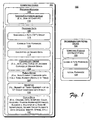
- Fig. 1 illustrates an exemplary system 100 for cryptographically processing data based on a Cassels-Tate pairing.
- System 100 provides an alternative to pairing-based systems based on the Weil or Tate pairings evaluated at points on an elliptic curve or abelian variety.
- System 100 uses the group of points on the Shafarevich-Tate group of an elliptic curve or abelian variety, combined with the Cassels-Tate pairing on this group.
- System 100 may implement the operations for Cassels-Tate pairing in a cryptosystem using any one of many known pairing-based cryptographic protocols.
- system 100 implements protocols based on identity-based cryptographic algorithms such as those directed to signatures (plain, blind, proxy, ring, undeniable, etc), encryption, authenticated encryption, broadcast encryption, encryption with keyword search, batch signatures, key agreement (plain, authenticated, group, etc.), trust authorities and public key certification, hierarchical cryptosystems, threshold cryptosystems and signatures, chameleon hash and signatures, authentication, applications and systems, or the like.
- identity-based cryptographic algorithms such as those directed to signatures (plain, blind, proxy, ring, undeniable, etc), encryption, authenticated encryption, broadcast encryption, encryption with keyword search, batch signatures, key agreement (plain, authenticated, group, etc.), trust authorities and public key certification, hierarchical cryptosystems, threshold cryptosystems and signatures, chameleon hash and signatures, authentication, applications and systems, or the like.
- system 100 for cryptographic processing based on a Cassels-Tate pairing implements protocols based on access control, key agreement, non-interactive key distribution, credentials (anonymous, hidden, self-blindable), secret handshakes, provably secure signatures, short signatures, aggregate, ring, and verifiably encrypted signatures, blind and partially blind signatures, proxy signatures, undeniable signatures, signcryption, multisignatures and threshold signatures, limited-verifier and designated-verifier signatures, threshold cryptosystems, hierarchical and role-based cryptosystems, chameleon hash and signatures, verifiable random functions, strongly insulated encryption, intrusion-resilient encryption, certificate-less PKC, al, traitor tracing, or the like.
- System 100 includes computing device 102 coupled over a network to a networked computing device 104.
- Computing device 102 includes program module(s) 106 and program data 108.
- Program modules 106 include, for example, signing / encrypting module 110 to respectively encrypt or sign original data (a respective portion of "other data" 132) using: (a) a group of points on a Shafarevich-Tate group 114 of an elliptic curve or abelian; and, (b) an associated Cassels-Tate pairing 116.
- original data that has respectively been signed or encrypted by signing / encrypting module 110 is shown in the program data portion of computing device 102 as encrypted or signed data 118.
- networked computing device 104 includes verifying / decrypting module 120 to respectively decrypt or verify encrypted or signed data 118 as a function of a Cassels-Tate pairing 122 that is generated by verifying / decrypting module 120 as a function of elements of a Shafarevich-Tate group 114.
- verifying / decrypting module 120 to respectively decrypt or verify encrypted or signed data 118 as a function of a Cassels-Tate pairing 122 that is generated by verifying / decrypting module 120 as a function of elements of a Shafarevich-Tate group 114.
- Shafarevich-Tate group 114 is a set of objects such as elements in a subgroup of a cohomology group 124. Shafarevich-Tate group 114 provides security to system 100 as a function of the hardness of discrete log in the Shafarevich-Tate group 114. Shafarevich-Tate group 114 is defined as follows. If K is a number field 124, denote by M K the set of nonequivalent valuations on K . Denote by K v a completion of K with respect to the metric induced by a prime v and by k v the residue field. In general, if f : G ⁇ G' is a morphism of groups denote its kernel by G f .
- a ⁇ B is an isogeny of abelian varieties, denote by A ⁇ the kernel of ⁇ , and by ⁇ the dual isogeny B ⁇ .
- H i ( K , G ) we write H i ( K , G ) to denote the group cohomology H i ( Gal ( K s / K ), G ( K s )), where K s is a fixed separable closure ofK.
- Shafarevich-Tate group 114 of an abelian variety is defined. Let A be an abelian variety over a number field K .
- the Shafarevich-Tate group 114 of A which is defined below, measures the failure of the local-to-global principle for certain torsors.
- CT Cassels-Tate
- 116 or 122 CT
- III ⁇ / K
- the CT pairing is written as a sum of local pairings (e.g., local pairings 126).
- Each local pairing is evaluated by a combination of evaluations of the Tate pairing, the Well pairing, and the Hilbert symbol with respect to m .
- Special cases of the pairing on A an elliptic curve, can be evaluated more simply using techniques such as those described in C. Beaver, "5-torsion in the Shafarevich-Tate group of a family of elliptic curves", J. Number Theory, 82(1):25-46, 2000 .
- the Cassels-Tate pairing CT (*,*) is a pairing such that C ⁇ T : I ⁇ I ⁇ I A / K ⁇ I ⁇ I ⁇ I A ⁇ / K ⁇ Q / Z , which is non-degenerate modulo the divisible group.
- a definition in a special case follows. (For a general definition see William G. McCallum, "On the Shafarevich-Tate group of the Jacobian of a quotient of the Fermat curve", Invent. Math., 93(3):637-666, 1988 (I, Proposition 6.9).
- a maps to zero in H 1 ( K v , A ), and so we can lift b v to an element b v ,1 ⁇ H 1 ( K v , A ⁇ ) that is in the image of A ( K v ).
- cup-product induced by the Weil pairing we mean the composition H 1 K v A ⁇ ⁇ H 1 K v A ⁇ ⁇ ⁇ H 2 K v , A ⁇ ⁇ A ⁇ ⁇ ⁇ ⁇ ⁇ e ⁇ ⁇ H 2 K v G m of the regular cup-product with the map on cohomology induced by the Weil pairing.
- the map inv ⁇ is the canonical map H 2 ( K ⁇ , G m ) ⁇ Q / Z . (The image of inv ⁇ lies inside m -1 Z / Z .)
- S ⁇ be the Selmer group, which is a subset of H 1 ( K,A ⁇ ) defined by the exact sequence 0 ⁇ A K / ⁇ ⁇ A K ⁇ S ⁇ ⁇ I ⁇ I ⁇ ⁇ 0.
- S ⁇ be the ⁇ -Selmer group, which is defined by the corresponding exact sequence for ⁇ .
- the local pairing ⁇ , ⁇ v ⁇ , ⁇ is a bilinear pairing of abelian groups.
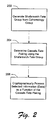
- Fig. 2 shows an exemplary procedure 200 to cryptographically process data using a Cassels-Tate pairing. The operations of procedure are described with respect to components of Fig. 1 .
- the left-most digit of a component reference number identifies the particular figure in which the component first appears.
- signing / encrypting module 110 generates Shafarevich-Tate group 114 ( Fig. 1 ) from cohomology group 124 and abelian variety A over a number field K .
- signing / encrypting module 110 determines a Cassels-Tate pairing (see "other data" 132) based on the Shafarevich-Tate group 114 and a secret, r , which is the number of times that an element x of the Shafarevich-Tate group 114 was composed with itself to obtain the public key, r*x .
- the selected information e.g., original data
- signing / encrypting module 110 encrypts or signs the data as a function of the determined Cassels-Tate pairing.
- verifying /decrypting module 120 respectively decrypts or verifies the data as a function of a generated Cassels-Tate pairing.
- the particular pairing-based cryptology algorithm selected at block 206 to process is arbitrary and a function of the particular algorithm selected for implementation.
- operations of block 206 use an identity-based encryption algorithm as described below in reference to Fig. 4 , or alternatively, an algorithm based on key issuing, signatures (plain, blind, proxy, ring, undeniable, etc.), encryption, authenticated or broadcast encryption, etc., to cryptographically process the data.
- block 206 uses an algorithm based on key agreement, key distribution, signatures (e.g., short or group signatures, etc.), etc., to cryptographically process the data.
- block 206 uses a different pairing-based cryptographic algorithm to cryptographically process the data.
- Fig. 3 shows an exemplary procedure 300 to cryptographically sign data using a Cassels-Tate pairing.
- the particular pairing-based cryptology algorithm selected to sign the data is arbitrary and a function of the particular cryptology architecture selected for implementation.
- the operations of procedure 300 are described with respect to components of Fig. 1 .
- the left-most digit of a component reference number identifies the particular figure in which the component first appears.
- signing / encrypting module 110 which in this implementation is a signing module, and so referred to as such, implements a signature scheme.
- signing module 110 generates Shafarevich-Tate group 114 from cohomology group 124 an abelian variety A over a number field K .
- signing module 110 selects and makes public an element x in III ( A / K ), in the Shafarevich-Tate group 114 of A .
- signing module 110 generates two isogenies, ⁇ and ⁇ , of degree m , from A to A (e.g., via integer multiplication). There are numerous known techniques that can be used to generate the isogenies.
- signing module 110 obtains two random points, P and P' , generators for the kernels of A ⁇ and ⁇ ⁇ , where ⁇ is the dual isogeny ⁇ ⁇ ⁇ .
- Any two parties that desire to encrypt or sign original data and/or decrypt or verify associated encrypted or signed data 118, and/or establish a common secret, generate respective public keys 128.
- a party that wants to generate a respective public key 128 generates a respective secret random number, r , and composes x with itself in the Shafarevich-Tate group 114 r times to generate a new element (the r th multiple of x , r*x ).
- the number r is a user's (e.g., party A or party B) secret 130.
- the secret 130 is not shared.
- signing / encrypting module 110 publishes this new element as a public key 128.
- signing module 110 signs original data using the Shafarevich-Tate group(s) 114 to generate signed data 118.
- signing module 110 utilizes hash function, h , from the data space ⁇ 0,1 ⁇ n into III ( ⁇ / K ) to sign original data, M (e.g., a plaintext message).
- the data space ⁇ 0,1 ⁇ n is the set of bit-strings of some length n .
- the data space ⁇ 0,1 ⁇ * is the set of bit-strings of some length *.
- signing module 110 sends M together with the signature ⁇ to a target entity such as to an application executing on networked computing device 104.
- the application implements or otherwise accesses logic implemented by verifying / decrypting module 120.
- verifying / decrypting module 120 which is this implementation is a verifying module, validates or verfies the signature of M by hashing M , computing Cassels-Tate pairing 122, CT ( r*x, h ( M )), and comparing it with CT ( x, ⁇ ). If they are the same then the signature on the message is deemed valid.
- This section indicates how, in certain cases, operations of verifying /decrypting module 120 at block 318 can compute a Cassels-Tate pairing 122 explicitly.
- attention is focused on the special case where an explicit formula is provided for the pairing 122. Exemplary notation is also provided.
- ⁇ be the isogeny of E of degree p .
- P ⁇ E(K) be a generator for the kernel of ⁇ .
- D P a divisor on E over K which represents P
- Lemma 3 Let R ⁇ E ( K ), and let D R be a divisor equivalent to ( R ) - ( O ) and not meeting the support of D P .
- the local pairing 126 can be evaluated as an application of two Tate pairings 122 and one Hilbert symbol (see, "other data" 132).
- projective coordinates are used to avoid divisions, and denominator cancellation techniques are used to evaluate the Tate pairing.
- Fig. 4 shows an exemplary procedure 400 of system 100 for identity-based encryption using the Cassels-Tate pairing on the Shafarevich-Tate group of an abelian variety.
- the operations of procedure 400 are described with respect to components of Fig. 1 .
- the left-most digit of a component reference number identifies the particular figure in which the component first appears.
- Operations of procedure 400 are based on the following: let x be an element, possibly a generator, of the Shafarevich-Tate group 114 of the dual of an abelian variety, and let r be a random integer less than the group order of the Shafarevich-Tate group.
- a program module 106 for example, signing /encrypting module 110 sets a public key 128 to equal to r*x .
- module 110 is an encryption module and is referred to as such with respect to the procedure.
- the integer r is the master key.
- the program module 106 selects a cryptographic hash function h 1 from the data space ⁇ 0,1 ⁇ * into the non-zero elements of the Shafarevich-Tate group.
- the program module 106 selects a cryptographic hash function h 2 from the target space of the Cassels-Tate pairing 116 into the data space ⁇ 0,1 ⁇ *.
- the program module 106 selects a third cryptographic hash function h 3 from two copies of the data space ⁇ 0,1 ⁇ * into the non-zero integers modulo the group order of the Shafarevich-Tate group 114.
- the program module 106 selects a fourth cryptographic hash function h 4 from a copy of the data space ⁇ 0,1 ⁇ * into itself.
- an authority for the system 100 e.g., a program module 106 such as encrypting module 110
- a program module 106 such as encrypting module 110
- generates a corresponding private key by hashing the identity string into an element of the Shafarevich-Tate group 114, h 1 (ID) and then setting the private key to be r*h 1 (ID) .
- identity string and the private key are shown as respective portions of "other data" 132.
- the program module 106 computes the hash of ID into the Shafarevich-Tate group, h 1 (ID).
- the message M is a respective portion of "other data" 132.
- the program module 106 selects a random string s in the data space ⁇ 0,1 ⁇ *.
- let a h 3 (s,M) .
- Decryption of the message can be accomplished as follows.
- Fig. 5 illustrates an example of a suitable computing environment in which cryptographic processing data based on a Cassels-Tate pairing may be fully or partially implemented.
- Exemplary computing environment 500 is only one example of a suitable computing environment for the exemplary system of Fig. 1 and exemplary operations of Figs. 2-4 , and is not intended to suggest any limitation as to the scope of use or functionality of systems and methods the described herein. Neither should computing environment 500 be interpreted as having any dependency or requirement relating to any one or combination of components illustrated in computing environment 500.
- the methods and systems described herein are operational with numerous other general purpose or special purpose computing system, environments or configurations.
- Examples of well-known computing systems, environments, and/or configurations that may be suitable for use include, but are not limited to, personal computers, server computers, multiprocessor systems, microprocessor-based systems, network PCs, minicomputers, mainframe computers, distributed computing environments that include any of the above systems or devices, and so on.
- Compact or subset versions of the framework may also be implemented in clients of limited resources, such as handheld computers, or other computing devices.
- the invention is practiced in a distributed computing environment where tasks are performed by remote processing devices that are linked through a communications network.
- program modules may be located in both local and remote memory storage devices.
- an exemplary system for cryptographically processing data based on a Cassels-Tate pairing includes a general purpose computing device in the form of a computer 510 implementing, for example, system 100 of Fig. 1 .
- the following described aspects of computer 510 are exemplary implementations of computing devices 102 and/or 104 of Fig. 1 .
- Components of computer 510 may include, but are not limited to, processing unit(s) 520, a system memory 530, and a system bus 521 that couples various system components including the system memory to the processing unit 520.
- the system bus 521 may be any of several types of bus structures including a memory bus or memory controller, a peripheral bus, and a local bus using any of a variety of bus architectures.
- such architectures may include Industry Standard Architecture (ISA) bus, Micro Channel Architecture (MCA) bus, Enhanced ISA (EISA) bus, Video Electronics Standards Association (VESA) local bus, and Peripheral Component Interconnect (PCI) bus also known as Mezzanine bus.
- ISA Industry Standard Architecture
- MCA Micro Channel Architecture
- EISA Enhanced ISA
- VESA Video Electronics Standards Association
- PCI Peripheral Component Interconnect
- a computer 510 typically includes a variety of computer-readable media.
- Computer-readable media can be any available media that can be accessed by computer 510 and includes both volatile and nonvolatile media, removable and non-removable media.
- Computer-readable media may comprise computer storage media and communication media.
- Computer storage media includes volatile and nonvolatile, removable and non-removable media implemented in any method or technology for storage of information such as computer-readable instructions, data structures, program modules or other data.
- Computer storage media includes, but is not limited to, RAM, ROM, EEPROM, flash memory or other memory technology, CD-ROM, digital versatile disks (DVD) or other optical disk storage, magnetic cassettes, magnetic tape, magnetic disk storage or other magnetic storage devices, or any other medium which can be used to store the desired information and which can be accessed by computer 510.
- Communication media typically embodies computer-readable instructions, data structures, program modules or other data in a modulated data signal such as a carrier wave or other transport mechanism, and includes any information delivery media.
- modulated data signal means a signal that has one or more of its characteristics set or changed in such a manner as to encode information in the signal.
- communication media includes wired media such as a wired network or a direct-wired connection, and wireless media such as acoustic, RF, infrared and other wireless media. Combinations of the any of the above should also be included within the scope of computer-readable media.
- System memory 530 includes computer storage media in the form of volatile and/or nonvolatile memory such as read only memory (ROM) 531 and random access memory (RAM) 532.
- ROM read only memory
- RAM random access memory
- BIOS basic input/output system
- RAM 532 typically contains data and/or program modules that are immediately accessible to and/or presently being operated on by processing unit 520.
- Fig. 5 illustrates operating system 534, application programs 535, other program modules 536, and program data 537.
- the computer 510 may also include other removable/non-removable, volatile/nonvolatile computer storage media.
- Figure 5 illustrates a hard disk drive 541 that reads from or writes to non-removable, nonvolatile magnetic media, a magnetic disk drive 551 that reads from or writes to a removable, nonvolatile magnetic disk 552, and an optical disk drive 555 that reads from or writes to a removable, nonvolatile optical disk 556 such as a CD ROM or other optical media.
- removable/non-removable, volatile/nonvolatile computer storage media that can be used in the exemplary operating environment include, but are not limited to, magnetic tape cassettes, flash memory cards, digital versatile disks, digital video tape, solid state RAM, solid state ROM, and the like.
- the hard disk drive 541 is typically connected to the system bus 521 through a non-removable memory interface such as interface 540, and magnetic disk drive 551 and optical disk drive 555 are typically connected to the system bus 521 by a removable memory interface, such as interface 550.
- the drives and their associated computer storage media discussed above and illustrated in Figure 5 provide storage of computer-readable instructions, data structures, program modules and other data for the computer 510.
- hard disk drive 541 is illustrated as storing operating system 544, application programs 545, other program modules 546, and program data 547. Note that these components can either be the same as or different from operating system 534, application programs 535, other program modules 536, and program data 537.
- Application programs 535 includes, for example program modules of computing devices 102 or 104 of Fig. 1 .
- Program data 537 includes, for example, program data of computing devices 102 or 104 of Fig. 1 .
- Operating system 544, application programs 545, other program modules 546, and program data 547 are given different numbers here to illustrate that they are at least different copies.
- a user may enter commands and information into the computer 510 through input devices such as a keyboard 562 and pointing device 561, commonly referred to as a mouse, trackball or touch pad.
- Other input devices may include a microphone, joystick, game pad, satellite dish, scanner, or the like.
- These and other input devices are often connected to the processing unit 520 through a user input interface 560 that is coupled to the system bus 521, but may be connected by other interface and bus structures, such as a parallel port, game port or a universal serial bus (USB).
- USB universal serial bus
- a monitor 591 or other type of display device is also connected to the system bus 521 via an interface, such as a video interface 590.
- computers may also include other peripheral output devices such as printer 596 and audio device(s) 597, which may be connected through an output peripheral interface 595.
- the computer 510 operates in a networked environment using logical connections to one or more remote computers, such as a remote computer 580.
- remote computer 580 represents computing device 102 or networked computer 104 of Fig. 1 .
- the remote computer 580 may be a personal computer, a server, a router, a network PC, a peer device or other common network node, and as a function of its particular implementation, may include many or all of the elements described above relative to the computer 510, although only a memory storage device 581 has been illustrated in Figure 5 .
- the logical connections depicted in Figure 5 include a local area network (LAN) 581 and a wide area network (WAN) 573, but may also include other networks.
- LAN local area network
- WAN wide area network
- Such networking environments are commonplace in offices, enterprise-wide computer networks, intranets and the Internet.
- the computer 510 When used in a LAN networking environment, the computer 510 is connected to the LAN 571 through a network interface or adapter 570. When used in a WAN networking environment, the computer 510 typically includes a modem 572 or other means for establishing communications over the WAN 573, such as the Internet.
- the modem 572 which may be internal or external, may be connected to the system bus 521 via the user input interface 560, or other appropriate mechanism.
- program modules depicted relative to the computer 510, or portions thereof may be stored in the remote memory storage device.
- Figure 5 illustrates remote application programs 585 as residing on memory device 581.
- the network connections shown are exemplary and other means of establishing a communications link between the computers may be used.
- the public element x can be chosen from the Shafarevich-Tate group of the dual of A, and the messages M can be hashed into the Shafarevich-Tate group of A.
- the roles of A and the dual of A can be switched.
- system 100 Accordingly, the specific features and operations of system 100 are disclosed as exemplary forms of implementing the claimed subject matter.
Landscapes
- Engineering & Computer Science (AREA)
- Computer Security & Cryptography (AREA)
- Signal Processing (AREA)
- Theoretical Computer Science (AREA)
- Computer Networks & Wireless Communication (AREA)
- Pure & Applied Mathematics (AREA)
- Physics & Mathematics (AREA)
- General Physics & Mathematics (AREA)
- Mathematical Optimization (AREA)
- Computing Systems (AREA)
- Algebra (AREA)
- Mathematical Analysis (AREA)
- Mathematical Physics (AREA)
- Mobile Radio Communication Systems (AREA)
- Storage Device Security (AREA)
- Two-Way Televisions, Distribution Of Moving Picture Or The Like (AREA)
- Signal Processing For Digital Recording And Reproducing (AREA)
- Air Bags (AREA)
- Complex Calculations (AREA)
Applications Claiming Priority (1)
| Application Number | Priority Date | Filing Date | Title |
|---|---|---|---|
| US11/011,289 US7639799B2 (en) | 2004-12-14 | 2004-12-14 | Cryptographically processing data based on a Cassels-Tate pairing |
Publications (2)
| Publication Number | Publication Date |
|---|---|
| EP1672482A1 EP1672482A1 (en) | 2006-06-21 |
| EP1672482B1 true EP1672482B1 (en) | 2009-09-23 |
Family
ID=35619651
Family Applications (1)
| Application Number | Title | Priority Date | Filing Date |
|---|---|---|---|
| EP05110688A Expired - Lifetime EP1672482B1 (en) | 2004-12-14 | 2005-11-14 | Cryptographically processing data based on a Cassels-Tate pairing |
Country Status (5)
| Country | Link |
|---|---|
| US (2) | US7639799B2 (https=) |
| EP (1) | EP1672482B1 (https=) |
| JP (1) | JP4874629B2 (https=) |
| AT (1) | ATE443886T1 (https=) |
| DE (1) | DE602005016769D1 (https=) |
Families Citing this family (30)
| Publication number | Priority date | Publication date | Assignee | Title |
|---|---|---|---|---|
| US7646872B2 (en) * | 2004-04-02 | 2010-01-12 | Research In Motion Limited | Systems and methods to securely generate shared keys |
| US7860247B2 (en) * | 2004-11-12 | 2010-12-28 | Dublin City University | Identity based encryption |
| EP1675300B1 (en) * | 2004-12-23 | 2008-10-01 | Hewlett-Packard Development Company, L.P. | Improvements in the use of bilinear mappings in cryptographic applications |
| WO2006076804A1 (en) | 2005-01-21 | 2006-07-27 | Certicom Corp. | Elliptic curve random number generation |
| EP2122900A4 (en) * | 2007-01-22 | 2014-07-23 | Spyrus Inc | PORTABLE DATA ENCRYPTION DEVICE WITH CONFIGURABLE SAFETY FUNCTIONS AND METHOD FOR FILING ENCRYPTION |
| US8638928B2 (en) | 2007-05-25 | 2014-01-28 | Nec Corporation | Key exchanging apparatus |
| US8243933B2 (en) * | 2007-08-29 | 2012-08-14 | Red Hat, Inc. | Method for sharing secret information among cooperating parties |
| US8068606B2 (en) * | 2007-08-29 | 2011-11-29 | Red Hat, Inc. | Embedding a secret in a bit string for safeguarding the secret |
| JP5365072B2 (ja) * | 2007-12-11 | 2013-12-11 | ソニー株式会社 | 鍵生成装置、暗号化装置、受信装置、鍵生成方法、暗号化方法、鍵処理方法およびプログラム |
| US8615084B2 (en) * | 2008-05-29 | 2013-12-24 | Red Hat, Inc. | Extending a secret bit string to safeguard the secret |
| US8250367B2 (en) * | 2008-09-30 | 2012-08-21 | Microsoft Corporation | Cryptographic applications of efficiently evaluating large degree isogenies |
| US7783803B2 (en) * | 2008-11-03 | 2010-08-24 | Microsoft Corporation | Pairing service technologies |
| US8190892B2 (en) * | 2008-12-29 | 2012-05-29 | King Fahd University Of Petroleum & Minerals | Message authentication code with blind factorization and randomization |
| CN102045164B (zh) * | 2009-10-20 | 2013-06-05 | 广州信睿网络科技有限公司 | 一种基于身份的无密钥泄露的变色龙数字签名方法 |
| US8462939B2 (en) | 2010-12-07 | 2013-06-11 | King Fahd University Of Petroleum And Minerals | RNS-based cryptographic system and method |
| US8769301B2 (en) * | 2011-07-28 | 2014-07-01 | Qualcomm Incorporated | Product authentication based upon a hyperelliptic curve equation and a curve pairing function |
| CN102694654B (zh) * | 2012-05-25 | 2015-03-25 | 孙华 | 基于身份的门限环签密方法 |
| EP2862115B1 (en) * | 2012-06-18 | 2021-04-07 | OLogN Technologies AG | Secure password management systems, methods and apparatuses |
| US10148285B1 (en) | 2012-07-25 | 2018-12-04 | Erich Schmitt | Abstraction and de-abstraction of a digital data stream |
| CN103117860B (zh) * | 2013-01-21 | 2015-08-05 | 孙华 | 无证书盲环签名方法 |
| US10795858B1 (en) | 2014-02-18 | 2020-10-06 | Erich Schmitt | Universal abstraction and de-abstraction of a digital data stream |
| EP3367608A1 (en) * | 2017-02-28 | 2018-08-29 | Koninklijke Philips N.V. | Elliptic curve isogeny based key agreement protocol |
| EP3379766B1 (en) * | 2017-03-20 | 2019-06-26 | Huawei Technologies Co., Ltd. | A wireless communication device for communication in a wireless communication network |
| US10205713B2 (en) * | 2017-04-05 | 2019-02-12 | Fujitsu Limited | Private and mutually authenticated key exchange |
| CN108449174B (zh) * | 2018-02-09 | 2021-07-30 | 孔泽一 | 云计算应用中智能终端的可撤销加密方法及装置 |
| CN109600216B (zh) * | 2018-12-11 | 2021-08-27 | 安徽大学 | 一种强抗碰撞变色龙哈希函数的构造方法 |
| US11764940B2 (en) | 2019-01-10 | 2023-09-19 | Duality Technologies, Inc. | Secure search of secret data in a semi-trusted environment using homomorphic encryption |
| CN112291774B (zh) | 2020-12-31 | 2021-03-16 | 飞天诚信科技股份有限公司 | 一种与认证器进行通信的方法及系统 |
| CN114091070B (zh) * | 2021-11-24 | 2024-08-23 | 中国银行股份有限公司 | 基于希尔伯特变换的密文生成方法、服务器、介质及装置 |
| CN117201015B (zh) * | 2023-09-27 | 2024-05-17 | 西安邮电大学 | 基于无证书的多信源网络编码群签密方法 |
Family Cites Families (4)
| Publication number | Priority date | Publication date | Assignee | Title |
|---|---|---|---|---|
| US7069287B2 (en) | 2000-09-19 | 2006-06-27 | Worcester Polytechnic Institute | Method for efficient computation of odd characteristic extension fields |
| US7113594B2 (en) * | 2001-08-13 | 2006-09-26 | The Board Of Trustees Of The Leland Stanford University | Systems and methods for identity-based encryption and related cryptographic techniques |
| US7353395B2 (en) * | 2002-03-21 | 2008-04-01 | Ntt Docomo Inc. | Authenticated ID-based cryptosystem with no key escrow |
| CN101453332A (zh) * | 2002-04-15 | 2009-06-10 | 株式会社Ntt都科摩 | 利用双线性映射的签名方案 |
-
2004
- 2004-12-14 US US11/011,289 patent/US7639799B2/en active Active
-
2005
- 2005-10-28 US US11/260,950 patent/US7707426B2/en not_active Expired - Fee Related
- 2005-11-09 JP JP2005324933A patent/JP4874629B2/ja not_active Expired - Fee Related
- 2005-11-14 EP EP05110688A patent/EP1672482B1/en not_active Expired - Lifetime
- 2005-11-14 DE DE602005016769T patent/DE602005016769D1/de not_active Expired - Lifetime
- 2005-11-14 AT AT05110688T patent/ATE443886T1/de not_active IP Right Cessation
Also Published As
| Publication number | Publication date |
|---|---|
| ATE443886T1 (de) | 2009-10-15 |
| EP1672482A1 (en) | 2006-06-21 |
| US20060129800A1 (en) | 2006-06-15 |
| US7707426B2 (en) | 2010-04-27 |
| JP2006171711A (ja) | 2006-06-29 |
| JP4874629B2 (ja) | 2012-02-15 |
| US20070076865A1 (en) | 2007-04-05 |
| DE602005016769D1 (de) | 2009-11-05 |
| US7639799B2 (en) | 2009-12-29 |
Similar Documents
| Publication | Publication Date | Title |
|---|---|---|
| EP1672482B1 (en) | Cryptographically processing data based on a Cassels-Tate pairing | |
| JP4809598B2 (ja) | 暗号システムの設計におけるアイソジャニの使用 | |
| EP1710952B1 (en) | Cryptographic Applications of the Cartier Pairing | |
| US8180047B2 (en) | Trapdoor pairings | |
| Zhou et al. | ExpSOS: Secure and verifiable outsourcing of exponentiation operations for mobile cloud computing | |
| US7443980B2 (en) | Hierarchical identity-based encryption and signature schemes | |
| CN103647642B (zh) | 一种基于证书代理重加密方法及系统 | |
| Farashahi et al. | Indifferentiable deterministic hashing to elliptic and hyperelliptic curves | |
| Nunez et al. | NTRUReEncrypt: An efficient proxy re-encryption scheme based on NTRU | |
| US7844051B2 (en) | Trapdoor one-way functions on elliptic curves and their application to shorter signatures and asymmetric encryption | |
| Liu et al. | Multi-authority ciphertext policy attribute-based encryption scheme on ideal lattices | |
| US8589679B2 (en) | Identifier-based signcryption with two trusted authorities | |
| US20050135610A1 (en) | Identifier-based signcryption | |
| Zhang et al. | An attribute-based encryption scheme secure against malicious KGC | |
| CN115296792A (zh) | 一种保护密钥的基于身份的签密方法 | |
| US20060104447A1 (en) | Discrete logarithm-based cryptography using the Shafarevich-Tate group | |
| CN113872757B (zh) | 一种基于sm2公钥加密算法的广播加密方法 | |
| Tiplea | A brief introduction to quadratic residuosity based cryptography | |
| Abed et al. | A Novel Cryptosystem Using Integer Power | |
| Kikuchi | Deep Impact on the Digital Finance in the era of Post-Quantum Cryptography | |
| ELHASSANI et al. | CRYPTOSYSTEM BASED ON LATTICE AND ELLIPTIC CURVE. | |
| Li et al. | Pairing Compression on Some Elliptic Curves with Subgroups of Embedding Degree 6 and Its Applications to Pairing-Based Cryptography | |
| Budroni | Notes on Lattice-Based Cryptography | |
| Chillali et al. | Cryptosystem based on lattice and elliptic curve | |
| Nishioka | Reconsideration on the security of the boneh-franklin identity-based encryption scheme |
Legal Events
| Date | Code | Title | Description |
|---|---|---|---|
| PUAI | Public reference made under article 153(3) epc to a published international application that has entered the european phase |
Free format text: ORIGINAL CODE: 0009012 |
|
| AK | Designated contracting states |
Kind code of ref document: A1 Designated state(s): AT BE BG CH CY CZ DE DK EE ES FI FR GB GR HU IE IS IT LI LT LU LV MC NL PL PT RO SE SI SK TR |
|
| AX | Request for extension of the european patent |
Extension state: AL BA HR MK YU |
|
| 17P | Request for examination filed |
Effective date: 20061027 |
|
| 17Q | First examination report despatched |
Effective date: 20061129 |
|
| AKX | Designation fees paid |
Designated state(s): AT BE BG CH CY CZ DE DK EE ES FI FR GB GR HU IE IS IT LI LT LU LV MC NL PL PT RO SE SI SK TR |
|
| GRAP | Despatch of communication of intention to grant a patent |
Free format text: ORIGINAL CODE: EPIDOSNIGR1 |
|
| GRAS | Grant fee paid |
Free format text: ORIGINAL CODE: EPIDOSNIGR3 |
|
| GRAA | (expected) grant |
Free format text: ORIGINAL CODE: 0009210 |
|
| AK | Designated contracting states |
Kind code of ref document: B1 Designated state(s): AT BE BG CH CY CZ DE DK EE ES FI FR GB GR HU IE IS IT LI LT LU LV MC NL PL PT RO SE SI SK TR |
|
| REG | Reference to a national code |
Ref country code: GB Ref legal event code: FG4D |
|
| REG | Reference to a national code |
Ref country code: CH Ref legal event code: EP |
|
| REG | Reference to a national code |
Ref country code: IE Ref legal event code: FG4D |
|
| REF | Corresponds to: |
Ref document number: 602005016769 Country of ref document: DE Date of ref document: 20091105 Kind code of ref document: P |
|
| PG25 | Lapsed in a contracting state [announced via postgrant information from national office to epo] |
Ref country code: SE Free format text: LAPSE BECAUSE OF FAILURE TO SUBMIT A TRANSLATION OF THE DESCRIPTION OR TO PAY THE FEE WITHIN THE PRESCRIBED TIME-LIMIT Effective date: 20090923 Ref country code: FI Free format text: LAPSE BECAUSE OF FAILURE TO SUBMIT A TRANSLATION OF THE DESCRIPTION OR TO PAY THE FEE WITHIN THE PRESCRIBED TIME-LIMIT Effective date: 20090923 Ref country code: LT Free format text: LAPSE BECAUSE OF FAILURE TO SUBMIT A TRANSLATION OF THE DESCRIPTION OR TO PAY THE FEE WITHIN THE PRESCRIBED TIME-LIMIT Effective date: 20090923 |
|
| PGFP | Annual fee paid to national office [announced via postgrant information from national office to epo] |
Ref country code: DE Payment date: 20091112 Year of fee payment: 5 |
|
| LTIE | Lt: invalidation of european patent or patent extension |
Effective date: 20090923 |
|
| PG25 | Lapsed in a contracting state [announced via postgrant information from national office to epo] |
Ref country code: PL Free format text: LAPSE BECAUSE OF FAILURE TO SUBMIT A TRANSLATION OF THE DESCRIPTION OR TO PAY THE FEE WITHIN THE PRESCRIBED TIME-LIMIT Effective date: 20090923 Ref country code: LV Free format text: LAPSE BECAUSE OF FAILURE TO SUBMIT A TRANSLATION OF THE DESCRIPTION OR TO PAY THE FEE WITHIN THE PRESCRIBED TIME-LIMIT Effective date: 20090923 Ref country code: SI Free format text: LAPSE BECAUSE OF FAILURE TO SUBMIT A TRANSLATION OF THE DESCRIPTION OR TO PAY THE FEE WITHIN THE PRESCRIBED TIME-LIMIT Effective date: 20090923 |
|
| NLV1 | Nl: lapsed or annulled due to failure to fulfill the requirements of art. 29p and 29m of the patents act | ||
| PG25 | Lapsed in a contracting state [announced via postgrant information from national office to epo] |
Ref country code: CY Free format text: LAPSE BECAUSE OF FAILURE TO SUBMIT A TRANSLATION OF THE DESCRIPTION OR TO PAY THE FEE WITHIN THE PRESCRIBED TIME-LIMIT Effective date: 20090923 |
|
| PG25 | Lapsed in a contracting state [announced via postgrant information from national office to epo] |
Ref country code: PT Free format text: LAPSE BECAUSE OF FAILURE TO SUBMIT A TRANSLATION OF THE DESCRIPTION OR TO PAY THE FEE WITHIN THE PRESCRIBED TIME-LIMIT Effective date: 20100125 Ref country code: CZ Free format text: LAPSE BECAUSE OF FAILURE TO SUBMIT A TRANSLATION OF THE DESCRIPTION OR TO PAY THE FEE WITHIN THE PRESCRIBED TIME-LIMIT Effective date: 20090923 Ref country code: RO Free format text: LAPSE BECAUSE OF FAILURE TO SUBMIT A TRANSLATION OF THE DESCRIPTION OR TO PAY THE FEE WITHIN THE PRESCRIBED TIME-LIMIT Effective date: 20090923 Ref country code: ES Free format text: LAPSE BECAUSE OF FAILURE TO SUBMIT A TRANSLATION OF THE DESCRIPTION OR TO PAY THE FEE WITHIN THE PRESCRIBED TIME-LIMIT Effective date: 20100103 Ref country code: EE Free format text: LAPSE BECAUSE OF FAILURE TO SUBMIT A TRANSLATION OF THE DESCRIPTION OR TO PAY THE FEE WITHIN THE PRESCRIBED TIME-LIMIT Effective date: 20090923 Ref country code: IS Free format text: LAPSE BECAUSE OF FAILURE TO SUBMIT A TRANSLATION OF THE DESCRIPTION OR TO PAY THE FEE WITHIN THE PRESCRIBED TIME-LIMIT Effective date: 20100123 |
|
| PGFP | Annual fee paid to national office [announced via postgrant information from national office to epo] |
Ref country code: FR Payment date: 20091123 Year of fee payment: 5 Ref country code: GB Payment date: 20091111 Year of fee payment: 5 |
|
| PG25 | Lapsed in a contracting state [announced via postgrant information from national office to epo] |
Ref country code: SK Free format text: LAPSE BECAUSE OF FAILURE TO SUBMIT A TRANSLATION OF THE DESCRIPTION OR TO PAY THE FEE WITHIN THE PRESCRIBED TIME-LIMIT Effective date: 20090923 |
|
| PG25 | Lapsed in a contracting state [announced via postgrant information from national office to epo] |
Ref country code: AT Free format text: LAPSE BECAUSE OF FAILURE TO SUBMIT A TRANSLATION OF THE DESCRIPTION OR TO PAY THE FEE WITHIN THE PRESCRIBED TIME-LIMIT Effective date: 20090923 Ref country code: MC Free format text: LAPSE BECAUSE OF NON-PAYMENT OF DUE FEES Effective date: 20091130 Ref country code: BE Free format text: LAPSE BECAUSE OF FAILURE TO SUBMIT A TRANSLATION OF THE DESCRIPTION OR TO PAY THE FEE WITHIN THE PRESCRIBED TIME-LIMIT Effective date: 20090923 |
|
| REG | Reference to a national code |
Ref country code: CH Ref legal event code: PL |
|
| PG25 | Lapsed in a contracting state [announced via postgrant information from national office to epo] |
Ref country code: NL Free format text: LAPSE BECAUSE OF FAILURE TO SUBMIT A TRANSLATION OF THE DESCRIPTION OR TO PAY THE FEE WITHIN THE PRESCRIBED TIME-LIMIT Effective date: 20090923 Ref country code: DK Free format text: LAPSE BECAUSE OF FAILURE TO SUBMIT A TRANSLATION OF THE DESCRIPTION OR TO PAY THE FEE WITHIN THE PRESCRIBED TIME-LIMIT Effective date: 20090923 |
|
| PLBE | No opposition filed within time limit |
Free format text: ORIGINAL CODE: 0009261 |
|
| STAA | Information on the status of an ep patent application or granted ep patent |
Free format text: STATUS: NO OPPOSITION FILED WITHIN TIME LIMIT |
|
| 26N | No opposition filed |
Effective date: 20100624 |
|
| PG25 | Lapsed in a contracting state [announced via postgrant information from national office to epo] |
Ref country code: LI Free format text: LAPSE BECAUSE OF NON-PAYMENT OF DUE FEES Effective date: 20091130 Ref country code: IE Free format text: LAPSE BECAUSE OF NON-PAYMENT OF DUE FEES Effective date: 20091114 Ref country code: GR Free format text: LAPSE BECAUSE OF FAILURE TO SUBMIT A TRANSLATION OF THE DESCRIPTION OR TO PAY THE FEE WITHIN THE PRESCRIBED TIME-LIMIT Effective date: 20091224 Ref country code: CH Free format text: LAPSE BECAUSE OF NON-PAYMENT OF DUE FEES Effective date: 20091130 |
|
| PG25 | Lapsed in a contracting state [announced via postgrant information from national office to epo] |
Ref country code: IT Free format text: LAPSE BECAUSE OF FAILURE TO SUBMIT A TRANSLATION OF THE DESCRIPTION OR TO PAY THE FEE WITHIN THE PRESCRIBED TIME-LIMIT Effective date: 20090923 Ref country code: BG Free format text: LAPSE BECAUSE OF FAILURE TO SUBMIT A TRANSLATION OF THE DESCRIPTION OR TO PAY THE FEE WITHIN THE PRESCRIBED TIME-LIMIT Effective date: 20091130 |
|
| PG25 | Lapsed in a contracting state [announced via postgrant information from national office to epo] |
Ref country code: LU Free format text: LAPSE BECAUSE OF NON-PAYMENT OF DUE FEES Effective date: 20091114 |
|
| PG25 | Lapsed in a contracting state [announced via postgrant information from national office to epo] |
Ref country code: HU Free format text: LAPSE BECAUSE OF FAILURE TO SUBMIT A TRANSLATION OF THE DESCRIPTION OR TO PAY THE FEE WITHIN THE PRESCRIBED TIME-LIMIT Effective date: 20100324 |
|
| GBPC | Gb: european patent ceased through non-payment of renewal fee |
Effective date: 20101114 |
|
| REG | Reference to a national code |
Ref country code: FR Ref legal event code: ST Effective date: 20110801 |
|
| PG25 | Lapsed in a contracting state [announced via postgrant information from national office to epo] |
Ref country code: TR Free format text: LAPSE BECAUSE OF FAILURE TO SUBMIT A TRANSLATION OF THE DESCRIPTION OR TO PAY THE FEE WITHIN THE PRESCRIBED TIME-LIMIT Effective date: 20090923 |
|
| REG | Reference to a national code |
Ref country code: DE Ref legal event code: R119 Ref document number: 602005016769 Country of ref document: DE Effective date: 20110601 Ref country code: DE Ref legal event code: R119 Ref document number: 602005016769 Country of ref document: DE Effective date: 20110531 |
|
| PG25 | Lapsed in a contracting state [announced via postgrant information from national office to epo] |
Ref country code: FR Free format text: LAPSE BECAUSE OF NON-PAYMENT OF DUE FEES Effective date: 20101130 |
|
| PG25 | Lapsed in a contracting state [announced via postgrant information from national office to epo] |
Ref country code: GB Free format text: LAPSE BECAUSE OF NON-PAYMENT OF DUE FEES Effective date: 20101114 |
|
| PG25 | Lapsed in a contracting state [announced via postgrant information from national office to epo] |
Ref country code: DE Free format text: LAPSE BECAUSE OF NON-PAYMENT OF DUE FEES Effective date: 20110531 |
|
| REG | Reference to a national code |
Ref country code: GB Ref legal event code: 732E Free format text: REGISTERED BETWEEN 20150312 AND 20150318 |