EP1672131A2 - Dispenser mountable under a toilet bowl rim - Google Patents
Dispenser mountable under a toilet bowl rim Download PDFInfo
- Publication number
- EP1672131A2 EP1672131A2 EP05026760A EP05026760A EP1672131A2 EP 1672131 A2 EP1672131 A2 EP 1672131A2 EP 05026760 A EP05026760 A EP 05026760A EP 05026760 A EP05026760 A EP 05026760A EP 1672131 A2 EP1672131 A2 EP 1672131A2
- Authority
- EP
- European Patent Office
- Prior art keywords
- rim
- dispensing device
- toilet
- brush
- chemical
- Prior art date
- Legal status (The legal status is an assumption and is not a legal conclusion. Google has not performed a legal analysis and makes no representation as to the accuracy of the status listed.)
- Withdrawn
Links
- 239000000126 substance Substances 0.000 claims abstract description 47
- 238000004140 cleaning Methods 0.000 claims abstract description 24
- XLYOFNOQVPJJNP-UHFFFAOYSA-N water Substances O XLYOFNOQVPJJNP-UHFFFAOYSA-N 0.000 claims description 23
- 239000007788 liquid Substances 0.000 claims description 14
- 239000007787 solid Substances 0.000 claims description 8
- 239000004033 plastic Substances 0.000 claims description 5
- 229920003023 plastic Polymers 0.000 claims description 5
- 238000005452 bending Methods 0.000 claims description 3
- 238000000034 method Methods 0.000 description 4
- 238000009472 formulation Methods 0.000 description 3
- 239000000203 mixture Substances 0.000 description 3
- 238000012360 testing method Methods 0.000 description 3
- VEXZGXHMUGYJMC-UHFFFAOYSA-N Hydrochloric acid Chemical compound Cl VEXZGXHMUGYJMC-UHFFFAOYSA-N 0.000 description 2
- 239000000853 adhesive Substances 0.000 description 2
- 230000001070 adhesive effect Effects 0.000 description 2
- 230000015572 biosynthetic process Effects 0.000 description 2
- 238000009434 installation Methods 0.000 description 2
- 230000033001 locomotion Effects 0.000 description 2
- 230000007774 longterm Effects 0.000 description 2
- 239000002184 metal Substances 0.000 description 2
- 238000000465 moulding Methods 0.000 description 2
- 238000005201 scrubbing Methods 0.000 description 2
- 238000004804 winding Methods 0.000 description 2
- 241000894006 Bacteria Species 0.000 description 1
- 239000004677 Nylon Substances 0.000 description 1
- 239000004698 Polyethylene Substances 0.000 description 1
- 102000015933 Rim-like Human genes 0.000 description 1
- 108050004199 Rim-like Proteins 0.000 description 1
- 238000013459 approach Methods 0.000 description 1
- 239000000919 ceramic Substances 0.000 description 1
- 239000003795 chemical substances by application Substances 0.000 description 1
- 239000011538 cleaning material Substances 0.000 description 1
- 238000005260 corrosion Methods 0.000 description 1
- 230000007797 corrosion Effects 0.000 description 1
- 238000011161 development Methods 0.000 description 1
- 239000012530 fluid Substances 0.000 description 1
- 238000011010 flushing procedure Methods 0.000 description 1
- 230000005484 gravity Effects 0.000 description 1
- 238000003780 insertion Methods 0.000 description 1
- 230000037431 insertion Effects 0.000 description 1
- 239000012669 liquid formulation Substances 0.000 description 1
- 238000012423 maintenance Methods 0.000 description 1
- 239000000463 material Substances 0.000 description 1
- 238000012986 modification Methods 0.000 description 1
- 230000004048 modification Effects 0.000 description 1
- 229920001778 nylon Polymers 0.000 description 1
- 235000019645 odor Nutrition 0.000 description 1
- 229920000728 polyester Polymers 0.000 description 1
- -1 polyethylene Polymers 0.000 description 1
- 229920000573 polyethylene Polymers 0.000 description 1
- 238000011160 research Methods 0.000 description 1
- 238000011012 sanitization Methods 0.000 description 1
- 238000004513 sizing Methods 0.000 description 1
- 229910001220 stainless steel Inorganic materials 0.000 description 1
- 239000010935 stainless steel Substances 0.000 description 1
- 230000003319 supportive effect Effects 0.000 description 1
- 239000004094 surface-active agent Substances 0.000 description 1
- 239000000725 suspension Substances 0.000 description 1
- 229920002994 synthetic fiber Polymers 0.000 description 1
- 229920001169 thermoplastic Polymers 0.000 description 1
- 239000004416 thermosoftening plastic Substances 0.000 description 1
- 239000002699 waste material Substances 0.000 description 1
Images


Classifications
-
- E—FIXED CONSTRUCTIONS
- E03—WATER SUPPLY; SEWERAGE
- E03D—WATER-CLOSETS OR URINALS WITH FLUSHING DEVICES; FLUSHING VALVES THEREFOR
- E03D9/00—Sanitary or other accessories for lavatories ; Devices for cleaning or disinfecting the toilet room or the toilet bowl; Devices for eliminating smells
- E03D9/02—Devices adding a disinfecting, deodorising, or cleaning agent to the water while flushing
- E03D9/03—Devices adding a disinfecting, deodorising, or cleaning agent to the water while flushing consisting of a separate container with an outlet through which the agent is introduced into the flushing water, e.g. by suction ; Devices for agents in direct contact with flushing water
- E03D9/032—Devices connected to or dispensing into the bowl
Definitions
- the present invention relates to dispensers, and in particular to dispensers for dispensing cleaning and/or freshening chemicals into toilet bowl water from a dispenser mounted adjacent the rim of a toilet bowl.
- Toilet bowls require care to prevent the buildup of unsightly deposits, to reduce odors and to prevent bacteria growth.
- toilet bowls have been cleaned, deodorized and/or disinfected by manual scrubbing with a liquid or powdered cleaning/sanitizing agent that is added to the bowl water by hand. This task has required manual labor to keep the toilet bowl clean.
- An alternative type of system hangs a dispenser adjacent and/or immediately under the toilet bowl rim. Water flowing from the rim will wash over the dispenser, thereby triggering dispensing of the stored chemical directly into the bowl water. Examples of this type of system include U.S. Pat. Nos. 6,178,564, 6,311,340 and 6,412,120.
- the presence of the device must be taken into account when cleaning the upper area of the toilet bowl rim. For example, one might need to slide or remove the device during cleaning.
- toilet bowl rims vary widely between manufacturers, and even between different models of a single manufacturer. Apart from differences in width and height, some toilet bowl rims are essentially completely open at the bottom. See e.g. U.S. Pat. No. 3,946,448. Others are largely closed at the bottom to form a box-like cross section conduit, with the bottom of the box having a series of relatively small drain holes. See e.g. U.S. Pat. Nos. 1,359,735 and 1,815,197.
- Some holders that are suitable to mount a dispenser under the rim by a prong that is extendable into a small rim drain hole are generally unsuitable for mounting that same device under an open bottom rim like that of U.S. Pat. No. 3,946,448.
- a product would typically be sold with a label that advises consumers to check the type of toilet rim they have before buying. Since many consumers aren't readily aware of that information, that creates a marketing impediment which may lead a consumer to select a system that provides the chemical to the tank directly (rather than mounts under the bowl rim).
- the invention provides a dispensing device for using a flow of water during a toilet flush to dispense a chemical into a toilet bowl.
- the device has a housing for holding the chemical, the housing having an opening.
- the device also has a suspender for suspending the housing from a rim of the toilet bowl.
- the suspender is a brush having flexible bristles adjacent its upper end and having a lower support end. The lower support end is linked to the housing.
- the most preferred form of brush has fifty or more thin bristles (e.g. like a bottle or test tube brush).
- the number of bristles can be reduced as the thickness of the bristles increases, without compromising supporting capability.
- the number of bristles can be reduced for any given thickness depending on the selection of the material used for bristle formation.
- the term "brush” is intended to include any structure with a support from which extends at least three resilient or flexible arms or bristles in a somewhat radial or transverse direction.
- the housing used with such a dispensing device is configured such that if the device is mounted to the toilet bowl rim by contact between the brush and the rim, water that has flowed through the rim can cause a portion of the chemical to be dispensed into water in the bowl.
- the chemical in the housing can be one or more liquids, or may be a mixed formulation solid, or may be partially a liquid and partially a solid. When the chemical is a solid, the solid can be in the form of a dissolvable block stored in a dispensing cage. When the chemical is a liquid, the housing may be an inverted bottle that feeds a dispensing tray.
- the supporting device is in the form of a brush.
- the brush desirably is positioned adjacent the upper end of the device, and has a portion which is wide enough and with suitable flexibility so as to cause a jam fitting in conventional open bottom rims, while permitting the brush top end to collapse to pass through relatively small rim bottom holes.
- test tube brushes (apart from their handle end) have about the right dimensions and flexibility for use in supporting the housings of the present invention.
- a central supporting core of the brush is made of a twisted corrosion-resistant metal such as stainless steel.
- Bristles made of a synthetic material e.g. nylon, polyester, or polyethylene
- Numerous companies produce brushes of this type for test tube or other cleaning purposes. For example, some brushes of this type are available from Brushes Corp. of Cleveland, Ohio.
- the invention provides a variant dispensing device for using a flow of water during a toilet flush to dispense a chemical into a toilet bowl.
- This device also has such a housing and has a suspender for suspending the housing from a rim of the toilet bowl.
- the suspender has a support extending along a longitudinal axis, and a resilient arm adjacent an upper end of the support and extending transversely there from.
- the arm could be a conventional brush bristle, or alternatively a thickened plastic arm.
- the resilient arm is designed to be capable of bending relative to the longitudinal axis through an arc of greater than 90 degrees without modifying the rest position of the arm.
- the arm can bend down towards the support when the arm is pushed through a small rim hole. Further, after it passes through the rim hole it can flex outward. Moreover, when it is desired to remove the suspender from a rim, the arm can then bend upwardly sufficiently so that the arm moves out of the way to permit the removal. Hence, the arm will not permanently catch in rims of the type having small rim holes, while the arm still permits mounting in a way that is adequately supportive while the device is installed.
- the invention provides toilets in which these dispensing devices are installed.
- a chemical dispensing device of the above kind can be mounted in the rim by jamming an upper brush portion of the device between opposed side walls of the rim such that contact (e.g. frictional) between the downwardly angled brush bristles and the side walls retains the chemical dispensing device under the rim.
- the chemical dispensing device can be mounted through one of such holes so that a brush portion of the device is inside the rim and bristles of the rim retain the chemical dispensing device under the rim.
- the housing can be essentially hidden from view after installation. Further, the top and inside exposed wall of the rim is completely unaffected by the connection, and thus capable of being cleaned without disturbing the device.
- one advantage of the present invention to provide an improved toilet bowl chemical dispenser that can dispense quantities of cleaning/freshening toilet bowl treatment chemicals from under the rim of a toilet bowl during a flush, without requiring any attachment connectors that extend over the top of the bowl rim.
- FIG. 1 is a left upper, frontal, perspective view of a first embodiment of a dispensing device of the present invention, the device being suitable to store a solid block of chemical;
- FIG. 2 is a cross sectional view taken along line 2-2 of FIG. 1, albeit with the device mounted in a toilet bowl rim of the open bottom type;
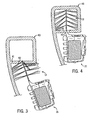
- FIG. 3 is a view similar to FIG. 2, but showing the device in the process of being mounted in a different type of toilet bowl rim, one having a closed bottom with small drain holes;
- FIG. 4 is a view similar to FIG. 3, but showing the device fully mounted in the FIG. 3 toilet bowl rim;
- FIG. 5 is a left upper, frontal, perspective view of a second embodiment of the present invention, where a liquid reservoir is supported by a brush.
- FIGS. 1 and 2 there is a dispenser (generally 10) having a housing/cage portion (generally 11) supportable by a brush form suspender (generally 12).
- the interior 13 of the housing 11 constitutes a cage for retaining a dissolvable block 14 of cleaning material.
- the brush 12 preferably has a twisted wire central core 16 from which extends a plurality of flexible bristles.
- the twisted wire core 16 is preferably made of a metal or plastic, and the bristles are preferably made of plastic.
- the bristles can be integral with the core 16, or can be attached to the core by a conventional brush formation technique (e.g. winding the bristles with a wire core; adhering the bristles by adhesive; etc.).
- a conventional brush formation technique e.g. winding the bristles with a wire core; adhering the bristles by adhesive; etc.
- the bottom of the wire core 16 may be connected to the housing 11 by any suitable technique. It may be integrally formed with the housing 11. However it is preferred (for ease of molding) to form the brush separately and attach it by a technique such as winding, melt bonding, adhesive; etc.
- the lower end of the wire core can be wound around a receiving projection (not shown) formed on the housing 11.
- the housing 11 is in the form of a hangable clam shell type cage made by molding a thermoplastic.
- the housing halves 20 and 21 include a latch which is a projection 26 interfitting with a retaining aperture 27.
- the walls of the housing 11 contain openings 28 which permit liquid falling from the rim to pass into the cage cavity 13, against the block 14, and then out the housing 11.
- a rim block/tablet 14 is chosen so that it slowly dilutes into the water.
- a particularly important feature is the suspender brush 12 and how it interacts with toilet bowl rims.
- the brush diameter (at rest) is chosen to be somewhat wider than the narrow point of the rim between rim side walls 32 and 33. The jamming of the brush bristles against the somewhat roughened ceramic rim interior causes the brush bristles to resist downward movement of the device sufficiently that the brush acts to retain the device.
- the brush 12 is completely hidden, and the dispensing device 10 is essentially completely hidden.
- the device can easily be completely removed from the rim if desired (e.g. for replacement of the device or maintenance of the rim). This is because the bristles will flex from the FIG. 2 position to a position where the bristles are angled upwardly under exposure to such a removal force.
- the FIG. 2 dispenser can be designed for long-term use because one can leave the device in the rim while still accessing it to insert a new rim block 14.
- some consumers may prefer to make such an insertion of a new chemical block while not leaning over the toilet bowl.
- a consumer could remove the device, install the new block of chemical, and then re-install the device. This is facilitated because the brush rest position is not distorted by the bending motion inherent in the installation or removal.
- the device can be suspended from an alternative rim 40 that has a portion with an essentially closed bottom wall 41 except for a series of relatively small drainage holes 42.
- the brush can be pushed through one such hole 42.
- the bristles compress towards the support core 16, permitting at least some of the bristles to begin to pass through the hole 42 (see FIG. 3).
- the bristles then flex outward so as to catch the brush top end inside the rim and thereby hang the dispensing device. See FIG. 4.
- the brush end 12 is then not visible to the consumer, and the dispenser can be configured and sized so as to also be essentially not visible at that point.
- the brush can still be pulled back out the holes for the purposes noted above, again, because the bristles will swing upward through an arc exceeding 90 degrees as the dispenser is being yanked downward from the FIG. 4 position.
- FIG. 5 there is shown an alternative embodiment of the lower portion of the device, one where the cleaning chemical is stored as a liquid.
- devices of this type store one or more cleaning liquids in an inverted reservoir/housing 51.
- the reservoir bleeds cleaning fluid via gravity onto a capillary tray 52, and the water falling from the rim washes the concentrated liquid off the tray and into the bowl.
- Such a device can now be supported by a brush type suspender, similar to that described in connection with the FIG. 1 embodiment.
- a brush type suspender similar to that described in connection with the FIG. 1 embodiment.
- the present brush support system can be used with a variety of housings, and regardless of whether those housings store the cleaning/freshening chemical as a solid, or as a liquid, or as both.
- the brush need not have hundreds of bristles. Instead, the brush could have as few as three bristles. A brush with at least ten bristles is most preferred.
- the exact height of the brush is not critical. While it is preferred that the brush be at least 1 cm in height (preferably at least 2 cm in height), shorter brushes may also work.
- the weight may be such that multiple spaced brush connectors are desirable.
- the suspender could be modified from a brush to a core having even a single transverse arm.
- the arm should be sufficiently flexible to swing through an arc of more than 90 degrees.
- the present invention provides dispensers for dispensing cleaning and/or freshening chemicals from under the rim of a toilet bowl by way of the flow of water during a toilet flush.
Landscapes
- Health & Medical Sciences (AREA)
- Public Health (AREA)
- Epidemiology (AREA)
- Life Sciences & Earth Sciences (AREA)
- Engineering & Computer Science (AREA)
- Hydrology & Water Resources (AREA)
- Water Supply & Treatment (AREA)
- Bidet-Like Cleaning Device And Other Flush Toilet Accessories (AREA)
Abstract
Disclosed are devices for dispensing cleaning chemicals from under the rim of a toilet bowl. The devices are suspended from either an open bottom toilet bowl rim or a toilet bowl rim with bottom wall holes, using a brush or brush-like suspender. Bristles of the brush flex together to permit the brush to extend into toilet bowl rim holes or an entrance of an open bottom rim. They then expand away from each other to retain the dispenser directly under the rim, in an essentially hidden manner.
Description
- Not applicable
- Not applicable
- The present invention relates to dispensers, and in particular to dispensers for dispensing cleaning and/or freshening chemicals into toilet bowl water from a dispenser mounted adjacent the rim of a toilet bowl.
- Toilet bowls require care to prevent the buildup of unsightly deposits, to reduce odors and to prevent bacteria growth. Traditionally, toilet bowls have been cleaned, deodorized and/or disinfected by manual scrubbing with a liquid or powdered cleaning/sanitizing agent that is added to the bowl water by hand. This task has required manual labor to keep the toilet bowl clean.
- In order to reduce or in some cases eliminate the need for such manual scrubbing, various automatic toilet bowl cleaning systems have been proposed. One type of system delivers the cleaning chemical by adding it to the flush water while the flush water is still stored in the toilet tank. Some embodiments of this type of system add the chemical in sequence to the flushing cycle in liquid form. Others place a block of cleaning chemical in the toilet tank, to slowly dissolve over several weeks or longer.
- However, a system which relies on adding the chemical to the storage tank typically requires the consumer to lift a tank lid in order to install the device and/or to add a new charge/block of cleaning chemical. Also, for some of the embodiments of this system precise control over the quantity of chemical to be delivered is difficult, with resulting waste of cleaning chemical or inadequate cleaning. Further, when the chemical is placed in the storage tank the cleaning chemical must be compatible for long-term contact with some of the valving present in the toilet tank, which may impose some limitations on formulation.
- An alternative type of system hangs a dispenser adjacent and/or immediately under the toilet bowl rim. Water flowing from the rim will wash over the dispenser, thereby triggering dispensing of the stored chemical directly into the bowl water. Examples of this type of system include U.S. Pat. Nos. 6,178,564, 6,311,340 and 6,412,120.
- While this latter type of system is becoming increasingly popular, there are some disadvantages associated with current products that embody this approach. One disadvantage is that some of these devices use a hook that extends over the top (and usually to some extent an outside side wall) of the toilet bowl rim to mount the device. While the toilet seat will hide this when the seat is down, when the toilet seat is picked up (e.g. for a male to urinate), the device will be visible.
- In any event, the presence of the device must be taken into account when cleaning the upper area of the toilet bowl rim. For example, one might need to slide or remove the device during cleaning.
- Further complicating matters is that the designs of toilet bowl rims vary widely between manufacturers, and even between different models of a single manufacturer. Apart from differences in width and height, some toilet bowl rims are essentially completely open at the bottom. See e.g. U.S. Pat. No. 3,946,448. Others are largely closed at the bottom to form a box-like cross section conduit, with the bottom of the box having a series of relatively small drain holes. See e.g. U.S. Pat. Nos. 1,359,735 and 1,815,197.
- Some holders that are suitable to mount a dispenser under the rim by a prong that is extendable into a small rim drain hole (see e.g. U.S. Pat. Nos. 1,202,822, 1,974,955, 1,979,755, 2,214,798, and 3,736,600) are generally unsuitable for mounting that same device under an open bottom rim like that of U.S. Pat. No. 3,946,448. Hence, such a product would typically be sold with a label that advises consumers to check the type of toilet rim they have before buying. Since many consumers aren't readily aware of that information, that creates a marketing impediment which may lead a consumer to select a system that provides the chemical to the tank directly (rather than mounts under the bowl rim).
- In U.S.
patent application 10/435,359, filed May 9, 2003, our company described mounting a toilet bowl cleaner dispenser directly under an open bottom style rim, without the need for a hook that extends over the top of the rim and along the outside of the rim. Our company described that a vertical support could instead extend up from the dispenser directly into the lower side of the rim, the support being connected to a resilient arm that extended sideways and downward across the rim interior, at an angle. The flexibility of the arm adjusted for open bottom rims of varying widths. Frictional contact between the arm and the rim interior held the dispenser in place. - That application also disclosed that by making the flexible arm sufficiently flexible and small it could be pressed against the support so that both could pass together part way into holes in toilets having rims with bottom walls having such holes. However, if the rim was dimensioned too tall, such an arm could pass all the way into the rim and catch in place inside the rim, making removal difficult. If instead the rim hole was too small, the arm plus support might not fit into it at all. Finally, even if the device was properly sized for the rim, the plastic had to be specially shaped to prevent the device from too easily being pulled out from the rim.
- Hence, a need still existed for improved under-the-rim type toilet bowl cleaner dispensers, particularly those that can be mounted into a variety of toilet bowl rims, yet do so in a manner in which the dispenser is largely or entirely hidden from the consumer during use.
- In one aspect the invention provides a dispensing device for using a flow of water during a toilet flush to dispense a chemical into a toilet bowl. The device has a housing for holding the chemical, the housing having an opening. The device also has a suspender for suspending the housing from a rim of the toilet bowl. The suspender is a brush having flexible bristles adjacent its upper end and having a lower support end. The lower support end is linked to the housing.
- The most preferred form of brush has fifty or more thin bristles (e.g. like a bottle or test tube brush). However, the number of bristles can be reduced as the thickness of the bristles increases, without compromising supporting capability. Also, the number of bristles can be reduced for any given thickness depending on the selection of the material used for bristle formation.
- In any event, the term "brush" is intended to include any structure with a support from which extends at least three resilient or flexible arms or bristles in a somewhat radial or transverse direction.
- The housing used with such a dispensing device is configured such that if the device is mounted to the toilet bowl rim by contact between the brush and the rim, water that has flowed through the rim can cause a portion of the chemical to be dispensed into water in the bowl. The chemical in the housing can be one or more liquids, or may be a mixed formulation solid, or may be partially a liquid and partially a solid. When the chemical is a solid, the solid can be in the form of a dissolvable block stored in a dispensing cage. When the chemical is a liquid, the housing may be an inverted bottle that feeds a dispensing tray.
- While the specific cleaning chemical used is not critical to the present invention, one liquid formulation suitable for toilet bowl cleaning is described in U.S. patent 6,425,406. Like that formulation, preferred toilet bowl cleaners for use with the present invention will include at least one surfactant.
- In any event, in this embodiment, the supporting device is in the form of a brush. The brush desirably is positioned adjacent the upper end of the device, and has a portion which is wide enough and with suitable flexibility so as to cause a jam fitting in conventional open bottom rims, while permitting the brush top end to collapse to pass through relatively small rim bottom holes.
- Conventional test tube brushes (apart from their handle end) have about the right dimensions and flexibility for use in supporting the housings of the present invention. In one form a central supporting core of the brush is made of a twisted corrosion-resistant metal such as stainless steel. Bristles made of a synthetic material (e.g. nylon, polyester, or polyethylene) are mounted in the twisted core support in a conventional manner. Numerous companies produce brushes of this type for test tube or other cleaning purposes. For example, some brushes of this type are available from Brushes Corp. of Cleveland, Ohio.
- In another aspect the invention provides a variant dispensing device for using a flow of water during a toilet flush to dispense a chemical into a toilet bowl. This device also has such a housing and has a suspender for suspending the housing from a rim of the toilet bowl.
- However, here the suspender has a support extending along a longitudinal axis, and a resilient arm adjacent an upper end of the support and extending transversely there from. The arm could be a conventional brush bristle, or alternatively a thickened plastic arm. In any event, here the resilient arm is designed to be capable of bending relative to the longitudinal axis through an arc of greater than 90 degrees without modifying the rest position of the arm.
- Thus, the arm can bend down towards the support when the arm is pushed through a small rim hole.
Further, after it passes through the rim hole it can flex outward. Moreover, when it is desired to remove the suspender from a rim, the arm can then bend upwardly sufficiently so that the arm moves out of the way to permit the removal. Hence, the arm will not permanently catch in rims of the type having small rim holes, while the arm still permits mounting in a way that is adequately supportive while the device is installed. - In other aspects the invention provides toilets in which these dispensing devices are installed. When the toilet has an essentially open bottom rim, a chemical dispensing device of the above kind can be mounted in the rim by jamming an upper brush portion of the device between opposed side walls of the rim such that contact (e.g. frictional) between the downwardly angled brush bristles and the side walls retains the chemical dispensing device under the rim.
- When the toilet has a substantially closed bottom rim (albeit with a series of bottom drainage holes), the chemical dispensing device can be mounted through one of such holes so that a brush portion of the device is inside the rim and bristles of the rim retain the chemical dispensing device under the rim.
- In either case, with appropriate sizing of the housing, the housing can be essentially hidden from view after installation. Further, the top and inside exposed wall of the rim is completely unaffected by the connection, and thus capable of being cleaned without disturbing the device.
- As such, one advantage of the present invention to provide an improved toilet bowl chemical dispenser that can dispense quantities of cleaning/freshening toilet bowl treatment chemicals from under the rim of a toilet bowl during a flush, without requiring any attachment connectors that extend over the top of the bowl rim.
- It is another advantage of the present invention to provide an under the toilet rim cleansing/freshening device that can be installed under the rim of the toilet bowl in a way that the suspension system and the device itself are normally substantially hidden from view.
- It is yet another, particularly desirable, advantage of the present invention to provide an under the toilet rim cleansing/freshening device where the device can be used with a variety of toilet bowl rim sizes and types.
- It is still another advantage of the present invention to provide a suspender for such a device that renders the system suitable for use with dispensing housings that can store liquid, solid and/or both cleaning chemicals.
- The foregoing and other advantages of various embodiments of the invention will be apparent from the following description. In that description reference will be made to the accompanying drawings which form a part thereof, and in which there is shown by way of illustration preferred embodiments of the invention.
- FIG. 1 is a left upper, frontal, perspective view of a first embodiment of a dispensing device of the present invention, the device being suitable to store a solid block of chemical;
- FIG. 2 is a cross sectional view taken along line 2-2 of FIG. 1, albeit with the device mounted in a toilet bowl rim of the open bottom type;
- FIG. 3 is a view similar to FIG. 2, but showing the device in the process of being mounted in a different type of toilet bowl rim, one having a closed bottom with small drain holes;
- FIG. 4 is a view similar to FIG. 3, but showing the device fully mounted in the FIG. 3 toilet bowl rim; and
- FIG. 5 is a left upper, frontal, perspective view of a second embodiment of the present invention, where a liquid reservoir is supported by a brush.
- Turning first to FIGS. 1 and 2, there is a dispenser (generally 10) having a housing/cage portion (generally 11) supportable by a brush form suspender (generally 12). The interior 13 of the
housing 11 constitutes a cage for retaining adissolvable block 14 of cleaning material. - The
brush 12 preferably has a twisted wirecentral core 16 from which extends a plurality of flexible bristles. Thetwisted wire core 16 is preferably made of a metal or plastic, and the bristles are preferably made of plastic. - The bristles can be integral with the
core 16, or can be attached to the core by a conventional brush formation technique (e.g. winding the bristles with a wire core; adhering the bristles by adhesive; etc.). - The bottom of the
wire core 16 may be connected to thehousing 11 by any suitable technique. It may be integrally formed with thehousing 11. However it is preferred (for ease of molding) to form the brush separately and attach it by a technique such as winding, melt bonding, adhesive; etc. For example, the lower end of the wire core can be wound around a receiving projection (not shown) formed on thehousing 11. - In the FIG. 1 embodiment the
housing 11 is in the form of a hangable clam shell type cage made by molding a thermoplastic. There is afirst housing half 20 linked to asecond housing half 21 by a livinghinge 22. The housing halves 20 and 21 include a latch which is aprojection 26 interfitting with a retainingaperture 27. - When the first and
second housing halves 21/22 are brought together after theblock 14 has been inserted there between, theprojection 26 pops up intoaperture 27 inhousing half 21. In order to open thehousing 11, it is necessary to manually depress theprojection 26 so that it is released fromaperture 27, followed by relative pivoting of the housing halves. - The walls of the
housing 11 containopenings 28 which permit liquid falling from the rim to pass into thecage cavity 13, against theblock 14, and then out thehousing 11. When this embodiment is used, a rim block/tablet 14 is chosen so that it slowly dilutes into the water. - Various other structures may be associated with this type of cage such as described in U.S. Pat. No. 6,311,340. However, the specifics of the cage are not critical as long as the cage permits the chemical to be dispensed into the bowl water by virtue of the rim water.
- A particularly important feature is the
suspender brush 12 and how it interacts with toilet bowl rims. As best seen in FIG. 2, when the rim is of the essentially bottomless type, the brush diameter (at rest) is chosen to be somewhat wider than the narrow point of the rim betweenrim side walls - If one views that rim from directly above (as a consumer might typically do), the
brush 12 is completely hidden, and the dispensingdevice 10 is essentially completely hidden. Moreover, with a slight yanking force applied by a consumer the device can easily be completely removed from the rim if desired (e.g. for replacement of the device or maintenance of the rim). This is because the bristles will flex from the FIG. 2 position to a position where the bristles are angled upwardly under exposure to such a removal force. - The FIG. 2 dispenser can be designed for long-term use because one can leave the device in the rim while still accessing it to insert a
new rim block 14. However, some consumers may prefer to make such an insertion of a new chemical block while not leaning over the toilet bowl. In such a case, a consumer could remove the device, install the new block of chemical, and then re-install the device. This is facilitated because the brush rest position is not distorted by the bending motion inherent in the installation or removal. - Turning next to FIGS. 3 and 4, it will be appreciated that the device can be suspended from an
alternative rim 40 that has a portion with an essentially closedbottom wall 41 except for a series of relatively small drainage holes 42. In such a case, the brush can be pushed through onesuch hole 42. At that point, the bristles compress towards thesupport core 16, permitting at least some of the bristles to begin to pass through the hole 42 (see FIG. 3). - The bristles then flex outward so as to catch the brush top end inside the rim and thereby hang the dispensing device. See FIG. 4. The
brush end 12 is then not visible to the consumer, and the dispenser can be configured and sized so as to also be essentially not visible at that point. Of course, with a moderate yank downward the brush can still be pulled back out the holes for the purposes noted above, again, because the bristles will swing upward through an arc exceeding 90 degrees as the dispenser is being yanked downward from the FIG. 4 position. - Turning next to FIG. 5, there is shown an alternative embodiment of the lower portion of the device, one where the cleaning chemical is stored as a liquid. As will be appreciated from U.S. Pat. Nos. 6,178,564 and 6,412,120, devices of this type store one or more cleaning liquids in an inverted reservoir/
housing 51. The reservoir bleeds cleaning fluid via gravity onto acapillary tray 52, and the water falling from the rim washes the concentrated liquid off the tray and into the bowl. - Such a device can now be supported by a brush type suspender, similar to that described in connection with the FIG. 1 embodiment. Thus, it should be appreciated that the present brush support system can be used with a variety of housings, and regardless of whether those housings store the cleaning/freshening chemical as a solid, or as a liquid, or as both.
- The above description and the associated drawings merely disclose preferred embodiments of the present invention. Still other modifications may be made without departing from the spirit and scope of the invention. For example, the brush need not have hundreds of bristles. Instead, the brush could have as few as three bristles. A brush with at least ten bristles is most preferred.
- Also, the exact height of the brush is not critical. While it is preferred that the brush be at least 1 cm in height (preferably at least 2 cm in height), shorter brushes may also work.
- Also, there could be more than one brush. For example, in the case of a liquid dispenser the weight may be such that multiple spaced brush connectors are desirable.
- Further, the suspender could be modified from a brush to a core having even a single transverse arm. In such an embodiment the arm should be sufficiently flexible to swing through an arc of more than 90 degrees.
- Still other variations on the above structures are possible within the spirit and scope of the invention. Hence, the invention is not to be limited to just the preferred embodiments described above and/or disclosed in the accompanying drawings. Rather, the claims should also be looked to in order to judge the full scope of the invention.
- The present invention provides dispensers for dispensing cleaning and/or freshening chemicals from under the rim of a toilet bowl by way of the flow of water during a toilet flush.
Claims (13)
- A dispensing device for using a flow of water during a toilet flush to dispense a chemical into a toilet bowl, the device comprising:a housing for holding a chemical, the housing having an opening; anda suspender for suspending the housing from a rim of the toilet bowl, the suspender comprising a brush having flexible bristles adjacent its upper end and having a lower support end, the lower support end being linked to the housing;wherein the housing is configured such that if the device is mounted to the toilet bowl rim by contact between the brush and the rim, water flowing through the rim can cause a portion of the chemical to be dispensed into water in the bowl.
- The dispensing device of claim 1, wherein the housing comprises a reservoir holding a liquid cleaning chemical.
- The dispensing device of claim 1, wherein the housing comprises a cage holding a solid cleaning chemical.
- The dispensing device of claim 1, wherein the bristles are made of a plastic.
- The dispensing device of claim 1, wherein the brush is less than 5 cm in diameter at its widest point.
- The dispensing device of claim 1, wherein the brush extends for at least 1 cm along its longitudinal axis.
- A dispensing device for using a flow of water during a toilet flush to dispense a chemical into a toilet bowl, the device comprising:a housing for holding a chemical, the housing having an opening; anda suspender for suspending the housing from a rim of the toilet bowl, the suspender comprising a support extending along a longitudinal axis, and a resilient arm adjacent an upper end of the support and extending transversely there from;wherein a lower end of the support is linked to the housing;wherein the resilient arm is capable of bending relative to the longitudinal axis through an arc of greater than 90 degrees without modifying the rest position of the arm; andwherein the housing is configured such that if the device is mounted to the toilet bowl rim by contact between the brush and the rim, water flowing through the rim can cause a portion of the chemical to be dispensed into water in the bowl.
- A toilet of the type having an upper bowl rim that extends around an upper portion of a toilet bowl, the rim being suitable to carry flush water to the toilet bowl, the improvement comprising:wherein the rim has a portion with an essentially open bottom and a chemical dispensing device is mounted in that rim portion by jamming an upper brush portion of the device between opposed side walls of the rim such that friction between the brush portion and the side walls retains the chemical dispensing device under the rim.
- The toilet of claim 8, wherein the brush portion is not visible from directly above the portion of the rim where the dispensing device is installed when the dispensing device is installed in and under the rim of the toilet.
- The toilet of claim 9, wherein no portion of the dispensing device is visible from directly above the portion of the rim where the dispensing device is installed when the dispensing device is installed in and under the rim of the toilet.
- A toilet of the type having an upper bowl rim that extends around an upper portion of a toilet bowl, the rim being suitable to carry flush water to the toilet bowl, the improvement comprising:wherein the rim has a bottom wall formed with spaced downwardly directed holes; andthere is a chemical dispensing device mounted through one of such holes so that an upper brush portion of the device is inside the rim and bristles of the upper brush portion retain the chemical dispensing device under the rim.
- The toilet of claim 11, wherein the upper brush portion is not visible from directly above the portion of the rim where the dispensing device is installed when the dispensing device is installed in and under the rim of the toilet.
- The toilet of claim 12, wherein no portion of the dispensing device is visible from directly above the portion of the rim where the dispensing device is installed when the dispensing device is installed in and under the rim of the toilet.
Applications Claiming Priority (1)
| Application Number | Priority Date | Filing Date | Title |
|---|---|---|---|
| US11/011,577 US7069602B1 (en) | 2004-12-14 | 2004-12-14 | Dispenser mountable under a toilet bowl rim |
Publications (1)
| Publication Number | Publication Date |
|---|---|
| EP1672131A2 true EP1672131A2 (en) | 2006-06-21 |
Family
ID=35966453
Family Applications (1)
| Application Number | Title | Priority Date | Filing Date |
|---|---|---|---|
| EP05026760A Withdrawn EP1672131A2 (en) | 2004-12-14 | 2005-12-07 | Dispenser mountable under a toilet bowl rim |
Country Status (2)
| Country | Link |
|---|---|
| US (1) | US7069602B1 (en) |
| EP (1) | EP1672131A2 (en) |
Cited By (1)
| Publication number | Priority date | Publication date | Assignee | Title |
|---|---|---|---|---|
| ITRM20110090A1 (en) * | 2011-02-28 | 2012-08-29 | Enrico Faraglia | WATER CLEANING PUMP STORED IN THE SANITARY VASE WITH HYGIENIZER'S DESPENSER INSERTED IN THE HANDLE AND / OR CONTAINER OF THE CLEANING PART |
Families Citing this family (8)
| Publication number | Priority date | Publication date | Assignee | Title |
|---|---|---|---|---|
| DE102004058498A1 (en) * | 2004-12-04 | 2006-06-22 | Symrise Gmbh & Co. Kg | Invisible toilet stone |
| US7908680B2 (en) * | 2007-02-26 | 2011-03-22 | Hiromi Akitsu | Deodorant canister for urinals that also dispenses a potassium phosphate scale inhibitor with each flush |
| US9662618B2 (en) | 2013-03-14 | 2017-05-30 | Ecolab Usa Inc. | Solid product dispenser |
| US9403131B2 (en) | 2013-03-14 | 2016-08-02 | Ecolab Usa Inc. | Method for dispensing solid products |
| US10549245B2 (en) | 2014-08-05 | 2020-02-04 | Ecolab Usa Inc. | Apparatus and method for dispensing solutions from solid products |
| US10669705B2 (en) | 2016-07-05 | 2020-06-02 | Willert Home Products, Inc. | Toilet bowl treatment apparatus and method of making same |
| AU2019220575B2 (en) | 2018-02-13 | 2024-02-29 | Ecolab Usa Inc. | Portable solid product dispenser and use thereof, and method of dispensing a solution of a fluid and a solid product |
| US12116765B2 (en) | 2021-06-17 | 2024-10-15 | Carson Erickson | Automated toilet bowl cleaner |
Family Cites Families (12)
| Publication number | Priority date | Publication date | Assignee | Title |
|---|---|---|---|---|
| US1202822A (en) * | 1916-03-25 | 1916-10-31 | Thomas K Mork | Container for disinfectants. |
| US1359535A (en) * | 1920-02-02 | 1920-11-23 | Runser Jess William | Attachment for holding disinfectants |
| US1815197A (en) * | 1930-08-12 | 1931-07-21 | Gamel Harvey Wilson | Cleaning device |
| US1974955A (en) * | 1930-09-27 | 1934-09-25 | Foltis Anestis | Sanitary device |
| US1979755A (en) * | 1933-02-11 | 1934-11-06 | Louis J Mcdermott | Disinfecting device |
| US2214798A (en) * | 1938-12-30 | 1940-09-17 | Max F Reikosky | Deodorant container for toilet bowls |
| US3736600A (en) * | 1971-12-20 | 1973-06-05 | J Drinkwater | Toilet-bowl disinfectant-detergent holder and dispenser |
| IT1030072B (en) * | 1973-11-02 | 1979-03-30 | Tamin El Sioufy | DEVICE FOR THE DISINFECTION AND CHEMICAL CLEANING OF THE TOILET VESSEL |
| US6311340B1 (en) * | 1997-11-11 | 2001-11-06 | S. C. Johnson & Son, Inc. | Dispensing device |
| US6178564B1 (en) * | 1999-12-14 | 2001-01-30 | S. C. Johnson & Son, Inc. | Liquid dispensing toilet rim mounted toilet bowl cleaner |
| CA2483939C (en) * | 2002-05-10 | 2007-10-09 | S. C. Johnson & Son, Inc. | Toilet rim mounted liquid dispenser using vertical wicking system |
| US6662380B1 (en) * | 2002-08-29 | 2003-12-16 | S.C. Johnson & Son, Inc. | Dual action toilet rim mounted toilet bowl cleaner |
-
2004
- 2004-12-14 US US11/011,577 patent/US7069602B1/en not_active Expired - Lifetime
-
2005
- 2005-12-07 EP EP05026760A patent/EP1672131A2/en not_active Withdrawn
Cited By (1)
| Publication number | Priority date | Publication date | Assignee | Title |
|---|---|---|---|---|
| ITRM20110090A1 (en) * | 2011-02-28 | 2012-08-29 | Enrico Faraglia | WATER CLEANING PUMP STORED IN THE SANITARY VASE WITH HYGIENIZER'S DESPENSER INSERTED IN THE HANDLE AND / OR CONTAINER OF THE CLEANING PART |
Also Published As
| Publication number | Publication date |
|---|---|
| US20060123529A1 (en) | 2006-06-15 |
| US7069602B1 (en) | 2006-07-04 |
Similar Documents
| Publication | Publication Date | Title |
|---|---|---|
| US8695124B2 (en) | Toilet chemical dispenser | |
| US8095997B2 (en) | Modular cartridge based liquid dispenser system for toilets and bidets | |
| AU2006331713B2 (en) | Toilet bowl cleaning and/or deodorizing device | |
| US7069602B1 (en) | Dispenser mountable under a toilet bowl rim | |
| WO2010141087A2 (en) | Toilet bowl cleaning and/or deodorizing device | |
| US20020158028A1 (en) | Method and device for preventing the clogging of a drainage system | |
| JP4423184B2 (en) | Dispensing device for discharging liquid into the toilet | |
| US7934271B2 (en) | Toilet bowl treating assembly | |
| US5429270A (en) | Process and apparatus for dispensing liquids to a remote bathroom fixture | |
| GB1579617A (en) | Device for dispensing powdered material | |
| AU2004220724B2 (en) | A dispenser for releasing a substance into a toilet bowl | |
| US8146180B2 (en) | Toilet tablet dispenser | |
| EP1190644A1 (en) | Cleaning device and container containing a single dosage of cleaning material | |
| AU2004201757A1 (en) | Liquid cleaner dispenser for toilet | |
| GB2606420A (en) | A device for the application of cleaning fluid to a toilet pan | |
| JP7149964B2 (en) | Cleaning set with drug holder and drug | |
| US11377833B1 (en) | Water conserving toilet disinfectant dispenser | |
| AU621010B2 (en) | A dispensing device for a toilet cistern | |
| JP3017386U (en) | A cleaning agent localization device to be placed in the water tank of the flush toilet | |
| AU2021105754A4 (en) | Apparatus for automatically dispensing sanitizing liquid in the toilet flush tank to clean the toilet. | |
| IL150099A (en) | Dispensing device for cleaning agents | |
| US20250341082A1 (en) | Bedpan washer sink apparatus | |
| EP1591592A1 (en) | Liquid cleaner dispenser for toilet | |
| US2787432A (en) | Toilet brush support | |
| WO2023122516A1 (en) | Toilet bowl cleaning device |
Legal Events
| Date | Code | Title | Description |
|---|---|---|---|
| PUAI | Public reference made under article 153(3) epc to a published international application that has entered the european phase |
Free format text: ORIGINAL CODE: 0009012 |
|
| AK | Designated contracting states |
Kind code of ref document: A2 Designated state(s): AT BE BG CH CY CZ DE DK EE ES FI FR GB GR HU IE IS IT LI LT LU LV MC NL PL PT RO SE SI SK TR |
|
| AX | Request for extension of the european patent |
Extension state: AL BA HR MK YU |
|
| STAA | Information on the status of an ep patent application or granted ep patent |
Free format text: STATUS: THE APPLICATION HAS BEEN WITHDRAWN |
|
| 18W | Application withdrawn |
Effective date: 20080721 |