EP1671945A1 - Process for production of 1-aryl-5-(trifluoromethyl)-1h- tetrazoles - Google Patents
Process for production of 1-aryl-5-(trifluoromethyl)-1h- tetrazoles Download PDFInfo
- Publication number
- EP1671945A1 EP1671945A1 EP04788473A EP04788473A EP1671945A1 EP 1671945 A1 EP1671945 A1 EP 1671945A1 EP 04788473 A EP04788473 A EP 04788473A EP 04788473 A EP04788473 A EP 04788473A EP 1671945 A1 EP1671945 A1 EP 1671945A1
- Authority
- EP
- European Patent Office
- Prior art keywords
- aryl
- formula
- represented
- salts
- trifluoro
- Prior art date
- Legal status (The legal status is an assumption and is not a legal conclusion. Google has not performed a legal analysis and makes no representation as to the accuracy of the status listed.)
- Withdrawn
Links
- 238000000034 method Methods 0.000 title claims abstract description 40
- 238000004519 manufacturing process Methods 0.000 title description 12
- KJUGUADJHNHALS-UHFFFAOYSA-N 1H-tetrazole Substances C=1N=NNN=1 KJUGUADJHNHALS-UHFFFAOYSA-N 0.000 title description 8
- 239000002904 solvent Substances 0.000 claims abstract description 36
- -1 amine salt Chemical class 0.000 claims abstract description 29
- XHXFXVLFKHQFAL-UHFFFAOYSA-N phosphoryl trichloride Chemical compound ClP(Cl)(Cl)=O XHXFXVLFKHQFAL-UHFFFAOYSA-N 0.000 claims abstract description 22
- BHIIGRBMZRSDRI-UHFFFAOYSA-N [chloro(phenoxy)phosphoryl]oxybenzene Chemical compound C=1C=CC=CC=1OP(=O)(Cl)OC1=CC=CC=C1 BHIIGRBMZRSDRI-UHFFFAOYSA-N 0.000 claims abstract description 14
- 150000001540 azides Chemical class 0.000 claims abstract description 12
- 150000004945 aromatic hydrocarbons Chemical class 0.000 claims abstract description 10
- 150000003512 tertiary amines Chemical class 0.000 claims abstract description 10
- 239000003960 organic solvent Substances 0.000 claims abstract description 6
- ZMANZCXQSJIPKH-UHFFFAOYSA-N Triethylamine Chemical group CCN(CC)CC ZMANZCXQSJIPKH-UHFFFAOYSA-N 0.000 claims description 37
- YXFVVABEGXRONW-UHFFFAOYSA-N Toluene Chemical compound CC1=CC=CC=C1 YXFVVABEGXRONW-UHFFFAOYSA-N 0.000 claims description 33
- PXIPVTKHYLBLMZ-UHFFFAOYSA-N Sodium azide Chemical group [Na+].[N-]=[N+]=[N-] PXIPVTKHYLBLMZ-UHFFFAOYSA-N 0.000 claims description 22
- 125000001424 substituent group Chemical group 0.000 claims description 12
- 125000001624 naphthyl group Chemical group 0.000 claims description 10
- ILWRPSCZWQJDMK-UHFFFAOYSA-N triethylazanium;chloride Chemical group Cl.CCN(CC)CC ILWRPSCZWQJDMK-UHFFFAOYSA-N 0.000 claims description 9
- 125000001997 phenyl group Chemical group [H]C1=C([H])C([H])=C(*)C([H])=C1[H] 0.000 claims description 8
- 125000003118 aryl group Chemical group 0.000 claims description 6
- 125000004799 bromophenyl group Chemical group 0.000 claims description 6
- 125000000068 chlorophenyl group Chemical group 0.000 claims description 6
- 125000001207 fluorophenyl group Chemical group 0.000 claims description 6
- 125000006303 iodophenyl group Chemical group 0.000 claims description 6
- 125000003944 tolyl group Chemical group 0.000 claims description 6
- CTQNGGLPUBDAKN-UHFFFAOYSA-N O-Xylene Chemical compound CC1=CC=CC=C1C CTQNGGLPUBDAKN-UHFFFAOYSA-N 0.000 claims description 5
- 239000008096 xylene Substances 0.000 claims description 5
- 229910052783 alkali metal Inorganic materials 0.000 claims description 4
- 150000001340 alkali metals Chemical class 0.000 claims description 3
- 229910052784 alkaline earth metal Inorganic materials 0.000 claims description 3
- 150000001342 alkaline earth metals Chemical class 0.000 claims description 3
- XEKOWRVHYACXOJ-UHFFFAOYSA-N Ethyl acetate Chemical compound CCOC(C)=O XEKOWRVHYACXOJ-UHFFFAOYSA-N 0.000 description 66
- HEDRZPFGACZZDS-MICDWDOJSA-N Trichloro(2H)methane Chemical compound [2H]C(Cl)(Cl)Cl HEDRZPFGACZZDS-MICDWDOJSA-N 0.000 description 55
- 238000006243 chemical reaction Methods 0.000 description 53
- VLKZOEOYAKHREP-UHFFFAOYSA-N n-Hexane Chemical compound CCCCCC VLKZOEOYAKHREP-UHFFFAOYSA-N 0.000 description 44
- WEVYAHXRMPXWCK-UHFFFAOYSA-N Acetonitrile Chemical compound CC#N WEVYAHXRMPXWCK-UHFFFAOYSA-N 0.000 description 36
- 239000012043 crude product Substances 0.000 description 16
- 238000004440 column chromatography Methods 0.000 description 15
- 238000001644 13C nuclear magnetic resonance spectroscopy Methods 0.000 description 14
- 238000005160 1H NMR spectroscopy Methods 0.000 description 14
- 238000001704 evaporation Methods 0.000 description 14
- 230000008020 evaporation Effects 0.000 description 14
- VYPSYNLAJGMNEJ-UHFFFAOYSA-N Silicium dioxide Chemical compound O=[Si]=O VYPSYNLAJGMNEJ-UHFFFAOYSA-N 0.000 description 13
- 239000000741 silica gel Substances 0.000 description 13
- 229910002027 silica gel Inorganic materials 0.000 description 13
- 150000001805 chlorine compounds Chemical class 0.000 description 11
- 125000000217 alkyl group Chemical group 0.000 description 10
- CIRVADWNFWYATJ-UHFFFAOYSA-N 2,2,2-trifluoro-n-(4-methoxyphenyl)ethanimidoyl chloride Chemical compound COC1=CC=C(N=C(Cl)C(F)(F)F)C=C1 CIRVADWNFWYATJ-UHFFFAOYSA-N 0.000 description 9
- 125000004432 carbon atom Chemical group C* 0.000 description 8
- 239000000706 filtrate Substances 0.000 description 8
- 239000007788 liquid Substances 0.000 description 8
- 239000002244 precipitate Substances 0.000 description 8
- 239000012074 organic phase Substances 0.000 description 7
- XLYOFNOQVPJJNP-UHFFFAOYSA-N water Substances O XLYOFNOQVPJJNP-UHFFFAOYSA-N 0.000 description 7
- QTBSBXVTEAMEQO-UHFFFAOYSA-N Acetic acid Chemical compound CC(O)=O QTBSBXVTEAMEQO-UHFFFAOYSA-N 0.000 description 6
- UHOVQNZJYSORNB-UHFFFAOYSA-N Benzene Chemical compound C1=CC=CC=C1 UHOVQNZJYSORNB-UHFFFAOYSA-N 0.000 description 6
- CSNNHWWHGAXBCP-UHFFFAOYSA-L Magnesium sulfate Chemical compound [Mg+2].[O-][S+2]([O-])([O-])[O-] CSNNHWWHGAXBCP-UHFFFAOYSA-L 0.000 description 6
- 125000003545 alkoxy group Chemical group 0.000 description 6
- 238000000354 decomposition reaction Methods 0.000 description 6
- 238000000921 elemental analysis Methods 0.000 description 6
- VZGDMQKNWNREIO-UHFFFAOYSA-N tetrachloromethane Chemical compound ClC(Cl)(Cl)Cl VZGDMQKNWNREIO-UHFFFAOYSA-N 0.000 description 6
- JUINSXZKUKVTMD-UHFFFAOYSA-N hydrogen azide Chemical compound N=[N+]=[N-] JUINSXZKUKVTMD-UHFFFAOYSA-N 0.000 description 5
- WZDYMUAGDOZJKY-UHFFFAOYSA-N 2,2,2-trifluoro-n-(2-methoxyphenyl)ethanimidoyl chloride Chemical compound COC1=CC=CC=C1N=C(Cl)C(F)(F)F WZDYMUAGDOZJKY-UHFFFAOYSA-N 0.000 description 4
- OUTSPSLYNAJENA-UHFFFAOYSA-N 2,2,2-trifluoro-n-(4-methoxyphenyl)acetamide Chemical compound COC1=CC=C(NC(=O)C(F)(F)F)C=C1 OUTSPSLYNAJENA-UHFFFAOYSA-N 0.000 description 4
- QXTZFTFJNQVVKJ-UHFFFAOYSA-N 2,2,2-trifluoro-n-(4-methylphenyl)ethanimidoyl chloride Chemical compound CC1=CC=C(N=C(Cl)C(F)(F)F)C=C1 QXTZFTFJNQVVKJ-UHFFFAOYSA-N 0.000 description 4
- WMYIMHCLYPBXPC-UHFFFAOYSA-N 2,2,2-trifluoro-n-naphthalen-1-ylethanimidoyl chloride Chemical compound C1=CC=C2C(N=C(Cl)C(F)(F)F)=CC=CC2=C1 WMYIMHCLYPBXPC-UHFFFAOYSA-N 0.000 description 4
- UKKALSJSKAHGTL-UHFFFAOYSA-N 2,2,2-trifluoro-n-phenylethanimidoyl chloride Chemical compound FC(F)(F)C(Cl)=NC1=CC=CC=C1 UKKALSJSKAHGTL-UHFFFAOYSA-N 0.000 description 4
- YNQLUTRBYVCPMQ-UHFFFAOYSA-N Ethylbenzene Chemical compound CCC1=CC=CC=C1 YNQLUTRBYVCPMQ-UHFFFAOYSA-N 0.000 description 4
- VEXZGXHMUGYJMC-UHFFFAOYSA-N Hydrochloric acid Chemical compound Cl VEXZGXHMUGYJMC-UHFFFAOYSA-N 0.000 description 4
- CPELXLSAUQHCOX-UHFFFAOYSA-N Hydrogen bromide Chemical compound Br CPELXLSAUQHCOX-UHFFFAOYSA-N 0.000 description 4
- SJRJJKPEHAURKC-UHFFFAOYSA-N N-Methylmorpholine Chemical compound CN1CCOCC1 SJRJJKPEHAURKC-UHFFFAOYSA-N 0.000 description 4
- QAOWNCQODCNURD-UHFFFAOYSA-N Sulfuric acid Chemical compound OS(O)(=O)=O QAOWNCQODCNURD-UHFFFAOYSA-N 0.000 description 4
- DTQVDTLACAAQTR-UHFFFAOYSA-N Trifluoroacetic acid Chemical compound OC(=O)C(F)(F)F DTQVDTLACAAQTR-UHFFFAOYSA-N 0.000 description 4
- 239000002253 acid Substances 0.000 description 4
- 150000007513 acids Chemical class 0.000 description 4
- 150000001412 amines Chemical class 0.000 description 4
- MVPPADPHJFYWMZ-UHFFFAOYSA-N chlorobenzene Chemical compound ClC1=CC=CC=C1 MVPPADPHJFYWMZ-UHFFFAOYSA-N 0.000 description 4
- RWGFKTVRMDUZSP-UHFFFAOYSA-N cumene Chemical compound CC(C)C1=CC=CC=C1 RWGFKTVRMDUZSP-UHFFFAOYSA-N 0.000 description 4
- 125000005843 halogen group Chemical group 0.000 description 4
- 239000000543 intermediate Substances 0.000 description 4
- JAAZIJYCZQYEIZ-UHFFFAOYSA-N n-(4-chlorophenyl)-2,2,2-trifluoroethanimidoyl chloride Chemical compound FC(F)(F)C(Cl)=NC1=CC=C(Cl)C=C1 JAAZIJYCZQYEIZ-UHFFFAOYSA-N 0.000 description 4
- LQNUZADURLCDLV-UHFFFAOYSA-N nitrobenzene Chemical compound [O-][N+](=O)C1=CC=CC=C1 LQNUZADURLCDLV-UHFFFAOYSA-N 0.000 description 4
- VHYFNPMBLIVWCW-UHFFFAOYSA-N 4-Dimethylaminopyridine Chemical compound CN(C)C1=CC=NC=C1 VHYFNPMBLIVWCW-UHFFFAOYSA-N 0.000 description 3
- YMWUJEATGCHHMB-UHFFFAOYSA-N Dichloromethane Chemical compound ClCCl YMWUJEATGCHHMB-UHFFFAOYSA-N 0.000 description 3
- RTZKZFJDLAIYFH-UHFFFAOYSA-N Diethyl ether Chemical compound CCOCC RTZKZFJDLAIYFH-UHFFFAOYSA-N 0.000 description 3
- YCKRFDGAMUMZLT-UHFFFAOYSA-N Fluorine atom Chemical compound [F] YCKRFDGAMUMZLT-UHFFFAOYSA-N 0.000 description 3
- JLTDJTHDQAWBAV-UHFFFAOYSA-N N,N-dimethylaniline Chemical compound CN(C)C1=CC=CC=C1 JLTDJTHDQAWBAV-UHFFFAOYSA-N 0.000 description 3
- MUBZPKHOEPUJKR-UHFFFAOYSA-N Oxalic acid Chemical compound OC(=O)C(O)=O MUBZPKHOEPUJKR-UHFFFAOYSA-N 0.000 description 3
- 229910052731 fluorine Inorganic materials 0.000 description 3
- 239000011737 fluorine Substances 0.000 description 3
- 238000010438 heat treatment Methods 0.000 description 3
- OOHAUGDGCWURIT-UHFFFAOYSA-N n,n-dipentylpentan-1-amine Chemical compound CCCCCN(CCCCC)CCCCC OOHAUGDGCWURIT-UHFFFAOYSA-N 0.000 description 3
- 239000002798 polar solvent Substances 0.000 description 3
- GETQZCLCWQTVFV-UHFFFAOYSA-N trimethylamine Chemical compound CN(C)C GETQZCLCWQTVFV-UHFFFAOYSA-N 0.000 description 3
- MTHYOEQGPVHZPA-UHFFFAOYSA-N 1-(2-methoxyphenyl)-5-(trifluoromethyl)tetrazole Chemical compound COC1=CC=CC=C1N1C(C(F)(F)F)=NN=N1 MTHYOEQGPVHZPA-UHFFFAOYSA-N 0.000 description 2
- RWHPLCKOAIHOLS-UHFFFAOYSA-N 1-(4-chlorophenyl)-5-(trifluoromethyl)tetrazole Chemical compound FC(F)(F)C1=NN=NN1C1=CC=C(Cl)C=C1 RWHPLCKOAIHOLS-UHFFFAOYSA-N 0.000 description 2
- YAQPRCARZYYIJV-UHFFFAOYSA-N 1-(4-methylphenyl)-5-(trifluoromethyl)tetrazole Chemical compound C1=CC(C)=CC=C1N1C(C(F)(F)F)=NN=N1 YAQPRCARZYYIJV-UHFFFAOYSA-N 0.000 description 2
- OHPOSYAVZOHRBF-UHFFFAOYSA-N 1-naphthalen-1-yl-5-(trifluoromethyl)tetrazole Chemical compound FC(F)(F)C1=NN=NN1C1=CC=CC2=CC=CC=C12 OHPOSYAVZOHRBF-UHFFFAOYSA-N 0.000 description 2
- 125000001637 1-naphthyl group Chemical group [H]C1=C([H])C([H])=C2C(*)=C([H])C([H])=C([H])C2=C1[H] 0.000 description 2
- MYPKUDNIQPOXHU-UHFFFAOYSA-N 2,2,2-trifluoro-n-(2-methoxyphenyl)acetamide Chemical compound COC1=CC=CC=C1NC(=O)C(F)(F)F MYPKUDNIQPOXHU-UHFFFAOYSA-N 0.000 description 2
- UTLLHJULQYAUIK-UHFFFAOYSA-N 2,2,2-trifluoro-n-(4-methylphenyl)acetamide Chemical compound CC1=CC=C(NC(=O)C(F)(F)F)C=C1 UTLLHJULQYAUIK-UHFFFAOYSA-N 0.000 description 2
- DASQPWURVZDKPV-UHFFFAOYSA-N 2,2,2-trifluoro-n-naphthalen-1-ylacetamide Chemical compound C1=CC=C2C(NC(=O)C(F)(F)F)=CC=CC2=C1 DASQPWURVZDKPV-UHFFFAOYSA-N 0.000 description 2
- SAPQIENQEZURNZ-UHFFFAOYSA-N 2,2,2-trifluoro-n-phenylacetamide Chemical compound FC(F)(F)C(=O)NC1=CC=CC=C1 SAPQIENQEZURNZ-UHFFFAOYSA-N 0.000 description 2
- GQHTUMJGOHRCHB-UHFFFAOYSA-N 2,3,4,6,7,8,9,10-octahydropyrimido[1,2-a]azepine Chemical compound C1CCCCN2CCCN=C21 GQHTUMJGOHRCHB-UHFFFAOYSA-N 0.000 description 2
- BSKHPKMHTQYZBB-UHFFFAOYSA-N 2-methylpyridine Chemical compound CC1=CC=CC=N1 BSKHPKMHTQYZBB-UHFFFAOYSA-N 0.000 description 2
- 125000001622 2-naphthyl group Chemical group [H]C1=C([H])C([H])=C2C([H])=C(*)C([H])=C([H])C2=C1[H] 0.000 description 2
- ITQTTZVARXURQS-UHFFFAOYSA-N 3-methylpyridine Chemical compound CC1=CC=CN=C1 ITQTTZVARXURQS-UHFFFAOYSA-N 0.000 description 2
- FKNQCJSGGFJEIZ-UHFFFAOYSA-N 4-methylpyridine Chemical compound CC1=CC=NC=C1 FKNQCJSGGFJEIZ-UHFFFAOYSA-N 0.000 description 2
- ZCYVEMRRCGMTRW-UHFFFAOYSA-N 7553-56-2 Chemical compound [I] ZCYVEMRRCGMTRW-UHFFFAOYSA-N 0.000 description 2
- WKBOTKDWSSQWDR-UHFFFAOYSA-N Bromine atom Chemical compound [Br] WKBOTKDWSSQWDR-UHFFFAOYSA-N 0.000 description 2
- ZAMOUSCENKQFHK-UHFFFAOYSA-N Chlorine atom Chemical compound [Cl] ZAMOUSCENKQFHK-UHFFFAOYSA-N 0.000 description 2
- HEDRZPFGACZZDS-UHFFFAOYSA-N Chloroform Chemical compound ClC(Cl)Cl HEDRZPFGACZZDS-UHFFFAOYSA-N 0.000 description 2
- AFVFQIVMOAPDHO-UHFFFAOYSA-N Methanesulfonic acid Chemical compound CS(O)(=O)=O AFVFQIVMOAPDHO-UHFFFAOYSA-N 0.000 description 2
- KWYHDKDOAIKMQN-UHFFFAOYSA-N N,N,N',N'-tetramethylethylenediamine Chemical compound CN(C)CCN(C)C KWYHDKDOAIKMQN-UHFFFAOYSA-N 0.000 description 2
- JGFZNNIVVJXRND-UHFFFAOYSA-N N,N-Diisopropylethylamine (DIPEA) Chemical compound CCN(C(C)C)C(C)C JGFZNNIVVJXRND-UHFFFAOYSA-N 0.000 description 2
- SVYKKECYCPFKGB-UHFFFAOYSA-N N,N-dimethylcyclohexylamine Chemical compound CN(C)C1CCCCC1 SVYKKECYCPFKGB-UHFFFAOYSA-N 0.000 description 2
- IMNFDUFMRHMDMM-UHFFFAOYSA-N N-Heptane Chemical compound CCCCCCC IMNFDUFMRHMDMM-UHFFFAOYSA-N 0.000 description 2
- OFBQJSOFQDEBGM-UHFFFAOYSA-N Pentane Chemical compound CCCCC OFBQJSOFQDEBGM-UHFFFAOYSA-N 0.000 description 2
- NBIIXXVUZAFLBC-UHFFFAOYSA-N Phosphoric acid Chemical compound OP(O)(O)=O NBIIXXVUZAFLBC-UHFFFAOYSA-N 0.000 description 2
- JUJWROOIHBZHMG-UHFFFAOYSA-N Pyridine Chemical compound C1=CC=NC=C1 JUJWROOIHBZHMG-UHFFFAOYSA-N 0.000 description 2
- WYURNTSHIVDZCO-UHFFFAOYSA-N Tetrahydrofuran Chemical compound C1CCOC1 WYURNTSHIVDZCO-UHFFFAOYSA-N 0.000 description 2
- RDOXTESZEPMUJZ-UHFFFAOYSA-N anisole Chemical compound COC1=CC=CC=C1 RDOXTESZEPMUJZ-UHFFFAOYSA-N 0.000 description 2
- KCXMKQUNVWSEMD-UHFFFAOYSA-N benzyl chloride Chemical compound ClCC1=CC=CC=C1 KCXMKQUNVWSEMD-UHFFFAOYSA-N 0.000 description 2
- GDTBXPJZTBHREO-UHFFFAOYSA-N bromine Substances BrBr GDTBXPJZTBHREO-UHFFFAOYSA-N 0.000 description 2
- 229910052794 bromium Inorganic materials 0.000 description 2
- 239000006227 byproduct Substances 0.000 description 2
- 239000007795 chemical reaction product Substances 0.000 description 2
- 239000007810 chemical reaction solvent Substances 0.000 description 2
- 239000012320 chlorinating reagent Substances 0.000 description 2
- 239000000460 chlorine Substances 0.000 description 2
- 229910052801 chlorine Inorganic materials 0.000 description 2
- 238000002425 crystallisation Methods 0.000 description 2
- 230000008025 crystallization Effects 0.000 description 2
- XBDQKXXYIPTUBI-UHFFFAOYSA-N dimethylselenoniopropionate Natural products CCC(O)=O XBDQKXXYIPTUBI-UHFFFAOYSA-N 0.000 description 2
- 125000001495 ethyl group Chemical group [H]C([H])([H])C([H])([H])* 0.000 description 2
- 239000007789 gas Substances 0.000 description 2
- 229910000042 hydrogen bromide Inorganic materials 0.000 description 2
- 239000011630 iodine Substances 0.000 description 2
- 229910052740 iodine Inorganic materials 0.000 description 2
- 125000000959 isobutyl group Chemical group [H]C([H])([H])C([H])(C([H])([H])[H])C([H])([H])* 0.000 description 2
- 125000001449 isopropyl group Chemical group [H]C([H])([H])C([H])(*)C([H])([H])[H] 0.000 description 2
- AUHZEENZYGFFBQ-UHFFFAOYSA-N mesitylene Substances CC1=CC(C)=CC(C)=C1 AUHZEENZYGFFBQ-UHFFFAOYSA-N 0.000 description 2
- 125000001827 mesitylenyl group Chemical group [H]C1=C(C(*)=C(C([H])=C1C([H])([H])[H])C([H])([H])[H])C([H])([H])[H] 0.000 description 2
- BDAGIHXWWSANSR-UHFFFAOYSA-N methanoic acid Natural products OC=O BDAGIHXWWSANSR-UHFFFAOYSA-N 0.000 description 2
- 125000002496 methyl group Chemical group [H]C([H])([H])* 0.000 description 2
- UAEPNZWRGJTJPN-UHFFFAOYSA-N methylcyclohexane Chemical compound CC1CCCCC1 UAEPNZWRGJTJPN-UHFFFAOYSA-N 0.000 description 2
- DIAIBWNEUYXDNL-UHFFFAOYSA-N n,n-dihexylhexan-1-amine Chemical compound CCCCCCN(CCCCCC)CCCCCC DIAIBWNEUYXDNL-UHFFFAOYSA-N 0.000 description 2
- PEFCIPXJRCETGI-UHFFFAOYSA-N n-(4-chlorophenyl)-2,2,2-trifluoroacetamide Chemical compound FC(F)(F)C(=O)NC1=CC=C(Cl)C=C1 PEFCIPXJRCETGI-UHFFFAOYSA-N 0.000 description 2
- 125000004108 n-butyl group Chemical group [H]C([H])([H])C([H])([H])C([H])([H])C([H])([H])* 0.000 description 2
- 125000001436 propyl group Chemical group [H]C([*])([H])C([H])([H])C([H])([H])[H] 0.000 description 2
- 238000000746 purification Methods 0.000 description 2
- 230000035484 reaction time Effects 0.000 description 2
- 238000001953 recrystallisation Methods 0.000 description 2
- 150000003839 salts Chemical class 0.000 description 2
- 125000002914 sec-butyl group Chemical group [H]C([H])([H])C([H])([H])C([H])(*)C([H])([H])[H] 0.000 description 2
- 125000000999 tert-butyl group Chemical group [H]C([H])([H])C(*)(C([H])([H])[H])C([H])([H])[H] 0.000 description 2
- FYSNRJHAOHDILO-UHFFFAOYSA-N thionyl chloride Chemical compound ClS(Cl)=O FYSNRJHAOHDILO-UHFFFAOYSA-N 0.000 description 2
- 231100000331 toxic Toxicity 0.000 description 2
- 230000002588 toxic effect Effects 0.000 description 2
- VPYJNCGUESNPMV-UHFFFAOYSA-N triallylamine Chemical compound C=CCN(CC=C)CC=C VPYJNCGUESNPMV-UHFFFAOYSA-N 0.000 description 2
- IMFACGCPASFAPR-UHFFFAOYSA-N tributylamine Chemical compound CCCCN(CCCC)CCCC IMFACGCPASFAPR-UHFFFAOYSA-N 0.000 description 2
- 125000002023 trifluoromethyl group Chemical group FC(F)(F)* 0.000 description 2
- YFTHZRPMJXBUME-UHFFFAOYSA-N tripropylamine Chemical compound CCCN(CCC)CCC YFTHZRPMJXBUME-UHFFFAOYSA-N 0.000 description 2
- SCYULBFZEHDVBN-UHFFFAOYSA-N 1,1-Dichloroethane Chemical compound CC(Cl)Cl SCYULBFZEHDVBN-UHFFFAOYSA-N 0.000 description 1
- KNKRKFALVUDBJE-UHFFFAOYSA-N 1,2-dichloropropane Chemical compound CC(Cl)CCl KNKRKFALVUDBJE-UHFFFAOYSA-N 0.000 description 1
- KXUBVJUFPNGQDD-UHFFFAOYSA-N 1-(4-methoxyphenyl)-5-(trifluoromethyl)tetrazole Chemical compound C1=CC(OC)=CC=C1N1C(C(F)(F)F)=NN=N1 KXUBVJUFPNGQDD-UHFFFAOYSA-N 0.000 description 1
- DURPTKYDGMDSBL-UHFFFAOYSA-N 1-butoxybutane Chemical compound CCCCOCCCC DURPTKYDGMDSBL-UHFFFAOYSA-N 0.000 description 1
- BMVXCPBXGZKUPN-UHFFFAOYSA-N 1-hexanamine Chemical class CCCCCCN BMVXCPBXGZKUPN-UHFFFAOYSA-N 0.000 description 1
- MCTWTZJPVLRJOU-UHFFFAOYSA-N 1-methyl-1H-imidazole Chemical compound CN1C=CN=C1 MCTWTZJPVLRJOU-UHFFFAOYSA-N 0.000 description 1
- FOFLYFGTOIXFJV-UHFFFAOYSA-N 1-phenyl-5-(trifluoromethyl)tetrazole Chemical compound FC(F)(F)C1=NN=NN1C1=CC=CC=C1 FOFLYFGTOIXFJV-UHFFFAOYSA-N 0.000 description 1
- RQEUFEKYXDPUSK-UHFFFAOYSA-N 1-phenylethylamine Chemical class CC(N)C1=CC=CC=C1 RQEUFEKYXDPUSK-UHFFFAOYSA-N 0.000 description 1
- JDFHWMMKPFLLKV-UHFFFAOYSA-N 2,2,2-trifluoro-n-(2-fluorophenyl)acetamide Chemical compound FC1=CC=CC=C1NC(=O)C(F)(F)F JDFHWMMKPFLLKV-UHFFFAOYSA-N 0.000 description 1
- KQLJNDWIEKTPAK-UHFFFAOYSA-N 2,2,2-trifluoro-n-(2-fluorophenyl)ethanimidoyl chloride Chemical compound FC1=CC=CC=C1N=C(Cl)C(F)(F)F KQLJNDWIEKTPAK-UHFFFAOYSA-N 0.000 description 1
- OMPMADRXWAHDGV-UHFFFAOYSA-N 2,2,2-trifluoro-n-(2-iodophenyl)acetamide Chemical compound FC(F)(F)C(=O)NC1=CC=CC=C1I OMPMADRXWAHDGV-UHFFFAOYSA-N 0.000 description 1
- MWUIPXRSLWLIFP-UHFFFAOYSA-N 2,2,2-trifluoro-n-(2-iodophenyl)ethanimidoyl chloride Chemical compound FC(F)(F)C(Cl)=NC1=CC=CC=C1I MWUIPXRSLWLIFP-UHFFFAOYSA-N 0.000 description 1
- GJXFGIBZJFSTNW-UHFFFAOYSA-N 2,2,2-trifluoro-n-(2-methylphenyl)acetamide Chemical compound CC1=CC=CC=C1NC(=O)C(F)(F)F GJXFGIBZJFSTNW-UHFFFAOYSA-N 0.000 description 1
- FHAFGVPXPVEATM-UHFFFAOYSA-N 2,2,2-trifluoro-n-(2-methylphenyl)ethanimidoyl chloride Chemical compound CC1=CC=CC=C1N=C(Cl)C(F)(F)F FHAFGVPXPVEATM-UHFFFAOYSA-N 0.000 description 1
- WWKUHNUESPCMSE-UHFFFAOYSA-N 2,2,2-trifluoro-n-(3-fluorophenyl)acetamide Chemical compound FC1=CC=CC(NC(=O)C(F)(F)F)=C1 WWKUHNUESPCMSE-UHFFFAOYSA-N 0.000 description 1
- ZEWYVZSMKUUMNZ-UHFFFAOYSA-N 2,2,2-trifluoro-n-(3-iodophenyl)acetamide Chemical compound FC(F)(F)C(=O)NC1=CC=CC(I)=C1 ZEWYVZSMKUUMNZ-UHFFFAOYSA-N 0.000 description 1
- ZMSUEXGCCMGRDO-UHFFFAOYSA-N 2,2,2-trifluoro-n-(3-iodophenyl)ethanimidoyl chloride Chemical compound FC(F)(F)C(Cl)=NC1=CC=CC(I)=C1 ZMSUEXGCCMGRDO-UHFFFAOYSA-N 0.000 description 1
- TZCQPHOSHKXEQV-UHFFFAOYSA-N 2,2,2-trifluoro-n-(3-methoxyphenyl)acetamide Chemical compound COC1=CC=CC(NC(=O)C(F)(F)F)=C1 TZCQPHOSHKXEQV-UHFFFAOYSA-N 0.000 description 1
- WUVOWVWHUFECNR-UHFFFAOYSA-N 2,2,2-trifluoro-n-(3-methoxyphenyl)ethanimidoyl chloride Chemical compound COC1=CC=CC(N=C(Cl)C(F)(F)F)=C1 WUVOWVWHUFECNR-UHFFFAOYSA-N 0.000 description 1
- TYEUVUSAPIDKLP-UHFFFAOYSA-N 2,2,2-trifluoro-n-(3-methylphenyl)acetamide Chemical compound CC1=CC=CC(NC(=O)C(F)(F)F)=C1 TYEUVUSAPIDKLP-UHFFFAOYSA-N 0.000 description 1
- KHEZECWTGSRARY-UHFFFAOYSA-N 2,2,2-trifluoro-n-(3-methylphenyl)ethanimidoyl chloride Chemical compound CC1=CC=CC(N=C(Cl)C(F)(F)F)=C1 KHEZECWTGSRARY-UHFFFAOYSA-N 0.000 description 1
- YTUKUMWAERJYPA-UHFFFAOYSA-N 2,2,2-trifluoro-n-(4-fluorophenyl)acetamide Chemical compound FC1=CC=C(NC(=O)C(F)(F)F)C=C1 YTUKUMWAERJYPA-UHFFFAOYSA-N 0.000 description 1
- RQMRLWLPPFJICW-UHFFFAOYSA-N 2,2,2-trifluoro-n-(4-fluorophenyl)ethanimidoyl chloride Chemical compound FC1=CC=C(N=C(Cl)C(F)(F)F)C=C1 RQMRLWLPPFJICW-UHFFFAOYSA-N 0.000 description 1
- FDWUACCNDXQZBU-UHFFFAOYSA-N 2,2,2-trifluoro-n-(4-iodophenyl)acetamide Chemical compound FC(F)(F)C(=O)NC1=CC=C(I)C=C1 FDWUACCNDXQZBU-UHFFFAOYSA-N 0.000 description 1
- SXYHNJSGETXQOZ-UHFFFAOYSA-N 2,2,2-trifluoro-n-(4-iodophenyl)ethanimidoyl chloride Chemical compound FC(F)(F)C(Cl)=NC1=CC=C(I)C=C1 SXYHNJSGETXQOZ-UHFFFAOYSA-N 0.000 description 1
- LBQZDNKXORGQAD-UHFFFAOYSA-N 2,2,2-trifluoro-n-naphthalen-2-ylacetamide Chemical compound C1=CC=CC2=CC(NC(=O)C(F)(F)F)=CC=C21 LBQZDNKXORGQAD-UHFFFAOYSA-N 0.000 description 1
- KUABLHMQCWIMPD-UHFFFAOYSA-N 2,2,2-trifluoro-n-naphthalen-2-ylethanimidoyl chloride Chemical compound C1=CC=CC2=CC(N=C(Cl)C(F)(F)F)=CC=C21 KUABLHMQCWIMPD-UHFFFAOYSA-N 0.000 description 1
- LBLYYCQCTBFVLH-UHFFFAOYSA-N 2-Methylbenzenesulfonic acid Chemical compound CC1=CC=CC=C1S(O)(=O)=O LBLYYCQCTBFVLH-UHFFFAOYSA-N 0.000 description 1
- OSWFIVFLDKOXQC-UHFFFAOYSA-N 4-(3-methoxyphenyl)aniline Chemical compound COC1=CC=CC(C=2C=CC(N)=CC=2)=C1 OSWFIVFLDKOXQC-UHFFFAOYSA-N 0.000 description 1
- VVJKKWFAADXIJK-UHFFFAOYSA-N Allylamine Chemical class NCC=C VVJKKWFAADXIJK-UHFFFAOYSA-N 0.000 description 1
- DKPFZGUDAPQIHT-UHFFFAOYSA-N Butyl acetate Natural products CCCCOC(C)=O DKPFZGUDAPQIHT-UHFFFAOYSA-N 0.000 description 1
- 0 C**(C)(*)C(N)=O Chemical compound C**(C)(*)C(N)=O 0.000 description 1
- OYPRJOBELJOOCE-UHFFFAOYSA-N Calcium Chemical compound [Ca] OYPRJOBELJOOCE-UHFFFAOYSA-N 0.000 description 1
- 239000004215 Carbon black (E152) Substances 0.000 description 1
- 229910020323 ClF3 Inorganic materials 0.000 description 1
- XDTMQSROBMDMFD-UHFFFAOYSA-N Cyclohexane Chemical compound C1CCCCC1 XDTMQSROBMDMFD-UHFFFAOYSA-N 0.000 description 1
- XBPCUCUWBYBCDP-UHFFFAOYSA-N Dicyclohexylamine Chemical class C1CCCCC1NC1CCCCC1 XBPCUCUWBYBCDP-UHFFFAOYSA-N 0.000 description 1
- RWSOTUBLDIXVET-UHFFFAOYSA-N Dihydrogen sulfide Chemical compound S RWSOTUBLDIXVET-UHFFFAOYSA-N 0.000 description 1
- ZAFNJMIOTHYJRJ-UHFFFAOYSA-N Diisopropyl ether Chemical compound CC(C)OC(C)C ZAFNJMIOTHYJRJ-UHFFFAOYSA-N 0.000 description 1
- XTHFKEDIFFGKHM-UHFFFAOYSA-N Dimethoxyethane Chemical compound COCCOC XTHFKEDIFFGKHM-UHFFFAOYSA-N 0.000 description 1
- WJYIASZWHGOTOU-UHFFFAOYSA-N Heptylamine Chemical class CCCCCCCN WJYIASZWHGOTOU-UHFFFAOYSA-N 0.000 description 1
- DGAQECJNVWCQMB-PUAWFVPOSA-M Ilexoside XXIX Chemical compound C[C@@H]1CC[C@@]2(CC[C@@]3(C(=CC[C@H]4[C@]3(CC[C@@H]5[C@@]4(CC[C@@H](C5(C)C)OS(=O)(=O)[O-])C)C)[C@@H]2[C@]1(C)O)C)C(=O)O[C@H]6[C@@H]([C@H]([C@@H]([C@H](O6)CO)O)O)O.[Na+] DGAQECJNVWCQMB-PUAWFVPOSA-M 0.000 description 1
- WHXSMMKQMYFTQS-UHFFFAOYSA-N Lithium Chemical compound [Li] WHXSMMKQMYFTQS-UHFFFAOYSA-N 0.000 description 1
- FYYHWMGAXLPEAU-UHFFFAOYSA-N Magnesium Chemical compound [Mg] FYYHWMGAXLPEAU-UHFFFAOYSA-N 0.000 description 1
- BZLVMXJERCGZMT-UHFFFAOYSA-N Methyl tert-butyl ether Chemical compound COC(C)(C)C BZLVMXJERCGZMT-UHFFFAOYSA-N 0.000 description 1
- GRYLNZFGIOXLOG-UHFFFAOYSA-N Nitric acid Chemical compound O[N+]([O-])=O GRYLNZFGIOXLOG-UHFFFAOYSA-N 0.000 description 1
- CBENFWSGALASAD-UHFFFAOYSA-N Ozone Chemical compound [O-][O+]=O CBENFWSGALASAD-UHFFFAOYSA-N 0.000 description 1
- BHHGXPLMPWCGHP-UHFFFAOYSA-N Phenethylamine Chemical class NCCC1=CC=CC=C1 BHHGXPLMPWCGHP-UHFFFAOYSA-N 0.000 description 1
- ZLMJMSJWJFRBEC-UHFFFAOYSA-N Potassium Chemical compound [K] ZLMJMSJWJFRBEC-UHFFFAOYSA-N 0.000 description 1
- XBDQKXXYIPTUBI-UHFFFAOYSA-M Propionate Chemical compound CCC([O-])=O XBDQKXXYIPTUBI-UHFFFAOYSA-M 0.000 description 1
- GSEJCLTVZPLZKY-UHFFFAOYSA-N Triethanolamine Chemical class OCCN(CCO)CCO GSEJCLTVZPLZKY-UHFFFAOYSA-N 0.000 description 1
- KXKVLQRXCPHEJC-UHFFFAOYSA-N acetic acid trimethyl ester Natural products COC(C)=O KXKVLQRXCPHEJC-UHFFFAOYSA-N 0.000 description 1
- 229910000147 aluminium phosphate Inorganic materials 0.000 description 1
- 239000008346 aqueous phase Substances 0.000 description 1
- 239000003125 aqueous solvent Substances 0.000 description 1
- 239000003849 aromatic solvent Substances 0.000 description 1
- ZSIQJIWKELUFRJ-UHFFFAOYSA-N azepane Chemical class C1CCCNCC1 ZSIQJIWKELUFRJ-UHFFFAOYSA-N 0.000 description 1
- SRSXLGNVWSONIS-UHFFFAOYSA-N benzenesulfonic acid Chemical compound OS(=O)(=O)C1=CC=CC=C1 SRSXLGNVWSONIS-UHFFFAOYSA-N 0.000 description 1
- 229940092714 benzenesulfonic acid Drugs 0.000 description 1
- 150000003939 benzylamines Chemical class 0.000 description 1
- 238000007664 blowing Methods 0.000 description 1
- KGBXLFKZBHKPEV-UHFFFAOYSA-N boric acid Chemical compound OB(O)O KGBXLFKZBHKPEV-UHFFFAOYSA-N 0.000 description 1
- 239000004327 boric acid Substances 0.000 description 1
- 150000003940 butylamines Chemical class 0.000 description 1
- 239000011575 calcium Substances 0.000 description 1
- 229910052791 calcium Inorganic materials 0.000 description 1
- BVKZGUZCCUSVTD-UHFFFAOYSA-N carbonic acid Chemical compound OC(O)=O BVKZGUZCCUSVTD-UHFFFAOYSA-N 0.000 description 1
- XTEGARKTQYYJKE-UHFFFAOYSA-N chloric acid Chemical compound OCl(=O)=O XTEGARKTQYYJKE-UHFFFAOYSA-N 0.000 description 1
- 229940005991 chloric acid Drugs 0.000 description 1
- 150000003946 cyclohexylamines Chemical class 0.000 description 1
- JQVDAXLFBXTEQA-UHFFFAOYSA-N dibutylamine Chemical class CCCCNCCCC JQVDAXLFBXTEQA-UHFFFAOYSA-N 0.000 description 1
- 150000005332 diethylamines Chemical class 0.000 description 1
- 150000004656 dimethylamines Chemical class 0.000 description 1
- WEHWNAOGRSTTBQ-UHFFFAOYSA-N dipropylamine Chemical class CCCNCCC WEHWNAOGRSTTBQ-UHFFFAOYSA-N 0.000 description 1
- 238000004821 distillation Methods 0.000 description 1
- 239000003814 drug Substances 0.000 description 1
- 238000001035 drying Methods 0.000 description 1
- 125000006575 electron-withdrawing group Chemical group 0.000 description 1
- 239000003759 ester based solvent Substances 0.000 description 1
- SJMLNDPIJZBEKY-UHFFFAOYSA-N ethyl 2,2,2-trichloroacetate Chemical compound CCOC(=O)C(Cl)(Cl)Cl SJMLNDPIJZBEKY-UHFFFAOYSA-N 0.000 description 1
- 150000003947 ethylamines Chemical class 0.000 description 1
- 238000001914 filtration Methods 0.000 description 1
- 235000019253 formic acid Nutrition 0.000 description 1
- 229940083124 ganglion-blocking antiadrenergic secondary and tertiary amines Drugs 0.000 description 1
- FUZZWVXGSFPDMH-UHFFFAOYSA-N hexanoic acid Chemical compound CCCCCC(O)=O FUZZWVXGSFPDMH-UHFFFAOYSA-N 0.000 description 1
- 229930195733 hydrocarbon Natural products 0.000 description 1
- 150000002430 hydrocarbons Chemical class 0.000 description 1
- 229910000037 hydrogen sulfide Inorganic materials 0.000 description 1
- 239000004615 ingredient Substances 0.000 description 1
- 229910052744 lithium Inorganic materials 0.000 description 1
- 239000011777 magnesium Substances 0.000 description 1
- 229910052749 magnesium Inorganic materials 0.000 description 1
- 230000008018 melting Effects 0.000 description 1
- 238000002844 melting Methods 0.000 description 1
- 229940098779 methanesulfonic acid Drugs 0.000 description 1
- UZKWTJUDCOPSNM-UHFFFAOYSA-N methoxybenzene Substances CCCCOC=C UZKWTJUDCOPSNM-UHFFFAOYSA-N 0.000 description 1
- SKTCDJAMAYNROS-UHFFFAOYSA-N methoxycyclopentane Chemical compound COC1CCCC1 SKTCDJAMAYNROS-UHFFFAOYSA-N 0.000 description 1
- GYNNXHKOJHMOHS-UHFFFAOYSA-N methyl-cycloheptane Natural products CC1CCCCCC1 GYNNXHKOJHMOHS-UHFFFAOYSA-N 0.000 description 1
- 150000003956 methylamines Chemical class 0.000 description 1
- 150000007522 mineralic acids Chemical class 0.000 description 1
- 150000002780 morpholines Chemical class 0.000 description 1
- XTAZYLNFDRKIHJ-UHFFFAOYSA-N n,n-dioctyloctan-1-amine Chemical compound CCCCCCCCN(CCCCCCCC)CCCCCCCC XTAZYLNFDRKIHJ-UHFFFAOYSA-N 0.000 description 1
- YAIXIJZAVUCEAC-UHFFFAOYSA-N n-(2-bromophenyl)-2,2,2-trifluoroacetamide Chemical compound FC(F)(F)C(=O)NC1=CC=CC=C1Br YAIXIJZAVUCEAC-UHFFFAOYSA-N 0.000 description 1
- YOLUCAAEVNUSQU-UHFFFAOYSA-N n-(2-bromophenyl)-2,2,2-trifluoroethanimidoyl chloride Chemical compound FC(F)(F)C(Cl)=NC1=CC=CC=C1Br YOLUCAAEVNUSQU-UHFFFAOYSA-N 0.000 description 1
- PVXHGQMYBCEHRD-UHFFFAOYSA-N n-(2-chlorophenyl)-2,2,2-trifluoroacetamide Chemical compound FC(F)(F)C(=O)NC1=CC=CC=C1Cl PVXHGQMYBCEHRD-UHFFFAOYSA-N 0.000 description 1
- CDVXQXKUJDDWHW-UHFFFAOYSA-N n-(2-chlorophenyl)-2,2,2-trifluoroethanimidoyl chloride Chemical compound FC(F)(F)C(Cl)=NC1=CC=CC=C1Cl CDVXQXKUJDDWHW-UHFFFAOYSA-N 0.000 description 1
- GOZQGZMXFNNSNV-UHFFFAOYSA-N n-(3-bromophenyl)-2,2,2-trifluoroacetamide Chemical compound FC(F)(F)C(=O)NC1=CC=CC(Br)=C1 GOZQGZMXFNNSNV-UHFFFAOYSA-N 0.000 description 1
- UTXUEQBKVKSXBO-UHFFFAOYSA-N n-(3-bromophenyl)-2,2,2-trifluoroethanimidoyl chloride Chemical compound FC(F)(F)C(Cl)=NC1=CC=CC(Br)=C1 UTXUEQBKVKSXBO-UHFFFAOYSA-N 0.000 description 1
- VRKVCIVKSRGSLU-UHFFFAOYSA-N n-(3-chlorophenyl)-2,2,2-trifluoroacetamide Chemical compound FC(F)(F)C(=O)NC1=CC=CC(Cl)=C1 VRKVCIVKSRGSLU-UHFFFAOYSA-N 0.000 description 1
- BGNULEHTPNDMSE-UHFFFAOYSA-N n-(3-chlorophenyl)-2,2,2-trifluoroethanimidoyl chloride Chemical compound FC(F)(F)C(Cl)=NC1=CC=CC(Cl)=C1 BGNULEHTPNDMSE-UHFFFAOYSA-N 0.000 description 1
- VVFVNAMWSGDFCX-UHFFFAOYSA-N n-(4-bromophenyl)-2,2,2-trifluoroacetamide Chemical compound FC(F)(F)C(=O)NC1=CC=C(Br)C=C1 VVFVNAMWSGDFCX-UHFFFAOYSA-N 0.000 description 1
- JHLRAGOIBZWLDY-UHFFFAOYSA-N n-(4-bromophenyl)-2,2,2-trifluoroethanimidoyl chloride Chemical compound FC(F)(F)C(Cl)=NC1=CC=C(Br)C=C1 JHLRAGOIBZWLDY-UHFFFAOYSA-N 0.000 description 1
- YKYONYBAUNKHLG-UHFFFAOYSA-N n-Propyl acetate Natural products CCCOC(C)=O YKYONYBAUNKHLG-UHFFFAOYSA-N 0.000 description 1
- PXSXRABJBXYMFT-UHFFFAOYSA-N n-hexylhexan-1-amine Chemical class CCCCCCNCCCCCC PXSXRABJBXYMFT-UHFFFAOYSA-N 0.000 description 1
- JACMPVXHEARCBO-UHFFFAOYSA-N n-pentylpentan-1-amine Chemical class CCCCCNCCCCC JACMPVXHEARCBO-UHFFFAOYSA-N 0.000 description 1
- DYUWTXWIYMHBQS-UHFFFAOYSA-N n-prop-2-enylprop-2-en-1-amine Chemical class C=CCNCC=C DYUWTXWIYMHBQS-UHFFFAOYSA-N 0.000 description 1
- 229910017604 nitric acid Inorganic materials 0.000 description 1
- IOQPZZOEVPZRBK-UHFFFAOYSA-N octan-1-amine Chemical class CCCCCCCCN IOQPZZOEVPZRBK-UHFFFAOYSA-N 0.000 description 1
- TVMXDCGIABBOFY-UHFFFAOYSA-N octane Chemical compound CCCCCCCC TVMXDCGIABBOFY-UHFFFAOYSA-N 0.000 description 1
- 150000007524 organic acids Chemical class 0.000 description 1
- 235000005985 organic acids Nutrition 0.000 description 1
- 235000006408 oxalic acid Nutrition 0.000 description 1
- 229940116315 oxalic acid Drugs 0.000 description 1
- DPBLXKKOBLCELK-UHFFFAOYSA-N pentan-1-amine Chemical class CCCCCN DPBLXKKOBLCELK-UHFFFAOYSA-N 0.000 description 1
- UHZYTMXLRWXGPK-UHFFFAOYSA-N phosphorus pentachloride Chemical compound ClP(Cl)(Cl)(Cl)Cl UHZYTMXLRWXGPK-UHFFFAOYSA-N 0.000 description 1
- 150000003053 piperidines Chemical class 0.000 description 1
- 229910052700 potassium Inorganic materials 0.000 description 1
- 239000011591 potassium Substances 0.000 description 1
- 239000000843 powder Substances 0.000 description 1
- 150000003141 primary amines Chemical class 0.000 description 1
- 239000000047 product Substances 0.000 description 1
- 235000019260 propionic acid Nutrition 0.000 description 1
- 229940095574 propionic acid Drugs 0.000 description 1
- 229940090181 propyl acetate Drugs 0.000 description 1
- WGYKZJWCGVVSQN-UHFFFAOYSA-N propylamine Chemical class CCCN WGYKZJWCGVVSQN-UHFFFAOYSA-N 0.000 description 1
- UMJSCPRVCHMLSP-UHFFFAOYSA-N pyridine Natural products COC1=CC=CN=C1 UMJSCPRVCHMLSP-UHFFFAOYSA-N 0.000 description 1
- 150000003222 pyridines Chemical class 0.000 description 1
- IUVKMZGDUIUOCP-BTNSXGMBSA-N quinbolone Chemical compound O([C@H]1CC[C@H]2[C@H]3[C@@H]([C@]4(C=CC(=O)C=C4CC3)C)CC[C@@]21C)C1=CCCC1 IUVKMZGDUIUOCP-BTNSXGMBSA-N 0.000 description 1
- 230000001105 regulatory effect Effects 0.000 description 1
- 229910052708 sodium Inorganic materials 0.000 description 1
- 239000011734 sodium Substances 0.000 description 1
- 239000007787 solid Substances 0.000 description 1
- 239000000126 substance Substances 0.000 description 1
- YLQBMQCUIZJEEH-UHFFFAOYSA-N tetrahydrofuran Natural products C=1C=COC=1 YLQBMQCUIZJEEH-UHFFFAOYSA-N 0.000 description 1
- IMNIMPAHZVJRPE-UHFFFAOYSA-N triethylenediamine Chemical compound C1CN2CCN1CC2 IMNIMPAHZVJRPE-UHFFFAOYSA-N 0.000 description 1
- FIQMHBFVRAXMOP-UHFFFAOYSA-N triphenylphosphane oxide Chemical compound C=1C=CC=CC=1P(C=1C=CC=CC=1)(=O)C1=CC=CC=C1 FIQMHBFVRAXMOP-UHFFFAOYSA-N 0.000 description 1
- NQPDZGIKBAWPEJ-UHFFFAOYSA-N valeric acid Chemical compound CCCCC(O)=O NQPDZGIKBAWPEJ-UHFFFAOYSA-N 0.000 description 1
Classifications
-
- C—CHEMISTRY; METALLURGY
- C07—ORGANIC CHEMISTRY
- C07C—ACYCLIC OR CARBOCYCLIC COMPOUNDS
- C07C257/00—Compounds containing carboxyl groups, the doubly-bound oxygen atom of a carboxyl group being replaced by a doubly-bound nitrogen atom, this nitrogen atom not being further bound to an oxygen atom, e.g. imino-ethers, amidines
- C07C257/02—Compounds containing carboxyl groups, the doubly-bound oxygen atom of a carboxyl group being replaced by a doubly-bound nitrogen atom, this nitrogen atom not being further bound to an oxygen atom, e.g. imino-ethers, amidines with replacement of the other oxygen atom of the carboxyl group by halogen atoms, e.g. imino-halides
-
- C—CHEMISTRY; METALLURGY
- C07—ORGANIC CHEMISTRY
- C07C—ACYCLIC OR CARBOCYCLIC COMPOUNDS
- C07C257/00—Compounds containing carboxyl groups, the doubly-bound oxygen atom of a carboxyl group being replaced by a doubly-bound nitrogen atom, this nitrogen atom not being further bound to an oxygen atom, e.g. imino-ethers, amidines
-
- C—CHEMISTRY; METALLURGY
- C07—ORGANIC CHEMISTRY
- C07D—HETEROCYCLIC COMPOUNDS
- C07D257/00—Heterocyclic compounds containing rings having four nitrogen atoms as the only ring hetero atoms
- C07D257/02—Heterocyclic compounds containing rings having four nitrogen atoms as the only ring hetero atoms not condensed with other rings
- C07D257/04—Five-membered rings
Definitions
- the present invention relates to processes for producing 1-aryl-5-(trifluoromethyl)-1 H -tetrazoles and their production intermediates, i.e., N -aryl-2,2,2-trifluoroacetimidoyl chlorides.
- 1-Aryl-5-(trifluoromethyl)-1 H -tetrazoles are important intermediates for a variety of pharmaceuticals.
- a known method for producing a tetrazole compound is blowing hydrogen azide gas into an imidoyl chloride compound at 200°C or higher ( J. Am. Chem. Soc., vol. 80, 1958, p. 4647).
- Other known methods include a reaction using sodium azide in an aqueous solvent ( J. Org. Chem. , vol. 23, 1958, p. 1909); reaction using an aprotic polar solvent such as DMF, acetonitrile or the like ( Synth . Commun., vol. 1, 1971, p. 1; J . Org. Chem., vol. 19, 1979, p. 3281; J. Fluorine Chem., vol. 99, 1999, p. 83); and like methods.
- An example of a conventional production process for an imidoyl chloride compound is converting an amide compound into an imidoyl chloride compound using phosphorus oxychloride, phosphorus pentachloride, thionyl chloride or a like chlorinating reagent.
- an amide compound having a highly electron withdrawing group such as a trifluoromethyl group is used in this method, the reaction progresses extremely slowly, thereby hindering the efficient production of the imidoyl chloride compound.
- J. Org. Chem., vol. 58, 1993, p. 32 teaches a process for efficiently producing an imidoyl chloride compound containing a strongly electron withdrawing trifluoromethyl group using a large excess of carbon tetrachloride as a chlorinating reagent.
- this process is environmentally problematic since carbon tetrachloride is highly toxic and is a regulated substance due to its ozone depletion potential.
- a known production process that does not use carbon tetrachloride is one that uses ethyl trichloroacetate.
- This process produces, for example, N -(4-methoxyphenyl)-2,2,2-trifluoroacetimidoyl chloride in a yield of 76% (Japanese Unexamined Patent Publication No. 2003-321431).
- This method produces solid triphenylphosphine oxide in a weight-based amount twice or more than that of the desired product, and the removal thereof is difficult.
- the yield is only 76%, this is not an industrially advantageous process.
- An object of the present invention is to provide processes for safely and efficiently producing 1-aryl-5-(trifluoromethyl)-1 H -tetrazoles and their production intermediates, i.e., N -aryl-2,2,2-trifluoroacetimidoyl chlorides.
- the inventors conducted extensive research to achieve the object described above, and found that a 1-aryl-5-(trifluoromethyl)-1 H -tetrazole can be safely and efficiently produced by subjecting an N -aryl-2,2,2-trifluoroacetimidoyl chloride and an azide to a reaction in the presence of an amine salt in an aromatic hydrocarbon solvent, and the inventors thus partially accomplished the present invention.
- an N -aryl-2,2,2-trifluoroacetimidoyl chloride can be safely and efficiently produced by subjecting a 2,2,2-trifluoro- N -arylacetamide, a tertiary amine and at least one member selected from the group consisting of phosphorus oxychloride and diphenyl chlorophosphate to a reaction in an organic solvent, and the inventors thereby accomplished the present invention.
- the present invention provides processes for safely and efficiently producing 1-aryl-5-(trifluoromethyl)-1 H -tetrazoles and their production intermediates, i.e., N -aryl-2,2,2-trifluoroacetimidoyl chlorides, as described below.
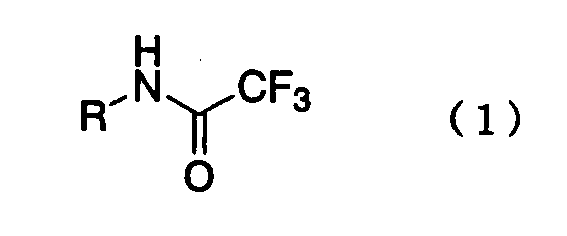
- N -aryl-2,2,2-trifluoroacetimidoyl chloride represented by Formula (2) can be produced by reacting a 2,2,2-trifluoro- N -arylacetamide represented by Formula (1), a tertiary amine, and at least one member selected from the group consisting of phosphorus oxychloride and diphenyl chlorophosphate in an organic solvent.
- R in Formulae (1) and (2) is an aryl group optionally having one substituent, and preferably a phenyl or naphthyl group optionally having one substituent.
- the naphthyl group may be either 1-naphthyl or 2-naphthyl.
- the position of the substituent is not limited. Examples of the substituent are alkyl groups, alkoxy groups, and halogen atoms.
- Such alkyl groups may be linear or branched. When branched, the number and position(s) of branch(es) are not limited.
- such an alkyl group preferably has 1 to 10 carbon atoms, and more preferably 1 to 4 carbon atoms. Preferable and specific examples are methyl, ethyl, propyl, isopropyl, n -butyl, isobutyl, s -butyl, t -butyl, and like groups.
- the alkyl moiety of such an alkoxy group may be linear or branched. When branched, the number and position(s) of branch(es) are not limited.
- the alkyl moiety preferably has 1 to 10 carbon atoms, and more preferably 1 to 4 carbon atoms.
- Preferable and specific examples of such alkoxy groups are methoxy, ethoxy, n -propoxy, isopropoxy, n -butoxy, but-2-oxy, 2-methylprop-1-oxy, 2-methylprop-2-oxy, and like groups.
- Such halogen atoms may be fluorine, chlorine, bromine, or iodine.
- R in Formulae (1) and (2) are phenyl, methylphenyl, methoxyphenyl, fluorophenyl, chlorophenyl, bromophenyl, iodophenyl, and naphthyl groups.
- 2,2,2-trifluoro- N- arylacetamides may be prepared according to any process.
- Preferable and specific examples are 2,2,2-trifluoro- N- phenylacetamide, 2,2,2-trifluoro- N -(2-methylphenyl)acetamide, 2,2,2-trifluoro-N-(3-methylphenyl)acetamide, 2,2,2-trifluoro- N- (4-methylphenyl)acetamide, 2,2,2-trifluoro- N -(2-methoxyphenyl)acetamide, 2,2,2-trifluoro- N -(3-methoxyphenyl)acetamide, 2,2,2-trifluoro- N -(4-methoxyphenyl)acetamide, 2,2,2-trifluoro- N -(2-fluorophenyl)acetamide, 2,2,2-trifluoro- N -(3-fluorophenyl)acetamide, 2,2,2-trifluoro- N- (4-fluoro-
- the amount of phosphorus oxychloride used in the present invention is preferably 0.6 to 3.0 mol, and more preferably 0.7 to 2.0 mol, per mol of 2,2,2-trifluoro- N- arylacetamide.
- the amount of diphenyl chlorophosphate is preferably 1.0 to 3.0 mol, and more preferably 1.5 to 2.5 mol, per mol of 2,2,2-trifluoro- N -arylacetamide.
- Phosphorus oxychloride and diphenyl chlorophosphate may be used either singly or in combination.
- Tertiary amines usable in the present invention are not limited. Preferable and specific examples are trimethylamine, triethylamine, tripropylamine, diisopropylethylamine, tributylamine, tripentylamine, triamylamine, trihexylamine, trioctylamine, triallylamine, pyridine, 2-methylpyridine, 3-methylpyridine, 4-methylpyridine, N -methylmorpholine, N,N- dimethylcyclohexylamine, N,N -dimethylaniline, N,N,N',N'- tetramethylethylenediamine, 4-dimethylaminopyridine, N- methylimidazole, 1,4-diazabicyclo[2.2.2]octane, 1,8-diazabicyclo[5.4.0]undec-7-ene, etc.
- triethylamine is particularly preferable.
- the amount of tertiary amine is preferably 1.0 to 3.0 mol, and more preferably 1.1 to 2.0 mol, per mol of 2,2,2-trifluoro- N -arylacetamide.
- Reaction solvents are not limited insofar as they do not react with the reaction ingredients. Specific examples are pentane, hexane, cyclohexane, methylcyclohexane, heptane, octane, and like hydrocarbon solvents; benzene, toluene, xylene, mesitylene, ethylbenzene, chlorobenzene, nitrobenzene, cumene, chlorotoluene, anisole, and like aromatic solvents; diethyl ether, diisopropyl ether, dibutyl ether, t -butyl methyl ether, cyclopentyl methyl ether, dimethoxyethane, tetrahydrofuran, and like ethereal solvents; dichloromethane, chloroform, dichloroethane, dichloropropane, and like halogenated solvents; methyl acetate, ethyl acetate
- reaction solvent is preferably 1 to 15 ml, and more preferably 3 to 10 ml, per gram of 2,2,2-trifluoro- N -arylacetamide represented by Formula (1).
- the reaction of the present invention is carried out by adding a 2,2,2-trifluoro- N -arylacetamide represented by Formula (1), a tertiary amine, and at least one member selected from the group consisting of phosphorus oxychloride and diphenyl chlorophosphate, to an organic solvent, followed by heating.
- a 2,2,2-trifluoro- N -arylacetamide represented by Formula (1) a 2,2,2-trifluoro- N -arylacetamide represented by Formula (1), a tertiary amine, and at least one member selected from the group consisting of phosphorus oxychloride and diphenyl chlorophosphate
- the reaction temperature is preferably 0 to 150°C, and more preferably 20 to 85°C.
- the reaction time is preferably 1 to 100 hours, and more preferably 5 to 50 hours.
- N -aryl-2,2,2-trifluoroacetimidoyl chlorides can be safely and efficiently produced.
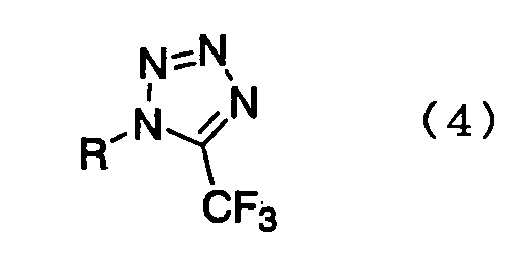
- a 1-aryl-5-(trifluoromethyl)-1 H -tetrazole represented by Formula (4) can be obtained by reacting an N -aryl-2,2,2-trifluoroacetimidoyl chloride represented by Formula (2) with an azide represented by Formula (3) in the presence of an amine salt in an aromatic hydrocarbon solvent.
- R in Formulae (2) and (4) is an aryl group optionally having one substituent, and preferably a phenyl or naphthyl group optionally having one substituent.
- the naphthyl group may be either 1-naphthyl or 2-naphthyl.
- the position of the substituent is not limited. Examples of the substituent are alkyl groups, alkoxy groups, and halogen atoms.
- Such alkyl groups may be linear or branched. When branched, the number and position(s) of branch(es) are not limited.
- such an alkyl group preferably has 1 to 10 carbon atoms, and more preferably 1 to 4 carbon atoms. Preferable and specific examples are methyl, ethyl, propyl, isopropyl, n -butyl, isobutyl, s -butyl, t -butyl, and like groups.
- the alkyl moiety of such an alkoxy group may be linear or branched. When branched, the number and position(s) of branch(es) are not limited.
- the alkyl moiety preferably has 1 to 10 carbon atoms, and more preferably 1 to 4 carbon atoms.
- Preferable and specific examples of such alkoxy groups are methoxy, ethoxy, n -propoxy, isopropoxy, n -butoxy, but-2-oxy, 2-methylprop-1-oxy, 2-methylprop-2-oxy, and like groups.
- Such halogen atoms may be fluorine, chlorine, bromine, or iodine.
- R in Formulae (2) and (4) are phenyl, methylphenyl, methoxyphenyl, fluorophenyl, chlorophenyl, bromophenyl, iodophenyl, and naphthyl groups.
- N -aryl-2,2,2-trifluoroacetimidoyl chlorides are N -phenyl-2,2,2-trifluoroacetimidoyl chloride, N -(2-methylphenyl)-2,2,2-trifluoroacetimidoyl chloride, N -(3-methylphenyl)-2,2,2-trifluoroacetimidoyl chloride, N -(4-methylphenyl)-2,2,2-trifluoroacetimidoyl chloride, N -(2-methoxyphenyl)-2,2,2-trifluoroacetimidoyl chloride, N -(3-methoxyphenyl)-2,2,2-trifluoroacetimidoyl chloride, N -(4-methoxyphenyl)-2,2,2-trifluoroacetimidoyl chloride, N -(2-fluorophenyl)-2,2,2-trifluoroacetimidoyl chloride
- Examples of azides represented by Formula (3) are azides of sodium, potassium, lithium, and like alkali metals; and azides of calcium, magnesium, and like alkaline-earth metals. Alkali metal azides are preferable, with sodium azide being particularly preferable.
- the amount of azide is preferably 1.0 to 3.0 mol, and more preferably 1.1 to 2.0 mol, per mol of N -aryl-2,2,2-trifluoroacetimidoyl chloride represented by Formula (2).
- Amine salts usable in the present invention are formed from amines and acids.
- Amines include primary, secondary and tertiary amines, and aliphatic amines are particularly preferable.
- Specific examples of amine salts are, although not limited thereto, methylamine salts, ethylamine salts, propylamine salts, butylamine salts, amylamine salts, hexylamine salts, cyclohexylamine salts, heptylamine salts, octylamine salts, allylamine salts, benzylamine salts, ⁇ -phenylethylamine salts, ⁇ -phenylethylamine salts, and like primary amine salts; dimethylamine salts, diethylamine salts, dipropylamine salts, dibutylamine salts, diamylamine salts, dihexylamine salts, dicyclohexylamine salts, diallylamine salt
- Acids usable herein to form salts are those that usually form salts with amines. Specific examples are, although not limited thereto, hydrochloric acid, hydrogen bromide, sulfuric acid, nitric acid, phosphoric acid, boric acid, hydrogen azide, chloric acid, carbonic acid, hydrogen sulfide, and like inorganic acids; and formic acid, acetic acid, trifluoroacetic acid, propionic acid, oxalic acid, methanesulfonic acid, benzenesulfonic acid, toluenesulfonic acid, and like organic acids.
- Preferable acids are hydrochloric acid, hydrogen bromide, sulfuric acid, hydrogen azide, acetic acid, and trifluoroacetic acid.
- triethylamine hydrochloride is particularly preferable.
- the amount of amine salt is preferably 0.1 to 1.5 mol, and more preferably 0.3 to 1.0 mol, per mol of N -aryl-2,2,2-trifluoroacetimidoyl chloride represented by Formula (2).
- aromatic hydrocarbon solvents usable in the present invention are benzene, toluene, xylene, mesitylene, ethylbenzene, chlorobenzene, nitrobenzene, cumene, chlorotoluene, etc., with toluene and xylene being particularly preferable. Two or more such aromatic hydrocarbon solvents can be used in combination.
- the amount of solvent is preferably 1 to 15 ml, and more preferably 3 to 10 ml, per gram of N -aryl-2,2,2-trifluoroacetimidoyl chloride represented by Formula (2).
- the reaction of the present invention is carried out by adding an N -aryl-2,2,2-trifluoroacetimidoyl chloride represented by Formula (2), an azide represented by Formula (3), and an amine salt to an aromatic hydrocarbon solvent, followed by heating.
- the reaction temperature is preferably 0 to 150°C, and more preferably 50 to 100°C.
- the reaction time is preferably 5 to 50 hours, and more preferably 12 to 30 hours.
- 1-aryl-5-(trifluoromethyl)-1 H -tetrazoles can be safely and efficiently produced.
Landscapes
- Chemical & Material Sciences (AREA)
- Organic Chemistry (AREA)
- Organic Low-Molecular-Weight Compounds And Preparation Thereof (AREA)
- Low-Molecular Organic Synthesis Reactions Using Catalysts (AREA)
Abstract

Description
- The present invention relates to processes for producing 1-aryl-5-(trifluoromethyl)-1H-tetrazoles and their production intermediates, i.e., N-aryl-2,2,2-trifluoroacetimidoyl chlorides. 1-Aryl-5-(trifluoromethyl)-1H-tetrazoles are important intermediates for a variety of pharmaceuticals.
- A known method for producing a tetrazole compound is blowing hydrogen azide gas into an imidoyl chloride compound at 200°C or higher (J. Am. Chem. Soc., vol. 80, 1958, p. 4647). Other known methods include a reaction using sodium azide in an aqueous solvent (J. Org. Chem., vol. 23, 1958, p. 1909); reaction using an aprotic polar solvent such as DMF, acetonitrile or the like (Synth. Commun., vol. 1, 1971, p. 1; J. Org. Chem., vol. 19, 1979, p. 3281; J. Fluorine Chem., vol. 99, 1999, p. 83); and like methods.
- However, the method in which hydrogen azide gas is blown at 200°C or higher may allow toxic hydrogen azide to escape the reaction system, and thus poses great safety risks for industrial scale production. In reactions using a solvent such as DMF, acetonitrile or the like, sodium azide may react with the solvent when heating is necessary. Moreover, since such solvents are water-miscible, large amounts of the reaction product dissolves in the aqueous phase in the post-treatment. Furthermore, when DMF or a like high-boiling-point solvent is used, solvent removal is difficult if the reaction product is liquid. Therefore, these prior-art production processes are not industrially advantageous.
- An example of a conventional production process for an imidoyl chloride compound is converting an amide compound into an imidoyl chloride compound using phosphorus oxychloride, phosphorus pentachloride, thionyl chloride or a like chlorinating reagent. However, when an amide compound having a highly electron withdrawing group such as a trifluoromethyl group is used in this method, the reaction progresses extremely slowly, thereby hindering the efficient production of the imidoyl chloride compound.
- J. Org. Chem., vol. 58, 1993, p. 32 teaches a process for efficiently producing an imidoyl chloride compound containing a strongly electron withdrawing trifluoromethyl group using a large excess of carbon tetrachloride as a chlorinating reagent. However, this process is environmentally problematic since carbon tetrachloride is highly toxic and is a regulated substance due to its ozone depletion potential.
- A known production process that does not use carbon tetrachloride is one that uses ethyl trichloroacetate. This process produces, for example, N-(4-methoxyphenyl)-2,2,2-trifluoroacetimidoyl chloride in a yield of 76% (Japanese Unexamined Patent Publication No. 2003-321431). This method, however, produces solid triphenylphosphine oxide in a weight-based amount twice or more than that of the desired product, and the removal thereof is difficult. Moreover, since the yield is only 76%, this is not an industrially advantageous process.
- An object of the present invention is to provide processes for safely and efficiently producing 1-aryl-5-(trifluoromethyl)-1H-tetrazoles and their production intermediates, i.e., N-aryl-2,2,2-trifluoroacetimidoyl chlorides.
- Other objects and characteristics of the present invention will become evident by the disclosure provided below.
- The inventors conducted extensive research to achieve the object described above, and found that a 1-aryl-5-(trifluoromethyl)-1H-tetrazole can be safely and efficiently produced by subjecting an N-aryl-2,2,2-trifluoroacetimidoyl chloride and an azide to a reaction in the presence of an amine salt in an aromatic hydrocarbon solvent, and the inventors thus partially accomplished the present invention. Furthermore, the inventors found that an N-aryl-2,2,2-trifluoroacetimidoyl chloride can be safely and efficiently produced by subjecting a 2,2,2-trifluoro-N-arylacetamide, a tertiary amine and at least one member selected from the group consisting of phosphorus oxychloride and diphenyl chlorophosphate to a reaction in an organic solvent, and the inventors thereby accomplished the present invention.
- In particular, the present invention provides processes for safely and efficiently producing 1-aryl-5-(trifluoromethyl)-1H-tetrazoles and their production intermediates, i.e., N-aryl-2,2,2-trifluoroacetimidoyl chlorides, as described below.
- 1. A process for producing an N-aryl-2,2,2-trifluoroacetimidoyl chloride represented by Formula (2):


- 2. The process according to Item 1, wherein R is a phenyl, methylphenyl, methoxyphenyl, fluorophenyl, chlorophenyl, bromophenyl, iodophenyl, or naphthyl group.
- 3. The process according to Item 1 or 2, wherein the tertiary amine is triethylamine.
- 4. A process for producing a 1-aryl-5-(trifluoromethyl)-1H-tetrazole represented by Formula (4):

the process comprising the step of reacting in an aromatic hydrocarbon solvent, in the presence of an amine salt, an N-aryl-2,2,2-trifluoroacetimidoyl chloride represented by Formula (2):
M(N3)n (3)
wherein M is an alkali metal or alkaline-earth metal, and n is 1 or 2. - 5. The process according to Item 4, wherein R is a phenyl, methylphenyl, methoxyphenyl, fluorophenyl, chlorophenyl, bromophenyl, iodophenyl, or naphthyl group.
- 6. The process according to Item 4 or 5, wherein the azide is sodium azide.
- 7. The process according to any one of Items 4 to 6, wherein the amine salt is triethylamine hydrochloride.
- 8. The process according to any one of Items 4 to 7, wherein the aromatic hydrocarbon solvent is at least one member selected from the group consisting of toluene and xylene.
- The process for producing an N-aryl-2,2,2-trifluoroacetimidoyl chloride and the process for producing a 1-aryl-5-(trifluoromethyl)-1H-tetrazole are described below in detail.
- An N-aryl-2,2,2-trifluoroacetimidoyl chloride represented by Formula (2) can be produced by reacting a 2,2,2-trifluoro-N-arylacetamide represented by Formula (1), a tertiary amine, and at least one member selected from the group consisting of phosphorus oxychloride and diphenyl chlorophosphate in an organic solvent.
- "R" in Formulae (1) and (2) is an aryl group optionally having one substituent, and preferably a phenyl or naphthyl group optionally having one substituent. The naphthyl group may be either 1-naphthyl or 2-naphthyl. The position of the substituent is not limited. Examples of the substituent are alkyl groups, alkoxy groups, and halogen atoms.
- Such alkyl groups may be linear or branched. When branched, the number and position(s) of branch(es) are not limited. For the reaction to progress smoothly, such an alkyl group preferably has 1 to 10 carbon atoms, and more preferably 1 to 4 carbon atoms. Preferable and specific examples are methyl, ethyl, propyl, isopropyl, n-butyl, isobutyl, s-butyl, t-butyl, and like groups.
- The alkyl moiety of such an alkoxy group may be linear or branched. When branched, the number and position(s) of branch(es) are not limited. For the reaction to progress smoothly, the alkyl moiety preferably has 1 to 10 carbon atoms, and more preferably 1 to 4 carbon atoms. Preferable and specific examples of such alkoxy groups are methoxy, ethoxy, n-propoxy, isopropoxy, n-butoxy, but-2-oxy, 2-methylprop-1-oxy, 2-methylprop-2-oxy, and like groups.
- Such halogen atoms may be fluorine, chlorine, bromine, or iodine.
- Particularly preferable examples of R in Formulae (1) and (2) are phenyl, methylphenyl, methoxyphenyl, fluorophenyl, chlorophenyl, bromophenyl, iodophenyl, and naphthyl groups.
- In the present invention, 2,2,2-trifluoro-N-arylacetamides may be prepared according to any process. Preferable and specific examples are 2,2,2-trifluoro-N-phenylacetamide, 2,2,2-trifluoro-N-(2-methylphenyl)acetamide, 2,2,2-trifluoro-N-(3-methylphenyl)acetamide, 2,2,2-trifluoro-N-(4-methylphenyl)acetamide, 2,2,2-trifluoro-N-(2-methoxyphenyl)acetamide, 2,2,2-trifluoro-N-(3-methoxyphenyl)acetamide, 2,2,2-trifluoro-N-(4-methoxyphenyl)acetamide, 2,2,2-trifluoro-N-(2-fluorophenyl)acetamide, 2,2,2-trifluoro-N-(3-fluorophenyl)acetamide, 2,2,2-trifluoro-N-(4-fluorophenyl)acetamide, 2,2,2-trifluoro-N-(2-chlorophenyl)acetamide, 2,2,2-trifluoro-N-(3-chlorophenyl)acetamide, 2,2,2-trifluoro-N-(4-chlorophenyl)acetamide, 2,2,2-trifluoro-N-(2-bromophenyl)acetamide, 2,2,2-trifluoro-N-(3-bromophenyl)acetamide, 2,2,2-trifluoro-N-(4-bromophenyl)acetamide, 2,2,2-trifluoro-N-(2-iodophenyl)acetamide, 2,2,2-trifluoro-N-(3-iodophenyl)acetamide, 2,2,2-trifluoro-N-(4-iodophenyl)acetamide, 2,2,2-trifluoro-N-(naphthalen-1-yl)acetamide, and 2,2,2-trifluoro-N-(naphthalen-2-yl)acetamide.
- The amount of phosphorus oxychloride used in the present invention is preferably 0.6 to 3.0 mol, and more preferably 0.7 to 2.0 mol, per mol of 2,2,2-trifluoro-N-arylacetamide. The amount of diphenyl chlorophosphate is preferably 1.0 to 3.0 mol, and more preferably 1.5 to 2.5 mol, per mol of 2,2,2-trifluoro-N-arylacetamide. Phosphorus oxychloride and diphenyl chlorophosphate may be used either singly or in combination.
- Tertiary amines usable in the present invention are not limited. Preferable and specific examples are trimethylamine, triethylamine, tripropylamine, diisopropylethylamine, tributylamine, tripentylamine, triamylamine, trihexylamine, trioctylamine, triallylamine, pyridine, 2-methylpyridine, 3-methylpyridine, 4-methylpyridine, N-methylmorpholine, N,N-dimethylcyclohexylamine, N,N-dimethylaniline, N,N,N',N'-tetramethylethylenediamine, 4-dimethylaminopyridine, N-methylimidazole, 1,4-diazabicyclo[2.2.2]octane, 1,8-diazabicyclo[5.4.0]undec-7-ene, etc. Among such examples, triethylamine is particularly preferable. The amount of tertiary amine is preferably 1.0 to 3.0 mol, and more preferably 1.1 to 2.0 mol, per mol of 2,2,2-trifluoro-N-arylacetamide.
- Reaction solvents are not limited insofar as they do not react with the reaction ingredients. Specific examples are pentane, hexane, cyclohexane, methylcyclohexane, heptane, octane, and like hydrocarbon solvents; benzene, toluene, xylene, mesitylene, ethylbenzene, chlorobenzene, nitrobenzene, cumene, chlorotoluene, anisole, and like aromatic solvents; diethyl ether, diisopropyl ether, dibutyl ether, t-butyl methyl ether, cyclopentyl methyl ether, dimethoxyethane, tetrahydrofuran, and like ethereal solvents; dichloromethane, chloroform, dichloroethane, dichloropropane, and like halogenated solvents; methyl acetate, ethyl acetate, propyl acetate, butyl acetate, and like ester-based solvents; and acetonitrile and like polar solvents. Among these solvents, polar solvents are preferable, with acetonitrile being particularly preferable. The amount of reaction solvent is preferably 1 to 15 ml, and more preferably 3 to 10 ml, per gram of 2,2,2-trifluoro-N-arylacetamide represented by Formula (1).
- The reaction of the present invention is carried out by adding a 2,2,2-trifluoro-N-arylacetamide represented by Formula (1), a tertiary amine, and at least one member selected from the group consisting of phosphorus oxychloride and diphenyl chlorophosphate, to an organic solvent, followed by heating. Excessively low reaction temperatures decelerate the reaction, and excessively high reaction temperatures result in the generation of large amounts of by-products. Therefore, the reaction temperature is preferably 0 to 150°C, and more preferably 20 to 85°C. The reaction time is preferably 1 to 100 hours, and more preferably 5 to 50 hours.
- After the reaction, the solvent is evaporated off to obtain a crude product. Purification by crystallization, recrystallization, distillation, column chromatography, etc., is then performed to obtain an N-aryl-2,2,2-trifluoroacetimidoyl chloride represented by Formula (2).
- According to the present invention, N-aryl-2,2,2-trifluoroacetimidoyl chlorides can be safely and efficiently produced.
- A 1-aryl-5-(trifluoromethyl)-1H-tetrazole represented by Formula (4) can be obtained by reacting an N-aryl-2,2,2-trifluoroacetimidoyl chloride represented by Formula (2) with an azide represented by Formula (3) in the presence of an amine salt in an aromatic hydrocarbon solvent.
- "R" in Formulae (2) and (4) is an aryl group optionally having one substituent, and preferably a phenyl or naphthyl group optionally having one substituent. The naphthyl group may be either 1-naphthyl or 2-naphthyl. The position of the substituent is not limited. Examples of the substituent are alkyl groups, alkoxy groups, and halogen atoms.
- Such alkyl groups may be linear or branched. When branched, the number and position(s) of branch(es) are not limited. For the reaction to progress smoothly, such an alkyl group preferably has 1 to 10 carbon atoms, and more preferably 1 to 4 carbon atoms. Preferable and specific examples are methyl, ethyl, propyl, isopropyl, n-butyl, isobutyl, s-butyl, t-butyl, and like groups.
- The alkyl moiety of such an alkoxy group may be linear or branched. When branched, the number and position(s) of branch(es) are not limited. For the reaction to progress smoothly, the alkyl moiety preferably has 1 to 10 carbon atoms, and more preferably 1 to 4 carbon atoms. Preferable and specific examples of such alkoxy groups are methoxy, ethoxy, n-propoxy, isopropoxy, n-butoxy, but-2-oxy, 2-methylprop-1-oxy, 2-methylprop-2-oxy, and like groups.
- Such halogen atoms may be fluorine, chlorine, bromine, or iodine.
- Particularly preferable examples of R in Formulae (2) and (4) are phenyl, methylphenyl, methoxyphenyl, fluorophenyl, chlorophenyl, bromophenyl, iodophenyl, and naphthyl groups.
- Preferable and specific examples of N-aryl-2,2,2-trifluoroacetimidoyl chlorides are N-phenyl-2,2,2-trifluoroacetimidoyl chloride, N-(2-methylphenyl)-2,2,2-trifluoroacetimidoyl chloride, N-(3-methylphenyl)-2,2,2-trifluoroacetimidoyl chloride, N-(4-methylphenyl)-2,2,2-trifluoroacetimidoyl chloride, N-(2-methoxyphenyl)-2,2,2-trifluoroacetimidoyl chloride, N-(3-methoxyphenyl)-2,2,2-trifluoroacetimidoyl chloride, N-(4-methoxyphenyl)-2,2,2-trifluoroacetimidoyl chloride, N-(2-fluorophenyl)-2,2,2-trifluoroacetimidoyl chloride; N-.(3-fluorophenyl)-2,2,2-trifluoroacetimidoyl chloride, N-(4-fluorophenyl)-2,2,2-trifluoroacetimidoyl chloride, N-(2-chlorophenyl)-2,2,2-trifluoroacetimidoyl chloride, N-(3-chlorophenyl)-2,2,2-trifluoroacetimidoyl,chloride, N-(4-chlorophenyl)-2,2,2-trifluoroacetimidoyl chloride, N-(2-bromophenyl)-2,2,2-trifluoroacetimidoyl chloride, N-(3-bromophenyl)-2,2,2-trifluoroacetimidoyl chloride, N-(4-bromophenyl)-2,2,2-trifluoroacetimidoyl chloride, N-(2-iodophenyl)-2,2,2-trifluoroacetimidoyl chloride, N-(3-iodophenyl)-2,2,2-trifluoroacetimidoyl chloride, N-(4-iodophenyl)-2,2,2-trifluoroacetimidoyl chloride, N-(naphthalen-1-yl)-2,2,2-trifluoroacetimidoyl chloride, and N-(naphthalen-2-yl)-2,2,2-trifluoroacetimidoyl chloride.
- Examples of azides represented by Formula (3) are azides of sodium, potassium, lithium, and like alkali metals; and azides of calcium, magnesium, and like alkaline-earth metals. Alkali metal azides are preferable, with sodium azide being particularly preferable. The amount of azide is preferably 1.0 to 3.0 mol, and more preferably 1.1 to 2.0 mol, per mol of N-aryl-2,2,2-trifluoroacetimidoyl chloride represented by Formula (2).
- Amine salts usable in the present invention are formed from amines and acids. Amines include primary, secondary and tertiary amines, and aliphatic amines are particularly preferable. Specific examples of amine salts are, although not limited thereto, methylamine salts, ethylamine salts, propylamine salts, butylamine salts, amylamine salts, hexylamine salts, cyclohexylamine salts, heptylamine salts, octylamine salts, allylamine salts, benzylamine salts, α-phenylethylamine salts, β-phenylethylamine salts, and like primary amine salts; dimethylamine salts, diethylamine salts, dipropylamine salts, dibutylamine salts, diamylamine salts, dihexylamine salts, dicyclohexylamine salts, diallylamine salts, morpholine salts, piperidine salts, hexamethyleneimine salts, and like secondary amine salts; trimethylamine salts, triethylamine salts, tripropylamine salts, tributylamine salts, triamylamine salts, trihexylamine salts, triallylamine salts, pyridine salts, triethanolamine salts, N-methylmorpholine salts, N,N-dimethylcyclohexylamine salts, N,N-dimethylaniline salts, N,N,N',N'-tetramethylethylenediamine salts, 4-dimethylaminopyridine salts, and like tertiary amine salts; etc. Two or more such amine salts may be used in combination. Acids usable herein to form salts are those that usually form salts with amines. Specific examples are, although not limited thereto, hydrochloric acid, hydrogen bromide, sulfuric acid, nitric acid, phosphoric acid, boric acid, hydrogen azide, chloric acid, carbonic acid, hydrogen sulfide, and like inorganic acids; and formic acid, acetic acid, trifluoroacetic acid, propionic acid, oxalic acid, methanesulfonic acid, benzenesulfonic acid, toluenesulfonic acid, and like organic acids. Preferable acids are hydrochloric acid, hydrogen bromide, sulfuric acid, hydrogen azide, acetic acid, and trifluoroacetic acid. Among the aforementioned amine salts formed from amines and acids, triethylamine hydrochloride is particularly preferable. The amount of amine salt is preferably 0.1 to 1.5 mol, and more preferably 0.3 to 1.0 mol, per mol of N-aryl-2,2,2-trifluoroacetimidoyl chloride represented by Formula (2).
- Preferable and specific examples of aromatic hydrocarbon solvents usable in the present invention are benzene, toluene, xylene, mesitylene, ethylbenzene, chlorobenzene, nitrobenzene, cumene, chlorotoluene, etc., with toluene and xylene being particularly preferable. Two or more such aromatic hydrocarbon solvents can be used in combination. The amount of solvent is preferably 1 to 15 ml, and more preferably 3 to 10 ml, per gram of N-aryl-2,2,2-trifluoroacetimidoyl chloride represented by Formula (2).
- The reaction of the present invention is carried out by adding an N-aryl-2,2,2-trifluoroacetimidoyl chloride represented by Formula (2), an azide represented by Formula (3), and an amine salt to an aromatic hydrocarbon solvent, followed by heating. Excessively low reaction temperatures decelerate the reaction, and excessively high reaction temperatures result in the generation of large amounts of by-products. Therefore, the reaction temperature is preferably 0 to 150°C, and more preferably 50 to 100°C. The reaction time is preferably 5 to 50 hours, and more preferably 12 to 30 hours.
- After the reaction, the reaction solution is cooled to room temperature, and then washed with water. The organic phase is then dried, and the solvent is evaporated off to obtain a crude product. Purification by crystallization, recrystallization, column chromatography, etc., is then performed to obtain a 1-aryl-5-(trifluoromethyl)-1H-tetrazole represented by Formula (4).
- According to the present invention, 1-aryl-5-(trifluoromethyl)-1H-tetrazoles can be safely and efficiently produced.
- Examples are given below to illustrate the invention in more detail, but the scope of the invention is not limited to these examples.
- N-phenyl-2,2,2-trifluoroacetimidoyl chloride

- Seven grams (37.0 mmol) of 2,2,2-trifluoro-N-phenylacetamide, 19.84 g (74.0 mmol) of diphenyl chlorophosphate, 7.44 g (74.0 mmol) of triethylamine, and 28 ml of acetonitrile were introduced into a 100 ml flask and reacted for 15 hours while being refluxed (82°C). After the reaction, the reaction solution was cooled to room temperature, 28 ml of ethyl acetate was added thereto, and the precipitate was then filtered off. The filtrate was subjected to solvent removal by evaporation, and the crude product thus obtained was purified by column chromatography (silica gel, ethyl acetate:hexane = 3:7), resulting in 6.24 g of N-phenyl-2,2,2-trifluoroacetimidoyl chloride as a yellow liquid (yield: 81.2%).
IR (neat, cm-1): 1697, 1489, 1286, 1223, 1196, 1161, 947, 766, 725, 691
1H-NMR (CDCl3): δ 7.41-7.24 (m, 3H), 7.08-7.05(m, 2H)
13C-NMR (CDC13): δ 143. 47, 131.94 (q, J = 42.8 Hz), 129.12, 127.40, 120.63, 116.86 (q, J = 275.8 Hz) - 1-phenyl-5-(trifluoromethyl)-1H-tetrazole

- Five grams (24.1 mmol) of N-phenyl-2,2,2-trifluoroacetimidoyl chloride obtained in Example 1, 2.83 g (43.4 mmol) of sodium azide, 1.66 g (12.1 mmol) of triethylamine hydrochloride, and 40 ml of toluene were introduced into a 100 ml flask and reacted at 80°C for 16.5 hours. After the reaction, the reaction solution was cooled to room temperature and washed with water (30 ml x 3). The organic phase was dried over anhydrous magnesium sulfate for 1 hour, filtered, and then subjected to solvent removal by evaporation. The crude product thus obtained was purified by column chromatography (silica gel, ethyl acetate:hexane = 3:7), resulting in 4.81 g of 1-phenyl-5-(trifluoromethyl)-1H-tetrazo as a pale yellow oil (yield: 93.2%). IR (neat, cm-1): 3071, 1531, 1499, 1312, 1207, 1167, 1013, 766, 691 1H-NMR (CDCl3): δ 7.60-7.54 (m, 3H), 7.38 (d, J = 8.7 Hz, 2H), 7.06 (d, J = 8.7 Hz, 2H), 3.89 (s, 3H)
13C-NMR (CDCl3): δ 145.90 (q, J = 42.0 Hz), 132.41, 131.59, 131.58, 129.79, 129.76, 125.05, 117.73 (q, J = 270.0 Hz)
Elemental analysis: - Value calculated for C8H5F3N4: C, 44.87%; H, 2.35%; N, 26.16%
- Value found: C, 44.27%; H, 2.24%; N, 25.95%
- Decomposition temperature (DSC): 290°C (1.17 kJ/g), 367°C (1.55 kJ/g)
- N-(4-methylphenyl)-2,2,2-trifluoroacetimidoyl chloride.

- Seven grams (34.5 mmol) of 2,2,2-trifluoro-N-(4-methylphenyl)acetamide, 18.49 g (68.9 mmol) of diphenyl chlorophosphate, 6.97 g (68.9 mmol) of triethylamine, and 35 ml of acetonitrile were introduced into a 100 ml flask and reacted for 18 hours while being refluxed (82°C). After the reaction, the reaction solution was cooled to room temperature, 25 ml of ethyl acetate was added thereto, and the precipitate was then filtered off. The filtrate was subjected to solvent removal by evaporation, and the crude product thus obtained was purified by column chromatography (silica gel, ethyl acetate:hexane = 3:7), resulting in 6.77 g of N-(4-methylphenyl)-2,2,2-trifluoroacetimidoyl chloride as a yellow liquid (yield: 88.6%).
IR (neat, cm-1): 1684, 1506, 1286, 1223, 1196, 1159, 949, 934, 820 1H-NMR (CDCl3): δ 7.26-7.22 (m, 2H), 7.10-7.04 (m, 2H), 2.39 (s, 3H)
13C-NMR (CDCl3): δ 140. 61, 137.85, 130.55 (q, J = 42.8 Hz), 129.69, 121.23, 116.92 (q, J = 275.0 Hz), 21.02 - 1-(4-methylphenyl)-5-(trifluoromethyl)-1H-tetrazole

- Five grams (22.6 mmol) of N-(4-methylphenyl)-2,2,2-trifluoroacetimidoyl chloride obtained in Example 3, 2.68 g (40.7 mmol) of sodium azide, 1.57 g (11.3 mmol) of triethylamine hydrochloride, and 40 ml of toluene were introduced into a 100 ml flask and reacted at 80°C for 23 hours. After the reaction, the reaction solution was cooled to room temperature and washed with water (30 ml x 3). The organic phase was dried over anhydrous magnesium sulfate for 1 hour, filtered, and then subjected to solvent removal by evaporation. The crude product thus obtained was purified by column chromatography (silica gel, ethyl acetate:hexane = 3:7), resulting in 5.01 g of 1-(4-methylphenyl)-5-(trifluoromethyl)-1H-tetrazole as a pale yellow oil (yield: 97.3%). IR (neat, cm-1) : 3045, 2930, 1531, 1514, 1312, 1205, 1167, 1034, 1011, 822, 756
1H-NMR (CDCl3): δ 7.37-7.31 (m, 4H), 2.42 (s, 3H)
13C-NMR (CDCl3): δ 145.96 (q, J = 41.2 Hz), 142.28, 130.33, 129.95, 124.83, 117.81 (q, J = 270.9 Hz), 21.10
Elemental analysis: - Value calculated for C9H7F3N4: C, 47.37%; H, 3.09%; N, 24.98%
- Value found: C, 46.89%; H, 2.63%; N, 24.64%
- Decomposition temperature (DSC): 290°C (1.09 kJ/g), 360°C (1.29 kJ/g)
- N-(4-methoxyphenyl)-2,2,2-trifluoroacetimidoyl chloride

- Five grams (22.8 mmol) of 2,2,2-trifluoro-N-(4-methoxyphenyl)acetamide, 12.26 g (45.6 mmol) of diphenyl chlorophosphate, 4.62 g (45.6 mmol) of triethylamine, and 25 ml of acetonitrile were introduced into a 100 ml flask and reacted for 22 hours while being refluxed (82°C). After the reaction, the reaction solution was cooled to room temperature, 20 ml of ethyl acetate was added thereto, and the precipitate was then filtered off. The filtrate was subjected to solvent removal by evaporation, and the crude product thus obtained was purified by column chromatography (silica gel, ethyl acetate:hexane = 3:7), resulting in 4.53 g of N-(4-methoxyphenyl)-2,2,2-trifluoroacetimidoyl chloride as a yellow liquid (yield: 83.6%).
IR (neat, cm-1): 1676, 1599, 1506, 1285, 1252, 1194, 1159, 1032, 943, 924, 833, 766
1H-NMR (CDCl3): δ 7.26-7.21 (m, 2H), 7.00-6.91 (m, 2H), 3.81 (s, 3H)
13C-NMR (CDCl3): δ 159.37, 135.25, 127.93 (q, J = 42.4 Hz), 124.20, 116.90 (q, J = 274.0 Hz), 114.12, 55.45 - N-(4-methoxyphenyl)-2,2,2-trifluoroacetimidoyl chloride
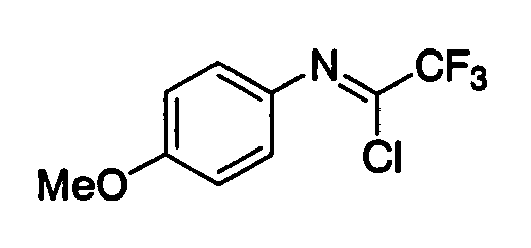
- Five grams (22.8 mmol) of 2,2,2-trifluoro-N-(4-methoxyphenyl)acetamide, 7.02 g (45.6 mmol) of phosphorus oxychloride, 4.62 g (45.6 mmol) of triethylamine, and 25 ml of acetonitrile were introduced into a 100 ml flask and reacted for 22 hours while being refluxed (82°C). After the reaction, the reaction solution was cooled to room temperature, 20 ml of ethyl acetate was added thereto, and the precipitate was then filtered off. The filtrate was subjected to solvent removal by evaporation, and the crude product thus obtained was purified by column chromatography (silica gel, ethyl acetate:hexane = 3:7), resulting in 4.52 g of N-(4-methoxyphenyl)-2,2,2-trifluoroacetimidoyl chloride as a yellow liquid (yield: 83.4%).
1H-NMR (CDCl3): δ 7.26-7.21 (m, 2H), 7.00-6.91 (m, 2H), 3.81 (s, 3H)
13C-NMR (CDCl3): δ 159.37, 135.25, 127.93 (q, J = 42.4 Hz), 124.20, 116.90 (q, J = 274.0 Hz), 114.12, 55.45 - N-(4-methoxyphenyl)-2,2,2-trifluoroacetimidoyl chloride

- Ten grams (45.6 mmol) of 2,2,2-trifluoro-N-(4-methoxyphenyl)acetamide, 4.92 g (32.0 mmol) of phosphorus oxychloride, 9.23 g (91.2 mmol) of triethylamine, and 50 ml of acetonitrile were introduced into a 200 ml flask and reacted for 19 hours while being refluxed (82°C). After the reaction, the reaction solution was cooled to room temperature, 30 ml of ethyl acetate was added thereto, and the precipitate was then filtered off. The filtrate was subjected to solvent removal by evaporation, and the crude product thus obtained was purified by column chromatography (silica gel, ethyl acetate:hexane = 3:7), resulting in 8.94 g of N-(4-methoxyphenyl)-2,2,2-trifluoroacetimidoyl chloride as a yellow liquid (yield: 82.5%).
1H-NMR (CDCl3): δ 7.26-7.21 (m, 2H), 7.00-6.91 (m, 2H), 3.81 (s, 3H)
13C-NMR (CDCl3): δ 159. 37, 135.25, 127.93 (q, J = 42.4 Hz), 124.20, 116.90 (q, J = 274.0 Hz), 114.12, 55.45 - 1-(4-methoxyphenyl)-5-(trifluoroniethyl)-1H-tetrazole

- Five grams (21.0 mmol) of N-(4-methoxyphenyl)-2,2,2-trifluoroacetimidoyl chloride obtained in Example 7, 2.46 g (37.8 mmol) of sodium azide, 1.45 g (10.5 mmol) of triethylamine hydrochloride, and 40 ml of toluene were introduced into a 100 ml flask and reacted at 80°C for 15 hours. After the reaction, the reaction solution was cooled to room temperature and washed with water (30 ml x 2). The organic phase was dried over anhydrous magnesium sulfate for 1 hour, filtered, and then subjected to solvent removal by evaporation. The crude product thus obtained was purified by column chromatography (silica gel, ethyl acetate:hexane = 3:7), resulting in 5.05 g of 1-(4-methoxyphenyl)-5-(trifluoromethyl)-1H-tetrazole as a pale yellow oil (yield: 98.3%).
IR (neat, cm-1): 1609, 1533, 1514, 1466, 1319, 1310, 1259, 1205, 1167, 1111, 1026, 837, 756, 542
1H-NMR (CDCl3): δ 7.38 (d, J = 8.7 Hz, 2H), 7.06 (d, J = 8.7 Hz, 2H), 3.89 (s, 3H)
13C-NMR (CDCl3): δ 161. 72, 146.03 (q, J = 42.1 Hz), 126.51, 124.95, 117.81 (q, J = 270.6 Hz), 114.87, 55.72
Elemental analysis: - Value calculated for C9H7F3N4O: C, 44.27%; H, 2.89%; N, 22.95%
- Value found: C, 43.81%; H, 2.81%; N, 22.15%
- Decomposition temperature (DSC): 286°C (1.58 kJ/g), 342°C (0.64 kJ/g)
- N- (2-methoxyphenyl)-2,2,2-trifluoroacetimidoyl chloride

- Five grams (22.8 mmol) of 2,2,2-trifluoro-N-(2-methoxyphenyl)acetamide, 12.24 g (45.6 mmol) of diphenyl chlorophosphate, 4.64 g (45.6 mmol) of triethylamine, and 25 ml of acetonitrile were introduced into a 100 ml flask and reacted for 22.5 hours while being refluxed (82°C). After the reaction, the reaction solution was cooled to room temperature, 20 ml of ethyl acetate was added thereto, and the precipitate was then filtered off. The filtrate was subjected to solvent removal by evaporation, and the crude product thus obtained was purified by column chromatography (silica gel, ethyl acetate:hexane = 3:7), resulting in 4.55 g of N-(2-methoxyphenyl)-2,2,2-trifluoroacetimidoyl chloride as a yellow liquid (yield: 84.3%).
IR (neat, cm-1): 1699, 1595, 1495, 1292, 1252, 1196, 1161, 949, 750
1H-NMR (CDCl3): δ 7.26-7.22 (m, 1H), 7.02-6.91 (m, 3H), 3.85 (s, 3H)
13C-NMR (CDCl3): δ 149. 18, 133.95 (q, J = 42.8 Hz), 133.09, 127.94, 120.54, 120.23, 116.81 (q, J = 275.0 Hz), 111.78, 55.58 - 1-(2-Methoxyphenyl)-5-(trifluoromethyl)-1H-tetrazole

- Four grams (16.8 mmol) of N-(2-methoxyphenyl)-2,2,2-trifluoroacetimidoyl chloride obtained in Example 9, 1.98 g (30.2 mmol) of sodium azide, 1.16 g (8.42 mmol) of triethylamine hydrochloride, and 40 ml of toluene were introduced into a 100 ml flask and reacted at 80°C for 14 hours. After the reaction, the reaction solution was cooled to room temperature and washed with water (30 ml x 2). The organic phase was dried over anhydrous magnesium sulfate for 1 hour, filtered, and then subjected to solvent removal by evaporation. The crude product thus obtained was purified by column chromatography (silica gel, ethyl acetate:hexane = 3:7), resulting in 4.01 g of 1-(2-methoxyphenyl)-5-(trifluoromethyl)-1H-tetrazole as a pale yellow oil (yield: 97.6%).
IR (neat, cm-1): 1601, 1563, 1506, 1470, 1441, 1315, 1288, 1258, 1169, 1124, 1107, 1013, 760, 683
1H-NMR (CDCl3): δ 7.59 (ddd, J = 7.8, 7.5, 1.7 Hz, 1H), 7.36 (dd, J = 7.8, 1.7 Hz, 1H), 7.14-7.08 (m, 2H), 3.79 (s, 3H)
13C-NMR (CDCl3): δ 153.55, 147.00 (q, J = 41.5 Hz), 133.19, 127.22, 121.00, 120.59, 117.60 (q, J = 270.4 Hz), 112.07, 55.76
Elemental analysis: - Value calculated for C9H7F3N4O: C, 44.27%; H, 2.89%; N, 22.95%
- Value found: C, 44.35%; H, 3.18%; N, 23.05%
- Decomposition temperature (DSC): 283°C (1.08 kJ/g), 353°C (0.60 kJ/g)
- N-(4-chlorophenyl)-2,2,2-trifluoroacetimidoyl chloride

- Four grams (17.9 mmol) of 2,2,2-trifluoro-N-(4-chlorophenyl)acetamide, 9.61 g (35.8 mmol) of diphenyl chlorophosphate, 3.62 g (35.8 mmol) of triethylamine, and 20 ml of acetonitrile were introduced into a 50 ml flask and reacted for 16 hours while being refluxed (82°C). After the reaction, the reaction solution was cooled to room temperature, 16 ml of ethyl acetate was added thereto, and the precipitate was then filtered off. The filtrate was subjected to solvent removal by evaporation, and the crude product thus obtained was purified by column chromatography (silica gel, ethyl acetate:hexane = 3:7), resulting in 3.40 g of N-(4-chlorophenyl)-2,2,2-trifluoroacetimidoyl chloride as a yellow liquid (yield: 78.6%).
IR (neat, cm-1): 1701, 1487, 1286, 1225, 1196, 1163, 1097, 1015, 951, 833, 735
1H-NMR (CDCl3): δ 7.42-7.38 (m, 2H), 7.07-6.94 (m, 2H)
13C-NMR (CDCl3): δ 141.66, 133.28, 132.52 (q, J = 42.8 Hz), 129.30, 122.26, 116.75 (q, J = 275.0 Hz) - 1-(4-chlorophenyl)-5-(trifluoromethyl)-1H-tetrazole

- Three grams (12.4 mmol) of N-(4-chlorophenyl)-2,2,2-trifluoroacetimidoyl chloride obtained in Example 11, 1.46 g (22.3 mmol) of sodium azide, 0.85 g (6.20 mmol) of triethylamine hydrochloride, and 30 ml of toluene were introduced into a 100 ml flask and reacted at 80°C for 24.5 hours. After the reaction, the reaction solution was cooled to room temperature and washed with water (20 ml x 2). The organic phase was dried over anhydrous magnesium sulfate for 1 hour, filtered, and then subjected to solvent removal by evaporation. The crude product thus obtained was purified by column chromatography (silica gel, ethyl acetate:hexane = 3:7), resulting in 2.84 g of 1-(4-chlorophenyl)-5-(trifluoromethyl)-1H-tetrazole as a pale yellow oil (yield: 92.2%). IR (neat, cm-1): 3101, 1531, 1497, 1313, 1207, 1167, 1096, 1009, 835
1H-NMR (CDCl3): δ 7.60-7.56 (m, 2H), 7.47-7.43 (m, 2H)
13C-NMR (CDCl3): δ 146.02 (q, J = 42.0 Hz), 138.13, 130.94, 130.25, 126.48, 117.75 (q, J = 270.9 Hz)
Elemental analysis: - Value calculated for C8H4ClF3N4: C, 38.65%; H, 1.62%; N, 22.93%
- Value found: C, 38.51%; H, 1.74%; N, 22.40%
- Decomposition temperature (DSC): 280°C (0.97 kJ/g), 368°C (0.42 kJ/g)
- N-(naphthalen-1-yl)-2,2,2-trifluoroacetimidoyl chloride

- Five grams (20.9 mmol) of 2,2,2-trifluoro-N-(naphthalen-1-yl)acetamide, 11.23 g (41.8 mmol) of diphenyl chlorophosphate, 4.22 g (41.8 mmol) of triethylamine, and 20 ml of acetonitrile were introduced into a 50 ml flask and reacted for 15 hours while being refluxed (82°C). After the reaction, the reaction solution was cooled to room temperature, 15 ml of ethyl acetate was added thereto, and the precipitate was then filtered off. The filtrate was subjected to solvent removal by evaporation, and the crude product thus obtained was purified by column chromatography (silica gel, ethyl acetate:hexane = 3:7), resulting in 4.65 g of N-(naphthalen-1-yl)-2,2,2-trifluoroacetimidoyl chloride as a yellow oil (yield: 86.2%).
IR (neat, cm-1): 1686, 1593, 1393, 1286, 1211, 1161, 943, 799, 772, 754, 702
1H-NMR (CDCl3): δ 7.89-7.86 (m, 1H), 7.82-7.79 (m, 2H), 7.56-7.48 (m, 3H), 7.18 (d, J = 7.4 Hz, 1H)
13C-NMR (CDCl3): δ 139. 67, 133.94, 132.90 (q, J = 42.8 Hz), 128.07, 127.65, 126.85, 126.73, 126.23, 125.11, 122.69, 116.9 (q, J = 275.0 Hz), 115.07 - 1-(naphthalen-1-yl)-5-(trifluoromethyl)-1H-tetrazole

- Four grams (15.5 mmol) of N-(naphthalen-1-yl)-2,2,2-trifluoroacetimidoyl chloride obtained in Example 13, 1.84 g (27.9 mmol) of sodium azide, 1.08 g (7.76 mmol) of triethylamine hydrochloride, and 40 ml of toluene were introduced into a 100 ml flask and reacted at 80°C for 14 hours. After the reaction, the reaction solution was cooled to room temperature and washed with water (30 ml x 2). The organic phase was dried over anhydrous magnesium sulfate for 1 hour, filtered, and then subjected to solvent removal by evaporation. The crude product thus obtained was precipitated for 1 hour in 18 ml of n-hexane while being cooled using an ice bath, followed by filtration and drying, thereby giving 3.86 g of 1-(naphthalen-1-yl)-5-(trifluoromethyl)-1H-tetrazole as a white powder (yield: 94.1%).
Melting point: 107.7-108.4°C
IR (KBr, cm-1): 3067, 1599, 1531, 1510, 1470, 1448, 1393, 1306, 1215, 1204, 1167, 1153, 1117, 1040, 802, 770, 754, 743, 665
1H-NMR (CDCl3): δ 8.11 (d, J = 8.3 Hz, 1H) 7.96 (d, J = 8.3 Hz, 1H), 7.62-7.50 (m, 4H), 7.02 (d, J = 8.3 Hz, 1H)
13C-NMR (CDCl3): δ 147.68 (q, J = 42.0 Hz), 133. 91, 132.55, 128.81, 128.73, 128.46, 128.40, 127.64, 125.10, 124.63, 120.74, 117.74 (q, J = 270.9 Hz)
Elemental analysis: - Value calculated for C12H7F3N4: C, 54.55%; H, 2.67%; N, 21.21%
- Value found: C, 54.27%; H, 2.66%; N, 21.21%
- Decomposition temperature (DSC): 272°C (0.67 kJ/g), 311°C (0.20 kJ/g)
Claims (8)
- A process for producing an N-aryl-2,2,2-trifluoroacetimidoyl chloride represented by Formula (2):


- The process according to claim 1, wherein R is a phenyl, methylphenyl, methoxyphenyl, fluorophenyl, chlorophenyl, bromophenyl, iodophenyl, or naphthyl group.
- The process according to claim 1, wherein the tertiary amine is triethylamine.
- A process for producing a 1-aryl-5-(trifluoromethyl)-1H-tetrazole represented by Formula (4):
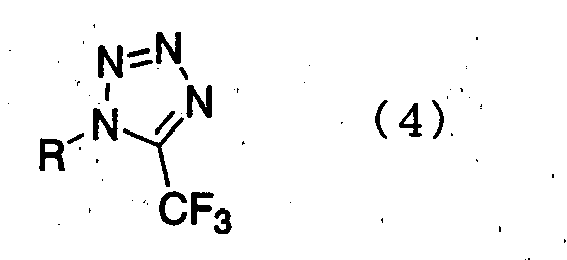
the process comprising the step of reacting in an aromatic hydrocarbon solvent, in the presence of an amine salt, an N-aryl-2,2,2-trifluoroacetimidoyl chloride represented by Formula (2):
M(N3)n (3)
wherein M is an alkali metal or alkaline-earth metal, and n is 1 or 2. - The process according to claim 4, wherein R is a phenyl, methylphenyl, methoxyphenyl, fluorophenyl, chlorophenyl, bromophenyl, iodophenyl, or naphthyl group.
- The process according to claim 4, wherein the azide is sodium azide.
- The process according to claim 4, wherein the amine salt is triethylamine hydrochloride.
- The process according to claim 4, wherein the aromatic hydrocarbon solvent is at least one member selected from the group consisting of toluene and xylene.
Applications Claiming Priority (3)
| Application Number | Priority Date | Filing Date | Title |
|---|---|---|---|
| JP2003385936 | 2003-10-10 | ||
| JP2004136859 | 2004-04-03 | ||
| PCT/JP2004/014781 WO2005035484A1 (en) | 2003-10-10 | 2004-09-30 | Process for production of 1-aryl-5-(trifluoromethyl)-1h- tetrazoles |
Publications (2)
| Publication Number | Publication Date |
|---|---|
| EP1671945A1 true EP1671945A1 (en) | 2006-06-21 |
| EP1671945A4 EP1671945A4 (en) | 2007-08-22 |
Family
ID=34436995
Family Applications (1)
| Application Number | Title | Priority Date | Filing Date |
|---|---|---|---|
| EP04788473A Withdrawn EP1671945A4 (en) | 2003-10-10 | 2004-09-30 | Process for production of 1-aryl-5-(trifluoromethyl)-1h- tetrazoles |
Country Status (6)
| Country | Link |
|---|---|
| US (1) | US7282609B2 (en) |
| EP (1) | EP1671945A4 (en) |
| JP (2) | JP4887782B2 (en) |
| KR (2) | KR100780906B1 (en) |
| CA (1) | CA2539338C (en) |
| WO (1) | WO2005035484A1 (en) |
Families Citing this family (3)
| Publication number | Priority date | Publication date | Assignee | Title |
|---|---|---|---|---|
| ES2450124T3 (en) * | 2010-03-12 | 2014-03-24 | Bayer Intellectual Property Gmbh | Procedure for the preparation of 5-substituted alkyltetrazoles |
| WO2013049013A2 (en) * | 2011-09-26 | 2013-04-04 | Board Of Regents, University Of Texas System | Preparation of bromomethylated derivatives via protection with trihaloacetic anhydride |
| JP5900292B2 (en) * | 2012-11-06 | 2016-04-06 | コニカミノルタ株式会社 | Method for producing iminochloride derivative and method for producing phenylimidazole derivative |
Family Cites Families (8)
| Publication number | Priority date | Publication date | Assignee | Title |
|---|---|---|---|---|
| FR2443467A1 (en) | 1978-12-08 | 1980-07-04 | Roussel Uclaf | NOVEL 3-QUINOLEINE CARBOXYLIC ACID DERIVATIVES, PROCESS FOR THEIR PREPARATION AND THEIR APPLICATION AS MEDICAMENT |
| DE3634717A1 (en) | 1986-10-11 | 1988-04-14 | Dynamit Nobel Ag | METHOD FOR PRODUCING 5-METHYLTETRAZOLE |
| JPH04243855A (en) | 1991-01-24 | 1992-08-31 | Nissan Chem Ind Ltd | Fluorine-containing compound |
| GB9201715D0 (en) * | 1992-01-28 | 1992-03-11 | Ici Plc | Chemical process |
| JP3671266B2 (en) | 1996-03-21 | 2005-07-13 | 東洋化成工業株式会社 | Process for producing 5-substituted tetrazoles |
| JP4464505B2 (en) | 1999-12-14 | 2010-05-19 | 日本精化株式会社 | Method for producing imidoyl chlorides |
| JP2002284770A (en) | 2001-03-23 | 2002-10-03 | Council Scient Ind Res | Method for synthesizing 5- (2-fluorophenyl) -1H-tetrazole |
| JP2003321431A (en) * | 2002-05-08 | 2003-11-11 | Fuji Photo Film Co Ltd | Method for producing imidoyl halides |
-
2004
- 2004-09-30 CA CA002539338A patent/CA2539338C/en not_active Expired - Fee Related
- 2004-09-30 KR KR1020067006822A patent/KR100780906B1/en not_active Expired - Fee Related
- 2004-09-30 KR KR1020077015862A patent/KR100794282B1/en not_active Expired - Fee Related
- 2004-09-30 WO PCT/JP2004/014781 patent/WO2005035484A1/en not_active Ceased
- 2004-09-30 JP JP2005514587A patent/JP4887782B2/en not_active Expired - Fee Related
- 2004-09-30 US US10/573,034 patent/US7282609B2/en not_active Expired - Fee Related
- 2004-09-30 EP EP04788473A patent/EP1671945A4/en not_active Withdrawn
-
2011
- 2011-04-25 JP JP2011096738A patent/JP2011173907A/en not_active Withdrawn
Non-Patent Citations (3)
| Title |
|---|
| See also references of WO2005035484A1 * |
| SHCHEGEL'SKII, V. F. ET AL: "synthesis and anticholinesterase activity of fluorine-containing arylimino phosphonates and phosphinates" PHARMACEUTICAL CHEMISTRY JOURNAL , 30(11), 690-692, 1996, XP008080757 * |
| XIAO, J. ET AL: "Synthesis of (trifluoromethyl)tetrazoles via a building block strategy" JOURNAL OF FLUORINE CHEMISTRY , 99(1), 83-85 CODEN: JFLCAR; ISSN: 0022-1139, 1999, XP002441133 * |
Also Published As
| Publication number | Publication date |
|---|---|
| US20070106080A1 (en) | 2007-05-10 |
| KR100780906B1 (en) | 2007-11-30 |
| EP1671945A4 (en) | 2007-08-22 |
| JP2011173907A (en) | 2011-09-08 |
| US7282609B2 (en) | 2007-10-16 |
| KR20060102551A (en) | 2006-09-27 |
| KR20070087029A (en) | 2007-08-27 |
| JP4887782B2 (en) | 2012-02-29 |
| KR100794282B1 (en) | 2008-01-11 |
| JPWO2005035484A1 (en) | 2006-12-21 |
| WO2005035484A1 (en) | 2005-04-21 |
| CA2539338A1 (en) | 2005-04-21 |
| CA2539338C (en) | 2008-11-25 |
Similar Documents
| Publication | Publication Date | Title |
|---|---|---|
| CN113039175B (en) | Preparation method of arylsulfonyl acrylonitrile | |
| US7282609B2 (en) | Process for production of 1-aryl-5-(trifluoromethyl)-1H-tetrazoles | |
| EP2112136B1 (en) | Bis(2-alkoxyethyl) azodicarboxylate ester compound and intermediate for production of the same | |
| JP2003335735A (en) | Method for producing perfluoroisopropylaniline | |
| JP7663218B2 (en) | Method for producing α-(mercaptomethyl)acrylic acid ester | |
| CN100424069C (en) | Preparation method of N-aryl-2, 2, 2-trifluoro acetimidoyl chloride | |
| JP4323032B2 (en) | Process for producing 3-nitro-2- (Nt-butoxycarbonyl) aminobenzoates and production intermediates thereof | |
| CN1946708B (en) | Synthesising method and benzoxathiepine intermediates | |
| WO2001081299A1 (en) | Process for producing bishalophenyl disulfide | |
| JP2003238500A (en) | Method for producing fluorine-containing tertiary amine compound and fluorine-containing quaternary ammonium salt | |
| JP3887757B2 (en) | Method for producing cyanobenzenesulfonyl chloride | |
| JP4271924B2 (en) | Method for producing 4-mercaptophenols | |
| JP3261454B2 (en) | Method for producing ketene imine compound | |
| JP3309202B2 (en) | Method for producing nitrobenzenesulfonyl halides | |
| JP4853911B2 (en) | Method for producing isothiazolopyridin-3-one compound | |
| JP5205875B2 (en) | Method for producing 2- (4-vinylarylsulfanyl) tetrahydropyran compound and aromatic hydrocarbon solution thereof | |
| EP1777216A1 (en) | A process for the preparation and purification of bicalutamide | |
| JPH10114729A (en) | Production of aminophenol | |
| JP2006143600A (en) | Method for producing phosphazene derivative containing chlorine atom | |
| JP2006232757A (en) | Method for producing phenoxyethyl halide and its derivative | |
| JP2008503452A (en) | Method for producing nitriles by elimination of water from aldehyde oximes with alkylphosphonic anhydrides | |
| WO2016056448A1 (en) | Protecting-group introducing agent for hydroxy group and/or mercapto group | |
| JP2004315444A (en) | METHOD FOR PRODUCING alpha,alpha-DIFLUOROACETIC ACID ESTERS | |
| JPH1036337A (en) | Method for producing aryl vinyl sulfone and intermediate thereof | |
| JP2002220370A (en) | Method for producing sulfenamide compound |
Legal Events
| Date | Code | Title | Description |
|---|---|---|---|
| PUAI | Public reference made under article 153(3) epc to a published international application that has entered the european phase |
Free format text: ORIGINAL CODE: 0009012 |
|
| 17P | Request for examination filed |
Effective date: 20060316 |
|
| AK | Designated contracting states |
Kind code of ref document: A1 Designated state(s): AT BE BG CH CY CZ DE DK EE ES FI FR GB GR HU IE IT LI LU MC NL PL PT RO SE SI SK TR |
|
| RIN1 | Information on inventor provided before grant (corrected) |
Inventor name: SATO, YASUHIRO,TOYO KASEI KOGYO COMPANY LIMITED Inventor name: KOGURO, KIYOTO,TOYO KASEI KOGYO COMPANY LIMITED Inventor name: MITSUI, SUNAO,TOYO KASEI KOGYO COMPANY LIMITED Inventor name: HAGIYA, KAZUTAKE,TOYO KASEI KOGYO COMPANY LIMITED |
|
| DAX | Request for extension of the european patent (deleted) | ||
| A4 | Supplementary search report drawn up and despatched |
Effective date: 20070719 |
|
| 17Q | First examination report despatched |
Effective date: 20100611 |
|
| RAP1 | Party data changed (applicant data changed or rights of an application transferred) |
Owner name: TOYO BOSEKI KABUSHIKI KAISHA |
|
| RAP1 | Party data changed (applicant data changed or rights of an application transferred) |
Owner name: TOYOBO CO., LTD. |
|
| STAA | Information on the status of an ep patent application or granted ep patent |
Free format text: STATUS: THE APPLICATION IS DEEMED TO BE WITHDRAWN |
|
| 18D | Application deemed to be withdrawn |
Effective date: 20130403 |