EP1671812A2 - Wheel bearing assembly mount with force attenuation - Google Patents
Wheel bearing assembly mount with force attenuation Download PDFInfo
- Publication number
- EP1671812A2 EP1671812A2 EP05077748A EP05077748A EP1671812A2 EP 1671812 A2 EP1671812 A2 EP 1671812A2 EP 05077748 A EP05077748 A EP 05077748A EP 05077748 A EP05077748 A EP 05077748A EP 1671812 A2 EP1671812 A2 EP 1671812A2
- Authority
- EP
- European Patent Office
- Prior art keywords
- flange
- support member
- vehicle
- sleeve
- mounting
- Prior art date
- Legal status (The legal status is an assumption and is not a legal conclusion. Google has not performed a legal analysis and makes no representation as to the accuracy of the status listed.)
- Withdrawn
Links
- 230000008878 coupling Effects 0.000 claims abstract description 5
- 238000010168 coupling process Methods 0.000 claims abstract description 5
- 238000005859 coupling reaction Methods 0.000 claims abstract description 5
- 230000004044 response Effects 0.000 abstract description 4
- 238000000034 method Methods 0.000 description 5
- 238000005096 rolling process Methods 0.000 description 5
- 230000008859 change Effects 0.000 description 2
- 238000003754 machining Methods 0.000 description 2
- 239000000463 material Substances 0.000 description 2
- 230000036316 preload Effects 0.000 description 2
- 230000008569 process Effects 0.000 description 2
- 230000000717 retained effect Effects 0.000 description 2
- 229910000677 High-carbon steel Inorganic materials 0.000 description 1
- 229910000831 Steel Inorganic materials 0.000 description 1
- 230000000712 assembly Effects 0.000 description 1
- 238000000429 assembly Methods 0.000 description 1
- 230000003247 decreasing effect Effects 0.000 description 1
- 238000005242 forging Methods 0.000 description 1
- 238000007373 indentation Methods 0.000 description 1
- 230000007246 mechanism Effects 0.000 description 1
- 238000012986 modification Methods 0.000 description 1
- 230000004048 modification Effects 0.000 description 1
- 230000035939 shock Effects 0.000 description 1
- 239000007787 solid Substances 0.000 description 1
- 239000010959 steel Substances 0.000 description 1
- 239000000725 suspension Substances 0.000 description 1
Images


Classifications
-
- F—MECHANICAL ENGINEERING; LIGHTING; HEATING; WEAPONS; BLASTING
- F16—ENGINEERING ELEMENTS AND UNITS; GENERAL MEASURES FOR PRODUCING AND MAINTAINING EFFECTIVE FUNCTIONING OF MACHINES OR INSTALLATIONS; THERMAL INSULATION IN GENERAL
- F16C—SHAFTS; FLEXIBLE SHAFTS; ELEMENTS OR CRANKSHAFT MECHANISMS; ROTARY BODIES OTHER THAN GEARING ELEMENTS; BEARINGS
- F16C35/00—Rigid support of bearing units; Housings, e.g. caps, covers
- F16C35/04—Rigid support of bearing units; Housings, e.g. caps, covers in the case of ball or roller bearings
- F16C35/06—Mounting or dismounting of ball or roller bearings; Fixing them onto shaft or in housing
- F16C35/067—Fixing them in a housing
-
- B—PERFORMING OPERATIONS; TRANSPORTING
- B60—VEHICLES IN GENERAL
- B60B—VEHICLE WHEELS; CASTORS; AXLES FOR WHEELS OR CASTORS; INCREASING WHEEL ADHESION
- B60B27/00—Hubs
-
- F—MECHANICAL ENGINEERING; LIGHTING; HEATING; WEAPONS; BLASTING
- F16—ENGINEERING ELEMENTS AND UNITS; GENERAL MEASURES FOR PRODUCING AND MAINTAINING EFFECTIVE FUNCTIONING OF MACHINES OR INSTALLATIONS; THERMAL INSULATION IN GENERAL
- F16C—SHAFTS; FLEXIBLE SHAFTS; ELEMENTS OR CRANKSHAFT MECHANISMS; ROTARY BODIES OTHER THAN GEARING ELEMENTS; BEARINGS
- F16C19/00—Bearings with rolling contact, for exclusively rotary movement
- F16C19/02—Bearings with rolling contact, for exclusively rotary movement with bearing balls essentially of the same size in one or more circular rows
- F16C19/14—Bearings with rolling contact, for exclusively rotary movement with bearing balls essentially of the same size in one or more circular rows for both radial and axial load
- F16C19/18—Bearings with rolling contact, for exclusively rotary movement with bearing balls essentially of the same size in one or more circular rows for both radial and axial load with two or more rows of balls
- F16C19/181—Bearings with rolling contact, for exclusively rotary movement with bearing balls essentially of the same size in one or more circular rows for both radial and axial load with two or more rows of balls with angular contact
- F16C19/183—Bearings with rolling contact, for exclusively rotary movement with bearing balls essentially of the same size in one or more circular rows for both radial and axial load with two or more rows of balls with angular contact with two rows at opposite angles
- F16C19/184—Bearings with rolling contact, for exclusively rotary movement with bearing balls essentially of the same size in one or more circular rows for both radial and axial load with two or more rows of balls with angular contact with two rows at opposite angles in O-arrangement
- F16C19/186—Bearings with rolling contact, for exclusively rotary movement with bearing balls essentially of the same size in one or more circular rows for both radial and axial load with two or more rows of balls with angular contact with two rows at opposite angles in O-arrangement with three raceways provided integrally on parts other than race rings, e.g. third generation hubs
-
- F—MECHANICAL ENGINEERING; LIGHTING; HEATING; WEAPONS; BLASTING
- F16—ENGINEERING ELEMENTS AND UNITS; GENERAL MEASURES FOR PRODUCING AND MAINTAINING EFFECTIVE FUNCTIONING OF MACHINES OR INSTALLATIONS; THERMAL INSULATION IN GENERAL
- F16C—SHAFTS; FLEXIBLE SHAFTS; ELEMENTS OR CRANKSHAFT MECHANISMS; ROTARY BODIES OTHER THAN GEARING ELEMENTS; BEARINGS
- F16C27/00—Elastic or yielding bearings or bearing supports, for exclusively rotary movement
- F16C27/04—Ball or roller bearings, e.g. with resilient rolling bodies
-
- F—MECHANICAL ENGINEERING; LIGHTING; HEATING; WEAPONS; BLASTING
- F16—ENGINEERING ELEMENTS AND UNITS; GENERAL MEASURES FOR PRODUCING AND MAINTAINING EFFECTIVE FUNCTIONING OF MACHINES OR INSTALLATIONS; THERMAL INSULATION IN GENERAL
- F16C—SHAFTS; FLEXIBLE SHAFTS; ELEMENTS OR CRANKSHAFT MECHANISMS; ROTARY BODIES OTHER THAN GEARING ELEMENTS; BEARINGS
- F16C2326/00—Articles relating to transporting
- F16C2326/01—Parts of vehicles in general
- F16C2326/02—Wheel hubs or castors
Definitions
- This invention relates to wheel bearing assemblies for supporting a wheel and, more particularly, to an apparatus and method for attenuating impact forces transmitted to ball bearings in a wheel bearing assembly.
- a wheel bearing assembly is used between a spindle and either a support member or a wheel hub (depending on the particular assembly configuration) for permitting relative rotation between the spindle and the support member or wheel hub.
- the vehicle wheel bearing assembly has become much more susceptible to damage resulting from side impact forces between the vehicle wheels and objects such as curbs. These side impact forces act in a direction generally parallel to the axis of the spindle and are transmitted to the bearing rolling elements (such as balls or rollers) and thence to the bearing raceways in which the rolling elements travel.
- the present invention provides a support member for a wheel bearing assembly.
- the support member has a central sleeve for securing bearing members therein, and a mounting flange extending from the central sleeve for securing the bearing assembly to a portion of a vehicle.
- the flange has a concave central portion coupled to the sleeve.
- the flange tapers down from the central portion into three, substantially equally angularly spaced-apart lobes projecting outwardly from the central portion.
- the junction between the central sleeve and the central portion of the flange has a radius formed therealong to help relieve any stress concentrations at the junction during flexing of the flange.
- One or more substantially flat, coplanar bearing surfaces are also formed along each of the lobes.
- the bearing surfaces abut the vehicle and are designed to rest flush against the vehicle when the support member is secured to the vehicle, providing a relatively limited contact area between the mounting flange and the vehicle.
- a chamfer may be formed at an end portion of each of the lobes to further reduce the contact area between the flange and the vehicle. Due to the generally concave shape of the portion of the mounting flange residing radially inwardly of the bearing surfaces, the central portion of the flange is spaced apart from the vehicle, and the bearing surfaces are the only portions of the flange in contact with the vehicle when the support member is secured to the vehicle.
- the central portion of the flange may be configured to act as a spring member. This enables the flange central portion to flex in response to a side impact load experienced by a wheel assembly attached to the vehicle via the wheel bearing assembly. This flexibility enables the flange to absorb a portion of the side impact load, thereby dampening or attenuating the portion of the load transmitted to the bearings.
- a wheel bearing assembly 10 is shown in FIG. 1 for supporting a wheel (not shown) in a wheel assembly 11.
- a spindle 12 defines a rotational axis A, and a support member 14 supports the spindle 12.
- Support member 14 may be secured to a portion 100 of the vehicle by fasteners or the like.
- a wheel hub 16 has a flange 17 for securing the wheel thereto and is supported on spindle 12 adjacent support member 14.
- wheel hub 16 is integrally formed with spindle 12.
- Wheel hub 16 and spindle 12 are rotatable about rotational axis A.
- a drive mechanism (not shown) is coupled to spindle 12 for rotationally driving the wheel.
- Bearing assembly 10 is arranged to permit wheel hub 16 and spindle 12 to rotate relative to support member 14, with support member 14 rotatably supporting spindle 12.
- spindle 12 is "rotatably supported” by support member 14 when the spindle is supported so as to permit rotation of the spindle.
- Wheel bearing assembly 10 has first 20 and second 22 bearing members in spaced relation with one another and a plurality of bearings 24, such as ball bearings, retained by a cage 25. Any of a variety of other types of rollable bearing elements (for example, needle roller bearings) may also be used. Bearings 24 are interposed between first 20 and second 22 bearing members to permit relative rotation between the bearing members 20, 22 about rotational axis A. First bearing member 20 is adjacent spindle 12 and second bearing member 22 is adjacent either the wheel hub or the support member, depending on the particular configuration of the wheel assembly 11. In the embodiment shown in FIG. 1, second bearing member 22 is integrally formed with support member 14. Bearing assembly 10 further includes a bearing seal 27 interposed between spindle 12 and support member 14 adjacent bearings 24 to prevent debris from contaminating bearings 24. It is preferred that the diameters of first 20 and second 22 bearing members not change significantly during the assembly process so that bearing seal 27 will fit properly.
- Wheel bearing assembly 10 also has third 52 and fourth 54 bearing members in spaced relation with one another and a plurality of bearings 51, such as ball bearings, retained by a cage 53. Bearings 51 are interposed between third 52 and fourth 54 bearing members to permit relative rotation between the bearing members 52, 54 about rotational axis A.
- third bearing member 52 is integrally formed with spindle 12
- fourth bearing member 54 is integrally formed with support member 14.
- a bearing seal 55 is interposed between spindle 12 and support member 14 adjacent to bearings 51 to prevent debris from contaminating bearings 51. It is preferred that the diameters of third 52 and fourth 54 bearing members not change significantly during the assembly process so that bearing seal 55 will fit properly.
- support member 14 rotatably couples spindle 12 to a portion 100 of a vehicle body.
- spindle 12 is "rotatably coupled" to vehicle portion 100 when the spindle is coupled to the vehicle so as to permit rotation of the spindle with respect to vehicle portion 100.
- Support member 14 includes an annular central sleeve 50 incorporating and/or securing bearing members 20, 22, 52, 54 therein to rotatably support spindle 12 therein.
- a mounting flange 56 extends from sleeve 50, for securing bearing assembly 10 to portion 100 of the vehicle.
- Flange 56 is secured to the vehicle along a mounting face 58 (FIGS. 3-5) of the flange.
- Flange 56 has a concave central portion 60 along which the flange is coupled to sleeve 50.
- flange 56 includes a plurality of equally angularly spaced-apart lobes 64 extending outwardly from central portion 60.
- three lobes are formed spaced apart approximately 120°; however, additional lobes may be formed, depending on the vehicle attachment requirements of a particular application.
- all of the lobes formed need not be equally angularly spaced-apart. Also, as seen in FIG.
- width dimensions lobes 64 taper from a relatively larger width dimension proximate sleeve 50 to a relatively smaller width dimension spaced radially outwardly from the sleeve.
- the lobed configuration reduces the amount of material used in forming the flange.
- a flange without separate lobes may be used.
- the junction between central sleeve 50 and flange central portion 60 has a radius 61 to help relieve any stress concentrations at the junction during flexing of mounting flange 56 with respect to central sleeve 50.
- Flange 56 is substantially concave between lobes 64 (i.e., flange central portion 60 bows inward relative to lobes 64, in a direction indicated by arrow B (FIG.1), generally away from the vehicle.
- one or more through-holes 66 are formed in each of lobes 64 for fasteners used in attaching support member 14 to the vehicle.
- one or more substantially flat bearing surfaces 68a, 68b are formed along each of lobes 64. Bearing surfaces 68a, 68b abut portion 100 of the vehicle and are designed to rest flush against the portion of the vehicle when support member 14 is attached to the vehicle, providing a relatively limited contact area between mounting flange 56 and the vehicle.
- two bearing surfaces 68a and 68b are radially spaced apart to straddle opposite sides of through-hole 66.
- bearing surfaces 68a, 68b are secured to a single, substantially flat surface on the vehicle.
- bearing surfaces 68a, 68b are formed (for example, by machining) so as to be substantially coplanar to help ensure sufficient abutting contact with vehicle portion 100.
- a chamfer 70 may be formed at an end portion of each of lobes 64 to further reduce the contact area between flange 56 and the vehicle.
- mounting flange 56 due to the concave portion of mounting flange 56, a large portion of mounting face 58 is spaced apart from the vehicle. Thus, rather than the entire mounting face 58 being in contact with the vehicle, bearing surfaces 68a, 68b are the only portions of flange 56 in contact with the vehicle when support member 14 is secured to the vehicle. This substantially reduces the contact area between mounting flange 56 and the vehicle, thereby localizing and reducing any impact forces transferred to bearing members 20, 22, 52, 54 through support member 14.
- mounting flange 56 is shaped to permit deflection of the flange in response to side impact loads applied to wheel assembly 11.
- Attachment of bearing members 20, 22, 52, 54 to the vehicle via lobes 64 and the generally concave shape of mounting face 58 radially inwardly of bearing surfaces 68a enable the flange to flex, in the direction indicated by arrow C (FIG.1), in response to a side impact load experienced by wheel assembly 11 and transmitted to bearing members 20, 22, 52, 54.
- This flexibility enables flange 56 to absorb a portion of the side impact load, thereby dampening or attenuating the portion of the load transmitted to the bearings.
- Support member 14 may be fabricated from steel (for example, a high-carbon steel forging) with conventional machining operations used to form bearing surfaces 68a, 68b having the coplanarity required for a given application.
- Wheel bearing assembly 10 is configured to be self-retaining to wheel assembly 11, and may be secured to the spindle using any one of a variety of known methods. Some exemplary methods of retaining bearing assembly 10 to wheel assembly 11 are described in U.S. Patent Nos. 6,574,865, 6,485,187, and 6,622,377, incorporated herein by reference.
- a thickness dimension t of mounting flange 156 may be varied to generally improve the force-deflection characteristics of the flange.
- the thickness t of the mounting flange may be decreased along a direction proceeding from sleeve 50 toward bearing surfaces 68a, effectively providing a taper to flange 56. This configuration helps minimize the weight of flange 56 while optimizing the force-deflection characteristics of the portion of the flange residing radially inwardly of bearing surfaces 68a.
- the thickness of the flange may also be varied as described in instances where a solid (non-lobed) flange configuration is used.
- bearing surfaces 368b, 368b' define a first mounting plane P1 and bearing surfaces 368a, 368a' define a second mounting plane P2 parallel to first mounting plane P1.
- First mounting plane P1 is spaced apart from the second mounting plane P2 in the direction of concavity of the flange. That is, bearing surfaces 368a, 368a' on lobes 364, 364' are slightly recessed a distance d (in the direction of arrow B (FIG.
- the direction of concavity of the flange is defined as the direction in which the concave flange "opens".
- bearing surfaces 368a, 368a' contact the vehicle only when the fasteners have been sufficiently tightened, which causes the portions of the flange residing between bearing surfaces 368a and 368b and the portions of the flange residing between 368a' and 368b' to deflect during tightening of the fasteners, thereby imparting a pre-load to flange 356 (i.e., flange 356 is pre-stressed during attachment to the vehicle).
- This flange pre-load increases the clamping force, or attachment force, with which the flange is secured to the vehicle.
- lobes 264-1 and 264-2 are attached to separate, non-coplanar portions of the vehicle.
- Lobe 264-1 is secured to a surface of the vehicle along a mounting plane P3
- lobe 264-2 is secured to a surface of the vehicle along a mounting plane P4, which is not coplanar with mounting plane P3.
- the local geometries of mounting flange 256 in the regions of lobes 264-1 and 264-2, the coplanarity of bearing surfaces 268-1a, 268-1b, and the coplanarity of bearing surfaces 268-2a, 268-2b along each of the lobes are adjusted so that the bearing surfaces on each lobe may be secured flush with their respective portions of the vehicle.
- the system described herein for rotatably coupling elements is not restricted to the coupling of a wheel spindle to the body of a vehicle. Rather, the system may be utilized in any application in which it is desirable to dampen or attenuate the impact, shock, or vibration forces transmitted to rotating bearing elements.
Landscapes
- Engineering & Computer Science (AREA)
- General Engineering & Computer Science (AREA)
- Mechanical Engineering (AREA)
- Rolling Contact Bearings (AREA)
Abstract
A support member (14) for rotatably coupling a first element to a second element. The support member includes a sleeve (50) for rotatably supporting the first element, and a flange (56) having a concave central portion. The flange (56) is coupled to the sleeve (50). The flange (56) has bearing surfaces (68a, 68b) formed thereon along which the flange (56) is mounted to the second element. In one embodiment, the first element is a spindle (12) of a vehicle wheel assembly (11) and is rotatably supported in the sleeve (50) by rollable bearing elements positioned therein. Multiple tapered lobes (64) extend outwardly from the sleeve (50), and the support member (14) is mounted to a vehicle via bearing surfaces (68a, 68b) along the lobes (64). Due to the concave portion of the flange (56), the bearing surfaces (68a, 68b) are the only portions of the flange (56) in contact with the vehicle when the support member (14) is secured to the vehicle, reducing the contact area between the flange (56) and the vehicle, and reducing impact forces transferred to the bearings. A portion of the flange (56) may act as a spring member, enabling the flange (56) to flex in response to an impact load experienced by the wheel bearing assembly (11). This enables the flange (56) to absorb a portion of the side impact load, thereby attenuating the portion of the load transmitted to the bearings. A wheel bearing assembly (10) incorporating the support member (14) is also disclosed.
Description
- This invention relates to wheel bearing assemblies for supporting a wheel and, more particularly, to an apparatus and method for attenuating impact forces transmitted to ball bearings in a wheel bearing assembly.
- A wheel bearing assembly is used between a spindle and either a support member or a wheel hub (depending on the particular assembly configuration) for permitting relative rotation between the spindle and the support member or wheel hub. As larger diameter wheels, lower profile tires, and more rigid vehicle suspension components are employed in newer vehicle platforms, the vehicle wheel bearing assembly has become much more susceptible to damage resulting from side impact forces between the vehicle wheels and objects such as curbs. These side impact forces act in a direction generally parallel to the axis of the spindle and are transmitted to the bearing rolling elements (such as balls or rollers) and thence to the bearing raceways in which the rolling elements travel. Where the transferred forces create stresses that exceed the elastic limit of the raceway material, the rolling elements may produce permanent surface indentations in the raceways (a phenomenon known as "Brinelling".) This can lead to undesirable noise and vibration in the bearing during use. To help prevent Brinelling, previous designs have focused on increasing the diameter or relative size of the rolling elements of the bearing. However, this approach increases the mass, weight and cost of the bearing components and can render the bearing design inefficient in terms of vehicle straight-running and cornering capabilities.
- For the reasons outlined above, it is desirable to dampen or otherwise reduce the impact forces transmitted to the bearing rolling elements.
- The present invention provides a support member for a wheel bearing assembly. The support member has a central sleeve for securing bearing members therein, and a mounting flange extending from the central sleeve for securing the bearing assembly to a portion of a vehicle. The flange has a concave central portion coupled to the sleeve. The flange tapers down from the central portion into three, substantially equally angularly spaced-apart lobes projecting outwardly from the central portion. The junction between the central sleeve and the central portion of the flange has a radius formed therealong to help relieve any stress concentrations at the junction during flexing of the flange. One or more substantially flat, coplanar bearing surfaces are also formed along each of the lobes. The bearing surfaces abut the vehicle and are designed to rest flush against the vehicle when the support member is secured to the vehicle, providing a relatively limited contact area between the mounting flange and the vehicle. A chamfer may be formed at an end portion of each of the lobes to further reduce the contact area between the flange and the vehicle. Due to the generally concave shape of the portion of the mounting flange residing radially inwardly of the bearing surfaces, the central portion of the flange is spaced apart from the vehicle, and the bearing surfaces are the only portions of the flange in contact with the vehicle when the support member is secured to the vehicle. This substantially reduces the contact area between the mounting flange and the vehicle, thereby reducing and localizing any impact forces transferred to the bearing members. In addition, the central portion of the flange may be configured to act as a spring member. This enables the flange central portion to flex in response to a side impact load experienced by a wheel assembly attached to the vehicle via the wheel bearing assembly. This flexibility enables the flange to absorb a portion of the side impact load, thereby dampening or attenuating the portion of the load transmitted to the bearings.
- In the drawings illustrating embodiments of the present invention:
- FIG. 1 is a cross-sectional side view of a wheel assembly secured to a wheel bearing assembly in accordance with the present invention;
- FIG. 2 is a perspective view of a wheel assembly secured to the wheel bearing assembly of FIG. 1;
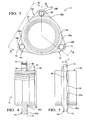
- FIG. 3 is a plan view of a first embodiment of a support member incorporated into a wheel bearing assembly of the present invention;
- FIG. 4 is a cross-sectional view of the first embodiment of the support member taken along line 4-4 of FIG. 3;
- FIG. 5 is a side view of the support member of FIG. 3 taken along line 5-5 of FIG. 3;
- FIG. 6 is a cross-sectional view of another alternative embodiment of the support member of the present invention; and
- FIG. 7 is a cross-sectional view of yet another alternative embodiment of the support member of the present invention.
- A
wheel bearing assembly 10 is shown in FIG. 1 for supporting a wheel (not shown) in awheel assembly 11. Aspindle 12 defines a rotational axis A, and asupport member 14 supports thespindle 12.Support member 14 may be secured to aportion 100 of the vehicle by fasteners or the like. Awheel hub 16 has aflange 17 for securing the wheel thereto and is supported onspindle 12adjacent support member 14. In the embodiment shown in FIG. 1,wheel hub 16 is integrally formed withspindle 12.Wheel hub 16 andspindle 12 are rotatable about rotational axis A. A drive mechanism (not shown) is coupled tospindle 12 for rotationally driving the wheel.Bearing assembly 10 is arranged to permitwheel hub 16 andspindle 12 to rotate relative to supportmember 14, withsupport member 14 rotatably supportingspindle 12. For purposes of the present invention,spindle 12 is "rotatably supported" bysupport member 14 when the spindle is supported so as to permit rotation of the spindle. -
Wheel bearing assembly 10 has first 20 and second 22 bearing members in spaced relation with one another and a plurality ofbearings 24, such as ball bearings, retained by acage 25. Any of a variety of other types of rollable bearing elements (for example, needle roller bearings) may also be used.Bearings 24 are interposed between first 20 and second 22 bearing members to permit relative rotation between thebearing members member 20 isadjacent spindle 12 and second bearingmember 22 is adjacent either the wheel hub or the support member, depending on the particular configuration of thewheel assembly 11. In the embodiment shown in FIG. 1, second bearingmember 22 is integrally formed withsupport member 14.Bearing assembly 10 further includes abearing seal 27 interposed betweenspindle 12 andsupport member 14adjacent bearings 24 to prevent debris from contaminatingbearings 24. It is preferred that the diameters of first 20 and second 22 bearing members not change significantly during the assembly process so that bearingseal 27 will fit properly. -
Wheel bearing assembly 10 also has third 52 and fourth 54 bearing members in spaced relation with one another and a plurality ofbearings 51, such as ball bearings, retained by acage 53.Bearings 51 are interposed between third 52 and fourth 54 bearing members to permit relative rotation between the bearingmembers member 52 is integrally formed withspindle 12 and fourth bearingmember 54 is integrally formed withsupport member 14. Abearing seal 55 is interposed betweenspindle 12 andsupport member 14 adjacent tobearings 51 to prevent debris from contaminatingbearings 51. It is preferred that the diameters of third 52 and fourth 54 bearing members not change significantly during the assembly process so that bearingseal 55 will fit properly. - Referring to FIGS. 1-5, support
member 14 rotatablycouples spindle 12 to aportion 100 of a vehicle body. For purposes of the present invention,spindle 12 is "rotatably coupled" tovehicle portion 100 when the spindle is coupled to the vehicle so as to permit rotation of the spindle with respect tovehicle portion 100.Support member 14 includes an annularcentral sleeve 50 incorporating and/or securing bearingmembers spindle 12 therein. Amounting flange 56 extends fromsleeve 50, for securingbearing assembly 10 toportion 100 of the vehicle.Flange 56 is secured to the vehicle along a mounting face 58 (FIGS. 3-5) of the flange.Flange 56 has a concavecentral portion 60 along which the flange is coupled to sleeve 50. In the embodiment shown in FIGS. 1-5,flange 56 includes a plurality of equally angularly spaced-apart lobes 64 extending outwardly fromcentral portion 60. In the embodiment shown, three lobes are formed spaced apart approximately 120°; however, additional lobes may be formed, depending on the vehicle attachment requirements of a particular application. In addition, all of the lobes formed need not be equally angularly spaced-apart. Also, as seen in FIG. 2,width dimensions lobes 64 taper from a relatively larger width dimensionproximate sleeve 50 to a relatively smaller width dimension spaced radially outwardly from the sleeve. The lobed configuration reduces the amount of material used in forming the flange. Alternatively, a flange without separate lobes may be used. The junction betweencentral sleeve 50 and flangecentral portion 60 has aradius 61 to help relieve any stress concentrations at the junction during flexing of mountingflange 56 with respect tocentral sleeve 50.Flange 56 is substantially concave between lobes 64 (i.e., flangecentral portion 60 bows inward relative tolobes 64, in a direction indicated by arrow B (FIG.1), generally away from the vehicle. - Referring to FIGS. 3 and 4, one or more through-
holes 66 are formed in each oflobes 64 for fasteners used in attachingsupport member 14 to the vehicle. In addition, one or more substantiallyflat bearing surfaces lobes 64.Bearing surfaces 68b abut portion 100 of the vehicle and are designed to rest flush against the portion of the vehicle whensupport member 14 is attached to the vehicle, providing a relatively limited contact area between mountingflange 56 and the vehicle. On eachlobe 64 of the embodiment shown, two bearingsurfaces hole 66. Also, in the embodiment shown, bearingsurfaces surfaces vehicle portion 100. Achamfer 70 may be formed at an end portion of each oflobes 64 to further reduce the contact area betweenflange 56 and the vehicle. - Referring again to FIGS. 1-5, due to the concave portion of mounting
flange 56, a large portion of mountingface 58 is spaced apart from the vehicle. Thus, rather than the entire mountingface 58 being in contact with the vehicle, bearingsurfaces flange 56 in contact with the vehicle whensupport member 14 is secured to the vehicle. This substantially reduces the contact area between mountingflange 56 and the vehicle, thereby localizing and reducing any impact forces transferred to bearingmembers support member 14. In addition, mountingflange 56 is shaped to permit deflection of the flange in response to side impact loads applied towheel assembly 11. Attachment of bearingmembers lobes 64 and the generally concave shape of mountingface 58 radially inwardly of bearingsurfaces 68a enable the flange to flex, in the direction indicated by arrow C (FIG.1), in response to a side impact load experienced bywheel assembly 11 and transmitted to bearingmembers flange 56 to absorb a portion of the side impact load, thereby dampening or attenuating the portion of the load transmitted to the bearings. -
Support member 14 may be fabricated from steel (for example, a high-carbon steel forging) with conventional machining operations used to form bearingsurfaces -
Wheel bearing assembly 10 is configured to be self-retaining towheel assembly 11, and may be secured to the spindle using any one of a variety of known methods. Some exemplary methods ofretaining bearing assembly 10 towheel assembly 11 are described in U.S. Patent Nos. 6,574,865, 6,485,187, and 6,622,377, incorporated herein by reference. - Referring to FIGS. 3 and 5, a thickness dimension t of mounting flange 156 may be varied to generally improve the force-deflection characteristics of the flange. The thickness t of the mounting flange may be decreased along a direction proceeding from
sleeve 50 toward bearingsurfaces 68a, effectively providing a taper to flange 56. This configuration helps minimize the weight offlange 56 while optimizing the force-deflection characteristics of the portion of the flange residing radially inwardly of bearingsurfaces 68a. The thickness of the flange may also be varied as described in instances where a solid (non-lobed) flange configuration is used. - In FIG. 6, like numerals are used to identify features similar to those identified in FIGS. 3 and 4. Referring to FIG. 6, in an alternative embodiment, bearing
surfaces surfaces surfaces lobes 364, 364' are slightly recessed a distance d (in the direction of arrow B (FIG. 1)) with respect to a corresponding bearing surfaces 368b, 368b' on the lobes such that, during application of fasteners to secureflange 356 to the vehicle, bearingsurfaces surfaces surfaces surfaces flange 356 is pre-stressed during attachment to the vehicle). This flange pre-load increases the clamping force, or attachment force, with which the flange is secured to the vehicle. - In yet another alternative embodiment, shown in FIG. 7, lobes 264-1 and 264-2 are attached to separate, non-coplanar portions of the vehicle. Lobe 264-1 is secured to a surface of the vehicle along a mounting plane P3, while lobe 264-2 is secured to a surface of the vehicle along a mounting plane P4, which is not coplanar with mounting plane P3. In this case, the local geometries of mounting
flange 256 in the regions of lobes 264-1 and 264-2, the coplanarity of bearing surfaces 268-1a, 268-1b, and the coplanarity of bearing surfaces 268-2a, 268-2b along each of the lobes are adjusted so that the bearing surfaces on each lobe may be secured flush with their respective portions of the vehicle. - The system described herein for rotatably coupling elements is not restricted to the coupling of a wheel spindle to the body of a vehicle. Rather, the system may be utilized in any application in which it is desirable to dampen or attenuate the impact, shock, or vibration forces transmitted to rotating bearing elements.
- It will be understood that the foregoing description of the present invention is for illustrative purposes only, and that the various structural and operational features herein disclosed are susceptible to a number of modifications, none of which departs from the spirit and scope of the present invention. The preceding description, therefore, is not meant to limit the scope of the invention. Rather, the scope of the invention is to be determined only by the appended claims and their equivalents.
Claims (8)
- A support member (14) for rotatably coupling a first element to a second element, the support member comprising:a sleeve (50) for rotatably supporting at least a portion of the first element therein; anda flange (56) including a concave portion (60) coupled to the sleeve (50), and a mounting portion (58) extending from the concave portion (60) for mounting the support member (14) to the second element.
- The support member (14) of claim 1 wherein the at least a portion of the first element is rotatably supported in the sleeve (50) by a plurality of rollable bearing elements (24) positioned therealong.
- The support member (14) of claim 1 wherein the mounting portion (58) includes a plurality of spaced-apart lobes (64), each lobe (64) including at least one bearing surface (68b) formed thereon for mounting the lobe (64) to the second element therealong.
- The support member (214) of claim 3 wherein the mounting portion includes a first lobe (264-1) and a second lobe (264-2), the at least one bearing surface (268-1b) formed on the first lobe defines a first mounting plane (P3), and the at least one bearing surface (268-b2) formed on the second lobe (264-2) defines a second mounting plane (P4) parallel to and spaced apart from the first mounting plane (P3).
- The support member (14) of claim 3 wherein a width dimension of at least one of the lobes (64) tapers from a relatively larger width dimension proximate the sleeve (50) to a relatively smaller width dimension spaced radially outwardly from the sleeve (50).
- The support member (14) of claim 1 wherein the flange (56) includes a first bearing surface (368b) and a second bearing surface (368a) positioned intermediate the first bearing surface (368b) and the sleeve (50), the first bearing surface (368b) defining a first mounting plane (P1), the second mounting surface (368a) defining a second mounting plane (P2) parallel to the first mounting plane (P1), and wherein the first mounting plane (P1) is spaced apart from the second mounting plane (P2) in the direction of concavity of the flange (56).
- The support member (14) of claim 1 wherein a thickness dimension (t) of the flange tapers from a relatively larger thickness dimension proximate the sleeve (50) to a relatively smaller thickness dimension spaced radially outwardly from the sleeve (50).
- A wheel bearing assembly (10) for a vehicle wheel comprising:a spindle (12);
a support member (14) for receiving a portion of the spindle (12) therein; and
a plurality of bearings (20, 22, 52, 54) interposed between the spindle (12) and the support member (14) for rotatably coupling the spindle (12) to the support member (14), the support member including a concave portion (60) anda mounting portion extending from the concave portion (60) for mounting the support member (14) to a vehicle.
Applications Claiming Priority (2)
| Application Number | Priority Date | Filing Date | Title |
|---|---|---|---|
| US63754604P | 2004-12-20 | 2004-12-20 | |
| US11/271,606 US7470067B2 (en) | 2004-12-20 | 2005-11-10 | Wheel bearing assembly mount with force attenuation |
Publications (1)
| Publication Number | Publication Date |
|---|---|
| EP1671812A2 true EP1671812A2 (en) | 2006-06-21 |
Family
ID=36001111
Family Applications (1)
| Application Number | Title | Priority Date | Filing Date |
|---|---|---|---|
| EP05077748A Withdrawn EP1671812A2 (en) | 2004-12-20 | 2005-12-01 | Wheel bearing assembly mount with force attenuation |
Country Status (2)
| Country | Link |
|---|---|
| US (1) | US7470067B2 (en) |
| EP (1) | EP1671812A2 (en) |
Cited By (3)
| Publication number | Priority date | Publication date | Assignee | Title |
|---|---|---|---|---|
| DE102008061112A1 (en) * | 2008-12-09 | 2010-06-10 | Bosch Mahle Turbo Systems Gmbh & Co. Kg | Exhaust gas turbocharger for supercharging internal-combustion engine of motor vehicle, has angular contact bearings subjected to axial pre-stress such that bearings are fixed at position relative to each other |
| US10174786B2 (en) * | 2014-12-10 | 2019-01-08 | Ntn Corporation | Wheel bearing apparatus and its mounting structure |
| WO2024199564A1 (en) * | 2023-03-28 | 2024-10-03 | Schaeffler Technologies AG & Co. KG | Wheel bearing unit and outer ring element |
Families Citing this family (9)
| Publication number | Priority date | Publication date | Assignee | Title |
|---|---|---|---|---|
| EP1647418B1 (en) * | 2004-10-13 | 2012-06-27 | Nsk Ltd. | Hub unit with wheel support and bearing ring, and method of manufacturing the hub unit |
| JP5242957B2 (en) * | 2007-07-09 | 2013-07-24 | Ntn株式会社 | Wheel bearing device |
| JP2010151311A (en) * | 2008-11-28 | 2010-07-08 | Jtekt Corp | Rolling bearing device for wheel |
| DE102009009128A1 (en) * | 2009-02-17 | 2010-08-19 | Bosch Mahle Turbo Systems Gmbh & Co. Kg | Bearing device for shaft of charging device, particularly exhaust gas turbocharger of internal combustion engine, has two angular contact ball bearings, which have one or multiple inner rings, and one or multiple outer rings |
| KR101734232B1 (en) * | 2016-07-08 | 2017-05-24 | 현대자동차 주식회사 | Tool device for exchanging sensor cap |
| JP1574957S (en) * | 2016-11-24 | 2017-08-07 | ||
| JP1577824S (en) * | 2016-11-24 | 2020-06-01 | ||
| JP1601194S (en) * | 2017-10-12 | 2018-04-09 | ||
| US10767700B2 (en) * | 2017-11-14 | 2020-09-08 | Aktiebolaget Skf | Flanged inner ring for wheel hub bearings |
Citations (2)
| Publication number | Priority date | Publication date | Assignee | Title |
|---|---|---|---|---|
| US6485187B1 (en) | 2000-10-24 | 2002-11-26 | Delphi Technologies, Inc. | Self-retained wheel bearing assembly |
| US6622377B1 (en) | 2000-10-24 | 2003-09-23 | Delphi Technologies, Inc. | Wheel bearing with separable inner race processing feature |
Family Cites Families (16)
| Publication number | Priority date | Publication date | Assignee | Title |
|---|---|---|---|---|
| US2812987A (en) * | 1956-10-17 | 1957-11-12 | Scott & Fetzer Co | Bearing mounting structures |
| US3372962A (en) * | 1966-02-21 | 1968-03-12 | Gen Precision Systems Inc | Spindle apparatus useful with rotating memory discs |
| US3360998A (en) * | 1966-03-10 | 1968-01-02 | Gen Motors Corp | Flexible chain sprocket support |
| NL164807C (en) * | 1970-02-05 | 1981-02-16 | Skf Svenska Kullagerfab Ab | VEHICLE WITH DRIVEN AND NON-DRIVEN WHEELS, EQUIPPED WITH THE SAME BEARING UNIT. |
| US4027931A (en) | 1975-10-03 | 1977-06-07 | Carrier Corporation | Flexible damped bearing support |
| CH673052A5 (en) | 1987-01-30 | 1990-01-31 | Bbc Brown Boveri & Cie | |
| EP0544986B1 (en) * | 1991-12-04 | 1996-03-13 | Firma Carl Freudenberg | Bearing |
| US5364194A (en) | 1993-01-04 | 1994-11-15 | Ampex Systems Corporation | Axially displaced flexural bearing support |
| DE19630293A1 (en) | 1996-07-26 | 1998-01-29 | Schaeffler Waelzlager Kg | Preloaded radial roller bearing |
| US5931585A (en) * | 1997-05-21 | 1999-08-03 | Amana Company, L.P. | Bearing mounting structure with reduced dimensional requirements |
| SE517176C2 (en) | 1997-06-11 | 2002-04-23 | Alfa Laval Ab | Support device for a centrifugal separator |
| ES2171337B1 (en) * | 1998-11-13 | 2003-06-16 | Fagor S Coop | EXPRESSED POT WITH LOCK OF THE CLOSURE OF THE COVER. |
| US6376952B1 (en) | 1999-07-14 | 2002-04-23 | E. I. Du Pont De Nemours And Company | Bearing system for a rotating shaft |
| US6517246B2 (en) | 2000-12-29 | 2003-02-11 | Spx Corporation | Flexible support and method for a steady bearing |
| JP4911333B2 (en) * | 2001-07-18 | 2012-04-04 | 株式会社ジェイテクト | Wheel mounting structure in a wheel bearing device |
| US7832939B2 (en) * | 2001-09-04 | 2010-11-16 | Ntn Corporation | Bearing apparatus for a wheel |
-
2005
- 2005-11-10 US US11/271,606 patent/US7470067B2/en active Active
- 2005-12-01 EP EP05077748A patent/EP1671812A2/en not_active Withdrawn
Patent Citations (3)
| Publication number | Priority date | Publication date | Assignee | Title |
|---|---|---|---|---|
| US6485187B1 (en) | 2000-10-24 | 2002-11-26 | Delphi Technologies, Inc. | Self-retained wheel bearing assembly |
| US6574865B2 (en) | 2000-10-24 | 2003-06-10 | Delphi Technologies, Inc. | Self-retained wheel bearing assembly |
| US6622377B1 (en) | 2000-10-24 | 2003-09-23 | Delphi Technologies, Inc. | Wheel bearing with separable inner race processing feature |
Cited By (3)
| Publication number | Priority date | Publication date | Assignee | Title |
|---|---|---|---|---|
| DE102008061112A1 (en) * | 2008-12-09 | 2010-06-10 | Bosch Mahle Turbo Systems Gmbh & Co. Kg | Exhaust gas turbocharger for supercharging internal-combustion engine of motor vehicle, has angular contact bearings subjected to axial pre-stress such that bearings are fixed at position relative to each other |
| US10174786B2 (en) * | 2014-12-10 | 2019-01-08 | Ntn Corporation | Wheel bearing apparatus and its mounting structure |
| WO2024199564A1 (en) * | 2023-03-28 | 2024-10-03 | Schaeffler Technologies AG & Co. KG | Wheel bearing unit and outer ring element |
Also Published As
| Publication number | Publication date |
|---|---|
| US7470067B2 (en) | 2008-12-30 |
| US20060133708A1 (en) | 2006-06-22 |
Similar Documents
| Publication | Publication Date | Title |
|---|---|---|
| EP0849481B1 (en) | Expandable bearing retainer | |
| CN100408877C (en) | Wheel bearing units with angular contact ball bearings | |
| US7470067B2 (en) | Wheel bearing assembly mount with force attenuation | |
| EP2602123B1 (en) | An integrated hub-bearing assembly for the wheel of a motor vehicle | |
| US9759254B2 (en) | Wheel bearing apparatus | |
| TWI833786B (en) | Rollers and wheels for mobile vehicles equipped with the same | |
| JPH07167138A (en) | Double row angular contact ball bearings for wheels | |
| JP2003097588A (en) | Car drive wheel hub unit | |
| CN115003925B (en) | Motor vehicle wheel assembly | |
| KR20070113189A (en) | Wheel hub joint unit | |
| US6883236B2 (en) | Vehicle-use bearing apparatus | |
| JP5401997B2 (en) | Hub unit for driving wheel support | |
| KR102543652B1 (en) | wheel bearing assembly | |
| JP3887349B2 (en) | Wheel support hub unit | |
| CN120712421A (en) | Wheel bearing device | |
| KR102667606B1 (en) | Wheel bearing assembly | |
| JP2002195254A (en) | Hub bearing unit | |
| CN101410258A (en) | Asymmetric hub assembly | |
| JP2004306681A (en) | Rolling bearing unit for wheel support | |
| US11453238B2 (en) | Wheel bearing assembly | |
| JP4436386B2 (en) | Wheel bearing and wheel bearing device including the same | |
| JPH11148516A (en) | Double row rolling bearing | |
| CA2711804C (en) | Asymmetric hub assembly | |
| JP2022154869A (en) | wheel support device | |
| KR102769371B1 (en) | Wheel bearing provided with improved wheel mounting flange structure |
Legal Events
| Date | Code | Title | Description |
|---|---|---|---|
| PUAI | Public reference made under article 153(3) epc to a published international application that has entered the european phase |
Free format text: ORIGINAL CODE: 0009012 |
|
| AK | Designated contracting states |
Kind code of ref document: A2 Designated state(s): AT BE BG CH CY CZ DE DK EE ES FI FR GB GR HU IE IS IT LI LT LU LV MC NL PL PT RO SE SI SK TR |
|
| AX | Request for extension of the european patent |
Extension state: AL BA HR MK YU |
|
| STAA | Information on the status of an ep patent application or granted ep patent |
Free format text: STATUS: THE APPLICATION IS DEEMED TO BE WITHDRAWN |
|
| 18D | Application deemed to be withdrawn |
Effective date: 20090701 |