EP1671555A1 - Work glove - Google Patents
Work glove Download PDFInfo
- Publication number
- EP1671555A1 EP1671555A1 EP05257755A EP05257755A EP1671555A1 EP 1671555 A1 EP1671555 A1 EP 1671555A1 EP 05257755 A EP05257755 A EP 05257755A EP 05257755 A EP05257755 A EP 05257755A EP 1671555 A1 EP1671555 A1 EP 1671555A1
- Authority
- EP
- European Patent Office
- Prior art keywords
- foam
- foam layer
- rubber
- work glove
- glove
- Prior art date
- Legal status (The legal status is an assumption and is not a legal conclusion. Google has not performed a legal analysis and makes no representation as to the accuracy of the status listed.)
- Granted
Links
Images
Classifications
-
- A—HUMAN NECESSITIES
- A41—WEARING APPAREL
- A41D—OUTERWEAR; PROTECTIVE GARMENTS; ACCESSORIES
- A41D19/00—Gloves
- A41D19/015—Protective gloves
- A41D19/01547—Protective gloves with grip improving means
- A41D19/01558—Protective gloves with grip improving means using a layer of grip improving material
-
- A—HUMAN NECESSITIES
- A41—WEARING APPAREL
- A41D—OUTERWEAR; PROTECTIVE GARMENTS; ACCESSORIES
- A41D19/00—Gloves
- A41D19/0055—Plastic or rubber gloves
-
- A—HUMAN NECESSITIES
- A41—WEARING APPAREL
- A41D—OUTERWEAR; PROTECTIVE GARMENTS; ACCESSORIES
- A41D19/00—Gloves
- A41D19/015—Protective gloves
Definitions
- the present invention relates to a work glove used in applications requiring gripping properties.
- gloves produced by coating a knitted base glove made of natural fiber such as cotton or chemical fiber such as acryl and polyester with synthetic rubber, natural rubber or thermoplastic resin such as polyvinyl chloride have been widely used as work gloves.
- Some of these gloves have non-slip properties as a porous foam layer having an air content of about 10 to 65% is formed (e.g., Japanese Patent Laid-Open No. 63-243310).
- foam latex to a base glove using a squeezee followed by hot curing to rubberize the same, or to apply liquid impermeable coating between the base glove and the resin layer (e.g., Japanese Patent Laid-Open No. 2002-201515).
- thermoplastic resin or rubber contains foam, the film strength and the abrasion strength are reduced although non-slip properties are improved.
- the present invention has been made in view of the above problem and aims at providing a work glove having excellent non-slip properties, film strength and abrasion resistance.
- a work glove comprising a glove base material made of fiber and a foam layer composed of a thermoplastic resin or a rubber provided thereon, characterized in that the foam layer has irregularities formed by heat press on the surface.
- a liquid impermeable coating layer composed of a thermoplastic resin or a rubber may be provided between the glove base material and the foam layer.
- the glove base material made of fiber used is a sewn, knitted or non-woven fabric glove made of natural or chemical fiber such as cotton, wool, polyester, nylon, aramid or reinforced polyethylene.
- the rubber used is natural rubber, homopolymers or copolymers such as isoprene, chloroprene, acrylic ester, styrene-butadiene copolymers, acrylonitrile-butadiene copolymers, polyurethane, butyl rubber, polybutadiene rubber and silicone rubber, or those blended with latex of a copolymer containing 10% by weight or less of carboxyl-modified group.
- the thermoplastic resin used refers to a homopolymer or a copolymer of vinyl chloride or vinyl acetate.
- a foaming agent or a foam stabilizer is added to the rubber.
- a foaming agent sodium alkyl sulfate, sodium alkyl ether sulfate, sodium dialkyl sulfosuccinate, N-lauroylamidopropyl dimethylbetaine, alkylamidopropyl dimethylamine oxide, N-alkylmonoamide disodium sulfosuccinate, potassium oleate, castor oil potassium, sodium dodecylbenzenesulfonate, or the like may be used.
- polyoxyethylene alkylamino ether sodium polyacrylate, ammonium stearate, peptide, ⁇ -alanine, sodium alkyldipropionate, or the like may be used.
- alkyl means lauryl, octyl or stearyl. There may be no clear distinction between the foaming agent and the foam stabilizer.
- thermoplastic resin may be added a chemical foaming agent such as toluene sulfonyl hydrazide, PP'oxybis(benzosulfonyl hydrazide), azodicarbonamide and azobisisobutylonitrile, thermally expandable microspheres called microcapsules containing low boiling point hydrocarbon, or a silicone foam stabilizer, in addition to a known plasticizer, stabilizer, thickener, or the like. Thereto may also be added particles such as acrylic particles, urethane particles, natural rubber powder, EVA powder, PVC particles or NBR particles. These chemical foaming agents and particles such as microcapsules may also be added to the rubber.
- a chemical foaming agent such as toluene sulfonyl hydrazide, PP'oxybis(benzosulfonyl hydrazide), azodicarbonamide and azobisisobutylonitrile
- thermally expandable microspheres called microcapsules containing low boiling
- heat press means pressing the intended portions during heat curing when forming a foam layer of thermoplastic resin or rubber.
- a pressure of 1 to 100 kgf/cm 2 is applied at about 60 to 300°C from the surface side using a metal or synthetic resin frame.
- heat setting means merely heating to solidify the material, which may results in drying, semi-crosslinking, gelatinization, or heat curing.
- a glove base material made of fiber is put on a hand-shaped frame and at least the palm side is coated with the foamed compound, and after the compound is semi-crosslinked and gelatinized, physical projections and recesses are formed on the foam layer to be formed by lightly pressing the desired part of the surface during heat curing.
- This induces collapse and thermal fusion of foam, while traces of foam which exhibit non-slip properties are left on the surface, and thus can increase film strength and abrasion resistance.
- the foam content can be optionally adjusted from 1% to 300% by stirring the compound using a foaming machine or a home use mixer.
- the foam content can be measured from specific gravity and it remains almost the same even after molding.
- foaming is also mechanically induced not by using a chemical foaming agent alone, the number of foam is increased and many traces of foam (openings) are formed on the surface of the foam layer, and collapse and fusion of foam are more likely to occur upon heat press.
- a glove has many traces of foam on the surface, water or oil present between the glove and the target is taken into the foam traces and removed, and thus the glove has better non-slip properties.
- the glove When the foam content is 1 % to 300%, the glove contains 10 to 130 pieces of foam having an average diameter of 10 ⁇ m to 400 ⁇ m per 1 cm 2 in the inside and on the surface. It is extremely difficult to produce foam having a diameter of less than 10 ⁇ m by mechanical foaming, and when the diameter is greater than 400 ⁇ m, the abrasion resistance becomes insufficient.
- a patterned plate may be used as a frame upon heat press to produce irregularities on the surface.
- only part of the foam layer e.g., part corresponding to finger tips of the glove, may be compressed using a flat plate.
- collapse and thermal fusion of foam can be induced by slightly pressing the surface of the foam layer by the projected portion of the plate, while many traces of foam can be left on the surface by slightly pressing the surface of the foam layer by the recessed portion, or preferably not pressing at all.
- the irregularities on the foam layer surface may be adjusted by the depth of the patterned plate. The thermal fusion may be confirmed by a microscope.
- liquid impermeable coating layer When disposing a liquid impermeable coating layer, a compound of the above-described thermoplastic resin or rubber is used after defoaming by stirring. Specifically, prior to formation of the foam layer, a glove base material put on a hand-shaped frame is coated with the defoamed compound by dipping or coating and the coated layer is dried or heat cured.
- “liquid impermeable” refers to the state which does not allow permeation of water in Water leak test according to EUROPEAN STANDARD EN 374. EUROPEAN STANDARD is available at Japanese Standards Association.
- a compound of Formulation 1 described below was foamed by stirring using a household electronic hand-mixer so that the foam content was adjusted to 100%.
- the foam content was confirmed by measurement of specific gravity.
- Knitted nylon base gloves were put on a hand-shaped dipping frame, dipped in a calcium nitrate solution, and only the palm side thereof was dipped in the foamed compound. The gloves were then heat set at 75°C for 10 minutes and removed from the frame. It was confirmed that the foam layer formed on the surface of each base glove had a thickness of 0.4 mm and a foam content equal to that of the foamed compound.
- Two gloves provided with the foam layer were each put on a flat frame. Only some regions of the palm and the finger tips of one glove were pressed by a flat plate, while almost the entire area of the palm side of the other glove was pressed at 1 kgf/cm 2 by a patterned plate on which recessed portions of 2 mm x 3 mm x 0.5 mm (depth) were formed at a density of 10 recesses/cm 2 , and heat set was performed in that state at 120°C for 20 minutes to create irregularities on the surface of the foam layer.
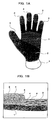
- FIG. 1A shows the appearance of the palm side of the glove pressed by a flat plate and FIG. 1B shows a cross-section of the glove.
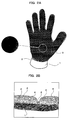
- FIG. 2A shows the appearance of the palm side of the glove pressed by a patterned plate and FIG. 2B shows a cross-section of the glove.
- reference numeral 1 denotes a base glove
- reference numeral 2 denotes a foam layer
- reference numeral 3 denotes a pressed portion in the foam layer 2
- reference numeral 4 denotes foam or a trace of foam (opening).
- the gloves prepared in the following other Examples have a similar appearance and cross-section.
- NBR latex*1 100 parts colloidal sulfur*2 2.0 parts zinc oxide*3 1.0 part vulcanization accelerator (zinc dibutyldithiocarbamate)*4 0.5 part antioxidant (2,2'-methylenebis(4-ethyl-6-tert-butylphenol)*5 0.5 part pigment*6 0.3 part thickener (polyacrylic acid ester)*7 0.2 part foaming agent (sodium sulfosuccinate)*8 3.0 parts foam stabilizer (sodium lauryldipropionate)*9 3.0 parts *1 Lx550 available from ZEON Corporation; *2 available from Hosoi Kagaku Co., Ltd.; *3 zinc oxide No.
- Gloves were prepared in the same manner as in Example 1 using a compound of the following Formulation 3, except that a knitted cotton base glove was put on a hand-shaped frame, dipped in a calcium nitrate solution and the foamed compound, heat set at 190°C for 5 minutes and then removed from the mold, then put on a flat frame and heat set at 190°C for 5 minutes with pressing.
- Gloves were prepared using a compound of the following Formulation 4 and a compound of the above-described Formulation 1.
- a knitted nylon base glove was put on a hand-shaped dipping frame and dipped in a calcium nitrate solution, and only the palm side thereof was dipped in the compound of Formulation 4.
- the glove was then heat set at 75°C for 10 minutes, dipped in the compound of Formulation 1, heat set at 75°C for 10 minutes and then removed from the frame to prepare gloves having a non-foamed layer and a foam layer stacked on the surface of the base glove.
- NBR latex*1 100 parts colloidal sulfur*2 2.0 parts zinc oxide*3 1.0 part vulcanization accelerator (zinc dibutyldithiocarbamate)*4 0.5 part antioxidant (2,2'-methylenebis(4-ethyl-6-tert-butylphenol)*5 0.5 part pigment * 6 0.3 part thickener (polyacrylic ester)*7 0.2 part * 1 to *7 are the same as those in Formulation 1.
- Gloves were prepared in the same manner as in Example 1 except that the foam layer was not heat pressed, i.e., heat set was performed without pressing.
- the gloves in Examples 1 to 4 and Comparative Examples 1 to 4 were subjected to the following property tests and evaluated.
- the evaluation results are shown in Table 1.
- the foam layer (0.4 mm in thickness) on the surface of the glove is compressed to a thickness of 0.16 mm and a foam content of 40% under the above-described heat press condition. This was confirmed by separately pressing a foam layer having an area larger than that of the glove surface by a flat plate.
- a test piece was cut out from the palm part of the glove and polished according to the Abrasion resistance test described in EUROPEAN STANDARD EN388, and the number of polish at which the base glove was exposed was counted. The greater the number, the higher the abrasion resistance. The types of the polishing agent do not make any difference.
- gloves prepared in Examples 1, Example 2, Example 3 and Example 4 have a foam layer heat pressed by a flat plate or a patterned plate. Further, in Examples 1 and 2, the foam layers are made of rubber, in Example 3, the foam layer is made of a thermoplastic resin, and in Example 4, the foam layer and the non-foamed layer are made of rubber. As is evident from Table 1, these gloves have improved abrasion resistance which is about 2 to 6 times higher than that of the gloves of the corresponding Comparative Example 1, Comparative Example 2, Comparative Example 3 and Comparative Example 4, proving that they also have sufficient non-slip properties.
- gloves having a liquid impermeable- coating layer between a base glove and a foam layer were prepared as follows.
- the foam content of the compound of Formulation 1 was adjusted to 100% in the same manner as in Example 1.
- Another compound of Formulation 1 was adjusted to a temperature of about 25°C to 30°C and defoamed by stirring at 100 rpm or lower for 12 hours.
- Knitted nylon base gloves were put on a hand-shaped dipping frame and dipped in a calcium nitrate solution, and only the palm side thereof was dipped in the defoamed compound.
- the gloves were then heat set at 75°C for 10 minutes, dipped in the foamed compound, heat set at 75°C for 10 minutes and then removed from the frame to prepare gloves having a liquid impermeable coating layer (non-foamed layer) and a foam layer stacked on the surface of the base glove.
- the obtained two gloves were each put on a flat frame and heat pressed to create irregularities on the surface of the foam layer as in Example 1.
- gloves having a liquid impermeable coating layer between a base glove and a foam layer were prepared in the same manner as in Example 5.
- gloves having a liquid impermeable coating layer between a base glove and a foam layer were prepared in the same manner as in Example 5, except that knitted cotton base gloves were used and the compound of Formulation 3 defoamed by stirring in vacuo by a Henschel mixer for about 10 minutes was applied to the base gloves put on a hand-shaped frame and heat set was performed at 190°C for 5 minutes to prepare the liquid impermeable coating layer.
- the coated layers of the gloves of Examples 4 to 7 were subjected to Water leak test according to EUROPEAN STANDARD EN374, and as a result, it was confirmed that the films were impermeable to water.
- the coated layers of the gloves of Examples 1 to 7 were subjected to a moisture permeability test (JIS L 1099A-1), and as a result, the gloves of Examples 1 to 3 which have no liquid impermeable coating layer showed a value of 1000 to 10000 g/m 2 ⁇ 24 hrs. While the portion pressed by a flat plate showed a value of 1000 g/m 2 ⁇ 24 hrs, no humidity was felt in each glove as a whole, suggesting that good results were obtained.
- JIS L 1099A-1 moisture permeability test
Landscapes
- Engineering & Computer Science (AREA)
- Textile Engineering (AREA)
- Gloves (AREA)
- Laminated Bodies (AREA)
Abstract
Description
- The present invention relates to a work glove used in applications requiring gripping properties.
- Conventionally, gloves produced by coating a knitted base glove made of natural fiber such as cotton or chemical fiber such as acryl and polyester with synthetic rubber, natural rubber or thermoplastic resin such as polyvinyl chloride have been widely used as work gloves. Some of these gloves have non-slip properties as a porous foam layer having an air content of about 10 to 65% is formed (e.g., Japanese Patent Laid-Open No. 63-243310). It is also proposed to apply foam latex to a base glove using a squeezee followed by hot curing to rubberize the same, or to apply liquid impermeable coating between the base glove and the resin layer (e.g., Japanese Patent Laid-Open No. 2002-201515). Generally, however, when thermoplastic resin or rubber contains foam, the film strength and the abrasion strength are reduced although non-slip properties are improved.
- The present invention has been made in view of the above problem and aims at providing a work glove having excellent non-slip properties, film strength and abrasion resistance.
- According to the present invention there is provided a work glove comprising a glove base material made of fiber and a foam layer composed of a thermoplastic resin or a rubber provided thereon, characterized in that the foam layer has irregularities formed by heat press on the surface.
- Preferably, a liquid impermeable coating layer composed of a thermoplastic resin or a rubber may be provided between the glove base material and the foam layer.
- Preferably, the glove base material made of fiber used is a sewn, knitted or non-woven fabric glove made of natural or chemical fiber such as cotton, wool, polyester, nylon, aramid or reinforced polyethylene.
- Preferably, the rubber used is natural rubber, homopolymers or copolymers such as isoprene, chloroprene, acrylic ester, styrene-butadiene copolymers, acrylonitrile-butadiene copolymers, polyurethane, butyl rubber, polybutadiene rubber and silicone rubber, or those blended with latex of a copolymer containing 10% by weight or less of carboxyl-modified group. Preferably the thermoplastic resin used refers to a homopolymer or a copolymer of vinyl chloride or vinyl acetate.
- In addition to a known cross-linking agent, vulcanization accelerator, antioxidant, thickener, or the like, a foaming agent or a foam stabilizer is added to the rubber. As a foaming agent, sodium alkyl sulfate, sodium alkyl ether sulfate, sodium dialkyl sulfosuccinate, N-lauroylamidopropyl dimethylbetaine, alkylamidopropyl dimethylamine oxide, N-alkylmonoamide disodium sulfosuccinate, potassium oleate, castor oil potassium, sodium dodecylbenzenesulfonate, or the like may be used. As a foam stabilizer, polyoxyethylene alkylamino ether, sodium polyacrylate, ammonium stearate, peptide, β-alanine, sodium alkyldipropionate, or the like may be used. Herein, alkyl means lauryl, octyl or stearyl. There may be no clear distinction between the foaming agent and the foam stabilizer.
- To the thermoplastic resin may be added a chemical foaming agent such as toluene sulfonyl hydrazide, PP'oxybis(benzosulfonyl hydrazide), azodicarbonamide and azobisisobutylonitrile, thermally expandable microspheres called microcapsules containing low boiling point hydrocarbon, or a silicone foam stabilizer, in addition to a known plasticizer, stabilizer, thickener, or the like. Thereto may also be added particles such as acrylic particles, urethane particles, natural rubber powder, EVA powder, PVC particles or NBR particles. These chemical foaming agents and particles such as microcapsules may also be added to the rubber.
- Preferably, heat press means pressing the intended portions during heat curing when forming a foam layer of thermoplastic resin or rubber. Specifically, with a foamed compound of thermoplastic resin or rubber being semi-crosslinked and gelatinized by slight heat setting, a pressure of 1 to 100 kgf/cm2 is applied at about 60 to 300°C from the surface side using a metal or synthetic resin frame. Herein, heat setting means merely heating to solidify the material, which may results in drying, semi-crosslinking, gelatinization, or heat curing. More specifically, a glove base material made of fiber is put on a hand-shaped frame and at least the palm side is coated with the foamed compound, and after the compound is semi-crosslinked and gelatinized, physical projections and recesses are formed on the foam layer to be formed by lightly pressing the desired part of the surface during heat curing. This induces collapse and thermal fusion of foam, while traces of foam which exhibit non-slip properties are left on the surface, and thus can increase film strength and abrasion resistance. It is preferable to press the desired portion so that the foam content of the pressed portion is 10% to 90% by volume of the foam content of the unpressed portion. In view of the abrasion resistance, it is preferable to perform pressing so that the thickness of the pressed portion is 50% of that of the unpressed portion.
- The foam content can be optionally adjusted from 1% to 300% by stirring the compound using a foaming machine or a home use mixer. The foam content can be measured from specific gravity and it remains almost the same even after molding. When foaming is also mechanically induced not by using a chemical foaming agent alone, the number of foam is increased and many traces of foam (openings) are formed on the surface of the foam layer, and collapse and fusion of foam are more likely to occur upon heat press. When a glove has many traces of foam on the surface, water or oil present between the glove and the target is taken into the foam traces and removed, and thus the glove has better non-slip properties. When the foam content is 1 % to 300%, the glove contains 10 to 130 pieces of foam having an average diameter of 10 µm to 400 µm per 1 cm2 in the inside and on the surface. It is extremely difficult to produce foam having a diameter of less than 10 µm by mechanical foaming, and when the diameter is greater than 400 µm, the abrasion resistance becomes insufficient.
- A patterned plate may be used as a frame upon heat press to produce irregularities on the surface. Alternatively, only part of the foam layer, e.g., part corresponding to finger tips of the glove, may be compressed using a flat plate. In the case of using a patterned plate, collapse and thermal fusion of foam can be induced by slightly pressing the surface of the foam layer by the projected portion of the plate, while many traces of foam can be left on the surface by slightly pressing the surface of the foam layer by the recessed portion, or preferably not pressing at all. The irregularities on the foam layer surface may be adjusted by the depth of the patterned plate. The thermal fusion may be confirmed by a microscope.
- When disposing a liquid impermeable coating layer, a compound of the above-described thermoplastic resin or rubber is used after defoaming by stirring. Specifically, prior to formation of the foam layer, a glove base material put on a hand-shaped frame is coated with the defoamed compound by dipping or coating and the coated layer is dried or heat cured. Preferably, "liquid impermeable" refers to the state which does not allow permeation of water in Water leak test according to EUROPEAN STANDARD EN 374. EUROPEAN STANDARD is available at Japanese Standards Association.
- Embodiments of the invention will now be described by way of example with reference to the accompanying drawings, where:
- FIG. 1A is a plan view illustrating an appearance of the palm side of a work glove of the present invention;
- FIG. 1B is a cross section of the glove;
- FIG. 2A is plan view illustrating an appearance of the palm side of another work glove of the present invention; and
- FIG. 2B is a cross section of the glove.
- The following examples are not intended to limit the scope of the present invention.
- A compound of Formulation 1 described below was foamed by stirring using a household electronic hand-mixer so that the foam content was adjusted to 100%. The foam content was confirmed by measurement of specific gravity.
- Knitted nylon base gloves were put on a hand-shaped dipping frame, dipped in a calcium nitrate solution, and only the palm side thereof was dipped in the foamed compound. The gloves were then heat set at 75°C for 10 minutes and removed from the frame. It was confirmed that the foam layer formed on the surface of each base glove had a thickness of 0.4 mm and a foam content equal to that of the foamed compound.
- Two gloves provided with the foam layer were each put on a flat frame. Only some regions of the palm and the finger tips of one glove were pressed by a flat plate, while almost the entire area of the palm side of the other glove was pressed at 1 kgf/cm2 by a patterned plate on which recessed portions of 2 mm x 3 mm x 0.5 mm (depth) were formed at a density of 10 recesses/cm2, and heat set was performed in that state at 120°C for 20 minutes to create irregularities on the surface of the foam layer.
- FIG. 1A shows the appearance of the palm side of the glove pressed by a flat plate and FIG. 1B shows a cross-section of the glove. FIG. 2A shows the appearance of the palm side of the glove pressed by a patterned plate and FIG. 2B shows a cross-section of the glove. In each figure, reference numeral 1 denotes a base glove,
reference numeral 2 denotes a foam layer,reference numeral 3 denotes a pressed portion in thefoam layer 2 andreference numeral 4 denotes foam or a trace of foam (opening). The gloves prepared in the following other Examples have a similar appearance and cross-section.Formulation 1 NBR latex*1 100 parts colloidal sulfur*2 2.0 parts zinc oxide*3 1.0 part vulcanization accelerator (zinc dibutyldithiocarbamate)*4 0.5 part antioxidant (2,2'-methylenebis(4-ethyl-6-tert-butylphenol)*5 0.5 part pigment*6 0.3 part thickener (polyacrylic acid ester)*7 0.2 part foaming agent (sodium sulfosuccinate)*8 3.0 parts foam stabilizer (sodium lauryldipropionate)*9 3.0 parts *1 Lx550 available from ZEON Corporation; *2 available from Hosoi Kagaku Co., Ltd.; *3 zinc oxide No. 2 available from Seido Chemical Industry Co., Ltd.; *4 BZ available from Ouchi Narishige Shoten Co., Ltd.; *5 BKF available from Bayer; *6 SABlue 12402 available from Mikuni Color Ltd.; *7 A-7070 available from Toa Gosei Co., Ltd.; *8 Pelex TA available from Kao Corporation; *9 Pionin C-158-D available from Takemoto Oil & Fat Co., Ltd.; "part(s)" of each component means "part(s) by mass". - Gloves were prepared in the same manner as in Example 1 using a compound of the following
Formulation 2.Formulation 2NR latex* 1 a 100 parts colloidal sulfur*2 1.0 part zinc oxide*3 0.5 part vulcanization accelerator (zinc dibutyldithiocarbamate)*4 0.2 part antioxidant (2,2'-methylenebis(4-ethyl-6-tert-butylphenol)*5 0.5 part pigment*6 0.3 part thickener (CMC)*7a 0.1 part foaming agent (sodium sulfosuccinate)*8 3.0 parts foam stabilizer (sodium lauryldipropionate)*9 3.0 parts *1a LATZ available from BURITPERAK Co., Ltd.; *7a Metolose 90SH30000 available from Shin-Etsu Chemical Co., Ltd.; *2 to *6,*8,*9 are the same as those in Formulation 1. - Gloves were prepared in the same manner as in Example 1 using a compound of the following
Formulation 3, except that a knitted cotton base glove was put on a hand-shaped frame, dipped in a calcium nitrate solution and the foamed compound, heat set at 190°C for 5 minutes and then removed from the mold, then put on a flat frame and heat set at 190°C for 5 minutes with pressing.Formulation 3vinyl chloride paste resin* 10 100 parts plasticizer (alkyl sulfonic acid phenyl ester)* 11 100 parts epoxidized soybean oil* 12 3 parts stabilizer (Ca-Ba-Zn)* 13 3 parts thickener (anhydrous SiO2)*14 0.2 part foam stabilizer* 15 20 parts *10 PSM-30 available from Kaneka Corporation (polymerization degree 1650); *11 Mesamoll available from Bayer; *12 W-100 EL available from DIC; *13 SWL-1 available from ASAHI DENKA Co., Ltd.; *14 REOLOSIL QS102 available from Tokuyama Corporation; *15 SH1250 available from Dow Coming Toray Co., Ltd. - Gloves were prepared using a compound of the following
Formulation 4 and a compound of the above-described Formulation 1. First, a knitted nylon base glove was put on a hand-shaped dipping frame and dipped in a calcium nitrate solution, and only the palm side thereof was dipped in the compound ofFormulation 4. The glove was then heat set at 75°C for 10 minutes, dipped in the compound of Formulation 1, heat set at 75°C for 10 minutes and then removed from the frame to prepare gloves having a non-foamed layer and a foam layer stacked on the surface of the base glove. - Two gloves were each put on a flat frame as in Example 1, and heat set was performed with one being pressed by a flat plate and the other being pressed by a patterned plate to create irregularities on the surface of the foam layer.
Formulation 4NBR latex*1 100 parts colloidal sulfur*2 2.0 parts zinc oxide*3 1.0 part vulcanization accelerator (zinc dibutyldithiocarbamate)*4 0.5 part antioxidant (2,2'-methylenebis(4-ethyl-6-tert-butylphenol)*5 0.5 part pigment*6 0.3 part thickener (polyacrylic ester)*7 0.2 part * 1 to *7 are the same as those in Formulation 1. - Gloves were prepared in the same manner as in Example 1 except that the foam layer was not heat pressed, i.e., heat set was performed without pressing.
- Gloves were prepared in the same manner as in Example 2 except that the foam layer was not heat pressed.
- Gloves were prepared in the same manner as in Example 3 except that the foam layer was not heat pressed.
- Gloves were prepared in the same manner as in Example 4 except that the foam layer was not heat pressed.
- The gloves in Examples 1 to 4 and Comparative Examples 1 to 4 were subjected to the following property tests and evaluated. The evaluation results are shown in Table 1. The foam layer (0.4 mm in thickness) on the surface of the glove is compressed to a thickness of 0.16 mm and a foam content of 40% under the above-described heat press condition. This was confirmed by separately pressing a foam layer having an area larger than that of the glove surface by a flat plate.
- A test piece was cut out from the palm part of the glove and polished according to the Abrasion resistance test described in EUROPEAN STANDARD EN388, and the number of polish at which the base glove was exposed was counted. The greater the number, the higher the abrasion resistance. The types of the polishing agent do not make any difference.
- The glove was worn and a metal bar coated with a fixed amount of cutting oil (Miyagawa 246) was gripped to examine the non-slip property. The property was evaluated based on the following four criteria. E: not slipped at all, G: not slippery, M: little slippery, P: slippery
Table 1 Press plate Abrasion resistance number (times) Non-slip property Ex. 1 flat plate 1100 G patterned plate 800 E Ex. 2 flat plate 600 G patterned plate 500 E Ex. 3 flat plate 1500 G patterned plate 1000 E Ex. 4 flat plate 1200 G patterned plate 700 E Com. Ex. 1 - 300 G Com. Ex. 2 - 150 G Com. Ex. 3 - 500 G Com. Ex. 4 - 200 G - As described above, gloves prepared in Examples 1, Example 2, Example 3 and Example 4 have a foam layer heat pressed by a flat plate or a patterned plate. Further, in Examples 1 and 2, the foam layers are made of rubber, in Example 3, the foam layer is made of a thermoplastic resin, and in Example 4, the foam layer and the non-foamed layer are made of rubber. As is evident from Table 1, these gloves have improved abrasion resistance which is about 2 to 6 times higher than that of the gloves of the corresponding Comparative Example 1, Comparative Example 2, Comparative Example 3 and Comparative Example 4, proving that they also have sufficient non-slip properties.
- Using a compound of the above-described Formulation 1, gloves having a liquid impermeable- coating layer between a base glove and a foam layer were prepared as follows.
- The foam content of the compound of Formulation 1 was adjusted to 100% in the same manner as in Example 1. Another compound of Formulation 1 was adjusted to a temperature of about 25°C to 30°C and defoamed by stirring at 100 rpm or lower for 12 hours.
- Knitted nylon base gloves were put on a hand-shaped dipping frame and dipped in a calcium nitrate solution, and only the palm side thereof was dipped in the defoamed compound. The gloves were then heat set at 75°C for 10 minutes, dipped in the foamed compound, heat set at 75°C for 10 minutes and then removed from the frame to prepare gloves having a liquid impermeable coating layer (non-foamed layer) and a foam layer stacked on the surface of the base glove.
- The obtained two gloves were each put on a flat frame and heat pressed to create irregularities on the surface of the foam layer as in Example 1.
- Using a compound of the above-described
Formulation 2, gloves having a liquid impermeable coating layer between a base glove and a foam layer were prepared in the same manner as in Example 5. - Using a compound of the above-described
Formulation 3, gloves having a liquid impermeable coating layer between a base glove and a foam layer were prepared in the same manner as in Example 5, except that knitted cotton base gloves were used and the compound ofFormulation 3 defoamed by stirring in vacuo by a Henschel mixer for about 10 minutes was applied to the base gloves put on a hand-shaped frame and heat set was performed at 190°C for 5 minutes to prepare the liquid impermeable coating layer. - The coated layers of the gloves of Examples 4 to 7 were subjected to Water leak test according to EUROPEAN STANDARD EN374, and as a result, it was confirmed that the films were impermeable to water.
- Further, the coated layers of the gloves of Examples 1 to 7 were subjected to a moisture permeability test (JIS L 1099A-1), and as a result, the gloves of Examples 1 to 3 which have no liquid impermeable coating layer showed a value of 1000 to 10000 g/m2·24 hrs. While the portion pressed by a flat plate showed a value of 1000 g/m2·24 hrs, no humidity was felt in each glove as a whole, suggesting that good results were obtained.
Claims (9)
- A work glove comprising a glove base material made of fiber and a foam layer composed of a thermoplastic resin or a rubber provided thereon, characterised in that the foam layer has irregularities formed by heat press on the surface.
- A work glove according to claim 1, wherein the thermoplastic resin is selected from any one or more of the following group: homopolymer, copolymer.
- A work glove according to claim 2, wherein the copolymer is selected from any one or more of the following group: copolymer of vinyl chloride, copolymer of vinyl acetate.
- A work glove according to any one of the preceding claims, wherein the rubber is selected from any one or more of the following group: natural rubber, homopolymers, copolymers.
- A work glove according to claim 4, wherein the copolymers are selected from any one or more of the following group: isoprene, chloroprene, acrylic ester, styrene-butadiene copolymers, acrylonitrile-butadiene copolymers, polyurethane, butyl rubber, polybutadiene rubber, silicone rubber.
- A work glove according to claim 4, wherein the copolymers are those blended with latex of a copolymer containing 10% by weight or less of carboxyl-modified group.
- A work glove according to any one of the preceding claims, wherein a liquid impermeable coating layer composed of a thermoplastic resin or a rubber is provided between the glove base material and the foam layer.
- A work glove according to any one of the preceding claims, wherein the foam layer has a pressed portion compressed to a foam content of 10 to 90% by volume relative to that of an unpressed portion.
- A work glove according to any one of claims 1 to 8, wherein the foam layer has a pressed portion compressed to a thickness of about 50% relative to that of an unpressed portion.
Applications Claiming Priority (1)
| Application Number | Priority Date | Filing Date | Title |
|---|---|---|---|
| JP2004365175A JP4242338B2 (en) | 2004-12-17 | 2004-12-17 | Non-slip gloves |
Publications (2)
| Publication Number | Publication Date |
|---|---|
| EP1671555A1 true EP1671555A1 (en) | 2006-06-21 |
| EP1671555B1 EP1671555B1 (en) | 2011-08-17 |
Family
ID=35976431
Family Applications (1)
| Application Number | Title | Priority Date | Filing Date |
|---|---|---|---|
| EP05257755A Expired - Lifetime EP1671555B1 (en) | 2004-12-17 | 2005-12-16 | Work glove |
Country Status (4)
| Country | Link |
|---|---|
| US (1) | US7310826B2 (en) |
| EP (1) | EP1671555B1 (en) |
| JP (1) | JP4242338B2 (en) |
| AT (1) | ATE520322T1 (en) |
Cited By (3)
| Publication number | Priority date | Publication date | Assignee | Title |
|---|---|---|---|---|
| NL1034425C2 (en) * | 2007-09-25 | 2009-03-26 | Bioclin B V | System for care of foot and / or hand, as well as method for care of foot and / or hand and use of a cover for care of foot and / or hand. |
| WO2021070010A1 (en) * | 2019-10-10 | 2021-04-15 | Dipped Products Plc | Latex dipped article with a wave-like textured porous structure and method of making thereof |
| EP3901362A1 (en) * | 2020-04-24 | 2021-10-27 | Honeywell International Inc. | Multi-layered coating for fabrics |
Families Citing this family (45)
| Publication number | Priority date | Publication date | Assignee | Title |
|---|---|---|---|---|
| US8881313B2 (en) | 2006-09-11 | 2014-11-11 | Li & Fung (B.V.I.) Ltd. | Molded articles of clothing with non-molded components |
| US20080092270A1 (en) * | 2006-09-11 | 2008-04-24 | Reber's Grip, Llc | Glove with visco-elastic foam |
| JP2008202154A (en) * | 2007-02-19 | 2008-09-04 | Bridgestone Sports Co Ltd | Golf gloves |
| JP4331782B2 (en) * | 2007-03-30 | 2009-09-16 | 株式会社東和コーポレーション | Method for forming resin surface, method for manufacturing article having concave portions of different sizes on the surface, article, method for manufacturing glove, and glove |
| US20080263738A1 (en) * | 2007-04-24 | 2008-10-30 | Kimberly-Clark Worldwide, Inc. | Impact protection glove |
| US9498009B2 (en) * | 2007-07-16 | 2016-11-22 | Madgrip Holdings, Llc | Utility glove |
| CA2637973C (en) * | 2007-07-16 | 2018-02-27 | David Gellis | Utility glove |
| US9555567B2 (en) | 2007-07-16 | 2017-01-31 | Madgrip Holdings, Llc | Utility glove |
| US8225427B2 (en) * | 2007-11-30 | 2012-07-24 | Nike, Inc. | Glove with gripping surface |
| US8225426B2 (en) * | 2007-11-30 | 2012-07-24 | Nike, Inc. | Glove with gripping surface |
| US20090325445A1 (en) * | 2008-06-27 | 2009-12-31 | Bogdan Mary C | Method of insulating temporary polymeric structures with polyurethane or polyisocyanurate foam |
| USD605365S1 (en) * | 2008-08-27 | 2009-12-01 | Wells Lamont Retail Group | Glove |
| US8119200B2 (en) | 2008-10-28 | 2012-02-21 | Midas Safety Inc. | Method for manufacturing a flexible and breathable matt finish glove |
| GB0906727D0 (en) * | 2009-04-20 | 2009-06-03 | Midas Safety Inc | Foamed polymer |
| JP5773594B2 (en) | 2009-08-19 | 2015-09-02 | ショーワグローブ株式会社 | gloves |
| US8370966B2 (en) | 2010-04-19 | 2013-02-12 | Luke Hendon | Roofing glove |
| JP5065448B2 (en) * | 2010-06-15 | 2012-10-31 | 株式会社東和コーポレーション | Work gloves used for electrical work |
| JP5964556B2 (en) * | 2010-07-02 | 2016-08-03 | ショーワグローブ株式会社 | Gloves and manufacturing method thereof |
| CN102970887B (en) * | 2010-10-04 | 2015-04-01 | 株式会社东和公司 | Glove |
| USD657500S1 (en) | 2010-12-16 | 2012-04-10 | David Gellis | Glove |
| US20160058083A1 (en) * | 2011-09-20 | 2016-03-03 | The Power Gripz Llc | Linesman's glove |
| JP5957206B2 (en) * | 2011-11-10 | 2016-07-27 | ショーワグローブ株式会社 | Gloves and manufacturing method thereof |
| US9642406B2 (en) * | 2012-02-16 | 2017-05-09 | Henry James Kusjanovic | Glove providing grip and dexterity |
| JP5951281B2 (en) * | 2012-02-28 | 2016-07-13 | ショーワグローブ株式会社 | Gloves and manufacturing method thereof |
| USD700403S1 (en) | 2012-10-19 | 2014-02-25 | Madgrip Holdings, Llc | Glove |
| US20140373252A1 (en) * | 2013-06-21 | 2014-12-25 | Swipets, Llc | Pet hair collector |
| WO2015022819A1 (en) * | 2013-08-12 | 2015-02-19 | ショーワグローブ株式会社 | Non-slip glove |
| US12150429B2 (en) | 2014-05-28 | 2024-11-26 | Handson Equine, Llc | Gardening glove and method of manufacturing the same |
| JP5874120B2 (en) * | 2014-07-09 | 2016-03-02 | Rubes Japan 株式会社 | Riding gloves |
| US20160007663A1 (en) * | 2014-07-10 | 2016-01-14 | Debra S. Price | Gardening Glove |
| USD893111S1 (en) | 2015-05-28 | 2020-08-11 | Handson Equine, Llc | Animal bathing and grooming glove |
| US20160367108A1 (en) * | 2015-06-18 | 2016-12-22 | Butler Home Products, Llc | Coated glove for removal of pet hair or debris |
| WO2017026075A1 (en) * | 2015-08-12 | 2017-02-16 | Ranasinghe Ranasinghe Arachchilage Don Manoj | Development of super-amphiphobic poly (nitrile-butadiene) rubber gloves for applications in the automobile industry |
| USD783229S1 (en) | 2015-09-30 | 2017-04-11 | Madgrip Holdings, Llc | Glove |
| USD789652S1 (en) | 2015-09-30 | 2017-06-20 | Madgrip Holdings, Llc | Glove |
| US11229248B2 (en) * | 2015-12-02 | 2022-01-25 | Showa Glove Co. | Supporting glove and method for manufacturing the supporting glove |
| KR101805105B1 (en) | 2016-06-15 | 2017-12-06 | (주)신성메이저글러브 | A coated cotton glove with embossed logo pattern |
| US11559091B2 (en) * | 2016-08-05 | 2023-01-24 | Gryppers, Inc. | Article for improved grip and protection in athletics |
| USD815368S1 (en) * | 2016-11-02 | 2018-04-10 | Wuxi Fangqian Plastic Working Glove Co., Ltd. | Glove for massaging pets |
| USD858906S1 (en) * | 2018-03-12 | 2019-09-03 | Jay Michaelson | Animal bathing and grooming glove |
| USD883582S1 (en) * | 2018-07-11 | 2020-05-05 | Dang Bui | Animal grooming glove |
| JP2020056132A (en) * | 2018-10-03 | 2020-04-09 | 勝星産業株式会社 | Gloves and manufacturing method thereof |
| MY205617A (en) | 2020-05-06 | 2024-10-30 | Top Glove Int Sdn Bhd | Embossments for thin film articles |
| CN111926575A (en) * | 2020-06-19 | 2020-11-13 | 江苏恒辉安防股份有限公司 | Superfine foaming nylon gloves |
| USD988615S1 (en) * | 2021-07-26 | 2023-06-06 | Haiqing Zhang | Pet grooming glove |
Citations (6)
| Publication number | Priority date | Publication date | Assignee | Title |
|---|---|---|---|---|
| US4497072A (en) * | 1981-11-24 | 1985-02-05 | Towa Glove Co., Ltd. | Porous coated glove |
| EP0134484A1 (en) * | 1983-07-11 | 1985-03-20 | Becton Dickinson and Company | Slip resistant surfaces |
| JPS63243310A (en) | 1982-10-25 | 1988-10-11 | ベクトン・ディッキンソン・アンド・カンパニー | Working glove having antiskid member |
| DE4015164A1 (en) * | 1990-05-11 | 1991-11-14 | Nitex Gmbh | Embossable foam latex - contains thermoplastic (adhesive) and opt. thermoset, and is permanently formable by heat and pressure even after vulcanising |
| DE10039887A1 (en) * | 2000-05-05 | 2001-11-08 | Bernd Kasdorf | Foam material, useful for the production of sports equipment and clothing, comprising latex foam with additives, specially thermoplastics and/or self-cross-linking polymers |
| JP2002201515A (en) | 2000-12-27 | 2002-07-19 | Atom Kk | Work glove and method of manufacturing the same |
Family Cites Families (5)
| Publication number | Priority date | Publication date | Assignee | Title |
|---|---|---|---|---|
| US5581812A (en) * | 1994-07-18 | 1996-12-10 | Comasec Safety, Inc. | Leak-proof textile glove |
| US5740551A (en) * | 1996-06-10 | 1998-04-21 | W. L. Gore & Associates, Inc. | Multi-layered barrier glove |
| WO2004093580A2 (en) * | 2003-04-21 | 2004-11-04 | Best Manufacturing Company | Methods, apparatus, and articles of manufacture for providing a foam glove |
| JP4711606B2 (en) * | 2003-05-14 | 2011-06-29 | アトム株式会社 | Gloves having anti-vibration performance and manufacturing method thereof |
| US20060143767A1 (en) * | 2004-12-14 | 2006-07-06 | Kaiyuan Yang | Breathable protective articles |
-
2004
- 2004-12-17 JP JP2004365175A patent/JP4242338B2/en not_active Expired - Lifetime
-
2005
- 2005-12-14 US US11/302,887 patent/US7310826B2/en not_active Expired - Lifetime
- 2005-12-16 EP EP05257755A patent/EP1671555B1/en not_active Expired - Lifetime
- 2005-12-16 AT AT05257755T patent/ATE520322T1/en not_active IP Right Cessation
Patent Citations (6)
| Publication number | Priority date | Publication date | Assignee | Title |
|---|---|---|---|---|
| US4497072A (en) * | 1981-11-24 | 1985-02-05 | Towa Glove Co., Ltd. | Porous coated glove |
| JPS63243310A (en) | 1982-10-25 | 1988-10-11 | ベクトン・ディッキンソン・アンド・カンパニー | Working glove having antiskid member |
| EP0134484A1 (en) * | 1983-07-11 | 1985-03-20 | Becton Dickinson and Company | Slip resistant surfaces |
| DE4015164A1 (en) * | 1990-05-11 | 1991-11-14 | Nitex Gmbh | Embossable foam latex - contains thermoplastic (adhesive) and opt. thermoset, and is permanently formable by heat and pressure even after vulcanising |
| DE10039887A1 (en) * | 2000-05-05 | 2001-11-08 | Bernd Kasdorf | Foam material, useful for the production of sports equipment and clothing, comprising latex foam with additives, specially thermoplastics and/or self-cross-linking polymers |
| JP2002201515A (en) | 2000-12-27 | 2002-07-19 | Atom Kk | Work glove and method of manufacturing the same |
Cited By (6)
| Publication number | Priority date | Publication date | Assignee | Title |
|---|---|---|---|---|
| NL1034425C2 (en) * | 2007-09-25 | 2009-03-26 | Bioclin B V | System for care of foot and / or hand, as well as method for care of foot and / or hand and use of a cover for care of foot and / or hand. |
| WO2009041815A1 (en) * | 2007-09-25 | 2009-04-02 | Bioclin B.V. | Kit for care of foot and/or hand |
| WO2021070010A1 (en) * | 2019-10-10 | 2021-04-15 | Dipped Products Plc | Latex dipped article with a wave-like textured porous structure and method of making thereof |
| EP3901362A1 (en) * | 2020-04-24 | 2021-10-27 | Honeywell International Inc. | Multi-layered coating for fabrics |
| US11903433B2 (en) | 2020-04-24 | 2024-02-20 | Honeywell International Inc. | Multi-layered coated fabric for personal protective equipment |
| US12376634B2 (en) | 2020-04-24 | 2025-08-05 | Honeywell Safety Products Usa Inc. | Method for manufacturing multilayered coated fabric for personal protective equipment |
Also Published As
| Publication number | Publication date |
|---|---|
| ATE520322T1 (en) | 2011-09-15 |
| JP4242338B2 (en) | 2009-03-25 |
| JP2006169676A (en) | 2006-06-29 |
| EP1671555B1 (en) | 2011-08-17 |
| US7310826B2 (en) | 2007-12-25 |
| US20060130212A1 (en) | 2006-06-22 |
Similar Documents
| Publication | Publication Date | Title |
|---|---|---|
| EP1671555B1 (en) | Work glove | |
| US4589940A (en) | Method of making foamed slip resistant surfaces | |
| US4514460A (en) | Slip resistant surfaces | |
| US4515851A (en) | Slip resistant surfaces | |
| US4555813A (en) | Slip resistant gloves | |
| US3093525A (en) | Method of lamination of plastic film and foam and the product therefrom | |
| US4218779A (en) | Chemical resistant article | |
| US4359783A (en) | Wearing apparel and methods for the manufacturing of wearing apparel | |
| EP1959770A1 (en) | Cut resistant glove and apparel | |
| US8087096B2 (en) | Slip resistant multi-layered articles | |
| JP2007231428A (en) | Working glove | |
| EP2401931B1 (en) | Glove and method for producing the same | |
| US4567612A (en) | Slip resistant gloves | |
| JP2002020913A (en) | Gloves and manufacturing method thereof | |
| WO1995026650A1 (en) | Wearing apparel with improved gripability and slip-resistance | |
| JP2008075201A (en) | Non-slip glove | |
| EP0103039A1 (en) | Wearing apparel and methods for the manufacture of wearing apparel | |
| JPH0651362B2 (en) | Glove manufacturing method | |
| HK1105802B (en) | Slip resistant multi-layered articles | |
| HU203837B (en) | Method for producing labour-safety devices built-up from textile-caoutchouc combined system |
Legal Events
| Date | Code | Title | Description |
|---|---|---|---|
| PUAI | Public reference made under article 153(3) epc to a published international application that has entered the european phase |
Free format text: ORIGINAL CODE: 0009012 |
|
| AK | Designated contracting states |
Kind code of ref document: A1 Designated state(s): AT BE BG CH CY CZ DE DK EE ES FI FR GB GR HU IE IS IT LI LT LU LV MC NL PL PT RO SE SI SK TR |
|
| AX | Request for extension of the european patent |
Extension state: AL BA HR MK YU |
|
| 17P | Request for examination filed |
Effective date: 20061221 |
|
| AKX | Designation fees paid |
Designated state(s): AT BE BG CH CY CZ DE DK EE ES FI FR GB GR HU IE IS IT LI LT LU LV MC NL PL PT RO SE SI SK TR |
|
| 17Q | First examination report despatched |
Effective date: 20070202 |
|
| RAP1 | Party data changed (applicant data changed or rights of an application transferred) |
Owner name: SHOWA GLOVE CO. |
|
| GRAJ | Information related to disapproval of communication of intention to grant by the applicant or resumption of examination proceedings by the epo deleted |
Free format text: ORIGINAL CODE: EPIDOSDIGR1 |
|
| GRAP | Despatch of communication of intention to grant a patent |
Free format text: ORIGINAL CODE: EPIDOSNIGR1 |
|
| GRAJ | Information related to disapproval of communication of intention to grant by the applicant or resumption of examination proceedings by the epo deleted |
Free format text: ORIGINAL CODE: EPIDOSDIGR1 |
|
| GRAP | Despatch of communication of intention to grant a patent |
Free format text: ORIGINAL CODE: EPIDOSNIGR1 |
|
| GRAS | Grant fee paid |
Free format text: ORIGINAL CODE: EPIDOSNIGR3 |
|
| GRAA | (expected) grant |
Free format text: ORIGINAL CODE: 0009210 |
|
| AK | Designated contracting states |
Kind code of ref document: B1 Designated state(s): AT BE BG CH CY CZ DE DK EE ES FI FR GB GR HU IE IS IT LI LT LU LV MC NL PL PT RO SE SI SK TR |
|
| REG | Reference to a national code |
Ref country code: GB Ref legal event code: FG4D |
|
| REG | Reference to a national code |
Ref country code: CH Ref legal event code: EP |
|
| REG | Reference to a national code |
Ref country code: IE Ref legal event code: FG4D |
|
| REG | Reference to a national code |
Ref country code: DE Ref legal event code: R096 Ref document number: 602005029536 Country of ref document: DE Effective date: 20111013 |
|
| REG | Reference to a national code |
Ref country code: NL Ref legal event code: VDEP Effective date: 20110817 |
|
| LTIE | Lt: invalidation of european patent or patent extension |
Effective date: 20110817 |
|
| PG25 | Lapsed in a contracting state [announced via postgrant information from national office to epo] |
Ref country code: PT Free format text: LAPSE BECAUSE OF FAILURE TO SUBMIT A TRANSLATION OF THE DESCRIPTION OR TO PAY THE FEE WITHIN THE PRESCRIBED TIME-LIMIT Effective date: 20111219 Ref country code: NL Free format text: LAPSE BECAUSE OF FAILURE TO SUBMIT A TRANSLATION OF THE DESCRIPTION OR TO PAY THE FEE WITHIN THE PRESCRIBED TIME-LIMIT Effective date: 20110817 Ref country code: SE Free format text: LAPSE BECAUSE OF FAILURE TO SUBMIT A TRANSLATION OF THE DESCRIPTION OR TO PAY THE FEE WITHIN THE PRESCRIBED TIME-LIMIT Effective date: 20110817 Ref country code: LT Free format text: LAPSE BECAUSE OF FAILURE TO SUBMIT A TRANSLATION OF THE DESCRIPTION OR TO PAY THE FEE WITHIN THE PRESCRIBED TIME-LIMIT Effective date: 20110817 Ref country code: FI Free format text: LAPSE BECAUSE OF FAILURE TO SUBMIT A TRANSLATION OF THE DESCRIPTION OR TO PAY THE FEE WITHIN THE PRESCRIBED TIME-LIMIT Effective date: 20110817 Ref country code: IS Free format text: LAPSE BECAUSE OF FAILURE TO SUBMIT A TRANSLATION OF THE DESCRIPTION OR TO PAY THE FEE WITHIN THE PRESCRIBED TIME-LIMIT Effective date: 20111217 |
|
| REG | Reference to a national code |
Ref country code: AT Ref legal event code: MK05 Ref document number: 520322 Country of ref document: AT Kind code of ref document: T Effective date: 20110817 |
|
| PG25 | Lapsed in a contracting state [announced via postgrant information from national office to epo] |
Ref country code: AT Free format text: LAPSE BECAUSE OF FAILURE TO SUBMIT A TRANSLATION OF THE DESCRIPTION OR TO PAY THE FEE WITHIN THE PRESCRIBED TIME-LIMIT Effective date: 20110817 Ref country code: CY Free format text: LAPSE BECAUSE OF FAILURE TO SUBMIT A TRANSLATION OF THE DESCRIPTION OR TO PAY THE FEE WITHIN THE PRESCRIBED TIME-LIMIT Effective date: 20110817 Ref country code: SI Free format text: LAPSE BECAUSE OF FAILURE TO SUBMIT A TRANSLATION OF THE DESCRIPTION OR TO PAY THE FEE WITHIN THE PRESCRIBED TIME-LIMIT Effective date: 20110817 Ref country code: PL Free format text: LAPSE BECAUSE OF FAILURE TO SUBMIT A TRANSLATION OF THE DESCRIPTION OR TO PAY THE FEE WITHIN THE PRESCRIBED TIME-LIMIT Effective date: 20110817 Ref country code: LV Free format text: LAPSE BECAUSE OF FAILURE TO SUBMIT A TRANSLATION OF THE DESCRIPTION OR TO PAY THE FEE WITHIN THE PRESCRIBED TIME-LIMIT Effective date: 20110817 Ref country code: GR Free format text: LAPSE BECAUSE OF FAILURE TO SUBMIT A TRANSLATION OF THE DESCRIPTION OR TO PAY THE FEE WITHIN THE PRESCRIBED TIME-LIMIT Effective date: 20111118 |
|
| PG25 | Lapsed in a contracting state [announced via postgrant information from national office to epo] |
Ref country code: BE Free format text: LAPSE BECAUSE OF FAILURE TO SUBMIT A TRANSLATION OF THE DESCRIPTION OR TO PAY THE FEE WITHIN THE PRESCRIBED TIME-LIMIT Effective date: 20110817 |
|
| PG25 | Lapsed in a contracting state [announced via postgrant information from national office to epo] |
Ref country code: SK Free format text: LAPSE BECAUSE OF FAILURE TO SUBMIT A TRANSLATION OF THE DESCRIPTION OR TO PAY THE FEE WITHIN THE PRESCRIBED TIME-LIMIT Effective date: 20110817 Ref country code: CZ Free format text: LAPSE BECAUSE OF FAILURE TO SUBMIT A TRANSLATION OF THE DESCRIPTION OR TO PAY THE FEE WITHIN THE PRESCRIBED TIME-LIMIT Effective date: 20110817 |
|
| PG25 | Lapsed in a contracting state [announced via postgrant information from national office to epo] |
Ref country code: EE Free format text: LAPSE BECAUSE OF FAILURE TO SUBMIT A TRANSLATION OF THE DESCRIPTION OR TO PAY THE FEE WITHIN THE PRESCRIBED TIME-LIMIT Effective date: 20110817 Ref country code: RO Free format text: LAPSE BECAUSE OF FAILURE TO SUBMIT A TRANSLATION OF THE DESCRIPTION OR TO PAY THE FEE WITHIN THE PRESCRIBED TIME-LIMIT Effective date: 20110817 |
|
| PLBE | No opposition filed within time limit |
Free format text: ORIGINAL CODE: 0009261 |
|
| STAA | Information on the status of an ep patent application or granted ep patent |
Free format text: STATUS: NO OPPOSITION FILED WITHIN TIME LIMIT |
|
| PG25 | Lapsed in a contracting state [announced via postgrant information from national office to epo] |
Ref country code: DK Free format text: LAPSE BECAUSE OF FAILURE TO SUBMIT A TRANSLATION OF THE DESCRIPTION OR TO PAY THE FEE WITHIN THE PRESCRIBED TIME-LIMIT Effective date: 20110817 |
|
| 26N | No opposition filed |
Effective date: 20120521 |
|
| PG25 | Lapsed in a contracting state [announced via postgrant information from national office to epo] |
Ref country code: MC Free format text: LAPSE BECAUSE OF NON-PAYMENT OF DUE FEES Effective date: 20111231 |
|
| REG | Reference to a national code |
Ref country code: CH Ref legal event code: PL |
|
| REG | Reference to a national code |
Ref country code: DE Ref legal event code: R097 Ref document number: 602005029536 Country of ref document: DE Effective date: 20120521 |
|
| REG | Reference to a national code |
Ref country code: IE Ref legal event code: MM4A |
|
| PG25 | Lapsed in a contracting state [announced via postgrant information from national office to epo] |
Ref country code: IE Free format text: LAPSE BECAUSE OF NON-PAYMENT OF DUE FEES Effective date: 20111216 Ref country code: LI Free format text: LAPSE BECAUSE OF NON-PAYMENT OF DUE FEES Effective date: 20111231 Ref country code: CH Free format text: LAPSE BECAUSE OF NON-PAYMENT OF DUE FEES Effective date: 20111231 |
|
| PG25 | Lapsed in a contracting state [announced via postgrant information from national office to epo] |
Ref country code: ES Free format text: LAPSE BECAUSE OF FAILURE TO SUBMIT A TRANSLATION OF THE DESCRIPTION OR TO PAY THE FEE WITHIN THE PRESCRIBED TIME-LIMIT Effective date: 20111128 |
|
| PG25 | Lapsed in a contracting state [announced via postgrant information from national office to epo] |
Ref country code: LU Free format text: LAPSE BECAUSE OF NON-PAYMENT OF DUE FEES Effective date: 20111216 |
|
| PG25 | Lapsed in a contracting state [announced via postgrant information from national office to epo] |
Ref country code: BG Free format text: LAPSE BECAUSE OF FAILURE TO SUBMIT A TRANSLATION OF THE DESCRIPTION OR TO PAY THE FEE WITHIN THE PRESCRIBED TIME-LIMIT Effective date: 20111117 |
|
| PG25 | Lapsed in a contracting state [announced via postgrant information from national office to epo] |
Ref country code: TR Free format text: LAPSE BECAUSE OF FAILURE TO SUBMIT A TRANSLATION OF THE DESCRIPTION OR TO PAY THE FEE WITHIN THE PRESCRIBED TIME-LIMIT Effective date: 20110817 |
|
| PG25 | Lapsed in a contracting state [announced via postgrant information from national office to epo] |
Ref country code: HU Free format text: LAPSE BECAUSE OF FAILURE TO SUBMIT A TRANSLATION OF THE DESCRIPTION OR TO PAY THE FEE WITHIN THE PRESCRIBED TIME-LIMIT Effective date: 20110817 |
|
| REG | Reference to a national code |
Ref country code: FR Ref legal event code: PLFP Year of fee payment: 11 |
|
| REG | Reference to a national code |
Ref country code: FR Ref legal event code: PLFP Year of fee payment: 12 |
|
| REG | Reference to a national code |
Ref country code: FR Ref legal event code: PLFP Year of fee payment: 13 |
|
| REG | Reference to a national code |
Ref country code: DE Ref legal event code: R082 Ref document number: 602005029536 Country of ref document: DE Representative=s name: JENSENS IP LIMITED, IE |
|
| P01 | Opt-out of the competence of the unified patent court (upc) registered |
Effective date: 20230420 |
|
| PGFP | Annual fee paid to national office [announced via postgrant information from national office to epo] |
Ref country code: DE Payment date: 20241029 Year of fee payment: 20 |
|
| PGFP | Annual fee paid to national office [announced via postgrant information from national office to epo] |
Ref country code: GB Payment date: 20241031 Year of fee payment: 20 |
|
| PGFP | Annual fee paid to national office [announced via postgrant information from national office to epo] |
Ref country code: FR Payment date: 20241111 Year of fee payment: 20 |
|
| PGFP | Annual fee paid to national office [announced via postgrant information from national office to epo] |
Ref country code: IT Payment date: 20241112 Year of fee payment: 20 |
|
| REG | Reference to a national code |
Ref country code: DE Ref legal event code: R071 Ref document number: 602005029536 Country of ref document: DE |
|
| REG | Reference to a national code |
Ref country code: GB Ref legal event code: PE20 Expiry date: 20251215 |