EP1669446A1 - Screening method - Google Patents
Screening method Download PDFInfo
- Publication number
- EP1669446A1 EP1669446A1 EP04773069A EP04773069A EP1669446A1 EP 1669446 A1 EP1669446 A1 EP 1669446A1 EP 04773069 A EP04773069 A EP 04773069A EP 04773069 A EP04773069 A EP 04773069A EP 1669446 A1 EP1669446 A1 EP 1669446A1
- Authority
- EP
- European Patent Office
- Prior art keywords
- cells
- established
- cell line
- chsp60
- mmp
- Prior art date
- Legal status (The legal status is an assumption and is not a legal conclusion. Google has not performed a legal analysis and makes no representation as to the accuracy of the status listed.)
- Withdrawn
Links
- 238000000034 method Methods 0.000 title claims abstract description 169
- 238000012216 screening Methods 0.000 title claims abstract description 52
- 108090000765 processed proteins & peptides Proteins 0.000 claims abstract description 78
- 230000036961 partial effect Effects 0.000 claims abstract description 49
- 150000003839 salts Chemical class 0.000 claims abstract description 45
- 241001647372 Chlamydia pneumoniae Species 0.000 claims abstract description 39
- 239000000126 substance Substances 0.000 claims abstract description 38
- 206010003210 Arteriosclerosis Diseases 0.000 claims abstract description 35
- 208000011775 arteriosclerosis disease Diseases 0.000 claims abstract description 34
- 102000002812 Heat-Shock Proteins Human genes 0.000 claims abstract description 21
- 108010004889 Heat-Shock Proteins Proteins 0.000 claims abstract description 21
- 230000000069 prophylactic effect Effects 0.000 claims abstract description 18
- 230000001225 therapeutic effect Effects 0.000 claims abstract description 12
- 210000004027 cell Anatomy 0.000 claims description 244
- 108010015302 Matrix metalloproteinase-9 Proteins 0.000 claims description 95
- 230000014509 gene expression Effects 0.000 claims description 46
- 238000012360 testing method Methods 0.000 claims description 27
- 239000003814 drug Substances 0.000 claims description 24
- 230000000638 stimulation Effects 0.000 claims description 22
- 230000006698 induction Effects 0.000 claims description 19
- 150000001875 compounds Chemical class 0.000 claims description 15
- 241000124008 Mammalia Species 0.000 claims description 13
- 229940124597 therapeutic agent Drugs 0.000 claims description 12
- 210000004962 mammalian cell Anatomy 0.000 claims description 8
- 238000002560 therapeutic procedure Methods 0.000 claims description 5
- 230000004936 stimulating effect Effects 0.000 claims description 2
- 208000015181 infectious disease Diseases 0.000 abstract description 9
- 229940126585 therapeutic drug Drugs 0.000 abstract description 9
- 108090000623 proteins and genes Proteins 0.000 description 68
- 102100030412 Matrix metalloproteinase-9 Human genes 0.000 description 63
- 108020004414 DNA Proteins 0.000 description 59
- 102000004169 proteins and genes Human genes 0.000 description 56
- 235000018102 proteins Nutrition 0.000 description 54
- 235000002639 sodium chloride Nutrition 0.000 description 47
- 235000001014 amino acid Nutrition 0.000 description 46
- 239000002585 base Substances 0.000 description 45
- 125000003275 alpha amino acid group Chemical group 0.000 description 44
- 229940024606 amino acid Drugs 0.000 description 44
- 150000001413 amino acids Chemical class 0.000 description 40
- 241000894007 species Species 0.000 description 40
- -1 aromatic amino acids Chemical class 0.000 description 28
- 239000002609 medium Substances 0.000 description 28
- 108091007433 antigens Proteins 0.000 description 23
- 102000036639 antigens Human genes 0.000 description 23
- 239000007788 liquid Substances 0.000 description 23
- 239000000427 antigen Substances 0.000 description 22
- 230000000694 effects Effects 0.000 description 22
- 108020004707 nucleic acids Proteins 0.000 description 21
- 102000039446 nucleic acids Human genes 0.000 description 21
- 150000007523 nucleic acids Chemical class 0.000 description 21
- 125000006239 protecting group Chemical group 0.000 description 21
- 238000006243 chemical reaction Methods 0.000 description 18
- 210000002540 macrophage Anatomy 0.000 description 18
- 241000894006 Bacteria Species 0.000 description 17
- 150000002148 esters Chemical class 0.000 description 17
- 229920005989 resin Polymers 0.000 description 17
- 239000011347 resin Substances 0.000 description 17
- 108091032973 (ribonucleotides)n+m Proteins 0.000 description 16
- FAPWRFPIFSIZLT-UHFFFAOYSA-M Sodium chloride Chemical compound [Na+].[Cl-] FAPWRFPIFSIZLT-UHFFFAOYSA-M 0.000 description 16
- 238000004519 manufacturing process Methods 0.000 description 16
- 102000004190 Enzymes Human genes 0.000 description 14
- 108090000790 Enzymes Proteins 0.000 description 14
- 229940088598 enzyme Drugs 0.000 description 14
- 210000001616 monocyte Anatomy 0.000 description 14
- 239000000243 solution Substances 0.000 description 14
- VEXZGXHMUGYJMC-UHFFFAOYSA-N Hydrochloric acid Chemical compound Cl VEXZGXHMUGYJMC-UHFFFAOYSA-N 0.000 description 13
- 241001465754 Metazoa Species 0.000 description 13
- 239000003795 chemical substances by application Substances 0.000 description 13
- 238000002360 preparation method Methods 0.000 description 13
- 239000013615 primer Substances 0.000 description 13
- 230000014616 translation Effects 0.000 description 13
- FBPFZTCFMRRESA-KVTDHHQDSA-N D-Mannitol Chemical compound OC[C@@H](O)[C@@H](O)[C@H](O)[C@H](O)CO FBPFZTCFMRRESA-KVTDHHQDSA-N 0.000 description 12
- 239000007983 Tris buffer Substances 0.000 description 12
- XSQUKJJJFZCRTK-UHFFFAOYSA-N Urea Chemical compound NC(N)=O XSQUKJJJFZCRTK-UHFFFAOYSA-N 0.000 description 12
- 125000003178 carboxy group Chemical group [H]OC(*)=O 0.000 description 12
- 239000013604 expression vector Substances 0.000 description 12
- 239000012634 fragment Substances 0.000 description 12
- LENZDBCJOHFCAS-UHFFFAOYSA-N tris Chemical compound OCC(N)(CO)CO LENZDBCJOHFCAS-UHFFFAOYSA-N 0.000 description 12
- 239000012228 culture supernatant Substances 0.000 description 11
- 229940079593 drug Drugs 0.000 description 11
- 230000032050 esterification Effects 0.000 description 11
- 238000005886 esterification reaction Methods 0.000 description 11
- 238000003018 immunoassay Methods 0.000 description 11
- 238000000746 purification Methods 0.000 description 11
- 241000238631 Hexapoda Species 0.000 description 10
- 108010076504 Protein Sorting Signals Proteins 0.000 description 10
- 238000009833 condensation Methods 0.000 description 10
- 230000005494 condensation Effects 0.000 description 10
- 238000009396 hybridization Methods 0.000 description 10
- 230000003902 lesion Effects 0.000 description 10
- 239000002904 solvent Substances 0.000 description 10
- CURLTUGMZLYLDI-UHFFFAOYSA-N Carbon dioxide Chemical compound O=C=O CURLTUGMZLYLDI-UHFFFAOYSA-N 0.000 description 9
- LFQSCWFLJHTTHZ-UHFFFAOYSA-N Ethanol Chemical compound CCO LFQSCWFLJHTTHZ-UHFFFAOYSA-N 0.000 description 9
- DNIAPMSPPWPWGF-UHFFFAOYSA-N Propylene glycol Chemical compound CC(O)CO DNIAPMSPPWPWGF-UHFFFAOYSA-N 0.000 description 9
- 239000002299 complementary DNA Substances 0.000 description 9
- 241000588722 Escherichia Species 0.000 description 8
- 239000002202 Polyethylene glycol Substances 0.000 description 8
- 240000004808 Saccharomyces cerevisiae Species 0.000 description 8
- 235000014680 Saccharomyces cerevisiae Nutrition 0.000 description 8
- 210000004102 animal cell Anatomy 0.000 description 8
- 238000012258 culturing Methods 0.000 description 8
- 210000004408 hybridoma Anatomy 0.000 description 8
- 229920001223 polyethylene glycol Polymers 0.000 description 8
- 238000000926 separation method Methods 0.000 description 8
- 239000011780 sodium chloride Substances 0.000 description 8
- 239000007790 solid phase Substances 0.000 description 8
- 239000006228 supernatant Substances 0.000 description 8
- 241000193830 Bacillus <bacterium> Species 0.000 description 7
- 241000588724 Escherichia coli Species 0.000 description 7
- 241000699666 Mus <mouse, genus> Species 0.000 description 7
- 241000283973 Oryctolagus cuniculus Species 0.000 description 7
- 229920002472 Starch Polymers 0.000 description 7
- 229930006000 Sucrose Natural products 0.000 description 7
- CZMRCDWAGMRECN-UGDNZRGBSA-N Sucrose Chemical compound O[C@H]1[C@H](O)[C@@H](CO)O[C@@]1(CO)O[C@@H]1[C@H](O)[C@@H](O)[C@H](O)[C@@H](CO)O1 CZMRCDWAGMRECN-UGDNZRGBSA-N 0.000 description 7
- 150000001408 amides Chemical class 0.000 description 7
- 125000002485 formyl group Chemical group [H]C(*)=O 0.000 description 7
- ISWSIDIOOBJBQZ-UHFFFAOYSA-N phenol group Chemical group C1(=CC=CC=C1)O ISWSIDIOOBJBQZ-UHFFFAOYSA-N 0.000 description 7
- 239000008107 starch Substances 0.000 description 7
- 229960004793 sucrose Drugs 0.000 description 7
- 208000004476 Acute Coronary Syndrome Diseases 0.000 description 6
- WVDDGKGOMKODPV-UHFFFAOYSA-N Benzyl alcohol Chemical compound OCC1=CC=CC=C1 WVDDGKGOMKODPV-UHFFFAOYSA-N 0.000 description 6
- 108091003079 Bovine Serum Albumin Proteins 0.000 description 6
- 108091034117 Oligonucleotide Proteins 0.000 description 6
- 108060008682 Tumor Necrosis Factor Proteins 0.000 description 6
- 102000000852 Tumor Necrosis Factor-alpha Human genes 0.000 description 6
- 239000002253 acid Substances 0.000 description 6
- 125000003277 amino group Chemical group 0.000 description 6
- 230000015572 biosynthetic process Effects 0.000 description 6
- 210000004369 blood Anatomy 0.000 description 6
- 239000008280 blood Substances 0.000 description 6
- 239000004202 carbamide Substances 0.000 description 6
- 229910002092 carbon dioxide Inorganic materials 0.000 description 6
- 229920002678 cellulose Polymers 0.000 description 6
- 239000001913 cellulose Substances 0.000 description 6
- 238000005119 centrifugation Methods 0.000 description 6
- 208000026106 cerebrovascular disease Diseases 0.000 description 6
- 239000003086 colorant Substances 0.000 description 6
- 230000002860 competitive effect Effects 0.000 description 6
- 238000005516 engineering process Methods 0.000 description 6
- 239000007888 film coating Substances 0.000 description 6
- 238000009501 film coating Methods 0.000 description 6
- 239000000499 gel Substances 0.000 description 6
- 230000000984 immunochemical effect Effects 0.000 description 6
- 238000002372 labelling Methods 0.000 description 6
- 239000006166 lysate Substances 0.000 description 6
- 235000010355 mannitol Nutrition 0.000 description 6
- 239000013612 plasmid Substances 0.000 description 6
- 102000004196 processed proteins & peptides Human genes 0.000 description 6
- UCSJYZPVAKXKNQ-HZYVHMACSA-N streptomycin Chemical compound CN[C@H]1[C@H](O)[C@@H](O)[C@H](CO)O[C@H]1O[C@@H]1[C@](C=O)(O)[C@H](C)O[C@H]1O[C@@H]1[C@@H](NC(N)=N)[C@H](O)[C@@H](NC(N)=N)[C@H](O)[C@H]1O UCSJYZPVAKXKNQ-HZYVHMACSA-N 0.000 description 6
- 239000005720 sucrose Substances 0.000 description 6
- 238000013519 translation Methods 0.000 description 6
- MTCFGRXMJLQNBG-REOHCLBHSA-N (2S)-2-Amino-3-hydroxypropansäure Chemical compound OC[C@H](N)C(O)=O MTCFGRXMJLQNBG-REOHCLBHSA-N 0.000 description 5
- WQZGKKKJIJFFOK-GASJEMHNSA-N Glucose Natural products OC[C@H]1OC(O)[C@H](O)[C@@H](O)[C@@H]1O WQZGKKKJIJFFOK-GASJEMHNSA-N 0.000 description 5
- DGAQECJNVWCQMB-PUAWFVPOSA-M Ilexoside XXIX Chemical compound C[C@@H]1CC[C@@]2(CC[C@@]3(C(=CC[C@H]4[C@]3(CC[C@@H]5[C@@]4(CC[C@@H](C5(C)C)OS(=O)(=O)[O-])C)C)[C@@H]2[C@]1(C)O)C)C(=O)O[C@H]6[C@@H]([C@H]([C@@H]([C@H](O6)CO)O)O)O.[Na+] DGAQECJNVWCQMB-PUAWFVPOSA-M 0.000 description 5
- 241000699670 Mus sp. Species 0.000 description 5
- 206010035226 Plasma cell myeloma Diseases 0.000 description 5
- 241000700159 Rattus Species 0.000 description 5
- 230000000692 anti-sense effect Effects 0.000 description 5
- 238000003556 assay Methods 0.000 description 5
- 239000000872 buffer Substances 0.000 description 5
- 239000011248 coating agent Substances 0.000 description 5
- 238000000576 coating method Methods 0.000 description 5
- 230000000875 corresponding effect Effects 0.000 description 5
- 239000000284 extract Substances 0.000 description 5
- 239000008103 glucose Substances 0.000 description 5
- 238000011534 incubation Methods 0.000 description 5
- 239000007791 liquid phase Substances 0.000 description 5
- 201000000050 myeloid neoplasm Diseases 0.000 description 5
- 238000001243 protein synthesis Methods 0.000 description 5
- 238000010517 secondary reaction Methods 0.000 description 5
- 230000028327 secretion Effects 0.000 description 5
- 239000011734 sodium Substances 0.000 description 5
- 229910052708 sodium Inorganic materials 0.000 description 5
- 239000007858 starting material Substances 0.000 description 5
- 102100038222 60 kDa heat shock protein, mitochondrial Human genes 0.000 description 4
- 244000215068 Acacia senegal Species 0.000 description 4
- 201000001320 Atherosclerosis Diseases 0.000 description 4
- IJGRMHOSHXDMSA-UHFFFAOYSA-N Atomic nitrogen Chemical compound N#N IJGRMHOSHXDMSA-UHFFFAOYSA-N 0.000 description 4
- 229920002134 Carboxymethyl cellulose Polymers 0.000 description 4
- 108010058432 Chaperonin 60 Proteins 0.000 description 4
- 241000701022 Cytomegalovirus Species 0.000 description 4
- 229920001353 Dextrin Polymers 0.000 description 4
- 239000004375 Dextrin Substances 0.000 description 4
- 241001198387 Escherichia coli BL21(DE3) Species 0.000 description 4
- PEDCQBHIVMGVHV-UHFFFAOYSA-N Glycerine Chemical compound OCC(O)CO PEDCQBHIVMGVHV-UHFFFAOYSA-N 0.000 description 4
- 229920000084 Gum arabic Polymers 0.000 description 4
- 229920002153 Hydroxypropyl cellulose Polymers 0.000 description 4
- AYFVYJQAPQTCCC-GBXIJSLDSA-N L-threonine Chemical compound C[C@@H](O)[C@H](N)C(O)=O AYFVYJQAPQTCCC-GBXIJSLDSA-N 0.000 description 4
- AFVFQIVMOAPDHO-UHFFFAOYSA-N Methanesulfonic acid Chemical compound CS(O)(=O)=O AFVFQIVMOAPDHO-UHFFFAOYSA-N 0.000 description 4
- 239000004373 Pullulan Substances 0.000 description 4
- 229920001218 Pullulan Polymers 0.000 description 4
- 239000012980 RPMI-1640 medium Substances 0.000 description 4
- 108091081021 Sense strand Proteins 0.000 description 4
- DBMJMQXJHONAFJ-UHFFFAOYSA-M Sodium laurylsulphate Chemical compound [Na+].CCCCCCCCCCCCOS([O-])(=O)=O DBMJMQXJHONAFJ-UHFFFAOYSA-M 0.000 description 4
- 241000209140 Triticum Species 0.000 description 4
- 235000021307 Triticum Nutrition 0.000 description 4
- 235000010489 acacia gum Nutrition 0.000 description 4
- 239000000205 acacia gum Substances 0.000 description 4
- 238000010306 acid treatment Methods 0.000 description 4
- 125000002252 acyl group Chemical group 0.000 description 4
- 239000002671 adjuvant Substances 0.000 description 4
- 125000000539 amino acid group Chemical group 0.000 description 4
- 229940124350 antibacterial drug Drugs 0.000 description 4
- 210000004899 c-terminal region Anatomy 0.000 description 4
- 235000010948 carboxy methyl cellulose Nutrition 0.000 description 4
- 239000001768 carboxy methyl cellulose Substances 0.000 description 4
- 150000007942 carboxylates Chemical class 0.000 description 4
- 239000008112 carboxymethyl-cellulose Substances 0.000 description 4
- 229940105329 carboxymethylcellulose Drugs 0.000 description 4
- OSASVXMJTNOKOY-UHFFFAOYSA-N chlorobutanol Chemical compound CC(C)(O)C(Cl)(Cl)Cl OSASVXMJTNOKOY-UHFFFAOYSA-N 0.000 description 4
- 238000006482 condensation reaction Methods 0.000 description 4
- 229920001577 copolymer Polymers 0.000 description 4
- YPHMISFOHDHNIV-FSZOTQKASA-N cycloheximide Chemical compound C1[C@@H](C)C[C@H](C)C(=O)[C@@H]1[C@H](O)CC1CC(=O)NC(=O)C1 YPHMISFOHDHNIV-FSZOTQKASA-N 0.000 description 4
- 235000019425 dextrin Nutrition 0.000 description 4
- 238000001962 electrophoresis Methods 0.000 description 4
- 239000012091 fetal bovine serum Substances 0.000 description 4
- 235000002864 food coloring agent Nutrition 0.000 description 4
- 235000010977 hydroxypropyl cellulose Nutrition 0.000 description 4
- 239000001863 hydroxypropyl cellulose Substances 0.000 description 4
- HQKMJHAJHXVSDF-UHFFFAOYSA-L magnesium stearate Chemical compound [Mg+2].CCCCCCCCCCCCCCCCCC([O-])=O.CCCCCCCCCCCCCCCCCC([O-])=O HQKMJHAJHXVSDF-UHFFFAOYSA-L 0.000 description 4
- 238000005259 measurement Methods 0.000 description 4
- 238000004848 nephelometry Methods 0.000 description 4
- 239000000546 pharmaceutical excipient Substances 0.000 description 4
- 229920002401 polyacrylamide Polymers 0.000 description 4
- 229920000036 polyvinylpyrrolidone Polymers 0.000 description 4
- 239000001267 polyvinylpyrrolidone Substances 0.000 description 4
- 235000013855 polyvinylpyrrolidone Nutrition 0.000 description 4
- 239000000047 product Substances 0.000 description 4
- 235000019423 pullulan Nutrition 0.000 description 4
- 238000003757 reverse transcription PCR Methods 0.000 description 4
- 239000000523 sample Substances 0.000 description 4
- 230000035945 sensitivity Effects 0.000 description 4
- 235000019333 sodium laurylsulphate Nutrition 0.000 description 4
- 235000019698 starch Nutrition 0.000 description 4
- 238000006467 substitution reaction Methods 0.000 description 4
- 238000013268 sustained release Methods 0.000 description 4
- 239000012730 sustained-release form Substances 0.000 description 4
- 238000013518 transcription Methods 0.000 description 4
- 230000035897 transcription Effects 0.000 description 4
- 238000000108 ultra-filtration Methods 0.000 description 4
- QTBSBXVTEAMEQO-UHFFFAOYSA-N Acetic acid Chemical compound CC(O)=O QTBSBXVTEAMEQO-UHFFFAOYSA-N 0.000 description 3
- WFDIJRYMOXRFFG-UHFFFAOYSA-N Acetic anhydride Chemical compound CC(=O)OC(C)=O WFDIJRYMOXRFFG-UHFFFAOYSA-N 0.000 description 3
- WEVYAHXRMPXWCK-UHFFFAOYSA-N Acetonitrile Chemical compound CC#N WEVYAHXRMPXWCK-UHFFFAOYSA-N 0.000 description 3
- GUBGYTABKSRVRQ-XLOQQCSPSA-N Alpha-Lactose Chemical compound O[C@@H]1[C@@H](O)[C@@H](O)[C@@H](CO)O[C@H]1O[C@@H]1[C@@H](CO)O[C@H](O)[C@H](O)[C@H]1O GUBGYTABKSRVRQ-XLOQQCSPSA-N 0.000 description 3
- QGZKDVFQNNGYKY-UHFFFAOYSA-N Ammonia Chemical compound N QGZKDVFQNNGYKY-UHFFFAOYSA-N 0.000 description 3
- 241000255789 Bombyx mori Species 0.000 description 3
- 241000282472 Canis lupus familiaris Species 0.000 description 3
- 241000283707 Capra Species 0.000 description 3
- 102000014914 Carrier Proteins Human genes 0.000 description 3
- 108010078791 Carrier Proteins Proteins 0.000 description 3
- 241000282693 Cercopithecidae Species 0.000 description 3
- FBPFZTCFMRRESA-FSIIMWSLSA-N D-Glucitol Natural products OC[C@H](O)[C@H](O)[C@@H](O)[C@H](O)CO FBPFZTCFMRRESA-FSIIMWSLSA-N 0.000 description 3
- FBPFZTCFMRRESA-JGWLITMVSA-N D-glucitol Chemical compound OC[C@H](O)[C@@H](O)[C@H](O)[C@H](O)CO FBPFZTCFMRRESA-JGWLITMVSA-N 0.000 description 3
- 102000053602 DNA Human genes 0.000 description 3
- YMWUJEATGCHHMB-UHFFFAOYSA-N Dichloromethane Chemical compound ClCCl YMWUJEATGCHHMB-UHFFFAOYSA-N 0.000 description 3
- QMMFVYPAHWMCMS-UHFFFAOYSA-N Dimethyl sulfide Chemical compound CSC QMMFVYPAHWMCMS-UHFFFAOYSA-N 0.000 description 3
- 239000006144 Dulbecco’s modified Eagle's medium Substances 0.000 description 3
- 238000002965 ELISA Methods 0.000 description 3
- 238000008157 ELISA kit Methods 0.000 description 3
- XEKOWRVHYACXOJ-UHFFFAOYSA-N Ethyl acetate Chemical compound CCOC(C)=O XEKOWRVHYACXOJ-UHFFFAOYSA-N 0.000 description 3
- 108010010803 Gelatin Proteins 0.000 description 3
- WHUUTDBJXJRKMK-UHFFFAOYSA-N Glutamic acid Natural products OC(=O)C(N)CCC(O)=O WHUUTDBJXJRKMK-UHFFFAOYSA-N 0.000 description 3
- DHMQDGOQFOQNFH-UHFFFAOYSA-N Glycine Chemical compound NCC(O)=O DHMQDGOQFOQNFH-UHFFFAOYSA-N 0.000 description 3
- 241000282412 Homo Species 0.000 description 3
- 108060003951 Immunoglobulin Proteins 0.000 description 3
- DCXYFEDJOCDNAF-REOHCLBHSA-N L-asparagine Chemical compound OC(=O)[C@@H](N)CC(N)=O DCXYFEDJOCDNAF-REOHCLBHSA-N 0.000 description 3
- CKLJMWTZIZZHCS-REOHCLBHSA-N L-aspartic acid Chemical compound OC(=O)[C@@H](N)CC(O)=O CKLJMWTZIZZHCS-REOHCLBHSA-N 0.000 description 3
- ROHFNLRQFUQHCH-YFKPBYRVSA-N L-leucine Chemical compound CC(C)C[C@H](N)C(O)=O ROHFNLRQFUQHCH-YFKPBYRVSA-N 0.000 description 3
- COLNVLDHVKWLRT-QMMMGPOBSA-N L-phenylalanine Chemical compound OC(=O)[C@@H](N)CC1=CC=CC=C1 COLNVLDHVKWLRT-QMMMGPOBSA-N 0.000 description 3
- OUYCCCASQSFEME-QMMMGPOBSA-N L-tyrosine Chemical compound OC(=O)[C@@H](N)CC1=CC=C(O)C=C1 OUYCCCASQSFEME-QMMMGPOBSA-N 0.000 description 3
- GUBGYTABKSRVRQ-QKKXKWKRSA-N Lactose Natural products OC[C@H]1O[C@@H](O[C@H]2[C@H](O)[C@@H](O)C(O)O[C@@H]2CO)[C@H](O)[C@@H](O)[C@H]1O GUBGYTABKSRVRQ-QKKXKWKRSA-N 0.000 description 3
- KDXKERNSBIXSRK-UHFFFAOYSA-N Lysine Natural products NCCCCC(N)C(O)=O KDXKERNSBIXSRK-UHFFFAOYSA-N 0.000 description 3
- ZMXDDKWLCZADIW-UHFFFAOYSA-N N,N-Dimethylformamide Chemical compound CN(C)C=O ZMXDDKWLCZADIW-UHFFFAOYSA-N 0.000 description 3
- 125000001429 N-terminal alpha-amino-acid group Chemical group 0.000 description 3
- MUBZPKHOEPUJKR-UHFFFAOYSA-N Oxalic acid Chemical compound OC(=O)C(O)=O MUBZPKHOEPUJKR-UHFFFAOYSA-N 0.000 description 3
- 241001494479 Pecora Species 0.000 description 3
- VYPSYNLAJGMNEJ-UHFFFAOYSA-N Silicium dioxide Chemical compound O=[Si]=O VYPSYNLAJGMNEJ-UHFFFAOYSA-N 0.000 description 3
- HEMHJVSKTPXQMS-UHFFFAOYSA-M Sodium hydroxide Chemical compound [OH-].[Na+] HEMHJVSKTPXQMS-UHFFFAOYSA-M 0.000 description 3
- 208000007536 Thrombosis Diseases 0.000 description 3
- ZMANZCXQSJIPKH-UHFFFAOYSA-N Triethylamine Chemical compound CCN(CC)CC ZMANZCXQSJIPKH-UHFFFAOYSA-N 0.000 description 3
- 241000700605 Viruses Species 0.000 description 3
- DPXJVFZANSGRMM-UHFFFAOYSA-N acetic acid;2,3,4,5,6-pentahydroxyhexanal;sodium Chemical compound [Na].CC(O)=O.OCC(O)C(O)C(O)C(O)C=O DPXJVFZANSGRMM-UHFFFAOYSA-N 0.000 description 3
- 125000002777 acetyl group Chemical group [H]C([H])([H])C(*)=O 0.000 description 3
- 239000004480 active ingredient Substances 0.000 description 3
- 238000001042 affinity chromatography Methods 0.000 description 3
- 229960000723 ampicillin Drugs 0.000 description 3
- AVKUERGKIZMTKX-NJBDSQKTSA-N ampicillin Chemical compound C1([C@@H](N)C(=O)N[C@H]2[C@H]3SC([C@@H](N3C2=O)C(O)=O)(C)C)=CC=CC=C1 AVKUERGKIZMTKX-NJBDSQKTSA-N 0.000 description 3
- 125000001797 benzyl group Chemical group [H]C1=C([H])C([H])=C(C([H])=C1[H])C([H])([H])* 0.000 description 3
- 239000011230 binding agent Substances 0.000 description 3
- 229940041514 candida albicans extract Drugs 0.000 description 3
- 150000001718 carbodiimides Chemical class 0.000 description 3
- 229920003123 carboxymethyl cellulose sodium Polymers 0.000 description 3
- 229940063834 carboxymethylcellulose sodium Drugs 0.000 description 3
- 239000003153 chemical reaction reagent Substances 0.000 description 3
- KRKNYBCHXYNGOX-UHFFFAOYSA-N citric acid Chemical compound OC(=O)CC(O)(C(O)=O)CC(O)=O KRKNYBCHXYNGOX-UHFFFAOYSA-N 0.000 description 3
- 230000001687 destabilization Effects 0.000 description 3
- 239000007884 disintegrant Substances 0.000 description 3
- 125000000524 functional group Chemical group 0.000 description 3
- 239000008273 gelatin Substances 0.000 description 3
- 229920000159 gelatin Polymers 0.000 description 3
- 235000019322 gelatine Nutrition 0.000 description 3
- 235000011852 gelatine desserts Nutrition 0.000 description 3
- HNDVDQJCIGZPNO-UHFFFAOYSA-N histidine Natural products OC(=O)C(N)CC1=CN=CN1 HNDVDQJCIGZPNO-UHFFFAOYSA-N 0.000 description 3
- 125000002887 hydroxy group Chemical group [H]O* 0.000 description 3
- NPZTUJOABDZTLV-UHFFFAOYSA-N hydroxybenzotriazole Substances O=C1C=CC=C2NNN=C12 NPZTUJOABDZTLV-UHFFFAOYSA-N 0.000 description 3
- 125000002883 imidazolyl group Chemical group 0.000 description 3
- 230000003053 immunization Effects 0.000 description 3
- 102000018358 immunoglobulin Human genes 0.000 description 3
- 230000016784 immunoglobulin production Effects 0.000 description 3
- 238000002347 injection Methods 0.000 description 3
- 239000007924 injection Substances 0.000 description 3
- 230000000302 ischemic effect Effects 0.000 description 3
- 229960004340 lacidipine Drugs 0.000 description 3
- GKQPCPXONLDCMU-CCEZHUSRSA-N lacidipine Chemical compound CCOC(=O)C1=C(C)NC(C)=C(C(=O)OCC)C1C1=CC=CC=C1\C=C\C(=O)OC(C)(C)C GKQPCPXONLDCMU-CCEZHUSRSA-N 0.000 description 3
- 239000008101 lactose Substances 0.000 description 3
- 239000000314 lubricant Substances 0.000 description 3
- 239000000203 mixture Substances 0.000 description 3
- 238000010369 molecular cloning Methods 0.000 description 3
- 208000010125 myocardial infarction Diseases 0.000 description 3
- 239000008194 pharmaceutical composition Substances 0.000 description 3
- 229960003742 phenol Drugs 0.000 description 3
- PHEDXBVPIONUQT-RGYGYFBISA-N phorbol 13-acetate 12-myristate Chemical compound C([C@]1(O)C(=O)C(C)=C[C@H]1[C@@]1(O)[C@H](C)[C@H]2OC(=O)CCCCCCCCCCCCC)C(CO)=C[C@H]1[C@H]1[C@]2(OC(C)=O)C1(C)C PHEDXBVPIONUQT-RGYGYFBISA-N 0.000 description 3
- 239000002644 phorbol ester Substances 0.000 description 3
- 239000002504 physiological saline solution Substances 0.000 description 3
- 229920000642 polymer Polymers 0.000 description 3
- 239000002244 precipitate Substances 0.000 description 3
- 238000001556 precipitation Methods 0.000 description 3
- 229940043274 prophylactic drug Drugs 0.000 description 3
- 108091008146 restriction endonucleases Proteins 0.000 description 3
- 210000001995 reticulocyte Anatomy 0.000 description 3
- 238000010532 solid phase synthesis reaction Methods 0.000 description 3
- 229960002920 sorbitol Drugs 0.000 description 3
- 238000003756 stirring Methods 0.000 description 3
- 229960005322 streptomycin Drugs 0.000 description 3
- 238000003786 synthesis reaction Methods 0.000 description 3
- 239000000454 talc Substances 0.000 description 3
- 229910052623 talc Inorganic materials 0.000 description 3
- 235000012222 talc Nutrition 0.000 description 3
- 125000000999 tert-butyl group Chemical group [H]C([H])([H])C(*)(C([H])([H])[H])C([H])([H])[H] 0.000 description 3
- RMVRSNDYEFQCLF-UHFFFAOYSA-N thiophenol Chemical compound SC1=CC=CC=C1 RMVRSNDYEFQCLF-UHFFFAOYSA-N 0.000 description 3
- 230000002792 vascular Effects 0.000 description 3
- 210000004509 vascular smooth muscle cell Anatomy 0.000 description 3
- 238000005406 washing Methods 0.000 description 3
- XLYOFNOQVPJJNP-UHFFFAOYSA-N water Chemical compound O XLYOFNOQVPJJNP-UHFFFAOYSA-N 0.000 description 3
- 230000003313 weakening effect Effects 0.000 description 3
- 239000012138 yeast extract Substances 0.000 description 3
- HDTRYLNUVZCQOY-UHFFFAOYSA-N α-D-glucopyranosyl-α-D-glucopyranoside Natural products OC1C(O)C(O)C(CO)OC1OC1C(O)C(O)C(O)C(CO)O1 HDTRYLNUVZCQOY-UHFFFAOYSA-N 0.000 description 2
- MZOFCQQQCNRIBI-VMXHOPILSA-N (3s)-4-[[(2s)-1-[[(2s)-1-[[(1s)-1-carboxy-2-hydroxyethyl]amino]-4-methyl-1-oxopentan-2-yl]amino]-5-(diaminomethylideneamino)-1-oxopentan-2-yl]amino]-3-[[2-[[(2s)-2,6-diaminohexanoyl]amino]acetyl]amino]-4-oxobutanoic acid Chemical compound OC[C@@H](C(O)=O)NC(=O)[C@H](CC(C)C)NC(=O)[C@H](CCCN=C(N)N)NC(=O)[C@H](CC(O)=O)NC(=O)CNC(=O)[C@@H](N)CCCCN MZOFCQQQCNRIBI-VMXHOPILSA-N 0.000 description 2
- 125000006526 (C1-C2) alkyl group Chemical group 0.000 description 2
- 125000003088 (fluoren-9-ylmethoxy)carbonyl group Chemical group 0.000 description 2
- VYMPLPIFKRHAAC-UHFFFAOYSA-N 1,2-ethanedithiol Chemical compound SCCS VYMPLPIFKRHAAC-UHFFFAOYSA-N 0.000 description 2
- VBICKXHEKHSIBG-UHFFFAOYSA-N 1-monostearoylglycerol Chemical compound CCCCCCCCCCCCCCCCCC(=O)OCC(O)CO VBICKXHEKHSIBG-UHFFFAOYSA-N 0.000 description 2
- 125000001917 2,4-dinitrophenyl group Chemical group [H]C1=C([H])C(=C([H])C(=C1*)[N+]([O-])=O)[N+]([O-])=O 0.000 description 2
- WRMNZCZEMHIOCP-UHFFFAOYSA-N 2-phenylethanol Chemical compound OCCC1=CC=CC=C1 WRMNZCZEMHIOCP-UHFFFAOYSA-N 0.000 description 2
- ZKHQWZAMYRWXGA-UHFFFAOYSA-N Adenosine triphosphate Natural products C1=NC=2C(N)=NC=NC=2N1C1OC(COP(O)(=O)OP(O)(=O)OP(O)(O)=O)C(O)C1O ZKHQWZAMYRWXGA-UHFFFAOYSA-N 0.000 description 2
- 206010002383 Angina Pectoris Diseases 0.000 description 2
- 244000063299 Bacillus subtilis Species 0.000 description 2
- 235000014469 Bacillus subtilis Nutrition 0.000 description 2
- 241000283690 Bos taurus Species 0.000 description 2
- OKTJSMMVPCPJKN-UHFFFAOYSA-N Carbon Chemical compound [C] OKTJSMMVPCPJKN-UHFFFAOYSA-N 0.000 description 2
- 241000700198 Cavia Species 0.000 description 2
- 206010008088 Cerebral artery embolism Diseases 0.000 description 2
- 206010008132 Cerebral thrombosis Diseases 0.000 description 2
- HEDRZPFGACZZDS-UHFFFAOYSA-N Chloroform Chemical compound ClC(Cl)Cl HEDRZPFGACZZDS-UHFFFAOYSA-N 0.000 description 2
- 108091033380 Coding strand Proteins 0.000 description 2
- 102000008186 Collagen Human genes 0.000 description 2
- 108010035532 Collagen Proteins 0.000 description 2
- 241000699802 Cricetulus griseus Species 0.000 description 2
- 235000019750 Crude protein Nutrition 0.000 description 2
- 101150074155 DHFR gene Proteins 0.000 description 2
- IAZDPXIOMUYVGZ-UHFFFAOYSA-N Dimethylsulphoxide Chemical compound CS(C)=O IAZDPXIOMUYVGZ-UHFFFAOYSA-N 0.000 description 2
- KCXVZYZYPLLWCC-UHFFFAOYSA-N EDTA Chemical compound OC(=O)CN(CC(O)=O)CCN(CC(O)=O)CC(O)=O KCXVZYZYPLLWCC-UHFFFAOYSA-N 0.000 description 2
- 241000283086 Equidae Species 0.000 description 2
- 241000282326 Felis catus Species 0.000 description 2
- VZCYOOQTPOCHFL-OWOJBTEDSA-N Fumaric acid Chemical compound OC(=O)\C=C\C(O)=O VZCYOOQTPOCHFL-OWOJBTEDSA-N 0.000 description 2
- 229930182566 Gentamicin Natural products 0.000 description 2
- CEAZRRDELHUEMR-URQXQFDESA-N Gentamicin Chemical compound O1[C@H](C(C)NC)CC[C@@H](N)[C@H]1O[C@H]1[C@H](O)[C@@H](O[C@@H]2[C@@H]([C@@H](NC)[C@@](C)(O)CO2)O)[C@H](N)C[C@@H]1N CEAZRRDELHUEMR-URQXQFDESA-N 0.000 description 2
- 101000990902 Homo sapiens Matrix metalloproteinase-9 Proteins 0.000 description 2
- 239000004354 Hydroxyethyl cellulose Substances 0.000 description 2
- 229920000663 Hydroxyethyl cellulose Polymers 0.000 description 2
- 201000001429 Intracranial Thrombosis Diseases 0.000 description 2
- 239000007760 Iscove's Modified Dulbecco's Medium Substances 0.000 description 2
- 125000000998 L-alanino group Chemical group [H]N([*])[C@](C([H])([H])[H])([H])C(=O)O[H] 0.000 description 2
- AGPKZVBTJJNPAG-WHFBIAKZSA-N L-isoleucine Chemical compound CC[C@H](C)[C@H](N)C(O)=O AGPKZVBTJJNPAG-WHFBIAKZSA-N 0.000 description 2
- FBOZXECLQNJBKD-ZDUSSCGKSA-N L-methotrexate Chemical compound C=1N=C2N=C(N)N=C(N)C2=NC=1CN(C)C1=CC=C(C(=O)N[C@@H](CCC(O)=O)C(O)=O)C=C1 FBOZXECLQNJBKD-ZDUSSCGKSA-N 0.000 description 2
- TWRXJAOTZQYOKJ-UHFFFAOYSA-L Magnesium chloride Chemical compound [Mg+2].[Cl-].[Cl-] TWRXJAOTZQYOKJ-UHFFFAOYSA-L 0.000 description 2
- 241000555303 Mamestra brassicae Species 0.000 description 2
- JGFZNNIVVJXRND-UHFFFAOYSA-N N,N-Diisopropylethylamine (DIPEA) Chemical compound CCN(C(C)C)C(C)C JGFZNNIVVJXRND-UHFFFAOYSA-N 0.000 description 2
- 229910019142 PO4 Inorganic materials 0.000 description 2
- 208000031481 Pathologic Constriction Diseases 0.000 description 2
- 229930182555 Penicillin Natural products 0.000 description 2
- JGSARLDLIJGVTE-MBNYWOFBSA-N Penicillin G Chemical compound N([C@H]1[C@H]2SC([C@@H](N2C1=O)C(O)=O)(C)C)C(=O)CC1=CC=CC=C1 JGSARLDLIJGVTE-MBNYWOFBSA-N 0.000 description 2
- NBIIXXVUZAFLBC-UHFFFAOYSA-N Phosphoric acid Chemical compound OP(O)(O)=O NBIIXXVUZAFLBC-UHFFFAOYSA-N 0.000 description 2
- GLUUGHFHXGJENI-UHFFFAOYSA-N Piperazine Chemical compound C1CNCCN1 GLUUGHFHXGJENI-UHFFFAOYSA-N 0.000 description 2
- NQRYJNQNLNOLGT-UHFFFAOYSA-N Piperidine Chemical compound C1CCNCC1 NQRYJNQNLNOLGT-UHFFFAOYSA-N 0.000 description 2
- 206010035664 Pneumonia Diseases 0.000 description 2
- 229920003171 Poly (ethylene oxide) Polymers 0.000 description 2
- JUJWROOIHBZHMG-UHFFFAOYSA-N Pyridine Chemical compound C1=CC=NC=C1 JUJWROOIHBZHMG-UHFFFAOYSA-N 0.000 description 2
- MTCFGRXMJLQNBG-UHFFFAOYSA-N Serine Natural products OCC(N)C(O)=O MTCFGRXMJLQNBG-UHFFFAOYSA-N 0.000 description 2
- CDBYLPFSWZWCQE-UHFFFAOYSA-L Sodium Carbonate Chemical compound [Na+].[Na+].[O-]C([O-])=O CDBYLPFSWZWCQE-UHFFFAOYSA-L 0.000 description 2
- VMHLLURERBWHNL-UHFFFAOYSA-M Sodium acetate Chemical compound [Na+].CC([O-])=O VMHLLURERBWHNL-UHFFFAOYSA-M 0.000 description 2
- ABBQHOQBGMUPJH-UHFFFAOYSA-M Sodium salicylate Chemical compound [Na+].OC1=CC=CC=C1C([O-])=O ABBQHOQBGMUPJH-UHFFFAOYSA-M 0.000 description 2
- QAOWNCQODCNURD-UHFFFAOYSA-N Sulfuric acid Chemical compound OS(O)(=O)=O QAOWNCQODCNURD-UHFFFAOYSA-N 0.000 description 2
- 241000282898 Sus scrofa Species 0.000 description 2
- 108020005038 Terminator Codon Proteins 0.000 description 2
- WYURNTSHIVDZCO-UHFFFAOYSA-N Tetrahydrofuran Chemical compound C1CCOC1 WYURNTSHIVDZCO-UHFFFAOYSA-N 0.000 description 2
- IQFYYKKMVGJFEH-XLPZGREQSA-N Thymidine Chemical compound O=C1NC(=O)C(C)=CN1[C@@H]1O[C@H](CO)[C@@H](O)C1 IQFYYKKMVGJFEH-XLPZGREQSA-N 0.000 description 2
- HDTRYLNUVZCQOY-WSWWMNSNSA-N Trehalose Natural products O[C@@H]1[C@@H](O)[C@@H](O)[C@@H](CO)O[C@@H]1O[C@@H]1[C@H](O)[C@@H](O)[C@@H](O)[C@@H](CO)O1 HDTRYLNUVZCQOY-WSWWMNSNSA-N 0.000 description 2
- 241000255993 Trichoplusia ni Species 0.000 description 2
- DTQVDTLACAAQTR-UHFFFAOYSA-N Trifluoroacetic acid Chemical compound OC(=O)C(F)(F)F DTQVDTLACAAQTR-UHFFFAOYSA-N 0.000 description 2
- QIVBCDIJIAJPQS-UHFFFAOYSA-N Tryptophan Natural products C1=CC=C2C(CC(N)C(O)=O)=CNC2=C1 QIVBCDIJIAJPQS-UHFFFAOYSA-N 0.000 description 2
- 208000007814 Unstable Angina Diseases 0.000 description 2
- KZSNJWFQEVHDMF-UHFFFAOYSA-N Valine Chemical compound CC(C)C(N)C(O)=O KZSNJWFQEVHDMF-UHFFFAOYSA-N 0.000 description 2
- 150000008065 acid anhydrides Chemical class 0.000 description 2
- 150000007513 acids Chemical class 0.000 description 2
- 230000009471 action Effects 0.000 description 2
- 239000007825 activation reagent Substances 0.000 description 2
- 206010000891 acute myocardial infarction Diseases 0.000 description 2
- 239000000654 additive Substances 0.000 description 2
- 150000001298 alcohols Chemical class 0.000 description 2
- HDTRYLNUVZCQOY-LIZSDCNHSA-N alpha,alpha-trehalose Chemical compound O[C@@H]1[C@@H](O)[C@H](O)[C@@H](CO)O[C@@H]1O[C@@H]1[C@H](O)[C@@H](O)[C@H](O)[C@@H](CO)O1 HDTRYLNUVZCQOY-LIZSDCNHSA-N 0.000 description 2
- 229920003144 amino alkyl methacrylate copolymer Polymers 0.000 description 2
- 238000004458 analytical method Methods 0.000 description 2
- RDOXTESZEPMUJZ-UHFFFAOYSA-N anisole Chemical compound COC1=CC=CC=C1 RDOXTESZEPMUJZ-UHFFFAOYSA-N 0.000 description 2
- 210000000628 antibody-producing cell Anatomy 0.000 description 2
- 239000003963 antioxidant agent Substances 0.000 description 2
- 235000006708 antioxidants Nutrition 0.000 description 2
- 125000003710 aryl alkyl group Chemical group 0.000 description 2
- 230000001580 bacterial effect Effects 0.000 description 2
- WPYMKLBDIGXBTP-UHFFFAOYSA-N benzoic acid Chemical compound OC(=O)C1=CC=CC=C1 WPYMKLBDIGXBTP-UHFFFAOYSA-N 0.000 description 2
- 235000019445 benzyl alcohol Nutrition 0.000 description 2
- SESFRYSPDFLNCH-UHFFFAOYSA-N benzyl benzoate Chemical compound C=1C=CC=CC=1C(=O)OCC1=CC=CC=C1 SESFRYSPDFLNCH-UHFFFAOYSA-N 0.000 description 2
- 125000001584 benzyloxycarbonyl group Chemical group C(=O)(OCC1=CC=CC=C1)* 0.000 description 2
- WQZGKKKJIJFFOK-VFUOTHLCSA-N beta-D-glucose Chemical compound OC[C@H]1O[C@@H](O)[C@H](O)[C@@H](O)[C@@H]1O WQZGKKKJIJFFOK-VFUOTHLCSA-N 0.000 description 2
- SMTOKHQOVJRXLK-UHFFFAOYSA-N butane-1,4-dithiol Chemical compound SCCCCS SMTOKHQOVJRXLK-UHFFFAOYSA-N 0.000 description 2
- 229910052799 carbon Inorganic materials 0.000 description 2
- 239000001569 carbon dioxide Substances 0.000 description 2
- 229940084030 carboxymethylcellulose calcium Drugs 0.000 description 2
- 230000007211 cardiovascular event Effects 0.000 description 2
- 239000004359 castor oil Substances 0.000 description 2
- 235000019438 castor oil Nutrition 0.000 description 2
- 230000001364 causal effect Effects 0.000 description 2
- 230000007910 cell fusion Effects 0.000 description 2
- 239000006285 cell suspension Substances 0.000 description 2
- 206010008118 cerebral infarction Diseases 0.000 description 2
- 229960004926 chlorobutanol Drugs 0.000 description 2
- HVYWMOMLDIMFJA-DPAQBDIFSA-N cholesterol Chemical compound C1C=C2C[C@@H](O)CC[C@]2(C)[C@@H]2[C@@H]1[C@@H]1CC[C@H]([C@H](C)CCCC(C)C)[C@@]1(C)CC2 HVYWMOMLDIMFJA-DPAQBDIFSA-N 0.000 description 2
- 238000010367 cloning Methods 0.000 description 2
- 229920001436 collagen Polymers 0.000 description 2
- 239000012141 concentrate Substances 0.000 description 2
- 235000008504 concentrate Nutrition 0.000 description 2
- 238000007796 conventional method Methods 0.000 description 2
- 235000005687 corn oil Nutrition 0.000 description 2
- 239000002285 corn oil Substances 0.000 description 2
- 235000012343 cottonseed oil Nutrition 0.000 description 2
- 239000002385 cottonseed oil Substances 0.000 description 2
- 230000008878 coupling Effects 0.000 description 2
- 238000010168 coupling process Methods 0.000 description 2
- 238000005859 coupling reaction Methods 0.000 description 2
- 210000004748 cultured cell Anatomy 0.000 description 2
- 125000000113 cyclohexyl group Chemical group [H]C1([H])C([H])([H])C([H])([H])C([H])(*)C([H])([H])C1([H])[H] 0.000 description 2
- 125000001511 cyclopentyl group Chemical group [H]C1([H])C([H])([H])C([H])([H])C([H])(*)C1([H])[H] 0.000 description 2
- OPTASPLRGRRNAP-UHFFFAOYSA-N cytosine Chemical compound NC=1C=CNC(=O)N=1 OPTASPLRGRRNAP-UHFFFAOYSA-N 0.000 description 2
- SUYVUBYJARFZHO-RRKCRQDMSA-N dATP Chemical compound C1=NC=2C(N)=NC=NC=2N1[C@H]1C[C@H](O)[C@@H](COP(O)(=O)OP(O)(=O)OP(O)(O)=O)O1 SUYVUBYJARFZHO-RRKCRQDMSA-N 0.000 description 2
- RGWHQCVHVJXOKC-SHYZEUOFSA-N dCTP Chemical compound O=C1N=C(N)C=CN1[C@@H]1O[C@H](CO[P@](O)(=O)O[P@](O)(=O)OP(O)(O)=O)[C@@H](O)C1 RGWHQCVHVJXOKC-SHYZEUOFSA-N 0.000 description 2
- HAAZLUGHYHWQIW-KVQBGUIXSA-N dGTP Chemical compound C1=NC=2C(=O)NC(N)=NC=2N1[C@H]1C[C@H](O)[C@@H](COP(O)(=O)OP(O)(=O)OP(O)(O)=O)O1 HAAZLUGHYHWQIW-KVQBGUIXSA-N 0.000 description 2
- NHVNXKFIZYSCEB-XLPZGREQSA-N dTTP Chemical compound O=C1NC(=O)C(C)=CN1[C@@H]1O[C@H](COP(O)(=O)OP(O)(=O)OP(O)(O)=O)[C@@H](O)C1 NHVNXKFIZYSCEB-XLPZGREQSA-N 0.000 description 2
- 230000034994 death Effects 0.000 description 2
- 230000007423 decrease Effects 0.000 description 2
- 238000009795 derivation Methods 0.000 description 2
- 238000001514 detection method Methods 0.000 description 2
- 238000000502 dialysis Methods 0.000 description 2
- 239000003085 diluting agent Substances 0.000 description 2
- XBDQKXXYIPTUBI-UHFFFAOYSA-N dimethylselenoniopropionate Natural products CCC(O)=O XBDQKXXYIPTUBI-UHFFFAOYSA-N 0.000 description 2
- 239000002552 dosage form Substances 0.000 description 2
- 238000006266 etherification reaction Methods 0.000 description 2
- 125000001495 ethyl group Chemical group [H]C([H])([H])C([H])([H])* 0.000 description 2
- 238000011156 evaluation Methods 0.000 description 2
- 238000002474 experimental method Methods 0.000 description 2
- 239000012894 fetal calf serum Substances 0.000 description 2
- 210000000497 foam cell Anatomy 0.000 description 2
- 235000013305 food Nutrition 0.000 description 2
- 235000003599 food sweetener Nutrition 0.000 description 2
- 238000002523 gelfiltration Methods 0.000 description 2
- 229960002518 gentamicin Drugs 0.000 description 2
- 239000011521 glass Substances 0.000 description 2
- 125000000404 glutamine group Chemical group N[C@@H](CCC(N)=O)C(=O)* 0.000 description 2
- RWSXRVCMGQZWBV-WDSKDSINSA-N glutathione Chemical compound OC(=O)[C@@H](N)CCC(=O)N[C@@H](CS)C(=O)NCC(O)=O RWSXRVCMGQZWBV-WDSKDSINSA-N 0.000 description 2
- 150000004676 glycans Chemical class 0.000 description 2
- 235000011187 glycerol Nutrition 0.000 description 2
- ZEMPKEQAKRGZGQ-XOQCFJPHSA-N glycerol triricinoleate Natural products CCCCCC[C@@H](O)CC=CCCCCCCCC(=O)OC[C@@H](COC(=O)CCCCCCCC=CC[C@@H](O)CCCCCC)OC(=O)CCCCCCCC=CC[C@H](O)CCCCCC ZEMPKEQAKRGZGQ-XOQCFJPHSA-N 0.000 description 2
- 239000001963 growth medium Substances 0.000 description 2
- UYTPUPDQBNUYGX-UHFFFAOYSA-N guanine Chemical compound O=C1NC(N)=NC2=C1N=CN2 UYTPUPDQBNUYGX-UHFFFAOYSA-N 0.000 description 2
- 235000019447 hydroxyethyl cellulose Nutrition 0.000 description 2
- 229940071826 hydroxyethyl cellulose Drugs 0.000 description 2
- 235000010979 hydroxypropyl methyl cellulose Nutrition 0.000 description 2
- 229920003088 hydroxypropyl methyl cellulose Polymers 0.000 description 2
- 239000001866 hydroxypropyl methyl cellulose Substances 0.000 description 2
- UFVKGYZPFZQRLF-UHFFFAOYSA-N hydroxypropyl methyl cellulose Chemical compound OC1C(O)C(OC)OC(CO)C1OC1C(O)C(O)C(OC2C(C(O)C(OC3C(C(O)C(O)C(CO)O3)O)C(CO)O2)O)C(CO)O1 UFVKGYZPFZQRLF-UHFFFAOYSA-N 0.000 description 2
- FDGQSTZJBFJUBT-UHFFFAOYSA-N hypoxanthine Chemical compound O=C1NC=NC2=C1NC=N2 FDGQSTZJBFJUBT-UHFFFAOYSA-N 0.000 description 2
- 238000001727 in vivo Methods 0.000 description 2
- 125000001041 indolyl group Chemical group 0.000 description 2
- 239000000411 inducer Substances 0.000 description 2
- 230000001939 inductive effect Effects 0.000 description 2
- NOESYZHRGYRDHS-UHFFFAOYSA-N insulin Chemical group N1C(=O)C(NC(=O)C(CCC(N)=O)NC(=O)C(CCC(O)=O)NC(=O)C(C(C)C)NC(=O)C(NC(=O)CN)C(C)CC)CSSCC(C(NC(CO)C(=O)NC(CC(C)C)C(=O)NC(CC=2C=CC(O)=CC=2)C(=O)NC(CCC(N)=O)C(=O)NC(CC(C)C)C(=O)NC(CCC(O)=O)C(=O)NC(CC(N)=O)C(=O)NC(CC=2C=CC(O)=CC=2)C(=O)NC(CSSCC(NC(=O)C(C(C)C)NC(=O)C(CC(C)C)NC(=O)C(CC=2C=CC(O)=CC=2)NC(=O)C(CC(C)C)NC(=O)C(C)NC(=O)C(CCC(O)=O)NC(=O)C(C(C)C)NC(=O)C(CC(C)C)NC(=O)C(CC=2NC=NC=2)NC(=O)C(CO)NC(=O)CNC2=O)C(=O)NCC(=O)NC(CCC(O)=O)C(=O)NC(CCCNC(N)=N)C(=O)NCC(=O)NC(CC=3C=CC=CC=3)C(=O)NC(CC=3C=CC=CC=3)C(=O)NC(CC=3C=CC(O)=CC=3)C(=O)NC(C(C)O)C(=O)N3C(CCC3)C(=O)NC(CCCCN)C(=O)NC(C)C(O)=O)C(=O)NC(CC(N)=O)C(O)=O)=O)NC(=O)C(C(C)CC)NC(=O)C(CO)NC(=O)C(C(C)O)NC(=O)C1CSSCC2NC(=O)C(CC(C)C)NC(=O)C(NC(=O)C(CCC(N)=O)NC(=O)C(CC(N)=O)NC(=O)C(NC(=O)C(N)CC=1C=CC=CC=1)C(C)C)CC1=CN=CN1 NOESYZHRGYRDHS-UHFFFAOYSA-N 0.000 description 2
- 201000010849 intracranial embolism Diseases 0.000 description 2
- 238000011835 investigation Methods 0.000 description 2
- 238000004255 ion exchange chromatography Methods 0.000 description 2
- JEIPFZHSYJVQDO-UHFFFAOYSA-N iron(III) oxide Inorganic materials O=[Fe]O[Fe]=O JEIPFZHSYJVQDO-UHFFFAOYSA-N 0.000 description 2
- 229940031703 low substituted hydroxypropyl cellulose Drugs 0.000 description 2
- HWYHZTIRURJOHG-UHFFFAOYSA-N luminol Chemical compound O=C1NNC(=O)C2=C1C(N)=CC=C2 HWYHZTIRURJOHG-UHFFFAOYSA-N 0.000 description 2
- 235000019359 magnesium stearate Nutrition 0.000 description 2
- 239000003550 marker Substances 0.000 description 2
- 229940098779 methanesulfonic acid Drugs 0.000 description 2
- BDAGIHXWWSANSR-UHFFFAOYSA-N methanoic acid Natural products OC=O BDAGIHXWWSANSR-UHFFFAOYSA-N 0.000 description 2
- 125000001360 methionine group Chemical group N[C@@H](CCSC)C(=O)* 0.000 description 2
- 229960000485 methotrexate Drugs 0.000 description 2
- 229920000609 methyl cellulose Polymers 0.000 description 2
- 125000002496 methyl group Chemical group [H]C([H])([H])* 0.000 description 2
- 239000001923 methylcellulose Substances 0.000 description 2
- 229960002900 methylcellulose Drugs 0.000 description 2
- 235000010981 methylcellulose Nutrition 0.000 description 2
- LXCFILQKKLGQFO-UHFFFAOYSA-N methylparaben Chemical compound COC(=O)C1=CC=C(O)C=C1 LXCFILQKKLGQFO-UHFFFAOYSA-N 0.000 description 2
- 244000005700 microbiome Species 0.000 description 2
- 239000003094 microcapsule Substances 0.000 description 2
- 150000007522 mineralic acids Chemical class 0.000 description 2
- 230000004048 modification Effects 0.000 description 2
- 238000012986 modification Methods 0.000 description 2
- 229910052757 nitrogen Inorganic materials 0.000 description 2
- 239000004006 olive oil Substances 0.000 description 2
- 235000008390 olive oil Nutrition 0.000 description 2
- 150000007524 organic acids Chemical class 0.000 description 2
- 235000005985 organic acids Nutrition 0.000 description 2
- 238000012261 overproduction Methods 0.000 description 2
- 229940049954 penicillin Drugs 0.000 description 2
- IZUPBVBPLAPZRR-UHFFFAOYSA-N pentachlorophenol Chemical compound OC1=C(Cl)C(Cl)=C(Cl)C(Cl)=C1Cl IZUPBVBPLAPZRR-UHFFFAOYSA-N 0.000 description 2
- 238000010647 peptide synthesis reaction Methods 0.000 description 2
- 239000012071 phase Substances 0.000 description 2
- 239000013034 phenoxy resin Substances 0.000 description 2
- 229920006287 phenoxy resin Polymers 0.000 description 2
- WVDDGKGOMKODPV-ZQBYOMGUSA-N phenyl(114C)methanol Chemical compound O[14CH2]C1=CC=CC=C1 WVDDGKGOMKODPV-ZQBYOMGUSA-N 0.000 description 2
- 235000021317 phosphate Nutrition 0.000 description 2
- 229920000058 polyacrylate Polymers 0.000 description 2
- 229920001282 polysaccharide Polymers 0.000 description 2
- 239000005017 polysaccharide Substances 0.000 description 2
- 230000002265 prevention Effects 0.000 description 2
- QELSKZZBTMNZEB-UHFFFAOYSA-N propylparaben Chemical compound CCCOC(=O)C1=CC=C(O)C=C1 QELSKZZBTMNZEB-UHFFFAOYSA-N 0.000 description 2
- 238000011002 quantification Methods 0.000 description 2
- 239000000941 radioactive substance Substances 0.000 description 2
- 238000003127 radioimmunoassay Methods 0.000 description 2
- 238000011160 research Methods 0.000 description 2
- 229920002477 rna polymer Polymers 0.000 description 2
- 238000005185 salting out Methods 0.000 description 2
- 238000011218 seed culture Methods 0.000 description 2
- 210000002966 serum Anatomy 0.000 description 2
- 239000008159 sesame oil Substances 0.000 description 2
- 235000011803 sesame oil Nutrition 0.000 description 2
- 239000001632 sodium acetate Substances 0.000 description 2
- 235000017281 sodium acetate Nutrition 0.000 description 2
- 238000002415 sodium dodecyl sulfate polyacrylamide gel electrophoresis Methods 0.000 description 2
- 229960004025 sodium salicylate Drugs 0.000 description 2
- 238000001179 sorption measurement Methods 0.000 description 2
- 230000036262 stenosis Effects 0.000 description 2
- 208000037804 stenosis Diseases 0.000 description 2
- 125000001424 substituent group Chemical group 0.000 description 2
- 238000009495 sugar coating Methods 0.000 description 2
- 230000001629 suppression Effects 0.000 description 2
- 239000004094 surface-active agent Substances 0.000 description 2
- 239000000375 suspending agent Substances 0.000 description 2
- 239000000725 suspension Substances 0.000 description 2
- 239000003765 sweetening agent Substances 0.000 description 2
- 230000002194 synthesizing effect Effects 0.000 description 2
- RWQNBRDOKXIBIV-UHFFFAOYSA-N thymine Chemical compound CC1=CNC(=O)NC1=O RWQNBRDOKXIBIV-UHFFFAOYSA-N 0.000 description 2
- VZCYOOQTPOCHFL-UHFFFAOYSA-N trans-butenedioic acid Natural products OC(=O)C=CC(O)=O VZCYOOQTPOCHFL-UHFFFAOYSA-N 0.000 description 2
- 230000001131 transforming effect Effects 0.000 description 2
- 230000014621 translational initiation Effects 0.000 description 2
- 239000012137 tryptone Substances 0.000 description 2
- OUYCCCASQSFEME-UHFFFAOYSA-N tyrosine Natural products OC(=O)C(N)CC1=CC=C(O)C=C1 OUYCCCASQSFEME-UHFFFAOYSA-N 0.000 description 2
- 241001515965 unidentified phage Species 0.000 description 2
- FTLYMKDSHNWQKD-UHFFFAOYSA-N (2,4,5-trichlorophenyl)boronic acid Chemical compound OB(O)C1=CC(Cl)=C(Cl)C=C1Cl FTLYMKDSHNWQKD-UHFFFAOYSA-N 0.000 description 1
- DIGQNXIGRZPYDK-WKSCXVIASA-N (2R)-6-amino-2-[[2-[[(2S)-2-[[2-[[(2R)-2-[[(2S)-2-[[(2R,3S)-2-[[2-[[(2S)-2-[[2-[[(2S)-2-[[(2S)-2-[[(2R)-2-[[(2S,3S)-2-[[(2R)-2-[[(2S)-2-[[(2S)-2-[[(2S)-2-[[2-[[(2S)-2-[[(2R)-2-[[2-[[2-[[2-[(2-amino-1-hydroxyethylidene)amino]-3-carboxy-1-hydroxypropylidene]amino]-1-hydroxy-3-sulfanylpropylidene]amino]-1-hydroxyethylidene]amino]-1-hydroxy-3-sulfanylpropylidene]amino]-1,3-dihydroxypropylidene]amino]-1-hydroxyethylidene]amino]-1-hydroxypropylidene]amino]-1,3-dihydroxypropylidene]amino]-1,3-dihydroxypropylidene]amino]-1-hydroxy-3-sulfanylpropylidene]amino]-1,3-dihydroxybutylidene]amino]-1-hydroxy-3-sulfanylpropylidene]amino]-1-hydroxypropylidene]amino]-1,3-dihydroxypropylidene]amino]-1-hydroxyethylidene]amino]-1,5-dihydroxy-5-iminopentylidene]amino]-1-hydroxy-3-sulfanylpropylidene]amino]-1,3-dihydroxybutylidene]amino]-1-hydroxy-3-sulfanylpropylidene]amino]-1,3-dihydroxypropylidene]amino]-1-hydroxyethylidene]amino]-1-hydroxy-3-sulfanylpropylidene]amino]-1-hydroxyethylidene]amino]hexanoic acid Chemical compound C[C@@H]([C@@H](C(=N[C@@H](CS)C(=N[C@@H](C)C(=N[C@@H](CO)C(=NCC(=N[C@@H](CCC(=N)O)C(=NC(CS)C(=N[C@H]([C@H](C)O)C(=N[C@H](CS)C(=N[C@H](CO)C(=NCC(=N[C@H](CS)C(=NCC(=N[C@H](CCCCN)C(=O)O)O)O)O)O)O)O)O)O)O)O)O)O)O)N=C([C@H](CS)N=C([C@H](CO)N=C([C@H](CO)N=C([C@H](C)N=C(CN=C([C@H](CO)N=C([C@H](CS)N=C(CN=C(C(CS)N=C(C(CC(=O)O)N=C(CN)O)O)O)O)O)O)O)O)O)O)O)O DIGQNXIGRZPYDK-WKSCXVIASA-N 0.000 description 1
- FDKWRPBBCBCIGA-REOHCLBHSA-N (2r)-2-azaniumyl-3-$l^{1}-selanylpropanoate Chemical compound [Se]C[C@H](N)C(O)=O FDKWRPBBCBCIGA-REOHCLBHSA-N 0.000 description 1
- ZGGHKIMDNBDHJB-NRFPMOEYSA-M (3R,5S)-fluvastatin sodium Chemical compound [Na+].C12=CC=CC=C2N(C(C)C)C(\C=C\[C@@H](O)C[C@@H](O)CC([O-])=O)=C1C1=CC=C(F)C=C1 ZGGHKIMDNBDHJB-NRFPMOEYSA-M 0.000 description 1
- PMHUSCHKTSTQEP-UHFFFAOYSA-N (4-carbamimidoylphenyl)methanesulfonyl fluoride Chemical compound NC(=N)C1=CC=C(CS(F)(=O)=O)C=C1 PMHUSCHKTSTQEP-UHFFFAOYSA-N 0.000 description 1
- UHPQFNXOFFPHJW-UHFFFAOYSA-N (4-methylphenyl)-phenylmethanamine Chemical compound C1=CC(C)=CC=C1C(N)C1=CC=CC=C1 UHPQFNXOFFPHJW-UHFFFAOYSA-N 0.000 description 1
- SJHPCNCNNSSLPL-CSKARUKUSA-N (4e)-4-(ethoxymethylidene)-2-phenyl-1,3-oxazol-5-one Chemical compound O1C(=O)C(=C/OCC)\N=C1C1=CC=CC=C1 SJHPCNCNNSSLPL-CSKARUKUSA-N 0.000 description 1
- 125000004169 (C1-C6) alkyl group Chemical group 0.000 description 1
- 125000006552 (C3-C8) cycloalkyl group Chemical group 0.000 description 1
- BJEPYKJPYRNKOW-REOHCLBHSA-N (S)-malic acid Chemical compound OC(=O)[C@@H](O)CC(O)=O BJEPYKJPYRNKOW-REOHCLBHSA-N 0.000 description 1
- 102000040650 (ribonucleotides)n+m Human genes 0.000 description 1
- BDNKZNFMNDZQMI-UHFFFAOYSA-N 1,3-diisopropylcarbodiimide Chemical compound CC(C)N=C=NC(C)C BDNKZNFMNDZQMI-UHFFFAOYSA-N 0.000 description 1
- RYHBNJHYFVUHQT-UHFFFAOYSA-N 1,4-Dioxane Chemical compound C1COCCO1 RYHBNJHYFVUHQT-UHFFFAOYSA-N 0.000 description 1
- LMDZBCPBFSXMTL-UHFFFAOYSA-N 1-ethyl-3-(3-dimethylaminopropyl)carbodiimide Chemical compound CCN=C=NCCCN(C)C LMDZBCPBFSXMTL-UHFFFAOYSA-N 0.000 description 1
- IXPNQXFRVYWDDI-UHFFFAOYSA-N 1-methyl-2,4-dioxo-1,3-diazinane-5-carboximidamide Chemical compound CN1CC(C(N)=N)C(=O)NC1=O IXPNQXFRVYWDDI-UHFFFAOYSA-N 0.000 description 1
- IIZPXYDJLKNOIY-JXPKJXOSSA-N 1-palmitoyl-2-arachidonoyl-sn-glycero-3-phosphocholine Chemical compound CCCCCCCCCCCCCCCC(=O)OC[C@H](COP([O-])(=O)OCC[N+](C)(C)C)OC(=O)CCC\C=C/C\C=C/C\C=C/C\C=C/CCCCC IIZPXYDJLKNOIY-JXPKJXOSSA-N 0.000 description 1
- OWEGMIWEEQEYGQ-UHFFFAOYSA-N 100676-05-9 Natural products OC1C(O)C(O)C(CO)OC1OCC1C(O)C(O)C(O)C(OC2C(OC(O)C(O)C2O)CO)O1 OWEGMIWEEQEYGQ-UHFFFAOYSA-N 0.000 description 1
- LHJGJYXLEPZJPM-UHFFFAOYSA-N 2,4,5-trichlorophenol Chemical compound OC1=CC(Cl)=C(Cl)C=C1Cl LHJGJYXLEPZJPM-UHFFFAOYSA-N 0.000 description 1
- UFBJCMHMOXMLKC-UHFFFAOYSA-N 2,4-dinitrophenol Chemical compound OC1=CC=C([N+]([O-])=O)C=C1[N+]([O-])=O UFBJCMHMOXMLKC-UHFFFAOYSA-N 0.000 description 1
- YGZFYDFBHIDIBH-UHFFFAOYSA-N 2-[bis(2-hydroxyethyl)amino]icosan-1-ol Chemical compound CCCCCCCCCCCCCCCCCCC(CO)N(CCO)CCO YGZFYDFBHIDIBH-UHFFFAOYSA-N 0.000 description 1
- BFSVOASYOCHEOV-UHFFFAOYSA-N 2-diethylaminoethanol Chemical compound CCN(CC)CCO BFSVOASYOCHEOV-UHFFFAOYSA-N 0.000 description 1
- CFMZSMGAMPBRBE-UHFFFAOYSA-N 2-hydroxyisoindole-1,3-dione Chemical compound C1=CC=C2C(=O)N(O)C(=O)C2=C1 CFMZSMGAMPBRBE-UHFFFAOYSA-N 0.000 description 1
- 125000000094 2-phenylethyl group Chemical group [H]C1=C([H])C([H])=C(C([H])=C1[H])C([H])([H])C([H])([H])* 0.000 description 1
- AEDQNOLIADXSBB-UHFFFAOYSA-N 3-(dodecylazaniumyl)propanoate Chemical compound CCCCCCCCCCCCNCCC(O)=O AEDQNOLIADXSBB-UHFFFAOYSA-N 0.000 description 1
- BMYNFMYTOJXKLE-UHFFFAOYSA-N 3-azaniumyl-2-hydroxypropanoate Chemical compound NCC(O)C(O)=O BMYNFMYTOJXKLE-UHFFFAOYSA-N 0.000 description 1
- OSWFIVFLDKOXQC-UHFFFAOYSA-N 4-(3-methoxyphenyl)aniline Chemical compound COC1=CC=CC(C=2C=CC(N)=CC=2)=C1 OSWFIVFLDKOXQC-UHFFFAOYSA-N 0.000 description 1
- OEBIVOHKFYSBPE-UHFFFAOYSA-N 4-Benzyloxybenzyl alcohol Chemical compound C1=CC(CO)=CC=C1OCC1=CC=CC=C1 OEBIVOHKFYSBPE-UHFFFAOYSA-N 0.000 description 1
- TVZGACDUOSZQKY-LBPRGKRZSA-N 4-aminofolic acid Chemical compound C1=NC2=NC(N)=NC(N)=C2N=C1CNC1=CC=C(C(=O)N[C@@H](CCC(O)=O)C(O)=O)C=C1 TVZGACDUOSZQKY-LBPRGKRZSA-N 0.000 description 1
- 125000006283 4-chlorobenzyl group Chemical group [H]C1=C([H])C(=C([H])C([H])=C1Cl)C([H])([H])* 0.000 description 1
- 125000004217 4-methoxybenzyl group Chemical group [H]C1=C([H])C(=C([H])C([H])=C1OC([H])([H])[H])C([H])([H])* 0.000 description 1
- BTJIUGUIPKRLHP-UHFFFAOYSA-N 4-nitrophenol Chemical compound OC1=CC=C([N+]([O-])=O)C=C1 BTJIUGUIPKRLHP-UHFFFAOYSA-N 0.000 description 1
- ODHCTXKNWHHXJC-VKHMYHEASA-N 5-oxo-L-proline Chemical compound OC(=O)[C@@H]1CCC(=O)N1 ODHCTXKNWHHXJC-VKHMYHEASA-N 0.000 description 1
- ZKHQWZAMYRWXGA-KQYNXXCUSA-J ATP(4-) Chemical compound C1=NC=2C(N)=NC=NC=2N1[C@@H]1O[C@H](COP([O-])(=O)OP([O-])(=O)OP([O-])([O-])=O)[C@@H](O)[C@H]1O ZKHQWZAMYRWXGA-KQYNXXCUSA-J 0.000 description 1
- 229930024421 Adenine Natural products 0.000 description 1
- GFFGJBXGBJISGV-UHFFFAOYSA-N Adenine Chemical compound NC1=NC=NC2=C1N=CN2 GFFGJBXGBJISGV-UHFFFAOYSA-N 0.000 description 1
- 229920000936 Agarose Polymers 0.000 description 1
- 102000002260 Alkaline Phosphatase Human genes 0.000 description 1
- 108020004774 Alkaline Phosphatase Proteins 0.000 description 1
- 208000024827 Alzheimer disease Diseases 0.000 description 1
- WLDHEUZGFKACJH-ZRUFZDNISA-K Amaranth Chemical compound [Na+].[Na+].[Na+].C12=CC=C(S([O-])(=O)=O)C=C2C=C(S([O-])(=O)=O)C(O)=C1\N=N\C1=CC=C(S([O-])(=O)=O)C2=CC=CC=C12 WLDHEUZGFKACJH-ZRUFZDNISA-K 0.000 description 1
- 239000004475 Arginine Substances 0.000 description 1
- 206010003445 Ascites Diseases 0.000 description 1
- DCXYFEDJOCDNAF-UHFFFAOYSA-N Asparagine Natural products OC(=O)C(N)CC(N)=O DCXYFEDJOCDNAF-UHFFFAOYSA-N 0.000 description 1
- 108010011485 Aspartame Proteins 0.000 description 1
- 208000037260 Atherosclerotic Plaque Diseases 0.000 description 1
- 108090001008 Avidin Proteins 0.000 description 1
- 108010023063 Bacto-peptone Proteins 0.000 description 1
- 239000005711 Benzoic acid Substances 0.000 description 1
- DWRXFEITVBNRMK-UHFFFAOYSA-N Beta-D-1-Arabinofuranosylthymine Natural products O=C1NC(=O)C(C)=CN1C1C(O)C(O)C(CO)O1 DWRXFEITVBNRMK-UHFFFAOYSA-N 0.000 description 1
- 241000409811 Bombyx mori nucleopolyhedrovirus Species 0.000 description 1
- 101000800130 Bos taurus Thyroglobulin Proteins 0.000 description 1
- SGHZXLIDFTYFHQ-UHFFFAOYSA-L Brilliant Blue Chemical compound [Na+].[Na+].C=1C=C(C(=C2C=CC(C=C2)=[N+](CC)CC=2C=C(C=CC=2)S([O-])(=O)=O)C=2C(=CC=CC=2)S([O-])(=O)=O)C=CC=1N(CC)CC1=CC=CC(S([O-])(=O)=O)=C1 SGHZXLIDFTYFHQ-UHFFFAOYSA-L 0.000 description 1
- VTYYLEPIZMXCLO-UHFFFAOYSA-L Calcium carbonate Chemical compound [Ca+2].[O-]C([O-])=O VTYYLEPIZMXCLO-UHFFFAOYSA-L 0.000 description 1
- UXVMQQNJUSDDNG-UHFFFAOYSA-L Calcium chloride Chemical compound [Cl-].[Cl-].[Ca+2] UXVMQQNJUSDDNG-UHFFFAOYSA-L 0.000 description 1
- 208000024172 Cardiovascular disease Diseases 0.000 description 1
- 229920000623 Cellulose acetate phthalate Polymers 0.000 description 1
- 241000606161 Chlamydia Species 0.000 description 1
- 208000017667 Chronic Disease Diseases 0.000 description 1
- 208000006545 Chronic Obstructive Pulmonary Disease Diseases 0.000 description 1
- 108090000317 Chymotrypsin Proteins 0.000 description 1
- 108020004705 Codon Proteins 0.000 description 1
- 102000004266 Collagen Type IV Human genes 0.000 description 1
- 108010042086 Collagen Type IV Proteins 0.000 description 1
- 102000029816 Collagenase Human genes 0.000 description 1
- 108060005980 Collagenase Proteins 0.000 description 1
- 241000699800 Cricetinae Species 0.000 description 1
- 102000004127 Cytokines Human genes 0.000 description 1
- 108090000695 Cytokines Proteins 0.000 description 1
- IGXWBGJHJZYPQS-SSDOTTSWSA-N D-Luciferin Chemical compound OC(=O)[C@H]1CSC(C=2SC3=CC=C(O)C=C3N=2)=N1 IGXWBGJHJZYPQS-SSDOTTSWSA-N 0.000 description 1
- FDKWRPBBCBCIGA-UWTATZPHSA-N D-Selenocysteine Natural products [Se]C[C@@H](N)C(O)=O FDKWRPBBCBCIGA-UWTATZPHSA-N 0.000 description 1
- 108020001019 DNA Primers Proteins 0.000 description 1
- 239000003155 DNA primer Substances 0.000 description 1
- 102000016928 DNA-directed DNA polymerase Human genes 0.000 description 1
- 108010014303 DNA-directed DNA polymerase Proteins 0.000 description 1
- 102000004163 DNA-directed RNA polymerases Human genes 0.000 description 1
- 108090000626 DNA-directed RNA polymerases Proteins 0.000 description 1
- CYCGRDQQIOGCKX-UHFFFAOYSA-N Dehydro-luciferin Natural products OC(=O)C1=CSC(C=2SC3=CC(O)=CC=C3N=2)=N1 CYCGRDQQIOGCKX-UHFFFAOYSA-N 0.000 description 1
- 239000004287 Dehydroacetic acid Substances 0.000 description 1
- 229920002307 Dextran Polymers 0.000 description 1
- FEWJPZIEWOKRBE-JCYAYHJZSA-N Dextrotartaric acid Chemical compound OC(=O)[C@H](O)[C@@H](O)C(O)=O FEWJPZIEWOKRBE-JCYAYHJZSA-N 0.000 description 1
- QOSSAOTZNIDXMA-UHFFFAOYSA-N Dicylcohexylcarbodiimide Chemical compound C1CCCCC1N=C=NC1CCCCC1 QOSSAOTZNIDXMA-UHFFFAOYSA-N 0.000 description 1
- 239000003109 Disodium ethylene diamine tetraacetate Substances 0.000 description 1
- 239000012591 Dulbecco’s Phosphate Buffered Saline Substances 0.000 description 1
- ZGTMUACCHSMWAC-UHFFFAOYSA-L EDTA disodium salt (anhydrous) Chemical compound [Na+].[Na+].OC(=O)CN(CC([O-])=O)CCN(CC(O)=O)CC([O-])=O ZGTMUACCHSMWAC-UHFFFAOYSA-L 0.000 description 1
- 241000196324 Embryophyta Species 0.000 description 1
- YQYJSBFKSSDGFO-UHFFFAOYSA-N Epihygromycin Natural products OC1C(O)C(C(=O)C)OC1OC(C(=C1)O)=CC=C1C=C(C)C(=O)NC1C(O)C(O)C2OCOC2C1O YQYJSBFKSSDGFO-UHFFFAOYSA-N 0.000 description 1
- 241001646716 Escherichia coli K-12 Species 0.000 description 1
- 241000701959 Escherichia virus Lambda Species 0.000 description 1
- JIGUQPWFLRLWPJ-UHFFFAOYSA-N Ethyl acrylate Chemical compound CCOC(=O)C=C JIGUQPWFLRLWPJ-UHFFFAOYSA-N 0.000 description 1
- 239000001856 Ethyl cellulose Substances 0.000 description 1
- ZZSNKZQZMQGXPY-UHFFFAOYSA-N Ethyl cellulose Chemical compound CCOCC1OC(OC)C(OCC)C(OCC)C1OC1C(O)C(O)C(OC)C(CO)O1 ZZSNKZQZMQGXPY-UHFFFAOYSA-N 0.000 description 1
- LYCAIKOWRPUZTN-UHFFFAOYSA-N Ethylene glycol Chemical compound OCCO LYCAIKOWRPUZTN-UHFFFAOYSA-N 0.000 description 1
- 229920003148 Eudragit® E polymer Polymers 0.000 description 1
- 229920003138 Eudragit® L 30 D-55 Polymers 0.000 description 1
- 229920003136 Eudragit® L polymer Polymers 0.000 description 1
- 229920003153 Eudragit® NE polymer Polymers 0.000 description 1
- 229920003152 Eudragit® RS polymer Polymers 0.000 description 1
- 229920003137 Eudragit® S polymer Polymers 0.000 description 1
- BJGNCJDXODQBOB-UHFFFAOYSA-N Fivefly Luciferin Natural products OC(=O)C1CSC(C=2SC3=CC(O)=CC=C3N=2)=N1 BJGNCJDXODQBOB-UHFFFAOYSA-N 0.000 description 1
- KRHYYFGTRYWZRS-UHFFFAOYSA-N Fluorane Chemical compound F KRHYYFGTRYWZRS-UHFFFAOYSA-N 0.000 description 1
- 241000287828 Gallus gallus Species 0.000 description 1
- SXRSQZLOMIGNAQ-UHFFFAOYSA-N Glutaraldehyde Chemical compound O=CCCCC=O SXRSQZLOMIGNAQ-UHFFFAOYSA-N 0.000 description 1
- 108010024636 Glutathione Proteins 0.000 description 1
- 239000004471 Glycine Substances 0.000 description 1
- 244000068988 Glycine max Species 0.000 description 1
- 235000010469 Glycine max Nutrition 0.000 description 1
- 108010015899 Glycopeptides Proteins 0.000 description 1
- 102000002068 Glycopeptides Human genes 0.000 description 1
- 108090000288 Glycoproteins Proteins 0.000 description 1
- 102000003886 Glycoproteins Human genes 0.000 description 1
- 102000005744 Glycoside Hydrolases Human genes 0.000 description 1
- 108010031186 Glycoside Hydrolases Proteins 0.000 description 1
- BIVBRWYINDPWKA-VLQRKCJKSA-L Glycyrrhizinate dipotassium Chemical compound [K+].[K+].O([C@@H]1[C@@H](O)[C@H](O)[C@H](O[C@@H]1O[C@H]1CC[C@]2(C)[C@H]3C(=O)C=C4[C@@H]5C[C@](C)(CC[C@@]5(CC[C@@]4(C)[C@]3(C)CC[C@H]2C1(C)C)C)C(O)=O)C([O-])=O)[C@@H]1O[C@H](C([O-])=O)[C@@H](O)[C@H](O)[C@H]1O BIVBRWYINDPWKA-VLQRKCJKSA-L 0.000 description 1
- 102000004457 Granulocyte-Macrophage Colony-Stimulating Factor Human genes 0.000 description 1
- 108010017213 Granulocyte-Macrophage Colony-Stimulating Factor Proteins 0.000 description 1
- 108091006905 Human Serum Albumin Proteins 0.000 description 1
- 102000008100 Human Serum Albumin Human genes 0.000 description 1
- UFHFLCQGNIYNRP-UHFFFAOYSA-N Hydrogen Chemical compound [H][H] UFHFLCQGNIYNRP-UHFFFAOYSA-N 0.000 description 1
- 229920001479 Hydroxyethyl methyl cellulose Polymers 0.000 description 1
- 206010020772 Hypertension Diseases 0.000 description 1
- UGQMRVRMYYASKQ-UHFFFAOYSA-N Hypoxanthine nucleoside Natural products OC1C(O)C(CO)OC1N1C(NC=NC2=O)=C2N=C1 UGQMRVRMYYASKQ-UHFFFAOYSA-N 0.000 description 1
- 102000004877 Insulin Human genes 0.000 description 1
- 108090001061 Insulin Proteins 0.000 description 1
- 102000006992 Interferon-alpha Human genes 0.000 description 1
- 108010047761 Interferon-alpha Proteins 0.000 description 1
- 241000235058 Komagataella pastoris Species 0.000 description 1
- 238000012218 Kunkel's method Methods 0.000 description 1
- ONIBWKKTOPOVIA-BYPYZUCNSA-N L-Proline Chemical compound OC(=O)[C@@H]1CCCN1 ONIBWKKTOPOVIA-BYPYZUCNSA-N 0.000 description 1
- QNAYBMKLOCPYGJ-REOHCLBHSA-N L-alanine Chemical compound C[C@H](N)C(O)=O QNAYBMKLOCPYGJ-REOHCLBHSA-N 0.000 description 1
- FFEARJCKVFRZRR-BYPYZUCNSA-N L-methionine Chemical compound CSCC[C@H](N)C(O)=O FFEARJCKVFRZRR-BYPYZUCNSA-N 0.000 description 1
- QIVBCDIJIAJPQS-VIFPVBQESA-N L-tryptophane Chemical compound C1=CC=C2C(C[C@H](N)C(O)=O)=CNC2=C1 QIVBCDIJIAJPQS-VIFPVBQESA-N 0.000 description 1
- 125000000510 L-tryptophano group Chemical group [H]C1=C([H])C([H])=C2N([H])C([H])=C(C([H])([H])[C@@]([H])(C(O[H])=O)N([H])[*])C2=C1[H] 0.000 description 1
- KZSNJWFQEVHDMF-BYPYZUCNSA-N L-valine Chemical compound CC(C)[C@H](N)C(O)=O KZSNJWFQEVHDMF-BYPYZUCNSA-N 0.000 description 1
- ROHFNLRQFUQHCH-UHFFFAOYSA-N Leucine Natural products CC(C)CC(N)C(O)=O ROHFNLRQFUQHCH-UHFFFAOYSA-N 0.000 description 1
- 102000003960 Ligases Human genes 0.000 description 1
- 108090000364 Ligases Proteins 0.000 description 1
- DDWFXDSYGUXRAY-UHFFFAOYSA-N Luciferin Natural products CCc1c(C)c(CC2NC(=O)C(=C2C=C)C)[nH]c1Cc3[nH]c4C(=C5/NC(CC(=O)O)C(C)C5CC(=O)O)CC(=O)c4c3C DDWFXDSYGUXRAY-UHFFFAOYSA-N 0.000 description 1
- 239000004472 Lysine Substances 0.000 description 1
- 102000013460 Malate Dehydrogenase Human genes 0.000 description 1
- 108010026217 Malate Dehydrogenase Proteins 0.000 description 1
- PEEHTFAAVSWFBL-UHFFFAOYSA-N Maleimide Chemical compound O=C1NC(=O)C=C1 PEEHTFAAVSWFBL-UHFFFAOYSA-N 0.000 description 1
- GUBGYTABKSRVRQ-PICCSMPSSA-N Maltose Natural products O[C@@H]1[C@@H](O)[C@H](O)[C@@H](CO)O[C@@H]1O[C@@H]1[C@@H](CO)OC(O)[C@H](O)[C@H]1O GUBGYTABKSRVRQ-PICCSMPSSA-N 0.000 description 1
- 102000001776 Matrix metalloproteinase-9 Human genes 0.000 description 1
- 102000005741 Metalloproteases Human genes 0.000 description 1
- 108010006035 Metalloproteases Proteins 0.000 description 1
- 102000003792 Metallothionein Human genes 0.000 description 1
- 108090000157 Metallothionein Proteins 0.000 description 1
- 102000016943 Muramidase Human genes 0.000 description 1
- 108010014251 Muramidase Proteins 0.000 description 1
- 241000711408 Murine respirovirus Species 0.000 description 1
- 210000004460 N cell Anatomy 0.000 description 1
- FXHOOIRPVKKKFG-UHFFFAOYSA-N N,N-Dimethylacetamide Chemical compound CN(C)C(C)=O FXHOOIRPVKKKFG-UHFFFAOYSA-N 0.000 description 1
- 108010062010 N-Acetylmuramoyl-L-alanine Amidase Proteins 0.000 description 1
- SECXISVLQFMRJM-UHFFFAOYSA-N N-Methylpyrrolidone Chemical compound CN1CCCC1=O SECXISVLQFMRJM-UHFFFAOYSA-N 0.000 description 1
- VIHYIVKEECZGOU-UHFFFAOYSA-N N-acetylimidazole Chemical compound CC(=O)N1C=CN=C1 VIHYIVKEECZGOU-UHFFFAOYSA-N 0.000 description 1
- 229930193140 Neomycin Natural products 0.000 description 1
- 108010079246 OMPA outer membrane proteins Proteins 0.000 description 1
- 208000025174 PANDAS Diseases 0.000 description 1
- 239000008118 PEG 6000 Substances 0.000 description 1
- 101150012394 PHO5 gene Proteins 0.000 description 1
- 208000021155 Paediatric autoimmune neuropsychiatric disorders associated with streptococcal infection Diseases 0.000 description 1
- 241000282579 Pan Species 0.000 description 1
- 240000000220 Panda oleosa Species 0.000 description 1
- 235000016496 Panda oleosa Nutrition 0.000 description 1
- 102000035195 Peptidases Human genes 0.000 description 1
- 108091005804 Peptidases Proteins 0.000 description 1
- 108010067902 Peptide Library Proteins 0.000 description 1
- 239000001888 Peptone Substances 0.000 description 1
- 108010080698 Peptones Proteins 0.000 description 1
- 102000003992 Peroxidases Human genes 0.000 description 1
- 241000276498 Pollachius virens Species 0.000 description 1
- 229920002584 Polyethylene Glycol 6000 Polymers 0.000 description 1
- 101710182846 Polyhedrin Proteins 0.000 description 1
- 239000004793 Polystyrene Substances 0.000 description 1
- 239000004372 Polyvinyl alcohol Substances 0.000 description 1
- ONIBWKKTOPOVIA-UHFFFAOYSA-N Proline Natural products OC(=O)C1CCCN1 ONIBWKKTOPOVIA-UHFFFAOYSA-N 0.000 description 1
- OFOBLEOULBTSOW-UHFFFAOYSA-N Propanedioic acid Natural products OC(=O)CC(O)=O OFOBLEOULBTSOW-UHFFFAOYSA-N 0.000 description 1
- XBDQKXXYIPTUBI-UHFFFAOYSA-M Propionate Chemical compound CCC([O-])=O XBDQKXXYIPTUBI-UHFFFAOYSA-M 0.000 description 1
- 102000001253 Protein Kinase Human genes 0.000 description 1
- 102000007056 Recombinant Fusion Proteins Human genes 0.000 description 1
- 108010008281 Recombinant Fusion Proteins Proteins 0.000 description 1
- 108020005091 Replication Origin Proteins 0.000 description 1
- 206010039203 Road traffic accident Diseases 0.000 description 1
- RYMZZMVNJRMUDD-UHFFFAOYSA-N SJ000286063 Natural products C12C(OC(=O)C(C)(C)CC)CC(C)C=C2C=CC(C)C1CCC1CC(O)CC(=O)O1 RYMZZMVNJRMUDD-UHFFFAOYSA-N 0.000 description 1
- 229910003797 SPO1 Inorganic materials 0.000 description 1
- 229910003798 SPO2 Inorganic materials 0.000 description 1
- 101150014136 SUC2 gene Proteins 0.000 description 1
- 101100150136 Saccharomyces cerevisiae (strain ATCC 204508 / S288c) SPO1 gene Proteins 0.000 description 1
- 241000235347 Schizosaccharomyces pombe Species 0.000 description 1
- 101100478210 Schizosaccharomyces pombe (strain 972 / ATCC 24843) spo2 gene Proteins 0.000 description 1
- 229920005654 Sephadex Polymers 0.000 description 1
- 239000012507 Sephadex™ Substances 0.000 description 1
- 229920001800 Shellac Polymers 0.000 description 1
- 244000061456 Solanum tuberosum Species 0.000 description 1
- 235000002595 Solanum tuberosum Nutrition 0.000 description 1
- 241000256251 Spodoptera frugiperda Species 0.000 description 1
- 208000007718 Stable Angina Diseases 0.000 description 1
- 108091081024 Start codon Proteins 0.000 description 1
- 244000228451 Stevia rebaudiana Species 0.000 description 1
- QTENRWWVYAAPBI-YZTFXSNBSA-N Streptomycin sulfate Chemical compound OS(O)(=O)=O.OS(O)(=O)=O.OS(O)(=O)=O.CN[C@H]1[C@H](O)[C@@H](O)[C@H](CO)O[C@H]1O[C@@H]1[C@](C=O)(O)[C@H](C)O[C@H]1O[C@H]1[C@H](N=C(N)N)[C@@H](O)[C@H](N=C(N)N)[C@@H](O)[C@@H]1O.CN[C@H]1[C@H](O)[C@@H](O)[C@H](CO)O[C@H]1O[C@@H]1[C@](C=O)(O)[C@H](C)O[C@H]1O[C@H]1[C@H](N=C(N)N)[C@@H](O)[C@H](N=C(N)N)[C@@H](O)[C@@H]1O QTENRWWVYAAPBI-YZTFXSNBSA-N 0.000 description 1
- 208000006011 Stroke Diseases 0.000 description 1
- 108090000787 Subtilisin Proteins 0.000 description 1
- KDYFGRWQOYBRFD-UHFFFAOYSA-N Succinic acid Natural products OC(=O)CCC(O)=O KDYFGRWQOYBRFD-UHFFFAOYSA-N 0.000 description 1
- 210000001744 T-lymphocyte Anatomy 0.000 description 1
- FEWJPZIEWOKRBE-UHFFFAOYSA-N Tartaric acid Natural products [H+].[H+].[O-]C(=O)C(O)C(O)C([O-])=O FEWJPZIEWOKRBE-UHFFFAOYSA-N 0.000 description 1
- 239000004098 Tetracycline Substances 0.000 description 1
- AYFVYJQAPQTCCC-UHFFFAOYSA-N Threonine Natural products CC(O)C(N)C(O)=O AYFVYJQAPQTCCC-UHFFFAOYSA-N 0.000 description 1
- 239000004473 Threonine Substances 0.000 description 1
- 108010022394 Threonine synthase Proteins 0.000 description 1
- GWEVSGVZZGPLCZ-UHFFFAOYSA-N Titan oxide Chemical compound O=[Ti]=O GWEVSGVZZGPLCZ-UHFFFAOYSA-N 0.000 description 1
- 101710120037 Toxin CcdB Proteins 0.000 description 1
- GSEJCLTVZPLZKY-UHFFFAOYSA-N Triethanolamine Chemical compound OCCN(CCO)CCO GSEJCLTVZPLZKY-UHFFFAOYSA-N 0.000 description 1
- RHQDFWAXVIIEBN-UHFFFAOYSA-N Trifluoroethanol Chemical compound OCC(F)(F)F RHQDFWAXVIIEBN-UHFFFAOYSA-N 0.000 description 1
- 239000007984 Tris EDTA buffer Substances 0.000 description 1
- 108090000631 Trypsin Proteins 0.000 description 1
- 102000004142 Trypsin Human genes 0.000 description 1
- 241000700618 Vaccinia virus Species 0.000 description 1
- 229930003451 Vitamin B1 Natural products 0.000 description 1
- 240000008042 Zea mays Species 0.000 description 1
- 235000005824 Zea mays ssp. parviglumis Nutrition 0.000 description 1
- 235000002017 Zea mays subsp mays Nutrition 0.000 description 1
- JLCPHMBAVCMARE-UHFFFAOYSA-N [3-[[3-[[3-[[3-[[3-[[3-[[3-[[3-[[3-[[3-[[3-[[5-(2-amino-6-oxo-1H-purin-9-yl)-3-[[3-[[3-[[3-[[3-[[3-[[5-(2-amino-6-oxo-1H-purin-9-yl)-3-[[5-(2-amino-6-oxo-1H-purin-9-yl)-3-hydroxyoxolan-2-yl]methoxy-hydroxyphosphoryl]oxyoxolan-2-yl]methoxy-hydroxyphosphoryl]oxy-5-(5-methyl-2,4-dioxopyrimidin-1-yl)oxolan-2-yl]methoxy-hydroxyphosphoryl]oxy-5-(6-aminopurin-9-yl)oxolan-2-yl]methoxy-hydroxyphosphoryl]oxy-5-(6-aminopurin-9-yl)oxolan-2-yl]methoxy-hydroxyphosphoryl]oxy-5-(6-aminopurin-9-yl)oxolan-2-yl]methoxy-hydroxyphosphoryl]oxy-5-(6-aminopurin-9-yl)oxolan-2-yl]methoxy-hydroxyphosphoryl]oxyoxolan-2-yl]methoxy-hydroxyphosphoryl]oxy-5-(5-methyl-2,4-dioxopyrimidin-1-yl)oxolan-2-yl]methoxy-hydroxyphosphoryl]oxy-5-(4-amino-2-oxopyrimidin-1-yl)oxolan-2-yl]methoxy-hydroxyphosphoryl]oxy-5-(5-methyl-2,4-dioxopyrimidin-1-yl)oxolan-2-yl]methoxy-hydroxyphosphoryl]oxy-5-(5-methyl-2,4-dioxopyrimidin-1-yl)oxolan-2-yl]methoxy-hydroxyphosphoryl]oxy-5-(6-aminopurin-9-yl)oxolan-2-yl]methoxy-hydroxyphosphoryl]oxy-5-(6-aminopurin-9-yl)oxolan-2-yl]methoxy-hydroxyphosphoryl]oxy-5-(4-amino-2-oxopyrimidin-1-yl)oxolan-2-yl]methoxy-hydroxyphosphoryl]oxy-5-(4-amino-2-oxopyrimidin-1-yl)oxolan-2-yl]methoxy-hydroxyphosphoryl]oxy-5-(4-amino-2-oxopyrimidin-1-yl)oxolan-2-yl]methoxy-hydroxyphosphoryl]oxy-5-(6-aminopurin-9-yl)oxolan-2-yl]methoxy-hydroxyphosphoryl]oxy-5-(4-amino-2-oxopyrimidin-1-yl)oxolan-2-yl]methyl [5-(6-aminopurin-9-yl)-2-(hydroxymethyl)oxolan-3-yl] hydrogen phosphate Polymers Cc1cn(C2CC(OP(O)(=O)OCC3OC(CC3OP(O)(=O)OCC3OC(CC3O)n3cnc4c3nc(N)[nH]c4=O)n3cnc4c3nc(N)[nH]c4=O)C(COP(O)(=O)OC3CC(OC3COP(O)(=O)OC3CC(OC3COP(O)(=O)OC3CC(OC3COP(O)(=O)OC3CC(OC3COP(O)(=O)OC3CC(OC3COP(O)(=O)OC3CC(OC3COP(O)(=O)OC3CC(OC3COP(O)(=O)OC3CC(OC3COP(O)(=O)OC3CC(OC3COP(O)(=O)OC3CC(OC3COP(O)(=O)OC3CC(OC3COP(O)(=O)OC3CC(OC3COP(O)(=O)OC3CC(OC3COP(O)(=O)OC3CC(OC3COP(O)(=O)OC3CC(OC3COP(O)(=O)OC3CC(OC3COP(O)(=O)OC3CC(OC3CO)n3cnc4c(N)ncnc34)n3ccc(N)nc3=O)n3cnc4c(N)ncnc34)n3ccc(N)nc3=O)n3ccc(N)nc3=O)n3ccc(N)nc3=O)n3cnc4c(N)ncnc34)n3cnc4c(N)ncnc34)n3cc(C)c(=O)[nH]c3=O)n3cc(C)c(=O)[nH]c3=O)n3ccc(N)nc3=O)n3cc(C)c(=O)[nH]c3=O)n3cnc4c3nc(N)[nH]c4=O)n3cnc4c(N)ncnc34)n3cnc4c(N)ncnc34)n3cnc4c(N)ncnc34)n3cnc4c(N)ncnc34)O2)c(=O)[nH]c1=O JLCPHMBAVCMARE-UHFFFAOYSA-N 0.000 description 1
- XAKBSHICSHRJCL-UHFFFAOYSA-N [CH2]C(=O)C1=CC=CC=C1 Chemical group [CH2]C(=O)C1=CC=CC=C1 XAKBSHICSHRJCL-UHFFFAOYSA-N 0.000 description 1
- YKTSYUJCYHOUJP-UHFFFAOYSA-N [O--].[Al+3].[Al+3].[O-][Si]([O-])([O-])[O-] Chemical compound [O--].[Al+3].[Al+3].[O-][Si]([O-])([O-])[O-] YKTSYUJCYHOUJP-UHFFFAOYSA-N 0.000 description 1
- 235000011054 acetic acid Nutrition 0.000 description 1
- 150000001242 acetic acid derivatives Chemical class 0.000 description 1
- KXKVLQRXCPHEJC-UHFFFAOYSA-N acetic acid trimethyl ester Natural products COC(C)=O KXKVLQRXCPHEJC-UHFFFAOYSA-N 0.000 description 1
- 239000000061 acid fraction Substances 0.000 description 1
- 230000002378 acidificating effect Effects 0.000 description 1
- 230000003213 activating effect Effects 0.000 description 1
- 230000004913 activation Effects 0.000 description 1
- 125000003670 adamantan-2-yl group Chemical group [H]C1([H])C(C2([H])[H])([H])C([H])([H])C3([H])C([*])([H])C1([H])C([H])([H])C2([H])C3([H])[H] 0.000 description 1
- 125000005076 adamantyloxycarbonyl group Chemical group C12(CC3CC(CC(C1)C3)C2)OC(=O)* 0.000 description 1
- 229960000643 adenine Drugs 0.000 description 1
- 239000003463 adsorbent Substances 0.000 description 1
- 238000005273 aeration Methods 0.000 description 1
- 238000000246 agarose gel electrophoresis Methods 0.000 description 1
- 235000004279 alanine Nutrition 0.000 description 1
- 239000003513 alkali Substances 0.000 description 1
- 229910052783 alkali metal Inorganic materials 0.000 description 1
- 125000000217 alkyl group Chemical group 0.000 description 1
- OENHQHLEOONYIE-UKMVMLAPSA-N all-trans beta-carotene Natural products CC=1CCCC(C)(C)C=1/C=C/C(/C)=C/C=C/C(/C)=C/C=C/C=C(C)C=CC=C(C)C=CC1=C(C)CCCC1(C)C OENHQHLEOONYIE-UKMVMLAPSA-N 0.000 description 1
- 102000004139 alpha-Amylases Human genes 0.000 description 1
- 108090000637 alpha-Amylases Proteins 0.000 description 1
- 229940024171 alpha-amylase Drugs 0.000 description 1
- BJEPYKJPYRNKOW-UHFFFAOYSA-N alpha-hydroxysuccinic acid Natural products OC(=O)C(O)CC(O)=O BJEPYKJPYRNKOW-UHFFFAOYSA-N 0.000 description 1
- AZDRQVAHHNSJOQ-UHFFFAOYSA-N alumane Chemical class [AlH3] AZDRQVAHHNSJOQ-UHFFFAOYSA-N 0.000 description 1
- 229910000147 aluminium phosphate Inorganic materials 0.000 description 1
- 230000009435 amidation Effects 0.000 description 1
- 238000007112 amidation reaction Methods 0.000 description 1
- 150000001412 amines Chemical class 0.000 description 1
- 150000003862 amino acid derivatives Chemical class 0.000 description 1
- 238000003277 amino acid sequence analysis Methods 0.000 description 1
- 125000004202 aminomethyl group Chemical group [H]N([H])C([H])([H])* 0.000 description 1
- 229960003896 aminopterin Drugs 0.000 description 1
- 229910021529 ammonia Inorganic materials 0.000 description 1
- 150000003863 ammonium salts Chemical class 0.000 description 1
- BFNBIHQBYMNNAN-UHFFFAOYSA-N ammonium sulfate Chemical compound N.N.OS(O)(=O)=O BFNBIHQBYMNNAN-UHFFFAOYSA-N 0.000 description 1
- 229910052921 ammonium sulfate Inorganic materials 0.000 description 1
- 235000011130 ammonium sulphate Nutrition 0.000 description 1
- 230000003321 amplification Effects 0.000 description 1
- 238000010171 animal model Methods 0.000 description 1
- 239000003242 anti bacterial agent Substances 0.000 description 1
- 230000000844 anti-bacterial effect Effects 0.000 description 1
- 230000002421 anti-septic effect Effects 0.000 description 1
- 229940088710 antibiotic agent Drugs 0.000 description 1
- 239000004599 antimicrobial Substances 0.000 description 1
- 229940064004 antiseptic throat preparations Drugs 0.000 description 1
- 239000003125 aqueous solvent Substances 0.000 description 1
- ODKSFYDXXFIFQN-UHFFFAOYSA-N arginine Natural products OC(=O)C(N)CCCNC(N)=N ODKSFYDXXFIFQN-UHFFFAOYSA-N 0.000 description 1
- 108010030518 arginine endopeptidase Proteins 0.000 description 1
- 125000003435 aroyl group Chemical group 0.000 description 1
- 125000003118 aryl group Chemical group 0.000 description 1
- 235000010323 ascorbic acid Nutrition 0.000 description 1
- 125000003289 ascorbyl group Chemical class [H]O[C@@]([H])(C([H])([H])O*)[C@@]1([H])OC(=O)C(O*)=C1O* 0.000 description 1
- 235000009582 asparagine Nutrition 0.000 description 1
- 229960001230 asparagine Drugs 0.000 description 1
- 239000000605 aspartame Substances 0.000 description 1
- IAOZJIPTCAWIRG-QWRGUYRKSA-N aspartame Chemical compound OC(=O)C[C@H](N)C(=O)N[C@H](C(=O)OC)CC1=CC=CC=C1 IAOZJIPTCAWIRG-QWRGUYRKSA-N 0.000 description 1
- 235000010357 aspartame Nutrition 0.000 description 1
- 229960003438 aspartame Drugs 0.000 description 1
- 235000003704 aspartic acid Nutrition 0.000 description 1
- 208000006673 asthma Diseases 0.000 description 1
- QVGXLLKOCUKJST-UHFFFAOYSA-N atomic oxygen Chemical compound [O] QVGXLLKOCUKJST-UHFFFAOYSA-N 0.000 description 1
- 150000001540 azides Chemical class 0.000 description 1
- 239000011324 bead Substances 0.000 description 1
- 235000015278 beef Nutrition 0.000 description 1
- 229960000686 benzalkonium chloride Drugs 0.000 description 1
- SRSXLGNVWSONIS-UHFFFAOYSA-N benzenesulfonic acid Chemical compound OS(=O)(=O)C1=CC=CC=C1 SRSXLGNVWSONIS-UHFFFAOYSA-N 0.000 description 1
- 229940092714 benzenesulfonic acid Drugs 0.000 description 1
- UREZNYTWGJKWBI-UHFFFAOYSA-M benzethonium chloride Chemical compound [Cl-].C1=CC(C(C)(C)CC(C)(C)C)=CC=C1OCCOCC[N+](C)(C)CC1=CC=CC=C1 UREZNYTWGJKWBI-UHFFFAOYSA-M 0.000 description 1
- 229960001950 benzethonium chloride Drugs 0.000 description 1
- 235000010233 benzoic acid Nutrition 0.000 description 1
- 125000003236 benzoyl group Chemical group [H]C1=C([H])C([H])=C(C([H])=C1[H])C(*)=O 0.000 description 1
- 229960002903 benzyl benzoate Drugs 0.000 description 1
- CADWTSSKOVRVJC-UHFFFAOYSA-N benzyl(dimethyl)azanium;chloride Chemical compound [Cl-].C[NH+](C)CC1=CC=CC=C1 CADWTSSKOVRVJC-UHFFFAOYSA-N 0.000 description 1
- 102000005936 beta-Galactosidase Human genes 0.000 description 1
- 108010005774 beta-Galactosidase Proteins 0.000 description 1
- 102000006995 beta-Glucosidase Human genes 0.000 description 1
- 108010047754 beta-Glucosidase Proteins 0.000 description 1
- IQFYYKKMVGJFEH-UHFFFAOYSA-N beta-L-thymidine Natural products O=C1NC(=O)C(C)=CN1C1OC(CO)C(O)C1 IQFYYKKMVGJFEH-UHFFFAOYSA-N 0.000 description 1
- OQFSQFPPLPISGP-UHFFFAOYSA-N beta-carboxyaspartic acid Natural products OC(=O)C(N)C(C(O)=O)C(O)=O OQFSQFPPLPISGP-UHFFFAOYSA-N 0.000 description 1
- 235000013734 beta-carotene Nutrition 0.000 description 1
- 239000011648 beta-carotene Substances 0.000 description 1
- TUPZEYHYWIEDIH-WAIFQNFQSA-N beta-carotene Natural products CC(=C/C=C/C=C(C)/C=C/C=C(C)/C=C/C1=C(C)CCCC1(C)C)C=CC=C(/C)C=CC2=CCCCC2(C)C TUPZEYHYWIEDIH-WAIFQNFQSA-N 0.000 description 1
- GUBGYTABKSRVRQ-QUYVBRFLSA-N beta-maltose Chemical compound OC[C@H]1O[C@H](O[C@H]2[C@H](O)[C@@H](O)[C@H](O)O[C@@H]2CO)[C@H](O)[C@@H](O)[C@@H]1O GUBGYTABKSRVRQ-QUYVBRFLSA-N 0.000 description 1
- 229960002747 betacarotene Drugs 0.000 description 1
- 239000002981 blocking agent Substances 0.000 description 1
- 230000037396 body weight Effects 0.000 description 1
- 238000006664 bond formation reaction Methods 0.000 description 1
- 239000012888 bovine serum Substances 0.000 description 1
- 229940098773 bovine serum albumin Drugs 0.000 description 1
- 238000009395 breeding Methods 0.000 description 1
- 230000001488 breeding effect Effects 0.000 description 1
- 239000007853 buffer solution Substances 0.000 description 1
- KDYFGRWQOYBRFD-NUQCWPJISA-N butanedioic acid Chemical compound O[14C](=O)CC[14C](O)=O KDYFGRWQOYBRFD-NUQCWPJISA-N 0.000 description 1
- NEDGUIRITORSKL-UHFFFAOYSA-N butyl 2-methylprop-2-enoate;2-(dimethylamino)ethyl 2-methylprop-2-enoate;methyl 2-methylprop-2-enoate Chemical compound COC(=O)C(C)=C.CCCCOC(=O)C(C)=C.CN(C)CCOC(=O)C(C)=C NEDGUIRITORSKL-UHFFFAOYSA-N 0.000 description 1
- 125000000484 butyl group Chemical group [H]C([*])([H])C([H])([H])C([H])([H])C([H])([H])[H] 0.000 description 1
- 239000001110 calcium chloride Substances 0.000 description 1
- 229910001628 calcium chloride Inorganic materials 0.000 description 1
- CJZGTCYPCWQAJB-UHFFFAOYSA-L calcium stearate Chemical compound [Ca+2].CCCCCCCCCCCCCCCCCC([O-])=O.CCCCCCCCCCCCCCCCCC([O-])=O CJZGTCYPCWQAJB-UHFFFAOYSA-L 0.000 description 1
- 235000013539 calcium stearate Nutrition 0.000 description 1
- 239000008116 calcium stearate Substances 0.000 description 1
- 239000002775 capsule Substances 0.000 description 1
- 125000001589 carboacyl group Chemical group 0.000 description 1
- 150000004649 carbonic acid derivatives Chemical class 0.000 description 1
- 239000004203 carnauba wax Substances 0.000 description 1
- 235000013869 carnauba wax Nutrition 0.000 description 1
- 239000005018 casein Substances 0.000 description 1
- BECPQYXYKAMYBN-UHFFFAOYSA-N casein, tech. Chemical compound NCCCCC(C(O)=O)N=C(O)C(CC(O)=O)N=C(O)C(CCC(O)=N)N=C(O)C(CC(C)C)N=C(O)C(CCC(O)=O)N=C(O)C(CC(O)=O)N=C(O)C(CCC(O)=O)N=C(O)C(C(C)O)N=C(O)C(CCC(O)=N)N=C(O)C(CCC(O)=N)N=C(O)C(CCC(O)=N)N=C(O)C(CCC(O)=O)N=C(O)C(CCC(O)=O)N=C(O)C(COP(O)(O)=O)N=C(O)C(CCC(O)=N)N=C(O)C(N)CC1=CC=CC=C1 BECPQYXYKAMYBN-UHFFFAOYSA-N 0.000 description 1
- 235000021240 caseins Nutrition 0.000 description 1
- 239000003054 catalyst Substances 0.000 description 1
- 238000010531 catalytic reduction reaction Methods 0.000 description 1
- 150000001768 cations Chemical class 0.000 description 1
- 238000004113 cell culture Methods 0.000 description 1
- 239000013592 cell lysate Substances 0.000 description 1
- 210000000170 cell membrane Anatomy 0.000 description 1
- 229940081734 cellulose acetate phthalate Drugs 0.000 description 1
- 230000007213 cerebrovascular event Effects 0.000 description 1
- 230000008859 change Effects 0.000 description 1
- 239000013522 chelant Substances 0.000 description 1
- 239000012295 chemical reaction liquid Substances 0.000 description 1
- 210000004978 chinese hamster ovary cell Anatomy 0.000 description 1
- 125000004218 chloromethyl group Chemical group [H]C([H])(Cl)* 0.000 description 1
- 229930002875 chlorophyll Natural products 0.000 description 1
- 235000019804 chlorophyll Nutrition 0.000 description 1
- ATNHDLDRLWWWCB-AENOIHSZSA-M chlorophyll a Chemical compound C1([C@@H](C(=O)OC)C(=O)C2=C3C)=C2N2C3=CC(C(CC)=C3C)=[N+]4C3=CC3=C(C=C)C(C)=C5N3[Mg-2]42[N+]2=C1[C@@H](CCC(=O)OC\C=C(/C)CCC[C@H](C)CCC[C@H](C)CCCC(C)C)[C@H](C)C2=C5 ATNHDLDRLWWWCB-AENOIHSZSA-M 0.000 description 1
- 235000012000 cholesterol Nutrition 0.000 description 1
- 229960002376 chymotrypsin Drugs 0.000 description 1
- 235000015165 citric acid Nutrition 0.000 description 1
- 150000001860 citric acid derivatives Chemical class 0.000 description 1
- 238000003776 cleavage reaction Methods 0.000 description 1
- 239000013599 cloning vector Substances 0.000 description 1
- 239000008119 colloidal silica Substances 0.000 description 1
- 238000004440 column chromatography Methods 0.000 description 1
- 239000013065 commercial product Substances 0.000 description 1
- 239000007859 condensation product Substances 0.000 description 1
- 238000012790 confirmation Methods 0.000 description 1
- 238000001816 cooling Methods 0.000 description 1
- NKLPQNGYXWVELD-UHFFFAOYSA-M coomassie brilliant blue Chemical compound [Na+].C1=CC(OCC)=CC=C1NC1=CC=C(C(=C2C=CC(C=C2)=[N+](CC)CC=2C=C(C=CC=2)S([O-])(=O)=O)C=2C=CC(=CC=2)N(CC)CC=2C=C(C=CC=2)S([O-])(=O)=O)C=C1 NKLPQNGYXWVELD-UHFFFAOYSA-M 0.000 description 1
- 235000005822 corn Nutrition 0.000 description 1
- 210000004351 coronary vessel Anatomy 0.000 description 1
- 230000002596 correlated effect Effects 0.000 description 1
- 239000000287 crude extract Substances 0.000 description 1
- 125000000582 cycloheptyl group Chemical group [H]C1([H])C([H])([H])C([H])([H])C([H])([H])C([H])(*)C([H])([H])C1([H])[H] 0.000 description 1
- 125000000640 cyclooctyl group Chemical group [H]C1([H])C([H])([H])C([H])([H])C([H])([H])C([H])(*)C([H])([H])C([H])([H])C1([H])[H] 0.000 description 1
- 235000018417 cysteine Nutrition 0.000 description 1
- XUJNEKJLAYXESH-UHFFFAOYSA-N cysteine Natural products SCC(N)C(O)=O XUJNEKJLAYXESH-UHFFFAOYSA-N 0.000 description 1
- 229940104302 cytosine Drugs 0.000 description 1
- SUYVUBYJARFZHO-UHFFFAOYSA-N dATP Natural products C1=NC=2C(N)=NC=NC=2N1C1CC(O)C(COP(O)(=O)OP(O)(=O)OP(O)(O)=O)O1 SUYVUBYJARFZHO-UHFFFAOYSA-N 0.000 description 1
- 238000000354 decomposition reaction Methods 0.000 description 1
- 230000003247 decreasing effect Effects 0.000 description 1
- 235000019258 dehydroacetic acid Nutrition 0.000 description 1
- 229940061632 dehydroacetic acid Drugs 0.000 description 1
- JEQRBTDTEKWZBW-UHFFFAOYSA-N dehydroacetic acid Chemical compound CC(=O)C1=C(O)OC(C)=CC1=O JEQRBTDTEKWZBW-UHFFFAOYSA-N 0.000 description 1
- PGRHXDWITVMQBC-UHFFFAOYSA-N dehydroacetic acid Natural products CC(=O)C1C(=O)OC(C)=CC1=O PGRHXDWITVMQBC-UHFFFAOYSA-N 0.000 description 1
- 239000003405 delayed action preparation Substances 0.000 description 1
- 238000012217 deletion Methods 0.000 description 1
- 230000037430 deletion Effects 0.000 description 1
- 239000003398 denaturant Substances 0.000 description 1
- 238000000432 density-gradient centrifugation Methods 0.000 description 1
- 238000013461 design Methods 0.000 description 1
- 238000003795 desorption Methods 0.000 description 1
- CRVGKGJPQYZRPT-UHFFFAOYSA-N diethylamino acetate Chemical compound CCN(CC)OC(C)=O CRVGKGJPQYZRPT-UHFFFAOYSA-N 0.000 description 1
- MTHSVFCYNBDYFN-UHFFFAOYSA-N diethylene glycol Chemical compound OCCOCCO MTHSVFCYNBDYFN-UHFFFAOYSA-N 0.000 description 1
- 230000004069 differentiation Effects 0.000 description 1
- 230000029087 digestion Effects 0.000 description 1
- ZZVUWRFHKOJYTH-UHFFFAOYSA-N diphenhydramine Chemical group C=1C=CC=CC=1C(OCCN(C)C)C1=CC=CC=C1 ZZVUWRFHKOJYTH-UHFFFAOYSA-N 0.000 description 1
- MGHPNCMVUAKAIE-UHFFFAOYSA-N diphenylmethanamine Chemical compound C=1C=CC=CC=1C(N)C1=CC=CC=C1 MGHPNCMVUAKAIE-UHFFFAOYSA-N 0.000 description 1
- 229940101029 dipotassium glycyrrhizinate Drugs 0.000 description 1
- 201000010099 disease Diseases 0.000 description 1
- 208000037265 diseases, disorders, signs and symptoms Diseases 0.000 description 1
- 235000019301 disodium ethylene diamine tetraacetate Nutrition 0.000 description 1
- 239000002270 dispersing agent Substances 0.000 description 1
- 238000004090 dissolution Methods 0.000 description 1
- 238000004821 distillation Methods 0.000 description 1
- 239000012153 distilled water Substances 0.000 description 1
- 125000005414 dithiopyridyl group Chemical group 0.000 description 1
- 238000001647 drug administration Methods 0.000 description 1
- 239000013583 drug formulation Substances 0.000 description 1
- 230000002526 effect on cardiovascular system Effects 0.000 description 1
- 235000013601 eggs Nutrition 0.000 description 1
- 230000001804 emulsifying effect Effects 0.000 description 1
- 239000000839 emulsion Substances 0.000 description 1
- 239000002158 endotoxin Substances 0.000 description 1
- 239000003623 enhancer Substances 0.000 description 1
- BEFDCLMNVWHSGT-UHFFFAOYSA-N ethenylcyclopentane Chemical compound C=CC1CCCC1 BEFDCLMNVWHSGT-UHFFFAOYSA-N 0.000 description 1
- 150000002170 ethers Chemical class 0.000 description 1
- 125000003754 ethoxycarbonyl group Chemical group C(=O)(OCC)* 0.000 description 1
- 235000019325 ethyl cellulose Nutrition 0.000 description 1
- 229920001249 ethyl cellulose Polymers 0.000 description 1
- GDCRSXZBSIRSFR-UHFFFAOYSA-N ethyl prop-2-enoate;2-methylprop-2-enoic acid Chemical compound CC(=C)C(O)=O.CCOC(=O)C=C GDCRSXZBSIRSFR-UHFFFAOYSA-N 0.000 description 1
- FSXVSUSRJXIJHB-UHFFFAOYSA-M ethyl prop-2-enoate;methyl 2-methylprop-2-enoate;trimethyl-[2-(2-methylprop-2-enoyloxy)ethyl]azanium;chloride Chemical compound [Cl-].CCOC(=O)C=C.COC(=O)C(C)=C.CC(=C)C(=O)OCC[N+](C)(C)C FSXVSUSRJXIJHB-UHFFFAOYSA-M 0.000 description 1
- 230000001747 exhibiting effect Effects 0.000 description 1
- 239000013613 expression plasmid Substances 0.000 description 1
- 239000000835 fiber Substances 0.000 description 1
- 238000001914 filtration Methods 0.000 description 1
- 239000012530 fluid Substances 0.000 description 1
- ZFKJVJIDPQDDFY-UHFFFAOYSA-N fluorescamine Chemical compound C12=CC=CC=C2C(=O)OC1(C1=O)OC=C1C1=CC=CC=C1 ZFKJVJIDPQDDFY-UHFFFAOYSA-N 0.000 description 1
- MHMNJMPURVTYEJ-UHFFFAOYSA-N fluorescein-5-isothiocyanate Chemical compound O1C(=O)C2=CC(N=C=S)=CC=C2C21C1=CC=C(O)C=C1OC1=CC(O)=CC=C21 MHMNJMPURVTYEJ-UHFFFAOYSA-N 0.000 description 1
- 238000002875 fluorescence polarization Methods 0.000 description 1
- 229960003765 fluvastatin Drugs 0.000 description 1
- 235000019253 formic acid Nutrition 0.000 description 1
- 239000001530 fumaric acid Substances 0.000 description 1
- 235000011087 fumaric acid Nutrition 0.000 description 1
- 230000004927 fusion Effects 0.000 description 1
- 238000007804 gelatin zymography Methods 0.000 description 1
- 235000013922 glutamic acid Nutrition 0.000 description 1
- 239000004220 glutamic acid Substances 0.000 description 1
- ZDXPYRJPNDTMRX-UHFFFAOYSA-N glutamine Natural products OC(=O)C(N)CCC(N)=O ZDXPYRJPNDTMRX-UHFFFAOYSA-N 0.000 description 1
- 229960003180 glutathione Drugs 0.000 description 1
- 229940075507 glyceryl monostearate Drugs 0.000 description 1
- 239000006451 grace's insect medium Substances 0.000 description 1
- 239000008187 granular material Substances 0.000 description 1
- 229960000789 guanidine hydrochloride Drugs 0.000 description 1
- PJJJBBJSCAKJQF-UHFFFAOYSA-N guanidinium chloride Chemical compound [Cl-].NC(N)=[NH2+] PJJJBBJSCAKJQF-UHFFFAOYSA-N 0.000 description 1
- 125000002795 guanidino group Chemical group C(N)(=N)N* 0.000 description 1
- 150000008282 halocarbons Chemical class 0.000 description 1
- 238000010438 heat treatment Methods 0.000 description 1
- 108060003552 hemocyanin Proteins 0.000 description 1
- 230000023597 hemostasis Effects 0.000 description 1
- 229910000040 hydrogen fluoride Inorganic materials 0.000 description 1
- 229920001477 hydrophilic polymer Polymers 0.000 description 1
- 229920003063 hydroxymethyl cellulose Polymers 0.000 description 1
- 229940031574 hydroxymethyl cellulose Drugs 0.000 description 1
- 125000004029 hydroxymethyl group Chemical group [H]OC([H])([H])* 0.000 description 1
- 229940031704 hydroxypropyl methylcellulose phthalate Drugs 0.000 description 1
- 229920003132 hydroxypropyl methylcellulose phthalate Polymers 0.000 description 1
- 229940071676 hydroxypropylcellulose Drugs 0.000 description 1
- 229920000639 hydroxypropylmethylcellulose acetate succinate Polymers 0.000 description 1
- 238000010191 image analysis Methods 0.000 description 1
- 230000003100 immobilizing effect Effects 0.000 description 1
- 238000002649 immunization Methods 0.000 description 1
- 238000000338 in vitro Methods 0.000 description 1
- 238000001802 infusion Methods 0.000 description 1
- 239000004615 ingredient Substances 0.000 description 1
- 239000003112 inhibitor Substances 0.000 description 1
- 230000002401 inhibitory effect Effects 0.000 description 1
- 238000003780 insertion Methods 0.000 description 1
- 230000037431 insertion Effects 0.000 description 1
- 229940125396 insulin Drugs 0.000 description 1
- 230000003834 intracellular effect Effects 0.000 description 1
- 239000007927 intramuscular injection Substances 0.000 description 1
- 238000010255 intramuscular injection Methods 0.000 description 1
- 239000007928 intraperitoneal injection Substances 0.000 description 1
- 238000010253 intravenous injection Methods 0.000 description 1
- 150000002500 ions Chemical class 0.000 description 1
- YOBAEOGBNPPUQV-UHFFFAOYSA-N iron;trihydrate Chemical compound O.O.O.[Fe].[Fe] YOBAEOGBNPPUQV-UHFFFAOYSA-N 0.000 description 1
- 238000001155 isoelectric focusing Methods 0.000 description 1
- AGPKZVBTJJNPAG-UHFFFAOYSA-N isoleucine Natural products CCC(C)C(N)C(O)=O AGPKZVBTJJNPAG-UHFFFAOYSA-N 0.000 description 1
- 229960000310 isoleucine Drugs 0.000 description 1
- 125000001449 isopropyl group Chemical group [H]C([H])([H])C([H])(*)C([H])([H])[H] 0.000 description 1
- 238000005304 joining Methods 0.000 description 1
- 238000011813 knockout mouse model Methods 0.000 description 1
- 229960001375 lactose Drugs 0.000 description 1
- 235000010445 lecithin Nutrition 0.000 description 1
- 239000000787 lecithin Substances 0.000 description 1
- 229940067606 lecithin Drugs 0.000 description 1
- 231100001231 less toxic Toxicity 0.000 description 1
- 210000000265 leukocyte Anatomy 0.000 description 1
- 150000002632 lipids Chemical group 0.000 description 1
- 238000004811 liquid chromatography Methods 0.000 description 1
- 238000011068 loading method Methods 0.000 description 1
- 230000007774 longterm Effects 0.000 description 1
- KNJDBYZZKAZQNG-UHFFFAOYSA-N lucigenin Chemical compound [O-][N+]([O-])=O.[O-][N+]([O-])=O.C12=CC=CC=C2[N+](C)=C(C=CC=C2)C2=C1C1=C(C=CC=C2)C2=[N+](C)C2=CC=CC=C12 KNJDBYZZKAZQNG-UHFFFAOYSA-N 0.000 description 1
- 210000004072 lung Anatomy 0.000 description 1
- 210000001165 lymph node Anatomy 0.000 description 1
- 239000004325 lysozyme Substances 0.000 description 1
- 235000010335 lysozyme Nutrition 0.000 description 1
- 229960000274 lysozyme Drugs 0.000 description 1
- 230000002101 lytic effect Effects 0.000 description 1
- RLSSMJSEOOYNOY-UHFFFAOYSA-N m-cresol Chemical compound CC1=CC=CC(O)=C1 RLSSMJSEOOYNOY-UHFFFAOYSA-N 0.000 description 1
- 239000003120 macrolide antibiotic agent Substances 0.000 description 1
- 229910001629 magnesium chloride Inorganic materials 0.000 description 1
- VZCYOOQTPOCHFL-UPHRSURJSA-N maleic acid Chemical compound OC(=O)\C=C/C(O)=O VZCYOOQTPOCHFL-UPHRSURJSA-N 0.000 description 1
- 239000011976 maleic acid Substances 0.000 description 1
- 239000001630 malic acid Substances 0.000 description 1
- 235000011090 malic acid Nutrition 0.000 description 1
- 230000000873 masking effect Effects 0.000 description 1
- 239000000463 material Substances 0.000 description 1
- 239000011159 matrix material Substances 0.000 description 1
- 230000007246 mechanism Effects 0.000 description 1
- 108020004999 messenger RNA Proteins 0.000 description 1
- 229940100630 metacresol Drugs 0.000 description 1
- 229910021645 metal ion Inorganic materials 0.000 description 1
- MYWUZJCMWCOHBA-VIFPVBQESA-N methamphetamine Chemical compound CN[C@@H](C)CC1=CC=CC=C1 MYWUZJCMWCOHBA-VIFPVBQESA-N 0.000 description 1
- UKVIEHSSVKSQBA-UHFFFAOYSA-N methane;palladium Chemical compound C.[Pd] UKVIEHSSVKSQBA-UHFFFAOYSA-N 0.000 description 1
- WVJKHCGMRZGIJH-UHFFFAOYSA-N methanetriamine Chemical compound NC(N)N WVJKHCGMRZGIJH-UHFFFAOYSA-N 0.000 description 1
- 229930182817 methionine Natural products 0.000 description 1
- UZKWTJUDCOPSNM-UHFFFAOYSA-N methoxybenzene Substances CCCCOC=C UZKWTJUDCOPSNM-UHFFFAOYSA-N 0.000 description 1
- 239000004292 methyl p-hydroxybenzoate Substances 0.000 description 1
- 235000010270 methyl p-hydroxybenzoate Nutrition 0.000 description 1
- 229960002216 methylparaben Drugs 0.000 description 1
- 239000007758 minimum essential medium Substances 0.000 description 1
- 239000011259 mixed solution Substances 0.000 description 1
- 239000012046 mixed solvent Substances 0.000 description 1
- 238000002156 mixing Methods 0.000 description 1
- 230000009456 molecular mechanism Effects 0.000 description 1
- 239000001788 mono and diglycerides of fatty acids Substances 0.000 description 1
- 229910000403 monosodium phosphate Inorganic materials 0.000 description 1
- 235000019799 monosodium phosphate Nutrition 0.000 description 1
- 201000006417 multiple sclerosis Diseases 0.000 description 1
- 125000004108 n-butyl group Chemical group [H]C([H])([H])C([H])([H])C([H])([H])C([H])([H])* 0.000 description 1
- ZUSSTQCWRDLYJA-UHFFFAOYSA-N n-hydroxy-5-norbornene-2,3-dicarboximide Chemical compound C1=CC2CC1C1C2C(=O)N(O)C1=O ZUSSTQCWRDLYJA-UHFFFAOYSA-N 0.000 description 1
- 125000004123 n-propyl group Chemical group [H]C([H])([H])C([H])([H])C([H])([H])* 0.000 description 1
- 229940037525 nasal preparations Drugs 0.000 description 1
- 229960004927 neomycin Drugs 0.000 description 1
- FEMOMIGRRWSMCU-UHFFFAOYSA-N ninhydrin Chemical compound C1=CC=C2C(=O)C(O)(O)C(=O)C2=C1 FEMOMIGRRWSMCU-UHFFFAOYSA-N 0.000 description 1
- 150000002823 nitrates Chemical class 0.000 description 1
- 150000002825 nitriles Chemical class 0.000 description 1
- 238000003199 nucleic acid amplification method Methods 0.000 description 1
- 239000002674 ointment Substances 0.000 description 1
- 230000003287 optical effect Effects 0.000 description 1
- 235000006408 oxalic acid Nutrition 0.000 description 1
- 108010071584 oxidized low density lipoprotein Proteins 0.000 description 1
- 239000001301 oxygen Substances 0.000 description 1
- 229910052760 oxygen Inorganic materials 0.000 description 1
- IWDCLRJOBJJRNH-UHFFFAOYSA-N p-cresol Chemical compound CC1=CC=C(O)C=C1 IWDCLRJOBJJRNH-UHFFFAOYSA-N 0.000 description 1
- 125000006503 p-nitrobenzyl group Chemical group [H]C1=C([H])C(=C([H])C([H])=C1[N+]([O-])=O)C([H])([H])* 0.000 description 1
- 230000003071 parasitic effect Effects 0.000 description 1
- 239000008188 pellet Substances 0.000 description 1
- 101150019841 penP gene Proteins 0.000 description 1
- PNJWIWWMYCMZRO-UHFFFAOYSA-N pent‐4‐en‐2‐one Natural products CC(=O)CC=C PNJWIWWMYCMZRO-UHFFFAOYSA-N 0.000 description 1
- 235000019319 peptone Nutrition 0.000 description 1
- 108040007629 peroxidase activity proteins Proteins 0.000 description 1
- 238000002823 phage display Methods 0.000 description 1
- 230000000144 pharmacologic effect Effects 0.000 description 1
- 125000001997 phenyl group Chemical group [H]C1=C([H])C([H])=C(*)C([H])=C1[H] 0.000 description 1
- COLNVLDHVKWLRT-UHFFFAOYSA-N phenylalanine Natural products OC(=O)C(N)CC1=CC=CC=C1 COLNVLDHVKWLRT-UHFFFAOYSA-N 0.000 description 1
- UYWQUFXKFGHYNT-UHFFFAOYSA-N phenylmethyl ester of formic acid Natural products O=COCC1=CC=CC=C1 UYWQUFXKFGHYNT-UHFFFAOYSA-N 0.000 description 1
- NBIIXXVUZAFLBC-UHFFFAOYSA-K phosphate Chemical compound [O-]P([O-])([O-])=O NBIIXXVUZAFLBC-UHFFFAOYSA-K 0.000 description 1
- 239000010452 phosphate Substances 0.000 description 1
- 239000002953 phosphate buffered saline Substances 0.000 description 1
- PTMHPRAIXMAOOB-UHFFFAOYSA-N phosphoramidic acid Chemical class NP(O)(O)=O PTMHPRAIXMAOOB-UHFFFAOYSA-N 0.000 description 1
- 150000003013 phosphoric acid derivatives Chemical class 0.000 description 1
- 125000000612 phthaloyl group Chemical group C(C=1C(C(=O)*)=CC=CC1)(=O)* 0.000 description 1
- 229920002523 polyethylene Glycol 1000 Polymers 0.000 description 1
- 229940093429 polyethylene glycol 6000 Drugs 0.000 description 1
- 235000010482 polyoxyethylene sorbitan monooleate Nutrition 0.000 description 1
- 239000000244 polyoxyethylene sorbitan monooleate Substances 0.000 description 1
- 229920001184 polypeptide Polymers 0.000 description 1
- 229920001296 polysiloxane Polymers 0.000 description 1
- 229920000136 polysorbate Polymers 0.000 description 1
- 229920000053 polysorbate 80 Polymers 0.000 description 1
- 229940068968 polysorbate 80 Drugs 0.000 description 1
- 229940068965 polysorbates Drugs 0.000 description 1
- 229920002223 polystyrene Polymers 0.000 description 1
- 229920002451 polyvinyl alcohol Polymers 0.000 description 1
- 235000019422 polyvinyl alcohol Nutrition 0.000 description 1
- 239000000843 powder Substances 0.000 description 1
- 229940088417 precipitated calcium carbonate Drugs 0.000 description 1
- 239000003755 preservative agent Substances 0.000 description 1
- 230000002335 preservative effect Effects 0.000 description 1
- 125000002924 primary amino group Chemical group [H]N([H])* 0.000 description 1
- 230000001737 promoting effect Effects 0.000 description 1
- 235000019260 propionic acid Nutrition 0.000 description 1
- FVSKHRXBFJPNKK-UHFFFAOYSA-N propionitrile Chemical compound CCC#N FVSKHRXBFJPNKK-UHFFFAOYSA-N 0.000 description 1
- 125000001436 propyl group Chemical group [H]C([*])([H])C([H])([H])C([H])([H])[H] 0.000 description 1
- 239000004405 propyl p-hydroxybenzoate Substances 0.000 description 1
- 235000010232 propyl p-hydroxybenzoate Nutrition 0.000 description 1
- 235000013772 propylene glycol Nutrition 0.000 description 1
- 229960003415 propylparaben Drugs 0.000 description 1
- 235000019833 protease Nutrition 0.000 description 1
- 108060006633 protein kinase Proteins 0.000 description 1
- UMJSCPRVCHMLSP-UHFFFAOYSA-N pyridine Natural products COC1=CC=CN=C1 UMJSCPRVCHMLSP-UHFFFAOYSA-N 0.000 description 1
- 238000010791 quenching Methods 0.000 description 1
- 230000000171 quenching effect Effects 0.000 description 1
- IUVKMZGDUIUOCP-BTNSXGMBSA-N quinbolone Chemical compound O([C@H]1CC[C@H]2[C@H]3[C@@H]([C@]4(C=CC(=O)C=C4CC3)C)CC[C@@]21C)C1=CCCC1 IUVKMZGDUIUOCP-BTNSXGMBSA-N 0.000 description 1
- 230000006340 racemization Effects 0.000 description 1
- 239000002516 radical scavenger Substances 0.000 description 1
- 230000035484 reaction time Effects 0.000 description 1
- HELXLJCILKEWJH-NCGAPWICSA-N rebaudioside A Chemical compound O([C@H]1[C@H](O)[C@@H](CO)O[C@H]([C@@H]1O[C@H]1[C@@H]([C@@H](O)[C@H](O)[C@@H](CO)O1)O)O[C@]12C(=C)C[C@@]3(C1)CC[C@@H]1[C@@](C)(CCC[C@]1([C@@H]3CC2)C)C(=O)O[C@H]1[C@@H]([C@@H](O)[C@H](O)[C@@H](CO)O1)O)[C@@H]1O[C@H](CO)[C@@H](O)[C@H](O)[C@H]1O HELXLJCILKEWJH-NCGAPWICSA-N 0.000 description 1
- 101150079601 recA gene Proteins 0.000 description 1
- 238000001953 recrystallisation Methods 0.000 description 1
- 239000006215 rectal suppository Substances 0.000 description 1
- 230000009467 reduction Effects 0.000 description 1
- 238000006722 reduction reaction Methods 0.000 description 1
- 238000004366 reverse phase liquid chromatography Methods 0.000 description 1
- 238000010839 reverse transcription Methods 0.000 description 1
- 238000004007 reversed phase HPLC Methods 0.000 description 1
- 230000002441 reversible effect Effects 0.000 description 1
- 238000012552 review Methods 0.000 description 1
- 229940085605 saccharin sodium Drugs 0.000 description 1
- 244000195895 saibo Species 0.000 description 1
- 239000012723 sample buffer Substances 0.000 description 1
- 230000007017 scission Effects 0.000 description 1
- 229940055619 selenocysteine Drugs 0.000 description 1
- ZKZBPNGNEQAJSX-UHFFFAOYSA-N selenocysteine Natural products [SeH]CC(N)C(O)=O ZKZBPNGNEQAJSX-UHFFFAOYSA-N 0.000 description 1
- 235000016491 selenocysteine Nutrition 0.000 description 1
- 239000012679 serum free medium Substances 0.000 description 1
- 239000004208 shellac Substances 0.000 description 1
- 229940113147 shellac Drugs 0.000 description 1
- ZLGIYFNHBLSMPS-ATJNOEHPSA-N shellac Chemical compound OCCCCCC(O)C(O)CCCCCCCC(O)=O.C1C23[C@H](C(O)=O)CCC2[C@](C)(CO)[C@@H]1C(C(O)=O)=C[C@@H]3O ZLGIYFNHBLSMPS-ATJNOEHPSA-N 0.000 description 1
- 235000013874 shellac Nutrition 0.000 description 1
- 230000035939 shock Effects 0.000 description 1
- 229960002855 simvastatin Drugs 0.000 description 1
- RYMZZMVNJRMUDD-HGQWONQESA-N simvastatin Chemical compound C([C@H]1[C@@H](C)C=CC2=C[C@H](C)C[C@@H]([C@H]12)OC(=O)C(C)(C)CC)C[C@@H]1C[C@@H](O)CC(=O)O1 RYMZZMVNJRMUDD-HGQWONQESA-N 0.000 description 1
- 239000002356 single layer Substances 0.000 description 1
- 235000010413 sodium alginate Nutrition 0.000 description 1
- 239000000661 sodium alginate Substances 0.000 description 1
- 229940005550 sodium alginate Drugs 0.000 description 1
- 229910000029 sodium carbonate Inorganic materials 0.000 description 1
- 239000001509 sodium citrate Substances 0.000 description 1
- NLJMYIDDQXHKNR-UHFFFAOYSA-K sodium citrate Chemical compound O.O.[Na+].[Na+].[Na+].[O-]C(=O)CC(O)(CC([O-])=O)C([O-])=O NLJMYIDDQXHKNR-UHFFFAOYSA-K 0.000 description 1
- AJPJDKMHJJGVTQ-UHFFFAOYSA-M sodium dihydrogen phosphate Chemical compound [Na+].OP(O)([O-])=O AJPJDKMHJJGVTQ-UHFFFAOYSA-M 0.000 description 1
- 239000007901 soft capsule Substances 0.000 description 1
- 239000007787 solid Substances 0.000 description 1
- 238000000638 solvent extraction Methods 0.000 description 1
- 238000000527 sonication Methods 0.000 description 1
- 239000004334 sorbic acid Substances 0.000 description 1
- 235000010199 sorbic acid Nutrition 0.000 description 1
- 229940075582 sorbic acid Drugs 0.000 description 1
- 210000000952 spleen Anatomy 0.000 description 1
- 210000004988 splenocyte Anatomy 0.000 description 1
- 230000006641 stabilisation Effects 0.000 description 1
- 238000011105 stabilization Methods 0.000 description 1
- 239000003381 stabilizer Substances 0.000 description 1
- 238000010186 staining Methods 0.000 description 1
- 239000012086 standard solution Substances 0.000 description 1
- 229940032147 starch Drugs 0.000 description 1
- 238000011146 sterile filtration Methods 0.000 description 1
- 239000007929 subcutaneous injection Substances 0.000 description 1
- 238000010254 subcutaneous injection Methods 0.000 description 1
- 239000000758 substrate Substances 0.000 description 1
- LSNNMFCWUKXFEE-UHFFFAOYSA-L sulfite Chemical class [O-]S([O-])=O LSNNMFCWUKXFEE-UHFFFAOYSA-L 0.000 description 1
- 150000003462 sulfoxides Chemical class 0.000 description 1
- 239000000829 suppository Substances 0.000 description 1
- 238000002198 surface plasmon resonance spectroscopy Methods 0.000 description 1
- 229920001059 synthetic polymer Polymers 0.000 description 1
- 239000000057 synthetic resin Substances 0.000 description 1
- 229920003002 synthetic resin Polymers 0.000 description 1
- 239000006188 syrup Substances 0.000 description 1
- 235000020357 syrup Nutrition 0.000 description 1
- 239000011975 tartaric acid Substances 0.000 description 1
- 235000002906 tartaric acid Nutrition 0.000 description 1
- 229960002180 tetracycline Drugs 0.000 description 1
- 229930101283 tetracycline Natural products 0.000 description 1
- 235000019364 tetracycline Nutrition 0.000 description 1
- 150000003522 tetracyclines Chemical class 0.000 description 1
- YLQBMQCUIZJEEH-UHFFFAOYSA-N tetrahydrofuran Natural products C=1C=COC=1 YLQBMQCUIZJEEH-UHFFFAOYSA-N 0.000 description 1
- 125000001412 tetrahydropyranyl group Chemical group 0.000 description 1
- 238000010257 thawing Methods 0.000 description 1
- 229960003495 thiamine Drugs 0.000 description 1
- DPJRMOMPQZCRJU-UHFFFAOYSA-M thiamine hydrochloride Chemical compound Cl.[Cl-].CC1=C(CCO)SC=[N+]1CC1=CN=C(C)N=C1N DPJRMOMPQZCRJU-UHFFFAOYSA-M 0.000 description 1
- HNKJADCVZUBCPG-UHFFFAOYSA-N thioanisole Chemical compound CSC1=CC=CC=C1 HNKJADCVZUBCPG-UHFFFAOYSA-N 0.000 description 1
- 125000003396 thiol group Chemical group [H]S* 0.000 description 1
- 229940104230 thymidine Drugs 0.000 description 1
- 229940113082 thymine Drugs 0.000 description 1
- OGIDPMRJRNCKJF-UHFFFAOYSA-N titanium oxide Inorganic materials [Ti]=O OGIDPMRJRNCKJF-UHFFFAOYSA-N 0.000 description 1
- 238000012546 transfer Methods 0.000 description 1
- 230000009466 transformation Effects 0.000 description 1
- ITMCEJHCFYSIIV-UHFFFAOYSA-N triflic acid Chemical compound OS(=O)(=O)C(F)(F)F ITMCEJHCFYSIIV-UHFFFAOYSA-N 0.000 description 1
- 125000004044 trifluoroacetyl group Chemical group FC(C(=O)*)(F)F 0.000 description 1
- GPRLSGONYQIRFK-MNYXATJNSA-N triton Chemical compound [3H+] GPRLSGONYQIRFK-MNYXATJNSA-N 0.000 description 1
- 125000002221 trityl group Chemical group [H]C1=C([H])C([H])=C([H])C([H])=C1C([*])(C1=C(C(=C(C(=C1[H])[H])[H])[H])[H])C1=C([H])C([H])=C([H])C([H])=C1[H] 0.000 description 1
- 239000012588 trypsin Substances 0.000 description 1
- 230000006433 tumor necrosis factor production Effects 0.000 description 1
- 238000005199 ultracentrifugation Methods 0.000 description 1
- 238000002525 ultrasonication Methods 0.000 description 1
- 241000701447 unidentified baculovirus Species 0.000 description 1
- 241001430294 unidentified retrovirus Species 0.000 description 1
- 239000006216 vaginal suppository Substances 0.000 description 1
- 239000004474 valine Substances 0.000 description 1
- 239000013598 vector Substances 0.000 description 1
- 235000015112 vegetable and seed oil Nutrition 0.000 description 1
- 239000008158 vegetable oil Substances 0.000 description 1
- 235000013343 vitamin Nutrition 0.000 description 1
- 239000011782 vitamin Substances 0.000 description 1
- 229940088594 vitamin Drugs 0.000 description 1
- 229930003231 vitamin Natural products 0.000 description 1
- 235000010374 vitamin B1 Nutrition 0.000 description 1
- 239000011691 vitamin B1 Substances 0.000 description 1
- 239000008215 water for injection Substances 0.000 description 1
- 238000001262 western blot Methods 0.000 description 1
- OENHQHLEOONYIE-JLTXGRSLSA-N β-Carotene Chemical compound CC=1CCCC(C)(C)C=1\C=C\C(\C)=C\C=C\C(\C)=C\C=C\C=C(/C)\C=C\C=C(/C)\C=C\C1=C(C)CCCC1(C)C OENHQHLEOONYIE-JLTXGRSLSA-N 0.000 description 1
Images


Classifications
-
- G—PHYSICS
- G01—MEASURING; TESTING
- G01N—INVESTIGATING OR ANALYSING MATERIALS BY DETERMINING THEIR CHEMICAL OR PHYSICAL PROPERTIES
- G01N33/00—Investigating or analysing materials by specific methods not covered by groups G01N1/00 - G01N31/00
- G01N33/48—Biological material, e.g. blood, urine; Haemocytometers
- G01N33/50—Chemical analysis of biological material, e.g. blood, urine; Testing involving biospecific ligand binding methods; Immunological testing
- G01N33/68—Chemical analysis of biological material, e.g. blood, urine; Testing involving biospecific ligand binding methods; Immunological testing involving proteins, peptides or amino acids
- G01N33/6893—Chemical analysis of biological material, e.g. blood, urine; Testing involving biospecific ligand binding methods; Immunological testing involving proteins, peptides or amino acids related to diseases not provided for elsewhere
-
- A—HUMAN NECESSITIES
- A61—MEDICAL OR VETERINARY SCIENCE; HYGIENE
- A61P—SPECIFIC THERAPEUTIC ACTIVITY OF CHEMICAL COMPOUNDS OR MEDICINAL PREPARATIONS
- A61P9/00—Drugs for disorders of the cardiovascular system
- A61P9/10—Drugs for disorders of the cardiovascular system for treating ischaemic or atherosclerotic diseases, e.g. antianginal drugs, coronary vasodilators, drugs for myocardial infarction, retinopathy, cerebrovascula insufficiency, renal arteriosclerosis
-
- G—PHYSICS
- G01—MEASURING; TESTING
- G01N—INVESTIGATING OR ANALYSING MATERIALS BY DETERMINING THEIR CHEMICAL OR PHYSICAL PROPERTIES
- G01N33/00—Investigating or analysing materials by specific methods not covered by groups G01N1/00 - G01N31/00
- G01N33/48—Biological material, e.g. blood, urine; Haemocytometers
- G01N33/50—Chemical analysis of biological material, e.g. blood, urine; Testing involving biospecific ligand binding methods; Immunological testing
- G01N33/53—Immunoassay; Biospecific binding assay; Materials therefor
- G01N33/569—Immunoassay; Biospecific binding assay; Materials therefor for microorganisms, e.g. protozoa, bacteria, viruses
- G01N33/56911—Bacteria
- G01N33/56927—Chlamydia
-
- G—PHYSICS
- G01—MEASURING; TESTING
- G01N—INVESTIGATING OR ANALYSING MATERIALS BY DETERMINING THEIR CHEMICAL OR PHYSICAL PROPERTIES
- G01N2500/00—Screening for compounds of potential therapeutic value
-
- G—PHYSICS
- G01—MEASURING; TESTING
- G01N—INVESTIGATING OR ANALYSING MATERIALS BY DETERMINING THEIR CHEMICAL OR PHYSICAL PROPERTIES
- G01N2800/00—Detection or diagnosis of diseases
- G01N2800/32—Cardiovascular disorders
- G01N2800/323—Arteriosclerosis, Stenosis
Definitions
- the present invention relates to a method and kit for screening for a therapeutic drug for arteriosclerosis and a prophylactic/therapeutic drug for complications thereof. More specifically, the present invention relates to a screening method for a therapeutic drug for arteriosclerosis and a prophylactic/therapeutic drug for complications thereof, which comprises using a 60-kDa heat shock protein (hereinafter sometimes abbreviated as "HSP60”) derived from Chlamydia pneumoniae (hereinafter sometimes abbreviated as "Cp”) and cells of an established monocytic cell line of a mammal, and a kit therefor.
- HSP60 60-kDa heat shock protein
- Cp Chlamydia pneumoniae
- Chlamydia pneumoniae an obligate intracellular parasitic Gram-negative bacterium, is a major causal bacterium for community-acquired pneumonia, and has been suggested to be associated with chronic diseases such as arteriosclerosis, asthma, chronic obstructive pulmonary disease, Alzheimer's disease, and multiple sclerosis.
- Arteriosclerosis causes complications ranking high as causes of death in Japan, the USA, and Europe, such as acute coronary syndrome (ACS, including acute myocardial infarction and unstable angina pectoris) and cerebrovascular diseases (particularly ischemic cerebrovascular disorders, including cerebral infarction, cerebral embolism, cerebral thrombosis, and the like).
- ACS acute coronary syndrome
- cerebrovascular diseases particularly ischemic cerebrovascular disorders, including cerebral infarction, cerebral embolism, cerebral thrombosis, and the like.
- Cp and arteriosclerosis has been drawing attention since a survey on traffic accident victims reported a correlation between arteriosclerotic lesions and serum anti-Cp antibody prevalence (Saikku, P. et al., Lancet (UK), 1988, Vol. 2, pp. 983-986).
- Cp infection was reported to promote the formation of arteriosclerotic lesions, and it was also shown that the lesion formation is suppressed by antibacterial drug administration (see, for example, Muhlestein, J.B. et al., Circulation (USA), 1998, Vol. 97, pp. 633-636).
- Cp-derived HSP60 (hereinafter sometimes abbreviated as "chsp60”) was detected in human arteriosclerotic lesions (Kol, A. et al., Circulation (USA), 1998, Vol. 98, pp. 300-307), and it was reported that when primary macrophages differentiated from human monocytes were stimulated with chsp60, the production of matrix metalloproteinase-9 (hereinafter sometimes abbreviated as "MMP-9”), one of collagenases, was increased (Vehmaan-Kreula, P.
- MMP-9 matrix metalloproteinase-9
- MMP-9 is overproduced in progressed human arteriosclerotic lesions, and highly expressed and activated particularly in ruptured lesions (Loftus, A. et al., Stroke (USA), 2000, Vol. 31, pp. 40-47). It has also been shown that high MMP-9 concentrations in plasma can be a risk factor of cardiovascular disease death, that polymorphism in the MMP-9 gene is significantly correlated with the future incidence rate of cardiovascular events in patients with stable angina pectoris (Blankenberg, S. et al., Circulation (USA), 2003, Vol. 107, pp.
- Atherosclerosis refers to a condition characterized by vascular luminal stenosis by atheroma (plaque) covered by collagen fiber
- plaque vascular luminal stenosis by atheroma (plaque) covered by collagen fiber
- plaque properties rather than degree of stenosis, are important in coronary artery events with thrombus formation that leads to the onset of ACS, such as myocardial infarction and angina pectoris. That is, the hypothesis that lesions with a large lipid core and a thin fibrous cap covering the core are likely to undergo plaque rupture and are at a high risk of developing complications, has been supported (Libby, P., Circulation (USA), 1995, Vol. 91, pp. 2844-2850).
- the primary component of the fibrous cap covering the plaque surface is collagen, and matrix metalloproteases (MMPs), a group of collagen-degradative enzymes, are capable of directly weakening the cap (Young, J.L. et al., Thrombosis and Haemostasis (Germany), 2002, Vol. 88, pp. 554-567; Jones, C.B. et al., Cardiovascular Research (Netherlands), 2003, Vol. 59, pp. 812-823). Plaque rupture is considered to occur as macrophages and vascular smooth muscle cells activated by T cells incorporate oxidized LDL to become foamy and the fibrous cap is weakened by MMPs secreted from the resulting foam cells. In particular, MMP-9 is considered to play a major role in plaque destabilization because significantly increased production thereof has been confirmed in ruptured plaques.
- MMPs matrix metalloproteases
- MMP-9 secretion from macrophages and the like may be promoted by chsp60 stimulation, which MMP-9 may weaken the fibrous cap and cause plaque rupture.
- lacidipine which is a therapeutic drug for hypertension, suppressed MMP-9 secretion and production in mouse macrophages stimulated with phorbol ester or tumor necrosis factor (TNF- ⁇ )
- TNF- ⁇ tumor necrosis factor
- statin-series drugs were shown to have a suppressive effect on the progression of arteriosclerosis in a plurality of clinical studies (Grobbee, D.E. et al., Drugs (New Zealand), 2003, Vol. 63, pp. 893-911).
- the present inventors conducted diligent investigations, and for the first time found that when cells of an established monocytic cell line (e.g., THP-1 cell line) are used as an MMP-9-producing cell and infected with Cp or stimulated with chsp60, remarkably higher MMP-9 expression is unexpectedly induced than with monocytes isolated from blood or with primary macrophages differentiated therefrom.
- an established monocytic cell line e.g., THP-1 cell line
- the present invention relates to:
- the screening method of the present invention for a therapeutic substance for arteriosclerosis and/or a prophylactic/therapeutic substance for complications thereof comprises using cells of an established monocytic cell line, a Chlamydia pneumoniae -derived 60-kDa heat shock protein or a partial peptide thereof or a salt thereof or cells capable of producing the same.
- arteriosclerosis means, for example, suppression of progression of arteriosclerotic lesions, plaque stabilization and the like; as examples of “complications of arteriosclerosis", cardiovascular and cerebrovascular events, including acute coronary syndrome (ACS) such as acute myocardial infarction and unstable angina pectoris, and ischemic cerebrovascular disorders such as cerebral infarction, cerebral thrombosis, and cerebral embolism, can be mentioned.
- ACS acute coronary syndrome
- ischemic cerebrovascular disorders such as cerebral infarction, cerebral thrombosis, and cerebral embolism
- the chsp60 used in the present invention is not subject to limitation as to the derivation thereof, as long as it is a protein comprising the same or substantially the same amino acid sequence as the amino acid sequence shown by SEQ ID NO:2; for example, the chsp60 can be isolated from various strains belonging to Chlamydia pneumoniae separated from nature (for example, clinical isolates from pneumonia patients and the like).
- the chsp60 may also be a protein chemically synthesized on the basis of the amino acid sequence shown by SEQ ID NO:2, or may also a recombinant protein produced by a transformant incorporating a nucleic acid having the base sequence encoding the above-described amino acid sequence.
- the chsp60 may also be a protein biochemically synthesized using a cell-free (transcription) translation system with the nucleic acid as a template.
- amino acid sequence shown by SEQ ID NO:2 an amino acid sequence having a homology of about 60% or more, preferably about 70% or more, more preferably about 80% or more, particularly preferably about 90% or more, and most preferably about 95% or more, to the amino acid sequence shown by SEQ ID NO:2, and the like can be mentioned.
- homology means the proportion (%) of the same and similar amino acid residues to all overlapping amino acid residues in the optimal alignment where two amino acid sequences are aligned using a mathematical algorithm known in the relevant technical field (preferably, the algorithm is such that a gap can be introduced into one or both of the sequences for the optimal alignment).
- a "similar amino acid” means an amino acid having similar physiochemical properties; for example, amino acids classified into the same group, such as aromatic amino acids (Phe, Trp, Tyr), aliphatic amino acids (Ala, Leu, Ile, Val), polar amino acids (GIn, Asn), basic amino acids (Lys, Arg, His), acidic amino acids (Glu, Asp), amino acids having a hydroxyl group (Ser, Thr), and amino acids having a small side chain (Gly, Ala, Ser, Thr, Met), can be mentioned. Substitution by such a similar amino acid is expected to produce no change in the phenotype of protein (i.e., conservative amino acid substitution). Specific examples of conservative amino acid substitution are well known in the relevant technical field and described in various pieces of the literature (see, for example, Bowie et al., Science, 247: 1306-1310 (1990)).
- Algorithms to determine the homology of an amino acid sequence include, for example, but are not limited to, the algorithm described in Karlin et al., Proc. Natl. Acad. Sci. USA, 90: 5873-5877 (1993) [the algorithm is incorporated in the NBLAST and XBLAST programs (version 2.0) (Altschul et al., Nucleic Acids Res., 25: 3389-3402 (1997))], the algorithm described in Needleman et al., J. Mol.
- substantially the same amino acid sequence as the amino acid sequence shown by SEQ ID NO:2 is an amino acid sequence having an identity of about 60% or more, preferably about 70% or more, more preferably about 80% or more, and particularly preferably about 90% or more, to the amino acid sequence shown by SEQ ID NO:2.
- a protein comprising substantially the same amino acid sequence as the amino acid sequence shown by SEQ ID NO:2 refers to a protein comprising the aforementioned "substantially the same amino acid sequence as the amino acid sequence shown by SEQ ID NO:2", and having substantially the same quality of activity as a protein comprising the amino acid sequence shown by SEQ ID NO:2.
- activity refers to MMP-9-expression-enhancing activity or plaque destabilization (fibrous coat weakening) activity in cells (for example, cells present in blood or vascular walls, such as leukocytes, including monocytic cells such as monocytes and macrophages, and vascular smooth muscle cells) of mammals (e.g., humans, monkeys, cattle, horses, swine, sheep, goat, dogs, cats, rabbits, hamsters, guinea pigs, mice, rats and the like); "substantially the same quality” means that the activities are qualitatively (e.g., physiologically or pharmacologically) equivalent to each other. It is preferable, therefore, that MMP-9-expression-enhancing activity and the like be equivalent to each other (e.g., 0.5 to 2 times), but quantitative factors such as the extent of these activities and the molecular weights of the proteins may be different.
- a measurement of MMP-9-expression-enhancing activity can be performed according to, for example, the methods described in the 5th non-patent document above and the like (ELISA using anti-MMP-9 antibody, gelatin zymography, quantitative RT-PCR) or a method based thereon.
- Examples of the chsp60 used in the present invention also include what are called muteins such as proteins comprising (1) an amino acid sequence having one or two or more amino acids (for example, about 1 to 50, preferably about 1 to 30, more preferably about 1 to 10, and particularly preferably several (1 to 5) amino acids) deleted from the amino acid sequence shown by SEQ ID NO:2, (2) an amino acid sequence having one or two or more amino acids (for example, about 1 to 50, preferably about 1 to 30, more preferably about 1 to 10, and particularly preferably several (1 to 5) amino acids) added to the amino acid sequence shown by SEQ ID NO:2, (3) an amino acid sequence having one or two or more amino acids (for example, about 1 to 50, preferably about 1 to 30, more preferably about 1 to 10, and particularly preferably several (1 to 5) amino acids) inserted in the amino acid sequence shown by SEQ ID NO:2, (4) an amino acid sequence having one or two or more amino acids (for example, about 1 to 50, preferably about 1 to 30, more preferably about 1 to 10, and particularly preferably several (1 to
- the chsp60 in the present invention is preferably a protein having the amino acid sequence shown by SEQ ID NO:2, and derived from the Chlamydia pneumoniae KKpn-1 strain [Kishimoto T. and Soejima R., Intern.
- proteins and peptides are denoted with the N-terminus (amino terminus) described as the left end and the C-terminus (carboxyl terminus) as the right end, in accordance with the common way of describing peptides.
- the chsp60 including a protein comprising the amino acid sequence shown by SEQ ID NO:2, may have any of a carboxyl group (-COOH), a carboxylate (-COO - ), an amide (-CONH 2 ) or an ester (-COOR) at the C-terminus thereof.
- R in the ester is exemplified by C 1-6 alkyl groups, for example, methyl, ethyl, n-propyl, isopropyl, n-butyl and the like; C 3-8 cycloalkyl groups, for example, cyclopentyl, cyclohexyl and the like; C 6-12 aryl groups, for example, phenyl, ⁇ -naphthyl and the like; phenyl-C 1-2 alkyl groups, for example, benzyl, phenethyl and the like; C 7-14 aralkyl groups such as ⁇ ,-naphthyl-C 1-2 -alkyl groups such as ⁇ -naphthylmethyl; pivaloyloxymethyl groups; and the like.
- C 1-6 alkyl groups for example, methyl, ethyl, n-propyl, isopropyl, n-butyl and the like
- the carboxyl group may be amidated or esterified, and such proteins are also included in the chsp60.
- ester used in this case, the above-described esters at the C-terminus can be mentioned.
- the chsp60 also includes those wherein the amino group of the amino acid residue at the N-terminus (e.g., methionine residue) is protected with a protecting group (for example, C 1-6 acyl groups such as C 1-6 alkanoyls such as formyl group and acetyl group); those wherein the glutamine residue at the N-terminus, which is produced upon cleavage in vivo, is pyroglutaminated; those wherein a substituent (for example, - OH, -SH, amino group, imidazole group, indole group, guanidino group and the like) on the side chain of an amino acid in the molecule is protected with an appropriate protecting group (for example, C 1-6 acyl groups such as C 1-6 alkanoyl groups such as formyl group and acetyl group, and the like); conjugated proteins such as what are called glycoproteins having sugar chains bound thereto, and the like.
- a protecting group for example, C 1-6
- a partial peptide of the chsp60 may be any peptide having a partial amino acid sequence of the above-described chsp60, and having substantially the same quality of activity as that of the chsp60.
- substantially the same quality of activity has the same meaning as described above.
- a measurement of “substantially the same quality of activity” can be performed in the same manner as the chsp60.
- examples of the partial peptide of the present invention include one having a partial amino acid sequence comprising a region involved in the MMP-9-expression-enhancing action in mammalian cells, in the amino acid sequence shown by SEQ ID NO:2.
- the partial peptide of the present invention is preferably a peptide having at least 50 or more, preferably 100 or more, and more preferably 200 or more amino acids.
- the partial peptide of the present invention may have any of a carboxyl group (-COOH), a carboxylate (-COO - ), an amide (-CONH 2 ), or an ester (-COOR) at the C-terminus thereof.
- R in the ester is exemplified by the same examples as those mentioned with respect to the chsp60.
- the partial peptide of the present invention has a carboxyl group (or carboxylate) at a position other than the C-terminus, the carboxyl group may be amidated or esterified, and such partial peptides are also included in the partial peptide of the present invention.
- the ester used in this case the above-described esters at the C-terminus can be mentioned.
- the partial peptide of the present invention like the above-described chsp60, also includes those wherein the amino group of the amino acid residue at the N-terminus is protected with a protecting group; those wherein the glutamine residue at the N-terminus is pyroglutaminated; those wherein a substituent on the side chain of an amino acid in the molecule is protected with an appropriate protecting group; conjugated peptides such as what are called glycopeptides having sugar chains bound thereto, and the like.
- physiologically acceptable salts with acids e.g., inorganic acids, organic acids
- bases e.g., alkali metal salts
- salts include salts with inorganic acids (for example, hydrochloric acid, phosphoric acid, hydrobromic acid, sulfuric acid), salts with organic acids (for example, acetic acid, formic acid, propionic acid, fumaric acid, maleic acid, succinic acid, tartaric acid, citric acid, malic acid, oxalic acid, benzoic acid, methanesulfonic acid, benzenesulfonic acid), and the like.
- inorganic acids for example, hydrochloric acid, phosphoric acid, hydrobromic acid, sulfuric acid
- organic acids for example, acetic acid, formic acid, propionic acid, fumaric acid, maleic acid, succinic acid, tartaric acid, citric acid, malic acid, oxalic acid, benzoic acid, methanesulfonic acid, benzenesulfonic acid
- the chsp60 or a salt thereof can be produced from cells of various Cp strains by protein separation and purification techniques known per se, as described above.
- appropriate host cells such as human lung-derived cultured cells (e.g., HL cells and the like) are infected with Cp, and cultured in a medium suitable for chlamydia growth (e.g., Eagle medium supplemented with cycloheximide, and the like) for an appropriate period, and thereafter disrupted by sonication and the like, and Cp cells are mass-purified using density gradient centrifugation and the like.
- a medium suitable for chlamydia growth e.g., Eagle medium supplemented with cycloheximide, and the like
- the chsp60 or a salt thereof can be purified by dissolving the Cp cells obtained, extracting a soluble fraction, and then separating the soluble fraction by reverse phase chromatography, ion exchange chromatography, affinity chromatography and the like.
- chsp60 or a partial peptide thereof or a salt thereof (hereinafter sometimes generically referred to as "chsp60 species (chsp60s)") can also be produced according to a known method of peptide synthesis.
- the method of peptide synthesis may, for example, be any of solid phase synthesis and liquid phase synthesis.
- the desired protein can be produced by condensing a partial peptide or amino acids that can constitute a chsp60 species and the remaining portion, and, when the product has a protecting group, removing the protecting group.
- condensation and protecting group removal can be achieved by methods known per se, for example, the methods described in (1) to (5) below.
- the protein (peptide) thus obtained can be purified and isolated using a known method of purification.
- a known method of purification solvent extraction, distillation, column chromatography, liquid chromatography, recrystallization, combinations thereof and the like can be mentioned.
- the free form can be converted into an appropriate salt by a known method or a method based thereon; conversely, when the protein (peptide) is obtained in the form of a salt, the salt can be converted into the free form or another salt by a known method or a method based thereon.
- resins for protein synthesis may usually be used.
- resins chloromethyl resin, hydroxymethyl resin, benzhydrylamine resin, aminomethyl resin, 4-benzyloxybenzyl alcohol resin, 4-methylbenzhydrylamine resin, PAM resin, 4-hydroxymethylmethylphenyl acetamidomethyl resin, polyacrylamide resin, 4-(2',4'-dimethoxyphenyl-hydroxymethyl)phenoxy resin, 4-(2',4'-dimethoxyphenyl-Fmoc-aminoethyl)phenoxy resin and the like can be mentioned.
- amino acids having ⁇ -amino groups and side-chain functional groups protected as appropriate are condensed on the resin in accordance with the sequence of the desired protein (peptide) according to various methods of condensation known per se.
- the protein and the like are excised from the resin and the various protecting groups are removed simultaneously; then, an intramolecular disulfide bond-forming reaction is performed in a highly diluted solution to give the desired protein (peptide) or an amide thereof.
- carbodiimides include DCC, N,N'-diisopropylcarbodiimide, N-ethyl-N'-(3-dimethylaminopropyl)carbodiimide and the like.
- Condensation of protected amino acids is performed by, for example, adding the protected amino acids, along with an activation reagent and a racemization inhibitor (for example, HOBt, HOOBt), directly to the resin, or by adding the protected amino acids to the resin after being previously activated in the form of a symmetric acid anhydride, HOBt ester, or HOOBt ester.
- a racemization inhibitor for example, HOBt, HOOBt
- Solvents used in the activation of protected amino acids or condensation with the resin can be selected as appropriate from among solvents known to be usable for protein condensation reactions.
- acid amides such as N,N-dimethylformamide, N,N-dimethylacetamide, and N-methylpyrrolidone
- halogenated hydrocarbons such as methylene chloride and chloroform
- alcohols such as trifluoroethanol
- sulfoxides such as dimethylsulfoxide
- amines such as pyridine
- ethers such as dioxane and tetrahydrofuran
- nitriles such as acetonitrile and propionitrile
- esters such as methyl acetate and ethyl acetate; appropriate mixtures of these solvents, and the like can be used.
- Reaction temperature is selected as appropriate from the range known to be useful for protein condensation reactions, and is normally selected as appropriate from the range of about -20°C to 50°C.
- the activated amino acid derivative is normally used in an excess of 1.5 to 4 times. If a test using the ninhydrin reaction reveals insufficient condensation, the condensation can be completed by repeating the condensation reaction without splitting off the protecting groups. If the condensation is yet insufficient even after repeating the reaction, unreacted amino acids can be acetylated with acetic anhydride or acetylimidazole to ensure sufficient condensation.
- Protection methods and protecting groups for the functional groups that should not be involved in the reaction of the starting material amino acid methods of splitting off the protecting groups, methods of activating the functional groups involved in the reaction, and the like can be selected as appropriate from among known groups or known means.
- protecting groups for the amino groups of the starting material amino acid Z, Boc, t-pentyloxycarbonyl, isobornyloxycarbonyl, 4-methoxybenzyloxycarbonyl, Cl-Z, Br-Z, adamantyloxycarbonyl, trifluoroacetyl, phthaloyl, formyl, 2-nitrophenylsulphenyl, diphenylphosphinothioyl, Fmoc and the like can be mentioned.
- a carboxyl group in a starting material can be protected by, for example, alkyl esterification (for example, esterification with a linear, branched or cyclic alkyl such as methyl, ethyl, propyl, butyl, t-butyl, cyclopentyl, cyclohexyl, cycloheptyl, cyclooctyl, or 2-adamantyl), aralkyl esterification (for example, benzyl esterification, 4-nitrobenzyl esterification, 4-methoxybenzyl esterification, 4-chlorobenzyl esterification, benzhydryl esterification), phenacyl esterification, benzyloxycarbonyl hydrazidation, t-butoxycarbonyl hydrazidation, trityl hydrazidation and the like.
- alkyl esterification for example, esterification with a linear, branched or cyclic alkyl
- the hydroxyl group of serine can be protected by, for example, esterification or etherification.
- groups suitable for this esterification lower (C 1-6 ) alkanoyl groups such as acetyl group, aroyl groups such as benzoyl group, groups derived from carbonic acid, such as benzyloxycarbonyl group and ethoxycarbonyl group, and the like can be mentioned.
- groups suitable for the etherification benzyl group, tetrahydropyranyl group, t-butyl group and the like can be mentioned.
- the method of removing (split off) the protecting group catalytic reduction in a hydrogen gas stream in the presence of a catalyst such as Pd-black or Pd-carbon; acid treatment with anhydrous hydrogen fluoride, methanesulfonic acid, trifluoromethanesulfonic acid or trifluoroacetic acid, or a mixed solution thereof; treatment with a base such as diisopropylethylamine, triethylamine, piperidine or piperazine; reduction with sodium in liquid ammonia, and the like can be mentioned.
- the reaction of splitting of the protecting group by the above-described acid treatment is normally performed at a temperature of about -20°C to 40°C.
- a cation scavenger such as anisole, phenol, thioanisole, meta-cresol, para-cresol, dimethylsulfide, 1,4-butanedithiol or 1,2-ethanedithiol is effective.
- a cation scavenger such as anisole, phenol, thioanisole, meta-cresol, para-cresol, dimethylsulfide, 1,4-butanedithiol or 1,2-ethanedithiol is effective.
- the 2,4-dinitrophenyl group used as the protecting group for the imidazole moiety of histidine is removed by thiophenol treatment.
- the formyl group used as the protecting group for the indole moiety of tryptophan is removed by alkali treatment with dilute sodium hydroxide solution, dilute ammonia or the like, as well as by the above-described acid treatment in the presence of 1,2-ethanedithiol, 1,4-butanedithiol or the like.
- activated carboxyl group in a starting material amino acid corresponding acid anhydrides, azides, activated esters [esters with alcohols (for example, pentachlorophenol, 2,4,5-trichlorophenol, 2,4-dinitrophenol, cyanomethyl alcohol, para-nitrophenol, HONB, N-hydroxysuccimide, N-hydroxyphthalimide, HOBt)], and the like can be mentioned.
- activated amino group in a starting material amino acid corresponding phosphoric amides can be mentioned.
- an amide of the protein (peptide) for example, the ⁇ -carboxyl group of the carboxy-terminal amino acid is first protected by amidation, and the peptide chain on the amino group side is then extended to a desired length; thereafter, a protein (peptide) having only the protecting group for the N-terminal ⁇ -amino group in the peptide chain removed and a protein (peptide) having only the protecting group for the C-terminal carboxyl group removed are prepared, and the two proteins (peptides) are condensed in a mixed solvent as described above. Details of the condensation reaction are the same as those described above.
- the protected protein (protected peptide) obtained by the condensation is purified, all the protecting groups can be removed by the above-described method to give the desired crude protein (crude peptide).
- This crude protein (crude peptide) may be purified by various known means of purification, and the major fraction may be lyophilized to give an amide of the desired protein (peptide).
- An ester of the protein (peptide) can be obtained by, for example, condensing the ⁇ -carboxyl group of the carboxy-terminal amino acid with a desired alcohol to prepare an amino acid ester, and then following the same procedures as those for the above-described amide of the protein (peptide).
- the partial peptide of the present invention or a salt thereof can also be produced by cleaving the chsp60 or a salt thereof with an appropriate peptidase.
- a chsp60 species can also be produced by culturing a transformant incorporating an expression vector comprising a nucleic acid encoding the chsp60 or a partial peptide thereof, and separating and purifying the chsp60 species from the culture obtained.
- the nucleic acid encoding the chsp60 or a partial peptide thereof may be a DNA or RNA, or may be a DNA/RNA chimera.
- the nucleic acid is preferably a DNA.
- the nucleic acid may be double stranded or single stranded. When the nucleic acid is double stranded, it may be a double-stranded DNA, a double-stranded RNA or a DNA:RNA hybrid. When the nucleic acid is single stranded, it may be a sense strand (i.e., coding strand) or an antisense strand (i.e., non-coding strand).
- DNA encoding the chsp60 or a partial peptide thereof a genomic DNA extracted from Cp cells by a conventional method, a cDNA prepared by a reverse transcription reaction (or amplified by RT-PCR) from RNA extracted from Cp cells by a conventional method, a chemically synthesized DNA, and the like can be mentioned.
- a DNA comprising the base sequence shown by SEQ ID NO:1 or a DNA comprising a base sequence that hybridizes with the base sequence shown by SEQ ID NO:1 under highly stringent conditions, and encoding a protein (peptide) having substantially the same quality of activity (e.g., MMP-9-expression-enhancing activity and the like) as the aforementioned protein comprising the amino acid sequence shown by SEQ ID NO:2, and the like can be mentioned.
- a protein (peptide) having substantially the same quality of activity e.g., MMP-9-expression-enhancing activity and the like
- a DNA comprising a base sequence having a homology of about 60% or more, preferably about 70% or more, more preferably about 80% or more, particularly preferably about 90% or more, and most preferably about 95% or more, to the base sequence shown by SEQ ID NO:1 in the overlapping region, and the like can be used.
- the hybridization can be performed by a method known per se or a method based thereon, for example, the method described in Molecular Cloning, 2nd edition (J. Sambrook et al., Cold Spring Harbor Lab. Press, 1989) and the like. When a commercially available library is used, the hybridization can be performed according to the method described in the instruction manual attached. The hybridization can be performed preferably under highly stringent conditions.
- stringent conditions refer to conditions wherein the base sequence shown by SEQ ID NO:1 and a DNA having a base sequence having a homology of about 60% or more, preferably about 70% or more, more preferably about 80% or more, particularly preferably about 90% or more, and most preferably about 95% or more, in the overlapping region are hybridizable with each other; for example, conditions of a sodium concentration of about 19 to 40mM, preferably about 19 to 20mM, and a temperature of about 50 to 70°C, preferably about 60 to 65°C, can be mentioned, with preference given to the case of a sodium concentration of about 19mM and a temperature of about 65°C.
- the DNA encoding the chsp60 or a partial peptide thereof is preferably a DNA comprising the base sequence shown by SEQ ID NO:1 or a portion of the base sequence with a matching reading frame of the codon (that is, in-frame) or the like.
- the DNA encoding the chsp60 or a partial peptide thereof can be cloned by amplification by the PCR method using a synthetic DNA primer having a portion of the base sequence encoding the protein or peptide with a genomic DNA or cDNA derived from chsp60-producing cells (e.g., Cp cells) as a template, or by screening a library prepared by incorporating the genomic DNA fragment or cDNA into an appropriate cloning vector (e.g., bacteriophage, plasmid, cosmid, phagemid and the like) by colony or plaque hybridization with a labeled DNA fragment or synthetic DNA encoding a portion or whole of the chsp60 as a probe.
- an appropriate cloning vector e.g., bacteriophage, plasmid, cosmid, phagemid and the like
- the hybridization can be performed according to, for example, the method described in Molecular Cloning, 2nd edition (ibidem) and the like. When a commercially available library is used, the hybridization can be performed according to the method described in the instruction manual attached to the library.
- the DNA encoding the chsp60 or a partial peptide thereof can also be cloned by an antibody screening method using an anti-chsp60 antibody. Also, as a method of obtaining a full-length cDNA clone quickly and conveniently, the RACE method can be used.
- a full-length cDNA clone can be obtained by synthesizing oligonucleotides homologous to partial base sequences of an sense strand and antisense strand of the double-stranded DNA corresponding to a portion of the chsp60 cDNA, performing 5' and 3' RACE reactions with each oligonucleotide and an appropriate adapter primer as a pair of PCR primers, and joining the amplified fragments by a method such as using restriction endonuclease and ligase.
- the DNA encoding the chsp60 or a partial peptide thereof can be chemically synthesized on the basis of the base sequence shown by SEQ ID NO:1 using a commercially available automated DNA/RNA synthesizer. It is also possible to prepare a full-length DNA by synthesizing a fragment of a sense strand and a fragment of an antisense strand in a mutually overlapping length, hybridizing these fragments, and performing a PCR method and the like in combination.
- the base sequence of the DNA can be converted by a method known per se such as the ODA-LA PCR method, the Gapped duplex method, or the Kunkel method, or a method based thereon, using a known kit, for example, Mutan TM -super Express Km (Takara Shuzo Co., Ltd.), Mutan TM -K (Takara Shuzo Co., Ltd.) and the like.
- the cloned protein-encoding DNA can be used as is or, if desired, after digestion with a restriction endonuclease or addition of a linker, depending on the purpose of use.
- the DNA may have ATG as a translation initiation codon at the 5' end thereof, and may have TAA, TGA or TAG as a translation termination codon at the 3' end thereof. These translation initiation and termination codons may be added using an appropriate synthetic DNA adapter.
- An expression vector comprising the nucleic acid encoding the chsp60 or a partial peptide thereof can be produced by, for example, excising the desired DNA fragment from the DNA encoding the chsp60, and ligating the DNA fragment to the downstream of a promoter in an appropriate expression vector.
- plasmids derived from Escherichia coli e.g., pBR322, pBR325, pUC12, pUC13
- plasmids derived from Bacillus subtilis e.g., pUB110, pTP5, pC194
- yeast e.g., pSH19, pSH15
- bacteriophages such as ⁇ phage
- animal viruses such as retrovirus, vaccinia virus, and baculovirus
- the promoter may be any promoter compartible with the host used for gene expression.
- the host is a bacterium of the genus Escherichia
- the trp promoter, the lac promoter, the recA promoter, the ⁇ P L promoter, the lpp promoter, the T7 promoter and the like are preferable.
- the SPO1 promoter When the host is a bacterium of the genus Bacillus, the SPO1 promoter, the SPO2 promoter, the penP promoter and the like are preferable.
- the PHO5 promoter When the host is a yeast, the PHO5 promoter, the PGK promoter, the GAP promoter, the ADH promoter and the like are preferable.
- the polyhedrin promoter, the P10 promoter and the like are preferable.
- the SR ⁇ promoter when the host is an animal cell, the SR ⁇ promoter, the SV40 promoter, the LTR promoter, the CMV (cytomegalovirus) promoter, the HSV-TK promoter and the like can be used.
- the CMV promoter, the SR ⁇ promoter and the like are preferable.
- SV40ori SV40 replication origin
- the ampicillin resistance gene hereinafter sometimes abbreviated as Amp r
- the neomycin resistance gene hereinafter sometimes abbreviated as Neo r , G418 resistance
- the tetracycline resistance gene the hygromycin resistance gene
- the dihydrofolate reductase gene hereinafter sometimes abbreviated as dhfr, methotrexate (MTX) resistance
- a signal sequence compatible with the host may be added as necessary to the N-terminal side of the chsp60.
- a PhoA signal sequence, an OmpA signal sequence and the like can be used;
- the host is a bacterium of the genus Bacillus, an ⁇ -amylase signal sequence, a subtilisin signal sequence and the like can be used;
- the host is a yeast, an MF ⁇ signal sequence, an SUC2 signal sequence and the like can be used;
- the host is an animal cell, an insulin signal sequence, an ⁇ -interferon signal sequence, an antibody molecule signal sequence and the like can be used.
- a transformant comprising the DNA encoding the chsp60 or a partial peptide thereof can be produced by transforming the host with an expression vector comprising the DNA according to a known method.
- bacteria of the genus Escherichia bacteria of the genus Bacillus, yeasts, insect cells, insects, animal cells and the like can be mentioned.
- Bacillus subtilis MI114 Gene, Vol. 24, 255 (1983)]
- 207-21 Journal of Biochemistry, Vol. 95, 87 (1984)] and the like
- Saccharomyces cerevisiae AH22, AH22R - , NA87-11A, DKD-5D, and 20B-12, Schizosaccharomyces pombe NCYC1913 and NCYC2036, Pichia pastoris KM71 and the like can be used.
- insects cells of an established cell line derived from the cabbage armyworm (Spodoptera frugiperda cells; Sf cells), MG1 cells derived from the Trichoplusia ni mid-intestine, High FiveTM cells derived from Trichoplusia ni eggs, cells derived from Mamestra brassicae , cells derived from Estigmena acrea, and the like can be used when the virus is AcNPV, for example.
- viruses is BmNPV
- cells of an established cell line derived from Bombyx mori Bombyx mori N cells; BmN cells
- BmN cells Bombyx mori N cells
- Sf9 cells ATCC CRL1711
- Sf21 cells both types of cells are described in Vaughn, J.L. et al., In Vivo, 13, 213-217 (1977)
- Sf9 cells ATCC CRL1711
- Sf21 cells both types of cells are described in Vaughn, J.L. et al., In Vivo, 13, 213-217 (1977)
- Vaughn, J.L. et al., In Vivo, 13, 213-217 (1977) can be used.
- Bombyx mori larvae and the like can be used [Maeda et al., Nature, Vol. 315, 592 (1985)].
- CHO cells Chinese hamster cells CHO lacking the dhfr gene
- mouse L cells mouse AtT-20, mouse myeloma cells, rat GH3, human FL cells and the like
- CHO(dhfr - ) cells Chinese hamster cells CHO lacking the dhfr gene
- mouse L cells mouse AtT-20, mouse myeloma cells, rat GH3, human FL cells and the like
- Transformation can be performed according to a known method depending on the kind of the host.
- Bacteria of the genus Escherichia can be transformed according to, for example, the methods described in the Proceedings of the National Academy of Sciences of the USA (Proc. Natl. Acad. Sci. USA), Vol. 69, 2110 (1972), Gene, Vol. 17, 107 (1982) and the like.
- Bacteria of the genus Bacillus can be transformed according to, for example, the methods described in Molecular & General Genetics, Vol. 168, 111 (1979) and the like.
- Yeasts can be transformed according to, for example, the methods described in Methods in Enzymology, Vol. 194, 182-187 (1991), Proceedings of the National Academy of Sciences of the USA (Proc. Natl. Acad. Sci. USA), Vol. 75, 1929 (1978) and the like.
- Insect cells and insects can be transformed according to, for example, the methods described in Bio/Technology, 6, 47-55 (1988) and the like.
- Animal cells can be transformed, for example, according to the methods described in Saibo Kogaku (Cell Engineering), extra issue 8, Shin Saibo Kogaku Jikken Protocol (New Cell Engineering Experimental Protocol), 263-267 (1995), published by Shujunsha, and Virology, Vol. 52, 456 (1973).
- Cultivation of a transformant can be performed according to a known method depending on the kind of the host.
- the medium used for cultivation is preferably a liquid medium.
- the medium preferably contains substances required for the growth of the transformant, such as carbon sources, nitrogen sources, and inorganic substances.
- carbon sources glucose, dextrin, soluble starch, sucrose and the like
- nitrogen sources inorganic or organic substances such as ammonium salts, nitrate salts, corn steep liquor, peptone, casein, beef extract, soybean cake, and potato extract
- inorganic substances calcium chloride, sodium dihydrogenphosphate, magnesium chloride and the like
- yeast extract, vitamins, growth promoting factors and the like may be added to the medium.
- the pH of the medium is preferably about 5 to about 8.
- the medium for cultivation of a transformant whose host is a bacterium of the genus Escherichia is preferably, for example, an M9 medium containing glucose and Casamino acids [Miller, Journal of Experiments in Molecular Genetics, 431-433, Cold Spring Harbor Laboratory, New York, 1972]. Chemicals such as 3 ⁇ -indolylacrylic acid may be added to the medium as necessary to allow the promoter to function efficiently.
- Cultivation of a transformant whose host is a bacterium of the genus Escherichia is normally performed at about 15°C to about 43°C for about 3 to about 24 hours.
- the culture may be aerated or agitated as necessary.
- Cultivation of a transformant whose host is a bacterium of the genus Bacillus is normally performed at about 30°C to about 40°C for about 6 to about 24 hours.
- the culture may be aerated or agitated as necessary.
- the medium for culturing a transformant whose host is a yeast Burkholder's minimal medium [Bostian, K.L. et al., Proceedings of the National Academy of Sciences of the USA (Proc. Natl. Acad. Sci. USA), Vol. 77, 4505 (1980)]
- an SD medium containing 0.5% Casamino acid (Bitter, G.A. et al., Proceedings of the National Academy of Sciences of the USA (Proc. Natl. Acad. Sci. USA), Vol. 81, 5330 (1984)] and the like can be mentioned.
- the pH of the medium is preferably about 5 to about 8. Cultivation is normally performed at about 20°C to about 35°C for about 24 to about 72 hours.
- the culture may be aerated or agitated as necessary.
- the medium for culturing a transformant whose host is an insect cell or an insect examples of the medium for culturing a transformant whose host is an insect cell or an insect
- Grace's Insect Medium having additives such as 10% inactivated bovine serum added thereto as appropriate, and the like can be used.
- the pH of the medium is preferably about 6.2 to about 6.4. Cultivation is normally performed at about 27°C for about 3 days to about 5 days.
- the culture may be aerated or agitated as necessary.
- an MEM medium containing about 5% to about 20% fetal bovine serum [Science, Vol. 122, 501 (1952)], DMEM medium [Virology, Vol. 8, 396 (1959)], RPMI 1640 medium [The Journal of the American Medical Association, Vol. 199, 519 (1967)], 199 medium [Proceeding of the Society for the Biological Medicine, Vol. 73, 1 (1950)] and the like can be used.
- the pH of the medium is preferably about 6 to about 8. Cultivation is normally performed at about 30°C to about 40°C for about 15 to about 60 hours.
- the culture may be aerated or agitated as necessary.
- the chsp60 or a partial peptide thereof or a salt thereof can be produced in or outside the cells of a transformant or in the cell membrane.
- the chsp60 species can be separated and purified from the culture obtained by culturing the aforementioned transformant according to a method known per se.
- a method that comprises suspending the cells collected from the culture by a known method in an appropriate buffer, disrupting the cells by ultrasonication, lysozyme and/or freeze-thawing and the like, and performing centrifugation and filtration, to yield a crude extract of the soluble protein, and the like can be used as appropriate.
- the buffer may contain a protein denaturant such as urea or guanidine hydrochloride and a surfactant such as Triton X-100TM.
- a known method comprising collecting a culture supernatant from the culture is used.
- the protein (peptide) contained in the culture supernatant or extract thus obtained can be separated and purified according to a method known per se.
- Such methods include methods based on solubility, such as salting-out and solvent precipitation; methods based mainly on differences in molecular weight, such as dialysis, ultrafiltration, gel filtration, and SDS-polyacrylamide gel electrophoresis; methods based on differences in electric charge, such as ion exchange chromatography; methods based on specific affinity, such as affinity chromatography; methods based on differences in hydrophobicity, such as reverse phase high performance liquid chromatography; methods based on differences in isoelectric point, such as isoelectric focusing; and the like. These methods may be combined as appropriate.
- affinity chromatography To purify a recombinant chsp60 species more quickly and conveniently, it is preferable to use affinity chromatography.
- an anti-chsp60 antibody column can be used; when an appropriate tag sequence (e.g., His tag, GST tag, MBP tag and the like) is added to the DNA encoding the chsp60 or a partial peptide thereof, a column with a metal ion chelate, glutathione, or maltose immobilized thereon and the like can be used as appropriate.
- an appropriate tag sequence e.g., His tag, GST tag, MBP tag and the like
- Monoclonal antibodies or polyclonal antibodies against the chsp60 are commercially available (e.g., those produced by Amersham Company), or can be produced using an chsp60 species as an antigen according to an antibody or antiserum production method known per se (see, for example, below).
- the free form can be converted into a salt by a method known per se or a method based thereon; when the protein (peptide) is obtained in the form of a salt, the salt can be converted into the free form or another salt by a method known per se or a method based thereon.
- the protein (peptide) produced by the transformant can be treated with a suitable protein-modifying enzyme before or after the purification, so as to make an optionally chosen modification or to partially remove a polypeptide.
- a suitable protein-modifying enzyme for example, trypsin, chymotrypsin, arginyl endopeptidase, protein kinase, glycosidase and the like can be mentioned.
- the presence of the chsp60 species thus obtained can be confirmed by an enzyme immunoassay, Western blotting and the like using a specific antibody.
- a chsp60 species can be synthesized in vitro using a cell-free protein translation system comprising rabbit reticulocyte lysate, wheat germ lysate, Escherichia coli lysate or the like, with an RNA corresponding to the DNA encoding the above-described chsp60 or a partial peptide thereof as a template.
- a chsp60 species can also be synthesized using a cell-free transcription/translation system further comprising RNA polymerase, with the DNA encoding the chsp60 or a partial peptide thereof as a template.
- the cell-free protein (transcription) translation system used may be a commercial product, and may be prepared in accordance with a method known per se; specifically, an Escherichia coli extract can be prepared in accordance with the method described in Pratt J.M. et al., Transcription and Translation, 179-209, Hames B.D. & Higgins S.J. eds., IRL Press, Oxford (1984) and the like.
- Commercially available cell lysates include those derived from Escherichia coli such as the E.
- coli S30 extract system manufactured by Promega Company
- RTS 500 Rapid Translation System manufactured by Roche Company
- those derived from rabbit reticulocytes such as the Rabbit Reticulocyte Lysate System (manufactured by Promega Company)
- those derived from wheat germ such as PROTEIOSTM (manufactured by TOYOBO Company).
- a cell-free protein translation system using a wheat germ lysate is suitable.
- a method described in, for example, Johnston F.B. et al., Nature, 179, 160-161 (1957) or Erickson A.H. et al., Meth. Enzymol., 96, 38-50 (1996) can be used.
- a chsp60 species can be provided not only as an isolated protein (peptide), but also in the form of cells capable of producing the same.
- cells capable of producing a chsp60 species not only various strains belonging to Chlamydia pneumoniae that produce the chsp60 naturally, but also cells manipulated to artificially produce a chsp60 species, for example, a transformant comprising the aforementioned DNA encoding the chsp60 or a partial peptide thereof, can be mentioned. In the latter case, the transformant is capable of producing a sufficient amount of the chsp60 to enhance MMP-9 expression in cells of an established monocytic cell line under conditions suitable for cultivation of the established cell line.
- the cells capable of producing a chsp60 species are cells of a bacterial strain belonging to Chlamydia pneumoniae , particularly preferably the aforementioned KKpn-1 strain.
- the cells of an established monocytic cell line used in the present invention are not subject to limitation, as long as they are cells of a cell line established from mammal-derived monocytes or macrophages, and include not only cells of a known monocytic cell line (for example, human monocyte-derived THP-1, U-937, and P31/FUJ, mouse monocyte-derived RAW264.7, J774A.1, and the like), but also cells of a cell line newly established by culturing monocytes or macrophages isolated from a mammal using a known culturing technique.
- a known monocytic cell line for example, human monocyte-derived THP-1, U-937, and P31/FUJ, mouse monocyte-derived RAW264.7, J774A.1, and the like
- Cells of an established monocytic cell line show remarkably higher levels of enhancement of MMP-9 expression by chsp60 stimulation than monocytes and macrophages isolated from a mammal such as humans, or primary culture monocytic cells such as primary macrophages differentiated from monocytes using a differentiation inducer such as GM-CSF. Therefore, they are advantageous in that a more highly sensitive screening system can be provided. It is desirably to use cells of an established monocytic cell line wherein the expression of the MMP-9 gene with 48 hours of stimulation with a 100 nM chsp60 species is not less than 5 times, preferably not less than 10 times, and more preferably not less than 20 times, the expression without the stimulation. Although the expression amount of the MMP-9 gene without chsp60 stimulation is not subject to limitation, it is more preferable that the MMP-9 gene be substantially not expressed (that is, below the limit of detection).
- the cells of the established monocytic cell line are cells of a human monocyte-derived cell line such as THP-1, U-937, or P31/FUJ, particularly preferably cells of the THP-1 cell line.
- a human monocyte-derived cell line such as THP-1, U-937, or P31/FUJ, particularly preferably cells of the THP-1 cell line.
- the cells of the an established monocytic cell line can be subcultured and maintained in a culture broth suitable for each cell line [for example, minimum essential medium (MEM) supplemented with fetal bovine serum, antibiotics (penicillin, streptomycin and the like) as desired, Dulbecco's modified Eagle medium (DMEM), RPMI1640 medium, 199 medium, F12 medium and the like].
- MEM minimum essential medium
- DMEM Dulbecco's modified Eagle medium
- RPMI1640 medium 199 medium, F12 medium and the like.
- the screening method of the present invention comprises measuring and comparing the expressions of the MMP-9 gene in cells of an established monocytic cell line stimulated with a chsp60 species under two conditions: in the presence and absence of a test compound.
- a stimulus with a chsp60 species can be selected as appropriate depending on the form of the chsp60 species provided. That is, when the chsp60 species is an isolated protein (peptide), the stimulation can be performed by incubating cells of an established monocytic cell line using a culture broth for cells of an established monocytic cell line (see, for example, above) wherein the chsp60 species has been dissolved to a predetermined concentration.
- the chsp60 species concentration about 100 to about 1000nM (about 5 to about 80 ⁇ g/ml when the chsp60 is used), preferably about 200 to about 400nM, can be mentioned.
- the incubation can be performed using a culture vessel for animal cell cultivation; for example, 96-well plates and the like are preferably used. Cell density is exemplified by about 5x10 5 to about 1x10 6 cells/ml.
- the incubation can, for example, be performed in a CO 2 incubator (e.g., 5% CO 2 95% air) at about 30°C to about 40°C for about 40 to about 72 hours, preferably about 44 to about 50 hours.
- the chsp60 species when the chsp60 species is provided in the form of cells capable of producing the same, cells of an established cell line can be stimulated with the chsp60 species by incubating the cells of the established monocytic cell line in the presence of the cells.
- the amount added of the cells capable of producing the chsp60 species may be any amount, as long as it can provide a level of stimulation equivalent to that with the above-described concentration of the chsp60; when using naturally occurring Cp cells, examples of such amounts include about 5x10 5 to about 1x10 7 IFU (Inclusion-Forming Units)/ml, preferably about 1x10 6 to about 1x10 7 IFU (Inclusion-Forming Units)/ml.
- the incubation can be performed under the same conditions as above.
- the cells producing a chsp60 species may be cells of an established monocytic cell line themselves. That is, the screening of the present invention can be performed by transforming cells of an established monocytic cell line as host cells with an expression vector comprising the DNA encoding the chsp60 or a partial peptide thereof according to the above-described method, and incubating the thus-obtained transformant under the same conditions as described above.
- the transformant has been treated to make it capable of producing a chsp60 species only under predetermined conditions.
- a method using an expression vector wherein the DNA encoding the chsp60 or a partial peptide thereof is placed under the control of an inducible promoter e.g., metallothionein promoter, heat shock promoters and the like
- an inducible promoter e.g., metallothionein promoter, heat shock promoters and the like
- a method using the CRE-loxP system e.g., metallothionein promoter, heat shock promoters and the like
- stimulation with a chsp60 species refers to loading with an inducer (or inducing stress)
- without stimulation refers to non-induction of chsp60 species expression.
- test compound subjected to the screening of the present invention is not subject to limitation; for example, a compound library prepared using combinatorial chemistry technology, a random peptide library prepared by solid phase synthesis or the phage display method, or naturally occurring ingredients derived from microorganisms, animals, plants, marine organisms and the like, and the like can be mentioned.
- the method of measuring the expression of the MMP-9 gene in cells of an established monocytic cell line is also not subject to limitation.
- the gene expression amount can be measured at the RNA level by performing Northern hybridization using a nucleic acid comprising the MMP-9-encoding base sequence or a portion thereof as a probe with an RNA extracted from the cells of the established cell line as a template, or by performing quantitative RT-PCR using a synthetic oligo-DNA comprising a portion of the MMP-9-encoding base sequence as a primer with an RNA extracted from the cells of the established cell line as a template.
- nucleic acid comprising the MMP-9-encoding base sequence or a portion thereof
- a nucleic acid comprising the base sequence shown by SEQ ID NO:3 or a base sequence capable of hybridizing to the base sequence under highly stringent conditions
- the nucleic acid may be a DNA or an RNA, and may be a DNA/RNA chimera.
- the nucleic acid may be single stranded or double stranded; when the nucleic acid is single stranded, it may be a sense strand or an antisense strand. When the nucleic acid is double stranded, it may be a DNA:RNA hybrid.
- the expression of the MMP-9 gene can also be performed at a protein level using an anti-MMP-9 antibody by a commonly used immunoassay system.
- the anti-MMP-9 antibody used here may be a monoclonal antibody or a polyclonal antibody; in addition to the complete antibody molecule, the F(ab') 2 , Fab' and Fab fractions thereof and the like may also be used.
- Monoclonal antibodies or polyclonal antibodies against MMP-9 are commercially available (e.g., those produced by Amersham Company), or can be produced using MMP-9 or a partial peptide thereof or a salt thereof (hereinafter sometimes referred to as "an MMP-9 species (MMP-9s)") as an antigen according to an antibody or antiserum production method known per se.
- MMP-9 protein used as an antigen is preferably, but is not limited to, a protein of the same derivation as the cells of the established monocytic cell line used in the screening. For example, when cells of an established human-derived monocytic cell line are used, a 92-kDa proprotein comprising the amino acid sequence shown by amino acid Nos.
- An MMP-9 species can be obtained by purification from MMP-9-producing cells (e.g., mammal-derived monocytes, macrophages and the like) using a known technique of protein separation in the same manner as with a chsp60 species, by chemical synthesis by the solid phase synthesis method based on the amino acid sequence information shown by SEQ ID NO:4, by recombinant production using the DNA encoding MMP-9 cloned on the basis of the base sequence information shown by SEQ ID NO:3, or by cell-free synthesis with the MMP-9-encoding nucleic acid as a template.
- MMP-9-producing cells e.g., mammal-derived monocytes, macrophages and the like
- a monoclonal antibody and polyclonal antibody against MMP-9 can, for example, be prepared as described below.
- An MMP-9 species is administered as is, or along with a carrier or a diluent, to a warm-blooded animal at a site enabling antibody production by its administration.
- Freund's complete adjuvant or Freund's incomplete adjuvant may be administered. Dosing is normally performed about two to 10 times in total every 2 to 6 weeks.
- mammals such as monkeys, rabbits, dogs, guinea pigs, mice, rats, sheep, and goat (and non-mammal animals such as chicken) can be mentioned, with preference given to mice and rats.
- a hybridoma that produces a monoclonal antibody can be prepared by selecting an individual showing an antibody titer from among warm-blooded animals, e.g., mice, immunized with an antigen, collecting the spleen or lymph node 2 to 5 days after final immunization, and fusing antibody-producing cells contained therein with myeloma cells of the same animal species or of a different animal species.
- a measurement of antibody titer in an antiserum can be performed by, for example, reacting a protein labeled as described below with the antiserum, then determining the activity of the labeling agent bound to the antibody.
- the fusion can be performed according to a known method, for example, the method of Koehler and Milstein [Nature, 256, 495 (1975)].
- the fusogen polyethylene glycol (PEG), Sendai virus and the like can be mentioned, with preference given to PEG.
- myeloma cells warm-blooded animal myeloma cells such as NS-1, P3U1, SP2/0, and AP-1 can be mentioned, with preference given to P3U1.
- the ratio by number of antibody-producing cells (splenocytes) and myeloma cells used is preferably about 1:1 to 20:1; cell fusion can be efficiently performed by adding PEG (preferably PEG1000 to PEG6000) at a concentration of about 10% to 80%, and incubating the cells at 20°C to 40°C, preferably 30°C to 37°C, for 1 to 10 minutes.
- PEG preferably PEG1000 to PEG6000
- a hybridoma that produces a monoclonal antibody can be screened by, for example, a method that comprises adding a hybridoma culture supernatant to a solid phase (e.g., microplate) having a protein antigen adsorbed thereto, directly or along with a carrier, then adding an anti-immunoglobulin antibody (an anti-mouse immunoglobulin antibody is used when mouse cells are used for the cell fusion) labeled with a radioactive substance, an enzyme or the like, or Protein A, and detecting the monoclonal antibody bound to the solid phase; a method that comprises adding a hybridoma culture supernatant to a solid phase having an anti-immunoglobulin antibody or Protein A adsorbed thereto, adding a protein labeled with a radioactive substance, an enzyme or the like, and detecting the monoclonal antibody bound to the solid phase; and the like.
- a monoclonal antibody can be selected according to a method known per se or a method based thereon. This selection of a monoclonal antibody can normally be achieved using a medium for animal cells supplemented with HAT (hypoxanthine, aminopterin, thymidine) and the like. Any selection and breeding medium for a monoclonal antibody can be used, as long as it allows the hybridoma to grow.
- HAT hyperxanthine, aminopterin, thymidine
- an RPMI 1640 medium containing 1% to 20%, preferably 10% to 20%, fetal calf serum, a GIT medium (Wako Pure Chemical Industries, Ltd.) containing 1% to 10% fetal calf serum, a serum-free medium for hybridoma culture (SFM-101, Nissui Seiyaku Co., Ltd.) and the like can be used.
- Cultivation temperature is normally 20°C to 40°C, preferably about 37°C.
- Cultivation time is normally 5 days to 3 weeks, preferably 1 week to 2 weeks.
- the cultivation may be performed normally in the presence of 5% gaseous carbon dioxide.
- the antibody titer of the hybridoma culture supernatant can be determined in the same manner as the above-described determination of antibody titer in antiserum.
- the monoclonal antibody thus obtained can be separated and purified according to a method known per se, for example, a method of immunoglobulin separation and purification [e.g., salting-out, alcohol precipitation, isoelectric point precipitation, electrophoresis, adsorption and desorption with ion exchangers (e.g., DEAE), ultracentrifugation, gel filtration, specific purification comprising collecting only the antibody using an activated adsorbent such as an antigen-bound solid phase, Protein A, or Protein G, and dissociating the linkage to separate the desired antibody].
- a method of immunoglobulin separation and purification e.g., salting-out, alcohol precipitation, isoelectric point precipitation, electrophoresis, adsorption and desorption with ion exchangers (e.g., DEAE), ultracentrifugation, gel filtration, specific purification comprising collecting only the antibody using an activated adsorbent such as an antigen-bound solid phase, Protein A
- a polyclonal antibody against MMP-9 can be produced according to a method known per se.
- the polyclonal antibody can be produced by forming an immunoantigen (protein antigen) or a complex thereof with a carrier protein, immunizing a warm-blooded animal in the same manner as the above-described method of monoclonal antibody production, collecting a product containing an antibody against MMP-9 from the immunized animal, and separating and purifying the antibody.
- the kind of carrier protein and the mixing ratio of carrier and hapten may be any ones whatever they are, as long as an antibody against the immunizing hapten crosslinked to the carrier is efficiently produced; for example, a method that comprises coupling bovine serum albumin, bovine thyroglobulin, hemocyanin or the like to the hapten in a ratio by weight of 0.1 to 20, preferably 1 to 5, to 1 of hapten, can be used.
- hapten and carrier for example, glutaraldehyde, carbodiimide, maleimide activated ester, activated ester reagents comprising the thiol group or the dithiopyridyl group, and the like can be used.
- the condensation product is administered as is, or along with a carrier or a diluent, to a warm-blooded animal at a site enabling antibody production by its administration.
- a carrier or a diluent In order to increase antibody productivity upon the administration, Freund's complete adjuvant or Freund's incomplete adjuvant may be administered. Dosing is normally performed about three to 10 times in total every 2 to 6 weeks.
- the polyclonal antibody can be collected from blood, ascites fluid and the like, preferably blood, of a warm-blooded animal immunized by the above-described method.
- Polyclonal antibody titer in antiserum can be determined in the same manner as the above-described determination of antibody titer in serum. Separation and purification of the polyclonal antibody can be performed according to a method of immunoglobulin separation and purification as with the above-described separation and purification of monoclonal antibody.
- the method of quantifying MMP-9 or a salt thereof using an anti-MMP-9 antibody is not to be subject to limitation; any assay method can be used, as long as the amount of antibody, antigen, or antibody-antigen complex corresponding to the amount of antigen in a test liquid is detected by a chemical or physical means and calculated from a standard curve generated using standard solutions containing known amounts of antigen.
- any assay method can be used, as long as the amount of antibody, antigen, or antibody-antigen complex corresponding to the amount of antigen in a test liquid is detected by a chemical or physical means and calculated from a standard curve generated using standard solutions containing known amounts of antigen.
- nephelometry, the competitive method, the immunometric method, and the sandwich method are advantageously used, with preference given to the sandwich method described below, in terms of sensitivity and specificity.
- the other antibody when one antibody recognizes the N-terminal portion of MMP-9, it is desirable that the other antibody be an antibody that recognizes another portion of MMP-9, for example, the C-terminal portion.
- radioisotopes examples of the labeling agent used for the assay method using a labeled substance
- radioisotopes examples of the radioisotopes used, [ 125 I], [ 131 I], [ 3 H], [ 14 C] and the like can be mentioned.
- enzymes stable enzymes of high specific activity are preferred; for example, ⁇ -galactosidase, ⁇ -glucosidase, alkaline phosphatase, peroxidase, malate dehydrogenase and the like can be mentioned.
- fluorescent substances fluorescamine, fluorescein isothiocyanate and the like can be mentioned.
- luminescent substances luminol, luminol derivatives, luciferin, lucigenin and the like can be mentioned.
- biotin-(strepto)avidin system may also be used for the binding of an antibody or antigen and the labeling agent.
- insolubilization of the antigen or antibody physical adsorption may be used, and methods based on chemical binding, which are normally used to insolubilize or immobilize proteins, may also be used.
- the carrier insoluble polysaccharides such as agarose, dextran and cellulose; synthetic resins such as polystyrene, polyacrylamide and silicone; glass and the like can be mentioned.
- the insolubilized anti-MMP-9 antibody is reacted with a test liquid (primary reaction), and further reacted with another labeled anti-MMP-9 antibody (secondary reaction), and the activity of the labeling agent on the insolubilizing carrier is then measured, whereby the amount of MMP-9 or a salt thereof in the test liquid can be quantified.
- the primary and secondary reactions may be performed in the reverse order, and may be performed simultaneously or at a time interval.
- the labeling agent and the method of insolubilization may be the same as those described above.
- the antibody used for an immobilized antibody or a labeled antibody need not always be one kind; a mixture of two or more kinds of antibodies may be used to increase assay sensitivity.
- the anti-MMP-9 antibodies used for the primary and secondary reactions are preferably antibodies having mutually different sites for binding with MMP-9. That is, regarding the antibodies used for the primary and secondary reactions, for example, when the antibody used for the secondary reaction recognizes the C-terminal portion of MMP-9, the antibody used for the primary reaction is preferably an antibody that recognizes a portion other than the C-terminal portion, for example, the N-terminal portion.
- An anti-MMP-9 antibody can be used for assay systems other than the sandwich method, for example, the competitive method, the immunometric method, nephelometry and the like.
- an antigen in a test liquid and a labeled antigen are competitively reacted with an antibody, then the unreacted labeled antigen (F) and the labeled antigen bound to the antibody (B) are separated (B/F separation); the amount labeled in either B or F is measured to quantify the amount of antigen in the test liquid.
- the liquid phase method which uses a soluble antibody as the antibody and uses polyethylene glycol, a secondary antibody against the above-described antibody (primary antibody) and the like for B/F separation
- the immobilization method which uses a solid-immobilized primary antibody or uses a soluble primary antibody and a solid-immobilized secondary antibody, are available.
- a homogenous system immunoassay such as surface plasmon resonance, fluorescence polarization immunoassay, fluorescence quenching immunoassay, or fluorescence energy transfer immunoassay can be used.
- an antigen in a test liquid and an immobilized antigen are competitively reacted with a given amount of labeled antibody, and thereafter the solid phase is separated from the liquid phase, or an antigen in a test liquid is reacted with an excess amount of labeled antibody, an immobilized antigen is then added to bind the unreacted labeled antibody to the solid phase, and the solid phase is separated from the liquid phase. Subsequently, the amount of labeled antibody in either phase is measured to quantify the amount of antigen in the test liquid.
- nephelometry the amount of insoluble precipitate resulting from the antigen-antibody reaction within the gel or in the solution is measured. Even when the amount of antigen in the test liquid is small and only a small amount of precipitate is obtained, laser nephelometry, which is based on laser scattering, and the like can be used advantageously.
- the expression of the MMP-9 gene can also be measured with the enzyme activity of the resulting MMP-9 or a salt thereof as an indicator.
- the method of measuring the enzyme activity is not subject to limitation, for example, a method comprising subjecting a test liquid (culture supernatant after completion of incubation) to electrophoresis on a gel (e.g., SDS-polyacrylamide gel and the like) comprising a substrate for MMP-9 (e.g., gelatin, type IV collagen and the like), removing the SDS to refold the MMP-9, then incubating the gel in an appropriate buffer, and quantifying the density of the lytic band by image analysis, and the like can be mentioned.
- a gel e.g., SDS-polyacrylamide gel and the like
- a substrate for MMP-9 e.g., gelatin, type IV collagen and the like
- the method of measuring the expression of the MMP-9 gene in the screening method of the present invention is the competitive ELISA method comprising competitively reacting a test liquid and an enzymatically labeled MMP-9 species to an anti-MMP-9 antibody.
- a test compound that decreases the expression amount of the MMP-9 gene with chsp60 stimulation by about 20% or more, preferably 30% or more, more preferably about 50% or more, can be selected as a compound that inhibits the induction of MMP-9 expression by the chsp60.
- a compound that inhibits the induction of MMP-9 expression selected as described above is effective in the treatment of arteriosclerosis and/or the prevention/treatment of complications thereof, because it is capable of inhibiting the increase in MMP-9 secretion from foam cells derived from macrophages or vascular smooth muscle cells due to Cp infection to suppress the weakening of the fibrous coat of plaques, and hence to prevent plaque destabilization and collapse.
- the present invention also provides a kit suitable for performing the above-described screening method.
- the screening kit of the present invention comprises cells of an established monocytic cell line and a chsp60 species or cells capable of producing the same or an expression vector comprising the DNA encoding the same.
- the cells of the established monocytic cell line and the chsp60 species or the cells capable of producing the same or the expression vector comprising the DNA encoding the same those mentioned above in the description of the screening method of the present invention can be used.
- the screening kit of the present invention comprises cells of an established monocytic cell line manipulated to be capable of producing a chsp60 species.
- cells of an established monocytic cell line those mentioned above in the description of the screening method of the present invention can be used.
- the screening kit of the present invention may further comprise a reagent for measuring the expression of the MMP-9 gene.
- the kit may further comprise, for example, a sense and an antisense primer capable of amplifying a fragment of MMP-9 RNA.
- the base sequence of the primer pair include, but are not limited to, the primer described in the above-mentioned Vehmaan-Kreula, P. et al., Arterioscler. Thromb. Vasc. Biol. (USA), 2001, Vol. 21, pp.
- e1-e8 and the like those skilled in the art are able to easily construct another advantageous primer on the basis of the base sequence of the MMP-9-encoding nucleic acid (for example, the base sequence shown by SEQ ID NO:3), using as necessary a known primer design support software.
- the kit may further comprise an anti-MMP-9 antibody and enzymatically labeled MMP-9 or a partial peptide thereof or a salt thereof.
- an anti-MMP-9 antibody and the enzymatically labeled MMP-9 species those mentioned above in the description of the screening method of the present invention can be used respectively.
- the kit may further comprise a secondary antibody capable of specifically recognizing an anti-MMP-9 antibody (primary antibody) (for example, goat-derived anti-rabbit IgG antiserum and the like when the primary antibody is a rabbit-derived anti-MMP-9 IgG antibody) and a carrier for immobilizing the anti-MMP-9 antibody or the secondary antibody (e.g., microtiter plates, glass beads and the like).
- primary antibody for example, goat-derived anti-rabbit IgG antiserum and the like when the primary antibody is a rabbit-derived anti-MMP-9 IgG antibody
- a carrier for immobilizing the anti-MMP-9 antibody or the secondary antibody e.g., microtiter plates, glass beads and the like.
- the present invention also provides a therapeutic agent for arteriosclerosis and/or a prophylactic/therapeutic agent for complications thereof, comprising a substance capable of suppressing the induction of the expression of the MMP-9 gene by chsp60 in mammalian cells.
- the prophylactic/therapeutic agent can comprise a pharmacologically acceptable carrier as necessary.
- various organic or inorganic carrier substances in common use as pharmaceutical materials can be used, which are formulated as excipients, lubricants, binders, and disintegrants in solid preparations; as solvents, solubilizers, suspending agents, isotonizing agents, buffers, soothing agents and the like in liquid preparations.
- Pharmaceutical additives such as antiseptics, antioxidants, colorants, and sweeteners can also be used as necessary.
- lactose sucrose, D-mannitol, D-sorbitol, starch, ⁇ -starch, dextrin, crystalline cellulose, low-substituted hydroxypropylcellulose, carboxymethylcellulose sodium, gum arabic, dextrin, pullulan, light silicic anhydride, synthetic aluminum silicate, magnesium metasilicate aluminate and the like can be mentioned.
- magnesium stearate As examples of preferable lubricants, magnesium stearate, calcium stearate, talc, colloidal silica and the like can be mentioned.
- binders ⁇ -starch
- cane sugar, gelatin, gum arabic, methylcellulose, carboxymethylcellulose, carboxymethylcellulose sodium, crystalline cellulose, sucrose, D-mannitol, trehalose, dextrin, pullulan, hydroxypropylcellulose, hydroxypropylmethylcellulose, polyvinylpyrrolidone and the like can be mentioned.
- lactose sucrose, starch, carboxymethylcellulose, carboxymethylcellulose calcium, crosscarmellose sodium, carboxymethylstarch sodium, light silicic anhydride, low-substituted hydroxypropylcellulose and the like can be mentioned.
- water for injection water for injection, physiological saline, Ringer's solution, alcohol, propylene glycol, polyethylene glycol, sesame oil, corn oil, olive oil, cottonseed oil and the like can be mentioned.
- solubilizers polyethylene glycol, propylene glycol, D-mannitol, trehalose, benzyl benzoate, ethanol, trisaminomethane, cholesterol, triethanolamine, sodium carbonate, sodium citrate, sodium salicylate, sodium acetate and the like can be mentioned.
- surfactants such as stearyltriethanolamine, sodium lauryl sulfate, laurylaminopropionic acid, lecithin, benzalkonium chloride, benzethonium chloride, and glyceryl monostearate
- hydrophilic polymers such as polyvinyl alcohol, polyvinylpyrrolidone, carboxymethylcellulose sodium, methylcellulose, hydroxymethylcellulose, hydroxyethylcellulose, and hydroxypropylcellulose
- polysorbates polyoxyethylene hydrogenated castor oil and the like can be mentioned.
- sodium chloride sodium chloride, glycerin, D-mannitol, D-sorbitol, glucose and the like can be mentioned.
- buffer solutions such as of phosphates, acetates, carbonates and citrates, and the like can be mentioned.
- benzyl alcohol and the like can be mentioned.
- para-oxybenzoic acid esters chlorobutanol, benzyl alcohol, phenethyl alcohol, dehydroacetic acid, sorbic acid and the like can be mentioned.
- antioxidants examples include sulfites, ascorbates and the like.
- water-soluble food tar colors e.g., food colors such as Food Color Red No.2 and No.3, Food Color Yellow No. 4 and No.5, and Food Color Blue No. 1 and No.2
- water-insoluble lake colors e.g., aluminum salts of the aforementioned water-soluble food tar colors, and the like
- natural colors e.g., ⁇ -carotene, chlorophyll, red iron oxide and the like
- saccharin sodium dipotassium glycyrrhizinate, aspartame, stevia and the like can be mentioned.
- oral preparations such as tablets, capsules (including soft capsules and microcapsules), granules, powders, syrups, emulsions, and suspensions
- non-oral preparations such as injections (e.g., subcutaneous injections, intravenous injections, intramuscular injections, intraperitoneal injections and the like), external preparations (e.g., nasal preparations, transdermal preparations, ointments and the like), suppositories (e.g., rectal suppositories, vaginal suppositories and the like), pellets, drip infusions, and sustained-release preparations (e.g., sustained-release microcapsules and the like) can be mentioned, and these can be safely administered orally or non-orally, respectively.
- injections e.g., subcutaneous injections, intravenous injections, intramuscular injections, intraperitoneal injections and the like
- external preparations e.g., nasal preparations, transdermal preparations
- compositions can be produced by a method in common use in the field of drug formulation technology, for example, methods described in the Japanese Pharmacopoeia and the like. Specific methods of preparing preparations are described in detail below.
- the content of a compound obtained by the screening method of the present invention in the pharmaceutical composition varies depending on dosage form, dose of the compound and the like, and is, for example, about 0.1% to 100% by weight.
- an oral preparation is produced by adding an excipient (e.g., lactose, sucrose, starch, D-mannitol and the like), a disintegrant (e.g., carboxymethylcellulose calcium and the like), a binder (e.g., ⁇ -starch, gum arabic, carboxymethylcellulose, hydroxypropylcellulose, polyvinylpyrrolidone and the like), a lubricant (e.g., talc, magnesium stearate, polyethylene glycol 6000 and the like) and the like, to active ingredients, and compressing them, with coating performed, if necessary, using a coating base for the purpose of taste masking, enteric dissolution or sustained release, by a method known per se.
- an excipient e.g., lactose, sucrose, starch, D-mannitol and the like
- a disintegrant e.g., carboxymethylcellulose calcium and the like
- a binder e.g., ⁇ -star
- coating base sugar-coating bases, water-soluble film-coating bases, enteric film-coating bases, sustained-release film-coating bases and the like can be mentioned.
- sucrose is used, which may be used in combination with one or two or more kinds selected from among talc, precipitated calcium carbonate, gelatin, gum arabic, pullulan, carnauba wax and the like.
- cellulose polymers such as hydroxypropylcellulose, hydroxypropylmethylcellulose, hydroxyethylcellulose and methylhydroxyethylcellulose
- synthetic polymers such as polyvinylacetal diethylaminoacetate, aminoalkylmethacrylate copolymer E [Eudragit E (trade name), Roehm Pharma GmbH], and polyvinylpyrrolidone
- polysaccharides such as pullulan; and the like
- cellulose polymers such as hydroxypropylmethylcellulose phthalate, hydroxypropylmethylcellulose acetate succinate, carboxymethylethylcellulose, and cellulose acetate phthalate; acrylate polymers such as methacrylate copolymer L [Eudragit L (trade name), Roehm Pharma GmbH], methacrylate copolymer LD [Eudragit L-30D55 (trade name), Roehm Pharma GmbH], and methacrylate copolymer S [Eudragit S (trade name), Roehm Pharma GmbH]; naturally occurring substances such as shellac; and the like can be mentioned.
- cellulose polymers such as ethylcellulose; acrylate polymers such as aminoalkylmethacrylate copolymer RS [Eudragit RS (trade name), Roehm Pharma GmbH] and ethyl acrylate/methyl methacrylate copolymer suspension [Eudragit NE (trade name), Roehm Pharma GmbH]; and the like can be mentioned.
- acrylate polymers such as aminoalkylmethacrylate copolymer RS [Eudragit RS (trade name), Roehm Pharma GmbH] and ethyl acrylate/methyl methacrylate copolymer suspension [Eudragit NE (trade name), Roehm Pharma GmbH]; and the like can be mentioned.
- the above-described coating bases may be used in a suitable mixture of two or more kinds thereof. Also, a light-blocking agent such as titanium oxide or iron sesquioxide may be used during coating.
- An injection is produced by dissolving, suspending or emulsifying active ingredients, along with a dispersing agent (e.g., polysorbate 80, polyoxyethylene hydrogenated castor oil 60, polyethylene glycol, carboxymethylcellulose, sodium alginate and the like), a preservative (e.g., methylparaben, propylparaben, benzyl alcohol, chlorobutanol, phenol and the like), an isotonizing agent (e.g., sodium chloride, glycerin, D-mannitol, D-sorbitol, glucose and the like) and the like, in an aqueous solvent (e.g., distilled water, physiological saline, Ringer's solution and the like) or an oily solvent (e.g., vegetable oils such as olive oil, sesame oil, cottonseed oil and corn oil, propylene glycol and the like).
- a dispersing agent e.g., polysorbate 80, polyoxyethylene hydrogenated castor
- additives such as a solubilizer (e.g., sodium salicylate, sodium acetate and the like), a stabilizer (e.g., human serum albumin and the like), and a soothing agent (e.g., benzyl alcohol and the like) may be used.
- a solubilizer e.g., sodium salicylate, sodium acetate and the like
- a stabilizer e.g., human serum albumin and the like
- a soothing agent e.g., benzyl alcohol and the like
- the preparation thus obtained is safe and less toxic, it can be administered orally or non-orally to, for example, mammals (for example, humans, mice, rats, rabbits, sheep, swine, cattle, horses, cats, dogs, monkeys, chimpanzees and the like).
- mammals for example, humans, mice, rats, rabbits, sheep, swine, cattle, horses, cats, dogs, monkeys, chimpanzees and the like.
- the dose of the prophylactic/therapeutic agent varies depending on target disease, seriousness, subject of administration, route of administration and the like; for example, in an adult patient with atherosclerosis (assuming a 60 kg body weight), the dose is about 0.1 to about 100 mg, preferably about 1.0 to about 50 mg, and more preferably about 1.0 to about 20 mg, per day, based on the amount of the active ingredient substance that suppresses the induction of MMP-9 expression, and this amount can be administered in a single dose or two or more divided doses.
- sequence identification numbers in the sequence listing of the present description show the following sequences.
- Cloning of the chsp60 gene was performed by a PCR method with a DNA extracted from Cp-infected cells as a template.
- Iscove's Modified Dulbecco's Medium (supplemented with 10% FBS, 100 ⁇ g/mL streptomycin, 50 ⁇ g/mL gentamicin, and 0.5 ⁇ g/mL cycloheximide) was inoculated to Iscove's Modified Dulbecco's Medium (IMDM) (supplemented with 10% FBS, 100 ⁇ g/mL streptomycin, 50 ⁇ g/mL gentamicin, and 0.5 ⁇ g/mL cycloheximide) to infect the HEp-2, and the Cp was cultured.
- IMDM Iscove's Modified Dulbecco's Medium
- the infected cells were recovered using a cell scraper, twice washed with PBS, then resuspended in 4 ml of TE buffer solution, and repeatedly frozen at -80°C and thawed in three cycles to disrupt the cells, thereafter this was treated with phenol and precipitated with ethanol, and the obtained nucleic acid fraction was used as a PCR template.
- M69217) [5'-ggaaggcatatggcagcgaaaatattaaata-3' (SEQ ID NO:5) and 5'-ggaaggcatatgctagtagtccattcctgcgctt-3' (SEQ ID NO:6)], 50 pmol each, were added to a PCR reaction liquid, and PCR was performed with KOD DNA Polymerase (Toyobo) using the Gene Amp PCR System 9700 (Applied Biosystems) (reaction conditions: 25 cycles of treatment at 95°C for 30 seconds, at 55°C for 30 seconds, and at 72°C for 1 minute).
- This Escherichia coli strain has been deposited with the International Patent Organism Depositary, National Institute of Advanced Industrial Science and Technology (Central 6, 1-1-1, Higashi, Tsukuba, Ibaraki, 305-8566 Japan) under the accession number of FERM BP-8430 since July 16, 2003].
- One loopful of the Escherichia coli BL21(DE3)/pHSP21-1 strain obtained in Reference Example 1 was inoculated to 1 L of a seed culture medium (1% Tryptone, 0.5% Yeast Extract, 0.5% NaCl and 50 mg/L ampicillin), and cultured at 30°C overnight for a seed culture.
- a seed culture medium 1% Tryptone, 0.5% Yeast Extract, 0.5% NaCl and 50 mg/L ampicillin
- the entire quantity of this culture was transferred to 18.5 L of a main culture medium (1.2% Tryptone, 2.4% Yeast Extract, 0.2% Bactopeptone, 0.05% NaCl, 1.5% Glucose, 50 mg/L ampicillin and 50 mg/L Vitamin-B1), and main culture was initiated under the conditions of 37°C, a stirring rate of 150 rpm, an aeration rate of 20 NL/min, a dissolved oxygen concentration of 2.0 ppm, and a pH control level of 6.8 while measuring the Klett unit value over time.
- a main culture medium (1.2% Tryptone, 2.4% Yeast Extract, 0.2% Bactopeptone, 0.05% NaCl, 1.5% Glucose, 50 mg/L ampicillin and 50 mg/L Vitamin-B1
- main culture was initiated under the conditions of 37°C, a stirring rate of 150 rpm, an aeration rate of 20 NL/min, a dissolved oxygen concentration of 2.0 ppm, and a pH control level of 6.8
- Isopropyl ⁇ -D(-)-Thiogalactopyranoside IPTG was added to obtain a final concentration of 1mM, and cultivation was continued for another 4 hours to induce chsp60 expression, followed by centrifugation at 6000 rpm for 20 minutesto recover the expressing cells.
- a 50mM Tris/HCl (pH 8.0) containing 150mM sodium chloride was passed through the column to yield 5 L of an eluate containing the chsp60.
- This eluate was replaced with a 50mM Tris/HCl (pH 8.0) containing 2M urea and simultaneously concentrated using ultrafiltration (PSU, 10k, SARTORIUS) to yield 2 L of a concentrate.
- B 50mM Tris/HCl, 2M urea, 500mM sodium chloride, pH 8.0
- This eluate was passed through a Sephadex G-25 column (5 cm diameter x 50 cm, Amersham Biosciences K.K.), previously equilibrated with Dulbecco's phosphate-buffered saline, and 650 mL of the obtained chsp60 fraction was further passed through an Acticlean Etox column (5 cm diameter x 20 cm, Sterogene Company), previously equilibrated with Dulbecco's phosphate-buffered physiological saline, to remove endotoxins.
- the N-terminal amino acid sequence of the purified chsp60 obtained in Reference Example 2 was determined using a gas-phase protein sequencer (Applied Biosystems Company, model 492 type). As a result, this sequence agreed with the N-terminal amino acid sequence of the HSP60 derived from the Chlamydia pneumoniae KKpn-1 strain deduced from the cDNA base sequence (SEQ D NO:1), except that the N-terminal amino acid Met was lacked from the obtained chsp60.
- Test Example 1 Changes over days in the induction of TNF ⁇ and MMP-9 production by chsp60 stimulation in cells of an established monocytic cell line
- THP-1 An established monocytic cell line THP-1 was purchased from the American Type Culture Collection (ATCC).
- ATCC American Type Culture Collection
- the chsp60 prepared in Reference Example 2 was added to a 1x10 6 cells/mL THP-1 cell suspension prepared with an RPMI 1640 medium supplemented with 1% fetal bovine serum (containing 100 ⁇ g/mL streptomycin, 100 units/mL penicillin and 50 ⁇ g/mL gentamicin) at 20 ⁇ g/mL, and this was cultured in ambient conditions of 5% CO 2 and 37°C.
- fetal bovine serum containing 100 ⁇ g/mL streptomycin, 100 units/mL penicillin and 50 ⁇ g/mL gentamicin
- Test Example 2 chsp60 concentration dependence of the induction of MMP-9 production in cells of an established monocytic cell line
- the chsp60 prepared in Reference Example 2 was added to a 1x10 6 cells/mL THP-1 cell suspension prepared in the same manner as Example 1 at 5, 10 or 20 ⁇ g/mL, and this was cultured in ambient conditions of 5% CO 2 and 37°C. After 2 days of cultivation, the culture supernatant was collected, and the MMP-9 content in the supernatant was measured using an ELISA kit manufactured by Amersham Company. The culture supernatant of THP-1 cells cultured in the same manner, but without the addition of the chsp60, was used as control. The results are shown in Figure 2. The induction of MMP-9 production increased with dependence on chsp60 concentration.
- the screening method of the present invention is advantageous in that higher levels of MMP-9 expression are induced by using cells of an established monocytic cell line than monocytes isolated from blood and primary macrophages.
- the screening method of the present invention is effective as a highly sensitive screening system for a novel therapeutic drug for arteriosclerosis capable of suppressing the progression of arteriosclerosis due to infection with Chlamydia pneumoniae because higher levels of MMP-9 expression are induced by using cells of an established monocytic cell line than monocytes isolated from blood and primary macrophages.
Landscapes
- Health & Medical Sciences (AREA)
- Life Sciences & Earth Sciences (AREA)
- Engineering & Computer Science (AREA)
- Immunology (AREA)
- Urology & Nephrology (AREA)
- Chemical & Material Sciences (AREA)
- Biomedical Technology (AREA)
- Hematology (AREA)
- Molecular Biology (AREA)
- General Health & Medical Sciences (AREA)
- Medicinal Chemistry (AREA)
- General Physics & Mathematics (AREA)
- Physics & Mathematics (AREA)
- Food Science & Technology (AREA)
- Analytical Chemistry (AREA)
- Biochemistry (AREA)
- Cell Biology (AREA)
- Microbiology (AREA)
- Pathology (AREA)
- Biotechnology (AREA)
- Tropical Medicine & Parasitology (AREA)
- Virology (AREA)
- Proteomics, Peptides & Aminoacids (AREA)
- Bioinformatics & Cheminformatics (AREA)
- General Chemical & Material Sciences (AREA)
- Veterinary Medicine (AREA)
- Public Health (AREA)
- Animal Behavior & Ethology (AREA)
- Pharmacology & Pharmacy (AREA)
- Organic Chemistry (AREA)
- Nuclear Medicine, Radiotherapy & Molecular Imaging (AREA)
- Chemical Kinetics & Catalysis (AREA)
- Heart & Thoracic Surgery (AREA)
- Cardiology (AREA)
- Vascular Medicine (AREA)
- Medicines That Contain Protein Lipid Enzymes And Other Medicines (AREA)
- Measuring Or Testing Involving Enzymes Or Micro-Organisms (AREA)
Abstract
The present invention provides a screening means for a novel therapeutic drug for arteriosclerosis capable of suppressing the progression of arteriosclerosis due to infection with Chlamydia pneumoniae. Specifically, provided is a screening method for a therapeutic substance for arteriosclerosis and/or a.prophylactic/therapeutic substance for complications thereof, which comprises using cells of an established monocytic cell line and a Chlamydia pneumoniae-derived 60-kDa heat shock protein or a partial peptide thereof or a salt thereof or calls capable of producing the same (the cells may be identical to, or different from, the cells of the established monocytic cell line).
Description
- The present invention relates to a method and kit for screening for a therapeutic drug for arteriosclerosis and a prophylactic/therapeutic drug for complications thereof. More specifically, the present invention relates to a screening method for a therapeutic drug for arteriosclerosis and a prophylactic/therapeutic drug for complications thereof, which comprises using a 60-kDa heat shock protein (hereinafter sometimes abbreviated as "HSP60") derived from Chlamydia pneumoniae (hereinafter sometimes abbreviated as "Cp") and cells of an established monocytic cell line of a mammal, and a kit therefor.
- Chlamydia pneumoniae, an obligate intracellular parasitic Gram-negative bacterium, is a major causal bacterium for community-acquired pneumonia, and has been suggested to be associated with chronic diseases such as arteriosclerosis, asthma, chronic obstructive pulmonary disease, Alzheimer's disease, and multiple sclerosis.
- Arteriosclerosis (particularly atherosclerosis) causes complications ranking high as causes of death in Japan, the USA, and Europe, such as acute coronary syndrome (ACS, including acute myocardial infarction and unstable angina pectoris) and cerebrovascular diseases (particularly ischemic cerebrovascular disorders, including cerebral infarction, cerebral embolism, cerebral thrombosis, and the like). The relationship between Cp and arteriosclerosis has been drawing attention since a survey on traffic accident victims reported a correlation between arteriosclerotic lesions and serum anti-Cp antibody prevalence (Saikku, P. et al., Lancet (UK), 1988, Vol. 2, pp. 983-986). Later, much evidence based on seroepidemiological findings has been reported for Cp as a causal microorganism in arteriosclerosis (see, for example, Thomas, M. et al., Circulation (USA), 1999, Vol. 99, pp. 2733-2736). Furthermore, in experimental animal models, Cp infection was reported to promote the formation of arteriosclerotic lesions, and it was also shown that the lesion formation is suppressed by antibacterial drug administration (see, for example, Muhlestein, J.B. et al., Circulation (USA), 1998, Vol. 97, pp. 633-636).
- Based on these findings, a clinical study with an antibacterial macrolide was conducted in about 200 patients with myocardial infarction, and recurrence rate of the heart attack was reported to decrease to less than one third. However, in a large-scale long-term study of the same drug in about 7000 subjects conducted with this result in mind in the USA, the drug was determined to be ineffective; the disputes on the efficacy of antibacterial drug remain unsettled. Furthermore, problems including the emergence of resistant strains due to overuse of antibacterial drugs, have been pointed out; even if their efficacy is confirmed, it is postulated that antibacterial drugs will never become the mainstream of the treatment for arteriosclerosis.
- The molecular mechanisms behind the formation and progression of arteriosclerotic lesions due to Cp infection have not well been understood to date. Recently, Cp-derived HSP60 (hereinafter sometimes abbreviated as "chsp60") was detected in human arteriosclerotic lesions (Kol, A. et al., Circulation (USA), 1998, Vol. 98, pp. 300-307), and it was reported that when primary macrophages differentiated from human monocytes were stimulated with chsp60, the production of matrix metalloproteinase-9 (hereinafter sometimes abbreviated as "MMP-9"), one of collagenases, was increased (Vehmaan-Kreula, P. et al., Arterioscler. Thromb. Vasc. Biol. (USA), 2001, Vol. 21, pp. e1-e8). MMP-9 is overproduced in progressed human arteriosclerotic lesions, and highly expressed and activated particularly in ruptured lesions (Loftus, A. et al., Stroke (USA), 2000, Vol. 31, pp. 40-47). It has also been shown that high MMP-9 concentrations in plasma can be a risk factor of cardiovascular disease death, that polymorphism in the MMP-9 gene is significantly correlated with the future incidence rate of cardiovascular events in patients with stable angina pectoris (Blankenberg, S. et al., Circulation (USA), 2003, Vol. 107, pp. 1579-1585), and that in MMP-9 knockout mice, the progression of lesions in atherosclerosis is suppressed (Luttun, A. et al., Circulation (USA), 2004, Vol. 109, pp. 1408-1414).
- Although atherosclerosis refers to a condition characterized by vascular luminal stenosis by atheroma (plaque) covered by collagen fiber, it is considered, from clinical findings, that plaque properties, rather than degree of stenosis, are important in coronary artery events with thrombus formation that leads to the onset of ACS, such as myocardial infarction and angina pectoris. That is, the hypothesis that lesions with a large lipid core and a thin fibrous cap covering the core are likely to undergo plaque rupture and are at a high risk of developing complications, has been supported (Libby, P., Circulation (USA), 1995, Vol. 91, pp. 2844-2850).
- The primary component of the fibrous cap covering the plaque surface is collagen, and matrix metalloproteases (MMPs), a group of collagen-degradative enzymes, are capable of directly weakening the cap (Young, J.L. et al., Thrombosis and Haemostasis (Germany), 2002, Vol. 88, pp. 554-567; Jones, C.B. et al., Cardiovascular Research (Netherlands), 2003, Vol. 59, pp. 812-823). Plaque rupture is considered to occur as macrophages and vascular smooth muscle cells activated by T cells incorporate oxidized LDL to become foamy and the fibrous cap is weakened by MMPs secreted from the resulting foam cells. In particular, MMP-9 is considered to play a major role in plaque destabilization because significantly increased production thereof has been confirmed in ruptured plaques.
- Judging from the findings above, as mechanisms behind arteriosclerosis progression due to Cp infection, it is strongly suggested that MMP-9 secretion from macrophages and the like may be promoted by chsp60 stimulation, which MMP-9 may weaken the fibrous cap and cause plaque rupture.
- In fact, there have been many reports that drugs exhibiting suppressive action on MMP-9 secretion and production have an effect to suppress the progression of arteriosclerosis. For example, lacidipine, which is a therapeutic drug for hypertension, suppressed MMP-9 secretion and production in mouse macrophages stimulated with phorbol ester or tumor necrosis factor (TNF-α) (Bellosta, S. et al., The Journal of Pharmacology and Experimental Therapeutics (USA), 2001, Vol. 296, No.3, pp. 736-743), and results of a clinical study demonstrated that lacidipine has a suppressive effect on the progression of arteriosclerosis (Zanchetti, A. et al., Circulation (USA), 2002, Vol. 106, pp. 2422-2427). Also, fluvastatin and simvastatin, which are known as cholesterol-reducing drugs, inhibited MMP-9 secretion and production in mouse and human macrophages stimulated with phorbol ester (TPA) (Bellosta, S. et al., Arteriosclerosis, Thrombosis, and Vascular Biology (USA), 1998, Vol. 18, pp. 1671-1678), many statin-series drugs, including these, were shown to have a suppressive effect on the progression of arteriosclerosis in a plurality of clinical studies (Grobbee, D.E. et al., Drugs (New Zealand), 2003, Vol. 63, pp. 893-911).
- Judging from the above-described findings, a substance capable of suppressing the overproduction of MMP-9 from macrophages and the like due to Cp infection or chsp60 stimulation is expected to become a novel drug effective in the treatment and suppression of progression of arteriosclerosis (particularly prevention of serious complications such as ACS and ischemic cerebrovascular disorders) or the treatment of complications thereof. However, no compound screening system that possesses a sufficient sensitivity to permit use as a search and evaluation system for such drugs, and that is excellent in reproducibility, has been known to date. As with the above-described pharmacological evaluation systems for statin-series drugs and lacidipine, it is possible to induce high levels of MMP-9 production by stimulation with phorbol ester or TNF-α, but induction of MMP-9 production with these drugs or cytokines does not reflect actual Cp infection events, and there have been drawbacks, including conventionally used monocytes and macrophages produce high background values without stimulation due to constitutive expression of MMP-9.
- Accordingly, it is an object of the present invention to provide a screening system capable of selecting a substance capable of suppressing the overproduction of MMP-9 from macrophages and the like due to Cp infection or chsp60 stimulation, with high sensitivity, high reproducibility, and high efficiency, and hence to provide a novel therapeutic drug for arteriosclerosis and a prophylactic/therapeutic drug for complications thereof.
- With the aim of accomplishing the above-described objectives, the present inventors conducted diligent investigations, and for the first time found that when cells of an established monocytic cell line (e.g., THP-1 cell line) are used as an MMP-9-producing cell and infected with Cp or stimulated with chsp60, remarkably higher MMP-9 expression is unexpectedly induced than with monocytes isolated from blood or with primary macrophages differentiated therefrom. The present inventors conducted further investigations based on these findings, and developed the present invention.
- Accordingly, the present invention relates to:
- [1] a screening method for a therapeutic substance for arteriosclerosis and/or a prophylactic/therapeutic substance for complications thereof, which comprises using cells of an established monocytic cell line and a Chlamydia pneumoniae-derived 60-kDa heat shock protein or a partial peptide thereof or a salt thereof or cells capable of producing the same (the cells may be identical to, or different from, the cells of the established monocytic cell line),
- [2] the screening method described in [1] above, which comprises stimulating cells of an established monocytic cell line with a Chlamydia pneumoniae-derived 60-kDa heat shock protein or a partial peptide thereof or a salt thereof in the presence and absence of a test compound, and comparing the expressions of the matrix metalloproteinase-9 gene under both conditions,
- [3] the screening method described in [1] above, which comprises infecting cells of an established monocytic cell line with Chlamydia pneumoniae in the presence and absence of a test compound, and comparing the expressions of the matrix metalloproteinase-9 gene under both conditions,
- [4] the screening method described in [1] above, which comprises comparing the expressions of the matrix metalloproteinase-9 gene in cells of an established monocytic cell line capable of producing a Chlamydia pneumoniae-derived 60-kDa heat shock protein or a partial peptide thereof or a salt thereof in the presence and absence of a test compound,
- [5] the screening method described in [1] above, which comprises using cells of an established monocytic cell line wherein the expression of the matrix metalloproteinase-9 gene with 48 hours of stimulation with 100nM of a Chlamydia pneumoniae-derived 60-kDa heat shock protein or a partial peptide thereof or a salt thereof is not less than 5 times the expression without the stimulation,
- [6] the screening method described in [1] above, wherein the cells of the established monocytic cell line show substantially no expression of the matrix metalloproteinase-9 gene without stimulation,
- [7] the screening method described in [1] above, wherein the cells of the established monocytic cell line are cells of an established cell line selected from the group consisting of THP-1, U-937, P31/FUJ, RAW264.7, and J774A.1,
- [8] the screening method described in [1] above, wherein the cells of the established monocytic cell line are cells of the established THP-1 cell line,
- [9] a screening kit for a therapeutic substance for arteriosclerosis and/or a prophylactic/therapeutic substance for complications thereof, which comprises cells of an established monocytic cell line, and a Chlamydia pneumoniae-derived 60-kDa heat shock protein or a partial peptide thereof or a salt thereof or cells capable of producing the same (the cells may be identical to, or different from, the cells of the established monocytic cell line),
- [10] the screening kit described in [9] above, wherein the cells capable of producing a Chlamydia pneumoniae-derived 60-kDa heat shock protein or a partial peptide thereof or a salt thereof are cells of Chlamydia pneumoniae or an established monocytic cell line,
- [11] the screening kit described in [9] above, wherein the cells of the established monocytic cell line are cells of an established cell line selected from the group consisting of THP-1, U-937, P31/FUJ, RAW264.7 and J774A.1,
- [12] the screening kit described in [9] above, wherein the cells of the established monocytic cell line are cells of the established THP-1 cell line,
- [13] a therapeutic agent for arteriosclerosis and/or a prophylactic/therapeutic agent for complications thereof, which comprises a substance capable of suppressing the induction of the expression of the matrix metalloproteinase-9 gene by a Chlamydia pneumoniae-derived 60-kDa heat shock protein in mammalian cells,
- [14] a therapeutic method for arteriosclerosis and/or a prophylactic or therapeutic method for complications thereof in a mammal, which comprises administering to the mammal an effective amount of a substance capable of suppressing the induction of the expression of the matrix metalloproteinase-9 gene by a Chlamydia pneumoniae-derived 60-kDa heat shock protein in mammalian cells, and
- [15] a use of a substance capable of suppressing the induction of the expression of the matrix metalloproteinase-9 gene by a Chlamydia pneumoniae-derived 60-kDa heat shock protein in mammalian cells, for producing a therapeutic agent for arteriosclerosis and/or a prophylactic or therapeutic agent for complications thereof, and the like.
-
- Figure 1 shows changes over days in the induction of TNFα (FIG.1A) and MMP-9 (FIG.1B) production by chsp60 stimulation in cells of an established monocytic cell line.
- Figure 2 shows the chsp60 concentration dependence of the induction of MMP-9 production in cells of an established monocytic cell line.
- The screening method of the present invention for a therapeutic substance for arteriosclerosis and/or a prophylactic/therapeutic substance for complications thereof comprises using cells of an established monocytic cell line, a Chlamydia pneumoniae-derived 60-kDa heat shock protein or a partial peptide thereof or a salt thereof or cells capable of producing the same. As used herein, "therapy (treatment) of arteriosclerosis" means, for example, suppression of progression of arteriosclerotic lesions, plaque stabilization and the like; as examples of "complications of arteriosclerosis", cardiovascular and cerebrovascular events, including acute coronary syndrome (ACS) such as acute myocardial infarction and unstable angina pectoris, and ischemic cerebrovascular disorders such as cerebral infarction, cerebral thrombosis, and cerebral embolism, can be mentioned.
- The chsp60 used in the present invention is not subject to limitation as to the derivation thereof, as long as it is a protein comprising the same or substantially the same amino acid sequence as the amino acid sequence shown by SEQ ID NO:2; for example, the chsp60 can be isolated from various strains belonging to Chlamydia pneumoniae separated from nature (for example, clinical isolates from pneumonia patients and the like). The chsp60 may also be a protein chemically synthesized on the basis of the amino acid sequence shown by SEQ ID NO:2, or may also a recombinant protein produced by a transformant incorporating a nucleic acid having the base sequence encoding the above-described amino acid sequence. Alternatively, the chsp60 may also be a protein biochemically synthesized using a cell-free (transcription) translation system with the nucleic acid as a template.
- As "substantially the same amino acid sequence as the amino acid sequence shown by SEQ ID NO:2", an amino acid sequence having a homology of about 60% or more, preferably about 70% or more, more preferably about 80% or more, particularly preferably about 90% or more, and most preferably about 95% or more, to the amino acid sequence shown by SEQ ID NO:2, and the like can be mentioned.
- As used herein, "homology" means the proportion (%) of the same and similar amino acid residues to all overlapping amino acid residues in the optimal alignment where two amino acid sequences are aligned using a mathematical algorithm known in the relevant technical field (preferably, the algorithm is such that a gap can be introduced into one or both of the sequences for the optimal alignment). A "similar amino acid" means an amino acid having similar physiochemical properties; for example, amino acids classified into the same group, such as aromatic amino acids (Phe, Trp, Tyr), aliphatic amino acids (Ala, Leu, Ile, Val), polar amino acids (GIn, Asn), basic amino acids (Lys, Arg, His), acidic amino acids (Glu, Asp), amino acids having a hydroxyl group (Ser, Thr), and amino acids having a small side chain (Gly, Ala, Ser, Thr, Met), can be mentioned. Substitution by such a similar amino acid is expected to produce no change in the phenotype of protein (i.e., conservative amino acid substitution). Specific examples of conservative amino acid substitution are well known in the relevant technical field and described in various pieces of the literature (see, for example, Bowie et al., Science, 247: 1306-1310 (1990)).
- Algorithms to determine the homology of an amino acid sequence include, for example, but are not limited to, the algorithm described in Karlin et al., Proc. Natl. Acad. Sci. USA, 90: 5873-5877 (1993) [the algorithm is incorporated in the NBLAST and XBLAST programs (version 2.0) (Altschul et al., Nucleic Acids Res., 25: 3389-3402 (1997))], the algorithm described in Needleman et al., J. Mol. Biol., 48: 444-453 (1970) [the algorithm is incorporated in the GAP program in the GCG software package], the algorithm described in Myers and Miller, CABIOS, 4: 11-17 (1988) [the algorithm is incorporated in the ALIGN program (version 2.0), which is part of the CGC sequence alignment software package], the algorithm described in Pearson et al., Proc. Natl. Acad. Sci. USA, 85: 2444-2448 (1988) [the algorithm is incorporated in the FASTA program in the GCG software package] and the like.
- More preferably, substantially the same amino acid sequence as the amino acid sequence shown by SEQ ID NO:2 is an amino acid sequence having an identity of about 60% or more, preferably about 70% or more, more preferably about 80% or more, and particularly preferably about 90% or more, to the amino acid sequence shown by SEQ ID NO:2.
- "A protein comprising substantially the same amino acid sequence as the amino acid sequence shown by SEQ ID NO:2" refers to a protein comprising the aforementioned "substantially the same amino acid sequence as the amino acid sequence shown by SEQ ID NO:2", and having substantially the same quality of activity as a protein comprising the amino acid sequence shown by SEQ ID NO:2.
- As used herein, "activity" refers to MMP-9-expression-enhancing activity or plaque destabilization (fibrous coat weakening) activity in cells (for example, cells present in blood or vascular walls, such as leukocytes, including monocytic cells such as monocytes and macrophages, and vascular smooth muscle cells) of mammals (e.g., humans, monkeys, cattle, horses, swine, sheep, goat, dogs, cats, rabbits, hamsters, guinea pigs, mice, rats and the like); "substantially the same quality" means that the activities are qualitatively (e.g., physiologically or pharmacologically) equivalent to each other. It is preferable, therefore, that MMP-9-expression-enhancing activity and the like be equivalent to each other (e.g., 0.5 to 2 times), but quantitative factors such as the extent of these activities and the molecular weights of the proteins may be different.
- A measurement of MMP-9-expression-enhancing activity can be performed according to, for example, the methods described in the 5th non-patent document above and the like (ELISA using anti-MMP-9 antibody, gelatin zymography, quantitative RT-PCR) or a method based thereon.
- Examples of the chsp60 used in the present invention also include what are called muteins such as proteins comprising (1) an amino acid sequence having one or two or more amino acids (for example, about 1 to 50, preferably about 1 to 30, more preferably about 1 to 10, and particularly preferably several (1 to 5) amino acids) deleted from the amino acid sequence shown by SEQ ID NO:2, (2) an amino acid sequence having one or two or more amino acids (for example, about 1 to 50, preferably about 1 to 30, more preferably about 1 to 10, and particularly preferably several (1 to 5) amino acids) added to the amino acid sequence shown by SEQ ID NO:2, (3) an amino acid sequence having one or two or more amino acids (for example, about 1 to 50, preferably about 1 to 30, more preferably about 1 to 10, and particularly preferably several (1 to 5) amino acids) inserted in the amino acid sequence shown by SEQ ID NO:2, (4) an amino acid sequence having one or two or more amino acids (for example, about 1 to 50, preferably about 1 to 30, more preferably about 1 to 10, and particularly preferably several (1 to 5) amino acids) substituted by other amino acids in the amino acid sequence shown by SEQ ID NO:2, or (5) an amino acid sequence comprising a combination thereof.
- When an amino acid sequence is inserted, deleted or substituted as described above, the position of the insertion, deletion or substitution is not subject to limitation.
- The chsp60 in the present invention is preferably a protein having the amino acid sequence shown by SEQ ID NO:2, and derived from the Chlamydia pneumoniae KKpn-1 strain [Kishimoto T. and Soejima R., Intern. Med., 32: 934-937 (1993)] [the recombinant Escherichia coli BL21(DE3)/pHSP21-1 strain incorporating the chsp60 gene derived from the KKpn-1 strain has been deposited with the International Patent Organism Depositary, National Institute of Advanced Industrial Science and Technology (Central 6, 1-1-1, Higashi, Tsukuba, Ibaraki, 305-8566 Japan) under the accession number of FERM BP-8430 since July 16, 2003], or a variant thereof derived from another Cp strain.
- In the present description, proteins and peptides are denoted with the N-terminus (amino terminus) described as the left end and the C-terminus (carboxyl terminus) as the right end, in accordance with the common way of describing peptides. The chsp60, including a protein comprising the amino acid sequence shown by SEQ ID NO:2, may have any of a carboxyl group (-COOH), a carboxylate (-COO-), an amide (-CONH2) or an ester (-COOR) at the C-terminus thereof.
- As used herein, R in the ester is exemplified by C1-6 alkyl groups, for example, methyl, ethyl, n-propyl, isopropyl, n-butyl and the like; C3-8 cycloalkyl groups, for example, cyclopentyl, cyclohexyl and the like; C6-12 aryl groups, for example, phenyl, α-naphthyl and the like; phenyl-C1-2 alkyl groups, for example, benzyl, phenethyl and the like; C7-14 aralkyl groups such as α,-naphthyl-C1-2-alkyl groups such as α-naphthylmethyl; pivaloyloxymethyl groups; and the like.
- When the chsp60 has a carboxyl group (or carboxylate) at a position other than the C-terminus, the carboxyl group may be amidated or esterified, and such proteins are also included in the chsp60. As examples of the ester used in this case, the above-described esters at the C-terminus can be mentioned.
- Furthermore, the chsp60 also includes those wherein the amino group of the amino acid residue at the N-terminus (e.g., methionine residue) is protected with a protecting group (for example, C1-6 acyl groups such as C1-6 alkanoyls such as formyl group and acetyl group); those wherein the glutamine residue at the N-terminus, which is produced upon cleavage in vivo, is pyroglutaminated; those wherein a substituent (for example, - OH, -SH, amino group, imidazole group, indole group, guanidino group and the like) on the side chain of an amino acid in the molecule is protected with an appropriate protecting group (for example, C1-6 acyl groups such as C1-6 alkanoyl groups such as formyl group and acetyl group, and the like); conjugated proteins such as what are called glycoproteins having sugar chains bound thereto, and the like.
- A partial peptide of the chsp60 (hereinafter sometimes simply abbreviated as "the partial peptide of the present invention") may be any peptide having a partial amino acid sequence of the above-described chsp60, and having substantially the same quality of activity as that of the chsp60. As used herein, "substantially the same quality of activity" has the same meaning as described above. A measurement of "substantially the same quality of activity" can be performed in the same manner as the chsp60.
- Specifically, examples of the partial peptide of the present invention include one having a partial amino acid sequence comprising a region involved in the MMP-9-expression-enhancing action in mammalian cells, in the amino acid sequence shown by SEQ ID NO:2.
- The partial peptide of the present invention is preferably a peptide having at least 50 or more, preferably 100 or more, and more preferably 200 or more amino acids.
- Also, the partial peptide of the present invention may have any of a carboxyl group (-COOH), a carboxylate (-COO-), an amide (-CONH2), or an ester (-COOR) at the C-terminus thereof. As used herein, R in the ester is exemplified by the same examples as those mentioned with respect to the chsp60. When the partial peptide of the present invention has a carboxyl group (or carboxylate) at a position other than the C-terminus, the carboxyl group may be amidated or esterified, and such partial peptides are also included in the partial peptide of the present invention. As examples of the ester used in this case, the above-described esters at the C-terminus can be mentioned.
- Furthermore, the partial peptide of the present invention, like the above-described chsp60, also includes those wherein the amino group of the amino acid residue at the N-terminus is protected with a protecting group; those wherein the glutamine residue at the N-terminus is pyroglutaminated; those wherein a substituent on the side chain of an amino acid in the molecule is protected with an appropriate protecting group; conjugated peptides such as what are called glycopeptides having sugar chains bound thereto, and the like.
- As the salt of the chsp60 or a partial peptide thereof, physiologically acceptable salts with acids (e.g., inorganic acids, organic acids), bases (e.g., alkali metal salts) and the like can be mentioned, with preference given to physiologically acceptable acid adduct salts. Examples of such salts include salts with inorganic acids (for example, hydrochloric acid, phosphoric acid, hydrobromic acid, sulfuric acid), salts with organic acids (for example, acetic acid, formic acid, propionic acid, fumaric acid, maleic acid, succinic acid, tartaric acid, citric acid, malic acid, oxalic acid, benzoic acid, methanesulfonic acid, benzenesulfonic acid), and the like.
- The chsp60 or a salt thereof can be produced from cells of various Cp strains by protein separation and purification techniques known per se, as described above. Specifically, for example, appropriate host cells such as human lung-derived cultured cells (e.g., HL cells and the like) are infected with Cp, and cultured in a medium suitable for chlamydia growth (e.g., Eagle medium supplemented with cycloheximide, and the like) for an appropriate period, and thereafter disrupted by sonication and the like, and Cp cells are mass-purified using density gradient centrifugation and the like. The chsp60 or a salt thereof can be purified by dissolving the Cp cells obtained, extracting a soluble fraction, and then separating the soluble fraction by reverse phase chromatography, ion exchange chromatography, affinity chromatography and the like.
- The chsp60 or a partial peptide thereof or a salt thereof (hereinafter sometimes generically referred to as "chsp60 species (chsp60s)") can also be produced according to a known method of peptide synthesis.
- The method of peptide synthesis may, for example, be any of solid phase synthesis and liquid phase synthesis. The desired protein can be produced by condensing a partial peptide or amino acids that can constitute a chsp60 species and the remaining portion, and, when the product has a protecting group, removing the protecting group.
- Here, condensation and protecting group removal can be achieved by methods known per se, for example, the methods described in (1) to (5) below.
- (1) M. Bodanszky and M.A. Ondetti: Peptide Synthesis, Interscience Publishers, New York (1966)
- (2) Schroeder and Luebke: The Peptide, Academic Press, New York (1965)
- (3) Nobuo Izumiya et al.: Peptide Gosei-no-Kiso to Jikken (Basics and experiments of peptide synthesis), Maruzen Co. (1975)
- (4) Haruaki Yajima and Shunpei Sakakibara: Seikagaku Jikken Koza (Biochemical Experiment) 1, Tanpakushitsu no Kagaku (Chemistry of Proteins) IV, 205 (1977)
- (5) Haruaki Yajima ed.: Zoku Iyakuhin no Kaihatsu (A Sequel to Development of Pharmaceuticals), Vol. 14, Peptide Synthesis, Hirokawa Shoten
- The protein (peptide) thus obtained can be purified and isolated using a known method of purification. Here, as examples of the method of purification, solvent extraction, distillation, column chromatography, liquid chromatography, recrystallization, combinations thereof and the like can be mentioned.
- When the protein (peptide) obtained by the above-described method is the free form, the free form can be converted into an appropriate salt by a known method or a method based thereon; conversely, when the protein (peptide) is obtained in the form of a salt, the salt can be converted into the free form or another salt by a known method or a method based thereon.
- To synthesize a chsp60 species, commercially available resins for protein synthesis may usually be used. As examples of such resins, chloromethyl resin, hydroxymethyl resin, benzhydrylamine resin, aminomethyl resin, 4-benzyloxybenzyl alcohol resin, 4-methylbenzhydrylamine resin, PAM resin, 4-hydroxymethylmethylphenyl acetamidomethyl resin, polyacrylamide resin, 4-(2',4'-dimethoxyphenyl-hydroxymethyl)phenoxy resin, 4-(2',4'-dimethoxyphenyl-Fmoc-aminoethyl)phenoxy resin and the like can be mentioned.
- Using such a resin, amino acids having α-amino groups and side-chain functional groups protected as appropriate are condensed on the resin in accordance with the sequence of the desired protein (peptide) according to various methods of condensation known per se. At the end of the reaction, the protein and the like are excised from the resin and the various protecting groups are removed simultaneously; then, an intramolecular disulfide bond-forming reaction is performed in a highly diluted solution to give the desired protein (peptide) or an amide thereof.
- For the above-described condensation of protected amino acids, various activation reagents for protein synthesis may be used, with preference given to carbodiimides. Useful carbodiimides include DCC, N,N'-diisopropylcarbodiimide, N-ethyl-N'-(3-dimethylaminopropyl)carbodiimide and the like.
- Condensation of protected amino acids is performed by, for example, adding the protected amino acids, along with an activation reagent and a racemization inhibitor (for example, HOBt, HOOBt), directly to the resin, or by adding the protected amino acids to the resin after being previously activated in the form of a symmetric acid anhydride, HOBt ester, or HOOBt ester.
- Solvents used in the activation of protected amino acids or condensation with the resin can be selected as appropriate from among solvents known to be usable for protein condensation reactions. For example, acid amides such as N,N-dimethylformamide, N,N-dimethylacetamide, and N-methylpyrrolidone; halogenated hydrocarbons such as methylene chloride and chloroform; alcohols such as trifluoroethanol; sulfoxides such as dimethylsulfoxide; amines such as pyridine; ethers such as dioxane and tetrahydrofuran; nitriles such as acetonitrile and propionitrile; esters such as methyl acetate and ethyl acetate; appropriate mixtures of these solvents, and the like can be used.
- Reaction temperature is selected as appropriate from the range known to be useful for protein condensation reactions, and is normally selected as appropriate from the range of about -20°C to 50°C. The activated amino acid derivative is normally used in an excess of 1.5 to 4 times. If a test using the ninhydrin reaction reveals insufficient condensation, the condensation can be completed by repeating the condensation reaction without splitting off the protecting groups. If the condensation is yet insufficient even after repeating the reaction, unreacted amino acids can be acetylated with acetic anhydride or acetylimidazole to ensure sufficient condensation.
- Protection methods and protecting groups for the functional groups that should not be involved in the reaction of the starting material amino acid, methods of splitting off the protecting groups, methods of activating the functional groups involved in the reaction, and the like can be selected as appropriate from among known groups or known means.
- As examples of the protecting groups for the amino groups of the starting material amino acid, Z, Boc, t-pentyloxycarbonyl, isobornyloxycarbonyl, 4-methoxybenzyloxycarbonyl, Cl-Z, Br-Z, adamantyloxycarbonyl, trifluoroacetyl, phthaloyl, formyl, 2-nitrophenylsulphenyl, diphenylphosphinothioyl, Fmoc and the like can be mentioned.
- A carboxyl group in a starting material can be protected by, for example, alkyl esterification (for example, esterification with a linear, branched or cyclic alkyl such as methyl, ethyl, propyl, butyl, t-butyl, cyclopentyl, cyclohexyl, cycloheptyl, cyclooctyl, or 2-adamantyl), aralkyl esterification (for example, benzyl esterification, 4-nitrobenzyl esterification, 4-methoxybenzyl esterification, 4-chlorobenzyl esterification, benzhydryl esterification), phenacyl esterification, benzyloxycarbonyl hydrazidation, t-butoxycarbonyl hydrazidation, trityl hydrazidation and the like.
- The hydroxyl group of serine can be protected by, for example, esterification or etherification. As examples of groups suitable for this esterification, lower (C1-6) alkanoyl groups such as acetyl group, aroyl groups such as benzoyl group, groups derived from carbonic acid, such as benzyloxycarbonyl group and ethoxycarbonyl group, and the like can be mentioned. As examples of groups suitable for the etherification, benzyl group, tetrahydropyranyl group, t-butyl group and the like can be mentioned.
- As examples of the protecting group for the phenolic hydroxyl group of tyrosine, Bzl, Cl2-Bzl, 2-nitrobenzyl, Br-Z, t-butyl and the like can be mentioned.
- As examples of the protecting group for the imidazole moiety of histidine, Tos, 4-methoxy-2,3,6-trimethylbenzenesulfonyl, DNP, benzyloxymethyl, Bum, Boc, Trt, Fmoc and the like can be mentioned.
- As examples of the method of removing (split off) the protecting group, catalytic reduction in a hydrogen gas stream in the presence of a catalyst such as Pd-black or Pd-carbon; acid treatment with anhydrous hydrogen fluoride, methanesulfonic acid, trifluoromethanesulfonic acid or trifluoroacetic acid, or a mixed solution thereof; treatment with a base such as diisopropylethylamine, triethylamine, piperidine or piperazine; reduction with sodium in liquid ammonia, and the like can be mentioned. The reaction of splitting of the protecting group by the above-described acid treatment is normally performed at a temperature of about -20°C to 40°C. In the acid treatment, addition of a cation scavenger such as anisole, phenol, thioanisole, meta-cresol, para-cresol, dimethylsulfide, 1,4-butanedithiol or 1,2-ethanedithiol is effective. The 2,4-dinitrophenyl group used as the protecting group for the imidazole moiety of histidine is removed by thiophenol treatment. The formyl group used as the protecting group for the indole moiety of tryptophan is removed by alkali treatment with dilute sodium hydroxide solution, dilute ammonia or the like, as well as by the above-described acid treatment in the presence of 1,2-ethanedithiol, 1,4-butanedithiol or the like.
- As examples of the activated carboxyl group in a starting material amino acid, corresponding acid anhydrides, azides, activated esters [esters with alcohols (for example, pentachlorophenol, 2,4,5-trichlorophenol, 2,4-dinitrophenol, cyanomethyl alcohol, para-nitrophenol, HONB, N-hydroxysuccimide, N-hydroxyphthalimide, HOBt)], and the like can be mentioned. As examples of the activated amino group in a starting material amino acid, corresponding phosphoric amides can be mentioned.
- In another method of obtaining an amide of the protein (peptide), for example, the α-carboxyl group of the carboxy-terminal amino acid is first protected by amidation, and the peptide chain on the amino group side is then extended to a desired length; thereafter, a protein (peptide) having only the protecting group for the N-terminal α-amino group in the peptide chain removed and a protein (peptide) having only the protecting group for the C-terminal carboxyl group removed are prepared, and the two proteins (peptides) are condensed in a mixed solvent as described above. Details of the condensation reaction are the same as those described above. After the protected protein (protected peptide) obtained by the condensation is purified, all the protecting groups can be removed by the above-described method to give the desired crude protein (crude peptide). This crude protein (crude peptide) may be purified by various known means of purification, and the major fraction may be lyophilized to give an amide of the desired protein (peptide).
- An ester of the protein (peptide) can be obtained by, for example, condensing the α-carboxyl group of the carboxy-terminal amino acid with a desired alcohol to prepare an amino acid ester, and then following the same procedures as those for the above-described amide of the protein (peptide).
- The partial peptide of the present invention or a salt thereof can also be produced by cleaving the chsp60 or a salt thereof with an appropriate peptidase.
- Furthermore, a chsp60 species can also be produced by culturing a transformant incorporating an expression vector comprising a nucleic acid encoding the chsp60 or a partial peptide thereof, and separating and purifying the chsp60 species from the culture obtained.
- The nucleic acid encoding the chsp60 or a partial peptide thereof may be a DNA or RNA, or may be a DNA/RNA chimera. The nucleic acid is preferably a DNA. Also, the nucleic acid may be double stranded or single stranded. When the nucleic acid is double stranded, it may be a double-stranded DNA, a double-stranded RNA or a DNA:RNA hybrid. When the nucleic acid is single stranded, it may be a sense strand (i.e., coding strand) or an antisense strand (i.e., non-coding strand).
- As the DNA encoding the chsp60 or a partial peptide thereof, a genomic DNA extracted from Cp cells by a conventional method, a cDNA prepared by a reverse transcription reaction (or amplified by RT-PCR) from RNA extracted from Cp cells by a conventional method, a chemically synthesized DNA, and the like can be mentioned.
- Specifically, as examples of the DNA encoding the chsp60 or a partial peptide thereof, a DNA comprising the base sequence shown by SEQ ID NO:1, or a DNA comprising a base sequence that hybridizes with the base sequence shown by SEQ ID NO:1 under highly stringent conditions, and encoding a protein (peptide) having substantially the same quality of activity (e.g., MMP-9-expression-enhancing activity and the like) as the aforementioned protein comprising the amino acid sequence shown by SEQ ID NO:2, and the like can be mentioned.
- As examples of the DNA capable of hybridizing with the base sequence shown by SEQ ID NO:1 under highly stringent conditions, a DNA comprising a base sequence having a homology of about 60% or more, preferably about 70% or more, more preferably about 80% or more, particularly preferably about 90% or more, and most preferably about 95% or more, to the base sequence shown by SEQ ID NO:1 in the overlapping region, and the like can be used.
- The hybridization can be performed by a method known per se or a method based thereon, for example, the method described in Molecular Cloning, 2nd edition (J. Sambrook et al., Cold Spring Harbor Lab. Press, 1989) and the like. When a commercially available library is used, the hybridization can be performed according to the method described in the instruction manual attached. The hybridization can be performed preferably under highly stringent conditions.
- As used herein, "stringent conditions" refer to conditions wherein the base sequence shown by SEQ ID NO:1 and a DNA having a base sequence having a homology of about 60% or more, preferably about 70% or more, more preferably about 80% or more, particularly preferably about 90% or more, and most preferably about 95% or more, in the overlapping region are hybridizable with each other; for example, conditions of a sodium concentration of about 19 to 40mM, preferably about 19 to 20mM, and a temperature of about 50 to 70°C, preferably about 60 to 65°C, can be mentioned, with preference given to the case of a sodium concentration of about 19mM and a temperature of about 65°C. Those skilled in the art are able to easily obtain desired stringency by changing the salt concentration of the hybridization solution, hybridization reaction temperature, probe concentration, probe length, the number of mismatches, hybridization reaction time, the salt concentration of the washing solution, washing temperature, and the like as appropriate.
- The DNA encoding the chsp60 or a partial peptide thereof is preferably a DNA comprising the base sequence shown by SEQ ID NO:1 or a portion of the base sequence with a matching reading frame of the codon (that is, in-frame) or the like.
- The DNA encoding the chsp60 or a partial peptide thereof can be cloned by amplification by the PCR method using a synthetic DNA primer having a portion of the base sequence encoding the protein or peptide with a genomic DNA or cDNA derived from chsp60-producing cells (e.g., Cp cells) as a template, or by screening a library prepared by incorporating the genomic DNA fragment or cDNA into an appropriate cloning vector (e.g., bacteriophage, plasmid, cosmid, phagemid and the like) by colony or plaque hybridization with a labeled DNA fragment or synthetic DNA encoding a portion or whole of the chsp60 as a probe. The hybridization can be performed according to, for example, the method described in Molecular Cloning, 2nd edition (ibidem) and the like. When a commercially available library is used, the hybridization can be performed according to the method described in the instruction manual attached to the library. When an expression vector is used as a vector for the library, the DNA encoding the chsp60 or a partial peptide thereof can also be cloned by an antibody screening method using an anti-chsp60 antibody. Also, as a method of obtaining a full-length cDNA clone quickly and conveniently, the RACE method can be used. Hence, a full-length cDNA clone can be obtained by synthesizing oligonucleotides homologous to partial base sequences of an sense strand and antisense strand of the double-stranded DNA corresponding to a portion of the chsp60 cDNA, performing 5' and 3' RACE reactions with each oligonucleotide and an appropriate adapter primer as a pair of PCR primers, and joining the amplified fragments by a method such as using restriction endonuclease and ligase.
- Alternatively, the DNA encoding the chsp60 or a partial peptide thereof can be chemically synthesized on the basis of the base sequence shown by SEQ ID NO:1 using a commercially available automated DNA/RNA synthesizer. It is also possible to prepare a full-length DNA by synthesizing a fragment of a sense strand and a fragment of an antisense strand in a mutually overlapping length, hybridizing these fragments, and performing a PCR method and the like in combination.
- The base sequence of the DNA can be converted by a method known per se such as the ODA-LA PCR method, the Gapped duplex method, or the Kunkel method, or a method based thereon, using a known kit, for example, Mutan™-super Express Km (Takara Shuzo Co., Ltd.), Mutan™-K (Takara Shuzo Co., Ltd.) and the like.
- The cloned protein-encoding DNA can be used as is or, if desired, after digestion with a restriction endonuclease or addition of a linker, depending on the purpose of use. The DNA may have ATG as a translation initiation codon at the 5' end thereof, and may have TAA, TGA or TAG as a translation termination codon at the 3' end thereof. These translation initiation and termination codons may be added using an appropriate synthetic DNA adapter.
- An expression vector comprising the nucleic acid encoding the chsp60 or a partial peptide thereof can be produced by, for example, excising the desired DNA fragment from the DNA encoding the chsp60, and ligating the DNA fragment to the downstream of a promoter in an appropriate expression vector.
- As the expression vector, plasmids derived from Escherichia coli (e.g., pBR322, pBR325, pUC12, pUC13); plasmids derived from Bacillus subtilis (e.g., pUB110, pTP5, pC194); plasmids derived from yeast (e.g., pSH19, pSH15); bacteriophages such as λ phage; animal viruses such as retrovirus, vaccinia virus, and baculovirus; pA1-11, pXT1, pRc/CMV, pRc/RSV, pcDNAI/Neo, and the like can be used.
- The promoter may be any promoter compartible with the host used for gene expression.
- When the host is a bacterium of the genus Escherichia, the trp promoter, the lac promoter, the recA promoter, the λPL promoter, the lpp promoter, the T7 promoter and the like are preferable.
- When the host is a bacterium of the genus Bacillus, the SPO1 promoter, the SPO2 promoter, the penP promoter and the like are preferable.
- When the host is a yeast, the PHO5 promoter, the PGK promoter, the GAP promoter, the ADH promoter and the like are preferable.
- When the host is an insect cell, the polyhedrin promoter, the P10 promoter and the like are preferable.
- For example, when the host is an animal cell, the SRα promoter, the SV40 promoter, the LTR promoter, the CMV (cytomegalovirus) promoter, the HSV-TK promoter and the like can be used. In particular, the CMV promoter, the SRα promoter and the like are preferable.
- As the expression vector, one optionally comprising an enhancer, a splicing signal, a poly A addition signal, a selection marker, an SV40 replication origin (hereinafter sometimes abbreviated as SV40ori) and the like, in addition to the above-described examples, can be used. As examples of the selection marker, the ampicillin resistance gene (hereinafter sometimes abbreviated as Ampr), the neomycin resistance gene (hereinafter sometimes abbreviated as Neor, G418 resistance), the tetracycline resistance gene, the hygromycin resistance gene, the dihydrofolate reductase gene (hereinafter sometimes abbreviated as dhfr, methotrexate (MTX) resistance), and the like can be mentioned.
- Also, a signal sequence compatible with the host may be added as necessary to the N-terminal side of the chsp60. When the host is a bacterium of the genus Escherichia, a PhoA signal sequence, an OmpA signal sequence and the like can be used; when the host is a bacterium of the genus Bacillus, an α-amylase signal sequence, a subtilisin signal sequence and the like can be used; when the host is a yeast, an MFα signal sequence, an SUC2 signal sequence and the like can be used; when the host is an animal cell, an insulin signal sequence, an α-interferon signal sequence, an antibody molecule signal sequence and the like can be used.
- A transformant comprising the DNA encoding the chsp60 or a partial peptide thereof can be produced by transforming the host with an expression vector comprising the DNA according to a known method.
- Here, as the expression vector, those mentioned above can be mentioned.
- As examples of the host used, bacteria of the genus Escherichia, bacteria of the genus Bacillus, yeasts, insect cells, insects, animal cells and the like can be mentioned.
- As examples of the bacteria of the genus Escherichia, Escherichia coli K12 DH1 [Proceedings of the National Academy of Sciences of the USA (Proc. Natl. Acad. Sci. USA), Vol. 60, 160 (1968)], JM103 [Nucleic Acids Research, Vol. 9, 309 (1981)], JA221 [Journal of Molecular Biology, Vol. 120, 517 (1978)], HB101 [Journal of Molecular Biology, Vol. 41, 459 (1969)], C600 [Genetics, Vol. 39, 440 (1954)] and the like can be used.
- As examples of the bacteria of the genus Bacillus, Bacillus subtilis MI114 [Gene, Vol. 24, 255 (1983)], 207-21 [Journal of Biochemistry, Vol. 95, 87 (1984)] and the like can be used.
- As examples of the yeasts, Saccharomyces cerevisiae AH22, AH22R-, NA87-11A, DKD-5D, and 20B-12, Schizosaccharomyces pombe NCYC1913 and NCYC2036, Pichia pastoris KM71 and the like can be used.
- As the insect cells, cells of an established cell line derived from the cabbage armyworm (Spodoptera frugiperda cells; Sf cells), MG1 cells derived from the Trichoplusia ni mid-intestine, High Five™ cells derived from Trichoplusia ni eggs, cells derived from Mamestra brassicae, cells derived from Estigmena acrea, and the like can be used when the virus is AcNPV, for example. When the virus is BmNPV, cells of an established cell line derived from Bombyx mori (Bombyx mori N cells; BmN cells) and the like can be used as the insect cells. As examples of the Sf cells, Sf9 cells (ATCC CRL1711), Sf21 cells (both types of cells are described in Vaughn, J.L. et al., In Vivo, 13, 213-217 (1977)) and the like can be used.
- As examples of the insects, Bombyx mori larvae and the like can be used [Maeda et al., Nature, Vol. 315, 592 (1985)].
- As examples of the animal cells, simian cells COS-7 and Vero, Chinese hamster cells CHO (hereinafter abbreviated as CHO cells), Chinese hamster cells CHO lacking the dhfr gene (hereinafter abbreviated as CHO(dhfr-) cells), mouse L cells, mouse AtT-20, mouse myeloma cells, rat GH3, human FL cells and the like can be used.
- Transformation can be performed according to a known method depending on the kind of the host.
- Bacteria of the genus Escherichia can be transformed according to, for example, the methods described in the Proceedings of the National Academy of Sciences of the USA (Proc. Natl. Acad. Sci. USA), Vol. 69, 2110 (1972), Gene, Vol. 17, 107 (1982) and the like.
- Bacteria of the genus Bacillus can be transformed according to, for example, the methods described in Molecular & General Genetics, Vol. 168, 111 (1979) and the like.
- Yeasts can be transformed according to, for example, the methods described in Methods in Enzymology, Vol. 194, 182-187 (1991), Proceedings of the National Academy of Sciences of the USA (Proc. Natl. Acad. Sci. USA), Vol. 75, 1929 (1978) and the like.
- Insect cells and insects can be transformed according to, for example, the methods described in Bio/Technology, 6, 47-55 (1988) and the like.
- Animal cells can be transformed, for example, according to the methods described in Saibo Kogaku (Cell Engineering), extra issue 8, Shin Saibo Kogaku Jikken Protocol (New Cell Engineering Experimental Protocol), 263-267 (1995), published by Shujunsha, and Virology, Vol. 52, 456 (1973).
- Cultivation of a transformant can be performed according to a known method depending on the kind of the host.
- For example, when culturing a transformant whose host is a bacterium of the genus Escherichia or a bacterium of the genus Bacillus, the medium used for cultivation is preferably a liquid medium. The medium preferably contains substances required for the growth of the transformant, such as carbon sources, nitrogen sources, and inorganic substances. As examples of the carbon sources, glucose, dextrin, soluble starch, sucrose and the like can be mentioned; as examples of the nitrogen sources, inorganic or organic substances such as ammonium salts, nitrate salts, corn steep liquor, peptone, casein, beef extract, soybean cake, and potato extract can be mentioned; as examples of the inorganic substances, calcium chloride, sodium dihydrogenphosphate, magnesium chloride and the like can be mentioned. In addition, yeast extract, vitamins, growth promoting factors and the like may be added to the medium. The pH of the medium is preferably about 5 to about 8.
- The medium for cultivation of a transformant whose host is a bacterium of the genus Escherichia is preferably, for example, an M9 medium containing glucose and Casamino acids [Miller, Journal of Experiments in Molecular Genetics, 431-433, Cold Spring Harbor Laboratory, New York, 1972]. Chemicals such as 3β-indolylacrylic acid may be added to the medium as necessary to allow the promoter to function efficiently.
- Cultivation of a transformant whose host is a bacterium of the genus Escherichia is normally performed at about 15°C to about 43°C for about 3 to about 24 hours. The culture may be aerated or agitated as necessary.
- Cultivation of a transformant whose host is a bacterium of the genus Bacillus is normally performed at about 30°C to about 40°C for about 6 to about 24 hours. The culture may be aerated or agitated as necessary.
- As examples of the medium for culturing a transformant whose host is a yeast, Burkholder's minimal medium [Bostian, K.L. et al., Proceedings of the National Academy of Sciences of the USA (Proc. Natl. Acad. Sci. USA), Vol. 77, 4505 (1980)], an SD medium containing 0.5% Casamino acid [Bitter, G.A. et al., Proceedings of the National Academy of Sciences of the USA (Proc. Natl. Acad. Sci. USA), Vol. 81, 5330 (1984)] and the like can be mentioned. The pH of the medium is preferably about 5 to about 8. Cultivation is normally performed at about 20°C to about 35°C for about 24 to about 72 hours. The culture may be aerated or agitated as necessary.
- As examples of the medium for culturing a transformant whose host is an insect cell or an insect, Grace's Insect Medium [Grace, T.C.C., Nature, 195, 788 (1962)] having additives such as 10% inactivated bovine serum added thereto as appropriate, and the like can be used. The pH of the medium is preferably about 6.2 to about 6.4. Cultivation is normally performed at about 27°C for about 3 days to about 5 days. The culture may be aerated or agitated as necessary.
- As examples of the medium for culturing a transformant whose host is an animal cell, an MEM medium containing about 5% to about 20% fetal bovine serum [Science, Vol. 122, 501 (1952)], DMEM medium [Virology, Vol. 8, 396 (1959)], RPMI 1640 medium [The Journal of the American Medical Association, Vol. 199, 519 (1967)], 199 medium [Proceeding of the Society for the Biological Medicine, Vol. 73, 1 (1950)] and the like can be used. The pH of the medium is preferably about 6 to about 8. Cultivation is normally performed at about 30°C to about 40°C for about 15 to about 60 hours. The culture may be aerated or agitated as necessary.
- As described above, the chsp60 or a partial peptide thereof or a salt thereof can be produced in or outside the cells of a transformant or in the cell membrane.
- The chsp60 species can be separated and purified from the culture obtained by culturing the aforementioned transformant according to a method known per se.
- For example, when the chsp60 species is extracted from cultured cells, a method that comprises suspending the cells collected from the culture by a known method in an appropriate buffer, disrupting the cells by ultrasonication, lysozyme and/or freeze-thawing and the like, and performing centrifugation and filtration, to yield a crude extract of the soluble protein, and the like can be used as appropriate. The buffer may contain a protein denaturant such as urea or guanidine hydrochloride and a surfactant such as Triton X-100™. When the protein (peptide) is secreted in the culture broth, a known method comprising collecting a culture supernatant from the culture is used.
- The protein (peptide) contained in the culture supernatant or extract thus obtained can be separated and purified according to a method known per se. Such methods include methods based on solubility, such as salting-out and solvent precipitation; methods based mainly on differences in molecular weight, such as dialysis, ultrafiltration, gel filtration, and SDS-polyacrylamide gel electrophoresis; methods based on differences in electric charge, such as ion exchange chromatography; methods based on specific affinity, such as affinity chromatography; methods based on differences in hydrophobicity, such as reverse phase high performance liquid chromatography; methods based on differences in isoelectric point, such as isoelectric focusing; and the like. These methods may be combined as appropriate.
- To purify a recombinant chsp60 species more quickly and conveniently, it is preferable to use affinity chromatography. As the affinity column, an anti-chsp60 antibody column can be used; when an appropriate tag sequence (e.g., His tag, GST tag, MBP tag and the like) is added to the DNA encoding the chsp60 or a partial peptide thereof, a column with a metal ion chelate, glutathione, or maltose immobilized thereon and the like can be used as appropriate. Monoclonal antibodies or polyclonal antibodies against the chsp60 are commercially available (e.g., those produced by Amersham Company), or can be produced using an chsp60 species as an antigen according to an antibody or antiserum production method known per se (see, for example, below).
- When the protein (peptide) thus obtained is in the free form, the free form can be converted into a salt by a method known per se or a method based thereon; when the protein (peptide) is obtained in the form of a salt, the salt can be converted into the free form or another salt by a method known per se or a method based thereon.
- The protein (peptide) produced by the transformant can be treated with a suitable protein-modifying enzyme before or after the purification, so as to make an optionally chosen modification or to partially remove a polypeptide. As examples of the protein-modifying enzyme used, trypsin, chymotrypsin, arginyl endopeptidase, protein kinase, glycosidase and the like can be mentioned.
- The presence of the chsp60 species thus obtained can be confirmed by an enzyme immunoassay, Western blotting and the like using a specific antibody.
- Alternatively, a chsp60 species can be synthesized in vitro using a cell-free protein translation system comprising rabbit reticulocyte lysate, wheat germ lysate, Escherichia coli lysate or the like, with an RNA corresponding to the DNA encoding the above-described chsp60 or a partial peptide thereof as a template. Alternatively, a chsp60 species can also be synthesized using a cell-free transcription/translation system further comprising RNA polymerase, with the DNA encoding the chsp60 or a partial peptide thereof as a template. The cell-free protein (transcription) translation system used may be a commercial product, and may be prepared in accordance with a method known per se; specifically, an Escherichia coli extract can be prepared in accordance with the method described in Pratt J.M. et al., Transcription and Translation, 179-209, Hames B.D. & Higgins S.J. eds., IRL Press, Oxford (1984) and the like. Commercially available cell lysates include those derived from Escherichia coli such as the E. coli S30 extract system (manufactured by Promega Company) and the RTS 500 Rapid Translation System (manufactured by Roche Company), those derived from rabbit reticulocytes such as the Rabbit Reticulocyte Lysate System (manufactured by Promega Company), and those derived from wheat germ such as PROTEIOS™ (manufactured by TOYOBO Company). Of these, a cell-free protein translation system using a wheat germ lysate is suitable. For preparing a wheat germ lysate, a method described in, for example, Johnston F.B. et al., Nature, 179, 160-161 (1957) or Erickson A.H. et al., Meth. Enzymol., 96, 38-50 (1996) can be used.
- As a system or apparatus for protein synthesis, a batch method (Pratt, J.M. et al. (1984), ibidem), a continuous cell-free protein synthesis system wherein amino acids, energy sources and the like are continuously supplied to the reaction system (Spirin A.S. et al., Science, 242, 1162-1164 (1988)), the dialysis method (Kikawa et al., 21st Annual Meeting of the Molecular Biology Society of Japan, WID6), or the overlay method (instruction manual of the PROTEIOS™ Wheat germ cell-free protein synthesis core kit: manufactured by TOYOBO) and the like can be mentioned. Furthermore, a method wherein template RNA, amino acids, energy sources and the like are supplied to the synthetic reaction system whenever necessary, and synthetic products and decomposition products are discharged whenever necessary (Japanese Patent Unexamined Publication No. 2000-333673) and the like can be used.
- Conversion of the protein (peptide) thus obtained to a salt (free form), modification before or after purification and confirmation (detection) of the presence can be performed in the same manner as described above.
- In the screening method of the present invention, a chsp60 species can be provided not only as an isolated protein (peptide), but also in the form of cells capable of producing the same. As cells capable of producing a chsp60 species, not only various strains belonging to Chlamydia pneumoniae that produce the chsp60 naturally, but also cells manipulated to artificially produce a chsp60 species, for example, a transformant comprising the aforementioned DNA encoding the chsp60 or a partial peptide thereof, can be mentioned. In the latter case, the transformant is capable of producing a sufficient amount of the chsp60 to enhance MMP-9 expression in cells of an established monocytic cell line under conditions suitable for cultivation of the established cell line.
- Preferably, the cells capable of producing a chsp60 species are cells of a bacterial strain belonging to Chlamydia pneumoniae, particularly preferably the aforementioned KKpn-1 strain.
- The cells of an established monocytic cell line used in the present invention are not subject to limitation, as long as they are cells of a cell line established from mammal-derived monocytes or macrophages, and include not only cells of a known monocytic cell line (for example, human monocyte-derived THP-1, U-937, and P31/FUJ, mouse monocyte-derived RAW264.7, J774A.1, and the like), but also cells of a cell line newly established by culturing monocytes or macrophages isolated from a mammal using a known culturing technique.
- Cells of an established monocytic cell line show remarkably higher levels of enhancement of MMP-9 expression by chsp60 stimulation than monocytes and macrophages isolated from a mammal such as humans, or primary culture monocytic cells such as primary macrophages differentiated from monocytes using a differentiation inducer such as GM-CSF. Therefore, they are advantageous in that a more highly sensitive screening system can be provided. It is desirably to use cells of an established monocytic cell line wherein the expression of the MMP-9 gene with 48 hours of stimulation with a 100 nM chsp60 species is not less than 5 times, preferably not less than 10 times, and more preferably not less than 20 times, the expression without the stimulation. Although the expression amount of the MMP-9 gene without chsp60 stimulation is not subject to limitation, it is more preferable that the MMP-9 gene be substantially not expressed (that is, below the limit of detection).
- Preferably, the cells of the established monocytic cell line are cells of a human monocyte-derived cell line such as THP-1, U-937, or P31/FUJ, particularly preferably cells of the THP-1 cell line.
- The cells of the an established monocytic cell line can be subcultured and maintained in a culture broth suitable for each cell line [for example, minimum essential medium (MEM) supplemented with fetal bovine serum, antibiotics (penicillin, streptomycin and the like) as desired, Dulbecco's modified Eagle medium (DMEM), RPMI1640 medium, 199 medium, F12 medium and the like].
- The screening method of the present invention comprises measuring and comparing the expressions of the MMP-9 gene in cells of an established monocytic cell line stimulated with a chsp60 species under two conditions: in the presence and absence of a test compound.
- A stimulus with a chsp60 species can be selected as appropriate depending on the form of the chsp60 species provided. That is, when the chsp60 species is an isolated protein (peptide), the stimulation can be performed by incubating cells of an established monocytic cell line using a culture broth for cells of an established monocytic cell line (see, for example, above) wherein the chsp60 species has been dissolved to a predetermined concentration. As the chsp60 species concentration, about 100 to about 1000nM (about 5 to about 80 µg/ml when the chsp60 is used), preferably about 200 to about 400nM, can be mentioned. The incubation can be performed using a culture vessel for animal cell cultivation; for example, 96-well plates and the like are preferably used. Cell density is exemplified by about 5x10⁵ to about 1x10⁶ cells/ml. The incubation can, for example, be performed in a CO2 incubator (e.g., 5% CO2 95% air) at about 30°C to about 40°C for about 40 to about 72 hours, preferably about 44 to about 50 hours.
- On the other hand, when the chsp60 species is provided in the form of cells capable of producing the same, cells of an established cell line can be stimulated with the chsp60 species by incubating the cells of the established monocytic cell line in the presence of the cells. The amount added of the cells capable of producing the chsp60 species may be any amount, as long as it can provide a level of stimulation equivalent to that with the above-described concentration of the chsp60; when using naturally occurring Cp cells, examples of such amounts include about 5x10⁵ to about 1x10⁷ IFU (Inclusion-Forming Units)/ml, preferably about 1x10⁶ to about 1x10⁷ IFU (Inclusion-Forming Units)/ml. The incubation can be performed under the same conditions as above.
- In another embodiment of the present invention, the cells producing a chsp60 species may be cells of an established monocytic cell line themselves. That is, the screening of the present invention can be performed by transforming cells of an established monocytic cell line as host cells with an expression vector comprising the DNA encoding the chsp60 or a partial peptide thereof according to the above-described method, and incubating the thus-obtained transformant under the same conditions as described above.
- In this case, it is more preferable that the transformant has been treated to make it capable of producing a chsp60 species only under predetermined conditions. As examples of the method of preparing such a transformant, a method using an expression vector wherein the DNA encoding the chsp60 or a partial peptide thereof is placed under the control of an inducible promoter (e.g., metallothionein promoter, heat shock promoters and the like), a method using the CRE-loxP system, and the like can be mentioned. When such a transformant is used, "stimulation with a chsp60 species" refers to loading with an inducer (or inducing stress), and "without stimulation" refers to non-induction of chsp60 species expression.
- The test compound subjected to the screening of the present invention is not subject to limitation; for example, a compound library prepared using combinatorial chemistry technology, a random peptide library prepared by solid phase synthesis or the phage display method, or naturally occurring ingredients derived from microorganisms, animals, plants, marine organisms and the like, and the like can be mentioned.
- The method of measuring the expression of the MMP-9 gene in cells of an established monocytic cell line is also not subject to limitation. For example, the gene expression amount can be measured at the RNA level by performing Northern hybridization using a nucleic acid comprising the MMP-9-encoding base sequence or a portion thereof as a probe with an RNA extracted from the cells of the established cell line as a template, or by performing quantitative RT-PCR using a synthetic oligo-DNA comprising a portion of the MMP-9-encoding base sequence as a primer with an RNA extracted from the cells of the established cell line as a template.
- As examples of the nucleic acid comprising the MMP-9-encoding base sequence or a portion thereof, a nucleic acid comprising the base sequence shown by SEQ ID NO:3 or a base sequence capable of hybridizing to the base sequence under highly stringent conditions can be mentioned. The nucleic acid may be a DNA or an RNA, and may be a DNA/RNA chimera. Also, the nucleic acid may be single stranded or double stranded; when the nucleic acid is single stranded, it may be a sense strand or an antisense strand. When the nucleic acid is double stranded, it may be a DNA:RNA hybrid.
- Alternatively, the expression of the MMP-9 gene can also be performed at a protein level using an anti-MMP-9 antibody by a commonly used immunoassay system. The anti-MMP-9 antibody used here may be a monoclonal antibody or a polyclonal antibody; in addition to the complete antibody molecule, the F(ab')2, Fab' and Fab fractions thereof and the like may also be used.
- Monoclonal antibodies or polyclonal antibodies against MMP-9 are commercially available (e.g., those produced by Amersham Company), or can be produced using MMP-9 or a partial peptide thereof or a salt thereof (hereinafter sometimes referred to as "an MMP-9 species (MMP-9s)") as an antigen according to an antibody or antiserum production method known per se. The MMP-9 protein used as an antigen is preferably, but is not limited to, a protein of the same derivation as the cells of the established monocytic cell line used in the screening. For example, when cells of an established human-derived monocytic cell line are used, a 92-kDa proprotein comprising the amino acid sequence shown by amino acid Nos. -87 to 601 in the amino acid sequence shown by SEQ ID NO:4, or an 88-kDa active protein comprising the amino acid sequence shown by amino acid Nos. 1 to 601, can be mentioned. An MMP-9 species can be obtained by purification from MMP-9-producing cells (e.g., mammal-derived monocytes, macrophages and the like) using a known technique of protein separation in the same manner as with a chsp60 species, by chemical synthesis by the solid phase synthesis method based on the amino acid sequence information shown by SEQ ID NO:4, by recombinant production using the DNA encoding MMP-9 cloned on the basis of the base sequence information shown by SEQ ID NO:3, or by cell-free synthesis with the MMP-9-encoding nucleic acid as a template.
- A monoclonal antibody and polyclonal antibody against MMP-9 can, for example, be prepared as described below.
- An MMP-9 species is administered as is, or along with a carrier or a diluent, to a warm-blooded animal at a site enabling antibody production by its administration. In order to increase antibody productivity upon the administration, Freund's complete adjuvant or Freund's incomplete adjuvant may be administered. Dosing is normally performed about two to 10 times in total every 2 to 6 weeks. As examples of the warm-blooded animal used, mammals such as monkeys, rabbits, dogs, guinea pigs, mice, rats, sheep, and goat (and non-mammal animals such as chicken) can be mentioned, with preference given to mice and rats.
- For example, a hybridoma that produces a monoclonal antibody can be prepared by selecting an individual showing an antibody titer from among warm-blooded animals, e.g., mice, immunized with an antigen, collecting the spleen or
lymph node 2 to 5 days after final immunization, and fusing antibody-producing cells contained therein with myeloma cells of the same animal species or of a different animal species. A measurement of antibody titer in an antiserum can be performed by, for example, reacting a protein labeled as described below with the antiserum, then determining the activity of the labeling agent bound to the antibody. The fusion can be performed according to a known method, for example, the method of Koehler and Milstein [Nature, 256, 495 (1975)]. As examples of the fusogen, polyethylene glycol (PEG), Sendai virus and the like can be mentioned, with preference given to PEG. - As examples of the myeloma cells, warm-blooded animal myeloma cells such as NS-1, P3U1, SP2/0, and AP-1 can be mentioned, with preference given to P3U1. The ratio by number of antibody-producing cells (splenocytes) and myeloma cells used is preferably about 1:1 to 20:1; cell fusion can be efficiently performed by adding PEG (preferably PEG1000 to PEG6000) at a concentration of about 10% to 80%, and incubating the cells at 20°C to 40°C, preferably 30°C to 37°C, for 1 to 10 minutes.
- A hybridoma that produces a monoclonal antibody can be screened by, for example, a method that comprises adding a hybridoma culture supernatant to a solid phase (e.g., microplate) having a protein antigen adsorbed thereto, directly or along with a carrier, then adding an anti-immunoglobulin antibody (an anti-mouse immunoglobulin antibody is used when mouse cells are used for the cell fusion) labeled with a radioactive substance, an enzyme or the like, or Protein A, and detecting the monoclonal antibody bound to the solid phase; a method that comprises adding a hybridoma culture supernatant to a solid phase having an anti-immunoglobulin antibody or Protein A adsorbed thereto, adding a protein labeled with a radioactive substance, an enzyme or the like, and detecting the monoclonal antibody bound to the solid phase; and the like.
- A monoclonal antibody can be selected according to a method known per se or a method based thereon. This selection of a monoclonal antibody can normally be achieved using a medium for animal cells supplemented with HAT (hypoxanthine, aminopterin, thymidine) and the like. Any selection and breeding medium for a monoclonal antibody can be used, as long as it allows the hybridoma to grow. For example, an RPMI 1640 medium containing 1% to 20%, preferably 10% to 20%, fetal calf serum, a GIT medium (Wako Pure Chemical Industries, Ltd.) containing 1% to 10% fetal calf serum, a serum-free medium for hybridoma culture (SFM-101, Nissui Seiyaku Co., Ltd.) and the like can be used. Cultivation temperature is normally 20°C to 40°C, preferably about 37°C. Cultivation time is normally 5 days to 3 weeks, preferably 1 week to 2 weeks. The cultivation may be performed normally in the presence of 5% gaseous carbon dioxide. The antibody titer of the hybridoma culture supernatant can be determined in the same manner as the above-described determination of antibody titer in antiserum.
- The monoclonal antibody thus obtained can be separated and purified according to a method known per se, for example, a method of immunoglobulin separation and purification [e.g., salting-out, alcohol precipitation, isoelectric point precipitation, electrophoresis, adsorption and desorption with ion exchangers (e.g., DEAE), ultracentrifugation, gel filtration, specific purification comprising collecting only the antibody using an activated adsorbent such as an antigen-bound solid phase, Protein A, or Protein G, and dissociating the linkage to separate the desired antibody].
- A polyclonal antibody against MMP-9 can be produced according to a method known per se. For example, the polyclonal antibody can be produced by forming an immunoantigen (protein antigen) or a complex thereof with a carrier protein, immunizing a warm-blooded animal in the same manner as the above-described method of monoclonal antibody production, collecting a product containing an antibody against MMP-9 from the immunized animal, and separating and purifying the antibody.
- Regarding the complex of immunoantigen and carrier protein used to immunize a warm-blooded animal, the kind of carrier protein and the mixing ratio of carrier and hapten may be any ones whatever they are, as long as an antibody against the immunizing hapten crosslinked to the carrier is efficiently produced; for example, a method that comprises coupling bovine serum albumin, bovine thyroglobulin, hemocyanin or the like to the hapten in a ratio by weight of 0.1 to 20, preferably 1 to 5, to 1 of hapten, can be used.
- Various condensing agents can be used for the coupling of hapten and carrier; for example, glutaraldehyde, carbodiimide, maleimide activated ester, activated ester reagents comprising the thiol group or the dithiopyridyl group, and the like can be used.
- The condensation product is administered as is, or along with a carrier or a diluent, to a warm-blooded animal at a site enabling antibody production by its administration. In order to increase antibody productivity upon the administration, Freund's complete adjuvant or Freund's incomplete adjuvant may be administered. Dosing is normally performed about three to 10 times in total every 2 to 6 weeks.
- The polyclonal antibody can be collected from blood, ascites fluid and the like, preferably blood, of a warm-blooded animal immunized by the above-described method.
- Polyclonal antibody titer in antiserum can be determined in the same manner as the above-described determination of antibody titer in serum. Separation and purification of the polyclonal antibody can be performed according to a method of immunoglobulin separation and purification as with the above-described separation and purification of monoclonal antibody.
- The method of quantifying MMP-9 or a salt thereof using an anti-MMP-9 antibody is not to be subject to limitation; any assay method can be used, as long as the amount of antibody, antigen, or antibody-antigen complex corresponding to the amount of antigen in a test liquid is detected by a chemical or physical means and calculated from a standard curve generated using standard solutions containing known amounts of antigen. For example, nephelometry, the competitive method, the immunometric method, and the sandwich method are advantageously used, with preference given to the sandwich method described below, in terms of sensitivity and specificity.
- Specifically, as the immunoassay method using an anti-MMP-9 antibody,
- (i) a method comprising quantifying MMP-9 or a salt thereof in a test liquid (culture supernatant after incubation) by competitively reacting an anti-MMP-9 antibody and the test liquid and a labeled MMP-9 species, and measuring the ratio of the labeled MMP-9 bound to the antibody (competitive method), and
- (ii) a method comprising quantifying MMP-9 or a salt thereof in a test liquid by simultaneously or sequentially reacting the test liquid and an anti-MMP-9 antibody insolubilized on a carrier and another labeled anti-MMP-9 antibody, and then measuring the activity of the labeling agent on the insolubilizing carrier (sandwich method), and the like can be mentioned.
- In the quantification (ii) above, when one antibody recognizes the N-terminal portion of MMP-9, it is desirable that the other antibody be an antibody that recognizes another portion of MMP-9, for example, the C-terminal portion.
- As examples of the labeling agent used for the assay method using a labeled substance, radioisotopes, enzymes, fluorescent substances, luminescent substances and the like can be mentioned. As examples of the radioisotopes used, [125I], [131I], [3H], [14C] and the like can be mentioned. As examples of the enzymes, stable enzymes of high specific activity are preferred; for example, β-galactosidase, β-glucosidase, alkaline phosphatase, peroxidase, malate dehydrogenase and the like can be mentioned. As examples of the fluorescent substances, fluorescamine, fluorescein isothiocyanate and the like can be mentioned. As examples of the luminescent substances, luminol, luminol derivatives, luciferin, lucigenin and the like can be mentioned. Furthermore, the biotin-(strepto)avidin system may also be used for the binding of an antibody or antigen and the labeling agent.
- For insolubilization of the antigen or antibody, physical adsorption may be used, and methods based on chemical binding, which are normally used to insolubilize or immobilize proteins, may also be used. As examples of the carrier, insoluble polysaccharides such as agarose, dextran and cellulose; synthetic resins such as polystyrene, polyacrylamide and silicone; glass and the like can be mentioned.
- In the sandwich method, the insolubilized anti-MMP-9 antibody is reacted with a test liquid (primary reaction), and further reacted with another labeled anti-MMP-9 antibody (secondary reaction), and the activity of the labeling agent on the insolubilizing carrier is then measured, whereby the amount of MMP-9 or a salt thereof in the test liquid can be quantified. The primary and secondary reactions may be performed in the reverse order, and may be performed simultaneously or at a time interval. The labeling agent and the method of insolubilization may be the same as those described above. In immunoassays by the sandwich method, the antibody used for an immobilized antibody or a labeled antibody need not always be one kind; a mixture of two or more kinds of antibodies may be used to increase assay sensitivity.
- In assaying MMP-9 or a salt thereof by the above-described sandwich method, the anti-MMP-9 antibodies used for the primary and secondary reactions are preferably antibodies having mutually different sites for binding with MMP-9. That is, regarding the antibodies used for the primary and secondary reactions, for example, when the antibody used for the secondary reaction recognizes the C-terminal portion of MMP-9, the antibody used for the primary reaction is preferably an antibody that recognizes a portion other than the C-terminal portion, for example, the N-terminal portion.
- An anti-MMP-9 antibody can be used for assay systems other than the sandwich method, for example, the competitive method, the immunometric method, nephelometry and the like.
- In the competitive method, an antigen in a test liquid and a labeled antigen are competitively reacted with an antibody, then the unreacted labeled antigen (F) and the labeled antigen bound to the antibody (B) are separated (B/F separation); the amount labeled in either B or F is measured to quantify the amount of antigen in the test liquid. For this reaction, the liquid phase method, which uses a soluble antibody as the antibody and uses polyethylene glycol, a secondary antibody against the above-described antibody (primary antibody) and the like for B/F separation, and the immobilization method, which uses a solid-immobilized primary antibody or uses a soluble primary antibody and a solid-immobilized secondary antibody, are available. In the liquid phase method, a homogenous system immunoassay such as surface plasmon resonance, fluorescence polarization immunoassay, fluorescence quenching immunoassay, or fluorescence energy transfer immunoassay can be used.
- In the immunometric method, an antigen in a test liquid and an immobilized antigen are competitively reacted with a given amount of labeled antibody, and thereafter the solid phase is separated from the liquid phase, or an antigen in a test liquid is reacted with an excess amount of labeled antibody, an immobilized antigen is then added to bind the unreacted labeled antibody to the solid phase, and the solid phase is separated from the liquid phase. Subsequently, the amount of labeled antibody in either phase is measured to quantify the amount of antigen in the test liquid.
- In nephelometry, the amount of insoluble precipitate resulting from the antigen-antibody reaction within the gel or in the solution is measured. Even when the amount of antigen in the test liquid is small and only a small amount of precipitate is obtained, laser nephelometry, which is based on laser scattering, and the like can be used advantageously.
- In applying these individual immunoassays to the quantification method of the present invention, no special conditions, procedures or the like need to be set forth. The assay system for MMP-9 may be constructed with ordinary technical considerations of those skilled in the art on ordinary conditions and procedures in the respective methods. For details of these general techniques, reference can be made to reviews, texts and the like.
- For example, Hiroshi Irie, ed., "Radioimmunoassay" (Kodansha Ltd., published in 1974), Hiroshi Irie, ed., "Sequel to the Radioimmunoassay" (Kodansha Ltd., published in 1979), Eiji Ishikawa et al., ed., "Enzyme Immonoassay" (Igakushoin, published in 1978), Eiji Ishikawa et al., ed., "Enzyme Immonoassay" (2nd ed.) (Igakushoin, published in 1982), Eiji Ishikawa et al., ed., "Enzyme Immonoassay" (3rd ed.) (Igakushoin, published in 1987), Methods in ENZYMOLOGY, Vol. 70 (Immunochemical Techniques (Part A)), ibidem, Vol. 73 (Immunochemical Techniques (Part B)), ibid., Vol. 74 (Immunochemical Techniques (Part C)), ibid., Vol. 84 (Immunochemical Techniques (Part D: Selected Immunoassays)), ibidem, Vol. 92 (Immunochemical Techniques (Part E: Monoclonal Antibodies and General Immunoassay Methods)), ibidem, Vol. 121 (Immunochemical Techniques (Part I: Hybridoma Technology and Monoclonal Antibodies)) (all published by Academic Press Publishing) and the like can be referenced to.
- Alternatively, the expression of the MMP-9 gene can also be measured with the enzyme activity of the resulting MMP-9 or a salt thereof as an indicator. Although the method of measuring the enzyme activity is not subject to limitation, for example, a method comprising subjecting a test liquid (culture supernatant after completion of incubation) to electrophoresis on a gel (e.g., SDS-polyacrylamide gel and the like) comprising a substrate for MMP-9 (e.g., gelatin, type IV collagen and the like), removing the SDS to refold the MMP-9, then incubating the gel in an appropriate buffer, and quantifying the density of the lytic band by image analysis, and the like can be mentioned.
- Particularly preferably, the method of measuring the expression of the MMP-9 gene in the screening method of the present invention is the competitive ELISA method comprising competitively reacting a test liquid and an enzymatically labeled MMP-9 species to an anti-MMP-9 antibody.
- As a result of the above-described measurement of the expression of the MMP-9 gene, for example, a test compound that decreases the expression amount of the MMP-9 gene with chsp60 stimulation by about 20% or more, preferably 30% or more, more preferably about 50% or more, can be selected as a compound that inhibits the induction of MMP-9 expression by the chsp60.
- A compound that inhibits the induction of MMP-9 expression selected as described above is effective in the treatment of arteriosclerosis and/or the prevention/treatment of complications thereof, because it is capable of inhibiting the increase in MMP-9 secretion from foam cells derived from macrophages or vascular smooth muscle cells due to Cp infection to suppress the weakening of the fibrous coat of plaques, and hence to prevent plaque destabilization and collapse.
- The present invention also provides a kit suitable for performing the above-described screening method. The screening kit of the present invention comprises cells of an established monocytic cell line and a chsp60 species or cells capable of producing the same or an expression vector comprising the DNA encoding the same. As the cells of the established monocytic cell line and the chsp60 species or the cells capable of producing the same or the expression vector comprising the DNA encoding the same, those mentioned above in the description of the screening method of the present invention can be used.
- In an embodiment, the screening kit of the present invention comprises cells of an established monocytic cell line manipulated to be capable of producing a chsp60 species. As such cells of an established monocytic cell line, those mentioned above in the description of the screening method of the present invention can be used.
- The screening kit of the present invention may further comprise a reagent for measuring the expression of the MMP-9 gene. For example, when the expression of the MMP-9 gene is measured using RT-PCR, the kit may further comprise, for example, a sense and an antisense primer capable of amplifying a fragment of MMP-9 RNA. Examples of the base sequence of the primer pair include, but are not limited to, the primer described in the above-mentioned Vehmaan-Kreula, P. et al., Arterioscler. Thromb. Vasc. Biol. (USA), 2001, Vol. 21, pp. e1-e8 and the like; those skilled in the art are able to easily construct another advantageous primer on the basis of the base sequence of the MMP-9-encoding nucleic acid (for example, the base sequence shown by SEQ ID NO:3), using as necessary a known primer design support software.
- When the expression of the MMP-9 gene is measured using the competitive ELISA method, the kit may further comprise an anti-MMP-9 antibody and enzymatically labeled MMP-9 or a partial peptide thereof or a salt thereof. Here, as the anti-MMP-9 antibody and the enzymatically labeled MMP-9 species, those mentioned above in the description of the screening method of the present invention can be used respectively. The kit may further comprise a secondary antibody capable of specifically recognizing an anti-MMP-9 antibody (primary antibody) (for example, goat-derived anti-rabbit IgG antiserum and the like when the primary antibody is a rabbit-derived anti-MMP-9 IgG antibody) and a carrier for immobilizing the anti-MMP-9 antibody or the secondary antibody (e.g., microtiter plates, glass beads and the like).
- The present invention also provides a therapeutic agent for arteriosclerosis and/or a prophylactic/therapeutic agent for complications thereof, comprising a substance capable of suppressing the induction of the expression of the MMP-9 gene by chsp60 in mammalian cells. The prophylactic/therapeutic agent can comprise a pharmacologically acceptable carrier as necessary.
- As the "pharmacologically acceptable carrier", various organic or inorganic carrier substances in common use as pharmaceutical materials can be used, which are formulated as excipients, lubricants, binders, and disintegrants in solid preparations; as solvents, solubilizers, suspending agents, isotonizing agents, buffers, soothing agents and the like in liquid preparations. Pharmaceutical additives such as antiseptics, antioxidants, colorants, and sweeteners can also be used as necessary.
- As examples of preferable excipients, lactose, sucrose, D-mannitol, D-sorbitol, starch, α-starch, dextrin, crystalline cellulose, low-substituted hydroxypropylcellulose, carboxymethylcellulose sodium, gum arabic, dextrin, pullulan, light silicic anhydride, synthetic aluminum silicate, magnesium metasilicate aluminate and the like can be mentioned.
- As examples of preferable lubricants, magnesium stearate, calcium stearate, talc, colloidal silica and the like can be mentioned.
- As examples of preferable binders, α-starch, cane sugar, gelatin, gum arabic, methylcellulose, carboxymethylcellulose, carboxymethylcellulose sodium, crystalline cellulose, sucrose, D-mannitol, trehalose, dextrin, pullulan, hydroxypropylcellulose, hydroxypropylmethylcellulose, polyvinylpyrrolidone and the like can be mentioned.
- As examples of preferable disintegrants, lactose, sucrose, starch, carboxymethylcellulose, carboxymethylcellulose calcium, crosscarmellose sodium, carboxymethylstarch sodium, light silicic anhydride, low-substituted hydroxypropylcellulose and the like can be mentioned.
- As examples of preferable solvents, water for injection, physiological saline, Ringer's solution, alcohol, propylene glycol, polyethylene glycol, sesame oil, corn oil, olive oil, cottonseed oil and the like can be mentioned.
- As examples of preferable solubilizers, polyethylene glycol, propylene glycol, D-mannitol, trehalose, benzyl benzoate, ethanol, trisaminomethane, cholesterol, triethanolamine, sodium carbonate, sodium citrate, sodium salicylate, sodium acetate and the like can be mentioned.
- As examples of preferable suspending agents, surfactants such as stearyltriethanolamine, sodium lauryl sulfate, laurylaminopropionic acid, lecithin, benzalkonium chloride, benzethonium chloride, and glyceryl monostearate; hydrophilic polymers such as polyvinyl alcohol, polyvinylpyrrolidone, carboxymethylcellulose sodium, methylcellulose, hydroxymethylcellulose, hydroxyethylcellulose, and hydroxypropylcellulose; polysorbates, polyoxyethylene hydrogenated castor oil and the like can be mentioned.
- As examples of preferable isotonizing agents, sodium chloride, glycerin, D-mannitol, D-sorbitol, glucose and the like can be mentioned.
- As examples of preferable buffers, buffer solutions such as of phosphates, acetates, carbonates and citrates, and the like can be mentioned.
- As examples of preferable soothing agents, benzyl alcohol and the like can be mentioned.
- As examples of preferable antiseptic agents, para-oxybenzoic acid esters, chlorobutanol, benzyl alcohol, phenethyl alcohol, dehydroacetic acid, sorbic acid and the like can be mentioned.
- As examples of preferable antioxidants, sulfites, ascorbates and the like can be mentioned.
- As examples of preferable colorants, water-soluble food tar colors (e.g., food colors such as Food Color Red No.2 and No.3, Food Color Yellow No. 4 and No.5, and Food Color Blue No. 1 and No.2), water-insoluble lake colors (e.g., aluminum salts of the aforementioned water-soluble food tar colors, and the like), natural colors (e.g., β-carotene, chlorophyll, red iron oxide and the like) and the like can be mentioned.
- As examples of preferable sweeteners, saccharin sodium, dipotassium glycyrrhizinate, aspartame, stevia and the like can be mentioned.
- As examples of dosage forms for the aforementioned pharmaceutical composition, oral preparations such as tablets, capsules (including soft capsules and microcapsules), granules, powders, syrups, emulsions, and suspensions; and non-oral preparations such as injections (e.g., subcutaneous injections, intravenous injections, intramuscular injections, intraperitoneal injections and the like), external preparations (e.g., nasal preparations, transdermal preparations, ointments and the like), suppositories (e.g., rectal suppositories, vaginal suppositories and the like), pellets, drip infusions, and sustained-release preparations (e.g., sustained-release microcapsules and the like) can be mentioned, and these can be safely administered orally or non-orally, respectively.
- These pharmaceutical compositions can be produced by a method in common use in the field of drug formulation technology, for example, methods described in the Japanese Pharmacopoeia and the like. Specific methods of preparing preparations are described in detail below. The content of a compound obtained by the screening method of the present invention in the pharmaceutical composition varies depending on dosage form, dose of the compound and the like, and is, for example, about 0.1% to 100% by weight.
- For example, an oral preparation is produced by adding an excipient (e.g., lactose, sucrose, starch, D-mannitol and the like), a disintegrant (e.g., carboxymethylcellulose calcium and the like), a binder (e.g., α-starch, gum arabic, carboxymethylcellulose, hydroxypropylcellulose, polyvinylpyrrolidone and the like), a lubricant (e.g., talc, magnesium stearate, polyethylene glycol 6000 and the like) and the like, to active ingredients, and compressing them, with coating performed, if necessary, using a coating base for the purpose of taste masking, enteric dissolution or sustained release, by a method known per se.
- As examples of the coating base, sugar-coating bases, water-soluble film-coating bases, enteric film-coating bases, sustained-release film-coating bases and the like can be mentioned.
- As the sugar-coating base, sucrose is used, which may be used in combination with one or two or more kinds selected from among talc, precipitated calcium carbonate, gelatin, gum arabic, pullulan, carnauba wax and the like.
- As examples of the water-soluble film-coating base, cellulose polymers such as hydroxypropylcellulose, hydroxypropylmethylcellulose, hydroxyethylcellulose and methylhydroxyethylcellulose; synthetic polymers such as polyvinylacetal diethylaminoacetate, aminoalkylmethacrylate copolymer E [Eudragit E (trade name), Roehm Pharma GmbH], and polyvinylpyrrolidone; polysaccharides such as pullulan; and the like can be mentioned.
- As examples of the enteric film-coating base, cellulose polymers such as hydroxypropylmethylcellulose phthalate, hydroxypropylmethylcellulose acetate succinate, carboxymethylethylcellulose, and cellulose acetate phthalate; acrylate polymers such as methacrylate copolymer L [Eudragit L (trade name), Roehm Pharma GmbH], methacrylate copolymer LD [Eudragit L-30D55 (trade name), Roehm Pharma GmbH], and methacrylate copolymer S [Eudragit S (trade name), Roehm Pharma GmbH]; naturally occurring substances such as shellac; and the like can be mentioned.
- As examples of the sustained-release film-coating base, cellulose polymers such as ethylcellulose; acrylate polymers such as aminoalkylmethacrylate copolymer RS [Eudragit RS (trade name), Roehm Pharma GmbH] and ethyl acrylate/methyl methacrylate copolymer suspension [Eudragit NE (trade name), Roehm Pharma GmbH]; and the like can be mentioned.
- The above-described coating bases may be used in a suitable mixture of two or more kinds thereof. Also, a light-blocking agent such as titanium oxide or iron sesquioxide may be used during coating.
- An injection is produced by dissolving, suspending or emulsifying active ingredients, along with a dispersing agent (e.g., polysorbate 80, polyoxyethylene hydrogenated castor oil 60, polyethylene glycol, carboxymethylcellulose, sodium alginate and the like), a preservative (e.g., methylparaben, propylparaben, benzyl alcohol, chlorobutanol, phenol and the like), an isotonizing agent (e.g., sodium chloride, glycerin, D-mannitol, D-sorbitol, glucose and the like) and the like, in an aqueous solvent (e.g., distilled water, physiological saline, Ringer's solution and the like) or an oily solvent (e.g., vegetable oils such as olive oil, sesame oil, cottonseed oil and corn oil, propylene glycol and the like). If desired, additives such as a solubilizer (e.g., sodium salicylate, sodium acetate and the like), a stabilizer (e.g., human serum albumin and the like), and a soothing agent (e.g., benzyl alcohol and the like) may be used. The injection is usually filled in suitable ampoules.
- Because the preparation thus obtained is safe and less toxic, it can be administered orally or non-orally to, for example, mammals (for example, humans, mice, rats, rabbits, sheep, swine, cattle, horses, cats, dogs, monkeys, chimpanzees and the like).
- The dose of the prophylactic/therapeutic agent varies depending on target disease, seriousness, subject of administration, route of administration and the like; for example, in an adult patient with atherosclerosis (assuming a 60 kg body weight), the dose is about 0.1 to about 100 mg, preferably about 1.0 to about 50 mg, and more preferably about 1.0 to about 20 mg, per day, based on the amount of the active ingredient substance that suppresses the induction of MMP-9 expression, and this amount can be administered in a single dose or two or more divided doses.
- Abbreviations for bases, amino acids and the like used in the present description are based on abbreviations specified by the IUPAC-IUB Commission on Biochemical Nomenclature or abbreviations in common use in relevant fields; some examples are given below. When an optical isomer may be present in amino acid, it is of the L-configuration, unless otherwise stated.
- DNA:
- deoxyribonucleic acid
- cDNA:
- complementary deoxyribonucleic acid
- A:
- adenine
- T:
- thymine
- G:
- guanine
- C:
- cytosine
- RNA:
- ribonucleic acid
- mRNA:
- messenger ribonucleic acid
- dATP:
- deoxyadenosine triphosphate
- dTTP:
- deoxythymidine triphosphate
- dGTP:
- deoxyguanosine triphosphate
- dCTP:
- deoxycytidine triphosphate
- ATP:
- adenosine triphosphate
- EDTA:
- ethylenediaminetetraacetic acid
- SDS:
- sodium dodecyl sulfate
- Gly:
- glycine
- Ala:
- alanine
- Val:
- valine
- Leu:
- leucine
- Ile:
- isoleucine
- Ser:
- serine
- Thr:
- threonine
- Cys:
- cysteine
- Met:
- methionine
- Glu:
- glutamic acid
- Asp:
- aspartic acid
- Lys:
- lysine
- Arg:
- arginine
- His:
- histidine
- Phe:
- phenylalanine
- Tyr:
- tyrosine
- Trp:
- tryptophan
- Pro:
- proline
- Asn:
- asparagine
- GIn:
- glutamine
- pGlu:
- pyrroglutamic acid
- Sec:
- selenocysteine
- The sequence identification numbers in the sequence listing of the present description show the following sequences.
- [SEQ ID NO:1]
This shows the base sequence of the DNA that encodes the chsp60 derived from the Chlamydia pneumoniae KKpn-1 strain. - [SEQ ID NO:2]
This shows the amino acid sequence of the chsp60 derived from the Chlamydia pneumoniae KKpn-1 strain. - [SEQ ID NO:3]
This shows the base sequence of the DNA that encodes human MMP-9 (preproprotein). - [SEQ ID NO:4]
This shows the amino acid sequence of human MMP-9 (preproprotein). - [SEQ ID NO:5]
This shows the base sequence of an oligonucleotide designed to function as a primer for amplifying the DNA that encodes the chsp60 derived from the Chlamydia pneumoniae KKpn-1 strain. - [SEQ ID NO:6]
This shows the base sequence of an oligonucleotide designed to function as a primer for amplifying the DNA that encodes the chsp60 derived from the Chlamydia pneumoniae KKpn-1 strain. - The present invention is hereinafter described in more detail by means of the following reference examples and working examples. These examples, however, are given only for the sake of exemplification, and not to limit the scope of the present invention.
- Note that the gene manipulation procedures described below were performed according to methods described in a book (Maniatis et al., Molecular Cloning, Cold Spring Harbor Laboratory, 1989), methods described in protocols attached to reagents, and the like.
- Cloning of the chsp60 gene was performed by a PCR method with a DNA extracted from Cp-infected cells as a template.
- After a plate (25 cm2 flask) inoculated with HEp-2 cells (about 2.5x10⁵ cells/ml; obtained from Dainippon Pharmaceutical Co., Ltd.) was cultured in a gaseous carbon dioxide incubator at 37°C overnight, the monolayer supernatant was discarded; a prepared bacterial liquid of the Chlamydia pneumoniae (Cp) KKpn-1 strain [Kishimoto T. and Soejima R., Intern. Med., 32: 934-937 (1993)] was inoculated to Iscove's Modified Dulbecco's Medium (IMDM) (supplemented with 10% FBS, 100 µg/mL streptomycin, 50 µg/mL gentamicin, and 0.5 µg/mL cycloheximide) to infect the HEp-2, and the Cp was cultured. After 72 hours of cultivation, the infected cells were recovered using a cell scraper, twice washed with PBS, then resuspended in 4 ml of TE buffer solution, and repeatedly frozen at -80°C and thawed in three cycles to disrupt the cells, thereafter this was treated with phenol and precipitated with ethanol, and the obtained nucleic acid fraction was used as a PCR template. Primers prepared with reference to the base sequence of the chsp60 (GroEL) gene derived from the Cp AR-39 strain (GenBank Accession NO. M69217) [5'-ggaaggcatatggcagcgaaaaatattaaata-3' (SEQ ID NO:5) and 5'-ggaaggcatatgctagtagtccattcctgcgctt-3' (SEQ ID NO:6)], 50 pmol each, were added to a PCR reaction liquid, and PCR was performed with KOD DNA Polymerase (Toyobo) using the Gene Amp PCR System 9700 (Applied Biosystems) (reaction conditions: 25 cycles of treatment at 95°C for 30 seconds, at 55°C for 30 seconds, and at 72°C for 1 minute).
- After the DNA fragment amplified above was digested with the restriction endonuclease NdeI (Takara Shuzo), agarose gel electrophoresis was performed, and the fragment was recovered. The DNA fragment and the Escherichia coli expression plasmid pET21a (obtained from NOVAGEN), previously cleaved with NdeI, were mixed and joined using the DNA Ligation Kit Ver.2 (Takara Shuzo) to yield the plasmid pHSP21-1 for chsp60 expression. Escherichia coli BL21(DE3) competent cells (Toyobo) were transformed with this plasmid to yield the transformant Escherichia coli BL21(DE3)/pHSP21-1 strain. This Escherichia coli strain has been deposited with the International Patent Organism Depositary, National Institute of Advanced Industrial Science and Technology (Central 6, 1-1-1, Higashi, Tsukuba, Ibaraki, 305-8566 Japan) under the accession number of FERM BP-8430 since July 16, 2003].
- One loopful of the Escherichia coli BL21(DE3)/pHSP21-1 strain obtained in Reference Example 1 was inoculated to 1 L of a seed culture medium (1% Tryptone, 0.5% Yeast Extract, 0.5% NaCl and 50 mg/L ampicillin), and cultured at 30°C overnight for a seed culture. The entire quantity of this culture was transferred to 18.5 L of a main culture medium (1.2% Tryptone, 2.4% Yeast Extract, 0.2% Bactopeptone, 0.05% NaCl, 1.5% Glucose, 50 mg/L ampicillin and 50 mg/L Vitamin-B1), and main culture was initiated under the conditions of 37°C, a stirring rate of 150 rpm, an aeration rate of 20 NL/min, a dissolved oxygen concentration of 2.0 ppm, and a pH control level of 6.8 while measuring the Klett unit value over time. When the Klett unit value reached 800, Isopropyl β-D(-)-Thiogalactopyranoside (IPTG) was added to obtain a final concentration of 1mM, and cultivation was continued for another 4 hours to induce chsp60 expression, followed by centrifugation at 6000 rpm for 20 minutesto recover the expressing cells.
- After 350 g of the obtained cells was suspended by the addition of 2.7 L of a 50mM Tris/HCl (pH 8.0) containing 5mM disodium ethylenediaminetetraacetate and 1mM (p-amidinophenyl)methanesulfonyl fluoride, the cells were disrupted at 1,000 to 1,100 bar using a high-pressure homogenizer (PANDA, NIRO SOAVI Company) with thorough cooling with ice. This disrupted cell liquid was centrifuged (17,700xG, 120 minutes, Beckman Instruments) to yield 3.15 L of a centrifugation supernatant. To the obtained centrifugation supernatant, 300 mL of 25(w/v)% streptomycin solution was added, followed by vigorous stirring; the resulting solution was allowed to stand at 4°C for 3 days and then centrifuged (12,227xG, 60 minutes, Beckman Instruments), to yield 3.6 L of a centrifugation supernatant. Subsequently, after this centrifugation supernatant was thoroughly dissolved by the addition of 1,062 g of ammonium sulfate, the solution was allowed to stand at 4°C overnight and then centrifuged (12,227xG, 60 minutes, Beckman Instruments), and the obtained precipitate was dissolved by the addition of 1.5 L of 20mM Tris/HCl (pH 8.0). After this solution was dialyzed against 10 L of 10mM Tris/HCl (pH 8.0), the internal dialyzate was further desalinized using ultrafiltration (PSU, 10k, SARTORIUS) to yield 3 L of a desalinized liquid. After the obtained desalinized liquid was passed through, and adsorbed to, a Toyopearl DEAE-650M column (11.3 cm diameter x 23 cm, Tosoh Corporation), previously equilibrated with 50mM Tris/HCl (pH 8.0), 50mM Tris/HCl (pH 8.0) and then a 50mM Tris/HCl (pH 8.0) containing 50mM sodium chloride were passed through the column to thoroughly wash the column. After the washing, a 50mM Tris/HCl (pH 8.0) containing 150mM sodium chloride was passed through the column to yield 5 L of an eluate containing the chsp60. This eluate was replaced with a 50mM Tris/HCl (pH 8.0) containing 2M urea and simultaneously concentrated using ultrafiltration (PSU, 10k, SARTORIUS) to yield 2 L of a concentrate. Subsequently, this concentrate was adsorbed to a DEAE-5PW column (10.5 cm diameter x 20 cm, Tosoh Corporation), previously equilibrated with a 50mM Tris/HCl (pH 8.0) containing 2M urea; after the column was thoroughly washed, solution B was passed through the column with a concentration gradient of 10 to 50% B (B=50mM Tris/HCl, 2M urea, 500mM sodium chloride, pH 8.0) at a flow rate of 50 mL/min for 80 minutes, to yield 2 L of a chsp60 eluate. After this eluate was desalinized using ultrafiltration (PSU, 10k, SARTORIUS ), the desalinized liquid was again adsorbed to a DEAE-5PW column (10.5 cm diameter x 20 cm, Tosoh Corporation), previously equilibrated with a 50mM Tris/HC1 (pH 8.0) containing 2M urea; after the column was thoroughly washed, solution B was passed through the column with a concentration gradient of 0 to 40% B (B=50mM Tris/HCl, 2M urea, 500mM sodium chloride, pH 8.0) at a flow rate of 50 mL/min for 80 minutes, to yield 555 mL of a chsp60 eluate. This eluate was passed through a Sephadex G-25 column (5 cm diameter x 50 cm, Amersham Biosciences K.K.), previously equilibrated with Dulbecco's phosphate-buffered saline, and 650 mL of the obtained chsp60 fraction was further passed through an Acticlean Etox column (5 cm diameter x 20 cm, Sterogene Company), previously equilibrated with Dulbecco's phosphate-buffered physiological saline, to remove endotoxins. Finally, 760 mL of the endotoxin-removed effluent was subjected to sterile filtration (Sterivex filter, Nihon Millipore Ltd.) to yield 760 mL of a chsp60 solution.
- To the purified chsp60 obtained in Reference Example 2, an equal amount of a sample buffer containing 100mM DTT [Laemmli, Nature, Vol. 227, p. 680 (1979)] was added; after vigorous stirring and 3 minutes of heating at 95°C, electrophoresis was performed using Perfect NT Gel 10-20% (DRC Company). As a result of Coomassie Brilliant Blue staining of the gel after electrophoresis, a single band was observed at about 60 kDa, confirming that the purified chsp60 was nearly a simple substance.
- The N-terminal amino acid sequence of the purified chsp60 obtained in Reference Example 2 was determined using a gas-phase protein sequencer (Applied Biosystems Company, model 492 type). As a result, this sequence agreed with the N-terminal amino acid sequence of the HSP60 derived from the Chlamydia pneumoniae KKpn-1 strain deduced from the cDNA base sequence (SEQ D NO:1), except that the N-terminal amino acid Met was lacked from the obtained chsp60.
- An established monocytic cell line THP-1 was purchased from the American Type Culture Collection (ATCC). The chsp60 prepared in Reference Example 2 was added to a 1x10⁶ cells/mL THP-1 cell suspension prepared with an RPMI 1640 medium supplemented with 1% fetal bovine serum (containing 100 µg/mL streptomycin, 100 units/mL penicillin and 50 µg/mL gentamicin) at 20 µg/mL, and this was cultured in ambient conditions of 5% CO2 and 37°C. After 1 day, 2 days and 3 days of cultivation, each culture supernatant was collected, and the MMP-9 content in the supernatant was measured using an ELISA kit manufactured by Amersham Company and the TNFα content in the supernatant was measured using an ELISA kit manufactured by Genzyme Corporation. The culture supernatant of THP-1 cells cultured in the same manner, but without the addition of the chsp60, were used as control. These experiments were performed using 96-well plates with a liquid volume of 200 µL/well. The results are shown in Figure 1. The induction of TNFα production maximized at 1 day of cultivation and then decreased, whereas the induction of MMP-9 production increased over time during the cultivation period.
- The chsp60 prepared in Reference Example 2 was added to a 1x10⁶ cells/mL THP-1 cell suspension prepared in the same manner as Example 1 at 5, 10 or 20 µg/mL, and this was cultured in ambient conditions of 5% CO2 and 37°C. After 2 days of cultivation, the culture supernatant was collected, and the MMP-9 content in the supernatant was measured using an ELISA kit manufactured by Amersham Company. The culture supernatant of THP-1 cells cultured in the same manner, but without the addition of the chsp60, was used as control. The results are shown in Figure 2. The induction of MMP-9 production increased with dependence on chsp60 concentration.
- The screening method of the present invention is advantageous in that higher levels of MMP-9 expression are induced by using cells of an established monocytic cell line than monocytes isolated from blood and primary macrophages.
- The screening method of the present invention is effective as a highly sensitive screening system for a novel therapeutic drug for arteriosclerosis capable of suppressing the progression of arteriosclerosis due to infection with Chlamydia pneumoniae because higher levels of MMP-9 expression are induced by using cells of an established monocytic cell line than monocytes isolated from blood and primary macrophages.
-
- SEQ ID NO:5
An oligonucleotide designed to function as a primer for amplifying the DNA that encodes the chsp60 derived from the Chlamydia pneumoniae KKpn-1 strain. - SEQ ID NO:6
An oligonucleotide designed to function as a primer for amplifying the DNA that encodes the chsp60 derived from the Chlamydia pneumoniae KKpn-1 strain. - This application is based on a patent application No. 2003-316572 filed September 9, 2003 in Japan, the contents of which are hereby incorporated by reference.

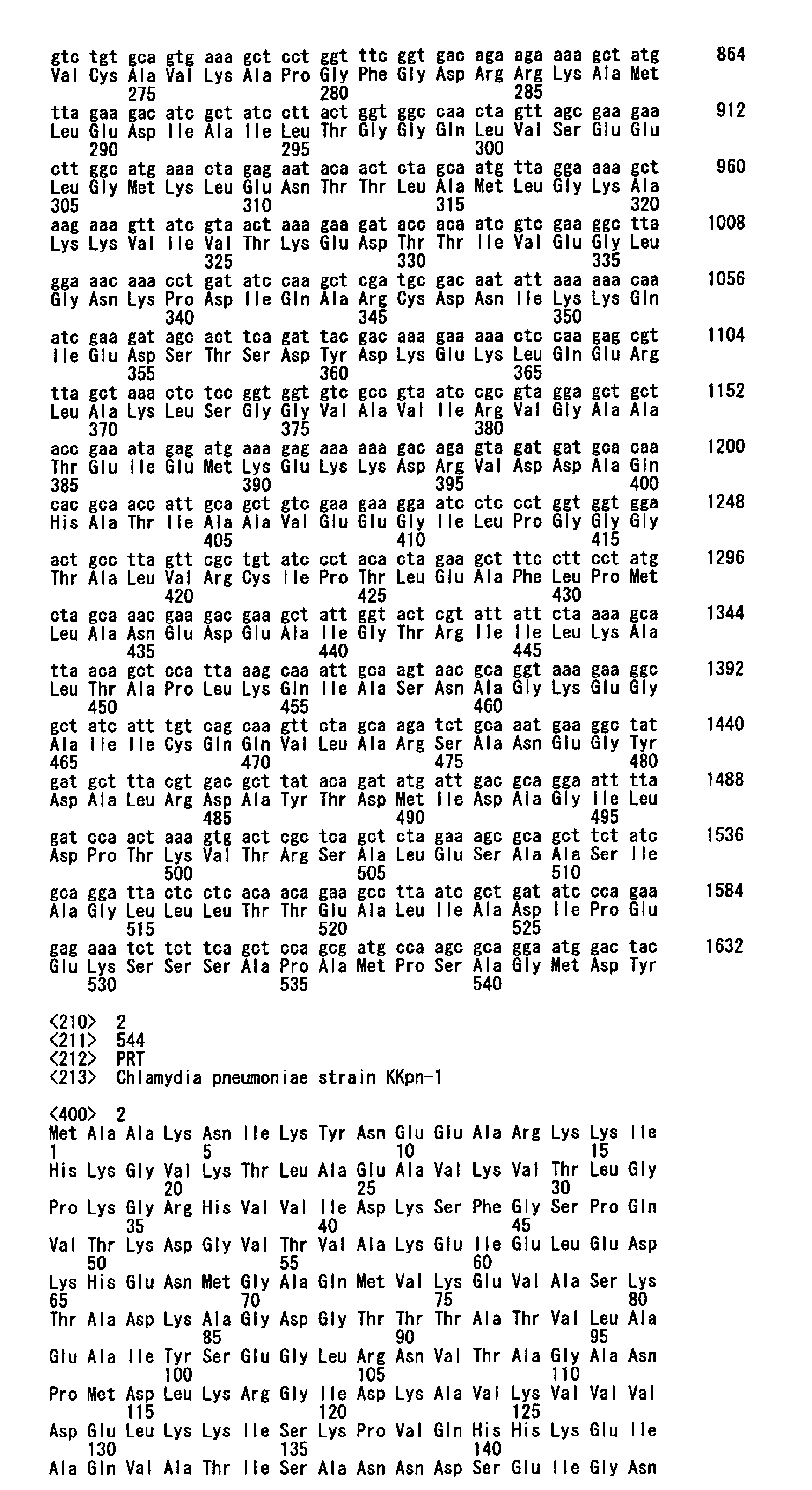


Claims (15)
- A screening method for a therapeutic substance for arteriosclerosis and/or a prophylactic/therapeutic substance for complications thereof, which comprises using cells of an established monocytic cell line and a Chlairiydia pneumoniae-derived 60-kDa heat shock protein or a partial peptide thereof or a salt thereof or cells capable of producing the same (the cells may be identical to, or different from, the cells of the established monocytic cell line).
- The screening method of claim 1, which comprises stimulating cells of an established monocytic cell line with a Chlamydia pneumoniae-derived 60-kDa heat shock protein or a partial peptide thereof or a salt thereof in the presence and absence of a test compound, and comparing the expressions of the matrix metalloproteinase-9 gene under the both conditions.
- The screening method of claim 1, which comprises infecting cells of an established monocytic cell line with Chlamydia pneumoniae in the presence and absence of a test compound, and comparing the expressions of the matrix metalloproteinase-9 gene under the two conditions.
- The screening method of claim 1, which comprises comparing the expressions of the matrix metalloproteinase-9 gene in cells of an established monocytic cell line capable of producing a Chlamydia pneumoniae-derived 60-kDa heat shock protein or a partial peptide thereof or a salt thereof in the presence and absence of a test compound.
- The screening method of claim 1, which comprises using cells of an established monocytic cell line wherein the expression of the matrix metalloproteinase-9 gene with 48 hours of stimulation with 100nM of a Chlamydia pneumoniae-derived 60-kDa heat shock protein or a partial peptide thereof or a salt thereof is not less than 5 times the expression without the stimulation.
- The screening method of claim 1, wherein the cells of the established monocytic cell line show substantially no expression of the matrix metalloproteinase-9 gene without stimulation.
- The screening method of claim 1, wherein the cells of the established monocytic cell line are cells of an established cell line selected from the group consisting of THP-1, U-937, P31/FUJ, RAW264.7, and J774A.1.
- The screening method of claim 1, wherein the cells of the established monocytic cell line are cells of the established THP-1 cell line.
- A screening kit for a therapeutic substance for arteriosclerosis and/or a prophylactic/therapeutic substance for complications thereof, which comprises cells of an established monocytic cell line, and a Chlamydia pneumoniae-derived 60-kDa heat shock protein or a partial peptide thereof or a salt thereof or cells capable of producing the same (the cells may be identical to, or different from, the cells of the established monocytic cell line).
- The screening kit of claim 9, wherein the cells capable of producing a Chlamydia pneumoniae-derived 60-kDa heat shock protein or a partial peptide thereof or a salt thereof are cells of Chlamydia pneumoniae or an established monocytic cell line.
- The screening kit of claim 9, wherein the cells of the established monocytic cell line are cells of an established cell line selected from the group consisting of THP-1, U-937, P31/FUJ, RAW264.7 and J774A.1.
- The screening kit of claim 9, wherein the cells of the established monocytic cell line are cells of the established THP-1 cell line.
- A therapeutic agent for arteriosclerosis and/or a prophylactic/therapeutic agent for complications thereof, which comprises a substance capable of suppressing the induction of the expression of the matrix metalloproteinase-9 gene by a Chlamydia pneumoniae-derived 60-kDa heat shock protein in mammalian cells.
- A therapeutic method for arteriosclerosis and/or a prophylactic or therapeutic method for complications thereof in a mammal, which comprises administering to the mammal an effective amount of a substance capable of suppressing the induction of the expression of the matrix metalloproteinase-9 gene by a Chlamydia pneumoniae-derived 60-kDa heat shock protein in mammalian cells.
- A use of a substance capable of suppressing the induction of the expression of the matrix metalloproteinase-9 gene by a Chlamydia pneumoniae-derived 60-kDa heat shock protein in mammalian cells, for producing a therapeutic agent for arteriosclerosis and/or a prophylactic or therapeutic agent for complications thereof.
Applications Claiming Priority (2)
| Application Number | Priority Date | Filing Date | Title |
|---|---|---|---|
| JP2003316572 | 2003-09-09 | ||
| PCT/JP2004/013396 WO2005026348A1 (en) | 2003-09-09 | 2004-09-08 | Screening method |
Publications (2)
| Publication Number | Publication Date |
|---|---|
| EP1669446A1 true EP1669446A1 (en) | 2006-06-14 |
| EP1669446A4 EP1669446A4 (en) | 2008-07-16 |
Family
ID=34308459
Family Applications (1)
| Application Number | Title | Priority Date | Filing Date |
|---|---|---|---|
| EP04773069A Withdrawn EP1669446A4 (en) | 2003-09-09 | 2004-09-08 | SCREENING METHOD |
Country Status (3)
| Country | Link |
|---|---|
| US (1) | US20060234297A1 (en) |
| EP (1) | EP1669446A4 (en) |
| WO (1) | WO2005026348A1 (en) |
Families Citing this family (4)
| Publication number | Priority date | Publication date | Assignee | Title |
|---|---|---|---|---|
| WO2008088864A2 (en) * | 2007-01-18 | 2008-07-24 | The Trustess Of Columbia University In The City Of New York | Matrix metalloproteinase-9-related methods |
| WO2010036930A1 (en) * | 2008-09-26 | 2010-04-01 | Javad Parvizi | Methods and kits for detecting joint infection |
| US20110097748A1 (en) * | 2009-10-28 | 2011-04-28 | Warsaw Orthopedic, Inc. | Use of cell lines to determine levels of efficacy of pharmaceutical formulations |
| KR101829330B1 (en) | 2011-04-13 | 2018-02-20 | (주)아모레퍼시픽 | Method for screening anti-inflammatory skin aging agent |
-
2004
- 2004-09-08 US US10/570,971 patent/US20060234297A1/en not_active Abandoned
- 2004-09-08 EP EP04773069A patent/EP1669446A4/en not_active Withdrawn
- 2004-09-08 WO PCT/JP2004/013396 patent/WO2005026348A1/en not_active Ceased
Non-Patent Citations (2)
| Title |
|---|
| SCHMIDT ROLAND ET AL: "EMMPRIN (CID 147) is a central activator of extracellular matrix degradation by Chlamydia pneumoniae-infected monocytes. Implications for plaque rupture" THROMBOSIS AND HAEMOSTASIS, vol. 95, no. 1, January 2006 (2006-01), pages 151-158, XP002481603 ISSN: 0340-6245 * |
| See also references of WO2005026348A1 * |
Also Published As
| Publication number | Publication date |
|---|---|
| US20060234297A1 (en) | 2006-10-19 |
| EP1669446A4 (en) | 2008-07-16 |
| WO2005026348A1 (en) | 2005-03-24 |
Similar Documents
| Publication | Publication Date | Title |
|---|---|---|
| EP2048162A1 (en) | Novel monoclonal antibody and use of the same | |
| US7309693B2 (en) | Preventives and remedies for pulmonary hypertension | |
| EP1234878A1 (en) | Use of disease-associated gene | |
| US20060234297A1 (en) | Screening method | |
| JP4056248B2 (en) | Screening method for amyloid β protein production inhibitor | |
| EP1467207B1 (en) | Screening method for a prophylactic and therapeutic substance for a renal disease. | |
| JP4972538B2 (en) | Preventive and therapeutic agents for neurodegenerative diseases | |
| US6992171B2 (en) | Polypeptide and its DNA | |
| JP2005102691A (en) | Screening method | |
| JP4827320B2 (en) | Pulmonary hypertension prevention / treatment agent | |
| EP1600165A1 (en) | Medicinal use of mip-3alpha inhibitor and method of screening brain/nerve cell protective agent | |
| US20060035209A1 (en) | Screening method | |
| JP2002223762A (en) | New protein and dna encoding the same | |
| JP2003227822A (en) | Diagnostics for chronic obstructive pulmonary disease | |
| US20040185500A1 (en) | Use of disease-associated gene | |
| JP2005128010A (en) | Method of screening insulin sensitizer | |
| JP2002233369A (en) | New protein and its dna | |
| JPWO2005118631A1 (en) | Novel protein complex and its use | |
| JP2004331613A (en) | Medicament for preventing or treating immunologic and inflammatory diseases | |
| JP2002233371A (en) | New protein and its dna | |
| JP2002218984A (en) | New protein and dna encoding the same | |
| JP2002218981A (en) | New protein and its dna | |
| JP2003125788A (en) | Application of disease-related gene | |
| JP2002233372A (en) | New protein and its dna | |
| JP2003221344A (en) | Preventive/curing agent for rhinitis |
Legal Events
| Date | Code | Title | Description |
|---|---|---|---|
| PUAI | Public reference made under article 153(3) epc to a published international application that has entered the european phase |
Free format text: ORIGINAL CODE: 0009012 |
|
| 17P | Request for examination filed |
Effective date: 20060308 |
|
| AK | Designated contracting states |
Kind code of ref document: A1 Designated state(s): AT BE BG CH CY CZ DE DK EE ES FI FR GB GR HU IE IT LI LU MC NL PL PT RO SE SI SK TR |
|
| DAX | Request for extension of the european patent (deleted) | ||
| A4 | Supplementary search report drawn up and despatched |
Effective date: 20080613 |
|
| 17Q | First examination report despatched |
Effective date: 20080925 |
|
| STAA | Information on the status of an ep patent application or granted ep patent |
Free format text: STATUS: THE APPLICATION IS DEEMED TO BE WITHDRAWN |
|
| 18D | Application deemed to be withdrawn |
Effective date: 20090206 |