EP1668076B1 - Vinylidene chloride polymer composition - Google Patents
Vinylidene chloride polymer composition Download PDFInfo
- Publication number
- EP1668076B1 EP1668076B1 EP04766838.9A EP04766838A EP1668076B1 EP 1668076 B1 EP1668076 B1 EP 1668076B1 EP 04766838 A EP04766838 A EP 04766838A EP 1668076 B1 EP1668076 B1 EP 1668076B1
- Authority
- EP
- European Patent Office
- Prior art keywords
- polymer
- oligomer
- hydrogen atom
- composition according
- carbon atoms
- Prior art date
- Legal status (The legal status is an assumption and is not a legal conclusion. Google has not performed a legal analysis and makes no representation as to the accuracy of the status listed.)
- Expired - Lifetime
Links
- 229920000642 polymer Polymers 0.000 title claims description 154
- 239000000203 mixture Substances 0.000 title claims description 100
- OEPOKWHJYJXUGD-UHFFFAOYSA-N 2-(3-phenylmethoxyphenyl)-1,3-thiazole-4-carbaldehyde Chemical compound O=CC1=CSC(C=2C=C(OCC=3C=CC=CC=3)C=CC=2)=N1 OEPOKWHJYJXUGD-UHFFFAOYSA-N 0.000 title claims description 65
- 239000000178 monomer Substances 0.000 claims description 110
- 125000004435 hydrogen atom Chemical group [H]* 0.000 claims description 64
- 238000000576 coating method Methods 0.000 claims description 61
- -1 alkyl radical Chemical class 0.000 claims description 60
- 239000011248 coating agent Substances 0.000 claims description 59
- 125000004432 carbon atom Chemical group C* 0.000 claims description 43
- SNVLJLYUUXKWOJ-UHFFFAOYSA-N methylidenecarbene Chemical compound C=[C] SNVLJLYUUXKWOJ-UHFFFAOYSA-N 0.000 claims description 39
- 238000000034 method Methods 0.000 claims description 30
- 230000008569 process Effects 0.000 claims description 26
- ABLZXFCXXLZCGV-UHFFFAOYSA-N Phosphorous acid Chemical group OP(O)=O ABLZXFCXXLZCGV-UHFFFAOYSA-N 0.000 claims description 24
- 229910052751 metal Inorganic materials 0.000 claims description 23
- 239000002184 metal Substances 0.000 claims description 23
- WCYWZMWISLQXQU-UHFFFAOYSA-N methyl Chemical compound [CH3] WCYWZMWISLQXQU-UHFFFAOYSA-N 0.000 claims description 22
- 238000003776 cleavage reaction Methods 0.000 claims description 21
- 230000007017 scission Effects 0.000 claims description 21
- 239000002904 solvent Substances 0.000 claims description 21
- 239000006185 dispersion Substances 0.000 claims description 16
- 238000002156 mixing Methods 0.000 claims description 10
- 238000006467 substitution reaction Methods 0.000 claims description 9
- 229920000298 Cellophane Polymers 0.000 claims description 8
- 125000003118 aryl group Chemical group 0.000 claims description 6
- 239000000463 material Substances 0.000 claims description 6
- 239000002356 single layer Substances 0.000 claims description 6
- 238000004519 manufacturing process Methods 0.000 claims description 5
- BAPJBEWLBFYGME-UHFFFAOYSA-N Methyl acrylate Chemical compound COC(=O)C=C BAPJBEWLBFYGME-UHFFFAOYSA-N 0.000 description 24
- 238000004458 analytical method Methods 0.000 description 20
- WYURNTSHIVDZCO-UHFFFAOYSA-N Tetrahydrofuran Chemical compound C1CCOC1 WYURNTSHIVDZCO-UHFFFAOYSA-N 0.000 description 18
- 229920001577 copolymer Polymers 0.000 description 18
- 229910052698 phosphorus Inorganic materials 0.000 description 17
- OAICVXFJPJFONN-UHFFFAOYSA-N Phosphorus Chemical compound [P] OAICVXFJPJFONN-UHFFFAOYSA-N 0.000 description 16
- 239000011574 phosphorus Substances 0.000 description 16
- 238000004626 scanning electron microscopy Methods 0.000 description 16
- 239000000243 solution Substances 0.000 description 16
- 238000010526 radical polymerization reaction Methods 0.000 description 15
- 239000000523 sample Substances 0.000 description 14
- OZAIFHULBGXAKX-UHFFFAOYSA-N 2-(2-cyanopropan-2-yldiazenyl)-2-methylpropanenitrile Chemical compound N#CC(C)(C)N=NC(C)(C)C#N OZAIFHULBGXAKX-UHFFFAOYSA-N 0.000 description 12
- 238000002360 preparation method Methods 0.000 description 12
- 238000000550 scanning electron microscopy energy dispersive X-ray spectroscopy Methods 0.000 description 12
- 239000000654 additive Substances 0.000 description 11
- 230000000694 effects Effects 0.000 description 10
- 238000006116 polymerization reaction Methods 0.000 description 10
- UHOVQNZJYSORNB-UHFFFAOYSA-N Benzene Chemical compound C1=CC=CC=C1 UHOVQNZJYSORNB-UHFFFAOYSA-N 0.000 description 9
- 230000009477 glass transition Effects 0.000 description 9
- 150000003254 radicals Chemical class 0.000 description 9
- 229910000831 Steel Inorganic materials 0.000 description 8
- 238000001228 spectrum Methods 0.000 description 8
- 239000010959 steel Substances 0.000 description 8
- YLQBMQCUIZJEEH-UHFFFAOYSA-N tetrahydrofuran Natural products C=1C=COC=1 YLQBMQCUIZJEEH-UHFFFAOYSA-N 0.000 description 8
- CSCPPACGZOOCGX-UHFFFAOYSA-N Acetone Chemical compound CC(C)=O CSCPPACGZOOCGX-UHFFFAOYSA-N 0.000 description 7
- 238000006243 chemical reaction Methods 0.000 description 7
- 125000001309 chloro group Chemical group Cl* 0.000 description 7
- 238000000151 deposition Methods 0.000 description 7
- 230000008021 deposition Effects 0.000 description 7
- IJGRMHOSHXDMSA-UHFFFAOYSA-N Atomic nitrogen Chemical compound N#N IJGRMHOSHXDMSA-UHFFFAOYSA-N 0.000 description 6
- OKKJLVBELUTLKV-UHFFFAOYSA-N Methanol Chemical compound OC OKKJLVBELUTLKV-UHFFFAOYSA-N 0.000 description 6
- OFBQJSOFQDEBGM-UHFFFAOYSA-N Pentane Chemical compound CCCCC OFBQJSOFQDEBGM-UHFFFAOYSA-N 0.000 description 6
- PPBRXRYQALVLMV-UHFFFAOYSA-N Styrene Chemical compound C=CC1=CC=CC=C1 PPBRXRYQALVLMV-UHFFFAOYSA-N 0.000 description 6
- BZHJMEDXRYGGRV-UHFFFAOYSA-N Vinyl chloride Chemical compound ClC=C BZHJMEDXRYGGRV-UHFFFAOYSA-N 0.000 description 5
- NIXOWILDQLNWCW-UHFFFAOYSA-N acrylic acid group Chemical group C(C=C)(=O)O NIXOWILDQLNWCW-UHFFFAOYSA-N 0.000 description 5
- 238000000921 elemental analysis Methods 0.000 description 5
- 238000002270 exclusion chromatography Methods 0.000 description 5
- 239000007788 liquid Substances 0.000 description 5
- FPYJFEHAWHCUMM-UHFFFAOYSA-N maleic anhydride Chemical compound O=C1OC(=O)C=C1 FPYJFEHAWHCUMM-UHFFFAOYSA-N 0.000 description 5
- 239000000843 powder Substances 0.000 description 5
- XLYOFNOQVPJJNP-UHFFFAOYSA-N water Substances O XLYOFNOQVPJJNP-UHFFFAOYSA-N 0.000 description 5
- NLHHRLWOUZZQLW-UHFFFAOYSA-N Acrylonitrile Chemical compound C=CC#N NLHHRLWOUZZQLW-UHFFFAOYSA-N 0.000 description 4
- KAKZBPTYRLMSJV-UHFFFAOYSA-N Butadiene Chemical compound C=CC=C KAKZBPTYRLMSJV-UHFFFAOYSA-N 0.000 description 4
- VEXZGXHMUGYJMC-UHFFFAOYSA-M Chloride anion Chemical compound [Cl-] VEXZGXHMUGYJMC-UHFFFAOYSA-M 0.000 description 4
- RTZKZFJDLAIYFH-UHFFFAOYSA-N Diethyl ether Chemical compound CCOCC RTZKZFJDLAIYFH-UHFFFAOYSA-N 0.000 description 4
- 229910007161 Si(CH3)3 Inorganic materials 0.000 description 4
- XTXRWKRVRITETP-UHFFFAOYSA-N Vinyl acetate Chemical compound CC(=O)OC=C XTXRWKRVRITETP-UHFFFAOYSA-N 0.000 description 4
- 239000003795 chemical substances by application Substances 0.000 description 4
- 230000000052 comparative effect Effects 0.000 description 4
- 239000000839 emulsion Substances 0.000 description 4
- 150000002148 esters Chemical class 0.000 description 4
- 238000001704 evaporation Methods 0.000 description 4
- 230000008020 evaporation Effects 0.000 description 4
- 125000000524 functional group Chemical group 0.000 description 4
- 239000003999 initiator Substances 0.000 description 4
- 239000010410 layer Substances 0.000 description 4
- 238000002844 melting Methods 0.000 description 4
- 230000008018 melting Effects 0.000 description 4
- 239000011541 reaction mixture Substances 0.000 description 4
- 238000012546 transfer Methods 0.000 description 4
- JAHNSTQSQJOJLO-UHFFFAOYSA-N 2-(3-fluorophenyl)-1h-imidazole Chemical compound FC1=CC=CC(C=2NC=CN=2)=C1 JAHNSTQSQJOJLO-UHFFFAOYSA-N 0.000 description 3
- ZWEHNKRNPOVVGH-UHFFFAOYSA-N 2-Butanone Chemical compound CCC(C)=O ZWEHNKRNPOVVGH-UHFFFAOYSA-N 0.000 description 3
- 238000004679 31P NMR spectroscopy Methods 0.000 description 3
- ZLQGITSKRNWIOT-UHFFFAOYSA-N 5-(dimethylamino)furan-2-carbaldehyde Chemical compound CN(C)C1=CC=C(C=O)O1 ZLQGITSKRNWIOT-UHFFFAOYSA-N 0.000 description 3
- YMWUJEATGCHHMB-UHFFFAOYSA-N Dichloromethane Chemical compound ClCCl YMWUJEATGCHHMB-UHFFFAOYSA-N 0.000 description 3
- VGGSQFUCUMXWEO-UHFFFAOYSA-N Ethene Chemical compound C=C VGGSQFUCUMXWEO-UHFFFAOYSA-N 0.000 description 3
- 239000005977 Ethylene Substances 0.000 description 3
- GYCMBHHDWRMZGG-UHFFFAOYSA-N Methylacrylonitrile Chemical compound CC(=C)C#N GYCMBHHDWRMZGG-UHFFFAOYSA-N 0.000 description 3
- YXFVVABEGXRONW-UHFFFAOYSA-N Toluene Chemical compound CC1=CC=CC=C1 YXFVVABEGXRONW-UHFFFAOYSA-N 0.000 description 3
- 230000000996 additive effect Effects 0.000 description 3
- 150000001408 amides Chemical class 0.000 description 3
- 239000007900 aqueous suspension Substances 0.000 description 3
- QVGXLLKOCUKJST-UHFFFAOYSA-N atomic oxygen Chemical compound [O] QVGXLLKOCUKJST-UHFFFAOYSA-N 0.000 description 3
- 229910052799 carbon Inorganic materials 0.000 description 3
- 239000000460 chlorine Substances 0.000 description 3
- 229910052801 chlorine Inorganic materials 0.000 description 3
- 239000002270 dispersing agent Substances 0.000 description 3
- 238000012674 dispersion polymerization Methods 0.000 description 3
- 238000009826 distribution Methods 0.000 description 3
- 238000001035 drying Methods 0.000 description 3
- 230000008030 elimination Effects 0.000 description 3
- 238000003379 elimination reaction Methods 0.000 description 3
- 238000000724 energy-dispersive X-ray spectrum Methods 0.000 description 3
- 238000010348 incorporation Methods 0.000 description 3
- 238000003760 magnetic stirring Methods 0.000 description 3
- 239000011159 matrix material Substances 0.000 description 3
- LVHBHZANLOWSRM-UHFFFAOYSA-N methylenebutanedioic acid Natural products OC(=O)CC(=C)C(O)=O LVHBHZANLOWSRM-UHFFFAOYSA-N 0.000 description 3
- 238000000386 microscopy Methods 0.000 description 3
- 230000005012 migration Effects 0.000 description 3
- 238000013508 migration Methods 0.000 description 3
- 229910052757 nitrogen Inorganic materials 0.000 description 3
- 239000001301 oxygen Substances 0.000 description 3
- 229910052760 oxygen Inorganic materials 0.000 description 3
- 238000003756 stirring Methods 0.000 description 3
- GETTZEONDQJALK-UHFFFAOYSA-N (trifluoromethyl)benzene Chemical compound FC(F)(F)C1=CC=CC=C1 GETTZEONDQJALK-UHFFFAOYSA-N 0.000 description 2
- OKKJMXCNNZVCPO-UHFFFAOYSA-N 2-(2-methylprop-2-enoyloxy)ethylphosphonic acid Chemical compound CC(=C)C(=O)OCCP(O)(O)=O OKKJMXCNNZVCPO-UHFFFAOYSA-N 0.000 description 2
- ZCYVEMRRCGMTRW-UHFFFAOYSA-N 7553-56-2 Chemical compound [I] ZCYVEMRRCGMTRW-UHFFFAOYSA-N 0.000 description 2
- XKRFYHLGVUSROY-UHFFFAOYSA-N Argon Chemical compound [Ar] XKRFYHLGVUSROY-UHFFFAOYSA-N 0.000 description 2
- OKTJSMMVPCPJKN-UHFFFAOYSA-N Carbon Chemical compound [C] OKTJSMMVPCPJKN-UHFFFAOYSA-N 0.000 description 2
- ZAMOUSCENKQFHK-UHFFFAOYSA-N Chlorine atom Chemical compound [Cl] ZAMOUSCENKQFHK-UHFFFAOYSA-N 0.000 description 2
- YCKRFDGAMUMZLT-UHFFFAOYSA-N Fluorine atom Chemical compound [F] YCKRFDGAMUMZLT-UHFFFAOYSA-N 0.000 description 2
- 229920000028 Gradient copolymer Polymers 0.000 description 2
- QIGBRXMKCJKVMJ-UHFFFAOYSA-N Hydroquinone Chemical compound OC1=CC=C(O)C=C1 QIGBRXMKCJKVMJ-UHFFFAOYSA-N 0.000 description 2
- XEEYBQQBJWHFJM-UHFFFAOYSA-N Iron Chemical compound [Fe] XEEYBQQBJWHFJM-UHFFFAOYSA-N 0.000 description 2
- QYKIQEUNHZKYBP-UHFFFAOYSA-N Vinyl ether Chemical class C=COC=C QYKIQEUNHZKYBP-UHFFFAOYSA-N 0.000 description 2
- 239000002253 acid Substances 0.000 description 2
- 238000012644 addition polymerization Methods 0.000 description 2
- 239000002318 adhesion promoter Substances 0.000 description 2
- 150000001336 alkenes Chemical class 0.000 description 2
- 230000000844 anti-bacterial effect Effects 0.000 description 2
- 239000012736 aqueous medium Substances 0.000 description 2
- 238000010560 atom transfer radical polymerization reaction Methods 0.000 description 2
- 230000015572 biosynthetic process Effects 0.000 description 2
- 238000012662 bulk polymerization Methods 0.000 description 2
- 125000003178 carboxy group Chemical group [H]OC(*)=O 0.000 description 2
- 230000000295 complement effect Effects 0.000 description 2
- 239000000975 dye Substances 0.000 description 2
- 239000003995 emulsifying agent Substances 0.000 description 2
- 238000007720 emulsion polymerization reaction Methods 0.000 description 2
- FJKIXWOMBXYWOQ-UHFFFAOYSA-N ethenoxyethane Chemical compound CCOC=C FJKIXWOMBXYWOQ-UHFFFAOYSA-N 0.000 description 2
- NXWVPIWRMPQYEX-UHFFFAOYSA-N ethyl 2-(benzenecarbonothioylsulfanyl)propanoate Chemical compound CCOC(=O)C(C)SC(=S)C1=CC=CC=C1 NXWVPIWRMPQYEX-UHFFFAOYSA-N 0.000 description 2
- 229910052731 fluorine Inorganic materials 0.000 description 2
- 239000011737 fluorine Substances 0.000 description 2
- 239000008187 granular material Substances 0.000 description 2
- 238000000892 gravimetry Methods 0.000 description 2
- 239000001257 hydrogen Substances 0.000 description 2
- 229910052739 hydrogen Inorganic materials 0.000 description 2
- 230000006872 improvement Effects 0.000 description 2
- 229910052740 iodine Inorganic materials 0.000 description 2
- 239000011630 iodine Substances 0.000 description 2
- 238000010907 mechanical stirring Methods 0.000 description 2
- 238000001465 metallisation Methods 0.000 description 2
- 125000005395 methacrylic acid group Chemical class 0.000 description 2
- 238000012705 nitroxide-mediated radical polymerization Methods 0.000 description 2
- YPJUNDFVDDCYIH-UHFFFAOYSA-N perfluorobutyric acid Chemical compound OC(=O)C(F)(F)C(F)(F)C(F)(F)F YPJUNDFVDDCYIH-UHFFFAOYSA-N 0.000 description 2
- 239000004014 plasticizer Substances 0.000 description 2
- BASFCYQUMIYNBI-UHFFFAOYSA-N platinum Chemical compound [Pt] BASFCYQUMIYNBI-UHFFFAOYSA-N 0.000 description 2
- QQONPFPTGQHPMA-UHFFFAOYSA-N propylene Natural products CC=C QQONPFPTGQHPMA-UHFFFAOYSA-N 0.000 description 2
- 125000004805 propylene group Chemical group [H]C([H])([H])C([H])([*:1])C([H])([H])[*:2] 0.000 description 2
- 230000008521 reorganization Effects 0.000 description 2
- 239000013557 residual solvent Substances 0.000 description 2
- 230000002441 reversible effect Effects 0.000 description 2
- 238000001542 size-exclusion chromatography Methods 0.000 description 2
- 239000007787 solid Substances 0.000 description 2
- 238000004528 spin coating Methods 0.000 description 2
- 239000000126 substance Substances 0.000 description 2
- 238000003786 synthesis reaction Methods 0.000 description 2
- 229920001567 vinyl ester resin Polymers 0.000 description 2
- 125000000391 vinyl group Chemical group [H]C([*])=C([H])[H] 0.000 description 2
- 238000005406 washing Methods 0.000 description 2
- UOORRWUZONOOLO-OWOJBTEDSA-N (E)-1,3-dichloropropene Chemical compound ClC\C=C\Cl UOORRWUZONOOLO-OWOJBTEDSA-N 0.000 description 1
- JFEVIPGMXQNRRF-UHFFFAOYSA-N 1,1,3-trichloroprop-1-ene Chemical compound ClCC=C(Cl)Cl JFEVIPGMXQNRRF-UHFFFAOYSA-N 0.000 description 1
- ZAIDIVBQUMFXEC-UHFFFAOYSA-N 1,1-dichloroprop-1-ene Chemical compound CC=C(Cl)Cl ZAIDIVBQUMFXEC-UHFFFAOYSA-N 0.000 description 1
- FALCMQXTWHPRIH-UHFFFAOYSA-N 2,3-dichloroprop-1-ene Chemical compound ClCC(Cl)=C FALCMQXTWHPRIH-UHFFFAOYSA-N 0.000 description 1
- SMZOUWXMTYCWNB-UHFFFAOYSA-N 2-(2-methoxy-5-methylphenyl)ethanamine Chemical compound COC1=CC=C(C)C=C1CCN SMZOUWXMTYCWNB-UHFFFAOYSA-N 0.000 description 1
- QOOHUWULLQCUGG-UHFFFAOYSA-N 2-dimethoxyphosphorylethyl 2-methylprop-2-enoate Chemical compound COP(=O)(OC)CCOC(=O)C(C)=C QOOHUWULLQCUGG-UHFFFAOYSA-N 0.000 description 1
- HRPVXLWXLXDGHG-UHFFFAOYSA-N Acrylamide Chemical compound NC(=O)C=C HRPVXLWXLXDGHG-UHFFFAOYSA-N 0.000 description 1
- OSDWBNJEKMUWAV-UHFFFAOYSA-N Allyl chloride Chemical compound ClCC=C OSDWBNJEKMUWAV-UHFFFAOYSA-N 0.000 description 1
- JIGUQPWFLRLWPJ-UHFFFAOYSA-N Ethyl acrylate Chemical compound CCOC(=O)C=C JIGUQPWFLRLWPJ-UHFFFAOYSA-N 0.000 description 1
- 229910001335 Galvanized steel Inorganic materials 0.000 description 1
- 206010018910 Haemolysis Diseases 0.000 description 1
- UFHFLCQGNIYNRP-UHFFFAOYSA-N Hydrogen Chemical compound [H][H] UFHFLCQGNIYNRP-UHFFFAOYSA-N 0.000 description 1
- WOBHKFSMXKNTIM-UHFFFAOYSA-N Hydroxyethyl methacrylate Chemical compound CC(=C)C(=O)OCCO WOBHKFSMXKNTIM-UHFFFAOYSA-N 0.000 description 1
- CERQOIWHTDAKMF-UHFFFAOYSA-N Methacrylic acid Chemical compound CC(=C)C(O)=O CERQOIWHTDAKMF-UHFFFAOYSA-N 0.000 description 1
- VVQNEPGJFQJSBK-UHFFFAOYSA-N Methyl methacrylate Chemical compound COC(=O)C(C)=C VVQNEPGJFQJSBK-UHFFFAOYSA-N 0.000 description 1
- CNCOEDDPFOAUMB-UHFFFAOYSA-N N-Methylolacrylamide Chemical compound OCNC(=O)C=C CNCOEDDPFOAUMB-UHFFFAOYSA-N 0.000 description 1
- 239000006057 Non-nutritive feed additive Substances 0.000 description 1
- CYTYCFOTNPOANT-UHFFFAOYSA-N Perchloroethylene Chemical group ClC(Cl)=C(Cl)Cl CYTYCFOTNPOANT-UHFFFAOYSA-N 0.000 description 1
- 239000004952 Polyamide Substances 0.000 description 1
- 239000004698 Polyethylene Substances 0.000 description 1
- 239000004743 Polypropylene Substances 0.000 description 1
- 239000004793 Polystyrene Substances 0.000 description 1
- 229910006069 SO3H Inorganic materials 0.000 description 1
- NINIDFKCEFEMDL-UHFFFAOYSA-N Sulfur Chemical compound [S] NINIDFKCEFEMDL-UHFFFAOYSA-N 0.000 description 1
- XSTXAVWGXDQKEL-UHFFFAOYSA-N Trichloroethylene Chemical group ClC=C(Cl)Cl XSTXAVWGXDQKEL-UHFFFAOYSA-N 0.000 description 1
- 230000001133 acceleration Effects 0.000 description 1
- 150000001253 acrylic acids Chemical class 0.000 description 1
- 239000000853 adhesive Substances 0.000 description 1
- 230000001070 adhesive effect Effects 0.000 description 1
- 125000005250 alkyl acrylate group Chemical group 0.000 description 1
- 239000004411 aluminium Substances 0.000 description 1
- 229910052782 aluminium Inorganic materials 0.000 description 1
- XAGFODPZIPBFFR-UHFFFAOYSA-N aluminium Chemical compound [Al] XAGFODPZIPBFFR-UHFFFAOYSA-N 0.000 description 1
- 239000002216 antistatic agent Substances 0.000 description 1
- 229910052786 argon Inorganic materials 0.000 description 1
- 239000012298 atmosphere Substances 0.000 description 1
- 230000004888 barrier function Effects 0.000 description 1
- 229920001400 block copolymer Polymers 0.000 description 1
- 238000007664 blowing Methods 0.000 description 1
- IYYIVELXUANFED-UHFFFAOYSA-N bromo(trimethyl)silane Chemical compound C[Si](C)(C)Br IYYIVELXUANFED-UHFFFAOYSA-N 0.000 description 1
- 230000005587 bubbling Effects 0.000 description 1
- CQEYYJKEWSMYFG-UHFFFAOYSA-N butyl acrylate Chemical compound CCCCOC(=O)C=C CQEYYJKEWSMYFG-UHFFFAOYSA-N 0.000 description 1
- 150000001721 carbon Chemical group 0.000 description 1
- 229920002678 cellulose Polymers 0.000 description 1
- 239000001913 cellulose Substances 0.000 description 1
- 229910052729 chemical element Inorganic materials 0.000 description 1
- 230000015271 coagulation Effects 0.000 description 1
- 238000005345 coagulation Methods 0.000 description 1
- 239000000470 constituent Substances 0.000 description 1
- 238000007334 copolymerization reaction Methods 0.000 description 1
- 238000005260 corrosion Methods 0.000 description 1
- 239000006184 cosolvent Substances 0.000 description 1
- YTKRILODNOEEPX-NSCUHMNNSA-N crotyl chloride Chemical compound C\C=C\CCl YTKRILODNOEEPX-NSCUHMNNSA-N 0.000 description 1
- 238000007872 degassing Methods 0.000 description 1
- 238000013461 design Methods 0.000 description 1
- 238000010790 dilution Methods 0.000 description 1
- 239000012895 dilution Substances 0.000 description 1
- 238000004090 dissolution Methods 0.000 description 1
- 238000010894 electron beam technology Methods 0.000 description 1
- 239000003480 eluent Substances 0.000 description 1
- ZOOODBUHSVUZEM-UHFFFAOYSA-N ethoxymethanedithioic acid Chemical compound CCOC(S)=S ZOOODBUHSVUZEM-UHFFFAOYSA-N 0.000 description 1
- QUPDWYMUPZLYJZ-UHFFFAOYSA-N ethyl Chemical compound C[CH2] QUPDWYMUPZLYJZ-UHFFFAOYSA-N 0.000 description 1
- SUPCQIBBMFXVTL-UHFFFAOYSA-N ethyl 2-methylprop-2-enoate Chemical compound CCOC(=O)C(C)=C SUPCQIBBMFXVTL-UHFFFAOYSA-N 0.000 description 1
- 230000001747 exhibiting effect Effects 0.000 description 1
- 238000001125 extrusion Methods 0.000 description 1
- 239000000945 filler Substances 0.000 description 1
- 238000013467 fragmentation Methods 0.000 description 1
- 238000006062 fragmentation reaction Methods 0.000 description 1
- 239000008397 galvanized steel Substances 0.000 description 1
- 239000007789 gas Substances 0.000 description 1
- 230000008588 hemolysis Effects 0.000 description 1
- 229920001519 homopolymer Polymers 0.000 description 1
- BHEPBYXIRTUNPN-UHFFFAOYSA-N hydridophosphorus(.) (triplet) Chemical compound [PH] BHEPBYXIRTUNPN-UHFFFAOYSA-N 0.000 description 1
- 238000006460 hydrolysis reaction Methods 0.000 description 1
- 238000007654 immersion Methods 0.000 description 1
- 238000002347 injection Methods 0.000 description 1
- 239000007924 injection Substances 0.000 description 1
- 239000000976 ink Substances 0.000 description 1
- 229910052742 iron Inorganic materials 0.000 description 1
- 239000004816 latex Substances 0.000 description 1
- 229920000126 latex Polymers 0.000 description 1
- 238000013507 mapping Methods 0.000 description 1
- 150000002734 metacrylic acid derivatives Chemical class 0.000 description 1
- 239000012299 nitrogen atmosphere Substances 0.000 description 1
- 238000004172 nitrogen cycle Methods 0.000 description 1
- 125000004430 oxygen atom Chemical group O* 0.000 description 1
- 238000004806 packaging method and process Methods 0.000 description 1
- 239000002245 particle Substances 0.000 description 1
- PNJWIWWMYCMZRO-UHFFFAOYSA-N pent‐4‐en‐2‐one Natural products CC(=O)CC=C PNJWIWWMYCMZRO-UHFFFAOYSA-N 0.000 description 1
- 125000002467 phosphate group Chemical group [H]OP(=O)(O[H])O[*] 0.000 description 1
- UEZVMMHDMIWARA-UHFFFAOYSA-M phosphonate Chemical group [O-]P(=O)=O UEZVMMHDMIWARA-UHFFFAOYSA-M 0.000 description 1
- 125000004437 phosphorous atom Chemical group 0.000 description 1
- 229920003023 plastic Polymers 0.000 description 1
- 239000004033 plastic Substances 0.000 description 1
- 229910052697 platinum Inorganic materials 0.000 description 1
- 229920002647 polyamide Polymers 0.000 description 1
- 229920000573 polyethylene Polymers 0.000 description 1
- 229920000139 polyethylene terephthalate Polymers 0.000 description 1
- 239000005020 polyethylene terephthalate Substances 0.000 description 1
- 229920001155 polypropylene Polymers 0.000 description 1
- 229920002223 polystyrene Polymers 0.000 description 1
- 229920000915 polyvinyl chloride Polymers 0.000 description 1
- 239000004800 polyvinyl chloride Substances 0.000 description 1
- 238000001556 precipitation Methods 0.000 description 1
- 229920005604 random copolymer Polymers 0.000 description 1
- 230000035484 reaction time Effects 0.000 description 1
- 239000003507 refrigerant Substances 0.000 description 1
- 229910052710 silicon Inorganic materials 0.000 description 1
- 239000010703 silicon Substances 0.000 description 1
- 238000006884 silylation reaction Methods 0.000 description 1
- 238000001179 sorption measurement Methods 0.000 description 1
- 238000004611 spectroscopical analysis Methods 0.000 description 1
- 238000005507 spraying Methods 0.000 description 1
- 239000003381 stabilizer Substances 0.000 description 1
- 239000010935 stainless steel Substances 0.000 description 1
- 229910001220 stainless steel Inorganic materials 0.000 description 1
- 150000003440 styrenes Chemical class 0.000 description 1
- 229910052717 sulfur Inorganic materials 0.000 description 1
- 239000011593 sulfur Substances 0.000 description 1
- 238000010408 sweeping Methods 0.000 description 1
- UOORRWUZONOOLO-UHFFFAOYSA-N telone II Natural products ClCC=CCl UOORRWUZONOOLO-UHFFFAOYSA-N 0.000 description 1
- 238000012360 testing method Methods 0.000 description 1
- 229950011008 tetrachloroethylene Drugs 0.000 description 1
- 238000010257 thawing Methods 0.000 description 1
- 238000007669 thermal treatment Methods 0.000 description 1
- UBOXGVDOUJQMTN-UHFFFAOYSA-N trichloroethylene Natural products ClCC(Cl)Cl UBOXGVDOUJQMTN-UHFFFAOYSA-N 0.000 description 1
- ZTWTYVWXUKTLCP-UHFFFAOYSA-N vinylphosphonic acid Chemical compound OP(O)(=O)C=C ZTWTYVWXUKTLCP-UHFFFAOYSA-N 0.000 description 1
- 239000003643 water by type Substances 0.000 description 1
- 239000012991 xanthate Substances 0.000 description 1
Images

Classifications
-
- C—CHEMISTRY; METALLURGY
- C09—DYES; PAINTS; POLISHES; NATURAL RESINS; ADHESIVES; COMPOSITIONS NOT OTHERWISE PROVIDED FOR; APPLICATIONS OF MATERIALS NOT OTHERWISE PROVIDED FOR
- C09D—COATING COMPOSITIONS, e.g. PAINTS, VARNISHES OR LACQUERS; FILLING PASTES; CHEMICAL PAINT OR INK REMOVERS; INKS; CORRECTING FLUIDS; WOODSTAINS; PASTES OR SOLIDS FOR COLOURING OR PRINTING; USE OF MATERIALS THEREFOR
- C09D127/00—Coating compositions based on homopolymers or copolymers of compounds having one or more unsaturated aliphatic radicals, each having only one carbon-to-carbon double bond, and at least one being terminated by a halogen; Coating compositions based on derivatives of such polymers
- C09D127/02—Coating compositions based on homopolymers or copolymers of compounds having one or more unsaturated aliphatic radicals, each having only one carbon-to-carbon double bond, and at least one being terminated by a halogen; Coating compositions based on derivatives of such polymers not modified by chemical after-treatment
- C09D127/04—Coating compositions based on homopolymers or copolymers of compounds having one or more unsaturated aliphatic radicals, each having only one carbon-to-carbon double bond, and at least one being terminated by a halogen; Coating compositions based on derivatives of such polymers not modified by chemical after-treatment containing chlorine atoms
- C09D127/08—Homopolymers or copolymers of vinylidene chloride
-
- C—CHEMISTRY; METALLURGY
- C08—ORGANIC MACROMOLECULAR COMPOUNDS; THEIR PREPARATION OR CHEMICAL WORKING-UP; COMPOSITIONS BASED THEREON
- C08L—COMPOSITIONS OF MACROMOLECULAR COMPOUNDS
- C08L27/00—Compositions of homopolymers or copolymers of compounds having one or more unsaturated aliphatic radicals, each having only one carbon-to-carbon double bond, and at least one being terminated by a halogen; Compositions of derivatives of such polymers
- C08L27/02—Compositions of homopolymers or copolymers of compounds having one or more unsaturated aliphatic radicals, each having only one carbon-to-carbon double bond, and at least one being terminated by a halogen; Compositions of derivatives of such polymers not modified by chemical after-treatment
- C08L27/04—Compositions of homopolymers or copolymers of compounds having one or more unsaturated aliphatic radicals, each having only one carbon-to-carbon double bond, and at least one being terminated by a halogen; Compositions of derivatives of such polymers not modified by chemical after-treatment containing chlorine atoms
- C08L27/08—Homopolymers or copolymers of vinylidene chloride
-
- C—CHEMISTRY; METALLURGY
- C08—ORGANIC MACROMOLECULAR COMPOUNDS; THEIR PREPARATION OR CHEMICAL WORKING-UP; COMPOSITIONS BASED THEREON
- C08L—COMPOSITIONS OF MACROMOLECULAR COMPOUNDS
- C08L43/00—Compositions of homopolymers or copolymers of compounds having one or more unsaturated aliphatic radicals, each having only one carbon-to-carbon double bond, and containing boron, silicon, phosphorus, selenium, tellurium or a metal; Compositions of derivatives of such polymers
- C08L43/02—Homopolymers or copolymers of monomers containing phosphorus
-
- C—CHEMISTRY; METALLURGY
- C08—ORGANIC MACROMOLECULAR COMPOUNDS; THEIR PREPARATION OR CHEMICAL WORKING-UP; COMPOSITIONS BASED THEREON
- C08L—COMPOSITIONS OF MACROMOLECULAR COMPOUNDS
- C08L51/00—Compositions of graft polymers in which the grafted component is obtained by reactions only involving carbon-to-carbon unsaturated bonds; Compositions of derivatives of such polymers
- C08L51/003—Compositions of graft polymers in which the grafted component is obtained by reactions only involving carbon-to-carbon unsaturated bonds; Compositions of derivatives of such polymers grafted on to macromolecular compounds obtained by reactions only involving unsaturated carbon-to-carbon bonds
Definitions
- the present invention relates to a polymer composition, to a process for preparing such a polymer composition, to its use for coating metal, polymer, paper or cellophane surfaces and for producing thin single-layer or multilayer films and moulded objects, to a process for coating such surfaces by means of said polymer composition and to the articles or parts of articles obtained.
- additives intended to confer on them improved properties for use, such as additives for improving fire resistance or those for improving resistance to ultraviolet rays, plasticizers, dyes, antistatic agents, demisting agents or adhesion promoters.
- the desired improvement in a property lies in the mass of the polymer. In this case, the addition of an additive distributed within the mass makes it possible to obtain good effectiveness.
- the phenomena involved are first and foremost surface phenomena (towards the air) or interface phenomena (towards the coating support).
- the distribution of the additive within the mass of the composition that it forms with the polymer has a major drawback in so far as it is not present at the site where it would be useful, which makes it necessary to introduce it in a greater amount than necessary in order for a sufficient amount to be present at the surface or at the interface.
- This overdose engenders an additional cost but can also have a negative influence on other properties of the material, such as the barrier properties and the mechanical properties.
- incompatibles additives may be used so as to obtain migration thereof towards the surface or towards the interface.
- the additives have a low molar mass and are rapidly washed from the surface to which they have migrated, thus resulting in a loss of effectiveness.
- This is, for example, the case of demisting agents which may be washed from the surface of a film by steam.
- a major improvement in the field would therefore be to have polymer compositions comprising additives capable of migrating preferentially to where they are useful (polymer/air surface, polymer/metal interface, polymer 1/polymer 2 interface, etc.). Besides this selective migration, the additive should exhibit sufficient compatibility with the polymer in order to avoid being easily washed away.
- EP 0 185 464 discloses aqueous latex copolymer compositions comprising a mixture of an amorphous copolymer of vinylidene chloride and at least one internally plasticizing comonomer and an amorphous copolymer of vinylidene chloride and at least one comonomer selected from alkyl acrylates, methacrylates, styrene, acrylonitrile, vinyl acetate and vinyl ethyl ether.
- DE 19 27 270 discloses an emulsion polymerization process in two steps of vinylidene chloride in mixture with other ethylenically insaturated monomers in order to obtain an aqueous dispersion.
- a subject of the present invention is such a polymer composition.
- the invention relates to a polymer composition according to claim 1 comprising
- polymer (P1) is intended to denote a polymer of molar mass greater than that of the co-oligomer (O1).
- the number-average molar mass, as determined for example by steric exclusion chromatography or by elemental analysis, of the polymer (P1) involved in the composition according to the invention is greater than 30 000.
- the number-average molar mass of the polymer (P1) is less than or equal to 2 000 000, preferably less than or equal to 1 000 000, particularly preferably less than or equal to 500 000, and most particularly preferably less than or equal to 250 000.
- the polymer (P1) is also advantageously characterized by a polydispersity index (ratio of the weight-average molar mass to the number-average molar mass), as determined by size exclusion chromatography, of greater than or equal to 1.
- the polymer (P1) is advantageously characterized by a polydispersity index of less than or equal to 4.
- polymer (P1) comprising monomeric units derived from vinylidene chloride (M1)
- M1 vinylidene chloride
- the polymer (P1) contains at least 50%, preferably at least 60%, particularly preferably at least 70%, by weight of monomeric units derived from the ethylenically unsaturated monomer (M1).
- Polymer (P1) of the composition according to the invention is a chlorinated polymer.
- the ethylenically unsaturated monomer (M1) is vinylidene chloride
- chlorinated polymer is intended to denote both the homopolymers of vinylidene chloride and the copolymers that vinilidene chloride for with chlorinated monomers and/or with nonchlorinated monomers. These copolymers may in particular be random copolymers, gradient copolymers, block copolymers or grafted copolymers.
- the chlorinated polymer advantageously comprises at least 50%, preferably at least 60%, particularly preferably at least 70%, by weight of monomeric units derived from vinylidene chloride
- chlorinated monomer is intended to denote any ethylenically unsaturated monomer which comprises at least one chlorine atom.
- chlorinated monomers mention may be made of chlorinated monomers in which the number of chlorine atoms is 1, chlorinated monomers in which the number of chlorine atoms is 2, trichloroethylene, 1,1,3-trichloropropene and tetrachloro ethylene.
- nonchlorinated monomer is intended to denote, for example, vinyl esters such as, for example, vinyl acetate, vinyl ethers, acrylic or methacrylic acids, esters and amides, acrylonitrile, methacrylonitrile, styrene and derivatives, butadiene, olefins such as, for example, ethylene and propylene, itaconic acid and maleic anhydride.
- vinyl esters such as, for example, vinyl acetate, vinyl ethers, acrylic or methacrylic acids, esters and amides, acrylonitrile, methacrylonitrile, styrene and derivatives, butadiene, olefins such as, for example, ethylene and propylene, itaconic acid and maleic anhydride.
- a first preferred family of chlorinated monomers consists of chlorinated monomers in which the number of chlorine atoms is 1.
- chlorinated monomers in which the number of chlorine atoms is 1 mention may be made of allyl chloride, crotyl chloride and, with most particular mention, vinyl chloride.
- a second preferred family of chlorinated monomers consists of chlorinated monomers in which the number of chlorine atoms is 2.
- chlorinated monomers in which the number of chlorine atoms is 2 mention may be made of 1,1-dichloropropene, 1,3-dichloropropene, 2,3-dichloropropene,
- the polymer (P1) of the composition according to the invention is a polymer of vinylidene chloride.
- the ethylenically unsaturated monomer (M1) is therefore, vinylidene chloride.
- copolymers of vinylidene chloride are preferred.
- copolymers of vinylidene chloride is intended to denote the copolymers of vinylidene chloride, which is the major monomer, with one or more monomers that are copolymerizable with said monomer.
- the vinylidene chloride is therefore advantageously present in the resulting copolymers in a proportion of at least 50% by weight.
- vinyl chloride vinyl esters such as, for example, vinyl acetate, vinyl ethers, acrylic acids, esters and amides, methacrylic acids, esters and amides, acrylonitrile, methacrylonitrile, styrene, styrene derivatives, butadiene, olefins such as, for example, ethylene and propylene, itaconic acid and maleic anhydride.
- vinyl esters such as, for example, vinyl acetate, vinyl ethers, acrylic acids, esters and amides, methacrylic acids, esters and amides, acrylonitrile, methacrylonitrile, styrene, styrene derivatives, butadiene, olefins such as, for example, ethylene and propylene, itaconic acid and maleic anhydride.
- Copolymers of vinylidene chloride that are most particularly preferred are those containing, as copolymerizable monomers, vinyl chloride and/or at least one monomer chosen from maleic anhydride and (meth)acrylic monomers, namely methyl acrylate, methyl methacrylate, ethyl acrylate, ethyl methacrylate, n-butyl acrylate, ethylene glycol methacrylate, acrylonitrile, methacrylonitrile, acrylic acid, methacrylic acid, itaconic acid, acrylamide and N-methylolacrylamide.
- monomers chosen from maleic anhydride and (meth)acrylic monomers namely methyl acrylate, methyl methacrylate, ethyl acrylate, ethyl methacrylate, n-butyl acrylate, ethylene glycol methacrylate, acrylonitrile, methacrylonitrile, acrylic acid, methacrylic acid, itaconic acid,
- the amount of vinylidene chloride in the copolymers of vinylidene chloride ranges from 50 to 95% by weight, preferably from 60 to 95% by weight, particularly preferably from 70 to 95% by weight.
- the amount of vinyl chloride in the copolymers ofvinylidene chloride ranges from 3 to 50% by weight, preferably from 3 to 40% by weight, particularly preferably from 4.5 to 30% by weight.
- the amount of maleic anhydride and/or of the (meth)acrylic monomer(s) in the copolymers of vinylidene chloride ranges from 1 to 50% by weight, preferably from 2 to 40% by weight, particularly preferably from 2 to 30% by weight.
- the polymer (P1) involved in the composition according to the invention can be prepared by any know process of addition polymerization. It is preferably prepared by a process of radical polymerization, whether mass polymerization, polymerization in solution in a solvent or aqueous-dispersion polymerization. It is particularly preferably prepared by a process of aqueous-dispersion radical polymerization, and most particularly preferably by a process of aqueous-suspension radical polymerization or by a process of aqueous-emulsion radical polymerization.
- aqueous-dispersion polymerization is intended to denote aqueous-suspension radical polymerization as well as aqueous-emulsion radical polymerization and aqueous-microsuspension polymerization.
- aqueous-suspension radical polymerization is intended to denote any process of radical polymerization that is carried out in aqueous medium in the presence of oleosoluble radical initiators and dispersing agents.
- aqueous-emulsion radical polymerization is intended to denote any process of radical polymerization that is carried out in aqueous medium in the presence of watersoluble radical initiators and emulsifiers.
- aqueous-microsuspension polymerization also referred to as polymerization in homogenized aqueous dispersion or miniemulsion
- polymerization in homogenized aqueous dispersion or miniemulsion is intended to denote any process of radical polymerization in which oleosoluble initiators are used and an emulsion of droplets of monomers is prepared by means of vigorous mechanical stirring and the presence of emulsifiers.
- At least one co-oligomer (O1) is intended to denote that the polymer composition according to the invention must contain at least one co-oligomer (O1), but that it may contain several thereof. It preferably comprises just one thereof.
- co-oligomer (O1) is intended to denote a copolymer of low molar mass.
- the number-average molar mass, as determined by size exclusion chromatography or elemental analysis, of the co-oligomer (O1) involved in the composition according to the invention is greater than or equal to 100, preferably greater than or equal to 500 and particularly preferably greater than or equal to 1000.
- the number-average molar mass of the co-oligomer (O1) is less than or equal to 30 000, preferably less than or equal to 25 000, and particularly preferably less than or equal to 20 000.
- the co-oligomer (O1) is also advantageously characterized by a polydispersity index (ratio of the weight-average molar mass to the number-average molar mass), as determined by steric exclusion chromatography, of greater than or equal to 1.
- the co-oligomer (O1) is advantageously characterized by a polydispersity index of less than or equal to 3, preferably of less than or equal to 2.5, particularly preferably of less than or equal to 2.
- the chain of monomeric units in the co-oligomer (O1) is advantageously of the random, alternating, block or gradient type, and preferably of the block or gradient type.
- the structure of the co-oligomer (O1) is advantageously linear or branched (for example grafted, comb-branched or star-branched) and preferably linear.
- the co-oligomer (O1) is particularly preferably characterized by a linear structure with a chain of monomeric units of block or gradient type.
- the component (A) comprises at least one monomeric unit identical to that derived from the ethylenically unsaturated monomer (M1) on which the polymer (P1) as defined above is based vinylidene chloride.
- Component (A) of the co-oligomer (O1) comprises at least one monomeric unit derived from the monomer (M1).
- the monomeric units derived from the monomer (M1) of component A represent at least 10% by weight, and particularly preferably at least 25% by weight, of the co-oligomer (O1).
- the monomeric units derived from the monomer (M1) of component A represent at most 90% by weight, preferably at most 85% by weight, and particularly preferably at most 75% by weight, of the co-oligomer (O1).
- Component (A) of the co-oligomer (O1) may comprise at least one monomeric unit derived from at least one monomer that is copolymerizable with the monomer (M1) as defined above, i.e. vinylidene chloride.
- Component (A) of the co-oligomer (O1) advantageously comprises at least one monomeric unit derived from at least one monomer that is copolymerizable with the monomer (M1).
- the monomeric units derived from at least one monomer that is copolymerizable with the monomer (M1) of component A represent at least 2% by weight, and particularly preferably at least 5% by weight, of the co-oligomer (O1).
- the monomeric units derived from at least one monomer that is copolymerizable with the monomer (M1) of component A represent at most 50% by weight, preferably at most 30% by weight, and particularly preferably at most 25% by weight, of the co-oligomer (O1).
- component (B) comprises at least one monomeric unit (m2), derived from an ethylenically unsaturated monomer, carrying at least one group chosen from the following groups:
- the ethylenically unsaturated monomer from which the monomeric unit (m2) carrying at least one group chosen from the groups mentioned above is derived can be an ethylenically unsaturated monomer (M2) that is itself carrying at least one of the groups concerned, but also, when the group concerned is a phosphonate group -PO(OH)(OR 1 ) with R 1 being a hydrogen atom or an alkyl radical containing from 1 to 11 carbon atoms, an ethylenically unsaturated monomer (M2') carrying at least one group which, after total or partial cleavage, results in the group concerned.
- cleavage is intended to mean any reaction which makes it possible to obtain the group -PO(OH)(OR 1 ).
- the hydrolysis reaction is a particularly preferred case of cleavage.
- monomer (M2) carrying at least one group -(CH 2 ) b -C c F 2c+1 with b between 1 and 11 and c greater than or equal to 5, from which the corresponding monomeric unit (m2) is derived mention may be made of the following monomers:
- b is greater than or equal to 1.
- b is less than or equal to 11, preferably less than or equal to 5, and particularly preferably less than or equal to 3.
- c is advantageously greater than or equal to 5 and preferably greater than or equal to 6.
- c is preferably less than or equal to 20 and particularly preferably less than or equal to 10.
- c is most particularly preferably equal to 8.
- component (B) of the co-oligomer (O1) comprises at least one monomeric unit (m2), derived from an ethylenically unsaturated monomer, carrying at least one group -(CH 2 ) b -C c F 2c+1
- the co-oligomer (O1) is most particularly preferably characterized by a linear structure with a chain of monomeric units of block type.
- monomer (M2) carrying at least one phosphonate group -PO(OH)(OR 1 ) with R 1 being a hydrogen atom or an alkyl radical containing from 1 to 11 carbon atoms, from which the corresponding monomeric unit (m2) is derived mention may be made of:
- monomer (M2') carrying at least one group which, after total or partial cleavage (for example hemihydrolysis), results in the phosphonate group -PO(OH)(OR 1 ) (with R 1 being a hydrogen atom or an alkyl radical containing from 1 to 11 carbon atoms), from which the corresponding monomeric unit (m2) is derived mention may be made of the monomers (M2') carrying at least one group -PO(OR 1' )(OR 2' ) with R 1' , and R 2' , which are the same or different, representing an alkyl radical containing from 1 to 11 carbon atoms.
- R 1 is a hydrogen atom or an alkyl radical containing from 1 to 11 carbon atoms.
- R 1 is an alkyl radical
- R 1 contains from 1 to 11 carbon atoms, preferably from 1 to 8 carbon atoms, and particularly preferably from 1 to 5.
- R 1 is either a methyl radical or an ethyl radical are most particularly preferred.
- phosphonate group -PO(OH)(OR 1 ) is intended to denote the groups -PO(OH)(OR 1 ) attached to a carbon atom and not the phosphate groups -O-P(O)(OR) 2 with R being a hydrogen atom or an alkyl radical, in which the phosphorus atom is attached to an oxygen atom.
- component (B) of the co-oligomer (O1) comprises at least one monomeric unit (m2), derived from an ethylenically unsaturated monomer, carrying at least one phosphonate group -PO(OH)(OR 1 ),
- the co-oligomer (O1) is most particularly preferably characterized by a linear structure with a chain of monomeric units of gradient type.
- component (B) comprises at least one monomeric unit (m2), derived from an ethylenically unsaturated monomer (M2'), carrying at least one group which, after cleavage, results in the phosphonate group -PO(OH)(OR 1 ) with R 1 being a hydrogen atom or an alkyl radical containing from 1 to 11 carbon atoms
- the cleavage may be carried out during the synthesis of the co-oligomer (O1), during the preparation of the polymer composition, as subsequently explained in detail, or during the use of the polymer composition.
- the cleavage preferably takes place during the synthesis of the co-oligomer (O1).
- component (B) comprises at least one monomeric unit (m2), derived from an ethylenically unsaturated monomer (M2'), carrying at least one group which, after cleavage, results in the phosphonate group -PO(OH)(OR 1 ) with R 1 being a hydrogen atom or an alkyl radical containing from 1 to 11 carbon atoms, the total cleavage (so that R 1 is a hydrogen atom) or the partial cleavage, in particular the hemihydrolysis, (so that R 1 is an alkyl radical containing from 1 to 11 carbon atoms), of the ethylenically unsaturated monomer (M2') carrying at least one group -PO(OR 1' )(OR 2' ) with R 1' and R 2' , which are the same or different, representing an alkyl radical containing from 1 to 11 carbon atoms, may be carried out as described, respectively, in C
- Component (B) of the co-oligomer (O1) comprises at least one monomeric unit (m2).
- the monomeric units (m2) of component (B) represent at least 10% by weight, and particularly preferably at least 15% by weight, of the co-oligomer (O1).
- the monomeric units (m2) of component (B) represent at most 80% by weight, preferably at most 75% by weight, and particularly preferably at most 70% by weight, of the co-oligomer.
- Component (B) of the co-oligomer (O1) comprises at least one monomeric unit (m2), derived from an ethylenically unsaturated monomer, carrying at least one group chosen from the following groups:
- component (B) of the co-oligomer (O1) advantageously comprises at least one monomeric unit (m2), derived from an ethylenically unsaturated monomer, carrying at least one group chosen from the groups -(CH 2 ) b -C c F 2c+1 with b between 1 and 11 and c greater than or equal to 5.
- the ethylenically unsaturated monomer from which the monomeric unit (m2) carrying at least one group chosen from the groups mentioned above is derived is advantageously an ethylenically unsaturated monomer (M2) that is itself carrying at least one of the groups concerned.
- the monomer (M2) carrying at least one group chosen from the groups -(CH 2 ) b -C c F 2c+1 is chosen from the following monomers:
- a monomer (M2) carrying at least one group -(CH 2 ) b -C c F 2c+1 that is most particularly preferred is 1H,1H,2H,2H-heptadecafluorodecyl acrylate (FDA).
- the monomeric units derived from the monomer (M1) of component (A) of the co-oligomer (O1) represent at least 25% and at most 30% by weight
- the monomeric units derived from at least one monomer that is copolymerizable with the monomer (M1) of component (A) represent at least 5% and at most 10% by weight
- the monomeric units (m2) of component (B) represent at least 60% and at most 70% by weight of the total weight of the co-oligomer.
- component (B) of the co-oligomer (O1) advantageously comprises at least one monomeric unit (m2), derived from an ethylenically unsaturated monomer, carrying at least one group chosen from the phosphonate groups -PO(OH)(OR 1 ) with R 1 being a hydrogen atom or an alkyl radical containing from 1 to 11 carbon atoms.
- the ethylenically unsaturated monomer from which the monomeric unit (m2) carrying at least one group chosen from the groups mentioned above is derived is advantageously an ethylenically unsaturated monomer (M2) that is itself carrying at least one of the groups concerned or an ethylenically unsaturated monomer (M2') carrying at least one group which, after cleavage, results in the group concerned.
- the monomeric unit (m2) carrying at least one group chosen from the phosphonate groups -PO(OH)(OR 1 ) is derived from an ethylenically unsaturated monomer chosen from the following monomers:
- i is between 1 and 20, preferably between 1 and 11, and particularly preferably between 1 and 3.
- R 10 and R 11 which are the same or different, are advantageously a hydrogen atom or an alkyl radical containing from 1 to 11 carbon atoms.
- this radical preferably contains from 1 to 8 carbon atoms.
- the monomeric unit (m2) carrying at least one group chosen from the phosphonate groups -PO(OH)(OR 1 ) is derived from an ethylenically unsaturated monomer chosen from the following monomers:
- the monomeric units derived from the monomer (M1) of component (A) of the co-oligomer (O1) represent at least 65% and at most 75% by weight
- the monomeric units derived from at least one monomer that is copolymerizable with the monomer (M1) of component (A) represent at least 5% and at most 15% by weight
- the monomeric units (m2) of component (B) represent at least 15% and at most 25% by weight of the total weight of the co-oligomer.
- the co-oligomer of the polymer composition according to the invention may also comprise a component (C) comprising at least one monomeric unit derived from an ethylenically unsaturated monomer (M3) carrying at least one functional group generating at least one of the following properties: bactericidal effect, printability, adhesion, sliding effect, anti-adhesion, thermochromic effect, anti-UV effect, antistatic effect, demisting effect, sealability or adsorption of gas.
- bactericidal effect bactericidal effect
- printability adhesion
- sliding effect anti-adhesion
- thermochromic effect anti-UV effect
- antistatic effect demisting effect
- demisting effect sealability or adsorption of gas.
- Component (C) of the co-oligomer (O1) advantageously comprises at least one monomeric unit derived from the monomer (M3).
- the monomeric units derived from the monomer (M3) of component C represent at least 1% by weight of the co-oligomer (O1).
- the monomeric units derived from the monomer (M3) of component (C) represent at most 50% by weight, preferably at most 25% by weight, and particularly preferably at most 15% by weight, of the co-oligomer.
- Component (B) and component (C) of the co-oligomer (O1) may optionally be put together.
- the ethylenically unsaturated monomer generating a monomeric unit including component (B) and component (C) advantageously has one of the following general structures in which X" represents a functional group generating a desired property and represents a particular case of X being any group, as previously defined, and X' one of the groups defined in component (B) of the co-oligomer (O1):
- ethylenically unsaturated monomers generating a monomeric unit including component (B) and component (C) would be, for example (X" representing the functional group generating the desired property and representing a particular case of X being any group, as previously defined; a, b, c, d and e being as defined above):
- the co-oligomer (O1) comprises a component (A) comprising at least one monomeric unit derived from vinylidene chloride and a component (B) comprising at least one monomeric unit (m2), derived from an ethylenically unsaturated monomer, carrying at least one group chosen from the groups -(CH 2 ) b -C c F 2c+1 with b between 1 and 11 and c greater than or equal to 5, and the phosphonate groups -PO(OH)(OR 1 ) with Ri being a hydrogen atom or an alkyl radical containing from 1 to 11 carbon atoms, with the preferences defined above for b and c.
- the co-oligomer (O1) is preferably a co-oligomer of vinylidene chloride, of methyl acrylate and of 2-methacryloxyethylphosphonic acid (MAPHOS(OH) 2 ).
- the co-oligomer (O1) is preferably a co-oligomer of vinylidene chloride, of methyl acrylate and of 1H,1H,2H,2H-hepta-decafluorodecyl acrylate (FDA).
- the co-oligomer (O1) involved in the composition according to the invention may be obtained by any process of radical polymerization, whether mass polymerization, polymerization in solution in a solvent or aqueous-dispersion polymerization, for obtaining the chain of monomeric units (random, alternating, block or gradient) and the structure (linear or branched) desired for the co-oligomer (O1).
- the preferred polymerization processes are the polymerization processes during which the polymerization conditions (choice of temperature, nature of the initiator, use of a transfer agent) are such that the desired structure is obtained, and the processes of controlled radical polymerization.
- the processes of controlled radical polymerization are particularly preferred.
- the processes of controlled radical polymerization mention may be made of the ATRP (Atom Transfer Radical Polymerization) process, the RAFT (Reversible Addition-Fragmentation Chain Transfer) process, the MADIX (Macromolecular Design via Interchange of Xanthate) process, the NMP (Nitroxide Mediated Polymerization) process, the ITP (Iodine Transfer Polymerization) process and the RITP (Reverse Iodine Transfer Polymerization) process.
- the RAFT, ITP and RITP processes are particularly preferred.
- the polymer composition according to the invention advantageously comprises at least 40% by weight, and preferably at least 50% by weight, of polymer (P1) relative to the total weight of the polymer (P1) and of the co-oligomer (O1).
- the polymer composition according to the invention may also contain additives that are conventional for polymer compositions, such as dyes, stabilizers, processing aids, antiblocking agents, fillers, plasticizers or additives for improving fire resistance.
- the composition may also contain polymers such as the polymers mentioned as examples of polymers (P1), with a preference for halogenated polymers.
- the polymer composition according to the invention may or may not comprise a solvent or water.
- a subject of the present invention is a process for preparing the polymer composition according to the invention.
- the invention relates to a process for preparing the polymer composition according to the invention, comprising the mixing of the polymer (P1) and of the co-oligomer(s) (O1) in at least one solvent, the dispersion of the co-oligomer(s) (O1) in an aqueous dispersion of the polymer (P1), or the mixing of the polymer (P1) and of the co-oligomer(s) (O1) by premixing.
- the concentration of the solution in the solvent(s) is advantageously between 1 and 100 g.l -1 , and preferably between 5 and 50 g.l -1 .
- At least one solvent is intended to denote that one or more solvents may be used.
- the polymer (P1) is a polymer ofvinylidene chloride and the co-oligomer (O1) comprises at least one monomeric unit identical to that of vinylidene chloride, tetrahydrofuran, toluene, methyl ethyl ketone, acetone and mixtures thereof are preferred.
- the co-oligomer (O1) carries at least one group -(CH 2 ) b -C c F 2c+1 , trifluorotoluene may be used as co-solvent in order to facilitate the dissolving of the co-oligomer (O1).
- the polymer composition according to the invention is prepared by mixing the polymer (P1) and the co-oligomer(s) (O1) in at least one solvent, the polymer (P1) and the co-oligomer(s) (O1) are advantageously in the powder or liquid state.
- the step of mixing the polymer (P1) and the co-oligomer(s) (O1) in at least one solvent may or may not be followed by a step of elimination of the solvent according to the use for which the mixture is intended. If the solvent is eliminated, this is preferably done by evaporation or by precipitation.
- an aqueous dispersion of the polymer (P1) advantageously exhibiting a particle size of 50 to 500 nm, and preferably of 80 to 200 nm, is advantageously used.
- the aqueous dispersion of the polymer (P1) is preferably that obtained by means of the aqueous-emulsion polymerization process.
- the co-oligomer(s) (O1) When the polymer composition according to the invention is prepared by dispersing the co-oligomer(s) (O1) in an aqueous dispersion of the polymer (P1), the co-oligomer(s) (O1) may be added in the powder or liquid state or in the form of an aqueous dispersion.
- the step of dispersion of the polymer (P1) and of the co-oligomer(s) (O1) may or may not be followed by a step of elimination of the water according to the use for which the dispersion is intended. If the water is eliminated, this is preferably done by evaporation or by coagulation of the dispersion, followed by filter-drying and drying.
- the polymer composition according to the invention is prepared by mixing the polymer (P1) and the co-oligomer(s) (O1) by means of premixing, the polymer (P1) and the co-oligomer(s) (O1) are advantageously mixed in the powder or liquid state by dry process without melting.
- the premixing may be followed by extrusion in order to produce granules in particular.
- component (B) comprises at least one monomeric unit (m2) derived from an ethylenically unsaturated monomer (M2') carrying at least one group which, after cleavage, results in the group concerned, namely a phosphonate group -PO(OH)(OR 1 ) with R 1 being a hydrogen atom or an alkyl radical containing from 1 to 11 carbon atoms
- the cleavage may be carried out prior to, during or subsequent to the step of preparation of the polymer composition as described above.
- the process for preparing the polymer composition according to the invention comprises the mixing of the polymer (P1) and of the co-oligomer(s) (O1) in at least one solvent.
- a subject of the present invention is the use of the polymer composition according to the invention.
- the invention relates to the use of the polymer composition according to the invention, for coating metal, polymer, paper or cellophane surfaces, for producing thin single-layer or multilayer films or for producing moulded objects.
- metal surfaces mention may be made of steel, galvanized steel and aluminium.
- polyethylene terephthalate As polymer surfaces, mention may be made of polyethylene terephthalate, bioriented polypropylene, poly(vinyl chloride), polyethylene, polyamides and EVA (copolymer of ethylene and of vinyl acetate that is partially hydrolysed).
- a subject of the present invention is also a process for coating metal, polymer, paper or cellophane surfaces by means of the polymer composition according to the invention.
- the invention relates to a process for coating metal, polymer, paper or cellophane surfaces by means of the polymer composition according to the invention, according to which the polymer composition is coated onto said surfaces, colaminated with said surfaces or coextruded with the material forming said surfaces.
- a solution of said composition in at least one solvent or an aqueous dispersion of said composition is advantageously coated onto said surfaces by any conventional coating process or spray coating process or by immersion of the surface in the solution of the polymer composition.
- the coating step is preferably followed by a step of evaporation of the solvent or of the water, particularly preferably during a step of thermal treatment, most particularly preferably at a temperature greater than the glass transition temperature of the polymers and really very particularly preferably at a temperature greater than the melting temperature of the polymers.
- the polymer composition When the polymer composition is colaminated with said surfaces, it is advantageously first extruded or coextruded in the form of a film and this film is then colaminated with said surfaces.
- said composition in the form of a powder, is advantageously coextruded with the material forming said surfaces, in the form of a powder or of granules, so as to obtain said surfaces coated with the polymer composition in the form of films, of sheets or of plates.
- component (B) comprises at least one monomeric unit (m2) derived from an ethylenically unsaturated monomer (M2') carrying at least one group which, after cleavage, results in the phosphonate group -PO(OH)(OR 1 ) with R 1 being a hydrogen atom or an alkyl radical containing from 1 to 11 carbon atoms
- the cleavage may be carried out just before or during the operation to coat the metal, polymer, paper or cellophane surfaces with the polymer composition.
- a subject of the invention is the articles or parts of articles prepared by means of the polymer composition according to the invention.
- the articles or parts of articles are advantageously films, sheets, plates, thin single-layer or multilayer films or moulded objects.
- the thin single-layer or multilayer films obtained may be used, for example, in packaging.
- the moulded objects obtained may, for example, be obtained by injection or by injection-blowing.
- the polymer composition according to the invention has many advantages.
- the polymer composition according to the invention makes it possible to improve the adhesion of a polymer coating to a metal, polymer, paper or cellophane surface. It thus makes it possible to avoid the use of primer or of adhesive between the layers of a multilayer assembly.
- it makes it possible to modify the properties of the coating that it forms and to improve the surface properties, such as the anti-corrosion properties, the gas-barrier properties, the antibacterial properties, the adhesion of inks at the surface and the protection against ultraviolet rays.
- Scanning electron microscopy was used to visualize the morphology of the coating and the location of the phosphorus.
- a LEICA X-ray-coupled scanning electron microscope was used. This gave less resolution than the SEM microscope but made it possible to characterize the elements constituting the coating. It involves spectrometry using X-rays induced under the effect of an electron beam. The spectra obtained made it possible to identify all the elements present in the coating, subjected to the stream of electrons. For this, a beam of electrons was projected onto the surface to be analysed and the X-photons emitted were detected. By means of the energy released by the bombarded elements, an X-rays spectrum was obtained. Two types of analyses could be carried out.
- the sample was immersed in liquid nitrogen and the metal support was bent in order to cause a cryofracture within the coating, and then the latter was detached using a scalpel. Initially, surface analyses (view from above), followed by interface analyses (view from below), were carried out on the zones having been detached. Finally, the section was characterized by means of successive sightings with the microscope probe.
- Example 1 (according to the invention) - Preparation of a vinylidene chloride polymer
- a polymer was recovered which was then dried under a fluidized bed. It was characterized by a number-average molar mass M n of 63 000 g.mol -1 and a polydispersity index I p (ratio of the weight-average molar mass to the number-average molar mass) of 1.99.
- the number-average molar mass M n and the polymolecularity index I p were determined by steric exclusion chromatography on the dry samples with a system having a Waters pump equipped with two 300 mm PL-Gel 5 ⁇ m mixed-C columns (Polymer Laboratories). Tetrahydrofuran (1 ml.mn -1 ) was used as eluent. The calibrations were carried out using standard polystyrene from Polymer Laboratories.
- the mass yield was 92%.
- the glass transition temperature of the vinylidene chloride polymer obtained measured on a Pyris 1 DSC device from Perkin Elmer, is 32°C.
- the polymer obtained is characterized by a vinylidene chloride content of 80 mol% (82% by weight) and a methyl acrylate content of 20 mol% (18% by weight).
- Example 2 (comparative) - Preparation of a vinylidene chloride co-oligomer not carrying a group according to the invention
- the copolymerization was carried out in a stainless steel type 316 autoclave with a working volume of 300 ml (Parr instrument), and a test pressure of 338 bar, i.e. a maximum service pressure of 225 bar and a maximum service temperature of 200°C.
- the autoclave was equipped with a shaft and a propeller with 4 angled blades, entrained by magnetic stirring at a variable rate of 0 to 1700 rpm (torque 180 N.cm).
- the reaction mixture was brought to 70°C under a nitrogen atmosphere while maintaining the rate of stirring at 400 rpm for 18 hours.
- the overall conversion was determined by gravimetry according to the following procedure. A sample of approximately 2 g was taken in a haemolysis tube before being cooled using liquid nitrogen. The solvent and the residual monomers were evaporated off under vacuum at 35°C, after having added hydroquinone. The conversion was calculated according to the equation: (m dry ⁇ 100)/(m sample ⁇ SC) with m dry being the mass of the sample after evaporation, m sample being the mass of the crude sample and SC being the theoretical solids content at 100% conversion. The conversion by mass of the final sample was 55.6%. The co-oligomer obtained was solubilized in tetrahydrofuran and precipitated twice from pentane in order to purify it.
- the number-average molar mass M n determined by steric exclusion chromatography as explained above, of the co-oligomer obtained was 6800 g.mol -1 and the polydispersity index Ip was 1.36.
- the polymer obtained is characterized by a vinylidene chloride content of 80 mol% (82% by weight) and a methyl acrylate content of 20 mol% (18% by weight).
- Example 3 (comparative) - Preparation of a vinylidene chloride co-oligomer carring -P(O)(OCH 3 ) 2 functions
- the reaction mixture was brought to 70°C while maintaining the rate of stirring at 400 rpm for 24 hours.
- the co-oligomer obtained was solubilized in tetrahydrofuran and precipitated twice from pentane in order to purify it.
- the number-average molar mass M n determined by steric exclusion chromatography as explained above, of the co-oligomer obtained was 5800 g.mol -1 and the polydispersity index I p was 1.53.
- the co-oligomer obtained is characterized by a vinylidene chloride content of 75 mol% (66.6% by weight), a methyl acrylate content of 14 mol% (11% by weight) and a MAPHOS(OCH 3 ) 2 content of 11 mol% (22.4% by weight).
- Example 4 (according to the invention) - Preparation of a vinylidene chloride co-oligomer carrying -P(O)(OH) 2 functions
- the co-oligomer prepared in Example 3 (5 g, 8.58 ⁇ 10 -4 mol) was introduced into a two-necked round-bottomed flask equipped with a refrigerant and a skirted stopper, and was dissolved in 25 ml of dichloromethane. After sweeping with argon for 30 minutes, bromotrimethylsilane (1.07 g, 6.97 ⁇ 10 -3 mol) was introduced dropwise. The reaction mixture was left at ambient temperature for 96 hours, with magnetic stirring, under an inert atmosphere. The reaction was followed by 31 P NMR. This reaction time was necessary in order to cleave all the phosphonic ester functions distributed on the co-oligomer chain.
- the solvent was evaporated off under vacuum. 25 ml of methanol were subsequently added and the mixture was left for 2 hours with stirring. After elimination of the methanol under a strong vacuum, the diacid co-oligomer was collected in the form of a solid.
- the glass transition temperature of the diacid co-oligomer is 48°C.
- Example 5 (comparative) - Preparation of a polymer composition containing a vinylidene chloride polymer and a vinylidene chloride co-oligomer not carrying a group according to the invention and its use for coating a metal surface
- This composition was deposited by spin-coating onto a 1 cm 2 steel surface.
- This support was cleaned and degreased beforehand by successive washing with acetone and with ether, and then carefully dried under vacuum.
- a drop of a solution containing 2 g.l -1 of the composition in tetrahydrofuran was deposited on the surface to be coated and the platform was spun (spin coating) for 30 seconds at 2000 rpm.
- the thickness of the coating was uniform and determined by the dilution and by the platform rotation rate and time.
- Example 6 (comparative) - Preparation of a polymer composition containing a vinylidene chloride polymer and a vinylidene chloride co-oligomer carrying -P(O)(COCH 3 ) 2 functions and its use for coating a metal surface
- the SEM-EDX analyses of the coating made up of the polymer composition according to Example 6 revealed the presence of the phosphorus X-line at 2 KeV (K ⁇ ) at the surface and at the interface.
- EDX spectra were superimposed, taking a reference peak, either oxygen or chlorine.
- the analyses were carried out at the same magnification ( ⁇ 1000) and at the same strength (7 KeV).
- the EDX spectra showed a slight migration of the phosphorus towards the metal interface.
- Example 7 (according to the invention) - Preparation of a polymer composition containing a vinylidene chloride polymer and a vinylidene chloride co-oligomer carrying -P(O)(OH) 2 functions and its use for coating a metal surface
- the section of the coating was then characterized. It was possible to note that it was made up of many nodules within a continuous matrix, as represented in Figure 3 , which represents, on the left, a photograph obtained by means of the SEM-EDX microscope in secondary electron mode (magnification 860x) and, on the right, a photograph obtained by means of the SEM microscope (magnification 1300x), of the section of the coating made up of the polymer composition according to Example 7 (A is the interface, B is the section and C is the surface). The size of these nodules was not consistent and ranged from 6 to 15 ⁇ m.
- Example 8 (according to the invention) - Preparation of a polymer composition containing a vinylidene chloride polymer and a vinylidene chloride co-oligomer carrying -P(O)(OH) 2 functions and its use for coating a metal surface
- the SEM-EDX analyses of the coating made up of the polymer composition according to Example 8 gave results comparable to those obtained for the coating made up of the composition according to Example 7.
- the phosphorous was detected only on the spectra realised at the interface and in the nodules.
- the photos produced by SEM as represented in Figure 5 on the left at a magnification of 860x and, on the right at a magnification of 1300x (A is the interface, B is the section and C is the surface), showed a greater concentration of nodules towards the metal interface. They also showed that a wider zone than in the case of Example 7, and representing approximately half the thickness of the deposit, consists only of the polymer.
- the amount of visible nodules within the coating was completely in agreement with the proportion of co-oligomer in the composition.
- Example 9 (according to the invention) - Preparation of a vinylidene chloride co-oligomer carrying -(CH 2 ) b -C c -F 2c+1 functions
- the final co-oligomer consisting of 2 blocks, a first block which is a co-oligomer of vinylidene chloride and of methyl acrylate and a second block which is an FDA homooligomer, was precipitated from pentane and dried under vacuum. 2.95 g of said co-oligomer was recovered, i.e. a yield by mass of 36.3%.
- the elemental analysis of the co-oligomer obtained gave the following percentages: 30.37% of C, 39.47% ofF and 19.53% of Cl, making it possible to calculate a molar composition of 59% of vinylidene chloride, 15% of methyl acrylate and 26% of FDA, and a composition by mass of 28% ofvinylidene chloride, 6.3% of methyl acrylate and 65.7% of FDA.
- a number-average molar mass of 19 800 g.mol -1 was calculated on the basis of these values and by assuming that all the FDA is in diblock form.
- Example 10 (according to the invention) - Preparation of a polymer composition containing a vinylidene chloride polymer and a vinylidene chloride co-oligomer carrying -(CH 2 ) b -C c -F 2c+1 functions and its use for coating a metal surface
- This composition was deposited by bare-coating onto a 1 cm 2 steel surface.
- This support was cleaned and degreased beforehand by successive washing with acetone and with ether and was then carefully dried under vacuum.
- a drop of a solution containing 2 g/l of the composition in tetrahydrofuran was deposited onto the surface to be coated.
- the drop was then spread out using a bar and the solvent slowly evaporated off.
- the thickness of the coating was determined by virtue of the space between the steel surface and the bar and also by virtue of the concentration of the solution.
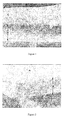
- the SEM photograph of the surface of the coating shows that said surface is not even, but has nodules.
- the SEM photograph of the interface of the coating indicates, for its part, that the nodules are virtually absent from this zone.
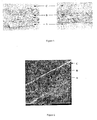
- the SEM photograph of the section of the coating made up of the polymer composition according to Example 10 (A represents a sighting within the section, close to the interface, B represents a sighting at the heart of the section and C represents a sighting within the section, close to the surface), at a magnification of 1260x represented in Figure 6
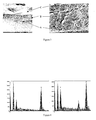
- the SEM-EDX analyses ( Figure 7 ) at the surface (C), at the interface (A) and in the heart of the section of the coating (B), illustrate the presence of the fluorinated co-oligomer within the section of the coating.
- Figure 7 in fact illustrates the EDX spectra obtained (on the left, at the surface (C), at the centre, in the heart of the section (B) and, on the right, at the interface (A) of the coating). It can be seen there that the fluorine is present only in the heart of the section and at the surface of the coating and not at the interface.
Landscapes
- Chemical & Material Sciences (AREA)
- Organic Chemistry (AREA)
- Life Sciences & Earth Sciences (AREA)
- Medicinal Chemistry (AREA)
- Polymers & Plastics (AREA)
- Chemical Kinetics & Catalysis (AREA)
- Health & Medical Sciences (AREA)
- Engineering & Computer Science (AREA)
- Materials Engineering (AREA)
- Wood Science & Technology (AREA)
- Addition Polymer Or Copolymer, Post-Treatments, Or Chemical Modifications (AREA)
- Compositions Of Macromolecular Compounds (AREA)
- Paints Or Removers (AREA)
Description
- The present invention relates to a polymer composition, to a process for preparing such a polymer composition, to its use for coating metal, polymer, paper or cellophane surfaces and for producing thin single-layer or multilayer films and moulded objects, to a process for coating such surfaces by means of said polymer composition and to the articles or parts of articles obtained.
- In the extremely vast field of plastic materials, it is the practice to add to polymers additives intended to confer on them improved properties for use, such as additives for improving fire resistance or those for improving resistance to ultraviolet rays, plasticizers, dyes, antistatic agents, demisting agents or adhesion promoters. In certain cases, the desired improvement in a property lies in the mass of the polymer. In this case, the addition of an additive distributed within the mass makes it possible to obtain good effectiveness.
- For other properties, the phenomena involved are first and foremost surface phenomena (towards the air) or interface phenomena (towards the coating support). In these cases, the distribution of the additive within the mass of the composition that it forms with the polymer has a major drawback in so far as it is not present at the site where it would be useful, which makes it necessary to introduce it in a greater amount than necessary in order for a sufficient amount to be present at the surface or at the interface. This overdose engenders an additional cost but can also have a negative influence on other properties of the material, such as the barrier properties and the mechanical properties. In certain cases, incompatibles additives may be used so as to obtain migration thereof towards the surface or towards the interface. In this case, the additives have a low molar mass and are rapidly washed from the surface to which they have migrated, thus resulting in a loss of effectiveness. This is, for example, the case of demisting agents which may be washed from the surface of a film by steam.
- A major improvement in the field would therefore be to have polymer compositions comprising additives capable of migrating preferentially to where they are useful (polymer/air surface, polymer/metal interface, polymer 1/polymer 2 interface, etc.). Besides this selective migration, the additive should exhibit sufficient compatibility with the polymer in order to avoid being easily washed away.
- In addition, in the field of coatings for metal surfaces, three layers are generally applied: the first being used for the adhesion, the second providing the properties of the coating and, finally, the finishing layer providing the surface properties. The use, in a single layer, of a composition comprising additives which would migrate to where they are necessary would also be a very great technological advance.
-
EP 0 185 464 discloses aqueous latex copolymer compositions comprising a mixture of an amorphous copolymer of vinylidene chloride and at least one internally plasticizing comonomer and an amorphous copolymer of vinylidene chloride and at least one comonomer selected from alkyl acrylates, methacrylates, styrene, acrylonitrile, vinyl acetate and vinyl ethyl ether. -
DE 19 27 270 discloses an emulsion polymerization process in two steps of vinylidene chloride in mixture with other ethylenically insaturated monomers in order to obtain an aqueous dispersion. - A subject of the present invention is such a polymer composition.
- To this effect, the invention relates to a polymer composition according to claim 1 comprising
- 1) a polymer (P1) comprising at least 50% by weight ofmonomeric units derived from vinylidene chloride (M1), and
- 2) at least one co-oligomer (O1) comprising at least:
- a) a component (A) comprising at least one monomeric unit identical to that derived from the monomer (M1) on which the polymer (P1) is based, and
- b) a component (B) comprising at least one monomeric unit (m2), derived from an ethylenically unsaturated monomer, carrying at least one group chosen from the following groups:
- -(CH2)b-CcF2c+1 with b between 1 and 11 and c greater than or equal to 5, and
- phosphonate groups -PO(OH)(OR1) with R1 being a hydrogen atom or an alkyl radical containing from 1 to 11 carbon atoms.
- For the purposes of the present invention, the term "polymer (P1)" is intended to denote a polymer of molar mass greater than that of the co-oligomer (O1). The number-average molar mass, as determined for example by steric exclusion chromatography or by elemental analysis, of the polymer (P1) involved in the composition according to the invention is greater than 30 000. The number-average molar mass of the polymer (P1) is less than or equal to 2 000 000, preferably less than or equal to 1 000 000, particularly preferably less than or equal to 500 000, and most particularly preferably less than or equal to 250 000.
- The polymer (P1) is also advantageously characterized by a polydispersity index (ratio of the weight-average molar mass to the number-average molar mass), as determined by size exclusion chromatography, of greater than or equal to 1. The polymer (P1) is advantageously characterized by a polydispersity index of less than or equal to 4.
- For the purposes of the present invention, the expression "polymer (P1) comprising monomeric units derived from vinylidene chloride (M1)" is intended to denote the polymers which are obtained by addition polymerization. The polymer (P1) contains at least 50%, preferably at least 60%, particularly preferably at least 70%, by weight of monomeric units derived from the ethylenically unsaturated monomer (M1).
- Polymer (P1) of the composition according to the invention is a chlorinated polymer. The ethylenically unsaturated monomer (M1) is vinylidene chloride
- The term "chlorinated polymer" is intended to denote both the homopolymers of vinylidene chloride and the copolymers that vinilidene chloride for with chlorinated monomers and/or with nonchlorinated monomers. These copolymers may in particular be random copolymers, gradient copolymers, block copolymers or grafted copolymers. The chlorinated polymer advantageously comprises at least 50%, preferably at least 60%, particularly preferably at least 70%, by weight of monomeric units derived from vinylidene chloride
- The term "chlorinated monomer" is intended to denote any ethylenically unsaturated monomer which comprises at least one chlorine atom. As examples of chlorinated monomers, mention may be made of chlorinated monomers in which the number of chlorine atoms is 1, chlorinated monomers in which the number of chlorine atoms is 2, trichloroethylene, 1,1,3-trichloropropene and tetrachloro ethylene.
- The term "nonchlorinated monomer" is intended to denote, for example, vinyl esters such as, for example, vinyl acetate, vinyl ethers, acrylic or methacrylic acids, esters and amides, acrylonitrile, methacrylonitrile, styrene and derivatives, butadiene, olefins such as, for example, ethylene and propylene, itaconic acid and maleic anhydride.
- A first preferred family of chlorinated monomers consists of chlorinated monomers in which the number of chlorine atoms is 1. As examples of chlorinated monomers in which the number of chlorine atoms is 1, mention may be made of allyl chloride, crotyl chloride and, with most particular mention, vinyl chloride.
- A second preferred family of chlorinated monomers consists of chlorinated monomers in which the number of chlorine atoms is 2. As examples of chlorinated monomers in which the number of chlorine atoms is 2, mention may be made of 1,1-dichloropropene, 1,3-dichloropropene, 2,3-dichloropropene,
- The polymer (P1) of the composition according to the invention is a polymer of vinylidene chloride. The ethylenically unsaturated monomer (M1) is therefore, vinylidene chloride.
- Among the polymers of vinylidene chloride, copolymers of vinylidene chloride are preferred. For the purposes of the present invention, the term "copolymers of vinylidene chloride" is intended to denote the copolymers of vinylidene chloride, which is the major monomer, with one or more monomers that are copolymerizable with said monomer. The vinylidene chloride is therefore advantageously present in the resulting copolymers in a proportion of at least 50% by weight.
- Among the monomers that are copolymerizable with vinylidene chloride, mention may be made of vinyl chloride, vinyl esters such as, for example, vinyl acetate, vinyl ethers, acrylic acids, esters and amides, methacrylic acids, esters and amides, acrylonitrile, methacrylonitrile, styrene, styrene derivatives, butadiene, olefins such as, for example, ethylene and propylene, itaconic acid and maleic anhydride.
- Copolymers of vinylidene chloride that are particularly preferred are those containing, as copolymerizable monomers, vinyl chloride and/or at least one monomer chosen from maleic anhydride and the (meth)acrylic monomers corresponding to the general formula:
CH2=CR2R3
in which R2 is chosen from hydrogen, the methyl radical and the radical -COOH, and R3 is chosen from the radical -CN, the radical -CH2-COOH and the radical -CO-R4 in which R4 is chosen from the radical -OH, the radicals -O-R5 with R5 chosen from the alkyl radicals containing from 1 to 18 carbon atoms optionally carrying one or more radicals -OH and the alkoxyalkyl radicals containing a total of 1 to 10 carbon atoms and, finally, R4 is also chosen from the radicals -NR6R7 in which R6 and R7, which are the same or different, are chosen from hydrogen and the alkyl radicals containing from 1 to 10 carbon atoms, optionally carrying one or more radicals -OH. - Copolymers of vinylidene chloride that are most particularly preferred are those containing, as copolymerizable monomers, vinyl chloride and/or at least one monomer chosen from maleic anhydride and (meth)acrylic monomers, namely methyl acrylate, methyl methacrylate, ethyl acrylate, ethyl methacrylate, n-butyl acrylate, ethylene glycol methacrylate, acrylonitrile, methacrylonitrile, acrylic acid, methacrylic acid, itaconic acid, acrylamide and N-methylolacrylamide.
- In general, the amount of vinylidene chloride in the copolymers of vinylidene chloride ranges from 50 to 95% by weight, preferably from 60 to 95% by weight, particularly preferably from 70 to 95% by weight.
- In general, the amount of vinyl chloride in the copolymers ofvinylidene chloride ranges from 3 to 50% by weight, preferably from 3 to 40% by weight, particularly preferably from 4.5 to 30% by weight.
- In general, the amount of maleic anhydride and/or of the (meth)acrylic monomer(s) in the copolymers of vinylidene chloride ranges from 1 to 50% by weight, preferably from 2 to 40% by weight, particularly preferably from 2 to 30% by weight.
- The polymer (P1) involved in the composition according to the invention can be prepared by any know process of addition polymerization. It is preferably prepared by a process of radical polymerization, whether mass polymerization, polymerization in solution in a solvent or aqueous-dispersion polymerization. It is particularly preferably prepared by a process of aqueous-dispersion radical polymerization, and most particularly preferably by a process of aqueous-suspension radical polymerization or by a process of aqueous-emulsion radical polymerization.
- For the purposes of the present invention, the expression "aqueous-dispersion polymerization" is intended to denote aqueous-suspension radical polymerization as well as aqueous-emulsion radical polymerization and aqueous-microsuspension polymerization.
- For the purposes of the present invention, the expression "aqueous-suspension radical polymerization" is intended to denote any process of radical polymerization that is carried out in aqueous medium in the presence of oleosoluble radical initiators and dispersing agents.
- For the purposes of the present invention, the expression "aqueous-emulsion radical polymerization" is intended to denote any process of radical polymerization that is carried out in aqueous medium in the presence of watersoluble radical initiators and emulsifiers.
- For the purposes of the present invention, the expression "aqueous-microsuspension polymerization", also referred to as polymerization in homogenized aqueous dispersion or miniemulsion, is intended to denote any process of radical polymerization in which oleosoluble initiators are used and an emulsion of droplets of monomers is prepared by means of vigorous mechanical stirring and the presence of emulsifiers.
- The expression "at least one co-oligomer (O1)" is intended to denote that the polymer composition according to the invention must contain at least one co-oligomer (O1), but that it may contain several thereof. It preferably comprises just one thereof.
- For the purposes of the present invention, the term "co-oligomer (O1)" is intended to denote a copolymer of low molar mass. The number-average molar mass, as determined by size exclusion chromatography or elemental analysis, of the co-oligomer (O1) involved in the composition according to the invention is greater than or equal to 100, preferably greater than or equal to 500 and particularly preferably greater than or equal to 1000. The number-average molar mass of the co-oligomer (O1) is less than or equal to 30 000, preferably less than or equal to 25 000, and particularly preferably less than or equal to 20 000.
- The co-oligomer (O1) is also advantageously characterized by a polydispersity index (ratio of the weight-average molar mass to the number-average molar mass), as determined by steric exclusion chromatography, of greater than or equal to 1. The co-oligomer (O1) is advantageously characterized by a polydispersity index of less than or equal to 3, preferably of less than or equal to 2.5, particularly preferably of less than or equal to 2.
- The chain of monomeric units in the co-oligomer (O1) is advantageously of the random, alternating, block or gradient type, and preferably of the block or gradient type. The structure of the co-oligomer (O1) is advantageously linear or branched (for example grafted, comb-branched or star-branched) and preferably linear. The co-oligomer (O1) is particularly preferably characterized by a linear structure with a chain of monomeric units of block or gradient type.
- In the co-oligomer (O1), the component (A) comprises at least one monomeric unit identical to that derived from the ethylenically unsaturated monomer (M1) on which the polymer (P1) as defined above is based vinylidene chloride.
- Component (A) of the co-oligomer (O1) comprises at least one monomeric unit derived from the monomer (M1). Preferably, the monomeric units derived from the monomer (M1) of component A represent at least 10% by weight, and particularly preferably at least 25% by weight, of the co-oligomer (O1).
- Advantageously, the monomeric units derived from the monomer (M1) of component A represent at most 90% by weight, preferably at most 85% by weight, and particularly preferably at most 75% by weight, of the co-oligomer (O1).
- Component (A) of the co-oligomer (O1) may comprise at least one monomeric unit derived from at least one monomer that is copolymerizable with the monomer (M1) as defined above, i.e. vinylidene chloride.
- Component (A) of the co-oligomer (O1) advantageously comprises at least one monomeric unit derived from at least one monomer that is copolymerizable with the monomer (M1). Preferably, the monomeric units derived from at least one monomer that is copolymerizable with the monomer (M1) of component A represent at least 2% by weight, and particularly preferably at least 5% by weight, of the co-oligomer (O1).
- Advantageously, the monomeric units derived from at least one monomer that is copolymerizable with the monomer (M1) of component A represent at most 50% by weight, preferably at most 30% by weight, and particularly preferably at most 25% by weight, of the co-oligomer (O1).
- In the co-oligomer, component (B) comprises at least one monomeric unit (m2), derived from an ethylenically unsaturated monomer, carrying at least one group chosen from the following groups:
- -(CH2)b-CcF2c+1 with b between 1 and 11 and c greater than or equal to 5, and
- the phosphonate groups -PO(OH)(OR1) with R1 being a hydrogen atom or an alkyl radical containing from 1 to 11 carbon atoms.
- The ethylenically unsaturated monomer from which the monomeric unit (m2) carrying at least one group chosen from the groups mentioned above is derived can be an ethylenically unsaturated monomer (M2) that is itself carrying at least one of the groups concerned, but also, when the group concerned is a phosphonate group -PO(OH)(OR1) with R1 being a hydrogen atom or an alkyl radical containing from 1 to 11 carbon atoms, an ethylenically unsaturated monomer (M2') carrying at least one group which, after total or partial cleavage, results in the group concerned. The term "cleavage" is intended to mean any reaction which makes it possible to obtain the group -PO(OH)(OR1). The hydrolysis reaction is a particularly preferred case of cleavage.
- As monomer (M2) carrying at least one group -(CH2)b-CcF2c+1 with b between 1 and 11 and c greater than or equal to 5, from which the corresponding monomeric unit (m2) is derived, mention may be made of the following monomers:
- CH2=CH-CO-O-(CH2)b-CcF2c+1,
- CH2=C(CH3)-CO-O-(CH2)b-CcF2c+1,
- CH2=CH-CO-O-(CH2)f-NR8-SO2-(CH2)b-CcF2c+1, with R8 being a hydrogen atom or a radical -CH3 and f being between 1 and 15 and preferably between 2 and 11, particularly preferably f being equal to 2,
- X-O-CO-CH=CH-CO-O-(CH2)b-CcF2c+1 with X being any group,
- CH2=CH-C6H4-CH2-O-(CH2)b-CcF2c+1,
- CH2=CH-O-CO-(CH2)b-CcF2c+1,
- CH2=C(CH2-CO-O-X)(CO-O-(CH2)b-CcF2c+1) with X being any group,
- CH2=C(CO-O-X)(CH2-CO-O-(CH2)b-CcF2c+1) with X being any group, and
- CH2=C(O-CO-X)(CO-O-(CH2)b-CcF2c+1) with X being any group.
- In the monomeric unit (m2) carrying at least one group -(CH2)b-CcF2c+1, b is greater than or equal to 1. b is less than or equal to 11, preferably less than or equal to 5, and particularly preferably less than or equal to 3. c is advantageously greater than or equal to 5 and preferably greater than or equal to 6. c is preferably less than or equal to 20 and particularly preferably less than or equal to 10. c is most particularly preferably equal to 8.
- When component (B) of the co-oligomer (O1) comprises at least one monomeric unit (m2), derived from an ethylenically unsaturated monomer, carrying at least one group -(CH2)b-CcF2c+1, the co-oligomer (O1) is most particularly preferably characterized by a linear structure with a chain of monomeric units of block type.
- As monomer (M2) carrying at least one phosphonate group -PO(OH)(OR1) with R1 being a hydrogen atom or an alkyl radical containing from 1 to 11 carbon atoms, from which the corresponding monomeric unit (m2) is derived, mention may be made of:
- CH2=CR9-CO-O-(CH2)i-PO(OH(OR1) with R9 being a hydrogen atom or a methyl radical and i being between 1 and 20,
- CH2=CR9-CO-O-CR10R11-PO(OH)(OR1) with R9 being a hydrogen atom or a methyl radical and R10 and R11, which are the same or different, being a hydrogen atom or an alkyl radical containing from 1 to 11 carbon atoms,
- CH2=CR9-CO-O-CH2-CH(OH)-CH2-PO(OH)(OR1) with R9 being a hydrogen atom or a methyl radical,
- CH2=CR9-CO-O-CH2-CH(OH)-CH2-CO-O-(CH2)2-PO(OH)(OR1) with R9 being a hydrogen atom or a methyl radical,
- CH2=CR9-CO-O-CH2-CH2-NH-CO-O-(CH2)i-PO(OH)(OR1) with R9 being a hydrogen atom or a methyl radical and i being between 1 and 20,
- CH2=CR9-CO-O-CH2-CH2-NH-CO-O-CR10R11-PO(OH)(OR1) with R9 being a hydrogen atom or a methyl radical and R10 and R11, which are the same or different, being a hydrogen atom or an alkyl radical containing from 1 to 11 carbon atoms,
- CH2=C(CH3)-C6H4-C(CH3)2-NH-CO-O-(CH2)i-PO(OH)(OR1) with i being between 1 and 20,
- CH2=C(CH3)-C6H4-C(CH3)2-NH-CO-O-CR10R11-PO(OH)(OR1) with R10 and R11, which are the same or different, being a hydrogen atom or an alkyl radical containing from 1 to 11 carbon atoms and the substitution of the aromatic ring being in the meta-position, ,
- CH2=CH-C6H4-CH2-PO(OH)(OR1) with the substitution of the aromatic ring being a mixture of ortho- and para-substitution,
- CH2=CH-PO(OM(OR1),
- X-O-CO-CH=CH-CO-O(CH2)i-CR10R11-PO(OH)(OR1) with R10 and R11, which are the same or different, being a hydrogen atom or an alkyl radical, i being between 1 and 20 and X being any group,
- CH2=C(O-CO-X)(CO-O-(CH2)i-CR10R11-PO(OH)(OR1)) with R10 and R11, which are the same or different, being a hydrogen atom or an alkyl radical, i being between 1 and 20 and X being any group,
- CH2=C(CH2-CO-O-X)(CO-O-(CH2)i-CR10R11-PO(OH)(OR1)) with R10 and R11, which are the same or different, being a hydrogen atom or an alkyl radical, i being between 1 and 20 and X being any group, and
- CH2=C(CO-O-X)(CH2-CO-O-(CH2)i-CR10R11-PO(OH)(OR1)) with R10 and R11, which are the same or different, being a hydrogen atom or an alkyl radical, i being between 1 et 20 and X being any group.
- As monomer (M2') carrying at least one group which, after total or partial cleavage (for example hemihydrolysis), results in the phosphonate group -PO(OH)(OR1) (with R1 being a hydrogen atom or an alkyl radical containing from 1 to 11 carbon atoms), from which the corresponding monomeric unit (m2) is derived, mention may be made of the monomers (M2') carrying at least one group -PO(OR1')(OR2') with R1', and R2', which are the same or different, representing an alkyl radical containing from 1 to 11 carbon atoms.
- In the monomeric unit (m2) carrying at least one group -PO(OH)(OR1), R1 is a hydrogen atom or an alkyl radical containing from 1 to 11 carbon atoms.
- When R1 is an alkyl radical, R1 contains from 1 to 11 carbon atoms, preferably from 1 to 8 carbon atoms, and particularly preferably from 1 to 5. The cases where R1 is either a methyl radical or an ethyl radical are most particularly preferred.
- The term "phosphonate group -PO(OH)(OR1)" is intended to denote the groups -PO(OH)(OR1) attached to a carbon atom and not the phosphate groups -O-P(O)(OR)2 with R being a hydrogen atom or an alkyl radical, in which the phosphorus atom is attached to an oxygen atom.
- When component (B) of the co-oligomer (O1) comprises at least one monomeric unit (m2), derived from an ethylenically unsaturated monomer, carrying at least one phosphonate group -PO(OH)(OR1), the co-oligomer (O1) is most particularly preferably characterized by a linear structure with a chain of monomeric units of gradient type.
- When, in the co-oligomer (O1), component (B) comprises at least one monomeric unit (m2), derived from an ethylenically unsaturated monomer (M2'), carrying at least one group which, after cleavage, results in the phosphonate group -PO(OH)(OR1) with R1 being a hydrogen atom or an alkyl radical containing from 1 to 11 carbon atoms, the cleavage may be carried out during the synthesis of the co-oligomer (O1), during the preparation of the polymer composition, as subsequently explained in detail, or during the use of the polymer composition. The cleavage preferably takes place during the synthesis of the co-oligomer (O1).
- In the particular case where, in the co-oligomer (O1), component (B) comprises at least one monomeric unit (m2), derived from an ethylenically unsaturated monomer (M2'), carrying at least one group which, after cleavage, results in the phosphonate group -PO(OH)(OR1) with R1 being a hydrogen atom or an alkyl radical containing from 1 to 11 carbon atoms, the total cleavage (so that R1 is a hydrogen atom) or the partial cleavage, in particular the hemihydrolysis, (so that R1 is an alkyl radical containing from 1 to 11 carbon atoms), of the ethylenically unsaturated monomer (M2') carrying at least one group -PO(OR1')(OR2') with R1' and R2', which are the same or different, representing an alkyl radical containing from 1 to 11 carbon atoms, may be carried out as described, respectively, in C. Brondino, B. Boutevin, Y. Hervaud, N. Pelaprat & A. Manseri, J. Fluorine Chem., 1996, 76, 193 and B. Boutevin, Y. Hervaud, T. Jeanmaire, A. Boulahna, M. Elasri, Phosph. Sulfur and Silicon, 2001, 174,1.
- Component (B) of the co-oligomer (O1) comprises at least one monomeric unit (m2). Preferably, the monomeric units (m2) of component (B) represent at least 10% by weight, and particularly preferably at least 15% by weight, of the co-oligomer (O1).
- Advantageously, the monomeric units (m2) of component (B) represent at most 80% by weight, preferably at most 75% by weight, and particularly preferably at most 70% by weight, of the co-oligomer.
- Component (B) of the co-oligomer (O1) comprises at least one monomeric unit (m2), derived from an ethylenically unsaturated monomer, carrying at least one group chosen from the following groups:
- -(CH2)b-CcF2c+1 with b between 1 and 11 and c greater than or equal to 5, and
- the phosphonate groups -PO(OH)(OR1) with R1 being a hydrogen atom or an alkyl radical containing from 1 to 11 carbon atoms.
- According to a first preferred embodiment, component (B) of the co-oligomer (O1) advantageously comprises at least one monomeric unit (m2), derived from an ethylenically unsaturated monomer, carrying at least one group chosen from the groups -(CH2)b-CcF2c+1 with b between 1 and 11 and c greater than or equal to 5.
- According to this first preferred embodiment, the ethylenically unsaturated monomer from which the monomeric unit (m2) carrying at least one group chosen from the groups mentioned above is derived is advantageously an ethylenically unsaturated monomer (M2) that is itself carrying at least one of the groups concerned.
- Preferably, the monomer (M2) carrying at least one group chosen from the groups -(CH2)b-CcF2c+1 is chosen from the following monomers:
- CH2=CH-CO-O-(CH2)b-CcF2c+1,
- CH2=C(CH3)-CO-O-(CH2)b-CcF2c+1,
- CH2=CH-CO-O-(CH2)f-NR8-SO2-(CH2)b-CcF2c+1, with R8 being a hydrogen atom or a radical -CH3 and f being between 1 and 15, preferably between 1 and 11, CH2=CH-C6H4-CH2-O-(CH2)b-CcF2c+1, and
- CH2=CH-O-CO-(CH2)b-CcF2c+1, in which b is between 1 and 11 and c is greater than or equal to 5 with the preferences defined above for b and c.
- Particularly preferably, the monomer (M2) carrying at least one group chosen from the groups -(CH2)b-CcF2c+1 is chosen from the following monomers: CH2=CH-CO-O-(CH2)b-CcF2c+1, and
CH2=C(CH3)-CO-O-(CH2)b-CcF2c+1, in which b is between 1 and 11 and c is greater than or equal to 5, with the preferences defined above for b and c. - A monomer (M2) carrying at least one group -(CH2)b-CcF2c+1 that is most particularly preferred is 1H,1H,2H,2H-heptadecafluorodecyl acrylate (FDA).
- According to this first preferred embodiment, as a complement to that which has already been defined above, good results have been obtained when the monomeric units derived from the monomer (M1) of component (A) of the co-oligomer (O1) represent at least 25% and at most 30% by weight, the monomeric units derived from at least one monomer that is copolymerizable with the monomer (M1) of component (A) represent at least 5% and at most 10% by weight and the monomeric units (m2) of component (B) represent at least 60% and at most 70% by weight of the total weight of the co-oligomer.
- According to a second preferred embodiment, component (B) of the co-oligomer (O1) advantageously comprises at least one monomeric unit (m2), derived from an ethylenically unsaturated monomer, carrying at least one group chosen from the phosphonate groups -PO(OH)(OR1) with R1 being a hydrogen atom or an alkyl radical containing from 1 to 11 carbon atoms.
- According to this second preferred embodiment, the ethylenically unsaturated monomer from which the monomeric unit (m2) carrying at least one group chosen from the groups mentioned above is derived is advantageously an ethylenically unsaturated monomer (M2) that is itself carrying at least one of the groups concerned or an ethylenically unsaturated monomer (M2') carrying at least one group which, after cleavage, results in the group concerned.
- Preferably, the monomeric unit (m2) carrying at least one group chosen from the phosphonate groups -PO(OH)(OR1) is derived from an ethylenically unsaturated monomer chosen from the following monomers:
- CH2=CR9-CO-O-(CH2)i-PO(OH)(OR1) with R9 being a hydrogen atom or a methyl radical and i being between 1 and 20,
- CH2=CR9-CO-O-CR10R11-PO(OH)(OR1) with R9 being a hydrogen atom or a methyl radical and R10 and R11, which are the same or different, being a hydrogen atom or an alkyl radical containing from 1 to 11 carbon atoms,
- CH2=CR9-CO-O-CH2-CH(OH)-CH2-PO(OH)(OR1) with R9 being a hydrogen atom or a methyl radical,
- CH2=CR9-CO-O-CH2-CH(OH)-CH2-CO-O-(CH2)2-PO(OH)(OR1) with R9 being a hydrogen atom or a methyl radical,
- CH2=CR9-CO-O-CH2-CH2-NH-CO-O-(CH2)i-PO(OH)(OR1) with R9 being a hydrogen atom or a methyl radical and i being between 1 and 20,
- CH2=CR9-CO-O-CH2-CH2-NH-CO-O-CR10R11-PO(OH)(OR1) with R9 being a hydrogen atom or a methyl radical and R10 and R11, which are the same or different, being a hydrogen atom or an alkyl radical containing from 1 to 11 carbon atoms,
- CH2=C(CH3)-C6H4-C(CH3)2-NH-CO-O-(CH2)i-PO(OH)(OR1) with i between 1 and 20,
- CH2=C(CH3)-C6H4-C(CH3)2-NH-CO-O-CR10R11-PO(OH)(OR1) with R10 and R11, which are the same or different, being a hydrogen atom or an alkyl radical containing from 1 to 11 carbon atoms and the substitution of the aromatic ring being in the meta-position,
- CH2=CH-C6H4-CH2-PO(OH)(OR1) with the substitution of the aromatic ring being a mixture of ortho- and para-substitution,
- CH2=CH-PO(OH)(OR1), in which R1 is a hydrogen atom or an alkyl radical containing from 1 to 11 carbon atoms, with the preferences defined above when R1 is an alkyl radical, and
- the corresponding monomers carrying at least one group -PO(OR1')(OR2') with R1' and R2', which are the same or different, representing an alkyl radical containing from 1 to 11 carbon atoms which, after total cleavage or partial cleavage (in particular hemihydrolysis), results in the phosphonate group -PO(OM(OR1) with R1 being a hydrogen atom or an alkyl radical containing from 1 to 11 carbon atoms.
- In the formulae mentioned above, i is between 1 and 20, preferably between 1 and 11, and particularly preferably between 1 and 3.
- In the formulae mentioned above, R10 and R11, which are the same or different, are advantageously a hydrogen atom or an alkyl radical containing from 1 to 11 carbon atoms. When they are an alkyl radical, this radical preferably contains from 1 to 8 carbon atoms.
- Particularly preferably, the monomeric unit (m2) carrying at least one group chosen from the phosphonate groups -PO(OH)(OR1) is derived from an ethylenically unsaturated monomer chosen from the following monomers:
- CH2=CR9-CO-O-(CH2)i-PO(OH)(OR1) with R9 being a hydrogen atom or a methyl radical and i being between 1 and 20, with the preferences defined above,
- CH2=CR9-CO-O-CH2-CH2-NH-CO-O-(CH2)i-PO(OH)(OR1) with R9 being a hydrogen atom or a methyl radical and i being between 1 and 20,
- CH2=CH-PO(OH)(OR1), and
- the corresponding monomers carrying at least one group -PO(OR1')(OR2') with R1' and R2', which are the same or different, representing an alkyl radical containing from 1 to 11 carbon atoms which, after total cleavage or partial cleavage (in particular hemihydrolysis), results in the phosphonate group -PO(OH)(OR1) with R1 being a hydrogen atom or an alkyl radical containing from 1 to 11 carbon atoms.
- Most particularly preferably, the monomeric unit (m2) carrying at least one group chosen from the phosphonate groups -PO(OH)(OR1) is derived from an ethylenically unsaturated monomer chosen from the following monomers:
- 1. 2-methacryloxyethylphosphonic acid (MAPHOS(OH)2)
- CH2=(CH3)-CO-O-(CH2)2-PO(OH)2
- 2. 2-methacryloxyethyl-6-carbamoyloxyethylphosphonic acid (MAUPHOS(OH2))
- CH2=C(CH3)-CO-O-CH2-CH2-NH-CO-O-(CH2)2-PO(OH)2, and
- 3. vinylphosphonic acid
- CH2=CH-PO(OH)2
- According to this second preferred embodiment, as a complement to that which has already been defined above, good results have been obtained when the monomeric units derived from the monomer (M1) of component (A) of the co-oligomer (O1) represent at least 65% and at most 75% by weight, the monomeric units derived from at least one monomer that is copolymerizable with the monomer (M1) of component (A) represent at least 5% and at most 15% by weight and the monomeric units (m2) of component (B) represent at least 15% and at most 25% by weight of the total weight of the co-oligomer.
- The co-oligomer of the polymer composition according to the invention may also comprise a component (C) comprising at least one monomeric unit derived from an ethylenically unsaturated monomer (M3) carrying at least one functional group generating at least one of the following properties: bactericidal effect, printability, adhesion, sliding effect, anti-adhesion, thermochromic effect, anti-UV effect, antistatic effect, demisting effect, sealability or adsorption of gas.
- The ethylenically unsaturated monomer (M3) advantageously has one of the following general structures CH2=CX"X', CH2=CH-CO-OX", CH2=C(CH3)-CO-O-X", X"-CO-O-CH=CH-CO-O-X', CH2=C(O-CO-X")(CO-O-X') or CH2=C(CO-O-X")(CH2-CO-O-X') in which X" and X' represent an identical or different functional group generating an identical or different desired property.
- Component (C) of the co-oligomer (O1) advantageously comprises at least one monomeric unit derived from the monomer (M3). Preferably, the monomeric units derived from the monomer (M3) of component C represent at least 1% by weight of the co-oligomer (O1).
- Advantageously, the monomeric units derived from the monomer (M3) of component (C) represent at most 50% by weight, preferably at most 25% by weight, and particularly preferably at most 15% by weight, of the co-oligomer.
- Component (B) and component (C) of the co-oligomer (O1) may optionally be put together. In this case, the ethylenically unsaturated monomer generating a monomeric unit including component (B) and component (C) advantageously has one of the following general structures in which X" represents a functional group generating a desired property and represents a particular case of X being any group, as previously defined, and X' one of the groups defined in component (B) of the co-oligomer (O1):
- CH2=CX"X', X"-O-CO-CH=CH-CO-O-X', X'-O-CO-CH=CH-CO-O-X",
- CH2=C(CO-O-X")(CH2-CO-O-X'), CH2=C(CO-O-X')(CH2-CO-O-X"),
- CH2=C(O-CO-X")(CO-O-X') or CH2=C(O-CO-X')(CO-O-X").
- Examples of ethylenically unsaturated monomers generating a monomeric unit including component (B) and component (C) would be, for example (X" representing the functional group generating the desired property and representing a particular case of X being any group, as previously defined; a, b, c, d and e being as defined above):
- CH2=C(CH2-CO-O-CaH2a+1)(CO-O-X"),
- CH2=C(CH2-CO-O-X")(CO-O-CaH2a+1),
- X"-O-CO-CH=CH-CO-O-CaH2a+1,
- CH2=C(O-CO-CaH2a+1)(CO-O-X"),
- CH2=C(O-CO-X")(CO-O-CaH2a+1),
- X"-O-CO-CH=CH-CO-O-(CH2)b-CcF2c+1,
- CH2=C(O-CO-X")(CO-O-(CH2)b-CcF2c+1),
- CH2=C(CO-O-X")(CH2-CO-O-(CH2)b-CcF2c+1),
- CH2=C(CH2-CO-O-X")(CO-O-(CH2)b-CcF2c+1),
- X"-O-CO-CH=CH-CO-O-(CH2)d-(Si(CH3)2-O)e-Si(CH3)3,
- CH2=C(O-CO-X")(CO-O-(CH2)d-(Si(CH3)2-O)e-Si(CH3)3),
- CH2=C(CO-O-X")(CH2-CO-O-(CH2)d-(Si(CH3)2-O)e-Si(CH3)3),
- CH2=C(CH2-CO-O-X")(CO-O-(CH2)d-(Si(CH3)2-O)e-Si(CH3)3),
- HOOC-Y-O-CO-CH=CH-CO-O-X" with Y being C6H4 or CgH2g in which g is between 1 and 15,
- CH2=C(O-CO-X")(CO-O-Y-COOH) with Y being C6H4 or CgH2g in which g is between 1 and 15,
- CH2=C(O-CO-(Y-COOH))(CO-O-X") with Y being C6H4 or CgH2g in which g is between 1 and 15,
- X"-O-CO-CH=CH-CO-O-ChH2h-Z-SO3H with h between 0 and 12, with Z being C6H4 or CR'R" with R' and R", which are the same or different, representing a hydrogen atom or an alkyl radical containing from 1 to 20 carbon atoms,
- X"-O-CO-CH=CH-CO-O(CH2)i-CR10R11-PO(OH)(OR1) with R10 and R11, which are the same or different, being a hydrogen atom or an alkyl radical and i being between 1 and 20,
- CH2=C(O-CO-X")(CO-O-(CH2)i-CR10R11-PO(OH)(OR1)) with R10 and R11, which are the same or different, being a hydrogen atom or an alkyl radical and i being between 1 and 20,
- CH2=C(CH2-CO-O-X")(CO-O-(CH2)i-CR10R11-PO(OH)(OR1)) with R10 and R11, which are the same or different, being a hydrogen atom or an alkyl radical and i being between 1 and 20, and
- CH2=C(CO-O-X")(CH2-CO-O-(CH2)i-CR10R11-PO(OH)(OR1)) with R10 and R11, which are the same or different, being a hydrogen atom or an alkyl radical and i being between 1 and 20.
- The co-oligomer (O1) comprises a component (A) comprising at least one monomeric unit derived from vinylidene chloride and a component (B) comprising at least one monomeric unit (m2), derived from an ethylenically unsaturated monomer, carrying at least one group chosen from the groups -(CH2)b-CcF2c+1 with b between 1 and 11 and c greater than or equal to 5, and the phosphonate groups -PO(OH)(OR1) with Ri being a hydrogen atom or an alkyl radical containing from 1 to 11 carbon atoms, with the preferences defined above for b and c.
- According to a first variant, the co-oligomer (O1) is preferably a co-oligomer of vinylidene chloride, of methyl acrylate and of 2-methacryloxyethylphosphonic acid (MAPHOS(OH)2).
- According to a second variant, the co-oligomer (O1) is preferably a co-oligomer of vinylidene chloride, of methyl acrylate and of 1H,1H,2H,2H-hepta-decafluorodecyl acrylate (FDA).
- The co-oligomer (O1) involved in the composition according to the invention may be obtained by any process of radical polymerization, whether mass polymerization, polymerization in solution in a solvent or aqueous-dispersion polymerization, for obtaining the chain of monomeric units (random, alternating, block or gradient) and the structure (linear or branched) desired for the co-oligomer (O1).
- Among the preferred polymerization processes are the polymerization processes during which the polymerization conditions (choice of temperature, nature of the initiator, use of a transfer agent) are such that the desired structure is obtained, and the processes of controlled radical polymerization.
- The processes of controlled radical polymerization are particularly preferred. Among the processes of controlled radical polymerization, mention may be made of the ATRP (Atom Transfer Radical Polymerization) process, the RAFT (Reversible Addition-Fragmentation Chain Transfer) process, the MADIX (Macromolecular Design via Interchange of Xanthate) process, the NMP (Nitroxide Mediated Polymerization) process, the ITP (Iodine Transfer Polymerization) process and the RITP (Reverse Iodine Transfer Polymerization) process. The RAFT, ITP and RITP processes are particularly preferred.
- The polymer composition according to the invention advantageously comprises at least 40% by weight, and preferably at least 50% by weight, of polymer (P1) relative to the total weight of the polymer (P1) and of the co-oligomer (O1).
- The polymer composition according to the invention may also contain additives that are conventional for polymer compositions, such as dyes, stabilizers, processing aids, antiblocking agents, fillers, plasticizers or additives for improving fire resistance. The composition may also contain polymers such as the polymers mentioned as examples of polymers (P1), with a preference for halogenated polymers. Finally, the polymer composition according to the invention may or may not comprise a solvent or water.
- Subsequently, a subject of the present invention is a process for preparing the polymer composition according to the invention.
- To this effect, the invention relates to a process for preparing the polymer composition according to the invention, comprising the mixing of the polymer (P1) and of the co-oligomer(s) (O1) in at least one solvent, the dispersion of the co-oligomer(s) (O1) in an aqueous dispersion of the polymer (P1), or the mixing of the polymer (P1) and of the co-oligomer(s) (O1) by premixing.
- When the polymer composition according to the invention is prepared by mixing the polymer (P1) and the co-oligomer(s) (O1) in at least one solvent, the concentration of the solution in the solvent(s) is advantageously between 1 and 100 g.l-1, and preferably between 5 and 50 g.l-1.
- The expression "at least one solvent" is intended to denote that one or more solvents may be used.
- Thus, when the polymer (P1) and the co-oligomer (O1) are not soluble in the same solvent, separate dissolution in an appropriate solvent for each of them can be carried out in a first step, followed by mixing of the two solutions.
- When the polymer (P1) is a polymer ofvinylidene chloride and the co-oligomer (O1) comprises at least one monomeric unit identical to that of vinylidene chloride, tetrahydrofuran, toluene, methyl ethyl ketone, acetone and mixtures thereof are preferred. When the co-oligomer (O1) carries at least one group -(CH2)b-CcF2c+1, trifluorotoluene may be used as co-solvent in order to facilitate the dissolving of the co-oligomer (O1).
- When the polymer composition according to the invention is prepared by mixing the polymer (P1) and the co-oligomer(s) (O1) in at least one solvent, the polymer (P1) and the co-oligomer(s) (O1) are advantageously in the powder or liquid state.
- The step of mixing the polymer (P1) and the co-oligomer(s) (O1) in at least one solvent may or may not be followed by a step of elimination of the solvent according to the use for which the mixture is intended. If the solvent is eliminated, this is preferably done by evaporation or by precipitation.
- When the polymer composition according to the invention is prepared by dispersing the co-oligomer(s) (O1) in an aqueous dispersion of the polymer (P1), an aqueous dispersion of the polymer (P1) advantageously exhibiting a particle size of 50 to 500 nm, and preferably of 80 to 200 nm, is advantageously used. The aqueous dispersion of the polymer (P1) is preferably that obtained by means of the aqueous-emulsion polymerization process.
- When the polymer composition according to the invention is prepared by dispersing the co-oligomer(s) (O1) in an aqueous dispersion of the polymer (P1), the co-oligomer(s) (O1) may be added in the powder or liquid state or in the form of an aqueous dispersion.
- The step of dispersion of the polymer (P1) and of the co-oligomer(s) (O1) may or may not be followed by a step of elimination of the water according to the use for which the dispersion is intended. If the water is eliminated, this is preferably done by evaporation or by coagulation of the dispersion, followed by filter-drying and drying.
- When the polymer composition according to the invention is prepared by mixing the polymer (P1) and the co-oligomer(s) (O1) by means of premixing, the polymer (P1) and the co-oligomer(s) (O1) are advantageously mixed in the powder or liquid state by dry process without melting.
- The premixing may be followed by extrusion in order to produce granules in particular.
- When, in the co-oligomer (O1), component (B) comprises at least one monomeric unit (m2) derived from an ethylenically unsaturated monomer (M2') carrying at least one group which, after cleavage, results in the group concerned, namely a phosphonate group -PO(OH)(OR1) with R1 being a hydrogen atom or an alkyl radical containing from 1 to 11 carbon atoms, the cleavage may be carried out prior to, during or subsequent to the step of preparation of the polymer composition as described above.
- Preferably, the process for preparing the polymer composition according to the invention comprises the mixing of the polymer (P1) and of the co-oligomer(s) (O1) in at least one solvent.
- In addition, a subject of the present invention is the use of the polymer composition according to the invention.
- To this effect, the invention relates to the use of the polymer composition according to the invention, for coating metal, polymer, paper or cellophane surfaces, for producing thin single-layer or multilayer films or for producing moulded objects.
- As metal surfaces, mention may be made of steel, galvanized steel and aluminium.
- As polymer surfaces, mention may be made of polyethylene terephthalate, bioriented polypropylene, poly(vinyl chloride), polyethylene, polyamides and EVA (copolymer of ethylene and of vinyl acetate that is partially hydrolysed).
- A subject of the present invention is also a process for coating metal, polymer, paper or cellophane surfaces by means of the polymer composition according to the invention.
- To this effect, the invention relates to a process for coating metal, polymer, paper or cellophane surfaces by means of the polymer composition according to the invention, according to which the polymer composition is coated onto said surfaces, colaminated with said surfaces or coextruded with the material forming said surfaces.
- When the polymer composition is coated onto said surfaces, a solution of said composition in at least one solvent or an aqueous dispersion of said composition is advantageously coated onto said surfaces by any conventional coating process or spray coating process or by immersion of the surface in the solution of the polymer composition. The coating step is preferably followed by a step of evaporation of the solvent or of the water, particularly preferably during a step of thermal treatment, most particularly preferably at a temperature greater than the glass transition temperature of the polymers and really very particularly preferably at a temperature greater than the melting temperature of the polymers.
- When the polymer composition is colaminated with said surfaces, it is advantageously first extruded or coextruded in the form of a film and this film is then colaminated with said surfaces.
- When the polymer composition is coextruded with the material forming said surfaces, said composition, in the form of a powder, is advantageously coextruded with the material forming said surfaces, in the form of a powder or of granules, so as to obtain said surfaces coated with the polymer composition in the form of films, of sheets or of plates.
- When, in the co-oligomer (O1), component (B) comprises at least one monomeric unit (m2) derived from an ethylenically unsaturated monomer (M2') carrying at least one group which, after cleavage, results in the phosphonate group -PO(OH)(OR1) with R1 being a hydrogen atom or an alkyl radical containing from 1 to 11 carbon atoms, the cleavage may be carried out just before or during the operation to coat the metal, polymer, paper or cellophane surfaces with the polymer composition.
- Finally, a subject of the invention is the articles or parts of articles prepared by means of the polymer composition according to the invention.
- The articles or parts of articles are advantageously films, sheets, plates, thin single-layer or multilayer films or moulded objects.
- The thin single-layer or multilayer films obtained may be used, for example, in packaging.
- The moulded objects obtained may, for example, be obtained by injection or by injection-blowing.
- The polymer composition according to the invention has many advantages. Thus, the polymer composition according to the invention makes it possible to improve the adhesion of a polymer coating to a metal, polymer, paper or cellophane surface. It thus makes it possible to avoid the use of primer or of adhesive between the layers of a multilayer assembly. Finally, it makes it possible to modify the properties of the coating that it forms and to improve the surface properties, such as the anti-corrosion properties, the gas-barrier properties, the antibacterial properties, the adhesion of inks at the surface and the protection against ultraviolet rays.
- The examples which follow are intended to illustrate the invention without, however, limiting the scope thereof
- Scanning electron microscopy was used to visualize the morphology of the coating after deposition of the polymer compositions onto a steel surface and the location of the phosphorus. A Hitachi scanning electron microscope was used. This made it possible to perform a fine analysis of the morphology of the coating and to differentiate the heavy elements with respect to the light elements by chemical contrast; the appearance of the heavy elements being lighter in colour.
- Scanning electron microscopy was used to visualize the morphology of the coating and the location of the phosphorus. A LEICA X-ray-coupled scanning electron microscope was used. This gave less resolution than the SEM microscope but made it possible to characterize the elements constituting the coating. It involves spectrometry using X-rays induced under the effect of an electron beam. The spectra obtained made it possible to identify all the elements present in the coating, subjected to the stream of electrons. For this, a beam of electrons was projected onto the surface to be analysed and the X-photons emitted were detected. By means of the energy released by the bombarded elements, an X-rays spectrum was obtained. Two types of analyses could be carried out. Either an overall analysis of the image visualized on the screen was carried out, which gave a mean of the composition of the coating, or a probe was used which made it possible to sight and analyse surfaces with an accuracy of 1 µm3. The accuracy of the probe made it possible to study the location of the various chemical elements within the section of the coating, by sighting with the microscope probe at various places.
- Analyses were carried out at the surface, at the interface and within the section of the coating by SEM microscopy and by SEM-EDX microscopy. Before any analysis, the samples were subjected to three successive metallizations with carbon for Examples 5-8 and to a metallization with platinum for Example 10. In order to carry out peak height comparisons, the same magnification, the same beam acceleration voltage (7 KV) and the same number of "hits" (electron bombardments) were used.
- In order to be able to analyse the section of the coating, the sample was immersed in liquid nitrogen and the metal support was bent in order to cause a cryofracture within the coating, and then the latter was detached using a scalpel. Initially, surface analyses (view from above), followed by interface analyses (view from below), were carried out on the zones having been detached. Finally, the section was characterized by means of successive sightings with the microscope probe.
- 1400 g of demineralized water were introduced into a 3 litre autoclave with mechanical stirring at 350 rpm. A solution of azobisisobutyronitrile (AIBN) in a dispersing agent of the cellulose derivative type (methylhydroxypropylcellulose), prepared by adding 1.85 g of AIBN (1.13 × 10⁻² mol) to 192 ml of a solution of the dispersing agent at 10.4 g.l-1, was then introduced into the autoclave. The reactor was then purged with vacuum-nitrogen cycles. A solution of vinylidene chloride (818 g, 8.44 mol) and methyl acrylate (181 g, 2.10 mol) was then introduced into the autoclave. The temperature was maintained at 70°C for 18 hours. Before the reactor was opened, the residual monomers were eliminated by degassing under vacuum for one hour.
- A polymer was recovered which was then dried under a fluidized bed. It was characterized by a number-average molar mass
M n of 63 000 g.mol-1 and a polydispersity index Ip (ratio of the weight-average molar mass to the number-average molar mass) of 1.99. The number-average molar massM n and the polymolecularity index Ip were determined by steric exclusion chromatography on the dry samples with a system having a Waters pump equipped with two 300 mm PL-Gel 5µm mixed-C columns (Polymer Laboratories). Tetrahydrofuran (1 ml.mn-1) was used as eluent. The calibrations were carried out using standard polystyrene from Polymer Laboratories. - The mass yield was 92%. The glass transition temperature of the vinylidene chloride polymer obtained, measured on a Pyris 1 DSC device from Perkin Elmer, is 32°C. The polymer obtained is characterized by a vinylidene chloride content of 80 mol% (82% by weight) and a methyl acrylate content of 20 mol% (18% by weight).
- The copolymerization was carried out in a stainless steel type 316 autoclave with a working volume of 300 ml (Parr instrument), and a test pressure of 338 bar, i.e. a maximum service pressure of 225 bar and a maximum service temperature of 200°C. The autoclave was equipped with a shaft and a propeller with 4 angled blades, entrained by magnetic stirring at a variable rate of 0 to 1700 rpm (torque 180 N.cm).
- Before introducing the reaction mixture, the autoclave was placed under vacuum. A solution containing vinylidene chloride (65.8 g, 6.68 × 10⁻¹ mol), methyl acrylate (14.9 g, 1.67 × 10⁻¹ mol), AIBN (0.155 g, 8.81 × 10⁻⁴ mol), 1-(ethoxycarbonyl)eth-1-yl dithiobenzoate (1.34g, 5.28 × 10⁻³ mol) and benzene (96.9 g, 1.24 mol) was introduced into the reactor.
- The reaction mixture was brought to 70°C under a nitrogen atmosphere while maintaining the rate of stirring at 400 rpm for 18 hours.
- The overall conversion was determined by gravimetry according to the following procedure. A sample of approximately 2 g was taken in a haemolysis tube before being cooled using liquid nitrogen. The solvent and the residual monomers were evaporated off under vacuum at 35°C, after having added hydroquinone. The conversion was calculated according to the equation: (mdry× 100)/(msample×SC) with mdry being the mass of the sample after evaporation, msample being the mass of the crude sample and SC being the theoretical solids content at 100% conversion. The conversion by mass of the final sample was 55.6%. The co-oligomer obtained was solubilized in tetrahydrofuran and precipitated twice from pentane in order to purify it.
- The number-average molar mass
M n, determined by steric exclusion chromatography as explained above, of the co-oligomer obtained was 6800 g.mol-1 and the polydispersity index Ip was 1.36. The glass transition temperature of the co-oligomer, determined by DSC, was 29.5°C. The polymer obtained is characterized by a vinylidene chloride content of 80 mol% (82% by weight) and a methyl acrylate content of 20 mol% (18% by weight). - In the same autoclave as that used in Example 2, a solution containing vinylidene chloride (21.37 g, 2.21 × 10⁻¹ mol), methyl acrylate (3.51 g, 4.08 × 10⁻² mol), dimethyl 2-methacryloxyethylphosphonate (MAPHOS(OCH3)2) (3 g, 1.36 × 10⁻² mol), AIBN (47.8 mg, 2.91 × 10⁻⁴ mol), 1-(ethoxycarbonyl)eth-1-yl dithiobenzoate (0.35g, 1.39 × 10⁻³ mol) and benzene (34.21 g, 4.39 × 10⁻¹ mol) was introduced into the reactor.
- The reaction mixture was brought to 70°C while maintaining the rate of stirring at 400 rpm for 24 hours. The co-oligomer obtained was solubilized in tetrahydrofuran and precipitated twice from pentane in order to purify it.
- The overall conversion, determined by gravimetry as defined in Example 2, was 32.5%.
- The number-average molar mass
M n, determined by steric exclusion chromatography as explained above, of the co-oligomer obtained was 5800 g.mol-1 and the polydispersity index Ip was 1.53. The glass transition temperature of the co-oligomer, determined by DSC, was 21.6°C. The co-oligomer obtained is characterized by a vinylidene chloride content of 75 mol% (66.6% by weight), a methyl acrylate content of 14 mol% (11% by weight) and a MAPHOS(OCH3)2 content of 11 mol% (22.4% by weight). - The incorporation of the MAPHOS(OCH3)2 monomer into the co-oligomer was confirmed by a 31P NMR analysis on a
Bruker 200 MHz device in D8-tetrahydrofuran, which showed a single peak at 29.8 ppm, a shift identical to that of MAPHOS(OCH3)2, and by elemental analysis, which gave a percentage of phosphorus in the precipitated co-oligomer of 2.7%, for 1.54% theoretically. The presence of an amount of phosphorus greater than the theoretical value confirms that the co-oligomer obtained is a copolymer with a MAPHOS(OCH3)2 distribution gradient. - The co-oligomer prepared in Example 3 (5 g, 8.58 × 10⁻⁴ mol) was introduced into a two-necked round-bottomed flask equipped with a refrigerant and a skirted stopper, and was dissolved in 25 ml of dichloromethane. After sweeping with argon for 30 minutes, bromotrimethylsilane (1.07 g, 6.97 × 10⁻³ mol) was introduced dropwise. The reaction mixture was left at ambient temperature for 96 hours, with magnetic stirring, under an inert atmosphere. The reaction was followed by 31P NMR. This reaction time was necessary in order to cleave all the phosphonic ester functions distributed on the co-oligomer chain. When the silylation was complete, the solvent was evaporated off under vacuum. 25 ml of methanol were subsequently added and the mixture was left for 2 hours with stirring. After elimination of the methanol under a strong vacuum, the diacid co-oligomer was collected in the form of a solid. The glass transition temperature of the diacid co-oligomer is 48°C.
- The incorporation of the monomer MAPHOS(OH)2 into the co-oligomer was confirmed by 31P NMR analysis on a
Bruker 200 MHz device in D8-tetrahydrofuran, which showed a single peak at 27.4 ppm, the chemical shift of MAPHOS(OH)2, and by elemental analysis, which gave a percentage of phosphorus in the precipitated co-oligomer of 3.1% for 1.56% theoretically. The presence of an amount of phosphorus greater than the theoretical value confirms that the co-oligomer obtained is a MAPHOS(OH)2 distribution gradient copolymer. - A polymer composition containing the vinylidene chloride polymer prepared in Example 1 and the vinylidene chloride co-oligomer prepared in Example 2, in a 50/50 mass ratio, was prepared by dissolving them in tetrahydrofuran (concentration 2 g.l-1).
- This composition was deposited by spin-coating onto a 1 cm2 steel surface. This support was cleaned and degreased beforehand by successive washing with acetone and with ether, and then carefully dried under vacuum.
- Thus, a drop of a solution containing 2 g.l-1 of the composition in tetrahydrofuran was deposited on the surface to be coated and the platform was spun (spin coating) for 30 seconds at 2000 rpm. The thickness of the coating was uniform and determined by the dilution and by the platform rotation rate and time.
- After the deposition, curing was again performed above the glass transition temperature of the polymers in a ventilated oven at 70°C for 4 hours. The re-curing temperature was intentionally chosen above the glass transition temperature of the polymers in order to allow reorganization of the polymer chains in the coating. This re-curing also made it possible to eliminate the residual solvent.
- Analyses of the SEM-EDX spectra for the coating made up of the composition according to Example 5 showed the presence of the three constituent elements. Thus, the carbon line was distinguished at 0.2 KeV (Kα), the oxygen line at 0.05 KeV (Kα) and the 2 chlorine lines at 2.6 (Kα) and 2.8 KeV (Kβ). The same composition was found at the surface and the interface of the coating. This result was confirmed by means of the photograph taken with the SEM microscope, represented in
Figure 1 (SEM photograph of the section of the coating made up of the polymer composition according to Example 5, on which A represents the interface, B, represents the section and C represents the surface, at a magnification of 20 000x), which shows a completely uniform deposition. It should be noted that the coating made up of the polymer composition according to Example 5 exhibited very little resistance when it was torn away from the support (therefore weak adhesion). - A polymer composition containing the vinylidene chloride polymer prepared in Example 1 and the vinylidene chloride co-oligomer prepared in Example 3, in a 50/50 mass ratio, was prepared in the same way as in Example 5.
- Deposition onto a steel surface was carried out according to the same procedure as that described in Example 5.
- The SEM-EDX analyses of the coating made up of the polymer composition according to Example 6 revealed the presence of the phosphorus X-line at 2 KeV (Kα) at the surface and at the interface. In order to be able to compare the respective amounts of phosphorus present at the various places on the coating, EDX spectra were superimposed, taking a reference peak, either oxygen or chlorine. In order for these results to be quantitative, the analyses were carried out at the same magnification (×1000) and at the same strength (7 KeV). The EDX spectra showed a slight migration of the phosphorus towards the metal interface.
- The photograph taken with the SEM microscope, represented in
Figure 2 (SEM photograph of the section of the coating made up of the polymer composition according to Example 6, on which A represents the interface, B represents the section and C represents the surface, at a magnification of 20 000x), showed that the coating was uniform. Thus, the incorporation of the MAPHOS(OCH3)2 monomer did not disturb the morphology of the deposit. - A polymer composition containing the vinylidene chloride polymer prepared in Example 1 and the vinylidene chloride co-oligomer prepared in Example 4, in a 50/50 mass ratio, was prepared in the same way as in Example 5.
- The deposition onto a steel surface was carried out according to the same procedure as that described in Example 5.
- The surface EDX analyses of this coating did not show the presence of phosphorus, this being the case in all the zones analysed, with more or less high magnification. On the other hand, in the analyses at the interface, it was possible to note the presence of phosphorus. The presence of iron (line at 0.8 KeV) was also observed. This is the result of the strong adhesion of the coating to the support, which coating was more difficult to tear away than in the case of the compositions according to Examples 5 and 6. Specifically, when the film was detached, a fine layer of the metal support was torn away.
- The section of the coating was then characterized. It was possible to note that it was made up of many nodules within a continuous matrix, as represented in
Figure 3 , which represents, on the left, a photograph obtained by means of the SEM-EDX microscope in secondary electron mode (magnification 860x) and, on the right, a photograph obtained by means of the SEM microscope (magnification 1300x), of the section of the coating made up of the polymer composition according to Example 7 (A is the interface, B is the section and C is the surface). The size of these nodules was not consistent and ranged from 6 to 15 µm. By sighting with the microscope probe on a nodule, an intense peak of phosphorus was revealed in the SEM-EDX spectrum, whereas by sighting on the matrix, this peak was not revealed, as illustrated inFigure 4 representing the SEM-EDX spectra obtained using the probe sighting in the matrix (on the left) or in the nodules (on the right). Mapping of the phosphorus composition of the same zone confirmed the fact that the phosphorus was found exclusively in the nodules. - In addition, on the photo in
Figure 3 , on the left, it is possible to see a zone depleted of nodules towards the surface of the coating which is 20 µm thick. This explains the surface SEM-EDX analyses which did not reveal any phosphorus on the spectra. On the other hand, there are more nodules (thickness 50 µm) close to the metal interface, which confirms the presence of phosphorus on the spectra performed at the interface. - Finally, it could be noted, by means of the SEM-EDX microscopy, that, at certain places on the metal plate, a fine film of coating remains after said coating had been torn off. These results showed that, when the coating was torn off, some nodules remained on the metal surface; this is proof that the acid phosphonate groups present in the co-oligomer are playing their role of adhesion promoter.
- A polymer composition containing the vinylidene chloride polymer prepared in Example 1 and the vinylidene chloride co-oligomer prepared in Example 4, in a 90/10 mass ratio, was prepared in the same way as in Example 5.
- The deposition onto a steel surface was carried out according to the same procedure as that described in Example 5.
- The SEM-EDX analyses of the coating made up of the polymer composition according to Example 8 gave results comparable to those obtained for the coating made up of the composition according to Example 7. The phosphorous was detected only on the spectra realised at the interface and in the nodules. In addition, the photos produced by SEM as represented in
Figure 5 , on the left at a magnification of 860x and, on the right at a magnification of 1300x (A is the interface, B is the section and C is the surface), showed a greater concentration of nodules towards the metal interface. They also showed that a wider zone than in the case of Example 7, and representing approximately half the thickness of the deposit, consists only of the polymer. Finally, the amount of visible nodules within the coating was completely in agreement with the proportion of co-oligomer in the composition. - A solution of 1H,1H,2H,2H-heptadecafluorodecyl acrylate (FDA) (5 g, 9.65 × 10⁻³ mol), AIBN (0.0111 g, 6.75 × 10⁻⁵ mol) and the vinylidene chloride co-oligomer prepared in Example 2 (1.133 g, 1.67 × 10⁻⁴ mol) in benzene (24.57 g, 3.15 × 10⁻¹ mol) was placed in a 50 ml two-necked round-bottomed flask. The oxygen was eliminated by means of freeze-thawing cycles under vacuum in order to eliminate the air and then by bubbling nitrogen. The solution was brought to 70°C with magnetic stirring for 22 hours. The final co-oligomer, consisting of 2 blocks, a first block which is a co-oligomer of vinylidene chloride and of methyl acrylate and a second block which is an FDA homooligomer, was precipitated from pentane and dried under vacuum. 2.95 g of said co-oligomer was recovered, i.e. a yield by mass of 36.3%.
- The elemental analysis of the co-oligomer obtained gave the following percentages: 30.37% of C, 39.47% ofF and 19.53% of Cl, making it possible to calculate a molar composition of 59% of vinylidene chloride, 15% of methyl acrylate and 26% of FDA, and a composition by mass of 28% ofvinylidene chloride, 6.3% of methyl acrylate and 65.7% of FDA. A number-average molar mass of 19 800 g.mol-1 was calculated on the basis of these values and by assuming that all the FDA is in diblock form.
- Moreover, a theoretical average molar mass of 17 700 g.mol-1 was calculated on the basis of the yield by mass.
- A polymer composition containing the vinylidene chloride polymer prepared in Example 1 and the vinylidene chloride co-oligomer prepared in Example 9, in an 80/20 mass ratio, was prepared by dissolving them in tetrahydrofuran (concentration 2 g.l-1).
- This composition was deposited by bare-coating onto a 1 cm2 steel surface. This support was cleaned and degreased beforehand by successive washing with acetone and with ether and was then carefully dried under vacuum.
- Thus, a drop of a solution containing 2 g/l of the composition in tetrahydrofuran was deposited onto the surface to be coated. The drop was then spread out using a bar and the solvent slowly evaporated off. The thickness of the coating was determined by virtue of the space between the steel surface and the bar and also by virtue of the concentration of the solution.
- After the deposition, curing was again performed above the glass transition temperature of the vinylidene chloride polymer and of that of the co-oligomer and also above the melting temperature of the PFBA block of the co-oligomer (71°C) in a ventilated oven at 100°C for 7 hours. The re-curing temperature was intentionally chosen above the glass transition temperature of the polymers and the melting temperature of the PFBA, so as to allow reorganization of the polymer chains in the coating. This re-curing also made it possible to eliminate the residual solvent.
- The SEM photograph of the surface of the coating shows that said surface is not even, but has nodules. The SEM photograph of the interface of the coating indicates, for its part, that the nodules are virtually absent from this zone.
- Finally, the SEM photograph of the section of the coating made up of the polymer composition according to Example 10 (A represents a sighting within the section, close to the interface, B represents a sighting at the heart of the section and C represents a sighting within the section, close to the surface), at a magnification of 1260x represented in
Figure 6 , and the SEM-EDX analyses (Figure 7 ) at the surface (C), at the interface (A) and in the heart of the section of the coating (B), illustrate the presence of the fluorinated co-oligomer within the section of the coating. -
Figure 7 in fact illustrates the EDX spectra obtained (on the left, at the surface (C), at the centre, in the heart of the section (B) and, on the right, at the interface (A) of the coating). It can be seen there that the fluorine is present only in the heart of the section and at the surface of the coating and not at the interface.
Claims (9)
- Polymer composition, characterized in that it comprises1) a polymer (P1) comprising at least 50% by weight of monomeric units derived from vinylidene chloride (M1), and2) at least one co-oligomer (O1) comprising at least:a) a component (A) comprising at least one monomeric unit identical to that derived from the monomer (M1) on which the polymer (P1) is based, andb) a component (B) comprising at least one monomeric unit (m2), derived from an ethylenically unsaturated monomer, carrying at least one group chosen from the following groups :- -(CH2)b-CcF2c+1 with b between 1 and 11 and c greater than or equal to 5, and- the phosphonate groups -PO(OH)(OR1) with R1 being a hydrogen atom or an alkyl radical containing from 1 to 11 carbon atoms,wherein said polymer (P1) has a number-average molar mass of greater than 30000 to less than or equal to 2000000 and said co-oligomer (O1) has a number-average molar mass of greater than 100 to less than or equal to 30000.
- Composition according to Claim 1, characterized in that component (B) of the co-oligomer (O1) comprises at least one monomeric unit (m2), derived from an ethylenically unsaturated monomer, carrying at least one group chosen from the groups -(CH2)b-CcF2c+1 with b between 1 and 11 and c greater than or equal to 5.
- Composition according to Claim 2, characterized in that the at least one monomeric unit (m2) is derived from an ethylenically unsaturated monomer, carrying at least one group chosen from the groups -(CH2)b-CcF2c+1 with b between 1 and 11 and c greater than or equal to 5 which is chosen from the following monomers:CH2=CH-CO-O-(CH2)b-CcF2c+1,CH2=C(CH3)-CO-O-(CH2)b-CcF2c±1,CH2=CH-CO-O-(CH2)f-NR8-SO2-(CH2)b-CcF2c+1, with R8 being a hydrogen atom or a radical -CH3 and f being between 1 and 15,CH2=CH-C6H4-CH2-O-(CH2)b-CcF2c±1 andCH2=CH-O-CO-(CH2)b-CcF2c+1.
- Composition according to Claim 1, characterized in that component (B) of the co-oligomer (O1) comprises at least one monomeric unit (m2), derived from an ethylenically unsaturated monomer, carrying at least one group chosen from the phosphonate groups -PO(OH)(OR1) with R1 being a hydrogen atom or an alkyl radical containing from 1 to 11 carbon atoms.
- Composition according to Claim 4, characterized in that the at least one monomeric unit (m2) is derived from an ethylenically unsaturated monomer, carrying at least one group chosen from the phosphonate groups -PO(OH)(OR1) with R1 being a hydrogen atom or an alkyl radical containing from I to 11 carbon atoms which is chosen from the following monomers:CH2=CR9-CO-O-(CH2)i-PO(OH)(OR1) with R9 being a hydrogen atom or a methyl radical and i being between I and 20,CH2=CR9-CO-O-CR10R11-PO(OH)(OR1) with R9 being a hydrogen atom or a methyl radical and R10 and R11, which are the same or different, being a hydrogen atom or an alkyl radical containing from 1 to 11 carbon atoms,CH2=CR9-CO-O-CH2-CH(OH)-CH2-PO(OH)(OR1) with R9 being a hydrogen atom or a methyl radical,CH2=CR9-CO-O-CH2-CH(OH)-CH2-CO-O-(CH2)2-PO(OH)(OR1) with R9 being a hydrogen atom or a methyl radical,CH2=CR9-CO-O-CH2-CH2-NH-CO-O-(CH2)i-PO(OH)(OR1) with R9 being a hydrogen atom or a methyl radical and i being between 1 and 20,CH2=CR9-CO-O-CH2-CH2-NH-CO-O-CR10R11-PO(OH)(OR1) with R9 being a hydrogen atom or a methyl radical and R10 and R11, which are the same or different, being a hydrogen atom or an alkyl radical containing from 1 to 11 carbon atoms,CH2=C(CH3)-C6H4-C(CH3)2-NH-CO-O-(CH2)i-PO(OH)(OR1) with i being between 1 and 20,CH2=C(CH3)-C6H4-C(CH3)2-NH-CO-O-CR10R11-PO(OH)(OR1) with R10 and R11, which are the same or different, being a hydrogen atom or an alkyl radical containing from 1 to 11 carbon atoms and the substitution of the aromatic ring being in the meta-position,CH2=CH-C6H4-CH2-PO(OH)(OR1) with the substitution of the aromatic ring being a mixture of ortho- and para-substitution,CH2=CH-PO(OH)(OR1), andthe corresponding monomers carrying at least one group -PO(OR1')(OR2') with R1' and R2', which are the same or different, representing an alkyl radical containing from 1 to 11 carbon atoms which, after total or partial cleavage, results in the phosphonate group -PO(OH)(OR1).
- Process for preparing a composition according to any one of Claims 1 to 5, characterized in that it comprises the mixing of the polymer (P1) and of the co-oligomer(s) (O1) in at least one solvent, the dispersion of the co-oligomer(s) (O1) in an aqueous dispersion of the polymer (P1), or the mixing of the polymer (P1) and of the co-oligomer(s) (O1) by premixing.
- Use of a composition according to any one of Claims 1 to 5, for coating metal, polymer, paper or cellophane surfaces, for producing thin single-layer or multilayer films or for producing moulded objects.
- Process for coating metal, polymer, paper or cellophane surfaces by means of the polymer composition according to any one of Claims 1 to 5, according to which the polymer composition is coated onto said surfaces, colaminated with said surfaces or coextruded with the material forming said surfaces.
- Articles or parts of articles prepared by means of the polymer composition according to any one of Claims 1 to 5.
Applications Claiming Priority (3)
| Application Number | Priority Date | Filing Date | Title |
|---|---|---|---|
| FR0311166A FR2859999B1 (en) | 2003-09-23 | 2003-09-23 | POLYMERIC COMPOSITION COMPRISING A POLYMER AND AT LEAST ONE COOLIGOMER COMPRISING A PARTICULAR FUNCTIONAL GROUP |
| FR0403108 | 2004-03-25 | ||
| PCT/EP2004/052272 WO2005028557A1 (en) | 2003-09-23 | 2004-09-22 | Polymer composition |
Publications (2)
| Publication Number | Publication Date |
|---|---|
| EP1668076A1 EP1668076A1 (en) | 2006-06-14 |
| EP1668076B1 true EP1668076B1 (en) | 2013-05-01 |
Family
ID=34379439
Family Applications (1)
| Application Number | Title | Priority Date | Filing Date |
|---|---|---|---|
| EP04766838.9A Expired - Lifetime EP1668076B1 (en) | 2003-09-23 | 2004-09-22 | Vinylidene chloride polymer composition |
Country Status (6)
| Country | Link |
|---|---|
| US (1) | US8324322B2 (en) |
| EP (1) | EP1668076B1 (en) |
| JP (1) | JP5078353B2 (en) |
| DK (1) | DK1668076T3 (en) |
| ES (1) | ES2423942T3 (en) |
| WO (1) | WO2005028557A1 (en) |
Families Citing this family (9)
| Publication number | Priority date | Publication date | Assignee | Title |
|---|---|---|---|---|
| FR2891548B1 (en) * | 2005-10-05 | 2010-08-27 | Solvay | AQUEOUS DISPERSION COMPRISING AT LEAST ONE POLYMER OF VINYLIDENE CHLORIDE AND AT LEAST ONE COPOLYMER |
| JP5174920B2 (en) | 2007-11-22 | 2013-04-03 | ソルヴェイ(ソシエテ アノニム) | Composition of at least one vinylidene chloride copolymer |
| FR2930945B1 (en) * | 2008-05-07 | 2011-03-11 | Arkema France | PROCESS FOR PREPARING A MIXTURE OF HALOGEN POLYMER AND COPOLYMER CARRYING ASSOCIATIVE GROUPS |
| US20120270454A1 (en) * | 2011-04-21 | 2012-10-25 | E.I. Du Pont De Nemours And Company | Body armor article and method of making |
| EP2794694B1 (en) | 2011-12-21 | 2016-03-30 | Solvay Sa | Process for the preparation of a vinylidene chloride polymer composite |
| US20140357791A1 (en) * | 2011-12-21 | 2014-12-04 | Solvay Sa | Process for the preparation of a vinylidene chloride polymer/clay composite |
| EP2794695B1 (en) * | 2011-12-21 | 2016-03-16 | Solvay Sa | Process for the preparation of a vinylidene chloride polymer |
| CN103797037B (en) * | 2012-06-04 | 2016-01-13 | Lg化学株式会社 | Water-dispersible halogen-terminated polyalkylacrylates, vinyl chloride-based block copolymers and methods for their preparation |
| AU2014215300B2 (en) | 2013-02-08 | 2017-03-30 | Kuraray Co., Ltd. | Multilayer structure and method for producing same |
Citations (1)
| Publication number | Priority date | Publication date | Assignee | Title |
|---|---|---|---|---|
| EP0376591A1 (en) * | 1988-12-29 | 1990-07-04 | Rohm And Haas Company | Phosphorus-containing polymer compositions comprising watersoluble polyvalent metal compounds |
Family Cites Families (20)
| Publication number | Priority date | Publication date | Assignee | Title |
|---|---|---|---|---|
| DE1027874B (en) * | 1956-05-09 | 1958-04-10 | Hoechst Ag | Process for the production of vinyl chloride copolymers |
| DE1250577B (en) * | 1959-11-28 | 1967-09-21 | tarbwerke Hoechst Aktiengesellschaft vormals Meister Lucius &. Brunmg, Frankfurt/M | Coating agent for coating the surfaces of bodies made of macromolecular organic substances |
| BE664139A (en) * | 1965-05-19 | 1965-11-19 | ||
| DE1927270A1 (en) | 1969-05-29 | 1970-12-03 | Basf Ag | Emulsion polymerisation of vinylidene chlor - ide and co-monomers in two stages |
| DE2609462C3 (en) * | 1976-03-08 | 1979-11-29 | Hoechst Ag, 6000 Frankfurt | Perfluoroalkyl ethyl acrylate copolymers |
| JPS5382890A (en) * | 1976-12-28 | 1978-07-21 | Nippon Synthetic Chem Ind Co Ltd:The | Emulsion polymerization process |
| JPS59215346A (en) * | 1983-05-23 | 1984-12-05 | Asahi Chem Ind Co Ltd | Vinylidene chloride latex |
| JPS6151068A (en) * | 1984-08-17 | 1986-03-13 | Showa Denko Kk | Water and oil-repellent paint |
| DE3568449D1 (en) | 1984-12-06 | 1989-04-06 | Ici Plc | Aqueous latex copolymer compositions |
| US5001192A (en) * | 1988-01-06 | 1991-03-19 | The Dow Chemical Company | Polymeric polyblend composition |
| US5091483A (en) * | 1989-09-22 | 1992-02-25 | Minnesota Mining And Manufacturing Company | Radiation-curable silicone elastomers and pressure sensitive adhesives |
| JP2663685B2 (en) * | 1990-07-20 | 1997-10-15 | 旭硝子株式会社 | Fluorine water / oil repellent |
| JPH051197A (en) * | 1991-06-27 | 1993-01-08 | Asahi Chem Ind Co Ltd | Fluorine-containing resin, its production and coating composition thereof |
| US6048952A (en) * | 1991-07-10 | 2000-04-11 | 3M Innovative Properties Company | Perfluoroalkyl halides and derivatives |
| US6174948B1 (en) * | 1996-12-24 | 2001-01-16 | The University Of Southern Mississippi | Latex compositions containing ethylenically unsaturated esters of fatty compounds and applications thereof |
| JP3776226B2 (en) | 1998-01-27 | 2006-05-17 | 花王株式会社 | Water-based beauty nail |
| FR2786178A1 (en) | 1998-11-25 | 2000-05-26 | Solvay | New functional trifluorovinyl monomers used for forming fluorinated elastomers and in forming crosslinked copolymers with fluorinated olefins |
| AU6447700A (en) | 1999-06-11 | 2001-01-02 | Bernard Jean Leon Boutevin | Method for protecting metals against corrosion and non-polluting reactive composition therefor |
| FR2819816B1 (en) | 2001-01-19 | 2003-04-11 | Solvay | POLYMER COMPOSITIONS COMPRISING TELOMERS WHICH HAVE AN AVERAGE DEGREE OF TEELOMERIZATION LESS THAN 8 OR MORE AND ARTICLES OR PARTS OF ARTICLES MADE USING THE SAME |
| FR2839724B1 (en) | 2002-05-17 | 2005-08-05 | Solvay | RADICAL POLYMERIZATION METHODS FOR PREPARING HALOGEN POLYMERS AND HALOGEN POLYMERS |
-
2004
- 2004-09-22 EP EP04766838.9A patent/EP1668076B1/en not_active Expired - Lifetime
- 2004-09-22 US US10/572,944 patent/US8324322B2/en active Active
- 2004-09-22 WO PCT/EP2004/052272 patent/WO2005028557A1/en not_active Ceased
- 2004-09-22 DK DK04766838.9T patent/DK1668076T3/en active
- 2004-09-22 JP JP2006527415A patent/JP5078353B2/en not_active Expired - Lifetime
- 2004-09-22 ES ES04766838T patent/ES2423942T3/en not_active Expired - Lifetime
Patent Citations (1)
| Publication number | Priority date | Publication date | Assignee | Title |
|---|---|---|---|---|
| EP0376591A1 (en) * | 1988-12-29 | 1990-07-04 | Rohm And Haas Company | Phosphorus-containing polymer compositions comprising watersoluble polyvalent metal compounds |
Non-Patent Citations (1)
| Title |
|---|
| TRINH ANH TRUC: "Study on the emulsion polymerization of acrylate monomers with the presence of organic phosphate for protective coating of carbon steel", CA, XP002411737 * |
Also Published As
| Publication number | Publication date |
|---|---|
| ES2423942T3 (en) | 2013-09-25 |
| WO2005028557A1 (en) | 2005-03-31 |
| JP2007505981A (en) | 2007-03-15 |
| JP5078353B2 (en) | 2012-11-21 |
| DK1668076T3 (en) | 2013-07-08 |
| US8324322B2 (en) | 2012-12-04 |
| EP1668076A1 (en) | 2006-06-14 |
| US20070218207A1 (en) | 2007-09-20 |
Similar Documents
| Publication | Publication Date | Title |
|---|---|---|
| US9255211B2 (en) | Adhesion to plastic with block copolymers obtained using RAFT | |
| CA2633263A1 (en) | Low surface energy block co-polymer preparation methods and applications | |
| US9340699B2 (en) | Aqueous oligomer / polymer emulsion with cationic functionality | |
| WO2010005756A1 (en) | Fluoropolymer aqueous hybrid compositions with improved film formation | |
| US8324322B2 (en) | Polymer composition | |
| EP2217631A2 (en) | Process for the preparation of a film or a coating on a substrate with an aqueous dispersion of polymer particles and the resulting films and coatings | |
| EP1934282B1 (en) | Aqueous dispersion | |
| WO2018147201A1 (en) | Water- and oil-repellent resin composition | |
| FR2859999A1 (en) | Polymeric composition for use e.g. as coating material, comprises a vinyl polymer and a co-oligomer consisting of vinyl monomer units and vinyl units with special groups, e.g. fluoroalkyl or carboxylic acid | |
| US20110065860A1 (en) | Method for preparing a blend of halogenated polymer and of copolymer bearing associative groups | |
| KR20030081462A (en) | Use of amphilic block copolymers in order to increase the water affinity of low-energy surfaces | |
| JP4077323B2 (en) | Plastisol composition and molded article and article using the same | |
| CA1175973A (en) | Film forming composition comprising internally plasticized vinyl chloride copolymer | |
| US5877259A (en) | Heat sealable adhesive coating composition and process | |
| JPH0441688B2 (en) | ||
| IL45910A (en) | Fire retradant stable aqueous polymer latices and their preparation | |
| Favstritsky et al. | Flame-retardant brominated styrene-based polymers. X. Dibromostyrene grafted latexes | |
| Li et al. | Mutual toughening of vinylidene chloride and methyl methacrylate in network composites prepared via concentrated emulsion polymerization | |
| JPH0621266B2 (en) | Undercoat paint |
Legal Events
| Date | Code | Title | Description |
|---|---|---|---|
| PUAI | Public reference made under article 153(3) epc to a published international application that has entered the european phase |
Free format text: ORIGINAL CODE: 0009012 |
|
| 17P | Request for examination filed |
Effective date: 20060424 |
|
| AK | Designated contracting states |
Kind code of ref document: A1 Designated state(s): AT BE BG CH CY CZ DE DK EE ES FI FR GB GR HU IE IT LI LU MC NL PL PT RO SE SI SK TR |
|
| DAX | Request for extension of the european patent (deleted) | ||
| RIN1 | Information on inventor provided before grant (corrected) |
Inventor name: BODART, VINCENT Inventor name: BOUTEVIN, BERNARD Inventor name: LACROIX-DESMAZES, PATRICK Inventor name: HERVAUD, YVES Inventor name: RIXENS, BERENGERE Inventor name: SEVERAC, ROMAIN Inventor name: FRINGANT, CHRISTOPHE |
|
| RIN1 | Information on inventor provided before grant (corrected) |
Inventor name: BOUTEVIN, BERNARD Inventor name: LACROIX-DESMAZES, PATRICK Inventor name: RIXENS, BERENGERE Inventor name: FRINGANT, CHRISTOPHE Inventor name: HERVAUD, YVES Inventor name: BODART, VINCENT Inventor name: SEVERAC, ROMAIN |
|
| 17Q | First examination report despatched |
Effective date: 20090528 |
|
| RAP1 | Party data changed (applicant data changed or rights of an application transferred) |
Owner name: SOLVAY SA |
|
| GRAP | Despatch of communication of intention to grant a patent |
Free format text: ORIGINAL CODE: EPIDOSNIGR1 |
|
| RIC1 | Information provided on ipc code assigned before grant |
Ipc: C09D 143/02 20060101ALI20120621BHEP Ipc: C08L 43/02 20060101ALI20120621BHEP Ipc: C08L 27/08 20060101AFI20120621BHEP Ipc: C09D 133/16 20060101ALI20120621BHEP Ipc: C09D 127/08 20060101ALI20120621BHEP Ipc: C08L 33/16 20060101ALI20120621BHEP |
|
| GRAP | Despatch of communication of intention to grant a patent |
Free format text: ORIGINAL CODE: EPIDOSNIGR1 |
|
| GRAS | Grant fee paid |
Free format text: ORIGINAL CODE: EPIDOSNIGR3 |
|
| GRAA | (expected) grant |
Free format text: ORIGINAL CODE: 0009210 |
|
| AK | Designated contracting states |
Kind code of ref document: B1 Designated state(s): AT BE BG CH CY CZ DE DK EE ES FI FR GB GR HU IE IT LI LU MC NL PL PT RO SE SI SK TR |
|
| REG | Reference to a national code |
Ref country code: GB Ref legal event code: FG4D |
|
| REG | Reference to a national code |
Ref country code: CH Ref legal event code: EP Ref country code: AT Ref legal event code: REF Ref document number: 609946 Country of ref document: AT Kind code of ref document: T Effective date: 20130515 |
|
| REG | Reference to a national code |
Ref country code: IE Ref legal event code: FG4D |
|
| REG | Reference to a national code |
Ref country code: DE Ref legal event code: R096 Ref document number: 602004041983 Country of ref document: DE Effective date: 20130704 |
|
| REG | Reference to a national code |
Ref country code: DK Ref legal event code: T3 |
|
| REG | Reference to a national code |
Ref country code: SE Ref legal event code: TRGR |
|
| REG | Reference to a national code |
Ref country code: AT Ref legal event code: MK05 Ref document number: 609946 Country of ref document: AT Kind code of ref document: T Effective date: 20130501 |
|
| REG | Reference to a national code |
Ref country code: ES Ref legal event code: FG2A Ref document number: 2423942 Country of ref document: ES Kind code of ref document: T3 Effective date: 20130925 |
|
| REG | Reference to a national code |
Ref country code: NL Ref legal event code: VDEP Effective date: 20130501 |
|
| PG25 | Lapsed in a contracting state [announced via postgrant information from national office to epo] |
Ref country code: GR Free format text: LAPSE BECAUSE OF FAILURE TO SUBMIT A TRANSLATION OF THE DESCRIPTION OR TO PAY THE FEE WITHIN THE PRESCRIBED TIME-LIMIT Effective date: 20130802 Ref country code: SI Free format text: LAPSE BECAUSE OF FAILURE TO SUBMIT A TRANSLATION OF THE DESCRIPTION OR TO PAY THE FEE WITHIN THE PRESCRIBED TIME-LIMIT Effective date: 20130501 Ref country code: AT Free format text: LAPSE BECAUSE OF FAILURE TO SUBMIT A TRANSLATION OF THE DESCRIPTION OR TO PAY THE FEE WITHIN THE PRESCRIBED TIME-LIMIT Effective date: 20130501 |
|
| PG25 | Lapsed in a contracting state [announced via postgrant information from national office to epo] |
Ref country code: PL Free format text: LAPSE BECAUSE OF FAILURE TO SUBMIT A TRANSLATION OF THE DESCRIPTION OR TO PAY THE FEE WITHIN THE PRESCRIBED TIME-LIMIT Effective date: 20130501 Ref country code: BG Free format text: LAPSE BECAUSE OF FAILURE TO SUBMIT A TRANSLATION OF THE DESCRIPTION OR TO PAY THE FEE WITHIN THE PRESCRIBED TIME-LIMIT Effective date: 20130801 Ref country code: CY Free format text: LAPSE BECAUSE OF FAILURE TO SUBMIT A TRANSLATION OF THE DESCRIPTION OR TO PAY THE FEE WITHIN THE PRESCRIBED TIME-LIMIT Effective date: 20130501 |
|
| PG25 | Lapsed in a contracting state [announced via postgrant information from national office to epo] |
Ref country code: EE Free format text: LAPSE BECAUSE OF FAILURE TO SUBMIT A TRANSLATION OF THE DESCRIPTION OR TO PAY THE FEE WITHIN THE PRESCRIBED TIME-LIMIT Effective date: 20130501 Ref country code: SK Free format text: LAPSE BECAUSE OF FAILURE TO SUBMIT A TRANSLATION OF THE DESCRIPTION OR TO PAY THE FEE WITHIN THE PRESCRIBED TIME-LIMIT Effective date: 20130501 Ref country code: CZ Free format text: LAPSE BECAUSE OF FAILURE TO SUBMIT A TRANSLATION OF THE DESCRIPTION OR TO PAY THE FEE WITHIN THE PRESCRIBED TIME-LIMIT Effective date: 20130501 Ref country code: BE Free format text: LAPSE BECAUSE OF FAILURE TO SUBMIT A TRANSLATION OF THE DESCRIPTION OR TO PAY THE FEE WITHIN THE PRESCRIBED TIME-LIMIT Effective date: 20130501 |
|
| PG25 | Lapsed in a contracting state [announced via postgrant information from national office to epo] |
Ref country code: RO Free format text: LAPSE BECAUSE OF FAILURE TO SUBMIT A TRANSLATION OF THE DESCRIPTION OR TO PAY THE FEE WITHIN THE PRESCRIBED TIME-LIMIT Effective date: 20130501 Ref country code: NL Free format text: LAPSE BECAUSE OF FAILURE TO SUBMIT A TRANSLATION OF THE DESCRIPTION OR TO PAY THE FEE WITHIN THE PRESCRIBED TIME-LIMIT Effective date: 20130501 |
|
| PLBE | No opposition filed within time limit |
Free format text: ORIGINAL CODE: 0009261 |
|
| STAA | Information on the status of an ep patent application or granted ep patent |
Free format text: STATUS: NO OPPOSITION FILED WITHIN TIME LIMIT |
|
| 26N | No opposition filed |
Effective date: 20140204 |
|
| PG25 | Lapsed in a contracting state [announced via postgrant information from national office to epo] |
Ref country code: MC Free format text: LAPSE BECAUSE OF FAILURE TO SUBMIT A TRANSLATION OF THE DESCRIPTION OR TO PAY THE FEE WITHIN THE PRESCRIBED TIME-LIMIT Effective date: 20130501 |
|
| REG | Reference to a national code |
Ref country code: CH Ref legal event code: PL |
|
| REG | Reference to a national code |
Ref country code: DE Ref legal event code: R097 Ref document number: 602004041983 Country of ref document: DE Effective date: 20140204 |
|
| REG | Reference to a national code |
Ref country code: IE Ref legal event code: MM4A |
|
| PG25 | Lapsed in a contracting state [announced via postgrant information from national office to epo] |
Ref country code: LI Free format text: LAPSE BECAUSE OF NON-PAYMENT OF DUE FEES Effective date: 20130930 Ref country code: IE Free format text: LAPSE BECAUSE OF NON-PAYMENT OF DUE FEES Effective date: 20130922 Ref country code: CH Free format text: LAPSE BECAUSE OF NON-PAYMENT OF DUE FEES Effective date: 20130930 |
|
| PG25 | Lapsed in a contracting state [announced via postgrant information from national office to epo] |
Ref country code: TR Free format text: LAPSE BECAUSE OF FAILURE TO SUBMIT A TRANSLATION OF THE DESCRIPTION OR TO PAY THE FEE WITHIN THE PRESCRIBED TIME-LIMIT Effective date: 20130501 |
|
| PG25 | Lapsed in a contracting state [announced via postgrant information from national office to epo] |
Ref country code: HU Free format text: LAPSE BECAUSE OF FAILURE TO SUBMIT A TRANSLATION OF THE DESCRIPTION OR TO PAY THE FEE WITHIN THE PRESCRIBED TIME-LIMIT; INVALID AB INITIO Effective date: 20040922 Ref country code: LU Free format text: LAPSE BECAUSE OF NON-PAYMENT OF DUE FEES Effective date: 20130922 |
|
| REG | Reference to a national code |
Ref country code: FR Ref legal event code: PLFP Year of fee payment: 12 |
|
| PG25 | Lapsed in a contracting state [announced via postgrant information from national office to epo] |
Ref country code: PT Free format text: LAPSE BECAUSE OF FAILURE TO SUBMIT A TRANSLATION OF THE DESCRIPTION OR TO PAY THE FEE WITHIN THE PRESCRIBED TIME-LIMIT Effective date: 20130501 |
|
| REG | Reference to a national code |
Ref country code: FR Ref legal event code: PLFP Year of fee payment: 13 |
|
| REG | Reference to a national code |
Ref country code: FR Ref legal event code: PLFP Year of fee payment: 14 |
|
| REG | Reference to a national code |
Ref country code: FR Ref legal event code: PLFP Year of fee payment: 15 |
|
| PGFP | Annual fee paid to national office [announced via postgrant information from national office to epo] |
Ref country code: FI Payment date: 20190909 Year of fee payment: 16 |
|
| REG | Reference to a national code |
Ref country code: FI Ref legal event code: MAE |
|
| PG25 | Lapsed in a contracting state [announced via postgrant information from national office to epo] |
Ref country code: FI Free format text: LAPSE BECAUSE OF NON-PAYMENT OF DUE FEES Effective date: 20200922 |
|
| P01 | Opt-out of the competence of the unified patent court (upc) registered |
Effective date: 20230624 |
|
| PGFP | Annual fee paid to national office [announced via postgrant information from national office to epo] |
Ref country code: IT Payment date: 20230810 Year of fee payment: 20 Ref country code: GB Payment date: 20230803 Year of fee payment: 20 |
|
| PGFP | Annual fee paid to national office [announced via postgrant information from national office to epo] |
Ref country code: SE Payment date: 20230810 Year of fee payment: 20 Ref country code: FR Payment date: 20230808 Year of fee payment: 20 Ref country code: DK Payment date: 20230914 Year of fee payment: 20 Ref country code: DE Payment date: 20230802 Year of fee payment: 20 |
|
| PGFP | Annual fee paid to national office [announced via postgrant information from national office to epo] |
Ref country code: ES Payment date: 20231003 Year of fee payment: 20 |
|
| REG | Reference to a national code |
Ref country code: DE Ref legal event code: R081 Ref document number: 602004041983 Country of ref document: DE Owner name: SYENSQO S.A., BE Free format text: FORMER OWNER: SOLVAY SA, BRUXELLES, BE |
|
| REG | Reference to a national code |
Ref country code: DE Ref legal event code: R071 Ref document number: 602004041983 Country of ref document: DE |
|
| REG | Reference to a national code |
Ref country code: DK Ref legal event code: EUP Expiry date: 20240922 |
|
| REG | Reference to a national code |
Ref country code: ES Ref legal event code: FD2A Effective date: 20240927 |
|
| PG25 | Lapsed in a contracting state [announced via postgrant information from national office to epo] |
Ref country code: GB Free format text: LAPSE BECAUSE OF EXPIRATION OF PROTECTION Effective date: 20240921 |
|
| REG | Reference to a national code |
Ref country code: GB Ref legal event code: PE20 Expiry date: 20240921 |
|
| PG25 | Lapsed in a contracting state [announced via postgrant information from national office to epo] |
Ref country code: ES Free format text: LAPSE BECAUSE OF EXPIRATION OF PROTECTION Effective date: 20240923 |
|
| REG | Reference to a national code |
Ref country code: SE Ref legal event code: EUG |
|
| PG25 | Lapsed in a contracting state [announced via postgrant information from national office to epo] |
Ref country code: GB Free format text: LAPSE BECAUSE OF EXPIRATION OF PROTECTION Effective date: 20240921 Ref country code: ES Free format text: LAPSE BECAUSE OF EXPIRATION OF PROTECTION Effective date: 20240923 |