EP1666576A1 - Lubricant composition for seamless steel pipe working - Google Patents
Lubricant composition for seamless steel pipe working Download PDFInfo
- Publication number
- EP1666576A1 EP1666576A1 EP04772782A EP04772782A EP1666576A1 EP 1666576 A1 EP1666576 A1 EP 1666576A1 EP 04772782 A EP04772782 A EP 04772782A EP 04772782 A EP04772782 A EP 04772782A EP 1666576 A1 EP1666576 A1 EP 1666576A1
- Authority
- EP
- European Patent Office
- Prior art keywords
- lubricant composition
- viscosity
- water
- soluble polymer
- lubricant
- Prior art date
- Legal status (The legal status is an assumption and is not a legal conclusion. Google has not performed a legal analysis and makes no representation as to the accuracy of the status listed.)
- Granted
Links
Images


Classifications
-
- C—CHEMISTRY; METALLURGY
- C10—PETROLEUM, GAS OR COKE INDUSTRIES; TECHNICAL GASES CONTAINING CARBON MONOXIDE; FUELS; LUBRICANTS; PEAT
- C10M—LUBRICATING COMPOSITIONS; USE OF CHEMICAL SUBSTANCES EITHER ALONE OR AS LUBRICATING INGREDIENTS IN A LUBRICATING COMPOSITION
- C10M171/00—Lubricating compositions characterised by purely physical criteria, e.g. containing as base-material, thickener or additive, ingredients which are characterised exclusively by their numerically specified physical properties, i.e. containing ingredients which are physically well-defined but for which the chemical nature is either unspecified or only very vaguely indicated
-
- C—CHEMISTRY; METALLURGY
- C10—PETROLEUM, GAS OR COKE INDUSTRIES; TECHNICAL GASES CONTAINING CARBON MONOXIDE; FUELS; LUBRICANTS; PEAT
- C10M—LUBRICATING COMPOSITIONS; USE OF CHEMICAL SUBSTANCES EITHER ALONE OR AS LUBRICATING INGREDIENTS IN A LUBRICATING COMPOSITION
- C10M173/00—Lubricating compositions containing more than 10% water
- C10M173/02—Lubricating compositions containing more than 10% water not containing mineral or fatty oils
-
- B—PERFORMING OPERATIONS; TRANSPORTING
- B21—MECHANICAL METAL-WORKING WITHOUT ESSENTIALLY REMOVING MATERIAL; PUNCHING METAL
- B21B—ROLLING OF METAL
- B21B45/00—Devices for surface or other treatment of work, specially combined with or arranged in, or specially adapted for use in connection with, metal-rolling mills
- B21B45/02—Devices for surface or other treatment of work, specially combined with or arranged in, or specially adapted for use in connection with, metal-rolling mills for lubricating, cooling, or cleaning
- B21B45/0239—Lubricating
- B21B45/0245—Lubricating devices
- B21B45/0248—Lubricating devices using liquid lubricants, e.g. for sections, for tubes
- B21B2045/026—Lubricating devices using liquid lubricants, e.g. for sections, for tubes for tubes
-
- B—PERFORMING OPERATIONS; TRANSPORTING
- B21—MECHANICAL METAL-WORKING WITHOUT ESSENTIALLY REMOVING MATERIAL; PUNCHING METAL
- B21B—ROLLING OF METAL
- B21B25/00—Mandrels for metal tube rolling mills, e.g. mandrels of the types used in the methods covered by group B21B17/00; Accessories or auxiliary means therefor ; Construction of, or alloys for, mandrels or plugs
- B21B25/04—Cooling or lubricating mandrels during operation
-
- B—PERFORMING OPERATIONS; TRANSPORTING
- B21—MECHANICAL METAL-WORKING WITHOUT ESSENTIALLY REMOVING MATERIAL; PUNCHING METAL
- B21B—ROLLING OF METAL
- B21B45/00—Devices for surface or other treatment of work, specially combined with or arranged in, or specially adapted for use in connection with, metal-rolling mills
- B21B45/02—Devices for surface or other treatment of work, specially combined with or arranged in, or specially adapted for use in connection with, metal-rolling mills for lubricating, cooling, or cleaning
- B21B45/0239—Lubricating
- B21B45/0242—Lubricants
-
- C—CHEMISTRY; METALLURGY
- C10—PETROLEUM, GAS OR COKE INDUSTRIES; TECHNICAL GASES CONTAINING CARBON MONOXIDE; FUELS; LUBRICANTS; PEAT
- C10M—LUBRICATING COMPOSITIONS; USE OF CHEMICAL SUBSTANCES EITHER ALONE OR AS LUBRICATING INGREDIENTS IN A LUBRICATING COMPOSITION
- C10M2201/00—Inorganic compounds or elements as ingredients in lubricant compositions
- C10M2201/06—Metal compounds
- C10M2201/062—Oxides; Hydroxides; Carbonates or bicarbonates
-
- C—CHEMISTRY; METALLURGY
- C10—PETROLEUM, GAS OR COKE INDUSTRIES; TECHNICAL GASES CONTAINING CARBON MONOXIDE; FUELS; LUBRICANTS; PEAT
- C10M—LUBRICATING COMPOSITIONS; USE OF CHEMICAL SUBSTANCES EITHER ALONE OR AS LUBRICATING INGREDIENTS IN A LUBRICATING COMPOSITION
- C10M2201/00—Inorganic compounds or elements as ingredients in lubricant compositions
- C10M2201/06—Metal compounds
- C10M2201/062—Oxides; Hydroxides; Carbonates or bicarbonates
- C10M2201/0623—Oxides; Hydroxides; Carbonates or bicarbonates used as base material
-
- C—CHEMISTRY; METALLURGY
- C10—PETROLEUM, GAS OR COKE INDUSTRIES; TECHNICAL GASES CONTAINING CARBON MONOXIDE; FUELS; LUBRICANTS; PEAT
- C10M—LUBRICATING COMPOSITIONS; USE OF CHEMICAL SUBSTANCES EITHER ALONE OR AS LUBRICATING INGREDIENTS IN A LUBRICATING COMPOSITION
- C10M2201/00—Inorganic compounds or elements as ingredients in lubricant compositions
- C10M2201/087—Boron oxides, acids or salts
-
- C—CHEMISTRY; METALLURGY
- C10—PETROLEUM, GAS OR COKE INDUSTRIES; TECHNICAL GASES CONTAINING CARBON MONOXIDE; FUELS; LUBRICANTS; PEAT
- C10M—LUBRICATING COMPOSITIONS; USE OF CHEMICAL SUBSTANCES EITHER ALONE OR AS LUBRICATING INGREDIENTS IN A LUBRICATING COMPOSITION
- C10M2201/00—Inorganic compounds or elements as ingredients in lubricant compositions
- C10M2201/10—Compounds containing silicon
- C10M2201/102—Silicates
- C10M2201/103—Clays; Mica; Zeolites
-
- C—CHEMISTRY; METALLURGY
- C10—PETROLEUM, GAS OR COKE INDUSTRIES; TECHNICAL GASES CONTAINING CARBON MONOXIDE; FUELS; LUBRICANTS; PEAT
- C10M—LUBRICATING COMPOSITIONS; USE OF CHEMICAL SUBSTANCES EITHER ALONE OR AS LUBRICATING INGREDIENTS IN A LUBRICATING COMPOSITION
- C10M2201/00—Inorganic compounds or elements as ingredients in lubricant compositions
- C10M2201/10—Compounds containing silicon
- C10M2201/102—Silicates
- C10M2201/103—Clays; Mica; Zeolites
- C10M2201/1033—Clays; Mica; Zeolites used as base material
-
- C—CHEMISTRY; METALLURGY
- C10—PETROLEUM, GAS OR COKE INDUSTRIES; TECHNICAL GASES CONTAINING CARBON MONOXIDE; FUELS; LUBRICANTS; PEAT
- C10M—LUBRICATING COMPOSITIONS; USE OF CHEMICAL SUBSTANCES EITHER ALONE OR AS LUBRICATING INGREDIENTS IN A LUBRICATING COMPOSITION
- C10M2209/00—Organic macromolecular compounds containing oxygen as ingredients in lubricant compositions
- C10M2209/02—Macromolecular compounds obtained by reactions only involving carbon-to-carbon unsaturated bonds
- C10M2209/08—Macromolecular compounds obtained by reactions only involving carbon-to-carbon unsaturated bonds containing monomers having an unsaturated radical bound to a carboxyl radical, e.g. acrylate type
- C10M2209/084—Acrylate; Methacrylate
-
- C—CHEMISTRY; METALLURGY
- C10—PETROLEUM, GAS OR COKE INDUSTRIES; TECHNICAL GASES CONTAINING CARBON MONOXIDE; FUELS; LUBRICANTS; PEAT
- C10M—LUBRICATING COMPOSITIONS; USE OF CHEMICAL SUBSTANCES EITHER ALONE OR AS LUBRICATING INGREDIENTS IN A LUBRICATING COMPOSITION
- C10M2209/00—Organic macromolecular compounds containing oxygen as ingredients in lubricant compositions
- C10M2209/12—Polysaccharides, e.g. cellulose, biopolymers
-
- C—CHEMISTRY; METALLURGY
- C10—PETROLEUM, GAS OR COKE INDUSTRIES; TECHNICAL GASES CONTAINING CARBON MONOXIDE; FUELS; LUBRICANTS; PEAT
- C10N—INDEXING SCHEME ASSOCIATED WITH SUBCLASS C10M RELATING TO LUBRICATING COMPOSITIONS
- C10N2010/00—Metal present as such or in compounds
- C10N2010/02—Groups 1 or 11
-
- C—CHEMISTRY; METALLURGY
- C10—PETROLEUM, GAS OR COKE INDUSTRIES; TECHNICAL GASES CONTAINING CARBON MONOXIDE; FUELS; LUBRICANTS; PEAT
- C10N—INDEXING SCHEME ASSOCIATED WITH SUBCLASS C10M RELATING TO LUBRICATING COMPOSITIONS
- C10N2010/00—Metal present as such or in compounds
- C10N2010/04—Groups 2 or 12
-
- C—CHEMISTRY; METALLURGY
- C10—PETROLEUM, GAS OR COKE INDUSTRIES; TECHNICAL GASES CONTAINING CARBON MONOXIDE; FUELS; LUBRICANTS; PEAT
- C10N—INDEXING SCHEME ASSOCIATED WITH SUBCLASS C10M RELATING TO LUBRICATING COMPOSITIONS
- C10N2020/00—Specified physical or chemical properties or characteristics, i.e. function, of component of lubricating compositions
- C10N2020/01—Physico-chemical properties
- C10N2020/055—Particles related characteristics
- C10N2020/06—Particles of special shape or size
-
- C—CHEMISTRY; METALLURGY
- C10—PETROLEUM, GAS OR COKE INDUSTRIES; TECHNICAL GASES CONTAINING CARBON MONOXIDE; FUELS; LUBRICANTS; PEAT
- C10N—INDEXING SCHEME ASSOCIATED WITH SUBCLASS C10M RELATING TO LUBRICATING COMPOSITIONS
- C10N2040/00—Specified use or application for which the lubricating composition is intended
- C10N2040/20—Metal working
- C10N2040/241—Manufacturing joint-less pipes
-
- C—CHEMISTRY; METALLURGY
- C10—PETROLEUM, GAS OR COKE INDUSTRIES; TECHNICAL GASES CONTAINING CARBON MONOXIDE; FUELS; LUBRICANTS; PEAT
- C10N—INDEXING SCHEME ASSOCIATED WITH SUBCLASS C10M RELATING TO LUBRICATING COMPOSITIONS
- C10N2040/00—Specified use or application for which the lubricating composition is intended
- C10N2040/20—Metal working
- C10N2040/244—Metal working of specific metals
- C10N2040/247—Stainless steel
-
- C—CHEMISTRY; METALLURGY
- C10—PETROLEUM, GAS OR COKE INDUSTRIES; TECHNICAL GASES CONTAINING CARBON MONOXIDE; FUELS; LUBRICANTS; PEAT
- C10N—INDEXING SCHEME ASSOCIATED WITH SUBCLASS C10M RELATING TO LUBRICATING COMPOSITIONS
- C10N2050/00—Form in which the lubricant is applied to the material being lubricated
- C10N2050/015—Dispersions of solid lubricants
- C10N2050/02—Dispersions of solid lubricants dissolved or suspended in a carrier which subsequently evaporates to leave a lubricant coating
Definitions
- the present invention relates to a lubricant for hot rolling, which is mainly used for the production of a seamless steel pipe or tube by the Mannesmann process.
- a billet or bloom heated is made into a hollow blank with piercing mill, and then the hollow blank is finished into a product by means of a continuance mill (mandrel mill) and a sizing mill.
- a continuance mill mandrel mill
- a sizing mill On the step of elongation in Mannesmann process, inside face of a hollow blank is forcibly lubricated with a lubricant in order to prevent seizing.
- the lubricant is a graphite-based lubricant made mainly of granular graphite, scaly graphite, soil-form graphite or the like. It is used in a solid state or in the state of a liquid wherein a graphite is mixed with a binder.
- a graphite-based lubricant is suitable for hot rolling of a hard-to-work material such as stainless steel or high-alloy steel.
- the corrosion resistance of the material is hindered by carburization.
- a graphite-based lubricant is used for hot rolling of a hard-to-work material such as stainless steel or high-alloy, the inside face of a mother pipe or tube is carburized; therefore, grain boundaries due to grain-boundary - precipitation and the vicinity thereof are selectively corroded, so that the corrosion resistance thereof lowers, thereby losing the performance of product.
- Patent Document 1 suggests, instead of a conventional graphite-based lubricant, a lubricant composition based on a combination of an oxide-based layered compound, boric acid, and an alkali metal borate.
- Patent Document 2 suggests a lubricant composition' based on a combination of artificial mica, vermiculite or bentonite, Li, Na or K borate, a metaborate or pyroborate, and a hydrate thereof. These lubricants, wherein an oxide-based layered compound is combined with boric acid, are effective as non-carburizable lubricant that is excellent in lubricity.
- graphite-based lubricants can give the above-mentioned various properties when an ordinary organic thickener (for example, a water-soluble acrylic resin, or a water-soluble cellulose such as sodium carboxymethylcellulose) is sufficiently added to the graphite-based lubricants.
- an ordinary organic thickener for example, a water-soluble acrylic resin, or a water-soluble cellulose such as sodium carboxymethylcellulose
- Patent Document 3 discloses a lubricant wherein both of a water-soluble polymer and a water-dispersible polymer are blended in large amounts, whereby the above-mentioned various properties are attained.
- Patent Document 1 Japanese Patent Application Laid-Open (JP-A) No. 64-16894
- Patent Document 2 JP-A No. 5-171165
- Patent Document 3 JP-A No. 2-51592
- the lubricants disclosed in the Patent Documents 1 and 2 are supplied in a solid state onto a face of a tool (for example mandrel bar), or are applied to a tool in a state that they are dispersed intowater. Accordingly, in order to use the lubricants in a continuance mill (mandrel mill), it becomes necessary that they have various properties totally, such as storage stability before use, transferability inside an apparatus tube, sprayability to a lubricated site, and property of uniform adhesion to a high - temperature mandrel bar. However, it is difficult to attain these properties totally.
- an object of the present invention is to provide a lubricant composition which totally has various properties, such as storage stability, transferability inside an apparatus tube, sprayability to a lubricated site, and property of uniform adhesion to a high-temperature mandrel bar without losing non-carburizability or excellent lubricity in elongating hard-to-work materials (for example, such as 13 chromium steel and stainless steel) by a continuance mill(mandrel mill).
- various properties such as storage stability, transferability inside an apparatus tube, sprayability to a lubricated site, and property of uniform adhesion to a high-temperature mandrel bar without losing non-carburizability or excellent lubricity in elongating hard-to-work materials (for example, such as 13 chromium steel and stainless steel) by a continuance mill(mandrel mill).
- the wording "90 seconds from the time when shearing a lubricant composition is finished” means the time of 60 seconds after the following measurement start: a lubricant composition is stirred; and at 30 seconds from the end of the stirring, the viscosity of lubricant composition is measured at a given shear rate. Consequently, the wording "90 seconds” corresponds to the total value of the above-mentioned 30 seconds and 60 seconds.
- the wording "the time when shearing a lubricant composition is finished” means the time when the above-mentioned stirring operation is finished.
- the lubricant composition for seamless steel pipes or tubes working comprises 10 to 40% by mass of an oxide-based layered compound, 5 to 30% by mass of one or more alkali metal salts or amine salts of boric acid, 0.11 to 3.0% by mass of one or more water-soluble polymers which are soluble in an aqueous solution of the alkali metal salt (s) or amine salt (s) of boric acid, and water as the balance.
- the lubricant composition for seamless steel pipes or tubes working comprises, as water-soluble polymer(s), a pseudo plastic fluidity water-soluble polymer, or a pseudo plastic fluidity water-soluble polymer and a thixotropic fluidity water-soluble polymer.
- the lubricant composition for seamless steel pipes or tubes working comprises, as water-soluble polymer(s) , a pseudo plastic fluidity water-soluble polymer in an amount of 0.01 to 1.0% by mass of the whole of the lubricant composition, and a thixotropic fluidity water-soluble polymer in an amount of 0.1 to 2.0% by mass of the whole of the lubricant composition.
- a lubricant composition for seamless steel pipes or tubes working which totally has various properties, such as storage stability, transferability inside an apparatus tube, sprayability to lubricated sites, and property of uniform adhesion to a high-temperature mandrel bar without losing non-carburizability or excellent lubricity to hard-to-work materials such as 13 chromium steel and stainless steel.
- An oxide-based layered compound used as main agent in a lubricant composition for seamless steel pipes or tubes working of the invention is, for example, any natural mica or artificial mica.
- examples of the mica include:
- the average particle diameter of the oxide-based layered compound is from 1 to 40 ⁇ m, preferably from 5 to 30 ⁇ m. If the particle diameter is too small, the effect of interlayer slip becomes small. On the other hand, if the particle diameter is too large, problems such that a nozzle is blocked when the lubricant composition is sprayed are caused.
- the adding amount of the oxide-based layered compound is from 10 to 40% by mass of the lubricant composition of the lubricant of the invention for seamless steel pipes or tubes working, preferably from 20 to 30% by mass thereof. If the adding amount of the oxide-based layered compound is too small, the seizing resistance becomes low so that a problem is caused about the lubricity thereof. On the other hand, if the adding amount of the oxide-based layered compound is too large, the viscosity of the lubricant composition becomes too high so that a problem is caused about the workability.
- Alkali metal salt(s) or amine salt(s) of boric acid in a lubricant composition help (s) the oxide-based layered compound, which is a main agent, spreading on a high-temperature mandrel bar, or the salt (s) itself/themselves work(s) as a single or plural lubricating auxiliaries.
- the alkali metal salt(s) of boric acid include lithium borate, sodium borate, and potassium borate.
- Ametaborate, a pyroborate and/or a hydrate, such as borax (Na 2 B 4 O 7 ⁇ 10H 2 O) can be used.
- the adding amount of alkali metal salt (s) or amine salt (s) of boric acid into the lubricant composition is from 5 to 30% by mass, preferably from 10 to 20% by mass. If the adding amount of the salt (s) is too large, the salt (s) hinder (s) the lubricity of the main agent. If the adding amount of the salt(s) is too small, it hinders a main object, that is, the property of uniform adhesion to a mandrel bar caused by the main agent. Moreover, the lubricity is insufficient, so that shortage of lubricity is induced.
- Aswater-solublepolymer(s) used in a lubricant composition for seamless steel pipes or tubes working of the invention can be used: a single or a combination of two or more selected from natural, semi-natural and synthetic water-soluble polymers having the viscosity conditions prescribed in the present invention. These water-soluble polymers will be specifically described later.
- FIG. 1 wherein viscosity is represented by its vertical axis and time is represented by its horizontal axis, is a graph of the viscosity variation of a lubricant composition changed with time under the following conditions:
- a lubricant composition of which viscosity property is as the following (1) to (4) has excellent lubricity in the production of a seamless metal pipe or tube according to the Mannesmann process:
- a lubricant has the viscosity showed as FIG, 1, and attains various properties, such as storage stability, transferability inside an apparatus tube, sprayability to lubricated sites, and property of uniform adhesion to a high-temperature mandrel bar without adding a large amount of a polymer, the inventors have found out that the lubricant viscosityhas to fulfill the expression described below.
- a and b are set into the range of 4000 to 40000 and that of -1.0 to -0.3, respectively, while a lubricant composition is stored to be kept still. If a is less than 4000, the viscosity of a lubricant composition is low while a lubricant composition is kept still. Consequently, the oxide-based layered compound settles down while a lubricant composition is stored. If a is more than 40000, the fluidity of a lubricant composition is substantially lost, so as to cause a problem about the transfer thereof.
- b is more than -0.3, the difference between the viscosity of a lubricant composition while it is kept still and that while a lubricant composition is sheared (i.e., transferred or sprayed) is small, so as to cause a problem about the transfer or spray thereof. If b is less than -1.0, the viscosity of a lubricant composition becomes too low when it is sprayed. Consequently, at the time of applying a lubricant composition onto a tool, the lubricant adhered formerly is peeled down or scattered by the pressure of spraying lubricant itself. More preferably a and b are as follows:
- a and b are set into the range of 1000 to 20000 and that of -1.0 to -0.15, respectively, after 90 seconds from the time when shearing a lubricant composition is finished. If a, is less than 1000 or b is less than -1.0, the water-soluble polymer (s) is /are sheared and thus it takes much time that the viscosity recovers. Alternatively, a lubricant composition is sheared and its viscosity does not recover, and at this time the lubricant flows down. If a is more than 20000 or b is more than -0.15, a problem is caused when a lubricant composition is transferred or sprayed. More preferably, a and b are as follows:
- the inventors have made eager investigations on conditions for attaining the above-mentioned viscosity property, so as to find out the following: the use of only a pseudo plastic fluidity water-soluble polymer, as the water-soluble polymer(s) used in a lubricant composition of the invention, may cause the above mentioned property to be attained; however, the addition of both of a pseudo plastic fluidity water-soluble polymer and a thixotropic fluidity water-soluble polymer easily causes the above mentioned property to be attained.
- Typical examples of the pseudo plastic fluidity water-soluble polymer include bio-gums such as xanthan gum, welan gum and ramsan gum.
- the chemical structure of xanthan gum is a water-soluble polymer polysaccharide wherein linking blocks each having two glucoses, two mannoses and one glucuronic acid as constituents are recurred.
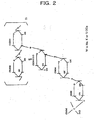
- a model of the chemical structure is illustrated in FIG. 2.
- Typical examples of the thixotropic fluiditywater-soluble polymer include carboxymethylcellulose salts (Na, K, and amine salts).
- carboxymethylcellulose salts Na, K, and amine salts.
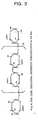
- FIG. 3 a chemical structure model of a long-chain polymer wherein glucoses are subjected to glucoside bonding is illustrated in FIG. 3.
- Pseudo plastic fluidity and/or thixotropic fluidity can also be attained by incorporating, into a lubricant composition, one or more selected from the following materials which are different from the above and cannot be easily distinguished from each other dependently on the molecular weight, another component or other components (for example, a metal (such as Ca) ion), or pH: bio-gums such as gellan gum, and succinoglucan; natural polysaccharides such as tamarind, tara gum, locust bean gum, and carrageenan; cellulose derivatives such as methylcellulose, ethylcellulose, hydroxyethylcellulose, hydroxypropylcellulose, hydroxyethylmethylcellulose, and hydroxypropylmethylcellulose; polyacrylic acid salts (Na, K, and amine salts), and alginic acid salts (Na, K, and amine salts).
- bio-gums such as gellan gum, and succinoglucan
- natural polysaccharides such as tama
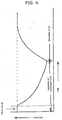
- the viscosity property of a pseudo plastic fluidity water-soluble polymer in static and dynamic states is shown in FIG. 4, and that of a thixotropic fluidity water-soluble polymer is shown in FIG. 5.
- a change from the static state to the dynamic state is like a straight line.
- the change comes under the scope of the invention, but satisfaction is not sufficiently given.
- the viscosity change of the thixotropic fluidity water-soluble polymer wherein the viscosity difference from the static state to the dynamic state is small, is gentler than the viscosity change of the pseudo plastic fluidity water-soluble polymer.
- the thixotropic fluidity water-soluble polymer some amount of time (yield value) is necessary from the start of the dynamic state to a drop in the viscosity.
- time is also necessary for a rise in the viscosity in the case that the dynamic state is shifted to the static state.
- the lubricant sprayed onto a mandrel bar cannot undergo viscosity change for ideal film-formation in a film-forming step from the spray to drying. As a result, the lubricant does not adhere evenly onto the mandrel bar at ease. Accordingly, the object of the invention cannot be sufficiently realized by only the thixotropic fluidity water-soluble polymer.
- the addition percentage of the pseudo plastic fluidity water-soluble polymer is from 0.01 to 1.0% by mass of the whole of the lubricant composition and the addition percentage of the thixotropic fluidity water-soluble polymer is from 0.1 to 2.0% by mass of the whole of the lubricant composition. More preferably, the addition percentage of the pseudo plastic fluidity water-soluble polymer is from 0.05 to 0.5% by mass of the whole of the lubricant composition and in connection therewith the addition percentage of the thixotropic fluidity water-soluble polymer is from 0.5 to 1.5% by mass of the whole of the lubricant composition.
- the addition percentage of the pseudo plastic fluidity water-soluble polymer gets larger than that of the thixotropic fluidity water-soluble polymer, the viscosity change by shear becomes too large so that a lubricant composition does not adhere evenly onto a mandrel bar at ease. If the percentage of the thixotropic fluidity water-soluble polymer becomes too large, the dispersion stability of the oxide-based layered compound and the spreading property to a high-temperature mandrel bar are deteriorated so that the property of the uniform adhesion gets worse.
- a lubricant which includes each fluidity water-soluble polymer of the above-mentioned two has a mixed viscosity property of that shown in FIG. 4 and FIG. 5.
- a qualitative viscosity property thereof is as follows: in FIG. 1, at time(i)when a lubricant composition is kept still, the viscosity is high because of the nature of the pseudo plastic fluidity water-soluble polymer; when shear is applied thereto thereafter, a drop in the viscosity at (i) to (iii), having a synthetic form of pseudo plastic fluidity and thixotropic fluidity states, is exhibited; and at last the viscosity property is converted into a rise in the viscosity shown at (iv) immediately after shearing is finished.
- the total percentage of the two polymers is more than 3.0% by mass of the total of a lubricant composition, a problem of carburization is unfavorably caused. If the percentage of the two polymers is less than 0.11% by mass of the total of a lubricant composition, the dispersion stability of the oxide-based layered compound is deteriorated so that the resultant is not suitable for a lubricant composition of the invention.
- an ordinary antifoaming agent or dispersing agent causes a risk of carburization if the agent is an organic compound; therefore, the addition of a small amount (0.5% or less by mass of the total of the lubricant composition) thereof is permissible.
- Inorganic agents, which do not contain carbon, are allowed to be added as long as the agents do not give a significant influence onto basic performances of the invention.
- Tables 1 to 2 and 10 comparative examples shown in Table 3 that is, 28 samples in total were prepared.
- Tables 1 to 3 also show peculiar numeric constants "a” and "b” in the approximate expressions of these samples while they were stored still, and those after 90 seconds from the time when shearing thereto was finished.
- Measuring device B-model rotary viscometer was used. Measuring temperature: It was set to 25°C.
- a 500-mL of the samples were respectively put into a 500-mL beaker, and then stirred at 3000 rpm for 1 minute by means of a propeller of 50 mm diameter.
- shear rate of the samples had a numerical range was that in the rotary viscometer, wherein viscosity is measured while a cone is rotated on its plate, cones actually used for the samples were different from each sample.
- Shear viscosity Each of samples was stirred to shear thereto with the propeller. After 30 seconds from the finish of shearing, it started to measure the viscosity at low shear rate. After 60 seconds from the start of the measurement, data of the viscometer was read out and was multiplied by a coefficient. The sample was again stirred, and after 30 seconds therefrom it started to measure the viscosity at high shear rate. After 60 seconds from the start of the measurement, data of the viscometer was read and was multiplied by a coefficient. The result was recorded as shear viscosity.
- the time "90 seconds from the time when shearing was finished (or after 90 seconds from the finish of the shearing)" means the time of 60 seconds after the following measurement start: an operation of shearing a sample was performed by stirring the lubricant composition; and after 30 seconds from the finish of the operation, it started to measure the viscosity at a given shear rate.
- the time "90 seconds” corresponds to the total value of the above-mentioned 30 seconds and 60 seconds.
- the "time when shearing was finished (or the time of the finish of the shearing” means the time when rotating the propeller for the above-mentioned stirring is stopped.
- log (X) and log (Y) are calculated. These are plotted in a graph corresponding to its vertical axis and its horizontal axis, respectively. As a result, there is a substantially linear relationship (relationship of a linear function) between them. From the graph, "b”, which is the gradient of the linear function and "a”, which is the vertical axis intercept, can be obtained by the least-squares method.
- the samples were respectively stored in a 500-mL glass container, and kept still for 7 days. Thereafter, a state of separation thereof was observed.
- the word "supernatant” means a substantially transparent liquid portion containing no solid. By observing a beaker of sample from a side-direction, the height of a supernatant in the beaker is measured. The height of a supernatant in the beaker was evaluated as the percentage thereof into the height of the liquid in the beaker.
- the wording "sedimentation on the bottom” means a state that a solid lubricant settles down on the bottom and thus a hard layer having no fluidity can be perceived.
- the mother pipe or tube was rolled to determined outer diameter by sizing mill.
- a product had an outer diameter of 63.5 mm, thickness of 7.0 mm and a length of 40000 mm.
- An arc-form test piece having a thickness of 5 mm, a width of 25 mm and a length of 50 mm was made from a product. This test piece was used to make a sulfuric acid-copper sulfate corrosion test prescribed in JIS G0575, and then the state of a grain boundary corrosive crack generated in the inside surface was observed.
- Spray manner an airless spray.
- Spraying pressure It was set to 3.0 MPa.
- Nozzle 1/4MVVP5010 (manufactured by Kabushiki Kaisha Ikeuchi (transliteration)).
- Sample temperature It was set to 25°Ctomake an evaluation.
- Spray manner an airless spray.
- Spraying pressure It was set to 3.0 MPa.
- Nozzle 1/4MVVP5010 (manufactured by Kabushiki Kaisha Ikeuchi (transliteration)).
- Test piece temperatures The temperatures were set to 60, 80, 100, and 120°C.
- Nozzle/test-piece distance It was set to 250 mm to make the test.
- Test speed It was set to 2 m/second.
- a lubricant composition for seamless steel pipes or tubes working of the invention is useful for working in the Mannesmann process for producing a seamless steel pipe.
Landscapes
- Chemical & Material Sciences (AREA)
- Chemical Kinetics & Catalysis (AREA)
- General Chemical & Material Sciences (AREA)
- Oil, Petroleum & Natural Gas (AREA)
- Organic Chemistry (AREA)
- Lubricants (AREA)
Abstract
Description
- The present invention relates to a lubricant for hot rolling, which is mainly used for the production of a seamless steel pipe or tube by the Mannesmann process.
- As is well known, in the production of a seamless metal pipe or tube by the Mannesmann process, a billet or bloom heated is made into a hollow blank with piercing mill, and then the hollow blank is finished into a product by means of a continuance mill (mandrel mill) and a sizing mill. On the step of elongation in Mannesmann process, inside face of a hollow blank is forcibly lubricated with a lubricant in order to prevent seizing. The lubricant is a graphite-based lubricant made mainly of granular graphite, scaly graphite, soil-form graphite or the like. It is used in a solid state or in the state of a liquid wherein a graphite is mixed with a binder.
- In lubricity a graphite-based lubricant is suitable for hot rolling of a hard-to-work material such as stainless steel or high-alloy steel. However, the corrosion resistance of the material is hindered by carburization. Specifically, when a graphite-based lubricant is used for hot rolling of a hard-to-work material such as stainless steel or high-alloy, the inside face of a mother pipe or tube is carburized; therefore, grain boundaries due to grain-boundary - precipitation and the vicinity thereof are selectively corroded, so that the corrosion resistance thereof lowers, thereby losing the performance of product.
- In order to improve this problem,
Patent Document 1 suggests, instead of a conventional graphite-based lubricant, a lubricant composition based on a combination of an oxide-based layered compound, boric acid, and an alkali metal borate.Patent Document 2 suggests a lubricant composition' based on a combination of artificial mica, vermiculite or bentonite, Li, Na or K borate, a metaborate or pyroborate, and a hydrate thereof. These lubricants, wherein an oxide-based layered compound is combined with boric acid, are effective as non-carburizable lubricant that is excellent in lubricity. - On the other hand, non-carburizability is not required for ordinary graphite-based lubricant. Accordingly, these graphite-based lubricants can give the above-mentioned various properties when an ordinary organic thickener (for example, a water-soluble acrylic resin, or a water-soluble cellulose such as sodium carboxymethylcellulose) is sufficiently added to the graphite-based lubricants. For example, Patent Document 3 discloses a lubricant wherein both of a water-soluble polymer and a water-dispersible polymer are blended in large amounts, whereby the above-mentioned various properties are attained.
- Patent Document 1: Japanese Patent Application Laid-Open (JP-A) No. 64-16894
- Patent Document 2: JP-A No. 5-171165
- Patent Document 3: JP-A No. 2-51592
- The lubricants disclosed in the
Patent Documents - In elongating a hollow blank of stainless steel or high-alloy steel by a continuance mill(mandrel mill), non-carburizability is persistently required in order to keep corrosion resistance thereof. Thus, the above-mentioned polymers cannot be blended in large amounts.
- Accordingly, an object of the present invention is to provide a lubricant composition which totally has various properties, such as storage stability, transferability inside an apparatus tube, sprayability to a lubricated site, and property of uniform adhesion to a high-temperature mandrel bar without losing non-carburizability or excellent lubricity in elongating hard-to-work materials (for example, such as 13 chromium steel and stainless steel) by a continuance mill(mandrel mill).
- The present invention is a lubricant composition for seamless steel pipes or tubes working which has a viscosity property represented by the following approximate expression:

wherein Y: viscosity (mPa·s) X: shear rate (s-1) ; and
a: 4000 to 40000 and b: -1.0 to -3.0 while a lubricant composition is stored still, and a: 1000 to 20000, and b: -1.0 to -0.15 after 90 seconds from the time when shearing a lubricant composition is finished. - The wording "90 seconds from the time when shearing a lubricant composition is finished" means the time of 60 seconds after the following measurement start: a lubricant composition is stirred; and at 30 seconds from the end of the stirring, the viscosity of lubricant composition is measured at a given shear rate. Consequently, the wording "90 seconds" corresponds to the total value of the above-mentioned 30 seconds and 60 seconds. The wording "the time when shearing a lubricant composition is finished" means the time when the above-mentioned stirring operation is finished.
- It is preferred that the lubricant composition for seamless steel pipes or tubes working comprises 10 to 40% by mass of an oxide-based layered compound, 5 to 30% by mass of one or more alkali metal salts or amine salts of boric acid, 0.11 to 3.0% by mass of one or more water-soluble polymers which are soluble in an aqueous solution of the alkali metal salt (s) or amine salt (s) of boric acid, and water as the balance.
- It is preferred that the lubricant composition for seamless steel pipes or tubes working comprises, as water-soluble polymer(s), a pseudo plastic fluidity water-soluble polymer, or a pseudo plastic fluidity water-soluble polymer and a thixotropic fluidity water-soluble polymer.
- Alternatively, it is preferred that the lubricant composition for seamless steel pipes or tubes working comprises, as water-soluble polymer(s), a pseudo plastic fluidity water-soluble polymer in an amount of 0.01 to 1.0% by mass of the whole of the lubricant composition, and a thixotropic fluidity water-soluble polymer in an amount of 0.1 to 2.0% by mass of the whole of the lubricant composition.
- According to the invention, it is possible to provide a lubricant composition for seamless steel pipes or tubes working which totally has various properties, such as storage stability, transferability inside an apparatus tube, sprayability to lubricated sites, and property of uniform adhesion to a high-temperature mandrel bar without losing non-carburizability or excellent lubricity to hard-to-work materials such as 13 chromium steel and stainless steel.
- An oxide-based layered compound used as main agent in a lubricant composition for seamless steel pipes or tubes working of the invention is, for example, any natural mica or artificial mica. Examples of the mica include:
- Potassium tetrasilicone mica {KMg2.5(Si4O10)F2},
- Sodium tetrasilicone mica {NaMg2.5(Si4O10) F2}, and
- Natural golden mica {KMg3(AlSi2O10) (OH)2}.
- The average particle diameter of the oxide-based layered compound is from 1 to 40 µm, preferably from 5 to 30 µm. If the particle diameter is too small, the effect of interlayer slip becomes small. On the other hand, if the particle diameter is too large, problems such that a nozzle is blocked when the lubricant composition is sprayed are caused. The adding amount of the oxide-based layered compound is from 10 to 40% by mass of the lubricant composition of the lubricant of the invention for seamless steel pipes or tubes working, preferably from 20 to 30% by mass thereof. If the adding amount of the oxide-based layered compound is too small, the seizing resistance becomes low so that a problem is caused about the lubricity thereof. On the other hand, if the adding amount of the oxide-based layered compound is too large, the viscosity of the lubricant composition becomes too high so that a problem is caused about the workability.
- Alkali metal salt(s) or amine salt(s) of boric acid in a lubricant composition help (s) the oxide-based layered compound, which is a main agent, spreading on a high-temperature mandrel bar, or the salt (s) itself/themselves work(s) as a single or plural lubricating auxiliaries. Examples of the alkali metal salt(s) of boric acid include lithium borate, sodium borate, and potassium borate. Ametaborate, a pyroborate and/or a hydrate, such as borax (Na2B4O7·10H2O) can be used.
- The adding amount of alkali metal salt (s) or amine salt (s) of boric acid into the lubricant composition is from 5 to 30% by mass, preferably from 10 to 20% by mass. If the adding amount of the salt (s) is too large, the salt (s) hinder (s) the lubricity of the main agent. If the adding amount of the salt(s) is too small, it hinders a main object, that is, the property of uniform adhesion to a mandrel bar caused by the main agent. Moreover, the lubricity is insufficient, so that shortage of lubricity is induced.
- Aswater-solublepolymer(s) used ina lubricant composition for seamless steel pipes or tubes working of the invention, the following can be used: a single or a combination of two or more selected from natural, semi-natural and synthetic water-soluble polymers having the viscosity conditions prescribed in the present invention. These water-soluble polymers will be specifically described later.
- Next, an ideal viscosity which has been found by the present inventors is shown in FIG. 1. FIG. 1, wherein viscosity is represented by its vertical axis and time is represented by its horizontal axis, is a graph of the viscosity variation of a lubricant composition changed with time under the following conditions:
- (i): a lubricant composition is kept still,
- (ii) to (iii): a lubricant composition is sheared at a constant rate, and
- (iii) to (iv) : the shearing of a lubricant composition is finished.
- The inventors have found out that a lubricant composition of which viscosity property is as the following (1) to (4), has excellent lubricity in the production of a seamless metal pipe or tube according to the Mannesmann process:
- (1) In order to store a lubricant in a state that solid particles of the oxide-based layered compound is even and stable, the viscosity at the time (i) when a lubricant composition is kept still has to be high. If the viscosity is low, the solid particles settle down.
- (2) In order to keep the transferability inside an apparatus tube and the sprayability, the viscosity at the time (ii) to (iii) when a lubricant composition is sheared needs to be low.
- (3) For the property of fine and even adhesion to a high-temperature bar, which gives a great influence on lubricity, the viscosity at the time (ii) has to be high. From a microscopic viewpoint, a lubricant is continuously sprayed and adheres onto a tool surface. On a coat of lubricant adhered formerly, a lubricant sprayed later arrives. That is, a coat of lubricant adhered formerly is sheared. Accordingly, if the viscosity at the time (ii) is low, the lubricant is unfavorably peeled down or scattered by the pressure of spraying lubricant.
- (4) In order to keep uniform and stable retention property of the solid particles on a tool surface, the viscosity needs to rise immediately after the finish of the shearing at the times of (iii) to (iv). If it takes much time that the viscosity recovers or the viscosity does not recover, the lubricant unfavorably flows down from the tool surface.
- In order to realize that a lubricant has the viscosity showed as FIG, 1, and attains various properties, such as storage stability, transferability inside an apparatus tube, sprayability to lubricated sites, and property of uniform adhesion to a high-temperature mandrel bar without adding a large amount of a polymer, the inventors have found out that the lubricant viscosityhas to fulfill the expression described below. In other words, the inventors have measured the viscosity property of the present invention lubricant having the above-mentioned various properties by a viscosity-measuring method described in Examples which is described later, so as to find that the parameters a and b which are counted from the measured viscosity curve has to be within the range described in the following approximate expression:

wherein Y: viscosity (mPa·s) X: shear rate (s-1); and
a: 4000 to 40000 and b: -1.0 to -0.3 while a lubricant composition is stored still; and
a: 1000 to 20000, and b: -1.0 to -0.7.5 after 90 seconds from the time when shearing a lubricant composition is finished. - In the approximate expression:

a and b are set into the range of 4000 to 40000 and that of -1.0 to -0.3, respectively, while a lubricant composition is stored to be kept still. If a is less than 4000, the viscosity of a lubricant composition is low while a lubricant composition is kept still. Consequently, the oxide-based layered compound settles down while a lubricant composition is stored. If a is more than 40000, the fluidity of a lubricant composition is substantially lost, so as to cause a problem about the transfer thereof. - Further, if b is more than -0.3, the difference between the viscosity of a lubricant composition while it is kept still and that while a lubricant composition is sheared (i.e., transferred or sprayed) is small, so as to cause a problem about the transfer or spray thereof. If b is less than -1.0, the viscosity of a lubricant composition becomes too low when it is sprayed. Consequently, at the time of applying a lubricant composition onto a tool, the lubricant adhered formerly is peeled down or scattered by the pressure of spraying lubricant itself. More preferably a and b are as follows:
- a: 7000 to 30000, and
- b: -0.5 to -0.8.
- The approximate expression: Y = a·Xb is described herein with reference to FIG. 1. As the value a is larger and the value b is smaller while a lubricant composition is stored still (that is, when the value X is limitlessly near 0), the viscosity at the time (i) in FIG. 1 is higher so that the stability is better. For example, in the case of X = 0.01, a = 100000 and b = -1, Y = 10,000,000 mPa·s.
- In the approximate expression:

a and b are set into the range of 1000 to 20000 and that of -1.0 to -0.15, respectively,
after 90 seconds from the time when shearing a lubricant composition is finished. If a, is less than 1000 or b is less than -1.0, the water-soluble polymer (s) is /are sheared and thus it takes much time that the viscosity recovers. Alternatively, a lubricant composition is sheared and its viscosity does not recover, and at this time the lubricant flows down. If a is more than 20000 or b is more than -0.15, a problem is caused when a lubricant composition is transferred or sprayed. More preferably, a and b are as follows: - a: 3000 to 20000, and
- b: -0.3 to -0.8.
- As the value a is larger and the value b is smaller while a lubricant composition is sheared (that is, when the value X is larger immediately after a lubricant composition is stirred), the viscosity at the time (ii) and (iii) in FIG. 1 is higher. If a is too large and b is too small, the viscosity does not become low and that hinders the transferability and sprayability. For example, in the case of X = 10, a = 100000 and b = -1, Y = 10,000 mPa·s.
- The time after a lubricant composition is sheared (that is, when the value X just after the stirring is small) is (iv) in FIG. 1. In the case that numerical values of a and bare similar to the numerical values when a lubricant composition is stored still, the viscosity rapidly recovers. In this case, the lubricant that adheres to a tool does not easily flow down. Accordingly, such an appropriate viscosity property as in the invention described above is crucial.
- The inventors have made eager investigations on conditions for attaining the above-mentioned viscosity property, so as to find out the following: the use of only a pseudo plastic fluidity water-soluble polymer, as the water-soluble polymer(s) used in a lubricant composition of the invention, may cause the above mentioned property to be attained; however, the addition of both of a pseudo plastic fluidity water-soluble polymer and a thixotropic fluidity water-soluble polymer easily causes the above mentioned property to be attained.
- Typical examples of the pseudo plastic fluidity water-soluble polymer include bio-gums such as xanthan gum, welan gum and ramsan gum. The chemical structure of xanthan gum is a water-soluble polymer polysaccharide wherein linking blocks each having two glucoses, two mannoses and one glucuronic acid as constituents are recurred. A model of the chemical structure is illustrated in FIG. 2.
- Typical examples of the thixotropic fluiditywater-soluble polymer include carboxymethylcelulose salts (Na, K, and amine salts). As an example thereof, a chemical structure model of a long-chain polymer wherein glucoses are subjected to glucoside bonding is illustrated in FIG. 3.
- Pseudo plastic fluidity and/or thixotropic fluidity can also be attained by incorporating, into a lubricant composition, one or more selected from the following materials which are different from the above and cannot be easily distinguished from each other dependently on the molecular weight, another component or other components (for example, a metal (such as Ca) ion), or pH: bio-gums such as gellan gum, and succinoglucan; natural polysaccharides such as tamarind, tara gum, locust bean gum, and carrageenan; cellulose derivatives such as methylcellulose, ethylcellulose, hydroxyethylcellulose, hydroxypropylcellulose, hydroxyethylmethylcellulose, and hydroxypropylmethylcellulose; polyacrylic acid salts (Na, K, and amine salts), and alginic acid salts (Na, K, and amine salts).
- Next, the viscosity property of a pseudo plastic fluidity water-soluble polymer in static and dynamic states is shown in FIG. 4, and that of a thixotropic fluidity water-soluble polymer is shown in FIG. 5. According to only the pseudo plastic fluidity water-soluble polymer, a change from the static state to the dynamic state is like a straight line. Thus, the change comes under the scope of the invention, but satisfaction is not sufficiently given. On the other hand, the viscosity change of the thixotropic fluidity water-soluble polymer, wherein the viscosity difference from the static state to the dynamic state is small, is gentler than the viscosity change of the pseudo plastic fluidity water-soluble polymer. About the thixotropic fluidity water-soluble polymer, some amount of time (yield value) is necessary from the start of the dynamic state to a drop in the viscosity. About the thixotropic fluidity water-soluble polymer, time is also necessary for a rise in the viscosity in the case that the dynamic state is shifted to the static state. In the case that time is required for such a viscosity change, the lubricant sprayed onto a mandrel bar cannot undergo viscosity change for ideal film-formation in a film-forming step from the spray to drying. As a result, the lubricant does not adhere evenly onto the mandrel bar at ease. Accordingly, the object of the invention cannot be sufficiently realized by only the thixotropic fluidity water-soluble polymer.
- In order to realize the ideal viscosity form shown in FIG. 1, it is desired to add the above-mentioned two polymers together. Specifically, the addition percentage of the pseudo plastic fluidity water-soluble polymer is from 0.01 to 1.0% by mass of the whole of the lubricant composition and the addition percentage of the thixotropic fluidity water-soluble polymer is from 0.1 to 2.0% by mass of the whole of the lubricant composition. More preferably, the addition percentage of the pseudo plastic fluidity water-soluble polymer is from 0.05 to 0.5% by mass of the whole of the lubricant composition and in connection therewith the addition percentage of the thixotropic fluidity water-soluble polymer is from 0.5 to 1.5% by mass of the whole of the lubricant composition. If the addition percentage of the pseudo plastic fluidity water-soluble polymer gets larger than that of the thixotropic fluidity water-soluble polymer, the viscosity change by shear becomes too large so that a lubricant composition does not adhere evenly onto a mandrel bar at ease. If the percentage of the thixotropic fluidity water-soluble polymer becomes too large, the dispersion stability of the oxide-based layered compound and the spreading property to a high-temperature mandrel bar are deteriorated so that the property of the uniform adhesion gets worse.
- A lubricant which includes each fluidity water-soluble polymer of the above-mentioned two has a mixed viscosity property of that shown in FIG. 4 and FIG. 5. A qualitative viscosity property thereof is as follows: in FIG. 1, at time(i)when a lubricant composition is kept still, the viscosity is high because of the nature of the pseudo plastic fluidity water-soluble polymer; when shear is applied thereto thereafter, a drop in the viscosity at (i) to (iii), having a synthetic form of pseudo plastic fluidity and thixotropic fluidity states, is exhibited; and at last the viscosity property is converted into a rise in the viscosity shown at (iv) immediately after shearing is finished.
- If the total percentage of the two polymers is more than 3.0% by mass of the total of a lubricant composition, a problem of carburization is unfavorably caused. If the percentage of the two polymers is less than 0.11% by mass of the total of a lubricant composition, the dispersion stability of the oxide-based layered compound is deteriorated so that the resultant is not suitable for a lubricant composition of the invention.
- The addition of an ordinary antifoaming agent or dispersing agent causes a risk of carburization if the agent is an organic compound; therefore, the addition of a small amount (0.5% or less by mass of the total of the lubricant composition) thereof is permissible. Inorganic agents, which do not contain carbon, are allowed to be added as long as the agents do not give a significant influence onto basic performances of the invention.
- Eighteen working examples shown in Tables 1 to 2 and 10 comparative examples shown in Table 3, that is, 28 samples in total were prepared. Tables 1 to 3 also show peculiar numeric constants "a" and "b" in the approximate expressions of these samples while they were stored still, and those after 90 seconds from the time when shearing thereto was finished.
- Measuring device: B-model rotary viscometer was used.
Measuring temperature: It was set to 25°C. - a 500-mL of the samples were respectively put into a 500-mL beaker, and then stirred at 3000 rpm for 1 minute by means of a propeller of 50 mm diameter.
- Low rotation (1.5 rpm) [shear rate: 0.323 to 0.366 S-1]
- High rotation (60 rpm) [shear rate: 12.9 to 14.6 s-1]
- The reason why the shear rate of the samples had a numerical range was that in the rotary viscometer, wherein viscosity is measured while a cone is rotated on its plate, cones actually used for the samples were different from each sample.
- Stationary viscosity: After each of the samples was stirred and kept still for 24 hours, it started to measure the viscosity at low shear rate. After 60 seconds from the start of the measurement, data of the viscometer was read out and was multiplied by a coefficient. Subsequently, it started to measure the viscosity at high shear rate. After 60 seconds from the start of the measurement, data of the viscometer was read out and was multiplied by a coefficient. The result was recorded as stationary viscosity.
- Shear viscosity: Each of samples was stirred to shear thereto with the propeller. After 30 seconds from the finish of shearing, it started to measure the viscosity at low shear rate. After 60 seconds from the start of the measurement, data of the viscometer was read out and was multiplied by a coefficient. The sample was again stirred, and after 30 seconds therefrom it started to measure the viscosity at high shear rate. After 60 seconds from the start of the measurement, data of the viscometer was read and was multiplied by a coefficient. The result was recorded as shear viscosity.
- In the measurements, the time "90 seconds from the time when shearing was finished (or after 90 seconds from the finish of the shearing)" means the time of 60 seconds after the following measurement start: an operation of shearing a sample was performed by stirring the lubricant composition; and after 30 seconds from the finish of the operation, it started to measure the viscosity at a given shear rate. Thus, the time "90 seconds" corresponds to the total value of the above-mentioned 30 seconds and 60 seconds. The "time when shearing was finished (or the time of the finish of the shearing" means the time when rotating the propeller for the above-mentioned stirring is stopped.
- Logarithms of both sides of the approximate expression Y = a·Xb are given as follows: log (Y) = blog (X) + log (a)
- According to X and Y obtained in the above-mentioned measurements, log (X) and log (Y) are calculated. These are plotted in a graph corresponding to its vertical axis and its horizontal axis, respectively. As a result, there is a substantially linear relationship (relationship of a linear function) between them. From the graph, "b", which is the gradient of the linear function and "a", which is the vertical axis intercept, can be obtained by the least-squares method.
- The samples were respectively stored in a 500-mL glass container, and kept still for 7 days. Thereafter, a state of separation thereof was observed.
-
- : No supernatant was generated, and no sedimentation was caused on the bottom.

- ○: Supernatant was generated in an amount of less than 5%, and no sedimentation was caused on the bottom.
- Δ: Supernatant was generated in an amount of 5% or more, and no sedimentation was caused on the bottom.
- x: Sedimentation was caused on the bottom regardless of the generation of supernatant.
- The word "supernatant" means a substantially transparent liquid portion containing no solid. By observing a beaker of sample from a side-direction, the height of a supernatant in the beaker is measured. The height of a supernatant in the beaker was evaluated as the percentage thereof into the height of the liquid in the beaker.
- The wording "sedimentation on the bottom" means a state that a solid lubricant settles down on the bottom and thus a hard layer having no fluidity can be perceived.
- Four examples 4, 11 and 13 and Comparative Examples 6 were respectively sprayed and applied onto a mandrel bar made of SKD61 and having an outer diameter of 140.5 mm and an effective portion length of 18 m, and then dried and solidified to form a substantially uniform lubricant coat having a film thickness of 100 µm on the surface of the mandrel bar. The mandrel bar, onto which the lubricant was applied, was inserted into an hollow shell. Continuance mill (mandrel mill) composed of 7 stands was used to roll a hollow blank into an mother pipe or tube.
- Specification of a hollow blank before elongation:
- Material: Austenite stainless steel (SUS304L);
- Working: piercing by piercing mill with inclined-roll;
- Shape: outer diameter: 181.0 mm, thickriess: 16.0 mm, and length: 7000 mm.
- Shape of a mother pipe or tube after elongation:
- Outer diameter: 151.0 mm, thickness: 5.0 mm, and length: 25300 mm.
- After the hollow blanks were respectively rolled with continuance mill (mandrel mill), the mother pipe or tube was rolled to determined outer diameter by sizing mill. A product had an outer diameter of 63.5 mm, thickness of 7.0 mm and a length of 40000 mm. An arc-form test piece having a thickness of 5 mm, a width of 25 mm and a length of 50 mm was made from a product. This test piece was used to make a sulfuric acid-copper sulfate corrosion test prescribed in JIS G0575, and then the state of a grain boundary corrosive crack generated in the inside surface was observed.
-
- : No crack.
- x: A crack was generated.
- Spray manner: an airless spray.
- Spraying pressure: It was set to 3.0 MPa.
- Nozzle: 1/4MVVP5010 (manufactured by Kabushiki Kaisha Ikeuchi (transliteration)).
- Spray pattern: Fan-shaped
- Spray angle:
- 50 degrees (angle at which water was spread into a fan shape when water was sprayed)
- Sample temperature: It was set to 25°Ctomake an evaluation.
-
- : The spray angle was a almost predetermined angle (50 degrees).
- O: The spray angle was somewhat narrower than the predetermined angle (40 to 45 degrees).
- △: The spray angle was far narrower than the predetermined angle (20 to 39 degrees).
- x: The spray angle was hardly spread (less than 20 degrees), or sprayed particles were large.
- Spray manner: an airless spray.
- Spraying pressure: It was set to 3.0 MPa.
- Nozzle: 1/4MVVP5010 (manufactured by Kabushiki Kaisha Ikeuchi (transliteration)).
- Spray angle: 50 degrees
- Test piece temperatures: The temperatures were set to 60, 80, 100, and 120°C.
- Nozzle/test-piece distance: It was set to 250 mm to make the test.
- Test speed: It was set to 2 m/second.
-
- : The coat adhered evenly, and the adhesion amount was 50 g/m2 or more.
- 0: The coat adhered substantially evenly, and the adhesion amount was 50 g/m2 or more.
- △ : The lubricant somewhat flowed down, and the adhesion amount was 40 g/m2 or more.
- x: The lubricant flowed down largely, and the adhesion amount was 30 g/m2 or less.
- xx: The adhesion property was bad because of repellency, and the adhesion amount was 30 g/m2 or less.
- The results of the tests 1) to 5) are shown in Tables 1 to 3.
[Table 1] Example 1 Example2 Example 3 Example 4 Example 5 Example 6 Example 7 Example 8 Example 9 Sodium tetrasilicone mica 10.00 10.00 20.00 15.00 20.00 20.00 20.00 20.00 30.00 Natural golden mica Bentonite Potassium borate 10.00 13.00 8.00 10.00 10.00 15.00 15.00 12.00 Amine borate 5.00 5.00 8.00 5.00 5.00 5.00 3.00 Xanthan gum 0.50 0.40 0.70 0.10 0.40 0.50 0.30 0.30 Welan gum 0.05 CMC (A) 0.50 0.50 CMC (B) 0.50 0.30 CMC (C) 1.00 1.00 0.50 CMC (D) Na polyacrylate (A) Na polyacrylate (B) 0.20 Water (Calculated amount) 84.00 74.10 66.30 67.90 68.95 64.40 59.00 59.20 54.40 Liquid state Stationary viscosity (low shear rate) 18850 15930 53500 14180 15400 15800 22080 26000 30900 (high shear rate) 1080 1390 1750 1780 1870 1040 1720 1700 1860 After shearing (low shear rate) 19520 17400 48420 6325 2250 18900 25000 18000 24130 (high shear rate) 1090 1410 1690 1410 1170 1060 1630 1600 1710 At a time of stationary storage (coefficient a) 8154 7795 19638 7719 8302 7119 10451 11691 13562 (coefficient b) -0.777 -0.663 -0.929 -0.564 -0.573 -0.739 -0.693 -0.741 -0.763 Immediately after the shearing (coefficient a) 8380 8332 18115 4074 1858 8125 11232 8856 11110 (coefficient b) -0.784 -0.683 -0.911 -0.408 -0.178. -0.783 -0.742 -0.657 -0.719 Storage stability ⊚ ⊚ ⊚ ⊚ ⊚ ⊚ ⊚ ⊚ ⊚ Carburization ⊚ ⊚ ⊚ ⊚ ⊚ ⊚ ⊚ ⊚ ⊚ Sprayability (25°C) ⊚ ⊚ ○ ⊚ ⊚ ○ ⊚ ⊚ ⊚ Adhesive property (60°C) ⊚ ⊚ ⊚ ○ ○ Δ ⊚ ⊚ ⊚ (80°C) ⊚ ⊚ ⊚ ⊚ ○ Δ ⊚ ⊚ ⊚ (100°C) ⊚ ⊚ ⊚ ⊚ ⊚ ○ ⊚ ⊚ ⊚ (120°C) ⊚ ⊚ ○ ⊚ ⊚ ○ ⊚ ⊚ ⊚ [Table 2] Example 10 Example 11 EXample 12 Example 13 Example 14 Example 15 Example 16 Example 17 Example 18 Sodium tetrasilicone mica 40.00 10.00 5.00 5.00 20.00 Natural golden mica 20.00 10.00 10.00 5.00 5.00 10.00 Bentonite 20.00 10.00 5.00 5.00 Potassium borate 12.00 12.00 10.00 10.00 20.00 5.00 5.00 30.00 30.00 Amine borate 3.00 3.00 10.00 5.00 10.00 10.00 Xanthan gum 0.60 0.10 0.20 Welan gum 0.05 0.15 0.20 0.15 0.10 0.02 CMC (A) 1.50 CMC (B) 0.50 CMC (C) 1.00 1.00 1.00 CMC (D) 0.50 Na polyacrylate (A) 2.00 1.00 Na polyacrylate (B) 0.30 Water (Calculated amount) 44.45 62.40 59.55 63.30 58.85 68.90 68.90 58.80 49.48 Liquid state Stationary viscosity (low shear rate) 12070 42400 32000 45100 17800 50000 9500 18000 9225 (high shear-rate) 1740 2480 1450 4230 1650 3050 1800 2150 1680 After shearing (low shear rate) 8920 32100 17500 9830 7200 8500 5800 133300 1975 (high shear rate) 1580 2500 1100 2230 900 2100 1560 1980 835 At a time of stationary storage (coefficient a) 6843 18453 12923 22542 8866 22031 5835 9657 5600 (coefficient b) -0.526 -0.771 -0.841 -0.643 -0.646 -0.76 -0.452 -0.577 -0.463 Immediately after the shearing (coefficient a) 5371 15193 7779 6364 3915 5643 3947 7611 1534 (coefficient b) -0.47 -0.693 -0.752 -0.403 -0.565 -0.38 -0.357 -0.517 -0.234 Storage stability ⊚ ⊚ ⊚ ⊚ ○ ⊚ ⊚ ⊚ ○ Carburization ⊚ ⊚ ⊚ ⊚ ⊚ ⊚ ⊚ ⊚ ⊚ Sprayabilily (25°C) ⊚ ⊚ ○ ○ ⊚ ⊚ ⊚ ⊚ ⊚ Adhesive property (60°C) ⊚ ⊚ Δ ⊚ ○ ⊚ ⊚ ⊚ Δ (80°C) ⊚ ⊚ Δ ⊚ ○ ⊚ ⊚ ⊚ Δ (100°C) ⊚ ○ ○ ⊚ ⊚ ⊚ ⊚ ⊚ ○ (120°C) ⊚ Δ ○ ⊚ ○ ⊚ ⊚ ⊚ Δ [Table 3] Comparative Example 1 Comparative Example 2 Comparative Example 3 Comparative Example 4 Comparative Example 5 Comparative Example 6 Comparative Example 7 Comparative Example 8 Comparative Example 9 Comparative Example 10 Sodium tetrasilicone mica 20.00 30.00 20.00 10.00 20.00 7.00 42.00 Natural golden mica 15.00 50.00 10.00 20.00 Bentonite 10.00 10.00 Potassium borate 10.00 5.00 30.00 10.00 15.00 20.00 2.00 30.00 10.00 Amine borate 10.00 5.00 5.00 5.00 2.00 5.00 5.00 Xanthan gum 3.00 0.50 0.30 0.30 0.005 Welan gum 0.30 2.00 0.005 CMC (A) 1.00 1.00 0.05 CMC (B) 5.00 CMC (E) 5.00 Na polyacrylate (A) Na polyacrytate (B) 1.00 0.15 Water (Calculated amount) 67.00 59.00 74.00 19.70 53.00 54.50 54.70 87.70 22.845 54.945 Liquid state Unable to be prepared Unable to be prepared Unable to be prepared Unable to be prepared Stationary viscosity (low shear rate) 400 2100 26800 4400 87600 800 (high shear rate) 340 570 3870 520 100000 130 After shearing (low shear rate) 350 700 11000 1000 100000 1200 (high shear rate) 314 500 2300 468 8700 140 At a time of stationary storage (coefficient a) 381 1433 15201 2353 91065 469 (coefficient b) -0.044 -0.354 -0.526 -0.58 -0.038 -0.494 Immediately after the shearing (coefficient a) 339 63.4 6954 800 48892 639 (coefficient b) -0.03 -0.091 -0.425 -0.206 -0.663 -0.584 Storage stability X X ⊚ ⊚ ⊚ X Carburization ⊚ ⊚ X ⊚ ⊚ ⊚ Sprayability (25°C) ⊚ ○ ○ ⊚ X ⊚ Adhesive property (60°C) X X ○ X X X (80°C) X X ○ X X X (100°C) X X ○ X X X (120°C) XX XX ○ X X XX CMC*(A): molecular weight (100,000), viscosity (800/2%**) CMC*(B): molecular weight (250,000), viscosity (1600/1%**) CMC*(C): molecular weight (175,000), viscosity (2500/2%) CMC*(D): molecular weight (195,000), viscosity (3500/2%) CMC*(E): molecular weight (30,000), viscosity (15/2%) Na polyacrylate (A): molecular weight (500,000), viscosity (75/1%) Na polyacrylate (B): molecular weight (1,650,000), viscosity (300/0.2%) *CMC = Na salt of carboxymethylcellulose **: It means that the viscosity of a 2% solution thereof in water at 25°C was 800 mPa·s. - From the above-mentioned test results, it was proved that a lubricant composition of the invention has performances good in all of storage stability, sprayability, and adhesion property. On the other hand, about the group of a lubricant compositions of Comparative Examples, satisfactory performances therefor were unable to be obtained.
- The above has described the invention in connection with embodiments which appear to be most practical and preferable at the present time. However, the invention is not limited to the embodiments disclosed in the specification of the present application, and can be appropriately varied within a scope not contrary to the subject matter and the conception of the invention read out from the claims and the whole of the specification. It should be understood that any lubricant composition for seamless steel pipes or tubes working with such a variation is also included in the technical scope of the invention.
- A lubricant composition for seamless steel pipes or tubes working of the invention is useful for working in the Mannesmann process for producing a seamless steel pipe.
-
- FIG. 1 is a chart showing an ideal viscosity form as a lubricant composition for seamless steel pipes or tubes working.
- FIG. 2 is a view of a chemical structure model of an example of the pseudo plastic fluidity water-soluble polymer.
- FIG. 3 is a view showing a chemical structure model of a long-chain polymer wherein glucoses are subjected to glucoside bonding, the polymer being an example of the thixotropic fluidity water-soluble polymer.
- FIG. 4 is a chart showing viscosity properties of static and dynamic states of a pseudo plastic fluidity water-soluble polymer.
- FIG. 5 is a chart showing viscosity properties of static and dynamic states of a thixotropic fluidity water-soluble polymer.
Claims (4)
- A lubricant composition for seamless steel pipes or tubes working, which has a viscosity property represented by the following approximate expression: Y = a·Xb
wherein Y: viscosity (mPa·s), X: shear rate (s-1); and
a: 4000 to 40000 and b: -1.0 to -0.3 while a lubricant composition is stored still, and
a: 1000 to 20000, and b: -1.0 to -0.15 after 90 seconds from the time when shearing a lubricant composition is finished. - The lubricant composition for seamless steel pipes or tubes working according to claim 1, which comprises 10 to 40% by mass of an oxide-based layered compound, 5 to 30% by mass of one or more alkali metal salts or amine salts of boric acid, 0.11 to 3.0% by mass of one or more water-soluble polymers which are soluble in an aqueous solution of the alkali metal salt(s) or amine salt(s) of boric acid, and water as the balance.
- The lubricant composition for seamless steel pipes or tubes working according to claim 2, which comprises, as the water-soluble polymer(s), a pseudo plastic fluidity water-soluble polymer, or a mixture of a pseudo plastic fluidity water-soluble polymer and a thixotropic fluidity water-soluble polymer.
- The lubricant composition for seamless steel pipes or tubes working according to claim 2, which comprises, as the water-soluble polymer(s), a pseudo plastic fluidity water-soluble polymer in an amount of 0.01 to 1.0% by mass of the whole of the lubricant composition, and a thixotropic fluidity water-soluble polymer in an amount of 0.1 to 2,0% by mass of the whole of the lubricant composition.
Applications Claiming Priority (2)
| Application Number | Priority Date | Filing Date | Title |
|---|---|---|---|
| JP2003312232 | 2003-09-04 | ||
| PCT/JP2004/012833 WO2005023966A1 (en) | 2003-09-04 | 2004-09-03 | Lubricant composition for seamless steel pipe working |
Publications (3)
| Publication Number | Publication Date |
|---|---|
| EP1666576A1 true EP1666576A1 (en) | 2006-06-07 |
| EP1666576A4 EP1666576A4 (en) | 2009-05-20 |
| EP1666576B1 EP1666576B1 (en) | 2014-07-23 |
Family
ID=34269732
Family Applications (1)
| Application Number | Title | Priority Date | Filing Date |
|---|---|---|---|
| EP04772782.1A Expired - Lifetime EP1666576B1 (en) | 2003-09-04 | 2004-09-03 | Lubricant composition for seamless steel pipe working |
Country Status (4)
| Country | Link |
|---|---|
| EP (1) | EP1666576B1 (en) |
| JP (1) | JP5292575B2 (en) |
| CN (1) | CN100575468C (en) |
| WO (1) | WO2005023966A1 (en) |
Families Citing this family (7)
| Publication number | Priority date | Publication date | Assignee | Title |
|---|---|---|---|---|
| JP4910693B2 (en) * | 2006-12-28 | 2012-04-04 | 住友金属工業株式会社 | A method for applying a lubricant to a mandrel bar, a method for controlling the film thickness of the lubricant on a mandrel bar, and a method for producing a seamless steel pipe. |
| JP5392134B2 (en) * | 2010-02-15 | 2014-01-22 | 新日鐵住金株式会社 | Lubricant for hot rolling tool and surface treatment method for mandrel bar for hot seamless pipe manufacturing |
| JP5142232B2 (en) * | 2010-12-22 | 2013-02-13 | 新日鐵住金株式会社 | Seamless steel pipe manufacturing method |
| CN102703193A (en) * | 2012-05-25 | 2012-10-03 | 衡阳市金化科技有限公司 | High-temperature water-based core rod lubricant and preparation method |
| CN104450136A (en) * | 2014-11-05 | 2015-03-25 | 衡阳市金化科技有限公司 | Bentonite lubricant |
| CN106334713A (en) * | 2016-09-26 | 2017-01-18 | 天津钢管集团股份有限公司 | Hot rolling lubrication process method for titanium alloy seamless tube |
| WO2024116556A1 (en) * | 2022-11-28 | 2024-06-06 | 日本製鉄株式会社 | Lubricant composition, and manufacturing method of seamless metal pipes using same |
Family Cites Families (11)
| Publication number | Priority date | Publication date | Assignee | Title |
|---|---|---|---|---|
| JPH07122069B2 (en) * | 1989-06-09 | 1995-12-25 | 住友金属工業株式会社 | Hot lubricant |
| EP0554822B1 (en) * | 1992-02-06 | 1999-12-29 | Timcal Ag | Mandrel lubricant for the manufacture of seamless tubes |
| CN1100750A (en) * | 1993-09-21 | 1995-03-29 | 宝山钢铁(集团)公司 | Lubricating powder used for thermoplastic processing of metals |
| JP2910592B2 (en) * | 1994-12-13 | 1999-06-23 | 住友金属工業株式会社 | Lubricant composition for hot working |
| JPH0978080A (en) * | 1995-09-12 | 1997-03-25 | Sumitomo Metal Ind Ltd | Lubricant composition for high temperature processing and method of using the same |
| JPH10121088A (en) * | 1996-10-15 | 1998-05-12 | Sumitomo Metal Ind Ltd | Lubricant composition for high-temperature processing of metal and method of using the same |
| JPH10130687A (en) | 1996-10-30 | 1998-05-19 | Kawasaki Steel Corp | Lubricant composition for hot working |
| JP3275255B2 (en) * | 1997-07-16 | 2002-04-15 | 住友金属工業株式会社 | Hot working lubricant and lubrication method |
| JP4000738B2 (en) * | 2000-02-21 | 2007-10-31 | 住友金属工業株式会社 | Method of piercing and rolling seamless steel pipes |
| JP3646628B2 (en) * | 2000-07-14 | 2005-05-11 | 住友金属工業株式会社 | Rolling method with mandrel mill |
| JP2005097605A (en) * | 2003-09-04 | 2005-04-14 | Sumitomo Metal Ind Ltd | Seamless steel pipe processing lubricant composition |
-
2004
- 2004-09-03 EP EP04772782.1A patent/EP1666576B1/en not_active Expired - Lifetime
- 2004-09-03 CN CN200480025327A patent/CN100575468C/en not_active Expired - Fee Related
- 2004-09-03 WO PCT/JP2004/012833 patent/WO2005023966A1/en not_active Ceased
-
2009
- 2009-05-07 JP JP2009112471A patent/JP5292575B2/en not_active Expired - Lifetime
Also Published As
| Publication number | Publication date |
|---|---|
| CN100575468C (en) | 2009-12-30 |
| JP2009287023A (en) | 2009-12-10 |
| EP1666576B1 (en) | 2014-07-23 |
| WO2005023966A1 (en) | 2005-03-17 |
| JP5292575B2 (en) | 2013-09-18 |
| CN1845982A (en) | 2006-10-11 |
| EP1666576A4 (en) | 2009-05-20 |
Similar Documents
| Publication | Publication Date | Title |
|---|---|---|
| JP5292575B2 (en) | Seamless steel pipe processing lubricant composition | |
| EP2014747A1 (en) | Lubricant composition for hot plastic working and method of hot plastic working with the same | |
| Pušavec et al. | Tribology of solid-lubricated liquid carbon dioxide assisted machining | |
| CN101573191B (en) | Method of coating lubricant on mandrel, method of controlling film thickness of lubricant on mandrel, and method of manufacturing seamless steel pipe | |
| CN101910388B (en) | Lubricant for hot working and process for manufacturing seamless steel pipe | |
| JP5392134B2 (en) | Lubricant for hot rolling tool and surface treatment method for mandrel bar for hot seamless pipe manufacturing | |
| US8455408B2 (en) | Anti-seizure agent for hot steel working | |
| JP2005097605A (en) | Seamless steel pipe processing lubricant composition | |
| JPH0978080A (en) | Lubricant composition for high temperature processing and method of using the same | |
| EP1816184B1 (en) | Powder lubricant composition for hot working and process for producing seamless tube | |
| EP1862530A1 (en) | Two-pack-type seizing inhibitor for hot plastic working and process for producing seamless tube with the same | |
| EP4628565A1 (en) | Lubricant composition, and manufacturing method of seamless metal pipes using same | |
| JP3871898B2 (en) | Hot powder lubricant composition and hot working method using the same | |
| JPH10121088A (en) | Lubricant composition for high-temperature processing of metal and method of using the same | |
| JPH04519B2 (en) | ||
| JPH05117684A (en) | Liquid lubricant for plug rolling mill | |
| JP3804397B2 (en) | Steel pipe with scale for excellent corrosion resistance | |
| JP2789979B2 (en) | Lubricant for seamless tube hot rolling | |
| SU1018966A1 (en) | Lubricant for cold rolling of pipes | |
| JPH03259998A (en) | Lubricant for hot working of metal | |
| JPH07116709A (en) | Seamless steel tube rolling method |
Legal Events
| Date | Code | Title | Description |
|---|---|---|---|
| PUAI | Public reference made under article 153(3) epc to a published international application that has entered the european phase |
Free format text: ORIGINAL CODE: 0009012 |
|
| 17P | Request for examination filed |
Effective date: 20060331 |
|
| AK | Designated contracting states |
Kind code of ref document: A1 Designated state(s): CH DE FR IT LI |
|
| DAX | Request for extension of the european patent (deleted) | ||
| RBV | Designated contracting states (corrected) |
Designated state(s): CH DE FR IT LI |
|
| A4 | Supplementary search report drawn up and despatched |
Effective date: 20090422 |
|
| RIC1 | Information provided on ipc code assigned before grant |
Ipc: C10N 20/02 20060101ALN20090415BHEP Ipc: C10M 171/02 20060101AFI20050322BHEP Ipc: C10M 103/00 20060101ALI20090415BHEP Ipc: C10N 50/02 20060101ALN20090415BHEP Ipc: C10N 40/24 20060101ALN20090415BHEP Ipc: B21B 25/04 20060101ALI20090415BHEP Ipc: C10M 103/06 20060101ALI20090415BHEP Ipc: C10M 173/02 20060101ALI20090415BHEP Ipc: C10N 10/02 20060101ALN20090415BHEP Ipc: C10M 145/40 20060101ALI20090415BHEP Ipc: C10N 30/06 20060101ALN20090415BHEP Ipc: C10N 30/00 20060101ALN20090415BHEP |
|
| 17Q | First examination report despatched |
Effective date: 20090813 |
|
| RAP1 | Party data changed (applicant data changed or rights of an application transferred) |
Owner name: NIPPON STEEL & SUMITOMO METAL CORPORATION |
|
| GRAP | Despatch of communication of intention to grant a patent |
Free format text: ORIGINAL CODE: EPIDOSNIGR1 |
|
| INTG | Intention to grant announced |
Effective date: 20140212 |
|
| GRAS | Grant fee paid |
Free format text: ORIGINAL CODE: EPIDOSNIGR3 |
|
| GRAA | (expected) grant |
Free format text: ORIGINAL CODE: 0009210 |
|
| AK | Designated contracting states |
Kind code of ref document: B1 Designated state(s): CH DE FR IT LI |
|
| REG | Reference to a national code |
Ref country code: CH Ref legal event code: EP Ref country code: CH Ref legal event code: NV Representative=s name: R.A. EGLI AND CO, PATENTANWAELTE, CH |
|
| REG | Reference to a national code |
Ref country code: DE Ref legal event code: R096 Ref document number: 602004045520 Country of ref document: DE Effective date: 20140904 |
|
| REG | Reference to a national code |
Ref country code: DE Ref legal event code: R097 Ref document number: 602004045520 Country of ref document: DE |
|
| PLBE | No opposition filed within time limit |
Free format text: ORIGINAL CODE: 0009261 |
|
| STAA | Information on the status of an ep patent application or granted ep patent |
Free format text: STATUS: NO OPPOSITION FILED WITHIN TIME LIMIT |
|
| 26N | No opposition filed |
Effective date: 20150424 |
|
| REG | Reference to a national code |
Ref country code: FR Ref legal event code: PLFP Year of fee payment: 13 |
|
| REG | Reference to a national code |
Ref country code: FR Ref legal event code: PLFP Year of fee payment: 14 |
|
| REG | Reference to a national code |
Ref country code: FR Ref legal event code: PLFP Year of fee payment: 15 |
|
| REG | Reference to a national code |
Ref country code: DE Ref legal event code: R082 Ref document number: 602004045520 Country of ref document: DE Representative=s name: LORENZ SEIDLER GOSSEL RECHTSANWAELTE PATENTANW, DE Ref country code: DE Ref legal event code: R081 Ref document number: 602004045520 Country of ref document: DE Owner name: NIPPON STEEL CORP., JP Free format text: FORMER OWNER: NIPPON STEEL & SUMITOMO METAL CORPORATION, TOKYO, JP |
|
| PGFP | Annual fee paid to national office [announced via postgrant information from national office to epo] |
Ref country code: IT Payment date: 20230810 Year of fee payment: 20 |
|
| PGFP | Annual fee paid to national office [announced via postgrant information from national office to epo] |
Ref country code: FR Payment date: 20230808 Year of fee payment: 20 Ref country code: DE Payment date: 20230802 Year of fee payment: 20 |
|
| PGFP | Annual fee paid to national office [announced via postgrant information from national office to epo] |
Ref country code: CH Payment date: 20231001 Year of fee payment: 20 |
|
| REG | Reference to a national code |
Ref country code: DE Ref legal event code: R071 Ref document number: 602004045520 Country of ref document: DE |
|
| REG | Reference to a national code |
Ref country code: CH Ref legal event code: PL |