EP1664022B1 - 2-substituted benzimidazole piperidine analogs as selective melanin concentrating hormone receptor antagonists for the treatment of obesity and related disorders - Google Patents
2-substituted benzimidazole piperidine analogs as selective melanin concentrating hormone receptor antagonists for the treatment of obesity and related disorders Download PDFInfo
- Publication number
- EP1664022B1 EP1664022B1 EP04782252A EP04782252A EP1664022B1 EP 1664022 B1 EP1664022 B1 EP 1664022B1 EP 04782252 A EP04782252 A EP 04782252A EP 04782252 A EP04782252 A EP 04782252A EP 1664022 B1 EP1664022 B1 EP 1664022B1
- Authority
- EP
- European Patent Office
- Prior art keywords
- compound
- alkyl
- group
- substituted
- mmol
- Prior art date
- Legal status (The legal status is an assumption and is not a legal conclusion. Google has not performed a legal analysis and makes no representation as to the accuracy of the status listed.)
- Expired - Lifetime
Links
- 0 *c(cc1)ccc1C(C1CC*CC1)=O Chemical compound *c(cc1)ccc1C(C1CC*CC1)=O 0.000 description 9
- OFTWBYSQZLSWSB-UCDZCMRKSA-N C=CC1C=C2N=C(CO[C@@H](C3CCNCC3)c(cc3)ccc3-c3cc(C#N)ccc3)NC2=CC1Cl Chemical compound C=CC1C=C2N=C(CO[C@@H](C3CCNCC3)c(cc3)ccc3-c3cc(C#N)ccc3)NC2=CC1Cl OFTWBYSQZLSWSB-UCDZCMRKSA-N 0.000 description 1
- PEGSHZSZCUYMBK-RRCMXBARSA-N CC(CNC(C(CC1)CCN1C(OC(C)(C)C)=O)c(cc1)ccc1-c1cc(C#N)ccc1)/N=C(\C(C=C1F)N)/C=C1Cl Chemical compound CC(CNC(C(CC1)CCN1C(OC(C)(C)C)=O)c(cc1)ccc1-c1cc(C#N)ccc1)/N=C(\C(C=C1F)N)/C=C1Cl PEGSHZSZCUYMBK-RRCMXBARSA-N 0.000 description 1
- UWFRINAFISFFHQ-UHFFFAOYSA-N Cc(c(Cl)c1)cc2c1[nH]c(CNC(C(CC1)CCN1C1CCCC1)c(cc1)ccc1-c1cc(C#N)ccc1)n2 Chemical compound Cc(c(Cl)c1)cc2c1[nH]c(CNC(C(CC1)CCN1C1CCCC1)c(cc1)ccc1-c1cc(C#N)ccc1)n2 UWFRINAFISFFHQ-UHFFFAOYSA-N 0.000 description 1
- ZXQMVCZVBMDSHX-UHFFFAOYSA-N Clc(cc1Cl)cc2c1nc(CCC(C1CCN(Cc3ccccc3)CC1)c(cc1)ccc1Br)[nH]2 Chemical compound Clc(cc1Cl)cc2c1nc(CCC(C1CCN(Cc3ccccc3)CC1)c(cc1)ccc1Br)[nH]2 ZXQMVCZVBMDSHX-UHFFFAOYSA-N 0.000 description 1
- SBHLDXLQXGRKFE-UHFFFAOYSA-N N#Cc1cccc(-c2ccc(C(C(CC3)CCN3C3CCCC3)OCc3nc(cc(c(Cl)c4)F)c4[nH]3)cc2)c1 Chemical compound N#Cc1cccc(-c2ccc(C(C(CC3)CCN3C3CCCC3)OCc3nc(cc(c(Cl)c4)F)c4[nH]3)cc2)c1 SBHLDXLQXGRKFE-UHFFFAOYSA-N 0.000 description 1
- NADXIRWSCBGHGI-UHFFFAOYSA-N N#Cc1cccc(-c2ccc(C3(CCc4nc(cc(c(F)c5)F)c5[nH]4)CCN(CC4CC4)CC3)cc2)c1 Chemical compound N#Cc1cccc(-c2ccc(C3(CCc4nc(cc(c(F)c5)F)c5[nH]4)CCN(CC4CC4)CC3)cc2)c1 NADXIRWSCBGHGI-UHFFFAOYSA-N 0.000 description 1
- JHCFJDAWNCGNJZ-UHFFFAOYSA-N N#Cc1cccc(-c2ccc(C3(CNc4nc(cc(c(F)c5)F)c5[nH]4)CCNCC3)cc2)c1 Chemical compound N#Cc1cccc(-c2ccc(C3(CNc4nc(cc(c(F)c5)F)c5[nH]4)CCNCC3)cc2)c1 JHCFJDAWNCGNJZ-UHFFFAOYSA-N 0.000 description 1
Classifications
-
- C—CHEMISTRY; METALLURGY
- C04—CEMENTS; CONCRETE; ARTIFICIAL STONE; CERAMICS; REFRACTORIES
- C04B—LIME, MAGNESIA; SLAG; CEMENTS; COMPOSITIONS THEREOF, e.g. MORTARS, CONCRETE OR LIKE BUILDING MATERIALS; ARTIFICIAL STONE; CERAMICS; REFRACTORIES; TREATMENT OF NATURAL STONE
- C04B35/00—Shaped ceramic products characterised by their composition; Ceramics compositions; Processing powders of inorganic compounds preparatory to the manufacturing of ceramic products
- C04B35/622—Forming processes; Processing powders of inorganic compounds preparatory to the manufacturing of ceramic products
- C04B35/626—Preparing or treating the powders individually or as batches ; preparing or treating macroscopic reinforcing agents for ceramic products, e.g. fibres; mechanical aspects section B
- C04B35/63—Preparing or treating the powders individually or as batches ; preparing or treating macroscopic reinforcing agents for ceramic products, e.g. fibres; mechanical aspects section B using additives specially adapted for forming the products, e.g.. binder binders
- C04B35/632—Organic additives
-
- A—HUMAN NECESSITIES
- A61—MEDICAL OR VETERINARY SCIENCE; HYGIENE
- A61P—SPECIFIC THERAPEUTIC ACTIVITY OF CHEMICAL COMPOUNDS OR MEDICINAL PREPARATIONS
- A61P1/00—Drugs for disorders of the alimentary tract or the digestive system
-
- A—HUMAN NECESSITIES
- A61—MEDICAL OR VETERINARY SCIENCE; HYGIENE
- A61P—SPECIFIC THERAPEUTIC ACTIVITY OF CHEMICAL COMPOUNDS OR MEDICINAL PREPARATIONS
- A61P3/00—Drugs for disorders of the metabolism
- A61P3/04—Anorexiants; Antiobesity agents
-
- A—HUMAN NECESSITIES
- A61—MEDICAL OR VETERINARY SCIENCE; HYGIENE
- A61P—SPECIFIC THERAPEUTIC ACTIVITY OF CHEMICAL COMPOUNDS OR MEDICINAL PREPARATIONS
- A61P3/00—Drugs for disorders of the metabolism
- A61P3/06—Antihyperlipidemics
-
- A—HUMAN NECESSITIES
- A61—MEDICAL OR VETERINARY SCIENCE; HYGIENE
- A61P—SPECIFIC THERAPEUTIC ACTIVITY OF CHEMICAL COMPOUNDS OR MEDICINAL PREPARATIONS
- A61P3/00—Drugs for disorders of the metabolism
- A61P3/08—Drugs for disorders of the metabolism for glucose homeostasis
- A61P3/10—Drugs for disorders of the metabolism for glucose homeostasis for hyperglycaemia, e.g. antidiabetics
-
- A—HUMAN NECESSITIES
- A61—MEDICAL OR VETERINARY SCIENCE; HYGIENE
- A61P—SPECIFIC THERAPEUTIC ACTIVITY OF CHEMICAL COMPOUNDS OR MEDICINAL PREPARATIONS
- A61P43/00—Drugs for specific purposes, not provided for in groups A61P1/00-A61P41/00
-
- A—HUMAN NECESSITIES
- A61—MEDICAL OR VETERINARY SCIENCE; HYGIENE
- A61P—SPECIFIC THERAPEUTIC ACTIVITY OF CHEMICAL COMPOUNDS OR MEDICINAL PREPARATIONS
- A61P9/00—Drugs for disorders of the cardiovascular system
- A61P9/12—Antihypertensives
-
- C—CHEMISTRY; METALLURGY
- C07—ORGANIC CHEMISTRY
- C07D—HETEROCYCLIC COMPOUNDS
- C07D401/00—Heterocyclic compounds containing two or more hetero rings, having nitrogen atoms as the only ring hetero atoms, at least one ring being a six-membered ring with only one nitrogen atom
- C07D401/02—Heterocyclic compounds containing two or more hetero rings, having nitrogen atoms as the only ring hetero atoms, at least one ring being a six-membered ring with only one nitrogen atom containing two hetero rings
- C07D401/06—Heterocyclic compounds containing two or more hetero rings, having nitrogen atoms as the only ring hetero atoms, at least one ring being a six-membered ring with only one nitrogen atom containing two hetero rings linked by a carbon chain containing only aliphatic carbon atoms
-
- C—CHEMISTRY; METALLURGY
- C07—ORGANIC CHEMISTRY
- C07D—HETEROCYCLIC COMPOUNDS
- C07D401/00—Heterocyclic compounds containing two or more hetero rings, having nitrogen atoms as the only ring hetero atoms, at least one ring being a six-membered ring with only one nitrogen atom
- C07D401/02—Heterocyclic compounds containing two or more hetero rings, having nitrogen atoms as the only ring hetero atoms, at least one ring being a six-membered ring with only one nitrogen atom containing two hetero rings
- C07D401/12—Heterocyclic compounds containing two or more hetero rings, having nitrogen atoms as the only ring hetero atoms, at least one ring being a six-membered ring with only one nitrogen atom containing two hetero rings linked by a chain containing hetero atoms as chain links
Definitions
- This invention rotates to antagonists for melanin-concentrating hormone (MCH) and their use in the manufacture of a medicament for the treatment of metabolic and eating disorders, novel compounds having MCH receptor modulatory activity, pharmaceutical compositions containing one or more such modulators, methods of preparing such modulators and methods of using such modulators in the manufacture of a medicament to treat obesity, diabetes and related disorders.
- MCH melanin-concentrating hormone
- MCH a cyclic peptide
- 5,908,830 discloses a combination therapy for the treatment of diabetes or obesity involving the administration of a metabolic rate increasing agent and a feeding behavior modifying agent, an example of the latter being an MCH antagonist. Further, MCH receptor antagonists may also be useful in the treatment of depression and/or anxiety. Borowksy et al., Nature Medicine, 8, pp. 825 - 830 (01 Aug 2002 ).
- WO 02/076947 discloses HCH antagonists and their use in treatment of obesity.
- WO 02/081460 discloses lipid lowering biphenylcarboxamides.
- WO 02/088093 discloses benzimidazoles that are useful in treating sexual dysfunction.
- WO 03/088908 discloses heterocyclo inhibitors of potassium channel function.
- this disclosure provides novel benzimidazole compounds which can have MCH antagonist activity.
- These compounds are represented by structural formula I: or a pharmaceutically acceptable salt or solvate thereof, wherein
- This disclosure is also directed to pharmaceutical compositions for the treatment of metabolic disorders such as obesity, those disorders associated with obesity and eating disorders such as hyperphagia.
- this disclosure is directed to the method of treatment of metabolic disorders such as obesity, and eating disorders such as hyperphagia.
- Another instance includes a method of treating an eating disorder which comprises administering to a mammal in need of such treatment an amount of a first compound, said first compound being a compound of formula I; e.g. a compound of the invention and a second compound, said second compound being an antiobesity and/or anorectic agent wherein the amounts of the first and second compounds result in the therapeutic desired effect.
- compositions for the treatment of obesity which comprise an obesity treating amount of at least one compound of formula I, e.g. at least one compound of the invention, or a pharmaceutically acceptable salt or solvate of said compound and a pharmaceutically acceptable carrier.
- the disclosure relates to compounds that are represented by structural formula I, or a pharmaceutically acceptable salt or solvate thereof, wherein the various moieties are as described above.
- the disclosure includes those compounds of formula I wherein, Y and are linked to the adjacent ring to form a compound of the following formula,
- One instance of the disclosure are compounds of formula I wherein Y is -(CR 2 R 3 ) p NR 8 (CH 2 ) q -, p is 1; q is 0; R 2 and R 3 are hydrogen, or alkyl; and R 8 is hydrogen or alkyl.
- Additional instances of the disclosure include those compounds of formula I wherein Y is -(CH 2 ) p O(CH 2 ) q ; p is 0; and q is 1.
- Alternative instances of the disclosure also include those compounds wherein Y is -(CH 2 ) p O(CH 2 ) q ; p is 1; and q is 0; or wherein Y is -(CR 2 R 3 ) t -; t is 2; and R 2 and R 3 are hydrogen or alkyl.
- Additional instances of the disclosure include those compounds of Formula I wherein R 1 is hydrogen, alkyl, aralkyl, cycloalkyl, cycloalkylalkyl-, R 10 -substituted alkyl, hydroxyalkyl, -S(O 2 )R 5 , -C(O)R 5 , -C(O)NR 8 R 9 or -C(O)OR 6 .
- R 6 is 1 to 5 substituents and each R 6 is independently selected from the group consisting of halogen, -CF 3 , -OCF 3 , -CN, -CHO, -S(O 2 )R 5 , -C(O)R 5 ,-C(O)NR 8 R 9 , -(alkylene)C(O)NR 8 R 9 ,-(alkylene)NR 8 R 9 ,-(alkylene)NR 8 C(O)R 5 , -(alkylene)NR 8 S(O 2 )R 5 and
- R 6 is 1 substituent, wherein said R 6 is independently selected from the group consisting of halogen, -CN,-(alkylene)C(O)NR 8 R 9 , -(alkylene)NR 8 R 9 and -(alkylene)NR 8 C(O)R 5 .
- Another instance of the disclosure include those compounds of formula I wherein Ar is R 6 -substituted phenyl and R 6 is at the meta or para position of Ar, relative to the position where Ar is attached to the parent moiety.
- R 6 is at the meta position of Ar, relative to the position where Ar is attached to the parent moiety; preferably R 6 is -CN.
- R 4 is two substituents and each R 4 is independently selected from the group consisting of halogen, -CN and-CF 3 .
- R 4 is selected from the group consisting of Cl, F and -CF 3 .
- R 1 is hydrogen, Boc, methyl, ethyl, hydroxyethyl, hydroxypentyl, cyclobutyl, cyclopentyl, -S(O 2 )CH 3 , -C(O)CH 3 , -C(O)CH 2 CH 3 , C(O)NHCH 2 CH 3 , isopropyl or cyclopropylmethyl.
- Still additional instances of formula I include compounds selected from the group consisting of compounds of Examples 8A, 8B, 8C, 8D; 11A, 11B, 11C, 15A, 15B, 16A, 16B, 17A, 17B, 28A, 28B, 33, 34D, 34A, 34B, 34C, 39, 44, 48, 53, 54, 56, 57, 58, 63, 64 67A, 67B, 75A, 75B and 75C herein.
- Another instance is a method of treating a disorder associated with obesity comprising administering to a mammal in need of such treatment a therapeutically effective amount of at least one compound of formula I, e.g. at least one compound of the invention, or a pharmaceutically acceptable salt or solvate of said compound.
- disorders associated with obesity include type II diabetes, insulin resistance, hyperlipidemia or hypertension.
- Another instance includes a method of treating an eating disorder which comprises administering to a mammal in need of such treatment an amount of a first compound, said first compound being a compound of formula I e.g. a compound of the invention, or a pharmaceutically acceptable salt or solvate of said compound; and
- a second compound said second compound being an antiobesity and/or anorectic agent selected from the group consisting of a ⁇ 3 agonist, a thryomimetic agent, an anorectic agent and an NPY antagonist; wherein the amounts of the first and second compounds result in the desired therapeutic effect (the treatment of obesity, obesity related disorders, metabolic and eating disorders).
- Alkoxy means an alkyl-O- group in which the alkyl group is as previously described.
- suitable alkoxy groups include methoxy, ethoxy, n-propoxy and isopropoxy.
- the alkyl group is linked to an adjacent moiety through the ether oxygen.
- suitable alkoxy groups include propoxy, ethoxy and butoxy.
- Alkyl means an aliphatic hydrocarbon group, which may be straight or branched and comprising 1 to 20 carbon atoms in the chain. Preferred alkyl groups contain 1 to 12 carbon atoms in the chain. More preferred alkyl groups contain 1 to 6 carbon atoms in the chain. Branched means that one or more lower alkyl groups such as methyl, ethyl or propyl, are attached to a linear alkyl chain. "Lower alkyl” means an alkyl group having 1 to 6 carbon atoms in the chain, which may be straight or branched. The alkyl group can be unsubstituted or substituted with one or more substituents which may be the same or different, each being independently selected from R 10 groups listed above. Examples of suitable alkyl groups include methyl, ethyl, n-propyl, isopropyl, n-butyl, and t-butyl.
- Alkylene means an alkanediyl group commonly having free valencies on two carbon atoms. Examples include methylene, ethylene, propylene and the like.
- Aryl means an aromatic monocyclic or multicyclic ring system comprising about 6 to about 14 carbon atoms, preferably about 6 to about 10 carbon atoms. Included in the definition of aryl are fused aryls such as indenyl, napthalenyl, anthracenyl and indolinyl. Fused aryls can be attached to the parent moiety either through the saturated or unsaturated portions of the ring.
- the aryl group can be unsubstituted or substituted on the ring with one or more substituents which may be the same or different, each being independently selected from R 6 , R 10 and R 11 groups listed above. Examples of suitable aryl groups include phenyl and naphthyl.
- the "aryl” group can also be substituted by linking two adjacent carbons on its aromatic ring via a combination of one or more carbon atoms and one or more oxygen atoms such as methylenedioxy, ethylenedioxy.
- Aralkyl means an aryl-alkyl- group in which the aryl and alkyl are as previously described. Preferred aralkyls comprise a lower alkyl group. Examples of suitable aralkyl groups include benzyl, 2-phenethyl and a naphthlenylmethyl. The bond to the parent moiety is through the alkyl.
- substituted aralkyl means that the aralkyl group may be substituted by one or more substituents which may be the same or different, each substituent being independently selected from R 10 groups listed above.
- Cycloalkyl means a non-aromatic mono- or multicyclic ring system comprising 3 to 10 carbon atoms, preferably 5 to 10 carbon atoms. Preferred cycloalkyl rings contain 5 to 7 ring atoms.
- the cycloalkyl can be optionally substituted on the ring by replacing an available hydrogen on the ring by one or more substituents which may be the same or different, each being independently selected from R 10 and R 11 groups listed above.
- suitable monocyclic cycloalkyls include cyclopropyl, cyclopentyl, cyclohexyl, cycloheptyl.
- suitable multicyclic cycloalkyls include 1-decalinyl, norbornyl, adamantyl and the like.
- Cycloalkylalkyl means a cycloalkylalkyl group in which the cycloalkyl and alkyl groups are as previously described.
- the cycloalkyl portion of cycloalkylalkyl can be optionally substituted on the ring by replacing an available hydrogen on the ring by one or more substituents which may be the same or different, each being independently selected from R 10 groups listed above.
- the bond to the parent moiety is through the alkyl group.
- Halo means fluoro, chloro, bromo or iodo groups. Preferred are fluoro, chloro or bromo, and more preferred are fluoro and chloro.
- Halogen means fluorine, chlorine, bromine or iodine. Preferred are fluorine, chlorine or bromine, and more preferred are fluorine and chlorine.
- Haloalkyl means an alkyl as defined above wherein one or more hydrogen atoms on the alkyl is replaced by a halo group defined above.
- Heteroaryl means an aromatic monocyclic or multicyclic ring system comprising 5 to 14 ring atoms, preferably 5 to 10 ring atoms, in which one or more of the ring atoms is an element other than carbon, for example nitrogen, oxygen or sulfur, alone or in combination.
- Preferred heteroaryls contain 5 to 6 ring atoms.
- the "heteroaryl” can be optionally substituted on the ring by replacing an available hydrogen on the ring by one or more substituents which may be the same or different, each being independently selected from R 6 , R 10 and R 11 groups listed above.
- a nitrogen atom of a heteroaryl can be optionally oxidized to the corresponding N-oxide.
- heteroaryls examples include pyridyl, pyrazinyl, furanyl, thienyl, pyrimidinyl, isoxazolyl, isothiazolyl, oxazolyl, thiazolyl, pyrrolyl, triazolyl.
- Heteroaralkyl means a heteroaryl-alkyl- group in which the heteroaryl and alkyl are as previously described. Preferred heteroaralkyls contain a lower alkyl group.
- the heteroaralkyl can be optionally substituted on the ring by replacing an available hydrogen on the ring or hydrogen(s) on any nitrogen(s) suitably by one or more substituents which may be the same or different, each being independently selected from R 6 and R 10 groups listed above.
- suitable aralkyl groups include pyridylmethyl, 2-(furan-3-yl)ethyl and quinolin-3-ylmethyl. The bond to the parent moiety is through the alkyl.
- Heterocyclyl means a non-aromatic saturated monocyclic or multicyclic ring system comprising 3 to 10 ring atoms, preferably 5 to 10 ring atoms, in which one or more of the atoms in the ring system is an element other than carbon, for example nitrogen, oxygen or sulfur, alone or in combination. There are no adjacent oxygen and/or sulfur atoms present in the ring system.
- Preferred heterocyclyls contain 5 to 6 ring atoms.
- the prefix aza, oxa or thia before the heterocyclyl root name means that at least a nitrogen, oxygen or sulfur atom respectively is present as a ring atom.
- the heterocyclyl can be optionally substituted on the ring by replacing an available hydrogen on the ring or hydrogen(s) on any nitrogen(s) suitably by one or more substituents which may be the same or different, each being independently selected from R 10 and R 11 groups listed above.
- the nitrogen or sulfur atom of the heterocyclyl can be optionally oxidized to the corresponding N-oxide, S-oxide or S,S-dioxide.
- suitable monocyclic heterocyclyl rings include piperidyl, pyrrolidinyl, piperazinyl, pyranyl, thiophenyl, tetrahydrothiophenyl, morpholinyl.
- Heterocyclylalkyl means heterocyclyl-alkyl- group in which the heterocyclyl and alkyl are as previously described.
- the heterocyclyl ring can be optionally substituted on the ring by replacing an available hydrogen on the ring or hydrogen(s) on any nitrogen(s) suitably by one or more substituents which may be the same or different, each being independently selected from R 10 and R 11 groups listed above.
- the nitrogen or sulfur atom of the heterocyclyl can be optionally oxidized to the corresponding N-oxide, S-oxide or S,S-dioxide.
- suitable heterocyclylalkyl groups include or The bond to the parent moiety is through the alkyl.
- Hydroxyalkyl means a HO-alkyl- group in which alkyl is as previously defined. Preferred hydroxyalkyls contain lower alkyl. Examples of suitable hydroxyalkyl groups include hydroxymethyl and 2-hydroxyethyl.
- “Mammal” means humans and other mammalian animals.
- Patient includes both human and other animals.
- At least one " compound or "one or more compounds” means one to three compounds, preferably one compound.
- any variable e.g., aryl, heterocycle, R 2 , etc.
- its definition at each occurrence is independent of its definition at every other occurrence.
- “Also, combinations of substituents and/or variables are permissible only if such combinations result in stable compounds.
- the compounds of Formula I e.g. the compounds of the invention, can be administered as racemic mixtures or enantiomerically pure compounds.
- composition is intended to encompass a product comprising the specified ingredients in the specified amounts, as well as any product which results, directly or indirectly, from combination of the specified ingredients in the specified amounts.
- the compounds of formula I e.g. the compounds of the invention, can form salts, solvates and prodrugs.
- Reference to a compound of formula herein is understood to include reference to sails, solvates and prodrugs thereof, unless otherwise indicated.
- Solvates of the compounds of the disclosure are also contemplated.
- “Solvate” means a physical association of a compound of this invention with one or more solvent molecules. This physical association involves varying degrees of ionic and covalent bonding, including hydrogen bonding. In certain instances the solvate will be capable of isolation, for example when one or more solvent molecules are incorporated in the crystal lattice of the crystalline solid.
- “Solvat” encompasses both solution-phase and isolatable solvates. Examples of suitable solvates include ethanolates, methanolates, and the like.
- “Hydrate” is a solvate wherein the solvent molecule is H 2 O.
- Prodrugs of the compounds are also contemplated.
- the term "prodrug”, as employed herein, denotes a compound that is a drug precursor which, upon administration to a subject, undergoes chemical conversion by metabolic or chemical processes to yield a compound of formula I or a salt and/or solvate thereof.
- a discussion of prodrugs is provided in T. Higuchi and V. Stella, Pro-drugs as Novel Delivery Systems (1987) Volume 14 of the A.C.S. Symposium Series , and in Bioreversible Carriers in Drug Design, (1987) Edward B. Roche, ed., American Pharmaceutical Association and Pergamon Press .
- salt(s) denotes acidic salts formed with inorganic and/or organic acids, as well as basic salts formed with inorganic and/or organic bases.
- a compound of Formula I e.g. a compound of the invention, contains both a basic moiety, such as a pyridine or imidazole, and an acidic moiety, such as a carboxylic acid, zwitterions ("inner salts") may be formed and are included within the term “salt(s)” as used herein.
- Pharmaceutically acceptable (i.e., non-toxic, physiologically acceptable) salts are preferred, although other salts are also useful.
- Salts of the compound of the Formula I e.g.
- salts a compounds of the invention may be formed, for example, by reacting a compound of Formula I e.g. a compound of the invention, with an amount of acid or base; such as an equivalent amount, in a medium such as one in which the salt precipitates or in an aqueous medium followed by lyophilization.
- a compound of Formula I e.g. a compound of the invention
- an amount of acid or base such as an equivalent amount
- Exemplary acid addition salts include acetates, adipates, alginates, ascorbates, aspartates, benzoates, benzenesulforiates, bisulfates, borates, butyrates, citrates, camphorates, camphorsulfonates, cyclopentanepropionates, digluconates, dodecylsulfates, ethanesulfonates, fumarates, glucoheptanoates, glycerophosphates, hemisulfates, heptanoates, hexanoates, hydrochlorides, hydrobromides, hydroiodides, 2-hydroxyethanesulfonates, lactates, maleates, methanesulfonates, 2-naphthalenesulfonates, nicotinates, nitrate, oxalates, pectinates, persulfates, 3-phenylpropionates, phosphates, pic
- Exemplary basic salts include ammonium salts, alkali metal salts such as sodium, lithium, and potassium salts, alkaline earth metal salts such as calcium and magnesium salts, salts with organic bases (for example, organic amines) such as benzathines, dicyclohexylamines, hydrabamines (formed with N,N-bis(dehydroabietyl)ethylenediamine), N-methyl-D-glucamines, N-methyl-D-glucamides, t-butyl amines, and salts with amino acids such as arginine and lysine.
- Basic nitrogen-containing groups may be quarternized with agents such as lower alkyl halides (e.g.
- dialkyl sulfates e.g. dimethyl, diethyl, dibutyl, and diamyl sulfates
- long chain halides e.g. decyl, lauryl, myristyl and stearyl chlorides, bromides and iodides
- aralkyl halides e.g. benzyl and phenethyl bromides.
- All stereoisomers (for example, geometric isomers, optical isomers) of the present compounds include those of the salts and solvates of the compounds), such as those which may exist due to asymmetric carbons on various substituents, including enantiomeric forms (which may exist even in the absence of asymmetric carbons), rotameric forms, atropisomers, and diastereomeric forms, are contemplated.
- Individual stereoisomers of the compounds of the disclosure e.g. of compounds of the invention, may, for example, be substantially free of other isomers, or may be admixed, for example, as racemates or with all other, or other selected, stereoisomers.
- the chiral centers of the compounds can have the S or R configuration as defined by the IUPAC 1974 Recommendations.
- the use of the terms "salt”, “solvate” and the like, is intended to equally apply to the salt and solvate of enantiomers, stereoisomers, rotamers, tautomers or racemates of the inventive compounds.
- Compounds of Formula I can be highly selective, high affinity Melanin Concentrating Hormone (MCH) receptor antagonists useful for the treatment of obesity.
- MCH Melanin Concentrating Hormone
- An aspect of this disclosure is a method of treating a mammal (e.g. , human) having a disease or condition mediated by MCH by administering a therapeutically effective amount of at least one compound of Formula I, e.g. at least one compound of the invention, or a pharmaceutically acceptable salt or solvate of said compound to the mammal.
- Effective amount or “therapeutically effective amount” is meant to describe an amount of a compound effective to treat a mammal (e.g., human) having a disease or condition mediated by MCH, and thus producing the desired therapeutic effect (the treatment of obesity, obesity related disorders, metabolic and eating disorders).
- a preferred dosage is about 0.001 to 100 mg/kg of body weight/day of the compound of Formula I, e.g. of a compound of the invention.
- An especially preferred dosage is about 0.01 to 30 mg/kg of body weigh/day of a compound of Formula I, e.g. of a compound of the invention, or a pharmaceutically acceptable salt or solvate of said compound.
- Still yet another aspect of this disclosure is a method of treating obesity comprising administering to a mammal in need of such treatment a therapeutically effective amount of at least one compound of Formula I, e.g. at least one compound of the invention, or a pharmaceutically acceptable salt or solvate of said compound.
- a therapeutically effective amount of at least one compound of Formula I e.g. at least one compound of the invention, or a pharmaceutically acceptable salt or solvate of said compound.
- a further aspect of this disclosure is a method for treating eating and metabolic disorders such as bulimia and anorexia comprising administering to a mammal a therapeutically effective amount of at least one compound of Formula I, e.g. at least one compound of the invention, or a pharmaceutically acceptable salt or solvate of said compound.
- Another aspect of this disclosure is a method for treating hyperlipidemia comprising administering to a mammal a therapeutically effective amount of at least one compound of Formula I, e.g. at least one compound of the invention, or a pharmaceutically acceptable salt or solvate of said compound.
- Another aspect of this disclosure is a method for treating cellulite and fat accumulation comprising administering to a mammal a therapeutically effective amount of at least one compound of Formula I, e.g. at least one compound of the invention, or a pharmaceutically acceptable salt or solvate of said compound.
- a therapeutically effective amount of at least one compound of Formula I e.g. at least one compound of the invention, or a pharmaceutically acceptable salt or solvate of said compound.
- Another aspect of this disclosure is directed to a method for treating type II diabetes comprising administering to a mammal a therapeutically effective amount of at least one compound of Formula I, e.g. at least one compound of the invention, or a pharmaceutically acceptable salt or solvate of said compound.
- a therapeutically effective amount of at least one compound of Formula I e.g. at least one compound of the invention, or a pharmaceutically acceptable salt or solvate of said compound.
- compositions which comprise at least one compound of Formula I, e.g. at least one compound of the invention, or a pharmaceutically acceptable salt or solvate of said compound and at least one pharmaceutically acceptable carrier.
- compositions for the treatment of obesity which comprise an obesity treating amount of at least one compound of Formula I, e.g. at least one compound of the invention, or a pharmaceutically acceptable salt or solvate of said compound and at least one pharmaceutically acceptable carrier.
- Still yet other aspects of this disclosure are combinations of a compound of Formula I, e.g. a compound of the invention, or a pharmaceutically acceptable salt or solvate of said compound and other compounds as described below.
- a method for treating obesity comprising administering to a mammal (e.g., a female or male human)
- kits comprising:
- Preferred antiobesity and/or anorectic agents taken singly or in any combination thereof in the above combination methods, combination compositions and combination kits are:
- Another aspect of this disclosure is a method of treating diabetes comprising administering to a mammal (e.g ., a female or male human)
- a mammal e.g ., a female or male human
- This disclosure is also directed to a pharmaceutical combination composition
- a pharmaceutical combination composition comprising: a therapeutically effective amount of a composition comprising a first compound, said first compound being a compound of Formula I, e.g. a compound of the invention, or a pharmaceutically acceptable salt or solvate of said compound; a second compound, said second compound being an aldose reductase inhibitor, a glycogen phosphorylase inhibitor, a sorbitol dehydrogenase inhibitor, a protein tyrosine phosphatase 1 B inhibitor, a dipeptidyl protease inhibitor, insulin (including orally bioagailable insulin preparations), an insulin mimetic, metformin, acarbose, a PPAR-gamma ligand such as troglitazone, rosaglitazone, pioglitazone, or GW-1929, a sulfonylurea, glipazide, glyburide, or chlorpropamide; and optionally a
- kits comprising:
- the pharmaceutical preparation is in a unit dosage form.
- the preparation is subdivided into suitably sized unit doses containing appropriate quantities of the active component, e . g ., an effective amount to achieve the desired purpose.
- the quantity of active compound in a unit dose of preparation may be varied or adjusted from 1 mg to 1000 mg, preferably from 1 mg to 50 mg, more preferably from 1 mg to 25 mg, according to the particular application.
- the actual dosage employed may be varied depending upon the requirements of the patient and the severity of the condition being treated. Determination of the proper dosage regimen for a particular situation is within the skill of the art. For convenience, the total daily dosage may be divided and administered in portions during the day as required.
- a typical recommenced daily dosage regimen for oral administration can range from 1 mg/day to 300 mg/day, preferably 1 mg/day to 50 mg/day, in two to four divided doses.
- inert, pharmaceutical acceptable carriers can be either solid or liquid.
- Solid form preparations include powders, tablets, dispersible granules, capsules, cachets and suppositories.
- the powders and tablets may be comprises of from 5 to 70 percent active ingredient.
- Suitable solid carriers are known in the art, e.g . magnesium carbonate, magnesium stearate, talc, sugar, lactose. Tablets, powders, cachets and capsules can be used as solid dosage forms suitable for oral administration.
- a low melting wax such as a mixture of fatty acid glycerides or cocoa butter is first melted, and the active ingredient is dispersed homogeneously therein as by stirring. The molten homogeneous mixture is then poured into convenient sized molds, allowed to cool and thereby solidify.
- Liquid form preparations include solutions, suspensions and emulsions. As an example may be mentioned water or water-propylene glycol solutions for parenteral injection.
- Liquid form preparations may also include solutions for intranasal administration.
- Aerosol preparations suitable for inhalation may include solutions and solids in powder form, which may be in combination with a pharmaceutically acceptable carrier, such as an inert compressed gas.
- a pharmaceutically acceptable carrier such as an inert compressed gas.
- solid form preparations which are intended to be converted, shortly before use, to liquid form preparations for either oral or parenteral administration.
- liquid forms include solutions, suspensions and emulsions.
- the compounds of the disclosure may also be deliverable transdermally.
- the transdermal compositions can take the form of creams, lotions, aerosols and/or emulsions and can be included in a transdermal patch of the matrix or reservoir type as are conventional in the art for this purpose.
- the compound is administered orally.
- the pharmaceutical preparation is in unit dosage form.
- the preparation is subdivided into unit doses containing appropriate quantities of the active component, e.g., an effective amount to achieve the desired purpose.
- N-linked Alkylbenzimidazoles 4,4-Disubstituted Piperidines
- Trifluoroacetic acid (1 mL) was added to a solution of compound 15B (0.064 g, 0.111 mmol) in 2 mL of dichloromethane and the mixture was stirred for 2h at room temperature. The solvent was removed in vacuo and the piperidine product 16B was used as such for the next step without any further purification.
- Phenol 24 (4.6 g, 11.2 mmol) was dissolved in 100 mL of dichloromethane and treated with triethylamine (10 mL) and PhNTf 2 (5.0 g, 13.9 mmol) at room temperature and the mixture was stirred for 6h. The solvent was removed in vacuo to give the triflate as brown oil.
- the mixture was stirred at room temperature for 1 h followed by the addition of a 1 mL DMF solution containing 0.070 g of 2,5,6-trichloro-1-(2-trimethylsilanyl-ethoxymethyl)-1H-benzoimidazole 50 (0.198 mmol, 1 eq), 0.020 g of n-Bu 4 NI (0.054 mmol, 0.3 eq) and 0.012 g of 15-crown-5 (0.054 mmol, 0.3 eq).
- the resulting mixture was stirred and heated at 50°C for 20 h. After cooling, the mixture was diluted with 25 mL of ethyl acetate and washed with H 2 O and saturated brine.
- reaction mixture was diluted with 10 mL of ethyl acetate and washed with H 2 O and saturated brine.
- the organic extracts were combined and dried over Na 2 SO 4 , filtered and concentrated by rotary evaporation to give the crude product as a pale foam.
- Compound 64 was prepared according to procedure M as follows:
- Step 1 Preparation of alkylating agent, 66:
- Nitrile 68 was prepared using procedure O as follows:
- Step 2 The unsaturated nitrile of compound 68 was reduced using procedure AC as exampled below:
- Step 3 Reduction of nitrile 69 to aldehyde 70 was performed according to procedure AD as exampled below:
- Step 4 Homologation of aldehyde 70 to give unsaturated ester 71 was accomplished using procedure AE as exampled below:
- Step 5 Reduction of unsaturated olefin 71 to give ester 72 was accomplished using procedure AF as exampled below:
- Step 6 Reduction of ester 72 to give aldehyde 73 was accomplished using procedure AG as exampled below:
- Step 7 Benzimidazole formation was accomplished to give compound 74 as exampled in procedure AH below:
- Step 8 Arylation of compound 74A to give compound 75A was accomplished using procedure G as exampled below:
- Membranes from CHO cells expressing the MCH receptor were prepared by lysing cells with 5 mM HEPES for 15 min at 4C. Cell lysates were centrifuged (12.5000 x g, 15 min) and the pellet was resuspended in 5 mM HEPES. For each 96-well plate (Microlite, Dynex Technologies), 1 mg of cell membranes were incubated with 10 mg of wheat germ agglutinin SPA beads (Amersham) for 5 min at 4 C in a volume of 10 ml of binding buffer (25 mM HEPES, 10 mM MGCl 2 , 10 mM NaCl, 5 mM MnCl 2 , 0.1% BSA).
- the membrane/bead mixture was centrifuged (1500 x g, 3.5 min), the supernatant was aspirated, and the pellet was resuspended in 10 ml binding buffer. The centrifugation, aspiration and resuspension were then repeated.
- the membrane/bead mixture (100 ⁇ l) was then added to 96-well plates containing 50 ⁇ l of 500 pM [ 125 I]-MCH (NEN) and 50 ml of the appropriate concentration of compound (4X the desired final concentration).
- Nonspecific binding was determined by including 1 ⁇ M MCH in the binding reaction.
- the binding reaction was incubated at room temperature for 2 h. Plates were then analyzed in a TOPCOUNT microplate scintillation counter (Packard). Data was analyzed and Ki values were determined using GraphPad Prism.
- Example 28A a Ki value of 3 nM was observed.
Landscapes
- Chemical & Material Sciences (AREA)
- Organic Chemistry (AREA)
- Health & Medical Sciences (AREA)
- Engineering & Computer Science (AREA)
- General Health & Medical Sciences (AREA)
- Public Health (AREA)
- Chemical Kinetics & Catalysis (AREA)
- General Chemical & Material Sciences (AREA)
- Medicinal Chemistry (AREA)
- Nuclear Medicine, Radiotherapy & Molecular Imaging (AREA)
- Veterinary Medicine (AREA)
- Pharmacology & Pharmacy (AREA)
- Life Sciences & Earth Sciences (AREA)
- Animal Behavior & Ethology (AREA)
- Bioinformatics & Cheminformatics (AREA)
- Diabetes (AREA)
- Ceramic Engineering (AREA)
- Manufacturing & Machinery (AREA)
- Hematology (AREA)
- Obesity (AREA)
- Inorganic Chemistry (AREA)
- Structural Engineering (AREA)
- Materials Engineering (AREA)
- Endocrinology (AREA)
- Child & Adolescent Psychology (AREA)
- Cardiology (AREA)
- Emergency Medicine (AREA)
- Heart & Thoracic Surgery (AREA)
- Pharmaceuticals Containing Other Organic And Inorganic Compounds (AREA)
- Plural Heterocyclic Compounds (AREA)
Abstract
Description
- This invention rotates to antagonists for melanin-concentrating hormone (MCH) and their use in the manufacture of a medicament for the treatment of metabolic and eating disorders, novel compounds having MCH receptor modulatory activity, pharmaceutical compositions containing one or more such modulators, methods of preparing such modulators and methods of using such modulators in the manufacture of a medicament to treat obesity, diabetes and related disorders.
- MCH, a cyclic peptide, was first identified over a decade ago in teleost fish where it appears to regulate color change. More recently, MCH has been the subject of investigation for its possible role as a regulator of eating behavior in mammals. As reported by Shimada et al., Nature, Vol. 396 (17 Dec. 1998), pp. 670-673, MCH-deficient mice have reduced body weight and leanness due to hypophagia (reduced feeding). In view of their findings, it was suggested that antagonists of MCH may be effective for the treatment of obesity.
U.S. Patent No. 5,908,830 discloses a combination therapy for the treatment of diabetes or obesity involving the administration of a metabolic rate increasing agent and a feeding behavior modifying agent, an example of the latter being an MCH antagonist. Further, MCH receptor antagonists may also be useful in the treatment of depression and/or anxiety. Borowksy et al., Nature Medicine, 8, pp. 825 - 830 (01 Aug 2002). -
WO 02/076947 WO 02/081460 WO 02/088093 WO 03/088908 - In one instance, this disclosure provides novel benzimidazole compounds which can have MCH antagonist activity. These compounds are represented by structural formula I:

- Y is a bond, -(CR2R3)pNR8(CH2)q-, -(CR2R3)t(CHR12)-, -(CHR12)t(CR2R3)-, -CHR12CH2N-, -CHR12CH2S-, -CHR12CH2O-, -C(O)(CR2R3)pNR8-, -(CH2)pO(CH2)q-, -(CH2)pS(CH2)q-, -(CR2R3)t-, -C(O)(CH2)rO- or -C(O)(CH2)rS-;
- m is 0 or 1;
- n is 0,2 or 3;
- p is 0 to 4;
- q is 0 to 4;
- r is 1 to 3;
- t is 1 to 6;
- Ar is aryl, heteroaryl, R6-substituted aryl or R6-substituted heteroaryl;
- R1 is hydrogen, alkyl, cycloalkyl, cycloalkylalkyl-, aralkyl, heterocyclyl, heterocyclylalkyl, hydroxyalkyl, heteroaralkyl, -C(O)R5, -C(O)OR5, -C(O)NR8R9, -S(O2)R5, -S(O2)NR8R9, aryl, heteroaryl, -CF3, R10-substituted aralkyl, R10-substituted heterocyclyl, R10 -substituted aryl, R10 -substituted heteroaryl, R10 -substituted heterocyclylalkyl, R10-substituted heteroaralkyl, R10-substituted alkyl, R10-substituted cycloalkyl- or R10-substituted cycloalkylalkyl-;
- R2 and R3 can be the same or different, each being independently hydrogen or alkyl; or R2 and R3 can be joined together and with the carbon to which they are attached form a 3 to 7-membered ring;
- R4 is 1 to 4 substituents, each R4 is independently selected from the group consisting of hydrogen, -OH, alkoxy, -OCF3, -CN, alkyl, halogen, -NR8C(O)R7, -C(O)NR8R9, -NR8S(O2)R7, -S(O2)NR8R9, -S(O2)R7, -C(O)R7, -C(O)OR8, -CF3, -(alkylene)NR8R9, -(alkylene)NR8C(O)R7, CHO, -C=NOR8 or two adjacent R4 groups can be joined together to form a methylene dioxy or ethylene dioxy group;
- R5 is alkyl, aryl, aralkyl, heteroaryl, heteroaralkyl, cycloalkyl, heterocyclyl, heterocyclylalkyl, R11-substituted heteroaralkyl, R11-substituted cycloalkyl, R11-substituted heterocyclyl, R11-substituted heterocyclylalkyl, R11-substituted aryl or R11-substituted heteroaryl;
- R6 is 1 to 5 substituents, each R6 is independently selected from the group consisting of hydrogen, -OH, alkoxy, -OCF3, -CN, alkyl, halogen, -NR8R9, -NR8C(O)R7, -C(O)NR8R9, -NR8S(O2)R7, -S(O2)NR8R9, -S(O2)R7, -C(O)R7, -C(O)OR8, -CF3, -(alkylene)NR8R9, -(alkylene)C(O)NR8R9, -(alkylene)NR8C(O)R7, -(alkylene)NR8S(O2)R7, -(alkylene)NR8C(O)NR8R9; -(alkylene)NR8C(O)OR7, CHO, -C=NOR8 and
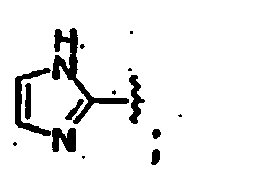
- R7 is alkyl, aryl, aralkyl, heteroaryl, heteroaralkyl, R11-substituted aryl or R11-substituted heteroaryl;
- R8 is hydrogen or alkyl;
- R9 is hydrogen, alkyl, aryl, aralkyl, cycloalkyl, heteroaralkyl or heteroaryl;
- R10 is 1 to 5 substituents, each R10 is independently selected from the group consisting of -OH, alkoxy, -C(O)NR8R9,-NR8R9, -NR8S(O2)R5, -NR8C(O)NR8R9, -NR8C(O)R5, -NR8C(O)OR5 and -C(O)OR9;
- R11 is 1 to 5 substituents, each R11 being independently selected from the group consisting of hydrogen, -OH, alkoxy, -OCF3, -CN, alkyl, halogen or -CF3; and
- R12 is hydroxy or alkoxy.
- Some of the compounds of Formula I are in accordance with the present invention. Compounds of the invention are defined in the appended claims.
- This disclosure is also directed to pharmaceutical compositions for the treatment of metabolic disorders such as obesity, those disorders associated with obesity and eating disorders such as hyperphagia. In one instance, this disclosure is directed to the method of treatment of metabolic disorders such as obesity, and eating disorders such as hyperphagia. Another instance includes a method of treating an eating disorder which comprises administering to a mammal in need of such treatment an amount of a first compound, said first compound being a compound of formula I; e.g. a compound of the invention and a second compound, said second compound being an antiobesity and/or anorectic agent wherein the amounts of the first and second compounds result in the therapeutic desired effect. In another instance, this disclosure is also directed to pharmaceutical compositions for the treatment of obesity which comprise an obesity treating amount of at least one compound of formula I, e.g. at least one compound of the invention, or a pharmaceutically acceptable salt or solvate of said compound and a pharmaceutically acceptable carrier.
- The disclosure relates to compounds that are represented by structural formula I, or a pharmaceutically acceptable salt or solvate thereof, wherein the various moieties are as described above.
- When m is 0, the disclosure includes those compounds of formula I wherein, Y and


- Further compounds within the scope of the disclosure include those compounds of formula I when n is 0, there is no connecting bond between the two carbons adjacent to the nitrogen of the piperidyl ring.
- One instance of the disclosure are compounds of formula I wherein Y is -(CR2R3)pNR8(CH2)q-, p is 1; q is 0; R2 and R3 are hydrogen, or alkyl; and R8 is hydrogen or alkyl.
- An additional instance of the disclosure are compounds of formula I wherein Y is -(CR2R3)pNR8(CH2)q-, p is 0; q is 1; R2 and R3 are hydrogen or alkyl; and R8 is hydrogen or alkyl.
- Additional instances of the disclosure include those compounds of formula I wherein Y is -(CH2)pO(CH2)q; p is 0; and q is 1. Alternative instances of the disclosure also include those compounds wherein Y is -(CH2)pO(CH2)q; p is 1; and q is 0; or wherein Y is -(CR2R3)t-; t is 2; and R2 and R3 are hydrogen or alkyl.
- Additional instances of the disclosure include those compounds of Formula I wherein R1 is hydrogen, alkyl, aralkyl, cycloalkyl, cycloalkylalkyl-, R10-substituted alkyl, hydroxyalkyl, -S(O2)R5, -C(O)R5, -C(O)NR8R9 or -C(O)OR6.
- Another instance of the disclosure include those compounds of formula I wherein
Ar is R8-substituted aryl;
and
R6 is 1 to 5 substituents and each R6 is independently selected from the group consisting of halogen, -CF3, -OCF3, -CN, -CHO, -S(O2)R5, -C(O)R5,-C(O)NR8R9, -(alkylene)C(O)NR8R9,-(alkylene)NR8R9,-(alkylene)NR8C(O)R5, -(alkylene)NR8S(O2)R5 and
- Another instance of the disclosure include those compounds of formula I wherein R6 is 1 substituent, wherein said R6 is independently selected from the group consisting of halogen, -CN,-(alkylene)C(O)NR8R9, -(alkylene)NR8R9 and -(alkylene)NR8C(O)R5.
- Another instance of the disclosure include those compounds of formula I wherein Ar is R6-substituted phenyl and R6 is at the meta or para position of Ar, relative to the position where Ar is attached to the parent moiety.
- Another instance of the disclosure include those compounds of formula I wherein R6 is at the meta position of Ar, relative to the position where Ar is attached to the parent moiety; preferably R6 is -CN.
- Another instance of the disclosure include those compounds of formula I wherein R4 is two substituents and each R4 is independently selected from the group consisting of halogen, -CN and-CF3.
- Another instance of the disclosure include those compounds of formula I wherein R4 is selected from the group consisting of Cl, F and -CF3.
- Another instance of the disclosure include those compounds of formula I wherein R1 is hydrogen, Boc, methyl, ethyl, hydroxyethyl, hydroxypentyl, cyclobutyl, cyclopentyl,

- Still additional instances of formula I include compounds selected from the group consisting of compounds of Examples 8A, 8B, 8C, 8D; 11A, 11B, 11C, 15A, 15B, 16A, 16B, 17A, 17B, 28A, 28B, 33, 34D, 34A, 34B, 34C, 39, 44, 48, 53, 54, 56, 57, 58, 63, 64 67A, 67B, 75A, 75B and 75C herein.
- Other instances of the disclosure include those methods of treatment with the compounds of formula I, e.g. compounds of the invention, wherein the eating disorder is hyperphagia and wherein the metabolic disorder is obesity.
- Another instance is a method of treating a disorder associated with obesity comprising administering to a mammal in need of such treatment a therapeutically effective amount of at least one compound of formula I, e.g. at least one compound of the invention, or a pharmaceutically acceptable salt or solvate of said compound. Specific examples of disorders associated with obesity include type II diabetes, insulin resistance, hyperlipidemia or hypertension.
- Another instance includes a method of treating an eating disorder which comprises administering to a mammal in need of such treatment an amount of a first compound, said first compound being a compound of formula I e.g. a compound of the invention, or a pharmaceutically acceptable salt or solvate of said compound; and
- a second compound, said second compound being an antiobesity and/or anorectic agent selected from the group consisting of a β3 agonist, a thryomimetic agent, an anorectic agent and an NPY antagonist;
wherein the amounts of the first and second compounds result in the desired therapeutic effect (the treatment of obesity, obesity related disorders, metabolic and eating disorders). - Except where stated otherwise, the following definitions apply throughout the present specification and claims. These definitions apply regardless of whether a term is used by itself or in combination with other terms. Hence the definition of "alkyl" applies to "alkyl" as well as to the "alkyl" portions of "alkoxy", "cycloalkyl and so forth.
- As used above, and throughout the specification, the following terms, unless otherwise indicated, shall be understood to have the following meanings:
- "Alkoxy" means an alkyl-O- group in which the alkyl group is as previously described. Examples of suitable alkoxy groups include methoxy, ethoxy, n-propoxy and isopropoxy. The alkyl group is linked to an adjacent moiety through the ether oxygen. Examples of suitable alkoxy groups include propoxy, ethoxy and butoxy.
- "Alkyl" means an aliphatic hydrocarbon group, which may be straight or branched and comprising 1 to 20 carbon atoms in the chain. Preferred alkyl groups contain 1 to 12 carbon atoms in the chain. More preferred alkyl groups contain 1 to 6 carbon atoms in the chain. Branched means that one or more lower alkyl groups such as methyl, ethyl or propyl, are attached to a linear alkyl chain. "Lower alkyl" means an alkyl group having 1 to 6 carbon atoms in the chain, which may be straight or branched. The alkyl group can be unsubstituted or substituted with one or more substituents which may be the same or different, each being independently selected from R10 groups listed above. Examples of suitable alkyl groups include methyl, ethyl, n-propyl, isopropyl, n-butyl, and t-butyl.
- "Alkylene" means an alkanediyl group commonly having free valencies on two carbon atoms. Examples include methylene, ethylene, propylene and the like.
- "Aryl" means an aromatic monocyclic or multicyclic ring system comprising about 6 to about 14 carbon atoms, preferably about 6 to about 10 carbon atoms. Included in the definition of aryl are fused aryls such as indenyl, napthalenyl, anthracenyl and indolinyl. Fused aryls can be attached to the parent moiety either through the saturated or unsaturated portions of the ring. The aryl group can be unsubstituted or substituted on the ring with one or more substituents which may be the same or different, each being independently selected from R6, R10 and R11 groups listed above. Examples of suitable aryl groups include phenyl and naphthyl. The "aryl" group can also be substituted by linking two adjacent carbons on its aromatic ring via a combination of one or more carbon atoms and one or more oxygen atoms such as methylenedioxy, ethylenedioxy.
- "Aralkyl" means an aryl-alkyl- group in which the aryl and alkyl are as previously described. Preferred aralkyls comprise a lower alkyl group. Examples of suitable aralkyl groups include benzyl, 2-phenethyl and a naphthlenylmethyl. The bond to the parent moiety is through the alkyl. The term "substituted aralkyl" means that the aralkyl group may be substituted by one or more substituents which may be the same or different, each substituent being independently selected from R10 groups listed above.
- "Cycloalkyl" means a non-aromatic mono- or multicyclic ring system comprising 3 to 10 carbon atoms, preferably 5 to 10 carbon atoms. Preferred cycloalkyl rings contain 5 to 7 ring atoms. The cycloalkyl can be optionally substituted on the ring by replacing an available hydrogen on the ring by one or more substituents which may be the same or different, each being independently selected from R10 and R11 groups listed above. Examples of suitable monocyclic cycloalkyls include cyclopropyl, cyclopentyl, cyclohexyl, cycloheptyl. Examples of suitable multicyclic cycloalkyls include 1-decalinyl, norbornyl, adamantyl and the like.
- "Cycloalkylalkyl" means a cycloalkylalkyl group in which the cycloalkyl and alkyl groups are as previously described. The cycloalkyl portion of cycloalkylalkyl can be optionally substituted on the ring by replacing an available hydrogen on the ring by one or more substituents which may be the same or different, each being independently selected from R10 groups listed above. The bond to the parent moiety is through the alkyl group.
- "Halo" means fluoro, chloro, bromo or iodo groups. Preferred are fluoro, chloro or bromo, and more preferred are fluoro and chloro.
- "Halogen" means fluorine, chlorine, bromine or iodine. Preferred are fluorine, chlorine or bromine, and more preferred are fluorine and chlorine.
- "Haloalkyl" means an alkyl as defined above wherein one or more hydrogen atoms on the alkyl is replaced by a halo group defined above.
- "Heteroaryl" means an aromatic monocyclic or multicyclic ring system comprising 5 to 14 ring atoms, preferably 5 to 10 ring atoms, in which one or more of the ring atoms is an element other than carbon, for example nitrogen, oxygen or sulfur, alone or in combination. Preferred heteroaryls contain 5 to 6 ring atoms. The "heteroaryl" can be optionally substituted on the ring by replacing an available hydrogen on the ring by one or more substituents which may be the same or different, each being independently selected from R6, R10 and R11 groups listed above. A nitrogen atom of a heteroaryl can be optionally oxidized to the corresponding N-oxide. Examples of suitable heteroaryls include pyridyl, pyrazinyl, furanyl, thienyl, pyrimidinyl, isoxazolyl, isothiazolyl, oxazolyl, thiazolyl, pyrrolyl, triazolyl.
- "Heteroaralkyl" means a heteroaryl-alkyl- group in which the heteroaryl and alkyl are as previously described. Preferred heteroaralkyls contain a lower alkyl group. The heteroaralkyl can be optionally substituted on the ring by replacing an available hydrogen on the ring or hydrogen(s) on any nitrogen(s) suitably by one or more substituents which may be the same or different, each being independently selected from R6 and R10 groups listed above. Examples of suitable aralkyl groups include pyridylmethyl, 2-(furan-3-yl)ethyl and quinolin-3-ylmethyl. The bond to the parent moiety is through the alkyl.
- "Heterocyclyl" means a non-aromatic saturated monocyclic or multicyclic ring system comprising 3 to 10 ring atoms, preferably 5 to 10 ring atoms, in which one or more of the atoms in the ring system is an element other than carbon, for example nitrogen, oxygen or sulfur, alone or in combination. There are no adjacent oxygen and/or sulfur atoms present in the ring system. Preferred heterocyclyls contain 5 to 6 ring atoms. The prefix aza, oxa or thia before the heterocyclyl root name means that at least a nitrogen, oxygen or sulfur atom respectively is present as a ring atom. The heterocyclyl can be optionally substituted on the ring by replacing an available hydrogen on the ring or hydrogen(s) on any nitrogen(s) suitably by one or more substituents which may be the same or different, each being independently selected from R10 and R11 groups listed above. The nitrogen or sulfur atom of the heterocyclyl can be optionally oxidized to the corresponding N-oxide, S-oxide or S,S-dioxide. Examples of suitable monocyclic heterocyclyl rings include piperidyl, pyrrolidinyl, piperazinyl, pyranyl, thiophenyl, tetrahydrothiophenyl, morpholinyl.
- "Heterocyclylalkyl" means heterocyclyl-alkyl- group in which the heterocyclyl and alkyl are as previously described. The heterocyclyl ring can be optionally substituted on the ring by replacing an available hydrogen on the ring or hydrogen(s) on any nitrogen(s) suitably by one or more substituents which may be the same or different, each being independently selected from R10 and R11 groups listed above. The nitrogen or sulfur atom of the heterocyclyl can be optionally oxidized to the corresponding N-oxide, S-oxide or S,S-dioxide. Examples of suitable heterocyclylalkyl groups include


- "Hydroxyalkyl" means a HO-alkyl- group in which alkyl is as previously defined. Preferred hydroxyalkyls contain lower alkyl. Examples of suitable hydroxyalkyl groups include hydroxymethyl and 2-hydroxyethyl.
- "Mammal" means humans and other mammalian animals.
- "Patient" includes both human and other animals.
- It should also be noted that any heteroatom with unsatisfied valences in the text, schemes, examples, structural formulae, and Tables herein is assumed to have the hydrogen atom or atoms to satisfy the valences.
- The terms "at least one " compound or "one or more compounds" means one to three compounds, preferably one compound.
- When any variable (e.g., aryl, heterocycle, R2, etc.) occurs more than once in any substituent or in Formula I, its definition at each occurrence is independent of its definition at every other occurrence. "Also, combinations of substituents and/or variables are permissible only if such combinations result in stable compounds.
- The compounds of Formula I e.g. the compounds of the invention, can be administered as racemic mixtures or enantiomerically pure compounds.
- As used herein, the term "composition" is intended to encompass a product comprising the specified ingredients in the specified amounts, as well as any product which results, directly or indirectly, from combination of the specified ingredients in the specified amounts.
- The compounds of formula I e.g. the compounds of the invention, can form salts, solvates and prodrugs. Reference to a compound of formula herein is understood to include reference to sails, solvates and prodrugs thereof, unless otherwise indicated.
- Solvates of the compounds of the disclosure, e.g. solvates of compounds of the invention, are also contemplated. "Solvate" means a physical association of a compound of this invention with one or more solvent molecules. This physical association involves varying degrees of ionic and covalent bonding, including hydrogen bonding. In certain instances the solvate will be capable of isolation, for example when one or more solvent molecules are incorporated in the crystal lattice of the crystalline solid. "Solvat" encompasses both solution-phase and isolatable solvates. Examples of suitable solvates include ethanolates, methanolates, and the like. "Hydrate" is a solvate wherein the solvent molecule is H2O.
- Prodrugs of the compounds are also contemplated. The term "prodrug", as employed herein, denotes a compound that is a drug precursor which, upon administration to a subject, undergoes chemical conversion by metabolic or chemical processes to yield a compound of formula I or a salt and/or solvate thereof. A discussion of prodrugs is provided in T. Higuchi and V. Stella, Pro-drugs as Novel Delivery Systems (1987) Volume 14 of the A.C.S. Symposium Series, and in Bioreversible Carriers in Drug Design, (1987) Edward B. Roche, ed., American Pharmaceutical Association and Pergamon Press.
- The term "salt(s)", as employed herein, denotes acidic salts formed with inorganic and/or organic acids, as well as basic salts formed with inorganic and/or organic bases. In addition, when a compound of Formula I e.g. a compound of the invention, contains both a basic moiety, such as a pyridine or imidazole, and an acidic moiety, such as a carboxylic acid, zwitterions ("inner salts") may be formed and are included within the term "salt(s)" as used herein. Pharmaceutically acceptable (i.e., non-toxic, physiologically acceptable) salts are preferred, although other salts are also useful. "Salts of the compound of the Formula I e.g. salts a compounds of the invention, may be formed, for example, by reacting a compound of Formula I e.g. a compound of the invention, with an amount of acid or base; such as an equivalent amount, in a medium such as one in which the salt precipitates or in an aqueous medium followed by lyophilization.
- Exemplary acid addition salts include acetates, adipates, alginates, ascorbates, aspartates, benzoates, benzenesulforiates, bisulfates, borates, butyrates, citrates, camphorates, camphorsulfonates, cyclopentanepropionates, digluconates, dodecylsulfates, ethanesulfonates, fumarates, glucoheptanoates, glycerophosphates, hemisulfates, heptanoates, hexanoates, hydrochlorides, hydrobromides, hydroiodides, 2-hydroxyethanesulfonates, lactates, maleates, methanesulfonates, 2-naphthalenesulfonates, nicotinates, nitrate, oxalates, pectinates, persulfates, 3-phenylpropionates, phosphates, picrates, pivalates, propionates, salicylates, succinates, sulfates, sulfonates (such as those mentioned herein), tartarates, thiocyanates, toluenesulfonates (also known as tosylates,) and undecanoates. Additionally, acids which are generally considered suitable for the formation of pharmaceutically useful salts from basic pharmaceutical compounds are discussed, for example, by S. Berge et al, Journal of Pharmaceutical Sciences (1977) 66(1) 1-19; P. Gould, International J. of Pharmaceutics (1986):33 201-217; Anderson et al, The Practice of Medicinal Chemistry (1996), Academic Press, New York; and in The Orange Book(Food & Drug Administration, Washington, D.C on their website).
- Exemplary basic salts include ammonium salts, alkali metal salts such as sodium, lithium, and potassium salts, alkaline earth metal salts such as calcium and magnesium salts, salts with organic bases (for example, organic amines) such as benzathines, dicyclohexylamines, hydrabamines (formed with N,N-bis(dehydroabietyl)ethylenediamine), N-methyl-D-glucamines, N-methyl-D-glucamides, t-butyl amines, and salts with amino acids such as arginine and lysine. Basic nitrogen-containing groups may be quarternized with agents such as lower alkyl halides (e.g. methyl, ethyl, propyl, and butyl chlorides, bromides and iodides), dialkyl sulfates (e.g. dimethyl, diethyl, dibutyl, and diamyl sulfates), long chain halides (e.g. decyl, lauryl, myristyl and stearyl chlorides, bromides and iodides), aralkyl halides (e.g. benzyl and phenethyl bromides).
- All such acid salts and base salts are intended to be pharmaceutically Acceptable salts within the scope of the disclosure and all acid and base salts are considered equivalent to the free forms of the corresponding compounds for purposes of the disclosure.
- Compounds of Formula I, e.g. compounds of the invention, and salts and solvates thereof, may exist in their tautomeric form (for example, as an amide or imino ether). All such tautomeric forms are contemplated herein.
- All stereoisomers (for example, geometric isomers, optical isomers) of the present compounds (including those of the salts and solvates of the compounds), such as those which may exist due to asymmetric carbons on various substituents, including enantiomeric forms (which may exist even in the absence of asymmetric carbons), rotameric forms, atropisomers, and diastereomeric forms, are contemplated. Individual stereoisomers of the compounds of the disclosure e.g. of compounds of the invention, may, for example, be substantially free of other isomers, or may be admixed, for example, as racemates or with all other, or other selected, stereoisomers. The chiral centers of the compounds can have the S or R configuration as defined by the IUPAC 1974 Recommendations. The use of the terms "salt", "solvate" and the like, is intended to equally apply to the salt and solvate of enantiomers, stereoisomers, rotamers, tautomers or racemates of the inventive compounds.
- Compounds of Formula I, e.g. compounds of the invention, can be highly selective, high affinity Melanin Concentrating Hormone (MCH) receptor antagonists useful for the treatment of obesity.
- An aspect of this disclosure is a method of treating a mammal (e.g., human) having a disease or condition mediated by MCH by administering a therapeutically effective amount of at least one compound of Formula I, e.g. at least one compound of the invention, or a pharmaceutically acceptable salt or solvate of said compound to the mammal.
- "Effective amount" or "therapeutically effective amount" is meant to describe an amount of a compound effective to treat a mammal (e.g., human) having a disease or condition mediated by MCH, and thus producing the desired therapeutic effect (the treatment of obesity, obesity related disorders, metabolic and eating disorders).
- A preferred dosage is about 0.001 to 100 mg/kg of body weight/day of the compound of Formula I, e.g. of a compound of the invention. An especially preferred dosage is about 0.01 to 30 mg/kg of body weigh/day of a compound of Formula I, e.g. of a compound of the invention, or a pharmaceutically acceptable salt or solvate of said compound.
- Still yet another aspect of this disclosure is a method of treating obesity comprising administering to a mammal in need of such treatment a therapeutically effective amount of at least one compound of Formula I, e.g. at least one compound of the invention, or a pharmaceutically acceptable salt or solvate of said compound.
- A further aspect of this disclosure is a method for treating eating and metabolic disorders such as bulimia and anorexia comprising administering to a mammal a therapeutically effective amount of at least one compound of Formula I, e.g. at least one compound of the invention, or a pharmaceutically acceptable salt or solvate of said compound.
- Another aspect of this disclosure is a method for treating hyperlipidemia comprising administering to a mammal a therapeutically effective amount of at least one compound of Formula I, e.g. at least one compound of the invention, or a pharmaceutically acceptable salt or solvate of said compound.
- Another aspect of this disclosure is a method for treating cellulite and fat accumulation comprising administering to a mammal a therapeutically effective amount of at least one compound of Formula I, e.g. at least one compound of the invention, or a pharmaceutically acceptable salt or solvate of said compound.
- Another aspect of this disclosure is directed to a method for treating type II diabetes comprising administering to a mammal a therapeutically effective amount of at least one compound of Formula I, e.g. at least one compound of the invention, or a pharmaceutically acceptable salt or solvate of said compound.
- In addition to the "direct" effect of the compounds on the MCH subtype, there are diseases and conditions that can benefit from the weight loss such as, for example, insulin resistance, impaired glucose tolerance, Type II Diabetes, hypertension, hyperlipidemia, cardiovascular disease, gall stones, certain cancers, and sleep apnea.
- This disclosure is also directed to pharmaceutical compositions, which comprise at least one compound of Formula I, e.g. at least one compound of the invention, or a pharmaceutically acceptable salt or solvate of said compound and at least one pharmaceutically acceptable carrier.
- This disclosure is also directed to pharmaceutical compositions for the treatment of obesity which comprise an obesity treating amount of at least one compound of Formula I, e.g. at least one compound of the invention, or a pharmaceutically acceptable salt or solvate of said compound and at least one pharmaceutically acceptable carrier.
- Still yet other aspects of this disclosure are combinations of a compound of Formula I, e.g. a compound of the invention, or a pharmaceutically acceptable salt or solvate of said compound and other compounds as described below.
- Accordingly, included within the disclosure is a method for treating obesity comprising administering to a mammal (e.g., a female or male human)
- a. an amount of a first compound, said first compound being a compound of Formula I, e.g. a compound of the invention, or a pharmaceutically acceptable salt or solvate of said compound; and
- b. an amount of a second compound, said second compound being an antiobesity and/or anorectic agent such as a β3 agonist, a thyromimetic agent, an anoretic agent, or an NPY antagonist and/or optionally a pharmaceutically carrier, vehicle or diluent, wherein the amounts of the first and second compounds result in a therapeutic effect.
- Another instance of this disclosure is a kit comprising:
- a. an amount of a compound of Formula I, e.g. a compound of the invention, or a pharmaceutically acceptable salt or solvate of said compound and a pharmaceutically acceptable carrier, vehicle or diluent in a first unit dosage form;
- b. an amount of an antiobesity and/or anorectic agent such as a β3 agonist, a thyromimetic agent, an anoretic agent, or an NPY antagonist and a pharmaceutically acceptable carrier, vehicle or diluent in a second unit dosage form; and
- c. means for containing said first and second dosage forms wherein the amounts of the first and second compounds result in a therapeutic effect.
- Preferred antiobesity and/or anorectic agents (taken singly or in any combination thereof) in the above combination methods, combination compositions and combination kits are:
- phenylpropanolamine, ephedrine, pseudoephedrine, phehtermine, a cholecystokinin-A (hereinafter referred to as CCK-A) agonist, a monoamine reuptake inhibitor (such as sibutramine), a sympathomimetic agent; a serotonergic agent (such as dexfenfluramine or fenfluramine), a dopamine agonist (such as bromocriptine), a melanocyte-stimulating hormone receptor agonist or mimetic, a melanocyte-stimulating hormone analog, a cannabinoid receptor antagonist, a melanin concentrating hormone antagonist, the OB protein (hereinafter referred to as "leptin"), a leptin analog, a leptin receptor agonist, a galanin antagonist or a Gl lipase inhibitor or decreaser (such as orlistat). Other useful anorectic agents include bombesin agonists, dehydroepiandrosterone or analogs thereof, glucocorticoid receptor agonists and antagonists, orexin receptor antagonists, urocortin binding protein antagonists, agonists of the glucagon-like peptide-1 receptor such as Exendin and ciliary neurotrophic factors such as Axokine.
- Another aspect of this disclosure is a method of treating diabetes comprising administering to a mammal (e.g., a female or male human)
- a. an amount of a first compound, e.g. a compound of the invention, said first compound being a compound of Formula I, or a pharmaceutically acceptable salt or solvate of said compound; and
- b. an amount of a second compound, said second compound being an aldose reductase inhibitor, a glycogen phosphorylase inhibitor, a sorbitol dehydrogenase inhibitor, a protein tyrosine phosphatase 1 B inhibitor, a dipeptidyl protease inhibitor, insulin (including orally bioavailable insulin preparations), an insulin mimetic, metformin, acarbose, a PPAR-gamma ligand such as troglitazone, rosaglitazone, pioglitazone or GW-1929, a sulfonylurea, glipazide, glyburide, or chlorpropamide wherein the amounts of the first and second compounds result in a therapeutic effect.
- This disclosure is also directed to a pharmaceutical combination composition comprising: a therapeutically effective amount of a composition comprising
a first compound, said first compound being a compound of Formula I, e.g. a compound of the invention, or a pharmaceutically acceptable salt or solvate of said compound;
a second compound, said second compound being an aldose reductase inhibitor, a glycogen phosphorylase inhibitor, a sorbitol dehydrogenase inhibitor, a protein tyrosine phosphatase 1 B inhibitor, a dipeptidyl protease inhibitor, insulin (including orally bioagailable insulin preparations), an insulin mimetic, metformin, acarbose, a PPAR-gamma ligand such as troglitazone, rosaglitazone, pioglitazone, or GW-1929, a sulfonylurea, glipazide, glyburide, or chlorpropamide; and optionally a pharmaceutical carrier, vehicle or diluent. - Another instance of this disclosure is a kit comprising:
- a. an amount of a compound of Formula I, e.g. a compound of the invention, or a pharmaceutically acceptable salt or solvate of said compound and a pharmaceutically acceptable carrier, vehicle or diluent in a first unit dosage form;
- b. an amount of an aldose reductase inhibitor, a glycogen phosphorylase inhibitor, a sorbitol dehydrogenase inhibitor, a protein tyrosine phosphatase 1B inhibitor, a dipeptidyl protease inhibitor, insulin (including orally bioavaitable insulin preparations), an insulin mimetic, metformin, acarbose, a PPAR-gamma ligand such as troglitazone, rosaglitazone, pioglitazone, or GW-1929, a sutfonylurea, glipazide, glyburide, or chlorpropamide and a pharmaceutically acceptable carrier, vehicle or diluent in a second unit dosage form; and
- c. means for containing said first and second dosage forms wherein the amounts of the first and second compounds result in a therapeutic effect.
- Preferably, the pharmaceutical preparation is in a unit dosage form. In such form, the preparation is subdivided into suitably sized unit doses containing appropriate quantities of the active component, e.g., an effective amount to achieve the desired purpose.
- The quantity of active compound in a unit dose of preparation may be varied or adjusted from 1 mg to 1000 mg, preferably from 1 mg to 50 mg, more preferably from 1 mg to 25 mg, according to the particular application.
- The actual dosage employed may be varied depending upon the requirements of the patient and the severity of the condition being treated. Determination of the proper dosage regimen for a particular situation is within the skill of the art. For convenience, the total daily dosage may be divided and administered in portions during the day as required.
- The amount and frequency of administration of the compounds of the disclosure, e.g. the compounds of the invention and/or the pharmaceutically acceptable salts thereof will be regulated according to the judgment of the attending clinician considering such factors as age, condition and size of the patient as well as severity of the symptoms being treated. A typical recommenced daily dosage regimen for oral administration can range from 1 mg/day to 300 mg/day, preferably 1 mg/day to 50 mg/day, in two to four divided doses.
- For preparing pharmaceutical compositions from the compounds described by this invention, inert, pharmaceutical acceptable carriers can be either solid or liquid. Solid form preparations include powders, tablets, dispersible granules, capsules, cachets and suppositories. The powders and tablets may be comprises of from 5 to 70 percent active ingredient. Suitable solid carriers are known in the art, e.g. magnesium carbonate, magnesium stearate, talc, sugar, lactose. Tablets, powders, cachets and capsules can be used as solid dosage forms suitable for oral administration.
- For preparing suppositories, a low melting wax such as a mixture of fatty acid glycerides or cocoa butter is first melted, and the active ingredient is dispersed homogeneously therein as by stirring. The molten homogeneous mixture is then poured into convenient sized molds, allowed to cool and thereby solidify.
- Liquid form preparations include solutions, suspensions and emulsions. As an example may be mentioned water or water-propylene glycol solutions for parenteral injection.
- Liquid form preparations may also include solutions for intranasal administration.
- Aerosol preparations suitable for inhalation may include solutions and solids in powder form, which may be in combination with a pharmaceutically acceptable carrier, such as an inert compressed gas.
- Also included are solid form preparations which are intended to be converted, shortly before use, to liquid form preparations for either oral or parenteral administration. Such liquid forms include solutions, suspensions and emulsions.
- The compounds of the disclosure, e.g. the compounds of the invention, may also be deliverable transdermally. The transdermal compositions can take the form of creams, lotions, aerosols and/or emulsions and can be included in a transdermal patch of the matrix or reservoir type as are conventional in the art for this purpose.
- Preferably the compound is administered orally.
- Preferably, the pharmaceutical preparation is in unit dosage form. In such form, the preparation is subdivided into unit doses containing appropriate quantities of the active component, e.g., an effective amount to achieve the desired purpose.
- Compounds of Formula I, e.g. compounds of the invention, can be produced by processes known to those skilled in the art using either solution phase or solid phase synthesis as shown in the following reaction schemes, in the preparations and examples below.
- The invention disclosed herein is exemplified by the following preparations and examples.
- Where NMR data are presented, 1H spectra were obtained on either a Varian VXR-200 (200 MHz, 1H), Varian Gemini-300 (300 MHz) or XL-400 (400 MHz) and are reported as ppm down field from Me4Si with number of protons, multiplicities, and coupling constants in Hertz indicated parenthetically. Where LC/MS data are presented, analyses was performed using an Applied Biosystems API-100 mass spectrometer and Shimadzu SCL-10A LC column: Altech platinum C18, 3 micron, 33mm x 7mm ID; gradient flow: 0 min -10% CH3CN, 5 min - 95% CH3CN, 7 min - 95% CH3CN, 7.5 min -10% CH3CN, 9 min - stop. The observed parent ion using electro spray ionization are given.
- The following abbreviations are utilized throughout the experimental procedures described below:
- SEMCI or SEM-CI means 2-(trimethylsilyl)ethoxymethyl chloride;
- EtONa or NaOEt means sodium ethoxide;
- EtOH means ethanol;
- MeOH means methanol;
- Bu means butyl;
- 9-BBN means 9-borabicyclo[3.3.1]nonane;
- Ac means acetate;
- Bn means benzyl;
- Me means methyl;
- Py means pyridine;
- Ph means phenyl;
- DEAD means diethylazodicarboxylate;
- Ph3P means triphenylphosphine;
- CH3CN means acetonitrile;
- TBAF means tetrabutylammonium fuoride trihydrate;
- TFA means trifluoroacetic acid;
- TFAA means trifluoroacetic acid anhydride;
- THF means tetrahydrofuran;
- Imid means imidazole;
- DCM means dichloromethane;
- DIBAL means disobutyl aluminum hydride;
- DIEA means N, N diisopropylethylamine;
- DMA means dimethylacetamide;
- DMSO means dimethyl sulfoxide;
- DMF means N,N-dimethylformamide;
- LAH means lithium aluminum hydride;
- PhNTF2 means N-phenyltrifluoromethane sulfonimide;
- Boc means Butoxycarbonyl;
- (Boc)2O means di-t-butyl carbonate;
- NMR means nuclear magnetic resonance spectroscopy;
- MS means mass spectrometry;
- TLC means Thin layer chromatography;
- HPLC means high performance liquid chromatography;
- room temperature or rt (ambient) means about 25ºC;
- AcOEt or EtOAc means ethyl acetate;
- NaBH(OAc3) means sodium triacetoxyborohydride.;
- TsOH means toluenesulfonic acid.
- The following examples illustrate the preparation of some of the compounds of the invention.
- Note: These compounds can be prepared via the following schemes:
-

-
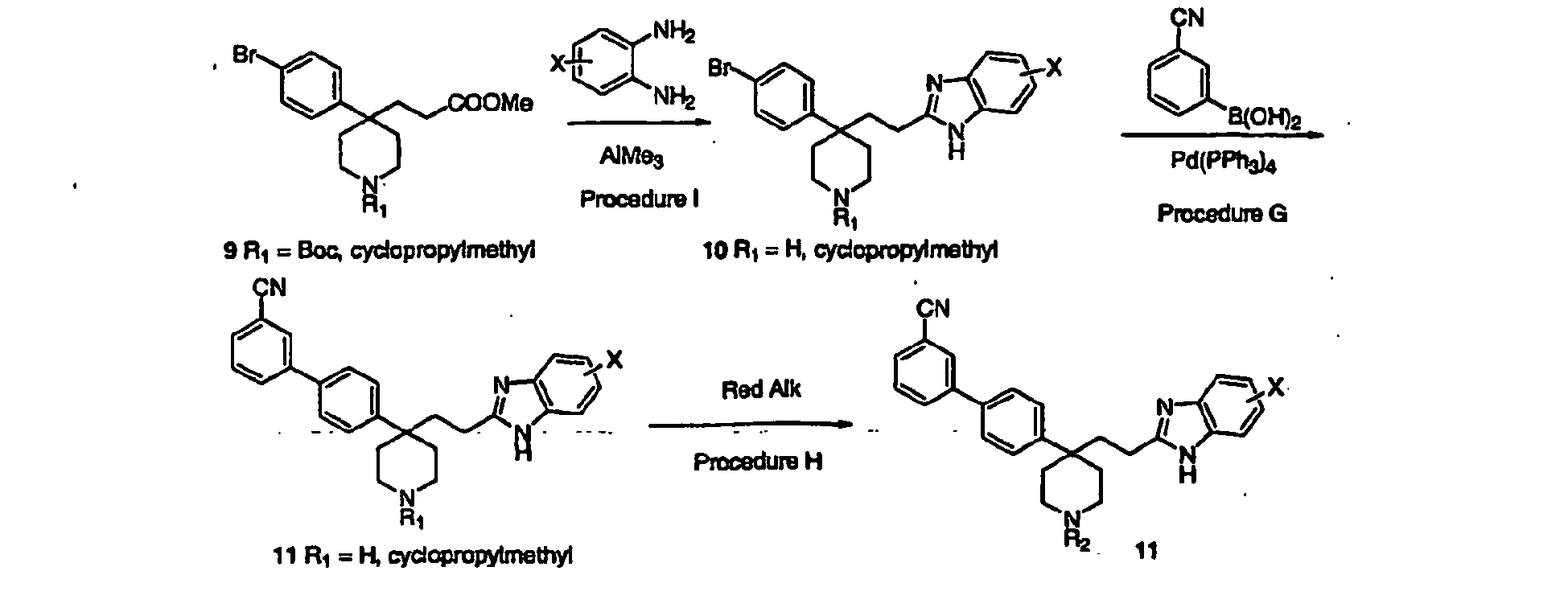
-

-

-

-

-

-

-

-

-

-
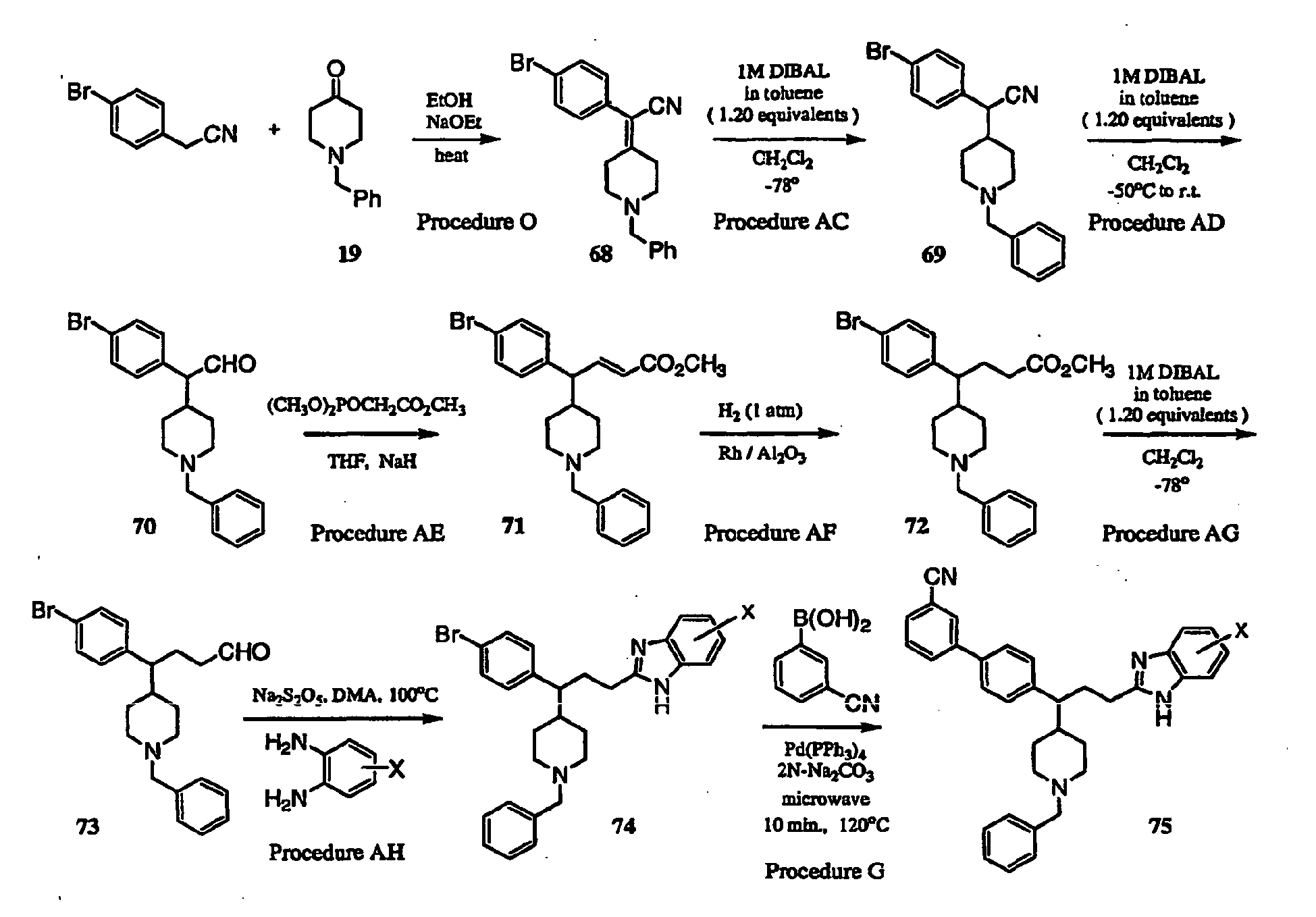
- To a solution of 5.6 g (20 mmol) of aminomethyl piperidine 1 in 80 mL of dichloromethane was added 5.2 g (25 mmol) of trifluoroacetic anhydride at 0°C. The mixture was stirred at the same temperature for 0.5 h, washed with 100 mL of saturated aqueous NaHCO3. The aqueous layer was extracted with three 100 mL portions of dichloromethane. The combined organic extracts were concentrated to give 7.5g of amide 2. Calcd m/z for C21H23F3N2O·H+ = 377; found m/z = 377.
- To a stirred solution of 7.4g (20 mmol) of amide 2 in 50 mL of ClCH2CH2Cl was added 2.5 g (25 mmol) of methyl chloroformate at 0°C. The mixture was stirred under reflux for 1 h. It was concentrated in vacuo to give 6.92 g of crude product 3. Calcd m/z for C16H19F3N2O3·H+ = 345; found m/z = 345.
- To a stirred solution of 6.8 g (19.8 mmol) of compound 3 in 60 mL of dichloromethane was added 6 g (60 mmol) of methanesulfonic acid. After 10 min, 4.7 g (16 mmol) of 1,3-dibromo-5,5-dimethylhydantoin was added. The mixture was stirred at room temperature for 65 h. It was quenched with 150 mL of saturated aqueous NaHCO3, and extracted with three 120 mL portions of dichloromethane. The combined organic extracts were washed with 80 mL of brine and concentrated. The residue was chromatographed on silica gel eluting with 2-4% MeOH in dichloromethane to give 6.4 g of brominated compound 4 contaminated ca. 25% of starting material 3. Calcd m/z for C16H18BrF3N3O3·H+ = 425; found m/z = 425.
- A mixture of 4.2 g (10 mmol) of compound 4 and 2.8 g (20 mmol) of K2CO3 in 28 mL of MeOH-H2O (5:2) was stirred at RT for 20 h and concentrated. The residue was dissolved in 30 mL of H2O, extracted with four 60 mL portions of CHCl3. The combined organic extracts were washed with 30 mL of brine and concentrated. The residue was purified by preparative TLC eluting with 2-4% MeOH in dichloromethane containing 1% NH4OH to give 1.2 g of pure amine 5 and 2.0 g of amine 5 containing starting material 4. Compound 5: Calcd m/z for C14H19BrN2O2·H+ = 327; found m/z = 327.
- To a stirred solution of 0.54 g (3 mmol) of 1,1'-thiocarbonyldiimidazole and 40 mg (0.6 mmol) of imidazole in 10 mL of acetonitrile was added a solution of 0.65 g (2 mmol) of amine 5 in 8 mL of acetonitrile. The mixture was stirred at room temperature for 3 h, then 0.6 g (4.16 mmol) of 4,5-difluorobenzene-1,2-diamine was added. The reaction was heated at 50°C for 20 h followed by concentration in vacuo. To the residue in 25 mL of ethanol was added 0.86 g (4 mmol) of HgO (red) and 0.15 g of sulfur. After heating under reflux for 1 h, the mixture was filtered through a pad of celite. The filtrate was concentrated; the residue was chromatographed on silica gel eluting with 1-8% MeOH in dichloromethane containing 1% NH4OH to give 1.86 g of aminobenzimidazole 6. Calcd m/z for C21H21BrF2N4O2·H+ = 479; found m/z = 479.
- To a solution of 0.55 g (1.15 mmol) of compound 6 in 5 mL of ethanol was added 15 mL of 6N aqueous HCl. The solution was heated under reflux for 18 h. It was concentrated to a volume of ~15 mL, basified with 25 mL of diluted NH4OH and extracted with four 50 mL portions of dichloromethane. The combined organic extracts were washed with 30 mL of brine, and concentrated to give 0.43 g of piperidine 7. Calcd m/z for C19H19BrF2N4·H+ = 421; found m/z = 421.
- A mixture of 0.42 g (1 mmol) of compound 7, 0.2 g (1.2 mmol) of 3-cyanophenylboronic acid, 0.1 g (0.01 mmol) of Pd(PPh3)4 in 1 mL of 1 N Na2CO3 and 4.5 mL of methanol in a sealed tube was heated at 120°C for 10 min under microwave irradiation. It was diluted with 20 mL of methanol and filtered. The filtrate was concentrated and the residue was purified by preparative TLC eluting with 10% MeOH in dichloromethane containing 1% NH4OH to give 0.18 g of compound 8A.
- The following compounds have been prepared analogously:
Cpd. # Structure Formula (M+1)+ calcd m/z obsd m/z 8A 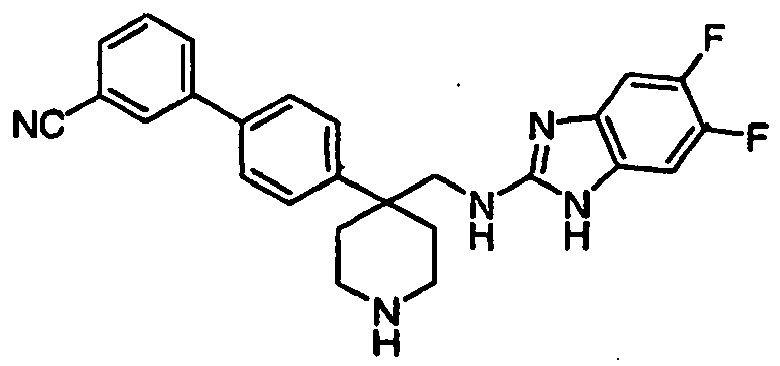
C26H23F2N5·H+ 444 444 8D 
C28H25F2N5·O2·H+ 502 502 - To a stirred solution of 0.044 g (0.1 mmol) of compound 8A and 8 mg (1.2 mmol) of cyclopropanecarboxaldehyde in 2 mL of dichloromethane-methanol (1:1) was added 0.03 g (0.14 mmol) of NaBH(OAC)3. The mixture was stirred art room temperature for 18 h and purified by resin clean-up using Argonaut Technologies, Inc. p-toluene sulfonic acid resin, MP-TsOH (1.29mmol/g) to give 0.039 g of alkylated piperidine 8B.
- The following compounds have been prepared analogously:
Cpd. # Structure Formula (M+1)+ calcd m/z obsd m/z 8B 
C30H29F2N5·H+ 498 498 8C 
C30H29F2N5·H+ 498 498 11A 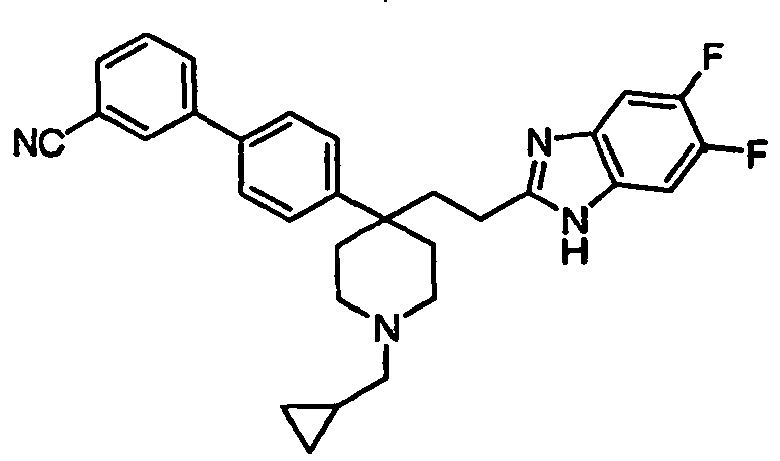
C31H30F2N4·H+ 497 497 11B 
C27H24ClFN4·H+ 459 459 11C 
C31H30ClFN4·H+ 513 513 - To a stirred solution of 0.52 g (0 mmol) of 4,5-difluorobenzene-1,2-diamine in 8 mL of toluene was added 5 mL (10 mmol) of AlMe3 in toluene. After 20 min, a solution of 1.0 g (2. 6 mmol) of compound 9A (R1 = n-Boc) in toluene was introduced. The mixture was stirred under reflux for 18 h and cooled to room temperature. The reaction was quenched with 70 mL of saturated aqueous NaHCO3, and extracted with three 60 mL portions of dichloromethane. The combined organic extracts were washed with 50 mL of brine and concentrated. The residue was chromatographed over silica gel eluting with 1-10% methanol in dichioromethane containing 1% NH4OH to give 0.25 g of compound 10A.
- The following compounds have been prepared analogously:
Cpd. # Structure Formula (M+1)+ calcd m/z obsd m/z 10A 
C24H26BrF2N3·H+ 476 476 10B 
C20H20BrClFN3·H+ 438 438 - To a solution of 12 g (33 mmol) of compound 12 (Anandan Palani, et al, J. Med. Chem. 2002, 45, 3143) in 100 mL of methanol-H2O (1:3) was added 10 g (72 mmol) of K2CO3. The solution was stirred at room temperature for 18 h and concentrated to a volume of ca. 70 mL. It was diluted with 100 mL of H2O and extracted with three 150 mL portions of dichloromethane. The combined organic extracts were washed with 50 mL of brine and concentrated. The residue was chromatographed on silica gel eluting with 3 to 12% methanol in dichloromethane containing 1% NH4OH to give 7 g of the desired N-unsubstituted piperidine. Calcd m/z for C12H14BrNO·H+ = 268; found m/z = 268.
- To a solution of 7 g (26 mmol) of the piperidine from step 1 in 150 mL of methanol was added 6.5 g (30 mmol) of (Boc)2O. The mixture was stirred at room temperature for 2 h and concentrated. The residue was recrystalized from methanol to give N-Boc piperidine. Calcd m/z for C17H22BrNO3·H+ = 368; found m/z = 368
- To a solution of the N-Boc protected bromophenyl ketone from step 2 (2.0 g, 5.43 mmol) in dichloroethane (2 mL) was added NH4OAc (5.0 g, 64.0 mmol) and NaCNBH4 (1.0 g, 15.9 mmol, in 2 mL methanol). The reaction mixture was stirred at room temperature for 48 h. Water (100 mL) was added and the mixture was extracted with dichloromethane (2 X 100 mL). The organic layer was dried using sodium sulfate and removal of the solvent afforded amino compound 13 as an oil in 90% yield. Calcd m/z for C17H25BrN2O2·H+ = 369.1; found m/z = 369.1
- To a solution of bromophenyl amine compound 13 (1.66 g, 4.5 mmol) in toluene/methanol (1:1, 50 mL) was added 3-cyanophenyl boronic acid (1.0 g, 6.6 mmol), aq. Na2CO3 (2 N, 5 mL) and Pd(PPh3)4 (0.5 g, 5.6 mol%). The solution was purged with nitrogen for 5 minutes and heated at 90°C overnight. The reaction mixture was diluted with dichloromethane and filtered through celite. The solvent was removed in vacuo and the product was isolated by silica gel column chromatography using 5-10% methanol in dichloromethane as eluent to afford compound 14 in 57% yield. Calcd m/z for C24H29N3O3·H+ = 392.2; found m/z = 392.1
- To a solution of compound 14 (0.08 g, 0.204 mmol) in acetonitrile (5 mL) was added K2CO3 (0.2 g, 1.45 mmol) and 6-chloro-2-chloromethyl- 5-fluoro-1H-benzimidazole (0.05 g, 0.228 mol) and the contents were stirred at room temperature for 3h. The reaction mixture was diluted with 50 mL of dichloromethane and filtered through Celite. The solvent was removed in vacuo and the residue was purified by silica gel column chromatography using 5-10% methanol in dichloromethane to give 0.07 g of compound 15B as an oil. Calcd m/z for C32H33ClFN5O2·H+ = 574.2; found m/z = 574.1
- The following compounds have been prepared using this or analogous methods:
Cpd. # Structure Formula (M+1)+ calcd m/z obsd m/z 15A 
C32H33Cl2N5O2·H+ 590.2 590.1 15B 
C32H33ClFN5O2·H+ 574.2 574.1 - Trifluoroacetic acid (1 mL) was added to a solution of compound 15B (0.064 g, 0.111 mmol) in 2 mL of dichloromethane and the mixture was stirred for 2h at room temperature. The solvent was removed in vacuo and the piperidine product 16B was used as such for the next step without any further purification.
- The following compounds were prepared using analogously:
Cpd. # Structure Formula (M+1)+ calcd m/z obsd m/z 16A 
C27H25Cl2N5·H+ 490.2 490.1 16B 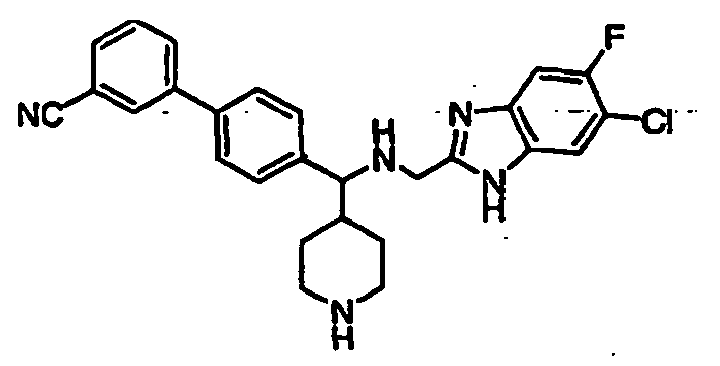
C27H25ClFN5·H+ 474.2 474.1 - To a solution of piperidine 16B (0.01 g, 0.0142 mmol) in 2 ml of methanol was added cyclopropanecarboxaldehyde (5 mg, 0.071 mmol) and NaCNBH3 (0.01 g, 0.05 mmol) and the contents were stirred at room temperature for 2h. The residue was purified by prep TLC using 10% methanol in dichloromethane as eluent to give 0.003 mg of the alkylated piperidine product 17A as an oil. Calcd m/z for C31H31ClFN5·H+ = 528.2; found m/z = 528.1
Cpd. # Structure Formula (M+1)+ calcd m/z obsd m/z 17A 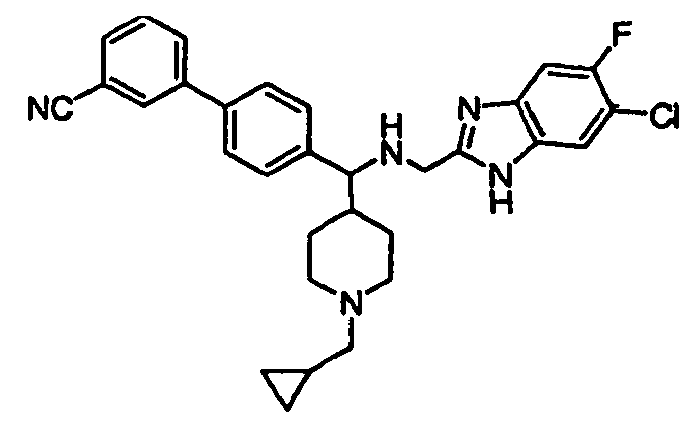
C31H31ClFN5·H+ 528.2 528.1 17B 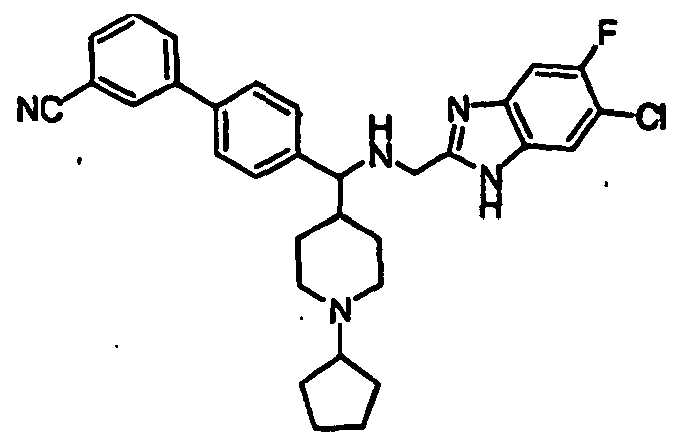
C32H33ClFN5·H+ 542.2 542.1 - To a mixture of 4-methoxyphenyl acetonitrile (10 g, 67.9 mmol) and N-benzyl piperidone (13 g, 68.6 mol) in 100 mL of ethanol was added NaOEt (7.0 g, 102.0 mmol) and the contents were heated at 90°C for 3h. The reaction mixture was cooled to room temperature and poured into a mixture of acetic anhydride/pyridine (1:1, 200 mL). The mixture was stirred for 2h and the solvents were removed in vacuo. The residue was purified by silica gel chromatography using 2% methanol in dichloromethane to give 15.0 g of the conjugated nitrile 20 as a light brown solid. Calcd m/z for C21H22N2O·H+ = 319.2; found m/z = 319.1.
- To a solution of compound 20 (7.5 g, 23.5 mmol) in 100 mL of methanol was added magnesium turnings (5.7 g, 10 eq) and iodine (500 mg) and the contents were stirred for 3h at room temperature. The inorganic material was filtered and water was added to the methanol solution. The precipitated gel was extracted with EtOAc (3X200 mL) and isopropanol (2X 200 mL). The solvent was removed in vacuo and the residue 21 (6.0 g) was used without further purification for the next step. Calcd m/z for C21H24N2O·H+ = 321.2; found m/z = 321.1.
- To a solution of lithium aluminum hydride (1 M solution in THF, 47 mL, 3 eq) in THF was added H2SO4 (2.15 mL, 3.2 eq) at 0°C very slowly. The resulting white slurry was stirred at room temperature for 30 minutes and at 30°C for 15 minutes. Compound 21 (5.0 g, 15.6 mmol) in 50 mL of THF was cannulated to the alane solution and the resulting mixture was stirred at 55°C for 3h. The reaction mixture was cooled to room temperature and quenched with water (1.62 mL), 1 N NaOH (3.23 mL) and water (4.85 mL). Dichloromethane (∼100 mL) was added and the mixture was filtered through Celite. The solvent was evaporated to give 4.05 g of amine 22 as a colorless solid.Calcd m/z for C21H28N2O·H+ = 325.2; found m/z = 325.1.
- Compound 22 (4.05 g, 12.48 mol) was dissolved in 100 mL of dichloromethane and treated with BBr3 (3.54 mL, 37.4 mmol) at -78°C. The reaction mixture was warmed to room temperature and stirred for 3h. The reaction mixture was cooled to - 78°C and carefully quenched by the addition of 50 mL of methanol. The reaction was slowly warmed to room temperature and heated under reflux for 30 minutes. The solvent was removed in vacuo to give 3.5 g of the desired phenol 23 as a light yellow solid. Calcd m/z for C20H26N2O·H+ = 311.2; found m/z = 311.1.
- To a solution of compound 23 (3.5 g, 11.27 mol) in 50 mL of methanol was added triethylamine (2 mL) and (Boc)2O (2.7 g, 12.3 mol) at room temperature and the mixture was stirred for 4h. The solvent was removed in vacuo and the product 24 was used without further purification in the next step.
- Phenol 24 (4.6 g, 11.2 mmol) was dissolved in 100 mL of dichloromethane and treated with triethylamine (10 mL) and PhNTf2 (5.0 g, 13.9 mmol) at room temperature and the mixture was stirred for 6h. The solvent was removed in vacuo to give the triflate as brown oil. To the crude triflate (6.0g, 11.0 mmol) in 100 mL of toluene/methanol (1:1) was added 3-cyanophenyl boronic acid (3.25 g, 2 eq), aq. Na2CO3 (2N, 10 mL), and Pd(PPh3)4 (1.2 g, 10 mol%) and the resulting solution was flushed with nitrogen. The contents were heated at 90°C overnight and passed through a short pad of Celite. The solids were washed with ethyl acetate and the filtrate was concentrated in vacuo. The residue was purified by silica gel column chromatography eluting with 20-60 % ethyl acetate in hexane to give 3.0 g of the desired biaryl 25 as a colorless powder. Calcd m/z for C32H37N2O·H+ = 496.3; found m/z = 496.3.
- The Boc protecting group was removed analogously to procedure M as follows:
- To a solution of compound 25 (0.885 g, 1.785 mmol) in 10 mL of dichloromethane was added 2 mL of trifluoroacetic acid at 0°C and the mixture stirred for 1 h. The reaction was warmed to room temperature and stirred for an additional 2h. The reaction mixture was quenched by the addition of NH4OH and extracted with dichloromethane (2X50 mL). The extracts were concentrated in vacuo and the residue 26 (0.6 g) was used directly in the next step. Calcd m/z for C27H29N3·H+ = 396.2; found m/z = 396.1.
- To a flask containing 0.12g (0.66mmol, 1.5eq.) of thiocarbonyldiimidazole and 9 mg of imidazole (0.13mmol, 0.3eq.) was added 1.5 mL of acetonitrile. The reaction was cooled to 0°C and then a solution of 1 mL of acetonitrile containing 0.17g (0.44mmol, 0.3eq) of 4'-[2-amino-1-(1-benzyl-piperidin-4-yl)-ethyl]-biphenyl-3-carbonitrile was added over ten minutes. After 10 minutes at 0°C the reaction was stirred for 3 hours at room temperature at which time 0.16g (0.90mmol, 2eq.) of 4,5-dichlorophenylenediamine were added. The reaction was heated to 50°C for 3 hours and then stirred at room temperature overnight. The following morning the reaction was concentrated to give 0.27g of thiourea 27 as a dark red-brown solid. Calcd m/z for C34H33Cl2N5S·H+ = 614.2; found m/z = 614.1.
- To a flask containing ~0.27g of the crude thiourea 27 were added 6.0 mL of ethanol, 0.19g (0.9mmol, 2eq) of HgO, and 9 mg (0.09mmol, 0.2eq) of sulfur. The reaction was heated under reflux for two hours and then cooled to room temperature. It was filtered through Celite and concentrated. The product was taken up in a 60% DMSO/30% CH3CN/10% formic acid solution. It was then chromatographed via reverse phase HPLC using a C-18 column eluting with a gradient starting with 95% CH3CN/5% H2O to 5% CH3CN/95% H2O both containing 0.10% formic acid. This purification gave 24 mg of the formate salt of the desired aminobenzimidazole 28A as a yellow solid. Calcd m/z for C34H31Cl2N5·H+ = 580.2; found m/z = 580.1.
- The following compounds were prepared in analogous fashion:
Cpd. # Structure Formula (M+1)+ calcd m/z obsd m/z 28A 
C34H31Cl2N5·H+ 580.2 580.1 28B 
C34H31Cl2N5·H+ 548.2 548.1 - Bromophenyl ketone 29 from step 2 of procedure J (1.08 g, 2.9 mmol, A. Palani, et. al. J. Med. Chem. 2001, 44, 3339-3342) was dissolved in 10 mL of ethanol and treated with NaBH4 (0.11 g, 2.9 mmol) at 0°C. The reaction mixture was slowly warmed to room temperature and stirred for 2h. Methanol was added and the mixture stirred for 30 minutes. The solvent was removed and the reaction was purified by silica gel column using 40% ethyl acetate in hexane to give 0.79 g of the desired alcohol 30 as a white solid. Calcd m/z for C17H24BrNO3·H+ = 370.1; found m/z = 370.1.
-

- To a solution of 6-chloro-2-chloromethyl-5-fluoro-1H-benzoimidazole (2.0 g, 9.0 mmol) in 20 mL of tetrahydrofuran was added Hünig's base (1.92 mL, 1.2 eq) followed by SEM-CI (2.15 mL, 1.2 eq) at 0°C. The reaction was warmed to room temperature and stirred overnight. More SEM-CI (1 mL) was added and the reaction was stirred an additional 2h. The solvent was removed in vacuo and the compound was purified by silica gel column using 30% ethyl acetate in hexane to give 0.45 g of the desired protected alkylating agent. Calcd m/z for C14H19Cl2FN2OSi·H+ = 349.1; found m/z = 349.1.
- To a solution of alcohol 30 (0.2 g, 0.54 mmol) in 3 mL of tetrahydrofuran was added NaH (0.023 g, 2eq, 60% in mineral oil) and the reaction was stirred at room temperature for 15 minutes. The SEM protected chloromethylbenzimidazole from Step 1 (0.22 g, 1.2 eq) was dissolved in 1 mL of tetrahydrofuran and added to the reaction mixture. The mixture was stirred for 4h at room temperature. The reaction was quenched by the addition of methanol followed by concentration in vacuo. The reaction was purified by silica gel chromatography using 30-40% ethyl acetate in hexane mixture as the eluent to give 0.2 g of the ether 31 as an oil Calcd m/z for C31H42BrClFN3O4Si·H+ = 682.2; found m/z = 682.2.
- The biaryl molecules were prepared in this sequence analogous to Procedure K as follows:
- To a solution of compound 31 (0.2 g, 0.29 mmol) in toluene/ethanol (1:1, 5 mL) was added 3-cyanophenyl boronic acid (0.052 g, 1.2 eq), aq. Na2CO3 (2N, 0.35 mL) and Pd (PPh3)4 (0.033 g, 10 mol %). The contents were flushed with nitrogen and heated at 90°C overnight. The reaction mixture was passed through a pad of Celite and the solvent was removed in vacuo. The product 32 (0.10 g) was isolated by silica gel column using 0-45% ethyl acetate in hexanes as eluent. Calcd m/z for C38H46ClFN4O4Si·H+ = 705.3; found m/z = 705.3.
- The deprotection of the amine in this sequence is accomplished analogously to Procedure M as follows:
- Compound 32 (0.045 g, 0.0637 mmol) was dissolved in 2 mL of dichloromethane and treated with trifluoroacetic acid (0.5 mL) at 0°C. The reaction was stirred for 3h. The reaction was purified by prep TLC using 10% methanol in dichloromethane as eluent to give 25 mg of the desired piperidine 33 as a white solid. Calcd m/z for C27H24ClFN4O·H+ = 475.2; found m/z = 475.1.
- The piperidine nitrogen was alkylated in this sequence analogously to Procedure N as follows:
- To a solution of compound 33 (0.01 g, 0.02 mmol) in 1 mL of dichloromethane was added cyclopropane carboxaldehyde (0.014 g, 0.2 mmol) followed by NaCHBH3 (0.013 g, 3eq). The reaction mixture was stirred for 3h and directly applied to a prep TLC plate. Elution with 5% methanol in dichloromethane afforded 0.004 g compound 34A as a oil. Calcd m/z for C31H3OClFN4O·H+ = 529.2; found m/z = 529.1.
- The following compounds were prepared using analogous methods:
Cpd. # Structure Formula (M+1)+ calcd m/z obsd m/z 34A 
C31H30ClFN4O·H+ 529.2 529.1 34B 
C34H30ClFN4O·H+ 565.2 565.1 34C 
C32H32ClFN4O·H+ 543.2 543.1 34D 
C32H34ClFN4O2·H+ 561.2 561.1 - The bromophenyl piperidine ketone from step 1 of procedure J (0.12 g, 0.33 mmol) was treated with methanesulfonyl chloride (0.038 mL, 1.5 eq) and diisopropylethyl amine (0.11 mL, 20 eq) in 1 mL of dichloromethane. The reaction mixture was stirred at 0°C for 2 hours, warmed to room temperature and stirred overnight. The solvent was removed in vacuo and the residue was purified by silica gel column chromatography eluting with 40% ethyl acetate in hexane to give 0.058 g of compound 35 as a white solid. Calcd m/z for C13H16BrO3S H+ = 346.0; found m/z = 346.1
- Compound 35 (0.1 g, 0.29 mmol) was arylated using the Suzuki conditions described in procedure K to give 0.08 g of compound 36 as light brown solid. Calcd m/z for C20H20N2O3S H+ = 369.1; found m/z = 369.1
- Compound 36 (0.08 g, 0.22 mmol) was reduced to the corresponding alcohol according to procedure W to give 0.07 g of compound 37 as a white solid. Calcd m/z for C20H22N2O3S H+ = 371.1; found m/z = 371.1
- Compound 37 (0.035 g, 0.0945 mmol) was treated with 5,6-dichloro-2-chloromethyl-1-(2-trimethylsilanyl-ethoxymethyl)-1H-benzimidazole (0.07 g, 2 eq.) according to procedure X to afford 35 mg of compound 38 as oil. Calcd m/z for C34H40Cl2N4O4SSi H+ = 699.2; found m/z = 699.2
- Compound 38 (0.035 g, 0.05 mmol) was deprotected according to procedure M to give 20 mg of compound 39 as oil. Calcd m/z for C28H26Cl2N4O3S H+ = 569.1; found m/z = 569.1
- The bromophenyl piperidine ketone from step 1 of procedure J (0.10 g, 0.37 mmol) was treated with acetic anhydride (0.12 mL, 3 eq) in 2 mL of pyridine. The reaction mixture was stirred for 2 hours at room temperature. The solvent was removed in vacuo and the residue was purified by silica gel column chromatography eluting with 10% ethyl acetate in hexane to give 0.12 g of compound 40 as solid. Calcd m/z for C14H16BrNO2 H+ = 310.04; found m/z = 310.1
- Compound 40 (0.12 g, 0.39 mmol) was arylated using the Suzuki conditions described in procedure K to give 0.123 g of compound 41 as brown solid. Calcd m/z for C21 H20N2O3 H+ = 333.2; found m/z = 333.1
- Compound 41 (0.123 g, 0.37 mmol) was reduced to the corresponding alcohol according to procedure W to give 0.12 g of compound 42 as white solid. Calcd m/z for C21H22N2O2 H+ = 335.2; found m/z = 335.1
- Compound 42 (0.007 g, 0.02 mmol) was treated with 5,6-dichloro-2-chloromethyl-1-(2-trimethylsilanyl-ethoxymethyl)-1H-benzimidazole (0.02 g, 0.054 mmol) according to procedure X to afford 12 mg of compound 43 as oil. Calcd m/z for C35H40Cl2N4O3Si H+ = 663.2; found m/z = 663.1
- Compound 43 (0.012 g, 0.018 mmol) was deprotected according to procedure M to give 8 mg of compound 44 as oil. Calcd m/z for C29H26Cl2N4O2 H+ = 533.1; found m/z = 533.1
- Compound 45 (0.5 g, 1.3 mmol) was arylated using the Suzuki conditions described in procedure K to give 0.43 g of compound 46 as oil. Calcd m/z for C25H30N2O3 H+ = 407.2; found m/z = 407.1
- To a mixture of compound 46 (0.43 g, 1.05 mmol), 6-Chloro-5-fluorobenzimidazole-2-thiol (0.22 g, 1.08 mmol) and triphenylphosphine (0.3 g, 1.14 mmol) in 10 mL of tetrahydrofuran (10 mL) was added a solution of diethylazodicarboxylate (0.2 g, 1.114 mmol in 5 mL tetrahydrofuran) and the mixture was stirred at room temperature for 6 hours. The solvent was removed in vacuo and the residue was purified by silica gel column chromatography using 20% ethyl acetate in hexane to give 0.05 g of compound 47 as oil. Calcd m/z for C32H32ClFN4O2S H+ = 590.2; found m/z = 590.1
- Compound 47 (0.02 g, 0.0338 mmol) was deprotected according to procedure M to give 6 mg of compound 48 as white solid. Calcd m/z for C27H24ClFN4S H+ = 491.5; found m/z = 491.1
-
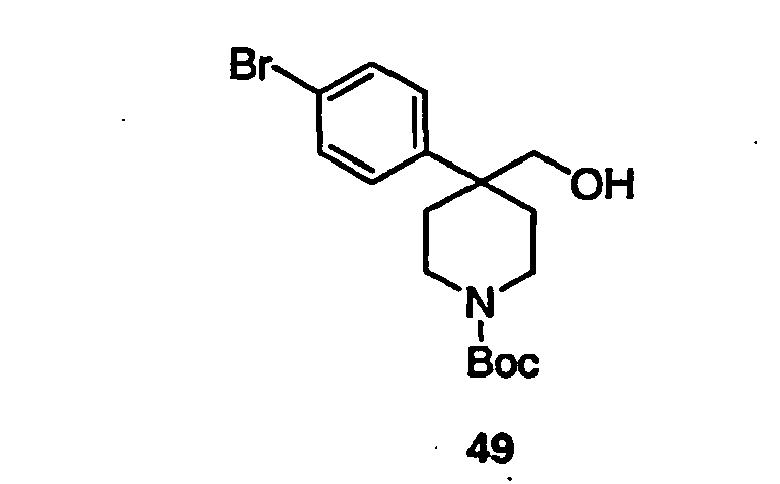
- To a suspension of bis-(2-chloroethyl)amine hydrochloride (17.85 g, 100 mmol, 1 eq) in 100 mL of dichloromethane was added 100 mL of a 10% aqueous solution of NaOH. The mixture was stirred at room temperature and a solution of (Boc)2O (21.82 g, 100 mmol, 1 eq) in 100 mL of dichloromethane was added. The reaction was stirred at room temperature for 20 h and then extracted with 100 mL of dichloromethane. The organic extracts were combined and dried over Na2SO4, filtered and concentrated by rotary evaporation to give the crude bis-(2-chloroethyl)carbamic acid tert-butyl ester (24.1 g), which was used in the next step without further purification.
- To a mixture of bis-(2-chloro-ethyl)-carbamic acid tert-butyl ester from Step 1 (7.26 g, 30 mmol, 1 eq) and 4-bromophenylacetonitrile (5.88 g, 30 mmol, 1 eq) in 38 mL of toluene and 76 mL of H2O was added NaOH (45.6 g, 114 mmol, 10M solution) followed by hexadecyltributylphosphonium bromide (3.0 g, 6.0 mmol, 0.2 eq). The resulting dark mixture was heated to 110°C for 2 h and then allowed to cool to ambient temperature. It was extracted with three 200 mL portions of ethyl acetate and the combined organic extracts were dried over Na2SO4, filtered and concentrated by rotary evaporation to give the crude product as a black oily residue. Purification by flash column chromatography eluting with a gradient of 5-10% ethyl acetate in hexane gave 5.67 g of 4-(4-bromo-phenyl)-4-cyano-piperidine-1-carboxylic acid tert-butyl ester as a pale yellow foam. 1H NMR (300 MHz, CDCl3): δ 7.56-7.48 (d, 2H), 7.36-7.30 (d, 2H), 4.40-4.10 (br. s, 2H), 3.27-3.05 (t, 2H), 2.10-1.80 (m, 4H), 1.45 (s, 9H).
- To a solution of 4-(4-bromo-phenyl)-4-cyano-piperidine-1-carboxylic acid tert-butyl ester from Step 2 (5.67 g, 15.57 mmol, 1 eq) in 60 mL of dichloromethane was add a solution of DIBAL-H (1 M in toluene, 23.36 mL, 23.36 mmol, 1.5 eq) in a dropwise fashion. The resulting mixture was stirred at room temperature for 20 h and then 15 mL of methanol was added carefully. The mixture was stirred for 0.25 h and a precipitate formed. The resulting mixture was filtered through Celite and the salts were washed several times with ethyl acetate. The filtrate was adsorbed onto silica gel and purified by flash column chromatography eluting with a gradient of 5-20% ethyl acetate in hexane to give 1.78 g of 4-(4-bromo-phenyl)-4-(2-oxo-ethyl)-piperidine-1-carboxylic acid tert-butyl ester and 1.54 g of recovered starting material. 1H NMR (300 MHz, CDCl3): δ 9.35 (s, 1 H), 7.50-7.46 (d, 2H), 7.15-7.10 (d, 2H), 3.82 (br. s, 2H), 3.11-3.04 (t, 2H), 2.35-2.28 (dt, 2H), 1.90 (br. s, 2H), 1.42 (s, 9H).
- To a solution of 1.78 g of 4-(4-bromo-phenyl)-4-hydroxymethyl-piperidine-1-carboxylic acid tert-butyl ester from Step 3 (4.85 mmol, 1 eq) in 25 mL of isopropanol was added NaBH4 (0.201 g, 5.33 mmol, 1.1 eq). The mixture was stirred at room temperature for 20 h and then quenched by the addition of aqueous HCl (20 mL) to pH ∼3. The solvent was removed by rotary evaporation and the resulting aqueous mixture was extracted with three 50 mL portions of ethyl acetate. The organic extracts were combined and washed with saturated brine and dried over Na2SO4. Filtration and concentration by rotary evaporation gave the crude product which was purified by flash column chromatography eluting with a gradient of 5-20% ethyl acetate in hexane to give 1.36 g of the title compound 4-(4-bromo-phenyl)-4-hydroxymethyl-piperidine-1-carboxylic acid tert-butyl ester 49 as a pale foam. 1H NMR (300 MHz, CDCl3): δ 7.38-7.18 (m, 4H), 4.35-4.19 (br. d, 2H), 2.83-2.76 (t, 2H), 2.70-2.58 (m, 1 H), 1.86-1.78 (d, 2H), 1.70-1.58 (m, 3H), 1.50 (s, 9H).
-

- To a solution of 3,4-dichlorophenylenediamine (1.5 g, 8.2 mmol, 1 eq) in 15 mL of tetrahydrofuran was added CO(imid)2 (2.0 g, 12.3 mmol, 1.5 eq). The mixture was stirred at room temperature for 16 h under Argon. The solvent was removed by rotary evaporation and the residue partitioned between 85 mL of ether and 85 mL of 1 N NaOH. The aqueous extract was acidified by careful addition of concentrated HCl and the resulting off-white precipitate was filtered, washed with water, then dried under high vacuum to give the crude product. To this material was added 40 mL of POCl3 and the mixture was heated to 120°C for 2 h. The POCl3 was removed by rotary evaporation and the residue was diluted with 45 mL of water and neutralized by addition of aqueous KHCO3. The aqueous mixture was extracted with three 100 mL portions of 90/10 (v:v) dichloromethane in methanol. The organic extracts were combined and dried over Na2SO4, filtered and concentrated by rotary evaporation to give 2,5,6-trichloro-1H-benzoimidazole as a yellow solid (1.0 g). 1H NMR (300 MHz, DMSO): δ 7,82 (s, 2H); MS (ESI): m/z 223.4/225.3 (M+1/M+3).
- To a solution of 4.1 g crude 2,5,6-trichloro-1 H-benzoimidazole from Step 1 (∼18.7 mmol) in 60 mL of tetrahydrofuran under Argon at 0°C was added diisopropylethyl amine (0.91 mL, 22.44 mmol, 1.2 eq). To this mixture was added SEM-Cl (4.91 mL, 28 mmol, 1.5 eq) in a drop-wise fashion and the mixture was stirred at room temperature for 20 h. Methanol was added (20 mL) and the solvent removed by rotary evaporation. The crude residue was dissolved in dichloromethane, absorbed onto silica gel, and purified by flash column chromatography eluting with 30% ethyl acetate in hexane to give 4.25g of the title compound 2,5,6-trichloro-1-(2-trimethylsilanyl-ethoxymethyl)-1H-benzoimidazole, 50 as an off-white solid. 1H NMR (300 MHz, DMSO): δ 8.11 (s, 1 H), 7.96 (s, 1 H), 5.64 (s, 2H), 3.58 3.53 (d, 2H), 0.85-0.80 (t, 2H), 0.03-0.01 (s, 9H).
- To a solution of 0.075 g of 4-(4-bromo-phenyl)-4-hydroxymethyl-piperidine-1-carboxylic acid tert-butyl ester, 49 (0.18 mmol) in 0.6 mL of DMF at room temperature was added 0.095 g of NaH (0.22 mmol, 1.2 eq). The mixture was stirred at room temperature for 1 h followed by the addition of a 1 mL DMF solution containing 0.070 g of 2,5,6-trichloro-1-(2-trimethylsilanyl-ethoxymethyl)-1H-benzoimidazole 50 (0.198 mmol, 1 eq), 0.020 g of n-Bu4NI (0.054 mmol, 0.3 eq) and 0.012 g of 15-crown-5 (0.054 mmol, 0.3 eq). The resulting mixture was stirred and heated at 50°C for 20 h. After cooling, the mixture was diluted with 25 mL of ethyl acetate and washed with H2O and saturated brine. The organic extracts were dried over Na2SO4, filtered and concentrated by rotary evaporation to give the crude product which was purified by flash column chromatography eluting with a gradient of 7-20% ethyl acetate in hexane to give 0.105 g of 4-(4-bromo-phenyl)-4-[5,6-dichloro-1-(2-trimethylsilanylethoxymethyl)-1H-benzoimidazol-2-yloxymethyl]-piperidine-1-carboxylic acid tert-butyl ester 51 as a pale foam (0.144 mmol, 80%). 1H NMR (300 MHz, CDCl3): δ 7.62-7.59 (m, 2H, 7.41 (m, 1 H), 7.26-7.21 (m, 1 H), 7.10-7.07 (d (2H), 5.07 (s, 2H), 4.41 (s, 2H), 3.67 (m, 2H), 3.58 (m, 2H), 3.29-3.23 (m, 2H), 2.17-2.13 (m, 2H), 1.86-1.83 (m, 2H), 1.34 (s, 9H), 0.78-0.71 (m, 2H), 0.11 (s, 9H).
- Compound 51 was arylated using Suzuki conditions as described in Procedure K as follows:
- A mixture of 0.105 g of 4-(4-bromo-phenyl)-4-[5,6-dichloro-1-(2-trimethylsilanylethoxymethyl)-1H-benzoimidazol-2-yloxymethyl]-piperidine-1-carboxylic acid tert-butyl ester 51 (0.144 mmol, 1 eq), 0.024 g of 3-cyanophenyl boronic acid (0.16 mmol, 1.1 eq), and 0.034 g of Pd(PPh3)4 (0.03 mmol, 20 mol%) was mixed with 3 mL of toluene, 2 mL of ethanol and 1 mL of 2M aqueous Na2CO3 and then heated at 80°C for 20 h while stirring. The reaction was allowed to cool to room temperature, diluted with 25 mL of ethyl acetate and washed with 25 mL of saturated brine. The organic extracts were dried over Na2SO4, filtered and concentrated by rotary evaporation to give the crude product which was purified by flash column chromatography eluting with a gradient of 5 - 20% ethyl acetate in hexane to give 0.081 g of 4-(3'-cyano-biphenyl-4-yl)-4-[5,6-dichloro-1-(2-trimethylsilanyl-ethoxymethyn-1H-benzoimidazol-2-yloxymethyl]-piperidine-1-carboxylic acid tert-butyl ester 52 as a pale foam: 1H NMR (300 MHz, CDCl3): δ 7.82-7.76 (m, 2H), 7.59-7.48 (m, 7H), 7.13-7.10 (m, 1 H), 5.17 (s, 2H), 4.53 (s, 2H), 3.85-3.80 (br. d, 2H), 3.41-3.36 (t, 2H), 3.18-3.10 (t, 2H), 2.36-2.31 (d, 2H), 2.00-1.96 (t, 2H), 1.44 (s, 9H), 0.83-0.77 (t, 2H), 0.10 (s, 9H).
- To a solution of 0.081 g of 4-(3'-cyano-biphenyl-4-yl)-4-[5,6-dichloro-1-(2-trimethylsilanyl-ethoxymethyl)-1H-benzoimidazol-2-yloxymethyl]-piperidine-1-carboxylic acid tert-butyl ester 52 (0.115 mmol) in 5 mL of tetrahydrofuran at room temperature was added 0.23 mL of a solution of TBAF (1 M in THF, 0.23 mmol, 2 eq). The mixture was heated at 60°C for 6 h. After cooling to room temperature, the mixture was partitioned between 15mL of ethyl acetate and 15 mL of H2O. The organic layer was separated, washed with saturated brine, dried (Na2SO4), and concentrated by rotary evaporation to give the crude product as a pale foam (0.070 g) which was purified by flash column chromatography eluting with 30% ethyl acetate in hexanes to give 0.035 g of 4-(3'-cyano-biphenyl-4-yl)-4-(5,6-dichloro-1H-benzoimidazol-2-yloxymethyl)-piperidine-1-carboxylic acid tert-butyl ester 53 as a pale foam and 0.024 g of recovered starting material. 1H NMR (300 MHz, CDCl3): δ 7.82-7.75 (m, 2H), 7.64-7.52 (dt, 1H), 7.61-7.46 (m, 5H), 7.26 (s, 1 H), 4.51 (s, 2H), 3.85-3.83 (d, 2H), 3.18-3.10 (t, 2H), 2.32-2.28 (d, 2H), 2.04-1.98 (t, 2H), 1.42 (s, 9H). MS (ESI): Calcd m/z for C31H30Cl2N4O3·H+ = 577.2; found m/z = 576.7/578.7 [(M+1)+/(M+3)+].
- 4'-[4-(5,6-Dichloro-1H-benzoimidazol-2-yloxymethyl)-piperidin-4-yl]-biphenyl-3-carbonitrile, 54 was prepared analogously to Procedure M as follows:
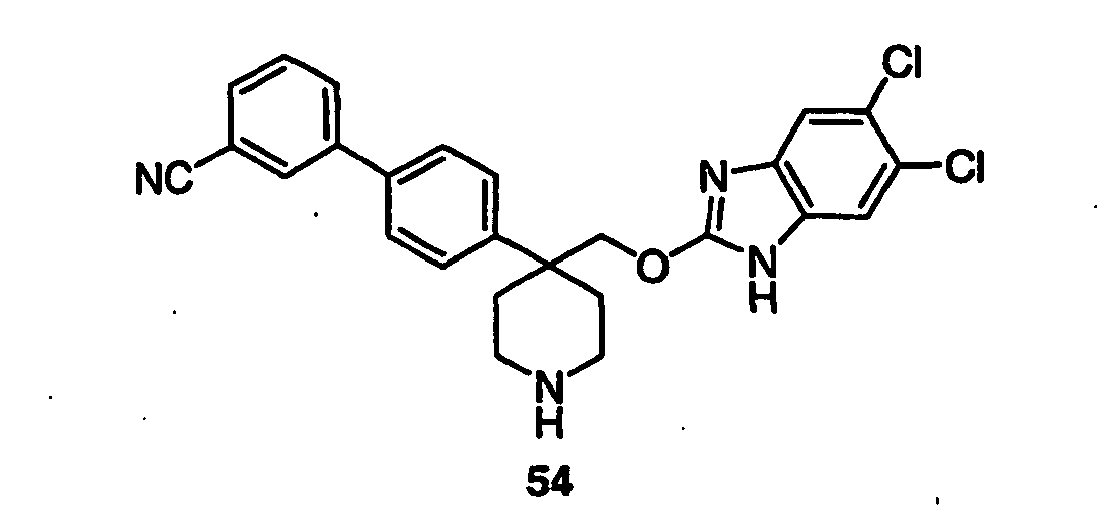
- To a solution of 0.015 g of 4-(3'-cyano-biphenyl-4-yl)-4-(5,6-dichloro-1H-benzoimidazol-2-yloxymethyl)-piperidine-1-carboxylic acid tert-butyl ester 53 (0.026 mmol) in 3 mL of dichloromethane at 0°C was added 1 mL of trifluoroacetic acid. The mixture was stirred at 0°C for 2 h then diluted with 10 mL of toluene and concentrated by rotary evaporation. The resulting residue was dissolved in 25 m) of ethyl acetate and washed with 10% aqueous NaHCO3 and saturated brine. The organic extracts were dried over Na2SO4, filtered and concentrated by rotary evaporation to give the crude product which was purified by reverse phase preparative HPLC to give 0.0113 g of the desired product 4'-[4-(5,6-dichloro-1H-benzoimidazol-2-yloxymethyl)-piperidin-4-yl]-biphhenyl-3-carbonitrile 54 as a pale foam. 1H NMR (300 MHz, CDCl3/CD3OD): δ 7.85-7.75 (t, 1 H), 7.72-7.70 (dt, 1 H), 7.57-7.41 (m, 6H), 7.30(s, 2H), 5.19 (s, 2H), 4.31 (s, 2H), 3.33-3.25 (m, 2H), 2.90-2.82 (d, 2H), 2.47-2.34 (m, 2H), MS (ESI): Calcd m/z for C26H22Cl2N4O·H+ = 477.1; found m/z = 476.7/478.7 [(M +1)+/(M+3)+].
-

- To a solution of 0.035 g of 4-(3'-cyano-biphenyl-4-yl)-4-[5,6-dichioro-1-(2-trimethylsilanyl-ethexymethyl)-1H-benzoimidazol-2-ylmethoxymethyl]-piperidine-1-carboxylic acid tert-butyl ester 52 (0.05 mmol) in 3 mL of dichloromethane at 0°C was added 1 mL of trifluoroacetic acid as per Procedure M. The mixture was stirred at 0°C for 2 h then diluted with 10 mL of toluene and concentrated by rotary evaporation. The resulting residue was dissolved in 25 mL of ethyl acetate, washed with 10% aqueous NaHCO3 and saturated brine, dried (Na2SO4), and concentrated by rotary evaporation to give the crude product which was purified by reverse phase preparative HPLC to give 0.030 g of 4'-{4-[5,6-dichloro-1-(2-trimethylsilanyl-ethoxymethyl)-1H-benzoimidazol-2-yloxymethyl]-piperidin-4-yl}-biphenyl-3-carbonitrile 55 as a pale foam. 1H NMR (300 MHz, CDCl3): δ 7.85-7.84 (t, 1 H), 7.80-7.77 (d, 1 H), 7.63-7.51 (m, 7H), 7.33 (s, 1 H), 5.19 (s, 2H), 4.54 (s, 2H), 3.41-3.36 (t, 2H), 3.12-3.05 (d, 2H), 2.92-2.82 (t, 2H), 2.60 (br. s, 1 H), 2.40-2.33 (d, 2H), 2.14-2.05 (t, 2H), 0.00 (s, 9H).
- To a solution of 0.030 g of 4'-{4-[5,6-dichloro-1-(2-trimethylsilanylethoxymethyl)-1H-benzoimidazol-2-yloxymethyl]-piperidin-4-yl}-biphenyl-3-carbonitrile (0.05 mmol) 55 in 1 mL of dichloromethane was added methanesulfonyl chloride (0.005 mL, 0.053 mmol, 1.1 eq) and DIEA (0.011 mL, 0.06 mmol, 1.2 eq). The resulting mixture was stirred at room temperature for 16 h, diluted with 5 mL of ethyl acetate, and washed with H2O and saturated brine. The organic extracts were combined and dried over Na2SO4, filtered and concentrated by rotary evaporation to give 0.044 g of 4'-{4-[5,6-dichloro-1-(2-trimethylsilanyl-ethoxymethyl)-1H-benzoimidazol-2-yloxymethyl]-1-methanesulfonyl-piperidin-4-yl}-biphenyl-3-carbonitrile as a pale foam. MS (ESI): m/z 684.8/686.8 (M +1/M+3).
- To a solution of 0.044 g of crude 4'-{4-[5,6-dichloro-1-(2-trimethylsilanylethoxymethyl)-1 H-benzoimidazol-2-yloxymethyl]-1-methanesulfonyl-piperidin-4-yl}-biphenyl-3-carbonitrile from the previous step (∼ 0.05 mmol) in 2 mL of tetrahydrofuran was added tetrabutylammonium fluoride (1M in THF, 0.1 mL, 0.1 mmol, 2 eq) and the resulting mixture was heated to 60°C for 18 h. After cooling to room temperature, the reaction mixture was diluted with 10 mL of ethyl acetate and washed with H2O and saturated brine. The organic extracts were combined and dried over Na2SO4, filtered and concentrated by rotary evaporation to give the crude product as a pale foam. Purification by flash silica gel chromatography eluting with a gradient of 20-70% ethyl acetate in hexane gave a pale foam which was re-purified by reverse phase preparative HPLC to yield 0.016 g of the desired product 4'-[4-(5,6-dichloro-1H-benzoimidazol-2-yloxymethyl)-1-methanesulfonyl-piperidin-4-yl]-biphenyl-3-carbonitrile 56 as a white foam. 1H NMR (300 MHz, CDCl3): δ 7.84-7.83 (t, 1H), 7.80-7.77 (dt, 1 H), 7.66-7.44 (m, 8H), 4.54 (s, 2H), 3.64-3-40 (d, 2H), 3.02-2.95 (t, 2H), 2.74 (s, 3H), 2.60 (br. s, 1 H), 2.47-2.43 (d, 2H), 2.22-2.12 (t, 2H). MS (ESI): Calcd m/z for C27H24Cl2N4O3S·H+ = 554.1; found m/z = 554.6/556.7 [(M+1)+/(M+3)+].
-

- Compound 57 was prepared analogously to procedure H as follows:
- To a solution of 0.045 g of 4'-{4-[5,6-dichloro-1-(2-trimethylsilanylethoxymethyl)-1H-benzoimidazol-2-yloxymethyl]-piperidin-4-yl}-biphenyl-3-carbonitrile 55 (0.073 mmol, 1 eq) in 0.5 mL of 1,2-dichloroethane at room temperature was added 6.6 µL of cyclopropanecarboxaldehyde (0.088 mmol, 1.2 eq) and acetic acid (0.005 mL, 1% v/v). The mixture was stirred at room temperature for 1 h followed by the addition of 0.023 g of NaBH(OAc)3 (0.105 mmol, 1.5 eq). The reaction was stirred at room temperature for 16 h and then the solvent was removed by rotary evaporation to yield 0.052 g of the crude product. This intermediate was dissolved in 2 mL of tetrahydrofuran and tetrabutylammonium fluoride on silica gel (1.0-1.5 mmol/g, 0.16 g, 2 eq) was added. The mixture was heated to 60°C for 16 h then filtered and the resin washed with 10 mL of tetrahydrofuran. The filtrate was concentrated by rotary evaporation and the crude product was purified by flash silica gel chromatography eluting with 1 % methanol in dichloromethane with 3% triethylamine to give 0.007 g of the desired product 4'-[1-cyclopropylmethyl-4-(5,6-dichloro-1H-benzaimidazal-2-yloxymethyl)-piperidin-4-yl]-biphenyl-3-carbonitrile 57 MS (ESI): Calcd m/z for C30H28Cl2N4O·H+ = 531.2; found m/z 530.9/532.9 [(M+1)+/(M+3)+].
-
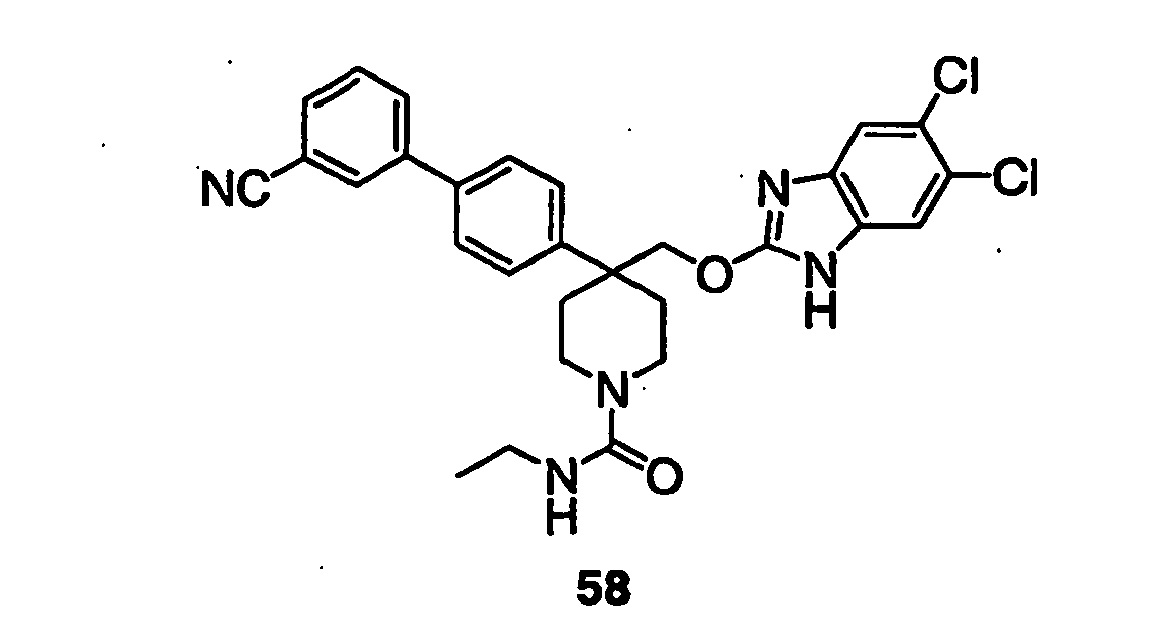
- To a solution of 0.045 g of 4'-{4-[5,6-dichloro-1-(2-trimethylsilanylethoxymethyl)-1H-benzoimidazol-2-yloxymethyl]-piperidin-4-yl}-biphenyl-3-carbonitrile (0.073 mmol, 1 eq) in 0.7 mL of dichloromethane was added ethyl isocyanate (6.5 µL, 0.088 mmol, 1.2 eq) and 15.4 µL of diisopropylethyl amine (0.088 mmol, 1.2 eq) and the resulting mixture was stirred at room temperature for 16 h. The solvent was removed by rotary evaporation to yield the crude product which was purified by preparative TLC eluting with 10% methanol in dichloromethane to give 0.030 g of 4-(3'-cyano-biphenyl-4-yl)-4-[5,6-dichloro-1-(2-trimethylsilanyl-ethexymethyl)-1H-benzoimidazol-2-yloxymethyl]-piperidine-1-carboxylic acid ethylamide. This intermediate was dissolved in 2 mL of tetrahydrofuran and 0.080 g of tetrabutylammonium fluoride on silica gel (1.0-1.5 mmol/g, 2 eq) was added. The mixture was heated at 60°C for 16 h then filtered and the resin washed with 10 mL of tetrahydrofuran. The filtrate was concentrated by rotary evaporation and the crude product was purified by flash silica gel chromatography eluting with 1 % methanol in dichloromethane with 3% triethylamine to give 0.0054 g of the desired product 4-(3'-cyano-biphenyl-4-yl)-4-(5,6-dichloro-1H-benzoimidazol-2-yloxymethyl)-piperidine-1-carboxylic acid ethylamide 58. MS (ESI): Calcd m/z for C29H27Cl2N5O2·H+ = 548.2; found m/z = 547.8/549.8 [(M +1)+/(M+3)+].
-

- Compound 59 was prepared using procedure S as follows:
- To a solution of 5 g of 4-(4-bromophenyl)-4hydroxy-piperidine (19.52 mmol, 1 eq) in 60 mL of 10% triethylamine in DMF at 0°C was added (Boc)2O (4.26 g, 19.52 mmol, 1 eq). The mixture was stirred at room temperature for 16 h and then concentrated by rotary evaporation. The resulting slurry was dissolved in 100 mL of ethyl acetate, washed with 1 N aqueous HCl and dried over Na2SO4. Filtration and concentration by rotary evaporation gave 7.0 g of the desired 4-(4-bromo-phenyl)-4-hydroxy-piperidine-1-carboxylic acid tert-butyl ester 59 (19.5 mmol, 100%). 1H NMR (300 MHz, CDCl3): δ 7.46-7.42 (d, 2H), 7.35-7.31 (d, 2H), 4.00-3.90 (br. d, 2H), 3.22-3.16 (br. t, 2H), 2.34 (br. s, 1 H), 1.98-1.80 (br. t, 2H), 1.69-1.64 (br d, 2H), 1.44 (s, 9H).
-
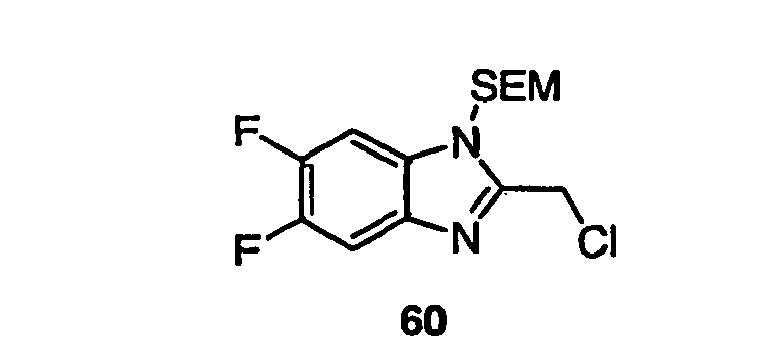
- A mixture of 1 g of 3,4-difluoro-1,2-phenylenediamine (6.94 mmol) and 0.983 g of chloro-acetic acid (10.41 mmol, 1.5 eq) in 13 mL of 4N aqueous HCl was heated to 100°C for 3 h. The mixture was poured onto ice (10 g), neutralized by the addition of NH4OH and extracted with three 30 mL portions of ethyl acetate. The organic extracts were combined and dried over Na2SO4, filtered and concentrated by rotary evaporation to give 1.28 g of 2-chloromethyl-5,6-difluoro-1H-benzoimidazole as a brown solid. 1H NMR (300 MHz, CDCl3/CD3OD): δ 7.30-7.25 (m, 2H), 4.68 (s, 2H); MS (ESI): Calcd m/z for C8H5ClF2N2·H+ = 203.1; found m/z = 203.2/205.2 [(M +1)+/(M+3)+].
- To a solution of 1.28 g of the crude 2-chloromethyl-5,6-difluoro-1H-benzoimidazole (∼6.34 mmol, 1 eq) in 8 mL of tetrahydrofuran at 0°C was added 1.33 mL of diisopropylethyl amine (7.61 mmol, 1.2 eq) followed by 1.68 mL of SEM-CI (9.51 mmol, 1.5 eq). The resulting mixture was stirred and warmed to room temperature over 18 h. The reaction was diluted with 25 mL of ethyl acetate and washed with 20 mL of saturated brine and 20 mL of 1 N aqueous HCl. The organic extracts were dried over Na2SO4, filtered and concentrated by rotary evaporation to give 2.3 g of 2-chloromethyl-5,6-difluoro-1-(2-trimethylsilanyl-ethoxymethyl)-1H-benzoimidazole 60. 1H NMR (300 MHz, CDCl3): δ 7.85 (s, 1H), 7.61 (s, 1H), 5.57 (s, 2H), 4.84 (s, 2H), 3.58-3.52 (t, 2H), 0.95-0.89 (t, 2H), 0.04 (s, 9H).
-

- Compound 59 was alkylated as per procedure X as follows:
- To a suspension of 0.325 g of KH (30% dispersion in mineral oil,2.43 mmol, 1.2 eq) in 3 mL of tetrahydrofuran at 0°C was added a solution of 4-(4-bromo-phenyl)-4-hydroxy-piperidine-1-carboxylic acid tert-butyl ester 59 (0.75 g, 2.025 mmol, 1 eq) in 3 mL of tetrahydrofuran. The resulting mixture was stirred for 0.5 h followed by the addition of a solution of 0.874 g of 2-chloromethyl-5,6-difluoro-1-(2-trimethylsilanylethoxymethyl)-1H-benzoimidazole 60 (2.63 mmol, 1.3 eq) in 3 mL of tetrahydrofuran. The reaction mixture was stirred at 0°C for 0.5 h and then at room temperature for 18h. The mixture was partitioned between 25 mL of ethyl acetate and 25 mL of H2O, the organic layer separated, and the aqueous layer extracted with two 25 mL portions of ethyl acetate. The combined organic extracts were washed with 25 mL of saturated brine, dried (Na2SO4), and concentrated to give the crude product which was purified by flash silica gel chromatography eluting with 1% methanol in dichloromethane followed by a second chromatography eluting with 35% ethyl acetate in hexane to give 0.116 g of the desired product 4-(4-bromo-phenyl)-4-[5,6-difluoro-1-(2-trimethylsilanylethoxymethyl)-1H-benzoimidazol-2-ylmethoxy]-piperidine-1-carboxylic acid tert-butyl ester 61. MS (ESI): Calcd m/z for C30H40BrF2N3O4Si·H+ = 652.2; found m/z= 652.1/654.0 [(M+1)+/(M+3)+].
- Compound 61 was arylated as per procedure K as follows:
- A mixture of 0.116 g of 4-(4-bromo-phenyl)-4-[5,6-difluoro-1-(2-trimethylsilanylethoxymethyl)-1H-benzoimidazol-2-ylmethoxy]-piperidine-1-carboxylic acid tert-butyl ester 61 (∼0.18mmol, 1 eq), 0.032 g of 3-cyanophenyiboronic acid (0.215 mmol, 1.2 eq), and 0.040 g of Pd(PPh3)4 (0.036 mmol, 20 mol%) with 3 mL of toluene, 2 mL of ethanol and 1 mL of 2M aqueous Na2CO3 was heated at 80°C for 20 h. The reaction was allowed to cool to room temperature, diluted with 25 mL of ethyl acetate and washed with 25 mL of saturated brine. The organic layer was dried over Na2SO4, filtered and concentrated by rotary evaporation to give the crude product which was purified by flash silica gel chromatography eluting with a gradient of 5 - 50% ethyl acetate in hexane to give 0.042 g of 4-(3'-cyano-biphenyl-4-yl)-4-[5,6-difluoro-1-(2-trimethylsilanyl-ethoxymethyl)-1H-benzoimidazol-2-ylmethaxy]-piperidine-1-carboxylic acid tert-butyl ester 62 as a pale foam.
- Compound 62 was deprotected as per procedure AB as follows:
- To a solution of 0.033 g of 4-(3'-cyano-biphenyl-4-yl)-4-[5,6-difluoro-1-(2-trimethylsilanyl-ethoxymethyl)-1H-benzoimidazol-2-ylmethoxy]-piperidine-1-carboxylic acid tert-butyl ester 62 (0.05 mmol, 1 eq) in 2.5 mL of tetrahydrofuran was added 0.10 mL tetrabutylammonium fluoride (1M in THF, 0.1 mmol, 2 eq). The reaction was stirred at room temperature for 20 h and then at 60°C for 5 h. The mixture was allowed to cool to room temperature and then partitioned between 25 mL of ethyl acetate and 20mL of H2O. The organic layer was separated, washed with saturated brine, dried (Na2SO4), and concentrated to give the crude product which was purified by flash silica gel chromatography eluting with a gradient of 10 - 50% ethyl acetate in hexane to yield 0.025 g of the desired product 4-(3'-cyano-biphenyl-4-yl)-4-(5,6-difluoro-1H-benzoimidazol-2-ylmethoxy)-piperidine-1-carboxylic acid tert-butyl ester 63 as a pale foam: 1H NMR (300 MHz, CDCl3): δ 9.96 (br. s., 1H), 7.82-7.81 (m, 1H), 7.78-7.75 (dt, 1 H), 7.65-7.61 (m, 1 H), 7.57-7.40 (m, 6H), 7.30-7.24 (m, 1 H), 4.43 (s, 2H), 4.00 (d, 2H), 3.31-3.23 (t, 2H), 2.24-2.19 (d, 2H), 2.07-1.97 (td, 2H), 1.48 (s, 9H); MS (ESI): Calcd m/z for C31H30F2N4O3·H+ = 545.2; found m/z = 545 (M +1)+.
-

- Compound 64 was prepared according to procedure M as follows:
- To a solution of 0.010 g of 4-(3'-cyano-biphenyl-4-yl)-4-(5,6-difluoro-1H-benzoimidazol-2-ylmethoxy)-piperidine-1-carboxylic acid tert-butyl ester 63 (0.018 mmol) in 2 mL of dichloromethane at 0°C was added 0.7 mL of trifluoroacetic acid in a drop-wise fashion. The reaction was stirred at 0°C for 1 h and then at room temperature for 0.5 h. The mixture was diluted with 10 mL of toluene and concentrated using rotary evaporation. The resulting residue was partitioned between 10 mL of ethyl acetate and saturated 10 mL of aqueous NaHCO3. The organic layer separated, washed with saturated 10 mL of brine, dried (Na2SO4), and concentrated by rotary evaporation to give 0.008 g of the desired product 4'-[4-(5,6-dichloro-1H-benzoimidazol-2-ylmethoxy)-piperidin-4-yl]-biphenyl-3-carbonitrile 64: 1H NMR (300 MHz, CDCl3/CD3OD): δ 7.81-7.74 (m, 2H), 7.63-7.49 (m, 6H), 7.37-7.28 (t, 2H), 4.32 (s, 2H), 3.30-3.19 (t, 2H), 3.09-3.00 (br. d, 2H), 2.30-2.20 (d, 2H), 2.11-2.02 (t, 2H); MS (ESI): Calcd m/z for C26H22F2N4O·H+ = 445.2; found m/z = 445 (M +1)+.
-

- Compound 67 was prepared as per procedure L as follows:
-

- To a solution of 5 g of 4,5-dichlorobenzene-1,2-diamine (0.0282 mol) in 5N aqueous HCl (50 mL) was added 2.5 g of chloroacetic acid (0.0264 mol) and the mixture was heated under reflux overnight. The reaction mixture was cooled to 0°C and neutralized with aq. NH4OH solution. The product was collected by vacuum filtration and dried in vacuo to get 6.0 g of chloromethyl benzimidazole 66A as brown solid. Calcd m/z for C8H5Cl3N2 H+ = 234.96; found m/z = 236.1
-

- To a solution of 0.044 g of 4'-(4-amino-1-cyclopentyl-piperidin-4-yl)-biphenyl-3-carbonitrile (0.13 mmol) in 2 mL of acetonitrile was added 0.053 g of K2CO3 (3eq) followed by 0.045 g of 5,6-dichloro-2-chloromethyl-1H-benzimidazole (0.19 mmol) and the contents were stirred at 100°C overnight. The solid inorganic material was removed by filtration and the solvent was removed in vacuo. The product was isolated by prep thin layer chromatography over silica gel eluting with 5% methanol in dichloromethane to get 0.02 g of the product 67A as off-white solid. Calcd m/z for C31H31Cl2N5 H+ = 544.2; found m/z = 544.1
- The following compounds were prepared in analogous fashion:
Cpd. # Structure Formula (M+1)+ calcd m/z obsd m/z 67A 
C31H31Cl2N5 H+ 544.2 544.1 67B * 
C31 H33N5 H+ 476.3 476.3 * Compound 67B was prepared by alkylation of the 4-bromo-phenyl analog followed by Suzuki (procedure K) to introduce the m-CN phenyl group. - Nitrile 68 was prepared using procedure O as follows:
- Sodium ethoxide (15.27 g, 0.224 moles) was added in portions to a stirring solution of 40.0 g of 4-bromophenyl acetonitrile (0.204 moles) in 350 mL of ethanol at room temperature. After the addition was complete, the reaction was stirred for 1 h at room temperature. A solution of 34.75 g of 1-benzyl-4-piperidone(0.184 mole) in 50 mL of ethanol was added via an addition funnel. The reaction was heated in an oil bath at 80-85 °C for 17h. The reaction was concentrated to -100 mL and was poured into 850 mL of ice water with stirring. The mixture was made strongly acidic (pH 1-2) with the portion-wise addition of conc. HCl. The aqueous phase was stirred for 30 min. and was made basic (pH~10) with the addition of 30% NaOH. The aqueous phase was extracted with three 400 mL portions of dichloromethane. The combined organic extracts were dried over anhydrous magnesium sulfate and evaporated to give 70.66 g a thick oil. The residue was purified by flash column chromatography on silica gel eluting with a solvent gradient from 15-30% ethyl acetate in hexanes to give 30.0 g of 68 as a solid: ES MS Calcd m/z for C20H19BrN2 H+ = 367/369; found m/z = 367/369.
- The 1 M DIBAL in toluene (34.20 mL, 0.0342 moles) was added dropwise to a stirring solution of 10.46 g of compound 68 (0.0285 moles) in 100 mL of dichloromethane at -78°C. The reaction was stirred at -78°C for an additional 45min. The reaction was quenched with the addition of -12 g of sodium decahydrate in portions. The mixture was allowed to warm to room temperature, diluted with ethyl acetate, and filtered through a layer of Celite. The filter pad was washed with additional ethyl acetate. The combined organic filtrate was evaporated to give 10.64 g of an oil. The material was purified by flash column chromatography on silica gel eluting with a gradient from 5-30% ethyl acetate in hexane to give 5.06 g of the product 69 as an oil. ES MS Calcd m/z for C20H21BrN2 H+ = 369/371; found m/z = 369/371.
- The 1 M DIBAL in toluene (20.35 mL, 0.0203 moles) was added dropwise to a stirring solution of 5.00 g of compound 69 (0.0135 moles) in 40 mL of dichloromethane at -50 to -60°C. The acetone/dry ice bath was allowed to warm to room temperature over 16h. The reaction was cooled to 0°C and ~40 mL of 1 N aqueous HCl was added dropwise followed by the addition of 30 mL of water. The mixture was stirred at room temperature for -40 min. The reaction was made basic with the addition of solid sodium bicarbonate. The aluminum salts were removed by filtration through a layer of Celite. The filter pad was washed with dichloromethane. The layers were partitioned and separated. The aqueous phase was extracted with two 200 mL portions of dichloromethane. The combined organic extracts were dried over anhydrous sodium sulfate and evaporated to give 4.96 g of aldehyde 70 as an oil: ES MS Calcd m/z for C20H22BrNO H+ = 372/374; found m/z = 372/374.
- To a mixture of 0.452 g of NaH (60% NaH in oil, 18.82 mmol) in 110 mL of tetrahydrofuran was cooled to 0°C was added 2.48 g of trimethyl phosphonoacetate (17.1 mmol) drop-wise. A thick suspension was obtained during the addition. The reaction was stirred an additional 2.5h. A solution of 4.90 g of 70 (13.2 mmol) in 25 mL of tetrahydrofuran was added dropwise over 30 min. The reaction was stirred at 0°C for 15 min. and then at room temperature for 5h. The reaction was concentrated in vacuo and the residue was partitioned between 75 mL of water and 200 mL of ethyl acetate. The layers were separated and the water was extracted with two 100 mL portions of ethyl acetate. The combined ethyl acetate extracts washed with 100 mL of brine, dried over anhydrous sodium sulfate and evaporated to yield 6.04 g of an oil. This material was purified by flash column chromatography on silica gel eluting with a solvent gradient from 20-35% ethyl acetate in hexane to give 3.61 g of unsaturated ester 71 as an oil: ES MS Calcd m/z for C23H26BrNO2 H+ = 428/430; found m/z = 428/430.
- A solution of 6.27 g of compound 71 (0.0146 moles) in 150 mL of ethanol was stirred with 0.627 g of 5%Rh on alumina under an 1 atmosphere of hydrogen at room temperature. After 1.5h, the reduction was shown to be complete by tlc analysis (30% ethyl acetate in hexane) and mass spectroscopy. The catalyst was removed by filtration through a layer of Celite. The filter pad was washed with ethanol and the combined ethanol filtrate was evaporated to give 6.20 g of saturated ester 72 as an oil: ES MS Calcd m/z for C23H28BrNO2 H+ = 430/432; found m/z = 430/432.
- To a solution of 6.15 g of ester 72 (14.3 mmol) in 70 mL of toluene at -78°C was added 19.80 mL of 1 M DIBAL in toluene (19.7 mmol) dropwise over 40 min. The reaction was stirred at -78°C for 1.5h. While maintaining the reaction at -78°C, the reaction was quenched by the addition of ~9 g of sodium sulfate decahydrate in portions. The mixture was stirred at -78°C for 20 min. and then at room temperature for 40 min. The solids were removed by filtration through a layer of Celite. The filter pad was washed with ethyl acetate. The combined organic filtrate was concentrated to give 5.87 g of an oil. Purification by flash column chromatography on silica gel eluting with a solvent gradient from 35-50% ethyl acetate in hexane gave 3.35 g of aldehyde 73 as an oil: ES MS Calcd m/z for C22H26BrNO H+ =400/402; found m/z = 400/402.
- A mixture of 0.258 g of aldehyde 73 (0.644 mmol), 0.114 g of 4,5-dichloro-1,2-phenylenediamine (0.644 mmol), and 0.159 g of sodium metabisulfite (0.838 mmol) in 5.5 mL of dimethylacetamide were heated in an oil bath at 100-105° C for 4h. The reaction was cooled and poured into 60 mL of water with stirring. The solid thus formed was collected by vacuum filtration and was washed with water. It was fully dried under vacuum to 0.279 g of a powder. The product was purified by flash column chromatography on silica gel eluting with a solvent gradient from 2-5% methanol in dichloromethane containing 0.5% ammonium hydroxide to give 0.118 g of benzimidazole 74A as a solid: ES MS Calcd m/z for C28H28BrCl2N3 H+ = 556/558; found m/z = 556/558.
- The following compounds were prepared in analogous fashion:
Cpd. # Structure Formula (M+1)+ calcd m/z obsd m/z 74A 
C28H28BrCl2N3 H+ 556/558 556/558 74B 
C28H28BrCl2N3 H+ 540/542 540/542 74C 
C28H28BrCl2N3 H+ 556/558 556/558 - A mixture of 0.118 g of 74A (0.212 mmol), 0.041 g of 3-cyanophenyl boronic acid (0.276 mmol), 0.029 g of tetrakis(triphenylphosphine) palladium (0.025 mmol), and 0.3 mL of 2N aqueous sodium carbonate in 2 mL of toluene and 2 mL of methanol was degassed with argon. The reaction was heated at 120°C under microwave conditions for 10 min using temperature control. The reaction was diluted with methanol, stirred and filtered through a layer of Celite. The filter pad was washed with methanol. The combined filtrate was evaporated to give 0.219 g of a solid. This residue was purified by flash column chromatography on silica gel eluting with a solvent gradient from 2%-5% methanol in dichloromethane to give 0.075 g of compound 75A as a solid: ES MS Calcd m/z for C35H32Cl2N4 H+ = 579/581; found m/z = 579/581.
- The following compounds were prepared in analogous fashion:
Cpd. # Structure Formula (M+1)+ calcd m/z obsd m/z 75A 
C35H32Cl2N4 H+ 579/581 579/581 75B 
C35H32FClN4 H+ 563/565 563/565 75C 
C35H32Cl2N4 H+ 579/581 579/581 - Membranes from CHO cells expressing the MCH receptor were prepared by lysing cells with 5 mM HEPES for 15 min at 4C. Cell lysates were centrifuged (12.5000 x g, 15 min) and the pellet was resuspended in 5 mM HEPES. For each 96-well plate (Microlite, Dynex Technologies), 1 mg of cell membranes were incubated with 10 mg of wheat germ agglutinin SPA beads (Amersham) for 5 min at 4 C in a volume of 10 ml of binding buffer (25 mM HEPES, 10 mM MGCl2, 10 mM NaCl, 5 mM MnCl2, 0.1% BSA). The membrane/bead mixture was centrifuged (1500 x g, 3.5 min), the supernatant was aspirated, and the pellet was resuspended in 10 ml binding buffer. The centrifugation, aspiration and resuspension were then repeated. The membrane/bead mixture (100 µl) was then added to 96-well plates containing 50 µl of 500 pM [125I]-MCH (NEN) and 50 ml of the appropriate concentration of compound (4X the desired final concentration). Nonspecific binding was determined by including 1 µM MCH in the binding reaction. The binding reaction was incubated at room temperature for 2 h. Plates were then analyzed in a TOPCOUNT microplate scintillation counter (Packard). Data was analyzed and Ki values were determined using GraphPad Prism.
- Compounds with Ki values greater than 100 nM are designated in the table below as D class compounds.
- Compounds with Ki values between 50 and 100 nM are designated in the table below as C class compounds.
- Compounds with Ki values between 20 and 50 nM are designated in the table below as B class compounds.
- Compounds with Ki values less than 20 nM are designated in the table below as A class compounds.
- In a preferred embodiment of the invention, Example 28A, a Ki value of 3 nM was observed.
Cpd # Structure Class 8A 
B 8B 
B 8C 
B 8D 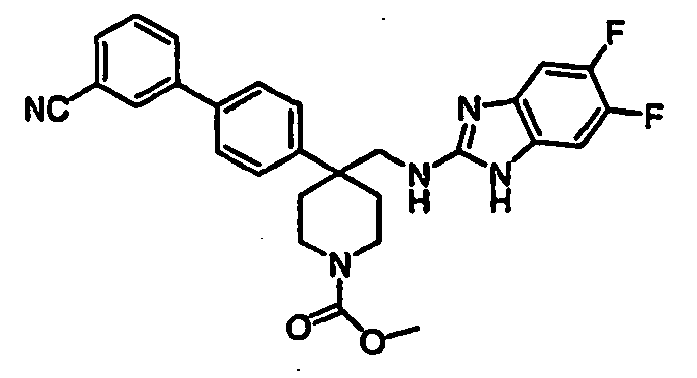
D 11A 
D 11B 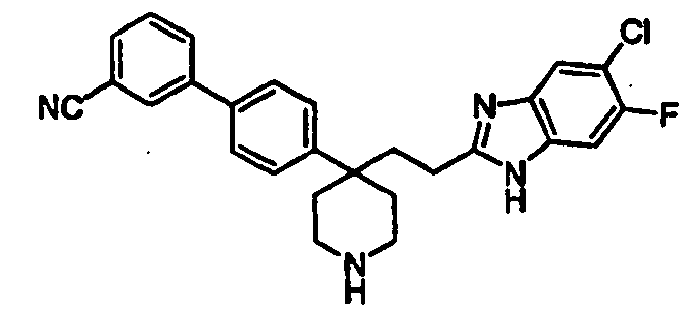
D 11C 
D 15A 
C 15B 
B 16A 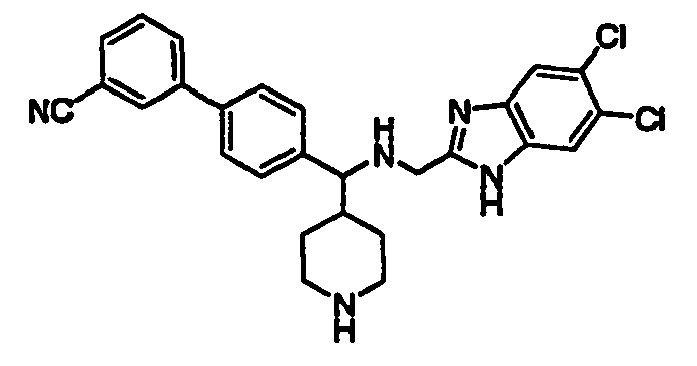
A 16B 
B 17A 
A 17B 
B 28A 
A 28B 
A 33 
B 34D 
D 34A 
B 34B 
B 34C 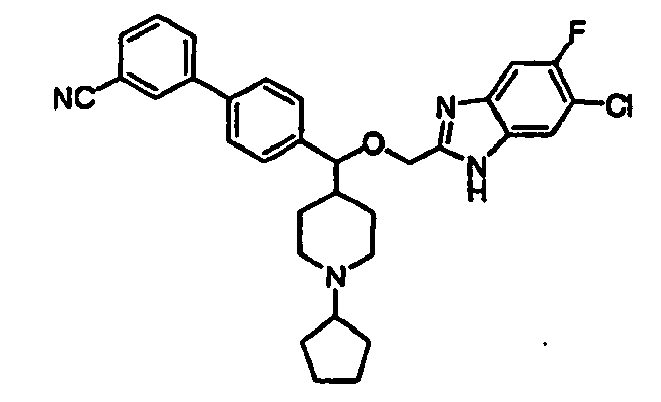
B 39 
D 44 
D 48 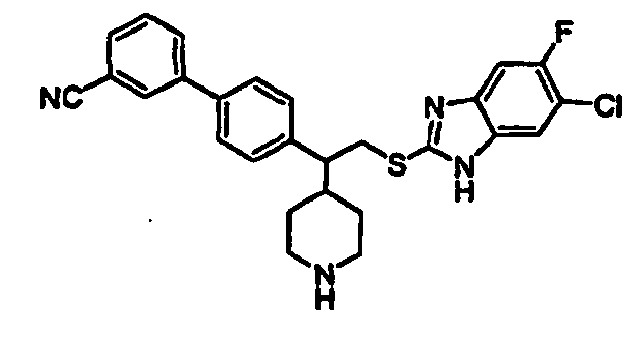
D 53 
D 54 
C 56 
D 57 
C 58 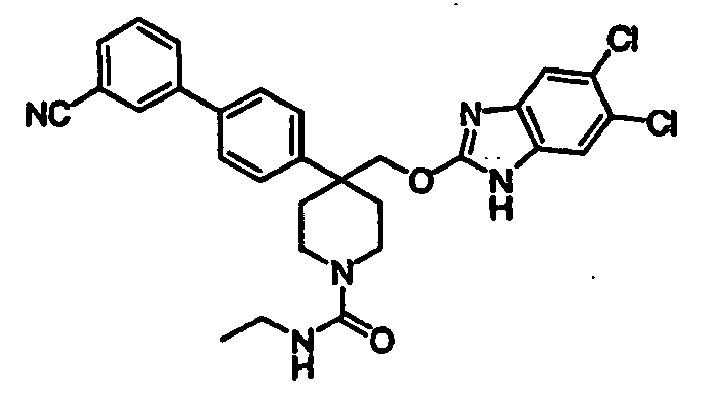
D 63 
D 64 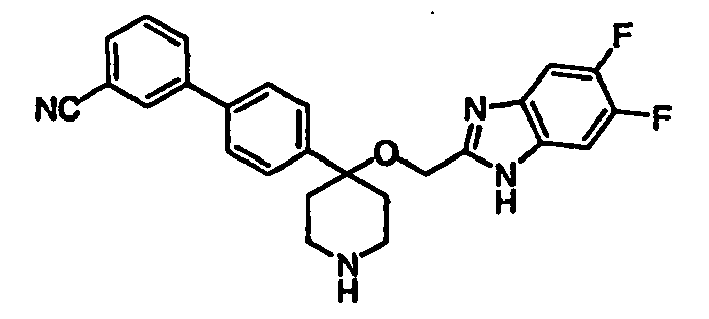
D 67A 
D 67B 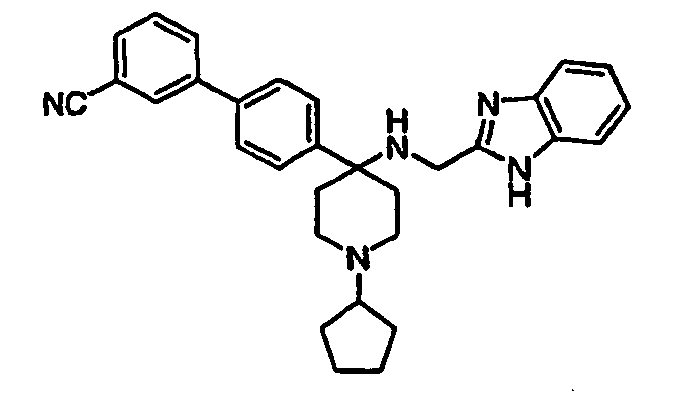
D 75A 
C 75B 
B 75C 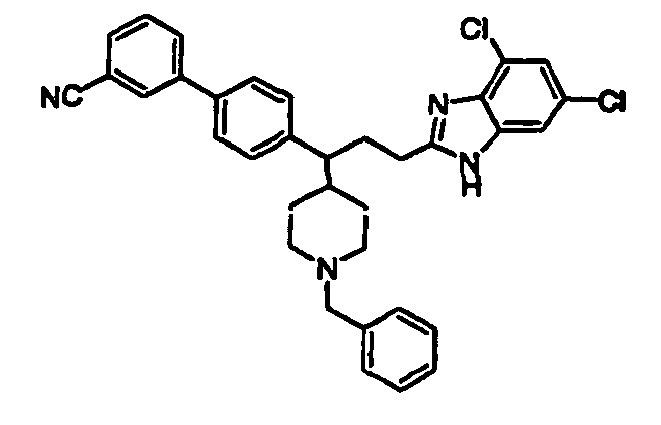
B
Claims (35)
- A compound represented by the structural formula

Y is a bond, -(CR2R3)pNR8(CH2)q-, -(CR2R3)t(CHR12)-, -(CHR12)t(CR2R3)-, -CHR12CH2N-, -CHR12CH2S-, -CHR12CH2O-, -C(O)(CR2R3)pNR8-, -(CH2)pO(CH2)q-, -(CH2)pS(CH2)q-, -(CR2R3)t-, -C(O)(CH2)rO- or -C(O)(CH2)rS-;
m is 1;
n is 0, and there is no connecting bond between the 2 carbon atoms adjacent to the nitrogen of the piperidyl ring;
p is 0 to 4;
q is 0 to 4;
r is 1 to 3;
t is 1 to 6;
Ar is aryl, heteroaryl, R6-substituted aryl or R6-substituted heteroaryl;
R1 is hydrogen, alkyl, cycloalkyl, cycloalkylalkyl, aralkyl, heterocyclyl, heterocyclylalkyl, hydrokyalkyl, heteroaralkyl, -C(O)R5, -C(O)OR5, -C(O)NR8R9, -S(O2)R5, -S(O2)NR8R9, aryl, heteroaryl, -CF3, R10-substituted aralkyl, R10-substituted heterocyclyl, R10-substituted aryl, R10-substituted heteroaryl, R10-substituted heterocyclylalkyl, R10-substituted heteroaralkyl, R10-substituted alkyl, R10-substituted cycloalkyl- or R10-substituted cycloalkylalkyl-;
R2 and R3 can be the same or different, each being independently hydrogen or alkyl; or R2 and R3 can be joined together and with the carbon to which they are attached form a 3 to 7-membered ring;
R4 is 1 to 4 substituents, each R4 is independently selected from the group consisting of hydrogen, -OH, alkoxy, -OCF3, -CN, alkyl, halogen, -NR8C(O)R7, -C(O)NR8R9, -NR8S(O2)R7, -S(O2)NR8R9, -S(O2)R7, -C(O)R7, -C(O)OR8, -CF3, -(alkylene)NR8R9, -(alkylene)NR8C(O)R7, CHO, -C=NOR8 or two adjacent R4 groups can be joined together to form a methylene dioxy or ethylene dioxy group;
R5 is alkyl, aryl, aralkyl, heteroaryl, heteroaralkyl, cycloalkyl, heterocyclyl, heterocyclylalkyl, R11-substituted heteroaralkyl, R11-substituted cycloalkyl, R11-substituted heterocyclyl, R11-substituted heterocyclylalkyl, R11-substituted aryl or R11-substituted heteroaryl;
R6 is 1 to 5 substituents, each R6 is independently selected from the group consisting of hydrogen, -OH, alkoxy, -OCF3, -CN, alkyl, halogen, -NR8R9, -NR8C(O)R7, -C(O)NR8R9, -NR8S(O2)R7, -S(O2)NR8R9, -S(O2)R7, C(O)R7, -C(O)OR8, -CF3, -(alkylene)NR8R9, -(alkylene)C(O)NR8R9, -(alkylene)NR8C(O)R7, -(alkylene)NR8S(O2)R7, -(alkylene)NR8C(O)NR8R9, -(alkylene)NR8C(O)OR7, CHO, -C=NOR8 and
R8 is hydrogen or alkyl;
R9 is hydrogen, alkyl, aryl, aralkyl, cycloalkyl, heteroaralkyl or heteroaryl;
R10 is 1 to 5 substituents, each R10 is independently selected from the group consisting of -OH, alkoxy, -C(O)NR8R9, -NR8R9, -NR8S(O2)R5, -NR8C(O)NR8R9, -NR8C(O)R5, -NR8C(O)OR5 and -C(O)OR9;
R11 is 1 to 5 substituents, each R11 being independently selected from the group consisting of hydrogen, -OH, alkoxy, -OCF3, -CN, alkyl, halogen or -CF3; and
R12 is hydroxy or alkoxy,
wherein:"alkyl" means an aliphatic hydrocarbon group, which may be straight or branched and comprising 1 to 20 carbon atoms in thechain;"alkylene" means an alkanediyl;"aryl" means an aromatic monocyclic or multicyclic ring system comprising 6 to 14 carbon atoms,"aralkyl" means an aryl-alkyl- group in which the aryl and alkyl are as previously described wherein the bond to the parent moiety is through the alkyl;"cycloalkyl" means a non-aromatic mono- or multicyclic ring system comprising 3 to 10 carbon atoms;"cycloalkylalkyl" means a cycloalkylalkyl group in which the cycloalkyl and alkyl groups are as previously described wherein the bond to the parent moiety is through the alkyl group."halogen" means fluorine, chlorine, bromine or iodine."heteroaryl" means an aromatic monocyclic or multicyclic ring system comprising 5 to 14 ring atoms, in which one or more of the ring atoms is an element other than carbon;"heteroaralkyl" means a heteroaryl-alkyl- group in which the heteroaryl and alkyl are as previously described wherein the bond to the parent moiety is through the alkyl;"heterocyclyl" means a non-aromatic saturated monocyclic or multicyclic ring system comprising 3 to 10 ring atoms, in which one or more of the atoms in the ring system is an element other than carbon, providing there are no adjacent oxygen and/or sulfur atoms present in the ring system;"heterocyclylalkyl" means heterocyclyl-alkyl- group in which the heterocyclyl and alkyl are as previously described wherein the bond to the parent moiety is through the alkyl;"hydroxyalkyl" means a HO-alkyl- group in which alkyl is as previously defined; and"alkoxy" means an alkyl-O- group in which the alkyl group is as previously described. - The compound of claim 1 wherein
p is 1;
q is 0;
Y is -(CR2R3)pNR8(CH2)q-;
R2 and R3 are hydrogen or alkyl;
and
R8 is hydrogen or alkyl. - The compound of claim 1 wherein
p is 0;
q is 1;
Y is -(CR2R3)pNR8(CH2)q-;
R2 and R3 are hydrogen or alkyl;
and
R8 is hydrogen or alkyl. - The compound of claim 1 wherein
Y is -(CH2)pO(CH2)q;
p is 0;
and
q is 1. - The compound of claim 1 wherein
Y is -(CH2)pO(CH2)q;
p is 1;
and
q is 0. - The compound of claim 1 wherein
Y is -(CR2R3)t-;
t is 2;
and
R2 and R3 are hydrogen or alky. - The compound of claim 1 wherein R1 is hydrogen, alkyl, aralkyl, cycloalkyl, cycloalkylalkyl-, hydroxyalkyl, R10-substituted alkyl, -S(O2)R5, -C(O)R5, -C(O)NR8R9 or -C(O)OR5.
- The compound of claim 1 wherein
Ar is R6-substituted aryl;
and
R6 is 1 to 5 substituents and each R6 is independently selected from the group consisting of halogen, -CF3, -OCF3, -CN, -CHO, -S(O2)R5, -C(O)R5, -C(O)NR8R9, -(alkylene)C(O)NR8R9,-(alkylene)NR8R9, -(alkylene)NR8C(O)R5, -(alkylene)NR8S(O2)R5 and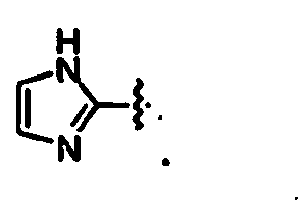
- The compound of claim 8 wherein R6 is 1 substituent, wherein said R6 is independently selected from the group consisting of halogen, -CN, -(alkylene)NR8R9, -(alkylene)C(O)NR8R9, and -(alkylene)NR8C(O)R5.
- The compound of claim 8 wherein Ar is R6-substituted phenyl and R6 is at the meta or para position of Ar, relative to the position where Ar is attached to the parent moiety.
- The compound of claim 9 wherein R6 is at the meta position of Ar, relative to the position where Ar is attached to the parent moiety.
- The compound of claim 8 wherein R6 is -CN.
- The compound of claim 9 wherein R6 is -CN.
- The compound of claim 1 wherein R4 is two substituents and each R4 is independently selected from the group consisting of halogen, -CN and -CF3.
- The compound of claim 14 wherein R4 is selected from the group consisting of Cl, F and -CF3.
- The compound of claim 7 wherein R1 is hydrogen, Boc, methyl, ethyl, hydroxyethyl, hydroxypentyl, cyclobutyl, cyclopentyl,

- A compound selected from the group consisting of

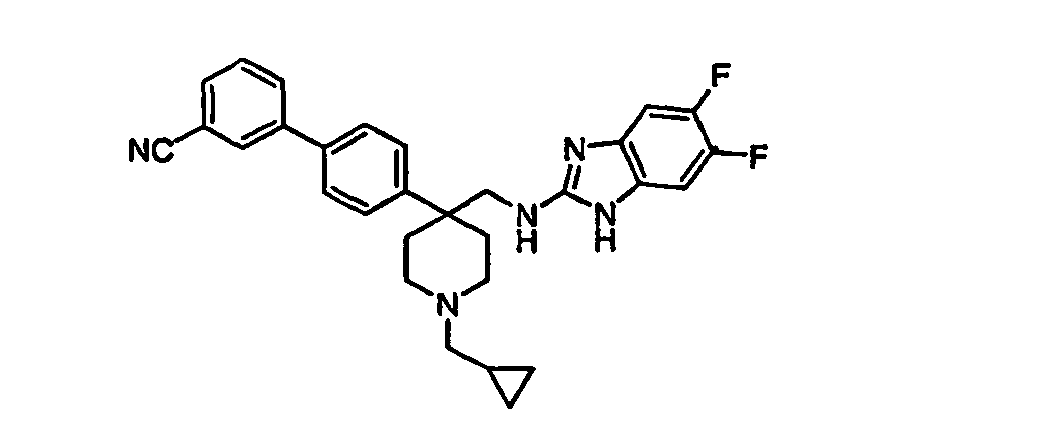

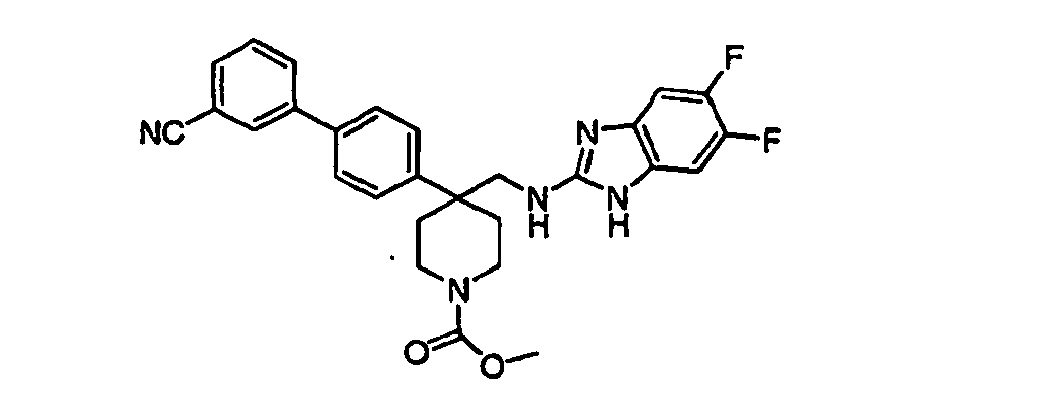


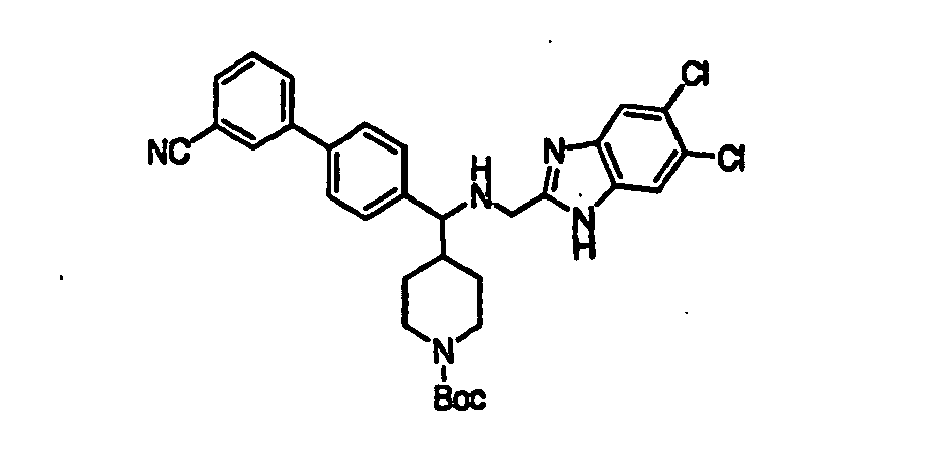
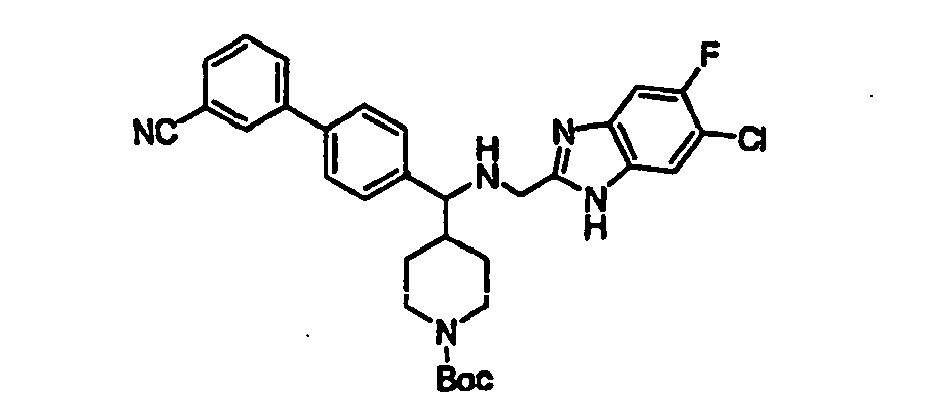
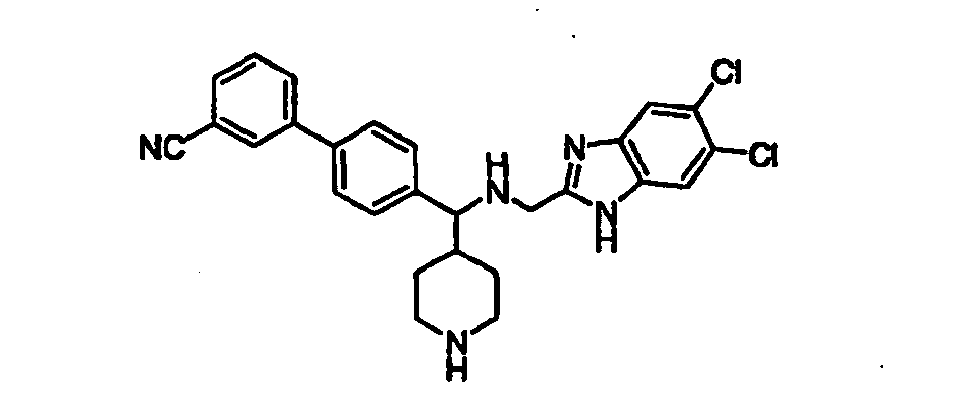


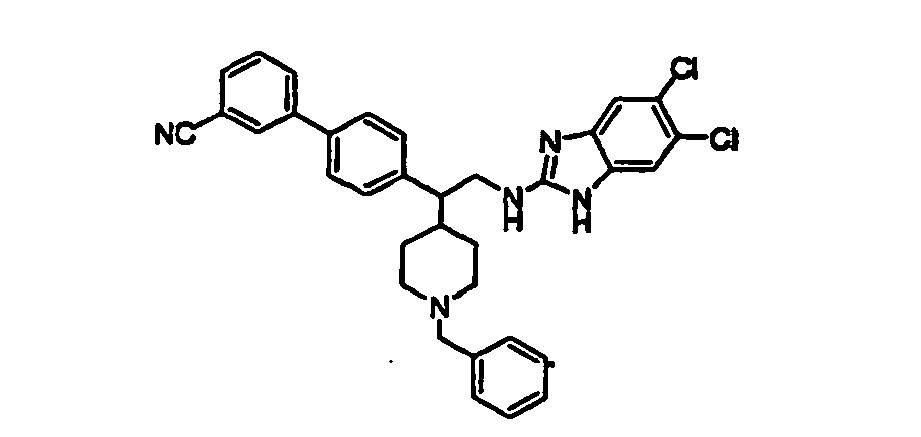


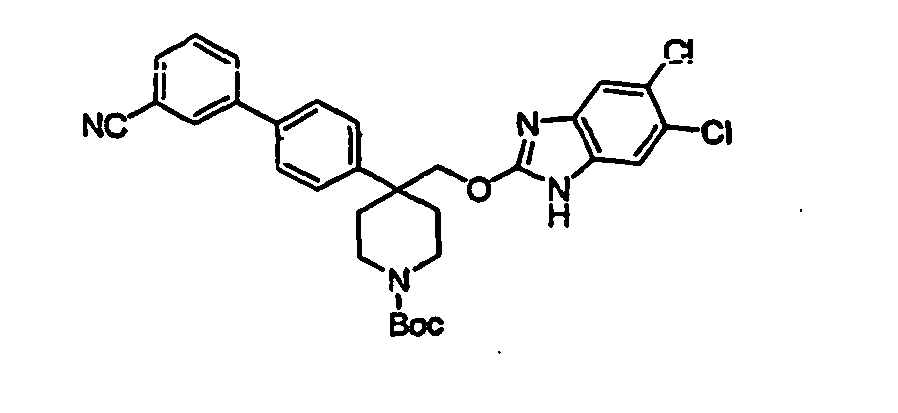

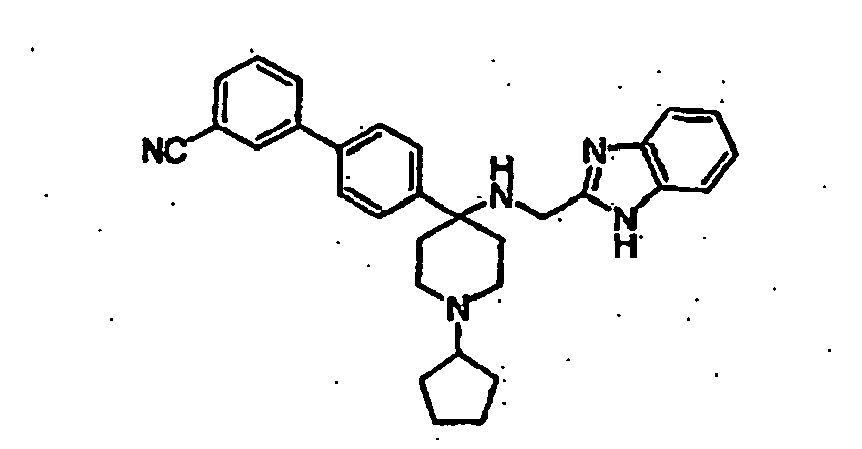

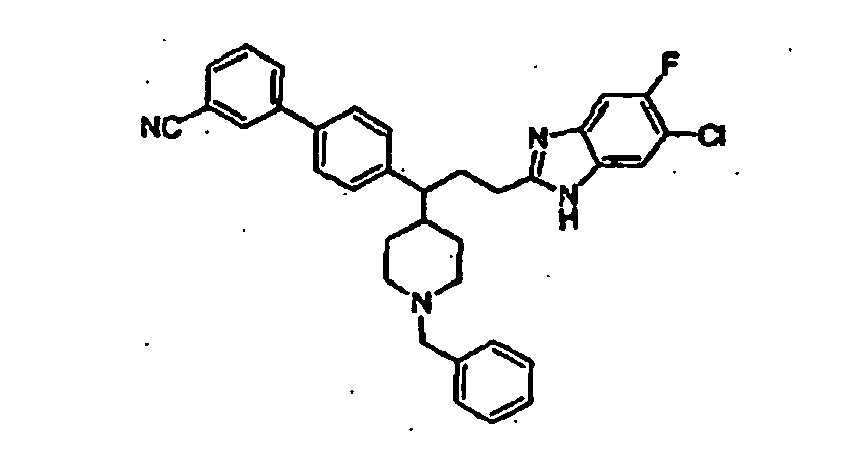

- The use of at least one compound of Claim 1 for the manufacture of a medicament for treating a metabolic disorder, an eating disorder or diabetes.
- The use of at least one compound of Claim 17 for the manufacture of a medicament for treating a metabolic disorder, an eating disorder or diabetes.
- The use of claim 18 wherein said eating disorder is hyperphagia.
- The use of claim 18 wherein said metabolic disorder is obesity.
- The use of at least one compound of claim 1 for the manufacture of a medicament for treating a disorder associated with obesity.
- The use of at least one compound of claim 17 for the manufacture of a medicament for treating a disorder associated with obesity.
- The use of claim 22 wherein said disorder associated with obesity is at least one of type II diabetes, insulin resistance, hyperlipidemia or hypertension.
- The use of claim 23 wherein said disorder associated with obesity is at least one of type II diabetes, insulin resistance, hyperlipidemia or hypertension.
- The use of at least one compound of claim 1 for the manufacture of a medicament for treating an eating disorder wherein the treatment comprises administering to a mammal in need of such treatment said medicament
and
a second compound, said second compound being an antiobesity and/or anorectic agent selected from the group consisting of a β3 agonist, a thryomimetic agent, an anorectic agent and an NPY antagonist. - The use of at least one compound of Claim 17 for the manufacture of a medicament for treating an eating disorder wherein the treatment comprises administering to a mammal in need of such treatment said medicament
and
a second compound, said second compound being an antiobesity and/or anorectic agent selected from the group consisting of a β3 agonist, a thryomimetic agent, an anorectic agent and an NPY antagonist. - A pharmaceutical composition which comprises :a first compound, said first compound being a compound of claim 1, or a pharmaceutical acceptable salt or solvate of said compound;a second compound, said second compound being an antiobesity and/or anorectic agent selected from the group consisting of a β3 agonist, a thryomimetic agent, an anorectic agents and NPY antagonist; anda pharmaceutically acceptable carrier.
- A pharmaceutical composition which comprises :a first compound, said first compound being a compound of claim 17, or a pharmaceutically acceptable salt or solvate of said compound;a second compound, said second compound being an antiobesity and/or anorectic agent selected from the group consisting of a β3 agonist, a thryomimetic agent, an anorectic agent and NPY antagonist; anda pharmaceutically acceptable carrier.
- A pharmaceutical composition which comprises :a first compound, said first compound being a compound of claim 1, or a pharmaceutical acceptable salt or solvate of said compound;a second compound, said second compound selected from the group consisting of an aldose reductase inhibitor, a Glycogen phosphorylase inhibitor, a sorbitol dehydrogenase inhibitor, a protein tyrosine, phosphatase 1 B inhibitor, a dipeptidyl protease inhibitor, insulin, an insulin mimetic, metformin, acarbose, troglitazone, rosaglitazone, pioglitazone, GW-1929, a sulfonylurea, glipazide, glyburide, and chlorpropamide; anda pharmaceutically acceptable carrier.
- A pharmaceutical composition which comprises :a first compound, said first compound being a compound of claim 17, or a pharmaceutically acceptable salt or solvate of said compound;a second compound, said second compound selected from the group consisting of an aldose reductase inhibitor, a glycogen phosphorylase inhibitor, a sorbitol dehydrogenase inhibitor, a protein tyrosine phosphatase 1B inhibitor, a dipeptidyl protease inhibitor, insulin, an insulin mimetic, metformin, acarbose, trogliazone, rosaglitazone, pioglitazone, GW-1929, a sulfonylurea, glipazide, glyburide, and chlorpropamide; anda pharmaceutically acceptable carrier.
- A pharmaceutical-composition comprising at least one compound of claim 1 in combination with at least one pharmaceutically acceptable carrier.
- A pharmaceutical composition comprising at least one compound of claim 17 in combination with at least one pharmaceutically acceptable carrier.
- A process for making a pharmaceutical composition comprising combining at least one compound of claim 1, and at least one pharmaceutical acceptable carrier.
- A process for making a pharmaceutical composition comprising combining at least one compound of claim 17, and at least one pharmaceutical acceptable carrier.
Applications Claiming Priority (2)
| Application Number | Priority Date | Filing Date | Title |
|---|---|---|---|
| US49887603P | 2003-08-29 | 2003-08-29 | |
| PCT/US2004/027734 WO2005023798A1 (en) | 2003-08-29 | 2004-08-26 | 2-substituted benzimidazole piperidines analogs as selective melanin concentrating hormone receptor antagonists for the treatment of obesity and related disorders |
Publications (2)
| Publication Number | Publication Date |
|---|---|
| EP1664022A1 EP1664022A1 (en) | 2006-06-07 |
| EP1664022B1 true EP1664022B1 (en) | 2011-06-15 |
Family
ID=34272746
Family Applications (1)
| Application Number | Title | Priority Date | Filing Date |
|---|---|---|---|
| EP04782252A Expired - Lifetime EP1664022B1 (en) | 2003-08-29 | 2004-08-26 | 2-substituted benzimidazole piperidine analogs as selective melanin concentrating hormone receptor antagonists for the treatment of obesity and related disorders |
Country Status (10)
| Country | Link |
|---|---|
| US (1) | US7511146B2 (en) |
| EP (1) | EP1664022B1 (en) |
| JP (1) | JP4672662B2 (en) |
| CN (1) | CN1845916A (en) |
| AR (1) | AR045496A1 (en) |
| AT (1) | ATE512959T1 (en) |
| CA (1) | CA2536929C (en) |
| MX (1) | MXPA06002372A (en) |
| TW (1) | TW200524902A (en) |
| WO (1) | WO2005023798A1 (en) |
Families Citing this family (7)
| Publication number | Priority date | Publication date | Assignee | Title |
|---|---|---|---|---|
| WO2006067531A1 (en) * | 2004-12-24 | 2006-06-29 | Prosidion Ltd | G-protein coupled receptor (gpr116) agonists and use thereof for treating obesity and diabetes |
| NZ564759A (en) * | 2005-06-30 | 2011-08-26 | Prosidion Ltd | GPCR agonists |
| BRPI0806498A2 (en) * | 2007-01-04 | 2014-04-22 | Prosidion Ltd | GPCR PIPERIDINE AGONISTS |
| AR064736A1 (en) * | 2007-01-04 | 2009-04-22 | Prosidion Ltd | GPCR AGONISTS |
| CL2008000018A1 (en) * | 2007-01-04 | 2008-08-01 | Prosidion Ltd | COMPOUNDS DERIVED FROM NITROGEN AND OXYGEN HETEROCICLES, GPCR AGONISTS; PHARMACEUTICAL COMPOSITION THAT INCLUDES SUCH COMPOUND; AND USE OF THE COMPOUND FOR THE TREATMENT OF OBESITY, DIABETES, METABOLIC SYNDROME, HYPERLIPIDEMIA, TOLERANCE |
| JP2012511007A (en) * | 2008-12-04 | 2012-05-17 | グラクソ グループ リミテッド | Method for preparing spiroindoline and its precursor |
| CN104860919B (en) * | 2015-03-26 | 2017-11-10 | 天津药物研究院有限公司 | Benzimidizole derivatives containing piperidines and its production and use |
Family Cites Families (7)
| Publication number | Priority date | Publication date | Assignee | Title |
|---|---|---|---|---|
| US5908830A (en) * | 1996-10-31 | 1999-06-01 | Merck & Co., Inc. | Combination therapy for the treatment of diabetes and obesity |
| US20020169166A1 (en) * | 2001-03-09 | 2002-11-14 | Cowart Marlon D. | Benzimidazoles that are useful in treating sexual dysfunction |
| US6900329B2 (en) * | 2001-03-21 | 2005-05-31 | Schering Corporation | MCH antagonists and their use in the treatment of obesity |
| JO2390B1 (en) * | 2001-04-06 | 2007-06-17 | شركة جانسين فارماسوتيكا ان. في | Lipid lowering biphenulcarboxamides |
| ATE460163T1 (en) * | 2001-04-12 | 2010-03-15 | Pharmacopeia Llc | ARLY AND DIARYL PIPERIDINE DERIVATIVES USABLE AS MCH INHIBITORS |
| AR037429A1 (en) * | 2001-11-26 | 2004-11-10 | Schering Corp | DERIVATIVES OF PIPERIDINE ANTAGONISTS OF THE MCH, PHARMACEUTICAL COMPOSITIONS, A PROCESS FOR THEIR DEVELOPMENT AND THE USE OF SUCH DERIVATIVES, ONLY OR IN COMBINATION, FOR THE MANUFACTURE OF A MEDICINAL PRODUCT FOR THE TREATMENT OF OBESITY AND DISORDERS OF THE SNC |
| TW200403058A (en) * | 2002-04-19 | 2004-03-01 | Bristol Myers Squibb Co | Heterocyclo inhibitors of potassium channel function |
-
2004
- 2004-08-25 AR ARP040103055A patent/AR045496A1/en unknown
- 2004-08-26 CA CA2536929A patent/CA2536929C/en not_active Expired - Fee Related
- 2004-08-26 US US10/926,557 patent/US7511146B2/en not_active Expired - Fee Related
- 2004-08-26 EP EP04782252A patent/EP1664022B1/en not_active Expired - Lifetime
- 2004-08-26 TW TW093125667A patent/TW200524902A/en unknown
- 2004-08-26 CN CNA2004800249377A patent/CN1845916A/en active Pending
- 2004-08-26 JP JP2006524846A patent/JP4672662B2/en not_active Expired - Fee Related
- 2004-08-26 WO PCT/US2004/027734 patent/WO2005023798A1/en not_active Ceased
- 2004-08-26 MX MXPA06002372A patent/MXPA06002372A/en active IP Right Grant
- 2004-08-26 AT AT04782252T patent/ATE512959T1/en not_active IP Right Cessation
Also Published As
| Publication number | Publication date |
|---|---|
| TW200524902A (en) | 2005-08-01 |
| WO2005023798A1 (en) | 2005-03-17 |
| ATE512959T1 (en) | 2011-07-15 |
| CN1845916A (en) | 2006-10-11 |
| JP4672662B2 (en) | 2011-04-20 |
| US20050054628A1 (en) | 2005-03-10 |
| AR045496A1 (en) | 2005-11-02 |
| CA2536929A1 (en) | 2005-03-17 |
| CA2536929C (en) | 2010-09-28 |
| MXPA06002372A (en) | 2006-06-20 |
| US7511146B2 (en) | 2009-03-31 |
| JP2007504146A (en) | 2007-03-01 |
| EP1664022A1 (en) | 2006-06-07 |
Similar Documents
| Publication | Publication Date | Title |
|---|---|---|
| US6664273B2 (en) | Piperidine based MCH antagonists for treatment of obesity and CNS disorders | |
| DE60204548T2 (en) | MCH ANTAGONISTS AND ITS USE FOR THE TREATMENT OF FATIBILITY | |
| CA2536544C (en) | 2-substituted benzimidazole derivatives as selective melanin concentrating hormone receptor antagonists for the treatment of obesity and related disorders | |
| CA2490531C (en) | Spirosubstituted piperidines as selective melanin concentrating hormone receptor antagonists for the treatment of obesity | |
| EP1601664B1 (en) | Biaryltetrahydroisoquinoline piperidines as selective mch receptor antagonists for the treatment of obesity and related disorders | |
| US7511146B2 (en) | 2-substituted benzimidazole piperidines analogs as selective melanin concentrating hormone receptor antagonists for the treatment of obesity and related disorders | |
| US7345042B2 (en) | MCH antagonists for the treatment of obesity | |
| EP1667679B1 (en) | Aminobenzimidazoles as selective melanin concentrating hormone receptor antagonists for the treatment of obesity and related disorders | |
| JP2007504146A5 (en) | ||
| HK1071567B (en) | Spirosubstituted piperidines as selective melanin concentrating hormone receptor antagonists for the treatment of obesity | |
| AU2002244308A1 (en) | MCH antagonists and their use in the treatment of obesity |
Legal Events
| Date | Code | Title | Description |
|---|---|---|---|
| PUAI | Public reference made under article 153(3) epc to a published international application that has entered the european phase |
Free format text: ORIGINAL CODE: 0009012 |
|
| 17P | Request for examination filed |
Effective date: 20060329 |
|
| AK | Designated contracting states |
Kind code of ref document: A1 Designated state(s): AT BE BG CH CY CZ DE DK EE ES FI FR GB GR HU IE IT LI LU MC NL PL PT RO SE SI SK TR |
|
| AX | Request for extension of the european patent |
Extension state: AL HR LT LV MK |
|
| REG | Reference to a national code |
Ref country code: HK Ref legal event code: DE Ref document number: 1087407 Country of ref document: HK |
|
| 17Q | First examination report despatched |
Effective date: 20090115 |
|
| RAP1 | Party data changed (applicant data changed or rights of an application transferred) |
Owner name: PHARMACOPEIA, LLC Owner name: SCHERING CORPORATION |
|
| GRAP | Despatch of communication of intention to grant a patent |
Free format text: ORIGINAL CODE: EPIDOSNIGR1 |
|
| RTI1 | Title (correction) |
Free format text: 2-SUBSTITUTED BENZIMIDAZOLE PIPERIDINE ANALOGS AS SELECTIVE MELANIN CONCENTRATING HORMONE RECEPTOR ANTAGONISTS FOR THE TREATMENT OF OBESITY AND RELATED DISORDERS |
|
| GRAS | Grant fee paid |
Free format text: ORIGINAL CODE: EPIDOSNIGR3 |
|
| GRAA | (expected) grant |
Free format text: ORIGINAL CODE: 0009210 |
|
| AK | Designated contracting states |
Kind code of ref document: B1 Designated state(s): AT BE BG CH CY CZ DE DK EE ES FI FR GB GR HU IE IT LI LU MC NL PL PT RO SE SI SK TR |
|
| AX | Request for extension of the european patent |
Extension state: AL HR LT LV MK |
|
| REG | Reference to a national code |
Ref country code: GB Ref legal event code: FG4D Ref country code: CH Ref legal event code: EP |
|
| REG | Reference to a national code |
Ref country code: IE Ref legal event code: FG4D |
|
| REG | Reference to a national code |
Ref country code: DE Ref legal event code: R096 Ref document number: 602004033105 Country of ref document: DE Effective date: 20110721 |
|
| REG | Reference to a national code |
Ref country code: NL Ref legal event code: T3 |
|
| PG25 | Lapsed in a contracting state [announced via postgrant information from national office to epo] |
Ref country code: SE Free format text: LAPSE BECAUSE OF FAILURE TO SUBMIT A TRANSLATION OF THE DESCRIPTION OR TO PAY THE FEE WITHIN THE PRESCRIBED TIME-LIMIT Effective date: 20110615 |
|
| PGFP | Annual fee paid to national office [announced via postgrant information from national office to epo] |
Ref country code: CH Payment date: 20110829 Year of fee payment: 8 |
|
| LTIE | Lt: invalidation of european patent or patent extension |
Effective date: 20110615 |
|
| PG25 | Lapsed in a contracting state [announced via postgrant information from national office to epo] |
Ref country code: FI Free format text: LAPSE BECAUSE OF FAILURE TO SUBMIT A TRANSLATION OF THE DESCRIPTION OR TO PAY THE FEE WITHIN THE PRESCRIBED TIME-LIMIT Effective date: 20110615 Ref country code: AT Free format text: LAPSE BECAUSE OF FAILURE TO SUBMIT A TRANSLATION OF THE DESCRIPTION OR TO PAY THE FEE WITHIN THE PRESCRIBED TIME-LIMIT Effective date: 20110615 Ref country code: CY Free format text: LAPSE BECAUSE OF FAILURE TO SUBMIT A TRANSLATION OF THE DESCRIPTION OR TO PAY THE FEE WITHIN THE PRESCRIBED TIME-LIMIT Effective date: 20110615 Ref country code: SI Free format text: LAPSE BECAUSE OF FAILURE TO SUBMIT A TRANSLATION OF THE DESCRIPTION OR TO PAY THE FEE WITHIN THE PRESCRIBED TIME-LIMIT Effective date: 20110615 Ref country code: GR Free format text: LAPSE BECAUSE OF FAILURE TO SUBMIT A TRANSLATION OF THE DESCRIPTION OR TO PAY THE FEE WITHIN THE PRESCRIBED TIME-LIMIT Effective date: 20110916 |
|
| PGFP | Annual fee paid to national office [announced via postgrant information from national office to epo] |
Ref country code: FR Payment date: 20110901 Year of fee payment: 8 Ref country code: GB Payment date: 20110826 Year of fee payment: 8 Ref country code: DE Payment date: 20110831 Year of fee payment: 8 |
|
| PG25 | Lapsed in a contracting state [announced via postgrant information from national office to epo] |
Ref country code: BE Free format text: LAPSE BECAUSE OF FAILURE TO SUBMIT A TRANSLATION OF THE DESCRIPTION OR TO PAY THE FEE WITHIN THE PRESCRIBED TIME-LIMIT Effective date: 20110615 |
|
| PGFP | Annual fee paid to national office [announced via postgrant information from national office to epo] |
Ref country code: NL Payment date: 20110829 Year of fee payment: 8 |
|
| PG25 | Lapsed in a contracting state [announced via postgrant information from national office to epo] |
Ref country code: EE Free format text: LAPSE BECAUSE OF FAILURE TO SUBMIT A TRANSLATION OF THE DESCRIPTION OR TO PAY THE FEE WITHIN THE PRESCRIBED TIME-LIMIT Effective date: 20110615 Ref country code: PT Free format text: LAPSE BECAUSE OF FAILURE TO SUBMIT A TRANSLATION OF THE DESCRIPTION OR TO PAY THE FEE WITHIN THE PRESCRIBED TIME-LIMIT Effective date: 20111017 Ref country code: CZ Free format text: LAPSE BECAUSE OF FAILURE TO SUBMIT A TRANSLATION OF THE DESCRIPTION OR TO PAY THE FEE WITHIN THE PRESCRIBED TIME-LIMIT Effective date: 20110615 |
|
| PG25 | Lapsed in a contracting state [announced via postgrant information from national office to epo] |
Ref country code: RO Free format text: LAPSE BECAUSE OF FAILURE TO SUBMIT A TRANSLATION OF THE DESCRIPTION OR TO PAY THE FEE WITHIN THE PRESCRIBED TIME-LIMIT Effective date: 20110615 Ref country code: PL Free format text: LAPSE BECAUSE OF FAILURE TO SUBMIT A TRANSLATION OF THE DESCRIPTION OR TO PAY THE FEE WITHIN THE PRESCRIBED TIME-LIMIT Effective date: 20110615 Ref country code: SK Free format text: LAPSE BECAUSE OF FAILURE TO SUBMIT A TRANSLATION OF THE DESCRIPTION OR TO PAY THE FEE WITHIN THE PRESCRIBED TIME-LIMIT Effective date: 20110615 |
|
| PG25 | Lapsed in a contracting state [announced via postgrant information from national office to epo] |
Ref country code: MC Free format text: LAPSE BECAUSE OF NON-PAYMENT OF DUE FEES Effective date: 20110831 |
|
| PLBE | No opposition filed within time limit |
Free format text: ORIGINAL CODE: 0009261 |
|
| STAA | Information on the status of an ep patent application or granted ep patent |
Free format text: STATUS: NO OPPOSITION FILED WITHIN TIME LIMIT |
|
| 26N | No opposition filed |
Effective date: 20120316 |
|
| PG25 | Lapsed in a contracting state [announced via postgrant information from national office to epo] |
Ref country code: IT Free format text: LAPSE BECAUSE OF FAILURE TO SUBMIT A TRANSLATION OF THE DESCRIPTION OR TO PAY THE FEE WITHIN THE PRESCRIBED TIME-LIMIT Effective date: 20110615 |
|
| PG25 | Lapsed in a contracting state [announced via postgrant information from national office to epo] |
Ref country code: DK Free format text: LAPSE BECAUSE OF FAILURE TO SUBMIT A TRANSLATION OF THE DESCRIPTION OR TO PAY THE FEE WITHIN THE PRESCRIBED TIME-LIMIT Effective date: 20110615 |
|
| REG | Reference to a national code |
Ref country code: DE Ref legal event code: R097 Ref document number: 602004033105 Country of ref document: DE Effective date: 20120316 |
|
| PG25 | Lapsed in a contracting state [announced via postgrant information from national office to epo] |
Ref country code: IE Free format text: LAPSE BECAUSE OF NON-PAYMENT OF DUE FEES Effective date: 20110826 |
|
| REG | Reference to a national code |
Ref country code: NL Ref legal event code: V1 Effective date: 20130301 |
|
| REG | Reference to a national code |
Ref country code: HK Ref legal event code: WD Ref document number: 1087407 Country of ref document: HK |
|
| REG | Reference to a national code |
Ref country code: CH Ref legal event code: PL |
|
| GBPC | Gb: european patent ceased through non-payment of renewal fee |
Effective date: 20120826 |
|
| PG25 | Lapsed in a contracting state [announced via postgrant information from national office to epo] |
Ref country code: ES Free format text: LAPSE BECAUSE OF FAILURE TO SUBMIT A TRANSLATION OF THE DESCRIPTION OR TO PAY THE FEE WITHIN THE PRESCRIBED TIME-LIMIT Effective date: 20110926 Ref country code: CH Free format text: LAPSE BECAUSE OF NON-PAYMENT OF DUE FEES Effective date: 20120831 Ref country code: LI Free format text: LAPSE BECAUSE OF NON-PAYMENT OF DUE FEES Effective date: 20120831 Ref country code: NL Free format text: LAPSE BECAUSE OF NON-PAYMENT OF DUE FEES Effective date: 20130301 |
|
| REG | Reference to a national code |
Ref country code: FR Ref legal event code: ST Effective date: 20130430 |
|
| PG25 | Lapsed in a contracting state [announced via postgrant information from national office to epo] |
Ref country code: LU Free format text: LAPSE BECAUSE OF NON-PAYMENT OF DUE FEES Effective date: 20110826 |
|
| PG25 | Lapsed in a contracting state [announced via postgrant information from national office to epo] |
Ref country code: BG Free format text: LAPSE BECAUSE OF FAILURE TO SUBMIT A TRANSLATION OF THE DESCRIPTION OR TO PAY THE FEE WITHIN THE PRESCRIBED TIME-LIMIT Effective date: 20110915 |
|
| PG25 | Lapsed in a contracting state [announced via postgrant information from national office to epo] |
Ref country code: DE Free format text: LAPSE BECAUSE OF NON-PAYMENT OF DUE FEES Effective date: 20130301 Ref country code: GB Free format text: LAPSE BECAUSE OF NON-PAYMENT OF DUE FEES Effective date: 20120826 |
|
| PG25 | Lapsed in a contracting state [announced via postgrant information from national office to epo] |
Ref country code: FR Free format text: LAPSE BECAUSE OF NON-PAYMENT OF DUE FEES Effective date: 20120831 |
|
| REG | Reference to a national code |
Ref country code: DE Ref legal event code: R119 Ref document number: 602004033105 Country of ref document: DE Effective date: 20130301 |
|
| PG25 | Lapsed in a contracting state [announced via postgrant information from national office to epo] |
Ref country code: TR Free format text: LAPSE BECAUSE OF FAILURE TO SUBMIT A TRANSLATION OF THE DESCRIPTION OR TO PAY THE FEE WITHIN THE PRESCRIBED TIME-LIMIT Effective date: 20110615 |
|
| PG25 | Lapsed in a contracting state [announced via postgrant information from national office to epo] |
Ref country code: HU Free format text: LAPSE BECAUSE OF FAILURE TO SUBMIT A TRANSLATION OF THE DESCRIPTION OR TO PAY THE FEE WITHIN THE PRESCRIBED TIME-LIMIT Effective date: 20110615 |