EP1663993B1 - Guanidine derivatives - Google Patents
Guanidine derivatives Download PDFInfo
- Publication number
- EP1663993B1 EP1663993B1 EP04761896A EP04761896A EP1663993B1 EP 1663993 B1 EP1663993 B1 EP 1663993B1 EP 04761896 A EP04761896 A EP 04761896A EP 04761896 A EP04761896 A EP 04761896A EP 1663993 B1 EP1663993 B1 EP 1663993B1
- Authority
- EP
- European Patent Office
- Prior art keywords
- guanidine
- tetrahydro
- methyl
- quinazolin
- butyl
- Prior art date
- Legal status (The legal status is an assumption and is not a legal conclusion. Google has not performed a legal analysis and makes no representation as to the accuracy of the status listed.)
- Expired - Lifetime
Links
- 229940083094 guanine derivative acting on arteriolar smooth muscle Drugs 0.000 title claims description 9
- 150000002357 guanidines Chemical class 0.000 title claims description 8
- 238000011282 treatment Methods 0.000 claims abstract description 19
- 208000002193 Pain Diseases 0.000 claims abstract description 18
- 230000036407 pain Effects 0.000 claims abstract description 13
- LFQSCWFLJHTTHZ-UHFFFAOYSA-N Ethanol Chemical compound CCO LFQSCWFLJHTTHZ-UHFFFAOYSA-N 0.000 claims abstract description 11
- 230000036772 blood pressure Effects 0.000 claims abstract description 7
- 239000003792 electrolyte Substances 0.000 claims abstract description 7
- 230000037406 food intake Effects 0.000 claims abstract description 7
- 235000012631 food intake Nutrition 0.000 claims abstract description 7
- 230000006386 memory function Effects 0.000 claims abstract description 7
- 208000004454 Hyperalgesia Diseases 0.000 claims abstract description 6
- 208000035154 Hyperesthesia Diseases 0.000 claims abstract description 6
- 208000007271 Substance Withdrawal Syndrome Diseases 0.000 claims abstract description 6
- 230000002265 prevention Effects 0.000 claims abstract description 6
- 206010046543 Urinary incontinence Diseases 0.000 claims abstract description 5
- 150000004677 hydrates Chemical class 0.000 claims abstract description 4
- 239000002464 receptor antagonist Substances 0.000 claims abstract description 3
- 229940044551 receptor antagonist Drugs 0.000 claims abstract description 3
- 229940001470 psychoactive drug Drugs 0.000 claims abstract 2
- 239000004089 psychotropic agent Substances 0.000 claims abstract 2
- 230000010656 regulation of insulin secretion Effects 0.000 claims abstract 2
- -1 methylamino, ethylamino, isopropylamino, cyclopropylamino, methoxy, ethoxy, trifluoromethoxy, methylsulphanyl Chemical group 0.000 claims description 68
- 150000001875 compounds Chemical class 0.000 claims description 48
- 150000003839 salts Chemical class 0.000 claims description 17
- 125000002496 methyl group Chemical group [H]C([H])([H])* 0.000 claims description 14
- 125000001495 ethyl group Chemical group [H]C([H])([H])C([H])([H])* 0.000 claims description 13
- 150000002148 esters Chemical class 0.000 claims description 9
- 239000002253 acid Substances 0.000 claims description 8
- 125000003178 carboxy group Chemical group [H]OC(*)=O 0.000 claims description 6
- 125000001449 isopropyl group Chemical group [H]C([H])([H])C([H])(*)C([H])([H])[H] 0.000 claims description 6
- HWYCFZUSOBOBIN-AQJXLSMYSA-N (2s)-2-[[(2s)-1-[(2s)-5-amino-2-[[(2s)-2-[[(2s)-2-[[(2s)-2-amino-3-phenylpropanoyl]amino]-4-methylpentanoyl]amino]-3-phenylpropanoyl]amino]-5-oxopentanoyl]pyrrolidine-2-carbonyl]amino]-n-[(2s)-1-[[(2s)-1-amino-1-oxo-3-phenylpropan-2-yl]amino]-5-(diaminome Chemical compound C([C@H](N)C(=O)N[C@@H](CC(C)C)C(=O)N[C@@H](CC=1C=CC=CC=1)C(=O)N[C@@H](CCC(N)=O)C(=O)N1[C@@H](CCC1)C(=O)N[C@@H](CCC(N)=O)C(=O)N[C@@H](CCCN=C(N)N)C(=O)N[C@@H](CC=1C=CC=CC=1)C(N)=O)C1=CC=CC=C1 HWYCFZUSOBOBIN-AQJXLSMYSA-N 0.000 claims description 5
- 102400001095 Neuropeptide FF Human genes 0.000 claims description 5
- 206010057852 Nicotine dependence Diseases 0.000 claims description 5
- 208000025569 Tobacco Use disease Diseases 0.000 claims description 5
- 125000004432 carbon atom Chemical group C* 0.000 claims description 5
- 125000004108 n-butyl group Chemical group [H]C([H])([H])C([H])([H])C([H])([H])C([H])([H])* 0.000 claims description 5
- 125000004123 n-propyl group Chemical group [H]C([H])([H])C([H])([H])C([H])([H])* 0.000 claims description 5
- 108010055752 phenylalanyl-leucyl-phenylalanyl-glutaminyl-prolyl-glutaminyl-arginyl-phenylalaninamide Proteins 0.000 claims description 5
- 230000000506 psychotropic effect Effects 0.000 claims description 5
- 125000000714 pyrimidinyl group Chemical group 0.000 claims description 5
- 239000012453 solvate Substances 0.000 claims description 5
- 150000007514 bases Chemical class 0.000 claims description 4
- 125000001797 benzyl group Chemical group [H]C1=C([H])C([H])=C(C([H])=C1[H])C([H])([H])* 0.000 claims description 4
- 238000002360 preparation method Methods 0.000 claims description 4
- 125000001436 propyl group Chemical group [H]C([*])([H])C([H])([H])C([H])([H])[H] 0.000 claims description 4
- 125000000999 tert-butyl group Chemical group [H]C([H])([H])C(*)(C([H])([H])[H])C([H])([H])[H] 0.000 claims description 4
- 125000002023 trifluoromethyl group Chemical group FC(F)(F)* 0.000 claims description 4
- BKARLPMXLIRRID-UHFFFAOYSA-N 1h-cyclohepta[d]pyrimidine Chemical compound C1=CC=CC=C2NC=NC=C21 BKARLPMXLIRRID-UHFFFAOYSA-N 0.000 claims description 3
- LTFBFZBWUKWXID-UHFFFAOYSA-N 1h-cyclopenta[d]pyrimidine Chemical compound N1=CNC2=CC=CC2=C1 LTFBFZBWUKWXID-UHFFFAOYSA-N 0.000 claims description 3
- LXJWTBIPBFBGFV-UHFFFAOYSA-N 6h-pyrano[3,2-d]pyrimidine Chemical compound N1=CN=C2C=CCOC2=C1 LXJWTBIPBFBGFV-UHFFFAOYSA-N 0.000 claims description 3
- 125000001584 benzyloxycarbonyl group Chemical group C(=O)(OCC1=CC=CC=C1)* 0.000 claims description 3
- 125000004186 cyclopropylmethyl group Chemical group [H]C([H])(*)C1([H])C([H])([H])C1([H])[H] 0.000 claims description 3
- 125000004051 hexyl group Chemical group [H]C([H])([H])C([H])([H])C([H])([H])C([H])([H])C([H])([H])C([H])([H])* 0.000 claims description 3
- 125000000959 isobutyl group Chemical group [H]C([H])([H])C([H])(C([H])([H])[H])C([H])([H])* 0.000 claims description 3
- 125000006257 n-butyloxycarbonyl group Chemical group [H]C([H])([H])C([H])([H])C([H])([H])C([H])([H])OC(*)=O 0.000 claims description 3
- 125000001997 phenyl group Chemical group [H]C1=C([H])C([H])=C(*)C([H])=C1[H] 0.000 claims description 3
- UYWQUFXKFGHYNT-UHFFFAOYSA-N phenylmethyl ester of formic acid Natural products O=COCC1=CC=CC=C1 UYWQUFXKFGHYNT-UHFFFAOYSA-N 0.000 claims description 3
- BWESROVQGZSBRX-UHFFFAOYSA-N pyrido[3,2-d]pyrimidine Chemical compound C1=NC=NC2=CC=CN=C21 BWESROVQGZSBRX-UHFFFAOYSA-N 0.000 claims description 3
- 125000005931 tert-butyloxycarbonyl group Chemical group [H]C([H])([H])C(OC(*)=O)(C([H])([H])[H])C([H])([H])[H] 0.000 claims description 3
- 125000001973 tert-pentyl group Chemical group [H]C([H])([H])C([H])([H])C(*)(C([H])([H])[H])C([H])([H])[H] 0.000 claims description 3
- 125000003774 valeryl group Chemical group O=C([*])C([H])([H])C([H])([H])C([H])([H])C([H])([H])[H] 0.000 claims description 3
- KTQHWAJUEUKKIQ-UHFFFAOYSA-N 5,6,7,8,9,10-hexahydrocycloocta[d]pyrimidine Chemical compound C1CCCCCC2=NC=NC=C21 KTQHWAJUEUKKIQ-UHFFFAOYSA-N 0.000 claims description 2
- VRUDHVVJIWFTGM-UHFFFAOYSA-N 5,6,7,8-tetrahydropyrido[3,2-d]pyrimidine Chemical group N1=CN=C2CCCNC2=C1 VRUDHVVJIWFTGM-UHFFFAOYSA-N 0.000 claims description 2
- SMSHIXOEBWOYJS-UHFFFAOYSA-N 5,6,7,8-tetrahydroquinazoline Chemical compound C1=NC=C2CCCCC2=N1 SMSHIXOEBWOYJS-UHFFFAOYSA-N 0.000 claims description 2
- DQGCNIVDCDKADB-UHFFFAOYSA-N 5h-pyrimido[5,4-b]azepine Chemical compound N1C=CC=CC2=NC=NC=C12 DQGCNIVDCDKADB-UHFFFAOYSA-N 0.000 claims description 2
- WYANEPDSNWAVNE-UHFFFAOYSA-N 6,7,8,9-tetrahydro-5h-cyclohepta[d]pyrimidine Chemical compound C1CCCCC2=CN=CN=C21 WYANEPDSNWAVNE-UHFFFAOYSA-N 0.000 claims description 2
- BJUPTJXRJDXLHF-UHFFFAOYSA-N 6,7-dihydro-5h-cyclopenta[d]pyrimidine Chemical compound N1=CN=C2CCCC2=C1 BJUPTJXRJDXLHF-UHFFFAOYSA-N 0.000 claims description 2
- LMAYDNVIKBCSLP-UHFFFAOYSA-N 6,7-dihydro-5h-pyrrolo[3,2-d]pyrimidine Chemical compound C1=NC=C2NCCC2=N1 LMAYDNVIKBCSLP-UHFFFAOYSA-N 0.000 claims description 2
- PHQVXPYZZSPBHC-UHFFFAOYSA-N 6h-thiopyrano[3,2-d]pyrimidine Chemical compound N1=CN=C2C=CCSC2=C1 PHQVXPYZZSPBHC-UHFFFAOYSA-N 0.000 claims description 2
- 125000004429 atom Chemical group 0.000 claims description 2
- HJXKACHFFVNTKR-UHFFFAOYSA-N cycloocta[d]pyrimidine Chemical group C1=CC=CC=CC2=NC=NC=C21 HJXKACHFFVNTKR-UHFFFAOYSA-N 0.000 claims description 2
- 239000001257 hydrogen Substances 0.000 claims description 2
- 229910052739 hydrogen Inorganic materials 0.000 claims description 2
- 125000004435 hydrogen atom Chemical class [H]* 0.000 claims description 2
- 125000004356 hydroxy functional group Chemical group O* 0.000 claims description 2
- JWVCLYRUEFBMGU-UHFFFAOYSA-N quinazoline Chemical compound N1=CN=CC2=CC=CC=C21 JWVCLYRUEFBMGU-UHFFFAOYSA-N 0.000 claims description 2
- 229940126601 medicinal product Drugs 0.000 claims 2
- CZPWVGJYEJSRLH-UHFFFAOYSA-N Pyrimidine Chemical compound C1=CN=CN=C1 CZPWVGJYEJSRLH-UHFFFAOYSA-N 0.000 claims 1
- 239000004480 active ingredient Substances 0.000 claims 1
- 230000008030 elimination Effects 0.000 claims 1
- 238000003379 elimination reaction Methods 0.000 claims 1
- 230000001225 therapeutic effect Effects 0.000 claims 1
- 102000011015 Neuropeptide FF receptor Human genes 0.000 abstract description 7
- 108010061550 Neuropeptide FF receptor Proteins 0.000 abstract description 7
- 239000002904 solvent Substances 0.000 abstract description 6
- 206010012335 Dependence Diseases 0.000 abstract 2
- SNICXCGAKADSCV-JTQLQIEISA-N (-)-Nicotine Chemical compound CN1CCC[C@H]1C1=CC=CN=C1 SNICXCGAKADSCV-JTQLQIEISA-N 0.000 abstract 1
- 230000037149 energy metabolism Effects 0.000 abstract 1
- UYTPUPDQBNUYGX-UHFFFAOYSA-N guanine Chemical class O=C1NC(N)=NC2=C1N=CN2 UYTPUPDQBNUYGX-UHFFFAOYSA-N 0.000 abstract 1
- 229960002715 nicotine Drugs 0.000 abstract 1
- SNICXCGAKADSCV-UHFFFAOYSA-N nicotine Natural products CN1CCCC1C1=CC=CN=C1 SNICXCGAKADSCV-UHFFFAOYSA-N 0.000 abstract 1
- 238000011084 recovery Methods 0.000 abstract 1
- RTZKZFJDLAIYFH-UHFFFAOYSA-N Diethyl ether Chemical compound CCOCC RTZKZFJDLAIYFH-UHFFFAOYSA-N 0.000 description 18
- 238000000034 method Methods 0.000 description 17
- 229960004198 guanidine Drugs 0.000 description 16
- XEKOWRVHYACXOJ-UHFFFAOYSA-N Ethyl acetate Chemical compound CCOC(C)=O XEKOWRVHYACXOJ-UHFFFAOYSA-N 0.000 description 13
- ZMANZCXQSJIPKH-UHFFFAOYSA-N Triethylamine Chemical compound CCN(CC)CC ZMANZCXQSJIPKH-UHFFFAOYSA-N 0.000 description 12
- 239000000047 product Substances 0.000 description 12
- LFVVNPBBFUSSHL-UHFFFAOYSA-N alexidine Chemical compound CCCCC(CC)CNC(=N)NC(=N)NCCCCCCNC(=N)NC(=N)NCC(CC)CCCC LFVVNPBBFUSSHL-UHFFFAOYSA-N 0.000 description 11
- 239000000243 solution Substances 0.000 description 11
- 239000002585 base Substances 0.000 description 9
- VLKZOEOYAKHREP-UHFFFAOYSA-N n-Hexane Chemical compound CCCCCC VLKZOEOYAKHREP-UHFFFAOYSA-N 0.000 description 9
- 239000000126 substance Substances 0.000 description 9
- XLYOFNOQVPJJNP-UHFFFAOYSA-N water Substances O XLYOFNOQVPJJNP-UHFFFAOYSA-N 0.000 description 9
- WYURNTSHIVDZCO-UHFFFAOYSA-N Tetrahydrofuran Chemical compound C1CCOC1 WYURNTSHIVDZCO-UHFFFAOYSA-N 0.000 description 8
- 239000000203 mixture Substances 0.000 description 8
- 102100029049 Neuropeptide FF receptor 1 Human genes 0.000 description 7
- 239000011541 reaction mixture Substances 0.000 description 7
- 239000007858 starting material Substances 0.000 description 7
- CSCPPACGZOOCGX-UHFFFAOYSA-N Acetone Chemical compound CC(C)=O CSCPPACGZOOCGX-UHFFFAOYSA-N 0.000 description 6
- WEVYAHXRMPXWCK-UHFFFAOYSA-N Acetonitrile Chemical compound CC#N WEVYAHXRMPXWCK-UHFFFAOYSA-N 0.000 description 6
- UHOVQNZJYSORNB-UHFFFAOYSA-N Benzene Chemical compound C1=CC=CC=C1 UHOVQNZJYSORNB-UHFFFAOYSA-N 0.000 description 6
- OKKJLVBELUTLKV-UHFFFAOYSA-N Methanol Chemical compound OC OKKJLVBELUTLKV-UHFFFAOYSA-N 0.000 description 6
- 101150056943 Npffr1 gene Proteins 0.000 description 6
- 229950010221 alexidine Drugs 0.000 description 6
- 230000027455 binding Effects 0.000 description 6
- 230000000694 effects Effects 0.000 description 6
- ZRALSGWEFCBTJO-UHFFFAOYSA-N Guanidine Chemical compound NC(N)=N ZRALSGWEFCBTJO-UHFFFAOYSA-N 0.000 description 5
- 101000634561 Homo sapiens Neuropeptide FF receptor 2 Proteins 0.000 description 5
- DGAQECJNVWCQMB-PUAWFVPOSA-M Ilexoside XXIX Chemical compound C[C@@H]1CC[C@@]2(CC[C@@]3(C(=CC[C@H]4[C@]3(CC[C@@H]5[C@@]4(CC[C@@H](C5(C)C)OS(=O)(=O)[O-])C)C)[C@@H]2[C@]1(C)O)C)C(=O)O[C@H]6[C@@H]([C@H]([C@@H]([C@H](O6)CO)O)O)O.[Na+] DGAQECJNVWCQMB-PUAWFVPOSA-M 0.000 description 5
- 102100029050 Neuropeptide FF receptor 2 Human genes 0.000 description 5
- FAPWRFPIFSIZLT-UHFFFAOYSA-M Sodium chloride Chemical compound [Na+].[Cl-] FAPWRFPIFSIZLT-UHFFFAOYSA-M 0.000 description 5
- 239000000872 buffer Substances 0.000 description 5
- 239000002552 dosage form Substances 0.000 description 5
- 235000019439 ethyl acetate Nutrition 0.000 description 5
- 230000003914 insulin secretion Effects 0.000 description 5
- 229940005483 opioid analgesics Drugs 0.000 description 5
- PAMIQIKDUOTOBW-UHFFFAOYSA-N 1-methylpiperidine Chemical compound CN1CCCCC1 PAMIQIKDUOTOBW-UHFFFAOYSA-N 0.000 description 4
- GQHTUMJGOHRCHB-UHFFFAOYSA-N 2,3,4,6,7,8,9,10-octahydropyrimido[1,2-a]azepine Chemical compound C1CCCCN2CCCN=C21 GQHTUMJGOHRCHB-UHFFFAOYSA-N 0.000 description 4
- IXDXFXQFNMXQQU-UHFFFAOYSA-N 2-(4-methyl-5,6,7,8,9,10-hexahydrocycloocta[d]pyrimidin-2-yl)guanidine Chemical compound C1CCCCCC2=C1N=C(N=C(N)N)N=C2C IXDXFXQFNMXQQU-UHFFFAOYSA-N 0.000 description 4
- NIULILZCZJKURO-UHFFFAOYSA-N 2-(4-methyl-6,7,8,9-tetrahydro-5h-cyclohepta[d]pyrimidin-2-yl)guanidine Chemical compound C1CCCCC2=C1N=C(NC(N)=N)N=C2C NIULILZCZJKURO-UHFFFAOYSA-N 0.000 description 4
- HVSCHOZGYJDTNP-UHFFFAOYSA-N 3-methyl-n-(3-methylbutyl)-[1,2,4]triazolo[4,3-b]pyridazin-6-amine Chemical compound N1=C(NCCC(C)C)C=CC2=NN=C(C)N21 HVSCHOZGYJDTNP-UHFFFAOYSA-N 0.000 description 4
- BVKZGUZCCUSVTD-UHFFFAOYSA-L Carbonate Chemical compound [O-]C([O-])=O BVKZGUZCCUSVTD-UHFFFAOYSA-L 0.000 description 4
- ISWSIDIOOBJBQZ-UHFFFAOYSA-N Phenol Chemical compound OC1=CC=CC=C1 ISWSIDIOOBJBQZ-UHFFFAOYSA-N 0.000 description 4
- 150000001412 amines Chemical class 0.000 description 4
- 239000003153 chemical reaction reagent Substances 0.000 description 4
- 239000003814 drug Substances 0.000 description 4
- BDAGIHXWWSANSR-UHFFFAOYSA-N methanoic acid Natural products OC=O BDAGIHXWWSANSR-UHFFFAOYSA-N 0.000 description 4
- BWHMMNNQKKPAPP-UHFFFAOYSA-L potassium carbonate Chemical compound [K+].[K+].[O-]C([O-])=O BWHMMNNQKKPAPP-UHFFFAOYSA-L 0.000 description 4
- 125000006239 protecting group Chemical group 0.000 description 4
- 229910052708 sodium Inorganic materials 0.000 description 4
- 239000011734 sodium Substances 0.000 description 4
- 0 *c1nc(NC(N)=N)nc2c1CCCCCCC2 Chemical compound *c1nc(NC(N)=N)nc2c1CCCCCCC2 0.000 description 3
- DZVMZYRUBJDTPQ-UHFFFAOYSA-N 2-(4,5-dimethyl-5,6,7,8-tetrahydroquinazolin-2-yl)guanidine Chemical compound NC(=N)NC1=NC(C)=C2C(C)CCCC2=N1 DZVMZYRUBJDTPQ-UHFFFAOYSA-N 0.000 description 3
- AQIXPPDRNFNPRW-UHFFFAOYSA-N 2-(4,6-dimethyl-5,6,7,8-tetrahydroquinazolin-2-yl)guanidine Chemical compound NC(=N)NC1=NC(C)=C2CC(C)CCC2=N1 AQIXPPDRNFNPRW-UHFFFAOYSA-N 0.000 description 3
- ATKAGXXVMZWYGM-UHFFFAOYSA-N 2-(4-methyl-5,6,7,8-tetrahydroquinazolin-2-yl)guanidine Chemical compound C1CCCC2=C1N=C(N=C(N)N)N=C2C ATKAGXXVMZWYGM-UHFFFAOYSA-N 0.000 description 3
- ZXRRRMMSIMSGTN-UHFFFAOYSA-N 2-(4-methyl-6-propan-2-yl-5,6,7,8-tetrahydroquinazolin-2-yl)guanidine Chemical compound NC(=N)NC1=NC(C)=C2CC(C(C)C)CCC2=N1 ZXRRRMMSIMSGTN-UHFFFAOYSA-N 0.000 description 3
- IWTUDKQIQBGRFW-UHFFFAOYSA-N 2-(4-methyl-6-propyl-5,6,7,8-tetrahydroquinazolin-2-yl)guanidine Chemical compound NC(=N)NC1=NC(C)=C2CC(CCC)CCC2=N1 IWTUDKQIQBGRFW-UHFFFAOYSA-N 0.000 description 3
- NWMKMGDIVMWXAX-UHFFFAOYSA-N 2-(4-methyl-8-phenyl-5,6,7,8-tetrahydroquinazolin-2-yl)guanidine Chemical compound C1CCC=2C(C)=NC(NC(N)=N)=NC=2C1C1=CC=CC=C1 NWMKMGDIVMWXAX-UHFFFAOYSA-N 0.000 description 3
- ASOOANNKZUSTMO-UHFFFAOYSA-N 2-(6-tert-butyl-4-methyl-5,6,7,8-tetrahydroquinazolin-2-yl)guanidine Chemical compound C1CC(C(C)(C)C)CC2=C1N=C(NC(N)=N)N=C2C ASOOANNKZUSTMO-UHFFFAOYSA-N 0.000 description 3
- YIFCRDLYZJGGJW-UHFFFAOYSA-N 2-(8-tert-butyl-4-methyl-5,6,7,8-tetrahydroquinazolin-2-yl)guanidine Chemical compound CC(C)(C)C1CCCC2=C1N=C(NC(N)=N)N=C2C YIFCRDLYZJGGJW-UHFFFAOYSA-N 0.000 description 3
- OFXMDUCSFGSEME-UHFFFAOYSA-N 2-[4-methyl-6-(2-methylbutan-2-yl)-5,6,7,8-tetrahydroquinazolin-2-yl]guanidine Chemical compound NC(=N)NC1=NC(C)=C2CC(C(C)(C)CC)CCC2=N1 OFXMDUCSFGSEME-UHFFFAOYSA-N 0.000 description 3
- YKAYMASDSHFOGI-UHFFFAOYSA-N 4-phenylcyclohexan-1-one Chemical compound C1CC(=O)CCC1C1=CC=CC=C1 YKAYMASDSHFOGI-UHFFFAOYSA-N 0.000 description 3
- QTBSBXVTEAMEQO-UHFFFAOYSA-N Acetic acid Chemical compound CC(O)=O QTBSBXVTEAMEQO-UHFFFAOYSA-N 0.000 description 3
- NLXLAEXVIDQMFP-UHFFFAOYSA-N Ammonia chloride Chemical compound [NH4+].[Cl-] NLXLAEXVIDQMFP-UHFFFAOYSA-N 0.000 description 3
- 208000000094 Chronic Pain Diseases 0.000 description 3
- YMWUJEATGCHHMB-UHFFFAOYSA-N Dichloromethane Chemical compound ClCCl YMWUJEATGCHHMB-UHFFFAOYSA-N 0.000 description 3
- VEXZGXHMUGYJMC-UHFFFAOYSA-N Hydrochloric acid Chemical compound Cl VEXZGXHMUGYJMC-UHFFFAOYSA-N 0.000 description 3
- 206010020751 Hypersensitivity Diseases 0.000 description 3
- ZMXDDKWLCZADIW-UHFFFAOYSA-N N,N-Dimethylformamide Chemical compound CN(C)C=O ZMXDDKWLCZADIW-UHFFFAOYSA-N 0.000 description 3
- SJRJJKPEHAURKC-UHFFFAOYSA-N N-Methylmorpholine Chemical compound CN1CCOCC1 SJRJJKPEHAURKC-UHFFFAOYSA-N 0.000 description 3
- KWYUFKZDYYNOTN-UHFFFAOYSA-M Potassium hydroxide Chemical compound [OH-].[K+] KWYUFKZDYYNOTN-UHFFFAOYSA-M 0.000 description 3
- VYPSYNLAJGMNEJ-UHFFFAOYSA-N Silicium dioxide Chemical compound O=[Si]=O VYPSYNLAJGMNEJ-UHFFFAOYSA-N 0.000 description 3
- CDBYLPFSWZWCQE-UHFFFAOYSA-L Sodium Carbonate Chemical compound [Na+].[Na+].[O-]C([O-])=O CDBYLPFSWZWCQE-UHFFFAOYSA-L 0.000 description 3
- PMZURENOXWZQFD-UHFFFAOYSA-L Sodium Sulfate Chemical compound [Na+].[Na+].[O-]S([O-])(=O)=O PMZURENOXWZQFD-UHFFFAOYSA-L 0.000 description 3
- YXFVVABEGXRONW-UHFFFAOYSA-N Toluene Chemical compound CC1=CC=CC=C1 YXFVVABEGXRONW-UHFFFAOYSA-N 0.000 description 3
- 239000007983 Tris buffer Substances 0.000 description 3
- 230000002378 acidificating effect Effects 0.000 description 3
- 230000001154 acute effect Effects 0.000 description 3
- 208000026935 allergic disease Diseases 0.000 description 3
- 230000008901 benefit Effects 0.000 description 3
- 238000006243 chemical reaction Methods 0.000 description 3
- 238000011097 chromatography purification Methods 0.000 description 3
- 230000001684 chronic effect Effects 0.000 description 3
- 239000012043 crude product Substances 0.000 description 3
- YKFKEYKJGVSEIX-UHFFFAOYSA-N cyclohexanone, 4-(1,1-dimethylethyl)- Chemical compound CC(C)(C)C1CCC(=O)CC1 YKFKEYKJGVSEIX-UHFFFAOYSA-N 0.000 description 3
- 125000004185 ester group Chemical group 0.000 description 3
- 230000009610 hypersensitivity Effects 0.000 description 3
- 150000007529 inorganic bases Chemical class 0.000 description 3
- 239000000543 intermediate Substances 0.000 description 3
- 238000005259 measurement Methods 0.000 description 3
- 239000012528 membrane Substances 0.000 description 3
- 229910052757 nitrogen Inorganic materials 0.000 description 3
- 125000004433 nitrogen atom Chemical group N* 0.000 description 3
- 150000007530 organic bases Chemical class 0.000 description 3
- 239000012074 organic phase Substances 0.000 description 3
- 230000001575 pathological effect Effects 0.000 description 3
- 230000008569 process Effects 0.000 description 3
- 238000000746 purification Methods 0.000 description 3
- 239000000741 silica gel Substances 0.000 description 3
- 229910002027 silica gel Inorganic materials 0.000 description 3
- 229910052938 sodium sulfate Inorganic materials 0.000 description 3
- 235000011152 sodium sulphate Nutrition 0.000 description 3
- 238000003786 synthesis reaction Methods 0.000 description 3
- FCQQCBRXKJOFAV-UHFFFAOYSA-N tert-butyl 2-(diaminomethylideneamino)-4-methyl-7,8-dihydro-5h-pyrido[4,3-d]pyrimidine-6-carboxylate Chemical compound C1CN(C(=O)OC(C)(C)C)CC2=C1N=C(NC(N)=N)N=C2C FCQQCBRXKJOFAV-UHFFFAOYSA-N 0.000 description 3
- 238000012360 testing method Methods 0.000 description 3
- 230000001052 transient effect Effects 0.000 description 3
- 230000000472 traumatic effect Effects 0.000 description 3
- LENZDBCJOHFCAS-UHFFFAOYSA-N tris Chemical compound OCC(N)(CO)CO LENZDBCJOHFCAS-UHFFFAOYSA-N 0.000 description 3
- ZVPDNRVYHLRXLX-UHFFFAOYSA-N 1-ter-butyl-3-p-tolyl-1h-pyrazolo[3,4-d]pyrimidin-4-ylamine Chemical compound C1=CC(C)=CC=C1C1=NN(C(C)(C)C)C2=NC=NC(N)=C12 ZVPDNRVYHLRXLX-UHFFFAOYSA-N 0.000 description 2
- HRCXBKBEBGJMDJ-UHFFFAOYSA-N 2-(4,8-dimethyl-5,6,7,8-tetrahydroquinazolin-2-yl)guanidine Chemical compound N1=C(NC(N)=N)N=C2C(C)CCCC2=C1C HRCXBKBEBGJMDJ-UHFFFAOYSA-N 0.000 description 2
- KDKLJCVVZFYRKV-UHFFFAOYSA-N 2-(4-methyl-6-phenyl-5,6,7,8-tetrahydroquinazolin-2-yl)guanidine Chemical compound C1C=2C(C)=NC(NC(N)=N)=NC=2CCC1C1=CC=CC=C1 KDKLJCVVZFYRKV-UHFFFAOYSA-N 0.000 description 2
- HZAXFHJVJLSVMW-UHFFFAOYSA-N 2-Aminoethan-1-ol Chemical compound NCCO HZAXFHJVJLSVMW-UHFFFAOYSA-N 0.000 description 2
- UTTPPNFLOYXXBU-UHFFFAOYSA-N 2-[6-phenyl-4-(trifluoromethyl)-5,6,7,8-tetrahydroquinazolin-2-yl]guanidine Chemical compound C1C=2C(C(F)(F)F)=NC(NC(=N)N)=NC=2CCC1C1=CC=CC=C1 UTTPPNFLOYXXBU-UHFFFAOYSA-N 0.000 description 2
- FPTNCEKIDSBEQH-UHFFFAOYSA-N 2-[6-propan-2-yl-4-(trifluoromethyl)-5,6,7,8-tetrahydroquinazolin-2-yl]guanidine Chemical compound NC(=N)NC1=NC(C(F)(F)F)=C2CC(C(C)C)CCC2=N1 FPTNCEKIDSBEQH-UHFFFAOYSA-N 0.000 description 2
- DJAZRDWUHJGBPP-UHFFFAOYSA-N 2-[6-tert-butyl-4-(trifluoromethyl)-5,6,7,8-tetrahydroquinazolin-2-yl]guanidine Chemical compound NC(=N)NC1=NC(C(F)(F)F)=C2CC(C(C)(C)C)CCC2=N1 DJAZRDWUHJGBPP-UHFFFAOYSA-N 0.000 description 2
- UJBOOUHRTQVGRU-UHFFFAOYSA-N 3-methylcyclohexan-1-one Chemical compound CC1CCCC(=O)C1 UJBOOUHRTQVGRU-UHFFFAOYSA-N 0.000 description 2
- OSWFIVFLDKOXQC-UHFFFAOYSA-N 4-(3-methoxyphenyl)aniline Chemical compound COC1=CC=CC(C=2C=CC(N)=CC=2)=C1 OSWFIVFLDKOXQC-UHFFFAOYSA-N 0.000 description 2
- VHYFNPMBLIVWCW-UHFFFAOYSA-N 4-Dimethylaminopyridine Chemical compound CN(C)C1=CC=NC=C1 VHYFNPMBLIVWCW-UHFFFAOYSA-N 0.000 description 2
- VGVHNLRUAMRIEW-UHFFFAOYSA-N 4-methylcyclohexan-1-one Chemical compound CC1CCC(=O)CC1 VGVHNLRUAMRIEW-UHFFFAOYSA-N 0.000 description 2
- FPKISACHVIIMRA-UHFFFAOYSA-N 4-propan-2-ylcyclohexan-1-one Chemical compound CC(C)C1CCC(=O)CC1 FPKISACHVIIMRA-UHFFFAOYSA-N 0.000 description 2
- HBAQYPYDRFILMT-UHFFFAOYSA-N 8-[3-(1-cyclopropylpyrazol-4-yl)-1H-pyrazolo[4,3-d]pyrimidin-5-yl]-3-methyl-3,8-diazabicyclo[3.2.1]octan-2-one Chemical class C1(CC1)N1N=CC(=C1)C1=NNC2=C1N=C(N=C2)N1C2C(N(CC1CC2)C)=O HBAQYPYDRFILMT-UHFFFAOYSA-N 0.000 description 2
- VTYYLEPIZMXCLO-UHFFFAOYSA-L Calcium carbonate Chemical compound [Ca+2].[O-]C([O-])=O VTYYLEPIZMXCLO-UHFFFAOYSA-L 0.000 description 2
- IAZDPXIOMUYVGZ-UHFFFAOYSA-N Dimethylsulphoxide Chemical compound CS(C)=O IAZDPXIOMUYVGZ-UHFFFAOYSA-N 0.000 description 2
- KFZMGEQAYNKOFK-UHFFFAOYSA-N Isopropanol Chemical compound CC(C)O KFZMGEQAYNKOFK-UHFFFAOYSA-N 0.000 description 2
- JGFZNNIVVJXRND-UHFFFAOYSA-N N,N-Diisopropylethylamine (DIPEA) Chemical compound CCN(C(C)C)C(C)C JGFZNNIVVJXRND-UHFFFAOYSA-N 0.000 description 2
- LRHPLDYGYMQRHN-UHFFFAOYSA-N N-Butanol Chemical compound CCCCO LRHPLDYGYMQRHN-UHFFFAOYSA-N 0.000 description 2
- CHJJGSNFBQVOTG-UHFFFAOYSA-N N-methyl-guanidine Natural products CNC(N)=N CHJJGSNFBQVOTG-UHFFFAOYSA-N 0.000 description 2
- 108090000189 Neuropeptides Proteins 0.000 description 2
- NQRYJNQNLNOLGT-UHFFFAOYSA-N Piperidine Chemical compound C1CCNCC1 NQRYJNQNLNOLGT-UHFFFAOYSA-N 0.000 description 2
- JUJWROOIHBZHMG-UHFFFAOYSA-N Pyridine Chemical compound C1=CC=NC=C1 JUJWROOIHBZHMG-UHFFFAOYSA-N 0.000 description 2
- WQDUMFSSJAZKTM-UHFFFAOYSA-N Sodium methoxide Chemical compound [Na+].[O-]C WQDUMFSSJAZKTM-UHFFFAOYSA-N 0.000 description 2
- DKGAVHZHDRPRBM-UHFFFAOYSA-N Tert-Butanol Chemical compound CC(C)(C)O DKGAVHZHDRPRBM-UHFFFAOYSA-N 0.000 description 2
- 150000007513 acids Chemical class 0.000 description 2
- 229910052783 alkali metal Inorganic materials 0.000 description 2
- 150000001340 alkali metals Chemical class 0.000 description 2
- 229910052784 alkaline earth metal Inorganic materials 0.000 description 2
- 230000000202 analgesic effect Effects 0.000 description 2
- 238000004458 analytical method Methods 0.000 description 2
- 239000005557 antagonist Substances 0.000 description 2
- 239000012148 binding buffer Substances 0.000 description 2
- 230000004071 biological effect Effects 0.000 description 2
- 230000000903 blocking effect Effects 0.000 description 2
- 125000000484 butyl group Chemical group [H]C([*])([H])C([H])([H])C([H])([H])C([H])([H])[H] 0.000 description 2
- 150000004649 carbonic acid derivatives Chemical class 0.000 description 2
- 125000002915 carbonyl group Chemical group [*:2]C([*:1])=O 0.000 description 2
- 210000004027 cell Anatomy 0.000 description 2
- 238000004113 cell culture Methods 0.000 description 2
- 239000003795 chemical substances by application Substances 0.000 description 2
- MVPPADPHJFYWMZ-UHFFFAOYSA-N chlorobenzene Chemical compound ClC1=CC=CC=C1 MVPPADPHJFYWMZ-UHFFFAOYSA-N 0.000 description 2
- 238000004587 chromatography analysis Methods 0.000 description 2
- 238000004440 column chromatography Methods 0.000 description 2
- 125000004122 cyclic group Chemical group 0.000 description 2
- BGTOWKSIORTVQH-UHFFFAOYSA-N cyclopentanone Chemical compound O=C1CCCC1 BGTOWKSIORTVQH-UHFFFAOYSA-N 0.000 description 2
- 238000011161 development Methods 0.000 description 2
- SWSQBOPZIKWTGO-UHFFFAOYSA-N dimethylaminoamidine Natural products CN(C)C(N)=N SWSQBOPZIKWTGO-UHFFFAOYSA-N 0.000 description 2
- 125000004705 ethylthio group Chemical group C(C)S* 0.000 description 2
- 235000019253 formic acid Nutrition 0.000 description 2
- 125000000524 functional group Chemical group 0.000 description 2
- 239000007789 gas Substances 0.000 description 2
- ZXEKIIBDNHEJCQ-UHFFFAOYSA-N isobutanol Chemical compound CC(C)CO ZXEKIIBDNHEJCQ-UHFFFAOYSA-N 0.000 description 2
- 230000005923 long-lasting effect Effects 0.000 description 2
- 238000004519 manufacturing process Methods 0.000 description 2
- 102000051367 mu Opioid Receptors Human genes 0.000 description 2
- 229940021182 non-steroidal anti-inflammatory drug Drugs 0.000 description 2
- 230000009871 nonspecific binding Effects 0.000 description 2
- 239000003960 organic solvent Substances 0.000 description 2
- YBYRMVIVWMBXKQ-UHFFFAOYSA-N phenylmethanesulfonyl fluoride Chemical compound FS(=O)(=O)CC1=CC=CC=C1 YBYRMVIVWMBXKQ-UHFFFAOYSA-N 0.000 description 2
- 231100000614 poison Toxicity 0.000 description 2
- 229910000027 potassium carbonate Inorganic materials 0.000 description 2
- 102000005962 receptors Human genes 0.000 description 2
- 108020003175 receptors Proteins 0.000 description 2
- 238000004007 reversed phase HPLC Methods 0.000 description 2
- 238000007363 ring formation reaction Methods 0.000 description 2
- 229910000104 sodium hydride Inorganic materials 0.000 description 2
- HEMHJVSKTPXQMS-UHFFFAOYSA-M sodium hydroxide Inorganic materials [OH-].[Na+] HEMHJVSKTPXQMS-UHFFFAOYSA-M 0.000 description 2
- 125000001424 substituent group Chemical group 0.000 description 2
- 239000000725 suspension Substances 0.000 description 2
- GETQZCLCWQTVFV-UHFFFAOYSA-N trimethylamine Chemical compound CN(C)C GETQZCLCWQTVFV-UHFFFAOYSA-N 0.000 description 2
- 108020001612 μ-opioid receptors Proteins 0.000 description 2
- BDNKZNFMNDZQMI-UHFFFAOYSA-N 1,3-diisopropylcarbodiimide Chemical compound CC(C)N=C=NC(C)C BDNKZNFMNDZQMI-UHFFFAOYSA-N 0.000 description 1
- RYHBNJHYFVUHQT-UHFFFAOYSA-N 1,4-Dioxane Chemical compound C1COCCO1 RYHBNJHYFVUHQT-UHFFFAOYSA-N 0.000 description 1
- VVUHTEPXYZVIAU-UHFFFAOYSA-N 2-(4-methyl-6,7-dihydro-5h-cyclopenta[d]pyrimidin-2-yl)guanidine Chemical compound CC1=NC(NC(N)=N)=NC2=C1CCC2 VVUHTEPXYZVIAU-UHFFFAOYSA-N 0.000 description 1
- HLJFXCWDRATSTN-UHFFFAOYSA-N 2-acetyl-4-phenylcyclohexan-1-one Chemical compound C1CC(=O)C(C(=O)C)CC1C1=CC=CC=C1 HLJFXCWDRATSTN-UHFFFAOYSA-N 0.000 description 1
- OEKATORRSPXJHE-UHFFFAOYSA-N 2-acetylcyclohexan-1-one Chemical compound CC(=O)C1CCCCC1=O OEKATORRSPXJHE-UHFFFAOYSA-N 0.000 description 1
- LFSAPCRASZRSKS-UHFFFAOYSA-N 2-methylcyclohexan-1-one Chemical compound CC1CCCCC1=O LFSAPCRASZRSKS-UHFFFAOYSA-N 0.000 description 1
- YOETUEMZNOLGDB-UHFFFAOYSA-N 2-methylpropyl carbonochloridate Chemical compound CC(C)COC(Cl)=O YOETUEMZNOLGDB-UHFFFAOYSA-N 0.000 description 1
- DRLVMOAWNVOSPE-UHFFFAOYSA-N 2-phenylcyclohexan-1-one Chemical compound O=C1CCCCC1C1=CC=CC=C1 DRLVMOAWNVOSPE-UHFFFAOYSA-N 0.000 description 1
- ZRYDPLOWJSFQAE-UHFFFAOYSA-N 2-tert-butylcyclohexan-1-one Chemical compound CC(C)(C)C1CCCCC1=O ZRYDPLOWJSFQAE-UHFFFAOYSA-N 0.000 description 1
- MWOOKDULMBMMPN-UHFFFAOYSA-N 3-(2-ethyl-1,2-oxazol-2-ium-5-yl)benzenesulfonate Chemical compound O1[N+](CC)=CC=C1C1=CC=CC(S([O-])(=O)=O)=C1 MWOOKDULMBMMPN-UHFFFAOYSA-N 0.000 description 1
- FPQQSJJWHUJYPU-UHFFFAOYSA-N 3-(dimethylamino)propyliminomethylidene-ethylazanium;chloride Chemical compound Cl.CCN=C=NCCCN(C)C FPQQSJJWHUJYPU-UHFFFAOYSA-N 0.000 description 1
- BMYNFMYTOJXKLE-UHFFFAOYSA-N 3-azaniumyl-2-hydroxypropanoate Chemical compound NCC(O)C(O)=O BMYNFMYTOJXKLE-UHFFFAOYSA-N 0.000 description 1
- DCSKAMGZSIRJAQ-UHFFFAOYSA-N 4-(2-methylbutan-2-yl)cyclohexan-1-one Chemical compound CCC(C)(C)C1CCC(=O)CC1 DCSKAMGZSIRJAQ-UHFFFAOYSA-N 0.000 description 1
- HVCNXQOWACZAFN-UHFFFAOYSA-N 4-ethylmorpholine Chemical compound CCN1CCOCC1 HVCNXQOWACZAFN-UHFFFAOYSA-N 0.000 description 1
- NQEDLIZOPMNZMC-UHFFFAOYSA-N 4-propylcyclohexan-1-one Chemical compound CCCC1CCC(=O)CC1 NQEDLIZOPMNZMC-UHFFFAOYSA-N 0.000 description 1
- NGIWBYQXUPECQQ-UHFFFAOYSA-N 4-tert-butyl-2-(2,2,2-trifluoroacetyl)cyclohexan-1-one Chemical compound CC(C)(C)C1CCC(=O)C(C(=O)C(F)(F)F)C1 NGIWBYQXUPECQQ-UHFFFAOYSA-N 0.000 description 1
- QTBSBXVTEAMEQO-UHFFFAOYSA-M Acetate Chemical compound CC([O-])=O QTBSBXVTEAMEQO-UHFFFAOYSA-M 0.000 description 1
- QGZKDVFQNNGYKY-UHFFFAOYSA-O Ammonium Chemical compound [NH4+] QGZKDVFQNNGYKY-UHFFFAOYSA-O 0.000 description 1
- 239000004475 Arginine Substances 0.000 description 1
- 241000283690 Bos taurus Species 0.000 description 1
- COVZYZSDYWQREU-UHFFFAOYSA-N Busulfan Chemical compound CS(=O)(=O)OCCCCOS(C)(=O)=O COVZYZSDYWQREU-UHFFFAOYSA-N 0.000 description 1
- PVMSFXLEZVIYDJ-UHFFFAOYSA-N CC(N)NC(N)=N Chemical compound CC(N)NC(N)=N PVMSFXLEZVIYDJ-UHFFFAOYSA-N 0.000 description 1
- OYPRJOBELJOOCE-UHFFFAOYSA-N Calcium Chemical compound [Ca] OYPRJOBELJOOCE-UHFFFAOYSA-N 0.000 description 1
- HEDRZPFGACZZDS-UHFFFAOYSA-N Chloroform Chemical compound ClC(Cl)Cl HEDRZPFGACZZDS-UHFFFAOYSA-N 0.000 description 1
- XDTMQSROBMDMFD-UHFFFAOYSA-N Cyclohexane Chemical compound C1CCCCC1 XDTMQSROBMDMFD-UHFFFAOYSA-N 0.000 description 1
- QOSSAOTZNIDXMA-UHFFFAOYSA-N Dicylcohexylcarbodiimide Chemical compound C1CCCCC1N=C=NC1CCCCC1 QOSSAOTZNIDXMA-UHFFFAOYSA-N 0.000 description 1
- XTHFKEDIFFGKHM-UHFFFAOYSA-N Dimethoxyethane Chemical compound COCCOC XTHFKEDIFFGKHM-UHFFFAOYSA-N 0.000 description 1
- 102000003688 G-Protein-Coupled Receptors Human genes 0.000 description 1
- 108090000045 G-Protein-Coupled Receptors Proteins 0.000 description 1
- 241000282412 Homo Species 0.000 description 1
- 101000634565 Homo sapiens Neuropeptide FF receptor 1 Proteins 0.000 description 1
- 101001108239 Homo sapiens Pro-FMRFamide-related neuropeptide VF Proteins 0.000 description 1
- UFHFLCQGNIYNRP-UHFFFAOYSA-N Hydrogen Chemical compound [H][H] UFHFLCQGNIYNRP-UHFFFAOYSA-N 0.000 description 1
- 206010021639 Incontinence Diseases 0.000 description 1
- ODKSFYDXXFIFQN-BYPYZUCNSA-P L-argininium(2+) Chemical compound NC(=[NH2+])NCCC[C@H]([NH3+])C(O)=O ODKSFYDXXFIFQN-BYPYZUCNSA-P 0.000 description 1
- KDXKERNSBIXSRK-YFKPBYRVSA-N L-lysine Chemical compound NCCCC[C@H](N)C(O)=O KDXKERNSBIXSRK-YFKPBYRVSA-N 0.000 description 1
- WHXSMMKQMYFTQS-UHFFFAOYSA-N Lithium Chemical compound [Li] WHXSMMKQMYFTQS-UHFFFAOYSA-N 0.000 description 1
- KDXKERNSBIXSRK-UHFFFAOYSA-N Lysine Natural products NCCCCC(N)C(O)=O KDXKERNSBIXSRK-UHFFFAOYSA-N 0.000 description 1
- 239000004472 Lysine Substances 0.000 description 1
- 241001465754 Metazoa Species 0.000 description 1
- 241000699670 Mus sp. Species 0.000 description 1
- VIHYIVKEECZGOU-UHFFFAOYSA-N N-acetylimidazole Chemical compound CC(=O)N1C=CN=C1 VIHYIVKEECZGOU-UHFFFAOYSA-N 0.000 description 1
- HTLZVHNRZJPSMI-UHFFFAOYSA-N N-ethylpiperidine Chemical compound CCN1CCCCC1 HTLZVHNRZJPSMI-UHFFFAOYSA-N 0.000 description 1
- CTQNGGLPUBDAKN-UHFFFAOYSA-N O-Xylene Chemical compound CC1=CC=CC=C1C CTQNGGLPUBDAKN-UHFFFAOYSA-N 0.000 description 1
- 208000026251 Opioid-Related disease Diseases 0.000 description 1
- 241001440143 Panula Species 0.000 description 1
- ZLMJMSJWJFRBEC-UHFFFAOYSA-N Potassium Chemical compound [K] ZLMJMSJWJFRBEC-UHFFFAOYSA-N 0.000 description 1
- 102100021876 Pro-FMRFamide-related neuropeptide VF Human genes 0.000 description 1
- 241000700159 Rattus Species 0.000 description 1
- KEAYESYHFKHZAL-UHFFFAOYSA-N Sodium Chemical compound [Na] KEAYESYHFKHZAL-UHFFFAOYSA-N 0.000 description 1
- 229930006000 Sucrose Natural products 0.000 description 1
- CZMRCDWAGMRECN-UGDNZRGBSA-N Sucrose Chemical compound O[C@H]1[C@H](O)[C@@H](CO)O[C@@]1(CO)O[C@@H]1[C@H](O)[C@@H](O)[C@H](O)[C@@H](CO)O1 CZMRCDWAGMRECN-UGDNZRGBSA-N 0.000 description 1
- STSCVKRWJPWALQ-UHFFFAOYSA-N TRIFLUOROACETIC ACID ETHYL ESTER Chemical compound CCOC(=O)C(F)(F)F STSCVKRWJPWALQ-UHFFFAOYSA-N 0.000 description 1
- FZNCGRZWXLXZSZ-CIQUZCHMSA-N Voglibose Chemical compound OCC(CO)N[C@H]1C[C@](O)(CO)[C@@H](O)[C@H](O)[C@H]1O FZNCGRZWXLXZSZ-CIQUZCHMSA-N 0.000 description 1
- DGEZNRSVGBDHLK-UHFFFAOYSA-N [1,10]phenanthroline Chemical compound C1=CN=C2C3=NC=CC=C3C=CC2=C1 DGEZNRSVGBDHLK-UHFFFAOYSA-N 0.000 description 1
- 150000001242 acetic acid derivatives Chemical class 0.000 description 1
- 230000003213 activating effect Effects 0.000 description 1
- 230000010933 acylation Effects 0.000 description 1
- 238000005917 acylation reaction Methods 0.000 description 1
- 210000001789 adipocyte Anatomy 0.000 description 1
- 150000001298 alcohols Chemical class 0.000 description 1
- 229910000288 alkali metal carbonate Inorganic materials 0.000 description 1
- 150000008041 alkali metal carbonates Chemical class 0.000 description 1
- 150000008044 alkali metal hydroxides Chemical class 0.000 description 1
- 229910001860 alkaline earth metal hydroxide Inorganic materials 0.000 description 1
- 125000000217 alkyl group Chemical group 0.000 description 1
- 235000019270 ammonium chloride Nutrition 0.000 description 1
- 230000036592 analgesia Effects 0.000 description 1
- 150000008064 anhydrides Chemical class 0.000 description 1
- 150000001450 anions Chemical class 0.000 description 1
- ODKSFYDXXFIFQN-UHFFFAOYSA-N arginine Natural products OC(=O)C(N)CCCNC(N)=N ODKSFYDXXFIFQN-UHFFFAOYSA-N 0.000 description 1
- 125000003710 aryl alkyl group Chemical group 0.000 description 1
- RQPZNWPYLFFXCP-UHFFFAOYSA-L barium dihydroxide Chemical compound [OH-].[OH-].[Ba+2] RQPZNWPYLFFXCP-UHFFFAOYSA-L 0.000 description 1
- 229910001863 barium hydroxide Inorganic materials 0.000 description 1
- WPYMKLBDIGXBTP-UHFFFAOYSA-N benzoic acid group Chemical group C(C1=CC=CC=C1)(=O)O WPYMKLBDIGXBTP-UHFFFAOYSA-N 0.000 description 1
- 125000002619 bicyclic group Chemical group 0.000 description 1
- 239000011230 binding agent Substances 0.000 description 1
- 230000033228 biological regulation Effects 0.000 description 1
- 230000015572 biosynthetic process Effects 0.000 description 1
- 230000037396 body weight Effects 0.000 description 1
- 229910052791 calcium Inorganic materials 0.000 description 1
- 239000011575 calcium Substances 0.000 description 1
- 229910000019 calcium carbonate Inorganic materials 0.000 description 1
- 239000002775 capsule Substances 0.000 description 1
- 150000001718 carbodiimides Chemical class 0.000 description 1
- 229950005499 carbon tetrachloride Drugs 0.000 description 1
- 150000005323 carbonate salts Chemical class 0.000 description 1
- ZXUYAAIAQPXZDR-UHFFFAOYSA-N carbonic acid;2-(4-methyl-5,6,7,8-tetrahydroquinazolin-2-yl)guanidine Chemical compound OC(O)=O.C1CCCC2=C1N=C(NC(N)=N)N=C2C ZXUYAAIAQPXZDR-UHFFFAOYSA-N 0.000 description 1
- 150000001728 carbonyl compounds Chemical class 0.000 description 1
- PFKFTWBEEFSNDU-UHFFFAOYSA-N carbonyldiimidazole Chemical compound C1=CN=CN1C(=O)N1C=CN=C1 PFKFTWBEEFSNDU-UHFFFAOYSA-N 0.000 description 1
- 239000006143 cell culture medium Substances 0.000 description 1
- 210000003169 central nervous system Anatomy 0.000 description 1
- 238000005119 centrifugation Methods 0.000 description 1
- 210000004978 chinese hamster ovary cell Anatomy 0.000 description 1
- 229960001701 chloroform Drugs 0.000 description 1
- 230000000295 complement effect Effects 0.000 description 1
- 230000008878 coupling Effects 0.000 description 1
- 238000010168 coupling process Methods 0.000 description 1
- 238000005859 coupling reaction Methods 0.000 description 1
- 238000002425 crystallisation Methods 0.000 description 1
- 230000008025 crystallization Effects 0.000 description 1
- WZHCOOQXZCIUNC-UHFFFAOYSA-N cyclandelate Chemical compound C1C(C)(C)CC(C)CC1OC(=O)C(O)C1=CC=CC=C1 WZHCOOQXZCIUNC-UHFFFAOYSA-N 0.000 description 1
- 238000006352 cycloaddition reaction Methods 0.000 description 1
- CGZZMOTZOONQIA-UHFFFAOYSA-N cycloheptanone Chemical compound O=C1CCCCCC1 CGZZMOTZOONQIA-UHFFFAOYSA-N 0.000 description 1
- JHIVVAPYMSGYDF-UHFFFAOYSA-N cyclohexyloxide Natural products O=C1CCCCC1 JHIVVAPYMSGYDF-UHFFFAOYSA-N 0.000 description 1
- IIRFCWANHMSDCG-UHFFFAOYSA-N cyclooctanone Chemical compound O=C1CCCCCCC1 IIRFCWANHMSDCG-UHFFFAOYSA-N 0.000 description 1
- 230000001419 dependent effect Effects 0.000 description 1
- QGBSISYHAICWAH-UHFFFAOYSA-N dicyandiamide Chemical compound NC(N)=NC#N QGBSISYHAICWAH-UHFFFAOYSA-N 0.000 description 1
- HPNMFZURTQLUMO-UHFFFAOYSA-N diethylamine Chemical compound CCNCC HPNMFZURTQLUMO-UHFFFAOYSA-N 0.000 description 1
- BGRWYRAHAFMIBJ-UHFFFAOYSA-N diisopropylcarbodiimide Natural products CC(C)NC(=O)NC(C)C BGRWYRAHAFMIBJ-UHFFFAOYSA-N 0.000 description 1
- 238000004090 dissolution Methods 0.000 description 1
- 239000008298 dragée Substances 0.000 description 1
- 229940079593 drug Drugs 0.000 description 1
- 239000003480 eluent Substances 0.000 description 1
- 150000002170 ethers Chemical class 0.000 description 1
- 125000004494 ethyl ester group Chemical group 0.000 description 1
- 238000002474 experimental method Methods 0.000 description 1
- 239000012530 fluid Substances 0.000 description 1
- 230000006870 function Effects 0.000 description 1
- 229940052308 general anesthetics halogenated hydrocarbons Drugs 0.000 description 1
- 150000008282 halocarbons Chemical class 0.000 description 1
- GNOIPBMMFNIUFM-UHFFFAOYSA-N hexamethylphosphoric triamide Chemical compound CN(C)P(=O)(N(C)C)N(C)C GNOIPBMMFNIUFM-UHFFFAOYSA-N 0.000 description 1
- 238000004128 high performance liquid chromatography Methods 0.000 description 1
- 150000004678 hydrides Chemical class 0.000 description 1
- 229930195733 hydrocarbon Natural products 0.000 description 1
- 150000002430 hydrocarbons Chemical class 0.000 description 1
- 125000002887 hydroxy group Chemical group [H]O* 0.000 description 1
- QWMUDOFWQWBHFI-UHFFFAOYSA-N hydroxy-imino-diphenoxy-$l^{5}-phosphane Chemical compound C=1C=CC=CC=1OP(=O)(N)OC1=CC=CC=C1 QWMUDOFWQWBHFI-UHFFFAOYSA-N 0.000 description 1
- 238000001727 in vivo Methods 0.000 description 1
- 238000011534 incubation Methods 0.000 description 1
- 238000002347 injection Methods 0.000 description 1
- 239000007924 injection Substances 0.000 description 1
- 230000003993 interaction Effects 0.000 description 1
- 239000003456 ion exchange resin Substances 0.000 description 1
- 229920003303 ion-exchange polymer Polymers 0.000 description 1
- 150000002500 ions Chemical class 0.000 description 1
- JJWLVOIRVHMVIS-UHFFFAOYSA-N isopropylamine Chemical compound CC(C)N JJWLVOIRVHMVIS-UHFFFAOYSA-N 0.000 description 1
- CTAPFRYPJLPFDF-UHFFFAOYSA-N isoxazole Chemical class C=1C=NOC=1 CTAPFRYPJLPFDF-UHFFFAOYSA-N 0.000 description 1
- 239000003446 ligand Substances 0.000 description 1
- 238000012417 linear regression Methods 0.000 description 1
- 229910052744 lithium Inorganic materials 0.000 description 1
- 238000011551 log transformation method Methods 0.000 description 1
- 230000007774 longterm Effects 0.000 description 1
- 159000000003 magnesium salts Chemical class 0.000 description 1
- 230000014759 maintenance of location Effects 0.000 description 1
- 150000002689 maleic acids Chemical class 0.000 description 1
- 150000002691 malonic acids Chemical class 0.000 description 1
- 230000004060 metabolic process Effects 0.000 description 1
- QARBMVPHQWIHKH-UHFFFAOYSA-N methanesulfonyl chloride Chemical compound CS(Cl)(=O)=O QARBMVPHQWIHKH-UHFFFAOYSA-N 0.000 description 1
- MQWCXKGKQLNYQG-UHFFFAOYSA-N methyl cyclohexan-4-ol Natural products CC1CCC(O)CC1 MQWCXKGKQLNYQG-UHFFFAOYSA-N 0.000 description 1
- 125000004170 methylsulfonyl group Chemical group [H]C([H])([H])S(*)(=O)=O 0.000 description 1
- 150000007522 mineralic acids Chemical class 0.000 description 1
- BQJCRHHNABKAKU-KBQPJGBKSA-N morphine Chemical class O([C@H]1[C@H](C=C[C@H]23)O)C4=C5[C@@]12CCN(C)[C@@H]3CC5=CC=C4O BQJCRHHNABKAKU-KBQPJGBKSA-N 0.000 description 1
- 239000002858 neurotransmitter agent Substances 0.000 description 1
- QJGQUHMNIGDVPM-UHFFFAOYSA-N nitrogen group Chemical group [N] QJGQUHMNIGDVPM-UHFFFAOYSA-N 0.000 description 1
- LYGJENNIWJXYER-UHFFFAOYSA-N nitromethane Chemical compound C[N+]([O-])=O LYGJENNIWJXYER-UHFFFAOYSA-N 0.000 description 1
- 201000005040 opiate dependence Diseases 0.000 description 1
- 150000007524 organic acids Chemical class 0.000 description 1
- 235000005985 organic acids Nutrition 0.000 description 1
- 150000002913 oxalic acids Chemical class 0.000 description 1
- 230000008058 pain sensation Effects 0.000 description 1
- 239000002245 particle Substances 0.000 description 1
- 239000008188 pellet Substances 0.000 description 1
- 239000003208 petroleum Substances 0.000 description 1
- 239000008194 pharmaceutical composition Substances 0.000 description 1
- 239000000546 pharmaceutical excipient Substances 0.000 description 1
- 230000003285 pharmacodynamic effect Effects 0.000 description 1
- 230000000144 pharmacologic effect Effects 0.000 description 1
- 239000012071 phase Substances 0.000 description 1
- 230000035790 physiological processes and functions Effects 0.000 description 1
- 229920000768 polyamine Polymers 0.000 description 1
- 229910052700 potassium Inorganic materials 0.000 description 1
- 239000011591 potassium Substances 0.000 description 1
- RPDAUEIUDPHABB-UHFFFAOYSA-N potassium ethoxide Chemical compound [K+].CC[O-] RPDAUEIUDPHABB-UHFFFAOYSA-N 0.000 description 1
- BDAWXSQJJCIFIK-UHFFFAOYSA-N potassium methoxide Chemical compound [K+].[O-]C BDAWXSQJJCIFIK-UHFFFAOYSA-N 0.000 description 1
- LPNYRYFBWFDTMA-UHFFFAOYSA-N potassium tert-butoxide Chemical compound [K+].CC(C)(C)[O-] LPNYRYFBWFDTMA-UHFFFAOYSA-N 0.000 description 1
- 238000001556 precipitation Methods 0.000 description 1
- 102000004196 processed proteins & peptides Human genes 0.000 description 1
- 108090000765 processed proteins & peptides Proteins 0.000 description 1
- 230000000644 propagated effect Effects 0.000 description 1
- BDERNNFJNOPAEC-UHFFFAOYSA-N propan-1-ol Chemical compound CCCO BDERNNFJNOPAEC-UHFFFAOYSA-N 0.000 description 1
- 125000002568 propynyl group Chemical group [*]C#CC([H])([H])[H] 0.000 description 1
- 238000000159 protein binding assay Methods 0.000 description 1
- UMJSCPRVCHMLSP-UHFFFAOYSA-N pyridine Natural products COC1=CC=CN=C1 UMJSCPRVCHMLSP-UHFFFAOYSA-N 0.000 description 1
- 150000003222 pyridines Chemical class 0.000 description 1
- 229940083082 pyrimidine derivative acting on arteriolar smooth muscle Drugs 0.000 description 1
- 150000004717 pyruvic acids Chemical class 0.000 description 1
- 150000003254 radicals Chemical class 0.000 description 1
- 238000001953 recrystallisation Methods 0.000 description 1
- 239000011347 resin Substances 0.000 description 1
- 229920005989 resin Polymers 0.000 description 1
- 238000012552 review Methods 0.000 description 1
- 230000019491 signal transduction Effects 0.000 description 1
- 229910000029 sodium carbonate Inorganic materials 0.000 description 1
- 239000011780 sodium chloride Substances 0.000 description 1
- 239000012312 sodium hydride Substances 0.000 description 1
- 239000007787 solid Substances 0.000 description 1
- 241000894007 species Species 0.000 description 1
- 230000009870 specific binding Effects 0.000 description 1
- 210000000278 spinal cord Anatomy 0.000 description 1
- 238000003860 storage Methods 0.000 description 1
- 239000005720 sucrose Substances 0.000 description 1
- 239000006228 supernatant Substances 0.000 description 1
- 239000013589 supplement Substances 0.000 description 1
- 239000003826 tablet Substances 0.000 description 1
- LMBFAGIMSUYTBN-MPZNNTNKSA-N teixobactin Chemical compound C([C@H](C(=O)N[C@@H]([C@@H](C)CC)C(=O)N[C@@H](CO)C(=O)N[C@H](CCC(N)=O)C(=O)N[C@H]([C@@H](C)CC)C(=O)N[C@@H]([C@@H](C)CC)C(=O)N[C@@H](CO)C(=O)N[C@H]1C(N[C@@H](C)C(=O)N[C@@H](C[C@@H]2NC(=N)NC2)C(=O)N[C@H](C(=O)O[C@H]1C)[C@@H](C)CC)=O)NC)C1=CC=CC=C1 LMBFAGIMSUYTBN-MPZNNTNKSA-N 0.000 description 1
- FTGIVLQZVUPSAJ-UHFFFAOYSA-N tert-butyl 3-acetyl-4-oxopiperidine-1-carboxylate Chemical compound CC(=O)C1CN(C(=O)OC(C)(C)C)CCC1=O FTGIVLQZVUPSAJ-UHFFFAOYSA-N 0.000 description 1
- ROUYFJUVMYHXFJ-UHFFFAOYSA-N tert-butyl 4-oxopiperidine-1-carboxylate Chemical compound CC(C)(C)OC(=O)N1CCC(=O)CC1 ROUYFJUVMYHXFJ-UHFFFAOYSA-N 0.000 description 1
- VZGDMQKNWNREIO-UHFFFAOYSA-N tetrachloromethane Chemical compound ClC(Cl)(Cl)Cl VZGDMQKNWNREIO-UHFFFAOYSA-N 0.000 description 1
- YLQBMQCUIZJEEH-UHFFFAOYSA-N tetrahydrofuran Natural products C=1C=COC=1 YLQBMQCUIZJEEH-UHFFFAOYSA-N 0.000 description 1
- 229940124597 therapeutic agent Drugs 0.000 description 1
- HTSABYAWKQAHBT-UHFFFAOYSA-N trans 3-methylcyclohexanol Natural products CC1CCCC(O)C1 HTSABYAWKQAHBT-UHFFFAOYSA-N 0.000 description 1
- IMNIMPAHZVJRPE-UHFFFAOYSA-N triethylenediamine Chemical compound C1CN2CCN1CC2 IMNIMPAHZVJRPE-UHFFFAOYSA-N 0.000 description 1
- YFTHZRPMJXBUME-UHFFFAOYSA-N tripropylamine Chemical compound CCCN(CCC)CCC YFTHZRPMJXBUME-UHFFFAOYSA-N 0.000 description 1
- 239000003643 water by type Substances 0.000 description 1
- 238000010626 work up procedure Methods 0.000 description 1
- 239000008096 xylene Substances 0.000 description 1
Classifications
-
- C—CHEMISTRY; METALLURGY
- C07—ORGANIC CHEMISTRY
- C07D—HETEROCYCLIC COMPOUNDS
- C07D239/00—Heterocyclic compounds containing 1,3-diazine or hydrogenated 1,3-diazine rings
- C07D239/70—Heterocyclic compounds containing 1,3-diazine or hydrogenated 1,3-diazine rings condensed with carbocyclic rings or ring systems
- C07D239/72—Quinazolines; Hydrogenated quinazolines
- C07D239/78—Quinazolines; Hydrogenated quinazolines with hetero atoms directly attached in position 2
- C07D239/84—Nitrogen atoms
-
- A—HUMAN NECESSITIES
- A61—MEDICAL OR VETERINARY SCIENCE; HYGIENE
- A61K—PREPARATIONS FOR MEDICAL, DENTAL OR TOILETRY PURPOSES
- A61K31/00—Medicinal preparations containing organic active ingredients
- A61K31/33—Heterocyclic compounds
- A61K31/395—Heterocyclic compounds having nitrogen as a ring hetero atom, e.g. guanethidine or rifamycins
- A61K31/495—Heterocyclic compounds having nitrogen as a ring hetero atom, e.g. guanethidine or rifamycins having six-membered rings with two or more nitrogen atoms as the only ring heteroatoms, e.g. piperazine or tetrazines
- A61K31/505—Pyrimidines; Hydrogenated pyrimidines, e.g. trimethoprim
- A61K31/517—Pyrimidines; Hydrogenated pyrimidines, e.g. trimethoprim ortho- or peri-condensed with carbocyclic ring systems, e.g. quinazoline, perimidine
-
- A—HUMAN NECESSITIES
- A61—MEDICAL OR VETERINARY SCIENCE; HYGIENE
- A61P—SPECIFIC THERAPEUTIC ACTIVITY OF CHEMICAL COMPOUNDS OR MEDICINAL PREPARATIONS
- A61P13/00—Drugs for disorders of the urinary system
- A61P13/02—Drugs for disorders of the urinary system of urine or of the urinary tract, e.g. urine acidifiers
-
- A—HUMAN NECESSITIES
- A61—MEDICAL OR VETERINARY SCIENCE; HYGIENE
- A61P—SPECIFIC THERAPEUTIC ACTIVITY OF CHEMICAL COMPOUNDS OR MEDICINAL PREPARATIONS
- A61P25/00—Drugs for disorders of the nervous system
- A61P25/02—Drugs for disorders of the nervous system for peripheral neuropathies
-
- A—HUMAN NECESSITIES
- A61—MEDICAL OR VETERINARY SCIENCE; HYGIENE
- A61P—SPECIFIC THERAPEUTIC ACTIVITY OF CHEMICAL COMPOUNDS OR MEDICINAL PREPARATIONS
- A61P25/00—Drugs for disorders of the nervous system
- A61P25/04—Centrally acting analgesics, e.g. opioids
-
- A—HUMAN NECESSITIES
- A61—MEDICAL OR VETERINARY SCIENCE; HYGIENE
- A61P—SPECIFIC THERAPEUTIC ACTIVITY OF CHEMICAL COMPOUNDS OR MEDICINAL PREPARATIONS
- A61P25/00—Drugs for disorders of the nervous system
- A61P25/30—Drugs for disorders of the nervous system for treating abuse or dependence
-
- A—HUMAN NECESSITIES
- A61—MEDICAL OR VETERINARY SCIENCE; HYGIENE
- A61P—SPECIFIC THERAPEUTIC ACTIVITY OF CHEMICAL COMPOUNDS OR MEDICINAL PREPARATIONS
- A61P25/00—Drugs for disorders of the nervous system
- A61P25/30—Drugs for disorders of the nervous system for treating abuse or dependence
- A61P25/32—Alcohol-abuse
-
- A—HUMAN NECESSITIES
- A61—MEDICAL OR VETERINARY SCIENCE; HYGIENE
- A61P—SPECIFIC THERAPEUTIC ACTIVITY OF CHEMICAL COMPOUNDS OR MEDICINAL PREPARATIONS
- A61P25/00—Drugs for disorders of the nervous system
- A61P25/30—Drugs for disorders of the nervous system for treating abuse or dependence
- A61P25/34—Tobacco-abuse
-
- A—HUMAN NECESSITIES
- A61—MEDICAL OR VETERINARY SCIENCE; HYGIENE
- A61P—SPECIFIC THERAPEUTIC ACTIVITY OF CHEMICAL COMPOUNDS OR MEDICINAL PREPARATIONS
- A61P29/00—Non-central analgesic, antipyretic or antiinflammatory agents, e.g. antirheumatic agents; Non-steroidal antiinflammatory drugs [NSAID]
-
- A—HUMAN NECESSITIES
- A61—MEDICAL OR VETERINARY SCIENCE; HYGIENE
- A61P—SPECIFIC THERAPEUTIC ACTIVITY OF CHEMICAL COMPOUNDS OR MEDICINAL PREPARATIONS
- A61P3/00—Drugs for disorders of the metabolism
- A61P3/12—Drugs for disorders of the metabolism for electrolyte homeostasis
-
- A—HUMAN NECESSITIES
- A61—MEDICAL OR VETERINARY SCIENCE; HYGIENE
- A61P—SPECIFIC THERAPEUTIC ACTIVITY OF CHEMICAL COMPOUNDS OR MEDICINAL PREPARATIONS
- A61P43/00—Drugs for specific purposes, not provided for in groups A61P1/00-A61P41/00
-
- A—HUMAN NECESSITIES
- A61—MEDICAL OR VETERINARY SCIENCE; HYGIENE
- A61P—SPECIFIC THERAPEUTIC ACTIVITY OF CHEMICAL COMPOUNDS OR MEDICINAL PREPARATIONS
- A61P5/00—Drugs for disorders of the endocrine system
- A61P5/48—Drugs for disorders of the endocrine system of the pancreatic hormones
-
- A—HUMAN NECESSITIES
- A61—MEDICAL OR VETERINARY SCIENCE; HYGIENE
- A61P—SPECIFIC THERAPEUTIC ACTIVITY OF CHEMICAL COMPOUNDS OR MEDICINAL PREPARATIONS
- A61P9/00—Drugs for disorders of the cardiovascular system
- A61P9/02—Non-specific cardiovascular stimulants, e.g. drugs for syncope, antihypotensives
-
- A—HUMAN NECESSITIES
- A61—MEDICAL OR VETERINARY SCIENCE; HYGIENE
- A61P—SPECIFIC THERAPEUTIC ACTIVITY OF CHEMICAL COMPOUNDS OR MEDICINAL PREPARATIONS
- A61P9/00—Drugs for disorders of the cardiovascular system
- A61P9/12—Antihypertensives
-
- C—CHEMISTRY; METALLURGY
- C07—ORGANIC CHEMISTRY
- C07D—HETEROCYCLIC COMPOUNDS
- C07D239/00—Heterocyclic compounds containing 1,3-diazine or hydrogenated 1,3-diazine rings
- C07D239/70—Heterocyclic compounds containing 1,3-diazine or hydrogenated 1,3-diazine rings condensed with carbocyclic rings or ring systems
Definitions
- These compounds are new and have valuable pharmacodynamic properties. They act as neuropeptide FF receptor antagonists and are useful in the treatment of pain, for the control of hypersensitivity (hyperalgesia), chronic, acute, long-lasting, transient pain, which may be operative, traumatic or pathological in origin the advantage of preventing or reversing opioid tolerance and / or opioid dependence.
- the substances according to the invention are also suitable for the treatment of withdrawal symptoms in the case of alcohol, psychotropic and nicotine dependence and for the prevention or abolition of these dependencies.
- the compounds can be used to regulate insulin release, food intake, memory function, blood pressure, electrolyte and energy balance, as well as in the treatment of urinary incontinence.
- Guanidine derivatives of the formula II which contain one or more asymmetric centers can be present as optically pure enantiomers, as mixtures of enantiomers, such as racemates, or optionally as optically pure diastereomers, as mixtures of diastereomers, as diastereomeric racemates or as mixtures of diastereomeric racemates ,
- NPFF neuropeptides FF
- NPAF AF
- NPSF SF
- NPVF VF
- the neuropeptides appear to play an important role in opioid-dependent analgesia as well as in the development of tolerance to opioids (review article: Roumy and Zajac, Europ. J. Pharm. 1998, 345, 1-11 ; Panula et al., Prog. Neurobiol. 1996, 48, 461-87 ).
- NPFF neuropeptide FF
- NPFF1 and NPFF2 receptors in addition to their original pain modulating effects, suggest that the two peptides, in addition to their original pain modulating effects, may additionally affect the storage and use of body energy ( Lefrere et al., J. Biol. Chem. 2002, 277 (42), 39169 ).
- NSAIDs non-steroidal antiinflammatory drugs
- canabinoids canabinoids
- opioids opioids
- Morphine derivatives for example, bind to the ⁇ -opioid receptor and thus have a pain-relieving effect.
- Opioid binding to the ⁇ -opioid receptor is associated with the release of neuropeptide FF.
- the released NPFF attenuates the analgesic effect of the administered opioids and leads to tolerance to opioids.
- increasingly higher opioid doses must be administered as a result of this tolerance, which can ultimately lead to serious side effects.
- NPFF1 receptor located mainly in the central nervous system and the NPFF2 receptor primarily in the spinal cord.
- NPFF2 receptor Activating the NPFF2 receptors reveals an opioid-like analgesic effect.
- Blocking the NPFFI receptors by an antagonist prevents the development of tolerance to opioids and additionally increases their effect.
- the novel substances are new and are characterized by valuable pharmacological properties.
- the compounds of the formula II according to the invention and their derivatives are suitable pharmaceutically acceptable salts for use as medicaments, in particular for the treatment of pain and hyperalgesia, wherein the substances according to the invention supplement the conventional treatment methods of chronic pain, with the advantage of preventing or reversing the undesired opioid tolerance and / or dependency.
- the substances according to the invention are also suitable for the treatment of withdrawal symptoms in the case of alcohol, psychotropic and nicotine dependence and for the prevention or abolition of these dependencies.
- they can be used to regulate insulin release, food intake, memory function, blood pressure, electrolyte and energy balance, as well as in the treatment of urinary incontinence.
- the present invention relates to the new substances as such and as therapeutic agents; Processes and intermediates for their preparation; A pharmaceutical composition containing one of the above substances; the manufacture of such medicaments and the use of the above substances for the prevention and treatment of pain hypersensitivity (hyperalgesia), chronic, acute, long-lasting, transient pain, which may be operative, traumatic or pathological in origin, withdrawal symptoms in alcohol, psychotropic and nicotine dependence and to prevent or eliminate these dependencies, to regulate insulin release, food intake, memory functions, blood pressure, electrolyte and energy balance, and for the treatment of urinary incontinence or for the production of appropriate drugs.
- pain hypersensitivity hypersensitivity
- chronic, acute, long-lasting, transient pain which may be operative, traumatic or pathological in origin, withdrawal symptoms in alcohol, psychotropic and nicotine dependence and to prevent or eliminate these dependencies
- to regulate insulin release food intake, memory functions, blood pressure, electrolyte and energy balance, and for the treatment of urinary incontinence or for the production of appropriate drugs.
- R 1 Preferred meanings for R 1 are methyl and trifluoromethyl.
- Q together with a pyrimidine ring may for example be a 6,7-dihydro-5H-cyclopentapyrimidine, 5,6,7,8-tetrahydroquinazolines, 6,7,8,9-tetrahydro-5H-cycloheptapyrimidine , 5,6,7,8,9,10-hexahydrocyclooctapyrimidine, 6,7-dihydro-5H-pyrrolopyrimidine or 5,6,7,8-tetrahydropyridopyrimidine skeleton.
- the compounds of the formula II according to the invention may be present in free form as pharmaceutically acceptable acid addition salts, as pharmaceutically acceptable salts of acidic compounds of formula II with bases, as pharmaceutically acceptable esters of hydroxy- or carboxy-containing compounds of formula II and as hydrates or solvates thereof ,
- pharmaceutically acceptable salts refers to those salts which do not diminish the biological activity and properties of the free bases and which are not biologically or otherwise undesirable.
- the acid addition salts are prepared from the free bases by means of inorganic acids such as hydrochloric, hydrobromic, sulfuric, nitric, phosphoric and the like, preferably hydrochloric or hydrobromic acid, or by organic acids such as acetic, propionic, glycolic, pyruvic, oxalic, maleic and malonic acids. Succinic, tartaric, salicylic, citric, benzoic, mandelic, methanesulfonic, p-toluenesulfonic and the like. If certain compounds of formula II are prepared by the cycloaddition of bisguanidine carbonate described below, they may be produced as carbonates.
- inorganic acids such as hydrochloric, hydrobromic, sulfuric, nitric, phosphoric and the like, preferably hydrochloric or hydrobromic acid
- organic acids such as acetic, propionic, glycolic, pyruvic, oxalic, maleic and malonic acids.
- Compounds of formula II containing acidic groups can form salts with inorganic or organic bases.
- Preferred salts with inorganic bases include, but are not limited to, sodium, potassium, lithium, ammonium, calcium, magnesium salts and the like.
- Preferred salts with organic bases are, but are not limited to, salts with primary, secondary and tertiary, optionally Substituted amines, including all naturally occurring substituted amines, with cyclic amines and basic ion exchange resins such as isopropylamine, trimethylamine, diethylamine, triethylamine, tripropylamine, ethanolamine, lysine, arginine, N-ethylpiperidine, piperidine, polyamine resins and the like.
- Compounds of Formula II bearing an acidic group may also exist as zwitterions.
- the invention also encompasses pharmaceutically suitable esters of hydroxy- or carboxy-containing compounds of the formula II.
- “Pharmaceutically suitable esters” mean that functional groups corresponding to functional groups in compounds of the formula II are derivatized to form ester groups, that they are transformed back into their active form in vivo. On the one hand, COOH groups can be esterified.
- suitable such esters are the alkyl and aralkyl esters. Preferred such esters are methyl, ethyl, propyl, butyl and benzyl esters and (R / S) -1 - [(isopropoxycarbonyl) oxy] ethyl ester.
- ethyl esters and the isomeric butyl esters.
- OH groups may be esterified.
- examples of such compounds include physiologically acceptable and metabolically labile ester groups, such as methoxymethyl ester, methyl thiomethyl ester, pivaloyloxymethyl ester and similar ester groups.
- CHOSP10 Chinese hamster ovary cells
- NPFF1 or NPFF2 receptor were propagated at standard cell culture conditions for neuropeptide FF receptor binding studies.
- the cells were scraped from the cell culture plate and transferred to a 50 ml falcon tube. The cells were then centrifuged for 5 minutes at 450 g, resuspended in buffer A and mixed for 30 seconds on a Polytron Vortexer. After centrifugation at 30,000 g for 20 min.
- the membrane-buffer mixture was then aliquoted and deep-frozen. The protein content of an aliquot was determined by the method of Lowry.
- the binding assay was performed in a final volume of 250 ⁇ l. 100 ⁇ l membrane buffer mix corresponding to 35 ⁇ g protein content were mixed with 95 ⁇ l binding buffer (50 mM Tris pH 7.4, 60 mM NaCl, 0.1% protease-free BSA, 0.01% NaN 3 ). After adding 5 ⁇ l each of one concentration of test substance per measurement point, 0.2 nM 125 I-Tyr1-NPFF (NEN, NEX381) was added per measurement point in 50 ⁇ l. After 90 min.
- Nonspecific binding was determined in the presence of 1 ⁇ M unlabeled neuropeptide FF. Specific binding is defined as the difference between total and nonspecific binding. IC 50 values are defined as the concentration of the antagonist that displaces 50% of the 125 I-labeled neuropeptide FF. This concentration is determined by linear regression analysis after logit / log transformation of the binding values.
- Preferred compounds according to the invention exhibit IC 50 values below 1000 nM in the receptor binding study described above, particularly preferred compounds show IC 50 values below 100 nM, very particularly preferred below 10 nM.
- Table 1 NPFF1 receptor binding connection Binding NPFF1 IC 50 [nM] rac-N- (4-methyl-6-propyl-5,6,7,8-tetrahydro-quinazolin-2-yl) guanidine 1 rac-N- (6-isopropyl-4-methyl-5,6,7,8-tetrahydro-quinazolin-2-yl) guanidine 2 rac-N- (4-methyl-5,6,7,8-tetrahydro-quinazolin-2-yl) guanidine 4 rac-N- (4,5-dimethyl-5,6,7,8-tetrahydro-quinazolin-2-yl) guanidine 7 rac-N- (6-tert-butyl-4-methyl-5,6,7,8-tetrahydro-quinazolin-2-yl) guanidine 8th rac
- the compounds of the present invention are valuable for the treatment of pain, pain hypersensitivity (hyperalgesia), and chronic, acute, long-term, or transient pain, which include operative, traumatic, or pain pathological origin. Most importantly, they complement the common treatments for chronic pain with the advantage of preventing or reversing the unwanted opioid tolerance and / or dependency.
- the substances according to the invention are also suitable for the treatment of withdrawal symptoms in the case of alcohol, psychotropic and nicotine dependence and for the prevention or abolition of these dependencies.
- the compounds can regulate insulin release, food intake, memory function, blood pressure the electrolyte and energy budget, as well as for the treatment of incontinence.
- the compounds according to the invention can be converted into suitable galenic dosage forms by methods which are generally known and are familiar to any person skilled in the art.
- dosage forms are, for example, tablets, coated tablets, dragees, capsules, injection solutions, etc.
- Suitable excipients and auxiliaries for preparing such pharmaceutical dosage forms are also generally known and familiar to any person skilled in the art.
- these dosage forms may also contain further pharmacologically active compounds.
- the dosage of the compounds according to the invention or the dosage forms containing them must be adapted by the attending physician to the respective needs of the patient.
- a daily dose of 0.1-20 mg, preferably 0.5-5 mg of a compound according to the invention per kg body weight of the patient should be appropriate.
- novel guanidine derivatives of general formula II can be prepared by methods known in organic synthesis and isolated and purified using known techniques such as precipitation, chromatography, crystallization, preparative reverse-phase HPLC, etc. Any stereoisomer mixtures obtained, such as racemates, can be separated by generally customary methods, preferably by chromatography on a chiral phase.
- bicyclic guanidine group-containing compounds of the formula II can be prepared according to the following scheme 1:
- a compound of formula 1 wherein the nitrogen atom (s) present in Q is protected or appropriately substituted with an R 'donating agent is ⁇ -substituted to the carbonyl group by known methods having a function W is activated, for example acylated, formylated, or aminoalkylated, followed by subjecting the resulting compound of formula 2 with a nitrogen-containing reagent such as bisguanidine of formula 3 or guanidine in a cyclocondensation, optionally the resulting compound of formula 4 by methods known per se in the target compound of formula II transferred, if appropriate, from the obtained compound, the fitting of the or all faculty available nitrogen atom (s) (s) protecting group (s) split off, if appropriate, these (s) nitrogen atom (s) with a / a radical R 'donating agent in accordance with substituted and optionally a resulting basic compound in a pharmaceutically acceptable salt with a sharp ure, or one obtained, acidic group-containing basic compound in a pharmaceutically acceptable salt with
- bicyclic pyrimidine derivatives of the formula IV which represent a subgroup of the compounds of the formula II, can be prepared according to Scheme 2 below:
- Cycloalkanones of the formula 1 can be acylated by known methods in position ⁇ to the carbonyl group ( J. Med. Chem. 1989, 32 (2), 351-357 ) or formylated (eg J. Org. Chem. 2000, 65, 7145-7150 ) become.
- the subsequent cyclocondensation of 1,3-dioxo compounds (5) with bisguanidine (3) takes place in a known manner and leads to the desired 2-guanidine derivatives of the formula IV ( Org. Lett. 2001, 3 (24), 3887-3889 ).
- heterocyclic oxo compounds of the formula 1 can also be reacted in an analogous manner to the corresponding target compounds of the formula IV . It should be noted that an -NH group present in Q of the starting product is provided with a common protective group.
- Suitable organic solvents are those which are inert under the chosen reaction conditions. These are preferably ethers, such as diethyl ether, dioxane, tetrahydrofuran, glycol dimethyl ether; or alcohols, for example methanol, ethanol, propanol, isopropanol, butanol, isobutanol or tert-butanol; or hydrocarbons, such as benzene, toluene, xylene, hexane, cyclohexane or petroleum fractions; or halogenated hydrocarbons, such as dichloromethane, trichloromethane, tetrachloromethane, dichloroethylene, trichlorethylene or chlorobenzene; or ethyl acetate, triethylamine, pyridines, dimethyl sulfoxide, dimethylformamide, hexamethylphosphoramide, acetonitrile, acetone or nitrome
- Bases which can be used for the processes described are generally inorganic or organic bases.
- alkali metal hydroxides for example sodium or potassium hydroxide
- alkaline earth metal hydroxides for example barium hydroxide
- alkali metal carbonates such as sodium carbonate or potassium carbonate
- alkaline earth metal carbonates such as calcium carbonate
- alkali metal or alkaline earth metal alkoxides such as sodium or potassium methoxide, sodium or potassium ethoxide or potassium tert-butoxide
- organic amines eg
- Trialkyl (C1-C6) amines such as triethylamine, or heterocyclic amines, such as 1,4-diazabicyclo [2.2.2] octane (DABCO), 1,8-diazabicyclo [5.4.0] undec-7-ene (DBU) , Pyridine, 4-dimethyl-aminopyridine, N-methylpiperidine or N-methylmorpholine. It is also possible to use alkali metals such as sodium or their hydrides such as sodium hydride. The bases mentioned may, where appropriate, be used as acid-binding agents.
- DABCO 1,4-diazabicyclo [2.2.2] octane
- DBU 1,8-diazabicyclo [5.4.0] undec-7-ene
- Pyridine 4-dimethyl-aminopyridine
- N-methylpiperidine N-methylmorpholine.
- alkali metals such as sodium or their hydrides such as sodium hydride.
- Dehydrating reagents can be used as coupling reagents, for example carbodiimides, such as diisopropylcarbodiimide, dicyclohexylcarbodiimide or N- (3-dimethylaminopropyl) -N'-ethylcarbodiimide hydrochloride, or carbonyl compounds, such as carbonyldiimidazole, or 1,2-oxazolium compounds, such as 2-ethyl 5-phenyl-isoxazolium-3-sulfonate, or propanephosphonic anhydride or isobutylchloroformate or benzotriazolyloxy-tris (dimethylamino) phosphonium hexafluorophosphate (BOP) or diphenylphosphoramidate or methanesulphonyl chloride, if appropriate in the presence of bases such as triethylamine or N-ethylmorpholine or N-methylpiperidine or diisopropy
- Example 2 Analogously to the preparation of Example 1, the compounds according to Examples 2-18 in Table 2 were prepared starting from the corresponding cyclic ⁇ -acyl ketones. In those cases where the product did not crystallize, chromatographic purification on silica gel (eluent: ethyl acetate / acetone / water / acetic acid 16: 2: 1: 1) was performed and the product was correspondingly isolated as the acetate. Both the carbonates and the acetates could be converted by dissolution in methanolic HCl and subsequent removal of the solvent in vacuo in the appropriate HCl salts.
- cyclic ⁇ -acyl ketones used are commercially available or were prepared starting from the corresponding cycloalkanone by acylation by literature methods ( J. Med. Chem. 1989, 32 (2), 351-357 ; J. Org. Chem. 2000, 65 (21), 7145-7150 ; J. Med. Chem. 1971, 14 (10), 997-998 ). Below, exemplary methods are described for the different classes of compounds.
Landscapes
- Health & Medical Sciences (AREA)
- Chemical & Material Sciences (AREA)
- Organic Chemistry (AREA)
- Life Sciences & Earth Sciences (AREA)
- Pharmacology & Pharmacy (AREA)
- Veterinary Medicine (AREA)
- Public Health (AREA)
- General Health & Medical Sciences (AREA)
- Medicinal Chemistry (AREA)
- Animal Behavior & Ethology (AREA)
- General Chemical & Material Sciences (AREA)
- Bioinformatics & Cheminformatics (AREA)
- Nuclear Medicine, Radiotherapy & Molecular Imaging (AREA)
- Chemical Kinetics & Catalysis (AREA)
- Engineering & Computer Science (AREA)
- Biomedical Technology (AREA)
- Neurosurgery (AREA)
- Addiction (AREA)
- Neurology (AREA)
- Heart & Thoracic Surgery (AREA)
- Psychiatry (AREA)
- Cardiology (AREA)
- Pain & Pain Management (AREA)
- Epidemiology (AREA)
- Diabetes (AREA)
- Urology & Nephrology (AREA)
- Hematology (AREA)
- Obesity (AREA)
- Rheumatology (AREA)
- Endocrinology (AREA)
- Pharmaceuticals Containing Other Organic And Inorganic Compounds (AREA)
- Organic Low-Molecular-Weight Compounds And Preparation Thereof (AREA)
- Nitrogen Condensed Heterocyclic Rings (AREA)
- Acyclic And Carbocyclic Compounds In Medicinal Compositions (AREA)
- Medicines That Contain Protein Lipid Enzymes And Other Medicines (AREA)
- Quinoline Compounds (AREA)
Abstract
Description
Die vorliegende Erfindung betrifft Guanidinderivate der allgemeinen Formel

- R1 Methyl, Ethyl, Trifluormethyl, Methylamino, Ethylamino, Isopropylamino, Cyclopropylamino, Methoxy, Ethoxy, Trifluormethoxy, Methylsulfanyl, oder Ethylsulfanyl bedeutet;
- Q eine Kette von 3-6 gegebenenfalls substituierten C-Atomen bedeutet, wovon eines oder mehrere durch -N(R')-, -O- oder -S(O)m ersetzt sein können, wobei im Falle mehrerer solcher Atome oder Gruppen diese gleich oder verschieden sein können, wobei Q zusammen mit dem Pyrimidinring ein Chinazolin-, Cyclopentapyrimidin-, Cycloheptapyrimidin, Pyridopyrimidin-, Pyranopyrimidin-, Thiopyranopyrimidin-, Pyrimidoazepin- oder Cyclooctapyrimidingerüst bildet, welches nur die drei Doppelbindungen des Pyrimidinbausteins enthält;
- R' Methyl, Ethyl, Propyl, Hexyl, 2,2-Dimethylpropionyl, Cyclopropylmethyl, 2-Cyclohexylethyl, Propinyl, Ethyloxycarbonylethyl, Benzyl, n-Butyloxycarbonyl, tert-Butyloxycarbonyl, Benzyloxycarbonyl, 3-Methyl-butyryl, Pentanoyl, Phenylacetyl, 2-Propylpentanoyl, Cyclopropancarbonyl, Isobutyryl, But-3-enoyl, 2-Methoxyacetyl, Propane-2-sulfonyl, Butane-1-sulfonyl, Methansulfonyl, tert-Butyloxycarbonylaminopropionyl oder 4-Dimethylamino-butyryl bedeutet;
- R2 Methyl, Ethyl, n-Propyl, Isopropyl, n-Butyl, Isobutyl, tert.-Butyl, 1,1-Dimethylpropyl oder Phenyl bedeutet; R3-R7 Wasserstoff, Methyl, Ethyl, n-Propyl, i-Propyl, n-Butyl oder t-Butyl bedeuten; und
- m 0, 1 oder 2 bedeutet;
- R 1 is methyl, ethyl, trifluoromethyl, methylamino, ethylamino, isopropylamino, cyclopropylamino, methoxy, ethoxy, trifluoromethoxy, methylsulfanyl, or ethylsulfanyl;
- Q is a chain of 3-6 optionally substituted carbon atoms, one or more of which may be replaced by -N (R ') -, -O- or -S (O) m , where in the case of several such atoms or groups may be the same or different, where Q together with the pyrimidine ring forms a quinazoline, cyclopentapyrimidine, cycloheptapyrimidine, pyridopyrimidine, pyranopyrimidine, thiopyranopyrimidine, pyrimidoazepine or cyclooctapyrimidine skeleton containing only the three double bonds of the pyrimidine moiety;
- R 'is methyl, ethyl, propyl, hexyl, 2,2-dimethylpropionyl, cyclopropylmethyl, 2-cyclohexylethyl, propynyl, ethyloxycarbonylethyl, benzyl, n-butyloxycarbonyl, tert-butyloxycarbonyl, benzyloxycarbonyl, 3-methylbutyryl, pentanoyl, phenylacetyl, 2- Propylpentanoyl, cyclopropanecarbonyl, isobutyryl, but-3-enoyl, 2-methoxyacetyl, propanes-2-sulfonyl, butanes-1-sulfonyl, methanesulfonyl, tert-butyloxycarbonylaminopropionyl or 4-dimethylamino-butyryl;
- R 2 is methyl, ethyl, n -propyl, isopropyl, n -butyl, isobutyl, tert -butyl, 1,1-dimethylpropyl or phenyl; R 3 -R 7 is hydrogen, methyl, ethyl, n-propyl, i-propyl, n-butyl or t-butyl; and
- m is 0, 1 or 2;
Diese Verbindungen sind neu, und sie zeichnen sich durch wertvolle pharmakodynamische Eigenschaften aus. Sie wirken als Neuropeptid FF Rezeptor-Antagonisten und eignen sich zur Behandlung von Schmerz, für die Kontrolle von Schmerzüberempfindlichkeit (Hyperalgesie), von chronischen, akuten, lang andauernden, vorübergehenden Schmerzen, wobei diese Schmerzen operativen, traumatischen, oder pathologischen Ursprungs sein können, mit dem Vorteil, Opioidtoleranz und/oder Opioidabhängigkeit zu verhindern oder rückgängig zu machen. Die erfindungsgemässen Stoffe sind zudem zur Behandlung von Entzugserscheinungen bei Alkohol-, Psychopharmaka- und Nicotinabhängigkeit und zur Verhinderung oder Aufhebung dieser Abhängigkeiten geeignet. Zusätzlich können die Verbindungen zur Regulierung der Insulin-Freisetzung, der Nahrungsaufnahme, von Gedächtnisfunktionen, des Blutdrucks, des Elektrolyt- und Energiehaushaltes, sowie bei der Behandlung von Harninkontinenz eingesetzt werden.These compounds are new and have valuable pharmacodynamic properties. They act as neuropeptide FF receptor antagonists and are useful in the treatment of pain, for the control of hypersensitivity (hyperalgesia), chronic, acute, long-lasting, transient pain, which may be operative, traumatic or pathological in origin the advantage of preventing or reversing opioid tolerance and / or opioid dependence. The substances according to the invention are also suitable for the treatment of withdrawal symptoms in the case of alcohol, psychotropic and nicotine dependence and for the prevention or abolition of these dependencies. In addition, the compounds can be used to regulate insulin release, food intake, memory function, blood pressure, electrolyte and energy balance, as well as in the treatment of urinary incontinence.
Guanidinderivate der Formel II, welche ein oder mehrere Asymmetriezentren enthalten, können als optisch reine Enantiomere, als Mischungen von Enantiomeren, wie zum Beispiel Racemate, oder gegebenenfalls als optisch reine Diastereomere, als Mischungen von Diastereomeren, als diastereomere Racemate oder als Mischungen von diastereomeren Racematen vorliegen.Guanidine derivatives of the formula II which contain one or more asymmetric centers can be present as optically pure enantiomers, as mixtures of enantiomers, such as racemates, or optionally as optically pure diastereomers, as mixtures of diastereomers, as diastereomeric racemates or as mixtures of diastereomeric racemates ,
Die Neuropeptide FF (NPFF), AF (NPAF), SF (NPSF) und VF (NPVF) sind verwandte Neurotransmittoren mit schmerzmodulierenden Eigenschaften. Sie bilden zusammen mit den kürzlich entdeckten G-Protein gekoppelten Rezeptoren, NPFF1 und NPFF2, einen wichtigen Teil eines endogenen Systems, welches die Schmerzempfindung in verschiedenen Säugerarten wie Mensch, Ratte, Maus, Rind usw. reguliert. Die erwähnten Neuropeptide scheinen sowohl bei der opioidabhängigen Analgesie als auch der Entwicklung von Toleranz gegenüber Opioiden eine wichtige Rolle zu spielen (Übersichtsartikel:
Das Vorkommen von funktionalen NPFF1 und NPFF2 Rezeptoren in Adipocyten und die Wirkung von NPFF und NPAF auf Schlüsselstellen der Signalübertragung im adiposen Metabolismus deuten darauf hin, dass die beiden Peptide neben ihren ursprünglichen schmerzmodulierenden Effekten, zusätzlich einen Einfluss auf Speicherung und Verwendung von Körperenergie haben könnten (
Die gängigen Behandlungsmöglichkeiten von chronischem Schmerz basieren auf NSAIDs (non-steroidal antiinflammatory drugs), Canabinoiden und Opioiden. So binden zum Beispiel Morphinderivate an den µ-opioiden Rezeptor und wirken dadurch schmerzlindernd. Opioidbindung an den µ-opioiden Rezeptor geht einher mit der Freisetzung von Neuropeptid FF. Basierend auf Tierexperimenten wird vermutet, dass das freigesetzte NPFF den analgetischen Effekt der verabreichten Opioide abschwächt und zu Toleranz gegenüber Opioiden führt. Um bei längeren Behandlungen einen gleichbleibenden schmerzlindernden Effekt zu erhalten, müssen infolge dieser Toleranz zunehmend höhere Opioid-Dosen verabreicht werden, was schliesslich zu ernsthaften Nebenwirkungen führen kann. Wie eingangs schon erwähnt, sind bis heute zwei Neuropeptid FF Rezeptoren bekannt, wobei der NPFF1-Rezeptor hauptsächlich im zentralen Nervensystem und der NPFF2-Rezeptor vornehmlich im Rückenmark lokalisiert ist. Aktivieren der NPFF2-Rezeptoren zeigt eine opioid-ähnliche analgetische Wirkung. Blockieren der NPFFI-Rezeptoren durch einen Antagonisten verhindert die Entwicklung von Toleranz gegenüber Opioiden und erhöht zusätzlich deren Wirkung.Common treatments for chronic pain are based on NSAIDs (non-steroidal antiinflammatory drugs), canabinoids, and opioids. Morphine derivatives, for example, bind to the μ-opioid receptor and thus have a pain-relieving effect. Opioid binding to the μ-opioid receptor is associated with the release of neuropeptide FF. Based on animal experiments, it is believed that the released NPFF attenuates the analgesic effect of the administered opioids and leads to tolerance to opioids. In order to obtain a consistent pain-relieving effect with longer treatments, increasingly higher opioid doses must be administered as a result of this tolerance, which can ultimately lead to serious side effects. As already mentioned, two neuropeptide FF receptors are known to date, with the NPFF1 receptor located mainly in the central nervous system and the NPFF2 receptor primarily in the spinal cord. Activating the NPFF2 receptors reveals an opioid-like analgesic effect. Blocking the NPFFI receptors by an antagonist prevents the development of tolerance to opioids and additionally increases their effect.
Kawakami J. K. et al. (
Wie eingangs erwähnt sind die erfindungsgemässen Stoffe neu und zeichnen sich durch wertvolle pharmakologische Eigenschaften aus. Aufgrund ihrer Eigenschaft, die Interaktion von Neuropeptid FF mit dem Neuropeptid FF1-Rezeptor-Subtyp zu blockieren, eignen sich die erfindungsgemässen Verbindungen der Formel II und deren pharmazeutisch verwendbare Salze zur Verwendung als Arzneimittel, insbesondere für die Behandlung von Schmerz und Hyperalgesie, wobei die erfindungsgemässen Stoffe die gängigen Behandlungsmethoden von chronischen Schmerzen ergänzen, und zwar mit dem Vorteil, die unerwünschte Opioidtoleranz und/oder Abhängigkeit zu verhindern oder rückgängig zu machen. Die erfindungsgemässen Stoffe sind zudem zur Behandlung von Entzugserscheinungen bei Alkohol-, Psychopharmaka- und Nicotinabhängigkeit und zur Verhinderung oder Aufhebung dieser Abhängigkeiten geeignet. Zusätzlich können sie zur Regulierung der Insulin-Freisetzung, der Nahrungsaufnahme, von Gedächtnisfunktionen, des Blutdruckes, des Elektrolyt- und Energiehaushaltes, sowie bei der Behandlung von Harninkontinenz eingesetzt werden.As mentioned above, the novel substances are new and are characterized by valuable pharmacological properties. Owing to their property of blocking the interaction of neuropeptide FF with the neuropeptide FF1 receptor subtype, the compounds of the formula II according to the invention and their derivatives are suitable pharmaceutically acceptable salts for use as medicaments, in particular for the treatment of pain and hyperalgesia, wherein the substances according to the invention supplement the conventional treatment methods of chronic pain, with the advantage of preventing or reversing the undesired opioid tolerance and / or dependency. The substances according to the invention are also suitable for the treatment of withdrawal symptoms in the case of alcohol, psychotropic and nicotine dependence and for the prevention or abolition of these dependencies. In addition, they can be used to regulate insulin release, food intake, memory function, blood pressure, electrolyte and energy balance, as well as in the treatment of urinary incontinence.
Gegenstand der vorliegenden Erfindung sind die neuen Stoffe als solche und als therapeutische Wirkstoffe; Verfahren und Zwischenprodukte zu deren Herstellung; Arzneimittel, enthaltend einen der obigen Stoffe; die Herstellung solcher Arzneimittel und die Verwendung der obigen Stoffe zur Vorbeugung und Behandlung von Schmerzüberempfindlichkeit (Hyperalgesie), von chronischen, akuten, lang andauernden, vorübergehenden Schmerzen, welche operativen, traumatischen, oder pathologischen Ursprungs sein können, von Entzugserscheinungen bei Alkohol-, Psychopharmaka- und Nicotinabhängigkeit und zur Verhinderung oder Aufhebung dieser Abhängigkeiten, zur Regulierung der Insulin-Freisetzung, der Nahrungsaufnahme, von Gedächtnisfunktionen, des Blutdrucks, des Elektrolyt- und Energiehaushaltes, und zur Behandlung von Harninkontinenz bzw. zur Herstellung entsprechender Arzneimittel.The present invention relates to the new substances as such and as therapeutic agents; Processes and intermediates for their preparation; A pharmaceutical composition containing one of the above substances; the manufacture of such medicaments and the use of the above substances for the prevention and treatment of pain hypersensitivity (hyperalgesia), chronic, acute, long-lasting, transient pain, which may be operative, traumatic or pathological in origin, withdrawal symptoms in alcohol, psychotropic and nicotine dependence and to prevent or eliminate these dependencies, to regulate insulin release, food intake, memory functions, blood pressure, electrolyte and energy balance, and for the treatment of urinary incontinence or for the production of appropriate drugs.
Bevorzugte Bedeutungsmöglichkeiten für R1 sind Methyl und Trifluormethyl.Preferred meanings for R 1 are methyl and trifluoromethyl.
Wenn eines oder mehrere der C-Atome in der Kette Q in Formel II substituiert ist/sind, dann kann
- eines der C-Atome einen oder zwei (also geminale) gleiche oder verschiedene Substituenten tragen; oder es können
- mehrere der C-Atome je einen oder zwei (also geminale) gleiche oder verschiedene Substituenten tragen.
- one of the C atoms carries one or two (ie geminal) identical or different substituents; or it can
- several of the carbon atoms each carry one or two (ie geminal) identical or different substituents.
In Formel II kann Q zusammen mit einem Pyrimidinring zum Beispiel ein 6,7-Dihydro-5H-cyclopentapyrimidin-, 5,6,7,8-Tetrahydro-chinazolin-, 6,7,8,9-Tetrahydro-5H-cycloheptapyrimidin-, 5,6,7,8,9,10-Hexahydrocyclooctapyrimidin-, 6,7-Dihydro-5H-pyrrolopyrimidin- oder 5,6,7,8-Tetrahydro-pyridopyrimidingerüst bilden.In formula II , Q together with a pyrimidine ring may for example be a 6,7-dihydro-5H-cyclopentapyrimidine, 5,6,7,8-tetrahydroquinazolines, 6,7,8,9-tetrahydro-5H-cycloheptapyrimidine , 5,6,7,8,9,10-hexahydrocyclooctapyrimidine, 6,7-dihydro-5H-pyrrolopyrimidine or 5,6,7,8-tetrahydropyridopyrimidine skeleton.
Ganz besonders bevorzugte Verbindung der Formel II sind
- N-(4-Methyl-6-propyl-5,6,7,8-tetrahydro-chinazolin-2-yl)-guanidin;
- N-(6-Isopropyl-4-methyl-5,6,7,8-tetrahydro-chinazolin-2-yl)-guanidin;
- N-(4-Methyl-5,6,7,8-tetrahydro-chinazolin-2-yl)-guanidin;
- N-(4,5-Dimethyl-5,6,7,8-tetrahydro-chinazolin-2-yl)-guanidin und N-(6-tert-Butyl-4-methyl-5,6,7,8-tetrahydro-chinazolin-2-yl)-guanidin.
- N- (4-methyl-6-propyl-5,6,7,8-tetrahydro-quinazolin-2-yl) guanidine;
- N- (6-isopropyl-4-methyl-5,6,7,8-tetrahydro-quinazolin-2-yl) guanidine;
- N- (4-methyl-5,6,7,8-tetrahydro-quinazolin-2-yl) guanidine;
- N- (4,5-dimethyl-5,6,7,8-tetrahydroquinazolin-2-yl) guanidine and N- (6-tert-butyl-4-methyl-5,6,7,8-tetrahydro quinazolin-2-yl) guanidine.
Weitere besonders bevorzugte Verbindungen der Formel II sind
- N-(4-Methyl-8-phenyl-5,6,7,8-tetrahydro-chinazolin-2-yl)-guanidin;
- N-(4-Methyl-6-phenyl-5,6,7,8-tetrahydro-chinazolin-2-yl)-guanidin;
- N-[6-(1,1-Dimethyl-propyl)-4-methyl-5,6,7,8-tetrahydrochinazolin-2-yl]-guanidin;
- N-(8-tert-Butyl-4-methyl-5,6,7,8-tetrahydro-chinazolin-2-yl)-guanidin;
- N-(4,6-Dimethyl-5,6,7,8-tetrahydro-chinazolin-2-yl)-guanidin;
- N-(4-Methyl-6,7,8,9-tetrahydro-5H-cycloheptapyrimidin-2-yl)-guanidin; und
- N-(4-Methyl-5,6,7,8,9,10-hexahydro-cyclooctapyrimidin-2-yl)-guanidin.
- N- (4-methyl-8-phenyl-5,6,7,8-tetrahydro-quinazolin-2-yl) guanidine;
- N- (4-methyl-6-phenyl-5,6,7,8-tetrahydro-quinazolin-2-yl) guanidine;
- N- [6- (1,1-dimethyl-propyl) -4-methyl-5,6,7,8-tetrahydroquinazolin-2-yl] -guanidine;
- N- (8-tert-butyl-4-methyl-5,6,7,8-tetrahydro-quinazolin-2-yl) guanidine;
- N- (4,6-dimethyl-5,6,7,8-tetrahydro-quinazolin-2-yl) guanidine;
- N- (4-methyl-6,7,8,9-tetrahydro-5H-cycloheptapyrimidin-2-yl) guanidine; and
- N- (4-methyl-5,6,7,8,9,10-hexahydro-cyclooctapyrimidin-2-yl) guanidine.
Ebenfalls bevorzugte Verbindungen der Formel II sind
- N-(4,8-Dimethyl-5,6,7,8-tetrahydro-chinazolin-2-yl)-guanidin;
- N-(6-tert-Butyl-4-trifluoromethyl-5,6,7,8-tetrahydro-chinazolin-2-yl)-guanidin.
- N- (4,8-dimethyl-5,6,7,8-tetrahydro-quinazolin-2-yl) guanidine;
- N- (6-tert-butyl-4-trifluoromethyl-5,6,7,8-tetrahydro-quinazolin-2-yl) guanidine.
Weitere repräsentative Verbindungen der Formel II sind auch
- 2-Guanidino-4-methyl-7,8-dihydro-5H-pyrido[4,3-d]pyrimidin-6-carbonsäure-tert-butylester;
- N-(6-Phenyl-4-trifluormethyl-5,6,7,8-tetrahydro-chinazolin-2-yl)-guanidin; und
- N-(6-Isopropyl-4-trifluormethyl-5,6,7,8-tetrahydrochinazolin-2-yl)-guanidin.
- 2-guanidino-4-methyl-7,8-dihydro-5H-pyrido [4,3-d] pyrimidine-6-carboxylic acid tert-butyl ester;
- N- (6-phenyl-4-trifluoromethyl-5,6,7,8-tetrahydro-quinazolin-2-yl) guanidine; and
- N- (6-Isopropyl-4-trifluoromethyl-5,6,7,8-tetrahydroquinazolin-2-yl) guanidine.
Die erfindungsgemässen Verbindungen der Formel II können in freier Form, als pharmazeutisch verwendbare Säureadditionssalze, als pharmazeutisch verwendbare Salze von sauren Verbindungen der Formel II mit Basen, als pharmazeutisch verwendbare Ester von Hydroxy- oder Carboxygruppen enthaltenden Verbindungen der Formel II sowie als Hydrate oder Solvate davon vorliegen. Der Begriff "pharmazeutisch verwendbare Salze" bezieht sich auf solche Salze, welche die biologische Wirkung und Eigenschaften der freien Basen nicht mindern und welche nicht biologisch oder anderweitig unerwünscht sind.The compounds of the formula II according to the invention may be present in free form as pharmaceutically acceptable acid addition salts, as pharmaceutically acceptable salts of acidic compounds of formula II with bases, as pharmaceutically acceptable esters of hydroxy- or carboxy-containing compounds of formula II and as hydrates or solvates thereof , The term "pharmaceutically acceptable salts" refers to those salts which do not diminish the biological activity and properties of the free bases and which are not biologically or otherwise undesirable.
Die Säureadditionssalze werden aus den freien Basen mittels anorganischer Säuren, wie Salzsäure, Bromwasserstoffsäure, Schwefelsäure, Salpetersäure, Phosphorsäure und dgl., vorzugsweise Salzsäure oder Bromwasserstoffsäure, oder mittels organischer Säuren, wie Essigsäure, Propionsäure, Glycolsäure, Brenztraubensäure, Oxalsäure, Maleinsäure, Malonsäure, Bernsteinsäure, Weinsäure, Salicylsäure, Citronensäure, Benzoesäure, Mandelsäure, Methansulfonsäure, p-Toluolsulfonsäure und dgl. gebildet. Falls bestimmte Verbindungen der Formel II durch die weiter unten beschriebene Cycloaddition von Bisguanidincarbonat hergestellt werden, können sie als Carbonate anfallen.The acid addition salts are prepared from the free bases by means of inorganic acids such as hydrochloric, hydrobromic, sulfuric, nitric, phosphoric and the like, preferably hydrochloric or hydrobromic acid, or by organic acids such as acetic, propionic, glycolic, pyruvic, oxalic, maleic and malonic acids. Succinic, tartaric, salicylic, citric, benzoic, mandelic, methanesulfonic, p-toluenesulfonic and the like. If certain compounds of formula II are prepared by the cycloaddition of bisguanidine carbonate described below, they may be produced as carbonates.
Verbindungen der Formel II, die saure Gruppen enthalten, können mit anorganischen oder organischen Basen Salze bilden. Bevorzugte Salze mit anorganischen Basen sind, aber nicht ausschliesslich, Natrium-, Kalium-, Lithium-, Ammonium-, Calcium-, Magnesiumsalze und dgl. Bevorzugte Salze mit organischen Basen sind, aber nicht ausschliesslich, Salze mit primären, sekundären und tertiären, gegebenenfalls substituierten Aminen, einsch-liesslich alle natürlich vorkommenden substituierten Amine, mit cyclischen Aminen und basischen Ionenaustauschharzen, wie Isopropylamin, Trimethylamin, Diethylamin, Triethylamin, Tripropylamin, Ethanolamin, Lysin, Arginin, N-Ethylpiperidin, Piperidin, Polyamin-Harze und dgl. Verbindungen der Formel II, die eine saure Gruppe tragen, können auch als Zwitterionen vorliegen.Compounds of formula II containing acidic groups can form salts with inorganic or organic bases. Preferred salts with inorganic bases include, but are not limited to, sodium, potassium, lithium, ammonium, calcium, magnesium salts and the like. Preferred salts with organic bases are, but are not limited to, salts with primary, secondary and tertiary, optionally Substituted amines, including all naturally occurring substituted amines, with cyclic amines and basic ion exchange resins such as isopropylamine, trimethylamine, diethylamine, triethylamine, tripropylamine, ethanolamine, lysine, arginine, N-ethylpiperidine, piperidine, polyamine resins and the like. Compounds of Formula II bearing an acidic group may also exist as zwitterions.
Die Erfindung umfasst auch pharmazeutisch geeignete Ester von Hydroxy- oder Carboxygruppen enthaltenden Verbindungen der Formel II. "Pharmazeutisch geeignete Ester" bedeutet, dass in Verbindungen der Formel II entsprechende funktionelle Gruppen so zu Estergruppen derivatisiert sind, dass sie in vivo wieder in ihre aktive Form zurücktransformiert werden. Einerseits können COOH-Gruppen verestert sein. Beispiele geeigneter derartiger Ester sind die Alkyl- und Aralkylester. Bevorzugte derartige Ester sind Methyl-, Ethyl-, Propyl-, Butyl- und Benzylester sowie (R/S)-1-[(Isopropoxycarbonyl)oxy]ethylester. Besonders bevorzugt sind Ethylester und die isomeren Butylester. Anderseits können OH-Gruppen verestert sein. Beispiele solcher Verbindungen enthalten physiologisch akzeptable und metabolisch labile Estergruppen, wie Methoxymethylester-, Methylthiomethylester-, Pivaloyloxymethylester- und ähnliche Estergruppen.The invention also encompasses pharmaceutically suitable esters of hydroxy- or carboxy-containing compounds of the formula II. "Pharmaceutically suitable esters" mean that functional groups corresponding to functional groups in compounds of the formula II are derivatized to form ester groups, that they are transformed back into their active form in vivo. On the one hand, COOH groups can be esterified. Examples of suitable such esters are the alkyl and aralkyl esters. Preferred such esters are methyl, ethyl, propyl, butyl and benzyl esters and (R / S) -1 - [(isopropoxycarbonyl) oxy] ethyl ester. Particularly preferred are ethyl esters and the isomeric butyl esters. On the other hand, OH groups may be esterified. Examples of such compounds include physiologically acceptable and metabolically labile ester groups, such as methoxymethyl ester, methyl thiomethyl ester, pivaloyloxymethyl ester and similar ester groups.
Verbindungen der Formel II wurden im folgenden Test auf ihre Affinität für die NPFF Rezeptoren untersucht:Compounds of the formula II were tested in the following test for their affinity for the NPFF receptors:
Für Neuropeptid FF Rezeptor-Bindungsstudien geeignete Hamster-Zellen (Chinese Hamster Ovary cells, CHOSP10), welche jeweils den NPFF1 oder NPFF2 Rezeptor produzieren, wurden bei Standard Zellkulturbedingungen vermehrt. Das Zellkulturmedium wurde abgesaugt und 5 ml von Puffer A (5 mM Tris pH=7.4, 1 mM MgCl2) pro 17cm Petrischale zugegeben. Die Zellen wurden von der Zellkulturplatte abgeschabt und in ein 50 ml Falkon-Gefäss transferiert. Danach wurden die Zellen 5 Minuten bei 450 g zentrifugiert, wiederum im Puffer A resuspendiert und 30 Sekunden auf einem Polytron Vortexer gemixt. Nach einer Zentrifugation bei 30'000 g während 20 min. wurde der Überstand verworfen und das Membranpellet in 500 µl Puffer C (75 mM Tris PH=7.4, 25 mM MgCl2, 250 mM Saccharose, 0.1 mM PMSF, 0.1 mMm Phenanthrolin) aufgenommen. Das Membran-Puffer-Gemisch wurde danach in Aliquots aufgeteilt und tiefgefroren. Der Proteingehalt von einem Aliquot wurde nach der Methode von Lowry bestimmt.Chinese hamster ovary cells (CHOSP10), each producing the NPFF1 or NPFF2 receptor, were propagated at standard cell culture conditions for neuropeptide FF receptor binding studies. The cell culture medium was aspirated and 5 ml of buffer A (5 mM Tris pH = 7.4, 1 mM MgCl 2 ) was added per 17 cm petri dish. The cells were scraped from the cell culture plate and transferred to a 50 ml falcon tube. The cells were then centrifuged for 5 minutes at 450 g, resuspended in buffer A and mixed for 30 seconds on a Polytron Vortexer. After centrifugation at 30,000 g for 20 min. the supernatant was discarded and the membrane pellet was taken up in 500 μl buffer C (75 mM Tris pH = 7.4, 25 mM MgCl 2 , 250 mM sucrose, 0.1 mM PMSF, 0.1 mM phenanthroline). The membrane-buffer mixture was then aliquoted and deep-frozen. The protein content of an aliquot was determined by the method of Lowry.
Der Bindungstest wurde in einem Endvolumen von 250 µl durchgeführt. 100 µl Membran-Puffermix entsprechend 35 µg Proteingehalt wurden mit 95 µl Bindungs-Puffer (50 mM Tris pH 7.4, 60 mM NaCl, 0.1 % Protease freies BSA, 0.01% NaN3) gemischt. Nach Zugabe von 5 µl jeweils einer Konzentration Testsubstanz pro Messpunkt, wurde 0.2 nM 125I-Tyr1-NPFF (NEN, NEX381) pro Messpunkt in 50 µl zugegeben. Nach 90 min. Inkubation bei Zimmertemperatur wurden die Proben durch ein GF/C Filter (Millipore (MAHFC1H60)) abgesaugt und der Filter mit eiskaltem Bindungs-Puffer mit dreimal 300 µl gewaschen (Packard Filtermate). Nach Zugabe von 55 µl Microscint 40 (Packard 6013641) Scintillationsflüssigkeit wurden die Messpunkte im Gamma-Counter (Packard, Top Count NXT) quantifiziert.The binding assay was performed in a final volume of 250 μl. 100 μl membrane buffer mix corresponding to 35 μg protein content were mixed with 95 μl binding buffer (50 mM Tris pH 7.4, 60 mM NaCl, 0.1% protease-free BSA, 0.01% NaN 3 ). After adding 5 μl each of one concentration of test substance per measurement point, 0.2 nM 125 I-Tyr1-NPFF (NEN, NEX381) was added per measurement point in 50 μl. After 90 min. Incubation at room temperature, the samples were aspirated through a GF / C filter (Millipore (MAHFC1H60)) and the filter washed with ice-cold binding buffer with three times 300 ul (Packard Filtermate). After adding 55 μl of Microscint 40 (Packard 6013641) scintillation fluid, the measurement points were quantified in the gamma counter (Packard, Top Count NXT).
Nichtspezifische Bindung wurde in Gegenwart von 1 µM unmarkiertem Neuropeptid FF ermittelt. Spezifische Bindung ist definiert als die Differenz zwischen totaler und nichtspezifischer Bindung. IC50 Werte werden definiert als diejenige Konzentration des Antagonisten, welche 50% des 125 I-markierten Neuropeptid FF verdrängt. Diese Konzentration wird durch lineare Regressions-Analyse nach logit/log-Transformation der Bindungswerte ermittelt.Nonspecific binding was determined in the presence of 1 μM unlabeled neuropeptide FF. Specific binding is defined as the difference between total and nonspecific binding. IC 50 values are defined as the concentration of the antagonist that displaces 50% of the 125 I-labeled neuropeptide FF. This concentration is determined by linear regression analysis after logit / log transformation of the binding values.
Bevorzugte erfindungsgemässe Verbindungen zeigen in der oben beschriebenen Rezeptor Bindungsstudie IC50 Werte unter 1000 nM, besonders bevorzugte Verbindungen zeigen IC50 Werte unter 100 nM, ganz besonders bevorzugte unter 10 nM.Preferred compounds according to the invention exhibit IC 50 values below 1000 nM in the receptor binding study described above, particularly preferred compounds show IC 50 values below 100 nM, very particularly preferred below 10 nM.
Die Ergebnisse von im vorstehend beschriebenen biologischen Test untersuchten repräsentativen Verbindungen der Formel II sind in der nachfolgenden Tabelle 1 zusammengestellt.
Wie eingangs erwähnt, sind die erfindungsgemässen Verbindungen aufgrund ihrer Fähigkeit, die Neuropeptid FF Rezeptoren zu blockieren, wertvoll zur Behandlung von Schmerz, von Schmerzüberempfindlichkeit (Hyperalgesie) und von chronischen, akuten, lang andauernden oder vorübergehenden Schmerzen, wobei diese Schmerzen operativen, traumatischen, oder pathologischen Ursprungs sein können. Vor allem ergänzen sie die gängigen Behandlungsmethoden von chronischen Schmerzen mit dem Vorteil, die unerwünschte Opioidtoleranz und/oder Abhängigkeit zu verhindern oder rückgängig zu machen. Die erfindungsgemässen Stoffe sind zudem zur Behandlung von Entzugserscheinungen bei Alkohol-, Psychopharmaka- und Nicotinabhängigkeit und zur Verhinderung oder Aufhebung dieser Abhängigkeiten geeignet. Zusätzlich können die Verbindungen zur Regulierung der Insulin-Freisetzung, der Nahrungsaufnahme, von Gedächtnisfunktionen, des Blutdrucks des Elektrolyt- und Energiehaushaltes, sowie zur Behandlung von Inkontinenz eingesetzt werden.As mentioned above, because of their ability to block neuropeptide FF receptors, the compounds of the present invention are valuable for the treatment of pain, pain hypersensitivity (hyperalgesia), and chronic, acute, long-term, or transient pain, which include operative, traumatic, or pain pathological origin. Most importantly, they complement the common treatments for chronic pain with the advantage of preventing or reversing the unwanted opioid tolerance and / or dependency. The substances according to the invention are also suitable for the treatment of withdrawal symptoms in the case of alcohol, psychotropic and nicotine dependence and for the prevention or abolition of these dependencies. In addition, the compounds can regulate insulin release, food intake, memory function, blood pressure the electrolyte and energy budget, as well as for the treatment of incontinence.
Die erfindungsgemässen Verbindungen können nach allgemein bekannten und jedem Fachmann geläufigen Methoden in geeignete galenische Darreichungsformen gebracht werden. Solche Darreichungsformen sind beispielsweise Tabletten, Lacktabletten, Dragees, Kapseln, Injektionslösungen usw. Zur Herstellung solcher galenischer Darreichungsformen geeignete Exzipientien und Hilfsstoffe sind ebenfalls allgemein bekannt und jedem Fachmann geläufig. Ausser einer oder mehreren erfindungsgemässen Verbindungen können diese Darreichungsformen auch noch weitere pharmakologisch aktive Verbindungen enthalten.The compounds according to the invention can be converted into suitable galenic dosage forms by methods which are generally known and are familiar to any person skilled in the art. Such dosage forms are, for example, tablets, coated tablets, dragees, capsules, injection solutions, etc. Suitable excipients and auxiliaries for preparing such pharmaceutical dosage forms are also generally known and familiar to any person skilled in the art. Apart from one or more compounds according to the invention, these dosage forms may also contain further pharmacologically active compounds.
Die Dosierung der erfindungsgemässen Verbindungen bzw. der sie enthaltenden Darreichungsformen ist vom behandelnden Arzt den jeweiligen Bedürfnissen des Patienten anzupassen. Im Allgemeinen dürfte eine Tagesdosis von 0.1-20 mg, bevorzugt 0.5-5 mg einer erfindungsgemässen Verbindung pro kg Körpergewicht des Patienten angebracht sein.The dosage of the compounds according to the invention or the dosage forms containing them must be adapted by the attending physician to the respective needs of the patient. In general, a daily dose of 0.1-20 mg, preferably 0.5-5 mg of a compound according to the invention per kg body weight of the patient should be appropriate.
Die erfindungsgemässen Guanidinderivate der allgemeinen Formel II, sowie die entsprechenden Ausgangs- und Zwischenprodukte können mittels in der organischen Synthese bekannter Methoden hergestellt und unter Verwendung bekannter Techniken wie Fällen, Chromatografieren, Kristallisieren, präperative reverse-phase HPLC, usw. isoliert und gereinigt werden. Allfällig erhaltenene Stereoisomerengemische, wie Racemate, können nach allgemein üblichen Methoden aufgetrennt werden, bevorzugt durch Chromatografieren an einer chiralen Phase.The novel guanidine derivatives of general formula II , and the corresponding starting materials and intermediates can be prepared by methods known in organic synthesis and isolated and purified using known techniques such as precipitation, chromatography, crystallization, preparative reverse-phase HPLC, etc. Any stereoisomer mixtures obtained, such as racemates, can be separated by generally customary methods, preferably by chromatography on a chiral phase.
Allgemein können bicyclische, Guanidingruppen enthaltende Verbindungen der Formel II gemäss dem nachstehenden Schema 1 hergestellt werden:

Eine Verbindung der Formel 1, worin das oder die in Q allfällig vorhandene(n) Stickstoffatom(e) geschützt oder mit einem einen Rest R' abgebenden Mittel entsprechend substituiert ist/sind, wird in α-Stellung zur Carbonylgruppe nach bekannten Methoden mit einer Funktion W aktiviert, z.B. acyliert, formyliert, oder aminoalkyliert, worauf man die erhaltene Verbindung der Formel 2 mit einem stickstoffhaltigen Reagens, wie Bisguanidin der Formel 3 oder Guanidin einer Cyclokondensation unterwirft, gegebenenfalls die erhaltene Verbindung der Formel 4 mittels an sich bekannter Methoden in die Zielverbindung der Formel II überführt, gegebenenfalls aus der erhaltenen Verbindung die an dem oder den allfällig vorhandenen Stickstoffatom(en) sitzende(n) Schutzgruppe(n) abspaltet, gegebenenfalls diese(s) Stickstoffatom(e) mit einem / einen Rest R' abgebenden Mittel entsprechend substituiert und gegebenenfalls eine erhaltene basische Verbindung in ein pharmazeutisch verwendbares Salz mit einer Säure, bzw. eine erhaltene, eine saure Gruppe enthaltende basische Verbindung in ein pharmazeutisch verwendbares Salz mit einer Base bzw. eine erhaltene, Hydroxy- oder Carboxygruppen enthaltende Verbindung in einen pharmazeutisch verwendbaren Ester überführt und gegebenenfalls das erhaltene Produkt in ein Hydrat oder Solvat überführt.A compound of formula 1 wherein the nitrogen atom (s) present in Q is protected or appropriately substituted with an R 'donating agent is α-substituted to the carbonyl group by known methods having a function W is activated, for example acylated, formylated, or aminoalkylated, followed by subjecting the resulting compound of formula 2 with a nitrogen-containing reagent such as bisguanidine of formula 3 or guanidine in a cyclocondensation, optionally the resulting compound of formula 4 by methods known per se in the target compound of formula II transferred, if appropriate, from the obtained compound, the fitting of the or allfällig available nitrogen atom (s) (s) protecting group (s) split off, if appropriate, these (s) nitrogen atom (s) with a / a radical R 'donating agent in accordance with substituted and optionally a resulting basic compound in a pharmaceutically acceptable salt with a Sä ure, or one obtained, acidic group-containing basic compound in a pharmaceutically acceptable salt with a base or a resulting compound containing hydroxy or carboxy groups in a pharmaceutically acceptable ester and optionally converting the product obtained into a hydrate or solvate.
So lassen sich bicyclische Pyrimidin-Derivate der Formel IV, welche eine Untergruppe der Verbindungen der Formel II darstellen, gemäss dem nachstehenden Schema 2 herstellen:

Cycloalkanone der Formel 1 können mit bekannten Methoden in Position α zur Carbonylgruppe acyliert (
Typischerweise wird die Synthese sowohl der erfindungsgemässen Guanidinderivate der allgemeinen Formel II als auch der entsprechenden Zwischenprodukte in Lösung unter Verwendung eines organischen Lösungsmittels durchgeführt. Einführen und Entfernen von Schutzgruppen erfolgen mit typischen, dem Fachmann bekannten Methoden (
Geeignete organische Lösungsmittel sind solche, welche sich unter den gewählten Reaktionsbedingungen inert verhalten. Es sind dies bevorzugt Ether, wie Diethylether, Dioxan, Tetrahydrofuran, Glycoldimethylether; oder Alkohole, zum Beispiel Methanol, Ethanol, Propanol, Isopropanol, Butanol, iso-Butanol oder tert-Butanol; oder Kohlenwasserstoffe, wie Benzol, Toluol, Xylol, Hexan, Cyclohexan oder Petroleum-Fraktionen; oder halogenierte Kohlenwasserstoffe, wie Dichlormethan, Trichlormethan, Tetrachlormethan, Dichlorethylen, Trichlorethylen oder Chlorbenzol; oder auch Ethylacetat, Triethylamin, Pyridine, Dimethylsulfoxid, Dimethylformamid, Hexamethylphosphoramid, Acetonitril, Aceton oder Nitromethan. Ebenfalls können Mischungen der erwähnten Lösungsmittel verwendet werden.Suitable organic solvents are those which are inert under the chosen reaction conditions. These are preferably ethers, such as diethyl ether, dioxane, tetrahydrofuran, glycol dimethyl ether; or alcohols, for example methanol, ethanol, propanol, isopropanol, butanol, isobutanol or tert-butanol; or hydrocarbons, such as benzene, toluene, xylene, hexane, cyclohexane or petroleum fractions; or halogenated hydrocarbons, such as dichloromethane, trichloromethane, tetrachloromethane, dichloroethylene, trichlorethylene or chlorobenzene; or ethyl acetate, triethylamine, pyridines, dimethyl sulfoxide, dimethylformamide, hexamethylphosphoramide, acetonitrile, acetone or nitromethane. Also, mixtures of the mentioned solvents can be used.
Basen, welche für die beschriebenen Prozesse verwendet werden können, sind im allgemeinen anorganische oder organische Basen. Bevorzugt werden Alkalimetallhydroxide, zum Beispiel Natrium- oder Kaliumhydroxid, Erdalkalimetallhydroxide, zum Beispiel Bariumhydroxid, Alkalimetallcarbonate wie Natriumcarbonat oder Kaliumcarbonat, Erdalkalimetallcarbonate wie Calciumcarbonat, oder Alkalimetall- oder Erdalkalimetallalkoxide wie Natrium- oder Kaliummethoxid, Natrium- oder Kaliumethoxid oder Kalium-tert-butoxid, oder organische Amine, z.B.Bases which can be used for the processes described are generally inorganic or organic bases. Preference is given to alkali metal hydroxides, for example sodium or potassium hydroxide, alkaline earth metal hydroxides, for example barium hydroxide, alkali metal carbonates such as sodium carbonate or potassium carbonate, alkaline earth metal carbonates such as calcium carbonate, or alkali metal or alkaline earth metal alkoxides such as sodium or potassium methoxide, sodium or potassium ethoxide or potassium tert-butoxide, or organic amines, eg
Trialkyl(C1-C6)-amine, wie Triethylamin, oder heterocyclische Amine, wie 1,4-Diazabicyclo[2.2.2]octan (DABCO), 1,8-Diazabicyclo[5.4.0]undec-7-en (DBU), Pyridin, 4-Dimethyl-aminopyridin, N-Methylpiperidin oder N-Methylmorpholin. Es ist auch möglich, Alkalimetalle, wie Natrium, oder deren Hydride, wie Natriumhydrid, zu verwenden. Die erwähnten Basen können, wo dienlich, als säurebindendes Hilfsmittel verwendet werden.Trialkyl (C1-C6) amines, such as triethylamine, or heterocyclic amines, such as 1,4-diazabicyclo [2.2.2] octane (DABCO), 1,8-diazabicyclo [5.4.0] undec-7-ene (DBU) , Pyridine, 4-dimethyl-aminopyridine, N-methylpiperidine or N-methylmorpholine. It is also possible to use alkali metals such as sodium or their hydrides such as sodium hydride. The bases mentioned may, where appropriate, be used as acid-binding agents.
Als Kupplungsreagenzien können dehydratisierende Reagenzien dienen, beispielsweise Carbodiimide, wie Diisopropylcarbodiimid, Dicyclohexylcarbodiimid oder N-(3-Dimethylaminopropyl)-N'-ethylcarbodiimid-hydrochlorid, oder Cärbonylverbindungen, wie Carbonyldiimidazol, oder 1,2-Oxazolium-Verbindungen, wie 2-Ethyl-5-phenyl-isoxazolium-3-sulfonat, oder auch Propanphosphonsäureanhydrid oder iso-Butylchloroformiat oder Benzotriazolyloxy-tris-(dimethylamino)phosphonium-hexafluorophosphat (BOP) oder Diphenylphosphoramidat oder Methansulfonylchlorid, wenn angebracht in Gegenwart von Basen, wie Triethylamin oder N-Ethylmorpholin oder N-Methylpiperidin oder Diisopropylethylamin.Dehydrating reagents can be used as coupling reagents, for example carbodiimides, such as diisopropylcarbodiimide, dicyclohexylcarbodiimide or N- (3-dimethylaminopropyl) -N'-ethylcarbodiimide hydrochloride, or carbonyl compounds, such as carbonyldiimidazole, or 1,2-oxazolium compounds, such as 2-ethyl 5-phenyl-isoxazolium-3-sulfonate, or propanephosphonic anhydride or isobutylchloroformate or benzotriazolyloxy-tris (dimethylamino) phosphonium hexafluorophosphate (BOP) or diphenylphosphoramidate or methanesulphonyl chloride, if appropriate in the presence of bases such as triethylamine or N-ethylmorpholine or N-methylpiperidine or diisopropylethylamine.
Die nachfolgenden Beispiele sollen zur Erläuterung der vorliegende Erfindung dienen, diese aber in keiner Weise einschränken.The following examples are intended to illustrate the present invention, but in no way limit it.
2-Acetylcyclohexanon (500 µmol, Aldrich) wurde zusammen mit Bisguanidin 3 (1 mmol) und Kaliumcarbonat (2.5 mmol) in EtOH (2 ml) vorgelegt und a) im Mikrowellenofen (10 min, 120 °C) oder b) bei 80 °C über Nacht umgesetzt. Nach beendeter Reaktion wurde das Reaktionsgemisch mit Wasser versetzt, bis alles Carbonat gelöst war, und das über Nacht ausgefallene Produkt abfiltriert. t R 1.39; MS (pos. Ion.) m/z 206.37 [M+H]+.2-Acetylcyclohexanone (500 μmol, Aldrich) was taken together with bisguanidine 3 (1 mmol) and potassium carbonate (2.5 mmol) in EtOH (2 ml) and a) in a microwave oven (10 min, 120 ° C) or b) at 80 ° C implemented overnight. After completion of the reaction, the reaction mixture was water until all the carbonate was dissolved, and filtered off the precipitated product overnight. t R 1.39; MS (pos ion) m / z 206.37 [M + H] + .
Ein Gemisch aus Dicyandiamid (476 mmol), Ammoniumchlorid (12 mol) und Phenol (120 g) wurde 6 Stunden auf 120-140 °C erhitzt. Zur Aufarbeitung wurde das Reaktionsgemisch auf Wasser (500 ml) gegeben und zur Entfernung des Phenols mehrfach mit Diethylether extrahiert. Das Produkt wurde durch Zugabe von gesättigter Natriumcarbonatlösung ausgefällt und abfiltriert. Nach Umkristallisation aus Methanol erhielt man 3 in Form des Carbonatsalzes als fast farblosen Feststoff. (
Analog zur Herstellung von Beispiel 1 wurden ausgehend von den entsprechenden cyclischen α-Acylketonen die Verbindungen gemäss Beispielen 2-18 in Tabelle 2 hergestellt. In denjenigen Fällen, in denen das Produkt nicht auskristallisierte, wurde eine chromatographische Aufreinigung an Kieselgel (Eluent: Ethylacetat/ Aceton/Wasser/ Essigsäure 16:2:1:1) durchgeführt und das Produkt entsprechend als Acetat isoliert. Sowohl die Carbonate als auch die Acetate konnten durch Lösen in methanolischer HCl und anschliessendes Entfernen des Lösungsmittels im Vakuum in die entspechenden HCl-Salze überführt werden.Analogously to the preparation of Example 1, the compounds according to Examples 2-18 in Table 2 were prepared starting from the corresponding cyclic α-acyl ketones. In those cases where the product did not crystallize, chromatographic purification on silica gel (eluent: ethyl acetate / acetone / water / acetic acid 16: 2: 1: 1) was performed and the product was correspondingly isolated as the acetate. Both the carbonates and the acetates could be converted by dissolution in methanolic HCl and subsequent removal of the solvent in vacuo in the appropriate HCl salts.
In Tabelle 2 sind für die Produkte gemäss Beispielen 1-18 die Strukturformeln (einschliesslich der Säuren, von welchen sich die Anionen der erhaltenen Salze ableiten), die Namen der entsprechenden Basen sowie deren Summenformeln und Molekulargewichte, die für die Herstellung verwendeten Ausgangsprodukte sowie physikalische Daten angegeben. Bei sämtlichen Produkten handelt es sich um Racemate.In Table 2, for the products according to Examples 1-18, the structural formulas (including the acids from which the anions of the salts obtained are derived), the names of the corresponding bases and their molecular formulas and molecular weights, the starting materials used for the preparation and physical data specified. All products are racemates.
Die verwendeten cyclischen α-Acylketone sind kommerziell erhältlich oder wurden ausgehend vom entsprechenden Cycloalkanon durch Acylierung nach literaturbekannten Methoden hergestellt (
Zu einer Suspension von NaH (20 mmol) in absolutem Ethylacetat (20 mmol) wurde eine Lösung von 4-Phenylcyclohexanon (10 mmol, Lancaster) in Benzol (5 ml) getropft und das Reaktionsgemisch nach beendeter Gasentwicklung für 3 h bei 40° C gerührt. Anschliessend wurde mit Wasser versetzt, das Reaktionsgemisch dreimal mit Ether extrahiert, die vereinigten organischen Phasen mit Wasser und gesättigter Natriumchloridlösung gewaschen, über Natriumsulfat getrocknet und das Lösungsmittel im Vakuum entfernt. Nach säulenchromatographischer Aufreinigung an Kieselgel mit Hexan/EtOAc 15:1 erhielt man sauberes Produkt. t R 2.14; MS (pos. Ion.) m/z 217.26 [M+H]+. (
In analoger Weise wurden auch die Ausgangsprodukte für die Beispiele 4-14 in Tabelle 2 hergestellt und ohne chromatographische Reinigung als Rohprodukte gemäss dem für Beispiel 1 beschriebenen Verfahren umgesetzt.In an analogous manner, the starting materials for Examples 4-14 in Table 2 were prepared and reacted without chromatographic purification as crude products according to the method described for Example 1.
Eine Lösung von 4-Oxo-piperidin-1-carbonsäure-tert-butylester (2.5 mmol) in absolutem THF (1 ml) wurde bei -78 °C zu einer frisch bereiteten Lösung von LDA (2.76 mmol) in absolutem THF (2 ml) gegeben und 2 h bei dieser Temperatur gerührt. Anschliessend tropfte man in THF (1.5 ml) gelöstes Acetylimidazol (2.76 mmol) zu und rührte das Reaktionsgemisch über Nacht, wobei man auf Raumtemperatur erwärmen liess. Nach Zugabe von gesättigter Ammoniumchlorid-Lösung wurde dreimal mit Ether extrahiert, die vereinigten organischen Phasen mit Wasser und gesättigter Natriumchloridlösung gewaschen, über Natriumsulfat getrocknet und das Lösungsmittel im Vakuum entfernt. Nach säulenchromatographischer Aufreinigung an Kieselgel mit Hexan/EtOAc 5:1 erhielt man das Produkt als gelbes Öl. t R 2.09; MS (neg. Ion.) m/z 240.41 [M-H]-. (
Die Umsetzung zum Guanidin-Derivat erfolgte wie für Beispiel 1 beschrieben.The conversion to the guanidine derivative was carried out as described for Example 1.
Zu einer Suspension von Natriummethoxid (6 mmol) und 4-tert-butyl-cyclohexanon (3 mmol) in absolutem Diethylether (3 ml) wurde eine Lösung von Ethyltrifluoracetat (6 mmol) in Diethylether (2 ml) getropft und das Reaktionsgemisch nach beendeter Gasentwicklung über Nacht bei Raumtemperatur gerührt. Anschliessend wurde mit Wasser versetzt, das Reaktionsgemisch dreimal mit Ether extrahiert, die vereinigten organischen Phasen mit Wasser und gesättigter Natriumchloridlösung gewaschen, über Natriumsulfat getrocknet und das Lösungsmittel im Vakuum entfernt. Das so erhaltene gelbe Öl wurde ohne weitere Aufreinigung als Rohprodukt gemäss dem für Beispiel 1 beschriebenen Verfahren mit Bisguanidin-Carbonat umgesetzt. (
In analoger Weise wurden auch die Ausgangsprodukte für die Beispiele 17 und 18 in Tabelle 2 hergestellt und ohne chromatographische Reinigung als Rohprodukte gemäss dem für Beispiel 1 beschriebenen Verfahren umgesetzt.In an analogous manner, the starting materials for Examples 17 and 18 in Table 2 were prepared and reacted without chromatographic purification as crude products according to the method described for Example 1.
Die hergestellten Verbindungen wurden mittels reverse-phase HPLC analysiert (Retention time t R) auf einem Waters Alliance LC, ausgerüstet mit einem MassLynx NT Massenspektrometer an einer GROM-SIL 120 ODS-4 HE HPLC-Kolonne (Teilchengrösse 3µm, Säulenlänge 30 mm, Durchmesser 2 mm) mit einem linearen Gradienten mit Wasser/ 0.06% Ameisensäure (A) und Acetonitril/0.06% Ameisensäure (B) von 5% auf 95% B in 3 min. mit einer Flussrate von 0.3 ml/min.
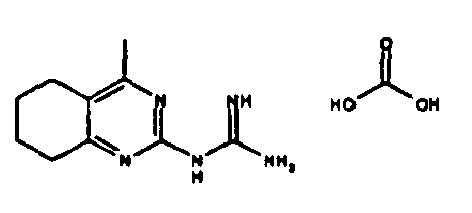


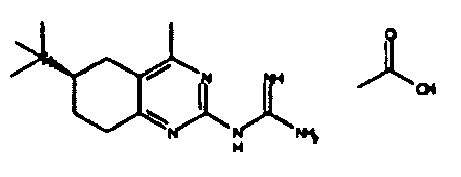


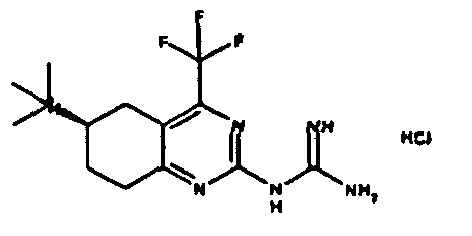


Claims (6)
- Guanidine derivatives of general formula
 R1 means methyl, ethyl, trifluoromethyl, methylamino, ethylamino, isopropylamino, cyclopropylamino, methoxy, ethoxy, trifluoromethoxy, methylsulphanyl or ethylsulphanyl;Q means a chain of 3-6 optionally substituted C atoms, one or more of which can be replaced by -N(R')-, -O- or -S(O)m, in the case of many such atoms or groups these being able to be identical or different, wherein Q, together with the pyrimidine ring, forms a quinazoline, cyclopentapyrimidine, cycloheptapyrimidine, pyridopyrimidine, pyranopyrimidine, thiopyranopyrimidine, pyrimidoazepine or cyclooctapyrimidine skeleton, which contains only the three double bonds of the pyrimidine component;R' means methyl, ethyl, propyl, hexyl, 2,2-dimethylpropionyl, cyclopropylmethyl, 2-cyclohexylethyl, propinyl, ethyloxycarbonylethyl, benzyl, n-butyloxycarbonyl, tert-butyloxycarbonyl, benzyloxycarbonyl, 3-methylbutyryl, pentanoyl, phenylacetyl, 2-propylpentanoyl, cyclopropanecarbonyl, isobutyryl, but-3-enoyl, 2-methoxyacetyl, propane-2-sulphonyl, butane-1-sulphonyl, methanesulphonyl, tert-butyloxycarbonylaminopropionyl or 4-dimethylaminobutyryl; R2 means methyl, ethyl, n-propyl, isopropyl, n-butyl, isobutyl, tert.-butyl, 1,1-dimethylpropyl or phenyl;R3-R7 mean hydrogen, methyl, ethyl, n-propyl, i-propyl, n-butyl or t-butyl; andm means 0, 1 or 2;pharmaceutically acceptable acid addition salts of basic compounds of formula II, pharmaceutically acceptable salts of acid group-containing compounds of formula II with bases, pharmaceutically acceptable esters of hydroxy or carboxy group-containing compounds of formula II as well as hydrates or solvates thereof.
 - Compounds according to claim 1, in which Q together with a pyrimidine ring forms a 6,7-dihydro-5H-cyclopentapyrimidine, 5,6,7,8-tetrahydro-quinazoline, 6,7,8,9-tetrahydro-5H-cycloheptapyrimidine, 5,6,7,8,9,10-hexahydrocyclooctapyrimidine, 6,7-dihydro-5H-pyrrolopyrimidine or 5,6,7,8-tetrahydropyridopyrimidine skeleton.
- Compounds according to claim 1, the guanidine derivatives of formula II being chosen from the following compounds:- N-(4-methyl-5,6,7,8-tetrahydro-quinazolin-2-yl)-guanidine;- N-(4-methyl-6,7-dihydro-5H-cyclopentapyrimidin-2-yl)-guanidine;- N-(4-methyl-6-phenyl-5,6,7,8-tetrahydro-quinazolin-2-yl)-guanidine;- N-(6-isopropyl-4-methyl-5,6,7,8-tetrahydro-quinazolin-2-yl)-guanidine;- N-(4-methyl-6-propyl-5,6,7,8-tetrahydro-quinazolin-2-yl)-guanidine;- N-(4,5-dimethyl-5,6,7,8-tetrahydro-quinazolin-2-yl)-guanidine;- N-(6-tert-butyl-4-methyl-5,6,7,8-tetrahydro-quinazolin-2-yl)-guanidine;- N-(4-methyl-8-phenyl-5,6,7,8-tetrahydro-quinazolin-2-yl)-guanidine;- N-[6-(1,1-dimethyl-propyl)-4-methyl-5,6,7,8-tetrahydro-quinazolin-2-yl]-guanidine;- N-(8-tert-butyl-4-methyl-5,5,7,8-tetrahydro-quinazolin-2-yl)-guanidine;- N-(4,6-dimethyl-5,6,7,8-tetrahydro-quinazolin-2-yl)-guanidine;- N-(4-methyl-6,7,8,9-tetrahydro-5H-cycloheptapyrimidin-2-yl)-guanidine;- N-(4-methyl-5,6,7,8,9,10-hexahydro-cyclooctapyrimidin-2-yl)-guanidine;- N-(4,8-dimethyl-5,6,7,8-tetrahydro-quinazolin-2-yl)-guanidine;- 2-guanidino-4-methyl-7,8-dihydro-5H-pyrido[4,3-d]pyrimidine-6-carboxylic acid tert-butyl ester;- N-(6-tert-butyl-4-trifluoromethyl-5,6,7,8-tetrahydro-quinazolin-2-yl)-guanidine;- N-(6-phenyl-4-trifluoromethyl-5,6,7,8-tetrahydro-quinazolin-2-yl)-guanidine; and- N-(6-isopropyl-4-trifluoromethyl-5,6,7,8-tetrahydro-quinazolin-2-yl)-guanidine.
- Compounds according to one of claims 1-3 for use as therapeutic active ingredients.
- A medicinal product containing a compound according to one of claims 1-3 and an inert carrier.
- Use of compounds according to one of claims 1-3 as neuropeptide FF receptor-antagonists for the preparation of a medicinal product for the treatment of pain and hyperalgesia, of withdrawal symptoms in the case of alcohol, psychotropics and nicotine dependence and for the prevention or elimination of these dependences, for the regulation of insulin secretion, food intake, memory functions, blood pressure, and of the electrolyte and energy balance and for the treatment of urinary incontinence.
Priority Applications (1)
| Application Number | Priority Date | Filing Date | Title |
|---|---|---|---|
| PL04761896T PL1663993T3 (en) | 2003-09-05 | 2004-09-03 | Guanidine derivatives |
Applications Claiming Priority (2)
| Application Number | Priority Date | Filing Date | Title |
|---|---|---|---|
| CH15262003 | 2003-09-05 | ||
| PCT/CH2004/000556 WO2005023781A1 (en) | 2003-09-05 | 2004-09-03 | Guanidine derivatives |
Publications (2)
| Publication Number | Publication Date |
|---|---|
| EP1663993A1 EP1663993A1 (en) | 2006-06-07 |
| EP1663993B1 true EP1663993B1 (en) | 2008-03-12 |
Family
ID=34230846
Family Applications (1)
| Application Number | Title | Priority Date | Filing Date |
|---|---|---|---|
| EP04761896A Expired - Lifetime EP1663993B1 (en) | 2003-09-05 | 2004-09-03 | Guanidine derivatives |
Country Status (16)
| Country | Link |
|---|---|
| US (1) | US7544691B2 (en) |
| EP (1) | EP1663993B1 (en) |
| JP (1) | JP2007504176A (en) |
| KR (1) | KR20060064065A (en) |
| CN (1) | CN1845907B (en) |
| AT (1) | ATE388943T1 (en) |
| AU (1) | AU2004270304A1 (en) |
| BR (1) | BRPI0414103A (en) |
| CA (1) | CA2536927A1 (en) |
| DE (1) | DE502004006515D1 (en) |
| ES (1) | ES2300807T3 (en) |
| IL (1) | IL173853A0 (en) |
| NO (1) | NO20061531L (en) |
| PL (1) | PL1663993T3 (en) |
| RU (1) | RU2006110738A (en) |
| WO (1) | WO2005023781A1 (en) |
Families Citing this family (8)
| Publication number | Priority date | Publication date | Assignee | Title |
|---|---|---|---|---|
| SE521512C2 (en) | 2001-06-25 | 2003-11-11 | Niconovum Ab | Device for administering a substance to the front of an individual's oral cavity |
| EP1578422B1 (en) | 2002-12-20 | 2007-04-11 | NicoNovum AB | A physically and chemically stable nicotine and micorcrystalline cellulose containing particulate material |
| US9402809B2 (en) | 2006-03-16 | 2016-08-02 | Niconovum Usa, Inc. | Snuff composition |
| KR101885503B1 (en) | 2009-12-24 | 2018-08-07 | 사우디 아람코 테크놀로지스 컴퍼니 | Methods for the synthesis of polycyclic guanidine compounds |
| WO2015002150A1 (en) | 2013-07-03 | 2015-01-08 | 株式会社新日本科学 | Novel compound, organic cation transporter 3 detection agent, and organic cation transporter 3 activity inhibitor |
| JP7153653B2 (en) | 2017-02-14 | 2022-10-14 | リサーチ トライアングル インスティテュート | Proline neuropeptide FF receptor modulator |
| CN108159031A (en) * | 2018-01-24 | 2018-06-15 | 昆明理工大学 | Application and drug and preparation method of the melbine in prevention and/or treatment Capillary zone electropheresis dependence producing drug is prepared |
| CN108159032A (en) * | 2018-01-24 | 2018-06-15 | 昆明理工大学 | Application and drug and preparation method of the melbine in prevention and/or treatment opium drug dependence producing drug is prepared |
Family Cites Families (6)
| Publication number | Priority date | Publication date | Assignee | Title |
|---|---|---|---|---|
| US3505327A (en) | 1967-08-07 | 1970-04-07 | American Cyanamid Co | Tetrahydroquinoxalinyl phosphates or thiophosphates |
| BE795257A (en) | 1972-02-10 | 1973-08-09 | Thomae Gmbh Dr K | NEW OXAZOLS |
| DE3334455A1 (en) * | 1983-03-04 | 1984-09-06 | Bayer Ag, 5090 Leverkusen | GUANIDIN DERIVATIVES |
| WO2003026657A1 (en) * | 2001-09-24 | 2003-04-03 | Synaptic Pharmaceutical Corporation | Compounds for the treatment of pain |
| US20030139431A1 (en) * | 2001-09-24 | 2003-07-24 | Kawakami Joel K. | Guanidines which are agonist/antagonist ligands for neuropeptide FF (NPFF) receptors |
| WO2003026667A1 (en) * | 2001-09-24 | 2003-04-03 | Synaptic Pharmaceutical Corporation | Quinazolino- and quinolino- guanidines as ligands for the neurop eptide ff (npff) receptors |
-
2004
- 2004-09-03 CA CA002536927A patent/CA2536927A1/en not_active Abandoned
- 2004-09-03 PL PL04761896T patent/PL1663993T3/en unknown
- 2004-09-03 DE DE502004006515T patent/DE502004006515D1/en not_active Expired - Lifetime
- 2004-09-03 BR BRPI0414103-2A patent/BRPI0414103A/en not_active IP Right Cessation
- 2004-09-03 AU AU2004270304A patent/AU2004270304A1/en not_active Abandoned
- 2004-09-03 ES ES04761896T patent/ES2300807T3/en not_active Expired - Lifetime
- 2004-09-03 WO PCT/CH2004/000556 patent/WO2005023781A1/en not_active Ceased
- 2004-09-03 CN CN2004800253298A patent/CN1845907B/en not_active Expired - Fee Related
- 2004-09-03 AT AT04761896T patent/ATE388943T1/en not_active IP Right Cessation
- 2004-09-03 US US10/570,517 patent/US7544691B2/en not_active Expired - Fee Related
- 2004-09-03 JP JP2006525025A patent/JP2007504176A/en active Pending
- 2004-09-03 RU RU2006110738/04A patent/RU2006110738A/en not_active Application Discontinuation
- 2004-09-03 KR KR1020067004345A patent/KR20060064065A/en not_active Withdrawn
- 2004-09-03 EP EP04761896A patent/EP1663993B1/en not_active Expired - Lifetime
-
2006
- 2006-02-21 IL IL173853A patent/IL173853A0/en unknown
- 2006-04-04 NO NO20061531A patent/NO20061531L/en not_active Application Discontinuation
Also Published As
| Publication number | Publication date |
|---|---|
| PL1663993T3 (en) | 2008-08-29 |
| JP2007504176A (en) | 2007-03-01 |
| BRPI0414103A (en) | 2006-10-31 |
| DE502004006515D1 (en) | 2008-04-24 |
| EP1663993A1 (en) | 2006-06-07 |
| ATE388943T1 (en) | 2008-03-15 |
| KR20060064065A (en) | 2006-06-12 |
| CA2536927A1 (en) | 2005-03-17 |
| US20070123510A1 (en) | 2007-05-31 |
| CN1845907B (en) | 2010-07-28 |
| NO20061531L (en) | 2006-04-04 |
| WO2005023781A1 (en) | 2005-03-17 |
| ES2300807T3 (en) | 2008-06-16 |
| AU2004270304A1 (en) | 2005-03-17 |
| CN1845907A (en) | 2006-10-11 |
| IL173853A0 (en) | 2006-07-05 |
| US7544691B2 (en) | 2009-06-09 |
| RU2006110738A (en) | 2007-12-10 |
Similar Documents
| Publication | Publication Date | Title |
|---|---|---|
| DE69933573T2 (en) | CHINAZOLINE DERIVATIVES AS MEDICAMENTS | |
| DE69208877T2 (en) | CHINUCLIDINE DERIVATIVES | |
| DE60006280T2 (en) | BETA 2 ADRENERGIC RECEPTOR AGONISTS | |
| DE69032020T2 (en) | N-substituted 4-pyrimidine amines and pyrimidine diamines, processes for their preparation and their use as medicaments | |
| DE60118704T2 (en) | Pyrimidine derivatives as selective inhibitors of COX-2 | |
| EP2331506B1 (en) | Novel benzamides, production thereof, and use thereof as medicaments | |
| DE602005003128T3 (en) | CHINAZOLINONE DERIVATIVES AS VANILLOID ANTAGONISTS | |
| EP0682027A1 (en) | Pyrrolopyrimidine derivatives with antiproliferative action | |
| EP0509398B1 (en) | Quinoxalines, process for their preparation and their use | |
| DE69909209T2 (en) | PYRIMIDINONE DERIVATIVES, PHARMACEUTICAL PREPARATIONS CONTAINING THESE COMPOUNDS, AND METHOD FOR THE PRODUCTION THEREOF | |
| KR102171120B1 (en) | Substituted 2-thioxo-imidazolidin-4-ones and spiro analogues thereof, active anti-cancer ingredient, pharmaceutical composition, medicinal preparation, method for treating prostate cancer | |
| JP2023554282A (en) | SUBSTITUTED PIPERIDINO COMPOUNDS AND RELATED TREATMENT METHODS | |
| DE69816290T2 (en) | CHINOLIN-4-CARBOXAMIDE DERIVATIVES AS NK-2 AND NK-3 RECEPTOR ANTAGONISTS | |
| DE3342164A1 (en) | ANTIPSYCHOTIC BENZOXAZINE, METHOD FOR THE PRODUCTION THEREOF AND PHARMACEUTICAL PREPARATIONS CONTAINING THEM | |
| DE69510553T2 (en) | ISOTHIOURINE DERIVATIVES AS A NO SYNTHASE HEMMER | |
| EP3272746A1 (en) | Salts of quinazoline derivative and method for preparing same | |
| DE60313769T2 (en) | 3- (PYRIDINYL-AMINO) -1H-INDOL-2-CARBOXYLIC COMPOUNDS AS INHIBITORS OF INTERLEUKIN-4 GENE EXPRESSION | |
| EP1529041B1 (en) | Novel prodrugs of 1-methyl-2-(4-amidinophenylaminomethyl)-benzimidazol-5-yl-carboxylic acid-(n-2-pyridil-n-2-hydroxycarbonylethyl)-amide, production and use thereof as medicaments | |
| DE60017446T2 (en) | Isoquinoline and quinazoline derivatives with combined 5-HT1A, 5-HT1B and 5-HT1D receptor affinity | |
| DE69612753T2 (en) | (R) -5-BROMO-N- (1-ETHYL-4-METHYLHEXAHYDRO-1H-1,4-DIAZEPIN-6-YL) -2-METHOXY-6-METHYLAMINO-3-PYRIDINE-CARBOXAMIDE, METHOD FOR THE PRODUCTION THEREOF AND THE CONTAINER THEREOF MEDICAL PREPARATION | |
| DE69232484T2 (en) | HYDROISOCHINOLINDERIVATE | |
| EP1204414B1 (en) | Use of morphinan derivates as medicines | |
| EP1663993A1 (en) | Guanidine derivatives | |
| DE4132631A1 (en) | IMIDAZOLYL-propenoic acid derivatives | |
| DE10048715A1 (en) | Use of amino acid for the treatment of pain |
Legal Events
| Date | Code | Title | Description |
|---|---|---|---|
| PUAI | Public reference made under article 153(3) epc to a published international application that has entered the european phase |
Free format text: ORIGINAL CODE: 0009012 |
|
| 17P | Request for examination filed |
Effective date: 20060405 |
|
| AK | Designated contracting states |
Kind code of ref document: A1 Designated state(s): AT BE BG CH CY CZ DE DK EE ES FI FR GB GR HU IE IT LI LU MC NL PL PT RO SE SI SK TR |
|
| AX | Request for extension of the european patent |
Extension state: HR LT LV |
|
| RIN1 | Information on inventor provided before grant (corrected) |
Inventor name: VALDENAIRE, OLIVIER Inventor name: FRETZ, HEINZ Inventor name: HILPERT, KURT Inventor name: BREU, VOLKER Inventor name: GILLER, THOMAS Inventor name: FECHER, ANJA |
|
| 17Q | First examination report despatched |
Effective date: 20060725 |
|
| RAX | Requested extension states of the european patent have changed |
Extension state: HR Payment date: 20060405 Extension state: LV Payment date: 20060405 Extension state: LT Payment date: 20060405 |
|
| RIN1 | Information on inventor provided before grant (corrected) |
Inventor name: FRETZ, HEINZ Inventor name: HILPERT, KURT Inventor name: GILLER, THOMAS Inventor name: FECHER, ANJA Inventor name: BREU, VOLKER Inventor name: VALDENAIRE, OLIVIER |
|
| 17Q | First examination report despatched |
Effective date: 20060725 |
|
| GRAP | Despatch of communication of intention to grant a patent |
Free format text: ORIGINAL CODE: EPIDOSNIGR1 |
|
| GRAS | Grant fee paid |
Free format text: ORIGINAL CODE: EPIDOSNIGR3 |
|
| GRAA | (expected) grant |
Free format text: ORIGINAL CODE: 0009210 |
|
| AK | Designated contracting states |
Kind code of ref document: B1 Designated state(s): AT BE BG CH CY CZ DE DK EE ES FI FR GB GR HU IE IT LI LU MC NL PL PT RO SE SI SK TR |
|
| AX | Request for extension of the european patent |
Extension state: HR LT LV |
|
| REG | Reference to a national code |
Ref country code: GB Ref legal event code: FG4D Free format text: NOT ENGLISH |
|
| REG | Reference to a national code |
Ref country code: CH Ref legal event code: EP |
|
| REG | Reference to a national code |
Ref country code: IE Ref legal event code: FG4D Free format text: LANGUAGE OF EP DOCUMENT: GERMAN |
|
| REF | Corresponds to: |
Ref document number: 502004006515 Country of ref document: DE Date of ref document: 20080424 Kind code of ref document: P |
|
| GBT | Gb: translation of ep patent filed (gb section 77(6)(a)/1977) |
Effective date: 20080413 |
|
| REG | Reference to a national code |
Ref country code: ES Ref legal event code: FG2A Ref document number: 2300807 Country of ref document: ES Kind code of ref document: T3 |
|
| REG | Reference to a national code |
Ref country code: GR Ref legal event code: EP Ref document number: 20080401298 Country of ref document: GR |
|
| PG25 | Lapsed in a contracting state [announced via postgrant information from national office to epo] |
Ref country code: FI Free format text: LAPSE BECAUSE OF FAILURE TO SUBMIT A TRANSLATION OF THE DESCRIPTION OR TO PAY THE FEE WITHIN THE PRESCRIBED TIME-LIMIT Effective date: 20080312 |
|
| LTIE | Lt: invalidation of european patent or patent extension |
Effective date: 20080312 |
|
| REG | Reference to a national code |
Ref country code: PL Ref legal event code: T3 |
|
| PG25 | Lapsed in a contracting state [announced via postgrant information from national office to epo] |
Ref country code: SI Free format text: LAPSE BECAUSE OF FAILURE TO SUBMIT A TRANSLATION OF THE DESCRIPTION OR TO PAY THE FEE WITHIN THE PRESCRIBED TIME-LIMIT Effective date: 20080312 |
|
| PGFP | Annual fee paid to national office [announced via postgrant information from national office to epo] |
Ref country code: TR Payment date: 20080513 Year of fee payment: 5 |
|
| ET | Fr: translation filed | ||
| PG25 | Lapsed in a contracting state [announced via postgrant information from national office to epo] |
Ref country code: SK Free format text: LAPSE BECAUSE OF FAILURE TO SUBMIT A TRANSLATION OF THE DESCRIPTION OR TO PAY THE FEE WITHIN THE PRESCRIBED TIME-LIMIT Effective date: 20080312 Ref country code: PT Free format text: LAPSE BECAUSE OF FAILURE TO SUBMIT A TRANSLATION OF THE DESCRIPTION OR TO PAY THE FEE WITHIN THE PRESCRIBED TIME-LIMIT Effective date: 20080818 Ref country code: CZ Free format text: LAPSE BECAUSE OF FAILURE TO SUBMIT A TRANSLATION OF THE DESCRIPTION OR TO PAY THE FEE WITHIN THE PRESCRIBED TIME-LIMIT Effective date: 20080312 Ref country code: SE Free format text: LAPSE BECAUSE OF FAILURE TO SUBMIT A TRANSLATION OF THE DESCRIPTION OR TO PAY THE FEE WITHIN THE PRESCRIBED TIME-LIMIT Effective date: 20080612 |
|
| PG25 | Lapsed in a contracting state [announced via postgrant information from national office to epo] |
Ref country code: RO Free format text: LAPSE BECAUSE OF FAILURE TO SUBMIT A TRANSLATION OF THE DESCRIPTION OR TO PAY THE FEE WITHIN THE PRESCRIBED TIME-LIMIT Effective date: 20080312 |
|
| PGFP | Annual fee paid to national office [announced via postgrant information from national office to epo] |
Ref country code: AT Payment date: 20080930 Year of fee payment: 5 Ref country code: IE Payment date: 20080821 Year of fee payment: 5 Ref country code: NL Payment date: 20080915 Year of fee payment: 5 Ref country code: PL Payment date: 20080902 Year of fee payment: 5 |
|
| PLBE | No opposition filed within time limit |
Free format text: ORIGINAL CODE: 0009261 |
|
| STAA | Information on the status of an ep patent application or granted ep patent |
Free format text: STATUS: NO OPPOSITION FILED WITHIN TIME LIMIT |
|
| PG25 | Lapsed in a contracting state [announced via postgrant information from national office to epo] |
Ref country code: DK Free format text: LAPSE BECAUSE OF FAILURE TO SUBMIT A TRANSLATION OF THE DESCRIPTION OR TO PAY THE FEE WITHIN THE PRESCRIBED TIME-LIMIT Effective date: 20080312 |
|
| 26N | No opposition filed |
Effective date: 20081215 |
|
| PGFP | Annual fee paid to national office [announced via postgrant information from national office to epo] |
Ref country code: BE Payment date: 20080929 Year of fee payment: 5 |
|
| PG25 | Lapsed in a contracting state [announced via postgrant information from national office to epo] |
Ref country code: EE Free format text: LAPSE BECAUSE OF FAILURE TO SUBMIT A TRANSLATION OF THE DESCRIPTION OR TO PAY THE FEE WITHIN THE PRESCRIBED TIME-LIMIT Effective date: 20080312 Ref country code: BG Free format text: LAPSE BECAUSE OF FAILURE TO SUBMIT A TRANSLATION OF THE DESCRIPTION OR TO PAY THE FEE WITHIN THE PRESCRIBED TIME-LIMIT Effective date: 20080612 Ref country code: MC Free format text: LAPSE BECAUSE OF NON-PAYMENT OF DUE FEES Effective date: 20080930 |
|
| PGFP | Annual fee paid to national office [announced via postgrant information from national office to epo] |
Ref country code: GR Payment date: 20080908 Year of fee payment: 5 |
|
| PG25 | Lapsed in a contracting state [announced via postgrant information from national office to epo] |
Ref country code: CY Free format text: LAPSE BECAUSE OF FAILURE TO SUBMIT A TRANSLATION OF THE DESCRIPTION OR TO PAY THE FEE WITHIN THE PRESCRIBED TIME-LIMIT Effective date: 20080312 |
|
| BERE | Be: lapsed |
Owner name: ACTELION PHARMACEUTICALS LTD. Effective date: 20090930 |
|
| REG | Reference to a national code |
Ref country code: NL Ref legal event code: V1 Effective date: 20100401 |
|
| PG25 | Lapsed in a contracting state [announced via postgrant information from national office to epo] |
Ref country code: AT Free format text: LAPSE BECAUSE OF NON-PAYMENT OF DUE FEES Effective date: 20090903 |
|
| PG25 | Lapsed in a contracting state [announced via postgrant information from national office to epo] |
Ref country code: HU Free format text: LAPSE BECAUSE OF FAILURE TO SUBMIT A TRANSLATION OF THE DESCRIPTION OR TO PAY THE FEE WITHIN THE PRESCRIBED TIME-LIMIT Effective date: 20080913 Ref country code: LU Free format text: LAPSE BECAUSE OF NON-PAYMENT OF DUE FEES Effective date: 20080903 Ref country code: NL Free format text: LAPSE BECAUSE OF NON-PAYMENT OF DUE FEES Effective date: 20100401 Ref country code: IE Free format text: LAPSE BECAUSE OF NON-PAYMENT OF DUE FEES Effective date: 20090903 |
|
| PG25 | Lapsed in a contracting state [announced via postgrant information from national office to epo] |
Ref country code: BE Free format text: LAPSE BECAUSE OF NON-PAYMENT OF DUE FEES Effective date: 20090930 |
|
| PG25 | Lapsed in a contracting state [announced via postgrant information from national office to epo] |
Ref country code: GR Free format text: LAPSE BECAUSE OF NON-PAYMENT OF DUE FEES Effective date: 20100406 |
|
| PGFP | Annual fee paid to national office [announced via postgrant information from national office to epo] |
Ref country code: CH Payment date: 20100923 Year of fee payment: 7 Ref country code: ES Payment date: 20100923 Year of fee payment: 7 |
|
| PGFP | Annual fee paid to national office [announced via postgrant information from national office to epo] |
Ref country code: FR Payment date: 20101005 Year of fee payment: 7 Ref country code: IT Payment date: 20100922 Year of fee payment: 7 |
|
| PGFP | Annual fee paid to national office [announced via postgrant information from national office to epo] |
Ref country code: GB Payment date: 20100921 Year of fee payment: 7 |
|
| PGFP | Annual fee paid to national office [announced via postgrant information from national office to epo] |
Ref country code: DE Payment date: 20100922 Year of fee payment: 7 |
|
| PG25 | Lapsed in a contracting state [announced via postgrant information from national office to epo] |
Ref country code: PL Free format text: LAPSE BECAUSE OF NON-PAYMENT OF DUE FEES Effective date: 20090903 |
|
| REG | Reference to a national code |
Ref country code: PL Ref legal event code: LAPE |
|
| REG | Reference to a national code |
Ref country code: CH Ref legal event code: PL |
|
| GBPC | Gb: european patent ceased through non-payment of renewal fee |
Effective date: 20110903 |
|
| PG25 | Lapsed in a contracting state [announced via postgrant information from national office to epo] |
Ref country code: IT Free format text: LAPSE BECAUSE OF NON-PAYMENT OF DUE FEES Effective date: 20110903 |
|
| REG | Reference to a national code |
Ref country code: FR Ref legal event code: ST Effective date: 20120531 |
|
| REG | Reference to a national code |
Ref country code: DE Ref legal event code: R119 Ref document number: 502004006515 Country of ref document: DE Effective date: 20120403 |
|
| PG25 | Lapsed in a contracting state [announced via postgrant information from national office to epo] |
Ref country code: LI Free format text: LAPSE BECAUSE OF NON-PAYMENT OF DUE FEES Effective date: 20110930 Ref country code: CH Free format text: LAPSE BECAUSE OF NON-PAYMENT OF DUE FEES Effective date: 20110930 Ref country code: DE Free format text: LAPSE BECAUSE OF NON-PAYMENT OF DUE FEES Effective date: 20120403 |
|
| PG25 | Lapsed in a contracting state [announced via postgrant information from national office to epo] |
Ref country code: FR Free format text: LAPSE BECAUSE OF NON-PAYMENT OF DUE FEES Effective date: 20110930 Ref country code: GB Free format text: LAPSE BECAUSE OF NON-PAYMENT OF DUE FEES Effective date: 20110903 |
|
| PG25 | Lapsed in a contracting state [announced via postgrant information from national office to epo] |
Ref country code: TR Free format text: LAPSE BECAUSE OF NON-PAYMENT OF DUE FEES Effective date: 20090903 |
|
| REG | Reference to a national code |
Ref country code: ES Ref legal event code: FD2A Effective date: 20130531 |
|
| PG25 | Lapsed in a contracting state [announced via postgrant information from national office to epo] |
Ref country code: ES Free format text: LAPSE BECAUSE OF NON-PAYMENT OF DUE FEES Effective date: 20110904 |