EP1663291B1 - Recombinant lubricin molecules and uses thereof - Google Patents
Recombinant lubricin molecules and uses thereof Download PDFInfo
- Publication number
- EP1663291B1 EP1663291B1 EP04781229A EP04781229A EP1663291B1 EP 1663291 B1 EP1663291 B1 EP 1663291B1 EP 04781229 A EP04781229 A EP 04781229A EP 04781229 A EP04781229 A EP 04781229A EP 1663291 B1 EP1663291 B1 EP 1663291B1
- Authority
- EP
- European Patent Office
- Prior art keywords
- protein
- seq
- lub
- prg4
- recombinant
- Prior art date
- Legal status (The legal status is an assumption and is not a legal conclusion. Google has not performed a legal analysis and makes no representation as to the accuracy of the status listed.)
- Expired - Lifetime
Links
Classifications
-
- A—HUMAN NECESSITIES
- A61—MEDICAL OR VETERINARY SCIENCE; HYGIENE
- A61K—PREPARATIONS FOR MEDICAL, DENTAL OR TOILETRY PURPOSES
- A61K38/00—Medicinal preparations containing peptides
- A61K38/16—Peptides having more than 20 amino acids; Gastrins; Somatostatins; Melanotropins; Derivatives thereof
- A61K38/17—Peptides having more than 20 amino acids; Gastrins; Somatostatins; Melanotropins; Derivatives thereof from animals; from humans
- A61K38/1703—Peptides having more than 20 amino acids; Gastrins; Somatostatins; Melanotropins; Derivatives thereof from animals; from humans from vertebrates
- A61K38/1709—Peptides having more than 20 amino acids; Gastrins; Somatostatins; Melanotropins; Derivatives thereof from animals; from humans from vertebrates from mammals
-
- C—CHEMISTRY; METALLURGY
- C07—ORGANIC CHEMISTRY
- C07K—PEPTIDES
- C07K14/00—Peptides having more than 20 amino acids; Gastrins; Somatostatins; Melanotropins; Derivatives thereof
- C07K14/435—Peptides having more than 20 amino acids; Gastrins; Somatostatins; Melanotropins; Derivatives thereof from animals; from humans
-
- A—HUMAN NECESSITIES
- A61—MEDICAL OR VETERINARY SCIENCE; HYGIENE
- A61K—PREPARATIONS FOR MEDICAL, DENTAL OR TOILETRY PURPOSES
- A61K38/00—Medicinal preparations containing peptides
- A61K38/16—Peptides having more than 20 amino acids; Gastrins; Somatostatins; Melanotropins; Derivatives thereof
- A61K38/17—Peptides having more than 20 amino acids; Gastrins; Somatostatins; Melanotropins; Derivatives thereof from animals; from humans
-
- A—HUMAN NECESSITIES
- A61—MEDICAL OR VETERINARY SCIENCE; HYGIENE
- A61K—PREPARATIONS FOR MEDICAL, DENTAL OR TOILETRY PURPOSES
- A61K38/00—Medicinal preparations containing peptides
- A61K38/16—Peptides having more than 20 amino acids; Gastrins; Somatostatins; Melanotropins; Derivatives thereof
- A61K38/17—Peptides having more than 20 amino acids; Gastrins; Somatostatins; Melanotropins; Derivatives thereof from animals; from humans
- A61K38/18—Growth factors; Growth regulators
-
- A—HUMAN NECESSITIES
- A61—MEDICAL OR VETERINARY SCIENCE; HYGIENE
- A61K—PREPARATIONS FOR MEDICAL, DENTAL OR TOILETRY PURPOSES
- A61K38/00—Medicinal preparations containing peptides
- A61K38/16—Peptides having more than 20 amino acids; Gastrins; Somatostatins; Melanotropins; Derivatives thereof
- A61K38/17—Peptides having more than 20 amino acids; Gastrins; Somatostatins; Melanotropins; Derivatives thereof from animals; from humans
- A61K38/19—Cytokines; Lymphokines; Interferons
-
- A—HUMAN NECESSITIES
- A61—MEDICAL OR VETERINARY SCIENCE; HYGIENE
- A61K—PREPARATIONS FOR MEDICAL, DENTAL OR TOILETRY PURPOSES
- A61K45/00—Medicinal preparations containing active ingredients not provided for in groups A61K31/00 - A61K41/00
- A61K45/06—Mixtures of active ingredients without chemical characterisation, e.g. antiphlogistics and cardiaca
-
- A—HUMAN NECESSITIES
- A61—MEDICAL OR VETERINARY SCIENCE; HYGIENE
- A61P—SPECIFIC THERAPEUTIC ACTIVITY OF CHEMICAL COMPOUNDS OR MEDICINAL PREPARATIONS
- A61P11/00—Drugs for disorders of the respiratory system
-
- A—HUMAN NECESSITIES
- A61—MEDICAL OR VETERINARY SCIENCE; HYGIENE
- A61P—SPECIFIC THERAPEUTIC ACTIVITY OF CHEMICAL COMPOUNDS OR MEDICINAL PREPARATIONS
- A61P19/00—Drugs for skeletal disorders
-
- A—HUMAN NECESSITIES
- A61—MEDICAL OR VETERINARY SCIENCE; HYGIENE
- A61P—SPECIFIC THERAPEUTIC ACTIVITY OF CHEMICAL COMPOUNDS OR MEDICINAL PREPARATIONS
- A61P19/00—Drugs for skeletal disorders
- A61P19/02—Drugs for skeletal disorders for joint disorders, e.g. arthritis, arthrosis
-
- A—HUMAN NECESSITIES
- A61—MEDICAL OR VETERINARY SCIENCE; HYGIENE
- A61P—SPECIFIC THERAPEUTIC ACTIVITY OF CHEMICAL COMPOUNDS OR MEDICINAL PREPARATIONS
- A61P19/00—Drugs for skeletal disorders
- A61P19/04—Drugs for skeletal disorders for non-specific disorders of the connective tissue
-
- A—HUMAN NECESSITIES
- A61—MEDICAL OR VETERINARY SCIENCE; HYGIENE
- A61P—SPECIFIC THERAPEUTIC ACTIVITY OF CHEMICAL COMPOUNDS OR MEDICINAL PREPARATIONS
- A61P21/00—Drugs for disorders of the muscular or neuromuscular system
-
- A—HUMAN NECESSITIES
- A61—MEDICAL OR VETERINARY SCIENCE; HYGIENE
- A61P—SPECIFIC THERAPEUTIC ACTIVITY OF CHEMICAL COMPOUNDS OR MEDICINAL PREPARATIONS
- A61P25/00—Drugs for disorders of the nervous system
- A61P25/04—Centrally acting analgesics, e.g. opioids
-
- A—HUMAN NECESSITIES
- A61—MEDICAL OR VETERINARY SCIENCE; HYGIENE
- A61P—SPECIFIC THERAPEUTIC ACTIVITY OF CHEMICAL COMPOUNDS OR MEDICINAL PREPARATIONS
- A61P29/00—Non-central analgesic, antipyretic or antiinflammatory agents, e.g. antirheumatic agents; Non-steroidal antiinflammatory drugs [NSAID]
-
- A—HUMAN NECESSITIES
- A61—MEDICAL OR VETERINARY SCIENCE; HYGIENE
- A61P—SPECIFIC THERAPEUTIC ACTIVITY OF CHEMICAL COMPOUNDS OR MEDICINAL PREPARATIONS
- A61P35/00—Antineoplastic agents
-
- A—HUMAN NECESSITIES
- A61—MEDICAL OR VETERINARY SCIENCE; HYGIENE
- A61P—SPECIFIC THERAPEUTIC ACTIVITY OF CHEMICAL COMPOUNDS OR MEDICINAL PREPARATIONS
- A61P43/00—Drugs for specific purposes, not provided for in groups A61P1/00-A61P41/00
-
- A—HUMAN NECESSITIES
- A61—MEDICAL OR VETERINARY SCIENCE; HYGIENE
- A61P—SPECIFIC THERAPEUTIC ACTIVITY OF CHEMICAL COMPOUNDS OR MEDICINAL PREPARATIONS
- A61P9/00—Drugs for disorders of the cardiovascular system
-
- C—CHEMISTRY; METALLURGY
- C07—ORGANIC CHEMISTRY
- C07K—PEPTIDES
- C07K14/00—Peptides having more than 20 amino acids; Gastrins; Somatostatins; Melanotropins; Derivatives thereof
- C07K14/435—Peptides having more than 20 amino acids; Gastrins; Somatostatins; Melanotropins; Derivatives thereof from animals; from humans
- C07K14/46—Peptides having more than 20 amino acids; Gastrins; Somatostatins; Melanotropins; Derivatives thereof from animals; from humans from vertebrates
- C07K14/47—Peptides having more than 20 amino acids; Gastrins; Somatostatins; Melanotropins; Derivatives thereof from animals; from humans from vertebrates from mammals
-
- C—CHEMISTRY; METALLURGY
- C07—ORGANIC CHEMISTRY
- C07K—PEPTIDES
- C07K14/00—Peptides having more than 20 amino acids; Gastrins; Somatostatins; Melanotropins; Derivatives thereof
- C07K14/435—Peptides having more than 20 amino acids; Gastrins; Somatostatins; Melanotropins; Derivatives thereof from animals; from humans
- C07K14/475—Growth factors; Growth regulators
-
- C—CHEMISTRY; METALLURGY
- C07—ORGANIC CHEMISTRY
- C07K—PEPTIDES
- C07K16/00—Immunoglobulins [IG], e.g. monoclonal or polyclonal antibodies
- C07K16/18—Immunoglobulins [IG], e.g. monoclonal or polyclonal antibodies against material from animals or humans
-
- A—HUMAN NECESSITIES
- A61—MEDICAL OR VETERINARY SCIENCE; HYGIENE
- A61K—PREPARATIONS FOR MEDICAL, DENTAL OR TOILETRY PURPOSES
- A61K38/00—Medicinal preparations containing peptides
Definitions
- the invention relates to novel recombinant lubricin molecules and their uses as lubricants, anti-adhesive agents and/or intra-articular supplements for, e.g., synovial joints, meniscus, tendon, peritoneum, pericardium and pleura.
- OA osteoarthritis
- RA rheumatoid arthritis
- a lubricated surface also contributes to optimal functionality.
- normal tendon function requires the prevention of cellular adhesion to tendon surfaces.
- tendon adhesions is the most common complication.
- Native lubricin protein is related to megakaryocyte stimulating factor (MSF) precursor protein.
- MSF megakaryocyte stimulating factor
- PRG4 proteoglycan 4
- MSF precursor protein is described in US6433142 and US20020137894
- Polypeptide encoded by exon 6 of the PRG4 gene is heavily glycosylated and appears necessary for a PRG4-related protein to serve as a lubricant, e.g., between surfaces of articular cartilage.
- PRG4 glycoprotein is also synthesized by the intimal synoviocytes that line tendon sheaths; it is highly likely that the glycoprotein also originates from tenocytes (Rees et al., 2002).
- the glycoprotein is prominently present in fibrocartilaginous regions of tendon.
- the glycoprotein may play an important cytoprotective role for tendons by preventing cellular adhesion to tendon surfaces, as well as by providing lubrication during normal tendon function.
- Exon 6 of the PRG4 also called “lubricin” gene encodes approximately 76-78 repeats of KEPAPTT-similar sequences and 6 repeats of XXTTTX-like sequences. Varying the number of comparable repeat sequences in recombinant lubricin proteins according to the present invention allows for development of improved biotherapeutics for enhancing lubrication in joints and for countering undesired adhesion between tissues.
- the present invention relates to novel recombinant lubricin molecules and their use as lubricants, anti-adhesive agents and/or intra-articular supplements.
- lubricin expression constructs were designed which enabled the synthesis of recombinant lubricin proteins with varying degrees of O-linked oligosaccharide substitution. This is accomplished by incorporating variable numbers of the KEPAPTT-like sequences into a "core" cDNA construct comprised of exons 1 through 5, 5'- and 3'-flanking regions of exon 6, and exons 7 through 12. Iterative insertion of "synthetic cDNA cassettes" encoding multiple KEPAPTT-like sequences facilitates the generation of recombinant lubricin constructs of different sizes. The initial focus of these studies was on construct PRG4-Lub:1 (containing DNA of "synthetic cDNA cassette-1" (SEQ ID NO: 1), which encodes four KEPAPTT sequences).
- each isoform differs in the composition of PRG4 gene exons that encode the isoform's primary structure.
- exons 1 through 12 of the PRG4 gene encode the V0 isoform, which represents the full-length isoform
- exons 1 through 4 and 6 through 12 encode the V1 isoform, which lacks only a segment encoded by exon 5.
- Exons 1 through 3 and 6 through 12 encode the V2 isoform, which lacks segments encoded by exons 4 and 5. Finally, exons 1, 3, and 6 through 12 encode the V3 isoform, which lacks segments encoded by exons 2, 4, and 5. Other isoforms likely exist, and some related mutant proteins have been described (see US20020086824 ).
- the present invention provides recombinant lubricin protein comprising repetitive KEPAPTT-like sequences.
- the invention provides isolated protein comprising SEQ ID NOS : 7, 11, 15,19 or 23.
- the invention provides isolated polynucleotide comprising nucleic acid sequence encoding recombinant lubricin protein.
- the invention provides isolated polynucleotide comprising nucleic acid sequence encoding the protein.
- the invention provides isolated polynucleotide having at least 80%, 85%, 90% 95%, 97%, 98% or 99% identity to SEQ ID NOS: 6,10,14,18 or 22 over the entire length of the sequence.
- the invention also provides in related embodiments a composition comprising a therapeutically effective amount of a recombinant lubricin protein in a pharmaceutically acceptable carrier.
- the composition additionally comprises hyaluronan or hylan.
- Also described herein is a method of treating a subject comprising: obtaining a recombinant lubricin protein composition; and administering said composition to a tissue of the subject.
- the tissue is selected from the group consisting of cartilage, synovium, meniscus, tendon, peritoneum, pericardium, and pleura.
- the method additionally comprises a step selected from the group consisting of: providing an anesthetic to the subject; providing an anti-inflammatory drug to the subject; providing an antibiotic to the subject; aspirating fluid from the subject; washing tissue of the subject; and imaging tissue of the subject.
- the subject is selected from the group consisting of a mouse, a rat, a cat, a dog, a horse, and a human.
- the invention also provides an expression vector comprising a polynucleotide encoding a recombinant lubricin protein wherein the polynucleotide is operably linked to an expression control sequence.
- the invention provides a method of producing recombinant lubricin protein comprising: growing cells transformed with the expression vector in liquid culture media; and collecting recombinant lubricin protein from the media.
- the collecting protein step may further comprise: concentrating the protein by filtering the media through a membrane; collecting the retained protein from the membrane; and solubilizing the collected protein in a buffered salt solution containing L-arginine hydrochloride ranging in concentration from 0.1 to 2.0 M.
- the present invention also encompasses polynucleotides that are homologous to the specific embodiments outlined herein, e.g., having at least 80%, 85%, 95%, 97%, 98% or 99% sequence identity to the specified DNA sequences.
- the invention further describes polynucleotides having nucleic acid sequence capable of hybridizing over the length of a functional domain to the complement of the specified DNA sequences under high stringency conditions.
- the invention also includes proteins encoded by these homologous or hybridizing polynucleotides.
- repetitive KEPAPTT-like sequence means an amino acid sequence having at least 90%, 93%, 95%, 96%, 97%, 98%, 99% or higher identity to: (a) sequence "APTTPKEPAPTTTKSAPTTPKEPAPTTTKEPAPTTPKEPAPTTTK” (SBEQ ID NO: 26; 45 amino acids) and having at least one O-linked substitution, (b) sequence "KEPAPTTTKEPAPTTTKSAPTTPKEPAPTTP” (SEQ ID NO: 27; 31 amino acids) and having at least one O-linked substitution; or (c) sequence "EPAPTTTKSAPTTPKEPAPTTP” (SEQ ID NO: 28; 22 amino acids) and having at least one O-linked substitution.
- a repetitive KEPAPTT-like sequence may preferably have two, three, four or more O-linked substitutions.
- An O-linked substitution of recombinant lubricin may be a substitution with the lubricating oligosaccharide ⁇ -(1-3)-Gal-GalNac, or with other moieties, including artificial or naturally-occurring carbohydrate moieties (such as keratan sulfate or chondroitin sulfate).
- the O-linked substitution may be with moieties that contribute to a capacity of recombinant lubricin to act as a carrier of surface active phospholipid (SAPL) or surfactants (Hills, 2002). Percent glycosylation or substitution is determined by weight (dry weight).
- High stringency conditions when used in reference to DNA:DNA hybridization, comprise conditions equivalent to binding or hybridization at 42°C in a solution consisting of 5X SSPE (43.8 g/l NaCl, 6.9 g/l NaH 2 PO 4 ⁇ H 2 O and 1.85 g/l EDTA, pH adjusted to 7.4 with NaOH), 0.5% SDS, 5X Denhardt's reagent and 100 ⁇ g/ml denatured salmon sperm DNA followed by washing in a solution comprising 0.1X SSPE, 1.0% SDS at 42°C when a probe of about 500 nucleotides in length is employed.
- 5X SSPE 43.8 g/l NaCl, 6.9 g/l NaH 2 PO 4 ⁇ H 2 O and 1.85 g/l EDTA, pH adjusted to 7.4 with NaOH
- SDS 5X Denhardt's reagent
- 100 ⁇ g/ml denatured salmon sperm DNA followed by washing in a solution comprising 0.1X SS
- Polypeptides or other compounds described herein are said to be “isolated” when they are within preparations that are at least 50% by weight (dry weight) the compound of interest. Polypeptides or other compounds described herein are said to be “substantially pure” when they are within preparations that are at least 80% by weight (dry weight) the compound of interest. Polypeptides or other compounds described herein are said to be “homogeneous” when they are within preparations that are at least 95%, and preferably 99%, by weight (dry weight) the compound of interest. Purity is measured by reducing polyacrylamide gel electrophoresis and enhanced coomassie blue staining, followed by optical density traces of bands (i.e., with protein purity being measured through optical densitometry).
- Phen-free means free of fever causing contaminants, including endotoxin. Measurement of contaminants is to be performed by the applicable standard tests set by the U.S. Food and Drug Administration.
- the term "therapeutically effective amount” means the total amount of each active component of the relevant pharmaceutical composition or method that is sufficient to show a meaningful patient benefit, i.e., treatment, healing, prevention or amelioration of the relevant medical condition, or an increase in rate of treatment, healing, prevention or amelioration of such conditions.
- a meaningful patient benefit i.e., treatment, healing, prevention or amelioration of the relevant medical condition, or an increase in rate of treatment, healing, prevention or amelioration of such conditions.
- the term refers to that ingredient alone.
- the term refers to combined amounts of the active ingredients that result in the therapeutic effect, whether administered in combination, serially or simultaneously.
- Embodiments of the present invention may be used as intra-articular supplements.
- Intra-articular supplementation with compounds not derived from lubricin has been practiced as a joint therapy.
- "viscosupplementation” with polymeric hyaluronan (HA) and higher molecular weight hylans is used clinically to treat OA-associated knee pain.
- This viscosupplementation has shown significant therapeutic value, particularly in reducing weight-bearing pain in patients (Wobig et al., 1998).
- Hylan G-F 20 is generated by cross-linking several HA molecules obtained from rooster or chicken combs. Viscosupplementation with Hylan G-F 20 can be significantly more efficacious for alleviating pain than viscosupplementation with lower molecular weight HA (Wobig et al., 1999). In addition, relieving pain by viscosupplementation with Hylan G-F 20 may be particularly preferable to administration of NSAIDs for those patients who do not tolerate NSAIDs (e.g., in patients with a high risk of gastrointestinal complications; Espallargues and Pons, 2003).
- Hylan G-F 20 viscosupplementation is a safe and well-tolerated therapy that provides a short-term (i.e., until 3-6 months posttreatment) decrease in pain symptoms while improving joint function, the therapy may not significantly forestall the eventual need for knee replacement in OA patients (Espallargues and Pons, 2003).
- the base DNA construct for the generation of recombinant lubricin molecules is composed of the Met codon (ATG) through the BssHII restriction site ( G ⁇ CGCGC ) of SEQ ID NO: 6 (i.e., base nos. 1 through 1123) and the BspEI restriction site ( T ⁇ CCGGA ) through the stop codon (TAA) of SEQ ID NO: 6 (i.e., base nos. 1269 through 2946).
- ATG Met codon
- G ⁇ CGCGC BssHII restriction site
- T ⁇ CCGGA BspEI restriction site
- TAA stop codon
- SEQ ID NO: 1 DNA sequence of synthetic cDNA cassette-1 (SEQ ID NO: 1) is added BssHII / BspEI to the base construct to make the recombinant PRG4-Lub:1 cDNA construct (SEQ ID NO: 6).
- SEQ ID NO: 6 is composed of the Lub:1 DNA insert (SEQ ID NO: 8; which encodes the 51 amino acids of SEQ ID NO: 9 with its four KEPAPTT sequences) between DNA encoding amino acids M1 through S373 and DNA encoding E848 through P1404 of native PRG4.
- the recombinant lubricin PRG4-LUB:1 includes 51 amino acids that form four perfect KEPAPTT sequences and approximately three imperfect KEPAPTT sequences.
- DNA sequence of synthetic cDNA cassette-2 (SEQ ID NO: 3) is added Bsu36I / BspEI to the PRG4-Lub:1 construct to make the PRG4-Lub:2 cDNA construct (SEQ ID NO: 10).
- the PRG4-Lub:1 cDNA construct has one Bsu36I restriction site ( CC ⁇ TNAGG , i.e., CC ⁇ TAAGG ; base nos. 1225 through 1231 of SEQ ID NO: 6).
- the cDNA cassettes are synthesized as single stranded oligonucleotides and hybridized together to produce a double stranded DNA fragment with sticky ends. This is why the terminal BssHII, Bsu36I, and BspEI sites appear incomplete.
- synthetic cDNA cassette-1 SEQ ID NO: 1
- a sequence bounded by remnant flanking BssHII ( G ⁇ CGCGC ) and BspEI ( T ⁇ CCGGA ) restriction sites includes an internal Bsu36I restriction site ( CC ⁇ TNAGG , i:e., CC ⁇ TAAGG) ; the restriction sites are underlined below:
- SEQ ID NO: 2 which is a translation of SEQ ID NO: 1, includes four KEPAPTT sequences that are perfect matches (highlighted below):
- Synthetic cDNA cassette-2 (SEQ ID NO: 3) similarly has a remnant 5'-terminal Bsu36I restriction site (i.e., CC ⁇ TNAGG , evidenced only by the TAA sequence), a 3'-terminal remnant BspEI restriction site ( T ⁇ CCGGA ), and an internal Bsu36I restriction site ( CC ⁇ TNAGG ); the restriction sites are underlined below:
- SEQ ID NO: 4 which is a translation of SEQ ID NO: 3, includes three KEPAPTT sequences that are perfect matches (highlighted below):
- the recombinant PRG4-Lub:1 cDNA construct (SEQ ID NO: 6) in pTmed2 vector (construct plus vector equals SEQ ID NO: 5) is flanked by SalI ( G ⁇ TCGAC ; base nos. 1027 through 1032 of SEQ ID NO: 5) and NotI ( GC ⁇ GGCCGC ; base nos. 3984 through 3991 of SEQ ID NO: 5) restriction sites.
- the SalI site incorporates a modified Kozak translation initiation sequence ( CCCACC ; base nos. 1032 through 1037 of SEQ ID NO: 5) before the translation start codon ATG (base nos. 1038 through 1040 of SEQ ID NO: 5).
- BssHII G ⁇ CGCGC ; base nos.
- the PRG4-Lub:1 cDNA construct (SEQ ID NO: 6) is translated into the PRG4-LUB:1 protein (SEQ ID NO: 7).
- the insert between S373 and E425 (i.e., E848 of native PRG4) of the entire PRG4-LUB:1 protein (SEQ ID NO: 7) is the 51 amino acids of SEQ ID NO: 9.
- These are translated from the Lub:1 DNA insert (SEQ ID NO: 8) and include four perfect KEPAPTT sequences.
- BssHII restriction site G ⁇ CGCGC ; base nos. 1118 through 1123 of SEQ ID NO: 6
- T ⁇ CCGGA base nos.
- the recombinant PRG4-Lub:2 cDNA construct (SEQ ID NO: 10) in pTmed2 vector is flanked by SalI ( G ⁇ TCGAC ) and NotI ( GC ⁇ GGCCGC ) restriction sites; the SalI site incorporates a modified Kozak translation initiation sequence ( CCCACC ) before the translation start codon ATG (base nos. 1 through 3 of SEQ ID NO: 10).
- the recombinant PRG4-Lub:3 cDNA construct (SEQ ID NO: 14), the recombinant PRG4-Lub:4 cDNA construct (SEQ ID NO: 18), and the recombinant PRG4-Lub:5 cDNA construct (SEQ ID NO: 22) in pTmed2 vector are each flanked by SalI ( G ⁇ TCGAC ) and NotI ( GC ⁇ GGCCGC ) restriction sites; the SalI site incorporates a modified Kozak translation initiation sequence ( CCCACC ) before the translation start codon ATG (base nos. 1 through 3 of SEQ ID NOS: 14, 18, and 22, respectively).
- the internal Bsu36I cloning site (CC ⁇ TNAGG , i.e., CC ⁇ TAAGG ; base nos. 1318 through 1324 of SEQ ID NO: 10) is found between the BssHII ( G ⁇ CGCGC ; base nos. 1118 through 1123) and BspEI ( T ⁇ CCGGA ; base nos. 1347 through 1352) restriction sites.
- the PRG4-Lub:2 construct (SEQ ID NO: 10) is translated into the PRG4-LUB:2 protein (SEQ ID NO: 11).
- the insert between S373 and E451 (i.e., E848 of native PRG4) of the entire PRG4-LUB:2 protein (SEQ ID NO: 11) is the 77 amino acids of SEQ ID NO: 13. These are translated from the Lub:2 DNA insert (SEQ ID NO:12).
- the 77 amino acids of the recombinant lubricin PRG4-LUB:2 form six perfect KEPAPTT sequences and approximately four imperfect KEPAPTT sequences.
- the internal Bsu36I cloning site (CC ⁇ TNAGG , i.e., CC ⁇ TAAGG ; base nos. 1411 through 1417 of SEQ ID NO: 14) is found between BssHII ( G ⁇ CGCGC ; base nos. 1118 through 1123) and BspEI (T ⁇ CCGGA; base nos. 1440 through 1445) restriction sites.
- the PRG4-Lub:3 construct (SEQ ID NO: 14) is translated into the PRG4-LUB:3 protein (SEQ ID NO: 15).
- the insert between S373 and E482 (i.e., E848 of native PRG4) of the entire PRG4-LUB:3 protein (SEQ ID NO: 15) is the 108 amino acids of SEQ ID NO: 17. These are translated from the Lub:3 DNA insert (SEQ ID NO:16). In place of A374 through P847 (474 amino acids) of native PRG4, the 108 amino acids of the recombinant lubricin PRG4-LUB:3 form nine perfect KEPAPTT sequences and approximately five imperfect KEPAPTT sequences.
- the internal Bsu36I cloning site (CC ⁇ TNAGG , i.e., CC ⁇ TAAGG ; base nos. 1504 through 1510 of SEQ ID NO: 18) is found between BssHII ( G ⁇ CGCGC ; base nos. 1118 through 1123) and BspEI ( T ⁇ CCGGA ; base nos. 1533 through 1538) restriction sites.
- the PRG4-Lub:4 construct (SEQ ID NO: 18) is translated into the PRG4-LUB:4 protein (SEQ ID NO: 19).
- the insert between S373 and E513 (i.e., E848 of native PRG4) of the entire PRG4-LUB:4 protein (SEQ ID NO: 19) is the 139 amino acids of SEQ ID NO: 21. These are translated from the Lub:4 DNA insert (SEQ ID NO:20). In place of A374 through P847 (474 amino acids) of native PRG4, the 139 amino acids of the recombinant lubricin PRG4-LUB:4 form twelve perfect KEPAPTT sequences and approximately six imperfect KEPAPTT sequences.
- the internal Bsu36I cloning site (CC ⁇ TNAGG , i.e., CC ⁇ TAAGG ; base nos. 1597 through 1603 of SEQ ID NO: 22) is found between BssHII ( G ⁇ CGCGC; base nos. 1118 through 1123) and BspEI ( T ⁇ CCGGA ; base nos. 1626 through 1631) restriction sites.
- the PRG4-Lub:5 construct (SEQ ID NO: 22) is translated into the PRG4-LUB:5 protein (SEQ ID NO: 23).
- the insert between S373 and E544 (i.e., E848 of native PRG4) of the entire PRG4-LUB:5 protein (SEQ ID NO: 23) is the 170 amino acids of SEQ ID NO: 25. These are translated from the Lub:5 DNA insert (SEQ ID NO:24). In place of A374 through P847 (474 amino acids) of native PRG4, the 170 amino acids of the recombinant lubricin PRG4-LUB:5 form fifteen perfect KEPAPTT sequences and approximately seven imperfect KEPAPTT sequences.
- the process of inserting the synthetic cDNA cassette-2 can be iterated indefinitely. Each iteration results in the addition of three perfect KEPAPTT sequences.
- recombinant lubricins PRG4-LUB:2 through PRG4-LUB:5 are constructed in this way through the use of insert sequences
- recombinant lubricins PRG4-LUB:6 through PRG4-LUB:N are constructed.
- Table 2 provides a summary of BssHII / BspE1 insert sequences.
- the base DNA construct may also be employed, depending on the various activities and length desired. Additionally, different restrictions enzymes may be employed in an analogous strategy, providing that their location is conveniently located within nucleic acid sequence encoding PRG4 protein.
- the base DNA construct lacks native exon 6 sequence, but includes one or more of exon 1 through exon 5 sequences or of exon 7 through exon 12 sequences of the native PRG4 gene.
- the base DNA construct is identical to a recombinant MSF sequences described in US6433142 or US20020137894 except that part or all of the sequences of exon 6 are absent.
- the invention provides cDNA constructs encoding recombinant lubricins that are cloned into SAlI ( G ⁇ TCGAC ; base nos. 1027 through 1032 of SEQ ID NO: 5) and NotI ( GC ⁇ GGCCGC ; base nos. 3984 through 3991 of SEQ ID NO: 5) restriction sites in the eucaryotic expression vector pTmed2 as a preferred embodiment (e.g., recombinant PRG4-Lub:1 cDNA construct in pTmed2 expression vector is located in SEQ ID NO: 5 at base nos. 1038 though 3983).
- the SalI site incorporates the first base of a modified Kozak translation initiation sequence ( C CACC; base no. 1032 of SEQ ID NO: 5) before the methionine start codon (ATG; base nos. 1038 through 1040 of SEQ ID NO: 5).
- Other embodiments of the invention include other restriction site combinations and other expression vectors.
- the interative process makes use of the synthetic cDNA cassette-1 (SEQ ID NO: 1) in expression vector pTmed2, which is flanked by the restriction sites for BssHII ( G ⁇ CGCGC ) and BspEI ( T ⁇ CCGGA ), and the synthetic cDNA cassette-1, which includes an internal Bsu36I restriction site (CC ⁇ TNAGG, i.e., CC ⁇ TAAGG ; base nos. 107 to 113 of SEQ ID NO: 1).
- synthetic cDNA cassette-2 (SEQ ID NO: 3) is inserted between the Bsu36I and BspEI sites of the recombinant construct.
- Synthetic cDNA cassette-2 (SEQ ID NO: 3) is flanked by a modified remnant Bsu36I site ( TAA AG) and a remnant BspEI (AC TCCGG ) site. It also includes an internal Bsu36I site ( CC ⁇ TNAGG , i.e., CC ⁇ TAAGG ; base nos. 92 through 98 of SEQ ID NO: 3).
- amino acid sequence "KEPAPTT T KEPAPTT TKSAPTTP KEPAPTT P" (SEQ ID NO: 27; 31 amino acids) is encoded by the DNA insert that becomes part of each PRG4-Lub:N+1 cDNA constructs through the addition of synthetic cDNA cassette-2 Bsu36I / BspEI to a PRG4-Lub:N cDNA construct.
- PRG4-LUB:N protein where N is an integer greater than or equal to 3
- amino acid sequence "EPAPTT TKSAPTTP KEPAPTT P" joins SEQ ID NO: 26 to (N minus 2) repeats of SEQ ID, NO: 27 in preferred embodiments.
- amino acid sequence "KEPKPAPTTP" (SEQ ID NO; 29; 10 amino acids) immediately shows the last insert repeat of SEQ ID NO: 27 in preferred embodiments of the PRG4-LUB:N protein where N is an integer greater than or equal to 2.
- SEQ ID NO: 26 SEQ ID NO: 27, and (SEQ ID NO: 28 are each designated herein to be a "repetitive KEPAPTT-like sequence" (the N-terminus of SEQ ID 28 links to a K residue so that SEQ ID NO: 28 forms two KEPAPTT sequences in PRG4-LUB:N proteins).
- the PRG4-LUB:N protein comprise SEQ ID NO: 26 in a preferred embodiment.
- the PRG4-LUB:N protein also comprises SEQ ID NO: 27 in a preferred embodiment.
- SEQ ID NO: 27 is repeated (N minus 1) times within each PRG4-LUB:N protein in these preferred embodiments.
- SEQ ID NO: 26 and SEQ ID NO: 27 overlap (i.e., they share a KEPAPTT sequence).
- recombinant lubricin protein comprises the 22 amino acids of SEQ ID NO: 28 joining the N-terminal-oriented 45 amino acids of SEQ ID NO: 26 to (N minus 2) repeat(s) of the 31 amino acids of SEQ ID NO: 27, where the 10 amino acids of SEQ ID NO: 29 are C-terminal to the last 31-amino-acid repeat of SEQ ID NO: 27.
- PRG4-LUB:N proteins in general have (3 times N) repeats of the KEPAPTT sequence in preferred embodiments where N equals the number of repetitive KEPAPTT-like sequences.
- PRG4-Lub:1 cDNA construct (SEQ ID NO: 6; containing synthetic cDNA cassette-1 sequence) was expressed in a stably transfected, preadaptive CHO DUKX cell line, purified from conditioned media, and solubilized in PBS containing 500 mM L-arginine hydrochloride as follows.
- the PRG4-Lub:1 cDNA construct was expressed in a stably transfected CHO DUKX cell line and the conditioned media was collected. A two liter volume of this conditioned media was filter concentrated under compressed nitrogen gas (40 psi) using an AMICON® M2000 TM filtration unit fitted with either a 10 kDa nominal molecular weight limit (NMWL), a 30 kDa NMWL or a 100 kDa NMWL PALL FILTRON® OMEGA TM disc membrane. Media was concentrated to approximately a 100 ml volume, which was aspirated from the disc membrane. The disc membrane was then removed from the AMICON® M2000 TM filtration unit.
- PBS phosphate buffered saline
- the L-arginine hydrochloride concentration may range from 100 mM to 2.0 M.
- PRG4-LUB:2 through PRG4-LUB:5 glycoproteins are harvested directly from disc membranes, i.e., without purification of the concentrate remaining above disc membranes. That is, these recombinant lubricin glycoproteins are isolated directly from disc membranes of 10 kDa NMWL, 30 kDa NMWL, or 100 kDa NMWL PALL FILTRON® OMEGA TM filtration units.
- these glycoproteins may also be purified from the concentrate remaining above disc membranes through chromatographic techniques or electrophoretic techniques or both.
- Recombinant lubricin proteins and glycoproteins may also be purified using chromatography and other techniques known in the art (as, for example, described in US6433142 for MSF proteins; see also: Deutscher, 1990; and Scopes, 1994).
- the cell source of lubricin in normal and osteoarthritic joints was further investigated using immunohistochemical techniques.
- the presence of lubricin on other tissue surfaces, including pleura, pericardium, peritoneum, and meninges, was examined according to the following methods.
- Osteoarthritic cartilage and synovium were obtained by informed consent from patients undergoing knee replacement surgery.
- Other tissues examined were normal human synovium and normal non-human primate (NHP) synovium, cartilage, pleura, pericardium, peritoneum, meninges, brain, tendon, and ligaments, and canine normal and osteoarthritic meniscus, cartilage, synovium, ligament, and tendons.
- Tissues were fixed in 4% paraformaldehyde immediately after harvest or following 24 hours incubation in media without and with supplemental monensin (5 ⁇ M).
- monensin 5 ⁇ M
- the tissues were fixed in 4% paraformaldehyde for 24 hours and 6-8 micron paraffin sections were obtained.
- a subset of tissues were frozen in optical coherence tomography (OCT) freezing compound and cut at 5 to 10 micron intervals followed by acetone fixation.
- OCT optical coherence tomography
- Immunohistochemical and immunofluorescent analyses utilized a purified polyclonal rabbit anti-human lubricin antibody (Ab 06A10) generated by immunization with a truncated form of recombinant lubricin and purification on a protein A column.
- CD 16 antibody (NEOMARKERS®, Fremont CA) was used to identify macrophages (Fcy receptor III).
- CD106/VCAM-1 antibody (NEOMARKERS®) was used to label fibroblasts within cryostat sections. For control sections, an equivalent concentration of RIgG (VECTOR LABS TM , CA), MIgG 1 (DAKO®), and MIgG 2a (DAKO®) was used consecutively.
- the Dextran Technology System (ENVISION+TM; DAKO®) was used to visualize antibody binding and the sections were counterstained with Mayer's alum-hematoxylin. Immunofluorescence was performed using the above primary antibodies and probed with secondary antibodies (Alexa Dyes - MOLECULAR PROBES TM , Oregon) goat anti-rabbit Alexa dye at 546 nm and goat anti-mouse Alexa dye at 488 nm. Fluorescent binding of the antibody was detected with a NIKON® fluorescent microscope.
- Lubricin was detected along the surfaces of normal and osteoarthritic human articular cartilage and synovium. A thick layer of lubricin completely coated the fibrillated osteoarthritic surface.
- CD106 immunofluorescence showed strong cell membrane staining of the intimal fibroblasts of the synovium; lubricin protein was also visualized as staining within synovial cells. Double immunostaining for CD106+lubricin, clearly showed co-localization within the intimal fibroblasts of the synovium.
- CD16 staining of synovial macrophages demonstrated the presence of these cells throughout the layers of the synovium, but there was no co-localization with lubricin.
- NHP and canine articular tissues (normal and OA) with the lubricin antibody showed lubricin coating the surface layer of the synovium, cartilage, meniscus, and tendons.
- NHP cartilage also showed strong immunoreactivity not only in the superficial zone cells but also the transitional zone cells without the addition of monensin to increase intracellular stores of the glycoprotein.
- Cells lining the peritoneum, pericardium, and pleura also exhibited lubricin expression, though no immunoreactivity was observed in the meninges or brain.
- Lubricin protein outside joint tissue has not been previously described. A surface layer of lubricin was clearly demonstrated on lung pleura, pericardium, and peritoneum. Lubricin is reputed to have a lubricating function within the synovial joint, but may have multiple roles including, but not limited to, lubrication and anti-adhesive functions in other tissues. Supplementation of these other tissues with lubricin is a biotherapy encompassed within this invention.
- Recombinant lubricin could be used as a lubricant generally, e.g., with seals and bearings and the like.
- a lubricant generally, e.g., with seals and bearings and the like.
- US4973068 entitled “Differential surface roughness dynamic seals and bearings”
- Recombinant lubricin could be used as a lubricant with these seals.
- recombinant lubricin could be used as a lubricant for medical devices, prostheses, and implants, particularly where a biocompatible lubricant is required.
- the applications need not be medical, but could include applications in environmentally sensitive contexts where a biocompatible lubricant may be desirable.
- a recombinant lubricin of the present invention may be used in a pharmaceutical composition when combined with a pharmaceutically acceptable carrier.
- a pharmaceutically acceptable carrier may also contain (in addition to protein and a carrier) diluents, fillers, salts, buffers, stabilizers, solubilizers, and other materials well known in the art.
- pharmaceutically acceptable means a non-toxic material that does not interfere with the effectiveness of the biological activity of the active ingredient(s). The characteristics of the carrier will depend on the route of administration.
- the pharmaceutical composition of the invention may also contain cytokines, lymphokines, or other hematopoietic factors such as M-CSF, GM-CSF, TNF, IL-1, IL-2, IL-3, IL4, IL-5, IL-6, IL-7, IL-8, IL-9, IL-10, IL-11, IL-12, IL-13, IL-14, IL-15, TNF1, TNF2, G-CSF, Meg-CSF, thrombopoietin, stem cell factor, and erythropoietin.
- the pharmaceutical composition may further contain other agents which either enhance the activity of the protein or complement its activity or use in treatment.
- protein of the present invention may be included in formulations of the particular cytokine, lymphokine, other hematopoietic factor, thrombolytic or anti-thrombotic factor, or anti-inflammatory agent to minimize side effects.
- recombinant lubricin protein for intra-articular supplementation in combination with the previously described polymeric hyaluronan (HA) and higher molecular weight hylans is particularly preferred.
- Other preferred combinations for use in intra-articular supplementation include the use of recombinant lubricin protein with anesthetics (e.g., lidocaine), steroids (e.g., triamcinolone hexacetonide), or radioisotopes (e.g., yttrium).
- anesthetics e.g., lidocaine
- steroids e.g., triamcinolone hexacetonide
- radioisotopes e.g., yttrium
- Other preferred combinations for use in intra-articular supplementation may include autologous or heterologous cell preparations (e.g., of cultured chondrocytes, synoviocytes, or stem cells, whether autologously or heterologously derived).
- a recombinant lubricin of the present invention may be active in multimers (e.g., heterodimers or homodimers) or complexes with itself or other proteins.
- pharmaceutical compositions of the invention may comprise a protein of the invention in such multimeric or complexed form.
- a pharmaceutical composition of the invention may be in the form of a complex of the recombinant lubricin protein(s) of present invention along with protein or peptide antigens.
- the protein and/or peptide antigen will deliver a stimulatory signal to both B and T lymphocytes.
- B lymphocytes will respond to antigen through their surface immunoglobulin receptor.
- T lymphocytes will respond to antigen through the T cell receptor (TCR) following presentation of the antigen by MHC proteins.
- TCR T cell receptor
- the antigen components could also be supplied as purified MHC-peptide complexes alone or with costimulatory molecules that can directly signal T cells.
- antibodies able to bind surface immunolgobulin and other molecules on B cells as well as antibodies able to bind the TCR and other molecules on T cells can be combined with the pharmaceutical composition of the invention.
- a pharmaceutical composition of the invention may be in the form of a liposome in which protein of the present invention is combined, in addition to other pharmaceutically acceptable carriers, with amphipathic agents such as lipids which exist in aggregated form as micelles, insoluble monolayers, liquid crystals, or lamellar layers in aqueous solution.
- Suitable lipids for liposomal formulation include, without limitation, monoglycerides, diglycerides, sulfatides, lysolecithin, phospholipids, saponin, bile acids, and the like. Preparation of such liposomal formulations is within the level of skill in the art, as disclosed, for example, in US4235871 , US4501728 , US4837028 , and US4737323 .
- a therapeutically effective amount of protein of the present invention is administered to a subject (e.g., a mammal) having a condition to be treated.
- Protein of the present invention may be administered in accordance with the method of the invention either alone or in combination with other therapies such as treatments employing cytokines, lymphokines, other hematopoietic factors, or cell-based supplements.
- protein of the present invention may be administered either simultaneously with the cytokine(s), lymphokine(s), other hematopoietic factor(s), thrombolytic or anti-thrombotic factors, or cell-based supplement, or sequentially. If administered sequentially, the attending physician will decide on the appropriate sequence of administering protein of the present invention in combination with cytokine(s), lymphokine(s), other hematopoietic factor(s), thrombolytic or anti-thrombotic factors, or cell-based supplement.
- Administration of protein of the present invention used in the pharmaceutical composition or to practice the method of the present invention can be carried out in a variety of conventional ways, such as cutaneous, subcutaneous, intraperitoneal, parenteral or intravenous injection, or, in some instances, oral ingestion, inhalation, topical application. Administration to a patient by injection into joint tissue is generally preferred (Schumacher, 2003).
- protein of the present invention When a therapeutically effective amount of protein of the present invention is administered orally, protein of the present invention will be in the form of a tablet, capsule, powder, solution or elixir.
- the pharmaceutical composition of the invention may additionally contain a solid carrier such as a gelatin or an adjuvant.
- the tablet, capsule, and powder contain from about 5 to 95% protein of the present invention, and preferably from about 25 to 90% protein of the present invention.
- a liquid carrier such as water, petroleum, oils of animal or plant origin such as peanut oil, mineral oil, soybean oil, or sesame oil, or synthetic oils may be added.
- the liquid form of the pharmaceutical composition may further contain physiological saline solution, dextrose or other saccharide solution, or glycols such as ethylene glycol, propylene glycol or polyethylene glycol.
- the pharmaceutical composition When administered in liquid form, contains from about 0.5 to 90% by weight of protein of the present invention, and preferably from about 1 to 50% protein of the present invention.
- protein of the present invention When a therapeutically effective amount of protein of the present invention is administered by intravenous, cutaneous or subcutaneous injection, protein of the present invention will be in the form of a pyrogen-free, parenterally acceptable aqueous solution.
- a preferred pharmaceutical composition for intravenous, cutaneous, or subcutaneous injection should contain, in addition to protein of the present invention, an isotonic vehicle such as Sodium Chloride Injection, Ringer's Injection, Dextrose Injection, Dextrose and Sodium Chloride Injection, Lactated Ringer's Injection, or other vehicle as known in the art.
- the pharmaceutical composition of the present invention may also contain stabilizers, preservatives, buffers, antioxidants, or other additives known to those of skill in the art.
- stabilizers for example, injection in association with, or in combination with, lidocaine or other local anesthetic, steroids or adrenocorticoids, HA and/or hylans, or radioisotopes are all encompassed within by the present invention.
- the amount of protein of the present invention in the pharmaceutical composition of the present invention will depend upon the nature and severity of the condition being treated, and on the nature of prior treatments which the patient has undergone. Ultimately, the attending physician will decide the amount of protein of the present invention with which to treat each individual patient. Initially, the attending physician will administer low doses of protein of the present invention and observe the patient's response. Larger doses of protein of the present invention may be administered until the optimal therapeutic effect is obtained for the patient, and at that point the dosage is not increased further.
- compositions used to practice the method of the present invention should contain about 0.01 ⁇ g to about 100 mg (preferably about 0.1 ⁇ g to about 10 mg, more preferably about 0.1 ⁇ g to about 1 mg) of protein of the present invention per kg body weight depending on the method of administration and the exact therapeutic course implemented.
- the duration of intravenous therapy using a pharmaceutical composition comprising recombinant lubricin of the present invention will vary, depending on the severity of the disease being treated and the condition and potential idiosyncratic response of each individual patient. It is contemplated that the duration of each application of the protein of the present invention may be in the range of 12 to 24 hours of continuous intravenous administration. Ultimately the attending physician will decide on the appropriate duration of intravenous therapy using the pharmaceutical composition of the present invention.
- the therapeutic method includes administering the composition topically, systematically, or locally as an implant or device.
- the therapeutic composition for use in this invention is, of course, in a pyrogen-free, physiologically acceptable form.
- the composition may desirably be encapsulated or injected in a viscous form for delivery to the site of bone, cartilage or tissue damage.
- Topical administration may be suitable for in some wound healing, and tissue repair contexts.
- Therapeutically useful agents which may also optionally be included in the composition as described above, may alternatively or additionally, be administered simultaneously or sequentially with the composition comprising recombinant lubricin protein of the invention in the methods of the invention.
- the composition would include a matrix capable of delivering the protein-containing composition to the site of bone and/or cartilage damage, possibly capable of providing a structure for the developing bone and cartilage, and optimally capable of being resorbed into the body.
- matrices may be formed of materials presently in use for other implanted medical applications.
- a matrix is used, the choice of matrix material is based on biocompatibility, biodegradability, mechanical properties, cosmetic appearance and interface properties.
- the particular application of the compositions will define the appropriate formulation.
- Potential matrices for the compositions may be biodegradable and chemically defined calcium sulfate, tricalciumphosphate, hydroxyapatite, polylactic acid, polyglycolic acid and polyanhydrides.
- Other potential materials are biodegradable and biologically well-defined, such as bone or dermal collagen.
- Further matrices are comprised of pure proteins or extracellular matrix components.
- Other potential matrices are nonbiodegradable and chemically defined, such as sintered hydroxapatite, bioglass, aluminates, or other ceramics.
- Matrices may be comprised of combinations of any of the above mentioned types of material, such as polylactic acid and hydroxyapatite or collagen and tricalciumphosphate.
- the bioceramics may be altered in composition, such as in calcium-aluminate-phosphate and processing to alter pore size, particle size, particle shape, and biodegradability.
- proteins of the invention may be combined with other agents beneficial to the treatment of the bone and/or cartilage defect, wound, or tissue in question.
- agents include various growth factors such as epidermal growth factor (EGF), platelet derived growth factor (PDGF), transforming growth factors (TGF- ⁇ and TGF- ⁇ ), and insulin-like growth factor (IGF).
- EGF epidermal growth factor
- PDGF platelet derived growth factor
- TGF- ⁇ and TGF- ⁇ transforming growth factors
- IGF insulin-like growth factor
- the therapeutic compositions are also presently valuable for veterinary applications.
- Particularly domestic animals such as cats and dogs, laboratory animals such as mice and rats, as well as horses, in addition to humans, are particularly desired subjects or patients for such treatment with recombinant lubricin proteins of the present invention.
- the dosage regimen of a protein-containing pharmaceutical composition to be used in tissue regeneration will be determined by the attending physician considering various factors which modify the action of the proteins, e.g., amount of tissue weight desired to be formed, the site of damage, the condition of the damaged tissue, the size of a wound, type of damaged tissue (e.g., cartilage or tendon), the patient's age, sex, and diet, the severity of any infection, time of administration and other clinical factors.
- the dosage may vary with the type of matrix used in the reconstitution and with inclusion of other proteins in the pharmaceutical composition. For example, the addition of other known growth factors, such as IGF I (insulin like growth factor I), to the final composition, may also effect the dosage. Progress can be monitored by periodic assessment of tissue/bone growth and/or repair, for example, X-rays, histomorphometric determinations and tetracycline labeling.
- Polynucleotides of the present invention can also be used for gene therapy. Such polynucleotides can be introduced either in vivo or ex vivo into cells for expression in a subject (e.g., a mammal). Polynucleotides of the invention may also be administered by other known methods for introduction of nucleic acid into a cell or organism (including, without limitation, in the form of viral vectors or naked DNA).
- Cells may also be cultured ex vivo in the presence of nucleic acids or proteins of the present invention in order to proliferate or to produce a desired effect on or activity in such cells. Treated cells can then be introduced in vivo for therapeutic purposes.
- Recombinant lubricin protein of the invention may also be used to immunize animals to obtain polyclonal and monoclonal antibodies which specifically react with the protein or, in some embodiments, its native counterparts. Such antibodies may be obtained using either complete recombinant lubricin protein or fragments thereof as an immunogen.
- the peptide immunogens additionally may contain a cysteine residue at the carboxyl terminus, and are conjugated to a hapten such as keyhole limpet hemocyanin (KLH).
- KLH keyhole limpet hemocyanin
- Monoclonal antibodies binding to recombinant lubricin protein of the invention may be useful diagnostic agents for the immunodetection of related proteins.
- Neutralizing monoclonal antibodies binding to these related proteins may also be useful therapeutics for both conditions associated with lubricin or, in some cases, in the treatment of some forms of cancer where abnormal expression of lubricin may be involved (e.g., in synoviomas).
- the immunogen is preferably a glycopeptide, the amino acid sequence of which spans a highly glycosylated portion of the recombinant lubricin, e.g., a repetitive KEPAPTT-like sequence. Shorter glycopeptides, e.g., 8-15 amino acids in length, within the same highly glycosylated region, are also used as immunogens.
- recombinant lubricin is delivered to the synovial cavity at a concentration in the range of 20 - 500 ⁇ g/ml in a volume of approximately 0.1 - 2 ml per injection.
- 1 ml of a recombinant lubricin at a concentration of 200 - 300 ⁇ g/ml is injected into a knee joint using a fine (e.g., 14 - 30 gauge, preferably 18 - 26 gauge) needle.
- the compositions of the invention are also useful for parenteral administration, such as intravenous, subcutaneous, intramuscular, or intraperitoneal administration, and, in preferred embodiments, onto the surfaces of the peritoneal, pericardium, or pleura.
- recombinant lubricin protein that is delivered by injection in joint therapies (Schumacher, 2003). Proper needle placement may be facilitated through the use of ultrasound technology. Successful injections are more common after successful aspiration of fluid is obtained. A supralateral approach into the suprapatellar pouch has been suggested to provide the most reliable access to knee joint space.
- nucleic acids encoding recombinant lubricin e.g., in gene therapy applications may be administered to a synovial cavity by intra-articular injection.
- recombinant lubricins described herein are administered in the form of gel, foam, fiber or fabric.
- a recombinant lubricin formulated in such a manner is placed over and between damaged or exposed tissue interfaces in order to prevent adhesion formation between apposing surfaces.
- the gel or film must remain in place and prevent tissue contact for a long enough time so that when the gel finally disperses and the tissues do come into contact, they will no longer have a tendency to adhere.
- Recombinant lubricin formulated for inhibition or prevention of adhesion formation are evaluated for prevention of post-surgical adhesions in a rat cecal abrasion model (Goldberg et al., 1993). Compositions are placed around surgically abraded rat ceca, and compared to non-treated controls (animals whose ceca were abraded but did not receive any treatment). A reduction in the amount of adhesion formation in the rat model in the presence of recombinant lubricin formulation compared to the amount in the absence of the formulation indicates that the formulation is clinically effective to reduce tissue adhesion formation.
- tissue adhesion e.g., where healing of cartilage fissures is desired
- use of recombinant lubricin may be best avoided.
- Providing lubrication to cartilage surfaces impairs cartilage-cartilage integration (Schaefer et al., 2004).
- Recombinant lubricins are also used to coat artificial limbs and joints prior to implantation into a mammal.
- such devices may be dipped or bathed in a solution of a recombinant lubricin, e.g., following methods described in US5709020 or US5702456 .
- PRG4 gene expression i.e., MSF gene expression
- MSF gene expression A marked upregulation in PRG4 gene expression (i.e., MSF gene expression) has been reported to be associated with prosthesis loosening; lubricin could disturb the tight interaction between bone and prosthesis and thereby contribute to prosthesis loosening (Morawietz et al., 2003).
- mice are anesthetized with 250 mg/kg intraperitoneal tribromoethanol (SIGMA® Chemical), and knees are prepared for aseptic surgery. A longitudinal incision medial to the patellar ligament is made, the joint capsule is opened, and the meniscotibial ligament (anchoring the medial meniscus to the tibial plateau) is identified. In a subset of animals, no further manipulation is performed, and this group is considered sham operated.
- SIGMA® Chemical intraperitoneal tribromoethanol
- the medial meniscotibial ligament is transected resulting in destabilization of the medial meniscus (DMM).
- DMM medial meniscus
- the joint capsule and subcutaneous layer are sutured closed separately and the skin is closed by application of NEXABAND® S/C tissue adhesive (Abbott, North Chicago, IL).
- Buprenorphine (BUPRENEX®; Reckitt & Coleman, guitarist-upon-Hull, UK) is administered pre- and post-operatively.
- Recombinant lubricin preparations are administered by intra-articular injection using a 30 gauge needle. Injections of 5-10 microliters per knee joint are administered one week post surgery. Additional injections are optionally administered on a weekly basis. Animals are sacrificed by carbon dioxide at 4 weeks post-operatively and at 8 weeks post-operatively.
- All quadrants of the joint are scored separately. A minimum of 12 levels are scored by blinded observers for each knee joint. Scores are expressed as the maximum histologic score found in each joint or the summed histologic scores. The summed score represents the additive scores for each quadrant of the joint on each histologic section through the joint. This method of analysis enables assessment of severity of lesions as well as the surface area of cartilage affected with OA-like lesions (Glasson et al., 2004).
Landscapes
- Health & Medical Sciences (AREA)
- Life Sciences & Earth Sciences (AREA)
- Chemical & Material Sciences (AREA)
- General Health & Medical Sciences (AREA)
- Medicinal Chemistry (AREA)
- Organic Chemistry (AREA)
- Pharmacology & Pharmacy (AREA)
- Veterinary Medicine (AREA)
- Public Health (AREA)
- Animal Behavior & Ethology (AREA)
- Engineering & Computer Science (AREA)
- Bioinformatics & Cheminformatics (AREA)
- Proteomics, Peptides & Aminoacids (AREA)
- Zoology (AREA)
- Gastroenterology & Hepatology (AREA)
- Chemical Kinetics & Catalysis (AREA)
- Nuclear Medicine, Radiotherapy & Molecular Imaging (AREA)
- General Chemical & Material Sciences (AREA)
- Epidemiology (AREA)
- Immunology (AREA)
- Genetics & Genomics (AREA)
- Biochemistry (AREA)
- Biophysics (AREA)
- Molecular Biology (AREA)
- Toxicology (AREA)
- Physical Education & Sports Medicine (AREA)
- Marine Sciences & Fisheries (AREA)
- Orthopedic Medicine & Surgery (AREA)
- Neurology (AREA)
- Biomedical Technology (AREA)
- Pain & Pain Management (AREA)
- Rheumatology (AREA)
- Heart & Thoracic Surgery (AREA)
- Cardiology (AREA)
- Pulmonology (AREA)
- Neurosurgery (AREA)
- Medicines That Contain Protein Lipid Enzymes And Other Medicines (AREA)
- Peptides Or Proteins (AREA)
- Pharmaceuticals Containing Other Organic And Inorganic Compounds (AREA)
- Micro-Organisms Or Cultivation Processes Thereof (AREA)
Abstract
Description
- The invention relates to novel recombinant lubricin molecules and their uses as lubricants, anti-adhesive agents and/or intra-articular supplements for, e.g., synovial joints, meniscus, tendon, peritoneum, pericardium and pleura.
- Optimal functionality of synovial joints is dependent upon extremely low coefficients of friction between articulating tissues. Normally, a contiguous, well-lubricated surface is maintained on articular cartilage. During osteoarthritis (OA), however, reduced lubrication contributes to cartilage matrix degradation and fibrillation; these in turn contribute to joint dysfunction and pain. Reduced lubrication also leads to joint dysfunction and pain in other forms of arthritis, including rheumatoid arthritis (RA).
- For other tissues (e.g., tendons), a lubricated surface also contributes to optimal functionality. In addition to requiring a lubricated surface, normal tendon function requires the prevention of cellular adhesion to tendon surfaces. In flexor tendon injury and repair, for example, the formation of tendon adhesions is the most common complication.
- Native lubricin protein is related to megakaryocyte stimulating factor (MSF) precursor protein. PRG4 (proteoglycan 4) is the name for MSF that has been accepted for the UCL/HGNC/HUGO Human Gene Nomenclature database. PRG4 protein (i.e., the MSF precursor protein) is described in
US6433142 andUS20020137894 Polypeptide encoded by exon 6 of the PRG4 gene is heavily glycosylated and appears necessary for a PRG4-related protein to serve as a lubricant, e.g., between surfaces of articular cartilage. - Studies indicate that PRG4 glycoprotein is also synthesized by the intimal synoviocytes that line tendon sheaths; it is highly likely that the glycoprotein also originates from tenocytes (Rees et al., 2002). The glycoprotein is prominently present in fibrocartilaginous regions of tendon. In a manner complementary to its synovial-fluid function, the glycoprotein may play an important cytoprotective role for tendons by preventing cellular adhesion to tendon surfaces, as well as by providing lubrication during normal tendon function.
- Exon 6 of the PRG4 (also called "lubricin") gene encodes approximately 76-78 repeats of KEPAPTT-similar sequences and 6 repeats of XXTTTX-like sequences. Varying the number of comparable repeat sequences in recombinant lubricin proteins according to the present invention allows for development of improved biotherapeutics for enhancing lubrication in joints and for countering undesired adhesion between tissues.
- The present invention relates to novel recombinant lubricin molecules and their use as lubricants, anti-adhesive agents and/or intra-articular supplements.
- In order to optimize expression parameters and investigate the functional necessity of all approximately 76-78 KEPAPTT-similar sequences, lubricin expression constructs were designed which enabled the synthesis of recombinant lubricin proteins with varying degrees of O-linked oligosaccharide substitution. This is accomplished by incorporating variable numbers of the KEPAPTT-like sequences into a "core" cDNA construct comprised of exons 1 through 5, 5'- and 3'-flanking regions of exon 6, and exons 7 through 12. Iterative insertion of "synthetic cDNA cassettes" encoding multiple KEPAPTT-like sequences facilitates the generation of recombinant lubricin constructs of different sizes. The initial focus of these studies was on construct PRG4-Lub:1 (containing DNA of "synthetic cDNA cassette-1" (SEQ ID NO: 1), which encodes four KEPAPTT sequences).
- The recombinant lubricin proteins of the present invention share primary structure with several isoforms of native human lubricin (see
WO 010 7068 US6743774 ,US20040072741 , andWO0064930 US20020086824 ). - In particular, the present invention provides recombinant lubricin protein comprising repetitive KEPAPTT-like sequences. In preferred embodiments, the invention provides isolated protein comprising SEQ ID NOS : 7, 11, 15,19 or 23. In further related embodiments, the invention provides isolated polynucleotide comprising nucleic acid sequence encoding recombinant lubricin protein. In preferred embodiments, the invention provides isolated polynucleotide comprising nucleic acid sequence encoding the protein. In further related embodiments, the invention provides isolated polynucleotide having at least 80%, 85%, 90% 95%, 97%, 98% or 99% identity to SEQ ID NOS: 6,10,14,18 or 22 over the entire length of the sequence.
-
Table 1. Identification of Sequences Having Sequence Identifiers SEQ ID NO: Identification 1 nucloetide sequence of synthetic cDNA cassette-1: 155 bases 2 translation of SEQ ID NO: 1: 51 amino acids 3 nucleotide sequence of synthetic cDNA cassette-2: 125 bases 4 translation of SEQ ID NO: 3:41 amino acids 5 pTmed2 vector containing recombinant PRG4-Lub:1 cDNA construct: 8049 bases 6 recombinant PRG4-Lub:1 cDNA construct: 2946 bases 7 amino acid sequence of entire PRG4-LUB:1 protein: 981 amino acids 8 Lub:1 DNA insert from synthetic cDNA cassette-1: 157 bases 9 51 amino acids encoded by Lub:1 DNA insert (4 KEPAPTT sequences between S373 to E425 in SEQ ID NO: 7) 10 recombinant PRG4-Lub:2 cDNA construct: 3024 bases 11 amino acid sequence of entire PRG4-LUB:2 protein: 1007 amino acids 12 Lub:2 DNA insert from synthetic cDNA cassette-1 and one synthetic cDNA cassette-2 sequence: 235 bases 13 77 amino acids encoded by Lub:2 DNA insert (6 KEPAPTT sequences between S373 and E451 in SEQ ID NO: 11) 14 recombinant PRG4-Lub:3 cDNA construct: 3117 bases 15 amino acid sequence of entire PRG4-LUB:3 protein: 1038 amino acids 16 Lub:3 DNA insert from synthetic cDNA cassette-1 and two synthetic cDNA cassette-2 sequences: 328 bases 17 108 amino acids encoded by Lub:3 DNA insert (9 KEPAPTT sequences between S373 and E482 in SEQ ID NO: 15) 18 recombinant PRG4-Lub:4 cDNA construct: 3210 bases 19 amino acid sequence of entire PRG4-LUB:4 protein: 1069 amino acids 20 Lub:4 DNA insert from cDNA cassette-1 and three synthetic cDNA cassette-2 sequences: 421 bases 21 139 amino acids encoded by Lub:4 DNA insert (12 KEPAPTT sequences between S373 and E513 in SEQ ID NO: 19) 22 recombinant PRG4-Lub:5 cDNA construct: 3303 bases 23 amino acid sequence of entire PRG4-LUB:5 protein: 1100 amino acids 24 Lub:5 DNA insert from cDNA cassette-1 and four synthetic cDNA cassette-2 sequences: 514 bases 25 170 amino acids encoded by Lub:5 DNA insert (15 KEPAPTT sequences between S373 and E544 in SEQ ID NO: 23) 26 amino acid sequence "APTTPKEPAPTTTKSAPTTPKEPAPTTT KEPAPTTPKEPAPTTTK" (45 amino acids) in preferred PRG4-LUB:N protein 27 amino acid sequence "KEPAPTTTKEPAPTTTKSAPTTP KEPAPTTP" (31 amino acids) repeated N-1 times in preferred PRG4-LUB:N protein 28 amino acid sequence "EPAPTTTKSAPTTPKEPAPTTP" (22 amino acids) joining SEQ ID NO: 26 to (N-2) repeats of SEQ ID NO: 27 in preferred PRG4-LUB:N protein where N ≥ 3. 29 amino acid sequence "KEPKPAPTTP" (10 amino acids) in preferred PRG4-LUB:N protein where N ≥ 2. - The invention also provides in related embodiments a composition comprising a therapeutically effective amount of a recombinant lubricin protein in a pharmaceutically acceptable carrier. In some embodiments, the composition additionally comprises hyaluronan or hylan.
- Also described herein is a method of treating a subject comprising: obtaining a recombinant lubricin protein composition; and administering said composition to a tissue of the subject. In related embodiments of this method, the tissue is selected from the group consisting of cartilage, synovium, meniscus, tendon, peritoneum, pericardium, and pleura. In further related embodiments of this method , the method additionally comprises a step selected from the group consisting of: providing an anesthetic to the subject; providing an anti-inflammatory drug to the subject; providing an antibiotic to the subject; aspirating fluid from the subject; washing tissue of the subject; and imaging tissue of the subject. In other related embodiments, the subject is selected from the group consisting of a mouse, a rat, a cat, a dog, a horse, and a human.
- In other embodiments, the invention also provides an expression vector comprising a polynucleotide encoding a recombinant lubricin protein wherein the polynucleotide is operably linked to an expression control sequence. In related embodiments, the invention provides a method of producing recombinant lubricin protein comprising: growing cells transformed with the expression vector in liquid culture media; and collecting recombinant lubricin protein from the media. The collecting protein step may further comprise: concentrating the protein by filtering the media through a membrane; collecting the retained protein from the membrane; and solubilizing the collected protein in a buffered salt solution containing L-arginine hydrochloride ranging in concentration from 0.1 to 2.0 M.
- An isolated antibody specific for a recombinant lubricin protein is also described herein.
- Other features and advantages of the invention will be apparent from the following description of preferred embodiments thereof, and from the claims.
- The present invention also encompasses polynucleotides that are homologous to the specific embodiments outlined herein, e.g., having at least 80%, 85%, 95%, 97%, 98% or 99% sequence identity to the specified DNA sequences. The invention further describes polynucleotides having nucleic acid sequence capable of hybridizing over the length of a functional domain to the complement of the specified DNA sequences under high stringency conditions. The invention also includes proteins encoded by these homologous or hybridizing polynucleotides.
- In order to delineate more clearly embodiments of the present invention, the following definitions are provided.
- Definitions. The phrase "repetitive KEPAPTT-like sequence" means an amino acid sequence having at least 90%, 93%, 95%, 96%, 97%, 98%, 99% or higher identity to: (a) sequence "APTTPKEPAPTTTKSAPTTPKEPAPTTTKEPAPTTPKEPAPTTTK" (SBEQ ID NO: 26; 45 amino acids) and having at least one O-linked substitution, (b) sequence "KEPAPTTTKEPAPTTTKSAPTTPKEPAPTTP" (SEQ ID NO: 27; 31 amino acids) and having at least one O-linked substitution; or (c) sequence "EPAPTTTKSAPTTPKEPAPTTP" (SEQ ID NO: 28; 22 amino acids) and having at least one O-linked substitution. A repetitive KEPAPTT-like sequence may preferably have two, three, four or more O-linked substitutions.
- While there exist a number of methods to measure identity between two polynucleotide or polypeptide sequences, the term "identity" is well known to skilled artisans and has a definite meaning with respect to a given specified method. Sequence identity described herein is measured using the BLAST 2 SEQUENCES tool available through NCBI (http://www.ncbi.nlm.nih.gov/blast/; see also Tatusova and Madden (1999)). For amino acid sequences, the parameters used are expect = 1000; word size = 2; filter = off; and other parameters set to default values. These same parameters are used for nucleic acid sequences, except word size = 8. Default values for amino acid sequence comparisons are: Matrix = BLOSUM62; open gap = 11; extension gap = 1 penalties; and gap x dropoff = 50. Default values for nucleic acid sequence comparisons are: reward for a match = 1; penalty for a mismatch = -2; strand option = both strands; open gap = 5; extension gap = 2 penalties; and gap x dropoff = 50.
- An O-linked substitution of recombinant lubricin may be a substitution with the lubricating oligosaccharide β-(1-3)-Gal-GalNac, or with other moieties, including artificial or naturally-occurring carbohydrate moieties (such as keratan sulfate or chondroitin sulfate). In some embodiments, the O-linked substitution may be with moieties that contribute to a capacity of recombinant lubricin to act as a carrier of surface active phospholipid (SAPL) or surfactants (Hills, 2002). Percent glycosylation or substitution is determined by weight (dry weight).
- High stringency conditions, when used in reference to DNA:DNA hybridization, comprise conditions equivalent to binding or hybridization at 42°C in a solution consisting of 5X SSPE (43.8 g/l NaCl, 6.9 g/l NaH2PO4·H2O and 1.85 g/l EDTA, pH adjusted to 7.4 with NaOH), 0.5% SDS, 5X Denhardt's reagent and 100 µg/ml denatured salmon sperm DNA followed by washing in a solution comprising 0.1X SSPE, 1.0% SDS at 42°C when a probe of about 500 nucleotides in length is employed.
- Polypeptides or other compounds described herein are said to be "isolated" when they are within preparations that are at least 50% by weight (dry weight) the compound of interest. Polypeptides or other compounds described herein are said to be "substantially pure" when they are within preparations that are at least 80% by weight (dry weight) the compound of interest. Polypeptides or other compounds described herein are said to be "homogeneous" when they are within preparations that are at least 95%, and preferably 99%, by weight (dry weight) the compound of interest. Purity is measured by reducing polyacrylamide gel electrophoresis and enhanced coomassie blue staining, followed by optical density traces of bands (i.e., with protein purity being measured through optical densitometry).
- "Pyrogen-free" means free of fever causing contaminants, including endotoxin. Measurement of contaminants is to be performed by the applicable standard tests set by the U.S. Food and Drug Administration.
- As used herein, the term "therapeutically effective amount" means the total amount of each active component of the relevant pharmaceutical composition or method that is sufficient to show a meaningful patient benefit, i.e., treatment, healing, prevention or amelioration of the relevant medical condition, or an increase in rate of treatment, healing, prevention or amelioration of such conditions. When applied to an individual active ingredient, administered alone, the term refers to that ingredient alone. When applied to a combination, the term refers to combined amounts of the active ingredients that result in the therapeutic effect, whether administered in combination, serially or simultaneously.
- Embodiments of the present invention may be used as intra-articular supplements. Intra-articular supplementation with compounds not derived from lubricin has been practiced as a joint therapy. For example, "viscosupplementation" with polymeric hyaluronan (HA) and higher molecular weight hylans (such as SYNVISC® elastoviscous fluid "Hylan G-F 20"--distributed by WYETH® Pharmaceuticals) is used clinically to treat OA-associated knee pain. This viscosupplementation has shown significant therapeutic value, particularly in reducing weight-bearing pain in patients (Wobig et al., 1998).
- Hylan G-F 20 is generated by cross-linking several HA molecules obtained from rooster or chicken combs. Viscosupplementation with Hylan G-F 20 can be significantly more efficacious for alleviating pain than viscosupplementation with lower molecular weight HA (Wobig et al., 1999). In addition, relieving pain by viscosupplementation with Hylan G-F 20 may be particularly preferable to administration of NSAIDs for those patients who do not tolerate NSAIDs (e.g., in patients with a high risk of gastrointestinal complications; Espallargues and Pons, 2003). Though Hylan G-F 20 viscosupplementation is a safe and well-tolerated therapy that provides a short-term (i.e., until 3-6 months posttreatment) decrease in pain symptoms while improving joint function, the therapy may not significantly forestall the eventual need for knee replacement in OA patients (Espallargues and Pons, 2003).
- Constructs. In some embodiments, the base DNA construct for the generation of recombinant lubricin molecules is composed of the Met codon (ATG) through the BssHII restriction site (G^CGCGC) of SEQ ID NO: 6 (i.e., base nos. 1 through 1123) and the BspEI restriction site (T^CCGGA) through the stop codon (TAA) of SEQ ID NO: 6 (i.e., base nos. 1269 through 2946). These sequences, i.e., base nos. 1 through 1123 and 1269 through 2946 of SEQ ID NO: 6, encode amino acids M1 through S373 (encoded by exons 1 through 5 and approximately 174 flanking 5'-codons of exon 6) and E848 through P1404 (encoded by approximately 293 flanking 3'-codons of exon 6 and exons 7 through 14) of native full-length lubricin (i.e., PRG4). The portion of exon 6 absent from the base DNA construct corresponds to DNA sequence encoding amino acids A374 through P847 of native PRG4 (474 amino acids absent out of approximately 940 amino acids encoded by exon 6). This absent amino acid sequence is rich in KEPAPTT-like sequences.
- DNA sequence of synthetic cDNA cassette-1 (SEQ ID NO: 1) is added BssHII/BspEI to the base construct to make the recombinant PRG4-Lub:1 cDNA construct (SEQ ID NO: 6). SEQ ID NO: 6 is composed of the Lub:1 DNA insert (SEQ ID NO: 8; which encodes the 51 amino acids of SEQ ID NO: 9 with its four KEPAPTT sequences) between DNA encoding amino acids M1 through S373 and DNA encoding E848 through P1404 of native PRG4. In other words, in place of A374 through P847 (474 amino acids) of native PRG4, the recombinant lubricin PRG4-LUB:1 includes 51 amino acids that form four perfect KEPAPTT sequences and approximately three imperfect KEPAPTT sequences.
- DNA sequence of synthetic cDNA cassette-2 (SEQ ID NO: 3) is added Bsu36I/BspEI to the PRG4-Lub:1 construct to make the PRG4-Lub:2 cDNA construct (SEQ ID NO: 10). The PRG4-Lub:1 cDNA construct has one Bsu36I restriction site (CC^TNAGG, i.e., CC^TAAGG; base nos. 1225 through 1231 of SEQ ID NO: 6). When synthetic cDNA cassette-2 is added to the PRG4-Lub:1 cDNA construct, this Bsu36I site is destroyed, but synthetic cassette-2 contains another internal Bsu36I restriction site (CC^TNAGG, i.e., CC^TAAGG; base nos. 92 through 98 of SEQ ID NO: 3). Consequently, a PRG4-Lub:N+1 construct can be made by adding synthetic cDNA cassette-2 Bsu36I/BspEI to the previous PRG4-Lub:N construct at this internal Bsu36I restriction site provided by synthetic cDNA cassette-2.
- The cDNA cassettes are synthesized as single stranded oligonucleotides and hybridized together to produce a double stranded DNA fragment with sticky ends. This is why the terminal BssHII, Bsu36I, and BspEI sites appear incomplete. In synthetic cDNA cassette-1 (SEQ ID NO: 1), a sequence bounded by remnant flanking BssHII (G^CGCGC) and BspEI (T^CCGGA) restriction sites includes an internal Bsu36I restriction site (CC^TNAGG, i:e., CC^TAAGG); the restriction sites are underlined below:

- SEQ ID NO: 2, which is a translation of SEQ ID NO: 1, includes four KEPAPTT sequences that are perfect matches (highlighted below):
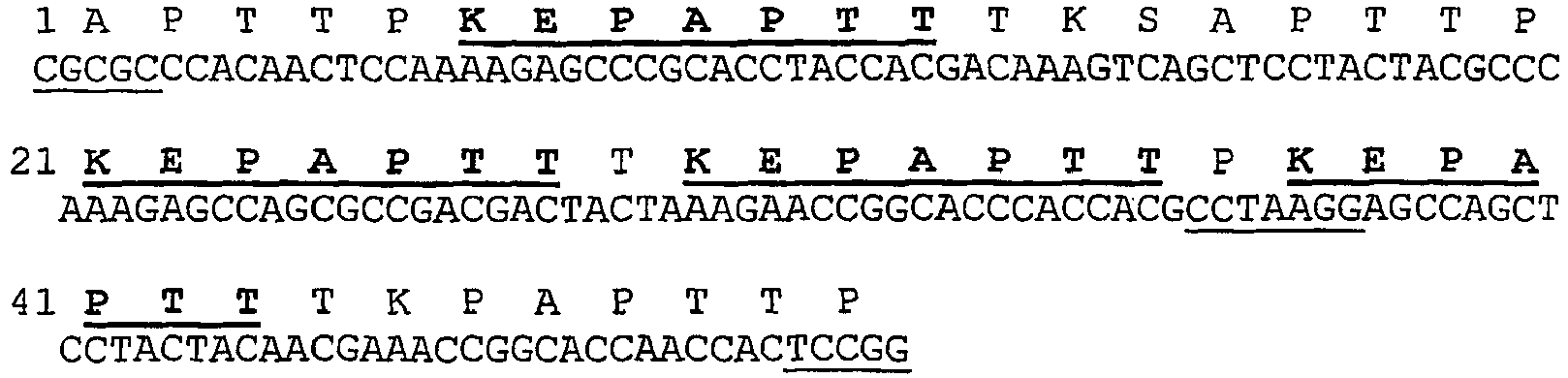
- Synthetic cDNA cassette-2 (SEQ ID NO: 3) similarly has a remnant 5'-terminal Bsu36I restriction site (i.e., CC^TNAGG, evidenced only by the TAA sequence), a 3'-terminal remnant BspEI restriction site (T^CCGGA), and an internal Bsu36I restriction site (CC^TNAGG); the restriction sites are underlined below:

- SEQ ID NO: 4, which is a translation of SEQ ID NO: 3, includes three KEPAPTT sequences that are perfect matches (highlighted below):

- The recombinant PRG4-Lub:1 cDNA construct (SEQ ID NO: 6) in pTmed2 vector (construct plus vector equals SEQ ID NO: 5) is flanked by SalI (G^TCGAC; base nos. 1027 through 1032 of SEQ ID NO: 5) and NotI (GC^GGCCGC; base nos. 3984 through 3991 of SEQ ID NO: 5) restriction sites. The SalI site incorporates a modified Kozak translation initiation sequence (CCCACC; base nos. 1032 through 1037 of SEQ ID NO: 5) before the translation start codon ATG (base nos. 1038 through 1040 of SEQ ID NO: 5). Between the BssHII (G^CGCGC; base nos. 2155 through 2160 of SEQ ID NO: 5) and BspEI (T^CCGGA; base nos. 2306 through 2311 of SEQ ID NO: 5) restriction sites is found the internal Bsu36I cloning site (CC^TNAGG, i.e., CC^TAAGG; base nos. 2262 through 2268 of SEQ ID NO: 5).
- The PRG4-Lub:1 cDNA construct (SEQ ID NO: 6) is translated into the PRG4-LUB:1 protein (SEQ ID NO: 7). The insert between S373 and E425 (i.e., E848 of native PRG4) of the entire PRG4-LUB:1 protein (SEQ ID NO: 7) is the 51 amino acids of SEQ ID NO: 9. These are translated from the Lub:1 DNA insert (SEQ ID NO: 8) and include four perfect KEPAPTT sequences. Between the BssHII restriction site (G^CGCGC; base nos. 1118 through 1123 of SEQ ID NO: 6) and the BspEI restriction site (T^CCGGA; base nos. 1269 through 1274 of SEQ ID NO: 6) is found the internal Bsu36I cloning site (CC^TNAGG, i.e., CC^TAAGG; base nos. 1225 through 1231 of SEQ ID NO: 6).
- As in the recombinant PRG4-Lub:1 construct in pTmed2 vector, the recombinant PRG4-Lub:2 cDNA construct (SEQ ID NO: 10) in pTmed2 vector is flanked by SalI (G^TCGAC) and NotI (GC^GGCCGC) restriction sites; the SalI site incorporates a modified Kozak translation initiation sequence (CCCACC) before the translation start codon ATG (base nos. 1 through 3 of SEQ ID NO: 10). Similarly, the recombinant PRG4-Lub:3 cDNA construct (SEQ ID NO: 14), the recombinant PRG4-Lub:4 cDNA construct (SEQ ID NO: 18), and the recombinant PRG4-Lub:5 cDNA construct (SEQ ID NO: 22) in pTmed2 vector are each flanked by SalI (G^TCGAC) and NotI (GC^GGCCGC) restriction sites; the SalI site incorporates a modified Kozak translation initiation sequence (CCCACC) before the translation start codon ATG (base nos. 1 through 3 of SEQ ID NOS: 14, 18, and 22, respectively).
- Within the PRG4-Lub:2 cDNA construct, the internal Bsu36I cloning site (CC^TNAGG, i.e., CC^TAAGG; base nos. 1318 through 1324 of SEQ ID NO: 10) is found between the BssHII (G^CGCGC; base nos. 1118 through 1123) and BspEI (T^CCGGA; base nos. 1347 through 1352) restriction sites. The PRG4-Lub:2 construct (SEQ ID NO: 10) is translated into the PRG4-LUB:2 protein (SEQ ID NO: 11). The insert between S373 and E451 (i.e., E848 of native PRG4) of the entire PRG4-LUB:2 protein (SEQ ID NO: 11) is the 77 amino acids of SEQ ID NO: 13. These are translated from the Lub:2 DNA insert (SEQ ID NO:12). In place of A374 through P847 (474 amino acids) of native PRG4, the 77 amino acids of the recombinant lubricin PRG4-LUB:2 form six perfect KEPAPTT sequences and approximately four imperfect KEPAPTT sequences.
- Within the PRG4-Lub:3 cDNA construct, the internal Bsu36I cloning site (CC^TNAGG, i.e., CC^TAAGG; base nos. 1411 through 1417 of SEQ ID NO: 14) is found between BssHII (G^CGCGC; base nos. 1118 through 1123) and BspEI (T^CCGGA; base nos. 1440 through 1445) restriction sites. The PRG4-Lub:3 construct (SEQ ID NO: 14) is translated into the PRG4-LUB:3 protein (SEQ ID NO: 15). The insert between S373 and E482 (i.e., E848 of native PRG4) of the entire PRG4-LUB:3 protein (SEQ ID NO: 15) is the 108 amino acids of SEQ ID NO: 17. These are translated from the Lub:3 DNA insert (SEQ ID NO:16). In place of A374 through P847 (474 amino acids) of native PRG4, the 108 amino acids of the recombinant lubricin PRG4-LUB:3 form nine perfect KEPAPTT sequences and approximately five imperfect KEPAPTT sequences.
- Within the PRG4-Lub:4 cDNA construct, the internal Bsu36I cloning site (CC^TNAGG, i.e., CC^TAAGG; base nos. 1504 through 1510 of SEQ ID NO: 18) is found between BssHII (G^CGCGC; base nos. 1118 through 1123) and BspEI (T^CCGGA; base nos. 1533 through 1538) restriction sites. The PRG4-Lub:4 construct (SEQ ID NO: 18) is translated into the PRG4-LUB:4 protein (SEQ ID NO: 19). The insert between S373 and E513 (i.e., E848 of native PRG4) of the entire PRG4-LUB:4 protein (SEQ ID NO: 19) is the 139 amino acids of SEQ ID NO: 21. These are translated from the Lub:4 DNA insert (SEQ ID NO:20). In place of A374 through P847 (474 amino acids) of native PRG4, the 139 amino acids of the recombinant lubricin PRG4-LUB:4 form twelve perfect KEPAPTT sequences and approximately six imperfect KEPAPTT sequences.
- Within the PRG4-Lub:5 cDNA construct, the internal Bsu36I cloning site (CC^TNAGG, i.e., CC^TAAGG; base nos. 1597 through 1603 of SEQ ID NO: 22) is found between BssHII (G^CGCGC; base nos. 1118 through 1123) and BspEI (T^CCGGA; base nos. 1626 through 1631) restriction sites. The PRG4-Lub:5 construct (SEQ ID NO: 22) is translated into the PRG4-LUB:5 protein (SEQ ID NO: 23). The insert between S373 and E544 (i.e., E848 of native PRG4) of the entire PRG4-LUB:5 protein (SEQ ID NO: 23) is the 170 amino acids of SEQ ID NO: 25. These are translated from the Lub:5 DNA insert (SEQ ID NO:24). In place of A374 through P847 (474 amino acids) of native PRG4, the 170 amino acids of the recombinant lubricin PRG4-LUB:5 form fifteen perfect KEPAPTT sequences and approximately seven imperfect KEPAPTT sequences.
- Importantly, the process of inserting the synthetic cDNA cassette-2 can be iterated indefinitely. Each iteration results in the addition of three perfect KEPAPTT sequences. Just as recombinant lubricins PRG4-LUB:2 through PRG4-LUB:5 are constructed in this way through the use of insert sequences, recombinant lubricins PRG4-LUB:6 through PRG4-LUB:N are constructed. Table 2 provides a summary of BssHII/BspE1 insert sequences.
-
Table 2. BssHII/BspE1 Insert Sequences LUB INSERT SEQ ID NO: Sequences (restriction sites underlined in DNA inserts; KEPAPTT sequences are highlighted in protein inserts) Lub:1 8 
LUB:1 9 APTTP KEPAPTT TKSAPTTP KEPAPTT T KEPAPTT P KEPAPTT TKPAPTTP Lub:2 12 
LUB:2 13 
Lub:3 16 
LUB:3 17 
Lub:4 20 
LUB:4 21 
Lub:5 24 
LUB:5 25 
- Although we have exemplified the base DNA construct with full-length PRG4 containing all 12 exons (minus a central portion of exon 6), splice variants of PRG4 may also be employed, depending on the various activities and length desired. Additionally, different restrictions enzymes may be employed in an analogous strategy, providing that their location is conveniently located within nucleic acid sequence encoding PRG4 protein. In other embodiments, the base DNA construct lacks native exon 6 sequence, but includes one or more of exon 1 through exon 5 sequences or of exon 7 through exon 12 sequences of the native PRG4 gene. In other embodiments, the base DNA construct is identical to a recombinant MSF sequences described in
US6433142 orUS20020137894 except that part or all of the sequences of exon 6 are absent. - The invention provides cDNA constructs encoding recombinant lubricins that are cloned into SAlI (G^TCGAC; base nos. 1027 through 1032 of SEQ ID NO: 5) and NotI (GC^GGCCGC; base nos. 3984 through 3991 of SEQ ID NO: 5) restriction sites in the eucaryotic expression vector pTmed2 as a preferred embodiment (e.g., recombinant PRG4-Lub:1 cDNA construct in pTmed2 expression vector is located in SEQ ID NO: 5 at base nos. 1038 though 3983). The SalI site incorporates the first base of a modified Kozak translation initiation sequence (CCACC; base no. 1032 of SEQ ID NO: 5) before the methionine start codon (ATG; base nos. 1038 through 1040 of SEQ ID NO: 5). Other embodiments of the invention include other restriction site combinations and other expression vectors.
- In a preferred embodiment, the interative process makes use of the synthetic cDNA cassette-1 (SEQ ID NO: 1) in expression vector pTmed2, which is flanked by the restriction sites for BssHII (G^CGCGC) and BspEI (T^CCGGA), and the synthetic cDNA cassette-1, which includes an internal Bsu36I restriction site (CC^TNAGG, i.e., CC^TAAGG; base nos. 107 to 113 of SEQ ID NO: 1). For the iterative generation of recombinant lubricin constructs containing KEPAPTT-like sequences in this preferred embodiment, synthetic cDNA cassette-2 (SEQ ID NO: 3) is inserted between the Bsu36I and BspEI sites of the recombinant construct. Synthetic cDNA cassette-2 (SEQ ID NO: 3) is flanked by a modified remnant Bsu36I site (TAAAG) and a remnant BspEI (ACTCCGG) site. It also includes an internal Bsu36I site (CC^TNAGG, i.e., CC^TAAGG; base nos. 92 through 98 of SEQ ID NO: 3). Upon cloning synthetic cDNA cassette-2 into the Bsu36I and BspEI sites of a recombinant lubricin construct, the Bsu36I cloning site of the original construct is destroyed leaving one unique Bsu36I cloning site in the new construct.
- In this preferred embodiment, the amino acid sequence "APTTP KEPAPTT TKSAPTTP KEPAPTT T KEPAPTT P KEPAPTT TK" (SEQ ID NO: 26; 45 amino acids) remains a part of each PRG4-LUB:N protein (where N = an integer of 1 or more). In addition, the amino acid sequence "KEPAPTT T KEPAPTT TKSAPTTP KEPAPTT P" (SEQ ID NO: 27; 31 amino acids) is encoded by the DNA insert that becomes part of each PRG4-Lub:N+1 cDNA constructs through the addition of synthetic cDNA cassette-2 Bsu36I/BspEI to a PRG4-Lub:N cDNA construct. For PRG4-LUB:N protein where N is an integer greater than or equal to 3, the amino acid sequence "EPAPTT TKSAPTTP KEPAPTT P" (SEQ ID NO: 28; 22 amino acids) joins SEQ ID NO: 26 to (N minus 2) repeats of SEQ ID, NO: 27 in preferred embodiments. Futhermore, the amino acid sequence "KEPKPAPTTP" (SEQ ID NO; 29; 10 amino acids) immediately shows the last insert repeat of SEQ ID NO: 27 in preferred embodiments of the PRG4-LUB:N protein where N is an integer greater than or equal to 2.
- Because they form at least two KEPAPTT sequences, SEQ ID NO: 26, SEQ ID NO: 27, and (SEQ ID NO: 28 are each designated herein to be a "repetitive KEPAPTT-like sequence" (the N-terminus of SEQ ID 28 links to a K residue so that SEQ ID NO: 28 forms two KEPAPTT sequences in PRG4-LUB:N proteins).
- Consequently, for recombinant lubricin protein PRG4-LUB:N (where N equals an integer of 1 or more), the PRG4-LUB:N protein comprise SEQ ID NO: 26 in a preferred embodiment. Furthermore, for recombinant lubricin protein PRG4-LUB:N (where N equals an integer of 2 or more), the PRG4-LUB:N protein also comprises SEQ ID NO: 27 in a preferred embodiment. SEQ ID NO: 27 is repeated (N minus 1) times within each PRG4-LUB:N protein in these preferred embodiments. In PRG4-LUB:2, SEQ ID NO: 26 and SEQ ID NO: 27 overlap (i.e., they share a KEPAPTT sequence).
- In other preferred embodiments where N is an integer greater than or equal to 3 recombinant lubricin protein comprises the 22 amino acids of SEQ ID NO: 28 joining the N-terminal-oriented 45 amino acids of SEQ ID NO: 26 to (N minus 2) repeat(s) of the 31 amino acids of SEQ ID NO: 27, where the 10 amino acids of SEQ ID NO: 29 are C-terminal to the last 31-amino-acid repeat of SEQ ID NO: 27.
-
Table 3. Sequence Frequencies in Preferred PRG4-LUB Proteins PRG4-LUB Protein SEQ ID NO:26 N-end insert SEQ ID NO: 28 >- - < SEQ ID NO: 27 >- - < SEQ ID NO: 29 insert C-end KEPAPTT repeats -LUB:1 1 0 0 0 4 -LUB:2 1 0 1 1 6 -LUB:3 1 1 1 1 9 -LUB:4 1 1 2 1 12 -LUB:5 1 1 3 1 15 -LUB:N 1 1 N-2 1 3xN - PRG4-LUB:N proteins in general have (3 times N) repeats of the KEPAPTT sequence in preferred embodiments where N equals the number of repetitive KEPAPTT-like sequences. Recombinant lubricin PRG4-LUB:5 (having 3 x N = 3 x 5 = 15 copies of the KEPAPTT sequence in preferred embodiments) is the largest recombinant lubricin PRG4-LUB:N whose sequence is detailed herein.
- PRG4-Lub:1 cDNA construct (SEQ ID NO: 6; containing synthetic cDNA cassette-1 sequence) was expressed in a stably transfected, preadaptive CHO DUKX cell line, purified from conditioned media, and solubilized in PBS containing 500 mM L-arginine hydrochloride as follows.
- The PRG4-Lub:1 cDNA construct was expressed in a stably transfected CHO DUKX cell line and the conditioned media was collected. A two liter volume of this conditioned media was filter concentrated under compressed nitrogen gas (40 psi) using an AMICON® M2000™ filtration unit fitted with either a 10 kDa nominal molecular weight limit (NMWL), a 30 kDa NMWL or a 100 kDa NMWL PALL FILTRON® OMEGA™ disc membrane. Media was concentrated to approximately a 100 ml volume, which was aspirated from the disc membrane. The disc membrane was then removed from the AMICON® M2000™ filtration unit. The "mucinous" retentate, which had accumulated at the surface of the disc membrane, was harvested using a cell scraper and transferred to microcentrifuge tubes. The samples in the microcentrifuge tubes were centrifuged at approximately 12,000 x g for 10 minutes, and the aqueous supernatant was removed. The remaining "lubricin-enriched" pellets were dissolved in phosphate buffered saline (PBS) containing 500 mM L-arginine hydrochloride. The L-arginine hydrochloride concentration may range from 100 mM to 2.0 M.
- Using the above procedure, PRG4-LUB:2 through PRG4-LUB:5 glycoproteins (and PRG4-LUB:N proteins where N=a nonnegative integer of 6 or more, as well as other glycoproteins containing KEPAPTT-like sequences) are harvested directly from disc membranes, i.e., without purification of the concentrate remaining above disc membranes. That is, these recombinant lubricin glycoproteins are isolated directly from disc membranes of 10 kDa NMWL, 30 kDa NMWL, or 100 kDa NMWL PALL FILTRON® OMEGA™ filtration units. In some instances, these glycoproteins may also be purified from the concentrate remaining above disc membranes through chromatographic techniques or electrophoretic techniques or both. Recombinant lubricin proteins and glycoproteins may also be purified using chromatography and other techniques known in the art (as, for example, described in
US6433142 for MSF proteins; see also: Deutscher, 1990; and Scopes, 1994). - The cell source of lubricin in normal and osteoarthritic joints was further investigated using immunohistochemical techniques. In addition, the presence of lubricin on other tissue surfaces, including pleura, pericardium, peritoneum, and meninges, was examined according to the following methods.
- Osteoarthritic cartilage and synovium were obtained by informed consent from patients undergoing knee replacement surgery. Other tissues examined were normal human synovium and normal non-human primate (NHP) synovium, cartilage, pleura, pericardium, peritoneum, meninges, brain, tendon, and ligaments, and canine normal and osteoarthritic meniscus, cartilage, synovium, ligament, and tendons. Tissues were fixed in 4% paraformaldehyde immediately after harvest or following 24 hours incubation in media without and with supplemental monensin (5 µM). For immunohistochemical studies the tissues were fixed in 4% paraformaldehyde for 24 hours and 6-8 micron paraffin sections were obtained. A subset of tissues were frozen in optical coherence tomography (OCT) freezing compound and cut at 5 to 10 micron intervals followed by acetone fixation.
- Immunohistochemical and immunofluorescent analyses utilized a purified polyclonal rabbit anti-human lubricin antibody (Ab 06A10) generated by immunization with a truncated form of recombinant lubricin and purification on a protein A column. CD 16 antibody (NEOMARKERS®, Fremont CA) was used to identify macrophages (Fcy receptor III). CD106/VCAM-1 antibody (NEOMARKERS®) was used to label fibroblasts within cryostat sections. For control sections, an equivalent concentration of RIgG (VECTOR LABS ™, CA), MIgG1 (DAKO®), and MIgG2a (DAKO®) was used consecutively. The Dextran Technology System (ENVISION+™; DAKO®) was used to visualize antibody binding and the sections were counterstained with Mayer's alum-hematoxylin. Immunofluorescence was performed using the above primary antibodies and probed with secondary antibodies (Alexa Dyes - MOLECULAR PROBES™, Oregon) goat anti-rabbit Alexa dye at 546 nm and goat anti-mouse Alexa dye at 488 nm. Fluorescent binding of the antibody was detected with a NIKON® fluorescent microscope.
- Lubricin was detected along the surfaces of normal and osteoarthritic human articular cartilage and synovium. A thick layer of lubricin completely coated the fibrillated osteoarthritic surface. CD106 immunofluorescence showed strong cell membrane staining of the intimal fibroblasts of the synovium; lubricin protein was also visualized as staining within synovial cells. Double immunostaining for CD106+lubricin, clearly showed co-localization within the intimal fibroblasts of the synovium. CD16 staining of synovial macrophages demonstrated the presence of these cells throughout the layers of the synovium, but there was no co-localization with lubricin.
- Staining of NHP and canine articular tissues (normal and OA) with the lubricin antibody showed lubricin coating the surface layer of the synovium, cartilage, meniscus, and tendons. NHP cartilage also showed strong immunoreactivity not only in the superficial zone cells but also the transitional zone cells without the addition of monensin to increase intracellular stores of the glycoprotein. Cells lining the peritoneum, pericardium, and pleura also exhibited lubricin expression, though no immunoreactivity was observed in the meninges or brain.
- In summary, both normal and osteoarthritic synovium, tendon, meniscus and cartilage were coated by a substantial layer of lubricin. The glycoprotein is clearly present on tissues within OA joints. Double-immunofluorescent staining of human OA synovium demonstrated that the intimal fibroblast synoviocytes were responsible for the synthesis of lubricin.
- The localization of lubricin protein outside joint tissue has not been previously described. A surface layer of lubricin was clearly demonstrated on lung pleura, pericardium, and peritoneum. Lubricin is reputed to have a lubricating function within the synovial joint, but may have multiple roles including, but not limited to, lubrication and anti-adhesive functions in other tissues. Supplementation of these other tissues with lubricin is a biotherapy encompassed within this invention.
- Recombinant lubricin could be used as a lubricant generally, e.g., with seals and bearings and the like. For example,
US3973781 entitled "Self-lubricating seal,"US4491331 entitled "Grooved mechanical face seal,"US4560174 entitled "Multi lip seal," andUS4973068 entitled "Differential surface roughness dynamic seals and bearings," each describe seals of varying designs. Recombinant lubricin could be used as a lubricant with these seals. - In particular, recombinant lubricin could be used as a lubricant for medical devices, prostheses, and implants, particularly where a biocompatible lubricant is required. In addition, the applications need not be medical, but could include applications in environmentally sensitive contexts where a biocompatible lubricant may be desirable.
- A recombinant lubricin of the present invention may be used in a pharmaceutical composition when combined with a pharmaceutically acceptable carrier. Such a composition may also contain (in addition to protein and a carrier) diluents, fillers, salts, buffers, stabilizers, solubilizers, and other materials well known in the art. The term "pharmaceutically acceptable" means a non-toxic material that does not interfere with the effectiveness of the biological activity of the active ingredient(s). The characteristics of the carrier will depend on the route of administration. The pharmaceutical composition of the invention may also contain cytokines, lymphokines, or other hematopoietic factors such as M-CSF, GM-CSF, TNF, IL-1, IL-2, IL-3, IL4, IL-5, IL-6, IL-7, IL-8, IL-9, IL-10, IL-11, IL-12, IL-13, IL-14, IL-15, TNF1, TNF2, G-CSF, Meg-CSF, thrombopoietin, stem cell factor, and erythropoietin. The pharmaceutical composition may further contain other agents which either enhance the activity of the protein or complement its activity or use in treatment. Such additional factors and/or agents may be included in the pharmaceutical composition to produce a synergistic effect with protein of the invention, or to minimize side effects. Conversely, protein of the present invention may be included in formulations of the particular cytokine, lymphokine, other hematopoietic factor, thrombolytic or anti-thrombotic factor, or anti-inflammatory agent to minimize side effects.
- Use of recombinant lubricin protein for intra-articular supplementation in combination with the previously described polymeric hyaluronan (HA) and higher molecular weight hylans is particularly preferred. Other preferred combinations for use in intra-articular supplementation include the use of recombinant lubricin protein with anesthetics (e.g., lidocaine), steroids (e.g., triamcinolone hexacetonide), or radioisotopes (e.g., yttrium). Other preferred combinations for use in intra-articular supplementation may include autologous or heterologous cell preparations (e.g., of cultured chondrocytes, synoviocytes, or stem cells, whether autologously or heterologously derived).
- A recombinant lubricin of the present invention may be active in multimers (e.g., heterodimers or homodimers) or complexes with itself or other proteins. As a result, pharmaceutical compositions of the invention may comprise a protein of the invention in such multimeric or complexed form.
- A pharmaceutical composition of the invention may be in the form of a complex of the recombinant lubricin protein(s) of present invention along with protein or peptide antigens. The protein and/or peptide antigen will deliver a stimulatory signal to both B and T lymphocytes. B lymphocytes will respond to antigen through their surface immunoglobulin receptor. T lymphocytes will respond to antigen through the T cell receptor (TCR) following presentation of the antigen by MHC proteins. MHC and structurally related proteins including those encoded by class I and class II MHC genes on host cells will serve to present the peptide antigen(s) to T lymphocytes. The antigen components could also be supplied as purified MHC-peptide complexes alone or with costimulatory molecules that can directly signal T cells. Alternatively antibodies able to bind surface immunolgobulin and other molecules on B cells as well as antibodies able to bind the TCR and other molecules on T cells can be combined with the pharmaceutical composition of the invention.
- A pharmaceutical composition of the invention may be in the form of a liposome in which protein of the present invention is combined, in addition to other pharmaceutically acceptable carriers, with amphipathic agents such as lipids which exist in aggregated form as micelles, insoluble monolayers, liquid crystals, or lamellar layers in aqueous solution. Suitable lipids for liposomal formulation include, without limitation, monoglycerides, diglycerides, sulfatides, lysolecithin, phospholipids, saponin, bile acids, and the like. Preparation of such liposomal formulations is within the level of skill in the art, as disclosed, for example, in
US4235871 ,US4501728 ,US4837028 , andUS4737323 . - In practicing the method of treatment or use of the present invention, a therapeutically effective amount of protein of the present invention is administered to a subject (e.g., a mammal) having a condition to be treated. Protein of the present invention may be administered in accordance with the method of the invention either alone or in combination with other therapies such as treatments employing cytokines, lymphokines, other hematopoietic factors, or cell-based supplements. When co-administered with one or more cytokines, lymphokines, other hematopoietic factors, or cell-based supplements, protein of the present invention may be administered either simultaneously with the cytokine(s), lymphokine(s), other hematopoietic factor(s), thrombolytic or anti-thrombotic factors, or cell-based supplement, or sequentially. If administered sequentially, the attending physician will decide on the appropriate sequence of administering protein of the present invention in combination with cytokine(s), lymphokine(s), other hematopoietic factor(s), thrombolytic or anti-thrombotic factors, or cell-based supplement.
- Administration of protein of the present invention used in the pharmaceutical composition or to practice the method of the present invention can be carried out in a variety of conventional ways, such as cutaneous, subcutaneous, intraperitoneal, parenteral or intravenous injection, or, in some instances, oral ingestion, inhalation, topical application. Administration to a patient by injection into joint tissue is generally preferred (Schumacher, 2003).
- When a therapeutically effective amount of protein of the present invention is administered orally, protein of the present invention will be in the form of a tablet, capsule, powder, solution or elixir. When administered in tablet form, the pharmaceutical composition of the invention may additionally contain a solid carrier such as a gelatin or an adjuvant. The tablet, capsule, and powder contain from about 5 to 95% protein of the present invention, and preferably from about 25 to 90% protein of the present invention. When administered in liquid form, a liquid carrier such as water, petroleum, oils of animal or plant origin such as peanut oil, mineral oil, soybean oil, or sesame oil, or synthetic oils may be added. The liquid form of the pharmaceutical composition may further contain physiological saline solution, dextrose or other saccharide solution, or glycols such as ethylene glycol, propylene glycol or polyethylene glycol. When administered in liquid form, the pharmaceutical composition contains from about 0.5 to 90% by weight of protein of the present invention, and preferably from about 1 to 50% protein of the present invention.
- When a therapeutically effective amount of protein of the present invention is administered by intravenous, cutaneous or subcutaneous injection, protein of the present invention will be in the form of a pyrogen-free, parenterally acceptable aqueous solution. The preparation of such parenterally acceptable protein solutions, having due regard to pH, isotonicity, stability, and the like, is within the skill in the art. A preferred pharmaceutical composition for intravenous, cutaneous, or subcutaneous injection should contain, in addition to protein of the present invention, an isotonic vehicle such as Sodium Chloride Injection, Ringer's Injection, Dextrose Injection, Dextrose and Sodium Chloride Injection, Lactated Ringer's Injection, or other vehicle as known in the art. The pharmaceutical composition of the present invention may also contain stabilizers, preservatives, buffers, antioxidants, or other additives known to those of skill in the art. For example, injection in association with, or in combination with, lidocaine or other local anesthetic, steroids or adrenocorticoids, HA and/or hylans, or radioisotopes are all encompassed within by the present invention.
- The amount of protein of the present invention in the pharmaceutical composition of the present invention will depend upon the nature and severity of the condition being treated, and on the nature of prior treatments which the patient has undergone. Ultimately, the attending physician will decide the amount of protein of the present invention with which to treat each individual patient. Initially, the attending physician will administer low doses of protein of the present invention and observe the patient's response. Larger doses of protein of the present invention may be administered until the optimal therapeutic effect is obtained for the patient, and at that point the dosage is not increased further. It is contemplated that the various pharmaceutical compositions used to practice the method of the present invention should contain about 0.01 µg to about 100 mg (preferably about 0.1 µg to about 10 mg, more preferably about 0.1 µg to about 1 mg) of protein of the present invention per kg body weight depending on the method of administration and the exact therapeutic course implemented.
- If administered intravenously, the duration of intravenous therapy using a pharmaceutical composition comprising recombinant lubricin of the present invention will vary, depending on the severity of the disease being treated and the condition and potential idiosyncratic response of each individual patient. It is contemplated that the duration of each application of the protein of the present invention may be in the range of 12 to 24 hours of continuous intravenous administration. Ultimately the attending physician will decide on the appropriate duration of intravenous therapy using the pharmaceutical composition of the present invention.
- For compositions of the present invention which are useful for bone, cartilage, tendon or ligament therapy, the therapeutic method includes administering the composition topically, systematically, or locally as an implant or device. When administered, the therapeutic composition for use in this invention is, of course, in a pyrogen-free, physiologically acceptable form. Further, the composition may desirably be encapsulated or injected in a viscous form for delivery to the site of bone, cartilage or tissue damage. Topical administration may be suitable for in some wound healing, and tissue repair contexts. Therapeutically useful agents which may also optionally be included in the composition as described above, may alternatively or additionally, be administered simultaneously or sequentially with the composition comprising recombinant lubricin protein of the invention in the methods of the invention. Preferably the composition would include a matrix capable of delivering the protein-containing composition to the site of bone and/or cartilage damage, possibly capable of providing a structure for the developing bone and cartilage, and optimally capable of being resorbed into the body. Such matrices may be formed of materials presently in use for other implanted medical applications.
- If a matrix is used, the choice of matrix material is based on biocompatibility, biodegradability, mechanical properties, cosmetic appearance and interface properties. The particular application of the compositions will define the appropriate formulation. Potential matrices for the compositions may be biodegradable and chemically defined calcium sulfate, tricalciumphosphate, hydroxyapatite, polylactic acid, polyglycolic acid and polyanhydrides. Other potential materials are biodegradable and biologically well-defined, such as bone or dermal collagen. Further matrices are comprised of pure proteins or extracellular matrix components. Other potential matrices are nonbiodegradable and chemically defined, such as sintered hydroxapatite, bioglass, aluminates, or other ceramics. Matrices may be comprised of combinations of any of the above mentioned types of material, such as polylactic acid and hydroxyapatite or collagen and tricalciumphosphate. The bioceramics may be altered in composition, such as in calcium-aluminate-phosphate and processing to alter pore size, particle size, particle shape, and biodegradability.
- In further compositions, proteins of the invention may be combined with other agents beneficial to the treatment of the bone and/or cartilage defect, wound, or tissue in question. These agents include various growth factors such as epidermal growth factor (EGF), platelet derived growth factor (PDGF), transforming growth factors (TGF-α and TGF-β), and insulin-like growth factor (IGF).
- The therapeutic compositions are also presently valuable for veterinary applications. Particularly domestic animals such as cats and dogs, laboratory animals such as mice and rats, as well as horses, in addition to humans, are particularly desired subjects or patients for such treatment with recombinant lubricin proteins of the present invention.
- The dosage regimen of a protein-containing pharmaceutical composition to be used in tissue regeneration will be determined by the attending physician considering various factors which modify the action of the proteins, e.g., amount of tissue weight desired to be formed, the site of damage, the condition of the damaged tissue, the size of a wound, type of damaged tissue (e.g., cartilage or tendon), the patient's age, sex, and diet, the severity of any infection, time of administration and other clinical factors. The dosage may vary with the type of matrix used in the reconstitution and with inclusion of other proteins in the pharmaceutical composition. For example, the addition of other known growth factors, such as IGF I (insulin like growth factor I), to the final composition, may also effect the dosage. Progress can be monitored by periodic assessment of tissue/bone growth and/or repair, for example, X-rays, histomorphometric determinations and tetracycline labeling.
- Polynucleotides of the present invention can also be used for gene therapy. Such polynucleotides can be introduced either in vivo or ex vivo into cells for expression in a subject (e.g., a mammal). Polynucleotides of the invention may also be administered by other known methods for introduction of nucleic acid into a cell or organism (including, without limitation, in the form of viral vectors or naked DNA).
- Cells may also be cultured ex vivo in the presence of nucleic acids or proteins of the present invention in order to proliferate or to produce a desired effect on or activity in such cells. Treated cells can then be introduced in vivo for therapeutic purposes.
- Recombinant lubricin protein of the invention may also be used to immunize animals to obtain polyclonal and monoclonal antibodies which specifically react with the protein or, in some embodiments, its native counterparts. Such antibodies may be obtained using either complete recombinant lubricin protein or fragments thereof as an immunogen. The peptide immunogens additionally may contain a cysteine residue at the carboxyl terminus, and are conjugated to a hapten such as keyhole limpet hemocyanin (KLH). Methods for synthesizing such peptides are known in the art (for example, as in Merrifield, 1963; and Krstenansky et al., 1987). Monoclonal antibodies binding to recombinant lubricin protein of the invention may be useful diagnostic agents for the immunodetection of related proteins. Neutralizing monoclonal antibodies binding to these related proteins may also be useful therapeutics for both conditions associated with lubricin or, in some cases, in the treatment of some forms of cancer where abnormal expression of lubricin may be involved (e.g., in synoviomas).
- In addition to antibodies which are directed to the polypeptide core of a recombinant lubricin protein, an antibody directed to a sugar portion or to a glycoprotein complex of recombinant lubricin protein is desirable. In order to generate antibodies which bind to glycosylated recombinant lubricin (but not to a deglycosylated form), the immunogen is preferably a glycopeptide, the amino acid sequence of which spans a highly glycosylated portion of the recombinant lubricin, e.g., a repetitive KEPAPTT-like sequence. Shorter glycopeptides, e.g., 8-15 amino acids in length, within the same highly glycosylated region, are also used as immunogens. Methods of generating antibodies to highly glycosylated biomolecules are known in the art (for example, as described by Schneerson et al., 1980).
- Standard methods for delivery of recombinant lubricin are used. For intra-articular administration, recombinant lubricin is delivered to the synovial cavity at a concentration in the range of 20 - 500 µg/ml in a volume of approximately 0.1 - 2 ml per injection. For example, 1 ml of a recombinant lubricin at a concentration of 200 - 300 µg/ml is injected into a knee joint using a fine (e.g., 14 - 30 gauge, preferably 18 - 26 gauge) needle. The compositions of the invention are also useful for parenteral administration, such as intravenous, subcutaneous, intramuscular, or intraperitoneal administration, and, in preferred embodiments, onto the surfaces of the peritoneal, pericardium, or pleura.
- Proper needle placement is critical for the efficacy of recombinant lubricin protein that is delivered by injection in joint therapies (Schumacher, 2003). Proper needle placement may be facilitated through the use of ultrasound technology. Successful injections are more common after successful aspiration of fluid is obtained. A supralateral approach into the suprapatellar pouch has been suggested to provide the most reliable access to knee joint space. In addition to administering recombinant lubricin by intra-articular injection, nucleic acids encoding recombinant lubricin (e.g., in gene therapy applications) may be administered to a synovial cavity by intra-articular injection.
- For prevention of surgical adhesions, recombinant lubricins described herein are administered in the form of gel, foam, fiber or fabric. A recombinant lubricin formulated in such a manner is placed over and between damaged or exposed tissue interfaces in order to prevent adhesion formation between apposing surfaces. To be effective, the gel or film must remain in place and prevent tissue contact for a long enough time so that when the gel finally disperses and the tissues do come into contact, they will no longer have a tendency to adhere. Recombinant lubricin formulated for inhibition or prevention of adhesion formation (e.g., in the form of a membrane, fabric, foam, or gel) are evaluated for prevention of post-surgical adhesions in a rat cecal abrasion model (Goldberg et al., 1993). Compositions are placed around surgically abraded rat ceca, and compared to non-treated controls (animals whose ceca were abraded but did not receive any treatment). A reduction in the amount of adhesion formation in the rat model in the presence of recombinant lubricin formulation compared to the amount in the absence of the formulation indicates that the formulation is clinically effective to reduce tissue adhesion formation. In contexts where tissue adhesion is desired (e.g., where healing of cartilage fissures is desired), however, use of recombinant lubricin may be best avoided. Providing lubrication to cartilage surfaces impairs cartilage-cartilage integration (Schaefer et al., 2004).
- Recombinant lubricins are also used to coat artificial limbs and joints prior to implantation into a mammal. For example, such devices may be dipped or bathed in a solution of a recombinant lubricin, e.g., following methods described in
US5709020 orUS5702456 . Care should be exercised, however, in the in vivo use of recombinant lubricin in providing lubrication near a prostheses. A marked upregulation in PRG4 gene expression (i.e., MSF gene expression) has been reported to be associated with prosthesis loosening; lubricin could disturb the tight interaction between bone and prosthesis and thereby contribute to prosthesis loosening (Morawietz et al., 2003). - In order to assess the efficacy of intra-articular administration of lubricin preparations, a murine model of osteoarthritis/cartilage erosion is prepared. For surgical induction of osteoarthritis, mice are anesthetized with 250 mg/kg intraperitoneal tribromoethanol (SIGMA® Chemical), and knees are prepared for aseptic surgery. A longitudinal incision medial to the patellar ligament is made, the joint capsule is opened, and the meniscotibial ligament (anchoring the medial meniscus to the tibial plateau) is identified. In a subset of animals, no further manipulation is performed, and this group is considered sham operated. In the experimental group the medial meniscotibial ligament is transected resulting in destabilization of the medial meniscus (DMM). In both sham and DMM animals, the joint capsule and subcutaneous layer are sutured closed separately and the skin is closed by application of NEXABAND® S/C tissue adhesive (Abbott, North Chicago, IL). Buprenorphine (BUPRENEX®; Reckitt & Coleman, Kingston-upon-Hull, UK) is administered pre- and post-operatively.
- Recombinant lubricin preparations are administered by intra-articular injection using a 30 gauge needle. Injections of 5-10 microliters per knee joint are administered one week post surgery. Additional injections are optionally administered on a weekly basis. Animals are sacrificed by carbon dioxide at 4 weeks post-operatively and at 8 weeks post-operatively.
- In order to assess the progression and severity of osteoarthritis, intact knee joints are placed into 4% paraformaldehyde for 24 hours, then decalcified in EDTA/polyvinylpyrrolidone for five days. Joints are embedded in paraffin and 6-µm frontal sections obtained through the entire joint. Slides are stained with Safranin O-fast green and graded at 70-µm intervals through the joint using a modification of a semiquantitative scoring system (Chambers et al., 2001) in which "0" = normal cartilage; "0.5" = loss of Safranin O without structural changes; "1" = roughened articular surface and small fibrillations; "2" = fibrillation down to the layer immediately below the superficial layer and some loss of surface lamina; "3" = mild (<20%); "5" = moderate (20-80%); and "6" = severe (>80%) loss of non-calcified cartilage. Scores of "4" (erosion to bone) are not a feature of this model. All quadrants of the joint (medial tibial plateau, medial femoral condyle, lateral tibial plateau, and lateral femoral condyle) are scored separately. A minimum of 12 levels are scored by blinded observers for each knee joint. Scores are expressed as the maximum histologic score found in each joint or the summed histologic scores. The summed score represents the additive scores for each quadrant of the joint on each histologic section through the joint. This method of analysis enables assessment of severity of lesions as well as the surface area of cartilage affected with OA-like lesions (Glasson et al., 2004).
- References: (1) Chambers et al., 2001, Arthritis Rheum. 44: 1455-65; (2) Deutscher, 1990, Methods in Enzymology, Vol. 182: Guide to Protein Purification, Academic Press; (3) Espallargues and Pons, 2003, Int'l J. Tech. Assess. Health Care 19: 41-56; (4) Flannery et al., 1999, Biochem. Biophys. Res. Comm. 254: 535-41; (5) Glasson et al., 2004, Arthritis Rheum. 50: 2547-58; (6) Goldberg et al., 1993, In: Gynecologic Surgery and Adhesion Prevention, Willey-Liss, pp. 191-204; (7) Hills, 2002, J. Rheumatology 29: 200-01; (8) Ikegawa et al., 2000, Cytogenet. Cell Genet. 90: 291-297; (9) Jay et al., 2001, J. Orthopaedic Research 19: 677-87; (10) Jay et al., 2002, Glycoconjugate Journal 18: 807-15; (11) Krstenansky et al., 1987, FEBS Lett. 211: 10-16; (12) Marcelino et al., 1999, Nature Genetics 23: 319-322; (13) Merberg et al., 1993, Biology of Vitronectins and their Receptors, Pressner et al. (eds.): Elsevier Science Publishers, pp. 45-53; (14) Merrifield, 1963, J. Amer. Chem. Soc. 85: 2149-54; (15) Morawietz et al., 2003, Virchows Arch. 443: 57-66; (16) Rees et al., 2002, Matrix Biology 21: 593-602; (17) Schneerson et al., 1980, J. Exp. Med. 152: 361-76; (18) Scopes, 1994, Protein Purification: Principles and Practice (3rd edition), Springer Verlag; (19) Schaefer et al., 2004, Biorheology 41: 503 - 508; (20) Schumacher, 2003, Arthritis & Rheumatism 49: 413-20; (21) Tatusova and Madden, 1999, FEMS Microbiol Lett. 174: 247-50; (22) Wobig et al., 1998, Clin. Ther. 20: 410-23; and (23) Wobig et al., 1999, Clin. Ther. 21: 1549-62.
-
- <110> Wyeth
Flannery, Carl R
Corcoran, Christopher J
Freeman, Bethany A
Racie, Lisa A - <120> RECOMBINANT LUBRICIN MOLECULES AND USES THEREOF
- <130> 50657-01404WOPT
- <160> 29
- <170> PatentIn version 3.3
- <210> 1
<211> 155
<212> DNA
<213>' Artificial - <220>
<223> Nucleotide sequence of synthetic cDNA cassette-1. - <400> 1

- <210> 2
<211> 51
<212> PRT
<213> Artificial - <220>
<223> Translation of SEQ ID NO: 1. - <400> 2

- <210> 3
<211> 125
<212> DNA
<213> Artificial - <220>
<223> Nucleotide sequence of synthetic cDNA cassette-2. - <400> 3

- <210> 4
<211> 41
<212> PRT
<213> Artificial - <220>
<223> Translation of SEQ ID NO: 3. - <400> 4

- <210> 5
<211> 8049
<212> DNA
<213> Artificial - <220>
<223> pTmed2 vector containing recombinant PRG4-Lub:1 cDNA construct. - <400> 5
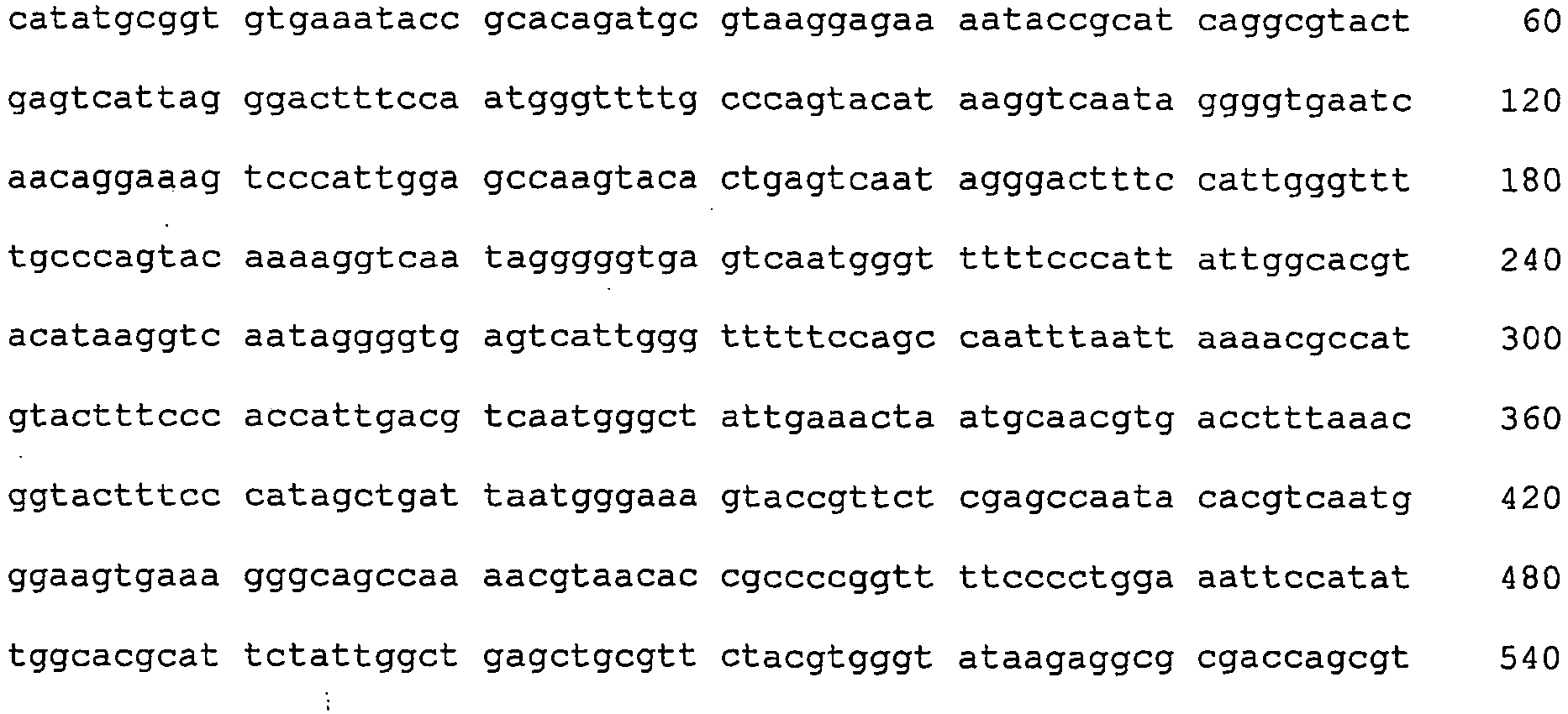


- <210> 6
<211> 2946
<212> DNA
<213> Artificial - <220>
<223> Recombinant PRG4-Lub:1 cDNA construct. - <400> 6

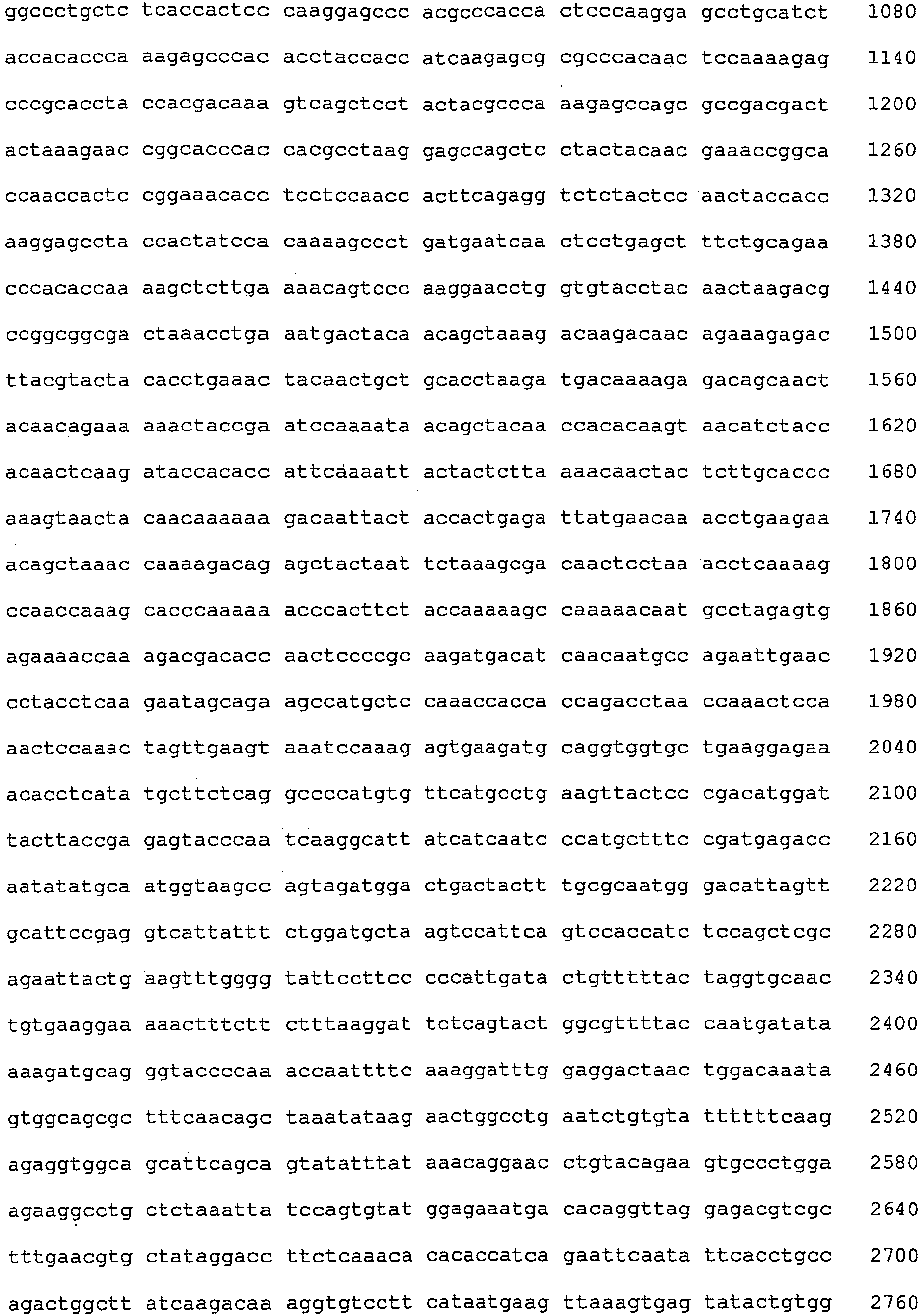

- <210> 7
<211> 981
<212> PRT
<213> Artificial - <220>
<223> Amino acid sequence of entire PRG4-LUB:1 protein. - <400> 7


- <210> 8
<211> 157
<212> DNA
<213> Artificial - <220>
<223> Lub:1 DNA insert from synthetic cDNA cassette-1. - <400> 8

- <210> 9
<211> 51
<212> PRT
<213> Artificial - <220>
<223> 51 amino acids encoded by Lub:1 DNA insert (4 KEPAPTT sequences between S373 to E425 in SEQ ID NO: 7). - <400> 9


- <210> 10
<211> 3024
<212> DNA
<213> Artificial - <220>
<223> Recombinant PRG4-Lub:2 cDNA construct. - <400> 10



- <210> 11
<211> 1007
<212> PRT
<213> Artificial - <220>
<223> Amino acid sequence of entire PRG4-LUB:2 protein. - <400> 11


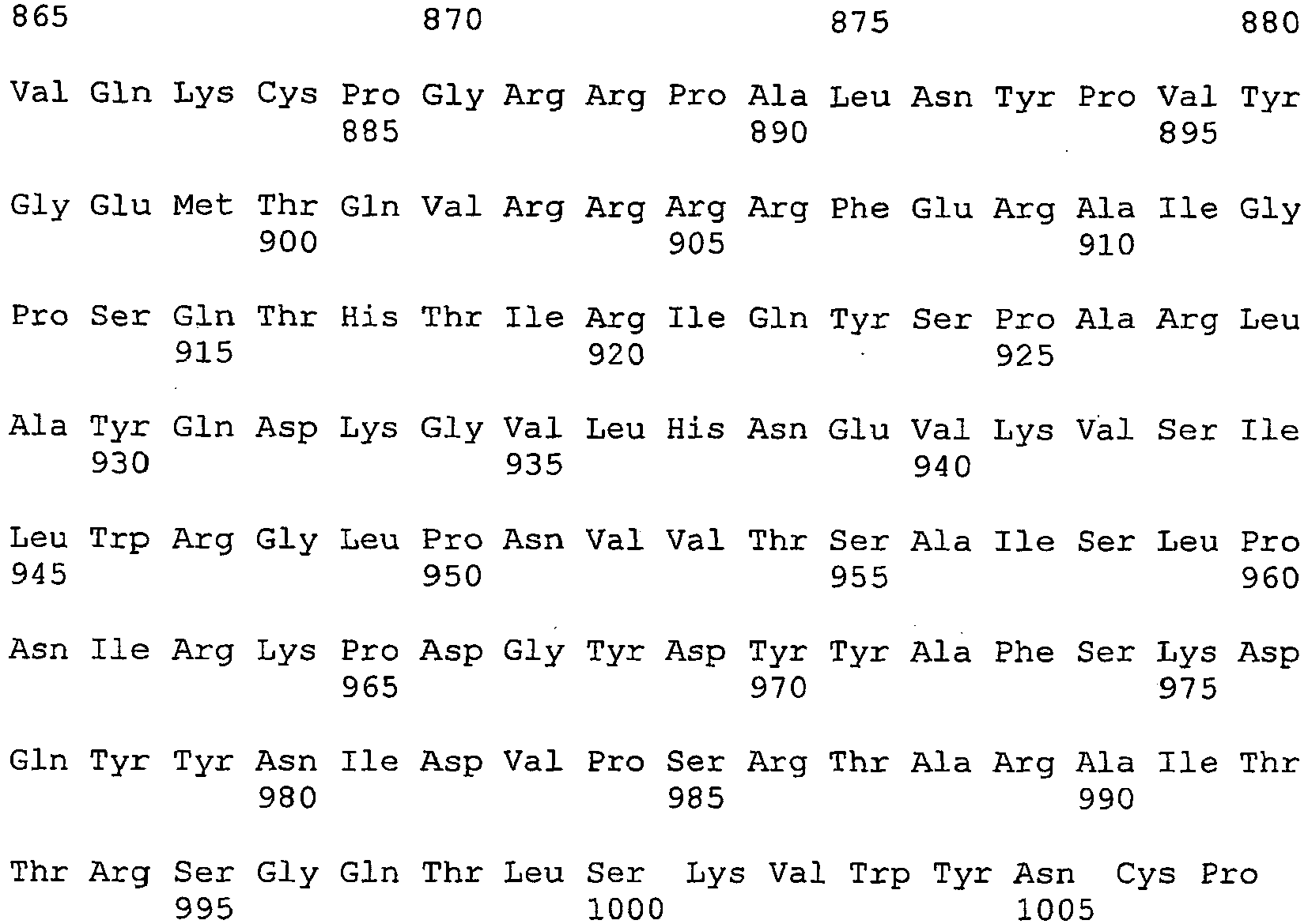
- <210> 12
<211> 235
<212> DNA
<213> Artificial - <220>
<223> Lub:2 DNA insert from synthetic cDNA cassette-1 and one synthetic cDNA cassette-2 sequence. - <400> 12

- <210> 13
<211> 77
<212> PRT
<213> Artificial - <220>
<223> 77 amino acids encoded by Lub:2 DNA insert (6 KEPAPTT sequences between S373 and E451 in SEQ ID NO: 11). - <400> 13


- <210> 14
<211> 3117
<212> DNA
<213> Artificial - <220>
<223> Recombinant PRG4-Lub:3 cDNA construct. - <400> 14
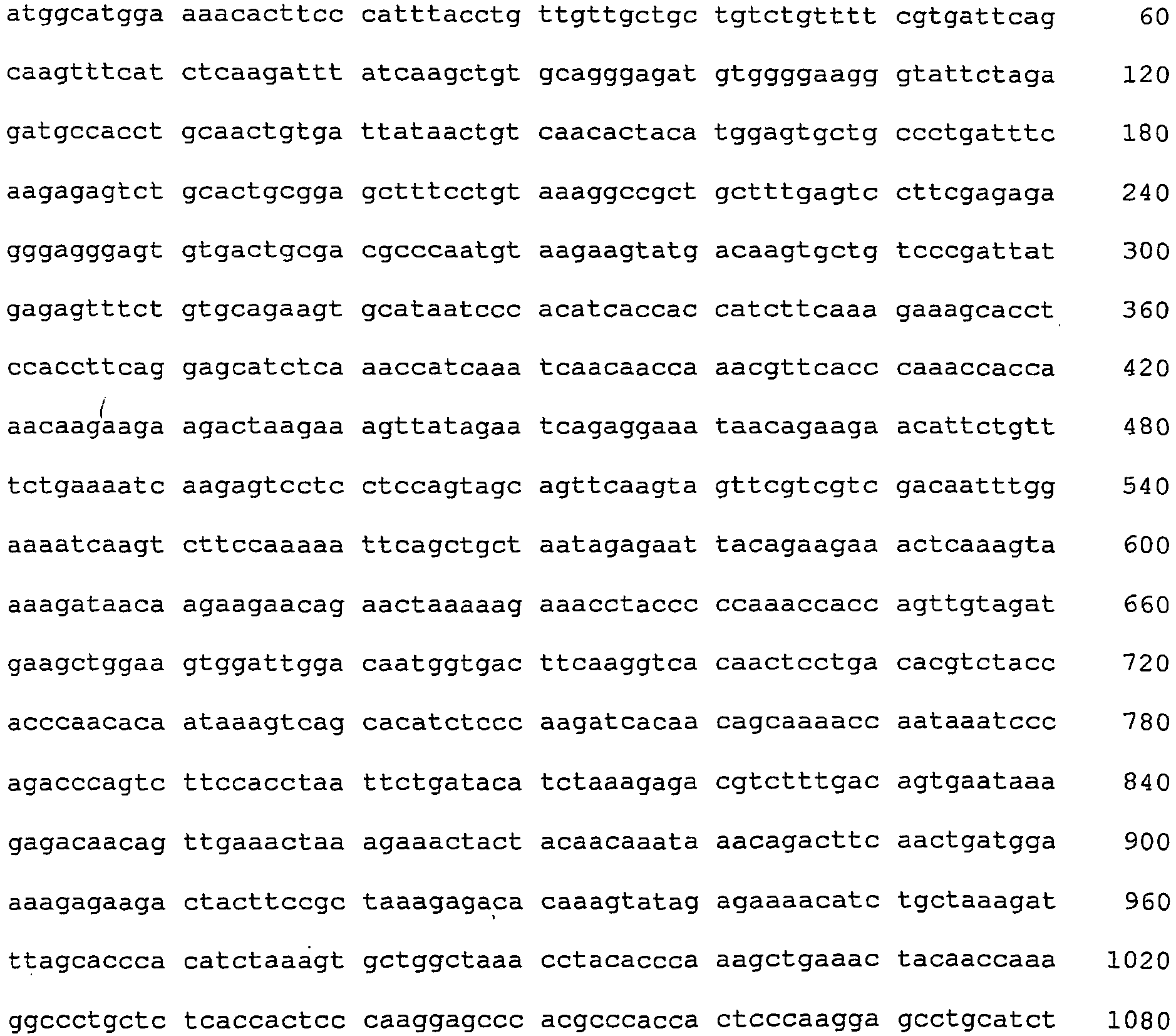


- <210> 15
<211> 1038
<212> PRT
<213> Artificial - <220>
<223> amino acid sequence of entire PRG4-LUB:3 protein - <400> 15


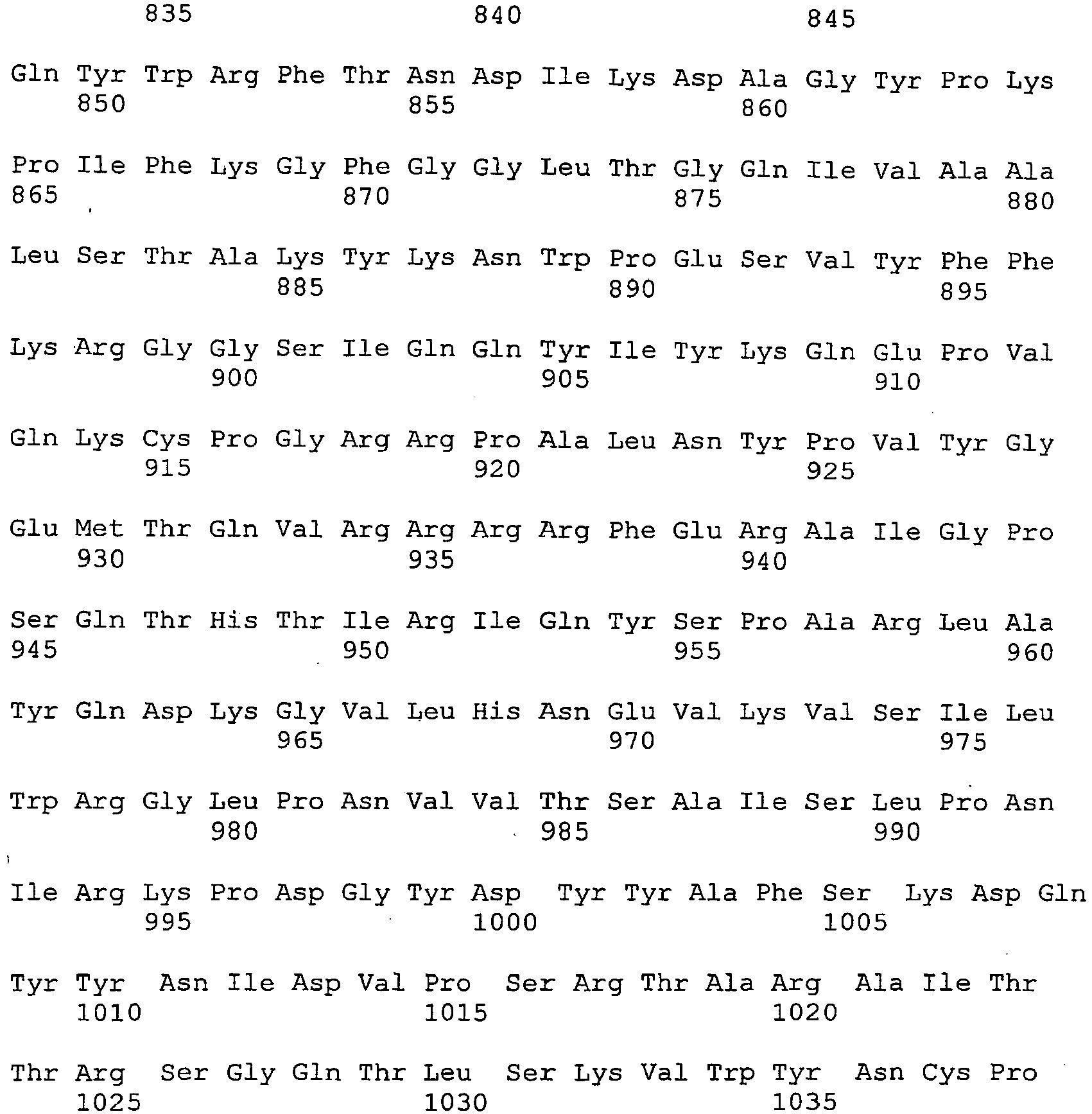
- <210> 16
<211> 328
<212> DNA
<213> Artificial - <220>
<223> Lub:3 DNA insert from synthetic cDNA cassette-1 and two synthetic cDNA cassette-2 sequences. - <400> 16


- <210> 17
<211> 108
<212> PRT
<213> Artificial - <220>
<223> 108 amino acids encoded by Lub:3 DNA insert (9 KEPAPTT sequences between S373 and E482 in SEQ ID NO: 15) - <400> 17

- <210> 18
<211> 3210
<212> DNA
<213> Artificial - <220>
<223> recombinant PRG4-Lub:4 cDNA construct. - <400> 18


- <210> 19
<211> 1069
<212> PRT
<213> Artificial - <220>
<223> amino acid sequence of entire PRG4-LUB:4 protein. - <400> 19


- <210> 20
<211> 421
<212> DNA
<213> Artificial - <220>
<223> Lub:4 DNA insert from cDNA cassette-1 and three synthetic cDNA cassette-2 sequences. - <400> 20

- <210> 21
<211> 139
<212> PRT
<213> Artificial - <220>
<223> 139 amino acids encoded by Lub:4 DNA insert (12 KEPAPTT sequences between S373 and E513 in SEQ ID NO: 19) - <400> 21


- <210> 22
<211> 3303
<212> DNA
<213> Artificial - <220>
<223> Recombinant PRG4-Lub:5 cDNA construct - <400> 22


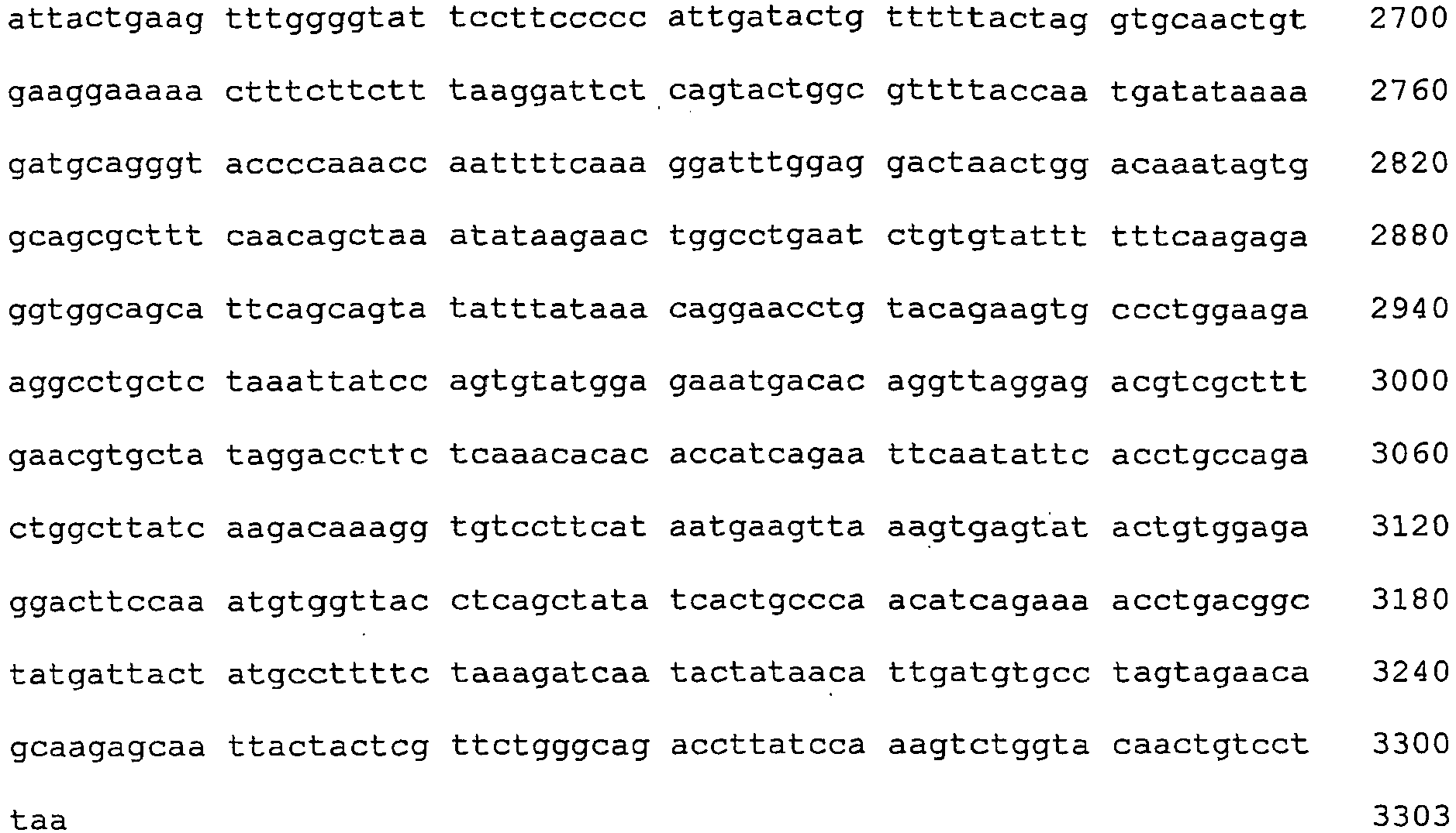
- <210> 23
<211> 1100
<212> PRT
<213> Artificial - <220>
<223> Amino acid sequence of entire PRG4-LUB:5 protein. - <400> 23


- <210> 24
<211> 514
<212> DNA
<213> Artificial - <220>
<223> Lub:5 DNA insert from cDNA cassette-1 and four synthetic cDNA cassette-2 sequences - <400> 24

- <210> 25
<211> 170
<212> PRT
<213> Artificial - <220>
<223> 170 amino acids encoded by Lub:5 DNA insert (15 KEPAPTT sequences between S373 and E544 in SEQ ID NO: 23) - <400> 25
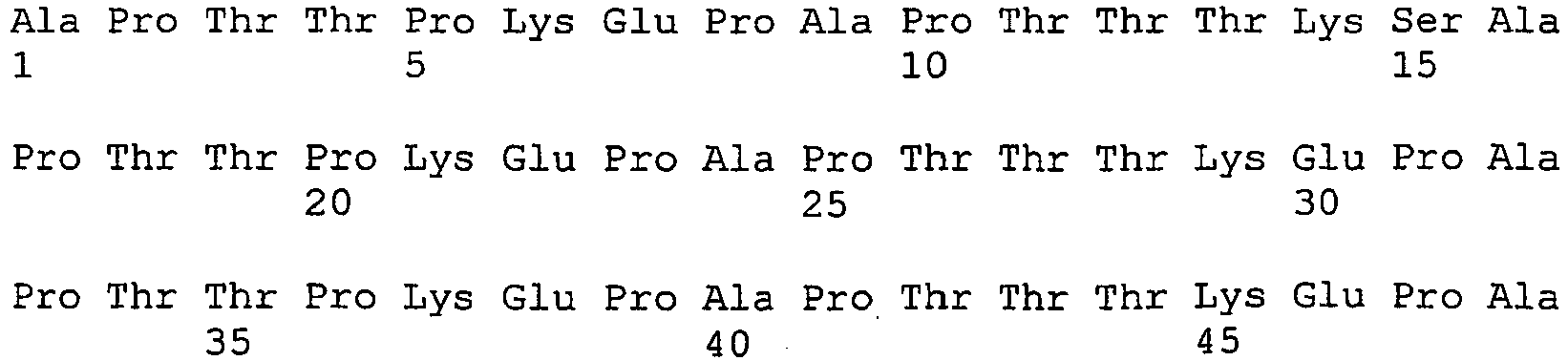
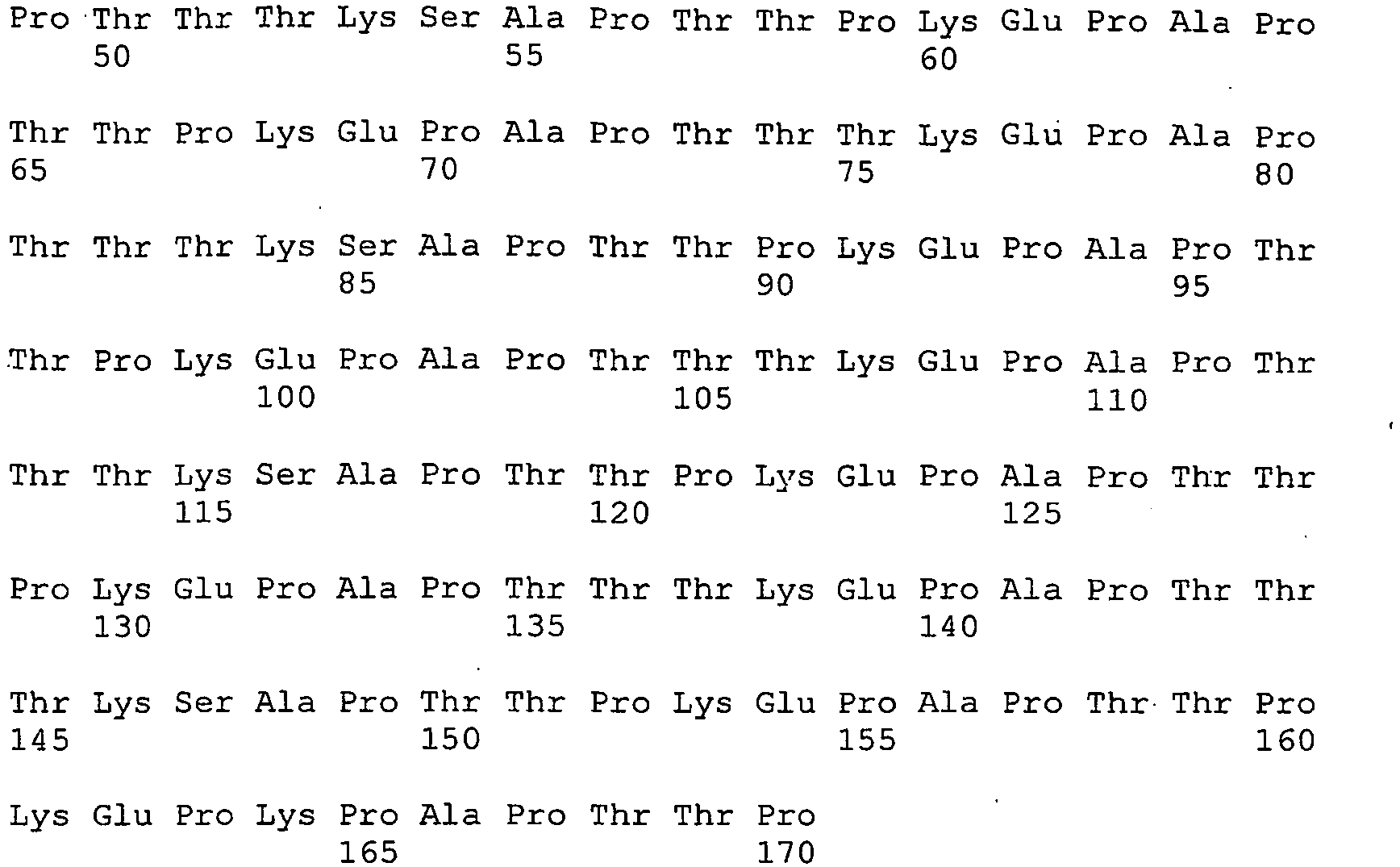
- <210> 26
<211> 45
<212> PRT
<213> Artificial - <220>
<223> amino acid sequence "APTTPKEPAPTTTKSAPTTPKEPAPTTT KEPAPTTPKEPAPTTTK" (45 amino acids) in preferred PRG4-LUB:N protein - <400> 26

- <210> 27
<211> 31
<212> PRT
<213> Artificial - <220>
<223> amino acid sequence "KEPAPTTTKEPAPTTTKSAPTTPKEPAPTTP" (31 amino acids) repeated N-1 times in preferred PRG4-LUB:N protein - <400> 27

- <210> 28
<211> 22
<212> PRT
<213> Artificial - <220>
<223> Amino acid sequence "EPAPTTTKSAPTTPKEPAPTTP" (22 amino acids) joining SEQ ID NO: 26 to (N-2) repeats of SEQ ID NO: 27 in preferred PRG4-LUB:N protein where N = 3 or more. - <400> 28

- <210> 29
<211> 10
<212> PRT
<213> Artificial - <220>
<223> Amino acid sequence "KEPKPAPTTP" (10 amino acids) in preferred PRG4-LUB:N protein where N = 2 or more. - <400> 29

Claims (21)
- An isolated protein comprising SEQ ID NOS: 7, 11, 15, 19 or 23.
- An isolated protein comprising SEQ ID NO:7.
- An isolated polynucleotide comprising a nucleic acid sequence encoding the protein of claim 1 or 2
- The polynucleotide of claim 3 wherein the polynucleotide comprises SEQ ID NOS: 6, 10, 14, 18 or 22.
- An isolated polynucleotide comprising a nucleic acid sequence encoding a recombinant lubricin protein and having at least 95% identity to SEQ ID NOS: 6, 10, 14, 18 or 22 over the entire length of the sequence.
- The polynucleotide of claim 5 comprising a nucleic acid sequence encoding a recombinant lubricin protein and having at least 99% identity to SEQ ID NOS: 6, 10, 14, 18 or 22 over the entire length of the sequence.
- A recombinant lubricin protein encoded by the polynucleotide of claim 5 or 6.
- The protein of claims 1, 2 or 7 wherein the protein is O-linked with β-(1-3)-Gal-GalNac.
- A composition comprising a therapeutically effective amount of a protein of claim 1, 2 or 7 in a pharmaceutically acceptable carrier.
- The composition of claim 9 additionally comprising hyaluronan or hylan.
- A protein of claim 1, 2 or 7 for use in the treatment of a subject.
- A protein of claim 1, 2 or 7 for use in the treatment of a subject by administration to a tissue of the subject.
- A protein of claim 1, 2 or 7 for the use of claim 11 wherein the tissue is selected from the group consisting of cartilage, synovium, meniscus, tendon, peritoneum, pericardium, and pleura.
- A protein of claim 1, 2 or 7 for the use of claim 11 wherein the tissue is cartilage.
- A protein of claim 1, 2 or 7 for the use of claim 11 where said use further comprises providing an anesthetic to the subject; providing an anti-inflammatory drug to the subject; providing an antibiotic to the subject; aspirating fluid from the subject; washing tissue of the subject; and imaging tissue of the subject.
- A protein of claim 1, 2 or 7 for the use of claim 11 where the subject is selected from the group consisting of a mouse, a rat, a cat, a dog, a horse and a human.
- A protein of claim 1, 2 or 7 for the use of claim 11 where the subject is a human.
- An expression vector comprising the polynucleotide of any one of claims 3 to 6 operably linked to an expression control sequence.
- A method of producing recombinant protein according to claim 1, 2 or 7 comprising:growing cells transformed with the expression vector of claim 18 in liquid culture media; andcollecting recombinant protein from the media.
- The method of claim 19, wherein the collecting protein comprises:concentrating the protein by filtering the media through a membrane;collecting the retained protein from the membrane; andsolubilizing the collected protein in a buffered salt solution containing L-arginine hydrochloride ranging in concentration from 0.1 to 2.0 M.
- The method of claim 20 wherein the L-arginine hydrochloride concentration is 0.5M.
Applications Claiming Priority (2)
| Application Number | Priority Date | Filing Date | Title |
|---|---|---|---|
| US49574103P | 2003-08-14 | 2003-08-14 | |
| PCT/US2004/026508 WO2005016130A2 (en) | 2003-08-14 | 2004-08-13 | Recombinant lubricin molecules and uses thereof |
Publications (3)
| Publication Number | Publication Date |
|---|---|
| EP1663291A2 EP1663291A2 (en) | 2006-06-07 |
| EP1663291A4 EP1663291A4 (en) | 2009-08-05 |
| EP1663291B1 true EP1663291B1 (en) | 2012-06-06 |
Family
ID=34193342
Family Applications (1)
| Application Number | Title | Priority Date | Filing Date |
|---|---|---|---|
| EP04781229A Expired - Lifetime EP1663291B1 (en) | 2003-08-14 | 2004-08-13 | Recombinant lubricin molecules and uses thereof |
Country Status (20)
| Country | Link |
|---|---|
| US (6) | US7642236B2 (en) |
| EP (1) | EP1663291B1 (en) |
| JP (1) | JP2007502122A (en) |
| KR (1) | KR101078202B1 (en) |
| CN (2) | CN102924584A (en) |
| AU (2) | AU2004264970B2 (en) |
| BR (1) | BRPI0413553A (en) |
| CR (1) | CR8204A (en) |
| DK (1) | DK1663291T3 (en) |
| EC (1) | ECSP066364A (en) |
| ES (1) | ES2388970T3 (en) |
| IL (2) | IL173258A (en) |
| MX (1) | MXPA06001658A (en) |
| NO (1) | NO20060475L (en) |
| NZ (1) | NZ545021A (en) |
| RU (2) | RU2376313C2 (en) |
| SG (1) | SG145724A1 (en) |
| UA (1) | UA91818C2 (en) |
| WO (1) | WO2005016130A2 (en) |
| ZA (1) | ZA200601291B (en) |
Cited By (1)
| Publication number | Priority date | Publication date | Assignee | Title |
|---|---|---|---|---|
| US11905531B2 (en) | 2016-01-13 | 2024-02-20 | Genzyme Corporation | Recombinant AAV vectors expressing osteoprotective genes, including HAS2 and lubricin, useful in the treatment of osteoarthritis and related joint conditions in mammals |
Families Citing this family (22)
| Publication number | Priority date | Publication date | Assignee | Title |
|---|---|---|---|---|
| US6743774B1 (en) | 1999-04-23 | 2004-06-01 | Rhode Island Hospital | Tribonectins |
| US20080287369A1 (en) * | 2004-07-23 | 2008-11-20 | Jay Gregory D | Compositions and Methods for Viscosupplementation |
| US20090068247A1 (en) * | 2007-09-12 | 2009-03-12 | Mucosal Therapeutics | Biocompatible devices coated with a tribonectin and methods for their production |
| US20090104148A1 (en) * | 2007-09-18 | 2009-04-23 | Jay Gregory D | Treatment and prevention of joint disease |
| HRP20150097T1 (en) | 2008-05-07 | 2015-03-27 | The Regents Of The University Of California | Therapeutic replenishment and enrichment of ocular surface lubrication |
| US8506944B2 (en) | 2008-05-07 | 2013-08-13 | The Regents Of The University Of California | Replenishment and enrichment of ocular surface lubrication |
| ES2534082T3 (en) * | 2009-01-13 | 2015-04-17 | Lubris Llc | Therapeutic modulation of the lubrication of the vaginal epithelium boundary |
| WO2010135736A2 (en) * | 2009-05-22 | 2010-11-25 | Singularis Inc. | Application and uses of prg4 and therapeutic modulation thereof |
| WO2011091000A2 (en) * | 2010-01-19 | 2011-07-28 | Singularis, Inc. | Oral care compositions and methods |
| US8716204B2 (en) | 2010-07-27 | 2014-05-06 | Zimmer, Inc. | Synthetic synovial fluid compositions and methods for making the same |
| US20130116186A1 (en) * | 2011-10-04 | 2013-05-09 | Rhode Island Hospital, A Lifespan Partner | Lubricin injections to maintain cartilage health |
| WO2014115022A1 (en) | 2013-01-25 | 2014-07-31 | Baylor College Of Medicine | A helper-dependent adenoviral gene therapy delivery and expression system |
| US20150010606A1 (en) * | 2013-07-08 | 2015-01-08 | Arthrex, Inc. | Intra-articular injection and implant attachment of molecule consisting of lubricin and extracellular superoxide dismutase or hyaluronic acid and extracellular superoxide dismutase |
| US20160263217A1 (en) * | 2013-10-16 | 2016-09-15 | Ensisheim Partners Llc | Protein-specific formulations |
| US9982027B2 (en) * | 2013-10-22 | 2018-05-29 | Lubris Llc | Control of rheological properties of mixed hyaluronate/lubricin solutions |
| US10500250B2 (en) | 2013-11-26 | 2019-12-10 | Lubris Llc | Compositions and methods for inhibiting intercellular interactions |
| AU2016211694B2 (en) | 2015-01-26 | 2021-11-11 | Lubris Llc | Use of PRG4 as an anti-inflammatory agent |
| ES2823173T3 (en) | 2016-01-27 | 2021-05-06 | Just Biotherapeutics Inc | Hybrid promoter and uses of it |
| WO2019246522A1 (en) * | 2018-06-21 | 2019-12-26 | Lubris Llc | Lubricin for use in wound healing |
| JP7667569B2 (en) * | 2019-01-15 | 2025-04-23 | コーネル ユニバーシティー | Recombinant lubricin and compositions and methods for using same |
| KR20220145361A (en) * | 2020-02-24 | 2022-10-28 | 노파르티스 아게 | Purification of Recombinantly Produced Polypeptides |
| IT202000022636A1 (en) | 2020-09-25 | 2022-03-25 | Ente Ospedaliero Specializzato In Gastroenterologia Istituto Nazionale Di Ricovero E Cura A Caratter | “COMBINATION THERAPY OF SORAFENIB AND/OR REGORAFENIB WITH THE RECOMBINANT HUMAN PROTEOGLYCAN-4 PROTEIN FOR THE TREATMENT OF HEPATOCARCINOMA” |
Citations (1)
| Publication number | Priority date | Publication date | Assignee | Title |
|---|---|---|---|---|
| WO2002062847A2 (en) * | 2000-12-29 | 2002-08-15 | Glaxo Group Limited | Superficial zone protein and methods of making and using same |
Family Cites Families (22)
| Publication number | Priority date | Publication date | Assignee | Title |
|---|---|---|---|---|
| US2734862A (en) * | 1956-02-14 | Synthetic casein fiber elastic grease | ||
| US2487377A (en) * | 1948-04-17 | 1949-11-08 | Socony Vacuum Oil Co Inc | Lubricant |
| US2878184A (en) * | 1953-12-29 | 1959-03-17 | Rockwell Mfg Co | Hydrocarbon resistant glycerol base lubricant |
| AR207237A1 (en) * | 1974-02-25 | 1976-09-22 | Thomas A | PROCEDURE FOR OBTAINING SOLUBLE LYOPHILIZED STABLE BIOLOGICAL EXTRACTS CONSTITUTED BY THERMORE RESISTANT PROTEIN COMPLEXES |
| US4438100A (en) * | 1980-04-25 | 1984-03-20 | A/S Orthana Kemisk Fabrik | Sterilized preserved, stable mucine-containing solutions |
| US5403592A (en) * | 1987-08-25 | 1995-04-04 | Macnaught Pty Limited | Lubricant composition for rheumatism |
| GB8803697D0 (en) * | 1988-02-17 | 1988-03-16 | Deltanine Research Ltd | Clinical developments using amniotic membrane cells |
| US5510418A (en) * | 1988-11-21 | 1996-04-23 | Collagen Corporation | Glycosaminoglycan-synthetic polymer conjugates |
| US5260417A (en) * | 1989-04-03 | 1993-11-09 | Genetics Institute, Inc. | Megakaryocyte growth promoting activity protein |
| US6433142B1 (en) * | 1989-08-08 | 2002-08-13 | Genetics Institute, Llc | Megakaryocyte stimulating factors |
| US5326558A (en) * | 1989-08-08 | 1994-07-05 | Genetics Institute, Inc. | Megakaryocytopoietic factor |
| AU652022B2 (en) * | 1991-02-12 | 1994-08-11 | C.R. Bard Inc. | Injectable medical device |
| US5605938A (en) * | 1991-05-31 | 1997-02-25 | Gliatech, Inc. | Methods and compositions for inhibition of cell invasion and fibrosis using dextran sulfate |
| CN1107891A (en) | 1994-03-04 | 1995-09-06 | 上海贝特生物技术有限公司 | Human megacaryocyte auxin and its separating purification and gene clone method and application |
| US5709020A (en) * | 1994-07-19 | 1998-01-20 | University Of Kentucky Research Foundation | Method for reducing the generation of wear particulates from an implant |
| US5515590A (en) * | 1994-07-19 | 1996-05-14 | University Of Kentucky Research Foundation | Method for reducing the generation of wear particulates from an implant |
| US5510122A (en) * | 1994-09-28 | 1996-04-23 | The Research Foundation Of State University Of New York | Preparation and use of whole saliva |
| US7001881B1 (en) * | 1999-04-23 | 2006-02-21 | Rhode Island Hospital | Tribonectins |
| US6743774B1 (en) * | 1999-04-23 | 2004-06-01 | Rhode Island Hospital | Tribonectins |
| US6960562B2 (en) * | 1999-04-23 | 2005-11-01 | Rhode Island Hospital, A Lifespan Partner | Tribonectin polypeptides and uses thereof |
| AU6366100A (en) | 1999-07-23 | 2001-02-13 | Case Western Reserve University | Novel methods and reagents for the treatment of osteoarthritis |
| EP1440981A3 (en) | 2003-01-21 | 2005-11-23 | Research Association for Biotechnology | Full-length human cdna |
-
2004
- 2004-08-13 WO PCT/US2004/026508 patent/WO2005016130A2/en not_active Ceased
- 2004-08-13 UA UAA200602706A patent/UA91818C2/en unknown
- 2004-08-13 DK DK04781229.2T patent/DK1663291T3/en active
- 2004-08-13 EP EP04781229A patent/EP1663291B1/en not_active Expired - Lifetime
- 2004-08-13 CN CN2012104146501A patent/CN102924584A/en active Pending
- 2004-08-13 US US10/567,764 patent/US7642236B2/en not_active Expired - Fee Related
- 2004-08-13 NZ NZ545021A patent/NZ545021A/en not_active IP Right Cessation
- 2004-08-13 KR KR1020067003110A patent/KR101078202B1/en not_active Expired - Fee Related
- 2004-08-13 ES ES04781229T patent/ES2388970T3/en not_active Expired - Lifetime
- 2004-08-13 AU AU2004264970A patent/AU2004264970B2/en not_active Ceased
- 2004-08-13 SG SG200805896-8A patent/SG145724A1/en unknown
- 2004-08-13 CN CNA2004800299041A patent/CN1867350A/en active Pending
- 2004-08-13 JP JP2006523436A patent/JP2007502122A/en active Pending
- 2004-08-13 BR BRPI0413553-9A patent/BRPI0413553A/en not_active IP Right Cessation
- 2004-08-13 MX MXPA06001658A patent/MXPA06001658A/en active IP Right Grant
- 2004-08-13 RU RU2006107925/13A patent/RU2376313C2/en not_active IP Right Cessation
-
2006
- 2006-01-19 CR CR8204A patent/CR8204A/en unknown
- 2006-01-19 IL IL173258A patent/IL173258A/en not_active IP Right Cessation
- 2006-01-30 NO NO20060475A patent/NO20060475L/en not_active Application Discontinuation
- 2006-02-13 ZA ZA200601291A patent/ZA200601291B/en unknown
- 2006-02-14 EC EC2006006364A patent/ECSP066364A/en unknown
-
2009
- 2009-06-24 IL IL199528A patent/IL199528A/en not_active IP Right Cessation
- 2009-08-07 RU RU2009130434/10A patent/RU2009130434A/en not_active Application Discontinuation
- 2009-11-19 US US12/622,141 patent/US7893029B2/en not_active Expired - Fee Related
- 2009-11-23 US US12/624,112 patent/US7897571B2/en not_active Expired - Fee Related
-
2010
- 2010-04-16 AU AU2010201537A patent/AU2010201537B2/en not_active Ceased
-
2011
- 2011-02-25 US US13/035,529 patent/US8420793B2/en not_active Expired - Fee Related
-
2013
- 2013-03-08 US US13/791,346 patent/US8987205B2/en not_active Expired - Fee Related
-
2015
- 2015-02-05 US US14/614,809 patent/US20150343019A1/en not_active Abandoned
Patent Citations (1)
| Publication number | Priority date | Publication date | Assignee | Title |
|---|---|---|---|---|
| WO2002062847A2 (en) * | 2000-12-29 | 2002-08-15 | Glaxo Group Limited | Superficial zone protein and methods of making and using same |
Non-Patent Citations (1)
| Title |
|---|
| CARL R. FLANNERY ET AL: "Prevention of cartilage degeneration in a rat model of osteoarthritis by intraarticular treatment with recombinant lubricin", ARTHRITIS & RHEUMATISM, vol. 60, no. 3, 1 March 2009 (2009-03-01), pages 840 - 847, XP055001918, ISSN: 0004-3591, DOI: 10.1002/art.24304 * |
Cited By (1)
| Publication number | Priority date | Publication date | Assignee | Title |
|---|---|---|---|---|
| US11905531B2 (en) | 2016-01-13 | 2024-02-20 | Genzyme Corporation | Recombinant AAV vectors expressing osteoprotective genes, including HAS2 and lubricin, useful in the treatment of osteoarthritis and related joint conditions in mammals |
Also Published As
Similar Documents
| Publication | Publication Date | Title |
|---|---|---|
| US7893029B2 (en) | Recombinant lubricin molecules and uses thereof | |
| JP3693338B2 (en) | Regulation of inflammatory response by induction of tissue morphogenetic factor | |
| EP0809517B1 (en) | Anti-transforming growth factor-beta gene therapy | |
| AU657913B2 (en) | Tissue-derived tumor growth inhibitors, methods of preparation and uses thereof | |
| US5739107A (en) | Morphogen treatment of gastrointestinal ulcers | |
| JP4255986B2 (en) | Morphogen treatment of gastrointestinal ulcers | |
| HK1089110B (en) | Recombinant lubricin molecules and uses thereof | |
| AU719153B2 (en) | Morphogen treatment of gastrointestinal ulcers | |
| Kato et al. | Effect of epidermal growth factor on intestinal adaptation after allogeneic small bowel transplantation in rats | |
| KR20170066515A (en) | A method of treating joint disease |
Legal Events
| Date | Code | Title | Description |
|---|---|---|---|
| PUAI | Public reference made under article 153(3) epc to a published international application that has entered the european phase |
Free format text: ORIGINAL CODE: 0009012 |
|
| 17P | Request for examination filed |
Effective date: 20060221 |
|
| AK | Designated contracting states |
Kind code of ref document: A2 Designated state(s): AT BE BG CH CY CZ DE DK EE ES FI FR GB GR HU IE IT LI LU MC NL PL PT RO SE SI SK TR |
|
| AX | Request for extension of the european patent |
Extension state: AL HR LT LV MK |
|
| RIC1 | Information provided on ipc code assigned before grant |
Ipc: C07K 14/435 20060101ALI20060627BHEP Ipc: A61K 38/17 20060101AFI20060627BHEP Ipc: A61K 31/728 20060101ALI20060627BHEP |
|
| R17D | Deferred search report published (corrected) |
Effective date: 20060427 |
|
| R17D | Deferred search report published (corrected) |
Effective date: 20060202 |
|
| REG | Reference to a national code |
Ref country code: HK Ref legal event code: DE Ref document number: 1089110 Country of ref document: HK |
|
| R17D | Deferred search report published (corrected) |
Effective date: 20060427 |
|
| A4 | Supplementary search report drawn up and despatched |
Effective date: 20090706 |
|
| 17Q | First examination report despatched |
Effective date: 20091012 |
|
| RAP1 | Party data changed (applicant data changed or rights of an application transferred) |
Owner name: WYETH LLC |
|
| RTI1 | Title (correction) |
Free format text: RECOMBINANT LUBRICIN MOLECULES AND USES THEREOF |
|
| GRAP | Despatch of communication of intention to grant a patent |
Free format text: ORIGINAL CODE: EPIDOSNIGR1 |
|
| GRAS | Grant fee paid |
Free format text: ORIGINAL CODE: EPIDOSNIGR3 |
|
| GRAA | (expected) grant |
Free format text: ORIGINAL CODE: 0009210 |
|
| AK | Designated contracting states |
Kind code of ref document: B1 Designated state(s): AT BE BG CH CY CZ DE DK EE ES FI FR GB GR HU IE IT LI LU MC NL PL PT RO SE SI SK TR |
|
| AX | Request for extension of the european patent |
Extension state: AL HR LT LV MK |
|
| REG | Reference to a national code |
Ref country code: GB Ref legal event code: FG4D |
|
| REG | Reference to a national code |
Ref country code: CH Ref legal event code: EP Ref country code: AT Ref legal event code: REF Ref document number: 560676 Country of ref document: AT Kind code of ref document: T Effective date: 20120615 |
|
| REG | Reference to a national code |
Ref country code: DK Ref legal event code: T3 |
|
| REG | Reference to a national code |
Ref country code: IE Ref legal event code: FG4D |
|
| REG | Reference to a national code |
Ref country code: NL Ref legal event code: T3 |
|
| PGFP | Annual fee paid to national office [announced via postgrant information from national office to epo] |
Ref country code: IE Payment date: 20120607 Year of fee payment: 9 |
|
| REG | Reference to a national code |
Ref country code: DE Ref legal event code: R096 Ref document number: 602004038098 Country of ref document: DE Effective date: 20120802 |
|
| REG | Reference to a national code |
Ref country code: SE Ref legal event code: TRGR |
|
| REG | Reference to a national code |
Ref country code: ES Ref legal event code: FG2A Ref document number: 2388970 Country of ref document: ES Kind code of ref document: T3 Effective date: 20121022 |
|
| PG25 | Lapsed in a contracting state [announced via postgrant information from national office to epo] |
Ref country code: CY Free format text: LAPSE BECAUSE OF FAILURE TO SUBMIT A TRANSLATION OF THE DESCRIPTION OR TO PAY THE FEE WITHIN THE PRESCRIBED TIME-LIMIT Effective date: 20120606 |
|
| PGFP | Annual fee paid to national office [announced via postgrant information from national office to epo] |
Ref country code: SE Payment date: 20120809 Year of fee payment: 9 Ref country code: GB Payment date: 20120726 Year of fee payment: 9 Ref country code: FI Payment date: 20120724 Year of fee payment: 9 |
|
| REG | Reference to a national code |
Ref country code: AT Ref legal event code: MK05 Ref document number: 560676 Country of ref document: AT Kind code of ref document: T Effective date: 20120606 |
|
| REG | Reference to a national code |
Ref country code: HK Ref legal event code: GR Ref document number: 1089110 Country of ref document: HK |
|
| REG | Reference to a national code |
Ref country code: LT Ref legal event code: MG9D Effective date: 20120606 |
|
| PG25 | Lapsed in a contracting state [announced via postgrant information from national office to epo] |
Ref country code: SI Free format text: LAPSE BECAUSE OF FAILURE TO SUBMIT A TRANSLATION OF THE DESCRIPTION OR TO PAY THE FEE WITHIN THE PRESCRIBED TIME-LIMIT Effective date: 20120606 Ref country code: GR Free format text: LAPSE BECAUSE OF FAILURE TO SUBMIT A TRANSLATION OF THE DESCRIPTION OR TO PAY THE FEE WITHIN THE PRESCRIBED TIME-LIMIT Effective date: 20120907 |
|
| PGFP | Annual fee paid to national office [announced via postgrant information from national office to epo] |
Ref country code: DE Payment date: 20120704 Year of fee payment: 9 Ref country code: ES Payment date: 20120802 Year of fee payment: 9 Ref country code: IT Payment date: 20120828 Year of fee payment: 9 Ref country code: FR Payment date: 20120821 Year of fee payment: 9 |
|
| PG25 | Lapsed in a contracting state [announced via postgrant information from national office to epo] |
Ref country code: BE Free format text: LAPSE BECAUSE OF FAILURE TO SUBMIT A TRANSLATION OF THE DESCRIPTION OR TO PAY THE FEE WITHIN THE PRESCRIBED TIME-LIMIT Effective date: 20120606 Ref country code: EE Free format text: LAPSE BECAUSE OF FAILURE TO SUBMIT A TRANSLATION OF THE DESCRIPTION OR TO PAY THE FEE WITHIN THE PRESCRIBED TIME-LIMIT Effective date: 20120606 Ref country code: SK Free format text: LAPSE BECAUSE OF FAILURE TO SUBMIT A TRANSLATION OF THE DESCRIPTION OR TO PAY THE FEE WITHIN THE PRESCRIBED TIME-LIMIT Effective date: 20120606 Ref country code: CZ Free format text: LAPSE BECAUSE OF FAILURE TO SUBMIT A TRANSLATION OF THE DESCRIPTION OR TO PAY THE FEE WITHIN THE PRESCRIBED TIME-LIMIT Effective date: 20120606 Ref country code: RO Free format text: LAPSE BECAUSE OF FAILURE TO SUBMIT A TRANSLATION OF THE DESCRIPTION OR TO PAY THE FEE WITHIN THE PRESCRIBED TIME-LIMIT Effective date: 20120606 Ref country code: AT Free format text: LAPSE BECAUSE OF FAILURE TO SUBMIT A TRANSLATION OF THE DESCRIPTION OR TO PAY THE FEE WITHIN THE PRESCRIBED TIME-LIMIT Effective date: 20120606 |
|
| PG25 | Lapsed in a contracting state [announced via postgrant information from national office to epo] |
Ref country code: PT Free format text: LAPSE BECAUSE OF FAILURE TO SUBMIT A TRANSLATION OF THE DESCRIPTION OR TO PAY THE FEE WITHIN THE PRESCRIBED TIME-LIMIT Effective date: 20121008 Ref country code: PL Free format text: LAPSE BECAUSE OF FAILURE TO SUBMIT A TRANSLATION OF THE DESCRIPTION OR TO PAY THE FEE WITHIN THE PRESCRIBED TIME-LIMIT Effective date: 20120606 |
|
| REG | Reference to a national code |
Ref country code: CH Ref legal event code: PL |
|
| PG25 | Lapsed in a contracting state [announced via postgrant information from national office to epo] |
Ref country code: MC Free format text: LAPSE BECAUSE OF NON-PAYMENT OF DUE FEES Effective date: 20120831 |
|
| PLBE | No opposition filed within time limit |
Free format text: ORIGINAL CODE: 0009261 |
|
| STAA | Information on the status of an ep patent application or granted ep patent |
Free format text: STATUS: NO OPPOSITION FILED WITHIN TIME LIMIT |
|
| PG25 | Lapsed in a contracting state [announced via postgrant information from national office to epo] |
Ref country code: LI Free format text: LAPSE BECAUSE OF NON-PAYMENT OF DUE FEES Effective date: 20120831 Ref country code: CH Free format text: LAPSE BECAUSE OF NON-PAYMENT OF DUE FEES Effective date: 20120831 |
|
| 26N | No opposition filed |
Effective date: 20130307 |
|
| REG | Reference to a national code |
Ref country code: DE Ref legal event code: R097 Ref document number: 602004038098 Country of ref document: DE Effective date: 20130307 |
|
| PG25 | Lapsed in a contracting state [announced via postgrant information from national office to epo] |
Ref country code: BG Free format text: LAPSE BECAUSE OF FAILURE TO SUBMIT A TRANSLATION OF THE DESCRIPTION OR TO PAY THE FEE WITHIN THE PRESCRIBED TIME-LIMIT Effective date: 20120906 |
|
| PGFP | Annual fee paid to national office [announced via postgrant information from national office to epo] |
Ref country code: NL Payment date: 20130521 Year of fee payment: 10 |
|
| REG | Reference to a national code |
Ref country code: DK Ref legal event code: EBP Effective date: 20130831 |
|
| REG | Reference to a national code |
Ref country code: SE Ref legal event code: EUG |
|
| GBPC | Gb: european patent ceased through non-payment of renewal fee |
Effective date: 20130813 |
|
| PG25 | Lapsed in a contracting state [announced via postgrant information from national office to epo] |
Ref country code: DE Free format text: LAPSE BECAUSE OF NON-PAYMENT OF DUE FEES Effective date: 20140301 Ref country code: SE Free format text: LAPSE BECAUSE OF NON-PAYMENT OF DUE FEES Effective date: 20130814 Ref country code: FI Free format text: LAPSE BECAUSE OF NON-PAYMENT OF DUE FEES Effective date: 20130813 Ref country code: TR Free format text: LAPSE BECAUSE OF FAILURE TO SUBMIT A TRANSLATION OF THE DESCRIPTION OR TO PAY THE FEE WITHIN THE PRESCRIBED TIME-LIMIT Effective date: 20120606 |
|
| REG | Reference to a national code |
Ref country code: IE Ref legal event code: MM4A |
|
| REG | Reference to a national code |
Ref country code: FR Ref legal event code: ST Effective date: 20140430 |
|
| PG25 | Lapsed in a contracting state [announced via postgrant information from national office to epo] |
Ref country code: IT Free format text: LAPSE BECAUSE OF NON-PAYMENT OF DUE FEES Effective date: 20130813 Ref country code: LU Free format text: LAPSE BECAUSE OF NON-PAYMENT OF DUE FEES Effective date: 20120813 |
|
| REG | Reference to a national code |
Ref country code: DE Ref legal event code: R119 Ref document number: 602004038098 Country of ref document: DE Effective date: 20140301 |
|
| PG25 | Lapsed in a contracting state [announced via postgrant information from national office to epo] |
Ref country code: HU Free format text: LAPSE BECAUSE OF FAILURE TO SUBMIT A TRANSLATION OF THE DESCRIPTION OR TO PAY THE FEE WITHIN THE PRESCRIBED TIME-LIMIT Effective date: 20040813 Ref country code: IE Free format text: LAPSE BECAUSE OF NON-PAYMENT OF DUE FEES Effective date: 20130813 Ref country code: GB Free format text: LAPSE BECAUSE OF NON-PAYMENT OF DUE FEES Effective date: 20130813 |
|
| PG25 | Lapsed in a contracting state [announced via postgrant information from national office to epo] |
Ref country code: FR Free format text: LAPSE BECAUSE OF NON-PAYMENT OF DUE FEES Effective date: 20130902 |
|
| REG | Reference to a national code |
Ref country code: ES Ref legal event code: FD2A Effective date: 20140908 |
|
| PG25 | Lapsed in a contracting state [announced via postgrant information from national office to epo] |
Ref country code: DK Free format text: LAPSE BECAUSE OF NON-PAYMENT OF DUE FEES Effective date: 20130831 |
|
| PG25 | Lapsed in a contracting state [announced via postgrant information from national office to epo] |
Ref country code: ES Free format text: LAPSE BECAUSE OF NON-PAYMENT OF DUE FEES Effective date: 20130814 |
|
| REG | Reference to a national code |
Ref country code: NL Ref legal event code: V1 Effective date: 20150301 |
|
| PG25 | Lapsed in a contracting state [announced via postgrant information from national office to epo] |
Ref country code: NL Free format text: LAPSE BECAUSE OF NON-PAYMENT OF DUE FEES Effective date: 20150301 |