EP1663255B1 - Withanamide and withanolide compositions and method of use thereof - Google Patents
Withanamide and withanolide compositions and method of use thereof Download PDFInfo
- Publication number
- EP1663255B1 EP1663255B1 EP04781541.0A EP04781541A EP1663255B1 EP 1663255 B1 EP1663255 B1 EP 1663255B1 EP 04781541 A EP04781541 A EP 04781541A EP 1663255 B1 EP1663255 B1 EP 1663255B1
- Authority
- EP
- European Patent Office
- Prior art keywords
- compound
- withanamide
- nmr
- compounds
- withanamides
- Prior art date
- Legal status (The legal status is an assumption and is not a legal conclusion. Google has not performed a legal analysis and makes no representation as to the accuracy of the status listed.)
- Expired - Lifetime
Links
- 0 CCC1*2C1CCC(C)C2 Chemical compound CCC1*2C1CCC(C)C2 0.000 description 18
- VQXZXJCYVLTQRL-UHFFFAOYSA-N C1CC2S=CC2C1 Chemical compound C1CC2S=CC2C1 VQXZXJCYVLTQRL-UHFFFAOYSA-N 0.000 description 1
Images
Classifications
-
- C—CHEMISTRY; METALLURGY
- C07—ORGANIC CHEMISTRY
- C07D—HETEROCYCLIC COMPOUNDS
- C07D405/00—Heterocyclic compounds containing both one or more hetero rings having oxygen atoms as the only ring hetero atoms, and one or more rings having nitrogen as the only ring hetero atom
- C07D405/14—Heterocyclic compounds containing both one or more hetero rings having oxygen atoms as the only ring hetero atoms, and one or more rings having nitrogen as the only ring hetero atom containing three or more hetero rings
-
- C—CHEMISTRY; METALLURGY
- C07—ORGANIC CHEMISTRY
- C07H—SUGARS; DERIVATIVES THEREOF; NUCLEOSIDES; NUCLEOTIDES; NUCLEIC ACIDS
- C07H17/00—Compounds containing heterocyclic radicals directly attached to hetero atoms of saccharide radicals
- C07H17/02—Heterocyclic radicals containing only nitrogen as ring hetero atoms
-
- A—HUMAN NECESSITIES
- A61—MEDICAL OR VETERINARY SCIENCE; HYGIENE
- A61K—PREPARATIONS FOR MEDICAL, DENTAL OR TOILETRY PURPOSES
- A61K31/00—Medicinal preparations containing organic active ingredients
- A61K31/70—Carbohydrates; Sugars; Derivatives thereof
-
- A—HUMAN NECESSITIES
- A61—MEDICAL OR VETERINARY SCIENCE; HYGIENE
- A61P—SPECIFIC THERAPEUTIC ACTIVITY OF CHEMICAL COMPOUNDS OR MEDICINAL PREPARATIONS
- A61P25/00—Drugs for disorders of the nervous system
- A61P25/06—Antimigraine agents
-
- A—HUMAN NECESSITIES
- A61—MEDICAL OR VETERINARY SCIENCE; HYGIENE
- A61P—SPECIFIC THERAPEUTIC ACTIVITY OF CHEMICAL COMPOUNDS OR MEDICINAL PREPARATIONS
- A61P25/00—Drugs for disorders of the nervous system
- A61P25/24—Antidepressants
-
- A—HUMAN NECESSITIES
- A61—MEDICAL OR VETERINARY SCIENCE; HYGIENE
- A61P—SPECIFIC THERAPEUTIC ACTIVITY OF CHEMICAL COMPOUNDS OR MEDICINAL PREPARATIONS
- A61P25/00—Drugs for disorders of the nervous system
- A61P25/28—Drugs for disorders of the nervous system for treating neurodegenerative disorders of the central nervous system, e.g. nootropic agents, cognition enhancers, drugs for treating Alzheimer's disease or other forms of dementia
-
- A—HUMAN NECESSITIES
- A61—MEDICAL OR VETERINARY SCIENCE; HYGIENE
- A61P—SPECIFIC THERAPEUTIC ACTIVITY OF CHEMICAL COMPOUNDS OR MEDICINAL PREPARATIONS
- A61P3/00—Drugs for disorders of the metabolism
-
- A—HUMAN NECESSITIES
- A61—MEDICAL OR VETERINARY SCIENCE; HYGIENE
- A61P—SPECIFIC THERAPEUTIC ACTIVITY OF CHEMICAL COMPOUNDS OR MEDICINAL PREPARATIONS
- A61P3/00—Drugs for disorders of the metabolism
- A61P3/04—Anorexiants; Antiobesity agents
-
- A—HUMAN NECESSITIES
- A61—MEDICAL OR VETERINARY SCIENCE; HYGIENE
- A61P—SPECIFIC THERAPEUTIC ACTIVITY OF CHEMICAL COMPOUNDS OR MEDICINAL PREPARATIONS
- A61P39/00—General protective or antinoxious agents
- A61P39/06—Free radical scavengers or antioxidants
Definitions
- the present invention relates to the use of withanamides in the treatment of various diseases, such as Alzheimer's Disease, depression, obesity and migraine headaches.
- the withanamides were particularly isolated and purified from fruits of Withania somnifera.
- Withania somnifera (L) Dunal of solanaceae, is an erect evergreen shrub distributed throughout the drier parts of India.
- W. somnifera known as Aswagandha
- Aswagandha is well known for its use in Ayurvedic medicine.
- the Aswagandha root extract was reported as a folk remedy for adenopathy, arthritis, asthma, hypertension, inflammations, and rheumatism ( Thakur, R.S., et al., Major Medicinal plants of India; Ed.; Central Institute of Medicinal and Aromatic Plants: Lucknow, India, 531 (1989 )).
- somnifera were also used as a cure for several illnesses including tumors, inflammations, conjunctivitis and tuberculosis ( Thakur, R.S., et al., Major Medicinal plants of India; Ed. ; Central Institute of Medicinal and Aromatic Plants: Lucknow, India, 531 (1989 )).
- powdered roots or root extract of this plant are used as a dietary supplement in the United States.
- the major chemical constituents reported from W. somnifera are called withanolides. These compounds are structurally diverse steroidal compounds with an ergosterol skeleton in which C-22 and C-26 are oxidized to form a ⁇ -lactone; ( Ray, A. B., et al., Prog. Chem. Org. Nat. Prod. 63, 1-106 (1994 )).
- the chemical investigations of the roots and leaves of W. somnifera resulted in the isolation and characterization of several withanolides ( Matsuda, M., et al., Bioorg. Med. Chem. 9, 1499-1507 (2001 )).
- the fruits of this plant are tiny orange berries and reported to contain saturated and unsaturated fatty acids ( Stoller E.W., et al., Lloydia, 37, 309-312 (1974 ); Monika, P., et al., Asian J. Chem. 6, 442-444 (1994 ); and Monika, P., et al., Sci. Phys. Sci. 5, 81-83 (1993 )).
- leaves and fruits are not fully investigated for biological activities.
- the withanolides are classified according to their structural skeleton ( Ray, A. B., et al., Prog. Chem. Org. Nat. Prod. 63, 1-106 (1994 )) and the structural variation is responsible for the wide array of pharmacological activities.
- the life-supporting oxygen becomes toxic to most aerobic organisms when exposed to greater concentrations. Reasons for this toxicity are due to the formation of superoxide (O 2 - ), hydrogen peroxide (H 2 O 2 ) and hydroxyl (-OH•) radicals during the conversion of oxygen to water in the mitochondria.
- superoxide O 2 -
- hydrogen peroxide H 2 O 2
- hydroxyl -OH•
- the free radicals generated from environmental contaminants and by exogenous factors such as drugs, toxins and stress cause oxidative damage to biological macromolecular structure and function ( Wickens, A.P., Respiration Physiology, 128 371-3891 (2001 )). This will then lead to the progression of many disease processes including atherosclerosis, cardiovascular diseases and cancer.
- Some of the pharmaceuticals prescribed for depression or anxiety contain natural antioxidants. Mixtures of ascorbic acid, pyridoxine, carotene, vitamin E, Zn, nicotinamide, and Se were effectively used to treat depression or anxiety (Horrobin, D.F., PCT Int. Appl. WO98-48788, A1 1998 1105 (1998)). Natural antioxidants are used as food additives to inhibit lipid peroxidation and to maintain the nutritional qualities of food. It is also known that antioxidants decrease the side effects of chemotherapy during cancer treatment ( Conclin, K.A., Nut. Canc. 37 1-18 (2000 )).
- the synthetic antioxidants used to prevent the lipid peroxidation in food are butylated hydroxyanisole (BHA), butylated hydroxytoluene (BHT), propyl gallate (PG), and tert-butylhydroquinone (TBHQ).
- BHA butylated hydroxyanisole
- BHT butylated hydroxytoluene
- PG propyl gallate
- TBHQ tert-butylhydroquinone
- synthetic antioxidants are considered to be potential carcinogens ( Marchant, C.A., Env. Health Persp. Supp. 104 1065-1073 (1996 )) and hence there is considerable interest in developing safe and natural antioxidants.
- the present invention provides a pharmaceutical composition
- a pharmaceutical composition comprising a compound of the formula wherein R is selected from the group consisting of and a compound of the formula and mixtures thereof.
- the present invention also provides a composition which comprises:
- a bioassay-guided purification of the methanolic extract of Withania somnifera fruits yielded novel withanamides A-I ( 1-9 ) (inventive compounds), a new withanolide ( 10 ) (not claimed) and three known withanolides ( 11-13 ) (not claimed).
- R is selected from the group consisting of:
- the structures of these compounds were determined by using FABMS, HRFABMS, ID- and 2D-NMR spectral experiments.
- the withanamides A-I ( 1-9 )were found to be glycosylated serotonine conjugated with long-chain hydroxyl fatty acids.
- the stereochemistry of the hydroxyl group on the long-chain fatty acid moiety was determined by modified Mosher's ester method for compound 1.
- Compounds 1-13 were tested for their ability to inhibit lipid peroxidation in a model system using large unilamellar vesicles (LUV's).
- Withanamides 1-5 and 9 inhibited lipid peroxidation by 98, 93, 79, 94, 81 and 86%, respectively, at 1 ⁇ g/mL.
- antioxidants butylated hydroxyanisole (BHA), butylated hydroxytoluene (BHT), and tert-butylhydroquinone (TBHQ), used as food preservatives, were also tested in this way at 1 ⁇ g/mL, respectively, and showed 80, 81 and 85% of inhibition.
- BHA butylated hydroxyanisole
- BHT butylated hydroxytoluene
- TBHQ tert-butylhydroquinone
- Withanamides A (1), H (8) and I (9). Withanamide A ( 1 ) was obtained as a pale brown amorphous powder with an [ ⁇ ] D -35°.
- the HRFABMS of 1 displayed an [M+H] + ion at m/z 779.4329 (calc. 779.4330) and indicated its molecular formula as C 40 H 62 N 2 O 13 .
- the IR spectrum showed absorption bands at 1633, 3413 cm -1 and indicated the presence of amide carbonyl and hydroxyl groups in the molecule.
- the proton NMR signals at ⁇ 6.66, 6.92, 6.99, and 7.15 were characteristic of a 5-oxygenated tryptamine derivative 14 and assigned to C-6, C-4, C-2 and C-7 protons, respectively.
- Two doublets at ⁇ 4.38 and 4.30, integrated for one proton each, were assigned to anomeric protons and indicated that compound 1 contained a disaccharide.
- Two triplets observed at ⁇ 2.84 and 3.42 were assigned to H-10 and H-11, respectively, of a tryptamine moiety.
- a triplet at ⁇ 2.12 together with a multiplet integrated for four protons at ⁇ 5.31 suggested the presence of an unsaturated fatty acid moiety in its structure.
- the terminal methyl signal at ⁇ 1.19 appeared as a doublet, was evident of a methine carbon at C-17 in the fatty acid moiety. Also, a multiplet integrated for one proton at ⁇ 3.79 confirmed a hydroxyl moiety at C-17.
- the signals at ⁇ 2.04, 2.30 and 2.75 were assigned to allylic methylene protons in the molecule.
- the 13 C NMR signals at ⁇ 112.4, 112.6, 112.5, 151.0 and 133.0 were attributed to C-6, C-7, C-3, C-5 and C-9, respectively, of a 5-oxygenated tryptamine moiety.
- the signal at ⁇ 176.2 indicated that the hydroxy fatty acid moiety was linked to 5-oxygenated tryptamine moiety by an amide linkage.
- the signals at ⁇ 77.7 and 22.1 were attributed to hydroxyl and methyl carbons, respectively of a side chain.
- Acid hydrolysis of 1 gave glucose as the only sugar in addition to serotonine and a fatty acid.
- the identity of glucose was confirmed by TLC comparison of the products from the hydrolysis with an authentic sample of glucose.
- the downfield shifts observed for C-6' by 7 ppm as compared to the C-6" showed a 1" ⁇ 6' linkage of glucose moieties.
- the disaccharide unit in compound 1 was identified as a diglucoside ( Jayaprakasam, B., et al., Tetrahedron 59 841-849 (2003 )).
- the TOCSY spectral data of compound 1 confirmed the positions bf double bonds at C-6"' and C-9"', respectively.
- the hydroxyl proton multiplet at ⁇ 3.79 was correlated to the methyl group in its COSY spectrum and supported the assignment of -OH at C-17 and further confirmed by HMBC correlations ( Figure 1 ).
- the ⁇ ( ⁇ S - ⁇ R )value for H-18 and H-16 were +0.03 and -0.02, respectively and confirmed the configuration at C-17 as R ( Reznaka, T., et al., Phytochemistry 54 635-645 (2000 )).
- Compound 8 gave a molecular ion at m / z 775.4013. Also, the similarities observed in its 1 H- and 13 C-NMR spectra to compound 1 indicated 8 as a withanamide with two additional olefinic bonds in its side chain and further supported by an 8H multiplet art ⁇ 5.34 and 13 C NMR shifts at ⁇ 132.6, 132.2, 131.4, 130.1, 128.7 and 128.5, respectively.
- the MS of compound 4 gave an [M+Na] + ion m/z 805.4462 and confirmed its molecular formula as C 40 H 66 O 13 N 2 .
- the 1 H- and 13 C NMR spectral data of 4 were similar to the spectral data of compound 2 and indicated a saturated side chain in the molecule. Also, the MS data confirmed that the side chain in compound 4 contained eighteen carbons.
- Withanamides F and G ( 6,7 ). Withanamide F ( 6 ) was obtained as an inseparable mixture with fatty acid glycoside as a minor impurity.
- the 1 H NMR data of 6 was similar to withanamide A ( 1 ). However, it gave a 2H multiplet at ⁇ 5.33, assigned to a double bond, in its side chain.
- the olefinic carbons in 6 appeared at ⁇ 130.9 and 130.7, respectively.
- Serotonine a neurotransmitter, constituted the basic skeleton in the structure of withanamides A-I ( 1-9 ).
- tryptamine ( 14 ),5-methoxyserotonine ( 15 ) and serotonine ( 16 ) were purchased.
- Compounds 1-16 and commercial antioxidants BHT, BHA and TBHQ were tested for the inhibition of lipid peroxidation by using large unilamellar vesicles (LUVs) model system ( Arora, A., et al., Free Radical Biology & Medicine 24 1355-1363 (1998 )).
- LUVs large unilamellar vesicles
- Tryptamine ( 14 ) showed 40% inhibition at 100 ⁇ g/ml and its 5-methoxy derivative, compound 15, inhibited lipid peroxidation by only 30% at 50 ⁇ g/mL.
- Serotonine (5-hydroxy tryptamine) hydrochloride showed 44% inhibition at 10 ⁇ g/mL.
- 5-Methoxytryptamine ( 15 ) showed higher activity than tryptamine ( 7 ) and indicated that 5-oxygenation increased the activity.
- Withanolides isolated from the fruits in the present invention also inhibited lipid peroxidation ( Figure 5 ).
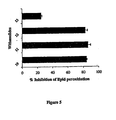
- Withanoside V ( 12 ) one of the major compounds isolated from W. somnifera seeds, showed 82.5% inhibition of lipid peroxidation at 10 ppm, whereas withanoside IV ( 13 ) inhibition was by 25% at 100 ⁇ g/mL.
- Withanolides VI ( 11 ) gave 86% lipid peroxidation inhibitory activity at 50 ppm and its 23,24-dihydroderivative ( 10 ) showed similar activity at 100 ppm ( Figure 5 ).
- the saturation of the lactone moiety in compound 10 decreased the activity as compared to its dehydroderivative 11 and indicated that the ⁇ , ⁇ -unsaturated 5-lactone is significant in the lipid peroxidation ability of withanolides.
- Compounds 11 and 13 were hydroxylated derivatives of 12. Hydroxylation at C-27 in 13 decreased the activity than the hydroxylation at C-20. This may be due to hydrogen bonding between the C27-hydroxyl and the carbonyl group of the lactone.
- Withanamides A-C ( 1-3 ) and withanoside V ( 12 ) were tested for their ability to inhibit the cyclooxygenase-1 (COX-1) and cyclooxygenase-2 (COX-2) enzymes ( Jayaprakasam, B., et al., Tetrahedron 59 841-849 (2003 )) These compounds did not inhibit COX-1 or COX-2 enzymes at 100 ⁇ g/mL.
- Serotonine plays an important role in controlling many physiological functions in the human body. Its release is a determining factor in the sleep onset, pain sensitivity, blood pressure regulation and mood control. A decreased level of serotonine makes the over consumption of carbohydrates and certain food groups which lead to weight gain ( Linnoila, V., et al., J. Clin. Psychiatry 53 46-51 (1992 )) depressive symptoms, insomnia, aggressiveness and chronic head aches ( Wurtman, J., J. Clin. Psychiatry 49 37-39 (1998 )).
- the 5-hydroxy-L-tryptophan, precursor of serotonine is used as an over-the-counter (OTC) drug for the treatment of various serotonine related disorders ( Birdsall, T.C., Altern Med Rev. 3 271-280 and references cited therein (1998)).
- OTC over-the-counter
- the withanamides 1-9 are novel serotonine derivatives with novel hydroxyl-substituted fatty acids and glucose units.
- the withanamides 1-9 inhibited the lipid peroxidation at 0.5-1 ⁇ g/ml similar or better than BHA, BHT and TBHQ and suggested that they are better antioxidants than the commercial antioxidants.
- the seeds of W . coagulence and W. somnifera were used to thicken the milk in India since ancient times. It is significant to note that these compounds did not exhibit cellular toxicity in the human tumor cell assays. Therefore, W. somnifera seeds or the withanamides are potential candidates for the development of new and safe antioxidants for human consumption.
- compounds 1-9 may play a greater role in the development of dietary supplements for treating various aging related disorders like Alzheimer's, Parkinson's and cardiovascular diseases using W. somnifera seeds.
- IR spectra were recorded on Mattson Galaxy Series FTIR 300 using WinFIRST software (Thermo Nicoloet, Madison, WI) spectrometer. All solvents used for isolation and purification were ACS grade.
- the silica gel used for MPLC was Merck Silica gel 60 (35-70 ⁇ m particle size).
- Si gel PTLC plates (20 x 20, 500 ⁇ m) were purchased from Analtech, Inc. (Newark, DE). Recycling preparative HPLC (Japan Analytical Industry Co. model LC-20) was used with JAIGEL-ODS-C 18 Column for reparation of compounds.
- BHA butylated hydroxyanisole
- BHT butylated hydroxytoluene
- TBHQ tert-butylhydroquinone 9
- serotonine 5-methoxyserotonine
- tryptamine was purchased from Sigma-Aldrich Co. (St. Louis, MO) .
- the lipid, 1-stearoyl 2-linoleoyl sn -glycerol 3-phosphocholine (SLPC) was purchased from Avanti Polar Lipids (Alabaster, AL).
- Fluorescent probe 3-[p-(6-phenyl)-1,3,5-hexatrienyl]-phenylpropionic acid was purchased from Molecular Probes (Eugene, OR) and R - and S- methoxy-(trifluoromethyl)phenylacetyl (MTPA) chlorides from Sigma-Aldrich Co.
- Plant Material The Withania somnifera plants were grown in the greenhouses of Bioactive Natural Products and Phytoceutical Laboratory at Michigan State University. Plants were grown under 12 h photoperiod at 75°F in 1:1 mixture of loamy sand and bacto mix in 6"-plastic pots. The plants were watered and fertilized daily using 20:20:20 (N:P:K). The fully ripened seeds were collected, dried at room temperature and extracted immediately.
- the MeOH extract (7 g) was defatted (1.5 g) with n-hexane (5 x 150 ml) and fractionated by silica gel medium pressure liquid chromatography (MPLC) under gradient conditions with 70% CHCl 3 to 80% MeOH.
- the 70% CHCl 3 eluates were collected in 10 fractions of each 40 mL, similar on TLC, pooled and concentrated to yield fractions I (300 mg).
- the similar fractions (8 fractions, 50 mL each) obtained from CHCl 3 :MeOH (1:1) elution were combined and concentrated to five fraction II (100 mg).
- Fraction III (1.8 g) was purified by prep. HPLC using JAIGEL-ODS-C 18 column and MeOH:H 2 O (75:25, v/v) as mobile phase at 3 mL/min. Fractions collected were A (15-30 min, 500 mg), B (31-41 min, 200 mg), C (42-56 min, 500 mg), D (58-70 min, 200 mg) and E (71-95 min, 50 mg). Fraction C was further purified by prep.
- Fraction D was purified by HPLC using MeOH:H 2 O (76:24, v/v) and gave pure compound 12 (67.3 min, 150 mg).
- Fraction E was purified by HPLC using MeOH:H 2 O (75:25) and yielded three fractions F (71 min, 14 mg), G (101 min, 5 mg), H (112 min, 4.0 mg) .
- PTLC CHCl 3 :MeOH; 75:25, v/v
- 8 pure compound 8
- the inventive Compounds 1-9 and Reference Compounds 10-16 were tested for their inhibition of lipid peroxidation using Large Unilamellar Vesicles (Liposome suspension) according to the published procedure ( Arora, A., et al., Free Radical Biology & Medicine 24 1355-1363 (1998 )).
- the liposome suspension was prepared by mixing the phospholipid 1-stearoyl-2-linoleoyl-sn-glycero-3'-phosphocoline (SLPC) and a fluorescence probe [3-[p-(6-phenyl)-1,3,5-hexatrienylphenylpropionic acid (DPH-PA).
- the final assay volume was 2 mL and consisted HEPES (100 ⁇ L), 1M NaCl (200 ⁇ L), N 2 -sparged water (1.64 ml), test sample or DMSO (20 ⁇ L) and liposome suspension (20 ⁇ L).
- the peroxidation was initiated by the addition of 20 ⁇ l of FeCl 2 . 4H 2 O (0.5 mM).
- the fluorescence was monitored at 0, 1, 3 and every 3 min up to 21 min using a Turner Model 450 Digital fluorometer. The decrease in fluorescence intensity over the time (21 min) indicated the rate of peroxidation.
- the percentage of lipid peroxidation was calculated with respect to DMSO solvent control.
- Stock solutions of the samples were prepared at 100 ⁇ g/ml and diluted further for the assay.
- the withanamide or withanolide is inhibitory at a dosage of 1 to 1,000 micrograms per milliliter or gram.
- one or more of the withanamides for treating a patient are provided to the patient at an inhibitory dose in a pharmaceutically acceptable carrier.
- the withanamides or withanolides are processed with pharmaceutical carrier substances by methods well known in the art such as by means of conventional mixing, granulating, coating, suspending and encapsulating methods, into the customary preparations for oral or rectal administration.
- withanamide preparations for oral application can be obtained by combining one or more of the anthraquinones with solid pharmaceutical carriers; optionally granulating the resulting mixture; and processing the mixture or granulate, if desired and/or optionally after the addition of suitable auxiliaries, into the form of tablets or dragee cores.
- Suitable pharmaceutical carriers for solid preparations are, in particular, fillers such as sugar, for example, lactose, saccharose, mannitol or sorbitol, cellulose preparations and/or calcium phosphates, for example, tricalcium phosphate or calcium hydrogen phosphate; also binding agents, such as starch paste, with the use, for example, of maize, wheat, rice or potato starch, gelatine, tragacanth, methyl cellulose, hydroxypropylmethyl cellulose, sodium carboxymethyl cellulose and/or polyvinylpyrrolidone, esters of polyacrylates or polymethacrylates with partially free functional groups; and/or, if required, effervescent agents, such as the above-mentioned starches, also carboxymethyl starch, cross-linked polyvinylpyrrolidone, agar, or alginic acid or a salt thereof, such as sodium alginate.
- fillers such as sugar, for example, lactose, saccharose, mann
- Dragee cores are provided with suitable coatings, optionally resistant to gastric juices, whereby there are used, inter alia, concentrated sugar solutions optionally containing gum arabic, talcum, polyvinylpyrrolidone, and/or titanium dioxide, lacquer solutions in aqueous solvents or, for producing coatings resistant to stomach juices, solutions of esters of polyacrylates or polymethacrylates having partially free functional groups, or of suitable cellulose preparations such as acetylcellulose phthalate or hydroxypropylmethylcellulose phthalate, with or without suitable softeners such as phthalic acid ester or triacetin.
- Dyestuffs or pigments may be added to the tablets or dragee coatings, for example for identification or marking of the various doses of active ingredient.
- One or more withanamide preparations which can be administered orally further include hard gelatine capsules, as well as hard or soft closed capsules made from gelatine and, if required, a softener such as glycerin or sorbitol.
- the hard gelatine capsules can contain one or more of the withanolides in the form of a granulate, for example in admixture with fillers such as maize starch, optionally granulated wheat starch, binders or lubricants such as talcum, magnesium stearate or colloidal silicic acid, and optionally stabilizers.
- the one or more of the withanolides is in the form of a powder or granulate; or it is preferably present in the form of a suspension in suitable solvent, whereby for stabilizing the suspensions there can be added, for example, glycerin monostearate.
- aqueous suspensions prepared in the usual manner, which suspensions contain the one or more of the compounds in the suspended form and at a concentration rendering a single dose sufficient.
- the aqueous suspensions either contain at most small amounts of stabilizers and/or flavoring substances, for example, sweetening agents such as saccharin-sodium, or as syrups contain a certain amount of sugar and/or sorbitol or similar substances.
- sweetening agents such as saccharin-sodium
- syrups contain a certain amount of sugar and/or sorbitol or similar substances.
- concentrates or concentrated suspensions for the preparation of shakes Such concentrates can also be packed in single-dose amounts.
- Suitable withanamide preparations for rectal administration are, for example, suppositories consisting of a mixture of one or more of the withanolides with a suppository foundation substance.
- Such substances are, in particular, natural or synthetic triglyceride mixtures.
- gelatine rectal capsules consisting of a suspension of the one or more of the withanamides in a foundation substance.
- Suitable foundation substances are, for example, liquid triglycerides, of higher or, in particular, medium saturated fatty acids.
- preparations containing the finely ground one or more of the withanamides preferably that having a median of particle size of 5 ⁇ m or less, in admixture with a starch, especially with maize starch or wheat starch, also, for example, with potato starch or rice starch.
- a starch especially with maize starch or wheat starch, also, for example, with potato starch or rice starch.
- They are produced preferably by means of a brief mixing in a high-speed mixer having a propeller-like, sharp-edged stirring device, for example with a mixing time of between 3 and 10 minutes, and in the case of larger amounts of constituents with cooling if necessary.
- the particles of the one or more of the withanamides are uniformly deposited, with a continuing reduction of the size of some particles, onto the starch particles.
- auxiliaries into the form of solid dosage units; i.e., pressed for example into the form of tablets or dragees or filled into capsules. They can however also be used directly, or after the addition of auxiliaries, for example, pharmaceutically acceptable wetting agents and distributing agents, such as esters of polyoxyethylene sorbitans with higher fatty acids or sodium lauryl sulphate, and/or flavoring substances, as concentrates for the preparation of aqueous suspensions, for example, with about 5- to 20-fold amount of water.
- auxiliaries for example, pharmaceutically acceptable wetting agents and distributing agents, such as esters of polyoxyethylene sorbitans with higher fatty acids or sodium lauryl sulphate, and/or flavoring substances, as concentrates for the preparation of aqueous suspensions, for example, with about 5- to 20-fold amount of water.
- these substances may also be added to the water used to prepare the suspension.
- the concentrates for producing suspensions consisting of the one or more of the withanamide/starch mixtures
- the one or more withanamides can be administered to a patient intraperitoneally, intranasally, subcutaneously, or intravenously.
- one or more of the withanolides are provided by dissolving, suspending or emulsifying them in an aqueous or nonaqueous solvent, such as vegetable or other similar oils, synthetic aliphatic acid glycerides, esters of higher aliphatic acids or propylene glycol; and if desired, with conventional additives such as solubilizers, isotonic agents, suspending agents, emulsifying agents, stabilizers and preservatives.
- the one or more withanolides are provided in a composition acceptable for intraperitoneal, subcutaneous, or intravenous use in warm-blooded animals or humans.
- a composition acceptable for intraperitoneal, subcutaneous, or intravenous use in warm-blooded animals or humans can comprise a physiologically acceptable solution such as a buffered phosphate salt solution as a carrier for the one or more of the withanamides.
- the solution is at a physiological pH.
- the composition is injected directly into the patient perfused through the tumor by intravenous administration.
- Preparations according to the present invention comprise one or more of the withanamides at a concentration suitable for administration to warm-blooded animals or humans which concentration is, depending on the mode of administration, between about 0.3% and 95%, preferably between about 2.5% and 90%.
- concentration is usually not higher than 30%, preferably about 2.5%; and conversely in the case of tablets, dragees and capsules with the one or more of the anthraquinones, the concentration is preferably not lower than about 0.3%, in order to ensure an easy ingestion of the required doses of the one or more withanamides.
- the doses can be administered daily or divided into several partial doses which are administered at intervals of several hours.
- the preparations can be used in conjunction with or following one or more other therapies such as radiation or chemotherapy.
- the administered dose of the one or more withanamides is dependent both on the patient (species of warm-blooded animal or human) to be treated, the general condition of the patient to be treated, and on the type of disease to be treated.
Landscapes
- Health & Medical Sciences (AREA)
- Chemical & Material Sciences (AREA)
- Organic Chemistry (AREA)
- Life Sciences & Earth Sciences (AREA)
- General Health & Medical Sciences (AREA)
- Engineering & Computer Science (AREA)
- Animal Behavior & Ethology (AREA)
- Veterinary Medicine (AREA)
- Public Health (AREA)
- Medicinal Chemistry (AREA)
- Pharmacology & Pharmacy (AREA)
- Nuclear Medicine, Radiotherapy & Molecular Imaging (AREA)
- General Chemical & Material Sciences (AREA)
- Chemical Kinetics & Catalysis (AREA)
- Bioinformatics & Cheminformatics (AREA)
- Neurology (AREA)
- Neurosurgery (AREA)
- Biomedical Technology (AREA)
- Molecular Biology (AREA)
- Biochemistry (AREA)
- Hematology (AREA)
- Pain & Pain Management (AREA)
- Obesity (AREA)
- Genetics & Genomics (AREA)
- Psychiatry (AREA)
- Biotechnology (AREA)
- Diabetes (AREA)
- Hospice & Palliative Care (AREA)
- Child & Adolescent Psychology (AREA)
- Epidemiology (AREA)
- Toxicology (AREA)
- Pharmaceuticals Containing Other Organic And Inorganic Compounds (AREA)
- Medicines Containing Plant Substances (AREA)
- Steroid Compounds (AREA)
- Organic Low-Molecular-Weight Compounds And Preparation Thereof (AREA)
- Acyclic And Carbocyclic Compounds In Medicinal Compositions (AREA)
- Saccharide Compounds (AREA)
Description
- The present invention relates to the use of withanamides in the treatment of various diseases, such as Alzheimer's Disease, depression, obesity and migraine headaches. The withanamides were particularly isolated and purified from fruits of Withania somnifera.
- Withania somnifera (L) Dunal of solanaceae, is an erect evergreen shrub distributed throughout the drier parts of India. W. somnifera, known as Aswagandha, is well known for its use in Ayurvedic medicine. The Aswagandha root extract was reported as a folk remedy for adenopathy, arthritis, asthma, hypertension, inflammations, and rheumatism (Thakur, R.S., et al., Major Medicinal plants of India; Ed.; Central Institute of Medicinal and Aromatic Plants: Lucknow, India, 531 (1989)). The leaves of W. somnifera were also used as a cure for several illnesses including tumors, inflammations, conjunctivitis and tuberculosis (Thakur, R.S., et al., Major Medicinal plants of India; Ed. ; Central Institute of Medicinal and Aromatic Plants: Lucknow, India, 531 (1989)). Currently, powdered roots or root extract of this plant are used as a dietary supplement in the United States.
- The major chemical constituents reported from W. somnifera are called withanolides. These compounds are structurally diverse steroidal compounds with an ergosterol skeleton in which C-22 and C-26 are oxidized to form a δ-lactone; (Ray, A. B., et al., Prog. Chem. Org. Nat. Prod. 63, 1-106 (1994)). The chemical investigations of the roots and leaves of W. somnifera resulted in the isolation and characterization of several withanolides (Matsuda, M., et al., Bioorg. Med. Chem. 9, 1499-1507 (2001)). The fruits of this plant are tiny orange berries and reported to contain saturated and unsaturated fatty acids (Stoller E.W., et al., Lloydia, 37, 309-312 (1974); Monika, P., et al., Asian J. Chem. 6, 442-444 (1994); and Monika, P., et al., Sci. Phys. Sci. 5, 81-83 (1993)). However, leaves and fruits are not fully investigated for biological activities. The withanolides are classified according to their structural skeleton (Ray, A. B., et al., Prog. Chem. Org. Nat. Prod. 63, 1-106 (1994)) and the structural variation is responsible for the wide array of pharmacological activities. Withanolides have been studied for their anti-inflammatory, antitumor, cytotoxic, immunomodulating activities and for the protection against CCl4-induced hepatotoxicity (Ray, A. B., et al., Prog. Chem. Org. Nat. Prod. 63, 1-106 (1994); and Anjaneyulu, A. S. R., et al., Studies in Natural Products Chemistry: Structure and Chemistry (Part F); Ed. Atta-ur-Rahman, Vol. 20, 135-261 (1998)). They were also reported to induce phase-II enzymes in animal models, which is considered to be one of the mechanisms in cancer chemoprevention (Misico, R.I., et al., J. Nat. Prod. 65, 677-680 (2002); and Su, B. N., et al., Tetrahedron 58, 3453-3466 (2002)).
- The life-supporting oxygen becomes toxic to most aerobic organisms when exposed to greater concentrations. Reasons for this toxicity are due to the formation of superoxide (O2 -), hydrogen peroxide (H2O2) and hydroxyl (-OH•) radicals during the conversion of oxygen to water in the mitochondria. The free radicals generated from environmental contaminants and by exogenous factors such as drugs, toxins and stress cause oxidative damage to biological macromolecular structure and function (Wickens, A.P., Respiration Physiology, 128 371-3891 (2001)). This will then lead to the progression of many disease processes including atherosclerosis, cardiovascular diseases and cancer. Several studies linked to the aging process to the generation of reactive oxygen and nitrogen (Vaya, J., et al., Curr. Med. Chem. Imm., Endoc. & Metab. )). The oxidative stress also damages the pancreatic β-cell's function and results in diabetes (West, I.C., Diabet Med. 17 171-180 (2000)). The singlet oxygen reacts with polyunsaturated fatty acids to form lipid peroxides which in turn decompose to initiate the formation of mutagens. Therefore, natural products or chemicals with potential to scavenge singlet species can reduce biological disorders that limit the progression of various aging related diseases. Many epidemiological studies shows that diets rich in antioxidants play a major role in the prevention of heart disease, cancer, diabetes, and Alzheimer's disease (Temple, N.J., Nutr. Res. 20 449-459 and references cited therein (2000)).
- Some of the pharmaceuticals prescribed for depression or anxiety contain natural antioxidants. Mixtures of ascorbic acid, pyridoxine, carotene, vitamin E, Zn, nicotinamide, and Se were effectively used to treat depression or anxiety (Horrobin, D.F., PCT Int. Appl.
WO98-48788, A1 1998 - It is therefore an object of the present invention to provide compounds useful as medicaments due to their action as antioxidants.
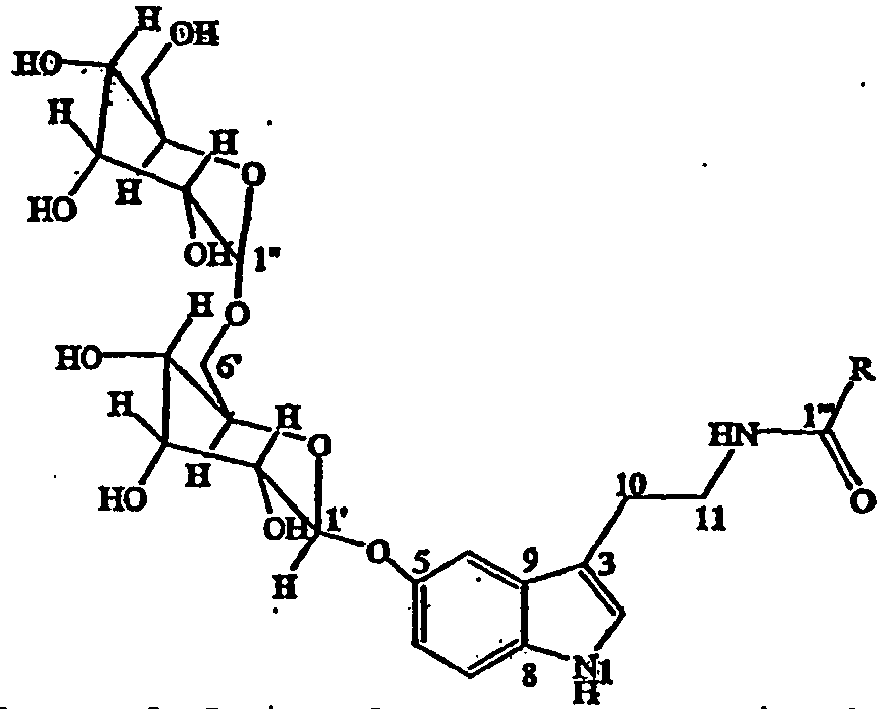
- The above object is achieved by a withanamide of the formula:
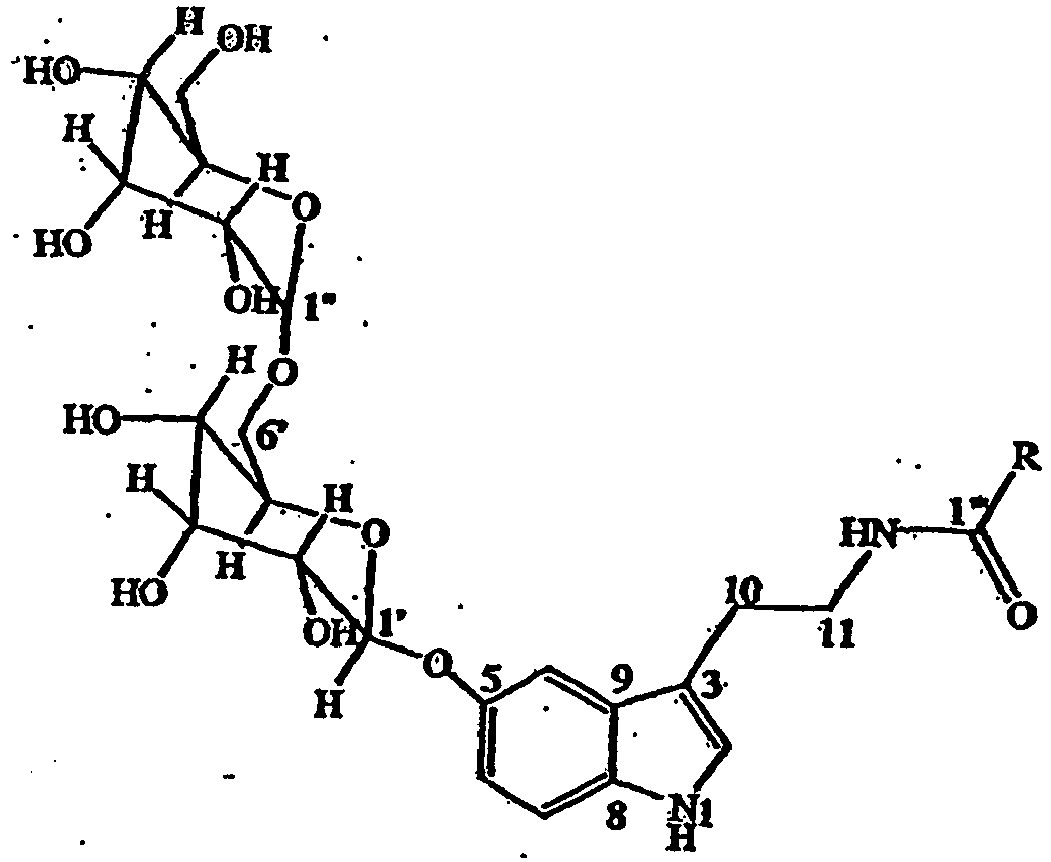







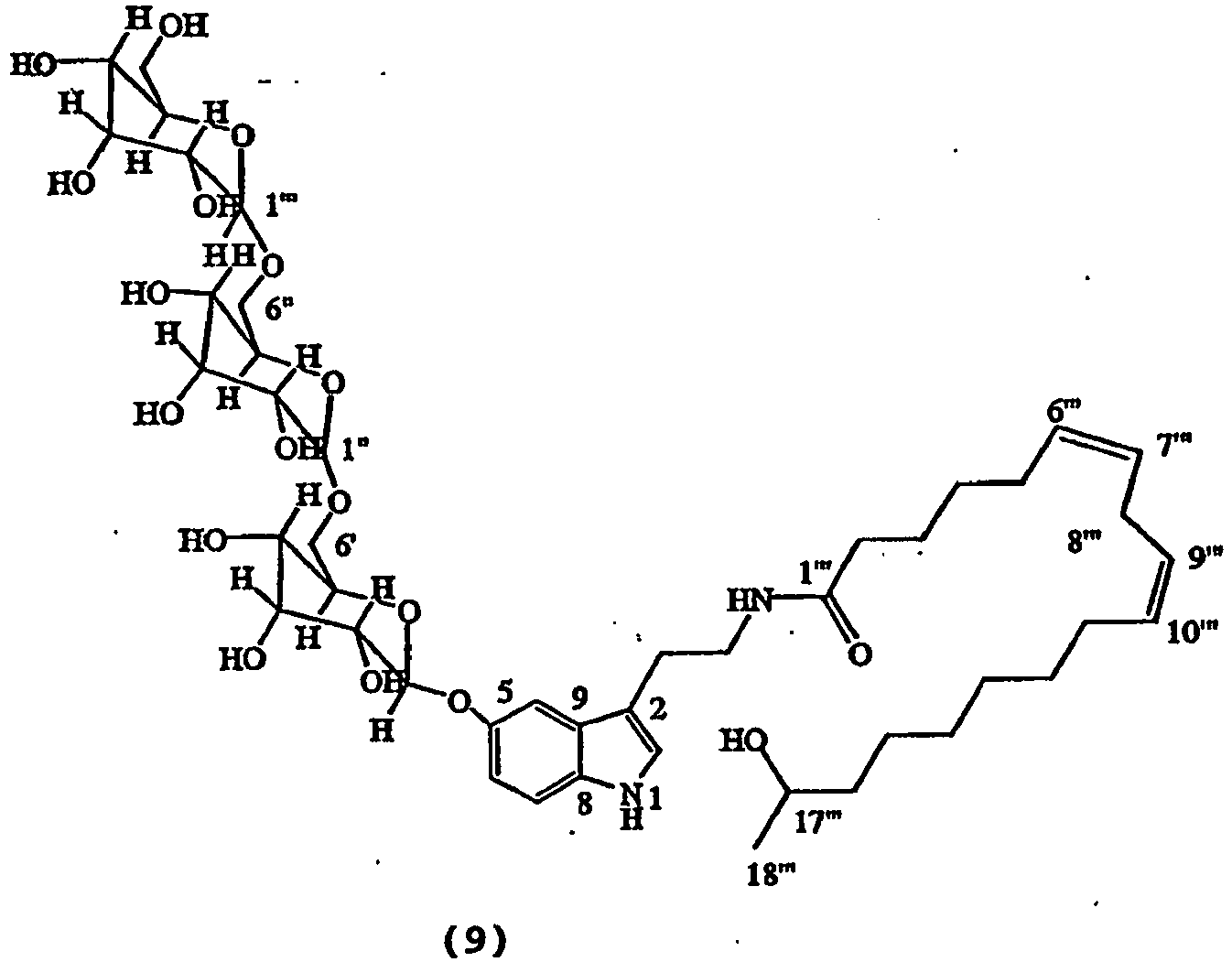
- Further, the present invention provides a pharmaceutical composition comprising a compound of the formula





- The present invention also provides a composition which comprises:
- (a) a composition in need of antioxidant activity; and
- (b) a compound selected from the group consisting of




- Preferred embodiments of the present invention are set forth in the dependent claims.
-
-
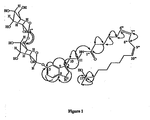
Figure 1 is a chemical structure showing selected HMBC (→) and COSY (↔) correlations observed incompound 1. -
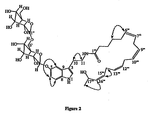
Figure 2 is a chemical structure showing selected TOCSY (→) correlations ofcompound 9. -
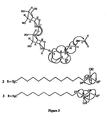
Figure 3 shows chemical structures for significant HMBC (→) and COSY (↔) correlations ofCompounds -
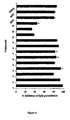
Figure 4 is a graph showing inhibition of lipid peroxidation by compounds 1-9 and 14-16. Fluorescence intensity was monitored for 21 minutes at intervals of 3 minutes. The percentage of inhibition represented was calculated with respect to DMSO Control at 21 min. The concentrations of compounds tested were 1-3, 5 and 9 at 1 µg/mL; 4, 6-8 at 0.5 µg/mL; 15 at 100 µg/mL; 16 at 50 µg/mL; 17 at 10 µg/mL. Commercial antioxidants BHA, BHT and TBHQ were tested at 1 µg/mL. Data represented indicates the mean ± one standard deviation (n=2). -
Figure 5 is a graph showing percent inhibition of lipid peroxidation by withanolides 10-13. Compounds tested were 10 and 13 at 100 µg/mL; 12 and 11 were at 10 and 50 µg/mL, respectively. Data represented indicates the mean ± one standard deviation (n=2). - It has been discovered that extracts of seeds of W. somnifera possess excellent lipid peroxidation inhibitory activity. The isolation and characterization of several novel withanamides and withanolides and a number of known withanolides from W. somnifera seed extracts is disclosed.
- A bioassay-guided purification of the methanolic extract of Withania somnifera fruits yielded novel withanamides A-I (1-9) (inventive compounds), a new withanolide (10) (not claimed) and three known withanolides (11-13) (not claimed).


- The structures of these compounds were determined by using FABMS, HRFABMS, ID- and 2D-NMR spectral experiments. The withanamides A-I (1-9)were found to be glycosylated serotonine conjugated with long-chain hydroxyl fatty acids. The stereochemistry of the hydroxyl group on the long-chain fatty acid moiety was determined by modified Mosher's ester method for
compound 1. Compounds 1-13 were tested for their ability to inhibit lipid peroxidation in a model system using large unilamellar vesicles (LUV's). Withanamides 1-5 and 9 inhibited lipid peroxidation by 98, 93, 79, 94, 81 and 86%, respectively, at 1 µg/mL. However, compounds 6-8, inhibited the lipid peroxidation by 85, 82 and 90%, respectively at 0.5 µg/mL. Withanolides 10 and 13 were tested at 100 µg/mL and gave 84 and 25% of inhibition in this assay.Compounds - The fruits of W. somnifera were collected from plants grown in the greenhouses of Bioactive Natural products and Phytoceutical Laboratory at Michigan State University, East Lansing, Michigan. Fruits were ground and extracted at room temperature sequentially with hexane, EtOAc, MeOH and Ammonical MeOH (pH=11). Hexane and EtOAc extracts contained β-carotene and fatty acids, as confirmed by TLC and GCMS.
- The antioxidant-assay-guided fractionation of MeOH extract yielded five bioactive active fractions. Purification of active fractions by CC, reverse phase HPLC and prep. TLC yielded nine novel withanamides A-I (1-9), a new withanolide and three known withanolides.
- Withanamides A (1), H (8) and I (9). Withanamide A (1) was obtained as a pale brown amorphous powder with an [α]D=-35°. The HRFABMS of 1 displayed an [M+H]+ ion at m/z 779.4329 (calc. 779.4330) and indicated its molecular formula as C40H62N2O13. The IR spectrum showed absorption bands at 1633, 3413 cm-1 and indicated the presence of amide carbonyl and hydroxyl groups in the molecule. The proton NMR signals at δ 6.66, 6.92, 6.99, and 7.15 were characteristic of a 5-oxygenated tryptamine derivative14 and assigned to C-6, C-4, C-2 and C-7 protons, respectively. Two doublets at δ 4.38 and 4.30, integrated for one proton each, were assigned to anomeric protons and indicated that
compound 1 contained a disaccharide. Two triplets observed at δ 2.84 and 3.42 were assigned to H-10 and H-11, respectively, of a tryptamine moiety. In addition to a broad singlet at δ 1.27, a triplet at δ 2.12 together with a multiplet integrated for four protons at δ 5.31 suggested the presence of an unsaturated fatty acid moiety in its structure. The terminal methyl signal at δ 1.19, appeared as a doublet, was evident of a methine carbon at C-17 in the fatty acid moiety. Also, a multiplet integrated for one proton at δ 3.79 confirmed a hydroxyl moiety at C-17. The signals at δ 2.04, 2.30 and 2.75 were assigned to allylic methylene protons in the molecule. The 13C NMR signals at δ 112.4, 112.6, 112.5, 151.0 and 133.0 were attributed to C-6, C-7, C-3, C-5 and C-9, respectively, of a 5-oxygenated tryptamine moiety. The signal at δ 176.2 indicated that the hydroxy fatty acid moiety was linked to 5-oxygenated tryptamine moiety by an amide linkage. The signals at δ 77.7 and 22.1 were attributed to hydroxyl and methyl carbons, respectively of a side chain. The carbon signals at δ 28.2, 28.1 and 26.5, assigned to allylic carbons, indicated the geometry of double bonds as Z incompound 1 since the allylic carbon in the E isomer appear at around 32 ppm (Spinell, A., et al., J. Org. Chem. 62 5471-5475 (1997 ); and Wenkert, E., et al., In Topics in 13C NMR spectroscopy; Levy, G.C., Ed.; Wiley-Interscience: New York, Vol. 2, p 81-121. - Acid hydrolysis of 1 gave glucose as the only sugar in addition to serotonine and a fatty acid. The identity of glucose was confirmed by TLC comparison of the products from the hydrolysis with an authentic sample of glucose. The downfield shifts observed for C-6' by 7 ppm as compared to the C-6" showed a 1"→6' linkage of glucose moieties. By comparison of 1H- and 13C NMR signals with literature values, the disaccharide unit in
compound 1 was identified as a diglucoside (Jayaprakasam, B., et al., Tetrahedron 59 841-849 (2003)). - Additional evidence of its structure was obtained from its MS fragmentation pattern, NOESY, HMBC and COSY studies. The ion at m/z 617 observed in its MS confirmed the loss of one of the glucose units from the molecular ion. The fragment at m/z 455 was assigned to the aglycone moiety and showed that the hydroxy fatty acid side chain contained 18-carbons. The diglucoside unit was placed at C-5 based on NOESY correlation of H-1' to H-4 (
Figure 1 ). Also, the HMBC correlations between the H-1" at δ 4.30 and C-6' at δ 69.7 confirmed a 1" →6' linkage of glucose moieties (Figure 1 ). The TOCSY spectral data ofcompound 1 confirmed the positions bf double bonds at C-6"' and C-9"', respectively. The hydroxyl proton multiplet at δ 3.79 was correlated to the methyl group in its COSY spectrum and supported the assignment of -OH at C-17 and further confirmed by HMBC correlations (Figure 1 ). - The absolute configuration at C-17 was determined by Mosher's ester method (Reznaka, T., et al., Photochemistry 54 635-645 (2000)).
Compound 1 was reacted separately with R (-) and S (+) α-methoxytrifluorophenylacetyl chlorides (MTPA) in anhydrous pyridine. Purification of the reaction mixtures yielded the R and S-MTPA ester derivatives. The 1H NMR analyses of the resulting esters revealed that the C-18 methyl in S-MTPA ester appeared at a lower field than in R- MTPA ester (supporting information). Similarly, H-16 in S-MTPA ester appeared at higher field than in R-MTPA ester. The Δδ(δS-δR)value for H-18 and H-16 were +0.03 and -0.02, respectively and confirmed the configuration at C-17 as R (Reznaka, T., et al., Phytochemistry 54 635-645 (2000)). -
Compound 8 gave a molecular ion at m/z 775.4013. Also, the similarities observed in its 1H- and 13C-NMR spectra to compound 1 indicated 8 as a withanamide with two additional olefinic bonds in its side chain and further supported by an 8H multiplet art δ 5.34 and 13C NMR shifts at δ 132.6, 132.2, 131.4, 130.1, 128.7 and 128.5, respectively. A signal at δ 2.82, integrated for 6H, was assigned to methylene groups placed between olefinic bonds at C-6"' and C-7"', C-9'" and C-10'", C-12"' and C-13'" and C-15"' and C-16"'. One of these double bonds was placed at C-15'" and C-16'" since the olefinic multiplet was correlated to the methyl doublet in its TOCSY spectrum (Figure 2 ) and it was further evidenced by the downfield shift of terminal methyl group to 1.24 ppm. The geometry of the double bonds was deduced as Z since the allylic carbons appeared at δ 26.6, 27.0 and 28.2, respectively, in its 13C NMR spectrum. Therefore, withanamide H was confirmed to be 11,15-dehydrowithanamide A, as shown in 8. -
Compound 9 also gave a similar 1H- and 13C-NMR spectral data to that ofcompound 1 as indicated by the chemical shifts for serotonine and hydroxyl-fatty acid moieties in it. The presence of two double bonds in the fatty acid moiety was confirmed by 4H multiplet at 5.33 ppm. The [M+H]+ ion at m/z 941.4857 confirmed the molecular formula of 9 as C46H72O18N2. In addition, the presence of three anomeric protons appeared at δ 4.32, 4.36 and 4.39 indicated that withanamide I (9) was a triglucoside. The linkage of two glucose units, as in the case of withanamide A (1), was established as C-1"→C-6' as indicated by the downfield shift of C6' protons. A similar linkage was established for the third glucose moiety. Therefore, the glucosidic unit was established as β-D-glucopyranosyl (1"→6')-β-D-glucopyranosyl (1'"→6")-β-D-glucopyranoside in 9. The appearance of end methyl group as a doublet in the 1H-NMR ofcompound 9 showed that the terminal substitution of long chain fatty acid moiety incompound 9 was similar to withanamide A (1). - Withanamides B - E, (2-5). Withanamide B (2), a colorless amorphous powder with an [α]D of -34°, gave the [M+H]+ at m/z 755.4330 and confirmed the molecular formula as C38H63N2O13 (calc. 755.4331). The 1H- and 13C NMR spectra of 2 were very similar to that of
compound 1 with the absence of olefinic proton signal art δ 5.32. Molecular ion of 2 was 24 amu less than that ofcompound 1. This showed that side chain in 2 was saturated and contained only sixteen carbons. The linkage among glucose moieties was evidence as 1"→6' by the downfield shift of C-6 to δ 69.7 and HMBC correlations observed between C-1" and H-6' (Figure 3 ). The methyl protons were correlated to the carbon at δ 77.7 in its HMBC spectrum confirmed the -OH substitution at C-15"' (Figure 3 ). The proposed structure of 2 was confirmed by HMQC, HMBC, DEPT and NOESY experiments. - The 1H-NMR of
compound 3 was similar tocompound 2 except for a -CH3 triplet at δ 0.91. In addition, it gave the molecular formula as C38H63N2O13, identical tocompound 2. This indicated thatcompound 3 was an isomer of 2. The major difference in the 13C NMR spectrum of 3 was the upfield shift of one of the methylene groups and appeared at δ 26.3. The appearance of methyl carbon at δ 10.1 as compared to the regular fatty acids (14.0 ppm) and the downfield shift of long chain hydroxyl carbon (δ 82.0) suggested the presence of a hydroxyl group at C-14"'. The triplet at δ 0.91 showed COSY correlation with the methylene protons at δ 1.52, which correlated to a proton at δ 3.63, supported a hydroxyl moiety at C-14"' (Figure 3 ). The presence of -OH at C-14"' was further substantiated by HMBC correlations of the methyl triplet at δ 0.91 to the hydroxyl carbon at δ 82.0 (Figure 3 ). Therefore,compound 3 was confirmed as a positional isomer of 2. - The MS of compound 4 gave an [M+Na]+ ion m/z 805.4462 and confirmed its molecular formula as C40H66O13N2. The 1H- and 13C NMR spectral data of 4 were similar to the spectral data of
compound 2 and indicated a saturated side chain in the molecule. Also, the MS data confirmed that the side chain in compound 4 contained eighteen carbons. -
Compound 5, a pale brown solid, gave the [M+H]+ ion at m/z 783.4645 and confirmed its molecular formula as C40H66N2O13. The 1H NMR spectral data of 5 was similar to withanamide C (3) and indicated the presence of a saturated side chain. The methyl triplet at δ 0.91 suggested that the terminal carbons incompound 5 had a similar substitution pattern as in 3. The difference in the molecular ion by 28 amu; as compared to 3, indicated the presence of two additional methylene groups in 5. Therefore,compound 5 possessed eighteen carbons in the hydroxy acid fatty acid side chain moiety with the hydroxyl group at C-16"'. Hence,compound 5 was a positional isomer of 4. - Withanamides F and G, (6,7). Withanamide F (6) was obtained as an inseparable mixture with fatty acid glycoside as a minor impurity. The 1H NMR data of 6 was similar to withanamide A (1). However, it gave a 2H multiplet at δ 5.33, assigned to a double bond, in its side chain. The appearance of a methyl triplet at δ 0.91 together with the signal for a carbon at δ 82.0 in compound 6 indicated that the terminal carbon in the fatty acid moiety had similar substitution pattern as in
compounds - The [M+H]+ of compound 7 at m/z 753.4173 was two mass units less than the molecular ion of 2 (755.4331) and hence suggested the presence of 16C-side chain with one unsaturation in it. A 2H multiplet at δ 5.34 also supported the olefinic bond. The doublet appeared at δ 1.21, assigned to methyl protons, indicated that the -OH moiety present in the fatty acid side chain was substituted similar to the substitutions in
compounds - 23, 24-Dihydrowithanolide VI (10):
Compound 10 was isolated as a colorless amorphous powder and displayed a molecular ion at m/z 785 in its FABMS spectrum. The IR absorption bands at 3421, 1724 and 1663 cm-1 in 10 suggested the presence of an -OH and a saturated lactone in the molecule. The HRFABMS confirmed its molecular formula as C40H65O15 (M+H)+ 785.4325; calc. 785.4323). The singlets at δ 0.89, 1.01, 1.25 and doublets at δ 1.17 and 1.15 were assigned to methyl groups, respectively, in its 1H NMR spectrum. The broad doublet at δ 5.52 and doublets at δ 4.39 and 4.36, which integrated for one proton each, were assigned to olefinic and anomeric protons, respectively. The doublet of doublet at δ 4.24 and a multiplet at δ 4.0 were assigned to H-22 and H-3, respectively.Compounds 10 and withanoside VI (11) showed similar 1H NMR chemical shifts (Matsuda, M., et al., Bioorg. Med. Chem. 9 1499-1507 (2001)). Appearance of two methyl doublets in 10 indicated that the double bond in the α,β-unsaturated δ-lactone moiety was not present. The absence of two olefinic carbons and the appearance of C=O at δ 178.9 in 10, as compared to 11, further confirmed the saturated lactone ring in the molecule. Two signals at δ 104.8 and 103.1, assigned to anomeric carbons, supported a diglucosidic moiety in the molecule. The downfield shift of C-6' protons (4.12 and 3.76 ppm), as compared to C-6" protons (δ 3.84, 3.66), indicated a 1"→6' linkage of two glucose moieties. Also, the downfield shift of C-6 (δ 69.7), similar to withanamides, further confirmed the glucosidic linkage as 1"→6. Signals at δ 81.9, 58.1, 56.1, 139.1, 125.5, 75.1 and 73.6 were assigned to C-22, C-14, C-17, C-5, C-6, C-1 and C-3, respectively. Other signals appeared at δ 14.2, 14.4, 19.9, 20.5 and 21.2 were assigned to 18, 28, 19, 27 and 21 methyl carbons, respectively. The diglucoside unit was placed at C-3 by comparison of the spectra data of 10 with the spectral data of withanolides 11-13. Except for the lactone carbon signals, all other 13C NMR chemical shifts in 10 were similar to withanoside VI (11). Hence the structure of 10 was derived as 23,24-Dihydrowithanolide VI (12). The molecular ion at m/z 784, with two mass units higher than the withanoside V, further supported the proposed structure forcompound 10. From the above spectral data the structure ofcompound 10 was derived as 23,24-Dihydrowithanolide VI. - Serotonine, a neurotransmitter, constituted the basic skeleton in the structure of withanamides A-I (1-9). Hence, to compare the structure and activity of these compounds, tryptamine (14),5-methoxyserotonine (15) and serotonine (16) were purchased. Compounds 1-16 and commercial antioxidants BHT, BHA and TBHQ were tested for the inhibition of lipid peroxidation by using large unilamellar vesicles (LUVs) model system (Arora, A., et al., Free Radical Biology & Medicine 24 1355-1363 (1998)). A dose response study was performed for all compounds and the active concentration reported in
Figure 4 was compared to the activity profiles of commercial antioxidants evaluated at 1 ppm concentration. BHA, BHT and TBHQ inhibited the lipid peroxidation by 80, 81 and 85%, respectively at 1 µg/ml (Figure 4 ). Withanamide B (2) contained a saturated side chain and inhibited lipid peroxidation by 93% at 1 µg/m (Figure 4 ) whereas withanamide C (3), a positional isomer of 2, showed 79% inhibition. Similarly, inhibition observed with withanamide D (4) and E (5) were 94 and 81%, respectively, at 1 µg/mL. Compounds 6 and 7 with one double bond in their side chain showed 85 and 82% inhibition, respectively, at 0.5 µg/ml. Similarly, Withanamide H (8) exhibited 90% inhibition in this assay at 0.5 µg/ml. However, Withanamide A (1), a diglucoside with two double bonds in its side chain, inhibited lipid peroxidation by 98% whereas withanamide I (9), a triglucoside, showed 86% inhibition at 1 µg/ml (Figure 4 ). This indicated that the number of glycoside units also played an important role in the antioxidant activity of these compounds. - Tryptamine (14) showed 40% inhibition at 100 µg/ml and its 5-methoxy derivative,
compound 15, inhibited lipid peroxidation by only 30% at 50 µg/mL. Serotonine (5-hydroxy tryptamine) hydrochloride showed 44% inhibition at 10 µg/mL. About 100% inhibition of lipid peroxidation, similar to withanamides at 1 µg/mL, was observed for compounds 14-16 when the test concentration was doubled. 5-Methoxytryptamine (15) showed higher activity than tryptamine (7) and indicated that 5-oxygenation increased the activity. Increased inhibition was observed for serotonine hydrochloride when compared to its 5-methyl derivative and suggested that the free hydroxyl at 5-position was very important for the free radical scavenging activity. Withanamides A-I, (1-9), exhibited excellent lipid peroxidation inhibitory activity equal to or better than the commercial antioxidants and far better than serotonine (Figure 4 ). The serotonine nucleus and hydroxy fatty acid side chain were contributing substantially for the antioxidant activity. Among withanamides, compounds with an unsaturated side chain were more active than the saturated side chain.Compounds 2 and 4, with the hydroxyl groups at 15 and 17 position, respectively, were more active than theirisomers - Withanolides isolated from the fruits in the present invention also inhibited lipid peroxidation (
Figure 5 ). Withanoside V (12), one of the major compounds isolated from W. somnifera seeds, showed 82.5% inhibition of lipid peroxidation at 10 ppm, whereas withanoside IV (13) inhibition was by 25% at 100 µg/mL. Withanolides VI (11) gave 86% lipid peroxidation inhibitory activity at 50 ppm and its 23,24-dihydroderivative (10) showed similar activity at 100 ppm (Figure 5 ). The saturation of the lactone moiety incompound 10 decreased the activity as compared to itsdehydroderivative 11 and indicated that the α,β-unsaturated 5-lactone is significant in the lipid peroxidation ability of withanolides.Compounds - Withanamides A-C (1-3) and withanoside V (12) were tested for their ability to inhibit the cyclooxygenase-1 (COX-1) and cyclooxygenase-2 (COX-2) enzymes (Jayaprakasam, B., et al., Tetrahedron 59 841-849 (2003)) These compounds did not inhibit COX-1 or COX-2 enzymes at 100 µg/mL. They were also tested for antiproliferative activity on NCI-H460 (Lung), HCT-116 (colon), SF-268 (Central Nervous System; CNS) and MCF-7 (breast) human tumor cell lines using MTT assay (Tian, Q., et al., Nutr. )) and were inactive. This demonstrated that these compounds possess little or no toxicity.
- Serotonine plays an important role in controlling many physiological functions in the human body. Its release is a determining factor in the sleep onset, pain sensitivity, blood pressure regulation and mood control. A decreased level of serotonine makes the over consumption of carbohydrates and certain food groups which lead to weight gain (Linnoila, V., et al., J. Clin. Psychiatry 53 46-51 (1992)) depressive symptoms, insomnia, aggressiveness and chronic head aches (Wurtman, J., J. Clin. Psychiatry 49 37-39 (1998)). The 5-hydroxy-L-tryptophan, precursor of serotonine, is used as an over-the-counter (OTC) drug for the treatment of various serotonine related disorders (Birdsall, T.C., Altern Med Rev. 3 271-280 and references cited therein (1998)). There is a potential for the conversion of the withanamides to serotonine in the stomach and the free serotonine may be absorbed if ingested orally. Therefore, the withanamides that have been isolated from W. somnifera seeds have the potential to increase serotonine level in the body and may be used as a supplement to deal with several disorders related to serotonine deficiency in the human. Also, two of the tryptamine analogs (sumatryptan and elitryptan) were used to treat migraine related disorders (Newman, D.J., et al., J. Nat. Prod. 66 1022-1037 (2003)). Therefore, withanamides can be considered as potential candidates for the treatment of migraine. Since the withanamides showed potential antioxidant activity, it can be used to prevent Alzheimer's disease and atherosclerosis.
- The withanamides 1-9 are novel serotonine derivatives with novel hydroxyl-substituted fatty acids and glucose units. The withanamides 1-9 inhibited the lipid peroxidation at 0.5-1 µg/ml similar or better than BHA, BHT and TBHQ and suggested that they are better antioxidants than the commercial antioxidants. The seeds of W. coagulence and W. somnifera were used to thicken the milk in India since ancient times. It is significant to note that these compounds did not exhibit cellular toxicity in the human tumor cell assays. Therefore, W. somnifera seeds or the withanamides are potential candidates for the development of new and safe antioxidants for human consumption. Also, compounds 1-9 may play a greater role in the development of dietary supplements for treating various aging related disorders like Alzheimer's, Parkinson's and cardiovascular diseases using W. somnifera seeds.
- General Experimental Procedures. The HRFAB and FAB (positive ion mode) mass spectra were measured on JEOL MX 110 mass spectrometer at Michigan State University Mass Spectrometry Facility Center. Optical rotations were measured in MeOH at 20°C on Perkin Elmer Polarimeter 341 (Shelton, CT). 1H (500 MHz) and 13C (125 MHz) and 2D NMR experiments were carried out on an INOVA VARIAN VRX 500 instrument using standard pulse sequences. The chemical shifts were measured in CD3OD and expressed in δ (ppm). HMBC was optimized for J = 8 Hz. IR spectra were recorded on Mattson Galaxy Series FTIR 300 using WinFIRST software (Thermo Nicoloet, Madison, WI) spectrometer. All solvents used for isolation and purification were ACS grade. The silica gel used for MPLC was Merck Silica gel 60 (35-70 µm particle size). Si gel PTLC plates (20 x 20, 500 µm) were purchased from Analtech, Inc. (Newark, DE). Recycling preparative HPLC (Japan Analytical Industry Co. model LC-20) was used with JAIGEL-ODS-C18 Column for reparation of compounds. Positive controls butylated hydroxyanisole (BHA), butylated hydroxytoluene (BHT), and tert-butylhydroquinone 9(TBHQ), serotonine, 5-methoxyserotonine, and tryptamine were purchased from Sigma-Aldrich Co. (St. Louis, MO) . The lipid, 1-stearoyl 2-linoleoyl sn-glycerol 3-phosphocholine (SLPC), was purchased from Avanti Polar Lipids (Alabaster, AL). Fluorescent probe, 3-[p-(6-phenyl)-1,3,5-hexatrienyl]-phenylpropionic acid was purchased from Molecular Probes (Eugene, OR) and R- and S-methoxy-(trifluoromethyl)phenylacetyl (MTPA) chlorides from Sigma-Aldrich Co.
- Plant Material. The Withania somnifera plants were grown in the greenhouses of Bioactive Natural Products and Phytoceutical Laboratory at Michigan State University. Plants were grown under 12 h photoperiod at 75°F in 1:1 mixture of loamy sand and bacto mix in 6"-plastic pots. The plants were watered and fertilized daily using 20:20:20 (N:P:K). The fully ripened seeds were collected, dried at room temperature and extracted immediately.
- Extraction and Isolation. The dried and ground fruits (100 g) of W. somnifera were sequentially extracted with n-hexane (3 x 500 mL), EtOAc (3 x 500 mL), MeOH (5 x 500 mL) and ammonical MeOH (3 x 500 mL). Evaporation of the solvent under reduced pressure yielded n-hexane (8 g), EtOAc (2 g), MeOH (8 g) and ammonical MeOH (2 g) crude extracts. The MeOH extract (7 g) was defatted (1.5 g) with n-hexane (5 x 150 ml) and fractionated by silica gel medium pressure liquid chromatography (MPLC) under gradient conditions with 70% CHCl3 to 80% MeOH. The 70% CHCl3 eluates were collected in 10 fractions of each 40 mL, similar on TLC, pooled and concentrated to yield fractions I (300 mg). The similar fractions (8 fractions, 50 mL each) obtained from CHCl3:MeOH (1:1) elution were combined and concentrated to five fraction II (100 mg). The CHCl3MeOH (40:60) eluates gave 15 fractions (50 mL each) were similar, pooled, evaporated to afford fraction III (2 g). Concentration of six similar fractions (each 45 mL) from CHCl3:MeOH (30:70 elution gave fraction IV (1.8 g). The 80% MeOH eluates were pooled and evaporated to afford V (200 mg).
- The fractions I and II contained predominantly fatty acids as indicated by TLC. Fraction III (1.8 g) was purified by prep. HPLC using JAIGEL-ODS-C18 column and MeOH:H2O (75:25, v/v) as mobile phase at 3 mL/min. Fractions collected were A (15-30 min, 500 mg), B (31-41 min, 200 mg), C (42-56 min, 500 mg), D (58-70 min, 200 mg) and E (71-95 min, 50 mg). Fraction C was further purified by prep. HPLC using CH3CN:H2O (62.5:37.5, v/v) and yielded pure compounds 1 (81.95 min, 62 mg), 2 (92.0 min, 71 mg) and a fraction (104 min, 35 mg).
Compounds - The fraction G was purified on Prep. TLC (CHCl3:MeOH, 4:1) gave compound 4 (Rf = 0.6, 2.5 mg). Purification of fractions F and H on PTLC using CHCl3:MeOH (5:1) on the mobile phase gave 5 (Rf = 0.65, 8 mg) and 6 (Rf = 0.58, 3.0 mg). Fraction II was subjected to HPLC using CH3CN:H2O (34.66, v/v) to yield five fractions fr.1 (37.0 min, 38.1 mg), fr.2 (45-70 min, 68.8 mg), fr.3 (84.4 min, 19.8 mg) and fr.4 (94.9 min, 11.4 mg).
- Fr.1 was purified by prep. TLC using the mobile phase (CHCl3:MeOH, 1:1, v/v) and afforded a pure withanolide 13 (Rf=0.40, 7.0 mg). Repeated purification of fr.4 by PTLC (CHCl3:MeOH; 75:25, v/v) yielded pure compound 8 (Rf=0.72, 2 mg). Similarly, fr.3 was purified by PTLC (CHCl3:MeOH, 70:30, v/v) yielded compounds 7 (Rf=0.61, 1.0 mg) and 9 (Rf=0.8, 0.7 mg). Purification of fr.2 by PTLC (CHCl3:MeOH, 1:1, v/v) gave band of Rf=0.5 (25.0 mg) and further purified by prep. HPLC using CH3CN:H2O (33:67) as mobile phase to yield withanolides 10 (62.4 min, 6.0 mg) and 11 (70.8 min, 4.0 mg).
- Withanamide A (1). Amorphous powder, [α]D=-35° (C 0.0125, MeOH), IR νmax (KBr) 3413 (-OH), 2926, 2854, 1633 (-CONH), 1458, 1071, 1033, 626. 1H NMR (500 MHz, CD3OD) 5 7.15 (1H, dd, J = 8.5, 1.0 Hz), 6.99 (1H, s, H-2), 6.92 (1H, dd, J = 2.5, 0.5 Hz, H-4), 6.66 (1H, ddd, J = 9.0, 2.0 Hz, H-6), 5.31 (4H, m, H-6"', 7"', 9"', 10"'), 4.38 (1H, d,J=8.0 Hz, H-1'), 4.30 (1H, d, J = 7.5 Hz, H-1"), 4.10 (1H, dd, J = 11.5, 1.0 Hz, H-6'b), 3.85 (1H, dd, J = 12. 0, 2.5 Hz, H-6"b), 3.79 (1H, m, H-17'"), 3.77 (1H, dd, J = 11.5, 5.0 Hz, H-6'a), 3.65 (1H, dd, J = 12.0, 5.5 Hz, H-6"a), 3.42 (2H, t, J = 7.5 Hz, H-11), 3.40 (1H, m, H-5'), 3.39 (2H, m, H-4', H-4"), 3.27-3.38 (2H, m, H-5", H-3", H-3'), 3.20 (1H, d,J = 9.0, 8.0 Hz, H-2"), 3.15 (1H, dd, J=9.0, 8.0 Hz, H-2'), 2.84 (2H, t, J = 7.0 Hz, H-10), 2.75 (2H, t, J = 6.5 Hz, H-8"'), 2.12 (2H, t, J = 7.5 Hz, H-2"'), 2.04 (4H, m, H-5"', 11"'), 1.54 (2H, m, H-3"'), 1.42 (2H, m, H-4'"), 1.32 (2H, m, H-16'"), 1.27 (8H, br. s, H-12"'-H-15'"), 1.19 (3H, d, J = 6.0 Hz, H-18"'). 13C NMR (125 MHz, CD3OD) δ 176.2 (C-1"') , 151.0 (C-5), 133.0 (C-8), 130.9 (C-10"'), 130.8 (C-7'"), 129.4 (C-9), 129.2 (C-9'"), 129.0 (C-6'"), 124.2 (C-2), 112.6 (C-7), 112.5 (C-3), 112.4 (C-6), 104.7 (C-1"), 104.0 (C-1'), 103.5 (C-4), 77.9 (C-3',3",5"), 77.7 (C-17'"), 76.8 (C-5'), 75.2 (C-2"), 75.0 (C-2'), 71.6 (C-4"), 71.4 (C-4'), 69.7 (C-6'), 62.7 (C-6"), 41.2 (C-11), 37.3 (C-16"'), 37.2 (C-2"'), 30.6-30.1 (C-12"'-15"'), 30.0 (C-4'"), 28.2 (C-11"'), 28.1 (C-5"'), 27.0 (C-3"'), 26.5 (C-8'"), 26.3 (C-10), 22.1 (C-18'"). HRFABMS 779.4329 (calcd for C40H63N2O13 (M+H)+, 779.4330). FABMS (m/z) 779 [M+H]+, 778 [M]+, 617, 455, 437, 175, 160, 159, 146.
- Withanamide B (2). Amorphous powder, [α]D=-34° (C 0.0125, MeOH), IR νmax (KBr) 3372 (-OH), 2924, 2853, 1632 (-CONH), 1463, 1371, 1071, 1031, 631. 1H NMR (500 MHz, CD3OD) δ 7.15 (1H, dd, J = 8.5, 0.5 Hz, H-7), 7.0 (1H, s, H-2), 6.94 (1H, dd, J = 2.5, 0.5 Hz, H-4), 6.66 (1H, dd, J = 9.0, 2.5 Hz, H-6), 4.40 (1H, d, J = 8.0 Hz, H-1"), 4.32 (1H, d, J = 7.5 Hz, H-1'), 4.11 (1H, dd, J = 12.0, 2.0 Hz, H-6'b), 3.87 (1H, dd, J = 12.0, 2.0 Hz, H-6"b) , 3.79 (1H, m, H-15"') , 3.78 (1H, dd, J = 12.0, 5.5 Hz, H-6'a), 3.67 (1H, dd, J = 12.0, 5.5 Hz, H-6"a), 3.44 (2H, t, J = 7.0 Hz, H-11) , 3.41 (2H, m, H=4", 5'), 3.40 (1H, m, H-4'), 3.25-3.38 (2H, m, H-5", H-3", H-3'), 3.24 (1H, dd, J = 9.0, 8.0 Hz, H-2"), 3.17 (1H, dd, J = 9.0, 8.0 Hz, H-2'), 2.85 (2H, t, J = 8.0 Hz, H-10), 2.13 (2H, t, J = 7.0 Hz, H-2"'), 1.55 (2H, m, H-3"'), 1.39 (4H, m, H-4"', H-14"'), 1.26 (18H, br. s, H-5'"-H-13'"), 1.20 (3H, d, J = 6.5 Hz, H-16"') ; 13C NMR (125 MHz, CD3OD) δ 176.2 (C-1"'), 151.0 (C-5), 133.0 (C-8), 129.4 (C-9), 124.2 (C-2), 112.6 (C-7), 112.4 (C-3), 112.3 (C-6), 104.7 (C-1"), 103.9 (C-1'), 103.5 (C-4), 77.9 (3", 5"), 77.8 (C-3'), 77.7 (C-15'"), 76.8 (C-5'), 75.2 (C-2"), 75.0 (C-2'), 71.5 (C-4"), 71.4 (C-4'), 69.7 (C-6'), 62.7 (C-6"), 41.2 (C-11), 37.6 (C-14"'), 37.2 (C-2'"), 30.8-30.2 (C-4"'-13"'), 27.0 (C-3"'), 26.3 (C-10), 22.0 (C-16"'). HRFABMS 755.4331 (calcd for C38H63N2O13 (M+H)+, 755.4330). FABMS (m/z) 777 [M+Na]+, 755 [M+H]+, 754 [M]+, 593, 431, 413, 396, 160, 146.
- Withanamide C (3). Amorphous powder, [α]D=-34° (C 0.01, MeOH), IR νmax (KBr) 3422 (-OH), 2924, 2853, 1633 (-CONH), 1459, 1071, 1032, 631. 1H NMR (500 MHz, CD3OD) δ 7.15 (1H, dd, J = 8.5, 0.5 Hz, H-7), 6.99 (1H, s, H-2), 6.92 (1H, dd, J = 2.0, 0.5 Hz, H-4), 6.65 (1H, dd, J = 8.5, 2.0 Hz, H-6), 4.40 (1H, d, J = 8.0 Hz, H-1"), 4.30 (1H, d, J = 8.0 Hz, H-1'), 4.10 (1H, dd, J = 12.0, 2.0 Hz, H-6'b), 3.86 (1H, dd, J = 12.0, 2.5 Hz, H-6"b), 3.79 (1H, dd, J = 12.0, 6.0 Hz, H-6'a), 3.66 (1H, dd, J = 12.0, 5.5 Hz, H-6" a), 3.63 (1H, m, H-14"'), 3.44 (2H, t, J = 7.0 Hz, H-11), 3.40 (1H, m, H-4'), 3.39 (1H, t, J = 7.5 Hz, H-5'), 3.25-3.37 (4H, m, H-5", 4", 3', 4'), 3.20 (1H, dd, J = 9.0, 7.5 Hz, H-2"), 3.16 (1H, dd, J = 9.0, 7.5 Hz, H-2'), 2.85 (2H, t, J = 7.5 Hz, H-10), 2.14 (2H, t, J = 7. 5 Hz, H-2"'), 1.56 (4H, m, H-3'', 15"'), 1.52 (2H, m, H-13"'), 1.39 (4H, m, H-4"" & H-14"'), 1.27 (18H, br. s, H-4"'-H-12"'), 0.91 (3H, t, J = 7.5 Hz, H-16"') ; 13C NMR (125 MHz, CD3OD) δ 176.3 (C-1'''), 151.1 (C-5), 133.1 (C-8), 129.5 (C-9), 124.2 (C-2), 112.6 (C-7), 112.5 (C-3), 112.4 (C-6), 104.9 (C-1"), 103.6 (C-1'), 103.5 (C-4), 82.0 (C-14"'), 78.1 (C-5"), 78.0 (C-3', 3"), 77.0 (C-5'), 75.3 (C-2"), 75.2 (C-2'), 71.7 (C-4"), 71.6 (C-4'), 69.9 (C-6'), 62.8 (C-6"), 41.2 (C-11), 37.2 (C-2"'), 34.5 (C-13"'), 31.0-28.6 (C-4"'-12"'), 27.0 (C-3"'), 26.3 (C-155'"), 26.0 (C-10), 10.1 (C-16""). HRFABMS 755.4331 (calcd for C38H63N2O13 (M+H)+, 755.4330). FABMS (m/z) 777 [M+Na]+, 755 [M+H]+, 754 [M]+, 431, 413, 396, 160, 159, 146.
- Withanamide D (4). Amorphous powder. IR νmax (KBr) 3402 (-OH), 2923, 2852, 1636 (-CONH), 1464, 1381, 1071, 1040, 630. 1H NMR (500 MHz, CD3OD) 5 7.14 (1H, dd, J = 9.0, 0.5 Hz, H-7), 6.99 (1H, s, H-2), 6.93 (1H, dd, J = 2.5, 0.5 Hz, H-4), 6.65 (1H, dd, J = 9.0, 2.5 Hz, H-6), 4.39 (1H, d, J = 8.0 Hz, H-1"), 4.32 (1H, d, J = 8.0, Hz, H-1'), 4.10 (1H, dd, J = 11.5, 2.0 Hz, H-6'b), 3.86 (1H, dd, J = 12.0, 2.5 Hz, H-6"b), 3.79 (1H, m, H-17'"), 3.79 (1H, dd, J = 12.0, 5.5 Hz, H-6'a), 3.66 (1H, dd, J = 12.0, 5.5 Hz, H-6"a), 3.44 (2H, t, J = 7.0 Hz, H-11), 3.41 (2H, m, H-4", 5'), 3.40 (1H, m, H-4'), 3.25-3.36 (4H, m, H-3', 3", 5', 5"), 3.20 (1H, dd, J = 9.0, 8.0 Hz, H-2"), 3. 15 (1H, dd, J = 9.0, 8.0 Hz, H-2'), 2.86 (2H, t, J = 7.0 Hz, H-10), 2.14 (2H, t, J = 7.0 Hz, H-2"'), 1.57 (2H, m, H-3"'), 1.40 (2H, m, H-16"'), 1.28 (24H, br. s, H-4'"-H-15'"), 1.21 (3H, d, J = 6.0 Hz, H-18"') ; 13C NMR (125 MHz, CD3OD) δ 176.3 (C-1"'), 151.1 (C-5), 133.1 (C-8, 129.5 (C-9), 124.2 (C-2), 112.6 (C-7), 112.5 (C-3), 112.4 (C-6), 104.8 (C-1"), 104.0 (C-1'), 103.5 (C-4), 78.0 (C-3', 3", 5"), 77.8 (C-17'"), 77.0 (C-5'), 75.3 (C-2"), 75.1 (C-2'), 71.6 (C-4'), 71.5 (C-4"), 69.8 (C-6'), 62.8 (C-6"), 41.2 (C-11), 37.8 (C-16'"), 37.2 (C-2'"), 30.9-30.2 (C-4'"-15'"), 27.0 (C-3'"), 26.3 (C-10), 22.1 (C-18"') . HRFABMS 805.4462 (calcd for C40H67N2O13Na, 805,4463). FABMS (m/z) 805 [M+Na]+, 783 [M+H]+, 643, 459, 441, 371, 363, 347, 160, 159.
- Withanamide E (5). Amorphous powder. 1H NMR (500 MHz, CD3OD) δ 7.15 (1H, dd, J = 8.5 Hz, H-7), 7.0 (1H, s, H-2), 6.93 (1H, dd, 2.0, 0.5 Hz, H-4), 6.65 (1H, dd, J = 8.5, 2.0 Hz, H-6), 4.40 (1H, d, J = 8.0 Hz, H-1"), 4.30 (1H, d, J = 8.0 Hz, H-1'), 4.10 (1H, dd, J = 12.0, 2.0 Hz, H-6'b), 3.86 (1H, dd, J = 12.0, 2.5 Hz, H-6"b), 3.78 (1H, dd, J = 12.0, 6.0 Hz, H-6'a), 3.66 (1H, dd, J = 12.0, 5.5 Hz, H-6"a), 3.63 (1H, t, J = 6.0, H-14'"), 3.44 (2H, t, J = 7.5 Hz, H-11), 3.40 (1H, m, H-4'), 3.39 (1H, t, J = 7.5 Hz, H-5'), 3.25-3.37 (4H, m, H-5", 4", 3', 4'), 3.20 (1H, dd, J = 9.0, 7.5 Hz, H-2"), 3.16 (1H, dd, J = 9.0, 7.5 Hz, H-2'), 2.85 (2H, t, J = 7.5 Hz, H-10), 2.14 (2H, t, J = 7.5 Hz, H-2'"), 1.56 (4H, m, H-3"', 17'"), 1.52 (2H, m, H-15"'), 1.27 (22H, br. s, H-4"'-H-14"'), 0.91 (3H, t, J = 7.5 Hz, H-18"') . HRFABMS 783.4645 (calcd for C40H67O13N2 783.4644). FABMS (m/z) 805 [M+Na]+, 783 [M+H]+, 765, 621, 459, 441, 282, 202, 175, 160, 159, 146.
- Withanamide F (6). Amorphous powder. IR νmax (KBr) 3402 (-OH), 2926, 2853, 1635 (-CONH), 1456, 1368, 1069, 1036, 615. 1H NMR (500 MHz, CD3OD) δ 7.14 (1H, dd, J = 8.5, 0.5 Hz, H-7), 6.99 (1H, s, H-2), 6.92 (1H, dd, J = 2.5, 0.5 Hz, H-4), 6.65 (1H, dd, J = 8.5, 2.5 Hz, H-6), 5.33 (2H, m, H-9'', 10"'), 4.39 (1H, d, J = 7.0 Hz, H-1"), 4.30 (1H, d, J = 7.5 Hz, H-1'), 4.09 (1H, dd, J = 12.5, 2.0 Hz, H-6'b), 3.86 (1H, dd, J = 11.5, 2.0 Hz, H-6"b), 3.78 (1H, dd, J = 11.5, 5.5 Hz, H-6'a), 3.66 (1H, dd, J = 11.5, 5.5 Hz, H-6"a), 3.62 (1H, t, J = 6.0, H-16'"), 3.44 (2H, t, J = 7.5 Hz, H-11), 3.41 (2H, m, H-4", 5'), 3.40 (1H, m, H-4'), 3.25-3.36 (4H, m, H-3',3",5',5"), 3.20 (1H, dd, J = 9.0, 8.0 Hz, H-2"), 3.15 (1H, dd, J = 9.0, 8.0 Hz, H-2'), 2.85 (2H, t, J = 7.0 Hz, H-10), 2.14 (2H, t, J = 7.5 Hz, H-2'"), 2.02 (4H, m, H-8'", 11'"), 1.55 (8H, m, H-3"', 16"', 7"', 12"'), 1.28 (24H, br. s, H-4'"-6"', H=13"'-15"'), 0.91 (3H, t, J = 7.5 Hz, H-18"') . 13C NMR (125 MHz, CD3OD) 5 176.3 (C-1"'), 151.2 (C-5), 133.1 (C-8), 130.9 (C-10"'), 130.8 (C-9"'), 129.5 (C-9), 124.2 (C-2), 112.6 (C-7), 112.5 (C-3), 112.4 (C-6), 104.9 (C-1"), 103.6 (C-1'), 103.5 (C-4), 82.0 (C-16"'), 78.0 (C-3', 3", 5"), 77.0 (C-5'), 75.3 (C-2"), 75.1 (C-2'), 71.7 (C-4"), 71.6 (C-4'), 69.9 (C-6'), 62.8 (C-6"), 41.2 (C-11), 37.2 (C-17'"), 37.2 (C-2'"), 30.8-30.1 (C-5'"-7"', C-12'"-C15'"), 30.2 (C-4'"), 28.2 (C-11"'), 28.1 (C-8'"), 27.0 (C-3'"), 26.5 (C-8"'), 26.3 (C-10), 10.2 (C-18"'). HRFABMS 803.4304 (calcd for C40H64O13N2Na, 803.4306). FABMS (m/z) 803 [M+Na]+, 781 [M+H]+, 641, 619, 457, 439, 393, 347, 160, 159, 146.
- Withanamide G (7). Amorphous powder. 1H - NMR (500 MHz, CD3OD) δ 7.15 (1H, d, J = 9.0 Hz, H-7), 7.0 (1H, s, H-2), 6.92 (1H, d, J = 2.0 Hz, H-4), 6.65 (1H, dd, J = 9.0, 2.0 Hz, H-6), 5.34 (2H, m, H-9"', 10'"), 4.39 (1H, d, J = 7.5 Hz , H-1"), 4.31 (1H, d, J = 7.5 Hz, H-1'), 4.10 (1H, dd, J = 12.0, 2.0 Hz, H-6'b), 3.85 (1H, dd, J = 12.0, 2.5 Hz, H-6"b), 3.79 (1H, m, H-15'"), 3.78 (1H, dd, J = 12.0, 5.0 Hz, H-6'a), 3.66 (1H, dd, J = 12.0, 5.0 Hz, H-6"a) 3.44 (2H, t, J = 7.5 Hz, H-11), 3.41 (2H, m, H-4", 5'), 3.40 (1H, m, H-4'), 3.25-3.38 (4H, m, H-5", H-3", H-3'); 3.24 (1H, dd, J = 9.0, 8.0 Hz, H-2"), 3.16 (1H, dd, J = 9.0, 8.0 Hz, H-2'), 2.85 (2H, t, J = 7.0 Hz, H-10), 2.14 (2H, t, J = 7.5 Hz, H-2'"), 1.55 (2H, m, H-3"', H-14'"), 2.03 (4H, m, H-2"'), 1.39 (2H, m, H-3"'), 1.28 (14H, br. s, H-5"'-H-13"'), 1.21 (3H, d, J = 6.5 Hz, H-16"') . HRFABMS 753.4173 (calcd for C38H61O13N2, 753.4174). FABMS (m/z) 775 [M+Na]+, 753 [M+H]+, 596, 155, 114.
- Withanamide H (8). Amorphous powder. 1H NMR (500 MHz, CD3OD) δ 7.14 (1H, d, J = 8.5 Hz, H-7), 6.99 (1H, s, H-2), 6.92 (1H, d, J = 2.5 Hz, H-4), 6.65 (1H, dd, J = 8.5, 2.5 Hz, H-6), 5.34 (8H, m, H-6"', 7"', 9"', 10"', 11"', 12"', 14"', 15"'"), 4.33 (1H, d, J = 8.0 Hz, H-1"), 4.27 (1H, d, J = 8.0 Hz, H-1'), 4.10 (1H, dd, J = 12.0, 2.0 Hz, H-6'b), 3.85 (1H, dd, J = 12.0, 2.5 Hz, H-6"b), 3.79 (1H, m, H-15'"), 3.78 (1H, dd, J = 12.0, 5.0 Hz, H-6'a), 3.66 (1H, dd, J = 12.0, 5.0 Hz, H-6" a), 3.44 (2H, t, J = 7.5 Hz, H-11), 3.41 (2H, m, H-4", 5'), 3.40 (1H, m, H-4'), 3.25-3.38 (4H, m, H-5", H-3", H-3'), 3.24 (1H, dd, J = 9.0, 8.0 Hz, H-2"), 3.16 (1H, dd, J = 9.0, 8.0 Hz, H-2'), 2.85 (2H, t, J = 7.0 Hz, H-10), 2.82 (6H, m, H-8"', 11"', 14'"), 2.14 (2H, t, J = 7.5 Hz, H-2'"), 2.07 (2H, m, 5'"), 1.55 (2H, m, H-3"'), 1.28 (2H, br. s, H-4'"), 1.24 (3H, d, J = 6.5 Hz, H-6'"). 13C NMR (125 MHz, CD3OD) δ 176.3 (C-1'"), 151.2 (C-5), 133.2 (C-8), 132.6 (C-9"'), 132.2 (C-6'"), 131.4 (C-7"', 10'"), 130.1 (C-15"'), 129.5 (C-9), 128.7 (C-12"', 13'"), 128.5 (C-6"', 15"'), 124.2 (C-2), 112.6 (C-7), 112.5 (C-3), 112.4 (C-6), 104.9 (C-1"), 100.9 (C-1'), 103.5 (C-4), 78.0 (C-3', 3", 5"), 77.7 (C-17'"), 76.8 (C-5'), 75.0 (C-2"), 74.9 (C-2'), 71.6 (C-4"), 71.3 (C-4'), 69.6 (C-6'), 62.8 (C-6"), 41.2 (C-11), 37.2 (C-2"'), 30.7 (C-4'"), 28.2 (C-5'"), 27.0 (C-3'"), 26.6 (C-8"', 11"', 12"'), 26.3 (C-10), 21.9 (C-18"'). HRFABMS 775.4013 (calcd for C40H59O13N2, 775.4017). FABMS (m/z) 799 [M+Na]+, 775 [M+H]+, 591, 435, 411, 160, 159, 146.
- Withanamide I (9). Amorphous powder. 1H NMR (500 MHz, CD3OD) δ 7.14 (1H, d, J = 8.5, 0.5 Hz, H-7), 6.99 (1H, s, H-2), 6.93 (1H, d, 2.5 Hz, H-4), 6.65 (1H, dd, J = 8.5, 2.0 Hz, H-6), 5.33 (4H, m, H-6"', 7"', 9"', 10'"), 4.39 (1H, d, J = 7.5 Hz, H-1"), 4.36 (1H, d, J = 8.0 Hz, H-1"'), 4.32 (1H, d, J = 8.0 Hz, H-1'), 4.15 (1H, bd, J = 12.0 Hz, H-6"b), 4.09 (1H, br. d, J = 12.0 Hz, H-6'b) 3.86 (1H, dd, J = 12.0, 2.0 Hz, H-6'"b), 3.79 (1H, m, H-15"'), 3.78 (1H, dd, J = 12.0, 5.5 Hz, H-6'a), 3.75 (1H, dd, J = 11.0, 6.0 Hz, H-6'a), 3.66 (1H, dd, J = 12.0, 5.0 Hz, H-6'"a), 3.44 (2H, t, J = 7.5 Hz, H-11), 3.41 (3H, m, H-4", 4'", 5'), 3.40 (1H, m, H-4'), 3.25-3.38 (5H, m, H-5", 5"', 3"', 3", 3'), 3.24 (2H, dd, J = 9.0, 8.0 Hz, H-2", 2"'), 3.16 (1H, dd, J = 9.0, 8.0 Hz, H-2'), 2.85 (2H, t, J = 7.0 Hz, H-10), 2.77 (2H, t, J = 6.0 Hz, H-8"'), 2.15 (2H, t, J = 7.5 Hz, H-2'"), 1.28 (10H, br s, H-5'"-H-13'"), 2.04 (4H, m, H-5"', 11"'), 1.56 (2H, m, H-3"'), 1.21 (3H, d, J = 6.5 Hz, H-6'"). HRFABMS 941.4857 (calcd for C46H73O18N2, 941.4859). FABMS (m/z) 963 [M+Na]+, 941 [M+H]+, 617, 455, 437, 316, 160, 159, 146.
- 23,24-Dihydrowithanolide VI (10). Colorless, amorphous powder. IR νmax (KBr) 3421 (-OH), 2936, 1724, 1663, 1460, 1384, 1073, 1043. 1H NMR (500 MHz, CD3OD) δ 5.52 (1H, br d, J = 5.0 Hz, H-6), 4.39 (1H, d, J = 8.0 Hz, H-1"), 4.24 (1H, dd, J = 11.5, 2.5 Hz, H-22), 4.36 (1H, d, J = 8.0 Hz, H-1'), 4.12 (1H, dd, J = 11.5, 2.5 Hz, H-6'b), 4.0 (1H, m, H-3), 3.86 (1H, dd, J = 11.5 2.0 Hz, H-6"b), 3.80 (1H, m, H-1), 3.76 (1H, dd, J = 11.5, 6.0 Hz, H-6'a), 3.66 (1H, dd, J = 12.0 6.0 Hz, H-6"a), 3.41 (3H, m, H-4", 5', H-11) , 3.40 (1H, m, H-4'), 3.25-3.38 (3H, m, H-5", H-3", H-3'), 3.24 (1H, dd, J = 9.0, 8.0 Hz, H-2"), 3.16 (1H, dd, J = 9.0, 8.0 Hz, H-2'), 1.24 (3H, s, Me-28), 1.17 (3H, d, J = 6.5 Hz, Me-27), 1.15 (3H, d, J = 6.5 Hz, Me-27), 1.01 (3H, s, Me-19), 0.89 (3H, s, Me-18). 13C NMR (125 MHz, CD3OD) δ 178.9 (C-26), 139.15 (C-5), 125.5 (C-6), 104.8 (C-1"), 103.1 (C-1'), 81.9 (C-22), 78.0 (C-3', 3"), 77.9 (C-5"), 77.0 (C-5'), 76.5 (C-20), 75.5 (C-2"), 75.2 (C-2'), 75.1 (C-1), 73.6 (C-3), 71.7 (C-4"), 71.6 (c-4'0, 69.7 (C-6'), 62.8 (C-6"), 58.1 (C-14), 56.1 (C-17), 44.0 (c-26), 42.7 (C-13), 42.5 (C-10), 41.4 (C-9), 41.1 (C-12), 39.2 (C-4), 37.8 (C-2), 32.8 (C-25), 32.7 (C-23), 32.6 (C-7), 32.0 (C-8), 25.0 (C-15), 23.0 (C-16), 21.2 (C-21), 20.5 (C-27), 19.9 (C-19), 14.4 (C-28), 14.2 (C-18). HRFABMS 785.4325 (calcd for C40H65O15, 785.4323). FABMS m/z 807 [M+Na]+, 785. 623, 605, 587, 443, 425, 407, 255.
- Compounds 11-13. The structures of compounds 11-13 were elucidated by 1H and 13C NMR data and their identity was confirmed by comparing the spectral data with the published results (Jayaprakasam, B., et al., Tetrahedron 59 841-849 (2003); and Matsuda, M., et al., Bioorg. Med. Chem. 9 1499-1507 (2001)).
- A mixture of compound 1 (1.5 mg) and R-(-)-Methoxy trifluorophenyl acetyl chloride (R-MTPA) in pyridine was stirred with dimethylaminopyridine (DMAP) (5 h) at room temperature. The solvent was evaporated and residue obtained was purified over PTLC using CHCl3:MeOH (9:1, v/v) to yield R-MTPA ester (1.0 mg). Similarly, compound 1 (1.2 mg) was treated with S-(+)-Methoxytrifluorophenyl acetyl chloride and the purification of the resulting product gave S-MTPA ester (0.9 mg). Antioxidant Assay
- The inventive Compounds 1-9 and Reference Compounds 10-16 were tested for their inhibition of lipid peroxidation using Large Unilamellar Vesicles (Liposome suspension) according to the published procedure (Arora, A., et al., Free Radical Biology & Medicine 24 1355-1363 (1998)). The liposome suspension was prepared by mixing the phospholipid 1-stearoyl-2-linoleoyl-sn-glycero-3'-phosphocoline (SLPC) and a fluorescence probe [3-[p-(6-phenyl)-1,3,5-hexatrienylphenylpropionic acid (DPH-PA). The final assay volume was 2 mL and consisted HEPES (100 µL), 1M NaCl (200 µL), N2-sparged water (1.64 ml), test sample or DMSO (20 µL) and liposome suspension (20 µL). The peroxidation was initiated by the addition of 20 µl of FeCl2. 4H2O (0.5 mM). The fluorescence was monitored at 0, 1, 3 and every 3 min up to 21 min using a Turner Model 450 Digital fluorometer. The decrease in fluorescence intensity over the time (21 min) indicated the rate of peroxidation. The percentage of lipid peroxidation was calculated with respect to DMSO solvent control. Stock solutions of the samples were prepared at 100 µg/ml and diluted further for the assay.
- In pharmaceutical compositions, the withanamide or withanolide is inhibitory at a dosage of 1 to 1,000 micrograms per milliliter or gram. In a preferred embodiment, one or more of the withanamides for treating a patient are provided to the patient at an inhibitory dose in a pharmaceutically acceptable carrier. As such, the withanamides or withanolides are processed with pharmaceutical carrier substances by methods well known in the art such as by means of conventional mixing, granulating, coating, suspending and encapsulating methods, into the customary preparations for oral or rectal administration. Thus, withanamide preparations for oral application can be obtained by combining one or more of the anthraquinones with solid pharmaceutical carriers; optionally granulating the resulting mixture; and processing the mixture or granulate, if desired and/or optionally after the addition of suitable auxiliaries, into the form of tablets or dragee cores.
- Suitable pharmaceutical carriers for solid preparations are, in particular, fillers such as sugar, for example, lactose, saccharose, mannitol or sorbitol, cellulose preparations and/or calcium phosphates, for example, tricalcium phosphate or calcium hydrogen phosphate; also binding agents, such as starch paste, with the use, for example, of maize, wheat, rice or potato starch, gelatine, tragacanth, methyl cellulose, hydroxypropylmethyl cellulose, sodium carboxymethyl cellulose and/or polyvinylpyrrolidone, esters of polyacrylates or polymethacrylates with partially free functional groups; and/or, if required, effervescent agents, such as the above-mentioned starches, also carboxymethyl starch, cross-linked polyvinylpyrrolidone, agar, or alginic acid or a salt thereof, such as sodium alginate. Auxiliaries are primarily flow-regulating agents and lubricating agents, for example, silicic acid, talcum, stearic acid or salts thereof, such as magnesium stearate or calcium stearate. Dragee cores are provided with suitable coatings, optionally resistant to gastric juices, whereby there are used, inter alia, concentrated sugar solutions optionally containing gum arabic, talcum, polyvinylpyrrolidone, and/or titanium dioxide, lacquer solutions in aqueous solvents or, for producing coatings resistant to stomach juices, solutions of esters of polyacrylates or polymethacrylates having partially free functional groups, or of suitable cellulose preparations such as acetylcellulose phthalate or hydroxypropylmethylcellulose phthalate, with or without suitable softeners such as phthalic acid ester or triacetin. Dyestuffs or pigments may be added to the tablets or dragee coatings, for example for identification or marking of the various doses of active ingredient.
- One or more withanamide preparations which can be administered orally further include hard gelatine capsules, as well as hard or soft closed capsules made from gelatine and, if required, a softener such as glycerin or sorbitol. The hard gelatine capsules can contain one or more of the withanolides in the form of a granulate, for example in admixture with fillers such as maize starch, optionally granulated wheat starch, binders or lubricants such as talcum, magnesium stearate or colloidal silicic acid, and optionally stabilizers. In closed capsules, the one or more of the withanolides is in the form of a powder or granulate; or it is preferably present in the form of a suspension in suitable solvent, whereby for stabilizing the suspensions there can be added, for example, glycerin monostearate.
- Other withanamide preparations to be administered orally are, for example, aqueous suspensions prepared in the usual manner, which suspensions contain the one or more of the compounds in the suspended form and at a concentration rendering a single dose sufficient. The aqueous suspensions either contain at most small amounts of stabilizers and/or flavoring substances, for example, sweetening agents such as saccharin-sodium, or as syrups contain a certain amount of sugar and/or sorbitol or similar substances. Also suitable are, for example, concentrates or concentrated suspensions for the preparation of shakes. Such concentrates can also be packed in single-dose amounts.
- Suitable withanamide preparations for rectal administration are, for example, suppositories consisting of a mixture of one or more of the withanolides with a suppository foundation substance. Such substances are, in particular, natural or synthetic triglyceride mixtures. Also suitable are gelatine rectal capsules consisting of a suspension of the one or more of the withanamides in a foundation substance. Suitable foundation substances are, for example, liquid triglycerides, of higher or, in particular, medium saturated fatty acids.
- Likewise of particular interest are preparations containing the finely ground one or more of the withanamides, preferably that having a median of particle size of 5 µm or less, in admixture with a starch, especially with maize starch or wheat starch, also, for example, with potato starch or rice starch. They are produced preferably by means of a brief mixing in a high-speed mixer having a propeller-like, sharp-edged stirring device, for example with a mixing time of between 3 and 10 minutes, and in the case of larger amounts of constituents with cooling if necessary. In this mixing process, the particles of the one or more of the withanamides are uniformly deposited, with a continuing reduction of the size of some particles, onto the starch particles. The mixtures mentioned can be processed with the customary, for example, the aforementioned, auxiliaries into the form of solid dosage units; i.e., pressed for example into the form of tablets or dragees or filled into capsules. They can however also be used directly, or after the addition of auxiliaries, for example, pharmaceutically acceptable wetting agents and distributing agents, such as esters of polyoxyethylene sorbitans with higher fatty acids or sodium lauryl sulphate, and/or flavoring substances, as concentrates for the preparation of aqueous suspensions, for example, with about 5- to 20-fold amount of water. Instead of combining the withanamide/starch mixture with a surface-active substance or with other auxiliaries, these substances may also be added to the water used to prepare the suspension. The concentrates for producing suspensions, consisting of the one or more of the withanamide/starch mixtures and optionally auxiliaries, can be packed in single-dose amounts, if required in an airtight and moisture-proof manner.
- In addition, the one or more withanamides can be administered to a patient intraperitoneally, intranasally, subcutaneously, or intravenously. In general, for intraperitoneal, intranasal, subcutaneous, or intravenous administration, one or more of the withanolides are provided by dissolving, suspending or emulsifying them in an aqueous or nonaqueous solvent, such as vegetable or other similar oils, synthetic aliphatic acid glycerides, esters of higher aliphatic acids or propylene glycol; and if desired, with conventional additives such as solubilizers, isotonic agents, suspending agents, emulsifying agents, stabilizers and preservatives. Preferably, the one or more withanolides are provided in a composition acceptable for intraperitoneal, subcutaneous, or intravenous use in warm-blooded animals or humans. For example, such compositions can comprise a physiologically acceptable solution such as a buffered phosphate salt solution as a carrier for the one or more of the withanamides. Preferably, the solution is at a physiological pH. In particular embodiments, the composition is injected directly into the patient perfused through the tumor by intravenous administration.
- Preparations according to the present invention comprise one or more of the withanamides at a concentration suitable for administration to warm-blooded animals or humans which concentration is, depending on the mode of administration, between about 0.3% and 95%, preferably between about 2.5% and 90%. In the case of suspensions, the concentration is usually not higher than 30%, preferably about 2.5%; and conversely in the case of tablets, dragees and capsules with the one or more of the anthraquinones, the concentration is preferably not lower than about 0.3%, in order to ensure an easy ingestion of the required doses of the one or more withanamides. If required, the doses can be administered daily or divided into several partial doses which are administered at intervals of several hours. In particular case, the preparations can be used in conjunction with or following one or more other therapies such as radiation or chemotherapy. The administered dose of the one or more withanamides is dependent both on the patient (species of warm-blooded animal or human) to be treated, the general condition of the patient to be treated, and on the type of disease to be treated.
Claims (20)
- A withanamide of the formula:


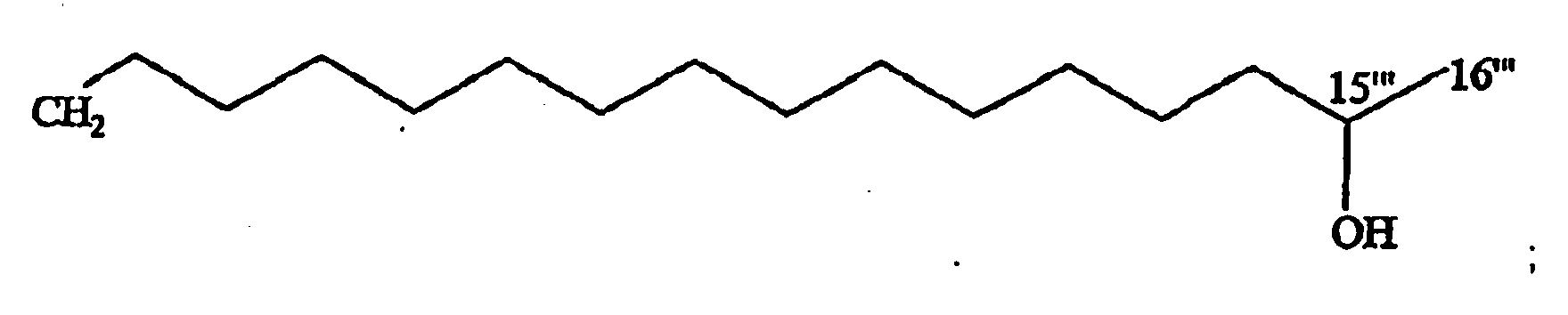






- The compound of claim 1, wherein R is

- The compound of claim 1, wherein R is

- The compound of claim 1, wherein R is

- The compound of claim 1, wherein R is

- The compound of claim 1, wherein R is

- The compound of claim 1, wherein R is

- The compound of claim 1, wherein R is

- The compound of claim 1, wherein R is

- A compound of the formula

- A pharmaceutical composition comprising:a compound selected from the group consisting of: a compound of the formula
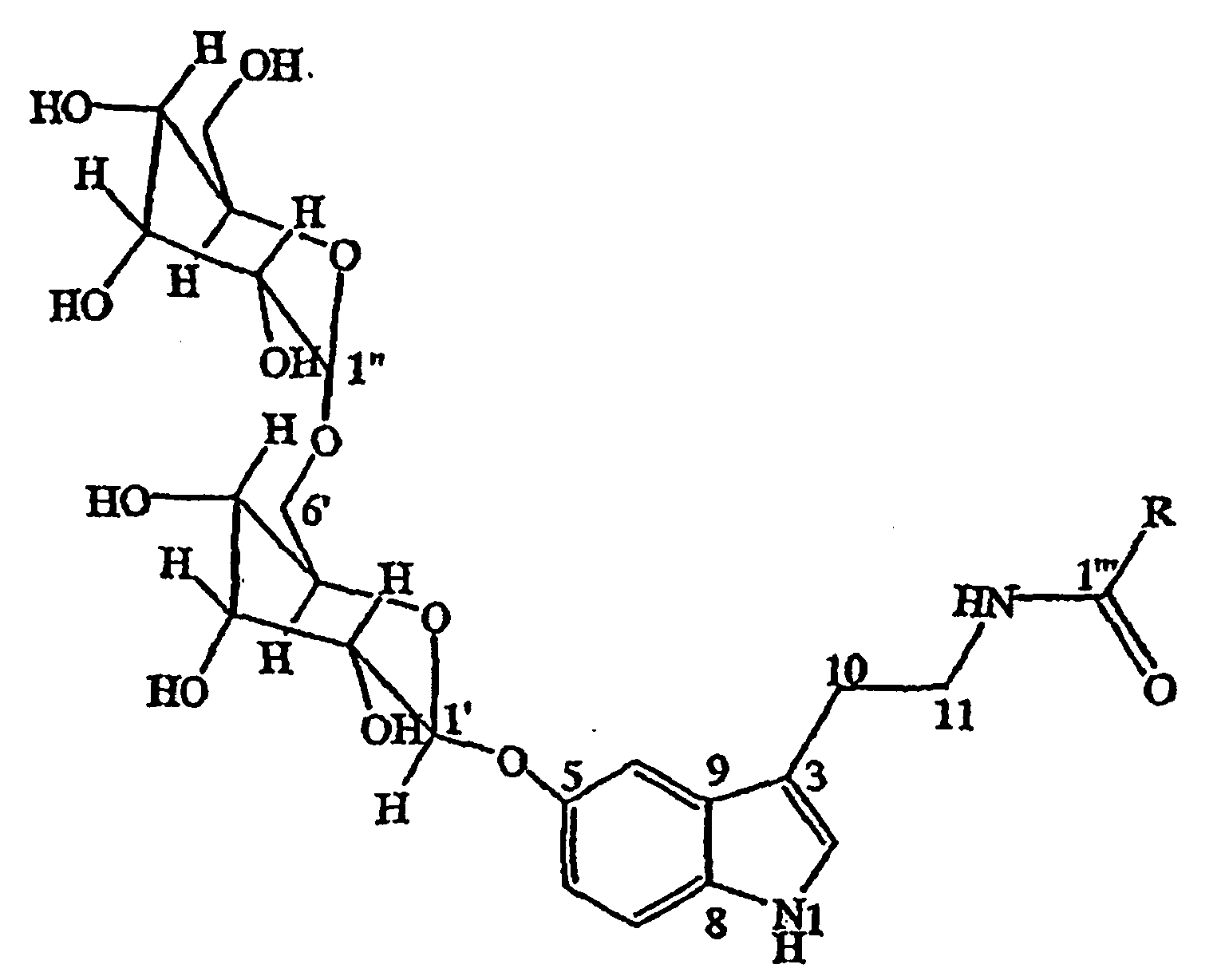


 a compound of the formula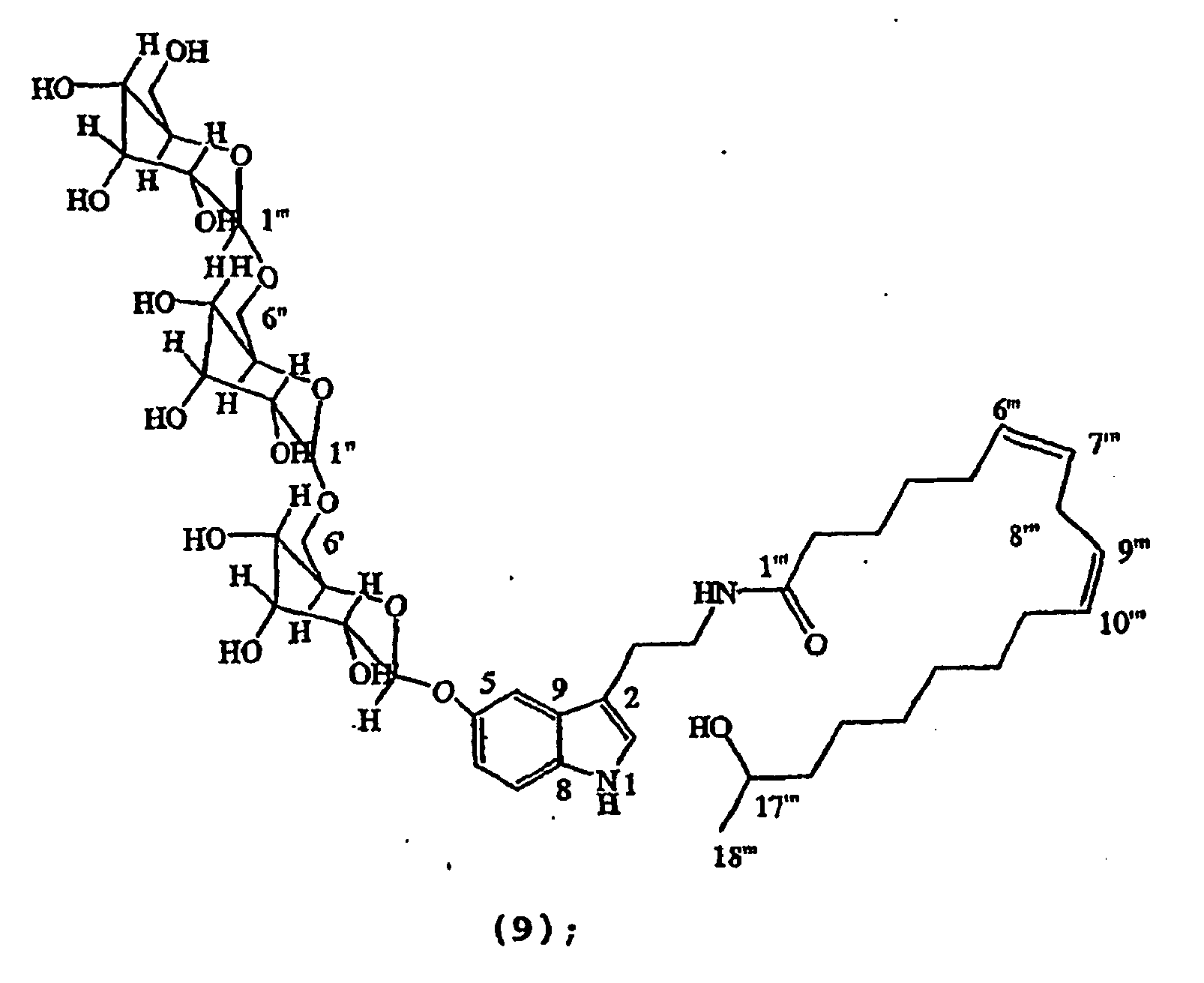
- The composition of claim 11 for medical use as an antioxidant.
- The composition of claim 11 for use in the treatment of Alzheimer's Disease.
- The composition of claim 11 for use in the treatment of obesity.
- The composition of claim 11 for use in the treatment of migraine headaches.
- The composition of claim 11 for use in the treatment of depression.
- A composition which comprises:(a) a composition in need of antioxidant activity; and(b) a compound selected from the group consisting of: a compound of the formula






- The composition of claim 11 further comprising a pharmaceutically acceptable carrier.
- The composition of claim 18 for use in treating a disease selected from the group consisting of Alzheimer's Disease, obesity, migraine headaches, and depression.
- The composition of claim 18 for medical use in an antioxidant treatment of a mammal.
Applications Claiming Priority (2)
| Application Number | Priority Date | Filing Date | Title |
|---|---|---|---|
| US50198503P | 2003-09-11 | 2003-09-11 | |
| PCT/US2004/026881 WO2005034846A2 (en) | 2003-09-11 | 2004-08-18 | Withanamide and withanolide compositions and method of use thereof |
Publications (3)
| Publication Number | Publication Date |
|---|---|
| EP1663255A2 EP1663255A2 (en) | 2006-06-07 |
| EP1663255A4 EP1663255A4 (en) | 2012-02-01 |
| EP1663255B1 true EP1663255B1 (en) | 2014-11-12 |
Family
ID=34434836
Family Applications (1)
| Application Number | Title | Priority Date | Filing Date |
|---|---|---|---|
| EP04781541.0A Expired - Lifetime EP1663255B1 (en) | 2003-09-11 | 2004-08-18 | Withanamide and withanolide compositions and method of use thereof |
Country Status (9)
| Country | Link |
|---|---|
| US (1) | US7282593B2 (en) |
| EP (1) | EP1663255B1 (en) |
| JP (1) | JP4787752B2 (en) |
| KR (1) | KR100764997B1 (en) |
| AU (1) | AU2004279327B2 (en) |
| BR (1) | BRPI0414334A (en) |
| CA (1) | CA2538905C (en) |
| MX (1) | MXPA06002842A (en) |
| WO (1) | WO2005034846A2 (en) |
Families Citing this family (20)
| Publication number | Priority date | Publication date | Assignee | Title |
|---|---|---|---|---|
| WO2003078448A1 (en) | 2002-03-13 | 2003-09-25 | Signum Biosciences, Inc. | Modulation of protein methylation and phosphoprotein phosphate |
| US7923041B2 (en) | 2005-02-03 | 2011-04-12 | Signum Biosciences, Inc. | Compositions and methods for enhancing cognitive function |
| WO2006084033A1 (en) | 2005-02-03 | 2006-08-10 | Signum Biosciences, Inc. | Compositions and methods for enhancing cognitive function |
| US20060204599A1 (en) * | 2005-03-14 | 2006-09-14 | Wheat Jared R | Dietary supplement and method of using same |
| US7951845B2 (en) * | 2006-01-19 | 2011-05-31 | The Regents Of The University Of Michigan | Composition and method of treating hearing loss |
| US7972633B2 (en) * | 2007-02-07 | 2011-07-05 | Applied Cognitive Sciences, LLC | Nutritional supplements for healthy memory and mental function |
| CN102014897B (en) | 2008-04-21 | 2015-08-05 | 西格纳姆生物科学公司 | Compound, compositions and its preparation method |
| EP2318025A2 (en) * | 2008-07-28 | 2011-05-11 | National Brain Research Centre | Withania somnifera plant extract and method of preparation thereof |
| US8598339B2 (en) | 2011-02-01 | 2013-12-03 | University Of Kansas | Withanolide isolated from Physalis longifolia and analogs and methods of use thereof |
| WO2016011049A2 (en) | 2014-07-14 | 2016-01-21 | Schwendeman Anna | Compositions and methods for disease treatment using nanoparticle delivered compounds |
| US10251927B2 (en) | 2015-10-22 | 2019-04-09 | Benny Antony | Process to enhance the bioactivity of Ashwagandha extracts |
| US12527832B2 (en) | 2015-10-22 | 2026-01-20 | Arjuna Natural Private Limited | Enriched Withania somnifera based dietary composition and a method thereof |
| US9987323B2 (en) | 2015-10-22 | 2018-06-05 | Benny Antony | Process to enhance the bioactivity of Ashwagandha extracts |
| WO2018156202A1 (en) | 2017-02-27 | 2018-08-30 | University Of Pittsburgh - Of The Commonwealth System Of Higher Education | Anti-psychotic composition and treatment methods |
| CN107652350B (en) * | 2017-10-09 | 2020-04-10 | 沈阳药科大学 | Withanolide II, extraction method and application thereof |
| CN107602657B (en) * | 2017-10-09 | 2020-04-10 | 沈阳药科大学 | Withanoid I, extraction method and application thereof |
| EP3968947A1 (en) * | 2019-05-16 | 2022-03-23 | Giuliani S.p.A. | Composition for the prevention and treatment of signs of skin aging |
| WO2021016548A1 (en) | 2019-07-25 | 2021-01-28 | North Carolina State University | Polyiodide binding compounds and methods of use thereof |
| EP4347856A2 (en) * | 2021-05-27 | 2024-04-10 | Octarine Bio ApS | Methods for producing tryptamine derivatives |
| KR102614233B1 (en) * | 2022-11-25 | 2023-12-19 | (주)엔에스티바이오 | Composition for reducing body fat comprising 12-deoxywithastramonolide and its derivatives |
Family Cites Families (2)
| Publication number | Priority date | Publication date | Assignee | Title |
|---|---|---|---|---|
| AU7222598A (en) | 1997-04-29 | 1998-11-24 | Scotia Holdings Plc | Treatment of depression and anxiety using docosahexaenoic acid or natural antioxidants |
| US6153198A (en) * | 1999-07-13 | 2000-11-28 | Natreon Inc. | Withania somnifera composition |
-
2004
- 2004-08-13 US US10/918,284 patent/US7282593B2/en not_active Expired - Lifetime
- 2004-08-18 BR BRPI0414334-5A patent/BRPI0414334A/en not_active IP Right Cessation
- 2004-08-18 MX MXPA06002842A patent/MXPA06002842A/en not_active Application Discontinuation
- 2004-08-18 EP EP04781541.0A patent/EP1663255B1/en not_active Expired - Lifetime
- 2004-08-18 WO PCT/US2004/026881 patent/WO2005034846A2/en not_active Ceased
- 2004-08-18 JP JP2006526098A patent/JP4787752B2/en not_active Expired - Fee Related
- 2004-08-18 CA CA002538905A patent/CA2538905C/en not_active Expired - Fee Related
- 2004-08-18 AU AU2004279327A patent/AU2004279327B2/en not_active Ceased
- 2004-08-18 KR KR1020067006292A patent/KR100764997B1/en not_active Expired - Fee Related
Also Published As
| Publication number | Publication date |
|---|---|
| AU2004279327A1 (en) | 2005-04-21 |
| JP4787752B2 (en) | 2011-10-05 |
| KR20060056410A (en) | 2006-05-24 |
| BRPI0414334A (en) | 2006-11-07 |
| CA2538905C (en) | 2009-02-03 |
| US7282593B2 (en) | 2007-10-16 |
| KR100764997B1 (en) | 2007-10-09 |
| WO2005034846A2 (en) | 2005-04-21 |
| US20050059727A1 (en) | 2005-03-17 |
| MXPA06002842A (en) | 2006-06-14 |
| JP2007505109A (en) | 2007-03-08 |
| WO2005034846A3 (en) | 2005-11-10 |
| EP1663255A4 (en) | 2012-02-01 |
| AU2004279327B2 (en) | 2008-05-22 |
| CA2538905A1 (en) | 2005-04-21 |
| EP1663255A2 (en) | 2006-06-07 |
Similar Documents
| Publication | Publication Date | Title |
|---|---|---|
| US7282593B2 (en) | Withanamide and withanolide compositions and method of use thereof | |
| Jayaprakasam et al. | Potent lipid peroxidation inhibitors from Withania somnifera fruits | |
| AU2002245022B8 (en) | Inhibition of NF-kappaB by triterpene compositions | |
| US7208182B2 (en) | Cyclooxygenase-2 inhibitory withanolide compositions and method | |
| CN102459217A (en) | Compounds affecting glycemic index | |
| Matsunami et al. | Absolute configuration of (+)-pinoresinol 4-O-[6 ″-O-galloyl]-β-d-glucopyranoside, macarangiosides E, and F isolated from the leaves of Macaranga tanarius | |
| Wang et al. | Anti-inflammatory oxazole-, nitro-and hexahydropyrrolo [2, 1-b] oxazole-containing abietane diterpenoid alkaloids from Salvia miltiorrhiza | |
| KR100547253B1 (en) | Ginsenoside derivatives effective for preventing and treating cancer | |
| Mustafa et al. | Synthesis and in vitro cytotoxic activity of N‐, F‐, and S‐ether derivatives of podophyllotoxin fatty acid adducts | |
| KR100564383B1 (en) | Method for preparing ginsenoside derivatives | |
| KR19990016761A (en) | Novel triterpene glycoside compounds, preparation method thereof and anticancer composition containing the same | |
| Cheng et al. | Secondary metabolites from the leaves of Meliosma rhoifolia and evaluation of their cytotoxic activity | |
| WO2003089576A2 (en) | Anticancer anthraquinones and method of use thereof | |
| JPH082788B2 (en) | Carcinogenic promoter inhibitor |
Legal Events
| Date | Code | Title | Description |
|---|---|---|---|
| PUAI | Public reference made under article 153(3) epc to a published international application that has entered the european phase |
Free format text: ORIGINAL CODE: 0009012 |
|
| 17P | Request for examination filed |
Effective date: 20060313 |
|
| AK | Designated contracting states |
Kind code of ref document: A2 Designated state(s): AT BE BG CH CY CZ DE DK EE ES FI FR GB GR HU IE IT LI LU MC NL PL PT RO SE SI SK TR |
|
| AX | Request for extension of the european patent |
Extension state: AL HR LT LV MK |
|
| DAX | Request for extension of the european patent (deleted) | ||
| RIC1 | Information provided on ipc code assigned before grant |
Ipc: C07H 17/02 20060101ALI20111220BHEP Ipc: C07H 17/00 20060101ALI20111220BHEP Ipc: A61K 31/70 20060101AFI20111220BHEP |
|
| A4 | Supplementary search report drawn up and despatched |
Effective date: 20120103 |
|
| 17Q | First examination report despatched |
Effective date: 20120522 |
|
| GRAP | Despatch of communication of intention to grant a patent |
Free format text: ORIGINAL CODE: EPIDOSNIGR1 |
|
| INTG | Intention to grant announced |
Effective date: 20140514 |
|
| RIN1 | Information on inventor provided before grant (corrected) |
Inventor name: JAYAPRAKASAM, BOLLEDDULA Inventor name: NAIR, MURALEEDHARAN, G. |
|
| GRAS | Grant fee paid |
Free format text: ORIGINAL CODE: EPIDOSNIGR3 |
|
| GRAA | (expected) grant |
Free format text: ORIGINAL CODE: 0009210 |
|
| AK | Designated contracting states |
Kind code of ref document: B1 Designated state(s): AT BE BG CH CY CZ DE DK EE ES FI FR GB GR HU IE IT LI LU MC NL PL PT RO SE SI SK TR |
|
| REG | Reference to a national code |
Ref country code: GB Ref legal event code: FG4D |
|
| REG | Reference to a national code |
Ref country code: CH Ref legal event code: EP |
|
| REG | Reference to a national code |
Ref country code: AT Ref legal event code: REF Ref document number: 695330 Country of ref document: AT Kind code of ref document: T Effective date: 20141115 |
|
| REG | Reference to a national code |
Ref country code: IE Ref legal event code: FG4D |
|
| REG | Reference to a national code |
Ref country code: DE Ref legal event code: R096 Ref document number: 602004046131 Country of ref document: DE Effective date: 20141224 |
|
| REG | Reference to a national code |
Ref country code: NL Ref legal event code: VDEP Effective date: 20141112 |
|
| REG | Reference to a national code |
Ref country code: AT Ref legal event code: MK05 Ref document number: 695330 Country of ref document: AT Kind code of ref document: T Effective date: 20141112 |
|
| PG25 | Lapsed in a contracting state [announced via postgrant information from national office to epo] |
Ref country code: ES Free format text: LAPSE BECAUSE OF FAILURE TO SUBMIT A TRANSLATION OF THE DESCRIPTION OR TO PAY THE FEE WITHIN THE PRESCRIBED TIME-LIMIT Effective date: 20141112 Ref country code: NL Free format text: LAPSE BECAUSE OF FAILURE TO SUBMIT A TRANSLATION OF THE DESCRIPTION OR TO PAY THE FEE WITHIN THE PRESCRIBED TIME-LIMIT Effective date: 20141112 Ref country code: FI Free format text: LAPSE BECAUSE OF FAILURE TO SUBMIT A TRANSLATION OF THE DESCRIPTION OR TO PAY THE FEE WITHIN THE PRESCRIBED TIME-LIMIT Effective date: 20141112 Ref country code: PT Free format text: LAPSE BECAUSE OF FAILURE TO SUBMIT A TRANSLATION OF THE DESCRIPTION OR TO PAY THE FEE WITHIN THE PRESCRIBED TIME-LIMIT Effective date: 20150312 |
|
| PG25 | Lapsed in a contracting state [announced via postgrant information from national office to epo] |
Ref country code: GR Free format text: LAPSE BECAUSE OF FAILURE TO SUBMIT A TRANSLATION OF THE DESCRIPTION OR TO PAY THE FEE WITHIN THE PRESCRIBED TIME-LIMIT Effective date: 20150213 Ref country code: AT Free format text: LAPSE BECAUSE OF FAILURE TO SUBMIT A TRANSLATION OF THE DESCRIPTION OR TO PAY THE FEE WITHIN THE PRESCRIBED TIME-LIMIT Effective date: 20141112 Ref country code: CY Free format text: LAPSE BECAUSE OF FAILURE TO SUBMIT A TRANSLATION OF THE DESCRIPTION OR TO PAY THE FEE WITHIN THE PRESCRIBED TIME-LIMIT Effective date: 20141112 Ref country code: PL Free format text: LAPSE BECAUSE OF FAILURE TO SUBMIT A TRANSLATION OF THE DESCRIPTION OR TO PAY THE FEE WITHIN THE PRESCRIBED TIME-LIMIT Effective date: 20141112 Ref country code: SE Free format text: LAPSE BECAUSE OF FAILURE TO SUBMIT A TRANSLATION OF THE DESCRIPTION OR TO PAY THE FEE WITHIN THE PRESCRIBED TIME-LIMIT Effective date: 20141112 |
|
| PG25 | Lapsed in a contracting state [announced via postgrant information from national office to epo] |
Ref country code: RO Free format text: LAPSE BECAUSE OF FAILURE TO SUBMIT A TRANSLATION OF THE DESCRIPTION OR TO PAY THE FEE WITHIN THE PRESCRIBED TIME-LIMIT Effective date: 20141112 Ref country code: DK Free format text: LAPSE BECAUSE OF FAILURE TO SUBMIT A TRANSLATION OF THE DESCRIPTION OR TO PAY THE FEE WITHIN THE PRESCRIBED TIME-LIMIT Effective date: 20141112 Ref country code: EE Free format text: LAPSE BECAUSE OF FAILURE TO SUBMIT A TRANSLATION OF THE DESCRIPTION OR TO PAY THE FEE WITHIN THE PRESCRIBED TIME-LIMIT Effective date: 20141112 Ref country code: SK Free format text: LAPSE BECAUSE OF FAILURE TO SUBMIT A TRANSLATION OF THE DESCRIPTION OR TO PAY THE FEE WITHIN THE PRESCRIBED TIME-LIMIT Effective date: 20141112 Ref country code: CZ Free format text: LAPSE BECAUSE OF FAILURE TO SUBMIT A TRANSLATION OF THE DESCRIPTION OR TO PAY THE FEE WITHIN THE PRESCRIBED TIME-LIMIT Effective date: 20141112 |
|
| REG | Reference to a national code |
Ref country code: DE Ref legal event code: R097 Ref document number: 602004046131 Country of ref document: DE |
|
| PLBE | No opposition filed within time limit |
Free format text: ORIGINAL CODE: 0009261 |
|
| STAA | Information on the status of an ep patent application or granted ep patent |
Free format text: STATUS: NO OPPOSITION FILED WITHIN TIME LIMIT |
|
| 26N | No opposition filed |
Effective date: 20150813 |
|
| PG25 | Lapsed in a contracting state [announced via postgrant information from national office to epo] |
Ref country code: IT Free format text: LAPSE BECAUSE OF FAILURE TO SUBMIT A TRANSLATION OF THE DESCRIPTION OR TO PAY THE FEE WITHIN THE PRESCRIBED TIME-LIMIT Effective date: 20141112 |
|
| PG25 | Lapsed in a contracting state [announced via postgrant information from national office to epo] |
Ref country code: SI Free format text: LAPSE BECAUSE OF FAILURE TO SUBMIT A TRANSLATION OF THE DESCRIPTION OR TO PAY THE FEE WITHIN THE PRESCRIBED TIME-LIMIT Effective date: 20141112 |
|
| PG25 | Lapsed in a contracting state [announced via postgrant information from national office to epo] |
Ref country code: MC Free format text: LAPSE BECAUSE OF FAILURE TO SUBMIT A TRANSLATION OF THE DESCRIPTION OR TO PAY THE FEE WITHIN THE PRESCRIBED TIME-LIMIT Effective date: 20141112 Ref country code: LU Free format text: LAPSE BECAUSE OF FAILURE TO SUBMIT A TRANSLATION OF THE DESCRIPTION OR TO PAY THE FEE WITHIN THE PRESCRIBED TIME-LIMIT Effective date: 20150818 |
|
| REG | Reference to a national code |
Ref country code: CH Ref legal event code: PL |
|
| PG25 | Lapsed in a contracting state [announced via postgrant information from national office to epo] |
Ref country code: CH Free format text: LAPSE BECAUSE OF NON-PAYMENT OF DUE FEES Effective date: 20150831 Ref country code: LI Free format text: LAPSE BECAUSE OF NON-PAYMENT OF DUE FEES Effective date: 20150831 |
|
| REG | Reference to a national code |
Ref country code: IE Ref legal event code: MM4A |
|
| PG25 | Lapsed in a contracting state [announced via postgrant information from national office to epo] |
Ref country code: IE Free format text: LAPSE BECAUSE OF NON-PAYMENT OF DUE FEES Effective date: 20150818 |
|
| REG | Reference to a national code |
Ref country code: FR Ref legal event code: PLFP Year of fee payment: 13 |
|
| PG25 | Lapsed in a contracting state [announced via postgrant information from national office to epo] |
Ref country code: BG Free format text: LAPSE BECAUSE OF FAILURE TO SUBMIT A TRANSLATION OF THE DESCRIPTION OR TO PAY THE FEE WITHIN THE PRESCRIBED TIME-LIMIT Effective date: 20141112 Ref country code: HU Free format text: LAPSE BECAUSE OF FAILURE TO SUBMIT A TRANSLATION OF THE DESCRIPTION OR TO PAY THE FEE WITHIN THE PRESCRIBED TIME-LIMIT; INVALID AB INITIO Effective date: 20040818 |
|
| REG | Reference to a national code |
Ref country code: FR Ref legal event code: PLFP Year of fee payment: 14 |
|
| PG25 | Lapsed in a contracting state [announced via postgrant information from national office to epo] |
Ref country code: TR Free format text: LAPSE BECAUSE OF FAILURE TO SUBMIT A TRANSLATION OF THE DESCRIPTION OR TO PAY THE FEE WITHIN THE PRESCRIBED TIME-LIMIT Effective date: 20141112 |
|
| PG25 | Lapsed in a contracting state [announced via postgrant information from national office to epo] |
Ref country code: BE Free format text: LAPSE BECAUSE OF FAILURE TO SUBMIT A TRANSLATION OF THE DESCRIPTION OR TO PAY THE FEE WITHIN THE PRESCRIBED TIME-LIMIT Effective date: 20141112 |
|
| REG | Reference to a national code |
Ref country code: FR Ref legal event code: PLFP Year of fee payment: 15 |
|
| PGFP | Annual fee paid to national office [announced via postgrant information from national office to epo] |
Ref country code: FR Payment date: 20210825 Year of fee payment: 18 |
|
| PGFP | Annual fee paid to national office [announced via postgrant information from national office to epo] |
Ref country code: DE Payment date: 20210827 Year of fee payment: 18 Ref country code: GB Payment date: 20210827 Year of fee payment: 18 |
|
| REG | Reference to a national code |
Ref country code: DE Ref legal event code: R119 Ref document number: 602004046131 Country of ref document: DE |
|
| GBPC | Gb: european patent ceased through non-payment of renewal fee |
Effective date: 20220818 |
|
| PG25 | Lapsed in a contracting state [announced via postgrant information from national office to epo] |
Ref country code: FR Free format text: LAPSE BECAUSE OF NON-PAYMENT OF DUE FEES Effective date: 20220831 Ref country code: DE Free format text: LAPSE BECAUSE OF NON-PAYMENT OF DUE FEES Effective date: 20230301 |
|
| PG25 | Lapsed in a contracting state [announced via postgrant information from national office to epo] |
Ref country code: GB Free format text: LAPSE BECAUSE OF NON-PAYMENT OF DUE FEES Effective date: 20220818 |