EP1663192B1 - hERG1 CHANNEL OPENERS FOR THE TREATMENT OF CARDIAC ARRHYTHMIAS - Google Patents
hERG1 CHANNEL OPENERS FOR THE TREATMENT OF CARDIAC ARRHYTHMIAS Download PDFInfo
- Publication number
- EP1663192B1 EP1663192B1 EP04766708A EP04766708A EP1663192B1 EP 1663192 B1 EP1663192 B1 EP 1663192B1 EP 04766708 A EP04766708 A EP 04766708A EP 04766708 A EP04766708 A EP 04766708A EP 1663192 B1 EP1663192 B1 EP 1663192B1
- Authority
- EP
- European Patent Office
- Prior art keywords
- phenyl
- alkyl
- carbamoyl
- urea
- sulfamoyl
- Prior art date
- Legal status (The legal status is an assumption and is not a legal conclusion. Google has not performed a legal analysis and makes no representation as to the accuracy of the status listed.)
- Expired - Lifetime
Links
- 206010003119 arrhythmia Diseases 0.000 title claims abstract description 16
- 238000011282 treatment Methods 0.000 title claims abstract description 14
- 101001047090 Homo sapiens Potassium voltage-gated channel subfamily H member 2 Proteins 0.000 title claims description 77
- 150000001875 compounds Chemical class 0.000 claims abstract description 99
- 125000001997 phenyl group Chemical group [H]C1=C([H])C([H])=C(*)C([H])=C1[H] 0.000 claims description 98
- 125000004397 aminosulfonyl group Chemical group NS(=O)(=O)* 0.000 claims description 88
- 125000001188 haloalkyl group Chemical group 0.000 claims description 88
- 125000004438 haloalkoxy group Chemical group 0.000 claims description 82
- 125000002887 hydroxy group Chemical group [H]O* 0.000 claims description 82
- 125000003545 alkoxy group Chemical group 0.000 claims description 80
- 125000000217 alkyl group Chemical group 0.000 claims description 78
- 125000000449 nitro group Chemical group [O-][N+](*)=O 0.000 claims description 70
- 125000005118 N-alkylcarbamoyl group Chemical group 0.000 claims description 69
- 125000003917 carbamoyl group Chemical group [H]N([H])C(*)=O 0.000 claims description 69
- 125000004453 alkoxycarbonyl group Chemical group 0.000 claims description 64
- 125000002252 acyl group Chemical group 0.000 claims description 60
- 239000004202 carbamide Substances 0.000 claims description 60
- 125000005080 alkoxycarbonylalkenyl group Chemical group 0.000 claims description 54
- 230000003213 activating effect Effects 0.000 claims description 52
- 125000005078 alkoxycarbonylalkyl group Chemical group 0.000 claims description 50
- 150000003839 salts Chemical class 0.000 claims description 45
- UFHFLCQGNIYNRP-UHFFFAOYSA-N Hydrogen Chemical compound [H][H] UFHFLCQGNIYNRP-UHFFFAOYSA-N 0.000 claims description 44
- 239000001257 hydrogen Substances 0.000 claims description 44
- 229910052739 hydrogen Inorganic materials 0.000 claims description 44
- -1 amino, carboxy Chemical group 0.000 claims description 43
- 125000001424 substituent group Chemical group 0.000 claims description 42
- 108091006146 Channels Proteins 0.000 claims description 35
- 125000002924 primary amino group Chemical group [H]N([H])* 0.000 claims description 33
- 125000005309 thioalkoxy group Chemical group 0.000 claims description 30
- 125000004093 cyano group Chemical group *C#N 0.000 claims description 29
- 239000004305 biphenyl Substances 0.000 claims description 26
- LZTSCEYDCZBRCJ-UHFFFAOYSA-N 1,2-dihydro-1,2,4-triazol-3-one Chemical compound OC=1N=CNN=1 LZTSCEYDCZBRCJ-UHFFFAOYSA-N 0.000 claims description 22
- 101100279960 Homo sapiens SQLE gene Proteins 0.000 claims description 22
- 239000000203 mixture Substances 0.000 claims description 22
- GWEHVDNNLFDJLR-UHFFFAOYSA-N 1,3-diphenylurea Chemical class C=1C=CC=CC=1NC(=O)NC1=CC=CC=C1 GWEHVDNNLFDJLR-UHFFFAOYSA-N 0.000 claims description 20
- 150000003672 ureas Chemical class 0.000 claims description 18
- 125000002023 trifluoromethyl group Chemical group FC(F)(F)* 0.000 claims description 17
- 125000003831 tetrazolyl group Chemical group 0.000 claims description 15
- 125000002490 anilino group Chemical group [H]N(*)C1=C([H])C([H])=C([H])C([H])=C1[H] 0.000 claims description 12
- 125000001620 monocyclic carbocycle group Chemical group 0.000 claims description 12
- 125000004076 pyridyl group Chemical group 0.000 claims description 12
- PCJFEVUKVKQSSL-UHFFFAOYSA-N 2h-1,2,4-oxadiazol-5-one Chemical compound O=C1N=CNO1 PCJFEVUKVKQSSL-UHFFFAOYSA-N 0.000 claims description 11
- 125000000623 heterocyclic group Chemical group 0.000 claims description 11
- 125000000876 trifluoromethoxy group Chemical group FC(F)(F)O* 0.000 claims description 10
- AEFYFGMSRKDXHZ-UHFFFAOYSA-N 1-[3,5-bis(trifluoromethyl)phenyl]-3-[4-bromo-2-(2h-tetrazol-5-yl)phenyl]urea Chemical compound FC(F)(F)C1=CC(C(F)(F)F)=CC(NC(=O)NC=2C(=CC(Br)=CC=2)C=2NN=NN=2)=C1 AEFYFGMSRKDXHZ-UHFFFAOYSA-N 0.000 claims description 9
- URTOCTRLSCVJCE-UHFFFAOYSA-N 1-[4-chloro-2-(2h-tetrazol-5-yl)phenyl]-3-(3,5-dichlorophenyl)urea Chemical compound N=1N=NNC=1C1=CC(Cl)=CC=C1NC(=O)NC1=CC(Cl)=CC(Cl)=C1 URTOCTRLSCVJCE-UHFFFAOYSA-N 0.000 claims description 9
- ULRPSUUXJOSUHQ-UHFFFAOYSA-N 4-chloro-2-[(2-fluorophenyl)carbamoylamino]benzoic acid Chemical compound OC(=O)C1=CC=C(Cl)C=C1NC(=O)NC1=CC=CC=C1F ULRPSUUXJOSUHQ-UHFFFAOYSA-N 0.000 claims description 9
- HBAQYPYDRFILMT-UHFFFAOYSA-N 8-[3-(1-cyclopropylpyrazol-4-yl)-1H-pyrazolo[4,3-d]pyrimidin-5-yl]-3-methyl-3,8-diazabicyclo[3.2.1]octan-2-one Chemical class C1(CC1)N1N=CC(=C1)C1=NNC2=C1N=C(N=C2)N1C2C(N(CC1CC2)C)=O HBAQYPYDRFILMT-UHFFFAOYSA-N 0.000 claims description 9
- 208000019622 heart disease Diseases 0.000 claims description 9
- 239000008194 pharmaceutical composition Substances 0.000 claims description 9
- CQSGYNDCTVUTAA-UHFFFAOYSA-N 1-(5-chloro-2-hydroxyphenyl)-3-[2-(trifluoromethyl)phenyl]urea Chemical compound OC1=CC=C(Cl)C=C1NC(=O)NC1=CC=CC=C1C(F)(F)F CQSGYNDCTVUTAA-UHFFFAOYSA-N 0.000 claims description 8
- LTLNZEORMZIQOV-UHFFFAOYSA-N 1-(5-chloro-2-sulfamoylphenyl)-3-[3-(trifluoromethyl)phenyl]urea Chemical compound NS(=O)(=O)C1=CC=C(Cl)C=C1NC(=O)NC1=CC=CC(C(F)(F)F)=C1 LTLNZEORMZIQOV-UHFFFAOYSA-N 0.000 claims description 8
- SSZSOHKEQABVNS-UHFFFAOYSA-N 1-[2-hydroxy-5-(trifluoromethyl)phenyl]-3-[2-(trifluoromethyl)phenyl]urea Chemical compound OC1=CC=C(C(F)(F)F)C=C1NC(=O)NC1=CC=CC=C1C(F)(F)F SSZSOHKEQABVNS-UHFFFAOYSA-N 0.000 claims description 8
- AAEVJVRBHXYKEB-UHFFFAOYSA-N 1-[4-chloro-2-(2h-tetrazol-5-yl)phenyl]-3-[4-chloro-3-(trifluoromethyl)phenyl]urea Chemical compound C1=C(Cl)C(C(F)(F)F)=CC(NC(=O)NC=2C(=CC(Cl)=CC=2)C=2NN=NN=2)=C1 AAEVJVRBHXYKEB-UHFFFAOYSA-N 0.000 claims description 8
- 208000020446 Cardiac disease Diseases 0.000 claims description 8
- 125000004448 alkyl carbonyl group Chemical group 0.000 claims description 8
- 125000003178 carboxy group Chemical group [H]OC(*)=O 0.000 claims description 8
- 125000004043 oxo group Chemical group O=* 0.000 claims description 8
- 125000000714 pyrimidinyl group Chemical group 0.000 claims description 8
- WCBOILZPQWQCIG-UHFFFAOYSA-N 1-(3,5-dihydroxyphenyl)-3-[3-(trifluoromethyl)phenyl]urea Chemical compound OC1=CC(O)=CC(NC(=O)NC=2C=C(C=CC=2)C(F)(F)F)=C1 WCBOILZPQWQCIG-UHFFFAOYSA-N 0.000 claims description 7
- JXPULDIATMTIIN-UHFFFAOYSA-N 1-[4-bromo-2-(2h-tetrazol-5-yl)phenyl]-3-[3-(trifluoromethyl)phenyl]urea Chemical compound FC(F)(F)C1=CC=CC(NC(=O)NC=2C(=CC(Br)=CC=2)C=2NN=NN=2)=C1 JXPULDIATMTIIN-UHFFFAOYSA-N 0.000 claims description 7
- 125000002911 monocyclic heterocycle group Chemical group 0.000 claims description 7
- NJFVQMRYJZHGME-UHFFFAOYSA-N 1,3-bis[2-hydroxy-5-(trifluoromethyl)phenyl]urea Chemical compound OC1=CC=C(C(F)(F)F)C=C1NC(=O)NC1=CC(C(F)(F)F)=CC=C1O NJFVQMRYJZHGME-UHFFFAOYSA-N 0.000 claims description 6
- SMYKFYZATBNGHX-UHFFFAOYSA-N 2,4-dioxo-5-[[3-(trifluoromethyl)phenyl]carbamoylamino]-1h-pyrimidine-6-carboxylic acid Chemical compound N1C(=O)NC(=O)C(NC(=O)NC=2C=C(C=CC=2)C(F)(F)F)=C1C(=O)O SMYKFYZATBNGHX-UHFFFAOYSA-N 0.000 claims description 6
- DWMCKWLIARMJQQ-UHFFFAOYSA-N 3-[[3-(trifluoromethyl)phenyl]carbamoylamino]pyrazine-2-carboxylic acid Chemical compound OC(=O)C1=NC=CN=C1NC(=O)NC1=CC=CC(C(F)(F)F)=C1 DWMCKWLIARMJQQ-UHFFFAOYSA-N 0.000 claims description 6
- IFCPQZNCKYDWQT-UHFFFAOYSA-N 5-methyl-2-[[3-(trifluoromethyl)phenyl]carbamoylamino]benzoic acid Chemical compound OC(=O)C1=CC(C)=CC=C1NC(=O)NC1=CC=CC(C(F)(F)F)=C1 IFCPQZNCKYDWQT-UHFFFAOYSA-N 0.000 claims description 6
- KRHJDJMOIKRPNN-UHFFFAOYSA-N NS 1608 Chemical compound OC1=CC=C(Cl)C=C1NC(=O)NC1=CC=CC(C(F)(F)F)=C1 KRHJDJMOIKRPNN-UHFFFAOYSA-N 0.000 claims description 6
- 230000002159 abnormal effect Effects 0.000 claims description 6
- 150000003936 benzamides Chemical class 0.000 claims description 6
- 125000002837 carbocyclic group Chemical group 0.000 claims description 6
- BUVTUTUINXXWDO-UHFFFAOYSA-N n-[4-phenyl-2-(2h-tetrazol-5-yl)phenyl]-3,5-bis(trifluoromethyl)benzamide Chemical compound FC(F)(F)C1=CC(C(F)(F)F)=CC(C(=O)NC=2C(=CC(=CC=2)C=2C=CC=CC=2)C=2NN=NN=2)=C1 BUVTUTUINXXWDO-UHFFFAOYSA-N 0.000 claims description 6
- 125000003373 pyrazinyl group Chemical group 0.000 claims description 6
- 125000002098 pyridazinyl group Chemical group 0.000 claims description 6
- 230000033764 rhythmic process Effects 0.000 claims description 6
- 206010065341 Ventricular tachyarrhythmia Diseases 0.000 claims description 5
- AIRFLUZYZLMDBM-UHFFFAOYSA-N n-[3-chloro-4-(4-chloroanilino)phenyl]-2-hydroxy-5-nitrobenzamide Chemical group OC1=CC=C([N+]([O-])=O)C=C1C(=O)NC(C=C1Cl)=CC=C1NC1=CC=C(Cl)C=C1 AIRFLUZYZLMDBM-UHFFFAOYSA-N 0.000 claims description 5
- 206010047302 ventricular tachycardia Diseases 0.000 claims description 5
- CFQUOVAZWRNRSC-UHFFFAOYSA-N 1-(2-amino-5-chlorophenyl)-3-[3-(trifluoromethyl)phenyl]urea Chemical compound NC1=CC=C(Cl)C=C1NC(=O)NC1=CC=CC(C(F)(F)F)=C1 CFQUOVAZWRNRSC-UHFFFAOYSA-N 0.000 claims description 4
- HHMXFSBGGMWJMT-UHFFFAOYSA-N 1-(5-bromo-2-hydroxyphenyl)-3-[3-(trifluoromethyl)phenyl]urea Chemical compound OC1=CC=C(Br)C=C1NC(=O)NC1=CC=CC(C(F)(F)F)=C1 HHMXFSBGGMWJMT-UHFFFAOYSA-N 0.000 claims description 4
- WIUGNIKUKXGXBL-UHFFFAOYSA-N 1-[2-hydroxy-5-(trifluoromethyl)phenyl]-3-[3-(trifluoromethyl)phenyl]urea Chemical compound OC1=CC=C(C(F)(F)F)C=C1NC(=O)NC1=CC=CC(C(F)(F)F)=C1 WIUGNIKUKXGXBL-UHFFFAOYSA-N 0.000 claims description 4
- NWLQWXGKPZZWSH-UHFFFAOYSA-N 1-[3,5-bis(trifluoromethyl)phenyl]-3-[2,4-dichloro-6-(2h-tetrazol-5-yl)phenyl]urea Chemical compound FC(F)(F)C1=CC(C(F)(F)F)=CC(NC(=O)NC=2C(=CC(Cl)=CC=2Cl)C=2NN=NN=2)=C1 NWLQWXGKPZZWSH-UHFFFAOYSA-N 0.000 claims description 4
- KIKHHROCOHMBDG-UHFFFAOYSA-N 1-[3,5-bis(trifluoromethyl)phenyl]-3-[4-chloro-2-(2h-tetrazol-5-yl)phenyl]urea Chemical compound FC(F)(F)C1=CC(C(F)(F)F)=CC(NC(=O)NC=2C(=CC(Cl)=CC=2)C=2NN=NN=2)=C1 KIKHHROCOHMBDG-UHFFFAOYSA-N 0.000 claims description 4
- KPKYNVZQOPNBIL-UHFFFAOYSA-N 1-[4-bromo-2-(2h-tetrazol-5-yl)phenyl]-3-(3,5-dichlorophenyl)urea Chemical compound ClC1=CC(Cl)=CC(NC(=O)NC=2C(=CC(Br)=CC=2)C=2NN=NN=2)=C1 KPKYNVZQOPNBIL-UHFFFAOYSA-N 0.000 claims description 4
- FYMVRPFAUCHQJK-UHFFFAOYSA-N 1-[4-bromo-2-(2h-tetrazol-5-yl)phenyl]-3-(3-chloro-4-fluorophenyl)urea Chemical compound C1=C(Cl)C(F)=CC=C1NC(=O)NC1=CC=C(Br)C=C1C1=NN=NN1 FYMVRPFAUCHQJK-UHFFFAOYSA-N 0.000 claims description 4
- YELSRKXSQJECRI-UHFFFAOYSA-N 1-[4-bromo-2-(2h-tetrazol-5-yl)phenyl]-3-[4-fluoro-3-(trifluoromethyl)phenyl]urea Chemical compound C1=C(C(F)(F)F)C(F)=CC=C1NC(=O)NC1=CC=C(Br)C=C1C1=NN=NN1 YELSRKXSQJECRI-UHFFFAOYSA-N 0.000 claims description 4
- MAXPMVVABWZKQP-UHFFFAOYSA-N 1-[5-chloro-2-(2h-tetrazol-5-yl)phenyl]-3-[4-chloro-3-(trifluoromethyl)phenyl]urea Chemical compound C1=C(Cl)C(C(F)(F)F)=CC(NC(=O)NC=2C(=CC=C(Cl)C=2)C=2NN=NN=2)=C1 MAXPMVVABWZKQP-UHFFFAOYSA-N 0.000 claims description 4
- BNJQNYCKEWQMPU-UHFFFAOYSA-N 2-[[3,5-bis(trifluoromethyl)phenyl]carbamoylamino]-4-chlorobenzoic acid Chemical compound OC(=O)C1=CC=C(Cl)C=C1NC(=O)NC1=CC(C(F)(F)F)=CC(C(F)(F)F)=C1 BNJQNYCKEWQMPU-UHFFFAOYSA-N 0.000 claims description 4
- MLGALOZSVFKMSG-UHFFFAOYSA-N 4-chloro-2-[(4-chlorophenyl)carbamoylamino]benzoic acid Chemical compound OC(=O)C1=CC=C(Cl)C=C1NC(=O)NC1=CC=C(Cl)C=C1 MLGALOZSVFKMSG-UHFFFAOYSA-N 0.000 claims description 4
- UZTGAEZWQMNUBC-UHFFFAOYSA-N 4-nitro-2-[[3-(trifluoromethyl)phenyl]carbamoylamino]benzoic acid Chemical compound OC(=O)C1=CC=C([N+]([O-])=O)C=C1NC(=O)NC1=CC=CC(C(F)(F)F)=C1 UZTGAEZWQMNUBC-UHFFFAOYSA-N 0.000 claims description 4
- CZAUOFXREFVFBI-UHFFFAOYSA-N 5-bromo-2-[[3-(trifluoromethyl)phenyl]carbamoylamino]benzoic acid Chemical compound OC(=O)C1=CC(Br)=CC=C1NC(=O)NC1=CC=CC(C(F)(F)F)=C1 CZAUOFXREFVFBI-UHFFFAOYSA-N 0.000 claims description 4
- 206010003658 Atrial Fibrillation Diseases 0.000 claims description 4
- 101000974726 Homo sapiens Potassium voltage-gated channel subfamily E member 1 Proteins 0.000 claims description 4
- 102100022755 Potassium voltage-gated channel subfamily E member 1 Human genes 0.000 claims description 4
- 206010049447 Tachyarrhythmia Diseases 0.000 claims description 4
- 208000001871 Tachycardia Diseases 0.000 claims description 4
- 229910052794 bromium Inorganic materials 0.000 claims description 4
- 229910052801 chlorine Inorganic materials 0.000 claims description 4
- 229910052731 fluorine Inorganic materials 0.000 claims description 4
- KIKWUDQRTFRIOC-UHFFFAOYSA-N n-hydroxy-2-[[3-(trifluoromethyl)phenyl]carbamoylamino]benzamide Chemical compound ONC(=O)C1=CC=CC=C1NC(=O)NC1=CC=CC(C(F)(F)F)=C1 KIKWUDQRTFRIOC-UHFFFAOYSA-N 0.000 claims description 4
- 230000002265 prevention Effects 0.000 claims description 4
- YJWGFXWJBWAPJN-UHFFFAOYSA-N 1-[3-(fluoromethyl)phenyl]-3-(6-methoxy-2-oxo-1h-pyridin-3-yl)urea Chemical compound OC1=NC(OC)=CC=C1NC(=O)NC1=CC=CC(CF)=C1 YJWGFXWJBWAPJN-UHFFFAOYSA-N 0.000 claims description 3
- BIWIPAFIUDLXFI-UHFFFAOYSA-N 1-pyrimidin-2-yl-3-[3-(trifluoromethyl)phenyl]urea Chemical group FC(F)(F)C1=CC=CC(NC(=O)NC=2N=CC=CN=2)=C1 BIWIPAFIUDLXFI-UHFFFAOYSA-N 0.000 claims description 3
- WEIPCSADPPQNOP-UHFFFAOYSA-N 2-[(4-chlorophenyl)carbamoylamino]-6-iodobenzoic acid Chemical compound OC(=O)C1=C(I)C=CC=C1NC(=O)NC1=CC=C(Cl)C=C1 WEIPCSADPPQNOP-UHFFFAOYSA-N 0.000 claims description 3
- 101000974720 Homo sapiens Potassium voltage-gated channel subfamily E member 2 Proteins 0.000 claims description 3
- 102100022752 Potassium voltage-gated channel subfamily E member 2 Human genes 0.000 claims description 3
- 208000006218 bradycardia Diseases 0.000 claims description 3
- 125000000113 cyclohexyl group Chemical group [H]C1([H])C([H])([H])C([H])([H])C([H])(*)C([H])([H])C1([H])[H] 0.000 claims description 3
- YUFLSJJEGNVISN-UHFFFAOYSA-N 1-(2,4-dihydroxyphenyl)-3-[3-(trifluoromethyl)phenyl]urea Chemical compound OC1=CC(O)=CC=C1NC(=O)NC1=CC=CC(C(F)(F)F)=C1 YUFLSJJEGNVISN-UHFFFAOYSA-N 0.000 claims description 2
- ZPGKENDVDNSTOO-UHFFFAOYSA-N 1-(2,5-dihydroxyphenyl)-3-[3-(trifluoromethyl)phenyl]urea Chemical compound OC1=CC=C(O)C(NC(=O)NC=2C=C(C=CC=2)C(F)(F)F)=C1 ZPGKENDVDNSTOO-UHFFFAOYSA-N 0.000 claims description 2
- LDEKSKQRLXJINL-UHFFFAOYSA-N 1-(2,6-dihydroxyphenyl)-3-[3-(trifluoromethyl)phenyl]urea Chemical compound OC1=CC=CC(O)=C1NC(=O)NC1=CC=CC(C(F)(F)F)=C1 LDEKSKQRLXJINL-UHFFFAOYSA-N 0.000 claims description 2
- MKGLSISINKWSSB-UHFFFAOYSA-N 1-(2-bromophenyl)-3-[4-bromo-2-(2h-tetrazol-5-yl)phenyl]urea Chemical compound N=1N=NNC=1C1=CC(Br)=CC=C1NC(=O)NC1=CC=CC=C1Br MKGLSISINKWSSB-UHFFFAOYSA-N 0.000 claims description 2
- MKGZBPUTINHEKR-UHFFFAOYSA-N 1-(2-hydroxy-3-nitrophenyl)-3-[3-(trifluoromethyl)phenyl]urea Chemical compound C1=CC=C([N+]([O-])=O)C(O)=C1NC(=O)NC1=CC=CC(C(F)(F)F)=C1 MKGZBPUTINHEKR-UHFFFAOYSA-N 0.000 claims description 2
- GITPQRMJEJRSRF-UHFFFAOYSA-N 1-(2-hydroxy-4-methoxyphenyl)-3-[3-(trifluoromethyl)phenyl]urea Chemical compound OC1=CC(OC)=CC=C1NC(=O)NC1=CC=CC(C(F)(F)F)=C1 GITPQRMJEJRSRF-UHFFFAOYSA-N 0.000 claims description 2
- KUYXFMOQTPVIKM-UHFFFAOYSA-N 1-(2-hydroxy-5-methoxyphenyl)-3-[3-(trifluoromethyl)phenyl]urea Chemical compound COC1=CC=C(O)C(NC(=O)NC=2C=C(C=CC=2)C(F)(F)F)=C1 KUYXFMOQTPVIKM-UHFFFAOYSA-N 0.000 claims description 2
- ZSLIIGIYWQZBOQ-UHFFFAOYSA-N 1-(2-hydroxy-5-nitrophenyl)-3-[3-(trifluoromethyl)phenyl]urea Chemical compound OC1=CC=C([N+]([O-])=O)C=C1NC(=O)NC1=CC=CC(C(F)(F)F)=C1 ZSLIIGIYWQZBOQ-UHFFFAOYSA-N 0.000 claims description 2
- ULOBWFQFTPJMGJ-UHFFFAOYSA-N 1-(2-hydroxy-6-nitrophenyl)-3-[3-(trifluoromethyl)phenyl]urea Chemical compound OC1=CC=CC([N+]([O-])=O)=C1NC(=O)NC1=CC=CC(C(F)(F)F)=C1 ULOBWFQFTPJMGJ-UHFFFAOYSA-N 0.000 claims description 2
- FBOTUXGDYMWIMI-UHFFFAOYSA-N 1-(2-hydroxyphenyl)-3-[3-(trifluoromethyl)phenyl]urea Chemical compound OC1=CC=CC=C1NC(=O)NC1=CC=CC(C(F)(F)F)=C1 FBOTUXGDYMWIMI-UHFFFAOYSA-N 0.000 claims description 2
- QHWXYHYVEKAFQM-UHFFFAOYSA-N 1-(3-acetylphenyl)-3-[2-(2h-tetrazol-5-yl)phenyl]urea Chemical compound CC(=O)C1=CC=CC(NC(=O)NC=2C(=CC=CC=2)C=2NN=NN=2)=C1 QHWXYHYVEKAFQM-UHFFFAOYSA-N 0.000 claims description 2
- KORRMCBGMACEQQ-UHFFFAOYSA-N 1-(3-acetylphenyl)-3-[4-bromo-2-(2h-tetrazol-5-yl)phenyl]urea Chemical compound CC(=O)C1=CC=CC(NC(=O)NC=2C(=CC(Br)=CC=2)C=2NN=NN=2)=C1 KORRMCBGMACEQQ-UHFFFAOYSA-N 0.000 claims description 2
- VGRFLIBZVRLCIR-UHFFFAOYSA-N 1-(3-bromophenyl)-3-[4-bromo-2-(2h-tetrazol-5-yl)phenyl]urea Chemical compound BrC1=CC=CC(NC(=O)NC=2C(=CC(Br)=CC=2)C=2NN=NN=2)=C1 VGRFLIBZVRLCIR-UHFFFAOYSA-N 0.000 claims description 2
- HNCHAANFUMUUOD-UHFFFAOYSA-N 1-(4-bromophenyl)-3-[4-bromo-2-(2h-tetrazol-5-yl)phenyl]urea Chemical compound C1=CC(Br)=CC=C1NC(=O)NC1=CC=C(Br)C=C1C1=NN=NN1 HNCHAANFUMUUOD-UHFFFAOYSA-N 0.000 claims description 2
- IHUAOZCBGOKPQR-UHFFFAOYSA-N 1-(4-chloro-2-hydroxyphenyl)-3-[3-(trifluoromethyl)phenyl]urea Chemical compound OC1=CC(Cl)=CC=C1NC(=O)NC1=CC=CC(C(F)(F)F)=C1 IHUAOZCBGOKPQR-UHFFFAOYSA-N 0.000 claims description 2
- WDNNLIPFXYEFQA-UHFFFAOYSA-N 1-(4-chlorophenyl)-3-(2-hydroxy-4-methoxyphenyl)urea Chemical compound OC1=CC(OC)=CC=C1NC(=O)NC1=CC=C(Cl)C=C1 WDNNLIPFXYEFQA-UHFFFAOYSA-N 0.000 claims description 2
- SSWMDHAWZHBJGP-UHFFFAOYSA-N 1-(5-chloro-2-hydroxyphenyl)-3-(3-hydroxyphenyl)urea Chemical compound OC1=CC=CC(NC(=O)NC=2C(=CC=C(Cl)C=2)O)=C1 SSWMDHAWZHBJGP-UHFFFAOYSA-N 0.000 claims description 2
- BMGICCUFSAWXLB-UHFFFAOYSA-N 1-(5-chloro-2-hydroxyphenyl)-3-(3-methylphenyl)urea Chemical compound CC1=CC=CC(NC(=O)NC=2C(=CC=C(Cl)C=2)O)=C1 BMGICCUFSAWXLB-UHFFFAOYSA-N 0.000 claims description 2
- WDJDTFGCQAJVPP-UHFFFAOYSA-N 1-(5-chloro-2-hydroxyphenyl)-3-[3-(trifluoromethoxy)phenyl]urea Chemical compound OC1=CC=C(Cl)C=C1NC(=O)NC1=CC=CC(OC(F)(F)F)=C1 WDJDTFGCQAJVPP-UHFFFAOYSA-N 0.000 claims description 2
- ATYBRDQDGZETQB-UHFFFAOYSA-N 1-(5-chloro-2-hydroxyphenyl)-3-[4-(ethylsulfamoyl)phenyl]urea Chemical compound C1=CC(S(=O)(=O)NCC)=CC=C1NC(=O)NC1=CC(Cl)=CC=C1O ATYBRDQDGZETQB-UHFFFAOYSA-N 0.000 claims description 2
- BPCFJBRTDTXFJE-UHFFFAOYSA-N 1-[4-amino-2-(2h-tetrazol-5-yl)phenyl]-3-[3-(trifluoromethyl)phenyl]urea Chemical compound N=1N=NNC=1C1=CC(N)=CC=C1NC(=O)NC1=CC=CC(C(F)(F)F)=C1 BPCFJBRTDTXFJE-UHFFFAOYSA-N 0.000 claims description 2
- VOYNZUBDOGHVEU-UHFFFAOYSA-N 1-[4-bromo-2-(2h-tetrazol-5-yl)phenyl]-3-(2-chlorophenyl)urea Chemical compound ClC1=CC=CC=C1NC(=O)NC1=CC=C(Br)C=C1C1=NN=NN1 VOYNZUBDOGHVEU-UHFFFAOYSA-N 0.000 claims description 2
- APTHNLDKRYJGGE-UHFFFAOYSA-N 1-[4-bromo-2-(2h-tetrazol-5-yl)phenyl]-3-(2-fluorophenyl)urea Chemical compound FC1=CC=CC=C1NC(=O)NC1=CC=C(Br)C=C1C1=NN=NN1 APTHNLDKRYJGGE-UHFFFAOYSA-N 0.000 claims description 2
- VMZLYUKODDNUOO-UHFFFAOYSA-N 1-[4-bromo-2-(2h-tetrazol-5-yl)phenyl]-3-(2-methylphenyl)urea Chemical compound CC1=CC=CC=C1NC(=O)NC1=CC=C(Br)C=C1C1=NN=NN1 VMZLYUKODDNUOO-UHFFFAOYSA-N 0.000 claims description 2
- FUTDSNSECRSEHH-UHFFFAOYSA-N 1-[4-bromo-2-(2h-tetrazol-5-yl)phenyl]-3-(2-nitrophenyl)urea Chemical compound [O-][N+](=O)C1=CC=CC=C1NC(=O)NC1=CC=C(Br)C=C1C1=NN=NN1 FUTDSNSECRSEHH-UHFFFAOYSA-N 0.000 claims description 2
- PZFZXGFVFQBZCR-UHFFFAOYSA-N 1-[4-bromo-2-(2h-tetrazol-5-yl)phenyl]-3-(3,4-dichlorophenyl)urea Chemical compound C1=C(Cl)C(Cl)=CC=C1NC(=O)NC1=CC=C(Br)C=C1C1=NN=NN1 PZFZXGFVFQBZCR-UHFFFAOYSA-N 0.000 claims description 2
- JUXQRQLZLRJJHP-UHFFFAOYSA-N 1-[4-bromo-2-(2h-tetrazol-5-yl)phenyl]-3-(3,5-dimethylphenyl)urea Chemical compound CC1=CC(C)=CC(NC(=O)NC=2C(=CC(Br)=CC=2)C=2NN=NN=2)=C1 JUXQRQLZLRJJHP-UHFFFAOYSA-N 0.000 claims description 2
- FQAXKQVBVCXURN-UHFFFAOYSA-N 1-[4-bromo-2-(2h-tetrazol-5-yl)phenyl]-3-(3-chlorophenyl)urea Chemical compound ClC1=CC=CC(NC(=O)NC=2C(=CC(Br)=CC=2)C=2NN=NN=2)=C1 FQAXKQVBVCXURN-UHFFFAOYSA-N 0.000 claims description 2
- QZGINFKUFFIYKB-UHFFFAOYSA-N 1-[4-bromo-2-(2h-tetrazol-5-yl)phenyl]-3-(3-fluorophenyl)urea Chemical compound FC1=CC=CC(NC(=O)NC=2C(=CC(Br)=CC=2)C=2NN=NN=2)=C1 QZGINFKUFFIYKB-UHFFFAOYSA-N 0.000 claims description 2
- YCZHXBDIGVJOQI-UHFFFAOYSA-N 1-[4-bromo-2-(2h-tetrazol-5-yl)phenyl]-3-(3-methoxyphenyl)urea Chemical compound COC1=CC=CC(NC(=O)NC=2C(=CC(Br)=CC=2)C=2NN=NN=2)=C1 YCZHXBDIGVJOQI-UHFFFAOYSA-N 0.000 claims description 2
- BENJGRUHAJDIOJ-UHFFFAOYSA-N 1-[4-bromo-2-(2h-tetrazol-5-yl)phenyl]-3-(3-methylphenyl)urea Chemical compound CC1=CC=CC(NC(=O)NC=2C(=CC(Br)=CC=2)C=2NN=NN=2)=C1 BENJGRUHAJDIOJ-UHFFFAOYSA-N 0.000 claims description 2
- ASAOJPDEGVMQCR-UHFFFAOYSA-N 1-[4-bromo-2-(2h-tetrazol-5-yl)phenyl]-3-(3-nitrophenyl)urea Chemical compound [O-][N+](=O)C1=CC=CC(NC(=O)NC=2C(=CC(Br)=CC=2)C=2NN=NN=2)=C1 ASAOJPDEGVMQCR-UHFFFAOYSA-N 0.000 claims description 2
- GKXYZGMGCJPIJB-UHFFFAOYSA-N 1-[4-bromo-2-(2h-tetrazol-5-yl)phenyl]-3-(4-methoxyphenyl)urea Chemical compound C1=CC(OC)=CC=C1NC(=O)NC1=CC=C(Br)C=C1C1=NN=NN1 GKXYZGMGCJPIJB-UHFFFAOYSA-N 0.000 claims description 2
- VDEXCHULQCSSBX-UHFFFAOYSA-N 1-[4-bromo-2-(2h-tetrazol-5-yl)phenyl]-3-(4-methyl-3-nitrophenyl)urea Chemical compound C1=C([N+]([O-])=O)C(C)=CC=C1NC(=O)NC1=CC=C(Br)C=C1C1=NN=NN1 VDEXCHULQCSSBX-UHFFFAOYSA-N 0.000 claims description 2
- OAQLMQFTGRGTSB-UHFFFAOYSA-N 1-[4-bromo-2-(2h-tetrazol-5-yl)phenyl]-3-(4-methylphenyl)urea Chemical compound C1=CC(C)=CC=C1NC(=O)NC1=CC=C(Br)C=C1C1=NN=NN1 OAQLMQFTGRGTSB-UHFFFAOYSA-N 0.000 claims description 2
- ZQGPBODVQABCMZ-UHFFFAOYSA-N 1-[4-bromo-2-(2h-tetrazol-5-yl)phenyl]-3-(4-nitrophenyl)urea Chemical compound C1=CC([N+](=O)[O-])=CC=C1NC(=O)NC1=CC=C(Br)C=C1C1=NN=NN1 ZQGPBODVQABCMZ-UHFFFAOYSA-N 0.000 claims description 2
- QVCCCKYWEMRHJG-UHFFFAOYSA-N 1-[4-bromo-2-(2h-tetrazol-5-yl)phenyl]-3-(4-propan-2-ylphenyl)urea Chemical compound C1=CC(C(C)C)=CC=C1NC(=O)NC1=CC=C(Br)C=C1C1=NN=NN1 QVCCCKYWEMRHJG-UHFFFAOYSA-N 0.000 claims description 2
- REXLPIXLNCWAKW-UHFFFAOYSA-N 1-[4-bromo-2-(2h-tetrazol-5-yl)phenyl]-3-[2-(trifluoromethyl)phenyl]urea Chemical compound FC(F)(F)C1=CC=CC=C1NC(=O)NC1=CC=C(Br)C=C1C1=NN=NN1 REXLPIXLNCWAKW-UHFFFAOYSA-N 0.000 claims description 2
- PTWUMGQRIORASC-UHFFFAOYSA-N 1-[4-bromo-2-(2h-tetrazol-5-yl)phenyl]-3-[4-chloro-3-(trifluoromethyl)phenyl]urea Chemical compound C1=C(Cl)C(C(F)(F)F)=CC(NC(=O)NC=2C(=CC(Br)=CC=2)C=2NN=NN=2)=C1 PTWUMGQRIORASC-UHFFFAOYSA-N 0.000 claims description 2
- JHUBTWRPSAEQAH-UHFFFAOYSA-N 1-[5-chloro-2-(5-oxo-2h-1,2,4-oxadiazol-3-yl)phenyl]-3-[3-(trifluoromethyl)phenyl]urea Chemical compound FC(F)(F)C1=CC=CC(NC(=O)NC=2C(=CC=C(Cl)C=2)C=2NC(=O)ON=2)=C1 JHUBTWRPSAEQAH-UHFFFAOYSA-N 0.000 claims description 2
- BJZJWKYVGFACEU-UHFFFAOYSA-N 1-phenyl-3-[2-(2h-tetrazol-5-yl)phenyl]urea Chemical compound C=1C=CC=C(C=2NN=NN=2)C=1NC(=O)NC1=CC=CC=C1 BJZJWKYVGFACEU-UHFFFAOYSA-N 0.000 claims description 2
- RQPVXOUSZLDZFI-UHFFFAOYSA-N 2-(phenylcarbamoylamino)benzoic acid Chemical compound OC(=O)C1=CC=CC=C1NC(=O)NC1=CC=CC=C1 RQPVXOUSZLDZFI-UHFFFAOYSA-N 0.000 claims description 2
- XTKZZUYSDALDSD-UHFFFAOYSA-N 2-[(2-chloropyridin-3-yl)carbamoylamino]pyridine-3-carboxylic acid Chemical compound OC(=O)C1=CC=CN=C1NC(=O)NC1=CC=CN=C1Cl XTKZZUYSDALDSD-UHFFFAOYSA-N 0.000 claims description 2
- XSASBPLXMONVEH-UHFFFAOYSA-N 2-[(2-methoxyphenyl)carbamoylamino]benzoic acid Chemical compound COC1=CC=CC=C1NC(=O)NC1=CC=CC=C1C(O)=O XSASBPLXMONVEH-UHFFFAOYSA-N 0.000 claims description 2
- IAFMJCYJYPBNLZ-UHFFFAOYSA-N 2-[(3-methoxyphenyl)carbamoylamino]benzoic acid Chemical compound COC1=CC=CC(NC(=O)NC=2C(=CC=CC=2)C(O)=O)=C1 IAFMJCYJYPBNLZ-UHFFFAOYSA-N 0.000 claims description 2
- WNOBAEGHLVCFDJ-UHFFFAOYSA-N 2-[(3-nitrophenyl)carbamoylamino]benzoic acid Chemical compound OC(=O)C1=CC=CC=C1NC(=O)NC1=CC=CC([N+]([O-])=O)=C1 WNOBAEGHLVCFDJ-UHFFFAOYSA-N 0.000 claims description 2
- IJBQMRFKUQPZRN-UHFFFAOYSA-N 2-[(4-bromophenyl)carbamoylamino]benzoic acid Chemical compound OC(=O)C1=CC=CC=C1NC(=O)NC1=CC=C(Br)C=C1 IJBQMRFKUQPZRN-UHFFFAOYSA-N 0.000 claims description 2
- ZFHPJWWTGIZRLR-UHFFFAOYSA-N 2-[(4-methoxyphenyl)carbamoylamino]benzoic acid Chemical compound C1=CC(OC)=CC=C1NC(=O)NC1=CC=CC=C1C(O)=O ZFHPJWWTGIZRLR-UHFFFAOYSA-N 0.000 claims description 2
- DMUIQBFHSGYVGR-UHFFFAOYSA-N 2-[(4-nitrophenyl)carbamoylamino]benzoic acid Chemical compound OC(=O)C1=CC=CC=C1NC(=O)NC1=CC=C([N+]([O-])=O)C=C1 DMUIQBFHSGYVGR-UHFFFAOYSA-N 0.000 claims description 2
- QENSUIRNFXWUAP-UHFFFAOYSA-N 2-[[2-(trifluoromethyl)phenyl]carbamoylamino]benzoic acid Chemical compound OC(=O)C1=CC=CC=C1NC(=O)NC1=CC=CC=C1C(F)(F)F QENSUIRNFXWUAP-UHFFFAOYSA-N 0.000 claims description 2
- CTNQAPPDQTYTHM-UHFFFAOYSA-N 2-[[3-(trifluoromethyl)phenyl]carbamoylamino]benzoic acid Chemical compound OC(=O)C1=CC=CC=C1NC(=O)NC1=CC=CC(C(F)(F)F)=C1 CTNQAPPDQTYTHM-UHFFFAOYSA-N 0.000 claims description 2
- JVGXDQXRBGMJEM-UHFFFAOYSA-N 2-methyl-6-[[3-(trifluoromethyl)phenyl]carbamoylamino]benzoic acid Chemical compound CC1=CC=CC(NC(=O)NC=2C=C(C=CC=2)C(F)(F)F)=C1C(O)=O JVGXDQXRBGMJEM-UHFFFAOYSA-N 0.000 claims description 2
- OLLYVWAEXRIQQX-UHFFFAOYSA-N 3-[(5-chloro-2-hydroxyphenyl)carbamoylamino]benzoic acid Chemical compound OC(=O)C1=CC=CC(NC(=O)NC=2C(=CC=C(Cl)C=2)O)=C1 OLLYVWAEXRIQQX-UHFFFAOYSA-N 0.000 claims description 2
- QLBNFCUZJVANCX-UHFFFAOYSA-N 3-methyl-2-[[3-(trifluoromethyl)phenyl]carbamoylamino]benzoic acid Chemical compound CC1=CC=CC(C(O)=O)=C1NC(=O)NC1=CC=CC(C(F)(F)F)=C1 QLBNFCUZJVANCX-UHFFFAOYSA-N 0.000 claims description 2
- GBIZDGBEYXSEAC-UHFFFAOYSA-N 4,5-dimethoxy-2-[[3-(trifluoromethyl)phenyl]carbamoylamino]benzoic acid Chemical compound C1=C(OC)C(OC)=CC(NC(=O)NC=2C=C(C=CC=2)C(F)(F)F)=C1C(O)=O GBIZDGBEYXSEAC-UHFFFAOYSA-N 0.000 claims description 2
- SLKINRYPDMWIAL-UHFFFAOYSA-N 4-(trifluoromethyl)-2-[[3-(trifluoromethyl)phenyl]carbamoylamino]benzoic acid Chemical compound OC(=O)C1=CC=C(C(F)(F)F)C=C1NC(=O)NC1=CC=CC(C(F)(F)F)=C1 SLKINRYPDMWIAL-UHFFFAOYSA-N 0.000 claims description 2
- DFPDSSLQVSIDAP-UHFFFAOYSA-N 4-chloro-2-(cyclohexylcarbamoylamino)benzoic acid Chemical compound OC(=O)C1=CC=C(Cl)C=C1NC(=O)NC1CCCCC1 DFPDSSLQVSIDAP-UHFFFAOYSA-N 0.000 claims description 2
- VJSGPQOXBJJZSK-UHFFFAOYSA-N 4-chloro-2-[(2-chloropyridin-3-yl)carbamoylamino]benzoic acid Chemical compound OC(=O)C1=CC=C(Cl)C=C1NC(=O)NC1=CC=CN=C1Cl VJSGPQOXBJJZSK-UHFFFAOYSA-N 0.000 claims description 2
- QPTLEOUUQWTJDB-UHFFFAOYSA-N 5-bromo-2-[(3,5-dimethoxyphenyl)carbamoylamino]benzoic acid Chemical compound COC1=CC(OC)=CC(NC(=O)NC=2C(=CC(Br)=CC=2)C(O)=O)=C1 QPTLEOUUQWTJDB-UHFFFAOYSA-N 0.000 claims description 2
- FGUGPQDCWBABOB-UHFFFAOYSA-N 5-chloro-2-[(3,5-dichlorophenyl)carbamoylamino]pyridine-3-carboxylic acid Chemical compound OC(=O)C1=CC(Cl)=CN=C1NC(=O)NC1=CC(Cl)=CC(Cl)=C1 FGUGPQDCWBABOB-UHFFFAOYSA-N 0.000 claims description 2
- AUTSRTJPPGRBSE-UHFFFAOYSA-N 5-fluoro-2-[[3-(trifluoromethyl)phenyl]carbamoylamino]benzoic acid Chemical compound OC(=O)C1=CC(F)=CC=C1NC(=O)NC1=CC=CC(C(F)(F)F)=C1 AUTSRTJPPGRBSE-UHFFFAOYSA-N 0.000 claims description 2
- PJLPKNWRYDOXOL-UHFFFAOYSA-N 5-hydroxy-2-[[3-(trifluoromethyl)phenyl]carbamoylamino]benzoic acid Chemical compound OC(=O)C1=CC(O)=CC=C1NC(=O)NC1=CC=CC(C(F)(F)F)=C1 PJLPKNWRYDOXOL-UHFFFAOYSA-N 0.000 claims description 2
- KMIZWQGKKVSULR-UHFFFAOYSA-N 5-methoxy-2-[[3-(trifluoromethyl)phenyl]carbamoylamino]benzoic acid Chemical compound OC(=O)C1=CC(OC)=CC=C1NC(=O)NC1=CC=CC(C(F)(F)F)=C1 KMIZWQGKKVSULR-UHFFFAOYSA-N 0.000 claims description 2
- JAVDFHOWHQVHSD-UHFFFAOYSA-N 5-nitro-2-[[3-(trifluoromethyl)phenyl]carbamoylamino]benzoic acid Chemical compound OC(=O)C1=CC([N+]([O-])=O)=CC=C1NC(=O)NC1=CC=CC(C(F)(F)F)=C1 JAVDFHOWHQVHSD-UHFFFAOYSA-N 0.000 claims description 2
- 206010003130 Arrhythmia supraventricular Diseases 0.000 claims description 2
- 206010047281 Ventricular arrhythmia Diseases 0.000 claims description 2
- 230000001746 atrial effect Effects 0.000 claims description 2
- 238000004519 manufacturing process Methods 0.000 claims description 2
- WGMPTNQIIPPWPF-UHFFFAOYSA-N methyl 2-chloro-5-hydroxy-4-[[3-(trifluoromethyl)phenyl]carbamoylamino]benzoate Chemical compound C1=C(Cl)C(C(=O)OC)=CC(O)=C1NC(=O)NC1=CC=CC(C(F)(F)F)=C1 WGMPTNQIIPPWPF-UHFFFAOYSA-N 0.000 claims description 2
- JMFMMJOIMYCQKL-UHFFFAOYSA-N methyl 3-[4-[[3,5-bis(trifluoromethyl)phenyl]carbamoylamino]-3-(2h-tetrazol-5-yl)phenyl]prop-2-enoate Chemical compound N1=NNN=C1C1=CC(C=CC(=O)OC)=CC=C1NC(=O)NC1=CC(C(F)(F)F)=CC(C(F)(F)F)=C1 JMFMMJOIMYCQKL-UHFFFAOYSA-N 0.000 claims description 2
- HQOJADQWVYMTPH-UHFFFAOYSA-N methyl 4-hydroxy-3-[[3-(trifluoromethyl)phenyl]carbamoylamino]benzoate Chemical compound COC(=O)C1=CC=C(O)C(NC(=O)NC=2C=C(C=CC=2)C(F)(F)F)=C1 HQOJADQWVYMTPH-UHFFFAOYSA-N 0.000 claims description 2
- ZBBXCPIASGPUAC-UHFFFAOYSA-N n-[3-(2h-tetrazol-5-yl)-4-[[3-(trifluoromethyl)phenyl]carbamoylamino]phenyl]acetamide Chemical compound N=1N=NNC=1C1=CC(NC(=O)C)=CC=C1NC(=O)NC1=CC=CC(C(F)(F)F)=C1 ZBBXCPIASGPUAC-UHFFFAOYSA-N 0.000 claims description 2
- 208000003663 ventricular fibrillation Diseases 0.000 claims description 2
- 125000001475 halogen functional group Chemical group 0.000 claims 46
- 208000031225 myocardial ischemia Diseases 0.000 claims 2
- BDRCJOLBVQXSJF-UHFFFAOYSA-N 1-(5-chloro-2-hydroxyphenyl)-3-(3-nitrophenyl)urea Chemical compound OC1=CC=C(Cl)C=C1NC(=O)NC1=CC=CC([N+]([O-])=O)=C1 BDRCJOLBVQXSJF-UHFFFAOYSA-N 0.000 claims 1
- BAOWTUDNMYHELT-UHFFFAOYSA-N 1-[2-(5-oxo-1h-1,2,4-triazol-2-yl)phenyl]-3-[3-(trifluoromethyl)phenyl]urea Chemical compound FC(F)(F)C1=CC=CC(NC(=O)NC=2C(=CC=CC=2)N2NC(=O)N=C2)=C1 BAOWTUDNMYHELT-UHFFFAOYSA-N 0.000 claims 1
- QHLDASYPZABKSN-UHFFFAOYSA-N 1-[4-bromo-2-(2h-tetrazol-5-yl)phenyl]-3-(2-ethylphenyl)urea Chemical compound CCC1=CC=CC=C1NC(=O)NC1=CC=C(Br)C=C1C1=NN=NN1 QHLDASYPZABKSN-UHFFFAOYSA-N 0.000 claims 1
- VSZKUIZXGWUDLH-UHFFFAOYSA-N 4-chloro-2-[(2-methoxyphenyl)carbamoylamino]benzoic acid Chemical compound COC1=CC=CC=C1NC(=O)NC1=CC(Cl)=CC=C1C(O)=O VSZKUIZXGWUDLH-UHFFFAOYSA-N 0.000 claims 1
- 206010049765 Bradyarrhythmia Diseases 0.000 claims 1
- 230000001969 hypertrophic effect Effects 0.000 claims 1
- ARZWVOOFRFERDN-UHFFFAOYSA-N methyl 3-[(5-chloro-2-hydroxyphenyl)carbamoylamino]benzoate Chemical compound COC(=O)C1=CC=CC(NC(=O)NC=2C(=CC=C(Cl)C=2)O)=C1 ARZWVOOFRFERDN-UHFFFAOYSA-N 0.000 claims 1
- 125000005843 halogen group Chemical group 0.000 description 53
- YMWUJEATGCHHMB-UHFFFAOYSA-N Dichloromethane Chemical compound ClCCl YMWUJEATGCHHMB-UHFFFAOYSA-N 0.000 description 31
- 230000036982 action potential Effects 0.000 description 27
- YXFVVABEGXRONW-UHFFFAOYSA-N Toluene Chemical compound CC1=CC=CC=C1 YXFVVABEGXRONW-UHFFFAOYSA-N 0.000 description 21
- 230000000747 cardiac effect Effects 0.000 description 20
- XLYOFNOQVPJJNP-UHFFFAOYSA-N water Substances O XLYOFNOQVPJJNP-UHFFFAOYSA-N 0.000 description 17
- 210000004027 cell Anatomy 0.000 description 15
- XEKOWRVHYACXOJ-UHFFFAOYSA-N Ethyl acetate Chemical compound CCOC(C)=O XEKOWRVHYACXOJ-UHFFFAOYSA-N 0.000 description 13
- OKKJLVBELUTLKV-UHFFFAOYSA-N Methanol Chemical compound OC OKKJLVBELUTLKV-UHFFFAOYSA-N 0.000 description 12
- HEMHJVSKTPXQMS-UHFFFAOYSA-M Sodium hydroxide Chemical compound [OH-].[Na+] HEMHJVSKTPXQMS-UHFFFAOYSA-M 0.000 description 12
- 238000002474 experimental method Methods 0.000 description 12
- 210000004413 cardiac myocyte Anatomy 0.000 description 11
- VYPSYNLAJGMNEJ-UHFFFAOYSA-N Silicium dioxide Chemical compound O=[Si]=O VYPSYNLAJGMNEJ-UHFFFAOYSA-N 0.000 description 10
- 230000000694 effects Effects 0.000 description 10
- 239000007787 solid Substances 0.000 description 10
- 102100022807 Potassium voltage-gated channel subfamily H member 2 Human genes 0.000 description 9
- 238000001914 filtration Methods 0.000 description 9
- ILAHWRKJUDSMFH-UHFFFAOYSA-N boron tribromide Chemical compound BrB(Br)Br ILAHWRKJUDSMFH-UHFFFAOYSA-N 0.000 description 8
- 239000003814 drug Substances 0.000 description 8
- 239000000243 solution Substances 0.000 description 8
- 101001010792 Homo sapiens Transcriptional regulator ERG Proteins 0.000 description 7
- 229940079593 drug Drugs 0.000 description 7
- 238000000034 method Methods 0.000 description 7
- 108090000623 proteins and genes Proteins 0.000 description 7
- CSCPPACGZOOCGX-UHFFFAOYSA-N Acetone Chemical compound CC(C)=O CSCPPACGZOOCGX-UHFFFAOYSA-N 0.000 description 6
- IAZDPXIOMUYVGZ-UHFFFAOYSA-N Dimethylsulphoxide Chemical compound CS(C)=O IAZDPXIOMUYVGZ-UHFFFAOYSA-N 0.000 description 6
- LFQSCWFLJHTTHZ-UHFFFAOYSA-N Ethanol Chemical compound CCO LFQSCWFLJHTTHZ-UHFFFAOYSA-N 0.000 description 6
- 102000004310 Ion Channels Human genes 0.000 description 6
- 108090000862 Ion Channels Proteins 0.000 description 6
- ZMANZCXQSJIPKH-UHFFFAOYSA-N Triethylamine Chemical compound CCN(CC)CC ZMANZCXQSJIPKH-UHFFFAOYSA-N 0.000 description 6
- 230000006793 arrhythmia Effects 0.000 description 6
- 235000019439 ethyl acetate Nutrition 0.000 description 6
- 239000012528 membrane Substances 0.000 description 6
- 229940126062 Compound A Drugs 0.000 description 5
- NLDMNSXOCDLTTB-UHFFFAOYSA-N Heterophylliin A Natural products O1C2COC(=O)C3=CC(O)=C(O)C(O)=C3C3=C(O)C(O)=C(O)C=C3C(=O)OC2C(OC(=O)C=2C=C(O)C(O)=C(O)C=2)C(O)C1OC(=O)C1=CC(O)=C(O)C(O)=C1 NLDMNSXOCDLTTB-UHFFFAOYSA-N 0.000 description 5
- ZLMJMSJWJFRBEC-UHFFFAOYSA-N Potassium Chemical compound [K] ZLMJMSJWJFRBEC-UHFFFAOYSA-N 0.000 description 5
- 241000269368 Xenopus laevis Species 0.000 description 5
- 239000003416 antiarrhythmic agent Substances 0.000 description 5
- QKIUAMUSENSFQQ-UHFFFAOYSA-N dimethylazanide Chemical compound C[N-]C QKIUAMUSENSFQQ-UHFFFAOYSA-N 0.000 description 5
- 230000001965 increasing effect Effects 0.000 description 5
- 238000002347 injection Methods 0.000 description 5
- 239000007924 injection Substances 0.000 description 5
- 210000000287 oocyte Anatomy 0.000 description 5
- 239000011591 potassium Substances 0.000 description 5
- 229910052700 potassium Inorganic materials 0.000 description 5
- 239000000047 product Substances 0.000 description 5
- 230000003252 repetitive effect Effects 0.000 description 5
- 229920006395 saturated elastomer Polymers 0.000 description 5
- GLGNXYJARSMNGJ-VKTIVEEGSA-N (1s,2s,3r,4r)-3-[[5-chloro-2-[(1-ethyl-6-methoxy-2-oxo-4,5-dihydro-3h-1-benzazepin-7-yl)amino]pyrimidin-4-yl]amino]bicyclo[2.2.1]hept-5-ene-2-carboxamide Chemical compound CCN1C(=O)CCCC2=C(OC)C(NC=3N=C(C(=CN=3)Cl)N[C@H]3[C@H]([C@@]4([H])C[C@@]3(C=C4)[H])C(N)=O)=CC=C21 GLGNXYJARSMNGJ-VKTIVEEGSA-N 0.000 description 4
- YEIWUCBCLPNGTK-UHFFFAOYSA-N 1-(6-methoxy-2-oxo-1h-pyridin-3-yl)-3-[3-(trifluoromethyl)phenyl]urea Chemical compound OC1=NC(OC)=CC=C1NC(=O)NC1=CC=CC(C(F)(F)F)=C1 YEIWUCBCLPNGTK-UHFFFAOYSA-N 0.000 description 4
- SXJYSIBLFGQAND-UHFFFAOYSA-N 1-isocyanato-3-(trifluoromethyl)benzene Chemical compound FC(F)(F)C1=CC=CC(N=C=O)=C1 SXJYSIBLFGQAND-UHFFFAOYSA-N 0.000 description 4
- 229910015845 BBr3 Inorganic materials 0.000 description 4
- 241000700199 Cavia porcellus Species 0.000 description 4
- VEXZGXHMUGYJMC-UHFFFAOYSA-N Hydrochloric acid Chemical compound Cl VEXZGXHMUGYJMC-UHFFFAOYSA-N 0.000 description 4
- CSNNHWWHGAXBCP-UHFFFAOYSA-L Magnesium sulfate Chemical compound [Mg+2].[O-][S+2]([O-])([O-])[O-] CSNNHWWHGAXBCP-UHFFFAOYSA-L 0.000 description 4
- 239000004480 active ingredient Substances 0.000 description 4
- 238000006243 chemical reaction Methods 0.000 description 4
- 229940125758 compound 15 Drugs 0.000 description 4
- 238000001035 drying Methods 0.000 description 4
- 208000004731 long QT syndrome Diseases 0.000 description 4
- LVTJOONKWUXEFR-FZRMHRINSA-N protoneodioscin Natural products O(C[C@@H](CC[C@]1(O)[C@H](C)[C@@H]2[C@]3(C)[C@H]([C@H]4[C@@H]([C@]5(C)C(=CC4)C[C@@H](O[C@@H]4[C@H](O[C@H]6[C@@H](O)[C@@H](O)[C@@H](O)[C@H](C)O6)[C@@H](O)[C@H](O[C@H]6[C@@H](O)[C@@H](O)[C@@H](O)[C@H](C)O6)[C@H](CO)O4)CC5)CC3)C[C@@H]2O1)C)[C@H]1[C@H](O)[C@H](O)[C@H](O)[C@@H](CO)O1 LVTJOONKWUXEFR-FZRMHRINSA-N 0.000 description 4
- 239000000377 silicon dioxide Substances 0.000 description 4
- 230000001225 therapeutic effect Effects 0.000 description 4
- 0 *c1cc(*)cc(NC(Nc2cc(*)c(*)cc2*)=O)c1 Chemical compound *c1cc(*)cc(NC(Nc2cc(*)c(*)cc2*)=O)c1 0.000 description 3
- BFDNHGQZOXNCGB-UHFFFAOYSA-N 1-pyrimidin-2-yl-3-[2-(trifluoromethyl)phenyl]urea Chemical compound FC(F)(F)C1=CC=CC=C1NC(=O)NC1=NC=CC=N1 BFDNHGQZOXNCGB-UHFFFAOYSA-N 0.000 description 3
- WEVYAHXRMPXWCK-UHFFFAOYSA-N Acetonitrile Chemical compound CC#N WEVYAHXRMPXWCK-UHFFFAOYSA-N 0.000 description 3
- 241000700198 Cavia Species 0.000 description 3
- 108010052164 Sodium Channels Proteins 0.000 description 3
- 102000018674 Sodium Channels Human genes 0.000 description 3
- 239000012190 activator Substances 0.000 description 3
- 125000003118 aryl group Chemical group 0.000 description 3
- 125000000484 butyl group Chemical group [H]C([*])([H])C([H])([H])C([H])([H])C([H])([H])[H] 0.000 description 3
- 230000000763 evoking effect Effects 0.000 description 3
- 239000000706 filtrate Substances 0.000 description 3
- 238000009472 formulation Methods 0.000 description 3
- 230000016507 interphase Effects 0.000 description 3
- 230000002045 lasting effect Effects 0.000 description 3
- KCKUETFDPUHEHR-UHFFFAOYSA-N n,n-dimethyl-4-[3-(5-oxo-1,2-dihydro-1,2,4-triazol-3-yl)-4-[[3-(trifluoromethyl)phenyl]carbamoylamino]phenyl]benzamide Chemical compound C1=CC(C(=O)N(C)C)=CC=C1C(C=C1C=2NC(=O)NN=2)=CC=C1NC(=O)NC1=CC=CC(C(F)(F)F)=C1 KCKUETFDPUHEHR-UHFFFAOYSA-N 0.000 description 3
- 230000004044 response Effects 0.000 description 3
- 230000036390 resting membrane potential Effects 0.000 description 3
- 239000003195 sodium channel blocking agent Substances 0.000 description 3
- 238000003756 stirring Methods 0.000 description 3
- 238000005406 washing Methods 0.000 description 3
- GHYOCDFICYLMRF-UTIIJYGPSA-N (2S,3R)-N-[(2S)-3-(cyclopenten-1-yl)-1-[(2R)-2-methyloxiran-2-yl]-1-oxopropan-2-yl]-3-hydroxy-3-(4-methoxyphenyl)-2-[[(2S)-2-[(2-morpholin-4-ylacetyl)amino]propanoyl]amino]propanamide Chemical compound C1(=CCCC1)C[C@@H](C(=O)[C@@]1(OC1)C)NC([C@H]([C@@H](C1=CC=C(C=C1)OC)O)NC([C@H](C)NC(CN1CCOCC1)=O)=O)=O GHYOCDFICYLMRF-UTIIJYGPSA-N 0.000 description 2
- NBJZEUQTGLSUOB-UHFFFAOYSA-N 1-chloro-4-isocyanato-2-(trifluoromethyl)benzene Chemical compound FC(F)(F)C1=CC(N=C=O)=CC=C1Cl NBJZEUQTGLSUOB-UHFFFAOYSA-N 0.000 description 2
- VZNCSZQPNIEEMN-UHFFFAOYSA-N 1-fluoro-2-isocyanatobenzene Chemical compound FC1=CC=CC=C1N=C=O VZNCSZQPNIEEMN-UHFFFAOYSA-N 0.000 description 2
- RALWXGMRFSUKKJ-UHFFFAOYSA-N 3-[4-[[4-chloro-3-(trifluoromethyl)phenyl]carbamoylamino]-3-(2h-tetrazol-5-yl)phenyl]-n,n-dimethylpropanamide Chemical compound N=1N=NNC=1C1=CC(CCC(=O)N(C)C)=CC=C1NC(=O)NC1=CC=C(Cl)C(C(F)(F)F)=C1 RALWXGMRFSUKKJ-UHFFFAOYSA-N 0.000 description 2
- BUSUUPIMJLVUGH-UHFFFAOYSA-N 4-chloro-2-(2h-tetrazol-5-yl)aniline Chemical compound NC1=CC=C(Cl)C=C1C1=NN=NN1 BUSUUPIMJLVUGH-UHFFFAOYSA-N 0.000 description 2
- CIWBSHSKHKDKBQ-JLAZNSOCSA-N Ascorbic acid Chemical compound OC[C@H](O)[C@H]1OC(=O)C(O)=C1O CIWBSHSKHKDKBQ-JLAZNSOCSA-N 0.000 description 2
- IJGRMHOSHXDMSA-UHFFFAOYSA-N Atomic nitrogen Chemical compound N#N IJGRMHOSHXDMSA-UHFFFAOYSA-N 0.000 description 2
- OYPRJOBELJOOCE-UHFFFAOYSA-N Calcium Chemical compound [Ca] OYPRJOBELJOOCE-UHFFFAOYSA-N 0.000 description 2
- 239000007832 Na2SO4 Substances 0.000 description 2
- 102000004257 Potassium Channel Human genes 0.000 description 2
- PMZURENOXWZQFD-UHFFFAOYSA-L Sodium Sulfate Chemical compound [Na+].[Na+].[O-]S([O-])(=O)=O PMZURENOXWZQFD-UHFFFAOYSA-L 0.000 description 2
- PXIPVTKHYLBLMZ-UHFFFAOYSA-N Sodium azide Chemical compound [Na+].[N-]=[N+]=[N-] PXIPVTKHYLBLMZ-UHFFFAOYSA-N 0.000 description 2
- XSQUKJJJFZCRTK-UHFFFAOYSA-N Urea Chemical compound NC(N)=O XSQUKJJJFZCRTK-UHFFFAOYSA-N 0.000 description 2
- 239000002253 acid Substances 0.000 description 2
- OIRDTQYFTABQOQ-KQYNXXCUSA-N adenosine Chemical compound C1=NC=2C(N)=NC=NC=2N1[C@@H]1O[C@H](CO)[C@@H](O)[C@H]1O OIRDTQYFTABQOQ-KQYNXXCUSA-N 0.000 description 2
- 102000015005 beta-adrenergic receptor activity proteins Human genes 0.000 description 2
- 108040006818 beta-adrenergic receptor activity proteins Proteins 0.000 description 2
- 230000000903 blocking effect Effects 0.000 description 2
- 239000011575 calcium Substances 0.000 description 2
- 229910052791 calcium Inorganic materials 0.000 description 2
- 125000004432 carbon atom Chemical group C* 0.000 description 2
- 125000002091 cationic group Chemical group 0.000 description 2
- 230000008859 change Effects 0.000 description 2
- 238000012512 characterization method Methods 0.000 description 2
- 238000010367 cloning Methods 0.000 description 2
- 229940125797 compound 12 Drugs 0.000 description 2
- 229940125782 compound 2 Drugs 0.000 description 2
- 230000008602 contraction Effects 0.000 description 2
- 238000007796 conventional method Methods 0.000 description 2
- 230000001419 dependent effect Effects 0.000 description 2
- 201000010099 disease Diseases 0.000 description 2
- 208000037265 diseases, disorders, signs and symptoms Diseases 0.000 description 2
- 230000004064 dysfunction Effects 0.000 description 2
- 238000003372 electrophysiological method Methods 0.000 description 2
- 229910052736 halogen Inorganic materials 0.000 description 2
- 150000002367 halogens Chemical class 0.000 description 2
- 125000005842 heteroatom Chemical group 0.000 description 2
- 125000001183 hydrocarbyl group Chemical group 0.000 description 2
- 239000004615 ingredient Substances 0.000 description 2
- 229910052943 magnesium sulfate Inorganic materials 0.000 description 2
- 125000002496 methyl group Chemical class [H]C([H])([H])* 0.000 description 2
- 125000002950 monocyclic group Chemical group 0.000 description 2
- 230000035772 mutation Effects 0.000 description 2
- 230000020477 pH reduction Effects 0.000 description 2
- 238000012402 patch clamp technique Methods 0.000 description 2
- 125000001147 pentyl group Chemical group C(CCCC)* 0.000 description 2
- 108020001213 potassium channel Proteins 0.000 description 2
- 239000000843 powder Substances 0.000 description 2
- 239000002244 precipitate Substances 0.000 description 2
- 230000001536 pro-arrhythmogenic effect Effects 0.000 description 2
- AQHHHDLHHXJYJD-UHFFFAOYSA-N propranolol Chemical compound C1=CC=C2C(OCC(O)CNC(C)C)=CC=CC2=C1 AQHHHDLHHXJYJD-UHFFFAOYSA-N 0.000 description 2
- 102000004169 proteins and genes Human genes 0.000 description 2
- LOUPRKONTZGTKE-LHHVKLHASA-N quinidine Chemical compound C([C@H]([C@H](C1)C=C)C2)C[N@@]1[C@H]2[C@@H](O)C1=CC=NC2=CC=C(OC)C=C21 LOUPRKONTZGTKE-LHHVKLHASA-N 0.000 description 2
- 230000002336 repolarization Effects 0.000 description 2
- 239000013605 shuttle vector Substances 0.000 description 2
- 229910052938 sodium sulfate Inorganic materials 0.000 description 2
- 206010042772 syncope Diseases 0.000 description 2
- 238000002560 therapeutic procedure Methods 0.000 description 2
- VZCYOOQTPOCHFL-UHFFFAOYSA-N trans-butenedioic acid Natural products OC(=O)C=CC(O)=O VZCYOOQTPOCHFL-UHFFFAOYSA-N 0.000 description 2
- AOSZTAHDEDLTLQ-AZKQZHLXSA-N (1S,2S,4R,8S,9S,11S,12R,13S,19S)-6-[(3-chlorophenyl)methyl]-12,19-difluoro-11-hydroxy-8-(2-hydroxyacetyl)-9,13-dimethyl-6-azapentacyclo[10.8.0.02,9.04,8.013,18]icosa-14,17-dien-16-one Chemical compound C([C@@H]1C[C@H]2[C@H]3[C@]([C@]4(C=CC(=O)C=C4[C@@H](F)C3)C)(F)[C@@H](O)C[C@@]2([C@@]1(C1)C(=O)CO)C)N1CC1=CC=CC(Cl)=C1 AOSZTAHDEDLTLQ-AZKQZHLXSA-N 0.000 description 1
- SZUVGFMDDVSKSI-WIFOCOSTSA-N (1s,2s,3s,5r)-1-(carboxymethyl)-3,5-bis[(4-phenoxyphenyl)methyl-propylcarbamoyl]cyclopentane-1,2-dicarboxylic acid Chemical compound O=C([C@@H]1[C@@H]([C@](CC(O)=O)([C@H](C(=O)N(CCC)CC=2C=CC(OC=3C=CC=CC=3)=CC=2)C1)C(O)=O)C(O)=O)N(CCC)CC(C=C1)=CC=C1OC1=CC=CC=C1 SZUVGFMDDVSKSI-WIFOCOSTSA-N 0.000 description 1
- QFLWZFQWSBQYPS-AWRAUJHKSA-N (3S)-3-[[(2S)-2-[[(2S)-2-[5-[(3aS,6aR)-2-oxo-1,3,3a,4,6,6a-hexahydrothieno[3,4-d]imidazol-4-yl]pentanoylamino]-3-methylbutanoyl]amino]-3-(4-hydroxyphenyl)propanoyl]amino]-4-[1-bis(4-chlorophenoxy)phosphorylbutylamino]-4-oxobutanoic acid Chemical compound CCCC(NC(=O)[C@H](CC(O)=O)NC(=O)[C@H](Cc1ccc(O)cc1)NC(=O)[C@@H](NC(=O)CCCCC1SC[C@@H]2NC(=O)N[C@H]12)C(C)C)P(=O)(Oc1ccc(Cl)cc1)Oc1ccc(Cl)cc1 QFLWZFQWSBQYPS-AWRAUJHKSA-N 0.000 description 1
- 125000006702 (C1-C18) alkyl group Chemical group 0.000 description 1
- 125000006273 (C1-C3) alkyl group Chemical group 0.000 description 1
- 125000004178 (C1-C4) alkyl group Chemical group 0.000 description 1
- 125000004169 (C1-C6) alkyl group Chemical group 0.000 description 1
- WSWCOQWTEOXDQX-MQQKCMAXSA-M (E,E)-sorbate Chemical compound C\C=C\C=C\C([O-])=O WSWCOQWTEOXDQX-MQQKCMAXSA-M 0.000 description 1
- METKIMKYRPQLGS-GFCCVEGCSA-N (R)-atenolol Chemical compound CC(C)NC[C@@H](O)COC1=CC=C(CC(N)=O)C=C1 METKIMKYRPQLGS-GFCCVEGCSA-N 0.000 description 1
- TWBNMYSKRDRHAT-RCWTXCDDSA-N (S)-timolol hemihydrate Chemical compound O.CC(C)(C)NC[C@H](O)COC1=NSN=C1N1CCOCC1.CC(C)(C)NC[C@H](O)COC1=NSN=C1N1CCOCC1 TWBNMYSKRDRHAT-RCWTXCDDSA-N 0.000 description 1
- 125000001359 1,2,3-triazol-4-yl group Chemical group [H]N1N=NC([*])=C1[H] 0.000 description 1
- 125000001305 1,2,4-triazol-3-yl group Chemical group [H]N1N=C([*])N=C1[H] 0.000 description 1
- 125000004509 1,3,4-oxadiazol-2-yl group Chemical group O1C(=NN=C1)* 0.000 description 1
- 125000004521 1,3,4-thiadiazol-2-yl group Chemical group S1C(=NN=C1)* 0.000 description 1
- 125000003363 1,3,5-triazinyl group Chemical group N1=C(N=CN=C1)* 0.000 description 1
- XEFUJGURFLOFAN-UHFFFAOYSA-N 1,3-dichloro-5-isocyanatobenzene Chemical compound ClC1=CC(Cl)=CC(N=C=O)=C1 XEFUJGURFLOFAN-UHFFFAOYSA-N 0.000 description 1
- RYHBNJHYFVUHQT-UHFFFAOYSA-N 1,4-Dioxane Chemical compound C1COCCO1 RYHBNJHYFVUHQT-UHFFFAOYSA-N 0.000 description 1
- QBWOZTNPCCYEFB-UHFFFAOYSA-N 1-(2,6-dimethoxypyridin-3-yl)-3-[3-(trifluoromethyl)phenyl]urea Chemical compound COC1=NC(OC)=CC=C1NC(=O)NC1=CC=CC(C(F)(F)F)=C1 QBWOZTNPCCYEFB-UHFFFAOYSA-N 0.000 description 1
- AIYRXDJVRDLERK-UHFFFAOYSA-N 1-(3,5-dimethoxyphenyl)-3-[3-(trifluoromethyl)phenyl]urea Chemical compound COC1=CC(OC)=CC(NC(=O)NC=2C=C(C=CC=2)C(F)(F)F)=C1 AIYRXDJVRDLERK-UHFFFAOYSA-N 0.000 description 1
- ONBQEOIKXPHGMB-VBSBHUPXSA-N 1-[2-[(2s,3r,4s,5r)-3,4-dihydroxy-5-(hydroxymethyl)oxolan-2-yl]oxy-4,6-dihydroxyphenyl]-3-(4-hydroxyphenyl)propan-1-one Chemical compound O[C@@H]1[C@H](O)[C@@H](CO)O[C@H]1OC1=CC(O)=CC(O)=C1C(=O)CCC1=CC=C(O)C=C1 ONBQEOIKXPHGMB-VBSBHUPXSA-N 0.000 description 1
- LHJRVCPBHJQKGT-UHFFFAOYSA-N 1-[2-methoxy-5-(trifluoromethyl)phenyl]-3-[2-(trifluoromethyl)phenyl]urea Chemical compound COC1=CC=C(C(F)(F)F)C=C1NC(=O)NC1=CC=CC=C1C(F)(F)F LHJRVCPBHJQKGT-UHFFFAOYSA-N 0.000 description 1
- GZWGTVZRRFPVAS-UHFFFAOYSA-N 1-isocyanato-2-(trifluoromethyl)benzene Chemical compound FC(F)(F)C1=CC=CC=C1N=C=O GZWGTVZRRFPVAS-UHFFFAOYSA-N 0.000 description 1
- FGKRUDMZMXKJLN-UHFFFAOYSA-N 1-pyridin-2-yl-3-[3-(trifluoromethyl)phenyl]urea Chemical compound FC(F)(F)C1=CC=CC(NC(=O)NC=2N=CC=CC=2)=C1 FGKRUDMZMXKJLN-UHFFFAOYSA-N 0.000 description 1
- SGTNSNPWRIOYBX-UHFFFAOYSA-N 2-(3,4-dimethoxyphenyl)-5-{[2-(3,4-dimethoxyphenyl)ethyl](methyl)amino}-2-(propan-2-yl)pentanenitrile Chemical compound C1=C(OC)C(OC)=CC=C1CCN(C)CCCC(C#N)(C(C)C)C1=CC=C(OC)C(OC)=C1 SGTNSNPWRIOYBX-UHFFFAOYSA-N 0.000 description 1
- HWQDHHCUOZZFIG-UHFFFAOYSA-N 2-amino-4-chlorobenzenesulfonamide Chemical compound NC1=CC(Cl)=CC=C1S(N)(=O)=O HWQDHHCUOZZFIG-UHFFFAOYSA-N 0.000 description 1
- JYYLQSCZISREGY-UHFFFAOYSA-N 2-amino-4-chlorobenzoic acid Chemical compound NC1=CC(Cl)=CC=C1C(O)=O JYYLQSCZISREGY-UHFFFAOYSA-N 0.000 description 1
- SWFNPENEBHAHEB-UHFFFAOYSA-N 2-amino-4-chlorophenol Chemical compound NC1=CC(Cl)=CC=C1O SWFNPENEBHAHEB-UHFFFAOYSA-N 0.000 description 1
- GYNTYIUCVMNCHL-UHFFFAOYSA-N 3-[4-amino-3-(2h-tetrazol-5-yl)phenyl]-n,n-dimethylpropanamide Chemical compound CN(C)C(=O)CCC1=CC=C(N)C(C=2NN=NN=2)=C1 GYNTYIUCVMNCHL-UHFFFAOYSA-N 0.000 description 1
- ZAGZIOYVEIDDJA-UHFFFAOYSA-N 3-aminopyrazine-2-carboxylic acid Chemical compound NC1=NC=CN=C1C(O)=O ZAGZIOYVEIDDJA-UHFFFAOYSA-N 0.000 description 1
- NHQDETIJWKXCTC-UHFFFAOYSA-N 3-chloroperbenzoic acid Chemical compound OOC(=O)C1=CC=CC(Cl)=C1 NHQDETIJWKXCTC-UHFFFAOYSA-N 0.000 description 1
- LUPYTTBEQTXBBE-UHFFFAOYSA-N 4-[3-[(z)-c-aminocarbonohydrazonoyl]-4-[[3-(trifluoromethyl)phenyl]carbamoylamino]phenyl]-n,n-dimethylbenzamide Chemical compound C1=CC(C(=O)N(C)C)=CC=C1C(C=C1C(=N)NN)=CC=C1NC(=O)NC1=CC=CC(C(F)(F)F)=C1 LUPYTTBEQTXBBE-UHFFFAOYSA-N 0.000 description 1
- 125000002373 5 membered heterocyclic group Chemical group 0.000 description 1
- HWCXJKLFOSBVLH-UHFFFAOYSA-N 5-amino-2,4-dioxo-1h-pyrimidine-6-carboxylic acid Chemical compound NC1=C(C(O)=O)NC(=O)NC1=O HWCXJKLFOSBVLH-UHFFFAOYSA-N 0.000 description 1
- 125000004070 6 membered heterocyclic group Chemical group 0.000 description 1
- QTBSBXVTEAMEQO-UHFFFAOYSA-M Acetate Chemical compound CC([O-])=O QTBSBXVTEAMEQO-UHFFFAOYSA-M 0.000 description 1
- VHUUQVKOLVNVRT-UHFFFAOYSA-N Ammonium hydroxide Chemical compound [NH4+].[OH-] VHUUQVKOLVNVRT-UHFFFAOYSA-N 0.000 description 1
- OKTJSMMVPCPJKN-UHFFFAOYSA-N Carbon Chemical compound [C] OKTJSMMVPCPJKN-UHFFFAOYSA-N 0.000 description 1
- 108010062745 Chloride Channels Proteins 0.000 description 1
- 102000011045 Chloride Channels Human genes 0.000 description 1
- KRKNYBCHXYNGOX-UHFFFAOYSA-K Citrate Chemical compound [O-]C(=O)CC(O)(CC([O-])=O)C([O-])=O KRKNYBCHXYNGOX-UHFFFAOYSA-K 0.000 description 1
- 229940126657 Compound 17 Drugs 0.000 description 1
- FEWJPZIEWOKRBE-JCYAYHJZSA-N Dextrotartaric acid Chemical compound OC(=O)[C@H](O)[C@@H](O)C(O)=O FEWJPZIEWOKRBE-JCYAYHJZSA-N 0.000 description 1
- LTMHDMANZUZIPE-AMTYYWEZSA-N Digoxin Natural products O([C@H]1[C@H](C)O[C@H](O[C@@H]2C[C@@H]3[C@@](C)([C@@H]4[C@H]([C@]5(O)[C@](C)([C@H](O)C4)[C@H](C4=CC(=O)OC4)CC5)CC3)CC2)C[C@@H]1O)[C@H]1O[C@H](C)[C@@H](O[C@H]2O[C@@H](C)[C@H](O)[C@@H](O)C2)[C@@H](O)C1 LTMHDMANZUZIPE-AMTYYWEZSA-N 0.000 description 1
- 206010014418 Electrolyte imbalance Diseases 0.000 description 1
- RRSNDVCODIMOFX-MPKOGUQCSA-N Fc1c(Cl)cccc1[C@H]1[C@@H](NC2(CCCCC2)[C@@]11C(=O)Nc2cc(Cl)ccc12)C(=O)Nc1ccc(cc1)C(=O)NCCCCCc1cccc2C(=O)N(Cc12)C1CCC(=O)NC1=O Chemical compound Fc1c(Cl)cccc1[C@H]1[C@@H](NC2(CCCCC2)[C@@]11C(=O)Nc2cc(Cl)ccc12)C(=O)Nc1ccc(cc1)C(=O)NCCCCCc1cccc2C(=O)N(Cc12)C1CCC(=O)NC1=O RRSNDVCODIMOFX-MPKOGUQCSA-N 0.000 description 1
- BDAGIHXWWSANSR-UHFFFAOYSA-M Formate Chemical compound [O-]C=O BDAGIHXWWSANSR-UHFFFAOYSA-M 0.000 description 1
- VZCYOOQTPOCHFL-OWOJBTEDSA-N Fumaric acid Chemical compound OC(=O)\C=C\C(O)=O VZCYOOQTPOCHFL-OWOJBTEDSA-N 0.000 description 1
- AEMRFAOFKBGASW-UHFFFAOYSA-M Glycolate Chemical compound OCC([O-])=O AEMRFAOFKBGASW-UHFFFAOYSA-M 0.000 description 1
- 208000010496 Heart Arrest Diseases 0.000 description 1
- CPELXLSAUQHCOX-UHFFFAOYSA-N Hydrogen bromide Chemical compound Br CPELXLSAUQHCOX-UHFFFAOYSA-N 0.000 description 1
- DGAQECJNVWCQMB-PUAWFVPOSA-M Ilexoside XXIX Chemical compound C[C@@H]1CC[C@@]2(CC[C@@]3(C(=CC[C@H]4[C@]3(CC[C@@H]5[C@@]4(CC[C@@H](C5(C)C)OS(=O)(=O)[O-])C)C)[C@@H]2[C@]1(C)O)C)C(=O)O[C@H]6[C@@H]([C@H]([C@@H]([C@H](O6)CO)O)O)O.[Na+] DGAQECJNVWCQMB-PUAWFVPOSA-M 0.000 description 1
- 102000004016 L-Type Calcium Channels Human genes 0.000 description 1
- 108090000420 L-Type Calcium Channels Proteins 0.000 description 1
- WHUUTDBJXJRKMK-VKHMYHEASA-N L-glutamic acid Chemical compound OC(=O)[C@@H](N)CCC(O)=O WHUUTDBJXJRKMK-VKHMYHEASA-N 0.000 description 1
- JVTAAEKCZFNVCJ-UHFFFAOYSA-M Lactate Chemical compound CC(O)C([O-])=O JVTAAEKCZFNVCJ-UHFFFAOYSA-M 0.000 description 1
- NNJVILVZKWQKPM-UHFFFAOYSA-N Lidocaine Chemical compound CCN(CC)CC(=O)NC1=C(C)C=CC=C1C NNJVILVZKWQKPM-UHFFFAOYSA-N 0.000 description 1
- WHXSMMKQMYFTQS-UHFFFAOYSA-N Lithium Chemical compound [Li] WHXSMMKQMYFTQS-UHFFFAOYSA-N 0.000 description 1
- FYYHWMGAXLPEAU-UHFFFAOYSA-N Magnesium Chemical compound [Mg] FYYHWMGAXLPEAU-UHFFFAOYSA-N 0.000 description 1
- OFOBLEOULBTSOW-UHFFFAOYSA-L Malonate Chemical compound [O-]C(=O)CC([O-])=O OFOBLEOULBTSOW-UHFFFAOYSA-L 0.000 description 1
- AFVFQIVMOAPDHO-UHFFFAOYSA-M Methanesulfonate Chemical compound CS([O-])(=O)=O AFVFQIVMOAPDHO-UHFFFAOYSA-M 0.000 description 1
- 229910002651 NO3 Inorganic materials 0.000 description 1
- 241000772415 Neovison vison Species 0.000 description 1
- NHNBFGGVMKEFGY-UHFFFAOYSA-N Nitrate Chemical compound [O-][N+]([O-])=O NHNBFGGVMKEFGY-UHFFFAOYSA-N 0.000 description 1
- 229910019142 PO4 Inorganic materials 0.000 description 1
- CXOFVDLJLONNDW-UHFFFAOYSA-N Phenytoin Chemical compound N1C(=O)NC(=O)C1(C=1C=CC=CC=1)C1=CC=CC=C1 CXOFVDLJLONNDW-UHFFFAOYSA-N 0.000 description 1
- UIIMBOGNXHQVGW-DEQYMQKBSA-M Sodium bicarbonate-14C Chemical compound [Na+].O[14C]([O-])=O UIIMBOGNXHQVGW-DEQYMQKBSA-M 0.000 description 1
- 206010042434 Sudden death Diseases 0.000 description 1
- QAOWNCQODCNURD-UHFFFAOYSA-L Sulfate Chemical compound [O-]S([O-])(=O)=O QAOWNCQODCNURD-UHFFFAOYSA-L 0.000 description 1
- NINIDFKCEFEMDL-UHFFFAOYSA-N Sulfur Chemical compound [S] NINIDFKCEFEMDL-UHFFFAOYSA-N 0.000 description 1
- 239000005864 Sulphur Substances 0.000 description 1
- TZTWTJNMGZIPLI-UHFFFAOYSA-N [2-[[3-chloro-4-(4-chloroanilino)phenyl]carbamoyl]-4-nitrophenyl] acetate Chemical compound CC(=O)OC1=CC=C([N+]([O-])=O)C=C1C(=O)NC(C=C1Cl)=CC=C1NC1=CC=C(Cl)C=C1 TZTWTJNMGZIPLI-UHFFFAOYSA-N 0.000 description 1
- VXBPYLFAPNDWFQ-UHFFFAOYSA-N [[amino-[5-[4-(dimethylcarbamoyl)phenyl]-2-[[3-(trifluoromethyl)phenyl]carbamoylamino]phenyl]methylidene]amino] 2-methylpropyl carbonate Chemical compound CC(C)COC(=O)ONC(=N)C1=CC(C=2C=CC(=CC=2)C(=O)N(C)C)=CC=C1NC(=O)NC1=CC=CC(C(F)(F)F)=C1 VXBPYLFAPNDWFQ-UHFFFAOYSA-N 0.000 description 1
- 230000004913 activation Effects 0.000 description 1
- 230000002730 additional effect Effects 0.000 description 1
- 239000002671 adjuvant Substances 0.000 description 1
- 238000007605 air drying Methods 0.000 description 1
- 125000003342 alkenyl group Chemical group 0.000 description 1
- 150000003863 ammonium salts Chemical class 0.000 description 1
- 125000000129 anionic group Chemical group 0.000 description 1
- 230000003288 anthiarrhythmic effect Effects 0.000 description 1
- 239000003242 anti bacterial agent Substances 0.000 description 1
- 230000001430 anti-depressive effect Effects 0.000 description 1
- 230000001387 anti-histamine Effects 0.000 description 1
- 230000000561 anti-psychotic effect Effects 0.000 description 1
- 229940088710 antibiotic agent Drugs 0.000 description 1
- 239000000935 antidepressant agent Substances 0.000 description 1
- 229940005513 antidepressants Drugs 0.000 description 1
- 239000000739 antihistaminic agent Substances 0.000 description 1
- 229940125715 antihistaminic agent Drugs 0.000 description 1
- 239000000164 antipsychotic agent Substances 0.000 description 1
- 229940005529 antipsychotics Drugs 0.000 description 1
- 229940072107 ascorbate Drugs 0.000 description 1
- 235000010323 ascorbic acid Nutrition 0.000 description 1
- 239000011668 ascorbic acid Substances 0.000 description 1
- 229960002274 atenolol Drugs 0.000 description 1
- QVGXLLKOCUKJST-UHFFFAOYSA-N atomic oxygen Chemical compound [O] QVGXLLKOCUKJST-UHFFFAOYSA-N 0.000 description 1
- 210000003403 autonomic nervous system Anatomy 0.000 description 1
- 125000003943 azolyl group Chemical group 0.000 description 1
- 230000008901 benefit Effects 0.000 description 1
- SRSXLGNVWSONIS-UHFFFAOYSA-M benzenesulfonate Chemical compound [O-]S(=O)(=O)C1=CC=CC=C1 SRSXLGNVWSONIS-UHFFFAOYSA-M 0.000 description 1
- WPYMKLBDIGXBTP-UHFFFAOYSA-N benzoic acid Chemical compound OC(=O)C1=CC=CC=C1 WPYMKLBDIGXBTP-UHFFFAOYSA-N 0.000 description 1
- 102000012740 beta Adrenergic Receptors Human genes 0.000 description 1
- 108010079452 beta Adrenergic Receptors Proteins 0.000 description 1
- 239000002876 beta blocker Substances 0.000 description 1
- 102000016966 beta-2 Adrenergic Receptors Human genes 0.000 description 1
- 108010014499 beta-2 Adrenergic Receptors Proteins 0.000 description 1
- 230000003115 biocidal effect Effects 0.000 description 1
- 230000033228 biological regulation Effects 0.000 description 1
- 239000008280 blood Substances 0.000 description 1
- 210000004369 blood Anatomy 0.000 description 1
- 238000009835 boiling Methods 0.000 description 1
- 239000012267 brine Substances 0.000 description 1
- 125000001246 bromo group Chemical group Br* 0.000 description 1
- 239000000872 buffer Substances 0.000 description 1
- 239000002775 capsule Substances 0.000 description 1
- 229910052799 carbon Inorganic materials 0.000 description 1
- 239000000969 carrier Substances 0.000 description 1
- 210000000170 cell membrane Anatomy 0.000 description 1
- 230000001413 cellular effect Effects 0.000 description 1
- 125000001309 chloro group Chemical group Cl* 0.000 description 1
- LOUPRKONTZGTKE-UHFFFAOYSA-N cinchonine Natural products C1C(C(C2)C=C)CCN2C1C(O)C1=CC=NC2=CC=C(OC)C=C21 LOUPRKONTZGTKE-UHFFFAOYSA-N 0.000 description 1
- 229940114081 cinnamate Drugs 0.000 description 1
- 238000004440 column chromatography Methods 0.000 description 1
- 229940125904 compound 1 Drugs 0.000 description 1
- 229940125773 compound 10 Drugs 0.000 description 1
- 229940126543 compound 14 Drugs 0.000 description 1
- 229940126142 compound 16 Drugs 0.000 description 1
- 229940126214 compound 3 Drugs 0.000 description 1
- 229940125898 compound 5 Drugs 0.000 description 1
- 238000001816 cooling Methods 0.000 description 1
- 235000021438 curry Nutrition 0.000 description 1
- 150000001923 cyclic compounds Chemical class 0.000 description 1
- 238000010908 decantation Methods 0.000 description 1
- 230000001934 delay Effects 0.000 description 1
- 230000003111 delayed effect Effects 0.000 description 1
- 239000012067 demethylated product Substances 0.000 description 1
- LTMHDMANZUZIPE-PUGKRICDSA-N digoxin Chemical compound C1[C@H](O)[C@H](O)[C@@H](C)O[C@H]1O[C@@H]1[C@@H](C)O[C@@H](O[C@@H]2[C@H](O[C@@H](O[C@@H]3C[C@@H]4[C@]([C@@H]5[C@H]([C@]6(CC[C@@H]([C@@]6(C)[C@H](O)C5)C=5COC(=O)C=5)O)CC4)(C)CC3)C[C@@H]2O)C)C[C@@H]1O LTMHDMANZUZIPE-PUGKRICDSA-N 0.000 description 1
- 229960005156 digoxin Drugs 0.000 description 1
- LTMHDMANZUZIPE-UHFFFAOYSA-N digoxine Natural products C1C(O)C(O)C(C)OC1OC1C(C)OC(OC2C(OC(OC3CC4C(C5C(C6(CCC(C6(C)C(O)C5)C=5COC(=O)C=5)O)CC4)(C)CC3)CC2O)C)CC1O LTMHDMANZUZIPE-UHFFFAOYSA-N 0.000 description 1
- 239000003085 diluting agent Substances 0.000 description 1
- 238000010494 dissociation reaction Methods 0.000 description 1
- 230000005593 dissociations Effects 0.000 description 1
- 239000003937 drug carrier Substances 0.000 description 1
- 229950005627 embonate Drugs 0.000 description 1
- 229950011470 enantate Drugs 0.000 description 1
- 125000001301 ethoxy group Chemical group [H]C([H])([H])C([H])([H])O* 0.000 description 1
- 125000003754 ethoxycarbonyl group Chemical group C(=O)(OCC)* 0.000 description 1
- 125000001495 ethyl group Chemical group [H]C([H])([H])C([H])([H])* 0.000 description 1
- 238000011156 evaluation Methods 0.000 description 1
- 238000000605 extraction Methods 0.000 description 1
- 239000012065 filter cake Substances 0.000 description 1
- 238000003818 flash chromatography Methods 0.000 description 1
- 125000001153 fluoro group Chemical group F* 0.000 description 1
- 125000002541 furyl group Chemical group 0.000 description 1
- 230000002068 genetic effect Effects 0.000 description 1
- 229930195712 glutamate Natural products 0.000 description 1
- 210000002064 heart cell Anatomy 0.000 description 1
- 125000001072 heteroaryl group Chemical group 0.000 description 1
- 125000004051 hexyl group Chemical group [H]C([H])([H])C([H])([H])C([H])([H])C([H])([H])C([H])([H])C([H])([H])* 0.000 description 1
- 239000005457 ice water Substances 0.000 description 1
- 125000002883 imidazolyl group Chemical group 0.000 description 1
- 239000003112 inhibitor Substances 0.000 description 1
- 238000010255 intramuscular injection Methods 0.000 description 1
- 238000010253 intravenous injection Methods 0.000 description 1
- 125000002346 iodo group Chemical group I* 0.000 description 1
- 125000000959 isobutyl group Chemical group [H]C([H])([H])C([H])(C([H])([H])[H])C([H])([H])* 0.000 description 1
- 125000004491 isohexyl group Chemical group C(CCC(C)C)* 0.000 description 1
- 125000001972 isopentyl group Chemical group [H]C([H])([H])C([H])(C([H])([H])[H])C([H])([H])C([H])([H])* 0.000 description 1
- 125000001449 isopropyl group Chemical group [H]C([H])([H])C([H])(*)C([H])([H])[H] 0.000 description 1
- 125000001786 isothiazolyl group Chemical group 0.000 description 1
- 125000000842 isoxazolyl group Chemical group 0.000 description 1
- ZLVXBBHTMQJRSX-VMGNSXQWSA-N jdtic Chemical compound C1([C@]2(C)CCN(C[C@@H]2C)C[C@H](C(C)C)NC(=O)[C@@H]2NCC3=CC(O)=CC=C3C2)=CC=CC(O)=C1 ZLVXBBHTMQJRSX-VMGNSXQWSA-N 0.000 description 1
- 229960004194 lidocaine Drugs 0.000 description 1
- 239000007788 liquid Substances 0.000 description 1
- 229910052744 lithium Inorganic materials 0.000 description 1
- GLXDVVHUTZTUQK-UHFFFAOYSA-M lithium;hydroxide;hydrate Chemical compound [Li+].O.[OH-] GLXDVVHUTZTUQK-UHFFFAOYSA-M 0.000 description 1
- 239000011777 magnesium Substances 0.000 description 1
- 229910052749 magnesium Inorganic materials 0.000 description 1
- VZCYOOQTPOCHFL-UPHRSURJSA-N maleic acid Chemical compound OC(=O)\C=C/C(O)=O VZCYOOQTPOCHFL-UPHRSURJSA-N 0.000 description 1
- 210000004962 mammalian cell Anatomy 0.000 description 1
- IWYDHOAUDWTVEP-UHFFFAOYSA-M mandelate Chemical compound [O-]C(=O)C(O)C1=CC=CC=C1 IWYDHOAUDWTVEP-UHFFFAOYSA-M 0.000 description 1
- 238000005259 measurement Methods 0.000 description 1
- 230000007246 mechanism Effects 0.000 description 1
- 125000000956 methoxy group Chemical group [H]C([H])([H])O* 0.000 description 1
- 125000001160 methoxycarbonyl group Chemical group [H]C([H])([H])OC(*)=O 0.000 description 1
- 229960002237 metoprolol Drugs 0.000 description 1
- IUBSYMUCCVWXPE-UHFFFAOYSA-N metoprolol Chemical compound COCCC1=CC=C(OCC(O)CNC(C)C)C=C1 IUBSYMUCCVWXPE-UHFFFAOYSA-N 0.000 description 1
- 230000003278 mimic effect Effects 0.000 description 1
- 150000007522 mineralic acids Chemical class 0.000 description 1
- 210000003205 muscle Anatomy 0.000 description 1
- 210000004457 myocytus nodalis Anatomy 0.000 description 1
- ZDYBEADHLHLROA-UHFFFAOYSA-N n-(2-cyano-4-phenylphenyl)-3,5-bis(trifluoromethyl)benzamide Chemical compound FC(F)(F)C1=CC(C(F)(F)F)=CC(C(=O)NC=2C(=CC(=CC=2)C=2C=CC=CC=2)C#N)=C1 ZDYBEADHLHLROA-UHFFFAOYSA-N 0.000 description 1
- KVBGVZZKJNLNJU-UHFFFAOYSA-N naphthalene-2-sulfonic acid Chemical compound C1=CC=CC2=CC(S(=O)(=O)O)=CC=C21 KVBGVZZKJNLNJU-UHFFFAOYSA-N 0.000 description 1
- 125000001971 neopentyl group Chemical group [H]C([*])([H])C(C([H])([H])[H])(C([H])([H])[H])C([H])([H])[H] 0.000 description 1
- 229910052757 nitrogen Inorganic materials 0.000 description 1
- 231100000252 nontoxic Toxicity 0.000 description 1
- 230000003000 nontoxic effect Effects 0.000 description 1
- QIQXTHQIDYTFRH-UHFFFAOYSA-N octadecanoic acid Chemical compound CCCCCCCCCCCCCCCCCC(O)=O QIQXTHQIDYTFRH-UHFFFAOYSA-N 0.000 description 1
- 150000007524 organic acids Chemical class 0.000 description 1
- 239000012044 organic layer Substances 0.000 description 1
- 125000001715 oxadiazolyl group Chemical group 0.000 description 1
- 125000002971 oxazolyl group Chemical group 0.000 description 1
- 239000001301 oxygen Substances 0.000 description 1
- 229910052760 oxygen Inorganic materials 0.000 description 1
- 238000007911 parenteral administration Methods 0.000 description 1
- VLTRZXGMWDSKGL-UHFFFAOYSA-M perchlorate Inorganic materials [O-]Cl(=O)(=O)=O VLTRZXGMWDSKGL-UHFFFAOYSA-M 0.000 description 1
- VLTRZXGMWDSKGL-UHFFFAOYSA-N perchloric acid Chemical compound OCl(=O)(=O)=O VLTRZXGMWDSKGL-UHFFFAOYSA-N 0.000 description 1
- 239000000546 pharmaceutical excipient Substances 0.000 description 1
- 230000000144 pharmacologic effect Effects 0.000 description 1
- 229960002036 phenytoin Drugs 0.000 description 1
- NBIIXXVUZAFLBC-UHFFFAOYSA-K phosphate Chemical compound [O-]P([O-])([O-])=O NBIIXXVUZAFLBC-UHFFFAOYSA-K 0.000 description 1
- 239000010452 phosphate Substances 0.000 description 1
- XNGIFLGASWRNHJ-UHFFFAOYSA-L phthalate(2-) Chemical compound [O-]C(=O)C1=CC=CC=C1C([O-])=O XNGIFLGASWRNHJ-UHFFFAOYSA-L 0.000 description 1
- CHKVPAROMQMJNQ-UHFFFAOYSA-M potassium bisulfate Chemical compound [K+].OS([O-])(=O)=O CHKVPAROMQMJNQ-UHFFFAOYSA-M 0.000 description 1
- 229910000343 potassium bisulfate Inorganic materials 0.000 description 1
- 239000003450 potassium channel blocker Substances 0.000 description 1
- 229910001414 potassium ion Inorganic materials 0.000 description 1
- 238000001556 precipitation Methods 0.000 description 1
- 238000002360 preparation method Methods 0.000 description 1
- 230000008569 process Effects 0.000 description 1
- 229940002612 prodrug Drugs 0.000 description 1
- 239000000651 prodrug Substances 0.000 description 1
- 230000002035 prolonged effect Effects 0.000 description 1
- 230000000069 prophylactic effect Effects 0.000 description 1
- 125000001501 propionyl group Chemical group O=C([*])C([H])([H])C([H])([H])[H] 0.000 description 1
- 229960003712 propranolol Drugs 0.000 description 1
- 125000001436 propyl group Chemical group [H]C([*])([H])C([H])([H])C([H])([H])[H] 0.000 description 1
- 125000003226 pyrazolyl group Chemical group 0.000 description 1
- LJXQPZWIHJMPQQ-UHFFFAOYSA-N pyrimidin-2-amine Chemical compound NC1=NC=CC=N1 LJXQPZWIHJMPQQ-UHFFFAOYSA-N 0.000 description 1
- 125000000168 pyrrolyl group Chemical group 0.000 description 1
- 229960001404 quinidine Drugs 0.000 description 1
- 239000011541 reaction mixture Substances 0.000 description 1
- 238000001953 recrystallisation Methods 0.000 description 1
- 230000003014 reinforcing effect Effects 0.000 description 1
- 125000006413 ring segment Chemical group 0.000 description 1
- YGSDEFSMJLZEOE-UHFFFAOYSA-M salicylate Chemical compound OC1=CC=CC=C1C([O-])=O YGSDEFSMJLZEOE-UHFFFAOYSA-M 0.000 description 1
- 229960001860 salicylate Drugs 0.000 description 1
- 239000011734 sodium Substances 0.000 description 1
- 229910052708 sodium Inorganic materials 0.000 description 1
- HPALAKNZSZLMCH-UHFFFAOYSA-M sodium;chloride;hydrate Chemical compound O.[Na+].[Cl-] HPALAKNZSZLMCH-UHFFFAOYSA-M 0.000 description 1
- 239000002904 solvent Substances 0.000 description 1
- 229940075554 sorbate Drugs 0.000 description 1
- 230000006641 stabilisation Effects 0.000 description 1
- 230000003019 stabilising effect Effects 0.000 description 1
- 238000003153 stable transfection Methods 0.000 description 1
- 238000010561 standard procedure Methods 0.000 description 1
- 238000010254 subcutaneous injection Methods 0.000 description 1
- KDYFGRWQOYBRFD-UHFFFAOYSA-L succinate(2-) Chemical compound [O-]C(=O)CCC([O-])=O KDYFGRWQOYBRFD-UHFFFAOYSA-L 0.000 description 1
- 229910021653 sulphate ion Inorganic materials 0.000 description 1
- 238000013268 sustained release Methods 0.000 description 1
- 239000012730 sustained-release form Substances 0.000 description 1
- 238000003786 synthesis reaction Methods 0.000 description 1
- 229940095064 tartrate Drugs 0.000 description 1
- 125000001113 thiadiazolyl group Chemical group 0.000 description 1
- 125000000335 thiazolyl group Chemical group 0.000 description 1
- 125000001544 thienyl group Chemical group 0.000 description 1
- 229960004605 timolol Drugs 0.000 description 1
- 238000004448 titration Methods 0.000 description 1
- WBYWAXJHAXSJNI-VOTSOKGWSA-M trans-cinnamate Chemical compound [O-]C(=O)\C=C\C1=CC=CC=C1 WBYWAXJHAXSJNI-VOTSOKGWSA-M 0.000 description 1
- 125000004306 triazinyl group Chemical group 0.000 description 1
- 125000001425 triazolyl group Chemical group 0.000 description 1
- 125000003866 trichloromethyl group Chemical group ClC(Cl)(Cl)* 0.000 description 1
- ILWRPSCZWQJDMK-UHFFFAOYSA-N triethylazanium;chloride Chemical compound Cl.CCN(CC)CC ILWRPSCZWQJDMK-UHFFFAOYSA-N 0.000 description 1
- 125000004953 trihalomethyl group Chemical group 0.000 description 1
- UCPYLLCMEDAXFR-UHFFFAOYSA-N triphosgene Chemical compound ClC(Cl)(Cl)OC(=O)OC(Cl)(Cl)Cl UCPYLLCMEDAXFR-UHFFFAOYSA-N 0.000 description 1
- 229960001722 verapamil Drugs 0.000 description 1
Images


Classifications
-
- A—HUMAN NECESSITIES
- A61—MEDICAL OR VETERINARY SCIENCE; HYGIENE
- A61K—PREPARATIONS FOR MEDICAL, DENTAL OR TOILETRY PURPOSES
- A61K31/00—Medicinal preparations containing organic active ingredients
-
- A—HUMAN NECESSITIES
- A61—MEDICAL OR VETERINARY SCIENCE; HYGIENE
- A61K—PREPARATIONS FOR MEDICAL, DENTAL OR TOILETRY PURPOSES
- A61K31/00—Medicinal preparations containing organic active ingredients
- A61K31/16—Amides, e.g. hydroxamic acids
- A61K31/17—Amides, e.g. hydroxamic acids having the group >N—C(O)—N< or >N—C(S)—N<, e.g. urea, thiourea, carmustine
-
- A—HUMAN NECESSITIES
- A61—MEDICAL OR VETERINARY SCIENCE; HYGIENE
- A61K—PREPARATIONS FOR MEDICAL, DENTAL OR TOILETRY PURPOSES
- A61K31/00—Medicinal preparations containing organic active ingredients
- A61K31/33—Heterocyclic compounds
- A61K31/395—Heterocyclic compounds having nitrogen as a ring hetero atom, e.g. guanethidine or rifamycins
- A61K31/41—Heterocyclic compounds having nitrogen as a ring hetero atom, e.g. guanethidine or rifamycins having five-membered rings with two or more ring hetero atoms, at least one of which being nitrogen, e.g. tetrazole
-
- A—HUMAN NECESSITIES
- A61—MEDICAL OR VETERINARY SCIENCE; HYGIENE
- A61P—SPECIFIC THERAPEUTIC ACTIVITY OF CHEMICAL COMPOUNDS OR MEDICINAL PREPARATIONS
- A61P43/00—Drugs for specific purposes, not provided for in groups A61P1/00-A61P41/00
-
- A—HUMAN NECESSITIES
- A61—MEDICAL OR VETERINARY SCIENCE; HYGIENE
- A61P—SPECIFIC THERAPEUTIC ACTIVITY OF CHEMICAL COMPOUNDS OR MEDICINAL PREPARATIONS
- A61P9/00—Drugs for disorders of the cardiovascular system
-
- A—HUMAN NECESSITIES
- A61—MEDICAL OR VETERINARY SCIENCE; HYGIENE
- A61P—SPECIFIC THERAPEUTIC ACTIVITY OF CHEMICAL COMPOUNDS OR MEDICINAL PREPARATIONS
- A61P9/00—Drugs for disorders of the cardiovascular system
- A61P9/04—Inotropic agents, i.e. stimulants of cardiac contraction; Drugs for heart failure
-
- A—HUMAN NECESSITIES
- A61—MEDICAL OR VETERINARY SCIENCE; HYGIENE
- A61P—SPECIFIC THERAPEUTIC ACTIVITY OF CHEMICAL COMPOUNDS OR MEDICINAL PREPARATIONS
- A61P9/00—Drugs for disorders of the cardiovascular system
- A61P9/06—Antiarrhythmics
-
- A—HUMAN NECESSITIES
- A61—MEDICAL OR VETERINARY SCIENCE; HYGIENE
- A61P—SPECIFIC THERAPEUTIC ACTIVITY OF CHEMICAL COMPOUNDS OR MEDICINAL PREPARATIONS
- A61P9/00—Drugs for disorders of the cardiovascular system
- A61P9/10—Drugs for disorders of the cardiovascular system for treating ischaemic or atherosclerotic diseases, e.g. antianginal drugs, coronary vasodilators, drugs for myocardial infarction, retinopathy, cerebrovascula insufficiency, renal arteriosclerosis
Definitions
- This invention relates to the use of hERG1 channel openers for the treatment of cardiac arrhythmias, and to the use of specific compounds for such treatment.
- the invention provides novel compounds useful as hERG1 channel openers.
- the heart is a muscle, which pumps the blood in the circulation by contracting 1-3 times per second.
- the heartbeat is caused by simultaneous contraction of the individual cardiac muscle cells (cardiac myocytes).
- the synchronization of the cellular contraction is governed by the electrical cardiac impulse (the cardiac action potential), which is generated in the pacemaker cells of the sine node and spreads rapidly over the heart through a specific conduction system.
- Disturbances in the generation of the impulse and the conduction of impulse may occur either as a consequence of a disease, a drug treatment or electrolyte imbalances. Such disturbances in the impulse are called arrhythmia or dysrythmia and they may lead to unease, emboli, syncope or sudden death.
- ion channels Underlie the electrical events in the heart since they are able to conduct electrical currents across the cell membrane.
- Different types of ion channels are thus instrumental in the generation and conduction of the cardiac action potential, in the regulation of the heart rate by the autonomic nervous system, and in the contractile process in the individual heart cells.
- the different types of ion channels are therefore good targets for anti-arrhythmic cardiac drugs, and many anti-arrhythmic drugs on the market do exert their effect by interacting with ion channels.
- ERG1 Human Ether-a-go-go Related Gene channel, hERG1 channel
- Block of this channel caused by drugs or genetic dysfunction may lead to arrhythmia.
- hERG1 channels A number of drugs have been shown to block the hERG1 channels, including compounds as diverse as anti-psychotics, anti-depressants, anti-histamines and anti-biotics. Several of these drugs have been withdrawn from the market, or put on prescription, within recent years due to pro-arrhythmic effects. Pharmacological block of hERG1 channels leads to a prolongation of the cardiac action potential and a reduced potassium conductance during the repolarisation and resting phase of the action potential. The prolonged action potential is reflected in the ECG as an increased distance between the Q and T waves, and the condition is called acquired Long QT Syndrome. Patients being treated with hERG1 blocking drugs can develop serious ventricular tachy-arrhythmia called torsade-des-pointes, which may eventually lead to syncope and possibly cardiac arrest.
- hERG1 channels are targets for a number of genetic mutations giving rise to inherited Long QT Syndrome. These patients also develop serious arrhythmias of the torsade-des-pointes type as well as a number of other arrhythmias including bradyarrhythmias. The patients are currently often treated with adrenergic beta-receptor blockers or pacemakers possibly with intracardial defibrillators (ICD).
- ICD intracardial defibrillators
- Anti-arrhythmic drugs are usually divided into four main classes.
- Class 1 compounds all block the cardiac voltage-dependent sodium channel. Some class 1 compounds do have additional effects influencing the cardiac action potential being the basis for a further subdivision into three subclasses:
- Digoxin and Adenosin also find use in the treatment of arrhythmia.
- WO 96/28537 describes long QT genes and methods for diagnosing or preventing the occurrence of Long QT Syndrome.
- WO 00/06772 describes mutations in and genomic structure of hERG1, a Long QT Syndrome gene.
- WO 02/42417 describes a new human ERG (hERG2) channel.
- WO 02/42735 describes a method of identifying hERG channel inhibitors.
- hERG1 channel openers for the treatment of cardiac arrhythmias has never been suggested.
- WO 94/22807 , WO 96/25157 , WO 97/45400 , WO 97/45111 , WO 98/47879 , WO 00/24707 and WO 2004/022529 describe urea derivatives useful as potassium channel modulators or chloride channel blockers, but an effect on hERG1 channels have not been reported with these compounds.
- the present invention is based on the discovery that whereas dysfunction or block of human ERG channels destabilises the cardiac myocytes and delays the repolarisation we have found that an increased cardiac ERG current helps repolarise the cardiac myocytes, and stabilises the cells during the repolarising and resting phase. The increased ERG current will inhibit early and late after-depolarisations as well as on the re-entry arrhythmia mechanism. ERG channel activation therefore is found useful for the treatment of all major cardiac arrhythmias.
- the hERG channel openers for use according to the present invention are different from known antiarrhythmic drugs and represent a new therapeutic principle, having the advantage of both increasing the potassium currents in the vulnerable period of the action potential, and of stabilising the cardiomyocytes following this period due to slow channel closure.
- the present invention is based on the discovery that certain urea and benzamide derivatives are useful as hERG1 channel activators.
- the invention relates to the use of a compound capable of activating a human ERG1 channel, or a pharmaceutically-acceptable addition salt thereof, for the manufacture of a pharmaceutical composition/medicament for the treatment, prevention or alleviation of an abnormal rhythm of the heart of a human.
- the present invention relates to the use of a human ERG1 channel opening compound for the treatment, prevention or alleviation of of an abnormal rhythm of the heart of a human.
- a human ERG1 channel opening compound is a compound that is capable of activating (reinforcing) an ERG current - at a concentration at or above 30 ⁇ mol, preferably at or above 10 ⁇ mol, more preferred at or above 1 ⁇ mol, most preferred at or above 0.1 ⁇ mol- as detected by electrophysiological methods, in particular by patch clamp technology, e.g. as described by Hamill OP, Marty A, Neher E, Sakmann B & Sigworth FJ: Improved patch-clamp techniques for high resolution current recordings from cells and cell-free membrane patches; Pflügers Arch. 1981 391 85-100 .
- Determination of the ability of a compound to activate the hERG1 channel may be determined on a hERG1 channel alone or on a hERG1 channel forming a complex with KCNE1, and/or KCNE2, and/or other accessory proteins.
- KCNE1 also is called minK
- KCNE2 also is called mirP, and are described by Abbott GW et al.; Cell 1999 97 175-187 .
- Determination of the ability of a compound to activate the hERG1 channel may in particular be accomplished by any conventional electrophysiological method, and preferably by patch clamp technology, e.g. as described in the working examples.
- the present invention relates to the use of a hERG1 channel opening compound for the treatment, prevention or alleviation of an abnormal rhythm of the heart.
- a cardiac disease, disorder or condition of the invention is cardiac arrhytmia, atrial arrhythmia, ventricular arrhythmia, atrial fibrillation, ventricular fibrillation, tachyarrhythmia, atrial tachyarrhythmia, ventricular tachyarrhythmia or bradyarrhythmias.
- a cardiac disease, disorder or condition of the invention is cardiac arrhythmia, atrial fibrillation and/or ventricular tachyarrhythmia.
- a cardiac disease, disorder or condition of the invention is cardiac arrhythmia.
- the invention relates to the use of a therapeutically effective amount of a compound capable of activating the human ERG1 channel (Human Ether- ⁇ -go-go Related Gene channel, hERG1 channel).
- Preferred hERG1 channel activating compounds for use according to the invention are the urea derivatives described in e.g. WO 94/22807 , WO 96/25157 , WO 97/45400 , WO 97/45111 , WO 98/47879 , WO 2000/24707 and WO 2004/022529 .
- the hERG1 channel activating compound for use according to the invention is a diphenyl urea derivative of Formula I, or an enantiomer or a mixture of its enantiomers, or a pharmaceutically acceptable salt thereof, wherein
- X represents hydroxy, alkoxy, amino, carboxy, alkyl-carbonyl, hydroxyaminocarbonyl, sulfamoyl, N-alkyl-sulfamoyl, N,N-di-alkyl-sulfamoyl, tetrazolyl, 2,4-dihydro-[1,2,4]triazol-3-one, 4 H -[1,2,4]oxadiazol-5-one, or 1,2-dihydro-[1,2,4]triazol-3-one; and at least one of R 1 , R 2 , R 3 and R 4 , and independently of each other, represent halo, hydroxy, alkyl, alkoxy, thioalkoxy, nitro, cyano, haloalkyl, haloalkoxy, amino, acyl, alkoxy-carbonyl, alkoxy-carbonyl-alkyl, alkoxy-carbonyl-alkenyl, N-(alkyl
- the hERG1 channel activating compound for use according to the invention is a diphenyl urea derivative of Formula I, wherein X represents OH, alkoxy, carboxy, alkyl-carbonyl or tetrazolyl ; and at least one of R 1 , R 2 , R 3 and R 4 , independently of each other, represent halo, hydroxy, alkyl, alkoxy, thioalkoxy, nitro, cyano, haloalkyl, haloalkoxy, amino, acyl, alkoxy-carbonyl, sulfamoyl, N-alkyl-sulfamoyl, N,N-di-alkyl-sulfamoyl and/or phenyl, which phenyl may optionally be substituted with one or two substituents selected from the group consisting of halo, hydroxy, alkyl, alkoxy, nitro, haloalkyl, haloal
- the hERG1 channel activating compound for use according to the invention is a diphenyl urea derivative of Formula I, wherein
- X represents hydroxy, amino, carboxy, hydroxyaminocarbonyl, sulfamoyl, tetrazolyl, 2,4-dihydro-[1,2,4]triazol-3-one, 4 H -[1,2,4]oxadiazol-5-one, or 1,2-dihydro-[1,2,4]triazol-3-one; and at least one of R 1 , R 2 , R 3 and R 4 , and independently of each other, represent halo, hydroxy, alkyl, alkoxy, nitro, haloalkyl, haloalkoxy, amino, alkoxy-carbonyl-alkenyl, N-(alkyl-carbonyl)-amino, carbamoyl, N-alkyl-carbamoyl, N,N-di-alkyl-carbamoyl, N,N-di-alkyl-carbamoyl-alkyl, N,N-di-alkyl-
- the hERG1 channel activating compound for use according to the invention is a diphenyl urea derivative of Formula I, wherein X represents hydroxy; and at least one of R 1 , R 2 , R 3 and R 4 , and independently of each other, represent halo, hydroxy, alkyl, alkoxy, thioalkoxy, nitro, cyano, haloalkyl, haloalkoxy, amino, acyl, alkoxy-carbonyl, alkoxy-carbonyl-alkyl, alkoxy-carbonyl-alkenyl, N-(alkyl-carbonyl)-amino, carbamoyl, N-alkyl-carbamoyl, N,N-di-alkyl-carbamoyl, N,N-di-alkyl-carbamoyl-alkyl, N,N-di-alkyl-carbamoyl-alkenyl, N-(
- X represents hydroxy; and at least one of R 1 , R 2 , R 3 and R 4 , independently of each other, represent halo, hydroxy, alkyl, alkoxy, nitro, haloalkyl, haloalkoxy, acyl, alkoxy-carbonyl, sulfamoyl, N-alkyl-sulfamoyl, N,N-dialkyl-sulfamoyl and/or phenyl, which phenyl may optionally be substituted with one or two substituents selected from the group consisting of halo, hydroxy, alkoxy, acyl, alkoxy-carbonyl and haloalkyl; and the remainder of R 1 , R 2 , R 3 and R 4 represent hydrogen.
- the hERG1 channel activating urea derivative for use according to the invention is 1-(3-Trifluoromethyl-phenyl)-3-(2-hydroxy-phenyl)-urea; 1-(3-Trifluoromethyl-phenyl)-3-(2-hydroxy-3-nitro-phenyl)-urea; 1-(3-Trifluoromethyl-phenyl)-3-(2,4-dihydroxy-phenyl)-urea; 1-(3-Trifluoromethyl-phenyl)-3-(2-hydroxy-4-methoxy-phenyl)-urea; 1-(3-Trifluoromethyl-phenyl)-3-(2-hydroxy-4-methoxycarbonyl-5-chlorophenyl)-urea; 1-(3-Trifluoromethyl-phenyl)-3-(2-hydroxy-4-methoxcarbonyl-phenyl)-urea; 1-(3-Trifluoromethyl-phenyl)-3-(2-hydroxy-4-methoxcarbonyl-phenyl)
- the hERG1 channel activating compound for use according to the invention is a diphenyl urea derivative of Formula I, wherein X represents carboxy; and at least one of R 1 , R 2 , R 3 and R 4 , and independently of each other, represent halo, hydroxy, alkyl, alkoxy, thioalkoxy, nitro, cyano, haloalkyl, haloalkoxy, amino, acyl, alkoxy-carbonyl, alkoxy-carbonyl-alkyl, alkoxy-carbonyl-alkenyl, N-(alkyl-carbonyl)-amino, carbamoyl, N-alkyl-carbamoyl, N,N-di-alkyl-carbamoyl, N,N-di-alkyl-carbamoyl-alkyl, N,N-di-alkyl-carbamoyl-alkenyl, N-(
- X represents carboxy; and at least one of R 1 , R 2 , R 3 and R 4 , independently of each other, represent halo, hydroxy, alkyl, alkoxy, nitro, haloalkyl, haloalkoxy, acyl, alkoxy-carbonyl, sulfamoyl, N-alkyl-sulfamoyl, N,N-dialkyl-sulfamoyl and/or phenyl, which phenyl may optionally be substituted with one or two substituents selected from the group consisting of halo, hydroxy, alkoxy, acyl, alkoxy-carbonyl and haloalkyl; and the remainder of R 1 , R 2 , R 3 and R 4 represent hydrogen.
- X represents carboxy; and at least one of R 1 , R 2 , R 3 and R 4 , and independently of each other, represent halo, hydroxy, alkyl, alkoxy, nitro, haloalkyl, haloalkoxy, and/or phenyl.
- the hERG1 channel activating urea derivative for use according to the invention is 1-Phenyl-3-(2-carboxy-phenyl)-urea; 1-(2-Methoxy-phenyl)-3-(2-carboxy-phenyl)-urea; 1-(2-Trifluoromethyl-phenyl)-3-(2-carboxy-phenyl)-urea; 1-(3-Methoxy-phenyl)-3-(2-carboxy-phenyl)-urea; 1-(3-Nitro-phenyl)-3-(2-carboxy-phenyl)-urea; 1-(3-Trifluoromethyl-phenyl)-3-(2-carboxy-phenyl)-urea; 1-(4-Methoxy-phenyl)-3-(2-carboxy-phenyl)-urea; 1-(4-Bromo-phenyl)-3-(2-carboxy-phenyl)-urea; 1-(4-Nitro-
- the hERG1 channel activating compound for use according to the invention is a diphenyl urea derivative of Formula I, wherein X represents tetrazolyl; and at least one of R 1 , R 2 , R 3 and R 4 , and independently of each other, represent halo, hydroxy, alkyl, alkoxy, thioalkoxy, nitro, cyano, haloalkyl, haloalkoxy, amino, acyl, alkoxy-carbonyl, alkoxy-carbonyl-alkyl, alkoxy-carbonyl-alkenyl, N-(alkyl-carbonyl)-amino, carbamoyl, N-alkyl-carbamoyl, N,N-di-alkyl-carbamoyl, N,N-di-alkyl-carbamoyl-alkyl, N,N-di-alkyl-carbamoyl-alkeny
- X represents 1 H -tetrazolyl; and at least one of R 1 , R 2 , R 3 and R 4 , independently of each other, represent halo, hydroxy, alkyl, alkoxy, nitro, haloalkyl, haloalkoxy, acyl, alkoxy-carbonyl, sulfamoyl, N-alkyl-sulfamoyl, N,N-di-alkyl-sulfamoyl and/or phenyl, which phenyl may optionally be substituted with one or two substituents selected from the group consisting of halo, hydroxy, alkyl, alkoxy, nitro, haloalkyl, haloalkoxy, acyl, and alkoxy-carbonyl; and the remainder of R 1 , R 2 , R 3 and R 4 represent hydrogen.
- X represents 1 H -tetrazolyl; and at least one of R 1 , R 2 , R 3 and R 4 , and independently of each other, represent Cl, Br, F, hydroxy, alkyl, alkoxy, nitro, CF 3 , OCF 3 , amino, alkoxy-carbonyl-alkenyl, N-(alkyl-carbonyl)-amino, carbamoyl, N-alkyl-carbamoyl, N,N-di-alkyl-carbamoyl, N,N-di-alkyl-carbamoyl-alkyl, N,N-di-alkyl-carbamoyl-alkenyl, N-(carboxy-alkyl)-carbamoyl, sulfamoyl, N-alkyl-sulfamoyl, N,N-di-alkyl-sulfamoyl and/or phen
- the hERG1 channel activating urea derivative for use according to the invention is 1-(3-Biphenyl)-3-[2-(1 H -tetrazol-5-yl)-phenyl]-urea; 1-(3-Acetyl-phenyl)-3-[2-(1 H -tetrazol-5-yl)-phenyl]-urea; 1-(4-Biphenyl)-3-[2-(1 H -tetrazol-5-yl)-phenyl]-urea; 1-(2-Bromo-phenyl)-3-[2-(1 H -tetrazol-5-yl)-4-bromo-phenyl]-urea; 1-(2-Chloro-phenyl)-3-[2-(1 H -tetrazol-5-yl)-4-bromo-phenyl]-urea; 1-(2-Fluoro-phenyl)-3-[2-(1 H -tetrazol-5-yl]-urea
- the hERG1 channel activating compound for use according to the invention is a diphenyl urea derivative of Formula I, wherein X represents 2,4-dihydro-[1,2,4]triazol-3-one; and at least one of R 1 , R 2 , R 3 and R 4 , and independently of one another, represent halo, hydroxy, alkyl, alkoxy, thioalkoxy, nitro, cyano, haloalkyl, haloalkoxy, amino, acyl, alkoxy-carbonyl, alkoxy-carbonyl-alkyl, alkoxy-carbonyl-alkenyl, N-(alkyl-carbonyl)-amino, carbamoyl, N-alkyl-carbamoyl, N,N-di-alkyl-carbamoyl, N,N-di-alkyl-carbamoyl-alkyl, N,N-di-alkyl-alkyl
- X represents 2,4-dihydro-[1,2,4]triazol-3-one; and at least one of R 1 , R 2 , R 3 and R 4 , and independently of one another, represent halo, haloalkyl, haloalkoxy, carbamoyl, N-alkyl-carbamoyl, N,N-di-alkyl-carbamoyl, sulfamoyl, N-alkyl-sulfamoyl, N,N-di-alkyl-sulfamoyl and/or phenyl, which phenyl may optionally be substituted with a substituent selected from the group consisting of halo, haloalkyl, haloalkoxy, carbamoyl, N-alkyl-carbamoyl, N,N-di-alkyl-carbamoyl, sulfamoyl, N-alkyl-sulfulfamo
- the hERG1 channel activating urea derivative for use according to the invention is 1-(3-Trifluoromethyl-phenyl)-3-[2-(5-oxo-4,5-dihydro-1 H -[1,2,4]triazol-3-yl)-4-(4'- N,N -dimethyl-carbamoyl)-biphenyl]-urea; or a pharmaceutically acceptable salt thereof.
- the hERG1 channel activating compound for use according to the invention is a diphenyl urea derivative of Formula I, wherein X represents 4 H -[1,2,4]oxadiazol-5-one; and at least one of R 1 , R 2 , R 3 and R 4 , and independently of one another, represent halo, hydroxy, alkyl, alkoxy, thioalkoxy, nitro, cyano, haloalkyl, haloalkoxy, amino, acyl, alkoxy-carbonyl, alkoxy-carbonyl-alkyl, alkoxy-carbonyl-alkenyl, N-(alkyl-carbonyl)-amino, carbamoyl, N-alkyl-carbamoyl, N,N-di-alkyl-carbamoyl, N,N-di-alkyl-carbamoyl-alkyl, N,N-di-alkyl-carbamoyl
- X represents 4 H -[1,2,4]oxadiazol-5-one; and at least one of R 1 , R 2 , R 3 and R 4 , and independently of one another, represent halo, haloalkyl, haloalkoxy, carbamoyl, N-alkyl-carbamoyl, N,N-di-alkyl-carbamoyl, sulfamoyl, N-alkyl-sulfamoyl, N,N-di-alkyl-sulfamoyl and/or phenyl, which phenyl may optionally be substituted with a substituent selected from the group consisting of halo, haloalkyl, haloalkoxy, carbamoyl, N-alkyl-carbamoyl, N,N-di-alkyl-carbamoyl, sulfamoyl, N-alkyl-sulfamo
- the hERG1 channel activating urea derivative for use according to the invention is 1-(3-Trifluoromethyl-phenyl)-3-[2-(5-oxo-4,5-dihydro-[1,2,4]oxadiazol-3-yl)-4-(4'- N,N -dimethyl-carbamoyl)-biphenyl]-urea; or 1-(3-Trifluoromethyl-phenyl)-3-[2-(5-oxo-4,5-dihydro-[1,2,4]oxadiazol-3-yl)-5-chloro-phenyl]-urea; or a pharmaceutically acceptable salt thereof.
- the hERG1 channel activating compound for use according to the invention is a diphenyl urea derivative of Formula I, wherein X represents 1,2-dihydro-[1,2,4]triazol-3-one; and at least one of R 1 , R 2 , R 3 and R 4 , and independently of one another, represent halo, hydroxy, alkyl, alkoxy, thioalkoxy, nitro, cyano, haloalkyl, haloalkoxy, amino, acyl, alkoxy-carbonyl, alkoxy-carbonyl-alkyl, alkoxy-carbonyl-alkenyl, N-(alkyl-carbonyl)-amino, carbamoyl, N-alkyl-carbamoyl, N,N-di-alkyl-carbamoyl, N,N-di-alkyl-carbamoyl-alkyl, N,N-di-alkyl-alkyl,
- X represents 1,2-dihydro-[1,2,4]triazol-3-one; and at least one of R 1 , R 2 , R 3 and R 4 , and independently of one another, represent halo, haloalkyl, haloalkoxy, carbamoyl, N-alkyl-carbamoyl, N,N-di-alkyl-carbamoyl, sulfamoyl, N-alkyl-sulfamoyl, N,N-di-alkyl-sulfamoyl and/or phenyl, which phenyl may optionally be substituted with a substituent selected from the group consisting of halo, haloalkyl, haloalkoxy, carbamoyl, N-alkyl-carbamoyl, N,N-di-alkyl-carbamoyl, sulfamoyl, N-alkyl-sulff
- the hERG1 channel activating urea derivative for use according to the invention is 1-(3-Trifluoromethyl-phenyl)-3-[2-(3-oxo-2,3-dihydro-[1,2,4]triazo)-1-yl)-phenyl]-urea; or a pharmaceutically acceptable salt thereof.
- the hERG1 channel activating compound for use according to the invention is a diphenyl urea derivative of Formula I, wherein X represents sulfamoyl, N-alkyl-sulfamoyl or N,N-di-alkyl-sulfamoyl; and at least one of R 1 , R 2 , R 3 and R 4 , and independently of each other, represent halo, hydroxy, alkyl, alkoxy, thioalkoxy, nitro, cyano, haloalkyl, haloalkoxy, amino, acyl, alkoxy-carbonyl, alkoxy-carbonyl-alkyl, alkoxy-carbonyl-alkenyl, N-(alkyl-carbonyl)-amino, carbamoyl, N-alkyl-carbamoyl, N,N-di-alkyl-carbamoyl, N,N-di-alkyl
- the hERG1 channel activating compound for use according to the invention is a diphenyl urea derivative of Formula I, wherein X represents sulfamoyl; and at least one of R 1 , R 2 , R 3 and R 4 , and independently of each other, represent halo, CF 3 , OCF 3 ; and the remainder of R 1 , R 2 , R 3 and R 4 represent hydrogen.
- the hERG1 channel activating urea derivative for use according to the invention is 1-(3-Trifluoromethyl-phenyl)-3-(2-sulfamoyl-5-chloro-phenyl)-urea; or a pharmaceutically acceptable salt thereof.
- the hERG1 channel activating compound for use according to the invention is a diphenyl urea derivative of Formula I, wherein X represents hydroxyaminocarbonyl; and at least one of R 1 , R 2 , R 3 and R 4 , and independently of each other, represent halo, hydroxy, alkyl, alkoxy, thioalkoxy, nitro, cyano, haloalkyl, haloalkoxy, amino, acyl, alkoxy-carbonyl, alkoxy-carbonyl-alkyl, alkoxy-carbonyl-alkenyl, N-(alkyl-carbonyl)-amino, carbamoyl, N-alkyl-carbamoyl, N,N-di-alkyl-carbamoyl, N,N-di-alkyl-carbamoyl-alkyl, N,N-di-alkyl-carbamoyl-alken
- X represents hydroxyaminocarbonyl; and at least one of R 1 , R 2 , R 3 and R 4 , and independently of each other, represent halo, CF 3 , OCF 3 ; and the remainder of R 1 , R 2 , R 3 and R 4 represent hydrogen.
- the hERG1 channel activating urea derivative for use according to the invention is 1-(3-Trifluoromethyl-phenyl)-3-[2-(hyd roxy-amino-carbonyl)-phenyl]-urea; or a pharmaceutically acceptable salt thereof.
- the hERG1 channel activating compound for use according to the invention is a diphenyl urea derivative of Formula I, wherein X represents amino; and at least one of R 1 , R 2 , R 3 and R 4 , and independently of each other, represent halo, hydroxy, alkyl, alkoxy, thioalkoxy, nitro, cyano, haloalkyl, haloalkoxy, amino, acyl, alkoxy-carbonyl, alkoxy-carbonyl-alkyl, alkoxy-carbonyl-alkenyl, N-(alkyl-carbonyl)-amino, carbamoyl, N-alkyl-carbamoyl, N,N-di-alkyl-carbamoyl, N,N-di-alkyl-carbamoyl-alkyl, N,N-di-alkyl-carbamoyl-alkenyl, N-
- X represents amino; and at least one of R 1 , R 2 , R 3 and R 4 , and independently of each other, represent halo, CF 3 , OCF 3 ; and the remainder of R 1 , R 2 , R 3 and R 4 represent hydrogen.
- the hERG1 channel activating urea derivative for use according to the invention is 1-(3-Trifluoromethyl-phenyl)-3-(2-amino-5-chloro-phenyl)-urea; or a pharmaceutically acceptable salt thereof.
- the hERG1 channel activating compound for use according to the invention is a diphenyl urea derivative of Formula II, wherein or an enantiomer or a mixture of its enantiomers, or a pharmaceutically acceptable salt thereof, wherein X represents hydroxy, carboxy, amino, hydroxyaminocarbonyl, sulfamoyl or 1 H -tetrazol-5-yl; and at least one of R 1 , R 2 , R 3 and R 4 , and independently of each other, represent halo and/or haloalkyl; and the remainder of R 1 , R 2 , R 3 and R 4 represent hydrogen.
- the hERG1 channel activating urea derivative for use according to the invention is 1-(3-Trifluoromethyl-phenyl)-3-(2-hydroxy-5-chloro-phenyl)-urea; 1-(3,5-Bis-trifluoromethyl-phenyl)-3-[4-bromo-2-(1 H -tetrazol-5-yl)-phenyl]-urea; 1,3-Bis-(2-hydroxy-5-trifluoromethyl-phenyl)-urea; 1-(3,5-Difluoro-phenyl)-3-[2-(1 H -tetrazol-5-yl)-4-(3'-trifluoromethyl-biphenyl]-urea; 1-(3,5-Bis-trifluoromethyl-phenyl)-3-(2-carboxy-5-chloro-phenyl)-urea; 1-(3,5-Bis-trifluoromethyl-phenyl)-3-[2-(1 H
- the hERG1 channel activating compound for use according to the invention is a diphenyl urea derivative of Formula II, or an enantiomer or a mixture of its enantiomers, or a pharmaceutically acceptable salt thereof, wherein X represents hydroxy, carboxy or 1 H-tetrazol-5-yl; and at least one of R 1 , R 2 , R 3 and R 4 , independently of each other, represent halo and/or haloalkyl; and the remainder of R 1 , R 2 , R 3 and R 4 represent hydrogen.
- the hERG1 channel activating urea derivative for use according to the invention is 1-(3-Trifluoromethyl-phenyl)-3-(2-hydroxy-5-chloro-phenyl)-urea; 1-(3,5-Bis-trifluoromethyl-phenyl)-3-[4-bromo-2-(1 H -tetrazol-5-yl)-phenyl]-urea; or 1,3-Bis-(2-hydroxy-5-trifluoromethyl-phenyl)-urea; or a pharmaceutically acceptable salt thereof.
- the hERG1 channel activating compound for use according to the invention is a urea derivative of Formula III, or an enantiomer or a mixture of its enantiomers, or a pharmaceutically acceptable salt thereof, or an N oxide thereof, wherein A and B, independently of each other, represent a monocyclic carbocyclic or heterocyclic group, optionally substituted with one or more of X, R 1 and/or R 2 , wherein X represents hydroxy, alkoxy, amino, carboxy, alkyl-carbonyl, hydroxyaminocarbonyl, sulfamoyl, N-alkyl-sulfamoyl, N,N-dialkyl-sulfamoyl, tetrazolyl, 2,4-dihydro-[1,2,4]triazol-3-one, 4H-[1,2,4]oxadiazol-5-one, or 1,2-dihydro-[1,2,4]triazol-3-one; and R
- A represents a monocyclic carbocyclic group selected from cyclohexyl and phenyl, which monocyclic carbocyclic group is optionally substituted with R 1 and/or R 2 ; and B represents phenyl or a monocyclic heterocyclic group selected from pyridyl, pyridazinyl, pyrimidinyl or pyrazinyl, or an N oxide thereof, which carbocyclic or heterocyclic group is optionally substituted with one or more of X, R 1 and/or R 2 .
- A represents phenyl, which is optionally substituted with R 1 and/or R 2 ; and B represents pyridyl or pyrimidinyl, or an N oxide thereof, which carbocyclic or heterocyclic group is optionally substituted with one or more of X, R 1 and/or R 2 .
- A represents pyridyl, optionally substituted with R 1 and/or R 2 ; and B represents phenyl or a monocyclic heterocyclic group selected from pyridyl, pyridazinyl, pyrimidinyl or pyrazinyl, or an N oxide thereof, which carbocyclic or heterocyclic group is optionally substituted with one or more of X, R 1 , and/or R 2 .
- X represents hydroxy, carboxy or tetrazolyl.
- R 1 and R 2 independently of each other, represent halo, hydroxy, alkyl, alkoxy, thioalkoxy, oxo, nitro, cyano, haloalkyl, haloalkoxy, amino, carboxy and/or alkoxy-carbonyl.
- the hERG1 channel activating urea derivative for use according to the invention is 1-Pyrimidin-2-yl-3-(3-trifluoromethyl-phenyl)-urea; 1-(2-Hydroxy-6-methoxy-pyridin-3-yl)-3-(3-fluoromethyl-phenyl)-urea; 1-(1-Oxy-pyridin-2-yl)-3-(3-trifluoromethyl-phenyl)-urea; 1-(3,5-Dihydroxy-phenyl)-3-(3-trifluoromethyl-phenyl)-urea; 1-(1,2,3,6-Tetrahydro-2,6-dioxo-4-carboxy-pyrimidin-5-yl)-3-(3-trifluoromethyl-phenyl)-urea; 1-(2-Carboxy-pyrazin-3-yl)-3-(3-trifluoromethyl-phenyl)-urea; 1-[2-(1
- the hERG1 channel activating compound for use according to the invention is a benzamide derivative of Formula IV, or an enantiomer or a mixture of its enantiomers, or a pharmaceutically acceptable salt thereof, wherein A represents a monocyclic carbocyclic or heterocyclic group, optionally substituted with one or more of X, R 1 and/or R 2 , wherein X represents hydroxy, alkoxy, amino, carboxy, alkyl-carbonyl, hydroxyaminocarbonyl, sulfamoyl, N-alkyl-sulfamoyl, N,N-di-alkyl-sulfamoyl, tetrazolyl, 2,4-dihydro-[1,2,4]triazol-3-one, 4 H- [1,2,4]oxadiazol-5-one, or 1,2-dihydro-[1,2,4]triazol-3-one; and R 1 , R 2 , R 3 and R
- A represents phenyl or pyridinyl, optionally substituted with one or more of X, R 1 and/or R 2 .
- X represents hydroxy, carboxy or tetrazolyl.
- R 1 , R 2 , R 3 and R 4 independently of each other, represent halo, hydroxy, alkyl, alkoxy, thioalkoxy, oxo, nitro, cyano, haloalkyl, haloalkoxy, amino, carboxy and/or alkoxy-carbonyl, phenyl and/or anilino, which phenyl or anilino may optionally be substituted with one or two substituents selected from the group consisting of halo, haloalkyl, and haloalkoxy.
- R 1 and R 2 independently of each other, represent halo, hydroxy, nitro, CF 3 , phenyl and/or anilino, which phenyl and anilino is optionally substituted with halo and/or CF 3 ; and R 3 and R 4 , independently of each other, represent halo, hydroxy, nitro and/or CF 3 .
- the hERG1 channel activating benzamide derivative for use according to the invention is N -[3-Chloro-4-(4-chloro-phenylamino)-phenyl]-2-hydroxy-5-nitro-benzamide; N -[3-(1 H -Tetrazol-5-yl)-biphenyl-4-yl]-3,5-bis-trifluoromethyl-benzamide; or a pharmaceutically acceptable salt thereof.
- the invention provides novel compounds useful as hERG1 channel activators.
- the compound for use according to the invention is a urea derivative of Formula III, selected from the group consisting of 1-Pyrimidin-2-yl-3-(3-trifluoromethyl-phenyl)-urea; 1-(2-Hydroxy-6-methoxy-pyridin-3-yl)-3-(3-fluoromethyl-phenyl)-urea; 1-(1-Oxy-pyridin-2-yl)-3-(3-trifluoromethyl-phenyl)-urea; 2,6-Dioxo-5-[3-(3-trifluoromethyl-phenyl)-ureido]-1,2,3,6-tetrahydropyrimidine-4-carboxylic acid; 3-[3-(3-Trifluoromethyl-phenyl)-ureido]-pyrazine-2-carboxylic acid; 1-(2-Hydroxy-5-trifluoromethyl-phenyl)-3-(2-trifluoromethyl-phenyl)
- the compound for use according to the invention is a diphenyl urea derivative of Formula I, selected from the group consisting of 1-(2-Hydroxy-5-trifluoromethyl-phenyl)-3-(2-trifluoromethyl-phenyl)-urea; 1-(5-Chloro-2-hydroxy-phenyl)-3-(2-trifluoromethyl-phenyl)-urea; 1-(3,5-Dihydroxy-phenyl)-3-(3-trifluoromethyl-phenyl)-urea; 4-Chloro-2-[3-(2-fluoro-phenyl)-ureido]-benzoic acid; 4-Chloro-2-[3-(3-trifluromethyl-phenyl)-ureido]-benzenesulfonamide; 1-(3-Chloro-4-trifluoromethyl-phenyl)-3-[2-(1 H -tetrazol-5-yl)-4-(2- N,N- dimethylcarb
- the compound for use according to the invention is a benzamide derivative of Formula IV, selected from the group consisting of N -[3-Chloro-4-(4-chloro-phenylamino)-phenyl]-2-hydroxy-5-nitro-benzamide; N -[3-(1 H-Tetrazol-5-yl)-biphenyl-4-yl]-3,5-bis-trifluoromethyl-benzamide; or a pharmaceutically acceptable salt thereof.
- the compounds for use according to the invention may be obtained as described in Example 5.
- halo represents fluoro, chloro, bromo or iodo.
- a trihalomethyl group represents e.g. a trifluoromethyl group, a trichloromethyl group, and similar trihalo-substituted methyl groups.
- an alkyl group designates a univalent saturated, straight or branched hydrocarbon chain.
- the hydrocarbon chain preferably contain of from one to eighteen carbon atoms (C 1-18 -alkyl), more preferred of from one to six carbon atoms (C 1-6 -alkyl; lower alkyl), including pentyl, isopentyl, neopentyl, tertiary pentyl, hexyl and isohexyl.
- alkyl represents a C 1-4 -alkyl group, including butyl, isobutyl, secondary butyl, and tertiary butyl.
- alkyl represents a C 1-3 -alkyl group, which may in particular be methyl, ethyl, propyl or isopropyl.
- alkoxy group designates an "alkyl-O-" group, wherein alkyl is as defined above.
- alkyl is as defined above.
- preferred alkoxy groups of the invention include methoxy and ethoxy.
- alkoxy-carbonyl group designates an "alkyl-O-(CO)-" group, wherein alkyl is as defined above.
- alkoxy-carbonyl groups of the invention include methoxy-carbonyl and ethoxy-carbonyl.
- alkoxy-carbonyl-alkyl group designates an "alkyl-O-(CO)-alkyl-" group, wherein alkyl is as defined above.
- alkoxy-carbonyl-alkyl groups of the invention include methoxy-carbonyl-methyl and ethoxy-carbonyl-methyl, methoxy-carbonyl-ethyl and ethoxy-carbonyl-ethyl.
- alkoxy-carbonyl-alkenyl group designates an "alkyl-O-(CO)-alkenyl-" group, wherein alkyl and alkenyl are as defined above.
- alkoxy-carbonyl-alkenyl groups of the invention include methoxy-carbonyl-ethenyl, ethoxy-carbonyl-ethenyl, methoxy-carbonyl-propenyl and ethoxy-carbonyl-propenyl.
- a thioalkoxy group designates an "alkyl-S-" group, wherein alkyl is as defined above.
- a haloalkyl group designates an alkyl group as defined herein, which alkyl group is substituted one or more times with halogen.
- Preferred haloalkyl groups of the invention include trihalogenmethyl and trihalogenethyl.
- a haloalkoxy group designates an alkoxy group as defined herein, which alkoxy group is substituted one or more times with halogen.
- Preferred haloalkoxy groups of the invention include trihalogenmethoxy, and trihalogenethoxy.
- an acyl group designates a carboxy group (-COOH) or an alkyl-carbonyl group (alkyl-CO-), wherein alkyl is as defined above.
- alkyl is as defined above.
- preferred acyl groups of the invention include carboxy, acetyl, and propionyl.
- a monocyclic carbocyclic group holding carbon only as ring atom, may in particular be aromatic (i.e. an aryl group), or saturated or partially saturated.
- Preferred monocyclic carbocyclic groups of the invention include 5- and 6-membered monocyclic carbocyclic groups. Most preferred monocyclic carbocyclic groups of the invention include cyclohexyl and phenyl.
- a monocyclic heterocyclic group is a cyclic compound holding one or more heteroatoms in its ring structure.
- Preferred heteroatoms include nitrogen (N), oxygen (O), and sulphur (S).
- One or more of the ring structures may in particular be aromatic or partially saturated (i.e. a heteroaryl), or fully saturated.
- Preferred heterocyclic monocyclic groups of the invention include 5- and 6 membered heterocyclic monocyclic groups.
- Preferred 5-6 membered monocyclic heterocyclic groups of the invention include furanyl, in particular furan-2- or 3-yl; thienyl, in particular thien-2- or 3-yl; selenophenyl, in particular selenophen-2- or 3-yl; pyrrolyl (azolyl), in particular pyrrol-2- or 3-yl; oxazolyl, in particular oxazol-2, 4- or 5-yl; thiazolyl, in particular thiazol-2, 4-or 5-yl; imidazolyl, in particular imidazol-2- or 4-yl; pyrazolyl, in particular pyrazol-3- or 4-yl; isoxazolyl, in particular isoxazol-3, 4- or 5-yl; isothiazolyl, in particular isothiazol-3-, 4- or 5-yl; oxadiazolyl, in particular 1,2,3-oxadiazol-4- or 5-yl, or 1,3,4-oxadiazol
- Most preferred 5-6 membered monocyclic heterocyclic groups of the invention include pyridinyl, in particular pyridin-2, 3 or 4-yl; pyridazinyl, in particular pyridazin-3- or 4-yl; pyrimidinyl, in particular pyrimidin-2, 4 or 5-yl; and pyrazinyl, in particular pyrazin-2 or 3-yl.
- the chemical compound for use according to the invention may be provided in any form suitable for the intended administration. Suitable forms include pharmaceutically (i.e. physiologically) acceptable salts, and pre- or prodrug forms of the chemical compound for use according to the invention.
- Examples of pharmaceutically acceptable addition salts include, without limitation, the non-toxic inorganic and organic acid addition salts such as the hydrochloride, the hydrobromide, the nitrate, the perchlorate, the phosphate, the sulphate, the formate, the acetate, the aconate, the ascorbate, the benzenesulphonate, the benzoate, the cinnamate, the citrate, the embonate, the enantate, the fumarate, the glutamate, the glycolate, the lactate, the maleate, the malonate, the mandelate, the methanesulphonate, the naphthalene-2-sulphonate derived, the phthalate, the salicylate, the sorbate, the stearate, the succinate, the tartrate, the toluene-p-sulphonate, and the like.
- Such salts may be formed by procedures well known and described in the art.
- Examples of pharmaceutically acceptable cationic salts of a chemical compound for use according to the invention include, without limitation, the sodium, the potassium, the calcium, the magnesium, the lithium, and the ammonium salt, and the like, of a chemical compound of the invention containing an anionic group.
- Such cationic salts may be formed by procedures well known and described in the art.
- the compounds for use according to the invention may be prepared by conventional methods for chemical synthesis, e.g. those described in WO 94/22807 , WO 96/25157 , WO 97/45400 , WO 97/45111 , WO 98/47879 , WO 2000/24707 and WO 2004/022529 .
- the invention provides novel pharmaceutical compositions comprising a therapeutically effective amount of a compound for use according to the invention.
- a chemical compound of the invention for use in therapy may be administered in the form of the raw chemical compound, it is preferred to introduce the active ingredient, optionally in the form of a physiologically acceptable salt, in a pharmaceutical composition together with one or more adjuvants, excipients, carriers, buffers, diluents, and/or other customary pharmaceutical auxiliaries.
- the invention provides pharmaceutical compositions comprising the compound for use according to the invention together with one or more pharmaceutically acceptable carriers therefore, and, optionally, other therapeutic and/or prophylactic ingredients, know and used in the art.
- the carrier(s) must be "acceptable” in the sense of being compatible with the other ingredients of the formulation and not harmful to the recipient thereof.
- the pharmaceutical composition of the invention may be administered by any convenient route, which suits the desired therapy.
- Preferred routes of administration include oral administration, in particular in tablet, in capsule, in dragé, in powder, or in liquid form, and parenteral administration, in particular cutaneous, subcutaneous, intramuscular, or intravenous injection.
- the pharmaceutical composition of the invention can be manufactured by any person skilled in the art, by use of standard methods and conventional techniques, appropriate to the desired formulation. When desired, compositions adapted to give sustained release of the active ingredient may be employed.
- compositions containing of from about 0.1 to about 500 mg of active ingredient per individual dose, preferably of from about 1 to about 100 mg, most preferred of from about 1 to about 10 mg, are suitable for therapeutic treatments.
- the active ingredient may be administered in one or several doses per day.
- a satisfactory result can, in certain instances, be obtained at a dosage as low as 0.1 ⁇ g/kg i.v. and 1 ⁇ g/kg p.o.
- the upper limit of the dosage range is presently considered to be about 10 mg/kg i.v. and 100 mg/kg p.o.
- Preferred ranges are from about 0.1 ⁇ g/kg to about 10 mg/kg/day i.v., and from about 1 ⁇ g/kg to about 100 mg/kg/day p.o.
- hERG1 channel opening activity of a diphenyl urea derivative for use according to the invention is determined using mammalian HEK293 cells stably expressing hERG1 channels.
- the hERG1 channel is expressed in HEK293 cells.
- the gene encoding the hERG1 channel was cloned as described by Warmke & Ganetzky, Proc. Natl. Acad. Sci. USA 1994 91 3438-3442 .
- the hERG1 gene was subcloned in the shuttle-vector pXOOM as described by Jespersen et al.; Biotechniques 2002 32 536-540 .
- Mammalian expression is obtained by stable transfection of the gene construct in HEK293 cells.
- the electrical current through the hERG1 channel is measured using patch clamp technology.
- hERG1 current is activated by simulated cardiac action potentials.
- this protocol goes from a resting membrane potential of -90 mV to a short initial depolarisation step to +30 mV, followed by a ramp ending at 0 mV. This plateau phase is ended by a repolarisation, going from -15 mV to -90 mV in 70 ms, back to the resting membrane potential, as also shown in the voltage protocol in Fig. 1 .
- HEK293 cells stably expressing hERG1 channels where challenged by a cardiac action potential protocol as indicated in Fig. 1 . Having reached a stable current level, Compound A was added. A marked increase in the repolarisation current could be observed.
- the hERG1 channel opening activity of a diphenyl urea derivative for use according to the invention 1-(3-Trifluoromethyl-phenyl)-3-[2-(1 H- tetrazol-5-yl)-4-bromo-phenyl] urea (Compound B), obtained as described in WO 98/47879 , Example 1, and N -[3-(1 H -Tetrazol-5-yl)-biphenyl-4-yl]-3,5-bis-trifluoromethyl-benzamide (Compound 15), obtained as described in Example 5, respectively, is determined using Xenopus laevis oocytes transiently expressing hERG1 channels.
- the hERG1 channel is expressed in HEK293 cells.
- the gene encoding the hERG1 channel was cloned as described by Warmke & Ganetzky, Proc. Natl. Acad. Sci. USA 1994 91 3438-3442 .
- the hERG1 gene was subcloned in the shuttle-vector pXOOM as described by Jespersen et al.; Biotechniques 2002 32 536-540 .
- the electrical current through the hERG1 channel is measured using 2-electrode voltage clamp technology.
- hERG1 current is activated by a step protocol.
- this protocol goes from a resting membrane potential of -80 mV (lasting 3 seconds) to a 1 second depolarisation step at +10 mV, followed by a repolarisation step at -60 mV.
- the protocol is repeated up to 500 times.
- Xenopus laevis oocytes transiently expressing hERG1 channels where challenged by a voltage protocol from -80 mV to +10 mV to -60 mV. This protocol was repeated every 7 th second until a stable current level was obtained. In independent experiments either of Compound B and Compound 15 were added. A marked increase in the repolarisation current recorded at -60 mV could be observed.
- the membrane potential of native cardiomyocytes was determined using the patch clamp technique in current clamp mode. The membrane potential was adjusted to approximately -80 mV before start of experiments.
- Cells were challenged by 20 repetitive rounds of current applications. A single round of application was as follows: Action potentials were evoked by applying a single current pulse of 1 nA lasting from 5-15 ms. The single pulse was followed by 30 repetitive pulses lasting 1-5 ms and with a current amplitude of 100-700 pA. The repetitive pulses were applied at the end of the evoked action potential. These experiments were conducted in the presence or absence of Compound C.
- Native cardiomyocytes responded to the described voltage protocol by eliciting an actionpotential.
- the following repetitive pulses resulted in disturbance of the cardio myocyte membranpotential and thereby prevented a regular repolarisation of the membrane potential. This was observed in 10 out of 20 rounds of current applications in control experiments (a representative example of a disturbed membrane potential is demonstrated in Fig. 3 ).
- application of Compound C resulted in a shorting of the cardiac action potential and a stable membrane potential in the presence of the 30 repetitive pulses as demonstrated in Fig. 3 . This stabilisation was observed for all 20 rounds of current applications.
- 5-Amino-orotic acid (0.86 g) was dissolved in DMSO (10 ml), treated with 3-trifluoromethylphenylisocyanate (0.9 ml) and after an hour with another 0.5 ml. The reaction was stirred for three days at room temperature. Water was added and the mixture was filtered and washed with water. The residue was slurried in water, treated with NaOH and worked through until basic. Filtration and acidification of the filtrate provided a precipitate, which was filtered, washed with water and dried.
- 2-Amino-4-chlorobenzoic acid 0.3 g
- 2-fluorophenylisocyanate 0.2 ml
- triethylamine 0.24 ml
- 2-fluorophenylisocyanate 0.1 ml was added and stirring continued for another week.
- the mixture was concentrated to almost dry, water was added and the pH was adjusted to 1 with diluted HCl. Water was decanted and the residue was dissolved in warm 96% EtOH.
- N -[3-cyano-biphenyl-4-yl]-3,5-bis-trifluoromethyl-benzamide 100 mg
- sodium azide 40 mg
- triethylamine hydrochloride 103 mg
- the reaction mixture was poured into a 5% KHSO 4 solution (10 ml) and the solid was filtered off and dried to give N-[3-(1 H -Tetrazol-5-yl)-biphenyl-4-yl]-3,5-bis-trifluoromethyl-benzamide as a white solid (120 mg).
- Mp. 156°C (dec.).
- N -[3-Chloro-4-(4-chloro-phenylamino)-phenyl]-2-acetoxy-5-nitro-benzamide (155 mg) was dissolved in a 1:1 mixture of THF and water (12 ml) and LiOH.H 2 O (64 mg) was added. After stirring at room temperature for 2 hours the solvents were evaporated and water was added to the residue. Filtration, acidification of the filtrate and filtration of the precipitate gave a residue which was flash-chromatographed (EtOAc; 1:3) to provide N-[3-Chloro-4-(4-chloro-phenylamino)-phenyl]-2-hydroxy-5-nitro-benzamide as a curry coloured powder (70 mg). Mp. >219°C (dec.).
Landscapes
- Health & Medical Sciences (AREA)
- Life Sciences & Earth Sciences (AREA)
- Veterinary Medicine (AREA)
- Chemical & Material Sciences (AREA)
- Public Health (AREA)
- Medicinal Chemistry (AREA)
- General Health & Medical Sciences (AREA)
- Animal Behavior & Ethology (AREA)
- Pharmacology & Pharmacy (AREA)
- Engineering & Computer Science (AREA)
- Bioinformatics & Cheminformatics (AREA)
- Epidemiology (AREA)
- General Chemical & Material Sciences (AREA)
- Nuclear Medicine, Radiotherapy & Molecular Imaging (AREA)
- Chemical Kinetics & Catalysis (AREA)
- Cardiology (AREA)
- Organic Chemistry (AREA)
- Heart & Thoracic Surgery (AREA)
- Hospice & Palliative Care (AREA)
- Urology & Nephrology (AREA)
- Vascular Medicine (AREA)
- Pharmaceuticals Containing Other Organic And Inorganic Compounds (AREA)
- Acyclic And Carbocyclic Compounds In Medicinal Compositions (AREA)
- Heterocyclic Carbon Compounds Containing A Hetero Ring Having Nitrogen And Oxygen As The Only Ring Hetero Atoms (AREA)
- Medicines That Contain Protein Lipid Enzymes And Other Medicines (AREA)
- Pyridine Compounds (AREA)
- Finger-Pressure Massage (AREA)
- Surgical Instruments (AREA)
- Processing Of Meat And Fish (AREA)
Abstract
Description
- This invention relates to the use of hERG1 channel openers for the treatment of cardiac arrhythmias, and to the use of specific compounds for such treatment. In a separate aspect the invention provides novel compounds useful as hERG1 channel openers.
- The heart is a muscle, which pumps the blood in the circulation by contracting 1-3 times per second. The heartbeat is caused by simultaneous contraction of the individual cardiac muscle cells (cardiac myocytes). The synchronization of the cellular contraction is governed by the electrical cardiac impulse (the cardiac action potential), which is generated in the pacemaker cells of the sine node and spreads rapidly over the heart through a specific conduction system.
- Disturbances in the generation of the impulse and the conduction of impulse may occur either as a consequence of a disease, a drug treatment or electrolyte imbalances. Such disturbances in the impulse are called arrhythmia or dysrythmia and they may lead to unease, emboli, syncope or sudden death.
- At a molecular level a group of proteins called ion channels underlie the electrical events in the heart since they are able to conduct electrical currents across the cell membrane. Different types of ion channels are thus instrumental in the generation and conduction of the cardiac action potential, in the regulation of the heart rate by the autonomic nervous system, and in the contractile process in the individual heart cells. The different types of ion channels are therefore good targets for anti-arrhythmic cardiac drugs, and many anti-arrhythmic drugs on the market do exert their effect by interacting with ion channels.
- One of the ion channels responsible for the termination of the cardiac action potential is the human ERG1 channel (Human Ether-a-go-go Related Gene channel, hERG1 channel), which is selective for permeation of potassium ions. Block of this channel caused by drugs or genetic dysfunction may lead to arrhythmia.
- A number of drugs have been shown to block the hERG1 channels, including compounds as diverse as anti-psychotics, anti-depressants, anti-histamines and anti-biotics. Several of these drugs have been withdrawn from the market, or put on prescription, within recent years due to pro-arrhythmic effects. Pharmacological block of hERG1 channels leads to a prolongation of the cardiac action potential and a reduced potassium conductance during the repolarisation and resting phase of the action potential. The prolonged action potential is reflected in the ECG as an increased distance between the Q and T waves, and the condition is called acquired Long QT Syndrome. Patients being treated with hERG1 blocking drugs can develop serious ventricular tachy-arrhythmia called torsade-des-pointes, which may eventually lead to syncope and possibly cardiac arrest.
- hERG1 channels are targets for a number of genetic mutations giving rise to inherited Long QT Syndrome. These patients also develop serious arrhythmias of the torsade-des-pointes type as well as a number of other arrhythmias including bradyarrhythmias. The patients are currently often treated with adrenergic beta-receptor blockers or pacemakers possibly with intracardial defibrillators (ICD).
- Most of the existing anti-arrhythmic drugs on the market were developed before their molecular target was known. However, for many of them their molecular target has later been shown to be an ion channel.
- Anti-arrhythmic drugs are usually divided into four main classes.
-
Class 1 compounds all block the cardiac voltage-dependent sodium channel. Someclass 1 compounds do have additional effects influencing the cardiac action potential being the basis for a further subdivision into three subclasses: - Class 1A compounds are sodium channel blockers such as Quinidine or Disopyramid, which prolong the action potential.
- Class 1B compounds are sodium channel blockers such as Lidocaine, Mexiletin or Phenytoin, which shorten the action potential.
- Class 1C compounds are sodium channel blockers such as Flecainid or Propafenon, which do not change the action potential duration.
-
Class 1 compounds interact with the sodium channel during its open or inactivated state and are dissociated from the channels during its closed state (during diastole). The rate of dissociation determines whether they show a frequency-dependent channel block. Some of theclass 1 compounds also block subtypes of potassium or calcium permeable channels in addition to their sodium channel blocking effect. -
Class 2 compounds are β-adrenoceptor blockers and include drugs like Atenolol, Metoprolol, Timolol or Propranolol. β-adrenoceptor blockers can be selective for cardiac β1-receptors or have affinity for β1- as well as β2-receptors. Some of the compounds have an intrinsic β-stimulating effect too. -
Class 3 compounds are potassium channel blockers such as Amiodaron, which prolong the action potential by delaying repolarisation of the action potential through block of potassium channels.Class 3 compounds show lack of effects in many patients and may even be pro-arrhythmic, probably due to the destabilising effect of the reduced potassium current. -
Class 4 compounds are blockers of L-type calcium channels such as Verapamil. - In addition to the compounds allocated to those four classes, Digoxin and Adenosin also find use in the treatment of arrhythmia.
-
WO 96/28537 WO 00/06772 WO 02/42417 WO 02/42735 - Moreover,
WO 94/22807 WO 96/25157 WO 97/45400 WO 97/45111 WO 98/47879 WO 00/24707 WO 2004/022529 describe urea derivatives useful as potassium channel modulators or chloride channel blockers, but an effect on hERG1 channels have not been reported with these compounds. - The present invention is based on the discovery that whereas dysfunction or block of human ERG channels destabilises the cardiac myocytes and delays the repolarisation we have found that an increased cardiac ERG current helps repolarise the cardiac myocytes, and stabilises the cells during the repolarising and resting phase. The increased ERG current will inhibit early and late after-depolarisations as well as on the re-entry arrhythmia mechanism. ERG channel activation therefore is found useful for the treatment of all major cardiac arrhythmias.
- As described above the hERG channel openers for use according to the present invention are different from known antiarrhythmic drugs and represent a new therapeutic principle, having the advantage of both increasing the potassium currents in the vulnerable period of the action potential, and of stabilising the cardiomyocytes following this period due to slow channel closure.
- Next, the present invention is based on the discovery that certain urea and benzamide derivatives are useful as hERG1 channel activators.
- Therefore the invention relates to the use of a compound capable of activating a human ERG1 channel, or a pharmaceutically-acceptable addition salt thereof, for the manufacture of a pharmaceutical composition/medicament for the treatment, prevention or alleviation of an abnormal rhythm of the heart of a human.
- Other objects of the invention will be apparent to the person skilled in the art from the following detailed description and examples.
- Viewed from one aspect the present invention relates to the use of a human ERG1 channel opening compound for the treatment, prevention or alleviation of of an abnormal rhythm of the heart of a human.
- In the context of this invention a human ERG1 channel opening compound is a compound that is capable of activating (reinforcing) an ERG current - at a concentration at or above 30 µmol, preferably at or above 10 µmol, more preferred at or above 1 µmol, most preferred at or above 0.1 µmol- as detected by electrophysiological methods, in particular by patch clamp technology, e.g. as described by Hamill OP, Marty A, Neher E, Sakmann B & Sigworth FJ: Improved patch-clamp techniques for high resolution current recordings from cells and cell-free membrane patches; Pflügers Arch. 1981 391 85-100.
- Determination of the ability of a compound to activate the hERG1 channel may be determined on a hERG1 channel alone or on a hERG1 channel forming a complex with KCNE1, and/or KCNE2, and/or other accessory proteins. KCNE1 also is called minK, and KCNE2 also is called mirP, and are described by Abbott GW et al.; Cell 1999 97 175-187.
- Determination of the ability of a compound to activate the hERG1 channel may in particular be accomplished by any conventional electrophysiological method, and preferably by patch clamp technology, e.g. as described in the working examples.
- The present invention relates to the use of a hERG1 channel opening compound for the treatment, prevention or alleviation of an abnormal rhythm of the heart.
- In a more specific embodiment a cardiac disease, disorder or condition of the invention is cardiac arrhytmia, atrial arrhythmia, ventricular arrhythmia, atrial fibrillation, ventricular fibrillation, tachyarrhythmia, atrial tachyarrhythmia, ventricular tachyarrhythmia or bradyarrhythmias.
- In a more preferred embodiment a cardiac disease, disorder or condition of the invention is cardiac arrhythmia, atrial fibrillation and/or ventricular tachyarrhythmia.
- In a most preferred embodiment a cardiac disease, disorder or condition of the invention is cardiac arrhythmia.
- Viewed from another aspect the invention relates to the use of a therapeutically effective amount of a compound capable of activating the human ERG1 channel (Human Ether-α-go-go Related Gene channel, hERG1 channel).
- Preferred hERG1 channel activating compounds for use according to the invention are the urea derivatives described in e.g.
WO 94/22807 WO 96/25157 WO 97/45400 WO 97/45111 WO 98/47879 WO 2000/24707 WO 2004/022529 . - In a more preferred embodiment the hERG1 channel activating compound for use according to the invention is a diphenyl urea derivative of Formula I,
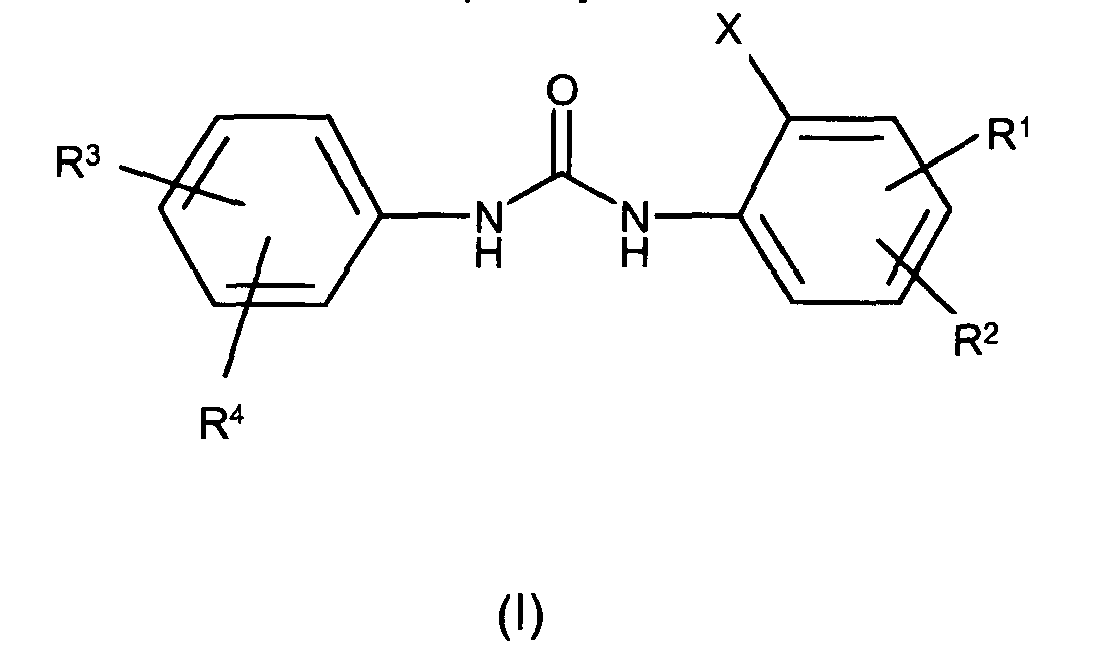
- X represents hydroxy, alkoxy, amino, carboxy, alkyl-carbonyl, hydroxyaminocarbonyl, sulfamoyl, N-alkyl-sulfamoyl, N,N-di-alkyl-sulfamoyl, tetrazolyl, 2,4-dihydro-[1,2,4]triazol-3-one, 4H-[1,2,4]oxadiazol-5-one, or 1,2-dihydro-[1,2,4]triazol-3-one; and
at least one of R1, R2, R3 and R4, and independently of each other, represent halo, hydroxy, alkyl, alkoxy, thioalkoxy, nitro, cyano, haloalkyl, haloalkoxy, amino, acyl, alkoxy-carbonyl, alkoxy-carbonyl-alkyl, alkoxy-carbonyl-alkenyl, N-(alkyl-carbonyl)-amino, carbamoyl, N-alkyl-carbamoyl, N,N-di-alkyl-carbamoyl, N,N-di-alkyl-carbamoyl-alkyl, N,N-di-alkyl-carbamoyl-alkenyl, N-(carboxy-alkyl)-carbamoyl, sulfamoyl, N-alkyl-sulfamoyl, N,N-di-alkyl-sulfamoyl and/or phenyl, which phenyl may optionally be substituted with one or two substituents selected from the group consisting of halo, hydroxy, alkyl, alkoxy, nitro, haloalkyl, haloalkoxy, acyl, alkoxy-carbonyl, alkoxy-carbonyl-alkyl, alkoxy-carbonyl-alkenyl, N-(alkyl-carbonyl)-amino, carbamoyl, N-alkyl-carbamoyl, N,N-di-alkyl-carbamoyl, N,N-di-alkyl-carbamoyl-alkyl, N,N-di-alkyl-carbamoyl-alkenyl, N-(carboxy-alkyl)-carbamoyl, sulfamoyl, N-alkyl-sulfamoyl, and N,N-di-alkyl-sulfamoyl; and the remainder of R1, R2, R3 and R4 represent hydrogen. - In an even more preferred embodiment the hERG1 channel activating compound for use according to the invention is a diphenyl urea derivative of Formula I, wherein
X represents OH, alkoxy, carboxy, alkyl-carbonyl or tetrazolyl ; and
at least one of R1, R2, R3 and R4, independently of each other, represent halo, hydroxy, alkyl, alkoxy, thioalkoxy, nitro, cyano, haloalkyl, haloalkoxy, amino, acyl, alkoxy-carbonyl, sulfamoyl, N-alkyl-sulfamoyl, N,N-di-alkyl-sulfamoyl and/or phenyl, which phenyl may optionally be substituted with one or two substituents selected from the group consisting of halo, hydroxy, alkyl, alkoxy, nitro, haloalkyl, haloalkoxy, acyl, and alkoxy-carbonyl; and the remainder of R1, R2, R3 and R4 represent hydrogen. - In a yet more preferred embodiment the hERG1 channel activating compound for use according to the invention is a diphenyl urea derivative of Formula I, wherein
- X represents hydroxy, amino, carboxy, hydroxyaminocarbonyl, sulfamoyl, tetrazolyl, 2,4-dihydro-[1,2,4]triazol-3-one, 4H-[1,2,4]oxadiazol-5-one, or 1,2-dihydro-[1,2,4]triazol-3-one; and
at least one of R1, R2, R3 and R4, and independently of each other, represent halo, hydroxy, alkyl, alkoxy, nitro, haloalkyl, haloalkoxy, amino, alkoxy-carbonyl-alkenyl, N-(alkyl-carbonyl)-amino, carbamoyl, N-alkyl-carbamoyl, N,N-di-alkyl-carbamoyl, N,N-di-alkyl-carbamoyl-alkyl, N,N-di-alkyl-carbamoyl-alkenyl, N-(carboxyalkyl)-carbamoyl, sulfamoyl, N-alkyl-sulfamoyl, N,N-di-alkyl-sulfamoyl and/or phenyl, which phenyl may optionally be substituted with a substituent selected from the group consisting of halo, haloalkyl, haloalkoxy, carbamoyl, N-alkyl-carbamoyl, N,N-di-alkyl-carbamoyl, sulfamoyl, N-alkyl-sulfamoyl, and N,N-di-alkyl-sulfamoyl; and the remainder of R1, R2, R3 and R4 represent hydrogen. - In a second preferred embodiment the hERG1 channel activating compound for use according to the invention is a diphenyl urea derivative of Formula I, wherein
X represents hydroxy; and at least one of R1, R2, R3 and R4, and independently of each other, represent halo, hydroxy, alkyl, alkoxy, thioalkoxy, nitro, cyano, haloalkyl, haloalkoxy, amino, acyl, alkoxy-carbonyl, alkoxy-carbonyl-alkyl, alkoxy-carbonyl-alkenyl, N-(alkyl-carbonyl)-amino, carbamoyl, N-alkyl-carbamoyl, N,N-di-alkyl-carbamoyl, N,N-di-alkyl-carbamoyl-alkyl, N,N-di-alkyl-carbamoyl-alkenyl, N-(carboxy-alkyl)-carbamoyl, sulfamoyl, N-alkyl-sulfamoyl, N,N-di-alkyl-sulfamoyl and/or phenyl, which phenyl may optionally be substituted with one or two substituents selected from the group consisting of halo, hydroxy, alkyl, alkoxy, nitro, haloalkyl, haloalkoxy, acyl, alkoxy-carbonyl, alkoxy-carbonyl-alkyl, alkoxy-carbonyl-alkenyl, N-(alkyl-carbonyl)-amino, carbamoyl, N-alkyl-carbamoyl, N,N-di-alkyl-carbamoyl, N,N-dialkyl-carbamoyl-alkyl, N,N-di-alkyl-carbamoyl-alkenyl, N-(carboxy-alkyl)-carbamoyl, sulfamoyl, N-alkyl-sulfamoyl, and N,N-di-alkyl-sulfamoyl; and the remainder of R1, R2, R3 and R4 represent hydrogen. - In a more preferred embodiment X represents hydroxy; and at least one of R1, R2, R3 and R4, independently of each other, represent halo, hydroxy, alkyl, alkoxy, nitro, haloalkyl, haloalkoxy, acyl, alkoxy-carbonyl, sulfamoyl, N-alkyl-sulfamoyl, N,N-dialkyl-sulfamoyl and/or phenyl, which phenyl may optionally be substituted with one or two substituents selected from the group consisting of halo, hydroxy, alkoxy, acyl, alkoxy-carbonyl and haloalkyl; and the remainder of R1, R2, R3 and R4 represent hydrogen.
- In a most preferred embodiment the hERG1 channel activating urea derivative for use according to the invention is
1-(3-Trifluoromethyl-phenyl)-3-(2-hydroxy-phenyl)-urea;
1-(3-Trifluoromethyl-phenyl)-3-(2-hydroxy-3-nitro-phenyl)-urea;
1-(3-Trifluoromethyl-phenyl)-3-(2,4-dihydroxy-phenyl)-urea;
1-(3-Trifluoromethyl-phenyl)-3-(2-hydroxy-4-methoxy-phenyl)-urea;
1-(3-Trifluoromethyl-phenyl)-3-(2-hydroxy-4-methoxycarbonyl-5-chlorophenyl)-urea;
1-(3-Trifluoromethyl-phenyl)-3-(2-hydroxy-4-methoxcarbonyl-phenyl)-urea;
1-(3-Trifluoromethyl-phenyl)-3-(2-hydroxy-4-chloro-phenyl)-urea;
1-(3-Trifluoromethyl-phenyl)-3-(2,5-dihydroxy-phenyl)-urea;
1-(3-Trifluoromethyl-phenyl)-3-(2-hydroxy-5-chloro-phenyl)-urea;
1-(3-Trifluoromethoxy-phenyl)-3-(2-hydroxy-5-chloro-phenyl)-urea;
1-(3-Trifluoromethyl-phenyl)-3-(2-hydroxy-5-methoxycarbonyl-phenyl)-urea;
1-(3-Trifluoromethyl-phenyl)-3-(2-hydroxy-5-nitro-phenyl)-urea;
1-(3-Trifluoromethyl-phenyl)-3-(2-hydroxy-5-methoxy-phenyl)-urea;
1-(3-Carboxy-phenyl)-3-(2-hydroxy-5-chloro-phenyl)-urea;
1-(3-Hydroxy-phenyl)-3-(2-hydroxy-5-chloro-phenyl)-urea;
1-(3-Methoxycarbonyl-phenyl)-3-(2-hydroxy-5-ch loro-phenyl)-urea;
1-(3-Methyl-phenyl)-3-(2-hydroxy-5-chloro-phenyl)-urea;
1-(3-Nitro-phenyl)-3-(2-hydroxy-5-ch loro-phenyl)-urea;
1-(3-Trifluoromethyl-phenyl)-3-(2-hydroxy-6-nitro-phenyl)-urea;
1-[4-(N-ethyl-sulfamoyl)-phenyl]-3-(2-hydroxy-5-chloro-phenyl)-urea;
1,3-Bis-(2-hydroxy-5-trifluoromethyl-phenyl)-urea;
1-(3-Trifluoromethyl-phenyl)-3-(2-hydroxy-5-trifluoromethyl-phenyl)-urea;
1-(2-Trifluoromethyl-phenyl)-3-(2-hydroxy-5-trifluoromethyl-phenyl)-urea;
1-(3-Trifluoromethyl-phenyl)-3-(2,6-dihydroxy-phenyl)-urea;
1-(4-Chloro-phenyl)-3-(2-hydroxy-4-methoxy-phenyl)-urea;
1-(3-Trifluoromethyl-phenyl)-3-(2-hydroxy-5-bromo-phenyl)-urea; or
1-(2-Trifluoromethyl-phenyl)-3-(2-hydroxy-5-chloro-phenyl)-urea;
or a pharmaceutically acceptable salt thereof. - In a third preferred embodiment the hERG1 channel activating compound for use according to the invention is a diphenyl urea derivative of Formula I, wherein X represents carboxy; and at least one of R1, R2, R3 and R4, and independently of each other, represent halo, hydroxy, alkyl, alkoxy, thioalkoxy, nitro, cyano, haloalkyl, haloalkoxy, amino, acyl, alkoxy-carbonyl, alkoxy-carbonyl-alkyl, alkoxy-carbonyl-alkenyl, N-(alkyl-carbonyl)-amino, carbamoyl, N-alkyl-carbamoyl, N,N-di-alkyl-carbamoyl, N,N-di-alkyl-carbamoyl-alkyl, N,N-di-alkyl-carbamoyl-alkenyl, N-(carboxyalkyl)-carbamoyl, sulfamoyl, N-alkyl-sulfamoyl, N,N-di-alkyl-sulfamoyl and/or phenyl, which phenyl may optionally be substituted with one or two substituents selected from the group consisting of halo, hydroxy, alkyl, alkoxy, nitro, haloalkyl, haloalkoxy, acyl, alkoxy-carbonyl, alkoxy-carbonyl-alkyl, alkoxy-carbonyl-alkenyl, N-(alkyl-carbonyl)-amino, carbamoyl, N-alkyl-carbamoyl, N,N-di-alkyl-carbamoyl, N,N-di-alkyl-carbamoyl-alkyl, N,N-di-alkyl-carbamoyl-alkenyl, N-(carboxy-alkyl)-carbamoyl, sulfamoyl, N-alkyl-sulfamoyl, and N,N-di-alkyl-sulfamoyl; and the remainder of R1, R2, R3 and R4 represent hydrogen.
- In a more preferred embodiment X represents carboxy; and at least one of R1, R2, R3 and R4, independently of each other, represent halo, hydroxy, alkyl, alkoxy, nitro, haloalkyl, haloalkoxy, acyl, alkoxy-carbonyl, sulfamoyl, N-alkyl-sulfamoyl, N,N-dialkyl-sulfamoyl and/or phenyl, which phenyl may optionally be substituted with one or two substituents selected from the group consisting of halo, hydroxy, alkoxy, acyl, alkoxy-carbonyl and haloalkyl; and the remainder of R1, R2, R3 and R4 represent hydrogen.
- In an even more preferred embodiment X represents carboxy; and at least one of R1, R2, R3 and R4, and independently of each other, represent halo, hydroxy, alkyl, alkoxy, nitro, haloalkyl, haloalkoxy, and/or phenyl.
- In a most preferred embodiment the hERG1 channel activating urea derivative for use according to the invention is
1-Phenyl-3-(2-carboxy-phenyl)-urea;
1-(2-Methoxy-phenyl)-3-(2-carboxy-phenyl)-urea;
1-(2-Trifluoromethyl-phenyl)-3-(2-carboxy-phenyl)-urea;
1-(3-Methoxy-phenyl)-3-(2-carboxy-phenyl)-urea;
1-(3-Nitro-phenyl)-3-(2-carboxy-phenyl)-urea;
1-(3-Trifluoromethyl-phenyl)-3-(2-carboxy-phenyl)-urea;
1-(4-Methoxy-phenyl)-3-(2-carboxy-phenyl)-urea;
1-(4-Bromo-phenyl)-3-(2-carboxy-phenyl)-urea;
1-(4-Nitro-phenyl)-3-(2-carboxy-phenyl)-urea;
1-(3-Trifluoromethyl-phenyl)-3-(2-carboxy-3-methyl-phenyl)-urea;
1-(3-Trifluoromethyl-phenyl)-3-(2-carboxy-4-methyl-phenyl)-urea;
1-(3-Trifluoromethyl-phenyl)-3-(2-carboxy-4-hydroxy-phenyl)-urea;
1-(3-Trifluoromethyl-phenyl)-3-(2-carboxy-4-nitro-phenyl)-urea;
1-(3-Trifluoromethyl-phenyl)-3-(2-carboxy-4-methoxy-phenyl)-urea;
1-(3-Trifluoromethyl-phenyl)-3-(2-carboxy-4-bromo-phenyl)-urea;
1-(3-Trifluoromethyl-phenyl)-3-(2-carboxy-4-fluoro-phenyl)-urea;
1-(3-Trifluoromethyl-phenyl)-3-(2-carboxy-4,5-dimethoxy-phenyl)-urea;
1-(3-Trifluoromethyl-phenyl)-3-(2-carboxy-5-nitro-phenyl)-urea;
1-(3-Trifluoromethyl-phenyl)-3-(2-carboxy-5-trifluoromethyl-phenyl)-urea;
1-(3-Trifluoromethyl-phenyl)-3-(2-carboxy-6-methyl-phenyl)-urea;
1-(3-Trifluoromethyl-phenyl)-3-(2-carboxy-5-nitro-phenyl)-urea;
1-(3,5-Bis-trifluoromethyl-phenyl)-3-(2-carboxy-5-chloro-phenyl)-urea;
1-(4-Chloro-phenyl)-3-(2-carboxy-3-iodo-phenyl)-urea;
1-(2-Fluoro-phenyl)-3-(2-carboxy-5-chloro-phenyl)-urea;
1-(4-Chloro-phenyl)-3-(2-carboxy-5-chloro-phenyl)-urea;
1-(3-Trifluoromethyl-phenyl)-3-(2-carboxy-4-methyl-phenyl)-urea;
1-(3-Trifluoromethyl-phenyl)-3-(2-carboxy-4-bromo-phenyl)-urea;
1-(3,5-Dimethoxy-phenyl)-3-(2-carboxy-4-bromo-phenyl)-urea;
1-(4-Biphenyl)-3-(2-carboxy-phenyl)-urea; or
1-(2-Methoxy-phenyl)-3-(2-carboxy-5-ch loro-phenyl)-urea;
or a pharmaceutically acceptable salt thereof. - In a fourth preferred embodiment the hERG1 channel activating compound for use according to the invention is a diphenyl urea derivative of Formula I, wherein X represents tetrazolyl; and at least one of R1, R2, R3 and R4, and independently of each other, represent halo, hydroxy, alkyl, alkoxy, thioalkoxy, nitro, cyano, haloalkyl, haloalkoxy, amino, acyl, alkoxy-carbonyl, alkoxy-carbonyl-alkyl, alkoxy-carbonyl-alkenyl, N-(alkyl-carbonyl)-amino, carbamoyl, N-alkyl-carbamoyl, N,N-di-alkyl-carbamoyl, N,N-di-alkyl-carbamoyl-alkyl, N,N-di-alkyl-carbamoyl-alkenyl, N-(carboxyalkyl)-carbamoyl, sulfamoyl, N-alkyl-sulfamoyl, N,N-di-alkyl-sulfamoyl and/or phenyl, which phenyl may optionally be substituted with one or two substituents selected from the group consisting of halo, hydroxy, alkyl, alkoxy, nitro, haloalkyl, haloalkoxy, acyl, alkoxy-carbonyl, alkoxy-carbonyl-alkyl, alkoxy-carbonyl-alkenyl, N-(alkyl-carbonyl)-amino, carbamoyl, N-alkyl-carbamoyl, N,N-di-alkyl-carbamoyl, N,N-di-alkyl-carbamoyl-alkyl, N,N-di-alkyl-carbamoyl-alkenyl, N-(carboxy-alkyl)-carbamoyl, sulfamoyl, N-alkyl-sulfamoyl, and N,N-di-alkyl-sulfamoyl; and the remainder of R1, R2, R3 and R4 represent hydrogen.
- In a more preferred embodiment X represents 1H-tetrazolyl; and at least one of R1, R2, R3 and R4, independently of each other, represent halo, hydroxy, alkyl, alkoxy, nitro, haloalkyl, haloalkoxy, acyl, alkoxy-carbonyl, sulfamoyl, N-alkyl-sulfamoyl, N,N-di-alkyl-sulfamoyl and/or phenyl, which phenyl may optionally be substituted with one or two substituents selected from the group consisting of halo, hydroxy, alkyl, alkoxy, nitro, haloalkyl, haloalkoxy, acyl, and alkoxy-carbonyl; and the remainder of R1, R2, R3 and R4 represent hydrogen.
- In an even more preferred embodiment X represents 1H-tetrazolyl; and at least one of R1, R2, R3 and R4, and independently of each other, represent Cl, Br, F, hydroxy, alkyl, alkoxy, nitro, CF3, OCF3, amino, alkoxy-carbonyl-alkenyl, N-(alkyl-carbonyl)-amino, carbamoyl, N-alkyl-carbamoyl, N,N-di-alkyl-carbamoyl, N,N-di-alkyl-carbamoyl-alkyl, N,N-di-alkyl-carbamoyl-alkenyl, N-(carboxy-alkyl)-carbamoyl, sulfamoyl, N-alkyl-sulfamoyl, N,N-di-alkyl-sulfamoyl and/or phenyl, which phenyl may optionally be substituted with a substituent selected from the group consisting of Cl, Br, F, CF3, OCF3, carbamoyl, N-alkyl-carbamoyl, N,N-di-alkyl-carbamoyl, sulfamoyl, N-alkyl-sulfamoyl, and N,N-di-alkyl-sulfamoyl; and the remainder of R1, R2, R3 and R4 represent hydrogen.
- In a most preferred embodiment the hERG1 channel activating urea derivative for use according to the invention is
1-(3-Biphenyl)-3-[2-(1H-tetrazol-5-yl)-phenyl]-urea;
1-(3-Acetyl-phenyl)-3-[2-(1H-tetrazol-5-yl)-phenyl]-urea;
1-(4-Biphenyl)-3-[2-(1H-tetrazol-5-yl)-phenyl]-urea;
1-(2-Bromo-phenyl)-3-[2-(1H-tetrazol-5-yl)-4-bromo-phenyl]-urea;
1-(2-Chloro-phenyl)-3-[2-(1H-tetrazol-5-yl)-4-bromo-phenyl]-urea;
1-(2-Fluoro-phenyl)-3-[2-(1H-tetrazol-5-yl)-4-bromo-phenyl]-urea;
1-(2-Methyl-phenyl)-3-[2-(1H-tetrazol-5-yl)-4-bromo-phenyl]-urea;
1-(2-Ethyl-phenyl)-3-(2-(1H-tetrazol-5-yl)-4-bromo-phenyl]-urea;
1-(2-Nitro-phenyl)-3-[2-(1H-tetrazol-5-yl)-4-bromo-phenyl]-urea;
1-(2-Trifluoromethyl-phenyl)-3-[2-(1H-tetrazol-5-yl)-4-bromo-phenyl]-urea;
1-(3-Acetyl-phenyl)-3-[2-(1H-tetrazol-5-yl)-4-bromo-phenyl]-urea;
1-(3-Biphenyl)-3-[2-(1H-tetrazol-5-yl)-4-bromo-phenyl]-urea;
1-(3-Bromo-phenyl)-3-[2-(1H-tetrazol-5-yl)-4-bromo-phenyl]-urea;
1-(3-Chloro-phenyl)-3-[2-(1H-tetrazol-5-yl)-4-bromo-phenyl]-urea;
1-(3-Fluoro-phenyl)-3-[2-(1H-tetrazol-5-yl)-4-bromo-phenyl]-urea;
1-(3-Methyl-phenyl)-3-[2-(1H-tetrazol-5-yl)-4-bromo-phenyl]-urea;
1-(3-Methoxy-phenyl)-3-[2-(1H-tetrazol-5-yl)-4-bromo-phenyl]-urea;
1-(3-Nitro-phenyl)-3-[2-(1H-tetrazol-5-yl)-4-bromo-phenyl]-urea;
1-(3-Trifluoromethyl-phenyl)-3-[2-(1H-tetrazol-5-yl)-4-bromo-phenyl]-urea;
1-(3,4-Dichloro-phenyl)-3-[2-(1H-tetrazol-5-yl)-4-bromo-phenyl]-urea;
1-(3-Nitro-4-methyl-phenyl)-3-[2-(1H-tetrazol-5-yl)-4-bromo-phenyl]-urea;
1-(3-Trifluoromethyl-4-chloro-phenyl)-3-[2-(1H-tetrazol-5-yl)-4-bromophenyl]-urea;
1-(3,5-Dichloro-phenyl)-3-[2-(1H-tetrazol-5-yl)-4-bromo-phenyl]-urea;
1-[3,5-Bis-trifluoromethyl-phenyl]-3-[4-bromo-2-(1H-tetrazol-5-yl)-phenyl]-urea;
1-(3,5-Dimethyl-phenyl)-3-[2-(1H-tetrazol-5-yl)-4-bromo-phenyl]-urea;
1-(4-Bromo-phenyl)-3-[2-(1H-tetrazol-5-yl)-4-bromo-phenyl]-urea;
1-(4-Ethoxyo-phenyl)-3-[2-(1H-tetrazol-5-yl)-4-bromo-phenyl]-urea;
1-(4-Methoxy-phenyl)-3-[2-(1H-tetrazol-5-yl)-4-bromo-phenyl]-urea;
1-(4-Methyl-phenyl)-3-[2-(1H-tetrazol-5-yl)-4-bromo-phenyl]-urea;
1-(4-Nitro-phenyl)-3-[2-(1H-tetrazol-5-yl)-4-bromo-phenyl]-urea;
1-(4-Trifluoromethyl-phenyl-3-[2-(1H-tetrazol-5-yl)-4-bromo-phenyl]-urea;
1-[4-(2-Propyl)-phenyl]-3-[2-(1H-tetrazol-5-yl)-4-bromo-phenyl]-urea;
1-(3-Trifluromethyl-phenyl)-3-[2-(1H-tetrazol-5-yl)-4-amino-phenyl]-urea;
1-(3-Bromo-phenyl)-3-[2-(1H-tetrazol-5-yl)-4-biphenyl]-urea;
1-(3-Bromo-phenyl)-3-[2-(1H-tetrazol-5-yl)-4-(3'-nitro)-biphenyl]-urea;
1-(3-Trifluoromethyl-phenyl)-3-[2-(1H-tetrazol-5-yl)-4-(3'-nitro)-biphenyl]-urea;
1-(3-Trifluoromethyl-phenyl)-3-[2-(1H-tetrazol-5-yl)-4-(4'-trifluoromethyl)-biphenyl]-urea;
1-(3-Trifluoromethyl-phenyl)-3-[2-(1H-tetrazol-5-yl)-4-(4'-ethoxycarbonyl)-biphenyl]-urea;
1-(3-Trifluoromethyl-phenyl)-3-[2-(1H-tetrazol-5-yl)-4-(4'-carboxy)-biphenyl]-urea;
1-(3,5-Bis-trifluoromethyl-phenyl)-3-[2-(1H-tetrazol-5-yl)-4-(4'-N,N-dimethylsulfamoyl)-biphenyl]-urea;
1-(3-Fluoro-5-trifluoromethyl-phenyl)-3-[2-(1H-tetrazol-5-yl)-4-(4'-N,N-dimethyl-sulfamoyl)-biphenyl]-urea;
1-(3,5-Bis-trifluoromethyl-phenyl)-3-[2-(1H-tetrazol-5-yl)-4-(4'-N,N-dimethylcarbamoyl)-biphenyl]-urea;
1-(3,5-Difluoro-phenyl)-3-[2-(1H-tetrazol-5-yl)-4-(3'-trifluoromethyl-biphenyl]-urea;
1-(3,5-Dichloro-phenyl)-3-[2-(1H-tetrazol-5-yl)-4-(4'-N,N-dimethylsulfamoyl)-biphenyl]-urea;
1-(3,5-Bis-trifluoromethyl-phenyl)-3-[2-(1H-tetrazol-5-yl)-4,6-dichlorophenyl]-urea;
1-(3-Chloro-4-trifluoromethyl-phenyl)-3-[2-(1H-tetrazol-5-yl)-4-(2-N,N-dimethylcarbamoyl-ethyl)-phenyl]-urea;
1-(3-Trifluoromethyl-phenyl)-3-[2-(1H-tetrazol-5-yl)-4-amino-phenyl]-urea;
1-(4-Chloro-3-trifluoromethyl-phenyl)-3-[2-(1H-tetrazol-5-yl)-4-chlorophenyl]-urea;
1-(3,5-Bis-trifluoromethyl-phenyl)-3-[2-(1H-tetrazol-5-yl)-4-(N-carboxymethyl)-carbamoyl-phenyl]-urea;
1-(3,5-Bis-trifluoromethyl-phenyl)-3-[2-(1H-tetrazol-5-yl)-4-(2-N,N-dimethylcarbamoyl-ethenyl)-phenyl]-urea;
1-(4-Fluoro-3-trifluoromethyl-phenyl)-3-[2-(1H-tetrazol-5-yl)-4-bromophenyl]-urea;
1-(3,5-Bis-trifluoromethyl-phenyl)-3-[2-(1H-tetrazol-5-yl)-4-bromo-phenyl]-urea;
1-(3,5-Bis-trifluoromethyl-phenyl)-3-[2-(1H-tetrazol-5-yl)-4-chloro-phenyl]-urea;
1-(3-Trifluoromethyl-phenyl)-3-[2-(1H-tetrazol-5-yl)-4-bromo-phenyl]-urea;
1-(3,5-Bis-trifluoromethyl-phenyl)-3-[2-(1H-tetrazol-5-yl)-4-(2-methoxy-carbonyl-ethenyl)-phenyl]-urea;
1-(3-Chloro-4-fluoro-phenyl)-3-[2-(1H-tetrazol-5-yl)-4-bromo-phenyl]-urea;
1-(3,5-Dichloro-phenyl)-3-[2-(1H-tetrazol-5-yl)-4-chloro-phenyl]-urea;
1-(4-Biphenyl)-3-[2-(1H-tetrazol-5-yl)-5-chloro-phenyl]-urea;
1-(4-Chloro-3-trifluoromethyl-phenyl)-3-[2-(1H-tetrazol-5-yl)-5-chlorophenyl]-urea;
1-(3-Trifluoromethyl-phenyl)-3-[2-(1H-tetrazol-5-yl)-4-(methyl-carbonylamino)-phenyl]-urea; or
1-(2-Trifluoromethyl-phenyl)-3-[2-(1H-tetrazol-5-yl)-4-(4'-chloro-biphenyl)]-urea;
or a pharmaceutically acceptable salt thereof. - In a fifth preferred embodiment the hERG1 channel activating compound for use according to the invention is a diphenyl urea derivative of Formula I, wherein X represents 2,4-dihydro-[1,2,4]triazol-3-one; and at least one of R1, R2, R3 and R4, and independently of one another, represent halo, hydroxy, alkyl, alkoxy, thioalkoxy, nitro, cyano, haloalkyl, haloalkoxy, amino, acyl, alkoxy-carbonyl, alkoxy-carbonyl-alkyl, alkoxy-carbonyl-alkenyl, N-(alkyl-carbonyl)-amino, carbamoyl, N-alkyl-carbamoyl, N,N-di-alkyl-carbamoyl, N,N-di-alkyl-carbamoyl-alkyl, N,N-di-alkyl-carbamoyl-alkenyl, N-(carboxy-alkyl)-carbamoyl, sulfamoyl, N-alkyl-sulfamoyl, N,N-di-alkyl-sulfamoyl and/or phenyl, which phenyl may optionally be substituted with one or two substituents selected from the group consisting of halo, hydroxy, alkyl, alkoxy, nitro, haloalkyl, haloalkoxy, acyl, alkoxy-carbonyl, alkoxy-carbonyl-alkyl, alkoxy-carbonyl-alkenyl, N-(alkyl-carbonyl)-amino, carbamoyl, N-alkyl-carbamoyl, N,N-di-alkyl-carbamoyl, N,N-dialkyl-carbamoyl-alkyl, N,N-di-alkyl-carbamoyl-alkenyl, N-(carboxy-alkyl)-carbamoyl, sulfamoyl, N-alkyl-sulfamoyl, and N,N-di-alkyl-sulfamoyl; and the remainder of R1 R 2 R3 and R4 represent hydrogen.
- In a more preferred embodiment X represents 2,4-dihydro-[1,2,4]triazol-3-one; and at least one of R1, R2, R3 and R4, and independently of one another, represent halo, haloalkyl, haloalkoxy, carbamoyl, N-alkyl-carbamoyl, N,N-di-alkyl-carbamoyl, sulfamoyl, N-alkyl-sulfamoyl, N,N-di-alkyl-sulfamoyl and/or phenyl, which phenyl may optionally be substituted with a substituent selected from the group consisting of halo, haloalkyl, haloalkoxy, carbamoyl, N-alkyl-carbamoyl, N,N-di-alkyl-carbamoyl, sulfamoyl, N-alkyl-sulfamoyl, and N,N-di-alkyl-sulfamoyl; and the remainder of R1, R2, R3 and R4 represent hydrogen.
- In a most preferred embodiment the hERG1 channel activating urea derivative for use according to the invention is
1-(3-Trifluoromethyl-phenyl)-3-[2-(5-oxo-4,5-dihydro-1H-[1,2,4]triazol-3-yl)-4-(4'-N,N-dimethyl-carbamoyl)-biphenyl]-urea;
or a pharmaceutically acceptable salt thereof. - In a sixth preferred embodiment the hERG1 channel activating compound for use according to the invention is a diphenyl urea derivative of Formula I, wherein X represents 4H-[1,2,4]oxadiazol-5-one; and at least one of R1, R2, R3 and R4, and independently of one another, represent halo, hydroxy, alkyl, alkoxy, thioalkoxy, nitro, cyano, haloalkyl, haloalkoxy, amino, acyl, alkoxy-carbonyl, alkoxy-carbonyl-alkyl, alkoxy-carbonyl-alkenyl, N-(alkyl-carbonyl)-amino, carbamoyl, N-alkyl-carbamoyl, N,N-di-alkyl-carbamoyl, N,N-di-alkyl-carbamoyl-alkyl, N,N-di-alkyl-carbamoyl-alkenyl, N-(carboxy-alkyl)-carbamoyl, sulfamoyl, N-alkyl-sulfamoyl, N,N-di-alkyl-sulfamoyl and/or phenyl, which phenyl may optionally be substituted with one or two substituents selected from the group consisting of halo, hydroxy, alkyl, alkoxy, nitro, haloalkyl, haloalkoxy, acyl, alkoxy-carbonyl, alkoxy-carbonyl-alkyl, alkoxy-carbonyl-alkenyl, N-(alkyl-carbonyl)-amino, carbamoyl, N-alkyl-carbamoyl, N,N-di-alkyl-carbamoyl, N,N-dialkyl-carbamoyl-alkyl, N,N-di-alkyl-carbamoyl-alkenyl, N-(carboxy-alkyl)-carbamoyl, sulfamoyl, N-alkyl-sulfamoyl, and N,N-di-alkyl-sulfamoyl; and the remainder of R1, R2, R3 and R4 represent hydrogen.
- In a more preferred embodiment X represents 4H-[1,2,4]oxadiazol-5-one; and at least one of R1, R2, R3 and R4, and independently of one another, represent halo, haloalkyl, haloalkoxy, carbamoyl, N-alkyl-carbamoyl, N,N-di-alkyl-carbamoyl, sulfamoyl, N-alkyl-sulfamoyl, N,N-di-alkyl-sulfamoyl and/or phenyl, which phenyl may optionally be substituted with a substituent selected from the group consisting of halo, haloalkyl, haloalkoxy, carbamoyl, N-alkyl-carbamoyl, N,N-di-alkyl-carbamoyl, sulfamoyl, N-alkyl-sulfamoyl, and N,N-di-alkyl-sulfamoyl; and the remainder of R1, R2, R3 and R4 represent hydrogen.
- In a most preferred embodiment the hERG1 channel activating urea derivative for use according to the invention is
1-(3-Trifluoromethyl-phenyl)-3-[2-(5-oxo-4,5-dihydro-[1,2,4]oxadiazol-3-yl)-4-(4'-N,N-dimethyl-carbamoyl)-biphenyl]-urea; or
1-(3-Trifluoromethyl-phenyl)-3-[2-(5-oxo-4,5-dihydro-[1,2,4]oxadiazol-3-yl)-5-chloro-phenyl]-urea;
or a pharmaceutically acceptable salt thereof. - In a seventh preferred embodiment the hERG1 channel activating compound for use according to the invention is a diphenyl urea derivative of Formula I, wherein X represents 1,2-dihydro-[1,2,4]triazol-3-one; and at least one of R1, R2, R3 and R4, and independently of one another, represent halo, hydroxy, alkyl, alkoxy, thioalkoxy, nitro, cyano, haloalkyl, haloalkoxy, amino, acyl, alkoxy-carbonyl, alkoxy-carbonyl-alkyl, alkoxy-carbonyl-alkenyl, N-(alkyl-carbonyl)-amino, carbamoyl, N-alkyl-carbamoyl, N,N-di-alkyl-carbamoyl, N,N-di-alkyl-carbamoyl-alkyl, N,N-di-alkyl-carbamoyl-alkenyl, N-(carboxy-alkyl)-carbamoyl, sulfamoyl, N-alkyl-sulfamoyl, N,N-dialkyl-sulfamoyl and/or phenyl, which phenyl may optionally be substituted with one or two substituents selected from the group consisting of halo, hydroxy, alkyl, alkoxy, nitro, haloalkyl, haloalkoxy, acyl, alkoxy-carbonyl, alkoxy-carbonyl-alkyl, alkoxy-carbonyl-alkenyl, N-(alkyl-carbonyl)-amino, carbamoyl, N-alkyl-carbamoyl, N,N-di-alkyl-carbamoyl, N,N-di-alkyl-carbamoyl-alkyl, N,N-di-alkyl-carbamoyl-alkenyl, N-(carboxyalkyl)-carbamoyl, sulfamoyl, N-alkyl-sulfamoyl, and N,N-di-alkyl-sulfamoyl; and the remainder of R1, R2, R3 and R4 represent hydrogen.
- In a more preferred embodiment X represents 1,2-dihydro-[1,2,4]triazol-3-one; and at least one of R1, R2, R3 and R4, and independently of one another, represent halo, haloalkyl, haloalkoxy, carbamoyl, N-alkyl-carbamoyl, N,N-di-alkyl-carbamoyl, sulfamoyl, N-alkyl-sulfamoyl, N,N-di-alkyl-sulfamoyl and/or phenyl, which phenyl may optionally be substituted with a substituent selected from the group consisting of halo, haloalkyl, haloalkoxy, carbamoyl, N-alkyl-carbamoyl, N,N-di-alkyl-carbamoyl, sulfamoyl, N-alkyl-sulfamoyl, and N,N-di-alkyl-sulfamoyl; and the remainder of R1, R2, R3 and R4 represent hydrogen.
- In a most preferred embodiment the hERG1 channel activating urea derivative for use according to the invention is
1-(3-Trifluoromethyl-phenyl)-3-[2-(3-oxo-2,3-dihydro-[1,2,4]triazo)-1-yl)-phenyl]-urea;
or a pharmaceutically acceptable salt thereof. - In an eight preferred embodiment the hERG1 channel activating compound for use according to the invention is a diphenyl urea derivative of Formula I, wherein X represents sulfamoyl, N-alkyl-sulfamoyl or N,N-di-alkyl-sulfamoyl; and at least one of R1, R2, R3 and R4, and independently of each other, represent halo, hydroxy, alkyl, alkoxy, thioalkoxy, nitro, cyano, haloalkyl, haloalkoxy, amino, acyl, alkoxy-carbonyl, alkoxy-carbonyl-alkyl, alkoxy-carbonyl-alkenyl, N-(alkyl-carbonyl)-amino, carbamoyl, N-alkyl-carbamoyl, N,N-di-alkyl-carbamoyl, N,N-di-alkyl-carbamoyl-alkyl, N,N-di-alkyl-carbamoyl-alkenyl, N-(carboxy-alkyl)-carbamoyl, sulfamoyl, N-alkyl-sulfamoyl, N,N-dialkyl-sulfamoyl and/or phenyl, which phenyl may optionally be substituted with one or two substituents selected from the group consisting of halo, hydroxy, alkyl, alkoxy, nitro, haloalkyl, haloalkoxy, acyl, alkoxy-carbonyl, alkoxy-carbonyl-alkyl, alkoxy-carbonyl-alkenyl, N-(alkyl-carbonyl)-amino, carbamoyl, N-alkyl-carbamoyl, N,N-di-alkyl-carbamoyl, N,N-di-alkyl-carbamoyl-alkyl, N,N-di-alkyl-carbamoyl-alkenyl, N-(carboxyalkyl)-carbamoyl, sulfamoyl, N-alkyl-sulfamoyl, and N,N-di-alkyl-sulfamoyl; and the remainder of R1, R2, R3 and R4 represent hydrogen.
- In a more preferred embodiment the hERG1 channel activating compound for use according to the invention is a diphenyl urea derivative of Formula I, wherein X represents sulfamoyl; and at least one of R1, R2, R3 and R4, and independently of each other, represent halo, CF3, OCF3; and the remainder of R1, R2, R3 and R4 represent hydrogen.
- In a most preferred embodiment the hERG1 channel activating urea derivative for use according to the invention is
1-(3-Trifluoromethyl-phenyl)-3-(2-sulfamoyl-5-chloro-phenyl)-urea;
or a pharmaceutically acceptable salt thereof. - In a ninth preferred embodiment the hERG1 channel activating compound for use according to the invention is a diphenyl urea derivative of Formula I, wherein X represents hydroxyaminocarbonyl; and at least one of R1, R2, R3 and R4, and independently of each other, represent halo, hydroxy, alkyl, alkoxy, thioalkoxy, nitro, cyano, haloalkyl, haloalkoxy, amino, acyl, alkoxy-carbonyl, alkoxy-carbonyl-alkyl, alkoxy-carbonyl-alkenyl, N-(alkyl-carbonyl)-amino, carbamoyl, N-alkyl-carbamoyl, N,N-di-alkyl-carbamoyl, N,N-di-alkyl-carbamoyl-alkyl, N,N-di-alkyl-carbamoyl-alkenyl, N-(carboxy-alkyl)-carbamoyl, sulfamoyl, N-alkyl-sulfamoyl, N,N-di-alkyl-sulfamoyl and/or phenyl, which phenyl may optionally be substituted with one or two substituents selected from the group consisting of halo, hydroxy, alkyl, alkoxy, nitro, haloalkyl, haloalkoxy, acyl, alkoxy-carbonyl, alkoxy-carbonyl-alkyl, alkoxy-carbonyl-alkenyl, N-(alkyl-carbonyl)-amino, carbamoyl, N-alkyl-carbamoyl, N,N-di-alkyl-carbamoyl, N,N-dialkyl-carbamoyl-alkyl, N,N-di-alkyl-carbamoyl-alkenyl, N-(carboxy-alkyl)-carbamoyl, sulfamoyl, N-alkyl-sulfamoyl, and N,N-di-alkyl-sulfamoyl; and the remainder of R1, R2, R3 and R4 represent hydrogen.
- In a more preferred embodiment X represents hydroxyaminocarbonyl; and at least one of R1, R2, R3 and R4, and independently of each other, represent halo, CF3, OCF3; and the remainder of R1, R2, R3 and R4 represent hydrogen.
- In a most preferred embodiment the hERG1 channel activating urea derivative for use according to the invention is
1-(3-Trifluoromethyl-phenyl)-3-[2-(hyd roxy-amino-carbonyl)-phenyl]-urea;
or a pharmaceutically acceptable salt thereof. - In a tenth preferred embodiment the hERG1 channel activating compound for use according to the invention is a diphenyl urea derivative of Formula I, wherein X represents amino; and at least one of R1, R2, R3 and R4, and independently of each other, represent halo, hydroxy, alkyl, alkoxy, thioalkoxy, nitro, cyano, haloalkyl, haloalkoxy, amino, acyl, alkoxy-carbonyl, alkoxy-carbonyl-alkyl, alkoxy-carbonyl-alkenyl, N-(alkyl-carbonyl)-amino, carbamoyl, N-alkyl-carbamoyl, N,N-di-alkyl-carbamoyl, N,N-di-alkyl-carbamoyl-alkyl, N,N-di-alkyl-carbamoyl-alkenyl, N-(carboxyalkyl)-carbamoyl, sulfamoyl, N-alkyl-sulfamoyl, N,N-di-alkyl-sulfamoyl and/or phenyl, which phenyl may optionally be substituted with one or two substituents selected from the group consisting of halo, hydroxy, alkyl, alkoxy, nitro, haloalkyl, haloalkoxy, acyl, alkoxy-carbonyl, alkoxy-carbonyl-alkyl, alkoxy-carbonyl-alkenyl, N-(alkyl-carbonyl)-amino, carbamoyl, N-alkyl-carbamoyl, N,N-di-alkyl-carbamoyl, N,N-di-alkyl-carbamoyl-alkyl, N,N-di-alkyl-carbamoyl-alkenyl, N-(carboxy-alkyl)-carbamoyl, sulfamoyl, N-alkyl-sulfamoyl, and N,N-di-alkyl-sulfamoyl; and the remainder of R1, R2, R3 and R4 represent hydrogen.
- In a more preferred embodiment X represents amino; and at least one of R1, R2, R3 and R4, and independently of each other, represent halo, CF3, OCF3; and the remainder of R1, R2, R3 and R4 represent hydrogen.
- In a most preferred embodiment the hERG1 channel activating urea derivative for use according to the invention is
1-(3-Trifluoromethyl-phenyl)-3-(2-amino-5-chloro-phenyl)-urea;
or a pharmaceutically acceptable salt thereof. - In an eleventh preferred embodiment the hERG1 channel activating compound for use according to the invention is a diphenyl urea derivative of Formula II, wherein

- In a most preferred embodiment the hERG1 channel activating urea derivative for use according to the invention is
1-(3-Trifluoromethyl-phenyl)-3-(2-hydroxy-5-chloro-phenyl)-urea;
1-(3,5-Bis-trifluoromethyl-phenyl)-3-[4-bromo-2-(1H-tetrazol-5-yl)-phenyl]-urea;
1,3-Bis-(2-hydroxy-5-trifluoromethyl-phenyl)-urea;
1-(3,5-Difluoro-phenyl)-3-[2-(1H-tetrazol-5-yl)-4-(3'-trifluoromethyl-biphenyl]-urea;
1-(3,5-Bis-trifluoromethyl-phenyl)-3-(2-carboxy-5-chloro-phenyl)-urea;
1-(3,5-Bis-trifluoromethyl-phenyl)-3-[2-(1H-tetrazol-5-yl)-4,6-dichlorophenyl]-urea;
1-(3-Trifluoromethyl-phenyl)-3-(2-sulfamoyl-5-chloro-phenyl)-urea;
1-(4-Ch loro-phenyl)-3-(2-carboxy-3-iodo-phenyl)-urea;
1-(2-Fluoro-phenyl)-3-(2-carboxy-5-chloro-phenyl)-urea;
1-(3-Trifluoromethyl-phenyl)-3-(2-hydroxy-5-trifluoromethyl-phenyl)-urea;
1-(4-Chloro-phenyl)-3-(2-carboxy-5-chloro-phenyl)-urea;
1-(3-Trifluoromethyl-phenyl)-3-(2-carboxy-4-methyl-phenyl)-urea;
1-(2-Trifluoromethyl-phenyl)-3-(2-hydroxy-5-trifluoromethyl-phenyl)-urea;
1-(3-Trifluoromethyl-phenyl)-3-[2-(hydroxy-amino-carbonyl)-phenyl]-urea;
1-(4-Chloro-3-trifluoromethyl-phenyl)-3-[2-(1H-tetrazol-5-yl)-4-chlorophenyl]-urea;
1-(3-Trifluoromethyl-phenyl)-3-(2-amino-5-chloro-phenyl)-urea;
1-(3-Trifluoromethyl-phenyl)-3-(2-hydroxy-5-bromo-phenyl)-urea;
1-(2-Trifluoromethyl-phenyl)-3-(2-hydroxy-5-chloro-phenyl)-urea;
1-(4-Fluoro-3-trifluoromethyl-phenyl)-3-[2-(1H-tetrazol-5-yl)-4-bromophenyl]-urea;
1-(3,5-Bis-trifluoromethyl-phenyl)-3-[2-(1H-tetrazol-5-yl)-4-bromo-phenyl]-urea;
1-(3,5-Bis-trifluoromethyl-phenyl)-3-[2-(1H-tetrazol-5-yl)-4-chloro-phenyl]-urea;
1-(3-Trifluoromethyl-phenyl)-3-[2-(1H-tetrazol-5-yl)-4-bromo-phenyl]-urea;
1-(3-Chloro-4-fluoro-phenyl)-3-[2-(1H-tetrazol-5-yl)-4-bromo-phenyl]-urea;
1-(3,5-Dichloro-phenyl)-3-[2-(1H-tetrazol-5-yl)-4-chloro-phenyl]-urea;
1-(3,5-Dichloro-phenyl)-3-[2-(1H-tetrazol-5-yl)-4-bromo-phenyl]-urea; or
1-(4-Chloro-3-trifluoromethyl-phenyl)-3-[2-(1H-tetrazol-5-yl)-5-chlorophenyl]-urea;
or a pharmaceutically acceptable salt thereof. - In a twelfth preferred embodiment the hERG1 channel activating compound for use according to the invention is a diphenyl urea derivative of Formula II,

- In a most preferred embodiment the hERG1 channel activating urea derivative for use according to the invention is
1-(3-Trifluoromethyl-phenyl)-3-(2-hydroxy-5-chloro-phenyl)-urea;
1-(3,5-Bis-trifluoromethyl-phenyl)-3-[4-bromo-2-(1H-tetrazol-5-yl)-phenyl]-urea; or
1,3-Bis-(2-hydroxy-5-trifluoromethyl-phenyl)-urea;
or a pharmaceutically acceptable salt thereof. - In a thirteenth preferred embodiment the hERG1 channel activating compound for use according to the invention is a urea derivative of Formula III,

- In a more preferred embodiment A represents a monocyclic carbocyclic group selected from cyclohexyl and phenyl, which monocyclic carbocyclic group is optionally substituted with R1 and/or R2; and B represents phenyl or a monocyclic heterocyclic group selected from pyridyl, pyridazinyl, pyrimidinyl or pyrazinyl, or an N oxide thereof, which carbocyclic or heterocyclic group is optionally substituted with one or more of X, R1 and/or R2.
- In an even more preferred embodiment A represents phenyl, which is optionally substituted with R1 and/or R2; and B represents pyridyl or pyrimidinyl, or an N oxide thereof, which carbocyclic or heterocyclic group is optionally substituted with one or more of X, R1 and/or R2.
- In another preferred embodiment A represents pyridyl, optionally substituted with R1 and/or R2; and B represents phenyl or a monocyclic heterocyclic group selected from pyridyl, pyridazinyl, pyrimidinyl or pyrazinyl, or an N oxide thereof, which carbocyclic or heterocyclic group is optionally substituted with one or more of X, R1 , and/or R2.
- In a more preferred embodiment X represents hydroxy, carboxy or tetrazolyl.
- In an even more preferred embodiment R1 and R2, independently of each other, represent halo, hydroxy, alkyl, alkoxy, thioalkoxy, oxo, nitro, cyano, haloalkyl, haloalkoxy, amino, carboxy and/or alkoxy-carbonyl.
- In a most preferred embodiment the hERG1 channel activating urea derivative for use according to the invention is
1-Pyrimidin-2-yl-3-(3-trifluoromethyl-phenyl)-urea;
1-(2-Hydroxy-6-methoxy-pyridin-3-yl)-3-(3-fluoromethyl-phenyl)-urea;
1-(1-Oxy-pyridin-2-yl)-3-(3-trifluoromethyl-phenyl)-urea;
1-(3,5-Dihydroxy-phenyl)-3-(3-trifluoromethyl-phenyl)-urea;
1-(1,2,3,6-Tetrahydro-2,6-dioxo-4-carboxy-pyrimidin-5-yl)-3-(3-trifluoromethyl-phenyl)-urea;
1-(2-Carboxy-pyrazin-3-yl)-3-(3-trifluoromethyl-phenyl)-urea;
1-[2-(1H-tetrazol-5-yl)-phenyl]-3-phenyl-urea;
1-(2-Carboxy-5-chloro-phenyl)-3-cyclohexyl-urea;
1-(3-Carboxy-pyridin-2-yl)-3-(2-chloro-pyridin-3-yl)-urea;
1-(2-Chloro-pyridin-3-yl)-3-(2-carboxy-5-chloro-phenyl)-urea;
1-(3-Carboxy-5-chloro-pyridin-2-yl)-3-(3,5-dichloro-phenyl)-urea;
or a pharmaceutically acceptable salt thereof. - In a fourteenth preferred embodiment the hERG1 channel activating compound for use according to the invention is a benzamide derivative of Formula IV,
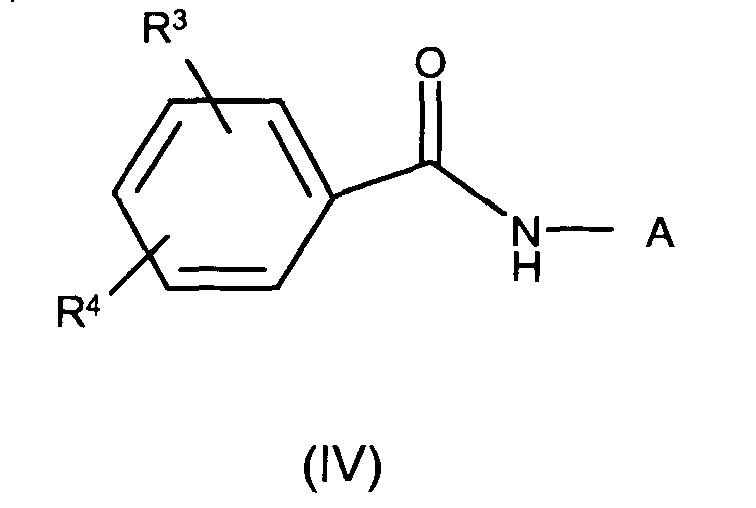
- In a more preferred embodiment A represents phenyl or pyridinyl, optionally substituted with one or more of X, R1 and/or R2.
- In an even preferred embodiment X represents hydroxy, carboxy or tetrazolyl.
- In a yet more preferred embodiment R1, R2, R3 and R4, independently of each other, represent halo, hydroxy, alkyl, alkoxy, thioalkoxy, oxo, nitro, cyano, haloalkyl, haloalkoxy, amino, carboxy and/or alkoxy-carbonyl, phenyl and/or anilino, which phenyl or anilino may optionally be substituted with one or two substituents selected from the group consisting of halo, haloalkyl, and haloalkoxy.
- In a still more preferred embodiment R1 and R2, independently of each other, represent halo, hydroxy, nitro, CF3, phenyl and/or anilino, which phenyl and anilino is optionally substituted with halo and/or CF3; and R3 and R4, independently of each other, represent halo, hydroxy, nitro and/or CF3.
- In a most preferred embodiment the hERG1 channel activating benzamide derivative for use according to the invention is
N-[3-Chloro-4-(4-chloro-phenylamino)-phenyl]-2-hydroxy-5-nitro-benzamide;
N-[3-(1H-Tetrazol-5-yl)-biphenyl-4-yl]-3,5-bis-trifluoromethyl-benzamide;
or a pharmaceutically acceptable salt thereof. - In a further aspect the invention provides novel compounds useful as hERG1 channel activators.
- In a preferred embodiment the compound for use according to the invention is a urea derivative of Formula III, selected from the group consisting of
1-Pyrimidin-2-yl-3-(3-trifluoromethyl-phenyl)-urea;
1-(2-Hydroxy-6-methoxy-pyridin-3-yl)-3-(3-fluoromethyl-phenyl)-urea;
1-(1-Oxy-pyridin-2-yl)-3-(3-trifluoromethyl-phenyl)-urea;
2,6-Dioxo-5-[3-(3-trifluoromethyl-phenyl)-ureido]-1,2,3,6-tetrahydropyrimidine-4-carboxylic acid;
3-[3-(3-Trifluoromethyl-phenyl)-ureido]-pyrazine-2-carboxylic acid;
1-(2-Hydroxy-5-trifluoromethyl-phenyl)-3-(2-trifluoromethyl-phenyl)-urea;
1-(5-Chloro-2-hydroxy-phenyl)-3-(2-trifluoromethyl-phenyl)-urea;
1-(3,5-Dihydroxy-phenyl)-3-(3-trifluoromethyl-phenyl)-urea;
4-Chloro-2-[3-(2-fluoro-phenyl)-ureido]-benzoic acid;
4-Chloro-2-[3-(3-trifluromethyl-phenyl)-ureido]-benzenesulfonamide;
1-(3-Chloro-4-trifluoromethyl-phenyl)-3-[2-(1H-tetrazol-5-yl)-4-(2-N,N-dimethylcarbamoyl-ethyl)-phenyl]-urea;
1-[4-Chloro-2-(1H-tetrazol-5-yl)-phenyl]-3-(3,5-dichloro-phenyl)-urea;
1-[4-Chloro-2-(1H-tetrazol-5-yl)-phenyl]-3-(4-chloro-3-trifluoromethylphenyl)-urea;
3'-(5-Oxo-4,5-dihydro-[1,2,4]oxadiazol-3-yl)-4'-[3-(3-trifluromethyl-phenyl)-ureido]-biphenyl-4-carboxylic acid dimethylamide; and
3'-(5-Oxo-4,5-dihydro-1H-[1,2,4]triazol-3-yl)-4'-[3-(3-trifluromethyl-phenyl)-ureido]-biphenyl-4-carboxylic acid dimethylamide;
or a pharmaceutically acceptable salt thereof. - In another preferred embodiment the compound for use according to the invention is a diphenyl urea derivative of Formula I, selected from the group consisting of
1-(2-Hydroxy-5-trifluoromethyl-phenyl)-3-(2-trifluoromethyl-phenyl)-urea;
1-(5-Chloro-2-hydroxy-phenyl)-3-(2-trifluoromethyl-phenyl)-urea;
1-(3,5-Dihydroxy-phenyl)-3-(3-trifluoromethyl-phenyl)-urea;
4-Chloro-2-[3-(2-fluoro-phenyl)-ureido]-benzoic acid;
4-Chloro-2-[3-(3-trifluromethyl-phenyl)-ureido]-benzenesulfonamide;
1-(3-Chloro-4-trifluoromethyl-phenyl)-3-[2-(1H-tetrazol-5-yl)-4-(2-N,N-dimethylcarbamoyl-ethyl)-phenyl]-urea;
1-[4-Chloro-2-(1H-tetrazol-5-yl)-phenyl]-3-(3,5-dichloro-phenyl)-urea;
1-[4-Chloro-2-(1H-tetrazol-5-yl)-phenyl]-3-(4-chloro-3-trifluoromethylphenyl)-urea;
3'-(5-Oxo-4,5-dihydro-[1,2,4]oxadiazol-3-yl)-4'-[3-(3-trifluromethyl-phenyl)-ureido]-biphenyl-4-carboxylic acid dimethylamide; and
3'-(5-Oxo-4,5-dihydro-1H-[1,2,4]triazol-3-yl)-4'-[3-(3-trifluromethyl-phenyl)-ureido]-biphenyl-4-carboxylic acid dimethylamide;
or a pharmaceutically acceptable salt thereof. - In a third preferred embodiment the compound for use according to the invention is a benzamide derivative of Formula IV, selected from the group consisting of
N-[3-Chloro-4-(4-chloro-phenylamino)-phenyl]-2-hydroxy-5-nitro-benzamide;
N-[3-(1 H-Tetrazol-5-yl)-biphenyl-4-yl]-3,5-bis-trifluoromethyl-benzamide;
or a pharmaceutically acceptable salt thereof. - The compounds for use according to the invention may be obtained as described in Example 5.
- In the context of this invention halo represents fluoro, chloro, bromo or iodo. Thus a trihalomethyl group represents e.g. a trifluoromethyl group, a trichloromethyl group, and similar trihalo-substituted methyl groups.
- In the context of this invention an alkyl group designates a univalent saturated, straight or branched hydrocarbon chain. The hydrocarbon chain preferably contain of from one to eighteen carbon atoms (C1-18-alkyl), more preferred of from one to six carbon atoms (C1-6-alkyl; lower alkyl), including pentyl, isopentyl, neopentyl, tertiary pentyl, hexyl and isohexyl. In a preferred embodiment alkyl represents a C1-4-alkyl group, including butyl, isobutyl, secondary butyl, and tertiary butyl. In another preferred embodiment of this invention alkyl represents a C1-3-alkyl group, which may in particular be methyl, ethyl, propyl or isopropyl.
- In the context of this invention an alkoxy group designates an "alkyl-O-" group, wherein alkyl is as defined above. Examples of preferred alkoxy groups of the invention include methoxy and ethoxy.
- In the context of this invention an alkoxy-carbonyl group designates an "alkyl-O-(CO)-" group, wherein alkyl is as defined above. Examples of preferred alkoxy-carbonyl groups of the invention include methoxy-carbonyl and ethoxy-carbonyl.
- In the context of this invention an alkoxy-carbonyl-alkyl group designates an "alkyl-O-(CO)-alkyl-" group, wherein alkyl is as defined above. Examples of preferred alkoxy-carbonyl-alkyl groups of the invention include methoxy-carbonyl-methyl and ethoxy-carbonyl-methyl, methoxy-carbonyl-ethyl and ethoxy-carbonyl-ethyl.
- In the context of this invention an alkoxy-carbonyl-alkenyl group designates an "alkyl-O-(CO)-alkenyl-" group, wherein alkyl and alkenyl are as defined above. Examples of preferred alkoxy-carbonyl-alkenyl groups of the invention include methoxy-carbonyl-ethenyl, ethoxy-carbonyl-ethenyl, methoxy-carbonyl-propenyl and ethoxy-carbonyl-propenyl.
- In the context of this invention a thioalkoxy group designates an "alkyl-S-" group, wherein alkyl is as defined above.
- In the context of this invention a haloalkyl group designates an alkyl group as defined herein, which alkyl group is substituted one or more times with halogen. Preferred haloalkyl groups of the invention include trihalogenmethyl and trihalogenethyl.
- In the context of this invention a haloalkoxy group designates an alkoxy group as defined herein, which alkoxy group is substituted one or more times with halogen. Preferred haloalkoxy groups of the invention include trihalogenmethoxy, and trihalogenethoxy.
- In the context of this invention an acyl group designates a carboxy group (-COOH) or an alkyl-carbonyl group (alkyl-CO-), wherein alkyl is as defined above. Examples of preferred acyl groups of the invention include carboxy, acetyl, and propionyl.
- In the context of this invention a monocyclic carbocyclic group, holding carbon only as ring atom, may in particular be aromatic (i.e. an aryl group), or saturated or partially saturated. Preferred monocyclic carbocyclic groups of the invention include 5- and 6-membered monocyclic carbocyclic groups. Most preferred monocyclic carbocyclic groups of the invention include cyclohexyl and phenyl.
- In the context of this invention a monocyclic heterocyclic group is a cyclic compound holding one or more heteroatoms in its ring structure. Preferred heteroatoms include nitrogen (N), oxygen (O), and sulphur (S). One or more of the ring structures may in particular be aromatic or partially saturated (i.e. a heteroaryl), or fully saturated. Preferred heterocyclic monocyclic groups of the invention include 5- and 6 membered heterocyclic monocyclic groups.
- Preferred 5-6 membered monocyclic heterocyclic groups of the invention include furanyl, in particular furan-2- or 3-yl; thienyl, in particular thien-2- or 3-yl; selenophenyl, in particular selenophen-2- or 3-yl; pyrrolyl (azolyl), in particular pyrrol-2- or 3-yl; oxazolyl, in particular oxazol-2, 4- or 5-yl; thiazolyl, in particular thiazol-2, 4-or 5-yl; imidazolyl, in particular imidazol-2- or 4-yl; pyrazolyl, in particular pyrazol-3- or 4-yl; isoxazolyl, in particular isoxazol-3, 4- or 5-yl; isothiazolyl, in particular isothiazol-3-, 4- or 5-yl; oxadiazolyl, in particular 1,2,3-oxadiazol-4- or 5-yl, or 1,3,4-oxadiazol-2-yl; triazolyl, in particular 1,2,3-triazol-4-yl or 1,2,4-triazol-3-yl; thiadiazolyl, in particular 1,2,3-thiadiazol-4- or 5-yl, or 1,3,4-thiadiazol-2-yl; pyridyl, in particular pyrid-2-, 3- or 4-yl; pyridazinyl, in particular pyridazin-3- or 4-yl; pyrimidinyl, in particular pyrimidin-2-, 4- or 5-yl; pyrazinyl, in particular pyrazin-2- or 3-yl; and triazinyl, in particular 1,2,4- or 1,3,5-triazinyl.
- Most preferred 5-6 membered monocyclic heterocyclic groups of the invention include pyridinyl, in particular pyridin-2, 3 or 4-yl; pyridazinyl, in particular pyridazin-3- or 4-yl; pyrimidinyl, in particular pyrimidin-2, 4 or 5-yl; and pyrazinyl, in particular pyrazin-2 or 3-yl.
- The chemical compound for use according to the invention may be provided in any form suitable for the intended administration. Suitable forms include pharmaceutically (i.e. physiologically) acceptable salts, and pre- or prodrug forms of the chemical compound for use according to the invention.
- Examples of pharmaceutically acceptable addition salts include, without limitation, the non-toxic inorganic and organic acid addition salts such as the hydrochloride, the hydrobromide, the nitrate, the perchlorate, the phosphate, the sulphate, the formate, the acetate, the aconate, the ascorbate, the benzenesulphonate, the benzoate, the cinnamate, the citrate, the embonate, the enantate, the fumarate, the glutamate, the glycolate, the lactate, the maleate, the malonate, the mandelate, the methanesulphonate, the naphthalene-2-sulphonate derived, the phthalate, the salicylate, the sorbate, the stearate, the succinate, the tartrate, the toluene-p-sulphonate, and the like. Such salts may be formed by procedures well known and described in the art.
- Examples of pharmaceutically acceptable cationic salts of a chemical compound for use according to the invention include, without limitation, the sodium, the potassium, the calcium, the magnesium, the lithium, and the ammonium salt, and the like, of a chemical compound of the invention containing an anionic group. Such cationic salts may be formed by procedures well known and described in the art.
- The compounds for use according to the invention may be prepared by conventional methods for chemical synthesis, e.g. those described in
WO 94/22807 WO 96/25157 WO 97/45400 WO 97/45111 WO 98/47879 WO 2000/24707 WO 2004/022529 . - In another aspect the invention provides novel pharmaceutical compositions comprising a therapeutically effective amount of a compound for use according to the invention.
- While a chemical compound of the invention for use in therapy may be administered in the form of the raw chemical compound, it is preferred to introduce the active ingredient, optionally in the form of a physiologically acceptable salt, in a pharmaceutical composition together with one or more adjuvants, excipients, carriers, buffers, diluents, and/or other customary pharmaceutical auxiliaries.
- In a preferred embodiment, the invention provides pharmaceutical compositions comprising the compound for use according to the invention together with one or more pharmaceutically acceptable carriers therefore, and, optionally, other therapeutic and/or prophylactic ingredients, know and used in the art. The carrier(s) must be "acceptable" in the sense of being compatible with the other ingredients of the formulation and not harmful to the recipient thereof.
- The pharmaceutical composition of the invention may be administered by any convenient route, which suits the desired therapy. Preferred routes of administration include oral administration, in particular in tablet, in capsule, in dragé, in powder, or in liquid form, and parenteral administration, in particular cutaneous, subcutaneous, intramuscular, or intravenous injection. The pharmaceutical composition of the invention can be manufactured by any person skilled in the art, by use of standard methods and conventional techniques, appropriate to the desired formulation. When desired, compositions adapted to give sustained release of the active ingredient may be employed.
- Further details on techniques for formulation and administration may be found in the latest edition of Remington's Pharmaceutical Sciences (Maack Publishing Co., Easton, PA).
- The actual dosage depends on the nature and severity of the disease being treated, and is within the discretion of the physician, and may be varied by titration of the dosage to the particular circumstances of this invention to produce the desired therapeutic effect. However, it is presently contemplated that pharmaceutical compositions containing of from about 0.1 to about 500 mg of active ingredient per individual dose, preferably of from about 1 to about 100 mg, most preferred of from about 1 to about 10 mg, are suitable for therapeutic treatments.
- The active ingredient may be administered in one or several doses per day. A satisfactory result can, in certain instances, be obtained at a dosage as low as 0.1 µg/kg i.v. and 1 µg/kg p.o. The upper limit of the dosage range is presently considered to be about 10 mg/kg i.v. and 100 mg/kg p.o. Preferred ranges are from about 0.1 µg/kg to about 10 mg/kg/day i.v., and from about 1 µg/kg to about 100 mg/kg/day p.o.
- The present invention is further illustrated by reference to the accompanying drawing, in which
-
Fig. 1 shows a determination of the current (-6 to 0 nA) vs. time (0.0 to 1.2 seconds). Mammalian HEK293 cells stably expressing hERG1 channels are challenged by a simulated cardiac action potential as indicated in the figure. Having reached a stable current level Compound A was added. Current traces are shown for a control experiment and in response to 10 µM of Compound A. A marked increase in the repolarisation current is observed; -
Fig. 2 shows results from Xenopus laevis oocytes transiently expressing hERG1 channels. Results are obtained by voltage clamping protocols stepping from 3 seconds at -80 mV to 1 second at +10 mV, followed by a step to 3 seconds at -60 mV. Current traces are shown for control experiments and in the response to 30 µM of either Compound B or Compound C. The tail current refers to the current measured at a potential of -60 mV; -
Fig. 3 shows results from guinea pig cardiomyocytes. Cardiac action potentials are initiated by injection of current. At a time point close to full repolarization, the cells are challenged by sub-threshold current injections to mimic delayed after-depolarizations. In control situations the summation of these current injections are sufficient to trigger a new action potential. In this experiment, however, application of 10-30 µM of Compound D stabilizes the cell and reduces the length of the cardiac action potential, thereby making it resistant to the later current injections. Results are obtained in current clamp mode and action potentials are evoked by current injection. Current traces are shown for control experiments and in the response to 30 µM of Compound D; and -
Fig. 4 shows the QT interval (QT; msec.), QT interval corrected for heart rate (QTc; msec.), and Heart Rate (per minute) over time (0-230 minutes) measured by telemetry in awake guinea pigs using a guinea-pig telemetry model, according to which model heart rate and ECG measurements are obtained before and after IV administration of 50 mg/kg of Compound B. IV application of Compound B has a dramatic effect on the corrected QT interval, reducing the length by 23% when compared to controls. - The invention is further illustrated with reference to the following examples, which are not intended to be in any way limiting to the scope of the invention as claimed.
- In this example the hERG1 channel opening activity of a diphenyl urea derivative for use according to the invention, 1-(3-Trifluoromethyl-phenyl)-3-(2-hydroxy-5-chlorophenyl)-urea (Compound A), is determined using mammalian HEK293 cells stably expressing hERG1 channels.
- The hERG1 channel is expressed in HEK293 cells. The gene encoding the hERG1 channel was cloned as described by Warmke & Ganetzky, Proc. Natl. Acad. Sci. USA 1994 91 3438-3442.
- To ensure functional expression in HEK293 cells, the hERG1 gene was subcloned in the shuttle-vector pXOOM as described by Jespersen et al.; Biotechniques 2002 32 536-540.
- Mammalian expression is obtained by stable transfection of the gene construct in HEK293 cells.
- The electrical current through the hERG1 channel is measured using patch clamp technology. hERG1 current is activated by simulated cardiac action potentials.
- In brief, this protocol goes from a resting membrane potential of -90 mV to a short initial depolarisation step to +30 mV, followed by a ramp ending at 0 mV. This plateau phase is ended by a repolarisation, going from -15 mV to -90 mV in 70 ms, back to the resting membrane potential, as also shown in the voltage protocol in
Fig. 1 . - HEK293 cells stably expressing hERG1 channels where challenged by a cardiac action potential protocol as indicated in
Fig. 1 . Having reached a stable current level, Compound A was added. A marked increase in the repolarisation current could be observed. - The results are presented in
Fig. 1 . - In experiments performed in HEK293 cells administration of 3-30 µM of Compound A resulted in an increase in the current during the last phase of the cardiac simulating voltage protocol reflecting the repolarisation current in a native cardiac action potential.
- It was also noticed that the first 200 ms of the resting phase had an increased hERG1 current.
- In this example the hERG1 channel opening activity of a diphenyl urea derivative for use according to the invention, 1-(3-Trifluoromethyl-phenyl)-3-[2-(1H-tetrazol-5-yl)-4-bromo-phenyl] urea (Compound B), obtained as described in
WO 98/47879 - The hERG1 channel is expressed in HEK293 cells. The gene encoding the hERG1 channel was cloned as described by Warmke & Ganetzky, Proc. Natl. Acad. Sci. USA 1994 91 3438-3442.
- To ensure functional expression in HEK293 cells, the hERG1 gene was subcloned in the shuttle-vector pXOOM as described by Jespersen et al.; Biotechniques 2002 32 536-540.
- The electrical current through the hERG1 channel is measured using 2-electrode voltage clamp technology. hERG1 current is activated by a step protocol.
- In brief, this protocol goes from a resting membrane potential of -80 mV (lasting 3 seconds) to a 1 second depolarisation step at +10 mV, followed by a repolarisation step at -60 mV. The protocol is repeated up to 500 times.
- Xenopus laevis oocytes transiently expressing hERG1 channels where challenged by a voltage protocol from -80 mV to +10 mV to -60 mV. This protocol was repeated every 7th second until a stable current level was obtained. In independent experiments either of Compound B and
Compound 15 were added. A marked increase in the repolarisation current recorded at -60 mV could be observed. - The results are presented in
Fig. 2 . - In experiments performed in Xenopus laevis oocytes, administration of 1-30 µM of Compound B and
Compound 15 resulted in an increase in the current. - In this example the activity on native cardiac myocytes from guinea pigs of a compound representative for use according to the invention, 1,3-Bis-(2-hydroxy-5-trifluoromethyl-phenyl)-urea (Compound C), obtained as described in
WO 2002/064128 , is determined. - The membrane potential of native cardiomyocytes was determined using the patch clamp technique in current clamp mode. The membrane potential was adjusted to approximately -80 mV before start of experiments. Cells were challenged by 20 repetitive rounds of current applications. A single round of application was as follows: Action potentials were evoked by applying a single current pulse of 1 nA lasting from 5-15 ms. The single pulse was followed by 30 repetitive pulses lasting 1-5 ms and with a current amplitude of 100-700 pA. The repetitive pulses were applied at the end of the evoked action potential. These experiments were conducted in the presence or absence of Compound C.
- Native cardiomyocytes responded to the described voltage protocol by eliciting an actionpotential. The following repetitive pulses (simulating early or late after-depolarisations) resulted in disturbance of the cardio myocyte membranpotential and thereby prevented a regular repolarisation of the membrane potential. This was observed in 10 out of 20 rounds of current applications in control experiments (a representative example of a disturbed membrane potential is demonstrated in
Fig. 3 ). In contrast, application of Compound C resulted in a shorting of the cardiac action potential and a stable membrane potential in the presence of the 30 repetitive pulses as demonstrated inFig. 3 . This stabilisation was observed for all 20 rounds of current applications. - In this experiment the compounds contemplated used according to the invention were investigated in an awake guinea-pig telemetry model typically used for safety evaluation with regard to human ERG-blockers.
- Compounds were dosed IV, and ECG's and heart rate were measured. QT intervals were corrected (QTc) for any change in heart rate.
- In this model, it is possible to obtain a dose-related decrease in QT intervals with compounds that open hERG channels, confirming that this channel is important for termination (repolarization) of the guinea pig cardiac action potential.
- The results of this experiment are presented in
Fig. 4 that demonstrates the effect of one concentration (50 mg/kg) of Compound B. - 1-(2-Methoxy-5-trifluoromethyl-phenyl)-3-(2-trifluoromethyl-phenyl)-urea (1 g) was dissolved in dry dichloromethane (20 ml) and cooled in an ice-bath. A 1 M solution of BBr3 in dichloromethane (4 ml) was added drop-wise, and the solution stirred at room temperature for 30 minutes. Water was added, and after vigorous stirring, the mixture was extracted with dichloromethane. Drying (MgSO4), filtration, concentration in vacuo and flash chromatography provided a product which was slurried with petrol, filtered, washed with petrol and dried to afford 1-(2-Hydroxy-5-trifluoromethyl-phenyl)-3-(2-trifluoromethyl-phenyl)-urea (340 mg). Mp. = 158-159°C.
- 2-Aminopyrimidine (1 g) was suspended in toluene (50 ml) and treated with 3-trifluoromethylphenylisocyanate (1.5 ml). The reaction was stirred overnight and then concentrated in vacuo to provide a white solid, which was taken up in 700 ml of boiling methanol and filtered. The filtrate was refluxed to provide a clear solution, which was slowly cooled to 3°C overnight. Filtration, washing with methanol and air drying gave 1-Pyrimidin-2-yl-3-(2-trifluoromethyl-phenyl)-urea (2.24 g). Mp. = 224-225°C.
- 5-Chloro-2-hydroxyaniline (1 g) was suspended in toluene (50 ml) and treated with 2-trifluoromethylphenylisocyanate (1.2 ml). The reaction was stirred overnight and then filtered. The filter-cake was slurried and filtered twice with 15 ml toluene and washed once more with petrol. Drying at 55°C gave 1-(5-Chloro-2-hydroxy-phenyl)-3-(2-trifluoromethyl-phenyl)-urea (2.06 g). Mp. = 183-184°C.
- 1-(2,6-dimethoxy-pyridin-3-yl)-3-(3-trifluoromethyl-phenyl)-urea (0.5 g) was suspended in dry dichloromethane (10 ml), BBr3 (0.14 ml) was added and the solution stirred at room temperature. After 5 hours more BBr3 (50 µl) was added and after a further hour the reaction was diluted with more dichloromethane and quenched with ice-water. The mixture was extracted with ethyl acetate, dried over MgSO4, filtered and concentrated to provide a light purple residue. This was preloaded onto silica and chromatographed to provide 1-(2-Hydroxy-6-methoxy-pyridin-3-yl)-3-(3-trifluoromethylphenyl)-urea as a white solid (210 mg). Mp. = 223-224°C.
- 1-(Pyridin-2-yl)-3-(3-trifluoromethyl-phenyl)-urea (1 g) in dichloromethane (50 ml) was treated with 60% m-CPBA (1 g) and stirred at room temperature overnight. The mixture was concentrated, taken up in EtOAc (60 ml), warmed and cooled to room temperature. Filtration and washing with EtOAc and drying in air gave 1-(1-Oxy-pyridin-2-yl)-3-(3-trifluoromethyl-phenyl)-urea as a white solid (820 mg). Mp. = 213-214°C.
- 1-(3,5-dimethoxyphenyl)-3-(3-trifluoromethyl-phenyl)-urea (1 g) in dichloromethane (25 ml) was treated with BBr3 (1 ml) and stirred at room temperature for 3 hours before pouring into water and filtration. The oily residue was chromatographed on silica to provide, along with some mono-demethylated product, the 1-(3,5-Dihydroxyphenyl)-3-(3-trifluoromethyl-phenyl)-urea (130 mg). Mp. = 174-175°C.
- 5-Amino-orotic acid (0.86 g) was dissolved in DMSO (10 ml), treated with 3-trifluoromethylphenylisocyanate (0.9 ml) and after an hour with another 0.5 ml. The reaction was stirred for three days at room temperature. Water was added and the mixture was filtered and washed with water. The residue was slurried in water, treated with NaOH and worked through until basic. Filtration and acidification of the filtrate provided a precipitate, which was filtered, washed with water and dried. Recrystallisation from 96% EtOH provided 2,6-dioxo-5-[3-(3-trifluoromethyl-phenyl)-ureido]-1,2,3,6-tetrahydro-pyrimidine-4-carboxylic acid (330 mg). Mp. > 300°C.
- 3-Aminopyrazine-2-carboxylic acid (0.7 g) in DMSO (10 ml) was treated with 3-trifluoromethylphenylisocyanate (0.9 ml), stirred at room temperature overnight and then quenched with water. A gummy residue separated. After decantation the residue was washed thoroughly with water, stirred with NaOH to basic pH, filtered and chromatographied on silica with CH2Cl2:MeOH:acetone (4:1:1) followed by CH2Cl2:MeOH:NH4OH (40:9:1) when the product started coming off the column. This gave 3-[3-(3-trifluoromethyl-phenyl)-ureido]-pyrazine-2-carboxylic acid. Mp. > 300°C.
- 2-Amino-4-chlorobenzoic acid (0.3 g), 2-fluorophenylisocyanate (0.2 ml) and triethylamine (0.24 ml) were stirred in toluene (20 ml) for a week. More 2-fluorophenylisocyanate (0.1 ml) was added and stirring continued for another week. The mixture was concentrated to almost dry, water was added and the pH was adjusted to 1 with diluted HCl. Water was decanted and the residue was dissolved in warm 96% EtOH. The pH was adjusted to 1 again with 4N HCl resulting in the precipitation of a solid, which was filtered and dried to give 4-chloro-2-[3-(2-fluorophenyl)-ureido]-benzoic acid (0.25 mg). Mp. = 195-197°C.
- This compound was prepared in a manner analogous to 1-Pyrimidin-2-yl-3-(2-trifluoromethyl-phenyl)-urea (Compound 2) from 2-amino-4-chloro-benzenesulfonamide and 3-trifluoromethylphenylisocyanate, yielding 4-chloro-2-[3-(3-trifluromethyl-phenyl)-ureido]-benzenesulfonamide (550 mg). Mp. = 163-165°C.
- 3-[4-Amino-3-(1H-tetrazol-5-yl)-phenyl]-N,N-dimethyl-propionamide (90 mg) dissolved in acetonitrile at 65°C under Ar was treated with 4-chloro-3-trifluoromethylphenylisocyanate (85.6 mg) and the mixture was stirred overnight. Cooling to room temperature and filtration afforded 3-[4-[3-(4-chloro-3-trifluoromethylphenyl)-ureido]-3-(1H-tetrazol-5-yl)-phenyl]-N,N-dimethyl-propionamide. Mp. = 184.5-189.3 °C.
- 4-Chloro-2-(1H-tetrazol-5-yl)-phenylamine (500 mg) dissolved in toluene (15 ml) was treated with 3,5-dichlorophenylisocyanate (500 mg) and stirred for a week. The precipitated product was filtered, washed with toluene, dissolved in acetone, filtered through celite, precipitated again with water, filtered and dried. This residue was slurried in 96% EtOH, and adjusted to basic pH with 10 N NaOH. The solution was filtered through celite and re-acidified with 4N HCl and a little water. The precipitated product was filtered and washed with water to afford 1-[4-Chloro-2-(1H-tetrazol-5-yl)-phenyl]-3-(3,5-dichloro-phenyl)-urea as a white solid (720 mg ). Mp. = 234-236°C.
- 4-Chloro-2-(1H-tetrazol-5-yl)-phenylamine (500 mg) dissolved in toluene (15 ml) was treated with 4-chloro-3-trifluoromethylphenylisocyanate (600 mg) and stirred for a week. The precipitated product was filtered and then acid/base extracted and reprecipitated in aq. acid in a manner analogous to that described for 1-[4-Chloro-2-(1H-tetrazol-5-yl)-phenyl]-3-(3,5-dichloro-phenyl)-urea (Compound 12) to give 1-[4-Chloro-2-(1H-tetrazol-5-yl)-phenyl]-3-(4-chloro-3-trifluoromethyl-phenyl)-urea as a white solid (850 mg). Mp. = 245-247°C.
- 3'-(N-Isobutoxycarbonyloxycarbamimidoyl)-4'-[3-(3-trifluoromethyl-phenyl)-ureido]-biphenyl-4-carboxylic acid dimethylamide (150 mg) in dioxan (6 ml) was adjusted to pH >10 with 1N NaOH and stirred at room temperature for 2.5 hrs. Addition of water, extraction with EtOAc, washing with brine, drying (Na2SO4), filtration and concentration afforded 3'-(5-Oxo-4,5-dihydro-[1,2,4]oxadiazol-3-yl)-4'-[3-(3-trifluromethyl-phenyl)-ureido]-biphenyl-4-carboxylic acid dimethylamide as a light yellow solid (102 mg). Mp. >165°C (dec.).
- N-[3-cyano-biphenyl-4-yl]-3,5-bis-trifluoromethyl-benzamide (100 mg), sodium azide (40 mg) and triethylamine hydrochloride (103 mg) were stirred at 100°C for 20 hours in DMF (3 ml). The reaction mixture was poured into a 5% KHSO4 solution (10 ml) and the solid was filtered off and dried to give N-[3-(1H-Tetrazol-5-yl)-biphenyl-4-yl]-3,5-bis-trifluoromethyl-benzamide as a white solid (120 mg). Mp. = 156°C (dec.).
- A solution of 3'-(N-aminocarbamimidoyl)-4'-[3-(3-trifluoromethyl-phenyl)-ureido]-biphenyl-4-carboxylic acid dimethylamide (322 mg) and triethylamine (212 microlitres) dissolved in dichloromethane (5 ml) at -50°C was treated with a solution of triphosgene (236 mg) in dichloromethane (5 ml). The mixture was stirred for 2.5 hrs at ambient temperature and poured into water. After adjusting to
pH 7 with aq. sodium bicarbonate, the mixture was extracted with EtOAc. The organic layers were dried over Na2SO4 filtered and concentrated. Column chromatography on silica afforded 3'-(5-Oxo-4,5-dihydro-1H-[1,2,4]triazol-3-yl)-4'-[3-(3-trifluromethyl-phenyl)-ureido]-biphenyl-4-carboxylic acid dimethylamide as a white solid. Mp. = 212°C. - N-[3-Chloro-4-(4-chloro-phenylamino)-phenyl]-2-acetoxy-5-nitro-benzamide (155 mg) was dissolved in a 1:1 mixture of THF and water (12 ml) and LiOH.H2O (64 mg) was added. After stirring at room temperature for 2 hours the solvents were evaporated and water was added to the residue. Filtration, acidification of the filtrate and filtration of the precipitate gave a residue which was flash-chromatographed (EtOAc; 1:3) to provide N-[3-Chloro-4-(4-chloro-phenylamino)-phenyl]-2-hydroxy-5-nitro-benzamide as a curry coloured powder (70 mg). Mp. >219°C (dec.).
Claims (50)
- Use of a compound capable of activating a human ERG1 channel (Human Ether-a-go-go Related Gene channel, hERG1 channel), or a pharmaceutically-acceptable addition salt thereof, for the manufacture of a pharmaceutical composition for the treatment, prevention or alleviation of an abnormal rhythm of the heart of a human.
- The use according to claim 1, wherein the abnormal rhythm of the heart is cardiac arrhythmia, atrial arrhythmia, ventricular arrhythmia, atrial fibrillation, ventricular fibrillation, tachyarrhythmia, atrial tachyarrhythmia, ventricular tachyarrhythmia or bradyarrhythmia.
- The use according to claim 2, wherein the abnormal rhythm of the heart is caused by cardiac ischemia, ischemic heart disease, hypertrophic heart, cardiomyopathia or failing heart.
- The use according to claim 3, wherein the cardiac disease, disorder or condition is cardiac arrhythmia, atrial fibrillation or ventricular tachyarrhythmia.
- The use according to any one of claims 1-4, wherein the compound is capable of selectively activating the hERG1 channel forming a complex with KCNE1 and/or KCNE2.
- The use according to any one of claims 1-5, wherein the human ERG1 channel activating compound is a diphenyl urea derivative of Formula I,

X represents hydroxy, alkoxy, amino, carboxy, alkyl-carbonyl, hydroxyaminocarbonyl, sulfamoyl, N-alkyl-sulfamoyl, N,N-di-alkyl-sulfamoyl, tetrazolyl, 2,4-dihydro-[1,2,4]triazol-3-one, 4H-[1,2,4]oxadiazol-5-one, or 1,2-dihydro-[1,2,4]triazol-3-one; and
at least one of R1, R2, R3 and R4, and independently of each other, represent halo, hydroxy, alkyl, alkoxy, thioalkoxy, nitro, cyano, haloalkyl, haloalkoxy, amino, acyl, alkoxy-carbonyl, alkoxy-carbonyl-alkyl, alkoxy-carbonyl-alkenyl, N-(alkyl-carbonyl)-amino, carbamoyl, N-alkyl-carbamoyl, N,N-di-alkyl-carbamoyl, N,N-di-alkyl-carbamoyl-alkyl, N,N-di-alkyl-carbamoyl-alkenyl, N-(carboxy-alkyl)-carbamoyl, sulfamoyl, N-alkyl-sulfamoyl, N,N-di-alkyl-sulfamoyl and/or phenyl, which phenyl may optionally be substituted with one or two substituents selected from the group consisting of halo, hydroxy, alkyl, alkoxy, nitro, haloalkyl, haloalkoxy, acyl, alkoxy-carbonyl, alkoxy-carbonyl-alkyl, alkoxy-carbonyl-alkenyl, N-(alkyl-carbonyl)-amino, carbamoyl, N-alkyl-carbamoyl, N,N-di-alkyl-carbamoyl, N,N-di-alkyl-carbamoyl-alkyl, N,N-di-alkyl-carbamoyl-alkenyl, N-(carboxy-alkyl)-carbamoyl, sulfamoyl, N-alkyl-sulfamoyl, and N,N-di-alkyl-sulfamoyl; and the remainder of R1, R2, R3 and R4 represent hydrogen. - The use according to claim 6, wherein
X represents hydroxy, amino, carboxy, hydroxyaminocarbonyl, sulfamoyl, tetrazolyl, 2,4-dihydro-[1,2,4]triazol-3-one, 4H-[1,2,4]oxadiazol-5-one, or 1,2-dihydro-[1,2,4]triazol-3-one; and
at least one of R1, R2, R3 and R4, and independently of each other, represent halo, hydroxy, alkyl, alkoxy, nitro, haloalkyl, haloalkoxy, amino, alkoxy-carbonyl-alkenyl, N-(alkyl-carbonyl)-amino, carbamoyl, N-alkyl-carbamoyl, N,N-dialkyl-carbamoyl, N,N-di-alkyl-carbamoyl-alkyl, N,N-di-alkyl-carbamoyl-alkenyl, N-(carboxy-alkyl)-carbamoyl, sulfamoyl, N-alkyl-sulfamoyl, N,N-di-alkyl-sulfamoyl and/or phenyl, which phenyl may optionally be substituted with a substituent selected from the group consisting of halo, haloalkyl, haloalkoxy, carbamoyl, N-alkyl-carbamoyl, N,N-di-alkyl-carbamoyl, sulfamoyl, N-alkyl-sulfamoyl, and N,N-di-alkyl-sulfamoyl; and the remainder of R1, R2, R3 and R4 represent hydrogen. - The use according to claim 6, wherein the human ERG1 channel activating compound is a compound of Formula I, wherein
X represents hydroxy; and
at least one of R1, R2, R3 and R4, and independently of each other, represent halo, hydroxy, alkyl, alkoxy, thioalkoxy, nitro, cyano, haloalkyl, haloalkoxy, amino, acyl, alkoxy-carbonyl, alkoxy-carbonyl-alkyl, alkoxy-carbonyl-alkenyl, N-(alkyl-carbonyl)-amino, carbamoyl, N-alkyl-carbamoyl, N,N-di-alkyl-carbamoyl, N,N-di-alkyl-carbamoyl-alkyl, N,N-di-alkyl-carbamoyl-alkenyl, N-(carboxy-alkyl)-carbamoyl, sulfamoyl, N-alkyl-sulfamoyl, N,N-di-alkyl-sulfamoyl and/or phenyl, which phenyl may optionally be substituted with one or two substituents selected from the group consisting of halo, hydroxy, alkyl, alkoxy, nitro, haloalkyl, haloalkoxy, acyl, alkoxy-carbonyl, alkoxy-carbonyl-alkyl, alkoxy-carbonyl-alkenyl, N-(alkyl-carbonyl)-amino, carbamoyl, N-alkyl-carbamoyl, N,N-di-alkyl-carbamoyl, N,N-di-alkyl-carbamoyl-alkyl, N,N-di-alkyl-carbamoyl-alkenyl, N-(carboxy-alkyl)-carbamoyl, sulfamoyl, N-alkyl-sulfamoyl, and N,N-di-alkyl-sulfamoyl; and the remainder of R1, R2, R3 and R4 represent hydrogen. - The use according to claim 8, wherein
at least one of R1, R2, R3 and R4, independently of each other, represent halo, hydroxy, alkyl, alkoxy, nitro, haloalkyl, haloalkoxy, carbamoyl, N-alkyl-carbamoyl, N,N-di-alkyl-carbamoyl, sulfamoyl, N-alkyl-sulfamoyl, N,N-di-alkyl-sulfamoyl and/or phenyl. - The use according to claim 9, wherein the human ERG1 channel activating compound is
1-(3-Trifluoromethyl-phenyl)-3-(2-hydroxy-phenyl)-urea;
1-(3-Trifluoromethyl-phenyl)-3-(2-hydroxy-3-nitro-phenyl)-urea;
1-(3-Trifluoromethyl-phenyl)-3-(2,4-dihydroxy-phenyl)-urea;
1-(3-Trifluoromethyl-phenyl)-3-(2-hydroxy-4-methoxy-phenyl)-urea;
1-(3-Trifluoromethyl-phenyl)-3-(2-hydroxy-4-methoxycarbonyl-5-chlorophenyl)-urea;
1-(3-Trifluoromethyl-phenyl)-3-(2-hydroxy-4-methoxcarbonyl-phenyl)-urea;
1-(3-Trifluoromethyl-phenyl)-3-(2-hydroxy-4-chloro-phenyl)-urea;
1-(3-Trifluoromethyl-phenyl)-3-(2,5-dihydroxy-phenyl)-urea;
1-(3-Trifluoromethyl-phenyl)-3-(2-hydroxy-5-chloro-phenyl)-urea;
1-(3-Trifluoromethoxy-phenyl)-3-(2-hydroxy-5-chloro-phenyl)-urea;
1-(3-Trifluoromethyl-phenyl)-3-(2-hydroxy-5-methoxycarbonyl-phenyl)-urea;
1-(3-Trifluoromethyl-phenyl)-3-(2-hydroxy-5-nitro-phenyl)-urea;
1-(3-Trifluoromethyl-phenyl)-3-(2-hydroxy-5-methoxy-phenyl)-urea;
1-(3-Carboxy-phenyl)-3-(2-hydroxy-5-chloro-phenyl)-urea;
1-(3-Hydroxy-phenyl)-3-(2-hydroxy-5-chloro-phenyl)-urea;
1-(3-Methoxycarbonyl-phenyl)-3-(2-hydroxy-5-chloro-phenyl)-urea;
1-(3-Methyl-phenyl)-3-(2-hydroxy-5-chloro-phenyl)-urea;
1-(3-Nitro-phenyl)-3-(2-hydroxy-5-chloro-phenyl)-urea;
1-(3-Trifluoromethyl-phenyl)-3-(2-hydroxy-6-nitro-phenyl)-urea;
1-[4-(N-ethyl-sulfamoyl)-phenyl]-3-(2-hydroxy-5-chloro-phenyl)-urea;
1,3-Bis-(2-hydroxy-5-trifluoromethyl-phenyl)-urea;
1-(3-Trifluoromethyl-phenyl)-3-(2-hydroxy-5-trifluoromethyl-phenyl)-urea;
1-(2-Trifluoromethyl-phenyl)-3-(2-hydroxy-5-trifluoromethyl-phenyl)-urea;
1-(3-Trifluoromethyl-phenyl)-3-(2,6-dihydroxy-phenyl)-urea;
1-(4-Chloro-phenyl)-3-(2-hydroxy-4-methoxy-phenyl)-urea;
1-(3-Trifluoromethyl-phenyl)-3-(2-hydroxy-5-bromo-phenyl)-urea; or
1-(2-Trifluoromethyl-phenyl)-3-(2-hydroxy-5-chloro-phenyl)-urea;
or a pharmaceutically acceptable salt thereof. - The use according to claim 6, wherein
X represents carboxy; and
at least one of R1, R2, R3 and R4, and independently of each other, represent halo, hydroxy, alkyl, alkoxy, thioalkoxy, nitro, cyano, haloalkyl, haloalkoxy, amino, acyl, alkoxy-carbonyl, alkoxy-carbonyl-alkyl, alkoxy-carbonyl-alkenyl, N-(alkyl-carbonyl)-amino, carbamoyl, N-alkyl-carbamoyl, N,N-di-alkyl-carbamoyl, N,N-di-alkyl-carbamoyl-alkyl, N,N-di-alkyl-carbamoyl-alkenyl, N-(carboxy-alkyl)-carbamoyl, sulfamoyl, N-alkyl-sulfamoyl, N,N-di-alkyl-sulfamoyl and/or phenyl, which phenyl may optionally be substituted with one or two substituents selected from the group consisting of halo, hydroxy, alkyl, alkoxy, nitro, haloalkyl, haloalkoxy, acyl, alkoxy-carbonyl, alkoxy-carbonyl-alkyl, alkoxy-carbonyl-alkenyl, N-(alkyl-carbonyl)-amino, carbamoyl, N-alkyl-carbamoyl, N,N-di-alkyl-carbamoyl, N,N-di-alkyl-carbamoyl-alkyl, N,N-di-alkyl-carbamoyl-alkenyl, N-(carboxy-alkyl)-carbamoyl, sulfamoyl, N-alkyl-sulfamoyl, and N,N-di-alkyl-sulfamoyl; and the remainder of R1, R2, R3 and R4 represent hydrogen. - The use according to claim 11, wherein the human ERG1 channel activating compound is a compound of Formula I, wherein
X represents carboxy; and
at least one of R1, R2, R3 and R4, independently of each other, represent halo, hydroxy, alkyl, alkoxy, nitro, haloalkyl, haloalkoxy, acyl, alkoxy-carbonyl, sulfamoyl, N-alkyl-sulfamoyl, N,N-di-alkyl-sulfamoyl and/or phenyl, which phenyl may optionally be substituted with one or two substituents selected from the group consisting of halo, hydroxy, alkoxy, acyl, alkoxy-carbonyl and haloalkyl; and the remainder of R1, R2, R3 and R4 represent hydrogen. - The use according to claim 12, wherein
at least one of R1, R2, R3 and R4, and independently of each other, represent halo, hydroxy, alkyl, alkoxy, nitro, haloalkyl, haloalkoxy, and/or phenyl. - The use according to claim 13, wherein the human ERG1 channel activating compound is
1-Phenyl-3-(2-carboxy-phenyl)-urea;
1-(2-Methoxy-phenyl)-3-(2-carboxy-phenyl)-urea;
1-(2-Trifluoromethyl-phenyl)-3-(2-carboxy-phenyl)-urea;
1-(3-Methoxy-phenyl)-3-(2-carboxy-phenyl)-urea;
1-(3-Nitro-phenyl)-3-(2-carboxy-phenyl)-urea;
1-(3-Trifluoromethyl-phenyl)-3-(2-carboxy-phenyl)-urea;
1-(4-Methoxy-phenyl)-3-(2-carboxy-phenyl)-urea;
1-(4-Bromo-phenyl)-3-(2-carboxy-phenyl)-urea;
1-(4-Nitro-phenyl)-3-(2-carboxy-phenyl)-urea;
1-(3-Trifluoromethyl-phenyl)-3-(2-carboxy-3-methyl-phenyl)-urea;
1-(3-Trifluoromethyl-phenyl)-3-(2-carboxy-4-methyl-phenyl)-urea;
1-(3-Trifluoromethyl-phenyl)-3-(2-carboxy-4-hydroxy-phenyl)-urea;
1-(3-Trifluoromethyl-phenyl)-3-(2-carboxy-4-nitro-phenyl)-urea;
1-(3-Trifluoromethyl-phenyl)-3-(2-carboxy-4-methoxy-phenyl)-urea;
1-(3-Trifluoromethyl-phenyl)-3-(2-carboxy-4-bromo-phenyl)-urea;
1-(3-Trifluoromethyl-phenyl)-3-(2-carboxy-4-fluoro-phenyl)-urea;
1-(3-Trifluoromethyl-phenyl)-3-(2-carboxy-4,5-dimethoxy-phenyl)-urea;
1-(3-Trifluoromethyl-phenyl)-3-(2-carboxy-5-nitro-phenyl)-urea;
1-(3-Trifluoromethyl-phenyl)-3-(2-carboxy-5-trifluoromethyl-phenyl)-urea;
1-(3-Trifluoromethyl-phenyl)-3-(2-carboxy-6-methyl-phenyl)-urea;
1-(3-Trifluoromethyl-phenyl)-3-(2-carboxy-5-nitro-phenyl)-urea;
1-(3,5-Bis-trifluoromethyl-phenyl)-3-(2-carboxy-5-chloro-phenyl)-urea;
1-(4-Chloro-phenyl)-3-(2-carboxy-3-iodo-phenyl)-urea;
1-(2-Fluoro-phenyl)-3-(2-carboxy-5-chloro-phenyl)-urea;
1-(4-Chloro-phenyl)-3-(2-carboxy-5-chloro-phenyl)-urea;
1-(3-Trifluoromethyl-phenyl)-3-(2-carboxy-4-methyl-phenyl)-urea;
1-(3-Trifluoromethyl-phenyl)-3-(2-carboxy-4-bromo-phenyl)-urea;
1-(3,5-Dimethoxy-phenyl)-3-(2-carboxy-4-bromo-phenyl)-urea;
1-(4-Biphenyl)-3-(2-carboxy-phenyl)-urea; or
1-(2-Methoxy-phenyl)-3-(2-carboxy-5-chloro-phenyl)-urea;
or a pharmaceutically acceptable salt thereof. - The use according to claim 6, wherein
X represents tetrazolyl; and
at least one of R1, R2, R3 and R4, and independently of each other, represent halo, hydroxy, alkyl, alkoxy, thioalkoxy, nitro, cyano, haloalkyl, haloalkoxy, amino, acyl, alkoxy-carbonyl, alkoxy-carbonyl-alkyl, alkoxy-carbonyl-alkenyl, N-(alkyl-carbonyl)-amino, carbamoyl, N-alkyl-carbamoyl, N,N-di-alkyl-carbamoyl, N,N-di-alkyl-carbamoyl-alkyl, N,N-di-alkyl-carbamoyl-alkenyl, N-(carboxy-alkyl)-carbamoyl, sulfamoyl, N-alkyl-sulfamoyl, N,N-di-alkyl-sulfamoyl and/or phenyl, which phenyl may optionally be substituted with one or two substituents selected from the group consisting of halo, hydroxy, alkyl, alkoxy, nitro, haloalkyl, haloalkoxy, acyl, alkoxy-carbonyl, alkoxy-carbonyl-alkyl, alkoxy-carbonyl-alkenyl, N-(alkyl-carbonyl)-amino, carbamoyl, N-alkyl-carbamoyl, N,N-di-alkyl-carbamoyl, N,N-di-alkyl-carbamoyl-alkyl, N,N-di-alkyl-carbamoyl-alkenyl, N-(carboxy-alkyl)-carbamoyl, sulfamoyl, N-alkyl-sulfamoyl, and N,N-di-alkyl-sulfamoyl; and the remainder of R1, R2, R3 and R4 represent hydrogen. - The use according to claim 15, wherein
X represents 1H-tetrazolyl; and
at least one of R1, R2, R3 and R4, and independently of each other, represent Cl, Br, F, hydroxy, alkyl, alkoxy, nitro, CF3, OCF3, amino, alkoxy-carbonyl-alkenyl, N-(alkyl-carbonyl)-amino, carbamoyl, N-alkyl-carbamoyl, N,N-di-alkyl-carbamoyl, N,N-di-alkyl-carbamoyl-alkyl, N,N-di-alkyl-carbamoyl-alkenyl, N-(carboxyalkyl)-carbamoyl, sulfamoyl, N-alkyl-sulfamoyl, N,N-di-alkyl-sulfamoyl and/or phenyl, which phenyl may optionally be substituted with a substituent selected from the group consisting of Cl, Br, F, CF3, OCF3, carbamoyl, N-alkyl-carbamoyl, N,N-di-alkyl-carbamoyl, sulfamoyl, N-alkyl-sulfamoyl, and N,N-di-alkyl-sulfamoyl; and the remainder of R1, R2, R3 and R4 represent hydrogen. - The use according to claim 16, wherein the human ERG1 channel activating compound is
1-(3-Biphenyl)-3-[2-(1H-tetrazol-5-yl)-phenyl]-urea;
1-(3-Acetyl-phenyl)-3-[2-(1H-tetrazol-5-yl)-phenyl]-urea;
1-(4-Biphenyl)-3-[2-(1H-tetrazol-5-yl)-phenyl]-urea;
1-(2-Bromo-phenyl)-3-[2-(1H-tetrazol-5-yl)-4-bromo-phenyl]-urea;
1-(2-Chloro-phenyl)-3-[2-(1H-tetrazol-5-yl)-4-bromo-phenyl]-urea;
1-(2-Fluoro-phenyl)-3-[2-(1H-tetrazol-5-yl)-4-bromo-phenyl]-urea;
1-(2-Methyl-phenyl)-3-[2-(1H-tetrazol-5-yl)-4-bromo-phenyl]-urea;
1-(2-Ethyl-phenyl)-3-[2-(1H-tetrazol-5-yl)-4-bromo-phenyl]-urea;
1-(2-Nitro-phenyl)-3-[2-(1H-tetrazol-5-yl)-4-bromo-phenyl]-urea;
1-(2-Trifluoromethyl-phenyl)-3-[2-(1H-tetrazol-5-yl)-4-bromo-phenyl]-urea;
1-(3-Acetyl-phenyl)-3-[2-(1H-tetrazol-5-yl)-4-bromo-phenyl]-urea;
1-(3-Biphenyl)-3-[2-(1H-tetrazol-5-yl)-4-bromo-phenyl]-urea;
1-(3-Bromo-phenyl)-3-[2-(1H-tetrazol-5-yl)-4-bromo-phenyl]-urea;
1-(3-Chloro-phenyl)-3-[2-(1H-tetrazol-5-yl)-4-bromo-phenyl]-urea;
1-(3-Fluoro-phenyl)-3-[2-(1H-tetrazol-5-yl)-4-bromo-phenyl]-urea;
1-(3-Methyl-phenyl)-3-[2-(1H-tetrazol-5-yl)-4-bromo-phenyl]-urea;
1-(3-Methoxy-phenyl)-3-[2-(1H-tetrazol-5-yl)-4-bromo-phenyl]-urea;
1-(3-Nitro-phenyl)-3-[2-(1H-tetrazol-5-yl)-4-bromo-phenyl]-urea;
1-(3-Trifluoromethyl-phenyl)-3-[2-(1H-tetrazol-5-yl)-4-bromo-phenyl]-urea;
1-(3,4-Dichloro-phenyl)-3-[2-(1H-tetrazol-5-yl)-4-bromo-phenyl]-urea;
1-(3-Nitro-4-methyl-phenyl)-3-[2-(1H-tetrazol-5-yl)-4-bromo-phenyl]-urea;
1-(3-Trifluoromethyl-4-chloro-phenyl)-3-[2-(1H-tetrazol-5-yl)-4-bromophenyl]-urea;
1-(3,5-Dichloro-phenyl)-3-[2-(1H-tetrazol-5-yl)-4-bromo-phenyl]-urea;
1-[3,5-Bis-trifluoromethyl-phenyl]-3-[4-bromo-2-(1H-tetrazol-5-yl)-phenyl]-urea;
1-(3,5-Dimethyl-phenyl)-3-[2-(1H-tetrazol-5-yl)-4-bromo-phenyl]-urea;
1-(4-Bromo-phenyl)-3-[2-(1H-tetrazol-5-yl)-4-bromo-phenyl]-urea;
1-(4-Ethoxyo-phenyl)-3-[2-(1H-tetrazol-5-yl)-4-bromo-phenyl]-urea;
1-(4-Methoxy-phenyl)-3-[2-(1H-tetrazol-5-yl)-4-bromo-phenyl]-urea;
1-(4-Methyl-phenyl)-3-[2-(1H-tetrazol-5-yl)-4-bromo-phenyl]-urea;
1-(4-Nitro-phenyl)-3-[2-(1H-tetrazol-5-yl)-4-bromo-phenyl]-urea;
1-(4-Trifluoromethyl-phenyl-3-[2-(1H-tetrazol-5-yl)-4-bromo-phenyl]-urea;
1-[4-(2-Propyl)-phenyl]-3-[2-(1H-tetrazol-5-yl)-4-bromo-phenyl]-urea;
1-(3-Trifluromethyl-phenyl)-3-[2-(1H-tetrazol-5-yl)-4-amino-phenyl]-urea;
1-(3-Bromo-phenyl)-3-[2-(1H-tetrazol-5-yl)-4-biphenyl]-urea;
1-(3-Bromo-phenyl)-3-[2-(1H-tetrazol-5-yl)-4-(3'-nitro)-biphenyl]-urea;
1-(3-Trifluoromethyl-phenyl)-3-[2-(1H-tetrazol-5-yl)-4-(3'-nitro)-biphenyl]-urea;
1-(3-Trifluoromethyl-phenyl)-3-[2-(1H-tetrazol-5-yl)-4-(4'-trifluoromethyl)-biphenyl]-urea;
1-(3-Trifluoromethyl-phenyl)-3-[2-(1H-tetrazol-5-yl)-4-(4'-ethoxycarbonyl)-biphenyl]-urea;
1-(3-Trifluoromethyl-phenyl)-3-[2-(1H-tetrazol-5-yl)-4-(4'-carboxy)-biphenyl]-urea;
1-(3,5-Bis-trifluoromethyl-phenyl)-3-[2-(1H-tetrazol-5-yl)-4-(4'-N,N-dimethyl-sulfamoyl)-biphenyl]-urea;
1-(3-Fluoro-5-trifluoromethyl-phenyl)-3-[2-(1H-tetrazol-5-yl)-4-(4'-N,N-dimethyl-sulfamoyl)-biphenyl]-urea;
1-(3,5-Bis-trifluoromethyl-phenyl)-3-[2-(1H-tetrazol-5-yl)-4-(4'-N,N-dimethyl-carbamoyl)-biphenyl]-urea;
1-(3,5-Difluoro-phenyl)-3-[2-(1H-tetrazol-5-yl)-4-(3'-trifluoromethyl-biphenyl]-urea;
1-(3,5-Bis-trifluoromethyl-phenyl)-3-[2-(1H-tetrazol-5-yl)-4-(4'-N,N-dimethyl-sulfamoyl)-biphenyl];
1-(3,5-Bis-trifluoromethyl-phenyl)-3-[2-(1H-tetrazol-5-yl)-4,6-dichlorophenyl]-urea;
1-(3-Chloro-4-trifluoromethyl-phenyl)-3-[2-(1H-tetrazol-5-yl)-4-(2-N,N-dimethylcarbamoyl-ethyl)-phenyl]-urea;
1-(3-Trifluoromethyl-phenyl)-3-[2-(1H-tetrazol-5-yl)-4-amino-phenyl]-urea;
1-(4-Chloro-3-trifluoromethyl-phenyl)-3-[2-(1H-tetrazol-5-yl)-4-chlorophenyl]-urea;
1-(3,5-Bis-trifluoromethyl-phenyl)-3-[2-(1H-tetrazol-5-yl)-4-(N-carboxymethyl)-carbamoyl-phenyl]-urea;
1-(3,5-Bis-trifluoromethyl-phenyl)-3-[2-(1H-tetrazol-5-yl)-4-(2-N,N-dimethylcarbamoyl-ethenyl)-phenyl]-urea;
1-(4-Fluoro-3-trifluoromethyl-phenyl)-3-[2-(1H-tetrazol-5-yl)-4-bromophenyl]-urea;
1-(3,5-Bis-trifluoromethyl-phenyl)-3-[2-( 1H-tetrazol-5-yl)-4-bromo-phenyl]-urea;
1-(3,5-Bis-trifluoromethyl-phenyl)-3-[2-(1H-tetrazol-5-yl)-4-chloro-phenyl]-urea;
1-(3-Trifluoromethyl-phenyl)-3-[2-(1H-tetrazol-5-yl)-4-bromo-phenyl]-urea;
1-(3,5-Bis-trifluoromethyl-phenyl)-3-[2-(1H-tetrazol-5-yl)-4-(2-methoxy-carbonyl-ethenyl)-phenyl]-urea;
1-(3-Chloro-4-fluoro-phenyl)-3-[2-(1H-tetrazol-5-yl)-4-bromo-phenyl]-urea;
1-(3,5-Dichloro-phenyl)-3-[2-(1H-tetrazol-5-yl)-4-chloro-phenyl]-urea;
1-(4-Biphenyl)-3-[2-(1H-tetrazol-5-yl)-5-chloro-phenyl]-urea;
1-(4-Chloro-3-trifluoromethyl-phenyl)-3-[2-(1H-tetrazol-5-yl)-5-chlorophenyl]-urea;
1-(3-Trifluoromethyl-phenyl)-3-[2-(1H-tetrazol-5-yl)-4-(methyl-carbonylamino)-phenyl]-urea; or
1-(2-Trifluoromethyl-phenyl)-3-[2-(1H-tetrazol-5-yl)-4-(4'-chloro-biphenyl)]-urea;
or a pharmaceutically acceptable salt thereof. - The use according to claim 6, wherein
X represents 2,4-dihydro-[1,2,4]triazol-3-one; and
at least one of R1, R2, R3 and R4, and independently of one another, represent halo, hydroxy, alkyl, alkoxy, thioalkoxy, nitro, cyano, haloalkyl, haloalkoxy, amino, acyl, alkoxy-carbonyl, alkoxy-carbonyl-alkyl, alkoxy-carbonyl-alkenyl, N-(alkyl-carbonyl)-amino, carbamoyl, N-alkyl-carbamoyl, N,N-di-alkyl-carbamoyl, N,N-di-alkyl-carbamoyl-alkyl, N,N-di-alkyl-carbamoyl-alkenyl, N-(carboxy-alkyl)-carbamoyl, sulfamoyl, N-alkyl-sulfamoyl, N,N-di-alkyl-sulfamoyl and/or phenyl, which phenyl may optionally be substituted with one or two substituents selected from the group consisting of halo, hydroxy, alkyl, alkoxy, nitro, haloalkyl, haloalkoxy, acyl, alkoxy-carbonyl, alkoxy-carbonyl-alkyl, alkoxy-carbonyl-alkenyl, N-(alkyl-carbonyl)-amino, carbamoyl, N-alkyl-carbamoyl, N,N-di-alkyl-carbamoyl, N,N-di-alkyl-carbamoyl-alkyl, N,N-di-alkyl-carbamoyl-alkenyl, N-(carboxy-alkyl)-carbamoyl, sulfamoyl, N-alkyl-sulfamoyl, and N,N-di-alkyl-sulfamoyl; and the remainder of R1, R2, R3 and R4 represent hydrogen. - The use according to claim 18, wherein
at least one of R1, R2, R3 and R4, and independently of one another, represent halo, haloalkyl, haloalkoxy, carbamoyl, N-alkyl-carbamoyl, N,N-di-alkyl-carbamoyl, sulfamoyl, N-alkyl-sulfamoyl, N,N-di-alkyl-sulfamoyl and/or phenyl, which phenyl may optionally be substituted with a substituent selected from the group consisting of halo, haloalkyl, haloalkoxy, carbamoyl, N-alkyl-carbamoyl, N,N-di-alkyl-carbamoyl, sulfamoyl, N-alkyl-sulfamoyl, and N,N-di-alkyl-sulfamoyl; and the remainder of R1, R2, R3 and R4 represent hydrogen. - The use according to claim 19, wherein the human ERG1 channel activating compound is
1-(3-Trifluoromethyl-phenyl)-3-[2-(5-oxo-4,5-dihydro-1H-[1,2,4]triazol-3-yl)-4-(4'-N,N-dimethyl-carbamoyl)-biphenyl]-urea;
or a pharmaceutically acceptable salt thereof. - The use according to claim 6, wherein
X represents 4H-[1,2,4]oxadiazol-5-one; and
at least one of R1, R2, R3 and R4, and independently of one another, represent halo, hydroxy, alkyl, alkoxy, thioalkoxy, nitro, cyano, haloalkyl, haloalkoxy, amino, acyl, alkoxy-carbonyl, alkoxy-carbonyl-alkyl, alkoxy-carbonyl-alkenyl, N-(alkyl-carbonyl)-amino, carbamoyl, N-alkyl-carbamoyl, N,N-di-alkyl-carbamoyl, N,N-di-alkyl-carbamoyl-alkyl, N,N-di-alkyl-carbamoyl-alkenyl, N-(carboxy-alkyl)-carbamoyl, sulfamoyl, N-alkyl-sulfamoyl, N,N-di-alkyl-sulfamoyl and/or phenyl, which phenyl may optionally be substituted with one or two substituents selected from the group consisting of halo, hydroxy, alkyl, alkoxy, nitro, haloalkyl, haloalkoxy, acyl, alkoxy-carbonyl, alkoxy-carbonyl-alkyl, alkoxy-carbonyl-alkenyl, N-(alkyl-carbonyl)-amino, carbamoyl, N-alkyl-carbamoyl, N,N-di-alkyl-carbamoyl, N,N-di-alkyl-carbamoyl-alkyl, N,N-di-alkyl-carbamoyl-alkenyl, N-(carboxy-alkyl)-carbamoyl, sulfamoyl, N-alkyl-sulfamoyl, and N,N-di-alkyl-sulfamoyl; and the remainder of R1, R2, R3 and R4 represent hydrogen. - The use according to claim 21, wherein
at least one of R1, R2, R3 and R4, and independently of one another, represent halo, haloalkyl, haloalkoxy, carbamoyl, N-alkyl-carbamoyl, N,N-di-alkyl-carbamoyl, sulfamoyl, N-alkyl-sulfamoyl, N,N-di-alkyl-sulfamoyl and/or phenyl, which phenyl may optionally be substituted with a substituent selected from the group consisting of halo, haloalkyl, haloalkoxy, carbamoyl, N-alkyl-carbamoyl, N,N-di-alkyl-carbamoyl, sulfamoyl, N-alkyl-sulfamoyl, and N,N-di-alkyl-sulfamoyl; and the remainder of R1, R2, R3 and R4 represent hydrogen. - The use according to claim 22, wherein the human ERG1 channel activating compound is
1-(3-Trifluoromethyl-phenyl)-3-[2-(5-oxo-4,5-dihydro-[1,2,4]oxadiazol-3-yl)-4-(4'-N,N-dimethyl-carbamoyl)-biphenyl]-urea; or
1-(3-Trifluoromethyl-phenyl)-3-[2-(5-oxo-4,5-dihydro-[1,2,4]oxadiazol-3-yl)-5-chloro-phenyl]-urea;
or a pharmaceutically acceptable salt thereof. - The use according to claim 6, wherein
X represents 1,2-dihydro-[1,2,4]triazol-3-one; and
at least one of R1, R2, R3 and R4, and independently of one another, represent halo, hydroxy, alkyl, alkoxy, thioalkoxy, nitro, cyano, haloalkyl, haloalkoxy, amino, acyl, alkoxy-carbonyl, alkoxy-carbonyl-alkyl, alkoxy-carbonyl-alkenyl, N-(alkyl-carbonyl)-amino, carbamoyl, N-alkyl-carbamoyl, N,N-di-alkyl-carbamoyl, N,N-di-alkyl-carbamoyl-alkyl, N,N-di-alkyl-carbamoyl-alkenyl, N-(carboxy-alkyl)-carbamoyl, sulfamoyl, N-alkyl-sulfamoyl, N,N-di-alkyl-sulfamoyl and/or phenyl, which phenyl may optionally be substituted with one or two substituents selected from the group consisting of halo, hydroxy, alkyl, alkoxy, nitro, haloalkyl, haloalkoxy, acyl, alkoxy-carbonyl, alkoxy-carbonyl-alkyl, alkoxy-carbonyl-alkenyl, N-(alkyl-carbonyl)-amino, carbamoyl, N-alkyl-carbamoyl, N,N-di-alkyl-carbamoyl, N,N-di-alkyl-carbamoyl-alkyl, N,N-di-alkyl-carbamoyl-alkenyl, N-(carboxy-alkyl)-carbamoyl, sulfamoyl, N-alkyl-sulfamoyl, and N,N-di-alkyl-sulfamoyl; and the remainder of R1, R2, R3 and R4 represent hydrogen. - The use according to claim 24, wherein
at least one of R1, R2, R3 and R4, and independently of one another, represent halo, haloalkyl, haloalkoxy, carbamoyl, N-alkyl-carbamoyl, N,N-di-alkyl-carbamoyl, sulfamoyl, N-alkyl-sulfamoyl, N,N-di-alkyl-sulfamoyl and/or phenyl, which phenyl may optionally be substituted with a substituent selected from the group consisting of halo, haloalkyl, haloalkoxy, carbamoyl, N-alkyl-carbamoyl, N,N-di-alkyl-carbamoyl, sulfamoyl, N-alkyl-sulfamoyl, and N,N-di-alkyl-sulfamoyl; and the remainder of R1, R2, R3 and R4 represent hydrogen. - The use according to claim 25, wherein the human ERG1 channel activating compound is
1-(3-Trifluoromethyl-phenyl)-3-[2-(3-oxo-2,3-dihydro-[1,2,4]triazol-1-yl)-phenyl]-urea;
or a pharmaceutically acceptable salt thereof. - The use according to claim 6, wherein
X represents sulfamoyl, N-alkyl-sulfamoyl or N,N-di-alkyl-sulfamoyl; and
at least one of R1, R2, R3 and R4, and independently of each other, represent halo, hydroxy, alkyl, alkoxy, thioalkoxy, nitro, cyano, haloalkyl, haloalkoxy, amino, acyl, alkoxy-carbonyl, alkoxy-carbonyl-alkyl, alkoxy-carbonyl-alkenyl, N-(alkyl-carbonyl)-amino, carbamoyl, N-alkyl-carbamoyl, N,N-di-alkyl-carbamoyl, N,N-di-alkyl-carbamoyl-alkyl, N,N-di-alkyl-carbamoyl-alkenyl, N-(carboxy-alkyl)-carbamoyl, sulfamoyl, N-alkyl-sulfamoyl, N,N-di-alkyl-sulfamoyl and/or phenyl, which phenyl may optionally be substituted with one or two substituents selected from the group consisting of halo, hydroxy, alkyl, alkoxy, nitro, haloalkyl, haloalkoxy, acyl, alkoxy-carbonyl, alkoxy-carbonyl-alkyl, alkoxy-carbonyl-alkenyl, N-(alkyl-carbonyl)-amino, carbamoyl, N-alkyl-carbamoyl, N,N-di-alkyl-carbamoyl, N,N-di-alkyl-carbamoyl-alkyl, N,N-di-alkyl-carbamoyl-alkenyl, N-(carboxy-alkyl)-carbamoyl, sulfamoyl, N-alkyl-sulfamoyl, and N,N-di-alkyl-sulfamoyl; and the remainder of R1, R2, R3 and R4 represent hydrogen. - The use according to claim 27, wherein
X represents sulfamoyl; and
at least one of R1, R2, R3 and R4, and independently of each other, represent halo, CF3, OCF3; and the remainder of R1, R2, R3 and R4 represent hydrogen. - The use according to claim 28, wherein the human ERG1 channel activating compound is
1-(3-Trifluoromethyl-phenyl)-3-(2-sulfamoyl-5-chloro-phenyl)-urea;
or a pharmaceutically acceptable salt thereof. - The use according to claim 6, wherein
X represents hydroxyaminocarbonyl; and
at least one of R1, R2, R3 and R4, and independently of each other, represent halo, hydroxy, alkyl, alkoxy, thioalkoxy, nitro, cyano, haloalkyl, haloalkoxy, amino, acyl, alkoxy-carbonyl, alkoxy-carbonyl-alkyl, alkoxy-carbonyl-alkenyl, N-(alkyl-carbonyl)-amino, carbamoyl, N-alkyl-carbamoyl, N,N-di-alkyl-carbamoyl, N,N-di-alkyl-carbamoyl-alkyl, N,N-di-alkyl-carbamoyl-alkenyl, N-(carboxy-alkyl)-carbamoyl, sulfamoyl, N-alkyl-sulfamoyl, N,N-di-alkyl-sulfamoyl and/or phenyl, which phenyl may optionally be substituted with one or two substituents selected from the group consisting of halo, hydroxy, alkyl, alkoxy, nitro, haloalkyl, haloalkoxy, acyl, alkoxy-carbonyl, alkoxy-carbonyl-alkyl, alkoxy-carbonyl-alkenyl, N-(alkyl-carbonyl)-amino, carbamoyl, N-alkyl-carbamoyl, N,N-di-alkyl-carbamoyl, N,N-di-alkyl-carbamoyl-alkyl, N,N-di-alkyl-carbamoyl-alkenyl, N-(carboxy-alkyl)-carbamoyl, sulfamoyl, N-alkyl-sulfamoyl, and N,N-di-alkyl-sulfamoyl; and the remainder of R1, R2, R3 and R4 represent hydrogen. - The use according to claim 30, wherein
X represents hydroxyaminocarbonyl; and
at least one of R1, R2, R3 and R4, and independently of each other, represent halo, CF3, OCF3; and the remainder of R1, R2, R3 and R4 represent hydrogen. - The use according to claim 31, wherein the human ERG1 channel activating compound is
1-(3-Trifluoromethyl-phenyl)-3-[2-(hydroxy-amino-carbonyl)-phenyl]-urea;
or a pharmaceutically acceptable salt thereof. - The use according to claim 6, wherein
X represents amino; and
at least one of R1, R2, R3 and R4, and independently of each other, represent halo, hydroxy, alkyl, alkoxy, thioalkoxy, nitro, cyano, haloalkyl, haloalkoxy, amino, acyl, alkoxy-carbonyl, alkoxy-carbonyl-alkyl, alkoxy-carbonyl-alkenyl, N-(alkyl-carbonyl)-amino, carbamoyl, N-alkyl-carbamoyl, N,N-di-alkyl-carbamoyl, N,N-di-alkyl-carbamoyl-alkyl, N,N-di-alkyl-carbamoyl-alkenyl, N-(carboxy-alkyl)-carbamoyl, sulfamoyl, N-alkyl-sulfamoyl, N,N-di-alkyl-sulfamoyl and/or phenyl, which phenyl may optionally be substituted with one or two substituents selected from the group consisting of halo, hydroxy, alkyl, alkoxy, nitro, haloalkyl, haloalkoxy, acyl, alkoxy-carbonyl, alkoxy-carbonyl-alkyl, alkoxy-carbonyl-alkenyl, N-(alkyl-carbonyl)-amino, carbamoyl, N-alkyl-carbamoyl, N,N-di-alkyl-carbamoyl, N,N-di-alkyl-carbamoyl-alkyl, N,N-di-alkyl-carbamoyl-alkenyl, N-(carboxy-alkyl)-carbamoyl, sulfamoyl, N-alkyl-sulfamoyl, and N,N-di-alkyl-sulfamoyl; and the remainder of R1, R2, R3 and R4 represent hydrogen. - The use according to claim 33, wherein
X represents amino; and
at least one of R1, R2, R3 and R4, and independently of each other, represent halo, CF3, OCF3; and the remainder of R1, R2, R3 and R4 represent hydrogen. - The use according to claim 34, wherein the human ERG1 channel activating compound is
1-(3-Trifluoromethyl-phenyl)-3-(2-amino-5-chloro-phenyl)-urea;
or a pharmaceutically acceptable salt thereof. - The use according to any one of claims 1-5, wherein the human ERG1 channel activating compound is a diphenyl urea derivative of Formula II,

X represents hydroxy, carboxy, amino, hydroxyaminocarbonyl, sulfamoyl or 1H-tetrazol-5-yl; and
at least one of R1, R2, R3 and R4, and independently of each other, represent halo and/or haloalkyl; and the remainder of R1, R2, R3 and R4 represent hydrogen. - The use according to claim 36, wherein the human ERG1 channel activating compound is
1-(3-Trifluoromethyl-phenyl)-3-(2-hydroxy-5-chloro-phenyl)-urea;
1-(3,5-Bis-trifluoromethyl-phenyl)-3-[4-bromo-2-(1H-tetrazol-5-yl)-phenyl]-urea;
1,3-Bis-(2-hydroxy-5-trifluoromethyl-phenyl)-urea;
1-(3,5-Difluoro-phenyl)-3-[2-(1H-tetrazol-5-yl)-4-(3'-trifluoromethyl-biphenyl]-urea;
1-(3,5-Bis-trifluoromethyl-phenyl)-3-(2-carboxy-5-chloro-phenyl)-urea;
1-(3,5-Bis-trifluoromethyl-phenyl)-3-[2-(1H-tetrazol-5-yl)-4,6-dichlorophenyl]-urea;
1-(3-Trifluoromethyl-phenyl)-3-(2-sulfamoyl-5-chloro-phenyl)-urea;
1-(4-Chloro-phenyl)-3-(2-carboxy-3-iodo-phenyl)-urea;
1-(2-Fluoro-phenyl)-3-(2-carboxy-5-chloro-phenyl)-urea;
1-(3-Trifluoromethyl-phenyl)-3-(2-hydroxy-5-trifluoromethyl-phenyl)-urea;
1-(4-Chloro-phenyl)-3-(2-carboxy-5-chloro-phenyl)-urea;
1-(3-Trifluoromethyl-phenyl)-3-(2-carboxy-4-methyl-phenyl)-urea;
1-(2-Trifluoromethyl-phenyl)-3-(2-hydroxy-5-trifluoromethyl-phenyl)-urea;
1-(3-Trifluoromethyl-phenyl)-3-[2-(hydroxy-amino-carbonyl)-phenyl]-urea;
1-(4-Chloro-3-trifluoromethyl-phenyl)-3-[2-(1H-tetrazol-5-yl)-4-chlorophenyl]-urea;
1-(3-Trifluoromethyl-phenyl)-3-(2-amino-5-chloro-phenyl)-urea;
1-(3-Trifluoromethyl-phenyl)-3-(2-hydroxy-5-bromo-phenyl)-urea;
1-(2-Trifluoromethyl-phenyl)-3-(2-hydroxy-5-chloro-phenyl)-urea;
1-(4-Fluoro-3-trifluoromethyl-phenyl)-3-[2-(1H-tetrazol-5-yl)-4-bromophenyl]-urea;
1-(3,5-Bis-trifluoromethyl-phenyl)-3-[2-(1H-tetrazol-5-yl)-4-bromo-phenyl]-urea;
1-(3,5-Bis-trifluoromethyl-phenyl)-3-[2-(1H-tetrazol-5-yl)-4-chloro-phenyl]-urea;
1-(3-Trifluoromethyl-phenyl)-3-[2-(1H-tetrazol-5-yl)-4-bromo-phenyl]-urea;
1-(3-Chloro-4-fluoro-phenyl)-3-[2-(1H-tetrazol-5-yl)-4-bromo-phenyl]-urea;
1-(3,5-Dichloro-phenyl)-3-[2-(1H-tetrazol-5-yl)-4-chloro-phenyl]-urea;
1-(3,5-Dichloro-phenyl)-3-[2-(1H-tetrazol-5-yl)-4-bromo-phenyl]-urea; or
1-(4-Chloro-3-trifluoromethyl-phenyl)-3-[2-(1H-tetrazol-5-yl)-5-chlorophenyl]-urea;
or a pharmaceutically acceptable salt thereof. - The use according to any one of claims 1-5, wherein the human ERG1 channel activating compound is a urea derivative of Formula III,

A and B, independently of each other, represent a monocyclic carbocyclic or heterocyclic group, optionally substituted with one or more of X, R1 and/or R2 wherein
X represents hydroxy, alkoxy, amino, carboxy, alkyl-carbonyl, hydroxyaminocarbonyl, sulfamoyl, N-alkyl-sulfamoyl, N,N-di-alkyl-sulfamoyl, tetrazolyl, 2,4-dihydro-[1,2,4]triazol-3-one, 4H-[1,2,4]oxadiazol-5-one, or 1,2-dihydro-[1,2,4]triazol-3-one; and
R1 and R2, independently of each other, represent halo, hydroxy, alkyl, alkoxy, thioalkoxy, oxo, nitro, cyano, haloalkyl, haloalkoxy, amino, acyl, alkoxy-carbonyl, alkoxy-carbonyl-alkyl, alkoxy-carbonyl-alkenyl, N-(alkyl-carbonyl)-amino, carbamoyl, N-alkyl-carbamoyl, N,N-di-alkyl-carbamoyl, N,N-di-alkyl-carbamoyl-alkyl, N,N-di-alkyl-carbamoyl-alkenyl, N-(carboxy-alkyl)-carbamoyl, sulfamoyl, N-alkyl-sulfamoyl, N,N-di-alkyl-sulfamoyl and/or phenyl, which phenyl may optionally be substituted with one or two substituents selected from the group consisting of halo, hydroxy, alkyl, alkoxy, nitro, haloalkyl, haloalkoxy, acyl, alkoxy-carbonyl, alkoxy-carbonyl-alkyl, alkoxy-carbonyl-alkenyl, N-(alkyl-carbonyl)-amino, carbamoyl, N-alkyl-carbamoyl, N,N-di-alkyl-carbamoyl, N,N-di-alkyl-carbamoyl-alkyl, N,N-di-alkyl-carbamoyl-alkenyl, N-(carboxy-alkyl)-carbamoyl, sulfamoyl, N-alkyl-sulfamoyl, and N,N-di-alkyl-sulfamoyl. - The use according to claim 38, wherein
A represents a monocyclic carbocyclic group selected from cyclohexyl and phenyl, which monocyclic carbocyclic group is optionally substituted with R1 and/or R2; and
B represents phenyl or a monocyclic heterocyclic group selected from pyridyl, pyridazinyl, pyrimidinyl or pyrazinyl, or an N oxide thereof, which carbocyclic or heterocyclic group is optionally substituted with one or more of X, R1 and/or R2. - The use according to claim 39, wherein
A represents phenyl, which is optionally substituted with R1 and/or R2; and
B represents pyridyl or pyrimidinyl, or an N oxide thereof, which carbocyclic or heterocyclic group is optionally substituted with one or more of X, R1 and/or R2. - The use according to claim 38, wherein
A represents pyridyl, optionally substituted with R1 and/or R2; and
B represents phenyl or a monocyclic heterocyclic group selected from pyridyl, pyridazinyl, pyrimidinyl or pyrazinyl, or an N oxide thereof, which carbocyclic or heterocyclic group is optionally substituted with one or more of X, R1 and/or R2. - The use according to any one of claims 38-41, wherein
X represents hydroxy, carboxy or tetrazolyl. - The use according to any one of claims 38-42, wherein
R1 and R2, independently of each other, represent halo, hydroxy, alkyl, alkoxy, thioalkoxy, oxo, nitro, cyano, haloalkyl, haloalkoxy, amino, carboxy and/or alkoxy-carbonyl. - The use according to claim 38, wherein the urea derivative is
1-Pyrimidin-2-yl-3-(3-trifluoromethyl-phenyl)-urea;
1-(2-Hydroxy-6-methoxy-pyridin-3-yl)-3-(3-fluoromethyl-phenyl)-urea;
1-(1-Oxy-pyridin-2-yl)-3-(3-trifluoromethyl-phenyl)-urea;
1-(3,5-Dihydroxy-phenyl)-3-(3-trifluoromethyl-phenyl)-urea;
1-(1,2,3,6-Tetrahydro-2,6-dioxo-4-carboxy-pyrimidin-5-yl)-3-(3-trifluoromethyl-phenyl)-urea;
1-(2-Carboxy-pyrazin-3-yl)-3-(3-trifluoromethyl-phenyl)-urea;
1-[2-(1H-tetrazol-5-yl)-phenyl]-3-phenyl-urea;
1-(2-Carboxy-5-chloro-phenyl)-3-cyclohexyl-urea;
1-(3-Carboxy-pyridin-2-yl)-3-(2-chloro-pyridin-3-yl)-urea;
1-(2-Chloro-pyridin-3-yl)-3-(2-carboxy-5-chloro-phenyl)-urea;
1-(3-Carboxy-5-chloro-pyridin-2-yl)-3-(3,5-dichloro-phenyl)-urea;
or a pharmaceutically acceptable salt thereof. - The use according to any one of claims 1-5, wherein the human ERG1 channel activating compound is a benzamide derivative of Formula IV,

A represents a monocyclic carbocyclic or heterocyclic group, optionally substituted with one or more of X, R1 and/or R2, wherein
X represents hydroxy, alkoxy, amino, carboxy, alkyl-carbonyl, hydroxyaminocarbonyl, sulfamoyl, N-alkyl-sulfamoyl, N,N-di-alkyl-sulfamoyl, tetrazolyl, 2,4-dihydro-[1,2,4]triazol-3-one, 4H-[1,2,4]oxadiazol-5-one, or 1,2-dihydro-[1,2,4]triazol-3-one; and
R1, R2, R3 and R4, independently of each other, represent halo, hydroxy, alkyl, alkoxy, thioalkoxy, oxo, nitro, cyano, haloalkyl, haloalkoxy, amino, acyl, alkoxy-carbonyl, alkoxy-carbonyl-alkyl, alkoxy-carbonyl-alkenyl, N-(alkyl-carbonyl)-amino, carbamoyl, N-alkyl-carbamoyl, N,N-di-alkyl-carbamoyl, N,N-di-alkyl-carbamoyl-alkyl, N,N-di-alkyl-carbamoyl-alkenyl, N-(carboxy-alkyl)-carbamoyl, sulfamoyl, N-alkyl-sulfamoyl, N,N-di-alkyl-sulfamoyl phenyl and/or anilino, which phenyl or anilino may optionally be substituted with one or two substituents selected from the group consisting of halo, hydroxy, alkyl, alkoxy, nitro, haloalkyl, haloalkoxy, acyl, alkoxy-carbonyl, alkoxy-carbonyl-alkyl, alkoxy-carbonyl-alkenyl, N-(alkyl-carbonyl)-amino, carbamoyl, N-alkyl-carbamoyl, N,N-di-alkyl-carbamoyl, N,N-di-alkyl-carbamoyl-alkyl, N,N-di-alkyl-carbamoyl-alkenyl, N-(carboxy-alkyl)-carbamoyl, sulfamoyl, N-alkyl-sulfamoyl, and N,N-di-alkyl-sulfamoyl. - The use according to claim 45, wherein
A represents phenyl or pyridinyl, optionally substituted with one or more of X, R1 and/or R2. - The use according to either one of claims 45-46, wherein
X represents hydroxy, carboxy or tetrazolyl. - The use according to any one of claims 45-47, wherein
R1, R2, R3 and R4, independently of each other, represent halo, hydroxy, alkyl, alkoxy, thioalkoxy, oxo, nitro, cyano, haloalkyl, haloalkoxy, amino, carboxy and/or alkoxy-carbonyl, phenyl and/or anilino, which phenyl or anilino may optionally be substituted with one or two substituents selected from the group consisting of halo, haloalkyl, and haloalkoxy. - The use according to claim 48, wherein
R1 and R2, independently of each other, represent halo, hydroxy, nitro, CF3, phenyl and/or anilino, which phenyl and anilino is optionally substituted with halo and/or CF3; and
R3 and R4, independently of each other, represent halo, hydroxy, nitro and/or CF3. - The use according to claim 49, wherein the benzamide derivative is
N-[3-Chloro-4-(4-chloro-phenylamino)-phenyl]-2-hydroxy-5-nitrobenzamide;
N-[3-(1H-Tetrazol-5-yl)-biphenyl-4-yl]-3,5-bis-trifluoromethyl-benzamide;
or a pharmaceutically acceptable salt thereof.
Applications Claiming Priority (2)
| Application Number | Priority Date | Filing Date | Title |
|---|---|---|---|
| DKPA200301264 | 2003-09-04 | ||
| PCT/EP2004/052046 WO2005023237A1 (en) | 2003-09-04 | 2004-09-06 | Erg channel openers for the treatment of cardiac arrhythmias |
Publications (2)
| Publication Number | Publication Date |
|---|---|
| EP1663192A1 EP1663192A1 (en) | 2006-06-07 |
| EP1663192B1 true EP1663192B1 (en) | 2008-12-03 |
Family
ID=34259076
Family Applications (1)
| Application Number | Title | Priority Date | Filing Date |
|---|---|---|---|
| EP04766708A Expired - Lifetime EP1663192B1 (en) | 2003-09-04 | 2004-09-06 | hERG1 CHANNEL OPENERS FOR THE TREATMENT OF CARDIAC ARRHYTHMIAS |
Country Status (10)
| Country | Link |
|---|---|
| US (2) | US7851492B2 (en) |
| EP (1) | EP1663192B1 (en) |
| JP (2) | JP2007504202A (en) |
| CN (1) | CN1845726A (en) |
| AT (1) | ATE415959T1 (en) |
| AU (1) | AU2004269924A1 (en) |
| CA (1) | CA2537746A1 (en) |
| DE (1) | DE602004018162D1 (en) |
| MX (1) | MXPA06002315A (en) |
| WO (1) | WO2005023237A1 (en) |
Families Citing this family (10)
| Publication number | Priority date | Publication date | Assignee | Title |
|---|---|---|---|---|
| JP2008524158A (en) * | 2004-12-17 | 2008-07-10 | ノイロサーチ アクティーゼルスカブ | Diphenylurea derivatives useful as potassium channel activators |
| WO2006089871A2 (en) * | 2005-02-23 | 2006-08-31 | Neurosearch A/S | Diphenylurea derivatives useful as erg channel openers for the treatment of cardiac arrhythmias |
| EP1957064A4 (en) * | 2005-11-21 | 2010-01-06 | Tap Pharmaceutical Prod Inc | Treatment of qt interval prolongation and diseases associated therewith |
| WO2007104719A1 (en) * | 2006-03-14 | 2007-09-20 | Neurosearch A/S | Diphenylurea derivatives and their use as chloride channel blockers or bkca channel modulators |
| EP2212303A1 (en) * | 2007-11-26 | 2010-08-04 | NeuroSearch AS | Novel benzamide derivatives useful as potassium channel modulators |
| WO2011119939A2 (en) * | 2010-03-25 | 2011-09-29 | The Uab Research Foundation | Manipulation of calcium channels to regulate after-depolarization events in cardiac myocytes |
| WO2015161052A1 (en) * | 2014-04-17 | 2015-10-22 | Novartis Ag | Polycyclic herg activators |
| CN105343120A (en) * | 2015-11-19 | 2016-02-24 | 宁波市医疗中心李惠利医院 | Applications of AMO-103 in preparing medicines used for treating arrhythmia |
| JP7111359B2 (en) * | 2018-02-08 | 2022-08-02 | 国立大学法人東北大学 | Plant Potassium Ion Transporter Function Controlling Agent and Plant Growing Method |
| JP7336133B2 (en) * | 2019-08-07 | 2023-08-31 | 国立大学法人東北大学 | Diphenylurea compound derivative |
Family Cites Families (23)
| Publication number | Priority date | Publication date | Assignee | Title |
|---|---|---|---|---|
| US5104890A (en) * | 1989-03-28 | 1992-04-14 | Fujisawa Pharmaceutical Company, Ltd. | Benzopyran derivatives and processes for preparation thereof |
| CN1060467A (en) * | 1990-09-25 | 1992-04-22 | 武田药品工业株式会社 | 1,3-Benzoxazine derivatives, production methods and uses thereof |
| US5164509A (en) * | 1990-11-26 | 1992-11-17 | E. R. Squibb & Sons, Inc. | Benzodiazolo analogs |
| DK41193D0 (en) | 1993-04-07 | 1993-04-07 | Neurosearch As | ion channel openers |
| US5416097A (en) * | 1993-05-19 | 1995-05-16 | Berlex Laboratories, Inc. | Potassium channel activators/openers |
| US5679706A (en) * | 1994-09-30 | 1997-10-21 | Bristol-Myers Squibb Company | Combination of a potassium channel activator and an antiarrhythmic agent |
| EP0809492A4 (en) | 1995-02-17 | 2007-01-24 | Smithkline Beecham Corp | Il-8 receptor antagonists |
| ATE316133T1 (en) | 1995-03-09 | 2006-02-15 | Univ Utah Res Found | ßLONG QTß GENES AND METHOD FOR DIAGNOSING OR PREVENTING ßLONG QTß SYNDROME |
| JP4073489B2 (en) | 1996-05-24 | 2008-04-09 | ニューロサーチ・アクティーゼルスカブ | PHENYL DERIVATIVE HAVING ACID GROUP, PROCESS FOR PRODUCING THE SAME, AND METHOD FOR USING THE SAME AS CHLORIDE CHANNEL BLOCKING AGENT |
| WO1997045111A1 (en) | 1996-05-24 | 1997-12-04 | Neurosearch A/S | Phenyl derivatives useful as blockers of chloride channels |
| CN1118462C (en) | 1997-04-22 | 2003-08-20 | 神经研究公司 | Substituted phenyl derivatives, their preparation and use |
| US5972894A (en) * | 1997-08-07 | 1999-10-26 | Cytran, Inc. | Peptides having potassium channel opener activity |
| EP1057485B1 (en) * | 1998-01-14 | 2005-05-11 | Nippon Shinyaku Co., Ltd. | Potassium channel activators |
| US6207383B1 (en) | 1998-07-27 | 2001-03-27 | University Of Utah Research Foundation | Mutations in and genomic structure of HERG—a long QT syndrome gene |
| SK5222001A3 (en) | 1998-10-22 | 2002-05-09 | Neurosearch As | Substituted phenyl derivatives, their preparation and use |
| WO2002042735A2 (en) * | 2000-10-30 | 2002-05-30 | Vanderbuilt University | Human kcr1 regulation of herg potassium channel block |
| EP1517917A4 (en) | 2000-11-20 | 2005-10-12 | Merck & Co Inc | CANAL POTASSIUM ERG2 HUMAN |
| JP2004520396A (en) * | 2001-02-15 | 2004-07-08 | ニューロサーチ、アクティーゼルスカブ | Treatment of diseases characterized by excessive or insufficient cell death |
| WO2003000245A1 (en) | 2001-06-22 | 2003-01-03 | Poseidon Pharmaceuticals A/S | Compounds for use in disorders associated with mast cell or basophil activity |
| EP1537075B1 (en) * | 2002-09-05 | 2009-07-01 | Neurosearch A/S | Diarylurea derivatives and their use as chloride channel blockers |
| WO2005023238A1 (en) * | 2003-09-04 | 2005-03-17 | Poseidon Pharmaceuticals A/S | Erg channel openers for the treatment of hyperexcitability-related neuronal diseases |
| EP1957064A4 (en) | 2005-11-21 | 2010-01-06 | Tap Pharmaceutical Prod Inc | Treatment of qt interval prolongation and diseases associated therewith |
| US20090047703A1 (en) * | 2007-08-17 | 2009-02-19 | University Of Maryland, Baltimore | ERG-1 Peptides and Polynucleotides and Their Use in the Treatment and Diagnosis of Disease |
-
2004
- 2004-09-06 AU AU2004269924A patent/AU2004269924A1/en not_active Abandoned
- 2004-09-06 CA CA002537746A patent/CA2537746A1/en not_active Abandoned
- 2004-09-06 MX MXPA06002315A patent/MXPA06002315A/en not_active Application Discontinuation
- 2004-09-06 US US10/570,250 patent/US7851492B2/en not_active Expired - Fee Related
- 2004-09-06 WO PCT/EP2004/052046 patent/WO2005023237A1/en not_active Ceased
- 2004-09-06 EP EP04766708A patent/EP1663192B1/en not_active Expired - Lifetime
- 2004-09-06 JP JP2006525152A patent/JP2007504202A/en active Pending
- 2004-09-06 AT AT04766708T patent/ATE415959T1/en not_active IP Right Cessation
- 2004-09-06 DE DE602004018162T patent/DE602004018162D1/en not_active Expired - Lifetime
- 2004-09-06 CN CNA2004800253847A patent/CN1845726A/en active Pending
-
2010
- 2010-11-08 JP JP2010249966A patent/JP2011052004A/en active Pending
- 2010-11-09 US US12/942,702 patent/US20110071164A1/en not_active Abandoned
Also Published As
| Publication number | Publication date |
|---|---|
| JP2011052004A (en) | 2011-03-17 |
| CA2537746A1 (en) | 2005-03-17 |
| JP2007504202A (en) | 2007-03-01 |
| US20060281794A1 (en) | 2006-12-14 |
| MXPA06002315A (en) | 2006-05-22 |
| US20110071164A1 (en) | 2011-03-24 |
| DE602004018162D1 (en) | 2009-01-15 |
| EP1663192A1 (en) | 2006-06-07 |
| ATE415959T1 (en) | 2008-12-15 |
| WO2005023237A1 (en) | 2005-03-17 |
| CN1845726A (en) | 2006-10-11 |
| US7851492B2 (en) | 2010-12-14 |
| AU2004269924A1 (en) | 2005-03-17 |
Similar Documents
| Publication | Publication Date | Title |
|---|---|---|
| US20110071164A1 (en) | Erg channel openers for the treatment of cardiac arrhythmias | |
| EP1986633B1 (en) | Treatment of duchenne muscular dystrophy | |
| EP2322174B1 (en) | Combined use of valsartan and calcium channel blockers for therapeutic purposes | |
| US20160199357A1 (en) | Methods for the production of functional protein from dna having a nonsense mutation and the treatment of disorders associated therewith | |
| US20080027032A1 (en) | Combinations comprising cox-2 inhibitors and aspirin | |
| KR20080034523A (en) | Therapeutic Combinations of Antihypertensive and Antiangiogenic Agents | |
| JP2010512410A (en) | Method for preventing or treating myocardial ischemia | |
| WO2006089871A2 (en) | Diphenylurea derivatives useful as erg channel openers for the treatment of cardiac arrhythmias | |
| CN1181019A (en) | Pharmaceutical composition containing benazepril or benazeprilat and valsartan | |
| US6417220B2 (en) | Mitochondrial membrane stabilizer | |
| KR20050026091A (en) | Compounds useful for the treatment of diseases responsive to antiangiogenetic therapy | |
| WO2005023238A1 (en) | Erg channel openers for the treatment of hyperexcitability-related neuronal diseases | |
| MX2008012899A (en) | Combination of organic compounds. | |
| US8106099B2 (en) | Combination of phenylcarboxamides with blockers of the IKr channel and their use for the treatment of atrial arrhythmias | |
| GB2047534A (en) | Analgesic and myotonolytic compositions | |
| US20210299116A1 (en) | Methods for reducing abnormal scar formation | |
| CA2519002A1 (en) | Phenylcarboxyl acid amides and ikr channel inhibitors combination and the use thereof for treating atrial arrhythmia | |
| MX2007014326A (en) | The use of rapamycin derivatives for the treatment and/or prevention of cardiovascular disorders. | |
| US20100056460A1 (en) | Combination of organic compounds | |
| JP2004525904A (en) | Methods of treating fibrotic diseases or other indications IIIC | |
| CN108774220B (en) | Compounds for treating myocardial ischemia and uses thereof | |
| SU936808A3 (en) | Process for producing derivatives of decahydroquinolinol or their salts | |
| AU2003226977A1 (en) | Substituted 3-phenyl-5-alkoxy-1,3,4-oxadiazol-2-ones, the production thereof and their use in medicaments | |
| CN101420952A (en) | Treatment of duchenne muscular dystrophy | |
| Wood et al. | Drug evaluation cardiovascular & renal: Ibutilide fumarate: a new class III agent for termination of atrial fibrillation and atrial flutter |
Legal Events
| Date | Code | Title | Description |
|---|---|---|---|
| PUAI | Public reference made under article 153(3) epc to a published international application that has entered the european phase |
Free format text: ORIGINAL CODE: 0009012 |
|
| 17P | Request for examination filed |
Effective date: 20060404 |
|
| AK | Designated contracting states |
Kind code of ref document: A1 Designated state(s): AT BE BG CH CY CZ DE DK EE ES FI FR GB GR HU IE IT LI LU MC NL PL PT RO SE SI SK TR |
|
| RIN1 | Information on inventor provided before grant (corrected) |
Inventor name: HANSEN, RIE, S. Inventor name: DEMNITZ, JOACHIM Inventor name: STROESSAEK, DORTE Inventor name: CHRISTOPHERSEN, PALLE Inventor name: GRUNNET, MORTEN Inventor name: OLESEN, SOEREN, PETER |
|
| 17Q | First examination report despatched |
Effective date: 20061020 |
|
| DAX | Request for extension of the european patent (deleted) | ||
| RAP1 | Party data changed (applicant data changed or rights of an application transferred) |
Owner name: NEUROSEARCH A/S |
|
| GRAP | Despatch of communication of intention to grant a patent |
Free format text: ORIGINAL CODE: EPIDOSNIGR1 |
|
| RTI1 | Title (correction) |
Free format text: HERG1 CHANNEL OPENERS FOR THE TREATMENT OF CARDIAC ARRHYTHMIAS |
|
| GRAS | Grant fee paid |
Free format text: ORIGINAL CODE: EPIDOSNIGR3 |
|
| GRAA | (expected) grant |
Free format text: ORIGINAL CODE: 0009210 |
|
| RIN1 | Information on inventor provided before grant (corrected) |
Inventor name: HANSEN, RIE, S. Inventor name: GRUNNET, MORTEN Inventor name: DEMNITZ, JOACHIM Inventor name: CHRISTOPHERSEN, PALLE Inventor name: OLESEN, SOEREN, PETER Inventor name: STROBAEK, DORTE |
|
| AK | Designated contracting states |
Kind code of ref document: B1 Designated state(s): AT BE BG CH CY CZ DE DK EE ES FI FR GB GR HU IE IT LI LU MC NL PL PT RO SE SI SK TR |
|
| REG | Reference to a national code |
Ref country code: GB Ref legal event code: FG4D |
|
| REG | Reference to a national code |
Ref country code: CH Ref legal event code: EP |
|
| REG | Reference to a national code |
Ref country code: IE Ref legal event code: FG4D |
|
| REF | Corresponds to: |
Ref document number: 602004018162 Country of ref document: DE Date of ref document: 20090115 Kind code of ref document: P |
|
| PG25 | Lapsed in a contracting state [announced via postgrant information from national office to epo] |
Ref country code: ES Free format text: LAPSE BECAUSE OF FAILURE TO SUBMIT A TRANSLATION OF THE DESCRIPTION OR TO PAY THE FEE WITHIN THE PRESCRIBED TIME-LIMIT Effective date: 20090314 |
|
| NLV1 | Nl: lapsed or annulled due to failure to fulfill the requirements of art. 29p and 29m of the patents act | ||
| PG25 | Lapsed in a contracting state [announced via postgrant information from national office to epo] |
Ref country code: PL Free format text: LAPSE BECAUSE OF FAILURE TO SUBMIT A TRANSLATION OF THE DESCRIPTION OR TO PAY THE FEE WITHIN THE PRESCRIBED TIME-LIMIT Effective date: 20081203 Ref country code: FI Free format text: LAPSE BECAUSE OF FAILURE TO SUBMIT A TRANSLATION OF THE DESCRIPTION OR TO PAY THE FEE WITHIN THE PRESCRIBED TIME-LIMIT Effective date: 20081203 Ref country code: NL Free format text: LAPSE BECAUSE OF FAILURE TO SUBMIT A TRANSLATION OF THE DESCRIPTION OR TO PAY THE FEE WITHIN THE PRESCRIBED TIME-LIMIT Effective date: 20081203 Ref country code: SI Free format text: LAPSE BECAUSE OF FAILURE TO SUBMIT A TRANSLATION OF THE DESCRIPTION OR TO PAY THE FEE WITHIN THE PRESCRIBED TIME-LIMIT Effective date: 20081203 |
|
| PG25 | Lapsed in a contracting state [announced via postgrant information from national office to epo] |
Ref country code: BG Free format text: LAPSE BECAUSE OF FAILURE TO SUBMIT A TRANSLATION OF THE DESCRIPTION OR TO PAY THE FEE WITHIN THE PRESCRIBED TIME-LIMIT Effective date: 20090303 Ref country code: BE Free format text: LAPSE BECAUSE OF FAILURE TO SUBMIT A TRANSLATION OF THE DESCRIPTION OR TO PAY THE FEE WITHIN THE PRESCRIBED TIME-LIMIT Effective date: 20081203 Ref country code: RO Free format text: LAPSE BECAUSE OF FAILURE TO SUBMIT A TRANSLATION OF THE DESCRIPTION OR TO PAY THE FEE WITHIN THE PRESCRIBED TIME-LIMIT Effective date: 20081203 Ref country code: EE Free format text: LAPSE BECAUSE OF FAILURE TO SUBMIT A TRANSLATION OF THE DESCRIPTION OR TO PAY THE FEE WITHIN THE PRESCRIBED TIME-LIMIT Effective date: 20081203 |
|
| PG25 | Lapsed in a contracting state [announced via postgrant information from national office to epo] |
Ref country code: CZ Free format text: LAPSE BECAUSE OF FAILURE TO SUBMIT A TRANSLATION OF THE DESCRIPTION OR TO PAY THE FEE WITHIN THE PRESCRIBED TIME-LIMIT Effective date: 20081203 Ref country code: AT Free format text: LAPSE BECAUSE OF FAILURE TO SUBMIT A TRANSLATION OF THE DESCRIPTION OR TO PAY THE FEE WITHIN THE PRESCRIBED TIME-LIMIT Effective date: 20081203 Ref country code: SE Free format text: LAPSE BECAUSE OF FAILURE TO SUBMIT A TRANSLATION OF THE DESCRIPTION OR TO PAY THE FEE WITHIN THE PRESCRIBED TIME-LIMIT Effective date: 20090303 Ref country code: PT Free format text: LAPSE BECAUSE OF FAILURE TO SUBMIT A TRANSLATION OF THE DESCRIPTION OR TO PAY THE FEE WITHIN THE PRESCRIBED TIME-LIMIT Effective date: 20090504 |
|
| PG25 | Lapsed in a contracting state [announced via postgrant information from national office to epo] |
Ref country code: SK Free format text: LAPSE BECAUSE OF FAILURE TO SUBMIT A TRANSLATION OF THE DESCRIPTION OR TO PAY THE FEE WITHIN THE PRESCRIBED TIME-LIMIT Effective date: 20081203 |
|
| PLBE | No opposition filed within time limit |
Free format text: ORIGINAL CODE: 0009261 |
|
| STAA | Information on the status of an ep patent application or granted ep patent |
Free format text: STATUS: NO OPPOSITION FILED WITHIN TIME LIMIT |
|
| PG25 | Lapsed in a contracting state [announced via postgrant information from national office to epo] |
Ref country code: DK Free format text: LAPSE BECAUSE OF FAILURE TO SUBMIT A TRANSLATION OF THE DESCRIPTION OR TO PAY THE FEE WITHIN THE PRESCRIBED TIME-LIMIT Effective date: 20081203 |
|
| 26N | No opposition filed |
Effective date: 20090904 |
|
| PG25 | Lapsed in a contracting state [announced via postgrant information from national office to epo] |
Ref country code: MC Free format text: LAPSE BECAUSE OF NON-PAYMENT OF DUE FEES Effective date: 20090930 |
|
| REG | Reference to a national code |
Ref country code: IE Ref legal event code: MM4A |
|
| PG25 | Lapsed in a contracting state [announced via postgrant information from national office to epo] |
Ref country code: IE Free format text: LAPSE BECAUSE OF NON-PAYMENT OF DUE FEES Effective date: 20090906 |
|
| PG25 | Lapsed in a contracting state [announced via postgrant information from national office to epo] |
Ref country code: GR Free format text: LAPSE BECAUSE OF FAILURE TO SUBMIT A TRANSLATION OF THE DESCRIPTION OR TO PAY THE FEE WITHIN THE PRESCRIBED TIME-LIMIT Effective date: 20090304 |
|
| PG25 | Lapsed in a contracting state [announced via postgrant information from national office to epo] |
Ref country code: IT Free format text: LAPSE BECAUSE OF FAILURE TO SUBMIT A TRANSLATION OF THE DESCRIPTION OR TO PAY THE FEE WITHIN THE PRESCRIBED TIME-LIMIT Effective date: 20081203 |
|
| PG25 | Lapsed in a contracting state [announced via postgrant information from national office to epo] |
Ref country code: LU Free format text: LAPSE BECAUSE OF NON-PAYMENT OF DUE FEES Effective date: 20090906 |
|
| PG25 | Lapsed in a contracting state [announced via postgrant information from national office to epo] |
Ref country code: HU Free format text: LAPSE BECAUSE OF FAILURE TO SUBMIT A TRANSLATION OF THE DESCRIPTION OR TO PAY THE FEE WITHIN THE PRESCRIBED TIME-LIMIT Effective date: 20090604 |
|
| PG25 | Lapsed in a contracting state [announced via postgrant information from national office to epo] |
Ref country code: TR Free format text: LAPSE BECAUSE OF FAILURE TO SUBMIT A TRANSLATION OF THE DESCRIPTION OR TO PAY THE FEE WITHIN THE PRESCRIBED TIME-LIMIT Effective date: 20081203 |
|
| PG25 | Lapsed in a contracting state [announced via postgrant information from national office to epo] |
Ref country code: CY Free format text: LAPSE BECAUSE OF FAILURE TO SUBMIT A TRANSLATION OF THE DESCRIPTION OR TO PAY THE FEE WITHIN THE PRESCRIBED TIME-LIMIT Effective date: 20081203 |
|
| PGFP | Annual fee paid to national office [announced via postgrant information from national office to epo] |
Ref country code: CH Payment date: 20110913 Year of fee payment: 8 |
|
| PGFP | Annual fee paid to national office [announced via postgrant information from national office to epo] |
Ref country code: GB Payment date: 20120905 Year of fee payment: 9 |
|
| PGFP | Annual fee paid to national office [announced via postgrant information from national office to epo] |
Ref country code: FR Payment date: 20120926 Year of fee payment: 9 Ref country code: DE Payment date: 20120829 Year of fee payment: 9 |
|
| REG | Reference to a national code |
Ref country code: CH Ref legal event code: PL |
|
| GBPC | Gb: european patent ceased through non-payment of renewal fee |
Effective date: 20130906 |
|
| REG | Reference to a national code |
Ref country code: FR Ref legal event code: ST Effective date: 20140530 |
|
| REG | Reference to a national code |
Ref country code: DE Ref legal event code: R119 Ref document number: 602004018162 Country of ref document: DE Effective date: 20140401 |
|
| PG25 | Lapsed in a contracting state [announced via postgrant information from national office to epo] |
Ref country code: GB Free format text: LAPSE BECAUSE OF NON-PAYMENT OF DUE FEES Effective date: 20130906 Ref country code: LI Free format text: LAPSE BECAUSE OF NON-PAYMENT OF DUE FEES Effective date: 20130930 Ref country code: CH Free format text: LAPSE BECAUSE OF NON-PAYMENT OF DUE FEES Effective date: 20130930 |
|
| PG25 | Lapsed in a contracting state [announced via postgrant information from national office to epo] |
Ref country code: DE Free format text: LAPSE BECAUSE OF NON-PAYMENT OF DUE FEES Effective date: 20140401 Ref country code: FR Free format text: LAPSE BECAUSE OF NON-PAYMENT OF DUE FEES Effective date: 20130930 |