EP1662084A2 - Guide for liftable glass panes of vehicle door windows - Google Patents
Guide for liftable glass panes of vehicle door windows Download PDFInfo
- Publication number
- EP1662084A2 EP1662084A2 EP05380223A EP05380223A EP1662084A2 EP 1662084 A2 EP1662084 A2 EP 1662084A2 EP 05380223 A EP05380223 A EP 05380223A EP 05380223 A EP05380223 A EP 05380223A EP 1662084 A2 EP1662084 A2 EP 1662084A2
- Authority
- EP
- European Patent Office
- Prior art keywords
- glass pane
- guide
- flaps
- rests
- window
- Prior art date
- Legal status (The legal status is an assumption and is not a legal conclusion. Google has not performed a legal analysis and makes no representation as to the accuracy of the status listed.)
- Withdrawn
Links
Images

Classifications
-
- B—PERFORMING OPERATIONS; TRANSPORTING
- B60—VEHICLES IN GENERAL
- B60J—WINDOWS, WINDSCREENS, NON-FIXED ROOFS, DOORS, OR SIMILAR DEVICES FOR VEHICLES; REMOVABLE EXTERNAL PROTECTIVE COVERINGS SPECIALLY ADAPTED FOR VEHICLES
- B60J10/00—Sealing arrangements
- B60J10/80—Sealing arrangements specially adapted for opening panels, e.g. doors
- B60J10/86—Sealing arrangements specially adapted for opening panels, e.g. doors arranged on the opening panel
- B60J10/88—Sealing arrangements specially adapted for opening panels, e.g. doors arranged on the opening panel mounted on, or integral with, the glass-run seals
-
- B—PERFORMING OPERATIONS; TRANSPORTING
- B60—VEHICLES IN GENERAL
- B60J—WINDOWS, WINDSCREENS, NON-FIXED ROOFS, DOORS, OR SIMILAR DEVICES FOR VEHICLES; REMOVABLE EXTERNAL PROTECTIVE COVERINGS SPECIALLY ADAPTED FOR VEHICLES
- B60J10/00—Sealing arrangements
- B60J10/20—Sealing arrangements characterised by the shape
- B60J10/21—Sealing arrangements characterised by the shape having corner parts or bends
-
- B—PERFORMING OPERATIONS; TRANSPORTING
- B60—VEHICLES IN GENERAL
- B60J—WINDOWS, WINDSCREENS, NON-FIXED ROOFS, DOORS, OR SIMILAR DEVICES FOR VEHICLES; REMOVABLE EXTERNAL PROTECTIVE COVERINGS SPECIALLY ADAPTED FOR VEHICLES
- B60J10/00—Sealing arrangements
- B60J10/30—Sealing arrangements characterised by the fastening means
-
- B—PERFORMING OPERATIONS; TRANSPORTING
- B60—VEHICLES IN GENERAL
- B60J—WINDOWS, WINDSCREENS, NON-FIXED ROOFS, DOORS, OR SIMILAR DEVICES FOR VEHICLES; REMOVABLE EXTERNAL PROTECTIVE COVERINGS SPECIALLY ADAPTED FOR VEHICLES
- B60J10/00—Sealing arrangements
- B60J10/50—Sealing arrangements characterised by means for prevention or reduction of noise, e.g. of rattling or vibration of windows
-
- B—PERFORMING OPERATIONS; TRANSPORTING
- B60—VEHICLES IN GENERAL
- B60J—WINDOWS, WINDSCREENS, NON-FIXED ROOFS, DOORS, OR SIMILAR DEVICES FOR VEHICLES; REMOVABLE EXTERNAL PROTECTIVE COVERINGS SPECIALLY ADAPTED FOR VEHICLES
- B60J10/00—Sealing arrangements
- B60J10/70—Sealing arrangements specially adapted for windows or windscreens
- B60J10/74—Sealing arrangements specially adapted for windows or windscreens for sliding window panes, e.g. sash guides
- B60J10/79—Sealing arrangements specially adapted for windows or windscreens for sliding window panes, e.g. sash guides for flush-glass windows, i.e. for windows flush with the vehicle body or the window frame
Definitions
- the present invention refers to a guide for liftable glass panes of vehicle door windows, made up of a profile made from elastically strainable material which is fixed along the vertical sides and the upper horizontal side of the door space delimiting the windows.
- These guides are the adjusting element of the glass pane on the vertical and upper horizontal sides of the door window space and must be a shock-absorbing and directing element of the window glass panes in their sliding, both for the opening and the closing thereof.
- These guides have a more or less homogenous profile which allows guiding the glass pane by using flexible flaps covered with a surface designed to reduce the coefficient of friction between the guide and the glass pane.
- the guides are arranged on the outer side of the frame of the vehicle door window opening, except on its lower side, where there is a glazing strip.
- the guide profile has a coupling system consisting in rear projections with pin profiles which are intended for being tightly introduced through the openings on the frame. Furthermore, the profile has a peripheral C-shaped tab which allows surrounding the innermost side of the door frame, such that the bodywork is hidden and a correct positioning of the entire guide is assured. This placing system is easily assembled and allows a good protection of the ends of the glass pane when it is in the uppermost position, corresponding to the closed window.
- This operation consists in providing a curved shape to the side of the inside of the frame and adding a part functioning as a clip for better fixing the corner to the door or for shaping the guide in such a manner that it incorporates the fixing clip.
- the object of the present invention is to eliminate the drawbacks set forth by means of a guide which improves the aerodynamic sound behaviour of the door window guide preventing the window or glass pane from occupying an unfavourable position for said acoustics due to the high pressures existing when the vehicle reaches high speeds.
- the guide on the corner areas formed between the vertical and upper sides and at the bottom of the channel limited by the flaps among which the door window glass pane slides and rests, the guide has been provided with projections or resting places on which the inner flap rests in the closed position when the glass pane reaches the corners. These resting places reduce the allowance of the flaps guiding the glass pane, which must be flexible in order to perform the task they have been designed for.
- the projections or resting positions can adopt any configuration in order to improve acoustic behaviour.
Landscapes
- Engineering & Computer Science (AREA)
- Mechanical Engineering (AREA)
- Window Of Vehicle (AREA)
Abstract
Description
- The present invention refers to a guide for liftable glass panes of vehicle door windows, made up of a profile made from elastically strainable material which is fixed along the vertical sides and the upper horizontal side of the door space delimiting the windows.
- These guides are the adjusting element of the glass pane on the vertical and upper horizontal sides of the door window space and must be a shock-absorbing and directing element of the window glass panes in their sliding, both for the opening and the closing thereof. These guides have a more or less homogenous profile which allows guiding the glass pane by using flexible flaps covered with a surface designed to reduce the coefficient of friction between the guide and the glass pane.
- The guides are arranged on the outer side of the frame of the vehicle door window opening, except on its lower side, where there is a glazing strip. The guide profile has a coupling system consisting in rear projections with pin profiles which are intended for being tightly introduced through the openings on the frame. Furthermore, the profile has a peripheral C-shaped tab which allows surrounding the innermost side of the door frame, such that the bodywork is hidden and a correct positioning of the entire guide is assured. This placing system is easily assembled and allows a good protection of the ends of the glass pane when it is in the uppermost position, corresponding to the closed window.
- In the window corners, where two sections of the guide join together, a finishing must be carried out so that this joint is effective. This operation consists in providing a curved shape to the side of the inside of the frame and adding a part functioning as a clip for better fixing the corner to the door or for shaping the guide in such a manner that it incorporates the fixing clip.
- Although the described shaping seems to be sufficient for reducing the vibration and noise produced by the wind, it occurs that when the vehicle reaches a high speed, noises from the moulded corners of the window gaskets or guides, area which is also the closest to the ear of the driver and passenger, occur at the upper corners of the coupling that is in contact with the upright, which define a very narrow angle..
- Traditional guide systems have aerodynamic noise drawbacks at high speeds. When in the closed position, the pressure generated shifts the glass pane from its originally designed position, in turn causing a turbulence and noise increase. Furthermore, this noise source concentrates on the window corners which are in turn areas very close to the ears of the passengers, a factor which amplifies the noise sensation.
- The object of the present invention is to eliminate the drawbacks set forth by means of a guide which improves the aerodynamic sound behaviour of the door window guide preventing the window or glass pane from occupying an unfavourable position for said acoustics due to the high pressures existing when the vehicle reaches high speeds. To this end according to the invention, on the corner areas formed between the vertical and upper sides and at the bottom of the channel limited by the flaps among which the door window glass pane slides and rests, the guide has been provided with projections or resting places on which the inner flap rests in the closed position when the glass pane reaches the corners. These resting places reduce the allowance of the flaps guiding the glass pane, which must be flexible in order to perform the task they have been designed for. Furthermore, at the joining point between the flaps of the vertical and horizontal sections of the guide profile, which generate a flexible longitudinal partition on which the edge of the glass pane rests when it reaches the closed position and which also serves to limit glass pane movement, in order to increase flap rigidity. A perfect opening and closing of the window is thus achieved, as well as that the window is much more fixed to the frame when completely closed. With the disclosed arrangement, when the vehicle is travelling at high speeds a remarkable reduction of the aerodynamic noise caused by the window pane shifting from its originally designed position is achieved.
- The projections or resting positions can adopt any configuration in order to improve acoustic behaviour.
- The constitution and advantages derived from the guide of the invention will be better understood with the following description, made in reference to the attached drawings, in which a non-limiting embodiment is shown.
- In the drawings:
- Figure 1 shows a perspective exploded view showing the corner area of the frame and the guide of the door window of a vehicle.
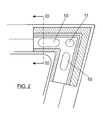
- Figure 2 shows a plan view of the corner area of the profile shown in Figure 1, with the flaps guiding and leading the glass pane partially sectioned according to section line II-II of Figure 3, including the embodiment of the invention.
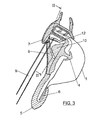
- Figure 3 shows a cross section of the guide of the invention, taken according to section line III-III of Figure 2.
- Figure 1 shows one of the upper angles 1 formed by the frame of a vehicle door which delimits the window. Along its sides, this frame has
slots 2 for fixing theguide 3 for the glass panes. On its rear surface, thisguide 3 hasprojections 4 finished in arrowhead shapes which are tightly introduced through theslots 2. Furthermore, theguide 3 constitutes a longitudinal C-shaped tab 5 which allows surrounding the innermost side oredge 6 of the door frame, thus achieving that theguide 3 completely hides the frame 1, as can be seen in Figure 3. - Assembly of this
guide 3 on the frame 1 is carried out by means of the following steps or stages:- 1.- The
peripheral tab 5 is adjusted around the inner edge of the enclosure or frame of the door window. - 2.- By means of a slight pressure with the fingers go over the entire coupling so that the
projections 4 are introduced and set into theslots 2 of the door frame. - 3.- Finally, and once the rubber guide is correctly positioned, the
corner area 3 at the bottom of which there is a fixing clip which can be introduced in a slot prepared to such end on the door frame is pressed until achieving its introduction and coupling, all this according to known arrangements and stages.
- 1.- The
- On its front portion, the
guide 3 is provided with twocontinuous flaps glass pane 9 of the door window slides and rests. When this glass pane reaches its end closing position, theflap 8 is slightly folded inwardly. A channel is defined betweenflaps corner area 3, projections or restingpositions flap 8 will rest, when flexed inwardly when theglass pane 9 reaches its end closing position. These projections or restingpositions flap 8, preventing it from being bent towards the inside of the channel defined byflaps - Flaps 7 and 8 run along the entire vertical and upper horizontal edges of the
guide 3. - According to another feature of the invention, projecting from the channel defined between
flaps longitudinal partition 12, Figure 3, against which the upper edge of the glass pane will rest, preventing it from getting excessively close to the guide wall. - As usual, on its outer surface the
flap 8 is provided with a coating preventing excessive friction between the glass pane and the guiding surface. For the same purpose thepartition 12 is provided with a similar coating on the surface directed towards theglass pane 9. - With the described arrangement, in the profile of the invention the
flaps positions flap 8 against which theglass pane 9 will firmly rest, in the corner area of the window, when said glass pane reaches its upper end position, in which position the upper edge rests againstpartition 12.
Claims (2)
- A guide for liftable glass panes of vehicle door windows, made up of a profile (3) made from elastically strainable material which is fixed along the vertical sides and the upper horizontal side of the door cavity intended for the window and having in its rear portion pin-shaped projections intended for being tightly introduced through openings in the frame, whereas in the front portion it has two continuous flaps (7, 8) between which the glass pane (9) of the door window slides and rests, characterised in that on the corner areas (1) formed between the vertical sides and the upper side and on the bottom of the channel delimited by the aforementioned two flaps (7, 8), it is provided with projections or resting positions (10, 11) on which the inner flap rests when the glass pane (9) reaches said corners (1) preventing its retraction and the glass pane (9) remaining compressed between the two flaps (7, 8).
- A guide according to claim 1, characterised in that between the two flaps (7, 8) it is provided with a flexible longitudinal partition (12) which starts from the base of the innermost flap, on which partition (12) the edge of the glass pane (9) rests when it reaches the closing position.
Applications Claiming Priority (1)
| Application Number | Priority Date | Filing Date | Title |
|---|---|---|---|
| ES200402713U ES1059026Y (en) | 2004-11-29 | 2004-11-29 | GUIDE FOR ELEVABLE CRYSTALS OF VEHICLE DOOR WINDOWS. |
Publications (2)
| Publication Number | Publication Date |
|---|---|
| EP1662084A2 true EP1662084A2 (en) | 2006-05-31 |
| EP1662084A3 EP1662084A3 (en) | 2009-10-14 |
Family
ID=34355219
Family Applications (1)
| Application Number | Title | Priority Date | Filing Date |
|---|---|---|---|
| EP05380223A Withdrawn EP1662084A3 (en) | 2004-11-29 | 2005-10-11 | Guide for liftable glass panes of vehicle door windows |
Country Status (2)
| Country | Link |
|---|---|
| EP (1) | EP1662084A3 (en) |
| ES (1) | ES1059026Y (en) |
Cited By (3)
| Publication number | Priority date | Publication date | Assignee | Title |
|---|---|---|---|---|
| JP2009227243A (en) * | 2008-03-25 | 2009-10-08 | Toyoda Gosei Co Ltd | Glass run for automobile |
| FR2951407A1 (en) * | 2009-10-19 | 2011-04-22 | Peugeot Citroen Automobiles Sa | SEALING MODULE AND ASSEMBLY FORMED THEREOF OF A SEALING MODULE AND A DOOR, VEHICLE COMPRISING SUCH AN ASSEMBLY. |
| CN105882369A (en) * | 2016-04-20 | 2016-08-24 | 上汽通用汽车有限公司 | Vehicle door window frame |
Family Cites Families (3)
| Publication number | Priority date | Publication date | Assignee | Title |
|---|---|---|---|---|
| JP3412551B2 (en) * | 1999-03-31 | 2003-06-03 | 豊田合成株式会社 | Car door glass run |
| JP3931023B2 (en) * | 2000-07-06 | 2007-06-13 | 豊田合成株式会社 | Door glass run |
| AU2003302632A1 (en) * | 2002-12-04 | 2004-06-23 | Gdx North America Inc. | Window sealing and guiding arrangements |
-
2004
- 2004-11-29 ES ES200402713U patent/ES1059026Y/en not_active Expired - Fee Related
-
2005
- 2005-10-11 EP EP05380223A patent/EP1662084A3/en not_active Withdrawn
Cited By (3)
| Publication number | Priority date | Publication date | Assignee | Title |
|---|---|---|---|---|
| JP2009227243A (en) * | 2008-03-25 | 2009-10-08 | Toyoda Gosei Co Ltd | Glass run for automobile |
| FR2951407A1 (en) * | 2009-10-19 | 2011-04-22 | Peugeot Citroen Automobiles Sa | SEALING MODULE AND ASSEMBLY FORMED THEREOF OF A SEALING MODULE AND A DOOR, VEHICLE COMPRISING SUCH AN ASSEMBLY. |
| CN105882369A (en) * | 2016-04-20 | 2016-08-24 | 上汽通用汽车有限公司 | Vehicle door window frame |
Also Published As
| Publication number | Publication date |
|---|---|
| ES1059026U (en) | 2005-03-01 |
| EP1662084A3 (en) | 2009-10-14 |
| ES1059026Y (en) | 2005-06-16 |
Similar Documents
| Publication | Publication Date | Title |
|---|---|---|
| US11241945B2 (en) | Automobile door glass run | |
| EP0068367B1 (en) | Sealing structure for a movable window | |
| JP6700900B2 (en) | Sealing material for automobile doors | |
| RU2602847C2 (en) | Car door (versions) | |
| EP0040588A1 (en) | Structure for supporting and guiding vertically-movable panes in side windows of motorvehicle bodies | |
| JPH0331026A (en) | Seal strip | |
| JP6833480B2 (en) | Mounting structure of glass run for car doors | |
| IT201600089226A1 (en) | Finishing and sealing assembly for an edge of a motor vehicle window. | |
| JP5651656B2 (en) | Vehicle door | |
| JPH0769058A (en) | Waist belt structure of car | |
| CN103171411A (en) | Glass-run retainer for automobile door and door structure of automobile | |
| EP1785302A2 (en) | Door structure of a motor vehicle | |
| JP2002067700A (en) | Glass run for automobile | |
| JP2566989B2 (en) | Movable flash / glass window system | |
| US5495693A (en) | Vehicle door assembly | |
| JPS6022198Y2 (en) | automotive glass launch channel | |
| US11926195B2 (en) | Sealing structure for vehicle door | |
| JP4271786B2 (en) | Sunroof deflector structure | |
| JP3797522B2 (en) | Door and glass run | |
| JPH0331606Y2 (en) | ||
| CN222061726U (en) | Exterior components, groove components, doors and vehicles | |
| JPS6343134Y2 (en) | ||
| JPH0329212Y2 (en) | ||
| JPH021133Y2 (en) | ||
| JP4962859B2 (en) | Glass run |
Legal Events
| Date | Code | Title | Description |
|---|---|---|---|
| PUAI | Public reference made under article 153(3) epc to a published international application that has entered the european phase |
Free format text: ORIGINAL CODE: 0009012 |
|
| AK | Designated contracting states |
Kind code of ref document: A2 Designated state(s): AT BE BG CH CY CZ DE DK EE ES FI FR GB GR HU IE IS IT LI LT LU LV MC NL PL PT RO SE SI SK TR |
|
| AX | Request for extension of the european patent |
Extension state: AL BA HR MK YU |
|
| PUAL | Search report despatched |
Free format text: ORIGINAL CODE: 0009013 |
|
| AK | Designated contracting states |
Kind code of ref document: A3 Designated state(s): AT BE BG CH CY CZ DE DK EE ES FI FR GB GR HU IE IS IT LI LT LU LV MC NL PL PT RO SE SI SK TR |
|
| AX | Request for extension of the european patent |
Extension state: AL BA HR MK YU |
|
| 17P | Request for examination filed |
Effective date: 20100413 |
|
| AKX | Designation fees paid |
Designated state(s): DE ES FR GB IT |
|
| 17Q | First examination report despatched |
Effective date: 20100623 |
|
| STAA | Information on the status of an ep patent application or granted ep patent |
Free format text: STATUS: THE APPLICATION IS DEEMED TO BE WITHDRAWN |
|
| 18D | Application deemed to be withdrawn |
Effective date: 20110104 |