EP1657333A1 - Stretchable nonwovens - Google Patents
Stretchable nonwovens Download PDFInfo
- Publication number
- EP1657333A1 EP1657333A1 EP20050024281 EP05024281A EP1657333A1 EP 1657333 A1 EP1657333 A1 EP 1657333A1 EP 20050024281 EP20050024281 EP 20050024281 EP 05024281 A EP05024281 A EP 05024281A EP 1657333 A1 EP1657333 A1 EP 1657333A1
- Authority
- EP
- European Patent Office
- Prior art keywords
- fibers
- web
- temperature
- nonwoven fabric
- filaments
- Prior art date
- Legal status (The legal status is an assumption and is not a legal conclusion. Google has not performed a legal analysis and makes no representation as to the accuracy of the status listed.)
- Granted
Links
- 239000004745 nonwoven fabric Substances 0.000 title claims description 43
- 239000000835 fiber Substances 0.000 claims abstract description 81
- 229920000642 polymer Polymers 0.000 claims abstract description 35
- 239000000463 material Substances 0.000 claims abstract description 30
- 238000000034 method Methods 0.000 claims description 28
- 229920000728 polyester Polymers 0.000 claims description 7
- 239000004952 Polyamide Substances 0.000 claims description 6
- 210000003632 microfilament Anatomy 0.000 claims description 6
- 229920002647 polyamide Polymers 0.000 claims description 6
- 238000001816 cooling Methods 0.000 claims description 3
- 238000002844 melting Methods 0.000 claims description 3
- 230000008018 melting Effects 0.000 claims description 3
- 229920000098 polyolefin Polymers 0.000 claims description 3
- 102000002151 Microfilament Proteins Human genes 0.000 claims description 2
- 108010040897 Microfilament Proteins Proteins 0.000 claims description 2
- 239000000203 mixture Substances 0.000 claims description 2
- 239000004744 fabric Substances 0.000 description 18
- 238000004519 manufacturing process Methods 0.000 description 10
- 238000011084 recovery Methods 0.000 description 8
- 239000002131 composite material Substances 0.000 description 6
- 239000002243 precursor Substances 0.000 description 6
- 238000010438 heat treatment Methods 0.000 description 5
- 239000004753 textile Substances 0.000 description 5
- 229920001169 thermoplastic Polymers 0.000 description 5
- 230000008901 benefit Effects 0.000 description 4
- -1 polypropylene Polymers 0.000 description 4
- 239000004416 thermosoftening plastic Substances 0.000 description 4
- 238000007664 blowing Methods 0.000 description 3
- 238000010791 quenching Methods 0.000 description 3
- 230000000171 quenching effect Effects 0.000 description 3
- 229920001410 Microfiber Polymers 0.000 description 2
- 239000004743 Polypropylene Substances 0.000 description 2
- 229920001577 copolymer Polymers 0.000 description 2
- 239000012530 fluid Substances 0.000 description 2
- 239000000155 melt Substances 0.000 description 2
- 238000002074 melt spinning Methods 0.000 description 2
- 239000003658 microfiber Substances 0.000 description 2
- 229920001155 polypropylene Polymers 0.000 description 2
- 229920005989 resin Polymers 0.000 description 2
- 239000011347 resin Substances 0.000 description 2
- 239000000126 substance Substances 0.000 description 2
- 229920002725 thermoplastic elastomer Polymers 0.000 description 2
- XLYOFNOQVPJJNP-UHFFFAOYSA-N water Substances O XLYOFNOQVPJJNP-UHFFFAOYSA-N 0.000 description 2
- 238000004804 winding Methods 0.000 description 2
- WSQZNZLOZXSBHA-UHFFFAOYSA-N 3,8-dioxabicyclo[8.2.2]tetradeca-1(12),10,13-triene-2,9-dione Chemical compound O=C1OCCCCOC(=O)C2=CC=C1C=C2 WSQZNZLOZXSBHA-UHFFFAOYSA-N 0.000 description 1
- 229920002614 Polyether block amide Polymers 0.000 description 1
- 239000000853 adhesive Substances 0.000 description 1
- 230000001070 adhesive effect Effects 0.000 description 1
- 239000000956 alloy Substances 0.000 description 1
- 229910045601 alloy Inorganic materials 0.000 description 1
- 238000003491 array Methods 0.000 description 1
- 230000015572 biosynthetic process Effects 0.000 description 1
- 229920001400 block copolymer Polymers 0.000 description 1
- 239000011248 coating agent Substances 0.000 description 1
- 238000000576 coating method Methods 0.000 description 1
- 230000001427 coherent effect Effects 0.000 description 1
- 238000010276 construction Methods 0.000 description 1
- 238000010924 continuous production Methods 0.000 description 1
- 238000002788 crimping Methods 0.000 description 1
- 238000000151 deposition Methods 0.000 description 1
- 238000009826 distribution Methods 0.000 description 1
- 210000004177 elastic tissue Anatomy 0.000 description 1
- 229920001971 elastomer Polymers 0.000 description 1
- 239000000806 elastomer Substances 0.000 description 1
- 230000009477 glass transition Effects 0.000 description 1
- 239000008187 granular material Substances 0.000 description 1
- 238000009998 heat setting Methods 0.000 description 1
- 229920001519 homopolymer Polymers 0.000 description 1
- 238000003384 imaging method Methods 0.000 description 1
- 230000001788 irregular Effects 0.000 description 1
- 238000009940 knitting Methods 0.000 description 1
- 238000003475 lamination Methods 0.000 description 1
- 229920000126 latex Polymers 0.000 description 1
- 239000004816 latex Substances 0.000 description 1
- 239000011159 matrix material Substances 0.000 description 1
- 229940127554 medical product Drugs 0.000 description 1
- 238000000059 patterning Methods 0.000 description 1
- 238000002360 preparation method Methods 0.000 description 1
- 238000003283 slot draw process Methods 0.000 description 1
- 238000009987 spinning Methods 0.000 description 1
- KKEYFWRCBNTPAC-UHFFFAOYSA-L terephthalate(2-) Chemical compound [O-]C(=O)C1=CC=C(C([O-])=O)C=C1 KKEYFWRCBNTPAC-UHFFFAOYSA-L 0.000 description 1
- 229920005992 thermoplastic resin Polymers 0.000 description 1
- 229920001187 thermosetting polymer Polymers 0.000 description 1
- 229920002554 vinyl polymer Polymers 0.000 description 1
- 238000009941 weaving Methods 0.000 description 1
Images


Classifications
-
- D—TEXTILES; PAPER
- D04—BRAIDING; LACE-MAKING; KNITTING; TRIMMINGS; NON-WOVEN FABRICS
- D04H—MAKING TEXTILE FABRICS, e.g. FROM FIBRES OR FILAMENTARY MATERIAL; FABRICS MADE BY SUCH PROCESSES OR APPARATUS, e.g. FELTS, NON-WOVEN FABRICS; COTTON-WOOL; WADDING ; NON-WOVEN FABRICS FROM STAPLE FIBRES, FILAMENTS OR YARNS, BONDED WITH AT LEAST ONE WEB-LIKE MATERIAL DURING THEIR CONSOLIDATION
- D04H3/00—Non-woven fabrics formed wholly or mainly of yarns or like filamentary material of substantial length
- D04H3/08—Non-woven fabrics formed wholly or mainly of yarns or like filamentary material of substantial length characterised by the method of strengthening or consolidating
- D04H3/16—Non-woven fabrics formed wholly or mainly of yarns or like filamentary material of substantial length characterised by the method of strengthening or consolidating with bonds between thermoplastic filaments produced in association with filament formation, e.g. immediately following extrusion
-
- D—TEXTILES; PAPER
- D04—BRAIDING; LACE-MAKING; KNITTING; TRIMMINGS; NON-WOVEN FABRICS
- D04H—MAKING TEXTILE FABRICS, e.g. FROM FIBRES OR FILAMENTARY MATERIAL; FABRICS MADE BY SUCH PROCESSES OR APPARATUS, e.g. FELTS, NON-WOVEN FABRICS; COTTON-WOOL; WADDING ; NON-WOVEN FABRICS FROM STAPLE FIBRES, FILAMENTS OR YARNS, BONDED WITH AT LEAST ONE WEB-LIKE MATERIAL DURING THEIR CONSOLIDATION
- D04H1/00—Non-woven fabrics formed wholly or mainly of staple fibres or like relatively short fibres
- D04H1/70—Non-woven fabrics formed wholly or mainly of staple fibres or like relatively short fibres characterised by the method of forming fleeces or layers, e.g. reorientation of fibres
- D04H1/74—Non-woven fabrics formed wholly or mainly of staple fibres or like relatively short fibres characterised by the method of forming fleeces or layers, e.g. reorientation of fibres the fibres being orientated, e.g. in parallel (anisotropic fleeces)
-
- D—TEXTILES; PAPER
- D04—BRAIDING; LACE-MAKING; KNITTING; TRIMMINGS; NON-WOVEN FABRICS
- D04H—MAKING TEXTILE FABRICS, e.g. FROM FIBRES OR FILAMENTARY MATERIAL; FABRICS MADE BY SUCH PROCESSES OR APPARATUS, e.g. FELTS, NON-WOVEN FABRICS; COTTON-WOOL; WADDING ; NON-WOVEN FABRICS FROM STAPLE FIBRES, FILAMENTS OR YARNS, BONDED WITH AT LEAST ONE WEB-LIKE MATERIAL DURING THEIR CONSOLIDATION
- D04H3/00—Non-woven fabrics formed wholly or mainly of yarns or like filamentary material of substantial length
- D04H3/02—Non-woven fabrics formed wholly or mainly of yarns or like filamentary material of substantial length characterised by the method of forming fleeces or layers, e.g. reorientation of yarns or filaments
-
- D—TEXTILES; PAPER
- D04—BRAIDING; LACE-MAKING; KNITTING; TRIMMINGS; NON-WOVEN FABRICS
- D04H—MAKING TEXTILE FABRICS, e.g. FROM FIBRES OR FILAMENTARY MATERIAL; FABRICS MADE BY SUCH PROCESSES OR APPARATUS, e.g. FELTS, NON-WOVEN FABRICS; COTTON-WOOL; WADDING ; NON-WOVEN FABRICS FROM STAPLE FIBRES, FILAMENTS OR YARNS, BONDED WITH AT LEAST ONE WEB-LIKE MATERIAL DURING THEIR CONSOLIDATION
- D04H3/00—Non-woven fabrics formed wholly or mainly of yarns or like filamentary material of substantial length
- D04H3/08—Non-woven fabrics formed wholly or mainly of yarns or like filamentary material of substantial length characterised by the method of strengthening or consolidating
- D04H3/10—Non-woven fabrics formed wholly or mainly of yarns or like filamentary material of substantial length characterised by the method of strengthening or consolidating with bonds between yarns or filaments made mechanically
- D04H3/11—Non-woven fabrics formed wholly or mainly of yarns or like filamentary material of substantial length characterised by the method of strengthening or consolidating with bonds between yarns or filaments made mechanically by fluid jet
-
- Y—GENERAL TAGGING OF NEW TECHNOLOGICAL DEVELOPMENTS; GENERAL TAGGING OF CROSS-SECTIONAL TECHNOLOGIES SPANNING OVER SEVERAL SECTIONS OF THE IPC; TECHNICAL SUBJECTS COVERED BY FORMER USPC CROSS-REFERENCE ART COLLECTIONS [XRACs] AND DIGESTS
- Y10—TECHNICAL SUBJECTS COVERED BY FORMER USPC
- Y10T—TECHNICAL SUBJECTS COVERED BY FORMER US CLASSIFICATION
- Y10T442/00—Fabric [woven, knitted, or nonwoven textile or cloth, etc.]
- Y10T442/60—Nonwoven fabric [i.e., nonwoven strand or fiber material]
- Y10T442/601—Nonwoven fabric has an elastic quality
-
- Y—GENERAL TAGGING OF NEW TECHNOLOGICAL DEVELOPMENTS; GENERAL TAGGING OF CROSS-SECTIONAL TECHNOLOGIES SPANNING OVER SEVERAL SECTIONS OF THE IPC; TECHNICAL SUBJECTS COVERED BY FORMER USPC CROSS-REFERENCE ART COLLECTIONS [XRACs] AND DIGESTS
- Y10—TECHNICAL SUBJECTS COVERED BY FORMER USPC
- Y10T—TECHNICAL SUBJECTS COVERED BY FORMER US CLASSIFICATION
- Y10T442/00—Fabric [woven, knitted, or nonwoven textile or cloth, etc.]
- Y10T442/60—Nonwoven fabric [i.e., nonwoven strand or fiber material]
- Y10T442/608—Including strand or fiber material which is of specific structural definition
- Y10T442/614—Strand or fiber material specified as having microdimensions [i.e., microfiber]
-
- Y—GENERAL TAGGING OF NEW TECHNOLOGICAL DEVELOPMENTS; GENERAL TAGGING OF CROSS-SECTIONAL TECHNOLOGIES SPANNING OVER SEVERAL SECTIONS OF THE IPC; TECHNICAL SUBJECTS COVERED BY FORMER USPC CROSS-REFERENCE ART COLLECTIONS [XRACs] AND DIGESTS
- Y10—TECHNICAL SUBJECTS COVERED BY FORMER USPC
- Y10T—TECHNICAL SUBJECTS COVERED BY FORMER US CLASSIFICATION
- Y10T442/00—Fabric [woven, knitted, or nonwoven textile or cloth, etc.]
- Y10T442/60—Nonwoven fabric [i.e., nonwoven strand or fiber material]
- Y10T442/608—Including strand or fiber material which is of specific structural definition
- Y10T442/614—Strand or fiber material specified as having microdimensions [i.e., microfiber]
- Y10T442/622—Microfiber is a composite fiber
-
- Y—GENERAL TAGGING OF NEW TECHNOLOGICAL DEVELOPMENTS; GENERAL TAGGING OF CROSS-SECTIONAL TECHNOLOGIES SPANNING OVER SEVERAL SECTIONS OF THE IPC; TECHNICAL SUBJECTS COVERED BY FORMER USPC CROSS-REFERENCE ART COLLECTIONS [XRACs] AND DIGESTS
- Y10—TECHNICAL SUBJECTS COVERED BY FORMER USPC
- Y10T—TECHNICAL SUBJECTS COVERED BY FORMER US CLASSIFICATION
- Y10T442/00—Fabric [woven, knitted, or nonwoven textile or cloth, etc.]
- Y10T442/60—Nonwoven fabric [i.e., nonwoven strand or fiber material]
- Y10T442/608—Including strand or fiber material which is of specific structural definition
- Y10T442/614—Strand or fiber material specified as having microdimensions [i.e., microfiber]
- Y10T442/625—Autogenously bonded
-
- Y—GENERAL TAGGING OF NEW TECHNOLOGICAL DEVELOPMENTS; GENERAL TAGGING OF CROSS-SECTIONAL TECHNOLOGIES SPANNING OVER SEVERAL SECTIONS OF THE IPC; TECHNICAL SUBJECTS COVERED BY FORMER USPC CROSS-REFERENCE ART COLLECTIONS [XRACs] AND DIGESTS
- Y10—TECHNICAL SUBJECTS COVERED BY FORMER USPC
- Y10T—TECHNICAL SUBJECTS COVERED BY FORMER US CLASSIFICATION
- Y10T442/00—Fabric [woven, knitted, or nonwoven textile or cloth, etc.]
- Y10T442/60—Nonwoven fabric [i.e., nonwoven strand or fiber material]
- Y10T442/637—Including strand or fiber material which is a monofilament composed of two or more polymeric materials in physically distinct relationship [e.g., sheath-core, side-by-side, islands-in-sea, fibrils-in-matrix, etc.] or composed of physical blend of chemically different polymeric materials or a physical blend of a polymeric material and a filler material
-
- Y—GENERAL TAGGING OF NEW TECHNOLOGICAL DEVELOPMENTS; GENERAL TAGGING OF CROSS-SECTIONAL TECHNOLOGIES SPANNING OVER SEVERAL SECTIONS OF THE IPC; TECHNICAL SUBJECTS COVERED BY FORMER USPC CROSS-REFERENCE ART COLLECTIONS [XRACs] AND DIGESTS
- Y10—TECHNICAL SUBJECTS COVERED BY FORMER USPC
- Y10T—TECHNICAL SUBJECTS COVERED BY FORMER US CLASSIFICATION
- Y10T442/00—Fabric [woven, knitted, or nonwoven textile or cloth, etc.]
- Y10T442/60—Nonwoven fabric [i.e., nonwoven strand or fiber material]
- Y10T442/681—Spun-bonded nonwoven fabric
-
- Y—GENERAL TAGGING OF NEW TECHNOLOGICAL DEVELOPMENTS; GENERAL TAGGING OF CROSS-SECTIONAL TECHNOLOGIES SPANNING OVER SEVERAL SECTIONS OF THE IPC; TECHNICAL SUBJECTS COVERED BY FORMER USPC CROSS-REFERENCE ART COLLECTIONS [XRACs] AND DIGESTS
- Y10—TECHNICAL SUBJECTS COVERED BY FORMER USPC
- Y10T—TECHNICAL SUBJECTS COVERED BY FORMER US CLASSIFICATION
- Y10T442/00—Fabric [woven, knitted, or nonwoven textile or cloth, etc.]
- Y10T442/60—Nonwoven fabric [i.e., nonwoven strand or fiber material]
- Y10T442/682—Needled nonwoven fabric
-
- Y—GENERAL TAGGING OF NEW TECHNOLOGICAL DEVELOPMENTS; GENERAL TAGGING OF CROSS-SECTIONAL TECHNOLOGIES SPANNING OVER SEVERAL SECTIONS OF THE IPC; TECHNICAL SUBJECTS COVERED BY FORMER USPC CROSS-REFERENCE ART COLLECTIONS [XRACs] AND DIGESTS
- Y10—TECHNICAL SUBJECTS COVERED BY FORMER USPC
- Y10T—TECHNICAL SUBJECTS COVERED BY FORMER US CLASSIFICATION
- Y10T442/00—Fabric [woven, knitted, or nonwoven textile or cloth, etc.]
- Y10T442/60—Nonwoven fabric [i.e., nonwoven strand or fiber material]
- Y10T442/689—Hydroentangled nonwoven fabric
Definitions
- the present invention relates generally to stretchable nonwoven fabrics, and more particularly, to a method of making a nonwoven fabric the can be made to develop stretch and recovery.
- the methods for producing such stretchable nonwoven fabrics have particular utility as applied to continuous multicomponent filaments have a titer of 0.01 to 1.0 dtex and bonded.
- Nonwoven fabrics are used in a wide variety of applications such as medical products, personal care products, work garments, sports and leisure wear, shoe linings, bed linen and carpet construction. These types of fabrics differ from woven or knitted fabrics in that they are produced directly from individual fibers interlaid in an irregular pattern to form a fibrous mat, eliminating the traditional textile manufacturing processes of multi-step yam preparation, and weaving or knitting. Entanglement of the fibers or filaments of the fabric acts to provide the fabric with a substantial level of integrity.
- nonwoven fabrics are a highly developed art.
- nonwoven webs and their manufacture involve forming filaments or fibers and depositing them on a carrier in such manner so as to cause the filaments or fibers to overlap as a mat of a desired basis weight.
- the bonding of such a mat may be achieved by entanglement or by other means, such as adhesives, application or heat and/or pressure, or, in some cases, by pressure alone.
- Nonwoven fabrics or webs have been formed from many processes such as for example, meltblowing processes, spunbonding processes, bonded carded web processes and, more recently, meltspinning processes.
- thermoplastic resin is fed into an extruder where it is melted and heated to the appropriate temperature required for fiber formation.
- the extruder feeds the molten resin to a special meltblowing die.
- the die arrangement is generally a plurality of linearally arranged small diameter capillaries.
- the resin emerges from the die orifices as molten threads into a high velocity stream of gas, usually air.
- the air attenuates the polymer into a blast of fine fibers which are collected on a moving screen placed in front of the blast. As the fibers land on the screen, they entangle to form a cohesive web so that it is generally impossible to remove one complete fiber from the mass of fibers or to trace one fiber from beginning to end.
- the spinbonding process has also been used to produce nonwoven fabrics.
- Spunbonded webs can have a more pleasant feel than meltblown webs because they more closely approximate textile filament deniers and consequently textile-like drape and hand.
- splittable fibers or filaments comprise plural sub-components, typically comprising two or more different polymeric materials, with the sub-components arranged in side-by-side relationship along the length of the filaments or fibers.
- Various specific cross-sectional configurations are known, such as segmented-pie, islands-in-the-sea, flower-like, side-by-side arrays, as well as a variety of additional specific configurations.
- the sub-components of splittable fibers or filaments can be separated by various chemical or mechanical processing techniques.
- portions of the multi-component fiber or filament can be separated by heating, needlepunching, or water jet treatment.
- Suitable chemical treatment of some types of multi-component fibers or filaments acts to dissolve portions thereof, thus at least partially separating the sub-components of the fibers or filaments.
- United States Patent No. 4,426,420 entitled "Spunlaced Fabric Containing Elastic Fibers” and assigned to DuPont is directed at hydraulically entangled spunlaced fabrics which are heat treated to impart improved stretch properties.
- Two types of fibers comprise the batt, hard fibers (polyester, polyamide, etc.) and elastomeric fibers (preferably poly (butylene terephthalate)-co-poly-(tetramethyleneoxy) terephthalate at 10-25%).
- United States Patent No. 4,820,572 entitled “Composite Elastomeric Polyether Block Amide Nonwoven Web” assigned to Kimberly-Clark Corp. is directed at an elastomeric nonwoven web formed by meltblowing, a coherent matrix of preferably microfibers composed of a polyester blockamide copolymer.
- United States Patent No. 5,151,320 entitled “Hydroentangled Spunbonded Composite Fabric and Process” assigned to the Dexter Corporation is directed at a hydroentangled composite fabric made by subjecting a spunbonded base web material of continuous manmade filaments to stretching in the cross direction at least 5 percent of its original dimension, but less than the cross direction elongation of the material under ambient conditions at the time of stretching.
- a cover layer of fluid dispersible fibers is applied to the stretched base web to form a multilayer structure, and the structure subjected to hydroentanglement to join the layers.
- United States Patent No. 5,227,224 entitled “Stretchable Nonwoven Fabrics and Method For Making Same” assigned to Chisso Corporation is directed at a uniform web comprising 70-100% by weight polypropylene base heat bondable composite fibers and 0-30% of other organic fibers (polyamide, polyester) having a web heat shrinkage percentage of 50% or higher at 120°C.
- the fibers are uniformly entangled together and "shrinked” as a result of sufficient entanglement imparted through further heat treatment (not under tension), resulting in a fabric having an elastic recovery at 30% elongation of 80% or higher in both warp and weft directions.
- United States Patent No. 5,549,964 entitled “Stretchable Nonwoven Fabric and Method of Manufactoring the Same” assigned to Asahi Kasei Kogyo Kabushiki Kaisha is directed at a stretchable nonwoven fabric manufactured by using a hydrogenated block copolymer.
- the copolymer preferably comprises a vinyl aromatic compound, a conjugated diene compound and a polyolefm and is melt blown.
- United States Patent No. 5,534,335 entitled "Nonwoven Fabric Formed From Alloy Fibers" assigned to Kimberly-Clark Corporation is directed at a nonwoven fabric comprising at least two thermoplastic polymers and a compatabilizer.
- One of the thermoplastics is present in a dominant continuous phase, (say a polypropylene) the other present as a non-continuous phase (say, a polyamide or a polyester).
- the melt temperature of the non-continuous phase polymer preferably is at least 30°C less than the melt temperature of the continuous phase polymer.
- the fiber may be melt blown or spunbonded.
- United States Patent No. 5,814,390 entitled “Creased Nonwoven Web With Stretch and Recovery” is assigned to Kimberly-Clark Worldwide and is directed at nonwoven fabrics produced by creasing a precursor using interdigitated rolls and heat setting the creases.
- the fabric preferably comprises a non-elastic olefm polymer-based thermoplastic fiber-comprising precursor web.
- United States Patent No. 5,910,224 entitled “Method for Forming An Elastic Necked-Bonded Material” is also assigned to Kimberly-Clark Worldwide and is directed at a method of making a stretchable composite by applying an elastomeric precursor to a neckable material, neck-stretching the neckable material and heating the elastomeric precursor while the neckable material is in a necked condition.
- the precursor may comprise a latex or thermoset elastomer.
- the neckable material may be formed by spunbonding or melt blowing preferably comprising, microfibers for instance polyester, polyamide and polyolefin.
- United States Patent No. 5,997,989 entitled "Elastic Nonwoven Webs and Method of Making Same” assigned to BBA Nonwovens Simpsonville, Inc. is directed at a spunbonded elastic nonwoven fabric, (and a process for making such) comprising a web of bonded thermoplastic filaments of a thermoplastic elastomer.
- a slot draw spunbonding process_ provides a web having an RMS recoverable elongation of at least 75% (MD and CD) after 30% elongation of the fabric and one pull.
- United States Patent No. 6,689,703 entitled "Elastically Stretchable Nonwoven Fabric and Fabric For Making the Same" assigned to Uni-Charm Corp. is directed at an elastically stretchable nonwoven fabric including thermoplastic elastomer filaments, the filaments being heat sealed and/or mechanically interwined together to form a nonwoven fabric that has crimped and non-crimped regions.
- the crimps are at a rate of 50/cm or higher.
- the crimps are formed by blowing hot air against an extrudate followed by blowing a warm or cold blast of air (at least 20°C less than the melting point of the filaments) against the filaments so that the filaments are stretched and reduced in diameter and are unevenly cooled, becoming at least partially crimped.
- the filaments are then heat sealed or mechanically intertwined to obtain the stretchable nonwoven fabric.
- United States Patent No. 6,692,541 entitled “Method of Making Nonwoven Fabric Comprising Splittable Fibers” assigned to Polymer Group, Inc is directed at a method where fabrics are formed from splittable filaments or staple length fibers having a plurality of sub-components which are at least partially separable into their sub-components by hydroentanglement.
- a three dimensional image transfer device having a foraminous forming surface is used to impart a distinct surface pattern or image to the precursor web during hydroentanglement.
- the web is preferably carded and cross-lapped prior to imaging and patterning.
- United States Patent Application 2003/0064650 entitled "Stretchable Multiple Component Spunbond Web And A Process For Making” assigned to DuPont is directed at providing high levels of three dimensional helical crimp utilizing draw rolls to provide a high degree of orientation.
- Filaments are mechanically drawn under conditions where the polymeric components remain substantially amorphous.
- the method comprises melt spinning continuous filaments comprising at least first and second distinct melt-spinnable polymers wherein the polymers are arranged in distinct substantially constantly positioned zones across the cross-section of the filaments in an eccentric relationship and extending substantially continuously along the length of the filaments.
- the filaments are quenched, passed over a series of rolls to anneal them (from amorphous to semicrystalline), tensioned and released to form helical crimps.
- nonwoven fabric which may be manufactured from spunbond material, and which may be elongated, and which has, e.g. elongation values in the range of about 5 to 70%.
- thermoplastic filamentous nonwoven spunbonded or a composite thereof
- hydroentangled such that it can be streteched and can be made to develop stretch and recovery.
- It is still further object of the present invention to provide a spun bonded nonwoven fabric comprising a web of filaments wherein one exposes a filament web that contains filaments that may be entangled and/or interlocked with one another, which is then stretched in a first selected direction at a selected temperature that provides stretching characteristics in a second direction other than the first direction.
- the present invention is directed at a nonwoven material which can be elongated in a selected direction, comprising a web of fibers comprising polymeric chains which fibers are entangled with one another characterized in that the fibers have been stretched in a first direction at a temperature wherein the fibers are aligned in said first direction and said polymeric chains in said fiber are orientated in said first direction.
- the fibers are then cooled below said temperature wherein the web of fibers demonstrate an ability to elongate in a second direction that is different from said first direction and wherein said fibers can also partially recover from said elongation in said second direction.
- the present invention is directed at a process for providing a nonwoven material with stretchable characteristics, comprising the steps of forming a web of polymeric filaments that are entangled with one another, wherein said polymeric filaments have a Tm. This may then be followed by stretching the web in a first direction at a temperature wherein said temperature is below Tm to align said fibers in said first direction and to orient said polymeric chains in said fiber in said first direction. This may then be followed by cooling said fibers below said temperature wherein said nonwoven material can elongate in a second direction that is different from said first direction and partially recover from said elongation in said second direction.
- this process may include the additional step wherein said web is further stretched across said width of said web, and wherein said nonwoven material can still elongate in a second direction across said width of said web and partially recover from said elongation.
- the present invention stands directed at a nonwoven material which can be elongated in a selected direction, comprising a web of fibers comprising polymeric chains which fibers are entangled with one another.
- the web of fibers comprise a microfilament nonwoven fabric having a weight of 30 to 150 g/m 2 and a tear strength of >40 N/5 cm, the nonwoven fabric being made of continuous multicomponent filaments having a titer of 1.5 to 5 dtex which are melt-spun, stretched, and directly laid down to form a nonwoven fabric, wherein the continuous multicomponent filaments are split, at least to the extent of 80%, to form continuous microfilaments having a titer of 0.01 to 1.0 dtex and bonded.
- the continuous multicomponent filaments may comprise a continuous bicomponent filament comprising two polymers.
- the two polymers may comprise a first polymer such as a polyester polymers, and a second polymer may comprise a polymer selected from the group consisting of polyamides, polyolefins, and mixtures thereof.
- the nonwoven fabric herein may be manufactured from a material manufactured and sold by Freudenberg Nonwovens under the trademark EvolonTM, which is identified as a textile made of microfilaments. It is reportedly manufactured in one continuous process, from polymer granulate to finished textile during which the spinning and laying down of the filaments in the web form are preferably combined with one another. Water jet bonding then provides the EvolonTM material which is constructed of endless microfilaments.
- EvolonTM which is identified as a textile made of microfilaments. It is reportedly manufactured in one continuous process, from polymer granulate to finished textile during which the spinning and laying down of the filaments in the web form are preferably combined with one another. Water jet bonding then provides the EvolonTM material which is constructed of endless microfilaments.
- the web of fibers may be unwound and fed at 10 to opposing rollers and preheated and stretched at 12 and 14 which provides a lengthwise stretch and an unconstrained widthwise shrinkage.
- the heating is such that the web of fibers comprising polymer chains are identified to have a melting point Tm and the temperature of preheating as noted above is at a temperature that is below Tm, and most preferably, about 0.1 - 20.0 °C below Tm.
- the temperature of preheating may be set to a temperature that is above Tg and below Tm, with respect to those polymers that may exhibit a glass transition temperature or Tg.
- the fibers, as illustrated are aligned in the lengthwise direction and the polymeric chains are also oriented in such direction.
- the fiber orientation (% frequency) has been plotted v. the orientation angle, prior to stretching, which therefore provides a view of the fiber orientation distribution (FOD).
- the fiber orientation (% frequency) has been plotted against orientation angle after stretching.
- FIGS. 3 and 4 it should be apparent that the fiber orientation is, subsequent to stretching, shifted towards the direction that the fabric is being stretched. Prior to stretching, the structure is relatively isotropic and after stretching the more anisotropic character can be seen.
- a tenter frame allows one to stretch the fabric back to its original width.
- the result of the preferred methodology illustrated in FIG. 1 is that upon quenching and winding at 18 it has been found that one produces a web of fibers that demonstrate an ability to elongate in a second direction that is different from the first (lengthwise) direction and wherein the fibers can partially recover from such elongation.
- the ability to elongate in the second direction may reach levels up to about 70 %, along with partial recovery.
- FIG. 2 illustrated therein is a two-step process for producing the stretchable material of the present invention.
- the step of unwinding and feeding is followed by preheating and stretching in a lengthwise direction at locations 22 and 24 facilitated by the use of rollers and heating via the use of said rollers to the desired temperatures, as herein described.
- the stretched fabric is quenched and wound and may be utilized in such form.
- the output at 26, after being quenched and wound may then again be unwound and fed at 28 such that upon travel between the rollers a widthwise stretch is imposed to a selected width at 30 followed by quenching and winding at 32.
Landscapes
- Engineering & Computer Science (AREA)
- Textile Engineering (AREA)
- Mechanical Engineering (AREA)
- Nonwoven Fabrics (AREA)
Abstract
Description
- The present invention relates generally to stretchable nonwoven fabrics, and more particularly, to a method of making a nonwoven fabric the can be made to develop stretch and recovery. The methods for producing such stretchable nonwoven fabrics have particular utility as applied to continuous multicomponent filaments have a titer of 0.01 to 1.0 dtex and bonded.
- Nonwoven fabrics are used in a wide variety of applications such as medical products, personal care products, work garments, sports and leisure wear, shoe linings, bed linen and carpet construction. These types of fabrics differ from woven or knitted fabrics in that they are produced directly from individual fibers interlaid in an irregular pattern to form a fibrous mat, eliminating the traditional textile manufacturing processes of multi-step yam preparation, and weaving or knitting. Entanglement of the fibers or filaments of the fabric acts to provide the fabric with a substantial level of integrity.
- The manufacture of nonwoven fabrics is a highly developed art. In general, nonwoven webs and their manufacture involve forming filaments or fibers and depositing them on a carrier in such manner so as to cause the filaments or fibers to overlap as a mat of a desired basis weight. The bonding of such a mat may be achieved by entanglement or by other means, such as adhesives, application or heat and/or pressure, or, in some cases, by pressure alone.
- Nonwoven fabrics or webs have been formed from many processes such as for example, meltblowing processes, spunbonding processes, bonded carded web processes and, more recently, meltspinning processes.
- In meltblowing, thermoplastic resin is fed into an extruder where it is melted and heated to the appropriate temperature required for fiber formation. The extruder feeds the molten resin to a special meltblowing die. The die arrangement is generally a plurality of linearally arranged small diameter capillaries. The resin emerges from the die orifices as molten threads into a high velocity stream of gas, usually air. The air attenuates the polymer into a blast of fine fibers which are collected on a moving screen placed in front of the blast. As the fibers land on the screen, they entangle to form a cohesive web so that it is generally impossible to remove one complete fiber from the mass of fibers or to trace one fiber from beginning to end.
- The spinbonding process has also been used to produce nonwoven fabrics. Various spinbonding techniques exist, but all include the basic steps of: extruding continuous filaments, quenching the filaments, drawing or attenuating the filaments by a high velocity fluid, and collecting the filaments on a surface to form a web. Spunbonded webs can have a more pleasant feel than meltblown webs because they more closely approximate textile filament deniers and consequently textile-like drape and hand.
- While manufacture of nonwoven fabrics from homopolymer, single component filaments or fibers is well known, use of multi-component "splittable" fibers or filaments can be advantageous for some applications. These types of splittable fibers or filaments comprise plural sub-components, typically comprising two or more different polymeric materials, with the sub-components arranged in side-by-side relationship along the length of the filaments or fibers. Various specific cross-sectional configurations are known, such as segmented-pie, islands-in-the-sea, flower-like, side-by-side arrays, as well as a variety of additional specific configurations.
- The sub-components of splittable fibers or filaments can be separated by various chemical or mechanical processing techniques. For example, portions of the multi-component fiber or filament can be separated by heating, needlepunching, or water jet treatment. Suitable chemical treatment of some types of multi-component fibers or filaments acts to dissolve portions thereof, thus at least partially separating the sub-components of the fibers or filaments.
- While woven and knitted fabrics provide a level of hand, drape and stretch that is preferred over most nonwoven fabrics, these benefits are somewhat offset by the cost and complexity of the textile manufacturing processes used to produce woven and knitted fabrics. There have been numerous attempts to improve the stretch and recovery characteristics of nonwoven fabrics to take advantage of the lower manufacturing costs. These include the use of more expensive elastomeric fibers in the web, as well as additional processing steps such as the lamination or coating of the web with other materials, and mechanical crimping of some of the fibers.
- United States Patent No. 4,426,420 entitled "Spunlaced Fabric Containing Elastic Fibers" and assigned to DuPont is directed at hydraulically entangled spunlaced fabrics which are heat treated to impart improved stretch properties. Two types of fibers comprise the batt, hard fibers (polyester, polyamide, etc.) and elastomeric fibers (preferably poly (butylene terephthalate)-co-poly-(tetramethyleneoxy) terephthalate at 10-25%).
- United States Patent No. 4,820,572 entitled "Composite Elastomeric Polyether Block Amide Nonwoven Web" assigned to Kimberly-Clark Corp. is directed at an elastomeric nonwoven web formed by meltblowing, a coherent matrix of preferably microfibers composed of a polyester blockamide copolymer.
- United States Patent No. 5,151,320 entitled "Hydroentangled Spunbonded Composite Fabric and Process" assigned to the Dexter Corporation is directed at a hydroentangled composite fabric made by subjecting a spunbonded base web material of continuous manmade filaments to stretching in the cross direction at least 5 percent of its original dimension, but less than the cross direction elongation of the material under ambient conditions at the time of stretching. A cover layer of fluid dispersible fibers is applied to the stretched base web to form a multilayer structure, and the structure subjected to hydroentanglement to join the layers.
- United States Patent No. 5,227,224 entitled "Stretchable Nonwoven Fabrics and Method For Making Same" assigned to Chisso Corporation is directed at a uniform web comprising 70-100% by weight polypropylene base heat bondable composite fibers and 0-30% of other organic fibers (polyamide, polyester) having a web heat shrinkage percentage of 50% or higher at 120°C. The fibers are uniformly entangled together and "shrinked" as a result of sufficient entanglement imparted through further heat treatment (not under tension), resulting in a fabric having an elastic recovery at 30% elongation of 80% or higher in both warp and weft directions.
- United States Patent No. 5,540,976 entitled "Nonwoven Laminate With Cross Directional Stretch" assigned to Kimberly-Clark Corporation is directed at a laminate comprising three layers. The outer layers of spunbond non-woven fiber webs are made of crimped or crimpable fibers and the inner layer is an elastomeric polymer layer. The layers are preferably bonded together by hydroentanglement.
- United States Patent No. 5,549,964 entitled "Stretchable Nonwoven Fabric and Method of Manufactoring the Same" assigned to Asahi Kasei Kogyo Kabushiki Kaisha is directed at a stretchable nonwoven fabric manufactured by using a hydrogenated block copolymer. The copolymer preferably comprises a vinyl aromatic compound, a conjugated diene compound and a polyolefm and is melt blown.
- United States Patent No. 5,534,335 entitled "Nonwoven Fabric Formed From Alloy Fibers" assigned to Kimberly-Clark Corporation is directed at a nonwoven fabric comprising at least two thermoplastic polymers and a compatabilizer. One of the thermoplastics is present in a dominant continuous phase, (say a polypropylene) the other present as a non-continuous phase (say, a polyamide or a polyester). The melt temperature of the non-continuous phase polymer preferably is at least 30°C less than the melt temperature of the continuous phase polymer. The fiber may be melt blown or spunbonded.
- United States Patent No. 5,814,390 entitled "Creased Nonwoven Web With Stretch and Recovery" is assigned to Kimberly-Clark Worldwide and is directed at nonwoven fabrics produced by creasing a precursor using interdigitated rolls and heat setting the creases. The fabric preferably comprises a non-elastic olefm polymer-based thermoplastic fiber-comprising precursor web.
- United States Patent No. 5,910,224, entitled "Method for Forming An Elastic Necked-Bonded Material" is also assigned to Kimberly-Clark Worldwide and is directed at a method of making a stretchable composite by applying an elastomeric precursor to a neckable material, neck-stretching the neckable material and heating the elastomeric precursor while the neckable material is in a necked condition. The precursor may comprise a latex or thermoset elastomer. The neckable material may be formed by spunbonding or melt blowing preferably comprising, microfibers for instance polyester, polyamide and polyolefin.
- United States Patent No. 5,997,989 entitled "Elastic Nonwoven Webs and Method of Making Same" assigned to BBA Nonwovens Simpsonville, Inc. is directed at a spunbonded elastic nonwoven fabric, (and a process for making such) comprising a web of bonded thermoplastic filaments of a thermoplastic elastomer. A slot draw spunbonding process_provides a web having an RMS recoverable elongation of at least 75% (MD and CD) after 30% elongation of the fabric and one pull.
- United States Patent No. 6,689,703 entitled "Elastically Stretchable Nonwoven Fabric and Fabric For Making the Same" assigned to Uni-Charm Corp. is directed at an elastically stretchable nonwoven fabric including thermoplastic elastomer filaments, the filaments being heat sealed and/or mechanically interwined together to form a nonwoven fabric that has crimped and non-crimped regions. The crimps are at a rate of 50/cm or higher. The crimps are formed by blowing hot air against an extrudate followed by blowing a warm or cold blast of air (at least 20°C less than the melting point of the filaments) against the filaments so that the filaments are stretched and reduced in diameter and are unevenly cooled, becoming at least partially crimped. The filaments are then heat sealed or mechanically intertwined to obtain the stretchable nonwoven fabric.
- United States Patent No. 6,692,541 entitled "Method of Making Nonwoven Fabric Comprising Splittable Fibers" assigned to Polymer Group, Inc is directed at a method where fabrics are formed from splittable filaments or staple length fibers having a plurality of sub-components which are at least partially separable into their sub-components by hydroentanglement. A three dimensional image transfer device having a foraminous forming surface is used to impart a distinct surface pattern or image to the precursor web during hydroentanglement. The web is preferably carded and cross-lapped prior to imaging and patterning.
- United States Patent Application 2003/0064650 entitled "Stretchable Multiple Component Spunbond Web And A Process For Making" assigned to DuPont is directed at providing high levels of three dimensional helical crimp utilizing draw rolls to provide a high degree of orientation. Filaments are mechanically drawn under conditions where the polymeric components remain substantially amorphous. The method comprises melt spinning continuous filaments comprising at least first and second distinct melt-spinnable polymers wherein the polymers are arranged in distinct substantially constantly positioned zones across the cross-section of the filaments in an eccentric relationship and extending substantially continuously along the length of the filaments. The filaments are quenched, passed over a series of rolls to anneal them (from amorphous to semicrystalline), tensioned and released to form helical crimps.
- What is therefore needed is a nonwoven fabric capable of elongation and recovery and which improves upon the prior art and which can be readily manufactured in accordance with the invention herein.
- It is thus one object of the present invention to provide a nonwoven fabric, which may be manufactured from spunbond material, and which may be elongated, and which has, e.g. elongation values in the range of about 5 to 70%.
- It is a more specific object of the present invention to provide any thermoplastic filamentous nonwoven (spunbonded or a composite thereof) that is hydroentangled such that it can be streteched and can be made to develop stretch and recovery.
- It is still further object of the present invention to provide a spun bonded nonwoven fabric comprising a web of filaments wherein one exposes a filament web that contains filaments that may be entangled and/or interlocked with one another, which is then stretched in a first selected direction at a selected temperature that provides stretching characteristics in a second direction other than the first direction.
- In one embodiment, the present invention is directed at a nonwoven material which can be elongated in a selected direction, comprising a web of fibers comprising polymeric chains which fibers are entangled with one another characterized in that the fibers have been stretched in a first direction at a temperature wherein the fibers are aligned in said first direction and said polymeric chains in said fiber are orientated in said first direction. The fibers are then cooled below said temperature wherein the web of fibers demonstrate an ability to elongate in a second direction that is different from said first direction and wherein said fibers can also partially recover from said elongation in said second direction.
- In a second alternative embodiment the present invention is directed at a process for providing a nonwoven material with stretchable characteristics, comprising the steps of forming a web of polymeric filaments that are entangled with one another, wherein said polymeric filaments have a Tm. This may then be followed by stretching the web in a first direction at a temperature wherein said temperature is below Tm to align said fibers in said first direction and to orient said polymeric chains in said fiber in said first direction. This may then be followed by cooling said fibers below said temperature wherein said nonwoven material can elongate in a second direction that is different from said first direction and partially recover from said elongation in said second direction. Optionally, this process may include the additional step wherein said web is further stretched across said width of said web, and wherein said nonwoven material can still elongate in a second direction across said width of said web and partially recover from said elongation.
- The above and other objects, features and advantages of the invention will become further apparent upon consideration of the written description and the appended drawings in which,
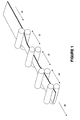
- FIG. 1 is an illustration of a one-step process for producing the stretchable material of the present invention.
- FIG. 2 is an illustration of a two-step process for producing the stretchable material of the present invention.
- FIG. 3 is a graph of fiber orientation v. orientation angle prior to stretching.
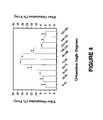
- FIG. 4 is a graph of fiber orientation v. orientation angle after stretching.
- In a first preferred embodiment, the present invention stands directed at a nonwoven material which can be elongated in a selected direction, comprising a web of fibers comprising polymeric chains which fibers are entangled with one another.
- Preferably, the web of fibers comprise a microfilament nonwoven fabric having a weight of 30 to 150 g/m2 and a tear strength of >40 N/5 cm, the nonwoven fabric being made of continuous multicomponent filaments having a titer of 1.5 to 5 dtex which are melt-spun, stretched, and directly laid down to form a nonwoven fabric, wherein the continuous multicomponent filaments are split, at least to the extent of 80%, to form continuous microfilaments having a titer of 0.01 to 1.0 dtex and bonded.
- More preferably, the continuous multicomponent filaments may comprise a continuous bicomponent filament comprising two polymers. The two polymers may comprise a first polymer such as a polyester polymers, and a second polymer may comprise a polymer selected from the group consisting of polyamides, polyolefins, and mixtures thereof.
- In one particularly preferred embodiment, the nonwoven fabric herein may be manufactured from a material manufactured and sold by Freudenberg Nonwovens under the trademark Evolon™, which is identified as a textile made of microfilaments. It is reportedly manufactured in one continuous process, from polymer granulate to finished textile during which the spinning and laying down of the filaments in the web form are preferably combined with one another. Water jet bonding then provides the Evolon™ material which is constructed of endless microfilaments.
- With reference to FIG. 1 herein, the web of fibers may be unwound and fed at 10 to opposing rollers and preheated and stretched at 12 and 14 which provides a lengthwise stretch and an unconstrained widthwise shrinkage. Preferably, the heating is such that the web of fibers comprising polymer chains are identified to have a melting point Tm and the temperature of preheating as noted above is at a temperature that is below Tm, and most preferably, about 0.1 - 20.0 °C below Tm. In addition, the temperature of preheating may be set to a temperature that is above Tg and below Tm, with respect to those polymers that may exhibit a glass transition temperature or Tg. Preferably the fibers, as illustrated, are aligned in the lengthwise direction and the polymeric chains are also oriented in such direction.
- In addition, with reference to FIG. 3 herein, the fiber orientation (% frequency) has been plotted v. the orientation angle, prior to stretching, which therefore provides a view of the fiber orientation distribution (FOD). Turning to FIG. 4 herein, the fiber orientation (% frequency) has been plotted against orientation angle after stretching. Upon comparison of FIGS. 3 and 4 it should be apparent that the fiber orientation is, subsequent to stretching, shifted towards the direction that the fabric is being stretched. Prior to stretching, the structure is relatively isotropic and after stretching the more anisotropic character can be seen.
- Returning then to FIG. 1, it can then be seen that at 16 one may optionally impose a widthwise stretch wherein the width may be set to a desired size, by the use, e.g., of a tenter frame. Those of skill in the art will recognize that a tenter frame allows one to stretch the fabric back to its original width. In any event, the result of the preferred methodology illustrated in FIG. 1 is that upon quenching and winding at 18 it has been found that one produces a web of fibers that demonstrate an ability to elongate in a second direction that is different from the first (lengthwise) direction and wherein the fibers can partially recover from such elongation. Along such lines it has been found that the ability to elongate in the second direction may reach levels up to about 70 %, along with partial recovery.
- With attention now focused to FIG. 2, illustrated therein is a two-step process for producing the stretchable material of the present invention. It can be seen at 20 the step of unwinding and feeding is followed by preheating and stretching in a lengthwise direction at
locations - In accordance with the present invention it therefore has been found that one can uniquely prepare a stretchable nonwoven material which would allow for utility in a number of applications where the advantages of the nonwoven material can be utilized, and now, along with the ability of such nonwoven to provide stretch and recovery characteristics.
- While the present invention has therefore been described in connection with certain preferred embodiments, it is understood that the subject matter ecnompased by way of the present invention is not to be limited to those specific embodiments. It is therefore intended that the subject matter of the present invention include all equivalents that may fall within the scope of the following claims.
Claims (15)
- A nonwoven material which can be elongated in a selected direction, comprising(a) a web of fibers comprising polymeric chains which fibers are entangled with one another characterized in that:(i) said fibers have been stretched in a first direction at a temperature
wherein said fibers are aligned in said first direction and said polymeric chains in said fiber are orientated in said first direction; and(ii) said fibers have been cooled below said temperature;wherein said web of fibers demonstrate an ability to elongate in a second direction that is different from said first direction and wherein said fibers can also partially recover from said elongation in said second direction. - The nonwoven fabric of claim 1 wherein said polymeric chains have a melting point Tm, and said temperature is below Tm.
- The nonwoven fabric of claim 2 wherein temperature below Tm is about 0.1- 20 °C below Tm.
- The nonwoven fabric of claim 1 wherein said polymer chains have a Tg and Tm, and said temperature is at or above Tg and below Tm.
- The nonwoven fabric of claim 1 wherein said fibers elongate in said second direction up to about 70% and partially recover.
- The nonwoven fabric of claim 1 wherein said second direction is substantially perpendicular to said first direction.
- The nonwoven fabric of claim 1 wherein said web of fibers comprises a microfilament nonwoven fabric having a weight of 30 to 150 g/m2 and a tear strength of >40 N/5 cm, the nonwoven fabric being made of continuous multicomponent filaments having a titer of 1.5 to 5 dtex which are melt-spun, stretched, and directly laid down to form a nonwoven fabric, wherein the continuous multicomponent filaments are split, at least to the extent of 80%, to form continuous microfilaments having a titer of 0.01 to 1.0 dtex and bonded.
- The nonwoven fabric of claim 7 wherein said continuous multicomponent filaments comprise a continuous bicomponent filament comprising two polymers.
- The nonwoven fabric of claim 8 wherein one of said polymers comprises a polyester polymers, and one of said polymers comprise a polymer selected from the group consisting of polyamides, polyolefins, and mixtures thereof.
- A process for providing a nonwoven material with stretchable characteristics, comprising the steps of:(a) forming a web of polymeric filaments that are entangled with one another,
wherein said polymeric filaments have a Tm;(b) stretching said web in a first direction at a temperature wherein said temperature is below Tm to align said fibers in said first direction and to orient said polymeric chains in said fiber in said first direction;(c) cooling said fibers below said temperature wherein said nonwoven material can elongate in a second direction that is different from said first direction and partially recover from said elongation in said second direction. - The process of claim 10 wherein said temperature below Tm is about 0.1-20 °C below Tm.
- The process of claim 10 wherein said fibers elongate in said second direction up to about 70% and partially recover.
- A process for providing a nonwoven material with stretchable characteristics, comprising the steps of:(a) forming a web of polymeric filaments that are entangled with one another, wherein said polymeric filaments have a Tm and said web has a length and a width;(b) stretching said web in a first direction coinciding with said web length at a temperature wherein said temperature is below Tm to align said fibers in said first direction and to orient said polymeric chains in said fiber in said first direction and
wherein said width of said web is reduced;(c) cooling said fibers below said temperature wherein said nonwoven material can elongate in a second direction across said width of said web and partially recover from said elongation. - The process of claim 13 wherein including the additional step wherein said web is further stretched across said width of said web, and wherein said nonwoven material can still elongate in a second direction across said width of said web and partially recover from said elongation.
- The process of claim 13 wherein said step of stretching across said width of said web comprises placing said web on a tenter frame.
Applications Claiming Priority (1)
| Application Number | Priority Date | Filing Date | Title |
|---|---|---|---|
| US62704904P | 2004-11-10 | 2004-11-10 |
Publications (2)
| Publication Number | Publication Date |
|---|---|
| EP1657333A1 true EP1657333A1 (en) | 2006-05-17 |
| EP1657333B1 EP1657333B1 (en) | 2008-01-09 |
Family
ID=35788963
Family Applications (1)
| Application Number | Title | Priority Date | Filing Date |
|---|---|---|---|
| EP20050024281 Expired - Lifetime EP1657333B1 (en) | 2004-11-10 | 2005-11-08 | Stretchable nonwovens |
Country Status (7)
| Country | Link |
|---|---|
| US (1) | US20060166583A1 (en) |
| EP (1) | EP1657333B1 (en) |
| JP (1) | JP2006138060A (en) |
| CN (1) | CN1958911A (en) |
| AT (1) | ATE383464T1 (en) |
| DE (1) | DE602005004234T2 (en) |
| TW (1) | TWI301163B (en) |
Families Citing this family (5)
| Publication number | Priority date | Publication date | Assignee | Title |
|---|---|---|---|---|
| US8083764B2 (en) * | 2001-02-28 | 2011-12-27 | Dedo Richard G | Tourniquet padding |
| US7108868B2 (en) | 2002-03-22 | 2006-09-19 | Unigen Pharmaceuticals, Inc. | Isolation of a dual cox-2 and 5-lipoxygenase inhibitor from acacia |
| KR100761248B1 (en) * | 2006-10-12 | 2007-10-04 | 주식회사 유니젠 | Composition for the treatment of atopic dermatitis containing bamboo and golden extract as active ingredients |
| CN105463707B (en) * | 2015-11-30 | 2017-08-04 | 佛山市南海必得福无纺布有限公司 | A kind of non-woven fabrics stretches unit |
| US11589693B2 (en) * | 2016-10-20 | 2023-02-28 | Purple Innovation, Llc | Bed linens, and related bedding assemblies and methods |
Citations (5)
| Publication number | Priority date | Publication date | Assignee | Title |
|---|---|---|---|---|
| US5910224A (en) * | 1996-10-11 | 1999-06-08 | Kimberly-Clark Worldwide, Inc. | Method for forming an elastic necked-bonded material |
| EP0933460A1 (en) * | 1998-01-30 | 1999-08-04 | Nippon Petrochemicals Company, Limited | Extendable nonwoven fabric and method for producing the same |
| US20010008675A1 (en) * | 1998-11-06 | 2001-07-19 | Meece Barry Dewayne | Unidirectionally cold stretched nonwoven webs of multipolymer fibers for stretch fabrics and disposable absorbent articles containing them |
| US20010025153A1 (en) * | 2000-02-28 | 2001-09-27 | Dieter Groitzsch | Medical bandaging material |
| US6372172B1 (en) * | 1997-12-19 | 2002-04-16 | Kimberly-Clark Worldwide, Inc. | Nonwoven webs having improved softness and barrier properties |
Family Cites Families (36)
| Publication number | Priority date | Publication date | Assignee | Title |
|---|---|---|---|---|
| US3949128A (en) * | 1972-08-22 | 1976-04-06 | Kimberly-Clark Corporation | Product and process for producing a stretchable nonwoven material from a spot bonded continuous filament web |
| US4088731A (en) * | 1976-07-28 | 1978-05-09 | Clupak, Inc. | Method of softening nonwoven fabrics |
| US4426420A (en) * | 1982-09-17 | 1984-01-17 | E. I. Du Pont De Nemours And Company | Spunlaced fabric containing elastic fibers |
| US4426417A (en) * | 1983-03-28 | 1984-01-17 | Kimberly-Clark Corporation | Nonwoven wiper |
| US4551378A (en) * | 1984-07-11 | 1985-11-05 | Minnesota Mining And Manufacturing Company | Nonwoven thermal insulating stretch fabric and method for producing same |
| US4820572A (en) * | 1986-10-15 | 1989-04-11 | Kimberly-Clark Corporation | Composite elastomeric polyether block amide nonwoven web |
| US5162074A (en) * | 1987-10-02 | 1992-11-10 | Basf Corporation | Method of making plural component fibers |
| JP2577977B2 (en) * | 1988-10-28 | 1997-02-05 | チッソ株式会社 | Stretchable nonwoven fabric and method for producing the same |
| US5549964A (en) * | 1988-12-27 | 1996-08-27 | Asahi Kasei Kogyo Kabushiki Kaisha | Stretchable nonwoven fabric and method of manufacturing the same |
| US5997989A (en) * | 1992-02-03 | 1999-12-07 | Bba Nonwovens Simpsonville, Inc. | Elastic nonwoven webs and method of making same |
| US5151320A (en) * | 1992-02-25 | 1992-09-29 | The Dexter Corporation | Hydroentangled spunbonded composite fabric and process |
| US5244482A (en) * | 1992-03-26 | 1993-09-14 | The University Of Tennessee Research Corporation | Post-treatment of nonwoven webs |
| CA2111172A1 (en) * | 1993-09-23 | 1995-03-24 | Dennis S. Everhart | Nonwoven fabric formed from alloy fibers |
| US5804286A (en) * | 1995-11-22 | 1998-09-08 | Fiberweb North America, Inc. | Extensible composite nonwoven fabrics |
| EP0757127A4 (en) * | 1994-11-25 | 1999-08-25 | Polymer Processing Res Inst | FLEECE FROM STRETCHED LONG FIBERS FROM DIFFERENT POLYMERS AND METHOD FOR THE PRODUCTION THEREOF |
| US5540976A (en) * | 1995-01-11 | 1996-07-30 | Kimberly-Clark Corporation | Nonwoven laminate with cross directional stretch |
| DE19518975C1 (en) * | 1995-05-23 | 1996-06-13 | Freudenberg Carl Fa | Cleaning cloth |
| US5814390A (en) * | 1995-06-30 | 1998-09-29 | Kimberly-Clark Worldwide, Inc. | Creased nonwoven web with stretch and recovery |
| JP3016361B2 (en) * | 1996-03-27 | 2000-03-06 | ユニチカ株式会社 | Unidirectional elastic nonwoven fabric and method for producing the same |
| FR2749860B1 (en) * | 1996-06-17 | 1998-08-28 | Freudenberg Spunweb Sa | NON WOVEN TABLECLOTH FORMED OF VERY THIN CONTINUOUS FILAMENTS |
| US5948528A (en) * | 1996-10-30 | 1999-09-07 | Basf Corporation | Process for modifying synthetic bicomponent fiber cross-sections and bicomponent fibers thereby produced |
| FR2790489B1 (en) * | 1999-03-01 | 2001-04-20 | Freudenberg Carl Fa | TABLECLOTH NOT WOVEN IN THERMOLIA FILAMENTS OR FIBERS |
| JP3550052B2 (en) * | 1999-06-28 | 2004-08-04 | ユニ・チャーム株式会社 | Stretchable nonwoven fabric and method for producing the same |
| US6465073B1 (en) * | 1999-06-30 | 2002-10-15 | Kimberly-Clark Worldwide, Inc. | Variable stretch material and process to make it |
| DE10002778B4 (en) * | 2000-01-22 | 2012-05-24 | Robert Groten | Use of a microfilament nonwoven fabric as a cleaning cloth |
| DE10009280B4 (en) * | 2000-02-28 | 2006-05-18 | Carl Freudenberg Kg | Composite material and process for its production |
| US6692541B2 (en) * | 2000-05-16 | 2004-02-17 | Polymer Group, Inc. | Method of making nonwoven fabric comprising splittable fibers |
| DE10117970C1 (en) * | 2001-01-19 | 2002-10-24 | Freudenberg Carl Kg | Process for producing monocomponent microfilaments and obtaining a nonwoven, woven or knitted fabric from the microfilaments |
| DE10115185A1 (en) * | 2001-03-27 | 2002-10-24 | Freudenberg Carl Kg | Splittable yarns, fibers or filaments and process for their production and device |
| US6743506B2 (en) * | 2001-05-10 | 2004-06-01 | The Procter & Gamble Company | High elongation splittable multicomponent fibers comprising starch and polymers |
| JP4070965B2 (en) * | 2001-06-08 | 2008-04-02 | ユニ・チャーム株式会社 | Stretchable composite sheet and method for forming a large number of wrinkles on stretchable composite sheet |
| DE10139228A1 (en) * | 2001-08-09 | 2003-03-06 | Freudenberg Carl Kg | Stretching device and method for producing stretched plastic filaments |
| US6887423B2 (en) * | 2001-09-26 | 2005-05-03 | E. I. Du Pont De Nemours And Company | Process for making a stretchable nonwoven web |
| US20030118776A1 (en) * | 2001-12-20 | 2003-06-26 | Kimberly-Clark Worldwide, Inc. | Entangled fabrics |
| US6808786B2 (en) * | 2003-02-04 | 2004-10-26 | Freudenberg Nonwovens | Automotive tufted carpet with enhanced acoustical properties |
| EP1538250B1 (en) * | 2003-12-05 | 2010-01-20 | Phoenix Intellectuals and Technologies Management, Inc. | Process for preparing an elastic nonwoven web |
-
2005
- 2005-11-08 DE DE200560004234 patent/DE602005004234T2/en not_active Expired - Lifetime
- 2005-11-08 AT AT05024281T patent/ATE383464T1/en active
- 2005-11-08 EP EP20050024281 patent/EP1657333B1/en not_active Expired - Lifetime
- 2005-11-09 JP JP2005325105A patent/JP2006138060A/en active Pending
- 2005-11-10 TW TW94139454A patent/TWI301163B/en active
- 2005-11-10 US US11/272,436 patent/US20060166583A1/en not_active Abandoned
- 2005-11-10 CN CNA2005101216930A patent/CN1958911A/en active Pending
Patent Citations (5)
| Publication number | Priority date | Publication date | Assignee | Title |
|---|---|---|---|---|
| US5910224A (en) * | 1996-10-11 | 1999-06-08 | Kimberly-Clark Worldwide, Inc. | Method for forming an elastic necked-bonded material |
| US6372172B1 (en) * | 1997-12-19 | 2002-04-16 | Kimberly-Clark Worldwide, Inc. | Nonwoven webs having improved softness and barrier properties |
| EP0933460A1 (en) * | 1998-01-30 | 1999-08-04 | Nippon Petrochemicals Company, Limited | Extendable nonwoven fabric and method for producing the same |
| US20010008675A1 (en) * | 1998-11-06 | 2001-07-19 | Meece Barry Dewayne | Unidirectionally cold stretched nonwoven webs of multipolymer fibers for stretch fabrics and disposable absorbent articles containing them |
| US20010025153A1 (en) * | 2000-02-28 | 2001-09-27 | Dieter Groitzsch | Medical bandaging material |
Also Published As
| Publication number | Publication date |
|---|---|
| TWI301163B (en) | 2008-09-21 |
| ATE383464T1 (en) | 2008-01-15 |
| DE602005004234D1 (en) | 2008-02-21 |
| JP2006138060A (en) | 2006-06-01 |
| US20060166583A1 (en) | 2006-07-27 |
| DE602005004234T2 (en) | 2009-01-08 |
| EP1657333B1 (en) | 2008-01-09 |
| TW200643248A (en) | 2006-12-16 |
| CN1958911A (en) | 2007-05-09 |
Similar Documents
| Publication | Publication Date | Title |
|---|---|---|
| US7005395B2 (en) | Stretchable composite sheets and processes for making | |
| US7201816B2 (en) | High bulk composite sheets and method for preparing | |
| US5393599A (en) | Composite nonwoven fabrics | |
| EP0534863A1 (en) | Bonded composite nonwoven web and process | |
| US7036197B2 (en) | Stretchable multiple-component nonwoven fabrics and methods for preparing | |
| KR100923610B1 (en) | Elastic composite sheet and its manufacturing method | |
| US20060068176A1 (en) | High bulk composite sheets and method for preparing | |
| EP1430168B1 (en) | Stretchable multiple component spunbond webs and a process for making | |
| US20090068422A1 (en) | Multilayer stretch nonwoven fabric composites | |
| JP2005536647A (en) | Nonwoven web with improved necking uniformity | |
| CN101755083A (en) | Non-woven material | |
| EP1657333B1 (en) | Stretchable nonwovens | |
| JP5902257B2 (en) | Method for producing composite nonwoven sheet | |
| KR102599166B1 (en) | Manufacturing method of multi-functional non-woven fabric and multi-functional non-woven fabric prepared therefrom | |
| CN1182145A (en) | Lightweight, breathable and waterproof multilayer nonwoven fabric and production method thereof | |
| US20060260736A1 (en) | Method of making a dual performance nonwoven and the products therefrom | |
| JPH10273870A (en) | Composite non-woven fabric and its production | |
| JPH10158970A (en) | Composite nonwoven fabric and its production | |
| JPH10298860A (en) | Continuous filament nonwoven fabric for construction and its production | |
| WO2005118933A2 (en) | Filamentary blanket | |
| JP2012001854A (en) | Composite nonwoven sheet and manufacturing method thereof |
Legal Events
| Date | Code | Title | Description |
|---|---|---|---|
| PUAI | Public reference made under article 153(3) epc to a published international application that has entered the european phase |
Free format text: ORIGINAL CODE: 0009012 |
|
| AK | Designated contracting states |
Kind code of ref document: A1 Designated state(s): AT BE BG CH CY CZ DE DK EE ES FI FR GB GR HU IE IS IT LI LT LU LV MC NL PL PT RO SE SI SK TR |
|
| AX | Request for extension of the european patent |
Extension state: AL BA HR MK YU |
|
| 17P | Request for examination filed |
Effective date: 20060608 |
|
| 17Q | First examination report despatched |
Effective date: 20060920 |
|
| AKX | Designation fees paid |
Designated state(s): AT BE BG CH CY CZ DE DK EE ES FI FR GB GR HU IE IS IT LI LT LU LV MC NL PL PT RO SE SI SK TR |
|
| 17Q | First examination report despatched |
Effective date: 20060920 |
|
| GRAP | Despatch of communication of intention to grant a patent |
Free format text: ORIGINAL CODE: EPIDOSNIGR1 |
|
| GRAS | Grant fee paid |
Free format text: ORIGINAL CODE: EPIDOSNIGR3 |
|
| GRAA | (expected) grant |
Free format text: ORIGINAL CODE: 0009210 |
|
| AK | Designated contracting states |
Kind code of ref document: B1 Designated state(s): AT BE BG CH CY CZ DE DK EE ES FI FR GB GR HU IE IS IT LI LT LU LV MC NL PL PT RO SE SI SK TR |
|
| REG | Reference to a national code |
Ref country code: GB Ref legal event code: FG4D |
|
| REG | Reference to a national code |
Ref country code: CH Ref legal event code: EP |
|
| REG | Reference to a national code |
Ref country code: IE Ref legal event code: FG4D |
|
| REF | Corresponds to: |
Ref document number: 602005004234 Country of ref document: DE Date of ref document: 20080221 Kind code of ref document: P |
|
| PG25 | Lapsed in a contracting state [announced via postgrant information from national office to epo] |
Ref country code: SI Free format text: LAPSE BECAUSE OF FAILURE TO SUBMIT A TRANSLATION OF THE DESCRIPTION OR TO PAY THE FEE WITHIN THE PRESCRIBED TIME-LIMIT Effective date: 20080109 |
|
| PG25 | Lapsed in a contracting state [announced via postgrant information from national office to epo] |
Ref country code: IS Free format text: LAPSE BECAUSE OF FAILURE TO SUBMIT A TRANSLATION OF THE DESCRIPTION OR TO PAY THE FEE WITHIN THE PRESCRIBED TIME-LIMIT Effective date: 20080509 Ref country code: FI Free format text: LAPSE BECAUSE OF FAILURE TO SUBMIT A TRANSLATION OF THE DESCRIPTION OR TO PAY THE FEE WITHIN THE PRESCRIBED TIME-LIMIT Effective date: 20080109 Ref country code: LI Free format text: LAPSE BECAUSE OF FAILURE TO SUBMIT A TRANSLATION OF THE DESCRIPTION OR TO PAY THE FEE WITHIN THE PRESCRIBED TIME-LIMIT Effective date: 20080109 Ref country code: CH Free format text: LAPSE BECAUSE OF FAILURE TO SUBMIT A TRANSLATION OF THE DESCRIPTION OR TO PAY THE FEE WITHIN THE PRESCRIBED TIME-LIMIT Effective date: 20080109 Ref country code: LT Free format text: LAPSE BECAUSE OF FAILURE TO SUBMIT A TRANSLATION OF THE DESCRIPTION OR TO PAY THE FEE WITHIN THE PRESCRIBED TIME-LIMIT Effective date: 20080109 Ref country code: ES Free format text: LAPSE BECAUSE OF FAILURE TO SUBMIT A TRANSLATION OF THE DESCRIPTION OR TO PAY THE FEE WITHIN THE PRESCRIBED TIME-LIMIT Effective date: 20080420 |
|
| REG | Reference to a national code |
Ref country code: CH Ref legal event code: PL |
|
| PG25 | Lapsed in a contracting state [announced via postgrant information from national office to epo] |
Ref country code: BG Free format text: LAPSE BECAUSE OF FAILURE TO SUBMIT A TRANSLATION OF THE DESCRIPTION OR TO PAY THE FEE WITHIN THE PRESCRIBED TIME-LIMIT Effective date: 20080409 |
|
| ET | Fr: translation filed | ||
| PG25 | Lapsed in a contracting state [announced via postgrant information from national office to epo] |
Ref country code: LV Free format text: LAPSE BECAUSE OF FAILURE TO SUBMIT A TRANSLATION OF THE DESCRIPTION OR TO PAY THE FEE WITHIN THE PRESCRIBED TIME-LIMIT Effective date: 20080109 Ref country code: PL Free format text: LAPSE BECAUSE OF FAILURE TO SUBMIT A TRANSLATION OF THE DESCRIPTION OR TO PAY THE FEE WITHIN THE PRESCRIBED TIME-LIMIT Effective date: 20080109 Ref country code: PT Free format text: LAPSE BECAUSE OF FAILURE TO SUBMIT A TRANSLATION OF THE DESCRIPTION OR TO PAY THE FEE WITHIN THE PRESCRIBED TIME-LIMIT Effective date: 20080609 |
|
| PG25 | Lapsed in a contracting state [announced via postgrant information from national office to epo] |
Ref country code: CZ Free format text: LAPSE BECAUSE OF FAILURE TO SUBMIT A TRANSLATION OF THE DESCRIPTION OR TO PAY THE FEE WITHIN THE PRESCRIBED TIME-LIMIT Effective date: 20080109 Ref country code: DK Free format text: LAPSE BECAUSE OF FAILURE TO SUBMIT A TRANSLATION OF THE DESCRIPTION OR TO PAY THE FEE WITHIN THE PRESCRIBED TIME-LIMIT Effective date: 20080109 Ref country code: SK Free format text: LAPSE BECAUSE OF FAILURE TO SUBMIT A TRANSLATION OF THE DESCRIPTION OR TO PAY THE FEE WITHIN THE PRESCRIBED TIME-LIMIT Effective date: 20080109 Ref country code: SE Free format text: LAPSE BECAUSE OF FAILURE TO SUBMIT A TRANSLATION OF THE DESCRIPTION OR TO PAY THE FEE WITHIN THE PRESCRIBED TIME-LIMIT Effective date: 20080409 |
|
| PLBE | No opposition filed within time limit |
Free format text: ORIGINAL CODE: 0009261 |
|
| STAA | Information on the status of an ep patent application or granted ep patent |
Free format text: STATUS: NO OPPOSITION FILED WITHIN TIME LIMIT |
|
| PG25 | Lapsed in a contracting state [announced via postgrant information from national office to epo] |
Ref country code: RO Free format text: LAPSE BECAUSE OF FAILURE TO SUBMIT A TRANSLATION OF THE DESCRIPTION OR TO PAY THE FEE WITHIN THE PRESCRIBED TIME-LIMIT Effective date: 20080109 |
|
| 26N | No opposition filed |
Effective date: 20081010 |
|
| PG25 | Lapsed in a contracting state [announced via postgrant information from national office to epo] |
Ref country code: EE Free format text: LAPSE BECAUSE OF FAILURE TO SUBMIT A TRANSLATION OF THE DESCRIPTION OR TO PAY THE FEE WITHIN THE PRESCRIBED TIME-LIMIT Effective date: 20080109 |
|
| PG25 | Lapsed in a contracting state [announced via postgrant information from national office to epo] |
Ref country code: MC Free format text: LAPSE BECAUSE OF NON-PAYMENT OF DUE FEES Effective date: 20081130 |
|
| PG25 | Lapsed in a contracting state [announced via postgrant information from national office to epo] |
Ref country code: CY Free format text: LAPSE BECAUSE OF FAILURE TO SUBMIT A TRANSLATION OF THE DESCRIPTION OR TO PAY THE FEE WITHIN THE PRESCRIBED TIME-LIMIT Effective date: 20080109 |
|
| PG25 | Lapsed in a contracting state [announced via postgrant information from national office to epo] |
Ref country code: IT Free format text: LAPSE BECAUSE OF FAILURE TO SUBMIT A TRANSLATION OF THE DESCRIPTION OR TO PAY THE FEE WITHIN THE PRESCRIBED TIME-LIMIT Effective date: 20080109 |
|
| PG25 | Lapsed in a contracting state [announced via postgrant information from national office to epo] |
Ref country code: IE Free format text: LAPSE BECAUSE OF NON-PAYMENT OF DUE FEES Effective date: 20081110 |
|
| PG25 | Lapsed in a contracting state [announced via postgrant information from national office to epo] |
Ref country code: LU Free format text: LAPSE BECAUSE OF NON-PAYMENT OF DUE FEES Effective date: 20081108 Ref country code: HU Free format text: LAPSE BECAUSE OF FAILURE TO SUBMIT A TRANSLATION OF THE DESCRIPTION OR TO PAY THE FEE WITHIN THE PRESCRIBED TIME-LIMIT Effective date: 20080710 |
|
| PG25 | Lapsed in a contracting state [announced via postgrant information from national office to epo] |
Ref country code: TR Free format text: LAPSE BECAUSE OF FAILURE TO SUBMIT A TRANSLATION OF THE DESCRIPTION OR TO PAY THE FEE WITHIN THE PRESCRIBED TIME-LIMIT Effective date: 20080109 |
|
| PG25 | Lapsed in a contracting state [announced via postgrant information from national office to epo] |
Ref country code: GR Free format text: LAPSE BECAUSE OF FAILURE TO SUBMIT A TRANSLATION OF THE DESCRIPTION OR TO PAY THE FEE WITHIN THE PRESCRIBED TIME-LIMIT Effective date: 20080410 |
|
| PGFP | Annual fee paid to national office [announced via postgrant information from national office to epo] |
Ref country code: AT Payment date: 20101122 Year of fee payment: 6 Ref country code: FR Payment date: 20101209 Year of fee payment: 6 Ref country code: NL Payment date: 20101130 Year of fee payment: 6 |
|
| PGFP | Annual fee paid to national office [announced via postgrant information from national office to epo] |
Ref country code: DE Payment date: 20101201 Year of fee payment: 6 |
|
| PGFP | Annual fee paid to national office [announced via postgrant information from national office to epo] |
Ref country code: GB Payment date: 20101213 Year of fee payment: 6 |
|
| PGFP | Annual fee paid to national office [announced via postgrant information from national office to epo] |
Ref country code: BE Payment date: 20101201 Year of fee payment: 6 |
|
| BERE | Be: lapsed |
Owner name: CARL FREUDENBERG K.G. Effective date: 20111130 |
|
| REG | Reference to a national code |
Ref country code: NL Ref legal event code: V1 Effective date: 20120601 |
|
| GBPC | Gb: european patent ceased through non-payment of renewal fee |
Effective date: 20111108 |
|
| PG25 | Lapsed in a contracting state [announced via postgrant information from national office to epo] |
Ref country code: NL Free format text: LAPSE BECAUSE OF NON-PAYMENT OF DUE FEES Effective date: 20120601 |
|
| REG | Reference to a national code |
Ref country code: FR Ref legal event code: ST Effective date: 20120731 |
|
| PG25 | Lapsed in a contracting state [announced via postgrant information from national office to epo] |
Ref country code: BE Free format text: LAPSE BECAUSE OF NON-PAYMENT OF DUE FEES Effective date: 20111130 |
|
| REG | Reference to a national code |
Ref country code: DE Ref legal event code: R119 Ref document number: 602005004234 Country of ref document: DE Effective date: 20120601 |
|
| PG25 | Lapsed in a contracting state [announced via postgrant information from national office to epo] |
Ref country code: GB Free format text: LAPSE BECAUSE OF NON-PAYMENT OF DUE FEES Effective date: 20111108 |
|
| REG | Reference to a national code |
Ref country code: AT Ref legal event code: MM01 Ref document number: 383464 Country of ref document: AT Kind code of ref document: T Effective date: 20111108 |
|
| PG25 | Lapsed in a contracting state [announced via postgrant information from national office to epo] |
Ref country code: FR Free format text: LAPSE BECAUSE OF NON-PAYMENT OF DUE FEES Effective date: 20111130 |
|
| PG25 | Lapsed in a contracting state [announced via postgrant information from national office to epo] |
Ref country code: AT Free format text: LAPSE BECAUSE OF NON-PAYMENT OF DUE FEES Effective date: 20111108 |
|
| PG25 | Lapsed in a contracting state [announced via postgrant information from national office to epo] |
Ref country code: DE Free format text: LAPSE BECAUSE OF NON-PAYMENT OF DUE FEES Effective date: 20120601 |