EP1656452B1 - Expression vectors, transformed host cells and fermentation process for the production of recombinant polypeptides - Google Patents
Expression vectors, transformed host cells and fermentation process for the production of recombinant polypeptides Download PDFInfo
- Publication number
- EP1656452B1 EP1656452B1 EP04764066A EP04764066A EP1656452B1 EP 1656452 B1 EP1656452 B1 EP 1656452B1 EP 04764066 A EP04764066 A EP 04764066A EP 04764066 A EP04764066 A EP 04764066A EP 1656452 B1 EP1656452 B1 EP 1656452B1
- Authority
- EP
- European Patent Office
- Prior art keywords
- host cell
- polypeptide
- interest
- polynucleotide
- vector
- Prior art date
- Legal status (The legal status is an assumption and is not a legal conclusion. Google has not performed a legal analysis and makes no representation as to the accuracy of the status listed.)
- Expired - Lifetime
Links
- 102000004196 processed proteins & peptides Human genes 0.000 title claims abstract description 65
- 108090000765 processed proteins & peptides Proteins 0.000 title claims abstract description 65
- 229920001184 polypeptide Polymers 0.000 title claims abstract description 64
- 239000013604 expression vector Substances 0.000 title claims abstract description 30
- 238000004519 manufacturing process Methods 0.000 title claims abstract description 22
- 238000000855 fermentation Methods 0.000 title claims description 28
- 230000004151 fermentation Effects 0.000 title claims description 28
- 108090000623 proteins and genes Proteins 0.000 claims abstract description 71
- 108010076504 Protein Sorting Signals Proteins 0.000 claims abstract description 58
- 108091033319 polynucleotide Proteins 0.000 claims abstract description 58
- 239000002157 polynucleotide Substances 0.000 claims abstract description 58
- 102000040430 polynucleotide Human genes 0.000 claims abstract description 58
- 238000000034 method Methods 0.000 claims abstract description 54
- 230000008569 process Effects 0.000 claims abstract description 46
- 241000589539 Brevundimonas diminuta Species 0.000 claims abstract description 44
- 108020001507 fusion proteins Proteins 0.000 claims abstract description 34
- 102000037865 fusion proteins Human genes 0.000 claims abstract description 34
- 210000004027 cell Anatomy 0.000 claims description 106
- 102100040018 Interferon alpha-2 Human genes 0.000 claims description 35
- 239000013598 vector Substances 0.000 claims description 35
- 239000013612 plasmid Substances 0.000 claims description 34
- 230000014509 gene expression Effects 0.000 claims description 30
- 230000012010 growth Effects 0.000 claims description 26
- 239000002773 nucleotide Substances 0.000 claims description 25
- 125000003729 nucleotide group Chemical group 0.000 claims description 25
- WQZGKKKJIJFFOK-GASJEMHNSA-N Glucose Natural products OC[C@H]1OC(O)[C@H](O)[C@@H](O)[C@@H]1O WQZGKKKJIJFFOK-GASJEMHNSA-N 0.000 claims description 23
- 108010079944 Interferon-alpha2b Proteins 0.000 claims description 23
- 239000008103 glucose Substances 0.000 claims description 23
- 210000003705 ribosome Anatomy 0.000 claims description 21
- 108700039691 Genetic Promoter Regions Proteins 0.000 claims description 19
- 241000588724 Escherichia coli Species 0.000 claims description 17
- PEDCQBHIVMGVHV-UHFFFAOYSA-N Glycerine Chemical compound OCC(O)CO PEDCQBHIVMGVHV-UHFFFAOYSA-N 0.000 claims description 12
- 108010078049 Interferon alpha-2 Proteins 0.000 claims description 12
- 230000015572 biosynthetic process Effects 0.000 claims description 12
- 210000001322 periplasm Anatomy 0.000 claims description 12
- QVGXLLKOCUKJST-UHFFFAOYSA-N atomic oxygen Chemical compound [O] QVGXLLKOCUKJST-UHFFFAOYSA-N 0.000 claims description 10
- 239000001301 oxygen Substances 0.000 claims description 10
- 229910052760 oxygen Inorganic materials 0.000 claims description 10
- 108010047761 Interferon-alpha Proteins 0.000 claims description 9
- 102000006992 Interferon-alpha Human genes 0.000 claims description 9
- 239000000758 substrate Substances 0.000 claims description 9
- 230000001580 bacterial effect Effects 0.000 claims description 8
- 238000012258 culturing Methods 0.000 claims description 6
- 239000001963 growth medium Substances 0.000 claims description 6
- 150000001720 carbohydrates Chemical class 0.000 claims description 4
- 230000003247 decreasing effect Effects 0.000 claims description 4
- 238000002955 isolation Methods 0.000 claims description 3
- 125000002791 glucosyl group Chemical group C1([C@H](O)[C@@H](O)[C@H](O)[C@H](O1)CO)* 0.000 claims description 2
- 125000003275 alpha amino acid group Chemical group 0.000 claims 3
- 108020004705 Codon Proteins 0.000 description 27
- 108020004414 DNA Proteins 0.000 description 27
- 150000001413 amino acids Chemical group 0.000 description 24
- 239000012634 fragment Substances 0.000 description 24
- 229960001031 glucose Drugs 0.000 description 22
- 239000002609 medium Substances 0.000 description 18
- FAPWRFPIFSIZLT-UHFFFAOYSA-M Sodium chloride Chemical compound [Na+].[Cl-] FAPWRFPIFSIZLT-UHFFFAOYSA-M 0.000 description 16
- 239000000047 product Substances 0.000 description 15
- 229930101283 tetracycline Natural products 0.000 description 13
- IJGRMHOSHXDMSA-UHFFFAOYSA-N Atomic nitrogen Chemical compound N#N IJGRMHOSHXDMSA-UHFFFAOYSA-N 0.000 description 12
- OKTJSMMVPCPJKN-UHFFFAOYSA-N Carbon Chemical compound [C] OKTJSMMVPCPJKN-UHFFFAOYSA-N 0.000 description 12
- 108091034117 Oligonucleotide Proteins 0.000 description 12
- HEMHJVSKTPXQMS-UHFFFAOYSA-M Sodium hydroxide Chemical compound [OH-].[Na+] HEMHJVSKTPXQMS-UHFFFAOYSA-M 0.000 description 12
- 239000004098 Tetracycline Substances 0.000 description 12
- 229910052799 carbon Inorganic materials 0.000 description 12
- 235000018102 proteins Nutrition 0.000 description 12
- 102000004169 proteins and genes Human genes 0.000 description 12
- 229960002180 tetracycline Drugs 0.000 description 12
- 235000019364 tetracycline Nutrition 0.000 description 12
- 150000003522 tetracyclines Chemical class 0.000 description 12
- 235000001014 amino acid Nutrition 0.000 description 11
- PMZURENOXWZQFD-UHFFFAOYSA-L Sodium Sulfate Chemical compound [Na+].[Na+].[O-]S([O-])(=O)=O PMZURENOXWZQFD-UHFFFAOYSA-L 0.000 description 10
- 238000010367 cloning Methods 0.000 description 10
- QTBSBXVTEAMEQO-UHFFFAOYSA-N Acetic acid Chemical compound CC(O)=O QTBSBXVTEAMEQO-UHFFFAOYSA-N 0.000 description 9
- 108091026890 Coding region Proteins 0.000 description 9
- 108091008146 restriction endonucleases Proteins 0.000 description 9
- 102000014150 Interferons Human genes 0.000 description 8
- 108010050904 Interferons Proteins 0.000 description 8
- 229940079322 interferon Drugs 0.000 description 8
- 238000009630 liquid culture Methods 0.000 description 8
- 239000011780 sodium chloride Substances 0.000 description 8
- 101150118377 tet gene Proteins 0.000 description 7
- 229910019142 PO4 Inorganic materials 0.000 description 6
- QAOWNCQODCNURD-UHFFFAOYSA-N Sulfuric acid Chemical compound OS(O)(=O)=O QAOWNCQODCNURD-UHFFFAOYSA-N 0.000 description 6
- JLCPHMBAVCMARE-UHFFFAOYSA-N [3-[[3-[[3-[[3-[[3-[[3-[[3-[[3-[[3-[[3-[[3-[[5-(2-amino-6-oxo-1H-purin-9-yl)-3-[[3-[[3-[[3-[[3-[[3-[[5-(2-amino-6-oxo-1H-purin-9-yl)-3-[[5-(2-amino-6-oxo-1H-purin-9-yl)-3-hydroxyoxolan-2-yl]methoxy-hydroxyphosphoryl]oxyoxolan-2-yl]methoxy-hydroxyphosphoryl]oxy-5-(5-methyl-2,4-dioxopyrimidin-1-yl)oxolan-2-yl]methoxy-hydroxyphosphoryl]oxy-5-(6-aminopurin-9-yl)oxolan-2-yl]methoxy-hydroxyphosphoryl]oxy-5-(6-aminopurin-9-yl)oxolan-2-yl]methoxy-hydroxyphosphoryl]oxy-5-(6-aminopurin-9-yl)oxolan-2-yl]methoxy-hydroxyphosphoryl]oxy-5-(6-aminopurin-9-yl)oxolan-2-yl]methoxy-hydroxyphosphoryl]oxyoxolan-2-yl]methoxy-hydroxyphosphoryl]oxy-5-(5-methyl-2,4-dioxopyrimidin-1-yl)oxolan-2-yl]methoxy-hydroxyphosphoryl]oxy-5-(4-amino-2-oxopyrimidin-1-yl)oxolan-2-yl]methoxy-hydroxyphosphoryl]oxy-5-(5-methyl-2,4-dioxopyrimidin-1-yl)oxolan-2-yl]methoxy-hydroxyphosphoryl]oxy-5-(5-methyl-2,4-dioxopyrimidin-1-yl)oxolan-2-yl]methoxy-hydroxyphosphoryl]oxy-5-(6-aminopurin-9-yl)oxolan-2-yl]methoxy-hydroxyphosphoryl]oxy-5-(6-aminopurin-9-yl)oxolan-2-yl]methoxy-hydroxyphosphoryl]oxy-5-(4-amino-2-oxopyrimidin-1-yl)oxolan-2-yl]methoxy-hydroxyphosphoryl]oxy-5-(4-amino-2-oxopyrimidin-1-yl)oxolan-2-yl]methoxy-hydroxyphosphoryl]oxy-5-(4-amino-2-oxopyrimidin-1-yl)oxolan-2-yl]methoxy-hydroxyphosphoryl]oxy-5-(6-aminopurin-9-yl)oxolan-2-yl]methoxy-hydroxyphosphoryl]oxy-5-(4-amino-2-oxopyrimidin-1-yl)oxolan-2-yl]methyl [5-(6-aminopurin-9-yl)-2-(hydroxymethyl)oxolan-3-yl] hydrogen phosphate Chemical class Cc1cn(C2CC(OP(O)(=O)OCC3OC(CC3OP(O)(=O)OCC3OC(CC3O)n3cnc4c3nc(N)[nH]c4=O)n3cnc4c3nc(N)[nH]c4=O)C(COP(O)(=O)OC3CC(OC3COP(O)(=O)OC3CC(OC3COP(O)(=O)OC3CC(OC3COP(O)(=O)OC3CC(OC3COP(O)(=O)OC3CC(OC3COP(O)(=O)OC3CC(OC3COP(O)(=O)OC3CC(OC3COP(O)(=O)OC3CC(OC3COP(O)(=O)OC3CC(OC3COP(O)(=O)OC3CC(OC3COP(O)(=O)OC3CC(OC3COP(O)(=O)OC3CC(OC3COP(O)(=O)OC3CC(OC3COP(O)(=O)OC3CC(OC3COP(O)(=O)OC3CC(OC3COP(O)(=O)OC3CC(OC3COP(O)(=O)OC3CC(OC3CO)n3cnc4c(N)ncnc34)n3ccc(N)nc3=O)n3cnc4c(N)ncnc34)n3ccc(N)nc3=O)n3ccc(N)nc3=O)n3ccc(N)nc3=O)n3cnc4c(N)ncnc34)n3cnc4c(N)ncnc34)n3cc(C)c(=O)[nH]c3=O)n3cc(C)c(=O)[nH]c3=O)n3ccc(N)nc3=O)n3cc(C)c(=O)[nH]c3=O)n3cnc4c3nc(N)[nH]c4=O)n3cnc4c(N)ncnc34)n3cnc4c(N)ncnc34)n3cnc4c(N)ncnc34)n3cnc4c(N)ncnc34)O2)c(=O)[nH]c1=O JLCPHMBAVCMARE-UHFFFAOYSA-N 0.000 description 6
- 238000005277 cation exchange chromatography Methods 0.000 description 6
- 238000003776 cleavage reaction Methods 0.000 description 6
- 239000008367 deionised water Substances 0.000 description 6
- 238000013411 master cell bank Methods 0.000 description 6
- 229910052757 nitrogen Inorganic materials 0.000 description 6
- 239000010452 phosphate Substances 0.000 description 6
- 230000007017 scission Effects 0.000 description 6
- XLYOFNOQVPJJNP-UHFFFAOYSA-N water Chemical compound O XLYOFNOQVPJJNP-UHFFFAOYSA-N 0.000 description 6
- 241001646716 Escherichia coli K-12 Species 0.000 description 5
- 102000007056 Recombinant Fusion Proteins Human genes 0.000 description 5
- 108010008281 Recombinant Fusion Proteins Proteins 0.000 description 5
- 108700005078 Synthetic Genes Proteins 0.000 description 5
- 238000005273 aeration Methods 0.000 description 5
- 239000007640 basal medium Substances 0.000 description 5
- 239000002299 complementary DNA Substances 0.000 description 5
- 238000010276 construction Methods 0.000 description 5
- 230000001086 cytosolic effect Effects 0.000 description 5
- 239000013613 expression plasmid Substances 0.000 description 5
- 244000005700 microbiome Species 0.000 description 5
- 238000000746 purification Methods 0.000 description 5
- 150000003839 salts Chemical class 0.000 description 5
- 229910052938 sodium sulfate Inorganic materials 0.000 description 5
- 235000011152 sodium sulphate Nutrition 0.000 description 5
- 239000011550 stock solution Substances 0.000 description 5
- 238000013518 transcription Methods 0.000 description 5
- 230000035897 transcription Effects 0.000 description 5
- 238000005406 washing Methods 0.000 description 5
- 239000002028 Biomass Substances 0.000 description 4
- KCXVZYZYPLLWCC-UHFFFAOYSA-N EDTA Chemical compound OC(=O)CN(CC(O)=O)CCN(CC(O)=O)CC(O)=O KCXVZYZYPLLWCC-UHFFFAOYSA-N 0.000 description 4
- 239000006137 Luria-Bertani broth Substances 0.000 description 4
- 240000004808 Saccharomyces cerevisiae Species 0.000 description 4
- 229930006000 Sucrose Natural products 0.000 description 4
- CZMRCDWAGMRECN-UGDNZRGBSA-N Sucrose Chemical compound O[C@H]1[C@H](O)[C@@H](CO)O[C@@]1(CO)O[C@@H]1[C@H](O)[C@@H](O)[C@H](O)[C@@H](CO)O1 CZMRCDWAGMRECN-UGDNZRGBSA-N 0.000 description 4
- BFNBIHQBYMNNAN-UHFFFAOYSA-N ammonium sulfate Chemical compound N.N.OS(O)(=O)=O BFNBIHQBYMNNAN-UHFFFAOYSA-N 0.000 description 4
- 229910052921 ammonium sulfate Inorganic materials 0.000 description 4
- 239000006285 cell suspension Substances 0.000 description 4
- 108010034416 glutarylamidocephalosporanic acid acylase Proteins 0.000 description 4
- 230000001965 increasing effect Effects 0.000 description 4
- 239000002054 inoculum Substances 0.000 description 4
- -1 interleukin-6 Proteins 0.000 description 4
- 239000007788 liquid Substances 0.000 description 4
- WRUGWIBCXHJTDG-UHFFFAOYSA-L magnesium sulfate heptahydrate Chemical compound O.O.O.O.O.O.O.[Mg+2].[O-]S([O-])(=O)=O WRUGWIBCXHJTDG-UHFFFAOYSA-L 0.000 description 4
- 229930182817 methionine Natural products 0.000 description 4
- 239000000203 mixture Substances 0.000 description 4
- 235000015097 nutrients Nutrition 0.000 description 4
- 238000004007 reversed phase HPLC Methods 0.000 description 4
- 238000012807 shake-flask culturing Methods 0.000 description 4
- 239000005720 sucrose Substances 0.000 description 4
- 238000003786 synthesis reaction Methods 0.000 description 4
- 102000012410 DNA Ligases Human genes 0.000 description 3
- 108010061982 DNA Ligases Proteins 0.000 description 3
- 241001302584 Escherichia coli str. K-12 substr. W3110 Species 0.000 description 3
- 102000002265 Human Growth Hormone Human genes 0.000 description 3
- 108010000521 Human Growth Hormone Proteins 0.000 description 3
- 239000000854 Human Growth Hormone Substances 0.000 description 3
- 239000006142 Luria-Bertani Agar Substances 0.000 description 3
- 101710181812 Methionine aminopeptidase Proteins 0.000 description 3
- 239000004743 Polypropylene Substances 0.000 description 3
- 230000003321 amplification Effects 0.000 description 3
- 238000005349 anion exchange Methods 0.000 description 3
- 230000003115 biocidal effect Effects 0.000 description 3
- XMEVHPAGJVLHIG-FMZCEJRJSA-N chembl454950 Chemical compound [Cl-].C1=CC=C2[C@](O)(C)[C@H]3C[C@H]4[C@H]([NH+](C)C)C(O)=C(C(N)=O)C(=O)[C@@]4(O)C(O)=C3C(=O)C2=C1O XMEVHPAGJVLHIG-FMZCEJRJSA-N 0.000 description 3
- 238000001816 cooling Methods 0.000 description 3
- 230000000694 effects Effects 0.000 description 3
- 238000004520 electroporation Methods 0.000 description 3
- 239000000284 extract Substances 0.000 description 3
- 238000001914 filtration Methods 0.000 description 3
- 238000004191 hydrophobic interaction chromatography Methods 0.000 description 3
- 230000001939 inductive effect Effects 0.000 description 3
- 238000003199 nucleic acid amplification method Methods 0.000 description 3
- 230000003287 optical effect Effects 0.000 description 3
- 229920001155 polypropylene Polymers 0.000 description 3
- 238000012545 processing Methods 0.000 description 3
- 230000001105 regulatory effect Effects 0.000 description 3
- 238000011218 seed culture Methods 0.000 description 3
- 229960004989 tetracycline hydrochloride Drugs 0.000 description 3
- 238000012546 transfer Methods 0.000 description 3
- 230000014616 translation Effects 0.000 description 3
- 229920001817 Agar Polymers 0.000 description 2
- NLXLAEXVIDQMFP-UHFFFAOYSA-N Ammonium chloride Substances [NH4+].[Cl-] NLXLAEXVIDQMFP-UHFFFAOYSA-N 0.000 description 2
- VHUUQVKOLVNVRT-UHFFFAOYSA-N Ammonium hydroxide Chemical compound [NH4+].[OH-] VHUUQVKOLVNVRT-UHFFFAOYSA-N 0.000 description 2
- 108700010070 Codon Usage Proteins 0.000 description 2
- 241000282412 Homo Species 0.000 description 2
- VEXZGXHMUGYJMC-UHFFFAOYSA-N Hydrochloric acid Chemical compound Cl VEXZGXHMUGYJMC-UHFFFAOYSA-N 0.000 description 2
- FFEARJCKVFRZRR-BYPYZUCNSA-N L-methionine Chemical compound CSCC[C@H](N)C(O)=O FFEARJCKVFRZRR-BYPYZUCNSA-N 0.000 description 2
- 102000003982 Parathyroid hormone Human genes 0.000 description 2
- 108090000445 Parathyroid hormone Proteins 0.000 description 2
- 229920002873 Polyethylenimine Polymers 0.000 description 2
- 101000702488 Rattus norvegicus High affinity cationic amino acid transporter 1 Proteins 0.000 description 2
- 239000008272 agar Substances 0.000 description 2
- 235000011114 ammonium hydroxide Nutrition 0.000 description 2
- 235000011130 ammonium sulphate Nutrition 0.000 description 2
- 229960000723 ampicillin Drugs 0.000 description 2
- AVKUERGKIZMTKX-NJBDSQKTSA-N ampicillin Chemical compound C1([C@@H](N)C(=O)N[C@H]2[C@H]3SC([C@@H](N3C2=O)C(O)=O)(C)C)=CC=CC=C1 AVKUERGKIZMTKX-NJBDSQKTSA-N 0.000 description 2
- 238000004458 analytical method Methods 0.000 description 2
- 239000002518 antifoaming agent Substances 0.000 description 2
- LLSDKQJKOVVTOJ-UHFFFAOYSA-L calcium chloride dihydrate Chemical compound O.O.[Cl-].[Cl-].[Ca+2] LLSDKQJKOVVTOJ-UHFFFAOYSA-L 0.000 description 2
- 238000005119 centrifugation Methods 0.000 description 2
- 239000000919 ceramic Substances 0.000 description 2
- 230000008859 change Effects 0.000 description 2
- 239000007795 chemical reaction product Substances 0.000 description 2
- 239000003795 chemical substances by application Substances 0.000 description 2
- 230000000295 complement effect Effects 0.000 description 2
- 239000000287 crude extract Substances 0.000 description 2
- 239000012297 crystallization seed Substances 0.000 description 2
- 210000000805 cytoplasm Anatomy 0.000 description 2
- 229910021641 deionized water Inorganic materials 0.000 description 2
- 230000008021 deposition Effects 0.000 description 2
- 238000011161 development Methods 0.000 description 2
- 230000018109 developmental process Effects 0.000 description 2
- ZPWVASYFFYYZEW-UHFFFAOYSA-L dipotassium hydrogen phosphate Chemical compound [K+].[K+].OP([O-])([O-])=O ZPWVASYFFYYZEW-UHFFFAOYSA-L 0.000 description 2
- 229910000396 dipotassium phosphate Inorganic materials 0.000 description 2
- 230000002255 enzymatic effect Effects 0.000 description 2
- 238000000605 extraction Methods 0.000 description 2
- 230000004927 fusion Effects 0.000 description 2
- 239000012535 impurity Substances 0.000 description 2
- 238000000338 in vitro Methods 0.000 description 2
- 230000006698 induction Effects 0.000 description 2
- 238000011081 inoculation Methods 0.000 description 2
- NOESYZHRGYRDHS-UHFFFAOYSA-N insulin Chemical compound N1C(=O)C(NC(=O)C(CCC(N)=O)NC(=O)C(CCC(O)=O)NC(=O)C(C(C)C)NC(=O)C(NC(=O)CN)C(C)CC)CSSCC(C(NC(CO)C(=O)NC(CC(C)C)C(=O)NC(CC=2C=CC(O)=CC=2)C(=O)NC(CCC(N)=O)C(=O)NC(CC(C)C)C(=O)NC(CCC(O)=O)C(=O)NC(CC(N)=O)C(=O)NC(CC=2C=CC(O)=CC=2)C(=O)NC(CSSCC(NC(=O)C(C(C)C)NC(=O)C(CC(C)C)NC(=O)C(CC=2C=CC(O)=CC=2)NC(=O)C(CC(C)C)NC(=O)C(C)NC(=O)C(CCC(O)=O)NC(=O)C(C(C)C)NC(=O)C(CC(C)C)NC(=O)C(CC=2NC=NC=2)NC(=O)C(CO)NC(=O)CNC2=O)C(=O)NCC(=O)NC(CCC(O)=O)C(=O)NC(CCCNC(N)=N)C(=O)NCC(=O)NC(CC=3C=CC=CC=3)C(=O)NC(CC=3C=CC=CC=3)C(=O)NC(CC=3C=CC(O)=CC=3)C(=O)NC(C(C)O)C(=O)N3C(CCC3)C(=O)NC(CCCCN)C(=O)NC(C)C(O)=O)C(=O)NC(CC(N)=O)C(O)=O)=O)NC(=O)C(C(C)CC)NC(=O)C(CO)NC(=O)C(C(C)O)NC(=O)C1CSSCC2NC(=O)C(CC(C)C)NC(=O)C(NC(=O)C(CCC(N)=O)NC(=O)C(CC(N)=O)NC(=O)C(NC(=O)C(N)CC=1C=CC=CC=1)C(C)C)CC1=CN=CN1 NOESYZHRGYRDHS-UHFFFAOYSA-N 0.000 description 2
- 230000010354 integration Effects 0.000 description 2
- 229940061634 magnesium sulfate heptahydrate Drugs 0.000 description 2
- 101150023497 mcrA gene Proteins 0.000 description 2
- 239000012092 media component Substances 0.000 description 2
- 125000001360 methionine group Chemical group N[C@@H](CCSC)C(=O)* 0.000 description 2
- 229910000402 monopotassium phosphate Inorganic materials 0.000 description 2
- 230000035772 mutation Effects 0.000 description 2
- 239000000199 parathyroid hormone Substances 0.000 description 2
- 229960001319 parathyroid hormone Drugs 0.000 description 2
- 230000008092 positive effect Effects 0.000 description 2
- GNSKLFRGEWLPPA-UHFFFAOYSA-M potassium dihydrogen phosphate Chemical compound [K+].OP(O)([O-])=O GNSKLFRGEWLPPA-UHFFFAOYSA-M 0.000 description 2
- 238000001742 protein purification Methods 0.000 description 2
- 230000037432 silent mutation Effects 0.000 description 2
- 239000000243 solution Substances 0.000 description 2
- 229960004532 somatropin Drugs 0.000 description 2
- 230000001954 sterilising effect Effects 0.000 description 2
- 238000004659 sterilization and disinfection Methods 0.000 description 2
- 239000000126 substance Substances 0.000 description 2
- 235000013619 trace mineral Nutrition 0.000 description 2
- 239000011573 trace mineral Substances 0.000 description 2
- 230000002103 transcriptional effect Effects 0.000 description 2
- 238000013519 translation Methods 0.000 description 2
- 108010087967 type I signal peptidase Proteins 0.000 description 2
- 238000001262 western blot Methods 0.000 description 2
- SPFMQWBKVUQXJV-QGROCUHESA-N (2s,3r,4s,5s)-2,3,4,5,6-pentahydroxyhexanal;hydrate Chemical compound O.OC[C@H](O)[C@H](O)[C@@H](O)[C@H](O)C=O SPFMQWBKVUQXJV-QGROCUHESA-N 0.000 description 1
- NWXMGUDVXFXRIG-WESIUVDSSA-N (4s,4as,5as,6s,12ar)-4-(dimethylamino)-1,6,10,11,12a-pentahydroxy-6-methyl-3,12-dioxo-4,4a,5,5a-tetrahydrotetracene-2-carboxamide Chemical compound C1=CC=C2[C@](O)(C)[C@H]3C[C@H]4[C@H](N(C)C)C(=O)C(C(N)=O)=C(O)[C@@]4(O)C(=O)C3=C(O)C2=C1O NWXMGUDVXFXRIG-WESIUVDSSA-N 0.000 description 1
- ZOOGRGPOEVQQDX-UUOKFMHZSA-N 3',5'-cyclic GMP Chemical compound C([C@H]1O2)OP(O)(=O)O[C@H]1[C@@H](O)[C@@H]2N1C(N=C(NC2=O)N)=C2N=C1 ZOOGRGPOEVQQDX-UUOKFMHZSA-N 0.000 description 1
- 108700023418 Amidases Proteins 0.000 description 1
- 241000283690 Bos taurus Species 0.000 description 1
- 101100275473 Caenorhabditis elegans ctc-3 gene Proteins 0.000 description 1
- 102000055006 Calcitonin Human genes 0.000 description 1
- 108060001064 Calcitonin Proteins 0.000 description 1
- 241000589994 Campylobacter sp. Species 0.000 description 1
- KRKNYBCHXYNGOX-UHFFFAOYSA-K Citrate Chemical compound [O-]C(=O)CC(O)(CC([O-])=O)C([O-])=O KRKNYBCHXYNGOX-UHFFFAOYSA-K 0.000 description 1
- 102000004127 Cytokines Human genes 0.000 description 1
- 108090000695 Cytokines Proteins 0.000 description 1
- 241000147019 Enterobacter sp. Species 0.000 description 1
- 102000004190 Enzymes Human genes 0.000 description 1
- 108090000790 Enzymes Proteins 0.000 description 1
- 241001522878 Escherichia coli B Species 0.000 description 1
- 102400000321 Glucagon Human genes 0.000 description 1
- 108060003199 Glucagon Proteins 0.000 description 1
- WHUUTDBJXJRKMK-UHFFFAOYSA-N Glutamic acid Natural products OC(=O)C(N)CCC(O)=O WHUUTDBJXJRKMK-UHFFFAOYSA-N 0.000 description 1
- 102000004269 Granulocyte Colony-Stimulating Factor Human genes 0.000 description 1
- 108010017080 Granulocyte Colony-Stimulating Factor Proteins 0.000 description 1
- 108010017213 Granulocyte-Macrophage Colony-Stimulating Factor Proteins 0.000 description 1
- 102100039620 Granulocyte-macrophage colony-stimulating factor Human genes 0.000 description 1
- 102000018997 Growth Hormone Human genes 0.000 description 1
- 108010051696 Growth Hormone Proteins 0.000 description 1
- 101000619708 Homo sapiens Peroxiredoxin-6 Proteins 0.000 description 1
- 102000001706 Immunoglobulin Fab Fragments Human genes 0.000 description 1
- 108010054477 Immunoglobulin Fab Fragments Proteins 0.000 description 1
- 102000008394 Immunoglobulin Fragments Human genes 0.000 description 1
- 108010021625 Immunoglobulin Fragments Proteins 0.000 description 1
- 108090001061 Insulin Proteins 0.000 description 1
- 102000004877 Insulin Human genes 0.000 description 1
- 102000003996 Interferon-beta Human genes 0.000 description 1
- 108090000467 Interferon-beta Proteins 0.000 description 1
- 102000003815 Interleukin-11 Human genes 0.000 description 1
- 108090000177 Interleukin-11 Proteins 0.000 description 1
- 102000000588 Interleukin-2 Human genes 0.000 description 1
- 108010002350 Interleukin-2 Proteins 0.000 description 1
- 102000000646 Interleukin-3 Human genes 0.000 description 1
- 108010002386 Interleukin-3 Proteins 0.000 description 1
- 102000015696 Interleukins Human genes 0.000 description 1
- 108010063738 Interleukins Proteins 0.000 description 1
- 108091092195 Intron Proteins 0.000 description 1
- 239000007836 KH2PO4 Substances 0.000 description 1
- XUJNEKJLAYXESH-REOHCLBHSA-N L-Cysteine Chemical compound SC[C@H](N)C(O)=O XUJNEKJLAYXESH-REOHCLBHSA-N 0.000 description 1
- 102000007651 Macrophage Colony-Stimulating Factor Human genes 0.000 description 1
- 108010046938 Macrophage Colony-Stimulating Factor Proteins 0.000 description 1
- 241001465754 Metazoa Species 0.000 description 1
- 101100301239 Myxococcus xanthus recA1 gene Proteins 0.000 description 1
- 101100109292 Neurospora crassa (strain ATCC 24698 / 74-OR23-1A / CBS 708.71 / DSM 1257 / FGSC 987) arg-13 gene Proteins 0.000 description 1
- 108700026244 Open Reading Frames Proteins 0.000 description 1
- 238000012408 PCR amplification Methods 0.000 description 1
- 108091005804 Peptidases Proteins 0.000 description 1
- 102000035195 Peptidases Human genes 0.000 description 1
- 108010090127 Periplasmic Proteins Proteins 0.000 description 1
- 102100022239 Peroxiredoxin-6 Human genes 0.000 description 1
- 239000004365 Protease Substances 0.000 description 1
- 101100084022 Pseudomonas aeruginosa (strain ATCC 15692 / DSM 22644 / CIP 104116 / JCM 14847 / LMG 12228 / 1C / PRS 101 / PAO1) lapA gene Proteins 0.000 description 1
- 241000589774 Pseudomonas sp. Species 0.000 description 1
- 108010019653 Pwo polymerase Proteins 0.000 description 1
- 108091036333 Rapid DNA Proteins 0.000 description 1
- VMHLLURERBWHNL-UHFFFAOYSA-M Sodium acetate Chemical compound [Na+].CC([O-])=O VMHLLURERBWHNL-UHFFFAOYSA-M 0.000 description 1
- 108091081024 Start codon Proteins 0.000 description 1
- 239000012505 Superdex™ Substances 0.000 description 1
- 101150002328 Ttc36 gene Proteins 0.000 description 1
- 241001672648 Vieira Species 0.000 description 1
- 241000863000 Vitreoscilla Species 0.000 description 1
- 239000002253 acid Substances 0.000 description 1
- 238000000246 agarose gel electrophoresis Methods 0.000 description 1
- 102000005922 amidase Human genes 0.000 description 1
- 230000003698 anagen phase Effects 0.000 description 1
- WQZGKKKJIJFFOK-VFUOTHLCSA-N beta-D-glucose Chemical compound OC[C@H]1O[C@@H](O)[C@H](O)[C@@H](O)[C@@H]1O WQZGKKKJIJFFOK-VFUOTHLCSA-N 0.000 description 1
- 239000000872 buffer Substances 0.000 description 1
- 239000008364 bulk solution Substances 0.000 description 1
- BBBFJLBPOGFECG-VJVYQDLKSA-N calcitonin Chemical compound N([C@H](C(=O)N[C@@H](CC(C)C)C(=O)NCC(=O)N[C@@H](CCCCN)C(=O)N[C@@H](CC(C)C)C(=O)N[C@@H](CO)C(=O)N[C@@H](CCC(N)=O)C(=O)N[C@@H](CCC(O)=O)C(=O)N[C@@H](CC(C)C)C(=O)N[C@@H](CC=1NC=NC=1)C(=O)N[C@@H](CCCCN)C(=O)N[C@@H](CC(C)C)C(=O)N[C@@H](CCC(N)=O)C(=O)N[C@@H]([C@@H](C)O)C(=O)N[C@@H](CC=1C=CC(O)=CC=1)C(=O)N1[C@@H](CCC1)C(=O)N[C@@H](CCCNC(N)=N)C(=O)N[C@@H]([C@@H](C)O)C(=O)N[C@@H](CC(N)=O)C(=O)N[C@@H]([C@@H](C)O)C(=O)NCC(=O)N[C@@H](CO)C(=O)NCC(=O)N[C@@H]([C@@H](C)O)C(=O)N1[C@@H](CCC1)C(N)=O)C(C)C)C(=O)[C@@H]1CSSC[C@H](N)C(=O)N[C@@H](CO)C(=O)N[C@@H](CC(N)=O)C(=O)N[C@@H](CC(C)C)C(=O)N[C@@H](CO)C(=O)N[C@@H]([C@@H](C)O)C(=O)N1 BBBFJLBPOGFECG-VJVYQDLKSA-N 0.000 description 1
- 229960004015 calcitonin Drugs 0.000 description 1
- 229940052299 calcium chloride dihydrate Drugs 0.000 description 1
- 229940041514 candida albicans extract Drugs 0.000 description 1
- 238000006243 chemical reaction Methods 0.000 description 1
- 238000011210 chromatographic step Methods 0.000 description 1
- 238000004587 chromatography analysis Methods 0.000 description 1
- 238000011097 chromatography purification Methods 0.000 description 1
- 238000005352 clarification Methods 0.000 description 1
- 230000001143 conditioned effect Effects 0.000 description 1
- 238000011217 control strategy Methods 0.000 description 1
- 238000005520 cutting process Methods 0.000 description 1
- 235000018417 cysteine Nutrition 0.000 description 1
- XUJNEKJLAYXESH-UHFFFAOYSA-N cysteine Natural products SCC(N)C(O)=O XUJNEKJLAYXESH-UHFFFAOYSA-N 0.000 description 1
- 101150106284 deoR gene Proteins 0.000 description 1
- 230000001419 dependent effect Effects 0.000 description 1
- 238000010790 dilution Methods 0.000 description 1
- 239000012895 dilution Substances 0.000 description 1
- 239000000539 dimer Substances 0.000 description 1
- 235000019797 dipotassium phosphate Nutrition 0.000 description 1
- 238000011143 downstream manufacturing Methods 0.000 description 1
- 238000005516 engineering process Methods 0.000 description 1
- 239000003623 enhancer Substances 0.000 description 1
- 229940125532 enzyme inhibitor Drugs 0.000 description 1
- 239000002532 enzyme inhibitor Substances 0.000 description 1
- 239000006167 equilibration buffer Substances 0.000 description 1
- 238000002474 experimental method Methods 0.000 description 1
- 210000003722 extracellular fluid Anatomy 0.000 description 1
- 210000001723 extracellular space Anatomy 0.000 description 1
- 230000002349 favourable effect Effects 0.000 description 1
- 239000013020 final formulation Substances 0.000 description 1
- 101150045500 galK gene Proteins 0.000 description 1
- 239000007789 gas Substances 0.000 description 1
- 238000002523 gelfiltration Methods 0.000 description 1
- MASNOZXLGMXCHN-ZLPAWPGGSA-N glucagon Chemical compound C([C@@H](C(=O)N[C@H](C(=O)N[C@@H](CCC(N)=O)C(=O)N[C@@H](CC=1C2=CC=CC=C2NC=1)C(=O)N[C@@H](CC(C)C)C(=O)N[C@@H](CCSC)C(=O)N[C@@H](CC(N)=O)C(=O)N[C@@H]([C@@H](C)O)C(O)=O)C(C)C)NC(=O)[C@H](CC(O)=O)NC(=O)[C@H](CCC(N)=O)NC(=O)[C@H](C)NC(=O)[C@H](CCCNC(N)=N)NC(=O)[C@H](CCCNC(N)=N)NC(=O)[C@H](CO)NC(=O)[C@H](CC(O)=O)NC(=O)[C@H](CC(C)C)NC(=O)[C@H](CC=1C=CC(O)=CC=1)NC(=O)[C@H](CCCCN)NC(=O)[C@H](CO)NC(=O)[C@H](CC=1C=CC(O)=CC=1)NC(=O)[C@H](CC(O)=O)NC(=O)[C@H](CO)NC(=O)[C@@H](NC(=O)[C@H](CC=1C=CC=CC=1)NC(=O)[C@@H](NC(=O)CNC(=O)[C@H](CCC(N)=O)NC(=O)[C@H](CO)NC(=O)[C@@H](N)CC=1NC=NC=1)[C@@H](C)O)[C@@H](C)O)C1=CC=CC=C1 MASNOZXLGMXCHN-ZLPAWPGGSA-N 0.000 description 1
- 229960004666 glucagon Drugs 0.000 description 1
- 235000013922 glutamic acid Nutrition 0.000 description 1
- 239000004220 glutamic acid Substances 0.000 description 1
- 239000003102 growth factor Substances 0.000 description 1
- 239000000122 growth hormone Substances 0.000 description 1
- 238000010438 heat treatment Methods 0.000 description 1
- 229940116886 human interleukin-6 Drugs 0.000 description 1
- 230000001900 immune effect Effects 0.000 description 1
- 230000006872 improvement Effects 0.000 description 1
- 210000003000 inclusion body Anatomy 0.000 description 1
- 239000000411 inducer Substances 0.000 description 1
- 229940125396 insulin Drugs 0.000 description 1
- 229940074383 interleukin-11 Drugs 0.000 description 1
- 229940076264 interleukin-3 Drugs 0.000 description 1
- JEIPFZHSYJVQDO-UHFFFAOYSA-N iron(III) oxide Inorganic materials O=[Fe]O[Fe]=O JEIPFZHSYJVQDO-UHFFFAOYSA-N 0.000 description 1
- YOBAEOGBNPPUQV-UHFFFAOYSA-N iron;trihydrate Chemical compound O.O.O.[Fe].[Fe] YOBAEOGBNPPUQV-UHFFFAOYSA-N 0.000 description 1
- 239000007791 liquid phase Substances 0.000 description 1
- 239000003550 marker Substances 0.000 description 1
- 101150079876 mcrB gene Proteins 0.000 description 1
- 238000005259 measurement Methods 0.000 description 1
- 239000013028 medium composition Substances 0.000 description 1
- 230000002503 metabolic effect Effects 0.000 description 1
- 230000004060 metabolic process Effects 0.000 description 1
- 150000002742 methionines Chemical class 0.000 description 1
- 238000010327 methods by industry Methods 0.000 description 1
- 238000001471 micro-filtration Methods 0.000 description 1
- 230000000813 microbial effect Effects 0.000 description 1
- 230000002906 microbiologic effect Effects 0.000 description 1
- 235000019796 monopotassium phosphate Nutrition 0.000 description 1
- 101150012154 nupG gene Proteins 0.000 description 1
- 238000005457 optimization Methods 0.000 description 1
- 230000003204 osmotic effect Effects 0.000 description 1
- 230000003647 oxidation Effects 0.000 description 1
- 238000007254 oxidation reaction Methods 0.000 description 1
- 230000001590 oxidative effect Effects 0.000 description 1
- 238000010979 pH adjustment Methods 0.000 description 1
- 230000037361 pathway Effects 0.000 description 1
- 230000000144 pharmacologic effect Effects 0.000 description 1
- 101150009573 phoA gene Proteins 0.000 description 1
- 230000035479 physiological effects, processes and functions Effects 0.000 description 1
- 238000001556 precipitation Methods 0.000 description 1
- 239000002243 precursor Substances 0.000 description 1
- 230000012846 protein folding Effects 0.000 description 1
- 230000004853 protein function Effects 0.000 description 1
- 230000010076 replication Effects 0.000 description 1
- 238000011160 research Methods 0.000 description 1
- 238000012552 review Methods 0.000 description 1
- 238000012776 robust process Methods 0.000 description 1
- 101150098466 rpsL gene Proteins 0.000 description 1
- 238000000926 separation method Methods 0.000 description 1
- 230000035939 shock Effects 0.000 description 1
- 238000001542 size-exclusion chromatography Methods 0.000 description 1
- 239000001632 sodium acetate Substances 0.000 description 1
- 235000017281 sodium acetate Nutrition 0.000 description 1
- 238000002415 sodium dodecyl sulfate polyacrylamide gel electrophoresis Methods 0.000 description 1
- 239000001488 sodium phosphate Substances 0.000 description 1
- 229910000162 sodium phosphate Inorganic materials 0.000 description 1
- 239000007787 solid Substances 0.000 description 1
- 241000894007 species Species 0.000 description 1
- 239000006188 syrup Substances 0.000 description 1
- 235000020357 syrup Nutrition 0.000 description 1
- 230000034005 thiol-disulfide exchange Effects 0.000 description 1
- 230000001988 toxicity Effects 0.000 description 1
- 231100000419 toxicity Toxicity 0.000 description 1
- 230000009466 transformation Effects 0.000 description 1
- 230000014621 translational initiation Effects 0.000 description 1
- RYFMWSXOAZQYPI-UHFFFAOYSA-K trisodium phosphate Chemical compound [Na+].[Na+].[Na+].[O-]P([O-])([O-])=O RYFMWSXOAZQYPI-UHFFFAOYSA-K 0.000 description 1
- 239000012138 yeast extract Substances 0.000 description 1
Classifications
-
- C—CHEMISTRY; METALLURGY
- C12—BIOCHEMISTRY; BEER; SPIRITS; WINE; VINEGAR; MICROBIOLOGY; ENZYMOLOGY; MUTATION OR GENETIC ENGINEERING
- C12N—MICROORGANISMS OR ENZYMES; COMPOSITIONS THEREOF; PROPAGATING, PRESERVING, OR MAINTAINING MICROORGANISMS; MUTATION OR GENETIC ENGINEERING; CULTURE MEDIA
- C12N15/00—Mutation or genetic engineering; DNA or RNA concerning genetic engineering, vectors, e.g. plasmids, or their isolation, preparation or purification; Use of hosts therefor
- C12N15/09—Recombinant DNA-technology
- C12N15/63—Introduction of foreign genetic material using vectors; Vectors; Use of hosts therefor; Regulation of expression
- C12N15/70—Vectors or expression systems specially adapted for E. coli
-
- C—CHEMISTRY; METALLURGY
- C07—ORGANIC CHEMISTRY
- C07K—PEPTIDES
- C07K14/00—Peptides having more than 20 amino acids; Gastrins; Somatostatins; Melanotropins; Derivatives thereof
- C07K14/435—Peptides having more than 20 amino acids; Gastrins; Somatostatins; Melanotropins; Derivatives thereof from animals; from humans
- C07K14/52—Cytokines; Lymphokines; Interferons
- C07K14/555—Interferons [IFN]
- C07K14/56—IFN-alpha
-
- C—CHEMISTRY; METALLURGY
- C07—ORGANIC CHEMISTRY
- C07K—PEPTIDES
- C07K2319/00—Fusion polypeptide
- C07K2319/01—Fusion polypeptide containing a localisation/targetting motif
- C07K2319/02—Fusion polypeptide containing a localisation/targetting motif containing a signal sequence
-
- C—CHEMISTRY; METALLURGY
- C07—ORGANIC CHEMISTRY
- C07K—PEPTIDES
- C07K2319/00—Fusion polypeptide
- C07K2319/01—Fusion polypeptide containing a localisation/targetting motif
- C07K2319/034—Fusion polypeptide containing a localisation/targetting motif containing a motif for targeting to the periplasmic space of Gram negative bacteria as a soluble protein, i.e. signal sequence should be cleaved
Definitions
- the present invention relates to an expression vector, comprising a polynucleotide encoding a fusion protein comprising the signal sequence of the gac gene of Pseudomonas diminuta and a polypeptide of interest, a prokaryotic host cell transformed with such an expression vector and a process for production of a polypeptide of interest using said host cell and said expression vector.
- the process according to the present invention can, for example, favourably be used for the production of recombinant human Interferon alpha 2B (rhlFN ⁇ 2B) in Escherichia coli (E. coli).
- N-terminus On natural expression, for example in humans, many pharmaceutical proteins which are in use are transported into the extracellular space, and cleavage of the signal sequence present in the precursor protein for this purpose results in a clearly defined N-terminus. Such a homogeneous N-terminus is not always easy to produce, for example in bacterial cells, for several reasons.
- N-terminal fusion protein Another possibility to produce a mature recombinant polypeptide via a cytoplasmic pathway is the production of an N-terminal fusion protein with subsequent chemical or enzymatic in vitro cleavage.
- N-terminus of the fusion protein is not easily accessible to enzymatic cleavage leading to low cleavage rates or no cleavage at all. This may be due to the N-terminus being structurally inaccessible.
- recombinant proteins are expressed in the cytoplasm of prokaryotic microorganisms in a reduced state with the effect that disulphide bonds often necessary for correct protein folding and function are not formed or not formed correctly. Recombinant polypeptides containing disulphide bonds therefore may necessitate difficile in vitro oxidation.
- cytoplasmic expression leads often to the formation of inclusion bodies, which have to be solubilised under denaturing conditions followed by a refold to the native structure prior to the actual purification process.
- an expression vector encoding the signal sequence of the glutaryl 7-ACA acylase gene (gac gene) of Pseudomonas diminuta and a polypeptide of interest is particularly suitable for use in a process for the recombinant production of the polypeptide.
- the present invention thus relates to an expression vector comprising a polynucleotide encoding a fusion protein comprising the signal sequence of the gac gene of Pseudomonas diminuta and a polypeptide of interest other than gac of Pseudomonas diminuta, wherein said signal sequence and said polypeptide of interest are linked in such a way that upon expression of the polynucleotide in a suitable host cell the signal sequence is cleaved off the fusion protein and the polypeptide of interest is released into the periplasm of the host cell.
- polypeptides of interest can be produced by utilization of the expression vector.
- the polypeptide of interest can be selected from the group consisting of an interferon, an interleukin, a growth hormone, a growth factor, a cytokine, an enzyme, an enzyme inhibitor, an antibody and an antibody fragment, and the like, for example interferon alpha 2A, interferon alpha 2B, interleukin-3, interleukin-6, human growth hormone, insulin, granulocyte-colony stimulating factor, granulocyte macrophage-colony stimulating factor, macrophage-colony stimulating factor, interferon beta 1, bovine somatropin, porcine somatropin, interleukin-11, interleukin-2, a Fab-fragment, and small peptides such as calcitonin, parathyroid hormone (PTH), or a glucagon.
- PTH parathyroid hormone
- the polypeptide of interest is a recombinant human interferon 2, in particular human interferon alpha 2A or human interferon alpha 2B, the latter being particularly preferred to be the polypeptide of interest.
- a cDNA or a synthetic polynucleotide can be used. If a given cDNA or synthetic polynucleotide corresponding to a natural occurring gene sequence will be expressed only poorly, the structure of the cDNA or synthetic polynucleotide may be adapted to the respective host cell by codon optimization.
- the polynucleotide encoding the polypeptide of interest being rhIFN ⁇ 2B will comprise the following nucleotide sequence (SEQ ID NO 1) where 48 out of 165 codons of the natural occurring human interferon alpha 2B have been altered with respect to the nucleotide sequence without changing the amino acid sequence.
- any Pseudomonas diminuta strain which exhibits a glutaryl-7-aminocephalosporic acid acylase activity will bear a gac gene encoding a suitable signal sequence.
- Such a Pseudomonas diminuta strain bears the gene encoding the enzyme glutaryl-7-ACA-acylase, abbreviated gac.
- a preferred embodiment of the present invention relates to the expression vector according to the present invention, wherein said signal sequence of the gac gene of Pseudomonas diminuta, forming part of the said fusion protein, comprises the amino acid sequence (SEQ ID NO 2) MLRVLHRAASALVMATVIGLAPAVAFA.
- amino acid sequence may be encoded by the following polynucleotide sequence (SEQ ID NO 3)
- polynucleotide sequence where nucleotides have been altered as to create restriction enzyme site can be used as long as such mutations are silent, i.e. they do not change the amino acid sequence of the gas signal sequence as outlined above.
- a suitable polynucleotide sequence encoding the gac signal sequence may be (SEQ ID NO 4) wherein, compared to the polynucleotide sequence mentioned above, a single mutation (C->G) has been introduced with respect to the last nucleotide of codon 23, in order to obtain a restriction enzyme site (Sac 11 site) which may be used in further cloning.
- Another preferred embodiment of the present invention relates to the expression vector according to the present invention, wherein said vector is a plasmid.
- a low (about 1-10 copies per cell), medium (about 10-50 copies per cell) or high (about > 50 copies per cell) copy plasmid may be used. These definitions apply if such a plasmid will be used in a favourable environment, and such copy numbers may be lower under certain fermentation conditions, e.g. under reduced temperature conditions.
- a medium copy basic replicon e.g. pBR322
- a medium copy basic replicon e.g. pBR322
- a high copy replicon e.g.
- plasmids from the pUC series may be better suited.
- a high-copy plasmid is preferably used.
- a further preferred embodiment of the present invention relates to an expression vector according to the present invention, wherein said vector is a high copy plasmid.
- transcription and translation elements in particular a promoter and a ribosomal binding site (RBS).
- RBS ribosomal binding site
- the ribosomal binding site should neither be too strong nor too weak. The first could lead to an overstrain of the periplasmic protein export apparatus (translocase etc.) and the deposition of (often insoluble) uncleaved fusion protein in the cytoplasm. The second could lead to poor protein yields.
- the situation on the transcriptional level (promoter) is similar to the one on the translational level (RBS). Transcription should neither be too strong nor to weak in order to avoid the described phenomena. Also, the sudden onset of protein production when using an inducible promoter may cause problems with "clogging" the export apparatus or will at least require extensive fine-tuning of the induction step and fermentation parameters. This will often lead to non-robust processes.
- the promoter region and the ribosomal binding site of the gac gene of Pseudomonas diminuta are particularly suitable for serving as transcriptional and translational regulatory elements.
- a preferred embodiment comprises an expression vector according to the present invention, wherein said vector further comprises a polynucleotide comprising the promoter region and the ribosomal binding site of the gac gene of Pseudomonas diminuta, which polynucleotide being operatively linked to the polynucleotide encoding the fusion protein comprising the signal sequence and the polypeptide of interest.
- said polynucleotide comprising the promoter region and the ribosomal binding site comprises the nucleotide sequence (SEQ ID NO 5)
- said polynucleotide comprising the promoter region and the ribosomal binding site comprises the nucleotide sequence (SEQ ID NO 6)
- an expression vector according to the present invention may comprise a polynucleotide comprising one or more transcription terminator(s).
- an expression vector according to the present invention may comprise a polynucleotide encoding one or more selectable markers, e.g. to provide for antibiotic resistance of a transformed host cell. Suitable selectable markers are widely known in the art.
- the expression vector favourably comprises a polynucleotide comprising a tetracycline resistance gene.
- regulatory elements may be present on an expression vector according to the present invention. Regulatory elements are widely known in the art, like a repressor or an enhancer.
- the present invention relates to prokaryotic host cells which are transformed with an expression vector according to the present invention in order to be capable of bring about expression of the polypeptide of interest.
- the present invention relates to a prokaryotic host cell transformed with an expression vector which is compatible with the host cell, said vector comprising a polynucleotide encoding a fusion protein comprising the signal sequence of the gac gene of Pseudomonas diminuta and a polypeptide of interest other than gac of Pseudomonas diminuta, wherein said signal sequence and said polypeptide of interest are linked in such a way that upon expression of the polynucleotide in a suitable host cell the signal sequence is cleaved off the fusion protein and the polypeptide of interest is released into the periplasm of the host cell.
- polypeptides of interest examples are those as mentioned above.
- a preferred embodiment thereof relates to such a prokaryotic host cell, wherein the polypeptide of interest is an interferon alpha 2.
- interferon alpha 2 is selected from the group consisting of interferon alpha 2A and interferon alpha 2B, the latter being preferred.
- Another preferred embodiment thereof relates to a host cell according to the present invention, wherein said vector is a plasmid, preferably a high copy plasmid.
- the present invention further relates to a host cell according to the present invention, wherein said signal sequence of the gac gene of Pseudomonas diminuta comprises the amino acid sequence (SEQ ID NO 2) MLRVLHRAASALVMATVIGLAPAVAFA.
- the present invention relates to the host cell according to the present invention, wherein vector further comprises a polynucleotide comprising the promoter region and the ribosomal binding site of the gac gene of Pseudomonas diminuta, which polynucleotide being operatively linked to the polynucleotide encoding the fusion protein comprising the signal sequence and the polypeptide of interest.
- Such polynucleotide comprising the promoter region and the ribosomal binding site preferably comprises the nucleotide sequence (SEQ ID NO 5) In a further preferred embodiment thereof, such polynucleotide comprising the promoter region and the ribosomal binding site comprises the nucleotide sequence (SEQ ID NO 6)
- said host cell according to the present invention is a GRAM-negative bacterial cell.
- a bacterial cell is selected from the group consisting of Escherichia coli (E. coli), Pseudomonas sp., Enterobacter sp., Campylobacter sp., and Vitreoscilla sp, E.coli being particularly preferred.
- E. coli Escherichia coli
- Pseudomonas sp. Enterobacter sp.
- Campylobacter sp. Campylobacter sp.
- Vitreoscilla sp E.coli being particularly preferred.
- derivatives of E. coli K 12 will be used because such strains have a long history of safe use and are particularly suitable for periplasmatic expression.
- other types of E. coli e.g. E. coli B derivatives, may be used.
- the prokaryotic host cell is derived from E. coli W3110 (ATCC 27325). Such a strain has been deposited with the American Type Culture Collection (ATCC), 10801 University Boulevard, Manassas, VA 20110-2209, USA on February 28, 2001, under the Designation No. PTA-3132.
- ATCC American Type Culture Collection
- E. coli W3110 (ATCC 27325) and the deposited strain ATCC PTA-3132 can genetically be characterized as follows:
- Escherichia coli K-12 [F - mcrA mcrB IN(rrnD-rrnE)I lambda].
- a further aspect of the present invention relates to a process for production of a polypeptide of interest, comprising
- the process according to the present invention further comprises isolation of the polypeptide of interest.
- polypeptides of interest examples are those as mentioned above.
- a preferred embodiment thereof relates to such a prokaryotic host cell, wherein the polypeptide of interest is an interferon alpha 2.
- interferon alpha 2 is selected from the group consisting of interferon alpha 2A and interferon alpha 2B, the latter being preferred.
- Another preferred embodiment thereof relates to the process according to the present invention, wherein said vector is a plasmid, preferably a high copy plasmid.
- the present invention further relates to a process according to the present invention, wherein said signal sequence of the gac gene of Pseudomonas diminuta comprises the amino acid sequence (SEQ ID NO 2) MLRVLHRAASALVMATVIGLAPAVAFA.
- the present invention relates to the process according to the present invention, wherein said vector further comprises a polynucleotide comprising the promoter region and the ribosomal binding site of the gac gene of Pseudomonas diminuta, which polynucleotide being operatively linked to the polynucleotide encoding the fusion protein comprising the signal sequence and the polypeptide of interest.
- Such polynucleotide comprising the promoter region and the ribosomal binding site preferably comprises the nucleotide sequence (SEQ ID NO 5)
- such polynucleotide comprising the promoter region and the ribosomal binding site comprises the nucleotide sequence (SEQ ID NO 6)
- said host cell according to the present invention is an E. coli cell; implications of that have been described in detail above.
- the present invention relates to the cultivation (or fermentation) part of the process utilizing the transformed host cell according to the present invention.
- the applied fermentation strategy has to consider the sensitive relationships between microbial physiology and plasmid copy number, plasmid stability and gene expression which is not only determined on gene's level but also by media composition and process conditions. Besides the stability of the host strain, stability of the product is of great importance for high level production of recombinant proteins.
- Typical E.coli fermentation processes for the production of recombinant proteins are characterized by short fermentation times in a range between a few hours and about 100 hours of cultivation.
- Most often not only a carbon source but also various complex or inorganic nitrogen sources, different salts and trace elements are fed to E.coli cultures.
- Carbon feeding usually follows time-profiles with a stepwise increase or exponential increase of the feeding rates.
- mixtures of carbon sources are used during E.coli fermentations. Feeding of the carbon source is usually coupled to the oxygen transfer capacity of the bioreactor by the use of various control strategies.
- a further object of the present invention is to provide a robust and reproducible fermentation process, based on the gac expression system and corresponding transformed host cells according to the present invention, for high yield periplasmatic expression of a polypeptide of interest without the use of extensive nitrogen source feeding and optionally without the addition of trace elements to the fermentation media.
- the process according to the invention is carried out in principle by initially cultivating the bacterial host cell, i.e. the expression strain, in accordance with microbiological practice known per se.
- the strain is generally brought up starting from a single colony on a nutrient medium, but it is also possible to employ cryopreserved cell suspensions (cell banks).
- the strain is generally cultivated in a multistage process in order to obtain sufficient biomass for further use.
- the main culture will in most cases also be carried out at a somewhat lower temperature (for example 22°C or 28°C).
- Both inducible systems for example with trp, lac, tac or phoA promoter
- constitutive systems like the preferred system of the present invention comprising the gac promoter
- the resulting cells can be harvested and processed further.
- the multistage system consists of a plurality of bioreactors (fermenters), preferably employing defined nutrient media in order to be able to improve the process engineering control of the process or employing complex nutrient media in order to enhance growth of the microorganism and to increase robustness of the process.
- bioreactors preferably employing defined nutrient media in order to be able to improve the process engineering control of the process or employing complex nutrient media in order to enhance growth of the microorganism and to increase robustness of the process.
- a preliminary stage fermenter and a main stage fermenter are used.
- the preliminary stage fermenter is inoculated with a so-called inoculum which is generally grown from a single colony or a cryoculture in a shake flask. Good aeration must also be ensured in the fermenter - and especially in the main stage thereof.
- the resulting cells are once again delivered for further processing.
- the culturing (or cultivation) of the process according to the present invention as described herein is being performed as a multi-stage process comprising a pre-culture step and a main culture step.
- a single-step fermentation without a pre-culture step is possible.
- the process according to the present invention as described herein is being performed as a multi-stage fermentation process comprising a shake-flask step, optionally a pre-culture step, and a main-culture step.
- said culturing of the procaryotic host cell in the main culture step is performed in a culture medium comprising a substrate for more than about 90% of the cultivation time at a substrate concentration lower than the saturation constant of the substrate, accompanied by high levels of dissolved oxygen concentration, and further accompanied by a steadily decreasing specific growth rate of the bacterial host cells, the process being performed at a temperature which is lower than the optimum temperature for growth of the host cell.
- the saturation constant is the concentration of a substrate (in particular the carbon source) at which the host cell is growing at a specific growth rate which is equivalent to 50% of the maximum specific growth rate.
- the specific growth rate is the increase of biomass concentration in a certain time interval divided by the average biomass concentration of said time interval.
- the culture medium of the main culture as well as, where applicable, of the pre-culture is a complex medium comprising a complex nitrogen source, preferably a yeast extract, various salts and a carbon source to support initial growth of the host cell.
- a complex nitrogen source preferably a yeast extract, various salts and a carbon source to support initial growth of the host cell.
- said carbon source is either added to the main culture medium by feeding of said carbon source after inoculation or, preferably, present in the main culture at the time of inoculation.
- the concentration of dissolved oxygen in the main culture step is higher than about 20%, more preferably from about 40 % up to about 100% of saturation.
- the steadily decreasing growth rate in the main culture step is from about 2h -1 to about 0.001 h -1 .
- the temperature in the main culture step is between about 22°C and about 35°C, preferably between about 25°C and about 31 °C, most preferably about 28°C.
- said cultivation in the pre-culture and/or main culture is performed at a pH value in the range of about 6.7 to about 7.3.
- the substrate is glycerol or, preferably, a carbohydrate.
- the carbohydrate is glucose.
- polypeptide of interest is an interferon alpha 2.
- interferon alpha 2 is selected from the group consisting of interferon alpha 2A and interferon alpha 2B, the latter being preferred.
- the host cell is an E. coli cell.
- polypeptide of interest can then be isolated by protein purification methods known to the skilled person (see, for example, M.P. Deutscher, in: Methods in Enzymology: Guide to Protein Purification, Academic Press Inc., (1990), 309-392).
- a purification sequence generally comprises a cell disruption step, a clarification step (centrifugation or microfiltration) and various chromatographic steps, filtrations and/or precipitations.
- a suitable example for the isolation of a polypeptide of interest produced in accordance with the present invention is given below.
- E. coli strain W3110 (ATCC 27325) has been deposited with the American Type Culture Collection (ATCC), 10801 University Boulevard, Manassas, VA 20110-2209, USA on February 28, 2001, under the Designation No. PTA-3132.
- Example 1 Construction of a host cell strain for production of recombinant human interferon alpha 2B (rhlFN ⁇ 28)
- the polypeptide rhlFN ⁇ 2b (recombinant human Interferon- ⁇ 2b) is produced in the Escherichia coli K-12 strain W3110 transformed with a plasmid containing an optimized synthetic gene coding for rhIFN ⁇ 2b.
- rhlFN ⁇ 2b is produced under the control of the promoter and Ribosome Binding Site (RBS) of the glutaryl 7-ACA acylase gene (gac) from Pseudomonas diminuta CCM 3987 by fermentation of recombinant E . coli K-12.
- rhlFN ⁇ 2b is expressed as an N-terminal fusion protein with the signal sequence from the same (gac) gene, directing the protein to the periplasm with concurrent processing (cleaving off) of the signal sequence.
- the fermentation process therefore directly yields mature rhlFN ⁇ 2b with a primary sequence identical to that of naturally occurring human Interferon alpha 2b.
- the expression plasmid is designated pMG414, the production strain W31 1 0[pMG414].
- pUC 19 serves as the starting point for the construction of the vector plasmid.
- pUC19 is a frequently used and thoroughly characterized high copy plasmid. It contains a highly efficient origin of replication and an ampicillin resistance (amp or bla) gene (Yanisch-Perron et al., 1985; Vieira and Messing, 1982; GenBank accession numbers L09137 and X02514).
- the amp gene may not be an ideal selectable marker for industrial purposes. For this reason the promoter and the coding region of the amp gene are removed and replaced by the promoter and the coding region of the tetracycline resistance gene (tet) from the well known safety plasmid pBR322 (Bolivar et al., 1977a, 1977b, 1978; review: Balbás et al., 1986; GenBank accession numbers J01749, K00005, L08654, M10283, M10286, M10356, M10784, M10785, M10786, M33694, V01119). This cloning work is performed with the help of high fidelity PCR techniques.
- the fragment spanning bps 1743 to 679 of pUC19 is amplified using high fidelity PCR (Pwo DNA Polymerase system from Roche Biochemicals) and the following 5'-phosphorylated oligonucleotides:
- the resulting PCR fragment is 1624 bps in length and contains the complete pUC19 backbone lacking the amp promoter and coding sequence, but including the stop codon and transcription terminator from the amp gene.
- the tet promoter and coding sequence (excluding the stop codon) is amplified from pBR322. Again, high fidelity PCR was used to amplify bps 4 to 1273 of pBR322. The following 5'-phosphorylated oligonucleotides were used for this amplification:
- the resulting PCR fragment is 1270 bps in length.
- the two PCR fragments are purified by preparative agarose gel electrophoresis and ligated using T4 DNA Ligase (Rapid DNA Ligation Kit, Roche Biochemicals).
- the ligated DNA is purified and electroporated into Escherichia coli K-12 DH10B (Life Technologies ElectroMAX DH10B electrocompetent cells, genotype: F mcrA ⁇ ( mrr-hsd RMS- mcr BS) ⁇ 80d/acZ ⁇ M15 ⁇ lac X74 deo R rec A1 end A1 ara D139 ⁇ (ara, leu) 7697 ga /U gal K ⁇ - rp sL nup G) .
- Transformed cells are plated on to LB agar 15 mg/L tetracycline and 3 g/L glucose. Liquid cultures are grown in LB broth containing 15 mg/L tetracycline and 3 g/L glucose and plasmid DNA is isolated from these cultures using standard miniprep methods. Plasmid DNAs are analyzed by restriction analysis for correct integration of the tet fragment into the pUC19 backbone. Since integration of the fragment was unspecific with respect to orientation, only about 50% of all insert containing clone had the fragment inserted in the correct orientation, i.e. the tet gene running in the same direction as the the amp gene in pUC19. A larger amount of DNA is isolated from liquid cultures of a few clones and subjected to more detailed restriction analyses. Of those clones showing correct restriciton patterns, one is selected for further cloning work.
- the respective plasmid was designated pMG402. It is identical to pUC19 in all features and functions but for the fact that it must be grown on/in tetracycline-containing media instead of ampicillin-containing media. This way a tet resistant high copy vector suitable for industrial purposes is generated.
- Sac II restriction endonuclease site is introduced via the 3' PCR primer creating a silent mutation (amino acid sequence unchanged). This Sac II site allows fusion of the gac1ss coding region with the rhlFN ⁇ 2b gene.
- the structural gene for rhlFN ⁇ 2b is synthesized chemically. It differs from the natural human cDNA sequence in 48 of 165 codons and is designed to eliminate any weak and error prone codons.
- the resulting gene allows efficient and precise transcription and translation of rhlFN ⁇ 2b in Escherichia coli. Since the gene is designed for expression in a bacterial system it does not contain any untranslated sequences (introns etc.).
- the structural gene is chemically synthesized.
- overlapping complementary oligonucleotides about 30 to 50 nucleotides in length are synthesized in a way to cover both strands of the structural gene sequence without any gaps.
- the oligonucleotides are hybridized to each other and ligated using T4 DNA Ligase.
- the reaction product is cut with restriction endonucleases and cloned into the pUC18 vector.
- the resulting plasmid is sequenced and shows the correct sequence.
- the synthetic gene on this plasmid does not contain the gac signal sequence. This part of the coding region is introduced via the gac fragment containing promoter, RBS and signal sequence and fused to the rhIFN ⁇ 2b structural gene.
- the gac fragment is generated by chemical synthesis. For example, overlapping complementary oligonucleotides about 30 to 50 nucleotides in length are synthesized in a way to cover the full length of both strands of the gac fragment (including the restriction endonuclease recognition sites on both sides plus a minimum of 6 additional basepairs to allow efficient cleavage) without any gaps.
- the oligonucleotides are then hybridized to each other (e.g. by heating and subsequent cooling) and ligated using T4 DNA Ligase.
- the reaction product is then cut with the respective restriction endonucleases ( Xba I and EcoR I) and cloned into the pMG402 vector (see below).
- the gac fragment containing promoter, RBS and signal sequence can be amplified from a plasmid comprising such elements like plasmid pKS55, which construction is described in CS patent No. 278,515.
- the gac gene cloned therein has been derived from a strain of Pseudomonas diminuta (CCM 3987). Amplification is carried out using a high fidelity PCR system. The restriction endonuclease sites needed for cloning are introduced via the following PCR primers.
- the thus created gac fragment has the following nucleotide sequence (SEQ ID NO 13):
- the gac fragment (either synthetic or created via PCR) and the vector plasmid pMG402 are ligated using the Xba I and EcoR I sites. This way the expression vector pMG412 is generated.
- the expression vector, pMG412 contains codons 1 - 23 + the first nucleotide of codon 24 of the gac signal sequence. Into codons 22-24 the Sac II site is introduced by silent mutation. Anything downstream of the Sac II site in pMG412 is primer or vector sequence.
- a suitable primer has the following nucleotide sequence (SEQ ID NO 15):
- the last amino acids (24-27) of the gac signal sequence are V A F A (SEQ ID NO 16).
- the rhlFN ⁇ 2b gene is amplified using a high fidelity PCR system.
- the 5' PCR primer contains the Sac II site for fusing the gene with the gac fragment plus the last four codons of the gac signal sequence.
- the 3' primer contains the TAA (ochre) stop codon and the Mlu I site for cloning.
- the amplification of the Interferon alpha structural gene generates the following fragment (SEQ ID NO 17):
- This rhlFN ⁇ 2b PCR fragment and pMG412 are ligated using the Sac II and Mlu I sites. This way the final production/expression plasmid pMG414 was generated. Both strands of pMG414 are sequenced and show no differences to the expected sequence.
- plasmid pMG414 (total size 3668 bps): bps 2728-256: pUC19 backbone, part 1 bps 257-546: gac fragment (promoter, RBS, signal sequence) bps 547-1044: synthetic rhIFN ⁇ 2b gene (including TAA stop) bps 1045-1454: cloning sites + pUC19 backbone, part 2 bps 1455-2727: tet gene from pBR322 (promoter/RBS 1455-1536, coding sequence including TAA stop 1537-2727)
- the gac fragment containing promoter, RBS and signal sequence is fused to the rhlFN ⁇ 2b structural gene - using a restriction endonuclease site at the 3' end of the gac fragment introduced by a PCR primer.
- the same site is fused to the 5' end of the rhlFN ⁇ 2b structural gene, also by the way of a PCR primer. So after cloning both elements ( gac fragment and rhlFN ⁇ 2b structural gene) into the basic vector a gene encoding a gac1ss-rhlFN ⁇ 2b fusion protein is generated.
- the first 27 encode the gac signal sequence not present in the final protein and amino acids 28 to 192 encode mature rhlFN ⁇ 2b (165 amino acids, cysteine 1 to glutamic acid 165)
- nucleotide sequence of the expression cassette used in the rhlFN ⁇ 2b expression plasmid pMG414 (807 bps) (see below) and amino acid sequence of the gac1ss-rhlFN ⁇ 2b fusion protein is shown as follows (SEQ ID NO 18):
- the start (ATG) and the stop (TAA) codons of the open reading frame are shown in bold.
- TGC The first (TGC) an the last (GAA) codon of mature rhlFN ⁇ 2b are underlined.
- restriction endonuclease sites used for cloning are boxed. These are:
- the gac promoter shows high constitutive / basal activity, the addition of a chemical inducer or a physical stimulus (change in culture conditions) is not required.
- reaction After electroporation the reaction is suspended in liquid medium and plated onto agar plates containing tetracycline.
- the best clone may show good productivity but relatively poor growth. This poor growth can result from various factors, e.g. product toxicity to the host cell, metabolic burden due to product synthesis etc.
- the addition of glucose often brings some improvement because glucose downregulates (e.g. by catabolite repression) many promoters used for recombinant protein expression.
- glucose has a general positive effect on the growth of E. coli because it can be directly introduced into the metabolism as a carbon source.
- a cryovial of E1/116 is thawed and the cell suspension streaked onto glucose free LB agar plates containing tetracycline.
- the plate is incubated at 37°C until the colonies reach a sufficient size for inoculating a liquid culture. Colonies are transferred from the plate into small shake flasks filled with 15 mL of glucose free LB broth containing tetracycline.
- the cultures are shaken at 37°C until they reach an optical density at 600 nm of above 0.5 (typically > 1.0). For this first round this takes up to 48 hours due to the poor growth characteristics of the original isolate.
- This PSL is used as a starting point for the generation of the GMP cell banks (Master Cell Bank and Working Cell Bank) of the Interferon alpha 2b production strain.
- This reisolate is designated E1/116a. Reisolation processes like the one described above have proved to yield reproducible results.
- E1/116a shows excellent growth characteristics in shake flasks and stirred bioreactors (fermenters).
- An inoculum suitable for starting a bioreactor can be grown in a shake flask starting from a Working Cell Bank vial in about 8 hours.
- a Master Cell Bank is prepared under cGMP conditions from the primary seed lot described above.
- a PSL vial is thawed and plated onto tetracycline containing agar plates.
- a single colony is picked and used to inoculate the Master Cell Bank (MCB) shake flask culture (LB broth medium containing tetracycline).
- MMB Master Cell Bank
- the cell supension from the logarithmic growth phase is mixed 1+1 with 40 % w/v Glycerol, aliquoted at 1.8 mL into cryogenic vials, sealed in cryogenic tubing, and frozen in the liquid phase of a liquid nitrogen tank.
- the Working Cell Bank is generated in the same way as the Master Cell Bank except that the shake flask culture is inoculated with cell suspension from a thawed MCB vial.
- Example 2 Fermentation process for production of recombinant human interferon alpha 2B (rhIFN ⁇ 2B)
- the fermentation process is started by growing the strain E.coli K-12 W3110 obtainable from the Working Cell Bank as described above in shake flask cultures in Luria Bertani (LB-) medium at 37°C with the addition of the antibiotic tetracyclin hydrochloride to avoid growth of non-plasmid carrying cells.
- the medium for this pre-culture cultivation is based on deionized water containing glucose as a sole carbon source and yeast autolysate as a complex nitrogen source.
- anorganic salts like KH 2 PO 4 , K 2 HPO 4 , (NH 4 ) 2 SO 4 and MgSO 4 .7H 2 O are added to the medium.
- polypropylene glycole 2000 (PPG2000) is used as an antifoam agent polypropylene glycole 2000 (PPG2000) is used.
- the pre-culture medium has the following composition:
- Component Amount De-ionized water (WBI) 30 I Yeast autolysate, KAT, Ohly 21.7 g/l Glucose Monohydrate, pure 25.0 g/l Ammonium Sulfate, p.a. 1.0 g/I Potassium Phosphate Monobasic, p.a 1.5 g/l Potassium Phosphate Dibasic, anhydrous, pure 3.0 g/l Magnesium Sulfate Heptahydrate, p.a. 0.5 g/l Polypropylene Glycole 2000 0.5 ml/I
- the cultivation-time for seed culture is about 16 hours.
- pH-value is controlled to a set-point of 7,0 ⁇ 0,2 with sulfuric acid and sodium hydroxide or concentrated ammonia solution.
- Concentration of dissolved oxygen is kept at levels higher than 20% of saturation by increasing the stirrer speed.
- Stirrer speed at the beginning of the cultivation is set to 300 rpm, back-pressure in the vessel to 0,3 bar and aeration rate is controlled to 30 Umin (equivalent to "1 wm").
- Temperature is kept constantly at 37°C during cultivation. As a transfer criterion of broth to the main stage of the fermentation process, an increase of the dissolved oxygen concentration after consumption of the carbon source is used.
- a medium based on deionized water glucose as a carbon source and yeast autolysate as a complex nitrogen source is used.
- anorganic salts NH 4 ) 2 SO 4 , CaCl 2 .2H 2 O and MgSO 4 .7H 2 O
- PPG 2000 is used as an antifoam agent.
- the initial glucose is sterilized separatly and added to the sterile rest of the medium.
- Inoculum size to the main fermenter medium was in a range between 0,75 and 3%.
- the main culture medium has the following composition:
- Component Amount De-ionized water (WBI) 60 I Yeast autolysate, KAT, Ohly 43.5 g/l Ammonium Sulfate, p.a. 1.0 g/l Calcium Chloride Dihydrate cryst., p.a. 0.3 g/I Magnesium Sulfate Heptahydrate, p.a. 1.0 g/I Polypropylene Glycole 2000 0.5 ml/l
- the most important point during this cultivation is the necessity of a complete consumption of the initial glucose present in the medium. This leads to a sharp increase of dissolved oxygen concentration after about 9 hours of growth.
- Glucose limitation controlled by the feeding of the glucose-solution at a constant rate is therefore very important.
- the temperature during cultivation is controlled to a constant value of about 28°C.
- the initial stirrer speed is set to 300 rpm, the aeration rate is controlled to 100 Umin (equivalent to "1 vvm") and the back-pressure in the vessel is set to 0,3 bar.
- the pH-value is controlled to 7,1 ⁇ 0,3 with sulfuric acid and sodium hydroxide or concentrated ammonia solution. A peak of the pH-value up to 8.0 after consumption of the initially supplied glucose is acceptable.
- the concentration of the dissolved oxygen is controlled to values higher than 20% of saturation.
- Dependent on the oxygen transfer capacity of the bioreactor DO-concentration is kept at levels higher than 20% of saturation, preferably between about 40 % and 100% of saturation, by first increasing the stirrer speed to a maximum value. If this is not sufficient, first aeration rate and after that back-pressure is increased, respectively.
- the culture is harvested and cooled to 15 ⁇ 5 °C and conditioned for downstream processing by the addition of sucrose/EDTA to the cooled broth.
- the results of a fermentation batch is analysed based on the Western blot technique or on HPLC-measurements after laboratory or pilot plant periplasmatic extraction of the product.
- a fermentation broth obtained as described above containing host cells comprising the expressed interferon alpha 2B in the periplasmic space is adjusted with sulfuric acid to pH of 5,0 ⁇ 0,1 immediately after the fermentation and cooled down to 4°C ⁇ 2 °C.
- the low pH and the low temperature help to inactivate endogenous proteases.
- the fermentation broth is adjusted to 10°C to 20°C, then without any concentration or washing of the cells, solid or liquid sucrose (200g sucrose/kg fermentation broth) and EDTA (concentration 10mM) are added and the pH adjusted to 8.0.
- solid or liquid sucrose 200g sucrose/kg fermentation broth
- EDTA concentration 10mM
- the pH adjusted to 8.0 After a selective one-step cell permeation protocol using osmotic shock (1 +3 dilutions) with cooled water, whereby the fermentation broth comprising sucrose and EDTA is poured or pumped into the cooled (temperature about 4°C) water, the released periplasmic extract is clarified.
- Polyethyleneimine is added to a final concentration of 0,05 % and the pH is adjusted to about 7,5 with acetic acid. After 15 to 45 minutes cell debris and DNA flocculate, leaving a clear crude extract containing interferon which may be subject to centrifugation to improve clarity.
- Example 3 After pH adjustment to 4.8 - 5.2 with acetic acid and a filtration step using a 0.3 micron filter, the crude extract of Example 3 is applied to the CEX column (S ceramic HyperD F (Biosepra)). After a washing step with an equilibration buffer (20mM sodium acetate and 70mM NaCl at pH 5.0) the interferon is eluted with a step gradient at 175mM NaCl. The fraction collected is immediately processed by the process step of Example 4.2.
- an equilibration buffer (20mM sodium acetate and 70mM NaCl at pH 5.0
- Example 4.1 The fraction from Example 4.1 is adjusted to a pH of 7.3 to 7.7 with sodium hydroxide, diluted and purified with water to a conductivity of 3.5 to 4.5 mS/cm and applied to the AEX column (Q ceramic HyperD F (Biosepra)). After washing, the interferon is eluted with a linear salt gradient (0-300mM NaCl) at about 150mM NaCl. Fractions are collected that have a purity of greater than or equal to 90 area % according to IPC reversed-phase HPLC and used directly in the next step (see Example 4.3).
- Example 4.2 The fraction of Example 4.2 is diluted (1:1) with a stock solution of sodium sulphate (0.5% sodium sulphate), adjusted to pH 7.3 to 7.7 with NaOH or HCl and applied to the HIC column (Source 15PHE (Pharmacia). After washing, the interferon fraction of Example 3 is eluted with a linear sodium sulphate concentration (800 - 0 mM sodium sulphate) at about 400mM sodium sulphate. The fractions collected that have a purity of greater than or equal to 93 area % and no impurity greater than or equal to 3% according to IPC reversed-phase HPLC are used directly in the next purification step.
- Example 4 The collected fractions of Example 4 are diluted with water to a final conductivity of 7.5 to 8.5 mS/cm, adjusted to pH 4.3 to 4.7 with 99 to 100% acetic acid and applied to the CEX column (Toyopearl SP-650 S (TosoHaas)). After a washing step, the interferon is eluted in a linear NaCl gradient (0 - 300 mM NaCl) at about 250mM NaCl. The fractions are collected that have a purity of greater than or equal to 95 area % and no impurity greater than or equal to 3% according to IPC reversed-phase HPLC and are used directly in the next purification step.
- the last purification step is a gel filtration step to remove dimers and other aggregates and to perform a buffer exchange for the final formulation.
- the Superdex 75 pg used in this step shows a good resolution even at a high load volume (5 % - 15 %).
- the SEC is performed in 25mM sodium phosphate and 130mM NaCl + 0.3mM EDTA at a pH of about 7.3 to 7.7.
Landscapes
- Health & Medical Sciences (AREA)
- Genetics & Genomics (AREA)
- Life Sciences & Earth Sciences (AREA)
- Chemical & Material Sciences (AREA)
- Organic Chemistry (AREA)
- Zoology (AREA)
- Engineering & Computer Science (AREA)
- Biophysics (AREA)
- Biochemistry (AREA)
- Molecular Biology (AREA)
- General Health & Medical Sciences (AREA)
- Bioinformatics & Cheminformatics (AREA)
- General Engineering & Computer Science (AREA)
- Wood Science & Technology (AREA)
- Biotechnology (AREA)
- Biomedical Technology (AREA)
- Microbiology (AREA)
- Plant Pathology (AREA)
- Physics & Mathematics (AREA)
- Toxicology (AREA)
- Gastroenterology & Hepatology (AREA)
- Medicinal Chemistry (AREA)
- Proteomics, Peptides & Aminoacids (AREA)
- Micro-Organisms Or Cultivation Processes Thereof (AREA)
- Preparation Of Compounds By Using Micro-Organisms (AREA)
Abstract
Description
- The present invention relates to an expression vector, comprising a polynucleotide encoding a fusion protein comprising the signal sequence of the gac gene of Pseudomonas diminuta and a polypeptide of interest, a prokaryotic host cell transformed with such an expression vector and a process for production of a polypeptide of interest using said host cell and said expression vector.
- It is a subject of the present invention to provide a process for the efficient and direct production of a mature recombinant polypeptide in a prokaryotic host cell. The process according to the present invention can, for example, favourably be used for the production of recombinant human Interferon alpha 2B (rhlFNα2B) in Escherichia coli (E. coli).
- In the production of recombinant proteins in prokaryotic microorganisms such as the expression of human or other eukaryotic proteins in bacterial cells it is often difficult to obtain a clearly defined N-terminus which is as nearly 100% homogeneous as possible. This applies in particular to recombinant pharmaceutical proteins whose amino acid sequence ought in many cases to be identical to the amino acid sequence naturally occurring in humans/animals. Any inhomogeneity or deviation from the natural sequence is, however, unacceptable in many cases because these products frequently show different immunological (for example induction of antibody formation) and pharmacological (half-life, pharmacokinetics) properties. For these reasons, it is necessary in most cases to produce a nature-identical product (homogeneous and without foreign amino acids at the N-terminus).
- On natural expression, for example in humans, many pharmaceutical proteins which are in use are transported into the extracellular space, and cleavage of the signal sequence present in the precursor protein for this purpose results in a clearly defined N-terminus. Such a homogeneous N-terminus is not always easy to produce, for example in bacterial cells, for several reasons.
- The synthesis of all cytoplasmic proteins in prokaryotic microorganisms starts with a methionine due to the start codon ATG, which is both a translation initiation site and the codon for methionine. Depending on the structure of the second amino acid after the N-terminal methionine, this methionine may be cleaved off by a host cell methionine-aminopeptidase (MAP) leading to a mixture of a product starting either with Met or with the second amino acid. The separation of these two species is very difficult and leads to reduced yields. In recombinant cytoplasmic production of a polypeptide it is usual for a not inconsiderable proportion (1-50%) of the polypeptide to remain unaffected by the MAP. Therefore, production of recombinant polypeptides using a cytoplasmic Met-expression system is often highly unfavorable.
- Another possibility to produce a mature recombinant polypeptide via a cytoplasmic pathway is the production of an N-terminal fusion protein with subsequent chemical or enzymatic in vitro cleavage. However, in many cases N-terminus of the fusion protein is not easily accessible to enzymatic cleavage leading to low cleavage rates or no cleavage at all. This may be due to the N-terminus being structurally inaccessible.
- In addition, recombinant proteins are expressed in the cytoplasm of prokaryotic microorganisms in a reduced state with the effect that disulphide bonds often necessary for correct protein folding and function are not formed or not formed correctly. Recombinant polypeptides containing disulphide bonds therefore may necessitate difficile in vitro oxidation.
- Also, cytoplasmic expression leads often to the formation of inclusion bodies, which have to be solubilised under denaturing conditions followed by a refold to the native structure prior to the actual purification process.
- Periplasmic expression, on the other hand, could directly yield a product with the desired properties:
- (i) Correct, mature N-terminus by cleaving off of a periplasmic signal sequence by the host cell's signal peptidase apparatus
- (ii) Soluble expression due to correct folding
- (iii) Correct disulphide bond formation due to oxidative milieu in the periplasm very similar to the one found in the human extracellular fluid (where this molecule is naturally found)
- Accordingly, it is therefore an object of the present invention to provide a periplasmic expression system which is suitable for the production of a recombinant polypeptide of interest in a prokaryotic host cell.
- It has now surprisingly been found within the context of the present invention that an expression vector encoding the signal sequence of the glutaryl 7-ACA acylase gene (gac gene) of Pseudomonas diminuta and a polypeptide of interest is particularly suitable for use in a process for the recombinant production of the polypeptide.
- In one aspect, the present invention thus relates to an expression vector comprising a polynucleotide encoding a fusion protein comprising the signal sequence of the gac gene of Pseudomonas diminuta and a polypeptide of interest other than gac of Pseudomonas diminuta, wherein said signal sequence and said polypeptide of interest are linked in such a way that upon expression of the polynucleotide in a suitable host cell the signal sequence is cleaved off the fusion protein and the polypeptide of interest is released into the periplasm of the host cell.
- In accordance with the present invention, a variety of polypeptides of interest can be produced by utilization of the expression vector. For example, the polypeptide of interest can be selected from the group consisting of an interferon, an interleukin, a growth hormone, a growth factor, a cytokine, an enzyme, an enzyme inhibitor, an antibody and an antibody fragment, and the like, for example interferon alpha 2A, interferon alpha 2B, interleukin-3, interleukin-6, human growth hormone, insulin, granulocyte-colony stimulating factor, granulocyte macrophage-colony stimulating factor, macrophage-colony stimulating factor, interferon beta 1, bovine somatropin, porcine somatropin, interleukin-11, interleukin-2, a Fab-fragment, and small peptides such as calcitonin, parathyroid hormone (PTH), or a glucagon. Preferably, within the scope of the present invention, the polypeptide of interest is a recombinant human interferon 2, in particular human interferon alpha 2A or human interferon alpha 2B, the latter being particularly preferred to be the polypeptide of interest.
- With respect to the polynucleotide encoding the part of the fusion protein which is the polypeptide of interest, a cDNA or a synthetic polynucleotide can be used. If a given cDNA or synthetic polynucleotide corresponding to a natural occurring gene sequence will be expressed only poorly, the structure of the cDNA or synthetic polynucleotide may be adapted to the respective host cell by codon optimization.
- In this respect, within a preferred embodiment of the present invention, the polynucleotide encoding the polypeptide of interest being rhIFNα2B, will comprise the following nucleotide sequence (SEQ ID NO 1)where 48 out of 165 codons of the natural occurring human interferon alpha 2B have been altered with respect to the nucleotide sequence without changing the amino acid sequence.

- With respect to the Pseudomonas diminuta strain, any Pseudomonas diminuta strain which exhibits a glutaryl-7-aminocephalosporic acid acylase activity will bear a gac gene encoding a suitable signal sequence.
- For example, such a Pseudomonas diminuta strain has been described in Czech Patent No. CZ 278,515 under designation no. CCM 3987.
- Such a Pseudomonas diminuta strain bears the gene encoding the enzyme glutaryl-7-ACA-acylase, abbreviated gac.
- A preferred embodiment of the present invention relates to the expression vector according to the present invention, wherein said signal sequence of the gac gene of Pseudomonas diminuta, forming part of the said fusion protein, comprises the amino acid sequence (SEQ ID NO 2)
MLRVLHRAASALVMATVIGLAPAVAFA. - For example, such amino acid sequence may be encoded by the following polynucleotide sequence (SEQ ID NO 3)

- Likewise, polynucleotide sequence where nucleotides have been altered as to create restriction enzyme site can be used as long as such mutations are silent, i.e. they do not change the amino acid sequence of the gas signal sequence as outlined above.
- Accordingly, another example for a suitable polynucleotide sequence encoding the gac signal sequence may be (SEQ ID NO 4)wherein, compared to the polynucleotide sequence mentioned above, a single mutation (C->G) has been introduced with respect to the last nucleotide of codon 23, in order to obtain a restriction enzyme site (Sac 11 site) which may be used in further cloning.

- Another preferred embodiment of the present invention relates to the expression vector according to the present invention, wherein said vector is a plasmid. A low (about 1-10 copies per cell), medium (about 10-50 copies per cell) or high (about > 50 copies per cell) copy plasmid may be used. These definitions apply if such a plasmid will be used in a favourable environment, and such copy numbers may be lower under certain fermentation conditions, e.g. under reduced temperature conditions. For strong inducible systems a medium copy basic replicon (e.g. pBR322) may be adaquate, for strong basal expression from low or medium strength expression elements (promoter, RBS, structural gene) a high copy replicon (e.g. plasmids from the pUC series) may be better suited. In the context of the present invention, in particular with respect to production of rhlFNα2B, a high-copy plasmid is preferably used. Accordingly, a further preferred embodiment of the present invention relates to an expression vector according to the present invention, wherein said vector is a high copy plasmid.
- Further elements of the expression vector according to the present invention comprise transcription and translation elements, in particular a promoter and a ribosomal binding site (RBS).
- For periplasmic expression, the ribosomal binding site should neither be too strong nor too weak. The first could lead to an overstrain of the periplasmic protein export apparatus (translocase etc.) and the deposition of (often insoluble) uncleaved fusion protein in the cytoplasm. The second could lead to poor protein yields. The situation on the transcriptional level (promoter) is similar to the one on the translational level (RBS). Transcription should neither be too strong nor to weak in order to avoid the described phenomena. Also, the sudden onset of protein production when using an inducible promoter may cause problems with "clogging" the export apparatus or will at least require extensive fine-tuning of the induction step and fermentation parameters. This will often lead to non-robust processes.
- It has been found that in the context of the present invention the promoter region and the ribosomal binding site of the gac gene of Pseudomonas diminuta are particularly suitable for serving as transcriptional and translational regulatory elements.
- Therefore, a preferred embodiment comprises an expression vector according to the present invention, wherein said vector further comprises a polynucleotide comprising the promoter region and the ribosomal binding site of the gac gene of Pseudomonas diminuta, which polynucleotide being operatively linked to the polynucleotide encoding the fusion protein comprising the signal sequence and the polypeptide of interest.
- In a further preferred embodiment thereof said polynucleotide comprising the promoter region and the ribosomal binding site comprises the nucleotide sequence (SEQ ID NO 5)

- In a yet further preferred embodiment thereof said polynucleotide comprising the promoter region and the ribosomal binding site comprises the nucleotide sequence (SEQ ID NO 6)

- Further elements may be present in an expression vector according to the present invention, as appropriate.
- For example, an expression vector according to the present invention may comprise a polynucleotide comprising one or more transcription terminator(s).
- Likewise, an expression vector according to the present invention may comprise a polynucleotide encoding one or more selectable markers, e.g. to provide for antibiotic resistance of a transformed host cell. Suitable selectable markers are widely known in the art. In the context of the present invention, the expression vector favourably comprises a polynucleotide comprising a tetracycline resistance gene.
- Additionally, where suitable, further regulatory elements may be present on an expression vector according to the present invention. Regulatory elements are widely known in the art, like a repressor or an enhancer.
- In a further aspect, the present invention relates to prokaryotic host cells which are transformed with an expression vector according to the present invention in order to be capable of bring about expression of the polypeptide of interest.
- Therefore, the present invention relates to a prokaryotic host cell transformed with an expression vector which is compatible with the host cell, said vector comprising a polynucleotide encoding a fusion protein comprising the signal sequence of the gac gene of Pseudomonas diminuta and a polypeptide of interest other than gac of Pseudomonas diminuta, wherein said signal sequence and said polypeptide of interest are linked in such a way that upon expression of the polynucleotide in a suitable host cell the signal sequence is cleaved off the fusion protein and the polypeptide of interest is released into the periplasm of the host cell.
- Examples for suitable polypeptides of interest are those as mentioned above. A preferred embodiment thereof relates to such a prokaryotic host cell, wherein the polypeptide of interest is an interferon alpha 2. In particular, such interferon alpha 2 is selected from the group consisting of interferon alpha 2A and interferon alpha 2B, the latter being preferred.
- Another preferred embodiment thereof relates to a host cell according to the present invention, wherein said vector is a plasmid, preferably a high copy plasmid.
- The present invention further relates to a host cell according to the present invention, wherein said signal sequence of the gac gene of Pseudomonas diminuta comprises the amino acid sequence (SEQ ID NO 2)
MLRVLHRAASALVMATVIGLAPAVAFA. - In a further aspect, the present invention relates to the host cell according to the present invention, wherein vector further comprises a polynucleotide comprising the promoter region and the ribosomal binding site of the gac gene of Pseudomonas diminuta, which polynucleotide being operatively linked to the polynucleotide encoding the fusion protein comprising the signal sequence and the polypeptide of interest.
- Such polynucleotide comprising the promoter region and the ribosomal binding site preferably comprises the nucleotide sequence (SEQ ID NO 5)In a further preferred embodiment thereof, such polynucleotide comprising the promoter region and the ribosomal binding site comprises the nucleotide sequence (SEQ ID NO 6)


- With respect to prokaryotic host cells, preferably said host cell according to the present invention is a GRAM-negative bacterial cell. Preferably such a bacterial cell is selected from the group consisting of Escherichia coli (E. coli), Pseudomonas sp., Enterobacter sp., Campylobacter sp., and Vitreoscilla sp, E.coli being particularly preferred. Preferably, derivatives of E. coli K 12 will be used because such strains have a long history of safe use and are particularly suitable for periplasmatic expression. Likewise, other types of E. coli, e.g. E. coli B derivatives, may be used.
- In a preferred embodiment of the present invention, the prokaryotic host cell is derived from E. coli W3110 (ATCC 27325). Such a strain has been deposited with the American Type Culture Collection (ATCC), 10801 University Boulevard, Manassas, VA 20110-2209, USA on February 28, 2001, under the Designation No. PTA-3132.
- E. coli W3110 (ATCC 27325) and the deposited strain ATCC PTA-3132 can genetically be characterized as follows:
- Escherichia coli K-12 [F- mcrA mcrB IN(rrnD-rrnE)I lambda].
- A further aspect of the present invention relates to a process for production of a polypeptide of interest, comprising
- (i) providing a prokaryotic host cell transformed with an expression vector which is compatible with the host cell, said vector comprising a polynucleotide encoding a fusion protein comprising the signal sequence of the gac gene of Pseudomonas diminuta and a polypeptide of interest other than gac of Pseudomonas diminuta, wherein said signal sequence and said polypeptide of interest are linked in such a way that upon expression of the polynucleotide in a suitable host cell the signal sequence is cleaved off the fusion protein and the polypeptide of interest is released into the periplasm of the host cell, and
- (ii) culturing the prokaryotic host cell under conditions which cause expression of the polynucleotide whereby upon formation of the fusion protein the signal sequence is cleaved off the fusion protein and the polypeptide of interest is released into the periplasm of the host cell.
- Optionally, the process according to the present invention further comprises isolation of the polypeptide of interest.
- Examples for suitable polypeptides of interest are those as mentioned above. A preferred embodiment thereof relates to such a prokaryotic host cell, wherein the polypeptide of interest is an interferon alpha 2. In particular, such interferon alpha 2 is selected from the group consisting of interferon alpha 2A and interferon alpha 2B, the latter being preferred.
- Another preferred embodiment thereof relates to the process according to the present invention, wherein said vector is a plasmid, preferably a high copy plasmid.
- The present invention further relates to a process according to the present invention, wherein said signal sequence of the gac gene of Pseudomonas diminuta comprises the amino acid sequence (SEQ ID NO 2)
MLRVLHRAASALVMATVIGLAPAVAFA. - In a further aspect, the present invention relates to the process according to the present invention, wherein said vector further comprises a polynucleotide comprising the promoter region and the ribosomal binding site of the gac gene of Pseudomonas diminuta, which polynucleotide being operatively linked to the polynucleotide encoding the fusion protein comprising the signal sequence and the polypeptide of interest.
- Such polynucleotide comprising the promoter region and the ribosomal binding site preferably comprises the nucleotide sequence (SEQ ID NO 5)

- In a further preferred embodiment thereof, such polynucleotide comprising the promoter region and the ribosomal binding site comprises the nucleotide sequence (SEQ ID NO 6)

- With respect to prokaryotic host cells, preferably said host cell according to the present invention is an E. coli cell; implications of that have been described in detail above.
- In a further embodiment the present invention relates to the cultivation (or fermentation) part of the process utilizing the transformed host cell according to the present invention.
- Many factors can influence the productivity of fermentation processes employing recombinant organisms. The applied fermentation strategy has to consider the sensitive relationships between microbial physiology and plasmid copy number, plasmid stability and gene expression which is not only determined on gene's level but also by media composition and process conditions. Besides the stability of the host strain, stability of the product is of great importance for high level production of recombinant proteins.
- For the development of a fermentation process employing a constitutive expression system, growth conditions and recombinant product formation are closely related to each other. Therefore the effort for optimal growth and control of growth conditions which are in a close relationship to product formation during the whole fermentation run is higher compared to induced expression systems.
- Typical E.coli fermentation processes for the production of recombinant proteins are characterized by short fermentation times in a range between a few hours and about 100 hours of cultivation. Most often not only a carbon source but also various complex or inorganic nitrogen sources, different salts and trace elements are fed to E.coli cultures. Carbon feeding usually follows time-profiles with a stepwise increase or exponential increase of the feeding rates. Sometimes also mixtures of carbon sources are used during E.coli fermentations. Feeding of the carbon source is usually coupled to the oxygen transfer capacity of the bioreactor by the use of various control strategies.
- A further object of the present invention is to provide a robust and reproducible fermentation process, based on the gac expression system and corresponding transformed host cells according to the present invention, for high yield periplasmatic expression of a polypeptide of interest without the use of extensive nitrogen source feeding and optionally without the addition of trace elements to the fermentation media.
- The process according to the invention is carried out in principle by initially cultivating the bacterial host cell, i.e. the expression strain, in accordance with microbiological practice known per se. The strain is generally brought up starting from a single colony on a nutrient medium, but it is also possible to employ cryopreserved cell suspensions (cell banks). The strain is generally cultivated in a multistage process in order to obtain sufficient biomass for further use.
- On a small scale, this can take place in shaken flasks, wherein it is possible in most cases to employ a complex medium (for example LB broth). However, it is also possible to use defined media (for example citrate medium). For the cultivation, a small-volume preculture of the host strain (inoculated with a single colony or with a cell suspension from a cryoculture) is grown, the temperature for this cultivation not generally being critical for the later expression result, so that it is possible routinely to operate at relatively high temperatures (for example 30°C or 37°C). The main culture is set up in a larger volume (for example 500 ml), where it is in particular necessary to ensure good aeration (large volume of flask compared with the volume of contents, high speed of rotation). Since it is intended that expression takes place in soluble form, the main culture will in most cases also be carried out at a somewhat lower temperature (for example 22°C or 28°C). Both inducible systems (for example with trp, lac, tac or phoA promoter) and constitutive systems (like the preferred system of the present invention comprising the gac promoter) are suitable for producing soluble proteins. The resulting cells can be harvested and processed further.
- On a larger scale, the multistage system consists of a plurality of bioreactors (fermenters), preferably employing defined nutrient media in order to be able to improve the process engineering control of the process or employing complex nutrient media in order to enhance growth of the microorganism and to increase robustness of the process. In addition, it is possible to greatly increase biomass and product formation by feeding of particular nutrients (fed batch mode). For example, a preliminary stage fermenter and a main stage fermenter are used. The preliminary stage fermenter is inoculated with a so-called inoculum which is generally grown from a single colony or a cryoculture in a shake flask. Good aeration must also be ensured in the fermenter - and especially in the main stage thereof. The resulting cells are once again delivered for further processing.
- Accordingly, in a preferred embodiment the culturing (or cultivation) of the process according to the present invention as described herein is being performed as a multi-stage process comprising a pre-culture step and a main culture step. In the alternative, a single-step fermentation without a pre-culture step is possible. In an even more preferred embodiment, the process according to the present invention as described herein is being performed as a multi-stage fermentation process comprising a shake-flask step, optionally a pre-culture step, and a main-culture step.
- In particular, said culturing of the procaryotic host cell in the main culture step is performed in a culture medium comprising a substrate for more than about 90% of the cultivation time at a substrate concentration lower than the saturation constant of the substrate, accompanied by high levels of dissolved oxygen concentration, and further accompanied by a steadily decreasing specific growth rate of the bacterial host cells, the process being performed at a temperature which is lower than the optimum temperature for growth of the host cell.
- In this context, the saturation constant is the concentration of a substrate (in particular the carbon source) at which the host cell is growing at a specific growth rate which is equivalent to 50% of the maximum specific growth rate.
- In this context, the specific growth rate is the increase of biomass concentration in a certain time interval divided by the average biomass concentration of said time interval.
- Preferably, the culture medium of the main culture as well as, where applicable, of the pre-culture, is a complex medium comprising a complex nitrogen source, preferably a yeast extract, various salts and a carbon source to support initial growth of the host cell. In a preferred embodiment thereof, said carbon source is either added to the main culture medium by feeding of said carbon source after inoculation or, preferably, present in the main culture at the time of inoculation.
- Preferably, the concentration of dissolved oxygen in the main culture step is higher than about 20%, more preferably from about 40 % up to about 100% of saturation.
- Preferably, the steadily decreasing growth rate in the main culture step is from about 2h-1 to about 0.001 h-1.
- In a preferred embodiment, the temperature in the main culture step is between about 22°C and about 35°C, preferably between about 25°C and about 31 °C, most preferably about 28°C.
- In another preferred embodiment, said cultivation in the pre-culture and/or main culture is performed at a pH value in the range of about 6.7 to about 7.3.
- In a further preferred embodiment of the present invention, the substrate is glycerol or, preferably, a carbohydrate. Preferably, the carbohydrate is glucose.
- As mentioned herein, examples for suitable proteins of interest are those as mentioned above. A preferred embodiment, the polypeptide of interest is an interferon alpha 2. In particular, such interferon alpha 2 is selected from the group consisting of interferon alpha 2A and interferon alpha 2B, the latter being preferred.
- In a most preferred embodiment regarding all aspects of the processes of the present invention, the host cell is an E. coli cell.
- The polypeptide of interest can then be isolated by protein purification methods known to the skilled person (see, for example, M.P. Deutscher, in: Methods in Enzymology: Guide to Protein Purification, Academic Press Inc., (1990), 309-392). A purification sequence generally comprises a cell disruption step, a clarification step (centrifugation or microfiltration) and various chromatographic steps, filtrations and/or precipitations. A suitable example for the isolation of a polypeptide of interest produced in accordance with the present invention is given below.
- E. coli strain W3110 (ATCC 27325) has been deposited with the American Type Culture Collection (ATCC), 10801 University Boulevard, Manassas, VA 20110-2209, USA on February 28, 2001, under the Designation No. PTA-3132.
- The following examples serve to illustrate the present invention, without in any way limiting the scope thereof. Subject-matter disclosed in the examples relates to preferred embodiments of the present invention.
- The polypeptide rhlFNα2b (recombinant human Interferon-α2b) is produced in the Escherichia coli K-12 strain W3110 transformed with a plasmid containing an optimized synthetic gene coding for rhIFNα2b. rhlFNα2b is produced under the control of the promoter and Ribosome Binding Site (RBS) of the glutaryl 7-ACA acylase gene (gac) from Pseudomonas diminuta CCM 3987 by fermentation of recombinant E. coli K-12. rhlFNα2b is expressed as an N-terminal fusion protein with the signal sequence from the same (gac) gene, directing the protein to the periplasm with concurrent processing (cleaving off) of the signal sequence. The fermentation process therefore directly yields mature rhlFNα2b with a primary sequence identical to that of naturally occurring human Interferon alpha 2b. The expression plasmid is designated pMG414, the production strain W31 1 0[pMG414].
- pUC 19 serves as the starting point for the construction of the vector plasmid. pUC19 is a frequently used and thoroughly characterized high copy plasmid. It contains a highly efficient origin of replication and an ampicillin resistance (amp or bla) gene (Yanisch-Perron et al., 1985; Vieira and Messing, 1982; GenBank accession numbers L09137 and X02514).
- Even though pUC19 is frequently used for the construction of expression plasmids, the amp gene may not be an ideal selectable marker for industrial purposes. For this reason the promoter and the coding region of the amp gene are removed and replaced by the promoter and the coding region of the tetracycline resistance gene (tet) from the well known safety plasmid pBR322 (Bolivar et al., 1977a, 1977b, 1978; review: Balbás et al., 1986; GenBank accession numbers J01749, K00005, L08654, M10283, M10286, M10356, M10784, M10785, M10786, M33694, V01119). This cloning work is performed with the help of high fidelity PCR techniques.
- To achieve this, the fragment spanning bps 1743 to 679 of pUC19 is amplified using high fidelity PCR (Pwo DNA Polymerase system from Roche Biochemicals) and the following 5'-phosphorylated oligonucleotides:
- Oligo 235: 5'- Phosphate - TAACTGTCAG ACCAAGTTTA CTC -3' (SEQ ID NO 7)
- Oligo 236: 5'- Phosphate - GCGTTTCGGT GATGACGGTG -3' (SEQ ID NO 8)
- The resulting PCR fragment is 1624 bps in length and contains the complete pUC19 backbone lacking the amp promoter and coding sequence, but including the stop codon and transcription terminator from the amp gene.
- As mentioned above, the tet promoter and coding sequence (excluding the stop codon) is amplified from pBR322. Again, high fidelity PCR was used to amplify bps 4 to 1273 of pBR322. The following 5'-phosphorylated oligonucleotides were used for this amplification:
- Oligo 237: 5'- Phosphate - TCATGTTTGA CAGCTTATCA TCG -3' (SEQ ID NO 9)
- Oligo 238: 5'- Phosphate - GGTCGAGGTG GCCCGGCTC -3' (SEQ ID NO 10)
- The resulting PCR fragment is 1270 bps in length. The two PCR fragments are purified by preparative agarose gel electrophoresis and ligated using T4 DNA Ligase (Rapid DNA Ligation Kit, Roche Biochemicals). The ligated DNA is purified and electroporated into Escherichia coli K-12 DH10B (Life Technologies ElectroMAX DH10B electrocompetent cells, genotype: F mcrA Δ(mrr-hsdRMS-mcrBS) φ80d/acZΔM15 ΔlacX74 deoR recA1 endA1 araD139 Δ(ara, leu)7697 ga/U galK λ- rpsL nupG). Transformed cells are plated on to LB agar 15 mg/L tetracycline and 3 g/L glucose. Liquid cultures are grown in LB broth containing 15 mg/L tetracycline and 3 g/L glucose and plasmid DNA is isolated from these cultures using standard miniprep methods. Plasmid DNAs are analyzed by restriction analysis for correct integration of the tet fragment into the pUC19 backbone. Since integration of the fragment was unspecific with respect to orientation, only about 50% of all insert containing clone had the fragment inserted in the correct orientation, i.e. the tet gene running in the same direction as the the amp gene in pUC19. A larger amount of DNA is isolated from liquid cultures of a few clones and subjected to more detailed restriction analyses. Of those clones showing correct restriciton patterns, one is selected for further cloning work.
- The respective plasmid was designated pMG402. It is identical to pUC19 in all features and functions but for the fact that it must be grown on/in tetracycline-containing media instead of ampicillin-containing media. This way a tet resistant high copy vector suitable for industrial purposes is generated.
- Features of plasmid pMG402:
- bps 1954-680: pUC19 backbone (= pUC19 lacking the amp promoter and structural gene)
- bps 681-1953: tet promoter and structural gene from pBR322
- rhlFNα2b is expressed as an N-terminal fusion with the signal sequence of glutaryl 7-ACA acylase from Pseudomonas diminuta CCM 3987 (gac1ss = SEQ ID NO 2) directing the protein to the periplasm with concurrent processing (cleaving off) of the signal sequence by the host cell's signal peptidase apparatus.
Amino acid sequence of gac1ss (27 aa): MLRVLHRAAS ALVMATVIGL APAVAFA - In the 3' region of the coding sequence of the gac1ss a Sac II restriction endonuclease site is introduced via the 3' PCR primer creating a silent mutation (amino acid sequence unchanged). This Sac II site allows fusion of the gac1ss coding region with the rhlFNα2b gene.
- The structural gene for rhlFNα2b is synthesized chemically. It differs from the natural human cDNA sequence in 48 of 165 codons and is designed to eliminate any weak and error prone codons.
- In the following table, codon changes are indicated. In the table, "Natural codon" refers to the cDNA sequence published by Streuli et al., 1980 (GenBank Accession Number V00548). The amino acid numbers refer to mature hlFNα2b (starting with Cys 1). The amino acid sequence to be encoded by the synthetic gene is taken from the SwissProt Database, Accession number P01563/P01564 (amino acids 24 to 188).
Exchange no. Amino acid Natural codon Synthetic codon Exchange no. Amino acid Natural codon Synthetic codon 1 Cys 1 TGT TGC 25 Leu 80 CTC CTG 2 Pro 4 CCT CCG 26 Leu 81 CTA CTT 3 Arg 12 AGG CGG 27 Leu 88 CTC CTG 4 Arg 13 AGG CGA 28 Asn 93 AAT AAC 5 Leu 17 CTC CTT 29 Cys 98 TGT TGC 6 Arg 22 AGG CGG 30 Ile 100 ATA ATC 7 Arg 23 AGA CGA 31 Gly 102 GGG GGT 8 Ser 28 TCC TCT 32 Gly 104 GGG GGT 9 Leu 30 TTG TTA 33 Thr 106 ACA ACT 10 Asp 32 GAC GAT 34 Pro 109 CCC CCG 11 Arg 33 AGA . CGA 35 Ser 115 TCC TCT 12 Phe 36 TTT TTC 36 Arg 120 AGG CGA 13 Gly 37 GGA GGT 37 Arg 125 AGA CGG 14 Phe 38 TTT TTC 38 Leu 128 CTC CTG 15 Pro 39 CCC CCG 39 Pro 137 CCT CCG 16 Phe 43 TTT TTC 40 Cys 138 TGT TGC 17 Gly 44 GGC GGT 41 Arg 144 AGA CGA 18 Pro 54 CCT CCG 42 Arg 149 AGA CGG 19 Val 55 GTC GTA 43 Phe 151 TTT TTC 20 Leu 56 CTC TTG 44 Ser 154 TCA TCT 21 Asn 65 AAT AAC 45 Thr 155 ACA ACC 22 Leu 66 CTC CTG 46 Ser 160 AGT TCT 23 Thr 69 ACA ACT 47 Arg 162 AGA CGA 24 Ser 72 TCA TCT 48 Ser 163 AGT AGC - The resulting gene allows efficient and precise transcription and translation of rhlFNα2b in Escherichia coli. Since the gene is designed for expression in a bacterial system it does not contain any untranslated sequences (introns etc.).
- The structural gene is chemically synthesized. In brief, overlapping complementary oligonucleotides about 30 to 50 nucleotides in length are synthesized in a way to cover both strands of the structural gene sequence without any gaps. The oligonucleotides are hybridized to each other and ligated using T4 DNA Ligase. The reaction product is cut with restriction endonucleases and cloned into the pUC18 vector. The resulting plasmid is sequenced and shows the correct sequence.
- The synthetic gene on this plasmid does not contain the gac signal sequence. This part of the coding region is introduced via the gac fragment containing promoter, RBS and signal sequence and fused to the rhIFNα2b structural gene.
- The gac fragment is generated by chemical synthesis. For example, overlapping complementary oligonucleotides about 30 to 50 nucleotides in length are synthesized in a way to cover the full length of both strands of the gac fragment (including the restriction endonuclease recognition sites on both sides plus a minimum of 6 additional basepairs to allow efficient cleavage) without any gaps. The oligonucleotides are then hybridized to each other (e.g. by heating and subsequent cooling) and ligated using T4 DNA Ligase. The reaction product is then cut with the respective restriction endonucleases (Xba I and EcoRI) and cloned into the pMG402 vector (see below).
- In the alternative, the gac fragment containing promoter, RBS and signal sequence can be amplified from a plasmid comprising such elements like plasmid pKS55, which construction is described in CS patent No. 278,515. The gac gene cloned therein has been derived from a strain of Pseudomonas diminuta (CCM 3987). Amplification is carried out using a high fidelity PCR system. The restriction endonuclease sites needed for cloning are introduced via the following PCR primers.
- Primers:
- 1. 5'-Phosphate - GGGGGGTCTAGACCAACAACATCTTCAACGTCTACC -3' (SEQ ID NO 11)
- 2. 5'-Phosphate - CC CCC CGA ATT CAC TAG TAC GCG TCT CTC TCC -3' (SEQ ID NO 12)
- There will be no difference in performance between a gac fragment generated via high fidelity PCR amplification and a gac fragment generated by chemical synthesis.
- The thus created gac fragment has the following nucleotide sequence (SEQ ID NO 13):

- The gac fragment (either synthetic or created via PCR) and the vector plasmid pMG402 are ligated using the Xba I and EcoR I sites. This way the expression vector pMG412 is generated.
- The expression vector, pMG412, contains codons 1 - 23 + the first nucleotide of codon 24 of the gac signal sequence. Into codons 22-24 the Sac II site is introduced by silent mutation. Anything downstream of the Sac II site in pMG412 is primer or vector sequence.
- The last two nt of codon 24 + codons 25-27 are introduced by the forward PCR primer for the target structural gene (rhlFNα2B, see above). Such a primer therefore contains the following elements:
- Cutting overhang (e.g. 6 nucleotides) - Sac II site - tc gcc ttt gcg (SEQ ID NO 14) - hybridizing region corresponding to the 5' end of the "mature" target gene.
- In particular, a suitable primer has the following nucleotide sequence (SEQ ID NO 15):
- TT GCG CCC GCG GTC GCC TTT GCG - hybridizing region (Sac II underlined)
- The last amino acids (24-27) of the gac signal sequence are V A F A (SEQ ID NO 16).
- From the plasmid construct described above the rhlFNα2b gene is amplified using a high fidelity PCR system. The 5' PCR primer contains the Sac II site for fusing the gene with the gac fragment plus the last four codons of the gac signal sequence. The 3' primer contains the TAA (ochre) stop codon and the Mlu I site for cloning. The amplification of the Interferon alpha structural gene generates the following fragment (SEQ ID NO 17):

- This rhlFNα2b PCR fragment and pMG412 are ligated using the Sac II and Mlu I sites. This way the final production/expression plasmid pMG414 was generated. Both strands of pMG414 are sequenced and show no differences to the expected sequence.
- Features of plasmid pMG414 (total size 3668 bps):
bps 2728-256: pUC19 backbone, part 1 bps 257-546: gac fragment (promoter, RBS, signal sequence) bps 547-1044: synthetic rhIFNα2b gene (including TAA stop) bps 1045-1454: cloning sites + pUC19 backbone, part 2 bps 1455-2727: tet gene from pBR322 (promoter/RBS 1455-1536, coding sequence including TAA stop 1537-2727) - Thereby, the gac fragment containing promoter, RBS and signal sequence is fused to the rhlFNα2b structural gene - using a restriction endonuclease site at the 3' end of the gac fragment introduced by a PCR primer. The same site is fused to the 5' end of the rhlFNα2b structural gene, also by the way of a PCR primer. So after cloning both elements (gac fragment and rhlFNα2b structural gene) into the basic vector a gene encoding a gac1ss-rhlFNα2b fusion protein is generated. Of its total 192 codons (576 nucleotides) the first 27 encode the gac signal sequence not present in the final protein and amino acids 28 to 192 encode mature rhlFNα2b (165 amino acids, cysteine 1 to glutamic acid 165)
- The nucleotide sequence of the expression cassette used in the rhlFNα2b expression plasmid pMG414 (807 bps) (see below) and amino acid sequence of the gac1ss-rhlFNα2b fusion protein is shown as follows (SEQ ID NO 18):

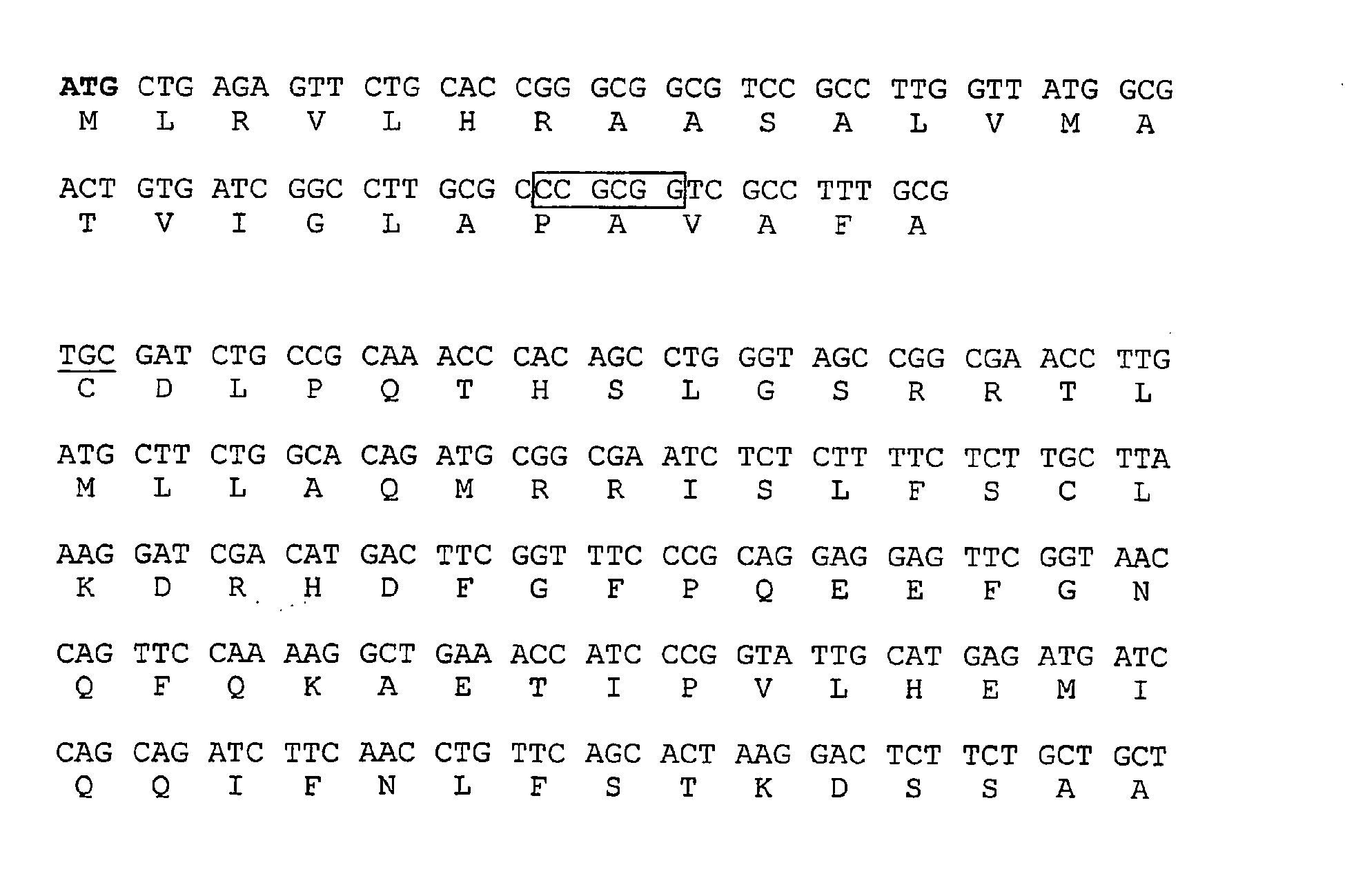


- The sequence as shown is divided into sub-paragraphs / regions which comprise:
- 1. the gac promoter and RBS (first paragraph, bps 257 to 465 of pMG414, see below),
- 2. the gac signal sequence coding region (second paragraph, bps 466 to 546 of pMG414, see below),
- 3. the synthetic gene for rhlFNα2b (third paragraph, bps 547 to 1044 of pMG414 (see below) - including the TAA stop codon), and
- 4. the 3' cloning linker (fourth paragraph, bps 1045 to 1063 of pMG414, see below).
- On the pMG414 these four regions are directly joined to one another. They are separated in the figure for reasons of lucidity only.
- The start (ATG) and the stop (TAA) codons of the open reading frame are shown in bold.
- The first (TGC) an the last (GAA) codon of mature rhlFNα2b are underlined.
- The restriction endonuclease sites used for cloning are boxed. These are:
- Xba I (TCTAGA) and EcoR I (GAATTC) for the introduction of the gac fragment (promoter, RBS, signal sequence, Sac II, Mlu I, Spe I sites)
- Sac II (CCGCGG) and Mlu I (ACGCGT) for the introduction of the rhlFNα2b PCR fragment (including four codons for the last four amino acids of the gac1ss, the 495 bp synthetic gene for mature rhlFNα2b, and the TAA(T) stop codon).
- The gac promoter shows high constitutive / basal activity, the addition of a chemical inducer or a physical stimulus (change in culture conditions) is not required.
- The expression plasmid pMG414 is introduced into the host strain ATCC PTA-3132 (=W3110 (ATCC 27325)) by electroporation. Electrocompetent cells are prepared according to a standard protocol, electroporation is carried out in 0.1 mm cuvettes at 1800 V using an Eppendorf Electroporator 2510.
- After electroporation the reaction is suspended in liquid medium and plated onto agar plates containing tetracycline.
- Starting point for selection of a suitable cell clone is a thus obtained transformation plate. Various clones from this plate are grown in liquid culture and cryopreserved as research cell banks. Their productivity is tested in shake flask experiments and compared. The best clone (E1/116) is used for further development.
- The best clone may show good productivity but relatively poor growth. This poor growth can result from various factors, e.g. product toxicity to the host cell, metabolic burden due to product synthesis etc. The addition of glucose often brings some improvement because glucose downregulates (e.g. by catabolite repression) many promoters used for recombinant protein expression. Also, glucose has a general positive effect on the growth of E. coli because it can be directly introduced into the metabolism as a carbon source.
- In the case of E1/116, a clear positive effect of glucose on growth is observed. The best results are achieved with glucose concentrations between 2 and 5 g/L. To adapt the cell line to cope with product formation and consequently to better growth in the absence of glucose, the strain is therefore grown in liquid medium in shake flasks for several passages ("shake flask cascade").
- More specifically, a cryovial of E1/116 is thawed and the cell suspension streaked onto glucose free LB agar plates containing tetracycline. The plate is incubated at 37°C until the colonies reach a sufficient size for inoculating a liquid culture. Colonies are transferred from the plate into small shake flasks filled with 15 mL of glucose free LB broth containing tetracycline. The cultures are shaken at 37°C until they reach an optical density at 600 nm of above 0.5 (typically > 1.0). For this first round this takes up to 48 hours due to the poor growth characteristics of the original isolate.
- The procedure described in the above paragraph is performed five consecutive times with the liquid culture of the previous round being streaked onto plates and the colonies from the plates serving to inoculate the next liquid culture. From each liquid culture optical density is determined and a sample was taken for determination of product titer using SDS-PAGE - Western Blot. Clones from the culture with the best combination of growth and productivity are the used to initiate the next round.
- In the course of the different rounds of this culture cascade (i.e. multiple propagation and reisolation steps) the growth characteristics of the (sub)strain(s) gradually improve. By choosing the strain with the best combination of growth and productivity in each round, titers are also gradually increased. After the fifth round again single colonies are generated on LB agar plates containing tetracycline and used to inoculate a liquid culture containing tetracycline for the generation of a primary seed lot (PSL). The culture is grown at 37°C to an optical density of about 1.5, mixed with an equal amount of sterile 40% w/v glycerol, aliquoted into cryogenic vials and frozen at -80°C. This PSL is used as a starting point for the generation of the GMP cell banks (Master Cell Bank and Working Cell Bank) of the Interferon alpha 2b production strain. This reisolate is designated E1/116a. Reisolation processes like the one described above have proved to yield reproducible results.
- E1/116a shows excellent growth characteristics in shake flasks and stirred bioreactors (fermenters). An inoculum suitable for starting a bioreactor can be grown in a shake flask starting from a Working Cell Bank vial in about 8 hours.
- A Master Cell Bank is prepared under cGMP conditions from the primary seed lot described above. In brief, a PSL vial is thawed and plated onto tetracycline containing agar plates. A single colony is picked and used to inoculate the Master Cell Bank (MCB) shake flask culture (LB broth medium containing tetracycline). The cell supension from the logarithmic growth phase is mixed 1+1 with 40 % w/v Glycerol, aliquoted at 1.8 mL into cryogenic vials, sealed in cryogenic tubing, and frozen in the liquid phase of a liquid nitrogen tank.
- The Working Cell Bank is generated in the same way as the Master Cell Bank except that the shake flask culture is inoculated with cell suspension from a thawed MCB vial.
- The fermentation process is started by growing the strain E.coli K-12 W3110 obtainable from the Working Cell Bank as described above in shake flask cultures in Luria Bertani (LB-) medium at 37°C with the addition of the antibiotic tetracyclin hydrochloride to avoid growth of non-plasmid carrying cells.
- The shake flask culture is then used to inoculate the seed culture (= pre-culture) medium (inoculum size = 0,4%). The medium for this pre-culture cultivation is based on deionized water containing glucose as a sole carbon source and yeast autolysate as a complex nitrogen source. In addition, anorganic salts like KH2PO4, K2HPO4, (NH4)2SO4 and MgSO4.7H2O are added to the medium. As an antifoam agent polypropylene glycole 2000 (PPG2000) is used. In particular, the pre-culture medium has the following composition:
-
Component Amount De-ionized water (WBI) 30 I Yeast autolysate, KAT, Ohly 21.7 g/l Glucose Monohydrate, pure 25.0 g/l Ammonium Sulfate, p.a. 1.0 g/I Potassium Phosphate Monobasic, p.a 1.5 g/l Potassium Phosphate Dibasic, anhydrous, pure 3.0 g/l Magnesium Sulfate Heptahydrate, p.a. 0.5 g/l Polypropylene Glycole 2000 0.5 ml/I - These media components are sterilized together for 20 minutes at 121 °C. After cooling of the basal medium, an aliquot of a 5 g/L sterile stock-solution of the antibiotic Tetracycline Hydrochloride is added to the basal medium (sterilization is performed by filtration (0.22 µm filter)).
-
Component Amount Tetracycline Hydrochloride cryst., Ph.Eur. 15 mg/l De-ionized water (WBI) - The cultivation-time for seed culture is about 16 hours. During cultivation of the seed culture pH-value is controlled to a set-point of 7,0 ± 0,2 with sulfuric acid and sodium hydroxide or concentrated ammonia solution. Concentration of dissolved oxygen is kept at levels higher than 20% of saturation by increasing the stirrer speed. Stirrer speed at the beginning of the cultivation is set to 300 rpm, back-pressure in the vessel to 0,3 bar and aeration rate is controlled to 30 Umin (equivalent to "1 wm"). Temperature is kept constantly at 37°C during cultivation. As a transfer criterion of broth to the main stage of the fermentation process, an increase of the dissolved oxygen concentration after consumption of the carbon source is used.
- For main culture cultivation a medium based on deionized water, glucose as a carbon source and yeast autolysate as a complex nitrogen source is used. Besides the addition of the anorganic salts (NH4)2SO4, CaCl2.2H2O and MgSO4.7H2O, PPG 2000 is used as an antifoam agent. The initial glucose is sterilized separatly and added to the sterile rest of the medium. Inoculum size to the main fermenter medium was in a range between 0,75 and 3%. In particular, the main culture medium has the following composition:
-
Component Amount De-ionized water (WBI) 60 I Yeast autolysate, KAT, Ohly 43.5 g/l Ammonium Sulfate, p.a. 1.0 g/l Calcium Chloride Dihydrate cryst., p.a. 0.3 g/I Magnesium Sulfate Heptahydrate, p.a. 1.0 g/I Polypropylene Glycole 2000 0.5 ml/l - These media components are sterilized together for 20 minutes at 121 °C. After cooling, an aliquot of a 800 g/L separately heat-sterilized glucose stock-solution is added to the main culture basal medium (sterilization is performed for more than 30 minutes at 120 °C).
-
Component Amount Glucose Syrup 12.5 ml/l De-ionized water (WBI) - The most important point during this cultivation is the necessity of a complete consumption of the initial glucose present in the medium. This leads to a sharp increase of dissolved oxygen concentration after about 9 hours of growth. By starting glucose feeding before total consumption of the initial glucose, no product formation is observed. Glucose limitation controlled by the feeding of the glucose-solution at a constant rate is therefore very important. The temperature during cultivation is controlled to a constant value of about 28°C. The initial stirrer speed is set to 300 rpm, the aeration rate is controlled to 100 Umin (equivalent to "1 vvm") and the back-pressure in the vessel is set to 0,3 bar. The pH-value is controlled to 7,1 ± 0,3 with sulfuric acid and sodium hydroxide or concentrated ammonia solution. A peak of the pH-value up to 8.0 after consumption of the initially supplied glucose is acceptable.
- The concentration of the dissolved oxygen is controlled to values higher than 20% of saturation. Dependent on the oxygen transfer capacity of the bioreactor DO-concentration is kept at levels higher than 20% of saturation, preferably between about 40 % and 100% of saturation, by first increasing the stirrer speed to a maximum value. If this is not sufficient, first aeration rate and after that back-pressure is increased, respectively. After a cultivation time between 48 and 192 hours (linear increase of product formation is observed with cultivation time) the culture is harvested and cooled to 15 ± 5 °C and conditioned for downstream processing by the addition of sucrose/EDTA to the cooled broth.
- The results of a fermentation batch is analysed based on the Western blot technique or on HPLC-measurements after laboratory or pilot plant periplasmatic extraction of the product.
- A fermentation broth obtained as described above containing host cells comprising the expressed interferon alpha 2B in the periplasmic space is adjusted with sulfuric acid to pH of 5,0 ± 0,1 immediately after the fermentation and cooled down to 4°C ± 2 °C. The low pH and the low temperature help to inactivate endogenous proteases.
- The fermentation broth is adjusted to 10°C to 20°C, then without any concentration or washing of the cells, solid or liquid sucrose (200g sucrose/kg fermentation broth) and EDTA (concentration 10mM) are added and the pH adjusted to 8.0. After a selective one-step cell permeation protocol using osmotic shock (1 +3 dilutions) with cooled water, whereby the fermentation broth comprising sucrose and EDTA is poured or pumped into the cooled (temperature about 4°C) water, the released periplasmic extract is clarified. Polyethyleneimine is added to a final concentration of 0,05 % and the pH is adjusted to about 7,5 with acetic acid. After 15 to 45 minutes cell debris and DNA flocculate, leaving a clear crude extract containing interferon which may be subject to centrifugation to improve clarity.
- This procedure leads to a clear periplasmic extract comprising the desired interferon alpha 2B in high yield with a purity of > 20 % with respect to the total protein content. Polyethyleneimine helps to separate the cell debris from the soluble protein extract leading to a very pure interferon solution.
- After pH adjustment to 4.8 - 5.2 with acetic acid and a filtration step using a 0.3 micron filter, the crude extract of Example 3 is applied to the CEX column (S ceramic HyperD F (Biosepra)). After a washing step with an equilibration buffer (20mM sodium acetate and 70mM NaCl at pH 5.0) the interferon is eluted with a step gradient at 175mM NaCl. The fraction collected is immediately processed by the process step of Example 4.2.
- The fraction from Example 4.1 is adjusted to a pH of 7.3 to 7.7 with sodium hydroxide, diluted and purified with water to a conductivity of 3.5 to 4.5 mS/cm and applied to the AEX column (Q ceramic HyperD F (Biosepra)). After washing, the interferon is eluted with a linear salt gradient (0-300mM NaCl) at about 150mM NaCl. Fractions are collected that have a purity of greater than or equal to 90 area % according to IPC reversed-phase HPLC and used directly in the next step (see Example 4.3).
- The fraction of Example 4.2 is diluted (1:1) with a stock solution of sodium sulphate (0.5% sodium sulphate), adjusted to pH 7.3 to 7.7 with NaOH or HCl and applied to the HIC column (Source 15PHE (Pharmacia). After washing, the interferon fraction of Example 3 is eluted with a linear sodium sulphate concentration (800 - 0 mM sodium sulphate) at about 400mM sodium sulphate. The fractions collected that have a purity of greater than or equal to 93 area % and no impurity greater than or equal to 3% according to IPC reversed-phase HPLC are used directly in the next purification step.
- The collected fractions of Example 4 are diluted with water to a final conductivity of 7.5 to 8.5 mS/cm, adjusted to pH 4.3 to 4.7 with 99 to 100% acetic acid and applied to the CEX column (Toyopearl SP-650 S (TosoHaas)). After a washing step, the interferon is eluted in a linear NaCl gradient (0 - 300 mM NaCl) at about 250mM NaCl. The fractions are collected that have a purity of greater than or equal to 95 area % and no impurity greater than or equal to 3% according to IPC reversed-phase HPLC and are used directly in the next purification step.
- The last purification step is a gel filtration step to remove dimers and other aggregates and to perform a buffer exchange for the final formulation. The Superdex 75 pg used in this step shows a good resolution even at a high load volume (5 % - 15 %). The SEC is performed in 25mM sodium phosphate and 130mM NaCl + 0.3mM EDTA at a pH of about 7.3 to 7.7.
- The fractions with the highest purity (> 95 % main peak in RP-HPLC and no side peak > 3 %) are pooled to give the final bulk solution comprising the desired recombinant human interferon α 2B in pure form in a high yield.
-
- <110> Sandoz AG
- <120> Expression vectors, transformed host cells and fermentation process for the production of recombinant polypeptides
- <130> BP/G-33314A/BCK
- <140> PCT/EP2004/009067
<141> 2004-08-12 - <160> 19
- <170> PatentIn version 3.2
- <210> 1
<211> 495
<212> DNA
<213> Artificial - <220>
<223> DNA encoding human interferon alpha 2B with altered codon usage - <400> 1


- <210> 2
<211> 27
<212> PRT
<213> Pseudomonas diminuta - <400> 2

- <210> 3
<211> 81
<212> DNA
<213> Pseudomonas diminuta - <400> 3

- <210> 4
<211> 81
<212> DNA
<213> Artificial - <220>
<223> DNA encoding signal sequence of gac gene of Pseudomonas diminuta with altered codon usage - <400> 4

- <210> 5
<211> 100
<212> DNA
<213> Pseudomonas diminuta - <400> 5

- <210> 6
<211> 209
<212> DNA
<213> Pseudomonas diminuta - <400> 6

- <210> 7
<211> 23
<212> DNA
<213> Artificial - <220>
<223> Oligonucleotide, PCR primer - <400> 7
taactgtcag accaagttta ctc 23 - <210> 8
<211> 20
<212> DNA
<213> Artificial - <220>
<223> Oligonucleotide, PCR primer - <400> 8
gcgtttcggt gatgacggtg 20 - <210> 9
<211> 23
<212> DNA
<213> Artificial - <220>
<223> Oligonucleotide, PCR primer - <400> 9
tcatgtttga cagcttatca tcg 23 - <210> 10
<211> 19
<212> DNA
<213> Artificial - <220>
<223> Oligonucleotide, PCR primer - <400> 10
ggtcgaggtg gcccggctc 19 - <210> 11
<211> 36
<212> DNA
<213> Artificial - <220>
<223> Oligonucleotide, PCR primer - <400> 11
ggggggtcta gaccaacaac atcttcaacg tctacc 36 - <210> 12
<211> 32
<212> DNA
<213> Artificial - <220>
<223> Oligonucleotide, PCR primer - <400> 12
ccccccgaat tcactagtac gcgtctctct cc 32 - <210> 13
<211> 315
<212> DNA
<213> Artificial - <220>
<223> DNA comprising part of gac gene of Pseudomonas diminuta - <400> 13

- <210> 14
<211> 11
<212> DNA
<213> Artificial - <220>
<223> Oligonucleotide, part of PCR primer - <400> 14
tcgcctttgc g 11 - <210> 15
<211> 23
<212> DNA
<213> Artificial - <220>
<223> Oligonucleotide, PCR primer - <400> 15
ttgcgcccgc ggtcgccttt gcg 23 - <210> 16
<211> 4
<212> PRT
<213> Pseudomonas diminuta - <400> 16

- <210> 17
<211> 540
<212> DNA
<213> Artificial - <220>
<223> DNA comprising nucleotide sequence encoding human interferon alpha 2B - <400> 17


- <210> 18
<211> 807
<212> DNA
<213> Artificial - <220>
<223> DNA encoding fusion protein comprising signal sequence of gac gene of Pseudomonas diminuta and human interferon alpha 2B - <220>
<221> CDS
<222> (210)..(788) - <400> 18


- <210> 19
<211> 192
<212> PRT
<213> Artificial - <220>
<223> DNA encoding fusion protein comprising signal sequence of gac gene of Pseudomonas diminuta and human interferon alpha 2B - <400> 19


Claims (41)
- An expression vector, comprising a polynucleotide encoding a fusion protein comprising the signal sequence of the gac gene of Pseudomonas diminuta and a polypeptide of interest other than gac of Pseudomonas diminuta, wherein said signal sequence and said polypeptide of interest are linked in such a way that upon expression of the polynucleotide in a suitable host cell the signal sequence is cleaved off the fusion protein and the polypeptide of interest is released into the periplasm of the host cell.
- The vector according to claim 1, wherein said vector is a plasmid.
- The vector according to claim 1, wherein said vector is a high copy plasmid.
- The vector according to claim 1, wherein the polypeptide of interest is interferon alpha 2.
- The vector according to claim 4, wherein the interferon alpha 2 is selected from the group consisting of interferon alpha 2A and interferon alpha 2B.
- The vector according to claim 1, wherein said signal sequence of the gac gene of Pseudomonas diminuta comprises the amino acid sequence (SEQ ID NO 2)
MLRVLHRAASALVMATVIGLAPAVAFA. - The vector according to claim 6, wherein said vector further comprises a polynucleotide comprising the promoter region and the ribosomal binding site of the gac gene of Pseudomonas diminuta, which polynucleotide being operatively linked to the polynucleotide encoding the fusion protein comprising the signal sequence and the polypeptide of interest.
- The vector according to claim 7, wherein said polynucleotide comprising the promoter region and the ribosomal binding site comprises the nucleotide sequence (SEQ ID NO 5)

- The vector according to claim 8, wherein said polynucleotide comprising the promoter region and the ribosomal binding site comprises the nucleotide sequence (SEQ ID NO 6)

- A prokaryotic host cell transformed with an expression vector which is compatible with the host cell, said vector comprising a polynucleotide encoding a fusion protein comprising the signal sequence of the gac gene of Pseudomonas diminuta and a polypeptide of interest other than gac of Pseudomonas diminuta, wherein said signal sequence and said polypeptide of interest are linked in such a way that upon expression of the polynucleotide in a suitable host cell the signal sequence is cleaved off the fusion protein and the polypeptide of interest is released into the periplasm of the host cell.
- The host cell according to claim 10, wherein said vector is a plasmid.
- The host cell according to claim 10, wherein said vector is a high copy plasmid.
- The host cell according to claim 10, wherein the polypeptide of interest is interferon alpha 2.
- The host cell according to claim 13, wherein the interferon alpha 2 is selected from the group consisting of interferon alpha 2A and interferon alpha 2B
- The host cell according to claim 10, wherein said signal sequence of the gac gene of Pseudomonas diminuta comprises the amino acid sequence (SEQ ID NO 2)
MLRVLHRAASALVMATVIGLAPAVAFA. - The host cell according to claim 10, wherein said vector further comprises a polynucleotide comprising the promoter region and the ribosomal binding site of the gac gene of Pseudomonas diminuta, which polynucleotide being operatively linked to the polynucleotide encoding the fusion protein comprising the signal sequence and the polypeptide of interest.
- The host cell according to claim 16, wherein said polynucleotide comprising the promoter region and the ribosomal binding site comprises the nucleotide sequence (SEQ ID NO 5)

- The host cell according to claim 16, wherein said polynucleotide comprising the promoter region and the ribosomal binding site comprises the nucleotide sequence (SEQ ID NO6)

- The host cell according to claim 10, wherein said host cell is an E. coli cell.
- A process for production of a polypeptide of interest, comprising(i) providing a prokaryotic host cell transformed with an expression vector which is compatible with the host cell, said vector comprising a polynucleotide encoding a fusion protein comprising the signal sequence of the gac gene of Pseudomonas diminuta and a polypeptide of interest other than gac of Pseudomonas diminuta, wherein said signal sequence and said polypeptide of interest are linked in such a way that upon expression of the polynucleotide in a suitable host cell the signal sequence is cleaved off the fusion protein and the polypeptide of interest is released into the periplasm of the host cell, and(ii) culturing the prokaryotic host cell under conditions which cause expression of the polynucleotide whereby upon formation of the fusion protein the signal sequence is cleaved off the fusion protein and the polypeptide of interest is released into the periplasm of the host cell.
- The process according to claim 20, further comprising isolation of the polypeptide of interest.
- The process according to claim 20, wherein said vector is a plasmid.
- The process according to claim 20, wherein said vector is a high copy plasmid.
- The process according to claim 20, wherein the polypeptide of interest is interferon alpha 2.
- The process according to claim 24, wherein the interferon alpha 2 is selected from the group consisting of interferon alpha 2A and interferon alpha 2B.
- The process according to claim 20, wherein said signal sequence of the gac gene of Pseudomonas diminuta comprises the amino acid sequence (SEQ ID NO 2)
MLRVLHRAASALVMATVIGZAPAVAFA. - The process according to claim 20, wherein said vector further comprises a polynucleotide comprising the promoter region and the ribosomal binding site of the gac gene of Pseudomonas diminuta, which polynucleotide being operatively linked to the polynucleotide encoding the fusion protein comprising the signal sequence and the polypeptide of interest.
- The process according to claim 27, wherein said polynucleotide comprising the promoter region and the ribosomal binding site comprises the nucleotide sequence (SEQ ID NO 5)

- The process according to claim 27, wherein said polynucleotide comprising the promoter region and the ribosomal binding site comprises the nucleotide sequence (SEQ ID NO 6)

- The process according to claim 20, wherein said host cell is an E. coli cell.
- The process according to claim 20, said culturing being performed as a multi-stage fermentation process comprising a shake-flask step, optionally a pre-culture step, and a main-culture step.
- The process according to claim 31, wherein said culturing of the procaryotic host cell in the main culture step is performed in a culture medium comprising a substrate for more than about 90% of the cultivation time at a substrate concentration lower than the saturation constant of the substrate, accompanied by high levels of dissolved oxygen concentration, and further accompanied by a steadily decreasing specific growth rate of the bacterial host cells, the process being performed at a temperature which is lower than the optimum temperature for growth of the host cell.
- The process according to claim 32, wherein the concentration of dissolved oxygen in the main culture step is from about 40 % up to about 100% of saturation.
- The process according to claim 32, wherein the steadily decreasing growth rate in the main culture step is from about 2 h-1 to about 0.001 h-1.
- The process according to claim 32, wherein the temperature in the main culture step is between about 22°C and about 35°C.
- The process according to claim 35, wherein the temperature in the main culture step is between about 25°C and about 31 °C.
- The process according to claim 36, wherein the temperature in the main culture step is about 28°C.
- The process according to claim 32, wherein said process is performed at a pH value in the range of about 6.7 to about 7.3 in the pre-culture step and/or the main-culture step.
- The process as claimed in claim 32, wherein the substrate is a carbohydrate or glycerol.
- The process according to claim 39, wherein the carbohydrate is glucose.
- The process according to claim 32, wherein the host cell is an E. coli cell.
Applications Claiming Priority (2)
| Application Number | Priority Date | Filing Date | Title |
|---|---|---|---|
| US49491403P | 2003-08-13 | 2003-08-13 | |
| PCT/EP2004/009067 WO2005017162A2 (en) | 2003-08-13 | 2004-08-12 | Expression vectors, transformed host cells and fermentation process for the production of recombinant polypeptides |
Publications (2)
| Publication Number | Publication Date |
|---|---|
| EP1656452A2 EP1656452A2 (en) | 2006-05-17 |
| EP1656452B1 true EP1656452B1 (en) | 2007-02-14 |
Family
ID=34193254
Family Applications (1)
| Application Number | Title | Priority Date | Filing Date |
|---|---|---|---|
| EP04764066A Expired - Lifetime EP1656452B1 (en) | 2003-08-13 | 2004-08-12 | Expression vectors, transformed host cells and fermentation process for the production of recombinant polypeptides |
Country Status (7)
| Country | Link |
|---|---|
| US (1) | US7785830B2 (en) |
| EP (1) | EP1656452B1 (en) |
| JP (1) | JP5544063B2 (en) |
| AT (1) | ATE353969T1 (en) |
| DE (1) | DE602004004796T2 (en) |
| ES (1) | ES2281822T3 (en) |
| WO (1) | WO2005017162A2 (en) |
Families Citing this family (4)
| Publication number | Priority date | Publication date | Assignee | Title |
|---|---|---|---|---|
| GB0321100D0 (en) | 2003-09-09 | 2003-10-08 | Celltech R&D Ltd | Biological products |
| AU2011235210B2 (en) * | 2010-04-01 | 2015-07-16 | Pfenex Inc. | Methods for G-CSF production in a Pseudomonas host cell |
| RU2017139267A (en) * | 2012-03-27 | 2019-02-12 | Дженентек, Инк. | ADVANCED METHODS FOR ISOLATING RECOMBINANT PROTEINS |
| CN114561395B (en) * | 2022-03-30 | 2023-07-28 | 四川大学 | Fusion tag-free rhIL-11 and soluble expression and efficient purification method of mutant thereof |
Family Cites Families (8)
| Publication number | Priority date | Publication date | Assignee | Title |
|---|---|---|---|---|
| US4680262A (en) | 1984-10-05 | 1987-07-14 | Genentech, Inc. | Periplasmic protein recovery |
| GB8715428D0 (en) | 1987-07-01 | 1987-08-26 | Univ Dundee | Organic compounds |
| CA2116774C (en) | 1991-09-19 | 2003-11-11 | Paul J. Carter | Expression in e. coli antibody fragments having at least a cysteine present as a free thiol. use for the production of bifunctional f(ab') 2 antibodies |
| EP0626448A3 (en) | 1993-05-26 | 1998-01-14 | BOEHRINGER INGELHEIM INTERNATIONAL GmbH | Process for preparing and purifying alpha-interferon |
| US6160089A (en) | 1998-07-08 | 2000-12-12 | Mitsui Chemicals, Inc. | Method for secretory production of human growth hormone |
| KR100360594B1 (en) * | 2000-01-19 | 2002-11-13 | 한미약품공업 주식회사 | Expression and secretion vector for human interferon alpha and process for producing human interferon alpha by employing same |
| GB0013810D0 (en) | 2000-06-06 | 2000-07-26 | Celltech Chiroscience Ltd | Biological products |
| AU2002311620A1 (en) | 2001-07-02 | 2003-01-21 | Insight Biopharmaceuticals Ltd. | Methods of making and using expression constructs for the expression of recombinant proteins |
-
2004
- 2004-08-12 AT AT04764066T patent/ATE353969T1/en not_active IP Right Cessation
- 2004-08-12 US US10/568,337 patent/US7785830B2/en not_active Expired - Fee Related
- 2004-08-12 EP EP04764066A patent/EP1656452B1/en not_active Expired - Lifetime
- 2004-08-12 DE DE602004004796T patent/DE602004004796T2/en not_active Expired - Lifetime
- 2004-08-12 WO PCT/EP2004/009067 patent/WO2005017162A2/en not_active Ceased
- 2004-08-12 ES ES04764066T patent/ES2281822T3/en not_active Expired - Lifetime
- 2004-08-12 JP JP2006522992A patent/JP5544063B2/en not_active Expired - Fee Related
Also Published As
| Publication number | Publication date |
|---|---|
| JP2007501623A (en) | 2007-02-01 |
| US7785830B2 (en) | 2010-08-31 |
| DE602004004796D1 (en) | 2007-03-29 |
| EP1656452A2 (en) | 2006-05-17 |
| WO2005017162A2 (en) | 2005-02-24 |
| ATE353969T1 (en) | 2007-03-15 |
| US20060228783A1 (en) | 2006-10-12 |
| DE602004004796T2 (en) | 2007-12-06 |
| JP5544063B2 (en) | 2014-07-09 |
| ES2281822T3 (en) | 2007-10-01 |
| WO2005017162A3 (en) | 2005-05-19 |
Similar Documents
| Publication | Publication Date | Title |
|---|---|---|
| CA1341240C (en) | Dna encoding human tumor necrosis factor and human tumor necrosis factor polypeptide | |
| CA1262694A (en) | Method of improving the yield of heterologous protein produced by cultivating recombinant bacteria | |
| EP0211047B1 (en) | Arab promoters and method of producing polypeptides, includinn cecropins, by microbiological techniques | |
| US20060134754A1 (en) | IL-21 production in prokaryotic hosts | |
| KR101210083B1 (en) | Process for Producing Polypeptides | |
| JPH0662841A (en) | Method for producing human serum albumin by microorganism | |
| ZA200404737B (en) | Nano-composite martensitic steels | |
| US20020090678A1 (en) | Phage-dependent superproduction of biologically active protein and peptides | |
| EP1656455B1 (en) | Process for the purification of recombinant polypeptides | |
| US7785830B2 (en) | Expression vectors, transformed host cells and fermentation process for the production of recombinant polypeptides | |
| JP2000504561A (en) | Polypeptides having IL-16 activity, their production and use | |
| CN1418251A (en) | Expression and secretion vector of human interferon α and method for producing human interferon α by using the vector | |
| RU2575598C2 (en) | Method for obtaining alpha5-interferon protein | |
| US7655437B2 (en) | Synthetic gene coding for human granulocyte-colony stimulating factor for the expression in E. coli | |
| HU202281B (en) | Process for producing selectable and independently replicable recombinant dna expression vectors | |
| EP0418219B1 (en) | cDNAs ENCODING SOMATOTROPIN, EXPRESSION VECTORS AND HOSTS | |
| WO2008096368A2 (en) | A novel process for production of recombinant human g-csf | |
| EP1461437B1 (en) | Expression vectors and promoters for heterologous gene expression | |
| SU1703690A1 (en) | Recombinant plasmid dna pvn22, encoding human interferon @@@-i1 synthesis, and the strain of bacterium pseudomonas sp - a producer of human interferon @@@-i1 | |
| CN1726281B (en) | IL-21 production in prokaryotic hosts | |
| CN101974536A (en) | Recombinant human interferon beta la gene, expression vector thereof and preparation method of recombinant human interferon beta la | |
| RU2432401C2 (en) | METHOD FOR PRODUCING OF HUMAN METHIONINE-FREE INTERFERON-ALPHA2b | |
| IL120009A (en) | Method for production of interferon - ?? polypeptide in a host cell | |
| NZ214261A (en) | Human immune interferon: production by recombinant dna technology |
Legal Events
| Date | Code | Title | Description |
|---|---|---|---|
| PUAI | Public reference made under article 153(3) epc to a published international application that has entered the european phase |
Free format text: ORIGINAL CODE: 0009012 |
|
| 17P | Request for examination filed |
Effective date: 20060313 |
|
| AK | Designated contracting states |
Kind code of ref document: A2 Designated state(s): AT BE BG CH CY CZ DE DK EE ES FI FR GB GR HU IE IT LI LU MC NL PL PT RO SE SI SK TR |
|
| GRAP | Despatch of communication of intention to grant a patent |
Free format text: ORIGINAL CODE: EPIDOSNIGR1 |
|
| DAX | Request for extension of the european patent (deleted) | ||
| GRAS | Grant fee paid |
Free format text: ORIGINAL CODE: EPIDOSNIGR3 |
|
| GRAA | (expected) grant |
Free format text: ORIGINAL CODE: 0009210 |
|
| AK | Designated contracting states |
Kind code of ref document: B1 Designated state(s): AT BE BG CH CY CZ DE DK EE ES FI FR GB GR HU IE IT LI LU MC NL PL PT RO SE SI SK TR |
|
| PG25 | Lapsed in a contracting state [announced via postgrant information from national office to epo] |
Ref country code: DK Free format text: LAPSE BECAUSE OF FAILURE TO SUBMIT A TRANSLATION OF THE DESCRIPTION OR TO PAY THE FEE WITHIN THE PRESCRIBED TIME-LIMIT Effective date: 20070214 Ref country code: PL Free format text: LAPSE BECAUSE OF FAILURE TO SUBMIT A TRANSLATION OF THE DESCRIPTION OR TO PAY THE FEE WITHIN THE PRESCRIBED TIME-LIMIT Effective date: 20070214 Ref country code: NL Free format text: LAPSE BECAUSE OF FAILURE TO SUBMIT A TRANSLATION OF THE DESCRIPTION OR TO PAY THE FEE WITHIN THE PRESCRIBED TIME-LIMIT Effective date: 20070214 Ref country code: BE Free format text: LAPSE BECAUSE OF FAILURE TO SUBMIT A TRANSLATION OF THE DESCRIPTION OR TO PAY THE FEE WITHIN THE PRESCRIBED TIME-LIMIT Effective date: 20070214 Ref country code: SI Free format text: LAPSE BECAUSE OF FAILURE TO SUBMIT A TRANSLATION OF THE DESCRIPTION OR TO PAY THE FEE WITHIN THE PRESCRIBED TIME-LIMIT Effective date: 20070214 Ref country code: FI Free format text: LAPSE BECAUSE OF FAILURE TO SUBMIT A TRANSLATION OF THE DESCRIPTION OR TO PAY THE FEE WITHIN THE PRESCRIBED TIME-LIMIT Effective date: 20070214 Ref country code: AT Free format text: LAPSE BECAUSE OF FAILURE TO SUBMIT A TRANSLATION OF THE DESCRIPTION OR TO PAY THE FEE WITHIN THE PRESCRIBED TIME-LIMIT Effective date: 20070214 Ref country code: LI Free format text: LAPSE BECAUSE OF FAILURE TO SUBMIT A TRANSLATION OF THE DESCRIPTION OR TO PAY THE FEE WITHIN THE PRESCRIBED TIME-LIMIT Effective date: 20070214 Ref country code: CH Free format text: LAPSE BECAUSE OF FAILURE TO SUBMIT A TRANSLATION OF THE DESCRIPTION OR TO PAY THE FEE WITHIN THE PRESCRIBED TIME-LIMIT Effective date: 20070214 |
|
| REG | Reference to a national code |
Ref country code: GB Ref legal event code: FG4D |
|
| REG | Reference to a national code |
Ref country code: CH Ref legal event code: EP |
|
| REF | Corresponds to: |
Ref document number: 602004004796 Country of ref document: DE Date of ref document: 20070329 Kind code of ref document: P |
|
| REG | Reference to a national code |
Ref country code: IE Ref legal event code: FG4D |
|
| PG25 | Lapsed in a contracting state [announced via postgrant information from national office to epo] |
Ref country code: BG Free format text: LAPSE BECAUSE OF FAILURE TO SUBMIT A TRANSLATION OF THE DESCRIPTION OR TO PAY THE FEE WITHIN THE PRESCRIBED TIME-LIMIT Effective date: 20070514 Ref country code: SE Free format text: LAPSE BECAUSE OF FAILURE TO SUBMIT A TRANSLATION OF THE DESCRIPTION OR TO PAY THE FEE WITHIN THE PRESCRIBED TIME-LIMIT Effective date: 20070514 |
|
| PG25 | Lapsed in a contracting state [announced via postgrant information from national office to epo] |
Ref country code: PT Free format text: LAPSE BECAUSE OF FAILURE TO SUBMIT A TRANSLATION OF THE DESCRIPTION OR TO PAY THE FEE WITHIN THE PRESCRIBED TIME-LIMIT Effective date: 20070716 |
|
| NLV1 | Nl: lapsed or annulled due to failure to fulfill the requirements of art. 29p and 29m of the patents act | ||
| ET | Fr: translation filed | ||
| REG | Reference to a national code |
Ref country code: CH Ref legal event code: PL |
|
| REG | Reference to a national code |
Ref country code: ES Ref legal event code: FG2A Ref document number: 2281822 Country of ref document: ES Kind code of ref document: T3 |
|
| PG25 | Lapsed in a contracting state [announced via postgrant information from national office to epo] |
Ref country code: SK Free format text: LAPSE BECAUSE OF FAILURE TO SUBMIT A TRANSLATION OF THE DESCRIPTION OR TO PAY THE FEE WITHIN THE PRESCRIBED TIME-LIMIT Effective date: 20070214 |
|
| PLBE | No opposition filed within time limit |
Free format text: ORIGINAL CODE: 0009261 |
|
| STAA | Information on the status of an ep patent application or granted ep patent |
Free format text: STATUS: NO OPPOSITION FILED WITHIN TIME LIMIT |
|
| PG25 | Lapsed in a contracting state [announced via postgrant information from national office to epo] |
Ref country code: RO Free format text: LAPSE BECAUSE OF FAILURE TO SUBMIT A TRANSLATION OF THE DESCRIPTION OR TO PAY THE FEE WITHIN THE PRESCRIBED TIME-LIMIT Effective date: 20070214 Ref country code: CZ Free format text: LAPSE BECAUSE OF FAILURE TO SUBMIT A TRANSLATION OF THE DESCRIPTION OR TO PAY THE FEE WITHIN THE PRESCRIBED TIME-LIMIT Effective date: 20070214 |
|
| 26N | No opposition filed |
Effective date: 20071115 |
|
| PG25 | Lapsed in a contracting state [announced via postgrant information from national office to epo] |
Ref country code: GR Free format text: LAPSE BECAUSE OF FAILURE TO SUBMIT A TRANSLATION OF THE DESCRIPTION OR TO PAY THE FEE WITHIN THE PRESCRIBED TIME-LIMIT Effective date: 20070515 Ref country code: MC Free format text: LAPSE BECAUSE OF NON-PAYMENT OF DUE FEES Effective date: 20070831 |
|
| PG25 | Lapsed in a contracting state [announced via postgrant information from national office to epo] |
Ref country code: IE Free format text: LAPSE BECAUSE OF NON-PAYMENT OF DUE FEES Effective date: 20070813 |
|
| PG25 | Lapsed in a contracting state [announced via postgrant information from national office to epo] |
Ref country code: EE Free format text: LAPSE BECAUSE OF FAILURE TO SUBMIT A TRANSLATION OF THE DESCRIPTION OR TO PAY THE FEE WITHIN THE PRESCRIBED TIME-LIMIT Effective date: 20070214 |
|
| PG25 | Lapsed in a contracting state [announced via postgrant information from national office to epo] |
Ref country code: CY Free format text: LAPSE BECAUSE OF FAILURE TO SUBMIT A TRANSLATION OF THE DESCRIPTION OR TO PAY THE FEE WITHIN THE PRESCRIBED TIME-LIMIT Effective date: 20070214 |
|
| PG25 | Lapsed in a contracting state [announced via postgrant information from national office to epo] |
Ref country code: LU Free format text: LAPSE BECAUSE OF NON-PAYMENT OF DUE FEES Effective date: 20070812 |
|
| PG25 | Lapsed in a contracting state [announced via postgrant information from national office to epo] |
Ref country code: HU Free format text: LAPSE BECAUSE OF FAILURE TO SUBMIT A TRANSLATION OF THE DESCRIPTION OR TO PAY THE FEE WITHIN THE PRESCRIBED TIME-LIMIT Effective date: 20070815 Ref country code: TR Free format text: LAPSE BECAUSE OF FAILURE TO SUBMIT A TRANSLATION OF THE DESCRIPTION OR TO PAY THE FEE WITHIN THE PRESCRIBED TIME-LIMIT Effective date: 20070214 |
|
| REG | Reference to a national code |
Ref country code: DE Ref legal event code: R082 Ref document number: 602004004796 Country of ref document: DE |
|
| REG | Reference to a national code |
Ref country code: FR Ref legal event code: PLFP Year of fee payment: 12 |
|
| PGFP | Annual fee paid to national office [announced via postgrant information from national office to epo] |
Ref country code: ES Payment date: 20150713 Year of fee payment: 12 Ref country code: DE Payment date: 20150804 Year of fee payment: 12 Ref country code: GB Payment date: 20150812 Year of fee payment: 12 |
|
| PGFP | Annual fee paid to national office [announced via postgrant information from national office to epo] |
Ref country code: FR Payment date: 20150629 Year of fee payment: 12 |
|
| PGFP | Annual fee paid to national office [announced via postgrant information from national office to epo] |
Ref country code: IT Payment date: 20150827 Year of fee payment: 12 |
|
| REG | Reference to a national code |
Ref country code: DE Ref legal event code: R119 Ref document number: 602004004796 Country of ref document: DE |
|
| GBPC | Gb: european patent ceased through non-payment of renewal fee |
Effective date: 20160812 |
|
| REG | Reference to a national code |
Ref country code: FR Ref legal event code: ST Effective date: 20170428 |
|
| PG25 | Lapsed in a contracting state [announced via postgrant information from national office to epo] |
Ref country code: DE Free format text: LAPSE BECAUSE OF NON-PAYMENT OF DUE FEES Effective date: 20170301 Ref country code: FR Free format text: LAPSE BECAUSE OF NON-PAYMENT OF DUE FEES Effective date: 20160831 Ref country code: GB Free format text: LAPSE BECAUSE OF NON-PAYMENT OF DUE FEES Effective date: 20160812 |
|
| PG25 | Lapsed in a contracting state [announced via postgrant information from national office to epo] |
Ref country code: IT Free format text: LAPSE BECAUSE OF NON-PAYMENT OF DUE FEES Effective date: 20160812 |
|
| PG25 | Lapsed in a contracting state [announced via postgrant information from national office to epo] |
Ref country code: ES Free format text: LAPSE BECAUSE OF NON-PAYMENT OF DUE FEES Effective date: 20160813 |
|
| REG | Reference to a national code |
Ref country code: ES Ref legal event code: FD2A Effective date: 20180626 |