EP1653763A2 - Wireless base stations and mobile stations - Google Patents
Wireless base stations and mobile stations Download PDFInfo
- Publication number
- EP1653763A2 EP1653763A2 EP20050255010 EP05255010A EP1653763A2 EP 1653763 A2 EP1653763 A2 EP 1653763A2 EP 20050255010 EP20050255010 EP 20050255010 EP 05255010 A EP05255010 A EP 05255010A EP 1653763 A2 EP1653763 A2 EP 1653763A2
- Authority
- EP
- European Patent Office
- Prior art keywords
- location registration
- tier
- registration area
- wireless base
- mobile station
- Prior art date
- Legal status (The legal status is an assumption and is not a legal conclusion. Google has not performed a legal analysis and makes no representation as to the accuracy of the status listed.)
- Granted
Links
Images




Classifications
-
- H—ELECTRICITY
- H04—ELECTRIC COMMUNICATION TECHNIQUE
- H04W—WIRELESS COMMUNICATION NETWORKS
- H04W60/00—Affiliation to network, e.g. registration; Terminating affiliation with the network, e.g. de-registration
- H04W60/04—Affiliation to network, e.g. registration; Terminating affiliation with the network, e.g. de-registration using triggered events
-
- H—ELECTRICITY
- H04—ELECTRIC COMMUNICATION TECHNIQUE
- H04W—WIRELESS COMMUNICATION NETWORKS
- H04W8/00—Network data management
- H04W8/02—Processing of mobility data, e.g. registration information at HLR [Home Location Register] or VLR [Visitor Location Register]; Transfer of mobility data, e.g. between HLR, VLR or external networks
Definitions
- the present invention relates to wireless base stations and mobile stations used in a wireless communication system in which location registration is performed. Preferably, it relates to wireless base station and mobile stations used in a wireless communication system wherein the location registration areas are hierarchical (multilayered).
- Figure 1 shows the configuration of a mobile (wireless) communication system. While there are communications systems based on various schemes, the description here takes as an example a W-CDMA (UTRA FDD) mobile communication system.
- W-CDMA UTRA FDD
- 1 is a core network
- 2 is a wireless base station controller (RNC: Radio Network Controller)
- 3 is a wireless bases station (NodeB)
- 4 is a mobile station (UE: User Equipment).
- Core network 1 is a network used for routing in the wireless communication system.
- the core network can comprise for instance an ATM switched network, packet switched network, router network, etc.
- MSC for nodes that perform routing of voice communication, etc
- SGSN for nodes that perform routing of packet communication, etc (packet switching).
- Core network 1 is also connected to other public networks (PSTN), etc, enabling the mobile station 4 to communicate with stationary telephones and the like as well.
- PSTN public networks
- the wireless base station controller 2 is positioned as a higher level device of the wireless base stations 3, and is provided with a function of controlling these wireless base stations 3 (management of wireless resources used, etc).
- the wireless base station controller 2 has the function of executing outer loop transmission power control and a handover control function, whereby the signal from a single mobile station 4 is received via a plurality of subordinate wireless base stations 3, and the data with the best quality is selected and transmitted to the core network 1 during handover.
- the wireless base stations 3 carry on radio communication with the mobile station 4, with the wireless resources being managed by RNC 2. Furthermore, the wireless base stations 3 are provided with the function of executing inner loop transmission power control.
- the mobile station 4 When the mobile station 4 is within the wireless area of a wireless base station 3, it establishes a wireless link to the wireless base station 3 and performs communication with other communication devices via the core network 1.
- the interface between the core network 1 and RNC 2 is referred to as the Iu interface
- the interface between RNCs 2 is referred to as the Iur interface
- the interface between RNC 2 and each wireless base station 3 is called the Iub interface
- the interface between the wireless base station 3 and the mobile station 4 is called the Uu interface.
- the network formed by devices 2 ⁇ 3 is referred to in particular as the radio access network (RAN).
- RAN radio access network
- Figure 2 is a diagram illustrating the configuration of a location registration area.
- 11 and 13 are nodes which make up the core network 1
- 11 represents an MSC (Mobile Switching Center)
- 12 represents an SGSN (Serving GPRS Support Node)
- 13 represents an HLR (Home Location Register).
- An MSC is a node which performs line switching for voice communication and the like, When performing reception of voice communication and the like to the mobile station 4, the MSC treats the wireless zone formed by the subordinate wireless base stations 3 as a single location registration area (LA #1, etc).
- the MSC has the function of calling the mobile station 4, and depending on the response from the mobile station 4, it establishes a communication path to mobile station 4 via one of the wireless base stations 3 making up the wireless zone in the location registration area in which the response was received.
- SGSN is a node that performs packet switching.
- the SGSN treats the wireless zone formed by the subordinate wireless base stations 3 as a single location registration area (RA #1, etc).
- the SGSN has the function of calling the mobile station 4, and depending on the response from the mobile station 4, it establishes a communication path to mobile station 4 via one of the wireless base stations 3 making up the wireless zone in the location registration area in which the response was received.
- HLR 13 is a data base for managing the current location of the mobile station 4, which makes it possible to specify the area for calling the mobile station 4 for voice and packet communication.
- the mobile station 4 moves between zones formed by the wireless base stations 3, and detects the location registration area it is in based on area information announced by the wireless base stations 3.
- location registration is performed via a wireless base station 3 to update the current location managed by the HLR.
- the current location of the mobile station 4 is thereby updated as the mobile station 4 moves, making it possible for the HLR 13 to manage and store the most recent current location of the mobile station 4.
- Figure 2 shows distinct LAs and RAs, it is also possible to unify the two areas and manage the location of the mobile station 4 based on the LA only, with the MSC 11 and SGSN 12 calling the mobile station 4 for voice communication and packet communication using LA as a unit.
- Literature relating to location registration includes the following publicly known literature: Japanese Unexamined Patent Application Publication S61-18229
- the mobile station Since the location of mobile stations in a mobile communication system needs to be managed, the mobile station stores the previously registered location registration area, and if the stored location registration area is different from the location registration area detected based upon announcement information from a wireless base station, updating of the location registration area is determined to be necessary, and location registration area updating (location registration) with HLR is performed via the wireless base station.
- location registration requires exchanging wireless signals with a wireless base station, wireless resources are consumed during location registration.
- a mobile station used in a mobile communication system which accepts location registrations from mobile stations in order to perform mobile station location management, said mobile station being characterized in that it comprises: a detection means which detects that it is in an overlap region of hierarchical location registration areas; and a delay unit which delays location registration when said detection has been made.
- said detection unit performs detection based on information announced by a wireless base station forming part of said wireless communication system.
- said delay unit delays location registration for a delay time determined by computation based on the given station's own identification information.
- the overlap region of hierarchical location registration areas detected by said detection unit is a region of overlap with a second tier location registration area having a wider area than the first tier location registration area for which location registration has already been effected, and said delay of location registration concerns location registration in said second tier location registration area.
- a wireless base station used in a wireless communication system which accepts location registrations from mobile stations in order to perform mobile station location management, said wireless base station being characterized in that it comprises an annunciation unit which announces to mobile stations that the wireless zone constituted by the wireless base station is contained in an overlap region of a first tier location registration area and a second tier location registration area wider than said first tier location registration area.
- said wireless zone corresponds to the wireless zone of the boundary area of said second tier location registration area.
- said annunciation unit transmits a parameter which allows lengthening of selectable delay times by which location registration in said second tier location registration area is delayed by the mobile station.
- a wireless base station used in a wireless communication system which accepts location registrations from mobile stations in order to perform mobile station location management, said wireless base station being characterized in that it comprises an annunciation unit which announces to mobile stations that the wireless zone constituted by the wireless base station is contained in an overlap area of a first tier location registration area and a second tier location registration area wider than said first tier location registration area, and that the boundary of said overlap area is being approached.
- a method for use in a mobile station the mobile station being used in a mobile communication system which accepts location registrations from mobile stations in order to perform mobile station location management, the method comprising: detecting that the mobile station is in an overlap region of hierarchical location registration areas; and delaying location registration when the detection has been made.
- a method for use in a wireless base station comprising: announcing to mobile stations that the wireless zone constituted by the wireless base station is contained in an overlap region of a first tier location registration area and a second tier location registration area wider than the first tier location registration area.
- An embodiment of the present invention makes it possible to relieve concentrated occurrence of location registrations.
- an embodiment of the present invention makes allowances at the same time for calls to the mobile stations.
- the configuration of the location registration areas is hierarchical and that the opportunities for performing location registration are dispersed. It is also possible to employ a technique whereby location registration opportunities are dispersed without making the location registration areas hierarchical.
- WCDMA Ultra FDD
- wireless base station, mobile station and HLR are respectively assigned the reference numbers 30, 40 and 130.
- Figure 3 is a diagram that illustrates the configuration of the location registration areas.
- the distinctive point is that hierarchical location registration areas are formed by providing not only first tier location registration areas la but also a second tier location registration area LA (the location registration areas are depicted three-dimensionally for ease of understanding).
- a further characteristic is that the second tier location registration area LA #1 is made wider than the first tier location registration area la #2.
- the second tier location registration area LA #1 would be effectively formed for example along a route on which a large number of mobile stations can move.
- the left boundary of the second tier location registration area (LA #1) is aligned with the boundary of a first tier location registration area (la #2) while the right boundary of the second tier location registration area (LA #1) is not aligned with the boundary of a first tier location registration area (la #4).
- Each location registration area is made up of a plurality of wireless zones formed by wireless base stations 30, and the wireless base stations contained in each location registration area inform the mobile station 40 of the location registration area which the mobile station 40 is currently in by announcing the area information of that location registration area (information of la #1, 2, 3 or 4, LA #1, etc).
- a wireless base station contained in both a first tier location registration area (e.g. la #2) and a second tier location registration area (e.g. LA #1) announces la #2a and LA #1 as the location registration information (indicating that this is an overlapping location registration area).
- wireless base stations lying at the boundary of a second tier location registration area provide an overlapping location registration area start notification as the area information in order to inform the mobile station 40 that this is an overlapping location registration area (a boundary of a second tier location registration area).
- the hierarchical location registration area is as described above, and the corresponding core network 1 contains MSC 11 as the voice communication routing device and HLR 130 as the location management device.
- the MSC can be replaced with an SGSN or with a routing device that handles both voice communication and packet communication.
- MSC #1 is connected to the wireless base stations 30 in location registration area #1
- MSC #2 is connected to the wireless base stations 30 contained respectively in location registration areas 1a #2 through 4 (location registration areas overlapping with location registration area LA #1) and location registration area la #4 (location registration area not overlapping with location registration area LA #1).
- HLR 130 manages and stores the location information of mobile stations 40 so that it can be looked up by the MSCs (routing devices).
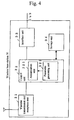
- Figure 4 is a drawing representing the configuration of a wireless base station.
- the basic operation of the wireless base station 30 involves storing information addressed to mobile stations 40 received via Iub from a higher level device in the storage unit 34 and transmitting it via the wireless transmission and reception unit 31 to the mobile stations 40, as well as demodulating and decoding signals received from mobile stations 40 and forwarding them via Iub to the higher level device.
- the wireless base station announces the location registration area information to the mobile stations 40 by the annunciation unit 321.
- the information to be announced can be acquired via Iub from a higher level device, or else data stored in the storage unit 34 can be read out and used.
- the wireless base stations in la #1 which does not have a hierarchical location registration area configuration, announce la #1 as the location registration area information, while wireless base stations within overlapping location registration areas announce la #2 and LA #1 (indicating that this is an overlapping location registration area) as the location registration area information.
- the boundary wireless base stations forming the wireless zone at the boundary of the second tier location registration area are made to issue an overlapping location registration area start notification (LA #1 start) differing from the notification that this is an overlapping location registration area.
- LA #1 start overlapping location registration area start notification
- each mobile station 40 Upon receiving a notification that this is an overlapping location registration area or an overlapping location registration area start notification, each mobile station 40 performs processing to delay location registration (in the second tier location registration area) by a respectively different period of time.
- 322 represents a parameter generating unit, which generates dispersal parameters to be announced to mobile stations 30 according to parameter information provided via Iub from a higher level device or parameter information stored in the storage unit 34.
- the size of a single overlapping location registration area varies depending on the size of the second tier location registration area.
- the time by which location registration is to be delayed by the mobile station 40 is changed according to the size of the overlapping location registration area.
- the delay time is spread over a wider range.
- LA #1 the overlapping location registration area
- delay times t1, t2 and t3 (tl ⁇ t2 ⁇ t3) would be generated as the dispersal parameter information by the parameter generating unit 322 and transmitted to the mobile stations 40
- LA #1 the overlapping location registration area
- delay times t1, t2, t3, t4 and t5 (t1 ⁇ t2 ⁇ t3 ⁇ t4 ⁇ t5) would be generated as dispersal parameter information by the parameter generating unit 322 and transmitted to the mobile stations 40 by the annunciation unit 321 via the wireless transmission and reception unit 31.
- a mobile station 40 can use the value obtained by dividing the identification information (a mobile device-specific number) of that mobile station 40 by the dispersal parameter information (e.g. 4096, 2048, 1024, 512, etc), and multiplying the remainder by a specific time coefficient (the time corresponding to one wireless frame (10 ms)).
- the dispersal parameter information e.g. 4096, 2048, 1024, 512, etc
- dispersal parameter information here was transmitted only by the boundary wireless base stations belonging to an overlapping location registration area, it is also possible to have it transmitted by other wireless base stations belonging to an overlapping location registration area.
- Figure 5 is a diagram illustrating the configuration of a mobile station 40 embodying the present invention.
- 43 represents a wireless transmission and reception unit for receiving wireless signals from the wireless base stations 30 and transmitting information passed on from the control unit 42 to the wireless base stations 30.
- 44 represents a storage unit that stores various types of data as well as the most recent location registration area information for the previously performed location registration.
- the mobile station 40 which is located in 1a #1 and has completed location registration indicating that it is in 1a #1 with the HLR 130, stores la #1 as the location registration area in its storage unit 44.
- the detection unit 423 detects that an overlapping location registration area is being approached based on the overlapping location registration area information (or overlapping location registration area start notifcation) provided by the wireless base station 30.
- the mobile station 40 Based on this detection, the mobile station 40 knows that it has entered a second tier location registration area (LA #1), which has a wider location registration area range, but if many mobile stations 40 were to perform location registration in LA #1 at once, congestion of location registration would occur.
- LA #1 second tier location registration area
- mobile station 40 performs control to delay location registration in LA #1.
- location registration area location registration
- updating of location registration area (location registration) for the first tier location registration area can be performed without delay.
- location registrations for the first tier location registration area will be performed all at once (since the boundaries of the first and second tier location registration areas are aligned on the left)
- each mobile station will perform location registration in LA #1 with a different timing, thus making it possible to reduce simultaneous location registration occurring upon moving from la #2 to la #3.
- each mobile station 40 When the mobile station 40 moves from la #4 to the left, as a result of delayed location registration, each mobile station will perform location registration in LA #1 with a different timing (as the boundary of the first and second tier location registration areas are not aligned on the right), thus making it possible to reduce simultaneous location registrations occurring upon moving from la #4 to la #3.
- t1 0
- t2 > 0
- the time at which location registration is performed can be delayed by the selected time period (e.g. t2).
- a dispersal method such as selecting t1 or t2 depending on whether the identification number of the given mobile station is even or odd.
- the SFN (system frame number) can be used as another dispersal method, by applying the following formula.
- delay time selection candidates and computation algorithm can all be stored in the storage unit 44 of the mobile station 40 and the delay time determined based on that, it is more preferable to have the parameters designated by the mobile communication network.
- the mobile station 40 can perform the computation according to the following formula to determine the time period for the delay.
- Delay time (mobile device identification number mod received dispersal parameter information) x time coefficient
- the time period of one wireless frame (10 ms) can be used as the time coefficient.
- the mobile station 40 After delayed location registration has been performed, if the mobile station 40 moves further and arrives in the area of 1a #3, the mobile station 40 will detect that it is in an overlapping location registration area with la #3 as the first tier location registration area, but since it has already registered its location in the second tier location registration area which is wider than the first tier location registration area and there is no change in the second tier location registration area, no location registration is performed here. Thus, simultaneous location registration is prevented at this stage.
- location registration which is not the above delayed location registration may be performed.
- the mobile station 40 detects based on information announced by a wireless base station 30 that it has moved into a location registration area which is not an overlapping location registration area, and location registration in la #4 is executed without the above-indicated delay processing.
- the wireless base station 30 in a location registration area overlapping with a first tier location registration area (1a #4) outside the boundary area of the second tier location registration area (LA #1) will provide an overlapping location registration area end warning.
- the mobile station 40 Upon receiving an overlapping location registration area end warning from the wireless base station 30, the mobile station 40 performs the previously described delayed location registration processing to register in la #4.
- delayed location registration fails, it is preferable to check again if there is a need for location registration (receive the location registration area information again from the wireless base station 30 and check if it is the same as the location registration area stored in storage unit 44), and if there is such a need, (if the stored location registration area and the received location registration area are different), to re-execute the delayed location registration anew.
- location registration area information again from the wireless base station 30 and check if it is the same as the location registration area stored in storage unit 44
- the next time location registration may be performed without delay.
- a slowly moving mobile station can be made to perform location registration in first tier location registration areas.
- LLR Location management device
- FIG. 6 is a diagram illustrating the configuration of a location management device (HLR/VLR) according to the present embodiment.
- 133 represents an interface unit that interfaces with the various routing devices (MSC 11, SGSN 12, etc).
- 132 represents a control unit which updates the current area of mobile stations 40 stored in the location information storage unit 131 based on location registration information (e.g. location registration area information) received from the mobile stations 40 via the interface unit 133, and responds to mobile station 40 current location inquiries from the various routing devices (MSC 11, SGSN 12, etc) with the corresponding stored information read from the storage unit 131.
- location registration information e.g. location registration area information
- the routing devices call the mobile station 40 in the location registration area corresponding to the location information indicated in the response from the location management device.
- the call is made in the first tier location registration area, while if both tiers or the second tier has been registered, it is preferable to perform the call in the second tier location registration area.
- the table shown on the left side of the location information storage unit 131 presents examples of what is stored in the location information storage unit 131.
- the first stored content illustrates stored content for a case where the first tier location is not stored when performing second tier location registration
- the second stored content illustrates stored content for a case where the first tier location is stored even when performing second tier location registration.
- the wireless zones which are the constituent units of the first and second tier location registration areas were managed by a common wireless base station 40, while in this example, the second tier location registration area is implemented by a separate device.
- an annunciation device for announcing, to mobile stations 40, overlapping location registration area information indicating that they are within LA #1 (since LA's are basically arranged for complete coverage, the announcement of location registration area LA #1 can be interpreted as overlapping location registration area information (the same is true for the first embodiment)) can be installed in a vehicle that travels within LA #1, and upon receiving the overlapping location registration area information announced by this annunciation device, a mobile station 40 would perform the delayed location registration processing presented above.
- Parameter information can be announced by this annunciation device.
- the annunciation device has the functions corresponding to a wireless base station.
- calls can be executed by wireless transmission of a call signal to the annunciation device, while if it does not have such a function, calling would be performed via a wireless base station serving LA #1 (a first tier wireless base station with the same range as LA #1 or a wireless base station forming the smallest first tier location registration area group which covers LA #1).
- LA #1 a first tier wireless base station with the same range as LA #1 or a wireless base station forming the smallest first tier location registration area group which covers LA #1.
- the annunciation device can also be arranged statically in the mobile communication system rather than installing it in a vehicle.
- Embodiments of the present invention may be implemented in hardware, or as software modules running on one or more processors, or on a combination thereof.
- the invention may also be embodied as one or more device or apparatus programs (computer programs and computer program products) for carrying out part or all of any of the methods described herein.
- Such computer programs embodying the present invention may be stored on computer-readable media, or could, for example, be in the form of one or more signals.
- Such signals may be data signals downloadable from an Internet website, or provided on a carrier signal, or in any other form.
Landscapes
- Engineering & Computer Science (AREA)
- Computer Networks & Wireless Communication (AREA)
- Signal Processing (AREA)
- Mobile Radio Communication Systems (AREA)
- Telephonic Communication Services (AREA)
Abstract
Description
- The present invention relates to wireless base stations and mobile stations used in a wireless communication system in which location registration is performed. Preferably, it relates to wireless base station and mobile stations used in a wireless communication system wherein the location registration areas are hierarchical (multilayered).
- Figure 1 shows the configuration of a mobile (wireless) communication system. While there are communications systems based on various schemes, the description here takes as an example a W-CDMA (UTRA FDD) mobile communication system.
- In the drawing, 1 is a core network, 2 is a wireless base station controller (RNC: Radio Network Controller), 3 is a wireless bases station (NodeB) and 4 is a mobile station (UE: User Equipment).
- Core
network 1 is a network used for routing in the wireless communication system. The core network can comprise for instance an ATM switched network, packet switched network, router network, etc. - Here, an example will be considered with two types of nodes that perform routing: MSC for nodes that perform routing of voice communication, etc (line switching), and SGSN for nodes that perform routing of packet communication, etc (packet switching).
- Core
network 1 is also connected to other public networks (PSTN), etc, enabling themobile station 4 to communicate with stationary telephones and the like as well. - The wireless
base station controller 2 is positioned as a higher level device of thewireless base stations 3, and is provided with a function of controlling these wireless base stations 3 (management of wireless resources used, etc). - Furthermore, the wireless
base station controller 2 has the function of executing outer loop transmission power control and a handover control function, whereby the signal from a singlemobile station 4 is received via a plurality of subordinatewireless base stations 3, and the data with the best quality is selected and transmitted to thecore network 1 during handover. - The
wireless base stations 3 carry on radio communication with themobile station 4, with the wireless resources being managed by RNC 2. Furthermore, thewireless base stations 3 are provided with the function of executing inner loop transmission power control. - When the
mobile station 4 is within the wireless area of awireless base station 3, it establishes a wireless link to thewireless base station 3 and performs communication with other communication devices via thecore network 1. - The interface between the
core network 1 andRNC 2 is referred to as the Iu interface, the interface betweenRNCs 2 is referred to as the Iur interface, the interface betweenRNC 2 and eachwireless base station 3 is called the Iub interface, and the interface between thewireless base station 3 and themobile station 4 is called the Uu interface. The network formed bydevices 2~3 is referred to in particular as the radio access network (RAN). - Next, the location registration processing performed by the mobile station will be described using Figure 2. Figure 2 is a diagram illustrating the configuration of a location registration area.
- In the drawing, 11, 12 and 13 are nodes which make up the
core network 1, 11 represents an MSC (Mobile Switching Center), 12 represents an SGSN (Serving GPRS Support Node), and 13 represents an HLR (Home Location Register). - An MSC is a node which performs line switching for voice communication and the like, When performing reception of voice communication and the like to the
mobile station 4, the MSC treats the wireless zone formed by the subordinatewireless base stations 3 as a single location registration area (LA # 1, etc). The MSC has the function of calling themobile station 4, and depending on the response from themobile station 4, it establishes a communication path tomobile station 4 via one of thewireless base stations 3 making up the wireless zone in the location registration area in which the response was received. - SGSN is a node that performs packet switching. When performing reception processing of packet communication and the like to the
mobile station 4, the SGSN treats the wireless zone formed by the subordinatewireless base stations 3 as a single location registration area (RA # 1, etc). The SGSN has the function of calling themobile station 4, and depending on the response from themobile station 4, it establishes a communication path tomobile station 4 via one of thewireless base stations 3 making up the wireless zone in the location registration area in which the response was received. - HLR 13 is a data base for managing the current location of the
mobile station 4, which makes it possible to specify the area for calling themobile station 4 for voice and packet communication. - Namely, the
mobile station 4 moves between zones formed by thewireless base stations 3, and detects the location registration area it is in based on area information announced by thewireless base stations 3. When there is a change in the location registration area stored by the mobile station in question, location registration is performed via awireless base station 3 to update the current location managed by the HLR. The current location of themobile station 4 is thereby updated as themobile station 4 moves, making it possible for the HLR 13 to manage and store the most recent current location of themobile station 4. - While Figure 2 shows distinct LAs and RAs, it is also possible to unify the two areas and manage the location of the
mobile station 4 based on the LA only, with the MSC 11 and SGSN 12 calling themobile station 4 for voice communication and packet communication using LA as a unit. - Literature relating to location registration includes the following publicly known literature: Japanese Unexamined Patent Application Publication S61-18229
- Since the location of mobile stations in a mobile communication system needs to be managed, the mobile station stores the previously registered location registration area, and if the stored location registration area is different from the location registration area detected based upon announcement information from a wireless base station, updating of the location registration area is determined to be necessary, and location registration area updating (location registration) with HLR is performed via the wireless base station.
- However, since location registration requires exchanging wireless signals with a wireless base station, wireless resources are consumed during location registration.
- In particular, when a plurality of mobile stations moves simultaneously by means of a mass transit means (train, bus, airplane, bus, etc), they will perform location registration simultaneously with the same wireless base station. This leads to problems such as a large amount of wireless resources being consumed at once due to the concentration of location registrations, and a temporary increase in the processing load of the nodes performing processing involved in location registration (MSC, SGSN, HLR, etc).
- It is desirable to relieve the concentrated occurrence of location registrations. It is further desirable to, at the same time, preferably make allowances for calls to the mobile stations.
- According to an embodiment of a first aspect of the present invention, there is provided a mobile station used in a mobile communication system which accepts location registrations from mobile stations in order to perform mobile station location management, said mobile station being characterized in that it comprises: a detection means which detects that it is in an overlap region of hierarchical location registration areas; and a delay unit which delays location registration when said detection has been made.
- Preferably, said detection unit performs detection based on information announced by a wireless base station forming part of said wireless communication system.
- Preferably, said delay unit delays location registration for a delay time determined by computation based on the given station's own identification information.
- Preferably, the overlap region of hierarchical location registration areas detected by said detection unit is a region of overlap with a second tier location registration area having a wider area than the first tier location registration area for which location registration has already been effected, and said delay of location registration concerns location registration in said second tier location registration area.
- According to an embodiment of a second aspect of the present invention, there is provided a wireless base station used in a wireless communication system which accepts location registrations from mobile stations in order to perform mobile station location management, said wireless base station being characterized in that it comprises an annunciation unit which announces to mobile stations that the wireless zone constituted by the wireless base station is contained in an overlap region of a first tier location registration area and a second tier location registration area wider than said first tier location registration area.
- Preferably, said wireless zone corresponds to the wireless zone of the boundary area of said second tier location registration area.
- Preferably, said annunciation unit transmits a parameter which allows lengthening of selectable delay times by which location registration in said second tier location registration area is delayed by the mobile station.
- According to an embodiment of a third aspect of the present invention, there is provided a wireless base station used in a wireless communication system which accepts location registrations from mobile stations in order to perform mobile station location management, said wireless base station being characterized in that it comprises an annunciation unit which announces to mobile stations that the wireless zone constituted by the wireless base station is contained in an overlap area of a first tier location registration area and a second tier location registration area wider than said first tier location registration area, and that the boundary of said overlap area is being approached.
- According to an embodiment of a fourth aspect of the present invention, there is provided a method for use in a mobile station, the mobile station being used in a mobile communication system which accepts location registrations from mobile stations in order to perform mobile station location management, the method comprising: detecting that the mobile station is in an overlap region of hierarchical location registration areas; and delaying location registration when the detection has been made.
- According to an embodiment of a fifth aspect of the present invention, there is provided a method for use in a wireless base station, the wireless base station being used in a wireless communication system which accepts location registrations from mobile stations in order to perform mobile station location management, the method comprising: announcing to mobile stations that the wireless zone constituted by the wireless base station is contained in an overlap region of a first tier location registration area and a second tier location registration area wider than the first tier location registration area.
- An embodiment of the present invention makes it possible to relieve concentrated occurrence of location registrations.
- Furthermore, an embodiment of the present invention makes allowances at the same time for calls to the mobile stations.
- Reference will now be made, by way of example, to the accompanying drawings, in which:
- Fig. 1 is a diagram illustrating a mobile communication system.
- Fig. 2 is a diagram serving to explain location registration processing.
- Fig. 3 is a diagram illustrating the configuration of location registration areas relating to the present invention.
- Fig. 4 is a diagram illustrating a wireless base station embodying the present invention.
- Fig. 5 is a diagram illustrating a mobile station embodying the present invention.
- Fig. 6 is a diagram illustrating a location management device according to the present invention.
- In the first embodiment, it is assumed that the configuration of the location registration areas is hierarchical and that the opportunities for performing location registration are dispersed. It is also possible to employ a technique whereby location registration opportunities are dispersed without making the location registration areas hierarchical.
- It is assumed that the WCDMA (UTRA FDD) mobile communication system configuration illustrated in Figure 1 will be used as the basic communication system configuration. Rather than differentiating devices that perform routing of voice communication and packet communication, such as MSC and SGSN, it also possible to have unified routers or the like which perform the routing of both.
- In the present embodiment, wireless base station, mobile station and HLR are respectively assigned the
reference numbers - First, the configuration of the location registration areas in the present embodiment will be described.
- Figure 3 is a diagram that illustrates the configuration of the location registration areas.
- In Figure 3, the distinctive point is that hierarchical location registration areas are formed by providing not only first tier location registration areas la but also a second tier location registration area LA (the location registration areas are depicted three-dimensionally for ease of understanding). A further characteristic is that the second tier location registration
area LA # 1 is made wider than the first tier location registration areala # 2. The second tier location registrationarea LA # 1 would be effectively formed for example along a route on which a large number of mobile stations can move. - Furthermore, in the drawing, the left boundary of the second tier location registration area (LA #1) is aligned with the boundary of a first tier location registration area (la #2) while the right boundary of the second tier location registration area (LA #1) is not aligned with the boundary of a first tier location registration area (la #4). However, it is also possible to set the boundary of a first tier location registration area so as to coincide with the boundary of a plurality of combined first tier location registration areas, or conversely, to set the boundary of a first tier location registration area so as not to coincide with the boundary of a plurality of combined first tier location registration areas.
- Each location registration area is made up of a plurality of wireless zones formed by
wireless base stations 30, and the wireless base stations contained in each location registration area inform themobile station 40 of the location registration area which themobile station 40 is currently in by announcing the area information of that location registration area (information ofla # LA # 1, etc). - However, a wireless base station contained in both a first tier location registration area (e.g. la #2) and a second tier location registration area (e.g. LA #1) (a wireless base station arranged in an overlapping location registration area (for instance, the wireless base station forming the striped wireless zone inside la #2)) announces la #2a and
LA # 1 as the location registration information (indicating that this is an overlapping location registration area). - Preferably, wireless base stations lying at the boundary of a second tier location registration area (e.g. the boundary wireless base stations forming the striped wireless zones in
la # 2 and la #4) provide an overlapping location registration area start notification as the area information in order to inform themobile station 40 that this is an overlapping location registration area (a boundary of a second tier location registration area). - The hierarchical location registration area is as described above, and the
corresponding core network 1 contains MSC 11 as the voice communication routing device and HLR 130 as the location management device. For packet communication, the MSC can be replaced with an SGSN or with a routing device that handles both voice communication and packet communication. - In the drawing,
MSC # 1 is connected to thewireless base stations 30 in locationregistration area # 1, andMSC # 2 is connected to thewireless base stations 30 contained respectively in location registrationareas 1a # 2 through 4 (location registration areas overlapping with location registration area LA #1) and location registration area la #4 (location registration area not overlapping with location registration area LA #1). - HLR 130 manages and stores the location information of
mobile stations 40 so that it can be looked up by the MSCs (routing devices). - Next, the configuration and operation of the
wireless base stations 30 contained in the hierarchical location registration areas will be described. - Figure 4 is a drawing representing the configuration of a wireless base station.
- In the drawing, 31 represents a wireless transmission and reception unit for conducting wireless communication with
mobile stations 40; 32 represents a control unit which controls the various other units and comprises a parameter generation unit and annunciation unit; 34 represents a storage unit which stores information to be transmitted tomobile stations 40, information received frommobile stations 40, and the like; and 33 represents an interface unit which interfaces with higher level devices (wireless base station controller 2). - The basic operation of the
wireless base station 30 involves storing information addressed tomobile stations 40 received via Iub from a higher level device in thestorage unit 34 and transmitting it via the wireless transmission and reception unit 31 to themobile stations 40, as well as demodulating and decoding signals received frommobile stations 40 and forwarding them via Iub to the higher level device. - Furthermore, in order to enable location registration processing by
mobile stations 40 as described above, the wireless base station announces the location registration area information to themobile stations 40 by theannunciation unit 321. - The information to be announced can be acquired via Iub from a higher level device, or else data stored in the
storage unit 34 can be read out and used. - In Figure 3, the wireless base stations in
la # 1, which does not have a hierarchical location registration area configuration, announcela # 1 as the location registration area information, while wireless base stations within overlapping location registration areas announcela # 2 and LA #1 (indicating that this is an overlapping location registration area) as the location registration area information. - More preferably, the boundary wireless base stations forming the wireless zone at the boundary of the second tier location registration area, such as the striped wireless zones of
la # LA # 1 start) differing from the notification that this is an overlapping location registration area. - Upon receiving a notification that this is an overlapping location registration area or an overlapping location registration area start notification, each
mobile station 40 performs processing to delay location registration (in the second tier location registration area) by a respectively different period of time. - Furthermore, in the drawing, 322 represents a parameter generating unit, which generates dispersal parameters to be announced to
mobile stations 30 according to parameter information provided via Iub from a higher level device or parameter information stored in thestorage unit 34. - The size of a single overlapping location registration area varies depending on the size of the second tier location registration area.
- However, if the time by which location registration is delayed is made the same regardless of the size of the overlapping location registration area, it is possible that situations will arise where, for instance, hardly any location registrations are made in the second tier location registration area.
- Thus, preferably, the time by which location registration is to be delayed by the
mobile station 40 is changed according to the size of the overlapping location registration area. - In other words, by setting the dispersal parameter transmitted in cases where the overlapping location registration area is large such that longer times can be selected for the selectable time period by which location registration is delayed by the
mobile station 40 as compared to cases where the overlapping location registration area is small, the delay time is spread over a wider range. - For example, if LA #1 (the overlapping location registration area) is small, in the boundary wireless base stations of the striped zone in la #2 (la #4), delay times t1, t2 and t3 (tl < t2 < t3) would be generated as the dispersal parameter information by the parameter generating unit 322 and transmitted to the
mobile stations 40, and if LA #1 (the overlapping location registration area) is large, in the boundary wireless base stations of the striped zone in la #2 (LA #4), delay times t1, t2, t3, t4 and t5 (t1 < t2 < t3 < t4 < t5) would be generated as dispersal parameter information by the parameter generating unit 322 and transmitted to themobile stations 40 by theannunciation unit 321 via the wireless transmission and reception unit 31. - Rather that announcing the actual delay time, it is more preferable to transmit dispersal parameter information for the
mobile stations 40 to use to determine the delay time. - For example, a
mobile station 40 can use the value obtained by dividing the identification information (a mobile device-specific number) of thatmobile station 40 by the dispersal parameter information (e.g. 4096, 2048, 1024, 512, etc), and multiplying the remainder by a specific time coefficient (the time corresponding to one wireless frame (10 ms)). - While the dispersal parameter information here was transmitted only by the boundary wireless base stations belonging to an overlapping location registration area, it is also possible to have it transmitted by other wireless base stations belonging to an overlapping location registration area.
- Next, the configuration and operation of the mobile station of the present embodiment will be described.
- Figure 5 is a diagram illustrating the configuration of a
mobile station 40 embodying the present invention. - In the drawing, 41 represents an input/output unit for inputting and outputting voice, images, data and the like; 423 represents a detection unit which detects that the mobile station is in an overlapping location registration area; 422 represents a delay unit which performs control to delay location registration; and 421 represents a location registration processing unit which performs delayed location registration according to the control of the delay unit when detection has been made by the detection unit.
- 43 represents a wireless transmission and reception unit for receiving wireless signals from the
wireless base stations 30 and transmitting information passed on from the control unit 42 to thewireless base stations 30. - 44 represents a storage unit that stores various types of data as well as the most recent location registration area information for the previously performed location registration.
- Here, the location registration operation for the case where the
mobile station 40 moves from left to right in Figure 3 (fromla # 1 successively tola # 2, #3 and #4) will be described. - The
mobile station 40, which is located in1a # 1 and has completed location registration indicating that it is in1a # 1 with the HLR 130, storesla # 1 as the location registration area in its storage unit 44. - When the
mobile station 40 moves towardla # 2 and enters the area of the stripedwireless base station 30 ofLA # 2, the detection unit 423 detects that an overlapping location registration area is being approached based on the overlapping location registration area information (or overlapping location registration area start notifcation) provided by thewireless base station 30. - Based on this detection, the
mobile station 40 knows that it has entered a second tier location registration area (LA #1), which has a wider location registration area range, but if manymobile stations 40 were to perform location registration inLA # 1 at once, congestion of location registration would occur. - Thus,
mobile station 40 performs control to delay location registration inLA # 1. - However, if a change in location registration area is detected before performing delayed location registration in the second tier location registration area, updating of location registration area (location registration) for the first tier location registration area can be performed without delay. Although it is possible that location registrations for the first tier location registration area will be performed all at once (since the boundaries of the first and second tier location registration areas are aligned on the left), by means of delayed location registration, each mobile station will perform location registration in
LA # 1 with a different timing, thus making it possible to reduce simultaneous location registration occurring upon moving fromla # 2 tola # 3. - Furthermore, since delayed location registration in an overlapping location registration area is permitted, situations where the HLR 130 cannot manage the most recent location of the
mobile station 40 do not arise (the mobile station is registered in at least one of the first or second tier location registration areas), thus making it possible to prevent situations where the location ofmobile station 40 at the time of an incoming communication is unknown and the mobile station cannot be called. - When the
mobile station 40 moves fromla # 4 to the left, as a result of delayed location registration, each mobile station will perform location registration inLA # 1 with a different timing (as the boundary of the first and second tier location registration areas are not aligned on the right), thus making it possible to reduce simultaneous location registrations occurring upon moving fromla # 4 tola # 3. - As the technique of performing delayed location registration, for example, one of either t1 (= 0) or t2 (> 0) can be selected and the time at which location registration is performed can be delayed by the selected time period (e.g. t2). Of course, in order to avoid having other
mobile stations 40 all select the same time period, it is preferable to employ a dispersal method such as selecting t1 or t2 depending on whether the identification number of the given mobile station is even or odd. - The SFN (system frame number) can be used as another dispersal method, by applying the following formula.
- SFN at which location registration is to be initiated = (mobile device identification number mod current SFN)
- While the delay time selection candidates and computation algorithm can all be stored in the storage unit 44 of the
mobile station 40 and the delay time determined based on that, it is more preferable to have the parameters designated by the mobile communication network. - For example, upon receiving the dispersal parameter information described above, the
mobile station 40 can perform the computation according to the following formula to determine the time period for the delay. - Delay time = (mobile device identification number mod received dispersal parameter information) x time coefficient
- Here, for example the time period of one wireless frame (10 ms) can be used as the time coefficient.
- To give an example calculation,

- After delayed location registration has been performed, if the
mobile station 40 moves further and arrives in the area of1a # 3, themobile station 40 will detect that it is in an overlapping location registration area withla # 3 as the first tier location registration area, but since it has already registered its location in the second tier location registration area which is wider than the first tier location registration area and there is no change in the second tier location registration area, no location registration is performed here. Thus, simultaneous location registration is prevented at this stage. - Of course, if there is a change in the second tier location registration area (for example, if there are two or more adjacent second tier location registration areas), location registration which is not the above delayed location registration may be performed.
- Moving further to the right from the striped wireless zone in
la # 4, themobile station 40 detects based on information announced by awireless base station 30 that it has moved into a location registration area which is not an overlapping location registration area, and location registration inla # 4 is executed without the above-indicated delay processing. - However, since location registration in
la # 4 could occur all at once, preferably, thewireless base station 30 in a location registration area overlapping with a first tier location registration area (1a #4) outside the boundary area of the second tier location registration area (LA #1) (particularly, in the wireless zone at the boundary ofla # 4 marked with a star) will provide an overlapping location registration area end warning. - Upon receiving an overlapping location registration area end warning from the
wireless base station 30, themobile station 40 performs the previously described delayed location registration processing to register inla # 4. - It is preferable to transmit parameter information along with the overlapping location registration area end warning. In cases where this cannot be received or the like, the parameter information and delay time stored in storage unit 44 upon location registration in
LA # 1 can be used. - Furthermore, in case delayed location registration fails, it is preferable to check again if there is a need for location registration (receive the location registration area information again from the
wireless base station 30 and check if it is the same as the location registration area stored in storage unit 44), and if there is such a need, (if the stored location registration area and the received location registration area are different), to re-execute the delayed location registration anew. Of course, if delayed location registration failed, the next time location registration may be performed without delay. - Furthermore, one can create mobile stations that perform location registration in first tier location registration areas without performing delayed location registration in second tier location registration areas.
- For example, a slowly moving mobile station can be made to perform location registration in first tier location registration areas.
- Next, location management of
mobile stations 40 will be described. "Location management device (HLR)" - Figure 6 is a diagram illustrating the configuration of a location management device (HLR/VLR) according to the present embodiment.
- 133 represents an interface unit that interfaces with the various routing devices (MSC 11,
SGSN 12, etc). 132 represents a control unit which updates the current area ofmobile stations 40 stored in the locationinformation storage unit 131 based on location registration information (e.g. location registration area information) received from themobile stations 40 via the interface unit 133, and responds tomobile station 40 current location inquiries from the various routing devices (MSC 11,SGSN 12, etc) with the corresponding stored information read from thestorage unit 131. - The routing devices call the
mobile station 40 in the location registration area corresponding to the location information indicated in the response from the location management device. Here, if only a first tier was registered as the location registration area, the call is made in the first tier location registration area, while if both tiers or the second tier has been registered, it is preferable to perform the call in the second tier location registration area. - The table shown on the left side of the location
information storage unit 131 presents examples of what is stored in the locationinformation storage unit 131. - The first stored content illustrates stored content for a case where the first tier location is not stored when performing second tier location registration, while the second stored content illustrates stored content for a case where the first tier location is stored even when performing second tier location registration.
- In any event, when second tier location registration has been carried out, calling would be performed in the second tier location registration area, but if there is no response, in the case of the second stored content, it would be possible to read the first tier location information directly from the stored content and repeat the call, while in the case of the first stored content, all first tier location registration areas overlapping with LA #1 (which are needed to cover LA #1) would be determined and the call would performed from
wireless base stations 30 in all the determined location registration areas. - In the first embodiment, the wireless zones which are the constituent units of the first and second tier location registration areas were managed by a common
wireless base station 40, while in this example, the second tier location registration area is implemented by a separate device. - For example, an annunciation device for announcing, to
mobile stations 40, overlapping location registration area information indicating that they are within LA #1 (since LA's are basically arranged for complete coverage, the announcement of location registrationarea LA # 1 can be interpreted as overlapping location registration area information (the same is true for the first embodiment)) can be installed in a vehicle that travels withinLA # 1, and upon receiving the overlapping location registration area information announced by this annunciation device, amobile station 40 would perform the delayed location registration processing presented above. - The annunciation device has the functions corresponding to a wireless base station. In cases where it is capable of calling and establishing wireless communication with
mobile stations 40, calls can be executed by wireless transmission of a call signal to the annunciation device, while if it does not have such a function, calling would be performed via a wireless base station serving LA #1 (a first tier wireless base station with the same range asLA # 1 or a wireless base station forming the smallest first tier location registration area group which covers LA #1). - The annunciation device can also be arranged statically in the mobile communication system rather than installing it in a vehicle.
- Embodiments of the present invention may be implemented in hardware, or as software modules running on one or more processors, or on a combination thereof. The invention may also be embodied as one or more device or apparatus programs (computer programs and computer program products) for carrying out part or all of any of the methods described herein. Such computer programs embodying the present invention may be stored on computer-readable media, or could, for example, be in the form of one or more signals. Such signals may be data signals downloadable from an Internet website, or provided on a carrier signal, or in any other form.
- Although specific embodiments of the present invention have been described, it will be understood by those of skill in the art that there are other embodiments that are equivalent to the described embodiments. Accordingly, it is to be understood that the invention is not to be limited by the specific illustrated embodiments, but only by the scope of the appended claims.
- This application is related to and claims priority to Japanese Application No. 2004-312345 filed October 27, 2004 in the Japanese Patent Office, the contents of which are incorporated by reference herein.
Claims (10)
- A mobile station used in a mobile communication system which accepts location registrations from mobile stations in order to perform mobile station location management, the mobile station comprising:a detection unit which detects that it is in an overlap region of hierarchical location registration areas; anda delay unit which delays location registration when the detection has been made.
- A mobile station as set forth in Claim 1, wherein:the detection unit performs detection based on information announced by a wireless base station forming part of the wireless communication system.
- A mobile station as set forth in Claim 1 or 2, wherein:the delay unit delays location registration for a delay time determined by computation based on the given station's own identification information.
- A mobile station as set forth in any preceding Claim, wherein:the overlap region of hierarchical location registration areas detected by the detection unit is a region of overlap with a second tier location registration area having a wider area than the first tier location registration area for which location registration has already been effected, and the delay of location registration concerns location registration in the second tier location registration area.
- A wireless base station used in a wireless communication system which accepts location registrations from mobile stations in order to perform mobile station location management, the wireless base station comprising:an annunciation unit which announces to mobile stations that the wireless zone constituted by the wireless base station is contained in an overlap region of a first tier location registration area and a second tier location registration area wider than the first tier location registration area.
- A wireless base station as set forth in Claim 5, wherein:the wireless zone corresponds to the wireless zone of the boundary area of the second tier location registration area.
- A wireless base station as set forth in Claim 5 or 6, wherein:the annunciation unit transmits a parameter which allows lengthening of selectable delay times by which location registration in the second tier location registration area is delayed by the mobile station.
- A wireless base station used in a wireless communication system which accepts location registrations from mobile stations in order to perform mobile station location management, the wireless base station comprising:an annunciation unit which announces to mobile stations that the wireless zone constituted by the wireless base station is contained in an overlap area of a first tier location registration area and a second tier location registration area wider than the first tier location registration area, and that the boundary of the overlap area is being approached.
- A method for use in a mobile station, the mobile station being used in a mobile communication system which accepts location registrations from mobile stations in order to perform mobile station location management, the method comprising:detecting that the mobile station is in an overlap region of hierarchical location registration areas; anddelaying location registration when the detection has been made.
- A method for use in a wireless base station, the wireless base station being used in a wireless communication system which accepts location registrations from mobile stations in order to perform mobile station location management, the method comprising:announcing to mobile stations that the wireless zone constituted by the wireless base station is contained in an overlap region of a first tier location registration area and a second tier location registration area wider than the first tier location registration area.
Applications Claiming Priority (1)
| Application Number | Priority Date | Filing Date | Title |
|---|---|---|---|
| JP2004312345A JP4424155B2 (en) | 2004-10-27 | 2004-10-27 | Mobile communication system, mobile station |
Publications (3)
| Publication Number | Publication Date |
|---|---|
| EP1653763A2 true EP1653763A2 (en) | 2006-05-03 |
| EP1653763A3 EP1653763A3 (en) | 2010-07-14 |
| EP1653763B1 EP1653763B1 (en) | 2015-09-09 |
Family
ID=35892368
Family Applications (1)
| Application Number | Title | Priority Date | Filing Date |
|---|---|---|---|
| EP05255010.0A Expired - Lifetime EP1653763B1 (en) | 2004-10-27 | 2005-08-12 | Wireless base stations and mobile stations |
Country Status (3)
| Country | Link |
|---|---|
| US (2) | US7890103B2 (en) |
| EP (1) | EP1653763B1 (en) |
| JP (1) | JP4424155B2 (en) |
Cited By (2)
| Publication number | Priority date | Publication date | Assignee | Title |
|---|---|---|---|---|
| EP2135472A4 (en) * | 2007-04-10 | 2013-01-23 | Ericsson Telefon Ab L M | A method and a system for managing signaling peak loads |
| CN104486831A (en) * | 2007-03-28 | 2015-04-01 | 联想创新有限公司(香港) | Mobile radio communications device, related network device and method |
Families Citing this family (12)
| Publication number | Priority date | Publication date | Assignee | Title |
|---|---|---|---|---|
| KR100810207B1 (en) * | 2005-07-22 | 2008-03-06 | 삼성전자주식회사 | Handover Method and Device Between Core Network Entities in Packet-switched Networks |
| PL1796408T3 (en) * | 2005-12-09 | 2008-11-28 | Siemens Ag | Radio communication after the switch-on of a subscriber station |
| JP4992308B2 (en) | 2006-06-14 | 2012-08-08 | 日本電気株式会社 | Communication system, operation control method, location management server, and program |
| KR101342639B1 (en) | 2007-02-26 | 2013-12-20 | 삼성전자 주식회사 | Apparatus and method for location registration of mobile station in multiple heterogeneous communication system |
| US8675680B2 (en) * | 2007-07-16 | 2014-03-18 | Sige Semiconductor, Inc. | Jurisdiction based parameter setting for wireless transceivers |
| CN101940040B (en) * | 2008-02-08 | 2014-10-29 | 艾利森电话股份有限公司 | Method and user equipment for mobile device registration |
| JP5169451B2 (en) * | 2008-05-07 | 2013-03-27 | 富士通株式会社 | Base station apparatus, mobile communication system, radio communication method, and radio communication program |
| JP4976360B2 (en) * | 2008-10-15 | 2012-07-18 | 株式会社エヌ・ティ・ティ・ドコモ | Service control device, function restriction system, and function restriction method |
| EP3650882A1 (en) | 2009-08-13 | 2020-05-13 | InterDigital Patent Holdings, Inc. | Method and apparatus for supporting positioning measurements |
| EP2346209B1 (en) * | 2010-01-18 | 2013-03-20 | Alcatel Lucent | Management of configuration changes in clustered network nodes |
| US8817661B2 (en) * | 2011-04-07 | 2014-08-26 | Alcatel Lucent | Method of providing hand-off hysteresis for subnet borders |
| JP5901839B2 (en) * | 2013-03-11 | 2016-04-13 | 三菱電機株式会社 | Mobile radio communication control apparatus and mobile radio communication system |
Citations (2)
| Publication number | Priority date | Publication date | Assignee | Title |
|---|---|---|---|---|
| US5666652A (en) | 1995-07-17 | 1997-09-09 | Motorola, Inc. | Method and apparatus for controlling zone registrations in a radio communication system |
| WO2001015479A1 (en) | 1999-08-20 | 2001-03-01 | Lucent Technologies Inc. | Location area identifier with core network identity field |
Family Cites Families (29)
| Publication number | Priority date | Publication date | Assignee | Title |
|---|---|---|---|---|
| JPS6118229A (en) | 1984-07-04 | 1986-01-27 | Nippon Telegr & Teleph Corp <Ntt> | Mobile communication control system |
| JP2545466B2 (en) | 1989-08-24 | 1996-10-16 | 日本電信電話株式会社 | Mobile communication location registration method |
| JP2927920B2 (en) | 1990-09-14 | 1999-07-28 | 日本電信電話株式会社 | Location registration control method |
| JPH0555991A (en) | 1991-08-23 | 1993-03-05 | Nippon Telegr & Teleph Corp <Ntt> | Location registration method |
| US5642398A (en) * | 1991-09-20 | 1997-06-24 | Qualcomm Incorporated | Comprehensive mobile communications device registration method |
| JPH06244780A (en) | 1993-02-16 | 1994-09-02 | N T T Idou Tsuushinmou Kk | Mobile communication control system and mobile station device |
| FI97932C (en) * | 1993-10-20 | 1997-03-10 | Nokia Telecommunications Oy | Cellular radio network, a subscriber device for a cellular radio network and a method for location updating in a cellular radio network |
| US6868270B2 (en) * | 1994-01-11 | 2005-03-15 | Telefonaktiebolaget L.M. Ericsson | Dual-mode methods, systems, and terminals providing reduced mobile terminal registrations |
| FI98692C (en) * | 1994-06-13 | 1997-07-25 | Nokia Telecommunications Oy | Procedure for controlling traffic in a hierarchical mobile radio system |
| US5732350A (en) * | 1995-12-06 | 1998-03-24 | Motorola, Inc. | Method for mobile station location registration with dynamic cell grouping for radiotelephone systems |
| KR0176103B1 (en) * | 1996-05-02 | 1999-05-15 | 양승택 | Overload Cell Control Method in CDMA Mobile Station System |
| US6212389B1 (en) * | 1997-04-04 | 2001-04-03 | Nortel Networks Limited | Methods and apparatus for controlling allocation of traffic channels in macrocell/microcell telecommunications networks |
| JP2972639B2 (en) | 1997-04-16 | 1999-11-08 | 日本電気アイシーマイコンシステム株式会社 | Mobile communication system and mobile communication method thereof |
| US5982757A (en) * | 1997-07-14 | 1999-11-09 | Motorola, Inc. | Method and apparatus for registering a remote unit in a communication system |
| US6225336B1 (en) | 1997-09-19 | 2001-05-01 | Shionogi & Co., Ltd. | Compounds having [2.2.1] bicyclo skeleton |
| JPH11298945A (en) * | 1998-04-08 | 1999-10-29 | Oki Electric Ind Co Ltd | MOBILE BODY, MOBILE BODY REGISTRATION DEVICE, AND MOBILE COMMUNICATION SYSTEM |
| EP1080228B1 (en) * | 1998-05-18 | 2010-04-28 | Igenex, Inc. | In situ hybridization method for detecting target nucleic acid |
| JP3127957B2 (en) | 1998-06-09 | 2001-01-29 | 日本電気株式会社 | Location registration method in mobile communication system |
| US6205336B1 (en) * | 1998-08-14 | 2001-03-20 | Telefonaktiebolaget Lm Ericsson (Publ) | Method and system for improving network resource utilization in a cellular communication system |
| JP2000134662A (en) | 1998-10-26 | 2000-05-12 | Fujitsu Ltd | Mobile communication system and mobile device |
| FI982363A7 (en) * | 1998-10-30 | 2000-05-01 | Nokia Corp | Method and system for restricting the operation of a radio device in a specific area |
| US6275706B1 (en) * | 1998-11-09 | 2001-08-14 | Telefonaktiebolaget L M Ericsson | Mobile telecommunications network and method for implementing and identifying hierarchical overlapping radio coverage areas |
| JP2001339770A (en) * | 2000-05-30 | 2001-12-07 | Matsushita Electric Ind Co Ltd | Wireless communication system and communication terminal device used therefor |
| JP3964616B2 (en) | 2000-11-10 | 2007-08-22 | 株式会社エヌ・ティ・ティ・ドコモ | Incoming request transmission apparatus, incoming request transmission method, and mobile communication network |
| US20020102976A1 (en) * | 2001-01-31 | 2002-08-01 | Newbury Mark E. | System and method for performing inter-layer handoff in a hierarchical cellular system |
| KR20030042396A (en) * | 2001-11-22 | 2003-05-28 | 삼성전자주식회사 | Method for performing registration adaptively in mobile station |
| US7369849B2 (en) * | 2002-08-06 | 2008-05-06 | General Motors Corporation | Method and system for registering an in-vehicle cellular phone |
| US7062272B2 (en) * | 2003-02-18 | 2006-06-13 | Qualcomm Incorporated | Method and apparatus to track count of broadcast content recipients in a wireless telephone network |
| JP2004289689A (en) * | 2003-03-24 | 2004-10-14 | Nec Corp | Mobile phone location registration method and mobile phone |
-
2004
- 2004-10-27 JP JP2004312345A patent/JP4424155B2/en not_active Expired - Fee Related
-
2005
- 2005-07-29 US US11/191,990 patent/US7890103B2/en not_active Expired - Fee Related
- 2005-08-12 EP EP05255010.0A patent/EP1653763B1/en not_active Expired - Lifetime
-
2007
- 2007-07-19 US US11/826,890 patent/US8331932B2/en not_active Expired - Fee Related
Patent Citations (2)
| Publication number | Priority date | Publication date | Assignee | Title |
|---|---|---|---|---|
| US5666652A (en) | 1995-07-17 | 1997-09-09 | Motorola, Inc. | Method and apparatus for controlling zone registrations in a radio communication system |
| WO2001015479A1 (en) | 1999-08-20 | 2001-03-01 | Lucent Technologies Inc. | Location area identifier with core network identity field |
Cited By (3)
| Publication number | Priority date | Publication date | Assignee | Title |
|---|---|---|---|---|
| CN104486831A (en) * | 2007-03-28 | 2015-04-01 | 联想创新有限公司(香港) | Mobile radio communications device, related network device and method |
| EP2130396A4 (en) * | 2007-03-28 | 2015-05-06 | Nec Corp | Mobile radio communications device, related network device and method |
| EP2135472A4 (en) * | 2007-04-10 | 2013-01-23 | Ericsson Telefon Ab L M | A method and a system for managing signaling peak loads |
Also Published As
| Publication number | Publication date |
|---|---|
| US20060105777A1 (en) | 2006-05-18 |
| JP2006128897A (en) | 2006-05-18 |
| JP4424155B2 (en) | 2010-03-03 |
| EP1653763B1 (en) | 2015-09-09 |
| US7890103B2 (en) | 2011-02-15 |
| EP1653763A3 (en) | 2010-07-14 |
| US20080096556A1 (en) | 2008-04-24 |
| US8331932B2 (en) | 2012-12-11 |
Similar Documents
| Publication | Publication Date | Title |
|---|---|---|
| US8331932B2 (en) | Wireless base station and mobile station | |
| EP3909284B1 (en) | Optimal network function data path discovery for 5g core | |
| US7286814B2 (en) | Location registration system, mobile terminal, control equipment, methods of location registration in the location registration system | |
| US7519034B2 (en) | Method and apparatus for channel assignment within ad-hoc communication system | |
| US20220201507A1 (en) | Method of managing distributed self-organizing network by surrounding base station information and base station using the same | |
| JP2006518122A (en) | Routing procedures for communication systems | |
| KR20000005748A (en) | Control of handoff in cdma cellular systems | |
| US20190181997A1 (en) | Method and apparatus for determining resource occupation state | |
| US20160037396A1 (en) | Dynamic channel switching for wireless mesh networks | |
| JP2800455B2 (en) | Location registration method and paging method for mobile communication system | |
| EP0584326B1 (en) | Radio system including mobile radio stations which provide registration messages with information indicating the order of transmission of the messages | |
| CN113596932B (en) | Information providing, generating and target base station determining method, equipment and medium | |
| CN111757486B (en) | Information transmission method and device | |
| US7146177B2 (en) | Radio access network for a mobile radio communications system and an operating method therefor | |
| KR20040079436A (en) | Method for re-routing a communication link including several radio communication systems | |
| CN114786138B (en) | Method and device for switching center nodes of ad hoc network and electronic equipment | |
| US6035200A (en) | System of communicating units and a method in said system | |
| JP4670987B2 (en) | Mobile communication system | |
| JP2004104438A (en) | Base station repeater | |
| JP4575625B2 (en) | Mobile terminal calling method | |
| JP2001292089A (en) | Wireless relay device and wireless communication system | |
| CN113810970B (en) | A data transmission method, base station, device and medium | |
| US20230388240A1 (en) | Communication device, communication method, and computer-readable storage medium | |
| CN117835363A (en) | Relay selection method, system, remote UE and relay | |
| JP2025127846A (en) | Communication apparatus, wireless device and program |
Legal Events
| Date | Code | Title | Description |
|---|---|---|---|
| PUAI | Public reference made under article 153(3) epc to a published international application that has entered the european phase |
Free format text: ORIGINAL CODE: 0009012 |
|
| AK | Designated contracting states |
Kind code of ref document: A2 Designated state(s): AT BE BG CH CY CZ DE DK EE ES FI FR GB GR HU IE IS IT LI LT LU LV MC NL PL PT RO SE SI SK TR |
|
| AX | Request for extension of the european patent |
Extension state: AL BA HR MK YU |
|
| PUAL | Search report despatched |
Free format text: ORIGINAL CODE: 0009013 |
|
| AK | Designated contracting states |
Kind code of ref document: A3 Designated state(s): AT BE BG CH CY CZ DE DK EE ES FI FR GB GR HU IE IS IT LI LT LU LV MC NL PL PT RO SE SI SK TR |
|
| AX | Request for extension of the european patent |
Extension state: AL BA HR MK YU |
|
| RIC1 | Information provided on ipc code assigned before grant |
Ipc: H04W 64/00 20090101AFI20100607BHEP |
|
| 17P | Request for examination filed |
Effective date: 20110112 |
|
| AKX | Designation fees paid |
Designated state(s): DE FR GB |
|
| 17Q | First examination report despatched |
Effective date: 20110519 |
|
| RIC1 | Information provided on ipc code assigned before grant |
Ipc: H04W 64/00 20090101AFI20150413BHEP Ipc: H04W 8/02 20090101ALI20150413BHEP |
|
| GRAP | Despatch of communication of intention to grant a patent |
Free format text: ORIGINAL CODE: EPIDOSNIGR1 |
|
| INTG | Intention to grant announced |
Effective date: 20150527 |
|
| RIN1 | Information on inventor provided before grant (corrected) |
Inventor name: SHINOZAKI, ATSUSHI |
|
| GRAS | Grant fee paid |
Free format text: ORIGINAL CODE: EPIDOSNIGR3 |
|
| GRAA | (expected) grant |
Free format text: ORIGINAL CODE: 0009210 |
|
| AK | Designated contracting states |
Kind code of ref document: B1 Designated state(s): DE FR GB |
|
| REG | Reference to a national code |
Ref country code: GB Ref legal event code: FG4D |
|
| REG | Reference to a national code |
Ref country code: DE Ref legal event code: R096 Ref document number: 602005047445 Country of ref document: DE |
|
| REG | Reference to a national code |
Ref country code: DE Ref legal event code: R097 Ref document number: 602005047445 Country of ref document: DE |
|
| REG | Reference to a national code |
Ref country code: FR Ref legal event code: PLFP Year of fee payment: 12 |
|
| PLBE | No opposition filed within time limit |
Free format text: ORIGINAL CODE: 0009261 |
|
| STAA | Information on the status of an ep patent application or granted ep patent |
Free format text: STATUS: NO OPPOSITION FILED WITHIN TIME LIMIT |
|
| 26N | No opposition filed |
Effective date: 20160610 |
|
| REG | Reference to a national code |
Ref country code: FR Ref legal event code: PLFP Year of fee payment: 13 |
|
| REG | Reference to a national code |
Ref country code: FR Ref legal event code: PLFP Year of fee payment: 14 |
|
| PGFP | Annual fee paid to national office [announced via postgrant information from national office to epo] |
Ref country code: FR Payment date: 20180712 Year of fee payment: 14 Ref country code: DE Payment date: 20180731 Year of fee payment: 14 |
|
| PGFP | Annual fee paid to national office [announced via postgrant information from national office to epo] |
Ref country code: GB Payment date: 20180808 Year of fee payment: 14 |
|
| REG | Reference to a national code |
Ref country code: DE Ref legal event code: R119 Ref document number: 602005047445 Country of ref document: DE |
|
| GBPC | Gb: european patent ceased through non-payment of renewal fee |
Effective date: 20190812 |
|
| PG25 | Lapsed in a contracting state [announced via postgrant information from national office to epo] |
Ref country code: FR Free format text: LAPSE BECAUSE OF NON-PAYMENT OF DUE FEES Effective date: 20190831 Ref country code: DE Free format text: LAPSE BECAUSE OF NON-PAYMENT OF DUE FEES Effective date: 20200303 |
|
| PG25 | Lapsed in a contracting state [announced via postgrant information from national office to epo] |
Ref country code: GB Free format text: LAPSE BECAUSE OF NON-PAYMENT OF DUE FEES Effective date: 20190812 |