EP1650287A1 - A method for recombining catalytic hydrocarbons - Google Patents
A method for recombining catalytic hydrocarbons Download PDFInfo
- Publication number
- EP1650287A1 EP1650287A1 EP04738321A EP04738321A EP1650287A1 EP 1650287 A1 EP1650287 A1 EP 1650287A1 EP 04738321 A EP04738321 A EP 04738321A EP 04738321 A EP04738321 A EP 04738321A EP 1650287 A1 EP1650287 A1 EP 1650287A1
- Authority
- EP
- European Patent Office
- Prior art keywords
- fraction
- diesel fuel
- gasoline
- fractionator
- aromatic
- Prior art date
- Legal status (The legal status is an assumption and is not a legal conclusion. Google has not performed a legal analysis and makes no representation as to the accuracy of the status listed.)
- Granted
Links
Images





Classifications
-
- C—CHEMISTRY; METALLURGY
- C10—PETROLEUM, GAS OR COKE INDUSTRIES; TECHNICAL GASES CONTAINING CARBON MONOXIDE; FUELS; LUBRICANTS; PEAT
- C10G—CRACKING HYDROCARBON OILS; PRODUCTION OF LIQUID HYDROCARBON MIXTURES, e.g. BY DESTRUCTIVE HYDROGENATION, OLIGOMERISATION, POLYMERISATION; RECOVERY OF HYDROCARBON OILS FROM OIL-SHALE, OIL-SAND, OR GASES; REFINING MIXTURES MAINLY CONSISTING OF HYDROCARBONS; REFORMING OF NAPHTHA; MINERAL WAXES
- C10G21/00—Refining of hydrocarbon oils, in the absence of hydrogen, by extraction with selective solvents
-
- C—CHEMISTRY; METALLURGY
- C10—PETROLEUM, GAS OR COKE INDUSTRIES; TECHNICAL GASES CONTAINING CARBON MONOXIDE; FUELS; LUBRICANTS; PEAT
- C10G—CRACKING HYDROCARBON OILS; PRODUCTION OF LIQUID HYDROCARBON MIXTURES, e.g. BY DESTRUCTIVE HYDROGENATION, OLIGOMERISATION, POLYMERISATION; RECOVERY OF HYDROCARBON OILS FROM OIL-SHALE, OIL-SAND, OR GASES; REFINING MIXTURES MAINLY CONSISTING OF HYDROCARBONS; REFORMING OF NAPHTHA; MINERAL WAXES
- C10G21/00—Refining of hydrocarbon oils, in the absence of hydrogen, by extraction with selective solvents
- C10G21/06—Refining of hydrocarbon oils, in the absence of hydrogen, by extraction with selective solvents characterised by the solvent used
- C10G21/12—Organic compounds only
- C10G21/16—Oxygen-containing compounds
-
- C—CHEMISTRY; METALLURGY
- C10—PETROLEUM, GAS OR COKE INDUSTRIES; TECHNICAL GASES CONTAINING CARBON MONOXIDE; FUELS; LUBRICANTS; PEAT
- C10G—CRACKING HYDROCARBON OILS; PRODUCTION OF LIQUID HYDROCARBON MIXTURES, e.g. BY DESTRUCTIVE HYDROGENATION, OLIGOMERISATION, POLYMERISATION; RECOVERY OF HYDROCARBON OILS FROM OIL-SHALE, OIL-SAND, OR GASES; REFINING MIXTURES MAINLY CONSISTING OF HYDROCARBONS; REFORMING OF NAPHTHA; MINERAL WAXES
- C10G21/00—Refining of hydrocarbon oils, in the absence of hydrogen, by extraction with selective solvents
- C10G21/28—Recovery of used solvent
-
- C—CHEMISTRY; METALLURGY
- C10—PETROLEUM, GAS OR COKE INDUSTRIES; TECHNICAL GASES CONTAINING CARBON MONOXIDE; FUELS; LUBRICANTS; PEAT
- C10G—CRACKING HYDROCARBON OILS; PRODUCTION OF LIQUID HYDROCARBON MIXTURES, e.g. BY DESTRUCTIVE HYDROGENATION, OLIGOMERISATION, POLYMERISATION; RECOVERY OF HYDROCARBON OILS FROM OIL-SHALE, OIL-SAND, OR GASES; REFINING MIXTURES MAINLY CONSISTING OF HYDROCARBONS; REFORMING OF NAPHTHA; MINERAL WAXES
- C10G7/00—Distillation of hydrocarbon oils
-
- C—CHEMISTRY; METALLURGY
- C10—PETROLEUM, GAS OR COKE INDUSTRIES; TECHNICAL GASES CONTAINING CARBON MONOXIDE; FUELS; LUBRICANTS; PEAT
- C10G—CRACKING HYDROCARBON OILS; PRODUCTION OF LIQUID HYDROCARBON MIXTURES, e.g. BY DESTRUCTIVE HYDROGENATION, OLIGOMERISATION, POLYMERISATION; RECOVERY OF HYDROCARBON OILS FROM OIL-SHALE, OIL-SAND, OR GASES; REFINING MIXTURES MAINLY CONSISTING OF HYDROCARBONS; REFORMING OF NAPHTHA; MINERAL WAXES
- C10G2300/00—Aspects relating to hydrocarbon processing covered by groups C10G1/00 - C10G99/00
- C10G2300/10—Feedstock materials
- C10G2300/1037—Hydrocarbon fractions
- C10G2300/104—Light gasoline having a boiling range of about 20 - 100 °C
-
- C—CHEMISTRY; METALLURGY
- C10—PETROLEUM, GAS OR COKE INDUSTRIES; TECHNICAL GASES CONTAINING CARBON MONOXIDE; FUELS; LUBRICANTS; PEAT
- C10G—CRACKING HYDROCARBON OILS; PRODUCTION OF LIQUID HYDROCARBON MIXTURES, e.g. BY DESTRUCTIVE HYDROGENATION, OLIGOMERISATION, POLYMERISATION; RECOVERY OF HYDROCARBON OILS FROM OIL-SHALE, OIL-SAND, OR GASES; REFINING MIXTURES MAINLY CONSISTING OF HYDROCARBONS; REFORMING OF NAPHTHA; MINERAL WAXES
- C10G2300/00—Aspects relating to hydrocarbon processing covered by groups C10G1/00 - C10G99/00
- C10G2300/10—Feedstock materials
- C10G2300/1037—Hydrocarbon fractions
- C10G2300/1044—Heavy gasoline or naphtha having a boiling range of about 100 - 180 °C
-
- C—CHEMISTRY; METALLURGY
- C10—PETROLEUM, GAS OR COKE INDUSTRIES; TECHNICAL GASES CONTAINING CARBON MONOXIDE; FUELS; LUBRICANTS; PEAT
- C10G—CRACKING HYDROCARBON OILS; PRODUCTION OF LIQUID HYDROCARBON MIXTURES, e.g. BY DESTRUCTIVE HYDROGENATION, OLIGOMERISATION, POLYMERISATION; RECOVERY OF HYDROCARBON OILS FROM OIL-SHALE, OIL-SAND, OR GASES; REFINING MIXTURES MAINLY CONSISTING OF HYDROCARBONS; REFORMING OF NAPHTHA; MINERAL WAXES
- C10G2300/00—Aspects relating to hydrocarbon processing covered by groups C10G1/00 - C10G99/00
- C10G2300/10—Feedstock materials
- C10G2300/1037—Hydrocarbon fractions
- C10G2300/1048—Middle distillates
- C10G2300/1055—Diesel having a boiling range of about 230 - 330 °C
-
- C—CHEMISTRY; METALLURGY
- C10—PETROLEUM, GAS OR COKE INDUSTRIES; TECHNICAL GASES CONTAINING CARBON MONOXIDE; FUELS; LUBRICANTS; PEAT
- C10G—CRACKING HYDROCARBON OILS; PRODUCTION OF LIQUID HYDROCARBON MIXTURES, e.g. BY DESTRUCTIVE HYDROGENATION, OLIGOMERISATION, POLYMERISATION; RECOVERY OF HYDROCARBON OILS FROM OIL-SHALE, OIL-SAND, OR GASES; REFINING MIXTURES MAINLY CONSISTING OF HYDROCARBONS; REFORMING OF NAPHTHA; MINERAL WAXES
- C10G2300/00—Aspects relating to hydrocarbon processing covered by groups C10G1/00 - C10G99/00
- C10G2300/20—Characteristics of the feedstock or the products
- C10G2300/30—Physical properties of feedstocks or products
- C10G2300/301—Boiling range
-
- C—CHEMISTRY; METALLURGY
- C10—PETROLEUM, GAS OR COKE INDUSTRIES; TECHNICAL GASES CONTAINING CARBON MONOXIDE; FUELS; LUBRICANTS; PEAT
- C10G—CRACKING HYDROCARBON OILS; PRODUCTION OF LIQUID HYDROCARBON MIXTURES, e.g. BY DESTRUCTIVE HYDROGENATION, OLIGOMERISATION, POLYMERISATION; RECOVERY OF HYDROCARBON OILS FROM OIL-SHALE, OIL-SAND, OR GASES; REFINING MIXTURES MAINLY CONSISTING OF HYDROCARBONS; REFORMING OF NAPHTHA; MINERAL WAXES
- C10G2300/00—Aspects relating to hydrocarbon processing covered by groups C10G1/00 - C10G99/00
- C10G2300/40—Characteristics of the process deviating from typical ways of processing
- C10G2300/44—Solvents
-
- C—CHEMISTRY; METALLURGY
- C10—PETROLEUM, GAS OR COKE INDUSTRIES; TECHNICAL GASES CONTAINING CARBON MONOXIDE; FUELS; LUBRICANTS; PEAT
- C10G—CRACKING HYDROCARBON OILS; PRODUCTION OF LIQUID HYDROCARBON MIXTURES, e.g. BY DESTRUCTIVE HYDROGENATION, OLIGOMERISATION, POLYMERISATION; RECOVERY OF HYDROCARBON OILS FROM OIL-SHALE, OIL-SAND, OR GASES; REFINING MIXTURES MAINLY CONSISTING OF HYDROCARBONS; REFORMING OF NAPHTHA; MINERAL WAXES
- C10G2400/00—Products obtained by processes covered by groups C10G9/00 - C10G69/14
- C10G2400/02—Gasoline
-
- C—CHEMISTRY; METALLURGY
- C10—PETROLEUM, GAS OR COKE INDUSTRIES; TECHNICAL GASES CONTAINING CARBON MONOXIDE; FUELS; LUBRICANTS; PEAT
- C10G—CRACKING HYDROCARBON OILS; PRODUCTION OF LIQUID HYDROCARBON MIXTURES, e.g. BY DESTRUCTIVE HYDROGENATION, OLIGOMERISATION, POLYMERISATION; RECOVERY OF HYDROCARBON OILS FROM OIL-SHALE, OIL-SAND, OR GASES; REFINING MIXTURES MAINLY CONSISTING OF HYDROCARBONS; REFORMING OF NAPHTHA; MINERAL WAXES
- C10G2400/00—Products obtained by processes covered by groups C10G9/00 - C10G69/14
- C10G2400/04—Diesel oil
Definitions
- the present invention relates to a process for catalytic hydrocarbon recombination, and more particularly to a process for catalytic hydrocarbon recombination for preparing high quality gasoline and diesel fuel.
- Catalytic cracking, heavy oil catalytic cracking technology is the key technology of oil refining.
- Catalytic cracking includes wax oil catalytic cracking, heavy oil catalytic cracking; the oils produced by this process are called catalytic hydrocarbons.
- the resulting catalytic hydrocarbons When processed, normally through a fractionator, the resulting catalytic hydrocarbons may produce dry gas, gasoline, diesel fuel, heavy oil, etc., where gasoline and diesel fuel is up to 70% of the market gasoline and diesel fuel share.
- the existing fractionation process for catalytic hydrocarbon has the following deficiency: First, the quality of the gasoline and diesel fuel produced by the existing process is to be improved; the olefin content of the gasoline is too high, octane number is too low, the cetane number of the diesel fuel is too low, and it can not meet the stabilization requirement; Secondly, the existing process is not available for producing various grade of gasoline at the same time, the grade of the products is too narrow; third, the ratio of the gasoline and diesel fuel produced does not match the market requirement, insufficient for the demand of diesel fuel but over sufficient for the demand of gasoline.
- the main factor which impacts the quality of the gasoline is the olefin content and the octane number of the gasoline.
- the methods taken by oil refining plants to increase the octane number are: 1. Increase high octane number gasoline regulating fraction, such as recombined resulting oil, alkylate, etherized resulting oil, isomerized resulting oil, etc.; 2. Use new catalysts; 3. Adjust the operating condition of catalytic cracking; 4. Adjusting the fractionation rang of gasoline.
- the solvent used in the solvent extracting tower to extract the aromatic hydrocarbon composition and non-aromatic hydrocarbon composition is recycled, and it is intersoluble with water. After having been recycled in the equipment for a long time, part of the solvent inevitably produces acidic material due to oxidization. Anti-acid is added to remove the acidic material. In the above process, a trace of olefin can be carried in the feed. In addition, mechanical contaminants can also be generated in the equipment and piping. The color of the recycle solvent will get darker and darker, and high polymer and acidic material accumulate continuously. This will impact the operation of the above process little by little, in serious cases, it will impact the quality and yield of the product. Therefore, the recycle solvent must be regenerated.
- the current solvent regeneration methods include atmosphere or vacuum stripping regeneration, atmosphere or vacuum distillation regeneration, adsorption regeneration and filtration regeneration.
- the stripping regeneration capacity is low due to the limitation of the stripping gas rate; the operation of the distillation regeneration is too complicated, large amount of solvent is lost, the energy consumption is high, and severe coking is found at the reboiler of the regenerator.
- Ion exchange resin is commonly used for adsorption regeneration, such as the sulfolane extracting system recycle water regeneration proposed by America patent US 4919816. This method can remove the acidic material of the recycle water, minimize the corrosion of the equipment, but can not remove the contaminant of the solvent system. Moreover, alkali solution is required.
- Chinese patent CN1062007C disclosed a regeneration method of aromatic extraction solvent.
- This regeneration approach is achieved by adding recycle water to the system, then by filtration and adsorption de-colure. It's disadvantages are as follows: first, the water amount in the system is limited, so it will limit the process capacity; secondly, after the water is added, the contaminant of the solvent can not be isolated before going into the adsorption bed, so fouling frequently happens at the adsorption bed; third, the adsorption bed fail when up to a certain extent due to the limitation of the adsorption capacity of the adsorption bed, so replacement or regeneration of the sorbent is required; fourth, acid and alkali treatment is required for resin regeneration, the operation is complex and it leads to higher cost.
- Another object of the invention is to provide a process for catalytic hydrocarbon recombination with a water-soluble solvent regeneration system, in which the solvent loss is low, the process capacity is strong, no acid and alkali treatment is required, and the quality of the regenerated solvent is high.
- a further object of the invention is to produce various grade of gasoline and diesel fuel at the same time through catalytic hydrocarbon recombination, thus to increase the types of the products.
- Yet another object of this invention is to increase the diesel fuel and gasoline ratio to meet the market demand.
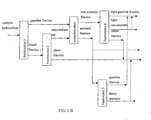
- the intermediate fraction is drawn at one for more side cuts added at the middle of the fractionator 1.
- the overhead temperature of the fractionator 1 is 65 ⁇ 95°C
- the outlet temperature of diesel fuel is 190 ⁇ 280°C
- the temperature of side cut is 120 ⁇ 260°C
- the bottom temperature is 340 ⁇ 385°C
- the overhead pressure of the fractionator 1 is 0.11 ⁇ 0.28 MPa
- the bottom pressure is 0.12 ⁇ 0.30.
- the gasoline fraction, diesel fuel fraction and intermediate fraction are produced at fractionator 1; the distillation range of the gasoline fraction is controlled at 35 ⁇ 110°C ⁇ 30°C, the distillation range of the diesel fuel fraction is controlled at 210°C ⁇ 30°C ⁇ 355 ⁇ 30°C, the fractionation range of the mentioned intermediate fraction is controlled at 120°C ⁇ 30°C ⁇ 210 ⁇ 30°C.
- step 1 fractionate a gasoline fraction and a diesel fuel fraction first, increase the temperature of the fractionator 1 by 10 ⁇ 50°C, and control the fraction range of the gasoline being at 35 ⁇ 210°C ⁇ 30°C, the fraction range of the diesel fuel is controlled at 210°C ⁇ 30°C ⁇ 355 ⁇ 30°C; then pump the gasoline fraction to fractionator 2 to proceed with the second fractionation, the intermediate fraction of 110°C ⁇ 30°C ⁇ 210 ⁇ 30°C is drawn at the bottom of the fractionator 2, and separate the gasoline fraction of 35 ⁇ 110°C ⁇ 30°C at the overhead.
- step 1 fractionate gasoline and diesel fuel fraction first, decrease the temperature of the fractionator 1 to 10 ⁇ 40°C, the fraction range of the gasoline being controlled at 35 ⁇ 110°C ⁇ 30°C, and the fraction range of the diesel fuel being controlled at 110°C ⁇ 30°C ⁇ 355 ⁇ 30°C; then pump the diesel fuel fraction to fractionator 5 to proceed with the second fractionation, draw the diesel fuel fraction of 210°C ⁇ 30°C ⁇ 355 ⁇ 30°C at the bottom of the fractionator 5, and separate the intermediate fraction of 110°C ⁇ 30°C ⁇ 210 ⁇ 30°C at the overhead.
- the aromatic hydrocarbon fraction is fractionated at fractionator 3
- high octane number gasoline fraction is separated at overhead of fractionator 3
- heavy aromatic is separated at the bottom, and the resulting high octane number gasoline fraction is blended with the 35 ⁇ 110°C ⁇ 30°C gasoline.
- the high octane number gasoline may be blended with 35 ⁇ 110°C ⁇ 30°C gasoline completely.
- the high octane number gasoline may be blended with 35 ⁇ 110°C ⁇ 30°C gasoline based on setting values to get different grade gasoline such as 90#, 93#, 97# gasoline.
- the intermediate fraction is drawn at 1 or 4 side cuts, thus dividing the intermediate fraction into 1 to 4 fraction range.
- the non-aromatic fraction is fractionated at fractionator 4, and the diesel fuel fraction is separated at the bottom of the fractionator 4, and blended with the 210°C ⁇ 30°C ⁇ 380°C diesel fuel fraction to increase the cetane number of the diesel fuel, or blending one or more kinds of low condensing point diesel fuel based on the market status.
- Light non-aromatic hydrocarbons are separated at overhead of fractionator 4. They can be used as chemical light oil, or blended with gasoline.
- a process for catalytic hydrocarbon recombination in which the catalytic hydrocarbon is fractionated at fractionator 1, includes fractionating gasoline fraction and diesel fuel fraction; recombine the gasoline fraction and the diesel fuel fraction, and draw the intermediate fraction from the gasoline fraction and the diesel fuel fraction; wherein the intermediate fraction and the gasoline fraction are pumped to the solvent extraction unit for extraction, so as to separate the aromatic and non-aromatic fraction.
- the intermediate fraction is drawn at one or more side cuts added at the middle section of the fractionator 1.
- the overhead temperature of the fractionator 1 is 65 ⁇ 130 °C
- the outlet temperature of diesel fuel is 170 ⁇ 250°C
- the side cut temperature is 120 ⁇ 240°C
- the bottom temperature is 330 ⁇ 385°C
- the overhead pressure of the fractionator 1 is 0.15 ⁇ 0.28 MPa
- the bottom pressure is 0.12 ⁇ 0.30 MPa
- the gasoline fraction, the diesel fuel fraction and the intermediate fraction are produced at fractionator 1
- the distillation range of the gasoline fraction is controlled at 35 ⁇ 150°C
- the distillation range of the diesel fuel fraction is controlled at 170 ⁇ 395°C
- the distillation range of the intermediate fraction is controlled at 70 ⁇ 250°C.
- step 1 fractionate gasoline and diesel fuel fraction first, increase the temperature of the fractionator 1 overhead and diesel fuel outlet by 10 ⁇ 50°C, control the distillation range of the gasoline at 35 ⁇ 250°C, control the distillation range of the diesel fuel at 170 ⁇ 395°C. Then the gasoline fraction is pumped to fractionator 2 to proceed with the second fractionation.
- the intermediate fraction of 70 ⁇ 250°C is drawn at the bottom side cut of the fractionator 2, the 35 ⁇ 150°C gasoline is separated at the overhead, and wherein the intermediate fraction and the 35 ⁇ 150°C gasoline go to the solvent extraction unit together to separate the aromatic and non-aromatic compositions.
- step 1 fractionate gasoline and diesel fuel fraction first, decrease the temperature of the fractionator 1 overhead and diesel fuel outlet by 10 ⁇ 50°C, control the distillation range of the gasoline at 35 ⁇ 150°C, control the distillation range of the diesel fuel at 70 ⁇ 395°C; then pump the diesel fuel fraction to fractionator 5 to proceed the second fractionation, the 170 ⁇ 395°C diesel fuel fraction is drawn at the bottom side cut of the fractionator 5, the 70 ⁇ 250°C intermediate fraction is fractionated at the overhead; the intermediate fraction and the 170 ⁇ 395°C diesel fuel go to the solvent extraction unit together to separate the aromatic and non-aromatic compositions.
- One preferred scheme is a one step fractionation process, wherein the fractionator 1 has 1 to 4 side cuts, so the intermediate fraction can be separated into 1 to 4 streams.
- the aromatic hydrocarbon fraction and the solvent are fractionated at fractionator 3
- high octane number gasoline fraction is separated at overhead of fractionator 3
- heavy aromatic is separated at the bottom.
- the non-aromatic fractions are fractionated at fractionator 4, the overhead product of the fractionator 4 is light gasoline; light non-aromatic hydrocarbons are drawn at the side cut; the diesel fuel fraction are drawn at the bottom.
- the diesel fuel fraction is blended with the 170 ⁇ 380°C diesel fuel fraction to increase the cetane number of the diesel fuel; one or more low condensing point diesel fuels and non-low condensing point diesel fuels can also be blended based on the market status; the diesel fuel fraction serve as the feed for ethylene after hydro treating.
- the light non-aromatic hydrocarbons may be blended with light gasoline; or it can be used as chemical light oil separately.
- the aromatic content of the chemical light oil is low; it can be taken as the high quality feed for steam cracker after hydro treating.
- the high octane gasoline fraction can be blended with the light gasoline fraction.
- the high octane gasoline fraction can be blended with the light gasoline fraction based on setting values to get different types of the gasoline, such as 90#, 93#, and 97#.
- the aromatic hydrocarbons can also be used as high quality gasoline.
- the solvents used for extraction are: sulfones, such as sulfolane; glycols, such as tetraethylene glycol and pentaethylene glycol; alkyl-alkones, such as N-methyl-pyrrolidone; acetamides; and amines, they can also be the mixture of two solvents or more than two solvents.
- a process for catalytic hydrocarbon recombination in which the catalytic hydrocarbon is fractionated at fractionator 1, includes fractionating gasoline fraction and diesel fuel fraction; recombine the gasoline fraction and the diesel fuel fraction, and draw an intermediate fraction from the gasoline fraction and the diesel fuel fraction; the intermediate fraction or the mixture of the intermediate fraction and the gasoline fraction are extracted at the solvent extractor to separate the aromatic and non-aromatic fraction, wherein the solvent for extraction is recycled, the regeneration procedure of the solvent is detailed as follows:
- step 3 At first the middle mixed phases of step 3 are filtered, then distilled.
- the weight ratio of water and the water-soluble solvent is preferably 0.5 ⁇ 3; more preferably is 1 ⁇ 2;
- the filtration separation can be 1-stage filtration, 2-stage filtration or 3-stage filtration, each filtration stage can be used in series, in parallel or in combination thereof.
- the material used in filtration can be a filter element, or filter packing.
- the filter element can employ materials of specific apertures, including metal powder metallurgy, ceramic, metal mesh and various fabrics etc.
- Filter packing includes active carbon, or treated active carbon, clay, silica gel, silicon oxide, alumina, molecular sieve, various mineral, such as sand, etc., and various cation and anion exchange resins.
- the paraffin-based catalytic feed and the feedback oil produce catalytic hydrocarbon under the catalysis of the LCS catalyst produced by Lanzhou Catalyst Plant, China.
- the resulting catalytic hydrocarbon is catalytic cracking wax oil. It is fractionated at the fractionator 1.
- the overhead temperature of the fractionator 1 is 110°C
- the diesel fuel outlet temperature is 190°C
- the bottom temperature is 370°C
- the overhead pressure is 0.11 MPa
- the bottom pressure is 0.12 MPa.
- the fractions are dry gas, liquid gas, gasoline, diesel fuel, heavy oil etc.
- the paraffin-based catalytic feed and the feedback oil produce catalytic hydrocarbon under the catalysis of LCS catalyst produced by Lanzhou Catalyst Plant, China. It is fractionated at the fractionator 1.
- the overhead temperature of the fractionator 1 is 80°C
- the diesel fuel outlet temperature is 240°C
- the bottom temperature is 370°C
- the overhead pressure is 0.1MPa
- the bottom pressure is 0.12MP.
- One side cut is added at the middle section of the fractionator 1 to draw the intermediate fraction.
- the side cut temperature is 190°C
- the distillation range of the intermediate fraction is 120 ⁇ 210°C.
- the intermediate fraction is pumped to an extractor for solvent extraction, the solvent used is sulfolane, the extraction temperature is 80°C, and the extraction pressure is 0.4MPa. Solvent weight ratio (solvent /feed) is 4.8. Aromatic and non-aromatic hydrocarbons are separated. The aromatic hydrocarbon fraction goes to the middle section of fractionator 3 for distillation, the distillation temperature is 120 ⁇ 165°C, and the distillation pressure is 0.04 ⁇ 0.20MPa. Stripping water goes in at the bottom, the overhead fraction is high octane number fraction, the lower side cut is heavy aromatic hydrocarbon fraction, the bottom cut is the recycle solvent.
- All the high octane number fractions are blended with the gasoline fraction; the non-aromatic hydrocarbon fraction goes to the fractionator 4 at the middle section for distillation.
- the distillation temperature is 100 ⁇ 135°C, the pressure is 0.15 ⁇ 0.25 MPa, the overhead cut is a light non-aromatic, the bottom cut is a diesel fuel; All the diesel fuels are blended with the diesel fuel fraction.
- the light non-aromatic hydrocarbons are blended with the gasoline fraction.
- the intermediate base atmosphere residual heavy oil catalytic feed and the feedback oil produce catalytic hydrocarbon under the catalysis of LANET-35 catalyst produced by Lanzhou Catalyst Plant, China.
- the catalytic hydrocarbon is catalytic cracking heavy oil. It is fractionated at the fractionator 1.
- the overhead temperature of the fractionator 1 is 80 °C
- diesel fuel outlet temperature is 240°C
- bottom temperature is 370°C
- overhead pressure is 0.1 MPa
- bottom pressure 0.12MPa; three side cuts are added at the middle section of the fractionator 1 to draw the intermediate fraction.
- the three side cut temperature from up to down is 170, 180, 190 °C
- the distillation range of the intermediate fraction is 80 ⁇ 120°C, 120 ⁇ 165°C, 165 ⁇ 220°C
- the intermediate fraction got from the three distillation range is pumped to the same extractor for solvent extraction.
- the solvent is tetraethylene glycol
- the extraction temperature is 85°C
- the extraction pressure is 0.4MPa.
- Solvent weight ratio (solvent/feed) is 3.1.
- Aromatic and non-aromatic hydrocarbons are separated;
- the aromatic hydrocarbon fraction goes to the middle section of fractionator 3 after combination for distillation, the distillation temperature is 120 ⁇ 180°C, and the distillation pressure is 0.04 ⁇ 0.20 MPa, stripping water is fed in at the bottom, the overhead fraction is high octane number fraction, the lower side cut is heavy aromatic hydrocarbon fraction, the bottom cut is the recycle solvent; All the high octane number fractions are blended with gasoline fraction; the non-aromatic hydrocarbon fraction goes to the middle section of fractionator 4 after combination for distillation.
- the distillation temperature is 100 ⁇ 135°C
- the pressure is 0.15 ⁇ 0.25 MPa
- the overhead cut are light non-aromatic hydrocarbons
- the bottom cut is a diesel fuels
- the diesel fuel fraction is blended with the diesel fuel fraction completely.
- the light non-aromatic hydrocarbons are blended with the gasoline fraction.
- the cycloalkyl heavy oil catalytic feed and the feedback oil produce the catalytic hydrocarbon under the catalysis of LANET-35 catalyst produced by Lanzhou Catalyst Plant.
- the catalytic hydrocarbon is cycloalkyl catalytic cracking heavy oil. It is fractionated at the fractionator 1.
- the overhead temperature of the fractionator 1 is 80 °C
- the diesel fuel outlet temperature is 240°C
- the bottom temperature is 370°C
- the overhead pressure is 0.1 MPa
- the bottom pressure is 0.12MPa
- two side cuts are added at the middle section of the fractionator 1 to draw the intermediate fraction.
- the two side cut temperature from up to down is 180, 190 °C
- the distillation range of the intermediate fraction is 80 ⁇ 165°C, 165 ⁇ 220°C respectively.
- the intermediate fractions got from two distillation ranges are pumped to the same extractor for solvent extraction.
- the solvent is N-formoxyl morphinone
- the extraction temperature is 85°C
- extraction pressure is 0.4MPa.
- Solvent weight ratio (solvent /feed) is 3.1.
- Aromatic and non-aromatic hydrocarbon fractions are separated.
- the aromatic hydrocarbon fraction goes to the middle section of fractionator 3 after combination for distillation, the distillation temperature is 120 ⁇ 180°C, and the distillation pressure is 0.04 ⁇ 0.20 MPa, stripping water is fed in at the bottom.
- the overhead fraction is high octane number fraction
- the lower side cut is heavy aromatic hydrocarbon fraction
- the bottom cut is for the recycle solvent.
- All the high octane number fractions are blended with gasoline fraction; the non-aromatic hydrocarbon fraction goes to the middle section of fractionator 4 after combination for distillation.
- the distillation temperature is 100 ⁇ 135°C, the pressure is 0.15 ⁇ 0.25MPa, the overhead cut is a light non-aromatic, the bottom cut is a diesel fuel fraction; the diesel fuel fraction is blended with the diesel fuel fraction completely.
- the light non-aromatic fraction is taken as light oil for chemicals.
- the paraffin-based catalytic feed and the feedback oil produce catalytic hydrocarbon under the catalysis of LBO-16 catalyst produced by Lanzhou Catalyst Plant
- the catalytic hydrocarbon is cycloalkyl catalytic hydrocarbon heavy oil. It is fractionated at the fractionator 1.
- the overhead temperature of the fractionator 1 is 50 °C
- the diesel fuel outlet temperature is 210°C
- the bottom temperature is 340°C
- the overhead pressure is 0.1MPa
- the bottom pressure is 0.12MPa.
- the distillation range of the gasoline fraction is controlled at 35 ⁇ 120°C.
- the distillation range of the diesel fuel 1 fraction is controlled at 120 ⁇ 355°C.
- Diesel fuel 1 fraction is pumped to fractionator 2 for secondary distillation.
- the overhead temperature of the fractionator 2 is 80°C, the diesel fuel outlet temperature is 240°C, the bottom temperature is 370°C, the overhead pressure is 0.1 MPa, the bottom pressure is 0.12MPa; an intermediate fraction with the distillation range of 80 ⁇ 240°C is drawn from The overhead of fractionator 2.
- the bottom cut is the gasoline fraction with the distillation range of 240 ⁇ 380°C.
- the intermediate fraction is pumped to the extractor for solvent extraction.
- the solvent is N-methyl pyrrole alkane alkone, the extraction temperature is 66°C, and extraction pressure is 0.4MPa.
- Solvent weight ratio (solvent /feed) is 3.3. Aromatic and non-aromatic hydrocarbon fraction is separated.
- the aromatic hydrocarbon fraction goes to the middle section of fractionator 3 for distillation, the distillation temperature is 120 ⁇ 180°C, and the distillation pressure is 0.04 ⁇ 0.20MPa, stripping water is fed in at the bottom, the overhead fraction is high octane number fraction, the lower side cut is heavy aromatic hydrocarbon fraction, the bottom cut is used for recycle solvent. All the high octane number fractions are blended with gasoline fraction; the non-aromatic hydrocarbon fraction goes to the fractionator 4 at the middle section for distillation.
- the distillation temperature is 100 ⁇ 135°C, the pressure is 0.15 ⁇ 0.25 MPa, the overhead cut is a light non-aromatic, the bottom cut is a diesel fuel fraction. All the diesel fuel fractions are blended with the diesel fuel fraction.
- the light non-aromatic fraction is taken as chemical light oil.
- the cycloalkyl heavy oil catalytic feed and the feedback oil produce catalytic hydrocarbon under the catalysis of LANET-35 catalyst produced by Lanzhou Catalyst Plant.
- the catalytic hydrocarbon is cycloalkyl catalytic cracking heavy oil. It is fractionated at the fractionator 1.
- the overhead temperature of the fractionator 1 is 120°C
- the diesel fuel outlet temperature is 270°C
- the bottom temperature is 370°C
- the overhead pressure is 0.1MPa
- the bottom pressure is 0.12MPa
- the distillation range of the gasoline fraction is controlled at 35 ⁇ 240°C.
- the distillation range of the diesel fuel 1 fraction is controlled at 240 ⁇ 385°C.
- Gasoline fraction is pumped to fractionator 2 for secondary distillation.
- the overhead temperature of the fractionator 2 is 80 °C, the diesel fuel outlet temperature is 240°C, the bottom temperature is 370°C, the overhead pressure is 0.1 MPa, the bottom pressure is 0.12MPa; an intermediate fraction with the distillation range of 110 ⁇ 210°C is drawn from the bottom of fractionator 2.
- the overhead is the gasoline fraction with the distillation range of 35 ⁇ 110°C.
- the intermediate fraction is pumped to the extractor for solvent extraction.
- the solvent is 50% N-methyl pyrrole alkane alkone and 50% tetraethylene glycol, the extraction temperature is 80°C, extraction pressure is 0.4MPa.
- Solvent weight ratio (solvent /feed) is 3.3.
- Aromatic and non-aromatic hydrocarbon fraction is separated;
- the aromatic hydrocarbon fraction goes to the middle section of fractionator 3 for distillation, the distillation temperature is 120 ⁇ 180°C, and the distillation pressure is 0.04 ⁇ 0.20MPa, stripping water is fed in at the bottom, the overhead fraction is high octane number fraction, the lower side cut is heavy aromatic hydrocarbon fraction, the bottom cut is used for recycle solvent; all the high octane number fractions are blended with gasoline fraction to make 93# gasoline; the non-aromatic hydrocarbon fraction goes to the fractionator 4 at the middle section for distillation.
- the distillation temperature is 100 ⁇ 135°C
- the pressure is 0.15 ⁇ 0.25MPa
- the overhead cut is a light non-aromatic
- the bottom cut is a diesel fuel fraction. All the diesel fuel fractions are blended with the diesel fuel fraction to make 5# diesel fuel.
- the light non-aromatic fraction is taken as light oil for chemicals.
- the paraffin-based catalytic feed and the feedback oil produce catalytic hydrocarbon under the catalysis of LCS catalyst produced by Lanzhou Catalyst Plant, the catalytic hydrocarbon is catalytic cracking wax oil. It is fractionated at the fractionator 1.
- the overhead temperature of the fractionator 1 is 80°C
- the diesel fuel outlet temperature is 240°C
- the bottom temperature is 370°C
- the overhead pressure is 0.1MPa
- the bottom pressure is 0.12MPa.
- One side cut is added at the middle section of fractionator 1 to draw the intermediate fraction.
- the temperature of the side cut is 180°C.
- the distillation range of the intermediate fraction is 140 ⁇ 240°C.
- the intermediate fraction is pumped to the extractor for solvent extraction.
- the solvent is pentaethylene glycol.
- the extraction temperature is 100°C
- extraction pressure is 0.4MPa.
- the solvent weight ratio (solvent /feed) is 2.9.
- Aromatic and non-aromatic hydrocarbon fractions are separated; the aromatic hydrocarbon fraction is taken as high quality gasoline directly at 0.04 ⁇ 0.20MPa, the non-aromatic hydrocarbon fraction goes to the fractionator 4 at the middle section for distillation.
- the distillation temperature is 100 ⁇ 150°C
- the pressure is 0.15 ⁇ 0.25 MPa
- the overhead cut is a light non-aromatic fraction
- the bottom cut is a diesel fuel fraction. All the diesel fuel fractions are blended with the diesel fuel fraction.
- the light non-aromatic fraction is taken as light oil for chemicals.
- Table 1-A Yield comparison of Comparative Examples 1-A and Embodiment 1-A Product distribution Comparative Example 1-A Embodiment 1-A Change Change Dry gas, Weight % 4.7 4.7 0 Liquid gas, Weight % 11.25 11.25 0 Gasoline, Weight % 39.09 29.38 -9.71 Diesel fuel, Weight % 40.71 46.53 5.82 Coke, Weight % 3.99 3.99 0 Oil slurry, Weight % 0 0 0 Chemical light oil, Weight % 0 3.89 3.89 Loss, Weight % 0.3 0.3 0 Yield of the light oil, Weight % 75.99 75.99 0
- Table 2-A Yield of the Embodiment 2-A-4-A Product distribution Embodiment 2-A Embodiment 3-A Embodiment 4-A Dry gas, Weight % 6 3.65 4.21 Liquid gas, Weight % 9.5 11.76 12.61 Gasoline, Weight % 29.38 26.
- the aromatic content of the diesel fuel was measured by GB11132-2002; the octane number of the gasoline was measured by GB/T5487; the density of the gasoline was measured by GB/T1884-1885; the distillation range of gasoline was measured by GB/T6536; the olefin content of gasoline was measured by GB11132-2002; the aromatic content of the diesel fuel was measured by GB11132-2002; the Cetane number of the diesel fuel was measured by GB/T386.
- the density of diesel fuel was measured by GB/T1884-1885; the distillation range of diesel fuel was measured by GB/T6536; the flash point of diesel fuel was measured by GB/T261; the distillation range of chemical light oil was measured by GB/T6536; the density of chemical light oil was measured by GB/T1884-1885; the aromatic content of the chemical light oil was measured by GB11132-2002; the olefin content of chemical light oil was measured by GB11132-2002;
- Tables 3-A and 4-A show that the invention can increase the octane number of gasoline, and the aromatic content also; the cetane number of diesel fuel also get improved; that means the quality of the gasoline and diesel fuel are improved.
- the paraffin-based catalytic feed and the feedback oil produce catalytic hydrocarbon under the catalysis of LCS catalyst produced by Lanzhou Catalyst Plant.
- the catalytic hydrocarbon is fractionated at the fractionator 1.
- the overhead temperature of the fractionator 1 is 110°C
- the diesel fuel outlet temperature is 190°C
- the bottom temperature is 370°C
- the overhead pressure is 0.11MPa
- the bottom pressure is 0.12MPa.
- the fractions are dry gas, liquid gas, gasoline, diesel fuel, heavy oil etc.
- the paraffin-based catalytic feed and the feedback oil produce catalytic hydrocarbon under the catalysis of LCS catalyst produced by Lanzhou Catalyst Plant.
- the catalytic hydrocarbon is fractionated at the fractionator 1.
- the overhead temperature of the fractionator 1 is 80 °C
- the diesel fuel outlet temperature is 240°C
- the bottom temperature is 370°C
- the overhead pressure is 0.1MPa
- the bottom pressure is 0.12MPa.
- One side cut is added at the middle section of the fractionator 1 to draw the intermediate fraction.
- the side cut temperature is 190°C
- the distillation range of the intermediate fraction is 120 ⁇ 210°C.
- the intermediate fraction and the gasoline fraction are pumped to the extractor for solvent extraction, the solvent is sulfolane, the extraction temperature is 80°C, and extraction pressure is 0.4MPa. Solvent weight ratio (solvent /feed) is 4.8.
- Aromatic and non-aromatic hydrocarbons are extracted; the aromatic hydrocarbon fraction and the solvent go to the middle section of fractionator 3 for distillation, the distillation temperature is 120 ⁇ 165°C, and the distillation pressure is 0.04 ⁇ 0.20 MPa, stripping water is fed in at the bottom, the overhead fraction is high octane number gasoline fraction, the lower side cut is heavy aromatic hydrocarbon fraction, the bottom cut is taken as the recycle solvent; the non-aromatic hydrocarbon fraction goes to the fractionator 4 at the middle section for distillation.
- the distillation temperature is 100 ⁇ 135°C
- the pressure is 0.15 ⁇ 0.25 MPa
- overhead cut is light gasoline fraction
- the side cut is light non-aromatic hydrocarbon fraction.
- the bottom cut is a diesel fuel fraction. All the diesel fuel fraction is blended with the diesel fuel fraction; 50% of the light non-aromatic fraction is used as the chemical light oil; the remaining 50% of the non-aromatic fraction is blended with all the high octane number gasoline fraction and light gasoline fraction.
- the intermediate base atmosphere residual heavy oil catalytic feed and the feedback oil produce catalytic hydrocarbon under the catalysis of LANET-35 catalyst produced by Lanzhou Catalyst Plant.
- the catalytic hydrocarbon is fractionated at the fractionator 1.
- the overhead temperature of the fractionator 1 is 110°C
- the diesel fuel outlet temperature is 190°C
- the bottom temperature is 370°C
- the overhead pressure is 0.11MPa
- the bottom pressure is 0.12MPa.
- the fractions are dry gas, liquid gas, gasoline, diesel fuel, heavy oil etc.
- the intermediate base atmosphere residual heavy oil catalytic feed and the feedback oil produce the catalytic hydrocarbon under the catalysis of LANET-35 catalyst produced by Lanzhou Catalyst Plant.
- the catalytic hydrocarbon is fractionated at the fractionator 1.
- the overhead temperature of the fractionator 1 is 80 °C
- the diesel fuel outlet temperature is 240°C
- the bottom temperature is 370°C
- the overhead pressure is 0.1 MPa
- the bottom pressure is 0.12MPa
- three side cuts are added at the middle section of the fractionator 1 to draw the intermediate fraction.
- the three side cut temperatures from up to down are 170, 180, 190°C
- the distillation range of the intermediate fraction is 80 ⁇ 120°C, 120 ⁇ 165°C, 165 ⁇ 220°C
- the intermediate fraction obtained from the three distillation range and gasoline fraction is pumped to three identical extractor for solvent extraction.
- the solvent is tetraethylene glycol
- the extraction temperature is 85°C
- extraction pressure is 0.4MPa.
- Solvent weight ratio (solvent /feed) is 3.1.
- Aromatic and non-aromatic hydrocarbons are extracted; the aromatic hydrocarbon fraction goes to the middle section of fractionator 3 after combination for distillation, the distillation temperature is 120 ⁇ 180°C, and the distillation pressure is 0.04 ⁇ 0.20MPa.
- the overhead fraction is high octane number gasoline fraction
- the lower side cut is heavy aromatic hydrocarbon fraction
- the bottom cut is taken as the recycle solvent
- the non-aromatic hydrocarbon fraction goes to the middle section of fractionator 4 after combination for distillation.
- the distillation temperature is 100 ⁇ 135°C
- the pressure is 0.15 ⁇ 0.25 MPa
- the overhead cut is a light gasoline fraction
- the side cut is light non-aromatic hydrocarbon fraction
- the bottom cut is a diesel fuel fraction.
- the diesel fuel fraction is taken as the feed for ethylene after hydro treating.
- the light non-aromatic fraction is blended with the light gasoline fraction.
- All the high octane number gasoline fraction is blended with the light gasoline fraction.
- the cycloalkyl heavy oil catalytic feed and the feedback oil produce the catalytic hydrocarbon under the catalysis of LANET-35 catalyst produced by Lanzhou Catalyst Plant.
- the catalytic hydrocarbon is fractionated at fractionator 1, the overhead temperature of the fractionator 1 is 110°C, the diesel fuel outlet temperature is 190°C, the bottom temperature is 370°C, the overhead pressure is 0.11 MPa, and the bottom pressure is 0.12 MPa.
- the fractions are dry gas, liquid gas, gasoline, diesel fuel, heavy oil etc.
- the cycloalkyl heavy oil catalytic feed and the feedback oil produce the catalytic hydrocarbon under the catalysis of LANET-35 catalyst produced by Lanzhou Catalyst Plant.
- the catalytic hydrocarbon is fractionated at the fractionator 1.
- the overhead temperature of the fractionator 1 is 80°C
- the diesel fuel outlet temperature is 240°C
- the bottom temperature is 370°C
- the overhead pressure is 0.18MPa
- the bottom pressure is 0.25 MPa
- two side cuts are added at the middle section of the fractionator 1 to draw the intermediate fraction.
- the two side cut temperatures from upper to lower sections are 180 and 190 °C
- the distillation range of the intermediate fraction is 80 ⁇ 165°C, and 165 ⁇ 220°C respectively.
- the intermediate fractions obtained from the two distillation ranges are pumped to two similar extractors for solvent extraction after being mixed with the respective gasoline fractions.
- the solvent is N-formoxyl morphinone
- the extraction temperature is 85°C
- extraction pressure is 0.4MPa.
- Solvent weight ratio (solvent /feed) is 3.1.
- Aromatic and non-aromatic hydrocarbon fractions are extracted.
- the aromatic hydrocarbon fraction goes to the middle section of fractionator 3 after combination for distillation.
- the distillation temperature is 120 ⁇ 180°C, and the distillation pressure is 0.04 ⁇ 0.20MPa.
- the overhead fraction is high octane number fraction
- the lower side cut is heavy aromatic hydrocarbon fraction
- the bottom cut is for the recycled solvent
- the non-aromatic hydrocarbon fraction goes the middle section of fractionator 4 after combination for distillation.
- the distillation temperature is 100 ⁇ 135°C
- the pressure is 0.15 ⁇ 0.25 MPa
- the overhead cut is a light gasoline
- the side cut is light non-aromatic
- the bottom cut is a diesel fuel fraction.
- the diesel fuel fraction is blended with the diesel fuel fraction completely.
- the light non-aromatic fraction is taken as chemical light oil.
- the high octane number gasoline fraction is blended with light gasoline and the heavy aromatic fraction is blended with the diesel fuel fraction.
- the catalytic hydrocarbon is fractionated at fractionator 1, the overhead temperature of the fractionator 1 is 110°C, the diesel fuel outlet temperature is 190°C, the bottom temperature is 370°C, the overhead pressure is 0.11 MPa, and the bottom pressure is 0.12MPa.
- the fractions are dry gas, liquid gas, gasoline, diesel fuel, heavy oil etc.
- the cycloalkyl heavy oil catalytic feed and the feedback oil produce the catalytic hydrocarbon under the catalysis of LANET-35 catalyst produced by Lanzhou Catalyst Plant.
- the catalytic hydrocarbon is fractionated at the fractionator 1.
- the overhead temperature of the fractionator 1 is 140°C
- the diesel fuel outlet temperature is 220°C
- the bottom temperature is 370°C
- the overhead pressure is 0.1MPa
- the bottom pressure is 0.12MPa
- the distillation range of the gasoline fraction 1 is controlled at 35 ⁇ 240°C.
- the distillation range of the diesel fuel fraction is controlled at 240 ⁇ 385°C.
- Gasoline 1 fraction is pumped to fractionator 2 for secondary distillation.
- the overhead temperature of the fractionator 2 is 80 °C, the intermediate fraction outlet temperature is 240°C, the bottom temperature is 370°C, the overhead pressure is 0.1 MPa, the bottom pressure is 0.12MPa; an intermediate fraction with the distillation range of 110 ⁇ 210°C is drawn from the bottom of fractionator 2.
- the overhead is the gasoline fraction with the distillation range of 35 ⁇ 110°C.
- the intermediate fraction and gasoline fraction are pumped to the extractor for solvent extraction.
- the solvent is 50% N-methyl pyrrole alkane alkone and 50% tetraethylene glycol, the extraction temperature is 80°C, extraction pressure is 0.4MPa.
- Solvent weight ratio (solvent /feed) is 3.3.
- Aromatic and non-aromatic hydrocarbon fractions are extracted; the aromatic hydrocarbon fraction and the solvent go to the middle section of fractionator 3 for distillation, the distillation temperature is 120 ⁇ 180°C, and the distillation pressure is 0.04 ⁇ 0.20MPa. Stripping water is fed in at the bottom, the overhead fraction is high octane number gasoline fraction, the lower side cut is heavy aromatic hydrocarbon fraction, the bottom cut is used for recycle solvent; the non-aromatic hydrocarbon fraction goes to the fractionator 4 at the middle section for distillation.
- the distillation temperature is 100 ⁇ 135°C, the pressure is 0.15 ⁇ 0.25MPa.
- the overhead cut is a light gasoline fraction
- the side cut is light non-aromatic hydrocarbon fraction
- the bottom cut is a diesel fuel fraction
- the high octane number gasoline is blended with light gasoline to make 93# gasoline. All the diesel fuel fractions are blended with the diesel fuel fraction to make 5# diesel fuel.
- Light non-aromatic is taken as chemical light oil.
- Paraffin base heavy oil and feedback oil produce the catalytic hydrocarbon under the catalysis of LBO-16 catalyst produced by Lanzhou Catalyst Plant.
- the catalytic hydrocarbon is fractionated at fractionator 1, the overhead temperature of the fractionator 1 is 110°C, the diesel fuel outlet temperature is 190°C, the bottom temperature is 370°C, the overhead pressure is 0.11MPa, and the bottom pressure is 0.12MPa.
- the fractions are dry gas, liquid gas, gasoline, diesel fuel, heavy oil etc.
- the paraffin base heavy oil catalytic feed and the feedback oil produce the catalytic hydrocarbon under the catalysis of LBO-16 catalyst produced by Lanzhou Catalyst Plant.
- the catalytic hydrocarbon is fractionated at the fractionator 1.
- the overhead temperature of the fractionator 1 is 90°C
- the diesel fuel outlet temperature is 180°C
- the bottom temperature is 340°C
- the overhead pressure is 0.1MPa
- the bottom pressure is 0.12MPa
- the distillation range of the gasoline fraction is controlled at 35 ⁇ 120°C.
- the distillation range of the diesel fuel fraction 1 is controlled at 120 ⁇ 355°C.
- the gasoline fraction is pumped to fractionator 5 for secondary distillation.
- the overhead temperature of the fractionator 5 is 80 °C
- the diesel fuel outlet temperature is 240°C
- the bottom temperature is 370°C
- the overhead pressure is 0.1MPa
- the bottom pressure is 0.12MPa
- the overhead of the fractionator 5 is the intermediate fraction with the distillation range of 80 ⁇ 240°C.
- the bottom cut is the diesel fuel fraction with a distillation range of 240 ⁇ 380°C; the intermediate fraction and gasoline fraction is pumped to the extractor for solvent extraction.
- the solvent is N-methyl pyrrole alkane alkone
- the extraction temperature is 66°C
- extraction pressure is 0.4MPa.
- Solvent weight ratio (solvent /feed) is 3.3.
- Aromatic and non-aromatic hydrocarbon fractions are extracted; the aromatic hydrocarbon fraction and the solvent go to the middle section of fractionator 3 for distillation, the distillation temperature is 120 ⁇ 180°C, and the distillation pressure is 0.04 ⁇ 0.20MPa. Stripping water is fed in at the bottom, the overhead fraction is high octane number gasoline fraction, the lower side cut is heavy aromatic hydrocarbon fraction, the bottom cut is used for recycle solvent; the non-aromatic hydrocarbon fraction goes to the fractionator 4 at the middle section for distillation.
- the distillation temperature is 100 ⁇ 150°C, the pressure is 0.15 ⁇ 0.25MPa.
- the overhead cut is a light gasoline fraction, the side cut is a light non-aromatic hydrocarbon fraction and the bottom cut is a diesel fuel fraction.
- the diesel fuel fraction is used as the feed for ethylene after hydro treating; the high octane number gasoline is blended with light gasoline.
- the light non-aromatic fraction is taken as chemical light oil.
- Residual mixing ratio 60 paraffin base heavy oil and the feedback oil produce a catalytic hydrocarbon under the catalysis of LANET-35 catalyst produced by Lanzhou Catalyst Plant.
- the catalytic hydrocarbon is fractionated at fractionator 1, the overhead temperature of the fractionator 1 is 110 °C, the diesel fuel outlet temperature is 190°C, the bottom temperature is 370°C, the overhead pressure is 0.11 MPa, and the bottom pressure is 0.12MPa.
- the fractions are dry gas, liquid gas, gasoline, diesel fuel, heavy oil etc.
- Residual mixing ratio 60 paraffin base heavy oil and feedback oil produce a catalytic hydrocarbon under the catalysis of LANET-35 catalyst produced by Lanzhou Catalyst Plant.
- the catalytic hydrocarbon is fractionated at the fractionator 1.
- the overhead temperature of the fractionator 1 is 80 °C
- the diesel fuel outlet temperature is 240°C
- the bottom temperature is 370°C
- the overhead pressure is 0.1MPa
- the bottom pressure is 0.12MPa.
- One side cut is added at the middle section of fractionator 1 to get the intermediate fraction.
- the side cut temperature is 180°C.
- the distillation range of the intermediate fraction is at 140 ⁇ 240°C.
- the intermediate fraction and gasoline fraction is pumped to the extractor for solvent extraction.
- the solvent is pentaethylene glycol, the extraction temperature is 100°C, and extraction pressure is 0.4MPa. Solvent weight ratio (solvent /feed) is 2.9.
- Aromatic and non-aromatic hydrocarbon fractions are extracted; the aromatic hydrocarbon fraction is used as high quality gasoline directly.
- the non-aromatic hydrocarbon fraction goes to the fractionator 4 from the middle section for distillation, the distillation temperature is 100 ⁇ 150°C, and the distillation pressure is 0.15 ⁇ 0.25MPa.
- the overhead fraction is light non-aromatic, the bottom cut is a diesel fuel. All diesel fuel fractions are blended with the diesel fuel fraction.
- the light non-aromatic fraction is taken as chemical light oil.
- Table 1-B Yield comparison of Comparative Example 1-B and Embodiment 1-B Product distribution Comparative Example 1-B Embodiment 1-B Change Dry gas, Weight % 4.7 4.7 0 Liquid gas, Weight % 11.25 11.25 0 Gasoline, Weight % 39.09 31.32 -8.58 Diesel fuel, Weight % 40.71 46.53 5.82 Coke, Weight % 3.99 3.99 0 Oil slurry, Weight % 0 0 0 Chemical light oil, Weight % 0 1.95 1.95 Loss, Weight % 0.3 0.3 0
- Table 2-B Property comparison of Comparative Example 1-B and Embodiment 1-B Product distribution Comparative Example 1-B Embodiment 1-B Change Aromatic content in the gasoline, m% 23.1 36.1 13 Octane number of the gasoline 90.2 92.6 2.4 Gasoline density, kg/m 3 1718 732 14 Distillation range of gasoline, °C 36 ⁇ 171 36
- the aromatic content of the diesel fuel was measured by GB11132-2002; the octane number of the gasoline was measured by GB/T5487; the density of the gasoline was measured by GB/T1884-1885; the distillation range of gasoline was measured by GB/T6536; the olefin content of gasoline was measured by GB11132-2002; t he olefin content of diesel fuel was measured by GB11132-2002, cetane number of the diesel fuel was measured by GB/T 386.
- the density of diesel fuel was measured by GB/T1884-1885; the distillation range of diesel fuel was measured by GB/T6536; the flash point of diesel fuel was measured by GB/T261; the distillation range of chemical light oil (light non-aromatic) was measured by GB/T6536; the density of chemical light oil was measured by GB/T1884-1885; the aromatic content of the chemical light oil was measured by GB11132-2002; the olefin content of chemical light oil was measured by GB11132-2002;
- the paraffin-based catalytic feed and a feedback oil produce catalytic hydrocarbon under the catalysis of LCS catalyst produced by Lanzhou Catalyst Plant.
- the catalytic hydrocarbon is catalytic cracking wax oil. It is fractionated at the fractionator.
- the overhead temperature of the fractionator is 80°C
- the diesel fuel outlet temperature is 240°C
- the bottom temperature is 370°C
- the overhead pressure is 0.1 MPa
- the bottom pressure is 0.12MPa.
- One side cut is added at the middle section of the fractionator to draw the intermediate fraction.
- the side cut temperature is 190 °C
- the distillation range of the intermediate fraction is 120 ⁇ 210°C.
- the intermediate fraction is pumped to a plate tower for water wash then pumped to the extractor for solvent extraction.
- the solvent is sulfolane
- the extraction temperature is 80°C
- extraction pressure is 0.4MPa
- Solvent weight ratio (solvent /feed) is 4.8.
- Sulfolane is regenerated by stripping.
- Aromatic and non-aromatic hydrocarbons are extracted.
- the aromatic hydrocarbon fraction goes to another fractionator for distillation, the distillation temperature is 120 ⁇ 165°C, and the distillation pressure is 0.04 ⁇ 0.20 MPa, stripping water is fed in at the bottom, the overhead fraction is high octane number fraction, the lower side cut is heavy aromatic hydrocarbon fraction, the bottom cut is taken as the recycle solvent.
- the high octane number fraction is fully blended with the gasoline fraction.
- the non-aromatic hydrocarbon fraction goes to next fractionator from the middle section for distillation.
- the distillation temperature is 100 ⁇ 135°C, and the distillation pressure is 0.15 ⁇ 0.25MPa.
- the overhead fraction is a light non-aromatic hydrocarbon fraction, and the bottom cut is a diesel fuel fraction. All the diesel fuel fraction is blended with the diesel fuel fraction; the light non-aromatic fraction is blended with gasoline fraction.
- the paraffin-based catalytic feed and a feedback oil produce catalytic hydrocarbon under the catalysis of LCS catalyst produced by Lanzhou Catalyst Plant.
- the catalytic hydrocarbon is catalytic cracking wax oil. It is fractionated at the fractionator.
- the overhead temperature of the fractionator is 80 °C
- the diesel fuel outlet temperature is 240°C
- the bottom temperature is 370°C
- the overhead pressure is 0.1 MPa
- the bottom pressure is 0.12MPa.
- One side cut is added at the middle section of the fractionator to draw the intermediate fraction.
- the side cut temperature is 190°C and the distillation range of the intermediate fraction is 120 ⁇ 210°C.
- the intermediate fraction is pumped to a plate tower for water washing then pumped to the extractor for solvent extraction.
- the solvent is sulfolane
- the extraction temperature is 80°C
- extraction pressure is 0.4MPa.
- Solvent weight ratio (solvent /feed) is 4.8.
- Aromatic and non-aromatic hydrocarbons are extracted.
- the aromatic hydrocarbon fraction goes to another fractionator from the middle section for distillation, the distillation temperature is 120 ⁇ 180°C, and the distillation pressure is 0.04 ⁇ 0.20MPa. Stripping water is fed in at the bottom, the overhead fraction is a high octane number fraction, the lower side cut is heavy aromatic hydrocarbon fraction, and the bottom cut is taken as the recycle solvent.
- the high octane number fraction is fully blended with the gasoline fraction to make 93# gasoline.
- the non-aromatic hydrocarbon fraction goes to the next fractionator from the middle section for distillation.
- the distillation temperature is 100 ⁇ 135°C, and the distillation pressure is 0.15 ⁇ 0.25MPa.
- the overhead fraction is a light non-aromatic hydrocarbon fraction, and the bottom cut is a diesel fuel fraction. All the diesel fuel fraction is blended with the diesel fuel fraction to make 5# diesel fuel; the light non-aromatic fraction is taken as chemical light oil.
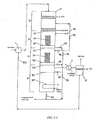
- the aromatic extraction solvent sulfolane is mixed with cooling water at mixer 1, the weight ratio of the water and the sulfolane is 5.0, the stream goes to the settlement area 3 of the solvent regenerator 2 after mixing.
- the lower section of settlement area 3 has one partition plate 32, the operation temperature of the settlement area 3 is 30°C, the pressure is 0.3MPa, 3 layers are formed at the settlement area, the top layer is oil which is drained via an outlet, the lower layer is an insoluble substance which is discharged via a slag outlet, the middle layer is a mixture of the water-soluble solvent and water, and goes to the stage 1 filtration area 4 via piping 31.
- the settlement area 3 and the stage 1 filtration area is isolated by the partition plate 32.
- the lower section of filtration area 4 is equipped with partition plates 42 and 43.
- a filter element 41 is installed at partition plate 42.
- the filter element is packed with multi-hole metal mesh, and the diameter of the mesh holes is 50 ⁇ m, operating temperature is 40 °C, the pressure is 0.2 MPa; the stream after being treated at filtration area 4 goes to a stage 2 filtration area 5.
- the lower section of the filtration area 5 has partition plates 52 and 53.
- the stream goes to distillation area 6 after being treated at filtration area 5 to separate the sulfolane and water vapor and liquid.
- a tray 61 is provided at the top section of distillation area 6, and a reboiler is at the bottom.
- the top temperature of distillation area 6 is 85 °C
- the bottom temperature of distillation area 6 is 150°C
- the reboiler temperature is 200 °C.
- the pressure of the distillation area is 0.08MPa
- water vapor goes to the condenser 7 to cool down, then goes to recovery water tank 8 for oil and water separation.
- the water goes to mixer 1.
- Regenerated solvent is discharged from the bottom of the distillation area.
- the regenerated solvent and the analysis result of the solvent property are shown in table 1-C.
- cycloalkyl heavy oil catalytic feed and feedback oil produce the catalytic hydrocarbon under the catalysis of LANET-35 catalyst produced by Lanzhou Catalyst Plant.
- the catalytic hydrocarbon is cycloalkyl catalytic cracking heavy oil. It is fractionated at the fractionator.
- the overhead temperature of the fractionator is 120°C
- the diesel fuel outlet temperature is 270°C
- the bottom temperature is 370°C
- the overhead pressure is 0.1MPa
- the bottom pressure is 0.12MPa
- the distillation range of the gasoline fraction is controlled at 35 ⁇ 240°C.
- the distillation range of the diesel fuel fraction is controlled at 240 ⁇ 385°C.
- the gasoline fraction is pumped to another fractionator for secondary distillation.
- the overhead temperature of the fractionator is 80°C
- the diesel fuel outlet temperature is 240°C
- the bottom temperature is 370°C
- the overhead pressure is 0.1 MPa
- the bottom pressure is 0.12MPa.
- An intermediate fraction with A distillation range of 110 ⁇ 210°C is drawn from the bottom of fractionator.
- the overhead is the gasoline fraction with the distillation range of 35 ⁇ 110°C.
- the intermediate fraction is subjected to solvent extraction.
- the solvent is 50% N-methyl pyrrole alkane alkone and 50% tetraethylene glycol
- the extraction temperature is 80°C
- the extraction pressure is 0.4MPa.
- the solvent weight ratio (solvent /feed) is 3.3. Aromatic and non-aromatic hydrocarbon fractions are extracted.
- the aromatic hydrocarbon fraction goes to the middle section of the another fractionator for distillation.
- the distillation temperature is 120 ⁇ 180°C
- the distillation pressure is 0.04 ⁇ 0.20MPa
- stripping water is fed in at the bottom
- the overhead fraction is a high octane number fraction
- the lower side cut is a heavy aromatic hydrocarbon fraction
- the bottom cut is used to recycle solvent.
- the high octane number fraction is blended with gasoline fraction to make 93# gasoline
- the non-aromatic hydrocarbon fraction goes to the middle section of the last fractionator for distillation.
- the distillation temperature is 100 ⁇ 135°C
- the pressure is 0.15 ⁇ 0.25MPa.
- the overhead cut is a light non-aromatic fraction
- the bottom cut is a diesel fuel fraction.
- the diesel fuel fraction is blended with the diesel fuel fraction to make 5# diesel fuel.
- the light non-aromatic fraction is taken as chemical light oil.
- Embodiment 1-C This is the same as Embodiment 1-C, except that: the water-soluble solvent is aromatic extraction solvent tetraethylene glycol; the weight ratio of the water and the tetraethylene glycol is 0.2; valves V1, V2 and V3 are set in between the settlement area 3, filtration area 4 and 5, the filter off material at the settlement area 3 can be discharged to filtration area 5; valves V4, V5, V6, V7 are set in between filtration area 4, filtration area 5 and distillation area 6, and the filtered off material at settlement area 3 or filtration area 4 or 5 is discharged to distillation area 6 directly.
- the water-soluble solvent is aromatic extraction solvent tetraethylene glycol
- the weight ratio of the water and the tetraethylene glycol is 0.2
- valves V1, V2 and V3 are set in between the settlement area 3, filtration area 4 and 5, the filter off material at the settlement area 3 can be discharged to filtration area 5; valves V4, V5, V6, V7 are set in between filtration area 4,
- V8 V9 are set, the filtered off material at settlement area 3 or filtration area 4 or 5 or distillation area 6 is discharged directly, regenerated solvent is obtained, and V10 is set between mixer 1 and water recovery tank 8.
- V10 is closed.
- V2,V5,V8 are closed, while the rest of the valves are open, filtered off material passes settlement area 3, filtration area 4, 5 and distillation area 6.
- the regenerated solvent and the analysis result of the solvent property is shown in table 2-C.
- paraffin base heavy oil catalytic feed and the feedback oil produce catalytic hydrocarbon under the catalysis of LBO-16 catalyst produced by Lanzhou Catalyst Plant.
- the catalytic hydrocarbon is cycloalkyl catalytic cracking heavy oil. It is fractionated at the fractionator.
- the overhead temperature of the fractionator is 50°C
- the diesel fuel outlet temperature is 210°C
- the bottom temperature is 340°C
- the overhead pressure is 0.1 MPa
- the bottom pressure is 0.12MPa
- the distillation range of the gasoline fraction is maintained at 35 ⁇ 120°C.
- the distillation range of the diesel fuel fraction 1 is maintained at 120 ⁇ 355°C.
- the gasoline fraction is pumped to another fractionator for secondary distillation.
- the overhead temperature of the fractionator is 80°C
- the diesel fuel outlet temperature is 240°C
- the bottom temperature is 370°C
- the overhead pressure is 0.1MPa
- the bottom pressure is 0.12MPa.
- An intermediate fraction with the distillation range of 80 ⁇ 240°C is drawn from the overhead of fractionator.
- the bottom fraction is a gasoline fraction with a distillation range of 240 ⁇ 380°C.
- the intermediate fraction goes to the extractor for solvent extraction.
- the solvent is N-methyl pyrrole alkane alkone
- the extraction temperature is 66°C
- extraction pressure is 0.4MPa.
- Solvent weight ratio (solvent /feed) is 3.3.
- Aromatic and non-aromatic hydrocarbon fractions are extracted. The aromatic hydrocarbon fraction goes to the middle section of the next fractionator for distillation.
- the distillation temperature is 120 ⁇ 180°C, the distillation pressure is 0.04 ⁇ 0.20 MPa, and stripping water is fed in at the bottom.
- the overhead fraction is a high octane number fraction, the lower side cut is a heavy aromatic hydrocarbon fraction, and the bottom cut is used for recycled solvent.
- the high octane number fraction is blended with gasoline fraction completely; the non-aromatic hydrocarbon fraction goes to the middle section of the last fractionator for distillation.
- the distillation temperature is 100 ⁇ 150°C and the pressure is 0.15 ⁇ 0.25 MPa.
- the overhead cut is a light non-aromatic fraction, the bottom cut is a diesel fuel fraction; the diesel fuel fraction is blended with the diesel fuel fraction completely.
- the light non-aromatic fraction is taken as chemical light oil.
- Embodiment 1-C This is the same as Embodiment 1-C, except in that: the solvent N-methyl pyrrole alkane alkone is for aromatic extraction distillation. Filtration 4 and 5 is omitted; the weight ratio of the water and the solvent is 9.0. The regenerated solvent and the analysis result of the solvent property is shown in Table 3-C.
- paraffin base heavy oil catalytic feed and feedback oil produce catalytic hydrocarbon under the catalysis of LCS catalyst produced by Lanzhou Catalyst Plant.
- the catalytic hydrocarbon is catalytic cracking heavy oil. It is fractionated at the fractionator.
- the overhead temperature of the fractionator is 80 °C
- the diesel fuel outlet temperature is 240°C
- the bottom temperature is 370°C
- the overhead pressure is 0.1 MPa
- the bottom pressure is 0.12MPa.
- One side cut is added at the middle section of the fractionator to draw the intermediate fraction.
- the side cut temperature is 190 °C, and the distillation range of the intermediate fraction at 120 ⁇ 210°C.
- the intermediate fraction is pumped to an extractor for solvent extraction.
- the solvent is sulfolane, the extraction temperature is 80°C, and extraction pressure is 0.4MPa. Solvent weight ratio (solvent /feed) is 4.8.
- Aromatic and non-aromatic hydrocarbon fractions are extracted.
- the aromatic hydrocarbon fraction goes to the middle section of another fractionator for distillation.
- the distillation temperature is 120 ⁇ 165°C and the distillation pressure is 0.04 ⁇ 0.20 MPa.
- Stripping water is fed in at the bottom, the overhead fraction is a high octane number fraction, the lower side cut is heavy aromatic hydrocarbon fraction, and the bottom cut is used for recycled solvent.
- the high octane number fraction is blended completely with the gasoline fraction; the non-aromatic hydrocarbon fraction goes to the middle section of the next fractionator for distillation.
- the distillation temperature is 100 ⁇ 135°C, and the pressure is 0.15 ⁇ 0.25MPa.
- the overhead cut is a light non-aromatic fraction
- the bottom cut is a diesel fuel fraction.
- the diesel fuel fraction is completely blended with the diesel fuel fraction.
- a light non-aromatic fraction is taken as chemical light oil.
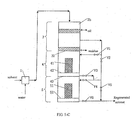
- the solvent N-formoxyl morpholine for aromatic extraction distillation is mixed with cooling water at mixer 1.
- the weight ratio of the water and the N-formoxyl morpholine is 2.0.
- the stream goes to a settler 9 after being mixed.
- the operation temperature of the settler 9 is 90 °C, the pressure is 1.0MPa. 3 layers are formed at the settler; the top layer is oil which is drained via an outlet, the lower layer is an insoluble substance which is discharged via a slag outlet, the middle layer is mixture of the water-soluble solvent and water, and goes to the stage 1 filter 10.
- the bottom of the filter 10 is isolated by a partition plate 42.
- a filter element 41 is installed at partition plate 42, the filter element being packed with ceramic elements.
- the diameter of the ceramic element holes is 40 ⁇ m, the operating temperature is 50°C, and the pressure is 0.9MPa.
- the stream after being treated at filter 10 goes to stage 2 filter 11.
- the bottom of the filter 11 has one partition plate 52, and a filter element 51 is installed at plate 52.
- the filter element 51 is packed with multi-hole metal powder metallurgy material.
- the diameter of the multi- hole metal powder metallurgy holes is 20 ⁇ m, the operating temperature is 50°C, and the pressure is 0.8 MPa.
- the stream goes to distiller 12 after being treated at filter 11 to separate vapor and liquid.
- a tray 61 is provided at the top section of distillater 12 and a reboiler 62 is provided at the bottom.
- the top temperature of distillater 12 is 85 °C
- the bottom temperature is 162 °C
- the reboiler temperature is 200 °C
- the pressure of the distillater 12 is 0.08MPa.
- Water vapor goes to the condenser 7 to cool down, then goes to recovery water tank 8 for oil and water separation.
- the water goes to mixer 1.
- Regenerated solvent is discharged from the bottom of distillater 12.
- the regenerated solvent and the analysis result of the solvent property is shown in Table 4-C.
- the solvent used during the absorption is dimethylsulfoxide; the weight ratio of the water and the dimethylsulfoxide is 1.0; valves V1, V2, V3, V4, V5, V6 are set in between the settlement area 3, filtration area 4 and 5, if V2, V5, are closed the other valves are open, the water-soluble solvent at the settlement area 3 is mixed with water and passes the filtration area 4 and 5, the regenerated solvent is discharged at the outlet of the filtration 5 directly.
- the products produced by the invention are from the gasoline and diesel fuel of the catalytic cracking fractionator, without other blended compositions; the yield of the gasoline is reduced; the aromatic content in the gasoline is increased, the octane number of the gasoline is increased by 3-5 units; the distillation range of gasoline is extended from 35 ⁇ 190°C to 35 ⁇ 203°C; the yield of diesel fuel is increased by 5-7 units; the diesel fuel and gasoline ratio is increased by 0.4-0.8; the aromatic content of the diesel fuel is reduced, so as to increase the cetane number by 5-7 units; the distillation range of diesel fuel is extended from 180 ⁇ 365°C to 165 ⁇ 365°C; the flash point of the diesel fuel is reduced from 75°C to 56°C; the yields of high quality light oil products and heavy aromatic products are increased; since the aromatic and non-aromatic hydrocarbons of the intermediate fraction of gasoline and diesel fuel are extracted, the high octane number aromatic hydrocarbon fraction can be blended with the gasoline fraction, making different proportions of 90#, 93#
- the catalytic gasoline can go to the market directly without blending with the high octane number fraction, thus saving the high octane number fraction, especial recombination oil, which is the main source of the light aromatic.
- the invention can not only increase the quality of gasoline and diesel fuel, but also produce different grades of gasoline and diesel fuel, lower capital cost, shorten construction schedule, facilitate operation, lower operation cost, and improve the diesel fuel and gasoline ratio which does not meet the immediate demand.
- the regeneration process of the invention involves settlement before filtration, the contaminants in the solvent are separated, and the gum in the solvent is separated effectively through filtration, so better solvent quality can be achieved after regeneration.
Landscapes
- Chemical & Material Sciences (AREA)
- Oil, Petroleum & Natural Gas (AREA)
- Engineering & Computer Science (AREA)
- Chemical Kinetics & Catalysis (AREA)
- General Chemical & Material Sciences (AREA)
- Organic Chemistry (AREA)
- Production Of Liquid Hydrocarbon Mixture For Refining Petroleum (AREA)
- Liquid Carbonaceous Fuels (AREA)
- Organic Low-Molecular-Weight Compounds And Preparation Thereof (AREA)
Abstract
Description
- The present invention relates to a process for catalytic hydrocarbon recombination, and more particularly to a process for catalytic hydrocarbon recombination for preparing high quality gasoline and diesel fuel.
- Catalytic cracking, heavy oil catalytic cracking technology is the key technology of oil refining. Catalytic cracking includes wax oil catalytic cracking, heavy oil catalytic cracking; the oils produced by this process are called catalytic hydrocarbons. When processed, normally through a fractionator, the resulting catalytic hydrocarbons may produce dry gas, gasoline, diesel fuel, heavy oil, etc., where gasoline and diesel fuel is up to 70% of the market gasoline and diesel fuel share.
- As environmental protection requirements getting increasingly stringent, the standards of the gasoline and diesel fuel become higher and higher. The existing fractionation process for catalytic hydrocarbon has the following deficiency: First, the quality of the gasoline and diesel fuel produced by the existing process is to be improved; the olefin content of the gasoline is too high, octane number is too low, the cetane number of the diesel fuel is too low, and it can not meet the stabilization requirement; Secondly, the existing process is not available for producing various grade of gasoline at the same time, the grade of the products is too narrow; third, the ratio of the gasoline and diesel fuel produced does not match the market requirement, insufficient for the demand of diesel fuel but over sufficient for the demand of gasoline.
- The main factor which impacts the quality of the gasoline is the olefin content and the octane number of the gasoline. Recently, the methods taken by oil refining plants to increase the octane number are: 1. Increase high octane number gasoline regulating fraction, such as recombined resulting oil, alkylate, etherized resulting oil, isomerized resulting oil, etc.; 2. Use new catalysts; 3. Adjust the operating condition of catalytic cracking; 4. Adjusting the fractionation rang of gasoline.
- The following issues are found from the above methods: 1. High capital cost, high operation cost, capacity limited by the feedstock, and unreasonable use of resource, for example, since recombined resulting oil is the main feed for the polyester, it maximizes the shortage of the polyester feed when large amount of recombined resulting oil is used as high octane gasoline blending fraction; 2. Use of new catalysts could increase the octane number, but it will lead to higher olefin content of the gasoline and decrease the diesel fuel and gasoline ratio; 3. Measures to adjust the operating condition of catalytic cracking and to increase the octane number could also lead to higher olefin content in the gasoline and lower the diesel fuel and gasoline ratio; 4. Measures to adjust the fractionation rang and to get higher octane number will also lead to higher olefin content in the gasoline, even if the adjusting margin is limited. All the methods used to get higher octane number by increasing the olefin content of the gasoline have conflict with execution of new gasoline standard.
- The solvent used in the solvent extracting tower to extract the aromatic hydrocarbon composition and non-aromatic hydrocarbon composition is recycled, and it is intersoluble with water. After having been recycled in the equipment for a long time, part of the solvent inevitably produces acidic material due to oxidization. Anti-acid is added to remove the acidic material. In the above process, a trace of olefin can be carried in the feed. In addition, mechanical contaminants can also be generated in the equipment and piping. The color of the recycle solvent will get darker and darker, and high polymer and acidic material accumulate continuously. This will impact the operation of the above process little by little, in serious cases, it will impact the quality and yield of the product. Therefore, the recycle solvent must be regenerated.
- The current solvent regeneration methods include atmosphere or vacuum stripping regeneration, atmosphere or vacuum distillation regeneration, adsorption regeneration and filtration regeneration. The stripping regeneration capacity is low due to the limitation of the stripping gas rate; the operation of the distillation regeneration is too complicated, large amount of solvent is lost, the energy consumption is high, and severe coking is found at the reboiler of the regenerator. Ion exchange resin is commonly used for adsorption regeneration, such as the sulfolane extracting system recycle water regeneration proposed by America patent US 4919816. This method can remove the acidic material of the recycle water, minimize the corrosion of the equipment, but can not remove the contaminant of the solvent system. Moreover, alkali solution is required. Chinese patent CN1062007C disclosed a regeneration method of aromatic extraction solvent. This regeneration approach is achieved by adding recycle water to the system, then by filtration and adsorption de-colure. It's disadvantages are as follows: first, the water amount in the system is limited, so it will limit the process capacity; secondly, after the water is added, the contaminant of the solvent can not be isolated before going into the adsorption bed, so fouling frequently happens at the adsorption bed; third, the adsorption bed fail when up to a certain extent due to the limitation of the adsorption capacity of the adsorption bed, so replacement or regeneration of the sorbent is required; fourth, acid and alkali treatment is required for resin regeneration, the operation is complex and it leads to higher cost.
- It is an object of the present invention to provide a process for catalytic hydrocarbon recombination to produce high quality gasoline and diesel fuel.
- Another object of the invention is to provide a process for catalytic hydrocarbon recombination with a water-soluble solvent regeneration system, in which the solvent loss is low, the process capacity is strong, no acid and alkali treatment is required, and the quality of the regenerated solvent is high.
- A further object of the invention is to produce various grade of gasoline and diesel fuel at the same time through catalytic hydrocarbon recombination, thus to increase the types of the products.
- Yet another object of this invention is to increase the diesel fuel and gasoline ratio to meet the market demand.
- To attain the above objects, this invention adopts the following technical scheme:
- A process for catalytic hydrocarbon recombination, in which catalytic hydrocarbon is fractionated at a fractionator (1), including fractionating gasoline fraction and diesel fuel fraction; characterized in that: the gasoline fraction and diesel fuel fraction are recombined, and an intermediate fraction is drawn from the gasoline fraction and diesel fuel fraction; and the above intermediate fraction is extracted at a solvent extractor to separate the aromatic and non-aromatic fraction.
- In one preferred scheme, the intermediate fraction is drawn at one for more side cuts added at the middle of the
fractionator 1. The overhead temperature of thefractionator 1 is 65~95°C, the outlet temperature of diesel fuel is 190~280°C, the temperature of side cut is 120~260°C, the bottom temperature is 340~385°C, the overhead pressure of thefractionator 1 is 0.11~0.28 MPa, the bottom pressure is 0.12~0.30. MPa; the gasoline fraction, diesel fuel fraction and intermediate fraction are produced atfractionator 1; the distillation range of the gasoline fraction is controlled at 35~110°C ±30°C, the distillation range of the diesel fuel fraction is controlled at 210°C±30°C~355±30°C, the fractionation range of the mentioned intermediate fraction is controlled at 120°C±30°C~210±30°C. - One preferred scheme is a two-step fractionation:
step 1, fractionate a gasoline fraction and a diesel fuel fraction first, increase the temperature of thefractionator 1 by 10~50°C, and control the fraction range of the gasoline being at 35~210°C±30°C, the fraction range of the diesel fuel is controlled at 210°C±30°C~355±30°C; then pump the gasoline fraction tofractionator 2 to proceed with the second fractionation, the intermediate fraction of 110°C±30°C~210±30°C is drawn at the bottom of thefractionator 2, and separate the gasoline fraction of 35~110°C±30°C at the overhead. - One preferred scheme, is a two step fractionation:
step 1, fractionate gasoline and diesel fuel fraction first, decrease the temperature of thefractionator 1 to 10~40°C, the fraction range of the gasoline being controlled at 35~110°C±30°C, and the fraction range of the diesel fuel being controlled at 110°C±30°C~355±30°C; then pump the diesel fuel fraction tofractionator 5 to proceed with the second fractionation, draw the diesel fuel fraction of 210°C±30°C~355±30°C at the bottom of thefractionator 5, and separate the intermediate fraction of 110°C±30°C~210±30°C at the overhead. - In one preferred scheme, the aromatic hydrocarbon fraction is fractionated at
fractionator 3, high octane number gasoline fraction is separated at overhead offractionator 3, heavy aromatic is separated at the bottom, and the resulting high octane number gasoline fraction is blended with the 35~110°C±30°C gasoline. - In one preferred scheme, the high octane number gasoline may be blended with 35~110°C±30°C gasoline completely.
- In one preferred scheme, the high octane number gasoline may be blended with 35~110°C±30°C gasoline based on setting values to get different grade gasoline such as 90#, 93#, 97# gasoline.
- In one preferred scheme, which it is a one step fractionation process, the intermediate fraction is drawn at 1 or 4 side cuts, thus dividing the intermediate fraction into 1 to 4 fraction range.
- In one preferred scheme, the non-aromatic fraction is fractionated at
fractionator 4, and the diesel fuel fraction is separated at the bottom of thefractionator 4, and blended with the 210°C±30°C~380°C diesel fuel fraction to increase the cetane number of the diesel fuel, or blending one or more kinds of low condensing point diesel fuel based on the market status. Light non-aromatic hydrocarbons are separated at overhead offractionator 4. They can be used as chemical light oil, or blended with gasoline. - A process for catalytic hydrocarbon recombination, in which the catalytic hydrocarbon is fractionated at
fractionator 1, includes fractionating gasoline fraction and diesel fuel fraction; recombine the gasoline fraction and the diesel fuel fraction, and draw the intermediate fraction from the gasoline fraction and the diesel fuel fraction; wherein the intermediate fraction and the gasoline fraction are pumped to the solvent extraction unit for extraction, so as to separate the aromatic and non-aromatic fraction. - In one preferred scheme, wherein the intermediate fraction is drawn at one or more side cuts added at the middle section of the
fractionator 1. The overhead temperature of thefractionator 1 is 65~130 °C, the outlet temperature of diesel fuel is 170~250°C, the side cut temperature is 120~240°C, the bottom temperature is 330~385°C, the overhead pressure of thefractionator 1 is 0.15~0.28 MPa, and the bottom pressure is 0.12~0.30 MPa; the gasoline fraction, the diesel fuel fraction and the intermediate fraction are produced atfractionator 1; the distillation range of the gasoline fraction is controlled at 35~150°C, the distillation range of the diesel fuel fraction is controlled at 170~395°C, and the distillation range of the intermediate fraction is controlled at 70~250°C. - One preferred scheme, is a two step fractionation:
step 1, fractionate gasoline and diesel fuel fraction first, increase the temperature of thefractionator 1 overhead and diesel fuel outlet by 10~50°C, control the distillation range of the gasoline at 35~250°C, control the distillation range of the diesel fuel at 170~395°C. Then the gasoline fraction is pumped tofractionator 2 to proceed with the second fractionation. The intermediate fraction of 70~250°C is drawn at the bottom side cut of thefractionator 2, the 35~150°C gasoline is separated at the overhead, and wherein the intermediate fraction and the 35~150°C gasoline go to the solvent extraction unit together to separate the aromatic and non-aromatic compositions. - One preferred scheme, is a two step fractionation:
step 1, fractionate gasoline and diesel fuel fraction first, decrease the temperature of thefractionator 1 overhead and diesel fuel outlet by 10~50°C, control the distillation range of the gasoline at 35~150°C, control the distillation range of the diesel fuel at 70~395°C; then pump the diesel fuel fraction tofractionator 5 to proceed the second fractionation, the 170~395°C diesel fuel fraction is drawn at the bottom side cut of thefractionator 5, the 70~250°C intermediate fraction is fractionated at the overhead; the intermediate fraction and the 170~395°C diesel fuel go to the solvent extraction unit together to separate the aromatic and non-aromatic compositions. - One preferred scheme, is a one step fractionation process, wherein the
fractionator 1 has 1 to 4 side cuts, so the intermediate fraction can be separated into 1 to 4 streams. - In one preferred scheme, the aromatic hydrocarbon fraction and the solvent are fractionated at
fractionator 3, high octane number gasoline fraction is separated at overhead offractionator 3, and heavy aromatic is separated at the bottom. - In one preferred scheme, the non-aromatic fractions are fractionated at
fractionator 4, the overhead product of thefractionator 4 is light gasoline; light non-aromatic hydrocarbons are drawn at the side cut; the diesel fuel fraction are drawn at the bottom. - The diesel fuel fraction is blended with the 170~380°C diesel fuel fraction to increase the cetane number of the diesel fuel; one or more low condensing point diesel fuels and non-low condensing point diesel fuels can also be blended based on the market status; the diesel fuel fraction serve as the feed for ethylene after hydro treating.
- The light non-aromatic hydrocarbons may be blended with light gasoline; or it can be used as chemical light oil separately. The aromatic content of the chemical light oil is low; it can be taken as the high quality feed for steam cracker after hydro treating.
- The high octane gasoline fraction can be blended with the light gasoline fraction.
- The high octane gasoline fraction can be blended with the light gasoline fraction based on setting values to get different types of the gasoline, such as 90#, 93#, and 97#.
- The aromatic hydrocarbons can also be used as high quality gasoline.
- The solvents used for extraction are: sulfones, such as sulfolane; glycols, such as tetraethylene glycol and pentaethylene glycol; alkyl-alkones, such as N-methyl-pyrrolidone; acetamides; and amines, they can also be the mixture of two solvents or more than two solvents.
- A process for catalytic hydrocarbon recombination, in which the catalytic hydrocarbon is fractionated at
fractionator 1, includes fractionating gasoline fraction and diesel fuel fraction; recombine the gasoline fraction and the diesel fuel fraction, and draw an intermediate fraction from the gasoline fraction and the diesel fuel fraction; the intermediate fraction or the mixture of the intermediate fraction and the gasoline fraction are extracted at the solvent extractor to separate the aromatic and non-aromatic fraction, wherein the solvent for extraction is recycled, the regeneration procedure of the solvent is detailed as follows: - 1. Mix the water-soluble solvent with water, the weight ratio of water and the solvent is 0.1~10;
- 2. The mixture is separated by sedimentation. Three phases are generated, oil at top, the mixture of water-solvent and water at middle section, and insoluble substance at bottom;
- 3. The mixed phases of
step 2 are fractionated at atmosphere or vacuum condition by utilizing of waste heat, obtaining water-soluble solvent and water; - 4. Discharge the regenerated water-soluble solvent of
step 3, and cool down the separated water; - 5. After the water in
step 4 is cool down, reseparate the oil and water, discharge the recovered water, and mix with the water-soluble solvent ofstep 1 for recycle. - In one preferred scheme, at first the middle mixed phases of
step 3 are filtered, then distilled. - The weight ratio of water and the water-soluble solvent is preferably 0.5~3; more preferably is 1~2;
- In one preferred scheme, the filtration separation can be 1-stage filtration, 2-stage filtration or 3-stage filtration, each filtration stage can be used in series, in parallel or in combination thereof.
- The material used in filtration can be a filter element, or filter packing. The filter element can employ materials of specific apertures, including metal powder metallurgy, ceramic, metal mesh and various fabrics etc. Filter packing includes active carbon, or treated active carbon, clay, silica gel, silicon oxide, alumina, molecular sieve, various mineral, such as sand, etc., and various cation and anion exchange resins.
-
- FIG. 1-A is a schematic flow diagram of the Embodiment 1-A of the invention;
- FIG. 2-A is a schematic flow diagram of the Embodiment 5-A of the invention;
- FIG. 3-A is a schematic flow diagram of the Embodiment 4-A of the invention;
- FIG. 1-B is a schematic flow diagram of the Embodiment 1-B of the invention;
- FIG. 2-B is a schematic flow diagram of the Embodiment 4-B of the invention;
- FIG. 3-B is a schematic flow diagram of the Embodiment 5-B of the invention;
- FIG. 1-C is a schematic flow diagram of the Embodiment 1-C of the invention;
- FIG. 2-C is a schematic flow diagram of the Embodiment 2-C of the invention;
- FIG. 3-C is a schematic flow diagram of the Embodiment 3-C of the invention;
- FIG. 4-C is a schematic flow diagram of the Embodiment 4-C of the invention;
- FIG. 5-C is a schematic flow diagram of the Embodiment 5-C of the invention;
- Further description is given by the following embodiments, but it is not intended to limit the scope of the invention.
- The paraffin-based catalytic feed and the feedback oil produce catalytic hydrocarbon under the catalysis of the LCS catalyst produced by Lanzhou Catalyst Plant, China. The resulting catalytic hydrocarbon is catalytic cracking wax oil. It is fractionated at the
fractionator 1. The overhead temperature of thefractionator 1 is 110°C, the diesel fuel outlet temperature is 190°C, the bottom temperature is 370°C, the overhead pressure is 0.11 MPa, the bottom pressure is 0.12 MPa. The fractions are dry gas, liquid gas, gasoline, diesel fuel, heavy oil etc. - Referring to FIG. 1-A, the paraffin-based catalytic feed and the feedback oil produce catalytic hydrocarbon under the catalysis of LCS catalyst produced by Lanzhou Catalyst Plant, China. It is fractionated at the
fractionator 1. The overhead temperature of thefractionator 1 is 80°C, the diesel fuel outlet temperature is 240°C, the bottom temperature is 370°C, the overhead pressure is 0.1MPa, the bottom pressure is 0.12MP. One side cut is added at the middle section of thefractionator 1 to draw the intermediate fraction. The side cut temperature is 190°C, the distillation range of the intermediate fraction is 120~210°C. The intermediate fraction is pumped to an extractor for solvent extraction, the solvent used is sulfolane, the extraction temperature is 80°C, and the extraction pressure is 0.4MPa. Solvent weight ratio (solvent /feed) is 4.8. Aromatic and non-aromatic hydrocarbons are separated. The aromatic hydrocarbon fraction goes to the middle section offractionator 3 for distillation, the distillation temperature is 120~165°C, and the distillation pressure is 0.04~0.20MPa. Stripping water goes in at the bottom, the overhead fraction is high octane number fraction, the lower side cut is heavy aromatic hydrocarbon fraction, the bottom cut is the recycle solvent. All the high octane number fractions are blended with the gasoline fraction; the non-aromatic hydrocarbon fraction goes to thefractionator 4 at the middle section for distillation. The distillation temperature is 100~135°C, the pressure is 0.15~0.25 MPa, the overhead cut is a light non-aromatic, the bottom cut is a diesel fuel; All the diesel fuels are blended with the diesel fuel fraction. The light non-aromatic hydrocarbons are blended with the gasoline fraction. - The intermediate base atmosphere residual heavy oil catalytic feed and the feedback oil produce catalytic hydrocarbon under the catalysis of LANET-35 catalyst produced by Lanzhou Catalyst Plant, China. The catalytic hydrocarbon is catalytic cracking heavy oil. It is fractionated at the
fractionator 1. The overhead temperature of thefractionator 1 is 80 °C, diesel fuel outlet temperature is 240°C, bottom temperature is 370°C,overhead pressure is 0.1 MPa, bottom pressure is 0.12MPa; three side cuts are added at the middle section of thefractionator 1 to draw the intermediate fraction. The three side cut temperature from up to down is 170, 180, 190 °C, the distillation range of the intermediate fraction is 80~120°C, 120~165°C, 165~220°C, the intermediate fraction got from the three distillation range is pumped to the same extractor for solvent extraction. The solvent is tetraethylene glycol, the extraction temperature is 85°C, and the extraction pressure is 0.4MPa. Solvent weight ratio (solvent/feed) is 3.1. Aromatic and non-aromatic hydrocarbons are separated; The aromatic hydrocarbon fraction goes to the middle section offractionator 3 after combination for distillation, the distillation temperature is 120~180°C, and the distillation pressure is 0.04~0.20 MPa, stripping water is fed in at the bottom, the overhead fraction is high octane number fraction, the lower side cut is heavy aromatic hydrocarbon fraction, the bottom cut is the recycle solvent; All the high octane number fractions are blended with gasoline fraction; the non-aromatic hydrocarbon fraction goes to the middle section offractionator 4 after combination for distillation. The distillation temperature is 100~135°C, the pressure is 0.15~0.25 MPa, the overhead cut are light non-aromatic hydrocarbons, the bottom cut is a diesel fuels; the diesel fuel fraction is blended with the diesel fuel fraction completely. The light non-aromatic hydrocarbons are blended with the gasoline fraction. - The cycloalkyl heavy oil catalytic feed and the feedback oil produce the catalytic hydrocarbon under the catalysis of LANET-35 catalyst produced by Lanzhou Catalyst Plant. The catalytic hydrocarbon is cycloalkyl catalytic cracking heavy oil. It is fractionated at the
fractionator 1. The overhead temperature of thefractionator 1 is 80 °C, the diesel fuel outlet temperature is 240°C, the bottom temperature is 370°C,the overhead pressure is 0.1 MPa, the bottom pressure is 0.12MPa; two side cuts are added at the middle section of thefractionator 1 to draw the intermediate fraction. The two side cut temperature from up to down is 180, 190 °C, the distillation range of the intermediate fraction is 80~165°C, 165~220°C respectively. The intermediate fractions got from two distillation ranges are pumped to the same extractor for solvent extraction. The solvent is N-formoxyl morphinone, the extraction temperature is 85°C, and extraction pressure is 0.4MPa. Solvent weight ratio (solvent /feed) is 3.1. Aromatic and non-aromatic hydrocarbon fractions are separated. The aromatic hydrocarbon fraction goes to the middle section offractionator 3 after combination for distillation, the distillation temperature is 120~180°C, and the distillation pressure is 0.04~0.20 MPa, stripping water is fed in at the bottom. The overhead fraction is high octane number fraction, the lower side cut is heavy aromatic hydrocarbon fraction, the bottom cut is for the recycle solvent. All the high octane number fractions are blended with gasoline fraction; the non-aromatic hydrocarbon fraction goes to the middle section offractionator 4 after combination for distillation. The distillation temperature is 100~135°C, the pressure is 0.15~0.25MPa, the overhead cut is a light non-aromatic, the bottom cut is a diesel fuel fraction; the diesel fuel fraction is blended with the diesel fuel fraction completely. The light non-aromatic fraction is taken as light oil for chemicals. - Referring to FIG. 3-A, the paraffin-based catalytic feed and the feedback oil produce catalytic hydrocarbon under the catalysis of LBO-16 catalyst produced by Lanzhou Catalyst Plant, the catalytic hydrocarbon is cycloalkyl catalytic hydrocarbon heavy oil. It is fractionated at the
fractionator 1. The overhead temperature of thefractionator 1 is 50 °C, the diesel fuel outlet temperature is 210°C, the bottom temperature is 340°C, the overhead pressure is 0.1MPa, and the bottom pressure is 0.12MPa. The distillation range of the gasoline fraction is controlled at 35~120°C. The distillation range of thediesel fuel 1 fraction is controlled at 120~355°C. Diesel fuel 1 fraction is pumped tofractionator 2 for secondary distillation. The overhead temperature of thefractionator 2 is 80°C, the diesel fuel outlet temperature is 240°C, the bottom temperature is 370°C, the overhead pressure is 0.1 MPa, the bottom pressure is 0.12MPa; an intermediate fraction with the distillation range of 80~240°C is drawn from The overhead offractionator 2. The bottom cut is the gasoline fraction with the distillation range of 240~380°C. The intermediate fraction is pumped to the extractor for solvent extraction. The solvent is N-methyl pyrrole alkane alkone, the extraction temperature is 66°C, and extraction pressure is 0.4MPa. Solvent weight ratio (solvent /feed) is 3.3. Aromatic and non-aromatic hydrocarbon fraction is separated. The aromatic hydrocarbon fraction goes to the middle section offractionator 3 for distillation, the distillation temperature is 120~180°C, and the distillation pressure is 0.04~0.20MPa, stripping water is fed in at the bottom, the overhead fraction is high octane number fraction, the lower side cut is heavy aromatic hydrocarbon fraction, the bottom cut is used for recycle solvent. All the high octane number fractions are blended with gasoline fraction; the non-aromatic hydrocarbon fraction goes to thefractionator 4 at the middle section for distillation. The distillation temperature is 100~135°C, the pressure is 0.15~0.25 MPa, the overhead cut is a light non-aromatic, the bottom cut is a diesel fuel fraction. All the diesel fuel fractions are blended with the diesel fuel fraction. The light non-aromatic fraction is taken as chemical light oil. - Referring to 2-A, the cycloalkyl heavy oil catalytic feed and the feedback oil produce catalytic hydrocarbon under the catalysis of LANET-35 catalyst produced by Lanzhou Catalyst Plant. The catalytic hydrocarbon is cycloalkyl catalytic cracking heavy oil. It is fractionated at the
fractionator 1. The overhead temperature of thefractionator 1 is 120°C, the diesel fuel outlet temperature is 270°C, the bottom temperature is 370°C,the overhead pressure is 0.1MPa, the bottom pressure is 0.12MPa; the distillation range of the gasoline fraction is controlled at 35~240°C. The distillation range of thediesel fuel 1 fraction is controlled at 240~385°C. Gasoline fraction is pumped tofractionator 2 for secondary distillation. The overhead temperature of thefractionator 2 is 80 °C, the diesel fuel outlet temperature is 240°C, the bottom temperature is 370°C, the overhead pressure is 0.1 MPa, the bottom pressure is 0.12MPa; an intermediate fraction with the distillation range of 110~210°C is drawn from the bottom offractionator 2. The overhead is the gasoline fraction with the distillation range of 35~110°C. The intermediate fraction is pumped to the extractor for solvent extraction. The solvent is 50% N-methyl pyrrole alkane alkone and 50% tetraethylene glycol, the extraction temperature is 80°C, extraction pressure is 0.4MPa. Solvent weight ratio (solvent /feed) is 3.3. Aromatic and non-aromatic hydrocarbon fraction is separated; The aromatic hydrocarbon fraction goes to the middle section offractionator 3 for distillation, the distillation temperature is 120~180°C, and the distillation pressure is 0.04~0.20MPa, stripping water is fed in at the bottom, the overhead fraction is high octane number fraction, the lower side cut is heavy aromatic hydrocarbon fraction, the bottom cut is used for recycle solvent; all the high octane number fractions are blended with gasoline fraction to make 93# gasoline; the non-aromatic hydrocarbon fraction goes to thefractionator 4 at the middle section for distillation. The distillation temperature is 100~135°C, the pressure is 0.15~0.25MPa, the overhead cut is a light non-aromatic, the bottom cut is a diesel fuel fraction. All the diesel fuel fractions are blended with the diesel fuel fraction to make 5# diesel fuel. The light non-aromatic fraction is taken as light oil for chemicals. - The paraffin-based catalytic feed and the feedback oil produce catalytic hydrocarbon under the catalysis of LCS catalyst produced by Lanzhou Catalyst Plant, the catalytic hydrocarbon is catalytic cracking wax oil. It is fractionated at the
fractionator 1. The overhead temperature of thefractionator 1 is 80°C, the diesel fuel outlet temperature is 240°C, the bottom temperature is 370°C, the overhead pressure is 0.1MPa, and the bottom pressure is 0.12MPa. One side cut is added at the middle section offractionator 1 to draw the intermediate fraction. The temperature of the side cut is 180°C. The distillation range of the intermediate fraction is 140~240°C. The intermediate fraction is pumped to the extractor for solvent extraction. The solvent is pentaethylene glycol. The extraction temperature is 100°C, extraction pressure is 0.4MPa. The solvent weight ratio (solvent /feed) is 2.9. Aromatic and non-aromatic hydrocarbon fractions are separated; the aromatic hydrocarbon fraction is taken as high quality gasoline directly at 0.04~0.20MPa, the non-aromatic hydrocarbon fraction goes to thefractionator 4 at the middle section for distillation. The distillation temperature is 100~150°C, the pressure is 0.15~0.25 MPa, the overhead cut is a light non-aromatic fraction, the bottom cut is a diesel fuel fraction. All the diesel fuel fractions are blended with the diesel fuel fraction. The light non-aromatic fraction is taken as light oil for chemicals. - The yield and the properties of Comparative Examples and the Embodiments are shown as the following tables:
Table 1-A: Yield comparison of Comparative Examples 1-A and Embodiment 1-A Product distribution Comparative Example 1-A Embodiment 1-A Change Change Dry gas, Weight % 4.7 4.7 0 Liquid gas, Weight % 11.25 11.25 0 Gasoline, Weight % 39.09 29.38 -9.71 Diesel fuel, Weight % 40.71 46.53 5.82 Coke, Weight % 3.99 3.99 0 Oil slurry, Weight % 0 0 0 Chemical light oil, Weight % 0 3.89 3.89 Loss, Weight % 0.3 0.3 0 Yield of the light oil, Weight % 75.99 75.99 0 Table 2-A: Yield of the Embodiment 2-A-4-A Product distribution Embodiment 2-A Embodiment 3-A Embodiment 4-A Dry gas, Weight % 6 3.65 4.21 Liquid gas, Weight % 9.5 11.76 12.61 Gasoline, Weight % 29.38 26.18 37.01 Diesel fuel, Weight % 28.57 44.56 29.68 Coke, Weight % 9 8.02 7.42 Oil slurry, Weight % 9 3.75 5.55 Chemical light oil ,Weight % 6.55 1.89 3.17 Heavy aromatic, Weight % 0.8 Loss, Weight % 0.3 0.3 0 - It is shown that the invention can improve the diesel fuel/gasoline ratio significantly, and also provide chemical light oil.
Table 3-A: Property comparison of Comparative Example 1-A and Embodiment 1-A Product distribution Comparative Example 1-A Embodiment 1-A Change Aromatic content in the gasoline, m% 23.1 39.3 16.2 Octane number of the gasoline 90.2 93.9 3.7 Gasoline density, kg/m3 718 739 21 Distillation range of gasoline, °C 36~171 36~204 - Olefin content of the gasoline,% 42.7 37.5 5.2 Dry point of gasoline, °C 171 204 33 Aromatic content of the diesel fuel, m% 48.2 39 -9.2 Cetane number of the diesel fuel 38 43 5 Diesel fuel density, kg/m3 847 829 -18 Distillation range of diesel fuel, °C 181~346 167~346 - °C Flash point of diesel fuel, 71 57 -14 Distillation range of chemical light oil, °C 120~171 - Density of chemical light oil kg/m3 683 - Aromatic content of the chemical light oil, m% 2.1 - Olefin content of the chemical light oil, m% 23 - Table 4-A: Property of the Embodiments 2-A―4-A Product distribution Embodiment 2-A Embodiment 3-A Embodiment 4-A Aromatic content in the gasoline, m% 41 39 38.5 Octane number of the gasoline 94.2 92.3 93 Gasoline density, kg/m3 751 761 756 Distillation range of gasoline, °C 36~204 36~204 36~204- Olefin content of the gasoline,% 39.5 34 34.6 Dry point of gasoline, °C 204 204 204 Aromatic content of the diesel fuel, m% 40 40 39 Cetane number of the diesel fuel 38 36 39 Diesel fuel density, kg/m3 854 852 852 Distillation range of diesel fuel, °C 165~346 165~346 165~346 Flash point of diesel fuel, °C 57 56 56 Distillation range of chemical light oil, °C 80~165 100~165 100~165 Density of chemical light oil kg/m3 667 682 682 Aromatic content of the chemical light oil, m% 2.6 2.9 2.9 Olefin content of the chemical light oil, m% 42 31 29 Distillation range of heavy aromatic, °C 80~171 Density of the heavy aromatic, kg/m3 845 845 Aromatic content of heavy aromatic, m% 98.2 23 - - The aromatic content of the diesel fuel was measured by GB11132-2002; the octane number of the gasoline was measured by GB/T5487; the density of the gasoline was measured by GB/T1884-1885; the distillation range of gasoline was measured by GB/T6536; the olefin content of gasoline was measured by GB11132-2002; the aromatic content of the diesel fuel was measured by GB11132-2002; the Cetane number of the diesel fuel was measured by GB/T386. The density of diesel fuel was measured by GB/T1884-1885; the distillation range of diesel fuel was measured by GB/T6536; the flash point of diesel fuel was measured by GB/T261; the distillation range of chemical light oil was measured by GB/T6536; the density of chemical light oil was measured by GB/T1884-1885; the aromatic content of the chemical light oil was measured by GB11132-2002; the olefin content of chemical light oil was measured by GB11132-2002;
- Tables 3-A and 4-A show that the invention can increase the octane number of gasoline, and the aromatic content also; the cetane number of diesel fuel also get improved; that means the quality of the gasoline and diesel fuel are improved.
- The paraffin-based catalytic feed and the feedback oil produce catalytic hydrocarbon under the catalysis of LCS catalyst produced by Lanzhou Catalyst Plant. The catalytic hydrocarbon is fractionated at the
fractionator 1. The overhead temperature of thefractionator 1 is 110°C, the diesel fuel outlet temperature is 190°C, the bottom temperature is 370°C, the overhead pressure is 0.11MPa, and the bottom pressure is 0.12MPa. The fractions are dry gas, liquid gas, gasoline, diesel fuel, heavy oil etc. - See FIG. 1-B, the paraffin-based catalytic feed and the feedback oil produce catalytic hydrocarbon under the catalysis of LCS catalyst produced by Lanzhou Catalyst Plant. The catalytic hydrocarbon is fractionated at the
fractionator 1. The overhead temperature of thefractionator 1 is 80 °C, the diesel fuel outlet temperature is 240°C, the bottom temperature is 370°C, the overhead pressure is 0.1MPa, the bottom pressure is 0.12MPa. One side cut is added at the middle section of thefractionator 1 to draw the intermediate fraction. The side cut temperature is 190°C, the distillation range of the intermediate fraction is 120~210°C. The intermediate fraction and the gasoline fraction are pumped to the extractor for solvent extraction, the solvent is sulfolane, the extraction temperature is 80°C, and extraction pressure is 0.4MPa. Solvent weight ratio (solvent /feed) is 4.8. Aromatic and non-aromatic hydrocarbons are extracted; the aromatic hydrocarbon fraction and the solvent go to the middle section offractionator 3 for distillation, the distillation temperature is 120~165°C, and the distillation pressure is 0.04~0.20 MPa, stripping water is fed in at the bottom, the overhead fraction is high octane number gasoline fraction, the lower side cut is heavy aromatic hydrocarbon fraction, the bottom cut is taken as the recycle solvent; the non-aromatic hydrocarbon fraction goes to thefractionator 4 at the middle section for distillation. The distillation temperature is 100~135°C, the pressure is 0.15~0.25 MPa, overhead cut is light gasoline fraction, the side cut is light non-aromatic hydrocarbon fraction. The bottom cut is a diesel fuel fraction. All the diesel fuel fraction is blended with the diesel fuel fraction; 50% of the light non-aromatic fraction is used as the chemical light oil; the remaining 50% of the non-aromatic fraction is blended with all the high octane number gasoline fraction and light gasoline fraction. - The intermediate base atmosphere residual heavy oil catalytic feed and the feedback oil produce catalytic hydrocarbon under the catalysis of LANET-35 catalyst produced by Lanzhou Catalyst Plant. The catalytic hydrocarbon is fractionated at the
fractionator 1. The overhead temperature of thefractionator 1 is 110°C, the diesel fuel outlet temperature is 190°C, the bottom temperature is 370°C, the overhead pressure is 0.11MPa, and the bottom pressure is 0.12MPa. The fractions are dry gas, liquid gas, gasoline, diesel fuel, heavy oil etc. - The intermediate base atmosphere residual heavy oil catalytic feed and the feedback oil produce the catalytic hydrocarbon under the catalysis of LANET-35 catalyst produced by Lanzhou Catalyst Plant. The catalytic hydrocarbon is fractionated at the
fractionator 1. The overhead temperature of thefractionator 1 is 80 °C, the diesel fuel outlet temperature is 240°C, the bottom temperature is 370°C, the overhead pressure is 0.1 MPa, the bottom pressure is 0.12MPa; three side cuts are added at the middle section of thefractionator 1 to draw the intermediate fraction. The three side cut temperatures from up to down are 170, 180, 190°C, the distillation range of the intermediate fraction is 80~120°C, 120~165°C, 165~220°C, the intermediate fraction obtained from the three distillation range and gasoline fraction is pumped to three identical extractor for solvent extraction. The solvent is tetraethylene glycol, the extraction temperature is 85°C, and extraction pressure is 0.4MPa. Solvent weight ratio (solvent /feed) is 3.1. Aromatic and non-aromatic hydrocarbons are extracted; the aromatic hydrocarbon fraction goes to the middle section offractionator 3 after combination for distillation, the distillation temperature is 120~180°C, and the distillation pressure is 0.04~0.20MPa. Stripping water is fed in at the bottom, the overhead fraction is high octane number gasoline fraction, the lower side cut is heavy aromatic hydrocarbon fraction, the bottom cut is taken as the recycle solvent; the non-aromatic hydrocarbon fraction goes to the middle section offractionator 4 after combination for distillation. The distillation temperature is 100~135°C, the pressure is 0.15~0.25 MPa, the overhead cut is a light gasoline fraction; the side cut is light non-aromatic hydrocarbon fraction; the bottom cut is a diesel fuel fraction. The diesel fuel fraction is taken as the feed for ethylene after hydro treating. The light non-aromatic fraction is blended with the light gasoline fraction. All the high octane number gasoline fraction is blended with the light gasoline fraction. - The cycloalkyl heavy oil catalytic feed and the feedback oil produce the catalytic hydrocarbon under the catalysis of LANET-35 catalyst produced by Lanzhou Catalyst Plant. The catalytic hydrocarbon is fractionated at
fractionator 1, the overhead temperature of thefractionator 1 is 110°C, the diesel fuel outlet temperature is 190°C, the bottom temperature is 370°C, the overhead pressure is 0.11 MPa, and the bottom pressure is 0.12 MPa. The fractions are dry gas, liquid gas, gasoline, diesel fuel, heavy oil etc. - The cycloalkyl heavy oil catalytic feed and the feedback oil produce the catalytic hydrocarbon under the catalysis of LANET-35 catalyst produced by Lanzhou Catalyst Plant. The catalytic hydrocarbon is fractionated at the
fractionator 1. The overhead temperature of thefractionator 1 is 80°C, the diesel fuel outlet temperature is 240°C, the bottom temperature is 370°C, the overhead pressure is 0.18MPa, the bottom pressure is 0.25 MPa; two side cuts are added at the middle section of thefractionator 1 to draw the intermediate fraction. The two side cut temperatures from upper to lower sections are 180 and 190 °C, and the distillation range of the intermediate fraction is 80~165°C, and 165~220°C respectively. The intermediate fractions obtained from the two distillation ranges are pumped to two similar extractors for solvent extraction after being mixed with the respective gasoline fractions. The solvent is N-formoxyl morphinone, the extraction temperature is 85°C, and extraction pressure is 0.4MPa. Solvent weight ratio (solvent /feed) is 3.1. Aromatic and non-aromatic hydrocarbon fractions are extracted. The aromatic hydrocarbon fraction goes to the middle section offractionator 3 after combination for distillation. The distillation temperature is 120~180°C, and the distillation pressure is 0.04~0.20MPa. Stripping water is fed in at the bottom, the overhead fraction is high octane number fraction, the lower side cut is heavy aromatic hydrocarbon fraction, the bottom cut is for the recycled solvent; the non-aromatic hydrocarbon fraction goes the middle section offractionator 4 after combination for distillation. The distillation temperature is 100~135°C, the pressure is 0.15~0.25 MPa, the overhead cut is a light gasoline; the side cut is light non-aromatic; the bottom cut is a diesel fuel fraction. The diesel fuel fraction is blended with the diesel fuel fraction completely. The light non-aromatic fraction is taken as chemical light oil. The high octane number gasoline fraction is blended with light gasoline and the heavy aromatic fraction is blended with the diesel fuel fraction. - 50% paraffin base heavy oil and 50% intermediate base heavy oil and feedback oil produce catalytic hydrocarbon under the catalysis of LANET-35 catalyst produced by Lanzhou Catalyst Plant. The catalytic hydrocarbon is fractionated at
fractionator 1, the overhead temperature of thefractionator 1 is 110°C, the diesel fuel outlet temperature is 190°C, the bottom temperature is 370°C, the overhead pressure is 0.11 MPa, and the bottom pressure is 0.12MPa. The fractions are dry gas, liquid gas, gasoline, diesel fuel, heavy oil etc. - Referring to FIG. 2-B, the cycloalkyl heavy oil catalytic feed and the feedback oil produce the catalytic hydrocarbon under the catalysis of LANET-35 catalyst produced by Lanzhou Catalyst Plant. The catalytic hydrocarbon is fractionated at the
fractionator 1. The overhead temperature of thefractionator 1 is 140°C, the diesel fuel outlet temperature is 220°C, the bottom temperature is 370°C, the overhead pressure is 0.1MPa, the bottom pressure is 0.12MPa and the distillation range of thegasoline fraction 1 is controlled at 35~240°C. The distillation range of the diesel fuel fraction is controlled at 240~385°C. Gasoline 1 fraction is pumped tofractionator 2 for secondary distillation. The overhead temperature of thefractionator 2 is 80 °C, the intermediate fraction outlet temperature is 240°C, the bottom temperature is 370°C, the overhead pressure is 0.1 MPa, the bottom pressure is 0.12MPa; an intermediate fraction with the distillation range of 110~210°C is drawn from the bottom offractionator 2. The overhead is the gasoline fraction with the distillation range of 35~110°C. The intermediate fraction and gasoline fraction are pumped to the extractor for solvent extraction. The solvent is 50% N-methyl pyrrole alkane alkone and 50% tetraethylene glycol, the extraction temperature is 80°C, extraction pressure is 0.4MPa. Solvent weight ratio (solvent /feed) is 3.3. Aromatic and non-aromatic hydrocarbon fractions are extracted; the aromatic hydrocarbon fraction and the solvent go to the middle section offractionator 3 for distillation, the distillation temperature is 120~180°C, and the distillation pressure is 0.04~0.20MPa. Stripping water is fed in at the bottom, the overhead fraction is high octane number gasoline fraction, the lower side cut is heavy aromatic hydrocarbon fraction, the bottom cut is used for recycle solvent; the non-aromatic hydrocarbon fraction goes to thefractionator 4 at the middle section for distillation. The distillation temperature is 100~135°C, the pressure is 0.15~0.25MPa. The overhead cut is a light gasoline fraction, the side cut is light non-aromatic hydrocarbon fraction, the bottom cut is a diesel fuel fraction and the high octane number gasoline is blended with light gasoline to make 93# gasoline. All the diesel fuel fractions are blended with the diesel fuel fraction to make 5# diesel fuel. Light non-aromatic is taken as chemical light oil. - Paraffin base heavy oil and feedback oil produce the catalytic hydrocarbon under the catalysis of LBO-16 catalyst produced by Lanzhou Catalyst Plant. The catalytic hydrocarbon is fractionated at
fractionator 1, the overhead temperature of thefractionator 1 is 110°C, the diesel fuel outlet temperature is 190°C, the bottom temperature is 370°C, the overhead pressure is 0.11MPa, and the bottom pressure is 0.12MPa. The fractions are dry gas, liquid gas, gasoline, diesel fuel, heavy oil etc. - Referring to FIG. 3-B, the paraffin base heavy oil catalytic feed and the feedback oil produce the catalytic hydrocarbon under the catalysis of LBO-16 catalyst produced by Lanzhou Catalyst Plant. The catalytic hydrocarbon is fractionated at the
fractionator 1. The overhead temperature of thefractionator 1 is 90°C, the diesel fuel outlet temperature is 180°C, the bottom temperature is 340°C, the overhead pressure is 0.1MPa, the bottom pressure is 0.12MPa; the distillation range of the gasoline fraction is controlled at 35~120°C. The distillation range of thediesel fuel fraction 1 is controlled at 120~355°C. The gasoline fraction is pumped tofractionator 5 for secondary distillation. The overhead temperature of thefractionator 5 is 80 °C, the diesel fuel outlet temperature is 240°C, the bottom temperature is 370°C, the overhead pressure is 0.1MPa, the bottom pressure is 0.12MPa and the overhead of thefractionator 5 is the intermediate fraction with the distillation range of 80~240°C. The bottom cut is the diesel fuel fraction with a distillation range of 240~380°C; the intermediate fraction and gasoline fraction is pumped to the extractor for solvent extraction. The solvent is N-methyl pyrrole alkane alkone, the extraction temperature is 66°C, and extraction pressure is 0.4MPa. Solvent weight ratio (solvent /feed) is 3.3. Aromatic and non-aromatic hydrocarbon fractions are extracted; the aromatic hydrocarbon fraction and the solvent go to the middle section offractionator 3 for distillation, the distillation temperature is 120~180°C, and the distillation pressure is 0.04~0.20MPa. Stripping water is fed in at the bottom, the overhead fraction is high octane number gasoline fraction, the lower side cut is heavy aromatic hydrocarbon fraction, the bottom cut is used for recycle solvent; the non-aromatic hydrocarbon fraction goes to thefractionator 4 at the middle section for distillation. The distillation temperature is 100~150°C, the pressure is 0.15~0.25MPa. The overhead cut is a light gasoline fraction, the side cut is a light non-aromatic hydrocarbon fraction and the bottom cut is a diesel fuel fraction. The diesel fuel fraction is used as the feed for ethylene after hydro treating; the high octane number gasoline is blended with light gasoline. The light non-aromatic fraction is taken as chemical light oil. - Residual mixing ratio 60 paraffin base heavy oil and the feedback oil produce a catalytic hydrocarbon under the catalysis of LANET-35 catalyst produced by Lanzhou Catalyst Plant. The catalytic hydrocarbon is fractionated at
fractionator 1, the overhead temperature of thefractionator 1 is 110 °C, the diesel fuel outlet temperature is 190°C, the bottom temperature is 370°C, the overhead pressure is 0.11 MPa, and the bottom pressure is 0.12MPa. The fractions are dry gas, liquid gas, gasoline, diesel fuel, heavy oil etc. - Residual mixing ratio 60 paraffin base heavy oil and feedback oil produce a catalytic hydrocarbon under the catalysis of LANET-35 catalyst produced by Lanzhou Catalyst Plant. The catalytic hydrocarbon is fractionated at the
fractionator 1. The overhead temperature of thefractionator 1 is 80 °C, the diesel fuel outlet temperature is 240°C, the bottom temperature is 370°C, the overhead pressure is 0.1MPa, the bottom pressure is 0.12MPa. One side cut is added at the middle section offractionator 1 to get the intermediate fraction. The side cut temperature is 180°C. The distillation range of the intermediate fraction is at 140~240°C. The intermediate fraction and gasoline fraction is pumped to the extractor for solvent extraction. The solvent is pentaethylene glycol, the extraction temperature is 100°C, and extraction pressure is 0.4MPa. Solvent weight ratio (solvent /feed) is 2.9. Aromatic and non-aromatic hydrocarbon fractions are extracted; the aromatic hydrocarbon fraction is used as high quality gasoline directly. The non-aromatic hydrocarbon fraction goes to thefractionator 4 from the middle section for distillation, the distillation temperature is 100~150°C, and the distillation pressure is 0.15~0.25MPa. The overhead fraction is light non-aromatic, the bottom cut is a diesel fuel. All diesel fuel fractions are blended with the diesel fuel fraction. The light non-aromatic fraction is taken as chemical light oil. - The yield and the properties of Comparative Examples and the Embodiments are shown as the following tables:
Table 1-B: Yield comparison of Comparative Example 1-B and Embodiment 1-B Product distribution Comparative Example 1-B Embodiment 1-B Change Dry gas, Weight % 4.7 4.7 0 Liquid gas, Weight % 11.25 11.25 0 Gasoline, Weight % 39.09 31.32 -8.58 Diesel fuel, Weight % 40.71 46.53 5.82 Coke, Weight % 3.99 3.99 0 Oil slurry, Weight % 0 0 0 Chemical light oil, Weight % 0 1.95 1.95 Loss, Weight % 0.3 0.3 0 Table 2-B: Property comparison of Comparative Example 1-B and Embodiment 1-B Product distribution Comparative Example 1-B Embodiment 1-B Change Aromatic content in the gasoline, m% 23.1 36.1 13 Octane number of the gasoline 90.2 92.6 2.4 Gasoline density, kg/m3 1718 732 14 Distillation range of gasoline, °C 36~171 36~204 - Olefin content of the gasoline,% 42.7 38.9 -3.8 °C Dry point of gasoline, 171 204 33 Aromatic content of the 48.2 39 -9.2 diesel fuel, v% Cetane number of the diesel fuel 38 43 5 Diesel fuel density, kg/m3 847 829 -18 Distillation range of diesel fuel, °C 181~346 167~346 - Flash point of diesel 71 57 -14 Distillation range of chemical light oil, °C 120~171 - Density of chemical light oil kg/m3 683 - Aromatic content of the chemical light oil, v% 2.1 - Olefin content of the chemical light oil, v% 23 - Table 3-B: Yield comparison of Comparative Example 2-B and Embodiment 2-B Product distribution Comparative Example 2-B Embodiment 2-B Change Dry gas, Weight % 6 6 0 Liquid gas, Weight % 9.5 9.5 0 Gasoline, Weight % 41.5 35.93 -5.57 Diesel fuel, Weight % 23 21.37 -1.63 Coke, Weight % 9 9 0 Oil slurry, Weight % 9 0 9 Diesel fuel fraction, Weight % 0 8.1 8.1 Chemical light oil, Weight % 0 0.8 0.8 Loss, Weight % 2 0.3 0 Table 4-B: Property comparison of Comparative Example 2-B and Embodiment 2-B Product distribution Comparative Example 2-B Embodiment 2-B Change Aromatic content in the gasoline, v% 29 38 9 Octane number of the gasoline 91 93.1 2.1 Gasoline density, kg/m3 738 749 11 Distillation range of gasoline, °C 35~182 36~204 - Olefin content of the gasoline, v% 58 42.3 -15.7 °C Dry point of gasoline, 182 203 32 Aromatic content of the diesel fuel, v% 56 57 1 Octane number of the diesel fuel 30 29.5 -0.5 Diesel fuel density, kg/m3 886 889 3 Distillation range of diesel fuel, °C 182~352 203~346 - fuel, Flash °C point of diesel 75 76 1 Distillation range of diesel fuel fraction, °C 165~205 - Density of diesel fuel fraction kg/m3 789 - Distillation range of heavy aromatic, °C 80~171 - Density of the heavy aromatic, kg/m3 845 - Aromatic content of heavy aromatic, m% 98.2 - Table 5-B: Yield comparison of Comparative Example 3-B and Embodiment 3-B Product distribution Comparative Example 3-B Embodiment 3-B Change Dry gas, m % 3.65 3.65 0 Liquid gas, m % 11.76 11.76 0 Gasoline, m % 35.98 28.27 -7.71 Diesel fuel, m % 36.65 44.36 7.71 Coke, m % 8.02 8.02 0 Oil slurry, m % 3.75 3.75 . 0 Loss, m % 0.24 0.3 0 Table 6-B: Property comparison of Comparative Example 3-B and Embodiment 3-B Product distribution Comparative Example 3-B Embodiment 3-B Change Aromatic content in the gasoline, v% 21 36.9 15.9 Octane number of the gasoline 89 92 3 Gasoline density, kg/m3 723 735 12 Distillation range of gasoline, °C 35~203 36~204 - Olefin content of the gasoline, v% 29 36 7 Dry point of gasoline, °C 203 204 1 Aromatic content of the diesel fuel, v% 51 40 -11 Cetane number of the diesel fuel 29 35 6 Diesel fuel density, kg/m3 887 852 -35 Distillation range of diesel fuel, °C 203~349 165~346 - Flash point of diesel fuel, °C 85 56 -29 Table 7-B: Yield comparison of Comparative Example 4-B and Embodiment 4-B Product distribution Comparative Example 4-B Embodiment 4-B Change Dry gas, m % 6.2 6.2 0 Liquid gas, m % 29.1 29.1 0 Gasoline, m % 45.6 33.5 -12.1 Diesel fuel, m % 16.3 21.7 5.4 Coke, m % 8.1 8.1 0 Oil slurry, m % 0.2 0.2 0 Chemical light oil , m% 0 6.7 6.7 Loss , m % 0.5 0.5 0 Table 8-B: Property comparison of Comparative Example 4-B and Embodiment 4-B Product distribution Comparative Example 4-B Embodiment 4-B Change Aromatic content in the gasoline, v% 33 38.5 19.5 Octane number of the gasoline 92.3 97 4.7 Gasoline density, kg/m3 741 756 22 Distillation range of gasoline, °C 35~192 35~204 - Olefin content of the gasoline, v% 59 51 -8 Dry point of gasoline, °C 190 204 14 Aromatic content of the diesel fuel, v% 52 39 -13 Cetane number of the diesel fuel 32 39 7 Diesel fuel density, kg/m3 887 852 -35 Distillation range of diesel fuel, °C 203~363 165~363 - Flash point of diesel fuel, °C 75 56 -19 Distillation range of chemical light oil, °C 100~165 - Density of chemical light oil kg/m3 682 Aromatic content of the chemical light oil, v% 2.9 - Olefin content of the chemical light oil, v% 58 - Table 9-B: Yield comparison of Comparative Example 5-B and Embodiment 5-B Product distribution Comparative Example 5-B Embodiment 5-B Change Dry gas, m % 4.21 4.21 0 Liquid gas, m % 12.61 12.61 0 Gasoline, m % 47.04 37.02 -10.02 Diesel fuel, m % 22.82 29.67 6.85 Coke, m % 7.42 7.42 0 Oil slurry, m % 5.55 5.55 0 Chemical light oil , m% 0 3.17 3.17 Loss , m % 0.35 0.35 0 Table 10-B: Property comparison of Comparative Example 5-B and Embodiment 5-B Product distribution Comparative Example 5-B Embodiment 5-B Change Aromatic content in the gasoline, v% 19 38.5 19.5 Octane number of the gasoline 89 89 93 93 4 4 Gasoline density, kg/m3 734 756 22 Distillation range of gasoline, °C 35~190 36~204 - Olefin content of the gasoline, v% 33.33 34.6 1.27 °C Dry point of gasoline, 190 204 14 Aromatic content of the diesel fuel, v% 52 39 -13 Cetane number of the diesel fuel 32 39 7 Diesel fuel density, kg/m3 887 852 -35 Distillation range of diesel fuel, °C 203~363 165~363 - Flash point of diesel fuel, °C 75 56 -19 Distillation range of chemical light oil, °C 100~165 - Density of chemical light oil kg/m3 682 Aromatic content of the chemical light oil, v% 2.9 - Olefin content of the chemical light oil, v% 29 - Table 11-B: Yield comparison of Comparative Example 6-B and Embodiment 6-B Product distribution Comparative Example 6-B Embodiment 6-B Change Dry gas, m % 10.2 10.2 0 Liquid gas, m % 38.9 38.9 0 Gasoline, m % 32.5 25.2 -7.3 Diesel fuel, m % 10.4 14.2 3.8 Coke, m % 7.9 7.9 0 Oil slurry, m % 0.2 0.2 0 Heavy aromatic hydrocarbon fraction, m% 0 3.5 3.5 Loss , m % 0.3 0.3 0 Table 12-B: Property comparison of Comparative Example 6-B and Embodiment 6-B Product distribution Comparative Example 6-B Embodiment 6-B Change Aromatic content in the gasoline, v% 36 41.1 5.1 Octane number of the gasoline 92.7 93.9 1.2 Gasoline density, kg/m3 748 762 14 Distillation range of gasoline, °C 35~195 35~204 - Olefin content of the gasoline, m% 56 58 -2 °C Dry point of gasoline, 195 204 9 Aromatic content of the diesel fuel, v% 56 41 -15 Cetane number of the diesel fuel 26 34 8 Diesel fuel density, kg/m3 891 860 -31 Distillation range of diesel fuel, °C 203~356 165~356 - Flash point of diesel ful, °C 81 56 -25 Distillation range of heavy aromatic hydrocarbon fraction, °C 204□240 - Density of heavy aromatic hydrocarbon fraction kg/m3 849 - Olefin content of the heavy aromatic hydrocarbon fraction, m% 97.9 - - The aromatic content of the diesel fuel was measured by GB11132-2002; the octane number of the gasoline was measured by GB/T5487; the density of the gasoline was measured by GB/T1884-1885; the distillation range of gasoline was measured by GB/T6536; the olefin content of gasoline was measured by GB11132-2002; the olefin content of diesel fuel was measured by GB11132-2002, cetane number of the diesel fuel was measured by GB/T 386. The density of diesel fuel was measured by GB/T1884-1885; the distillation range of diesel fuel was measured by GB/T6536; the flash point of diesel fuel was measured by GB/T261; the distillation range of chemical light oil (light non-aromatic) was measured by GB/T6536; the density of chemical light oil was measured by GB/T1884-1885; the aromatic content of the chemical light oil was measured by GB11132-2002; the olefin content of chemical light oil was measured by GB11132-2002;
- The paraffin-based catalytic feed and a feedback oil produce catalytic hydrocarbon under the catalysis of LCS catalyst produced by Lanzhou Catalyst Plant. The catalytic hydrocarbon is catalytic cracking wax oil. It is fractionated at the fractionator. The overhead temperature of the fractionator is 80°C, the diesel fuel outlet temperature is 240°C, the bottom temperature is 370°C, the overhead pressure is 0.1 MPa, and the bottom pressure is 0.12MPa. One side cut is added at the middle section of the fractionator to draw the intermediate fraction. The side cut temperature is 190 °C, and the distillation range of the intermediate fraction is 120~210°C. The intermediate fraction is pumped to a plate tower for water wash then pumped to the extractor for solvent extraction. The solvent is sulfolane, the extraction temperature is 80°C, and extraction pressure is 0.4MPa. Solvent weight ratio (solvent /feed) is 4.8. Sulfolane is regenerated by stripping. Aromatic and non-aromatic hydrocarbons are extracted. The aromatic hydrocarbon fraction goes to another fractionator for distillation, the distillation temperature is 120~165°C, and the distillation pressure is 0.04~0.20 MPa, stripping water is fed in at the bottom, the overhead fraction is high octane number fraction, the lower side cut is heavy aromatic hydrocarbon fraction, the bottom cut is taken as the recycle solvent. The high octane number fraction is fully blended with the gasoline fraction. The non-aromatic hydrocarbon fraction goes to next fractionator from the middle section for distillation. The distillation temperature is 100~135°C, and the distillation pressure is 0.15~0.25MPa. The overhead fraction is a light non-aromatic hydrocarbon fraction, and the bottom cut is a diesel fuel fraction. All the diesel fuel fraction is blended with the diesel fuel fraction; the light non-aromatic fraction is blended with gasoline fraction.
- Referring to a FIG. 1-C, the paraffin-based catalytic feed and a feedback oil produce catalytic hydrocarbon under the catalysis of LCS catalyst produced by Lanzhou Catalyst Plant. The catalytic hydrocarbon is catalytic cracking wax oil. It is fractionated at the fractionator. The overhead temperature of the fractionator is 80 °C, the diesel fuel outlet temperature is 240°C, the bottom temperature is 370°C, the overhead pressure is 0.1 MPa, and the bottom pressure is 0.12MPa. One side cut is added at the middle section of the fractionator to draw the intermediate fraction. The side cut temperature is 190°C and the distillation range of the intermediate fraction is 120~210°C. The intermediate fraction is pumped to a plate tower for water washing then pumped to the extractor for solvent extraction. The solvent is sulfolane, the extraction temperature is 80°C, and extraction pressure is 0.4MPa. Solvent weight ratio (solvent /feed) is 4.8. Aromatic and non-aromatic hydrocarbons are extracted. The aromatic hydrocarbon fraction goes to another fractionator from the middle section for distillation, the distillation temperature is 120~180°C, and the distillation pressure is 0.04~0.20MPa. Stripping water is fed in at the bottom, the overhead fraction is a high octane number fraction, the lower side cut is heavy aromatic hydrocarbon fraction, and the bottom cut is taken as the recycle solvent. The high octane number fraction is fully blended with the gasoline fraction to make 93# gasoline. The non-aromatic hydrocarbon fraction goes to the next fractionator from the middle section for distillation. The distillation temperature is 100~135°C, and the distillation pressure is 0.15~0.25MPa. The overhead fraction is a light non-aromatic hydrocarbon fraction, and the bottom cut is a diesel fuel fraction. All the diesel fuel fraction is blended with the diesel fuel fraction to make 5# diesel fuel; the light non-aromatic fraction is taken as chemical light oil.
- The aromatic extraction solvent sulfolane is mixed with cooling water at
mixer 1, the weight ratio of the water and the sulfolane is 5.0, the stream goes to thesettlement area 3 of thesolvent regenerator 2 after mixing. The lower section ofsettlement area 3 has onepartition plate 32, the operation temperature of thesettlement area 3 is 30°C, the pressure is 0.3MPa, 3 layers are formed at the settlement area, the top layer is oil which is drained via an outlet, the lower layer is an insoluble substance which is discharged via a slag outlet, the middle layer is a mixture of the water-soluble solvent and water, and goes to thestage 1filtration area 4 viapiping 31. Thesettlement area 3 and thestage 1 filtration area is isolated by thepartition plate 32. The lower section offiltration area 4 is equipped withpartition plates filter element 41 is installed atpartition plate 42. The filter element is packed with multi-hole metal mesh, and the diameter of the mesh holes is 50 µm, operating temperature is 40 °C, the pressure is 0.2 MPa; the stream after being treated atfiltration area 4 goes to astage 2filtration area 5. The lower section of thefiltration area 5 haspartition plates filter element 51 packed with multi-hole metal mesh, the diameter of the mesh holes being 20µm, the operating temperature being 40°C, and the pressure being 0.1 MPa. The stream goes todistillation area 6 after being treated atfiltration area 5 to separate the sulfolane and water vapor and liquid. Atray 61 is provided at the top section ofdistillation area 6, and a reboiler is at the bottom. The top temperature ofdistillation area 6 is 85 °C, the bottom temperature ofdistillation area 6 is 150°C, the reboiler temperature is 200 °C. The pressure of the distillation area is 0.08MPa, water vapor goes to thecondenser 7 to cool down, then goes torecovery water tank 8 for oil and water separation. The water goes tomixer 1. Regenerated solvent is discharged from the bottom of the distillation area. The regenerated solvent and the analysis result of the solvent property are shown in table 1-C.Table 1-C Solvent Regenerated solvent Analysis method Viscosity, 30°C, centipoises 20.5 11.8 GB/T265 Color, >5 2 Colorimetry PH 5.8 6.1 -- Water content in the solvent, ppm 6500 6500 n-butyl alcohol azeotropy Hydrocarbon content in the solvent, ppm 2000 100 SY2128 Appearance brown Light yellow -- Continue operation time, year □ 1 -- Change of the feed rate, m% - ±5 -- - Referring to FIG. 2-C, cycloalkyl heavy oil catalytic feed and feedback oil produce the catalytic hydrocarbon under the catalysis of LANET-35 catalyst produced by Lanzhou Catalyst Plant. The catalytic hydrocarbon is cycloalkyl catalytic cracking heavy oil. It is fractionated at the fractionator. The overhead temperature of the fractionator is 120°C, the diesel fuel outlet temperature is 270°C, the bottom temperature is 370°C, the overhead pressure is 0.1MPa, the bottom pressure is 0.12MPa and the distillation range of the gasoline fraction is controlled at 35~240°C. The distillation range of the diesel fuel fraction is controlled at 240~385°C. The gasoline fraction is pumped to another fractionator for secondary distillation. The overhead temperature of the fractionator is 80°C, the diesel fuel outlet temperature is 240°C, the bottom temperature is 370°C, the overhead pressure is 0.1 MPa, and the bottom pressure is 0.12MPa. An intermediate fraction with A distillation range of 110~210°C is drawn from the bottom of fractionator. The overhead is the gasoline fraction with the distillation range of 35~110°C. The intermediate fraction is subjected to solvent extraction. The solvent is 50% N-methyl pyrrole alkane alkone and 50% tetraethylene glycol, the extraction temperature is 80°C, and the extraction pressure is 0.4MPa. The solvent weight ratio (solvent /feed) is 3.3. Aromatic and non-aromatic hydrocarbon fractions are extracted. The aromatic hydrocarbon fraction goes to the middle section of the another fractionator for distillation. The distillation temperature is 120~180°C, the distillation pressure is 0.04~0.20MPa, stripping water is fed in at the bottom, the overhead fraction is a high octane number fraction, the lower side cut is a heavy aromatic hydrocarbon fraction, and the bottom cut is used to recycle solvent. The high octane number fraction is blended with gasoline fraction to make 93# gasoline; the non-aromatic hydrocarbon fraction goes to the middle section of the last fractionator for distillation. The distillation temperature is 100~135°C, the pressure is 0.15~0.25MPa. The overhead cut is a light non-aromatic fraction, the bottom cut is a diesel fuel fraction. The diesel fuel fraction is blended with the diesel fuel fraction to make 5# diesel fuel. The light non-aromatic fraction is taken as chemical light oil.
- This is the same as Embodiment 1-C, except that: the water-soluble solvent is aromatic extraction solvent tetraethylene glycol; the weight ratio of the water and the tetraethylene glycol is 0.2; valves V1, V2 and V3 are set in between the
settlement area 3,filtration area settlement area 3 can be discharged tofiltration area 5; valves V4, V5, V6, V7 are set in betweenfiltration area 4,filtration area 5 anddistillation area 6, and the filtered off material atsettlement area 3 orfiltration area distillation area 6 directly. In addition, V8, V9 are set, the filtered off material atsettlement area 3 orfiltration area distillation area 6 is discharged directly, regenerated solvent is obtained, and V10 is set betweenmixer 1 andwater recovery tank 8. When filtered off material does not go throughdistillation 6, V10 is closed. When V2,V5,V8 are closed, while the rest of the valves are open, filtered off material passessettlement area 3,filtration area distillation area 6. The regenerated solvent and the analysis result of the solvent property is shown in table 2-C.Table 2-C Solvent Regenerated solvent Analysis method Viscosity, 30°C, centipoises 32.5 28.6 GB/T265 Color, >5 2 Colorimetry PH 7.2 7.5 -- Water content in the solvent, ppm 5 5 n-butyl alcohol azeotropy Hydrocarbon content in the solvent, ppm 1500 1100 SY2128 Appearance brown Light yellow -- Continue operation time, year □ 1 -- Change rate of the feed, m% - ±5 -- - Referring to FIG. 3-C, paraffin base heavy oil catalytic feed and the feedback oil produce catalytic hydrocarbon under the catalysis of LBO-16 catalyst produced by Lanzhou Catalyst Plant. The catalytic hydrocarbon is cycloalkyl catalytic cracking heavy oil. It is fractionated at the fractionator. The overhead temperature of the fractionator is 50°C, the diesel fuel outlet temperature is 210°C, the bottom temperature is 340°C, the overhead pressure is 0.1 MPa, the bottom pressure is 0.12MPa; the distillation range of the gasoline fraction is maintained at 35~120°C. The distillation range of the
diesel fuel fraction 1 is maintained at 120~355°C. The gasoline fraction is pumped to another fractionator for secondary distillation. The overhead temperature of the fractionator is 80°C, the diesel fuel outlet temperature is 240°C, the bottom temperature is 370°C, the overhead pressure is 0.1MPa, the bottom pressure is 0.12MPa. An intermediate fraction with the distillation range of 80~240°C is drawn from the overhead of fractionator. The bottom fraction is a gasoline fraction with a distillation range of 240~380°C. The intermediate fraction goes to the extractor for solvent extraction. The solvent is N-methyl pyrrole alkane alkone, the extraction temperature is 66°C, and extraction pressure is 0.4MPa. Solvent weight ratio (solvent /feed) is 3.3. Aromatic and non-aromatic hydrocarbon fractions are extracted. The aromatic hydrocarbon fraction goes to the middle section of the next fractionator for distillation. The distillation temperature is 120~180°C, the distillation pressure is 0.04~0.20 MPa, and stripping water is fed in at the bottom. The overhead fraction is a high octane number fraction, the lower side cut is a heavy aromatic hydrocarbon fraction, and the bottom cut is used for recycled solvent. The high octane number fraction is blended with gasoline fraction completely; the non-aromatic hydrocarbon fraction goes to the middle section of the last fractionator for distillation. The distillation temperature is 100~150°C and the pressure is 0.15~0.25 MPa. The overhead cut is a light non-aromatic fraction, the bottom cut is a diesel fuel fraction; the diesel fuel fraction is blended with the diesel fuel fraction completely. The light non-aromatic fraction is taken as chemical light oil. - This is the same as Embodiment 1-C, except in that: the solvent N-methyl pyrrole alkane alkone is for aromatic extraction distillation.
Filtration Table 3-C Solvent Regenerated solvent Analysis method Viscosity, 30°C, centipoises 2.3 0.9 GB/T265 GB/T265 Color, >5 2 Colorimetry PH 7.1 7.3 -- Water content in the solvent, ppm 3 3 3 3 n-butyl alcohol azeotropy Hydrocarbon content in the solvent, ppm 2100 5 SY2128 Appearance brown Light yellow -- Continue operation time, year □ 1 -- Change rate of the feed, m% - ±5 -- - Referring to FIG. 4-C, paraffin base heavy oil catalytic feed and feedback oil produce catalytic hydrocarbon under the catalysis of LCS catalyst produced by Lanzhou Catalyst Plant. The catalytic hydrocarbon is catalytic cracking heavy oil. It is fractionated at the fractionator. The overhead temperature of the fractionator is 80 °C, the diesel fuel outlet temperature is 240°C, the bottom temperature is 370°C, the overhead pressure is 0.1 MPa, the bottom pressure is 0.12MPa. One side cut is added at the middle section of the fractionator to draw the intermediate fraction. The side cut temperature is 190 °C, and the distillation range of the intermediate fraction at 120~210°C. The intermediate fraction is pumped to an extractor for solvent extraction. The solvent is sulfolane, the extraction temperature is 80°C, and extraction pressure is 0.4MPa. Solvent weight ratio (solvent /feed) is 4.8. Aromatic and non-aromatic hydrocarbon fractions are extracted. The aromatic hydrocarbon fraction goes to the middle section of another fractionator for distillation. The distillation temperature is 120~165°C and the distillation pressure is 0.04~0.20 MPa. Stripping water is fed in at the bottom, the overhead fraction is a high octane number fraction, the lower side cut is heavy aromatic hydrocarbon fraction, and the bottom cut is used for recycled solvent. The high octane number fraction is blended completely with the gasoline fraction; the non-aromatic hydrocarbon fraction goes to the middle section of the next fractionator for distillation. The distillation temperature is 100~135°C, and the pressure is 0.15~0.25MPa. The overhead cut is a light non-aromatic fraction, the bottom cut is a diesel fuel fraction. The diesel fuel fraction is completely blended with the diesel fuel fraction. A light non-aromatic fraction is taken as chemical light oil.
- The solvent N-formoxyl morpholine for aromatic extraction distillation is mixed with cooling water at
mixer 1. The weight ratio of the water and the N-formoxyl morpholine is 2.0. The stream goes to asettler 9 after being mixed. The operation temperature of thesettler 9 is 90 °C, the pressure is 1.0MPa. 3 layers are formed at the settler; the top layer is oil which is drained via an outlet, the lower layer is an insoluble substance which is discharged via a slag outlet, the middle layer is mixture of the water-soluble solvent and water, and goes to thestage 1filter 10. The bottom of thefilter 10 is isolated by apartition plate 42. Afilter element 41 is installed atpartition plate 42, the filter element being packed with ceramic elements. The diameter of the ceramic element holes is 40µm, the operating temperature is 50°C, and the pressure is 0.9MPa. The stream after being treated atfilter 10 goes tostage 2filter 11. The bottom of thefilter 11 has onepartition plate 52, and afilter element 51 is installed atplate 52. Thefilter element 51 is packed with multi-hole metal powder metallurgy material. The diameter of the multi- hole metal powder metallurgy holes is 20µm, the operating temperature is 50°C, and the pressure is 0.8 MPa. The stream goes todistiller 12 after being treated atfilter 11 to separate vapor and liquid. Atray 61 is provided at the top section ofdistillater 12 and areboiler 62 is provided at the bottom. The top temperature ofdistillater 12 is 85 °C, the bottom temperature is 162 °C, the reboiler temperature is 200 °C, and the pressure of thedistillater 12 is 0.08MPa. Water vapor goes to thecondenser 7 to cool down, then goes torecovery water tank 8 for oil and water separation. The water goes tomixer 1. Regenerated solvent is discharged from the bottom ofdistillater 12. The regenerated solvent and the analysis result of the solvent property is shown in Table 4-C.Table 4-C Solvent Regenerated solvent Analysis method Viscosity, 30°C, centipoises 15.7 6.9 GB/T265 GB/T265 Color, >5 2 Colorimetry PH 7.6 7.8 -- Water content in the solvent, ppm 2 2 n-butyl alcohol azeotropy Hydrocarbon content in the solvent, ppm 1000 40 SY2128 Appearance brown Light yellow -- Continue operation time, year □ 1 -- Change rate of the feed, m% - ±5 -- - Referring to Table 5-C, this the same as Embodiment 1-C, except that: the solvent used during the absorption is dimethylsulfoxide; the weight ratio of the water and the dimethylsulfoxide is 1.0; valves V1, V2, V3, V4, V5, V6 are set in between the
settlement area 3,filtration area settlement area 3 is mixed with water and passes thefiltration area filtration 5 directly. If V2 only is closed, the other valves are open, the water-soluble solvent at thesettlement area 3 is mixed with water and must pass thefiltration area 4, or passfiltration area 5, or get regenerated solvent at the outlet offiltration area 4 directly if V2,V5 are fully closed. The regenerated solvent and the analysis result of the solvent property is shown in Table 5-C.Table 5-C Solvent Regenerated solvent Analysis method Viscosity, 30°C, centipoises 2.3 0.9 GB/T265 Color, >5 2 Colorimetry PH 7.2 7.5 -- Water content in the solvent, ppm 5 5 n-butyl alcohol azeotropy Hydrocarbon content in the solvent, ppm 2000 130 SY2128 Appearance brown Light yellow -- Continue operation time, year □ 1 -- Change rate of the feed, m% - ±5 -- - The advantages of the invention are: the products produced by the invention are from the gasoline and diesel fuel of the catalytic cracking fractionator, without other blended compositions; the yield of the gasoline is reduced; the aromatic content in the gasoline is increased, the octane number of the gasoline is increased by 3-5 units; the distillation range of gasoline is extended from 35~190°C to 35~203°C; the yield of diesel fuel is increased by 5-7 units; the diesel fuel and gasoline ratio is increased by 0.4-0.8; the aromatic content of the diesel fuel is reduced, so as to increase the cetane number by 5-7 units; the distillation range of diesel fuel is extended from 180~365°C to 165~365°C; the flash point of the diesel fuel is reduced from 75°C to 56°C; the yields of high quality light oil products and heavy aromatic products are increased; since the aromatic and non-aromatic hydrocarbons of the intermediate fraction of gasoline and diesel fuel are extracted, the high octane number aromatic hydrocarbon fraction can be blended with the gasoline fraction, making different proportions of 90#, 93#, 97# gasoline, so plants can adjust the operation scheme based on the market demands. According to the present invention, the catalytic gasoline can go to the market directly without blending with the high octane number fraction, thus saving the high octane number fraction, especial recombination oil, which is the main source of the light aromatic. Compared with other process, with only one additional extractor and several fractionators on the basis of the existing catalytic hydrocarbon unit, the invention can not only increase the quality of gasoline and diesel fuel, but also produce different grades of gasoline and diesel fuel, lower capital cost, shorten construction schedule, facilitate operation, lower operation cost, and improve the diesel fuel and gasoline ratio which does not meet the immediate demand.
- In comparison with present regeneration systems in which, the filtration system may be fouled due to the contaminant and gum, so that frequent cleaning is required, and the quality of the regenerated solvent is poor, the regeneration process of the invention involves settlement before filtration, the contaminants in the solvent are separated, and the gum in the solvent is separated effectively through filtration, so better solvent quality can be achieved after regeneration.
Claims (32)
- A process for catalytic hydrocarbon recombination, in which catalytic hydrocarbon is fractionated in fractionator (1), including fractionating a gasoline fraction and a diesel fuel fraction; wherein the gasoline fraction and diesel fuel fraction are combined, and an intermediate fraction which is drawn from the gasoline fraction and the diesel fuel fraction; then the intermediate fraction is extracted at a solvent extractor to separate the aromatic fraction and non-aromatic fraction.
- A process for catalytic hydrocarbon recombination as claimed in claim 1, wherein the intermediate fraction is fractionated by adding one or more side cuts at the middle section of the fractionator 1, the gasoline fractionation, the diesel fuel fractionation and the intermediate fractionation are done at the fractionator 1; the distillation range of the gasoline fraction is controlled at 35~110°C±30°C, the distillation range of the diesel fuel fraction is controlled at 210±30°C~355±30°C, and the distillation range of the intermediate fraction is controlled at 120±30°C~210±30°C.
- A process for catalytic hydrocarbon recombination as claimed in claim 2, wherein the overhead temperature of the fractionator 1 is 65~95°C, the outlet temperature of the diesel fuel is 190~280°C, the temperature of the side cuts is 120~260°C, the bottom temperature is 340~385°C,the overhead pressure of the fractionator 1 is 0.11~0.28MPa, the bottom pressure of the fractionator is 0.12~0.30Mpa.
- A process for catalytic hydrocarbon recombination as claimed in claim 1, wherein the fractionation is a two- step fractionation: first step, fractionate a gasoline fraction and a diesel fuel fraction, increase the temperature of the fractionator 1 by 10~50°C, control the distillation range of the gasoline fraction 1 at 35~210°C±30°C, and control the distillation range of the diesel fuel fraction at 210±30°C~355±30°C; pump the gasoline fraction 1 to fractionator 2 for secondary fractionation, an intermediate fraction with the distillation range of 110±30°C~210±30°C is drawn from the bottom of the fractionator 2, and a gasoline fraction with the distillation range of 35~110°C±30°C is drawn from the overhead thereof.
- A process for catalytic hydrocarbon recombination as claimed in claim 1, wherein the fractionation is a two-step fractionation: first step, fractionate a gasoline fraction and a diesel fuel fraction, reduce the temperature of the fractionator 1 down 10~40°C, control the distillation range of the gasoline fraction 1 at 35~110°C±30°C, and control the distillation range of the diesel fuel fraction 1 at 110±30°C~355±30°C; pump the diesel fuel fraction 1 to fractionator 5 for secondary fractionation, a diesel fuel fraction with the distillation range of 210±30°C~355±30°C is drawn from the bottom of the fractionator 5, and an intermediate fraction with the distillation range of 110±30°C~210±30°C is drawn from the overhead thereof.
- A process for catalytic hydrocarbon recombination as claimed in claim 1, claim 2, claim 3 or claim 4, wherein the aromatic hydrocarbon fraction are fractionated at fractionator 3, a high octane number gasoline fraction is separated from the overhead cut of the fractionation 3, and a heavy aromatic hydrocarbon fraction is separated from the bottom thereof; blend the high octane number gasoline fraction with the gasoline fraction, and blend the heavy aromatic hydrocarbon fraction with the diesel fuel fraction.
- A process for catalytic hydrocarbon recombination as claimed in claim 2, wherein 1 to 4 side cuts are added at the middle section of the fractionator 1 to divide the intermediate fraction into 1-4 distillation ranges.
- A process for catalytic hydrocarbon recombination as claimed in claim 1, claim 2, claim 3 or claim 4, wherein the aromatic hydrocarbon fraction is used as high quality gasoline directly.
- A process for catalytic hydrocarbon recombination as claimed in claim 1, claim 2, claim 3 or claim 4, wherein the non-aromatic hydrocarbon fraction is fractionated at fractionator 4, a diesel fuel fraction is separated from the bottom of the fractionator 4, and blend it with the diesel fuel fraction to increase the cetane number of the diesel fuel, or make one or more grades of low condensing point diesel fuel; light non-aromatic hydrocarbons are separated from the overhead of the fractionator 4, the light non-aromatic hydrocarbons are used as chemical light oil, they can also be blended with the gasoline fraction.
- A process for catalytic hydrocarbon recombination, in which catalytic hydrocarbon is fractionated in the fractionator (1), including fractionating a gasoline fraction and a diesel fuel fraction; recombine the gasoline fraction and the diesel fuel fraction, an intermediate fraction is drawn between the gasoline fraction and the diesel fuel fraction; wherein the intermediate fraction and the gasoline fraction are pumped to a solvent extraction unit to separate the aromatic hydrocarbon fraction and non-aromatic hydrocarbon fraction.
- A process for catalytic hydrocarbon recombination as claimed in claim 10, wherein one or more side cuts are added at the middle section of fractionator 1 to get an intermediate fraction; the gasoline fraction, diesel fuel fraction and the intermediate fraction are completed at the fractionator 1; the distillation range of the gasoline fraction is controlled at 35~150°C, the distillation range of the diesel fuel fraction is controlled at 170~395°C,the distillation range of the intermediate fraction is controlled at 70~250°C.
- A process for catalytic hydrocarbon recombination as claimed in claim 10, wherein 2 to 4 side cuts are added at the middle section of the fractionator 1, so as to divide the intermediate fraction into 2 to 4 streams.
- A process for catalytic hydrocarbon recombination as claimed in claim 12, wherein the overhead temperature of the fractionator 1 is 65~130°C, the outlet temperature of the diesel fuel is 170~250°C, the side cut temperature is 120~240°C, the bottom temperature of the fractionator 1 is 330~385°C, the overhead pressure of the fractionator 1 is 0.15~0.28MPa, the bottom pressure of the fractionator 1 is 0.12~0.30Mpa.
- A process for catalytic hydrocarbon recombination as claimed in claim 10, wherein the fractionation is a two-step fractionation: first step, fractionate a gasoline fraction and a diesel fuel fraction, increase the temperature of the overhead of fractionator 1 and the temperature of the diesel fuel outlets by 10~50°C; the distillation range of the gasoline fraction is controlled at 35~250°C, the distillation range of the diesel fuel fraction is controlled at 170~395°C; pump the gasoline fraction to fractionator 2 for secondary fractionation, an intermediate fraction with the distillation range of 70~250°C is draw from the bottom of the fractionator 2, a gasoline fraction with the distillation range of 35~150°C is draw from the overhead thereof; pump the intermediate fraction and the gasoline fraction with the distillation range of 35~150°C to a solvent extraction unit to separate aromatic hydrocarbon fraction and non-aromatic hydrocarbon fraction.
- A process for catalytic hydrocarbon recombination as claimed in claim 10, wherein the fractionation is a two-step fractionation: first step, fractionate a gasoline fraction and a diesel fuel fraction, reduce the temperature of the overhead of fractionator 1 and diesel fuel outlet by 10~50°C; the distillation range of the gasoline fraction is controlled at 35~150°C, the distillation range of the diesel fuel fraction is controlled at 70~395°C; pump the diesel fuel fraction to fractionator 5 for secondary fractionation, a diesel fuel fraction with the distillation range of 170~395°C is drawn from the side cuts at the bottom of the fractionator 5, an intermediate fraction with the distillation range of 70~250°C is drawn from the overhead thereof; pump the intermediate fraction and the diesel fuel fraction with the distillation range of 170~395°C to a solvent extraction unit to separate aromatic hydrocarbon fraction and non-aromatic hydrocarbon fraction.
- A process for catalytic hydrocarbon recombination as claimed in claim 10 to15, wherein the aromatic hydrocarbon fraction are fractionated at fractionator 3, a high octane number gasoline fraction is separated from the overhead of the fractionator 3, a heavy aromatic hydrocarbon fraction is separated from the bottom thereof; the non-aromatic are fractionated at fractionator 4, from the overhead of the fractionator 4 are light gasoline; from the side cuts are light non-aromatic hydrocarbons; from bottom are diesel fuel fraction.
- A process for catalytic hydrocarbon recombination as claimed in claim 10 to15, wherein the aromatic hydrocarbon fraction are used as high quality gasoline directly.
- A process for catalytic hydrocarbon recombination as claimed in claim 16, wherein the high octane number gasoline fraction are blended with the light gasoline fraction.
- A process for catalytic hydrocarbon recombination as claimed in claim 16, wherein the heavy aromatic hydrocarbon fraction are blended with the diesel fuel fraction.
- A process for catalytic hydrocarbon recombination as claimed in claim 16, wherein the diesel fuel fraction are blended with the diesel fuel fraction.
- A process for catalytic hydrocarbon recombination as claimed in claim 16, wherein the light non-aromatic hydrocarbon fraction are blended with the gasoline fraction.
- A process for catalytic hydrocarbon recombination as claimed in claim 16, wherein the heavy aromatic hydrocarbon fraction are used as independent products; the diesel fuel fraction serve as the feed for ethylene after hydrogenated; the light non-aromatic hydrocarbon fraction are used as chemical light oils.
- A process for catalytic hydrocarbon recombination as claimed in claim 16, wherein the high octane number gasoline fraction are blended with the light gasoline fraction and the light non-aromatic hydrocarbons.
- A process for catalytic hydrocarbon recombination as claimed in claim 1 or 10, wherein the water-soluble solvent used for extraction is recycled, the regeneration method of the water-soluble solvent is: 1) mix the water-soluble solvent with water, the weight ratio of water and the water-soluble solvent is 0.1-10; 2) the mixture is separated by sedimentation, three phases are formed, the top layer is oil, the middle layer is the mixture of water-soluble solvent and water, the lower layer is insoluble substance; 3) the middle mixed phase in step 2) are distillated with the waste heat at atmosphere or vacuum condition to get the regenerated water-soluble solvent and water; 4) discharge the regenerated water-soluble solvent in 3), cooling the separated water; 5) after cooling the water in 4) is reseparated to divide water and oil, discharge the recovery water, and mixed with the water-soluble solvent in 1) for recycling use.
- A process for catalytic hydrocarbon recombination as claimed in claim 24, wherein the mixed phase in step 3) is filtered before distillation.
- A process for catalytic hydrocarbon recombination as claimed in claim 24, wherein the weight ratio of the water and the water-soluble solvent is 0.5-3.
- A process for catalytic hydrocarbon recombination as claimed in claim 24, wherein the weight ratio of the water and the water-soluble solvent is 1-2.
- A process for catalytic hydrocarbon recombination as claimed in claim 24, wherein the water-soluble solvent include a mixed solvent of 2 or more water-soluble solvents.
- A process for catalytic hydrocarbon recombination as claimed in claim 24, wherein the mixed phase in step 3) is filtered for more than one time before distillation.
- A process for catalytic hydrocarbon recombination as claimed in claim 29, wherein the filtration separation is a 2-stage filtration.
- A process for catalytic hydrocarbon recombination as claimed in claim 29, wherein the filtration separation is 3-stage filtration.
- A process for catalytic hydrocarbon recombination as claimed in claim 30 or 31, wherein the filtration separation is in series.
Applications Claiming Priority (4)
| Application Number | Priority Date | Filing Date | Title |
|---|---|---|---|
| CNB031481817A CN1295302C (en) | 2003-07-04 | 2003-07-04 | Catalytic hydrocarbon reforming treatment method |
| CNB2003101035419A CN100378197C (en) | 2003-11-07 | 2003-11-07 | Catalytic hydrocarbon recombinant treating method |
| CNB2003101035404A CN1309802C (en) | 2003-11-07 | 2003-11-07 | Catalytic hydrocarbon recombinant treating method |
| PCT/CN2004/000723 WO2005003261A1 (en) | 2003-07-04 | 2004-07-02 | A method for recombining catalytic hydrocarbons |
Publications (3)
| Publication Number | Publication Date |
|---|---|
| EP1650287A1 true EP1650287A1 (en) | 2006-04-26 |
| EP1650287A4 EP1650287A4 (en) | 2009-12-16 |
| EP1650287B1 EP1650287B1 (en) | 2012-03-28 |
Family
ID=33568103
Family Applications (1)
| Application Number | Title | Priority Date | Filing Date |
|---|---|---|---|
| EP04738321A Expired - Lifetime EP1650287B1 (en) | 2003-07-04 | 2004-07-02 | A method for recombining catalytic hydrocarbons |
Country Status (7)
| Country | Link |
|---|---|
| US (1) | US7867383B2 (en) |
| EP (1) | EP1650287B1 (en) |
| JP (1) | JP4399454B2 (en) |
| AT (1) | ATE551413T1 (en) |
| CA (1) | CA2528631C (en) |
| EA (1) | EA008121B1 (en) |
| WO (1) | WO2005003261A1 (en) |
Cited By (2)
| Publication number | Priority date | Publication date | Assignee | Title |
|---|---|---|---|---|
| US9074153B2 (en) | 2006-12-12 | 2015-07-07 | Shell Oil Company | Unleaded fuel compositions |
| US9163189B2 (en) | 2011-12-01 | 2015-10-20 | Shell Oil Company | Balanced unleaded fuel compositions |
Families Citing this family (8)
| Publication number | Priority date | Publication date | Assignee | Title |
|---|---|---|---|---|
| CA2705034C (en) * | 2007-11-09 | 2016-10-11 | Ranfeng Ding | System and process for producing high quality gasoline by catalytic hydrocarbon recombination |
| JP5438683B2 (en) * | 2007-11-09 | 2014-03-12 | 丁冉峰 | System and method for producing high quality gasoline by recombining hydrocarbons by catalytic action |
| CA2747721C (en) | 2008-12-19 | 2021-07-20 | Baxter International Inc. | Tfpi inhibitors and methods of use |
| EA019489B1 (en) * | 2009-01-21 | 2014-04-30 | Бейджин Гранд Голден-Брайт Инджиниринг Энд Текнолоджиз Ко., Лтд. | System and process for producing high quality gasoline by hydrogenation and recombination of oil refining hydrocarbon component |
| US20120130142A1 (en) * | 2010-11-24 | 2012-05-24 | Uop, Llc | Automatically measuring color changes in a stream |
| CN202717753U (en) * | 2011-06-22 | 2013-02-06 | 北京金伟晖工程技术有限公司 | Device for manufacturing low-sulfur high-octane rating gasoline at low cost |
| CN102659758A (en) * | 2012-06-01 | 2012-09-12 | 唐山中润煤化工有限公司 | Regeneration and purification method of sulfolane in crude benzene hydrofining |
| TWI804511B (en) * | 2017-09-26 | 2023-06-11 | 大陸商中國石油化工科技開發有限公司 | A catalytic cracking method for increasing production of low-olefin and high-octane gasoline |
Family Cites Families (9)
| Publication number | Priority date | Publication date | Assignee | Title |
|---|---|---|---|---|
| US2773006A (en) * | 1955-03-04 | 1956-12-04 | Union Oil Co | Separation of hydrocarbons |
| US3044950A (en) * | 1958-12-15 | 1962-07-17 | Gulf Research Development Co | Process for upgrading catalytically cracked gasoline |
| US3793192A (en) * | 1972-04-14 | 1974-02-19 | Exxon Research Engineering Co | Catalytic cracking process |
| US3985644A (en) * | 1975-01-30 | 1976-10-12 | Exxon Research And Engineering Company | Use of water/methanol mixtures as solvents for aromatics extraction |
| FR2635112B1 (en) * | 1988-08-02 | 1990-09-28 | Inst Francais Du Petrole | PROCESS FOR FRACTIONATION AND EXTRACTION OF HYDROCARBONS FOR OBTAINING AN ESSENCE WITH IMPROVED OCTANE INDEX AND AN IMPROVED SMOKE POINT KEROSENE |
| FR2704232B1 (en) * | 1993-04-23 | 1995-06-16 | Inst Francais Du Petrole | PROCESS FOR IMPROVING THE QUALITIES OF A HYDROCARBON FILLER BY EXTRACTION AND HYDRODESULFURATION AND THE GAS OIL OBTAINED. |
| CN1163879A (en) * | 1996-02-03 | 1997-11-05 | 克鲁普犹德有限公司 | Procedure for generating pure aromatics from reformed gasoline and device for implementing the procedure |
| ZA972966B (en) * | 1996-05-21 | 1997-11-21 | Glitsch Int Inc | Recovery of styrene from purolysis gasoline by extractive distillation. |
| CN1062007C (en) * | 1997-11-11 | 2001-02-14 | 中国石油化工总公司 | Process for regenerating aromatic hydrocarbon extraction solvent |
-
2004
- 2004-07-02 JP JP2006515639A patent/JP4399454B2/en not_active Expired - Fee Related
- 2004-07-02 US US10/563,351 patent/US7867383B2/en not_active Expired - Fee Related
- 2004-07-02 WO PCT/CN2004/000723 patent/WO2005003261A1/en not_active Ceased
- 2004-07-02 AT AT04738321T patent/ATE551413T1/en active
- 2004-07-02 EA EA200600180A patent/EA008121B1/en not_active IP Right Cessation
- 2004-07-02 CA CA2528631A patent/CA2528631C/en not_active Expired - Fee Related
- 2004-07-02 EP EP04738321A patent/EP1650287B1/en not_active Expired - Lifetime
Cited By (2)
| Publication number | Priority date | Publication date | Assignee | Title |
|---|---|---|---|---|
| US9074153B2 (en) | 2006-12-12 | 2015-07-07 | Shell Oil Company | Unleaded fuel compositions |
| US9163189B2 (en) | 2011-12-01 | 2015-10-20 | Shell Oil Company | Balanced unleaded fuel compositions |
Also Published As
| Publication number | Publication date |
|---|---|
| ATE551413T1 (en) | 2012-04-15 |
| EA200600180A1 (en) | 2006-10-27 |
| JP2007506808A (en) | 2007-03-22 |
| CA2528631C (en) | 2010-06-08 |
| CA2528631A1 (en) | 2005-01-13 |
| EP1650287A4 (en) | 2009-12-16 |
| EP1650287B1 (en) | 2012-03-28 |
| US7867383B2 (en) | 2011-01-11 |
| JP4399454B2 (en) | 2010-01-13 |
| WO2005003261A1 (en) | 2005-01-13 |
| US20070175800A1 (en) | 2007-08-02 |
| EA008121B1 (en) | 2007-04-27 |
Similar Documents
| Publication | Publication Date | Title |
|---|---|---|
| CN101747929B (en) | Catalytic conversion method for preparing lower olefins and aromatics | |
| CN103361118B (en) | Method for recovering aromatic hydrocarbons from gasoline containing olefin and sulfide | |
| CN109705915B (en) | Catalytic cracking method for increasing yield of isobutane and light aromatic hydrocarbons | |
| CN102051221B (en) | Method for more producing light oil by using hydrocarbon oil | |
| WO2019149212A1 (en) | Method for separating aromatic hydrocarbon using extractive distillation | |
| CN111465675B (en) | Process and apparatus for recovering products of slurry hydrocracking | |
| CN101717657A (en) | Device and method for separating light-colored C9 fraction of cracking | |
| US7867383B2 (en) | Method for recombining catalytic hydrocarbons | |
| CN114350402A (en) | Preparation method of high aromatic oil | |
| CN113717754B (en) | Catalytic cracking process for producing high aromatic hydrocarbon oil and high yield liquefied gas | |
| CN104031680A (en) | Method for production of olefin and low benzene content gasoline from naphtha | |
| CN101892074A (en) | A combination process for heavy oil processing that efficiently utilizes deasphalted oil | |
| KR101186726B1 (en) | Method for treating a hydrocarbon feedstock including resin removal | |
| CN105018138B (en) | Method and system for producing aromatic hydrocarbon, asphalt and high-octane gasoline through inferior crude oil | |
| CN113773874B (en) | High aromatic hydrocarbon oil material and preparation method and application thereof | |
| CN103773470B (en) | The method of clean diesel is produced by poor ignition quality fuel | |
| CN113717753B (en) | High aromatic hydrocarbon oil material and preparation method and application thereof | |
| CN109777481B (en) | Combined processing method for refinery gas | |
| CN109777495B (en) | Refinery gas combined processing method | |
| CN113755208B (en) | High aromatic hydrocarbon oil material and preparation method and application thereof | |
| CN102517074B (en) | Production method of environmentally-friendly rubber filling oil | |
| CN100378197C (en) | Catalytic hydrocarbon recombinant treating method | |
| CN105505459B (en) | RFCC method and apparatus | |
| CN116240044B (en) | Aromatic hydrocarbon extraction solvent regeneration method and dearomatization process | |
| CN108329946B (en) | A kind of method for separating gasoline fraction and gasoline desulfurization method |
Legal Events
| Date | Code | Title | Description |
|---|---|---|---|
| PUAI | Public reference made under article 153(3) epc to a published international application that has entered the european phase |
Free format text: ORIGINAL CODE: 0009012 |
|
| 17P | Request for examination filed |
Effective date: 20051222 |
|
| AK | Designated contracting states |
Kind code of ref document: A1 Designated state(s): AT BE BG CH CY CZ DE DK EE ES FI FR GB GR HU IE IT LI LU MC NL PL PT RO SE SI SK TR |
|
| DAX | Request for extension of the european patent (deleted) | ||
| A4 | Supplementary search report drawn up and despatched |
Effective date: 20091116 |
|
| RIC1 | Information provided on ipc code assigned before grant |
Ipc: C10G 35/04 20060101AFI20050114BHEP Ipc: C10G 21/28 20060101ALI20091110BHEP Ipc: C10G 21/00 20060101ALI20091110BHEP Ipc: C10G 21/16 20060101ALI20091110BHEP |
|
| 17Q | First examination report despatched |
Effective date: 20100128 |
|
| REG | Reference to a national code |
Ref country code: DE Ref legal event code: R079 Ref document number: 602004037106 Country of ref document: DE Free format text: PREVIOUS MAIN CLASS: C10G0035040000 Ipc: C10G0007000000 |
|
| RIC1 | Information provided on ipc code assigned before grant |
Ipc: C10G 21/28 20060101ALI20110805BHEP Ipc: C10G 21/16 20060101ALI20110805BHEP Ipc: C10G 7/00 20060101AFI20110805BHEP Ipc: C10G 21/00 20060101ALI20110805BHEP |
|
| GRAP | Despatch of communication of intention to grant a patent |
Free format text: ORIGINAL CODE: EPIDOSNIGR1 |
|
| GRAC | Information related to communication of intention to grant a patent modified |
Free format text: ORIGINAL CODE: EPIDOSCIGR1 |
|
| GRAS | Grant fee paid |
Free format text: ORIGINAL CODE: EPIDOSNIGR3 |
|
| GRAA | (expected) grant |
Free format text: ORIGINAL CODE: 0009210 |
|
| AK | Designated contracting states |
Kind code of ref document: B1 Designated state(s): AT BE BG CH CY CZ DE DK EE ES FI FR GB GR HU IE IT LI LU MC NL PL PT RO SE SI SK TR |
|
| REG | Reference to a national code |
Ref country code: GB Ref legal event code: FG4D |
|
| REG | Reference to a national code |
Ref country code: CH Ref legal event code: EP |
|
| REG | Reference to a national code |
Ref country code: AT Ref legal event code: REF Ref document number: 551413 Country of ref document: AT Kind code of ref document: T Effective date: 20120415 |
|
| REG | Reference to a national code |
Ref country code: IE Ref legal event code: FG4D |
|
| REG | Reference to a national code |
Ref country code: DE Ref legal event code: R096 Ref document number: 602004037106 Country of ref document: DE Effective date: 20120524 |
|
| REG | Reference to a national code |
Ref country code: NL Ref legal event code: T3 |
|
| PG25 | Lapsed in a contracting state [announced via postgrant information from national office to epo] |
Ref country code: GR Free format text: LAPSE BECAUSE OF FAILURE TO SUBMIT A TRANSLATION OF THE DESCRIPTION OR TO PAY THE FEE WITHIN THE PRESCRIBED TIME-LIMIT Effective date: 20120629 Ref country code: FI Free format text: LAPSE BECAUSE OF FAILURE TO SUBMIT A TRANSLATION OF THE DESCRIPTION OR TO PAY THE FEE WITHIN THE PRESCRIBED TIME-LIMIT Effective date: 20120328 |
|
| REG | Reference to a national code |
Ref country code: AT Ref legal event code: MK05 Ref document number: 551413 Country of ref document: AT Kind code of ref document: T Effective date: 20120328 |
|
| PG25 | Lapsed in a contracting state [announced via postgrant information from national office to epo] |
Ref country code: CY Free format text: LAPSE BECAUSE OF FAILURE TO SUBMIT A TRANSLATION OF THE DESCRIPTION OR TO PAY THE FEE WITHIN THE PRESCRIBED TIME-LIMIT Effective date: 20120328 |
|
| PG25 | Lapsed in a contracting state [announced via postgrant information from national office to epo] |
Ref country code: SI Free format text: LAPSE BECAUSE OF FAILURE TO SUBMIT A TRANSLATION OF THE DESCRIPTION OR TO PAY THE FEE WITHIN THE PRESCRIBED TIME-LIMIT Effective date: 20120328 Ref country code: RO Free format text: LAPSE BECAUSE OF FAILURE TO SUBMIT A TRANSLATION OF THE DESCRIPTION OR TO PAY THE FEE WITHIN THE PRESCRIBED TIME-LIMIT Effective date: 20120328 Ref country code: PL Free format text: LAPSE BECAUSE OF FAILURE TO SUBMIT A TRANSLATION OF THE DESCRIPTION OR TO PAY THE FEE WITHIN THE PRESCRIBED TIME-LIMIT Effective date: 20120328 Ref country code: BE Free format text: LAPSE BECAUSE OF FAILURE TO SUBMIT A TRANSLATION OF THE DESCRIPTION OR TO PAY THE FEE WITHIN THE PRESCRIBED TIME-LIMIT Effective date: 20120328 Ref country code: SE Free format text: LAPSE BECAUSE OF FAILURE TO SUBMIT A TRANSLATION OF THE DESCRIPTION OR TO PAY THE FEE WITHIN THE PRESCRIBED TIME-LIMIT Effective date: 20120328 Ref country code: EE Free format text: LAPSE BECAUSE OF FAILURE TO SUBMIT A TRANSLATION OF THE DESCRIPTION OR TO PAY THE FEE WITHIN THE PRESCRIBED TIME-LIMIT Effective date: 20120328 Ref country code: CZ Free format text: LAPSE BECAUSE OF FAILURE TO SUBMIT A TRANSLATION OF THE DESCRIPTION OR TO PAY THE FEE WITHIN THE PRESCRIBED TIME-LIMIT Effective date: 20120328 |
|
| PG25 | Lapsed in a contracting state [announced via postgrant information from national office to epo] |
Ref country code: SK Free format text: LAPSE BECAUSE OF FAILURE TO SUBMIT A TRANSLATION OF THE DESCRIPTION OR TO PAY THE FEE WITHIN THE PRESCRIBED TIME-LIMIT Effective date: 20120328 Ref country code: PT Free format text: LAPSE BECAUSE OF FAILURE TO SUBMIT A TRANSLATION OF THE DESCRIPTION OR TO PAY THE FEE WITHIN THE PRESCRIBED TIME-LIMIT Effective date: 20120730 |
|
| PG25 | Lapsed in a contracting state [announced via postgrant information from national office to epo] |
Ref country code: DK Free format text: LAPSE BECAUSE OF FAILURE TO SUBMIT A TRANSLATION OF THE DESCRIPTION OR TO PAY THE FEE WITHIN THE PRESCRIBED TIME-LIMIT Effective date: 20120328 Ref country code: AT Free format text: LAPSE BECAUSE OF FAILURE TO SUBMIT A TRANSLATION OF THE DESCRIPTION OR TO PAY THE FEE WITHIN THE PRESCRIBED TIME-LIMIT Effective date: 20120328 |
|
| PLBE | No opposition filed within time limit |
Free format text: ORIGINAL CODE: 0009261 |
|
| STAA | Information on the status of an ep patent application or granted ep patent |
Free format text: STATUS: NO OPPOSITION FILED WITHIN TIME LIMIT |
|
| PG25 | Lapsed in a contracting state [announced via postgrant information from national office to epo] |
Ref country code: IT Free format text: LAPSE BECAUSE OF FAILURE TO SUBMIT A TRANSLATION OF THE DESCRIPTION OR TO PAY THE FEE WITHIN THE PRESCRIBED TIME-LIMIT Effective date: 20120328 Ref country code: MC Free format text: LAPSE BECAUSE OF NON-PAYMENT OF DUE FEES Effective date: 20120731 |
|
| REG | Reference to a national code |
Ref country code: CH Ref legal event code: PL |
|
| 26N | No opposition filed |
Effective date: 20130103 |
|
| REG | Reference to a national code |
Ref country code: DE Ref legal event code: R097 Ref document number: 602004037106 Country of ref document: DE Effective date: 20130103 |
|
| PG25 | Lapsed in a contracting state [announced via postgrant information from national office to epo] |
Ref country code: ES Free format text: LAPSE BECAUSE OF FAILURE TO SUBMIT A TRANSLATION OF THE DESCRIPTION OR TO PAY THE FEE WITHIN THE PRESCRIBED TIME-LIMIT Effective date: 20120709 Ref country code: LI Free format text: LAPSE BECAUSE OF NON-PAYMENT OF DUE FEES Effective date: 20120731 Ref country code: CH Free format text: LAPSE BECAUSE OF NON-PAYMENT OF DUE FEES Effective date: 20120731 |
|
| REG | Reference to a national code |
Ref country code: IE Ref legal event code: MM4A |
|
| PG25 | Lapsed in a contracting state [announced via postgrant information from national office to epo] |
Ref country code: BG Free format text: LAPSE BECAUSE OF FAILURE TO SUBMIT A TRANSLATION OF THE DESCRIPTION OR TO PAY THE FEE WITHIN THE PRESCRIBED TIME-LIMIT Effective date: 20120628 Ref country code: IE Free format text: LAPSE BECAUSE OF NON-PAYMENT OF DUE FEES Effective date: 20120702 |
|
| PG25 | Lapsed in a contracting state [announced via postgrant information from national office to epo] |
Ref country code: TR Free format text: LAPSE BECAUSE OF FAILURE TO SUBMIT A TRANSLATION OF THE DESCRIPTION OR TO PAY THE FEE WITHIN THE PRESCRIBED TIME-LIMIT Effective date: 20120328 |
|
| PG25 | Lapsed in a contracting state [announced via postgrant information from national office to epo] |
Ref country code: LU Free format text: LAPSE BECAUSE OF NON-PAYMENT OF DUE FEES Effective date: 20120702 |
|
| PG25 | Lapsed in a contracting state [announced via postgrant information from national office to epo] |
Ref country code: HU Free format text: LAPSE BECAUSE OF FAILURE TO SUBMIT A TRANSLATION OF THE DESCRIPTION OR TO PAY THE FEE WITHIN THE PRESCRIBED TIME-LIMIT Effective date: 20040702 |
|
| REG | Reference to a national code |
Ref country code: FR Ref legal event code: PLFP Year of fee payment: 13 |
|
| REG | Reference to a national code |
Ref country code: FR Ref legal event code: PLFP Year of fee payment: 14 |
|
| REG | Reference to a national code |
Ref country code: FR Ref legal event code: PLFP Year of fee payment: 15 |
|
| PGFP | Annual fee paid to national office [announced via postgrant information from national office to epo] |
Ref country code: NL Payment date: 20180719 Year of fee payment: 15 Ref country code: FR Payment date: 20180725 Year of fee payment: 15 Ref country code: DE Payment date: 20180723 Year of fee payment: 15 |
|
| PGFP | Annual fee paid to national office [announced via postgrant information from national office to epo] |
Ref country code: GB Payment date: 20180719 Year of fee payment: 15 |
|
| REG | Reference to a national code |
Ref country code: DE Ref legal event code: R119 Ref document number: 602004037106 Country of ref document: DE |
|
| GBPC | Gb: european patent ceased through non-payment of renewal fee |
Effective date: 20190702 |
|
| PG25 | Lapsed in a contracting state [announced via postgrant information from national office to epo] |
Ref country code: NL Free format text: LAPSE BECAUSE OF NON-PAYMENT OF DUE FEES Effective date: 20190801 Ref country code: DE Free format text: LAPSE BECAUSE OF NON-PAYMENT OF DUE FEES Effective date: 20200201 Ref country code: GB Free format text: LAPSE BECAUSE OF NON-PAYMENT OF DUE FEES Effective date: 20190702 |
|
| REG | Reference to a national code |
Ref country code: NL Ref legal event code: MM Effective date: 20190801 |
|
| PG25 | Lapsed in a contracting state [announced via postgrant information from national office to epo] |
Ref country code: FR Free format text: LAPSE BECAUSE OF NON-PAYMENT OF DUE FEES Effective date: 20190731 |