EP1650092B1 - Device for actuating a parking brake with noise-reduction mechanism - Google Patents
Device for actuating a parking brake with noise-reduction mechanism Download PDFInfo
- Publication number
- EP1650092B1 EP1650092B1 EP05380232A EP05380232A EP1650092B1 EP 1650092 B1 EP1650092 B1 EP 1650092B1 EP 05380232 A EP05380232 A EP 05380232A EP 05380232 A EP05380232 A EP 05380232A EP 1650092 B1 EP1650092 B1 EP 1650092B1
- Authority
- EP
- European Patent Office
- Prior art keywords
- pawl
- lever
- push rod
- spring
- catch
- Prior art date
- Legal status (The legal status is an assumption and is not a legal conclusion. Google has not performed a legal analysis and makes no representation as to the accuracy of the status listed.)
- Expired - Lifetime
Links
Images

Classifications
-
- B—PERFORMING OPERATIONS; TRANSPORTING
- B60—VEHICLES IN GENERAL
- B60T—VEHICLE BRAKE CONTROL SYSTEMS OR PARTS THEREOF; BRAKE CONTROL SYSTEMS OR PARTS THEREOF, IN GENERAL; ARRANGEMENT OF BRAKING ELEMENTS ON VEHICLES IN GENERAL; PORTABLE DEVICES FOR PREVENTING UNWANTED MOVEMENT OF VEHICLES; VEHICLE MODIFICATIONS TO FACILITATE COOLING OF BRAKES
- B60T7/00—Brake-action initiating means
- B60T7/02—Brake-action initiating means for personal initiation
- B60T7/08—Brake-action initiating means for personal initiation hand actuated
- B60T7/10—Disposition of hand control
- B60T7/102—Disposition of hand control by means of a tilting lever
- B60T7/104—Disposition of hand control by means of a tilting lever with a locking mechanism
- B60T7/105—Disposition of hand control by means of a tilting lever with a locking mechanism the lock being released by means of a push button
Definitions
- the present invention relates to a parking brake actuating device with noise-reduction mechanism, where a main lever is disposed to tighten a cable of the braking mechanism, and a pawl catch is pushed against a toothed sector by means of a specific spring less resilient than a pusher spring of a pawl release button.
- Brake actuating devices that comprise a lever pivotally mounted on a bracket fixed to the motor vehicle chassis and disposed to be actuated manually to tighten a cable of a brake mechanism are well known in the prior art.
- a pawl mechanism enables the lever to be rotated in a braking direction but prevents its rotation in an opposite direction, as a result of which the lever remains in the position of maximum tightness reached.
- On the lever is disposed a button that can be pressed manually to release the pawl mechanism and thereby relieve the tension of the cable to release the brake mechanism.
- the pawl mechanism includes a pawl lever pivotally mounted on said main lever, and this pawl lever has at least one catch adapted to engage a toothed sector fixed onto the aforementioned bracket of the main lever.
- the button and the pawl lever are connected mechanically by means of a push rod, and a spring is disposed to push the button towards an extended non-operating position and at the same time to push the catch of the pawl lever against the tooth
- the teeth on the toothed sector include a succession of peaks and valleys, and when the main lever is rotated to tighten the brake cable, the pawl catch slides on the toothed sector, rotates to overcome a peak, and after overcoming each peak, the spring pushes the catch against the bottom of the next valley producing a clicking that can be bothersome.
- the force of this clicking is determined by the force of the spring and by the mass of the members displaced during the clicking, which in this case includes the pawl lever, the push rod and the button.
- the patent KR 00207220 of HYUNDAI MOTOR COMPANY, describes a noise-reduction mechanism for a lever actuating a hand brake in a motor vehicle, of the type mentioned above, in which one end of the push rod is connected to the button in a sliding manner.
- the mechanism includes a first spring, or main spring similar to the conventional one, for the return of the button to its extended position, and a second spring, or pawl spring, disposed inside the button, between an internal wall of the button and a stopper fixed to the push rod, to push the pawl catch against the toothed sector.
- the force of the pawl spring is smaller than the force of the main spring, as a result of which the force of the clicking, and consequently the noise produced, is smaller.
- the push rod is subjected to movements during the clicking.
- the international patent application WO 01/10688 of EDSCHA AG, describes a parking brake actuating device in which a push rod is housed in a movable manner inside the main lever, with a first end connected to the button and a second end disposed to make contact, when the push rod is moved by the actuating of the button, against the pawl lever to make it rotate in a direction of disengagement.
- a main spring is disposed to push the button-and-push-rod unit out of the main lever, and a second spring, or pawl spring, is disposed under compression between a stopper fixed to the main lever and the pawl lever to push the catch against the toothed sector.
- the push rod only pushes the pawl lever when it has exceeded a minimum distance between the end of the push rod and the pawl lever.
- the end of the push rod adjacent to the pawl lever is guided by a slide and pin mechanism, which makes the device more complex and makes assembly more difficult.
- a parking brake actuating device with noise-reduction mechanism of the type that comprises a main lever pivotally mounted on a bracket and disposed to be actuated manually to activate a brake mechanism; a pawl member mounted movably on said main lever and which has at least one catch adapted to engage in a toothed sector fixed on said bracket; a pawl spring disposed to push said catch against said toothed sector; a button mounted slidingly on the main lever and connected to a first end of a movable push rod, which has a second end adapted to push said pawl member in a direction suitable to disengage the catch of the toothed sector, when said button is actuated; and a main spring disposed to return the button to an extended position in relation to the main lever.
- the device is characterised in that the second end of the push rod defines a pusher wall configured to surround at least in part a support defined in said pawl member, and said pawl spring is disposed between a portion of said pawl member and a portion of the push rod to push said support of the pawl member towards said pusher wall of the push rod.
- the pawl spring exerts a smaller force than the main spring, as a result of which the pawl spring absorbs the successive movements that the pawl member makes when it overcomes the peaks of the toothed sector whereas the more resilient main spring remains unaltered pushing the button-and-push-rod unit towards its extended position.
- the force that pushes the catch to the bottom of a valley after each peak is smaller and the mass moved corresponds solely to the pawl member, which results in a significant reduction in the clicking noise of the pawl member against the toothed sector.
- the main spring gives way, enabling the movement of the push rod to push the pawl member and thereby disengage the catch from the toothed sector.
- this construction enables the button-and-push-rod unit, which are preferably formed by a single part, and the pawl member to be mutually assembled, with the pawl spring acting as a link between the two, before they are installed in the main lever, thereby greatly facilitating assembly.
- the inventive device also implies a reduction in the number of parts in relation to other known devices provided with a double spring.
- the figures show a parking brake actuating device with noise-reduction mechanism in accordance with an example of embodiment of the present invention.
- the device comprises a main lever 1 pivotally mounted in relation to an axis 24 on a bracket 2 fixed to the chassis of a motor vehicle.
- the aforementioned main lever 1 is disposed to be actuated manually by a user to tighten a cable and another member activating a parking brake mechanism.
- the tension of said cable increases as the free end of the main lever 1 is raised.
- a pawl member which, in the illustrated example, has the form of a pawl lever 3 pivotally mounted in relation to an axis 19, but which can adopt other configurations, such as for example, that of an appropriately guided sliding element.
- the aforementioned pawl lever 3 has a first arm 4 on a first side of said axis 19 and a second arm 7 on a second side of the axis 19, opposite to the first.
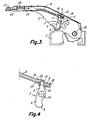
- On the aforementioned first arm 4 is formed at least one catch 5 adapted to engage in a toothed sector 6 fixed onto said bracket 2, whereas on the aforementioned second arm 7 is located a support 20 and a configuration 11, more clearly shown in Fig. 4 , and whose function is explained below.
- a button 13 slidingly mounted and connected to a first end 15 of a movable push rod 8, which has a second end 16 situated fast to the aforementioned support 20 of the pawl lever 3.
- This second end 16 is adapted to make contact with the support 20 and push the pawl lever 3 in a suitable direction to separate the aforementioned catch 5 from said toothed sector 6, when said button 13 is actuated.
- the disengagement between the catch 5 and the toothed sector frees the pawl mechanism, which enables the main lever 1 to be depressed, thereby deactivating the parking brake.
- the button 13 and the push rod 8 form a single part, although they can be parts made separately and subsequently joined together with an identical result.
- a main spring 10 To return the button 13 to an extended position in relation to the main lever 1, after having been pressed, between the button 13 and a stopper 14 connected to the main lever 1 is disposed a main spring 10.
- the second end 16 of the push rod 8 defines a pusher wall 17 configured to surround loosely at least in part the support 20 defined in the second arm 7 of the pawl lever 3, and said pawl spring 9 is disposed between a portion of the pawl lever 3 and a portion of the push rod 8 to push the support 20 towards said pusher wall 17.
- This pawl spring 9 acts at the same time to push the first arm 4 of the pawl lever 3, and consequently the catch 5, against said toothed sector 6.
- the pawl lever 3 and the second end 16 of the push rod 8 are configured and disposed to be in mutual contact at least while the main lever 1 is in a non-operating position with said brake mechanism deactivated.
- the second end 16 of the push rod 8 comprises a housing 12 in which are defined the pusher wall 17 and a stopper 18 facing it (better shown in Fig. 4 ).
- a final portion of the second arm 7 of the pawl lever 3 is housed in said housing 12, so that the support 20 is fast to the pusher wall 17.
- the pawl spring 9 is disposed under compression between said stopper 18 and the aforementioned configuration 11, which is formed on said final end of the second arm 7, on the side opposite to the support 20. Subsequently, the pawl spring 9 pushes the support 20 of the second arm 7 towards the pusher wall 17 and the catch 5 of said first arm 4 towards the toothed sector 6.
- the device of the present invention enables a "pre-assembly" of the part that constitutes the button 13 and the push rod 8 together with the pawl lever 3 ( Fig. 4 ), where the pawl spring 9 keeps both parts connected and ready to be installed in the main lever 1. It also permits a noise-reduction mechanism with a minimum number of additional parts.
Landscapes
- Engineering & Computer Science (AREA)
- Transportation (AREA)
- Mechanical Engineering (AREA)
- Braking Elements And Transmission Devices (AREA)
- Mechanical Control Devices (AREA)
- Braking Arrangements (AREA)
- Braking Systems And Boosters (AREA)
Abstract
Description
- The present invention relates to a parking brake actuating device with noise-reduction mechanism, where a main lever is disposed to tighten a cable of the braking mechanism, and a pawl catch is pushed against a toothed sector by means of a specific spring less resilient than a pusher spring of a pawl release button.
- Brake actuating devices that comprise a lever pivotally mounted on a bracket fixed to the motor vehicle chassis and disposed to be actuated manually to tighten a cable of a brake mechanism are well known in the prior art. A pawl mechanism enables the lever to be rotated in a braking direction but prevents its rotation in an opposite direction, as a result of which the lever remains in the position of maximum tightness reached. On the lever is disposed a button that can be pressed manually to release the pawl mechanism and thereby relieve the tension of the cable to release the brake mechanism. Generally, the pawl mechanism includes a pawl lever pivotally mounted on said main lever, and this pawl lever has at least one catch adapted to engage a toothed sector fixed onto the aforementioned bracket of the main lever. The button and the pawl lever are connected mechanically by means of a push rod, and a spring is disposed to push the button towards an extended non-operating position and at the same time to push the catch of the pawl lever against the toothed sector.
- The teeth on the toothed sector include a succession of peaks and valleys, and when the main lever is rotated to tighten the brake cable, the pawl catch slides on the toothed sector, rotates to overcome a peak, and after overcoming each peak, the spring pushes the catch against the bottom of the next valley producing a clicking that can be bothersome. The force of this clicking is determined by the force of the spring and by the mass of the members displaced during the clicking, which in this case includes the pawl lever, the push rod and the button.
- The patent
KR 00207220 - The
international patent application WO 01/10688 - The present invention helps overcome the previous drawbacks by providing a parking brake actuating device with noise-reduction mechanism, of the type that comprises a main lever pivotally mounted on a bracket and disposed to be actuated manually to activate a brake mechanism; a pawl member mounted movably on said main lever and which has at least one catch adapted to engage in a toothed sector fixed on said bracket; a pawl spring disposed to push said catch against said toothed sector; a button mounted slidingly on the main lever and connected to a first end of a movable push rod, which has a second end adapted to push said pawl member in a direction suitable to disengage the catch of the toothed sector, when said button is actuated; and a main spring disposed to return the button to an extended position in relation to the main lever. The device is characterised in that the second end of the push rod defines a pusher wall configured to surround at least in part a support defined in said pawl member, and said pawl spring is disposed between a portion of said pawl member and a portion of the push rod to push said support of the pawl member towards said pusher wall of the push rod.
- The pawl spring exerts a smaller force than the main spring, as a result of which the pawl spring absorbs the successive movements that the pawl member makes when it overcomes the peaks of the toothed sector whereas the more resilient main spring remains unaltered pushing the button-and-push-rod unit towards its extended position. As a consequence, the force that pushes the catch to the bottom of a valley after each peak is smaller and the mass moved corresponds solely to the pawl member, which results in a significant reduction in the clicking noise of the pawl member against the toothed sector. When the button is pressed manually, the main spring gives way, enabling the movement of the push rod to push the pawl member and thereby disengage the catch from the toothed sector.
- In addition, this construction enables the button-and-push-rod unit, which are preferably formed by a single part, and the pawl member to be mutually assembled, with the pawl spring acting as a link between the two, before they are installed in the main lever, thereby greatly facilitating assembly. The inventive device also implies a reduction in the number of parts in relation to other known devices provided with a double spring.
- The foregoing and other features and advantages of the invention will be made more evident in the light of the following detailed description of examples of the embodiment, reference being made to the accompanying drawings, in which:
-
Fig. 1 is a cross-sectional view of a parking brake actuating device with noise-reduction mechanism in accordance with an example of an embodiment of the present invention wherein the brake is shown in an activated condition; -
Fig. 2 is a cross-sectional view of the device inFig. 1 wherein the brake is shown prior to a deactivated condition; -
Fig. 3 is a cross-sectional view of the device inFig. 1 wherein the brake is shown in a deactivated condition; -
Fig. 4 is an enlarged partial cross-sectional view of key members of the device inFig. 1 . - The figures show a parking brake actuating device with noise-reduction mechanism in accordance with an example of embodiment of the present invention. The device comprises a main lever 1 pivotally mounted in relation to an
axis 24 on abracket 2 fixed to the chassis of a motor vehicle. The aforementioned main lever 1 is disposed to be actuated manually by a user to tighten a cable and another member activating a parking brake mechanism. The tension of said cable increases as the free end of the main lever 1 is raised. - Upon the main lever 1 is mounted a pawl member, which, in the illustrated example, has the form of a
pawl lever 3 pivotally mounted in relation to anaxis 19, but which can adopt other configurations, such as for example, that of an appropriately guided sliding element. In this example, theaforementioned pawl lever 3 has afirst arm 4 on a first side of saidaxis 19 and a second arm 7 on a second side of theaxis 19, opposite to the first. On the aforementionedfirst arm 4 is formed at least onecatch 5 adapted to engage in atoothed sector 6 fixed onto saidbracket 2, whereas on the aforementioned second arm 7 is located a support 20 and a configuration 11, more clearly shown inFig. 4 , and whose function is explained below. - On the aforementioned free end of the main lever 1 is a
button 13, slidingly mounted and connected to afirst end 15 of amovable push rod 8, which has asecond end 16 situated fast to the aforementioned support 20 of thepawl lever 3. Thissecond end 16 is adapted to make contact with the support 20 and push thepawl lever 3 in a suitable direction to separate theaforementioned catch 5 from saidtoothed sector 6, when saidbutton 13 is actuated. The disengagement between thecatch 5 and the toothed sector frees the pawl mechanism, which enables the main lever 1 to be depressed, thereby deactivating the parking brake. In the examples of embodiment shown, thebutton 13 and thepush rod 8 form a single part, although they can be parts made separately and subsequently joined together with an identical result. To return thebutton 13 to an extended position in relation to the main lever 1, after having been pressed, between thebutton 13 and astopper 14 connected to the main lever 1 is disposed amain spring 10. - Between the
second end 16 of thepush rod 8 and the support 20 of the second arm 7 of thepawl lever 3 exists an elastic link provided by apawl spring 9, which exerts a smaller force than themain spring 10. Thus, thesecond end 16 of thepush rod 8 defines apusher wall 17 configured to surround loosely at least in part the support 20 defined in the second arm 7 of thepawl lever 3, and saidpawl spring 9 is disposed between a portion of thepawl lever 3 and a portion of thepush rod 8 to push the support 20 towards saidpusher wall 17. Thispawl spring 9 acts at the same time to push thefirst arm 4 of thepawl lever 3, and consequently thecatch 5, against saidtoothed sector 6. Preferably, thepawl lever 3 and thesecond end 16 of thepush rod 8 are configured and disposed to be in mutual contact at least while the main lever 1 is in a non-operating position with said brake mechanism deactivated. - In the example of embodiment shown in
Figs. 1 to 4 , thesecond end 16 of thepush rod 8 comprises ahousing 12 in which are defined thepusher wall 17 and a stopper 18 facing it (better shown inFig. 4 ). A final portion of the second arm 7 of thepawl lever 3 is housed in saidhousing 12, so that the support 20 is fast to thepusher wall 17. Thepawl spring 9 is disposed under compression between said stopper 18 and the aforementioned configuration 11, which is formed on said final end of the second arm 7, on the side opposite to the support 20. Subsequently, thepawl spring 9 pushes the support 20 of the second arm 7 towards thepusher wall 17 and thecatch 5 of saidfirst arm 4 towards thetoothed sector 6. - The incorporation of the spring of a
pawl 9 less resilient than themain spring 10 reduces and regulates the noise produced by the clicking of thecatch 5 against thetoothed sector 6 when the main lever is actuated to activate the parking brake, irrespective of the force that the user perceives when pressing thebutton 13. In addition, the device of the present invention enables a "pre-assembly" of the part that constitutes thebutton 13 and thepush rod 8 together with the pawl lever 3 (Fig. 4 ), where thepawl spring 9 keeps both parts connected and ready to be installed in the main lever 1. It also permits a noise-reduction mechanism with a minimum number of additional parts. - A person skilled in the art will be capable of making variations and modifications to the example of embodiment shown and described without exceeding the scope of the present invention as defined in the following claims.
Claims (3)
- Parking brake actuating device with noise-reduction mechanism of the type that comprises:a main lever (1) mounted pivotally on a bracket (2) and disposed to be actuated manually to activate a brake mechanism;a pawl member mounted movably on said main lever (1) and which has at least one catch (5) adapted to engage in a toothed sector (6) fixed onto said support (2);a pawl spring (9) disposed to push said catch (5) against said toothed sector (6);a button (13) mounted slidingly on the main lever (1) and connected to a first end (15) of a movable push rod (8), which has a second end (16) adapted to push said pawl member in an direction suitable to disengage the catch (5) of the toothed sector (6), when said button (13) is actuated; anda main spring (10) disposed to return the button (13) to an extended position in relation to the main lever (1);wherein the second end (16) of the push rod (8) defines a pusher wall (17, 21) configured to surround loosely at least in part a support (20) defined in said pawl member, said pawl spring (9) is disposed between a portion of said pawl member and a portion of the push rod (8) to push said support (20) of the pawl member towards said pusher wall (17, 21) of the push rod (8), and the pawl spring (9) exerts a smaller force than the main spring (10), said pawl member having a pawl lever (3) mounted on the main lever (1) to pivot in respect to an axis (19), said pawl lever (3) having, on a first side of said axis (19), a first arm (4) on which said catch (5) is positioned and, on a second side of the axis (19), opposite to the first, a second arm (7) on which said support (20) is positioned, characterised in that said second end (16) of the push rod (8) comprises a housing (12) that defines a pusher wall (17) and a stopper (18) facing it, a portion of said second arm (7) of the pawl lever (3) being housed in said housing (12) with said support (20) fast to said pusher wall (17) and with said pawl spring (9) disposed under compression between said stopper (18) and a configuration (11) formed in said second arm (7) to push the support (20) of the second arm (7) towards the pusher wall (17) and the catch (5) of said first arm (4) towards the toothed sector (6).
- Device in accordance with claim 1, wherein the pawl member and the second end (16) of the push rod (8) are configured and disposed to be in mutual contact at least while the main lever (1) is in a non-operating position with said brake mechanism deactivated.
- Device in accordance with claims 1 or 2, wherein the button (13) and the push rod (8) are formed in a single part.
Applications Claiming Priority (1)
| Application Number | Priority Date | Filing Date | Title |
|---|---|---|---|
| ES200402515A ES2265240B1 (en) | 2004-10-22 | 2004-10-22 | SET OF PARKING BRAKE DRIVE WITH NOISE REDUCTION DEVICE. |
Publications (2)
| Publication Number | Publication Date |
|---|---|
| EP1650092A1 EP1650092A1 (en) | 2006-04-26 |
| EP1650092B1 true EP1650092B1 (en) | 2009-12-09 |
Family
ID=35693090
Family Applications (1)
| Application Number | Title | Priority Date | Filing Date |
|---|---|---|---|
| EP05380232A Expired - Lifetime EP1650092B1 (en) | 2004-10-22 | 2005-10-20 | Device for actuating a parking brake with noise-reduction mechanism |
Country Status (4)
| Country | Link |
|---|---|
| EP (1) | EP1650092B1 (en) |
| AT (1) | ATE451281T1 (en) |
| DE (1) | DE602005018149D1 (en) |
| ES (2) | ES2265240B1 (en) |
Cited By (2)
| Publication number | Priority date | Publication date | Assignee | Title |
|---|---|---|---|---|
| EP2420419A2 (en) | 2010-07-30 | 2012-02-22 | Batz, S.Coop. | Parking brake drive unit with locking device |
| KR102297648B1 (en) * | 2020-05-13 | 2021-09-06 | 동원산업 주식회사 | Spring noise suppression device for parking brake |
Families Citing this family (5)
| Publication number | Priority date | Publication date | Assignee | Title |
|---|---|---|---|---|
| ES1070757Y (en) * | 2009-07-30 | 2010-01-20 | Edscha Espana S A | DRIVE ROD FOR HAND BRAKE OF A MOTOR VEHICLE |
| DE202009013243U1 (en) * | 2009-10-02 | 2009-12-10 | Dietz-Automotive Gmbh & Co. Kg | Actuation device for a parking brake |
| DE202013100129U1 (en) * | 2013-01-11 | 2014-04-14 | Al-Ko Kober Ges. M.B.H | actuator |
| CN106553627A (en) * | 2015-09-28 | 2017-04-05 | 北汽福田汽车股份有限公司 | A kind of automobile and its parking braking are drawn device |
| CN107600053B (en) * | 2017-08-15 | 2024-05-10 | 宁波爱立德汽车部件有限公司 | Hand brake pressure lever for vehicle hand brake and processing method |
Family Cites Families (12)
| Publication number | Priority date | Publication date | Assignee | Title |
|---|---|---|---|---|
| DE1755911A1 (en) * | 1968-07-09 | 1971-10-28 | Porsche Kg | Foldable operating lever for vehicles, especially handbrake lever for motor vehicles |
| FR2672554B1 (en) * | 1991-02-11 | 1993-05-28 | Rockwell Abs France | PARKING HAND BRAKE FOR A MOTOR VEHICLE AND METHOD FOR MANUFACTURING THE LEVER OF THIS BRAKE. |
| DE19538108A1 (en) * | 1995-10-13 | 1997-04-17 | Bayerische Motoren Werke Ag | Holding device to prevent relative movement e.g. for handbrake of motor vehicle |
| ES2157380T3 (en) * | 1995-11-03 | 2001-08-16 | Scharwaechter Ed Gmbh | DRIVING DEVICE FOR A HAND BRAKE. |
| KR100207220B1 (en) | 1995-12-02 | 1999-07-15 | 정몽규 | A noise reducing device of a parking brake while in operation |
| JPH11105685A (en) * | 1997-10-06 | 1999-04-20 | Otsuka Koki Co Ltd | Parking brake system |
| DE19936733C2 (en) | 1999-08-06 | 2001-06-13 | Edscha Ag | Actuator for a parking brake |
| JP2001071876A (en) * | 1999-09-06 | 2001-03-21 | Namikoo Kk | Parking brake lever device for vehicle |
| DE10036547B4 (en) * | 2000-07-27 | 2006-03-23 | Dietz-Automotive Gmbh & Co. Kg | Actuation device for a parking brake |
| JP4666807B2 (en) * | 2001-05-14 | 2011-04-06 | 大塚工機株式会社 | Parking brake device |
| US7021174B2 (en) * | 2001-05-25 | 2006-04-04 | Ventra Group Inc. | Parking brake actuator with anti-release feature |
| DE20210489U1 (en) * | 2002-07-06 | 2002-11-21 | Dietz-automotive GmbH & Co. KG, 73265 Dettingen | Actuating device for a parking brake |
-
2004
- 2004-10-22 ES ES200402515A patent/ES2265240B1/en not_active Expired - Fee Related
-
2005
- 2005-10-20 EP EP05380232A patent/EP1650092B1/en not_active Expired - Lifetime
- 2005-10-20 DE DE602005018149T patent/DE602005018149D1/en not_active Expired - Lifetime
- 2005-10-20 AT AT05380232T patent/ATE451281T1/en not_active IP Right Cessation
- 2005-10-20 ES ES05380232T patent/ES2337157T3/en not_active Expired - Lifetime
Cited By (2)
| Publication number | Priority date | Publication date | Assignee | Title |
|---|---|---|---|---|
| EP2420419A2 (en) | 2010-07-30 | 2012-02-22 | Batz, S.Coop. | Parking brake drive unit with locking device |
| KR102297648B1 (en) * | 2020-05-13 | 2021-09-06 | 동원산업 주식회사 | Spring noise suppression device for parking brake |
Also Published As
| Publication number | Publication date |
|---|---|
| EP1650092A1 (en) | 2006-04-26 |
| ES2265240B1 (en) | 2008-01-01 |
| ES2337157T3 (en) | 2010-04-21 |
| ATE451281T1 (en) | 2009-12-15 |
| DE602005018149D1 (en) | 2010-01-21 |
| ES2265240A1 (en) | 2007-02-01 |
Similar Documents
| Publication | Publication Date | Title |
|---|---|---|
| EP0527518B1 (en) | Self-adjusting, push to-release parking brake | |
| JP2008506049A (en) | Door handle for vehicles with inertial safety system | |
| EP1650092B1 (en) | Device for actuating a parking brake with noise-reduction mechanism | |
| US4069722A (en) | Variable ratio brake pedal lever assembly | |
| JPH0126402B2 (en) | ||
| CN1368921A (en) | Operating mechanism for parking brake | |
| JP4844063B2 (en) | Foot-operated parking brake device for vehicles | |
| US5511641A (en) | Mechanical brake interlock mechanism for a column-mounted shift control assembly | |
| EP3674578B1 (en) | Damper and operating unit | |
| EP1752347B1 (en) | Ratchet type parking brake having quiet operation | |
| EP0138186A2 (en) | Park lock device for use with automatic transmission | |
| JP2022138811A5 (en) | ||
| CA2488604C (en) | Quiet apply push to release parking brake pedal | |
| US20020174737A1 (en) | Parking brake actuator with anti-release feature | |
| US6736025B2 (en) | Vehicular foot-operated parking brake control apparatus | |
| US7658126B2 (en) | Safety release feature | |
| US11754134B2 (en) | Device for automatically adjusting the clearance of a parking brake | |
| JP3594647B2 (en) | Manual brake device | |
| JP3015349B1 (en) | Foot-operated parking brake pedal | |
| JP3363035B2 (en) | Lid locking device | |
| US8250946B2 (en) | Parking brake for a vehicle | |
| US6742265B2 (en) | Hand guard block | |
| CN109488133B (en) | door safety brake | |
| JPH10287217A (en) | Foot-operated parking brake device | |
| EP1817144B1 (en) | Chain saw brake arrangement |
Legal Events
| Date | Code | Title | Description |
|---|---|---|---|
| PUAI | Public reference made under article 153(3) epc to a published international application that has entered the european phase |
Free format text: ORIGINAL CODE: 0009012 |
|
| AK | Designated contracting states |
Kind code of ref document: A1 Designated state(s): AT BE BG CH CY CZ DE DK EE ES FI FR GB GR HU IE IS IT LI LT LU LV MC NL PL PT RO SE SI SK TR |
|
| AX | Request for extension of the european patent |
Extension state: AL BA HR MK YU |
|
| RIN1 | Information on inventor provided before grant (corrected) |
Inventor name: BIDAGUREN DIEGO, INIGO Inventor name: PALACIO ARGUEELLES, JOSEBA Inventor name: INTXAURBE IRIONDO, JATSU |
|
| AKX | Designation fees paid | ||
| RBV | Designated contracting states (corrected) |
Designated state(s): AT BE BG CH CY CZ DE DK EE ES FI FR GB GR HU IE IS IT LI LT LU LV MC NL PL PT RO SE SI SK TR |
|
| REG | Reference to a national code |
Ref country code: DE Ref legal event code: 8566 |
|
| 17P | Request for examination filed |
Effective date: 20061124 |
|
| 17Q | First examination report despatched |
Effective date: 20081009 |
|
| GRAP | Despatch of communication of intention to grant a patent |
Free format text: ORIGINAL CODE: EPIDOSNIGR1 |
|
| GRAS | Grant fee paid |
Free format text: ORIGINAL CODE: EPIDOSNIGR3 |
|
| GRAA | (expected) grant |
Free format text: ORIGINAL CODE: 0009210 |
|
| AK | Designated contracting states |
Kind code of ref document: B1 Designated state(s): AT BE BG CH CY CZ DE DK EE ES FI FR GB GR HU IE IS IT LI LT LU LV MC NL PL PT RO SE SI SK TR |
|
| REG | Reference to a national code |
Ref country code: GB Ref legal event code: FG4D |
|
| REG | Reference to a national code |
Ref country code: CH Ref legal event code: EP |
|
| REG | Reference to a national code |
Ref country code: IE Ref legal event code: FG4D |
|
| REF | Corresponds to: |
Ref document number: 602005018149 Country of ref document: DE Date of ref document: 20100121 Kind code of ref document: P |
|
| REG | Reference to a national code |
Ref country code: NL Ref legal event code: VDEP Effective date: 20091209 |
|
| REG | Reference to a national code |
Ref country code: ES Ref legal event code: FG2A Ref document number: 2337157 Country of ref document: ES Kind code of ref document: T3 |
|
| PG25 | Lapsed in a contracting state [announced via postgrant information from national office to epo] |
Ref country code: LT Free format text: LAPSE BECAUSE OF FAILURE TO SUBMIT A TRANSLATION OF THE DESCRIPTION OR TO PAY THE FEE WITHIN THE PRESCRIBED TIME-LIMIT Effective date: 20091209 Ref country code: FI Free format text: LAPSE BECAUSE OF FAILURE TO SUBMIT A TRANSLATION OF THE DESCRIPTION OR TO PAY THE FEE WITHIN THE PRESCRIBED TIME-LIMIT Effective date: 20091209 Ref country code: SE Free format text: LAPSE BECAUSE OF FAILURE TO SUBMIT A TRANSLATION OF THE DESCRIPTION OR TO PAY THE FEE WITHIN THE PRESCRIBED TIME-LIMIT Effective date: 20091209 |
|
| LTIE | Lt: invalidation of european patent or patent extension |
Effective date: 20091209 |
|
| PG25 | Lapsed in a contracting state [announced via postgrant information from national office to epo] |
Ref country code: PL Free format text: LAPSE BECAUSE OF FAILURE TO SUBMIT A TRANSLATION OF THE DESCRIPTION OR TO PAY THE FEE WITHIN THE PRESCRIBED TIME-LIMIT Effective date: 20091209 Ref country code: LV Free format text: LAPSE BECAUSE OF FAILURE TO SUBMIT A TRANSLATION OF THE DESCRIPTION OR TO PAY THE FEE WITHIN THE PRESCRIBED TIME-LIMIT Effective date: 20091209 Ref country code: SI Free format text: LAPSE BECAUSE OF FAILURE TO SUBMIT A TRANSLATION OF THE DESCRIPTION OR TO PAY THE FEE WITHIN THE PRESCRIBED TIME-LIMIT Effective date: 20091209 |
|
| PG25 | Lapsed in a contracting state [announced via postgrant information from national office to epo] |
Ref country code: AT Free format text: LAPSE BECAUSE OF FAILURE TO SUBMIT A TRANSLATION OF THE DESCRIPTION OR TO PAY THE FEE WITHIN THE PRESCRIBED TIME-LIMIT Effective date: 20091209 |
|
| PG25 | Lapsed in a contracting state [announced via postgrant information from national office to epo] |
Ref country code: PT Free format text: LAPSE BECAUSE OF FAILURE TO SUBMIT A TRANSLATION OF THE DESCRIPTION OR TO PAY THE FEE WITHIN THE PRESCRIBED TIME-LIMIT Effective date: 20100409 Ref country code: RO Free format text: LAPSE BECAUSE OF FAILURE TO SUBMIT A TRANSLATION OF THE DESCRIPTION OR TO PAY THE FEE WITHIN THE PRESCRIBED TIME-LIMIT Effective date: 20091209 Ref country code: NL Free format text: LAPSE BECAUSE OF FAILURE TO SUBMIT A TRANSLATION OF THE DESCRIPTION OR TO PAY THE FEE WITHIN THE PRESCRIBED TIME-LIMIT Effective date: 20091209 Ref country code: EE Free format text: LAPSE BECAUSE OF FAILURE TO SUBMIT A TRANSLATION OF THE DESCRIPTION OR TO PAY THE FEE WITHIN THE PRESCRIBED TIME-LIMIT Effective date: 20091209 Ref country code: IS Free format text: LAPSE BECAUSE OF FAILURE TO SUBMIT A TRANSLATION OF THE DESCRIPTION OR TO PAY THE FEE WITHIN THE PRESCRIBED TIME-LIMIT Effective date: 20100409 Ref country code: BG Free format text: LAPSE BECAUSE OF FAILURE TO SUBMIT A TRANSLATION OF THE DESCRIPTION OR TO PAY THE FEE WITHIN THE PRESCRIBED TIME-LIMIT Effective date: 20100309 |
|
| PG25 | Lapsed in a contracting state [announced via postgrant information from national office to epo] |
Ref country code: BE Free format text: LAPSE BECAUSE OF FAILURE TO SUBMIT A TRANSLATION OF THE DESCRIPTION OR TO PAY THE FEE WITHIN THE PRESCRIBED TIME-LIMIT Effective date: 20091209 Ref country code: SK Free format text: LAPSE BECAUSE OF FAILURE TO SUBMIT A TRANSLATION OF THE DESCRIPTION OR TO PAY THE FEE WITHIN THE PRESCRIBED TIME-LIMIT Effective date: 20091209 Ref country code: CZ Free format text: LAPSE BECAUSE OF FAILURE TO SUBMIT A TRANSLATION OF THE DESCRIPTION OR TO PAY THE FEE WITHIN THE PRESCRIBED TIME-LIMIT Effective date: 20091209 |
|
| PLBE | No opposition filed within time limit |
Free format text: ORIGINAL CODE: 0009261 |
|
| STAA | Information on the status of an ep patent application or granted ep patent |
Free format text: STATUS: NO OPPOSITION FILED WITHIN TIME LIMIT |
|
| PG25 | Lapsed in a contracting state [announced via postgrant information from national office to epo] |
Ref country code: CY Free format text: LAPSE BECAUSE OF FAILURE TO SUBMIT A TRANSLATION OF THE DESCRIPTION OR TO PAY THE FEE WITHIN THE PRESCRIBED TIME-LIMIT Effective date: 20091209 |
|
| 26N | No opposition filed |
Effective date: 20100910 |
|
| PG25 | Lapsed in a contracting state [announced via postgrant information from national office to epo] |
Ref country code: DK Free format text: LAPSE BECAUSE OF FAILURE TO SUBMIT A TRANSLATION OF THE DESCRIPTION OR TO PAY THE FEE WITHIN THE PRESCRIBED TIME-LIMIT Effective date: 20091209 |
|
| PG25 | Lapsed in a contracting state [announced via postgrant information from national office to epo] |
Ref country code: IT Free format text: LAPSE BECAUSE OF FAILURE TO SUBMIT A TRANSLATION OF THE DESCRIPTION OR TO PAY THE FEE WITHIN THE PRESCRIBED TIME-LIMIT Effective date: 20091209 |
|
| PG25 | Lapsed in a contracting state [announced via postgrant information from national office to epo] |
Ref country code: MC Free format text: LAPSE BECAUSE OF NON-PAYMENT OF DUE FEES Effective date: 20101031 |
|
| REG | Reference to a national code |
Ref country code: CH Ref legal event code: PL |
|
| GBPC | Gb: european patent ceased through non-payment of renewal fee |
Effective date: 20101020 |
|
| PG25 | Lapsed in a contracting state [announced via postgrant information from national office to epo] |
Ref country code: LI Free format text: LAPSE BECAUSE OF NON-PAYMENT OF DUE FEES Effective date: 20101031 Ref country code: CH Free format text: LAPSE BECAUSE OF NON-PAYMENT OF DUE FEES Effective date: 20101031 |
|
| PG25 | Lapsed in a contracting state [announced via postgrant information from national office to epo] |
Ref country code: GB Free format text: LAPSE BECAUSE OF NON-PAYMENT OF DUE FEES Effective date: 20101020 |
|
| PG25 | Lapsed in a contracting state [announced via postgrant information from national office to epo] |
Ref country code: IE Free format text: LAPSE BECAUSE OF NON-PAYMENT OF DUE FEES Effective date: 20101020 |
|
| PG25 | Lapsed in a contracting state [announced via postgrant information from national office to epo] |
Ref country code: LU Free format text: LAPSE BECAUSE OF NON-PAYMENT OF DUE FEES Effective date: 20101020 Ref country code: HU Free format text: LAPSE BECAUSE OF FAILURE TO SUBMIT A TRANSLATION OF THE DESCRIPTION OR TO PAY THE FEE WITHIN THE PRESCRIBED TIME-LIMIT Effective date: 20100610 |
|
| PG25 | Lapsed in a contracting state [announced via postgrant information from national office to epo] |
Ref country code: TR Free format text: LAPSE BECAUSE OF FAILURE TO SUBMIT A TRANSLATION OF THE DESCRIPTION OR TO PAY THE FEE WITHIN THE PRESCRIBED TIME-LIMIT Effective date: 20091209 |
|
| PGFP | Annual fee paid to national office [announced via postgrant information from national office to epo] |
Ref country code: FR Payment date: 20131022 Year of fee payment: 9 |
|
| PGFP | Annual fee paid to national office [announced via postgrant information from national office to epo] |
Ref country code: ES Payment date: 20131028 Year of fee payment: 9 |
|
| PG25 | Lapsed in a contracting state [announced via postgrant information from national office to epo] |
Ref country code: GR Free format text: LAPSE BECAUSE OF FAILURE TO SUBMIT A TRANSLATION OF THE DESCRIPTION OR TO PAY THE FEE WITHIN THE PRESCRIBED TIME-LIMIT Effective date: 20091209 |
|
| REG | Reference to a national code |
Ref country code: FR Ref legal event code: ST Effective date: 20150630 |
|
| PG25 | Lapsed in a contracting state [announced via postgrant information from national office to epo] |
Ref country code: FR Free format text: LAPSE BECAUSE OF NON-PAYMENT OF DUE FEES Effective date: 20141031 |
|
| REG | Reference to a national code |
Ref country code: ES Ref legal event code: FD2A Effective date: 20151126 |
|
| PG25 | Lapsed in a contracting state [announced via postgrant information from national office to epo] |
Ref country code: ES Free format text: LAPSE BECAUSE OF NON-PAYMENT OF DUE FEES Effective date: 20141021 |
|
| PGFP | Annual fee paid to national office [announced via postgrant information from national office to epo] |
Ref country code: DE Payment date: 20211027 Year of fee payment: 17 |
|
| REG | Reference to a national code |
Ref country code: DE Ref legal event code: R119 Ref document number: 602005018149 Country of ref document: DE |
|
| PG25 | Lapsed in a contracting state [announced via postgrant information from national office to epo] |
Ref country code: DE Free format text: LAPSE BECAUSE OF NON-PAYMENT OF DUE FEES Effective date: 20230503 |