EP1649878A2 - Method of manufacturing globular ceramic particles, method of seeding cells and method of manufacturing product for repairing biological tissues - Google Patents
Method of manufacturing globular ceramic particles, method of seeding cells and method of manufacturing product for repairing biological tissues Download PDFInfo
- Publication number
- EP1649878A2 EP1649878A2 EP05021160A EP05021160A EP1649878A2 EP 1649878 A2 EP1649878 A2 EP 1649878A2 EP 05021160 A EP05021160 A EP 05021160A EP 05021160 A EP05021160 A EP 05021160A EP 1649878 A2 EP1649878 A2 EP 1649878A2
- Authority
- EP
- European Patent Office
- Prior art keywords
- ceramic particles
- cylindrical container
- manufacturing
- globular
- cells
- Prior art date
- Legal status (The legal status is an assumption and is not a legal conclusion. Google has not performed a legal analysis and makes no representation as to the accuracy of the status listed.)
- Withdrawn
Links
Images

Classifications
-
- A—HUMAN NECESSITIES
- A61—MEDICAL OR VETERINARY SCIENCE; HYGIENE
- A61L—METHODS OR APPARATUS FOR STERILISING MATERIALS OR OBJECTS IN GENERAL; DISINFECTION, STERILISATION OR DEODORISATION OF AIR; CHEMICAL ASPECTS OF BANDAGES, DRESSINGS, ABSORBENT PADS OR SURGICAL ARTICLES; MATERIALS FOR BANDAGES, DRESSINGS, ABSORBENT PADS OR SURGICAL ARTICLES
- A61L27/00—Materials for grafts or prostheses or for coating grafts or prostheses
- A61L27/02—Inorganic materials
- A61L27/12—Phosphorus-containing materials, e.g. apatite
-
- A—HUMAN NECESSITIES
- A61—MEDICAL OR VETERINARY SCIENCE; HYGIENE
- A61L—METHODS OR APPARATUS FOR STERILISING MATERIALS OR OBJECTS IN GENERAL; DISINFECTION, STERILISATION OR DEODORISATION OF AIR; CHEMICAL ASPECTS OF BANDAGES, DRESSINGS, ABSORBENT PADS OR SURGICAL ARTICLES; MATERIALS FOR BANDAGES, DRESSINGS, ABSORBENT PADS OR SURGICAL ARTICLES
- A61L27/00—Materials for grafts or prostheses or for coating grafts or prostheses
- A61L27/36—Materials for grafts or prostheses or for coating grafts or prostheses containing ingredients of undetermined constitution or reaction products thereof, e.g. transplant tissue, natural bone, extracellular matrix
- A61L27/38—Materials for grafts or prostheses or for coating grafts or prostheses containing ingredients of undetermined constitution or reaction products thereof, e.g. transplant tissue, natural bone, extracellular matrix containing added animal cells
Definitions
- the present invention relates to a method of manufacturing globular ceramic particles, a method of seeding cells, and a method of manufacturing a product for repairing biological tissues.
- hydroxyapatite HAP
- tricalcium phosphate TCP
- a scaffold made of a porous calcium phosphate material for example, such as ⁇ -TCP is used. If the ⁇ -TCP is left in contact with bone cells of a defect part of bone, so-called remodeling is performed in which osteoclasts absorb the ⁇ -TCP, and osteoblasts form a new bone.
- the bone-repairing material filled in the defect part of the bone is replaced by autologous bone as time goes by (for example, refer to: Uemura and two others, "Tissue engineering in bone using biodegradable ⁇ -TCP porous material - A new material strengthened in vivo Osferion", Medical Asahi, The Asahi Shimbun Company, October 1, 2001, Vol. 30, No. 10, p. 46-49).
- the shape of a bone-repairing material is generally known to be a cubic block shape, a granular shape, and the like.
- the shape of a bone-repairing material can be properly selected according to the form of a defect part of bone. If a defect part of bone covers a relatively wide-range, firstly the majority of the volume is filled with larger cubic block shaped bone-repairing material. Next, smaller cubic block shaped bone-repairing material is filled in the gaps, and then granular shaped bone-repairing material is filled in the even smaller gaps.
- the bone-repairing material is powder
- the overall internal volume can be filled in a high density without gaps, so as to fit with complex shapes peculiar to various defect parts of bone.
- the gaps are completely filled with the powder, a route for cells to grow, a route for supplying nutrients to the cells, and a route for discharging waste matters from the cells can not be maintained. Therefore, a cubic block shape or granular shape porous calcium phosphate material is used.
- a cubic block shape bone-repairing product is angular, there is a disadvantage in that nonuniform gaps are formed in the surroundings, unless the filling is done in an orderly manner.
- each granular body of the granular shaped bone-repairing material has an irregular shape, gaps between the granular bodies easily become nonuniform, although this is not as bad as for the case of cubic block shaped bone-repairing product.
- gaps between the cubic block shaped bone-repairing products are filled with granular shaped bone-repairing material, large gaps and small gaps also occur.
- the present invention takes the above problems into consideration, with an object of providing: a method of manufacturing globular ceramic particles which can be formed uniformly in the surrounding gaps, when they are arbitrarily filled into a defect part of biological tissue or the like, without impairing the adhesiveness of cells; a method of seeding cells whereby cells can be efficiently seeded; and a method of manufacturing a product for repairing biological tissues whereby the product for repairing biological tissues can be efficiently manufactured.
- the present invention employs the following solutions.
- the present invention provides a method of manufacturing globular ceramic particles comprising; containing a predetermined amount of ceramic particles inside a cylindrical container that is arranged approximately horizontally, and rotating the cylindrical container about its axis.
- the present invention by rotating the cylindrical container containing ceramic particles about its horizontal axis, movement is repeated inside the cylindrical container where the ceramic particles are lifted up to a predetermined height together with the rotation of the cylindrical container, and then dropped by the gravity.
- the ceramic particles are abraded due to friction and collision generated between the ceramic particles or between the ceramic particles and the internal surface of the cylindrical container, and thus formed into globular shapes with time. Therefore, it is possible to readily manufacture globular ceramic particles which can be formed uniformly into the surrounding gaps when they are arbitrarily filled into a defect part of biological tissue or the like, without impairing the adhesiveness of cells.
- the present invention provides a method of seeding cells comprising; containing globular ceramic particles inside a cylindrical container that is arranged approximately horizontally, enclosing a cell suspension having suspended cells to be seeded inside the cylindrical container, and then rotating the cylindrical container about its axis.
- the globular ceramic particles and the cell suspension are enclosed inside the cylindrical container, and the cylindrical container is rotated about its horizontal axis, to thereby make the globular ceramic particles contact with the cell suspension, so that they are adhered to the internal surface of the cylindrical container due to surface tension. Then as the cylindrical container is being rotated, the globular ceramic particles adhered to the internal surface of the cylindrical container are made to pass through the cell suspension that has been pooled at the bottom. Since the cells to be seeded are suspended in the cell suspension, the cells are captured by the globular ceramic particles passing through the cell suspension, and seeded. As a result, the cells can be efficiently seeded on the globular ceramic particles.
- the amount of the globular ceramic particles is such that, if the globular ceramic particles are laid over the cylindrical internal surface of the cylindrical container in one layer, almost all of the cylindrical internal surface is covered.
- the present invention provides a method of manufacturing a product for repairing biological tissues, comprising: a step for manufacturing globular ceramic particles comprising containing ceramic particles inside in a cylindrical container that is arranged approximately horizontally, and rotating the cylindrical container about its axis; and a seeding step comprising enclosing in the cylindrical container the manufactured globular ceramic particles and a cell suspension in which cells to adhere to the manufactured globular ceramic particles are suspended, and then rotating the cylindrical container about its axis.
- the ceramic particles are abraded, so that it becomes possible to readily manufacture globular ceramic particles which can be formed uniformly in the surrounding gaps, when they are arbitrarily filled into a defect part of biological tissue or the like, without impairing the adhesiveness of cells.
- the cell suspension is enclosed in the cylindrical container which is again rotated again about its axis, so that the cells in the cell suspension are captured by the globular ceramic particles, and the cells are efficiently seeded, enabling manufacture of the product for repairing biological tissues.
- a washing step for washing out scrap powder that has adhered onto the globular ceramic particles is provided between the manufacturing step and the seeding step.
- the scrap powder that has been generated from the abrasion of the granular shaped ceramic particles, and adhered onto the globular ceramic particles is washed out in the washing step, and the adhesiveness of the cells is increased, so that the product for repairing biological tissues can be manufactured more efficiently.
- the rotating speed of the cylindrical container in the manufacturing step is 20 to 100 rpm, and the rotating speed of the cylindrical container in the seeding step is 0.25 to 10 rpm.
- the globular ceramic particles can be manufactured, and the cells can be seeded onto the globular ceramic particles in the same or similar cylindrical containers, enabling manufacture of the product for repairing biological tissues.
- the rotating speed in the manufacturing step 20 to 100 rpm
- the ceramic particles are moved so as to roll on the internal surface of the cylindrical container, enabling efficient manufacture of the globular ceramic particles product for repairing biological tissues.
- the rotating speed in the seeding step 0.25 to 10 rpm, the globular ceramic particles that have adhered onto the internal surface of the cylindrical container by the cell suspension, can pass through the cell suspension while being adhered, enabling the cells to be seeded efficiently.
- the amount of globular ceramic particles is such that, if the globular ceramic particles are laid over the cylindrical internal surface of the cylindrical container in one layer, almost all of the cylindrical internal surface is covered.
- the globular ceramic particles are covering almost all of the cylindrical internal surface of the cylindrical container, they can be continually soaked in the cell suspension. Therefore the cells which tend to subside into the cell suspension can be efficiently seeded on the globular ceramic particles, and the product for repairing biological tissues can be manufactured efficiently.
- the angular parts of ceramic particles can be abraded so that the globular ceramic particles can be readily manufactured.
- the cells can be efficiently seeded on the manufactured globular ceramic particles, and the product for repairing biological tissues having the cells soaked into the inside, can be efficiently manufactured.
- the method of manufacturing the product 1 for repairing biological tissues comprises: a step S1 for manufacturing globular ceramic particles 2; a washing step S2; and a step S3 for seeding cells onto the globular ceramic particles 2 manufactured in the manufacturing step S1.
- a cylindrical container 5 containing granular shaped ceramic particles 4 is mounted on two approximately horizontal rollers 3 which have been arranged with a parallel spacing. Then by rotating the two rollers 3 in the same direction, the cylindrical container 5 is rotated about its horizontal central axis 6 (refer to FIG. 2).
- the rotating speed of the rollers 3 is about 20 to 100 rpm. For example, in the case of the 50 ml cylindrical container 5, the diameter is 27 mm. Therefore the rotating speed is set so that the peripheral speed becomes about 28 mm/s to 140 mm/s.
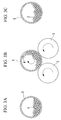
- the granular shaped ceramic particles 4 inside of the cylindrical container 5 are accumulated at the bottom of the cylindrical container 5.
- FIG. 3B by rotating the cylindrical container 5 within the above range of rotating speed, the granular shaped ceramic particles 4 inside of the cylindrical container are moved to roll on the internal surface of the cylindrical container 5. As a result, they are abraded due to friction and collision between the granules or between the granules and the internal surface of the cylindrical container 5, so that as shown in FIG. 3C, the globular ceramic particles 2 can be efficiently obtained.
- the washing step S2 is a step for washing out the scrap powder from the ceramic particles 2 formed in the manufacturing step S1.
- optional cleaning solution such as pure water or physiological saline solution is introduced into the cylindrical container 5, and shaken, and then poured out from the cylindrical container 5.
- the scrap powder accumulated in the cylindrical container and adhered onto the surface of the globular ceramic particles 2 can be washed out.
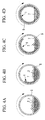
- a cell suspension 7 (refer to FIG. 4A ) having suspended cells to be seeded is introduced into the cylindrical container 5 containing the globular ceramic particles 2 that have been washed in the washing step S2. Then it is rotated about its horizontal central axis 6 on the rollers 3.
- the rotating speed of the rollers 3 is about 0.25 to 10 rpm.
- the rotating speed is set so that the peripheral speed is within a range of 0.35 mm/s to 14mm/s.
- the cell suspension 7 to be introduced into the cylindrical container 5 is introduced in an amount such that it is pooled to a maximum depth deeper than the diameter of the globular ceramic particles 2 at the bottom inside the horizontally arranged cylindrical container 5.
- the amount is about 5 to 15ml.
- the amount of the globular ceramic particles 2 in the cylindrical container 5 is preferably such that if the globular ceramic particles 2 are laid over the internal surface of the cylindrical container 5, they are filled up over the entire internal surface of the cylindrical container 5 in one layer.
- the amount is about 3g.
- the globular ceramic particles 2 that have been adhered onto the internal surface of the cylindrical container 5 are sequentially soaked in the cell suspension 7 pooled in the cylindrical container 5, together with the rotation of the cylindrical container 5. Since the cell suspension 7 in the cylindrical container 5 is pooled such that its maximum depth becomes deeper than the diameter of the globular ceramic particle 2, the globular ceramic particle 2 are soaked completely immersed in the cell suspension 7.
- the globular ceramic particles 2 are moved while being adhered onto the internal surface of the cylindrical container 5, they are made to pass through the bottom of the cell suspension 7. Since the cells in the cell suspension 7 tend to subside due to the action of gravity, most of them are present at the bottom of the cell suspension 7. Consequently, by making the globular ceramic particles 2 pass through the bottom of the cell suspension 7, the globular ceramic particles 2 pass through the area where most of the cells are present, so that many cells can be captured.
- the cells can be efficiently seeded on the globular ceramic particles 2.
- the product 1 for repairing biological tissues according to the present embodiment, it is possible to readily manufacture the product 1 for repairing biological tissues having cells adhered onto the globular ceramic particles 2, which can be formed uniformly in the surrounding gaps when it is arbitrarily filled into a defect part of biological tissue or the like.
- the method of manufacturing the product 1 for repairing biological tissues constituted in this manner a higher seedion efficiency can be obtained compared to the case where cell suspension and the material for repairing biological tissues are put into a petri dish and left standing.
- the washing step S2 is set between the manufacturing step S1 and the seeding step S3.
- the washing step S2 is not always necessary.
- the cylindrical container 5 is replaced in the manufacturing step S1 and in the seeding step S3, the washing step S2 is not required.
- the optimum amount of the granular shaped ceramic particles 4 at the time of manufacturing the globular ceramic particles 2, and the amount of the globular ceramic particles 2 for enabling seeding at maximum efficiency are considered to be different. Therefore, the amount of the ceramic particles 2, and the ceramic particles 4 treated in step S1 and step S2 may be different.
- a cylindrical container having an internal surface structure where the granular shaped ceramic particles 2 can be rotatively rolled to become globular may be employed.
- a cylindrical container having projections on the internal surface may be employed.
- projections for example projections having a height of about 100 ⁇ m are preferable.
- ⁇ -tricalcium phosphate for the raw material of the globular ceramic particles 2, in addition to ⁇ -tricalcium phosphate, other optional ceramic particles such as hydroxyapatite or the like may be employed.
- the cells to be seeded in addition to mesenchymal stem cells, other optional adhesive cells may be employed.
Landscapes
- Health & Medical Sciences (AREA)
- Life Sciences & Earth Sciences (AREA)
- Chemical & Material Sciences (AREA)
- General Health & Medical Sciences (AREA)
- Veterinary Medicine (AREA)
- Oral & Maxillofacial Surgery (AREA)
- Transplantation (AREA)
- Epidemiology (AREA)
- Dermatology (AREA)
- Animal Behavior & Ethology (AREA)
- Biomedical Technology (AREA)
- Public Health (AREA)
- Medicinal Chemistry (AREA)
- Engineering & Computer Science (AREA)
- Inorganic Chemistry (AREA)
- Cell Biology (AREA)
- Zoology (AREA)
- Botany (AREA)
- Chemical Kinetics & Catalysis (AREA)
- Micro-Organisms Or Cultivation Processes Thereof (AREA)
- Apparatus Associated With Microorganisms And Enzymes (AREA)
- Materials For Medical Uses (AREA)
Abstract
Description
- The present invention relates to a method of manufacturing globular ceramic particles, a method of seeding cells, and a method of manufacturing a product for repairing biological tissues.
- This application is based on patent application No. 2004-290224 filed in Japan, the content of which is incorporated herein by reference.
- Recently, it has become possible to repair a defect part of bone caused by osteoncus extraction, trauma, or the like, by regenerating the bone by filling a bone-repairing material. For such a bone-repairing material, hydroxyapatite (HAP) and tricalcium phosphate (TCP) are known. However, from the viewpoint of leaving no foreign matter inside the body, a scaffold made of a porous calcium phosphate material, for example, such as β-TCP is used. If the β-TCP is left in contact with bone cells of a defect part of bone, so-called remodeling is performed in which osteoclasts absorb the β-TCP, and osteoblasts form a new bone. That is, the bone-repairing material filled in the defect part of the bone is replaced by autologous bone as time goes by (for example, refer to: Uemura and two others, "Tissue engineering in bone using biodegradable β-TCP porous material - A new material strengthened in vivo Osferion", Medical Asahi, The Asahi Shimbun Company, October 1, 2001, Vol. 30, No. 10, p. 46-49).
- The shape of a bone-repairing material is generally known to be a cubic block shape, a granular shape, and the like. The shape of a bone-repairing material can be properly selected according to the form of a defect part of bone. If a defect part of bone covers a relatively wide-range, firstly the majority of the volume is filled with larger cubic block shaped bone-repairing material. Next, smaller cubic block shaped bone-repairing material is filled in the gaps, and then granular shaped bone-repairing material is filled in the even smaller gaps.
- If the bone-repairing material is powder, the overall internal volume can be filled in a high density without gaps, so as to fit with complex shapes peculiar to various defect parts of bone. However, since the gaps are completely filled with the powder, a route for cells to grow, a route for supplying nutrients to the cells, and a route for discharging waste matters from the cells can not be maintained. Therefore, a cubic block shape or granular shape porous calcium phosphate material is used. However, since a cubic block shape bone-repairing product is angular, there is a disadvantage in that nonuniform gaps are formed in the surroundings, unless the filling is done in an orderly manner. Moreover, since each granular body of the granular shaped bone-repairing material has an irregular shape, gaps between the granular bodies easily become nonuniform, although this is not as bad as for the case of cubic block shaped bone-repairing product. Similarly in a method in which gaps between the cubic block shaped bone-repairing products are filled with granular shaped bone-repairing material, large gaps and small gaps also occur.
- If in this manner nonuniform gaps are formed in the surroundings of the material for repairing biological tissues such as bone-repairing material, the following disadvantages can be considered.
- Firstly, as mentioned above, if nonuniform gaps are formed in the surroundings of the material for repairing biological tissues, then in a state where the material is filled into a defect part of the biological tissue, the flow of the body fluid in the surroundings becomes nonuniform. As a result, the density of cells that grow using the material for repairing biological tissues as a scaffold becomes nonuniform, and hence there is a disadvantage in that the biological tissue is not uniformly regenerated.
- Secondly, if nonuniform gaps are formed in the surroundings of the material for repairing biological tissues that has been filled into the internal space of a bioreactor such as an artificial liver, the function as the bioreactor can not be realized all over the internal space, and hence there is a disadvantage in that high performance can not be obtained.
- Thirdly, if the material for repairing biological tissues is put into a medium together with cells and cultured, in a state with nonuniform gaps formed in the above manner, the cell distribution becomes nonuniform, and hence there is a disadvantage in that accurate judgement can not be made in the shipping inspection and the like. That is, a situation may arise where, since a relatively large number of cells were present in a sample collected in the shipping inspection, then a shipping judgement is made, but in fact in another parts no cells were present at all. Conversely, another situation may arise where, since no cells were present in a sample, then culturing was continued, but in fact cells were sufficiently proliferated in another parts. In order to avoid such disadvantages, samples should be collected from at least two parts in performing the inspection. However there is then the disadvantage in that the number of the work steps are increased.
- The present invention takes the above problems into consideration, with an object of providing: a method of manufacturing globular ceramic particles which can be formed uniformly in the surrounding gaps, when they are arbitrarily filled into a defect part of biological tissue or the like, without impairing the adhesiveness of cells; a method of seeding cells whereby cells can be efficiently seeded; and a method of manufacturing a product for repairing biological tissues whereby the product for repairing biological tissues can be efficiently manufactured.
- In order to solve the above problem, the present invention employs the following solutions.
- The present invention provides a method of manufacturing globular ceramic particles comprising; containing a predetermined amount of ceramic particles inside a cylindrical container that is arranged approximately horizontally, and rotating the cylindrical container about its axis.
- According to the present invention, by rotating the cylindrical container containing ceramic particles about its horizontal axis, movement is repeated inside the cylindrical container where the ceramic particles are lifted up to a predetermined height together with the rotation of the cylindrical container, and then dropped by the gravity. As a result, the ceramic particles are abraded due to friction and collision generated between the ceramic particles or between the ceramic particles and the internal surface of the cylindrical container, and thus formed into globular shapes with time. Therefore, it is possible to readily manufacture globular ceramic particles which can be formed uniformly into the surrounding gaps when they are arbitrarily filled into a defect part of biological tissue or the like, without impairing the adhesiveness of cells.
- Moreover, the present invention provides a method of seeding cells comprising; containing globular ceramic particles inside a cylindrical container that is arranged approximately horizontally, enclosing a cell suspension having suspended cells to be seeded inside the cylindrical container, and then rotating the cylindrical container about its axis.
- According to the present invention, the globular ceramic particles and the cell suspension are enclosed inside the cylindrical container, and the cylindrical container is rotated about its horizontal axis, to thereby make the globular ceramic particles contact with the cell suspension, so that they are adhered to the internal surface of the cylindrical container due to surface tension. Then as the cylindrical container is being rotated, the globular ceramic particles adhered to the internal surface of the cylindrical container are made to pass through the cell suspension that has been pooled at the bottom. Since the cells to be seeded are suspended in the cell suspension, the cells are captured by the globular ceramic particles passing through the cell suspension, and seeded. As a result, the cells can be efficiently seeded on the globular ceramic particles.
- In the above structure, preferably the amount of the globular ceramic particles is such that, if the globular ceramic particles are laid over the cylindrical internal surface of the cylindrical container in one layer, almost all of the cylindrical internal surface is covered.
- By such a structure, if the globular ceramic particles are adhered to the cylindrical internal surface of the cylindrical container in one layer, almost all of the cylindrical internal surface is covered and the globular ceramic particles are continually soaked in the cell suspension. In that case, since the globular ceramic particles pass in the vicinity of the bottom of the cell suspension which is pooled at the bottom of the cylindrical container, the cells which tend to subside into the cell suspension are efficiently seeded on the globular ceramic particles.
- Moreover, the present invention provides a method of manufacturing a product for repairing biological tissues, comprising: a step for manufacturing globular ceramic particles comprising containing ceramic particles inside in a cylindrical container that is arranged approximately horizontally, and rotating the cylindrical container about its axis; and a seeding step comprising enclosing in the cylindrical container the manufactured globular ceramic particles and a cell suspension in which cells to adhere to the manufactured globular ceramic particles are suspended, and then rotating the cylindrical container about its axis.
- According to the present invention, by rotating the cylindrical container containing ceramic particles about its horizontal axis, the ceramic particles are abraded, so that it becomes possible to readily manufacture globular ceramic particles which can be formed uniformly in the surrounding gaps, when they are arbitrarily filled into a defect part of biological tissue or the like, without impairing the adhesiveness of cells. Moreover, the cell suspension is enclosed in the cylindrical container which is again rotated again about its axis, so that the cells in the cell suspension are captured by the globular ceramic particles, and the cells are efficiently seeded, enabling manufacture of the product for repairing biological tissues.
- In the above structure, preferably a washing step for washing out scrap powder that has adhered onto the globular ceramic particles, is provided between the manufacturing step and the seeding step.
- By so doing, the scrap powder that has been generated from the abrasion of the granular shaped ceramic particles, and adhered onto the globular ceramic particles is washed out in the washing step, and the adhesiveness of the cells is increased, so that the product for repairing biological tissues can be manufactured more efficiently.
- In the above structure, preferably the rotating speed of the cylindrical container in the manufacturing step is 20 to 100 rpm, and the rotating speed of the cylindrical container in the seeding step is 0.25 to 10 rpm.
- By so doing, by simply changing the rotating speed, the globular ceramic particles can be manufactured, and the cells can be seeded onto the globular ceramic particles in the same or similar cylindrical containers, enabling manufacture of the product for repairing biological tissues. By setting the rotating speed in the manufacturing step to 20 to 100 rpm, the ceramic particles are moved so as to roll on the internal surface of the cylindrical container, enabling efficient manufacture of the globular ceramic particles product for repairing biological tissues. Moreover, by setting the rotating speed in the seeding step to 0.25 to 10 rpm, the globular ceramic particles that have adhered onto the internal surface of the cylindrical container by the cell suspension, can pass through the cell suspension while being adhered, enabling the cells to be seeded efficiently.
- Furthermore, in the above structure, preferably the amount of globular ceramic particles is such that, if the globular ceramic particles are laid over the cylindrical internal surface of the cylindrical container in one layer, almost all of the cylindrical internal surface is covered.
- By so doing, in a state where the globular ceramic particles are covering almost all of the cylindrical internal surface of the cylindrical container, they can be continually soaked in the cell suspension. Therefore the cells which tend to subside into the cell suspension can be efficiently seeded on the globular ceramic particles, and the product for repairing biological tissues can be manufactured efficiently.
- According to the present invention, the following effects can be demonstrated. The angular parts of ceramic particles can be abraded so that the globular ceramic particles can be readily manufactured. Moreover the cells can be efficiently seeded on the manufactured globular ceramic particles, and the product for repairing biological tissues having the cells soaked into the inside, can be efficiently manufactured.
-
- FIG. 1 is a flowchart showing a method of manufacturing a product for repairing biological tissues according to an embodiment of the present invention.
- FIG. 2 is a perspective view showing a manufacturing step in the method of manufacturing a product for repairing biological tissues of FIG. 1.
- FIG. 3A is a process drawing showing the state of ceramic particles in the manufacturing step of FIG. 2.
- FIG. 3B is a process drawing showing the state of ceramic particles in the manufacturing step of FIG. 2.
- FIG. 3C is a process drawing showing the state of ceramic particles in the manufacturing step of FIG. 2.
- FIG. 4A is a process drawing showing a seeding step in the method of manufacturing a product for repairing biological tissues of FIG. 1.
- FIG. 4B is a process drawing showing a seeding step in the method of manufacturing a product for repairing biological tissues of FIG. 1.
- FIG. 4C is a process drawing showing a seeding step in the method of manufacturing a product for repairing biological tissues of FIG. 1.
- FIG. 4D is a process drawing showing a seeding step in the method of manufacturing a product for repairing biological tissues of FIG. 1.
- Hereunder is a description of a method of manufacturing a product 1 (refer to FIG. 4B,4C,4D) for repairing biological tissues according to an embodiment of the present invention, with reference to FIG. 1.
- As shown in FIG.1, the method of manufacturing the product 1 for repairing biological tissues according to the present embodiment comprises: a step S1 for manufacturing globular
ceramic particles 2; a washing step S2; and a step S3 for seeding cells onto the globularceramic particles 2 manufactured in the manufacturing step S1. - As shown in FIG. 2 and FIG. 3B, in the step S1 for manufacturing globular
ceramic particles 2, acylindrical container 5 containing granular shapedceramic particles 4 is mounted on two approximatelyhorizontal rollers 3 which have been arranged with a parallel spacing. Then by rotating the tworollers 3 in the same direction, thecylindrical container 5 is rotated about its horizontal central axis 6 (refer to FIG. 2). The rotating speed of therollers 3 is about 20 to 100 rpm. For example, in the case of the 50 mlcylindrical container 5, the diameter is 27 mm. Therefore the rotating speed is set so that the peripheral speed becomes about 28 mm/s to 140 mm/s. - As shown in FIG. 3A, when the
cylindrical container 5 is stationary, the granular shapedceramic particles 4 inside of thecylindrical container 5 are accumulated at the bottom of thecylindrical container 5. As shown in FIG. 3B, by rotating thecylindrical container 5 within the above range of rotating speed, the granular shapedceramic particles 4 inside of the cylindrical container are moved to roll on the internal surface of thecylindrical container 5. As a result, they are abraded due to friction and collision between the granules or between the granules and the internal surface of thecylindrical container 5, so that as shown in FIG. 3C, the globularceramic particles 2 can be efficiently obtained. - The washing step S2 is a step for washing out the scrap powder from the
ceramic particles 2 formed in the manufacturing step S1. In this step, for example optional cleaning solution such as pure water or physiological saline solution is introduced into thecylindrical container 5, and shaken, and then poured out from thecylindrical container 5. As a result, the scrap powder accumulated in the cylindrical container and adhered onto the surface of the globularceramic particles 2 can be washed out. - In the seeding step S3, a cell suspension 7 (refer to FIG. 4A ) having suspended cells to be seeded is introduced into the
cylindrical container 5 containing the globularceramic particles 2 that have been washed in the washing step S2. Then it is rotated about its horizontalcentral axis 6 on therollers 3. The rotating speed of therollers 3 is about 0.25 to 10 rpm. For example, in the case of the 50 mlcylindrical container 5, the rotating speed is set so that the peripheral speed is within a range of 0.35 mm/s to 14mm/s. - As shown in FIG. 4A, in the seeding step S3, the
cell suspension 7 to be introduced into thecylindrical container 5, is introduced in an amount such that it is pooled to a maximum depth deeper than the diameter of the globularceramic particles 2 at the bottom inside the horizontally arrangedcylindrical container 5. For example, in the case of the 50 mlcylindrical container 5, the amount is about 5 to 15ml. - Moreover, the amount of the globular
ceramic particles 2 in thecylindrical container 5 is preferably such that if the globularceramic particles 2 are laid over the internal surface of thecylindrical container 5, they are filled up over the entire internal surface of thecylindrical container 5 in one layer. For example, in the case of the 50 mlcylindrical container 5, the amount is about 3g. - When the
cylindrical container 5 having the globularceramic particles 2 and thecell suspension 7 enclosed in this manner is made horizontal and rotated about itscentral axis 6, the respective globularceramic particles 2 are adhered onto the internal surface of thecylindrical container 5 due to the surface tension of thecell suspension 7, and as shown in FIG. 4B, are moved together with the rotation of thecylindrical container 5. As shown in FIG. 4C, the globularceramic particles 2 that have been aggregated at the bottom of thecylindrical container 5 are sequentially adhered onto the internal surface of thecylindrical container 5 together with the rotation of thecylindrical container 5. Finally as shown in FIG. 4D, they are spread in one layer so as to fill up over the entire internal surface of thecylindrical container 5. - By further rotating the
cylindrical container 5 in this state, the globularceramic particles 2 that have been adhered onto the internal surface of thecylindrical container 5 are sequentially soaked in thecell suspension 7 pooled in thecylindrical container 5, together with the rotation of thecylindrical container 5. Since thecell suspension 7 in thecylindrical container 5 is pooled such that its maximum depth becomes deeper than the diameter of the globularceramic particle 2, the globularceramic particle 2 are soaked completely immersed in thecell suspension 7. - Moreover, since the globular
ceramic particles 2 are moved while being adhered onto the internal surface of thecylindrical container 5, they are made to pass through the bottom of thecell suspension 7. Since the cells in thecell suspension 7 tend to subside due to the action of gravity, most of them are present at the bottom of thecell suspension 7. Consequently, by making the globularceramic particles 2 pass through the bottom of thecell suspension 7, the globularceramic particles 2 pass through the area where most of the cells are present, so that many cells can be captured. - By rotating the
cylindrical container 5 in this manner for about 24 hrs, the cells can be efficiently seeded on the globularceramic particles 2. - In this manner, according to the method of manufacturing the product 1 for repairing biological tissues according to the present embodiment, it is possible to readily manufacture the product 1 for repairing biological tissues having cells adhered onto the globular
ceramic particles 2, which can be formed uniformly in the surrounding gaps when it is arbitrarily filled into a defect part of biological tissue or the like. - Moreover, according to the method of manufacturing the product 1 for repairing biological tissues constituted in this manner, a higher seedion efficiency can be obtained compared to the case where cell suspension and the material for repairing biological tissues are put into a petri dish and left standing.
- In the method of manufacturing the product 1 for repairing biological tissues according to the present embodiment, the washing step S2 is set between the manufacturing step S1 and the seeding step S3. However the washing step S2 is not always necessary. In particular, if the
cylindrical container 5 is replaced in the manufacturing step S1 and in the seeding step S3, the washing step S2 is not required. The optimum amount of the granular shapedceramic particles 4 at the time of manufacturing the globularceramic particles 2, and the amount of the globularceramic particles 2 for enabling seeding at maximum efficiency are considered to be different. Therefore, the amount of theceramic particles 2, and theceramic particles 4 treated in step S1 and step S2 may be different. - Moreover, for the
cylindrical container 5, in order to be able to manufacture the globularceramic particles 2 more efficiently in the step S1 for manufacturing the globularceramic particles 2, a cylindrical container having an internal surface structure where the granular shapedceramic particles 2 can be rotatively rolled to become globular may be employed. For example, a cylindrical container having projections on the internal surface may be employed. For the projections, for example projections having a height of about 100 µm are preferable. - Moreover, for the raw material of the globular
ceramic particles 2, in addition to β-tricalcium phosphate, other optional ceramic particles such as hydroxyapatite or the like may be employed. - Furthermore, for the cells to be seeded, in addition to mesenchymal stem cells, other optional adhesive cells may be employed.
Claims (7)
- A method of manufacturing globular ceramic particles, comprising; containing a predetermined amount of ceramic particles inside a cylindrical container that is arranged approximately horizontally, and rotating said cylindrical container about its axis.
- A method of seeding cells comprising;containing globular ceramic particles inside a cylindrical container that is arranged approximately horizontally,enclosing a cell suspension having suspended cells to be seeded inside the cylindrical container, and thenrotating said cylindrical container about its axis.
- A method of seeding cells according to claim 2, wherein an amount of said globular ceramic particles is such that, if the globular ceramic particles are laid over the cylindrical internal surface of said cylindrical container in one layer, almost all of said cylindrical internal surface is covered.
- A method of manufacturing a product for repairing biological tissues, comprising:a step for manufacturing globular ceramic particles comprising containing ceramic particles inside a cylindrical container that is arranged approximately horizontally, and rotating said cylindrical container about its axis; anda seeding step comprising enclosing a cell suspension having suspended cells to be seeded together with said manufactured globular ceramic particles, inside a cylindrical container, and then rotating said cylindrical container about its axis.
- A method of manufacturing a product for repairing biological tissues according to claim 4, wherein a washing step for washing out scrap powder that has adhered onto the globular ceramic particles, is provided between said manufacturing step and said seeding step.
- A method of manufacturing a product for repairing biological tissues according to claim 4, wherein the rotating speed of the cylindrical container in said manufacturing step is 20 to 100 rpm, and the rotating speed of the cylindrical container in said seeding step is 0.25 to 10 rpm.
- A method of manufacturing a product for repairing biological tissues according to claim 4, wherein the amount of globular ceramic particles is such that, if the globular ceramic particles are laid over the cylindrical internal surface of said cylindrical container in one layer, almost all of said cylindrical internal surface is covered.
Applications Claiming Priority (1)
| Application Number | Priority Date | Filing Date | Title |
|---|---|---|---|
| JP2004290224A JP2006101986A (en) | 2004-10-01 | 2004-10-01 | Production method of spherical ceramic particle, cell seeding method and production method of biological tissue prosthesis |
Publications (2)
| Publication Number | Publication Date |
|---|---|
| EP1649878A2 true EP1649878A2 (en) | 2006-04-26 |
| EP1649878A3 EP1649878A3 (en) | 2007-10-24 |
Family
ID=35645499
Family Applications (1)
| Application Number | Title | Priority Date | Filing Date |
|---|---|---|---|
| EP05021160A Withdrawn EP1649878A3 (en) | 2004-10-01 | 2005-09-28 | Method of manufacturing globular ceramic particles, method of seeding cells and method of manufacturing product for repairing biological tissues |
Country Status (3)
| Country | Link |
|---|---|
| US (1) | US20060074140A1 (en) |
| EP (1) | EP1649878A3 (en) |
| JP (1) | JP2006101986A (en) |
Families Citing this family (1)
| Publication number | Priority date | Publication date | Assignee | Title |
|---|---|---|---|---|
| KR101632755B1 (en) * | 2008-12-03 | 2016-06-22 | 고쿠리츠다이가쿠호우진 도쿄다이가쿠 | Method for producing granular cultured bone |
Family Cites Families (16)
| Publication number | Priority date | Publication date | Assignee | Title |
|---|---|---|---|---|
| US3698388A (en) * | 1971-01-11 | 1972-10-17 | Plastek Co | Interdental stimulator |
| DE2256849A1 (en) * | 1972-03-14 | 1973-09-27 | Kaiser Aluminium Chem Corp | HIGH STRENGTH, ACTIVE, LOW DENSITY ALUMINUM OXYDE SHAPED BODIES AND PROCESS FOR THEIR MANUFACTURING |
| US4418691A (en) * | 1981-10-26 | 1983-12-06 | Massachusetts Institute Of Technology | Method of promoting the regeneration of tissue at a wound |
| US4595584A (en) * | 1983-05-26 | 1986-06-17 | Eastman Kodak Company | Rumen-stable pellets |
| US5308764A (en) * | 1988-06-30 | 1994-05-03 | The United States Of America As Represented By The Administrator Of The National Aeronautics And Space Administration | Multi-cellular, three-dimensional living mammalian tissue |
| US5153132A (en) * | 1988-06-30 | 1992-10-06 | The United States Of America As Represented By The Administrator Of The National Aeronautics And Space Administration | Three-dimensional co-culture process |
| DE19504955A1 (en) * | 1995-02-15 | 1996-08-22 | Merck Patent Gmbh | Process for producing cancellous bone ceramic moldings |
| JP3490864B2 (en) * | 1997-06-02 | 2004-01-26 | ペンタックス株式会社 | Method for producing ceramic spherical granules |
| EP1002859A1 (en) * | 1998-11-10 | 2000-05-24 | Isotis B.V. | Seeding of cells |
| TW434006B (en) * | 1999-08-13 | 2001-05-16 | Bioform Inc | Tissue augmentation material and method |
| US6328990B1 (en) * | 1999-11-12 | 2001-12-11 | The Trustees Of The University Of Pennsylvania | Bioactive, degradable composite for tissue engineering |
| JP2003055061A (en) * | 2001-08-15 | 2003-02-26 | Olympus Optical Co Ltd | Calcium phosphate ceramic porous body |
| JP2003192466A (en) * | 2001-12-19 | 2003-07-09 | Toshiba Ceramics Co Ltd | Ceramic porous body, method for producing ceramic porous body |
| JP2003320011A (en) * | 2002-04-30 | 2003-11-11 | Olympus Optical Co Ltd | Biological tissue filling material, biological tissue filling material, method for producing biological tissue filling material, and apparatus for producing biological tissue filling material |
| JP2003320009A (en) * | 2002-04-30 | 2003-11-11 | Olympus Optical Co Ltd | Bone prosthesis, bone prosthesis and method for producing bone prosthesis |
| JP2004073849A (en) * | 2002-06-18 | 2004-03-11 | National Institute Of Advanced Industrial & Technology | Spherical calcium phosphate coated with biodegradable plastic and uses |
-
2004
- 2004-10-01 JP JP2004290224A patent/JP2006101986A/en active Pending
-
2005
- 2005-09-26 US US11/235,038 patent/US20060074140A1/en not_active Abandoned
- 2005-09-28 EP EP05021160A patent/EP1649878A3/en not_active Withdrawn
Also Published As
| Publication number | Publication date |
|---|---|
| US20060074140A1 (en) | 2006-04-06 |
| JP2006101986A (en) | 2006-04-20 |
| EP1649878A3 (en) | 2007-10-24 |
Similar Documents
| Publication | Publication Date | Title |
|---|---|---|
| Mastrogiacomo et al. | Role of scaffold internal structure on in vivo bone formation in macroporous calcium phosphate bioceramics | |
| EP0847376B1 (en) | An artificial stabilized composition of calcium phosphate phases particularly adapted for supporting bone cell activity | |
| Matsuzaka et al. | The effect of poly-L-lactic acid with parallel surface micro groove on osteoblast-like cells in vitro | |
| Bjerre et al. | Flow perfusion culture of human mesenchymal stem cells on silicate-substituted tricalcium phosphate scaffolds | |
| Chen et al. | Poly (DL‐lactic‐co‐glycolic acid) sponge hybridized with collagen microsponges and deposited apatite particulates | |
| Deligianni et al. | Effect of surface roughness of hydroxyapatite on human bone marrow cell adhesion, proliferation, differentiation and detachment strength | |
| AU2010300039A1 (en) | Porous materials coated with calcium phosphate and methods of fabrication thereof | |
| Mehr et al. | Pore size and LbL chitosan coating influence mesenchymal stem cell in vitro fibrosis and biomineralization in 3D porous poly (epsilon‐caprolactone) scaffolds | |
| Sundberg et al. | Biosynthesis and in vitro evaluation of macroporous mineralized bacterial nanocellulose scaffolds for bone tissue engineering | |
| Pang et al. | Surface modification of PLGA/β-TCP scaffold for bone tissue engineering: hybridization with collagen and apatite | |
| Carpentier et al. | Bioreactors for bone tissue engineering | |
| JP4231675B2 (en) | Culture method | |
| CN113440653B (en) | Titanium-based implant for promoting osseointegration and preparation method and application thereof | |
| US20060074140A1 (en) | Method of manufacturing globular ceramic particles, method of seeding cells, and method of manufacturing product for repairing biological tissues | |
| Filová et al. | Vascular endothelial cells on two‐and three‐dimensional fibrin assemblies for biomaterial coatings | |
| JP4756816B2 (en) | Method for manufacturing bone regenerative prosthesis | |
| CN106730009A (en) | A kind of bone repairing support and preparation method thereof | |
| Al-Salihi | In vitro evaluation of Malaysian natural coral porites bone graft substitutes (CORAGRAF) for bone tissue engineering: A preliminary study | |
| JP2004229962A (en) | Production method and apparatus of biotissue filling body | |
| CN214485171U (en) | Dental implant with bioactive surface | |
| EP2604684B1 (en) | Production method of tissue regeneration material and tissue regeneration material | |
| JP2005296113A (en) | Method of manufacturing biological tissue prosthesis | |
| Gibson et al. | Design and Culture of Biomaterial Scaffolds for Orthopedic Applications | |
| JP2014079171A (en) | Culture method of anchorage dependent cell | |
| Idaszek et al. | Biomaterials Advances |
Legal Events
| Date | Code | Title | Description |
|---|---|---|---|
| PUAI | Public reference made under article 153(3) epc to a published international application that has entered the european phase |
Free format text: ORIGINAL CODE: 0009012 |
|
| AK | Designated contracting states |
Kind code of ref document: A2 Designated state(s): AT BE BG CH CY CZ DE DK EE ES FI FR GB GR HU IE IS IT LI LT LU LV MC NL PL PT RO SE SI SK TR |
|
| AX | Request for extension of the european patent |
Extension state: AL BA HR MK YU |
|
| PUAL | Search report despatched |
Free format text: ORIGINAL CODE: 0009013 |
|
| AK | Designated contracting states |
Kind code of ref document: A3 Designated state(s): AT BE BG CH CY CZ DE DK EE ES FI FR GB GR HU IE IS IT LI LT LU LV MC NL PL PT RO SE SI SK TR |
|
| AX | Request for extension of the european patent |
Extension state: AL BA HR MK YU |
|
| AKX | Designation fees paid | ||
| STAA | Information on the status of an ep patent application or granted ep patent |
Free format text: STATUS: THE APPLICATION IS DEEMED TO BE WITHDRAWN |
|
| 18D | Application deemed to be withdrawn |
Effective date: 20080425 |
|
| REG | Reference to a national code |
Ref country code: DE Ref legal event code: 8566 |