EP1648113A2 - Prüfsondengerät und Verfahren - Google Patents
Prüfsondengerät und Verfahren Download PDFInfo
- Publication number
- EP1648113A2 EP1648113A2 EP05109154A EP05109154A EP1648113A2 EP 1648113 A2 EP1648113 A2 EP 1648113A2 EP 05109154 A EP05109154 A EP 05109154A EP 05109154 A EP05109154 A EP 05109154A EP 1648113 A2 EP1648113 A2 EP 1648113A2
- Authority
- EP
- European Patent Office
- Prior art keywords
- test
- aggregate test
- aggregate
- tests
- modified
- Prior art date
- Legal status (The legal status is an assumption and is not a legal conclusion. Google has not performed a legal analysis and makes no representation as to the accuracy of the status listed.)
- Withdrawn
Links
Images



Classifications
-
- H—ELECTRICITY
- H04—ELECTRIC COMMUNICATION TECHNIQUE
- H04L—TRANSMISSION OF DIGITAL INFORMATION, e.g. TELEGRAPHIC COMMUNICATION
- H04L43/00—Arrangements for monitoring or testing data switching networks
- H04L43/50—Testing arrangements
-
- H—ELECTRICITY
- H04—ELECTRIC COMMUNICATION TECHNIQUE
- H04L—TRANSMISSION OF DIGITAL INFORMATION, e.g. TELEGRAPHIC COMMUNICATION
- H04L43/00—Arrangements for monitoring or testing data switching networks
- H04L43/12—Network monitoring probes
-
- H—ELECTRICITY
- H04—ELECTRIC COMMUNICATION TECHNIQUE
- H04L—TRANSMISSION OF DIGITAL INFORMATION, e.g. TELEGRAPHIC COMMUNICATION
- H04L41/00—Arrangements for maintenance, administration or management of data switching networks, e.g. of packet switching networks
- H04L41/08—Configuration management of networks or network elements
- H04L41/0803—Configuration setting
- H04L41/0813—Configuration setting characterised by the conditions triggering a change of settings
-
- H—ELECTRICITY
- H04—ELECTRIC COMMUNICATION TECHNIQUE
- H04L—TRANSMISSION OF DIGITAL INFORMATION, e.g. TELEGRAPHIC COMMUNICATION
- H04L41/00—Arrangements for maintenance, administration or management of data switching networks, e.g. of packet switching networks
- H04L41/08—Configuration management of networks or network elements
- H04L41/0803—Configuration setting
- H04L41/0823—Configuration setting characterised by the purposes of a change of settings, e.g. optimising configuration for enhancing reliability
Definitions
- the present invention relates to a probe apparatus of the type, for example, that receives copies of packets, such as IP packets, and performs tests on the received packets in order to generate network performance statistics.
- the present invention also relates to a method of modifying an aggregate test.
- units of data are communicated between devices having respective source and destination addresses in a high-speed communications network.
- routers are interconnected to, as their name suggests, route or forward the units of data from a device having the source address to a device having the destination address as they pass from router to router.
- the packets comprise a number of headers, each relating to different layers of a communications protocol stack. Some parts of headers can also relate encapsulated data units.
- packets in particular IP packets, which flow across an interface of a given router within a core of the high-speed communications network.
- One simple form of analysis involves breaking a stream of incoming packets into flows of packets and counting the number of packets and bytes associated with each flow.
- the flows can be defined in any number of ways, for example source port-destination port tuples, or Multi-Protocol Label Switching (MPLS) Label Switched Paths (LSPs).
- MPLS Multi-Protocol Label Switching
- LSPs Label Switched Paths
- many known packet-processing engines extract such flow information from streams of packets, particularly in relation to a Quality of Service (QoS) enabled network that handles flows of packets in accordance with respective QoS criteria associated with the flows of packets.
- QoS Quality of Service
- the probe is embedded in the given router, it may even be possible to make use of the existing packet processor of the given router to perform some of the processing necessary to carry
- One known alternative solution is a hybrid approach and involves sampling packets from the flows of packets originating from the stream of packets. This effectively "decouples" the analysis tasks from the data rate of the flows of packets, enabling exploitation of a range of processing techniques albeit with the introduction of varying bounded statistical uncertainty in the results obtained.
- the stream of packets is split into flows of packets by hardware and accurate byte and packet counts are maintained for each flow of packets. Subsequently, the hardware samples packets for each flow, a respective sampling rate existing for each flow of packets, and the sampled packets are passed to a software application for further analysis.
- definitions of flows used when splitting the flow of packets must not be more complex than the most complex definition used by the routers themselves to classify packets to satisfy QoS differentiation of flows requirements.
- sampled packets In order for sampled packets to be characterised and aggregated in many different ways, as is required depending upon intended usage of results of the characterisation and aggregation, one or more individual tests to achieve the analysis task need to be re-configurable at run-time so as to be able to adapt to current needs of consumers of results of the analysis.
- a probe apparatus for a communications network comprising: a processing resource for implementing an aggregate test constituted from a plurality of individual tests, the processing resource being capable of receiving an instruction to modify the constitution of the aggregate of test; wherein the processing resource supports a test modifier for modifying, when in use, the aggregate test in response to the instruction so as to create a modified aggregate test, and an optimiser for re-writing the modified aggregate test with respect to a predetermined optimisation goal so as to create an optimised modified aggregate test for implementation by the processing resource.
- Semantics may be associated with the modified aggregate test, the optimiser may be arranged to preserve the semantics of the modified aggregate test.
- the processing resource may be arranged to modify, when in use, the combination of tests and implement the modified combination of tests prior to implementation of the modified and optimised combination of tests.
- the optimiser may be arranged to re-write, when in use, the modified aggregate test or the optimised aggregate test during implementation of the modified aggregate test or the optimised aggregate test, respectively.
- the modification or re-writing may take place between processing steps during implementation.
- the apparatus may further comprise a data store for storing the plurality of individual tests.
- the aggregate test and the plurality of individual tests may be rooted directed graphs of elements.
- At least one of the plurality of individual tests may comprise an interconnected combination of datagram processing elements.
- the at least one of the datagram processing elements may be a classifier.
- At least one of the datagram processing elements may be a Tee.
- a router apparatus comprising the probe apparatus as set forth above in relation to the first aspect of the present invention.
- a network monitoring system comprising the router apparatus or the probe apparatus as set forth above in relation to the first and/or second aspects of the present invention.
- a method of modifying an aggregate test for implementation on a stream of datagrams comprising the steps of: implementing the aggregate test, the aggregate test being constituted from a plurality of individual tests; receiving an instruction to modify the constitution of the aggregate test; modifying the aggregate test in response to the instruction so as to create a modified aggregate test; re-writing the modified aggregate test with respect to a predetermined optimisation goal so as to create an optimised modified aggregate test; and implementing the optimised modified aggregate test.
- a computer program code element comprising computer program code means to make a computer execute the method as set forth above in relation to the fourth aspect of the present invention.
- the computer program element may be embodied on a computer readable medium.
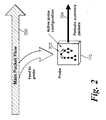
- an IP network for example an IP backbone network 100, comprises a plurality of interconnected high-speed routers 102.
- a link 104 between a first router 106 and a second router 108 of the plurality of high-speed routers 102 is coupled to a probe 110 by means of a tap 112, an electrical or optical connection to the link 104 in order to "siphon-off" a copy of electrical or optical signals communicated along the link 104 so as to enable the probe 110 to monitor communications between the first and second routers 106, 108.
- the tap 112 is coupled to an input 114 of the probe 110, an output 116 of the probe being coupled to a packet input port 118, such as an Ethernet port of the second router 108.
- the probe 110 is used by, for example, one or more groups of network operators, such as a group supporting Voice over IP traffic and/or another group responsible for maintenance of customer websites, to make a number of measurements in relation to a main flow of packets 200 communicated between the first and second routers 106, 108.
- the number of measurements is performed as an aggregate test 202 that constitutes an analysis task.
- the probe 110 is also capable of generating summary packets 204 constituting summary messages.
- the aggregate test 202 comprises a Tee element 300, having an input for receiving packets.
- the Tee element 300 is coupled to a first classifier element 302, the first classifier element 302 being coupled to a first counter element 304 and a second counter element 306.
- the Tee element 300 is also coupled to a second classifier element 308, the second classifier element 308 being coupled to a third classifier element 310 that is coupled to a third counter element 312 and a fourth counter element 314.
- the second classifier element 308 is also coupled to a fifth counter element 316 and a sixth counter element 318.
- the aggregate test 202 is therefore represented by a rooted acyclic directed graph of elements, each of which performs a respective function in relation to packets.
- the aggregate test 202 is written in an adapted version of the "Click" configuration language, as described in "The click modular router” (E. Kohler, R. Morris, B. Chen, J. Jannotti, and M. Frans Kaashoek, ACM Transactions on Computer Systems, 18(3):263-297, August 2000) and www.pdos.lcs.mit.edu/click/.
- the Click configuration language is a language to develop modular software routers, but can also be used to perform the combination of tests 202. However, it should be appreciated that any suitable programming language can be used to implement the aggregate test 202.
- the aggregate test 202 can be perceived as a tree, or more generally as the rooted acyclic directed graph as described above, having branches subtending from Tee elements and classifier elements, the counter elements constituting leaves of the tree.
- the behaviour of the graph i.e. the way in which states (for example, the counters) of the graph are modified, on reception of a packet defines the semantics of the graph.
- the aggregate test 202 comprises an arrangement of individual tests such that any given packet flowing through the tree has a definite path through the tree that can be followed.
- the Tee element 300 sends a copy of received packets to each child coupled to the Tee element 300, whereas the first, second and third classifier elements 302, 308, 310 serve to direct packets along predefined branches of the tree in response to certain characteristics of the packets being processed.
- each classifier element is preprogrammed to output packets to outputs of the classifier elements dependent upon certain characteristics of the packets, for example IP packets or non-IP packets.
- the counter elements simply count packets received from the classifier elements to which they are coupled, thereby counting packets having the characteristic identified by the classifier elements providing the packets.
- the probe 110 comprises a processing resource 400, such as a microprocessor, having an input 402 coupled to an input port 404 of the probe 110.
- the processing resource 400 supports a controller process 406 capable of retrieving data from and storing data to a storage device 408 of the probe 110.
- the storage device 408 is capable of storing individual tests that, when combined as a graph of the individual tests is semantically equivalent to the aggregate test 202.
- the storage device 408 is, for the purposes of speed, a memory device.
- the processing resource 400 also supports a test re-writer process 410, the test re-writer process 410 being capable of communicating with the controller process 406.
- the test re-writer process 410 is also capable of interacting with a test execution process 412 that is also supported by the processing resource 400.
- the test execution process 412 has access to the input 114 of the probe 110 as well as the output 116 of the probe 110.
- the controller process 406 serves to modify the aggregate test 202 by applying a set of modification rules, in a non-semantic preserving way, so as to add or remove an individual test from the aggregate test 202.
- the test re-writer process 410 serves to optimise the aggregate test 202 upon addition of one or more test to the aggregate test 202 or prior to removal of one or more test from the aggregate test 202.
- the test re-writer process 410 has a first set of rules relating to operations that can be carried out on a set of interconnected tests to achieve a first predetermined optimisation goal in relation to addition of one or more test to the aggregate test 202.
- the first optimisation goal is to minimise tree or graph depth, for example by removing redundant or superfluous elements.
- the test re-writer process 410 has a second set of rules relating to operations than can be carried out on a set of interconnected tests to achieve a second predetermined optimisation goal in relation to removal of one or more test from the aggregate test 202.
- the second optimisation goal is to minimise tree depth or graph depth, for example by removing redundant or superfluous elements, whilst "factoring out” or isolating a given individual test from the aggregate test 202.
- optimisation rules exist for the click modular router described above, the first and second set of rules used herein differ in that they relate specifically to the manipulation of aggregate tests being executed by the test execution process 412, and the optimisations are being performed whilst the aggregate test 202 is being executed, i.e. the performance of the aggregate test 202 is not halted or taken off-line to re-write the aggregate test 202 following an instruction to add or remove one or more test to or from the aggregate test 202.
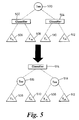
- a Tee element 500 can be used to combine the pair of individual tests T 1 , T 2 into the aggregate test 202 suitable for execution on the stream of packets.
- the Tee element 500 sends a copy of each incoming packet to each of its children.
- a first classifier element 502 and a second classifier element 504 are each coupled to the Tee element 500.
- the first classifier element 502 is coupled to a first sub-graph 506 and a second sub-graph 508 and together they constitute the first individual test, T 1 .
- the first and second sub-graphs 506, 508 can each comprise one or more respective test elements.
- the second classifier element 504 is coupled to a third sub-graph 510 and a fourth sub-graph 512 and together they constitute the second individual test, T 2 .
- the third and fourth sub-graphs 510, 512 can also each comprise one or more respective test elements.
- the first individual test T 1 implements a count of Internet Protocol (IP) packets
- the second individual test T 2 implementing a count of non-IP packets.
- the first sub-graph 506 updates a counter every time an IP packet is encountered by the first sub-graph 506, and the second sub-graph 508 discards all non-IP packets, i.e. the second sub-graph 508 is simply a so-called "discard node”.
- the third sub-graph 510 is a discard node as well, but for IP packets, and the fourth sub-graph 512 updates a counter every time a non-IP packet is encountered.
- the first classifier element 502 therefore directs IP packets to the first sub-graph 506 and non-IP packets to the second sub-graph 508.
- the second classifier element 504 directs IP packets to the third sub-graph 510 and non-IP packets to the fourth sub-graph 512.
- the controller process 406 applies the set of modification rules to concatenate the first and second individual tests T 1 , T 2 using the Tee element 500, the resulting structure again being that of a rooted directed graph constituting the aggregate test 202.
- the first set of optimisation rules are applied by the test re-writer process 410 so as to , as a first step, immerse the functionality of the Tee element 500 down one level in the tree structure and providing a single classifier element 514 as the uppermost node, or root, of the tree structure. Consequently, a first Tee element 516 and a second Tee element 518 replace the first and second classifier elements 502, 504, respectively.
- the single classifier element 514 is therefore coupled to the first Tee element 516 and the second Tee element 518.
- the first set of optimisation rules when applied, require that the first sub-graph 506 and the third sub-graph 510 are coupled to the first Tee element 516, whilst the second sub-graph 508 and the fourth sub-graph 512 are coupled to the second Tee element 518. Since the third sub-graph 510 is a discard element, and is coupled to the first Tee element 516, the third sub-graph 510 can be removed, because any branch of a Tee element that is coupled to a discard element can be removed. Further, a Tee element coupled to a single "child" element can simply be replaced by the child element.
- the single classifier element 514 is therefore, after optimisation, coupled to the first sub-graph 506 and the fourth sub-graph 512 only.
- the first set of optimisation rules have to take into account graphical context of elements being replaced or moved as part of the optimisation process, thereby preserving the semantics of the pair of individual tests T 1 , T 2 (the aggregate test 202).
- account is taken of the graphical context of elements being replaced, added, removed or moved as part of the optimisation process so as to preserve the semantics of the aggregate test 202.
- An advantage of the above optimisation is that a single classification element can replace the presence of two classifier elements, thereby reducing the processing overhead required by the aggregated pair of individual tests T 1 , T 2 . Additionally, the discard nodes are rendered redundant.
- any given aggregate test has a single entry point (or root) for initial packet input and typically one or more discard elements at the bottom of a graph (or leaves of a tree) constituting the aggregate test to process packets injected into a given sub graph, for example branch, of the aggregate test 202.
- An example of such a structure is the first Tee element 516 coupled to the first and third sub-graph 506, 510 as described above. In such circumstances, another optimisation is sometimes possible.
- the third sub-graph 510 has been modified so that it is not a discard element, but instead another sub-graph, and a test element 600 is coupled to the first sub-graph 506; the test element 600 is a discard element.
- any packet entering the first test element 506 is eventually passed to the another discard element 600, unchanged.
- the fact that packets processed by the first sub-graph 506 remain unchanged allows the first and third sub-graph 506, 510 to be composed sequentially, thereby again avoiding the need for the first Tee element 516 and the another discard element 600.
- the optimisation is sometimes possible and depends upon the exact elements making up the first and third sub-graph 506, 510.
- the optimisation rules ensure that every packet passing through a given graph or sub-graph reaches a single discard element at the fringe of the given graph or sub-graph. Assuming packets reaching the discard elements are not modified, the discard elements would then be removed and replaced by respective links to the beginning of the third sub-graph 510.
- a number of requests are transmitted to the probe 110 from one or more different sources corresponding to one or more different consumers.
- a single consumer implements and modifies multiple individual tests on a given link, whereas in other circumstances, more than one consumer implements one or more individual tests on the given link. Consequently, each consumer has a need to add or remove tests, for example, a first request 414 is sent from a first consumer (not shown) and received via the input port 404 of the probe 110.
- a second request 416 is sent by a second consumer (not shown) and again received by the probe 110 via the input port 404.
- the test execution process 412 executes the aggregate test 202 formed from a number of individual tests.
- Each request received includes an individual test to be added to or removed from the aggregate test 202 being executed by the test execution process 412.
- the request can simply be a reference to the individual test to be removed.
- each request can include an authentication component to identify the authenticity of an originator of a received request as an owner of the individual test to be added or removed. This approach also avoids any given consumer accidentally adding or removing tests that do not belong to the consumer.
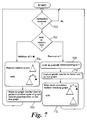
- the controller process 406 awaits (Step 700) receipt of a request, for example the first or second requests 414, 416. Upon receipt of the request, the controller process 406 determines (Step 702) whether the received request is a request to add a test or a request to remove a test.
- the controller process 406 extracts a test to be added, T i , from the first request 414 and stores the test to be added, T i , in the storage device 408. Thereafter, the controller process 406 atomically modifies (Step 704) the aggregate test 202, the modified aggregate test 418, constituting a current graph 420 being executed by the test execution process 412, with a Tee element coupled to the current graph and the test to be added, T i .
- a modified current graph is therefore created and executed by the test execution process 412, without interruption of the execution of the aggregate test 202, or loss or corruption of test measurements.
- the atomic modifications are small, discrete, modifications made between packet processing steps of the test execution process 412. More particularly, the atomic modifications are made between processing steps relating to a given part of the current graph being executed by the test execution process 412. For example, if the test execution process 412 is processing a first branch of the aggregate test 202, then the atomic modifications can be made to a second branch of the aggregate test 202, whilst the first branch is being processed.
- the controller process 406 instructs the re-writer process 410 to attempt to optimise the modified current graph with respect to the first predetermined optimisation goal.
- the re-writer process 410 then implements (Step 706) the first set of optimisation rules as atomic modifications, examples of the implementation of which have already been described above, in an attempt to maximise sharing of test elements by the modified current graph.
- the re-writer process 410 in combination with the first set of optimisation rules attempts, inter alia, to "push" the Tee element, added at the root of the current graph to merge the test to be added, T i , to the current graph, down into the modified current graph.
- This and any other optimisation steps are carried out by the re-writer process 410.
- the atomic modifications are small, discrete, semantic preserving modifications made between packet processing steps of the test execution process 412. More particularly, the atomic modifications are made between processing steps relating to a given part of the current graph being executed by the test execution process 412.
- test execution process 412 is able to continue executing the optimised modified current graph on a stream of packets received via the input port 114 of the probe 110.
- Results of the tests executed by the test execution process 412 are then communicated to a central monitoring station (not shown) as summary messages, the summary messages being inserted into a flow of traffic processed by, in this example, the second router 108, via the packet input port 118 of the second router 108, for onward propagation to the central monitoring station.
- the controller process 406 accesses the storage device 408 to retrieve (Step 708) the test to be removed, T j .
- the controller process 406 then passes a copy of the test to be removed, T j , to the re-writer process 410 and instructs (Step 710) the re-writer process 406 to separate out the test to be removed, T j , from the current graph being implemented by the test execution process 412.
- the separating out of the test to be removed, T j can be seen as a de-merger or de-optimisation of the aggregate test 202 being executed by the test execution process 412.
- the re-writing process 410 applies the second set of optimisation rules defined to achieve the second predetermined optimisation goal, namely to isolate, or "factor out" the test to be removed, T j ,.
- Isolation of the test to be removed, T j also involves making necessary atomic modifications to the current graph being executed by the test execution process 412 so as to be able to extract the test to be removed, T j , from the current graph being executed without modifying the semantics of remaining aggregate test being executed.
- the atomic modifications are made to the current graph being executed between packet processing steps carried out by the test execution process 412 until a point is reached where a Tee element is a topmost element of the modified aggregate test, the modified current graph constituting one child of the Tee element and the test to be removed, T j constituting another child of the Tee element.
- the atomic modifications are discrete, semantic preserving, changes made to one or more given part of the current graph being executed whilst the test execution process 412 is not processing the one or more given part of the current graph.
- T j Upon successful isolation of the test to be removed, T j , the test to be removed, T j , and the Tee element that binds the test to be removed, T j , to the modified current graph are removed (Step 712) by the controller process 406, leaving the modified current graph.
- This can be achieved by simple manipulation of pointers. Consequently, the test execution process 412 continues executing the modified current graph on the stream of packets received via the input port 114 of the probe 110. Results of the tests executed by the test execution process 412 are also communicated to the central monitoring station in a like manner to that described above in relation to the test to be added, T i .
- packet Whilst the above examples have been described in the context of packet communication, it should be appreciated that the term “packet” is intended to be construed as encompassing packets, datagrams, frames, cells, and protocol data units and so these term should be understood to be interchangeable.
- Alternative embodiments of the invention can be implemented as a computer program product for use with a computer system, the computer program product being, for example, a series of computer instructions stored on a tangible data recording medium, such as a diskette, CD-ROM, ROM, or fixed disk, or embodied in a computer data signal, the signal being transmitted over a tangible medium or a wireless medium, for example, microwave or infrared.
- the series of computer instructions can constitute all or part of the functionality described above, and can also be stored in any memory device, volatile or non-volatile, such as semiconductor, magnetic, optical or other memory device.
Landscapes
- Engineering & Computer Science (AREA)
- Computer Networks & Wireless Communication (AREA)
- Signal Processing (AREA)
- Data Exchanges In Wide-Area Networks (AREA)
- Mobile Radio Communication Systems (AREA)
Applications Claiming Priority (1)
| Application Number | Priority Date | Filing Date | Title |
|---|---|---|---|
| GB0422818A GB2419255A (en) | 2004-10-14 | 2004-10-14 | Modifying an aggregate test in a network probe |
Publications (2)
| Publication Number | Publication Date |
|---|---|
| EP1648113A2 true EP1648113A2 (de) | 2006-04-19 |
| EP1648113A3 EP1648113A3 (de) | 2008-06-04 |
Family
ID=33462700
Family Applications (1)
| Application Number | Title | Priority Date | Filing Date |
|---|---|---|---|
| EP05109154A Withdrawn EP1648113A3 (de) | 2004-10-14 | 2005-10-03 | Prüfsondengerät und Verfahren |
Country Status (3)
| Country | Link |
|---|---|
| US (1) | US20060083179A1 (de) |
| EP (1) | EP1648113A3 (de) |
| GB (1) | GB2419255A (de) |
Families Citing this family (14)
| Publication number | Priority date | Publication date | Assignee | Title |
|---|---|---|---|---|
| US20140369363A1 (en) * | 2013-06-18 | 2014-12-18 | Xpliant, Inc. | Apparatus and Method for Uniquely Enumerating Paths in a Parse Tree |
| US9769078B2 (en) | 2013-11-05 | 2017-09-19 | Cisco Technology, Inc. | Dynamic flowlet prioritization |
| US10778584B2 (en) | 2013-11-05 | 2020-09-15 | Cisco Technology, Inc. | System and method for multi-path load balancing in network fabrics |
| US9397946B1 (en) | 2013-11-05 | 2016-07-19 | Cisco Technology, Inc. | Forwarding to clusters of service nodes |
| US9374294B1 (en) | 2013-11-05 | 2016-06-21 | Cisco Technology, Inc. | On-demand learning in overlay networks |
| US9674086B2 (en) | 2013-11-05 | 2017-06-06 | Cisco Technology, Inc. | Work conserving schedular based on ranking |
| US9888405B2 (en) * | 2013-11-05 | 2018-02-06 | Cisco Technology, Inc. | Networking apparatuses and packet statistic determination methods employing atomic counters |
| EP3605971B1 (de) | 2013-11-05 | 2021-10-13 | Cisco Technology, Inc. | Netzwerk-fabric-überlagerung |
| US9502111B2 (en) | 2013-11-05 | 2016-11-22 | Cisco Technology, Inc. | Weighted equal cost multipath routing |
| US9655232B2 (en) | 2013-11-05 | 2017-05-16 | Cisco Technology, Inc. | Spanning tree protocol (STP) optimization techniques |
| US10951522B2 (en) | 2013-11-05 | 2021-03-16 | Cisco Technology, Inc. | IP-based forwarding of bridged and routed IP packets and unicast ARP |
| US9876711B2 (en) | 2013-11-05 | 2018-01-23 | Cisco Technology, Inc. | Source address translation in overlay networks |
| US9825857B2 (en) | 2013-11-05 | 2017-11-21 | Cisco Technology, Inc. | Method for increasing Layer-3 longest prefix match scale |
| US11016867B2 (en) | 2015-12-18 | 2021-05-25 | Micro Focus Llc | Test execution comparisons |
Family Cites Families (7)
| Publication number | Priority date | Publication date | Assignee | Title |
|---|---|---|---|---|
| AU5430296A (en) * | 1995-05-26 | 1996-12-11 | Motorola, Inc. | Method and apparatus for optimizing and testing a communication system |
| AU722149B2 (en) * | 1996-02-29 | 2000-07-20 | Bt Financial Group Pty Limited | Determination of software functionality |
| US7100124B2 (en) * | 2000-07-03 | 2006-08-29 | Cadence Design Systems, Inc. | Interface configurable for use with target/initiator signals |
| GB2365155A (en) * | 2000-07-24 | 2002-02-13 | Motorola Inc | Generation of test scripts from a system specification model |
| US7840652B2 (en) * | 2001-03-21 | 2010-11-23 | Ascentive Llc | System and method for determining network configuration settings that provide optimal network performance |
| US6941450B2 (en) * | 2001-07-30 | 2005-09-06 | International Business Machines Corporation | System and method for identifying one or more optimum configurations of a data processing system |
| US7043549B2 (en) * | 2002-01-31 | 2006-05-09 | International Business Machines Corporation | Method and system for probing in a network environment |
-
2004
- 2004-10-14 GB GB0422818A patent/GB2419255A/en not_active Withdrawn
-
2005
- 2005-09-16 US US11/229,232 patent/US20060083179A1/en not_active Abandoned
- 2005-10-03 EP EP05109154A patent/EP1648113A3/de not_active Withdrawn
Also Published As
| Publication number | Publication date |
|---|---|
| GB2419255A (en) | 2006-04-19 |
| GB0422818D0 (en) | 2004-11-17 |
| EP1648113A3 (de) | 2008-06-04 |
| US20060083179A1 (en) | 2006-04-20 |
Similar Documents
| Publication | Publication Date | Title |
|---|---|---|
| US6874016B1 (en) | Information searching device | |
| EP1648113A2 (de) | Prüfsondengerät und Verfahren | |
| US10432527B1 (en) | Packet header field extraction | |
| US8521905B2 (en) | System for flexible and extensible flow processing in software-defined networks | |
| US8711860B2 (en) | Controller for flexible and extensible flow processing in software-defined networks | |
| US8718064B2 (en) | Forwarding element for flexible and extensible flow processing software-defined networks | |
| US8582466B2 (en) | Flow statistics aggregation | |
| US9491083B2 (en) | Systems and methods of test packet handling | |
| US10389627B2 (en) | State-dependent data forwarding | |
| Zheng et al. | Highly-efficient and adaptive network monitoring: When INT meets segment routing | |
| CN105323185A (zh) | 用于与交换机结构相关的流控制的方法和装置 | |
| CN103873291B (zh) | 用于配置软件定义的网络的方法和设备 | |
| JP4823156B2 (ja) | リモートトラフィック監視方法 | |
| CN104509032A (zh) | 软件定义的网络中的操作、监管、以及管理(oam)功能 | |
| JP2012526500A (ja) | データ通信セッションを制御する方法および装置 | |
| Sviridov et al. | LODGE: LOcal Decisions on Global statEs in programmable data planes | |
| CN109547288A (zh) | 一种协议无关转发网络可编程流测量方法 | |
| Kushwaha et al. | Design, analysis, and a terabit implementation of a source-routing-based SDN data plane | |
| CN104883303A (zh) | 一种sdn架构中多流表网络路由追踪的方法 | |
| Owens et al. | Explicit routing in software-defined networking (ersdn): Addressing controller scalability | |
| Sheldon et al. | Ej-fat joint esnet jlab fpga accelerated transport load balancer | |
| US20120014256A1 (en) | Locating Signatures in Packets | |
| Kataria et al. | Programmable Data Plane for New IP using eXpress Data Path (XDP) in Linux | |
| US20200044953A1 (en) | Data Packet Fast Routing Method | |
| Mihaeljans et al. | Service Function Chaining via SR-MPLS over P4: A rudimentary analysis |
Legal Events
| Date | Code | Title | Description |
|---|---|---|---|
| PUAI | Public reference made under article 153(3) epc to a published international application that has entered the european phase |
Free format text: ORIGINAL CODE: 0009012 |
|
| AK | Designated contracting states |
Kind code of ref document: A2 Designated state(s): AT BE BG CH CY CZ DE DK EE ES FI FR GB GR HU IE IS IT LI LT LU LV MC NL PL PT RO SE SI SK TR |
|
| AX | Request for extension of the european patent |
Extension state: AL BA HR MK YU |
|
| RAP1 | Party data changed (applicant data changed or rights of an application transferred) |
Owner name: AGILENT TECHNOLOGIES, INC. |
|
| PUAL | Search report despatched |
Free format text: ORIGINAL CODE: 0009013 |
|
| AK | Designated contracting states |
Kind code of ref document: A3 Designated state(s): AT BE BG CH CY CZ DE DK EE ES FI FR GB GR HU IE IS IT LI LT LU LV MC NL PL PT RO SE SI SK TR |
|
| AX | Request for extension of the european patent |
Extension state: AL BA HR MK YU |
|
| 17P | Request for examination filed |
Effective date: 20081204 |
|
| 17Q | First examination report despatched |
Effective date: 20090107 |
|
| AKX | Designation fees paid |
Designated state(s): DE FR GB |
|
| STAA | Information on the status of an ep patent application or granted ep patent |
Free format text: STATUS: THE APPLICATION IS DEEMED TO BE WITHDRAWN |
|
| 18D | Application deemed to be withdrawn |
Effective date: 20090519 |