EP1642642B1 - Synthesis of recyclable chiral metathesis catalysts - Google Patents
Synthesis of recyclable chiral metathesis catalysts Download PDFInfo
- Publication number
- EP1642642B1 EP1642642B1 EP05011735.7A EP05011735A EP1642642B1 EP 1642642 B1 EP1642642 B1 EP 1642642B1 EP 05011735 A EP05011735 A EP 05011735A EP 1642642 B1 EP1642642 B1 EP 1642642B1
- Authority
- EP
- European Patent Office
- Prior art keywords
- group
- alkyl
- substituted
- aryl
- formula
- Prior art date
- Legal status (The legal status is an assumption and is not a legal conclusion. Google has not performed a legal analysis and makes no representation as to the accuracy of the status listed.)
- Expired - Lifetime
Links
Classifications
-
- C—CHEMISTRY; METALLURGY
- C07—ORGANIC CHEMISTRY
- C07F—ACYCLIC, CARBOCYCLIC OR HETEROCYCLIC COMPOUNDS CONTAINING ELEMENTS OTHER THAN CARBON, HYDROGEN, HALOGEN, OXYGEN, NITROGEN, SULFUR, SELENIUM OR TELLURIUM
- C07F15/00—Compounds containing elements of Groups 8, 9, 10 or 18 of the Periodic Table
-
- B—PERFORMING OPERATIONS; TRANSPORTING
- B01—PHYSICAL OR CHEMICAL PROCESSES OR APPARATUS IN GENERAL
- B01J—CHEMICAL OR PHYSICAL PROCESSES, e.g. CATALYSIS OR COLLOID CHEMISTRY; THEIR RELEVANT APPARATUS
- B01J31/00—Catalysts comprising hydrides, coordination complexes or organic compounds
- B01J31/16—Catalysts comprising hydrides, coordination complexes or organic compounds containing coordination complexes
- B01J31/24—Phosphines, i.e. phosphorus bonded to only carbon atoms, or to both carbon and hydrogen atoms, including e.g. sp2-hybridised phosphorus compounds such as phosphabenzene, phosphole or anionic phospholide ligands
- B01J31/2404—Cyclic ligands, including e.g. non-condensed polycyclic ligands, the phosphine-P atom being a ring member or a substituent on the ring
-
- B—PERFORMING OPERATIONS; TRANSPORTING
- B01—PHYSICAL OR CHEMICAL PROCESSES OR APPARATUS IN GENERAL
- B01J—CHEMICAL OR PHYSICAL PROCESSES, e.g. CATALYSIS OR COLLOID CHEMISTRY; THEIR RELEVANT APPARATUS
- B01J31/00—Catalysts comprising hydrides, coordination complexes or organic compounds
- B01J31/16—Catalysts comprising hydrides, coordination complexes or organic compounds containing coordination complexes
- B01J31/22—Organic complexes
- B01J31/2265—Carbenes or carbynes, i.e.(image)
-
- B—PERFORMING OPERATIONS; TRANSPORTING
- B01—PHYSICAL OR CHEMICAL PROCESSES OR APPARATUS IN GENERAL
- B01J—CHEMICAL OR PHYSICAL PROCESSES, e.g. CATALYSIS OR COLLOID CHEMISTRY; THEIR RELEVANT APPARATUS
- B01J31/00—Catalysts comprising hydrides, coordination complexes or organic compounds
- B01J31/16—Catalysts comprising hydrides, coordination complexes or organic compounds containing coordination complexes
- B01J31/24—Phosphines, i.e. phosphorus bonded to only carbon atoms, or to both carbon and hydrogen atoms, including e.g. sp2-hybridised phosphorus compounds such as phosphabenzene, phosphole or anionic phospholide ligands
-
- C—CHEMISTRY; METALLURGY
- C07—ORGANIC CHEMISTRY
- C07F—ACYCLIC, CARBOCYCLIC OR HETEROCYCLIC COMPOUNDS CONTAINING ELEMENTS OTHER THAN CARBON, HYDROGEN, HALOGEN, OXYGEN, NITROGEN, SULFUR, SELENIUM OR TELLURIUM
- C07F15/00—Compounds containing elements of Groups 8, 9, 10 or 18 of the Periodic Table
- C07F15/0006—Compounds containing elements of Groups 8, 9, 10 or 18 of the Periodic Table compounds of the platinum group
- C07F15/002—Osmium compounds
-
- C—CHEMISTRY; METALLURGY
- C07—ORGANIC CHEMISTRY
- C07F—ACYCLIC, CARBOCYCLIC OR HETEROCYCLIC COMPOUNDS CONTAINING ELEMENTS OTHER THAN CARBON, HYDROGEN, HALOGEN, OXYGEN, NITROGEN, SULFUR, SELENIUM OR TELLURIUM
- C07F15/00—Compounds containing elements of Groups 8, 9, 10 or 18 of the Periodic Table
- C07F15/0006—Compounds containing elements of Groups 8, 9, 10 or 18 of the Periodic Table compounds of the platinum group
- C07F15/0046—Ruthenium compounds
-
- B—PERFORMING OPERATIONS; TRANSPORTING
- B01—PHYSICAL OR CHEMICAL PROCESSES OR APPARATUS IN GENERAL
- B01J—CHEMICAL OR PHYSICAL PROCESSES, e.g. CATALYSIS OR COLLOID CHEMISTRY; THEIR RELEVANT APPARATUS
- B01J2231/00—Catalytic reactions performed with catalysts classified in B01J31/00
- B01J2231/10—Polymerisation reactions involving at least dual use catalysts, e.g. for both oligomerisation and polymerisation
- B01J2231/14—Other (co) polymerisation, e.g. of lactides or epoxides
-
- B—PERFORMING OPERATIONS; TRANSPORTING
- B01—PHYSICAL OR CHEMICAL PROCESSES OR APPARATUS IN GENERAL
- B01J—CHEMICAL OR PHYSICAL PROCESSES, e.g. CATALYSIS OR COLLOID CHEMISTRY; THEIR RELEVANT APPARATUS
- B01J2231/00—Catalytic reactions performed with catalysts classified in B01J31/00
- B01J2231/50—Redistribution or isomerisation reactions of C-C, C=C or C-C triple bonds
- B01J2231/54—Metathesis reactions, e.g. olefin metathesis
-
- B—PERFORMING OPERATIONS; TRANSPORTING
- B01—PHYSICAL OR CHEMICAL PROCESSES OR APPARATUS IN GENERAL
- B01J—CHEMICAL OR PHYSICAL PROCESSES, e.g. CATALYSIS OR COLLOID CHEMISTRY; THEIR RELEVANT APPARATUS
- B01J2231/00—Catalytic reactions performed with catalysts classified in B01J31/00
- B01J2231/50—Redistribution or isomerisation reactions of C-C, C=C or C-C triple bonds
- B01J2231/54—Metathesis reactions, e.g. olefin metathesis
- B01J2231/543—Metathesis reactions, e.g. olefin metathesis alkene metathesis
-
- B—PERFORMING OPERATIONS; TRANSPORTING
- B01—PHYSICAL OR CHEMICAL PROCESSES OR APPARATUS IN GENERAL
- B01J—CHEMICAL OR PHYSICAL PROCESSES, e.g. CATALYSIS OR COLLOID CHEMISTRY; THEIR RELEVANT APPARATUS
- B01J2531/00—Additional information regarding catalytic systems classified in B01J31/00
- B01J2531/80—Complexes comprising metals of Group VIII as the central metal
- B01J2531/82—Metals of the platinum group
- B01J2531/821—Ruthenium
-
- B—PERFORMING OPERATIONS; TRANSPORTING
- B01—PHYSICAL OR CHEMICAL PROCESSES OR APPARATUS IN GENERAL
- B01J—CHEMICAL OR PHYSICAL PROCESSES, e.g. CATALYSIS OR COLLOID CHEMISTRY; THEIR RELEVANT APPARATUS
- B01J2531/00—Additional information regarding catalytic systems classified in B01J31/00
- B01J2531/80—Complexes comprising metals of Group VIII as the central metal
- B01J2531/82—Metals of the platinum group
- B01J2531/825—Osmium
-
- B—PERFORMING OPERATIONS; TRANSPORTING
- B01—PHYSICAL OR CHEMICAL PROCESSES OR APPARATUS IN GENERAL
- B01J—CHEMICAL OR PHYSICAL PROCESSES, e.g. CATALYSIS OR COLLOID CHEMISTRY; THEIR RELEVANT APPARATUS
- B01J31/00—Catalysts comprising hydrides, coordination complexes or organic compounds
- B01J31/16—Catalysts comprising hydrides, coordination complexes or organic compounds containing coordination complexes
- B01J31/22—Organic complexes
- B01J31/2282—Unsaturated compounds used as ligands
- B01J31/2295—Cyclic compounds, e.g. cyclopentadienyls
Definitions
- the present invention relates to the synthesis of highly active ruthenium or osmium carbene metathesis catalysts.
- simple methods for forming carbon-carbon bonds are extremely important and valuable tools.
- One method of C-C bond formation that has proved particularly useful is transition-metal catalyzed olefin metathesis.
- transition-metal catalyzed olefin metathesis is highly metathesis active and stable in the presence of a variety of functional groups.
- These catalysts are of the general formula where M is ruthenium or osmium, X and X 1 are anionic ligands, and L and L 1 are neutral electron donors and R and R' are specific substituents that will be described in more detail below.
- United States Patents Nos. 5,312,940 and 5,342,909 disclose specific vinyl alkylidene ruthenium and osmium complexes in which the neutral electron donor ligands L and L 1 are triphenyl phosphines or diphenylmethyl phosphines. As disclosed in the patents, the catalysts are useful in catalyzing the ring opening metathesis polymerization ("ROMP") of strained olefins.
- United States Patent 5,710,298 discloses specific vinyl alkylidene ruthenium and osmium complexes in which the neutral electron donor ligands L and L 1 are phosphines with at least one secondary-alkyl or cycloalkyl substituent.
- водородородани ⁇ phosphine catalysts are more metathesis active than the corresponding triphenyl phosphine catalysts and may be used to catalyze a variety of metathesis reactions involving acyclic and unstrained cyclic olefins.
- WO-A-97 06185 discloses specific non-vinyl alkylidene complexes that are more metathesis active than their vinyl alkylidene counterparts.
- the preferred catalyst disclosed in this application are benzylidene ruthenium and osmium carbene compounds.
- vinyl alkylidene catalysts may be synthesized by a variety of methods including the reaction of ruthenium or osmium compounds with cyclopropenes or phosphoranes, and neutral or anionic ligand exchange. Of these previous methods, the preferred method of making the catalysts is via the reaction of a substituted cyclopropene with a ruthenium or osmium dihalide.
- WO-A-9706135 discloses a method for synthesizing alkylidene complex catalysts via the reaction of substituted diazoalkanes with ruthenium dihalides.
- the synthetic procedures disclosed in this application can be used to make non-vinyl alkylidene complex catalysts which are more metathesis active than their corresponding vinyl alkylidene counterparts.
- the secondary-alkyl phosphine catalysts cannot be synthesized directly from the reaction of ruthenium dihalide and diazoalkanes.
- the secondary-alkyl phosphine catalysts must be synthesized by ligand exchange.
- diazo starting materials greatly broadened the range of ruthenium and osmium carbene catalysts that could be synthesized, the danger of handling diazocompounds on a large scale severely restricts the commercial and laboratory utility of this method.
- the diazo method requires the synthesis to be conducted at low temperature (about -80°C to -50°C) and requires the use of considerable solvent in the final purification of the catalyst.
- the secondary-alkyl phosphine catalysts must be synthesized using a multi-step ligand exchange procedure which may be time consuming and expensive and may result in lower product yields.
- the secondary-alkyl phosphine catalysts In both the cyclopropene and diazo synthesis methods the secondary-alkyl phosphine catalysts must be synthesized using a multi-step, ligand exchange procedure. Since the secondary-alkyl phosphine catalysts are more metathesis active than the triphenyl phosphine catalysts and therefore may have wider commercial utility, the necessity of a multi-step synthesis in these cases can be a severe limitation.
- the present invention addresses this need and provides simple, safe, and less expensive methods of synthesizing ruthenium and osmium carbene catalysts.
- one step syntheses are provided using stable, readily available starting materials. The processes result in good product yield without the need for expensive and sophisticated equipment.
- both vinyl and non-vinyl alkylidene catalysts may be synthesized.
- the methods can produce catalysts in a form which makes post synthesis purification unnecessary.
- a method for synthesizing vinyl alkylidene catalysts of the formula is provided where M, X, X 1 , L, and L 1 are as described above and R 12 , R 13 , and R 17 may be the same or different and may be any one of a variety of substituents that are described in detail below.
- R 12 and R 13 are the same and are both methyls and R 17 is hydrogen.
- the alkyne may be of the general formula, R 17 C ⁇ CCR 12 R 13 R', wherein R' is hydroxyl.
- the alkyne is reacted with the dihydrogen complex as above but then subsequently reacted with HX to form the above described vinyl alkylidene catalyst.
- R' is hydrogen or a C 1 -C 20 alkyl
- a method for synthesizing compounds of the formula is provided where M, X, X 1 , L, and L 1 are as described above and R 14 , R 15 , and R 16 may be any one of a variety of substituents that are described in detail below.
- a compound of the formula (n - 1 or 2) is contacted with a compound of the formula to yield the required ruthenium or osmium carbene complex catalyst.
- the methods of the present invention may be used t.o synthesize ruthenium or osmium carbene complex catalysts that include a ruthenium or osmium metal center that is in a +2 oxidation state, have an electron count of 16, and are penta-coordinated. More specifically, the methods of the present invention may be used to synthesize compourids with the formula wherein:
- the R substitutent is hydrogen and the R 1 substituent is one of the following: (1) hydrogen; (2) C 1 -C 20 alkyl; (3) C 2 -C 20 alkenyl (4) aryl; (5) C 1 -C 20 alkyl substituted with one or more groups selected from the group consisting of aryl, halogen, hydroxy, C 1 -C 5 alkoxy, and C 2 -C 5 alkoxycarbonyl; and (6) aryl substituted with one or more groups selected from the group consisting of C 1 -C 5 alkyl, aryl, hydroxyl, C 1 -C 5 alkoxy, amino, nitro, and halogen.
- the R 1 substituent is phenyl or phenyl substituted with a group selected from the group consisting of chloride, bromide, iodide, fluoride, -NO 2 , -NMe 2 , methoxy, and methyl. In the most preferred embodiment, the R 1 substituent is phenyl.
- the L and L 1 ligands may be the same or different and may be any neutral electron donor ligand.
- the L and L 1 ligands may be the same or different and may be phosphines, sulfonated phosphines, phosphites, phosphinites, phosphonites, arsines, stibines, ethers, amines, amides, imines, sulfoxides, carboxyls, nitrosyis, pyridines, and thioethers.
- the L and L 1 ligands may be the same or different and are phosphines of the formula PR 3 R 4 R 5 , where R 3 is a secondary alkyl or cycloalkyl group, and R 4 and R 5 are the same or different and may be aryl, C 1 -C 10 primary alkyl, secondary alkyl, or cycloalkyl groups.
- the L and L 1 ligands may be the same or different and are -P(cyclohexyl) 3 , -P(cyclopentyl) 3 , or -P(isopropyl) 3 .
- the X and X 1 ligands may be the same or different and may be any anionic ligand.
- the X and X 1 ligands may be the same or different and may be a halogen, hydrogen or one of the following groups: C 1 -C 20 alkyl, aryl, C 1 -C 20 alkoxide, aryloxide, C 3 -C 20 alkyldiketonate, aryldiketonate, C 1 -C 20 carboxylate, aryl or C 1 -C 20 alkylsulfonate, C 1 -C 20 alkylthio, C 1 -C 20 alkylsulfonyl, or C 1 -C 20 alkylsulfinyl.
- Each group may optionally be substituted with C 1 -C 5 alkyl, halogen, C 1 -C 5 alkoxy or with a phenyl group.
- the phenyl group in turn may optionally be substituted with halogen, C 1 -C 5 alkyl or C 1 -C 5 alkoxy.
- the X and X 1 ligands may be the same or different and may be chloride, bromide, iodide, hydrogen or a moiety selected from a group consisting of: benzoate, C 1 -C 5 carboxylate, C 1 -C 5 alkyl, phenoxy, C 1 -C 5 alkoxy, C 1 -C 5 alkylthio, aryl, and C 1 -C 5 alkyl sulfonate.
- Each moiety may optionally be substituted with C 1 -C 5 alkyl or a phenyl group.
- the phenyl group may optionally be substituted with halogen, C 1 -C 5 alkyl or C 1 -C 5 alkoxy.
- the X and X 1 ligands may be the same or different and may be chloride, CF 3 CO 2 , CH 3 CO 2 , CFH 2 CO 2 , (CH 3 ) 3 CO, (CF 3 ) 2 (CH 3 )CO, (CF 3 ) (CH 3 ) 2 CO, PhO, MeO, EtO, tosylate, mesylate, or trifluoromethanesulfonate.
- X and X 1 are both chloride.
- the most preferred catalysts are:
- the above catalysts are stable in the presence of a variety of functional groups including hydroxyl, thiol, ketone, aldehyde, ester, ether, amine, imine, amide, nitro, carboxylic acid, disulfide, carbonate, isocyanate, carbodiimide, carboalkoxy, and halogen. Therefore, the starting materials and products of the reactions described below may contain one or more of these functional groups without poisoning the catalyst.
- the catalysts are stable in the presence of aqueous, organic, or protic solvents, for example, aromatic hydrocarbons, chlorinated hydrocarbons, ethers, aliphatic hydrocarbons, alcohols, water, or mixtures of the above. Therefore, the reactions described below may be carried out in one or more of these solvents without poisoning the catalyst product.
- the present invention relates to new routes for synthesizing the above-described ruthenium and osmium carbene catalysts which eliminate many of the problems associated with previous methods. Unless explicitly stated otherwise, the substituents of the catalyst are as defined above.
- the ruthenium and osmium carbene catalysts may be synthesized in one-step syntheses using readily available and stable carbene and metal sources.
- the methods of the present invention allow for the synthesis of ruthenium and osmium carbene complex compounds without the use of unstable starting materials and using reactions that may be run at room temperature or above.
- the method also allows for the preparation of catalysts with varying anionic and neutral electron donor ligands and varying substituents on the carbene carbon.
- the methods of the present invention generally yield the carbene complexes in greater than 90% yield and are sufficiently clean that the resulting catalysts may be used without extensive post synthesis purification. As discussed in the background section, all of these aspects of the present invention possess important advantages over the existing methods.
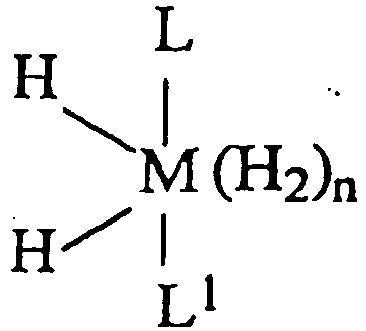
- the dihydrogen complex is M(H) 2 (H 2 ) n L 1 L and the organic compound is a substituted alkane which includes a carbon atom bearing the X, X 1 , and R 1 substituents of the catalyst.
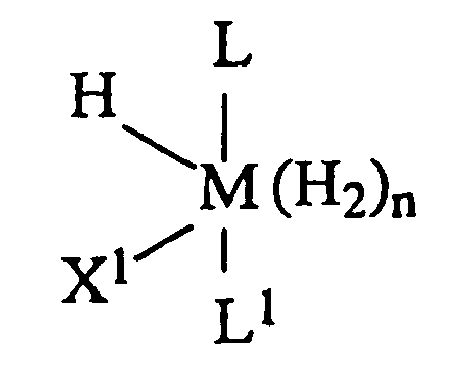
- the dihydrogen complex is M(H) (X) (H 2 ) n L 1 L and the organic compound is a substituted alkyne.
- the dihydrogen complex is M(H) (X) (H 2 ) n L 1 L and the organic compound is an alkene (olefin).
- This embodiment includes a process for synthesizing a compound of the formula which comprises the step of contacting a compound of the formula with a compound of the formula R 1 C(X)(X 1 )H in the presence of an olefin.
- M, R 1 , X, X 1 , L, and L 1 are as described defined in the catalysts section and n is either 1 or 2.
- M is ruthenium;
- L and L 1 ligands are each a phosphine of the formula PR 3 R 4 R 5 , where R 3 is a secondary alkyl or cycloalkyl group, and R 4 and R 5 are each aryl, C 1 -C 10 primary alkyl, secondary alkyl, or cycloalkyl groups;
- X and X 1 ligands are each a halogen, benzoate, C 1 -C 5 carboxylate, C 1 -C 5 alkyl, C 1 -C 5 alkoxy, C 1 -C 5 alkylthio, aryl, or C 1 -C 5 alkyl sulfonate including chloride, bromide, iodide, CF 3 CO 2 , CH 3 CO 2 , CFH 2 CO 2 , (CH 3 ) 3 CO, (CF 3 ) 2 (CH 3 )CO, (CF 3 )(CH 3 ) 2 CO,
- L and L 1 ligands are each -P(cyclohexyl) 3 , -P(cyclopentyl) 3 , or -P(isopropyl) 3 ;
- X and X 1 ligands are each a halogen;
- R 1 substituent is an substituted or an unsubstituted aromatic hydrocarbon wherein the substituted group is selected from the group consisting of chloride, bromide, iodide, fluoride, -NO 2 , -NMe 2 , methoxy, and methyl; and the olefin is cyclohexene or styrene.
- L and L 1 ligands are each either -P(cyclohexyl) 3 or -P(cyclopentyl) 3 ;
- X and X 1 ligands are each chloride;
- R 1 substituent is a substituted or unsubstituted phenyl wherein the substituted group is selected from the group consisting of chloride, bromide, iodide, fluoride, -NO 2 , -NMe 2 , methoxy, and methyl; and the olefin is cyclohexene.
- the olefin selected for use in this synthetic route is one which does not readily undergo metathesis.
- a metathesis active olefin such as ethylene
- the expected product may not be generated in high yields due to a potential metathesis reaction between the olefin and the product catalyst.
- Ru(H) 2 (H 2 ) 2 (PCy 3 ) 2 was reacted with either PhCHCl 2 or Cl 2 CHCO 2 Me in the presence of ethylene, instead of the expected benzylidene and ester carbene, a methylidene complex was formed.
- This embodiment includes a process for synthesizing a compound of the formula which comprises the step of contacting a compound of the formula with a compound of the formula wherein M, X, X 1 , L, and L 1 are as previously defined in the catalysts section.
- the alkyne may be of the general formula, R 17 C ⁇ CCR 12 R 13 R', wherein R' is hydroxyl.
- the alkyne is reacted with the dihydrogen complex as above but then subsequently reacted with HX to form the above described catalyst.
- R' is hydrogen or a C 1 -C 20 alkyl
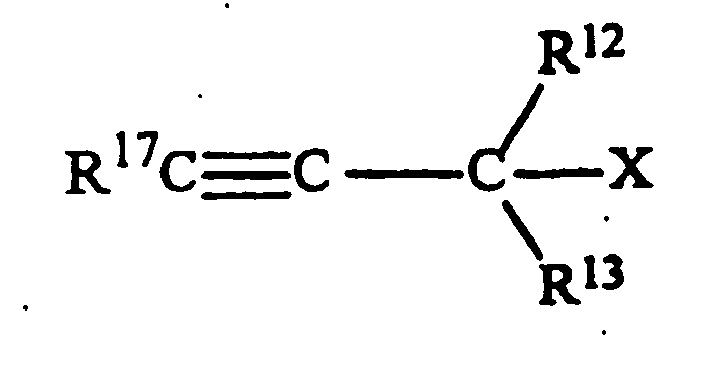
- n which is either 1 or 2; R 17 which is hydrogen, aryl or C 1 -C 18 alkyl; and R 12 and R 13 which are each hydrogen or one of the following substituent groups: C 1 -C 18 alkyl, C 2 -C 18 alkenyl, C 2 -C 18 alkynyl, aryl, C 1 -C 18 carboxylate, C 1 -C 18 alkoxy, C 2 -C 18 alkenyloxy, C 2 -C 18 alkynyloxy, aryloxy, C 2 -C 18 alkoxycarbonyl, C 1 -C 18 alkylthio, C 1 -C 18 alkylsulfonyl and C 1 -C 18 alkylsulfinyl; wherein the substituent group may be substituted with one or more groups selected from C 1 -C 5 alkyl, C 1 -C 5 alkoxy, and aryl.
- the substitute aryl group is phenyl
- it may be further substituted with one or more groups selected from a halogen, a C 1 -C 5 alkyl, or a C 1 -C 5 alkoxy.
- the R 12 and R 13 substituent groups may further include one or more functional groups selected from hydroxyl, thiol, thioether, ketone, aldehyde, ester, ether, amine, imine, amide, nitro, carboxylic acid, disulfide, carbonate, isocyanate, carbodiimide, carboalkoxy, carbamate, and halogen.
- M is ruthenium;
- L and L 1 ligands are each a phosphine of the formula PR 3 R 4 R 5 , where R 3 is a secondary alkyl or cycloalkyl group, and R 4 and R 5 are each aryl, C 1 -C 10 primary alkyl, secondary alkyl, or cycloalkyl groups;
- X and X 1 ligands are each a halogen, benzoate, C 1 -C 5 carboxylate, C 1 -C 5 alkyl, C 1 -C 5 alkoxy, C 1 -C 5 alkylthio, aryl, or C 1 -C 5 alkyl sulfonate including chloride, bromide, iodide, CF 3 CO 2 , CH 3 CO 2 , CFH 2 CO 2 , (CH 3 ) 3 CO, (CF 3 ) 2 (CH 3 )CO, (CF 3 ) (CH 3 ) 2 CO
- L and L 1 ligands are each -P(cyclohexyl) 3 , -P(cyclopentyl) 3 , or -P(isopropyl) 3 ;
- X and X 1 ligands are each a halogen;
- R 12 and R 13 are each substituted or unsubstituted aromatic hydrocarbon wherein the substituted group is selected from the group consisting of chloride, bromide, iodide, fluoride, -NO 2 , -NMe 2 , methoxy, and methyl; and R 17 is hydrogen.
- L and L 1 ligands are each either -P(cyclohexyl) 3 or -P(cyclopentyl) 3 ;
- X and X 1 ligands are each chloride;
- R 12 and R 13 are each substituted or unsubstituted phenyl or wherein the substituted group is selected from the group consisting of chloride, bromide, iodide, fluoride, -NO 2 , -NMe 2 , methoxy, and methyl; and R 17 is hydrogen.
- This embodiment of the invention is an extremely efficient method for synthesizing the above described ruthenium and osmium vinyl alkylidene catalysts in essentially a one pot synthesis. Because the metal complex need not be isolated, it may be generated in situ and then subsequently reacted with a substituted alkyne to form the desired product.
- the embodiment also results in high product yields.
- this reaction was monitored by 1 H NMR, it was found that the reaction is completed in less than ten minutes, even at -30°C. At this temperature, integration against an internal standard reveals that the yield is approximately 99.5%.
- Changing X also affected the amount of the byproduct formed.
- tertiary propargylic halide, especially tertiary propargylic chlorides are most preferred.
- ratio of carbene to Ru (IV) byproduct can be improved dramatically if the solvent is changed from dichloromethane to benzene or toluene.
- the 8:1 and 0.8:1 product to byproduct ratios of HC ⁇ CCH(CH 3 )Cl and HC ⁇ CCH 2 Cl were improved to 30:1 and 37:1 respectively.
- Reaction Scheme 2 may be modified by replacing a dihydrogen species in the starting complex with a third phosphine ligand.
- the resulting hydrido complex will be of the form M(H) (Cl) (H 2 )LL 1 L 2 or M (H) (Cl) LL 1 L 2 depending on the starting dihydrogen species.
- M, X, X 1 , R 12 , R 13 , and R 17 are as described above.
- Reaction Scheme 2A shows one version of this embodiment.
- This process comprises the step of contacting a compound of the formula with a compound of the formula M, X, X 1 , L, and L 1 are as described defined in the catalysts section; n is either 1 or 2; and R 14 , R 15 , and R 16 are each is hydrogen or one of the following substituent groups: C 1 -C 19 alkyl, C 2 -C 19 alkenyl, C 2 -C 19 alkynyl, aryl, C 1 -C 19 carboxylate, C 1 -C 19 alkoxy, C 2 -C 19 alkenyloxy, C 2 -C 19 alkynyloxy, aryloxy, C 2 -C 19 alkoxycarbonyl, C 1 -C 19 alkylthio, C 1 -C 19 alkylsulfonyl and C 1 -C 19 alkylsulfinyl; wherein the substituent group may be substituted with one or more groups selected from C 1 -C 5 alkyl, C 1 -
- the substitute aryl group is phenyl, it may be further substituted with one or more groups selected from a halogen, a C 1 -C 5 alkyl, or a C 1 -C 5 alkoxy.
- the R 14 , R 15 , and R 16 substituent groups may further include one or more functional groups selected from hydroxyl, thiol, thioether, ketone, aldehyde, ester, ether, amine, imine, amide, nitro, carboxylic acid, disulfide, carbonate, isocyanate, carbodiimide, carboalkoxy, carbamate, and halogen.
- M is ruthenium;
- L and L 1 ligands are each a phosphine of the formula PR 3 R 4 R 5 , where R 3 is a secondary alkyl or cycloalkyl group, and R 4 and R 5 are each aryl, C 1 -C 10 primary alkyl, secondary alkyl, or cycloalkyl groups;
- X and X 1 ligands are each a halogen, benzoate, C 1 -C 5 carboxylate, C 1 -C 5 alkyl, C 1 -C 5 alkoxy, C 1 -C 5 alkylthio, aryl, or C 1 -C 5 alkyl sulfonate including chloride, bromide, iodide, CF 3 CO 2 , CH 3 CO 2 , CFH 2 CO 2 , (CH 3 ) 3 CO, (CF 3 ) 2 (CH 3 ) CO, (CF 3 ) (CH 3 ) 2 CO,
- L and L 1 ligands are each -P(cyclohexyl) 3 , -P(cyclopentyl) 3 , or -P(isopropyl) 3 ;
- X and X 1 ligands are each a halogen;
- R 14 and R 15 are each substituted or unsubstituted aromatic hydrocarbon wherein the substituted group is selected from the group consisting of chloride, bromide, iodide, fluoride, -NO 2 , -NMe 2 , methoxy, and methyl; and R 16 is hydrogen.
- L and L 1 ligands are each either -P(cyclohexyl) 3 or -P(cyclopentyl) 3 ;
- X and X 1 ligands are each chloride;
- R 14 and R 15 are each substituted or unsubstituted phenyl or wherein the substituted group is selected from the group consisting of chloride, bromide, iodide, fluoride, -NO 2 , -NMe 2 , methoxy, and methyl; and R 16 is hydrogen.
- Reaction Scheme 3 may be modified by replacing a dihydrogen species in the starting complex with a third phosphine ligand.
- the resulting hydrido complex will be of the form M(R) (Cl) (H 2 )LL 1 L 2 or M(R) (Cl)LL 1 L 2 depending on the starting dihydrogen species.
- M, X, X 1 , R 14 , R 15 , and R 16 are as described above.
- Reaction Scheme 3A shows one version of this embodiment.
- the alkane route is generally the preferred method when non-vinyl alkylidene catalyst are to be synthesized.
- the methylidene complex is a result of a subsequent cross metathesis reaction between the intended carbene product and vinyl chloride (which also results in the formation of 1-chloropropene).
- the ratio of carbene to Ru (IV) byproduct is a modest 2.1:1- Unlike the alkyne route, increasing the steric bulk at the alkene's ⁇ -carbon (to suppress ⁇ -addition), did not improve the carbene yield,
- Ru (1,5-cyclooctadiene) (cyclooctatriene) (hereinafter referred to as "Ru(COD)(COT)"
- This alternative route is a variation of the alkane route that was previously described and takes advantage of a potential metathesis reaction between the olefin used in the reaction and the carbene product.
- the reaction mixture was stirred overnight after the addition of Cl 2 CH 2 .
- Ru(H) (Cl) (H 2 ) 2 (PCy 3 ) 2 can also be accomplished in a suitably sized, thick walled teflon-valved Strauss flask. Depending on the scale of the reaction and the size of the flask, the system is re-pressurized with hydrogen gas after several hours. Alternatively, the reaction can be carried out by bubbling H 2 gas at atmospheric pressure.
- Polymerizations are done by placing the solution obtained below in a 40°C oil bath for one hour, and then at least one hour in an oven at 100°C.
- the in situ generated ruthenium carbene catalyst is dissolved in 25 mL of DCPD and poured into a beaker.
- the in situ generated ruthenium carbene catalyst is dissolved in 5 mL of DCPD which contains 40 mg of triphenylphosphine, and allowed to stir under argon. After four hours the solution has become quite viscous and is added to 20 mL of DCPD in a beaker.
- the in situ generated ruthenium carbene catalyst is dissolved in 1 mL of DCPD which contains 40 mg of triphenylphosphine, and allowed to stir under argon. After 17 hours this solution has a slimy, soft gelatin like consistency, which can be dissolved in 4 mL of DCPD before being added to 20 mL DCPD in a beaker.
Landscapes
- Chemical & Material Sciences (AREA)
- Organic Chemistry (AREA)
- Inorganic Chemistry (AREA)
- Engineering & Computer Science (AREA)
- Materials Engineering (AREA)
- Chemical Kinetics & Catalysis (AREA)
- Catalysts (AREA)
- Organic Low-Molecular-Weight Compounds And Preparation Thereof (AREA)
Abstract
Description
- The present invention relates to the synthesis of highly active ruthenium or osmium carbene metathesis catalysts. To the synthetic organic or polymer chemist, simple methods for forming carbon-carbon bonds are extremely important and valuable tools. One method of C-C bond formation that has proved particularly useful is transition-metal catalyzed olefin metathesis. The past two decades of intensive research effort has recently culminated in the discovery of well defined ruthenium and osmium carbene complex catalysts that are highly metathesis active and stable in the presence of a variety of functional groups.
- These ruthenium and osmium carbene complexes have been described in United States Patents Nos.
5, 312, 940 ,5, 342, 909 and5, 710, 298 (published 20.1.1998 ) and inWO-A-9706135 (published 20.2.1997 
- United States Patents Nos.
5,312,940 and5,342,909 disclose specific vinyl alkylidene ruthenium and osmium complexes in which the neutral electron donor ligands L and L1 are triphenyl phosphines or diphenylmethyl phosphines. As disclosed in the patents, the catalysts are useful in catalyzing the ring opening metathesis polymerization ("ROMP") of strained olefins. United States Patent5,710,298 discloses specific vinyl alkylidene ruthenium and osmium complexes in which the neutral electron donor ligands L and L1 are phosphines with at least one secondary-alkyl or cycloalkyl substituent. These secondary-alkyl phosphine catalysts are more metathesis active than the corresponding triphenyl phosphine catalysts and may be used to catalyze a variety of metathesis reactions involving acyclic and unstrained cyclic olefins.WO-A-97 06185 - As disclosed by United States Patents Nos.
5, 312, 940 and5, 342, 909 , vinyl alkylidene catalysts may be synthesized by a variety of methods including the reaction of ruthenium or osmium compounds with cyclopropenes or phosphoranes, and neutral or anionic ligand exchange. Of these previous methods, the preferred method of making the catalysts is via the reaction of a substituted cyclopropene with a ruthenium or osmium dihalide. Unfortunately, this method is limited to the synthesis of vinyl alkylidene catalysts (i.e., catalysts in which R is hydrogen and R1 is a substituted vinyl group) and cannot be used to directly synthesize the secondary alkyl phosphine catalysts disclosed in United States Patent No.5,710,298 . The synthesis of these secondary-alkyl phosphine catalysts further requires reacting the triphenyl phosphine catalysts produced from the cyclopropene reaction with secondary-alkyl phosphines in a ligand exchange reaction. - In part to overcome the fact that the cyclopropenes are not readily available and are generally limited to the synthesis of vinyl alkylidene catalysts,
WO-A-9706135 - In both the cyclopropene and diazo synthesis methods the secondary-alkyl phosphine catalysts must be synthesized using a multi-step, ligand exchange procedure. Since the secondary-alkyl phosphine catalysts are more metathesis active than the triphenyl phosphine catalysts and therefore may have wider commercial utility, the necessity of a multi-step synthesis in these cases can be a severe limitation.
- Although the previous methods have been adequate to make reasonable quantities of the ruthenium and osmium carbene catalysts, as the number of scientific and commercial applications of these catalysts continues to increase, a need exists for simple, safe, and inexpensive methods of synthesizing these compounds to fully exploit their potential.
- The present invention addresses this need and provides simple, safe, and less expensive methods of synthesizing ruthenium and osmium carbene catalysts. In general, one step syntheses are provided using stable, readily available starting materials. The processes result in good product yield without the need for expensive and sophisticated equipment. In addition, both vinyl and non-vinyl alkylidene catalysts may be synthesized. Moreover, the methods can produce catalysts in a form which makes post synthesis purification unnecessary.
- In one aspect of the present invention, a method for synthesizing vinyl alkylidene catalysts of the formula


- Alternatively, the alkyne may be of the general formula, R17C≡CCR12R13R', wherein R' is hydroxyl. In this variation, the alkyne is reacted with the dihydrogen complex as above but then subsequently reacted with HX to form the above described vinyl alkylidene catalyst. However, in another variation of this reaction scheme, when R' is hydrogen or a C1-C20 alkyl, the method produces a non-vinyl alkylidene catalyst of the general formula, (X) (X1) (L) (L1) M=C(R17) (CH2CR12R13R').
- In yet another aspect of the present invention, a method for synthesizing compounds of the formula


- The methods of the present invention may be used t.o synthesize ruthenium or osmium carbene complex catalysts that include a ruthenium or osmium metal center that is in a +2 oxidation state, have an electron count of 16, and are penta-coordinated. More specifically, the methods of the present invention may be used to synthesize compourids with the formula

- M is ruthenium or osmium;
- X and X1 are independently any anionic ligand;
- L and L1 are any neutral electron donor ligand;
- R and R1 are each hydrogen or one of the following substituent groups: C1-C20 alkyl, C2-C20 alkenyl, C2-C20 alkynyl, aryl, C1-C20 carboxylate, C1-C20 alkoxy, C2-C20 alkenyloxy, C2-C20 alkynyloxy, aryloxy, C2-C20 alkoxycarbonyl, C1-C20 alkylthio, C1-C20 alkylsulfonyl and C1-C20 alkylsulfinyl.
- In a preferred embodiment, the R substitutent is hydrogen and the R1 substituent is one of the following: (1) hydrogen; (2) C1-C20 alkyl; (3) C2-C20 alkenyl (4) aryl; (5) C1-C20 alkyl substituted with one or more groups selected from the group consisting of aryl, halogen, hydroxy, C1-C5 alkoxy, and C2-C5 alkoxycarbonyl; and (6) aryl substituted with one or more groups selected from the group consisting of C1-C5 alkyl, aryl, hydroxyl, C1-C5 alkoxy, amino, nitro, and halogen. In a more preferred embodiment, the R1 substituent is phenyl or phenyl substituted with a group selected from the group consisting of chloride, bromide, iodide, fluoride, -NO2, -NMe2, methoxy, and methyl. In the most preferred embodiment, the R1 substituent is phenyl.
- The L and L1 ligands may be the same or different and may be any neutral electron donor ligand. In a preferred embodiment, the L and L1 ligands may be the same or different and may be phosphines, sulfonated phosphines, phosphites, phosphinites, phosphonites, arsines, stibines, ethers, amines, amides, imines, sulfoxides, carboxyls, nitrosyis, pyridines, and thioethers. In a more preferred embodiment, the L and L1 ligands may be the same or different and are phosphines of the formula PR3R4R5, where R3 is a secondary alkyl or cycloalkyl group, and R4 and R5 are the same or different and may be aryl, C1-C10 primary alkyl, secondary alkyl, or cycloalkyl groups. In the most preferred embodiment, the L and L1 ligands may be the same or different and are -P(cyclohexyl)3, -P(cyclopentyl)3, or -P(isopropyl)3.
- The X and X1 ligands may be the same or different and may be any anionic ligand. In a preferred embodiment, the X and X1 ligands may be the same or different and may be a halogen, hydrogen or one of the following groups: C1-C20 alkyl, aryl, C1-C20 alkoxide, aryloxide, C3-C20 alkyldiketonate, aryldiketonate, C1-C20 carboxylate, aryl or C1-C20 alkylsulfonate, C1-C20 alkylthio, C1-C20 alkylsulfonyl, or C1-C20 alkylsulfinyl. Each group may optionally be substituted with C1-C5 alkyl, halogen, C1-C5 alkoxy or with a phenyl group. The phenyl group in turn may optionally be substituted with halogen, C1-C5 alkyl or C1-C5 alkoxy. In a more preferred embodiment, the X and X1 ligands may be the same or different and may be chloride, bromide, iodide, hydrogen or a moiety selected from a group consisting of: benzoate, C1-C5 carboxylate, C1-C5 alkyl, phenoxy, C1-C5 alkoxy, C1-C5 alkylthio, aryl, and C1-C5 alkyl sulfonate. Each moiety may optionally be substituted with C1-C5 alkyl or a phenyl group. The phenyl group may optionally be substituted with halogen, C1-C5 alkyl or C1-C5 alkoxy. In an even more preferred embodiment, the X and X1 ligands may be the same or different and may be chloride, CF3CO2, CH3CO2, CFH2CO2, (CH3)3CO, (CF3)2(CH3)CO, (CF3) (CH3)2CO, PhO, MeO, EtO, tosylate, mesylate, or trifluoromethanesulfonate. In the most preferred embodiment, X and X1 are both chloride.
-


- The above catalysts are stable in the presence of a variety of functional groups including hydroxyl, thiol, ketone, aldehyde, ester, ether, amine, imine, amide, nitro, carboxylic acid, disulfide, carbonate, isocyanate, carbodiimide, carboalkoxy, and halogen. Therefore, the starting materials and products of the reactions described below may contain one or more of these functional groups without poisoning the catalyst. In addition, the catalysts are stable in the presence of aqueous, organic, or protic solvents, for example, aromatic hydrocarbons, chlorinated hydrocarbons, ethers, aliphatic hydrocarbons, alcohols, water, or mixtures of the above. Therefore, the reactions described below may be carried out in one or more of these solvents without poisoning the catalyst product.
- The present invention relates to new routes for synthesizing the above-described ruthenium and osmium carbene catalysts which eliminate many of the problems associated with previous methods. Unless explicitly stated otherwise, the substituents of the catalyst are as defined above.
- We have discovered that the ruthenium and osmium carbene catalysts may be synthesized in one-step syntheses using readily available and stable carbene and metal sources. As will be described in detail below, the methods of the present invention allow for the synthesis of ruthenium and osmium carbene complex compounds without the use of unstable starting materials and using reactions that may be run at room temperature or above. The method also allows for the preparation of catalysts with varying anionic and neutral electron donor ligands and varying substituents on the carbene carbon. The methods of the present invention generally yield the carbene complexes in greater than 90% yield and are sufficiently clean that the resulting catalysts may be used without extensive post synthesis purification. As discussed in the background section, all of these aspects of the present invention possess important advantages over the existing methods.
- We have discovered three routes through which the catalysts may be synthesized involving a ruthenium or osmium dihydrogen complex and a simple organic compound. The two general forms of the dihydrogen complex are M(H)2(H2)nL1L and M(H)X(H2)nL1L wherein M, X, L and L1 are as previously defined and n is 1 or 2. Because the dissociation of the first dihydrogen species is facile, the single dihydrogen (n=1) and bis(dihydrogen) (n=2) complexes are essentially interchangeable. In general, the bis(dihydrogen) complex predominates in the solid form of the complex and the single(dihydrogen) complex predominates in solution.
- In the first route, the dihydrogen complex is M(H)2(H2)nL1L and the organic compound is a substituted alkane which includes a carbon atom bearing the X, X1, and R1 substituents of the catalyst. In the second route, the dihydrogen complex is M(H) (X) (H2)nL1L and the organic compound is a substituted alkyne. In the third route, the dihydrogen complex is M(H) (X) (H2)nL1L and the organic compound is an alkene (olefin).
- For clarity and ease of presentation, specific reaction conditions and procedures are collected together in the final Experimental Procedures section.
- A first embodiment according to the claims of
EP 0 942 914 B1 granted on the parent case of the present divisional application may be summarized in Reaction Scheme 1, below.
- This embodiment includes a process for synthesizing a compound of the formula

- In preferred embodiments of the alkane method: M is ruthenium; L and L1 ligands are each a phosphine of the formula PR3R4R5, where R3 is a secondary alkyl or cycloalkyl group, and R4 and R5 are each aryl, C1-C10 primary alkyl, secondary alkyl, or cycloalkyl groups; X and X1 ligands are each a halogen, benzoate, C1-C5 carboxylate, C1-C5 alkyl, C1-C5 alkoxy, C1-C5 alkylthio, aryl, or C1-C5 alkyl sulfonate including chloride, bromide, iodide, CF3CO2, CH3CO2, CFH2CO2, (CH3)3CO, (CF3)2(CH3)CO, (CF3)(CH3)2CO, PhO, MeO, EtO, tosylate, mesylate, and trifluoromethanesulfonate; R1 is hydrogen or a substituted or unsubstituted C1-C20 alkyl or aryl wherein the substituted group is selected from a group consisting of aryl, halogen, hydroxy, amino, nitro, C1-C5 alkyl, C1-C5 alkoxy, and C2-C5 alkoxycarbonyl; and the olefin is one which does not readily undergo metathesis reactions or regenerate the same species upon metathesis.
- In especially preferred embodiments: L and L1 ligands are each -P(cyclohexyl)3, -P(cyclopentyl)3, or -P(isopropyl)3; X and X1 ligands are each a halogen; R1 substituent is an substituted or an unsubstituted aromatic hydrocarbon wherein the substituted group is selected from the group consisting of chloride, bromide, iodide, fluoride, -NO2, -NMe2, methoxy, and methyl; and the olefin is cyclohexene or styrene.
- In the most preferred embodiments: L and L1 ligands are each either -P(cyclohexyl)3 or -P(cyclopentyl)3; X and X1 ligands are each chloride; R1 substituent is a substituted or unsubstituted phenyl wherein the substituted group is selected from the group consisting of chloride, bromide, iodide, fluoride, -NO2, -NMe2, methoxy, and methyl; and the olefin is cyclohexene.
- As stated previously, it is preferred that the olefin selected for use in this synthetic route is one which does not readily undergo metathesis. When a metathesis active olefin such as ethylene is used, the expected product may not be generated in high yields due to a potential metathesis reaction between the olefin and the product catalyst. For example, when Ru(H)2(H2)2(PCy3)2 was reacted with either PhCHCl2 or Cl2CHCO2Me in the presence of ethylene, instead of the expected benzylidene and ester carbene, a methylidene complex was formed. Observations of the carbene proton resonances of the intermediates (δ = 20.59 and 20.15 respectively) as well as the formation of styrene and methyl methacrylate confirm that this is due to the subsequent metathesis reaction of ethylene with the resulting benzylidene and ester carbene.
- However, this subsequent metathesis reaction is substantially eliminated when a less active olefin is used such as cyclohexene. For example, when Ru(H)2(H2)2(PCy3)2 was reacted with PhCHCl2, Cl2CHCO2Me or CH2Cl2 in the presence of cyclohexene, the corresponding carbenes were formed in good yield. When these reactions were monitored by 31p NMR using triphenylphosphine oxide as the internal standard, the NMR experiments showed that these conversions were essentially quantitative.
- One version of this embodiment of the invention may be summarized in Reaction Scheme 2, below.

- This embodiment includes a process for synthesizing a compound of the formula


- Alternatively, the alkyne may be of the general formula, R17C≡CCR12R13R', wherein R' is hydroxyl. In this variation, the alkyne is reacted with the dihydrogen complex as above but then subsequently reacted with HX to form the above described catalyst. However, in another variation of this reaction scheme, when R' is hydrogen or a C1-C20 alkyl, the method produces a catalyst of the general formula, (X) (X1) (L) (L1) M=C (R17) (CH2CR12R13R').
- In either version, the remaining variables are n which is either 1 or 2; R17 which is hydrogen, aryl or C1-C18 alkyl; and R12 and R13 which are each hydrogen or one of the following substituent groups: C1-C18 alkyl, C2-C18 alkenyl, C2-C18 alkynyl, aryl, C1-C18 carboxylate, C1-C18 alkoxy, C2-C18 alkenyloxy, C2-C18 alkynyloxy, aryloxy, C2-C18 alkoxycarbonyl, C1-C18 alkylthio, C1-C18 alkylsulfonyl and C1-C18 alkylsulfinyl; wherein the substituent group may be substituted with one or more groups selected from C1-C5 alkyl, C1-C5 alkoxy, and aryl. When the substitute aryl group is phenyl, it may be further substituted with one or more groups selected from a halogen, a C1-C5 alkyl, or a C1-C5 alkoxy. Moreover, the R12 and R13 substituent groups may further include one or more functional groups selected from hydroxyl, thiol, thioether, ketone, aldehyde, ester, ether, amine, imine, amide, nitro, carboxylic acid, disulfide, carbonate, isocyanate, carbodiimide, carboalkoxy, carbamate, and halogen.
- In preferred embodiments of the alkyne method: M is ruthenium; L and L1 ligands are each a phosphine of the formula PR3R4R5, where R3 is a secondary alkyl or cycloalkyl group, and R4 and R5 are each aryl, C1-C10 primary alkyl, secondary alkyl, or cycloalkyl groups; X and X1 ligands are each a halogen, benzoate, C1-C5 carboxylate, C1-C5 alkyl, C1-C5 alkoxy, C1-C5 alkylthio, aryl, or C1-C5 alkyl sulfonate including chloride, bromide, iodide, CF3CO2, CH3CO2, CFH2CO2, (CH3)3CO, (CF3)2 (CH3)CO, (CF3) (CH3)2CO, PhO, MeO, EtO, tosylate, mesylate, and trifluoromethanesulfonate; R12 and R13 are each substituted or unsubstituted C1-C18 alkyl or aryl wherein the substituted group is selected from a group consisting of aryl, halogen, hydroxy, amino, nitro, C1-C5 alkyl, C1-C5 alkoxy, and C2-C5 alkoxycarbonyl; and R17 is hydrogen or methyl.
- In especially preferred embodiments: L and L1 ligands are each -P(cyclohexyl)3, -P(cyclopentyl)3, or -P(isopropyl)3; X and X1 ligands are each a halogen; R12 and R13 are each substituted or unsubstituted aromatic hydrocarbon wherein the substituted group is selected from the group consisting of chloride, bromide, iodide, fluoride, -NO2, -NMe2, methoxy, and methyl; and R17 is hydrogen.
- In the most preferred embodiments: L and L1 ligands are each either -P(cyclohexyl)3 or -P(cyclopentyl)3; X and X1 ligands are each chloride; R12 and R13 are each substituted or unsubstituted phenyl or wherein the substituted group is selected from the group consisting of chloride, bromide, iodide, fluoride, -NO2, -NMe2, methoxy, and methyl; and R17 is hydrogen.
- This embodiment of the invention is an extremely efficient method for synthesizing the above described ruthenium and osmium vinyl alkylidene catalysts in essentially a one pot synthesis. Because the metal complex need not be isolated, it may be generated in situ and then subsequently reacted with a substituted alkyne to form the desired product.
- In addition to the ease of synthesis, the embodiment also results in high product yields. For example, the hydrido chloride complex Ru(H) (Cl) (H2) (PCy3)2 reacts rapidly with commercially available 3-chloro-3-methyl-1-butyne in methylene chloride to form the carbene complex Ru(Cl)2(PCy3)2(=CH-CH=Me2) in 95.2% isolated yield. When this reaction was monitored by 1H NMR, it was found that the reaction is completed in less than ten minutes, even at -30°C. At this temperature, integration against an internal standard reveals that the yield is approximately 99.5%.
- Reactions with other alkynes, especially propargylic halides, were found to react similarly. Ruthenium, carbenes Ru(Cl2) (PCy3)2(=CH-CH=(CH2)5) and Ru (Cl2) (PCy3)2 (=CH-CH=CHPh) were formed from the corresponding alkynes in essentially quantitative yields, although a trace of the ruthenium (IV) complex, Ru(H)2(Cl)2(PCy3)2 was formed as a byproduct. Interestingly, the amount of the byproduct increased as the steric bulk of the alkyne decreased. For example, the monomethyl substituted HC≡CCH(CH3)Cl formed the carbene product Ru(Cl)2(PCy3)2(=CH-CH=Me) and the byproduct Ru(H)2(Cl)2(PCy3)2 in an 8:1 ratio, and HC≡CCH2Cl formed the carbene product Ru(Cl)2(PCy3)2(=CH-CH=CH2) and the byproduct in a 0.8:1 ratio.
- Changing X also affected the amount of the byproduct formed. For example, the dimethyl-substituted propargyl bromide, HC≡CC(Me)2Br gives 30:1 of the expected mixed halogen carbene RuClBr(PCy3)2(=CH-CH=CMe2) to the mixed halogen Ru(IV) species RuClBr(H)2(PCy3)2 which is substantially different than from the greater than 200:1 ratio seen with the corresponding chloride, HC≡CC(Me)2Cl. As a result, tertiary propargylic halide, especially tertiary propargylic chlorides are most preferred.
- Moreover, ratio of carbene to Ru (IV) byproduct can be improved dramatically if the solvent is changed from dichloromethane to benzene or toluene. By switching solvents, the 8:1 and 0.8:1 product to byproduct ratios of HC≡CCH(CH3)Cl and HC≡CCH2Cl were improved to 30:1 and 37:1 respectively.
- When L and L1 groups are triaryl phosphines, Reaction Scheme 2 may be modified by replacing a dihydrogen species in the starting complex with a third phosphine ligand. The resulting hydrido complex will be of the form M(H) (Cl) (H2)LL1L2 or M (H) (Cl) LL1L2 depending on the starting dihydrogen species. In all other respects, M, X, X1, R12, R13, and R17 are as described above. Reaction Scheme 2A shows one version of this embodiment.

- This embodiment of the invention may be summarized in Reaction Scheme 3, below.

- This embodiment includes a process for synthesizing a compound of the formula

- This process comprises the step of contacting a compound of the formula


- In preferred embodiments of the alkene method: M is ruthenium; L and L1 ligands are each a phosphine of the formula PR3R4R5, where R3 is a secondary alkyl or cycloalkyl group, and R4 and R5 are each aryl, C1-C10 primary alkyl, secondary alkyl, or cycloalkyl groups; X and X1 ligands are each a halogen, benzoate, C1-C5 carboxylate, C1-C5 alkyl, C1-C5 alkoxy, C1-C5 alkylthio, aryl, or C1-C5 alkyl sulfonate including chloride, bromide, iodide, CF3CO2, CH3CO2, CFH2CO2, (CH3)3CO, (CF3)2 (CH3) CO, (CF3) (CH3)2CO, PhO, MeO, EtO, tosylate, mesylate, and trifluoromethanesulfonate; R14 and R15 are each substituted or unsubstituted C1-C18 alkyl or aryl wherein the substituted group is selected from a group consisting of aryl, halogen, hydroxy, amino, nitro, C1-C5 alkyl, C1-C5 alkoxy, and C2-C5 alkoxycarbonyl; and R16 is hydrogen.
- In especially preferred embodiments: L and L1 ligands are each -P(cyclohexyl)3, -P(cyclopentyl)3, or -P(isopropyl)3; X and X1 ligands are each a halogen; R14 and R15 are each substituted or unsubstituted aromatic hydrocarbon wherein the substituted group is selected from the group consisting of chloride, bromide, iodide, fluoride, -NO2, -NMe2, methoxy, and methyl; and R16 is hydrogen.
- In the most preferred embodiments: L and L1 ligands are each either -P(cyclohexyl)3 or -P(cyclopentyl)3; X and X1 ligands are each chloride; R14 and R15 are each substituted or unsubstituted phenyl or wherein the substituted group is selected from the group consisting of chloride, bromide, iodide, fluoride, -NO2, -NMe2, methoxy, and methyl; and R16 is hydrogen.
- When L and L1 groups are triaryl phosphines, Reaction Scheme 3 may be modified by replacing a dihydrogen species in the starting complex with a third phosphine ligand. The resulting hydrido complex will be of the form M(R) (Cl) (H2)LL1L2 or M(R) (Cl)LL1L2 depending on the starting dihydrogen species. In all other respects, M, X, X1, R14, R15, and R16 are as described above. Reaction Scheme 3A shows one version of this embodiment.

- Because the alkene route reactions appears to be less efficient than the other two methods, the alkane route is generally the preferred method when non-vinyl alkylidene catalyst are to be synthesized. For example, Ru(H) (Cl) (H2) (PCy3)2 reacts with vinyl chloride to give the expected carbene Ru(Cl)2(PCy3)2(=CHCH3), the methylidene complex Ru(Cl)2(PCy3)2(=CH2), and the ruthenium (IV) byproduct Ru(H)2(Cl)2(PCy3)2. The methylidene complex is a result of a subsequent cross metathesis reaction between the intended carbene product and vinyl chloride (which also results in the formation of 1-chloropropene). However, even when the total carbene products are taken into account, the ratio of carbene to Ru (IV) byproduct is a modest 2.1:1- Unlike the alkyne route, increasing the steric bulk at the alkene's β-carbon (to suppress β-addition), did not improve the carbene yield,
- In this method, Ru (1,5-cyclooctadiene) (cyclooctatriene) (hereinafter referred to as "Ru(COD)(COT)") is used instead of the dihydrogen complex to synthesize catalysts of the general formula Ru(X)2(L)2(=CHR1) wherein:
- R1 is as previously defined in the catalyst section;
- X is a halogen; and,
- L is a phosphine of the formula PR3R4R5, where R3 is a secondary alkyl or cycloalkyl group, and R4 and R5 are independently selected from aryl, C1-C10 primary alkyl, secondary alkyl; or cycloalkyl groups. In preferred embodiments, X is chloride and L is P(cyclohexyl)3, P(cyclopentyl)3, or P(isopropyl)3. R1CHX2 is added to a solution of Ru(COD)(COT) in the presence of phosphine, L, in a suitable solvent at room temperature to generate the product, Ru(X)2(L)2(=CHR1). Illustrative examples of suitable solvents include but are not limited to toluene, benzene and dichloromethane.
- The general mechanism of reaction involves two steps: the oxidative addition of the alkyl dihalide to the Ru(0) species followed by an α-halide elimination. An illustrative example of this method is shown in Reaction Scheme 4 which results in a 50% product yield of RuCl2 (PCy3)2(=CHPh).

- However, this synthetic route presents two potential limitations. The first is that although good yields have been reported, Ru(COD)(COT) is difficult and tedious to synthesize. The second is that the formation of phosphonium salts, such as PCy3CHClR1+Cl- when X = C1 and L = PCy3, may potentially limit the viability of this route for some carbene catalysts. For example, while RuCl2(PCy3)2 (=CHPh) and RUCl2(PCy3)2(=CH2) may be synthesized in this manner, RuCl2(PCy3)2(=CHCO2Me) cannot be synthesized using Cl2CHCO2Me because of the formation of the phosphonium salt, [Cy3PCHClCHCO2Me]+Cl- as a side reaction.
- This alternative route is a variation of the alkane route that was previously described and takes advantage of a potential metathesis reaction between the olefin used in the reaction and the carbene product. First, RuCl2(PCy3)2(=CHCO2Me) is formed by reaction Ru(H)2(H2)2(PCy3) with Cl2CHCO2Me in the presence of the olefin, styrene, in an application of the above described alkane reaction. The formed carbene RuCl2(PCy3)2(PCy3) (=CHCO2Me) undergoes a subsequent metathesis reaction with styrene to produce the final product RuCl2(PCy3)2(=CHPh).
- In general, unless explicitly noted otherwise, all solvents used are degassed prior to use. [RuCl2(COD)]x (6.0 g, 21.43 mmol), PCy3 (12.0 g, 42.86 mmol), and NaOH (7.2 g) were placed in a 500 mL Fisher-Porter bottle. [RuCl2(COD)]x is a polymeric complex produced from the reaction of RuCl3 with COD. Degassed sec-butyl alcohol (250 mL) was added, and the suspension was pressurized under H2 (2 atm) and heated at 90°C. The system was repressurized several times, an indication of H2 uptake. The reaction mixture was stirred overnight. The system was allowed to cool to room temperature under H2 pressure. A pale yellow crystalline precipitate was obtained. All of the following manipulations were carried out under H2 pressure. Water (30 mL) was added to the resulting mixture, and the mixture was filtered though a glass frit filter. The filtrate was washed twice with water (30 mL portions) and with methanol (twice with 20 mL portions. The solid was dried under a H2 stream. 11.8 g (83% yield) of a pale yellow crystalline compound was obtained. The NMR spectra of this product were identical to those previously reported in the literature for Ru(H)2(H2)2(PCy3)2-
- To a suspension of Ru(H)2(H2)2(PCy3)2 (1.0g, 1.50 mmol) in pentane (40 mL), cyclohexene (1.5 mL, 14.80 mmol) was added. After 2 minutes, a yellow solution is obtained, and after 15 minutes, a pale yellow precipitate is formed. The reaction mixture was stirred for 1 hour. The volatiles were removed under vacuum. Pentane was added to the solid. Addition of PhCHCl2 (0.4 mL, 3.11 mmol) led to the formation of a red solution, which was stirred for 45 minutes. The solvent was evaporated, and the residue was washed with cold methanol (three times with 10 mL portions). 0.75 g (61% yield) of a purple solid was obtained whose NMR spectra were identical to the compound RuCl2(PCy3)2(=CHPh).
- RuCl2(PCy3)2(=CH2) and RuCl2 (PCy3)2 (=CHCO2Me) were prepared in an analogous manner as above except that Cl2CH2 and Cl2CHCO2Me were added as the dihalo compounds respectively. In the case of the synthesis of RuCl2(PCy3)2(=CH2), because the reaction is slower as monitored by NMR, the reaction mixture was stirred overnight after the addition of Cl2CH2.
- Selective spectroscopic data for RuCl2(PCy3)2 (=CHCO2Me) : 1H NMR (300 MHz, C6D6: δ 20.15 (s, Ru=CH), 3.53 (s, CO2CH3) ; 13C NMR (125.71, CD2Cl2, -30°C) δ 276.37 (t, J(P, C) = 5.1 Hz, Ru=CH), 178.69 (s, CO2Me), 50.84 (s, CO2CH3) ; 31P (161.9 MHz, C6D6) δ 38.66 (s, PCy3) ; IR (Nujol) ν 1721 cm-1 (C=O- (ester)).
- Ru(H)2(H2)2(PCy3)2 + styrene +α,α-dichlorotoluene. Styrene (0.2 mL, 1.7 mmol) was added to a solution of Ru(H)2(H2)2(PCy3)2 (0.54 g; 0.77 mmol) in toluene (20 mL). After 15 min, α,α-dichlorotoluene (0.1 mL) was added to the resulting deep red solution. The reaction mixture was stirred for 45 min. The solvent was removed and the residue washed with methanol and acetone affording the isolation of a purple solid, identified as Ru(=CHPh)Cl2(PCy3)2 by NMR. Yield 25%.
- Cyclohexene (5 mL was added to Ru (H2) (H2)2 (PCy3)2
13 (1.1 g; 1.65 mmol). The formation of a red solution was observed and immediately a pale yellow solid precipitated out. Pentane was added (20 mL) and the suspension was stirred for 2 h. The solid was isolated by filtration. Yield: 81 %. 1H in C6D6: -5. (br s, 2H, H2), 1.2-2.0 (m, 66H, PCy3), 3.0 (s, 1H, CHolefin ), 20.1ppm; 31P{1H} 59ppm (s). - Addition of R1CHX1X to this intermediate, Ru(cyclohexene)2(H2) (PCy3)2 results in the ruthenium catalyst, RuX1X(PCy3)2(R1). As a result, the specific intermediate, Ru(cyclohexene)2(H2) (PCy3)2, or any intermediate of the general form, Ru (olefin)2(H2) (PCy3)2, may replace Ru (H)2(H2)2(PCy3)2 and the olefin in the alkane reaction route.
- For example, Ru(=CHPh)Cl2(PCy3)2 was synthesized by adding α,α-dichlorotoluene (5 µL) to a solution of Ru (cyclohekene)2 (H2) (Cy3P)2 (20 mg; 2.68 • 10-2 mmol) in C6D6 (0.5 mL) The solution turned deep red and the 1H and 31P{1H} NMR spectra showed the quantitative conversion to Ru(=CHPh)Cl2(PCy3)2. Similarly, Ru(=CHCOOMe)Cl2(PCy3)2 was synthesized by adding methyl dichloroacetate (5 µL) to a solution of Ru (cyclohexene)2(H2) (PCy3)2 (20 mg; 2.68 • 10-2 mmol) in C6D6 (0.5 mL). The solution turned violet and the 1H and 31P NMR spectra showed the quantitative conversion to Ru(=CHCOOMe)Cl2(PCy3)2. 1H in C6D6: 1.2-2.7 (m, 66H, PCy3), 3.5 (s, 3H, COOCH 3), 20.1ppm (s, CH carbene unit); 31P{1H} in C6D6 38ppm (s, PCy3).
- [RuCl2(COD)]x (4.00 g, 14.28 mmol) and tricyclohexylphosphine (8.46 g of 97% from Strem, 29.26 mmol) were placed in a 500 ml, high pressure system equipped with a pressure gauge. To this system, 200mL of degassed sec-butanol and triethylamine (1.99 mL, 14.28 mmol) were added. The system is then placed under vacuum, and purged with hydrogen. After purging, the system is pressurized with 1.5 atm of hydrogen, sealed, and heated to 80°C for a total of 20 hours. When the pressure dropped below an atmosphere the system was cooled and repressurized, approximately every 20-30 minutes for the first several hours.
- Generation of Ru(H) (Cl) (H2)2(PCy3)2 can also be accomplished in a suitably sized, thick walled teflon-valved Strauss flask. Depending on the scale of the reaction and the size of the flask, the system is re-pressurized with hydrogen gas after several hours. Alternatively, the reaction can be carried out by bubbling H2 gas at atmospheric pressure.
- Isolation of the air-sensitive orange solid was accomplished by allowing the system to cool to room temperature and adding a volume (200 mL) of degassed methanol to insure complete precipitation. The solid was filtered, washed with methanol (3x, 50 mL, and dried in vacuo to give 9.26g, 93% of Ru (H) (Cl) (H2)2(PCy3)2.
- Ru(H) (Cl) (H2) (PCy3)2 (1.00 g, 1.43 mmol) under an inert atmosphere is dissolved in 30 mL of dichloromethane cooled to -30°C, and 3-chloro-3-methyl-1-butyne (170 µL, 1.5 mmol) is added. The solution instantly turns dark red-purple, and is allowed to stir for fifteen minutes before removing the flask from the cooling bath and concentrating to a viscous oil. Degassed methanol (20 mL) is added to precipitate the purple solid, which is then washed with methanol (3X, 10 mL) and dried to give 1.09 g or approximately 95.2% yield of the carbene.
- Selected NMR data (CD2Cl2) : 1H: δ 19.26 (d, RuCH, JHH = 11.7 Hz), 7.81 (d, RuCHCH, JHH = 11.7 Hz); 31P: δ 36.4 (s, RuPCy3) ; 13C : δ 288.4 (t, RuCH, JCP = 9.6 Hz), 146.9 (s), 133.5 (s).
- NMR studies show that this reaction at -30°C is extremely clean (no other carbene species) and proceeds to approximately 99%. At room temperature the reaction is less clean (i.e., other presumed and unidentified carbene species are generated in small quantities) but also proceeds in -98% yield. Therefore, the use of low temperatures for the generation of this compound should give a slightly easier isolation and higher yield of a pure product. However, the generation of this carbene for use in situ can be done at room temperature with little or no visible effect.
- All other reactions with Ru(H) (Cl) (H2) (PCy3)2 described in the description portion of the specification were done in a similar fashion but on a 20 mg scale in 0.5 mL of CD2Cl2. Non commercially available alkynes were made following procedures in Preparative Acetylenic Chemistry, L. Brandsma, Elsevier Science Publishers B.V. (Amsterdam, 1988); H. Werner, et al., Chem. Ber. 122: 2097-2107 (1989); and K. Hiraki, et al., J. Chem. Soci., Dalton Trans. pp. 873-877 (1985).
- Method B - triarylphosphine version of the alkyne route 0.24 mL of 3-chloro-3-methyl-1-butyne was added to a -30°C solution of Ru (H) (Cl) (PPh3)3 (2.0 g, 1.99 mmoles) in methylene chloride (20 ml). The reaction mixture was stirred for 1.5 hour at 0°C. After the volume was reduced to 1 mL under reduced pressure, 20 mL of pentane was added. The resulting brown solid was isolated by filtration, redissolved in 1 mL of methylene chloride and then was washed twice with 10 mL portions of pentane to yield 1.5 grams (90% yield) of the desired product.
- Method C - in situ generation of Ru(H) (Cl) (H2) (PCy3)2 [RuCl2(COD)]x, (0.500 g, 1,78 mmol) and tricyclohexylphosphine (1.050 g, 3.75 mmol) were placed in a 250 mL thick walled teflon-valved Strauss flask. To this system, 20 mL of degassed sec-butanol is added. The system is then placed under vacuum, purged with hydrogen, sealed, and heated to 80°C. After four hours the system is cooled to room temperature, re-pressurized with hydrogen, and allowed to stir at 80°C for a further sixteen hours. The system is then cooled to room temperature and one volume of toluene is added. The resulting solution is cooled to -30°C and 2-methyl-1-buten-3-yne (254 mL, 2.66 mmol) is added. After stirring for one hour the solution is concentrated by half and 50 mL of degassed methanol is added to give a purple solid, isolated as above to give 0.590 g, 41% of RuCl2 (PCy3)2(=CH-CH=CMe2)
- (RuCl2(COD)]x (0.500g, 1.79 mmol) and tricyclohexylphosphine (1.000 g, 3.58 mmol) were placed in a 500 mL high pressure system equipped with a pressure gauge. To this system, 25 mL of degassed sec-butanol and triethylamine (0.250 mL, 1.79 mmol) were added. After purging with hydrogen, the system was pressurized with 1.5 atm of hydrogen and heated to 80°C for a total of 20 hours, repressurizing as needed. An orange precipitate, known to be Ru(H)(H2)2Cl(PCy3)2 is observed as well as a slightly brown solution. The apparatus was then cooled to room temperature, and then to 0°C, at which point it was purged with argon. 3-chloro-3-methyl-1-butyne (0.600 mL, 5.3 mmol) is added. Over a period of one hour the orange precipitate turns red-purple, and the reaction is then removed from the ice bath and allowed to stir for one additional hour. Degassed methanol (25 mL) is added to precipitate the purple solid, which is then washed with methanol (3×10mL) and dried to give 1.35 g, 94.5% of the carbene. Selected NMR data (CD2Cl2) :1H:d19.26 (d, RuCH, JHH=11.7Hz, 1H), 7.81 (d, RuCHCH, JHH=11, 7Hz, 1H); 31P:d 36.4 (s, RuPCy3) ; 13C: d 288.4 (t, RuCH, JCP=9.6Hz), 146.9 (s), 133.5 (s).
- This procedure is identical to the one pot method for the synthesis of RuCl2(PCy3)2(=CH-CH=CMe2) except that triisopropyl phosphine (0.573 g, 3.58 mmol) is used instead of tricyclohexylphosphine. In this case the intermediate Ru(H)(H2)2Cl (PiPr3)2 is soluble, giving a red-brown solution which is then cooled and to which the 3-chloro-3-methyl-1-butyne is added. The reaction is quite vigorous, with gas evolved immediately and a deep purple precipitate observed. After stirring for thirty minutes the solid is isolated as above to give 1.85 g, 92.5% of the carbene. Selected NMR data (CD2Cl2) :1H:d19.38 (d, RuCH, JHH=11Hz, 1H) , 7.95 (d, RuCHCH; JHH=11Hz, 1H), 2.80 (m, PCH(CH3)2, 6H), 1.54 and 1.26 (s, RuCHCHC(CH3)2, 3H each), 1.23 (dd, P PCH(CH3)2, 36H) ; 31P:d 45.8 (s, RuPCy3).
- The in situ generation of Ru2Cl2(PCy3)2(=CH-CH=CMe2) (hereinafter referred to as the ruthenium carbene catalyst in this example) is accomplished by dissolving 18 mg (0.025 mmol) of Ru(H)(Cl)(H2)2(PCy3)2 in approximately 0.5-1.0 mL of dichloromethane under argon. This solution is cooled to -30°C, at which point 3-chloro-3-methyl-1-butyne (3.5 mL, 0.030 mmol) is added. The solution instantly turns red-purple, and is allowed to stir for fifteen minutes before removing the solvent to give a dark oil. If a solid is desired, the solution can be concentrated and a small amount (<1 mL) of degassed methanol can be added to give a purple solid, which is dried in vacuo (without filtration).
- Polymerizations are done by placing the solution obtained below in a 40°C oil bath for one hour, and then at least one hour in an oven at 100°C.
- The in situ generated ruthenium carbene catalyst is dissolved in 25 mL of DCPD and poured into a beaker.
- The in situ generated ruthenium carbene catalyst is dissolved in 5 mL of DCPD which contains 40 mg of triphenylphosphine, and allowed to stir under argon. After four hours the solution has become quite viscous and is added to 20 mL of DCPD in a beaker.
- The in situ generated ruthenium carbene catalyst is dissolved in 1 mL of DCPD which contains 40 mg of triphenylphosphine, and allowed to stir under argon. After 17 hours this solution has a slimy, soft gelatin like consistency, which can be dissolved in 4 mL of DCPD before being added to 20 mL DCPD in a beaker.
- Ru(COD)(COT) + 2 PCy3 + α, α--dichlorotoluene. To a solution of Ru(COD)(COT) (0.11 g; 0.33 mmol) and PCy3 (0.19 g; 0.67 mmol) in 15 mL of toluene was added α, α-dichlorotoluene (50 mL; 0.39 mmol). The reaction mixture was stirred at room temperature for two days. The resulting deep brown solution was evaporated, and the residue was washed with acetone and methanol (twice with 5 mL portions) affording the isolation of a purple solid. The NMR spectra of this product were identical to the compound Ru(=CHPh)Cl2(PCy3)2. Yield: 50%.
- Ru(H)2(H2)(PCy3)2 + styrene + Cl2CRCO2Me.
Styrene (5 mL) was added to a suspension of Ru(H)2(H2)2(PCy3)2 (3.0 g, 4.50 mmol) in pentane (50 mL). The red solution immediately obtained was stirred for 1 hour, and Cl2CHCO2Me (0.9 mL, 8.7 mmol) was then added. The reaction mixture was stirred for 45 minutes. The solvent was removed, and the residue was washed with acetone and methanol (twice with 20 mL portions). A purple solid (2.0 g, 54% yield) was isolated whose NMR data were identical to those of RuCl2 (PCy3)2 (=CHPH).
Claims (20)
- A method for synthesizing a compound of the formula


 n is 1 or 2;M is osmium or ruthenium;R12 and R13 are each independently selected from the group consisting of hydrogen, substituted substituent, and an unsubstituted substituent, wherein the substituent is selected from a group consisting of: C1-C18 alkyl, C2-C18 alkenyl, C2-C18 alkynyl, aryl, C1-C18 carboxylate, C1-C18 alkoxy, C2-C18 alkenyloxy, C2-C18 alkynyloxy, aryloxy, C2-C18 alkoxycarbonyl, C1-C18 alkylthio, C1-C18 alkylsulfonyl and C1-C18 alkylsulfinyl;R17 is selected from a group consisting of hydrogen, aryl, and C1-C18 alkyl;X and X1 are independently selected from any anionic ligand; and,L and L1 are independently selected from any neutral electron donor.
 - The method according to claim 1 wherein M is ruthenium.
- The method according to claim 1 wherein R12 and R13 are each independently selected from a group consisting of hydrogen, unsubstituted C1-C18 alkyl, substituted C1-C18 alkyl, unsubstituted C2-C18 alkenyl, substituted C2-C18 alkenyl, unsubstituted aryl, and substituted aryl.
- The method according to claim 1 wherein the R12 or R13 substituent substitution is selected from a group consisting of unsubstituted C1-C5 alkyl, substituted C1-C5 alkyl, unsubstituted C1-C5 alkoxy, substituted C1-C5 alkoxy, unsubstituted aryl, and substituted aryl.
- The method according to claim 1 wherein R12 or R13 includes a functional group is selected from a group consisting of hydroxyl, thiol, thioether, ketone, aldehyde, ester, ether, amine, imine, amide, nitro, carboxylic acid, disulfide, carbonate, isocyanate, carbodiimide, carboalkoxy, carbamate, and halogen.
- The method according to claim 3 wherein R12 and R13 are both phenyl.
- The method according to claim 3 wherein R12 and R13 are both methyl.
- The method according to claim 1 wherein X and X1 ligands are independently selected from a group consisting of hydrogen, halogen, a substituted substituent, and an unsubstituted substituent,
wherein the substituent is selected from a group consisting of C1-C20 alkyl, aryl, C1-C20 alkoxide, aryloxide, C3-C20 alkyldiketonate, aryldiketonate, C1-C20 carboxylate, aryl or C1-C20 alkylsulfonate, C1-C20 alkylthio, C1-C20 alkylsulfonyl, and C1-C20 alkylsulfinyl. - The method according to claim 8 wherein the substituent substitution is selected from a group consisting of halogen, C1-C5 alkyl, C1-C5 alkoxy, and a phenyl.
- The method according to claim 8 wherein X and X1 are independently selected from a group consisting of chloride, CF3CO2, CH3CO2, CFH2CO2, (CH3)3CO, (CF3)2(CH3)CO, (CF3)(CH3)2CO, PhO, MeO, EtO, tosylate, mesylate, and trifluoromethanesulfonate.
- The method according to claim 10 wherein X and X1 are both chloride.
- The method according to claim 1 wherein L and L1 are each a phosphine of the formula PR3R4R5 wherein
R3 is a secondary alkyl or cycloalkyl group and
R4 and R5 are independently selected from a group consisting of aryl, C1-C10 primary alkyl, secondary alkyl and cycloalkyl groups. - The method according to claim 12 wherein L and L1 are independently selected from a group consisting of -P(cyclohexyl)3, -P(cyclopentyl)3, and -P(isopropyl)3.
- A method for synthesizing a compound of the formula


n is 1 or 2;
M is ruthenium;
R12 and R13 are each independently selected from a group consisting of hydrogen, unsubstituted C1-C18 alkyl, substituted C1-C18. alkyl, unsubstituted C2-C18 alkenyl, substituted C2-C18 alkenyl, unsubstituted aryl, and substituted aryl;
R17 is selected from a group consisting of hydrogen, aryl, and C1-C18 alkyl;
X and X1 are independently selected from a group consisting of halogen, CF3CO2, CH3CO2, CFH2CO2, (CH3)3CO, (CF3)2(CH3)CO, (CF3)(CH3)2CO, PhO, MeO, EtO, tosylate, mesylate, and trifluoromethanesulfonate; and,
L and L1 are independently selected from a group consisting of -P(cyclohexyl)3, -P(cyclopentyl)3, and -P(isopropyl)3. - The method according to claim 14 wherein
X and X1 are both chloride and
L and L1 are both -P(cyclohexyl)3. - The method according to claim 14 wherein the compound of the formula

- The method according to claim 14 wherein the compound of the formula

- The method according to claim 17 where the tertiary propargyl halide is a tertiary propargyl chloride.
- The method according to claim 14 wherein the contacting step occurs in solvent.
- The method according to claim 19 wherein the solvent is selected from a group consisting of methylene chloride, benzene and toluene.
Applications Claiming Priority (3)
| Application Number | Priority Date | Filing Date | Title |
|---|---|---|---|
| US3108896P | 1996-11-15 | 1996-11-15 | |
| US08/966,011 US5917071A (en) | 1996-11-15 | 1997-11-07 | Synthesis of ruthenium or osmium metathesis catalysts |
| EP97946598A EP0942914B1 (en) | 1996-11-15 | 1997-11-10 | Synthesis of ruthenium or osmium metathesis catalysts |
Related Parent Applications (2)
| Application Number | Title | Priority Date | Filing Date |
|---|---|---|---|
| EP97946598A Division EP0942914B1 (en) | 1996-11-15 | 1997-11-10 | Synthesis of ruthenium or osmium metathesis catalysts |
| EP97946598.6 Division | 1998-05-22 |
Publications (3)
| Publication Number | Publication Date |
|---|---|
| EP1642642A2 EP1642642A2 (en) | 2006-04-05 |
| EP1642642A3 EP1642642A3 (en) | 2006-11-29 |
| EP1642642B1 true EP1642642B1 (en) | 2014-01-01 |
Family
ID=26706822
Family Applications (2)
| Application Number | Title | Priority Date | Filing Date |
|---|---|---|---|
| EP05011735.7A Expired - Lifetime EP1642642B1 (en) | 1996-11-15 | 1997-11-10 | Synthesis of recyclable chiral metathesis catalysts |
| EP97946598A Expired - Lifetime EP0942914B1 (en) | 1996-11-15 | 1997-11-10 | Synthesis of ruthenium or osmium metathesis catalysts |
Family Applications After (1)
| Application Number | Title | Priority Date | Filing Date |
|---|---|---|---|
| EP97946598A Expired - Lifetime EP0942914B1 (en) | 1996-11-15 | 1997-11-10 | Synthesis of ruthenium or osmium metathesis catalysts |
Country Status (10)
| Country | Link |
|---|---|
| US (5) | US5917071A (en) |
| EP (2) | EP1642642B1 (en) |
| JP (2) | JP4649458B2 (en) |
| KR (1) | KR100569918B1 (en) |
| CN (2) | CN1134448C (en) |
| AT (1) | ATE300354T1 (en) |
| AU (3) | AU729654B2 (en) |
| CA (3) | CA2579664C (en) |
| DE (1) | DE69733830T2 (en) |
| WO (1) | WO1998021214A1 (en) |
Families Citing this family (79)
| Publication number | Priority date | Publication date | Assignee | Title |
|---|---|---|---|---|
| US6156692A (en) * | 1996-04-30 | 2000-12-05 | Bp Amoco Corporation | Ruthenium-containing catalyst composition for olefin metathesis |
| US6159890A (en) * | 1996-04-30 | 2000-12-12 | Bp Amoco Corporation | Ruthenium-containing catalyst system for olefin metathesis |
| US6060570A (en) * | 1996-08-12 | 2000-05-09 | Bp Amoco Corporation | Process for preparation of addition products of difunctional telechelic polyolefins from cyclic olefins by olefin metathesis reaction |
| US5917071A (en) * | 1996-11-15 | 1999-06-29 | California Institute Of Technology | Synthesis of ruthenium or osmium metathesis catalysts |
| DE59709143D1 (en) * | 1996-11-15 | 2003-02-20 | Ciba Sc Holding Ag | Catalyst mixture for ring-opening metathesis polymerization |
| CA2280268C (en) * | 1997-03-06 | 2007-11-20 | Ciba Specialty Chemicals Holding Inc. | New catalysts |
| US6175047B1 (en) * | 1997-12-26 | 2001-01-16 | Takasago International Corporation | Ruthenium metathesis catalyst and method for producing olefin reaction product by metathesis reaction using the same |
| AU3535599A (en) * | 1998-04-23 | 1999-11-08 | Hitachi Chemical Company, Ltd. | Curable molding material and method for producing molded article |
| KR100372985B1 (en) * | 1998-05-14 | 2003-02-25 | 히다치 가세고교 가부시끼가이샤 | Resin Composition and Process for Producing Cured Article Using the Same |
| US6383319B1 (en) | 1998-08-07 | 2002-05-07 | A.P.T. Aerospace, L.L.C. | Rocket fuels based on metal hydrides and poly-DCPD |
| US7507854B2 (en) * | 1998-09-01 | 2009-03-24 | Materia, Inc. | Impurity reduction in Olefin metathesis reactions |
| US6696597B2 (en) | 1998-09-01 | 2004-02-24 | Tilliechem, Inc. | Metathesis syntheses of pheromones or their components |
| US6900347B2 (en) | 1998-09-01 | 2005-05-31 | Tilliechem, Inc. | Impurity inhibition in olefin metathesis reactions |
| DE69941219D1 (en) | 1998-09-10 | 2009-09-17 | Univ New Orleans Foundation | CATALYST COMPLEX WITH PHENYLINDENYLIDEN LIGAND |
| EP2000803A1 (en) | 1998-11-30 | 2008-12-10 | Nanosphere, Inc. | Nanoparticles with Polymer Shells |
| WO2000043343A2 (en) | 1999-01-26 | 2000-07-27 | California Institute Of Technology | Novel methods for cross-metathesis of terminal olefins |
| US6342621B1 (en) | 1999-01-29 | 2002-01-29 | Nippon Zeon Co., Ltd. | Ruthenium catalysts for metathesis reactions of olefins |
| ATE437903T1 (en) | 1999-03-18 | 2009-08-15 | California Inst Of Techn | NEW ABA TRIBLOCK AND DIBLOCK COPOLYMERS AND METHOD FOR THE PRODUCTION THEREOF |
| US6225488B1 (en) | 1999-04-02 | 2001-05-01 | Nippon Zeon Co., Ltd. | Ruthenium or osmium catalysts for olefin metathesis reactions |
| US6384282B2 (en) | 2000-03-01 | 2002-05-07 | Yale University | Transition metal-catalyzed process for addition of amines to carbon-carbon double bonds |
| WO2001083097A2 (en) | 2000-05-04 | 2001-11-08 | University Of Florida | Metathesis of functionalized allylic olefins |
| US6921736B1 (en) * | 2000-07-17 | 2005-07-26 | University Of New Orleans Research And Technology Foundation, Inc. | Simply assembled and recyclable polymer-supported olefin metathesis catalysts |
| US6420592B1 (en) | 2000-08-15 | 2002-07-16 | University Of Kansas | Amino acid-derived phosponamidic anhydrides and methods of preparing the same |
| US6359129B1 (en) | 2000-08-15 | 2002-03-19 | University Of Kansas | Amino acid-derived, 7-membered cyclic sulfamides and methods of synthesizing the same |
| US6420586B1 (en) | 2000-08-15 | 2002-07-16 | University Of Kansas | Amino acid-derived cyclic phosphonamides and methods of synthesizing the same |
| AU2001288738A1 (en) * | 2000-09-05 | 2002-03-22 | California Institute Of Technology | Highly active metathesis catalysts generated in situ from inexpensive and air stable precursors |
| US6433113B1 (en) | 2000-12-07 | 2002-08-13 | Zeon Corporation | Ring-opening metathesis polymerization (ROMP) of cyclo-olefins with molybdenum catalysts |
| US6476167B2 (en) | 2000-12-14 | 2002-11-05 | Bayer Corporation | End-functionalized polyolefin prepared via ring opening metathesis polymerization in the presence of a novel chain transfer agent, and a process for the preparation of the end-functionalized polyolefin via ring opening metathesis polyermization |
| US6391978B1 (en) | 2000-12-14 | 2002-05-21 | Bayer Corporation | Process for the synthesis of hydroxyl-end group functionalized polybutadienes |
| US6909009B2 (en) * | 2001-03-08 | 2005-06-21 | Avtandil Koridze | Alkane and alkane group dehydrogenation with organometallic catalysts |
| AU2002307089A1 (en) * | 2001-04-02 | 2002-10-15 | California Institute Of Technology | One-pot synthesis of group 8 transition metal carbene complexes useful as olefin metathesis catalysts |
| US6844442B2 (en) * | 2001-04-16 | 2005-01-18 | Yeda Research And Development Company, Ltd. | Method for the preparation of metal carbene complexes |
| EP1395616B1 (en) | 2001-04-16 | 2019-05-22 | California Institute Of Technology | Group 8 transition metal carbene complexes as enantioselective olefin metathesis catalysts |
| US20030113740A1 (en) * | 2001-04-26 | 2003-06-19 | Mirkin Chad A. | Oligonucleotide-modified ROMP polymers and co-polymers |
| US6884859B2 (en) * | 2001-08-29 | 2005-04-26 | California Institute Of Technology | Ring-opening metathesis polymerization of bridged bicyclic and polycyclic olefins containing two or more heteroatoms |
| CA2458904C (en) * | 2001-08-30 | 2012-07-17 | Materia, Inc. | Infusion of cyclic olefin resins into porous materials |
| JP2005517774A (en) | 2002-02-19 | 2005-06-16 | カリフォルニア インスティテュート オブ テクノロジー | Ring expansion of cyclic olefins by olefin metathesis reaction using acyclic dienes |
| US7108914B2 (en) * | 2002-07-15 | 2006-09-19 | Motorola, Inc. | Self-healing polymer compositions |
| MXPA05000866A (en) | 2002-07-23 | 2005-04-19 | Ppg Ind Ohio Inc | Glass fiber sizing compositions, sized glass fibers, and polyolefin composites. |
| US7030053B2 (en) | 2002-11-06 | 2006-04-18 | Conocophillips Company | Catalyst composition comprising ruthenium and a treated silica support component and processes therefor and therewith for preparing high molecular weight hydrocarbons such as polymethylene |
| US6956064B2 (en) * | 2002-12-31 | 2005-10-18 | Conocophillips Company | Catalyst composition comprising ruthenium and zirconium and processes therefor and therewith for preparing high molecular weight hydrocarbons such as polymethylene |
| US20040127584A1 (en) * | 2002-12-31 | 2004-07-01 | Phillips Petroleum Company | Chemical vapor deposition synthesis of polymerization catalyst composition |
| CA2512815A1 (en) * | 2003-01-13 | 2004-07-29 | Cargill, Incorporated | Method for making industrial chemicals |
| JP2004307455A (en) * | 2003-02-17 | 2004-11-04 | Sekisui Chem Co Ltd | Method for synthesizing zero-valent transition metal complex and organometallic compound using the same as starting material |
| EP1855861A4 (en) * | 2003-07-18 | 2010-12-01 | Univ Northwestern | SURFACE AND LOCAL POLYMERIZATION THROUGH DIRECTORY LITHOGRAPH |
| US7250523B2 (en) * | 2003-10-22 | 2007-07-31 | Board Of Trustees Of Michigan State University | Imido-tethered carbenes of molybdenum for ring-opening metathesis polymerization and ring-closing metathesis |
| US8461223B2 (en) * | 2005-04-07 | 2013-06-11 | Aspen Aerogels, Inc. | Microporous polycyclopentadiene-based aerogels |
| CN101291944B (en) * | 2005-10-20 | 2012-07-04 | 三井化学株式会社 | Process for producing organic transition metal complex compound, metathesis catalyst produced by the process, metathesis polymer formed by ring opening polymerization with the same, and process for pr |
| WO2007081987A2 (en) * | 2006-01-10 | 2007-07-19 | Elevance Renewable Sciences, Inc. | Method of making hydrogenated metathesis products |
| EP2046719B1 (en) * | 2006-07-12 | 2013-09-04 | Elevance Renewable Sciences, Inc. | Ring opening cross-metathesis reaction of cyclic olefins with seed oils and the like |
| WO2008010961A2 (en) | 2006-07-13 | 2008-01-24 | Elevance Renewable Sciences, Inc. | Synthesis of terminal alkenes from internal alkenes and ethylene via olefin metathesis |
| WO2008027268A2 (en) * | 2006-08-25 | 2008-03-06 | Dow Global Technologies Inc. | Production of blockcopolymers by amorphous polymer segment interchange via metathesis |
| BRPI0714523A2 (en) | 2006-08-25 | 2013-04-24 | Dow Global Technologies Inc | process for preparing a product mixture comprising ethylenically unsaturated telechelic polymers, process for preparing a product mixture comprising functionalized telechelic polymers, telechelic polymer comprised of ethylenic unsaturation or polyol functionality, and process for preparing a polyurethane composition by reacting a diisocyanate compound with a polyol |
| EP2057205B1 (en) | 2006-08-25 | 2017-02-08 | Dow Global Technologies LLC | Production of meta-block copolymers by polymer segment interchange |
| ES2391209T3 (en) * | 2006-08-25 | 2012-11-22 | Dow Global Technologies Llc | Production of randomized block copolymers by metathesis of high melting polymer segments |
| JP5613981B2 (en) | 2006-08-31 | 2014-10-29 | 日本ゼオン株式会社 | Norbornene-based ring-opening polymer hydride, resin composition and molded article |
| CN102123979A (en) | 2006-10-13 | 2011-07-13 | 埃莱文斯可更新科学公司 | Process for the synthesis of terminal olefins from internal olefins by olefin metathesis |
| CN101558027B (en) * | 2006-10-13 | 2013-10-16 | 埃莱文斯可更新科学公司 | Methods of making alpha, omega-dicarboxylic acid alkene derivatives by double decomposition |
| WO2008048520A2 (en) | 2006-10-13 | 2008-04-24 | Elevance Renewable Sciences, Inc. | Methods of making organic compounds by metathesis and hydrocyanation |
| US20080306230A1 (en) * | 2007-06-07 | 2008-12-11 | General Electric Company | Composition and Associated Method |
| EP2128196B1 (en) | 2007-11-21 | 2016-10-26 | Zeon Corporation | Polymer composition and use thereof |
| US8241575B2 (en) * | 2008-01-28 | 2012-08-14 | The Johns Hopkins University | Molecularly imprinted polymer sensor device |
| EP2248839B1 (en) | 2008-02-29 | 2018-03-28 | Zeon Corporation | Crystalline norbornene ring-opening polymer hydride and molded article of same |
| EP2260047B2 (en) | 2008-04-08 | 2016-07-20 | Evonik Degussa GmbH | Method for manufacturing ruthenium carbene complexes |
| EA020900B1 (en) | 2009-05-05 | 2015-02-27 | Стипэн Компани | Composition for recovering oil, process for recovering oil from oil bearing formation and sulfonated derivative of internal olefins |
| EP2428269A1 (en) | 2010-09-08 | 2012-03-14 | Bergen Teknologioverføring AS | Novel olefin metathesis catalysts |
| CN103079699B (en) * | 2010-09-24 | 2015-07-08 | 埃克森美孚化学专利公司 | A novel class of olefin metathesis catalysts, methods of preparation, and processes for the use thereof |
| US8227371B2 (en) | 2010-09-24 | 2012-07-24 | Exxonmobil Chemical Patents Inc. | Class of olefin metathesis catalysts, methods of preparation, and processes for the use thereof |
| FR2975310B1 (en) | 2011-05-19 | 2014-03-14 | IFP Energies Nouvelles | RUTHENIUM-BASED CATALYTIC COMPOSITION COMPRISING A SILANE OR SILOXANE-LIKE COMPOUND AND OLEFIN METATHESIS METHOD USING THE SAME |
| US9181360B2 (en) | 2011-08-12 | 2015-11-10 | Exxonmobil Chemical Patents Inc. | Polymers prepared by ring opening / cross metathesis |
| US9234985B2 (en) | 2012-08-01 | 2016-01-12 | California Institute Of Technology | Birefringent polymer brush structures formed by surface initiated ring-opening metathesis polymerization |
| WO2014022482A1 (en) | 2012-08-01 | 2014-02-06 | California Institute Of Technology | Solvent-free enyne metathesis polymerization |
| US9207532B2 (en) | 2012-10-05 | 2015-12-08 | California Institute Of Technology | Photoinitiated olefin methathesis polymerization |
| EP3063592B1 (en) | 2013-10-30 | 2021-04-07 | California Institute of Technology | Direct photopatterning of robust and diverse materials |
| EP3115368A1 (en) | 2015-07-10 | 2017-01-11 | Bergen Teknologioverforing AS | Improved olefin metathesis catalysts |
| CN105199025A (en) * | 2015-08-28 | 2015-12-30 | 江南大学 | Ruthenium catalyst used for norbornene polymerization and preparation method thereof |
| WO2018075479A1 (en) | 2016-10-19 | 2018-04-26 | Materia, Inc. | Synthesis and characterization of ru alkylidene complexes |
| US10894854B2 (en) | 2017-05-01 | 2021-01-19 | Florida State University Research Foundation, Inc. | Functional bottlebrush polymers |
| CA3208606A1 (en) | 2021-02-19 | 2022-10-13 | Cesaroni Aerospace Incorporated | Rocket motor |
Family Cites Families (13)
| Publication number | Priority date | Publication date | Assignee | Title |
|---|---|---|---|---|
| US4945144A (en) * | 1988-07-25 | 1990-07-31 | California Institute Of Technology | Ring opening methathesis polymerization of strained cyclic ethers |
| US4883851A (en) * | 1988-07-25 | 1989-11-28 | California Institute Of Technology | Ring opening metathesis polymerization of strained cyclic ethers |
| US4945141A (en) * | 1988-07-25 | 1990-07-31 | California Institute Of Technology | Ring opening metathesis polymerization of strained cyclic ethers |
| US4945135A (en) * | 1988-07-25 | 1990-07-31 | California Institute Of Technology | Ring opening metathesis polymerization of strained cyclic ethers |
| US5198511A (en) * | 1991-12-20 | 1993-03-30 | Minnesota Mining And Manufacturing Company | Polymerizable compositions containing olefin metathesis catalysts and cocatalysts, and methods of use therefor |
| EP1253156A3 (en) * | 1992-04-03 | 2004-01-07 | California Institute Of Technology | High activity ruthenium or osmium metal carbene complexes for olefin metathesis reactions and synthesis and application thereof |
| US5710298A (en) * | 1992-04-03 | 1998-01-20 | California Institute Of Technology | Method of preparing ruthenium and osmium carbene complexes |
| US5312940A (en) * | 1992-04-03 | 1994-05-17 | California Institute Of Technology | Ruthenium and osmium metal carbene complexes for olefin metathesis polymerization |
| US5554778A (en) * | 1995-01-31 | 1996-09-10 | E. I. Du Pont De Nemours And Company | Ruthenium hydrogenation catalysts |
| US5599962A (en) * | 1995-01-31 | 1997-02-04 | E. I. Du Pont De Nemours And Company | Process for the preparation of ruthenium hydrogenation catalysts and products thereof |
| US5831108A (en) * | 1995-08-03 | 1998-11-03 | California Institute Of Technology | High metathesis activity ruthenium and osmium metal carbene complexes |
| US5917071A (en) | 1996-11-15 | 1999-06-29 | California Institute Of Technology | Synthesis of ruthenium or osmium metathesis catalysts |
| US5762334A (en) * | 1997-03-19 | 1998-06-09 | Kosi; James F. | Reminder device and method to limit betting loses |
-
1997
- 1997-11-07 US US08/966,011 patent/US5917071A/en not_active Expired - Lifetime
- 1997-11-10 WO PCT/US1997/020390 patent/WO1998021214A1/en not_active Ceased
- 1997-11-10 EP EP05011735.7A patent/EP1642642B1/en not_active Expired - Lifetime
- 1997-11-10 CA CA2579664A patent/CA2579664C/en not_active Expired - Fee Related
- 1997-11-10 EP EP97946598A patent/EP0942914B1/en not_active Expired - Lifetime
- 1997-11-10 CN CNB971812969A patent/CN1134448C/en not_active Expired - Fee Related
- 1997-11-10 KR KR1019997004305A patent/KR100569918B1/en not_active Expired - Fee Related
- 1997-11-10 CA CA002271892A patent/CA2271892C/en not_active Expired - Lifetime
- 1997-11-10 CN CNB031042007A patent/CN100338082C/en not_active Expired - Lifetime
- 1997-11-10 DE DE69733830T patent/DE69733830T2/en not_active Expired - Lifetime
- 1997-11-10 AT AT97946598T patent/ATE300354T1/en not_active IP Right Cessation
- 1997-11-10 CA CA2739930A patent/CA2739930A1/en not_active Abandoned
- 1997-11-10 AU AU51736/98A patent/AU729654B2/en not_active Ceased
-
1999
- 1999-02-19 US US09/253,042 patent/US6048993A/en not_active Expired - Lifetime
-
2000
- 2000-03-10 US US09/523,017 patent/US6153778A/en not_active Expired - Lifetime
- 2000-09-28 US US09/672,585 patent/US6313332B1/en not_active Expired - Lifetime
-
2001
- 2001-05-04 AU AU43727/01A patent/AU775969B2/en not_active Ceased
- 2001-09-28 US US09/967,198 patent/US6504041B2/en not_active Expired - Lifetime
-
2004
- 2004-11-18 AU AU2004231197A patent/AU2004231197A1/en not_active Abandoned
-
2007
- 2007-10-03 JP JP2007260396A patent/JP4649458B2/en not_active Expired - Lifetime
-
2010
- 2010-10-20 JP JP2010235626A patent/JP2011046729A/en active Pending
Also Published As
Similar Documents
| Publication | Publication Date | Title |
|---|---|---|
| EP0942914B1 (en) | Synthesis of ruthenium or osmium metathesis catalysts | |
| CA2502342C (en) | Ruthenium complexes as (pre)catalysts for metathesis reactions | |
| JP5180254B2 (en) | Hexacoordinate ruthenium or osmium metal carbene metathesis catalyst | |
| US6232482B1 (en) | Method for producing ruthenium complexes | |
| JP4063886B6 (en) | Synthesis of ruthenium or osmium metathesis catalysts | |
| CN1896085B (en) | Synthesis of recyclable chiral metathesis catalysts | |
| US6844442B2 (en) | Method for the preparation of metal carbene complexes | |
| KR20010080598A (en) | Method of Producing Ruthenium Complexes | |
| MXPA00001400A (en) | Method for producing ruthenium complexes |
Legal Events
| Date | Code | Title | Description |
|---|---|---|---|
| PUAI | Public reference made under article 153(3) epc to a published international application that has entered the european phase |
Free format text: ORIGINAL CODE: 0009012 |
|
| AC | Divisional application: reference to earlier application |
Ref document number: 0942914 Country of ref document: EP Kind code of ref document: P |
|
| AK | Designated contracting states |
Kind code of ref document: A2 Designated state(s): AT BE CH DE DK ES FI FR GB GR IE IT LI LU MC NL PT SE |
|
| RIC1 | Information provided on ipc code assigned before grant |
Ipc: C07F 9/58 20060101ALI20060725BHEP Ipc: B01J 31/24 20060101ALI20060725BHEP Ipc: C07F 15/00 20060101ALI20060725BHEP Ipc: B01J 31/22 20060101AFI20060215BHEP |
|
| PUAL | Search report despatched |
Free format text: ORIGINAL CODE: 0009013 |
|
| AK | Designated contracting states |
Kind code of ref document: A3 Designated state(s): AT BE CH DE DK ES FI FR GB GR IE IT LI LU MC NL PT SE |
|
| AKX | Designation fees paid | ||
| 17P | Request for examination filed |
Effective date: 20070521 |
|
| RBV | Designated contracting states (corrected) |
Designated state(s): AT BE CH DE DK ES FI FR GB GR IE IT LI LU MC NL PT SE |
|
| 17Q | First examination report despatched |
Effective date: 20090226 |
|
| GRAP | Despatch of communication of intention to grant a patent |
Free format text: ORIGINAL CODE: EPIDOSNIGR1 |
|
| INTG | Intention to grant announced |
Effective date: 20130716 |
|
| GRAS | Grant fee paid |
Free format text: ORIGINAL CODE: EPIDOSNIGR3 |
|
| GRAA | (expected) grant |
Free format text: ORIGINAL CODE: 0009210 |
|
| AC | Divisional application: reference to earlier application |
Ref document number: 0942914 Country of ref document: EP Kind code of ref document: P |
|
| AK | Designated contracting states |
Kind code of ref document: B1 Designated state(s): AT BE CH DE DK ES FI FR GB GR IE IT LI LU MC NL PT SE |
|
| REG | Reference to a national code |
Ref country code: GB Ref legal event code: FG4D |
|
| REG | Reference to a national code |
Ref country code: CH Ref legal event code: EP |
|
| REG | Reference to a national code |
Ref country code: IE Ref legal event code: FG4D |
|
| REG | Reference to a national code |
Ref country code: AT Ref legal event code: REF Ref document number: 647344 Country of ref document: AT Kind code of ref document: T Effective date: 20140215 |
|
| REG | Reference to a national code |
Ref country code: DE Ref legal event code: R096 Ref document number: 69740685 Country of ref document: DE Effective date: 20140220 |
|
| REG | Reference to a national code |
Ref country code: NL Ref legal event code: VDEP Effective date: 20140101 |
|
| REG | Reference to a national code |
Ref country code: AT Ref legal event code: MK05 Ref document number: 647344 Country of ref document: AT Kind code of ref document: T Effective date: 20140101 |
|
| PG25 | Lapsed in a contracting state [announced via postgrant information from national office to epo] |
Ref country code: ES Free format text: LAPSE BECAUSE OF FAILURE TO SUBMIT A TRANSLATION OF THE DESCRIPTION OR TO PAY THE FEE WITHIN THE PRESCRIBED TIME-LIMIT Effective date: 20140101 Ref country code: AT Free format text: LAPSE BECAUSE OF FAILURE TO SUBMIT A TRANSLATION OF THE DESCRIPTION OR TO PAY THE FEE WITHIN THE PRESCRIBED TIME-LIMIT Effective date: 20140101 Ref country code: PT Free format text: LAPSE BECAUSE OF FAILURE TO SUBMIT A TRANSLATION OF THE DESCRIPTION OR TO PAY THE FEE WITHIN THE PRESCRIBED TIME-LIMIT Effective date: 20140502 Ref country code: FI Free format text: LAPSE BECAUSE OF FAILURE TO SUBMIT A TRANSLATION OF THE DESCRIPTION OR TO PAY THE FEE WITHIN THE PRESCRIBED TIME-LIMIT Effective date: 20140101 Ref country code: SE Free format text: LAPSE BECAUSE OF FAILURE TO SUBMIT A TRANSLATION OF THE DESCRIPTION OR TO PAY THE FEE WITHIN THE PRESCRIBED TIME-LIMIT Effective date: 20140101 Ref country code: NL Free format text: LAPSE BECAUSE OF FAILURE TO SUBMIT A TRANSLATION OF THE DESCRIPTION OR TO PAY THE FEE WITHIN THE PRESCRIBED TIME-LIMIT Effective date: 20140101 |
|
| PG25 | Lapsed in a contracting state [announced via postgrant information from national office to epo] |
Ref country code: BE Free format text: LAPSE BECAUSE OF FAILURE TO SUBMIT A TRANSLATION OF THE DESCRIPTION OR TO PAY THE FEE WITHIN THE PRESCRIBED TIME-LIMIT Effective date: 20140101 |
|
| REG | Reference to a national code |
Ref country code: DE Ref legal event code: R097 Ref document number: 69740685 Country of ref document: DE |
|
| PG25 | Lapsed in a contracting state [announced via postgrant information from national office to epo] |
Ref country code: DK Free format text: LAPSE BECAUSE OF FAILURE TO SUBMIT A TRANSLATION OF THE DESCRIPTION OR TO PAY THE FEE WITHIN THE PRESCRIBED TIME-LIMIT Effective date: 20140101 |
|
| PLBE | No opposition filed within time limit |
Free format text: ORIGINAL CODE: 0009261 |
|
| STAA | Information on the status of an ep patent application or granted ep patent |
Free format text: STATUS: NO OPPOSITION FILED WITHIN TIME LIMIT |
|
| REG | Reference to a national code |
Ref country code: DE Ref legal event code: R082 Ref document number: 69740685 Country of ref document: DE Representative=s name: ANDRAE WESTENDORP PATENTANWAELTE PARTNERSCHAFT, DE |
|
| 26N | No opposition filed |
Effective date: 20141002 |
|
| REG | Reference to a national code |
Ref country code: DE Ref legal event code: R097 Ref document number: 69740685 Country of ref document: DE Effective date: 20141002 |
|
| PG25 | Lapsed in a contracting state [announced via postgrant information from national office to epo] |
Ref country code: LU Free format text: LAPSE BECAUSE OF FAILURE TO SUBMIT A TRANSLATION OF THE DESCRIPTION OR TO PAY THE FEE WITHIN THE PRESCRIBED TIME-LIMIT Effective date: 20141110 Ref country code: MC Free format text: LAPSE BECAUSE OF FAILURE TO SUBMIT A TRANSLATION OF THE DESCRIPTION OR TO PAY THE FEE WITHIN THE PRESCRIBED TIME-LIMIT Effective date: 20140101 |
|
| REG | Reference to a national code |
Ref country code: CH Ref legal event code: PL |
|
| PG25 | Lapsed in a contracting state [announced via postgrant information from national office to epo] |
Ref country code: CH Free format text: LAPSE BECAUSE OF NON-PAYMENT OF DUE FEES Effective date: 20141130 Ref country code: LI Free format text: LAPSE BECAUSE OF NON-PAYMENT OF DUE FEES Effective date: 20141130 |
|
| REG | Reference to a national code |
Ref country code: FR Ref legal event code: PLFP Year of fee payment: 19 |
|
| PG25 | Lapsed in a contracting state [announced via postgrant information from national office to epo] |
Ref country code: IT Free format text: LAPSE BECAUSE OF FAILURE TO SUBMIT A TRANSLATION OF THE DESCRIPTION OR TO PAY THE FEE WITHIN THE PRESCRIBED TIME-LIMIT Effective date: 20140101 Ref country code: GR Free format text: LAPSE BECAUSE OF FAILURE TO SUBMIT A TRANSLATION OF THE DESCRIPTION OR TO PAY THE FEE WITHIN THE PRESCRIBED TIME-LIMIT Effective date: 20140402 |
|
| REG | Reference to a national code |
Ref country code: FR Ref legal event code: PLFP Year of fee payment: 20 |
|
| PGFP | Annual fee paid to national office [announced via postgrant information from national office to epo] |
Ref country code: IE Payment date: 20161123 Year of fee payment: 20 Ref country code: DE Payment date: 20161123 Year of fee payment: 20 Ref country code: FR Payment date: 20161123 Year of fee payment: 20 Ref country code: GB Payment date: 20161128 Year of fee payment: 20 |
|
| REG | Reference to a national code |
Ref country code: DE Ref legal event code: R071 Ref document number: 69740685 Country of ref document: DE |
|
| REG | Reference to a national code |
Ref country code: GB Ref legal event code: PE20 Expiry date: 20171109 |
|
| REG | Reference to a national code |
Ref country code: IE Ref legal event code: MK9A |
|
| PG25 | Lapsed in a contracting state [announced via postgrant information from national office to epo] |
Ref country code: IE Free format text: LAPSE BECAUSE OF EXPIRATION OF PROTECTION Effective date: 20171110 Ref country code: GB Free format text: LAPSE BECAUSE OF EXPIRATION OF PROTECTION Effective date: 20171109 |