EP1641129A1 - An improved turbo encoder - Google Patents
An improved turbo encoder Download PDFInfo
- Publication number
- EP1641129A1 EP1641129A1 EP05108777A EP05108777A EP1641129A1 EP 1641129 A1 EP1641129 A1 EP 1641129A1 EP 05108777 A EP05108777 A EP 05108777A EP 05108777 A EP05108777 A EP 05108777A EP 1641129 A1 EP1641129 A1 EP 1641129A1
- Authority
- EP
- European Patent Office
- Prior art keywords
- output
- bits
- lut
- output bit
- encoder
- Prior art date
- Legal status (The legal status is an assumption and is not a legal conclusion. Google has not performed a legal analysis and makes no representation as to the accuracy of the status listed.)
- Withdrawn
Links
- 230000009897 systematic effect Effects 0.000 claims abstract description 28
- 238000000034 method Methods 0.000 claims description 7
- 238000013459 approach Methods 0.000 abstract description 19
- 238000012856 packing Methods 0.000 description 11
- 101100021996 Arabidopsis thaliana CYP97C1 gene Proteins 0.000 description 6
- 101100510695 Arabidopsis thaliana LUT2 gene Proteins 0.000 description 6
- 238000004891 communication Methods 0.000 description 2
- 238000007796 conventional method Methods 0.000 description 2
- 101150045592 RSC1 gene Proteins 0.000 description 1
- 101100094096 Saccharomyces cerevisiae (strain ATCC 204508 / S288c) RSC2 gene Proteins 0.000 description 1
- 230000015572 biosynthetic process Effects 0.000 description 1
- 238000012937 correction Methods 0.000 description 1
- 238000011010 flushing procedure Methods 0.000 description 1
- 230000000873 masking effect Effects 0.000 description 1
Images

Classifications
-
- H—ELECTRICITY
- H03—ELECTRONIC CIRCUITRY
- H03M—CODING; DECODING; CODE CONVERSION IN GENERAL
- H03M13/00—Coding, decoding or code conversion, for error detection or error correction; Coding theory basic assumptions; Coding bounds; Error probability evaluation methods; Channel models; Simulation or testing of codes
- H03M13/29—Coding, decoding or code conversion, for error detection or error correction; Coding theory basic assumptions; Coding bounds; Error probability evaluation methods; Channel models; Simulation or testing of codes combining two or more codes or code structures, e.g. product codes, generalised product codes, concatenated codes, inner and outer codes
- H03M13/2903—Methods and arrangements specifically for encoding, e.g. parallel encoding of a plurality of constituent codes
-
- H—ELECTRICITY
- H03—ELECTRONIC CIRCUITRY
- H03M—CODING; DECODING; CODE CONVERSION IN GENERAL
- H03M13/00—Coding, decoding or code conversion, for error detection or error correction; Coding theory basic assumptions; Coding bounds; Error probability evaluation methods; Channel models; Simulation or testing of codes
- H03M13/29—Coding, decoding or code conversion, for error detection or error correction; Coding theory basic assumptions; Coding bounds; Error probability evaluation methods; Channel models; Simulation or testing of codes combining two or more codes or code structures, e.g. product codes, generalised product codes, concatenated codes, inner and outer codes
- H03M13/2957—Turbo codes and decoding
Definitions
- the present invention relates to an improved Turbo Encoder.
- Turbo coding is an advanced error correction technique widely used in the communications industry. Turbo encoders and decoders are key elements in today's communication systems to achieve the best possible data reception with least possible errors.
- the basis of turbo coding is to introduce redundancy in the data to be transmitted through a channel by serial/parallel concatenation of convoluational encoders. Using this redundant data the component decoders working in iterative passion helps to recover original data from the received data. This feature makes turbo encoding all the more popular.
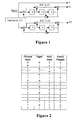
- FIG 1 shows a WCDMA turbo encoder specified in 3GPP TS 25.212 specifications entitled “Multiplexing and channel coding (FDD)".
- WCDMA turbo encoder is parallel-concatenated recursive systematic convolutional encoder (RSC) with random interleaver in between.
- the first RSC (3) works on actual input data and the second RSC (4) works on interleaved data provided by the interleaver (2).
- the input to the turbo encoder (1) is a 32-bit packet and the output from the turbo encoder (1) is also a 32-bit packet resulting from multiplexed output of both RSCs (3 & 4) by puncturing the non-systematic bit of the second RSC (4).
- the rate of this turbo code is 1/3.
- both the RSCs (3 & 4) are flushed out such that the state of both RSCs (3 & 4) becomes zero.
- the output tail bits of the first RSC (3) systematic bit followed by parity bit are packed along with the encoded stream.
- the output tail bits of second RSC (4) non-systematic bit followed by parity bit are packed to the output stream.
- the parity output of the RSC with respect to state follows 1 st order Markov chain.
- the conventional approach uses a LUT which gives next state and the output for the given input and present state.
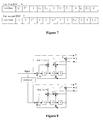
- the WCDMA turbo encoder table is given in figure 2.
- the input to the 1 st RSC is given bit by bit from the input data and the input to the 2 nd RSC is given from the input data by using pre calculated interleaver table.
- the input systematic bit is packed with the output parity bits of both the RSCs in an output register.
- the implementation involves many logical, shift and memory read/write operations. It requires at least one memory read for encoding single bit to get output or next state information for each RSC and also needs masking of the required bits and shifting to their respective positions and packing with the output register. The above steps are repeated 32 times to process each 32bit packed input and whenever the output register is full of 32bits it is stored to the output array.
- the object of the instant invention is to provide an improved turbo encoder.
- Another object of the invention is to provide an encoder that operates on multiple bits simultaneously.
- the invention provides an improved turbo encoder comprising multiple interleaved parallel concatenated recursive systematic convolutional encoder wherein each recursive systematic convolutional encoder is provided with an LUT that simultaneously provides the output bit pattern as well as the next state value corresponding to a defined set of multiple input bits and present state for operating said recursive systematic convolutional encoder.
- the said LUT is shared across multiple recursive systematic convolutional encoder.
- An improved method for turbo encoding comprising the steps of:
- Each said output bit pattern of said LUT is generated by a state machine for multiple input bits.
- the said LUT provides the next state information generated by said state machine as per multiple input bits and present state.
- the instant invention is explained for encoding four bits simultaneously at the rate 1/3 as an example. However it is not limited to said values and any person skilled in the art can use it for other rates and different number of bits as well.
- the proposed approach can be extended to implement encoding in different applications like CDMA2000 turbo encoder.
- Figure 2 shows the input and output words being encoded at the rate of 1/3.
- the encoding of complete 32bit word results in three 32bit output words.
- the S j is the j th systematic bit;
- P j 1 is parity output of first RSC and
- P j 2 is parity output of second RSC.
- first RSC (3) and the second RSC (4) are distributed amongst the three output words, each separated by two bits.
- RSC random access memory
- each RSC following its own LUT for calculating output pattern of 12 bits each.
- the result of both RSCs (3 & 4) is 'OR'ed to obtain the actual output pattern.
- the abovementioned LUT also provides the next-state information apart from the output pattern.
- the LUTs for both RSCs (3 & 4) of turbo encoder shown in figure 1 are shown in figures 4 & 5 respectively for only few combinations of the input and the present-state.
- the LUT of first RSC (3) contains systematic and parity output bits for the four continuous input bits.
- the LUT of second RSC (4) contains only parity output bits for four continuous input bits as non-systematic bits are punctured. The description of the table formation is explained in detail in the next section.
- the approach works in two parts. Since the input is an array of 32bits, the input bits, which are complete 32bit packed are handled in first part and the incomplete bits in last word are handled in the second part.
- the proposed new approach is used in the first part and the conventional approach is used for the second part.
- the inner loop runs eight times to finish the encoding of 32bits resulting in eight output patterns and the outer loop runs the number of times the number of words are to be encoded.
- the non-systematic input bits to the second RSC (4) are packed into 32bit register using pre-calculated interleaver table before the onset of the encoding of the inner loop.
- all the eight output patterns are packed into the three words.
- the output words are packed from patterns according to the word boundaries, as shown in figure 6.
- the outer loop includes the non-systematic bit packing and output packing apart from encoding the inner loop.
- the remaining bits in last incomplete word can at most be 31 bits, which can be processed one bit at a time with the conventional method.
- each element of the LUT requires 16 bits, upper 4 bits represent the next-state and the lower 12 bits represents the output pattern of the corresponding RSC.
- the table size of each LUT is 256 bytes (128 elements and each of 2 bytes).
- the parity output bits after every input bit and next state after four continuous input bits are calculated using figure 2.
- the output steam contains systematic bits
- the input bits and parity bits are placed in respective positions to follow the output word format described in figure 3.
- the positions where the parity output from second RSC is to be placed are filled with zeros. Accordingly the LUT1 pattern (6) for first RSC (3) looks as described in figure 7.
- the LUT2 pattern (7) for second RSC (4) is shown in figure 7.
- the party output bit after every input bit and the next state after four continuous input bits are calculated using figure 2.
- the output is only the parity output.
- the parity output bits of second RSC (4) are placed in respective positions and the position where the systematic and parity output bits from first RSC are to be placed is filled by zeros.
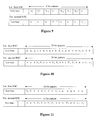
- the CDMA2000 turbo encoder shown in figure 8 supports various coding rates 1/2, 1/3, 1/4 and 1/5 with two feed forwards polynomials (8 & 9) (1 + D + D 3 , 1 + D + D 2 + D 3 ) and one feed back polynomial (10) (1 + D 2 + D 3 ).
- the proposed LUTs are used for encoding. The calculation of contents of both LUTs is explained further. Care should be taken according to the coding rate and puncturing while calculating output pattern of LUTs.
- the output streams for different rates from CDMA2000 turbo encoder look as follows. For rate 1/2: X 1 , Y 1 , X 2 Y' 2 , X 3 ,Y 3 , X 4 ,Y' 4 For rate 1/3: X 1 ,Y 1 , Y' 1 , X 2 Y 2 ,Y' 2 , X 3 ,Y 3 , Y' 3 , X 4 ,Y 4 ,Y' 4 For rate 1/4: X 1 ,Y 1 ,Z 1 ,Z' 1 , X 2 ,Y 2 ,Y' 2 ,Z' 2 , X 3 ,Y 3 ,Z 3 ,Z' 3 , X 4 ,Y 4 ,Y' 4 ,Z' 4 For rate 1/5: X 1 ,Y 1 ,Z 1 , Y' 1 , Z' 1 , X 2 , Y 2 , Z 2 , Y' 2 ,Z' 2 , X 3 , Y 3
- the table size of each LUT required is 256 bytes (128 elements and each of 2 bytes).
- each element of LUT requires more than 16 bits so the element size can be 32bits.
- the table size of each LUT required is 512 bytes (128 elements and each of 4 bytes).
- each element of LUT requires more than 16 bits so the element size can be 32bits.
- the table size of each LUT required is 512 bytes (128 elements and each of 4 bytes).
Landscapes
- Physics & Mathematics (AREA)
- Probability & Statistics with Applications (AREA)
- Engineering & Computer Science (AREA)
- Theoretical Computer Science (AREA)
- Error Detection And Correction (AREA)
Abstract
Description
- The present invention relates to an improved Turbo Encoder.
- Turbo coding is an advanced error correction technique widely used in the communications industry. Turbo encoders and decoders are key elements in today's communication systems to achieve the best possible data reception with least possible errors. The basis of turbo coding is to introduce redundancy in the data to be transmitted through a channel by serial/parallel concatenation of convoluational encoders. Using this redundant data the component decoders working in iterative passion helps to recover original data from the received data. This feature makes turbo encoding all the more popular.
- Figure 1 shows a WCDMA turbo encoder specified in 3GPP TS 25.212 specifications entitled "Multiplexing and channel coding (FDD)". WCDMA turbo encoder is parallel-concatenated recursive systematic convolutional encoder (RSC) with random interleaver in between. The first RSC (3) works on actual input data and the second RSC (4) works on interleaved data provided by the interleaver (2).
- The input to the turbo encoder (1) is a 32-bit packet and the output from the turbo encoder (1) is also a 32-bit packet resulting from multiplexed output of both RSCs (3 & 4) by puncturing the non-systematic bit of the second RSC (4). As one stream of input bit results in three output bit streams, the rate of this turbo code is 1/3. After finishing encoding of the input bits both the RSCs (3 & 4) are flushed out such that the state of both RSCs (3 & 4) becomes zero. While flushing the encoder (1), the output tail bits of the first RSC (3) systematic bit followed by parity bit are packed along with the encoded stream. Similarly the output tail bits of second RSC (4) non-systematic bit followed by parity bit are packed to the output stream.
- In a conventional approach, the parity output of the RSC with respect to state, follows 1st order Markov chain. The conventional approach uses a LUT which gives next state and the output for the given input and present state. The WCDMA turbo encoder table is given in figure 2. The input to the 1st RSC is given bit by bit from the input data and the input to the 2nd RSC is given from the input data by using pre calculated interleaver table. The input systematic bit is packed with the output parity bits of both the RSCs in an output register.
- As the both input and output are 32bit packed and each encoder parity output depends on the present state, the implementation involves many logical, shift and memory read/write operations. It requires at least one memory read for encoding single bit to get output or next state information for each RSC and also needs masking of the required bits and shifting to their respective positions and packing with the output register. The above steps are repeated 32 times to process each 32bit packed input and whenever the output register is full of 32bits it is stored to the output array.
- Further the conventional approach used for implementing turbo coding processes one input bit at a time. This is not the best way and consumes lot of operations. A new approach, which works on four input bits at a time, has been proposed.
- To obviate the aforesaid drawbacks, the object of the instant invention is to provide an improved turbo encoder.
- Another object of the invention is to provide an encoder that operates on multiple bits simultaneously.
- To achieve the aforementioned objects the invention provides an improved turbo encoder comprising multiple interleaved parallel concatenated recursive systematic convolutional encoder wherein each recursive systematic convolutional encoder is provided with an LUT that simultaneously provides the output bit pattern as well as the next state value corresponding to a defined set of multiple input bits and present state for operating said recursive systematic convolutional encoder.
- The said LUT is shared across multiple recursive systematic convolutional encoder.
- An improved method for turbo encoding comprising the steps of:
- determining a first output bit pattern corresponding to received multiple input bits of input bit stream employing an LUT;
- interleaving the said input bit stream to provide multiple interleaved output bit streams;
- determining a second output bit pattern for multiple bits of each said multiple interleaved output bit stream employing an LUT;
- generating the output bit stream from said primary and secondary output bit patterns wherein all the output bit patterns are generated using LUTs operating on a set of multiple bit at a time.
- Each said output bit pattern of said LUT is generated by a state machine for multiple input bits.
- The said LUT provides the next state information generated by said state machine as per multiple input bits and present state.
-
- Figure 1 shows a WCDMA turbo encoder specified in 3GPP TS 25.212 specifications.
- Figure 2 describes a WCDMA turbo encoder table for calculating next state and parity output.
- Figure 3 shows an output word format after completion of turbo encoding for 32bit input word.
- Figure 4 shows a first RSC's LUT for calculating next state and the output pattern.
- Figure 5 shows a second RSC's LUT for calculating next state and the output pattern.
- Figure 6 shows an output word packing using patterns obtained from both RSCs.
- Figure 7 shows an output pattern for LUT1 and LUT2.
- Figure 8 shows a CDMA2000 Turbo encoder specified in 3GPP2 C.S0002-D.
- Figure 9 shows an output pattern for LUT1 and LUT2 for
rate 1/2 CDMA2000 turbo encoder. - Figure 10 shows an output pattern for LUT1 and LUT2 for
rate 1/5 CDMA2000 turbo encoder. - Figure 11 shows an output pattern for LUT1 and LUT2 for
rate 1/4 CDMA2000 turbo encoder. - The instant invention is explained for encoding four bits simultaneously at the
rate 1/3 as an example. However it is not limited to said values and any person skilled in the art can use it for other rates and different number of bits as well. The proposed approach can be extended to implement encoding in different applications like CDMA2000 turbo encoder. - Figure 2 shows the input and output words being encoded at the rate of 1/3. The encoding of complete 32bit word, results in three 32bit output words. The Sj is the jth systematic bit; Pj 1 is parity output of first RSC and Pj 2 is parity output of second RSC.
- The systematic input, parity output of first RSC (3) and the second RSC (4) are distributed amongst the three output words, each separated by two bits. Thus four input bits are continuously encoded with each RSC (3 or 4) following its own LUT for calculating output pattern of 12 bits each. The result of both RSCs (3 & 4) is 'OR'ed to obtain the actual output pattern. The abovementioned LUT also provides the next-state information apart from the output pattern.
- The LUTs for both RSCs (3 & 4) of turbo encoder shown in figure 1 are shown in figures 4 & 5 respectively for only few combinations of the input and the present-state. The LUT of first RSC (3) contains systematic and parity output bits for the four continuous input bits. The LUT of second RSC (4) contains only parity output bits for four continuous input bits as non-systematic bits are punctured. The description of the table formation is explained in detail in the next section.
- The approach works in two parts. Since the input is an array of 32bits, the input bits, which are complete 32bit packed are handled in first part and the incomplete bits in last word are handled in the second part. The proposed new approach is used in the first part and the conventional approach is used for the second part.
- Since a nibble of four bits is encoded at a time, the inner loop runs eight times to finish the encoding of 32bits resulting in eight output patterns and the outer loop runs the number of times the number of words are to be encoded. The non-systematic input bits to the second RSC (4) are packed into 32bit register using pre-calculated interleaver table before the onset of the encoding of the inner loop. Once encoding of the inner loop is completed, all the eight output patterns are packed into the three words. The output words are packed from patterns according to the word boundaries, as shown in figure 6.
- Thus the outer loop includes the non-systematic bit packing and output packing apart from encoding the inner loop. The remaining bits in last incomplete word can at most be 31 bits, which can be processed one bit at a time with the conventional method.
- As described above, for every four bits, the output pattern results from both RSCs (3 & 4) and the parity output positions therein obtained from both the RSCs (3 & 4) are different thereby requiring individual LUTs for each RSC. Each element of the LUT requires 16 bits, upper 4 bits represent the next-state and the lower 12 bits represents the output pattern of the corresponding RSC. For a given state there are sixteen different combinations of inputs (24 = 16), and eight such possible states in case of WCDMA turbo encoder, which is containing 3 memory elements (23 = 8). Therefore the table size of each LUT is 256 bytes (128 elements and each of 2 bytes).
- For all possible states and input bits, the parity output bits after every input bit and next state after four continuous input bits are calculated using figure 2. As the output steam contains systematic bits, the input bits and parity bits are placed in respective positions to follow the output word format described in figure 3. The positions where the parity output from second RSC is to be placed are filled with zeros. Accordingly the LUT1 pattern (6) for first RSC (3) looks as described in figure 7.
- The LUT2 pattern (7) for second RSC (4) is shown in figure 7.The party output bit after every input bit and the next state after four continuous input bits are calculated using figure 2. In the second RSC (4), the output is only the parity output. Hence the parity output bits of second RSC (4) are placed in respective positions and the position where the systematic and parity output bits from first RSC are to be placed is filled by zeros.
- The complexity of this approach is analyzed against the conventional approach. As per the proposed approach, it encodes 4bit input pattern into 12bit output pattern and requires two memory loads, a single 'OR' operation and a mask operation for the required pattern. The updating next state of each RSC takes one mask and one shift operations for every 4 input bits. Also, it consumes few more logical operations for packing of non-systematic bits and packing of output patterns into output words. Using conventional approach, each RSC requires one memory read, one mask operation for the required bit, and one shift operation for the respective position and 'OR' operation for packing to the result. Also few more logical operations are required for un-packing of systematic input word.
- The proposed approach explained on
WCDMA rate 1/3, however runs four times faster than the conventional approach, as it requires only one fourth of the operations. Further it can be extended to other standards such as CDMA2000 turbo encoding which supports various rates by puncturing. - The CDMA2000 turbo encoder shown in figure 8 supports
various coding rates 1/2, 1/3, 1/4 and 1/5 with two feed forwards polynomials (8 & 9) (1 + D + D3, 1 + D + D2 + D3) and one feed back polynomial (10) (1 + D2 + D3). The proposed LUTs are used for encoding. The calculation of contents of both LUTs is explained further. Care should be taken according to the coding rate and puncturing while calculating output pattern of LUTs. - The output streams for different rates from CDMA2000 turbo encoder look as follows.
Forrate 1/2: X1, Y1, X2 Y'2 , X3 ,Y3 , X4 ,Y'4
Forrate 1/3: X1,Y1, Y'1, X2 Y2 ,Y'2 , X3 ,Y3, Y'3 , X4,Y4,Y'4
Forrate 1/4: X1,Y1,Z1,Z'1, X2,Y2,Y'2,Z'2, X3,Y3,Z3,Z'3, X4,Y4,Y'4,Z'4
Forrate 1/5: X1,Y1 ,Z1, Y'1, Z'1, X2, Y2, Z2, Y'2,Z'2, X3, Y3, Z3, Y'3, Z'3, X4,Y4 ,Z4, Y'4, Z'4 - For
rate 1/3, the LUTs remain the same as that of WCDMA as there is no difference in encoding. In case ofrate 1/2, along with systematic bit Xi either the parity of RSC1 Yi or RSC2 Y'i is sent alternatively. Each element of LUT requires 16 bits, upper 4 bits represents the next-state while the lower 8 bits represent output pattern of the corresponding RSC as shown in figure 9 and remaining 4 bits are unused. Zeros in LUTs fill the unused portion of bits. After packing such eight output patterns, the output of complete 32bit word input is formed into two 32bit output words (8* 8 bits = 64bits). The table size of each LUT required is 256 bytes (128 elements and each of 2 bytes). - For the
rate 1/5 each element of LUT requires more than 16 bits so the element size can be 32bits. The upper 4bits represents the next-state while the lower 20 bits represents output pattern of corresponding RSC as shown in figure 10. After packing eight such output patterns the output of complete 32bit word input is formed into five 32bit output words (8* 20 bits = 160 bits). The table size of each LUT required is 512 bytes (128 elements and each of 4 bytes). - For
rate 1/4 also each element of LUT requires more than 16 bits so the element size can be 32bits. The upper 4bits represents the next-state while the lower 16 bits represents the output pattern of corresponding RSC as shown in figure 11. After packing eight such output patterns the output of complete 32bit word input is formed into four 32bit output words (8* 16 bits = 128 bits). The table size of each LUT required is 512 bytes (128 elements and each of 4 bytes). - In this paper, improved turbo encoding has been proposed and compared against the computations required with conventional method. This improved turbo encoding handles 4 bits at a time, and the same logic can be extended for 8 input bits at a time, as the cost of 32 times memory, which is not advisable. The proposed approach is described in detail for WCDMA turbo encoder. A brief idea for implementing this in other standards such as CDMA2000, which can support other coding rates such as 1/2, 1/4 and 1/5 apart from 1/3, is also presented. The approach works efficiently for all coding rates, as the LUT inherently does the job of puncturing and multiplexing according to the coding rate.
Claims (5)
- An improved turbo encoder comprising multiple interleaved parallel concatenated recursive systematic convolutional encoder wherein each recursive systematic convolutional encoder is provided with an LUT that simultaneously provides the output bit pattern as well as the next state value corresponding to a defined set of multiple input bits and present state for operating said recursive systematic convolutional encoder.
- An improved turbo encoder comprising multiple interleaved parallel concatenated recursive systematic convoluational encoder as claimed in claim 1 wherein said LUT is shared across multiple recursive systematic convolutional encoder.
- An improved method for turbo encoding comprising the steps of:- determining a first output bit pattern corresponding to received multiple input bits of input bit stream employing an LUT;- interleaving the said input bit stream to provide multiple interleaved output bit streams;- determining a second output bit pattern for multiple bits of each said multiple interleaved output bit stream employing an LUT;- generating the output bit stream from said primary and secondary output bit patterns wherein all the output bit patterns are generated using LUTs operating on a set of multiple bit at a time.
- An improved method for turbo encoding as claimed in claim 3 wherein each said output bit pattern of said LUT is generated by a state machine for multiple input bits.
- An improved method for turbo encoding as claimed in claim 3 wherein said LUT provides the next state information generated by said state machine as per multiple input bits and present state.
Applications Claiming Priority (1)
| Application Number | Priority Date | Filing Date | Title |
|---|---|---|---|
| IN1796DE2004 | 2004-09-22 |
Publications (1)
| Publication Number | Publication Date |
|---|---|
| EP1641129A1 true EP1641129A1 (en) | 2006-03-29 |
Family
ID=35429558
Family Applications (1)
| Application Number | Title | Priority Date | Filing Date |
|---|---|---|---|
| EP05108777A Withdrawn EP1641129A1 (en) | 2004-09-22 | 2005-09-22 | An improved turbo encoder |
Country Status (2)
| Country | Link |
|---|---|
| US (1) | US7519896B2 (en) |
| EP (1) | EP1641129A1 (en) |
Families Citing this family (4)
| Publication number | Priority date | Publication date | Assignee | Title |
|---|---|---|---|---|
| US20090022079A1 (en) * | 2005-05-04 | 2009-01-22 | Fei Frank Zhou | Method and apparatus for providing enhanced channel interleaving |
| JP5170441B2 (en) * | 2006-05-17 | 2013-03-27 | 日本電気株式会社 | Turbo encoder and HARQ processing method used therefor |
| US8924829B2 (en) * | 2009-08-31 | 2014-12-30 | Freescale Semiconductor, Inc. | Device and method for turbo-encoding a block of data |
| KR20110124729A (en) * | 2010-05-11 | 2011-11-17 | 한국전자통신연구원 | Device for transmitting and receiving data in communication system |
Citations (3)
| Publication number | Priority date | Publication date | Assignee | Title |
|---|---|---|---|---|
| US6304991B1 (en) * | 1998-12-04 | 2001-10-16 | Qualcomm Incorporated | Turbo code interleaver using linear congruential sequence |
| WO2002029977A2 (en) * | 2000-09-28 | 2002-04-11 | Intel Corporation | A decoder for trellis-based channel encoding |
| GB2377146A (en) * | 2001-02-19 | 2002-12-31 | Radioscape Ltd | Convolutional code decoder which applies the inverse of the encode matrix to the received data and only applies Viterbi decoding to sections with errors |
Family Cites Families (2)
| Publication number | Priority date | Publication date | Assignee | Title |
|---|---|---|---|---|
| US6718504B1 (en) * | 2002-06-05 | 2004-04-06 | Arc International | Method and apparatus for implementing a data processor adapted for turbo decoding |
| US7051261B1 (en) * | 2002-10-29 | 2006-05-23 | Lattice Semiconductor Corporation | Turbo encoder with reduced processing delay |
-
2005
- 2005-09-22 EP EP05108777A patent/EP1641129A1/en not_active Withdrawn
- 2005-09-22 US US11/233,314 patent/US7519896B2/en active Active
Patent Citations (3)
| Publication number | Priority date | Publication date | Assignee | Title |
|---|---|---|---|---|
| US6304991B1 (en) * | 1998-12-04 | 2001-10-16 | Qualcomm Incorporated | Turbo code interleaver using linear congruential sequence |
| WO2002029977A2 (en) * | 2000-09-28 | 2002-04-11 | Intel Corporation | A decoder for trellis-based channel encoding |
| GB2377146A (en) * | 2001-02-19 | 2002-12-31 | Radioscape Ltd | Convolutional code decoder which applies the inverse of the encode matrix to the received data and only applies Viterbi decoding to sections with errors |
Also Published As
| Publication number | Publication date |
|---|---|
| US7519896B2 (en) | 2009-04-14 |
| US20060069978A1 (en) | 2006-03-30 |
Similar Documents
| Publication | Publication Date | Title |
|---|---|---|
| EP1471648B1 (en) | Method for a general turbo code trellis termination | |
| CN100466502C (en) | Channel Coding Method for Communication System | |
| JP4105067B2 (en) | Transmission rate matching apparatus and method for data communication system | |
| US8370713B2 (en) | Error correction code decoding device | |
| US6950977B2 (en) | Mechanism for turbo decoding when CRC for partial blocks is provided | |
| KR100315708B1 (en) | Apparatus and method for puncturing a turbo encoder in a mobile communication system | |
| JP2002532938A (en) | Encoding and decoding apparatus having a serial chain structure in a communication system | |
| CA2550761C (en) | Puncturing of convolutional codes | |
| CN100508440C (en) | Parallel processing of decoding and of a cyclic redundancy check when mobile radio signals are received | |
| JP2004511161A (en) | Apparatus and method for generating (n, 3) code and (n, 4) code using simplex code | |
| EP1545011B1 (en) | Optimized interleaving of digital signals | |
| US7519896B2 (en) | Turbo encoder and related methods | |
| EP1257064B1 (en) | Prunable S-random block interleaver method and corresponding interleaver | |
| US8151160B1 (en) | Configurable low-density parity-check decoder for LDPC codes of arbitrary block size and method of configuring the same | |
| JP2000353965A (en) | Interleaving method, interleaving device, turbo coding method, and turbo coding device | |
| US20040117711A1 (en) | Method for improving the performance of 3-dimensional concatenated product codes | |
| EP1529344B1 (en) | Method of first interleaving of a two interleaver transmitter | |
| US7555684B1 (en) | Circuit for and a method of generating an interleaver address | |
| KR100351146B1 (en) | Concatenated convolutional coder and decoder for international mobile telecommunication system | |
| Pilato et al. | Design Optimization for High Throughput Recursive Systematic Convolutional Encoders | |
| JP7862038B2 (en) | A turbo code design method, a turbo code design apparatus, and a recording medium for storing a turbo code design program. | |
| KR101331053B1 (en) | Apparatus and Method for Encoding using Turbo Code, and Unit and Method of Permutation | |
| EP1374416B1 (en) | Recursive convolutional encoding | |
| JPH07264078A (en) | BCH coding apparatus and BCH coding method | |
| KR20030082699A (en) | Turbo internal interleaving method and device based on golden sequence |
Legal Events
| Date | Code | Title | Description |
|---|---|---|---|
| PUAI | Public reference made under article 153(3) epc to a published international application that has entered the european phase |
Free format text: ORIGINAL CODE: 0009012 |
|
| AK | Designated contracting states |
Kind code of ref document: A1 Designated state(s): AT BE BG CH CY CZ DE DK EE ES FI FR GB GR HU IE IS IT LI LT LU LV MC NL PL PT RO SE SI SK TR |
|
| AX | Request for extension of the european patent |
Extension state: AL BA HR MK YU |
|
| 17P | Request for examination filed |
Effective date: 20060919 |
|
| 17Q | First examination report despatched |
Effective date: 20061020 |
|
| AKX | Designation fees paid |
Designated state(s): DE FR GB IT |
|
| 17Q | First examination report despatched |
Effective date: 20061020 |
|
| RAP1 | Party data changed (applicant data changed or rights of an application transferred) |
Owner name: STMICROELECTRONICS PVT. LTD. |
|
| STAA | Information on the status of an ep patent application or granted ep patent |
Free format text: STATUS: THE APPLICATION IS DEEMED TO BE WITHDRAWN |
|
| 18D | Application deemed to be withdrawn |
Effective date: 20081029 |