EP1640695B1 - Temperature measuring method using micro temperature sensing element - Google Patents
Temperature measuring method using micro temperature sensing element Download PDFInfo
- Publication number
- EP1640695B1 EP1640695B1 EP04747084A EP04747084A EP1640695B1 EP 1640695 B1 EP1640695 B1 EP 1640695B1 EP 04747084 A EP04747084 A EP 04747084A EP 04747084 A EP04747084 A EP 04747084A EP 1640695 B1 EP1640695 B1 EP 1640695B1
- Authority
- EP
- European Patent Office
- Prior art keywords
- gallium
- temperature
- sensing element
- nano tube
- temperature sensing
- Prior art date
- Legal status (The legal status is an assumption and is not a legal conclusion. Google has not performed a legal analysis and makes no representation as to the accuracy of the status listed.)
- Expired - Lifetime
Links
- 238000000034 method Methods 0.000 title claims abstract description 17
- GYHNNYVSQQEPJS-UHFFFAOYSA-N Gallium Chemical compound [Ga] GYHNNYVSQQEPJS-UHFFFAOYSA-N 0.000 claims abstract description 59
- 229910052733 gallium Inorganic materials 0.000 claims abstract description 59
- OKTJSMMVPCPJKN-UHFFFAOYSA-N Carbon Chemical compound [C] OKTJSMMVPCPJKN-UHFFFAOYSA-N 0.000 claims abstract description 34
- 239000002041 carbon nanotube Substances 0.000 claims abstract description 33
- 229910021393 carbon nanotube Inorganic materials 0.000 claims abstract description 33
- 230000005540 biological transmission Effects 0.000 claims description 17
- AJNVQOSZGJRYEI-UHFFFAOYSA-N digallium;oxygen(2-) Chemical compound [O-2].[O-2].[O-2].[Ga+3].[Ga+3] AJNVQOSZGJRYEI-UHFFFAOYSA-N 0.000 claims description 15
- 229910001195 gallium oxide Inorganic materials 0.000 claims description 15
- 239000002071 nanotube Substances 0.000 claims description 4
- 230000001590 oxidative effect Effects 0.000 claims description 2
- 238000010438 heat treatment Methods 0.000 description 9
- 238000009529 body temperature measurement Methods 0.000 description 5
- 238000005259 measurement Methods 0.000 description 5
- 238000001000 micrograph Methods 0.000 description 5
- 238000002173 high-resolution transmission electron microscopy Methods 0.000 description 4
- QVGXLLKOCUKJST-UHFFFAOYSA-N atomic oxygen Chemical compound [O] QVGXLLKOCUKJST-UHFFFAOYSA-N 0.000 description 3
- QSHDDOUJBYECFT-UHFFFAOYSA-N mercury Chemical compound [Hg] QSHDDOUJBYECFT-UHFFFAOYSA-N 0.000 description 3
- 229910052753 mercury Inorganic materials 0.000 description 3
- 239000001301 oxygen Substances 0.000 description 3
- 229910052760 oxygen Inorganic materials 0.000 description 3
- XEEYBQQBJWHFJM-UHFFFAOYSA-N Iron Chemical compound [Fe] XEEYBQQBJWHFJM-UHFFFAOYSA-N 0.000 description 2
- UFWIBTONFRDIAS-UHFFFAOYSA-N Naphthalene Chemical compound C1=CC=CC2=CC=CC=C21 UFWIBTONFRDIAS-UHFFFAOYSA-N 0.000 description 2
- PXHVJJICTQNCMI-UHFFFAOYSA-N Nickel Chemical compound [Ni] PXHVJJICTQNCMI-UHFFFAOYSA-N 0.000 description 2
- ATJFFYVFTNAWJD-UHFFFAOYSA-N Tin Chemical compound [Sn] ATJFFYVFTNAWJD-UHFFFAOYSA-N 0.000 description 2
- MWPLVEDNUUSJAV-UHFFFAOYSA-N anthracene Chemical compound C1=CC=CC2=CC3=CC=CC=C3C=C21 MWPLVEDNUUSJAV-UHFFFAOYSA-N 0.000 description 2
- 230000008602 contraction Effects 0.000 description 2
- 238000009792 diffusion process Methods 0.000 description 2
- 239000007789 gas Substances 0.000 description 2
- 239000007791 liquid phase Substances 0.000 description 2
- 238000004519 manufacturing process Methods 0.000 description 2
- 239000000463 material Substances 0.000 description 2
- 229910052751 metal Inorganic materials 0.000 description 2
- 239000002184 metal Substances 0.000 description 2
- VNWKTOKETHGBQD-UHFFFAOYSA-N methane Chemical compound C VNWKTOKETHGBQD-UHFFFAOYSA-N 0.000 description 2
- YNPNZTXNASCQKK-UHFFFAOYSA-N phenanthrene Chemical compound C1=CC=C2C3=CC=CC=C3C=CC2=C1 YNPNZTXNASCQKK-UHFFFAOYSA-N 0.000 description 2
- 239000000843 powder Substances 0.000 description 2
- BBEAQIROQSPTKN-UHFFFAOYSA-N pyrene Chemical compound C1=CC=C2C=CC3=CC=CC4=CC=C1C2=C43 BBEAQIROQSPTKN-UHFFFAOYSA-N 0.000 description 2
- 239000000523 sample Substances 0.000 description 2
- 239000004065 semiconductor Substances 0.000 description 2
- 239000000126 substance Substances 0.000 description 2
- 229910052718 tin Inorganic materials 0.000 description 2
- PFNQVRZLDWYSCW-UHFFFAOYSA-N (fluoren-9-ylideneamino) n-naphthalen-1-ylcarbamate Chemical compound C12=CC=CC=C2C2=CC=CC=C2C1=NOC(=O)NC1=CC=CC2=CC=CC=C12 PFNQVRZLDWYSCW-UHFFFAOYSA-N 0.000 description 1
- JBRZTFJDHDCESZ-UHFFFAOYSA-N AsGa Chemical compound [As]#[Ga] JBRZTFJDHDCESZ-UHFFFAOYSA-N 0.000 description 1
- RYGMFSIKBFXOCR-UHFFFAOYSA-N Copper Chemical compound [Cu] RYGMFSIKBFXOCR-UHFFFAOYSA-N 0.000 description 1
- OTMSDBZUPAUEDD-UHFFFAOYSA-N Ethane Chemical compound CC OTMSDBZUPAUEDD-UHFFFAOYSA-N 0.000 description 1
- KRHYYFGTRYWZRS-UHFFFAOYSA-N Fluorane Chemical compound F KRHYYFGTRYWZRS-UHFFFAOYSA-N 0.000 description 1
- 229910052688 Gadolinium Inorganic materials 0.000 description 1
- 229910001218 Gallium arsenide Inorganic materials 0.000 description 1
- UFHFLCQGNIYNRP-UHFFFAOYSA-N Hydrogen Chemical compound [H][H] UFHFLCQGNIYNRP-UHFFFAOYSA-N 0.000 description 1
- DGAQECJNVWCQMB-PUAWFVPOSA-M Ilexoside XXIX Chemical compound C[C@@H]1CC[C@@]2(CC[C@@]3(C(=CC[C@H]4[C@]3(CC[C@@H]5[C@@]4(CC[C@@H](C5(C)C)OS(=O)(=O)[O-])C)C)[C@@H]2[C@]1(C)O)C)C(=O)O[C@H]6[C@@H]([C@H]([C@@H]([C@H](O6)CO)O)O)O.[Na+] DGAQECJNVWCQMB-PUAWFVPOSA-M 0.000 description 1
- WHXSMMKQMYFTQS-UHFFFAOYSA-N Lithium Chemical compound [Li] WHXSMMKQMYFTQS-UHFFFAOYSA-N 0.000 description 1
- ZLMJMSJWJFRBEC-UHFFFAOYSA-N Potassium Chemical compound [K] ZLMJMSJWJFRBEC-UHFFFAOYSA-N 0.000 description 1
- 229910052772 Samarium Inorganic materials 0.000 description 1
- XUIMIQQOPSSXEZ-UHFFFAOYSA-N Silicon Chemical compound [Si] XUIMIQQOPSSXEZ-UHFFFAOYSA-N 0.000 description 1
- 239000005083 Zinc sulfide Substances 0.000 description 1
- 229910052783 alkali metal Inorganic materials 0.000 description 1
- 150000001340 alkali metals Chemical class 0.000 description 1
- OENHQHLEOONYIE-UKMVMLAPSA-N all-trans beta-carotene Natural products CC=1CCCC(C)(C)C=1/C=C/C(/C)=C/C=C/C(/C)=C/C=C/C=C(C)C=CC=C(C)C=CC1=C(C)CCCC1(C)C OENHQHLEOONYIE-UKMVMLAPSA-N 0.000 description 1
- TUPZEYHYWIEDIH-WAIFQNFQSA-N beta-carotene Natural products CC(=C/C=C/C=C(C)/C=C/C=C(C)/C=C/C1=C(C)CCCC1(C)C)C=CC=C(/C)C=CC2=CCCCC2(C)C TUPZEYHYWIEDIH-WAIFQNFQSA-N 0.000 description 1
- 235000013734 beta-carotene Nutrition 0.000 description 1
- 239000011648 beta-carotene Substances 0.000 description 1
- 229960002747 betacarotene Drugs 0.000 description 1
- 229910052792 caesium Inorganic materials 0.000 description 1
- TVFDJXOCXUVLDH-UHFFFAOYSA-N caesium atom Chemical compound [Cs] TVFDJXOCXUVLDH-UHFFFAOYSA-N 0.000 description 1
- 229910052799 carbon Inorganic materials 0.000 description 1
- 229910017052 cobalt Inorganic materials 0.000 description 1
- 239000010941 cobalt Substances 0.000 description 1
- GUTLYIVDDKVIGB-UHFFFAOYSA-N cobalt atom Chemical compound [Co] GUTLYIVDDKVIGB-UHFFFAOYSA-N 0.000 description 1
- 238000007796 conventional method Methods 0.000 description 1
- 238000001816 cooling Methods 0.000 description 1
- 229910052802 copper Inorganic materials 0.000 description 1
- 239000010949 copper Substances 0.000 description 1
- 230000000694 effects Effects 0.000 description 1
- 238000004146 energy storage Methods 0.000 description 1
- 238000002149 energy-dispersive X-ray emission spectroscopy Methods 0.000 description 1
- 230000005669 field effect Effects 0.000 description 1
- 239000000945 filler Substances 0.000 description 1
- GVEPBJHOBDJJJI-UHFFFAOYSA-N fluoranthrene Natural products C1=CC(C2=CC=CC=C22)=C3C2=CC=CC3=C1 GVEPBJHOBDJJJI-UHFFFAOYSA-N 0.000 description 1
- UIWYJDYFSGRHKR-UHFFFAOYSA-N gadolinium atom Chemical compound [Gd] UIWYJDYFSGRHKR-UHFFFAOYSA-N 0.000 description 1
- 229910052732 germanium Inorganic materials 0.000 description 1
- GNPVGFCGXDBREM-UHFFFAOYSA-N germanium atom Chemical compound [Ge] GNPVGFCGXDBREM-UHFFFAOYSA-N 0.000 description 1
- 239000001257 hydrogen Substances 0.000 description 1
- 229910052739 hydrogen Inorganic materials 0.000 description 1
- 229910000040 hydrogen fluoride Inorganic materials 0.000 description 1
- 229910052738 indium Inorganic materials 0.000 description 1
- APFVFJFRJDLVQX-UHFFFAOYSA-N indium atom Chemical compound [In] APFVFJFRJDLVQX-UHFFFAOYSA-N 0.000 description 1
- 239000011261 inert gas Substances 0.000 description 1
- 229910052742 iron Inorganic materials 0.000 description 1
- 229910052746 lanthanum Inorganic materials 0.000 description 1
- FZLIPJUXYLNCLC-UHFFFAOYSA-N lanthanum atom Chemical compound [La] FZLIPJUXYLNCLC-UHFFFAOYSA-N 0.000 description 1
- 229910052744 lithium Inorganic materials 0.000 description 1
- 239000000696 magnetic material Substances 0.000 description 1
- 150000002739 metals Chemical class 0.000 description 1
- 239000000203 mixture Substances 0.000 description 1
- 229910052759 nickel Inorganic materials 0.000 description 1
- 230000003287 optical effect Effects 0.000 description 1
- 125000002080 perylenyl group Chemical group C1(=CC=C2C=CC=C3C4=CC=CC5=CC=CC(C1=C23)=C45)* 0.000 description 1
- CSHWQDPOILHKBI-UHFFFAOYSA-N peryrene Natural products C1=CC(C2=CC=CC=3C2=C2C=CC=3)=C3C2=CC=CC3=C1 CSHWQDPOILHKBI-UHFFFAOYSA-N 0.000 description 1
- 229910052700 potassium Inorganic materials 0.000 description 1
- 239000011591 potassium Substances 0.000 description 1
- 230000004044 response Effects 0.000 description 1
- 230000031070 response to heat Effects 0.000 description 1
- 230000006903 response to temperature Effects 0.000 description 1
- 229910052701 rubidium Inorganic materials 0.000 description 1
- IGLNJRXAVVLDKE-UHFFFAOYSA-N rubidium atom Chemical compound [Rb] IGLNJRXAVVLDKE-UHFFFAOYSA-N 0.000 description 1
- KZUNJOHGWZRPMI-UHFFFAOYSA-N samarium atom Chemical compound [Sm] KZUNJOHGWZRPMI-UHFFFAOYSA-N 0.000 description 1
- 229910052710 silicon Inorganic materials 0.000 description 1
- 239000010703 silicon Substances 0.000 description 1
- 229910052708 sodium Inorganic materials 0.000 description 1
- 239000011734 sodium Substances 0.000 description 1
- 239000002887 superconductor Substances 0.000 description 1
- ANRHNWWPFJCPAZ-UHFFFAOYSA-M thionine Chemical compound [Cl-].C1=CC(N)=CC2=[S+]C3=CC(N)=CC=C3N=C21 ANRHNWWPFJCPAZ-UHFFFAOYSA-M 0.000 description 1
- 229910052984 zinc sulfide Inorganic materials 0.000 description 1
- DRDVZXDWVBGGMH-UHFFFAOYSA-N zinc;sulfide Chemical compound [S-2].[Zn+2] DRDVZXDWVBGGMH-UHFFFAOYSA-N 0.000 description 1
- OENHQHLEOONYIE-JLTXGRSLSA-N β-Carotene Chemical compound CC=1CCCC(C)(C)C=1\C=C\C(\C)=C\C=C\C(\C)=C\C=C\C=C(/C)\C=C\C=C(/C)\C=C\C1=C(C)CCCC1(C)C OENHQHLEOONYIE-JLTXGRSLSA-N 0.000 description 1
Images


Classifications
-
- G—PHYSICS
- G01—MEASURING; TESTING
- G01K—MEASURING TEMPERATURE; MEASURING QUANTITY OF HEAT; THERMALLY-SENSITIVE ELEMENTS NOT OTHERWISE PROVIDED FOR
- G01K5/00—Measuring temperature based on the expansion or contraction of a material
- G01K5/02—Measuring temperature based on the expansion or contraction of a material the material being a liquid
- G01K5/04—Details
- G01K5/10—Containers for the liquid
-
- B—PERFORMING OPERATIONS; TRANSPORTING
- B82—NANOTECHNOLOGY
- B82Y—SPECIFIC USES OR APPLICATIONS OF NANOSTRUCTURES; MEASUREMENT OR ANALYSIS OF NANOSTRUCTURES; MANUFACTURE OR TREATMENT OF NANOSTRUCTURES
- B82Y30/00—Nanotechnology for materials or surface science, e.g. nanocomposites
-
- G—PHYSICS
- G01—MEASURING; TESTING
- G01K—MEASURING TEMPERATURE; MEASURING QUANTITY OF HEAT; THERMALLY-SENSITIVE ELEMENTS NOT OTHERWISE PROVIDED FOR
- G01K5/00—Measuring temperature based on the expansion or contraction of a material
- G01K5/02—Measuring temperature based on the expansion or contraction of a material the material being a liquid
-
- G—PHYSICS
- G01—MEASURING; TESTING
- G01K—MEASURING TEMPERATURE; MEASURING QUANTITY OF HEAT; THERMALLY-SENSITIVE ELEMENTS NOT OTHERWISE PROVIDED FOR
- G01K2211/00—Thermometers based on nanotechnology
-
- Y—GENERAL TAGGING OF NEW TECHNOLOGICAL DEVELOPMENTS; GENERAL TAGGING OF CROSS-SECTIONAL TECHNOLOGIES SPANNING OVER SEVERAL SECTIONS OF THE IPC; TECHNICAL SUBJECTS COVERED BY FORMER USPC CROSS-REFERENCE ART COLLECTIONS [XRACs] AND DIGESTS
- Y10—TECHNICAL SUBJECTS COVERED BY FORMER USPC
- Y10S—TECHNICAL SUBJECTS COVERED BY FORMER USPC CROSS-REFERENCE ART COLLECTIONS [XRACs] AND DIGESTS
- Y10S977/00—Nanotechnology
- Y10S977/70—Nanostructure
- Y10S977/734—Fullerenes, i.e. graphene-based structures, such as nanohorns, nanococoons, nanoscrolls or fullerene-like structures, e.g. WS2 or MoS2 chalcogenide nanotubes, planar C3N4, etc.
- Y10S977/742—Carbon nanotubes, CNTs
- Y10S977/744—Carbon nanotubes, CNTs having atoms interior to the carbon cage
-
- Y—GENERAL TAGGING OF NEW TECHNOLOGICAL DEVELOPMENTS; GENERAL TAGGING OF CROSS-SECTIONAL TECHNOLOGIES SPANNING OVER SEVERAL SECTIONS OF THE IPC; TECHNICAL SUBJECTS COVERED BY FORMER USPC CROSS-REFERENCE ART COLLECTIONS [XRACs] AND DIGESTS
- Y10—TECHNICAL SUBJECTS COVERED BY FORMER USPC
- Y10S—TECHNICAL SUBJECTS COVERED BY FORMER USPC CROSS-REFERENCE ART COLLECTIONS [XRACs] AND DIGESTS
- Y10S977/00—Nanotechnology
- Y10S977/902—Specified use of nanostructure
- Y10S977/932—Specified use of nanostructure for electronic or optoelectronic application
- Y10S977/953—Detector using nanostructure
- Y10S977/955—Of thermal property
Definitions
- the present invention relates to a temperature measuring method using a minute sized temperature sensing element. More specifically, it relates to a novel temperature measuring method capable of measuring temperature accurately in a wide range, using a temperature sensing element comprising a carbon nanotube containing columnar gallium.
- a metal such as lead, tin, copper, indium and mercury; an alkali metal such as lithium, sodium, potassium, rubidium and cesium; a superconductor such as lead, tin, and gallium; a semiconductor such as silicon, germanium, gallium arsenide, zinc selenide, and zinc sulfide; a magnetic material such as samarium, gadolinium, lanthanum, iron, cobalt and nickel, and a mixture thereof.
- a metal such as lead, tin, copper, indium and mercury
- an alkali metal such as lithium, sodium, potassium, rubidium and cesium
- a superconductor such as lead, tin, and gallium
- a semiconductor such as silicon, germanium, gallium arsenide, zinc selenide, and zinc sulfide
- a magnetic material such as samarium, gadolinium, lanthanum, iron, cobalt and nickel, and a mixture thereof.
- an organic molecule semiconductor such as a naphthalene, an anthracene, a phenanthrene, a pyrene, and a perylene
- an organic dye molecule such as a cyanine dye and a ⁇ -carotene
- a gas molecule such as hydrogen fluoride, methane, and ethane, or the like
- thermometers capable of measuring temperature in the micrometer size environment has been more and more called for.
- the nano thermometers known so far have a relatively narrow measurable temperature range so that several kinds of the thermometers need to be prepared for each of the temperature ranges to be measured when measuring temperature over a wide range. Due to the fact that this is troublesome and expensive, the development of a nano thermometer capable of measuring temperature over a wide range by itself has strongly been desired.
- thermometer utilizing gallium capable of accurately measuring temperature in a relatively wide temperature range.
- the principle of the temperature measurement is based on the linear expansion or contraction of the gallium in response to temperature change over a wide range. By measuring the change of length of columnar gallium by high resolution transmission electron microscopy, the temperature is measured.
- the production method for a temperature sensing element comprising a carbon nano tube having a 1 to 10 ⁇ m length to contain the columnar gallium and a 40 to 150 nm diameter is known already (Document 3 - see below). Moreover, the present inventors have already developed a production method for a temperature sensing element involving the heat treatment at 1,200 to 1,400°C of gallium oxide powders and carbon powders under the inert gas flow (see Application 1 - see below).
- the length of the columnar gallium temperature sensing element cannot be read out unless the subject to be measured is introduced into the observation area of a high resolution transmission type electron microscope.
- the temperature sensing element is taken out from the inside of the subject to the outside for temperature measurement, since the length of the columnar gallium returns to the length at the room temperature, the accurate temperature of the subject at the high temperature cannot be determined.
- an object of the present invention is to solve the above-mentioned problems by providing a novel method capable of accurately measuring the temperature of a subject to be measured at a high temperature even when a columnar gallium temperature sensing element in a nano thermometer utilizing a gallium is taken out from the inside of the subject and the temperature is measured at the room temperature.
- the present invention provides a method for measuring the temperature of a subject using a minute sized temperature sensing element, said temperature sensing element comprising a carbon nano tube with continuous columnar gallium contained therein, said nano tube having one end open and the other closed, said method characterised in comprising the steps of:
- the present invention has the above-mentioned characteristics. The embodiments thereof will be explained hereinafter.
- a temperature sensing element comprising a carbon nano tube with one end opened and the other end closed, containing a continuous columnar gallium is introduced into the observation area of a high resolution transmission electron microscope maintained at different temperatures so as to measure the length of the gallium at each temperature. Then, the temperature sensing element is inserted into a subject to measure its temperature so as to be placed in a heated environment in the air atmosphere. Due to the heating operation, the volume of the gallium is expanded and the top end part thereof is oxidized so as to produce gallium oxide.
- the temperature sensing element is taken out from the subject to have the temperature measured after cooling for measuring the length of the gallium of the temperature sensing element again using the high resolution transmission electron microscope. Thereby, the temperature of the subject can be measured.
- the nano thermometer of the present invention utilizes the expansion characteristics of the gallium present inside the carbon nano tube in response to the temperature change so that in principle it is not different from a thermometer used in general for measuring the expansion or contraction change of mercury.
- the carbon nano tube has about a 1 to 10 ⁇ m length and a 40 to 150 nm diameter for the measurement of the temperature in a micrometer size environment so that it is extremely minute compared with the thermometer used in general. Therefore, in order to measure the length of the gallium in the minute carbon nano tube, use of an optical instrument such as a high resolution transmission electron microscope is necessary.
- gallium has the widest liquid phase range (29.78 to 2,403 °C) among metals, so that it has the excellent characteristics of a low vapor pressure at a high temperature. Furthermore, since with gallium the volume increases linearly in response to temperature rise in a 50 to 500°C temperature range, and furthermore, its volume reduces linearly in the case of lowering the temperature, it is suitable as a thermometer required to measure the temperature in a wide temperature range.
- the carbon nano tube containing the gallium can be produced according to various kinds of methods including a known method explained as the conventional technique, a method proposed by the present inventors, et al..
- a temperature sensing element was produced according to the method disclosed in the above-mentioned document 3. The structure thereof was confirmed by high resolution transmission electron microscopy with a mounted X-ray energy diffusion spectrometer. The temperature sensing element was placed onto a grid for observation by the high resolution transmission electron microscopy. Then, the temperature sensing element was observed by high resolution transmission electron microscopy maintained at 20°C and 58°C to measure the height of the gallium.
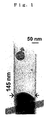
- FIG. 1 is a high resolution transmission electron microscope image showing the height of the gallium at the time of observing the temperature sensing element at 20°C.
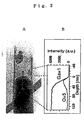
- FIG. 2(A) is an image of the temperature sensing element observed again at 20°C using the high resolution transmission electron microscope after introducing the same into a furnace in the air, heating at 358°C and taking it out. As shown in FIG. 2(A) , the top end position of the gallium is made higher than the top end position of the gallium in FIG. 1 .
- the gallium position is made higher despite the measurements at the same ordinary temperature 20°C because the gallium top end part reacts with oxygen so as to produce gallium oxide, and the produced gallium oxide is firmly bonded with the inner wall of the carbon nano tube so that the gallium oxide layer position at the high temperature is not lowered even after temperature drop.
- FIG. 3 is an image of the same temperature sensing element as that in example 1 observed using a high resolution transmission electron microscope after heating to 440°C.
- FIG 4 is an image thereof observed at 20°C using the same high resolution transmission electron microscope after heating and taking it out.
- gallium layer (1) of a low density layer is formed in the lower part of the gallium layer, and that the gallium oxide layer is bonded firmly with the inner wall of the carbon nano tube.
- the height difference of the gallium top ends in FIG 1 and FIG. 2(A) was 170 nm.
- the gallium volume V 0 initially at 20°C was 9.586 ⁇ 10 7 nm 3
- the volume increase amount ⁇ V 2 at Th°C was 2.577 ⁇ 10 6 nm 3 .
- the gallium volume Vo calculated with the premise that the carbon nano tube inner diameter is increased linearly is larger than the real gallium volume, the gallium density is lowered due to the oxygen diffusion, or the like.
- the present invention enables temperature measurement in the micrometer size environment, and furthermore, temperature measurement in a wide temperature range of 50 to 500°C.
Landscapes
- Physics & Mathematics (AREA)
- General Physics & Mathematics (AREA)
- Chemical & Material Sciences (AREA)
- Engineering & Computer Science (AREA)
- Nanotechnology (AREA)
- Materials Engineering (AREA)
- Condensed Matter Physics & Semiconductors (AREA)
- Crystallography & Structural Chemistry (AREA)
- Composite Materials (AREA)
- Carbon And Carbon Compounds (AREA)
- Crystals, And After-Treatments Of Crystals (AREA)
- Measuring Temperature Or Quantity Of Heat (AREA)
- Radiation Pyrometers (AREA)
Abstract
Description
- The present invention relates to a temperature measuring method using a minute sized temperature sensing element. More specifically, it relates to a novel temperature measuring method capable of measuring temperature accurately in a wide range, using a temperature sensing element comprising a carbon nanotube containing columnar gallium.
- After the discovery of the carbon nanotube in 1991, a number of studies have been carried out by many researchers. Various technical improvements and utilization methods have been developed in relation to carbon nanotubes. For example, nowadays they are utilized widely in field effect devices, probe top ends for scanning probe microscopes, superconductive materials, highly sensitive microbalances, structural materials, minute forceps for nanoscale operation, parts for gas detectors, hydrogen energy storage devices, or the like. Moreover, studies have been actively pursued in relation to carbon nanotubes containing various fillers (
Document 1 and Document 2 - see below). - For example, the following substances to be contained in carbon nanotubes have been discussed: a metal such as lead, tin, copper, indium and mercury; an alkali metal such as lithium, sodium, potassium, rubidium and cesium; a superconductor such as lead, tin, and gallium; a semiconductor such as silicon, germanium, gallium arsenide, zinc selenide, and zinc sulfide; a magnetic material such as samarium, gadolinium, lanthanum, iron, cobalt and nickel, and a mixture thereof. Moreover, an organic molecule semiconductor such as a naphthalene, an anthracene, a phenanthrene, a pyrene, and a perylene, an organic dye molecule such as a cyanine dye and a β-carotene; and a gas molecule such as hydrogen fluoride, methane, and ethane, or the like have been discussed.
- On the other hand, recently, a number of researchers have been involved in the micrometer size field of study so that a nano thermometer capable of measuring temperature in the micrometer size environment has been more and more called for. However, the nano thermometers known so far have a relatively narrow measurable temperature range so that several kinds of the thermometers need to be prepared for each of the temperature ranges to be measured when measuring temperature over a wide range. Due to the fact that this is troublesome and expensive, the development of a nano thermometer capable of measuring temperature over a wide range by itself has strongly been desired.
- Under such circumstances, a nano thermometer utilizing gallium, capable of accurately measuring temperature in a relatively wide temperature range has been proposed. The principle of the temperature measurement is based on the linear expansion or contraction of the gallium in response to temperature change over a wide range. By measuring the change of length of columnar gallium by high resolution transmission electron microscopy, the temperature is measured.
- The production method for a temperature sensing element comprising a carbon nano tube having a 1 to 10 µm length to contain the columnar gallium and a 40 to 150 nm diameter is known already (Document 3 - see below). Moreover, the present inventors have already developed a production method for a temperature sensing element involving the heat treatment at 1,200 to 1,400°C of gallium oxide powders and carbon powders under the inert gas flow (see Application 1 - see below).
- However, in relation to the temperature measuring method, using the nano thermometer utilizing a gallium discussed above, the length of the columnar gallium temperature sensing element cannot be read out unless the subject to be measured is introduced into the observation area of a high resolution transmission type electron microscope. On the other hand, once the temperature sensing element is taken out from the inside of the subject to the outside for temperature measurement, since the length of the columnar gallium returns to the length at the room temperature, the accurate temperature of the subject at the high temperature cannot be determined.
- Document 1: P. Ajayan et al., Nature, vol. 361, page 333, 1993
- Document 2: Official gazette of the Japanese Patent Application Laid Open No.
6-227806 - Document 3: Gao, Y.H. & Bando Y., Nature, 415,599 (2002)
- Application 1: Japanese Patent Application No.
2002-67661 - Aocordingly, an object of the present invention is to solve the above-mentioned problems by providing a novel method capable of accurately measuring the temperature of a subject to be measured at a high temperature even when a columnar gallium temperature sensing element in a nano thermometer utilizing a gallium is taken out from the inside of the subject and the temperature is measured at the room temperature.
- In order to solve the above-mentioned problems, the present invention provides a method for measuring the temperature of a subject using a minute sized temperature sensing element, said temperature sensing element comprising a carbon nano tube with continuous columnar gallium contained therein, said nano tube having one end open and the other closed, said method characterised in comprising the steps of:
- (1) obtaining the relationship between temperature and length of gallium In said carbon nano tube by Introducing said temperature sensing element into the observation area of a high resolution transmission electron microscope maintained at different temperatures to measure the length of the gallium at each temperature;
- (2) inserting the temperature sensing element into a subject to be measured in air;
- (3) oxidizing the gallium in said carbon nano tube in the air to produce a gallium oxide layer which is firmly bonded to said carbon nano tube;
- (4) taking out the temperature sensing element from the subject;
- (5) measuring by high resolution transmission electron microscope the location of the top end of said gallium oxide layer in the nano tube to obtain the length of the columnar gallium; and
- (6) determining the temperature of the subject on the basis of the thus obtained length of the columnar gallium and the relationship between temperature and length of gallium in said carbon nano tube obtained under step (1).
- In the accompanying drawings:
-
FIG 1 is a high resolution transmission electron microscope image of a gallium-containing carbon nano tube temperature sensing element before heating, observed at 20°C. -
FIG 2(A) is a high resolution transmission electron microscope image of the gallium-containing carbon nano tube temperature sensing element after heating to 358°C In the air, observed at 20°C, andFIG 2(B) is a graph of an energy dispersive X-ray spectrograph thereof. -
FIG. 3 is a high resolution transmission electron microscope image of the gallium-containing carbon nano tube temperature sensing element at 440°C in air. -
FIG 4 is a high resolution transmission electron microscope image of the gallium-containing carbon nano tube temperature sensing element after heating to 440°C in the air, observed at 20°C. - The numeral in the figures denotes the following.
- The present invention has the above-mentioned characteristics. The embodiments thereof will be explained hereinafter.
- According to the temperature measuring method of the present invention, first, a temperature sensing element comprising a carbon nano tube with one end opened and the other end closed, containing a continuous columnar gallium is introduced into the observation area of a high resolution transmission electron microscope maintained at different temperatures so as to measure the length of the gallium at each temperature. Then, the temperature sensing element is inserted into a subject to measure its temperature so as to be placed in a heated environment in the air atmosphere. Due to the heating operation, the volume of the gallium is expanded and the top end part thereof is oxidized so as to produce gallium oxide. Since the gallium oxide is bonded with the carbon nano tube firmly so that the gallium oxide at the top end part has its position fixed even when the temperature sensing element is taken out from the subject to be measured, the temperature sensing element is taken out from the subject to have the temperature measured after cooling for measuring the length of the gallium of the temperature sensing element again using the high resolution transmission electron microscope. Thereby, the temperature of the subject can be measured.
- Accordingly, the nano thermometer of the present invention utilizes the expansion characteristics of the gallium present inside the carbon nano tube in response to the temperature change so that in principle it is not different from a thermometer used in general for measuring the expansion or contraction change of mercury.
- However, it differs therefrom in that the carbon nano tube has about a 1 to 10 µm length and a 40 to 150 nm diameter for the measurement of the temperature in a micrometer size environment so that it is extremely minute compared with the thermometer used in general. Therefore, in order to measure the length of the gallium in the minute carbon nano tube, use of an optical instrument such as a high resolution transmission electron microscope is necessary.
- According to the present invention, the reason for selecting gallium as the substance to be contained in the carbon nano tube, is that gallium has the widest liquid phase range (29.78 to 2,403 °C) among metals, so that it has the excellent characteristics of a low vapor pressure at a high temperature. Furthermore, since with gallium the volume increases linearly in response to temperature rise in a 50 to 500°C temperature range, and furthermore, its volume reduces linearly in the case of lowering the temperature, it is suitable as a thermometer required to measure the temperature in a wide temperature range.
- For example, compared with the liquid phase range (-38.87 to 356.58°C) of mercury used for an ordinary temperature, it has a wide temperature measurement range at a high temperature range, and thus the effect of using the gallium for the nano thermometer is apparent.
- The carbon nano tube containing the gallium can be produced according to various kinds of methods including a known method explained as the conventional technique, a method proposed by the present inventors, et al..
- With reference to the following examples, embodiments of the invention will be explained in further detail.
- A temperature sensing element was produced according to the method disclosed in the above-mentioned document 3. The structure thereof was confirmed by high resolution transmission electron microscopy with a mounted X-ray energy diffusion spectrometer. The temperature sensing element was placed onto a grid for observation by the high resolution transmission electron microscopy. Then, the temperature sensing element was observed by high resolution transmission electron microscopy maintained at 20°C and 58°C to measure the height of the gallium.
-
FIG. 1 is a high resolution transmission electron microscope image showing the height of the gallium at the time of observing the temperature sensing element at 20°C.FIG. 2(A) is an image of the temperature sensing element observed again at 20°C using the high resolution transmission electron microscope after introducing the same into a furnace in the air, heating at 358°C and taking it out. As shown inFIG. 2(A) , the top end position of the gallium is made higher than the top end position of the gallium inFIG. 1 . - Accordingly, the gallium position is made higher despite the measurements at the same ordinary temperature 20°C because the gallium top end part reacts with oxygen so as to produce gallium oxide, and the produced gallium oxide is firmly bonded with the inner wall of the carbon nano tube so that the gallium oxide layer position at the high temperature is not lowered even after temperature drop.
- This can be confirmed also by the inclusion of oxygen at the gallium top end part as observed in the energy dispersive X-ray spectroscopy shown in
FIG. 2(B) . -
FIG. 3 is an image of the same temperature sensing element as that in example 1 observed using a high resolution transmission electron microscope after heating to 440°C.FIG 4 is an image thereof observed at 20°C using the same high resolution transmission electron microscope after heating and taking it out. - From
FIG. 4 , since the gallium oxide layer is bonded firmly with the inner wall of the carbon nano tube, the gallium oxide thin layer position is not changed even after temperature drop. - It is confirmed that gallium layer (1) of a low density layer is formed in the lower part of the gallium layer, and that the gallium oxide layer is bonded firmly with the inner wall of the carbon nano tube.
- As a result of the measurement using the high resolution transmission type electron microscope accordingly, the height difference of the gallium top ends in
FIG 1 andFIG. 2(A) was 170 nm. According to the calculation using the numerical values, the gallium volume V0 initially at 20°C was 9.586 × 10⁷ nm3, the increased volume ΔV1 at the time of heating to 58°C was 2.333 × 10⁵ nm3 (ΔV1/V0 = 0.24%), and the volume increase amount ΔV2 at Th°C was 2.577 × 10⁶ nm3. By substituting these values in the formula Th = 58 + ΔV2/a0 (V0 + ΔV1), (wherein a0 is the expansion coefficient of the gallium at 58°C [0.95 × 10⁻⁴/°C]), Th = 341°C can be obtained as the calculation value. - Although the value is slightly lower than the real measurement value 358°C, it was confirmed that the temperature can be measured considerably accurately at a high temperature.
- As to the difference of the calculation value and the real measurement value, it is considered that the gallium volume Vo calculated with the premise that the carbon nano tube inner diameter is increased linearly is larger than the real gallium volume, the gallium density is lowered due to the oxygen diffusion, or the like.
- The present invention enables temperature measurement in the micrometer size environment, and furthermore, temperature measurement in a wide temperature range of 50 to 500°C.
Claims (2)
- A method for measuring the temperature of a subject using a minute sized temperature sensing element, said temperature sensing element comprising a carbon nano tube with continuous columnar gallium contained therein, said nano tube having one end open and the other closed,said method characterised in comprising the steps of:(1) obtaining the relationship between temperature and length of gallium in said carbon nano tube by introducing said temperature sensing element into the observation area of a high resolution transmission electron microscope maintained at different temperatures to measure the length of the gallium at each temperature;(2) inserting the temperature sensing element into a subject to be measured in air;(3) oxidizing the gallium in said carbon nano tube in the air to produce a gallium oxide layer which is firmly bonded to said carbon nano tube;(4) taking out the temperature sensing element from the subject;(5) measuring by high resolution transmission electron microscope the location of the top end of said gallium oxide layer in the nano tube to obtain the length of the columnar gallium; and(6) determining the temperature of the subject on the basis of the thus obtained length of the columnar gallium and the relationship between temperature and length of gallium In said carbon nano tube obtained under step (1).
- A method as claimed in claim 1 wherein said carbon nano tube has a length of 1 to 10 µm and a diameter of 40 to 150 nm.
Applications Claiming Priority (2)
| Application Number | Priority Date | Filing Date | Title |
|---|---|---|---|
| JP2003186607A JP3924616B2 (en) | 2003-06-30 | 2003-06-30 | Temperature measurement method using minute size temperature sensing element |
| PCT/JP2004/009615 WO2005001403A1 (en) | 2003-06-30 | 2004-06-30 | Temperature measuring method using micro temperature sensing element |
Publications (3)
| Publication Number | Publication Date |
|---|---|
| EP1640695A1 EP1640695A1 (en) | 2006-03-29 |
| EP1640695A4 EP1640695A4 (en) | 2006-07-12 |
| EP1640695B1 true EP1640695B1 (en) | 2011-08-10 |
Family
ID=33549696
Family Applications (1)
| Application Number | Title | Priority Date | Filing Date |
|---|---|---|---|
| EP04747084A Expired - Lifetime EP1640695B1 (en) | 2003-06-30 | 2004-06-30 | Temperature measuring method using micro temperature sensing element |
Country Status (4)
| Country | Link |
|---|---|
| US (1) | US7331709B2 (en) |
| EP (1) | EP1640695B1 (en) |
| JP (1) | JP3924616B2 (en) |
| WO (1) | WO2005001403A1 (en) |
Families Citing this family (9)
| Publication number | Priority date | Publication date | Assignee | Title |
|---|---|---|---|---|
| CN101627011A (en) | 2005-09-19 | 2010-01-13 | 爱密斯菲尔科技公司 | Crystalline forms of the disodium salt of N- (5-chlorosalicyloyl) -8-aminocaprylic acid |
| JP2007101474A (en) * | 2005-10-07 | 2007-04-19 | National Institute For Materials Science | Nanometer-sized micro temperature switch and manufacturing method thereof |
| JP2007101503A (en) * | 2005-10-07 | 2007-04-19 | National Institute For Materials Science | Nanometer-sized micro thermometer and manufacturing method thereof |
| PL2215047T3 (en) | 2007-11-02 | 2014-05-30 | Emisphere Tech Inc | Method of treating vitamin b12 deficiency |
| JP5545577B2 (en) * | 2009-08-28 | 2014-07-09 | 独立行政法人産業技術総合研究所 | Electrode member, electron energy analyzer, photoelectron energy analyzer, and temperature measuring device |
| RU2431151C1 (en) * | 2010-05-31 | 2011-10-10 | Государственное образовательное учреждение высшего профессионального образования "Саратовский государственный университет им. Н.Г. Чернышевского" | Method of measuring nanoparticle temperature |
| EP2458354A1 (en) | 2010-11-24 | 2012-05-30 | Fei Company | Method of measuring the temperature of a sample carrier in a charged particle-optical apparatus |
| US9274008B2 (en) | 2012-11-28 | 2016-03-01 | Washington University | Nanothermometer, methods and uses therefor |
| USD789809S1 (en) * | 2015-12-22 | 2017-06-20 | Shanghai Wener Information Technology Co., Ltd. | Tumor cell thermometer |
Family Cites Families (7)
| Publication number | Priority date | Publication date | Assignee | Title |
|---|---|---|---|---|
| US1793303A (en) * | 1925-01-28 | 1931-02-17 | Gen Electric | Temperature-responsive device |
| US3688582A (en) * | 1970-02-27 | 1972-09-05 | Frederick J Gradishar | Thermometric devices |
| DE4227434C2 (en) * | 1992-08-19 | 1994-08-18 | Geraberger Thermometerwerk Gmb | thermometer |
| JP2546114B2 (en) | 1992-12-22 | 1996-10-23 | 日本電気株式会社 | Foreign substance-encapsulated carbon nanotubes and method for producing the same |
| US7112315B2 (en) * | 1999-04-14 | 2006-09-26 | The Regents Of The University Of California | Molecular nanowires from single walled carbon nanotubes |
| JP3686941B2 (en) | 2002-02-04 | 2005-08-24 | 独立行政法人物質・材料研究機構 | Nano thermometer and manufacturing method thereof |
| JP3918059B2 (en) * | 2003-06-30 | 2007-05-23 | 独立行政法人物質・材料研究機構 | Single crystal magnesium oxide nanotubes containing gallium, method for producing the same, and temperature sensing element using the same |
-
2003
- 2003-06-30 JP JP2003186607A patent/JP3924616B2/en not_active Expired - Lifetime
-
2004
- 2004-06-30 US US10/521,767 patent/US7331709B2/en not_active Expired - Fee Related
- 2004-06-30 EP EP04747084A patent/EP1640695B1/en not_active Expired - Lifetime
- 2004-06-30 WO PCT/JP2004/009615 patent/WO2005001403A1/en not_active Ceased
Also Published As
| Publication number | Publication date |
|---|---|
| US20050238082A1 (en) | 2005-10-27 |
| WO2005001403A1 (en) | 2005-01-06 |
| US7331709B2 (en) | 2008-02-19 |
| EP1640695A4 (en) | 2006-07-12 |
| EP1640695A1 (en) | 2006-03-29 |
| JP2005024256A (en) | 2005-01-27 |
| JP3924616B2 (en) | 2007-06-06 |
Similar Documents
| Publication | Publication Date | Title |
|---|---|---|
| Zhang et al. | A review on principles and applications of scanning thermal microscopy (SThM) | |
| Shi et al. | Measuring thermal and thermoelectric properties of one-dimensional nanostructures using a microfabricated device | |
| Perez‐Taborda et al. | High thermoelectric zT in n‐type silver selenide films at room temperature | |
| Wei et al. | New aspects of the metal–insulator transition in single-domain vanadium dioxide nanobeams | |
| CN102944573B (en) | Method for simultaneously measuring laser absorptivity and thermal conductivity of single micro-nano wire rod | |
| Mecklenburg et al. | Thermometry of silicon nanoparticles | |
| US7331709B2 (en) | Temperature measuring method using micro temperature sensing element | |
| Du et al. | Tunneling spectroscopy at megabar pressures: Determination of the superconducting gap in sulfur | |
| Zhang et al. | In situ fabrication and investigation of nanostructures and nanodevices with a microscope | |
| JP3686941B2 (en) | Nano thermometer and manufacturing method thereof | |
| Gehring et al. | Efficient heating of single-molecule junctions for thermoelectric studies at cryogenic temperatures | |
| US10481174B2 (en) | Superconducting scanning sensor for nanometer scale temperature imaging | |
| Shen et al. | Measuring nanoscale thermal gradients in suspended MoS2 with STEM-EELS | |
| Kimura et al. | Josephson scanning tunneling microscopy: a local and direct probe of the superconducting order parameter | |
| Venkatesh et al. | Fabrication of Low Temperature Stage for Atomic Force Microscope | |
| Pekola | Trends in thermometry | |
| Xiao et al. | Kinetics of solid-gas reactions characterized by scanning AC nano-calorimetry with application to Zr oxidation | |
| EP1568979A1 (en) | Temperature-sensing element and method of manufacturing the element, and nano-thermometer | |
| Yang et al. | Ultrahigh stress response and storage properties in a single CdS nanobelt-based flexible device for an erasable nonvolatile stress sensing and memory effect | |
| Zhukov et al. | Measurements of the work function of single-walled carbon nanotubes encapsulated by AgI, AgCl, and CuBr using kelvin probe technique with different kinds of probes | |
| Mehta et al. | Thermoelectric measurements of high-resistance Janus monolayer transition-metal dichalcogenide | |
| CN205333679U (en) | Scan sample under low temperature device of probe micrometering | |
| Park et al. | Andreev reflection spectroscopy of the heavy-fermion superconductor CeCoIn5 along three different crystallographic orientations | |
| Nelson et al. | Thin film cryogenic thermometers defined with optical lithography for thermomagnetic measurements on films | |
| Kolosovsky et al. | Heat Flux Sensor Based on Thin Film YBCO |
Legal Events
| Date | Code | Title | Description |
|---|---|---|---|
| PUAI | Public reference made under article 153(3) epc to a published international application that has entered the european phase |
Free format text: ORIGINAL CODE: 0009012 |
|
| 17P | Request for examination filed |
Effective date: 20050307 |
|
| AK | Designated contracting states |
Kind code of ref document: A1 Designated state(s): DE FR GB |
|
| A4 | Supplementary search report drawn up and despatched |
Effective date: 20060614 |
|
| DAX | Request for extension of the european patent (deleted) | ||
| RBV | Designated contracting states (corrected) |
Designated state(s): DE FR GB |
|
| 17Q | First examination report despatched |
Effective date: 20100416 |
|
| GRAP | Despatch of communication of intention to grant a patent |
Free format text: ORIGINAL CODE: EPIDOSNIGR1 |
|
| GRAS | Grant fee paid |
Free format text: ORIGINAL CODE: EPIDOSNIGR3 |
|
| GRAA | (expected) grant |
Free format text: ORIGINAL CODE: 0009210 |
|
| AK | Designated contracting states |
Kind code of ref document: B1 Designated state(s): DE FR GB |
|
| REG | Reference to a national code |
Ref country code: GB Ref legal event code: FG4D |
|
| REG | Reference to a national code |
Ref country code: DE Ref legal event code: R096 Ref document number: 602004033882 Country of ref document: DE Effective date: 20111020 |
|
| PLBE | No opposition filed within time limit |
Free format text: ORIGINAL CODE: 0009261 |
|
| STAA | Information on the status of an ep patent application or granted ep patent |
Free format text: STATUS: NO OPPOSITION FILED WITHIN TIME LIMIT |
|
| 26N | No opposition filed |
Effective date: 20120511 |
|
| REG | Reference to a national code |
Ref country code: DE Ref legal event code: R097 Ref document number: 602004033882 Country of ref document: DE Effective date: 20120511 |
|
| PGFP | Annual fee paid to national office [announced via postgrant information from national office to epo] |
Ref country code: GB Payment date: 20130619 Year of fee payment: 10 Ref country code: DE Payment date: 20130620 Year of fee payment: 10 |
|
| PGFP | Annual fee paid to national office [announced via postgrant information from national office to epo] |
Ref country code: FR Payment date: 20130703 Year of fee payment: 10 |
|
| REG | Reference to a national code |
Ref country code: DE Ref legal event code: R119 Ref document number: 602004033882 Country of ref document: DE |
|
| GBPC | Gb: european patent ceased through non-payment of renewal fee |
Effective date: 20140630 |
|
| REG | Reference to a national code |
Ref country code: FR Ref legal event code: ST Effective date: 20150227 |
|
| REG | Reference to a national code |
Ref country code: DE Ref legal event code: R119 Ref document number: 602004033882 Country of ref document: DE Effective date: 20150101 |
|
| PG25 | Lapsed in a contracting state [announced via postgrant information from national office to epo] |
Ref country code: DE Free format text: LAPSE BECAUSE OF NON-PAYMENT OF DUE FEES Effective date: 20150101 |
|
| PG25 | Lapsed in a contracting state [announced via postgrant information from national office to epo] |
Ref country code: GB Free format text: LAPSE BECAUSE OF NON-PAYMENT OF DUE FEES Effective date: 20140630 Ref country code: FR Free format text: LAPSE BECAUSE OF NON-PAYMENT OF DUE FEES Effective date: 20140630 |