EP1640404A1 - Polycarbosilane and method of producing the same - Google Patents
Polycarbosilane and method of producing the same Download PDFInfo
- Publication number
- EP1640404A1 EP1640404A1 EP05020613A EP05020613A EP1640404A1 EP 1640404 A1 EP1640404 A1 EP 1640404A1 EP 05020613 A EP05020613 A EP 05020613A EP 05020613 A EP05020613 A EP 05020613A EP 1640404 A1 EP1640404 A1 EP 1640404A1
- Authority
- EP
- European Patent Office
- Prior art keywords
- polycarbosilane
- general formula
- acid
- following general
- repeating unit
- Prior art date
- Legal status (The legal status is an assumption and is not a legal conclusion. Google has not performed a legal analysis and makes no representation as to the accuracy of the status listed.)
- Granted
Links
- 0 C*C(C)(C(C)C)C1(CC1)[C@](C1)C1C1CCCC1 Chemical compound C*C(C)(C(C)C)C1(CC1)[C@](C1)C1C1CCCC1 0.000 description 4
Classifications
-
- C—CHEMISTRY; METALLURGY
- C08—ORGANIC MACROMOLECULAR COMPOUNDS; THEIR PREPARATION OR CHEMICAL WORKING-UP; COMPOSITIONS BASED THEREON
- C08G—MACROMOLECULAR COMPOUNDS OBTAINED OTHERWISE THAN BY REACTIONS ONLY INVOLVING UNSATURATED CARBON-TO-CARBON BONDS
- C08G77/00—Macromolecular compounds obtained by reactions forming a linkage containing silicon with or without sulfur, nitrogen, oxygen or carbon in the main chain of the macromolecule
- C08G77/60—Macromolecular compounds obtained by reactions forming a linkage containing silicon with or without sulfur, nitrogen, oxygen or carbon in the main chain of the macromolecule in which all the silicon atoms are connected by linkages other than oxygen atoms
-
- C—CHEMISTRY; METALLURGY
- C08—ORGANIC MACROMOLECULAR COMPOUNDS; THEIR PREPARATION OR CHEMICAL WORKING-UP; COMPOSITIONS BASED THEREON
- C08G—MACROMOLECULAR COMPOUNDS OBTAINED OTHERWISE THAN BY REACTIONS ONLY INVOLVING UNSATURATED CARBON-TO-CARBON BONDS
- C08G77/00—Macromolecular compounds obtained by reactions forming a linkage containing silicon with or without sulfur, nitrogen, oxygen or carbon in the main chain of the macromolecule
- C08G77/04—Polysiloxanes
- C08G77/12—Polysiloxanes containing silicon bound to hydrogen
-
- C—CHEMISTRY; METALLURGY
- C08—ORGANIC MACROMOLECULAR COMPOUNDS; THEIR PREPARATION OR CHEMICAL WORKING-UP; COMPOSITIONS BASED THEREON
- C08G—MACROMOLECULAR COMPOUNDS OBTAINED OTHERWISE THAN BY REACTIONS ONLY INVOLVING UNSATURATED CARBON-TO-CARBON BONDS
- C08G77/00—Macromolecular compounds obtained by reactions forming a linkage containing silicon with or without sulfur, nitrogen, oxygen or carbon in the main chain of the macromolecule
- C08G77/48—Macromolecular compounds obtained by reactions forming a linkage containing silicon with or without sulfur, nitrogen, oxygen or carbon in the main chain of the macromolecule in which at least two but not all the silicon atoms are connected by linkages other than oxygen atoms
- C08G77/50—Macromolecular compounds obtained by reactions forming a linkage containing silicon with or without sulfur, nitrogen, oxygen or carbon in the main chain of the macromolecule in which at least two but not all the silicon atoms are connected by linkages other than oxygen atoms by carbon linkages
Definitions
- the present invention relates to a novel polycarbosilane and a method of producing the same.
- a polycarbosilane has attracted attention as a precursor for silicon carbide fibers and ceramic materials, and has been industrially utilized.
- a polycarbosilane having a main chain with a repeating structure of silicon atoms and carbon atoms exhibits excellent heat resistance and is widely utilized.
- the polycarbosilane is expected to be applied to optical functional materials, conductive materials, and the like.
- a method of producing a polycarbosilane having a main chain with a repeating structure of silicon atoms and carbon atoms a method utilizing thermal rearrangement of poly(dimethylsilane) (Journal of Materials Science, 2569 to 2576, Vol. 13, 1978) can be given. According to this method, some methyl groups bonded to silicon atoms in poly(dimethylsilane) are inserted into Si-Si bonds in the main chain to form Si-C bonds, and the rearranged Si-CH 3 sites are replaced with Si-H bonds.
- a polycarbosilane is generally cured by (1) formation of Si-O-Si crosslinks by sintering in an oxidizing atmosphere (US Patent No. 5,602,060 and US-A-2003/17635) or (2) formation of Si-Si bonds by coupling between Si-H bonds and subsequent formation of Si-C-Si bonds by a rearrangement reaction (US-A-2003/17635).
- metal interconnects provided on a substrate may be oxidized so that the interconnect resistance may be increased.
- the curing reaction more easily proceeds as the content of the Si-H bonds in the polymer becomes higher.
- a dehydrogenation coupling reaction gradually occurs during storage, whereby the polymer may deteriorate.
- a polycarbosilane which solves the above-described problems, can be cured under reduced pressure or an inert gas atmosphere, and is chemically stable, (1) a polycarbosilane which is readily cured by heating or the like due to the presence of a crosslinkable side chain other than the Si-H bond or introduction of a mildly crosslinked structure before crosslinking, or (2) a polycarbosilane which further contains an appropriate amount of Si-H bond side chains to enable the dehydrogenation coupling reaction is preferable.
- the amount of crosslink site in the polymer is increased.
- thermal stability and mechanical strength may be decreased when the crosslink site is an organic group, or resistance to processing such as etching and plasma processing may be decreased in semiconductor integrated circuit applications when the crosslink site is a siloxane structure.
- US-A-2003/17635 discloses a method of applying a polycarbosilane which does not contain an Si-O bond to a silicon wafer and heating the applied polycarbosilane in air to form an Si-O-Si bond by oxidation
- JP-A-2003-142477 and JP-T-8-510292 disclose polymers obtained by modifying a polycarbosilane containing an Si-H bond in an organic solvent by using alkali and water.
- a polycarbosilane which does not affect other materials such as interconnects when applied to a semiconductor integrated circuit manufacturing process and exhibits excellent storage stability has not yet been obtained.
- the invention may provide a polycarbosilane which is easily crosslinked and cured and exhibits excellent storage stability, and a method of producing the same.
- a polycarbosilane according to one aspect of the invention has a main chain in which silicon atoms and carbon atoms are alternately repeated, and the polycarbosilane comprises:
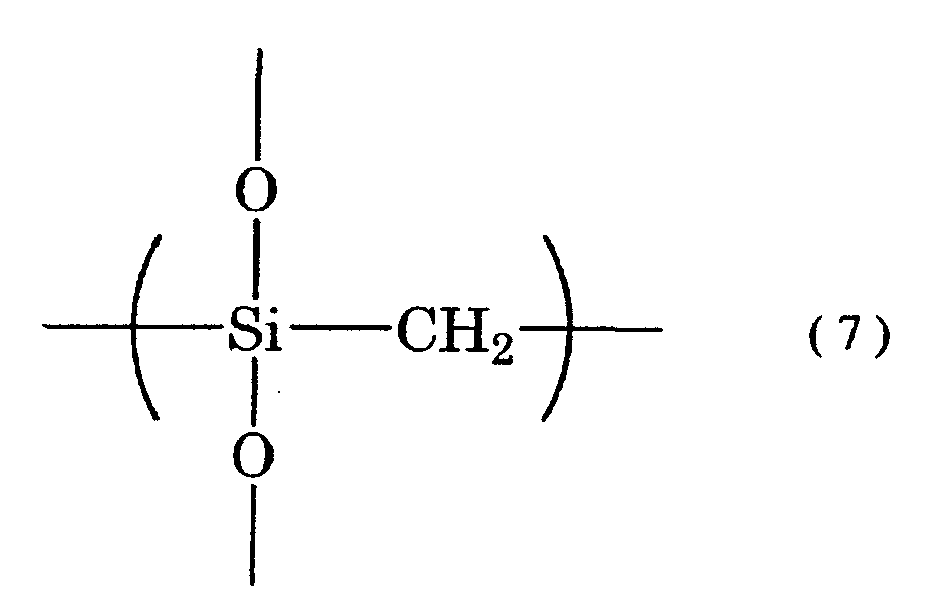
- This polycarbosilane may further include at least one of repeating units shown by following formulas (4) to (10).
- This polycarbosilane may have a weight average molecular weight of 300 to 1,000,000 and being soluble in an organic solvent.
- a method of producing a polycarbosilane according to another aspect of the invention includes:
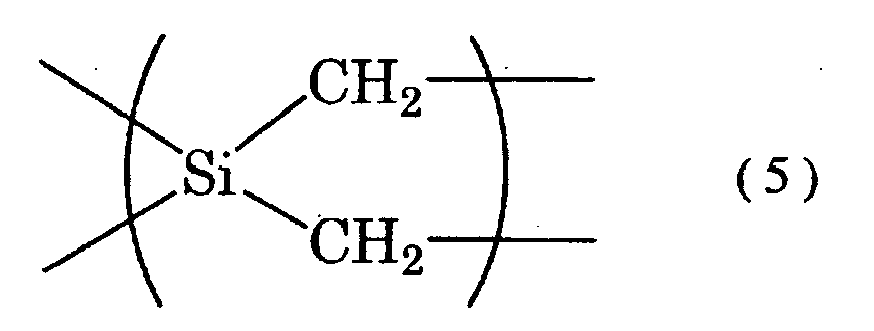
- the raw material polymer may include at least one of a repeating unit shown by a following general formula (4) and a repeating unit shown by a following general formula (5) or (8).
- the polymer can be crosslinked and cured by sintering in a nonoxidizing atmosphere such as an inert gas atmosphere or under reduced pressure due to the presence of the Si-H bond and the Si-O bond.
- a nonoxidizing atmosphere such as an inert gas atmosphere or under reduced pressure due to the presence of the Si-H bond and the Si-O bond.
- This polycarbosilane also includes an appropriate amount of Si-CH 3 bonds important for etching resistance, ashing properties, and the like.
- This polycarbosilane may be utilized for ceramics, heat-resistant plastic, electronic material interlayer film, and the like.
- a polycarbosilane including an Si-H bond and an Si-O bond at an arbitrary ratio can be obtained in a high yield.
- the percentage of the Si-O bond converted from the Si-H bond can be controlled by adjusting the amount of water and/or alcohol used. Therefore, a polycarbosilane in which the ratio of the Si-H bond and the Si-O bond is controlled can be obtained.
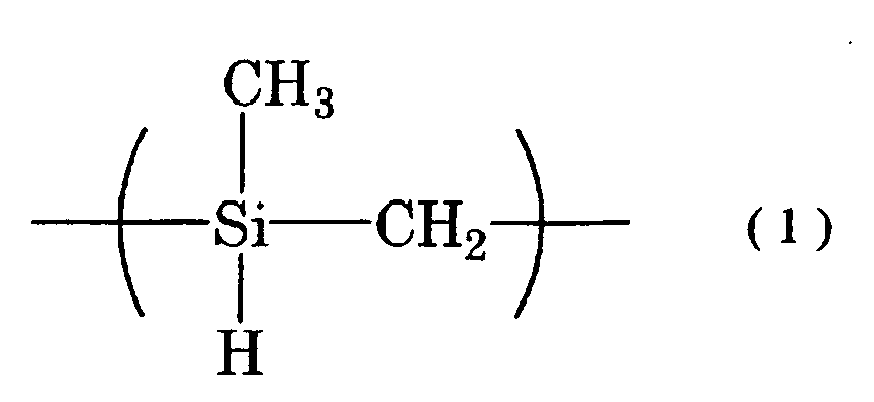
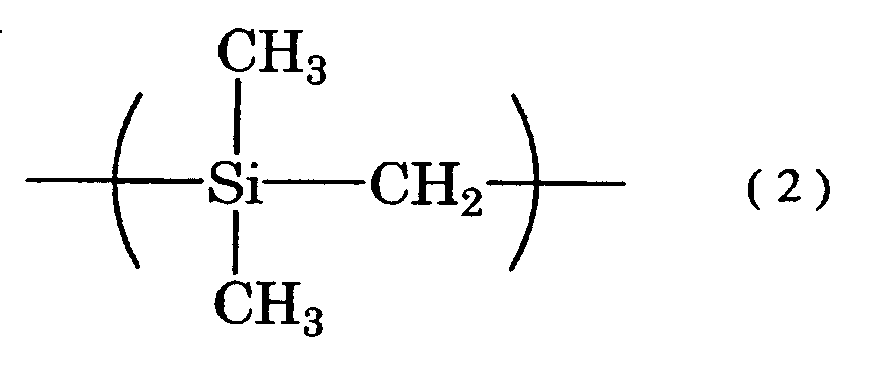
- a polycarbosilane according to an embodiment of the invention has a main chain in which silicon atoms and carbon atoms are alternately repeated, and the polycarbosilane includes a repeating unit shown by a following general formula (1), a repeating unit shown by a following general formula (2), and a repeating unit shown by a following general formula (3).
- the polycarbosilane according to one embodiment of the invention includes a main chain in which silicon atoms and carbon atoms are alternately repeated, and side chains containing a hydrogen atom, an oxygen atom, or a carbon atom bonded to the silicon atoms in the main chain.
- the oxygen atom may bond to a hydrogen atom, a silicon atom, or a carbon atom.
- the "main chain in which silicon atoms and carbon atoms are alternately repeated" has a structure shown by the following general formula (11), for example.
- the side chains bonded to the main chain are omitted.
- the number of silicon atoms and carbon atoms included in the main chain is not limited to that shown in the general formula (11).
- the type of side chain bonded to the main chain is not particularly limited.
- the side chain may be -H, -OH, -OR (R represents an alkyl group having 1 to 6 carbon atoms, and may be derived from an alcohol used when producing the polycarbosilane according to one embodiment of the invention), or -O-Si. ⁇ Si ⁇ C ⁇ Si ⁇ C ⁇ Si ⁇ C ⁇ Si ⁇ C ⁇ (11)
- the number of repeating units shown by the general formulas (1) to (3) be respectively 5 to 50%, 10 to 70%, and 5 to 50%.
- This polycarbosilane may further include at least one of repeating units shown by following formulas (4) to (10).
- the oxygen atom may bond to a hydrogen atom, a silicon atom, or a carbon atom.
- the carbon atom of methylene (-CH 2 -) may bond to an oxygen atom, a silicon atom, or a carbon atom.
- the polycarbosilane according to one embodiment of the invention be soluble in an organic solvent and have a weight average molecular weight of preferably 300 to 1,000,000, and still more preferably 500 to 100,000. If the weight average molecular weight is less than 300, the polymer may volatilize during sintering. If the weight average molecular weight exceeds 1,000,000, the polymer becomes insoluble in a solution so that a coating composition cannot be obtained.
- the raw material polymer may include at least one of a repeating unit shown by a following general formula (4) and a repeating unit shown by a following general formula (5) or (8).
- polymers shown by the following general formulas (12), (13), and (14) can be given.
- x and y individually represent integers of one or more.
- a and b individually represent integers of one or more, and c and d individually represent integers with at least one of c and d being one or more.
- a and b individually represent integers of one or more, and c and d individually represent integers with at least one of c and d being one or more.
- ammonia, organic amines, and ammonium hydroxides are preferable, with tetramethylammonium hydroxide, tetraethylammonium hydroxide, and tetrapropylammonium hydroxide being particularly preferable.
- the basic catalyst may be used either individually or in combination of two or more.
- the amount of basic catalyst used is determined depending on the number of Si-H bonds included in the raw material polycarbosilane.
- alcohols having 1 to 6 carbon atoms can be given. Specific examples include methanol, ethanol, n-propanol, iso-propanol, n-butanol, tert-butanol, sec-butanol, n-propanol, ethylene glycol, propylene glycol, glycerol, and the like.
- some of the Si-H bonds are converted into Si-O bonds by reacting the raw material polymer with water and/or alcohol (ROH; R represents an alkyl group) in an organic solvent in the presence of the basic catalyst.
- some of the Si-H bonds may be converted into a silanol (Si-OH) site, an alkoxysilane (Si-OR) site, or an Si-O-Si bond.
- a dehydration-condensation reaction between silanol sites may occur after formation of the silanol sites. This results in formation of an Si-O-Si bond.
- a method of converting the Si-H bond into the Si-O bond by using water or alcohol in the presence of a metal, acid, or basic catalyst is disclosed in JP-A-2003-142477 and JP-T-8-510292.
- a first synthesis example of the polycarbosilane according to one embodiment of the invention is shown in the following general formula (15).
- the first synthesis example illustrates the case where the raw material polymer is shown by the general formula (12).
- z represents an integer which satisfies x>z
- the oxygen atom may bond to a hydrogen atom, a silicon atom, or a carbon atom.
- some of the Si-H bonds in the raw material polymer shown by the general formula (12) are converted into Si-O bonds by a rearrangement reaction to obtain a polycarbosilane shown by the general formula (15).
- a second synthesis example of the polycarbosilane according to one embodiment of the invention is shown in the following general formula (16).
- the second synthesis example illustrates the case where the raw material polymer is shown by the general formula (13).
- e represents an integer which satisfies a>e
- f and g represent integers which satisfy c>f+g
- p represents 0 or 1
- the oxygen atom may bond to a hydrogen atom, a silicon atom, or a carbon atom.
- some of the Si-H bonds in the raw material polymer shown by the general formula (13) are converted into Si-O bonds by a rearrangement reaction to obtain a polycarbosilane shown by the general formula (16).
- a third synthesis example of the polycarbosilane according to one embodiment of the invention is shown in the following general formula (17).
- the third synthesis example illustrates the case where the raw material polymer is shown by the general formula (14).
- e represents an integer which satisfies a>e
- f and g represent integers which satisfy c>f+g
- p represents 0 or 1
- the oxygen atom may bond to a hydrogen atom, a silicon atom, or a carbon atom.
- some of the Si-H bonds in the raw material polymer shown by the general formula (14) are converted into Si-O bonds by a rearrangement reaction to obtain a polycarbosilane shown by the general formula (17).
- the Si-H bond formation reaction may be terminated by adding an acidic aqueous solution to the reaction system to deactivate the reaction system.
- an acidic aqueous solution is not particularly limited.
- an organic acid or an inorganic acid may be used.
- organic acid examples include acetic acid, propionic acid, butanoic acid, pentanoic acid, hexanoic acid, heptanoic acid, octanoic acid, nonanoic acid, decanoic acid, oxalic acid, maleic acid, methylmalonic acid, adipic acid, sebacic acid, gallic acid, butyric acid, mellitic acid, arachidonic acid, shikimic acid, 2-ethylhexanoic acid, oleic acid, stearic acid, linolic acid, linoleic acid, salicylic acid, benzoic acid, p-aminobenzoic acid, p-toluenesulfonic acid, benzenesulfonic acid, monochloroacetic acid, dichloroacetic acid, trichloroacetic acid, trifluoroacetic acid, formic acid, malonic acid, sulfonic acid, phthalic
- the inorganic acid hydrochloric acid, nitric acid, sulfuric acid, hydrofluoric acid, phosphoric acid, and the like can be given.
- the organic acid is preferable since polymer precipitation or gelation rarely occurs.
- a compound containing a carboxyl group is preferable.
- acetic acid, oxalic acid, maleic acid, formic acid, malonic acid, phthalic acid, fumaric acid, itaconic acid, succinic acid, mesaconic acid, citraconic acid, malic acid, glutaric acid, and hydrolysate of maleic anhydride are preferable. These compounds may be used either individually or in combination of two or more.
- the following organic solvents may be used.
- the organic solvent used in one embodiment of the invention an organic solvent in which water and/or alcohol used and the raw material polymer can be dissolved is preferable.
- aliphatic hydrocarbon solvents such as n-pentane, i-pentane, n-hexane, i-hexane, n-heptane, i-heptane, 2,2,4-trimethylpentane, n-octane, i-octane, cyclohexane, and methylcyclohexane; aromatic hydrocarbon solvents such as benzene, toluene, xylene, ethylbenzene, trimethylbenzene, methylethylbenzene, n-propylebenzene, i-propylebenzene, diethylbenzene, i-butylbenzene, triethylbenzene, di-i-propylbenzene, n-amylnaphthalene, and trimethylbenzene (when using a hydrocarbon solvent and water, a hydrocarbon solvent and another solvent may be
- solvents may be used either individually or in combination of two or more.
- aliphatic hydrocarbon solvents such as n-pentane, i-pentane, n-hexane, i-hexane, n-heptane, i-heptane, 2,2,4-trimethylpentane, n-octane, i-octane, cyclohexane, and methylcyclohexane
- aromatic hydrocarbon solvents such as benzene, toluene, xylene, ethylbenzene, trimethylbenzene, methylethylbenzene, n-propylebenzene, i-propylbenzene, diethylbenzene, i-butylbenzene, triethylbenzene, di-i-propylbenzene, n-amylnaphthalene, trimethylbenz
- the weight average molecular weight (Mw) and the number average molecular weight (Mn) of a polycarbosilane were measured by gel permeation chromatography (GPC) under the following conditions.
- the 1 H NMR spectrum (500 MHz) and the 29 Si NMR spectrum (100 MHz) of a polycarbosilane were measured by using BRUKER AVANCE 500 (manufactured by Bruker).
- the physical and chemical data for the polycarbosilane of Experimental Example 1 is given below.
- the structure of the polycarbosilane of Experimental Example 1 and assignment of NMR spectral data are shown in the following general formula (18) and Tables 1 and 2.
- x is 40% (0.4)
- y is 60% (0.6)
- z is 10% (0.1).
- the polycarbosilane of Experimental Example 1 is estimated to include an Si-OH site.
- a 4% butyl acetate solution of the resulting polymer was prepared and spin-coated on a silicon wafer at 2500 rpm to obtain a film.
- the film was sintered at 150°C for one minute and at 400°C for one minute on a hot plate in a nitrogen atmosphere.
- cyclohexanone solvent
- the thickness of the resulting film (corresponds to "film thickness after solvent application and sintering" in Table 9) was measured to compare the film thicknesses before and after applying cyclohexanone.
- Table 9 the "film reduction rate (%)" indicates “ ⁇ (film thickness after deposition) - (film thickness after solvent application and sintering) ⁇ / (film thickness after deposition) x 100".
- the physical and chemical data for the polycarbosilane of Experimental Example 2 is given below.
- the structure of the polycarbosilane of Experimental Example 2 and assignment of the NMR spectral data are shown in the following general formula (19) and Tables 3 and 4.
- x is 40% (0.4)
- y is 60% (0.6)
- z is 10% (0.1).
- the polycarbosilane of Experimental Example 2 is estimated to include an Si-OH site.
- Comparative Example 1 The structure of Comparative Example 1 (raw material polymer 1) and assignment of the NMR spectral data are shown in the following general formula (20) and Tables 5 and 6.
- x 40% (0.4) and y is 60% (0.6).
- TABLE 5 Measurement method ⁇ (ppm) Assignment 1 H NMR (in deuterated benzene) -2.0 to 1.0 (broad) 1), 3), 4), 5), 6) 3.5 to 4.5 (broad) 2)
- the 29 Si NMR spectral data for the polycarbosilane of Experimental Example 1 has an additional peak at 10 to 30 ppm in comparison with the 29 Si NMR spectral data for Comparative Example 1 (raw material polymer 1). This peak is estimated to indicate the silicon atom bonded to the oxygen atom.
- the raw material polymer 1 was applied to a silicon wafer and sintered to evaluate the solvent dissolution resistance in the same manner as in Experimental Example 1. The results are shown in Table 9.
- the 29 Si NMR spectral data for the polycarbosilane of Experimental Example 2 has an additional peak at 10 to 30 ppm in comparison with the 29 Si NMR spectral data for Comparative Example 2 (raw material polymer 2). This peak is estimated to indicate the silicon atom bonded to the oxygen atom.
- a polycarbosilane having a main chain in which silicon atoms and carbon atoms are alternately repeated, includes a repeating unit shown by a following general formula (1), a repeating unit shown by a following general formula (2), and a repeating unit shown by a following general formula (3).
Landscapes
- Chemical & Material Sciences (AREA)
- Health & Medical Sciences (AREA)
- Chemical Kinetics & Catalysis (AREA)
- Medicinal Chemistry (AREA)
- Polymers & Plastics (AREA)
- Organic Chemistry (AREA)
- Silicon Polymers (AREA)
Abstract


Description
- The present invention relates to a novel polycarbosilane and a method of producing the same.
- A polycarbosilane has attracted attention as a precursor for silicon carbide fibers and ceramic materials, and has been industrially utilized. In particular, a polycarbosilane having a main chain with a repeating structure of silicon atoms and carbon atoms exhibits excellent heat resistance and is widely utilized. The polycarbosilane is expected to be applied to optical functional materials, conductive materials, and the like.
- As a method of producing a polycarbosilane having a main chain with a repeating structure of silicon atoms and carbon atoms, a method utilizing thermal rearrangement of poly(dimethylsilane) (Journal of Materials Science, 2569 to 2576, Vol. 13, 1978) can be given. According to this method, some methyl groups bonded to silicon atoms in poly(dimethylsilane) are inserted into Si-Si bonds in the main chain to form Si-C bonds, and the rearranged Si-CH3 sites are replaced with Si-H bonds.
- As other methods of producing a polycarbosilane, a method of producing a polycarbosilane from chloromethyltrichlorosilane through a Grignard reaction (Organometallics, 1336 to 1344, Vol. 10, 1991), and a method of producing a polycarbosilane by ring-opening polymerization of a disilacyclobutane (Journal of Organometallic Chemistry, 1 to 10, Vol. 521, 1996) can be given. These documents disclose a method of producing a polycarbosilane containing an Si-H bond by replacing a substituent on a silicon atom in a monomer with a chlorine atom, polymerizing the monomers, and reducing the resulting polymer by using lithium aluminum hydride or the like.
- In related-art technology, a polycarbosilane is generally cured by (1) formation of Si-O-Si crosslinks by sintering in an oxidizing atmosphere (US Patent No. 5,602,060 and US-A-2003/17635) or (2) formation of Si-Si bonds by coupling between Si-H bonds and subsequent formation of Si-C-Si bonds by a rearrangement reaction (US-A-2003/17635). However, when the method (1) is utilized for a semiconductor integrated circuit manufacturing process, metal interconnects provided on a substrate may be oxidized so that the interconnect resistance may be increased. In the method (2), the curing reaction more easily proceeds as the content of the Si-H bonds in the polymer becomes higher. However, a dehydrogenation coupling reaction gradually occurs during storage, whereby the polymer may deteriorate.
- As a polycarbosilane which solves the above-described problems, can be cured under reduced pressure or an inert gas atmosphere, and is chemically stable, (1) a polycarbosilane which is readily cured by heating or the like due to the presence of a crosslinkable side chain other than the Si-H bond or introduction of a mildly crosslinked structure before crosslinking, or (2) a polycarbosilane which further contains an appropriate amount of Si-H bond side chains to enable the dehydrogenation coupling reaction is preferable. In the case of a polycarbosilane which can be cured by only the mechanism described in (1), the amount of crosslink site in the polymer is increased. As a result, thermal stability and mechanical strength may be decreased when the crosslink site is an organic group, or resistance to processing such as etching and plasma processing may be decreased in semiconductor integrated circuit applications when the crosslink site is a siloxane structure. US-A-2003/17635 discloses a method of applying a polycarbosilane which does not contain an Si-O bond to a silicon wafer and heating the applied polycarbosilane in air to form an Si-O-Si bond by oxidation, and JP-A-2003-142477 and JP-T-8-510292 disclose polymers obtained by modifying a polycarbosilane containing an Si-H bond in an organic solvent by using alkali and water. However, a polycarbosilane which does not affect other materials such as interconnects when applied to a semiconductor integrated circuit manufacturing process and exhibits excellent storage stability has not yet been obtained.
- The invention may provide a polycarbosilane which is easily crosslinked and cured and exhibits excellent storage stability, and a method of producing the same.
- A polycarbosilane according to one aspect of the invention has a main chain in which silicon atoms and carbon atoms are alternately repeated, and the polycarbosilane comprises:
- a repeating unit shown by a following general formula (1), a repeating unit shown by a following general formula (2), and a repeating unit shown by a following general formula (3).


- This polycarbosilane may further include at least one of repeating units shown by following formulas (4) to (10).


- This polycarbosilane may have a weight average molecular weight of 300 to 1,000,000 and being soluble in an organic solvent.
- A method of producing a polycarbosilane according to another aspect of the invention includes:
- reacting a raw material polymer with at least one of water and alcohol in a presence of a basic catalyst, the raw material polymer having a main chain in which silicon atoms and carbon atoms are alternately repeated and including a repeating unit shown by a following general formula (1) and a repeating unit shown by a following general formula (2).

- With this method of producing a polycarbosilane,
the raw material polymer may include at least one of a repeating unit shown by a following general formula (4) and a repeating unit shown by a following general formula (5) or (8).


- According to this polycarbosilane, the polymer can be crosslinked and cured by sintering in a nonoxidizing atmosphere such as an inert gas atmosphere or under reduced pressure due to the presence of the Si-H bond and the Si-O bond. This polycarbosilane also includes an appropriate amount of Si-CH3 bonds important for etching resistance, ashing properties, and the like.
- This polycarbosilane may be utilized for ceramics, heat-resistant plastic, electronic material interlayer film, and the like.
- According to this method of producing a polycarbosilane, a polycarbosilane including an Si-H bond and an Si-O bond at an arbitrary ratio can be obtained in a high yield. Specifically, the percentage of the Si-O bond converted from the Si-H bond can be controlled by adjusting the amount of water and/or alcohol used. Therefore, a polycarbosilane in which the ratio of the Si-H bond and the Si-O bond is controlled can be obtained.
- The polycarbosilane and the method of producing the same according to embodiments of the invention are described below.
- A polycarbosilane according to an embodiment of the invention has a main chain in which silicon atoms and carbon atoms are alternately repeated, and the polycarbosilane includes a repeating unit shown by a following general formula (1), a repeating unit shown by a following general formula (2), and a repeating unit shown by a following general formula (3). Specifically, the polycarbosilane according to one embodiment of the invention includes a main chain in which silicon atoms and carbon atoms are alternately repeated, and side chains containing a hydrogen atom, an oxygen atom, or a carbon atom bonded to the silicon atoms in the main chain.


- In the general formula (3), the oxygen atom may bond to a hydrogen atom, a silicon atom, or a carbon atom.
- In one embodiment of the invention, the "main chain in which silicon atoms and carbon atoms are alternately repeated" has a structure shown by the following general formula (11), for example. In the general formula (11), the side chains bonded to the main chain are omitted. The number of silicon atoms and carbon atoms included in the main chain is not limited to that shown in the general formula (11). The type of side chain bonded to the main chain is not particularly limited. For example, the side chain may be -H, -OH, -OR (R represents an alkyl group having 1 to 6 carbon atoms, and may be derived from an alcohol used when producing the polycarbosilane according to one embodiment of the invention), or -O-Si.
― Si―C―Si――C―Si――C―Si―C― (11) - In the polycarbosilane according to one embodiment of the invention, it is preferable that the number of repeating units shown by the general formulas (1) to (3) be respectively 5 to 50%, 10 to 70%, and 5 to 50%.
- This polycarbosilane may further include at least one of repeating units shown by following formulas (4) to (10).


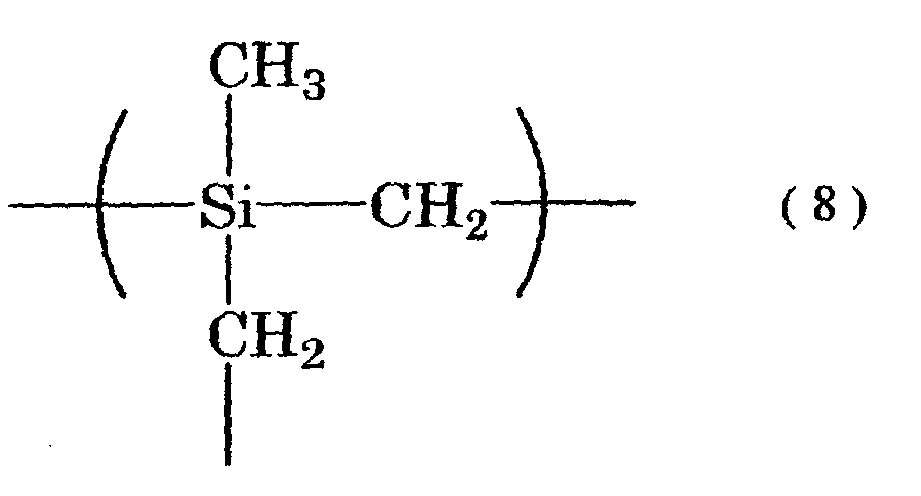


- In the general formulas (6) and (7), the oxygen atom may bond to a hydrogen atom, a silicon atom, or a carbon atom. In the general formula (8), the carbon atom of methylene (-CH2-) may bond to an oxygen atom, a silicon atom, or a carbon atom.
- It is preferable that the polycarbosilane according to one embodiment of the invention be soluble in an organic solvent and have a weight average molecular weight of preferably 300 to 1,000,000, and still more preferably 500 to 100,000. If the weight average molecular weight is less than 300, the polymer may volatilize during sintering. If the weight average molecular weight exceeds 1,000,000, the polymer becomes insoluble in a solution so that a coating composition cannot be obtained.
- A method of producing a polycarbosilane according to another embodiment of the invention includes:
- reacting a raw material polymer with at least one of water and alcohol in a presence of a basic catalyst, the raw material polymer having a main chain in which silicon atoms and carbon atoms are alternately repeated and including a repeating unit shown by a following general formula (1) and a repeating unit shown by a following general formula (2).


- The raw material polymer may include at least one of a repeating unit shown by a following general formula (4) and a repeating unit shown by a following general formula (5) or (8).


- As examples of the raw material polymer used in the method of producing the polycarbosilane according to one embodiment of the invention, polymers shown by the following general formulas (12), (13), and (14) can be given.


- As examples of the basic catalyst which may be used in the method of producing the polycarbosilane according to one embodiment of the invention, sodium hydroxide, potassium hydroxide, lithium hydroxide, cerium hydroxide, barium hydroxide, calcium hydroxide, pyridine, pyrrole, piperazine, pyrrolidine, piperidine, picoline, ammonia, methylamine, ethylamine, propylamine, butylamine, dimethylamine, diethylamine, dipropylamine, dibutylamine, trimethylamine, triethylamine, tripropylamine, tributylamine, monoethanolamine, diethanolamine, dimethylmonoethanolamine, monomethyldiethanolamine, triethanolamine, diazabicyclooctane, diazabicyclononane, diazabicycloundecene, urea, tetramethylammonium hydroxide, tetraethylammonium hydroxide, tetrapropylammonium hydroxide, tetrabutylammonium hydroxide, benzyltrimethylammonium hydroxide, choline, and the like can be given. Of these, ammonia, organic amines, and ammonium hydroxides are preferable, with tetramethylammonium hydroxide, tetraethylammonium hydroxide, and tetrapropylammonium hydroxide being particularly preferable. The basic catalyst may be used either individually or in combination of two or more.
- The amount of basic catalyst used is determined depending on the number of Si-H bonds included in the raw material polycarbosilane.
- As examples of the alcohol which may be used in the method of producing the polycarbosilane according to one embodiment of the invention, alcohols having 1 to 6 carbon atoms can be given. Specific examples include methanol, ethanol, n-propanol, iso-propanol, n-butanol, tert-butanol, sec-butanol, n-propanol, ethylene glycol, propylene glycol, glycerol, and the like.
- In the method of producing the polycarbosilane according to one embodiment of the invention, some of the Si-H bonds are converted into Si-O bonds by reacting the raw material polymer with water and/or alcohol (ROH; R represents an alkyl group) in an organic solvent in the presence of the basic catalyst. In more detail, some of the Si-H bonds may be converted into a silanol (Si-OH) site, an alkoxysilane (Si-OR) site, or an Si-O-Si bond. When using water as the reactant, a dehydration-condensation reaction between silanol sites may occur after formation of the silanol sites. This results in formation of an Si-O-Si bond. A method of converting the Si-H bond into the Si-O bond by using water or alcohol in the presence of a metal, acid, or basic catalyst is disclosed in JP-A-2003-142477 and JP-T-8-510292.
- A first synthesis example of the polycarbosilane according to one embodiment of the invention is shown in the following general formula (15). The first synthesis example illustrates the case where the raw material polymer is shown by the general formula (12).

- In the general formula (15), z represents an integer which satisfies x>z, and the oxygen atom may bond to a hydrogen atom, a silicon atom, or a carbon atom. Specifically, some of the Si-H bonds in the raw material polymer shown by the general formula (12) are converted into Si-O bonds by a rearrangement reaction to obtain a polycarbosilane shown by the general formula (15).
- A second synthesis example of the polycarbosilane according to one embodiment of the invention is shown in the following general formula (16). The second synthesis example illustrates the case where the raw material polymer is shown by the general formula (13).

- In the general formula (16), e represents an integer which satisfies a>e, f and g represent integers which satisfy c>f+g, p represents 0 or 1, and the oxygen atom may bond to a hydrogen atom, a silicon atom, or a carbon atom. Specifically, some of the Si-H bonds in the raw material polymer shown by the general formula (13) are converted into Si-O bonds by a rearrangement reaction to obtain a polycarbosilane shown by the general formula (16).
- A third synthesis example of the polycarbosilane according to one embodiment of the invention is shown in the following general formula (17). The third synthesis example illustrates the case where the raw material polymer is shown by the general formula (14).

- In the general formula (17), e represents an integer which satisfies a>e, f and g represent integers which satisfy c>f+g, p represents 0 or 1, and the oxygen atom may bond to a hydrogen atom, a silicon atom, or a carbon atom. Specifically, some of the Si-H bonds in the raw material polymer shown by the general formula (14) are converted into Si-O bonds by a rearrangement reaction to obtain a polycarbosilane shown by the general formula (17).
- In the method of producing the polycarbosilane according to one embodiment of the invention, the Si-H bond formation reaction may be terminated by adding an acidic aqueous solution to the reaction system to deactivate the reaction system. When using water as the reactant, a further dehydration-condensation of silanol sites expected to be formed can be prevented. The acidic aqueous solution is not particularly limited. For example, an organic acid or an inorganic acid may be used. As examples of the organic acid, acetic acid, propionic acid, butanoic acid, pentanoic acid, hexanoic acid, heptanoic acid, octanoic acid, nonanoic acid, decanoic acid, oxalic acid, maleic acid, methylmalonic acid, adipic acid, sebacic acid, gallic acid, butyric acid, mellitic acid, arachidonic acid, shikimic acid, 2-ethylhexanoic acid, oleic acid, stearic acid, linolic acid, linoleic acid, salicylic acid, benzoic acid, p-aminobenzoic acid, p-toluenesulfonic acid, benzenesulfonic acid, monochloroacetic acid, dichloroacetic acid, trichloroacetic acid, trifluoroacetic acid, formic acid, malonic acid, sulfonic acid, phthalic acid, fumaric acid, citric acid, tartaric acid, maleic anhydride, fumaric acid, itaconic acid, succinic acid, mesaconic acid, citraconic acid, malic acid, malonic acid, hydrolysate of glutaric acid, hydrolysate of maleic anhydride, hydrolysate of phthalic anhydride, and the like can be given. As examples of the inorganic acid, hydrochloric acid, nitric acid, sulfuric acid, hydrofluoric acid, phosphoric acid, and the like can be given. Of these, the organic acid is preferable since polymer precipitation or gelation rarely occurs. As the organic acid, a compound containing a carboxyl group is preferable. In particular, acetic acid, oxalic acid, maleic acid, formic acid, malonic acid, phthalic acid, fumaric acid, itaconic acid, succinic acid, mesaconic acid, citraconic acid, malic acid, glutaric acid, and hydrolysate of maleic anhydride are preferable. These compounds may be used either individually or in combination of two or more.
- In the method of producing the polycarbosilane according to one embodiment of the invention, the following organic solvents may be used. As the organic solvent used in one embodiment of the invention, an organic solvent in which water and/or alcohol used and the raw material polymer can be dissolved is preferable. As examples of the organic solvent, aliphatic hydrocarbon solvents such as n-pentane, i-pentane, n-hexane, i-hexane, n-heptane, i-heptane, 2,2,4-trimethylpentane, n-octane, i-octane, cyclohexane, and methylcyclohexane; aromatic hydrocarbon solvents such as benzene, toluene, xylene, ethylbenzene, trimethylbenzene, methylethylbenzene, n-propylebenzene, i-propylebenzene, diethylbenzene, i-butylbenzene, triethylbenzene, di-i-propylbenzene, n-amylnaphthalene, and trimethylbenzene (when using a hydrocarbon solvent and water, a hydrocarbon solvent and another solvent may be used in combination); ketone solvents such as acetone, methyl ethyl ketone, methyl n-propyl ketone, methyl n-butyl ketone, diethyl ketone, methyl i-butyl ketone, methyl n-pentyl ketone, ethyl n-butyl ketone, methyl n-hexyl ketone, di-i-butyl ketone, trimethylenonane, cyclohexanone, 2-hexanone, methylcyclohexanone, 2,4-pentanedione, acetonylacetone, diacetone alcohol, acetophenone, and fenchone; ether solvents such as ethyl ether, i-propyl ether, n-butyl ether, n-hexyl ether, 2-ethylhexyl ether, ethylene oxide, 1,2-propylene oxide, dioxolane, 4-methyl dioxolane, dioxane, dimethyl dioxane, ethylene glycol monomethyl ether, ethylene glycol monoethyl ether, ethylene glycol diethyl ether, ethylene glycol mono-n-butyl ether, ethylene glycol mono-n-hexyl ether, ethylene glycol monophenyl ether, ethylene glycol mono-2-ethyl butyl ether, ethylene glycol dibutyl ether, diethylene glycol monomethyl ether, diethylene glycol monoethyl ether, diethylene glycol dimethyl ether (diglyme), diethylene glycol diethyl ether, diethylene glycol mono-n-butyl ether, diethylene glycol di-n-butyl ether, diethylene glycol mono-n-hexyl ether, ethoxy triglycol, tetraethylene glycol di-n-butyl ether, tripropylene glycol monomethyl ether, tetrahydrofuran, and 2-methyltetrahydrofuran; nitrogen-containing solvents such as N-methylformamide, N,N-dimethylformamide, N,N-dimethylformamide, acetamide, N-methylacetamide, N,N-dimethylacetamide, N-methylpropioneamide, and N-methylpyrrolidone; sulfur-containing solvents such as dimethyl sulfide, diethyl sulfide, thiophene, tetrahydrothiophene, dimethylsulfoxide, sulfolane, and 1,3-propanesultone; alcohol solvents such as methanol, ethanol, n-propanol, isopropanol, n-butanol, tert-butanol, and sec-butanol (alcohol solvent also serves as the reactant); and the like can be given. These solvents may be used either individually or in combination of two or more. When used in combination with the above-mentioned solvent, aliphatic hydrocarbon solvents such as n-pentane, i-pentane, n-hexane, i-hexane, n-heptane, i-heptane, 2,2,4-trimethylpentane, n-octane, i-octane, cyclohexane, and methylcyclohexane; aromatic hydrocarbon solvents such as benzene, toluene, xylene, ethylbenzene, trimethylbenzene, methylethylbenzene, n-propylebenzene, i-propylbenzene, diethylbenzene, i-butylbenzene, triethylbenzene, di-i-propylbenzene, n-amylnaphthalene, trimethylbenzene; and the like may be used.
- Examples according to the invention are described below. However, the invention is not limited to the following examples. Evaluation in experimental examples and comparative examples are carried out as follows.
- The weight average molecular weight (Mw) and the number average molecular weight (Mn) of a polycarbosilane were measured by gel permeation chromatography (GPC) under the following conditions.
- Sample: A sample was prepared by dissolving 1 g of a polymer in 100 cc of tetrahydrofuran as a solvent.
- Standard polystyrene: standard polystyrene manufactured by Pressure Chemical Company
- Device: high-temperature high-speed gel permeation chromatogram (Model 150-C ALC/GPC) manufactured by Waters Corporation
- Column: SHODEX A-80M (length: 50 cm) manufactured by Showa Denko K.K.
- Measurement temperature: 40°C
- Flow rate: 1 cc/min
- The 1H NMR spectrum (500 MHz) and the 29Si NMR spectrum (100 MHz) of a polycarbosilane were measured by using BRUKER AVANCE 500 (manufactured by Bruker).
- 20 g of "Nipusi Type-S" manufactured by Nippon Carbon Co., Ltd. (hereinafter also called "raw material polymer 1") was dissolved in tetrahydrofuran to prepare 400 g of a reaction solution. After the addition of 5.0 ml of a tetramethylammonium hydroxide (TMAH) aqueous solution (1.0 mol/L), the reaction solution was heated at 50°C for three hours. After cooling the reaction solution to room temperature, 10 ml of an oxalic acid aqueous solution (2.0 mol/L) was added to the reaction solution to terminate the reaction. After the addition of 100 g of cyclohexanone and 400 g of an oxalic acid aqueous solution (0.02 mol/L) to the reaction solution, the mixture was shaken and allowed to stand to separate the mixture into an organic phase and an aqueous phase. The organic phase was removed and concentrated to obtain 19.8 g of a polycarbosilane of Experimental Example 1.
- The physical and chemical data for the polycarbosilane of Experimental Example 1 is given below. The structure of the polycarbosilane of Experimental Example 1 and assignment of NMR spectral data are shown in the following general formula (18) and Tables 1 and 2. In the general formula (18), x is 40% (0.4), y is 60% (0.6), and z is 10% (0.1). From the results of IR spectral data, the polycarbosilane of Experimental Example 1 is estimated to include an Si-OH site.
1H NMR (in deuterated benzene) spectral data: -2.0 to 1.0 ppm (broad), 3.5 to 4.5 ppm (broad)
29Si NMR (in deuterated benzene) spectral data: -40 to -30 ppm (broad), -20 to 10 ppm (broad), 10 to 30 ppm (broad); The peaks of the latter two overlap. The integral ratio of the three peaks was about 3:6:1.
IR spectral data (liquid film): 3670 cm-1 (corresponds to Si-OH), 2950 cm-1, 2900 cm-1, 2096 cm-1, 1360 cm-1, 1250 cm-1, 1030 cm-1, 820 cm-1
Molecular weight (GPC): Mw=7,100, Mn=720
TABLE 1 Measurement method δ (ppm) Assignment 1H NMR (in deuterated benzene) -2.0 to 1.0 (broad) 1), 3), 4), 5), 6), 7), 8) 3.5 to 4.5 (broad) 2) TABLE 2 Measurement method δ (ppm) Assignment 29Si NMR (in deuterated benzene) -40 to -30 (broad) A) -20 to 10 (broad) B) -10 to 30 (broad) C) - A 4% butyl acetate solution of the resulting polymer was prepared and spin-coated on a silicon wafer at 2500 rpm to obtain a film. The film was sintered at 150°C for one minute and at 400°C for one minute on a hot plate in a nitrogen atmosphere. After measuring the thickness of the resulting film (corresponds to "film thickness after deposition" in Table 9), cyclohexanone (solvent) was spin-coated on the wafer at 2500 rpm, and the film was sintered at 150°C and 400°C. The thickness of the resulting film (corresponds to "film thickness after solvent application and sintering" in Table 9) was measured to compare the film thicknesses before and after applying cyclohexanone. The results are shown in Table 9. In Table 9, the "film reduction rate (%)" indicates "{(film thickness after deposition) - (film thickness after solvent application and sintering)} / (film thickness after deposition) x 100".
- 20 g of "Nipusi Type-UH" manufactured by Nippon Carbon Co., Ltd. (hereinafter also called "raw material polymer 2") was dissolved in dioxane to prepare 400 g of a reaction solution. After the addition of 3.0 ml of pyridine and 4.0 ml of water, the reaction solution was heated at 80°C for five hours. After cooling the reaction solution to room temperature, 10 ml of an acetic acid aqueous solution (2.0 mol/L) was added to the reaction solution to terminate the reaction. After the addition of 100 g of cyclohexanone and 400 g of an acetic acid aqueous solution (0.02 mol/L) to the reaction solution, the mixture was shaken and allowed to stand to separate the mixture into an organic phase and an aqueous phase. The organic phase was removed and concentrated to obtain 19.3 g of a polycarbosilane of Experimental Example 2.
- The physical and chemical data for the polycarbosilane of Experimental Example 2 is given below. The structure of the polycarbosilane of Experimental Example 2 and assignment of the NMR spectral data are shown in the following general formula (19) and Tables 3 and 4. In the general formula (19), x is 40% (0.4), y is 60% (0.6), and z is 10% (0.1). From the results of IR spectral data, the polycarbosilane of Experimental Example 2 is estimated to include an Si-OH site.
1H NMR (in deuterated benzene) spectral data: -2.0 to 1.0 ppm (broad), 3.5 to 4.5 ppm (broad)
29Si NMR (in deuterated benzene) spectral data: -40 to -30 ppm (broad), -20 to 10 ppm (broad), 10 to 30 ppm (broad); The peaks of the latter two overlap. The integral ratio of the three peaks was about 3.5:6:0.5.
IR spectral data (liquid film): 3670 cm-1 (corresponds to Si-OH), 2950 cm-1, 2900 cm-1, 2096 cm-1, 1360 cm-1, 1250 cm-1, 1030 cm-1, 820 cm-1
Molecular weight (GPC): Mw=10,200, Mn=1,500
TABLE 3 Measurement method δ (ppm) Assignment 1H NMR (in deuterated benzene) -2.0 to 1.0 (broad) 1), 3), 4), 5), 6), 7), 8) 3.5 to 4.5 (broad) 2) TABLE 4 Measurement method δ (ppm) Assignment 29Si NMR (in deuterated benzene) -40 to -30 (broad) A) -20 to 10 (broad) B) -10 to 30 (broad) C) - The resulting polymer was applied to a silicon wafer and sintered to evaluate the solvent dissolution resistance in the same manner as in Experimental Example 1. The results are shown in Table 9.
- Physical and chemical data for "Nipusi Type-S" manufactured by Nippon Carbon Co., Ltd. (raw material polymer 1)
1H NMR (in deuterated benzene) spectral data: -2.0 to 1.0 ppm (broad), 3.5 to 4.5 ppm (broad)
29Si NMR (in deuterated benzene) spectral data: -40 to -30 ppm (broad), -20 to 10 ppm (broad); The integral ratio of the two peaks was about 4:6.
IR spectral data (liquid film): 2950 cm-1, 2900 cm-1, 2096 cm-1, 1360 cm-1, 1250 cm-1, 1030 cm-1, 820 cm-1
Molecular weight (GPC): Mw=3,000, Mn=500 - The structure of Comparative Example 1 (raw material polymer 1) and assignment of the NMR spectral data are shown in the following general formula (20) and Tables 5 and 6. In the general formula (20), x is 40% (0.4) and y is 60% (0.6).

TABLE 5 Measurement method δ (ppm) Assignment 1H NMR (in deuterated benzene) -2.0 to 1.0 (broad) 1), 3), 4), 5), 6) 3.5 to 4.5 (broad) 2) TABLE 6 Measurement method δ (ppm) Assignment 29Si NMR (in deuterated benzene) -40 to -30 (broad) A) -20 to 10 (broad) B) - The 29Si NMR spectral data for the polycarbosilane of Experimental Example 1 has an additional peak at 10 to 30 ppm in comparison with the 29Si NMR spectral data for Comparative Example 1 (raw material polymer 1). This peak is estimated to indicate the silicon atom bonded to the oxygen atom.
- While the integral ratio of the three peaks in the 29Si NMR spectral data for the polycarbosilane of Experimental Example 1 was about 3:6:1, the integral ratio of the two peaks in the 29Si NMR spectral data for the raw material polymer 1 as Comparative Example 1 was about 4:6. This suggests that some of the Si-H bonds (about 25 mol% of the Si-H bonds) in the raw material polymer 1 were converted into Si-O bonds so that the polycarbosilane of Experimental Example 1 was obtained. Specifically, it was confirmed that the polycarbosilane of Experimental Example 1 had an Si-H bond and an Si-O bond.
- The raw material polymer 1 was applied to a silicon wafer and sintered to evaluate the solvent dissolution resistance in the same manner as in Experimental Example 1. The results are shown in Table 9.
- Physical and chemical data for "Nipusi Type-UH" manufactured by Nippon Carbon Co., Ltd. (raw material polymer 2)
1H NMR (in deuterated benzene) spectral data: -2.0 to 1.0 ppm (broad), 3.5 to 4.5 ppm (broad)
29Si NMR (in deuterated benzene) spectral data: -40 to -30 ppm (broad), -20 to 10 ppm (broad); The integral ratio of the two peaks was about 4:6.
IR spectral data (liquid film): 2950 cm-1, 2900 cm-1, 2096 cm-1, 1360 cm-1, 1250 cm-1, 1030 cm-1, 820 cm-1
Molecular weight (GPC): Mw=5,000, Mn=1,000 - The structure of Comparative Example 2 (raw material polymer 2) and assignment of the NMR spectral data are shown in the following general formula (21) and Tables 7 and 8. In the general formula (21), x is 40% (0.4) and y is 60% (0.6).

TABLE 7 Measurement method δ (ppm) Assignment 1H NMR (in deuterated benzene) -2.0 to 1.0 (broad) 1), 3), 4), 5), 6) 3.5 to 4.5 (broad) 2) TABLE 8 Measurement method δ (ppm) Assignment 29Si NMR (in deuterated benzene) -40 to -30 (broad) A) -20 to 10 (broad) B) - The 29Si NMR spectral data for the polycarbosilane of Experimental Example 2 has an additional peak at 10 to 30 ppm in comparison with the 29Si NMR spectral data for Comparative Example 2 (raw material polymer 2). This peak is estimated to indicate the silicon atom bonded to the oxygen atom.
- While the integral ratio of the three peaks in the 29Si NMR spectral data for the polycarbosilane of Experimental Example 2 was about 3.5:6:0.5, the integral ratio of the two peaks in the 29Si NMR spectral data for the raw material polymer 2 as Comparative Example 2 was about 4:6. This suggests that some of the Si-H bonds (about 13 mol% of the Si-H bonds) in the raw material polymer 2 were converted into Si-O bonds so that the polycarbosilane of Experimental Example 2 was obtained. Specifically, it was confirmed that the polycarbosilane of Experimental Example 2 had an Si-H bond and an Si-O bond.
- The raw material polymer 2 was applied to a silicon wafer and sintered to evaluate the solvent dissolution resistance in the same manner as in Experimental Example 1. The results are shown in Table 9.
TABLE 9 Raw material polymer Film thickness after deposition (nm) Film thickness after solvent application and sintering (nm) Film reduction rate (%) Experimental Example I Raw material polymer 1 110 110 0 Experimental Example 2 Raw material polymer 2 120 119 1 Comparative Example 1 Raw material polymer 1 113 35 69 Comparative Example 2 Raw material polymer 2 118 32 73 - Although only some embodiments of the present invention have been described in detail above, those skilled in the art will readily appreciate that many modifications are possible in the embodiments without materially departing from the novel teachings and advantages of this invention. Accordingly, all such modifications are intended to be included within scope of this invention.
- A polycarbosilane, having a main chain in which silicon atoms and carbon atoms are alternately repeated, includes a repeating unit shown by a following general formula (1), a repeating unit shown by a following general formula (2), and a repeating unit shown by a following general formula (3).


Claims (5)
- A polycarbosilane having a main chain in which silicon atoms and carbon atoms are alternately repeated, the polycarbosilane comprising:a repeating unit shown by a following general formula (1), a repeating unit shown by a following general formula (2), and a repeating unit shown by a following general formula (3).


- The polycarbosilane as defined by claim 1, further comprising at least one of repeating units shown by following formulas (4) to (10).




- The polycarbosilane as defined by claim 1 or 2, having a weight average molecular weight of 300 to 1,000,000 and being soluble in an organic solvent.
- A method of producing a polycarbosilane, the method comprising:reacting a raw material polymer with at least one of water and alcohol in a presence of a basic catalyst, the raw material polymer having a main chain in which silicon atoms and carbon atoms are alternately repeated and including a repeating unit shown by a following general formula (1) and a repeating unit shown by a following general formula (2).


- The method of producing a polycarbosilane as defined by claim 4,
wherein the raw material polymer includes at least one of a repeating unit shown by a following general formula (4) and a repeating unit shown by a following general formula (5) or (8).


Applications Claiming Priority (1)
| Application Number | Priority Date | Filing Date | Title |
|---|---|---|---|
| JP2004275389 | 2004-09-22 |
Publications (2)
| Publication Number | Publication Date |
|---|---|
| EP1640404A1 true EP1640404A1 (en) | 2006-03-29 |
| EP1640404B1 EP1640404B1 (en) | 2008-05-07 |
Family
ID=35445947
Family Applications (1)
| Application Number | Title | Priority Date | Filing Date |
|---|---|---|---|
| EP05020613A Expired - Lifetime EP1640404B1 (en) | 2004-09-22 | 2005-09-21 | Polycarbosilane and method of producing the same |
Country Status (5)
| Country | Link |
|---|---|
| US (1) | US7358317B2 (en) |
| EP (1) | EP1640404B1 (en) |
| KR (1) | KR100677781B1 (en) |
| DE (1) | DE602005006489D1 (en) |
| TW (1) | TWI308575B (en) |
Cited By (4)
| Publication number | Priority date | Publication date | Assignee | Title |
|---|---|---|---|---|
| EP1947135A4 (en) * | 2005-11-11 | 2012-12-26 | Jsr Corp | Polycarbosilane, method for producing same, silica composition for coating application, and silica film |
| US9969756B2 (en) | 2014-09-23 | 2018-05-15 | L'Air Liquide, Société Anonyme pour l'Etude et l'Exploitation des Procédés George Claude | Carbosilane substituted amine precursors for deposition of Si-containing films and methods thereof |
| US10544506B2 (en) | 2015-03-30 | 2020-01-28 | L'Air Liquide, Société Anonyme pour l'Etude et l'Exploitation des Procédés Georges Claude | Method of forming a silicon nitride film using Si—N containing precursors |
| US11407922B2 (en) | 2016-03-23 | 2022-08-09 | L'Air Liquide, Société Anonyme pour l'Etude et l'Exploitation des Procédés Georges Claude | Si-containing film forming compositions and methods of making and using the same |
Families Citing this family (8)
| Publication number | Priority date | Publication date | Assignee | Title |
|---|---|---|---|---|
| WO2005108469A1 (en) * | 2004-05-11 | 2005-11-17 | Jsr Corporation | Method for forming organic silica film, organic silica film, wiring structure, semiconductor device, and composition for film formation |
| JP5110238B2 (en) * | 2004-05-11 | 2012-12-26 | Jsr株式会社 | Insulating film forming composition and method for producing the same, and silica-based insulating film and method for forming the same |
| JP5110239B2 (en) * | 2004-05-11 | 2012-12-26 | Jsr株式会社 | Method for forming organic silica film, composition for film formation |
| WO2006109628A1 (en) * | 2005-04-08 | 2006-10-19 | Toagosei Co., Ltd. | Polycarbosilane and method for producing same |
| WO2009008041A1 (en) * | 2007-07-06 | 2009-01-15 | Fujitsu Limited | Material for insulating film, multilayered wiring board, method for manufacturing the multilayered wiring board, semiconductor device, and method for manufacturing the semiconductor device thereof |
| US20090081598A1 (en) | 2007-09-24 | 2009-03-26 | International Business Machines Corporation | Functionalized carbosilane polymers and photoresist compositions containing the same |
| US20090081579A1 (en) * | 2007-09-24 | 2009-03-26 | International Business Machines Corporation | Functionalized carbosilane polymers and photoresist compositions containing the same |
| CN109337078B (en) * | 2018-09-28 | 2021-06-29 | 中国科学院宁波材料技术与工程研究所 | A kind of preparation method of silicon carbide ceramic precursor polycarbosilane |
Citations (4)
| Publication number | Priority date | Publication date | Assignee | Title |
|---|---|---|---|---|
| US5811564A (en) * | 1997-12-17 | 1998-09-22 | Dow Corning Corporation | Polycarbosilane hydroxides and methods for their preparation |
| US20030017635A1 (en) * | 1999-06-07 | 2003-01-23 | Paul Apen | Low dielectric constant polyorganosilicon materials generated from polycarbosilanes |
| EP1308476A1 (en) * | 2001-11-02 | 2003-05-07 | Fujitsu Limited | Insulation film forming material, insulation film, method for forming the insulation film, and semiconductor device |
| JP2003273100A (en) * | 2002-03-18 | 2003-09-26 | Fujitsu Ltd | Semiconductor device and manufacturing method thereof |
Family Cites Families (2)
| Publication number | Priority date | Publication date | Assignee | Title |
|---|---|---|---|---|
| US5750643A (en) * | 1993-05-18 | 1998-05-12 | Sri International | Dehydrocoupling treatment and hydrosilylation of silicon-containing polymers, and compounds and articles produced thereby |
| JP3418458B2 (en) | 1993-08-31 | 2003-06-23 | 富士通株式会社 | Method for manufacturing semiconductor device |
-
2005
- 2005-09-16 US US11/227,179 patent/US7358317B2/en not_active Expired - Lifetime
- 2005-09-21 KR KR1020050087593A patent/KR100677781B1/en not_active Expired - Fee Related
- 2005-09-21 EP EP05020613A patent/EP1640404B1/en not_active Expired - Lifetime
- 2005-09-21 DE DE602005006489T patent/DE602005006489D1/en not_active Expired - Lifetime
- 2005-09-22 TW TW094132788A patent/TWI308575B/en not_active IP Right Cessation
Patent Citations (4)
| Publication number | Priority date | Publication date | Assignee | Title |
|---|---|---|---|---|
| US5811564A (en) * | 1997-12-17 | 1998-09-22 | Dow Corning Corporation | Polycarbosilane hydroxides and methods for their preparation |
| US20030017635A1 (en) * | 1999-06-07 | 2003-01-23 | Paul Apen | Low dielectric constant polyorganosilicon materials generated from polycarbosilanes |
| EP1308476A1 (en) * | 2001-11-02 | 2003-05-07 | Fujitsu Limited | Insulation film forming material, insulation film, method for forming the insulation film, and semiconductor device |
| JP2003273100A (en) * | 2002-03-18 | 2003-09-26 | Fujitsu Ltd | Semiconductor device and manufacturing method thereof |
Non-Patent Citations (1)
| Title |
|---|
| PATENT ABSTRACTS OF JAPAN vol. 2003, no. 12 5 December 2003 (2003-12-05) * |
Cited By (4)
| Publication number | Priority date | Publication date | Assignee | Title |
|---|---|---|---|---|
| EP1947135A4 (en) * | 2005-11-11 | 2012-12-26 | Jsr Corp | Polycarbosilane, method for producing same, silica composition for coating application, and silica film |
| US9969756B2 (en) | 2014-09-23 | 2018-05-15 | L'Air Liquide, Société Anonyme pour l'Etude et l'Exploitation des Procédés George Claude | Carbosilane substituted amine precursors for deposition of Si-containing films and methods thereof |
| US10544506B2 (en) | 2015-03-30 | 2020-01-28 | L'Air Liquide, Société Anonyme pour l'Etude et l'Exploitation des Procédés Georges Claude | Method of forming a silicon nitride film using Si—N containing precursors |
| US11407922B2 (en) | 2016-03-23 | 2022-08-09 | L'Air Liquide, Société Anonyme pour l'Etude et l'Exploitation des Procédés Georges Claude | Si-containing film forming compositions and methods of making and using the same |
Also Published As
| Publication number | Publication date |
|---|---|
| DE602005006489D1 (en) | 2008-06-19 |
| TW200619274A (en) | 2006-06-16 |
| US7358317B2 (en) | 2008-04-15 |
| US20060063905A1 (en) | 2006-03-23 |
| KR100677781B1 (en) | 2007-02-02 |
| TWI308575B (en) | 2009-04-11 |
| KR20060051464A (en) | 2006-05-19 |
| EP1640404B1 (en) | 2008-05-07 |
Similar Documents
| Publication | Publication Date | Title |
|---|---|---|
| EP1746122B1 (en) | Method for forming organic silica film, organic silica film, wiring structure and semiconductor device | |
| KR100709644B1 (en) | Silica-based Film, Process for Forming the Same, Composition for Forming Insulating Film of Semiconductor Device, Wiring Structure and Semiconductor Device | |
| KR101203225B1 (en) | Composition For Forming Film, Process For Preparing the Same, Material For Forming Insulating Film, Process For Forming Film and Silica Film | |
| US7893538B2 (en) | Organic silica film and method for forming same, composition for forming insulating film of semiconductor device and method for producing same, wiring structure and semiconductor device | |
| EP1640404B1 (en) | Polycarbosilane and method of producing the same | |
| JP4900557B2 (en) | Polycarbosilane | |
| KR101095746B1 (en) | Insulating film, its formation method, and composition for film formation | |
| JP2000309753A (en) | Composition for forming film and material for forming insulating film | |
| US20060134336A1 (en) | Novel polycarbosilane and method of producing the same, film-forming composition, and film and method of forming the same | |
| US8017700B2 (en) | Polycarbosilane, method for producing same, silica composition for coating application, and silica film | |
| KR100902224B1 (en) | Stacked Film, Insulating Film and Semiconductor Substrate | |
| JP2000309751A (en) | Composition for forming film and material for forming insulating film | |
| JP5321771B2 (en) | Method for producing polycarbosilane | |
| JP2003115482A (en) | Composition for forming insulating film | |
| JP2007131778A (en) | Polycarbosilane, silica-based composition for coating, and silica-based film | |
| JP2000303023A (en) | Method for producing film-forming composition | |
| JP4304774B2 (en) | Method for producing film forming composition, film forming composition and insulating film forming material | |
| JP2001049184A (en) | Film forming composition, film forming method, and low density film | |
| JP4044759B2 (en) | Insulating film forming composition | |
| JP2004300312A (en) | Coating composition for forming silica-based film and method for forming silica-based film | |
| JP4411687B2 (en) | Method for producing film forming composition, film forming composition and insulating film forming material | |
| JP2009108285A (en) | Film-forming composition and silica-based film | |
| JP2000327999A (en) | Composition for forming film and material for interlayer insulating film | |
| JP4411688B2 (en) | Method for producing film forming composition, film forming composition and insulating film forming material | |
| JP4304773B2 (en) | Film-forming composition, method for producing film-forming composition, and insulating film-forming material |
Legal Events
| Date | Code | Title | Description |
|---|---|---|---|
| PUAI | Public reference made under article 153(3) epc to a published international application that has entered the european phase |
Free format text: ORIGINAL CODE: 0009012 |
|
| AK | Designated contracting states |
Kind code of ref document: A1 Designated state(s): AT BE BG CH CY CZ DE DK EE ES FI FR GB GR HU IE IS IT LI LT LU LV MC NL PL PT RO SE SI SK TR |
|
| AX | Request for extension of the european patent |
Extension state: AL BA HR MK YU |
|
| 17P | Request for examination filed |
Effective date: 20060517 |
|
| 17Q | First examination report despatched |
Effective date: 20060704 |
|
| AKX | Designation fees paid |
Designated state(s): BE DE FR GB IT NL |
|
| 17Q | First examination report despatched |
Effective date: 20060704 |
|
| GRAP | Despatch of communication of intention to grant a patent |
Free format text: ORIGINAL CODE: EPIDOSNIGR1 |
|
| GRAS | Grant fee paid |
Free format text: ORIGINAL CODE: EPIDOSNIGR3 |
|
| GRAA | (expected) grant |
Free format text: ORIGINAL CODE: 0009210 |
|
| AK | Designated contracting states |
Kind code of ref document: B1 Designated state(s): BE DE FR GB IT NL |
|
| REG | Reference to a national code |
Ref country code: GB Ref legal event code: FG4D |
|
| REF | Corresponds to: |
Ref document number: 602005006489 Country of ref document: DE Date of ref document: 20080619 Kind code of ref document: P |
|
| PLBE | No opposition filed within time limit |
Free format text: ORIGINAL CODE: 0009261 |
|
| STAA | Information on the status of an ep patent application or granted ep patent |
Free format text: STATUS: NO OPPOSITION FILED WITHIN TIME LIMIT |
|
| 26N | No opposition filed |
Effective date: 20090210 |
|
| REG | Reference to a national code |
Ref country code: FR Ref legal event code: PLFP Year of fee payment: 12 |
|
| PGFP | Annual fee paid to national office [announced via postgrant information from national office to epo] |
Ref country code: GB Payment date: 20160920 Year of fee payment: 12 Ref country code: DE Payment date: 20160921 Year of fee payment: 12 Ref country code: NL Payment date: 20160920 Year of fee payment: 12 |
|
| PGFP | Annual fee paid to national office [announced via postgrant information from national office to epo] |
Ref country code: FR Payment date: 20160921 Year of fee payment: 12 |
|
| PGFP | Annual fee paid to national office [announced via postgrant information from national office to epo] |
Ref country code: BE Payment date: 20160920 Year of fee payment: 12 |
|
| PGFP | Annual fee paid to national office [announced via postgrant information from national office to epo] |
Ref country code: IT Payment date: 20160922 Year of fee payment: 12 |
|
| REG | Reference to a national code |
Ref country code: DE Ref legal event code: R119 Ref document number: 602005006489 Country of ref document: DE |
|
| REG | Reference to a national code |
Ref country code: NL Ref legal event code: MM Effective date: 20171001 |
|
| GBPC | Gb: european patent ceased through non-payment of renewal fee |
Effective date: 20170921 |
|
| REG | Reference to a national code |
Ref country code: BE Ref legal event code: MM Effective date: 20170930 |
|
| PG25 | Lapsed in a contracting state [announced via postgrant information from national office to epo] |
Ref country code: NL Free format text: LAPSE BECAUSE OF NON-PAYMENT OF DUE FEES Effective date: 20171001 |
|
| REG | Reference to a national code |
Ref country code: FR Ref legal event code: ST Effective date: 20180531 |
|
| PG25 | Lapsed in a contracting state [announced via postgrant information from national office to epo] |
Ref country code: DE Free format text: LAPSE BECAUSE OF NON-PAYMENT OF DUE FEES Effective date: 20180404 Ref country code: GB Free format text: LAPSE BECAUSE OF NON-PAYMENT OF DUE FEES Effective date: 20170921 |
|
| PG25 | Lapsed in a contracting state [announced via postgrant information from national office to epo] |
Ref country code: BE Free format text: LAPSE BECAUSE OF NON-PAYMENT OF DUE FEES Effective date: 20170930 Ref country code: IT Free format text: LAPSE BECAUSE OF NON-PAYMENT OF DUE FEES Effective date: 20170921 Ref country code: FR Free format text: LAPSE BECAUSE OF NON-PAYMENT OF DUE FEES Effective date: 20171002 |