EP1640288A1 - Container, frozen material packaging body, and method of manufacturing packing body - Google Patents
Container, frozen material packaging body, and method of manufacturing packing body Download PDFInfo
- Publication number
- EP1640288A1 EP1640288A1 EP04746640A EP04746640A EP1640288A1 EP 1640288 A1 EP1640288 A1 EP 1640288A1 EP 04746640 A EP04746640 A EP 04746640A EP 04746640 A EP04746640 A EP 04746640A EP 1640288 A1 EP1640288 A1 EP 1640288A1
- Authority
- EP
- European Patent Office
- Prior art keywords
- container
- frozen material
- frozen
- present
- filled
- Prior art date
- Legal status (The legal status is an assumption and is not a legal conclusion. Google has not performed a legal analysis and makes no representation as to the accuracy of the status listed.)
- Granted
Links
Images

Classifications
-
- B—PERFORMING OPERATIONS; TRANSPORTING
- B65—CONVEYING; PACKING; STORING; HANDLING THIN OR FILAMENTARY MATERIAL
- B65D—CONTAINERS FOR STORAGE OR TRANSPORT OF ARTICLES OR MATERIALS, e.g. BAGS, BARRELS, BOTTLES, BOXES, CANS, CARTONS, CRATES, DRUMS, JARS, TANKS, HOPPERS, FORWARDING CONTAINERS; ACCESSORIES, CLOSURES, OR FITTINGS THEREFOR; PACKAGING ELEMENTS; PACKAGES
- B65D25/00—Details of other kinds or types of rigid or semi-rigid containers
- B65D25/38—Devices for discharging contents
- B65D25/40—Nozzles or spouts
-
- B—PERFORMING OPERATIONS; TRANSPORTING
- B65—CONVEYING; PACKING; STORING; HANDLING THIN OR FILAMENTARY MATERIAL
- B65D—CONTAINERS FOR STORAGE OR TRANSPORT OF ARTICLES OR MATERIALS, e.g. BAGS, BARRELS, BOTTLES, BOXES, CANS, CARTONS, CRATES, DRUMS, JARS, TANKS, HOPPERS, FORWARDING CONTAINERS; ACCESSORIES, CLOSURES, OR FITTINGS THEREFOR; PACKAGING ELEMENTS; PACKAGES
- B65D5/00—Rigid or semi-rigid containers of polygonal cross-section, e.g. boxes, cartons or trays, formed by folding or erecting one or more blanks made of paper
- B65D5/42—Details of containers or of foldable or erectable container blanks
- B65D5/4295—Ventilating arrangements, e.g. openings, space elements
-
- A—HUMAN NECESSITIES
- A23—FOODS OR FOODSTUFFS; TREATMENT THEREOF, NOT COVERED BY OTHER CLASSES
- A23B—PRESERVATION OF FOODS, FOODSTUFFS OR NON-ALCOHOLIC BEVERAGES; CHEMICAL RIPENING OF FRUIT OR VEGETABLES
- A23B2/00—Preservation of foods or foodstuffs, in general
-
- B—PERFORMING OPERATIONS; TRANSPORTING
- B65—CONVEYING; PACKING; STORING; HANDLING THIN OR FILAMENTARY MATERIAL
- B65D—CONTAINERS FOR STORAGE OR TRANSPORT OF ARTICLES OR MATERIALS, e.g. BAGS, BARRELS, BOTTLES, BOXES, CANS, CARTONS, CRATES, DRUMS, JARS, TANKS, HOPPERS, FORWARDING CONTAINERS; ACCESSORIES, CLOSURES, OR FITTINGS THEREFOR; PACKAGING ELEMENTS; PACKAGES
- B65D85/00—Containers, packaging elements or packages, specially adapted for particular articles or materials
-
- B—PERFORMING OPERATIONS; TRANSPORTING
- B65—CONVEYING; PACKING; STORING; HANDLING THIN OR FILAMENTARY MATERIAL
- B65D—CONTAINERS FOR STORAGE OR TRANSPORT OF ARTICLES OR MATERIALS, e.g. BAGS, BARRELS, BOTTLES, BOXES, CANS, CARTONS, CRATES, DRUMS, JARS, TANKS, HOPPERS, FORWARDING CONTAINERS; ACCESSORIES, CLOSURES, OR FITTINGS THEREFOR; PACKAGING ELEMENTS; PACKAGES
- B65D2205/00—Venting means
Definitions
- the present invention relates to a method of manufacturing a container for filling a frozen material therein, a frozen material packaging body having the frozen material filled therein, and a method of manufacturing the frozen material packaging body.
- Non-Patent Document 1 In general, frozen food and drink, frozen pharmaceuticals, frozen cultures (i.e. so-called starter culture, a process of manufacture of the frozen cultures is disclosed in Non-Patent Document 1), or the like have been filled into a container made from such as a paper (e.g. a container like a milk carton) so as to be stored and gone into commercial circulation.
- a content to be packed into the container is food and drink, pharmaceuticals, cultures, or the like. Therefore, a hygienic administration is important. Accordingly, it is ordinary that containers for filling these are totally enclosed immediately after filling the contents.
- a container with a frozen material filled therein is referred to as a frozen material packaging body.
- Non-Patent Document 1 "science and technology of lactic acid bacterium", pages 352-353, edited by LACTIC ACID BACTERIUM RESEARCH AND OPINION EXCHANGE ASSOCIATES, published by SOCIOLOGY
- Non-Patent Document 1 since a liquid nitrogen is used for freezing, the temperature is the same as or lower than -40 Celsius degree (It may be -150 Celsius degree or less).
- -40 Celsius degree It may be -150 Celsius degree or less.
- gases such as air and nitrogen in the container expand due to the temperature change (temperature increment).
- the container deforms or bursts. This problem occurs during not only storage in a freezing chamber but also a process of commodity circulation and an unattended process for using frozen cultures in a factory at a room temperature.
- the present invention is provided to solve the above problems and to provide a container, which does not deform and burst even when a content or a gas in the container expands by a temperature difference between before and after making the frozen material packaging body and enables hygienic administration of the content, a frozen material packaging body, with the frozen material filled therein, and a method of manufacturing the frozen material packaging body.
- a container for filling a frozen material therein has a vent hole, which is covered by a filter material having microbial impermeability and air permeability, at least at a portion of the container.
- the vent hole is formed at least at a portion of the above container and the port is covered with a filter material having microbial impermeability and air permeability, even when a content or a gas in the container expands by a temperature difference between before and after forming the frozen material packaging body, the gas inside the container is outwards released from the vent hole. Therefore, it is possible to maintain an equilibrium state between the inside pressure and the outside pressure of the container. Accordingly, it is possible to prevent the container from being deformed and burst and microbes from intruding inside the container from the outside thereof. Therefore, there is no problem that the content is subjected to unhygienic exposure by providing the vent hole.
- the filer material used in the above container may be an unwoven paper having a air permeability of a range of 5 to 10000 sec / 100cc under JIS-P8117 (Gurley method).
- the unwoven paper having such the degree of the air permeability is a filter material having both the microbial impermeability and air permeability and suitable for the container according to the present invention.
- the container is formed by a laminated body which is fabricated by laminating thin films.
- a paper layer may exist in the laminated body.
- an aluminum foil layer may exist in a laminated body forming the above container.
- the aluminum foil layer as described above, it is possible to improve tearing strength, burst strength , and barrier strength. Further, the fermentative ability of bacteria, for example when bifidobacteria and so on are filled in the container, can also be improved.
- the frozen material packaging body includes the above container and a frozen material filled in the container.
- a method of manufacturing the frozen material packaging body includes a frozen material formation step of freezing a liquid material by dropping a liquid material through liquid nitrogen to form a frozen material in a shape of pellet, a frozen material filling step of filling the above mentioned container with the frozen material formed in the frozen material formation step, and a packaging step of hermitically sealing the container filled with the frozen material so as to shape the frozen material packaging body.
- the container related to the present invention even when a temperature difference may occur between before and after forming the frozen material package body and thereby the content and the gas in the container expands, because the vent hole covered by the filter material having microbial impermeability and air permeability is formed at least in a portion of the container, the gas inside the container is outwards released from the vent hole to maintain an equilibrium state between the inner pressure and the outer pressure of the container. Therefore, it is possible to prevent the container from being deformed or burst and microbes from intruding from the outside to the inside. Accordingly, there occurs no problem that the content is exposed in an unhygienic manner by providing the vent hole.
- the container described above since the container described above is used, even though the frozen material is filled in the container and the container is hermetically sealed immediately after freezing the frozen material, the container does not expand or burst. Therefore, it is possible to improve its process yield.
- Figure 1 is a perspective view of the container according to the present invention.
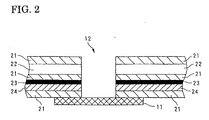
- Figure 2 is a cross-sectional view taken along a line A-A for illustrating a layer structure of a container shown in Figure 1 in accordance with the present invention.
- the container 10 according to the present invention is provided to be filled with a frozen material, and at least in a portion of the container 10 has a vent hole 12 covered by a filter material 11 which has microbial impermeability and air permeability.
- the vent hole 12 in a container according to the present invention is formed in order to prevent deformation and burst of the container from occurring even when a frozen material being a content of the container or a gas inside the container expands by outward releasing the gas inside the container to maintain an equilibrium state of the inner and outer pressures of the container. Accordingly, in the container 10 of the present invention, a position where the vent hole 12 is formed, a number of the vent hole 12, and a size and a shape of the vent hole 12 are not specifically limited as long as the above functions are demonstrated.
- a position of forming the vent hole is preferably a portion of the container which is not directly in contact with the frozen material filled in the container.
- the frozen material filled in the container may be a material of a very low temperature of minus 40 Celsius degree or less. Accordingly, when the vent hole 12 and the frozen material are in a direct contact, there is a case where a filter material 11 which is formed to cover the vent hole 12 may be damaged by the frozen material.
- the number of the vent holes it differs with respect to the size of the vent holes. However, it is ordinarily possible to sufficiently achieve the purpose of the vent hole by providing one or two of these.
- the size of the vent hole 12 can be arbitrarily set in consideration of the size of the container 10 (the amount of the frozen material to be filled). For example, when the volume of the container 10 is two liters, the size of the vent hole is preferably 2 to 35 cm 2 per one hole. Further, the shape of the vent hole 12 may be a round shape as shown in Figure 1 or a rectangular shape. Further, the number of the vent holes may be two or more.
- the above described vent hole 12 is covered by a filter material 11 having microbial impermeability and air permeability.
- the filter material 11 is provided in order to prevent microbes from intruding inside the container through the vent hole 12 and guarantee hygienics inside the container. Accordingly, as long as a filter material 11 can achieve the object of the present invention, namely the filter material 11 has microbial impermeability and air permeability, the material is not specifically limited.
- the frozen material being the content of the container, according to the present invention has a very low temperature material of minus 40 Celsius degree or less and a case where the frozen material is a food or bacterium. Therefore, it is preferable that the filter material has low temperature resistance and gamma ray resistance in consideration of an occasion of conducting gamma sterilization in addition to the above described microbial impermeability and air permeability.
- an unwoven paper having an air permeability of a range of 5 to 1000 sec per 100cc under JIS-P8117 (the Gurley method) as such the filter material 11.
- the unwoven paper having the air permeability in this range sufficiently satisfies the both of the microbial impermeability and the air permeability, necessary for the filter material 11 used in a container according to the present invention.
- the air permeability under the Gurley method is less than 5 sec per 100 cc, there may be a case where the necessary air permeability is not obtainable. As a result, there may occur expansion and burst of the container 10.
- the material of the unwoven paper having such the air permeability is not specifically limited.
- the unwoven paper may be formed by arbitrarily selecting and using polypropylene, high-density polyethylene, polyethylene terephthalate, nylon, ethylene methacrylic acid copolymer, ethylene acrylic acid copolymer, and so on.
- an unwoven paper made from high density polyethylene is preferable.
- Tyvek (Tyvek 1073B) made by Dupont-Asahi Flash Spun Products Co., Ltd is preferable.
- the unwoven paper used in the present invention may be made or formed by mixing a plurality of the above-mentioned materials or laminating a plurality of the above-mentioned materials.
- the material (layer structure) and a shape of the container body 10a are not specifically limited, and can be arbitrarily selected depending on types and uses of frozen materials to be filled.
- a frozen material to be filled is a frozen culture (so-called starter culture)
- the shape of the container 10 is ordinarily a gable top type as shown in Figure 1 and the size thereof is ordinarily one to two liters.
- the container body 10a may be formed to be a laminated body formed by arbitrarily laminating a paper, a thermal plastic resin, and so on.
- the arrangement may be in an order of, from the outside of the container, polyethylene 21/ paper 22, polyethylene 21/aluminum foil 23/ polyethylene terephthalate 24/ polyethylene 21.
- polyethylene as the material of the most inner layer of the container body and polyethylene as the above described filter material 11
- an aluminum foil layer in the layer structure it is possible to give further tearing strength, burst strength, and barrier strength to the container 10.
- a container body 10a may be a container of an unheated type which does not require heating with, for example, a microwave oven. Therefore, even if an aluminum foil layer is provided, no specific problem occurs.
- the frozen material packaging body according to the present invention is made up of a container 10 as described above and a frozen material to be filled therein.
- the frozen material forming the frozen material packaging body according to the present invention is not specifically limited and any material may be selected. Especially, frozen food and drink, frozen pharmaceuticals, and frozen bacterium are preferable. Specifically, it is possible to exemplify a starter culture, which is obtained by freezing slurry of bacterium necessary for producing frozen ice candy, frozen concentrated egg yolk, and yogurt. Especially, the frozen culture (starter culture) is suitable because the advantages of the container according to the present invention are enjoyed most.
- the frozen culture should ordinarily not be dead. Therefore, the frozen culture is unfrozen itself without artificially applying heat with for example a microwave oven. In the present invention, such the frozen material that is to be unfrozen itself is most preferable.
- a frozen material is a frozen culture, it is preferable to sterilize an inside of container 10 before filling the frozen culture. For example, gamma sterilization and gaseous sterilization are preferably performed.
- a frozen material is not specifically limited. However, a frozen material is more preferably in a shape of pellet.
- the method of manufacturing frozen materialpacking body according to the present invention includes a frozen material forming step of freezing a liquid material by dropping the liquid material through liquid nitrogen, a frozen material filling step of filling the frozen material formed in the frozen material forming step in the above described container (10), and a packaging step of forming a frozen material packaging body by hermetically sealing the container with the frozen material filled.
- a frozen material forming step of freezing a liquid material by dropping the liquid material through liquid nitrogen a frozen material filling step of filling the frozen material formed in the frozen material forming step in the above described container (10)
- a packaging step of forming a frozen material packaging body by hermetically sealing the container with the frozen material filled since the liquid nitrogen is first used in the frozen material forming step, the frozen material is instantaneously formed.
- the frozen material formed in the frozen material forming step is filled in the container and hermetically sealed immediately after taking it out of the liquid nitrogen, it is possible to prevent the frozen material from being unfrozen while manufacturing the frozen material packaging body.
- the frozen material is immediately filled in the container and hermetically sealed, there are cases where liquid nitrogen is left on a surface of the frozen material or oxygen existing in the vicinity of a surface of the frozen material is cooled by the frozen material and mixed into the container in a solid phase.
- the filter material is Tyvek (Tyvek1073B) made by Dupont-Asahi Flash Spun Products Co., Ltd and having the air permeability under JIS-P8117 (Gurley method) of 5 to 40 sec per 100 cc.
- the number of the vent holes is one.
- the shape of the vent hole is circular, and the size is a diameter of 3cm.
- the filter material is bonded by a thermal welding method so as to completely cover the vent hole inside the container. Further, the layer structure of the container body is shown in Figure 2.
- the paper container according to Example 2 is prepared A layer structure of its container body is in an order of polyethylene/paper/ polyethylene from the outside of the container. The other portions are similar to those of the paper container of Example 1.
- Example 1 As a paper container according to Comparative Example 1, a paper container having similar shape, size, and layer structure to those of Example 1 is prepared. However, the paper container does not have any vent hole.
- Example 2 As a paper container according to Comparative Example 2, a paper container having similar shape, size, and layer structure and also a similar vent hole to that of Example 1 is prepared. However, the vent hole formed in the paper container is not covered by a filter (a vent hole is simply formed in the container).
- Frozen material packaging bodies are manufactured in accordance with the manufacturing method of the frozen material packaging body according to the present invention.
- a skimmed milky liquid (concentration is 10 mass %) is first prepared and dropped through liquid nitrogen to form frozen materials (specific volume of 0.5 g/cm 2 ).
- the frozen materials are taken out of the liquid nitrogen by a stainless net and stored in freezing chambers while adjusting temperatures of the frozen materials respectively to be -40, -80, -150, and less than -150 Celsius degrees.
- the frozen materials of these temperatures as much as 1kg each are respectively filled in the containers manufactured according to Example 1 and the container manufactured according to Comparative Example 1, and the upper ends of the containers are sealed.
- These containers are derelict at a room temperature of 25 Celsius degree for one hour and at a temperature of -40 Celsius degree in a freezing chamber for twenty four hours respectively to observe expansion of the containers.
- the present invention when a frozenmaterial is frozen and stored, by filling the frozen material at a temperature less than a temperature at which the frozen material is frozen and stored, for example the frozenmaterial is filled in a temperature condition of -40 Celsius degree, preferably -80 Celsius degree or less, an advantage of the present invention is more suitably enjoyable.
- Containers according to Example 1 of the present invention and containers according to Comparative Examples 1 and 2 are prepared and respectively subjected to irradiation of a gamma beam of 10 to 30 kilo Gray (kGy) to sterilize inside the containers.
- a gamma beam of 10 to 30 kilo Gray (kGy) to sterilize inside the containers.
- Skimmed milky liquid are boiled at 121 Celsius degrees for 15 minutes, and thereafter it is dropped through liquid nitrogen which has been sterilized with a filter thereby forming a frozen material having a temperature of -150 Celsius degree.
- the frozen material is placed inside a clean room.
- the frozen material of one kilogram each is respectively filled in the containers according to Example 1 and the containers according to Comparative Examples 1 and 2, thus sterilized.
- the upper end portions of the containers are hermetically sealed to thereby form the frozen material packaging bodies.
- the filter material having microbial impermeability and air permeability prevents microbes from intruding inside the container and enables constant ventilation inside the container.
- the container according to Comparative Example 1 since it is totally enclosed, it was impossible to prevent expansion of the container, and a fault occurs at a sealing portion of the container along with the expansion to allow intrusion of microbes inside the container. In the container according to Example 2, the result means that microbes should have intruded through the vent hole.
- the four containers according to Example 1 of the present invention and the four containers according to Comparative Example 1 of the present invention are prepared.
- the frozen material similar to that in Test 2 is filled in these containers respectively by amounts of 400 ml (20% of the container volume), 1000ml (50% of the container volume), 1500ml (75% of the container volume) , and 2000ml (100% of the container volume). Then the upper ends of the containers are hermetically sealed to form frozen material packaging bodies.
- Each of the frozen material packaging bodies are left at a room temperature of 25 Celsius degree for 2 hours while observing expansion of these containers.
- a laminated body (with aluminum foil layer) used for a body of the container according to Example 1 and a laminated body (without aluminum foil layer) used for a body of the container according to Example 2 of the present invention are prepared to measure their tearing strength and burst strength.
- the result is shown in Tables 4 and 5.
- the tearing strength is measured with an Elemendorf Tearing Tester (Toyo SEIKI SEISAKU-SHO, . LTD) in compliance with JIS P 8116.
- the tearing direction is from the surface side to the back side.
- the burst strength is measured with a Mullen burst tester (high pressure type) (Toyo SEIKI SEISAKU-SHO,. LTD) in compliance with the measurement method of JIS P 8131.
- the bursting direction is from the surface side to the back side.
- the laminated bodies used in Example 1 of the present invention are excellent with respect to both of the tearing strength and the burst strength in comparison with that of Example 2. This result is considered to depend on whether or not the aluminum foil layer exists in the laminated body. Namely, it is preferable that an aluminum foil layer exists in the container according to the present invention as described in reference of Figure 2. Further, the laminated body used in Example 1 has polyethylene terephthalate laminated in addition to the aluminum foil layer. Such the laminated body is superior to that of Example 2 because of a synergistic effect between an aluminum foil layer and polyethylene terephthalate.
- the container of the present invention is to fill with the frozen material in a shape of pellet, when the frozen material is stored at a relatively high temperature of -15 Celsius degree ormore, the pellets are apt to mutually connect, a lump may be produced, and the entirety may solidify.
- the frozen pellets cannot be evacuated from the opening of the container, it is necessary to give an impact of, for example, beating at the outside of the container. In such the case, it is necessary to increase the strength of the container.
- the strength of the container body can be increased by providing an aluminum foil layer and polyethylene terephthalate inside the laminated body forming the container.
- a laminated body (with aluminum foil layer) used for a body of the container according to Example 1 and a laminated body (without aluminum foil layer) used for a body of the container according to Example 2 of the present invention are prepared to measure their oxygen permeability and moisture permeability.
- the laminated body used for the container body of Example 1 of the present invention is superior in both of oxygen permeability and moisture permeability to the container according to Example 2. This reason seems to reside in a difference of whether or not the aluminum foil layer exists inside the laminated body in a similar manner to Test 4 described above. Accordingly, in the container of the present invention formed in use of the laminated body having the aluminum foil layer, it is possible to completely shut down transmission of oxygen between the outside and the inside in the main body of the container except for the vent port.
- a laminated body according to Example 1 and a laminated body according to Example 2 of the present invention are prepared. Pellets obtained by freezing bifidobacteria which are cultivated in a culture media of milk (10% skimmed milk solution and 1% yeast extract) are filled in the containers. Thereafter, while maintaining the containers sealed, the pellets obtained by freezing bifidobacteria are dissolved and fermented at a temperature of 37 Celsius degree. The pH changes of thus obtained dissolved liquid inside the containers are measured.
- the pH of the dissolved liquid inside the container according to the present invention has a lower drop rate in comparison with that of Example 2.
Landscapes
- Engineering & Computer Science (AREA)
- Life Sciences & Earth Sciences (AREA)
- Mechanical Engineering (AREA)
- Wood Science & Technology (AREA)
- Zoology (AREA)
- Chemical & Material Sciences (AREA)
- Food Science & Technology (AREA)
- Polymers & Plastics (AREA)
- Packages (AREA)
- Medical Preparation Storing Or Oral Administration Devices (AREA)
Abstract
Description
- The present invention relates to a method of manufacturing a container for filling a frozen material therein, a frozen material packaging body having the frozen material filled therein, and a method of manufacturing the frozen material packaging body.
- In general, frozen food and drink, frozen pharmaceuticals, frozen cultures (i.e. so-called starter culture, a process of manufacture of the frozen cultures is disclosed in Non-Patent Document 1), or the like have been filled into a container made from such as a paper (e.g. a container like a milk carton) so as to be stored and gone into commercial circulation. In this case, a content to be packed into the container is food and drink, pharmaceuticals, cultures, or the like. Therefore, a hygienic administration is important. Accordingly, it is ordinary that containers for filling these are totally enclosed immediately after filling the contents. Hereinafter, a container with a frozen material filled therein is referred to as a frozen material packaging body. Non-Patent Document 1: "science and technology of lactic acid bacterium", pages 352-353, edited by LACTIC ACID BACTERIUM RESEARCH AND OPINION EXCHANGE ASSOCIATES, published by SOCIOLOGY
- However, for example in frozen cultures, as described in Non-Patent Document 1, since a liquid nitrogen is used for freezing, the temperature is the same as or lower than -40 Celsius degree (It may be -150 Celsius degree or less). When such the frozen cultures are filled in a container and totally enclosed immediately thereafter to make a frozen material packaging body, during storage in a freezing chamber at a temperature of, for example, around -40 Celsius degree, gases such as air and nitrogen in the container expand due to the temperature change (temperature increment). As a result, there is a case where the container deforms or bursts. This problem occurs during not only storage in a freezing chamber but also a process of commodity circulation and an unattended process for using frozen cultures in a factory at a room temperature.
- The present invention is provided to solve the above problems and to provide a container, which does not deform and burst even when a content or a gas in the container expands by a temperature difference between before and after making the frozen material packaging body and enables hygienic administration of the content, a frozen material packaging body, with the frozen material filled therein, and a method of manufacturing the frozen material packaging body.
- According to an aspect of solving the above problems in the present invention, a container for filling a frozen material therein has a vent hole, which is covered by a filter material having microbial impermeability and air permeability, at least at a portion of the container.
- Since the vent hole is formed at least at a portion of the above container and the port is covered with a filter material having microbial impermeability and air permeability, even when a content or a gas in the container expands by a temperature difference between before and after forming the frozen material packaging body, the gas inside the container is outwards released from the vent hole. Therefore, it is possible to maintain an equilibrium state between the inside pressure and the outside pressure of the container. Accordingly, it is possible to prevent the container from being deformed and burst and microbes from intruding inside the container from the outside thereof. Therefore, there is no problem that the content is subjected to unhygienic exposure by providing the vent hole.
- The filer material used in the above container may be an unwoven paper having a air permeability of a range of 5 to 10000 sec / 100cc under JIS-P8117 (Gurley method).
- The unwoven paper having such the degree of the air permeability is a filter material having both the microbial impermeability and air permeability and suitable for the container according to the present invention.
- The container is formed by a laminated body which is fabricated by laminating thin films. A paper layer may exist in the laminated body.
- When a paper container is used as descried above, since the paper has a better low temperature resistance than a synthetic resin and so on, the container itself scarcely damaged after filling it with a content which is frozen by liquid nitrogen and has a very low temperature. Further, because the container is made of paper, the manufacturing cost can be reduced.
- Furthermore, an aluminum foil layer may exist in a laminated body forming the above container.
- By providing the aluminum foil layer as described above, it is possible to improve tearing strength, burst strength , and barrier strength. Further, the fermentative ability of bacteria, for example when bifidobacteria and so on are filled in the container, can also be improved.
- According to another aspect of solving the problem in the present invention, the frozen material packaging body includes the above container and a frozen material filled in the container.
- According to another aspect of solving the problem in the present invention, a method of manufacturing the frozen material packaging body includes a frozen material formation step of freezing a liquid material by dropping a liquid material through liquid nitrogen to form a frozen material in a shape of pellet, a frozen material filling step of filling the above mentioned container with the frozen material formed in the frozen material formation step, and a packaging step of hermitically sealing the container filled with the frozen material so as to shape the frozen material packaging body.
- According to the container related to the present invention, even when a temperature difference may occur between before and after forming the frozen material package body and thereby the content and the gas in the container expands, because the vent hole covered by the filter material having microbial impermeability and air permeability is formed at least in a portion of the container, the gas inside the container is outwards released from the vent hole to maintain an equilibrium state between the inner pressure and the outer pressure of the container. Therefore, it is possible to prevent the container from being deformed or burst and microbes from intruding from the outside to the inside. Accordingly, there occurs no problem that the content is exposed in an unhygienic manner by providing the vent hole.
- Further, according to the method of manufacturing the frozen material package body according to the present invention, since the container described above is used, even though the frozen material is filled in the container and the container is hermetically sealed immediately after freezing the frozen material, the container does not expand or burst. Therefore, it is possible to improve its process yield.
-
- [Figure 1] A perspective view of a container related to the present invention.
- [Figure 2] A cross-sectional view for explaining a layered structure of a container shown in Figure 1 and related to the present invention.
-
- 10:
- Container
- 11:
- Filter material
- 12:
- Vent hole
- Hereinafter, a container according to the present invention will be specifically described in reference of figures.
- Figure 1 is a perspective view of the container according to the present invention. Figure 2 is a cross-sectional view taken along a line A-A for illustrating a layer structure of a container shown in Figure 1 in accordance with the present invention.
- As shown in Figure 1, the
container 10 according to the present invention is provided to be filled with a frozen material, and at least in a portion of thecontainer 10 has avent hole 12 covered by afilter material 11 which has microbial impermeability and air permeability. - The
vent hole 12 in a container according to the present invention is formed in order to prevent deformation and burst of the container from occurring even when a frozen material being a content of the container or a gas inside the container expands by outward releasing the gas inside the container to maintain an equilibrium state of the inner and outer pressures of the container. Accordingly, in thecontainer 10 of the present invention, a position where thevent hole 12 is formed, a number of thevent hole 12, and a size and a shape of thevent hole 12 are not specifically limited as long as the above functions are demonstrated. - A position of forming the vent hole is preferably a portion of the container which is not directly in contact with the frozen material filled in the container. For example, it is preferably positioned in the vicinity of the upper end of the
container 12. The frozen material filled in the container may be a material of a very low temperature of minus 40 Celsius degree or less. Accordingly, when thevent hole 12 and the frozen material are in a direct contact, there is a case where afilter material 11 which is formed to cover thevent hole 12 may be damaged by the frozen material. - Further, as for the number of the vent holes, it differs with respect to the size of the vent holes. However, it is ordinarily possible to sufficiently achieve the purpose of the vent hole by providing one or two of these.
- The size of the
vent hole 12 can be arbitrarily set in consideration of the size of the container 10 (the amount of the frozen material to be filled). For example, when the volume of thecontainer 10 is two liters, the size of the vent hole is preferably 2 to 35 cm2 per one hole. Further, the shape of thevent hole 12 may be a round shape as shown in Figure 1 or a rectangular shape. Further, the number of the vent holes may be two or more. - In the
container 10 according to the present invention, the above describedvent hole 12 is covered by afilter material 11 having microbial impermeability and air permeability. Thefilter material 11 is provided in order to prevent microbes from intruding inside the container through thevent hole 12 and guarantee hygienics inside the container. Accordingly, as long as afilter material 11 can achieve the object of the present invention, namely thefilter material 11 has microbial impermeability and air permeability, the material is not specifically limited. However, there are a case where the frozen material, being the content of the container, according to the present invention has a very low temperature material of minus 40 Celsius degree or less and a case where the frozen material is a food or bacterium. Therefore, it is preferable that the filter material has low temperature resistance and gamma ray resistance in consideration of an occasion of conducting gamma sterilization in addition to the above described microbial impermeability and air permeability. - Specifically, it is possible to mention an unwoven paper having an air permeability of a range of 5 to 1000 sec per 100cc under JIS-P8117 (the Gurley method) as such the
filter material 11. The unwoven paper having the air permeability in this range sufficiently satisfies the both of the microbial impermeability and the air permeability, necessary for thefilter material 11 used in a container according to the present invention. When the air permeability under the Gurley method is less than 5 sec per 100 cc, there may be a case where the necessary air permeability is not obtainable. As a result, there may occur expansion and burst of thecontainer 10. On the other hand, when the air permeability under the Gurley method is larger than 10000 sec per 100 cc, even though the air permeability is sufficient, there may be a problem in microbial impermeability so as not to guarantee hygienics of a frozen material filled in a container. - The material of the unwoven paper having such the air permeability is not specifically limited. The unwoven paper may be formed by arbitrarily selecting and using polypropylene, high-density polyethylene, polyethylene terephthalate, nylon, ethylene methacrylic acid copolymer, ethylene acrylic acid copolymer, and so on. Especially, an unwoven paper made from high density polyethylene is preferable. Specifically, Tyvek (Tyvek 1073B) made by Dupont-Asahi Flash Spun Products Co., Ltd is preferable. Further, the unwoven paper used in the present invention may be made or formed by mixing a plurality of the above-mentioned materials or laminating a plurality of the above-mentioned materials.
- Next, a
container body 10a of thecontainer 10 according to the present invention will be described. - In the present invention, although the material (layer structure) and a shape of the
container body 10a are not specifically limited, and can be arbitrarily selected depending on types and uses of frozen materials to be filled. For example, when a frozen material to be filled is a frozen culture (so-called starter culture), the shape of thecontainer 10 is ordinarily a gable top type as shown in Figure 1 and the size thereof is ordinarily one to two liters. - For example, the
container body 10a may be formed to be a laminated body formed by arbitrarily laminating a paper, a thermal plastic resin, and so on. Specifically, as shown in Figure 2, the arrangement may be in an order of, from the outside of the container,polyethylene 21/paper 22,polyethylene 21/aluminum foil 23/polyethylene terephthalate 24/polyethylene 21. As such, by using polyethylene as the material of the most inner layer of the container body and polyethylene as the above describedfilter material 11, it becomes convenient because a thermal welding method is usable when thefilter material 11 is provided in thevent hole 12. Further, by providing an aluminum foil layer in the layer structure, it is possible to give further tearing strength, burst strength, and barrier strength to thecontainer 10. Further, when a bacterium such as bifidobacteria is filled in a container, it is possible to improve fermentative ability of the bacterium.
Further, acontainer body 10a according to the embodiment may be a container of an unheated type which does not require heating with, for example, a microwave oven. Therefore, even if an aluminum foil layer is provided, no specific problem occurs. - Further, although it is not shown in Figure 2, it is possible to provide a print layer to give design to a
container 10. Furthermore, it is possible to provide a heat resistance layer made from such as polyethylene terephthalate or nylon. - Next, a frozen material packaging body according to the present invention will be described.
- The frozen material packaging body according to the present invention is made up of a
container 10 as described above and a frozen material to be filled therein. - The frozen material forming the frozen material packaging body according to the present invention is not specifically limited and any material may be selected. Especially, frozen food and drink, frozen pharmaceuticals, and frozen bacterium are preferable. Specifically, it is possible to exemplify a starter culture, which is obtained by freezing slurry of bacterium necessary for producing frozen ice candy, frozen concentrated egg yolk, and yogurt. Especially, the frozen culture (starter culture) is suitable because the advantages of the container according to the present invention are enjoyed most. The frozen culture should ordinarily not be dead. Therefore, the frozen culture is unfrozen itself without artificially applying heat with for example a microwave oven. In the present invention, such the frozen material that is to be unfrozen itself is most preferable. When a frozen material is a frozen culture, it is preferable to sterilize an inside of
container 10 before filling the frozen culture. For example, gamma sterilization and gaseous sterilization are preferably performed. - The shape of such frozenmaterial is not specifically limited. However, a frozen material is more preferably in a shape of pellet.
- Next, a method of manufacturing the above mentioned frozen material packing body will be described in accordance with the present invention.
- The method of manufacturing frozen materialpacking body according to the present invention includes a frozen material forming step of freezing a liquid material by dropping the liquid material through liquid nitrogen, a frozen material filling step of filling the frozen material formed in the frozen material forming step in the above described container (10), and a packaging step of forming a frozen material packaging body by hermetically sealing the container with the frozen material filled. According to the method of manufacturing frozen material packaging body in the present invention, since the liquid nitrogen is first used in the frozen material forming step, the frozen material is instantaneously formed. Further, according to the method of the present invention, since the frozen material formed in the frozen material forming step is filled in the container and hermetically sealed immediately after taking it out of the liquid nitrogen, it is possible to prevent the frozen material from being unfrozen while manufacturing the frozen material packaging body. As such, when the frozen material is immediately filled in the container and hermetically sealed, there are cases where liquid nitrogen is left on a surface of the frozen material or oxygen existing in the vicinity of a surface of the frozen material is cooled by the frozen material and mixed into the container in a solid phase. Accordingly, in such the cases, when a conventional container (namely a totally enclosed container without a vent hole) is used, the liquid nitrogen remaining after the filling and the oxygen mixed inside the container in a solid phase are evaporated to thereby make the container expand /burst. In a conventional technique, it is necessary to wait for evaporation of the liquid nitrogen and the solid oxygen until these are evaporated by increasing the surface temperature of the frozen material. However, since the manufacturing method of the frozen material packaging body according to the present invention uses the above described container according to the present invention, even when a frozen material is filled and hermetically sealed , the container does not expand and burst to thereby improve process yield in manufacture.
- Meanwhile, the present invention is not limited to the above embodiment. The above embodiment is provided only as an example. All whatever having substantially the same structure as and similar functions and effects to those in the technical idea described in the scope of claims in the present invention are included in the technical scope of the present invention.
- A paper container (Quantity: 2 liters) of a gable top type (as shown in Figure 1)having a vent hole, which is covered by a filter material and located in the vicinity of the upper portion of the container (vide Figure 1), is prepared in accordance with Example 1 of the present invention.
- In the paper container according to Example 1, the filter material is Tyvek (Tyvek1073B) made by Dupont-Asahi Flash Spun Products Co., Ltd and having the air permeability under JIS-P8117 (Gurley method) of 5 to 40 sec per 100 cc. The number of the vent holes is one. The shape of the vent hole is circular, and the size is a diameter of 3cm. The filter material is bonded by a thermal welding method so as to completely cover the vent hole inside the container. Further, the layer structure of the container body is shown in Figure 2.
- The paper container according to Example 2 is prepared A layer structure of its container body is in an order of polyethylene/paper/ polyethylene from the outside of the container. The other portions are similar to those of the paper container of Example 1.
- As a paper container according to Comparative Example 1, a paper container having similar shape, size, and layer structure to those of Example 1 is prepared. However, the paper container does not have any vent hole.
- As a paper container according to Comparative Example 2, a paper container having similar shape, size, and layer structure and also a similar vent hole to that of Example 1 is prepared. However, the vent hole formed in the paper container is not covered by a filter (a vent hole is simply formed in the container).
- Four containers according to Example 1 of the present invention and four containers according to Comparative Example 1 are prepared. Frozen material packaging bodies are manufactured in accordance with the manufacturing method of the frozen material packaging body according to the present invention.
- Specifically, a skimmed milky liquid (concentration is 10 mass %) is first prepared and dropped through liquid nitrogen to form frozen materials (specific volume of 0.5 g/cm2). Next, the frozen materials are taken out of the liquid nitrogen by a stainless net and stored in freezing chambers while adjusting temperatures of the frozen materials respectively to be -40, -80, -150, and less than -150 Celsius degrees. Thereafter, the frozen materials of these temperatures as much as 1kg each are respectively filled in the containers manufactured according to Example 1 and the container manufactured according to Comparative Example 1, and the upper ends of the containers are sealed.
- These containers are derelict at a room temperature of 25 Celsius degree for one hour and at a temperature of -40 Celsius degree in a freezing chamber for twenty four hours respectively to observe expansion of the containers.
- Results are shown in Table 1 as follows.
[Table 1] Result when containers are left for an hour at a room temperature (25 Celsius degree) Temperature (Celsius degree) of frozen material -40 -80 -150 under -150 Example 1 Not Expand Not Expand Not Expand Not Expand Comparative Example 1 Expand Expand Expand Expand Result when containers are left inside freezing chamber at a temperature (-40 Celsius degree) for twenty-four hours Temperature (Celsius degree) of frozen material -40 -80 -150 under -150 Example 1 Not Expand Not Expand Not Expand Not Expand Comparative Example 1 Not Expand Expand Expand Expand - As known from Table 1, in the frozen material packaging bodies using the containers according to Example 1 of the present invention, even though the packages are left at a room temperature or in a freezing chamber, they do not expand. However, in the frozen material packaging bodies using the containers of Comparative Example 1, the packages expand. (However, the container filled with the frozen material of -40 Celsius degree and left inside the freezing chamber having-40 Celsius degree did not expand. This is because there is no temperature difference, and a gas inside the container does not expand. Namely, in the present invention, when a frozenmaterial is frozen and stored, by filling the frozen material at a temperature less than a temperature at which the frozen material is frozen and stored, for example the frozenmaterial is filled in a temperature condition of -40 Celsius degree, preferably -80 Celsius degree or less, an advantage of the present invention is more suitably enjoyable.)
- Containers according to Example 1 of the present invention and containers according to Comparative Examples 1 and 2 are prepared and respectively subjected to irradiation of a gamma beam of 10 to 30 kilo Gray (kGy) to sterilize inside the containers.
- Skimmed milky liquid are boiled at 121 Celsius degrees for 15 minutes, and thereafter it is dropped through liquid nitrogen which has been sterilized with a filter thereby forming a frozen material having a temperature of -150 Celsius degree.
- The frozen material is placed inside a clean room. The frozen material of one kilogram each is respectively filled in the containers according to Example 1 and the containers according to Comparative Examples 1 and 2, thus sterilized. Then the upper end portions of the containers are hermetically sealed to thereby form the frozen material packaging bodies.
- After cultivating each of the frozen material packaging bodies for five days at a temperature of 30 Celsius degree, it is checked whether or not each of the contents of the packaging bodies corrupts.
- The results are shown in Table 2.
[Table 2] Corrupted or not? Example 1 Not Corrupt Comparative Example 1 Corrupt Comparative Example 2 Corrupt - As known from the Table 2, in the frozen packaging body according to the present invention, even though it was incubated for five days at a temperature of 30 Celsius degree, the content did not corrupt. However, in the frozen packaging body using the containers according to Examples 1 and 2, the content corrupted. This is because, in the container according to the present invention, the filter material having microbial impermeability and air permeability prevents microbes from intruding inside the container and enables constant ventilation inside the container. However, in the container according to Comparative Example 1, since it is totally enclosed, it was impossible to prevent expansion of the container, and a fault occurs at a sealing portion of the container along with the expansion to allow intrusion of microbes inside the container. In the container according to Example 2, the result means that microbes should have intruded through the vent hole.
- The four containers according to Example 1 of the present invention and the four containers according to Comparative Example 1 of the present invention are prepared. The frozen material similar to that in Test 2 is filled in these containers respectively by amounts of 400 ml (20% of the container volume), 1000ml (50% of the container volume), 1500ml (75% of the container volume) , and 2000ml (100% of the container volume). Then the upper ends of the containers are hermetically sealed to form frozen material packaging bodies.
- Each of the frozen material packaging bodies are left at a room temperature of 25 Celsius degree for 2 hours while observing expansion of these containers.
- The result is shown in Table 3 as follows.
[Table 3] Filled Amount 400ml (20% of Container Volume 1000ml (50% of Container Volume 1500ml (75%of Container Volume 2000ml (100%of Container Volume Example 1 Not Expand Not Expand Not Expand Not Expand Comparative Example 1 Without substantive Expansion Expand Expand Expand - As known from Table 3, in the frozen material packaging bodies using the containers according to Embodiment 1 of the present invention, regardless of the filled amount of the frozen material (even though it is filled 100%), the containers did not expand. Meanwhile, in the frozen material packaging bodies using the containers of Comparative Example 1, although a large expansion has not been observed, it was impossible to prevent the container from expanding when the frozen material was filled more. Namely, in the present invention, it is possible to preferably enjoy the advantages of the present invention when the filled amount of the frozen material exceeds 20% of the container volume (preferably 50% or more).
- A laminated body (with aluminum foil layer) used for a body of the container according to Example 1 and a laminated body (without aluminum foil layer) used for a body of the container according to Example 2 of the present invention are prepared to measure their tearing strength and burst strength.
- The result is shown in Tables 4 and 5. The tearing strength is measured with an Elemendorf Tearing Tester (Toyo SEIKI SEISAKU-SHO, . LTD) in compliance with JIS P 8116. The tearing direction is from the surface side to the back side. The burst strength is measured with a Mullen burst tester (high pressure type) (Toyo SEIKI SEISAKU-SHO,. LTD) in compliance with the measurement method of JIS P 8131. The bursting direction is from the surface side to the back side.
-

-

- Since the container of the present invention is to fill with the frozen material in a shape of pellet, when the frozen material is stored at a relatively high temperature of -15 Celsius degree ormore, the pellets are apt to mutually connect, a lump may be produced, and the entirety may solidify. In this case, since the frozen pellets cannot be evacuated from the opening of the container, it is necessary to give an impact of, for example, beating at the outside of the container. In such the case, it is necessary to increase the strength of the container. According to the result of Test 4, it is known that the strength of the container body can be increased by providing an aluminum foil layer and polyethylene terephthalate inside the laminated body forming the container.
- A laminated body (with aluminum foil layer) used for a body of the container according to Example 1 and a laminated body (without aluminum foil layer) used for a body of the container according to Example 2 of the present invention are prepared to measure their oxygen permeability and moisture permeability.
- The result is shown in Table 6 as follows. These measurements are done using OX-TRAN (MOCON Company) incompliance with JIS K 7126.
-

- A laminated body according to Example 1 and a laminated body according to Example 2 of the present invention are prepared. Pellets obtained by freezing bifidobacteria which are cultivated in a culture media of milk (10% skimmed milk solution and 1% yeast extract) are filled in the containers. Thereafter, while maintaining the containers sealed, the pellets obtained by freezing bifidobacteria are dissolved and fermented at a temperature of 37 Celsius degree. The pH changes of thus obtained dissolved liquid inside the containers are measured.
- The result is shown in Table 7 as follows.
-

Claims (6)
- A container for filling a frozen material therein comprising:a vent port covered with a filter material having microbial impermeability and air permeability and formed at least in a portion of the container.
- A container according to Claim 1, wherein
the filter material is an unwoven paper having air permeability of a range of 5 to 10000 seb/100 cc under JIS-P8117(Gurley method). - A container according to Claim 1 or 2, wherein
the container is formed in a laminated body of laminating thin films, and
the laminated body includes a paper layer. - A container according to Claim 3, wherein
the laminated body includes an aluminum foil layer. - A frozen material packaging body comprising:a container described in any one of Claims 1 to 4; anda frozen material filled in the container.
- A method of manufacturing a frozen material packaging body according to Claim 5, comprising steps of:forming a frozen material for freezing a liquid material by dropping the liquid material through liquid nitrogen and forming the frozen material in a pellet shape;filling the frozenmaterial formed in the freezingmaterial forming step in the container according to any one of Claims 1 to 4; andhermetically sealing the container with the frozen material filled in the frozenmaterial packaging step and forming the frozen material packaging body.
Applications Claiming Priority (3)
| Application Number | Priority Date | Filing Date | Title |
|---|---|---|---|
| JP2003187415 | 2003-06-30 | ||
| JP2004191588A JP4153905B2 (en) | 2003-06-30 | 2004-06-29 | Container, frozen product package, and manufacturing method of package |
| PCT/JP2004/009171 WO2005000707A1 (en) | 2003-06-30 | 2004-06-30 | Container, frozen material packaging body, and method of manufacturing packaging body |
Publications (3)
| Publication Number | Publication Date |
|---|---|
| EP1640288A1 true EP1640288A1 (en) | 2006-03-29 |
| EP1640288A4 EP1640288A4 (en) | 2009-04-29 |
| EP1640288B1 EP1640288B1 (en) | 2010-09-01 |
Family
ID=33554491
Family Applications (1)
| Application Number | Title | Priority Date | Filing Date |
|---|---|---|---|
| EP04746640A Expired - Lifetime EP1640288B1 (en) | 2003-06-30 | 2004-06-30 | Frozen material package and method of manufacturing frozen material package |
Country Status (8)
| Country | Link |
|---|---|
| US (2) | US20060153951A1 (en) |
| EP (1) | EP1640288B1 (en) |
| JP (1) | JP4153905B2 (en) |
| KR (1) | KR100664551B1 (en) |
| CA (1) | CA2530207C (en) |
| DE (1) | DE602004028938D1 (en) |
| DK (1) | DK1640288T3 (en) |
| WO (1) | WO2005000707A1 (en) |
Families Citing this family (3)
| Publication number | Priority date | Publication date | Assignee | Title |
|---|---|---|---|---|
| KR100833320B1 (en) | 2006-12-14 | 2008-05-28 | 위니아만도 주식회사 | Food container |
| KR101309178B1 (en) | 2011-07-22 | 2013-09-23 | 한신메디칼 주식회사 | Sealant material and container including the same |
| WO2021240831A1 (en) * | 2020-05-29 | 2021-12-02 | 朋和産業株式会社 | Packaging material for heated food |
Family Cites Families (13)
| Publication number | Priority date | Publication date | Assignee | Title |
|---|---|---|---|---|
| US2902396A (en) * | 1956-08-28 | 1959-09-01 | Julian L Reynolds | Laminate for wrapping precooked frozen food |
| US3946780A (en) * | 1973-01-04 | 1976-03-30 | Sellers John C | Fermentation container |
| JPS5283974A (en) * | 1976-01-01 | 1977-07-13 | Yakult Honsha Kk | Incubation mixture of milk containing living cell of bifidus strain and method of producing same |
| US4262023A (en) * | 1977-12-22 | 1981-04-14 | Mauri Brothers & Thomson (Aust.) Pty. Limited | Frozen multiple-strain cheese starter composition |
| JPS5739303Y2 (en) * | 1978-05-23 | 1982-08-30 | ||
| JPS58183372U (en) * | 1982-05-29 | 1983-12-06 | 大日本印刷株式会社 | Heat-filled packaging |
| JPH0631107B2 (en) * | 1983-05-30 | 1994-04-27 | 大日本印刷株式会社 | Easy-to-open medical package |
| DE3416752A1 (en) * | 1984-05-07 | 1985-11-07 | Nyffeler, Corti AG, Kirchberg | SEALING MEMBRANE FOR CONTAINERS WITH GAS-DEVELOPING FILLING MATERIAL |
| US4792048A (en) * | 1987-04-10 | 1988-12-20 | Minnesota Mining And Manufacturing Company | Gable-top container |
| JP2707271B2 (en) * | 1988-03-31 | 1998-01-28 | 盛稔 小国 | Sterilization method of drug solution |
| US5302790A (en) * | 1992-03-16 | 1994-04-12 | Golden Valley Microwave Foods Inc. | Microwave popcorn popping bag |
| WO1996029896A1 (en) * | 1995-03-29 | 1996-10-03 | Jones Curt D | Dropper assembly for liquid feed and method of feeding liquid composition to a freezing chamber |
| JP2000264381A (en) * | 1995-09-19 | 2000-09-26 | Nakamoto Pakkusu Kk | Storage bag for food to be heated by microwave oven |
-
2004
- 2004-06-29 JP JP2004191588A patent/JP4153905B2/en not_active Expired - Fee Related
- 2004-06-30 KR KR1020057024828A patent/KR100664551B1/en not_active Expired - Fee Related
- 2004-06-30 WO PCT/JP2004/009171 patent/WO2005000707A1/en not_active Ceased
- 2004-06-30 US US10/562,384 patent/US20060153951A1/en not_active Abandoned
- 2004-06-30 DE DE602004028938T patent/DE602004028938D1/en not_active Expired - Lifetime
- 2004-06-30 DK DK04746640.4T patent/DK1640288T3/en active
- 2004-06-30 CA CA002530207A patent/CA2530207C/en not_active Expired - Fee Related
- 2004-06-30 EP EP04746640A patent/EP1640288B1/en not_active Expired - Lifetime
-
2009
- 2009-09-16 US US12/560,735 patent/US20100009428A1/en not_active Abandoned
Also Published As
| Publication number | Publication date |
|---|---|
| DE602004028938D1 (en) | 2010-10-14 |
| US20100009428A1 (en) | 2010-01-14 |
| EP1640288A4 (en) | 2009-04-29 |
| KR100664551B1 (en) | 2007-01-03 |
| WO2005000707A1 (en) | 2005-01-06 |
| DK1640288T3 (en) | 2010-11-29 |
| KR20060028772A (en) | 2006-04-03 |
| US20060153951A1 (en) | 2006-07-13 |
| WO2005000707A8 (en) | 2006-06-29 |
| JP4153905B2 (en) | 2008-09-24 |
| CA2530207A1 (en) | 2005-01-06 |
| CA2530207C (en) | 2008-09-09 |
| EP1640288B1 (en) | 2010-09-01 |
| JP2005035676A (en) | 2005-02-10 |
Similar Documents
| Publication | Publication Date | Title |
|---|---|---|
| US11820579B1 (en) | Insulated packaging for use with dry ice | |
| US4172152A (en) | Thermally insulative beverage container | |
| EP1188683B1 (en) | Packaging container and packaged food | |
| US8828463B2 (en) | Packaging of respiring biological materials | |
| EP2051589B1 (en) | Method for storing bananas during ripening | |
| WO2011159978A1 (en) | Insulating inserts, containers comprising them and methods of assembling and using them | |
| CN101730647A (en) | Slotted lids for packaging fresh fruit, vegetables and flowers in corresponding modified atmosphere trays | |
| US20100009428A1 (en) | Container, frozen material packaging body, and method of manufacturing packaging body | |
| EP1516827B1 (en) | Packaging of bananas | |
| US12492064B2 (en) | Insulated packaging for use with dry ice | |
| JP2002147914A (en) | Low temperature cool-storage medium | |
| KR100336491B1 (en) | Method for Packaging Kimchi Product for Preventing Volume Increment | |
| JP2684215B2 (en) | Agricultural transport containers | |
| KR200207745Y1 (en) | Package for inhibiting the swelling of kimchi | |
| BR112014014434B1 (en) | MATERIAL AND PACKAGING FOR YEAST STORAGE | |
| KR20250007628A (en) | PHA-based retort food pouches | |
| KR101677594B1 (en) | A packaging method of kimchi product for preventing volumeincrement | |
| CN213083756U (en) | Fresh-keeping and sterilizing corrugated carton | |
| CN106628322A (en) | Packaging method of quick-frozen foods and application thereof | |
| JP2822374B2 (en) | Thermal insulation panel | |
| KR102943043B1 (en) | Makgeolli bottle cap | |
| JPH01317354A (en) | Preservation of vegetable and fruit keeping freshness over long period | |
| JPS6038330B2 (en) | Carbon dioxide supply device | |
| CN120436172A (en) | Self-fermented yogurt and its production method and packaging | |
| JP2024098186A (en) | Plastic films and packaging bags |
Legal Events
| Date | Code | Title | Description |
|---|---|---|---|
| PUAI | Public reference made under article 153(3) epc to a published international application that has entered the european phase |
Free format text: ORIGINAL CODE: 0009012 |
|
| 17P | Request for examination filed |
Effective date: 20051223 |
|
| AK | Designated contracting states |
Kind code of ref document: A1 Designated state(s): DE DK FR GB |
|
| RIN1 | Information on inventor provided before grant (corrected) |
Inventor name: ISHIBASHI, NORIO,MORINAGA MILK INDUSTRY CO., LTD. Inventor name: SHIINA, NORIYUKI,DAI NIPPON PRINTING CO., LTD. Inventor name: YAMATO, SHOJI,DAI NIPPON PRINTING CO., LTD. Inventor name: ABE, FUMIAKI,MORINAGA MILK INDUSTRY CO., LTD. . |
|
| RTI1 | Title (correction) |
Free format text: CONTAINER, FROZEN MATERIAL PACKAGING BODY, AND METHOD OF MANUFACTURING PACKAGING BODY |
|
| DAX | Request for extension of the european patent (deleted) | ||
| RBV | Designated contracting states (corrected) |
Designated state(s): DE DK FR GB |
|
| A4 | Supplementary search report drawn up and despatched |
Effective date: 20090330 |
|
| GRAP | Despatch of communication of intention to grant a patent |
Free format text: ORIGINAL CODE: EPIDOSNIGR1 |
|
| RTI1 | Title (correction) |
Free format text: FROZEN MATERIAL PACKAGE AND METHOD OF MANUFACTURING FROZEN MATERIAL PACKAGE |
|
| GRAS | Grant fee paid |
Free format text: ORIGINAL CODE: EPIDOSNIGR3 |
|
| GRAA | (expected) grant |
Free format text: ORIGINAL CODE: 0009210 |
|
| AK | Designated contracting states |
Kind code of ref document: B1 Designated state(s): DE DK FR GB |
|
| REG | Reference to a national code |
Ref country code: GB Ref legal event code: FG4D |
|
| REF | Corresponds to: |
Ref document number: 602004028938 Country of ref document: DE Date of ref document: 20101014 Kind code of ref document: P |
|
| REG | Reference to a national code |
Ref country code: DK Ref legal event code: T3 |
|
| PLBE | No opposition filed within time limit |
Free format text: ORIGINAL CODE: 0009261 |
|
| STAA | Information on the status of an ep patent application or granted ep patent |
Free format text: STATUS: NO OPPOSITION FILED WITHIN TIME LIMIT |
|
| 26N | No opposition filed |
Effective date: 20110606 |
|
| REG | Reference to a national code |
Ref country code: DE Ref legal event code: R097 Ref document number: 602004028938 Country of ref document: DE Effective date: 20110606 |
|
| PGFP | Annual fee paid to national office [announced via postgrant information from national office to epo] |
Ref country code: FR Payment date: 20120705 Year of fee payment: 9 Ref country code: GB Payment date: 20120621 Year of fee payment: 9 |
|
| GBPC | Gb: european patent ceased through non-payment of renewal fee |
Effective date: 20130630 |
|
| REG | Reference to a national code |
Ref country code: FR Ref legal event code: ST Effective date: 20140228 |
|
| PG25 | Lapsed in a contracting state [announced via postgrant information from national office to epo] |
Ref country code: GB Free format text: LAPSE BECAUSE OF NON-PAYMENT OF DUE FEES Effective date: 20130630 |
|
| PG25 | Lapsed in a contracting state [announced via postgrant information from national office to epo] |
Ref country code: FR Free format text: LAPSE BECAUSE OF NON-PAYMENT OF DUE FEES Effective date: 20130701 |
|
| PGFP | Annual fee paid to national office [announced via postgrant information from national office to epo] |
Ref country code: DK Payment date: 20200610 Year of fee payment: 17 Ref country code: DE Payment date: 20200617 Year of fee payment: 17 |
|
| REG | Reference to a national code |
Ref country code: DE Ref legal event code: R119 Ref document number: 602004028938 Country of ref document: DE |
|
| REG | Reference to a national code |
Ref country code: DK Ref legal event code: EBP Effective date: 20210630 |
|
| PG25 | Lapsed in a contracting state [announced via postgrant information from national office to epo] |
Ref country code: DE Free format text: LAPSE BECAUSE OF NON-PAYMENT OF DUE FEES Effective date: 20220101 |
|
| PG25 | Lapsed in a contracting state [announced via postgrant information from national office to epo] |
Ref country code: DK Free format text: LAPSE BECAUSE OF NON-PAYMENT OF DUE FEES Effective date: 20210630 |