EP1639780B1 - Sicherheit für protokoll-traversal - Google Patents
Sicherheit für protokoll-traversal Download PDFInfo
- Publication number
- EP1639780B1 EP1639780B1 EP04737139A EP04737139A EP1639780B1 EP 1639780 B1 EP1639780 B1 EP 1639780B1 EP 04737139 A EP04737139 A EP 04737139A EP 04737139 A EP04737139 A EP 04737139A EP 1639780 B1 EP1639780 B1 EP 1639780B1
- Authority
- EP
- European Patent Office
- Prior art keywords
- information
- packet
- validity
- network node
- public key
- Prior art date
- Legal status (The legal status is an assumption and is not a legal conclusion. Google has not performed a legal analysis and makes no representation as to the accuracy of the status listed.)
- Expired - Lifetime
Links
- 238000000034 method Methods 0.000 claims description 25
- 238000012795 verification Methods 0.000 claims description 8
- 230000007246 mechanism Effects 0.000 description 7
- 238000004891 communication Methods 0.000 description 6
- 230000005540 biological transmission Effects 0.000 description 4
- 230000011664 signaling Effects 0.000 description 3
- 238000013459 approach Methods 0.000 description 2
- 238000012545 processing Methods 0.000 description 2
- 238000007630 basic procedure Methods 0.000 description 1
- 230000001419 dependent effect Effects 0.000 description 1
- 238000011161 development Methods 0.000 description 1
- 230000018109 developmental process Effects 0.000 description 1
- 238000010586 diagram Methods 0.000 description 1
- 238000007689 inspection Methods 0.000 description 1
Images


Classifications
-
- H—ELECTRICITY
- H04—ELECTRIC COMMUNICATION TECHNIQUE
- H04L—TRANSMISSION OF DIGITAL INFORMATION, e.g. TELEGRAPHIC COMMUNICATION
- H04L63/00—Network architectures or network communication protocols for network security
- H04L63/12—Applying verification of the received information
- H04L63/123—Applying verification of the received information received data contents, e.g. message integrity
-
- H—ELECTRICITY
- H04—ELECTRIC COMMUNICATION TECHNIQUE
- H04L—TRANSMISSION OF DIGITAL INFORMATION, e.g. TELEGRAPHIC COMMUNICATION
- H04L69/00—Network arrangements, protocols or services independent of the application payload and not provided for in the other groups of this subclass
- H04L69/22—Parsing or analysis of headers
-
- H—ELECTRICITY
- H04—ELECTRIC COMMUNICATION TECHNIQUE
- H04L—TRANSMISSION OF DIGITAL INFORMATION, e.g. TELEGRAPHIC COMMUNICATION
- H04L9/00—Cryptographic mechanisms or cryptographic arrangements for secret or secure communications; Network security protocols
- H04L9/30—Public key, i.e. encryption algorithm being computationally infeasible to invert or user's encryption keys not requiring secrecy
- H04L9/3066—Public key, i.e. encryption algorithm being computationally infeasible to invert or user's encryption keys not requiring secrecy involving algebraic varieties, e.g. elliptic or hyper-elliptic curves
- H04L9/3073—Public key, i.e. encryption algorithm being computationally infeasible to invert or user's encryption keys not requiring secrecy involving algebraic varieties, e.g. elliptic or hyper-elliptic curves involving pairings, e.g. identity based encryption [IBE], bilinear mappings or bilinear pairings, e.g. Weil or Tate pairing
-
- H—ELECTRICITY
- H04—ELECTRIC COMMUNICATION TECHNIQUE
- H04L—TRANSMISSION OF DIGITAL INFORMATION, e.g. TELEGRAPHIC COMMUNICATION
- H04L9/00—Cryptographic mechanisms or cryptographic arrangements for secret or secure communications; Network security protocols
- H04L9/32—Cryptographic mechanisms or cryptographic arrangements for secret or secure communications; Network security protocols including means for verifying the identity or authority of a user of the system or for message authentication, e.g. authorization, entity authentication, data integrity or data verification, non-repudiation, key authentication or verification of credentials
- H04L9/3247—Cryptographic mechanisms or cryptographic arrangements for secret or secure communications; Network security protocols including means for verifying the identity or authority of a user of the system or for message authentication, e.g. authorization, entity authentication, data integrity or data verification, non-repudiation, key authentication or verification of credentials involving digital signatures
-
- H—ELECTRICITY
- H04—ELECTRIC COMMUNICATION TECHNIQUE
- H04L—TRANSMISSION OF DIGITAL INFORMATION, e.g. TELEGRAPHIC COMMUNICATION
- H04L9/00—Cryptographic mechanisms or cryptographic arrangements for secret or secure communications; Network security protocols
- H04L9/32—Cryptographic mechanisms or cryptographic arrangements for secret or secure communications; Network security protocols including means for verifying the identity or authority of a user of the system or for message authentication, e.g. authorization, entity authentication, data integrity or data verification, non-repudiation, key authentication or verification of credentials
- H04L9/3297—Cryptographic mechanisms or cryptographic arrangements for secret or secure communications; Network security protocols including means for verifying the identity or authority of a user of the system or for message authentication, e.g. authorization, entity authentication, data integrity or data verification, non-repudiation, key authentication or verification of credentials involving time stamps, e.g. generation of time stamps
-
- H—ELECTRICITY
- H04—ELECTRIC COMMUNICATION TECHNIQUE
- H04L—TRANSMISSION OF DIGITAL INFORMATION, e.g. TELEGRAPHIC COMMUNICATION
- H04L2209/00—Additional information or applications relating to cryptographic mechanisms or cryptographic arrangements for secret or secure communication H04L9/00
- H04L2209/80—Wireless
Definitions
- This invention relates to a method and a system for protecting packets to be sent from a first network node to a second network node.
- This invention is related to security and more particularly security protocols to protect user packets.
- security protocols There are currently two main security protocols which are Ipsec (as described, for example, in S. Kent, R. Atkinson, "Security Architecture for the Internet Protocol", RFC 2401, November 1998 ) and SKIP (Simple Key Management for Internet Protocols, information is available, for example, from www.skip.org , an overview can be found in http://www.tik.ee.ethz.ch/ ⁇ skip/SKIP.html):
- SKIP is a connectionless protocol (no connection set up is required) but all the information is carried in the SKIP header: this includes the encryption algorithm used, as well as the keying material that the receiving end will use to derive the session key.
- SKIP relies on so-called Diffie-Hellman public values. For this, it is necessary that both nodes to know each other, since it is required that both nodes exchange their Diffie-Hellman public values. That is, it is required that both nodes know the other node's authenticated public value (i.e. Diffie-Hellman value) in order to compute a pairwise symmetric key.
- the solutions known in the prior art require that the nodes which are involved in a transmission of a packet and need to verify the validity thereof know each other before starting the actual transmission of the packet. Therefore, additional messages are required which lead to an increased amount of traffic. Moreover, managing of the network is complicated since, before performing the actual transmission, it is necessary to make sure that all nodes (i.e., also intermediate nodes) involved do have the required information for verifying the validity of the packet. This limits the freedom of the routes to be taken by a packet.
- Document WO 98/02815 discloses a method for transmitting security in a computer network, as set out in the preamble of claim 1.
- a validity check is performed.
- a time reference is used for a validity check. Namely, the time reference is stored in a packet header is read (upon receiving a packet) and compared again with the present time reference. If this comparison yields that the packet is old, the packet is presumed to be invalid and is immediately discarded.
- the object underlying the present invention resides in removing the above drawback of the prior art and to enable a protection of packets to be sent from a first network node to a second network node, wherein the amount of protocol messages is reduced and a flexible routing of the packet is possible.
- every network node involved in transmitting a packet i.e., the receiving node or any intermediate node
- the nodes do not need to have any pre-established information (e.g. Security Association), or have to exchange key values beforehand. That is, there is no security nor state required, and no connection set up overhead is produced.
- e.g. Security Association e.g. Security Association
- any node on the path that needs to verify the validity of the messages can do so.
- Each packet can be processed independently from the others.
- the communicating nodes do not know the address or any other characteristics of a firewall or other middle node that may need to process the exchanged data/or perform some operations based on them. Therefore, since according to the present invention the authentication of the packets can be processed independently, the security in a network can be enhanced.
- the validity information may comprise security information indicating security services applied to the packet.
- the algorithm information may comprise values to initialise the algorithm to be used for performing a validity check of the packet.
- the validity information may comprise public key information of the sending node.
- the public key information may comprise reference information on how the public key can be obtained. Hence, it is not necessary that the actual public key is included in the header, such that the size of the header can be maintained sufficiently small.
- the reference information may comprise the identity of an entity form which the public key can be obtained, or may comprise a public key identifier for the public key.
- the public key information may alternatively comprise the public key itself.
- the public key information may comprise public key verification information indicating information in order to verify that the public key actually belongs to the sending node.
- the validity information may comprise an information item for preventing replay attacks. That is, a mechanism to prevent replay attacks may be used, and the necessary information or data may be included in the header.
- the information item for preventing replay attacks may contain an indication of the method to be used for anti replay attacks.
- the information item for preventing replay attacks may contain a time stamp.
- other mechanisms are possible, such as use of nonces and the like.
- the packet may be signed using a private key corresponding to the Public Key indicated by the validity information in the packet header in the sending network node.
- a validity check of a packet may be performed by referring to the validity information contained in the header of the packet.
- a validity check of a packet may be performed by referring to the validity information contained in the header of the packet in an intermediate node.
- an intermediate node may check the validity of the packet.
- the packet may be sent by, e.g., Internet Protocol.
- the network node may be a mobile network node.
- Fig. 1 shows a principle block diagram of network nodes concerned in the embodiments of the invention.
- Reference sign A denotes a first node, which is a sending node in this case.
- the node A may be a server, some kind of host, a user entity such as a Personal Computer connected to the Internet, a mobile node such as a mobile telephone or the like.
- the node A comprises a validity handling function A1 which serves to generate validity information and to insert this information into a header of a packet, as will be described later in more detail.
- Reference sign B denotes a receiving node.
- This node can be, similar to the node A, a server, some kind of host, a user entity such as a Personal Computer connected to the Internet, a mobile node such as a mobile telephone or the like.
- the node B comprises a validity check function B1 which serves to check the validity of a received packet based on the validity information included in the header of the received packet, as will described later in more detail.
- Reference sign C denotes a middle node or intermediate node.
- the node C can have the same structure as the node B, i.e., can be a server or the like, or can be a router.
- the intermediate nodes are also called middle-box entities (described, for example, in http://www.ietf.org/html.charters/midcom-charter.html) in IETF. Similar to the receiving node B, also such an intermediate node might need to verify the validity of the message and to make sure that the message was sent from A and was not modified on the way (data origin authentication, integrity protection).
- the intermediate node C comprises a validity check function C1, similar as the corresponding validity check function B1 of the node B.
- A may not be aware of the intermediate nodes.
- the intermediate nodes should therefore not need to have a pre-established security association with A (e.g. IPsec SA).
- the separate nodes do need the validity information received by means of the security header in order to verify the validity of a received packet.
- the nodes B and C do need only the validity check function, but do not need to have further functions related to establishing a security association or the like.
- the validity information can also include a pointer instead of the sender's public key.
- the public key may be too long to be carried into the header.
- the validity information may contain a pointer to the public key of A (e.g., the address in a database of a corresponding server or the like).
- Fig. 2 shows a flowchart illustrating the basic procedure how the security header according to the first embodiment of the invention is generated in the node A.
- the procedure starts when a packet is to be generated or is to be sent.
- the validity information is generated. The content of the validity information is described later with respect to Fig. 3 .
- the validity information generated in step S21 is inserted into the header, and in step S23, the packet including the header is sent to its destination, namely the node B. During transmission, it may pass the node C.
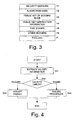
- FIG. 3 the structure of the header according to the first embodiment is described. It is noted that the structure shown in the drawing does not necessarily represent the actual order of the headers, but gives an overview about the header fields according to the embodiment.
- the new security header includes the following information, which are referred to as the validity information.
- Security services (field H1): this field informs the receiving nodes about the security services that have been applied to the packet (e.g. encryption, integrity protection, etc.).
- field H3 may contain a pointer to the sender's public key since the public key itself may be too long to be carried in the packet, as described above.
- This information indicates how the receiving nodes can make sure that the Public Key belongs to the claimed entity (i.e., the sending node). This could e.g. include a Certificate, or just the indication that CGA has been applied (CGA: Cryptographically Generated Address, as described, for example, in Cryptographically Generated Addresses by Tuomas Aura, February 2003, (http://www.ietf.org/internet-drafts/draft-aura-cga-00.txt ) .
- this field could carry a pointer comprising information as to where to retrieve the relevant certificate to verify the validity of this packet.
- the pointer may include the address of a corresponding server, for example, and a more detailed address for accessing a database within this server, for example.
- Fig. 3 other headers necessary for the packet (e.g., addresses and the like) are denoted by the field H6.
- the actual payload of the packet is denoted by the reference sign P.
- the receiving node B and intermediate node(s) C can check the validity of the packet based only on the received validity information.
- step S41 the validity information is extracted from the header of a received packet.
- step S42 the validity check is performed, and depending on the result (i.e., whether the packet fails or passes validity check), the packet is accepted (step S43), or a failure procedure is started (step S44).
- the failure procedure may be discarding of the packet and/or informing the user of the receiving and/or sending node that the packet has be corrupted.
- the packet is forwarded after it has been accepted in step S43.
- the validity check is performed based on the information contained in the different field of the security header according to the embodiment of the description.
- the security services information in field H1 indicates to the validity check function B1/C1 of the receiving/middle node which security service is present. That is, based on this information the validity check function can decide how the validity check has to be performed.
- the field H2 comprising the algorithm information indicates which algorithm the validity check function has to use in order to perform the validity check.
- the field H3 indicates the public key of the sending node which is required to compute a key in order to check the validity. If necessary, the information in field H4 can be used to verify that the received public key is indeed the public key of the sending node.
- the information in field H5 (time stamp) can be used to check whether the packet is still "valid", or whether it is out-of-date, in order to avoid a replay attack.
- the receiving node or an intermediate node can perform a validity verification without relying on a security association or preset public key values or the like. That is, the receiving node and intermediate nodes can perform the validity check independently from further security information.
- the new security header according to the invention can be used, for example:
- the intermediate nodes will be able to verify the validity of the packets.
- the sender will sign the messages using the Private Key corresponding to the Public Key sent in the message header.
- IPsec As when IPsec was first deployed, for legacy network entities, this invention can be implemented using a "Bump In the Stack” implementation (also described in S. Kent, R. Atkinson, "Security Architecture for the Internet Protocol", RFC 2401, November 1998 ). That is, in “Bump-in-the-stack” (BITS) implementations, IPsec is implemented “underneath" an existing implementation of an IP protocol stack, between the native IP and the local network drivers. Source code access for the IP stack is not required in this context, making this implementation approach appropriate for use with legacy systems. This approach, when it is adopted, is usually employed in hosts.
- BIOS Bump-in-the-stack
- the present invention can be implemented as described above with respect to Figs. 1 to 4 .
- Fig. 5 illustrates a further possible format.
- time stamp was given as an example for a mechanism to prevent replay attack.
- other suitable mechanisms to prevent replay attacks can be used. That is, in the header some other suitable information item for preventing replay attacks may be introduced.
- not every single packet will contain the security header.
- the security header is added only to some specific packets.
- Possible applications are Mobile IPv6 and NSIS (Next Steps In signaling, described in http://www.ietf.org/html.charters/nsis-charter.html , for example) .
- Mobile IPv6 in order to allow firewalls to be able to process Mobile IPv6 packets correctly and therefore detect, read and authenticate Binding Update messages without requiring the FW and the MN to have a pre-shared security relation, only packets containing Binding Update messages need to have such security header.
- NSIS signaling used e.g. in the TIST meaning (i.e.
- the amount of information to be included in the communication packets as a whole is reduced, since only a part of the packets contain the security header according to the invention. Moreover, the operation load is reduced since not every single packet has to be checked with respect to the validity thereof.
- the above embodiments can be freely combined. For example, there may be cases where for one kind of communication (e.g., requiring a high degree of security) every single packet contains the security header, whereas for other kinds of communication only a part of the packets contain the security header.
- public keys may be stored in some database. Therefore, a protocol may be adapted by which the public key can be retrieved from such a database.
- a protocol may be adapted by which the public key can be retrieved from such a database.
- Such a protocl is defined for SKIP, for example, such that this existing protocol can easily be adapted. It is noted that there is only one retrieval necessary for a series of packets, since all packets within one communication will carry the same public key. This also reduces the amount of information to be carried with in a header.
- the validity information in the header may comprise the entity (e.g., the database) from which the public key can be obtained.
- the validity information may comprise a public key identifier for the public key.
- intermediate network node C In addition, in the first embodiment only one intermediate network node C has been described. However, there may be a plurality of intermediate network nodes adapted to perform a validity verification.
Landscapes
- Engineering & Computer Science (AREA)
- Computer Security & Cryptography (AREA)
- Signal Processing (AREA)
- Computer Networks & Wireless Communication (AREA)
- Theoretical Computer Science (AREA)
- Computing Systems (AREA)
- Mathematical Optimization (AREA)
- Mathematical Physics (AREA)
- Pure & Applied Mathematics (AREA)
- Physics & Mathematics (AREA)
- Mathematical Analysis (AREA)
- General Physics & Mathematics (AREA)
- Algebra (AREA)
- Computer Hardware Design (AREA)
- General Engineering & Computer Science (AREA)
- Data Exchanges In Wide-Area Networks (AREA)
Claims (31)
- Verfahren zum Schützen von Paketen, die von einem ersten Netzwerkknoten (A) zu einem zweiten Netzwerkknoten (B) zu senden sind, mit
Erzeugen (S21) von Gültigkeitsinformationen für ein Paket;
Erzeugen (S22) eines Header für das Paket mit den Gültigkeitsinformationen,
Senden (S22) des Pakets mit dem Header von dem ersten Netzwerkknoten zu dem zweiten Netzwerkknoten,
dadurch gekennzeichnet, dass
die Gültigkeitsinformationen alle nötigen Informationen aufweisen, die zur Durchführung einer Gültigkeitsprüfung des Pakets erforderlich sind, und die Gültigkeitsinformationen Algorithmusinformationen (H2) aufweisen, die zur Durchführung einer Gültigkeitsprüfung des Pakets zu verwenden sind,
wobei die Algorithmusinformationen (H2) einen zur Durchführung einer Gültigkeitsprüfung des Pakets zu verwendenden Algorithmus angeben und Werte zum Initialisieren des zur Durchführung einer Gültigkeitsprüfung des Pakets zu verwendenden Algorithmus aufweisen. - Verfahren nach Anspruch 1, wobei die Gültigkeitsinformationen Sicherheitsinformationen (H1) aufweisen, die an dem Paket angewendete Sicherheitsdienste angeben.
- Verfahren nach Anspruch 1, wobei die Gültigkeitsinformationen Informationen bezüglich eines öffentlichen Schlüssels des sendenden Knotens (H3) aufweisen.
- Verfahren nach Anspruch 3, wobei die Informationen bezüglich des öffentlichen Schlüssels (H3) Referenzinformationen aufweisen, wie der öffentliche Schlüssel erhalten werden kann.
- Verfahren nach Anspruch 4, wobei die Referenzinformationen eine Identität einer Einheit aufweisen, von der der öffentliche Schlüssel erhalten werden kann.
- Verfahren nach Anspruch 4, wobei die Referenzinformationen einen öffentlichen Schlüsselidentifizierer für den öffentlichen Schlüssel aufweisen.
- Verfahren nach Anspruch 3, wobei die Informationen bezüglich des öffentlichen Schlüssels (H3) den öffentlichen Schlüssel selbst aufweisen.
- Verfahren nach Anspruch 3, wobei die Informationen bezüglich des öffentlichen Schlüssels öffentliche Schlüsselverifizierungsinformationen (H4) aufweisen, die Informationen angeben, um zu verifizieren, dass der öffentliche Schlüssel tatsächlich zu dem sendenden Knoten gehört.
- Verfahren nach Anspruch 1, wobei die Gültigkeitsinformationen eine Information zum Verhindern von Replay-Angriffen (H5) aufweisen.
- Verfahren nach Anspruch 9, wobei die Information zum Verhindern von Replay-Angriffen (H5) die Angabe des Verfahrens enthält, das für Anti-Replay-Angriffe zu verwenden ist.
- Verfahren nach Anspruch 9, wobei die Information zum Verhindern von Replay-Angriffen (H5) einen Zeitstempel enthält.
- Verfahren nach Anspruch 3, weiterhin mit
Signieren des Pakets unter Verwendung eines privaten Schlüssels entsprechend dem öffentlichen Schlüssel, der durch die Gültigkeitsinformationen in dem Paket-Header (H3) angegeben ist, in dem sendenden Netzwerkknoten. - Verfahren nach Anspruch 1, weiterhin mit
Durchführen einer Gültigkeitsprüfung (S42) eines Pakets durch Bezugnahme auf die Gültigkeitsinformationen, die in dem Header des Pakets enthalten sind, in dem empfangenen Knoten. - Verfahren nach Anspruch 1, weiterhin mit
Durchführen einer Gültigkeitsprüfung (S42) eines Pakets durch Bezugnahme auf die Gültigkeitsinformationen, die in dem Header des Pakets enthalten sind, in einem Zwischenknoten. - Netzwerkknoten (A) zum Senden von Paketen zu einem empfangenen Netzwerkknoten, mit
einer Einrichtung (A1) zum Erzeugen von Gültigkeitsinformationen für ein Paket;
einer Einrichtung (A1) zum Erzeugen eines Headers für das Paket mit den Gültigkeitsinformationen,
einer Einrichtung zum Senden des Pakets einschließlich des Headers zu dem empfangenen Netzwerkknoten,
wobei die Gültigkeitsinformationen alle nötigen Informationen aufweisen, die zur Durchführung einer Gültigkeitsprüfung des Pakets erforderlich sind, und die Gültigkeitsinformationen Algorithmusinformationen (H2) aufweisen, die zur Durchführung einer Gültigkeitsprüfung des Pakets zu verwenden sind,
wobei die Algorithmusinformationen (H2) einen zur Durchführung einer Gültigkeitsprüfung des Pakets zu verwendenden Algorithmus angeben und Werte zum Initialisieren des zur Durchführung einer Gültigkeitsprüfung des Pakets zu verwendenden Algorithmus aufweisen. - Netzwerkknoten (B) zum Empfangen von Paketen von einem sendenden Netzwerkknoten, mit
einer Einrichtung (B1) zur Durchführung einer Gültigkeitsprüfung eines Pakets durch Beziehen auf Gültigkeitsinformationen, die in dem Header des Pakets enthalten sind,
wobei die Gültigkeitsinformationen alle nötigen Informationen aufweisen, die zur Durchführung einer Gültigkeitsprüfung des Pakets erforderlich sind, und die Gültigkeitsinformationen Algorithmusinformationen (H2) aufweisen, die zur Durchführung einer Gültigkeitsprüfung des Pakets zu verwenden sind,
wobei die Algorithmusinformationen (H2) einen zur Durchführung einer Gültigkeitsprüfung des Pakets zu verwendenden Algorithmus angeben und Werte zum Initialisieren des zur Durchführung einer Gültigkeitsprüfung des Pakets zu verwendenden Algorithmus aufweisen. - Netzwerkknoten (C) zum Weiterleiten von Paketen von einem sendenden Netzwerkknoten zu einem empfangenden Netzwerkknoten, mit
einer Einrichtung (C1) zur Durchführung einer Gültigkeitsprüfung eines Pakets durch Beziehen auf Gültigkeitsinformationen, die in dem Header des Pakets enthalten sind,
wobei die Gültigkeitsinformationen alle nötigen Informationen aufweisen, die zur Durchführung einer Gültigkeitsprüfung des Pakets erforderlich sind, und die Gültigkeitsinformationen Algorithmusinformationen (H2) aufweisen, die zur Durchführung einer Gültigkeitsprüfung des Pakets zu verwenden sind,
wobei die Algorithmusinformationen (H2) einen zur Durchführung einer Gültigkeitsprüfung des Pakets zu verwendenden Algorithmus angeben und Werte zum Initialisieren des zur Durchführung einer Gültigkeitsprüfung des Pakets zu verwendenden Algorithmus aufweisen. - Netzwerkknoten nach einem der Ansprüche 15 bis 17, wobei die Gültigkeitsinformationen Sicherheitsinformationen (H1) aufweisen, die an dem Paket angewendete Sicherheitsdienste angeben.
- Netzwerkknoten nach einem der Ansprüche 15 bis 17, wobei die Gültigkeitsinformationen Informationen bezüglich eines öffentlichen Schlüssels des sendenden Knotens (H3) aufweisen.
- Netzwerkknoten nach Anspruch 19, wobei die Informationen bezüglich des öffentlichen Schlüssels (H3) Referenzinformationen aufweisen, wie der öffentliche Schlüssel erhalten werden kann.
- Netzwerkknoten nach Anspruch 20, wobei die Referenzinformationen eine Identität einer Einheit aufweisen, von der der öffentliche Schlüssel erhalten werden kann.
- Netzwerkknoten nach Anspruch 20, wobei die Referenzinformationen einen öffentlichen Schlüsselidentifizierer für den öffentlichen Schlüssel aufweisen.
- Netzwerkknoten nach Anspruch 19, wobei die Informationen bezüglich des öffentlichen Schlüssels (H3) den öffentlichen Schlüssel selbst aufweisen.
- Netzwerkknoten nach Anspruch 19, wobei die Informationen bezüglich des öffentlichen Schlüssels öffentliche Schlüsselverifizierungsinformationen (H4) aufweisen, die Informationen angeben, um zu verifizieren, dass der öffentliche Schlüssel tatsächlich zu dem sendenden Knoten gehört.
- Netzwerkknoten nach einem der Ansprüche 15 bis 17, wobei die Gültigkeitsinformationen eine Information zum Verhindern von Replay-Angriffen (H5) aufweisen.
- Netzwerkknoten nach Anspruch 25, wobei die Information zum Verhindern von Replay-Angriffen (H5) die Angabe des Verfahrens enthält, das für Anti-Replay-Angriffe zu verwenden ist.
- Netzwerkknoten nach Anspruch 25, wobei die Information zum Verhindern von Replay-Angriffen (H5) einen Zeitstempel enthält.
- Netzwerkknoten nach Anspruch 19 weiterhin mit
einer Einrichtung zum Signieren des Pakets unter Verwendung eines privaten Schlüssels entsprechend dem öffentlichen Schlüssel, der durch die Gültigkeitsinformationen in dem Paket-Header (H3) angegeben ist, in dem sendenden Netzwerkknoten. - Netzwerkknoten nach einem der Ansprüche 15 bis 17, wobei der Netzwerkknoten ein mobiler Netzwerkknoten ist.
- Netzwerksystem mit einem Netzwerkknoten (A) nach Anspruch 15, der eingerichtet ist, ein Paket zu senden, und einen Netzwerkknoten (B) nach Anspruch 16, der eingerichtet ist, das Paket zu empfangen.
- Netzwerksystem nach Anspruch 30, weiterhin mit zumindest einem Zwischenknoten (C) nach Anspruch 17.
Applications Claiming Priority (3)
| Application Number | Priority Date | Filing Date | Title |
|---|---|---|---|
| US48276303P | 2003-06-27 | 2003-06-27 | |
| US10/721,504 US20040268123A1 (en) | 2003-06-27 | 2003-11-26 | Security for protocol traversal |
| PCT/IB2004/002086 WO2005002172A1 (en) | 2003-06-27 | 2004-06-23 | Security for protocol traversal |
Publications (2)
| Publication Number | Publication Date |
|---|---|
| EP1639780A1 EP1639780A1 (de) | 2006-03-29 |
| EP1639780B1 true EP1639780B1 (de) | 2013-02-27 |
Family
ID=33544581
Family Applications (1)
| Application Number | Title | Priority Date | Filing Date |
|---|---|---|---|
| EP04737139A Expired - Lifetime EP1639780B1 (de) | 2003-06-27 | 2004-06-23 | Sicherheit für protokoll-traversal |
Country Status (3)
| Country | Link |
|---|---|
| US (1) | US20040268123A1 (de) |
| EP (1) | EP1639780B1 (de) |
| WO (1) | WO2005002172A1 (de) |
Families Citing this family (21)
| Publication number | Priority date | Publication date | Assignee | Title |
|---|---|---|---|---|
| US7530112B2 (en) * | 2003-09-10 | 2009-05-05 | Cisco Technology, Inc. | Method and apparatus for providing network security using role-based access control |
| US7836490B2 (en) | 2003-10-29 | 2010-11-16 | Cisco Technology, Inc. | Method and apparatus for providing network security using security labeling |
| CN1886953A (zh) * | 2003-11-28 | 2006-12-27 | 松下电器产业株式会社 | 通信切换方法、通信消息处理方法、利用计算机执行这些方法的程序、以及通信系统 |
| US20050268331A1 (en) * | 2004-05-25 | 2005-12-01 | Franck Le | Extension to the firewall configuration protocols and features |
| US7669244B2 (en) | 2004-10-21 | 2010-02-23 | Cisco Technology, Inc. | Method and system for generating user group permission lists |
| US7877796B2 (en) | 2004-11-16 | 2011-01-25 | Cisco Technology, Inc. | Method and apparatus for best effort propagation of security group information |
| US7886145B2 (en) * | 2004-11-23 | 2011-02-08 | Cisco Technology, Inc. | Method and system for including security information with a packet |
| US7721323B2 (en) * | 2004-11-23 | 2010-05-18 | Cisco Technology, Inc. | Method and system for including network security information in a frame |
| US7827402B2 (en) * | 2004-12-01 | 2010-11-02 | Cisco Technology, Inc. | Method and apparatus for ingress filtering using security group information |
| KR100680177B1 (ko) * | 2004-12-30 | 2007-02-08 | 삼성전자주식회사 | 홈 네트워크 외부에서 사용자를 인증하는 방법 |
| US8051489B1 (en) * | 2005-03-18 | 2011-11-01 | Oracle America, Inc. | Secure configuration of a wireless sensor network |
| US8281383B2 (en) * | 2006-12-11 | 2012-10-02 | Cisco Technology, Inc. | Secured IPv6 traffic preemption |
| US8166534B2 (en) * | 2007-05-18 | 2012-04-24 | Microsoft Corporation | Incorporating network connection security levels into firewall rules |
| US7840708B2 (en) * | 2007-08-13 | 2010-11-23 | Cisco Technology, Inc. | Method and system for the assignment of security group information using a proxy |
| JP5589410B2 (ja) * | 2010-01-29 | 2014-09-17 | 沖電気工業株式会社 | 通信システム及び通信装置 |
| KR20140052243A (ko) * | 2012-10-23 | 2014-05-07 | 한국전자통신연구원 | 네트워크 데이터 서비스 장치 및 방법, 네트워크 데이터 서비스를 위한 클라이언트 단말 장치 |
| US9391781B2 (en) | 2013-06-04 | 2016-07-12 | Altera Corporation | Systems and methods for intermediate message authentication in a switched-path network |
| EP3248360B1 (de) | 2015-01-19 | 2020-05-06 | Inauth, Inc. | Systeme und verfahren für sichere kommunikation mit sicherem weg |
| US10897457B2 (en) * | 2017-04-17 | 2021-01-19 | International Business Machines Corporation | Processing of IoT data by intermediaries |
| US10966091B1 (en) * | 2017-05-24 | 2021-03-30 | Jonathan Grier | Agile node isolation using packet level non-repudiation for mobile networks |
| CN113395247B (zh) * | 2020-03-11 | 2023-01-13 | 华为技术有限公司 | 一种防止对SRv6 HMAC校验进行重放攻击的方法和设备 |
Family Cites Families (27)
| Publication number | Priority date | Publication date | Assignee | Title |
|---|---|---|---|---|
| US5175765A (en) * | 1989-05-09 | 1992-12-29 | Digital Equipment Corporation | Robust data broadcast over a distributed network with malicious failures |
| US5455865A (en) * | 1989-05-09 | 1995-10-03 | Digital Equipment Corporation | Robust packet routing over a distributed network containing malicious failures |
| US5081678A (en) * | 1989-06-28 | 1992-01-14 | Digital Equipment Corporation | Method for utilizing an encrypted key as a key identifier in a data packet in a computer network |
| US5680461A (en) * | 1995-10-26 | 1997-10-21 | Sun Microsystems, Inc. | Secure network protocol system and method |
| WO1998002815A1 (en) | 1996-07-12 | 1998-01-22 | Glenayre Electronics, Inc. | Apparatus and methods for transmission security in a computer network |
| AU743258B2 (en) * | 1997-01-03 | 2002-01-24 | Fortress Technologies, Inc. | Improved network security device |
| DE19727267A1 (de) * | 1997-06-26 | 1999-01-07 | Siemens Ag | Verfahren und Computersystem zur Codierung einer digitalen Nachricht, zur Übertragung der Nachricht von einer ersten Computereinheit zu einer zweiten Computereinheit und zur Decodierung der Nachricht |
| US6084969A (en) * | 1997-12-31 | 2000-07-04 | V-One Corporation | Key encryption system and method, pager unit, and pager proxy for a two-way alphanumeric pager network |
| US7233948B1 (en) * | 1998-03-16 | 2007-06-19 | Intertrust Technologies Corp. | Methods and apparatus for persistent control and protection of content |
| US6389532B1 (en) * | 1998-04-20 | 2002-05-14 | Sun Microsystems, Inc. | Method and apparatus for using digital signatures to filter packets in a network |
| US6295604B1 (en) * | 1998-05-26 | 2001-09-25 | Intel Corporation | Cryptographic packet processing unit |
| US6202081B1 (en) * | 1998-07-21 | 2001-03-13 | 3Com Corporation | Method and protocol for synchronized transfer-window based firewall traversal |
| US6725371B1 (en) * | 1999-06-30 | 2004-04-20 | Intel Corporation | Secure packet processor |
| US7200230B2 (en) * | 2000-04-06 | 2007-04-03 | Macrovision Corporation | System and method for controlling and enforcing access rights to encrypted media |
| US7177421B2 (en) * | 2000-04-13 | 2007-02-13 | Broadcom Corporation | Authentication engine architecture and method |
| JP2001308841A (ja) * | 2000-04-21 | 2001-11-02 | Sony Corp | 送信装置および送信方法、受信装置および受信方法、ならびに、送受信システムおよび送受信方法 |
| EP1187415A1 (de) * | 2000-09-05 | 2002-03-13 | Siemens Aktiengesellschaft | Verfahren zur Identifikation von Internet-Nutzern |
| JP2002208922A (ja) * | 2001-01-12 | 2002-07-26 | Ntt Docomo Inc | 暗号化装置および復号装置ならびに認証情報付与装置、暗号化方法、復号方法、認証情報付与方法 |
| GB2367986B (en) * | 2001-03-16 | 2002-10-09 | Ericsson Telefon Ab L M | Address mechanisms in internet protocol |
| DE10142498A1 (de) * | 2001-08-30 | 2003-03-27 | Siemens Ag | Verfahren zur Ver- und Entschlüsselung von Kommunikationsdaten |
| US7113601B2 (en) * | 2001-09-26 | 2006-09-26 | Mohan Ananda | Method and apparatus for performing secure communications |
| US7143443B2 (en) * | 2001-10-01 | 2006-11-28 | Ntt Docomo, Inc. | Secure sharing of personal devices among different users |
| US6829685B2 (en) * | 2001-11-15 | 2004-12-07 | International Business Machines Corporation | Open format storage subsystem apparatus and method |
| DE60326570D1 (de) * | 2002-05-29 | 2009-04-23 | Panasonic Corp | Bertragungssystem und datenübertragungsverfahren |
| US7376125B1 (en) * | 2002-06-04 | 2008-05-20 | Fortinet, Inc. | Service processing switch |
| CN1685689B (zh) * | 2002-09-30 | 2012-12-26 | 松下电器产业株式会社 | 控制家庭终端的装置、通信方法和通信系统 |
| US7409544B2 (en) * | 2003-03-27 | 2008-08-05 | Microsoft Corporation | Methods and systems for authenticating messages |
-
2003
- 2003-11-26 US US10/721,504 patent/US20040268123A1/en not_active Abandoned
-
2004
- 2004-06-23 WO PCT/IB2004/002086 patent/WO2005002172A1/en not_active Ceased
- 2004-06-23 EP EP04737139A patent/EP1639780B1/de not_active Expired - Lifetime
Also Published As
| Publication number | Publication date |
|---|---|
| EP1639780A1 (de) | 2006-03-29 |
| US20040268123A1 (en) | 2004-12-30 |
| WO2005002172A1 (en) | 2005-01-06 |
Similar Documents
| Publication | Publication Date | Title |
|---|---|---|
| EP1639780B1 (de) | Sicherheit für protokoll-traversal | |
| Kaufman | Internet key exchange (IKEv2) protocol | |
| US6353891B1 (en) | Control channel security for realm specific internet protocol | |
| US9838362B2 (en) | Method and system for sending a message through a secure connection | |
| Gurtov | Host identity protocol (HIP): towards the secure mobile internet | |
| US7036010B2 (en) | Method and apparatus for a secure communications session with a remote system via an access-controlling intermediate system | |
| US6976177B2 (en) | Virtual private networks | |
| USRE46113E1 (en) | Technique for maintaining secure network connections | |
| EP1036460B1 (de) | Verfahren zur paketauthentifizierung in gegenwart von netzwerkadressübersetzungen und protokollumwandlungen | |
| US7434045B1 (en) | Method and apparatus for indexing an inbound security association database | |
| EP1880525B1 (de) | Verfahren und vorrichtung für das host-identitäts-protokoll | |
| JP2004295891A (ja) | パケットペイロードを認証する方法 | |
| EP1635502A1 (de) | Sitzungssteuerserver und kommunikationssystem | |
| US20140181967A1 (en) | Providing-replay protection in systems using group security associations | |
| CN101156348A (zh) | 使用配对函数在各方之间的通信中确保保密的方法和设备 | |
| Richardson et al. | Opportunistic encryption using the internet key exchange (ike) | |
| CN103312668B (zh) | 一种基于链路管理协议安全联盟的消息传送方法及装置 | |
| US20100275008A1 (en) | Method and apparatus for secure packet transmission | |
| Hohendorf et al. | Secure End-to-End Transport Over SCTP. | |
| JP2003244194A (ja) | データ暗号装置及び暗号通信処理方法及びデータ中継装置 | |
| KR100450774B1 (ko) | NAT 기능을 갖는 사설망에서 IPSec을 이용한종단과 종단 간의 private 정보 전송 방법 및 이를이용한 보안 서비스 방법 | |
| JP2001111612A (ja) | 情報漏洩防止方法およびシステム並びに情報漏洩防止プログラムを記録した記録媒体 | |
| Hohendorf et al. | Secure end-to-end transport over sctp | |
| WO2025018931A1 (en) | Internet protocol security anti-replay | |
| Skurichinas | Public-Key Distribution and Acquisition services over SMS |
Legal Events
| Date | Code | Title | Description |
|---|---|---|---|
| PUAI | Public reference made under article 153(3) epc to a published international application that has entered the european phase |
Free format text: ORIGINAL CODE: 0009012 |
|
| 17P | Request for examination filed |
Effective date: 20051201 |
|
| AK | Designated contracting states |
Kind code of ref document: A1 Designated state(s): DE FR GB |
|
| DAX | Request for extension of the european patent (deleted) | ||
| RBV | Designated contracting states (corrected) |
Designated state(s): DE FR GB |
|
| 17Q | First examination report despatched |
Effective date: 20070117 |
|
| RIN1 | Information on inventor provided before grant (corrected) |
Inventor name: FACCIN, STEFANO, M. Inventor name: LE, FRANCK |
|
| RAP1 | Party data changed (applicant data changed or rights of an application transferred) |
Owner name: 2011 INTELLECTUAL PROPERTY ASSET TRUST |
|
| RAP1 | Party data changed (applicant data changed or rights of an application transferred) |
Owner name: CORE WIRELESS LICENSING S.A.R.L. |
|
| GRAP | Despatch of communication of intention to grant a patent |
Free format text: ORIGINAL CODE: EPIDOSNIGR1 |
|
| RIC1 | Information provided on ipc code assigned before grant |
Ipc: H04L 29/06 20060101AFI20120801BHEP |
|
| GRAS | Grant fee paid |
Free format text: ORIGINAL CODE: EPIDOSNIGR3 |
|
| GRAA | (expected) grant |
Free format text: ORIGINAL CODE: 0009210 |
|
| AK | Designated contracting states |
Kind code of ref document: B1 Designated state(s): DE FR GB |
|
| REG | Reference to a national code |
Ref country code: GB Ref legal event code: FG4D |
|
| REG | Reference to a national code |
Ref country code: DE Ref legal event code: R096 Ref document number: 602004041139 Country of ref document: DE Effective date: 20130425 |
|
| PLBE | No opposition filed within time limit |
Free format text: ORIGINAL CODE: 0009261 |
|
| STAA | Information on the status of an ep patent application or granted ep patent |
Free format text: STATUS: NO OPPOSITION FILED WITHIN TIME LIMIT |
|
| 26N | No opposition filed |
Effective date: 20131128 |
|
| REG | Reference to a national code |
Ref country code: DE Ref legal event code: R097 Ref document number: 602004041139 Country of ref document: DE Effective date: 20131128 |
|
| REG | Reference to a national code |
Ref country code: FR Ref legal event code: PLFP Year of fee payment: 12 |
|
| PGFP | Annual fee paid to national office [announced via postgrant information from national office to epo] |
Ref country code: GB Payment date: 20150617 Year of fee payment: 12 Ref country code: DE Payment date: 20150616 Year of fee payment: 12 |
|
| PGFP | Annual fee paid to national office [announced via postgrant information from national office to epo] |
Ref country code: FR Payment date: 20150608 Year of fee payment: 12 |
|
| REG | Reference to a national code |
Ref country code: DE Ref legal event code: R119 Ref document number: 602004041139 Country of ref document: DE |
|
| GBPC | Gb: european patent ceased through non-payment of renewal fee |
Effective date: 20160623 |
|
| REG | Reference to a national code |
Ref country code: FR Ref legal event code: ST Effective date: 20170228 |
|
| PG25 | Lapsed in a contracting state [announced via postgrant information from national office to epo] |
Ref country code: DE Free format text: LAPSE BECAUSE OF NON-PAYMENT OF DUE FEES Effective date: 20170103 Ref country code: FR Free format text: LAPSE BECAUSE OF NON-PAYMENT OF DUE FEES Effective date: 20160630 |
|
| PG25 | Lapsed in a contracting state [announced via postgrant information from national office to epo] |
Ref country code: GB Free format text: LAPSE BECAUSE OF NON-PAYMENT OF DUE FEES Effective date: 20160623 |