EP1638315A1 - Method and device for processing a video signal aimed at compensating for the defects of display devices - Google Patents
Method and device for processing a video signal aimed at compensating for the defects of display devices Download PDFInfo
- Publication number
- EP1638315A1 EP1638315A1 EP05108361A EP05108361A EP1638315A1 EP 1638315 A1 EP1638315 A1 EP 1638315A1 EP 05108361 A EP05108361 A EP 05108361A EP 05108361 A EP05108361 A EP 05108361A EP 1638315 A1 EP1638315 A1 EP 1638315A1
- Authority
- EP
- European Patent Office
- Prior art keywords
- video signal
- component
- law
- video
- processing
- Prior art date
- Legal status (The legal status is an assumption and is not a legal conclusion. Google has not performed a legal analysis and makes no representation as to the accuracy of the status listed.)
- Granted
Links
Images

Classifications
-
- H—ELECTRICITY
- H04—ELECTRIC COMMUNICATION TECHNIQUE
- H04N—PICTORIAL COMMUNICATION, e.g. TELEVISION
- H04N5/00—Details of television systems
- H04N5/14—Picture signal circuitry for video frequency region
- H04N5/20—Circuitry for controlling amplitude response
- H04N5/202—Gamma control
Definitions
- the invention relates to a method and a device for processing video images aimed at compensating for the defects of certain display devices, in particular nonlinear display devices (for example cathode ray tubes).
- nonlinear display devices for example cathode ray tubes.
- a video signal may be represented in various spaces interlinked by a transfer function.
- the representation space for the colour levels consists of a set of integers, varying for example between 0 and 255.
- the visualization space is, for its part, the space in which the optical signal is generated and perceived.
- the representation space for the colour levels and the visualization space are related by a nonlinear law called the electro-optical transfer function or more commonly the gamma law.
- the luminous intensity reproduced on the screen is therefore a nonlinear function of the colour level at the input of the display device.
- n out N out ⁇ ( n in N in ) ⁇
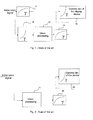
- Figure 1 and Figure 2 illustrate a method of processing according to the state of the art of a video signal pre-corrected (Figure 1) or not ( Figure 2) by an inverse gamma law, aimed at reducing the visual defects due to the display device.
- the transfer function (also called the posterior law subsequently in the document), described previously and referenced 15 in Figure 1, has the feature of attenuating the dark pixels. It is known to pre-correct the initial video signal arising from the camera by an inverse gamma law 11 (also called the anterior law subsequently in the document) so as to compensate for this attenuation before transmitting this signal corrected to the display device. This processing which is generally performed at the level of the camera is not mandatory.
- the value of gamma used to pre-correct the initial video signal is known and specified in various documents in particular the Recommendations of the ITU for television (e.g. ITU-R BT.709-5, Basic Parameters Values for HDTV, ITU-R BT.470-6, Conventional Television System ) .
- the video processing may, for example, be a re-interpolation of video images aimed at correcting distortions in the images. The distortions are due to the display device.
- the brightness of a point of the image may vary depending on whether it is re-interpolated on one or on n pixels.
- the visual sum of the intensities of the n pixels is not the same as that of the pixel alone if the processing space is not a linear space with respect to the visualization space.
- a video signal may be generated and produced by the camera without having previously been pre-corrected by an inverse gamma law 11.
- an inverse gamma law 11 it is known to apply the video processing directly to the initial video signal 21.
- the signal thus obtained is corrected by an inverse gamma law 22, so as to compensate for the attenuation of the dark points introduced by the transfer function of the tube.
- the display device 23 modifies the video signal thus corrected according to the gamma law characteristic of the display device.
- the method according to the state of the art though it makes it possible to correct certain defects (for example attenuation of the dark points), does not take account of certain characteristics of certain display devices which depend on the direction of visualization (e.g. inter-pixel overlap, shape of the spot).
- the application of a global gamma law may cause visual defects.
- the term global gamma law signifies a law which applies in the same manner whether we process the vertical or horizontal components of the video signal. Defects of local attenuation of the red, green and blue signals, generating colour defects are, for example, visible in the case where we apply a processing of re-interpolation of a colour image.
- the present invention proposes a method whose objective is to decrease certain visual defects by applying a different gamma law in each of the processing directions (horizontal and vertical).
- a video signal comprising a horizontal component and a vertical component, before the display of the signal by a display device, according to the following steps:
- the order of processing of the components of the signal is of no importance.
- the intermediate gamma law is a composition of the law associated with the second component and of the inverse gamma law associated with the first component. Specifically, after having processed the signal according to one of these components, it is appropriate to adopt a standpoint in a space which is linear according to the other component. Thus, if the Y component has been processed first, it is subsequently appropriate to adopt a standpoint in a space linear in X.
- the video signal is corrected by the various gamma laws and the intermediate law is applied using correspondence tables which with each input level of the video signal associate an output level calculated according to the appropriate law.
- the first and second video processings are processings of re-interpolation of the video signal, respectively according to the first component and according to the second component of the signal.
- the re-interpolation of the video signal consists of a filtering of the signal, the filter used being a polyphase filter.
- the resolution in terms of number of bits (or dynamic range) of the video signal is increased during the step of correction by a specific gamma law associated with the first component of the video signal, and we return to the initial resolution during the step of correction by a specific inverse gamma law associated with the second component of the video signal.
- This increase in the resolution in terms of number of bits may make it possible to eliminate the remaining quantization artefacts.
- the invention will apply advantageously to nonmatrix display devices.
- the invention also relates to a device intended to implement the method.
- the device comprises:
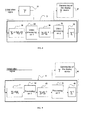
- the method according to the invention is illustrated by Figures 3 and 4. It is referenced 3 in Figure 3 and 4 in Figure 4. The method includes 5 steps referenced 32 to 36 in Figure 3 and referenced 41 to 45 in Figure 4.
- the first step 32 of the method 3 (step 41 in the method 4) according to the invention consists in adopting a standpoint in a linear space in Y.
- a law ⁇ Y characteristic of the vertical direction is applied to the initial video signal, pre-corrected 31 or otherwise by a global inverse gamma law.
- a correspondence table which will associate with each input level an output level calculated according to the appropriate inverse gamma law.
- the resolution in terms of number of bits may be increased. This will make it possible in particular to eliminate certain quantization artefacts.
- the subsequent steps will therefore be carried out with a larger dynamic range in terms of number of bits and a return to the initial dynamic range will be effected upon the application of the last gamma law.
- ⁇ Y is estimated directly according to a procedure described subsequently in the document. The gamma law being known, we deduce the law ⁇ Y therefrom.
- a video processing making it possible to correct these distortions is applied to the video signal.
- This processing may for example be a filtering of the images of the video sequence. More precisely, it will be possible to apply a processing of re-interpolation of the images. It will also be possible to apply another video processing addressing a particular technical requirement of the display device.
- the second step according to the invention 33, 42 therefore consists in re-interpolating the video image in Y by applying to the pixels a filter dependent on the Y displacement to be effected.
- a filter dependent on the Y displacement to be effected It will for example be possible to apply a polyphase filter whose phase will be calculated on the basis of the shift in the position of the point to be calculated. Thus the phase will be zero if the point lies on the initial grid. It will be +0.5 if, the point is shifted by 1/2 of a pixel with respect to the initial grid.
- any other type of filter making it possible to re-interpolate an image (e.g. bicubic, bilinear filter).
- the horizontal components of the video signal are processed. It is then necessary to adopt a standpoint in a linear space in X.
- the following intermediate function ⁇ intermediate ⁇ x o ⁇ Y -1 is applied to the video signal arising from the previous step.
- ⁇ intermediate ⁇ x o ⁇ Y -1
- the function ⁇ x will be estimated with the procedure described later in the description.
- the fourth step 35, 44 therefore consists in re-interpolating the video image in X by applying to the pixels a filter dependent on the X displacement to be effected.
- the fifth step 36, 45 consists in correcting the signal processed by applying to the signal the law ⁇ -1 x characteristic of the horizontal direction.
- this step it will also be possible to use a correspondence table which will restore the initial dynamic range if the latter was modified.
- the video signal thus processed will thereafter be displayed by the display device 37, 46.
- the procedure for estimating the gamma law will be adapted so as to estimate the laws ⁇ x and ⁇ Y .
- ⁇ x we display only horizontal lines 1 pixel high, separated by a sufficient number of black lines so as to eliminate the Y influences that may intervene from pixel to pixel (for example 4 black lines).
- L(n) light level
- ⁇ x 255*L(n)/L(255).
- ⁇ Y 255*L(n)/L(255).
- the inventive method can also be applied to laws other than gamma laws for correcting video signals.
- the invention also relates to a device 5 linked to a display device 54 aimed at implementing the method described previously. Only the essential elements of the device are represented in Figure 5.
- the device according to the invention contains in particular a memory 52 in which are stored the correspondence tables used for the processing by the various gamma laws 32, 34, 36, 41, 43, 45.
- the device also comprises a processing unit 53 such as a microprocessor or the like comprising the processing programs, in particular the re-interpolation program.
- the processing unit also comprises the conversion functions allowing the processing by the various gamma laws 32, 34, 36, 41, 43, 45. These functions utilize the correspondence tables stored in the memory.
- the device contains an input/output interface 51 for receiving the input video signal, pre-corrected or otherwise by the gamma law, and transmitting the video signal processed according to the method 3, 4 of the invention to the display device.
Landscapes
- Engineering & Computer Science (AREA)
- Multimedia (AREA)
- Signal Processing (AREA)
- Picture Signal Circuits (AREA)
- Controls And Circuits For Display Device (AREA)
- Processing Of Color Television Signals (AREA)
- Transforming Electric Information Into Light Information (AREA)
- Liquid Crystal Display Device Control (AREA)
Abstract
- correction (32) of a video signal by a specific gamma law associated with a first component from among said horizontal and vertical components of said video signal,
- first video processing (33) acting on said first component of the corrected video signal,
- application (34), to the video signal processed, of an intermediate law effecting the transfer from a space which is linear with respect to the first component to a space which is linear with respect to the other of said components, called the second component,
- second video processing (35) acting on the second component of the video signal emanating from the previous step, and
- correction (36) of the video signal processed by a specific inverse gamma law associated with the second component.
Description
- The invention relates to a method and a device for processing video images aimed at compensating for the defects of certain display devices, in particular nonlinear display devices (for example cathode ray tubes).
- A video signal may be represented in various spaces interlinked by a transfer function. Thus, the representation space for the colour levels consists of a set of integers, varying for example between 0 and 255. The visualization space is, for its part, the space in which the optical signal is generated and perceived.
- In most video image display devices, the representation space for the colour levels and the visualization space are related by a nonlinear law called the electro-optical transfer function or more commonly the gamma law. The luminous intensity reproduced on the screen is therefore a nonlinear function of the colour level at the input of the display device.
- The transfer function relating the two representation spaces is characteristic of the type of display device. In the case of cathode ray tubes, the gamma law of the tube has the following form:

- nin is the input level,
- nout is the output level,
- Nin is the maximum level characterizing nin,
- Nout is the maximum level characterizing nout,
- γ is the coefficient characterizing the transfer function.
- According to the state of the art, it is known, in order to estimate the gamma law of a display device, to display on the latter a series of uniform images whose level varies from 0 to 255. We then measure the light level L(n) emitted by the screen for each input level n, then we normalize this curve by the maximum of these input levels: γ = 255*L(n)/L(255).
- Figure 1 and Figure 2 illustrate a method of processing according to the state of the art of a video signal pre-corrected (Figure 1) or not (Figure 2) by an inverse gamma law, aimed at reducing the visual defects due to the display device.
- The transfer function (also called the posterior law subsequently in the document), described previously and referenced 15 in Figure 1, has the feature of attenuating the dark pixels. It is known to pre-correct the initial video signal arising from the camera by an inverse gamma law 11 (also called the anterior law subsequently in the document) so as to compensate for this attenuation before transmitting this signal corrected to the display device. This processing which is generally performed at the level of the camera is not mandatory. The value of gamma used to pre-correct the initial video signal is known and specified in various documents in particular the Recommendations of the ITU for television (e.g. ITU-R BT.709-5, Basic Parameters Values for HDTV, ITU-R BT.470-6, Conventional Television System).
- In addition, before displaying the video signal transmitted on the screen, it may be necessary to apply a
video processing 13 to the pre-corrected or not pre-corrected video signals so as for example to improve the quality of the signal which will be displayed. The video processing may, for example, be a re-interpolation of video images aimed at correcting distortions in the images. The distortions are due to the display device. - When such a video processing is applied, it is necessary to work in a space which is linear with respect to the visualization space. Specifically, in the converse case we would see the appearance on the displayed image of processing dependent defects. For example, in the case of a re-interpolation the brightness of a point of the image may vary depending on whether it is re-interpolated on one or on n pixels. Specifically, in this case, the visual sum of the intensities of the n pixels is not the same as that of the pixel alone if the processing space is not a linear space with respect to the visualization space.
- For this purpose, as illustrated in Figure 1, it is known to invert on either side of the
processing block 13, theanterior law 11 if the initial signal has been pre-corrected and to invert theposterior law 15, respectively in theblocks - However, as described previously, a video signal may be generated and produced by the camera without having previously been pre-corrected by an
inverse gamma law 11. In this case, as illustrated in Figure 2, it is known to apply the video processing directly to theinitial video signal 21. The signal thus obtained is corrected by aninverse gamma law 22, so as to compensate for the attenuation of the dark points introduced by the transfer function of the tube. Thedisplay device 23 modifies the video signal thus corrected according to the gamma law characteristic of the display device. - The method according to the state of the art, though it makes it possible to correct certain defects (for example attenuation of the dark points), does not take account of certain characteristics of certain display devices which depend on the direction of visualization (e.g. inter-pixel overlap, shape of the spot).
- Thus, in the case of the application of video processing which successively applies to the horizontal (X) and vertical components of the image (Y), the application of a global gamma law may cause visual defects. The term global gamma law signifies a law which applies in the same manner whether we process the vertical or horizontal components of the video signal. Defects of local attenuation of the red, green and blue signals, generating colour defects are, for example, visible in the case where we apply a processing of re-interpolation of a colour image.
- It is therefore desirable in order to process the video signal to take account of the direction (horizontal or vertical) of processing.
- For this purpose, the present invention proposes a method whose objective is to decrease certain visual defects by applying a different gamma law in each of the processing directions (horizontal and vertical). According to the invention, we propose to process a video signal comprising a horizontal component and a vertical component, before the display of the signal by a display device, according to the following steps:
- correction of the video signal by a specific gamma law associated with a first component from among the horizontal and vertical components of the video signal,
- first video processing acting on the first component of the corrected video signal,
- application, to the video signal processed, of an intermediate law effecting the transfer from a space which is linear with respect to the first component to a space which is linear with respect to the other of the horizontal and vertical components, called the second component,
- second video processing acting on the second component of the video signal emanating from the previous step, and
- correction of the video signal processed by a specific inverse gamma law associated with the second component of the video signal.
- The order of processing of the components of the signal is of no importance.
- According to a preferred embodiment, the intermediate gamma law is a composition of the law associated with the second component and of the inverse gamma law associated with the first component. Specifically, after having processed the signal according to one of these components, it is appropriate to adopt a standpoint in a space which is linear according to the other component. Thus, if the Y component has been processed first, it is subsequently appropriate to adopt a standpoint in a space linear in X.
- According to a preferred embodiment, the video signal is corrected by the various gamma laws and the intermediate law is applied using correspondence tables which with each input level of the video signal associate an output level calculated according to the appropriate law.
- Advantageously, the first and second video processings are processings of re-interpolation of the video signal, respectively according to the first component and according to the second component of the signal.
- According to a preferred embodiment, the re-interpolation of the video signal consists of a filtering of the signal, the filter used being a polyphase filter.
- According to a preferred embodiment, the resolution in terms of number of bits (or dynamic range) of the video signal is increased during the step of correction by a specific gamma law associated with the first component of the video signal, and we return to the initial resolution during the step of correction by a specific inverse gamma law associated with the second component of the video signal. This increase in the resolution in terms of number of bits may make it possible to eliminate the remaining quantization artefacts.
- The invention will apply advantageously to nonmatrix display devices.
- The invention also relates to a device intended to implement the method. According to the invention the device comprises:
- means for correcting the video signal by a specific gamma law associated with a first component from among the horizontal and vertical components of the video signal,
- means for applying a first video processing acting on the first component of the corrected video signal,
- means for applying, to the video signal processed, an intermediate law effecting the transfer from a space which is linear with respect to the first component to a space which is linear with respect to the other of the horizontal and vertical components, called the second component; the means generating an intermediate signal,
- means for applying a second video processing acting on the second component of the intermediate video signal, and
- means for correcting the video signal processed by a specific inverse gamma law associated with the second component of the video signal.
- The invention will be better understood and illustrated by means of wholly nonlimiting advantageous exemplary modes of embodiment and implementation, with reference to the appended figures in which:
- Figure 1 illustrates a method of processing a video signal according to the state of the art, aimed at reducing the visual defects due to the display device, in the case where the initial video signal has been pre-corrected by an inverse gamma law;
- Figure 2 illustrates a method of processing a video signal according to the state of the art, aimed at reducing the visual defects due to the display device, in the case where the initial video signal has not been pre-corrected by an inverse gamma law;
- Figure 3 illustrates a method of processing a video signal according to the invention, aimed at reducing the visual defects due to the display device, in the case where the initial video signal has been pre-corrected by an inverse gamma law;
- Figure 4 illustrates a method of processing a video signal according to the invention, aimed at reducing the visual defects due to the display device, in the case where the initial video signal has not been pre-corrected by an inverse gamma law; and
- Figure 5 illustrates a device for processing a video signal according to the invention, aimed at reducing the visual defects due to the display device.
- The method according to the invention is illustrated by Figures 3 and 4. It is referenced 3 in Figure 3 and 4 in Figure 4. The method includes 5 steps referenced 32 to 36 in Figure 3 and referenced 41 to 45 in Figure 4.
- The
first step 32 of the method 3 (step 41 in the method 4) according to the invention consists in adopting a standpoint in a linear space in Y. For this purpose, a law γY characteristic of the vertical direction is applied to the initial video signal, pre-corrected 31 or otherwise by a global inverse gamma law. To apply this law, it is known to use a correspondence table which will associate with each input level an output level calculated according to the appropriate inverse gamma law. - During this operation, the resolution in terms of number of bits may be increased. This will make it possible in particular to eliminate certain quantization artefacts. The subsequent steps will therefore be carried out with a larger dynamic range in terms of number of bits and a return to the initial dynamic range will be effected upon the application of the last gamma law.
- In the case where, the initial video signal has been pre-corrected by an inverse global gamma law, the
law γ Y 32 is a composition of the law ψY and of the global gamma law, i.e.: γY = ΨY oγ,
where o is the law of composition of the functions and ψY corresponds to the deviation between the global gamma law and the law γY measured along Y.
γ Y is estimated directly according to a procedure described subsequently in the document. The gamma law being known, we deduce the law ψY therefrom. - In the case where, the initial video signal has not been pre-corrected by an inverse global gamma law, the
law γ Y 41 is equal to the law ψY : γY = ψY. - In order to compensate for the distortions introduced by the display device, a video processing making it possible to correct these distortions is applied to the video signal. This processing may for example be a filtering of the images of the video sequence. More precisely, it will be possible to apply a processing of re-interpolation of the images. It will also be possible to apply another video processing addressing a particular technical requirement of the display device.
- For this purpose, the second step according to the
invention - According to the invention, after having processed the vertical components of the video signal, the horizontal components of the video signal are processed. It is then necessary to adopt a standpoint in a linear space in X. For this purpose, in a
third step - According to the invention, the
fourth step - Finally, the
fifth step
γ -1 x characteristic of the horizontal direction. For this step, it will also be possible to use a correspondence table which will restore the initial dynamic range if the latter was modified. - During the five steps described previously, it would also be possible to begin by processing the signal along the horizontal component (X) and then to subsequently process the signal along the vertical component (Y).
- The video signal thus processed will thereafter be displayed by the
display device - According to the invention, the procedure for estimating the gamma law according to the state of the art, described previously, will be adapted so as to estimate the laws γ x and γY. For this purpose, in order to estimate γ x , we display only
horizontal lines 1 pixel high, separated by a sufficient number of black lines so as to eliminate the Y influences that may intervene from pixel to pixel (for example 4 black lines). We then measure the light level L(n) emitted by the screen for each input level n, then we normalize this curve by the maximum of these input levels: γx = 255*L(n)/L(255). We proceed in the same manner to estimate γY, usingvertical lines 1 pixel wide, separated by a sufficient number of black columns. - The inventive method can also be applied to laws other than gamma laws for correcting video signals.
- The invention also relates to a device 5 linked to a
display device 54 aimed at implementing the method described previously. Only the essential elements of the device are represented in Figure 5. The device according to the invention contains in particular amemory 52 in which are stored the correspondence tables used for the processing by thevarious gamma laws processing unit 53 such as a microprocessor or the like comprising the processing programs, in particular the re-interpolation program. The processing unit also comprises the conversion functions allowing the processing by thevarious gamma laws output interface 51 for receiving the input video signal, pre-corrected or otherwise by the gamma law, and transmitting the video signal processed according to themethod 3, 4 of the invention to the display device.
Claims (8)
- Method of processing a video signal comprising a vertical component and a horizontal component, before the display of said signal by a display device, characterized in that it comprises the following steps:- correction (32, 41) of said video signal by a specific gamma law associated with a first component from among said horizontal and vertical components of said video signal,- first video processing (33, 42) acting on said first component of the corrected video signal,- application (34, 43), to the video signal processed, of an intermediate law effecting the transfer from a space which is linear with respect to the first component to a space which is linear with respect to the other of said horizontal and vertical components, called the second component,- second video processing (35, 44) acting on said second component of the video signal emanating from the previous step, and- correction (36, 45) of the video signal processed by a specific inverse gamma law associated with the second component of the video signal.
- Method according to Claim 1, characterized in that the intermediate gamma law (34, 43) is a composition of the law associated with the second component and of the inverse gamma law associated with the first component.
- Method according to Claim 1 or 2, characterized in that the corrections by the various gamma laws and the application of the intermediate law are performed with the aid of correspondence tables which with each input level of the video signal associate an output level calculated according to the appropriate law.
- Method according to one of Claims 1 to 3, characterized in that the first and second video processings are processings of re-interpolation of the video signal, respectively according to the first component and according to the second component of said signal.
- Method according to Claim 4, characterized in that the re-interpolation of the video signal consists of a filtering of said signal and in that the filter used is a polyphase filter.
- Method according to Claim 1, characterized in that the resolution in terms of number of bits of the video signal is increased during the step of correction by the specific gamma law (32, 41) associated with the first component of the video signal, and in that we return to the initial resolution in terms of number of bits during the step of correction by the specific inverse gamma law (36, 45) associated with the second component of the video signal.
- Method according to Claim 5, characterized in that it is applied to nonmatrix display devices.
- Device (5) for processing a video signal comprising a vertical component and a horizontal component, before its display by a display device, characterized in that it comprises:- means for correcting (52, 53) said video signal by a specific gamma law associated with a first component from among said horizontal and vertical components of said video signal,- means for applying a first video processing (52, 53) acting on said first component of the corrected video signal,- means for applying (52, 53), to the video signal processed, an intermediate law effecting the transfer from a space which is linear with respect to the first component to a space which is linear with respect to the other of said horizontal and vertical components, called the second component; said means generating an intermediate signal,- means for applying a second video processing (52, 53) acting on said second component of the intermediate video signal, and- means for correcting (52, 53) the video signal processed by a specific inverse gamma law associated with the second component of the video signal.
Applications Claiming Priority (1)
| Application Number | Priority Date | Filing Date | Title |
|---|---|---|---|
| FR0452114A FR2875666A1 (en) | 2004-09-21 | 2004-09-21 | METHOD AND DEVICE FOR PROCESSING A VIDEO SIGNAL TO COMPENSATE DEFECTS OF DISPLAY DEVICES |
Publications (2)
| Publication Number | Publication Date |
|---|---|
| EP1638315A1 true EP1638315A1 (en) | 2006-03-22 |
| EP1638315B1 EP1638315B1 (en) | 2017-07-12 |
Family
ID=34948412
Family Applications (1)
| Application Number | Title | Priority Date | Filing Date |
|---|---|---|---|
| EP05108361.6A Ceased EP1638315B1 (en) | 2004-09-21 | 2005-09-13 | Method and device for processing a video signal aimed at compensating for the defects of display devices |
Country Status (7)
| Country | Link |
|---|---|
| US (1) | US7511770B2 (en) |
| EP (1) | EP1638315B1 (en) |
| JP (1) | JP4694925B2 (en) |
| KR (1) | KR101105350B1 (en) |
| CN (1) | CN100505830C (en) |
| FR (1) | FR2875666A1 (en) |
| MX (1) | MXPA05009747A (en) |
Families Citing this family (4)
| Publication number | Priority date | Publication date | Assignee | Title |
|---|---|---|---|---|
| US20080007565A1 (en) * | 2006-07-03 | 2008-01-10 | Shinichi Nogawa | Color correction circuit, driving device, and display device |
| JP4872508B2 (en) * | 2006-07-28 | 2012-02-08 | ソニー株式会社 | Image processing apparatus, image processing method, and program |
| KR101437911B1 (en) | 2007-11-29 | 2014-09-05 | 삼성전자주식회사 | Method and apparatus for enhancing dynamic range |
| US20100156956A1 (en) * | 2008-12-19 | 2010-06-24 | Madden Thomas E | Grayscale characteristic for non-crt displays |
Citations (2)
| Publication number | Priority date | Publication date | Assignee | Title |
|---|---|---|---|---|
| JP2001292340A (en) * | 2000-04-04 | 2001-10-19 | Ikegami Tsushinki Co Ltd | Contour correction circuit |
| WO2004054238A1 (en) * | 2002-12-06 | 2004-06-24 | Koninklijke Philips Electronics N.V. | Gamma correction |
Family Cites Families (9)
| Publication number | Priority date | Publication date | Assignee | Title |
|---|---|---|---|---|
| JPS61270995A (en) * | 1985-05-25 | 1986-12-01 | Nec Home Electronics Ltd | Device for improving picture quality of television |
| KR100256893B1 (en) | 1992-11-14 | 2000-05-15 | 윤종용 | Image data gamma correction device |
| US5510851A (en) * | 1994-03-29 | 1996-04-23 | Radius Inc. | Method and apparatus for dynamic purity correction |
| JP3953561B2 (en) * | 1996-10-15 | 2007-08-08 | 株式会社日立製作所 | Image signal format conversion signal processing method and circuit |
| KR100213223B1 (en) * | 1996-12-30 | 1999-08-02 | 윤종용 | Signal processing apparatus for solid state image pick-up device |
| JPH10233942A (en) * | 1997-02-19 | 1998-09-02 | Sony Corp | Image display control device and method |
| JP4016493B2 (en) * | 1998-08-05 | 2007-12-05 | 三菱電機株式会社 | Display device and multi-gradation circuit thereof |
| JP2003032513A (en) * | 2001-07-17 | 2003-01-31 | Sanyo Electric Co Ltd | Image signal processor |
| US7372507B2 (en) * | 2005-02-08 | 2008-05-13 | Texas Instruments Incorporated | Real-time content based gamma adjustment for digital video display |
-
2004
- 2004-09-21 FR FR0452114A patent/FR2875666A1/en active Pending
-
2005
- 2005-09-08 KR KR1020050083838A patent/KR101105350B1/en not_active Expired - Fee Related
- 2005-09-08 US US11/223,728 patent/US7511770B2/en active Active
- 2005-09-12 JP JP2005263968A patent/JP4694925B2/en not_active Expired - Fee Related
- 2005-09-13 MX MXPA05009747A patent/MXPA05009747A/en active IP Right Grant
- 2005-09-13 EP EP05108361.6A patent/EP1638315B1/en not_active Ceased
- 2005-09-14 CN CNB2005101096110A patent/CN100505830C/en not_active Expired - Fee Related
Patent Citations (2)
| Publication number | Priority date | Publication date | Assignee | Title |
|---|---|---|---|---|
| JP2001292340A (en) * | 2000-04-04 | 2001-10-19 | Ikegami Tsushinki Co Ltd | Contour correction circuit |
| WO2004054238A1 (en) * | 2002-12-06 | 2004-06-24 | Koninklijke Philips Electronics N.V. | Gamma correction |
Non-Patent Citations (1)
| Title |
|---|
| PATENT ABSTRACTS OF JAPAN vol. 2002, no. 02 2 April 2002 (2002-04-02) * |
Also Published As
| Publication number | Publication date |
|---|---|
| FR2875666A1 (en) | 2006-03-24 |
| CN1753456A (en) | 2006-03-29 |
| US7511770B2 (en) | 2009-03-31 |
| KR101105350B1 (en) | 2012-01-16 |
| JP2006094491A (en) | 2006-04-06 |
| JP4694925B2 (en) | 2011-06-08 |
| CN100505830C (en) | 2009-06-24 |
| US20070052863A1 (en) | 2007-03-08 |
| EP1638315B1 (en) | 2017-07-12 |
| KR20060051125A (en) | 2006-05-19 |
| MXPA05009747A (en) | 2006-03-27 |
Similar Documents
| Publication | Publication Date | Title |
|---|---|---|
| JP4809235B2 (en) | Smart clipper for mobile display | |
| US7006704B2 (en) | Method of and apparatus for improving picture quality | |
| CN101610350B (en) | Signal processing apparatus, signal processing method, solid-state image capturing apparatus, and electronic information device | |
| US20030128872A1 (en) | Method and apparatus for generating white component and controlling the brightness in display devices | |
| US20010035850A1 (en) | Image reproducing method, image display apparatus and picture signal compensation device | |
| CN110796979B (en) | Driving method and driving device of display panel | |
| JP2009092984A (en) | Image correction apparatus, image display system, and image correction method | |
| JP2003304549A (en) | Camera and image signal processing system | |
| EP0574943A2 (en) | Apparatus and method for limiting gain in a digital gamma corrector | |
| US7365800B2 (en) | Method for pre-processing image data | |
| KR101031665B1 (en) | Image processing apparatus, image display apparatus, image processing method and image display method | |
| JP3709981B2 (en) | Gradation correction apparatus and method | |
| US20030156225A1 (en) | Gradation correction apparatus | |
| EP1638315B1 (en) | Method and device for processing a video signal aimed at compensating for the defects of display devices | |
| KR100659348B1 (en) | Gamma Correction Device and Method in Plasma Display Panel | |
| JP3515042B2 (en) | Image display device and image signal correction device | |
| US7289128B2 (en) | Image processing device | |
| KR20050085376A (en) | Gamma correction | |
| JPH09138673A (en) | Method and apparatus for correcting color and brightness | |
| JPH06105185A (en) | Brightness correction method | |
| EP1258859B1 (en) | Method for a segmented inverse gamma correction for a plasma display panel | |
| KR20090117328A (en) | Display device and control method | |
| JPH0690382A (en) | Gradation correction device | |
| JPH1013848A (en) | White balance adjustment method for PDP | |
| KR101101328B1 (en) | Apparatus and method for color correction of video equipment according to ambient brightness |
Legal Events
| Date | Code | Title | Description |
|---|---|---|---|
| PUAI | Public reference made under article 153(3) epc to a published international application that has entered the european phase |
Free format text: ORIGINAL CODE: 0009012 |
|
| AK | Designated contracting states |
Kind code of ref document: A1 Designated state(s): AT BE BG CH CY CZ DE DK EE ES FI FR GB GR HU IE IS IT LI LT LU LV MC NL PL PT RO SE SI SK TR |
|
| AX | Request for extension of the european patent |
Extension state: AL BA HR MK YU |
|
| 17P | Request for examination filed |
Effective date: 20060911 |
|
| 17Q | First examination report despatched |
Effective date: 20061017 |
|
| AKX | Designation fees paid |
Designated state(s): DE ES FR GB IT TR |
|
| RAP1 | Party data changed (applicant data changed or rights of an application transferred) |
Owner name: THOMSON LICENSING |
|
| GRAP | Despatch of communication of intention to grant a patent |
Free format text: ORIGINAL CODE: EPIDOSNIGR1 |
|
| INTG | Intention to grant announced |
Effective date: 20160812 |
|
| RIN1 | Information on inventor provided before grant (corrected) |
Inventor name: KERVEC, JONATHAN Inventor name: BLONDE, LAURENT Inventor name: DOYEN, DIDIER |
|
| GRAJ | Information related to disapproval of communication of intention to grant by the applicant or resumption of examination proceedings by the epo deleted |
Free format text: ORIGINAL CODE: EPIDOSDIGR1 |
|
| INTC | Intention to grant announced (deleted) | ||
| GRAP | Despatch of communication of intention to grant a patent |
Free format text: ORIGINAL CODE: EPIDOSNIGR1 |
|
| INTG | Intention to grant announced |
Effective date: 20170201 |
|
| RAP1 | Party data changed (applicant data changed or rights of an application transferred) |
Owner name: THOMSON LICENSING DTV |
|
| GRAS | Grant fee paid |
Free format text: ORIGINAL CODE: EPIDOSNIGR3 |
|
| GRAA | (expected) grant |
Free format text: ORIGINAL CODE: 0009210 |
|
| AK | Designated contracting states |
Kind code of ref document: B1 Designated state(s): DE ES FR GB IT TR |
|
| REG | Reference to a national code |
Ref country code: DE Ref legal event code: R081 Ref document number: 602005052289 Country of ref document: DE Owner name: INTERDIGITAL MADISON PATENT HOLDINGS, FR Free format text: FORMER OWNER: THOMSON LICENSING, BOULOGNE-BILLANCOURT, FR Ref country code: GB Ref legal event code: FG4D |
|
| REG | Reference to a national code |
Ref country code: DE Ref legal event code: R096 Ref document number: 602005052289 Country of ref document: DE |
|
| REG | Reference to a national code |
Ref country code: FR Ref legal event code: PLFP Year of fee payment: 13 |
|
| REG | Reference to a national code |
Ref country code: DE Ref legal event code: R084 Ref document number: 602005052289 Country of ref document: DE |
|
| PG25 | Lapsed in a contracting state [announced via postgrant information from national office to epo] |
Ref country code: ES Free format text: LAPSE BECAUSE OF FAILURE TO SUBMIT A TRANSLATION OF THE DESCRIPTION OR TO PAY THE FEE WITHIN THE PRESCRIBED TIME-LIMIT Effective date: 20170712 |
|
| REG | Reference to a national code |
Ref country code: DE Ref legal event code: R097 Ref document number: 602005052289 Country of ref document: DE |
|
| PLBE | No opposition filed within time limit |
Free format text: ORIGINAL CODE: 0009261 |
|
| STAA | Information on the status of an ep patent application or granted ep patent |
Free format text: STATUS: NO OPPOSITION FILED WITHIN TIME LIMIT |
|
| PG25 | Lapsed in a contracting state [announced via postgrant information from national office to epo] |
Ref country code: IT Free format text: LAPSE BECAUSE OF FAILURE TO SUBMIT A TRANSLATION OF THE DESCRIPTION OR TO PAY THE FEE WITHIN THE PRESCRIBED TIME-LIMIT Effective date: 20170712 |
|
| 26N | No opposition filed |
Effective date: 20180413 |
|
| GBPC | Gb: european patent ceased through non-payment of renewal fee |
Effective date: 20171012 |
|
| PG25 | Lapsed in a contracting state [announced via postgrant information from national office to epo] |
Ref country code: GB Free format text: LAPSE BECAUSE OF NON-PAYMENT OF DUE FEES Effective date: 20171012 |
|
| REG | Reference to a national code |
Ref country code: FR Ref legal event code: PLFP Year of fee payment: 14 |
|
| REG | Reference to a national code |
Ref country code: DE Ref legal event code: R081 Ref document number: 602005052289 Country of ref document: DE Owner name: INTERDIGITAL MADISON PATENT HOLDINGS, FR Free format text: FORMER OWNER: THOMSON LICENSING DTV, LSSY-LES-MOULINEAUX, FR |
|
| PG25 | Lapsed in a contracting state [announced via postgrant information from national office to epo] |
Ref country code: TR Free format text: LAPSE BECAUSE OF FAILURE TO SUBMIT A TRANSLATION OF THE DESCRIPTION OR TO PAY THE FEE WITHIN THE PRESCRIBED TIME-LIMIT Effective date: 20170712 |
|
| P01 | Opt-out of the competence of the unified patent court (upc) registered |
Effective date: 20230514 |
|
| PGFP | Annual fee paid to national office [announced via postgrant information from national office to epo] |
Ref country code: FR Payment date: 20230926 Year of fee payment: 19 Ref country code: DE Payment date: 20230928 Year of fee payment: 19 |
|
| REG | Reference to a national code |
Ref country code: DE Ref legal event code: R119 Ref document number: 602005052289 Country of ref document: DE |
|
| PG25 | Lapsed in a contracting state [announced via postgrant information from national office to epo] |
Ref country code: DE Free format text: LAPSE BECAUSE OF NON-PAYMENT OF DUE FEES Effective date: 20250401 |
|
| PG25 | Lapsed in a contracting state [announced via postgrant information from national office to epo] |
Ref country code: FR Free format text: LAPSE BECAUSE OF NON-PAYMENT OF DUE FEES Effective date: 20240930 |