EP1636224B1 - Pyrrolopyridine-2-carboxylic acid amide inhibitors of glycogen phoshorylase - Google Patents
Pyrrolopyridine-2-carboxylic acid amide inhibitors of glycogen phoshorylase Download PDFInfo
- Publication number
- EP1636224B1 EP1636224B1 EP04753127A EP04753127A EP1636224B1 EP 1636224 B1 EP1636224 B1 EP 1636224B1 EP 04753127 A EP04753127 A EP 04753127A EP 04753127 A EP04753127 A EP 04753127A EP 1636224 B1 EP1636224 B1 EP 1636224B1
- Authority
- EP
- European Patent Office
- Prior art keywords
- alkyl
- pyridine
- pyrrolo
- carboxylic acid
- chloro
- Prior art date
- Legal status (The legal status is an assumption and is not a legal conclusion. Google has not performed a legal analysis and makes no representation as to the accuracy of the status listed.)
- Expired - Lifetime
Links
- 0 *C(*C(O)=O)NC(C(NC1=**=C)=CC1=I)=O Chemical compound *C(*C(O)=O)NC(C(NC1=**=C)=CC1=I)=O 0.000 description 47
- BFYGBVQESPWHEL-HNNXBMFYSA-N CCOC([C@H](Cc(cc1)ccc1F)NC(c1cc2cc(Cl)ncc2[nH]1)=O)=O Chemical compound CCOC([C@H](Cc(cc1)ccc1F)NC(c1cc2cc(Cl)ncc2[nH]1)=O)=O BFYGBVQESPWHEL-HNNXBMFYSA-N 0.000 description 2
- RXJXKECMRRWOGZ-SFHVURJKSA-N O=C([C@H](Cc1ccccc1)NC(c1cc(cc(nc2)Cl)c2[nH]1)=O)N1CCCCC1 Chemical compound O=C([C@H](Cc1ccccc1)NC(c1cc(cc(nc2)Cl)c2[nH]1)=O)N1CCCCC1 RXJXKECMRRWOGZ-SFHVURJKSA-N 0.000 description 2
- FBBSRDXXFSSKNY-CQSZACIVSA-N C/[O]=C(\c1cc(cc(N)nc2)c2[nH]1)/NC[C@H](N1CCOCC1)O Chemical compound C/[O]=C(\c1cc(cc(N)nc2)c2[nH]1)/NC[C@H](N1CCOCC1)O FBBSRDXXFSSKNY-CQSZACIVSA-N 0.000 description 1
- YNAVUWVOSKDBBP-UHFFFAOYSA-N C1NCCOC1 Chemical compound C1NCCOC1 YNAVUWVOSKDBBP-UHFFFAOYSA-N 0.000 description 1
- FGULOOYVZIIEBY-PWZSJDPDSA-N C=CC1NC(C(/N=C/[C@@H](CC(CC2)=CC=C2F)C(N)=O)=O)=CC1/C=C(\N)/Cl Chemical compound C=CC1NC(C(/N=C/[C@@H](CC(CC2)=CC=C2F)C(N)=O)=O)=CC1/C=C(\N)/Cl FGULOOYVZIIEBY-PWZSJDPDSA-N 0.000 description 1
- DWZHZNJNNLXKTB-SFHVURJKSA-N C=[O]=C([C@H](Cc1ccccc1)NC(c1cc(cc(N)nc2)c2[nH]1)=O)N1CCCC1 Chemical compound C=[O]=C([C@H](Cc1ccccc1)NC(c1cc(cc(N)nc2)c2[nH]1)=O)N1CCCC1 DWZHZNJNNLXKTB-SFHVURJKSA-N 0.000 description 1
- ZVACGPXQYWQWHH-OOJSILCGSA-N CC(/C=N1)N/C(/C(N[C@@H](Cc2ccccc2)C(N(CC2)CCC2O)=O)=O)=C\C/C=C1/O Chemical compound CC(/C=N1)N/C(/C(N[C@@H](Cc2ccccc2)C(N(CC2)CCC2O)=O)=O)=C\C/C=C1/O ZVACGPXQYWQWHH-OOJSILCGSA-N 0.000 description 1
- UWBNFVMETYWDHG-UHFFFAOYSA-N CC(C)(C)OC(N(CC1)CCC1N(C)S(c(cccc1)c1[N+]([O-])=O)(=O)=O)=O Chemical compound CC(C)(C)OC(N(CC1)CCC1N(C)S(c(cccc1)c1[N+]([O-])=O)(=O)=O)=O UWBNFVMETYWDHG-UHFFFAOYSA-N 0.000 description 1
- HIJWIULXGSMESD-YVLJNVBMSA-N CC(CC[C@@H](Cc(ccc(F)c1)c1N1C2CCNCC2)C1=O)CC(C1=CC2=CC(C3CC3)=NCCC2N1)=O Chemical compound CC(CC[C@@H](Cc(ccc(F)c1)c1N1C2CCNCC2)C1=O)CC(C1=CC2=CC(C3CC3)=NCCC2N1)=O HIJWIULXGSMESD-YVLJNVBMSA-N 0.000 description 1
- MLDLUFVFUHVMCT-UHFFFAOYSA-N CC(CNC(c1cc(cc(nc2)Cl)c2[nH]1)=O)C(C=C1F)=CCC1(C)F Chemical compound CC(CNC(c1cc(cc(nc2)Cl)c2[nH]1)=O)C(C=C1F)=CCC1(C)F MLDLUFVFUHVMCT-UHFFFAOYSA-N 0.000 description 1
- PKDPUENCROCRCH-UHFFFAOYSA-N CC(N1CCNCC1)=O Chemical compound CC(N1CCNCC1)=O PKDPUENCROCRCH-UHFFFAOYSA-N 0.000 description 1
- IOIXRDOZPGNKSU-UHFFFAOYSA-N CC1C(C=C)C=C2C=C(C(NC(Cc3ccccc3C3(C)C)C3O)=O)NC2C1 Chemical compound CC1C(C=C)C=C2C=C(C(NC(Cc3ccccc3C3(C)C)C3O)=O)NC2C1 IOIXRDOZPGNKSU-UHFFFAOYSA-N 0.000 description 1
- RCICTKRATTZURH-MDSZMTLUSA-N CC1C(F)=CC=C(C[C@@H](C(N(CC2)C[C@H]2N=O)=O)NC(c2cc3cc(N)ncc3[nH]2)=O)C1 Chemical compound CC1C(F)=CC=C(C[C@@H](C(N(CC2)C[C@H]2N=O)=O)NC(c2cc3cc(N)ncc3[nH]2)=O)C1 RCICTKRATTZURH-MDSZMTLUSA-N 0.000 description 1
- KUZPROPDZAPFOY-JRSKDTKFSA-N CC1C=CC=CC1C[C@@H](C(N(C)C)=O)NC(c1cc(nc(cc2)OC)c2[nH]1)=O Chemical compound CC1C=CC=CC1C[C@@H](C(N(C)C)=O)NC(c1cc(nc(cc2)OC)c2[nH]1)=O KUZPROPDZAPFOY-JRSKDTKFSA-N 0.000 description 1
- HLEAPYVNOCDJIL-JWJXVZORSA-N CCCN(CCC)C([C@H](C/C(/CC)=C/C=C(\C)/F)NC(c1cc2cc(Cl)ncc2[nH]1)=O)=O Chemical compound CCCN(CCC)C([C@H](C/C(/CC)=C/C=C(\C)/F)NC(c1cc2cc(Cl)ncc2[nH]1)=O)=O HLEAPYVNOCDJIL-JWJXVZORSA-N 0.000 description 1
- QQBLFKXVEOXXGV-KRWDZBQOSA-N CCN(CC)C([C@H](Cc(cc1)ccc1F)NC(c1cc(cc(nc2)Cl)c2[nH]1)=O)=O Chemical compound CCN(CC)C([C@H](Cc(cc1)ccc1F)NC(c1cc(cc(nc2)Cl)c2[nH]1)=O)=O QQBLFKXVEOXXGV-KRWDZBQOSA-N 0.000 description 1
- KOFMGVLWOAQIFL-HNNXBMFYSA-N CCOC([C@H](Cc(cc1)ccc1F)NC(c1cc2cc([I]=[IH])ncc2[nH]1)=O)=O Chemical compound CCOC([C@H](Cc(cc1)ccc1F)NC(c1cc2cc([I]=[IH])ncc2[nH]1)=O)=O KOFMGVLWOAQIFL-HNNXBMFYSA-N 0.000 description 1
- QEESVUFHIWOBTA-LLVKDONJSA-N CN(C)C([C@@H](CCc1ccccc1)N)=O Chemical compound CN(C)C([C@@H](CCc1ccccc1)N)=O QEESVUFHIWOBTA-LLVKDONJSA-N 0.000 description 1
- RDFYSUFNGGYNSK-NRFANRHFSA-N CN(C)CCN(CC1)CCN1C([C@H](Cc(cc1)ccc1F)NC(c1cc(cc(nc2)Cl)c2[nH]1)=O)=O Chemical compound CN(C)CCN(CC1)CCN1C([C@H](Cc(cc1)ccc1F)NC(c1cc(cc(nc2)Cl)c2[nH]1)=O)=O RDFYSUFNGGYNSK-NRFANRHFSA-N 0.000 description 1
- YNHAPGYAPWPGGY-KRWDZBQOSA-N CN(C1=O)C2=CC=CCC=C2C[C@@H]1NC(c1cc(cc(C#C)nc2)c2[nH]1)=O Chemical compound CN(C1=O)C2=CC=CCC=C2C[C@@H]1NC(c1cc(cc(C#C)nc2)c2[nH]1)=O YNHAPGYAPWPGGY-KRWDZBQOSA-N 0.000 description 1
- GLPUTFGRUXIKGB-CQSZACIVSA-N CN(CC1)CCN1C([C@@H](CCc1ccccc1)O)=O Chemical compound CN(CC1)CCN1C([C@@H](CCc1ccccc1)O)=O GLPUTFGRUXIKGB-CQSZACIVSA-N 0.000 description 1
- IJXQDMGAKYRTKX-HNNXBMFYSA-N CNC([C@H](Cc1ccccc1)NC(c1cc(cncc2)c2[nH]1)=O)=O Chemical compound CNC([C@H](Cc1ccccc1)NC(c1cc(cncc2)c2[nH]1)=O)=O IJXQDMGAKYRTKX-HNNXBMFYSA-N 0.000 description 1
- CFEFAGJWFGDQCO-XJDOXCRVSA-N COC(C(CC1)CCN1C([C@H](Cc(cc1)ccc1F)NC(C1=CC2=CC(O)=NCC2N1)=O)=O)=O Chemical compound COC(C(CC1)CCN1C([C@H](Cc(cc1)ccc1F)NC(C1=CC2=CC(O)=NCC2N1)=O)=O)=O CFEFAGJWFGDQCO-XJDOXCRVSA-N 0.000 description 1
- GWWCQKPWZIASLS-UHFFFAOYSA-N COCCCN1CCNCC1 Chemical compound COCCCN1CCNCC1 GWWCQKPWZIASLS-UHFFFAOYSA-N 0.000 description 1
- SYULZQYEDNTCHH-INIZCTEOSA-N COCCCNC([C@H](Cc(cc1)ccc1F)NC(c1cc2cc(Cl)ncc2[nH]1)=O)=O Chemical compound COCCCNC([C@H](Cc(cc1)ccc1F)NC(c1cc2cc(Cl)ncc2[nH]1)=O)=O SYULZQYEDNTCHH-INIZCTEOSA-N 0.000 description 1
- XMJDHGCCOQPNHG-LBAQZLPGSA-N COCCOC(CC1)CCN1C([C@H](Cc(cc1)ccc1F)NC(C(C1)Nc(cn2)c1cc2Cl)=O)=O Chemical compound COCCOC(CC1)CCN1C([C@H](Cc(cc1)ccc1F)NC(C(C1)Nc(cn2)c1cc2Cl)=O)=O XMJDHGCCOQPNHG-LBAQZLPGSA-N 0.000 description 1
- KTXVOCUROHMWQP-UHFFFAOYSA-N COCCOC1CCNCC1 Chemical compound COCCOC1CCNCC1 KTXVOCUROHMWQP-UHFFFAOYSA-N 0.000 description 1
- VIQHEEAKIQUIOA-RDJZCZTQSA-N COC[C@@H]([C@H](c1ccccc1)O)NC(c1cc(cc(nc2)Cl)c2[nH]1)=O Chemical compound COC[C@@H]([C@H](c1ccccc1)O)NC(c1cc(cc(nc2)Cl)c2[nH]1)=O VIQHEEAKIQUIOA-RDJZCZTQSA-N 0.000 description 1
- IKGGEQVPRQRXIF-UHFFFAOYSA-N COc(cc1)ccc1NC(CNC(c1cc2cc(Cl)ncc2[nH]1)=O)=O Chemical compound COc(cc1)ccc1NC(CNC(c1cc2cc(Cl)ncc2[nH]1)=O)=O IKGGEQVPRQRXIF-UHFFFAOYSA-N 0.000 description 1
- PWHFFQTUNJTGQV-UHFFFAOYSA-N COc1ccccc1CCNC(c1cc2cc(Cl)ncc2[nH]1)=O Chemical compound COc1ccccc1CCNC(c1cc2cc(Cl)ncc2[nH]1)=O PWHFFQTUNJTGQV-UHFFFAOYSA-N 0.000 description 1
- KOLAZZXPMHOJSI-UHFFFAOYSA-N Cc(nc1)cc2c1[nH]c(C(N(C)C(Cc(cccc1)c1N1C)C1=O)=O)c2 Chemical compound Cc(nc1)cc2c1[nH]c(C(N(C)C(Cc(cccc1)c1N1C)C1=O)=O)c2 KOLAZZXPMHOJSI-UHFFFAOYSA-N 0.000 description 1
- RVTWSSFYKYRYMV-HNNXBMFYSA-N Cc(nc1)cc2c1[nH]c(C(N[C@@H](Cc(cccc1)c1N1C)C1=O)=O)c2 Chemical compound Cc(nc1)cc2c1[nH]c(C(N[C@@H](Cc(cccc1)c1N1C)C1=O)=O)c2 RVTWSSFYKYRYMV-HNNXBMFYSA-N 0.000 description 1
- NBCQHRXBLPIFNR-UHFFFAOYSA-N Cc(nc1)cc2c1[nH]c(C(O)=O)c2 Chemical compound Cc(nc1)cc2c1[nH]c(C(O)=O)c2 NBCQHRXBLPIFNR-UHFFFAOYSA-N 0.000 description 1
- CCFGTKQIRWHYTB-UHFFFAOYSA-N Cc(nccc1)c1[N+]([O-])=O Chemical compound Cc(nccc1)c1[N+]([O-])=O CCFGTKQIRWHYTB-UHFFFAOYSA-N 0.000 description 1
- WENQGFRJFJKFHZ-IJHRGXPZSA-N Cc1ncc2[nH]c(C(N[C@@H](Cc3ccccc3)C(N(CCC3)CC3O)=O)=O)cc2c1 Chemical compound Cc1ncc2[nH]c(C(N[C@@H](Cc3ccccc3)C(N(CCC3)CC3O)=O)=O)cc2c1 WENQGFRJFJKFHZ-IJHRGXPZSA-N 0.000 description 1
- PTRBFZCRJCFBJH-YHDJDMAPSA-N N#CC1=CC2C=C(C(N[C@@H](Cc(cc3)ccc3F)C(N(CC3)CCNC3=O)=O)=O)NC2C=N1 Chemical compound N#CC1=CC2C=C(C(N[C@@H](Cc(cc3)ccc3F)C(N(CC3)CCNC3=O)=O)=O)NC2C=N1 PTRBFZCRJCFBJH-YHDJDMAPSA-N 0.000 description 1
- OLDJKTVLGHOZRJ-HKUYNNGSSA-N NC([C@H](CCCC1)N1C([C@H](Cc(cc1)ccc1F)NC(c1cc(cc(nc2)Cl)c2[nH]1)=O)=O)=O Chemical compound NC([C@H](CCCC1)N1C([C@H](Cc(cc1)ccc1F)NC(c1cc(cc(nc2)Cl)c2[nH]1)=O)=O)=O OLDJKTVLGHOZRJ-HKUYNNGSSA-N 0.000 description 1
- RZJYZXXOXQPXGJ-SSDOTTSWSA-N NC(c1cc(C[C@@H](N=C2)Cl)c2[nH]1)=O Chemical compound NC(c1cc(C[C@@H](N=C2)Cl)c2[nH]1)=O RZJYZXXOXQPXGJ-SSDOTTSWSA-N 0.000 description 1
- OWDVVMXXSRIILP-UHFFFAOYSA-N NC(c1cc(cc(nc2)Cl)c2[nH]1)=O Chemical compound NC(c1cc(cc(nc2)Cl)c2[nH]1)=O OWDVVMXXSRIILP-UHFFFAOYSA-N 0.000 description 1
- NISGSNTVMOOSJQ-UHFFFAOYSA-N NC1CCCC1 Chemical compound NC1CCCC1 NISGSNTVMOOSJQ-UHFFFAOYSA-N 0.000 description 1
- AHVQYHFYQWKUKB-UHFFFAOYSA-N NC1CCOCC1 Chemical compound NC1CCOCC1 AHVQYHFYQWKUKB-UHFFFAOYSA-N 0.000 description 1
- RWIVICVCHVMHMU-UHFFFAOYSA-N NCCN1CCOCC1 Chemical compound NCCN1CCOCC1 RWIVICVCHVMHMU-UHFFFAOYSA-N 0.000 description 1
- JFFOUICIRBXFRC-RFZPGFLSSA-N N[C@H](CCC1)[C@@H]1O Chemical compound N[C@H](CCC1)[C@@H]1O JFFOUICIRBXFRC-RFZPGFLSSA-N 0.000 description 1
- JKHANGSAASPBTP-PYGWLIJMSA-N Nc(nc1)cc2c1[nH]c(C(N[C@@H](CC1C=CC(F)=CC1)C(N1CCCCC1)O)=O)c2 Chemical compound Nc(nc1)cc2c1[nH]c(C(N[C@@H](CC1C=CC(F)=CC1)C(N1CCCCC1)O)=O)c2 JKHANGSAASPBTP-PYGWLIJMSA-N 0.000 description 1
- DEJUUKULVAIMNF-UHFFFAOYSA-N Nc1cc(Cl)ncc1I Chemical compound Nc1cc(Cl)ncc1I DEJUUKULVAIMNF-UHFFFAOYSA-N 0.000 description 1
- NPYUIXFSBFBAMZ-SFHVURJKSA-N O=C([C@H](Cc(cc1)ccc1F)NC(c1cc(cc(nc2)Cl)c2[nH]1)=O)N(CCC1)CC1=O Chemical compound O=C([C@H](Cc(cc1)ccc1F)NC(c1cc(cc(nc2)Cl)c2[nH]1)=O)N(CCC1)CC1=O NPYUIXFSBFBAMZ-SFHVURJKSA-N 0.000 description 1
- DNDNJRXJPNFTBH-INIZCTEOSA-N O=C([C@H](Cc(cc1)ccc1F)NC(c1cc(cc(nc2)Cl)c2[nH]1)=O)N(CCN1)CC1=O Chemical compound O=C([C@H](Cc(cc1)ccc1F)NC(c1cc(cc(nc2)Cl)c2[nH]1)=O)N(CCN1)CC1=O DNDNJRXJPNFTBH-INIZCTEOSA-N 0.000 description 1
- VISVMXXVFSVWLM-IBGZPJMESA-N O=C([C@H](Cc(cc1)ccc1F)NC(c1cc2cc(Cl)ncc2[nH]1)=O)N(CCC1)CC11OCCO1 Chemical compound O=C([C@H](Cc(cc1)ccc1F)NC(c1cc2cc(Cl)ncc2[nH]1)=O)N(CCC1)CC11OCCO1 VISVMXXVFSVWLM-IBGZPJMESA-N 0.000 description 1
- WFBLUEKEPCAHOU-KRWDZBQOSA-N O=C([C@H](Cc(cc1)ccc1F)NC(c1cc2cc(Cl)ncc2[nH]1)=O)N1CCNCC1 Chemical compound O=C([C@H](Cc(cc1)ccc1F)NC(c1cc2cc(Cl)ncc2[nH]1)=O)N1CCNCC1 WFBLUEKEPCAHOU-KRWDZBQOSA-N 0.000 description 1
- BMRVKXGASGGDKS-SFHVURJKSA-N O=C([C@H](Cc1ccccc1)NC(c1cc(cc(nc2)Cl)c2[nH]1)=O)N1CC=CCC1 Chemical compound O=C([C@H](Cc1ccccc1)NC(c1cc(cc(nc2)Cl)c2[nH]1)=O)N1CC=CCC1 BMRVKXGASGGDKS-SFHVURJKSA-N 0.000 description 1
- QZWQCMCCJHSAOZ-KRWDZBQOSA-N O=C([C@H](Cc1ccccc1)NC(c1cc(cc(nc2)Cl)c2[nH]1)=O)N1CCCC1 Chemical compound O=C([C@H](Cc1ccccc1)NC(c1cc(cc(nc2)Cl)c2[nH]1)=O)N1CCCC1 QZWQCMCCJHSAOZ-KRWDZBQOSA-N 0.000 description 1
- QIHRMJJXWYUXLR-KRWDZBQOSA-N O=C([C@H](Cc1ccccc1)NC(c1cc(cc(nc2)Cl)c2[nH]1)=O)N1CCOCC1 Chemical compound O=C([C@H](Cc1ccccc1)NC(c1cc(cc(nc2)Cl)c2[nH]1)=O)N1CCOCC1 QIHRMJJXWYUXLR-KRWDZBQOSA-N 0.000 description 1
- XUCPCBFFDVSZRW-INIZCTEOSA-N O=C([C@H](Cc1ccncc1)NC(c1cc(cc(nc2)Cl)c2[nH]1)=O)N1CCCC1 Chemical compound O=C([C@H](Cc1ccncc1)NC(c1cc(cc(nc2)Cl)c2[nH]1)=O)N1CCCC1 XUCPCBFFDVSZRW-INIZCTEOSA-N 0.000 description 1
- DILDGWPZCWMQCF-INIZCTEOSA-N O=C([C@H](Cc1cnccc1)NC(c1cc(cc(nc2)Cl)c2[nH]1)=O)N1CCCC1 Chemical compound O=C([C@H](Cc1cnccc1)NC(c1cc(cc(nc2)Cl)c2[nH]1)=O)N1CCCC1 DILDGWPZCWMQCF-INIZCTEOSA-N 0.000 description 1
- QEAQXSYTMVPZQE-UHFFFAOYSA-N O=C(c1cc(cc(nc2)Cl)c2[nH]1)NCC1Oc(cccc2)c2OC1 Chemical compound O=C(c1cc(cc(nc2)Cl)c2[nH]1)NCC1Oc(cccc2)c2OC1 QEAQXSYTMVPZQE-UHFFFAOYSA-N 0.000 description 1
- GUQIZLZOXIFLDW-UHFFFAOYSA-N O=C(c1cc(cc(nc2)Cl)c2[nH]1)NCCNc1c(cccc2)c2ccc1 Chemical compound O=C(c1cc(cc(nc2)Cl)c2[nH]1)NCCNc1c(cccc2)c2ccc1 GUQIZLZOXIFLDW-UHFFFAOYSA-N 0.000 description 1
- SRTKDCBCWYLJIP-UHFFFAOYSA-N O=C(c1cc(cc(nc2)Cl)c2[nH]1)NCc1nc(cccc2)c2[nH]1 Chemical compound O=C(c1cc(cc(nc2)Cl)c2[nH]1)NCc1nc(cccc2)c2[nH]1 SRTKDCBCWYLJIP-UHFFFAOYSA-N 0.000 description 1
- HPDFGUXGUJSDEL-UHFFFAOYSA-N O=C(c1cc2cc(Cl)ncc2[nH]1)NCCSCc(c(Cl)ccc1)c1F Chemical compound O=C(c1cc2cc(Cl)ncc2[nH]1)NCCSCc(c(Cl)ccc1)c1F HPDFGUXGUJSDEL-UHFFFAOYSA-N 0.000 description 1
- BGTOWKSIORTVQH-UHFFFAOYSA-N O=C1CCCC1 Chemical compound O=C1CCCC1 BGTOWKSIORTVQH-UHFFFAOYSA-N 0.000 description 1
- XCURLLQBIOPTHV-UHFFFAOYSA-N OC(CC1)CCN1C(CNC(c1cc2cc([U])ncc2[nH]1)=O)=O Chemical compound OC(CC1)CCN1C(CNC(c1cc2cc([U])ncc2[nH]1)=O)=O XCURLLQBIOPTHV-UHFFFAOYSA-N 0.000 description 1
- QLBYFHYRYBIPCS-UHFFFAOYSA-N OC(CCC1=CCCC1)C(N1CCCC1)=O Chemical compound OC(CCC1=CCCC1)C(N1CCCC1)=O QLBYFHYRYBIPCS-UHFFFAOYSA-N 0.000 description 1
- FLFQHYCHCVUFAA-AWEZNQCLSA-N OC([C@H](Cc(cc1)ccc1F)NC(c1cc2cc(Cl)cnc2[nH]1)=O)=O Chemical compound OC([C@H](Cc(cc1)ccc1F)NC(c1cc2cc(Cl)cnc2[nH]1)=O)=O FLFQHYCHCVUFAA-AWEZNQCLSA-N 0.000 description 1
- IZFVERBPAPUYEK-UHFFFAOYSA-N OC(c([nH]c1c2)cc1cnc2Cl)=O Chemical compound OC(c([nH]c1c2)cc1cnc2Cl)=O IZFVERBPAPUYEK-UHFFFAOYSA-N 0.000 description 1
- DXMRZBGFYBCTLR-UHFFFAOYSA-N OC(c1cc2cccnc2[nH]1)=O Chemical compound OC(c1cc2cccnc2[nH]1)=O DXMRZBGFYBCTLR-UHFFFAOYSA-N 0.000 description 1
- CPZWITOXBYEVQK-UHFFFAOYSA-N OCC(CCCC1)C1NC(CCc(cc1)ccc1F)=O Chemical compound OCC(CCCC1)C1NC(CCc(cc1)ccc1F)=O CPZWITOXBYEVQK-UHFFFAOYSA-N 0.000 description 1
- JYYJLXMDVWICGC-INIZCTEOSA-N OCCCCNC([C@H](Cc(cc1)ccc1F)NC(c1cc2cc(Cl)ncc2[nH]1)=O)=O Chemical compound OCCCCNC([C@H](Cc(cc1)ccc1F)NC(c1cc2cc(Cl)ncc2[nH]1)=O)=O JYYJLXMDVWICGC-INIZCTEOSA-N 0.000 description 1
- ROIDCGCINCAOSI-AWEZNQCLSA-N OC[C@@H](C(c1ccccc1)=O)NC(c1cc2cc(Cl)ncc2[nH]1)=O Chemical compound OC[C@@H](C(c1ccccc1)=O)NC(c1cc2cc(Cl)ncc2[nH]1)=O ROIDCGCINCAOSI-AWEZNQCLSA-N 0.000 description 1
- NWOBESJXATVWMX-WBVHZDCISA-N O[C@H](CC1)CN1C([C@H](Cc1ccccc1)NC(c1cc(cc(nc2)Cl)c2[nH]1)=O)=O Chemical compound O[C@H](CC1)CN1C([C@H](Cc1ccccc1)NC(c1cc(cc(nc2)Cl)c2[nH]1)=O)=O NWOBESJXATVWMX-WBVHZDCISA-N 0.000 description 1
- IVTUWWPVFVNFRI-OWXCZVATSA-N O[C@H](CCC1)CN1C(C(Cc(cc1)ccc1F)NC(c1cc(cc(nc2)[U])c2[nH]1)=O)=O Chemical compound O[C@H](CCC1)CN1C(C(Cc(cc1)ccc1F)NC(c1cc(cc(nc2)[U])c2[nH]1)=O)=O IVTUWWPVFVNFRI-OWXCZVATSA-N 0.000 description 1
- NXFVCJRSJOUWRN-CYBMUJFWSA-N O[C@H](CCc1ccccc1)C(N1CCNCC1)=O Chemical compound O[C@H](CCc1ccccc1)C(N1CCNCC1)=O NXFVCJRSJOUWRN-CYBMUJFWSA-N 0.000 description 1
- HNLPJCYUPXMPKL-DOTOQJQBSA-N O[C@H](CN(C1)C([C@H](Cc(cc2)ccc2F)NC(c2cc3cc(Cl)ncc3[nH]2)=O)=O)C1=O Chemical compound O[C@H](CN(C1)C([C@H](Cc(cc2)ccc2F)NC(c2cc3cc(Cl)ncc3[nH]2)=O)=O)C1=O HNLPJCYUPXMPKL-DOTOQJQBSA-N 0.000 description 1
- BWTDLWSEMBOOFQ-OXJNMPFZSA-N O[C@H]([C@H](Cc1ccccc1)NC(c1cc(cc(nc2)Cl)c2[nH]1)=O)C(NC1CCC1)=O Chemical compound O[C@H]([C@H](Cc1ccccc1)NC(c1cc(cc(nc2)Cl)c2[nH]1)=O)C(NC1CCC1)=O BWTDLWSEMBOOFQ-OXJNMPFZSA-N 0.000 description 1
- DMEZSKFRQJQWOE-OXJNMPFZSA-N O[C@H]([C@H](Cc1ccccc1)NC(c1cc(cc(nc2)[I]=[IH])c2[nH]1)=O)C(N1CCOCC1)=O Chemical compound O[C@H]([C@H](Cc1ccccc1)NC(c1cc(cc(nc2)[I]=[IH])c2[nH]1)=O)C(N1CCOCC1)=O DMEZSKFRQJQWOE-OXJNMPFZSA-N 0.000 description 1
- SZPRPAYYUWRLFD-TWOQFEAHSA-N O[C@H]([C@H](Cc1ccccc1)NC(c1cc2cc(Cl)ncc2[nH]1)=O)C(N(CC1)C[C@H]1O)=O Chemical compound O[C@H]([C@H](Cc1ccccc1)NC(c1cc2cc(Cl)ncc2[nH]1)=O)C(N(CC1)C[C@H]1O)=O SZPRPAYYUWRLFD-TWOQFEAHSA-N 0.000 description 1
- LUZNGUXVRNYENE-OXJNMPFZSA-N O[C@H]([C@H](Cc1ccccc1)NC(c1cc2cc(Cl)ncc2[nH]1)=O)C(N1CCOCC1)=O Chemical compound O[C@H]([C@H](Cc1ccccc1)NC(c1cc2cc(Cl)ncc2[nH]1)=O)C(N1CCOCC1)=O LUZNGUXVRNYENE-OXJNMPFZSA-N 0.000 description 1
Classifications
-
- C—CHEMISTRY; METALLURGY
- C07—ORGANIC CHEMISTRY
- C07D—HETEROCYCLIC COMPOUNDS
- C07D471/00—Heterocyclic compounds containing nitrogen atoms as the only ring hetero atoms in the condensed system, at least one ring being a six-membered ring with one nitrogen atom, not provided for by groups C07D451/00 - C07D463/00
- C07D471/02—Heterocyclic compounds containing nitrogen atoms as the only ring hetero atoms in the condensed system, at least one ring being a six-membered ring with one nitrogen atom, not provided for by groups C07D451/00 - C07D463/00 in which the condensed system contains two hetero rings
- C07D471/04—Ortho-condensed systems
-
- A—HUMAN NECESSITIES
- A61—MEDICAL OR VETERINARY SCIENCE; HYGIENE
- A61K—PREPARATIONS FOR MEDICAL, DENTAL OR TOILETRY PURPOSES
- A61K31/00—Medicinal preparations containing organic active ingredients
- A61K31/33—Heterocyclic compounds
- A61K31/395—Heterocyclic compounds having nitrogen as a ring hetero atom, e.g. guanethidine or rifamycins
- A61K31/435—Heterocyclic compounds having nitrogen as a ring hetero atom, e.g. guanethidine or rifamycins having six-membered rings with one nitrogen as the only ring hetero atom
- A61K31/4353—Heterocyclic compounds having nitrogen as a ring hetero atom, e.g. guanethidine or rifamycins having six-membered rings with one nitrogen as the only ring hetero atom ortho- or peri-condensed with heterocyclic ring systems
- A61K31/437—Heterocyclic compounds having nitrogen as a ring hetero atom, e.g. guanethidine or rifamycins having six-membered rings with one nitrogen as the only ring hetero atom ortho- or peri-condensed with heterocyclic ring systems the heterocyclic ring system containing a five-membered ring having nitrogen as a ring hetero atom, e.g. indolizine, beta-carboline
-
- A—HUMAN NECESSITIES
- A61—MEDICAL OR VETERINARY SCIENCE; HYGIENE
- A61P—SPECIFIC THERAPEUTIC ACTIVITY OF CHEMICAL COMPOUNDS OR MEDICINAL PREPARATIONS
- A61P3/00—Drugs for disorders of the metabolism
- A61P3/06—Antihyperlipidemics
-
- A—HUMAN NECESSITIES
- A61—MEDICAL OR VETERINARY SCIENCE; HYGIENE
- A61P—SPECIFIC THERAPEUTIC ACTIVITY OF CHEMICAL COMPOUNDS OR MEDICINAL PREPARATIONS
- A61P3/00—Drugs for disorders of the metabolism
- A61P3/08—Drugs for disorders of the metabolism for glucose homeostasis
- A61P3/10—Drugs for disorders of the metabolism for glucose homeostasis for hyperglycaemia, e.g. antidiabetics
-
- A—HUMAN NECESSITIES
- A61—MEDICAL OR VETERINARY SCIENCE; HYGIENE
- A61P—SPECIFIC THERAPEUTIC ACTIVITY OF CHEMICAL COMPOUNDS OR MEDICINAL PREPARATIONS
- A61P43/00—Drugs for specific purposes, not provided for in groups A61P1/00-A61P41/00
-
- A—HUMAN NECESSITIES
- A61—MEDICAL OR VETERINARY SCIENCE; HYGIENE
- A61P—SPECIFIC THERAPEUTIC ACTIVITY OF CHEMICAL COMPOUNDS OR MEDICINAL PREPARATIONS
- A61P5/00—Drugs for disorders of the endocrine system
- A61P5/48—Drugs for disorders of the endocrine system of the pancreatic hormones
-
- A—HUMAN NECESSITIES
- A61—MEDICAL OR VETERINARY SCIENCE; HYGIENE
- A61P—SPECIFIC THERAPEUTIC ACTIVITY OF CHEMICAL COMPOUNDS OR MEDICINAL PREPARATIONS
- A61P9/00—Drugs for disorders of the cardiovascular system
-
- A—HUMAN NECESSITIES
- A61—MEDICAL OR VETERINARY SCIENCE; HYGIENE
- A61P—SPECIFIC THERAPEUTIC ACTIVITY OF CHEMICAL COMPOUNDS OR MEDICINAL PREPARATIONS
- A61P9/00—Drugs for disorders of the cardiovascular system
- A61P9/10—Drugs for disorders of the cardiovascular system for treating ischaemic or atherosclerotic diseases, e.g. antianginal drugs, coronary vasodilators, drugs for myocardial infarction, retinopathy, cerebrovascula insufficiency, renal arteriosclerosis
Definitions
- the present invention is directed to pyrrolopyridine-2-carboxylic acid amides.
- the present invention is directed to pyrrolopyridine-2-carboxylic acid amides that are inhibitors of glycogen phosphorylase.
- Insulin dependent Type I diabetes and non-insulin dependent Type II diabetes continue to present treatment difficulties even though clinically accepted regimens that include diet, exercise, hypoglycemic agents, and insulin are available. Treatment is patient dependent - therefore there is a continuing need for novel hypoglycemic agents, particularly ones that may be better tolerated with fewer adverse effects.
- the liver and certain other organs produce glucose - thereby raising the blood sugar level - by breaking down glycogen or by synthesizing glucose from small molecule precursors.
- the breakdown of glycogen is catalyzed by glycogen phosphorylase enzyme. Accordingly, inhibiting glycogen phosphorylase ("GP") may lower the elevated blood sugar level in diabetic patients.
- hypertension and its associated pathologies such as, for example, atherosclerosis, lipidemia, hyperlipidemia and hypercholesterolemia have been associated with elevated insulin levels (hyperinsulinemia), which can lead to abnormal blood sugar levels.
- hyperinsulinemia hyperinsulinemia
- myocardial ischemia can result.
- hypoglycemic agents including compounds that inhibit glycogen phosphorylase.
- the cardioprotective effects of glycogen phosphorylase inhibitors for example following reperfusion injury, has also been described (see, for example, Ross et al., American Journal of Physiology. Heart and Circulatory Physiology, Mar 2004, 286(3), H1177-84 ). Accordingly, it is accepted that compounds that inhibit glycogen phosphorylase (see, for example, U.S. Patent No.
- 6,297,269 are useful in the treatment of diabetes, hyperglycemia, hypercholesterolemia, hyperinsulinemia, hyperlipidemia, atherosclerosis or myocardial ischemia. Nevertheless, it would be desirable to obtain other novel compounds that inhibit glycogen phosphorylase.
- U.S. Patent No. 6,297,269 and European Patent Application No. EP 0832066 describe substituted N -(indole-2-carbonyl)amides and derivatives as glycogen phosphorylase inhibitors.
- U.S. Patent Nos. 6,107,329 and 6,277,877 describe substituted N -(indole-2-carbonyl)glycinamides and derivatives as glycogen phosphorylase inhibitors.
- U.S. Patent No. 6,399,601 describes bicyclic pyrrolyl amides as glycogen phosphorylase inhibitors.
- European Patent Application Nos. EP 0978276 and EP 1136071 describe inhibitors of human glycogen phosphorylase and their use.
- International Patent Publication No. WO 01/68055 describes glycogen phosphorylase inhibitors.
- U.S. Patent No. 5,952,322 describes a method of reducing non-cardiac ischemial tissue damage using glycogen phosphorylase inhibitors.
- International Patent Publication No. WO 01/55146 describes arylamidines.
- International Patent Publication No. WO 01/62775 describes antiarrhythmic peptides.
- International Patent Publication No. WO 01/96346 describes tricyclic compounds.
- International Patent Publication No. WO 02/16314 describes substituted polyamine compounds.
- International Patent Publication No. WO 02/20475 describes serine protease activity inhibitors.
- International Patent Publication No. WO 02/40469 describes bombesin receptor antagonists.
- International Patent Publication No. WO 02/46159 describes guanidine and amidine derivatives.
- International Patent Publication No. WO 00/69815 describes ureido-substituted cyclic amine derivatives.
- U.S. Patent No. 5,710,153 describes tetrazole compounds.
- U.S. Patent Nos. 6,174,887 and 6,420,561 describe amide compounds.
- S.P. Hiremath et al., Acta Ciencia Indica, XVIII:397(1992 ) describes the synthesis and biological activities of indolylthiosemicarbazides and semicarbazides.
- International Patent Publication No. WO 96/36595 describes 3,4-disubstituted phenylsulfonamides.
- U.S. Patent No. 5,618,825 describes combinatorial sulfonamide libraries.
- European Patent Application No. EP 0810221 describes oxygen-containing heterocyclic derivatives.
- European Patent Application No. EP 0345990 describes polypeptide compounds.
- European Patent Application No. EP 0254545 describes diamine compounds.
- Compounds represented by Formula (I): or stereoisomers or pharmaceutically acceptable salts thereof, are inhibitors of glycogen phosphorylase and are useful in the prophylactic or therapeutic treatment of diabetes, hyperglycemia, hypercholesterolemia, hyperinsulinemia, hyperlipidemia, hypertension, atherosclerosis or tissue ischemia e.g. myocardial ischemia, and as cardioprotectants.
- the present invention is directed to a compound of Formula (I): or a stereoisomer, or a pharmaceutically acceptable salt thereof, wherein:
- the molecular weight of the compounds of Formula (I) is preferably less than 800, more preferably less than 600.
- the present invention is directed to a compound represented by Formula (I), or a stereoisomer, or a pharmaceutically acceptable salt thereof, wherein X 1 is N, and the other variables are as defined above for Formula (I).
- the present invention is directed to a compound represented by Formula (I), or a stereoisomer, or a pharmaceutically acceptable salt thereof, wherein X 1 is N, Y is a direct bond or C 1-2 alkyl, and Z is - C(O)-, and the other variables are as defined above for Formula (I).
- the present invention is directed to a compound represented by Formula (I), or a stereoisomer, or a pharmaceutically acceptable salt thereof, wherein X 1 is N, Y is a direct bond or C 1-2 alkyl, and Z is -O-, and the other variables are as defined above for Formula (I).
- the present invention is directed to a compound represented by Formula (I), or a stereoisomer, or a pharmaceutically acceptable salt thereof, wherein X 1 is N, Y is a direct bond or C 1-2 alkyl, and Z is >NH or >N(C 1-4 alkyl), and the other variables are as defined above for Formula (I).
- the present invention is directed to a compound represented by Formula (I), or a stereoisomer, or a pharmaceutically acceptable salt thereof, wherein X 2 is N, and the other variables are as defined above for Formula (I).
- the present invention is directed to a compound represented by Formula (I), or a stereoisomer, or a pharmaceutically acceptable salt thereof, wherein X 2 is N, Y is a direct bond or C 1-2 alkyl, and Z is - C(O)-, and the other variables are as defined above for Formula (I).
- the present invention is directed to a compound represented by Formula (I), or a stereoisomer, or a pharmaceutically acceptable salt thereof, wherein X 3 is N, and the other variables are as defined above for Formula (I).
- the present invention is directed to a compound represented by Formula (I), or a stereoisomer, or a pharmaceutically acceptable salt thereof, wherein X 3 is N, Y is a direct bond or C 1-2 alkyl, and Z is - C(O)-, and the other variables are as defined above for Formula (I).
- the present invention is directed to a compound represented by Formula (I), or a stereoisomer, or a pharmaceutically acceptable salt thereof, wherein X 3 is N, Y is -CH(OH)-, and Z is -C(O)-, and the other variables are as defined above for Formula (I).
- the present invention is directed to a compound represented by Formula (I), or a stereoisomer, or a pharmaceutically acceptable salt thereof, wherein X 3 is N, Y is a direct bond or C 1-2 alkyl, and Z is -O-, and the other variables are as defined above for Formula (I).
- the present invention is directed to a compound represented by Formula (I), or a stereoisomer, or a pharmaceutically acceptable salt thereof, wherein X 3 is N, Y is a direct bond or C 1-2 -alkyl, and Z is absent, and the other variables are as defined above for Formula (I).
- the present invention is directed to a compound represented by Formula (I), or a stereoisomer, or a pharmaceutically acceptable salt thereof, wherein X 3 is N, Y is a direct bond or C 1-2 -alkyl, and Z is >NH or >N(C 1-4 alkyl), and the other variables are as defined above for Formula (I).
- the present invention is directed to a compound represented by Formula (I), or a stereoisomer, or a pharmaceutically acceptable salt thereof, wherein X 4 is N, and the other variables are as defined above for Formula (I).
- the present invention is directed to a compound represented by Formula (I), or a stereoisomer, or a pharmaceutically acceptable salt thereof, wherein X 4 is N, Y is -CH(OH)-, and Z is -C(O)-, and the other variables are as defined above for Formula (I).
- Z is preferably other than -O-, >NH, >N(C 1-4 -alkyl) or >N(C 3-6 cycloalkyl).
- X 3 is N.
- R 1 and R 1 are each independently, halogen, cyano, hydrogen, methyl, methoxy, or ethynyl. More preferably R 1 and R 1 are each independently, halogen, cyano, or hydrogen.
- At least one of R' and R 1 is hydrogen. More preferably one of R 1 and R 1 is hydrogen.
- a preferred group of compounds are those where X 3 is N, one of R 1 and R 1 is hydrogen and the other is a 5-halo or 5-cyano group.
- Y is a direct bond or C 1-2 alkyl, more preferably Y is a direct bond.
- Z is -C(O)-.
- R 2 is hydrogen, C 1-4 alkyl, aryl or arylC 1-4 alkyl-, wherein the aryl ring is optionally substituted with 1-2 independent halogen, cyano, C 1-4 alkyl, C 1-4 -alkoxy, -NR 13 R 14 , -SO 2 C 1-4 alkyl, -SO 2 NR 13 R 14 , hydroxy, fluoromethyl, difluoromethyl, or trifluoromethyl substituents. More preferably R 2 is benzyl optionally substituted with 1-2 halogen substituents. A particular R 2 substituent which may be mentioned is -( S )-(4-fluorobenzyl).
- R 3 is heterocyclyl or -C 14 alkylheterocyclyl optionally substituted with 1-3 independent halogen, cyano, C 1-4 alkyl, fluoromethyl, difluoromethyl, trifluoromethyl, -NHC(O)O(C 1-4 alkyl), -C 1-4 alkylNHC(O)O(C 1-4 alkyl), -NR 7 R 8 , -C 1-4 -alkylNR 7 R 8 , -C(O)R 9 , C 1-4 alkoxy, C 1-4 alkoxyC 1-4 alkyl-, -OOH, -COOC 1-4 alkyl, - NHC(O)R 9 , -C 1-4 alkylNHC(O)R 9 , -C(O)N(R 10 ) 2 , -C 1-4 alkylC(O)N(R 10 )2, -C 1-4 -alkoxyC 1-4 alkoxy, hydroxy,
- R 3 is a nitrogen containing heterocyclyl group, especially a 4-8-membered nitrogen containing heterocyclyl group, linked to Z via a ring nitrogen atom, optionally substituted with 1-3 independent halogen, cyano, C 1-4 alkyl, fluoromethyl, difluoromethyl, trifluoromethyl, -NHC(O)O(C 1-4 alkyl), -C 1-4 -alkylNHC(O)O(C 1-4 alkyl), -NR 7 R 8 , -C 1-4 alkylNR 7 R 8 , -C(O)R 9 , C 1-4 alkoxy, C 1-4 -alkoxyC 1-4 alkyl-, -COOH, -COOC 1-4 alkyl, -NHC(O)R 9 , -C 1-4 alkylNHC(O)R 9 ,-C(O)N(R 10 ) 2 , -C 1-4 alkylC(O)N(R 10 )
- nitrogen containing heterocyclyl groups which R 3 may represent include azetidin-1-yl, pyrrolidin-1-yl, piperidin-1-yl, 1,4-diazapan-1-yl, piperazin-1-yl, morpholin-4-yl, thiomorpholin-4-yl, 1,1-dioxo-thiomorpholin-4-yl, or thiazolidin-3-yl; which groups may be optionally substituted as described above
- Preferred substituent groups for R 3 include -C 1-4 alkoxy, hydroxy and oxo.
- R 3 is pyrrolidin-1-yl or piperidin-1-yl optionally substituted with hydroxy, e.g. 4-hydroxypiperidin-1-yl and 3-( S )-hydroxypyrrolidin-1-yl.
- preferred compounds of this invention include those in which several or each variable in Formula (I) is selected from the preferred, more preferred, most preferred, especially or particularly listed groups for each variable. Therefore, this invention is intended to include all combinations of preferred, more preferred, most preferred, especially and particularly listed groups.
- alkyl as well as other groups having the prefix “alk” such as, for example, alkoxy, alkanyl, alkenyl, alkynyl, and the like, means carbon chains which may be linear or branched or combinations thereof. Examples of alkyl groups include methyl, ethyl, propyl, isopropyl, butyl, sec- and tert-butyl, pentyl, hexyl, heptyl and the like. "Alkenyl”, “alkynyl” and other like terms include carbon chains having at least one unsaturated carbon-carbon bond.
- C 1-4 alkyl is used to mean an alkyl having 1-4 carbons - that is, 1, 2, 3, or 4 carbons in a straight or branched configuration.
- cycloalkyl and “carbocyclic ring” mean carbocycles containing no heteroatoms, and include mono-, bi-, and tricyclic saturated carbocycles, as well as fused and bridged systems.
- fused ring systems can include one ring that is partially or fully unsaturated, such as a benzene ring, to form fused ring systems, such as benzofused carbocycles.
- Cycloalkyl includes such fused ring systems as spirofused ring systems.
- cycloalkyl and carbocyclic rings include C 3-10 cycloalkyl groups, particularly C 3-8 cycloalkyl groups, such as cyclopropyl, cyclobutyl, cyclopentyl, cyclohexyl, and decahydronaphthalene, adamantane, indanyl, 1,2,3,4-tetrahydronaphthalene and the like.
- halogen includes fluorine, chlorine, bromine, and iodine atoms.
- aryl is well known to chemists.
- the preferred aryl groups are phenyl and naphthyl, more preferably phenyl.
- heteroaryl is well known to chemists.
- the term includes 5- or 6-membered heteroaryl rings containing 1-4 heteroatoms chosen from oxygen, sulfur, and nitrogen in which oxygen and sulfur are not next to each other.
- heteroaryl rings are furyl, thienyl, pyrrolyl, pyrazolyl, imidazolyl, oxazolyl, isoxazolyl, thiazolyl, isothiazolyl, triazolyl, oxadiazolyl, thiadiazolyl, tetrazolyl, pyridyl, pyridazinyl, pyrimidinyl, pyrazinyl, and triazinyl.
- hetaryl includes hetaryl rings with fused carbocyclic ring systems that are partially or fully unsaturated, such as a benzene ring, to form a benzofused hetaryl.
- benzimidazole benzoxazole, benzothiazole, benzofuran, quinoline, isoquinoline, quinoxaline, and the like.
- heterocyclic ring refers to any one or two heteroatoms chosen from oxygen, sulfur, and nitrogen.
- heteroatoms chosen from oxygen, sulfur, and nitrogen.
- the sulfur and oxygen heteroatoms are not directly attached to one another. Any nitrogen heteroatoms in the ring may optionally be substituted with C 1-4 alkyl.
- heterocyclic rings examples include azetidine, oxetane, tetrahydrofuran, tetrahydropyran, oxepane, oxocane, thietane, thiazolidine, oxazolidine, oxazetidine, pyrazolidine, isoxazolidine, isothiazolidine, tetrahydrothiophene, tetrahydrothiopyran, thiepane, thiocane, azetidine, pyrrolidine, piperidine, N -methylpiperidine, azepane, 1,4-diazapane, azocane, [1,3]dioxane, oxazolidine, piperazine, homopiperazine, morpholine, thiomorpholine, 1,2,3,6-tetrahydropyridine and the like.
- heterocyclic rings include the oxidized forms of the sulfur-containing rings.
- tetrahydrothiophene-1-oxide, tetrahydrothiophene-1, -dioxide, thiomorpholine-1-oxide, thiomorpholine-1,1-dioxide, tetrahydrothiopyran-1-oxide, tetrahydrothiopyran-1,1-dioxide, thiazolidine-1-oxide, and thiazolidine-1,1-dioxide are also considered to be heterocyclic rings.
- heterocyclic also includes fused ring systems and can include a carbocyclic ring that is partially or fully unsaturated, such as a benzene ring, to form benzofused heterocycles.
- a carbocyclic ring that is partially or fully unsaturated, such as a benzene ring, to form benzofused heterocycles.
- 3,4-dihydro-1,4-benzodioxine tetrahydroquinoline, tetrahydroisoquinoline and the like.
- Compounds described herein may contain one or more asymmetric centers and may thus give rise to diastereomers and optical isomers.
- the present invention includes all such possible diastereomers as well as their racemic mixtures, their substantially pure resolved enantiomers, all possible geometric isomers, and pharmaceutically acceptable salts thereof.
- the above Formula (I) is shown without a definitive stereochemistry at certain positions.
- the present invention includes all stereoisomers of Formula (I) and pharmaceutically acceptable salts thereof. Further, mixtures of stereoisomers as well as isolated specific stereoisomers are also included. During the course of the synthetic procedures used to prepare such compounds, or in using racemization or epimerization procedures known to those skilled in the art, the products of such procedures can be a mixture of stereoisomers.
- the present invention includes any possible tautomers and pharmaceutically acceptable salts thereof, and mixtures thereof, except where specifically drawn or stated otherwise.
- the present invention includes any possible solvates and polymorphic forms.
- a type of a solvent that forms the solvate is not particularly limited so long as the solvent is pharmacologically acceptable.
- water, ethanol, propanol, acetone or the like can be used.
- the invention also encompasses a pharmaceutical composition that is comprised of a compound of Formula (I), or a pharmaceutically acceptable salt thereof, in combination with a pharmaceutically acceptable carrier.
- composition is comprised of a pharmaceutically acceptable carrier and a non-toxic therapeutically effective amount of a compound of Formula (I), or a pharmaceutically acceptable salt thereof.
- the invention encompasses a pharmaceutical composition for the treatment of disease by inhibiting glycogen phosphorylase, resulting in the prophylactic or therapeutic treatment of diabetes, hyperglycemia, hypercholesterolemia, hyperinsulinemia, hyperlipidemia, hypertension, atherosclerosis or tissue ischemia e.g. myocardial ischemia comprising a pharmaceutically acceptable carrier and a non-toxic therapeutically effective amount of compound of Formula (I), or a pharmaceutically acceptable salt thereof.
- salts refers to salts prepared from pharmaceutically acceptable non-toxic bases or acids.
- pharmaceutically acceptable non-toxic bases including inorganic bases and organic bases.
- Salts derived from such inorganic bases include aluminum, ammonium, calcium, copper (ic and ous), ferric, ferrous, lithium, magnesium, potassium, sodium, zinc and the like salts. Particularly preferred are the ammonium, calcium, magnesium, potassium and sodium salts.
- Salts derived from pharmaceutically acceptable organic non-toxic bases include salts of primary, secondary, and tertiary amines, as well as cyclic amines and substituted amines such as naturally occurring and synthesized substituted amines.
- organic non-toxic bases from which salts can be formed include arginine, betaine, caffeine, choline, N'N '-dibenzylethylenediamine, diethylamine, 2-diethylaminoethanol, 2-dimethylaminoethanol, ethanolamine, ethylenediamine, N -ethylmorpholine, N- ethylpiperidine, glucamine, glucosamine, histidine, hydrabamine, isopropylamine, lysine, methylglucamine, morpholine, piperazine, piperidine, polyamine resins, procaine, purines, theobromine, triethylamine, trimethylamine, tripropylamine, tromethamine and the like.
- the compound of the present invention When the compound of the present invention is basic, its corresponding salt can be conveniently prepared from pharmaceutically acceptable non-toxic acids, including inorganic and organic acids.
- Such acids include, for example, acetic, benzenesulfonic, benzoic, camphorsulfonic, citric, ethanesulfonic, fumaric, gluconic, glutamic, hydrobromic, hydrochloric, isethionic, lactic, maleic, malic, mandelic, methanesulfonic, mucic, nitric, pamoic, pantothenic, phosphoric, succinic, sulfuric, tartaric, p-toluenesulfonic acid and the like.
- Particularly preferred are citric, hydrobromic, hydrochloric, maleic, phosphoric, sulfuric and tartaric acids.
- the compounds of Formula (I) are intended for pharmaceutical use they are preferably provided in substantially pure form, for example at least 60% pure, more suitably at least 75% pure especially at least 98% pure (% are on a weight for weight basis).
- compositions of the present invention comprise a compound represented by Formula (I), or a pharmaceutically acceptable salt thereof, as an active ingredient, a pharmaceutically acceptable carrier and optionally other therapeutic ingredients or adjuvants.
- the compositions include those suitable for oral, rectal, topical, and parenteral (including subcutaneous, intramuscular, and intravenous) administration, although the most suitable route in any given case will depend on the particular host, and nature and severity of the conditions for which the active ingredient is being administered.
- the compositions are preferably suitable for oral administration.
- the pharmaceutical compositions may be conveniently presented in unit dosage form and prepared by any of the methods well known in the art of pharmacy.
- the compounds of Formula (I), or pharmaceutically acceptable salts thereof can be combined as the active ingredient in intimate admixture with a pharmaceutical carrier according to conventional pharmaceutical compounding techniques.
- the carrier may take a wide variety of forms depending on the form of preparation desired for administration, e.g. oral or parenteral (including intravenous).
- the pharmaceutical compositions of the present invention can be presented as discrete units suitable for oral administration such as capsules, sachets or tablets each containing a predetermined amount of the active ingredient.
- compositions can be presented as a powder, as granules, as a solution, as a suspension in an aqueous liquid, as a non-aqueous liquid, as an oil-in-water emulsion, or as a water-in-oil liquid emulsion.
- the compounds of Formula (I), or pharmaceutically acceptable salts thereof may also be administered by controlled release means and/or delivery devices.
- the compositions may be prepared by any of the methods of pharmacy. In general, such methods include a step of bringing into association the active ingredient with the carrier that constitutes one or more necessary ingredients.
- the compositions are prepared by uniformly and intimately admixing the active ingredient with liquid carriers or finely divided solid carriers or both. The product can then be conveniently shaped into the desired presentation.
- compositions of this invention may include a pharmaceutically acceptable carrier and a compound of Formula (I) or a pharmaceutically acceptable salt thereof.
- the compounds of Formula (I), or pharmaceutically acceptable salts thereof, can also be included in pharmaceutical compositions in combination with one or more other therapeutically active compounds.
- the pharmaceutical carrier employed can be, for example, a solid, liquid, or gas.
- solid carriers include lactose, terra alba, sucrose, talc, gelatin, agar, pectin, acacia, magnesium stearate, and stearic acid.
- liquid carriers are sugar syrup, peanut oil, olive oil, and water.
- gaseous carriers include carbon dioxide and nitrogen.
- any convenient pharmaceutical media may be employed.
- water, glycols, oils, alcohols, flavoring agents, preservatives, coloring agents, and the like may be used to form oral liquid preparations such as suspensions, elixirs and solutions; while carriers such as starches, sugars, microcrystalline cellulose, diluents, granulating agents, lubricants, binders, disintegrating agents, and the like may be used to form oral solid preparations such as powders, capsules and tablets. Because of their ease of administration, tablets and capsules are the preferred oral dosage units whereby solid pharmaceutical carriers are employed.
- tablets may be coated by standard aqueous or nonaqueous techniques.
- a tablet containing the composition of this invention may be prepared by compression or molding, optionally with one or more accessory ingredients or adjuvants.
- Compressed tablets may be prepared by compressing, in a suitable machine, the active ingredient in a free-flowing form such as powder or granules, optionally mixed with a binder, lubricant, inert diluent, surface active or dispersing agent. Molded tablets may be made by molding in a suitable machine, a mixture of the powdered compound moistened with an inert liquid diluent.
- Each tablet preferably contains from about 0.05mg to about 5g of the active ingredient and each sachet or capsule preferably contains from about 0.05mg to about 5g of the active ingredient.
- a formulation intended for oral administration to humans may contain from about 0.5 mg to about 5g of active agent, compounded with an appropriate and convenient amount of carrier material, which may vary from about 5 to about 95% of the total composition.
- Unit dosage forms will generally contain from about 1mg to about 2g of the active ingredient, typically 25mg, 50mg, 100mg, 200mg, 300mg, 400mg, 500mg, 600mg, 800mg, or 1000mg.
- compositions of the present invention suitable for parenteral administration may be prepared as solutions or suspensions of the active compounds in water.
- a suitable surfactant can be included such as, for example, hydroxypropylcellulose.
- Dispersions can also be prepared in glycerol, liquid polyethylene glycols, and mixtures thereof in oils. Further, a preservative can be included to prevent the detrimental growth of microorganisms.
- compositions of the present invention suitable for injectable use include sterile aqueous solutions or dispersions.
- the compositions can be in the form of sterile powders for the extemporaneous preparation of such sterile injectable solutions or dispersions.
- the final injectable form must be sterile and must be effectively fluid for easy syringability.
- the pharmaceutical compositions must be stable under the conditions of manufacture and storage; thus, preferably should be preserved against the contaminating action of microorganisms such as bacteria and fungi.
- the carrier can be a solvent or dispersion medium containing, for example, water, ethanol, polyol (e.g. glycerol, propylene glycol and liquid polyethylene glycol), vegetable oils, and suitable mixtures thereof.
- compositions of the present invention can be in a form suitable for topical use such as, for example, an aerosol, cream, ointment, lotion, dusting powder, or the like. Further, the compositions can be in a form suitable for use in transdermal devices. These formulations may be prepared, utilizing a compound of Formula (I), or a pharmaceutically acceptable salt thereof, via conventional processing methods. As an example, a cream or ointment is prepared by admixing hydrophilic material and water, together with about 5wt% to about 10wt% of the compound, to produce a cream or ointment having a desired consistency.
- a cream or ointment is prepared by admixing hydrophilic material and water, together with about 5wt% to about 10wt% of the compound, to produce a cream or ointment having a desired consistency.
- compositions of this invention can be in a form suitable for rectal administration wherein the carrier is a solid. It is preferable that the mixture forms unit dose suppositories. Suitable carriers include cocoa butter and other materials commonly used in the art. The suppositories may be conveniently formed by first admixing the composition with the softened or melted carrier(s) followed by chilling and shaping in molds.
- the pharmaceutical formulations described above may include, as appropriate, one or more additional carrier ingredients such as diluents, buffers, flavoring agents, binders, surface-active agents, thickeners, lubricants, preservatives (including anti-oxidants) and the like.
- additional carrier ingredients such as diluents, buffers, flavoring agents, binders, surface-active agents, thickeners, lubricants, preservatives (including anti-oxidants) and the like.
- additional carrier ingredients such as diluents, buffers, flavoring agents, binders, surface-active agents, thickeners, lubricants, preservatives (including anti-oxidants) and the like.
- additional carrier ingredients such as diluents, buffers, flavoring agents, binders, surface-active agents, thickeners, lubricants, preservatives (including anti-oxidants) and the like.
- other adjuvants can be included to render the formulation isotonic with the blood of the intended recipient
- dosage levels on the order of 0.01mg/kg to about 150mg/kg of body weight per day are useful in the treatment of the above-indicated conditions, or alternatively about 0.5mg to about 7g per patient per day.
- diabetes and hyperglycemia may be effectively treated by the administration of from about 0.01 to 50mg of the compound per kilogram of body weight per day, or alternatively about 0.5mg to about 3.5g per patient per day.
- hypercholesterolemia, hyperinsulinemia, hyperlipidemia, hypertension, atherosclerosis or tissue ischemia e.g. myocardial ischemia may be effectively treated by the administration of from about 0.01 to 50mg of the compound per kilogram of body weight per day, or alternatively about 0.5mg to about 3.5g per patient per day.
- the compounds of Formula (I) and pharmaceutically acceptable salts thereof may be used in the treatment of diseases or conditions in which glycogen phosphorylase plays a role.
- the invention also provides a compound of Formula (I), or a pharmaceutically acceptable salt thereof, for use in the treatment of a disease or condition in which glycogen phosphorylase plays a role.
- glycogen phosphorylase plays a role
- diabetes including Type I and Type II, impaired glucose tolerance, insulin resistance and diabetic complications such as neuropathy, nephropathy, retinopathy and cataracts
- hyperglycemia hypercholesterolemia
- hyperinsulinemia hyperlipidemia
- hypertension atherosclerosis
- tissue ischemia e.g. myocardial ischemia.
- the invention also provides a compound of Formula (I), or a pharmaceutically acceptable salt thereof for use in the treatment of hyperglycemia or diabetes.
- the invention also provides a compound of Formula (I), or a pharmaceutically acceptable salt thereof, for use in the prevention of diabetes in a human demonstrating pre-diabetic hyperglycemia or impaired glucose tolerance.
- the invention also provides a compound of Formula (I), or a pharmaceutically acceptable salt thereof, for use in the treatment of hypercholesterolemia, hyperinsulinemia, hyperlipidemia, hypertension, atherosclerosis or tissue ischemia.
- the invention also provides a compound of Formula (I), or pharmaceutically acceptable salt thereof, for use in cardioprotection e.g. following reperfusion injury.
- the invention also provides the use of a compound of Formula (I), or a pharmaceutically acceptable salt thereof, in the manufacture of a medicament for the treatment of a condition as defined above.
- treatment includes both therapeutic and prophylactic treatment.
- the compounds of Formula (I), or pharmaceutically acceptable salts thereof, may be administered alone or in combination with one or more other therapeutically active compounds.
- the other therapeutically active compounds may be for the treatment of the same disease or condition as the compounds of Formula (I) or a different disease or condition.
- the therapeutically active compounds may be administered simultaneously, sequentially or separately.
- the compounds of Formula (I) may be administered with other active compounds for the treatment of diabetes, for example insulin and insulin analogs, sulfonyl ureas and analogs, biguanides, ⁇ 2 agonists, fatty acid oxidation inhibitors, ⁇ -glucosidase inhibitors, ⁇ -agonists, phosphodiesterase inhibitors, lipid lowering agents, antiobesity agents, amylin antagonists, lipoxygenase inhibitors, somostatin analogs, glucokinase activators, glucagon antagonists, insulin signalling agonists, PTP1B inhibitors, gluconeogenesis inhibitors, antilypolitic agents, GSK inhibitors, galanin receptor agonists, anorectic agents, CCK receptor agonists, leptin, CRF antagonists or CRF binding proteins.
- active compounds for the treatment of diabetes for example insulin and insulin analogs, sulfonyl ureas and analogs, biguanides, ⁇ 2
- the compounds of Formula (I) may also be administered in combination with thyromimetic compounds, aldose reductase inhibitors, glucocorticoid receptor antagonists, NHE-1 inhibitors or sorbitol dehydrogenase inhibitors.
- the compounds of Formula (I) may exhibit advantageous properties compared to known glycogen phosphorylase inhibitors, for example, the compounds may exhibit improved solubility thus improving absorption properties and bioavailability. Furthermore the compounds of Formula (I) may exhibit further advantageous properties such as reduced inhibition of cytochrome P450 enzymes, meaning that they are less likely to cause adverse drug-drug interactions than known glycogen phosphorylase inhibitors.
- the compounds of Formula (I) can be prepared as outlined in Scheme 1 below wherein R 1 , R 1' , R 2 , R 3 , X 1 , X 2 , X 3 , X 4 , Y and Z are as defined above for Formula (I):
- the compounds of Formula (I) may be prepared by coupling the appropriate pyrrolopyridine-2-carboxylic acid of Formula (II), or a protected or activated derivative thereof, with the appropriate amine of Formula (III).
- Compounds of Formula (II) can be obtained by the syntheses described in Schemes 3 and 5 below.
- Compounds of Formula (III) are generally commercially available or can be obtained by the syntheses described in Schemes 8 and 9 below.
- the compound of Formula (II), or a protected or activated derivative thereof is combined with a compound of Formula (III) in the presence of a suitable coupling agent.
- suitable coupling reagents are 1-(3-dimethylaminopropyl)-3-ethylcarbodiimide hydrochloride/hydroxybenzotriazole (EDCI / HOBt), 1,1-carbonyldiimidazole (CDI), dicyclohexylcarbodiimide/hydroxybenzotriazole (DCC / HOBt), O- (1 H- benzotriazol-1-yl)- N,N,N',N '-tetramethyluronium tetrafluoroborate ( R.
- the couplings are performed in an inert solvent, preferably an aprotic solvent at a temperature of about 0°C to about 45°C for about 1 to 72h in the presence of a tertiary amine base such as diisopropylethylamine (DIPEA) or triethylamine.
- DIPEA diisopropylethylamine
- Exemplary solvents include acetonitrile, chloroform, dichloromethane, N,N- dimethylformamide (DMF) or mixtures thereof.
- DMF N,N- dimethylformamide
- Use of these coupling agents and appropriate selection of solvents and temperatures are known to those skilled in the art or can be readily determined from the literature.
- These and other exemplary conditions useful for coupling carboxylic acids are described in Houben-Weyl, Vol XV, part II, E. Wunsch, Ed., G. Thieme Verlag, 1974, Stuttgart , and M. Bodansky, Principles of Peptide Synthesis, Springer-Verlag, Berlin, 1984 and The Peptides, Analysis, Synthesis and Biology (Ed., E. Gross and J. Meienhofer), Vols 1-5, Academic Press NY 1979-1983 .
- the compounds of Formula (I) may be prepared according to Scheme 2 by coupling the appropriate carboxylic acid of Formula (I), or a protected or activated derivative thereof, (wherein Z is absent and R 3 is -CO 2 H) with the appropriate amine of Formula (IV).
- suitable coupling agents and conditions are as described above.
- Compounds of Formula (IV) are commercially available or are readily prepared by known techniques.
- Compounds of Formula (VI) may be prepared by condensation of ortho methyl nitro compounds of Formula (V) with an oxalate ester in a solvent such as diethyl ether in the presence of a base such as potassium ethoxide or DBU.
- Compounds of Formula (VII) are prepared from compounds of Formula (VI) under reducing conditions, such as iron powder and ammonium chloride, or by hydrogenation in ethanol using palladium catalysis.
- Compounds of Formula (VII) undergo ester hydrolysis using aqueous alkali to give pyrrolopyridine-2-carboxylic acids of Formula (II).
- Compounds of Formula (II) may also be prepared according to Scheme 5 by Heck coupling of an ortho -iodo aminopyridine (XIV) followed by cyclisation at a temperature of between 100 to 150°C in the presence of catalyst such as palladium acetate and a base such as DABCO in a solvent such as DMF (See Chen et al, J. Org. Chem. 1997, 62, 2676 ).
- the ortho -iodo aminopyridines (XIV) can be made by direct iodination of the appropriate aminopyridine (XIII) using iodine in the presence of silver sulfate in a solvent such as ethanol at ambient temperature (see Sy, W., Synth. Commun., 1992, 22, 3215 ).
- compounds of Formula (XIV) may be prepared according to Scheme 6 by deprotection of N-pivaloyl compounds (XV) by heating under reflux using hydrochloric acid.
- the N-pivaloyl compounds (XV) are in turn made by deprotonation of compounds of Formula (XVI) with an organolithium such as tert- butyllithium in a suitable solvent such as THF, followed by quenching with iodine at a low temperature.
- Compounds of Formula (XVI) may be made by protection of commercially available aminopyridines (XIII) with trimethylacetyl chloride and a base such as triethylamine in a solvent such as dichloromethane.
- N-BOC protected compounds (XVII) may be prepared according to Scheme 7 by deprotection of N-BOC protected compounds (XVII) using an acid such as trifluoroacetic acid in a solvent such as dichloromethane at ambient temperature.
- the N-BOC compounds (XVII) are in turn made by deprotonation of compounds of Formula (XVIII) with an organolithium such as n -butyllithium in the presence of N,N,N',N'-tetramethylethylenediamine (TMEDA) in a suitable solvent such as ether at temperatures around -70°C followed by the addition of iodine at temperatures around-10°C.
- TEDA N,N,N',N'-tetramethylethylenediamine
- N-BOC aminopyridines are routinely made from the commercially available aminopyridines (XIII) using di- tert -butyldicarbonate by heating in a solvent such as 1,4-dioxane.
- Compounds of Formula (X) are generally commercially available or are readily prepared by known techniques.
- PG represents a protecting group such as, for example, tert -butyloxycarbonyl (Boc).
- Compounds of Formula (XI) are made from carboxylic acids of Formula (X) using standard coupling conditions as described above for Scheme 1 .
- the compounds of Formula (I) may be prepared singly or as compound libraries comprising at least 2, for example 5 to 1,000 compounds and more preferably 10 to 100 compounds of Formula (I).
- Compound libraries may be prepared by a combinatorial "split and mix” approach or by multiple parallel synthesis using either solution or solid phase chemistry, using procedures known to those skilled in the art.
- labile functional groups in the intermediate compounds e.g. hydroxy, carboxy and amino groups
- the compounds of Formula (II) may be protected in the 1-position e.g. with an arylmethyl, acyl, alkoxycarbonyl, sulfonyl or silyl group.
- the protecting groups may be removed at any stage in the synthesis of the compounds of Formula (I) or may be present on the final compound of Formula (I).
- a comprehensive discussion of the ways in which various labile functional groups may be protected and methods for cleaving the resulting protected derivatives is given in for example, Protective Groups in Organic Chemistry, T.W. Greene and P.G.M. Wuts, (1991) Wiley-Interscience, New York, 2nd editi on.
- the invention also provides novel compounds of Formula (IIA).
- Specific compounds of Formula (IIA) include:
- the invention also provides a compound of Formula (XIX): wherein R 1 , R 1 , X 1 , X 2 , X 3 , and X 4 are as defined above for Formula (I) and R 3 is -aryl or -hetaryl.
- the invention also provides the novel compound 4( S )-(4-fluorobenzyl)oxazolidine-2,5-dione, which may be prepared as described in the Experimental section below.
- Mass directed purification was performed on a Micromass Platform LC with cone voltage 30v, employing an electrospray ionisation source in the positive (ES + ) ion mode, Waters 996 Photodiode Array Detector (210-390nm), Xterra Prep MS, C 18 , 5 ⁇ . 19x50mm columns, and a mobile Phase of MeCN + 0.1% Formic Acid / H 2 0+5%MeCN+0.1% Formic Acid.
- BOC tert -butyloxycarbonyl
- DABCO bicyclo(2,2,2)-1,4-diazaoctane
- DBU 1,8-Diazabicyclo[5.4.0]undec-7-ene
- DCM Dichloromethane
- DIPEA N,N -Diisopropylethylamine
- DMAP 4-(N,N-dimethylamino)pyridine
- DMF N,N -Dimethylformamide
- DMSO Dimethylsulfoxide
- DMTMM 4-(4,6-dimethoxy[1.3.5]triazin-2-yl)-4-methylmorpholinium chloride hydrate
- EDCI 1-(3-Dimethylaminopropyl)-3-ethylcarbodiimide hydrochloride
- GP Glycogen Phosphorylase
- HATU O-(7-Azabenzotriazol-1-yl)- N,N,N,N
- Aqueous sodium hydroxide solution (2.4mL, 2M, 4.8mmol) was added to a solution of 1 H -pyrrolo[3,2-c]pyridine-2-carboxylic acid ethyl ester ( Preparation 11, 0.76g, 4.0mmol) in ethanol (40mL) and the mixture heated under reflux for 2h before being cooled and concentrated in vacuo. The residue was dissolved in a minimum amount of water, glacial acetic acid (1mL) was added and the solution cooled in a refrigerator for 3 days. The resultant precipitate was collected by filtration washed with ether and dried in vacuo to give the title compound as a cream coloured solid.
- Route B To a solution of 4-hydroxypiperidine (40mg, 0.4mmol) in anhydrous THF (3mL) under an argon atmosphere was added a solution of 4( S )-(4-fluorobenzyl)oxazolidine-2,5-dione ( Preparation 117 , 100mg, 0.48mmol) in THF (2mL) dropwise over 15min. The resulting mixture was stirred for 40h at rt before removal of the solvent in vacuo. The crude material was purified by column chromatography (SiO 2 , 9:1 dichloromethane/methanol) to afford an oil.
- the title compound was prepared according to the method of Romero and Mitchell ( WO 91/09849 ).
- PdCl 2 (PPh 3 ) 2 (0.026g, 0.037mmol) and Cu(l)I (0.007g, 0.037mmol) were added sequentially to 5-bromo-1 H -pyrrolo[2,3-c]pyfdine-2-carboxylic acid ethyl ester ( Preparation 26 , 0.100g, 0.370mmol) under an argon atmosphere.
- 1,4-Dioxane (7mL, anhydrous) followed by diisopropylamine (0.063mL, 0.45mmol) were added and the stirred mixture was purged with argon for 5min.
- Trimethylsilylacetylene (0.064mL, 0.45mmol) was added dropwise and the resulting mixture stirred at rt for 24h.
- the reaction mixture was partitioned between water (50mL) and ethyl acetate (100mL) and the layers separated. The aqueous phase was extracted with ethyl acetate (3x30mL). The combined organics were washed with brine (50mL), dried (MgSO 4 ), filtered and concentrated in vacuo. The residue was dissolved in the minimum amount of dichloromethane and loaded onto a silica column.
- Piperidine-2-carboxylic acid amide was prepared according to the method of Johnson et. al., (J. Med. Chem., 1986, 29, 2100-2104 ) to give the title compound as an off-white solid.
- reaction mixture was partitioned between ethyl acetate (50mL) and brine (20mL). The layers were separated and the aqueous phase extracted with ethyl acetate (3 x 20mL), then the combined organics were washed with water (3 x 10mL) and brine (10mL). The organic phase was dried (MgSO 4 ), filtered and concentrated in vacuo. Purification via flash column chromatography eluting with methanol/dichloromethane (1:19) gave an orange oil which was triturated with diethyl ether/hexane to give the title compound as an orange solid.
- Route B The title compound was prepared as outlined in EXAMPLE 1 from 5-chloro-1 H -pyrrolo[2,3-c]pyridine-2-carboxylic acid (Preparation 18) and 2-( S )-amino-3-(4-fluorophenyl)-1-(4-hydroxypiperidin-1-yl)propan-1-one hydrochloride ( Preparation 20 ). The product was purified by chromatography on silica gel eluting with methanol/dichloromethane (1:19) to give the title compound as a pale yellow solid.
- Triethylamine (82 ⁇ L, 0.59mmol) was added to 2-( S )-amino- N,N -dimethyl-3-phenylpropionamide hydrochloride ( Preparation 8 , 117mg,0.51mmol) in DCM (5mL) at rt under nitrogen. The mixture was cooled to 0°C and 1 H -pyrrolo[2,3-b]pyridine-2-carboxylic acid ( Preparation 28 , 75mg, 0.51mmol) was added followed by HOBt (102mg, 0.765mmol) and then EDCI (98mg, 0.51mmol).
- the title compound was prepared as outlined in EXAMPLE 1 from 5-chloro-1 H -pyrrolo[2,3-c]pyridine-2-carboxylic acid ( Preparation 18 ) and 2-morpholin-4-ylethylamine. The product was purified by chromatography on silica gel eluting with methanol/dichloromethane (1:19) to give the title compound as a yellow solid.
- the title compound was prepared as outlined in EXAMPLE 1 from 5-chloro-1 H -pyrrolo[2,3-c]pyridine-2-carboxylic acid ( Preparation 18 ) and 2-(4-methoxyphenoxy)ethylamine.
- the product was purified by chromatography on silica gel eluting with methanol/dichloromethane (3:97) to give the title compound as a yellow solid.
- the title compound was prepared as outlined in EXAMPLE 1 from 5-chloro-1H-pyrrolo[2,3-c]pyridine-2-carboxylic acid ( Preparation 18 ) and 2-thiophen-2-ylethylamine. The product was purified by chromatography on silica gel eluting with methanol/dichloromethane (3:97) to give the title compound as a yellow solid.
- the title compound was prepared as outlined in EXAMPLE 1 from 5-chloro-1 H -pyrrolo[2,3-c]pyridine-2-carboxylic acid ( Preparation 18 ) and 2-(2-methoxyphenyl)ethylamine.
- the product was purified by chromatography on silica gel eluting with methanol/dichloromethane (3:97) to give the title compound as a yellow solid.
- the title compound was prepared as outlined in EXAMPLE 1 from 5-chloro-1 H- pyrrolo[2,3-c]pyridine-2-carboxylic acid ( Preparation 18 ) and 2-(naphthalen-1-ylamino)ethylamine. The product was purified by mass directed purification to give the title compound as a brown solid.
- the title compound was prepared as outlined in EXAMPLE 1 from 5-chloro-1 H- pyrrolo[3,2-b]pyridine-2-carboxylic acid ( Preparation 6) and 2-phenoxyethylamine. On completion of the reaction, the mixture was partitioned between water and dichloromethane on a hydrophobic frit, washing with dichloromethane. The organic filtrate was concentrated in vacuo then triturated with dichloromethane/methanol/ethyl acetate to give the title compound as a white solid.
- reaction solvent was removed in vacuo, and the residue partitioned between water (40mL) and ethyl acetate (3 x 40mL). The combined organic fractions were dried (MgSO 4 ), concentrated in vacuo and the residue purified by chromatography on silica gel eluting with methanol/dichloromethane (3:97) to give the title compound as a yellow solid.
- Aqueous hydrochloric acid (2.1mL, 2M) was added to a solution of 5-chloro-1 H- pyrrolo[2,3-c]pyridine-2-carboxylic acid [2-(4-methoxyphenyl)[1,3]dioxolan-2-ylmethyl]amide ( Preparation 49 , 160mg, 0.41mmol) in acetone (20mL). The mixture was heated under reflux for 90min then allowed to cool to rt. The suspension was filtered then washed with acetone and air dried, to give the title compound as a pale yellow solid.
- the aqueous phase was extracted with ethyl acetate (3x50mL) then the combined organics washed with sodium hydroxide solution (2M, 3x50mL), hydrochloric acid (2M, 2x50mL), brine (100mL), dried (MgSO 4 ), filtered and concentrated in vacuo.
- the isolated solid was dissolved in methanol / dichloromethane (15:185, v/v) then purified via flash chromatography (SiO 2 , dissolved in methanol / dichloromethane, 15:185, v/v) to give the title compound as a pale yellow powder.
- N,O -dimethylhydroxylamine hydrochloride 12mg, 0.12mmol
- 4-methylmorpholine 14 ⁇ l, 0.12mmol
- DMTMM 34mg, 0.12mmol
- the solvent was removed in vacuo and the residue partitioned between water (40ml) and EtOAc (2 x 40ml).
- the combined organics were dried (MgSO 4 ), concentrated in vacuo and purified by chromatography on silica gel eluting with methanol:dichloromethane (1:19) to give the title compound as a white solid.
- EXAMPLES 181-189 were prepared according to EXAMPLE 180 from the appropriate Boc-protected amine:
- EXAMPLES 230-237 were prepared in a similar way to EXAMPLE 229: EXAMPLE Amine Purification m/z RT (min) 230 Chromatography (DCM/MeOH 9:1) 544.45 5.39 231 Chromatography (DCM/MeOH 9:1) 558.22 3.67 232 Chromatography (DCM/MeOH 9:1) 514.28 2.67 233 Chromatography (DCM/MeOH 9:1) 488.38 2.69 234 Chromatography (DCM/MeOH 9:1) 445.28 3.17 235 Chromatography (EtOAc/PE 3:1) 427.35 3.5 236 prep. HPLC 459.4 3.2 237 Chromatography (EtOAc) 413.2 3.31
- EXAMPLE 240 was prepared in a similar way to EXAMPLE 239:
Landscapes
- Health & Medical Sciences (AREA)
- Chemical & Material Sciences (AREA)
- Organic Chemistry (AREA)
- Pharmacology & Pharmacy (AREA)
- Engineering & Computer Science (AREA)
- Bioinformatics & Cheminformatics (AREA)
- Veterinary Medicine (AREA)
- Public Health (AREA)
- General Health & Medical Sciences (AREA)
- Animal Behavior & Ethology (AREA)
- Medicinal Chemistry (AREA)
- Life Sciences & Earth Sciences (AREA)
- General Chemical & Material Sciences (AREA)
- Chemical Kinetics & Catalysis (AREA)
- Nuclear Medicine, Radiotherapy & Molecular Imaging (AREA)
- Diabetes (AREA)
- Heart & Thoracic Surgery (AREA)
- Obesity (AREA)
- Hematology (AREA)
- Endocrinology (AREA)
- Cardiology (AREA)
- Emergency Medicine (AREA)
- Vascular Medicine (AREA)
- Urology & Nephrology (AREA)
- Epidemiology (AREA)
- Pharmaceuticals Containing Other Organic And Inorganic Compounds (AREA)
- Heterocyclic Carbon Compounds Containing A Hetero Ring Having Nitrogen And Oxygen As The Only Ring Hetero Atoms (AREA)
- Nitrogen Condensed Heterocyclic Rings (AREA)
- Nitrogen And Oxygen Or Sulfur-Condensed Heterocyclic Ring Systems (AREA)
- Pyrrole Compounds (AREA)
- Preparation Of Compounds By Using Micro-Organisms (AREA)
- Plural Heterocyclic Compounds (AREA)
Abstract
Description
- The present invention is directed to pyrrolopyridine-2-carboxylic acid amides. In particular, the present invention is directed to pyrrolopyridine-2-carboxylic acid amides that are inhibitors of glycogen phosphorylase.
- Insulin dependent Type I diabetes and non-insulin dependent Type II diabetes continue to present treatment difficulties even though clinically accepted regimens that include diet, exercise, hypoglycemic agents, and insulin are available. Treatment is patient dependent - therefore there is a continuing need for novel hypoglycemic agents, particularly ones that may be better tolerated with fewer adverse effects.
- The liver and certain other organs produce glucose - thereby raising the blood sugar level - by breaking down glycogen or by synthesizing glucose from small molecule precursors. The breakdown of glycogen is catalyzed by glycogen phosphorylase enzyme. Accordingly, inhibiting glycogen phosphorylase ("GP") may lower the elevated blood sugar level in diabetic patients.
- Similarly, hypertension and its associated pathologies such as, for example, atherosclerosis, lipidemia, hyperlipidemia and hypercholesterolemia have been associated with elevated insulin levels (hyperinsulinemia), which can lead to abnormal blood sugar levels. Furthermore, myocardial ischemia can result. Such maladies may be treated with hypoglycemic agents, including compounds that inhibit glycogen phosphorylase. The cardioprotective effects of glycogen phosphorylase inhibitors, for example following reperfusion injury, has also been described (see, for example, Ross et al., American Journal of Physiology. Heart and Circulatory Physiology, Mar 2004, 286(3), H1177-84). Accordingly, it is accepted that compounds that inhibit glycogen phosphorylase (see, for example,
U.S. Patent No. 6,297,269 ) are useful in the treatment of diabetes, hyperglycemia, hypercholesterolemia, hyperinsulinemia, hyperlipidemia, atherosclerosis or myocardial ischemia. Nevertheless, it would be desirable to obtain other novel compounds that inhibit glycogen phosphorylase. - R. Kurukulasuriya, J.T. Link, et al., Current Medicinal Chem., 10:99-121(2003) describes "Prospects for Pharmacologic Inhibition of Hepatic Glucose Production." R. Kurukulasuriya, J.T. Link, et al., Current Medicinal Chem., 10:123-153(2003) describes "Potential Drug Targets and Progress Towards Pharmacologic Inhibition of Hepatic Glucose Production."
-
U.S. Patent No. 6,297,269 and European Patent Application No.EP 0832066 describe substituted N-(indole-2-carbonyl)amides and derivatives as glycogen phosphorylase inhibitors.U.S. Patent Nos. 6,107,329 and6,277,877 describe substituted N-(indole-2-carbonyl)glycinamides and derivatives as glycogen phosphorylase inhibitors.U.S. Patent No. 6,399,601 describes bicyclic pyrrolyl amides as glycogen phosphorylase inhibitors. European Patent Application Nos.EP 0978276 andEP 1136071 describe inhibitors of human glycogen phosphorylase and their use. International Patent Publication No.WO 01/68055 U.S. Patent No. 5,952,322 describes a method of reducing non-cardiac ischemial tissue damage using glycogen phosphorylase inhibitors. - International Patent Publication No.
WO 01/55146 WO 01/62775 WO 01/96346 WO 02/16314 WO 02/20475 WO 02/40469 WO 02/46159 WO 00/69815 - International Patent Publication No.
WO 00/43384 WO 02/26697 WO 00/76970 WO 01/32622 EP 1101759 describes phenylazole compounds. European Patent Application No.EP 1179341 describes cyclic amino compounds.U.S. Patent No. 6,037,325 describes substituted heterocyclic compounds.U.S. Patent No. 5,672,582 describes 4-substituted cyclohexylamine derivatives. European Patent Application No.EP 1201239 describes cyclic amine CCR3 antagonists. International Patent Publication No.WO 98/25617 U.S. Patent No. 5,756,810 describes preparing 3-nitrobenzoate compounds. -
U.S. Patent No. 5,710,153 describes tetrazole compounds.U.S. Patent Nos. 6,174,887 and6,420,561 describe amide compounds. S.P. Hiremath et al., Acta Ciencia Indica, XVIII:397(1992) describes the synthesis and biological activities of indolylthiosemicarbazides and semicarbazides. International Patent Publication No.WO 96/36595 U.S. Patent No. 5,618,825 describes combinatorial sulfonamide libraries. European Patent Application No.EP 0810221 describes oxygen-containing heterocyclic derivatives. European Patent Application No.EP 0345990 describes polypeptide compounds. European Patent Application No.EP 0254545 describes diamine compounds. - International Patent Publication No.
WO 97/31016 U.S. Patent No. 6,034,067 describes serine protease inhibitors. International Patent Publication No.WO 97/17985 U.S. Patent No. 6,107,309 describe hemoregulatory compounds.U.S. Patent No. 6,432,921 describes thrombin inhibitors. U.K. Patent Application No.GB 2292149 U.S. Patent No. 5,821,241 describes fibrinogen receptor antagonists. - International Patent Publication No.
WO 01/02424 U.S. Patent Nos. 6,001,811 ,5,869,455 and5,618,792 describe oxadiazole, thiadiazole and triazole peptoids.U.S. Patent Nos. 5,885,967 ,6,090,787 and6,124,277 describe thrombin inhibiting peptide derivatives.U.S. Patent No. 6,455,529 describes adhesion receptor antagonists.U.S. Patent No. 6,410,684 describes serine protease inhibitors. - International Patent Publication No.
WO 01/94310 U.S. Patent Publication No. 20030004162A1 , European Patent Application No.EP 0846464 , and International Publication No.WO 96/39384 WO 97/28798 U.S. Patent No. 5,346,907 describes amino acid analogs. - Compounds represented by Formula (I):

- The present invention is directed to a compound of Formula (I):

- one of X1, X2, X3 and X4 must be N and the others must be C;
- R1 and R1' are each independently, hydrogen, halogen, hydroxy, cyano, C1-4alkyl, C1-4alkoxy, fluoromethyl, difluoromethyl, trifluoromethyl, ethenyl, or ethynyl;
- R2 is hydrogen, C1-4alkyl, COOR6, COR6, C1-4alkoxyC1-4alkyl-, hydroxyC1-4alkyl-, cycloalkyl, cycloalkylC1-4alkyl-, aryl, arylC1-4alkyl-, hetaryl, or hetarylC1-4alkyl-, wherein any of the aryl or hetaryl rings are optionally substituted with 1-2 independent halogen, cyano, C1-4alkyl, C1-4alkoxy, -NR13R14, -SO2C1-4alkyl, -SO2NR13R14, hydroxy, fluoromethyl, difluoromethyl, or trifluoromethyl substituents;
- Y is a direct bond, C1-2alkyl, or -CH(OH)-;
- Z is CH2, -C(O)-, -O-, >NH, >N(C1-4alkyl), >N(C3-6Cycloalkyl), or absent; but when Y is -CH(OH)-, Z or R3 must be bonded to Y through a carbon-carbon bond;
- R3 is hydrogen, -COOH, -COOC1-4alkyl, C1-4alkoxy, C1-4alkyl, arylC1-4-alkylthio-, aryl, -C1-4alkylaryl, hetaryl, -C1-4alkylhetaryl, cycloalkyl, -C1-4-alkylcycloalkyl, heterocyclyl or -C1-4alkylheterocyclyl, wherein any of the rings is optionally substituted with 1-3 independent halogen, cyano, C1-4alkyl, fluoromethyl, difluoromethyl, trifluoromethyl, -NHC(O)O(C1-4alkyl), -C1-4alkylNHC(O)O(C1-4-alkyl), -NR7R8, -C1-4alkylNR7R8, -C(O)R9, C1-4alkoxy-, C1-4alkoxyC1-4alkyl-, COOH, -COOC1-4alkyl, -NHC(O)R9, -C1-4alkylNHC(O)R9, -C(O)N(R10)2, -C1-4-alkylC(O)N(R10)2, -C1-4alkoxyC1-4alkoxy, hydroxy, hydroxyC1-4alkyl-, -NHSO2R10, -SO2(C1-4alkyl), -SO2NR11R12, 5- to 6-membered heterocyclyl, phenyl, phenylC1_ 2alkoxy, or phenylC1-2alkyl substituents, wherein phenyl is optionally substituted with 1-2 independent halogen, cyano, C1-4alkyl, C1-4alkoxy, -NR13R14, -SO2C1-4alkyl, - SO2NR13R14, hydroxy, fluoromethyl, difluoromethyl or trifluoromethyl substituents, or two bonds on a ring carbon of the heterocyclyl group optionally can form an oxo ( =O) substituent;
- or R3 is -NR4R5 or -NR4(-C1-4alkylR5);
- R4 is hydrogen, C1-3alkyl, -C2-3alkyl-NR7R8, C3-6Cycloalkyl optionally substituted by hydroxy or hydroxyC1-4alkyl- further optionally substituted by hydroxy, C1-2alkoxyC2-4alkyr-, or C1-2alkyl-S(O)n-C2-3alkyl-;
- n is 0, 1, or 2;
- R5 is hydrogen, hydroxyC2-3alkyl-, C1-2alkoxy, C1-2alkoxyC1-4alkyl-, or aryl, hetaryl, or heterocyclyl;
- wherein a heterocyclic nitrogen-containing R5 ring optionally is mono-substituted on the ring nitrogen with C1-4alkyl, benzyl, benzoyl, C1-4alkyl-C(O)-, -SO2C1-4alkyl, -SO2NR13R14, C1-4alkoxycarbonyl, or aryl(C1-4alkoxy)carbonyl; and wherein the R5 rings are optionally mono-substituted on a ring carbon with halogen, cyano, C1-4alkyl-C(O)-, C1-4alkyl-SO2-, C1-4alkyl, C1-4alkoxy, hydroxy, -NR13R14, hydroxy, hydroxyC1-4alkyl-, carbamoyl, or C1-4alkylcarbamoyl-, provided that no quaternised nitrogen is included; or two bonds on a ring carbon of the heterocyclyl group optionally can form an oxo ( =O) substituent;
- R6 is C1-4alkyl, aryl, or hetaryl;
- R7 and R8 are independently hydrogen, C1-4alkyl, C3-6cycloalkyl, or CO(C1-4-alkyl);
- R9 is C1-4alkyl, or C3-6cycloalkyl;
- R10 is hydrogen, C1-4alkyl, or C3-6cycloalkyl;
- R11 and R12 are independently hydrogen or C1-4alkyl or together with the nitrogen to which they are attached may form a 4- to 6-membered heterocycle;
- R13 and R14 are independently hydrogen or C1-4alkyl; and
- wherein there are no nitrogen-oxygen, nitrogen-nitrogen or nitrogen-halogen bonds in linking the three components -Y-Z-R3 to each other;
- provided that the compound is not 2R,4S,5S-6-cyclohexyl-5-(6'-azaindol-2'-ylcarbonylamino)-2-(2'-methylpropyl)-gamma-hexanolactone.
- The molecular weight of the compounds of Formula (I) is preferably less than 800, more preferably less than 600.
- In the first aspect, the present invention is directed to a compound represented by Formula (I), or a stereoisomer, or a pharmaceutically acceptable salt thereof, wherein X1 is N, and the other variables are as defined above for Formula (I).
- In an embodiment of the first aspect, the present invention is directed to a compound represented by Formula (I), or a stereoisomer, or a pharmaceutically acceptable salt thereof, wherein X1 is N, Y is a direct bond or C1-2alkyl, and Z is - C(O)-, and the other variables are as defined above for Formula (I).
- In another embodiment of the first aspect, the present invention is directed to a compound represented by Formula (I), or a stereoisomer, or a pharmaceutically acceptable salt thereof, wherein X1 is N, Y is a direct bond or C1-2alkyl, and Z is -O-, and the other variables are as defined above for Formula (I).
- In yet another embodiment of the first aspect, the present invention is directed to a compound represented by Formula (I), or a stereoisomer, or a pharmaceutically acceptable salt thereof, wherein X1 is N, Y is a direct bond or C1-2alkyl, and Z is >NH or >N(C1-4alkyl), and the other variables are as defined above for Formula (I).
- In a second aspect, the present invention is directed to a compound represented by Formula (I), or a stereoisomer, or a pharmaceutically acceptable salt thereof, wherein X2 is N, and the other variables are as defined above for Formula (I).
- In an embodiment of the second aspect, the present invention is directed to a compound represented by Formula (I), or a stereoisomer, or a pharmaceutically acceptable salt thereof, wherein X2 is N, Y is a direct bond or C1-2alkyl, and Z is - C(O)-, and the other variables are as defined above for Formula (I).
- In a third aspect, the present invention is directed to a compound represented by Formula (I), or a stereoisomer, or a pharmaceutically acceptable salt thereof, wherein X3 is N, and the other variables are as defined above for Formula (I).
- In an embodiment of the third aspect, the present invention is directed to a compound represented by Formula (I), or a stereoisomer, or a pharmaceutically acceptable salt thereof, wherein X3 is N, Y is a direct bond or C1-2alkyl, and Z is - C(O)-, and the other variables are as defined above for Formula (I).
- In another embodiment of the third aspect, the present invention is directed to a compound represented by Formula (I), or a stereoisomer, or a pharmaceutically acceptable salt thereof, wherein X3 is N, Y is -CH(OH)-, and Z is -C(O)-, and the other variables are as defined above for Formula (I).
- In yet another embodiment of the third aspect, the present invention is directed to a compound represented by Formula (I), or a stereoisomer, or a pharmaceutically acceptable salt thereof, wherein X3 is N, Y is a direct bond or C1-2alkyl, and Z is -O-, and the other variables are as defined above for Formula (I).
- In still another embodiment of the third aspect, the present invention is directed to a compound represented by Formula (I), or a stereoisomer, or a pharmaceutically acceptable salt thereof, wherein X3 is N, Y is a direct bond or C1-2-alkyl, and Z is absent, and the other variables are as defined above for Formula (I).
- In yet still another embodiment of the third aspect, the present invention is directed to a compound represented by Formula (I), or a stereoisomer, or a pharmaceutically acceptable salt thereof, wherein X3 is N, Y is a direct bond or C1-2-alkyl, and Z is >NH or >N(C1-4alkyl), and the other variables are as defined above for Formula (I).
- In a fourth aspect, the present invention is directed to a compound represented by Formula (I), or a stereoisomer, or a pharmaceutically acceptable salt thereof, wherein X4 is N, and the other variables are as defined above for Formula (I).
- In an embodiment of the fourth aspect, the present invention is directed to a compound represented by Formula (I), or a stereoisomer, or a pharmaceutically acceptable salt thereof, wherein X4 is N, Y is -CH(OH)-, and Z is -C(O)-, and the other variables are as defined above for Formula (I).
- When Y is a direct bond then Z is preferably other than -O-, >NH, >N(C1-4-alkyl) or >N(C3-6cycloalkyl).
- Preferably X3 is N.
- Preferably R1 and R1 are each independently, halogen, cyano, hydrogen, methyl, methoxy, or ethynyl. More preferably R1 and R1 are each independently, halogen, cyano, or hydrogen.
- Preferably at least one of R' and R1 is hydrogen. More preferably one of R1 and R1 is hydrogen.
- A preferred group of compounds are those where X3 is N, one of R1 and R1 is hydrogen and the other is a 5-halo or 5-cyano group.
- Preferably Y is a direct bond or C1-2alkyl, more preferably Y is a direct bond.
- Preferably Z is -C(O)-.
- A preferred group of compounds are those wherein
- X3 is N;
- Y is a direct bond or C1-2alkyl; and
- Z is -C(O)-.
- Preferably R2 is hydrogen, C1-4alkyl, aryl or arylC1-4alkyl-, wherein the aryl ring is optionally substituted with 1-2 independent halogen, cyano, C1-4alkyl, C1-4-alkoxy, -NR13R14, -SO2C1-4alkyl, -SO2NR13R14, hydroxy, fluoromethyl, difluoromethyl, or trifluoromethyl substituents. More preferably R2 is benzyl optionally substituted with 1-2 halogen substituents. A particular R2 substituent which may be mentioned is -(S)-(4-fluorobenzyl).
- Preferably R3 is heterocyclyl or -C14alkylheterocyclyl optionally substituted with 1-3 independent halogen, cyano, C1-4alkyl, fluoromethyl, difluoromethyl, trifluoromethyl, -NHC(O)O(C1-4alkyl), -C1-4alkylNHC(O)O(C1-4alkyl), -NR7R8, -C1-4-alkylNR7R8, -C(O)R9, C1-4alkoxy, C1-4alkoxyC1-4alkyl-, -OOH, -COOC1-4alkyl, - NHC(O)R9, -C1-4alkylNHC(O)R9, -C(O)N(R10)2, -C1-4alkylC(O)N(R10)2, -C1-4-alkoxyC1-4alkoxy, hydroxy, hydroxyC1-4alkyl-, -NHSO2R10, -SO2(C1-4alkyl),-SO2NR11R12, 5- to 6-membered heterocyclyl, phenyl, phenylC1-2alkoxy, or phenylC1-2-alkyl substituents, wherein phenyl is optionally substituted with 1-2 independent halogen, cyano, C1-4alkyl , C1-4alkoxy, -NR13R14, -SO2C1-4alkyl, -SO2NR13R14, hydroxy, fluoromethyl, difluoromethyl, or trifluoromethyl substituents, or two bonds on a ring carbon of the heterocyclyl group optionally can form an oxo (=O) substituent; or R3 is -NR4R5 or -NR4-C1-4alkylR5).
- More preferably R3 is a nitrogen containing heterocyclyl group, especially a 4-8-membered nitrogen containing heterocyclyl group, linked to Z via a ring nitrogen atom, optionally substituted with 1-3 independent halogen, cyano, C1-4alkyl, fluoromethyl, difluoromethyl, trifluoromethyl, -NHC(O)O(C1-4alkyl), -C1-4-alkylNHC(O)O(C1-4alkyl), -NR7R8, -C1-4alkylNR7R8, -C(O)R9, C1-4alkoxy, C1-4-alkoxyC1-4alkyl-, -COOH, -COOC1-4alkyl, -NHC(O)R9, -C1-4alkylNHC(O)R9,-C(O)N(R10)2, -C1-4alkylC(O)N(R10)2, -C1-4alkoxyC1-4alkoxy, hydroxy, hydroxyC1-4-alkyl-, -NHSO2R10, -SO2(C1-4alkyl), -SO2NR11R12, 5- to 6-membered heterocyclyl, phenyl, phenylC1-2alkoxy, or phenylC1-2alkyl substituents, wherein phenyl is optionally substituted with 1-2 independent halogen, cyano, C1-4alkyl, C1-4alkoxy,-NR13R14, -SO2C1-4alkyl, -SO2NR13R14, hydroxy, fluoromethyl, difluoromethyl, or trifluoromethyl substituents, or two bonds on a ring carbon of the heterocyclyl group optionally can form an oxo ( =O) substituent; or R3 is -NR4R5 or -NR4(-C1-4alkylR5)
- Examples of nitrogen containing heterocyclyl groups which R3 may represent include azetidin-1-yl, pyrrolidin-1-yl, piperidin-1-yl, 1,4-diazapan-1-yl, piperazin-1-yl, morpholin-4-yl, thiomorpholin-4-yl, 1,1-dioxo-thiomorpholin-4-yl, or thiazolidin-3-yl; which groups may be optionally substituted as described above
- Preferred substituent groups for R3 include -C1-4alkoxy, hydroxy and oxo.
- Even more preferably R3 is pyrrolidin-1-yl or piperidin-1-yl optionally substituted with hydroxy, e.g. 4-hydroxypiperidin-1-yl and 3-(S)-hydroxypyrrolidin-1-yl.
- Specific compounds of the invention which may be mentioned are those included in the examples, in particular 5-chloro-1H-pyrrolo[2,3-c]pyridine-2-carboxylic acid [1-(S)-(4-fluorobenzyl)-2-(4-hydroxypiperidin-1-yl)-2-oxoethyl]amide and 5-chloro-1H-pyrrolo [2,3-c] pyridine-2-carboxylic acid [1-(S)-(4-fluorobenzyl)-2-(3-(S)-hydroxypyrrolidin-1-yl)-2-oxoethyl]amide.
- A particular group of compounds which may be mentioned are those represented by Formula (IA):

- one of X1, X2, X3 and X4 must be N and the others must be C;
- R1 and R1 are each independently, hydrogen, halogen, hydroxy, cyano, C1-4-alkyl, C1-4alkoxy, fluoromethyl, difluoromethyl, trifluoromethyl, ethenyl, or ethynyl;
- R2 is hydrogen, C1-4alkyl, aryl, arylC1-4alkyl-, hetaryl, hetarylC1-4alkyl-, wherein any of the aryl or hetaryl rings are optionally substituted with 1-2 independent halogen, cyano, C1-4alkyl, C1-4alkoxy, -NR13R14, -SO2C1-4alkyl, -SO2N R11R14, hydroxy, fluoromethyl, difluoromethyl, or trifluoromethyl substituents;
- Y is a direct bond, C1-2alkyl or -CH(OH)-;
- Z is CH2, -C(O)-, -O-, >NH, >N(C1-4alkyl), >N(C3-6cycloalkyl), or absent; but when Y is -CH(OH)-, Z or R3 must be bonded to Y through a carbon-carbon bond;
- R3 is hydrogen, -COOH, -COOC1-4alkyl, C1-4alkoxy, arylC1-4alkylthio-, aryl, -C1-4alkylaryl, hetaryl, -C1-4alkylhetaryl, heterocyclyl, or -C1-4alkylheterocyclyl, wherein any of the rings is optionally substituted with 1-3 independent halogen, cyano, C1-4alkyl, fluoromethyl, difluoromethyl, trifluoromethyl, -NR13R14, -C1-4-alkylNR13R14, -C(O)H, -C(O)(C1-4alkyl), C1-4alkoxy, C1-4alkoxyC1-4alkyl-, -COOH, -COOC1-4alkyl, carbamoyl, C1-4alkylcarbamoyl-, -C1-4alkoxymethoxy, hydroxy, hydroxyC1-4alkyl-, -SO2)(C1-4alkyl), phenyl or phenylC1-2alkyl substituents, or two bonds on a ring carbon of the heterocyclyl group optionally can form an oxo ( =O ) substituent;
- or R3 is -NR4R5 or -NR4(-C1-4alkylR5);
- R4 is hydrogen, C1-3alkyl, -C2-3alkyl-N(C1-3alkyl)(C1-3alkyl), C3-6cycloalkyl, hydroxyC2-3alkyl-, C1-2alkoxyC2-4alkyl-, or C1-2alkyl-S(O)n-C2-3alkyl-;
- n is 0, 1, or 2;
- R5 is hydrogen, hydroxyC2-3alkyl-, C1-2alkoxyC2-4alkyl, or an aryl, hetaryl, or heterocyclyl;
- wherein a heterocyclic nitrogen-containing R5 ring optionally is mono-substituted on the ring nitrogen with C1-4alkyl, benzyl, benzoyl, C1-4alkyl-C(O)-, -SO2C1-4alkyl, -SO2NR13R14, or C1-4alkoxycarbonyl aryl(C1-4alkoxy)carbonyl; and wherein the R5 rings are optionally mono-substituted on a ring carbon with halogen, cyano, C1-4alkyl-C(O)-, C1-4alkyl-SO2-, C1-4alkyl, C1-4alkoxy, -NR13R14, hydroxy, hydroxyC1-4alkyl-, carbamoyl or C1-4alkylcarbamoyl-, provided that no quatemised nitrogen is included; and
- wherein there are no nitrogen-oxygen, nitrogen-nitrogen or nitrogen-halogen bonds in linking the three components -Y-Z-R3 to each other.
- While the preferred groups for each variable have generally been listed above separately for each variable, preferred compounds of this invention include those in which several or each variable in Formula (I) is selected from the preferred, more preferred, most preferred, especially or particularly listed groups for each variable. Therefore, this invention is intended to include all combinations of preferred, more preferred, most preferred, especially and particularly listed groups.
- As used herein, unless stated otherwise, "alkyl" as well as other groups having the prefix "alk" such as, for example, alkoxy, alkanyl, alkenyl, alkynyl, and the like, means carbon chains which may be linear or branched or combinations thereof. Examples of alkyl groups include methyl, ethyl, propyl, isopropyl, butyl, sec- and tert-butyl, pentyl, hexyl, heptyl and the like. "Alkenyl", "alkynyl" and other like terms include carbon chains having at least one unsaturated carbon-carbon bond.
- As used herein, for example, "C1-4alkyl" is used to mean an alkyl having 1-4 carbons - that is, 1, 2, 3, or 4 carbons in a straight or branched configuration.
- The terms "cycloalkyl" and "carbocyclic ring" mean carbocycles containing no heteroatoms, and include mono-, bi-, and tricyclic saturated carbocycles, as well as fused and bridged systems. Such fused ring systems can include one ring that is partially or fully unsaturated, such as a benzene ring, to form fused ring systems, such as benzofused carbocycles. Cycloalkyl includes such fused ring systems as spirofused ring systems. Examples of cycloalkyl and carbocyclic rings include C3-10cycloalkyl groups, particularly C3-8cycloalkyl groups, such as cyclopropyl, cyclobutyl, cyclopentyl, cyclohexyl, and decahydronaphthalene, adamantane, indanyl, 1,2,3,4-tetrahydronaphthalene and the like.
- The term "halogen" includes fluorine, chlorine, bromine, and iodine atoms.
- The term "carbamoyl" unless specifically described otherwise means -C(O)-NH- or -NH-C(O)-.
- The term "aryl" is well known to chemists. The preferred aryl groups are phenyl and naphthyl, more preferably phenyl.
- The term "hetaryl" is well known to chemists. The term includes 5- or 6-membered heteroaryl rings containing 1-4 heteroatoms chosen from oxygen, sulfur, and nitrogen in which oxygen and sulfur are not next to each other. Examples of such heteroaryl rings are furyl, thienyl, pyrrolyl, pyrazolyl, imidazolyl, oxazolyl, isoxazolyl, thiazolyl, isothiazolyl, triazolyl, oxadiazolyl, thiadiazolyl, tetrazolyl, pyridyl, pyridazinyl, pyrimidinyl, pyrazinyl, and triazinyl. The term "hetaryl" includes hetaryl rings with fused carbocyclic ring systems that are partially or fully unsaturated, such as a benzene ring, to form a benzofused hetaryl. For example, benzimidazole, benzoxazole, benzothiazole, benzofuran, quinoline, isoquinoline, quinoxaline, and the like.
- Unless otherwise stated, the terms "heterocyclic ring", "heterocyclyl" and "heterocycle" are equivalent, and include 4-10-membered, e.g. 4-8-membered, saturated or partially saturated rings containing one or two heteroatoms chosen from oxygen, sulfur, and nitrogen. The sulfur and oxygen heteroatoms are not directly attached to one another. Any nitrogen heteroatoms in the ring may optionally be substituted with C1-4alkyl. Examples of heterocyclic rings include azetidine, oxetane, tetrahydrofuran, tetrahydropyran, oxepane, oxocane, thietane, thiazolidine, oxazolidine, oxazetidine, pyrazolidine, isoxazolidine, isothiazolidine, tetrahydrothiophene, tetrahydrothiopyran, thiepane, thiocane, azetidine, pyrrolidine, piperidine, N-methylpiperidine, azepane, 1,4-diazapane, azocane, [1,3]dioxane, oxazolidine, piperazine, homopiperazine, morpholine, thiomorpholine, 1,2,3,6-tetrahydropyridine and the like. Other examples of heterocyclic rings include the oxidized forms of the sulfur-containing rings. Thus, tetrahydrothiophene-1-oxide, tetrahydrothiophene-1, -dioxide, thiomorpholine-1-oxide, thiomorpholine-1,1-dioxide, tetrahydrothiopyran-1-oxide, tetrahydrothiopyran-1,1-dioxide, thiazolidine-1-oxide, and thiazolidine-1,1-dioxide are also considered to be heterocyclic rings. The term "heterocyclic also includes fused ring systems and can include a carbocyclic ring that is partially or fully unsaturated, such as a benzene ring, to form benzofused heterocycles. For example, 3,4-dihydro-1,4-benzodioxine, tetrahydroquinoline, tetrahydroisoquinoline and the like.
- Compounds described herein may contain one or more asymmetric centers and may thus give rise to diastereomers and optical isomers. The present invention includes all such possible diastereomers as well as their racemic mixtures, their substantially pure resolved enantiomers, all possible geometric isomers, and pharmaceutically acceptable salts thereof. The above Formula (I) is shown without a definitive stereochemistry at certain positions. The present invention includes all stereoisomers of Formula (I) and pharmaceutically acceptable salts thereof. Further, mixtures of stereoisomers as well as isolated specific stereoisomers are also included. During the course of the synthetic procedures used to prepare such compounds, or in using racemization or epimerization procedures known to those skilled in the art, the products of such procedures can be a mixture of stereoisomers.
- When a tautomer of the compound of Formula (I) exists, the present invention includes any possible tautomers and pharmaceutically acceptable salts thereof, and mixtures thereof, except where specifically drawn or stated otherwise.
- When the compound of Formula (I) and pharmaceutically acceptable salts thereof exist in the form of solvates or polymorphic forms, the present invention includes any possible solvates and polymorphic forms. A type of a solvent that forms the solvate is not particularly limited so long as the solvent is pharmacologically acceptable. For example, water, ethanol, propanol, acetone or the like can be used.
- The invention also encompasses a pharmaceutical composition that is comprised of a compound of Formula (I), or a pharmaceutically acceptable salt thereof, in combination with a pharmaceutically acceptable carrier.
- Preferably the composition is comprised of a pharmaceutically acceptable carrier and a non-toxic therapeutically effective amount of a compound of Formula (I), or a pharmaceutically acceptable salt thereof.
- Moreover, within this preferred embodiment, the invention encompasses a pharmaceutical composition for the treatment of disease by inhibiting glycogen phosphorylase, resulting in the prophylactic or therapeutic treatment of diabetes, hyperglycemia, hypercholesterolemia, hyperinsulinemia, hyperlipidemia, hypertension, atherosclerosis or tissue ischemia e.g. myocardial ischemia comprising a pharmaceutically acceptable carrier and a non-toxic therapeutically effective amount of compound of Formula (I), or a pharmaceutically acceptable salt thereof.
- The term "pharmaceutically acceptable salts" refers to salts prepared from pharmaceutically acceptable non-toxic bases or acids. When the compound of the present invention is acidic, its corresponding salt can be conveniently prepared from pharmaceutically acceptable non-toxic bases, including inorganic bases and organic bases. Salts derived from such inorganic bases include aluminum, ammonium, calcium, copper (ic and ous), ferric, ferrous, lithium, magnesium, potassium, sodium, zinc and the like salts. Particularly preferred are the ammonium, calcium, magnesium, potassium and sodium salts. Salts derived from pharmaceutically acceptable organic non-toxic bases include salts of primary, secondary, and tertiary amines, as well as cyclic amines and substituted amines such as naturally occurring and synthesized substituted amines. Other pharmaceutically acceptable organic non-toxic bases from which salts can be formed include arginine, betaine, caffeine, choline, N'N'-dibenzylethylenediamine, diethylamine, 2-diethylaminoethanol, 2-dimethylaminoethanol, ethanolamine, ethylenediamine, N-ethylmorpholine, N-ethylpiperidine, glucamine, glucosamine, histidine, hydrabamine, isopropylamine, lysine, methylglucamine, morpholine, piperazine, piperidine, polyamine resins, procaine, purines, theobromine, triethylamine, trimethylamine, tripropylamine, tromethamine and the like.
- When the compound of the present invention is basic, its corresponding salt can be conveniently prepared from pharmaceutically acceptable non-toxic acids, including inorganic and organic acids. Such acids include, for example, acetic, benzenesulfonic, benzoic, camphorsulfonic, citric, ethanesulfonic, fumaric, gluconic, glutamic, hydrobromic, hydrochloric, isethionic, lactic, maleic, malic, mandelic, methanesulfonic, mucic, nitric, pamoic, pantothenic, phosphoric, succinic, sulfuric, tartaric, p-toluenesulfonic acid and the like. Particularly preferred are citric, hydrobromic, hydrochloric, maleic, phosphoric, sulfuric and tartaric acids.
- Since the compounds of Formula (I) are intended for pharmaceutical use they are preferably provided in substantially pure form, for example at least 60% pure, more suitably at least 75% pure especially at least 98% pure (% are on a weight for weight basis).
- The pharmaceutical compositions of the present invention comprise a compound represented by Formula (I), or a pharmaceutically acceptable salt thereof, as an active ingredient, a pharmaceutically acceptable carrier and optionally other therapeutic ingredients or adjuvants. The compositions include those suitable for oral, rectal, topical, and parenteral (including subcutaneous, intramuscular, and intravenous) administration, although the most suitable route in any given case will depend on the particular host, and nature and severity of the conditions for which the active ingredient is being administered. The compositions are preferably suitable for oral administration. The pharmaceutical compositions may be conveniently presented in unit dosage form and prepared by any of the methods well known in the art of pharmacy.
- In practice, the compounds of Formula (I), or pharmaceutically acceptable salts thereof, can be combined as the active ingredient in intimate admixture with a pharmaceutical carrier according to conventional pharmaceutical compounding techniques. The carrier may take a wide variety of forms depending on the form of preparation desired for administration, e.g. oral or parenteral (including intravenous). Thus, the pharmaceutical compositions of the present invention can be presented as discrete units suitable for oral administration such as capsules, sachets or tablets each containing a predetermined amount of the active ingredient. Further, the compositions can be presented as a powder, as granules, as a solution, as a suspension in an aqueous liquid, as a non-aqueous liquid, as an oil-in-water emulsion, or as a water-in-oil liquid emulsion. In addition to the common dosage forms set out above, the compounds of Formula (I), or pharmaceutically acceptable salts thereof, may also be administered by controlled release means and/or delivery devices. The compositions may be prepared by any of the methods of pharmacy. In general, such methods include a step of bringing into association the active ingredient with the carrier that constitutes one or more necessary ingredients. In general, the compositions are prepared by uniformly and intimately admixing the active ingredient with liquid carriers or finely divided solid carriers or both. The product can then be conveniently shaped into the desired presentation.
- Thus, the pharmaceutical compositions of this invention may include a pharmaceutically acceptable carrier and a compound of Formula (I) or a pharmaceutically acceptable salt thereof. The compounds of Formula (I), or pharmaceutically acceptable salts thereof, can also be included in pharmaceutical compositions in combination with one or more other therapeutically active compounds.
- The pharmaceutical carrier employed can be, for example, a solid, liquid, or gas. Examples of solid carriers include lactose, terra alba, sucrose, talc, gelatin, agar, pectin, acacia, magnesium stearate, and stearic acid. Examples of liquid carriers are sugar syrup, peanut oil, olive oil, and water. Examples of gaseous carriers include carbon dioxide and nitrogen.
- In preparing the compositions for oral dosage form, any convenient pharmaceutical media may be employed. For example, water, glycols, oils, alcohols, flavoring agents, preservatives, coloring agents, and the like may be used to form oral liquid preparations such as suspensions, elixirs and solutions; while carriers such as starches, sugars, microcrystalline cellulose, diluents, granulating agents, lubricants, binders, disintegrating agents, and the like may be used to form oral solid preparations such as powders, capsules and tablets. Because of their ease of administration, tablets and capsules are the preferred oral dosage units whereby solid pharmaceutical carriers are employed. Optionally, tablets may be coated by standard aqueous or nonaqueous techniques.
- A tablet containing the composition of this invention may be prepared by compression or molding, optionally with one or more accessory ingredients or adjuvants. Compressed tablets may be prepared by compressing, in a suitable machine, the active ingredient in a free-flowing form such as powder or granules, optionally mixed with a binder, lubricant, inert diluent, surface active or dispersing agent. Molded tablets may be made by molding in a suitable machine, a mixture of the powdered compound moistened with an inert liquid diluent. Each tablet preferably contains from about 0.05mg to about 5g of the active ingredient and each sachet or capsule preferably contains from about 0.05mg to about 5g of the active ingredient.
- For example, a formulation intended for oral administration to humans may contain from about 0.5 mg to about 5g of active agent, compounded with an appropriate and convenient amount of carrier material, which may vary from about 5 to about 95% of the total composition. Unit dosage forms will generally contain from about 1mg to about 2g of the active ingredient, typically 25mg, 50mg, 100mg, 200mg, 300mg, 400mg, 500mg, 600mg, 800mg, or 1000mg.
- Pharmaceutical compositions of the present invention suitable for parenteral administration may be prepared as solutions or suspensions of the active compounds in water. A suitable surfactant can be included such as, for example, hydroxypropylcellulose. Dispersions can also be prepared in glycerol, liquid polyethylene glycols, and mixtures thereof in oils. Further, a preservative can be included to prevent the detrimental growth of microorganisms.
- Pharmaceutical compositions of the present invention suitable for injectable use include sterile aqueous solutions or dispersions. Furthermore, the compositions can be in the form of sterile powders for the extemporaneous preparation of such sterile injectable solutions or dispersions. In all cases, the final injectable form must be sterile and must be effectively fluid for easy syringability. The pharmaceutical compositions must be stable under the conditions of manufacture and storage; thus, preferably should be preserved against the contaminating action of microorganisms such as bacteria and fungi. The carrier can be a solvent or dispersion medium containing, for example, water, ethanol, polyol (e.g. glycerol, propylene glycol and liquid polyethylene glycol), vegetable oils, and suitable mixtures thereof.
- Pharmaceutical compositions of the present invention can be in a form suitable for topical use such as, for example, an aerosol, cream, ointment, lotion, dusting powder, or the like. Further, the compositions can be in a form suitable for use in transdermal devices. These formulations may be prepared, utilizing a compound of Formula (I), or a pharmaceutically acceptable salt thereof, via conventional processing methods. As an example, a cream or ointment is prepared by admixing hydrophilic material and water, together with about 5wt% to about 10wt% of the compound, to produce a cream or ointment having a desired consistency.
- Pharmaceutical compositions of this invention can be in a form suitable for rectal administration wherein the carrier is a solid. It is preferable that the mixture forms unit dose suppositories. Suitable carriers include cocoa butter and other materials commonly used in the art. The suppositories may be conveniently formed by first admixing the composition with the softened or melted carrier(s) followed by chilling and shaping in molds.
- In addition to the aforementioned carrier ingredients, the pharmaceutical formulations described above may include, as appropriate, one or more additional carrier ingredients such as diluents, buffers, flavoring agents, binders, surface-active agents, thickeners, lubricants, preservatives (including anti-oxidants) and the like. Furthermore, other adjuvants can be included to render the formulation isotonic with the blood of the intended recipient. Compositions containing a compound of Formula (I), or a pharmaceutically acceptable salt thereof, may also be prepared in powder or liquid concentrate form.
- Generally, dosage levels on the order of 0.01mg/kg to about 150mg/kg of body weight per day are useful in the treatment of the above-indicated conditions, or alternatively about 0.5mg to about 7g per patient per day. For example, diabetes and hyperglycemia may be effectively treated by the administration of from about 0.01 to 50mg of the compound per kilogram of body weight per day, or alternatively about 0.5mg to about 3.5g per patient per day. Similarly, hypercholesterolemia, hyperinsulinemia, hyperlipidemia, hypertension, atherosclerosis or tissue ischemia e.g. myocardial ischemia may be effectively treated by the administration of from about 0.01 to 50mg of the compound per kilogram of body weight per day, or alternatively about 0.5mg to about 3.5g per patient per day.
- It is understood, however, that the specific dose level for any particular patient will depend upon a variety of factors including the age, body weight, general health, sex, diet, time of administration, route of administration, rate of excretion, drug combination and the severity of the particular disease undergoing therapy.
- The compounds of Formula (I) and pharmaceutically acceptable salts thereof, may be used in the treatment of diseases or conditions in which glycogen phosphorylase plays a role.
- Thus the invention also provides a compound of Formula (I), or a pharmaceutically acceptable salt thereof, for use in the treatment of a disease or condition in which glycogen phosphorylase plays a role.
- Diseases or conditions in which glycogen phosphorylase plays a role include diabetes (including Type I and Type II, impaired glucose tolerance, insulin resistance and diabetic complications such as neuropathy, nephropathy, retinopathy and cataracts), hyperglycemia, hypercholesterolemia, hyperinsulinemia, hyperlipidemia, hypertension, atherosclerosis, tissue ischemia e.g. myocardial ischemia.
- The invention also provides a compound of Formula (I), or a pharmaceutically acceptable salt thereof for use in the treatment of hyperglycemia or diabetes.
- The invention also provides a compound of Formula (I), or a pharmaceutically acceptable salt thereof, for use in the prevention of diabetes in a human demonstrating pre-diabetic hyperglycemia or impaired glucose tolerance.
- The invention also provides a compound of Formula (I), or a pharmaceutically acceptable salt thereof, for use in the treatment of hypercholesterolemia, hyperinsulinemia, hyperlipidemia, hypertension, atherosclerosis or tissue ischemia.
- The invention also provides a compound of Formula (I), or pharmaceutically acceptable salt thereof, for use in cardioprotection e.g. following reperfusion injury.
- The invention also provides the use of a compound of Formula (I), or a pharmaceutically acceptable salt thereof, in the manufacture of a medicament for the treatment of a condition as defined above.
- In the uses of the compounds of the invention the term "treatment" includes both therapeutic and prophylactic treatment.
- The compounds of Formula (I), or pharmaceutically acceptable salts thereof, may be administered alone or in combination with one or more other therapeutically active compounds. The other therapeutically active compounds may be for the treatment of the same disease or condition as the compounds of Formula (I) or a different disease or condition. The therapeutically active compounds may be administered simultaneously, sequentially or separately.
- The compounds of Formula (I) may be administered with other active compounds for the treatment of diabetes, for example insulin and insulin analogs, sulfonyl ureas and analogs, biguanides, α2 agonists, fatty acid oxidation inhibitors, α-glucosidase inhibitors, β-agonists, phosphodiesterase inhibitors, lipid lowering agents, antiobesity agents, amylin antagonists, lipoxygenase inhibitors, somostatin analogs, glucokinase activators, glucagon antagonists, insulin signalling agonists, PTP1B inhibitors, gluconeogenesis inhibitors, antilypolitic agents, GSK inhibitors, galanin receptor agonists, anorectic agents, CCK receptor agonists, leptin, CRF antagonists or CRF binding proteins.
- The compounds of Formula (I) may also be administered in combination with thyromimetic compounds, aldose reductase inhibitors, glucocorticoid receptor antagonists, NHE-1 inhibitors or sorbitol dehydrogenase inhibitors.
- The compounds of Formula (I) may exhibit advantageous properties compared to known glycogen phosphorylase inhibitors, for example, the compounds may exhibit improved solubility thus improving absorption properties and bioavailability. Furthermore the compounds of Formula (I) may exhibit further advantageous properties such as reduced inhibition of cytochrome P450 enzymes, meaning that they are less likely to cause adverse drug-drug interactions than known glycogen phosphorylase inhibitors.
- In accordance with this invention, the compounds of Formula (I) can be prepared as outlined in Scheme 1 below wherein R1, R1', R2, R3, X1, X2, X3, X4, Y and Z are as defined above for Formula (I):

- According to Scheme 1, the compounds of Formula (I) may be prepared by coupling the appropriate pyrrolopyridine-2-carboxylic acid of Formula (II), or a protected or activated derivative thereof, with the appropriate amine of Formula (III). Compounds of Formula (II) can be obtained by the syntheses described in Schemes 3 and 5 below. Compounds of Formula (III) are generally commercially available or can be obtained by the syntheses described in Schemes 8 and 9 below.
- Typically, the compound of Formula (II), or a protected or activated derivative thereof, is combined with a compound of Formula (III) in the presence of a suitable coupling agent. Examples of suitable coupling reagents are 1-(3-dimethylaminopropyl)-3-ethylcarbodiimide hydrochloride/hydroxybenzotriazole (EDCI / HOBt), 1,1-carbonyldiimidazole (CDI), dicyclohexylcarbodiimide/hydroxybenzotriazole (DCC / HOBt), O-(1H-benzotriazol-1-yl)-N,N,N',N'-tetramethyluronium tetrafluoroborate (R. Knorr et al., Tetrahedron Lett., 1989, 30, 1927-1930) and polymer supported carbodiimide-1-hydroxybenzotriazole (for representative procedures, see for example, Argonaut Technical Note 501 available from Argonaut Technologies, Inc., Foster City, California). The couplings are performed in an inert solvent, preferably an aprotic solvent at a temperature of about 0°C to about 45°C for about 1 to 72h in the presence of a tertiary amine base such as diisopropylethylamine (DIPEA) or triethylamine. Exemplary solvents include acetonitrile, chloroform, dichloromethane, N,N-dimethylformamide (DMF) or mixtures thereof. Use of these coupling agents and appropriate selection of solvents and temperatures are known to those skilled in the art or can be readily determined from the literature. These and other exemplary conditions useful for coupling carboxylic acids are described in Houben-Weyl, Vol XV, part II, E. Wunsch, Ed., G. Thieme Verlag, 1974, Stuttgart, and M. Bodansky, Principles of Peptide Synthesis, Springer-Verlag, Berlin, 1984 and The Peptides, Analysis, Synthesis and Biology (Ed., E. Gross and J. Meienhofer), Vols 1-5, Academic Press NY 1979-1983.

- In a second process, the compounds of Formula (I) (wherein Z is C=O and R3 is -NR4R5 or -NR4-C1-4alkylR5)) may be prepared according to Scheme 2 by coupling the appropriate carboxylic acid of Formula (I), or a protected or activated derivative thereof, (wherein Z is absent and R3 is -CO2H) with the appropriate amine of Formula (IV). Examples of suitable coupling agents and conditions are as described above. Compounds of Formula (IV) are commercially available or are readily prepared by known techniques.
- Compounds of Formula (II) can be prepared as illustrated in Scheme 3.

- Compounds of Formula (VI) may be prepared by condensation of ortho methyl nitro compounds of Formula (V) with an oxalate ester in a solvent such as diethyl ether in the presence of a base such as potassium ethoxide or DBU. Compounds of Formula (VII) are prepared from compounds of Formula (VI) under reducing conditions, such as iron powder and ammonium chloride, or by hydrogenation in ethanol using palladium catalysis. Compounds of Formula (VII) undergo ester hydrolysis using aqueous alkali to give pyrrolopyridine-2-carboxylic acids of Formula (II). Further information on the conversion of compounds of Formula (V) to compounds of Formula (II) are described in the literature (Kermack, et al., J. Chem, Soc., 1921, 119, 1602; Cannon et al., J. Med. Chem., 1981, 24, 238; Julian et al., in Heterocyclic Compounds, Vol 3 (Wiley, New York, NY, 1962, R.C. Elderfield, Ed.) p 18.
- Alternatively, the compound of Formula (VII) wherein X2 is nitrogen can be prepared as illustrated in Scheme 4.

- Deprotonation of compounds of Formula (VIII) with an organolithium such as n-butyllithium in a suitable solvent such as THF, followed by quenching with methyl iodide gives compounds of Formula (IX). Such compounds can undergo further deprotonation with tert-butyllithium, in a suitable solvent such as THF, followed by quenching with diethyl oxalate and subsequent heating of the intermediate under reflux in hydrochloric acid, to give compounds of Formula (VII).
- Compounds of Formula (II) may also be prepared according to Scheme 5 by Heck coupling of an ortho-iodo aminopyridine (XIV) followed by cyclisation at a temperature of between 100 to 150°C in the presence of catalyst such as palladium acetate and a base such as DABCO in a solvent such as DMF (See Chen et al, J. Org. Chem. 1997, 62, 2676). The ortho-iodo aminopyridines (XIV) can be made by direct iodination of the appropriate aminopyridine (XIII) using iodine in the presence of silver sulfate in a solvent such as ethanol at ambient temperature (see Sy, W., Synth. Commun., 1992, 22, 3215).

- Alternatively compounds of Formula (XIV) may be prepared according to Scheme 6 by deprotection of N-pivaloyl compounds (XV) by heating under reflux using hydrochloric acid. The N-pivaloyl compounds (XV) are in turn made by deprotonation of compounds of Formula (XVI) with an organolithium such as tert-butyllithium in a suitable solvent such as THF, followed by quenching with iodine at a low temperature. Compounds of Formula (XVI) may be made by protection of commercially available aminopyridines (XIII) with trimethylacetyl chloride and a base such as triethylamine in a solvent such as dichloromethane.

- Alternatively compounds of Formula (XIV) may be prepared according to Scheme 7 by deprotection of N-BOC protected compounds (XVII) using an acid such as trifluoroacetic acid in a solvent such as dichloromethane at ambient temperature. The N-BOC compounds (XVII) are in turn made by deprotonation of compounds of Formula (XVIII) with an organolithium such as n-butyllithium in the presence of N,N,N',N'-tetramethylethylenediamine (TMEDA) in a suitable solvent such as ether at temperatures around -70°C followed by the addition of iodine at temperatures around-10°C. The N-BOC aminopyridines (XVIII) are routinely made from the commercially available aminopyridines (XIII) using di-tert-butyldicarbonate by heating in a solvent such as 1,4-dioxane.

- Protected or activated derivatives of the compounds of Formula (II) may be prepared by methods known to those skilled in the art.
- Compounds of Formula (III) can be prepared as illustrated in Scheme 8.
- Compounds of Formula (X) are generally commercially available or are readily prepared by known techniques. PG represents a protecting group such as, for example, tert-butyloxycarbonyl (Boc). Compounds of Formula (XI) are made from carboxylic acids of Formula (X) using standard coupling conditions as described above for Scheme 1.
- Compounds of Formula (III) can be prepared as illustrated in Scheme 8.

- Compounds of Formula (III) may be prepared from compounds of Formula (XI) by removal of the protecting group, where PG = Boc, under acidic conditions using for example trifluoroacetic acid in dichloromethane at temperatures of around 25°C.
- Compounds of Formula (III) wherein R2 is H, Y is a direct bond, Z is -C(O)- and R3 is aryl or -hetaryl can be prepared according to Scheme 9.

- Compounds of Formula (XXIII) are reacted with potassium phthalimide in a solvent such as DMF to give compounds of Formula (XXII) which can then be reacted with ethylene glycol in the presence of a catalytic amount of acid such as p-toluene sulfonic acid in a solvent such as toluene whilst removing water to give compounds of Formula (XXI). The phthalimide protecting group can then be removed using hydrazine hydrate by heating as a neat solution or by heating in a solvent such as ethanol to give compounds of Formula (XX). These amines are then coupled with compounds of Formula (II) under standard coupling conditions as described in Scheme 1, and then the ketal group is removed in the presence of acid such as hydrochloric acid in a solvent such as acetone at reflux temperature to give the compounds of Formula (I).

- Compounds of Formula (I) (wherein Z is C=O and R3 is C1-4alkoxy) may be prepared as illustrated in Scheme 10 by combination of compounds of Formula (II) and compounds of Formula (XII) under standard coupling conditions as described for Scheme 1. Compounds of Formula (XII) are generally commercially available or are readily prepared by known techniques
- Compounds of Formula (I) (wherein Z is absent and R3 is -CO2H) may be prepared by ester hydrolysis of compounds of Formula (I) (where Z is C=O and R3 is a C1-4alkoxy group) using aqueous alkali typically at a temperature of around 25"C for 30min to 20h.
- The compounds of Formula (I) may be prepared singly or as compound libraries comprising at least 2, for example 5 to 1,000 compounds and more preferably 10 to 100 compounds of Formula (I). Compound libraries may be prepared by a combinatorial "split and mix" approach or by multiple parallel synthesis using either solution or solid phase chemistry, using procedures known to those skilled in the art.
- During the synthesis of the compounds of Formula (I), labile functional groups in the intermediate compounds, e.g. hydroxy, carboxy and amino groups, may be protected. The compounds of Formula (II) may be protected in the 1-position e.g. with an arylmethyl, acyl, alkoxycarbonyl, sulfonyl or silyl group. The protecting groups may be removed at any stage in the synthesis of the compounds of Formula (I) or may be present on the final compound of Formula (I). A comprehensive discussion of the ways in which various labile functional groups may be protected and methods for cleaving the resulting protected derivatives is given in for example, Protective Groups in Organic Chemistry, T.W. Greene and P.G.M. Wuts, (1991) Wiley-Interscience, New York, 2nd edition.
- Any novel intermediates as defined above are also included within the scope of the invention.
- The invention also provides novel compounds of Formula (IIA). Specific compounds of Formula (IIA) include:
- 5-Chloro-1H-pyrrolo[3,2-b]pyridine-2-carboxylic acid;
- 5-Bromo-1H-pyrrolo[3,2-b]pyridine-2-carboxylic acid;
- 5-Cyano-1H-pyrrolo[3,2-b]pyridine-2-carboxylic acid;
- 5-methoxy-1H-pyrrolo[3,2-b]pyridine-2-carboxylic acid;
- 1H-Pyrrolo[3,2-c]pyridine-2-carboxylic acid;
- 6-Chloro-1H-pyrrolo[3,2-c]pyridine-2-carboxylic acid;
- 6-Cyano-1H-pyrrolo[3,2-c]pyridine-2-carboxylic acid;
- 5-Chloro-1H-pyrrolo[2,3-c]pyridine-2-carboxylic acid;
- 5-Bromo-1H-pyrrolo[2,3-c]pyridine-2-carboxylic acid;
- 5-Ethynyl-1H-pyrrolo[2,3-c]pyridine-2-carboxylic acid;
- 5-Cyano-1H-pyrrolo[2,3-c]pyridine-2-carboxylic acid;
- 5-Methyl-1H-pyrrolo[2,3-c]pyridine-2-carboxylic acid;
- 5-Chloro-1H-pyrrolo[2,3-b]pyridine-2-carboxylic acid;
- 6-Chloro-1H-pyrrolo[2,3-b]pyridine-2-carboxylic acid; and
- 6-Cyano-1H-pyrrolo[2,3-b]pyridine-2-carboxylic acid;
- The invention also provides a compound of Formula (XIX):

- The invention also provides the novel compound 4(S)-(4-fluorobenzyl)oxazolidine-2,5-dione, which may be prepared as described in the Experimental section below.
- Column chromatography was carried out on SiO2 (40-63 mesh). LCMS data were obtained using a Waters Symmetry 3.5µ C18 column (2.1 × 30.0mum, flow rate = 0.8mL/min) eluting with a (5% MeCN in H2O)-MeCN solution containing 0.1% HCO2H over 6min and UV detection at 220nm. Gradient information: 0.0-1.2min: 100% (5% MeCN in H2O); 1.2-3.8min: ramp up to 10% (5% MeCN in H2O)-90% MeCN; 3.8-4.4min: hold at 10% (5% MeCN in H2O)-90% MeCN; 4.4-5.5min: ramp up to 100% MeCN; 5.5-6.0min: return to 100% (5% MeCN in H2O). The mass spectra were obtained employing an electrospray ionisation source in the positive (ES+) ion mode. NMR spectra were acquired at 27°C on a Varian Mercury 400 spectrometer operating at 400 MHz or on a Bruker AMX2 500 spectrometer operating at 500MHz. Mass directed purification was performed on a Micromass Platform LC with cone voltage 30v, employing an electrospray ionisation source in the positive (ES+) ion mode, Waters 996 Photodiode Array Detector (210-390nm), Xterra Prep MS, C18, 5µ. 19x50mm columns, and a mobile Phase of MeCN + 0.1% Formic Acid / H20+5%MeCN+0.1% Formic Acid.
- Abbreviations and acronyms: BOC: tert-butyloxycarbonyl; DABCO: bicyclo(2,2,2)-1,4-diazaoctane; DBU:1,8-Diazabicyclo[5.4.0]undec-7-ene; DCM: Dichloromethane; DIPEA: N,N-Diisopropylethylamine; DMAP: 4-(N,N-dimethylamino)pyridine; DMF: N,N-Dimethylformamide; DMSO: Dimethylsulfoxide; DMTMM: 4-(4,6-dimethoxy[1.3.5]triazin-2-yl)-4-methylmorpholinium chloride hydrate; EDCI: 1-(3-Dimethylaminopropyl)-3-ethylcarbodiimide hydrochloride; GP: Glycogen Phosphorylase; HATU: O-(7-Azabenzotriazol-1-yl)-N,N,N',N'-tetramethyluronium hexafluorophosphate; HOBt: 1-Hydroxybenzotriazole; MDP: Mass directed purification; MgSO4: Magnesium sulfate; PS: Polymer supported; rt: room temperature; RT: Retention time; THF: Tetrahydrofuran, TBTU: O-(benzotriazol-1-yl) N, N, N',N'-tetramethyluronium tetrafluoroborate.
-
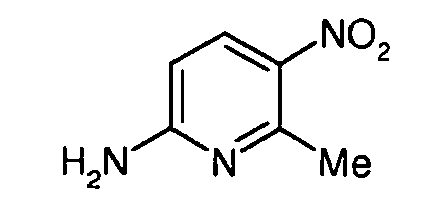
- The title compound was prepared according to the method of Parker and Shive (J. Am. Chem . Soc., 1947, 69, 63) as a brown powder. δH (d6 DMSO): 2.6 (3H, s), 6.37 (1H, d, 9.13Hz), 7.31 (2H, s), 8.08 (1H, d, 9.13Hz); m/z (ES+) = 154.06 [M+ H]+; RT = 0.57min.
-

- The title compound was prepared according to the method of Baumgarten and Su (J. Am. Chem. Soc, 1952, 74, 3828) as a brown powder. δH (d6 DMSO): 2.62 (3H, s), 6.28 (1H, d, 9.94Hz), 8.10 (1H, d, 9.94Hz).
-

- A suspension of 6-methyl-5-nitro-1H-pyridin-2-one (Preparation 2, 3.53g, 22.9mmol) in phosphorous oxychloride (20mL) was heated to 115°C (oil bath temperature) for 3h then allowed to cool to rt. The phosphorous oxychloride was removed in vacuo and the residue poured into iced water (100mL). The mixture was quenched by addition of saturated sodium bicarbonate solution, then the aqueous mixture was extracted with ethyl acetate (3 x 100mL). The combined organics were washed with brine, dried (MgSO4), filtered and concentrated in vacuo to furnish the title compound as a brown solid. δH (CDCl3): 2.86 (3H, s), 7.36 (1H, d, 8.59Hz), 8.27 (1H, d, 8.32Hz).
-
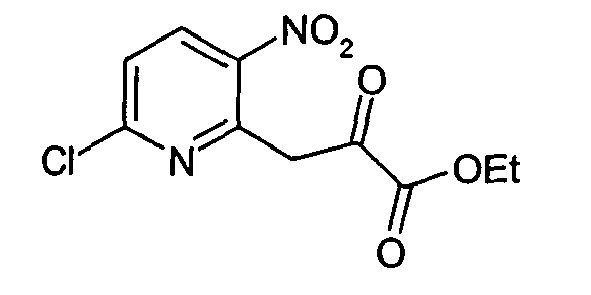
- To a solution of potassium ethoxide (134mg, 1.59mmol) in diethyl ether (5mL) and ethanol (1mL) was added diethyl oxalate (218µL, 1.59mmol) in one portion and the resulting solution was stirred for 30min at rt. 2-Chloro-6-methyl-5-nitropyridine (Preparation 3, 250mg, 1.45mmol) was added as a suspension in diethyl ether (2mL, anhydrous) and stirring was continued for 17h at rt. The mixture was filtered on a sinter, washing with cold diethyl ether. The collected precipitate was dissolved in glacial acetic acid then evaporated to dryness in vacuo to give the title compound as a brown powder. δH (CDCl3): 1.40 (3H, t, 7.27Hz), 4.38 (2H, q, 7.25Hz), 7.33 (1H, d, 8.59Hz), 7.37 (1H, s), 8.40 (1H, d, 8.86Hz).
-

- To a solution of 3-(2-chloro-5-nitropyridin-6-yl)-2-oxopropionic acid ethyl ester (Preparation 4,1.53g, 5.6mmol) in THF (65mL) and ethanol (30mL) was added saturated aqueous ammonium chloride solution (30mL) and the suspension was vigorously stirred at rt. Iron powder (1.95g, 34.8mmol) was added portionwise and the mixture was heated under reflux for 2h then allowed to cool prior to filtration through a celite plug, and washed through with warm THF. The mixture was concentrated under reduced pressure to give an aqueous suspension, which was filtered through a sinter, washing with water. The wet solid was washed with methanol and dried. The residue was adsorbed onto silica gel and purified via flash chromatography eluting with ethyl acetate/hexane (1:19) to give the title compound as a white solid. δH (CD3OD): 1.42 (3H, t, 7.03Hz), 4.42 (2H, q, 7.32Hz), 7.15 (1H, s), 7.30 (1H, d, 8.79Hz), 7.89 (1H, d, 8.35Hz); m/z (ES+) = 225.03 [M+ H]+; RT = 3.32min.
-

- To a stirred solution of 5-chloro-1H-pyrrolo[3,2-b]pyridine-2-carboxylic acid ethyl ester (Preparation 5, 151mg, 0.67mmol) in ethanol (10mL) was added sodium hydroxide (0.35mL, 2M) and the stirred solution was heated at 70°C for 2h. The reaction mixture was then allowed to cool to rt and left to stand for 16h. The pH was adjusted to 4 by addition of glacial acetic acid, the solvents removed in vacua to give a white solid, which was suspended in dichloromethane and filtered through a sinter, washing with additional dichloromethane. The filter cake was washed with ethyl acetate (3 x 30mL) and dried to give the title compound as a white solid. δH (CD3OD): 6.97 (1H, s), 7.17 (1H, d, 8.35Hz), 7.83 (1H, d, 8.35Hz); m/z (ES+) = 197 [M + H]+; RT = 2.82min.
-

- A solution of dimethylamine hydrochloride (1.45g, 17.8mmol) in DMF (46mL) was cooled to -10°C and triethylamine (2.7mL, 19.4mmol) was added. N-Boc-L-phenylalanine (4.59g, 17.3mmol, Aldrich) and HOBt (3.49g, 26mmol) were then added and the reaction stirred for 5min before addition of EDCI (3.33g, 17.4mmol). The reaction mixture was left to stir for 16h then diluted with ethyl acetate (400mL), washed sequentially with aqueous sodium hydroxide solution (2M, 2 x 100mL), hydrochloric acid (2N, 2 x 100mL), brine (250mL) and then dried (MgSO4). Evaporation in vacuo gave the title compound as a pale yellow oil. δH (CDCl3): 1.41 (9H, s), 2.61, 2.85 (6H, 2s), 2.91-2.99 (2H, m), 4.83 (1H, m), 5.40 (1H, br d), 7.18-7.29 (5H,m).
-

- To a solution of N-tert-butyloxycarbonyl-(S)-phenylalanine dimethylamide (Preparation 7, 24.8g, 84mmol) in methanol (50mL) was added a solution of hydrochloric acid (4N, in dioxane, 40mL) and the mixture stirred at rt for 3h. The resulting solution was concentrated in vacuo then dissolved in water (300mL). The aqueous solution was washed with ethyl acetate (3 x 100mL) and concentrated again. Successive recrystallisations with methanol (200mL) and a mixture of methanol and toluene (1:1, 200mL) gave the title compound as colourless crystals. δH (D2O) 2.75, 2.90 (6H, 2 x s), 3.18 (2H, m), 4.72 (1H, t), 7.28-7.45 (5H, m).
-

- Pyridin-4-ylcarbamic acid tert-butyl ester was prepared according to the method of Spivey et al., (J. Org. Chem., 1999, 64, 9430) to give the title compound as a white crystalline solid. δH (CDCl3): 1.52 (9H, s), 7.08 (1H, br s), 7.32 (2H, d), 8.43 (2H, d).
-

- (3-Methylpyridin-4-yl)carbamic acid tert-butyl ester was prepared according to the method of Hands et al., (Synthesis, 1996, 7, 877) to give the title compound as a pale yellow solid. δH (CDCl3): 1.55 (9H, s), 2.22 (3H, s), 6.52 (1H, s), 7.97 (1H, d), 8.27 (1H, s), 8.36 (1H, d).
-

- A solution of (3-methylpyridin-4-yl)carbamic acid tert-butyl ester (Preparation 10, 1.0g, 4.8mmol) in anhydrous THF (10mL) was cooled to -40°C and tert-butyl lithium (5.9mL, 10.1mmol) added dropwise. The temperature was maintained at -40°C for 1h and then a solution of diethyl oxalate (0.72mL, 5.3mmol) in THF (20mL) was added to the mixture. The reaction was warmed to 0°C, maintained at this temperature for 2h, warmed to rt and stirred for 16h. Hydrochloric acid (2N, 40mL) was added and the reaction heated under reflux for 90min, concentrated in vacuo and adjusted to pH 8 with saturated aqueous sodium hydrogen carbonate solution. The mixture was extracted with ethyl acetate (3 x 100mL) and the organic solution dried (MgSO4) and concentrated in vacuo to give the title compound. δH (d6 DMSO): 1.33 (3H, t), 4.35 (2H, q), 7.27 (1H, s), 7.38 (1H, d), 8.25 (1H, d), 8.95 (1H, s); m/z (ES+) =191 [M+ H]+.
-

- Aqueous sodium hydroxide solution (2.4mL, 2M, 4.8mmol) was added to a solution of 1H-pyrrolo[3,2-c]pyridine-2-carboxylic acid ethyl ester (Preparation 11, 0.76g, 4.0mmol) in ethanol (40mL) and the mixture heated under reflux for 2h before being cooled and concentrated in vacuo. The residue was dissolved in a minimum amount of water, glacial acetic acid (1mL) was added and the solution cooled in a refrigerator for 3 days. The resultant precipitate was collected by filtration washed with ether and dried in vacuo to give the title compound as a cream coloured solid. δH (D2O): 7.05 (1H, s), 7.63 (1H, d), 8.08 (1H, d), 8.94 (1H, s).
-

- To a solution of potassium ethoxide (3.1g, 36.2mmol) in diethyl ether (70mL) and ethanol (10mL) under an argon atmosphere was added diethyl oxalate (4.9mL, 36.2mmol) and the reaction stirred at rt for 30min. A solution of 4-methyl-3-nitropyridine (5.0g, 36.2mmol) in diethyl ether (20mL) was added resulting in the immediate formation of a dark red precipitate. The reaction mixture was stirred at rt for 72h, then cooled to 0°C and filtered. The solid was dissolved in water (500mL) acidified to pH 4 with acetic acid and the precipitate collected and dried to give the title compound as a red solid. δH (d6 DMSO): 1.27 (3H, t), 4.25 (2H, q), 6.74 (1H, s), 8.34 (1H, d), 8.43 (1H, d), 8.98 (1H, s); m/z (ES+) = 239 [M+H]+.
-

- To a solution of 3-(3-nitropyridin-4-yl)-2-oxopropionic acid ethyl ester (Preparation 13, 500mg, 2.1mmol) in ethanol (20mL) and THF (10mL) was added saturated ammonium chloride solution (10mL) and iron powder (700mg, 12.6mmol). The reaction was heated under reflux for 1h, then filtered through celite and washed through with hot ethyl acetate (3 x 30mL). The combined organic fractions were washed with brine (20mL), dried (MgSO4) and concentrated in vacuo to give the title compound as a brown solid. δH (CD3OD): 1.44 (3H, t), 4.43 (2H, q), 7.21 (1H, s), 7.69 (1H, d), 8.12 (1H, d), 8.80 (1H, s).
-

- To a solution of 1H-pyrrolo[2,3-c]pyridine-2-carboxylic acid ethyl ester (Preparation 14, 310mg, 1.6mmol) in ethanol (20mL) was added 2N sodium hydroxide solution (1mL, 2.0mmol) and the reaction mixture heated under reflux for 1.5h then concentrated in vacuo. The residue was dissolved in water (10mL) and acidified with acetic acid giving an immediate brown precipitate. The solid was filtered and dried to give the title compound as a beige solid. δH (D2O): 7.11 (1H, s), 7.99 (1H, d), 8.05 (1H, d), 8.85 (1H, s); m/z (ES+) = 163 [M + H]+.
-

- Route A : To a solution of potassium ethoxide (1.46g, 17.4mmol) in diethyl ether (80mL) and ethanol (10mL) under an argon atmosphere was added diethyl oxalate (2.4mL, 17.4mmol) and the mixture stirred at rt for 0.5h. A solution of 2-chloro-4-methyl-5-nitropyridine (3.0g, 17.4mmol) in diethyl ether (20mL) was added resulting in the formation of a dark green precipitate. The reaction was stirred at rt for 15h, cooled to 0°C, filtered and washed with cold diethyl ether to give a dark green solid. The solid was dissolved in water (200mL) and acidified to pH 4 with acetic acid to give an orange precipitate. The solid was collected by filtration and dried to give the title compound. m/z (ES+) = 273 [M + H]+.
Route B : To a solution of 2-chloro-4-methyl-5-nitropyridine (1.0g, 5.8mmol) in diethyl oxalate (4.23g, 29mmol) under an argon atmosphere was added 1,8-diazabicyclo[5.4.0]undec-7-ene (0.95mL, 6.4mol). The mixture was stirred at rt for 1.5h then diluted with t-butyl methyl ether (40mL), water (30mL) and acetic acid (1ml). The organic layer was separated, washed with water, dried (MgSO4) and evaporated to dryness. The resultant damp red solid residue was finally dried under high vacuum at 40-50°C to give the title compound. -

- 3-(2-Chloro-5-nitropyridin-4-yl)-2-oxopropionic acid ethyl ester (Preparation 16, 3.0g, 11.0mmol) was dissolved in ethanol (100mL) and THF (50mL). Iron powder (3.7g, 66.0mmol) and saturated ammonium chloride solution (50mL) were added and the mixture heated under reflux for 2h. The mixture was cooled, filtered through celite and washed several times with ethyl acetate. The organic layers were combined, washed with brine (100mL), dried (MgSO4) and concentrated in vacuo to give the title compound as a brown solid. δH (CD3OD): 1.42 (3H, t), 4.44 (2H, q), 7.15 (1H, s), 7.70 (1H, s), 8.59 (1H, s); m/z (ES+) = 225 [M+ H]+.
-

- Route A : To a solution of 5-chloro-1H-pyrrolo[2,3-c]pyridine-2-carboxylic acid ethyl ester (Preparation 17, 1.78g, 7.9mmol) in ethanol (70mL) was added sodium hydroxide solution (5.2mL, 2M, 10.3mmol) and the mixture heated under reflux for 2h. The solvent was removed in vacuo and the solid dissolved in water (150mL) and acidified to pH 4 with acetic acid to give the title compound as a brown solid that was isolated by filtration. δH (CD3OD): 7.13 (1H, s), 7.68 (1H, s), 8.58 (1H, s); m/z (ES+) = 197 [M + H]+.
Route B : A mixture of 6-chloro-4-iodopyridin-3-ylamine (Preparation 106, 0.33g, 1.30mmol), pyruvic acid (0.27mL, 3.89mmol), DABCO (0.44g, 3.89mmol) and palladium acetate (0.015g, 0.07mmol) in dry DMF was stirred vigorously and degassed with argon for 15min. The reaction mixture was heated to 107°C for 5h. The reaction mixture was allowed to cool to rt and stirred for 16h. The volatiles were removed under reduced pressure and the residue partitioned between ethyl acetate (100mL) and water (50mL). The layers were separated and the aqueous extracted with ethyl acetate (2x50mL). The combined organics were extracted with aqueous NaOH (2M, 3x70mL). The combined aqueous extracts were acidified to pH 4 by careful addition of glacial acetic acid, then extracted with ethyl acetate (3x60mL). The combined organics were washed with brine (50mL), dried (MgSO4) filtered and concentrated in vacuo to give the title compound as a brown solid. RT=2.72min, m/z (ES+) =197 [M + H]+ -

- To a stirred solution of Boc-3-(4-fluorophenyl)-(S)-alanine (10.0g, 35.3mmol), 4-hydroxypiperidine hydrochloride (5.1g, 37.1mmol) and HOBt (7.2g, 52.9mmol) in DMF (100mL), was added DIPEA (12.3mL, 70.6mmol) and after 5min, EDCI (7.4g, 38.8mmol) and the reaction stirred at rt for 16h. The solvent was removed in vacuo and the residue partitioned between water (150mL) and ethyl acetate (2 x 150mL). The combined organic fractions were washed with sodium hydroxide solution (2M, 50mL), hydrochloric acid (2N, 50mL), dried (MgSO4) and concentrated in vacuo. The product was chromatographed on silica gel eluting with ethyl acetate to give the title compound as a white solid. m/z (ES+) = 367 [M + H]+; RT = 3.28min.
-

- Route A : To a solution of [1(S)-(4-fluorobenzyl)-2-(4-hydroxypiperidin-1-yl)-2-oxoethyl]carbamic acid tert-butyl ester (Preparation 19, 11.6g, 31.7mmol) in methanol (40mL) was added hydrochloric acid in dioxane (24mL, 4N, 95.0mmol) and the reaction mixture stirred at rt for 6h. The solvent was removed in vacuo and the residue was dissolved in water (100mL) and extracted into ethyl acetate (2 x 50mL). The aqueous phase was evaporated to dryness to give the title compound as a white solid. δH (D2O): 0.52-0.63 (0.5H, m), 1.12-1.23 (0.5H, m), 1.26-1.38 (1H, m), 1.42-1.50 (0.5H, m), 1.59-1.69 (0.5H, m), 1.72-1.82 (1H, m), 2.61-2.71 (0.5H, m), 2.91-3.15 (4H, m), 3.33-3.47 (1H, m), 3.69-3.78 (1H, m), 3.88-3.96 (1H, m), 4.60-4.72 (1H, m), 7.02-7.11 (2H, m), 7.14-7.26 (2H, m).
Route B : To a solution of 4-hydroxypiperidine (40mg, 0.4mmol) in anhydrous THF (3mL) under an argon atmosphere was added a solution of 4(S)-(4-fluorobenzyl)oxazolidine-2,5-dione (Preparation 117, 100mg, 0.48mmol) in THF (2mL) dropwise over 15min. The resulting mixture was stirred for 40h at rt before removal of the solvent in vacuo. The crude material was purified by column chromatography (SiO2, 9:1 dichloromethane/methanol) to afford an oil. The free amine was dissolved in methanol (2mL) and a solution of 4M HCl in dioxane (0.3mL) was added and stirring was continued for 15min. The solvent was removed in vacuo and the material partitioned between ethyl acetate (5mL) and water (5mL). The aqueous layer was concentrated in vacuo to give the title compound. δH (CD3OD): 7.36-7.29 (2H, m), 7.17-7.10 (2H, m), 4.70 (1H, t), 4.09-4.00 (0.5H, m), 3.91-3.74 (1.5H, m), 3.64-3.56 (0.5H, m), 3.43-3.31 (1H, m), 3.26-3.07 (3H, m), 2.89-2.80 (0.5H, m), 1.87-1.69 (1.5H, m), 1.56-1.36 (2H, m), 1.09-0.99 (0.5H, m). -

- (3S,2R)-3-Amino-2-hydroxy-4-phenylbutyric acid methyl ester was synthesized according to the method of A. Fässler et al., (Tetrahedron Lett., 1998, 39, 4925) in three steps from commercially available N-(tert-butyloxycarbonyl)-L-phenylalaninal. Rf 0.29 (dichloromethane / methanol : 9 /1); δH (CDCl3): 2.04 (3H, m), 2.73 (1H, dd), 2.92 (1H, dd), 3.36 (1H, ddd), 3.79 (3H, s), 4.08 (1H, d), 7.22-7.33 (5H, m).
-

- (3S,2S)-3-Amino-2-hydroxy-4-phenylbutyric acid methyl ester was obtained as a side product in Preparation 21. Rf 0.19 (dichloromethane / methanol: 9./ 1); δH (CDCl3): 2.10 (2H, br s), 2.61 (1H, dd), 2.84 (1H, dd), 3.38 (1H, m), 3.78 (3H, s), 4.14(1H, br s).
-

- A solution of benzyl-2,5-dihydro-1H pyrrole-1-carboxylate (10.0g, 49.3mmol) in THF (200mL) was treated with osmium tetroxide solution (2.5% in tert-butanol, 5mL) and N-methylmorpholine (6.90g, 59.0mmol) and the reaction mixture stirred at rt under argon for 72h. Aqueous sodium thiosulfate solution (10%, 200mL) was added and the mixture stirred for a further 1h and then concentrated in vacuo. The resulting aqueous layer was extracted with ethyl acetate (3 x 200mL) and the combined organic layers washed with aqueous sodium thiosulfate solution (10%, 300mL) and hydrochloric acid (1N, 300mL). The organic fraction was dried (MgSO4) and concentrated in vacuo to give the title compound as an off-white solid. δH (CDCl3): 2.67 (2H, br s), 3.38-3.45 (2H, m), 3.63-3.67 (2H, m), 4.22-4.26 (2H, m), 5.12 (2H, s), 7.30-7.38 (5H, m); m/z (ES+) = 238 [M + H]+.
-

- Palladium-on-carbon (144mg, 10 wt%) was added to a solution of cis-3,4-dihydroxypyrrolidine-1-carboxylic acid benzyl ester (Preparation 22, 403mg, 1.70mmol) in ethanol (20mL) and cyclohexene (2mL) and the mixture stirred and heated under reflux for 6h. After filtration through celite and repeated washing of the catalyst with methanol (CARE!), the filtrate and washings were combined and concentrated in vacuo to give the title compound as a colourless oil. δH (d4 MeOH): 2.81 (2H, dd), 3.03 (2H, m), 4.07 (2H, m).
-

- To a suspension of 2-hydroxy-4-methyl-5-nitropyridine (1g, 6.5mmol) in dichloroethane (10mL) was added a solution of phosphorus oxybromide (2.8g, 9.7mmol) in dichloroethane (10mL). The reaction mixture was heated under reflux for 4h, then cooled to rt and quenched with water (40mL). The layers were separated and the aqueous layer extracted into dichloromethane (2 x 30mL). The combined organics were dried (MgSO4), concentrated in vacuo and chromatographed on silica gel eluting with dichloromethane to give the title compound as a pale yellow solid. δH (CDCl3): 2.63 (3H, s), 7.52 (1H, s), 8.96 (1H, s).
-

- To a solution of potassium ethoxide (2.05g, 24.3mmol) in diethyl ether (70mL) and ethanol (10mL) under an argon atmosphere was added diethyl oxalate (3.3mL, 24.3mmol) and the reaction stirred at rt for 15min. A solution of 2-bromo-4-methyl-5-nitropyridine (Preparation 24, 4.8g, 22.1mmol) in diethyl ether (20mL) was added to the reaction mixture giving an immediate black precipitate. The reaction was allowed to stir at rt for 6h, then cooled to 0°C and filtered to give a black solid. The solid was dissolved in water (250mL) and acidified to pH 4 with acetic acid resulting in formation of a red precipitate. The solid was collected and dried to give the title compound as a red solid. δH (d6 DMSO): 1.16 (3H, t), 4.01 (2H, q), 6.55 (1H, s), 7.92 (1H, s), 8.96 (1H, s).
-

- Route A : To a solution of 3-(2-bromo-5-nitropyridin-4-yl)-2-oxopropionic acid ethyl ester (Preparation 25, 3.38g, 10.7mmol) in THF (50mL) and ethanol (100mL) was added saturated ammonium chloride solution (50mL) and iron powder (3.57g, 64.0mmol) and the reaction heated under reflux for 2h. The reaction mixture was filtered through celite and washed several times with ethyl acetate. The solvent was removed in vacuo and the remainder partitioned between saturated sodium hydrogen carbonate solution (100mL) and ethyl acetate (3 x 150mL). The combined organic fractions were dried (MgSO4) and concentrated in vacuo to give the title compound as a brown solid. δH (CD3OD): 1.42 (3H, t), 4.43 (2H, q), 7.14 (1H, s), 7.85 (1H, s), 8.58 (1H, s); m/z (ES+) = 269 [M + H]+.
Route B : To a solution of 2-bromo-4-methyl-5-nitropyridine (Preparation 24, 5.7g, 26.3mmol) in diethyl oxalate (17.9mL) under argon was added 1,8-diazabicyclo[5,4,0]undec-7-ene (4.5mL, 30.2mmol) to give a dark red precipitate. Reaction mixture was stirred at rt for 4.5h and concentrated in vacuo. Acetic acid (140mL) was added to the residue under argon and heated to 60°C. Iron (2.94g, 52.6mmol) was added in small portions over a period of 1h. he reaction mixture was heated at 80°C for 4h. The reaction mixture was cooled to rt and poured into water (300mL) which gave a beige precipitate. The precipitate was isolated and washed with water. The solid obtained was dissolved in ethyl acetate (700ml) and filtered. The filtrate was concentrated in vacuo to give the title compound. m/z (ES+) = 269 [M + H]+; RT = 3.39min. -

- Sodium hydroxide solution (1.1mL, 2M, 2.23mmol) was added to a solution of 5-bromo-1H-pyrrolo[2,3-c]pyridine-2-carboxylic acid ethyl ester (Preparation 26, 500mg, 1.86mmol) in ethanol (20mL), and the reaction mixture heated under reflux for 1.5h and then concentrated in vacuo. The residue was dissolved in water (15mL) and acidified with acetic acid resulting in formation of a brown precipitate. The solid was collected by filtration and dried to give the title compound as a brown solid. δH (d6 DMSO): 7.08 (1H, s), 7.97 (1H, s), 8.60 (1H, s); m/z (ES+) = 241 [M + H]+.
-

- The title compound was prepared according to the method of Romero and Mitchell (
WO 91/09849 -

- A mixture of 2-chloro-3-nitropyridine (1.00, 6.30mmol), potassium carbonate (2.62g, 18.90mmol), tetrakis(triphenylphosphine)palladium (0.73g, 0.63mmol) and trimethyl boroxine (0.88mL, 6.30mmol) in 1,4-dioxane (2mL) and water (8mL) was heated to 110°C (oil bath temperature) for 6h and then stirred for 16h at rt. The mixture was then filtered through a celite pad, washing through with THF. The filtrate was adsorbed onto silica gel in vacuo and purified via flash column chromatography eluting with ethyl acetate/hexanes (3:7) to give the title compound as a yellow solid. δH (CDCl3): 2.86 (3H, s), 7.34 (1H, dd), 8.26 (1H, dd), 8.71 (1H, dd).
-

- To a solution of potassium ethoxide (2.44g, 27.7mmol) in diethyl ether (90mL) and ethanol (8mL) was added diethyl oxalate (3.79mL, 27.7mmol) resulting in a yellow suspension. The reaction mixture was stirred for 5min prior to the addition of 2-methyl-3-nitropyridine (Preparation 29, 3.40g, 24.6mmol) in one portion. The resulting red suspension was stirred at rt, under argon, for 20h. The mixture was filtered, washed thoroughly with diethyl ether and dried. The red solid was dissolved in water and the mixture adjusted to pH 4 by addition of glacial acetic acid. The resulting precipitate was collected by filtration, dissolved in dichloromethane, washed with brine, dried (MgSO4), and then filtered and concentrated in vacuo to give the title compound as an orange solid. δH (CDCl3): 1.40 (3H, t), 4.39 (2H, q), 7.34 (1H, s), 7.36 (1H, dd), 8.43 (1H, dd), 8.66 (1H, dd).
-

- To a suspension of 3-(3-nitropyridin-2-yl)-2-oxopropionic acid ethyl ester (Preparation 30, 1.00g, 4.20mmol) in ethanol (30mL, absolute) was added palladium (10% on activated carbon, 447mg, 0.42mmol) and the reaction mixture placed under an atmosphere of hydrogen at a pressure of 20-30psi for 12h with vigorous stirring. The reaction mixture was filtered through celite, washing with ethyl acetate and the filtrate concentrated in vacuo to ca. 20mL. Water (150mL) was added and the mixture cooled to between 0°C and 5°C. The precipitate that formed was collected by filtration and dried to give the title compound as a beige solid. δH (CDCl3): 1.44 (3H, t), 4.45 (2H, q), 7.25 (1H, dd), 7.39 (1H, s), 7.75 (1H, dd), 8.57 (1H, dd), 8.98 (1H, s).
-

- A suspension of 1H-pyrrolo[3,2-b]pyridine-2-carboxylic acid ethyl ester (Preparation 31, 0.34g, 1.77mmol) in aqueous sodium hydroxide solution (2M, 10mL) was heated under reflux for 3h and the resulting solution was allowed to cool to rt. The pH was adjusted to 4 by addition of glacial acetic acid. Excess acetic acid was removed in vacuo and the resulting suspension cooled to 0°C and then left standing at rt for 16h. The resulting beige precipitate was collected by filtration and dried to give the title compound as a beige solid. δH (d6 DMSO): 7.12 (1H, s), 7.23 (1H, dd), 7.79 (1H, d), 8.42 (1H, dd).
-

- To a stirred suspension of 2-chloro-6-methoxy-3-nitropyridine (2.44g, 12.9mmol) in 10% v/v aqueous dioxane (25mL) was added tetrakis(triphenyl phosphine) palladium (1.50g, 1.3mmol) and the mixture stirred for 15min prior to the addition of trimethylboroxine (1.81mL, 12.9mmol) and potassium carbonate (5.36g, 38.8mmol). The reaction mixture was heated under reflux for 6h then allowed to cool to rt over 16h. Ethyl acetate (100mL) was added and the mixture stirred vigorously for 1h. The mixture was filtered through celite, washing through with ethyl acetate. The aqueous phase was separated and extracted with ethyl acetate (3 x 30mL) and the combined organics were washed with brine (50mL), dried (MgSO4), filtered and adsorbed onto silica gel. Purification via flash column chromatography (SiO2, ethyl acetate / isohexane, 1:20) gave the title compound as a pale yellow solid. δH (CDCl3): 2.81 (3H, s), 4.01 (3H, s), 6.65 (1, d), 8.26 (1H, d).
-

- To a stirred suspension of potassium ethoxide (0.55g, 6.55mmol) in diethyl ether (20mL, anhydrous) and ethanol (4mL) was added diethyl oxalate (894µL, 6.55mmol) and the reaction mixture was stirred for 30min prior to the addition of 6-methoxy-2-methyl-3-nitropyridine (Preparation 33, 1.0g, 5.95mmol) in diethyl ether (8mL). The resulting red suspension was stirred at rt, under argon, for 20h. The mixture was filtered, the solid washed thoroughly with diethyl ether then dried. The red solid was then taken up in hot water and the solution cooled to 0°C. The precipitate was filtered, washed with cold water, and dried to give the title compound as a beige solid. δH (CDCl3): 1.40 (3H, t), 4.07 (3H, s), 4.39 (2H, q), 6.74 (1H, d), 7.57 (1H, s), 8.40 (1H, d), 13.82 (1H, s).
-

-

- To a solution of 5-methoxy-1H-pyrrolo[3,2-b]pyridine-2-carboxylic acid ethyl ester (Preparation 35, 128mg, 0.58mmol) in ethanol (10mL, absolute) was added aqueous sodium hydroxide (0.35mL, 2M) and the mixture heated to 70°C for 3h then cooled to rt. The solution was adjusted to pH 4 by addition of glacial acetic acid and the solvents removed under reduced pressure. Ethyl acetate (20mL) was added to the resulting oil and the mixture sonicated until a fine suspension formed. The mother liquor was decanted and the remaining solid was washed with ethyl acetate and dried in vacuo to give the title compound as a pale orange powder. δH (CD3OD): 3.92 (3H, s), 6.63 (1H, d), 6.94 (1H, s), 7.72 (1H, d).
-

- To a solution of 4-methoxyphenacyl bromide (5.78g, 25.23mmol) in DMF (20mL) was added potassium phthalimide (5.00g, 26.99mmol) and the reaction stirred at rt for 18h. The reaction mixture was partitioned between dichloromethane (200mL) and water (100mL). The layers were separated and the aqueous layer extracted with dichloromethane (3 x 50mL). The combined organics were washed with sodium hydroxide (2M, 50mL), water (50mL) and brine (50mL) and dried (MgSO4). Filtration, then concentration in vacuo gave an off white solid. Trituration with diethyl ether followed by collection by filtration gave the title compound as a white solid. δH (CDCl3): 3.86 (3H, s), 5.15 (2H, s), 7.09 (2H, d), 7.81-8.01 (4H, m), 8.05 (2H, d).
- The following compounds were synthesised according to Preparation 37 from potassium phthalimide and the appropriate α-bromoketone.

Preparation R NMR 38 
δH (d6 DMSO): 5.25 (2H, d), 7.60-7.75 (1H, m), 7.85-8.06 (5H, m), 8.10-8.24 (1H, m) 39 
δH (d6 DMSO): 5.24 (2H, s), 7.66 (2H, d), 7.83-8.02 (4H, m), 8.10 (2H, d) 40 
5H (d6 DMSO): 5.24 (2H, s), 7.36-7.52 (2H, m), 7.84-8.02 (4H, m), 8.11-8.25 (2H, m) -

- 2-[2-(4-Methoxyphenyl)-2-oxoethyl]isoindole-1,3-dione (Preparation 37, 6.35g, 21.5mmol) was suspended in toluene (50mL) and ethylene glycol (12mL) added. p-Toluenesulfonic acid (300mg, 1.58mmol) was added and the resulting mixture heated under reflux for 40h, removing water with a Dean-Stark trap. The reaction mixture was allowed to cool to rt then partitioned between ethyl acetate (200mL) and saturated aqueous sodium bicarbonate solution (100mL). The organic layer was washed with brine (50mL), dried (MgSO4) filtered and concentrated under reduced pressure, to give the title compound as an off-white solid. δH (d6 DMSO): 3.66 (2H, t), 3.72 (3H, s), 3.87 (4H, m), 6.88 (2H, d), 7.32 (2H, d), 7.83 (4H, m).
- The following compounds were synthesised according to Preparation 41 from ethylene glycol and the appropriate ketone.

Preparation R NMR 42 
δH (d6 DMSO): 3.69-3.81 (2H, m), 3.85-4.04 (4H, m), 7.15-7.30 (1H, m), 7.32-7.49 (2H, m), 7.74-7.96 (4H, m) 43 
δH (d6 DMSO): 3.62-3.78 (2H, m), 3.84-3.99 (4H, m), 7.32-7.49 (4H, m), 7.74-7.94 (4H, m) 44 
δH (d6 DMSO): 3.64-3.80 (2H, m), 3.85-4.03 (4H, m), 7.08-7.24 (2H, m), 7.35-7.52 (2H, m), 7.75-7.93 (4H, m) -

- 2-[2-(4-Methoxyphenyl)-[1,3]dioxolan-2-ylmethyl]isoindole-1,3-dione (Preparation 41, 2.0g, 5.90mmol) and hydrazine hydrate (5mL) were combined. The stirred reaction mixture was heated under reflux for 48h then allowed to cool to rt. Aqueous sodium hydroxide (2M, 10-15mL) and water (20mL) were added and the mixture stirred until a solution was formed. Diethyl ether (20mL) was added and the biphasic mixture stirred vigorously for 16h. The layers were separated and the aqueous layer was extracted with diethyl ether (3x20mL), then the combined organic extracts were washed with brine (20mL). The ethereal solution was passed through a filter paper then evaporated to dryness in vacuo to give the title compound as a yellow oil, which solidified on standing. δH (EDCl3): 1.42 (2H, br s), 3.06 (2H, s), 3.97 (3H, s), 4.00 (2H, t), 4.21 (2H, t), 7.04 (2H, d), 7.53 (2H, d).
- The following compounds were synthesised according to Preparation 45 from hydrazine hydrate and the corresponding phthalimide.

Preparation R NMR 46 
δH (CDCl3): 1.31 (2H, br s), 2.87 (2H, s), 3.79-3.87 (2H, m), 3.99-4.08 (2H, m), 7.00-7.20 (2H, m), 7.23-7.29 (1H, m) 47 
5H (CDCl3): 1.23 (2H, br s), 2.89 (2H, s), 3.75-3.87 (2H, m), 3.99-4.10 (2H, m), 7.29-7.33 (2H, m), 7.36-7.40 (2H, m) 48 
δH (d6 DMSO): 2.72 (2H, s), 3.25 (2H, br s), 3.67-3.78 (2H, m), 3.93-4.06 (2H, m), 7.11-7.18 (2H, m), 7.37-7.44 (2H, m) -

- To a solution of [2-(4-methoxyphenyl)-[1,3]-dioxolan-2-yl]methylamine (Preparation 45, 0.117g, 0.56mmol) in dichloromethane (5mL) was added DIPEA (213µL, 1.22mmol), 5-chloro-1H-pyrrolo[2,3-c]pyridine-2-carboxylic acid (Preparation 18, 0.100g, 0.51mmol) and HOBT (0.076g, 0.56mmol). The resulting solution was stirred for 2min then EDCI (0.117g, 0.61mmol) was added and stirring was continued for 18h at rt. The reaction mixture was partitioned between dichloromethane (30mL) and water (20mL) and the layers separated. The aqueous phase was extracted with dichloromethane (3x20mL) then the combined organics were washed with brine (20mL), dried (MgSO4), filtered and concentrated in vacuo. Recrystallisation from methanol/dichloromethane gave the title compound as an orange solid. δH (CDCl3): 3.81 (3H, s), 3.84-3.91 (4H, m), 4.05 (2H, m), 6.56 (1H, t), 6.76 (1H, s), 6.89 (2H, d), 7.44 (2H, d), 7.57 (1H, s), 8.68 (1H, s), 9.94 (1H, br s).
- The following compounds were synthesised according to Preparation 49 from 5-chloro-1H-pyrrolo[2,3-c]pyridine-2-carboxylic acid (Preparation 18) and the appropriate amine.

Preparation R m/z 50 
m/z (ES+) = 394 [M + H]+; RT = 3.49min 51 
m/z (ES+) = 392 [M + H]+; RT = 1.48min 52 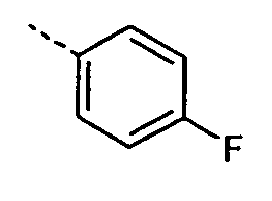
m/z (ES+) = 376 [M + H]+; RT = 3.26min -

- To a solution of (S)-2-tert-butoxycarbonylamino-3-pyridin-3-ylpropionic acid (500mg, 1.88mmol) in DMF (10mL) was added dimethylamine hydrochloride (153mg, 1.88mmol), DIPEA (1.2mL, 6.57mmol) and TBTU (602mg, 1.88mol). The reaction mixture was stirred at rt for 16h. The solvent was removed in vacuo and the residue dissolved in methanol (20mL). To this was added 4M hydrochloric acid in dioxane (20mL) and the reaction was stirred for 16h at rt. The solvent was removed in vacuo and the residue was partitioned between water (100mL) and ethyl acetate (2x100mL). The aqueous layer was evaporated to dryness and the residue recrystallised from ethanol/ethoxyethanol (9:1), to give the title compound as a white solid. δH (CD3OD): 2.99 (3H, s), 3.06 (3H, s), 3.35-3.42 (1H, m), 3.45-3.53 (1H, m), 4.87-4.94 (1H, m), 8.04-8.10 (1H, m), 8.48-8.53 (1H, m), 8.84-8.90 (2H, m).
-

- To a solution of pyrrolidine (157µL, 1.88mmol) in DMF (10mL) was added DIPEA (817µL, 4.69mmol), (S)-2-tert-butoxycarbonylamino-3-pyridin-3-ylpropionic acid (500mg, 1.88mmol) and TBTU (663mg, 2.06mmol). The reaction was stirred at rt for 72h. The solvent was removed in vacuo and the residue was dissolved in methanol (15mL). To this was added 4M hydrochloric acid in dioxane (20mL) and the reaction was stirred at rt for 16h. The solvent was removed in vacuo and the residue was partitioned between water (100mL) and ethyl acetate (2x100mL). The aqueous layer was evaporated to dryness, to give the title compound as a green oil. δH (CD3PD): 1.86-2.05 (4H, m), 3.20-3.28 (2H, m), 3.39-3.58 (2H, m), 3.68-3.78 (2H, m), 4.63-4.71 (1H, m), 8.11-8.17 (1H, m), 8.56-8.64 (1H, m), 8.85-8.93 (2H, m).
-

- To a stirred solution of dimethylamine hydrochloride (0.153g, 1.87mmol) in DMF (8mL) was added DIPEA (2mL, 6.55mmol), (S)-2-tert-butoxycarbonylamino-3-pyridin-2-ylpropionic acid (0.50g, 1.87mmol, Acros) and TBTU (0.60g, 1.87mmol). The reaction mixture was stirred at rt for 16h. The solvent was removed in vacuo and the residue was dissolved in methanol (15mL). To this was added 4M hydrochloric acid in dioxane (20mL) and the reaction stirred at rt for 16h. The solvent was removed in vacuo and the residue partitioned between water (100mL) and ethyl acetate (2x100mL). The aqueous layer was evaporated to dryness to give a solid, which was recrystallised from ethanol to give the title compound as a pale brown solid. m/z (ES+) = 194.
-

- Silver sulfate (3.40g, 10.9mmol) and 2-amino-5-chloropyridine (1g, 7.8mmol) was added to a solution of iodine (2.76g, 10.9mmol) in ethanol (50ml) and the reaction mixture stirred at rt for 72h. The mixture was filtered, washed with methanol and the filtrate concentrated in vacuo. The residue was partitioned between saturated Na2S2O3 solution (50ml) and DCM (2 x 50ml). The combined organics were dried (MgSO4), concentrated in vacuo and purified by chromatography on silica gel eluting with DCM to give the title compound as a beige solid. δH (CDCl3): 4.95 (2H, br s), 7.84 (1H, d), 7.98 (1H, d).
-

- Pyruvic acid (0.43ml, 6.24mmol) was added to a solution of 5-chloro-3-iodopyridin-2-ylamine (Preparation 56, 500mg, 2.08mmol), palladium acetate (23mg, 0.10mmol) and DABCO (700mg, 6.24mmol) in anhydrous DMF (20ml). The reaction mixture was degassed with argon for 20min, then heated to 110°C for 16h. The solvent was removed in vacuo and the residue suspended in water (10ml) and acetic acid (5ml) and then filtered. The solid was dissolved in EtOAc (50ml), extracted into 2N NaOH solution (50ml) and the organic layer discarded. The aqueous solution was acidified with concentrated HCl and extracted into EtOAc (2 x 40ml). The combined organics were dried (MgSO4) and concentrated in vacuo to give the title compound as a beige solid. 6H 7.14 (1H, s), 8.14 (1H, d), 8.35 (1H, d).
-

- PdCl2(PPh3)2 (0.026g, 0.037mmol) and Cu(l)I (0.007g, 0.037mmol) were added sequentially to 5-bromo-1H-pyrrolo[2,3-c]pyfdine-2-carboxylic acid ethyl ester (Preparation 26, 0.100g, 0.370mmol) under an argon atmosphere. 1,4-Dioxane (7mL, anhydrous) followed by diisopropylamine (0.063mL, 0.45mmol) were added and the stirred mixture was purged with argon for 5min. Trimethylsilylacetylene (0.064mL, 0.45mmol) was added dropwise and the resulting mixture stirred at rt for 24h. The reaction mixture was partitioned between water (50mL) and ethyl acetate (100mL) and the layers separated. The aqueous phase was extracted with ethyl acetate (3x30mL). The combined organics were washed with brine (50mL), dried (MgSO4), filtered and concentrated in vacuo. The residue was dissolved in the minimum amount of dichloromethane and loaded onto a silica column. Purification via flash column chromatography (SiO2, dichloromethane then 25% ethyl acetate / isohexane) gave a pale yellow solid. δH (CDCl3): 0.28 (9H, s), 1.43 (3H, t), 4.45 (2H, q), 7.18 (1H, s), 7.83 (1H, s), 8.86 (1H, s), 9.21 (1H, br s).
-

- To a stirred solution of the ester (Preparation 58, 0.123g) was added tetra-n-butylammonium fluoride (1.0M in THF, 5%wt H2O, 0.47mL, 0.47mmol) and the solution immediately turned dark pink in colour. After 5min the reaction was partitioned between ethyl acetate (60mL) and water (40mL). The layers were separated and the aqueous layer extracted with ethyl acetate (2x20mL). Glacial acetic acid was added to the combined organics until the colour changed from pink to yellow. The solution was washed with water (20mL), brine (20mL) then dried (MgSO4), filtered and concentrated in vacuo. The residue was dissolved in methanol and adsorbed onto silica gel. Purification via flash column chromatography (SiO2, ethyl acetate : isohexane, 1:1, v/v) gave the title compound as a pale yellow powder. δH (EDCl3): 1.44 (3H, t), 3.08 (1H, s), 4.46 (2H, q), 7.20 (1H, s), 7.85 (1H, s), 8.89 (1H, s), 9.33 (1H, s).
-
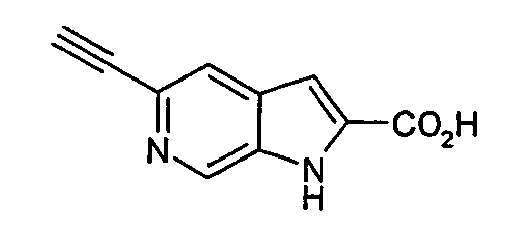
- To a suspension of ester (Preparation 59, 0.065g, 0.30mmol) in ethanol (6mL) was added sodium hydroxide (2M aqueous, 1.5mL, 3.0mmol) and the reaction mixture stirred at 50°C for 3h. The mixture was allowed to cool to rt and glacial acetic acid added, causing precipitation of a white solid. This was collected by filtration, washed with water (20mL) and then diethyl ether (20mL). The solid was air dried to give the title compound as a white powder. m/z (ES+) = 187 [M + H]+; RT = 1.85min.
-

- To a solution of 5-bromo-1H-pyrrolo[2,3-c]pyridine-2-carboxylic acid ethyl ester (Preparation 26, 0.160g, 0.590mmol) in DMF (anhydrous, 5mL) was added zinc (II) cyanide (0.041g, 0.35mmol) then tetrakis-triphenylphosphine palladium (0). The reaction mixture was degassed by bubbling argon through it for 10min. The reaction mixture was heated to reflux temperature for 4.5h then allowed to cool to rt. Water (30mL) was added and the mixture extracted with ethyl acetate (2x50mL). The combined organics were washed with brine (30mL), dried (MgSO4), filtered and concentrated in vacuo. The residue was dissolved in ethyl acetate then adsorbed onto silica gel. Purification via flash column chromatography (SiO2, ethyl acetate : isohexane, 1:3, v/v) gave the title compound as a white solid. δH (CDCl3): 1.45 (3H, t), 4.49 (2H, quartet), 7.31 (1H, s), 8.09 (1H, s), 8.97 (1H, s), 9.60 (1H, br s); m/z (ES+) = 216 [M + H]+; RT = 3.03min.
-

- To a stirred suspension of ester (Preparation 61, 0.266g, 1.24mmol) in ethanol (6mL) and water (0.6mL) was added sodium hydroxide (0.108g, 2.72mmol). The reaction mixture was heated to 50°C for 24h then allowed to cool to rt. The reaction mixture was diluted with diethyl ether (30mL), collected by filtration and washed with diethyl ether. The solid was washed with aqueous acetic acid (2x50mL), then diethyl ether. The solid was air-dried to give the title compound as a white solid. δH (d6 DMSO): 7.22 (1H, s), 8.37 (1H, s), 8.88 (1H, s), 12.88 (1H, s).
-
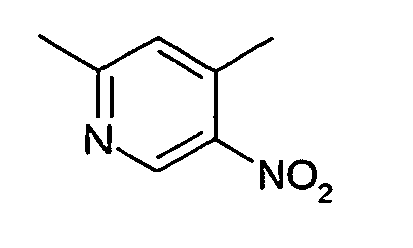
- To a stirred suspension of 2-chloro-4-methyl-5-nitropyridine (9.419g, 54.6mmol) in dioxane (110mL) was added tetrakis(triphenyl phosphine) palladium (6.330g, 5.46mmol) and the mixture stirred for 15min prior to the addition of trimethyl boroxine (7.68mL, 54.6mmol) and potassium carbonate (22.64g, 164.0mmol). The reaction mixture was heated under reflux for 6h then allowed to cool to rt over 16h. Ethyl acetate (200mL) was added and the mixture stirred vigorously for 1h. The mixture was filtered through celite, washing through with ethyl acetate / THF (1:1, v/v). Brine (100mL) was added and attempted separation of layers resulted in a thick emulsion. After removal of all volatiles, ethyl acetate (300mL) was added and the mixture filtered, giving rise to a biphasic mixture. The layers were separated and the aqueous phase was extracted with ethyl acetate (3 x 100mL). The combined organics were washed with brine (100mL), dried (MgSO4), filtered and concentrated in vacuo. The resulting oil was dissolved in dichloromethane then purified via flash column chromatography (SiO2, ethyl acetate / isohexane, 3:7, v/v) to give the title compound as an orange oil. δH (CDCl3): 2.59 (3H, s), 2.60 (3H, s), 7.12 (1H, s), 9.07 (1H, s).
-

- To a solution of potassium ethoxide (0.262g, 2.96mmol) in diethyl ether (10mL) and ethanol (1mL) was added diethyl oxalate (0.404mL, 2.96mmol) in one portion and the resulting solution stirred for 10min at rt. 2,4-Dimethyl-5-nitropyridine (Preparation 63, 0.400g, 2.63mmol) was added as a suspension in diethyl ether (1mL) / ethanol (1.5mL) and stirring continued for 16h at rt. The mixture was filtered, washing with cold diethyl ether. The collected precipitate was dissolved in water and the pH adjusted to 4 by the addition of glacial acetic acid. The resulting precipitate was collected by filtration and air dried. The solid was partitioned between ethyl acetate (150mL) and water (50mL) and the layers separated. The aqueous layer was extracted with ethyl acetate (3x20mL) and the combined organics washed with brine (50mL), dried (MgSO4), filtered and concentrated under reduced pressure to give the title compound as a red solid which required no further purification. δH (CDCl3): 1.40 (3H, t), 4.40 (2H, q), 4.52 (2H, s), 7.11 (1H, s), 9.25 (1H, s).
-

- To a solution of the pyruvate (Preparation 64, 0.749g, 2.97mmol) in THF (30mL) and ethanol (15mL) was added saturated aqueous ammonium chloride solution (15mL) and the suspension vigorously stirred at rt. Iron powder (1.38g, 24.64mmol) was added portionwise and the mixture heated under reflux for 2h then allowed to cool prior to filtration through a celite plug, and washed through with warm methanol. The mixture was concentrated under reduced pressure, the residue partitioned between ethyl acetate (250mL) and water (250mL) and the layers separated. The aqueous phase was extracted with ethyl acetate (3x50mL) then the combined organics were washed with brine (100mL), dried (MgSO4) filtered and concentrated in vacuo. The residue was adsorbed onto silica gel and purified via flash chromatography (SiO2, ethyl acetate) to give the title compound as a pale orange solid. δH (CDCl3): 1.42 (3H, t), 2.63 (3H, s), 4.43 (2H, q), 7.10 (1H, s), 7.40 (1H, s), 8.81 (1H, s), 9.08 (1H, br s).
-

- To a stirred solution of ester (Preparation 65, 117mg, 0.574mmol) in ethanol (10mL) was added aqueous sodium hydroxide (2M, 0.43mL, 0.861mmol). The resulting solution heated to 55°C for 4h then allowed to cool to room temperature and stirred for 17h. Excess glacial acetic acid was added then all volatiles were removed under reduced pressure. The residue was triturated with water and the resulting solid collected by filtration, washed with water then air dried. The title compound was isolated as a pale yellow solid. m/z (ES+) = 177 [M + H]+; RT = 1.60min.
-

- To a vigourosly stirred solution of 4-hydroxypiperidine-1-carboxylic acid tert-butyl ester (2.07g, 10.3mmol) in DMF (25mL) was added a 60% sodium hydride dispersion in mineral oil (500mg, 12.5mmol). After stirring for 20min, methyl iodide (0.9mL, 14.5mmol) was added and the resulting mixture stirred for 48h before being added to a mixture of water and brine (250mL, 1:1). Extraction with ethyl acetate (4x50mL), washing of the combined extracts with brine (100mL) and drying (MgSO4) gave, after concentration, a residue which was purified via flash chromatography (silica gel, ethyl acetate/hexane, 1:1) to give the title compound as a colourless oil. δH (CDCl3): 1.50 (9H, s), 1.52, 1.88 (4H, 2m) 3.12 (2H, ddd), 3.18 (1H, m), 3.19 (3H, s), 3.77 (2H, m); Rf 0.33 (ethyl acetate/hexane : 1/1).
-

- To a solution of 4-methoxypiperidine-1-carboxylic acid tert-butyl ester (Preparation 67, 1.58g, 7.34mmol) in methanol (20mL) was added hydrochloric acid in 1,4-dioxane (4M, 10mL) and the mixture stirred for 3h at rt. Concentration in vacuo gave an oil which was redissolved in water (100mL). The aqueous layer was washed with ethyl acetate (2x30mL) and concentrated to give the title compound as colourless solid. δH (D2O): 1.80,2.14 (4H, 2m), 3.13 (2H, m), 3.38 (2H, m), 3.40 (3H, s), 3.68 (m, 1H).
-

- (R)-3-Hydroxypyrrolidine-1-carboxylic acid tert-butyl ester (Sigma-Aldrich) (1.04g, 5.55mmol) was methylated and purified in a similar way to Preparation 67 using 60% sodium hydride dispersion (267mg, 6.68mmol) and methyl iodide (0.5mL, 8.06mmol) in DMF (15ml). δH (CDCl3): 1.50 (9H, s),1.94-2.02 (2H, m), 3.37 (3H, s), 3.38-3.58 (4H, m), 3.95 (1H, m); Rf 0.47 (ethyl acetate/hexane: 1/1).
-
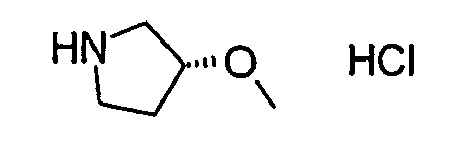
- (R)-3-Methoxypyrrolidine-1-carboxylic acid tert-butyl ester (840mg, 4.17mmol) was deprotected and purified in a similar way to Preparation 68 using methanol (10mL) and hydrochloric acid in 1,4-dioxane (4 M, 5.0mL). δH (D2O): 2.12 (2H, m), 3.10-3.56 (8H, m), 4.20 (1H, m).
-

- (S)-3-Hydroxypyrrolidine-1-carboxylic acid tert-butyl ester (Omega Chemical Company) (950mg, 5.55mmol) was methylated and purified in a similar way to Preparation 67 using 60% sodium hydride dispersion (260mg, 6.50mmol) and methyl iodide (0.5mL, 8.06mmol) in DMF (15ml). 1H NMR and Rf were identical to the (R)-enantiomer.
-

- (S)-3-Methoxypyrrolidine-1-carboxylic acid tert-butyl ester (720mg, 3.58mmol) was deprotected and purified in a similar way to Preparation 68 using methanol (10mL) and hydrochloric acid in 1,4-dioxane (4 M, 5.0mL). 1H NMR and Rf were identical to (R)-enantiomer.
-

- To a solution of 4-aminopiperidine-1-carboxylic acid tert-butyl ester (400mg, 200mmol) in anhydrous dichloromethane (14mL) under argon was added triethylamine (340µL, 2.4mmol) and the solution cooled in an ice bath. 2-Nitrophenylsulfonyl chloride (443mg, 2.0mmol) was added and the reaction allowed to stir at rt for 16h. The crude solution was washed with water (2x30mL) before removing the solvent in vacuo. The crude material was purified by chromatography using ethyl acetate/petroleum ether (30-60%) as the eluent to give the title compound as an off-white powder. δH (d6 DMSO): 8.43 (2H, m), 8.17 (1H, s), 8.09 (2H, m), 3.80-3.69 (2H, m), 3.31-3.23 (1H, m), 2.86-2.69 (2H, m), 1.63-1.51 (2H, m), 1.39 (9H, s), 1.29-1.17 (2H, m).
-

- To a solution of 4-(2-nitrobenzenesulfonylamino)piperidine-1-carboxylic acid tert-butyl ester (Preparation 73) (400mg, 1.04mmol) in DMF (10mL) was added caesium carbonate (507mg, 1.56mmol) and the mixture stirred at rt for 40 min. Iodomethane (323µL, 5.19mmol) was added and the mixture stirred for 16h. Solvent was removed in vacuo and the crude residue partitioned between ethyl acetate (20mL) and water (20mL). The organic layer was separated and washed with 1M HCl (2x20mL), water (20mL), then brine (2x20mL) before being dried (MgSO4). The solvent was removed in vacuo to give the title compound as a yellow powder. δH (d6 DMSO): 8.43 (2H, m), 8.01 (2H, m), 4.00-3.89 (3H, m), 2.83-2.67 (5H, m), 1.54-1.43 (2H, m), 1.39 (9H, s), 1.34-1.24 (2H, m).
-

- Prepared according to EXAMPLE 182 from 4-[methyl(2-nitrobenzenesulfonyl)amino]piperidine-1-carboxylic acid tert-butyl ester (Preparation 74). δH (d6-DMSO): 8.44 (2H, m), 8.13 (2H, m), 4.20-7.07 (1H, m), 3.29-3.17 (2H, m), 3.03-2.90 (2H, m), 2.77 (3H, s), 2.00-1.84 (2H, m), 1.51-1.43 (2H, m).
-

- Prepared according to EXAMPLE 231 from 2-(S)-[(5-chloro-1H-pyrrolo[2,3-c]pyridine-2-carbonyl)amino]-3-(4-fluorophenyl)-propionic acid (EXAMPLE 230) and N-methyl-2-nitro-N-piperidin-4-yl-benzenesulfonamide hydrochloride (Preparation 75). m/z (ES+) = 643.36 [M + H]+.
-

- To a solution of thiomorpholine (1.0g, 9.69mmol) in acetic acid (11.5mL) cooled to 0°C (ice bath) was added aqueous hydrogen peroxide solution (30% w/v, 4mL) and the reaction heated to 100°C for 16h. The mixture was cooled and solvent removed in vacuo before trituration of the residue with methanol gave a white precipitate. The solid was filtered and washed with methanol to give the title compound as an off-white powder. m/z (ES+) = 136.06 [M + H]+.
-

- To a cooled solution of anhydrous methanol (100mL) was added acetyl chloride (7.1mL, 0.1mol) and the solution stirred for 75min. Piperidine-4-carboxylic acid (150mg, 1.16mmol) was dissolved in the prepared solution (10mL) and the reaction stirred for 16h. The solvent was removed in vacuo to give the title compound as its hydrochloride salt. m/z (ES+) = 144.12 [M + H]+.
-

-
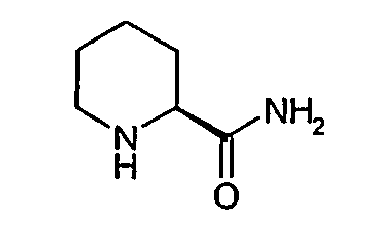
- Piperidine-2-carboxylic acid amide was prepared according to the method of Johnson et. al., (J. Med. Chem., 1986, 29, 2100-2104) to give the title compound as an off-white solid. 5H (CD3OD): 3.87-3.75 (1H, m), 3.43-3.34 (1H, m), 3.09-2.96 (1H, br m), 2.31-2.16 (1H, m), 1.97-1.81 (2H, br m), 1.77-1.57 (3H, br m).
-
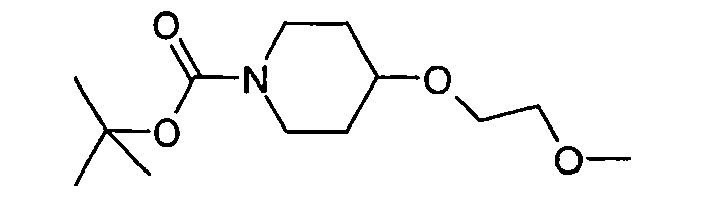
- To a solution of tert-butyl-4-hydroxy-1-piperidine carboxylate (300mg, 1.49mmol) in DMF (2mL) was added 1-bromo-2-methoxyethane (168µL, 1.79mmol) followed by potassium iodide (25mg, 0.15mmol) and sodium hydride (83.5mg, 2.09mmol) and the reaction stirred at rt for 16h. Solvent was removed in vacuo and crude residue was partitioned between ethyl acetate (10mL) and water (10mL). The organic layer was washed with 1M HCl (10mL), 1M NaOH (10mL) then brine (2x10mL) before being dried (MgSO4) and removing the solvent in vacuo. Purification by chromatography using dichloromethane/methanol (97:3) as the eluent gave the title compound as a yellow oil. δH (CDCl3): 3.89-3.77 (2H, m), 3.66 (2H, m), 2.57 (2H, m), 3.54-3.46 (1H, m), 3.43 (3H, s), 3.11-3.03 (2H, m), 1.93-1.83 (2H, m), 1.60-1.46 (11H, m).
-

- To a solution of 4-(2-methoxyethoxy)-piperidine-1-carboxylic acid tert-butyl ester (Preparation 81, 114mag, 0.44mmol) in methanol (3mL) was added 4M HCl in dioxane (550µL, 2.20mmol) and the reaction stirred at rt for 16h. Solvent was removed in vacuo and the crude residue dissolved in water (10mL). The aqueous solution was extracted with ethyl acetate (2x10mL) then concentrated in vacuo. Purification by trituration in ethyl acetate gave the title compound as the hydrochloride salt. δH (CD3OD): 3.74-3.67 (1H, m), 3.64 (2H, m), 3.56 (2H, m), 3.40-2.39 (7H, m), 2.11-1.96 (2H, m), 1.93-1.83 (2H, m).
-

- The title compound was prepared according to EXAMPLE 231 but using Boc-3-(4-fluorophenyl)-(R)-alanine and 4-hydroxypiperidine. m/z (ES+) = 367.34 [M+H]+.
-

- The title compound was prepared according to Preparation 20 from [1-(R)-(4-fluorobenzyl)-2-(4-hydroxypiperidin-1-yl)-2-oxoethyl] carbamic acid tert-butyl ester (Preparation 83). m/z (ES+) = 267.20 [M + H]+.
-

- To a solution of N-benzylmethylamine (648µL, 5.02mmol) and 1-tert-butoxycarbonyl-4-piperidone (500mg, 2.51mmol) in THF (8mL) was added sodium triacetoxyborohydride (798mg, 3.76mmol) followed by acetic acid (144µL, 2.51mmol) and the reaction stirred at rt for 40h. Solvent was removed in vacuo and the residue partitioned between ethyl acetate (15mL) and water (15mL). The organic layer was washed with sodium bicarbonate solution (2x15mL) then brine (2x20mL), dried (MgSO4) and the solvent removed in vacuo. The crude material was purified by chromatography using ethyl acetate/petroleum ether (2:1) as the eluent to give the title compound as yellow oil. m/z (ES+) = 305.32 [M + H]+.
-

- The title compound was prepared according to Preparation 23 from 4-(benzylmethylamino)piperidine-1-carboxylic acid tert-butyl ester (Preparation 85). δH (CD3OD): 4.13-4.03 (2H, m), 2.90-2.76 (2H, br m), 2.63-2.53 (1H, m), 2.40 (3H, s), 2.97-1.87 (2H, m), 1.49 (9H, s), 1.27-1.16 (2H, m).
-

- The title compound was prepared according to Preparation 85 from N-benzylmethylamine and tetrahydro-4H-pyran-4-one. Purification of the crude material by chromatography using dichloromethane/methanol (98:2) as the eluent gave the title compound as a yellow oil. δH (CD3OD): 7.50-7.40 (5H, m), 4.08 (2H, m), 4.06- (2H, s), 3.49-3.40 (2H, ddd), 3.23-3.14 (1H, m), 2.51 (3H, s), 2.03-1.97 (2H, m), 1.89-1.76 (2H, m).
-

- The title compound was prepared according to Preparation 23 from benzylmethyl(tetrahydropyran-4-yl)amine (Preparation 87). Crude material was dissolved in methanol and a solution of 1M HCl in ether was added dropwise to form a precipitate. The product was filtered and washed with ether to give the title compound as the hydrochloride salt as a white crystalline solid. δH (CD3OD) 4.11-4.00 (2H, m), 3.53-3.43 (2H, m), 3.37-3.27 (1H, m), 2.74 (3H, s), 2.11-2.03 (2H, m), 1.74-1.60 (2H, m).
-

- To a solution of 4-amino-1-benzylpiperidine (536µL, 2.63mmol) in formic acid (8.5mL) at 0°C was added formaldehyde solution (37%, 5.5mL) and the mixture heated to reflux for 6h. Solvent was removed in vacuo and the crude residue partitioned between ethyl acetate (20mL) and water (20mL). The aqueous layer was separated and taken to pH12 with 2M NaOH solution before being extracted with ethyl acetate (2x20mL). The organic portion was washed with brine (30mL) and dried (MgSO4) before removing the solvent in vacuo to give the title compound as a yellow oil. m/z (ES+) = 219.25 [M+H]+.
-

- The title compound was prepared according to Preparation 23 from 1-benzylpiperidin-4-yl-dimethylamine (Preparation 89). δH (CD3OD) : 3.17-3.09 (2H, m), 2.66-2.54 (2H, m), 2.30 (6H, s), 2.26 (1H, m), 1.94-1.86 (2H, m), 1.49-1.29 (2H, m).
-

- To a solution of 4-amino-1-Boc-piperidine (300mg, 1.50mmol) in dichloromethane (2.0mL) was added a solution of methanesulfonyl chloride (348µL, 4.49mmol) in dichloromethane (1mL) followed by a solution of pyridine (485µL, 5.99mmol) in dichloromethane (1mL), and the reaction stirred at rt for 16h. Water (10mL) was added, the mixture separated and the organic layer washed with 1M HCl (10mL), sodium bicarbonate solution (10mL) then brine (2x10mL). The solution was dried (MgSO4) and solvent removed in vacuo. The crude material was purified by chromatography using dichloromethane/methanol (95:5) as the eluent to give the title compound as an off-white powder. δH (CD3OD) 4.46-4.40 (1H, m), 4.09-3.97 (2H, m), 3.53-3.40 (1H, m), 3.0 (3H, s), 2.93-2.81 (2H, m), 2.01-1.93 (2H, m), 1.50-1.37 (2H, m).
-

- The title compound was prepared from 4-methanesulfonylaminopiperidine-1-carboxylic acid tert-butyl ester (Preparation 91) according to Preparation 82 as an off-white powder. δH (CD3OD): 3.67-3.57 (1H, m), 3.47-3.40 (2H, m), 3.19-3.10 (2H, m), 3.03 (3H, s), 2.26-2.17 (2H, m), 1.87-1.76 (2H, m).
-

- The title compound was prepared according to Preparation 78, using Boc-3-(4-pyridyl)-L-alanine as the starting acid. δH (CD3OD): 8.90 (2H, br s), 8.16 (2H, br s), 4.73-4.60 (1H, m), 3.84 (3H, s), 3.73-3.50 (2H, m).
-
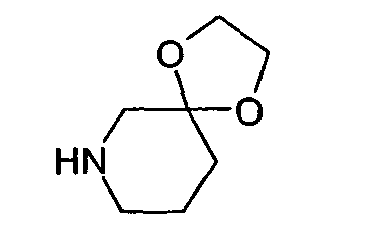
- To a solution of 1-Boc-3-piperidone (700mg, 3.51mmol) in toluene (20mL) was added ethylene glycol (588µL, 10.54mmol) followed by p-toluene sulfonic acid hydrate (1.0g, 5.27mmol) and the reaction heated to reflux using Dean-Stark apparatus for 7h. To the mixture was added NaHCO3 solution, and the organic layer was removed. The aqueous phase was evaporated to dryness and the resulting residue dissolved in THF. Filtration through celite and removal of the solvent in vacuo gave the desired product as light brown oil. δH (CD3OD): 3.99 (2H, s), 3.73-3.57 (2H, m), 3.63 (4H, m), 2.77 (1H, m), 2.73 (1H, m), 1.76 (2H, m).
-

- To a solution of commercially available 2-(S)-(N-tert-butyloxycarbonyl)-amino-1,3-diphenyl-1-propanone (250mg, 0.768mmol) in toluene (100mL) was added ethylene glycol (1.0mL, 17.9mmol) and p-toluenesulfonic acid monohydrate (262mg, 1.38mmol). The resulting mixture was heated under reflux for 48h, removing water with a Dean-Stark trap. After cooling to ambient temperature the mixture was diluted with ethyl acetate (200mL) and successively washed with diluted sodium hydroxide solution (1M, 2 x 50mL) and brine (50mL). The solution was dried (MgSO4) and concentrated to an oil that was purified by flash chromatography on silica gel (eluent: ethyl acetate) to give the title compound as colourless oil. δH (CDCl3): 2.07 (2H, br s), 2.37 (1H, dd), 2.92 (1H, dd), 3.36 (1H, m), 3.85-4.35 (4H, 3m), 7.14-7.59 (10H, m); m/z (ES+) = 270.20 [M+H]+; RT = 2.63min.
-

-

- A solution of bromomethylpyridin-3-yl ketone (4.55g, 16.2mmol) and potassium phthalimide (6.0g, 32.4mmol) in DMF (50mL) was stirred for 3 days at rt before the added to diluted brine (500ml, 1 :1). The solution was made acidic (pH 2) with diluted hydrochloric acid (1M) before washed with ethyl acetate (2 x 100ml). The aqueous layer was then made alkaline (pH 12) again with sodium hydroxide solution (2 M) and extracted with DCM (4 x 200ml). The extracts were combined and dried (MgSO4) before concentrated in vacuo. Recrystallisation from methanol (2x) allows to remove crystalline phthalimide and to enrich the title compound in the mother liquer. The crude product was used in Preparation 98 without further purification. δH (d6 DMSO): 5.33 (2H, s), 7.64 (1H, dd), 7.92, 7.97 (4H, 2m), 8.43 (1H, m), 8.88 (1H, m), 9.28 (1H, s); m/z (ES+) = 308.13 [M+ MeCN + H]+; RT = 2.39min.
-

- To a solution of crude 2-(2-oxo-2-pyridin-3-ylethyl)isoindole-1,3-dione (Preparation 97, 5.0g, ∼19.0mmol) in aqueous isopropanol (210ml, water/IPA : 1/6) was added sodium borohydride (10.2g, 270mmol) in 2 portions. The mixture was stirred at rt for 12h before being carefully acidified (pH 2) with dilute hydrochloric acid (1M). After removal of the solvent the residue was taken up in destillated water (100mL) and passed down a column filled with ion-exchange resin (Amberlite IR 120, H+-form, 300g, eluent: 500mL water then 1L of 2 M aqueous ammonia solution). Concentration of the alkaline fractions gave the title compound as a yellow oil. δH (d6 DMSO): 2.74, 2.85 (2H, 2m), 4.66 (1H, m), 5.15 (3H, br s), 7.36 (1H, dd), 7.75 (1H, m), 8.46 (1H, m), 8.56 (1H, m); m/z (ES+) = 139.11 [M + H]+; RT = 0.21min.
-

- To a solution of (1S,2S)-2-amino-1-phenyl-1,3-propanediol (2.07g, 12.4mmol) in DMF (10mL) was added imidazole (1.0g, 14.7mmol) and tert-butyldimethylsilyl chloride (2.30g, 15.3mmol). After stirring at rt for 12h the mixture was added to diluted brine (150mL, water/brine : 1/1). Extraction with ethyl acetate (4 x 30mL), washing of the combined extracts with brine (30mL) and drying (MgSO4) gave after concentration a residue which was purified by flash chromatography on silica gel (eluent: ethyl acetate). The title compound was obtained as colourless oil. δH (CDCl3): 0.24, 0.26 (6H, 2s), 1.12 (9H, s), 2.50-2.78 (3H, br s), 3.16 (1H, ddd), 3.78 (1H, dd), 3.85 (1H, dd), 4.84 (1H, d), 7.49-7.55 (5H, m); m/z (ES+) = 282.32 [M+ H]+; RT = 2.87min.
-

- To a solution of 5-chloro-1H-pyrrolo[2,3-c]pyridine-2-carboxylic acid (Preparation 18, 520mg, 2.65mmol) and 2-amino-3-(tert-butyldimethylsilanyloxy)-1-phenylpropan-1-ol (Preparation 99, 780mg, 2.77mmol) in DMF (15mL) was added HOBt (411mg, 2.68mmol), DIPEA (0.96mL, 5.51mmol) and EDCI (589mg, 3.07mmol). After stirring at rt for 12h the mixture was added to diluted brine (150mL, water/brine : 1/1). Extraction with ethyl acetate (4 x 50mL), washing of the combined extracts with diluted hydrochloric acid (1M, 50ml), diluted aqueous sodium hydroxide solution (1M, 50ml) and brine (50mL) followed by drying (MgSO4) gave after concentration a residue which was purified by flash chromatography on silica gel (eluent: hexane / ethyl acetate : 50 / 50). The title compound was obtained as colourless oil. δH (CD3OD) 0.00, 0.01 (6H, 2s), 0.84 (9H, s), 3.60 (1H, dd), 3.84 (1H, dd), 4.33 (1H, ddd), 4.98 (1H, d), 7.05 (1H, s), 7.12-7.37 (5H, 3m), 7.60 (1H, s), 8.49 (1H, s); m/z (ES+) = 460.36 [M + H]+; RT = 4.16min.
-

- To a solution of 5-chloro-1H-pyrrolo[2,3-c]pyridine-2-carboxylic acid [1-(S)-(tert-butyldimethylsilanyloxymethyl)-2-(S)-hydroxy-2-phenylethyl]amide (Preparation 100, 304mg, 0.661mmol) in dry DCM (10mL) was added Dess-Martin periodinane (342mg, 0.806mmol). After stirring for 3h at room temperature alkaline sodium thiosulfate solution was added (5.4g Na2SO3 dissolved in 20mL saturated NaHCO3 solution) and the emulsion vigorously stirred for an additional 30min. Ethyl acetate (150ml) was added and the aqueous layer removed. The organic layer was washed with brine (50ml), dried (MgSO4) and concentrated to a residue which was purified by flash chromatography on silica gel (eluent: hexane / ethyl acetate : 50/50) to give the title compound as colourless solid. m/z (ES+) = 458.34 [M+H]+; RT = 4.32min.
-

- To a stirred solution of (S)-N-Boc-4-fluorophenylalanine (5.08g, 17.9mmol) and (S)-3-hydroxypyrrolidine (1.05mL, 19.7mmol) in anhydrous DMF (200mL), was added DIPEA (6.87mL, 39.5mmol) and HOBt.H2O (3.02g, 19.7mmol). The reaction mixture was stirred for 10min at room temperature then EDCI (4.13g, 21.5mmol) was added and the resulting mixture stirred for 20h at rt. The volatiles were removed in vacuo then the residue partitioned between water (200mL) and ethyl acetate (200mL). The layers were separated and the aqueous layer extracted with ethyl acetate (3x50mL). The combined organics were washed with aqueous sodium hydroxide solution (2M, 3x50mL), brine (100mL), dried (MgSO4), filtered and concentrated in vacuo. The oily residue was purified via flash chromatography (SiO2, methanol / dichloromethane, 1:19, v/v) to give the title compound as a colourless oil which became a white solid on standing. m/z (ES+) = 353 [M+ H]+; RT = 3.17min.
-
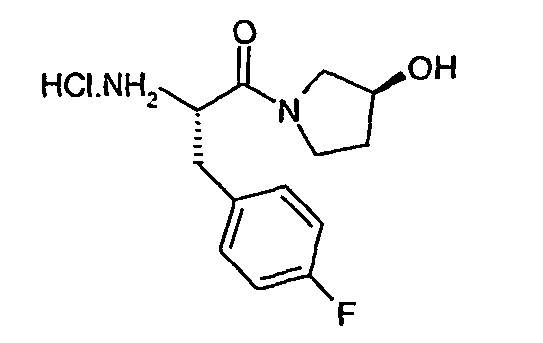
- To a solution of ester (Preparation 102, 5.25g, 14.9mmol) in methanol (anhydrous, 30mL) was added 4M HCl in dioxane (7.64mL, 30.6mmol) and the resulting solution stirred for 18h at rt then the solvents removed in vacuo. The residue was partitioned between ethyl acetate (150mL) and water (100mL). The layers were separated and the organic layer extracted with water (2x50mL). The combined aqueous extracts were washed once with ethyl acetate (30mL), then the combined organic extracts were evaporated to dryness under reduced pressure to give the title compound as a white foam. δH (CD3OD) 1.47-1.62 (0.5H, m), 1.67-1.80 (1H, m), 1.83-1.96 (0.5H, m), 2.72-2.87 (1H, m), 2.96-3.12 (2H, m), 3.19-3.29 (1H, m), 3.30-3.62 (2H, m), 4.14-4.39 (2H, m), 6.91-7.08 (2H, m), 7.22 (2H, dd).
-

- The title compound was prepared according to the method described by
Dinnell et al (US 2002/0022624 A1 ). δH (CDCl3): 1.52 (9H, s), 6.52 (1H, s), 7.26 (1H, d), 7.97 (1H, d), 8.23 (1H, d). -

- The title compound was prepared according to the method described by
Dinnell et al (US 2002/0022624 A1 ) from the compound of Preparation 104. δH (CDCl3): 1.54 (9H, s), 6.62 (1H, s), 7.72 (1H, s), 8.93 (1H, s). -

- The title compound was prepared according to the method described by
Dinnell et al (US 2002/0022624 A1 ) from the compound of Preparation 105. δH (CDCl3): 4.12 (2H, br s), 7.60 (1H, s), 7.79 (1H, s). -
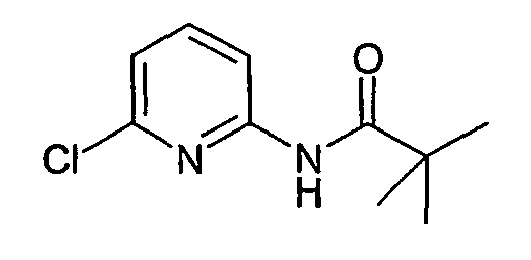
- To a solution of 2-amino-6-chloropyridine (3.0g, 23.3mmol) in dichloromethane (45mL) under argon was added triethylamine (4.10mL, 29.2mmol) and the reaction cooled to 0°C (ice bath). A solution of trimethylacetyl chloride (3.16mL, 25.7mmol) in dichloromethane (10mL) was added dropwise over 20min before stirring for 30min at 0°C. The reaction was brought up to rt and stirred for a further 5h, then water (30mL) was added. The organics were separated and washed with Na2CO3 solution (2x50mL), dried (MgSO4) and solvent removed in vacuo. Purification by column chromatography (SiO2, CH2Cl2) gave the title compound, m/z (ES+) = 213.04 [M+H]+.
-

- To a dry solution of N-(6-chloropyridin-2-yl)-2,2-dimethyl propionamide (Preparation 107, 8.0g, 37.6mmol) in THF (120mL), cooled to -78°C, was added dropwise, a solution of tert-butyllithium in pentane (1.7M, 48.7mL, 82.8mmol) over 40min. The reaction was stirred at -78°C for 3h before adding a solution of iodine (11.46g, 45.1mmol) in THF (40mL) dropwise. The mixture was brought up to rt and stirred for 16h. 2M HCl (30mL) was added to the reaction, and after 20min the solvent was removed in vacuo. Crude material was partitioned between ethyl acetate (200mL) and water (150mL). Organics were separated and washed with 10% sodium thiosulfate solution (4x100mL) then NaHCO3 solution (2x100mL), dried (MgSO4) and the solvent removed in vacuo. The residue was purified by column chromatography (SiO2 CH2Cl2) to give the title compound. m/z (ES+) = 338.93 [M+ H]+.
-

- A suspension of N-(6-chloro-3-iodopyridin-2-yl)-2,2-dimethyl propionamide (Preparation 108, 5.0g, 14.8mmol) in 1M HCl was heated to reflux for 4.5h. The reaction was cooled to rt and then extracted with diethyl ether (2x50mL). The organics were washed with Na2CO3 solution (2x50mL) before being dried (MgSO4) and the solvent removed in vacuo. Purification by column chromatography (SiO2, CH2Cl2) afforded the title compound. δH (CDCl3): 7.76 (1H, d), 6.46 (1H, d), 5.43-5.20 (2H, br s).
-

- To a dry solution of 6-chloro-3-iodo-pyridin-2-ylamine (Preparation 109, 2.80g, 11.0mmol) in DMF (80mL) under argon was added pyruvic acid (2.29mL, 33.0mmol), DABCO (3.70g, 33.0mmol) then palladium(II)acetate (124mg, 0.55mmol) and the mixture purged with argon for 20min. The reaction was heated to 105°C (bath temp.) for 3h before being allowed to cool to rt. Solvent was removed in vacuo then crude material partitioned between ethyl acetate (100mL) and water (75mL). The organic layer was separated and washed with water (2x75mL) before being extracted into 2M NaOH (2x75mL). The aqueous layer was acidified to pH 3 with 2M HCl and extracted into ethyl acetate (2x100mL). Organic layers were combined, dried (MgSO4) and concentrated in vacuo. The residue was suspended in water and the filtrate removed to give the title compound. m/z (ES+) = 196.91 [M+ H]+, RT = 3.07min.
-

- DIPEA (2.08mL, 11.95mmol), BOC-L-phenylalanine (1.128g, 3.98mmol) and HOBt (592mg, 4.38mmol) was added to a solution of [1,4]-diazepan-5-one (500mg, 4.38mmol) in DMF (10mL) and the mixture stirred for 5min. EDCI (992mg, 5.18mmol) was added and the reaction stirred for 16h before removing the solvent in vacuo. Purification by column chromatography (SiO2, 9:1 CH2Cl2/MeOH) gave the title compound. m/z (ES+) = 380.00 [M+H]+.
-

- To a solution of [1-(S)-(4-fluorobenzyl)-2-oxo-2-(5-oxo-[1,4]diazepam-1-yl)ethyl]carbamic acid tert-butyl ester (Preparation 111, 1.23g, 3.24mmol) in methanol (15mL) was added a solution of 4M HCl in dioxane (6.48mL, 25.9mmol) and the reaction stirred for 3.5h. Solvent was removed in vacuo then crude material taken into water (20mL). The aqueous layer was extracted with ethyl acetate (15mL) then water removed in vacuo to afford the title compound as its hydrochloride salt. m/z (ES+) = 279.95 [M + H]+.
-

- To a stirred solution of (S)-N-Boc-4-fluorophenylalanine (2.83g, 10.0mmol), DMAP (0.12g, 1.0mmol) in DCM (20mL) and 2-methyl-2-propanol (1.05mL, 11.0mmol), was added DCC (2.27g, 11.0mmol). The reaction mixture was stirred at rt for 16h. The reaction mixture was filtered and washed several times with DCM. The filtrate was concentrated in vacuo and chromatographed on silica gel eluting with ethyl acetate:isohexane (1:4) to give the title compound. δH (CDCl3): 1.39 (9H, s), 1.41 (9H, s), 3.01 (2H, m), 4.41 (1H, m), 4.98 (1H, m), 6.95 (2H, m), 7.12 (2H, m).
-

- A stirred solution of ethyl acetate (10mL) and methanol (0.60mL, 14.7mmol) was cooled to 0°C under an argon atmosphere. Acetyl chloride (1.05mL, 14.7mmol) was added dropwise, and the solution warmed to rt and stirred for 30min. 2-(S)-tert-butoxycarbonylamino-3-(4-fluorophenyl)propionic acid tert-butyl ester (Preparation 113, 1g, 2.95mmol) was added, and the reaction mixture stirred at rt for 4h. The reaction mixture was filtered, washed several times with diethyl ether and dried under vacuum to give the title compound. δH (DMSO): 1.30 (9H, s), 3.01 (1H, dd), 3.20 (1H, dd), 4.08 (1H, m), 7.15 (2H, m), 7.32 (2H, m), 8.64 (3H, br s).
-

- Silver sulfate (7.1g, 22.8mmol) and 4-amino-2-chloropyridine (4.06g, 31.6mmol) were added to a solution of iodine (5.65g, 22.3mmol) in ethanol (100mL) and the reaction mixture stirred at rt for 72h. The bright yellow suspension was filtered, washed with methanol and the filtrate concentrated in vacuo. The residue was partitioned between saturated Na2CO3 solution (200mL) and ethyl acetate (200ml). After separation the organic layer was washed with Na2S2O3 solution (50mL, 25%) and brine (50mL), dried (MgSO4), concentrated in vacuo and purified by chromatography on silica gel eluting with iso-hexane/ethyl acetate (3:1 to 2.5:1) to give the title compound. δH (CDCl3): 4.81 (2H, br s), 6.63 (1H, s), 8.38 (1H, s); m/z (ES+) = 254.86 [M+H]+; RT = 2.51mm.
-

- Pyruvic acid (0.86ml, 12.4mmol) was added to a solution of 2-chloro-5-iodo-pyridin-4-ylamine (Preparation 115, 1.05mg, 4.13mmol), palladium acetate (56mg, 0.25mmol) and DABCO (1.39g, 12.4mmol) in anhydrous DMF (30ml). The reaction mixture was degassed with argon for 20min, then heated to 145°C for 2h. The solvent was removed in vacuo and the residue taken up in water (200mL). The suspension was made alkaline (pH 9-10) with dilute NaOH solution (1M) and filtered through Celite. After washing of the filtrate with ethyl acetate (50 mL) and ether (50mL) the pH was adjusted to 3 with dilute HCl solution (1M). Extraction with ethyl acetate (5 x 50mL), drying of the combined extracts (MgSO4) and concentration gave the title compound.
δH (d6 DMSO): 7.24 (1H, s), 7.42 (1H, s), 8.80 (1H, s); m/z (ES-) = 195.02 [M - H]-; RT = 2.36min. -

- To a solution of 2(S)-tert-butoxycarbonylamino-3-(4-fluorophenyl)propionic acid (1.5g, 5.29mmol) in ethyl acetate (100mL) under an argon atmosphere was added triphosgene (628mg, 2.12mmol). To the solution was added triethylamine (0.8 mL 5.76mmol,) over 1min, and the reaction stirred for 72h at rt. The reaction mixture was filtered, and the filtrate concentrated in vacuo to yield an oily residue. The crude material was crystallised from cold dichloromethane and petroleum ether to give the title compound. δH (CD3OD): 7.20 (2H, m), 7.10 (2H, m), 5.86 (1H, s, (NH)), 4.58 (1H, s), 3.33-3.23 (2H, m), 3.11-3.00 (1H, m).
-

- To a solution of 5-chloro-1H-pyrrolo[3,2-b]pyridine-2-carboxylic acid (Preparation 6, 36mg, 0.18mmol) in DMF (4mL, anhydrous), was added 2-(S)-amino-N,N-dimethyl-3-phenylpropionamide hydrochloride (Preparation 8, 46mg, 0.20mmol), DIPEA (105µL, 6.05mmol) and HOBt (25mg, 0.18mmol) sequentially. The solution was stirred for 5min prior to the addition of EDCI (42mg, 0.22mmol) in one portion. The resulting solution was stirred for 16h at rt. The reaction mixture was partitioned between ethyl acetate (50mL) and brine (20mL). The layers were separated and the aqueous phase extracted with ethyl acetate (3 x 20mL), then the combined organics were washed with water (3 x 10mL) and brine (10mL). The organic phase was dried (MgSO4), filtered and concentrated in vacuo. Purification via flash column chromatography eluting with methanol/dichloromethane (1:19) gave an orange oil which was triturated with diethyl ether/hexane to give the title compound as an orange solid. δH (CDCl3): 2.71 (3H, s), 2.93 (3H, s), 3.05-3.21 (2H, m), 5.28-5.39 (1H, m), 7.00 (1H, s), 7.17-7.36 (6H, m), 7.69 (1H, d, 9.23Hz), 9.27 (1H, s); m/z (ES+) = 371.15 [M + H]+; RT = 3.28min.
-

- To a solution of 1H-pyrrolo[3,2-c]pyridine-2-carboxylic acid (Preparation 12, 100mg, 0.62mmol) in DMF (15mL) was added 2-(S)-amino-N,N-dimethyl-3-phenylpropionamide hydrochloride (Preparation 8, 141mg, 0.62mmol), HOBt (83mg, 0.62mmol) and DIPEA (0.21mL, 1.23mmol). After 30min, EDCI (154mg, 0.80mmol) was added and the mixture was stirred at rt for 72h. The solvent was removed in vacuo and the solid partitioned between water (50mL) and ethyl acetate (3 x 50mL). The combined organic layer was dried (MgSO4), concentrated in vacuo and purified by chromatography on silica gel using methanol / dichloromethane (6:94) as eluant to give the title compound as a beige solid. δH (CD3OD): 3.06-3.19 (2H, m), 4.83 (6H, s), 5.27 (1H, t), 7.20-7.32 (5H, m), 7.34 (1H, s), 7.45 (1H, d), 8.20 (1H, d), 8.87 (1H, s); m/z (ES+) = 337 [M + H]+ .
-

- To a solution of 1H-pyrrolo[2,3-c]pyridine-2-carboxylic acid (Preparation 15, 100mg, 0.62mmol) in DMF (15mL), was added 2-(S)-amino-N,N-dimethyl-3-phenylpropionamide hydrochloride (Preparation 8, 141mg, 0.62mmol), HOBt (83mg, 0.62mmol) and DIPEA (0.21mL, 1.23mmol). The reaction was stirred at rt for 0.5h, followed by addition of EDCI (154mg, 0.80mmol). The mixture was stirred at rt for 72h then partitioned between water (50mL) and ethyl acetate (3 x 50mL). The combined organic fractions were dried (MgSO4), concentrated in vacuo and chromatographed on silica gel eluting with methanol/dichloromethane (1:19) to give the title compound as a yellow solid. δH (CD3OD): 2.88 (6H, s), 3.07-3.20 (2H, m), 5.28 (1H, t), 7.20 (1H, s), 7.22-7.31 (5H, m), 7.65 (1H, d), 8.10 (1H, d), 8.76 (1H, s); m/z (ES+) = 337 [M + H]+.
-

-

- Route A : To a solution of 2-(S)-[(5-chloro-1H-pyrrolo[2,3-c]pyridine-2-carbonyl)amino]-3-(4-fluorophenyl)propionic acid (EXAMPLE 228, 1.4g, 3.87mmol) in DMF (35mL) was added HATU (1.77g, 4.64mmol) and the reaction stirred for 10min. 4-Hydroxypiperidine (0.43g, 4.26mmol) was added, followed by DIPEA (0.8mL, 4.64mmol,) and the reaction stirred at rt for 16h. Solvent was removed in vacuo and the crude material partitioned between ethyl acetate (50mL) and water (50mL). The organics were washed with sodium bicarbonate (2x30mL) and brine (2x30mL), dried (MgSO4) and the solvent removed in vacuo. Purification by column chromatography (SiO2, 96:4 dichloromethane/methanol) gave the title compound. m/z (ES+) = 445.15 [M+H]+; RT = 3.24min.
Route B : The title compound was prepared as outlined in EXAMPLE 1 from 5-chloro-1H-pyrrolo[2,3-c]pyridine-2-carboxylic acid (Preparation 18) and 2-(S)-amino-3-(4-fluorophenyl)-1-(4-hydroxypiperidin-1-yl)propan-1-one hydrochloride (Preparation 20). The product was purified by chromatography on silica gel eluting with methanol/dichloromethane (1:19) to give the title compound as a pale yellow solid. δH (CD3OD): 1.08-1.19 (0.5H, m), 1.29-1.51 (1.5H, m), 1.54-1.62 (0.5H, m), 1.73-1.84 (1.5H, m), 3.06-3.36 (4H, m), 3.67-3.95 (2.5H, m), 4.03-4.10 (0.5H, m), 5.32 (1H, t), 6.97-7.04 (2H, m), 7.14 (1H, s), 7.26-7.33 (2H, m), 7.66 (1H, s), 8.55 (1H, s); m/z (ES+) = 445 [M + H]+; RT = 3.27min. -

- To a solution of (S)-3-[(5-chloro-1H-pyrrolo[2,3-c]pyridine-2-carbonyl)amino]-2-(R)-hydroxy-4-phenylbutyric acid (EXAMPLE 44, 50mg, 0.13mmol), cis-3,4-dihydroxypyrrolidine (Preparation 23, 15mg, 0.15mmol) and HOBt (27mg, 0.20mmol) in DMF (5mL), was added DIPEA (47µL, 0.27mmol). After stirring for 5min, EDCI (28mg, 0.15mmol) was added and the reaction stirred at rt for 72h. The solvent was removed in vacuo and the residue partitioned between water (30mL) and ethyl acetate (3 x 30mL). The combined organic fractions were dried (MgSO4), concentrated in vacuo and the residue purified by chromatography on silica gel eluting with methanol/dichloromethane (1:9) to give the title compound as a white solid. m/z (ES+) = 459 [M+H]+. RT = 3.07min.
-

- To a solution of 5-bromo-1H-pyrrolo[2,3-c]pyridine-2-carboxylic acid (Preparation 27, 50mg, 0.21mmol) in DMF (5mL), was added 2-(S)-amino-N,N-dimethyl-3-phenylpropionamide hydrochloride (Preparation 8, 52mg, 0.23mmol), HOBt (31mg, 0.23mmol) and DIPEA (72µL, 0.41mmol). After 5min, EDCI (44mg, 0.23mmol) was added and the reaction was stirred at rt for 16h. The solvent was removed in vacuo and the residue partitioned between water (30mL) and ethyl acetate (3 x 30mL). The combined organic fractions were dried (MgSO4) concentrated in vacuo and the residue purified by chromatography on silica gel eluting with methanol/dichloromethane (3:97) to give the title compound as an off-white solid. δH (CD3OD): 2.88 (6H, s), 3.06-3.18 (2H, m), 5.27 (1H, t), 7.13 (1H, s), 7.19-7.29 (5H, m), 7.80 (1H, s), 8.53 (1H, s); m/z (ES+) = 415 [M + +H]+.
-

- Triethylamine (82µL, 0.59mmol) was added to 2-(S)-amino-N,N-dimethyl-3-phenylpropionamide hydrochloride (Preparation 8, 117mg,0.51mmol) in DCM (5mL) at rt under nitrogen. The mixture was cooled to 0°C and 1H-pyrrolo[2,3-b]pyridine-2-carboxylic acid (Preparation 28, 75mg, 0.51mmol) was added followed by HOBt (102mg, 0.765mmol) and then EDCI (98mg, 0.51mmol). The reaction mixture was then left to warm to rt, stirred for 4 days and then diluted with ethyl acetate (25mL), washed with aqueous sodium hydroxide solution (2M, 2 x 25mL), aqueous hydrochloric acid (2N, 2 x 25mL) and dried (MgSO4). The organic solution was concentrated in vacuo to give a beige foam which was purified by column chromatography eluting with methanol / dichloromethane (2:98) to give the title compound as a white solid. δH (CDCl3): 2.74 (3H, s), 2.95 (3H, s), 3.17 (2H, m), 5.41 (1H, dd), 6.90 (1H, s), 7.08-7.48 (7H, m), 7.98 (1H, d), 8.55 (1H, d); m/z (ES+) = 337.2 [M+H]+, RT = 1.38min.
-

- The title compound was prepared as outlined in EXAMPLE 1 from 5-chloro-1H-pyrrolo[2,3-c]pyridine-2-carboxylic acid (Preparation 18) and 2-phenoxyethylamine. The product was purified by chromatography on silica gel eluting with methanol/dichloromethane (1:19) to give the title compound as a yellow solid. δH (CD3OD): 3.79 (2H, t), 4.17 (2H, t), 6.88-6.97 (3H, m), 7.08 (1H, s), 7.16 (2H, t), 7.67 (1H, s), 8.58 (1H, s); m/z (ES+) = 316 [M + H]+.
-

- The title compound was prepared as outlined in EXAMPLE 1 from 5-chloro-1H-pyrrolo[2,3-c]pyridine-2-carboxylic acid (Preparation 18) and 2-morpholin-4-ylethylamine. The product was purified by chromatography on silica gel eluting with methanol/dichloromethane (1:19) to give the title compound as a yellow solid.
δH (CD3OD): 2.54-2.60 (4H, m), 2.64 (2H, t), 3.58 (2H, t), 3.69-3.73 (4H, m), 7.05 (1H, s), 7.66 (1H, s), 8.58 (1H, s); m/z (ES+) = 309 [M+H]+. -
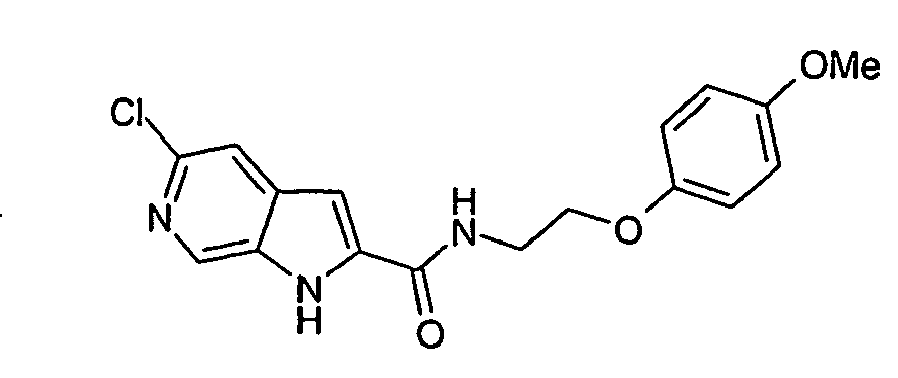
- The title compound was prepared as outlined in EXAMPLE 1 from 5-chloro-1H-pyrrolo[2,3-c]pyridine-2-carboxylic acid (Preparation 18) and 2-(4-methoxyphenoxy)ethylamine. The product was purified by chromatography on silica gel eluting with methanol/dichloromethane (3:97) to give the title compound as a yellow solid. δH (CD3OD): 3.71 (3H, s), 3.77 (2H, t), 4.12 (2H, t), 6.81-6.91 (4H, m), 7.09 (1H, s), 7.67 (1H, s), 8.58 (1H, s); m/z (ES+) = 346 [M+H]+.
-

- The title compound was prepared as outlined in EXAMPLE 1 from 5-chloro-1H-pyrrolo[2,3-c]pyridine-2-carboxylic acid (Preparation 18) and 2-thiophen-2-ylethylamine. The product was purified by chromatography on silica gel eluting with methanol/dichloromethane (3:97) to give the title compound as a yellow solid. δH (CD3OD): 3.16 (2H, t), 3.65 (2H, t), 6.89-6.94 (2H, m), 7.03 (1H, s), 7.20 (1H, d), 7.66 (1H, s), 8.57 (1H, s); m/z (ES+) = 306 [M+H]+.
-

- The title compound was prepared as outlined in EXAMPLE 1 from 5-chloro-1H-pyrrolo[2,3-c]pyridine-2-carboxylic acid (Preparation 18) and 2-(2-methoxyphenyl)ethylamine. The product was purified by chromatography on silica gel eluting with methanol/dichloromethane (3:97) to give the title compound as a yellow solid. δH (CD3OD): 2.94 (2H, t), 3.59 (2H, t), 3.78 (3H, s), 6.84 (1H, t), 6.89 (1H, d), 6.97 (1H, s), 7.12-7.18 (2H, m), 7.60 (1H, s), 8.55 (1H, s); m/z (ES+) = 330 [M+H]+.
-

- The title compound was prepared as outlined in EXAMPLE 1 from 5-chloro-1H-pyrrolo[2,3-c]pyridine-2-carboxylic acid (Preparation 18) and 2-oxo-2-phenylethylamine. The product was purified by mass directed purification to give the title compound as an orange solid. m/z (ES+) = 314 [M + H]+; RT = 3.30min.
-

- The title compound was prepared as outlined in EXAMPLE 1 from 5-chloro-1H-pyrrolo[2,3-c]pyridine-2-carboxylic acid (Preparation 18) and 2-oxo-2-phenylethylamine. The product was purified by mass directed purification to give the title compound as a yellow solid. m/z (ES+) = 326 [M+H]+; RT = 2.66min.
-

- The title compound was prepared as outlined in EXAMPLE 1 from 5-chloro-1H-pyrrolo[2,3-c]pyridine-2-carboxylic acid (Preparation 18) and phenethylamine. The product was purified by mass directed purification to give the title compound as an orange solid. δH (CD3OD): 2.94 (2H, t), 3.63 (2H, t), 7.00 (1H, s), 7.15-7.30 (5H, m), 7.64 (1H, s), 8.57 (1H, s); m/z (ES+) = 300 [M+H]+.
-

- The title compound was prepared as outlined in EXAMPLE 1 from 5-chloro-1H-pyrrolo[2,3-c]pyridine-2-carboxylic acid (Preparation 18) and 4-fluorophenethylamine. The product was purified by mass directed purification to give the title compound as an orange solid. δH (CD3OD) : 2.93 (2H, t), 3.60 (2H, t), 6.97-7.04 (3H, m), 7.24-7.30 (2H, m), 7.65 (1H, s), 8.56 (1H, s); m/z (ES+) = 318 [M + H]+.
-

- The title compound was prepared as outlined in EXAMPLE 1 from 5-chloro-1H-pyrrolo[2,3-c]pyridine-2-carboxylic acid (Preparation 18) and 2-(2-chloro-6-fluorobenzylsulfanyl)ethylamine. The product was purified by mass directed purification to give the title compound as a yellow solid. δH (CD3OD): 2.82 (2H, t), 3.64 (2H, t), 3.95 (2H, s), 7.04-7.09 (2H, m), 7.20-7.25 (2H, m), 7.67 (1H, s), 8.58 (1H, s); m/z (ES+) = 398 [M + H]+.
-

- The title compound was prepared as outlined in EXAMPLE 1 from 5-chloro-1H-pyrrolo[2,3-c]pyridine-2-carboxylic acid (Preparation 18) and 2,3-dihydrobenzo[1,4]dioxin-2-ylmethylamine. The product was purified by mass directed purification to give the title compound as a yellow solid. δH (CD3OD): 3.69-3.73 (2H, m), 3.97-4.03 (1H, m), 4.32-4.42 (2H, m), 6.77-6.88 (4H, m), 7.10 (1H, s), 7.67 (1H, s), 8.58 (1H, s); m/z (ES+) = 344 [M + H]+.
-

- The title compound was prepared as outlined in EXAMPLE 1 from 5-chloro-1H-pyrrolo[2,3-c]pyridine-2-carboxylic acid (Preparation 18) and 2-(naphthalen-1-ylamino)ethylamine. The product was purified by mass directed purification to give the title compound as a brown solid. δH (CD3OD): 3.55 (2H, t), 3.80 (2H, t), 6.68 (1H, d), 7.04 (1H, s), 7.14 (1H, d), 7.28 (1H, t), 7.36-7.42 (2H, m), 7.65 (1H, s), 7.70-7.74 (1H, m), 7.98-8.02 (1H, m), 8.58 (1H, s); m/z (ES+) = 365 [M + H]+.
-

- The title compound was prepared as outlined in EXAMPLE 1 from 1H-pyrrolo[2,3-c]pyridine-2-carboxylic acid (Preparation 15) and 2-phenylaminoethylamine to give the title compound as a pale yellow solid.
δH (CD3OD): 3.37 (2H, t), 3.63 (2H, t), 6.61 (1H, t), 6.69 (2H, d), 7.08-7.13 (2H, m), 7.64 (1H, d), 8.10 (1H, d), 8.78 (1H, s); m/z (ES+) = 281 [M+H]+. -

- The title compound was prepared as outlined in EXAMPLE 1 from 1H-pyrrolo[2,3-c]pyridine-2-carboxylic acid (Preparation 15) and 2-phenoxyethylamine to give the title compound as a pale yellow solid. δH (CD3OD): 3.81 (2H, t), 4.18 (2H, t), 6.89-6.97 (3H, m), 7.14 (1H, s), 7.26 (2H, t), 7.65 (1H, d), 8.10 (1H, d), 8.78 (1H, s); m/z (ES+) = 282 [M + H]+.
-

- To a solution of 5-methoxy-1H-pyrrolo[3,2-b]pyridine-2-carboxylic acid (Preparation 36, 50mg, 0.26mmol) in DMF (3mL), was added DIPEA (100µL, 0.57mmol), HOBt (35mg, 0.26mmol) and EDCI (60mg, 0.31mmol) sequentially. The reaction mixture was stirred for 5min prior to the addition of 2-(S)-amino-N, N-dimethyl-3-phenylpropionamide hydrochloride (Preparation 8, 65mg, 0.29mmol) in one portion. The reaction mixture was stirred for 21h at rt then water (15mL) and dichloromethane (30mL) were added. The mixture was stirred vigorously for 10min and the layers separated. The aqueous phase was extracted with dichloromethane (3 x 15mL) and the combined organics washed with brine (30mL), dried (MgSO4), filtered and concentrated in vacuo. Purification via flash column chromatography (SiO2, ethyl acetate/isohexane, 1:1) gave a yellow oil. Trituration with water followed by filtration and drying gave the title compound as a white solid. δH (CD3OD): 2.88 (6H, 2 x s), 3.12 (2H, m), 3.94 (3H, s), 5.26 (1H, dd), 6.71 (1H, d), 7.13 (1H, s), 7.25 (5H, m), 7.74 (1H, d); m/z (ES+) = 367 [M + H]+; RT = 3.20min.
-

- Prepared as outlined in EXAMPLE 1 from 1H-pyrrolo[3,2-b]pyridine-2-carboxylic acid (Preparation 32) and 2-(S)-amino-N, N-dimethyl-3-phenyl-propionamide hydrochloride (Preparation 8, 78mg, 0.34mmol). The title compound was isolated as a white solid. δH (d6 DMSO): 2.82 (3H, s), 2.98 (3H, s), 3.03 (2H, m), 5.12 (1H, m), 7.16 (2H, m), 7.24 (2H, m), 7.32 (2H, m), 7.40 (1H, d), 7.74 (1H, d), 8.37 (1H, dd), 8.93 (1H, d); m/z (ES+) = 337 [M + H]+; RT = 3.10min.
-

- To a solution of 1H-pyrrolo[3,2-b]pyridine-2-carboxylic acid (Preparation 32, 50mg, 0.31mmol) in DMF (5mL), was added 2-phenoxyethylamine (44µL, 0.34mmol), DIPEA (118µL, 0.68mmol) and HOBt (42mg, 0.31mmol) sequentially. The reaction mixture was stirred for 5min prior to the addition of EDCI (42mg, 0.22mmol) in one portion. The resulting mixture was stirred for 20h at rt and partitioned between ethyl acetate (50mL) and water (20mL). The layers were separated and the aqueous phase extracted with ethyl acetate (2 x 30mL). The combined organic fractions were washed with brine (20mL), dried (MgSO4), filtered and concentrated in vacuo to give an oil. Trituration with diethyl ether / isohexane and collection by filtration gave, after air-drying, the title compound as a cream coloured solid. δH (d6 DMSO): 3.48 (2H, m), 4.14 (2H, t), 6.94 (3H, m), 7.17 (1H, dd), 7.28 (3H, m), 7.77 (1H, d), 8.37 (1H, dd), 8.86 (1H, t); m/z (ES+) = 282 [M+ H]+; RT = 2.60min.
-

- The title compound was prepared as outlined in EXAMPLE 25 except N-phenylethylenediamine (44µL, 0.34mmol) was used in place of 2-phenoxyethylamine. The title compound was isolated as a cream solid. δH (d6 DMSO): 3.23 (2H, m), 3.37 (2H, m), 5.70 (1H, t), 6.52 (1H, t), 6.63 (2H, dd), 7.07 (2H, dd), 7.17 (1H, dd), 7.22 (1H, s), 7.77 (1H, d), 8.37 (1H, dd), 8.73 (1H, t); m/z (ES+) = 281 [M + H]+; RT = 2.36min.
-

- The title compound was prepared as outlined in EXAMPLE 1 from 5-chloro-1H-pyrrolo[3,2-b]pyridine-2-carboxylic acid (Preparation 6) and 2-phenoxyethylamine. On completion of the reaction, the mixture was partitioned between water and dichloromethane on a hydrophobic frit, washing with dichloromethane. The organic filtrate was concentrated in vacuo then triturated with dichloromethane/methanol/ethyl acetate to give the title compound as a white solid. δH (d6 DMSO): 3.68 (2H, m), 4.13 (2H, m), 6.94 (3H, m), 7.25 (4H, m), 7.83 (1H, d), 8.95 (1H, t), 12.09 (1H, s). m/z (ES+) = 316 [M + H]+; RT = 3.45min.
-

- The title compound was prepared as outlined in EXAMPLE 1 from 5-chloro-1H-pyrrolo[2,3-c]pyridine-2-carboxylic acid (Preparation 18) and 4-benzylpiperazin-lylethylamine. The product was purified by mass directed purification to give the title compound as an orange solid. m/z (ES+) = 398 [M + H]+; RT = 2.75min.
-

- The title compound was prepared as outlined in EXAMPLE 1 from 5-chloro-1H-pyrrolo[2,3-c]pyridine-2-carboxylic acid (Preparation 18) and 2-benzylaminoethylamine. The product was purified by mass directed purification to give the title compound as an off-white solid. m/z (ES+) = 329 [M+ H]+; RT = 2.75min.
-

- To a solution of [(5-chloro-1H-pyrrolo[2,3-c]pyridine-2-carbonyl)amino] acetic acid (EXAMPLE 40, 30mg, 0.12mmol) in DMF (2mL) was added aniline (12µL, 0.13mmol), HOBt (16mg, 0.12mmol) and DIPEA (41µL, 0.24mmol). After 5min, EDCI (29mg, 0.15mmol) was added, and the reaction stirred at rt for 16h. The solvent was removed in vacuo and the solid partitioned between water (20mL) and ethyl acetate (3 x 20mL). The combined organic fractions were dried (MgSO4), concentrated in vacuo and the residue purified by chromatography on silica gel eluting with methanol/dichloromethane (1:19) to give the title compound as a yellow solid. m/z (ES+) = 329 [M + H]+; RT = 3.17min.
-

- The title compound was prepared according to the procedure of EXAMPLE 30 except 4-aminotetrahydropyran was used in place of aniline. After 16h the reaction mixture was poured into water and left for a further 16h. The solid was filtered and dried to give the title compound as a white crystalline solid. m/z (ES+) = 337 [M+H]+; RT = 2.72min.
-

- The title compound was prepared according to EXAMPLE 30 except 2-aminomethylthiophene was used in place of aniline. After stirring for 16h the reaction mixture was poured into water and the precipitate was filtered and dried to give the title compound as a white solid. m/z (ES+) = 349 [M+H]+; RT = 3.07min.
-

- The title compound was prepared according to EXAMPLE 30 except p-anisidine was used in place of aniline. After stirring for 16h, the reaction mixture was poured into water and the precipitate was filtered and dried to give the title compound as a beige solid. m/z (ES+) = 359 [M+ H]+; RT = 3.22min.
-

- To a solution of 2-(S)-[(5-chloro-1H-pyrrolo[2,3-c]pyridine-2-carbonyl)amino]-3-phenylpropionic acid (EXAMPLE 42, 50mg, 0.15mmol) in DMF (3mL) was added pyrrolidine (13µL, 0.16mmol), HOBt (20mg, 0.15mmol) and DIPEA (51µL, 0.29mmol). After 5min, EDCI (36mg, 0.19mmol) was added and the reaction was stirred at rt for 16h. The solvent was removed in vacuo and the solid was triturated with water, filtered and dried to give the title compound as a beige solid. m/z (ES+) = 397 [M+H]+; RT = 3.38min.
-

- To a solution of 2-(S)-[(5-chloro-1H-pyrrolo[2,3-c]pyridine-2-carbonyl)amino]-3-phenylpropionic acid (EXAMPLE 42, 50mg, 0.15mmol) in DMF (3mL) was added 3-(S)-hydroxypyrrolidine (13.9mg, 0.16mmol), HOBt (20mg, 0.15mmol) and DIPEA (51µL, 0.29mmol). After 5min, EDCI (36mg, 0.19mmol) was added and the reaction stirred at rt for 16h. The solvent was removed in vacuo and the residue partitioned between water (20mL) and ethyl acetate (3 x 20mL), dried (MgSO4) and concentrated in vacuo. Purification via chromatography on silica gel eluting with methanol / dichloromethane (4:96) gave the title compound as a white solid. m/z (ES+) = 413 [M + H]+; RT = 3.20min.
-

- The title compound was prepared according to EXAMPLE 35 except cis-3,4-dihydroxypyrrolidine was used in place of 3-(S)-hydroxypyrrolidine. Purification via chromatography on silica gel eluting with a gradient of methanol/dichloromethane (4:96 to 1:9) gave the title compound as a white solid. m/z (ES+) = 429 [M+H]+; RT = 3.12min.
-

- The title compound was prepared according to the procedure used for EXAMPLE 35 except thiomorpholine was used in place of 3-(S)-hydroxypyrrolidine. Purification via chromatography on silica gel eluting with methanol/dichloromethane (3:97) gave the title compound as a white solid. m/z (ES+) = 429 [M + H]+; RT = 3.54min.
-

- The title compound was prepared according to EXAMPLE 35 except 4-aminotetrahydropyran was used in place of 3-(S)-hydroxypyrrolidine. The product was recrystallised from methanol/dichloromethane (3:97) to give the title compound as a white solid. m/z (ES+) = 427 [M+ H]+; RT = 3.23min.
-

- To a solution of 5-chloro-1H-pyrrolo[2,3-c]pyridine-2-carboxylic acid (Preparation 18, 800mg, 4.1mmol) in DMF (40mL) was added glycine ethyl ester hydrochloride (625mg, 4.5mmol), HOBt (0.55g, 4.1mmol) and DIPEA (2.13mL, 12.2mmol). After 5min, EDCI (1.01g, 5.3mmol) was added and the reaction stirred at rt for 16h. The solvent was removed in vacuo and the solid partitioned between water (100mL) and ethyl acetate (3 x 80mL). The combined organic fractions were dried (MgSO4), concentrated in vacuo and purified by chromatography on silica gel eluting with methanol/dichloromethane (4:96) to give the title compound as a yellow solid.
δH (CD3OD): 1.28 (3H, t), 4.14 (2H, s), 4.23 (2H, q), 7.10 (1H, s), 7.68 (1H, s), 8.59 (1H, s); m/z (ES+) = 282 [M+ H]+. -

- To a solution of [(5-chloro-1H-pyrrolo[2,3-c]pyridine-2-carbonyl)amino] acetic acid ethyl ester (EXAMPLE 39, 500mg, 1.8mmol) in THF (30mL) was added sodium hydroxide solution (1.8mL, 2M, 3.6mmol) and the reaction stirred at rt for 4h. The solvent was removed in vacuo and the solid partitioned between hydrochloric acid (1M, 100mL) and ethyl acetate (2 x 100mL). The aqueous layer was concentrated in vacuo and the solid residue suspended in water (10mL), filtered and dried to give the title compound as an off-white solid. δH (d6 DMSO): 3.97 (2H, d), 7.18 (1H, s), 7.76 (1H, s), 8.57 (1H, s), 9.17 (1H, t), 12.32 (1H, s); m/z (ES+) = 254 [M+H]+.
-

- To a solution of 5-chloro-1H-pyrrolo[2,3-c]pyridine-2-carboxylic acid (Preparation 18, 2.00g, 10.2mmol) in DMF (50mL) was added L-phenylalanine ethyl ester hydrochloride (2.45g, 10.7mmol), HOBt (1.37g, 10.2mmol) and DIPEA (5.3mL, 30.5mmol). After 5min, EDCI (2.54g, 13.2mmol) was added and the reaction mixture stirred at rt for 16h. The solvent was removed in vacuo and the solid dissolved in ethyl acetate (150mL) and washed with water (200mL). The organic phase was dried (MgSO4), concentrated in vacuo and purified by chromatography on silica gel eluting with methanol/dichloromethane (3:97) to give the title compound as a pale yellow solid. δH (CD3OD): 1.21 (3H, t), 3.13 (1H, dd), 3.28 (1H, dd), 4.17 (2H, q), 4.86 (1H, m), 7.09 (1H, s), 7.16-7.26 (5H, m), 7.65 (1H, s), 8.55 (1H, s); m/z (ES+) = 372 [M+ H]+.
-

- Sodium hydroxide solution (2.5ml, 2M, 5.1mmol) was added to a solution of 2-(S)-[(5-chloro-1H-pyrrolo[2,3-c]pyridine-2-carbonyl)amino]-3-phenylpropionic acid ethyl ester (EXAMPLES 41, 940mg, 2.5mmol) in THF (30mL) and the reaction mixture was stirred at rt for 16h. The solvent was removed in vacuo and the solid partitioned between hydrochloric acid (2M, 40mL) and ethyl acetate (3 x 40mL). The combined organic fractions were dried (MgSO4) and concentrated in vacuo to give the title compound as a yellow solid. m/z (ES+) = 344 [M + H]+; RT = 3.29min.
-

- To a solution of 5-chloro-1H-pyrrolo[2,3-c]pyridine-2-carboxylic acid (Preparation 18, 165mg, 0.84mmol) and (3S,2R)-3-amino-2-hydroxy-4-phenylbutyric acid methyl ester (Preparation 21, 175mg, 0.84mmol) in DMF (10mL) was added HOBt (125mg, 0.92mmol), DIPEA (0.29mL, 1.68mmol) and EDCI (177mg, 0.92mmol) and the reaction stirred at rt for 72h. The reaction solvent was removed in vacuo, and the residue partitioned between water (40mL) and ethyl acetate (3 x 40mL). The combined organic fractions were dried (MgSO4), concentrated in vacuo and the residue purified by chromatography on silica gel eluting with methanol/dichloromethane (3:97) to give the title compound as a yellow solid. δH (CD3OD): 2.97-3.12 (2H, m), 3.67 (1H, s), 4.25 (1H, d), 4.70-4.75 (1H, m), 7.08 (1H, s), 7.15-7.21 (1H, m), 7.25-7.34 (4H, m), 7.65 (1H, s), 8.55 (1H, s); m/z (ES+) = 388 [M + H]+.
-

- Sodium hydroxide solution (0.24mL, 2M, 0.48mmol) was added to a solution of (S)-3-[(5-chloro-1H-pyrrolo[2,3-c]pyridine-2-carbonyl)amino]-(R)-2-hydroxy-4-phenylbutyric acid methyl ester (EXAMPLE 43, 170mg, 0.44mmol) in methanol (5mL) and the reaction stirred at rt for 24h. The solvent was removed in vacuo and the residue partitioned between hydrochloric acid (1N, 30mL) and ethyl acetate (3 x 30mL). The combined organic fractions were dried (MgSO4) and concentrated in vacuo to give the title compound as a yellow solid. δH (DMSO): 2.71 (1H, dd), 2.91 (1H, dd), 3.56 (1H, d), 4.38-4.46 (1H, m), 4.77 (1H, s), 6.76 (1H, s), 7.11-7.16 (1H, m), 7.19-7.27 (4H, m), 7.45 (1H, s), 8.44-8.52 (2H, m); m/z (ES+) = 374 [M+ H]+.
-

- Aqueous hydrochloric acid (2.1mL, 2M) was added to a solution of 5-chloro-1H-pyrrolo[2,3-c]pyridine-2-carboxylic acid [2-(4-methoxyphenyl)[1,3]dioxolan-2-ylmethyl]amide (Preparation 49, 160mg, 0.41mmol) in acetone (20mL). The mixture was heated under reflux for 90min then allowed to cool to rt. The suspension was filtered then washed with acetone and air dried, to give the title compound as a pale yellow solid. δH (d6 DMSO): 3.86 (3H, s), 4.79 (2H, d), 7.08 (2H, d), 7.23 (1H, s), 7.77 (1H, s), 8.03 (2H, d), 8.58 (1H, s), 9.14 (1H, t), 12.31 (1H, br s). m/z (ES+) = 344 [M + H]+; RT = 3.34min.
- The following compounds were synthesised according to the method or EXAMPLE 45 using the appropriate ketal and aqueous hydrochloric acid.

Example R m/z 46 
m/z (ES+) = 350 [M + H]+; RT = 3.20min 47 
m/z (ES+) = 348 [M + H]+; RT = 3.32min 48 
m/z (ES+) = 332 [M + H]+; RT = 3.25min -
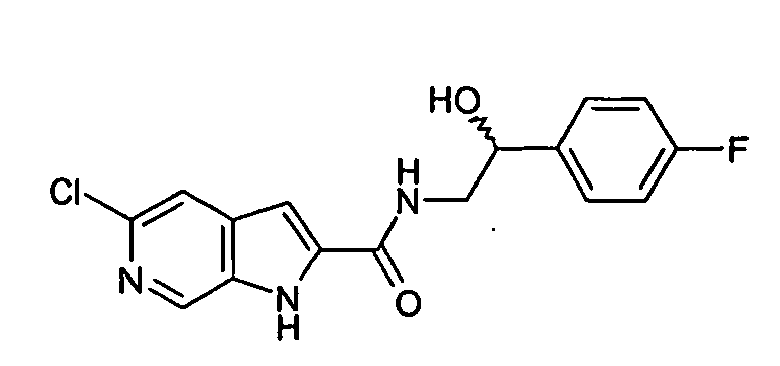
- To a stirred suspension of 5-chloro-1H-pyrrolo[2,3-c]pyridine-2-carboxylic acid [2-(4-fluorophenyl)-2-oxoethyl]amide EXAMPLE 48 (0.05g, 151mmol) in ethanol (5mL, absolute) was added polymer-supported borohydride (2.5mmol/g, 0.09g, 226mmol) and the mixture sonicated with gentle warming until the ketone had dissolved. The reaction mixture was stirred for 2 days at rt then filtered, washing with methanol. The filtrate was evaporated to dryness in vacuo to give a colourless oil. Purification via flash column chromatography (SiO2, ethyl acetate : isohexane, 1:1, v/v) gave the title compound as a white solid. m/z (ES+) = 334 [M + H]+; RT = 2.93min.
-

- To a solution of (S)-2-amino-N,N-dimethyl-3-pyridin-3-ylpropionamide hydrochloride (Preparation 53, 170mg, 0.74mmol) in DMF (5mL) was added DIPEA (0.45mL, 2.58mmol), 5-chloro-1H-pyrrolo[2,3-c]pyridine-2-carboxylic acid (Preparation 18, 145mg, 0.74mmol) and TBTU (262mg, 0.82mmol). The reaction mixture was stirred at rt for 16h. The solvent was removed in vacuo and the remainder was purified by preparative HPLC, to give the title compound as an off-white solid. δH (CD3OD): 2.95 (3H, s), 3.08 (3H, s), 3.11-3.18 (1H, m), 3.22-3.28 (1H, m), 5.31-5.37 (1H, m), 7.12 (1H, s), 7.34-7.38 (1H, m), 7.65 (1H, s), 7.79-7.84 (1H, m), 8.37-8.41 (1H, m), 8.45-8.51 (1H, m), 8.54 (1H, s); m/z (ES+) = 372 [M+ H]+.
-

- To a solution of (S)-2-amino-3-pyridin-3-yl-1-pyrrolidin-1-ylpropan-1-one hydrochloride (Preparation 54, 239mg, 0.94mmol) in DMF (5mL) was added DIPEA (0.60mL, 3.28mmol), 5-chloro-1H-pyrrolo[2,3-c]pyridine-2-carboxylic acid (Preparation 18, 184mg, 0.94mmol) and TBTU (330mg, 1.03mmol). The reaction mixture was stirred at rt for 16h. The solvent was removed in vacuo and the residue partitioned between ethyl acetate (100mL) and sodium hydroxide solution (2 x 100mL, 1N). The organic phase was dried (MgSO4) and evaporated to dryness give the title compound as a brown solid. δH (CD3OD): 1.74-1.94 (4H, m), 3.12-3.39 (4H, m), 3.41-3.48 (1H, m), 3.69-3.75 (1H, m), 5.07-5.12 (1H, m), 7.16 (1H, s), 7.34-7.39 (1H, m), 7.67 (1H, s), 7.79-7.83 (1H, m), 8.37-8.42 (1H, m), 8.45-8.51 (1H, m), 8.56 (1H, s); m/z (ES+) = 398 [M+ H]+.
-

- To a solution of 2-(S)-amino-N,N-dimethylamino-3-pyridin-2-yl-propionamide hydrochloride (Preparation 53, 0.15g, 0.66mmol) in DMF (5mL) was added DIPEA (0.4mL, 2.31mmol), TBTU (0.212g, 0.66mmol) and 5-chloro-1H-indole-2-carboxylic acid (Preparation 18, 0.130g, 0.66mmol). The reaction mixture was stirred at rt for 16h then concentrated under reduced pressure. The residue was dissolved in ethyl acetate (200mL) and washed with sodium hydroxide solution (100mL, 1N). The organic extract was dried and concentrated in vacuo. Purification by preparative hplc gave the title compound as a white solid. m/z (ES+) = 372 [M + H]+; RT = 2.47min.
-

- To a solution of carboxylic acid (Preparation 18, 2.66g, 13.6mmol) in DMF (anhydrous, 120mL) was added amine.HCl (Preparation 103, 4.30g, 14.9mmol), DIPEA (7.79mL, 44.7mmol) and HOBt.H2O (2.280g, 14.9mmol). The resulting solution was stirred at rt for 10min prior to the addition of EDCI (3.12g, 16.3mmol) and the reaction mixture stirred for 17h at rt. The volatiles were removed in vacuo then the residue was partitioned between ethyl acetate (200mL) and water (200mL). The aqueous phase was extracted with ethyl acetate (3x50mL) then the combined organics washed with sodium hydroxide solution (2M, 3x50mL), hydrochloric acid (2M, 2x50mL), brine (100mL), dried (MgSO4), filtered and concentrated in vacuo. The isolated solid was dissolved in methanol / dichloromethane (15:185, v/v) then purified via flash chromatography (SiO2, dissolved in methanol / dichloromethane, 15:185, v/v) to give the title compound as a pale yellow powder. δH (CD3OD): 1.72-2.02 (2H, m), 3.01-3.13 (1H, m), 3.13-3.26 (2H, m), 3.35-3.52 (1.5H, m), 3.55-3.65 (0.5H, m), 3.71-3.81 (0.5H, m), 3.84 (0.5H, dd), 4.23-4.33 (0.5H, m), 4.37-4.45 (0.5H, m), 4.99 (0.5H, t), 5.07 (0.5H, t), 6.90-7.07 (2H, m), 7.13 (1H, d), 7.31 (2H, dd), 7.66 (1H, s), 8.54 (1H, d); m/z (ES+) = 431 [M + H]+; RT = 3.17min.
-

- To a solution of 2-(S)-[(5-chloro-1H-pyrrolo[2,3-c]pyridine-2-carbonyl)-amino]-3-(4-fluorophenyl)propionic acid (30mg, 0.08mmol) in DMF (3mL) was added DIPEA (17.3µL, 0.10mmol) and HATU (37.8mg, 0.10mmol). After 15min, isopropylamine (7.1µL, 0.08mmol) was added. The reaction mixture was stirred at rt for 24h then concentrated under reduced pressure (genevac). Purification by mass directed purification gave the title compound as a yellow solid. m/z (ES+) = 403 [M+H] +; RT = 3.39min.
-
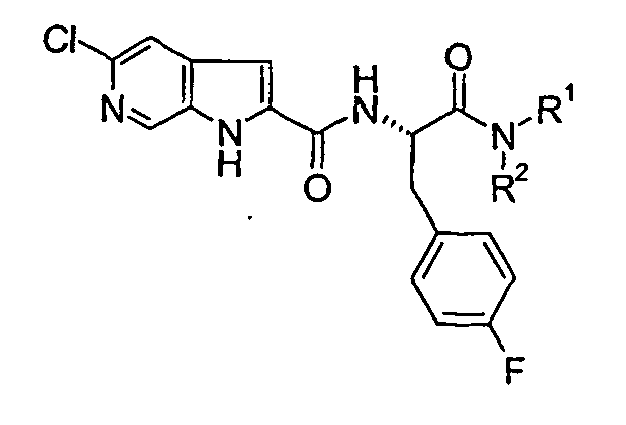
- The following compounds were prepared according to the method of EXAMPLE 54 from 2-(S)-[(5-chloro-1H-pyrrolo[2,3-c]pyridine-2-carbonyl)amino]-3-(4-fluorophenyl)propionic acid and the appropriate amine.
Example NR1R2 m/z RT (min) 55 
375 3.11 56 
389 3.24 57 
415 3.36 58 
429 3.51 59 
443/445 3.11 60 
457/459 3.22 61 
471/473 3.29 62 
445 3.20 63 
441 3.44 64 
401 3.19 65 
415 3.31 66 
429 3.51 67 
445 3.24 68 
445 3.14 69 
459 3.39 70 
431 3.07 71 
472 3.04 72 
431 3.17 73 
444 2.69 74 
405 3.06 75 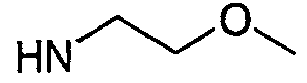
419 3.19 76 
435 3.36 77 
432 2.77 78 
449 2.99 79 
389 3.24 80 
417 3.37 81 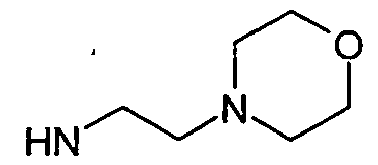
474 2.67 82 
444 3.04 83 
452 2.65 84 
437 3.57 85 
443 3.52 86 
477 3.31 87 
475 3.11 88 
447 2.99 89 
443 3.51 90 
433 3.32 91 
445 3.19 92 
447 3.37 93 
446 2.64 94 
419 3.04 95 
474 2.64 96 
498 2.70 97 
445 3.14 98 
443 3.20 -

- To a solution of 2-(S)-[(5-chloro-1H-pyrrolo[2,3-c]pyridine-2-carbonyl)-amino]-3-(4-fluorophenyl)propionic acid (100mg, 0.28mmol) in DMF (5ml) was added cyclopropylamine (19.2µl, 0.28mmol), HOBt (37mg, 0.28mmol) and DIPEA (96µl, 0.55mmol). After 5min, EDCI (69mg, 0.36mmol) was added and the reaction mixture stirred at rt for 16h. The solvent was removed in vacuo and the residue triturated with water and chromatographed on silica gel eluting with methanol:dichloromethane (1:24) to give the title compound as an off-white solid. m/z (ES+) = 401 [M+ H]+; RT = 3.22min.
-

- The following compounds were prepared according to the method of EXAMPLE 99 from 2-(S)-[(5-chloro-1H-pyrrolo[2,3-c]pyridine-2-carbonyl)amino]3-(4-fluorophenyl)propionic acid and the appropriate amine. All compounds were purified by chromatography on silica gel eluting with the described solvent system.
Example NR1R2 Eluent m/z RT (min) 100 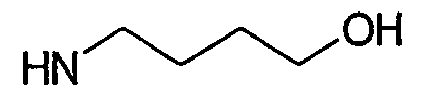
MeOH:DCM
1:19433 3.06 101 
MeOH:DCM
3:97433 3.20 102 
MeOH:DCM
6:94435 2.95 103 
MeOH:DCM
3:97486 3.15 104 
NH4OH:MeOH:DCM
1:9:90500 2.82 105 
MeOH:DCM
1:19550 3.24 106 
MeOH:DCM
1:19520 3.36 -

- 2-(S)-[(5-Chloro-1H-pyrrolo[2,3-c]pyridine-2-carbonyl)amino]-3-(4-fluorophenyl)propionic acid (100mg, 0.28mmol), 3-hydroxyazetidine hydrochloride (Heterocycles, 2002, 56(1-2), 433-442; 30mg, 0.28mmol) and HOBt (37mg, 0.28mmol) were dissolved in DMF (5ml) and DIPEA (0.14ml, 0.83mmol). After 5min, EDCI (69mg, 0.36mmol) was added and the reaction mixture stirred at rt for 16h. The solvent was removed in vacuo and the residue triturated with water. Purification by chromatography on silica gel eluting with methanol:dichloromethane (1:49 to 3:97) gave the title compound as a yellow solid. δH (CD3OD): 3.08-3.21 (2H, m), 3.58-3.63 (0.5H, m), 3.84-3.91 (0.5H, m), 4.03-4.09 (0.5H, m), 4.25-4.32 (0.5H, m), 4.38-4.94 (4H, m), 7.03-7.12 (2H, m), 7.15-7.19 (1H, m), 7.30-7.38 (2H, m), 7.68 (1H, s), 8.59 (1H, s); RT = 3.32min.
-

- 2-(S)-[(5-Chloro-1H-pyrrolo[2,3-c]pyridine-2-carbonyl)amino]-3-phenylpropionic acid (100mg, 0.29mmol), 3-hydroxyazetidine hydrochloride (32mg, 0.29mmol) and HOBt (39mg, 0.29mmol) were dissolved in DMF (5ml) and DIPEA (0.15ml, 0.87mmol). After 5min, EDCI (72mg, 0.38mmol) was added and the reaction mixture stirred at rt for 16h. The solvent was removed in vacuo and the residue triturated with water. Purification by chromatography on silica gel eluting with methanol:dichloromethane (1:49 to 3:97) gave the title compound as an off-white solid. δH (CD3OD): 3.12-3.20 (2H, m), 3.45-3.51 (0.5H, m), 3.83-3.90 (0.5H, m), 4.00-4.13 (1H, m), 4.35-4.52 (2H, m), 4.57-4.94 (2H, m), 7.18-7.22 (1H, m), 7.27-7.40 (5H, m), 7.68 (1H, s), 8.59 (1H, s); RT = 3.27min.
-

- [(5-Chloro-1H-pyrrolo[2,3-c]pyridine-2-carbonyl)amino] acetic acid (30mg, 0.12mmol), 3-hydroxyazetidine hydrochloride (13mg, 0.12mmol) and HOBt (16mg, 0.12mmol) were dissolved in DMF (3ml) and DIPEA (43µl, 0.25mmol). After 5min, EDCI (30mg, 0.15mmol) was added and the reaction mixture stirred at rt for 16h. The solvent was removed in vacuo and the residue partitioned between water (20ml) and DCM (3 x 20ml). The combined organics were dried (MgSO4), concentrated in vacuo and the residue purified by chromatography on silica gel eluting with methanol:dichloromethane (1:24) to give the title compound as a white solid. δH (CD3OD): 4.06-4.15 (3H, m), 4.40-4.46 (1H, m), 4.55-4.63 (1H, m), 4.77-4.94 (2H, m), 7.14 (1H, s), 7.71 (1H, s), 8.62 (1H, s); RT = 2.82min.
-

- The following compounds were prepared according to the method of EXAMPLE 109 from [(5-chloro-1H-pyrrolo[2,3-c]pyridine-2-carbonyl)amino] acetic acid and the appropriate amine. All compounds were purified by chromatography on silica gel eluting with the described solvent system.
Example NR1R2 Eluent m/z RT (min) 110 
MeOH:DCM
6:94 to 8:92337 2.61 111 
MeOH:DCM
1:24323 2.65 -

- 5-Chloro-1H-pyrrolo[2,3-c]pyridine-2-carboxylic acid (100mg, 0.51mmol) and 4-(4,6-dimethoxy[1.3.5]triazin-2-yl)-4-methylmorpholinium chloride (DMTMM) (183mg, 0.66mmol) were dissolved in THF (20ml). After 5min, 2-amino-3-oxo-3-phenylpropionic acid ethyl ester hydrochloride (Tetrahedron Lett., 1993, 34(2), 211-214; 124mg, 0.51mmol) and 4-methylmorpholine (56µl, 0.51mmol) were added and the reaction mixture stirred at rt for 72h. The solvent was removed in vacuo and the residue partitioned between water (40ml) and EtOAc (3 x 30ml). The combined organics were dried (MgSO4), concentrated in vacuo and purified by chromatography on silica gel eluting with methanol:dichloromethane (1:19). This material was further triturated with methanol:diethyl ether (1:19) to give the title compound as a pale yellow solid. m/z (ES+) = 386 [M + H]+; RT = 3.56min.
-

- 2-(S)-[(5-Chloro-1H-pyrrolo[2,3-c]pyridine-2-carbonyl)amino]-3-(4-fluorophenyl)propionic acid (80mg, 0.22mmol) and N,O-dimethylhydroxylamine hydrochloride (24mg, 0.24mmol) were dissolved in ethanol (10ml) and 4-methylmorpholine (27µl, 0.24mmol). To this was added DMTMM (67mg, 0.24mmol) and the reaction mixture was stirred at rt for 16h. Further N,O-dimethylhydroxylamine hydrochloride (12mg, 0.12mmol), 4-methylmorpholine (14µl, 0.12mmol) and DMTMM (34mg, 0.12mmol) were added and the reaction mixture was stirred at rt for 96h. The solvent was removed in vacuo and the residue partitioned between water (40ml) and EtOAc (2 x 40ml). The combined organics were dried (MgSO4), concentrated in vacuo and purified by chromatography on silica gel eluting with methanol:dichloromethane (1:19) to give the title compound as a white solid. m/z (ES+) = 405 [M + H]+; RT = 3.36min.
-

- 5-Chloro-1H-pyrrolo[2,3-b]pyridine-2-carboxylic acid (Preparation 57, 50mg, 0.25mmol), 2-(S)-amino-3-(4-fluorophenyl)-1-(4-hydroxypiperidin-1-yl)propan-1-one hydrochloride (85mg, 0.25mmol) and DMTMM (85mg, 0.31mmol) were dissolved in ethanol (5ml) and 4-methylmorpholine (31µl, 0.28mmol). The reaction mixture was stirred at rt for 16h. The solvent was removed in vacuo and the residue partitioned between water (30ml) and EtOAc (3 x 25ml). The combined organics were dried (MgSO4), concentrated in vacuo and purified by chromatography on silica gel eluting with methanol:dichloromethane (1:19) to give the title compound as a beige solid. m/z (ES+) = 445 [M + H]+; RT = 3.31min.
-

- 5-Chloro-1H-pyrrolo[2,3-b]pyridine-2-carboxylic acid (Preparation 57, 55mg, 0.28mmol), 2-(S)-amino-N,N-dimethyl-3-phenylpropionamide hydrochloride (70mg, 0.31mmol) and DMTMM (93mg, 0.34mmol) were dissolved in ethanol (5ml) and 4-methylmorpholine (34µl, 0.31mmol). The reaction mixture was stirred at rt for 24h. The solvent was removed in vacuo and the residue partitioned between water (40ml) and EtOAc (2 x 40ml). The combined organics were washed with 2N NaOH solution (40ml), brine (40ml), dried (MgSO4) concentrated in vacuo and purified by chromatography on silica gel eluting with methanol:dichloromethane (3:97) to give the title compound as a yellow solid. m/z (ES+) = 371 [M+ H]+; RT = 3.49min.
-

- To a solution of 2-(S)-amino-N,N-dimethyl-3-phenylpropionamide hydrochloride (Preparation 8, 0.0135g, 0.059mmol) in DMF (anhydrous, 3mL) was added DIPEA (0.031mL, 0.177mmol) then carboxylic acid (Preparation 60, 0.010g, 0.054mmol). To the stirred solution was added HOBt.H2O (0.008g, 0.059mmol) then, after 10min, EDCI (0.012g, 0.065mmol). The reaction mixture was stirred for 18h then all volatiles were removed in vacuo. The residue was partitioned between ethyl acetate (30mL) and water (20mL). The layers were separated and the aqueous layer extracted with ethyl acetate (3x20mL). The combined organics were washed with brine (30mL), dried (MgSO4), filtered and concentrated in vacuo. The residue was dissolved in methanol then adsorbed onto silica gel. Purification via flash column chromatography (SiO2, CH2Cl2: MeOH, 19 : 1, v/v) gave the title compound as an off-white solid. δH (CD3OD): 2.88 (3H, s), 2.89 (3H, s), 3.00-3.23 (2H, m), 3.50 (1H, s), 5.27 (1H, t), 7.10-7.37 (6H, m), 7.86 (1H, s), 8.70 (1H, s). m/z (ES+) = 361 [M + H]+; RT = 2.65min.
-

- To a solution of 2-(S)-amino-N,N-dimethyl-3-phenylpropionamide hydrochloride (Preparation 8, 0.023g, 0.100mmol) in DMF (anhydrous, 4mL) was added DIPEA (0.052mL, 0.300mmol) then carboxylic acid (Preparation 62, 0.017g, 0.091mmol). To the stirred solution was added HOBt.H2O (0.0135g, 0.100mmol) then, after 10min, EDCI (0.021g, 0.109mmol). The reaction mixture was stirred for 18h then all volatiles were removed in vacuo. The residue was partitioned between ethyl acetate (30mL) and water (20mL). The layers were separated and the aqueous layer extracted with ethyl acetate (3x20mL). The combined organics were washed with brine (30mL), dried (MgSO4) filtered and concentrated in vacuo. The residue was dissolved in ethyl acetate then adsorbed onto silica gel. Purification via flash column chromatography (SiO2, ethyl acetate : isohexane, 1:1, v/v) gave the title compound as a pale brown solid. δH (CDCl3): 2.77 (3H, s), 2.96 (3H, s), 3.08-8.20 (2H, m), 5.23-5.41 (1H, m), 6.99 (1H, s), 7.14-7.36 (5H, m), 7.65 (1H, d), 8.01 (1H, s), 8.87 (1H, s), 10.01 (1H, s); m/z (ES+) = 362 [M + H]+; RT = 3.11min.
-

- To a solution of 2-(S)-amino-3-(4-fluorophenyl)-1-(4-hydroxypiperidin-1-yl)propan-1-one hydrochloride (Preparation 20, 0.036g, 0.118mmol) in DMF (anhydrous, 5mL) was added DIPEA (0.061mL, 0.353mmol) then carboxylic acid (Preparation 62, 0.020g, 0.107mmol). To the stirred solution was added HOBt.H2O (0.016g, 0.107mmol) then, after 10min, EDCI (0.025g, 0.128mmol). The reaction mixture was stirred for 18h then all volatiles were removed in vacuo. The residue was partitioned between CH2Cl2 (30mL) and water (20mL). The layers were separated then the aqueous was extracted with CH2Cl2 (2x30mL). The combined organics were washed with brine (50mL), dried (MgSO4), filtered and concentrated in vacuo. The residue was dissolved in methanol then adsorbed onto silica gel. Purification via flash column chromatography (SiO2, methanol : dichloromethane, 7:93, v/v) gave the title compound as a white solid. δH (d6 DMSO): 1.05-1.32 (2H, m), 1.49-1.72 (2H, m), 2.86-3.42 (4H, m), 3.53-3.87 (2.5H, m), 3.93-4.05 (0.5H, m), 4.69 (1H, d), 5.07-5.21 (1H, m), 6.97-7.12 (2H, m), 7.26-7.39 (2H, m), 7.47 (1H, s), 8.41 (1H, s), 8.81 (1H, s), 9.01-9.41 (1H, m), 12.64 (1H, s); m/z (ES+) = 436 [M + H]+; RT = 1.51min.
-

- To a solution of 2-(S)-amino-N,N-dimethyl-3-phenylpropionamide hydrochloride (Preparation 8, 0.0286g, 0.125mmol) in DMF (anhydrous, 5mL) was added DIPEA (0.071mL, 0.409mmol) then carboxylic acid (Preparation 66, 0.020g, 0.114mmol). To the stirred solution was added HOBt.H2O (0.017g, 0.125mmol) then, after 10min, EDCI (0.026g, 0.136mmol). The reaction mixture was stirred for 16h at room temperature then all volatiles were removed in vacuo. The residue was partitioned between CH2Cl2 (50mL) and water (50mL). The layers were separated then the aqueous layer extracted with CH2Cl2 (3x20mL). The combined organics were washed with brine (30mL), dried (MgSO4), filtered and concentrated in vacuo. The residue was dissolved in CH2Cl2 then purified via flash column chromatography (SiO2, CH2Cl2 then methanol : CH2Cl2, 1:19, v/v) to give the title compound as a pale yellow solid. δH (CDCl3): 2.63 (3H, s), 2.77 (3H, s), 2.97 (3H, s), 3.11-3.25 (2H, m), 5.34-5.44 (1H, m), 6.85 (1H, s), 7.20-7.33 (6H, m), 7.34 (1H, s), 7.83 (1H, d), 8.78 (1H, s); m/z (ES+) = 351 [M+ H]+; RT = 2.36min.
-

- To a solution of 2-(S)-[(5-chloro-1H-pyrrolo[2,3-c]pyridine-2-carbonyl)amino]-3-phenylpropionic acid (EXAMPLE 42, 150mg, 0.42mmol) and 4-methoxypiperidine hydrochloride (Preparation 68, 86mg, 0.57mmol) in DMF (5mL) was added HOBt (66mg, 0.43mmol), DIPEA (0.23mL, 1.34mmol) and EDCI (102mg, 0.53mmol). After stirring at rt for 12h the mixture was added to diluted brine (100mL, water/brine : 1/1). Extraction with ethyl acetate (4 x 25mL), washing of the combined extracts with brine (50mL) and drying (MgSO4) gave, after concentration, a residue which was purified by recrystallisation from methanol to give the title compound as a colourless solid. m/z (ES+) = 459.38 [M+H]+; RT = 3.40min.
-

- To a solution of 2-(S)-[(5-chloro-1H-pyrrolo[2,3-c]pyridine-2-carbonyl)amino]-3-phenylpropionic acid (EXAMPLE 42, 104mg, 0.29mmol) and(R)-3-methoxypyrrolidine hydrochloride (Preparation 70, 40mg, 0.29mmol) in DMF (5mL) was added HOBt (44mg, 0.29mmol), DIPEA (0.15mL, 0.88mmol) and EDCI (66mg, 0.344mmol). After stirring at rt for 12h the mixture was added to diluted brine (100mL, water/brine : 1/1). Extraction with ethyl acetate (4 x 25mL), washing of the combined extracts with brine (50mL) and drying (MgSO4) gave, after concentration, a residue which was recrystallised from acetonitrile to give the title compound as a colourless solid. m/z (ES+) = 445.31 [M+H]+; RT = 3.36min.
-

- To a solution of 2-(S)-[(5-chloro-1H-pyrrolo[2,3-c]pyridine-2-carbonyl)amino]-3-phenylpropionic acid (EXAMPLE 42, 53mg, 0.15mmol) and (S)-3-methoxypyrrolidine hydrochloride (Preparation 72, 20mg, 0.15mmol) in DMF (5mL) was added HOBt (25mg, 0.16mmol), DIPEA (76µL, 0.44mmol) and EDCI (34mg, 0.18mmol). After stirring at rt for 12h the mixture was added to diluted brine (100mL, water/brine : 1/1). Extraction with ethyl acetate (4 x 25mL), washing of the combined extracts with brine (50mL) and drying (MgSO4) gave, after concentration, a residue which was purified via flash chromatography (silica gel, dichloromethane/methanol, 95:5) to give the title compound as a colourless solid. m/z (ES+) = 445.34 [M+H]+; RT = 3.34min.
-

- 5-Chloro-1H-pyrrolo[2,3-c]pyridine-2-carboxylic acid (Preparation 18, 170mg, 0.86mmol) and (3S,2S)-3-amino-2-hydroxy-4-phenylbutyric acid methyl ester (Preparation 21A, 174mg, 0.83mmol) were coupled under similar conditions to EXAMPLE 43 using HOBt (142mg, 0.93mmol), EDCI (200mg, 1.04mmol), DIPEA (0.32ml, 1.87mmol) in DMF (10ml). The crude product was purified by chromatography on silica gel eluting with hexane / ethyl acetate (25:75) to give the title compound as a colourless oil. δH (CDCl3): 3.04 (4H, 2dd), 3.74 (3H, s), 4.36 (1H, br s), 4.63 (1H, m), 4.98 (1H, ddd), 6.66 (1H, s), 6.96 (1H, d), 7.18-7.35 (5H, m), 7.48 (1H, s), 8.63 (1H, s).
-

- 3-(S)-[(5-Chloro-1H-pyrrolo[2,3-c]pyridine-2-carbonyl)amino]-2-(S)-hydroxy-4-phenylbutyric acid methyl ester (152mg, 0.39mmol) was hydrolysed in a similar way to EXAMPLE 44 using sodium hydroxide solution (0.44ml, 1N, 0.44mmol) in methanol (10mL). δH (d6 DMSO): 2.83,2.95 (2H, 2dd), 4.19 (1H, d), 4.52 (1H, m), 5.75 (1H, br s), 7.10-7.33 (6H, 2m), 7.68 (1H, s), 8.54 (1H, s), 8.72 (1H, d).
-

- Dimethylamine hydrochloride (7mg, 0.085mmol) was added to a solution of 3-(S)-[(5-chloro-1H-pyrrolo[2,3-c]pyridine-2-carbonyl)amino]-2-(S)-hydroxy-4-phenylbutyric acid (EXAMPLE 124, 30mg, 0.080mmol), HOBt (14mg, 0.091mmol), DIPEA (31µL, 0.18mmol) and EDCI (18mg, 0.094mmol) in DMF (3mL). After the addition of DIPEA (14ml, 0.080mmol) the mixture was stirred for 12h before adding to diluted brine (100mL, water/brine : 1/1). Extraction with ethyl acetate (4 x 25mL), washing of the combined extracts with brine (50mL) and drying (MgSO4) gave, after concentration, a residue which was purified by preparative LCMS to give the title compound as a colourless solid. m/z (ES+) = 401.28 [M + H]+; RT = 3.06min.
-

- Pyrrolidine (7µg, 0.084mmol) was added to a solution of 3-(S)-[(5-chloro-1H-pyrrolo[2,3-c]pyridine-2-carbonyl)amino]-2-(S)-hydroxy-4-phenylbutyric acid (EXAMPLE 124, 30mg, 0.080mmol), HOBt (14mg, 0.091mmol), DIPEA (31µL, 0.18mmol) and EDCI (18mg, 0.094mmol) in DMF (3mL). After stirring for 12h the mixture was added to diluted brine (100mL, water/brine : 1/1). Extraction with ethyl acetate (4 x 25mL), washing of the combined extracts with brine (50mL) and drying (MgSO4) gave, after concentration, a residue which was purified by preparative LCMS to give the title compound as a colourless solid. m/z (ES+) = 427.31 [M+H]+; RT = 3.27min.
-

- cis-3,4-Dihydroxypyrrolidine (Preparation 23, 9mg, 0.087mmol) was added to a solution of 3-(S)-[(5-chloro-1H-pyrrolo[2,3-c]pyridine-2-carbonyl)amino]-2-(S)-hydroxy-4-phenylbutyric acid (EXAMPLE 124, 30mg, 0.080mmol), HOBt (14mg, 0.091mmol), DIPEA (31µL, 0.18mmol) and EDCI (18mg, 0.094mmol) in DMF (3mL). After stirring for 12h the mixture was added to diluted brine (100mL, water/brine : 1/1). Extraction with ethyl acetate (4 x 25mL), washing of the combined extracts with brine (50mL) and drying (MgSO4) gave, after concentration, a residue which was purified by preparative LCMS to give the title compound as a colourless solid. m/z (ES+) = 459.29 [M + H]+; RT = 2.87min.
-

- n-Propylamine (16µL, 0.19mmol) was added to a solution of 3-(S)-[(5-chloro-1H-pyrrolo[2,3-c]pyridine-2-carbonyl)amino]-2-(R)-hydroxy-4-phenylbutyric acid (EXAMPLE 44, 40mg, 0.11mmol), HOBt (16.4mg, 0.11mmol), DIPEA (41µL, 0.24mmol) and EDCI (25mg, 0.13mmol) in DMF (3mL). After stirring for 72h at room temperature the solvent was removed in vacuo and the remaining residue was purified by preparative LCMS to give the title compound as colourless solid. m/z (ES+) = 415.34 [M+H]+; RT = 3.10mm.
- The following compounds were prepared according to the method of EXAMPLE 128 from 3-(S)-[(5-chloro-1H-pyrrolo[2,3-c]pyridine-2-carbonyl)-amino]-2-(R)-hydroxy-4-phenylbutyric acid and the appropriate amine.
Example Structure RT (min) m/z 129 
2.87 373.26 130 
2.89 417.31 131 
3.09 417.32 132 
3.23 401.29 133 
3.03 413.33 134 
3.20 427.34 135 
3.22 441.37 136 
3.19 413.32 137 
3.65 449.34 138 
3.09 427.30 139 
3.12 443.33 140 
2.87 443.33 141 
3.41 441.32 142 
2.91 457.30 143 
3.21 471.40 144 
2.63 456.39 145 
2.57 442.37 146 
3.06 443.35 147 
3.16 484.37 - The following compounds were prepared according to the procedure outlined below from 5-chloro-1H-pyrrolo[2,3-c]pyridine-2-carboxylic acid (Preparation 18) and the appropriate amine.
- To a solution of 5-chloro-1H-pyrrolo[2,3-c]pyridine-2-carboxylic acid (0.12 mmol, 1.5 eq) in 1:1.2 DMF / DCM (2 ml), HOBT (0.16 mmol, 2 eq) was added, followed by PS-carbodiimide (0.16 mmol, 2 eq). The reaction mixture was shaken for 15min and a solution of amine (0.08 mmol, 1 eq) in DCM (0.5 ml) was added. The reaction mixture was shaken overnight. HOBT and unreacted starting material acid were scavenged with MP-Trisamine (0.36 mmol, 4.5 eq). MP-Trisamine was added to the reaction mixture and the mixture shaken for 5h. The resin was filtered and washed with a solution of 1:1 DMF/DCM (2x4 ml). The filtrate was concentrated to give the product amide.
Example Structure RT (min) m/z (ES+) 148 
2.47 456.2 [M+H]+ 149 
3.51 411.3 [M+H]+ 150 
2.57 426.3 [M+H]+ 151 
2.53 456.3 [M+H]+ 152 
3.26 454.4 [M+H]+ 153 
2.94 401.3 [M+H]+ 154 
3.11 441.2 [M+H]+ 155 
2.97 454.4 [M+H]+ 156 
2.9 454.4 [M+H]+ 157 
3.04 441.4 [M+H]+ 158 
2.99 427.3 [M+H]+ 159 
3.42 409.3 [M+H]+ 160 
3.7 411.3 [M+H]+ 161 
3.17 413.3 [M+H]+ 162 
3.15 461.3 [M+H]+ 163 
3.12 427.3 [M+H]+ 164 
3.34 415.3 [M+H]+ 165 
3.45 441.3 [M+H]+ 166 
3.06 427.4 [M+H]+ 167 
3.14 383.3 [M+H]+ 168 
3.17 454.3 [M+H]+ 169 
2.94 426.3 [M+H]+ 170 
3.37 429.4 [M+H]+ 171 
3.57 397.3 [M+H]+ 172 
3.39 314.2 [M+H]+ 173 
3.7 334.2 [M+H]+ 174 
3.24 369.3 [M+H]+ -

- To 5-chloro-1H-pyrrolo[2,3-c]pyridine-2-carboxylic acid [1-(S)-(4-fluorobenzyl)-2-(4-hydroxypiperidin-1-yl)-2-oxoethyl]amide (EXAMPLE 5, 50mg, 0.11mmol) in anhydrous DMF (3mL) under argon was added benzylbromide (16µl, 0.13mmol) followed by sodium hydride (6.3mg, 0.16mmol) and the reaction stirred for 16h. Solvent was removed in vacuo and the residue partitioned between ethyl acetate (2 x 20mL) and water (20mL). The organic fractions were washed with 1M HCl (20mL), NaHCO3 (2 x 20mL) then brine (2 x 20mL), dried (MgSO4) and the solvent removed in vacuo. Crude material was purified by chromatography on silica gel with dichloromethane/methanol (9:1) as the eluent to give the title compound as an off-white powder. m/z (ES+) = 535.33 [M+H]+; RT = 3.44min.
-

- To a solution of 1-[2-(S)-[5-chloro-1H-pyrrolo[2,3-c]pyridine-2-carbonyl)amino]-3-(4-fluorophenyl)propionyl]piperidine-4-carboxylic acid methyl ester (EXAMPLE 239, 48mg, 0.1mmol) in THF (2.0mL) was added 1M sodium hydroxide solution (0.11mL, 0.11mmol) and the reaction stirred at rt for 3h. Solvent was removed in vacuo and the crude material partitioned between diethyl ether (20mL) and water (2 x 20mL). The aqueous layers were combined and acidified to pH2 with 2M HCl, and organics were extracted into ethyl acetate (2 x 20mL). Organic layers were combined and washed with brine (2x15mL), dried (MgSO4) and solvent removed in vacuo. The crude material was crystallised from ethyl acetate/petroleum ether to give the title compound as a white powder. m/z (ES+) = 473.30 [M + H]+; RT = 3.20min.
-
EXAMPLE Amine m/z RT (min) 177 
473.29 3.26 178 
473.3 3.33 -

- The title compound was prepared from 5-chloro-1H-pyrrolo[2,3-c]pyridine-2-carboxylic acid [1-(S)-(4-fluorobenzyl)-2-(4-hydroxypiperidin-1-yl)-2-oxoethyl] amide (EXAMPLE 5). To a solution of the starting amide (50mg, 0.14mmol) in anhydrous pyridine (2mL) under argon was added acetic anhydride (1mL) and the reaction stirred at rt over 4h. Solvent was removed in vacuo and the crude material dissolved in ethyl acetate (30mL). Organics were washed with 1M HCl (2x15mL), water (15mL) then brine (2x15mL), dried (MgSO4) and solvent removed in vacuo. The residue was purified by chromatography with dichloromethane/methanol (99:1) as the eluent to give the title compound as a white powder. m/z (ES+) = 487.26 [M+ H]+; RT = 3.38min.
-

- To a suspension of {1-[2-(S)-[(5-chloro-1H-pyrrolo[2,3-c]pyridine-2-carbonyl)amino]-3-(4-fluorophenyl)propionyl]piperidin-4-yl}carbamic acid tert-butyl ester (EXAMPLE 230, 500mg, 0.92mmol) in methanol (12mL) was added a solution of 4M HCl in dioxane (0.69mL, 2.76mmol) and the reaction stirred for 48h. The resulting precipitate was filtered and washed with ethyl acetate to give the title compound as the hydrochloride salt as a pale yellow powder. m/z (ES+) = 444.16 [M + H]+; RT = 2.65min. The product was dissolved in saturated sodium bicarbonate solution. Solvent was removed in vacuo and the crude material dissolved in THF (30mL). The solution was filtered through celite and solvent removed in vacuo to give the title compound as a yellow powder. m/z (ES+) = 444.32 (M+H]+; RT = 2.59min.
-
EXAMPLE Structure m/z RT (min) 181 
458.3 2.66 182 
430.35 2.66 183 
430.39 2.62 184 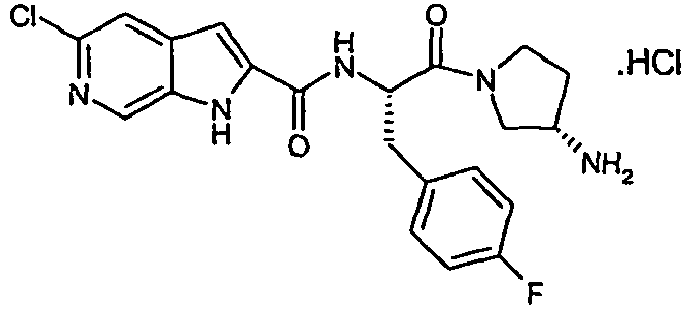
430.34 2.73 185 
430.38 2.69 186 
444.37 2.65 187 
444.41 2.59 188 
444.37 2.84 189 
444.4 2.78 -

- Prepared from 5-chloro-1H-pyrrolo[2,3-c]pyridine-2-carboxylic acid [2-(4-aminopiperidin-1-yl)-1-(S)-(4-fluorobenzyl)-2-oxoethyl]amide (EXAMPLE 180). The compound was synthesised according to EXAMPLE 179 and purified by preparative HPLC to give the title compound as a white powder. m/z (ES+) = 486.28 [M- CH3CO2H + NH4]+; RT = 3.18min.
-

- To a solution of 5-chloro-1H-pyrrolo[2,3-c]pyridine-2-carboxylic acid (1-(S)-(4-fluorobenzyl)-2-{4-[methyl-(2-nitrobenzenesulfonyl)amino]piperidin-1-yl}-2-oxoethyl)amide (Preparation 76, 82mg, 0.13mmol) in acetonitrile (6mL) was added phenylthiol (145µL, 1.4mmol) followed by potassium carbonate (230mg, 1.66mmol) and the reaction heated to 50°C for 24h. To the mixture was added diethyl ether (10mL) and 1M HCl (15mL) and stirred for 5min. The organic layer was separated and washed with 1M HCl (15mL) before combining the aqueous layers. The solution was basified to pH9 with solid potassium carbonate and extracted with ethyl acetate (2x20mL). Organic layers were combined, washed with brine (2x20mL) and dried (MgSO4) Removal of the solvent in vacuo provided the desired product as an off-white powder. m/z (ES+) = 458.40 [M + H]+; RT = 2.67min. A small portion of the product (10mg) was dissolved in methanol (2mL) and 1M HCl added to bring the solution to pH 1-2. After stirring for 20min the solvent was removed in vacuo to give the title compound as the hydrochloride salt as a yellow powder. m/z (ES+) = 458.38 [M+H]+; RT = 2.64min.
-

- Prepared according to EXAMPLE 191 from 5-chloro-1H-pyrrolo[2,3-c]pyridine-2-carboxylic acid [1-(S)-(4-fluorobenzyl)-2-(4-{[methyl-(2-nitrobenzenesulfonyl)amino]methyl}piperidin-1-yl)-2-oxoethyl]amide (synthesised according to Preparations 73-76 from the 4-aminomethylpiperidine-1-carboxylic acid tert-butyl ester starting material). m/z (ES+) free base = 472.33 [M+H]+; RT = 2.80min. m/z (ES+) HCl salt = 430.43 [M+H]+; RT = 2.72min.
-

- Prepared according to EXAMPLE 35, using 3-(R)-hydroxypyrrolidine in place of 3-(S)-hydroxypyrrolidine. Purification via chromatography using dichloromethane/methanol (95:5) as the eluent gave the title compound as an off-white powder. m/z (ES+) = 413.22 [M+H]+; RT = 3.13min.
-

- To 4-trifluoromethyl piperidine (17mg, 0.11mmol) was added a solution of 2-(S)-[(5-chloro-1H-pyrrolo[2,3-c]pyridine-2-carbonyl)amino]-3-(4-fluorophenyl)propionic acid (EXAMPLE 228, 40mg, 0.11mmol) in DMF (400µL) followed by a solution of HATU (50mg, 0.13mmol) in DMF (400µL) and finally a solution of DIPEA (23µL, 0.13mmol) in DMF (200µL). The resulting mixture was stirred at rt for 96h then solvent was removed in vacuo. The crude material was purified by crystallisation from THF/petroleum ether to give the title compound as a yellow powder. (ES+) = 497.23 [M+H]+; RT = 3.50min.
-
EXAMPLE Amine Purification m/z RT (min) 195 
Crystallisation (THF/PE) 501.26 3.43 196 
MDP 459.3 3.13 197 
MDP 512.37 2.77 198 
MDP 471.3 3.24 199 
MDP 447.27 3.37 200 
MDP 472.3 3.03 201 
MDP 473.32 3.09 202 
MDP 472.29 3.08 203 
MDP 528.38 3.3 204 
MDP 472.3 3.09 205 
MDP 501.32 3.55 206 
MDP 487.3 3.57 207 
MDP 488.34 2.75 208 
MDP 488.4 2.59 209 
MDP 502.38 2.77 210 
MDP 527.37 2.47 211 
MDP 486.29 3.09 212 
MDP 460.4 2.65 213 
MDP 458.36 3.18 214 
MDP 530.45 3.52 215 
MDP 530.45 3.46 216 
MDP 498.4 3.23 217 
MDP 544.48 3.61 218 
MDP 458.35 3 219 
MDP 544.46 3.61 220 
Chromatography (DCM/MeoH 98:2) 473.33 3.48 221 
Chromatography (DCM/MeoH 98:2) 502.38 3.43 222 
Trituration (EtOAc) 530.39 3.65 223 
Trituration (EtOAc) 458.32 2.8 224 
Prep HPLC 488.35 2.63 225 
Crystallisation (MeOH) 501.4 2.62 -
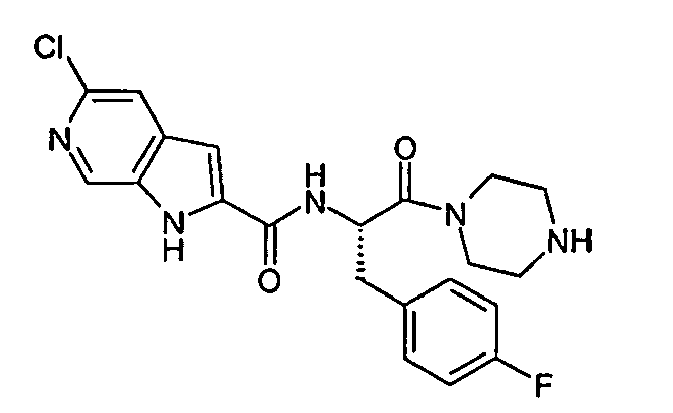
- Prepared according to EXAMPLE 180 from 4-[2-(S)-[5-chloro-1H-pyrrolo[2,3-c]pyridine-2-carbonyl)amino]-3-(4-fluorophenyl)propionyl]piperazine-1-carboxylic acid tert-butyl ester (prepared according to EXAMPLE 222). Purification gave the title compound as a yellow powder. m/z (ES+) = 430.34 [M + H]+; RT = 2.56min.
-

- Prepared according to EXAMPLE 41 using p-fluoro-L-phenylalanine ethyl ester hydrochloride instead of L-phenylalanine ethyl ester hydrochloride. Chromatography gave the title compound as a yellow powder. m/z (ES+) = 390.27 [M + H]+; RT = 3.71min.
-

- The title compound was prepared according to EXAMPLE 42 using 2-(S)-[(5-chloro-1H-pyrrolo[2,3-c]pyridine-2-carbonyl)amino]-3-(4-fluorophenyl)propionic acid ethyl ester (EXAMPLE 227). Solvent was removed in vacuo and the residue taken into water. The aqueous layer was extracted with ethyl acetate (3x) then acidified with 2M HCl solution to pH 2. The precipitate was filtered and washed thoroughly with water to give the title compound as a cream-coloured powder. (ES+) = 3 62.24 [M + H]+; RT = 3.21min.
-

- To a solution of 2-(S)-[(5-chloro-1H-pyrrolo[2,3-c]pyridine-2-carbonyl)amino]-3-(4-fluorophenyl)propionic acid (EXAMPLE 228, 40mg, 0.11mmol) in DMF (4mL) was added HATU (50mg, 0.13mmol) and the reaction stirred for 10 min. 4-Piperidone ethylene ketal (19mg, 0.13mmol) was added, followed by DIPEA (23µL, 0.13mmol) and the reaction stirred at rt for 16h. Solvent was removed in vacuo and the crude material partitioned between ethyl acetate (15mL) and water (15mL). The organic layer was washed with 1M HCl solution (15mL), sodium bicarbonate solution (2x20mL) then brine (2x20mL), dried (MgSO4) and the solvent removed in vacuo. Purification by chromatography using dichloromethane/methanol (9:1) as the eluent gave the title compound as a pale yellow powder. (ES+) = 487.30 [M + H]+; RT = 3.28min.
- EXAMPLES 230-237 were prepared in a similar way to EXAMPLE 229:
EXAMPLE Amine Purification m/z RT (min) 230 
Chromatography (DCM/MeOH 9:1) 544.45 5.39 231 
Chromatography (DCM/MeOH 9:1) 558.22 3.67 232 
Chromatography (DCM/MeOH 9:1) 514.28 2.67 233 
Chromatography (DCM/MeOH 9:1) 488.38 2.69 234 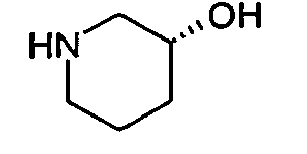
Chromatography (DCM/MeOH 9:1) 445.28 3.17 235 
Chromatography (EtOAc/PE 3:1) 427.35 3.5 236 
prep. HPLC 459.4 3.2 237 
Chromatography (EtOAc) 413.2 3.31 -
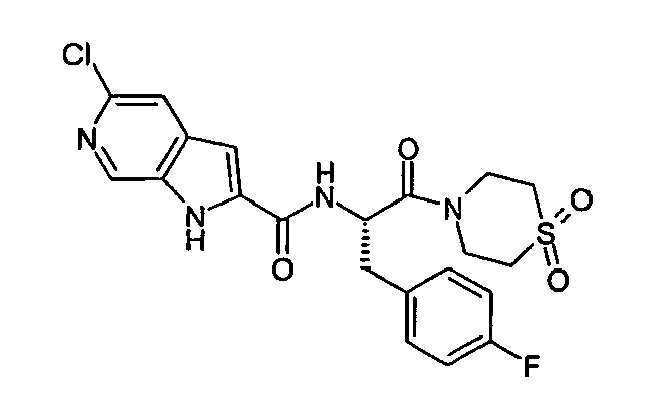
- Prepared according to EXAMPLE 229 from 2-(S)-[(5-chloro-1H-pyrrolo[2,3-c]pyridine-2-carbonyl)amino]-3-(4-fluorophenyl)propionic acid (EXAMPLE 228) and thiomorpholine-1,1-dioxide (Preparation 77). Purification by trituration with methanol gave the title compound as a pale yellow powder. (ES+) = 479.24 [M+H]+; RT = 3.17min.
-

- Prepared according to EXAMPLE 229 from 2-(S)-[(5-chloro-1H-pyrrolo[2,3-c]pyridine-2-carbonyl)amino]-3-(4-fluorophenyl)propionic acid (EXAMPLE 228) and piperidine-4-carboxylic acid methyl ester hydrochloride (Preparation 78). Purification by chromatography using ethyl acetate/petroleum ether (70:30) as the eluent gave the title compound as a pale yellow powder. m/z (ES+) = 487.32 [M+ H]+; RT = 3.44min.
-

-

- The title compound was prepared according to EXAMPLE 229 using 2-(S)-[(5-chloro-1H-pyrrolo[2,3-c]pyridine-2-carbonyl)amino]-3-phenylpropionic acid (EXAMPLE 42) and 4-hydroxypiperidine. Purification by chromatography using dichloromethane/methanol (9:1) as the eluent gave the title compound as an orange powder. m/z (ES+) = 427.35 [M + H]+; RT = 2.99min.
-

- To a solution of piperidine-2-carboxylic acid amide hydrochloride (Preparation 80, 24mg, 0.17mmol) in DMF (3mL) was added 2-(S)-[(5-chloro-1H-pyrrolo[2,3-c]pyridine-2-carbonyl)amino]-3-(4-fluorophenyl)propionic acid (EXAMPLE 230, 52mg, 0.14mmol), followed by HATU (65.6mg, 0.17mmol) and DIPEA (63µL, 0.36mmol), and the reaction stirred at rt for 16h. Solvent was removed in vacuo, purification via preparative HPLC gave the title compound as an off-white powder. m/z (ES+) = 472.31 [M+H]+; RT = 3.19min.
-

- The title compound was prepared according to EXAMPLE 229 from 2-(S)-[(5-chloro-1H-pyrrolo[2,3-c]pyridine-2-carbonyl)amino]-3-(4-fluorophenyl)propionic acid (EXAMPLE 228) and 4-(2-methoxyethoxy)piperidine hydrochloride (Preparation 82). Purification by chromatography using dichloromethane/methanol (95:5) as the eluent gave the title compound as an off-white powder. m/z (ES+) 503.26 [M+H]+; RT = 3.31min.
-

- The title compound was prepared according to EXAMPLE 229 using 4-(3-methoxypropoxy)piperidine hydrochloride, synthesised from the appropriate starting materials (Preparations 81 and 82). Purification by chromatography using dichloromethane/methanol (9:1) as the eluent gave the title compound as an off-white powder. m/z (ES+) = 517.36 [M+H]+; RT = 3.41min.
-

- To a solution of acetic acid (7.5µL, 0.13mmol) in DMF (5mL) was added EDCI (33mg, 0.17mmol), HOBt (19.5mg, 0.14mmol), 5-chloro-1H-pyrrolo[2,3-c]pyridine-2-carboxylic acid [2-(4-aminopiperidin-1-yl)-1-(S)-(4-fluorobenzyl)-2-oxoethyl]amide (EXAMPLE 180, 70mg, 0.16mmol) and DIPEA (57µL, 0.33mmol), and the reaction stirred at rt for 16h. Solvent was removed in vacuo then crude material partitioned between ethyl acetate (15mL) and water (15mL). The organic layer was washed with NaHCO3 (2x20mL) and brine (2x30mL), dried (MgSO4) and the solvent removed in vacuo. Purification by chromatography using dichloromethane/methanol (95:5) as the eluent gave the title compound as an off-white powder. m/z (ES+) = 486.27 [M+H]+; RT = 3.16min.
-

- The title compound was prepared from 5-chloro-1H-pyrrolo[2,3-c]pyridine-2-carboxylic acid [2-(4-aminomethylpiperidin-1-yl)-1-(S)-(4-fluorobenzyl)-2-oxyethyl]amide (EXAMPLE 229 then 180 from the appropriate piperidin-4-ylmethylcarbamic acid tert-butyl ester). Purification by preparative HPLC gave the title compound as a white powder. m/z (ES+) = 500.38 [M+H]+; RT = 3.14min.
-

- The title compound was prepared according to EXAMPLE 1 from 5-chloro-1H-pyrrolo[2,3-c]pyridine-2-carboxylic acid (Preparation 18) and 2-(R)-amino-3-(4-fluorophenyl)-1-(4-hydroxypiperidin-1-yl) propan-1-one hydrochloride (Preparation 84). Purification by chromatography using dichloromethane/methanol (92:8) as the eluent gave the title compound as a pale yellow powder. m/z (ES+) = 445.34 [M + H]+; RT = 3.10min.
-

- The title compound was prepared according to EXAMPLE 229 from 2-(S)-[(5-chloro-1H-pyrrolo[2,3-c]pyridine-2-carbonyl)amino]-3-(4-fluorophenyl)-propionic acid (EXAMPLE 228) and 4-methylaminopiperidine-1-carboxylic acid tert-butyl ester (Preparation 86). Purification by chromatography using dichloromethane/methanol (95:5) as the eluent gave the title compound as a pale yellow powder. m/z (ES+) = 558.48 [M+H]+; RT = 3.82min.
-

- The title compound was prepared according to Preparation 82, from 4-{[2-(S)-[(5-chloro-1H-pyrrolo[2,3-c]pyridine-2-carbonyl)amino]-3-(4-fluorophenyl)propionyl]methylamino}piperidine-1-carboxylic acid tert-butyl ester (EXAMPLE 248), to give the title compound as the hydrochloride salt as a yellow crystalline solid, m/z (ES+) = 458.30 [M+H]+; RT = 2.86min. The product was dissolved in saturated sodium bicarbonate solution and extracted into ethyl acetate. Organic solvent was removed in vacuo to give the title compound as the free base as a yellow powder. m/z (ES+) = 458.33 [M+H]+; RT = 2.82min.
-

- The title compound was prepared according to EXAMPLE 229 from 2-(S)-[(5-chloro-1H-pyrrolo[2,3-c]pyridine-2-carbonyl)amino]-3-(4-fluorophenyl)propionic acid (EXAMPLE 228) and methyl(tetrahydropyran-4-yl) amine hydrochloride (Preparation 88). m/z (ES+) = 459.27 [M+H]+; RT = 3.41min.
-

- The title compound was prepared according to EXAMPLE 35 from 2-(S)-[(5-chloro-1H-pyrrolo[2,3-c]pyridine-2-carbonyl)amino]-3-(4-fluorophenyl)propionic acid (EXAMPLE 228) and dimethylpiperidin-4-yl amine (Preparation 90). Purification by preparative HPLC gave the title compound as a yellow crystalline solid. m/z (ES+) = 472.34 [M + H]+; RT = 2.64min.
-

- The title compound was prepared according to EXAMPLE 229 from 2-(S)-[(5-chloro-1H-pyrrolo[2,3-c]pyridine-2-carbonyl)amino]-3-(4-fluorophenyl)propionic acid (EXAMPLE 228) and N-piperidin-4-yl methanesulfonamide hydrochloride (Preparation 92). Purification gave the title compound as an off-white powder. m/z (ES+) = 522.30 [M+H]+; RT = 3.29min.
-

- To a solution of 5-chloro-1H-pyrrolo[2,3-c]pyridine-2-carboxylic acid (Preparation 18, 185mg, 0.94mmol) in DMF (7mL) was added 2-(S)-amino-3-pyridin-4-yl propionic acid methyl ester hydrochloride (Preparation 93, 204mg, 0.94mmol) followed by TBTU (333mg, 1.04mmol) and DIPEA (740µL, 4.24mmol), and the reaction stirred at rt for 16h. Solvent was removed in vacuo and the residue partitioned between ethyl acetate (30mL) and water (30mL). The organic layer was washed with water (2x30mL), NaHCO3 solution (3x40mL) then brine (3x50mL), dried (MgSO4) and the solvent removed in vacuo. Purification by chromatography (SiO2, EtOAc) gave the title compound as a pink powder. m/z (ES+) = 359.11 [M+ H]+; RT = 2.42min.
-

- The title compound was prepared according to EXAMPLE 253 from 2-(S)-[(5-chloro-1H-pyrrolo[2,3-c]pyridine-2-carbonyl)amino]-3-pyridin-4-yl-propionic acid (EXAMPLE 259) and dimethylamine hydrochloride. Purification by preparative HPLC gave the title compound as an off-white powder. m/z (ES+) = 372.13 [M + H]+; RT = 2.31 min.
- EXAMPLE 255 was prepared in a similar way to EXAMPLE 254:

-

- To a suspension of 2-(S)-[(5-chloro-1H-pyrrolo[2,3-c]pyridine-2-carbonyl)amino]-3-(4-fluorophenyl)propionic acid (EXAMPLE 228, 80mg, 0.22mmol) in ethanol (6mL) was added DMTMM (78mg, 0.27mmol) and the reaction stirred for 5min. To the mixture was added 1,4-dioxa-7-aza-spiro[4.5]decane (Preparation 94, 35mg, 0.24mmol) and stirring continued for 16h. Solvent was removed in vacuo and the crude material partitioned between ethyl acetate and water. The organic layer was washed with NaHCO3 solution (2x20mL) then brine (2x20mL), dried (MgSO4) and the solvent removed in vacuo. Purification by chromatography using dichloromethane/methanol (95:5) as the eluent gave the title compound as a pale yellow powder. m/z (ES+) = 487.21 [M+H]+; RT = 3.50min.
-

- The title compound was prepared according to EXAMPLE 229 using (3R,4R)-dihydroxypyrrolidine (prepared according to Preparation 23 from the commercially available benzyl derivative). Additional crystallisation from methanol gave the title compound as colourless crystals. m/z (ES+) = 447.33 [M + H]+; RT = 2.99min.
-

- The title compound was prepared according to EXAMPLE 229 using 3-(S)-4-(S)-dihydroxypyrrolidine (prepared according to Preparation 23). Additional crystallisation from methanol gave the title compound as colourless crystals. m/z (ES+) = 447.33 [M + H]+; RT = 3.07min.
-

- The title compound was prepared according to EXAMPLE 42 from 2-(S)-[(5-chloro-1H-pyrrolo[2,3-c]pyridine-2-carbonyl)amino]-3-pyridin-4-yl-propionic acid methyl ester (EXAMPLE 253). m/z (ES+) = 345.09 [M + H]+.
-

- To a solution of 5-chloro-1H-pyrrolo[2,3-c]pyridine-2-carboxylic acid [2-phenyl-1-(S)-(2-phenyl-[1,3]dioxolan-2-yl)ethyl]amide (Preparation 96, 47mg, 0.105mmol) in acetone (20mL) was added aqueous hydrochloric acid (1mL, 1M). After stirring under reflux for 3 days the solvent was removed in vacuo. The residue was distributed between ethyl acetate (100mL) and saturated sodium carbonate solution (50mL). After separation the organic layer was washed with brine (50ml), dried (MgSO4) and concentrated to a residue which was purified by flash chromatography on silica gel (eluent: hexane / ethyl acetate : 50 / 50) to give the title compound as colourless solid. m/z (ES+) = 404.21 [M+H]+; RT = 3.58min.
-

- To a solution of 5-chloro-1H-pyrrolo[2,3-c]pyridine-2-carboxylic acid (Preparation 18, 296mg, 1.51mmol) and 2-amino-1-pyridin-3-ylethanol (Preparation 98, 214mg, 1.55mmol) in DMF (10mL) was added HOBt (225mg, 1.47mmol), DIPEA (0.55mL, 3.16mmol) and EDCI (340mg, 1.77mmol). After stirring at rt for 12h the solvent was removed in vacuo and the residue then taken up in THF (150mL) and washed with diluted sodium hydroxide solution (1M, 50mL) and brine (2 x 50mL). The solution was dried (MgSO4) and concentrated to an oil that was further purified by flash chromatography on silica gel (eluent: DCM / methanol : 90 / 10 + 0.5% triethylamine) to give the title compound as off-white solid. δH (d6 DMSO): 3.53 (2H, m), 4.85 (1H, m), 5.75 (1H, d), 7.15 (1H, s), 7.37 (1H, dd), 7.75 (2H, m), 8.47 (1H, m), 8.57 (1H, s), 8.89 (1H, appt), 12.24 (1H, s); m/z (ES+) 317.17 [M+H]+; RT = 2.71min.
-

- To a solution of 5-chloro-1H-pyrrolo[2,3-c]pyridine-2-carboxylic acid (Preparation 18, 223mg, 1.13mmol) and commercially available (1S,2S)-(+)-2-amino-3-methoxy-1-phenyl-1-propanol (200mg, 1.10mmol) in DMF (5mL) was added HOBt (173mg, 1.13mmol), DIPEA (0.42mL, 2.41mmol) and EDCI (260mg, 1.36mmol). After stirring at rt for 12h the mixture was added to diluted brine (100mL, water/brine : 1/1). Extraction with ethyl acetate (4 x 25mL), washing of the combined extracts with diluted hydrochloric acid (1M, 30ml), diluted aqueous sodium hydroxide solution (1M, 30ml) and brine (30mL) followed by drying over magnesium sulphate gave after concentration a residue which was purified by flash chromatography on silica gel (eluent: ethyl acetate). The title compound was obtained as colourless solid. δH (CD3OD): 3.37 (3H, s), 3.34 (1H, dd), 3.66 (1H, dd), 4.53 (1H, ddd), 5.03 (1H, d), 7.15 (1H, s), 7.25-7.45 (5H, 3m), 7.68 (1H, s), 8.58 (1H, s); m/z (ES+) = 360.22 [M+ H]+; RT = 3.12min.
-

- To a solution of 5-chloro-1H-pyrrolo[2,3-c]pyridine-2-carboxylic acid [1-(S)-(tert-butyldimethylsilanyloxymethyl)-2-oxo-2-phenylethyl]amide (Preparation 101, 220mg, 0.48mmol) in THF (10mL) was added acetic acid (60µL) and tetrabutylammonium fluoride solution (1ml, 1M in THF) at rt. After stirring for 3h the reaction mixture was distributed between ethyl acetate (100mL) and water (30mL). The organic layer was separated, then washed with brine (50ml), dried (MgSO4) and concentrated to a solid residue. Recrystallisation from THF gave the title compound. m/z (ES+) = 344.21 [M+H]+; RT = 3.02min.
-

- 5-Chloro-1H-pyrrolo[2,3-c]pyridine-2-carboxylic acid (2-(S)-hydroxy-1-(S)-methoxymethyl-2-phenylethyl)amide (EXAMPLE 262, 101mg, 0.281mmol) was oxidised and isolated in a similar way to Preparation 101 using Dess-Martin periodinane (240mg, 0.566mmol) in DCM (10mL). The title compound was obtained by recrystallisation of the crude product from methanol. m/z (ES+) = 358.24 [M + H]+; RT=3.18min.
-

- To a solution of racemic 5-chloro-1H-pyrrolo[2,3-c]pyridine-2-carboxylic acid (2-hydroxy-2-pyridin-3-ylethyl)amide (EXAMPLE 261, 80mg, 0.253mmol) in dry THF (20mL) was added Dess-Martin periodinane (307mg, 0.724mmol). After stirring for 4h at rt alkaline sodium thiosulfate solution was added (5.4g Na2SO3 dissolved in 20mL saturated NaHCO3 solution) and the emulsion was vigorously stirred for additional 30min before further diluted with water (~150mL). Extraction with THF (4 x 50mL), washing of the combined extracts with saturated sodium hydrogen carbonate (50mL) and brine (50mL) gave a solution which was concentrated after drying (MgSO4). Purification of the residue by flash chromatography on silica gel (eluent: DCM / methanol : 90 /10) gave the title compound as off-white solid. m/z (ES+) = 315.19 [M+H]+; RT = 2.65min.
-

- DIPEA (155µL, 0.89mmol), HOBt (43mg, 0.28mmol) and 6-chloro-1H-pyrrolo[2,3b]pyridine-2-carboxylic acid (Preparation 110, 50mg, 0.25mmol) was added to a stirred solution of 2-(S)-amino-N,N-dimethyl-3-phenyl propionamide hydrochloride (Preparation 8, 61mg, 0.27mmol) in DMF (4mL). After 5min EDCI (63mg, 0.33mmol) was added and the reaction stirred for 22h. Purification by column chromatography (SiO2, 95:5 CH2Cl2/MeOH) afforded the title compound. m/z (ES+) = 370.93 [M+ H]+; RT = 3.62min.
-

- The title compound was prepared according to EXAMPLE 266 but using 2-(S)-amino-3-(4-fluorophenyl)-1-(3-(S)-hydroxypyrrolidin-1-yl)-propan-1-one hydrochloride (Preparation 103) instead of 2-(S)-amino-N,N-dimethyl-3-phenyl propionamide hydrochloride. m/z (ES+) = 430.94 [M+H]+; RT = 4.31min.
-

- The title compound was prepared according to EXAMPLE 266 but using 2-(S)-amino-3-(4-fluorophenyl)-1-(4-hydroxypiperidin-1-yl)-propan-1-one hydrochloride (Preparation 20) instead of 2-(S)-amino-N,N-dimethyl-3-phenyl propionamide hydrochloride. Purification by column chromatography (SiO2, 9:1 CH2Cl2/MeOH) gave the title compound. m/z (ES+) = 444.91 [M+H]+; RT = 3.55min.
-

- The title compound was prepared according to EXAMPLE 266 but using 1-[2-(S)-amino-3-(4-fluorophenyl)propionyl]-[1,4]diazepan-5-one hydrochloride (Preparation 112) instead of 2-(S)-amino-N,N-dimethyl-3-phenyl propionamide hydrochloride. Purification by column chromatography (SiO2 94:6 CH2Cl2/MeOH) gave the title compound. m/z (ES+) = 457.91 [M+H]+; RT = 3.74min.
-

- To a solution of 6-chloro-1H-pyrrolo[2,3b]pyridine-2-carboxylic acid (Preparation 110, 60mg, 0.31mmol) in ethanol (5mL) was added 2-aminoacetophenone hydrochloride (58mg, 0.34mmol), N-methylmorpholine (74µL, 0.67mmol) and DMTMM (198mg, 0.67mmol) and the reaction stirred at rt for 16h. Solvent was removed in vacuo and the resulting residue partitioned between ethyl acetate (20mL) and water (20mL). Organics were washed with 1M HCl (20mL), water (20mL), NaHCO3 solution (2x20mL) then brine (20mL) before being dried (MgSO4) and solvent concentrated in vacuo. Purification by column chromatography (SiO2, 2:1 Pet. Ether/ EtOAc then 97:3 CH2Cl2/MeOH) gave the title compound.
-

- To a solution of 6-chloro-1H-pyrrolo[2,3b]pyridine-2-carboxylic acid (Preparation 110, 450mg, 2.29mmol) in DMF (20mL) was added 4-fluoro phenylalanine ethyl ester hydrochloride (624mg, 2.52mmol), DIPEA (1.40mL, 8.01mmol) and HOBt. (386mg, 2.52mmol) and the reaction stirred. After 5min EDCI (570mg, 2.98mmol) was added and stirring continued for 16hr. Solvent was removed in vacuo then crude material partitioned between ethyl acetate (75mL) and water (50mL). Organics were washed with NaHCO3 solution (3x50mL) then brine (2x50mL), dried (MgSO4) and THE solvent removed in vacuo to give the title compound. m/z (ES+) = 389.90 [M+H]+; RT = 3.79min.
-

- To a solution of 2-[(6-chloro-1H-pyrrolo[2,3-b]pyridine-2-carbonyl)amino]-3-(4-fluorophenyl)propionic acid ethyl ester (EXAMPLE 271, 780mg, 2.0mmol) in methanol (15mL) was added 2M NaOH (2mL, 4.0mmol) and the reaction was stirred for 16hr. Solvent was removed in vacuo and crude residue dissolved in water (20mL). The aqueous phase was washed with ethyl acetate (2x20mL), then acidified to Ph 3 with 2M HCl. The organics were extracted into ethyl acetate (2x30mL), and then dried (MgSO4) before concentrating the solvent in vacuo to provide the title compound. m/z (ES+) = 361.88 [M + H]+.
-

- To pyrrolidine (11.5mg, 0.14mmol) was added a solution of DIPEA (60µL, 0.35mmol) in DMF (500µL) followed by 2-(S)-[(6-chloro-1H-pyrrolo[2,3-b]pyridine-2-carbonyl)amino]-3-(4-fluorophenyl) propionic acid (EXAMPLE 272, 50mg, 0.14mmol) in DMF (500µL) and HOBt (23mg, 0.15mmol) in DMF (500µL) and the mixture stirred. After 5min EDCI (34.5mg, 0.18mmol) in DMF (500µL) was added and the reaction stirred for 16hr. Solvent was removed in vacuo then crude material purified by mass-directed purification to give the title compound. m/z (ES+) = 414.93 [M + H]+; RT = 3.77min.
- EXAMPLES 274-276 were prepared in the same way:
Example Structure m/z RT (min) 274 
430.92 3.46 275 
471.92 3.51 276 
432.92 3.79 - EXAMPLES 277-280 were prepared in the same way, but purification was by trituration from methanol:
Example Structure m/z RT (min) 277 
428.95 5.06 278 
430.93 3.65 279 
446.9 3.9 280 
443.92 3.05 -

- To a solution of 5-chloro-1H-pyrrolo[2,3-b]pyridine-2-carboxylic acid (Preparation 57, 500mg, 2.54mmol) in DMF (20mL) was added 2-(S)-amino-3-(4-fluorophenyl)propionic acid tert-butyl ester hydrochloride (Preparation 114, 701mg, 2.54mmol), HOBt (344mg, 2.54mmol) and DIPEA (1.4mL, 7.88mmol). After 5min, EDCI (634mg, 3.31mmol) was added and the reaction mixture stirred at rt for 72h. The solvent was removed in vacuo and the solid partitioned between water (50mL) and ethyl acetate (3 x 40mL). The combined organic phase was washed with brine (20mL), dried (MgSO4) concentrated in vacuo and purified by chromatography on silica gel eluting with methanol:dichloromethane (1:99) to give the title compound. δH (CD3OD): 1.42 (9H, s), 3.09 (1H, dd), 3.22 (1H, dd), 4.76 (1H, m), 6.98 (2H, m), 7.07 (1H, s), 7.27 (2H, m), 8.06 (1H, d), 8.28 (1H, d); m/z (ES+) = 418 [M+ H]+.
-

- Trifluoroacetic acid (1.9mL, 24.3mmol) was added to a suspension of 2-(S)-[(5-chloro-1H-pyrrolo[2,3-b]pyridine-2-carbonyl)amino]-3-(4-fluorophenyl)-propionic acid tert-butyl ester (EXAMPLE 281, 507mg, 1.21mmol) in DCM (25mL) and the reaction mixture was stirred at rt for 16h. Further trifluoroacetic acid (2mL) was added and the reaction was stirred at rt for 48h. The solvent was removed in vacuo and the solid partitioned between 1N hydrochloric acid (50mL) and ethyl acetate (3 x 30mL). The combined organic fractions were washed with brine (20mL), dried (MgSO4) and concentrated in vacuo to give the title compound. δH (CD3OD): 3.11 (1H, dd), 3.33 (1H, dd), 4.88 (1H, m), 6.97 (2H, m), 7.06 (1H, s), 7.28 (2H, m), 8.08 (1H, d), 8.29 (1H, d); m/z (ES+) = 362 [M + H]+; RT = 3.67min.
-

- To a solution of 5-chloro-1H-pyrrolo[2,3-b]pyridine-2-carboxylic acid (Preparation 57, 34mg, 0.17mmol) in DMF (5mL) was added 2-(S)-amino-3-(4-fluorophenyl)-1-(3-(S)-hydroxypyrrolidin-1-yl)propan-1-one hydrochloride (Preparation 103, 50mg, 0.17mmol), HOBt (23mg, 0.17mmol) and DIPEA (94µL, 0.54mmol). After 5min, EDCI (43mg, 0.23mmol) was added and the reaction stirred at rt for 16h. The solvent was removed in vacuo and the residue partitioned between water (25mL) and ethyl acetate (3 x 20mL). The combined organic layer was washed with 2N sodium hydroxide solution (2 x 10mL), brine (10mL), dried (MgSO4) and concentrated in vacuo. Purification via chromatography on silica gel eluting with methanol:dichloromethane (7:93) gave the title compound. m/z (ES+) = 431 [M+ H]+; RT = 3.49min.
-

- 5-Chloro-1H-pyrrolo[2,3-b]pyridine-2-carboxylic acid (Preparation 57, 50mg, 0.25mmol), 2-aminoacetophenone hydrochloride (48mg, 0.28mmol) and DMTMM (85mg, 0.31mmol) were dissolved in THF (5mL) and 4-methylmorpholine (31µL, 0.28mmol). The reaction mixture was stirred at rt for 16h. The solvent was removed in vacuo and the residue partitioned between water (20mL) and EtOAc (3 x 20mL). The combined organics were dried (MgSO4) concentrated in vacuo and purified by chromatography on silica gel eluting with methanol:dichloromethane (1:19) to give the title compound. m/z (ES+) = 314 [M + H]+; RT = 3.47min.
-

- 2-(S)-[(5-Chloro-1H-pyrrolo[2,3-b]pyridine-2-carbonyl)amino]-3-(4-fluorophenyl)propionic acid (EXAMPLE 282, 300mg, 0.08mmol) and N,O-dimethylhydroxylamine hydrochloride (8mg, 0.08mmol) were dissolved in THF (5mL) and 4-methylmorpholine (9µL, 0.08mmol). To this was added DMTMM (28mg, 0.10mmol) and the reaction mixture was stirred at rt for 16h. The solvent was removed in vacuo and the residue partitioned between water (30mL) and EtOAc (3 x 30mL). The combined organics were washed with 2N sodium hydroxide solution (2 x 20ml), brine (20ml), dried (MgSO4) and concentrated in vacuo. The crude residue was purified by chromatography on silica gel eluting with methanol:dichloromethane (1:24) to give the title compound. m/z (ES+) = 405 [M+ H]+; RT = 3.69min.
-

-

- The following compounds were prepared according to the method of EXAMPLE 286 from 2-(S)-[(5-chloro-1H-pyrrolo[2,3-c]pyridine-2-carbonyl)amino]-3-(4-fluorophenyl)propionic acid (EXAMPLE 282) and the appropriate amine, with the exception that all compounds were purified by mass directed purification.
Example NR1R2 m/z RT (min) 287 
431 3.47 288 
444 2.89 289 
405 3.20 290 
474 2.92 291 
472 3.37 292 
445 3.61 293 
433 3.51 294 
433 3.34 -

- To a solution of 6-chloro-1H-pyrrolo[3,2-c]pyridine-2-carboxylic acid (Preparation 116, 47mg, 0.24mmol) in DMF (5mL, anhydrous) was added 2-(S)-amino-N,N-dimethyl-3-phenylpropionamide hydrochloride (Preparation 8, 56mg, 0.25mmol), DIPEA (131µL, 0.75mmol) and HOBt (40mg, 0.26mmol) sequentially. The solution was stirred for 5min prior to the addition of EDCI (55mg, 0.29mmol) in one portion. The resulting solution was stirred for 12h at rt. The reaction mixture was partitioned between ethyl acetate (50mL) and water/brine (150mL, 1:1). The layers were separated and the aqueous phase extracted with ethyl acetate (3 x 50mL), then the combined organics were washed with dilute HCl solution (1M, 50mL), dilute NaOH solution (1M, 50mL) and brine (50mL). The organic phase was dried (MgSO4) filtered and concentrated in vacuo. Purification via flash column chromatography eluting with toluene/acetone (3:1) gave the title compound. δH (CDCl3): 2.88, 3.05 (6H, 2s), 3.18, 3.28 (2H, 2 dd), 5.41 (2H, m), 7.02 (1H, s), 7.28-7.34 (6H, m), 8.17 (1H, d), 8.68 (1H, s), 10.58 (1H, br s); m/z (ES+) = 371.13 [M+ H]+; RT = 3.28min.
-

- The title compound was prepared as outlined in EXAMPLE 295 from 6-chloro-1H-pyrrolo[3,2-c]pyridine-2-carboxylic acid (Preparation 116) and 2-(S)-amino-3-(4-fluorophenyl)-1-(4-hydroxypiperidin-1-yl)propan-1-one hydrochloride (Preparation 20). The product was purified by chromatography on silica gel eluting with methanol/dichloromethane (1:19) to give the title compound. δH (CD3OD): 1.16-1.88 (4H, 3m), 3.04-3.19 (4H, m), 3.69-4.16 (3H, 2m), 5.31 (1H, m), 7.00 (2H, m), 7.29 (3H, m), 7.42 (1H, s), 8.67 (1H, s); m/z (ES+) = 444.89 [M+ H]+; RT = 3.27min.
-

- The title compound was prepared as outlined in EXAMPLE 295 from 6-chloro-1H-pyrrolo[3,2-c]pyridine-2-carboxylic acid (Preparation 116) and 2-(S)-amino-3-(4-fluorophenyl)-1-(3-(S)-hydroxypyrrolidin-1-yl)propan-1-one hydrochloride (Preparation 103). The crude product was recrystallised from ethyl acetate to give the title compound. δH (CD3OD): 1.77-1.98 (2H, m), 3.08-3.88 (6H, 6m), 4.30, 4.42 (1H, 2m), 5.07, 5.09 (1H, 2m), 7.00 (2H, m), 7.30 (3H, m), 7.43 (1H, m), 8.67 (1H, s); m/z (ES+) = 430.90 [M+ H]+; RT = 3.29min.
-

- To a solution of 5-cyano-1H-pyrrolo[2,3-c]pyridine-2-carboxylic acid (Preparation 62, 0.035g, 0.19mmol) in THF (15mL) under argon was added 2-aminoacetophenone hydrochloride (0.036g, 0.21mmol), N-methylmorpholine (25µM, 0.23mmol) and DMTMM (0.072g, 0.27mmol). The reaction mixture was stirred at rt for 16h. The reaction mixture was concentrated to dryness in vacuo. The residue was partitioned between ethyl acetate (100mL) and water (50mL). The organic phase was separated and the aqueous phase was further extracted with ethyl acetate (100mL). The combined organic extract was washed with 1N NaOH (40mL), saturated sodium chloride (40mL), dried (MgSO4) filtered and concentrated in vacuo. Crude material was purified by chromatography in hexane / ethyl acetate (1:2) and recrystallised from methanol to give the title compound. m/z (ES+) = 304 [M+ H]+; RT = 4.37.
-

- To a solution of 2-amino-3-(S)-(4-fluorophenyl)propionic acid ethyl ester hydrochloride (0.530g, 2.14mmol) in DMF (15mL) was added DIPEA (1.3mL, 7.49mmol), HOBt (0.290g, 2.14mmol), 5-cyano-1H-pyrrolo[2,3-c]pyridine-2-carboxylic acid (Preparation 62, 0.400g, 2.14mmol) and EDCI (0.492g, 2.57mmol). The reaction mixture was stirred at rt for 16h. Reaction mixture was concentrated in vacuo and the residue was partitioned between water (150mL) and ethyl acetate (200mL). Organic phase was separated and the aqueous phase was further extracted with ethyl acetate (200mL). The combined organic extracts were washed with saturated NaHCO3 (75mL), saturated sodium chloride (100mL), dried (MgSO4) filtered and concentrated in vacuo to give the title compound. m/z (ES+) = 381 [M+ H]+; RT = 4.79min.
-

- To a solution of 2-[(5-cyano-1H-pyrrolo[2,3-c]pyridine-2-carbonyl)amino]-3-(S)-(4-fluorophenyl)propionic acid ethyl ester (EXAMPLE 299, 0.800g, 2.1mmol) in methanol / water (2:1) was added 1N NaOH (4.2mL, 4.2mmol) and stirred at rt for 16h. Reaction mixture was concentrated in vacuo to remove methanol. Water (150mL) was added to the residue and washed with ethyl acetate (2 x 75ml). The aqueous phase was cooled in an ice bath and acidified to pH 4 using 2N HCl. The precipitate formed was isolated and washed with water and ether to give the title compound. m/z (ES+) = 353 [M+ H]+; RT = 3.27 min.
-

- To a solution of N-dimethylamine hydrochloride (0.006g, 0.07mmol) in DMF (6mL) was added DIPEA (37µL, 0.21mmol), HOBt (0.009g, 0.07mmol), 2-[(5-cyano-1H-pyrrolo[2,3-c]pyridine-2-carbonyl)amino]-3-(S)-(4-fluorophenyl)propionic acid (EXAMPLE 300, 0.025g, 0.07mmol) and EDCI (0.016g, 0.084mmol). The reaction mixture was stirred at rt for 16h then concentrated in vacuo and the residue was partitioned between water (50mL) and ethyl acetate (100mL). The organic phase was separated and the aqueous phase was further extracted with ethyl acetate (100mL). The combined organic extracts were washed with saturated NaHCO3 (50mL), saturated sodium chloride (75mL), dried (MgSO4) filtered and concentrated in vacuo to give the title compound. m/z (ES+) = 380; RT = 3.45.
-

- The following compounds were prepared according to the method of EXAMPLE 301 from 2-[(5-cyano-1H-pyrrolo[2,3-c]pyidine-2-carbonyl)amino]-3-(S)-(4-fluorophenyl)propionic acid (EXAMPLE 300) and the appropriate amine.
Example Amine m/z RT (min) 302 
422 3.36 303 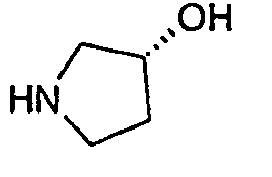
422 3.32 304 
420 3.92 305 
422 3.44 306 
420 3.72 307 
449 3.26 - α-D-Glucose-1-phosphate (disodium salt), Glycogen, D-Glucose, Malachite Green Hydrochloride, Ammonium Molybdate tetrahydrate, BSA, HEPES and rabbit muscle phosphorylase a (P1261) were purchased from Sigma. All other reagents were analytical grade.
- An assay for glycogen phosphorylase activity in the reverse direction was developed based on the method described by Engers et al., Can. J. Biochem., 1970, 48, 746-754]. Rabbit muscle glycogen phosphorylase a (Sigma) was reconstituted at a stock concentration of 100µg/mL in 25mM Tris/HCl. The pH was measured in a 96-well plate in a final volume of 100µL containing 50mM Hepes pH 7.2, 7.5mM glucose, 0.5mM glucose-1-phosphate and 1mg/mL glycogen. After incubation at 30°C for 30min, the inorganic phosphate released from glucose-1-phosphate was measured by the addition of 150µL of malachite green/molybdate solution prepared as follows: 5mL of 4.2% ammonium molybdate in 4N HCl, 15mL of 0.045% malachite green, 50µL of Tween 20. Following a 30min incubation at rt, the absorbance was measured at 620nm. For IC50 determination, 10µL of a serial dilution of compound (100µM to 0.004µM) in DMSO was added to each reaction in duplicate with the equivalent concentration of DMSO added to the control uninhibited reaction. Dose response curves were then obtained by plotting % inhibition versus log10 compound concentration. IC50 is defined as the concentration of compound achieving 50% inhibition under the assay conditions described.
- The EXAMPLES have an IC50 of < 1mM. For example, EXAMPLES 1-20, 22, 27, and 30-48 demonstrated efficacy by measuring values of IC50 in the range of 62.8-0.07µM. Examples 21, 23-26, 28, and 29 yielded IC50 100µM or higher. It is advantageous that the measured IC50 be lower than 100µM. It is still more advantageous for the IC50 to be lower than 50µM. It is even more advantageous for the IC50 to be lower than 5µM. It is yet more advantageous for the IC50 to be lower than 0.5µM.
Claims (32)
- A compound of Formula (I):
 one of X1, X2, X3 and X4 must be N and the others must be C;R1 and R1' are each independently, hydrogen, halogen, hydroxy, cyano, C1-4-alkyl, C1-4alkoxy, fluoromethyl, difluoromethyl, trifluoromethyl, ethenyl, or ethynyl;R2 is hydrogen, C1-4alkyl, COOR6, COR6, C1-4alkoxyC1-4alkyl-, hydroxyC1-4-alkyl-, cycloalkyl, cycloalkylC1-4alkyl-, aryl, arylC1-4alkyl-, hetaryl, or hetarylC1-4-alkyl-, wherein any of the aryl or hetaryl rings are optionally substituted with 1-2 independent halogen, cyano, C1-4alkyl, C1-4alkoxy, -NR13R14, -SO2C1-4alkyl, - SO2NR13R14, hydroxy, fluoromethyl, difluoromethyl, or trifluoromethyl substituents;Y is a direct bond, C1-2alkyl, or -CH(OH)-;Z is CH2, -C(O)-, -O-, >NH, >N(C1-4alkyl), >N(C3-6Cycloalkyl), or absent; but when Y is -CH(OH)-, Z or R3 must be bonded to Y through a carbon-carbon bond;R3 is hydrogen, -COOH, -COOC1-4alkyl, C1-4alkoxy, C1-4alkyl, arylC1-4-alkylthio-, aryl, -C1-4alkylaryl, hetaryl, -C1-4alkylhetaryl, cycloalkyl, -C1-4-alkylcycloalkyl, heterocyclyl or -C1-4alkylheterocyclyl, wherein any of the rings is optionally substituted with 1-3 independent halogen, cyano, C1-4alkyl, fluoromethyl, difluoromethyl, trifluoromethyl, -NHC(O)O(C1-4alkyl), -C1-4alkylNHC(O)O(C1-4-alkyl), -NR7R8, -C1-4alkylNR7R8, -C(O)R9, C1-4alkoxy-, C1-4alkoxyC1-4alkyl-, - COOH, -COOC1-4alkyl, -NHC(O)R9, -C1-4alkylNHC(O)R9, -C(O)N(R10)2, -C1-4-alkylC(O)N(R10)2, -C1-4alkoxyC1-4alkoxy, hydroxy, hydroxyC1-4alkyl-, -NHSO2R10, -SO2(C1-4alkyl), -SO2NR11R12, 5- to 6-membered heterocyclyl, phenyl, phenylC1-4-alkoxy, or phenylC1-2alkyl substituents, wherein phenyl is optionally substituted with 1-2 independent halogen, cyano, C1-4alkyl, C1-4alkoxy, -NR13R14, -SO2C1-4alkyl, - SO2NR13R14, hydroxy, fluoromethyl, difluoromethyl or trifluoromethyl substituents, or two bonds on a ring carbon of the heterocyclyl group optionally can form an oxo ( =O) substituent;or R3 is -NR4R5 or -NR4(-C1-4alkylR5);R4 is hydrogen, C1-3alkyl, -C2-3alkyl-NR7R8, C3-6cycloalkyl optionally substituted by hydroxy or hydroxyC1-4alkyl- further optionally substituted by hydroxy, C1-2alkoxyC2-4alkyl-, or C1-2alkyl-S(O)n-C2-3alkyl-;n is 0, 1, or 2;R5 is hydrogen, hydroxyC2-3alkyl-, C1-2alkoxy, C1-2alkoxyC1-4alkyl-, or aryl, hetaryl, or heterocyclyl;wherein a heterocyclic nitrogen-containing R5 ring optionally is mono-substituted on the ring nitrogen with C1-4alkyl, benzyl, benzoyl, C1-4alkyl-C(O)-, -SO2C1-4alkyl, -SO2NR13R14, C1-4alkoxycarbonyl, or aryl(C1-4alkoxy)carbonyl; and wherein the R5 rings are optionally mono-substituted on a ring carbon with halogen, cyano, C1-4alkyl-C(O)-, C1-4alkyl-SO2-, C1-4alkyl, C1-4alkoxy, hydroxy, -NR13R14, hydroxy, hydroxyC1-4alkyl-, carbamoyl, or C1-4alkylcarbamoyl-, provided that no quatemised nitrogen is included; or two bonds on a ring carbon of the heterocyclyl group optionally can form an oxo ( =O ) substituent;R6 is C1-4alkyl, aryl, or hetaryl;R7 and R8 are independently hydrogen, C1-4alkyl, C3-6cycloalkyl, or CO(C1-4-alkyl);R9 is C1-4alkyl, or C3-6cycloalkyl;R10 is hydrogen, C1-4alkyl, or C3-6cycloalkyl;R11 and R12 are independently hydrogen or C1-4alkyl, or together with the nitrogen to which they are attached may form a 4- to 6-membered heterocycle;R13 and R14 are independently hydrogen or C1-4alkyl; andwherein there are no nitrogen-oxygen, nitrogen-nitrogen or nitrogen-halogen bonds in linking the three components -Y-Z-R3 to each other;provided that the compound is not 2R,4S,5S-6-cyclohexyl-5-(6'-azaindol-2'-ylcarbonylamino)-2-(2'-methylpropyl)-gamma-hexanolactone.
 - A compound according to claim 1, or a stereoisomer, or a pharmaceutically acceptable salt thereof, wherein X3 is N.
- A compound according to claim 1, or a stereoisomer, or a pharmaceutically acceptable salt thereof, wherein X1 is N.
- A compound according to claim 1, or a stereoisomer, or a pharmaceutically acceptable salt thereof, wherein X2 is N.
- A compound according to claim 1, or a stereoisomer, or a pharmaceutically acceptable salt thereof, wherein X4 is N.
- A compound according to any one of the preceding claims, or a stereoisomer, or a pharmaceutically acceptable salt thereof, wherein R1 and R1' are each independently, halogen, cyano or hydrogen.
- A compound according to any one of the preceding claims, or a stereoisomer, or a pharmaceutically acceptable salt thereof, wherein one of R1 and R1' is hydrogen and the other is a 5-halo or 5-cyano group.
- A compound according to any one of the preceding claims, or a stereoisomer, or a pharmaceutically acceptable salt thereof, wherein Y is a direct bond or C1-2alkyl.
- A compound according to any one of the preceding claims, wherein Z is -C(O)-.
- A compound according to any one of claims 1, 2 or 6 to 9, or a stereoisomer, or a pharmaceutically acceptable salt thereof, wherein
X3 is N;
Y is a direct bond or C1-2alkyl; and
Z is -C(O)-. - A compound according to any one of the preceding claims, or a stereoisomer, or a pharmaceutically acceptable salt thereof, wherein Y is a direct bond.
- A compound according to any one of the preceding claims, or a stereoisomer, or a pharmaceutically acceptable salt thereof, wherein R2 is hydrogen, C1-4alkyl, aryl or arylC1-4alkyl-, wherein the aryl ring is optionally substituted with 1-2 independent halogen, cyano, C1-4alkyl, C1-4alkoxy, NR13R14, -SO2C1-4alkyl, -SO2NR13R14, hydroxy, fluoromethyl, difluoromethyl, or trifluoromethyl, substituents.
- A compound according to claim 12, or a stereoisomer, or a pharmaceutically acceptable salt thereof, wherein R2 is benzyl optionally substituted with 1-2 halogen substituents.
- A compound according to any one of the preceding claims, or a stereoisomer, or a pharmaceutically acceptable salt thereof, wherein R3 is heterocyclyl, -C1-4-alkylheterocyclyl optionally substituted with 1-3 independent halogen, cyano, -C1-4-alkyl, fluoromethyl, difluoromethyl, trifluoromethyl, -NHC(O)O(C1-4alkyl), -C1-4-alkylNHC(O)O(C1-4alkyl), -NR7R8, -C1-4alkylNR7R8, -C(O)R9, C1-4alkoxy-, C1-4-alkoxyC1-4alkyl-, -COOH, -COOC1-4alkyl, -NHC(O)R9, -C1-4alkylNHC(O)R9, - C(O)N(R10)2, -C1-4alkylC(O)N(R10)2, -C1-4alkoxyC1-4alkoxy, hydroxy, hydroxyC1-4-alkyl, -NHSO2R10, -SO2(C1-4alkyl), -SO2NR11R12, 5- to 6-membered heterocyclyl, phenyl, phenylC1-2alkoxy or phenylC1-2alkyl substituents, wherein phenyl is optionally substituted with 1-2 independent halogen, cyano, C1-4alkyl, C1-4alkoxy, - NR13R14, -SO2C1-4alkyl, -SO2NR13R14, hydroxy, fluoromethyl, difluoromethyl, or trifluoromethyl substituents, or two bonds on a ring carbon of the heterocyclyl group optionally can form an oxo (=O) substituent; or R3 is -NR4R5 or -NR4(-C1-4alkylR5).
- A compound according to claim 14, wherein R3 is an optionally substituted nitrogen containing heterocyclyl group, linked to Z via a ring nitrogen atom; or R3 is -NR4R5 or -NR4(-C1-4alkylR5).
- A compound according to claim 15, wherein R3 is an optionally substituted 4-8-membered nitrogen containing heterocyclyl group.
- A compound according to claim 16, or a stereoisomer, or a pharmaceutically acceptable salt thereof, wherein R3 is pyrrolidin-1-yl or piperidin-1-yl optionally substituted with hydroxy.
- A compound according to claim 1 selected from the following:





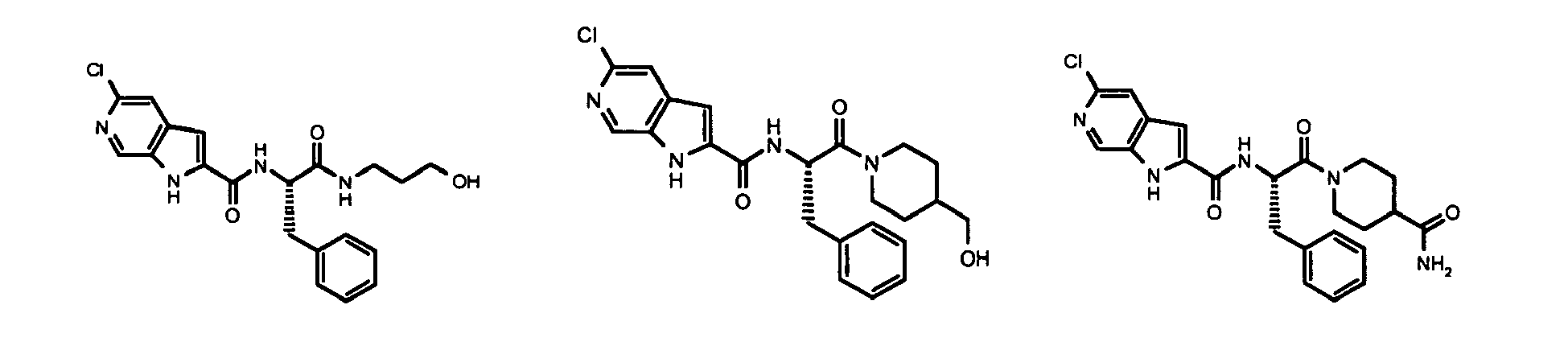



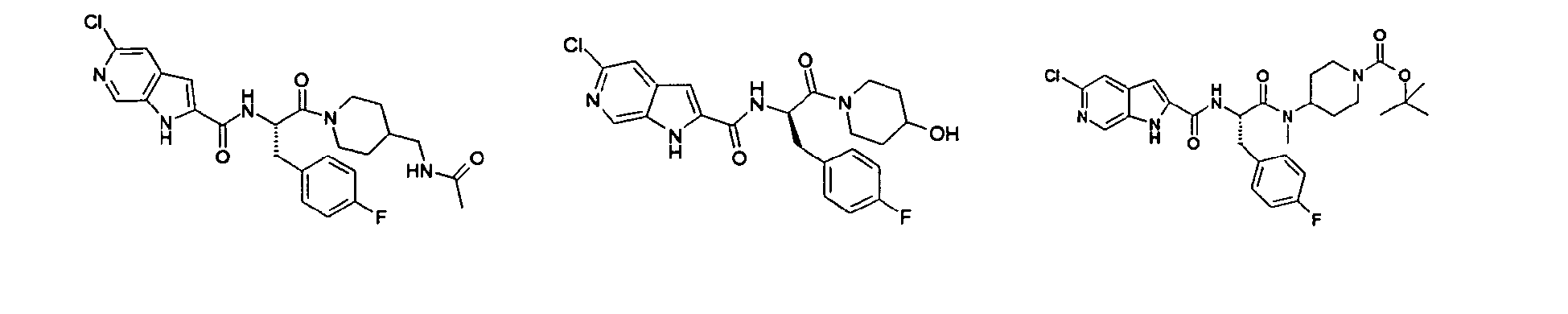





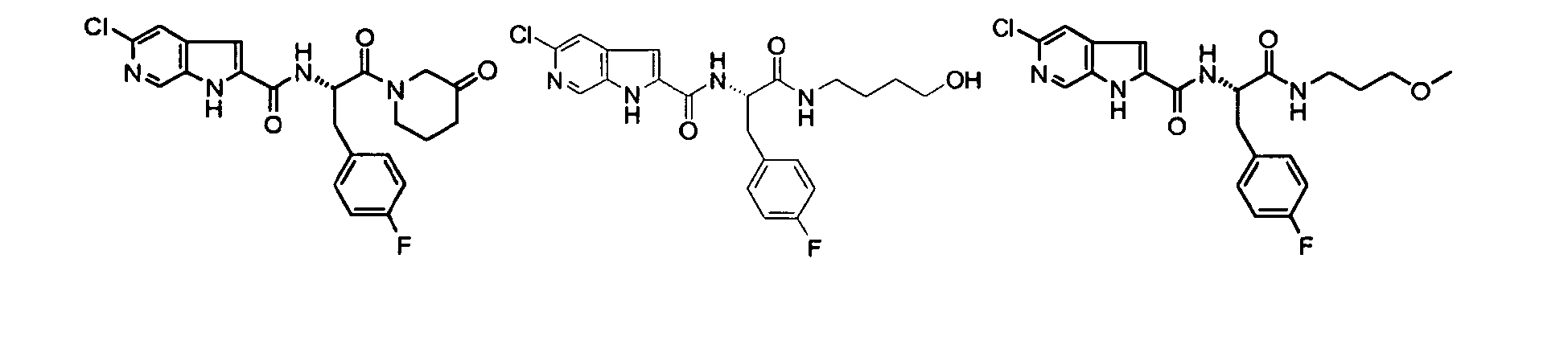


- A compound according to claim 1 selected from the following:

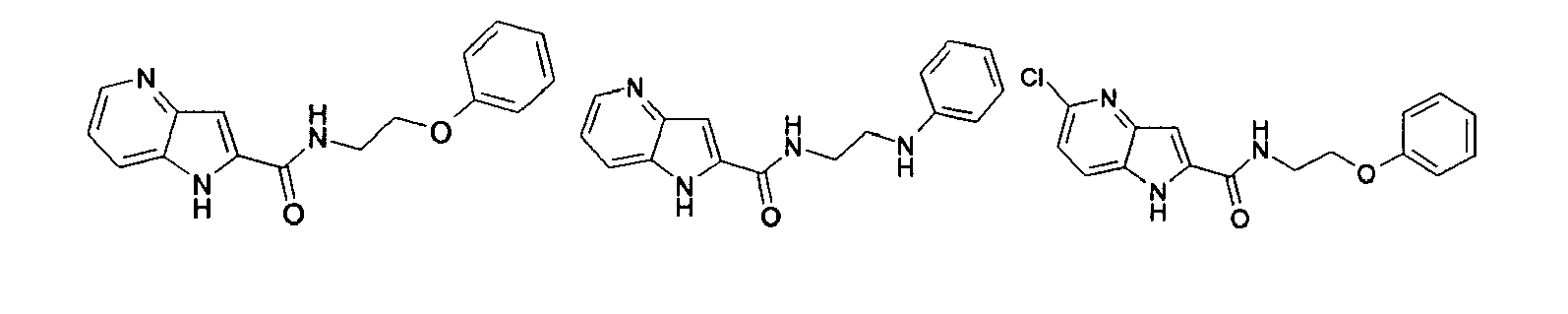
- A compound according to claim 1 selected from the following:


- A compound according to claim 1 selected from the following:


- The compound according to claim 1:

- A composition comprising a compound according to any one of claims 1 to 22, or a stereoisomer, or a pharmaceutically acceptable salt thereof; and a pharmaceutically acceptable carrier.
- A compound according to any one of claims 1 to 22, or a stereoisomer, or a pharmaceutically acceptable salt thereof, for use in the prophylactic or therapeutic treatment of hyperglycemia or diabetes.
- A compound according to any one of claims 1 to 22, or a stereoisomer, or a pharmaceutically acceptable salt thereof, for use in the prevention of diabetes in a human demonstrating pre-diabetic hyperglycemia or impaired glucose tolerance.
- A compound according to any one of claims 1 to 22, or a stereoisomer, or a pharmaceutically acceptable salt thereof, for use in the prophylactic or therapeutic treatment of hypercholesterolemia, hyperinsulinemia, hyperlipidemia, atherosclerosis or myocardial ischemia.
- A compound according to any one of claims 1 to 22, or a stereoisomer; or a pharmaceutically acceptable salt thereof, for use in cardioprotection.
- The use of a compound according to any one of claims 1 to 22, or a stereoisomer, or a pharmaceutically acceptable salt thereof, in the manufacture of a medicament for the treatment of a disease or condition as defined in any one of claims 24 to 27.
- A process for the production of a compound of Formula (I) according to claim 1, comprising:a)
 b)
b) c)
c) d)
d) e) for compounds of Formula (I) wherein Z is absent and R3 is -CO2H, ester hydrolysis of compounds of Formula (I) where Z is C=O and R3 is a C1-4alkoxy group.
 - A compound selected from:5-Chloro-1H-pyrrolo[3,2-b]pyridine-2-carboxylic acid;5-Bromo-1H-pyrrolo[3,2-b]pyridine-2-carboxylic acid;5-Cyano-1H-pywolo[3,2-b]pyridine-2-carboxylic acid;5-Methoxy-1H-pyrrolo[3,2-b]pyridine-2-carboxylic acid;1H-Pyrrolo[3,2-c]pyridine-2-carboxylic acid;6-Chloro-1H-pyrrolo[3,2-c]pyridine-2-carboxylic acid;6-Cyano-1H-pyrrolo[3,2-c]pyridine-2-carboxylic acid;5-Chloro-1H-pyrrolo[2,3-c]pyridine-2-carboxylic acid;5-Bromo-1H-pyrrolo[2,3-c]pyridine-2-carboxylic acid;5-Ethynyl-1H-pyrrolo[2,3-c]pyridine-2-carboxylic acid;5-Cyano-1H-pyrrolo[2,3-c]pyridine-2-carboxylic acid;5-Methyl-1H-pyrrolo[2,3-c]pyridine-2-carboxylic acid;5-Chloro-1H-pyrrolo[2,3-b]pyridine-2-carboxylic acid;6-Chloro-1H-pyrrolo[2,3-b]pyridine-2-carboxylic acid; and6-Cyano-1H-pyrrolo[2,3-b]pyridine-2-carboxylic acid;or a C1-4alkyl ester of any one thereof.
- A compound of Formula (XIX):

- 4(S)-(4-Fluorobenzyl)oxazolidine-2,5-dione.
Applications Claiming Priority (3)
| Application Number | Priority Date | Filing Date | Title |
|---|---|---|---|
| US47237503P | 2003-05-21 | 2003-05-21 | |
| US55125604P | 2004-03-08 | 2004-03-08 | |
| PCT/US2004/016243 WO2004104001A2 (en) | 2003-05-21 | 2004-05-20 | Pyrrolopyridine-2-carboxylic acid amide inhibitors of glycogen phoshorylase |
Publications (2)
| Publication Number | Publication Date |
|---|---|
| EP1636224A2 EP1636224A2 (en) | 2006-03-22 |
| EP1636224B1 true EP1636224B1 (en) | 2010-07-14 |
Family
ID=33479321
Family Applications (1)
| Application Number | Title | Priority Date | Filing Date |
|---|---|---|---|
| EP04753127A Expired - Lifetime EP1636224B1 (en) | 2003-05-21 | 2004-05-20 | Pyrrolopyridine-2-carboxylic acid amide inhibitors of glycogen phoshorylase |
Country Status (16)
| Country | Link |
|---|---|
| EP (1) | EP1636224B1 (en) |
| JP (2) | JP2006528702A (en) |
| KR (1) | KR101120935B1 (en) |
| AT (1) | ATE473974T1 (en) |
| AU (1) | AU2004240946B8 (en) |
| BR (1) | BRPI0410445B1 (en) |
| CA (1) | CA2525502C (en) |
| DE (1) | DE602004028122D1 (en) |
| EA (1) | EA009215B1 (en) |
| IL (1) | IL171851A (en) |
| MA (1) | MA27809A1 (en) |
| MX (1) | MXPA05012547A (en) |
| NO (1) | NO332265B1 (en) |
| NZ (1) | NZ543482A (en) |
| UA (1) | UA84146C2 (en) |
| WO (1) | WO2004104001A2 (en) |
Families Citing this family (34)
| Publication number | Priority date | Publication date | Assignee | Title |
|---|---|---|---|---|
| GB0205175D0 (en) | 2002-03-06 | 2002-04-17 | Astrazeneca Ab | Chemical compounds |
| GB0205166D0 (en) | 2002-03-06 | 2002-04-17 | Astrazeneca Ab | Chemical compounds |
| CA2545644C (en) * | 2003-11-12 | 2011-11-01 | Lg Life Sciences Ltd. | Melanocortin receptor agonists |
| ES2353309T3 (en) | 2004-03-08 | 2011-03-01 | Prosidion Ltd. | HYDRAZIDS OF THE PIRROLOPIRIDIN-2-CARBOXYL ACID AS INHIBITORS OF GLUCOGEN PHOSPHORILASE. |
| JP2007531744A (en) * | 2004-04-05 | 2007-11-08 | 武田薬品工業株式会社 | 6-azaindole compounds |
| DE102004054634A1 (en) * | 2004-11-12 | 2006-05-18 | Schwarz Pharma Ag | Azaindolcarboxamide |
| GB0425919D0 (en) * | 2004-11-25 | 2004-12-29 | Prosidion Ltd | Indole-2-carboxylic acid amides |
| PL1819704T3 (en) | 2004-12-02 | 2008-12-31 | Prosidion Ltd | Pyrrolopyridine-2-carboxylic acid amide derivative useful as inhibitor of glycogen phosphorylase |
| WO2006059163A1 (en) * | 2004-12-02 | 2006-06-08 | Prosidion Limited | Treatment of diabetes with glycogen phosphorylase inhibitors |
| ATE424821T1 (en) | 2004-12-02 | 2009-03-15 | Prosidion Ltd | PYRROLOPYRIDINE-2-CARBONIC ACID AMIDES |
| EP1948597A1 (en) * | 2005-10-21 | 2008-07-30 | Vertex Pharmaceuticals Incorporated | Derivatives for modulation of ion channels |
| JP2009519293A (en) * | 2005-12-16 | 2009-05-14 | エフ.ホフマン−ラ ロシュ アーゲー | Pyrrolo [2,3-b] pyridine derivatives as H3 receptor modulators |
| PE20080251A1 (en) | 2006-05-04 | 2008-04-25 | Boehringer Ingelheim Int | USES OF DPP IV INHIBITORS |
| EP2089023A2 (en) | 2006-11-02 | 2009-08-19 | Aestus Therapeutics, Inc. | Methods of treating neuropathic pain with agonists of ppar-gamma |
| FR2911605B1 (en) | 2007-01-19 | 2009-04-17 | Sanofi Aventis Sa | PYRROLOPYRIDINE-2-CARBOWAMIDE DERIVATIVES, THEIR PREPARATION AND THEIR THERAPEUTIC USE |
| DE102007012284A1 (en) | 2007-03-16 | 2008-09-18 | Boehringer Ingelheim Pharma Gmbh & Co. Kg | Novel substituted arylsulfonylglycines, their preparation and their use as pharmaceuticals |
| DE102007035334A1 (en) | 2007-07-27 | 2009-01-29 | Boehringer Ingelheim Pharma Gmbh & Co. Kg | Novel substituted arylsulfonylglycines, their preparation and their use as pharmaceuticals |
| DE102007035333A1 (en) | 2007-07-27 | 2009-01-29 | Boehringer Ingelheim Pharma Gmbh & Co. Kg | Novel substituted arylsulfonylglycines, their preparation and their use as pharmaceuticals |
| DE102007042154A1 (en) | 2007-09-05 | 2009-03-12 | Boehringer Ingelheim Pharma Gmbh & Co. Kg | Arylsulfonylaminomethyphosphonsäure derivatives, their preparation and their use as medicaments |
| US8785489B2 (en) | 2008-10-17 | 2014-07-22 | Boehringer Ingelheim International Gmbh | Heteroaryl substituted indole compounds useful as MMP-13 inhibitors |
| UY32940A (en) | 2009-10-27 | 2011-05-31 | Bayer Cropscience Ag | AMIDAS REPLACED WITH HALOGENO RENT AS INSECTICIDES AND ACARICIDES |
| AR086554A1 (en) | 2011-05-27 | 2014-01-08 | Novartis Ag | DERIVATIVES OF PIPERIDINE 3-ESPIROCICLICA AS AGRONISTS OF GHRELINE RECEPTORS |
| WO2012166389A1 (en) | 2011-05-31 | 2012-12-06 | Theravance, Inc. | Neprilysin inhibitors |
| CA2835220A1 (en) | 2011-05-31 | 2012-12-06 | Theravance, Inc. | Neprilysin inhibitors |
| US8513244B2 (en) | 2011-05-31 | 2013-08-20 | Theravance, Inc. | Neprilysin inhibitors |
| US9345247B2 (en) | 2012-08-17 | 2016-05-24 | Bayer Cropscience Ag | Azaindole carboxylic acid amides and azaindole thiocarboxylic acid amides for use as insecticides and acaricides |
| CN103626825B (en) * | 2013-09-30 | 2015-10-07 | 承德医学院 | The glycogen phosphorylase inhibitors cholic acid derivative of target liver, its preparation method and medicinal use |
| CN105829296A (en) | 2013-12-18 | 2016-08-03 | 巴斯夫欧洲公司 | Azole compounds with imine-derived substituents |
| JP7805583B2 (en) * | 2019-11-27 | 2026-01-26 | 国立研究開発法人理化学研究所 | G9a inhibitors |
| EP4237423B1 (en) | 2020-11-02 | 2024-12-11 | Boehringer Ingelheim International GmbH | Substituted 1h-pyrazolo[4,3-c]pyridines and derivatives as egfr inhibitors |
| CA3211571A1 (en) * | 2021-03-10 | 2022-09-15 | Donna L. Romero | Usp30 inhibitors and uses thereof |
| WO2023165168A1 (en) * | 2022-10-27 | 2023-09-07 | 常州大学 | APPLICATION OF PYRAZOLE DERIVATIVE AS β2 ADRENERGIC RECEPTOR ALLOSTERIC MODULATOR, ANTAGONIST AND AGONIST |
| CN115745891B (en) * | 2022-11-10 | 2025-08-01 | 常州大学 | Pyrazole derivatives as beta2Use of adrenergic receptor antagonists |
| CN115894373B (en) * | 2022-10-27 | 2025-08-01 | 常州大学 | N-substituted benzyl pyrazole derivatives as beta2Use of modulators, antagonists and agonists of adrenergic receptors |
Family Cites Families (12)
| Publication number | Priority date | Publication date | Assignee | Title |
|---|---|---|---|---|
| US4619915A (en) * | 1984-10-19 | 1986-10-28 | Pfizer Inc. | Peptide-substituted heterocyclic immunostimulants |
| IL88619A0 (en) * | 1987-12-15 | 1989-07-31 | Pfizer | Non-peptidic renin inhibitors |
| US5635527A (en) * | 1994-06-06 | 1997-06-03 | The Green Cross Corporation | Carboxylic acid compound having condensed ring, salt thereof and pharmaceutical use thereof |
| JP3314938B2 (en) * | 1995-06-06 | 2002-08-19 | ファイザー・インコーポレーテッド | Substituted N- (indole-2-carbonyl) -glycinamides and derivatives as glycogen phosphorylase inhibitors |
| FI974437A0 (en) * | 1995-06-06 | 1997-12-05 | Pfizer | Substituted N- (indole-2-carbonyl) amides and derivatives as glycogen phosphorylase inhibitors |
| KR100241643B1 (en) * | 1995-06-06 | 2000-03-02 | 디. 제이. 우드 | Substituted N- (indole-2-carbonyl) -β-alanimamide and its derivatives for treating diabetes |
| US5952322A (en) * | 1996-12-05 | 1999-09-14 | Pfizer Inc. | Method of reducing tissue damage associated with non-cardiac ischemia using glycogen phosphorylase inhibitors |
| GB9902047D0 (en) * | 1999-01-29 | 1999-03-17 | Cerebrus Ltd | Chemical compounds XI |
| DE60007592T2 (en) * | 1999-09-30 | 2004-09-16 | Pfizer Products Inc., Groton | Bicyclic pyrrolylamides as glycogen phosphorylase inhibitors |
| GB0021831D0 (en) * | 2000-09-06 | 2000-10-18 | Astrazeneca Ab | Chemical compounds |
| GB0202015D0 (en) * | 2002-01-29 | 2002-03-13 | Hoffmann La Roche | Piperazine Derivatives |
| BR0315681A (en) * | 2002-10-30 | 2005-09-06 | Merck Frosst Canada Inc | Compound and its pharmaceutically acceptable salts and hydrates, pharmaceutical composition, methods for treating prostaglandin d2-mediated diseases, treating nasal congestion, treating allergic asthma, and treating allergic rhinitis, compound or a salt thereof or pharmaceutically acceptable solvate, salt or hydrate of the compound, and use of a compound or a pharmaceutically acceptable salt or solvate thereof |
-
2004
- 2004-05-20 JP JP2006533345A patent/JP2006528702A/en not_active Withdrawn
- 2004-05-20 AT AT04753127T patent/ATE473974T1/en not_active IP Right Cessation
- 2004-05-20 CA CA2525502A patent/CA2525502C/en not_active Expired - Fee Related
- 2004-05-20 UA UAA200510756A patent/UA84146C2/en unknown
- 2004-05-20 NZ NZ543482A patent/NZ543482A/en not_active IP Right Cessation
- 2004-05-20 WO PCT/US2004/016243 patent/WO2004104001A2/en not_active Ceased
- 2004-05-20 EA EA200501645A patent/EA009215B1/en not_active IP Right Cessation
- 2004-05-20 EP EP04753127A patent/EP1636224B1/en not_active Expired - Lifetime
- 2004-05-20 MX MXPA05012547A patent/MXPA05012547A/en active IP Right Grant
- 2004-05-20 BR BRPI0410445-5A patent/BRPI0410445B1/en not_active IP Right Cessation
- 2004-05-20 DE DE602004028122T patent/DE602004028122D1/en not_active Expired - Lifetime
- 2004-05-20 AU AU2004240946A patent/AU2004240946B8/en not_active Ceased
-
2005
- 2005-11-09 IL IL171851A patent/IL171851A/en active IP Right Grant
- 2005-11-10 NO NO20055305A patent/NO332265B1/en not_active IP Right Cessation
- 2005-11-21 MA MA28613A patent/MA27809A1/en unknown
- 2005-11-21 KR KR1020057022252A patent/KR101120935B1/en not_active Expired - Fee Related
-
2011
- 2011-08-09 JP JP2011174163A patent/JP5669691B2/en not_active Expired - Fee Related
Also Published As
| Publication number | Publication date |
|---|---|
| JP5669691B2 (en) | 2015-02-12 |
| WO2004104001A2 (en) | 2004-12-02 |
| JP2011252005A (en) | 2011-12-15 |
| IL171851A (en) | 2011-08-31 |
| WO2004104001A3 (en) | 2005-03-03 |
| NO20055305D0 (en) | 2005-11-10 |
| UA84146C2 (en) | 2008-09-25 |
| NZ543482A (en) | 2009-02-28 |
| MA27809A1 (en) | 2006-03-01 |
| NO20055305L (en) | 2005-12-15 |
| EA009215B1 (en) | 2007-12-28 |
| AU2004240946A1 (en) | 2004-12-02 |
| BRPI0410445B1 (en) | 2017-11-28 |
| CA2525502C (en) | 2012-12-18 |
| ATE473974T1 (en) | 2010-07-15 |
| CA2525502A1 (en) | 2004-12-02 |
| EP1636224A2 (en) | 2006-03-22 |
| MXPA05012547A (en) | 2006-05-25 |
| JP2006528702A (en) | 2006-12-21 |
| AU2004240946B8 (en) | 2012-01-12 |
| EA200501645A1 (en) | 2006-06-30 |
| AU2004240946B2 (en) | 2011-09-08 |
| KR20060069792A (en) | 2006-06-22 |
| KR101120935B1 (en) | 2012-03-05 |
| NO332265B1 (en) | 2012-08-13 |
| BRPI0410445A (en) | 2006-05-30 |
| DE602004028122D1 (en) | 2010-08-26 |
Similar Documents
| Publication | Publication Date | Title |
|---|---|---|
| AU2004240946B2 (en) | Pyrrolopyridine-2-carboxylic acid amide inhibitors of glycogen phoshorylase | |
| KR102642203B1 (en) | Multicyclic compounds and methods for targeted cleavage of rapidly progressive fibrosarcoma polypeptides | |
| CN112218859B (en) | Proteolytic modulators and related methods of use | |
| US8158622B2 (en) | Pyrrolopyridine-2-carboxylic acid amide inhibitors of glycogen phosphorylase | |
| CN107849015B (en) | Benzimidazole derivatives as PAD4 inhibitors | |
| CN109069869B (en) | Bicyclic PAD4 inhibitors | |
| WO2011150190A2 (en) | Hcv inhibitor compounds and methods of use thereof | |
| CN115348961A (en) | Heterocyclic PAD4 inhibitors | |
| US6201006B1 (en) | Aromatic amidine derivatives useful as selective thrombin inhibitors | |
| EP1819332B1 (en) | Pyrrolopyridine-2-carboxylic acid amides | |
| CN113950477B (en) | Granulin precursor modulators and methods of use thereof | |
| EP1567489B1 (en) | Pyrrolidin-2-one derivatives as inhibitors of thrombin and factor xa | |
| CN100480249C (en) | Pyrrolopyridine-2-carboxylic acid amides as glycogen phosphorylase inhibitors | |
| WO2021132524A1 (en) | Epoxy azepan derivative | |
| HK40065898A (en) | Progranulin modulators and methods of using the same | |
| HK1228892B (en) | Kinase inhibitors | |
| HK1228892A1 (en) | Kinase inhibitors | |
| HK1200828B (en) | Kinase inhibitors | |
| HK40082554A (en) | Tlr2 modulator compounds, pharmaceutical compositions and uses thereof |
Legal Events
| Date | Code | Title | Description |
|---|---|---|---|
| PUAI | Public reference made under article 153(3) epc to a published international application that has entered the european phase |
Free format text: ORIGINAL CODE: 0009012 |
|
| 17P | Request for examination filed |
Effective date: 20051221 |
|
| AK | Designated contracting states |
Kind code of ref document: A2 Designated state(s): AT BE BG CH CY CZ DE DK EE ES FI FR GB GR HU IE IT LI LU MC NL PL PT RO SE SI SK TR |
|
| AX | Request for extension of the european patent |
Extension state: AL HR LT LV MK |
|
| REG | Reference to a national code |
Ref country code: HK Ref legal event code: DE Ref document number: 1088331 Country of ref document: HK |
|
| 17Q | First examination report despatched |
Effective date: 20061218 |
|
| RIN1 | Information on inventor provided before grant (corrected) |
Inventor name: PROCTER, MARTIN, JAMES Inventor name: SAMBROOK SMITH, COLIN, PETER Inventor name: ROWLEY, ROBERT, JOHN Inventor name: BRADLEY, STUART, EDWARD Inventor name: THOMAS, GERARD, HUGH Inventor name: SCHOFIELD, KAREN, LESLEY Inventor name: KRULLE, THOMAS, MARTIN Inventor name: MURRAY, PETER, JOHN, C/O PATENTS DEPARTMENT |
|
| GRAP | Despatch of communication of intention to grant a patent |
Free format text: ORIGINAL CODE: EPIDOSNIGR1 |
|
| GRAS | Grant fee paid |
Free format text: ORIGINAL CODE: EPIDOSNIGR3 |
|
| GRAA | (expected) grant |
Free format text: ORIGINAL CODE: 0009210 |
|
| AK | Designated contracting states |
Kind code of ref document: B1 Designated state(s): AT BE BG CH CY CZ DE DK EE ES FI FR GB GR HU IE IT LI LU MC NL PL PT RO SE SI SK TR |
|
| AX | Request for extension of the european patent |
Extension state: AL HR LT LV MK |
|
| REG | Reference to a national code |
Ref country code: GB Ref legal event code: FG4D |
|
| REG | Reference to a national code |
Ref country code: CH Ref legal event code: EP |
|
| REG | Reference to a national code |
Ref country code: IE Ref legal event code: FG4D |
|
| REF | Corresponds to: |
Ref document number: 602004028122 Country of ref document: DE Date of ref document: 20100826 Kind code of ref document: P |
|
| REG | Reference to a national code |
Ref country code: NL Ref legal event code: T3 |
|
| REG | Reference to a national code |
Ref country code: ES Ref legal event code: FG2A Effective date: 20101126 |
|
| LTIE | Lt: invalidation of european patent or patent extension |
Effective date: 20100714 |
|
| PG25 | Lapsed in a contracting state [announced via postgrant information from national office to epo] |
Ref country code: AT Free format text: LAPSE BECAUSE OF FAILURE TO SUBMIT A TRANSLATION OF THE DESCRIPTION OR TO PAY THE FEE WITHIN THE PRESCRIBED TIME-LIMIT Effective date: 20100714 Ref country code: FI Free format text: LAPSE BECAUSE OF FAILURE TO SUBMIT A TRANSLATION OF THE DESCRIPTION OR TO PAY THE FEE WITHIN THE PRESCRIBED TIME-LIMIT Effective date: 20100714 |
|
| PG25 | Lapsed in a contracting state [announced via postgrant information from national office to epo] |
Ref country code: SI Free format text: LAPSE BECAUSE OF FAILURE TO SUBMIT A TRANSLATION OF THE DESCRIPTION OR TO PAY THE FEE WITHIN THE PRESCRIBED TIME-LIMIT Effective date: 20100714 Ref country code: CY Free format text: LAPSE BECAUSE OF FAILURE TO SUBMIT A TRANSLATION OF THE DESCRIPTION OR TO PAY THE FEE WITHIN THE PRESCRIBED TIME-LIMIT Effective date: 20100714 Ref country code: PL Free format text: LAPSE BECAUSE OF FAILURE TO SUBMIT A TRANSLATION OF THE DESCRIPTION OR TO PAY THE FEE WITHIN THE PRESCRIBED TIME-LIMIT Effective date: 20100714 Ref country code: BG Free format text: LAPSE BECAUSE OF FAILURE TO SUBMIT A TRANSLATION OF THE DESCRIPTION OR TO PAY THE FEE WITHIN THE PRESCRIBED TIME-LIMIT Effective date: 20101014 Ref country code: PT Free format text: LAPSE BECAUSE OF FAILURE TO SUBMIT A TRANSLATION OF THE DESCRIPTION OR TO PAY THE FEE WITHIN THE PRESCRIBED TIME-LIMIT Effective date: 20101115 |
|
| PG25 | Lapsed in a contracting state [announced via postgrant information from national office to epo] |
Ref country code: BE Free format text: LAPSE BECAUSE OF FAILURE TO SUBMIT A TRANSLATION OF THE DESCRIPTION OR TO PAY THE FEE WITHIN THE PRESCRIBED TIME-LIMIT Effective date: 20100714 Ref country code: GR Free format text: LAPSE BECAUSE OF FAILURE TO SUBMIT A TRANSLATION OF THE DESCRIPTION OR TO PAY THE FEE WITHIN THE PRESCRIBED TIME-LIMIT Effective date: 20101015 Ref country code: SE Free format text: LAPSE BECAUSE OF FAILURE TO SUBMIT A TRANSLATION OF THE DESCRIPTION OR TO PAY THE FEE WITHIN THE PRESCRIBED TIME-LIMIT Effective date: 20100714 |
|
| PG25 | Lapsed in a contracting state [announced via postgrant information from national office to epo] |
Ref country code: DK Free format text: LAPSE BECAUSE OF FAILURE TO SUBMIT A TRANSLATION OF THE DESCRIPTION OR TO PAY THE FEE WITHIN THE PRESCRIBED TIME-LIMIT Effective date: 20100714 |
|
| PLBE | No opposition filed within time limit |
Free format text: ORIGINAL CODE: 0009261 |
|
| STAA | Information on the status of an ep patent application or granted ep patent |
Free format text: STATUS: NO OPPOSITION FILED WITHIN TIME LIMIT |
|
| PG25 | Lapsed in a contracting state [announced via postgrant information from national office to epo] |
Ref country code: CZ Free format text: LAPSE BECAUSE OF FAILURE TO SUBMIT A TRANSLATION OF THE DESCRIPTION OR TO PAY THE FEE WITHIN THE PRESCRIBED TIME-LIMIT Effective date: 20100714 Ref country code: SK Free format text: LAPSE BECAUSE OF FAILURE TO SUBMIT A TRANSLATION OF THE DESCRIPTION OR TO PAY THE FEE WITHIN THE PRESCRIBED TIME-LIMIT Effective date: 20100714 Ref country code: EE Free format text: LAPSE BECAUSE OF FAILURE TO SUBMIT A TRANSLATION OF THE DESCRIPTION OR TO PAY THE FEE WITHIN THE PRESCRIBED TIME-LIMIT Effective date: 20100714 Ref country code: RO Free format text: LAPSE BECAUSE OF FAILURE TO SUBMIT A TRANSLATION OF THE DESCRIPTION OR TO PAY THE FEE WITHIN THE PRESCRIBED TIME-LIMIT Effective date: 20100714 |
|
| 26N | No opposition filed |
Effective date: 20110415 |
|
| REG | Reference to a national code |
Ref country code: DE Ref legal event code: R097 Ref document number: 602004028122 Country of ref document: DE Effective date: 20110415 |
|
| PG25 | Lapsed in a contracting state [announced via postgrant information from national office to epo] |
Ref country code: MC Free format text: LAPSE BECAUSE OF NON-PAYMENT OF DUE FEES Effective date: 20110531 |
|
| REG | Reference to a national code |
Ref country code: CH Ref legal event code: PL |
|
| PG25 | Lapsed in a contracting state [announced via postgrant information from national office to epo] |
Ref country code: CH Free format text: LAPSE BECAUSE OF NON-PAYMENT OF DUE FEES Effective date: 20110531 Ref country code: LI Free format text: LAPSE BECAUSE OF NON-PAYMENT OF DUE FEES Effective date: 20110531 |
|
| REG | Reference to a national code |
Ref country code: IE Ref legal event code: MM4A |
|
| PG25 | Lapsed in a contracting state [announced via postgrant information from national office to epo] |
Ref country code: IE Free format text: LAPSE BECAUSE OF NON-PAYMENT OF DUE FEES Effective date: 20110520 |
|
| REG | Reference to a national code |
Ref country code: HK Ref legal event code: WD Ref document number: 1088331 Country of ref document: HK |
|
| PG25 | Lapsed in a contracting state [announced via postgrant information from national office to epo] |
Ref country code: LU Free format text: LAPSE BECAUSE OF NON-PAYMENT OF DUE FEES Effective date: 20110520 |
|
| PG25 | Lapsed in a contracting state [announced via postgrant information from national office to epo] |
Ref country code: TR Free format text: LAPSE BECAUSE OF FAILURE TO SUBMIT A TRANSLATION OF THE DESCRIPTION OR TO PAY THE FEE WITHIN THE PRESCRIBED TIME-LIMIT Effective date: 20100714 |
|
| PG25 | Lapsed in a contracting state [announced via postgrant information from national office to epo] |
Ref country code: HU Free format text: LAPSE BECAUSE OF FAILURE TO SUBMIT A TRANSLATION OF THE DESCRIPTION OR TO PAY THE FEE WITHIN THE PRESCRIBED TIME-LIMIT Effective date: 20100714 |
|
| REG | Reference to a national code |
Ref country code: FR Ref legal event code: PLFP Year of fee payment: 13 |
|
| REG | Reference to a national code |
Ref country code: FR Ref legal event code: PLFP Year of fee payment: 14 |
|
| REG | Reference to a national code |
Ref country code: FR Ref legal event code: PLFP Year of fee payment: 15 |
|
| PGFP | Annual fee paid to national office [announced via postgrant information from national office to epo] |
Ref country code: DE Payment date: 20180529 Year of fee payment: 15 Ref country code: ES Payment date: 20180601 Year of fee payment: 15 |
|
| PGFP | Annual fee paid to national office [announced via postgrant information from national office to epo] |
Ref country code: FR Payment date: 20180525 Year of fee payment: 15 Ref country code: NL Payment date: 20180526 Year of fee payment: 15 Ref country code: IT Payment date: 20180522 Year of fee payment: 15 |
|
| PGFP | Annual fee paid to national office [announced via postgrant information from national office to epo] |
Ref country code: GB Payment date: 20180529 Year of fee payment: 15 |
|
| REG | Reference to a national code |
Ref country code: DE Ref legal event code: R119 Ref document number: 602004028122 Country of ref document: DE |
|
| REG | Reference to a national code |
Ref country code: NL Ref legal event code: MM Effective date: 20190601 |
|
| GBPC | Gb: european patent ceased through non-payment of renewal fee |
Effective date: 20190520 |
|
| PG25 | Lapsed in a contracting state [announced via postgrant information from national office to epo] |
Ref country code: DE Free format text: LAPSE BECAUSE OF NON-PAYMENT OF DUE FEES Effective date: 20191203 Ref country code: NL Free format text: LAPSE BECAUSE OF NON-PAYMENT OF DUE FEES Effective date: 20190601 Ref country code: IT Free format text: LAPSE BECAUSE OF NON-PAYMENT OF DUE FEES Effective date: 20190520 Ref country code: GB Free format text: LAPSE BECAUSE OF NON-PAYMENT OF DUE FEES Effective date: 20190520 |
|
| PG25 | Lapsed in a contracting state [announced via postgrant information from national office to epo] |
Ref country code: FR Free format text: LAPSE BECAUSE OF NON-PAYMENT OF DUE FEES Effective date: 20190531 |
|
| REG | Reference to a national code |
Ref country code: ES Ref legal event code: FD2A Effective date: 20200928 |
|
| PG25 | Lapsed in a contracting state [announced via postgrant information from national office to epo] |
Ref country code: ES Free format text: LAPSE BECAUSE OF NON-PAYMENT OF DUE FEES Effective date: 20190521 |