EP1136071A2 - Use of glycogen phosphorylase inhibitors - Google Patents
Use of glycogen phosphorylase inhibitors Download PDFInfo
- Publication number
- EP1136071A2 EP1136071A2 EP01301979A EP01301979A EP1136071A2 EP 1136071 A2 EP1136071 A2 EP 1136071A2 EP 01301979 A EP01301979 A EP 01301979A EP 01301979 A EP01301979 A EP 01301979A EP 1136071 A2 EP1136071 A2 EP 1136071A2
- Authority
- EP
- European Patent Office
- Prior art keywords
- carboxylic acid
- amide
- alkyl
- oxo
- ethyl
- Prior art date
- Legal status (The legal status is an assumption and is not a legal conclusion. Google has not performed a legal analysis and makes no representation as to the accuracy of the status listed.)
- Withdrawn
Links
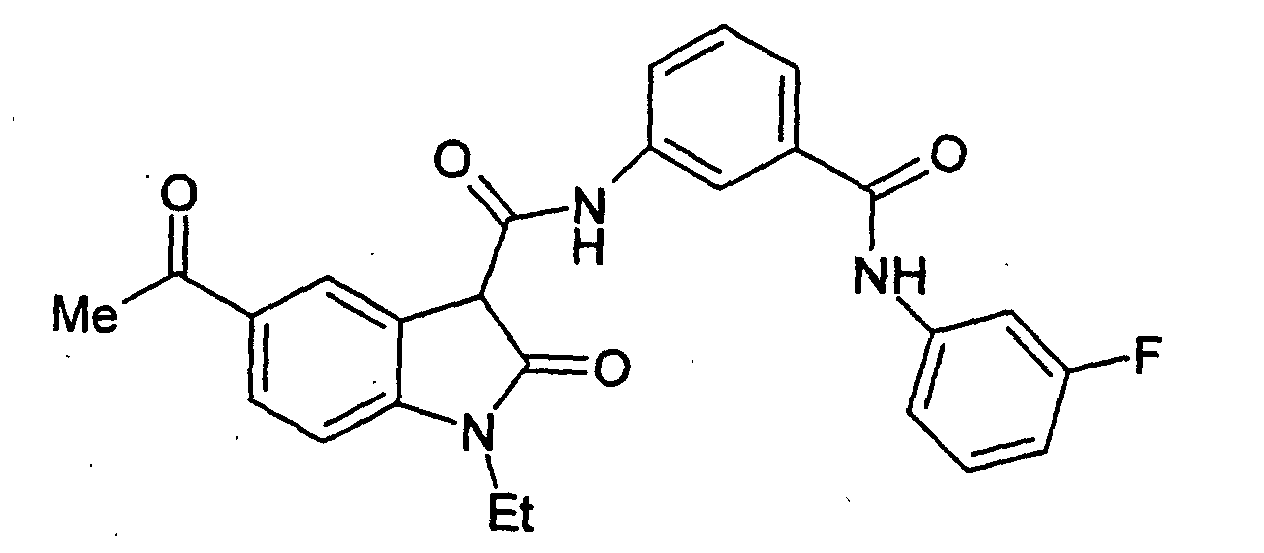
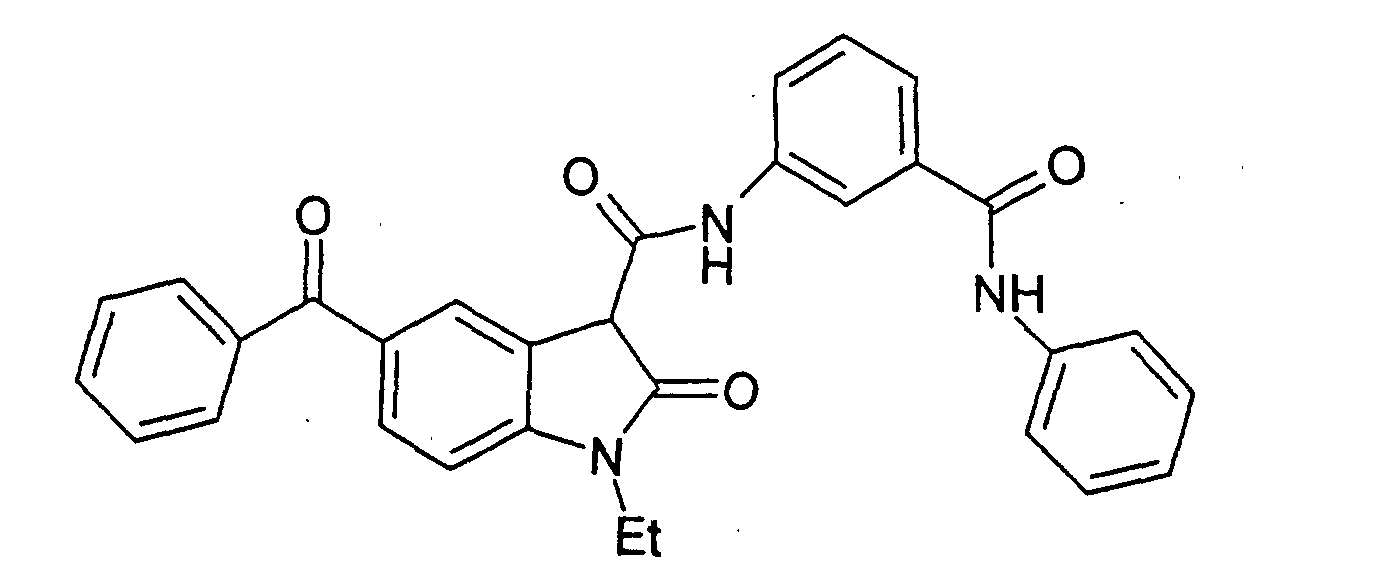
- 0 *C(c(cc1)cc(C2C(Nc3cccc(C(*)=O)c3)=O)c1N(*)C2=O)=O Chemical compound *C(c(cc1)cc(C2C(Nc3cccc(C(*)=O)c3)=O)c1N(*)C2=O)=O 0.000 description 1
- ZYNGDZZXFBCBLD-UHFFFAOYSA-N CCN(C(C(C(Nc1cc(C(Nc2ccccc2)=O)ccc1)=O)c1c2)=O)c1ccc2C(c1ccccc1)=O Chemical compound CCN(C(C(C(Nc1cc(C(Nc2ccccc2)=O)ccc1)=O)c1c2)=O)c1ccc2C(c1ccccc1)=O ZYNGDZZXFBCBLD-UHFFFAOYSA-N 0.000 description 1
- GSDFBSUXSMGTDL-UHFFFAOYSA-N CCN(C(C(C(Nc1cccc(C(Nc(cc2)ccc2I)=O)c1)=O)c1c2)=O)c1ccc2C(C)=O Chemical compound CCN(C(C(C(Nc1cccc(C(Nc(cc2)ccc2I)=O)c1)=O)c1c2)=O)c1ccc2C(C)=O GSDFBSUXSMGTDL-UHFFFAOYSA-N 0.000 description 1
Classifications
-
- A—HUMAN NECESSITIES
- A61—MEDICAL OR VETERINARY SCIENCE; HYGIENE
- A61K—PREPARATIONS FOR MEDICAL, DENTAL OR TOILETRY PURPOSES
- A61K31/00—Medicinal preparations containing organic active ingredients
- A61K31/33—Heterocyclic compounds
- A61K31/395—Heterocyclic compounds having nitrogen as a ring hetero atom, e.g. guanethidine or rifamycins
- A61K31/41—Heterocyclic compounds having nitrogen as a ring hetero atom, e.g. guanethidine or rifamycins having five-membered rings with two or more ring hetero atoms, at least one of which being nitrogen, e.g. tetrazole
- A61K31/425—Thiazoles
- A61K31/427—Thiazoles not condensed and containing further heterocyclic rings
-
- A—HUMAN NECESSITIES
- A61—MEDICAL OR VETERINARY SCIENCE; HYGIENE
- A61K—PREPARATIONS FOR MEDICAL, DENTAL OR TOILETRY PURPOSES
- A61K31/00—Medicinal preparations containing organic active ingredients
-
- A—HUMAN NECESSITIES
- A61—MEDICAL OR VETERINARY SCIENCE; HYGIENE
- A61K—PREPARATIONS FOR MEDICAL, DENTAL OR TOILETRY PURPOSES
- A61K31/00—Medicinal preparations containing organic active ingredients
- A61K31/33—Heterocyclic compounds
- A61K31/395—Heterocyclic compounds having nitrogen as a ring hetero atom, e.g. guanethidine or rifamycins
- A61K31/40—Heterocyclic compounds having nitrogen as a ring hetero atom, e.g. guanethidine or rifamycins having five-membered rings with one nitrogen as the only ring hetero atom, e.g. sulpiride, succinimide, tolmetin, buflomedil
- A61K31/403—Heterocyclic compounds having nitrogen as a ring hetero atom, e.g. guanethidine or rifamycins having five-membered rings with one nitrogen as the only ring hetero atom, e.g. sulpiride, succinimide, tolmetin, buflomedil condensed with carbocyclic rings, e.g. carbazole
- A61K31/404—Indoles, e.g. pindolol
-
- A—HUMAN NECESSITIES
- A61—MEDICAL OR VETERINARY SCIENCE; HYGIENE
- A61K—PREPARATIONS FOR MEDICAL, DENTAL OR TOILETRY PURPOSES
- A61K31/00—Medicinal preparations containing organic active ingredients
- A61K31/33—Heterocyclic compounds
- A61K31/395—Heterocyclic compounds having nitrogen as a ring hetero atom, e.g. guanethidine or rifamycins
- A61K31/40—Heterocyclic compounds having nitrogen as a ring hetero atom, e.g. guanethidine or rifamycins having five-membered rings with one nitrogen as the only ring hetero atom, e.g. sulpiride, succinimide, tolmetin, buflomedil
- A61K31/407—Heterocyclic compounds having nitrogen as a ring hetero atom, e.g. guanethidine or rifamycins having five-membered rings with one nitrogen as the only ring hetero atom, e.g. sulpiride, succinimide, tolmetin, buflomedil condensed with other heterocyclic ring systems, e.g. ketorolac, physostigmine
-
- A—HUMAN NECESSITIES
- A61—MEDICAL OR VETERINARY SCIENCE; HYGIENE
- A61K—PREPARATIONS FOR MEDICAL, DENTAL OR TOILETRY PURPOSES
- A61K31/00—Medicinal preparations containing organic active ingredients
- A61K31/33—Heterocyclic compounds
- A61K31/395—Heterocyclic compounds having nitrogen as a ring hetero atom, e.g. guanethidine or rifamycins
- A61K31/41—Heterocyclic compounds having nitrogen as a ring hetero atom, e.g. guanethidine or rifamycins having five-membered rings with two or more ring hetero atoms, at least one of which being nitrogen, e.g. tetrazole
- A61K31/42—Oxazoles
- A61K31/422—Oxazoles not condensed and containing further heterocyclic rings
-
- A—HUMAN NECESSITIES
- A61—MEDICAL OR VETERINARY SCIENCE; HYGIENE
- A61K—PREPARATIONS FOR MEDICAL, DENTAL OR TOILETRY PURPOSES
- A61K31/00—Medicinal preparations containing organic active ingredients
- A61K31/33—Heterocyclic compounds
- A61K31/395—Heterocyclic compounds having nitrogen as a ring hetero atom, e.g. guanethidine or rifamycins
- A61K31/435—Heterocyclic compounds having nitrogen as a ring hetero atom, e.g. guanethidine or rifamycins having six-membered rings with one nitrogen as the only ring hetero atom
- A61K31/44—Non condensed pyridines; Hydrogenated derivatives thereof
- A61K31/4427—Non condensed pyridines; Hydrogenated derivatives thereof containing further heterocyclic ring systems
- A61K31/4439—Non condensed pyridines; Hydrogenated derivatives thereof containing further heterocyclic ring systems containing a five-membered ring with nitrogen as a ring hetero atom, e.g. omeprazole
-
- A—HUMAN NECESSITIES
- A61—MEDICAL OR VETERINARY SCIENCE; HYGIENE
- A61K—PREPARATIONS FOR MEDICAL, DENTAL OR TOILETRY PURPOSES
- A61K31/00—Medicinal preparations containing organic active ingredients
- A61K31/33—Heterocyclic compounds
- A61K31/395—Heterocyclic compounds having nitrogen as a ring hetero atom, e.g. guanethidine or rifamycins
- A61K31/435—Heterocyclic compounds having nitrogen as a ring hetero atom, e.g. guanethidine or rifamycins having six-membered rings with one nitrogen as the only ring hetero atom
- A61K31/44—Non condensed pyridines; Hydrogenated derivatives thereof
- A61K31/445—Non condensed piperidines, e.g. piperocaine
- A61K31/4523—Non condensed piperidines, e.g. piperocaine containing further heterocyclic ring systems
- A61K31/454—Non condensed piperidines, e.g. piperocaine containing further heterocyclic ring systems containing a five-membered ring with nitrogen as a ring hetero atom, e.g. pimozide, domperidone
-
- A—HUMAN NECESSITIES
- A61—MEDICAL OR VETERINARY SCIENCE; HYGIENE
- A61K—PREPARATIONS FOR MEDICAL, DENTAL OR TOILETRY PURPOSES
- A61K31/00—Medicinal preparations containing organic active ingredients
- A61K31/33—Heterocyclic compounds
- A61K31/395—Heterocyclic compounds having nitrogen as a ring hetero atom, e.g. guanethidine or rifamycins
- A61K31/495—Heterocyclic compounds having nitrogen as a ring hetero atom, e.g. guanethidine or rifamycins having six-membered rings with two or more nitrogen atoms as the only ring heteroatoms, e.g. piperazine or tetrazines
- A61K31/496—Non-condensed piperazines containing further heterocyclic rings, e.g. rifampin, thiothixene or sparfloxacin
-
- A—HUMAN NECESSITIES
- A61—MEDICAL OR VETERINARY SCIENCE; HYGIENE
- A61K—PREPARATIONS FOR MEDICAL, DENTAL OR TOILETRY PURPOSES
- A61K31/00—Medicinal preparations containing organic active ingredients
- A61K31/33—Heterocyclic compounds
- A61K31/395—Heterocyclic compounds having nitrogen as a ring hetero atom, e.g. guanethidine or rifamycins
- A61K31/535—Heterocyclic compounds having nitrogen as a ring hetero atom, e.g. guanethidine or rifamycins having six-membered rings with at least one nitrogen and one oxygen as the ring hetero atoms, e.g. 1,2-oxazines
- A61K31/5375—1,4-Oxazines, e.g. morpholine
- A61K31/5377—1,4-Oxazines, e.g. morpholine not condensed and containing further heterocyclic rings, e.g. timolol
-
- A—HUMAN NECESSITIES
- A61—MEDICAL OR VETERINARY SCIENCE; HYGIENE
- A61K—PREPARATIONS FOR MEDICAL, DENTAL OR TOILETRY PURPOSES
- A61K45/00—Medicinal preparations containing active ingredients not provided for in groups A61K31/00 - A61K41/00
- A61K45/06—Mixtures of active ingredients without chemical characterisation, e.g. antiphlogistics and cardiaca
-
- A—HUMAN NECESSITIES
- A61—MEDICAL OR VETERINARY SCIENCE; HYGIENE
- A61P—SPECIFIC THERAPEUTIC ACTIVITY OF CHEMICAL COMPOUNDS OR MEDICINAL PREPARATIONS
- A61P3/00—Drugs for disorders of the metabolism
- A61P3/08—Drugs for disorders of the metabolism for glucose homeostasis
- A61P3/10—Drugs for disorders of the metabolism for glucose homeostasis for hyperglycaemia, e.g. antidiabetics
Definitions
- the invention relates to methods of utilizing glycogen phosphorylase inhibitors in the prophylactic treatment of individuals who have not yet presented with Type 2 diabetes mellitus, but in whom there is an increased risk of developing such condition.
- the diabetic disease state is characterized by an impaired glucose metabolism that manifests itself in, inter alia , elevated blood glucose levels in patients suffering therefrom.
- diabetes is classified into two distinct subgroups:
- Type 1 diabetic patients are treated with insulin, while the majority of Type 2 diabetic patients are treated with hypoglycemic agents, such as sulfonylureas that stimulate ⁇ -cell function, with other agents that enhance the tissue sensitivity of the patients towards insulin, or with insulin itself.
- hypoglycemic agents such as sulfonylureas have been employed widely in the treatment of NIDDM, this treatment is, in many instances, not completely satisfactory.
- sulfonylureas have proven ineffective in normalizing blood sugar levels of patients, thereby leading to an increased risk of acquiring diabetic complications.
- Type 2 diabetes is a heterogeneous disorder which appears to be polygenic in nature.
- the primary defect that leads to the clinically diagnosed state of Type 2 diabetes is not clearly identified at this time. It is suspected to be due to a defect in one or more of three primary loci - the liver, the beta cell (pancreatic islets), and/or peripheral insulin-responsive tissues (muscle and fat).
- the primary defect could occur in liver, causing elevated hepatic glucose production, which in turn stimulates hyperinsulinemia by the beta-cell and peripheral insulin resistance (Am. J. Physiol., 264 (27), E18-E23, 1993).
- This progression could then account for a primary defect in hepatic glucose production to produce secondary pancreatic and systemic dysfunction, or coupled with existing subthreshold defects at any of the three loci, to lead from a non-diseased state, to a state of insulin resistance, and/or impaired glucose tolerance without full presentation of Type 2 diabetes.
- This is called an insulin-resistant state, a Syndrome X state, or a metabolic syndrome state, or a prediabetic state, including, but not limited to, polycyctic ovary syndrome, pregnancy, growth hormone disorders, androgen disorders, and the like. Any of the above conditions could progress to worsen glycemic control to the extent that clinical presentation of Type 2 diabetes could result.
- glycogen phosphorylase inhibitors would be useful for reducing hepatic glucose production and/or insulin resistance in patients in whom impaired glucose tolerance or Type 2 diabetes has not presented but for whom are at increased risk of developing this disease, and/or preventing the disease in patients (people) "at risk” for Type 2 diabetes.
- the liver produces glucose in order to avoid hypoglycemia.
- This production of glucose is derived either from the release of glucose from stored glycogen or from gluconeogenesis, a de novo intracellular synthesis of glucose from a gluconeogenesis precursor, a process mediated by the enzyme glucose-6-phosphatase.
- the regulation of hepatic glucose output is poorly controlled and/or increased, in some cases resulting in a doubling of glucose output following overnight fasting.
- hepatic glucose production will be increased in Type 1 diabetes if the disease is not properly controlled by insulin treatment.
- gycogen phosphorylase inhibitors are known to be useful in the treatment of NIDDM by decreasing hepatic glucose production and lowering hypoglycemia. See T.L. Blundell, et al.; Diabetologia, 35 , Suppl. 2, 569-576 (1992) and Martin, et al.; Biochemistry, 30 , 10101 (1991).
- U.S. Pat. No. 5,874,454 discloses the use of certain thiazolidinedione derivatives in treating populations at risk for developing NIDDM and complications arising therefrom.
- the methods of instant invention are directed to the use of glycogen phosphorylase inhibitors in treating prophylactically individuals in whom Type 2 diabetes mellitus has not yet presented, but in whom there is an increased risk of developing such condition.
- the invention provides methods of treating prophylactically an individual in whom Type 2 diabetes mellitus has not yet presented, but in whom there is an increased risk of developing such condition, which methods comprise administering to an individual in need thereof an effective amount of a glycogen phosphorylase inhibitor.
- glycogen phosphorylase inhibitor as employed according to the methods of the invention, preferably comprises a compound selected from the group consisting of:
- the invention further provides methods of treating prophylactically an individual in whom Type 2 diabetes mellitus has not yet presented, but in whom there is an increased risk of developing such condition, which methods comprise administering to an individual in need thereof effective amounts of a glycogen phosphorylase inhibitor and a non-glycogen phosphorylase inhibiting anti-diabetic agent, or a glycogen phosphorylase inhibitor and an anti-obesity agent, preferably in the form of a pharmaceutical composition.
- the present invention provides methods of treating prophylactically an individual in whom Type 2 diabetes mellitus has not yet presented, but in whom there is an increased risk of developing such condition, which methods comprise administering to an individual in need thereof an effective amount of a glycogen phosphorylase inhibitor.
- the invention further provides methods of treating prophylactically an individual in whom Type 2 diabetes mellitus has not yet presented, but in whom there is an increased risk of developing such condition, which methods comprise administering to an individual in need thereof effective amounts of a glycogen phosphorylase inhibitor and a non-glycogen phosphorylase inhibiting anti-diabetic agent, or a glycogen phosphorylase inhibitor and an anti-obesity agent, preferably in the form of a pharmaceutical composition.
- Any individual representing a population having an increased risk of presenting with Type 2 diabetes mellitus may be prophylactically treated according to the methods of the instant invention. Accordingly, the methods of the invention are useful for preventing the transition to Type 2 diabetes mellitus of anydisease state or condition associated with risk factors having the potential to cause or induce such transition. Examples of such risk factors may include, but are not limited to:
- glycogen phosphorylase inhibitor any glycogen phosphorylase inhibitor may be employed in accordance with the methods of the instant invention, it is generally preferred that the inhibitor comprise a compound selected from the group consisting of:
- the compounds of formula (I), the stereoisomers and prodrugs thereof, and the pharmaceutically acceptable salts of the compounds, stereoisomers, and prodrugs, may be prepared as described in the aforementioned International Application Publication No. WO 96/39385.
- a particularly preferred subgroup of formula (I) compounds are those compounds selected from the group consisting of:
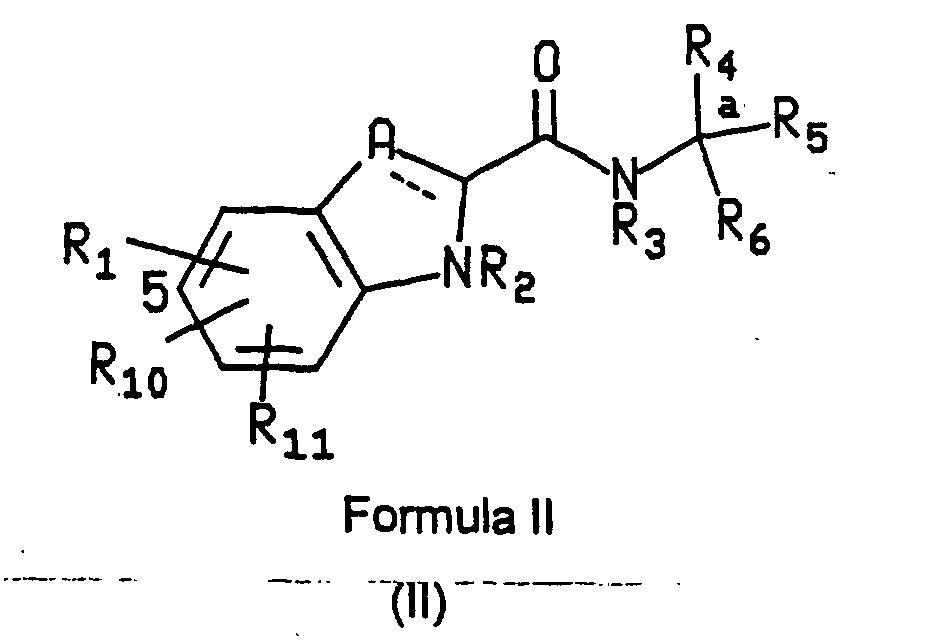
- the compounds of formula (II), the stereoisomers and prodrugs thereof, and the pharmaceutically acceptable salts of the compounds, stereoisomers, and prodrugs, may be prepared as described in the aforementioned International Application Publication No. WO 96/39384.
- a particularly preferred subgroup of formula (II) compounds are those compounds selected from the group consisting of:
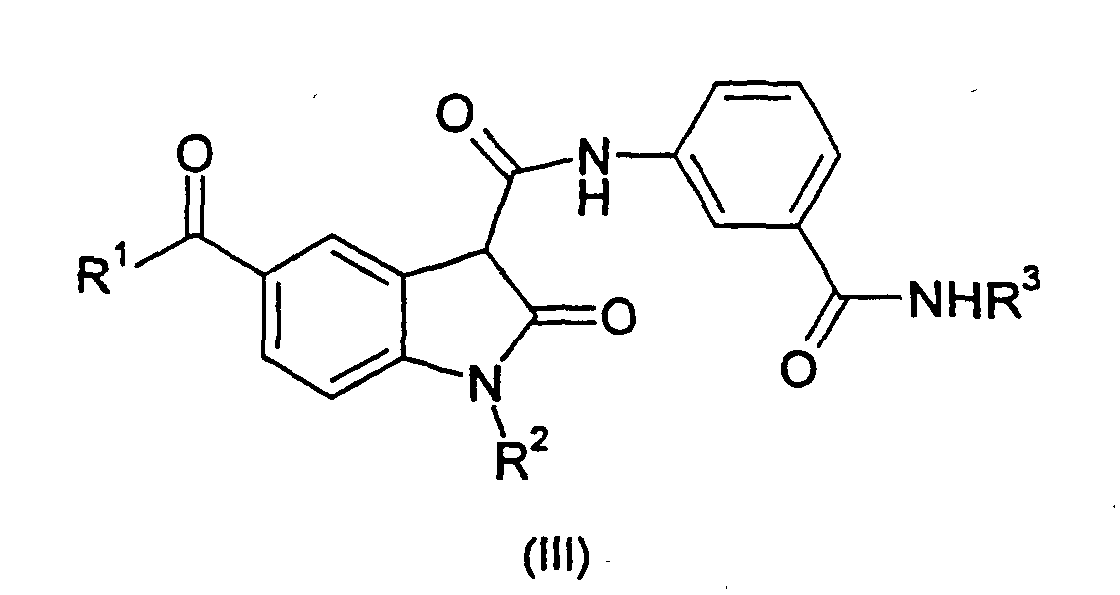
- the compounds of formula (III), the stereoisomers and prodrugs thereof, and the pharmaceutically acceptable salts of the compounds, stereoisomers, and prodrugs, may be prepared according to the following synthetic methodologies. The following definitions are applicable with respect to the compounds of formula (III).
- halo is meant chloro, bromo, iodo, or fluoro.
- alkyl is meant straight chain or branched saturated hydrocarbon
- alkyl groups assuming the designated length encompasses the particular example) are methyl, ethyl, propyl, isopropyl, butyl, sec-butyl, tert -butyl, pentyl, isopentyl, hexyl, isohexyl, and so forth.
- alkoxy is meant straight chain or branched saturated alkyl bonded through an oxy.
- alkoxy groups are methoxy, ethoxy, propoxy, isopropoxy, butoxy, isobutoxy, tert -butoxy, pentoxy, isopentoxy, hexoxy and isohexoxy.
- prodrug refers to compounds that are drug precursors, which, following administration, release the drug in vivo via a chemical or physiological process (e.g., a prodrug on being brought to the physiological pH is converted to the desired drug form).
- reaction-inert solvent and “inert solvent” refers to a solvent or mixture of solvents which does not interact with starting materials, reagents, intermediates or products in a manner which adversely affects the yield of the desired product.
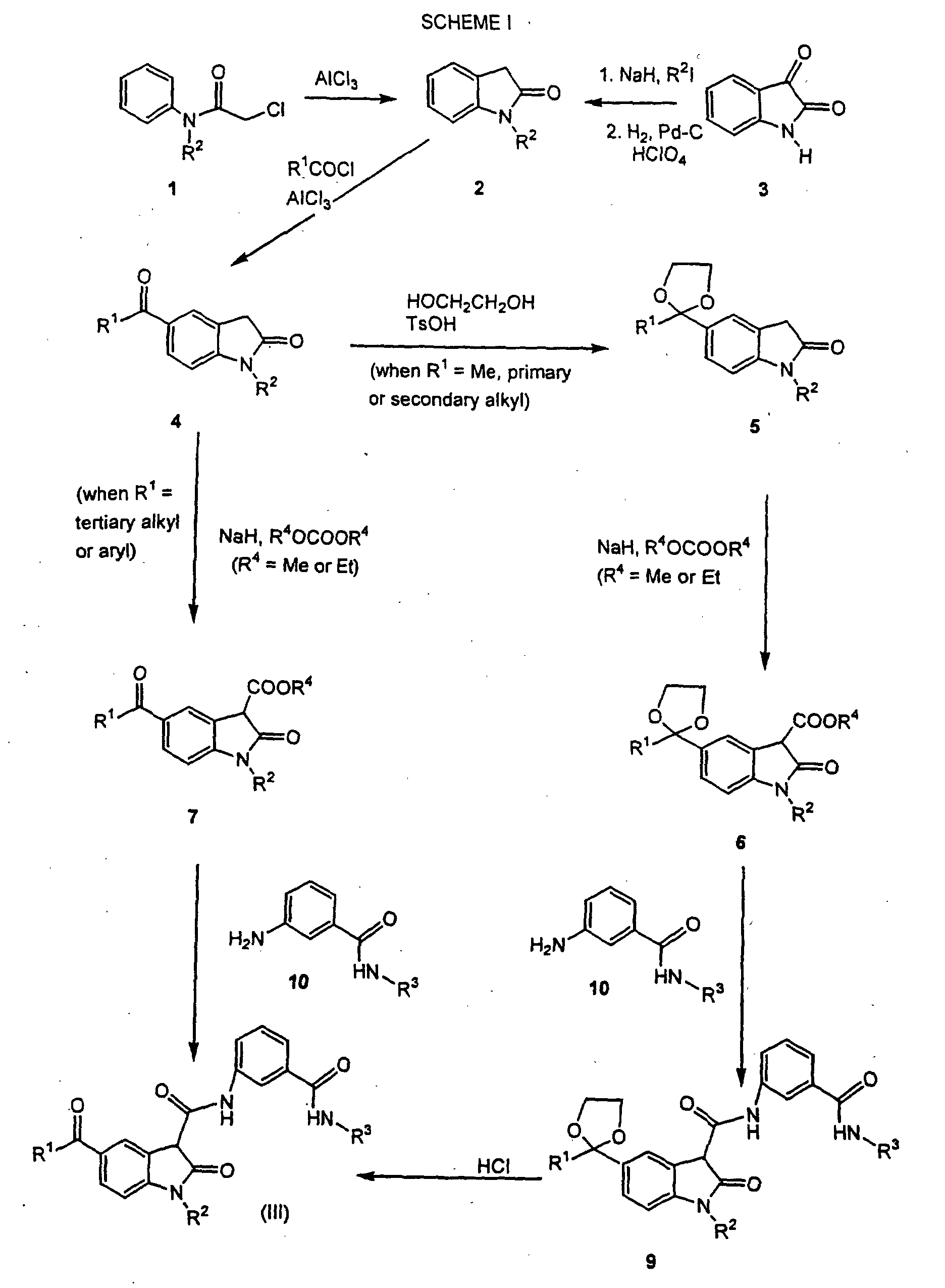
- the compounds of formula (III) can be made by processes including those known in the chemical arts, particularly in light of the description contained herein. Certain processes for the manufacture of formula (III) compounds are illustrated hereinbelow in the following reaction schemes.
- the compounds of formula (III), wherein R 1 , R 2 and R 3 are as defined hereinabove, may be prepared by either of two general procedures which involve coupling a carboxylic acid or carboxylic acid ester derivative of formula 6 or 7 with an appropriate 3-substituted aniline derivative of formula 10.
- the immediate product is a compound of formula (III).
- the coupling is performed using a compound of formula 6, which compound contains a protected ketone moiety, the intermediate result is the formation of a compound of formula 9 which may then be converted into a compound of formula (III) through subsequent deprotection.
- the deprotection of the formula 9 compounds may be effected using methods well known to one of ordinary skill in the art, for example, the methods described in "Protecting Groups in Organic Synthesis," Second Edition, T.W. Greene and P.G.M. Wuts, John Wiley and Sons, Inc., 1991.
- the compound of formula 9 is dissolved in a reaction-inert solvent such as tetrahydrofuran (THF) and strong aqueous acid is added.
- THF tetrahydrofuran
- the temperature of the reaction may be varied from 0°C to 50°C. Generally, however, the reaction is performed at room temperature.
- reaction is stirred until all or most of the starting material has reacted as determined by thin layer chromatography or other analytical technique well known to those skilled in the art. Ordinarily, the reaction is stirred for about fifteen minutes to about twenty-four hours, and preferably for about one hour.
- the resulting compound of formula (III) is then isolated according to methods well known to one of ordinary skill in the art.
- the coupling reaction referred to hereinabove is used to generate the compounds of formula (III) directly from the compounds of formula 7, or to generate the compounds of formula 9 from the compounds of formula 6.
- the coupling reaction is most readily accomplished by reacting a carboxylic acid ester derivative of formula 6 or formula 7 with the appropriate aniline derivative of formula 10.
- a compound of formula 6 or formula 7 is dissolved in a reaction-inert solvent and a compound of formula 10 is added.
- Molecular sieves (4 ⁇ ) are then added and the reaction mixture is generally heated at the reflux temperature of the chosen solvent until the starting materials are no longer present as determined by thin layer chromatography or other analytical techniques that will be well known to one of ordinary skill in the art.
- the coupled product of formula 9 or formula (III) is then isolated according to methods well known to those skilled in the art.
- the compounds of formula (III) may be prepared according to the procedure set forth in Scheme II.
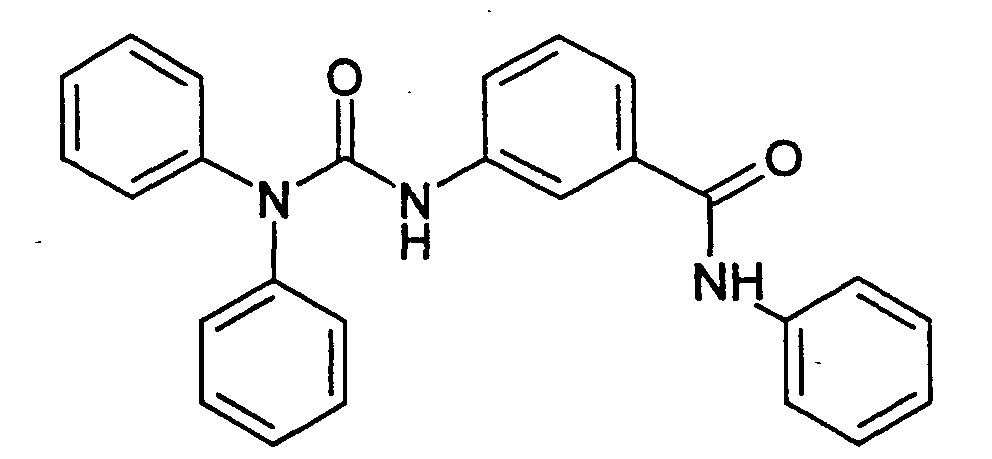
- a compound of formula 5, wherein Y is as set forth in Scheme II is reacted with an activated amide such as a NN-diphenylureido derivative in the presence of a base to form the compound of formula (III).
- the anion thus formed is treated with the activated amide compound and the reaction mixture is stirred for about 16 hours to about 7 days. Typically, the reaction is complete after stirring for about three days.
- the reaction mixture is then acidifed to provide the compound of formula (III).
- the compounds of formulae 6 and 7 in Scheme I may be prepared by standard acylation chemistry well known to one of ordinary skill in the art.
- the compounds of formula 4 are acylated directly, when R 1 is tertiary alkyl or aryl, by reacting the compound of formula 4 under standard acylation conditions, e.g.; base and acylating agent, to obtain the compound of formula 6.
- R is primary or secondary alkyl
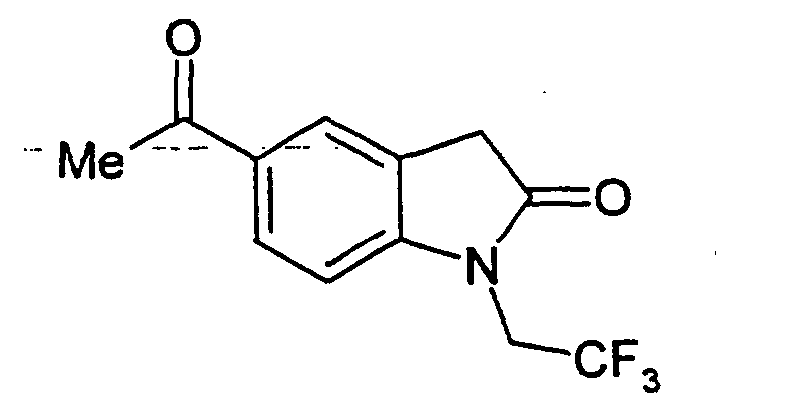
- the ketone moiety attached to the 5-position of the oxindole ring must be protected using standard ketone protecting groups as set forth in Greene and Wuts, supra.
- the protected compound of formula 5 is then acylated in the same manner as the compound of formula 4 to obtain the compound of formula 7.
- the compounds of formulae 1, 2, 3, 4 and 10 are prepared according to methods well known to those skilled in the art. Further, the starting materials and reagents for the above described reaction schemes are also readily available from commercial sources or can be readily synthesized by those skilled in the art using conventional methods of organic synthesis.
- the compounds of formula (III) may have an asymmetric carbon atom and therefore are racemic mixtures of enantiomers when prepared from nonoptically active intermediates and reagents. Enantiomers can be separated by reacting the enantiomeric mixture with an appropriate optically active compound (e.g,amine) to form a mixture of diastereomeric salts of the compound of formula (III) and separating the diastereomers by crystallization or other method well known to those skilled in the art. It will be recognized by those skilled in the art that racemization of the optically active center may occur upon removal of the ammonium counterion.
- an appropriate optically active compound e.g,amine
- optically active amine compounds when resolving the compounds of formula (III) using optically active amine compounds, it is particularly advantageous to use pharmaceutically acceptable optically active amines such as naturally occurring amino acids protected as carboxylic acid esters or other pharmaceutically acceptable protected amino acids.
- optically active amines such as naturally occurring amino acids protected as carboxylic acid esters or other pharmaceutically acceptable protected amino acids.
- Other physical resolution techniques such as chromatography are well known to those skilled in the art and these techiques may also be used to resolve the enantiomers of formula (III). All such diastereomers and enantiomers and mixtures thereof are intended to be included within the scope of the general formula (III).
- the compounds of formub (III) are acidic and they may form a salt with a pharmaceutically acceptable cation. All such salts are within the scope of the general formula (III) and can be prepared by conventional methods well known to one of ordinary skill in the art. Typical bases used to form such cationic salts are sodium hydroxide, sodium methoxide, sodium ethoxide, sodium hydride, potassium methoxide, magnesium hydroxide, calcium hydroxide, benzathine, choline, diethanolamine, piperazine and tromethamine.
- the cationic salts can be prepared simply by contacting the acidic and basic entities, usually in a stoichiometric ratio, in either an aqueous, non-aqueous or partially aqueous medium, as deemed appropriate.
- the salts may then be recovered either by filtration, by precipitation with a non-solvent followed by filtration, by evaporation of the solvent, or, in the case of aqueous solutions, by lyophilization, as deemed appropriate.
- NMR spectra were recorded on a Varian XL-300 (Varian Co., Palo Alto, California) or Bruker AM-300 spectrometer (Bruker Co., Billerica, Massachusetts) at about 23°C at 300 MHz for proton and 75.4 mHz for carbon nuclei. Chemical shifts are expressed in parts per million downfield from trimethylsilane.
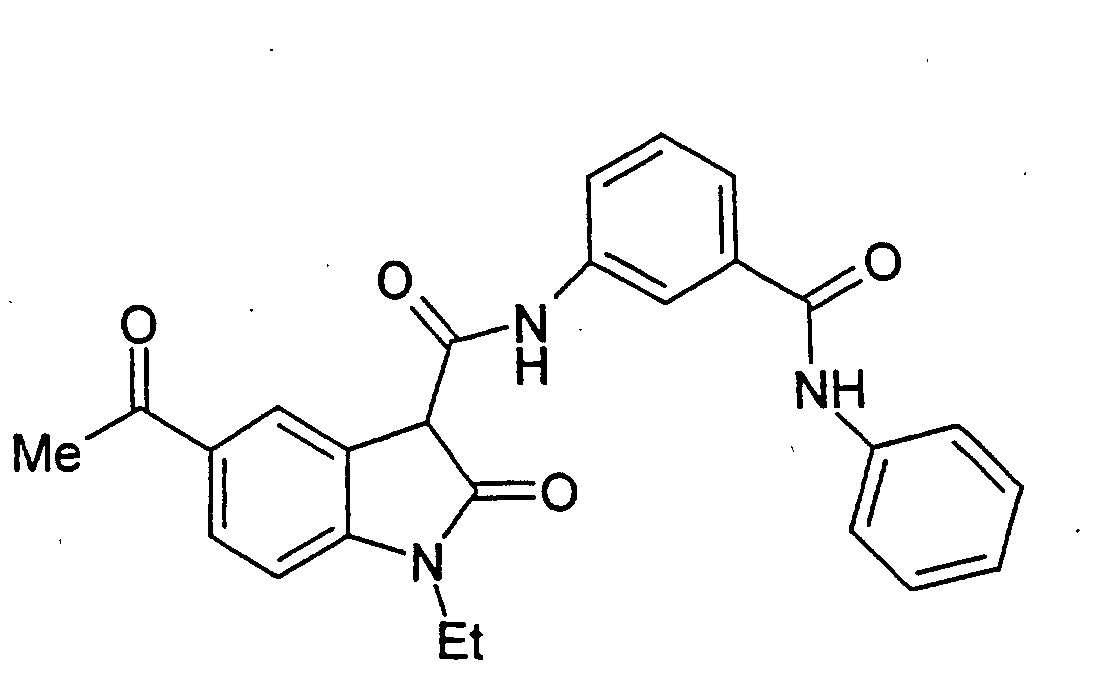
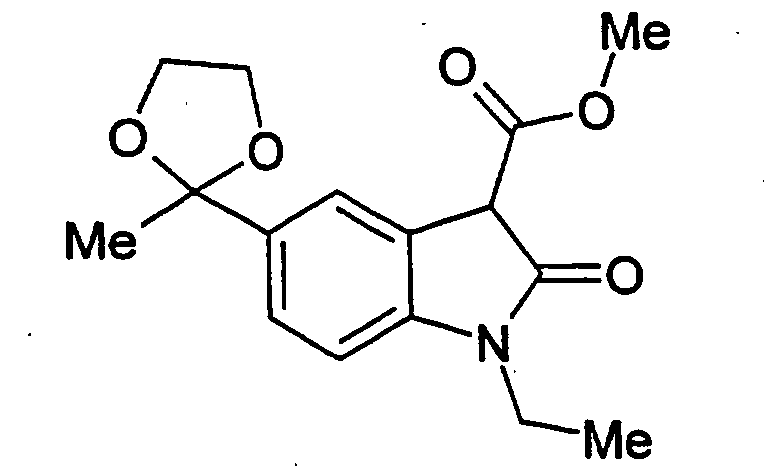
- Step A 1-Ethyl-5-(2-methyl-[1,3]dioxolan-2-yl)-2-oxo-2,3-dihydro-1H-indole-3-carboxylic acid (3-phenylcarbamoyl-phenyl)-amide .
- Step B 5-Acetyl-1-ethyl-2-oxo-2,3-dihydro-1H-indole-3-carboxylic acid (3-phenylcarbamoyl-phenyl)-amide.
- 1-ethyl-5-(2-methyl-[1,3]dioxolan-2-yl)-2-oxo-2,3-dihydro-1H-indole-3-carboxylic acid (3-phenylcarbamoyl-phenyl)-amide (the title compound of Example 1, Step A, 3.75 g, 7.8 mmol) in THF (70 mL) was added 2 N HCI (20 mL).
- Examples 2 to 15 were prepared from the appropriate starting materials in a manner analogous to the method of Example 1, with variations in reaction time, temperature, and reagents as noted.
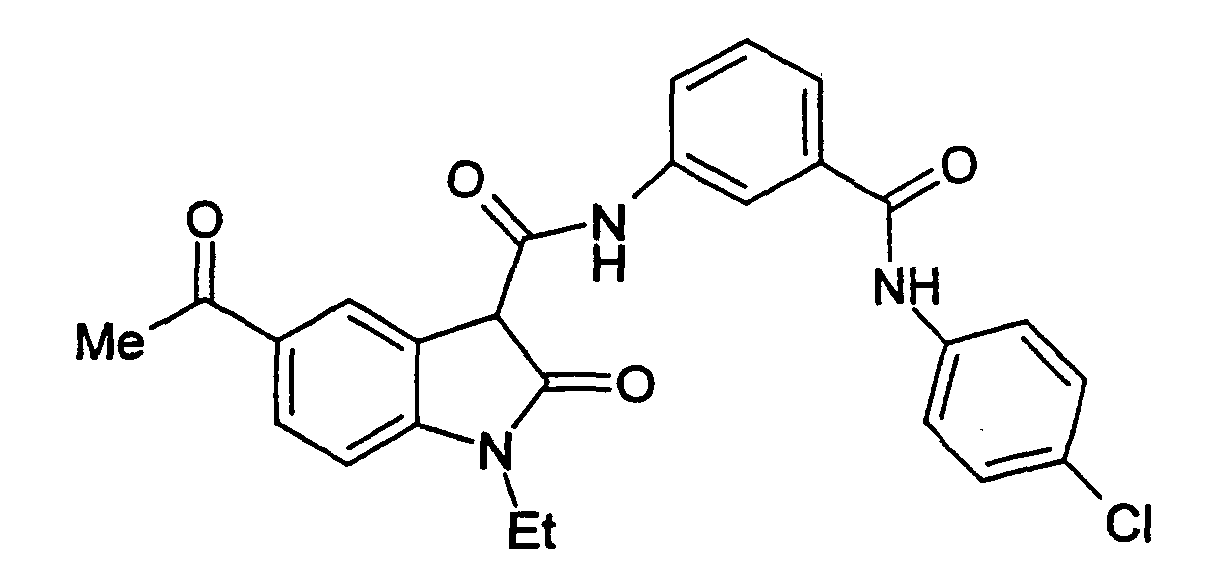
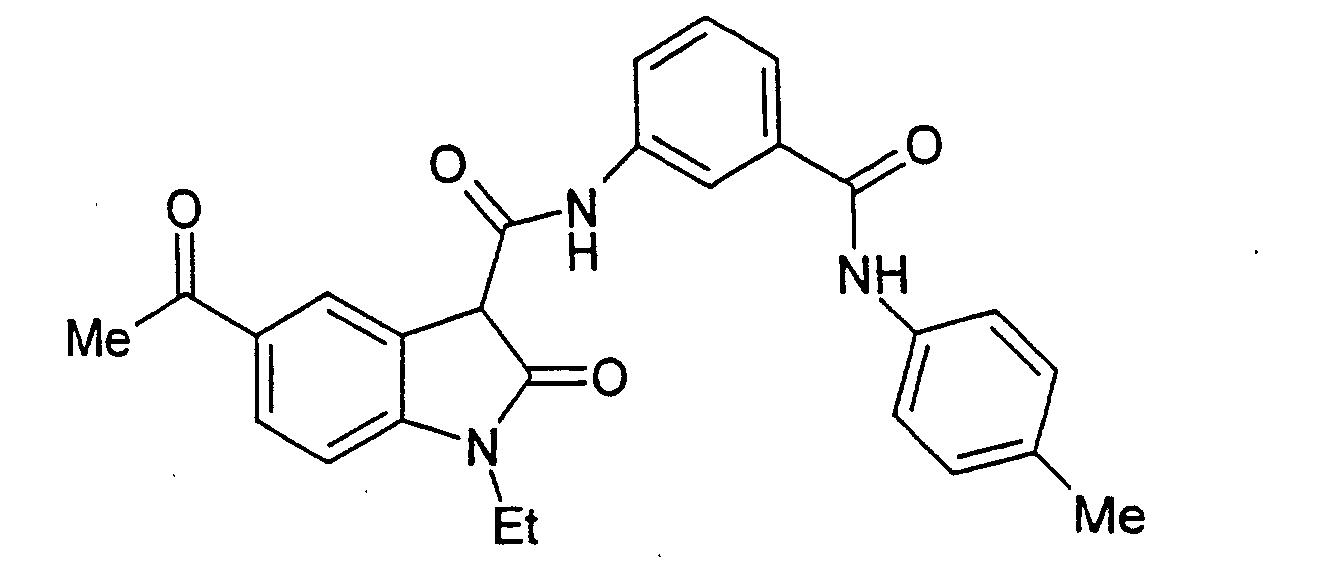
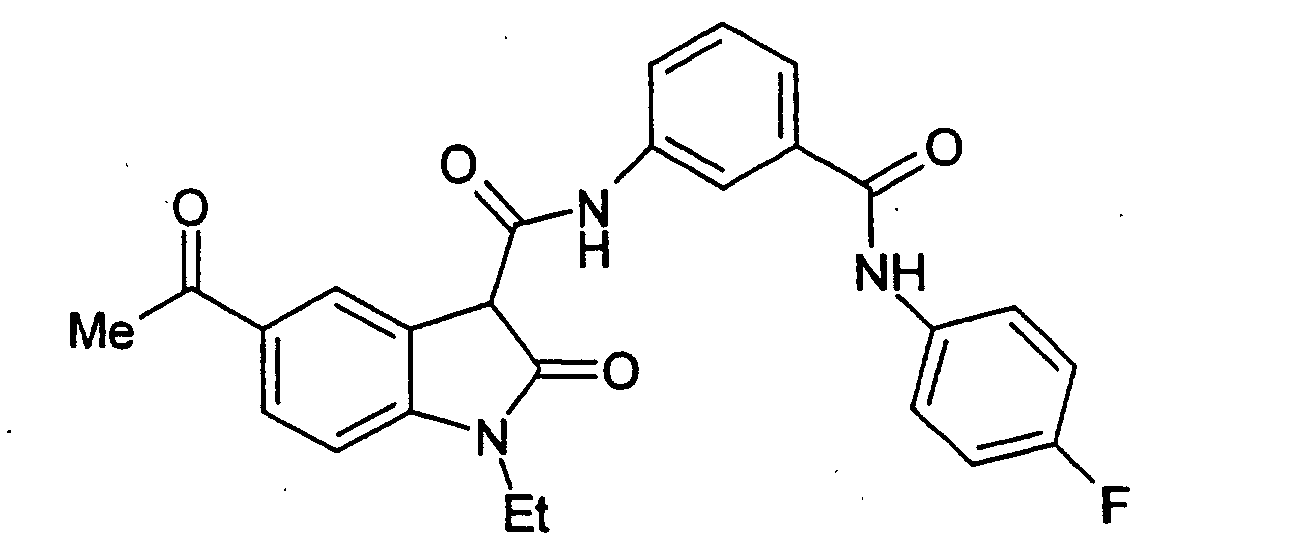
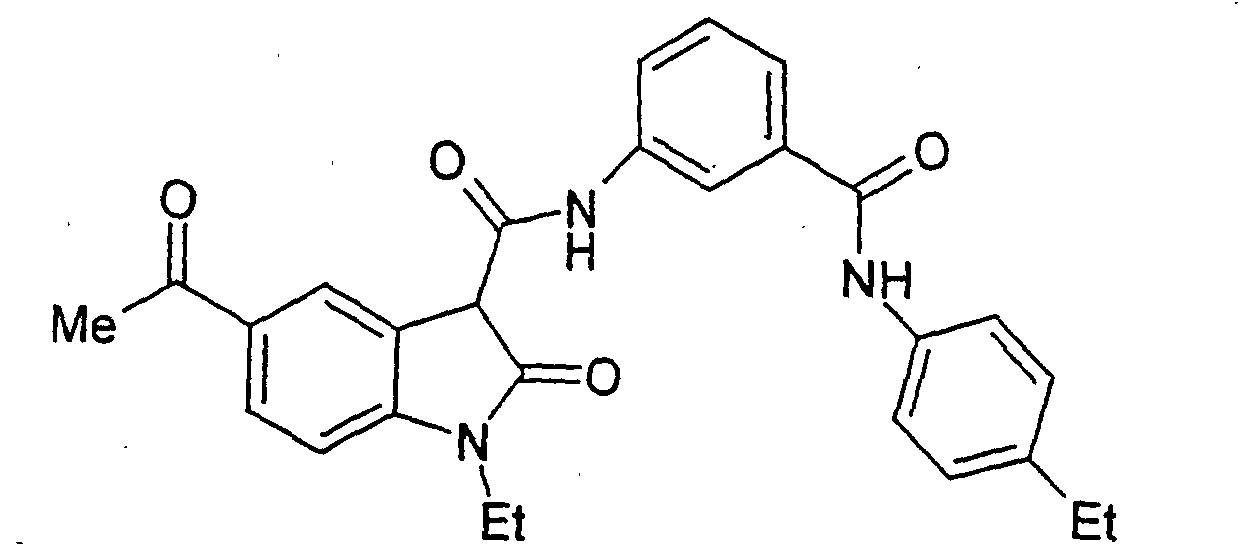
- a particularly preferred subgroup of formula (III) compounds are those compounds selected from the group consisting of:
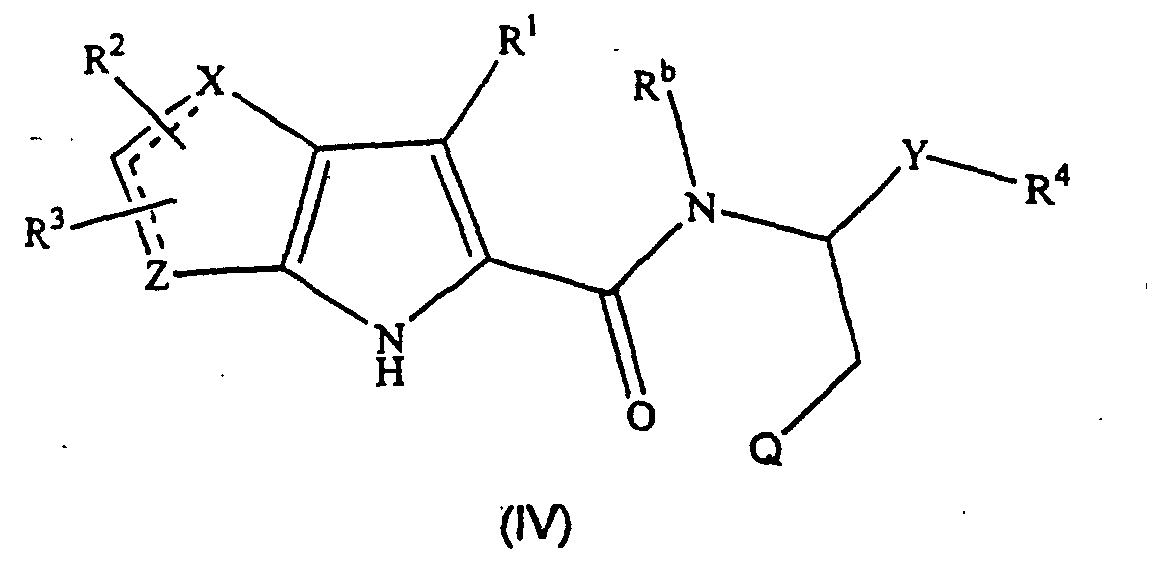
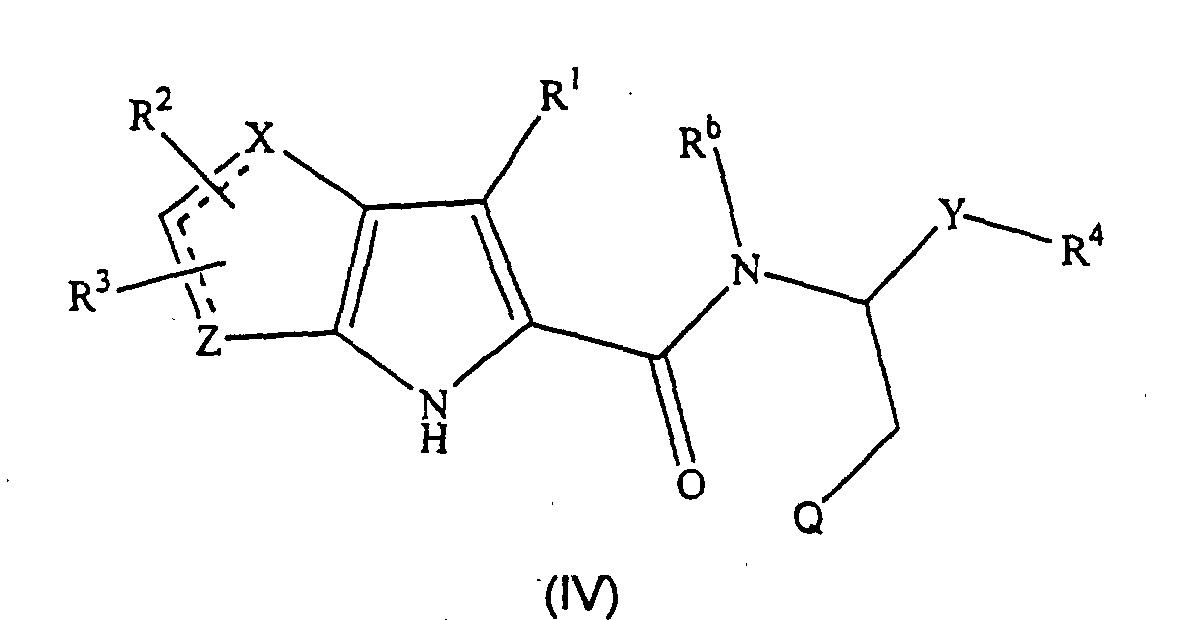
- the compounds of formula (IV), the stereoisomers and prodrugs thereof, and the pharmaceutically acceptable salts of the compounds, stereoisomers, and the prodrugs, may be prepared according to the following synthetic methodologies.
- the preparation of the compounds of formula (IV) may also require protection of remote functionality (e.g., primary amine, secondary amine, carboxyl).
- remote functionality e.g., primary amine, secondary amine, carboxyl.
- the need for such protection will vary depending on the nature of the remote functionality and the conditions of the preparation methods. The need for such protection is readily determined by one skilled in the art. The use of such protection/deprotection methods is also within the skill in the art.
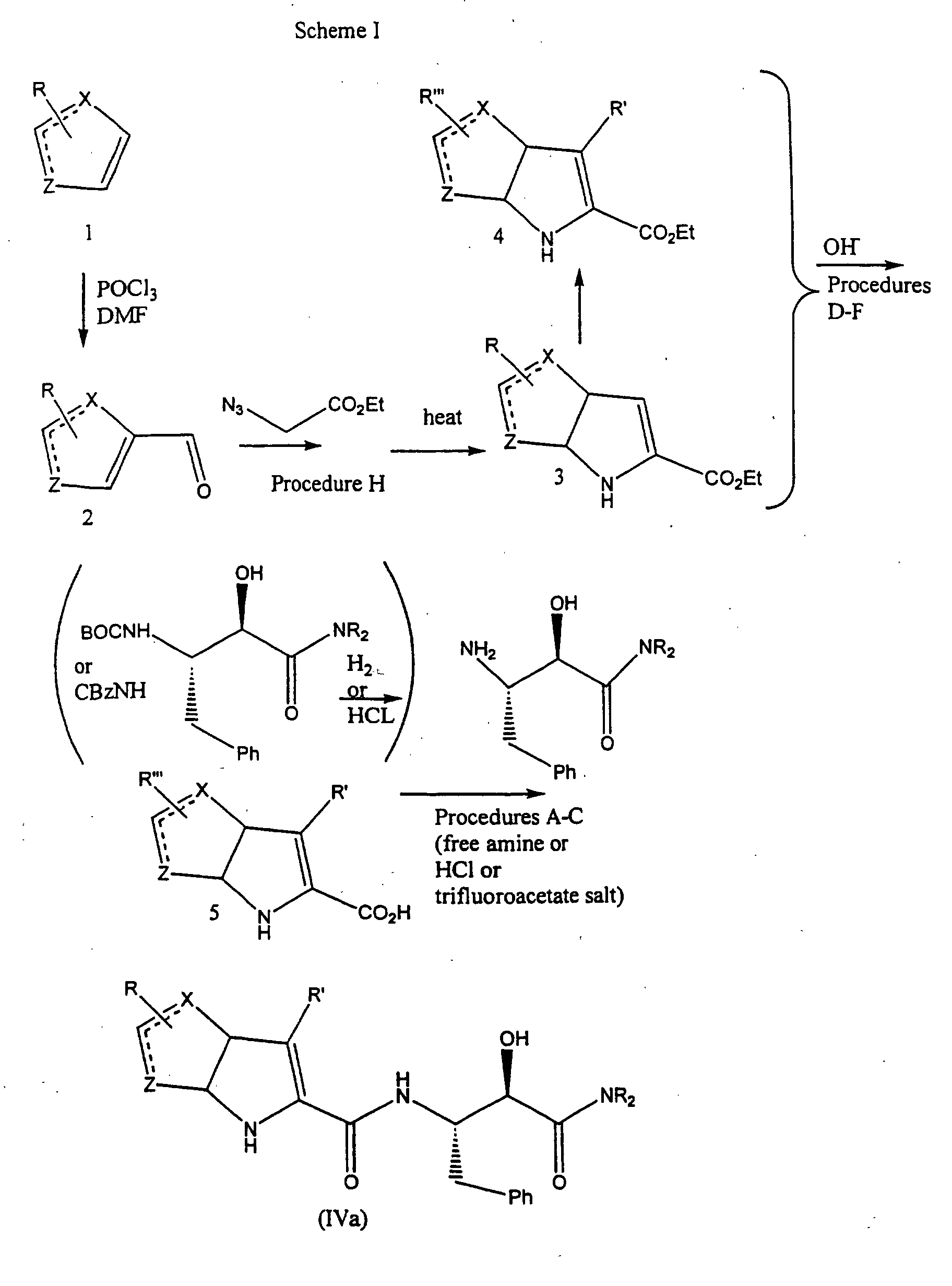
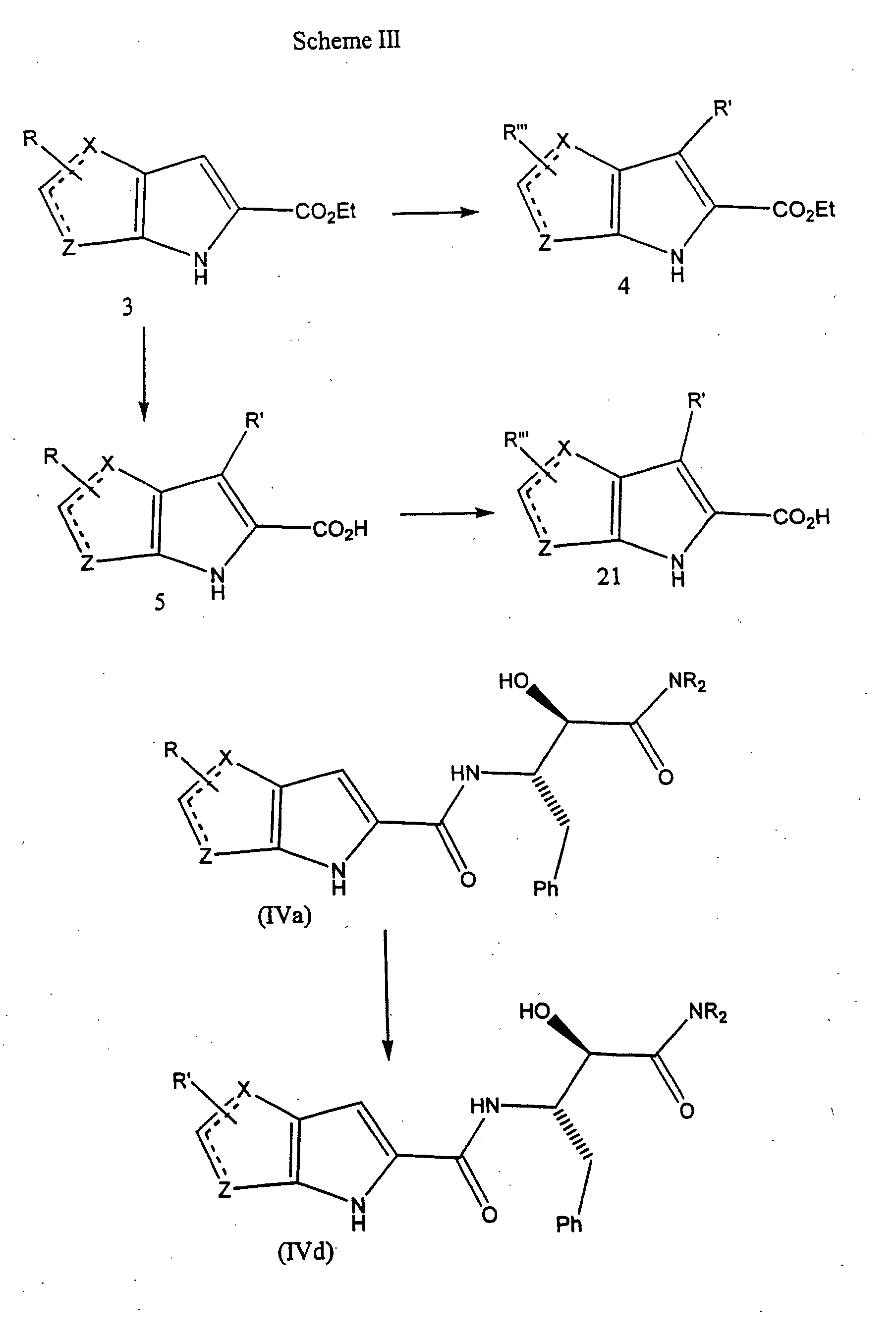
- the bicyclic pyrrolyl acids of Formula 5 can be made by several synthetic methods.
- a preferred method Hemetsberger, H. et al., Monatshefte fur Chemie, 103 : 194-204 (1972)
- the alcohol and alkoxide are derived from the corresponding alkyl ester to avoid transesterification problems.
- the reaction is performed at a temperature of about -20°C to about 25°C for about 1-24 hours, generally employing 3-8 equivalents of the alkoxide and an equimolar quantity of the azido-acetic acid alkyl ester.
- the resultant azides are then heated at reflux in an inert solvent such as xylenes to afford the heterocyclopyrrole esters of Formula 3.
- An example of a suitable preparation is shown by Procedure H below.
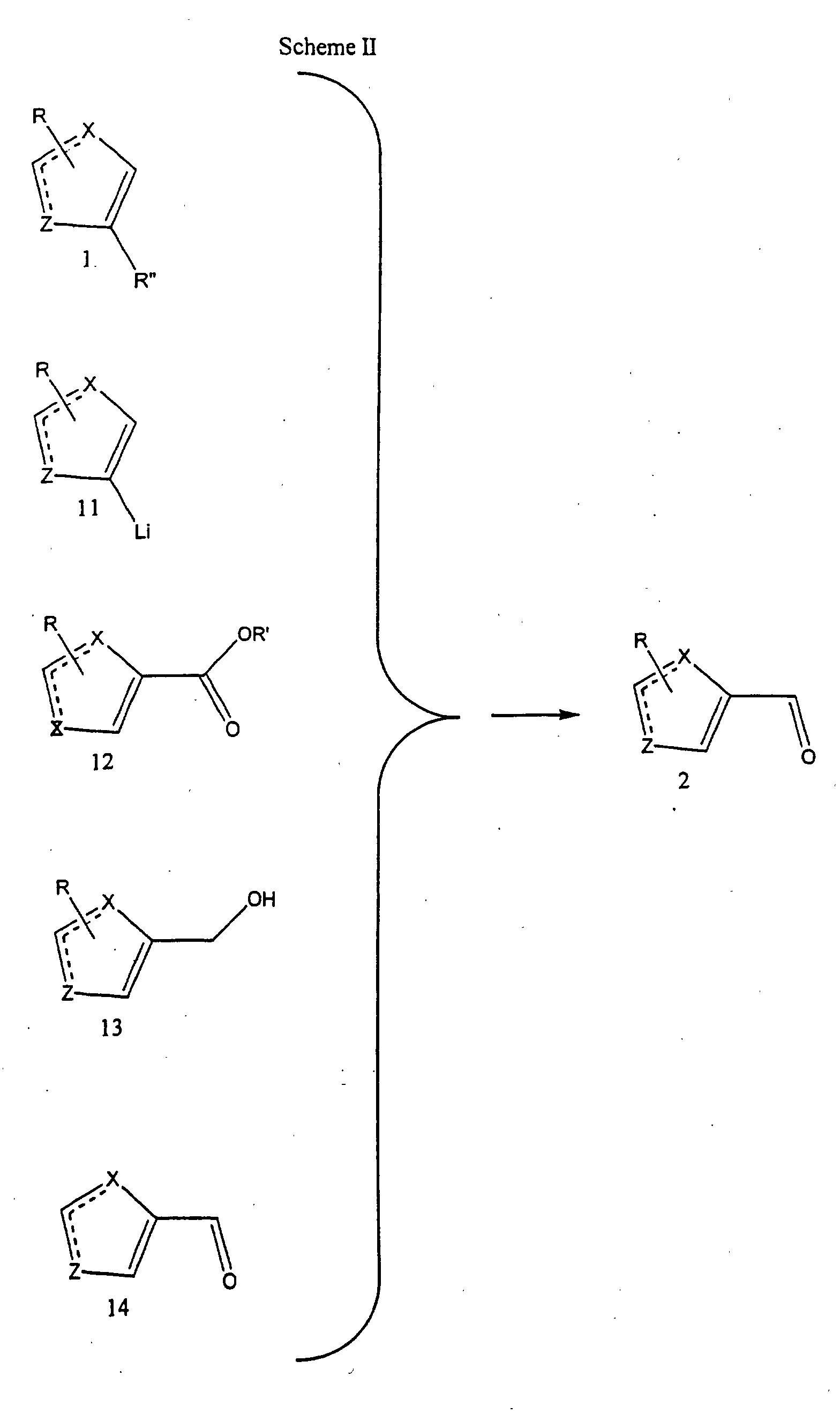
- aldehydes of Formula 2 can be made by conventional methods known to those skilled in the art, or methods for their preparation can readily be determined from the chemical literature (See, for example, Ortiz, J. A. et al., Eur. J. Med. Chem., 23 : 477-482 (1988)).
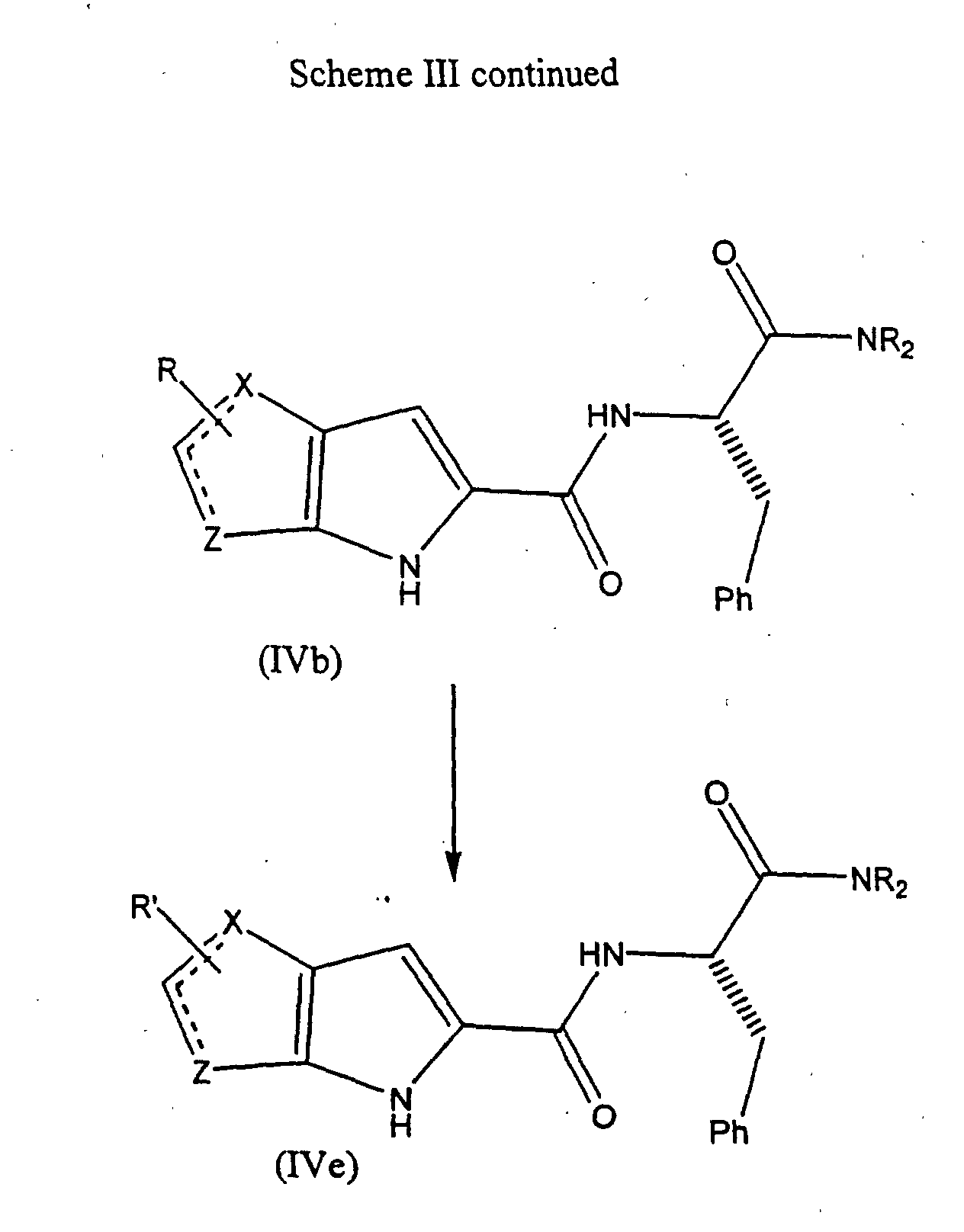
- substitution of the heterocyclopyrroles of Formula 3 can be accomplished by analogous conventional methods known to those skilled in the art or substitution methods can readily be determined from the literature.
- Palladium catalysts include, but are not limited to, palladium chloride, dichlorobis(triphenylphosphine)palladium (II), tetrakis(triphenylphosphine)palladium (0), and palladium acetate.
- Other exemplary conditions useful for forming carbon bonds to aromatic rings are described by K. Tamao, D. W. Knight, and K.
- Other exemplary conditions useful for forming nitriles are described by R. Grashey in Comprehensive Organic Synthesis: Selectivity, Strategy & Efficiency in Modern Organic Chemistry Vol 6 (Pergamon, New York, 1991, E. Winterfeldt, Ed., p 225).
- An example of a suitable nitrile preparation is Procedure G below.
- a suitable coupling agent is an agent that transforms the carboxylic acid group into a reactive species such that an amide linkage is formed between the carboxylic acid and the amine.
- the coupling agent can provide for the coupling in a one-pot process or several steps may be required to achieve the coupling.
- suitable coupling agents include 1-(3-dimethylaminopropyl)-3-ethylcarbodiimide hydrochloride/hydroxybenzotriazole (DEC/HBT), carbonyldiimidazole, dicyclohexylcarbodiimide/ hydroxybenzotriazole, 2-ethoxy-1-ethoxycarbonyl-1,2-dihydroquinoline (EEDQ), carbonyldiimidazole/ HBT, propanephosphonic anhydride (propanephosphonic acid anhydride, PAA) and diethylphosphorylcyanide.
- DEC/HBT 1-(3-dimethylaminopropyl)-3-ethylcarbodiimide hydrochloride/hydroxybenzotriazole
- EEDQ 2-ethoxy-1-ethoxycarbonyl-1,2-dihydroquinoline
- PAA propanephospho
- the coupling reaction is generally performed in an inert solvent, preferably an aprotic solvent at a temperature of about -20°C to about 50°C for about 1 to about 48 hours, optionally in the presence of a tertiary amine such as triethylamine.
- Suitable solvents include acetonitrile, dichloromethane, ethyl acetate, dimethylformamide and chloroform, or mixtures thereof.
- the carboxylic acid group is reacted with the coupling agent to form an activated intermediate, which can be isolated in the first step of the process.
- the activated intermediate is then reacted with the amine to form the amide.
- Examples of coupling agents that convert an acid to an activated intermediate include thionyl chloride, oxalyl chloride, which form acid chlorides, cyanuric fluoride, which forms acid flourides, or an alkyl chloroformate such as isobutyl or isopropenyl chloroformate (with a tertiary amine base), which forms a mixed anhydride of the carboxylic acid.
- the coupling agent is oxalyl chloride
- the acid chloride may be coupled with the amine in an appropriate solvent and a suitable base.
- Acceptable solvent/base combinations include dichloromethane, dimethylforamide or acetonitirile, or mixture thereof in the presence of a tertiary amine base such as triethylamine.
- solvent/base combinations include water or a C 1 -C 5 alcohol, or mixtures thereof, together with a cosolvent such as dichloromethane, tetrahydrofuran or dioxane, and a base such as sodium or potassium carbonate, sodium, potassium or lithium hydroxide, or sodium bicarbonate in sufficient quantity to consume the acid liberated in the reaction.
- a phase transfer catalyst typically 1 to 10 mole %
- a quaternary ammonium halide e.g., tetrabutylammonium bromide or methyl trioctylammonium chloride
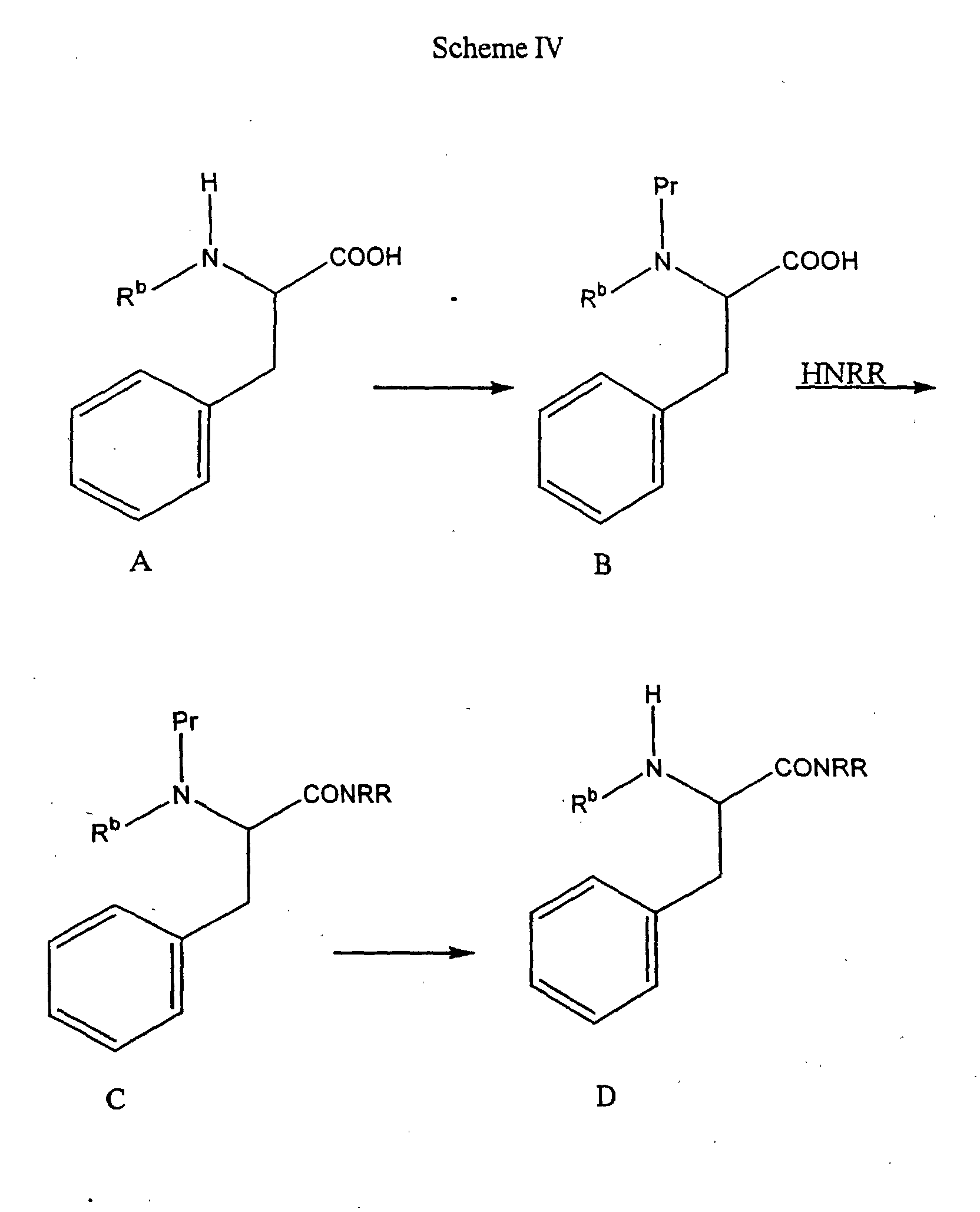
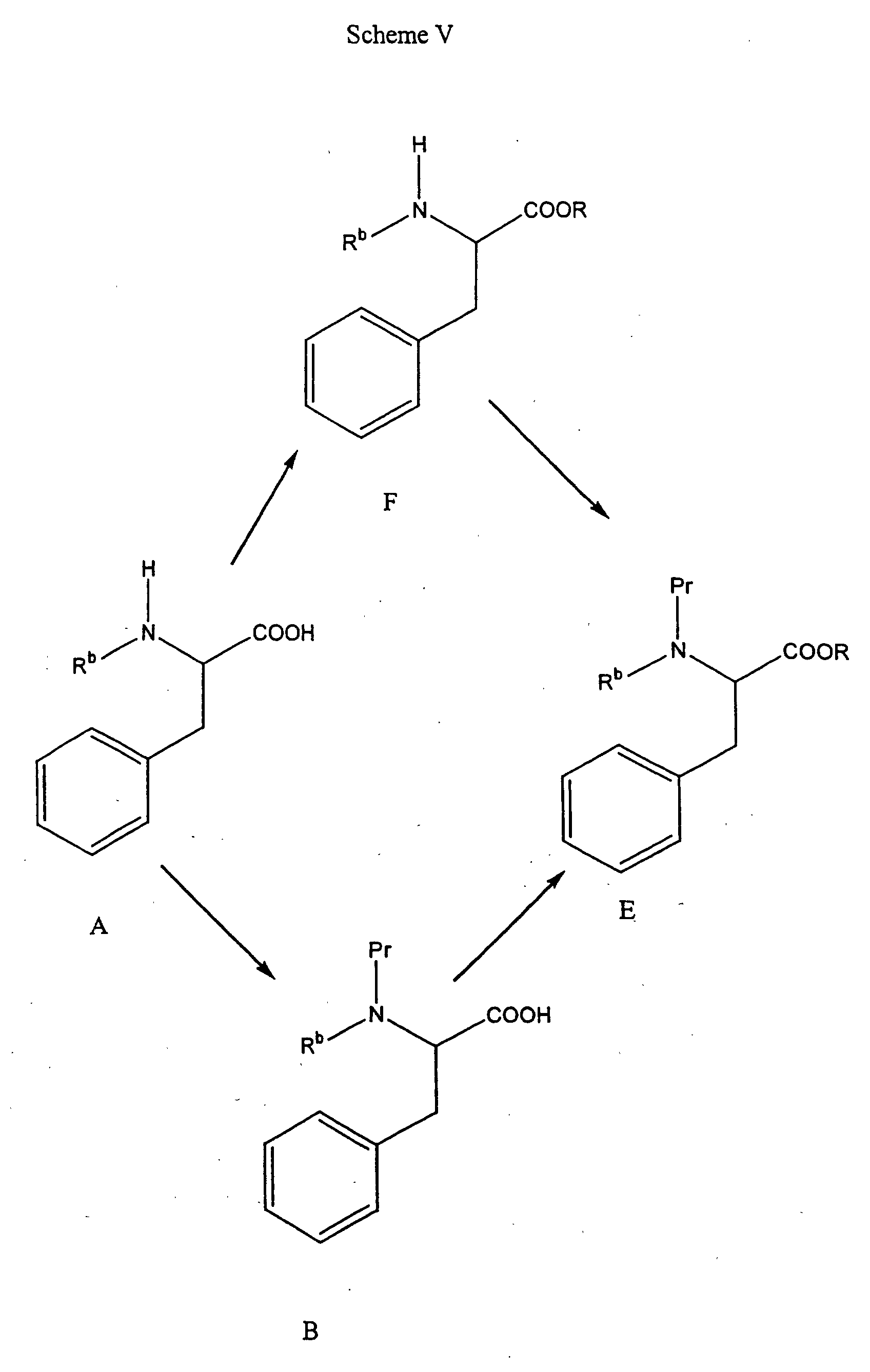
- an alpha amino acid of Formula A can be protected on the amine nitrogen with an appropriate protecting group (Pr) to form a protected amino acid of Formula B.
- Pr protecting group
- the ability to readily select an appropriate amine protecting group is within the purview of one of ordinary skill in the art.
- two common employed protecting groups are BOC, which is introduced by treating the amino acid with di- tert -butyldicarbonate, preferably in a protic solvent or a solvent mixture at high pH, and CBZ, which is introduced by treating the amino acid with benzylchloroformate, preferably in a protic solvent or a solvent mixture, and a base.
- the amine-protected amino acid intermediate of Formula B is then coupled with an appropriate amine of the formula HNRR, where the R groups are consistent with the compounds of the general formula (IV), in a procedure analogous to the coupling reaction set forth above to form a protected amide compound of Formula C.
- the protected amide of Formula C can then be deprotected to form an amide of Formula D.
- the protecting group is BOC
- the deprotection is typically performed by treating the protected compound with an acid in an aprotic solvent.
- Suitable acids include HCI, CH 3 SO 3 H, and trifluoroacetic acid.
- esters of the compounds of Formula A or B can be made by reacting the compound with an appropriate alcohol and an acid catalyst such as concentrated sulfuric acid or by treatment with an alkyl halide such as methyl idodide and a base such as potassium carbonate.
- an acid catalyst such as concentrated sulfuric acid
- an alkyl halide such as methyl idodide
- a base such as potassium carbonate.
- Compounds of Formula E can also be made by protecting a compound of Formula A, and then forming the ester.
- compounds of Formula E can be made starting with a compound of Formula A, forming an ester, and then protecting the amine group. Analogous procedures for the formation and cleavage of esters and the protection of amine groups are well known to those skilled in the art.
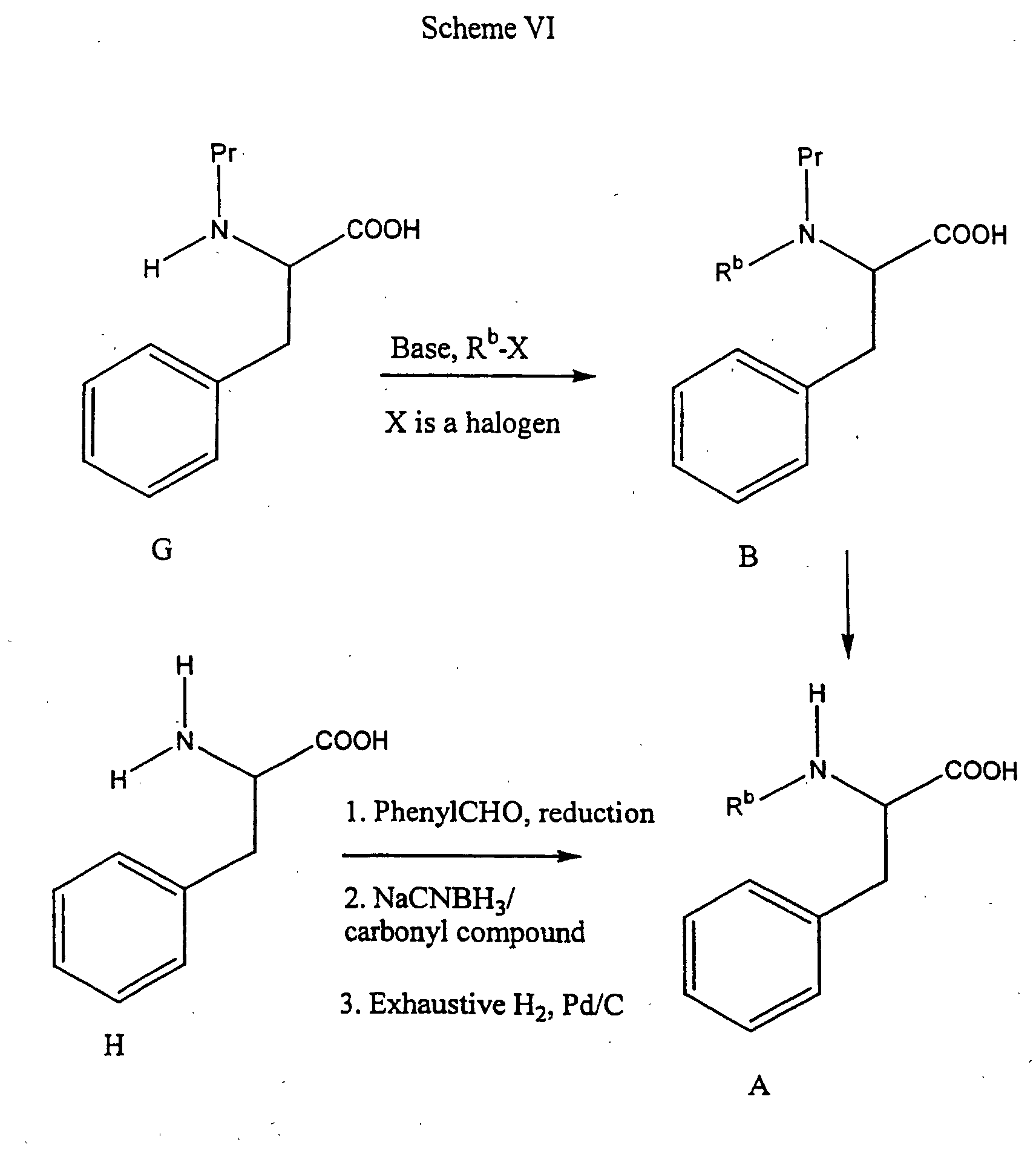
- the compounds of Formula A when R b is not hydrogen can be prepared as follows.
- the Formula B amino acid can be prepared by N-alkylation of a compound of Formula G, which is an amine protected alpha amino acid. N-alkylation is well known in the art and can be accomplished using an appropriate alkylating agent and a suitable base. Specific procedures for alkylation are described in Benoiton, Can. J. Chem, 55 : 906-910 (1985), and Hansen, J. Org. Chem., 50 : 945-950 (1977). For example, when R b is methyl, and Pr is BOC, sodium hydride and methyl iodide in tetrahydrofuran can be used. Deprotection of the compound of Formula B furnishes a compound of Formula A.
- a compound of Formula H can be N-alkylated by a three step sequence involving reductive benzylation, such as with benzaldehyde followed by Pd/C-catalyzed hydrogenation to give the mono-N-benzyl derivative, and reductive amination with an appropriate carbonyl compound, for example formaldehyde and sodium cyanoborohydride to introduce R b as methyl, to give the N-benzyl, substituted amino acid.
- the N-benzyl protecting group is conveniently removed, for example, by hydrogenation with an appropriate catalyst, to yield a compound of Formula A. Specific conditions for the three step alkylation procedure are described by Reinhold et al., J. Med. Chem., 11 : 258-260 (1968).
- alpha amino acid starting materials While many of the alpha amino acid starting materials are known, they can be synthesized by a number of procedures that are well known in the art. For example, the Strecker synthesis or variations thereof can be used. Accordingly, an aldehyde, sodium or potassium cyanide and ammonium chloride react to form an aminonitrile. It is noted that the aldehyde selected is determined by the desired amino acid. The aminonitirle is then hydrolyzed with a mineral acid to form the desired amino acid.
- the Bucherer-Berg method may be used where a hydantoin is formed by heating an aldehyde with ammonium carbonate and potassium cyanide followed by hydrolysis, for example, with barium hydroxide in refluxing dioxane, with acid or base to form the desired compounds.
- the cyanohydrin of Formula K is then reacted with an alcohol such as methanol and a strong acid catalyst such as HCI at a temperature of about 0°C to about 50°C, followed by the addition of water, if necessary.
- the protecting group is then removed, if still present, by an appropriate deprotection method yielding a compound of Formula L.
- the protecting group is BOC
- the Formula L compound is directly formed from the Formula K compound, and addition of water is not necessary.
- the Formula L compound can be protected on the nitrogen to form a compound of Formula M followed by hydrolysis of the ester with aqueous alkali at a temperature of about 0°C to about 50°C in a reaction-inert solvent resulting in the corresponding hydroxy acid of Formula N.
- the hydroxy acid of formula N is coupled to a suitable amine to form the protected amino amide of Formula O, which is then deptrotected to form a compound of Formula P.
- An analogous example of the conversion of a Formula K compound to the corresponding Formula L compound is provided in PCT Application Publication No. WO/9325574, Example 1a.
- Other analogous examples where a cyanohydrin is converted to a Formula M compound can be found in U.S. Pat. No. 4,814,342 and EPO Application Publication No. 0 438 233.
- the alpha position is the carbon atom containing the hydroxyl group.
- the desired stereochemistry can be obtained by the use of a single stereoisomeric aldehyde of Formula J.
- the Formula K cyanohydrin can be prepared from the stereochemically pure aldehyde by treatment with sodium or potassium cyanide as described above while maintaining the stereochemistry of the chiral carbon of the aldehyde, resulting in a mixture of stereoisomers, which can be separated, as is well known to those skilled in the art by crystallization. See, for example, Biochemistry, 31 : 8125-8141 (1992).
- isomer separation can be effected by chromatography or recrystallization techniques after conversion of a compound of Formula K to a compound of Formula L, M, N, O, or P by the procedures described herein and analogous to those well known in the art.
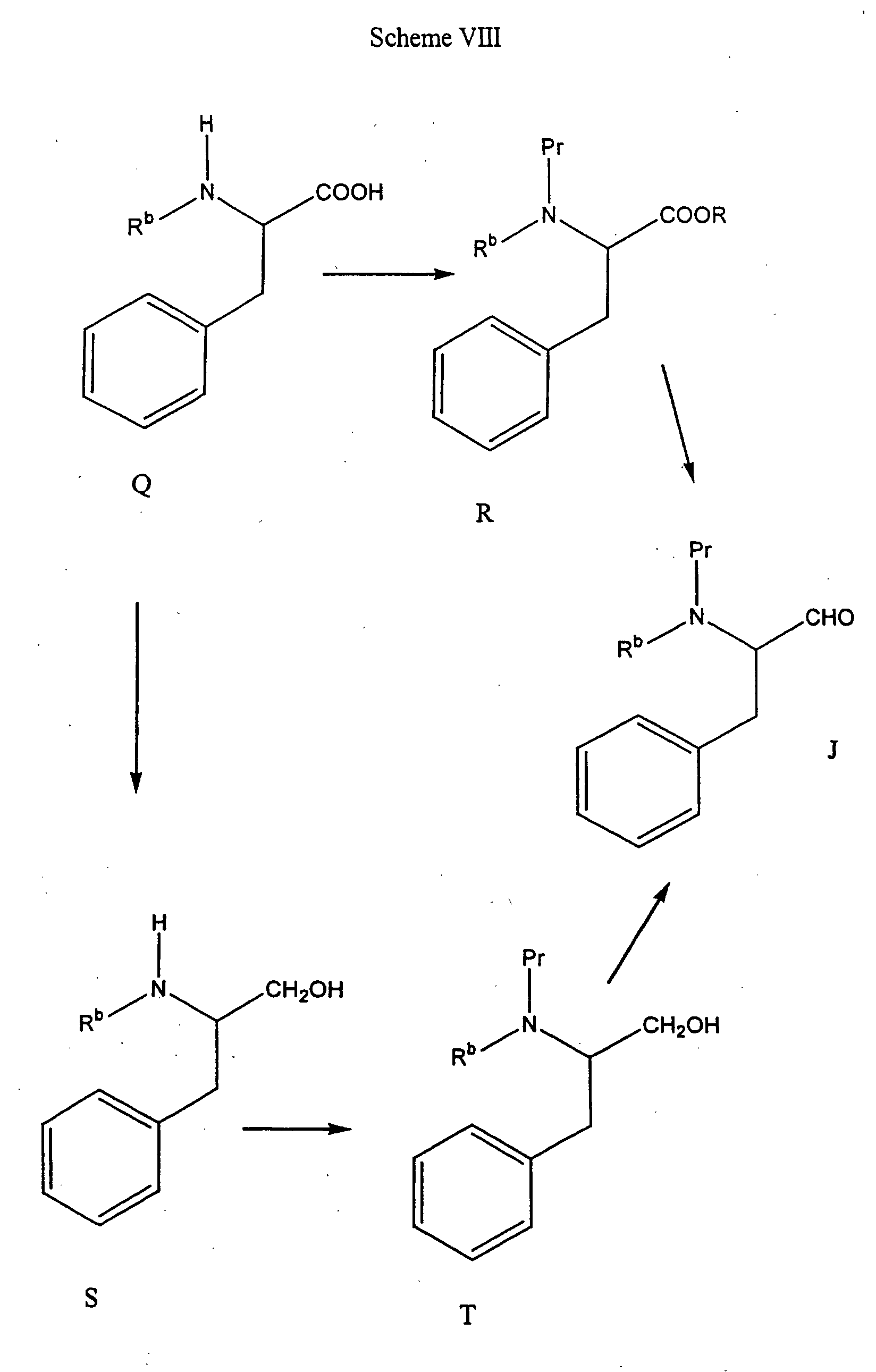
- the aminoaldehydes of Formula J can be made from the corresponding alpha amino acid of Formula Q.
- the alpha amino acid of Formula Q is protected on nitrogen and esterified to form a compound of Formula R.
- the compound of Formula R is reduced, for example, with diisobutylaluminum hydride in hexane or toluene, or a mixture thereof, at a temperature of about -78°C to about -50°C followed by quenching with methanol at - 78°C as described in J. Med. Chem., 28 : 1779-1790 (1985) to form the Formula J aldehyde.
- the Formula J aldehydes can be made by oxidation of Formula T alcohols, for example, with pyridine-SO 3 at a temperature of about -10°C to about 40°C in a reaction-inert solvent, preferably dimethylsulfoxide.
- the protected amino alcohols of Formula T if not commercially available, can be made by the protection of aminoalcohols of Formula S.
- the Formula S aminoalcohols are prepared by the reduction of amino acids of formula Q. The reduction can be accomplished by treating Formula Q amino acids with lithium aluminum hydride according to the procedure described by Dickman et al., Organic Synthesis, Wiley: New York, 1990; Collect. Vol. VIII, p. 530.
- NMR spectra were recorded on a Bruker AM300 or Varian XL-400 spectrometer at about 23°C at 300 or 400 MHz, respectively, for proton nuclei. Unless otherwise specified, NMR spectral data is reported for a 400 MHz spectrometer. Routine mass spectral data were obtained using a VG/Fisons Instruments Platform II spectrometer operating with an Atmospheric Pressure Chemical Ionization (APCI) source. Melting points are uncorrected and were determined on a Thomas Hoover capillary melting point apparatus. Unless otherwise specified, reagents were used as obtained from commercial sources. The term "concentrated" refers to removal of solvent on a rotary evaporator. Exceptions in the use of the Procedures A-H are noted individually in parentheses, following mention of the procedure.
- APCI Atmospheric Pressure Chemical Ionization
- aqueous phase is extracted with ethyl acetate.
- the combined organic phases are washed with saturated aqueous NaHCO 3 , dried over MgSO 4 , and concentrated giving crude product which is purified by chromatography on silica gel and/or recrystallization.
- a 0°C 0.1-0.3 M mixture of the primary amine or primary amine salt (1 equiv), 1 equiv of triethylamine, 1 equiv of the specified carboxylic acid, and 1 equiv of 1-hydroxy-7-azabenzotriazole (1 equiv. relative to the carboxylic acid), in dimethylformamide is treated with 1 equiv (corresponding in mol ratio to the carboxylic acid) 1-(3-dimethylamino-propyl)-3-ethylcarbodiimide hydrochloride.
- the mixture is allowed to warm to room temperature over several hours, stirred overnight, and partitioned between ethyl acetate and 1-2 N HCI.
- the organic phase is washed with saturated aqueous NaHCO 3 , dried over MgSO 4 , and concentrated giving crude product which is purified by chromatography on silica gel.
- a 0.3 M mixture of the primary amine hydrochloride (1 equiv), 1.2 equiv of triethylamine, 1 equiv of the specified carboxylic acid, and 1.2 equiv of 1-hydroxybenzotriazole hydrate in dimethylformamide is treated with 1.2 equiv 1-(3-dimethylamino-propyl)-3-ethylcarbodiimide methiodide.
- the mixture is stirred overnight and partitioned between ethyl acetate and 1 N NaOH.
- the organic phase is washed sequentially with 1 N HCI and water, dried over MgSO 4 , and concentrated giving crude product.
- a 0.1-0.8 M suspension of the ethyl ester (1 equiv) and KOH (2 equiv) in water is heated at reflux for 1-7 h, allowed to cool to room temperature, stirred overnight, and extracted with ethyl acetate.
- the aqueous phase is acidified with 2 N HCI and extracted with ethyl acetate.
- the combined organic phases are dried over MgSO 4 , and concentrated giving crude product which is purified by chromatography and/or washing with solvent.
- a 0.1-0.8 M suspension of the ethyl ester (1 equiv) and 2 N NaOH (10 equiv) in methanol is heated at 65°C for 2 h, allowed to cool to room temperature, concentrated to remove the methanol, diluted with water, and extracted with ethyl acetate.
- the aqueous phase is acidified with 2 N HCI and extracted with ethyl acetate.
- the combined organic phases are dried over MgSO 4 , and concentrated giving crude product which is purified by recrystallization.
- a 0.1-0.2 M mixture of the aldehyde (1 equiv) and hydroxylamine hydrochloride (2.2-4 equiv) in dimethylformamide is heated at 125°C overnight, allowed to cool to room temperature, and partitioned between ethyl acetate and water. The aqueous phase is extracted with ethyl acetate. The combined organic phases are washed with water, dried over MgSO 4 , and concentrated giving crude product which is purified by chromatography on silica gel.
- a 0°C 0.6-1.2 M solution of sodium (3-4 equiv) in ethanol is treated with a mixture of the aldehyde (1 equiv) and azido-acetic acid ethyl ester (1 equiv relative to sodium) dropwise such that the reaction temperature was maintained at 5-10°C.
- the reaction mixture is stirred for 1-2 h, quenched with cold saturated aqueous NH 4 Cl, and extracted with ether.
- the combined organic phases are dried over MgSO 4 and concentrated.
- the residue is purified by chromatography on silica gel.
- a 0.1-0.2 M solution of the resultant acrylate in xylenes is heated at reflux for 20-60 min and allowed to cool to room temperature.
- the reaction solution is either cooled further to induce crystallization of the product or concentrated giving crude product which is purified by washing with hexanes and/or chromatography on silica gel.
- Boc-DL-Phenylalanine and pyrrolidine-(3R,4S)-diol hydrochloride were coupled according to Procedure A (1.5 equiv 1-hydroxybenzotriazole hydrate, 1.1 equiv 1-(3-dimethylamino-propyl)-3-ethylcarbodiimide hydrochloride, dichloromethane; 3 d reaction time).
- Boc-L-Phenylalanine and pyrrolidine-(3R,4S)-diol hydrochloride were coupled according to Procedure A (1.5 equiv 1-hydroxybenzotriazole hydrate, dichloromethane; reaction mixture diluted with ethyl acetate and washed sequentially with 1 N NaOH, 1 N HCI, and saturated sodium chloride prior to drying).
- the reaction mixture was slowly allowed to warm to room temperature over several hours, stirred overnight, concentrated to remove the chloroform, diluted with water, basified with 5 N NaOH, and extracted with ethyl acetate. The combined organic phases were washed with saturated aqueous NaHCO 3 , dried over MgSO 4 , and concentrated.
- the product was purified by chromatron chromatography (radial) using 90:10 hexanes/diethyl ether and then then then the product obtained was recrystallized using hexanes/diethyl ether (90:10). Last, the product of the recrystallization was further purified by flash column chromatography using 90:10 petroleum ether/isopropyl ether.
- Boc-L-Phenylalanine (1.1 equiv) and piperidine-4-carboxylic acid ethyl ester were coupled according to Procedure A (1.5 equiv 1-hydroxybenzotriazole hydrate, 1.3 equiv 1-(3-dimethylamino-propyl)-3-ethylcarbodiimide hydrochloride, room temperature, dichloromethane; reaction mixture poured into water, acidified with 1 N HCI; resultant precipitate filtered, filtrate extracted with CHCl 3 ; organic phase washed sequentially with water and brine, dried over MgSO 4 before concentration).
- 5-Fluoro-thiophene-2-carbaldehyde (see, for example, Schuetz, R. D. and Nilles, G. P., J. Org. Chem., 36 : 2188-90 (1971)) was annulated according to Procedure H (aldehyde and azido-acetic acid ethyl ester added as ethanol solution (0.6 M of ester); acrylate organic phase washed with saturated aqueous NaCI prior to drying; acrylate not purified).
- 5-Chloro-thiophene-2-carbaldehyde was annulated according to Procedure H (aldehyde and azido-acetic acid ethyl ester added as ethanol solution (1.2 M of ester) such that reaction temperature maintained at 0-5°C; reaction mixture allowed to warm to room temperature, stirred for 2 h, poured into cold saturated aqueous NH 4 Cl; after ether extractions, combined acrylate organic phases washed with water until aqueous phase was neutral; 0.5 M solution of crude acrylate heated for 1.5 h).
- 4-Bromo-2-furaldehyde was annulated according to Procedure H (aldehyde and azido-acetic acid ethyl ester added as ethanol solution (1 M of ester) to -20 °C ethoxide solution; -20°C 35 min, -5°C 1.5 h, 5°C 15 min; reaction poured into cold saturated aqueous NH 4 Cl; after ether extraction, acrylate organic phase washed with water until aqueous phase was neutral; 0.5 M solution of crude acrylate heated).
- the resultant mixture was steam distilled and the distillate was cooled to 0°C, affording white crystals.
- the first500 ml of distillate was extracted with chloroform and concentrated and the residue was recrystallized from hexane (150 ml) at -50°C.
- the crude product (8.6 g) was dissolved in hexane (100 ml) and the insoluble material was filtered.
- the filtrate was diluted with hexane (50 ml), stirred with Norit® (2 g), and concentrated.
- the product was purified by recrystallization from hexane (50 ml) at -40°C and obtained as white crystals (7.5 g, 13%).
- 5-Chloro-4-methyl-thiophene-2-carbaldehyde was annulated according to Procedure H (aldehyde and azido-acetic acid ethyl ester was added as ethanol solution (1 M of ester) to -20°C ethoxide solution; allow to warm to 10°C over 2 h, 10°C 2 h; reaction poured into cold saturated aqueous NH 4 Cl; after ether extraction, acrylate organic phase washed with water until aqueous phase was neutral; solution of crude acrylate added to refluxing xylenes over 5 min and then heated at reflux).
- a preferred subgroup of formula (IV) compounds are those compounds selected from the group consisting of:
- Another aspect of the invention provides methods of treating prophylactically an individual in whom Type 2 diabetes mellitus has not yet presented, but in whom there is an increased risk of developing such condition, which methods comprise administering to an individual in need thereof effective amounts of a glycogen phosphorylase inhibitor and a non-glycogen phosphorylase inhibiting anti-diabetic agent, or a glycogen phosphorylase inhibitor and an anti-obesity agent, preferably in the form of a pharmaceutical composition.
- glycogen phosphorylase inhibitors may comprise, for example, the compounds of formulae (I), (II), (III), and (IV), the stereoisomers and prodrugs thereof, and the pharmaceutically acceptable salts of the compounds, stereoisomers, and prodrugs depicted hereinabove.
- non-glycogen phosphorylase inhibiting anti-diabetic agents may comprise, for example, D-chiroinositol; insulin and insulin analogs; GLP-1 (7-37)(insulinotropin) and GLP-1 (7-36)-NH 2 ; ⁇ -glucosidase inhibitors; glitazones and/or insulin sensitizers; sulfonylureas and analogs thereof; biguanides; ⁇ 2 -antagonists and imidazolines; insulin secretagogues; aldose reductase inhibitors; fatty acid oxidation inhibitors; ⁇ -agonists; phosphodiesterase inhibitors; lipid-lowering agents; vanadate and vanadium complexes; amylin antagonists; glucagon antagonists; growth hormone secretagogues; gluconeogenesis inhibitors; somatostatin analogs; antilipolytic agents; lipoxygenase inhibitors; insulin signaling agonists; insulin mimetics; PTP
- Preferred forms of insulin useful in the methods of the invention may comprise, for example, inhaled insulin, or insulin analogs, for example, LysPro insulin.
- Preferred ⁇ -glucosidase inhibitors useful in the methods of the invention may comprise those agents such as acarbose, voglibose, miglitol, emiglitate, camiglibose, MDL-25637, and MDL-73,945.
- Preferred glitazones and/or insulin sensitizers useful in the methods of the invention may comprise, for example, ciglitazone, pioglitazone, englitazone, troglitazone, darglitazone, rosiglitazone, JTT-501, MCC-555, and MX 6054.
- Preferred sulfonylureas and analogs thereof useful in the methods of the invention may comprise, for example, chlorpropamide, glibenclamide, tolbutamide, tolazamide, acetohexamide, glipizide, glimepiride, repaglinide, and meglitinide.
- Preferred biguanides useful in the methods of the invention may comprise, for example, metformin, phenformin, and buformin.
- Preferred ⁇ 2 -antagonists and imidazolines useful in the methods of the invention may comprise, for example, midaglizole, isaglidole, deriglidole, idazoxan, efaroxan, and fluparoxan.
- Preferred insulin secretagogues useful in the methods of the invention may comprise, for example, linogliride, A-4166, exendin-4, and BTS-67582.
- Preferred aldose reductase inhibitors useful in the methods of the invention may comprise, for example, epalrestat, sorbinil, tolrestat, zenarestat, and zopolrestat.
- Preferred fatty acid oxidation inhibitors useful in the methods of the invention may comprise, for example, clomoxir and etomoxir.
- Preferred ⁇ -agonists useful in the methods of the invention may comprise, for example, BRL-35135, BRL-37344, TAK-667, AZ 40140, and CL 316,243.
- Preferred phosphodiesterase inhibitors useful in the methods of the invention may comprise, for example, L-386,398.
- Preferred lipid-lowering agents useful in the methods of the invention may comprise, for example, benfluorex.
- Preferred vanadate and vanadium complexes useful in the methods of the invention may comprise, for example, naglivan and peroxovandium complexes.
- Preferred gluconeogenesis inhibitors useful in the methods of the invention may comprise, for example, glucose-6-phosphatase inhibitors, or GP 3034.
- Preferred antilipolytic agents useful in the methods of the invention may comprise, for example, nicotinic acid, acipimox, and WAG 994.
- Preferred amylin antagonists useful in the methods of the invention may comprise, for example, pramlintide and AC-137.
- Preferred glucagon antagonists useful in the methods of the invention may comprise, for example, BAY 27-9955.
- Preferred lipoxygenase inhibitors useful in the methods of the invention may comprise, for example, masoprocol.
- Preferred insulin signaling agonists useful in the methods of the invention may comprise, for example, L-783281.
- anti-obesity agents may comprise, for example, ⁇ -adrenergic receptor agonists, apolipoprotein-B secretion/microsomal triglyceride transfer protein (apo-B/MTP) inhibitors, MCR-4 agonists, cholecystokinin-A (CCK-A) agonists, monoamine reuptake inhibitors (such as sibutramine), sympathiomimetic agents, serotoninergic agents (such as dexfenfluramine or fenfluramine), dopamine agonists (such as bromocriptine), melanocyte-stimulating hormone receptor agonists or mimetics, melanocyte-stimulating hormone analogs, melanin concentrating hormone antagonists, cannabinoid receptor antagonists, the OB protein (leptin), a leptin analog, galanin antagonists, lipase inhibitors (such as orlistat), anorectic agents, for example, bombesin agonists, Neuropeptid
- Particularly preferred anti-obesity agents useful in the practice of this invention comprise ⁇ -adrenergic receptor agonists, sibutramine, orlistat, fenfluramine, dexfenfluramine, bromocriptine, phentermine, ephedrine, leptin, phenylpropanolamine, and pseudoephedrine.
- Particularly preferred ⁇ -adrenergic receptor agonists include those substituted aminopyridines disclosed in commonly assigned PCT International Application Publication No. WO 96/35671, the disclosure of which is hereby incorporated by reference.
- Especially preferred ⁇ -adrenergic receptor agonists disclosed therein are selected from the group consisting of ⁇ 4-[2-(2-[6-aminopyridin-3-yl]-2-(R)-hydroxyethylamino)ethoxy]phenyl ⁇ acetic acid, ⁇ 4-[2-(2-[6-aminopyridin-3-yl]-2-(R)-hydroxyethylamino)ethoxy]phenyl ⁇ benzoic acid, ⁇ 4-[2-(2-[6-aminopyridin-3-yl]-2-(R)-hydroxyethylamino)ethoxy]phenyl ⁇ propionic acid, and ⁇ 4-[2-(2-[6-aminopyridin-3-yl]-2-(R)-hydroxyethylamino)ethoxy]phenoxy ⁇ acetic acid.
- glycogen phosphorylase inhibitor to be administered in accordance with the methods of the invention will generally be dependent upon a number of factors including the health of the subject being treated, the extent of treatment desired, the nature and kind of concurrent therapy, if any, and the frequency of treatment and the nature of the effect desired.
- glycogen phosphorylase inhibitors have been reported with representative dosage ranges being from about 0.005 to about 50 mg/kg body weight of the individual per day.
- preferable dosages range from about 0.01 to about 25 mg/kg body weight of the individual per day, and, most preferably, from about 0.1 to about 15 mg/kg body weight of the individual per day.
- some variability in the general dosage range may be required depending upon the age and weight of the subject being treated, the intended route of administration, and the like.
- the dosage of the non-glycogen phosphorylase inhibiting anti-diabetic agent will also be generally dependent upon a number of factors including the health of the subject being treated, the extent of treatment desired, the nature and kind of concurrent therapy, if any, and the frequency of treatment and the nature of the effect desired.
- the dosage range of the non-glycogen phosphorylase inhibiting anti-diabetic agent is generally from about 0.001 to about 50 mg/kg body weight of the individual per day, preferably from about 0.01 to about 20 mg/kg body weight of the individual per day, administered as a single or divided dose.
- some variability in the general dosage range may be required depending upon the age and weight of the subject being treated, the intended route of administration, the particular non-glycogen phosphorylase inhibiting anti-diabetic agent being administered, and the like.
- the dosage of the anti-obesity agent will also be generally dependent upon a number of factors including the health of the subject being treated, the extent of treatment desired, the nature and kind of concurrent therapy, if any, and the frequency of treatment and the nature of the effect desired.
- the dosage range of the anti-obesity agent is generally in the range of from about 0.001 to about 100 mg/kg body weight of the individual per day, preferably from about 0.1 to about 10 mg/kg body weight of the individual per day, administered as a single or divided dose.
- some variability in the general dosage range may be required depending upon the age and weight of the subject being treated, the intended route of administration, the particular anti-obesity agent being administered, and the like.
- a glycogen phosphorylase inhibitor, a stereoisomer or prodrug thereof, or a pharmaceutically acceptable salt of the inhibitor, stereoisomer, or prodrug; or a glycogen phosphorylase inhibitor, a stereoisomer, or prodrug thereof, or a pharmaceutically acceptable salt of the inhibitor, stereoisomer, or prodrug, and a non-glycogen phosphorylase inhibiting anti-diabetic agent or anti-obesity agent is administered to the subject in need of treatment therewith, preferably in the form of a pharmaceutical composition.
- glycogen phosphorylase inhibitor, the stereoisomer or prodrug thereof, or the pharmaceutically acceptable salt of the inhibitor, stereoisomer, or prodrug, and the non-glycogen phosphorylase inhibiting anti-diabetic agent or anti-obesity agent may be administered either separately or in the pharmaceutical composition comprising both. It is generally preferred that such administration be oral. However, if the subject being treated is unable to swallow, or oral administration is otherwise impaired or undesirable, parenteral or transdermal administration will be appropriate.
- the glycogen phosphorylase inhibitor, a stereoisomer, or prodrug thereof, or a pharmaceutically acceptable salt of the inhibitor, stereoisomer, or prodrug; or the glycogen phosphorylase inhibitor, a stereoisomer, or prodrug thereof, or a pharmaceutically acceptable salt of the inhibitor, stereoisomer, or prodrug, and the non-glycogen phosphorylase inhibiting anti-diabetic agent or anti-obesity agent can be administered in any order. It is generally preferred that such administration be oral. It is especially preferred that such administration be oral and simultaneous. However, if the subject being treated is unable to swallow, or oral absorption is otherwise impaired or undesirable, parenteral or transdermal administration will be appropriate.
- glycogen phosphorylase inhibitor, a stereoisomer, or prodrug thereof, or a pharmaceutically acceptable salt of the inhibitor, stereoisomer, or prodrug; or the glycogen phosphorylase inhibitor, a stereoisomer, or prodrug thereof, or a pharmaceutically acceptable salt of the inhibitor, stereoisomer, or prodrug, and the non-glycogen phosphorylase inhibiting anti-diabetic agent or anti-obesity agent are administered sequentially, the administration of each can be by the same or by different methods.
- the glycogen phosphorylase inhibitor, a stereoisomer, or prodrug thereof, or a pharmaceutically acceptable salt of the inhibitor, stereoisomer, or prodrug; or the glycogen phosphorylase inhibitor, a stereoisomer, or prodrug thereof, or a pharmaceutically acceptable salt of the inhibitor, stereoisomer, or prodrug, and the non-glycogen phosphorylase inhibiting anti-diabetic agent or anti-obesity agent is preferably administered in the form of a pharmaceutical composition comprising a pharmaceutically acceptable carrier, vehicle, or diluent.
- the glycogen phosphorylase inhibitor, a stereoisomer, or prodrug thereof, or a pharmaceutically acceptable salt of the inhibitor, stereoisomer, or prodrug; or the glycogen phosphorylase inhibitor, a stereoisomer, or prodrug thereof, or a pharmaceutically acceptable salt of the inhibitor, stereoisomer, or prodrug, and the non-glycogen phosphorylase inhibiting anti-diabetic agent or anti-obesity agent can be administered separately or together in any conventional oral, parenteral, or transdermal dosage form.
- Suitable pharmaceutically acceptable carriers include inert solid fillers or diluents and sterile aqueous or organic solutions.
- the glycogen phosphorylase inhibitor, a stereoisomer, or prodrug thereof, or a pharmaceutically acceptable salt of the inhibitor, stereoisomer, or prodrug; or the glycogen phosphorylase inhibitor, a stereoisomer, or prodrug thereof, or a pharmaceutically acceptable salt of the inhibitor, stereoisomer, or prodrug, and the non-glycogen phosphorylase inhibiting anti-diabetic agent or anti-obesity agent will be present in such pharmaceutical compositions in amounts sufficient to provide the desired dosage amount in the ranges described hereinabove.
- the compounds can be combined with a suitable solid or liquid carrier, vehicle or diluent to form capsules, tablets, pills, powders, syrups, solutions, suspensions, and the like.
- suitable solid or liquid carrier vehicle or diluent
- vehicle or diluent to form capsules, tablets, pills, powders, syrups, solutions, suspensions, and the like.
- the pharmaceutical compositions may contain, if desired, additional components such as flavorants, sweeteners, excipients, and the like.
- the tablets, pills, capsules, and the like may also contain a binder such as gum tragacanth, acacia, com starch or gelatin; excipients such as dicalcium phosphate; a disintegrating agent such as com starch, potato starch, or alginic acid; a lubricant such as magnesium stearate; a sweetening agent such as sucrose, lactose, or saccharin; and adjuvants including coloring agents, preservants, and antioxidants.
- a dosage unit form is a capsule, it may contain, in addition to materials of the above type, a liquid carrier such as a fatty oil.
- a liquid carrier such as a fatty oil.
- Various other materials may be present as coatings or to modify the physical form of the dosage unit.
- tablets may be coated with shellac, sugar, or both.
- a syrup or elixir may contain, in addition to the active ingredient, sucrose as a sweetening agent, methyl or propylparabens as preservatives, a dye and a flavoring such as cherry or orange flavor.
- compositions of the invention may also be administered parenterally.
- parenteral administration the pharmaceutical compositions can be combined with sterile aqueous or organic media to form injectable solutions or suspensions.
- Solutions or suspensions of these pharmaceutical compositions can be prepared in water suitably mixed with a surfactant such as hydroxypropylcellulose.
- Dispersions can also be prepared in sesame or peanut oil, ethanol, water, polyol (e.g., glycerol, propylene glycol, and liquid polyethylene glycol), suitable mixtures thereof, vegetable oils, N-methyl glucamine, polyvinylpyrrolidone, and mixtures thereof in oils as well as aqueous solutions of water-soluble pharmaceutically acceptable salts of the compounds or prodrugs of the compounds.
- these preparations Under ordinary conditions of storage and use, these preparations contain a preservative to prevent the growth of microorganisms.
- the injectable solutions prepared in this manner can then be administered intravenously, intraperitoneally, subcutaneously, or intramuscularly, with intramuscular administration being the preferred parenteral route in humans. Solutions prepared for intravenous administration are preferably rendered isotonic prior to usage.
- the pharmaceutical forms suitable for injectable use include sterile aqueous solutions or dispersions and sterile powders for the preparation of sterile injectable solutions or dispersions.
- the form must be sterile and must be fluid to the extent that facile syringability exists. It must be stable under the conditions of manufacture and storage and must be preserved against contamination by microorganisms such as bacteria and fungi.
- glycogen phosphorylase inhibitor, a stereoisomer, or prodrug thereof, or a pharmaceutically acceptable salt of the inhibitor, stereoisomer, or prodrug; or the glycogen phosphorylase inhibitor, a stereoisomer, or prodrug thereof, or a pharmaceutically acceptable salt of the inhibitor, stereoisomer, or prodrug, and the non-glycogen phosphorylase inhibiting anti-diabetic agent or anti-obesity agent may also be encapsulated in liposomes to permit intravenous administration thereof.
- the liposomes suitable for use in this intention may include lipid vesicles and comprise plurilamellar lipid vesicles, small sonicated multilamellar vesicles, reverse phase evaporation vesicles, large multilamellar vesicles, and the like, wherein the lipid vesicles are formed by one or more phospholipids such as phosphotidylcholine, phosphatidylcholine, sphingomyelin, phospholactic acid, and the like.
- the vesicles may also comprise a sterol component such as cholesterol.
- compositions may also be administered transdermally.
- Suitable formulations for transdermal application include an amount of the glycogen phosphorylase inhibitor, a stereoisomer, or prodrug thereof, or a pharmaceutically acceptable salt of the inhibitor, stereoisomer, or prodrug; or the glycogen phosphorylase inhibitor, a stereoisomer, or prodrug thereof, or a pharmaceutically acceptable salt of the inhibitor, stereoisomer, prodrug, and the non-glycogen phosphorylase inhibiting anti-diabetic agent or anti-obesity agent with a suitable transdermal carrier.
- Preferred transdermal carriers include absorbable pharmacologically acceptable solvents to promote and assist passage through the skin of the subject being treated.
- transdermal devices comprise the form of a bandage having a backing member, a reservoir containing the compound, optionally with carriers, optionally a rate-controlling barrier to deliver the compound to the skin of the subject being treated at a controlled and predetermined rate over a prolonged period of time, and means to secure the device to the skin of the subject being treated.
- glycogen phosphorylase inhibitor a combination of a glycogen phosphorylase inhibitor and a non-glycogen phosphorylase inhibiting anti-diabetic agent, or a combination of a glycogen phosphorylase inhibitor and an anti-obesity agent, to treat prophylactically an individual in whom Type 2 diabetes mellitus has not yet presented, but in whom there is an increased risk of developing such condition, may be demonstrated according to the following exemplary, non-limiting protocols.
- the experimetal protocol described by Sreenan, et al., Am. J. Physiol., 271, E742-747 (1996), may be employed to evaluate the glycogen phosphorylase inhibitor, a combination of a glycogen phosphorylase inhibitor and a non-glycogen phosphorylase inhibiting anti-diabetic agent, or a combination of a glycogen phosphorylase inhibitor and an anti-obesity agent for the ability to prevent or delay the onset of diabetes in the prone obese Zucker diabetic fatty rat (Charles River Labs, Wilmington, MA and Genetic Models Inc.; Indianapolis, IN), or for the delay or prevention of the onset of insulin resistance or impaired glucose toleration in the prone obese Zucker fatty rat.
- Rats six weeks of age may be initiated on a daily regimen of treatment employing a glycogen phosphorylase inhibitor, a combination of a glycogen phosphorylase inhibitor and a non-glycogen phosphorylase inhibiting anti-diabetic agent, or a combination of a glycogen phosphorylase inhibitor and an anti-obesity agent (p.o. by gavage or in the chow), while being maintained on a standard rodent diet (Purina 5008; W.F. Fisher & Son, Inc., Bound Brook, NJ). After six weeks, the rats are fasted overnight, and blood samples are taken for determination of serum glucose, insulin, triglyceride, and free fatty acid concentrations.
- a glycogen phosphorylase inhibitor a combination of a glycogen phosphorylase inhibitor and a non-glycogen phosphorylase inhibiting anti-diabetic agent
- an anti-obesity agent p.o. by gavage or in the chow
- the results for the treated rats are compared against the untreated rats, and also against the lean littermates, which are considered normal.
- a reduction in serum glucose, insulin, triglyceride, and/or free fatty acid levels in the treated group compared to the untreated group indicates delay or prevention of the onset of diabetes or insulin resistance attributable to the glycogen phosphorylase inhibitor, the combination of the glycogen phosphorylase inhibitor and the non-glycogen phosphorylase inhibiting anti-diabetic agent, or the combination of the glycogen phosphorylase inhibitor and the anti-obesity agent.
- the animals can also be administered a glucose tolerance test after the six week treatment period.
- a reduction in serum glucose or insulin levels during the glucose tolerance test period by the treated group compared to the untreated group also indicates that the glycogen phosphorylase inhibitor, the combination of the glycogen phosphorylase inhibitor and the non-glycogen phosphorylase inhibiting anti-diabetic agent, or the combination of the glycogen phosphorylase inhibitor and the anti-obesity agent delayed or prevented the onset of diabetes, insulin resistance, and/or impaired glucose tolerance.
- the glycogen phosphorylase inhibitor a combination of a glycogen phosphorylase inhibitor and a non-glycogen phosphorylase inhibiting anti-diabetic agent, or a combination of a glycogen phosphorylase inhibitor and an anti-obesity agent can also be tested for delay or prevention of the onset of insulin resistance in dexamethasone-induced hyperglycemic and insulin resistant mice.
- C57BL6 (+/+) mice (Jackson Laboratory; Bar Harbor, ME) 15 weeks of age may be treated with dexamethasone at 2.5 mg/kg/day plus the glycogen phosphorylase inhibitor, the combination of the glycogen phosphorylase inhibitor and the non-glycogen phosphorylase inhibiting anti-diabetic agent, or the combination of the glycogen phosphorylase inhibitor and the anti-obesity agent (p.o. by gavage) or vehicle (untreated) for ten days.
- blood samples are taken for plasma glucose and insulin determination in the fed state.
- the animals are fasted for 12 hr., and subjected to an insulin tolerance test, comprising blood sampling at 10, 20, and 40 min. after i.p.
- a glucose tolerance test may be administered to the fasted animals after the ten-day treatment period.
- a reduction in plasma glucose or insulin levels in the fed state, a greater plasma glucose disappearance during the insulin tolerance test, and/or lower glucose or insulin levels during the glucose tolerance test by the glycogen phosphorylase inhibitor, the combination of the glycogen phosphorylase inhibitor and the non-glycogen phosphorylase inhibiting anti-diabetic agent, or the combination of the glycogen phosphorylase inhibitor and the anti-obesity agent plus dexamethasone-treated group compared to the dexamethasone control group indicates that the glycogen phosphorylase inhibitor, the combination of the glycogen phosphorylase inhibitor and the non-glycogen phosphorylase inhibiting anti-diabetic agent, or the combination of the glycogen phosphorylase inhibitor and the anti-obesity agent prevented or delayed the onset of insulin resistance, hyperglycemia, and impaired glucose tolerance
- the glycogen phosphorylase inhibitor may also be tested for the ability to delay or prevent the onset of insulin resistance induced by a cafeteria diet treatment of rats.
- mice Male Sprague-Dawley rats (Charles Rivers Labs; Wilmington, MA) weighing 200 g are fed a cafeteria diet consisting of braunschweiger liver sausage, assorted candy bars, cheeses, cookies, com chips, granola bars, marshmallows, peanut butter, Twinkies, and sweetened condensed milk plus the glycogen phosphorylase inhibitor, the combination of the glycogen phosphorylase inhibitor and the non-glycogen phosphorylase inhibiting anti-diabetic agent, or the combination of the glycogen phosphorylase inhibitor and the anti-obesity agent (p.o. by gavage or in the diet) or vehicle (untreated) for seven to forty-two days.
- a cafeteria diet consisting of braunschweiger liver sausage, assorted candy bars, cheeses, cookies, com chips, granola bars, marshmallows, peanut butter, Twinkies, and sweetened condensed milk plus the glycogen phosphorylase inhibitor, the combination of the glycogen phosphorylase inhibitor
- adipose depot weight are also determined.A reduction in plasma glucose or insulin levels in the fed state, and/or lower glucose or insulin levels during the glucose tolerance test,- and/or reduced weight gain or obesity (adipose depot weight) by the glycogen phosphorylase inhibitor, the combination of the glycogen phosphorylase inhibitor and the non-glycogen phosphorylase inhibiting anti-diabetic agent, or the combination of the glycogen phosphorylase inhibitor and the anti-obesity agent plus cafeteria diet-treated group compared to the cafeteria-fed control group will indicate that the glycogen phosphorylase inhibitor, the combination of the glycogen phosphorylase inhibitor and the non-glycogen phosphorylase inhibiting anti-diabetic agent, or the combination of the glycogen phosphorylase inhibitor and the anti-obesity agent delayed or prevented the onset of insulin resistance, hyperglycemia,
Landscapes
- Health & Medical Sciences (AREA)
- Chemical & Material Sciences (AREA)
- Medicinal Chemistry (AREA)
- Pharmacology & Pharmacy (AREA)
- Life Sciences & Earth Sciences (AREA)
- Animal Behavior & Ethology (AREA)
- General Health & Medical Sciences (AREA)
- Public Health (AREA)
- Veterinary Medicine (AREA)
- Epidemiology (AREA)
- Diabetes (AREA)
- Bioinformatics & Cheminformatics (AREA)
- Organic Chemistry (AREA)
- Engineering & Computer Science (AREA)
- Emergency Medicine (AREA)
- Hematology (AREA)
- Obesity (AREA)
- Chemical Kinetics & Catalysis (AREA)
- General Chemical & Material Sciences (AREA)
- Nuclear Medicine, Radiotherapy & Molecular Imaging (AREA)
- Endocrinology (AREA)
- Pharmaceuticals Containing Other Organic And Inorganic Compounds (AREA)
- Medicines That Contain Protein Lipid Enzymes And Other Medicines (AREA)
- Indole Compounds (AREA)
- Plural Heterocyclic Compounds (AREA)
- Heterocyclic Carbon Compounds Containing A Hetero Ring Having Oxygen Or Sulfur (AREA)
- Acyclic And Carbocyclic Compounds In Medicinal Compositions (AREA)
- Nitrogen Condensed Heterocyclic Rings (AREA)
Abstract
Description



wherein

wherein
wherein
wherein
wherein
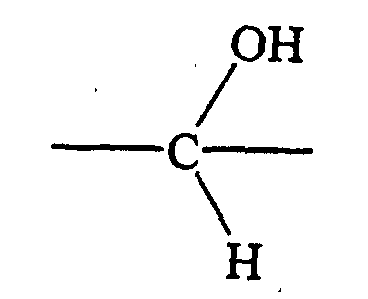
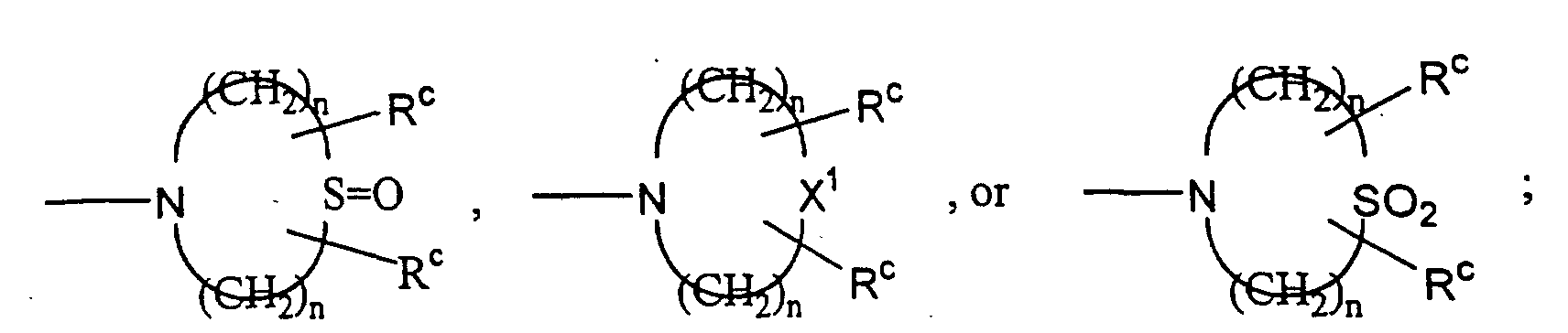


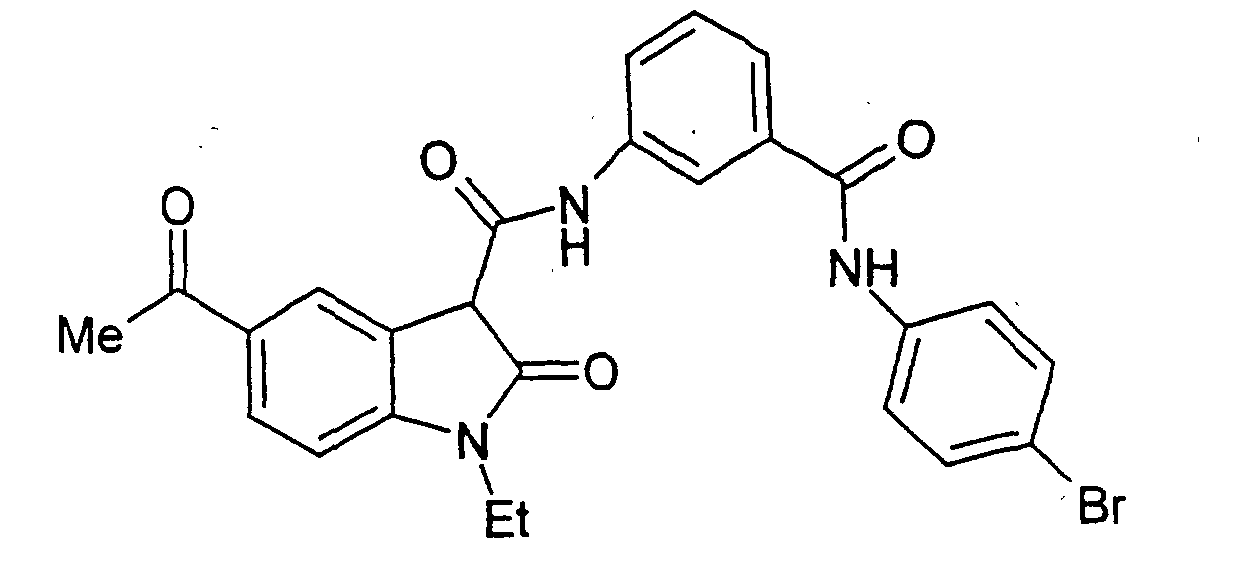

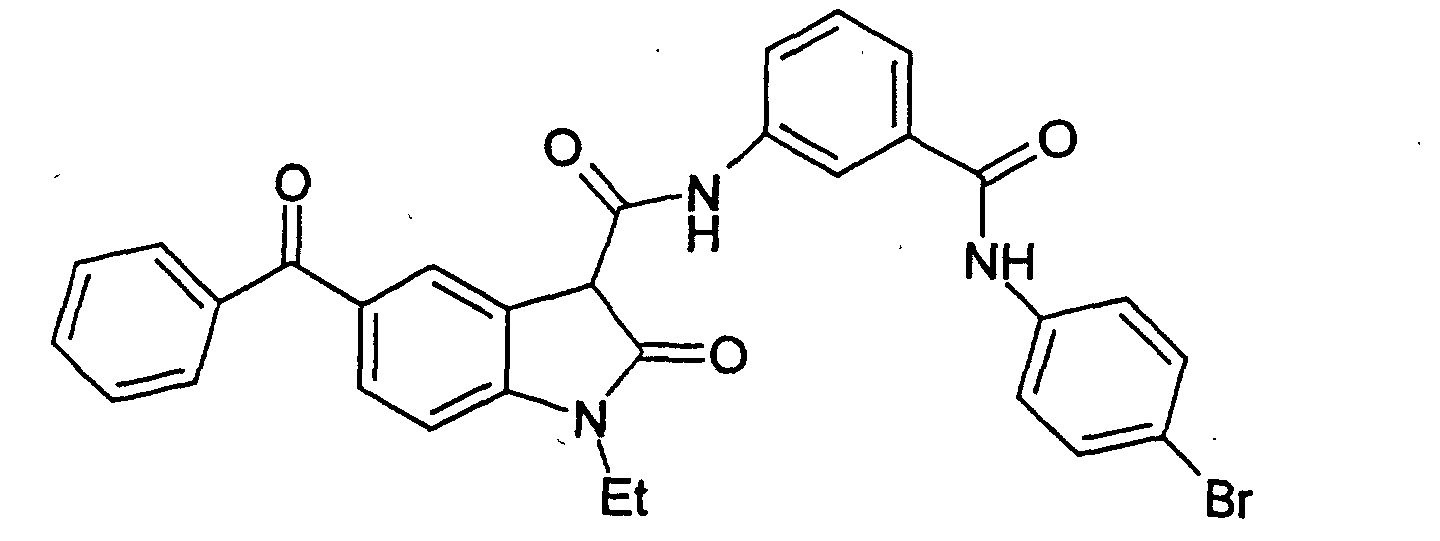
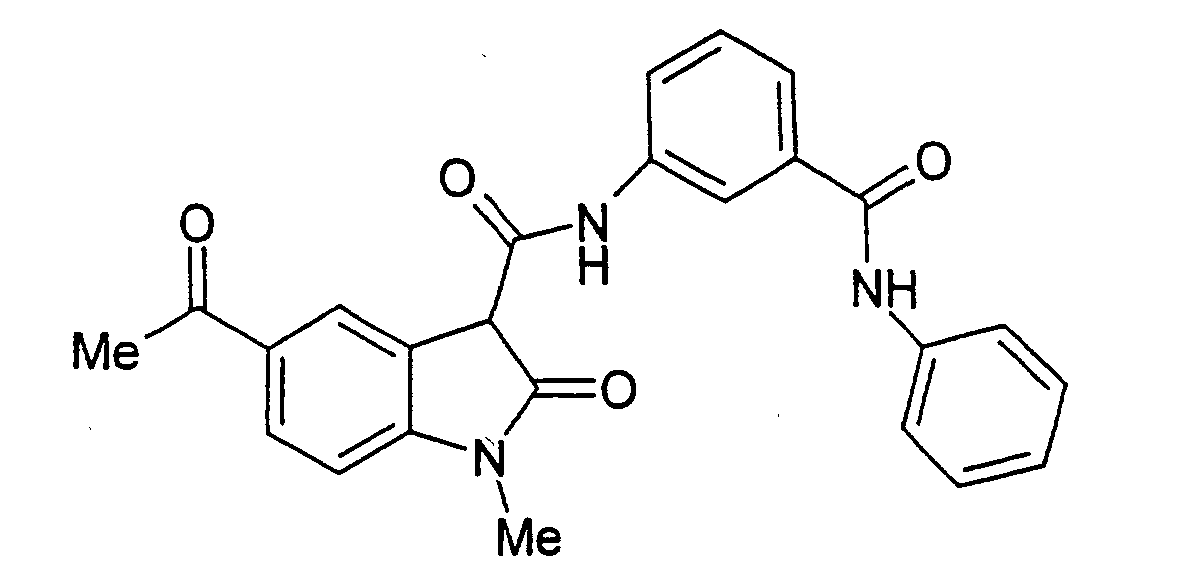
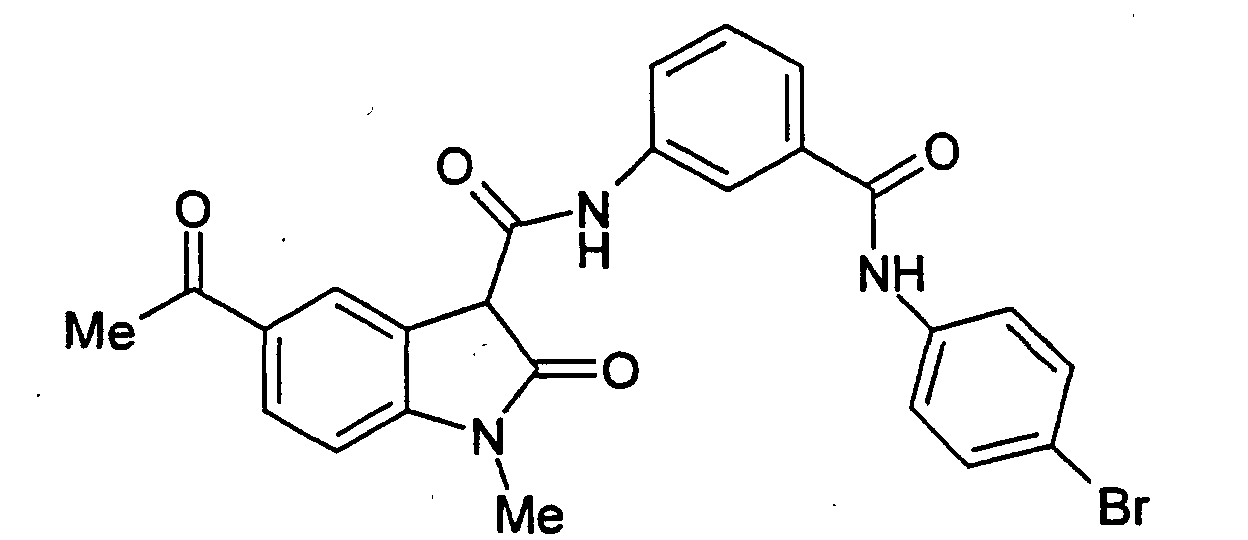
mp 234-236 °C. Calculated for C25H20BrN3N3O4: C 59.30; H 3.98; N 8.30; found C 59.12; H 4.15; N 8.08.

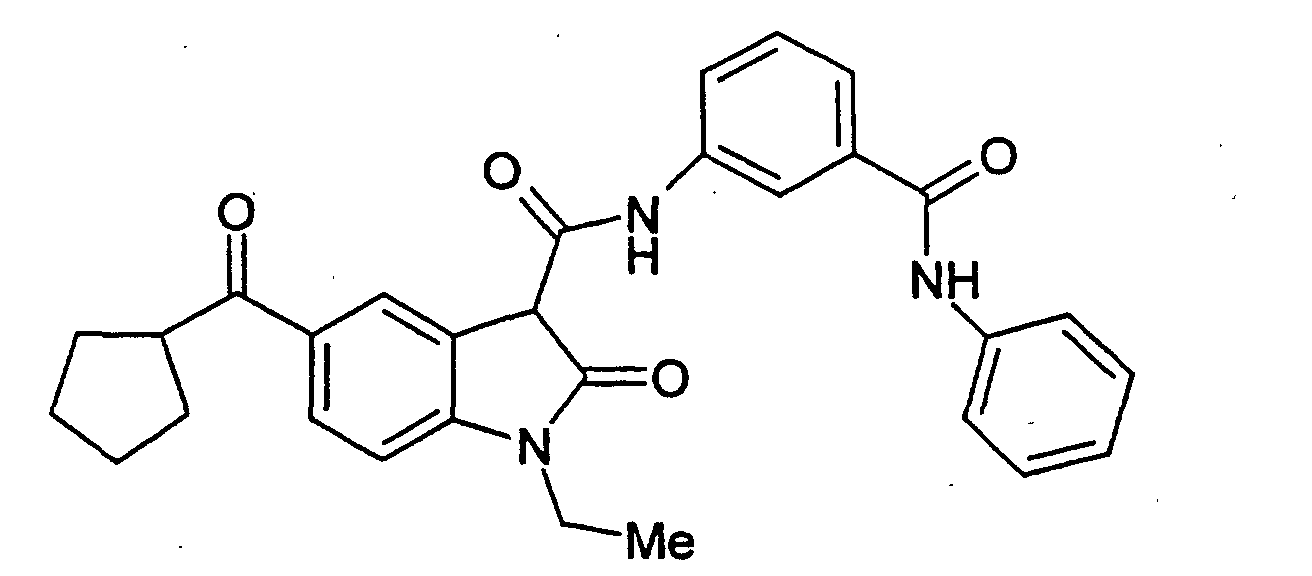
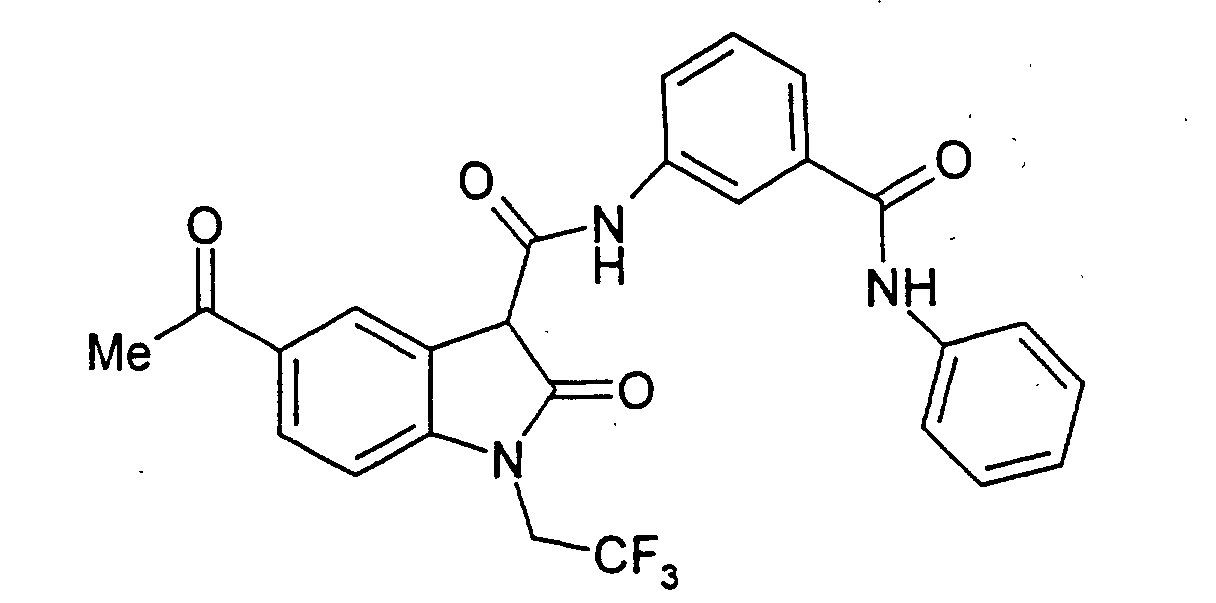



- Et
- ethyl
- DMF
- dimethylformamide
- BOC
- tert-butyloxycarbonyl
- CBz
- benzyloxycarbonyl
- Ph
- phenyl
- h
- hours
- d
- days
- min
- minutes
- equiv
- equivalent(s)
- DMSO
- dimethlysulfoxide
- dec
- decomposition
- mp
- melting point
- CIMS
- chemical ionization mass spectrometry



CIMS m/e 415.2 (MH+); 1H NMR (DMSO-d 6) δ 7.28-7.15 (m, 10H), 7.07-7.01 (m, 1H), 4.94-4.75 (m, 4.5H), 4.65 (d, J = 7.7 Hz, 0.5H), 4.09-3.88 (m, 4H), 3.51-3.38 (m, 1H), 3.27-3.07 (m, 3H), 2.83-2.63 (m, 2H).
CIMS m/e 281.2 (MH+); 1H NMR (DMSO-d 6) δ 7.27-7.13 (m, 5H), 4.95-4.80 (m, 3H), 3.93 (br s, 2H), 3.83 (dd, J = 3.3, 9.1 Hz, 1H), 3.45-3.05 (m, 6H), 2.99 (dq, J = 3.5, 6.3 Hz, 1H), 2.65 (m, 1H), 2.50 (m, 1H).
mp 143-145°C; CIMS mle 508.0/510.0 (MH+); 1H NMR (DMSO-d 6) δ 11.72 (br s, 1H), 7.84 (d, J = 9.1 Hz, 1H), 7,22 (m, 5H), 7.11 (m, 1H), 6.99 (s, 1H), 5.04 (d, J = 7.3 Hz, 0.5H), 4.95 (m, 1H), 4.89 (d, J = 5.0 Hz, 0.5H), 4.80 (d, J = 7.7 Hz, 0.5H), 4.75 (d, J = 4.4 Hz, 0.5H), 4.40 (m, 1H), 4.19 (m, 1H), 4.00-3.85 (m, 2H), 3.54 (m, 1H), 3.39 (dd, J = 4.9, 12.6 Hz, 0.5H), 3.22 (m, 1.5H), 3.16-3.06 (m, 1H), 2.94-2.81 (m, 2H).
CIMS m/e 244.0/246.0 ((M-H)+); 1H NMR (DMSO-d 6) δ 12.66 (br s, 1H), 12.10 (br s, 1H), 7.22 (s, 1H), 6.87 (d, J = 2.1 Hz, 1H).
mp 180-182°C dec.; CIMS m/e 180.1 ((M-H)+); 1H NMR(DMSO-d 6) δ 12.36 (s, 1H), 11.93 (s, 1H), 6.77 (s, 1H), 6.66 (s, 1H), 2.40 (s, 3H), 1.36 (t, J = 7.1 Hz, 3H).
CIMS m/e 381 (MH+).
CIMS m/e 281.2 (MH+).
CIMS m/e 351.2 (MH+); 1H NMR (CDCl3) δ 7.28-7.19 (m, 5H), 5.35 (m, 1H), 4.52 (m, 1H), 4.14-3.99 (m, 1.5H), 3.78-3.63 (m, 1.5H), 3.46-3.34 (m, 2H), 3.00-2.65 (m, 3H), 1.40 (s, 9H).
CIMS m/e 251.2 (MH+); 1H NMR (300 MHz, DMSO-d 6) δ 8.28 (br s, 3H), 7.38-7.21 (m, 5H), 5.11-4.93 (m, 2H), 4.34-4.22 (m, 1H), 3.96 (m, 1H), 3.81-3.70 (m, 1H), 3.89 (m, 0.5H), 3.47 (m, 0.5H), 3.33-2.85 (m, 4H), 2.63 (m, 1H).
CIMS m/e 351.2 (MH+); 1H NMR (DMSO-d 6) δ 7.25-7.13 (m, 5H), 7.06 (dd, J = 8.4, 13.6 Hz, 1H), 4.98 (d, J = 5.4 Hz, 0.5H), 4.91 (d, J = 5.0 Hz, 0.5H), 4.84 (m, 1H), 4.25 (dd, J = 8.5, 14.3 Hz, 1H), 4.02 (m, 0.5H), 3.94 (m, 0.5H), 3.79 (m, 1H), 3.68 (dd, J = 5.9, 10.1 Hz, 0.5H), 3.38 (dd, J = 5.3, 12.2 Hz, 0.5H), 3.27-3.10 (m, 3H), 2.83-2.67 (m, 2H), 1.27 (s, 5H), 1.25 (s, 4H).
CIMS m/e 251.0 (MH+); 1H NMR (DMSO-d 6) δ 8.33 (br s, 3H), 7.32-7.16 (m, 5H), 5.10-4.86 (m, 2H), 4.25-4.13 (m, 1H), 3.93 (m, 1H), 3.73-3.66 (m, 1H), 3.54 (m, 0.5H), 3.46-3.23 (m, 1.5H), 3.18-3.05 (m, 2H), 3.00 (m, 0.5H), 2.91-2.79 (m, 1H), 2.57 (dd, J = 5.6, 10.0 Hz, 0.5H).
CIMS m/e 228.2/230.2 ((M-H)+); 1H NMR (CDCl3) δ 9.28 (br s, 1H), 6.98 (d, J = 1.9 Hz, 1H), 6.88 (s, 1H), 4.33 (q, J = 7.2 Hz, 2H), 1.35 (t, J = 7.2 Hz, 3H).
CIMS m/e 200.1/202.1 ((M-H)+); 1H NMR (DMSO-d 6) δ 12.66 (br s, 1H), 12.08 (s, 1H), 7.11 (d, J = 1.9Hz, 1H), 6.86 (t, J = 2.1 Hz, 1H).
CIMS m/e 234.0/236.0 ((M-H)+); 1H NMR (DMSO-d 6) δ 12.28 (br s, 1H), 7.17 (s, 1H).
CIMS m/e 244.0/246.0 ((M-H)+); 1H NMR (DMSO-d 6) δ 12.63 (s, 1H), 12.04 (s, 1H), 7.13 (s, 1H), 6.97 (s, 1H).
mp 129-130°C; CIMS m/e 208.2 ((M-H)+), 210.2 (MH+); 1H NMR (CDCl3) δ 8.90 (br s, 1H), 7.04 (s, 1H), 6.63 (s, 1H), 4.33 (q, J = 7.1 Hz, 1H), 2.54 (s, 3H), 1.36 (t, J = 7.2 Hz, 3H).
mp 203-204°C; CIMS m/e 468.1/470.1 (MH+); 1H NMR (DMSO-d 6) δ 12.20 (s, 1H), 7.65-7.58 (m, 1H), 7.28-7.08 (m, 6H), 5.04 (d, J = 3.3 Hz, 1H), 4.98-4.80 (m, 3H), 4.08-3.95 (m, 1H), 3.91-3.74 (m, 2H), 3.26-3.10 (m, 2H), 3.10-2.88 (m, 2H).
CIMS m/e 395.1 (MH+); 1H NMR (DMSO-d 6) δ 12.09 (s, 1H), 8.74 (d, J = 8.5 Hz, 1H), 7.99 (s, 1H), 7.29-7.12 (m, 6H), 5.68 (m, 1H), 4.58 (m, 1H), 4.41 (m, 1H), 4.28 (m, 0.5H), 4.11-3.90 (m, 2H), 3.69 (m, 0.5H), 3.57-3.49 (m, 1H), 3.01-2.88 (m, 2H).
CIMS m/e 190.9 ((M-H)+); 1H NMR (DMSO-d 6) δ 13.03 (br s, 1H), 12.39 (br s, 1H), 7.97 (s, 1H), 7.04 (s, 1H).
mp 108-110°C; CIMS m/e 416.3 /418.2 ((M-H)+); 1H NMR (DMSO-d 6) δ 11.84 (m, 1H), 8.65 (d, J = 8.2 Hz, 1H) 7.39-7.13 (m, 7H), 5.08 (q, J = 7.6 Hz, 1H), 3.60-3.30 (m, 7H), 3.23 (m, 1H), 3.09-2.95 (m, 2H).
mp 234-235°C; CIMS m/e 374.2/376.2 ((M-H)+); 1H NMR (DMSO-d 6) δ 11.72 (s, 1H), 8.53 (d, J = 8.1 Hz, 1H), 7.23 (m, 4H), 7.13 (m, 3H), 5.01 (m, 1H), 3.01-2.88 (m, 5H), 2.78 (s, 3H).
mp 125-129°C; CIMS m/e 450.2/452.2 ((M-H)+); 1H NMR (300 MHz, DMSO-d 6) δ 11.80 (m 1H), 8.75 (dd, J = 8.1, 12.9, 1H), 7.36 (m, 2H), 7.26-7.14 (m, 5H), 5.08-4.97 (m, 1H), 4.81 (m, 0.5H), 4.63 (d, J = 11.4, 0.5H), 4.55 (d, J = 12.5, 0.5H), 4.45 (d, J = 12.4, 0.5H), 4.25 (m, 1H), 3.90-3.75 (m, 1H), 3.55-3.35 (m, 2H), 3.05 (m, 2H).
mp 104-105°C; CIMS m/e 486.2/488.2 ((M-H)+); 1H NMR (300 MHz, DMSO-d 6) δ 11.84 (m, 1H), 8.64 (t, J = 8.8 Hz, 1H), 7.32-7.14 (m, 7H), 5.10 (m, 1H), 4.30-3.89 (m, 4H), 3.15-2.92 (m, 3H), 2.80-2.50 (m, 2H), 1.83-1.69 (m, 2H), 1.52-0.94 (m, 5H).
CIMS m/e 405.2 (MH+); 1H NMR (CDCl3) δ 7.26-7.14 (m, 5H), 5.40 (dd, J = 8.9, 19.3 Hz, 1H), 4.82 (m, 1H), 4.34-4.24 (m, 1H), 4.09 (dq, J = 2.0, 7.1 Hz, 2H), 3.57 (m, 1H), 2.99-2.88 (m, 2.5H), 2.72 (m, 1H), 2.45-2.32 (m, 1.5H), 1.95-1.79 (m, 1.5H), 1.58 (m, 2H), 1.40 (d, J = 2.1 Hz, 9H), 1.23 (m, 3H), 0.68 (m, 0.5H).
CIMS m/e 305.1 (MH+); 1H NMR (CDCl3) δ 8.56 (br s, 2H), 7.29-7.18 (m, 5H), 4.94-4.82 (m, 1H), 4.22-3.97 (m, 4H), 3.53 (dt, J = 4.5, 12.7 Hz, 1H), 3.41-3.27 (m, 1H), 3.12 (m, 1H), 2.95 (m, 0.5H), 2.76 (t, J = 10.9 Hz, 0.5H), 2.66 (m, 0.5H), 2.27 (m, 1H), 2.07 (m, 0.5H), 1.79-1.51 (m, 2H), 1.38-1.11 (m, 3.5H), 0.41 (m, 0.5H).
CIMS m/e 448.1/450.0 (MH+); 1H NMR (DMSO-d 6) δ 11.77 (s, 1H), 8.55 (d, J = 8.1 Hz, 1H), 7.26-7.10 (m, 7H), 5.00-4.76 (m, 3H), 4.07-3.94 (m, 1.5H), 3.83 (m, 1.5H), 3.40-3.22 (m, 1H), 3.13 (m, 2H), 2.93 (m, 2H).
CIMS m/e 396.3 ((M-H)+); 1H NMR (DMSO-d 6) δ 10.96 (m, 1H), 8.23 (m, 1H), 7.27-7.19 (m, 4H), 7.14 (m, 1H), 6.83 (d, J = 5.4 Hz, 1H), 6.15 (s, 1H), 4.97 (d, J = 5.2 Hz, 0.5H), 4.89 (d, J = 4.6 Hz, 0.5H), 4.80 (m, 2H), 3.99 (m, 0.5H), 3.93 (m, 0.5H), 3.82 (m, 1.5H), 3.38 (m, 1H), 3.25 (m, 1H), 3.13 (m, 1.5H), 3.00-2.85 (m, 2H), 2.31 (s, 3H).
CIMS m/e 464.3 ((M-H)+); 1H NMR (DMSO-d 6) δ 11.86 (s, 1H), 8.54 (t, J = 8.9 Hz, 1H), 7.31 (s, 1H), 7.23 (m, 4H), 7.13 (m, 2H), 5.66 (m, 1H), 4.56 (m, 1H), 4.41 (m, 1H), 4.28 (m, 0.5H), 4.11-3.89 (m, 2H), 3.66 (m, 0.5H), 3.57-3.46 (m, 1H), 2.99-2.85 (m, 2H), 0.23 (s, 9H).
CIMS m/e 392.1 ((M-H)+); 1H NMR (CDCl3) δ 7.32-7.16 (m, 7H), 7.03 (m, 2H), 4.66 (m, 1H), 4.47 (m, 1H), 4.17 (m, 1H), 4.00 (m, 1H), 3.75-3.56 (m, 3H), 3.35 (m, 1H), 3.04 (m, 2H).
mp 128-132°C; CIMS m/e 416.1 ((M-H)+), 418.2 (MH+); 1H NMR (DMSO-d 6) δ 11.72 (m, 1H), 8.49 (d, J = 8.5 Hz, 1H), 7.28-7.13 (m, 6H), 6.71 (s, 1H), 4.99 (d, J = 5.2 Hz, 0.5H), 4.91 (d, J = 4.8 Hz, 0.5H), 4.86 (d, J = 3.7 Hz, 1H), 4.79 (m, 1H), 4.01 (m, 0.5H), 3.94 (m, 0.5H), 3.83 (m, 1.5H), 3.42-3.24 (m, 2.5H), 3.14 (m, 1H), 3.01-2.84 (m, 2H).
CIMS m/e 212.1 ((M-H)+); 1H NMR (CDCl3) δ 9.16 (br s, 1H), 7.03 (s, 1H), 6.51 (s, 1H), 4.33 (q, J = 7.2 Hz, 2H), 1.36 (t, J = 7.2 Hz, 3H).
CIMS m/e 184.1 ((M-H)+); 1H NMR (DMSO-d 6) δ 12.47 (br s, 1H), 12.03 (s, 1H), 6.96 (s, 1H), 6.73 (s, 1H).
CIMS m/e 377.1 ((M-H)+), 379.1 (MH+); 1H NMR (DMSO-d 6) δ 11.78 (s, 1H), 8.68 (t, J = 8.2 Hz, 1H), 7.67 (s, 1H), 7.22 (m, 4H), 7.15 (m, 1H), 7.01 (d, J = 3.1 Hz, 1H), 5.68 (m, 1H), 4.59 (m, 1H), 4.40 (m, 1H), 4.26 (m, 0.5H), 4.05 (m, 1H), 3.92 (m, 1H), 3.65 (m, 0.5H), 3.53 (m, 1H), 3.00-2.88 (m, 2H).
CIMS m/e 174.9 ((M-H)+); 1H NMR (DMSO-d 6) δ 13.10-12.60 (br s, 1H), 12.05 (s, 1H), 7.73 (s, 1H), 6.75 (s, 1H).
CIMS m/e 418.1/420.1 (MH+); 1H NMR (DMSO-d 6) δ 11.36 (s, 1H), 8.42 (dd, J = 2.9, 8.3 Hz, 1H), 7.27-7.10 (m, 5H), 6.94 (d, J = 6.0 Hz, 1H), 6.63 (m, 1H), 4.99 (d, J = 5.2 Hz, 0.5H), 4.91 (d, J = 5.0 Hz, 0.5H), 4.86-4.77 (m, 2H), 4.00 (m, 0.5H), 3.94 (m, 0.5H), 3.81 (m, 1.5H), 3.43-3.21 (m, 2.5H), 3.13 (m, 1H), 3.00-2.85 (m, 2H).
CIMS m/e 212.0/214.1 ((M-H)+); 1H NMR (CDCl3) δ 8.69 (br s, 1H), 6.74 (dd, J = 0.8, 1.7 Hz, 1H), 6.31 (d, J = 0.6 Hz, 1H), 4.33 (q, J = 7.1Hz, 2H), 1.36 (t, J = 7.1 Hz, 3H).
CIMS m/e 183.8/185.8 ((M-H)+); 1H NMR (DMSO-d 6) δ 12.47 (br s, 1H), 11.70 (s, 1H), 6.70 (s, 1H), 6.67 (s, 1H).
CIMS m/e 448.1/450.1 (MH+); 1H NMR (DMSO-d 6) δ 11.33 (m, 1H), 7.72 (d, J = 8.7 Hz, 1H), 7.25-7.09 (m, 5H), 6.82 (s, 1H), 6.61 (dd, J = 0.7, 3.0 Hz, 1H), 5.04 (d, J = 7.3 Hz, 0.5H), 4.94 (m, 1H), 4.89 (d, J = 5.0 Hz, 0.5H), 4.80 (d, J = 7.5 Hz, 0.5H), 4.75 (d, J = 4.2 Hz, 0.5H), 4.45-4.35 (m, 1H), 4.18 (m, 1H), 4.00-3.88 (m, 2H), 3.57-3.49 (m, 1H), 3.39 (m, 0.5H), 3.26-3.06 (m, 2.5H), 2.95-2.80 (m, 2H).
CIMS m/e 434.0/436.0 (MH+); 1H NMR (DMSO-d 6) δ 12.09 (m, 1H), 8.57 (d, J = 8.3 Hz, 1H), 7.40 (m, 0.5H), 7.28-7.10 (m, 6.5H), 5.00 (d, J = 5.2 Hz, 0.5H), 4.92 (d, J = 5.0 Hz, 0.5H), 4.84 (m, 2H), 4.10-3.93 (m, 1H), 3.82 (m, 1.5H), 3.44-3.23 (m, 2.5H), 3.13 (m, 1H), 3.03-2.87 (m, 2H).
CIMS m/e 228.0 ((M-H)+); 1H NMR (CDCl3) δ 9.02 (br s, 1H), 7.24 (s, 1H), 7.10 (s, 1H), 4.37 (q, J = 7.1 Hz, 2H), 1.38 (t, J = 7.1 Hz, 3H).
CIMS m/e 199.9/201.8 ((M-H)+); 1H NMR (DMSO-d 6) δ 12.71 (br s, 1H), 12.40 (s, 1H), 7.48 (s, 1H), 7.06 (d, J = 1.9 Hz, 1H).
CIMS m/e 464.0/466.0 (MH+); 1H NMR (DMSO-d 6) δ 12.4 (m, 1H), 7.89 (d, J = 8.9 Hz, 1H), 7.38 (s, 0.5H), 7.26-7.10 (m, 5.5H), 7.05 (d, J = 3.1 Hz, 1H), 5.08 (d, J = 7.1 Hz, 0.5H), 4.97-4.84 (m, 2H), 4.76 (d, J = 4.2 Hz, 0.5H), 4.44 (m, 1H), 4.20 (m, 1H), 4.09-3.88 (m, 2H), 3.53 (m, 1H), 3.38 (m, 0.5H), 3.25-3.06 (m, 2.5H), 2.97-2.82 (m, 2H).
CIMS m/e 475.9/478.2 ((M-H)+); 1H NMR (DMSO-d 6) δ 11.99 (m, 1H), 8.56 (d, J = 8.3 Hz, 1H), 7.48 (d, J = 1.2 Hz, 0.5H), 7.27-7.12 (m, 6.5H), 4.99 (d, J = 5.2 Hz, 0.5H), 4.91 (d, J = 5.2 Hz, 0.5H), 4.84 (m, 2H), 4.09-3.92 (m, 1.5H), 3.78 (m, 1.5H), 3.43-3.22 (m, 2H), 3.13 (m, 1H), 2.99-2.85 (m, 2H).
CIMS m/e 272.0/273.9 ((M-H)+); 1H NMR (CDCl3) δ 8.99 (br s, 1H), 7.21 (s, 1H), 7.13 (d, J = 1.9 Hz, 1 H), 4.37 (q, J = 7.2 Hz, 2H), 1.38 (t, J = 7.2 Hz, 3H).
CIMS m/e 243.9/245.9 ((M-H)+); 1H NMR (DMSO-d 6 δ 12.69 (br s, 1H), 12.33 (s, 1H), 7.56 (s, 1H), 7.08 (s, 1H).
CIMS m/e 508.0/510.0 (MH+); 1H NMR (DMSO-d 6) δ 11.96 (s, 0.5H), 11.91 (s, 0.5H), 7.90 (d, J = 9.3 Hz, 1H), 7.46 (s, 0.5H), 7.22 (m, 4.5H), 7.12 (m, 1H), 7.04 (m, 1H), 5.08 (d, J = 6.9 Hz, 0.5H), 4.94 (m, 1H), 4.89 (d, J = 5.0 Hz, 0.5H), 4.85 (d, J = 7.1 Hz, 0.5H), 4.75 (d, J = 4.4 Hz, 0.5H), 4.45 (m, 1H), 4.20 (m, 1H), 4.08-3.87 (m, 2H), 3.53 (m, 1H), 3.40-3.30 (m, 0.5H), 3.22 (m, 1H), 3.15-3.05 (m, 1.5H), 2.98-2.82 (m, 2H).
CIMS m/e 464.0/466.0 (MH+); 1H NMR (DMSO-d 6) δ 11.72 (s, 0.5H), 11.67 (s, 0.5H), 7.85 (d, J = 9.1 Hz, 1H), 7.21 (m, 4H), 7.12 (m, 1H), 7.00 (m, 2H), 5.05 (d, J = 7.1 Hz, 0.5H), 4.95 (m, 1H), 4.89 (d, J = 4.8 Hz, 0.5H), 4.81 (d, J = 7.5 Hz, 0.5H), 4.75 (d, J = 3.9 Hz, 0.5H), 4.41 (m, 1H), 4.20 (m, 1H), 4.00-3.87 (m, 2H), 3.54 (m, 1H), 3.40 (m 0.5H), 3.22 (m, 1.5H), 3.15-3.06 (m, 1H), 2.94-2.80 (m, 2H).
CIMS m/e 228.0/229.9 ((M-H)+); 1H NMR (CDCl3) δ 9.04 (br s, 1H), 7.02 (m, 1H), 6.88 (m, 1H), 4.34 (q, J = 7.2 Hz, 2H), 1.37 (t, J = 7.2Hz, 3H).
CIMS m/e 199.9/201.8 ((M-H)+); 1H NMR (DMSO-d 6) δ 12.62 (s, 1H), 12.04 (s, 1H), 7.05 (s, 1H), 6.97 (s, 1H).
CIMS m/e 434.0/436.0 (MH+); 1H NMR (DMSO-d 6) δ 11.73 (m, 1H), 8.57 (d, J = 7.9 Hz, 1H), 7.28-7.19 (m, 4H), 7.13 (m, 2H), 7.01 (d, J = 2.7 Hz, 1H), 5.00 (d, J = 5.2 Hz, 0.5H), 4.92 (d, J = 5.2Hz, 0.5H), 4.86 (m, 1H), 4.79 (m, 1H), 4.08-3.94 (m, 1H), 3.82 (m, 1.5H), 3.42-3.24 (m, 2H), 3.14 (m, 1.5H), 3.01-2.87 (m, 2H).
CIMS m/e 412.1 ((M-H)+), 414.0 (MH+); 1H NMR (DMSO-d 6) δ 11.69 (m, 1H), 8.45 (m, 1H), 7.28-7.18 (m, 4H), 7.12 (m, 2H), 6.93 (d, J = 1.0 Hz, 1H), 4.98 (d, J = 5.2 Hz, 0.5H), 4.90 (d, J = 5.0 Hz, 0.5H), 4.83 (m, 2H), 4.03-3.92 (m, 1H), 3.83 (m, 1.5H), 3.42-3.23 (m, 2.5H), 3.14 (m, 1H), 3.03-2.88 (m, 2H), 2.24 (s, 3H).
CIMS m/e 179.9 ((M-H)+), 181.8 (MH+); 1H NMR (DMSO-d 6) δ 12.45 (br s, 1H), 11.99 (s, 1H), 7.02 (m, 1H), 6.96 (m, 1H), 2.25 (s, 3H).
CIMS m/e 442.1 ((M-H)+), 444.0 (MH+); 1H NMR (DMSO-d 6) δ 11.66 (s, 0.5H), 11.62 (s, 0.5H), 7.76 (d, J = 8.9 Hz, 1H), 7.22 (m, 4H), 7.11 (m, 1H), 7.01 (d, J = 1.7 Hz, 1H), 6.91 (s, 1H), 5.06 (d, J = 7.3 Hz, 0.5H), 4.95 (m, 1H), 4.90 (d, J = 5.0 Hz, 0.5H), 4.82 (d, J = 7.5 Hz, 0.5H), 4.77 (d, J = 4.4 Hz, 0.5H), 4.44 (m, 1H), 4.21 (m, 1H), 4.01-3.87 (m, 2H), 3.55 (m, 1H), 3.40 (dd, J = 5.0, 12.6 Hz, 0.5H), 3.24 (m, 1.5H), 3.16-3.06 (m, 1H), 2.97-2.83 (m, 2H), 2.23 (s, 3H).
CIMS m/e 423.1 ((M-H)+), 425.1 (MH+); 1H NMR (DMSO-d 6) δ 12.15 (m, 1H), 8.85 (d, J = 8.3 Hz, 1H), 7.79 (m, 1H), 7.29-7.11 (m, 6H), 5.00 (m, 0.5H), 4.93-4.78 (m, 2.5H), 4.04-3.93 (m, 1H), 3.81 (m, 1.5H), 3.43-3.25 (m, 2.5H), 3.15 (m, 1H), 3.03-2.89 (m, 2H).
CIMS m/e 193.9 ((M-H)+), 195.8 (MH+); 1H NMR (DMSO-d 6) δ 13.38-12.78 (br s, 1H), 12.43 (s, 1H), 9.90 (s, 1H), 7.92 (s, 1H), 7.08 (s, 1H).
CIMS m/e 190.9 ((M-H)+); 1H NMR (DMSO-d 6) δ 13.06 (br s, 1H), 12.45 (s, 1H), 7.84 (s, 1H), 7.09 (s, 1H).
mp 137-140°C; CIMS m/e 437.1 ((M-H)+), 439.0 (MH+); 1H NMR (DMSO-d 6) δ 11.70 (m, 1H), 7.99 (d, J = 8.9 Hz, 1H), 7.65 (m, 1H), 7.22 (m, 4H), 7.12 (m, 1H), 6.91 (s, 1H), 5.09 (d, J = 7.1 Hz, 0.5H), 4.95 (m, 1H), 4.89 (d, J = 5.2 Hz, 0.5H), 4.83 (d, J = 7.3 Hz, 0.5H), 4.76 (d, J = 3.9 Hz, 0.5H), 4.42 (m, 1H), 4.21 (m, 1H), 4.08-3.89 (m, 2H), 3.61-3.50 (m, 1H), 3.40 (m, 0.5H), 3.24 (m, 1.5H), 3.13 (m, 1H), 2.95-2.80 (m, 2H).
mp 140°C dec.; CIMS m/e 461.9/463.9 (MH+); 1H NMR (300 MHz, DMSO-d 6) δ 11.75 (m, 1H), 8.47 (d, J = 8.6 Hz, 1H), 7.90 (d, J = 0.8 Hz, 1H), 7.33-7.15 (m, 5H), 6.98 (dd, J = 1.5, 3.4 Hz, 1H), 5.03 (d, J = 5.3 Hz, 0.5H), 4.95 (d, J = 5.1 Hz, 0.5H), 4.91-4.83 (m, 2H), 4.13-3.97 (m, 1H), 3.86 (m, 1.5H), 3.48-3.25 (m, 2.5H), 3.18 (m, 1H), 3.08-2.92 (m, 2H).
CIMS m/e 257.81259.8 (MH+); 1H NMR (300 MHz, CDCl3) δ 8.81 (br s, 1H), 7.48 (s, 1H), 6.79 (d, J = 1.8 Hz, 1H), 4.35 (q, J = 7.1 Hz, 2H), 1.36 (t, J = 7.1 Hz, 3H).
CIMS m/e 228.0/230.0 ((M-H)+); 1H NMR (300 MHz, DMSO-d 6) δ 12.60 (br s, 1H), 12.06 (br s, 1H), 7.98 (s, 1H), 6.77 (d, J = 1.8 Hz, 1H).
CIMS m/e 484.0 ((M-H)+), 486.0 (MH+); 1H NMR (DMSO-d 6) δ 12.00 (s, 0.5H), 11.95 (s, 0.5H), 7.83 (m, 1H), 7.55 (dd, J = 0.8, 5.2 Hz, 1H), 7.35 (dd, J = 1.2, 5.2 Hz, 1H), 7.23 (m, 4H), 7.12 (m, 2H), 5.07 (d, J = 7.3 Hz, 0.5H), 4.96 (m, 1H), 4.90 (d, J = 5.0 Hz, 0.5H), 4.81 (d, J = 7.5 Hz, 0.5H), 4.76 (d, J = 4.2 Hz, 0.5H), 4.44 (m, 1H), 4.20 (m, 1H), 4.08-3.88 (m, 1.5H), 3.57 (m, 1H), 3.40 (m, 0.5H), 3.26 (m, 1.5H), 3.17-3.07 (m, 1.5H), 2.97-2.84 (m, 2H).
CIMS m/e 250.1 ((M-H)+), 251.9 (MH+); 1H NMR (CDCl3) δ 9.46 (br s, 1H), 7.35 (d, J = 5.3 Hz, 1H), 7.29 (d, J = 5.3 Hz, 1H), 7.14 (d, J = 2.0 Hz, 1H), 4.38 (q, J = 7.1 Hz, 2H), 1.39 (t, J = 7.1 Hz, 3H).
CIMS m/e 222.0 ((M-H)+); 1H NMR (DMSO-d 6) δ 12.51 (s, 1H), 12.32 (s, 1H), 7.59 (d, J = 5.3 Hz, 1H), 7.38 (d, J = 5.3 Hz, 1H), 7.05 (d, J = 1.9 Hz, 1H).
CIMS m/e 454.0 ((M-H)+), 456.0 (MH+); 1H NMR (DMSO-d 6) δ12.03 (m, 1H), 8.53 (d, J = 8.1 Hz, 1H), 7.55 (dd, J = 0.8, 5.2 Hz, 1H), 7.34 (dd, J = 2.7, 5.2 Hz, 1H), 7.29-7.19 (m, 5H), 7.12 (m, 1H), 4.99 (d, J = 5.2 Hz, 0.5H), 4.91 (d, J = 5.0 Hz, 0.5H), 4.84 (m, 2H), 3.98 (m, 1H), 3.83 (m, 2H), 3.41-3.29 (m, 3H), 3.13 (m, 1H), 2.95 (m, 2H).
CIMS m/e 243.8/245.9 (MH+); 1H NMR (CDCl3) δ9.25 (br s, 1H), 7.02 (d, J = 1.9 Hz, 1H), 4.36 (q, J = 7.1 Hz, 2H), 2.28 (s, 3H), 1.38 (t, J = 7.1 Hz, 3H).
CIMS m/e 213.8/215.8 ((M-H)+); 1H NMR (DMSO-d 6) δ 12.61 (br s, 1H), 12.25 (s, 1H), 6.96 (dd, J = 0.5, 2.0 Hz, 1H), 2.23 (s, 1H).
mp 150-153°C; CIMS m/e 478.1/480.1 (MH+); 1H NMR (DMSO-d 6) δ 11.91 (s, 0.5H), 11.86 (s, 0.5H), 7.82 (d, J = 8.7, 1H), 7.22 (m, 4H), 7.11 (m, 1H), 7.01 (m, 1H), 5.07 (d, J = 6.8 Hz, 0.5H), 4.95 (m, 1H), 4.90 (d, J = 5.0 Hz, 0.5H), 4.82 (d, J = 6.8 Hz, 0.5H), 4.77 (d, J = 3.7 Hz, 0.5H), 4.44 (m, 1H), 4.21 (m, 1H), 4.08-3.88 (m, 1.5H), 3.56 (m, 1H), 3.40 (m, 0.5H), 3.24 (m, 1.5H), 3.14 (m, 1H), 3.08 (m, 0.5H), 2.95-2.82 (m, 2H).
mp 104-110°C; 444.0 ((M-H)+), 445.9 (MH+); 1H NMR (DMSO-d 6)) δ 11.61 (m, 1H), 8.52 (d, J = 8.6 Hz, 1H), 7.28-7.12 (m, 6H), 6.97 (d, J = 3.9 Hz, 1H), 4.99 (d, J = 5.1 Hz, 0.5H), 4.91 (d, J = 5.1 Hz, 0.5H), 4.83 (m, 2H), 4.06-3.94 (m, 1H), 3.80 (m, 2H), 3.43-3.24 (m, 2H), 3.14 (m, 1H), 3.02-2.87 (m, 2H), 2.46 (s, 3H).
CIMS m/e 240.0 ((M-H)+), 242.0 (MH+);1H NMR (CDCl3) δ 9.05 (br s, 1H), 7.04 (m, 1H), 6.97 (s, 1H), 4.35 (q, J = 7.1 Hz, 2H), 2.53 (s, 3H), 1.37 (t, J = 7.1 Hz, 3H).
CIMS m/e 211.9 ((M-H)+); 1H NMR (DMSO-d 6) δ 12.56 (s, 1H), 11.90 (s, 1H), 6.97 (s, 1H), 6.94 (s, 1H), 2.47 (s, 1H).
Claims (23)
- Use of a glycogen phosphorylase inhibitor in the manufacture of a medicament for treating prophylactically an individual in whom Type 2 diabetes mellitus has not yet presented, but in whom there is an increased risk of developing such condition.
- The use according to claim 1 wherein said increased risk comprises a risk factor associated with a Type 2 diabetes pre-disposing disease state or condition.
- The use according to claim 2 wherein said risk factor is selected from the group consisting of:(i) risk factors associated with classification as an individual having insulin resistance and/or hyperinsulinemia;(ii) risk factors based on environmental or genetic Type 2 diabetes pre-disposing disease states or conditions;(iii) risk factors predicated on race and/or ethnicity;(iv) risk factors based on genetic mutations affecting (3-cell function;(v) risk factors based on genetic defects in insulin action;(vi) risk factors based on presence of excess adipose tissue or clinically diagnosed obesity;(vii) risk factors identified through clinical chemistries or diagnostic testing signifying a pre-diabetic state;(viii) risk factors related to physiologic and endocrine changes associated with growth, development, or aging;(ix) risk factors related to diet or eating behaviors;(x) risk factors based on abnormal cardiovascular or blood lipid parameters;(xi) risk factors based on reproductive status;(xii) risk factors attributable to muscle wasting;(xiii) risk factors associated with polycystic ovary syndrome;(xiv) risk factors due to organ disease or dysfunction;(xv) risk factors due to conditions resulting in metabolic disturbances;(xvi) risk factors due to endocrine disorders or endocrinopathies;(xvii) risk factors due to pathophysiologic states;(xviii) risk factors factors due to immune-mediated disease;(xix) risk factors incurred due to drug or chemical exposure;(xx) risk factors associated with having a genetic syndrome associated with diabetes; and(xxi) risk factors associated with the detrimental effects caused by the administration of prolonged, elevated doses of insulin and/or the presence of ketoacidosis.
- The use according to claim 3 wherein said risk factor based on an environmental or genetic Type 2 diabetes pre-disposing disease state or condition comprises a family history of diabetes; said risk factor predicated on race and/or ethnicity comprises individual membership in an African-American, Hispanic, Native American, Asian, or Pacific Islander population; said risk factor based on genetic mutations affecting (3-cell function comprises a defect on chromosome 12, gene HNF-1α (MODY3), a defect on chromosome 7, gene glucokinase (MODY2), a defect on chromosome 20, gene HNF-4α (MODY1), or a defect in mitochondrial DNA; said risk factor based on a genetic defect in insulin action comprises a genetic mutation leading to Type A insulin resistance, acanthosis nigricans, leprechaunism, Rabson-Mendenhall syndrome, lipoatrophic diabetes or condition, or a genetic mutation or mutations in the insulin receptor, IRS proteins, glucose transporters, PC-1, glucokinase, UCP-1, β3 adrenergic receptor gene; said risk factor based on the presence of excess adipose tissue or diagnosed obesity comprises central obesity; said risk factor identified through clinical chemistries or diagnostic testing signifying a pre-diabetic state comprises impaired glucose tolerance, impaired fasting glucose, or hyperglycemia relative to normoglycemia; said risk factor related to physiologic or endocrine changes associated with growth, development, comprises classification as a menopausal, pubescent, or aged individual; said risk factor related to diet or eating behaviors comprises consumption of high fat or high carbohydrate diets, experiencing prolonged fasting or starvation, or having anorexia nervosa or bulemia; said risk factor based on abnormal cardiovascular or blood lipid parameters comprises hypertension, HDL cholesterol levels ≤ 35 mg/dl and/or TG levels ≥ 250 mg/dl, or classification as having metabolic syndrome; said risk factor based on reproductive status comprises pregnancy, a history of gestational diabetes, or macrosomia; said risk factor attributable to muscle wasting comprises risk due to aging, starvation, exposure to anti-gravity environments, or paralysis resulting from spinal cord injury; said risk factor due to organ disease or dysfunction comprises liver cirrhosis or renal disease; said risk factor due to conditions resulting in metabolic disturbances comprises ketoacidosis; said risk factor due to endocrine disorders or endocrinopathies comprises hyperandrogenism, thyrotoxicosis, hyperthyroidism, insulinoma, glucagonoma, somatostatinoma, aldosteroma, Cushing's Syndrome, pheochromocytoma, acromegaly, hypercortisolemia; said risk factor due to a pathophysiologic state comprises infection, congenital rubella, cytomegalovirus, toxemia, uremia, sepsis, or trauma; said risk factor due to immune-mediated disease comprises "stiff man" syndrome or the production of anti-insulin receptor antibodies; said risk factor incurred due to drug or chemical exposure comprises treatment with insulin-resistance-inducing or hyperglycemia-inducing agents comprising glucocorticoids, cytokines, α-interferon, thyroid hormone, TNFα, thiazides, estrogen-containing products, β-blockers, nicotinic acid, serotonin receptor-targeted antipsychotics or antidepressants, vacor, diazoxide, dilantin, and HIV protease inhibitors; and said risk factor associated with having a genetic syndrome associated with diabetes comprises Down's Syndrome, Klinefelter's Syndrome, Wolfram's Syndrome, Freidreich's Syndrome, Huntington's chorea, Laurence-Moon-Biedl Syndrome, myotonic dystrophy, porphyria, Prader-Willi Syndrome, and Alzheimer's Disease.
- The use according to claim 1 wherein said glycogen phosphorylase inhibitor is selected from the group consisting of:(i) a compound of formula (I)the stereoisomers and prodrugs thereof, and the pharmaceutically acceptable salts of said compounds, stereoisomers, and prodrugs, wherein:
 the dotted line (---) is an optional bond;A is -C(H)=, -C((C1-C4)alkyl)= or -C(halo)= when the dotted line (-) is a bond, or A is methylene or -CH((C1-C4)alkyl)- when the dotted line (-) is not a bond;R1, R10 or R11 are each independently H, halo, 4-, 6- or 7-nitro, cyano, (C1-C4)alkyl, (C1-C4)alkoxy, fluoromethyl, difluoromethyl or trifluoromethyl;R2 is H;R3 is H or (C1-C5)alkyl;R4 is H, methyl, ethyl, n-propyl, hydroxy(C1-C3)alkyl, (C1-C3)alkoxy(C1-C3)alkyl, phenyl(C1-C4)alkyl, phenylhydroxy(C1-C4)alkyl, phenyl(C1-C4)alkoxy(C1-C4)alkyl, thien-2- or -3-yl(C1-C4)alkyl or fur-2- or -3-yl(C1-C4)alkyl wherein said R4 rings are mono-, di- or tri-substituted independently on carbon with H, halo, (C1-C4)alkyl, (C1-C4)alkoxy, trifluoromethyl, hydroxy, amino or cyano; orR4 is pyrid-2-, -3- or -4-yl(C1-C4)alkyl, thiazol-2-, -4- or -5-yl(C1-C4)alkyl, imidazol -1-,-2-, -4- or -5-yl(C1-C4)alkyl, pyrrol-2- or -3-yl(C1-C4)alkyl, oxazol-2-, -4- or - 5-yl-(C1-C4)alkyl, pyrazol-3-, -4- or -5-yl(C1-C4)alkyl, isoxazol-3-, -4- or -5-yl(C1-C4)alkyl, isothiazol-3-, -4- or -5-yl(C1-C4)alkyl, pyridazin-3- or -4-yl-(C1-C4)alkyl, pyrimidin-2-, -4-, -5- or -6-yl(C1-C4)alkyl, pyrazin-2- or -3-yl(C1-C4)alkyl or 1,3,5-triazin-2-yl(C1-C4)alkyl, wherein said preceding R4 heterocycles are optionally mono- or di-substituted independently with halo, trifluoromethyl, (C1-C4)alkyl, (C1-C4)alkoxy, amino or hydroxy and said mono-or di-substituents are bonded to carbon;R5 is H, hydroxy, fluoro, (C1-C5)alkyl, (C1-C5)alkoxy, (C1-C6)alkanoyl, amino(C1-C4)alkoxy, mono-N- or di-N,N-(C1-C4)alkylamino(C1-C4)alkoxy, carboxy(C1-C4)alkoxy, (C1-C5)alkoxy-carbonyl(C1-C4)alkoxy, benzyloxycarbonyl(C1-C4)alkoxy, or carbonyloxy wherein said carbonyloxy is carbon-carbon linked with phenyl, thiazolyl, imidazolyl, 1H-indolyl, furyl, pyrrolyl, oxazolyl, pyrazolyl, isoxazolyl, isothiazolyl, pyridazinyl, pyrimidinyl, pyrazinyl or 1,3,5-triazinyl and wherein said preceding R5 rings are optionally mono-substituted with halo, (C1-C4)alkyl, (C1-C4)alkoxy, hydroxy, amino or trifluoromethyl and said mono-substituents are bonded to carbon;R7 is H, fluoro or (C1-C5)alkyl; orR5 and R7 can be taken together to be oxo;R6 is carboxy, (C1-C8)alkoxycarbonyl, C(O)NR8R9 or C(O)R12,
whereinR8 is H, (C1-C3)alkyl, hydroxy or (C1-C3)alkoxy; andR9 is H, (C1-C8)alkyl, hydroxy, (C1-C8)alkoxy, methylene-perfluorinated(C1-C8)alkyl, phenyl, pyridyl, thienyl, furyl, pyrrolyl, pyrrolidinyl, oxazolyl, thiazolyl, imidazolyl, pyrazolyl, pyrazolinyl, pyrazolidinyl, isoxazolyl, isothiazolyl, pyranyl, piperidinyl, morpholinyl, pyridazinyl, pyrimidinyl, pyrazinyl, piperazinyl or 1,3,5-triazinyl wherein said preceding R9 rings are carbon-nitrogen linked; orR9 is mono-, di- or tri-substituted (C1-C5)alkyl, wherein said substituents are independently H, hydroxy, amino, mono-N- or di-N,N-(C1-C5)alkylamino; orR9 is mono- or di-substituted (C1-C5)alkyl, wherein said substituents are independently phenyl, pyridyl, furyl, pyrrolyl, pyrrolidinyl, oxazolyl, thiazolyl, imidazolyl, pyrazolyl, pyrazolinyl, pyrazolidinyl, isoxazolyl, isothiazolyl, pyranyl, pyridinyl, piperidinyl, morpholinyl, pyridazinyl, pyrimidinyl, pyrazinyl, piperazinyl or 1,3,5-triazinylwherein the nonaromatic nitrogen-containing R9 rings are optionally mono-substituted on nitrogen with (C1-C6)alkyl, benzyl, benzoyl or (C1-C6)alkoxycarbonyl and wherein the R9 rings are optionally mono-substituted on carbon with halo, (C1-C4)alkyl, (C1-C4)alkoxy, hydroxy, amino, or mono-N- and di-N,N (C1-C5)alkylamino provided that no quaternized nitrogen is included and there are no nitrogen-oxygen, nitrogen-nitrogen or nitrogen-halo bonds;R12 is piperazin-1-yl, 4-(C1-C4)alkylpiperazin-1-yl, 4-formylpiperazin-1-yl, morpholino, thiomorpholino, 1-oxothiomorpholino, 1,1-dioxo-thiomorpholino, thiazolidin-3-yl, 1-oxo-thiazolidin-3-yl, 1,1-dioxo-thiazolidin-3-yl, 2-(C1-C6)alkoxycarbonylpyrrolidin-1-yl, oxazolidin-3-yl or 2(R)-hydroxymethylpyrrolidin-1-yl; orR12 is 3- and/or 4-mono-or di-substituted oxazetidin-2-yl, 2-, 4-, and/or 5- mono- or di-substituted oxazolidin-3-yl, 2-, 4-, and/or 5- mono- or di- substituted thiazolidin-3-yl, 2-, 4-, and/or 5- mono- or di- substituted 1-oxothiazolidin-3-yl, 2-, 4-, and/or 5- mono- or di- substituted 1,1-dioxothiazolidin-3-yl, 3- and/or 4-, mono- or di-substituted pyrrolidin-1-yl, 3-, 4- and/or 5-, mono-, di- or tri-substituted piperidin-1-yl, 3-, 4-, and/or 5- mono-, di-, or tri-substituted piperazin-1-yl, 3-substituted azetidin-1-yl, 4- and/or 5-, mono- or di-substituted 1,2-oxazinan-2-yl, 3-and/or 4-mono- or di-substituted pyrazolidin-1-yl, 4- and/or 5-, mono- or di-substituted isoxazolidin-2-yl, 4-and/or 5-, mono- and/or di-substituted isothiazolidin-2-yl wherein said R12 substituents are independently H, halo, (C1-C5)-alkyl, hydroxy, amino, mono-N- or di-N,N-(C1-C5)alkylamino, formyl, oxo, hydroxyimino, (C1-C5)alkoxy, carboxy, carbamoyl, mono- N-or di-N,N-(C1-C4)alkylcarbamoyl, (C1-C4)alkoxyimino, (C1-C4)alkoxymethoxy, (C1-C6)alkoxycarbonyl, carboxy(C1-C5)alkyl or hydroxy(C1-C5)alkyl;(ii) a compound of formula (II)the stereoisomers and prodrugs thereof, and the pharmaceutically acceptable salts of said compounds, stereoisomers, and prodrugs,
wherein:the dotted line (---) is an optional bond;A is -C(H)=, -C((C1-C4)alkyl)=, -C(halo)= or -N=, when the dotted line (---) is a bond, or A is methylene or -CH((C1-C4)alkyl)-, when the dotted line (---) is not a bond;R1, R10 or R11 are each independently H, halo, cyano, 4-, 6-, or 7-nitro, (C1-C4)alkyl, (C1-C4)alkoxy, fluoromethyl, difluoromethyl or trifluoromethyl;R2 is H;R3 is H or (C1-C5)alkyl;R4 is H, methyl, ethyl, n-propyl, hydroxy(C1-C3)alkyl, (C1-C3)alkoxy(C1-C3)alkyl, phenyl(C1-C4)alkyl, phenylhydroxy(C1-C4)alkyl, (phenyl)((C1-C4)-alkoxy)(C1-C4)alkyl, thien-2- or -3-yl(C1-C4)alkyl or fur-2- or -3-yl(C1-C4)alkyl wherein said R4 rings are mono-, di- or tri-substituted independently on carbon with H, halo, (C1-C4)alkyl, (C1-C4)alkoxy, trifluoromethyl, hydroxy, amino, cyano or 4,5-dihydro-1H-imidazol-2-yl; orR4 is pyrid-2-, -3- or -4-yl(C1-C4)alkyl, thiazol-2-, -4- or -5-yl(C1-C4)alkyl, imidazol-2-, -4- or -5-yl(C1-C4)alkyl, pyrrol-2- or -3-yl(C1-C4)alkyl, oxazol-2-, -4- or -5- yl(C1-C4)alkyl, pyrazol-3-, -4- or -5-yl(C1-C4)alkyl, isoxazol-3-, -4- or -5-yl(C1-C4)alkyl, isothiazol-3-, -4- or -5-yl(C1-C4)alkyl, pyridazin-3- or -4-yl(C1-C4)alkyl, pyrimidin-2-, -4-, -5- or -6-yl(C1-C4)alkyl, pyrazin-2- or -3-yl(C1-C4)alkyl, 1,3,5-triazin-2-yl(C1-C4)alkyl or indol-2-(C1-C4)alkyl, wherein said preceding R4 heterocycles are optionally mono- or di-substituted independently with halo, trifluoromethyl, (C1-C4)alkyl, (C1-C4)alkoxy, amino, hydroxy or cyano and said substituents are bonded to carbon; orR4 is R15-carbonyloxymethyl, wherein said R15 is phenyl, thiazolyl, imidazolyl, 1H-indolyl, furyl, pyrrolyl, oxazolyl, pyrazolyl, isoxazolyl, isothiazolyl, pyridyl, pyridazinyl, pyrimidinyl, pyrazinyl or 1,3,5-triazinyl and wherein said preceding R15 rings are optionally mono- or di-substituted independently with halo, amino, hydroxy, (C1-C4)alkyl, (C1-C4)alkoxy or trifluoromethyl and said mono- or di-substituents are bonded to carbon;R5 is H, methyl, ethyl, n-propyl, hydroxymethyl or hydroxyethyl;R6 is carboxy, (C1-C8)alkoxycarbonyl, benzyloxycarbonyl, C(O)NR8R9 or C(O)R12
whereinR8 is H, (C1-C6)alkyl, cyclo(C3-C6)alkyl, cyclo(C3-C6)alkyl(C1-C5)alkyl, hydroxy or (C1-C8)alkoxy; andR9 is H, cyclo(C3-C8)alkyl, cyclo(C3-C8)alkyl(C1-C5)alkyl, cyclo(C4-C7)alkenyl, cyclo(C3-C7)alkyl(C1-C5)alkoxy, cyclo(C3-C7)alkyloxy, hydroxy, methyleneperfluorinated(C1-C8)alkyl, phenyl, or a heterocycle wherein said heterocycle is pyridyl, furyl, pyrrolyl, pyrrolidinyl, oxazolyl, thiazolyl, imidazolyl, pyrazolyl, pyrazolinyl, pyrazolidinyl, isoxazolyl, isothiazolyl, pyranyl, pyridinyl, piperidinyl, morpholinyl, pyridazinyl, pyrimidinyl, pyrazinyl, piperazinyl, 1,3,5-triazinyl, benzothiazolyl, benzoxazolyl, benzimidazolyl, thiochromanyl or tetrahydrobenzothiazolyl wherein said heterocycle rings are carbon-nitrogen linked; orR9 is (C1-C6)alkyl or (C1-C8)alkoxy wherein said (C1-C6)alkyl or (C1-C8)alkoxy is optionally monosubstituted with cyclo(C4-C7)alken-1-yl, phenyl, thienyl, pyridyl, furyl, pyrrolyl, pyrrolidinyl, oxazolyl, thiazolyl, imidazolyl, pyrazolyl, pyrazolinyl, pyrazolidinyl, isoxazolyl, isothiazolyl, pyranyl, piperidinyl, morpholinyl, thiomorpholinyl, 1-oxothiomorpholinyl, 1,1-dioxothiomorpholinyl, pyridazinyl, pyrimidinyl, pyrazinyl, piperazinyl, 1,3,5-triazinyl or indolyl and wherein said (C1-C6)alkyl or (C1-C8)alkoxy are optionally additionally independently mono- or di-substituted with halo, hydroxy, (C1-C5)alkoxy, amino, mono-N- or di-N,N-(C1-C5)alkylamino, cyano, carboxy, or (C1-C4)alkoxycarbonyl; andwherein the R9 rings are optionally mono- or di-substituted independently on carbon with halo, (C1-C4)alkyl, (C1-C4)alkoxy, hydroxy, hydroxy(C1-C4)alkyl, amino(C1-C4)alkyl, mono-N- or di-N,N-(C1-C4)alkylamino(C1-C4)alkyl, (C1-C4)alkoxy(C1-C4)alkyl, amino, mono-N- or di-N,N-(C1-C4)alkylamino, cyano, carboxy, (C1-C5)alkoxycarbonyl, carbamoyl, formyl or trifluoromethyl and said R9 rings may optionally be additionally mono- or di-substituted independently with (C1-C5)alkyl or halo;R12 is morpholino, thiomorpholino, 1-oxothiomorpholino, 1,1-dioxothiomorpholino, thiazolidin-3-yl, 1-oxothiazolidin-3-yl, 1,1-dioxothiazolidin-3-yl, pyrrolidin-1-yl, piperidin-1-yl, piperazin-1-yl, piperazin-4-yl, azetidin-1-yl, 1,2-oxazinan-2-yl, pyrazolidin-1-yl, isoxazolidin-2-yl, isothiazolidin-2-yl, 1,2-oxazetidin-2-yl, oxazolidin-3-yl, 3,4-dihydroisoquinolin-2-yl, 1,3-dihydroisoindol-2-yl, 3,4-dihydro-2H-quinol-1-yl, 2,3-dihydro-benzo[1,4]oxazin-4-yl, 2,3-dihydro-benzo[1,4]-thiazine-4-yl, 3,4-dihydro-2H-quinoxalin-1-yl, 3,4-dihydro-benzo[c][1,2]oxazin-1-yl, 1,4-dihydrobenzo[d][1,2]oxazin-3-yl, 3,4-dihydro-benzo[e][1,2]-oxazin-2-yl, 3H-benzo[d]isoxazol-2-yl, 3H-benzo[c]isoxazol-1-yl or azepan-1-yl,wherein said R12 rings are optionally mono-, di- or tri-substituted independently with halo, (C1-C5)alkyl, (C1-C5)alkoxy, hydroxy, amino, mono-N- or di- N,N-(C1-C5)alkylamino, formyl, carboxy, carbamoyl, mono-N- or di-N,N-(C1-C5)alkylcarbamoyl, (C1-C6)alkoxy(C1-C3)alkoxy, (C1-C5)alkoxycarbonyl, benzyloxycarbonyl, (C1-C5)alkoxycarbonyl(C1-C5)alkyl, (C1-C4)alkoxycarbonylamino, carboxy(C1-C5)alkyl, carbamoyl(C1-C5)alkyl, mono-N- or di-N,N-(C1-C5)alkylcarbamoyl(C1-C5)alkyl, hydroxy(C1-C5)alkyl, (C1-C4)alkoxy(C1-C4)alkyl, amino(C1-C4)alkyl, mono-N- or di-N,N-(C1-C4)alkylamino(C1-C4)alkyl, oxo, hydroxyimino or (C1-C6)alkoxyimino and wherein no more than two substituents are selected from oxo, hydroxyimino or (C1-C6)alkoxyimino and oxo, hydroxyimino or (C1-C6)alkoxyimino are on nonaromatic carbon; andwherein said R12 rings are optionally additionally mono- or di-substituted independently with (C1-C5)alkyl or halo;(iii) a compound of formula (III)the stereoisomers and prodrugs thereof, and the pharmaceutically acceptable salts of said compounds, stereoisomers, and prodrugs,
wherein:R1 is (C1-C4)alkyl, (C3-C7)cycloalkyl, phenyl or phenyl independently substituted with up to three (C1-C4)alkyl, (C1-C4)alkoxy or halogen;R2 is (C1-C4)alkyl optionally substituted with up to three fluoro atoms; andR3 is (C3-C7)cycloalkyl; phenyl; phenyl substituted at the para position with (C1-C4)alkyl, halo or trifluoromethyl; phenyl substituted at the meta position with fluoro; or phenyl substituted at the ortho position with fluoro; and(iv) a compound of formula (IV)the stereoisomers and prodrugs thereof, and the pharmaceutically acceptable salts of said compounds, stereoisomers, and prodrugs,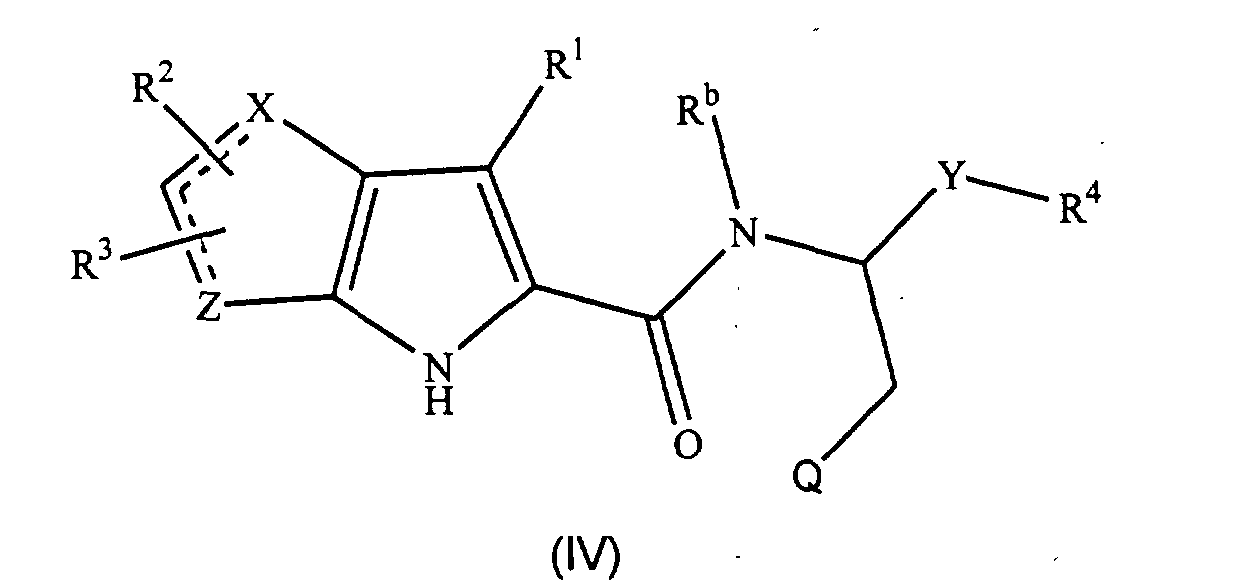
wherein:Q is aryl, substitued aryl, heteroaryl, or substitued heteroaryl;each Z and X are independently (C, CH or CH2), N, O or S;X1 is NRa, -CH2-, O or S;each - - - - is independently a bond or is absent, provided that both - - - - are not simlutaneously bonds;R1 is hydrogen, halogen, -OC1-C8alkyl, -SC1--C8alkyl,-C1-C8alkyl, -CF3, -NH2, -NHC1-C8alkyl, -N(C1-C8alkyl)2, -NO2, -CN,-CO2H, -CO2C1-C8alkyl, -C2-C8alkenyl, or -C2-C8alkynyl;each Ra and Rb is independently hydrogen or -C1-C8alkyl;Y isor absent;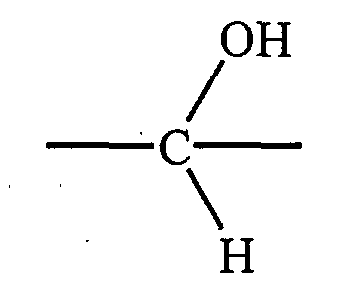 R2 and R3 are independently hydrogen, halogen, -C1-C8alkyl, -CN, -C≡C-Si(CH3)3, -OC1-C8alkyl, -SC1-C8alkyl, -CF3, -NH2, -NHC1-C8alkyl, -N(C1-C8alkyl)2, -NO2, -CO2H, -CO2C1-C8alkyl, -C2-C8alkenyl, or -C2-C8alkynyl, or R2 and R3 together with the atoms on the ring to which they are attached form a five or six membered ring containing from 0 to 3 heteroatoms and from 0 to 2 double bonds;R4 is -C(=O)-A;A is -NRdRd, -NRaCH2CH2ORa,
 each Rd is independently hydrogen, C1-C8alkyl, C1-C8alkoxy, aryl, substituted aryl, heteroaryl, or substituted heteroaryl;each Rc is independently hydrogen, -C(=O)ORa, -ORa, -SRa, or -NRaRa; andeach n is independently 1-3.
 - The use according to claim 5 wherein said glycogen phosphorylase inhibitor is a compound of formula (I), a stereoisomer or prodrug thereof, or a pharmaceutically acceptable salt of said compound, stereoisomer, or prodrug.
- The use according to claim 6 wherein said compound of formula (I) is selected from the group consisting of:5-chloro-1H-indole-2-carboxylic acid-[(1S)-((R)-hydroxy-dimethylcarbamoylmethyl)-2-phenyl-ethyl]-amide;5,6-dichloro-1H-indole-2-carboxylic acid-{(1S)-[(R)-hydroxy-(methoxy-methylcarbamoyl)-methyl]-2-phenyl-ethyl}-amide;5-chloro-1H-indole-2-carboxylic acid-{(1S)-[(R)-hydroxy-(methoxy-methylcarbamoyl)-methyl]-2-phenyl-ethyl}-amide;5-chloro-1H-indole-2-carboxylic acid-((1S)-{(R)-hydroxy-[(2-hydroxy-ethyl)-methyl-carbamoyl]-methyl}2-phenyl-ethyl}-amide;5-chloro-1H-indole-2-carboxylic acid-((1S)-{(R)-hydroxy-[methyl-(2-pyridin-2-yl-ethyl)-carbamoyl]-methyl}-2-phenyl-ethyl)-amide;5-chloro-1H-indole-2-carboxylic acid-[(1S)-benzyl-(2R)-hydroxy-3-(4-methylpiperazin-1-yl)-3-oxo-propyl]-amide;5-chloro-1H-indole-2-carboxylic acid-[(1S)-benzyl-(2R)-hydroxy-3-(3-hydroxyazetidin-1-yl)-3-oxo-propyl]-amide;5-chloro-1H-indole-2-carboxylic acid-((1S)-benzyl-(2R)-hydroxy-3-isoxazolidin-2-yl-3-oxo-propyl)-amide;5-chloro-1H-indole-2-carboxylic acid-((1S)-benzyl-(2R)-hydroxy-3-[1,2]oxazinan-2-yl-3-oxo-propyl)-amide;5-chloro-1H-indole-2-carboxylic acid-[(1S)-benzyl-(2R)-hydroxy-3-((3S)-hydroxy-pyrrolidin-1-yl)-3-oxo-propyl]-amide;5-chloro-1H-indole-2-carboxylic acid-[(1S)-benzyl-3-((3S,4S)-dihydroxypyrrolidin-1-yl)-(2R)-hydroxy-3-oxo-propyl]-amide;5-chloro-1H-indole-2-carboxylic acid-[(1S)-benzyl-3-((3R,4S)-dihydroxypyrrolidin-1-yl)-(2R)-hydroxy-3-oxo-propyl]-amide; and5-chloro-1H-indole-2-carboxylic acid-((1S)-benzyl-(2R)-hydroxy-3-morpholin-4-yl-3-oxo-propyl)-amide;the stereoisomers and prodrugs thereof, and the pharmaceutically acceptable salts of said compounds, stereoisomers, and prodrugs.
- The use according to claim 5 wherein said glycogen phosphorylase inhibitor is a compound of formula (II), a stereoisomer or prodrug thereof, or a pharmaceutically acceptable salt of said compound, stereoisomer, or prodrug.
- The use according to claim 8 wherein said compound of formula (II) is selected from the group consisting of:5-chloro-1H-indole-2-carboxylic acid-[(1S)-benzyl-2-(3-hydroxyiminopyrrolidin-1-yl)-2-oxo-ethyl]-amide;5-chloro-1H-indole-2-carboxylic acid-[2-(cis-3,4-dihydroxy-pyrrolidin-1 -yl)-2-oxo-ethyl]-amide;5-chloro-1H-indole-2-carboxylic acid-[(1S)-benzyl-2-(cis-3,4-dihydroxypyrrolidin-1-yl)-2-oxo-ethyl]-amide;5-chloro-1H-indole-2-carboxylic acid-[2-(1,1-dioxo-thiazolidin-3-yl)-2-oxo-ethyl]-amide;5-chloro-1H-indole-2-carboxylic acid-(2-oxo-2-thiazolidin-3-yl-ethyl)-amide;5-chloro-1H-indole-2-carboxylic acid-(1S)-(4-fluoro-benzyl)-2-(4-hydroxypiperidin-1-yl)-2-oxo-ethyl]-amide;5-chloro-1H-indole-2-carboxylic acid-[(1S)-benzyl-2-((3RS)-hydroxy-piperidin-1-yl)-2-oxo-ethyl]-amide;5-chloro-1H-indole-2-carboxylic acid-2-oxo-2-((1RS)-oxo-1-thiazolidin-3-yl)-ethyl]-amide;5-chloro-1H-indole-2-carboxylic acid-[(1S)-(2-fluoro-benzyl)-2-(4-hydroxypiperidin-1-yl)-2-oxo-ethyl]-amide;5-chloro-1H-indole-2-carboxylic acid-(1S)-benzyl-2-(3-hydroxy-azetidin-1-yl)-2-oxo-ethyl]-amide;5-chloro-1H-indole-2-carboxylic acid-[(1S)-benzyl-2-(3-hydroxyimino-azetidin-1-yl)-2-oxo-ethyl]-amide; and5-chloro-1H-indole-2-carboxylic acid-[(1S)-benzyl-2-(4-hydroxyimino-piperidin-1-yl)-2-oxo-ethyl]-amide;the stereoisomers and prodrugs thereof, and the pharmaceutically acceptable salts of said compounds, stereoisomers, and prodrugs.
- The use according to claim 5 wherein said glycogen phosphorylase inhibitor is a compound of formula (III), a stereoisomer or prodrug thereof, or a pharmaceutically acceptable salt of said compound, stereoisomer, or prodrug.
- The use according to claim 10 wherein said compound of formula (III) is selected from the group consisting of:5-acetyl-1-ethyl-2-oxo-2,3-dihydro-1H-indole-3-carboxylic acid (3-p-tolylcarbamoyl-phenyl)-amide;5-acetyl-1-ethyl-2-oxo-2,3-dihydro-1H-indole-3-carboxylic acid (3-(4-bromophenylcarbamoyl-phenyl)-amide; and5-acetyl-1-ethyl-2-oxo-2,3-dihydro-1H-indole-3-carboxylic acid (3-phenylcarbamoyl-phenyl)-amide;the stereoisomers and prodrugs thereof, and the pharmaceutically acceptable salts of said compounds, stereoisomers, and prodrugs.
- The use according to claim 5 wherein said glycogen phosphorylase inhibitor is a compound of formula (IV), a stereoisomer or prodrug thereof, or a pharmaceutically acceptable salt of said compound, stereoisomer, or prodrug.
- The use according to claim 12 wherein said compound of formula (IV) is selected from the group consisting of:2-chloro-6H-thieno[2,3-b]pyrrole-5-carboxylic acid-[(1S)-benzyl-2-((3R,4S)-dihydroxy-pyrrolidin-1-yl)-2-oxo-ethyl]-amide;(±)-2-bromo-4H-furo[3,2-b]pyrrole-5-carboxylic acid-[1-benzyl-2-((3R,4S)-dihydroxy-pyrrolidin-1-yl)-2-oxo-ethyl]-amide;2-bromo-4H-thieno[3,2-b]pyrrole-5-carboxylic acid-[(1S)-benzyl-2-((3R,4S)-dihydroxy-pyrrolidin-1-yl)-2-oxo-ethyl]-amide;2-chloro-6H-thieno[2,3-b]pyrrole-5-carboxylic acid-[(1S)-benzyl-2-morpholin-4-yl-2-oxo-ethyl]-amide;2-chloro-6H-thieno[2,3-b]pyrrole-5-carboxylic acid-[(1S)-benzyl-2-(1,1dioxo-1-thiazolidin-3-yl)-2-oxo-ethyl]-amide;2-chloro-4H-furo[3,2-b]pyrrole-5-carboxylic acid-[(1S)-benzyl-2-((3R,4S)-dihydroxy-pyrrolidin-1-yl)-2-oxo-ethyl]-amide;2-chloro-4H-furo[3,2-b]pyrrole-5-carboxylic acid-[(1S)-benzyl-3-((3R,4S)-dihydroxy-pyrrolidin-1-yl)-(2R)hydroxy-3-oxo-propyl]-amide;2-chloro-4H-thieno[3,2-b]pyrrole-5-carboxylic acid-[(1S)-benzyl-2-((3R,4S)-dihydroxy-pyrrolidin-1-yl)-2-oxo-ethyl]-amide; and3-methyl-4H-thieno[3,2-b]pyrrole-5-carboxylic acid-[(1S)-benzyl-2-((3R,4S)-dihydroxy-pyrrolidin-1-yl)-2-oxo-ethyl]-amide;the stereoisomers and prodrugs thereof, and the pharmaceutically acceptable salts of said compounds, stereoisomers, and prodrugs.
- Use of a glycogen phosphorylase inhibitor and a non-glycogen phosphorylase inhibiting anti-diabetic agent in the manufacture of a medicament for treating prophylactically an individual in whom Type 2 diabetes mellitus has not yet presented, but in whom there is an increased risk of developing such condition.
- The use according to claim 14 wherein said glycogen phosphorylase inhibitor is selected from the group consisting of:5-chloro-1H-indole-2-carboxylic acid-[(1S)-((R)-hydroxy-dimethylcarbamoylmethyl)-2-phenyl-ethyl]-amide;5,6-dichloro-1H-indole-2-carboxylic acid-{(1S)-[(R)-hydroxy-(methoxy-methylcarbamoyl)-methyl]-2-phenyl-ethyl}-amide;5-chloro-1H-indole-2-carboxylic acid-{(1S)-[(R)-hydroxy-(methoxy-methylcarbamoyl)-methyl]-2-phenyl-ethyl}amide;5-chloro-1H-indole-2-carboxylic acid-((1S)-{(R)-hydroxy-[(2-hydroxy-ethyl)-methyl-carbamoyl]-methyl}-2-phenyl-ethyl}amide;5-chloro-1H-indole-2-carboxylic acid-((1S)-{(R)-hydroxy-[methyl-(2-pyridin-2-yl-ethyl)-carbamoyl]-methyl}-2-phenyl-ethyl)-amide;5-chloro-1H-indole-2-carboxylic acid-[(1S)-benzyl-(2R)-hydroxy-3-(4-methylpiperazin-1-yl)-3-oxo-propyl]-amide;5-chloro-1H-indole-2-carboxylic acid-[(1S)-benzyl-(2R)-hydroxy-3-(3-hydroxyazetidin-1 -yl)-3-oxo-propyl]-amide;5-chloro-1H-indole-2-carboxylic acid-((1S)-benzyl-(2R)-hydroxy-3-isoxazoiidin-2-yl-3-oxo-propyl)-amide;5-chloro-1H-indole-2-carboxylic acid-((1S)-benzyl-(2R)-hydroxy-3-[1,2]oxazinan-2-yl-3-oxo-propyl)-amide;5-chloro-1H-indole-2-carboxylic acid-[(1S)-benzyl-(2R)-hydroxy-3-((3S)-hydroxy-pyrrolidin-1-yl)-3-oxo-propyl]-amide;5-chloro-1H-indole-2-carboxylic acid-[(1S)-benzyl-3-((3S,4S)-dihydroxypyrrolidin-1-yl)-(2R)-hydroxy-3-oxo-propyl]-amide;5-chloro-1H-indole-2-carboxylic acid-[(1S)-benzyl-3-((3R,4S)-dihydroxypyrrolidin-1-yl)-(2R)-hydroxy-3-oxo-propyl]-amide;5-chloro-1H-indole-2-carboxylic acid-((1S)-benzyl-(2R)-hydroxy-3-morpholin-4-yl-3-oxo-propyl)-amide;5-chloro-1H-indole-2-carboxylic acid-[(1 S)-benzyl-2-(3-hydroxyiminopyrrolidin-1-yl)-2-oxo-ethyl]-amide;5-chloro-1H-indole-2-carboxylic acid-[2-(cis-3,4-dihydroxy-pyrrolidin-1-yl)-2-oxo-ethyl]-amide;5-chloro-1H-indole-2-carboxylic acid-[(1S)-benzyl-2-(cis-3,4-dihydroxypyrrolidin-1-yl)-2-oxo-ethyl]-amide;5-chloro- 1H-indole-2-carboxylic acid-[2-(1,1-dioxo-thiazolidin-3-yl)-2-oxoethyl]-amide;5-chloro-1H-indole-2-carboxylic acid-(2-oxo-2-thiazolidin-3-yl-ethyl)-amide;5-chloro-1H-indole-2-carboxylic acid-(1S)-(4-fluoro-benzyl)-2-(4-hydroxypiperidin-1-yl)-2-oxo-ethyl]-amide;5-chloro-1H-indole-2-carboxylic acid-[(1S)-benzyl-2-((3RS)-hydroxy-piperidin-1-yl)-2-oxo-ethyl]-amide;5-chloro-1H-indole-2-carboxylic acid-2-oxo-2-((1RS)-oxo-1-thiazolidin-3-yl)-ethyl]-amide;5-chloro-1H-indole-2-carboxylic acid-[(1S)-(2-fluoro-benzyl)-2-(4-hydroxypiperidin-1-yl)-2-oxo-ethyl]-amide;5-chloro-1H-indole-2-carboxylic acid-(1S)-benzyl-2-(3-hydroxy-azetidin-1-yl)-2-oxo-ethyl]-amide;5-chloro-1H-indole-2-carboxylic acid-[(1S)-benzyl-2-(3-hydroxyimino-azetidin-1 -yl)-2-oxo-ethyl]-amide;5-chloro-1H-indole-2-carboxylic acid-[(1S)-benzyl-2-(4-hydroxyimino-piperidin-1-yl)-2-oxo-ethyl]-amide;5-acetyl-1-ethyl-2-oxo-2,3-dihydro-1H-indole-3-carboxylic acid (3-p-tolylcarbamoyl-phenyl)-amide;5-acetyl-1-ethyl-2-oxo-2,3-dihydro-1H-indole-3-carboxylic acid (3-(4-bromophenylcarbamoyl-phenyl)-amide;5-acetyl-1-ethyl-2-oxo-2,3-dihydro-1H-indole-3-carboxylic acid (3-phenylcarbamoyl-phenyl)-amide;2-chloro-6H-thieno[2,3-b]pyrrole-5-carboxylic acid-[(1S)-benzyl-2-((3R,4S)-dihydroxy-pyrrolidin-1-yl)-2-oxo-ethyl]-amide;(±)-2-bromo-4H-furo[3,2-b]pyrrole-5-carboxylic acid-[1-benzyl-2-((3R,4S)-dihydroxy-pyrrolidin-1-yl)-2-oxo-ethyl]-amide;2-bromo-4H-thieno[3,2-b]pyrrole-5-carboxylic acid-[(1S)-benzyl-2-((3R,4S)-dihydroxy-pyrrolidin-1-yl)-2-oxo-ethyl]-amide;2-chloro-6H-thieno[2,3-b]pyrrole-5-carboxylic acid-[(1S)-benzyl-2-morpholin-4-yl-2-oxo-ethyl]-amide;2-chloro-6H-thieno[2,3-b]pyrrole-5-carboxylic acid-[(1S)-benzyl-2-(1,1dioxo-1-thiazolidin-3-yl)-2-oxo-ethyl]-amide;2-chloro-4H-furo[3,2-b]pyrrole-5-carboxylic acid-[(1S)-benzyl-2-((3R,4S)-dihydroxy-pyrrolidin-1-yl)-2-oxo-ethyl]-amide;2-chloro-4H-furo[3,2-b]pyrrole-5-carboxylic acid-[(1S)-benzyl-3-((3R,4S)-dihydroxy-pyrrolidin-1-yl)-(2R)hydroxy-3-oxo-propyl]-amide;2-chloro-4H-thieno[3,2-b]pyrrole-5-carboxylic acid-[(1S)-benzyl-2-((3R,4S)-dihydroxy-pyrrolidin-1-yl)-2-oxo-ethyl]-amide; and3-methyl-4H-thieno[3,2-b]pyrrole-5-carboxylic acid-[(1S)-benzyl-2-((3R,4S)-dihydroxy-pyrrolidin-1-yl)-2-oxo-ethyl]-amide; the stereoisomers and prodrugs thereof, and the pharmaceutically acceptable salts of said compounds, stereoisomers, and prodrugs; andsaid non-glycogen phosphorylase inhibiting anti-diabetic agent is selected from the group consisting of D-chiroinositol; insulin or an insulin analog, GLP-1 (7-37) (insulinotropin) or GLP-1 (7-36)-NH2, an α-glucosidase inhibitor, a glitazone and/or an insulin sensitizer, a sulfonylurea or an analog thereof, a biguanide, an α2-antagonist or imidazoline, an insulin secretagogue, an aldose reductase inhibitor, a fatty acid oxidation inhibitor, a β-agonist, a phosphodiesterase inhibitor, a lipid-lowering agent, a vanadate or vanadium complex, an amylin antagonist, a glucagon antagonist, a growth hormone secretagogue, a gluconeogenesis inhibitor, a somatostatin analog, an antilipolytic agent; a lipoxygenase inhibitor; an insulin signaling agonist; an insulin mimetic; a PTP1B inhibitor; an insulin degrading enzyme inhibitor; and a glycogen synthase kinase inhibitor.
- The use according to claim 15 wherein said insulin analog is LysPro insulin; said α-glucosidase inhibitor is selected from the group consisting of acarbose, voglibose, miglitol, emiglitate, camiglibose, MDL-25,637, and MDL-73,945; said glitazone and/or insulin sensitizer is selected from the group consisting of ciglitazone, pioglitazone, englitazone, troglitazone, darglitazone, rosiglitazone, JTT-501, MCC-555, and MX 6054; said sulfonylurea or analog thereof is selected from the group consisting of chlorpropamide, glibenclamide, tolbutamide, tolazamide, acetohexamide, glipizide, glimepiride, repaglinide, and meglitinide; said biguanide is selected from the group consisting of metformin, phenformin, and buformin; said α2-antagonist or imidazoline is selected from the group consisting of midaglazole, isaglidole, deriglidole, idazoxan, efaroxan, and fluparoxan; said insulin secretagogue is selected from the group consisting of linogliride, A-4166, exendin-4, and BTS-67582; said aldose reductase inhibitor is selected from the group consisting of epalrestat, sorbinil, tolrestat, zenarestat, and zopolrestat; said fatty acid oxidation inhibitor is selected from the group consisting of clomoxir and etomoxir; said β-agonist is selected from the group consisting of BRL-35135, BRL-37344, TAK-37344, AZ 40140, and CL 316,243; said phosphodiesterase inhibitor is L-386,398; said lipid-lowering agent is benfluorex; said vanadate or vanadium complex is selected from the group consisting of naglivan and peroxovanadium complexes; said gluconeogenesis inhibitor is a glucose-6-phosphatase inhibitor or GP 3034; said antilipolytic agent is selected from the group consisting of nicotinic acid, acipimox, and WAG 994; said amylin antagonist is pramlintide or AC-137; said glucagon antagonist is BAY 27-9955; said lipoxygenase inhibitor is masoprocol; and said insulin signaling agonist is L-783281.
- Use of a glycogen phosphorylase inhibitor and an anti-obesity agent in the manufacture of a medicament for treating prophylactically an individual in whom Type 2 diabetes mellitus has not yet presented, but in whom there is an increased risk of developing such condition.
- The use according to claim 17 wherein said glycogen phosphorylase inhibitor is selected from the group consisting of:5-chloro-1H-indole-2-carboxylic acid-[(1S)-((R)-hydroxy-dimethylcarbamoylmethyl)-2-phenyl-ethyl]-amide;5,6-dichloro-1H-indole-2-carboxylic acid-{(1S)-[(R)-hydroxy-(methoxy-methylcarbamoyl)-methyl]-2-phenyl-ethyl}-amide;5-chloro-1H-indole-2-carboxylic acid-{(1S)-[(R)-hydroxy-(methoxy-methylcarbamoyl)-methyl]-2-phenyl-ethyl}-amide;5-chloro-1H-indole-2-carboxylic acid-((1S)-{(R)-hydroxy-[(2-hydroxy-ethyl)-methyl-carbamoyl]-methy}-2-phenyl-ethyl}-amide;5-chloro-1H-indole-2-carboxylic acid-((1S)-{(R)-hydroxy-[methyl-(2-pyridin-2-yl-ethyl)-carbamoyl]-methyl}2-phenyl-ethyl)-amide;5-chloro-1H-indole-2-carboxylic acid-[(1S)-benzyl-(2R)-hydroxy-3-(4-methylpiperazin-1-yl)-3-oxo-propyl]-amide;5-chloro-1H-indole-2-carboxylic acid-[(1S)-benzyl-(2R)-hydroxy-3-(3-hydroxyazetidin-1-yl)-3-oxo-propyl]-amide;5-chloro-1H-indole-2-carboxylic acid-((1S)-benzyl-(2R)-hydroxy-3-isoxazolidin-2-yl-3-oxo-propyl)-amide;5-chloro-1H-indole-2-carboxylic acid-((1S)-benzyl-(2R)-hydroxy-3-[1,2]oxazinan-2-yl-3-oxo-propyl)-amide;5-chloro-1H-indole-2-carboxylic acid-[(1S)-benzyl-(2R)-hydroxy-3-((3S)-hydroxy-pyrrolidin-1-yl)-3-oxo-propyl]-amide;5-chloro-1H-indole-2-carboxylic acid-[(1S)-benzyl-3-((3S,4S)-dihydroxypyrrolidin-1-yl)-(2R)-hydroxy-3-oxo-propyl]-amide;5-chloro-1 H-indole-2-carboxylic acid-[(1S)-benzyl-3-((3R,4S)-dihydroxypyrrolidin-1-yl)-(2R)-hydroxy-3-oxo-propyl]-amide;5-chloro-1H-indole-2-carboxylic acid-((1S)-benzyl-(2R)-hydroxy-3-morpholin-4-yl-3-oxo-propyl)-amide;5-chloro-1H-indole-2-carboxylic acid-[(1S)-benzyl-2-(3-hydroxyiminopyrrolidin-1-yl)-2-oxo-ethyl]-amide;5-chloro-1H-indole-2-carboxylic acid-[2-(cis-3,4-dihydroxy-pyrrolidin-1-yl)-2-oxo-ethyl]-amide;5-chloro-1H-indole-2-carboxylic acid-[(1S)-benzyl-2-(cis-3,4-dihydroxypyrrolidin-1-yl)-2-oxo-ethyl]-amide;5-chloro-1H-indole-2-carboxylic acid-[2-(1,1-dioxo-thiazolidin-3-yl)-2-oxo-ethyl]-amide;5-chloro-1H-indole-2-carboxylic acid-(2-oxo-2-thiazolidin-3-yl-ethyl)-amide;5-chloro-1 H-indole-2-carboxylic acid-(1S)-(4-fluoro-benzyl)-2-(4-hydroxypiperidin-1-yl)-2-oxo-ethyl]-amide;5-chloro-1H-indole-2-carboxylic acid-[(1S)-benzyl-2-((3RS)-hydroxy-piperidin-1-yl)-2-oxo-ethyl]-amide;5-chloro-1H-indole-2-carboxylic acid-2-oxo-2-((1RS)-oxo-1-thiazolidin-3-yl)-ethyl]-amide;5-chloro-1H-indole-2-carboxylic acid-[(1S)-(2-fluoro-benzyl)-2-(4-hydroxypiperidin-1-yl)-2-oxo-ethyl]-amide;5-chloro-1H-indole-2-carboxylic acid-(1S)-benzyl-2-(3-hydroxy-azetidin-1-yl)-2-oxo-ethyl]-amide;5-chloro-1H-indole-2-carboxylic acid-[(1S)-benzyl-2-(3-hydroxyimino-azetidin-1-yl)-2-oxo-ethyl]-amide;5-chloro-1H-indole-2-carboxylic acid-[(1S)-benzyl-2-(4-hydroxyimino-piperidin-1-yl)-2-oxo-ethyl]-amide;5-acetyl-1-ethyl-2-oxo-2,3-dihydro-1H-indole-3-carboxylic acid (3-p-tolylcarbamoyl-phenyl)-amide;5-acetyl-1-ethyl-2-oxo-2,3-dihydro-1 H-indole-3-carboxylic acid (3-(4-bromophenylcarbamoyl-phenyl)-amide;5-acetyl-1-ethyl-2-oxo-2,3-dihydro-1H-indole-3-carboxylic acid (3-phenylcarbamoyl-phenyl)-amide;2-chloro-6H-thieno[2,3-b]pyrrole-5-carboxylic acid-[(1S)-benzyl-2-((3R,4S)-dihydroxy-pyrrolidin-1 -yl)-2-oxo-ethyl]-amide;(±)-2-bromo-4H-furo[3,2-b]pyrrole-5-carboxylic acid-[1-benzyl-2-((3R,4S)-dihydroxy-pyrrolidin-1-yl)-2-oxo-ethyl]-amide;2-bromo-4H-thieno[3,2-b]pyrrole-5-carboxylic acid-[(1S)-benzyl-2-((3R,4S)-dihydroxy-pyrrolidin-1-yl)-2-oxo-ethyl]-amide;2-chloro-6H-thieno[2,3-b]pyrrole-5-carboxylic acid-[(1S)-benzyl-2-morpholin-4-yl-2-oxo-ethyl]-amide;2-chloro-6H-thieno[2,3-b]pyrrole-5-carboxylic acid-[(1S)-benzyl-2-(1,1dioxo-1-thiazolidin-3-yl)-2-oxo-ethyl]-amide;2-chloro-4H-furo[3,2-b]pyrrole-5-carboxylic acid-[(1S)-benzyl-2-((3R,4S)-dihydroxy-pyrrolidin-1-yl)-2-oxo-ethyl]-amide;2-chloro-4H-furo[3,2-b]pyrrole-5-carboxylic acid-[(1S)-benzyl-3-((3R,4S)-dihydroxy-pyrrolidin-1-yl)-(2R)hydroxy-3-oxo-propyl]-amide;2-chloro-4H-thieno[3,2-b]pyrrole-5-carboxylic acid-[(1S)-benzyl-2-((3R,4S)-dihydroxy-pyrrolidin-1-yl)-2-oxo-ethyl]-amide; and3-methyl-4H-thieno[3,2-b]pyrrole-5-carboxylic acid-[(1S)-benzyl-2-((3R,4S)-dihydroxy-pyrrolidin-1-yl)-2-oxo-ethyl]-amide; the stereoisomers and prodrugs thereof, and the pharmaceutically acceptable salts of said compounds, stereoisomers, and prodrugs; andsaid anti-obesity agent is selected from the group consisting of a β-adrenergic receptor agonist, an apolipoprotein-B secretion/microsomal triglyceride transfer protein inhibitor, an MCR-4 agonist, a cholecystokinin-A agonist, a monoamine reuptake inhibitor, a sympathiomimetic agent, a serotoninergic agent, a dopamine agonist, a melanocyte-stimulating hormone receptor agonist or mimetic, a melanocyte-stimulating hormone analog, a melanin concentrating hormone antagonist, a cannabinoid receptor antagonist, leptin or an analog thereof, a galanin antagonist, a lipase inhibitor, an anorectic agent, a Neuropeptide-Y antagonist, a thyromimetic agent, a dehydroepiandrosterone or an analog thereof, a glucocorticoid receptor agonist or antagonist, an orexin receptor antagonist, a urocortin binding protein antagonist, a glucagon-like peptide-1 receptor agonist, a ciliary neurotrophic factor, and an AGRP antagonist.
- The use according to claim 18 wherein said anti-obesity agent is selected from the group consisting of phentermine, ephedrine, leptin, phenylpropanolamine, and pseudoephedrine; said (3-adrenergic receptor agonist is selected from the group consisting of {4-[2-(2-[6-aminopyridin-3-yl]-2-(R)-hydroxyethylamino)ethoxy]phenyl}acetic acid, {4-[2-(2-[6-aminopyridin-3-yl]-2-(R)-hydroxyethylamino)ethoxy]phenyl}benzoic acid, {4-[2-(2-[6-aminopyridin-3-yl]-2-(R)-hydroxyethylamino)ethoxy]phenyl}propionic acid, and {4-[2-(2-[6-aminopyridin-3-yl]-2-(R)-hydroxyethylamino)ethoxy]phenoxy}acetic acid; said monoamine reuptake inhibitor is sibutramine; said serotoninergic agent is fenfluramine or dexfenfluramine; said dopamine agonist is bromocriptine; said lipase inhibitor is orlistat; and said anorectic agent is a bombesin agonist.
- A pharmaceutical composition comprising a glycogen phosphorylase inhibitor and a non-glycogen phosphorylase inhibiting anti-diabetic agent.
- A pharmaceutical composition comprising a glycogen phosphorylase inhibitor and an anti-obesity agent.
- A pharmaceutical product containing a glycogen phosphorylase inhibitor and a non-glycogen phosphorylase inhibiting anti-diabetic agent as a combined prepraration for simultaneous, separate or sequential use in treating prophylactically an individual in whom Type 2 diabetes mellitus has not yet presented, but in whom there is an increased risk of developing such condition.
- A pharmaceutical product containing a glycogen phosphorylase inhibitor and an anti-obesity agent as a combined prepraration for simultaneous, separate or sequential use in treating prophylactically an individual in whom Type 2 diabetes mellitus has not yet presented, but in whom there is an increased risk of developing such condition.
Applications Claiming Priority (2)
| Application Number | Priority Date | Filing Date | Title |
|---|---|---|---|
| US19138100P | 2000-03-22 | 2000-03-22 | |
| US191381P | 2000-03-22 |
Publications (2)
| Publication Number | Publication Date |
|---|---|
| EP1136071A2 true EP1136071A2 (en) | 2001-09-26 |
| EP1136071A3 EP1136071A3 (en) | 2003-03-26 |
Family
ID=22705259
Family Applications (1)
| Application Number | Title | Priority Date | Filing Date |
|---|---|---|---|
| EP01301979A Withdrawn EP1136071A3 (en) | 2000-03-22 | 2001-03-05 | Use of glycogen phosphorylase inhibitors |
Country Status (10)
| Country | Link |
|---|---|
| US (1) | US20030004162A1 (en) |
| EP (1) | EP1136071A3 (en) |
| JP (1) | JP2001302546A (en) |
| KR (1) | KR20010092696A (en) |
| AU (1) | AU2813001A (en) |
| CA (1) | CA2341344A1 (en) |
| HU (1) | HUP0101158A3 (en) |
| IL (1) | IL142113A0 (en) |
| NZ (1) | NZ510677A (en) |
| ZA (1) | ZA200102318B (en) |
Cited By (37)
| Publication number | Priority date | Publication date | Assignee | Title |
|---|---|---|---|---|
| WO2002072875A1 (en) * | 2001-03-14 | 2002-09-19 | The Chinese University Of Hong Kong | Method and compositions for evaluating risk of developing type 2 diabetes in people of chinese descent |
| WO2003037864A1 (en) * | 2001-10-29 | 2003-05-08 | Japan Tobacco Inc. | Indole compound and medicinal use thereof |
| WO2005013981A1 (en) * | 2003-08-07 | 2005-02-17 | Astrazeneca Ab | Heterocyclic amide derivatives which possess glycogen phosphorylase inhibitory activity |
| WO2005013975A1 (en) * | 2003-08-07 | 2005-02-17 | Astrazeneca Ab | Indolamide derivatives which possess glycogen phosphorylase inhibitory activity |
| WO2005018637A1 (en) * | 2003-08-22 | 2005-03-03 | Astrazeneca Ab | Heterocyclic amide derivatives which possess glycogen phosphorylase inhibitory activity |
| WO2005020987A1 (en) * | 2003-08-30 | 2005-03-10 | Astrazeneca Ab | Heterocyclic amide derivatives which posses glycogen phosphorylase inhibitory activity |
| WO2005020985A1 (en) * | 2003-08-29 | 2005-03-10 | Astrazeneca Ab | Indolamide derivatives which possess glycogen phosphorylase inhibitory activity |
| WO2005020986A1 (en) * | 2003-08-29 | 2005-03-10 | Astrazeneca Ab | Heterocyclic amide derivatives which posses glycogen phosphorylase inhibitory activity |
| WO2006059163A1 (en) * | 2004-12-02 | 2006-06-08 | Prosidion Limited | Treatment of diabetes with glycogen phosphorylase inhibitors |
| WO2006097175A1 (en) * | 2005-03-18 | 2006-09-21 | Santhera Pharmaceuticals (Schweiz) Ag | Dpp-iv inhibitors |
| US7115648B2 (en) | 2002-03-06 | 2006-10-03 | Astrazeneca Ab | Indole-amide derivatives and their use as glycogen phosphorylase inhibitors |
| US7122567B2 (en) | 2002-03-06 | 2006-10-17 | Astrazeneca Ab | Heterocyclic amide derivatives having glycogen phosphorylase inhibitory activity |
| US7129249B2 (en) | 2002-03-06 | 2006-10-31 | Astrazeneca Ab | Heterocyclic amide derivatives as inhibitors of glycogen phoshorylase |
| US7138415B2 (en) | 2002-03-06 | 2006-11-21 | Astrazeneca Ab | Indolamid derivatives which possess glycogenphosphorylase inhibitory activity |
| US7166636B2 (en) | 2002-03-06 | 2007-01-23 | Astrazeneca Ab | Indole-amid derivatives which possess glycogen phosphorylase inhibitory activity |
| US7169927B2 (en) | 2002-03-06 | 2007-01-30 | Astrazeneca Ab | Indole-amide derivatives and their use as glycogen phosphorylase inhibitors |
| US7186745B2 (en) | 2001-03-06 | 2007-03-06 | Astrazeneca Ab | Indolone derivatives having vascular damaging activity |
| US7214704B2 (en) | 2004-11-15 | 2007-05-08 | Bristol-Myers Squibb Company | 2-Amino-1-functionalized tetralin derivatives and related glycogen phosphorylase inhibitors |
| US7223786B2 (en) | 2004-11-15 | 2007-05-29 | Bristol-Myers Squibb Company | 2-aminonaphthalene derivatives and related glycogen phosphorylase inhibitors |
| US7226938B2 (en) | 2002-09-06 | 2007-06-05 | Janssen Pharmaceutica, N.V. | Heterocyclic compounds |
| US7226942B2 (en) | 2004-11-15 | 2007-06-05 | Bristol-Myers Squibb Company | 2-amino-4-functionalized tetralin derivatives and related glycogen phosphorylase inhibitors |
| WO2007128761A2 (en) | 2006-05-04 | 2007-11-15 | Boehringer Ingelheim International Gmbh | Uses of dpp-iv inhibitors |
| US7307174B2 (en) | 2002-10-03 | 2007-12-11 | Astrazeneca Ab | Process and intermediates for the preparation of thienopyrrole derivatives |
| WO2008047821A1 (en) | 2006-10-18 | 2008-04-24 | Takeda Pharmaceutical Company Limited | Fused heterocyclic compound |
| US7365061B2 (en) | 2004-11-15 | 2008-04-29 | Bristol-Myers Squibb Company | 2-Amino-3-functionalized tetralin derivatives and related glycogen phosphorylase inhibitors |
| US7405210B2 (en) | 2003-05-21 | 2008-07-29 | Osi Pharmaceuticals, Inc. | Pyrrolopyridine-2-carboxylic acid amide inhibitors of glycogen phosphorylase |
| US7411074B2 (en) | 2002-10-03 | 2008-08-12 | Astrazeneca Ab | Process and intermediates for the preparation of the thienopyrrole derivatives |
| WO2011006066A1 (en) * | 2009-07-10 | 2011-01-13 | Ironwood Pharmaceuticals, Inc. | Cb receptor agonists |
| US7884124B2 (en) | 2006-06-30 | 2011-02-08 | Sepracor Inc. | Fluoro-substituted inhibitors of D-amino acid oxidase |
| US7884112B2 (en) | 2004-03-08 | 2011-02-08 | Stuart Edward Bradley | Pyrrolopyridine-2-carboxylic acid hydrazides |
| US7893098B2 (en) | 2003-12-29 | 2011-02-22 | Sepracor Inc. | Pyrrole and pyrazole DAAO inhibitors |
| US7902252B2 (en) | 2007-01-18 | 2011-03-08 | Sepracor, Inc. | Inhibitors of D-amino acid oxidase |
| WO2011044904A3 (en) * | 2009-10-12 | 2011-06-23 | Aarhus Universitet | Method of prognosis |
| US8053603B2 (en) | 2006-01-06 | 2011-11-08 | Sunovion Pharmaceuticals Inc. | Tetralone-based monoamine reuptake inhibitors |
| US8097760B2 (en) | 2006-03-31 | 2012-01-17 | Sunovion Pharmacuticals Inc. | Preparation of chiral amides and amines |
| US8669291B2 (en) | 2007-05-31 | 2014-03-11 | Sunovion Pharmaceuticals Inc. | Phenyl substituted cycloalkylamines as monoamine reuptake inhibitors |
| US8877975B2 (en) | 2006-01-06 | 2014-11-04 | Sunovion Pharmaceuticals Inc. | Cycloalkylamines as monoamine reuptake inhibitors |
Families Citing this family (19)
| Publication number | Priority date | Publication date | Assignee | Title |
|---|---|---|---|---|
| EP1411968B1 (en) | 2001-07-31 | 2008-09-17 | THE GOVERNMENT OF THE UNITED STATES OF AMERICA, as represented by THE SECRETARY, DEPARTMENT OF HEALTH AND HUMAN SERVICES | Glp-1 exendin-4 peptide analogs and uses thereof |
| US7655658B2 (en) * | 2001-08-10 | 2010-02-02 | Palatin Technologies, Inc. | Thieno [2,3-D]pyrimidine-2,4-dione melanocortin-specific compounds |
| US7732451B2 (en) * | 2001-08-10 | 2010-06-08 | Palatin Technologies, Inc. | Naphthalene-containing melanocortin receptor-specific small molecule |
| US7354923B2 (en) * | 2001-08-10 | 2008-04-08 | Palatin Technologies, Inc. | Piperazine melanocortin-specific compounds |
| US7718802B2 (en) | 2001-08-10 | 2010-05-18 | Palatin Technologies, Inc. | Substituted melanocortin receptor-specific piperazine compounds |
| WO2003013571A1 (en) * | 2001-08-10 | 2003-02-20 | Palatin Technologies, Inc. | Peptidomimetics of biologically active metallopeptides |
| US7456184B2 (en) * | 2003-05-01 | 2008-11-25 | Palatin Technologies Inc. | Melanocortin receptor-specific compounds |
| BR0314872A (en) * | 2002-10-18 | 2005-08-02 | Pfizer Prod Inc | Cannabinoid receptor ligands and uses thereof |
| US7727991B2 (en) | 2003-05-01 | 2010-06-01 | Palatin Technologies, Inc. | Substituted melanocortin receptor-specific single acyl piperazine compounds |
| US7727990B2 (en) | 2003-05-01 | 2010-06-01 | Palatin Technologies, Inc. | Melanocortin receptor-specific piperazine and keto-piperazine compounds |
| US7968548B2 (en) | 2003-05-01 | 2011-06-28 | Palatin Technologies, Inc. | Melanocortin receptor-specific piperazine compounds with diamine groups |
| WO2004113345A1 (en) * | 2003-06-20 | 2004-12-29 | Japan Tobacco Inc. | Fused pyrrole compound and medicinal use thereof |
| US7736911B2 (en) * | 2004-04-15 | 2010-06-15 | Albert Einstein College Of Medicine Of Yeshiva University | Activity-based probes for protein tyrosine phosphatases |
| US7709484B1 (en) | 2004-04-19 | 2010-05-04 | Palatin Technologies, Inc. | Substituted melanocortin receptor-specific piperazine compounds |
| ATE424821T1 (en) | 2004-12-02 | 2009-03-15 | Prosidion Ltd | PYRROLOPYRIDINE-2-CARBONIC ACID AMIDES |
| JP2008528666A (en) * | 2005-02-05 | 2008-07-31 | アストラゼネカ アクチボラグ | Indanamide derivatives having glycogen phosphorylase inhibitory activity |
| WO2007006003A2 (en) | 2005-07-06 | 2007-01-11 | Sepracor Inc. | Combinations of eszopiclone and trans 4-(3,4-dichlorophenyl)-1,2,3,4-tetrahydro-n-methyl-1-napthalenamine or trans 4-(3,4-dichlorophenyl)-1,2,3,4-tetrahydro-1-napthalenamine, and methods of treatment of menopause and mood, anxiety, and cognitive disorders |
| US7834017B2 (en) | 2006-08-11 | 2010-11-16 | Palatin Technologies, Inc. | Diamine-containing, tetra-substituted piperazine compounds having identical 1- and 4-substituents |
| EP3838905A1 (en) * | 2019-12-18 | 2021-06-23 | Evonik Operations GmbH | Method for the preparation of polysulfane silanes by means of phase transfer catalysis |
Family Cites Families (3)
| Publication number | Priority date | Publication date | Assignee | Title |
|---|---|---|---|---|
| MX9709875A (en) * | 1995-06-06 | 1998-03-31 | Pfizer | Substituted n-(indole-2-carbonyl)-glycinamides and derivatives as glycogen phosphorylase inhibitors. |
| US5998463A (en) * | 1998-02-27 | 1999-12-07 | Pfizer Inc | Glycogen phosphorylase inhibitors |
| PT1088824E (en) * | 1999-09-30 | 2004-04-30 | Pfizer Prod Inc | BLYCYLIC PYRROLYL-AMIDES AS GLYCOGENE-PHOSPHORYLASE INHIBITORS |
-
2001
- 2001-03-05 EP EP01301979A patent/EP1136071A3/en not_active Withdrawn
- 2001-03-19 JP JP2001078839A patent/JP2001302546A/en active Pending
- 2001-03-19 IL IL14211301A patent/IL142113A0/en unknown
- 2001-03-20 CA CA002341344A patent/CA2341344A1/en not_active Abandoned
- 2001-03-20 US US09/813,335 patent/US20030004162A1/en not_active Abandoned
- 2001-03-20 KR KR1020010014306A patent/KR20010092696A/en not_active Ceased
- 2001-03-20 ZA ZA200102318A patent/ZA200102318B/en unknown
- 2001-03-20 AU AU28130/01A patent/AU2813001A/en not_active Abandoned
- 2001-03-21 HU HU0101158A patent/HUP0101158A3/en unknown
- 2001-03-21 NZ NZ510677A patent/NZ510677A/en unknown
Cited By (46)
| Publication number | Priority date | Publication date | Assignee | Title |
|---|---|---|---|---|
| US7186745B2 (en) | 2001-03-06 | 2007-03-06 | Astrazeneca Ab | Indolone derivatives having vascular damaging activity |
| WO2002072875A1 (en) * | 2001-03-14 | 2002-09-19 | The Chinese University Of Hong Kong | Method and compositions for evaluating risk of developing type 2 diabetes in people of chinese descent |
| WO2003037864A1 (en) * | 2001-10-29 | 2003-05-08 | Japan Tobacco Inc. | Indole compound and medicinal use thereof |
| US7129249B2 (en) | 2002-03-06 | 2006-10-31 | Astrazeneca Ab | Heterocyclic amide derivatives as inhibitors of glycogen phoshorylase |
| US7332515B2 (en) | 2002-03-06 | 2008-02-19 | Astrazeneca Ab | Indole-amid derivatives which possess glycogen phosphorylase inhibitory activity |
| US7169927B2 (en) | 2002-03-06 | 2007-01-30 | Astrazeneca Ab | Indole-amide derivatives and their use as glycogen phosphorylase inhibitors |
| US7166636B2 (en) | 2002-03-06 | 2007-01-23 | Astrazeneca Ab | Indole-amid derivatives which possess glycogen phosphorylase inhibitory activity |
| US7138415B2 (en) | 2002-03-06 | 2006-11-21 | Astrazeneca Ab | Indolamid derivatives which possess glycogenphosphorylase inhibitory activity |
| US7115648B2 (en) | 2002-03-06 | 2006-10-03 | Astrazeneca Ab | Indole-amide derivatives and their use as glycogen phosphorylase inhibitors |
| US7122567B2 (en) | 2002-03-06 | 2006-10-17 | Astrazeneca Ab | Heterocyclic amide derivatives having glycogen phosphorylase inhibitory activity |
| US7645758B2 (en) | 2002-09-06 | 2010-01-12 | Janssen Pharmaceutica, N.Y. | Heterocyclic compounds |
| US7226938B2 (en) | 2002-09-06 | 2007-06-05 | Janssen Pharmaceutica, N.V. | Heterocyclic compounds |
| US7307174B2 (en) | 2002-10-03 | 2007-12-11 | Astrazeneca Ab | Process and intermediates for the preparation of thienopyrrole derivatives |
| US7411074B2 (en) | 2002-10-03 | 2008-08-12 | Astrazeneca Ab | Process and intermediates for the preparation of the thienopyrrole derivatives |
| US7405210B2 (en) | 2003-05-21 | 2008-07-29 | Osi Pharmaceuticals, Inc. | Pyrrolopyridine-2-carboxylic acid amide inhibitors of glycogen phosphorylase |
| US8158622B2 (en) | 2003-05-21 | 2012-04-17 | Prosidion Limited | Pyrrolopyridine-2-carboxylic acid amide inhibitors of glycogen phosphorylase |
| WO2005013981A1 (en) * | 2003-08-07 | 2005-02-17 | Astrazeneca Ab | Heterocyclic amide derivatives which possess glycogen phosphorylase inhibitory activity |
| WO2005013975A1 (en) * | 2003-08-07 | 2005-02-17 | Astrazeneca Ab | Indolamide derivatives which possess glycogen phosphorylase inhibitory activity |
| WO2005018637A1 (en) * | 2003-08-22 | 2005-03-03 | Astrazeneca Ab | Heterocyclic amide derivatives which possess glycogen phosphorylase inhibitory activity |
| WO2005020985A1 (en) * | 2003-08-29 | 2005-03-10 | Astrazeneca Ab | Indolamide derivatives which possess glycogen phosphorylase inhibitory activity |
| WO2005020986A1 (en) * | 2003-08-29 | 2005-03-10 | Astrazeneca Ab | Heterocyclic amide derivatives which posses glycogen phosphorylase inhibitory activity |
| WO2005020987A1 (en) * | 2003-08-30 | 2005-03-10 | Astrazeneca Ab | Heterocyclic amide derivatives which posses glycogen phosphorylase inhibitory activity |
| US7893098B2 (en) | 2003-12-29 | 2011-02-22 | Sepracor Inc. | Pyrrole and pyrazole DAAO inhibitors |
| US7884112B2 (en) | 2004-03-08 | 2011-02-08 | Stuart Edward Bradley | Pyrrolopyridine-2-carboxylic acid hydrazides |
| US7223786B2 (en) | 2004-11-15 | 2007-05-29 | Bristol-Myers Squibb Company | 2-aminonaphthalene derivatives and related glycogen phosphorylase inhibitors |
| US7226942B2 (en) | 2004-11-15 | 2007-06-05 | Bristol-Myers Squibb Company | 2-amino-4-functionalized tetralin derivatives and related glycogen phosphorylase inhibitors |
| US7214704B2 (en) | 2004-11-15 | 2007-05-08 | Bristol-Myers Squibb Company | 2-Amino-1-functionalized tetralin derivatives and related glycogen phosphorylase inhibitors |
| US7365061B2 (en) | 2004-11-15 | 2008-04-29 | Bristol-Myers Squibb Company | 2-Amino-3-functionalized tetralin derivatives and related glycogen phosphorylase inhibitors |
| WO2006059163A1 (en) * | 2004-12-02 | 2006-06-08 | Prosidion Limited | Treatment of diabetes with glycogen phosphorylase inhibitors |
| WO2006097175A1 (en) * | 2005-03-18 | 2006-09-21 | Santhera Pharmaceuticals (Schweiz) Ag | Dpp-iv inhibitors |
| US8877975B2 (en) | 2006-01-06 | 2014-11-04 | Sunovion Pharmaceuticals Inc. | Cycloalkylamines as monoamine reuptake inhibitors |
| US9868718B2 (en) | 2006-01-06 | 2018-01-16 | Sunovion Pharmaceuticals Inc. | Cycloalkylamines as monoamine reuptake inhibitors |
| US8053603B2 (en) | 2006-01-06 | 2011-11-08 | Sunovion Pharmaceuticals Inc. | Tetralone-based monoamine reuptake inhibitors |
| US10562878B2 (en) | 2006-01-06 | 2020-02-18 | Sunovion Pharamceuticals Inc. | Cycloalkylamines as monoamine reuptake inhibitors |
| US8097760B2 (en) | 2006-03-31 | 2012-01-17 | Sunovion Pharmacuticals Inc. | Preparation of chiral amides and amines |
| WO2007128761A2 (en) | 2006-05-04 | 2007-11-15 | Boehringer Ingelheim International Gmbh | Uses of dpp-iv inhibitors |
| EP2351568A2 (en) | 2006-05-04 | 2011-08-03 | Boehringer Ingelheim International GmbH | Uses of dpp-iv inhibitors |
| US7884124B2 (en) | 2006-06-30 | 2011-02-08 | Sepracor Inc. | Fluoro-substituted inhibitors of D-amino acid oxidase |
| EP2298772A1 (en) | 2006-10-18 | 2011-03-23 | Takeda Pharmaceutical Company Limited | Fused heterocyclic compounds |
| US8492405B2 (en) | 2006-10-18 | 2013-07-23 | Takeda Pharmaceutical Company Limited | Glucokinase-activating fused heterocyclic compounds and methods of treating diabetes and obesity |
| WO2008047821A1 (en) | 2006-10-18 | 2008-04-24 | Takeda Pharmaceutical Company Limited | Fused heterocyclic compound |
| US7902252B2 (en) | 2007-01-18 | 2011-03-08 | Sepracor, Inc. | Inhibitors of D-amino acid oxidase |
| US8669291B2 (en) | 2007-05-31 | 2014-03-11 | Sunovion Pharmaceuticals Inc. | Phenyl substituted cycloalkylamines as monoamine reuptake inhibitors |
| US9586888B2 (en) | 2007-05-31 | 2017-03-07 | Sunovion Pharmaceuticals Inc. | Phenyl substituted cycloalkylamines as monoamine reuptake inhibitors |
| WO2011006066A1 (en) * | 2009-07-10 | 2011-01-13 | Ironwood Pharmaceuticals, Inc. | Cb receptor agonists |
| WO2011044904A3 (en) * | 2009-10-12 | 2011-06-23 | Aarhus Universitet | Method of prognosis |
Also Published As
| Publication number | Publication date |
|---|---|
| CA2341344A1 (en) | 2001-09-22 |
| HUP0101158A3 (en) | 2004-11-29 |
| ZA200102318B (en) | 2002-09-20 |
| NZ510677A (en) | 2002-10-25 |
| HU0101158D0 (en) | 2001-05-28 |
| HUP0101158A2 (en) | 2002-02-28 |
| AU2813001A (en) | 2001-09-27 |
| US20030004162A1 (en) | 2003-01-02 |
| IL142113A0 (en) | 2002-03-10 |
| KR20010092696A (en) | 2001-10-26 |
| EP1136071A3 (en) | 2003-03-26 |
| JP2001302546A (en) | 2001-10-31 |
Similar Documents
| Publication | Publication Date | Title |
|---|---|---|
| US20030004162A1 (en) | Use of glycogen phosphorylase inhibitors | |
| JP3314938B2 (en) | Substituted N- (indole-2-carbonyl) -glycinamides and derivatives as glycogen phosphorylase inhibitors | |
| EP1915149B1 (en) | Novel triazole derivatives as ghrelin analogue ligands of growth hormone secretagogue receptors | |
| US5525624A (en) | Non-peptide tachykinin receptor antagonists to treat psycological disorder | |
| AU747510B2 (en) | Treatment of insulin resistance with growth hormone secretagogues | |
| CN103052636B (en) | D 2antagonist and synthetic method thereof and using method | |
| RU2382770C2 (en) | Derivatives of tetrahydrocarbazoles, method of obtaining them and pharmaceutical compositions containing them | |
| KR101582910B1 (en) | Novel modulators of sphingosine phosphate receptors | |
| FR2804114A1 (en) | New 3-pyrrolidino-3-phenyl-1-phenylsulfonyl-indolin-2-one derivatives, useful for treating arginine-vasopressin related disorders such as cardiovascular, central nervous system, renal or gastric disease | |
| JP2001515045A (en) | Treatment of congestive heart failure with growth hormone secretagogues | |
| WO2021060453A1 (en) | Crosslinked optically active secondary amine derivative | |
| ZA200603181B (en) | 3-(4-aminophenyl) thienopyrimid-4-one derivatives as MCH R1 antagonists for the treatment of obesity, diabetes, depression and anxiety | |
| CA2152401C (en) | Synergising association having an antagonist effect on nk1 and nk2 receptors | |
| MX2008011015A (en) | Inhibitors of pai-1 for treatment of muscular conditions. | |
| US9463187B2 (en) | Methylphenidate derivatives and uses of them | |
| WO2007109615A2 (en) | β -LACTAMYL VASOPRESSIN V2 ANTAGONISTS | |
| US20030087944A1 (en) | Method for the treatment of renal dysfunction with spla2 inhibitors | |
| US7087628B2 (en) | N-heterocyclyl hydrazides as neurotrophic agents | |
| WO2003022271A1 (en) | Lymphocytic activation inhibitor and remedial agent for autoimmune disease | |
| WO1997025988A1 (en) | Methods of treating or preventing pain or nociception | |
| RU2415134C2 (en) | Method of treatment or prevention of physiological and/or pathophysiological conditions mediated by growth hormone secretion stimulating receptors, triazole and based pharmaceutical composition | |
| JPH09500881A (en) | 2- (2-Hydroxyphenyl) -5- (N-phenylmethyl-aminomethyl) -pyrroles as antipsychotic agents | |
| WO2005051382A1 (en) | Agent enhancing lipid-loewring effect | |
| JP2003160480A (en) | NK1 receptor antagonist | |
| NZ565740A (en) | Novel triazole derivatives as ghrelin analogue ligands of growth hormone secretagogue receptors |
Legal Events
| Date | Code | Title | Description |
|---|---|---|---|
| PUAI | Public reference made under article 153(3) epc to a published international application that has entered the european phase |
Free format text: ORIGINAL CODE: 0009012 |
|
| 17P | Request for examination filed |
Effective date: 20010326 |
|
| AK | Designated contracting states |
Kind code of ref document: A2 Designated state(s): AT BE CH CY DE DK ES FI FR GB GR IE IT LI LU MC NL PT SE TR |
|
| AX | Request for extension of the european patent |
Free format text: AL;LT;LV;MK;RO;SI |
|
| PUAL | Search report despatched |
Free format text: ORIGINAL CODE: 0009013 |
|
| AK | Designated contracting states |
Kind code of ref document: A3 Designated state(s): AT BE CH CY DE DK ES FI FR GB GR IE IT LI LU MC NL PT SE TR Designated state(s): AT BE CH CY DE DK ES FI FR GB GR IE IT LI LU MC NL PT SE TR |
|
| AX | Request for extension of the european patent |
Extension state: AL LT LV MK RO SI |
|
| 17Q | First examination report despatched |
Effective date: 20030523 |
|
| AKX | Designation fees paid |
Designated state(s): AT BE CH CY DE DK ES FI FR GB GR IE IT LI LU MC NL PT SE TR |
|
| STAA | Information on the status of an ep patent application or granted ep patent |
Free format text: STATUS: THE APPLICATION IS DEEMED TO BE WITHDRAWN |
|
| 18D | Application deemed to be withdrawn |
Effective date: 20031003 |