EP1635527A1 - Method for addressing a device in behalf of establishing a communication path between a telephony network and a data network - Google Patents
Method for addressing a device in behalf of establishing a communication path between a telephony network and a data network Download PDFInfo
- Publication number
- EP1635527A1 EP1635527A1 EP04077496A EP04077496A EP1635527A1 EP 1635527 A1 EP1635527 A1 EP 1635527A1 EP 04077496 A EP04077496 A EP 04077496A EP 04077496 A EP04077496 A EP 04077496A EP 1635527 A1 EP1635527 A1 EP 1635527A1
- Authority
- EP
- European Patent Office
- Prior art keywords
- domain
- communication path
- facility
- telephony
- user
- Prior art date
- Legal status (The legal status is an assumption and is not a legal conclusion. Google has not performed a legal analysis and makes no representation as to the accuracy of the status listed.)
- Granted
Links
- 238000000034 method Methods 0.000 title claims abstract description 23
- 238000006243 chemical reaction Methods 0.000 claims description 2
- 230000011664 signaling Effects 0.000 description 5
- 238000010586 diagram Methods 0.000 description 1
Images
Classifications
-
- H—ELECTRICITY
- H04—ELECTRIC COMMUNICATION TECHNIQUE
- H04M—TELEPHONIC COMMUNICATION
- H04M7/00—Arrangements for interconnection between switching centres
- H04M7/12—Arrangements for interconnection between switching centres for working between exchanges having different types of switching equipment, e.g. power-driven and step by step or decimal and non-decimal
- H04M7/1205—Arrangements for interconnection between switching centres for working between exchanges having different types of switching equipment, e.g. power-driven and step by step or decimal and non-decimal where the types of switching equipement comprises PSTN/ISDN equipment and switching equipment of networks other than PSTN/ISDN, e.g. Internet Protocol networks
- H04M7/128—Details of addressing, directories or routing tables
-
- H—ELECTRICITY
- H04—ELECTRIC COMMUNICATION TECHNIQUE
- H04L—TRANSMISSION OF DIGITAL INFORMATION, e.g. TELEGRAPHIC COMMUNICATION
- H04L61/00—Network arrangements, protocols or services for addressing or naming
- H04L61/45—Network directories; Name-to-address mapping
- H04L61/4535—Network directories; Name-to-address mapping using an address exchange platform which sets up a session between two nodes, e.g. rendezvous servers, session initiation protocols [SIP] registrars or H.323 gatekeepers
-
- H—ELECTRICITY
- H04—ELECTRIC COMMUNICATION TECHNIQUE
- H04L—TRANSMISSION OF DIGITAL INFORMATION, e.g. TELEGRAPHIC COMMUNICATION
- H04L65/00—Network arrangements, protocols or services for supporting real-time applications in data packet communication
- H04L65/1066—Session management
- H04L65/1069—Session establishment or de-establishment
-
- H—ELECTRICITY
- H04—ELECTRIC COMMUNICATION TECHNIQUE
- H04L—TRANSMISSION OF DIGITAL INFORMATION, e.g. TELEGRAPHIC COMMUNICATION
- H04L65/00—Network arrangements, protocols or services for supporting real-time applications in data packet communication
- H04L65/1066—Session management
- H04L65/1101—Session protocols
-
- H—ELECTRICITY
- H04—ELECTRIC COMMUNICATION TECHNIQUE
- H04L—TRANSMISSION OF DIGITAL INFORMATION, e.g. TELEGRAPHIC COMMUNICATION
- H04L9/00—Cryptographic mechanisms or cryptographic arrangements for secret or secure communications; Network security protocols
- H04L9/40—Network security protocols
Definitions
- the present invention relates to a method for addressing a destination device present in a data network domain when setting up a communication path from an originating device in the telephony domain.
- VolP Voice over IP
- VoIP Voice over IP
- IP Internet Protocol
- VolP can be applied on the Internet but is also possible to have VolP available within a private network such as an in-company data network.
- conversion is needed to convert the speech signal to be transported into a data signal that is suitable to be transported via a data communication protocol.
- Equipment of the first category can for instance be a (mobile) telephone.
- Equipment of the latter category can for instance be a personal computer that comprises facilities for enabling speech communication.
- a VolP call can be set up from a device in the telephony domain such as a telephone to a device in the data communication domain such as a personal computer or vice versa. It is also possible that a VolP call is set up between two devices in the data communication domain, such as two personal computers. In all situations it is needed that the originator addresses the destination but the way in which this is done depends, amongst others, on the type of originating and destination equipment.
- WO 01/35605 a method is presented for providing telephony services via an IP network, in which case a telephone number is used to address the destination. This is the case if an end-user sets up a communication path using a telephone with another end-user that uses a computer device.
- a draw back of this prior art is that the destination then needs to be addressed by a telephone number which telephone number is not always available to the originating end-user. For instance, if the destination end-user is subscribed to an Internet Service provider (ISP) this end-user can be on-line from any location.
- ISP Internet Service provider
- the destination end-user is not limited to a specific physical location, so the telephone number associated with the actual physical location may be different each time. It would then not be possible for the originating end-user to set-up a communication path.
- a method for addressing from a first device in a telephony domain a second device in a data communication domain for setting up a communication path between the first device and the second device, the second device being connected to a domain of an Internet Service Provider, the method comprises the steps of setting up a connection between the first device and a connect facility in the Internet Service Provider domain using a telephone number and supplying said connect facility via said connection with an address identifier that is associated with the second device.
- a method for setting up a communication path from a first device in a telephony domain to a second device in a data communication domain.
- the device in the telephony domain can be a telephone, a mobile telephone or any other type of device via which telephony related services could be used.
- the end-user using the first device dials a telephone number in order to connect to a point of presence (PoP), via which the domain of an Internet Service Provider can be accessed.
- PoP point of presence
- a PoP according to the present invention is unlike state of the art PoP's configured to handle voice traffic.
- Another advantage of the PoP's according to the invention is that it is possible to connect from a first device to the ISP's domain without being charged with long distance fees.
- the domain of the ISP comprises a connect facility which enables the originating end-user to address the destination end-user without using a telephone number. For instance, a client number, address information, an URL address, an e-mail address or an IP address can be used to address the destination end-user or the device used by the destination end-user.
- a client number, address information, an URL address, an e-mail address or an IP address can be used to address the destination end-user or the device used by the destination end-user.
- the ISP it is possible to provide the telephonedirectory with the telephone number via which the PoP's can be accessed and the client numbers of the end-users that are subscribed to that ISP. In such way the telephone number is publicly available. With this information other end-users, that are not subscribed to the ISP, can connect to the devices of the end-users subscribed to the ISP without having available the telephone numbers of the latter users.
- the ISP If the originating end-user is subscribed to the ISP, then it is possible for the ISP to make available the client numbers via a web page. If subscribers are connected to the Internet with fixed IP addresses, then it is possible to use these IP addresses for setting up communications paths between end-users for voice traffic without using the connect facility.
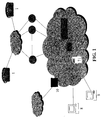
- FIG.1 shows a conceptual picture of the invention.
- a first device (1) is a device that can be used by an originating end-user (not depicted in the figure) for communication purposes.
- the first device (1) can, amongst others, be a telephone or a mobile telephone.
- the first device (1) is used in a telephony domain in which telephony related services are provided such as voice services and SMS (short message service).
- a telephony domain comprises exchanges that route the telephony traffic.
- Also comprised by a telephony domain are facilities that provide signaling functionality.
- a well-known signaling system is signaling system no. 7 (SS no7).
- the first device (1) is connected to a telephony network (2).
- the telephony network (2) comprises one or more local exchanges.
- a PoP (3) is a dial-in facility capable of handling traffic originating from a first device (1).
- a PoP (3) comprises access equipment via which end-users using a first device (3) can connect to a domain (11) of an Internet service Provider.
- the PoP's (3) can be geographically located in such a way that the end-users using the first devices (1) are charged with local distance fees instead of long distance fees by the operator operating the telephony network (2), which is an advantage of the use of the PoP's (3).
- the PoP's (3) are able to handle voice traffic, including the signaling procedures needed to set a connection. Additionally, a PoP (3) may also comprise facilities for handling data traffic such as modems and other dial-in equipment.
- a PoP (3) can be connected to the domain (11) of an Internet Service Provider via a leased line, although other types of connections are not excluded in the present invention.
- the domain (11) can be a location comprising different types of data communications related equipment. In the case of an Internet Service Provider, this equipment is based on the IP protocol, and other protocols and techniques that are related to IP (such as HTTP, FTP, and JAVA). Different types of equipment can be comprised by the domain (11) such as a local area network (LAN), servers, routers, and hosts. Also software and firmware can be comprised by the domain (11).
- the first device (1) In the set up phase for establishing a communication path between the first device (1) and a second device (8) the first device (1) is connected to a connect facility (4).
- the connect facility (4) is able to set up a communication path bases on a address identifier that is supplied by the end-user using the first device (1), i.e. the originating end-user. It can be sufficient to supply the connect facility (4) with one address identifier, but it may also the case that more than one address identifiers are needed to define the second device (the destination device).
- the address identifier can be a client number associated with the end-user that uses the second device (8).
- the client number can be provided by the Internet Service Provider to which the addressed end-user is subscribed.
- the originating end-user has to enter the client number via the first device (1) after there is established a connection between the first device (1) and the connect facility (4).
- the client number is entered by the originating end-user during the establishing of the connection.
- the address identifier comprises address information such as a zip code.
- the address identifier is information provided by the originating end-user via a voice response system comprised by the connect facility (4), for instance the name and the address of the destination end-user. Other types of information are not excluded in the present invention when considering the address identifier.
- An advantage of the usage of the connect facility (4) is that the originating end-user does not need a telephone number to set up a communication path to the destination end-user.
- the second device (8) can, amongst others, be a personal computer.
- the second device (8) is used in a data communication domain in which data communications related services are provided based, in this embodiment, IP.
- the second device (8) can be connected to the domain (11) of the Internet Service Provider via a dialed connection. It may be the case that for this purpose a point of presence is used that is integrated in the point of presence (3) that is used to connect the first device (1) to domain (11). However, it may also be the case that both access facilities to the domain (11) of the Internet Service Provider are separate.
- Domain (11) comprises a server (7) via which services are provided to the end-users using the second device (8) such as e-mail services, hosting services and access to the Internet.
- a firewall (10) is comprised by domain (11) for security purposes. There is also at least one router (6) in the local network of the Internet Service Provider.
- the connect facility (4) When the communication path between the first device (1) and the second device (8) is defined using the connect facility (4) the traffic between both devices is routed through a converter facility (5).
- the converter facility (5) converts voice traffic into data traffic, the latter being in this embodiment VolP.
Landscapes
- Engineering & Computer Science (AREA)
- Computer Networks & Wireless Communication (AREA)
- Signal Processing (AREA)
- Business, Economics & Management (AREA)
- General Business, Economics & Management (AREA)
- Multimedia (AREA)
- Computer Security & Cryptography (AREA)
- Data Exchanges In Wide-Area Networks (AREA)
- Telephonic Communication Services (AREA)
Abstract
Description
- The present invention relates to a method for addressing a destination device present in a data network domain when setting up a communication path from an originating device in the telephony domain.
- Nowadays, voice over IP (VolP) services are widespread. In the case of VolP voice traffic is transported using a data communication protocol, i.e. the Internet Protocol (IP). VolP can be applied on the Internet but is also possible to have VolP available within a private network such as an in-company data network. In general, conversion is needed to convert the speech signal to be transported into a data signal that is suitable to be transported via a data communication protocol. Regarding the end-user equipment that is involved in VolP, one can in general distinguish equipment that is related to the telephony domain and equipment that is related to the data communication domain. Equipment of the first category can for instance be a (mobile) telephone. Equipment of the latter category can for instance be a personal computer that comprises facilities for enabling speech communication. These facilities can be a microphone, a speaker, etc. There is also a distinction with regard to the way in which a VolP call is set up. A VolP call can be set up from a device in the telephony domain such as a telephone to a device in the data communication domain such as a personal computer or vice versa. It is also possible that a VolP call is set up between two devices in the data communication domain, such as two personal computers. In all situations it is needed that the originator addresses the destination but the way in which this is done depends, amongst others, on the type of originating and destination equipment.
- In WO 01/35605 a method is presented for providing telephony services via an IP network, in which case a telephone number is used to address the destination. This is the case if an end-user sets up a communication path using a telephone with another end-user that uses a computer device. A draw back of this prior art is that the destination then needs to be addressed by a telephone number which telephone number is not always available to the originating end-user. For instance, if the destination end-user is subscribed to an Internet Service provider (ISP) this end-user can be on-line from any location. The destination end-user is not limited to a specific physical location, so the telephone number associated with the actual physical location may be different each time. It would then not be possible for the originating end-user to set-up a communication path.
- It is an object of the invention to eliminate the drawbacks of the prior art and to provide a method for addressing from a device in the telephony domain another device that is in the data communications domain without using a telephone number.
- In accordance with this invention, a method is disclosed for addressing from a first device in a telephony domain a second device in a data communication domain for setting up a communication path between the first device and the second device, the second device being connected to a domain of an Internet Service Provider, the method comprises the steps of setting up a connection between the first device and a connect facility in the Internet Service Provider domain using a telephone number and supplying said connect facility via said connection with an address identifier that is associated with the second device.
- In a first aspect of the invention a method is disclosed for setting up a communication path from a first device in a telephony domain to a second device in a data communication domain. The device in the telephony domain can be a telephone, a mobile telephone or any other type of device via which telephony related services could be used. The end-user using the first device dials a telephone number in order to connect to a point of presence (PoP), via which the domain of an Internet Service Provider can be accessed. A PoP according to the present invention is unlike state of the art PoP's configured to handle voice traffic. Another advantage of the PoP's according to the invention is that it is possible to connect from a first device to the ISP's domain without being charged with long distance fees.
- The domain of the ISP comprises a connect facility which enables the originating end-user to address the destination end-user without using a telephone number. For instance, a client number, address information, an URL address, an e-mail address or an IP address can be used to address the destination end-user or the device used by the destination end-user. For the ISP it is possible to provide the telephonedirectory with the telephone number via which the PoP's can be accessed and the client numbers of the end-users that are subscribed to that ISP. In such way the telephone number is publicly available. With this information other end-users, that are not subscribed to the ISP, can connect to the devices of the end-users subscribed to the ISP without having available the telephone numbers of the latter users. If the originating end-user is subscribed to the ISP, then it is possible for the ISP to make available the client numbers via a web page. If subscribers are connected to the Internet with fixed IP addresses, then it is possible to use these IP addresses for setting up communications paths between end-users for voice traffic without using the connect facility.
- The foregoing aspects and many of attendant advantages of this invention will become better understood by reference to the following detailed description, when taken in conjunction with the accompanying drawing, wherein:
- FIG. 1 is a block diagram illustrating the concept of addressing a device in a data communication domain.
- For the purpose of teaching of the invention, preferred embodiments of the method and devices of the invention are described in the sequel. It will be apparent to the person skilled in the art that other alternative and equivalent embodiments of the invention can be conceived and reduced to practice without departing form the true spirit of the invention, the scope of the invention being limited only by the appended claims as finally granted.
- FIG.1 shows a conceptual picture of the invention. A first device (1) is a device that can be used by an originating end-user (not depicted in the figure) for communication purposes. The first device (1) can, amongst others, be a telephone or a mobile telephone. In general, the first device (1) is used in a telephony domain in which telephony related services are provided such as voice services and SMS (short message service). A telephony domain comprises exchanges that route the telephony traffic. Also comprised by a telephony domain are facilities that provide signaling functionality. A well-known signaling system is signaling system no. 7 (SS no7). The first device (1) is connected to a telephony network (2). The telephony network (2) comprises one or more local exchanges. Between a first device (1) and a local exchange there often is a signaling procedure when a connected is set up via the first device (1). It may be possible that two first devices (1) are connected to the same local exchange in the case that both first devices (1) are located near each other. But the two first devices (1) are each connected to another local exchange in other cases. Via the telephony network (2) a point of presence (PoP, 3) can be reached. A PoP (3) is a dial-in facility capable of handling traffic originating from a first device (1). A PoP (3) comprises access equipment via which end-users using a first device (3) can connect to a domain (11) of an Internet service Provider. The PoP's (3) can be geographically located in such a way that the end-users using the first devices (1) are charged with local distance fees instead of long distance fees by the operator operating the telephony network (2), which is an advantage of the use of the PoP's (3). The PoP's (3) are able to handle voice traffic, including the signaling procedures needed to set a connection. Additionally, a PoP (3) may also comprise facilities for handling data traffic such as modems and other dial-in equipment.
- A PoP (3) can be connected to the domain (11) of an Internet Service Provider via a leased line, although other types of connections are not excluded in the present invention. The domain (11) can be a location comprising different types of data communications related equipment. In the case of an Internet Service Provider, this equipment is based on the IP protocol, and other protocols and techniques that are related to IP (such as HTTP, FTP, and JAVA). Different types of equipment can be comprised by the domain (11) such as a local area network (LAN), servers, routers, and hosts. Also software and firmware can be comprised by the domain (11). In the set up phase for establishing a communication path between the first device (1) and a second device (8) the first device (1) is connected to a connect facility (4). The connect facility (4) is able to set up a communication path bases on a address identifier that is supplied by the end-user using the first device (1), i.e. the originating end-user. It can be sufficient to supply the connect facility (4) with one address identifier, but it may also the case that more than one address identifiers are needed to define the second device (the destination device). The address identifier can be a client number associated with the end-user that uses the second device (8). The client number can be provided by the Internet Service Provider to which the addressed end-user is subscribed. The originating end-user has to enter the client number via the first device (1) after there is established a connection between the first device (1) and the connect facility (4). However, it may also be possible that the client number is entered by the originating end-user during the establishing of the connection. In another embodiment the address identifier comprises address information such as a zip code. In yet another embodiment of the present invention the address identifier is information provided by the originating end-user via a voice response system comprised by the connect facility (4), for instance the name and the address of the destination end-user. Other types of information are not excluded in the present invention when considering the address identifier. An advantage of the usage of the connect facility (4) is that the originating end-user does not need a telephone number to set up a communication path to the destination end-user.
- The second device (8) can, amongst others, be a personal computer. In general, the second device (8) is used in a data communication domain in which data communications related services are provided based, in this embodiment, IP. The second device (8) can be connected to the domain (11) of the Internet Service Provider via a dialed connection. It may be the case that for this purpose a point of presence is used that is integrated in the point of presence (3) that is used to connect the first device (1) to domain (11). However, it may also be the case that both access facilities to the domain (11) of the Internet Service Provider are separate. Domain (11) comprises a server (7) via which services are provided to the end-users using the second device (8) such as e-mail services, hosting services and access to the Internet. A firewall (10) is comprised by domain (11) for security purposes. There is also at least one router (6) in the local network of the Internet Service Provider.
- When the communication path between the first device (1) and the second device (8) is defined using the connect facility (4) the traffic between both devices is routed through a converter facility (5). The converter facility (5) converts voice traffic into data traffic, the latter being in this embodiment VolP.
Claims (10)
- Method for addressing from a first device (1) in a telephony domain a second device (8) in a data communication domain for setting up a communication path between the first device (1) and the second device (8), the second device (8) being connected to a domain (11) of an Internet Service Provider, the method comprises the steps of setting up a connection between the first device (1) and a connect facility (4) in the Internet Service Provider domain (11) using a telephone number and supplying said connect facility (4) via said connection with an address identifier that is associated with the second device (8).
- Method according to claim 1, in which via the connect facility (4) upon receipt of the address identifier the communication path is set up, which communication path comprises a converter facility (5) for the conversion between voice traffic and data traffic.
- Method according to claim 1 or 2, in which the connection between the first device (1) and the connect facility (4) is set up via point of presence.
- Method according to any of the preceding claims, in which a data communication protocol that used in the data communication domain is the Internet Protocol.
- Method according to any of the preceding claims, in which the first device (1) is a telephone.
- Method according to any of the preceding claims, in which the second device (8) is a personal computer.
- Method according to any of the preceding claims, in which the address identifier is a code for identifying the second device (8) that is entered via the first device (1) in combination with the telephone number for connecting the first device (1) and connect facility (4).
- Method according to claim 7, in which the code is a client number associated with the user of the second device (8).
- Method according to claim 7, in which the code is a zip code in combination with a home address.
- Method according to claims 1 to 6, in which the connect facility (4) comprises a voice response system, which receives via the first device (1) the address identifier in the form of a spoken message.
Priority Applications (4)
| Application Number | Priority Date | Filing Date | Title |
|---|---|---|---|
| EP04077496A EP1635527B1 (en) | 2004-09-08 | 2004-09-08 | Method for addressing a device in behalf of establishing a communication path between a telephony network and a data network |
| AT04077496T ATE515870T1 (en) | 2004-09-08 | 2004-09-08 | METHOD FOR ADDRESSING A COMMUNICATIONS DEVICE FOR ESTABLISHING A TRANSMISSION PATH BETWEEN A DATA NETWORK AND A TELEPHONE NETWORK |
| PCT/EP2005/008977 WO2006027095A1 (en) | 2004-09-08 | 2005-08-18 | Method for addressing a device in behalf of establishing a communication path between a telephony network and a data network |
| US11/660,124 US20070263801A1 (en) | 2004-09-08 | 2005-08-18 | Method for Addressing a Device in Behalf of Establishing a Communication Path Between a Telephony Network and a Data Network |
Applications Claiming Priority (1)
| Application Number | Priority Date | Filing Date | Title |
|---|---|---|---|
| EP04077496A EP1635527B1 (en) | 2004-09-08 | 2004-09-08 | Method for addressing a device in behalf of establishing a communication path between a telephony network and a data network |
Publications (2)
| Publication Number | Publication Date |
|---|---|
| EP1635527A1 true EP1635527A1 (en) | 2006-03-15 |
| EP1635527B1 EP1635527B1 (en) | 2011-07-06 |
Family
ID=34928497
Family Applications (1)
| Application Number | Title | Priority Date | Filing Date |
|---|---|---|---|
| EP04077496A Expired - Lifetime EP1635527B1 (en) | 2004-09-08 | 2004-09-08 | Method for addressing a device in behalf of establishing a communication path between a telephony network and a data network |
Country Status (4)
| Country | Link |
|---|---|
| US (1) | US20070263801A1 (en) |
| EP (1) | EP1635527B1 (en) |
| AT (1) | ATE515870T1 (en) |
| WO (1) | WO2006027095A1 (en) |
Citations (3)
| Publication number | Priority date | Publication date | Assignee | Title |
|---|---|---|---|---|
| WO1998041925A1 (en) * | 1997-03-17 | 1998-09-24 | Geonet Limited, L.P. | System and method for managing internet user access |
| US6192044B1 (en) * | 1997-03-31 | 2001-02-20 | Intel Corporation | Employing a look-up service and a callee connection service to establish a network phone call between a caller and a callee |
| US20010018656A1 (en) * | 2000-02-28 | 2001-08-30 | Hartmut Weik | Method and server for setting up a communication connection via an IP network |
Family Cites Families (6)
| Publication number | Priority date | Publication date | Assignee | Title |
|---|---|---|---|---|
| US6754181B1 (en) * | 1996-11-18 | 2004-06-22 | Mci Communications Corporation | System and method for a directory service supporting a hybrid communication system architecture |
| US7571211B1 (en) * | 2002-04-15 | 2009-08-04 | Lightwaves Systems, Inc. | Method for routing messages over a network based on location |
| US7269162B1 (en) * | 2001-07-20 | 2007-09-11 | Cisco Technology, Inc. | Integration of presence services with a network enabled telephony device |
| US8295270B2 (en) * | 2002-05-16 | 2012-10-23 | International Business Machines Corporation | Internet telephony system for enabling internet telephone access from traditional telephone interface |
| JP4384529B2 (en) * | 2004-03-22 | 2009-12-16 | パナソニック株式会社 | Internet telephone, network server, calling method, and internet telephone system |
| JP4995416B2 (en) * | 2004-10-05 | 2012-08-08 | パナソニック株式会社 | IP communication apparatus and IP communication method |
-
2004
- 2004-09-08 EP EP04077496A patent/EP1635527B1/en not_active Expired - Lifetime
- 2004-09-08 AT AT04077496T patent/ATE515870T1/en not_active IP Right Cessation
-
2005
- 2005-08-18 WO PCT/EP2005/008977 patent/WO2006027095A1/en not_active Ceased
- 2005-08-18 US US11/660,124 patent/US20070263801A1/en not_active Abandoned
Patent Citations (3)
| Publication number | Priority date | Publication date | Assignee | Title |
|---|---|---|---|---|
| WO1998041925A1 (en) * | 1997-03-17 | 1998-09-24 | Geonet Limited, L.P. | System and method for managing internet user access |
| US6192044B1 (en) * | 1997-03-31 | 2001-02-20 | Intel Corporation | Employing a look-up service and a callee connection service to establish a network phone call between a caller and a callee |
| US20010018656A1 (en) * | 2000-02-28 | 2001-08-30 | Hartmut Weik | Method and server for setting up a communication connection via an IP network |
Non-Patent Citations (1)
| Title |
|---|
| SCHOEN U ET AL PINNACLE GROUP: "CONVERGENCE BETWEEN PUBLIC SWITCHING AND THE INTERNET", ISS '97. WORLD TELECOMMUNICATIONS CONGRESS. (INTERNATIONAL SWITCHING SYMPOSIUM). GLOBAL NETWORK EVOLUTION: CONVERGENCE OR COLLISION? TORONTO, SEPT. 21 - 26, 1997, ISS. WORLD TELECOMMUNICATIONS CONGRESS. (INTERNATIONAL SWITCHING SYMPOSIUM), TORONTO, P, vol. VOL. 1, 21 September 1997 (1997-09-21), pages 549 - 560, XP000720563 * |
Also Published As
| Publication number | Publication date |
|---|---|
| US20070263801A1 (en) | 2007-11-15 |
| EP1635527B1 (en) | 2011-07-06 |
| WO2006027095A1 (en) | 2006-03-16 |
| ATE515870T1 (en) | 2011-07-15 |
Similar Documents
| Publication | Publication Date | Title |
|---|---|---|
| US8819293B2 (en) | Method and system for communicating across telephone and data networks | |
| CN101095329B (en) | Distributed voice network | |
| US6192044B1 (en) | Employing a look-up service and a callee connection service to establish a network phone call between a caller and a callee | |
| US20050025136A1 (en) | Methods, systems, and computer program products for establishing VoIP service in a network | |
| US9137361B2 (en) | Method and apparatus for enabling global telephony capabilities in communication networks | |
| CN103442150B (en) | Call method, system and this gateway based on VOIP voice gateways | |
| US8280989B2 (en) | Method, system and apparatus for provisioning a communication client | |
| US20100246572A1 (en) | Method and apparatus for providing user access via multiple partner carriers for international calls | |
| JP2008522557A (en) | Downloading network-based information to IP phones | |
| US8064452B2 (en) | Method and apparatus for routing calls to an alternative endpoint during network disruptions | |
| CN102077561A (en) | A method to manage multiple caller identities in a telecommunication system | |
| US7602887B1 (en) | Method and apparatus for using a single local phone number for routing out of area phone numbers | |
| US20060146789A1 (en) | Method and apparatus for enabling personalized name identification in the calling name field | |
| US8594128B2 (en) | Method and apparatus for enabling dynamic protocol interworking resolution with diverse endpoints | |
| EP2036296A2 (en) | Method and apparatus for establishing class of service across peering communication networks | |
| EP1770962A1 (en) | Method and apparatus for providing internet protocol connectivity without consulting a domain name sytem server | |
| US20070263801A1 (en) | Method for Addressing a Device in Behalf of Establishing a Communication Path Between a Telephony Network and a Data Network | |
| EP4113930A1 (en) | Method and communication system for transmitting signaling information used for establishing a communication session between a calling end device and a called end device | |
| JP2004336663A (en) | Additional ip telephone service provision method | |
| JP4564881B2 (en) | Voice communication system | |
| US7881289B1 (en) | Method and apparatus for porting telephone numbers of endpoint devices | |
| US7852832B1 (en) | Method and apparatus for providing secure interface to externally hosted application servers | |
| JP2003069602A (en) | IP telephone server, IP telephone client, session establishment method and program | |
| KR100798189B1 (en) | Terminal Status Checking Method in Heterogeneous Protocol Environment | |
| US8705380B1 (en) | Method and apparatus for determining proper telephony adaptor configuration and installation |
Legal Events
| Date | Code | Title | Description |
|---|---|---|---|
| PUAI | Public reference made under article 153(3) epc to a published international application that has entered the european phase |
Free format text: ORIGINAL CODE: 0009012 |
|
| AK | Designated contracting states |
Kind code of ref document: A1 Designated state(s): AT BE BG CH CY CZ DE DK EE ES FI FR GB GR HU IE IT LI LU MC NL PL PT RO SE SI SK TR |
|
| AX | Request for extension of the european patent |
Extension state: AL HR LT LV MK |
|
| 17P | Request for examination filed |
Effective date: 20060915 |
|
| AKX | Designation fees paid |
Designated state(s): AT BE BG CH CY CZ DE DK EE ES FI FR GB GR HU IE IT LI LU MC NL PL PT RO SE SI SK TR |
|
| 17Q | First examination report despatched |
Effective date: 20061102 |
|
| GRAP | Despatch of communication of intention to grant a patent |
Free format text: ORIGINAL CODE: EPIDOSNIGR1 |
|
| GRAS | Grant fee paid |
Free format text: ORIGINAL CODE: EPIDOSNIGR3 |
|
| GRAA | (expected) grant |
Free format text: ORIGINAL CODE: 0009210 |
|
| AK | Designated contracting states |
Kind code of ref document: B1 Designated state(s): AT BE BG CH CY CZ DE DK EE ES FI FR GB GR HU IE IT LI LU MC NL PL PT RO SE SI SK TR |
|
| REG | Reference to a national code |
Ref country code: GB Ref legal event code: FG4D |
|
| REG | Reference to a national code |
Ref country code: CH Ref legal event code: EP |
|
| REG | Reference to a national code |
Ref country code: IE Ref legal event code: FG4D |
|
| REG | Reference to a national code |
Ref country code: DE Ref legal event code: R096 Ref document number: 602004033347 Country of ref document: DE Effective date: 20110901 |
|
| REG | Reference to a national code |
Ref country code: NL Ref legal event code: T3 |
|
| PG25 | Lapsed in a contracting state [announced via postgrant information from national office to epo] |
Ref country code: SI Free format text: LAPSE BECAUSE OF FAILURE TO SUBMIT A TRANSLATION OF THE DESCRIPTION OR TO PAY THE FEE WITHIN THE PRESCRIBED TIME-LIMIT Effective date: 20110706 |
|
| REG | Reference to a national code |
Ref country code: AT Ref legal event code: MK05 Ref document number: 515870 Country of ref document: AT Kind code of ref document: T Effective date: 20110706 |
|
| PG25 | Lapsed in a contracting state [announced via postgrant information from national office to epo] |
Ref country code: SE Free format text: LAPSE BECAUSE OF FAILURE TO SUBMIT A TRANSLATION OF THE DESCRIPTION OR TO PAY THE FEE WITHIN THE PRESCRIBED TIME-LIMIT Effective date: 20110706 Ref country code: BE Free format text: LAPSE BECAUSE OF FAILURE TO SUBMIT A TRANSLATION OF THE DESCRIPTION OR TO PAY THE FEE WITHIN THE PRESCRIBED TIME-LIMIT Effective date: 20110706 Ref country code: FI Free format text: LAPSE BECAUSE OF FAILURE TO SUBMIT A TRANSLATION OF THE DESCRIPTION OR TO PAY THE FEE WITHIN THE PRESCRIBED TIME-LIMIT Effective date: 20110706 Ref country code: PT Free format text: LAPSE BECAUSE OF FAILURE TO SUBMIT A TRANSLATION OF THE DESCRIPTION OR TO PAY THE FEE WITHIN THE PRESCRIBED TIME-LIMIT Effective date: 20111107 |
|
| PG25 | Lapsed in a contracting state [announced via postgrant information from national office to epo] |
Ref country code: AT Free format text: LAPSE BECAUSE OF FAILURE TO SUBMIT A TRANSLATION OF THE DESCRIPTION OR TO PAY THE FEE WITHIN THE PRESCRIBED TIME-LIMIT Effective date: 20110706 Ref country code: CY Free format text: LAPSE BECAUSE OF FAILURE TO SUBMIT A TRANSLATION OF THE DESCRIPTION OR TO PAY THE FEE WITHIN THE PRESCRIBED TIME-LIMIT Effective date: 20110706 Ref country code: GR Free format text: LAPSE BECAUSE OF FAILURE TO SUBMIT A TRANSLATION OF THE DESCRIPTION OR TO PAY THE FEE WITHIN THE PRESCRIBED TIME-LIMIT Effective date: 20111007 Ref country code: PL Free format text: LAPSE BECAUSE OF FAILURE TO SUBMIT A TRANSLATION OF THE DESCRIPTION OR TO PAY THE FEE WITHIN THE PRESCRIBED TIME-LIMIT Effective date: 20110706 |
|
| PG25 | Lapsed in a contracting state [announced via postgrant information from national office to epo] |
Ref country code: MC Free format text: LAPSE BECAUSE OF NON-PAYMENT OF DUE FEES Effective date: 20110930 Ref country code: CZ Free format text: LAPSE BECAUSE OF FAILURE TO SUBMIT A TRANSLATION OF THE DESCRIPTION OR TO PAY THE FEE WITHIN THE PRESCRIBED TIME-LIMIT Effective date: 20110706 Ref country code: SK Free format text: LAPSE BECAUSE OF FAILURE TO SUBMIT A TRANSLATION OF THE DESCRIPTION OR TO PAY THE FEE WITHIN THE PRESCRIBED TIME-LIMIT Effective date: 20110706 |
|
| REG | Reference to a national code |
Ref country code: CH Ref legal event code: PL |
|
| PLBE | No opposition filed within time limit |
Free format text: ORIGINAL CODE: 0009261 |
|
| STAA | Information on the status of an ep patent application or granted ep patent |
Free format text: STATUS: NO OPPOSITION FILED WITHIN TIME LIMIT |
|
| PG25 | Lapsed in a contracting state [announced via postgrant information from national office to epo] |
Ref country code: IT Free format text: LAPSE BECAUSE OF FAILURE TO SUBMIT A TRANSLATION OF THE DESCRIPTION OR TO PAY THE FEE WITHIN THE PRESCRIBED TIME-LIMIT Effective date: 20110706 Ref country code: EE Free format text: LAPSE BECAUSE OF FAILURE TO SUBMIT A TRANSLATION OF THE DESCRIPTION OR TO PAY THE FEE WITHIN THE PRESCRIBED TIME-LIMIT Effective date: 20110706 Ref country code: RO Free format text: LAPSE BECAUSE OF FAILURE TO SUBMIT A TRANSLATION OF THE DESCRIPTION OR TO PAY THE FEE WITHIN THE PRESCRIBED TIME-LIMIT Effective date: 20110706 |
|
| 26N | No opposition filed |
Effective date: 20120411 |
|
| REG | Reference to a national code |
Ref country code: IE Ref legal event code: MM4A |
|
| PG25 | Lapsed in a contracting state [announced via postgrant information from national office to epo] |
Ref country code: DK Free format text: LAPSE BECAUSE OF FAILURE TO SUBMIT A TRANSLATION OF THE DESCRIPTION OR TO PAY THE FEE WITHIN THE PRESCRIBED TIME-LIMIT Effective date: 20110706 |
|
| PG25 | Lapsed in a contracting state [announced via postgrant information from national office to epo] |
Ref country code: CH Free format text: LAPSE BECAUSE OF NON-PAYMENT OF DUE FEES Effective date: 20110930 Ref country code: LI Free format text: LAPSE BECAUSE OF NON-PAYMENT OF DUE FEES Effective date: 20110930 Ref country code: IE Free format text: LAPSE BECAUSE OF NON-PAYMENT OF DUE FEES Effective date: 20110908 |
|
| REG | Reference to a national code |
Ref country code: DE Ref legal event code: R097 Ref document number: 602004033347 Country of ref document: DE Effective date: 20120411 |
|
| PG25 | Lapsed in a contracting state [announced via postgrant information from national office to epo] |
Ref country code: ES Free format text: LAPSE BECAUSE OF FAILURE TO SUBMIT A TRANSLATION OF THE DESCRIPTION OR TO PAY THE FEE WITHIN THE PRESCRIBED TIME-LIMIT Effective date: 20111017 |
|
| PG25 | Lapsed in a contracting state [announced via postgrant information from national office to epo] |
Ref country code: LU Free format text: LAPSE BECAUSE OF NON-PAYMENT OF DUE FEES Effective date: 20110908 |
|
| PG25 | Lapsed in a contracting state [announced via postgrant information from national office to epo] |
Ref country code: BG Free format text: LAPSE BECAUSE OF FAILURE TO SUBMIT A TRANSLATION OF THE DESCRIPTION OR TO PAY THE FEE WITHIN THE PRESCRIBED TIME-LIMIT Effective date: 20111006 |
|
| PG25 | Lapsed in a contracting state [announced via postgrant information from national office to epo] |
Ref country code: TR Free format text: LAPSE BECAUSE OF FAILURE TO SUBMIT A TRANSLATION OF THE DESCRIPTION OR TO PAY THE FEE WITHIN THE PRESCRIBED TIME-LIMIT Effective date: 20110706 |
|
| PG25 | Lapsed in a contracting state [announced via postgrant information from national office to epo] |
Ref country code: HU Free format text: LAPSE BECAUSE OF FAILURE TO SUBMIT A TRANSLATION OF THE DESCRIPTION OR TO PAY THE FEE WITHIN THE PRESCRIBED TIME-LIMIT Effective date: 20110706 |
|
| PGFP | Annual fee paid to national office [announced via postgrant information from national office to epo] |
Ref country code: DE Payment date: 20140922 Year of fee payment: 11 |
|
| PGFP | Annual fee paid to national office [announced via postgrant information from national office to epo] |
Ref country code: GB Payment date: 20140919 Year of fee payment: 11 Ref country code: FR Payment date: 20140919 Year of fee payment: 11 |
|
| PGFP | Annual fee paid to national office [announced via postgrant information from national office to epo] |
Ref country code: NL Payment date: 20140918 Year of fee payment: 11 |
|
| REG | Reference to a national code |
Ref country code: DE Ref legal event code: R119 Ref document number: 602004033347 Country of ref document: DE |
|
| GBPC | Gb: european patent ceased through non-payment of renewal fee |
Effective date: 20150908 |
|
| REG | Reference to a national code |
Ref country code: NL Ref legal event code: MM Effective date: 20151001 |
|
| REG | Reference to a national code |
Ref country code: FR Ref legal event code: ST Effective date: 20160531 |
|
| PG25 | Lapsed in a contracting state [announced via postgrant information from national office to epo] |
Ref country code: DE Free format text: LAPSE BECAUSE OF NON-PAYMENT OF DUE FEES Effective date: 20160401 Ref country code: GB Free format text: LAPSE BECAUSE OF NON-PAYMENT OF DUE FEES Effective date: 20150908 |
|
| PG25 | Lapsed in a contracting state [announced via postgrant information from national office to epo] |
Ref country code: FR Free format text: LAPSE BECAUSE OF NON-PAYMENT OF DUE FEES Effective date: 20150930 Ref country code: NL Free format text: LAPSE BECAUSE OF NON-PAYMENT OF DUE FEES Effective date: 20151001 |