EP1635263A2 - Verfahren und Vorrichtung zur Code-Eingabe - Google Patents
Verfahren und Vorrichtung zur Code-Eingabe Download PDFInfo
- Publication number
- EP1635263A2 EP1635263A2 EP05107761A EP05107761A EP1635263A2 EP 1635263 A2 EP1635263 A2 EP 1635263A2 EP 05107761 A EP05107761 A EP 05107761A EP 05107761 A EP05107761 A EP 05107761A EP 1635263 A2 EP1635263 A2 EP 1635263A2
- Authority
- EP
- European Patent Office
- Prior art keywords
- branch
- instruction
- during execution
- traps
- return
- Prior art date
- Legal status (The legal status is an assumption and is not a legal conclusion. Google has not performed a legal analysis and makes no representation as to the accuracy of the status listed.)
- Withdrawn
Links
Images

Classifications
-
- G—PHYSICS
- G06—COMPUTING OR CALCULATING; COUNTING
- G06F—ELECTRIC DIGITAL DATA PROCESSING
- G06F11/00—Error detection; Error correction; Monitoring
- G06F11/36—Prevention of errors by analysis, debugging or testing of software
- G06F11/362—Debugging of software
- G06F11/3644—Debugging of software by instrumenting at runtime
-
- G—PHYSICS
- G06—COMPUTING OR CALCULATING; COUNTING
- G06F—ELECTRIC DIGITAL DATA PROCESSING
- G06F11/00—Error detection; Error correction; Monitoring
- G06F11/28—Error detection; Error correction; Monitoring by checking the correct order of processing
-
- G—PHYSICS
- G06—COMPUTING OR CALCULATING; COUNTING
- G06F—ELECTRIC DIGITAL DATA PROCESSING
- G06F21/00—Security arrangements for protecting computers, components thereof, programs or data against unauthorised activity
- G06F21/50—Monitoring users, programs or devices to maintain the integrity of platforms, e.g. of processors, firmware or operating systems
- G06F21/52—Monitoring users, programs or devices to maintain the integrity of platforms, e.g. of processors, firmware or operating systems during program execution, e.g. stack integrity ; Preventing unwanted data erasure; Buffer overflow
- G06F21/54—Monitoring users, programs or devices to maintain the integrity of platforms, e.g. of processors, firmware or operating systems during program execution, e.g. stack integrity ; Preventing unwanted data erasure; Buffer overflow by adding security routines or objects to programs
-
- G—PHYSICS
- G06—COMPUTING OR CALCULATING; COUNTING
- G06F—ELECTRIC DIGITAL DATA PROCESSING
- G06F9/00—Arrangements for program control, e.g. control units
- G06F9/06—Arrangements for program control, e.g. control units using stored programs, i.e. using an internal store of processing equipment to receive or retain programs
- G06F9/44—Arrangements for executing specific programs
- G06F9/448—Execution paradigms, e.g. implementations of programming paradigms
- G06F9/4482—Procedural
- G06F9/4484—Executing subprograms
Definitions
- the present invention relates to a method and apparatus for inserting code in computing environments, and is of particular but by no means exclusive application in effecting dynamic code insertion and for identifying and preventing stack buffer overflow security attacks.
- Patching is an existing technique whereby programming code is inserted into existing code without affecting that existing code. Such code insertion can be done either statically or dynamically, although dynamic code insertion generally has advantages over static code insertion. Dynamic code insertion is also referred to as “dynamic patching” or as the insertion of a "dynamic patch”.
- Code insertion is used in many tasks, including tracing, debugging and instruction profiling. Code insertion can be used to implement return address stacks to prevent security vulnerabilities such as stack-based attacks, and to insert a wrapper function (or trampoline) for intercepting a function call for tracing, debugging, profile sampling and stack-based attack monitoring purposes. However, although code insertion is extremely useful, it can result in code bloat as well as performance overhead.
- DynInst API library see, for example, www.cs.wisc.edu/ ⁇ kosart/papers/dyn-security.pdf
- DynInst API library see, for example, www.cs.wisc.edu/ ⁇ kosart/papers/dyn-security.pdf
- Caliper a trade mark of Hewlett-Packard Company
- Caliper uses a runtime code insertion technique that is based on Intel Itanium (Intel Corporation) processor special features, Performance Monitor Registers, Brach trace buffers, etc. See, for example, www.usenix.org/events/osdi2000/wiess2000/full_papers/hundt/hundt.pdf.
- Buffer overflows are commonly used to execute some malicious code on the stack of a target computer.
- An overflow in a local variable maintained in the stack memory may overwrite the return address preserved during the Call phase by a different value.
- a hacker can exploit this effect by replacing the return address with an arbitrary value that points to the hacker's set of malicious instructions.
- the control of execution can be redirected to these malicious instructions, with potentially adverse consequences for the affected host or network to which that host belongs.
- the result of this security breach can range from minor (such as the crash of a non-critical application) to severe (such as a root compromise attack or Denial of Service problem in critical services due to the daemon crashes).
- Stack Shield is a compiler solution that provides protection by taking a copy of the Return Pointer and temporarily placing it in a location (such as heap) that cannot be overwritten by an overflow in the stack.
- Non-executable stack is a memory management solution in which the execution rights on stack pages are disabled.
- a program that attempts to execute from stack pages will generate an execution protection trap.
- This non-executable stack approach detects buffer overflow attacks by terminating the program that attempted to execute from stack memory pages.
- this approach still allows the root cause of the problem, that is, the overwriting of return addresses. A hacker can thus still execute codes from places such as heap or code.
- the intercepting of the branch and the redirecting of processing are performed by a trap handler.
- the trap handler acts as a branch interceptor.
- the routine may contain or comprise the code. Further, the processing of the routine may depend on a property of the branch (such as its identity or target) that has been intercepted.
- the routine may comprise a tracing routine for performing tracing, a profiler for performing profiling or a buffer overflow detector for detecting (and possibly handling) a buffer overflow attack.
- the trap handler may be configured to intercept and respond - while taken branch traps are enabled - to a plurality of branches encountered during execution of the process or to any branches encountered during execution of the process.
- the method may include disabling taken branch traps under particular circumstances (as is discussed further below) .
- the method includes rewriting (preferably by means of the trap handler) an original target of the branch instruction that prompted the branch to a function call interceptor.
- the method includes processing the branch instruction that prompted the branch via a trap disabled further branch instruction after processing the routine (and hence the predefined task of the routine, such as profiling or buffer overflow attack detection). For example, if taken branch traps have been used to attach one or more programs to debuggers for enabling debugging on those programs, this technique could be used to allow the programs to refuse to accept any such forced debugging.
- the method is adapted to perform dynamic code insertion.
- taken branch traps are intended for debugging, tracing and the like.
- processors including RISC processors
- branch interceptors Processors that support taken branch traps define ways to enable and disable the taken branch traps as required, but generally taken branch traps are disabled by default.
- taken branch traps are handled by the OS kernel, which can use them to assist in debugging programs for break points.
- this aspect of the present invention allows a user to deploy a dynamic patch only when required. It will be understood that, while reference is made above to taken branch traps, this feature can be in the form of other functions that permit the trapping of branching.
- Taken branch traps are generally turned on against a thread or process, resulting in traps being generated on every branch and branch return. Taken branch traps are generally generated after the branch is made, in the instruction completer.
- the routine can comprise one or more instructions, and in one embodiment comprises a stub.
- the routine comprises a stub that redirects processing to a wrapper (or "trampoline”) function.
- the method may include replacing a branch target of the branch instruction that prompted the branch with a wrapper function.
- the trampoline could be executed followed by the original branch target.
- This approach can be useful for observing returns from functions; in some cases, such as where there is insufficient room in the function to be called to insert code owing to that function having perhaps only one or two instructions, it may be the only viable approach.
- the method may include inserting at an entry to a target function of the branch instruction that prompted the branch a further branch instruction.
- the further branch instruction may branch to a wrapper function.
- This approach is preferred for observing function calls (such as library functions) that are invoked from many places. In such cases, this approach limits the code insertion to a single location.
- the method includes avoiding any taken branches when the code is active to avoid the method's becoming recursive.
- the method includes providing the branch instruction that prompted the branch with a completer that indicates whether or not further traps should be generated.
- any further traps on branches that have already been processed can be prevented as the instructions are already in place to handle them. That is, further traps can be avoided on the branch instructions of i) branches to (for example) trampolines that observe branch calls and returns, and ii) branches within (for example) trampolines that are written for observing branch calls and returns.
- the PA-RISC (a trade mark of Hewlett-Packard Company processor provides SSM (Set System Mask) and RSM (Reset System Mask) instructions, which allow the creation of branches without obtaining taken branch traps.
- a bit (called “T bit") is provided in the Processor Status Word (PSW) for enabling or disabling taken branch traps. It is thus possible by means of SSM and RSM to make "taken branch trap free" branches as follows:
- RSM and SSM are privileged instructions that cannot be run directly from user space and that there is an overhead of two instructions per branch.
- the method provides a profiler, while in another embodiment, the method provides a tracer.
- the present invention provides a method for inserting code during execution of a process in a computing environment, comprising:
- the trap handler may be configured to intercept and respond - while taken branch traps are enabled - to a plurality of branches encountered during execution of the process or to any branches encountered during execution of the process.
- the method may include disabling taken branch traps under particular circumstances (as is discussed further below) .
- the method includes redirecting processing to a routine that performs the storing of the copy of the return address.
- the intercepting of the branch and the redirecting of processing are performed by a trap handler.
- the method includes refraining from executing the return instruction. In such cases, the method may include terminating the process.
- the method may include intercepting - while taken branch traps are enabled - a plurality of or any branches encountered during execution of the process
- the method includes providing software portions for determining whether any difference between the return address for the return instruction and the copy of the return address is due to a genuine or an illicit branch.
- a method of dynamically inserting instruction stubs in a program is loaded into the memory of a computer 100 (having CPU box 102, display 104 and keyboard 106).
- the CPU box 102 includes a hard disk, RAM, communications bus, etc., as well as a PA-RISC processor (though it will be appreciated that it could also be in the form of any other processor that also supports taken branch traps or like functionality for trapping branching).
- the computer 100 includes a software trap handler in the form of a branch interceptor for intercepting and responding to taken branch traps generated in response to branching during execution of the program (when taken branch traps are enabled on the program) .
- a software trap handler in the form of a branch interceptor for intercepting and responding to taken branch traps generated in response to branching during execution of the program (when taken branch traps are enabled on the program) . This allows the dynamic insertion of code in the form of instruction stubs during program execution. This is explained in greater detail below by reference to a number of Examples.
- code insertion can then be effected in a number of ways.
- one approach is to replace the branch target of the branch instruction with a trampoline function. During execution, the trampoline is executed followed by the original branch. This approach can be useful for observing returns from functions.
- Another approach involves inserting a branch instruction upon entering a function.
- the branch instruction that branches to the trampoline is inserted at the entry of the original function. This approach is preferred for observing function calls (such as library functions) that are invoked from many places.
- a C program has a main() function that calls function_A().
- the task is to insert trampoline_call() and trampoline_return () for function call and return respectively.
- main+20 BE function_A main+24 : LD0 0(r0),r26 ...
- function_A function_A+0 : STW r0, ⁇ 16(r30) function_A+4 : LDO 64(r30),r30 ... function_A+64 : BV 0(rp)
- branch instruction expresses in its completer whether or not a trap is actually required. This expression has precedence over the taken branch trap global mask (global to thread or process).
- such a branch instruction has the following syntax: ⁇ branch>,[DTBT
- the instruction completers DTBT, ETBT and NONE have the following meanings:
- a first example according to this embodiment is a general purpose dynamic code insertion method that can be used for profiling, function tracing, implementing buffer overflow detection algorithms dynamically.
- taken branch traps are enabled against applications.
- This trap handler rewrites the original branch target to a function call interceptor.
- the interpreter after its predefined task (such as profiling or buffer overflow attack detection), makes the original branch via a trap disabled branch instruction.
- the trampoline functions and the Return Pointer stack are allocated as follows:
- Binary (ABI) compatible software split stacks mechanisms are implemented to prevent stack-based attacks without any added performance penalty. This is particularly useful with processors that employ register linked procedure calls and returns, though it is not limited to such processors.
- Register linked procedure calls and returns employ a link register; the branch instruction saves the return address in this link register for later use by the return instructions.
- stack buffer overflows can create security problems when the link register spill-fill mechanism uses the stack for storage, which is so in most cases.
- a stack buffer overflow can overwrite the saved link register's contents during the spill and fill load the overwritten data into the link register.
- the program's execution control can be redirected to some place other than its usual execution path.
- the act of gaining control of a program by creating a stack overflow is known as a stack-based attacks.
- a split-stack mechanism can prevent stack-based attacks. Such attacks can be prevented if a microprocessor can provide the following facilities:
- the branch trap handler of this embodiment is employed in this scenario with the following effects:
- Example 3 is comparable to Example 2, and involves using taken branch processor traps to identify stack buffer overflow security attacks as soon as they happen so that they can be prevented from affecting the targeted host computer.
- the detection is symptom-triggered, and is effected by seeing whether the return address saved in the stack (or some other memory for nested function calls) is replaced by a different value or not. If the return address is replaced, then it could be a result of buffer overflow security attack. When a buffer overflow attack is detected in this way, preventive action can be taken; this may involve terminating the affected program.
- the buffer overflow detection and prevention logic contains two steps:
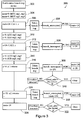
- y() proceeds at step 314 until, at step 316, y() returns to x(), which again generates a taken branch trap that is detected by branch_interceptor() 308.
- Example 4 of this embodiment setjmp and longjmp (which save and restore the state of a program) are handled.
- the function branch_interceptor() is modified (as compared with the version given above in Example 3):
- FIG. 4 is a schematic view of a data storage medium 400 according to another embodiment.
- the data storage medium 400 is in the form of a CD-ROM 402 that contains program instructions for dynamically inserting code in any of the manners described above by reference to FIGS. 1 to 3.
- the particular type of data storage medium may be selected according to need or other requirements.
- the data storage medium 400 could be in the form of a magnetic medium, but essentially any data storage medium will suffice. Indeed, the user need not be aware of which type of data storage medium is used, as the actual data storage medium could be located and accessed remotely.
Landscapes
- Engineering & Computer Science (AREA)
- Theoretical Computer Science (AREA)
- Computer Security & Cryptography (AREA)
- Software Systems (AREA)
- Physics & Mathematics (AREA)
- General Engineering & Computer Science (AREA)
- General Physics & Mathematics (AREA)
- Computer Hardware Design (AREA)
- Quality & Reliability (AREA)
- Debugging And Monitoring (AREA)
- Devices For Executing Special Programs (AREA)
- Executing Machine-Instructions (AREA)
Applications Claiming Priority (1)
| Application Number | Priority Date | Filing Date | Title |
|---|---|---|---|
| GB0419003A GB2417579A (en) | 2004-08-26 | 2004-08-26 | Method for dynamically inserting code into a process by enabling taken branch traps to intercept a branch during the execution of the process |
Publications (2)
| Publication Number | Publication Date |
|---|---|
| EP1635263A2 true EP1635263A2 (de) | 2006-03-15 |
| EP1635263A3 EP1635263A3 (de) | 2008-07-02 |
Family
ID=33104647
Family Applications (1)
| Application Number | Title | Priority Date | Filing Date |
|---|---|---|---|
| EP05107761A Withdrawn EP1635263A3 (de) | 2004-08-26 | 2005-08-24 | Verfahren und Vorrichtung zur Code-Eingabe |
Country Status (3)
| Country | Link |
|---|---|
| US (1) | US20060095895A1 (de) |
| EP (1) | EP1635263A3 (de) |
| GB (1) | GB2417579A (de) |
Families Citing this family (49)
| Publication number | Priority date | Publication date | Assignee | Title |
|---|---|---|---|---|
| WO2007025279A2 (en) * | 2005-08-25 | 2007-03-01 | Fortify Software, Inc. | Apparatus and method for analyzing and supplementing a program to provide security |
| GB0517357D0 (en) * | 2005-08-25 | 2005-10-05 | Corizon Ltd | User interface generation |
| US8510596B1 (en) * | 2006-02-09 | 2013-08-13 | Virsec Systems, Inc. | System and methods for run time detection and correction of memory corruption |
| US20070245258A1 (en) * | 2006-04-13 | 2007-10-18 | Codman Neuro Sciences Sàrl | Graphical user interface of an external control device for controlling an implantable medical device while minimizing human error |
| US8261244B2 (en) | 2006-06-02 | 2012-09-04 | Microsoft Corporation | Arbitrary runtime function call tracing |
| US8065664B2 (en) * | 2006-08-07 | 2011-11-22 | Webroot Software, Inc. | System and method for defining and detecting pestware |
| US7714864B2 (en) | 2006-11-16 | 2010-05-11 | Microsoft Corporation | Visual resource profiler for graphical applications |
| EP2106584A1 (de) * | 2006-12-11 | 2009-10-07 | Nxp B.V. | Pipeline-prozessor und compiler/planer für branch-delay-slots mit veränderlicher anzahl |
| US20090187748A1 (en) * | 2008-01-22 | 2009-07-23 | Scott Krig | Method and system for detecting stack alteration |
| US8601443B2 (en) * | 2008-02-12 | 2013-12-03 | International Business Machines Corporation | Method and system for correlating trace data |
| US9021240B2 (en) * | 2008-02-22 | 2015-04-28 | International Business Machines Corporation | System and method for Controlling restarting of instruction fetching using speculative address computations |
| US7912927B2 (en) * | 2008-03-26 | 2011-03-22 | Microsoft Corporation | Wait for ready state |
| US8196118B2 (en) * | 2008-03-27 | 2012-06-05 | Microsoft Corporation | Event set recording |
| US8266597B2 (en) * | 2008-06-16 | 2012-09-11 | International Business Machines Corporation | Dynamically patching computer code using breakpoints |
| US8990116B2 (en) * | 2008-10-07 | 2015-03-24 | Mocana Corporation | Preventing execution of tampered application code in a computer system |
| US9582292B2 (en) | 2008-10-07 | 2017-02-28 | Microsoft Technology Licensing, Llc. | Merged tree-view UI objects |
| US9645912B2 (en) * | 2008-12-01 | 2017-05-09 | Microsoft Technology Licensing, Llc | In-place function modification |
| US8308185B2 (en) * | 2009-01-30 | 2012-11-13 | Weaver Danny C | Pin-engaging drawbar and lock plate assembly |
| US20100275185A1 (en) * | 2009-04-24 | 2010-10-28 | Felix Burton | System and Method for High Performance Coverage Analysis |
| US8832666B2 (en) * | 2009-12-21 | 2014-09-09 | International Business Machines Corporation | Dynamic instrumentation |
| US8516230B2 (en) | 2009-12-29 | 2013-08-20 | International Business Machines Corporation | SPE software instruction cache |
| US8955131B2 (en) * | 2010-01-27 | 2015-02-10 | Mcafee Inc. | Method and system for proactive detection of malicious shared libraries via a remote reputation system |
| US9459851B2 (en) | 2010-06-25 | 2016-10-04 | International Business Machines Corporation | Arranging binary code based on call graph partitioning |
| US20110320786A1 (en) | 2010-06-25 | 2011-12-29 | International Business Machines Corporation | Dynamically Rewriting Branch Instructions in Response to Cache Line Eviction |
| US8522225B2 (en) * | 2010-06-25 | 2013-08-27 | International Business Machines Corporation | Rewriting branch instructions using branch stubs |
| US8631225B2 (en) | 2010-06-25 | 2014-01-14 | International Business Machines Corporation | Dynamically rewriting branch instructions to directly target an instruction cache location |
| US8508782B2 (en) | 2010-12-23 | 2013-08-13 | Konica Minolta Laboratory U.S.A., Inc. | Method of securing printers against malicious software |
| US9354886B2 (en) | 2011-11-28 | 2016-05-31 | Apple Inc. | Maintaining the integrity of an execution return address stack |
| CN103294517B (zh) | 2012-02-22 | 2018-05-11 | 国际商业机器公司 | 堆栈溢出保护装置、堆栈保护方法、相关编译器和计算装置 |
| CN104335220B (zh) * | 2012-03-30 | 2018-04-20 | 爱迪德技术有限公司 | 用于防止和检测安全威胁的方法和系统 |
| US9405544B2 (en) * | 2013-05-14 | 2016-08-02 | Apple Inc. | Next fetch predictor return address stack |
| EP3039608B1 (de) * | 2013-08-28 | 2018-07-04 | McAfee, LLC | Hardware- und software-ausführungsprofilierung |
| WO2015038944A1 (en) | 2013-09-12 | 2015-03-19 | Virsec Systems, Inc. | Automated runtime detection of malware |
| US9189214B2 (en) * | 2013-10-30 | 2015-11-17 | International Business Machines Corporation | Code stack management |
| IN2013CH05777A (de) * | 2013-12-13 | 2015-06-19 | Indian Inst Technology Madras | |
| US10354074B2 (en) | 2014-06-24 | 2019-07-16 | Virsec Systems, Inc. | System and methods for automated detection of input and output validation and resource management vulnerability |
| US9589133B2 (en) * | 2014-08-08 | 2017-03-07 | International Business Machines Corporation | Preventing return-oriented programming exploits |
| US9569613B2 (en) * | 2014-12-23 | 2017-02-14 | Intel Corporation | Techniques for enforcing control flow integrity using binary translation |
| EP3472746B1 (de) | 2016-06-16 | 2020-05-13 | Virsec Systems, Inc. | Systeme und verfahren zur behebung von speicherkorruption in einer computeranwendung |
| US10747539B1 (en) | 2016-11-14 | 2020-08-18 | Apple Inc. | Scan-on-fill next fetch target prediction |
| US11275587B2 (en) | 2018-05-02 | 2022-03-15 | Micron Technology, Inc. | Static identifications in object-based memory access |
| US10761855B2 (en) | 2018-05-02 | 2020-09-01 | Micron Technology, Inc. | Securing conditional speculative instruction execution |
| US10915428B2 (en) * | 2019-06-27 | 2021-02-09 | Capital One Services, Llc | Intelligent services and training agent for application dependency discovery, reporting, and management tool |
| US11093378B2 (en) | 2019-06-27 | 2021-08-17 | Capital One Services, Llc | Testing agent for application dependency discovery, reporting, and management tool |
| CN112182580B (zh) * | 2019-09-19 | 2024-04-09 | 中国科学院信息工程研究所 | 一种基于处理器芯片的内存漏洞检测方法及电子装置 |
| US12223367B2 (en) * | 2021-07-30 | 2025-02-11 | Cisco Technologies, Inc. | OpenTelemetry-based circuit breaker automation |
| KR102878655B1 (ko) * | 2021-12-09 | 2025-10-31 | 현대오토에버 주식회사 | 어플리케이션 스택 보호 방법 |
| CN115964249A (zh) * | 2022-12-29 | 2023-04-14 | 苏州市欧冶半导体有限公司 | 一种嵌入式系统软件拦截程序设计系统及方法 |
| US12608209B2 (en) * | 2023-08-15 | 2026-04-21 | Arm Limited | Operating system pagesize compatibility workarounds |
Citations (2)
| Publication number | Priority date | Publication date | Assignee | Title |
|---|---|---|---|---|
| US20030135718A1 (en) | 2002-01-14 | 2003-07-17 | International Business Machines Corporation | Method and system using hardware assistance for instruction tracing by revealing executed opcode or instruction |
| US20040103252A1 (en) * | 2002-11-25 | 2004-05-27 | Nortel Networks Limited | Method and apparatus for protecting memory stacks |
Family Cites Families (8)
| Publication number | Priority date | Publication date | Assignee | Title |
|---|---|---|---|---|
| US5850543A (en) * | 1996-10-30 | 1998-12-15 | Texas Instruments Incorporated | Microprocessor with speculative instruction pipelining storing a speculative register value within branch target buffer for use in speculatively executing instructions after a return |
| JPH10214203A (ja) * | 1997-01-29 | 1998-08-11 | Nec Corp | 情報処理装置 |
| US6141740A (en) * | 1997-03-03 | 2000-10-31 | Advanced Micro Devices, Inc. | Apparatus and method for microcode patching for generating a next address |
| FR2764407B1 (fr) * | 1997-06-05 | 1999-07-30 | Alsthom Cge Alcatel | Dispositif de retouche de programme de commande dans un processeur |
| IL132915A (en) * | 1999-11-14 | 2004-05-12 | Networks Assoc Tech Inc | Method for secure function execution by calling address validation |
| US7191445B2 (en) * | 2001-08-31 | 2007-03-13 | Texas Instruments Incorporated | Method using embedded real-time analysis components with corresponding real-time operating system software objects |
| US7350110B2 (en) * | 2002-01-14 | 2008-03-25 | International Business Machines Corporation | Method and system using hardware assistance for continuance of trap mode during or after interruption sequences |
| US7181733B2 (en) * | 2003-01-16 | 2007-02-20 | Sun Microsystems, Inc. | Method and apparatus for detecting an overflow condition in a kernel stack during operating system development |
-
2004
- 2004-08-26 GB GB0419003A patent/GB2417579A/en not_active Withdrawn
-
2005
- 2005-08-24 EP EP05107761A patent/EP1635263A3/de not_active Withdrawn
- 2005-08-25 US US11/212,554 patent/US20060095895A1/en not_active Abandoned
Patent Citations (2)
| Publication number | Priority date | Publication date | Assignee | Title |
|---|---|---|---|---|
| US20030135718A1 (en) | 2002-01-14 | 2003-07-17 | International Business Machines Corporation | Method and system using hardware assistance for instruction tracing by revealing executed opcode or instruction |
| US20040103252A1 (en) * | 2002-11-25 | 2004-05-27 | Nortel Networks Limited | Method and apparatus for protecting memory stacks |
Also Published As
| Publication number | Publication date |
|---|---|
| EP1635263A3 (de) | 2008-07-02 |
| GB2417579A (en) | 2006-03-01 |
| GB0419003D0 (en) | 2004-09-29 |
| US20060095895A1 (en) | 2006-05-04 |
Similar Documents
| Publication | Publication Date | Title |
|---|---|---|
| EP1635263A2 (de) | Verfahren und Vorrichtung zur Code-Eingabe | |
| Ainsworth et al. | MarkUs: Drop-in use-after-free prevention for low-level languages | |
| Robertson et al. | Run-time Detection of Heap-based Overflows. | |
| US9129106B2 (en) | Systems and methods for secure in-VM monitoring | |
| US7856538B2 (en) | Methods, systems and computer readable medium for detecting memory overflow conditions | |
| US7251735B2 (en) | Buffer overflow protection and prevention | |
| US8479174B2 (en) | Method, computer program and computer for analyzing an executable computer file | |
| US8516589B2 (en) | Apparatus and method for preventing virus code execution | |
| Jang et al. | Atra: Address translation redirection attack against hardware-based external monitors | |
| US11727110B2 (en) | Verifying stack pointer | |
| US9424427B1 (en) | Anti-rootkit systems and methods | |
| US20060010440A1 (en) | Optimizing system behavior in a virtual machine environment | |
| US7284276B2 (en) | Return-to-LIBC attack detection using branch trace records system and method | |
| CN104715202B (zh) | 一种虚拟机中的隐藏进程检测方法和装置 | |
| CN112463288B (zh) | 基于插桩的行为监控方法及系统 | |
| Wiseman et al. | Eliminating the threat of kernel stack overflows | |
| US20040250105A1 (en) | Method and apparatus for creating an execution shield | |
| US11216280B2 (en) | Exception interception | |
| Singh | Identifying malicious code through reverse engineering | |
| Wiseman et al. | Safer Operating System for Vehicle Telematics | |
| Ozdoganoglu et al. | Smashguard: A hardware solution to prevent attacks on the function return address | |
| Enomoto et al. | FlushBlocker: Lightweight mitigating mechanism for CPU cache flush instruction based attacks | |
| Lopes et al. | DIHyper: Providing Lifetime Hypervisor Data Integrity | |
| Saito et al. | Safe trans loader: mitigation and prevention of memory corruption attacks for released binaries | |
| Takaronis | Linux kernel exploitation, a wonderful mess |
Legal Events
| Date | Code | Title | Description |
|---|---|---|---|
| PUAI | Public reference made under article 153(3) epc to a published international application that has entered the european phase |
Free format text: ORIGINAL CODE: 0009012 |
|
| AK | Designated contracting states |
Kind code of ref document: A2 Designated state(s): AT BE BG CH CY CZ DE DK EE ES FI FR GB GR HU IE IS IT LI LT LU LV MC NL PL PT RO SE SI SK TR |
|
| AX | Request for extension of the european patent |
Extension state: AL BA HR MK YU |
|
| RTI1 | Title (correction) |
Free format text: METHOD AND APPARATUS FOR INSERTING CODE |
|
| PUAL | Search report despatched |
Free format text: ORIGINAL CODE: 0009013 |
|
| RTI1 | Title (correction) |
Free format text: METHOD AND APPARATUS FOR DYNAMICALLY INSTRUMENTING EXECUTABLE CODES |
|
| AK | Designated contracting states |
Kind code of ref document: A3 Designated state(s): AT BE BG CH CY CZ DE DK EE ES FI FR GB GR HU IE IS IT LI LT LU LV MC NL PL PT RO SE SI SK TR |
|
| AX | Request for extension of the european patent |
Extension state: AL BA HR MK YU |
|
| 17P | Request for examination filed |
Effective date: 20081209 |
|
| AKX | Designation fees paid |
Designated state(s): DE FR GB |
|
| 17Q | First examination report despatched |
Effective date: 20090217 |
|
| STAA | Information on the status of an ep patent application or granted ep patent |
Free format text: STATUS: THE APPLICATION IS DEEMED TO BE WITHDRAWN |
|
| 18D | Application deemed to be withdrawn |
Effective date: 20121025 |