EP1634771A2 - Protecting device for parked vehicles - Google Patents
Protecting device for parked vehicles Download PDFInfo
- Publication number
- EP1634771A2 EP1634771A2 EP05460026A EP05460026A EP1634771A2 EP 1634771 A2 EP1634771 A2 EP 1634771A2 EP 05460026 A EP05460026 A EP 05460026A EP 05460026 A EP05460026 A EP 05460026A EP 1634771 A2 EP1634771 A2 EP 1634771A2
- Authority
- EP
- European Patent Office
- Prior art keywords
- vehicle
- proximity sensors
- car
- relay
- parked
- Prior art date
- Legal status (The legal status is an assumption and is not a legal conclusion. Google has not performed a legal analysis and makes no representation as to the accuracy of the status listed.)
- Withdrawn
Links
- 230000011664 signaling Effects 0.000 claims description 10
- 230000003287 optical effect Effects 0.000 claims description 4
- 230000004913 activation Effects 0.000 claims 1
- 230000007246 mechanism Effects 0.000 description 3
- 230000002159 abnormal effect Effects 0.000 description 1
- 238000013459 approach Methods 0.000 description 1
- 230000000295 complement effect Effects 0.000 description 1
- 230000003628 erosive effect Effects 0.000 description 1
- 230000002035 prolonged effect Effects 0.000 description 1
- 230000001012 protector Effects 0.000 description 1
- 230000002459 sustained effect Effects 0.000 description 1
Images
Classifications
-
- B—PERFORMING OPERATIONS; TRANSPORTING
- B60—VEHICLES IN GENERAL
- B60Q—ARRANGEMENT OF SIGNALLING OR LIGHTING DEVICES, THE MOUNTING OR SUPPORTING THEREOF OR CIRCUITS THEREFOR, FOR VEHICLES IN GENERAL
- B60Q1/00—Arrangement of optical signalling or lighting devices, the mounting or supporting thereof or circuits therefor
- B60Q1/26—Arrangement of optical signalling or lighting devices, the mounting or supporting thereof or circuits therefor the devices being primarily intended to indicate the vehicle, or parts thereof, or to give signals, to other traffic
- B60Q1/48—Arrangement of optical signalling or lighting devices, the mounting or supporting thereof or circuits therefor the devices being primarily intended to indicate the vehicle, or parts thereof, or to give signals, to other traffic for parking purposes
-
- B—PERFORMING OPERATIONS; TRANSPORTING
- B60—VEHICLES IN GENERAL
- B60Q—ARRANGEMENT OF SIGNALLING OR LIGHTING DEVICES, THE MOUNTING OR SUPPORTING THEREOF OR CIRCUITS THEREFOR, FOR VEHICLES IN GENERAL
- B60Q5/00—Arrangement or adaptation of acoustic signal devices
- B60Q5/005—Arrangement or adaptation of acoustic signal devices automatically actuated
- B60Q5/006—Arrangement or adaptation of acoustic signal devices automatically actuated indicating risk of collision between vehicles or with pedestrians
-
- G—PHYSICS
- G08—SIGNALLING
- G08G—TRAFFIC CONTROL SYSTEMS
- G08G1/00—Traffic control systems for road vehicles
- G08G1/16—Anti-collision systems
- G08G1/168—Driving aids for parking, e.g. acoustic or visual feedback on parking space
Definitions
- This invention refers to a device designed to protect parked vehicles against potential impacts of other vehicles which manoeuvre in its vicinity.
- the purpose of this invention is to enable a given car to emit acoustic/optical signals when other vehicle approaches rapidly to the given car e.g. at the parking place causing danger of collision.
- the invention helps to prevent erosions and petty deformations resulting mainly from vehicle impacts on the car parked at the car park during manoeuvres of the vehicles which take positions at the front and back of the car.
- This invention belongs to the field of car accessories.
- the device proposed by this invention fully solves the problem mentioned before.
- the device is able to fulfil the function of the protecting element both when the car is manoeuvring at the car park (which happens in case of conventional mechanisms installed) and when the car is parked while other vehicles are manoeuvring close to it.
- the invention makes use of classical proximity sensors normally situated on the vehicle's bumper which control the functioning of the relay or electronic commutator which in turn controls the supply from the vehicle's accumulator to the transmitter's elements such as e.g. horn/ main beam headlights/ brake etc.
- the device could incorporate a photoelectric cell which could indicate the absence of light.
- an internal clock which can be programmed as to respect the period of time during which the use of horn is prohibited by law. Employment of the said clock solves the problem which appears when the photoelectric cell reacts on the light originating from artificial sources e.g. a street lamp.
- the device can be connected to a pager from the said optical/ acoustic signalling device specifically incorporating into the device a radiofrequency transmitter which is activated equally via the relay controlled by the sensors.
- the device has been designed particularly to protect a vehicle during the manoeuvres at the car park, it is still useful in protecting the said vehicle's doors while being opened, during which the doors can hit adjacent vehicles such as in e.g. parking on the kerb, for which it is necessary to install the complementary proximity sensors situated e.g. on the embellishments and protectors at the doors of the car.
- the drawing shows four ultrasonic sensors (1) of proximity separately installed at the vehicle's bumper e.g. at the car's rear and front bumper extreme points, and according to what has been said previously, the sensors can be installed at the vehicle's sides as well to protect the vehicle's doors.
- These four sensors are connected to the electronic commutator (2) which on receiving the signal from at least one of the sensors (1) acts on at least one relay (3) shutting the contacts (4) to supply one of the classic signalling device of the vehicle such as e.g. the horn (5) in whose power circuit (6) there is as well a classic switch (7), that permits its power feed from the vehicle's steering wheel in normal driving conditions.
- the classic signalling device of the vehicle such as e.g. the horn (5) in whose power circuit (6) there is as well a classic switch (7), that permits its power feed from the vehicle's steering wheel in normal driving conditions.
- Three relays (3), (3'), (3'') shown at the drawing are connected in parallel with the electronic commutator (2); the first relay supplies the horn (5), the second - the main beam headlights (8), the third- brake lights (9).
- the means of signaling and the number of medias acting simultaneously may change.
- the signaling device (5-8-9) will work when the vehicle exceeds the pre-established proximity degree e.g. 5 or 6 centimeters.
- the electronic commutator (2) which in turn will activate the signaling device and the action will be interrupted when the distance grows.
- the parking vehicle stops five or six centimeters away because there will be little space available or because of other reasons.
- the signaling from being active over an indefinite period of time, which can trouble the people nearby and discharge the car accumulator (10) there is a timer which collaborates with the electronic commutator (2) and stops the device after some predetermined time lapse e.g. 15 or 20 seconds.
- the electronic commutator (2) can supply in parallel three relays (3), (3'), (3"), a radiofrequency transmitter linked with a pager, which informs the owner that some abnormal situation has occurred in his car proximity.
- the mechanism will also have a timer which will stop the relay (3) during night time to respect the periods during which the use of horn is prohibited by law.
- the timer can be replaced with a photoelectric cell but this would cause functional errors when the vehicle is parked at night close to a source of light which can confuse the system cell.
Landscapes
- Engineering & Computer Science (AREA)
- Physics & Mathematics (AREA)
- Mechanical Engineering (AREA)
- General Physics & Mathematics (AREA)
- Acoustics & Sound (AREA)
- Transportation (AREA)
- Lighting Device Outwards From Vehicle And Optical Signal (AREA)
Abstract
Protecting device for parked vehicles which incorporates proximity sensors (1) suitably and separately arranged in its perimeter e.g. on the bumper extreme points characterized in that the proximity sensors (1) are connected with the commutator (2) which in turn is connected with the vehicle power supply accumulator via the horn (5) and/or main beam headlights (8) and/or the brake lights (9) or other, which produce acoustic signals in the parked car when another vehicle is approximating too closely.
Description
- This invention refers to a device designed to protect parked vehicles against potential impacts of other vehicles which manoeuvre in its vicinity.
- The purpose of this invention is to enable a given car to emit acoustic/optical signals when other vehicle approaches rapidly to the given car e.g. at the parking place causing danger of collision.
- The invention helps to prevent erosions and petty deformations resulting mainly from vehicle impacts on the car parked at the car park during manoeuvres of the vehicles which take positions at the front and back of the car.
- This invention belongs to the field of car accessories.
- Often the availability of space at the car parks is limited and the car design does not allow drivers to check their perimeters directly or visually which on many occasions entails that such manoeuvres end up with collisions of the parked car with the vehicle looking for an empty parking space with a consequence of damaging both the vehicle which is manoeuvring and the car which is parked properly.
- To avoid this problem devices have been employed which make use of proximity sensors properly established in bumpers. They are able to generate some types of signals to the driver of the car approaching at too great a speed to parked vehicles so that they can avoid a crash.
- However this device does not protect this vehicle while it is parked (i.e. in the event of the absence of this car's driver) so that there still is a problem when -as it happens in the vast majority of cases- the vehicle which is trying to park next to the parked one lacks the aforementioned mechanism.
- The device proposed by this invention fully solves the problem mentioned before. The device is able to fulfil the function of the protecting element both when the car is manoeuvring at the car park (which happens in case of conventional mechanisms installed) and when the car is parked while other vehicles are manoeuvring close to it.
- The invention makes use of classical proximity sensors normally situated on the vehicle's bumper which control the functioning of the relay or electronic commutator which in turn controls the supply from the vehicle's accumulator to the transmitter's elements such as e.g. horn/ main beam headlights/ brake etc.
- When the vehicle is approximating the other parked vehicle, whose engine is switched off this ensuing proximity is detected by one of the sensors acting on the said relay and triggering off the functioning of selected element/s of the vehicle's alarm.
- Signalling can be prolonged in time along with sustained proximity of the other vehicle, which obviously can result in running out of the car accumulator if this other car just parks nearby and its driver leaves for an undetermined time. Therefore it is necessary to install a timer which can be set for 15-20 seconds and turn off by itself.
- To prevent acoustic signals at night the device could incorporate a photoelectric cell which could indicate the absence of light. However it is advisable to install an internal clock which can be programmed as to respect the period of time during which the use of horn is prohibited by law. Employment of the said clock solves the problem which appears when the photoelectric cell reacts on the light originating from artificial sources e.g. a street lamp.
- In accordance with the other characteristics of the invention, the device can be connected to a pager from the said optical/ acoustic signalling device specifically incorporating into the device a radiofrequency transmitter which is activated equally via the relay controlled by the sensors.
- However the device has been designed particularly to protect a vehicle during the manoeuvres at the car park, it is still useful in protecting the said vehicle's doors while being opened, during which the doors can hit adjacent vehicles such as in e.g. parking on the kerb, for which it is necessary to install the complementary proximity sensors situated e.g. on the embellishments and protectors at the doors of the car.
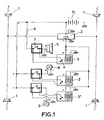
- To complete the description and to facilitate understanding of the invention and in accordance with the best example of its practical realisation, the drawing of an electric scheme has been attached.
- The drawing shows four ultrasonic sensors (1) of proximity separately installed at the vehicle's bumper e.g. at the car's rear and front bumper extreme points, and according to what has been said previously, the sensors can be installed at the vehicle's sides as well to protect the vehicle's doors.
- These four sensors are connected to the electronic commutator (2) which on receiving the signal from at least one of the sensors (1) acts on at least one relay (3) shutting the contacts (4) to supply one of the classic signalling device of the vehicle such as e.g. the horn (5) in whose power circuit (6) there is as well a classic switch (7), that permits its power feed from the vehicle's steering wheel in normal driving conditions.
- Three relays (3), (3'), (3'') shown at the drawing are connected in parallel with the electronic commutator (2); the first relay supplies the horn (5), the second - the main beam headlights (8), the third- brake lights (9). The means of signaling and the number of medias acting simultaneously may change.
- According to the drawing the signaling device (5-8-9) will work when the vehicle exceeds the pre-established proximity degree e.g. 5 or 6 centimeters. When this situation occurs, one of the sensors (1) will activate the electronic commutator (2) which in turn will activate the signaling device and the action will be interrupted when the distance grows.
- It may be possible that the parking vehicle stops five or six centimeters away because there will be little space available or because of other reasons. To prevent the signaling from being active over an indefinite period of time, which can trouble the people nearby and discharge the car accumulator (10) there is a timer which collaborates with the electronic commutator (2) and stops the device after some predetermined time lapse e.g. 15 or 20 seconds.
- As it has been said previously the electronic commutator (2) can supply in parallel three relays (3), (3'), (3"), a radiofrequency transmitter linked with a pager, which informs the owner that some abnormal situation has occurred in his car proximity.
- In the case of using the horn (5) as a signaling device the mechanism will also have a timer which will stop the relay (3) during night time to respect the periods during which the use of horn is prohibited by law. The timer can be replaced with a photoelectric cell but this would cause functional errors when the vehicle is parked at night close to a source of light which can confuse the system cell.
Claims (6)
- Protecting device for parked vehicles which incorporates proximity sensors suitably and separately arranged in its perimeter e.g. on the bumper extreme points characterized in that the proximity sensors are connected with the commutator which in turn is connected with the vehicle power supply accumulator via the horn and/or main beam headlights and/or the brake lights or other, which produce acoustic signals in the parked car when another vehicle is approximating too closely.
- The device according to claim 1, wherein the said electronic commutator collaborates with a timer which cuts power supply of the vehicle to optical/ acoustic signalling device after predetermined time in a situation of permanent proximity of another vehicle within the established security margin.
- The device according to any of the preceding claims, wherein the electronic commutator acts on for every acoustic/optical signalling via the relay or other.
- The device according to claim 3, wherein the horn activation relay collaborates with the photoelectric cell or internal clock which stops the relay during the night hours.
- The device according to any of the preceding claims, wherein the proximity sensors arranged separately on bumpers are accompanied by security sensors on the vehicle doors.
- The device according to any of the preceding claims, wherein the electronic commutator supplies radiofrequency transmitter connected to a pager.
Applications Claiming Priority (1)
| Application Number | Priority Date | Filing Date | Title |
|---|---|---|---|
| ES200402113U ES1058350Y (en) | 2004-09-14 | 2004-09-14 | PROTECTION DEVICE FOR PARKED VEHICLES. |
Publications (1)
| Publication Number | Publication Date |
|---|---|
| EP1634771A2 true EP1634771A2 (en) | 2006-03-15 |
Family
ID=34043425
Family Applications (1)
| Application Number | Title | Priority Date | Filing Date |
|---|---|---|---|
| EP05460026A Withdrawn EP1634771A2 (en) | 2004-09-14 | 2005-09-02 | Protecting device for parked vehicles |
Country Status (2)
| Country | Link |
|---|---|
| EP (1) | EP1634771A2 (en) |
| ES (1) | ES1058350Y (en) |
Cited By (2)
| Publication number | Priority date | Publication date | Assignee | Title |
|---|---|---|---|---|
| WO2007013030A3 (en) * | 2005-07-28 | 2007-05-31 | Hendrik Johannes Beukes | Monitoring system |
| GB2505325A (en) * | 2012-08-23 | 2014-02-26 | Bosch Gmbh Robert | Calculating the risk of a collision |
-
2004
- 2004-09-14 ES ES200402113U patent/ES1058350Y/en not_active Expired - Fee Related
-
2005
- 2005-09-02 EP EP05460026A patent/EP1634771A2/en not_active Withdrawn
Cited By (3)
| Publication number | Priority date | Publication date | Assignee | Title |
|---|---|---|---|---|
| WO2007013030A3 (en) * | 2005-07-28 | 2007-05-31 | Hendrik Johannes Beukes | Monitoring system |
| GB2505325A (en) * | 2012-08-23 | 2014-02-26 | Bosch Gmbh Robert | Calculating the risk of a collision |
| GB2505325B (en) * | 2012-08-23 | 2016-02-17 | Bosch Gmbh Robert | Process for avoiding collisions or for lessening accident damage, and driver-assistance system |
Also Published As
| Publication number | Publication date |
|---|---|
| ES1058350Y (en) | 2005-03-16 |
| ES1058350U (en) | 2004-12-01 |
Similar Documents
| Publication | Publication Date | Title |
|---|---|---|
| ES2831898T3 (en) | Cyclist Warning System | |
| US20150130607A1 (en) | Rear Brake Light System | |
| US20110163868A1 (en) | Warning system | |
| US20130321143A1 (en) | Modulated intensity flasher for vehicle brake light with accelerometer detection of hard-braking movement and backing-out indicator | |
| US6184791B1 (en) | Vehicle safety warning and action system | |
| EP3693219A1 (en) | Specific signalling system for warning road users of the imminent opening of vehicle doors | |
| CN107804263B (en) | Incoming vehicle reminding method, vehicle body controller and vehicle | |
| EP1634771A2 (en) | Protecting device for parked vehicles | |
| US20100156620A1 (en) | Vehicle rear safety distance alerting system | |
| US20020007245A1 (en) | Traffic control system for signalling timely any obstruction on the road | |
| US20060164226A1 (en) | Turn indicator warning device | |
| FR2833903A1 (en) | Separation of distress signal from turn indicators for motor vehicles or trailers, uses two flasher units operating at fast and slow rates, with control switches selecting fast unit for distress and slow unit for turn indication | |
| WO2008110879A1 (en) | Method and device for controlling vehicles' rear fog lights | |
| EP1331135B1 (en) | Vehicle with warning system | |
| JPH11147441A (en) | Accident indication switch actuated by impact at automobile accident | |
| US11447007B2 (en) | Vehicle-rampage braking system | |
| GB2300705A (en) | An automatic hazard warning light activation system for motor vehicles | |
| JP2003341426A (en) | Rear-end collision preventing device for automobile | |
| KR200395468Y1 (en) | Outside mirror apparatus which is linked with the turn signal lamp of automobile | |
| ES2336179B1 (en) | DEVICE FOR ADAPTATION AND CONTROL OF LIGHT SIGNALING IN TRAILERS OR CARAVANS. | |
| KR100405357B1 (en) | vehicle and object collision prevention apparatus | |
| EP0968098A1 (en) | Warning system for vehicles | |
| DE19902154A1 (en) | Add-on vehicle alarm system against animal, e.g. marten or for antitheft protection | |
| KR100714747B1 (en) | Automotive emergency flasher auto operation device | |
| KR200185259Y1 (en) | Side mirror with direction indicator light |
Legal Events
| Date | Code | Title | Description |
|---|---|---|---|
| PUAI | Public reference made under article 153(3) epc to a published international application that has entered the european phase |
Free format text: ORIGINAL CODE: 0009012 |
|
| AK | Designated contracting states |
Kind code of ref document: A2 Designated state(s): AT BE BG CH CY CZ DE DK EE ES FI FR GB GR HU IE IS IT LI LT LU LV MC NL PL PT RO SE SI SK TR |
|
| AX | Request for extension of the european patent |
Extension state: AL BA HR MK YU |
|
| STAA | Information on the status of an ep patent application or granted ep patent |
Free format text: STATUS: THE APPLICATION IS DEEMED TO BE WITHDRAWN |
|
| 18D | Application deemed to be withdrawn |
Effective date: 20090401 |