EP1633717B1 - P2x7 receptor antagonists and their use - Google Patents
P2x7 receptor antagonists and their use Download PDFInfo
- Publication number
- EP1633717B1 EP1633717B1 EP04735697A EP04735697A EP1633717B1 EP 1633717 B1 EP1633717 B1 EP 1633717B1 EP 04735697 A EP04735697 A EP 04735697A EP 04735697 A EP04735697 A EP 04735697A EP 1633717 B1 EP1633717 B1 EP 1633717B1
- Authority
- EP
- European Patent Office
- Prior art keywords
- chloro
- quinolinyl
- formula
- amino
- cyclohexaneacetamide
- Prior art date
- Legal status (The legal status is an assumption and is not a legal conclusion. Google has not performed a legal analysis and makes no representation as to the accuracy of the status listed.)
- Expired - Lifetime
Links
- 229940044551 receptor antagonist Drugs 0.000 title description 6
- 239000002464 receptor antagonist Substances 0.000 title description 6
- 102100037602 P2X purinoceptor 7 Human genes 0.000 title description 2
- 101710189965 P2X purinoceptor 7 Proteins 0.000 title description 2
- 150000001875 compounds Chemical class 0.000 claims abstract description 410
- 238000000034 method Methods 0.000 claims abstract description 132
- 230000008569 process Effects 0.000 claims abstract description 28
- 238000002360 preparation method Methods 0.000 claims abstract description 10
- 239000008194 pharmaceutical composition Substances 0.000 claims abstract description 8
- 238000002560 therapeutic procedure Methods 0.000 claims abstract description 7
- VYPSYNLAJGMNEJ-UHFFFAOYSA-N Silicium dioxide Chemical compound O=[Si]=O VYPSYNLAJGMNEJ-UHFFFAOYSA-N 0.000 claims description 168
- 125000001424 substituent group Chemical group 0.000 claims description 129
- 125000002887 hydroxy group Chemical group [H]O* 0.000 claims description 112
- 229910052736 halogen Inorganic materials 0.000 claims description 109
- 150000002367 halogens Chemical class 0.000 claims description 109
- -1 nitro, cyano, amino Chemical group 0.000 claims description 107
- 125000000623 heterocyclic group Chemical group 0.000 claims description 99
- 239000000377 silicon dioxide Substances 0.000 claims description 80
- IJGRMHOSHXDMSA-UHFFFAOYSA-N Atomic nitrogen Chemical compound N#N IJGRMHOSHXDMSA-UHFFFAOYSA-N 0.000 claims description 79
- VEXZGXHMUGYJMC-UHFFFAOYSA-N Hydrochloric acid Chemical compound Cl VEXZGXHMUGYJMC-UHFFFAOYSA-N 0.000 claims description 75
- 229910052757 nitrogen Inorganic materials 0.000 claims description 74
- 238000006243 chemical reaction Methods 0.000 claims description 67
- 125000004169 (C1-C6) alkyl group Chemical group 0.000 claims description 66
- 125000004435 hydrogen atom Chemical class [H]* 0.000 claims description 59
- 238000011282 treatment Methods 0.000 claims description 56
- 150000003839 salts Chemical class 0.000 claims description 55
- 239000001257 hydrogen Substances 0.000 claims description 50
- 229910052739 hydrogen Inorganic materials 0.000 claims description 50
- 125000000217 alkyl group Chemical group 0.000 claims description 39
- 239000012453 solvate Substances 0.000 claims description 35
- 125000002496 methyl group Chemical group [H]C([H])([H])* 0.000 claims description 33
- 125000003178 carboxy group Chemical group [H]OC(*)=O 0.000 claims description 31
- 125000004433 nitrogen atom Chemical group N* 0.000 claims description 30
- 125000002924 primary amino group Chemical group [H]N([H])* 0.000 claims description 29
- 125000002837 carbocyclic group Chemical group 0.000 claims description 26
- 125000004122 cyclic group Chemical group 0.000 claims description 26
- 229910052760 oxygen Inorganic materials 0.000 claims description 26
- WKBOTKDWSSQWDR-UHFFFAOYSA-N Bromine atom Chemical compound [Br] WKBOTKDWSSQWDR-UHFFFAOYSA-N 0.000 claims description 25
- GDTBXPJZTBHREO-UHFFFAOYSA-N bromine Substances BrBr GDTBXPJZTBHREO-UHFFFAOYSA-N 0.000 claims description 25
- 229910052794 bromium Inorganic materials 0.000 claims description 25
- ZCYVEMRRCGMTRW-UHFFFAOYSA-N 7553-56-2 Chemical compound [I] ZCYVEMRRCGMTRW-UHFFFAOYSA-N 0.000 claims description 24
- 125000000753 cycloalkyl group Chemical group 0.000 claims description 24
- 125000005842 heteroatom Chemical group 0.000 claims description 24
- 239000011630 iodine Substances 0.000 claims description 24
- 229910052740 iodine Inorganic materials 0.000 claims description 24
- QJGQUHMNIGDVPM-UHFFFAOYSA-N nitrogen group Chemical group [N] QJGQUHMNIGDVPM-UHFFFAOYSA-N 0.000 claims description 24
- 125000004191 (C1-C6) alkoxy group Chemical group 0.000 claims description 23
- QVGXLLKOCUKJST-UHFFFAOYSA-N atomic oxygen Chemical compound [O] QVGXLLKOCUKJST-UHFFFAOYSA-N 0.000 claims description 22
- 239000001301 oxygen Substances 0.000 claims description 22
- NINIDFKCEFEMDL-UHFFFAOYSA-N Sulfur Chemical group [S] NINIDFKCEFEMDL-UHFFFAOYSA-N 0.000 claims description 21
- DTQVDTLACAAQTR-UHFFFAOYSA-M Trifluoroacetate Chemical compound [O-]C(=O)C(F)(F)F DTQVDTLACAAQTR-UHFFFAOYSA-M 0.000 claims description 18
- 229910052799 carbon Inorganic materials 0.000 claims description 18
- 125000004432 carbon atom Chemical group C* 0.000 claims description 17
- 125000004178 (C1-C4) alkyl group Chemical group 0.000 claims description 16
- 125000003118 aryl group Chemical group 0.000 claims description 16
- 125000004093 cyano group Chemical group *C#N 0.000 claims description 16
- 229910052721 tungsten Inorganic materials 0.000 claims description 16
- 239000005864 Sulphur Chemical group 0.000 claims description 15
- 125000003386 piperidinyl group Chemical group 0.000 claims description 15
- 125000006552 (C3-C8) cycloalkyl group Chemical group 0.000 claims description 14
- QTBSBXVTEAMEQO-UHFFFAOYSA-M Acetate Chemical compound CC([O-])=O QTBSBXVTEAMEQO-UHFFFAOYSA-M 0.000 claims description 14
- UFHFLCQGNIYNRP-UHFFFAOYSA-N Hydrogen Chemical compound [H][H] UFHFLCQGNIYNRP-UHFFFAOYSA-N 0.000 claims description 14
- 239000003054 catalyst Substances 0.000 claims description 14
- 125000006701 (C1-C7) alkyl group Chemical group 0.000 claims description 13
- 125000000719 pyrrolidinyl group Chemical group 0.000 claims description 13
- 125000004454 (C1-C6) alkoxycarbonyl group Chemical group 0.000 claims description 12
- 125000004916 (C1-C6) alkylcarbonyl group Chemical group 0.000 claims description 12
- 125000000113 cyclohexyl group Chemical group [H]C1([H])C([H])([H])C([H])([H])C([H])(*)C([H])([H])C1([H])[H] 0.000 claims description 12
- 239000003814 drug Substances 0.000 claims description 12
- AFVFQIVMOAPDHO-UHFFFAOYSA-M Methanesulfonate Chemical compound CS([O-])(=O)=O AFVFQIVMOAPDHO-UHFFFAOYSA-M 0.000 claims description 11
- 239000002253 acid Substances 0.000 claims description 11
- PBOHJDQKIYZTLV-HNNXBMFYSA-N n-[2-[(3s)-3-aminopyrrolidin-1-yl]-6-chloroquinolin-5-yl]-2-cyclohexylacetamide Chemical compound C1[C@@H](N)CCN1C1=CC=C(C(NC(=O)CC2CCCCC2)=C(Cl)C=C2)C2=N1 PBOHJDQKIYZTLV-HNNXBMFYSA-N 0.000 claims description 11
- 125000006239 protecting group Chemical group 0.000 claims description 11
- 125000003466 9 membered carbocyclic group Chemical group 0.000 claims description 10
- 125000006577 C1-C6 hydroxyalkyl group Chemical group 0.000 claims description 10
- 125000002915 carbonyl group Chemical group [*:2]C([*:1])=O 0.000 claims description 10
- 125000004210 cyclohexylmethyl group Chemical group [H]C([H])(*)C1([H])C([H])([H])C([H])([H])C([H])([H])C([H])([H])C1([H])[H] 0.000 claims description 9
- 125000001436 propyl group Chemical group [H]C([*])([H])C([H])([H])C([H])([H])[H] 0.000 claims description 9
- 125000003831 tetrazolyl group Chemical group 0.000 claims description 9
- JOXIMZWYDAKGHI-UHFFFAOYSA-M toluene-4-sulfonate Chemical compound CC1=CC=C(S([O-])(=O)=O)C=C1 JOXIMZWYDAKGHI-UHFFFAOYSA-M 0.000 claims description 9
- VXAWLBWKTFEBSJ-HNNXBMFYSA-N 2-[(3s)-3-aminopyrrolidin-1-yl]-6-chloro-n-(cyclohexylmethyl)quinoline-5-carboxamide Chemical compound C1[C@@H](N)CCN1C1=CC=C(C(C(=O)NCC2CCCCC2)=C(Cl)C=C2)C2=N1 VXAWLBWKTFEBSJ-HNNXBMFYSA-N 0.000 claims description 8
- 125000002947 alkylene group Chemical group 0.000 claims description 8
- 125000001511 cyclopentyl group Chemical group [H]C1([H])C([H])([H])C([H])([H])C([H])(*)C1([H])[H] 0.000 claims description 8
- 229910003002 lithium salt Inorganic materials 0.000 claims description 8
- 159000000002 lithium salts Chemical class 0.000 claims description 8
- 238000004519 manufacturing process Methods 0.000 claims description 8
- DBDLZCQFOAKMKS-OAHLLOKOSA-N n-[6-chloro-2-[(3r)-3-hydroxypyrrolidin-1-yl]quinolin-5-yl]-2-cyclohexylacetamide Chemical compound C1[C@H](O)CCN1C1=CC=C(C(NC(=O)CC2CCCCC2)=C(Cl)C=C2)C2=N1 DBDLZCQFOAKMKS-OAHLLOKOSA-N 0.000 claims description 8
- 125000004193 piperazinyl group Chemical group 0.000 claims description 8
- AVXURJPOCDRRFD-UHFFFAOYSA-N Hydroxylamine Chemical compound ON AVXURJPOCDRRFD-UHFFFAOYSA-N 0.000 claims description 7
- BSVLCHROLUEOFQ-UHFFFAOYSA-N n-[2-(3-aminopropyl)-6-chloroquinolin-5-yl]-2-cyclohexylacetamide Chemical compound ClC=1C=CC2=NC(CCCN)=CC=C2C=1NC(=O)CC1CCCCC1 BSVLCHROLUEOFQ-UHFFFAOYSA-N 0.000 claims description 7
- SSSYLNXVGHSRTI-HNNXBMFYSA-N n-[2-[(3s)-3-aminopyrrolidin-1-yl]-6-chloroquinolin-5-yl]-3-cyclopentylpropanamide Chemical compound C1[C@@H](N)CCN1C1=CC=C(C(NC(=O)CCC2CCCC2)=C(Cl)C=C2)C2=N1 SSSYLNXVGHSRTI-HNNXBMFYSA-N 0.000 claims description 7
- SSGJRDKQKWGZRZ-KRWDZBQOSA-N n-[6-chloro-2-[(3s)-3-(2-hydroxyethylamino)pyrrolidin-1-yl]quinolin-5-yl]-2-cyclohexylacetamide Chemical compound C1[C@@H](NCCO)CCN1C1=CC=C(C(NC(=O)CC2CCCCC2)=C(Cl)C=C2)C2=N1 SSGJRDKQKWGZRZ-KRWDZBQOSA-N 0.000 claims description 7
- DBDLZCQFOAKMKS-HNNXBMFYSA-N n-[6-chloro-2-[(3s)-3-hydroxypyrrolidin-1-yl]quinolin-5-yl]-2-cyclohexylacetamide Chemical compound C1[C@@H](O)CCN1C1=CC=C(C(NC(=O)CC2CCCCC2)=C(Cl)C=C2)C2=N1 DBDLZCQFOAKMKS-HNNXBMFYSA-N 0.000 claims description 7
- 238000006268 reductive amination reaction Methods 0.000 claims description 7
- 125000006700 (C1-C6) alkylthio group Chemical group 0.000 claims description 6
- COJCWDWLMDYPQG-UHFFFAOYSA-N 1-[6-chloro-5-(3-cyclohexylpropanoylamino)quinolin-2-yl]piperidine-4-carboxylic acid Chemical compound C1CC(C(=O)O)CCN1C1=CC=C(C(NC(=O)CCC2CCCCC2)=C(Cl)C=C2)C2=N1 COJCWDWLMDYPQG-UHFFFAOYSA-N 0.000 claims description 6
- BXZQJVRXGKJLHF-INIZCTEOSA-N 2-[(3s)-3-aminopiperidin-1-yl]-6-chloro-n-(cyclohexylmethyl)quinoline-5-carboxamide Chemical compound C1[C@@H](N)CCCN1C1=CC=C(C(C(=O)NCC2CCCCC2)=C(Cl)C=C2)C2=N1 BXZQJVRXGKJLHF-INIZCTEOSA-N 0.000 claims description 6
- KMSLNTMWMNFOGN-UHFFFAOYSA-N 2-[1-[6-chloro-5-[(2-cyclohexylacetyl)amino]quinolin-2-yl]piperidin-4-yl]acetic acid Chemical compound C1CC(CC(=O)O)CCN1C1=CC=C(C(NC(=O)CC2CCCCC2)=C(Cl)C=C2)C2=N1 KMSLNTMWMNFOGN-UHFFFAOYSA-N 0.000 claims description 6
- GBJUGBBDSYLRKR-UHFFFAOYSA-N 2-[4-[6-chloro-5-(cyclohexylmethylcarbamoyl)quinolin-2-yl]piperazin-1-yl]acetic acid Chemical compound C1CN(CC(=O)O)CCN1C1=CC=C(C(C(=O)NCC2CCCCC2)=C(Cl)C=C2)C2=N1 GBJUGBBDSYLRKR-UHFFFAOYSA-N 0.000 claims description 6
- CGNJXSPAKKCIDK-UHFFFAOYSA-N 2-[[6-chloro-5-[(2-cyclohexylacetyl)amino]quinolin-2-yl]amino]acetic acid Chemical compound ClC=1C=CC2=NC(NCC(=O)O)=CC=C2C=1NC(=O)CC1CCCCC1 CGNJXSPAKKCIDK-UHFFFAOYSA-N 0.000 claims description 6
- IGEPROFODVNDRQ-QGZVFWFLSA-N 2-cyclohexyl-n-[2-[(3r)-3-hydroxypyrrolidin-1-yl]-6-methylquinolin-5-yl]acetamide Chemical compound CC1=CC=C2N=C(N3C[C@H](O)CC3)C=CC2=C1NC(=O)CC1CCCCC1 IGEPROFODVNDRQ-QGZVFWFLSA-N 0.000 claims description 6
- ITRDTWBRIGTAOE-UHFFFAOYSA-N 6-chloro-n-(cyclohexylmethyl)quinoline-5-carboxamide Chemical compound ClC1=CC=C2N=CC=CC2=C1C(=O)NCC1CCCCC1 ITRDTWBRIGTAOE-UHFFFAOYSA-N 0.000 claims description 6
- UGFAIRIUMAVXCW-UHFFFAOYSA-N Carbon monoxide Chemical compound [O+]#[C-] UGFAIRIUMAVXCW-UHFFFAOYSA-N 0.000 claims description 6
- DGAQECJNVWCQMB-PUAWFVPOSA-M Ilexoside XXIX Chemical compound C[C@@H]1CC[C@@]2(CC[C@@]3(C(=CC[C@H]4[C@]3(CC[C@@H]5[C@@]4(CC[C@@H](C5(C)C)OS(=O)(=O)[O-])C)C)[C@@H]2[C@]1(C)O)C)C(=O)O[C@H]6[C@@H]([C@H]([C@@H]([C@H](O6)CO)O)O)O.[Na+] DGAQECJNVWCQMB-PUAWFVPOSA-M 0.000 claims description 6
- 229910002091 carbon monoxide Inorganic materials 0.000 claims description 6
- VPZCTISEGWGAGR-INIZCTEOSA-N n-[2-[(3s)-3-aminopiperidin-1-yl]-6-chloroquinolin-5-yl]-2-cyclohexylacetamide Chemical compound C1[C@@H](N)CCCN1C1=CC=C(C(NC(=O)CC2CCCCC2)=C(Cl)C=C2)C2=N1 VPZCTISEGWGAGR-INIZCTEOSA-N 0.000 claims description 6
- KJEQZROLBVKHDP-MRXNPFEDSA-N n-[6-chloro-2-[(3s)-3-cyanopyrrolidin-1-yl]quinolin-5-yl]-2-cyclohexylacetamide Chemical compound ClC1=CC=C2N=C(N3C[C@H](CC3)C#N)C=CC2=C1NC(=O)CC1CCCCC1 KJEQZROLBVKHDP-MRXNPFEDSA-N 0.000 claims description 6
- 238000007254 oxidation reaction Methods 0.000 claims description 6
- XAEFZNCEHLXOMS-UHFFFAOYSA-M potassium benzoate Chemical compound [K+].[O-]C(=O)C1=CC=CC=C1 XAEFZNCEHLXOMS-UHFFFAOYSA-M 0.000 claims description 6
- 206010039073 rheumatoid arthritis Diseases 0.000 claims description 6
- 229910052708 sodium Inorganic materials 0.000 claims description 6
- 239000011734 sodium Substances 0.000 claims description 6
- 229910052717 sulfur Inorganic materials 0.000 claims description 6
- 125000004890 (C1-C6) alkylamino group Chemical group 0.000 claims description 5
- GNEVIDVAWKJYKC-UHFFFAOYSA-N 1-[6-chloro-5-[[2-(1-methylcyclohexyl)acetyl]amino]quinolin-2-yl]piperidine-4-carboxylic acid Chemical compound ClC=1C=CC2=NC(N3CCC(CC3)C(O)=O)=CC=C2C=1NC(=O)CC1(C)CCCCC1 GNEVIDVAWKJYKC-UHFFFAOYSA-N 0.000 claims description 5
- UITXCSNRFCXWKF-UHFFFAOYSA-N 2-cyclohexyl-n-[2-[3-(ethylamino)propyl]-6-methylquinolin-5-yl]acetamide Chemical compound CC=1C=CC2=NC(CCCNCC)=CC=C2C=1NC(=O)CC1CCCCC1 UITXCSNRFCXWKF-UHFFFAOYSA-N 0.000 claims description 5
- FKGXQEAGVZPHTC-UHFFFAOYSA-N 3-[[6-chloro-5-[(2-cyclohexylacetyl)amino]quinolin-2-yl]amino]propanoic acid Chemical compound ClC=1C=CC2=NC(NCCC(=O)O)=CC=C2C=1NC(=O)CC1CCCCC1 FKGXQEAGVZPHTC-UHFFFAOYSA-N 0.000 claims description 5
- VOYUHTGKCCGAAI-UHFFFAOYSA-N 6-chloro-n-(cyclohexylmethyl)-2-methylquinoline-5-carboxamide Chemical compound ClC=1C=CC2=NC(C)=CC=C2C=1C(=O)NCC1CCCCC1 VOYUHTGKCCGAAI-UHFFFAOYSA-N 0.000 claims description 5
- 239000002671 adjuvant Substances 0.000 claims description 5
- 150000001336 alkenes Chemical class 0.000 claims description 5
- 150000001412 amines Chemical class 0.000 claims description 5
- 239000003085 diluting agent Substances 0.000 claims description 5
- 238000005984 hydrogenation reaction Methods 0.000 claims description 5
- FPEROWRTMNZXLW-UHFFFAOYSA-N n-(cyclohexylmethyl)-6-methylquinoline-5-carboxamide Chemical compound CC1=CC=C2N=CC=CC2=C1C(=O)NCC1CCCCC1 FPEROWRTMNZXLW-UHFFFAOYSA-N 0.000 claims description 5
- ZUSATBXYFWGVHJ-UHFFFAOYSA-N n-[2-(4-aminopiperidin-1-yl)-6-chloroquinolin-5-yl]-2-cyclohexylacetamide Chemical compound C1CC(N)CCN1C1=CC=C(C(NC(=O)CC2CCCCC2)=C(Cl)C=C2)C2=N1 ZUSATBXYFWGVHJ-UHFFFAOYSA-N 0.000 claims description 5
- PBEDBKAWEURFHD-MRXNPFEDSA-N n-[6-chloro-2-[(3r)-3-(methylamino)pyrrolidin-1-yl]quinolin-5-yl]-2-cyclohexylacetamide Chemical compound C1[C@H](NC)CCN1C1=CC=C(C(NC(=O)CC2CCCCC2)=C(Cl)C=C2)C2=N1 PBEDBKAWEURFHD-MRXNPFEDSA-N 0.000 claims description 5
- PBEDBKAWEURFHD-INIZCTEOSA-N n-[6-chloro-2-[(3s)-3-(methylamino)pyrrolidin-1-yl]quinolin-5-yl]-2-cyclohexylacetamide Chemical compound C1[C@@H](NC)CCN1C1=CC=C(C(NC(=O)CC2CCCCC2)=C(Cl)C=C2)C2=N1 PBEDBKAWEURFHD-INIZCTEOSA-N 0.000 claims description 5
- ROCWOKQZSYZAGT-UHFFFAOYSA-N n-[6-chloro-2-[3-(3-hydroxypropylamino)propyl]quinolin-5-yl]-2-cyclohexylacetamide Chemical compound ClC=1C=CC2=NC(CCCNCCCO)=CC=C2C=1NC(=O)CC1CCCCC1 ROCWOKQZSYZAGT-UHFFFAOYSA-N 0.000 claims description 5
- VRASWSKYEXWWRM-UHFFFAOYSA-N n-[6-chloro-2-[methyl-[3-(methylamino)propyl]amino]quinolin-5-yl]-2-[4-(trifluoromethyl)cyclohexyl]acetamide;dihydrochloride Chemical compound Cl.Cl.ClC=1C=CC2=NC(N(C)CCCNC)=CC=C2C=1NC(=O)CC1CCC(C(F)(F)F)CC1 VRASWSKYEXWWRM-UHFFFAOYSA-N 0.000 claims description 5
- 201000008482 osteoarthritis Diseases 0.000 claims description 5
- 159000000000 sodium salts Chemical class 0.000 claims description 5
- 125000000008 (C1-C10) alkyl group Chemical group 0.000 claims description 4
- LAZJEWURFXJBBQ-UHFFFAOYSA-N 1-[6-chloro-5-(2-cyclohexylethylcarbamoyl)quinolin-2-yl]piperidine-4-carboxylic acid Chemical compound C1CC(C(=O)O)CCN1C1=CC=C(C(C(=O)NCCC2CCCCC2)=C(Cl)C=C2)C2=N1 LAZJEWURFXJBBQ-UHFFFAOYSA-N 0.000 claims description 4
- XBOFTQJEMSYMKJ-UHFFFAOYSA-N 1-[6-chloro-5-[(2-cyclohexylacetyl)amino]quinolin-2-yl]piperidine-4-carboxylic acid Chemical compound C1CC(C(=O)O)CCN1C1=CC=C(C(NC(=O)CC2CCCCC2)=C(Cl)C=C2)C2=N1 XBOFTQJEMSYMKJ-UHFFFAOYSA-N 0.000 claims description 4
- YWDUKXODAYJOPI-UHFFFAOYSA-N 2-(1-methylcyclohexyl)-n-quinolin-5-ylacetamide Chemical compound C=1C=CC2=NC=CC=C2C=1NC(=O)CC1(C)CCCCC1 YWDUKXODAYJOPI-UHFFFAOYSA-N 0.000 claims description 4
- JMCBXQUHXRJEAX-UHFFFAOYSA-N 2-(4-methylcyclohexyl)-n-quinolin-5-ylacetamide Chemical compound C1CC(C)CCC1CC(=O)NC1=CC=CC2=NC=CC=C12 JMCBXQUHXRJEAX-UHFFFAOYSA-N 0.000 claims description 4
- DXDBCWKSYFHJEC-INIZCTEOSA-N 2-[(3s)-3-aminopyrrolidin-1-yl]-6-chloro-n-(2-cyclohexylethyl)quinoline-5-carboxamide Chemical compound C1[C@@H](N)CCN1C1=CC=C(C(C(=O)NCCC2CCCCC2)=C(Cl)C=C2)C2=N1 DXDBCWKSYFHJEC-INIZCTEOSA-N 0.000 claims description 4
- MGGFTDPLMXJORL-UHFFFAOYSA-N 2-[1-[6-chloro-5-(cyclohexylmethylcarbamoyl)quinolin-2-yl]piperidin-4-yl]acetic acid Chemical compound C1CC(CC(=O)O)CCN1C1=CC=C(C(C(=O)NCC2CCCCC2)=C(Cl)C=C2)C2=N1 MGGFTDPLMXJORL-UHFFFAOYSA-N 0.000 claims description 4
- YRIBDLJNWPQBPY-UHFFFAOYSA-N 2-[4-[6-chloro-5-[(2-cyclohexylacetyl)amino]quinolin-2-yl]piperazin-1-yl]acetic acid Chemical compound C1CN(CC(=O)O)CCN1C1=CC=C(C(NC(=O)CC2CCCCC2)=C(Cl)C=C2)C2=N1 YRIBDLJNWPQBPY-UHFFFAOYSA-N 0.000 claims description 4
- WEUBAJVWGFSILC-INIZCTEOSA-N 2-[[(3s)-1-[6-chloro-5-[(2-cyclohexylacetyl)amino]quinolin-2-yl]pyrrolidin-3-yl]amino]acetic acid Chemical compound C1[C@@H](NCC(=O)O)CCN1C1=CC=C(C(NC(=O)CC2CCCCC2)=C(Cl)C=C2)C2=N1 WEUBAJVWGFSILC-INIZCTEOSA-N 0.000 claims description 4
- LOLYXDBESWAMRB-UHFFFAOYSA-N 2-cyclohexyl-n-(6-methyl-2-piperazin-1-ylquinolin-5-yl)acetamide Chemical compound CC1=CC=C2N=C(N3CCNCC3)C=CC2=C1NC(=O)CC1CCCCC1 LOLYXDBESWAMRB-UHFFFAOYSA-N 0.000 claims description 4
- LRYRZOCEUYUPAX-UHFFFAOYSA-N 2-cyclohexyl-n-quinolin-5-ylacetamide Chemical compound C=1C=CC2=NC=CC=C2C=1NC(=O)CC1CCCCC1 LRYRZOCEUYUPAX-UHFFFAOYSA-N 0.000 claims description 4
- MMKADPLXDTZCRK-KRWDZBQOSA-N 3-[[(3s)-1-[6-chloro-5-[(2-cyclohexylacetyl)amino]quinolin-2-yl]pyrrolidin-3-yl]amino]propanoic acid Chemical compound C1[C@@H](NCCC(=O)O)CCN1C1=CC=C(C(NC(=O)CC2CCCCC2)=C(Cl)C=C2)C2=N1 MMKADPLXDTZCRK-KRWDZBQOSA-N 0.000 claims description 4
- XKUVYIHVWJZCMC-UHFFFAOYSA-N 3-cyclopentyl-n-quinolin-5-ylpropanamide Chemical compound C=1C=CC2=NC=CC=C2C=1NC(=O)CCC1CCCC1 XKUVYIHVWJZCMC-UHFFFAOYSA-N 0.000 claims description 4
- SBQUTMVHNXUXGR-UHFFFAOYSA-N 4-[6-chloro-5-[(2-cyclohexylacetyl)amino]quinolin-2-yl]butanoic acid Chemical compound ClC=1C=CC2=NC(CCCC(=O)O)=CC=C2C=1NC(=O)CC1CCCCC1 SBQUTMVHNXUXGR-UHFFFAOYSA-N 0.000 claims description 4
- AMOCREBSAGYMHP-UHFFFAOYSA-N 4-[[6-chloro-5-[(2-cyclohexylacetyl)amino]quinolin-2-yl]amino]butanoic acid Chemical compound ClC=1C=CC2=NC(NCCCC(=O)O)=CC=C2C=1NC(=O)CC1CCCCC1 AMOCREBSAGYMHP-UHFFFAOYSA-N 0.000 claims description 4
- BGHAYEPHKCGFHD-SFHVURJKSA-N 6-chloro-n-(cyclohexylmethyl)-2-[(3s)-3-(2-hydroxyethylamino)piperidin-1-yl]quinoline-5-carboxamide Chemical compound C1[C@@H](NCCO)CCCN1C1=CC=C(C(C(=O)NCC2CCCCC2)=C(Cl)C=C2)C2=N1 BGHAYEPHKCGFHD-SFHVURJKSA-N 0.000 claims description 4
- PDIUYOQEVHQOHR-LMOVPXPDSA-N 6-chloro-n-(cyclohexylmethyl)-2-[(3s)-3-(2-hydroxyethylamino)pyrrolidin-1-yl]quinoline-5-carboxamide;hydrochloride Chemical compound Cl.C1[C@@H](NCCO)CCN1C1=CC=C(C(C(=O)NCC2CCCCC2)=C(Cl)C=C2)C2=N1 PDIUYOQEVHQOHR-LMOVPXPDSA-N 0.000 claims description 4
- BNWCJQPAWYXSHF-UHFFFAOYSA-N 6-chloro-n-(cyclohexylmethyl)-2-[3-(2-hydroxyethylamino)azetidin-1-yl]quinoline-5-carboxamide Chemical compound C1C(NCCO)CN1C1=CC=C(C(C(=O)NCC2CCCCC2)=C(Cl)C=C2)C2=N1 BNWCJQPAWYXSHF-UHFFFAOYSA-N 0.000 claims description 4
- SHGCFVXNZKPHLW-UHFFFAOYSA-N 6-chloro-n-(cyclohexylmethyl)-2-[3-(2h-tetrazol-5-yl)azetidin-1-yl]quinoline-5-carboxamide Chemical compound ClC1=CC=C2N=C(N3CC(C3)C=3NN=NN=3)C=CC2=C1C(=O)NCC1CCCCC1 SHGCFVXNZKPHLW-UHFFFAOYSA-N 0.000 claims description 4
- SXLFOLYKBHDXPJ-UHFFFAOYSA-N 6-chloro-n-(cyclohexylmethyl)-2-[4-(2h-tetrazol-5-yl)butyl]quinoline-5-carboxamide Chemical compound C1=CC2=C(C(=O)NCC3CCCCC3)C(Cl)=CC=C2N=C1CCCCC1=NN=NN1 SXLFOLYKBHDXPJ-UHFFFAOYSA-N 0.000 claims description 4
- QRXFMYKYBQZYCN-UHFFFAOYSA-N 6-chloro-n-(cyclohexylmethyl)-2-piperazin-1-ylquinoline-5-carboxamide;dihydrochloride Chemical compound Cl.Cl.ClC1=CC=C2N=C(N3CCNCC3)C=CC2=C1C(=O)NCC1CCCCC1 QRXFMYKYBQZYCN-UHFFFAOYSA-N 0.000 claims description 4
- 208000006545 Chronic Obstructive Pulmonary Disease Diseases 0.000 claims description 4
- 208000022559 Inflammatory bowel disease Diseases 0.000 claims description 4
- HYCCBNSVDKZILI-UHFFFAOYSA-N N-[6-chloro-2-[2-(2-hydroxyethylamino)ethylamino]quinolin-5-yl]-2-cyclohexylacetamide dihydrochloride Chemical compound Cl.Cl.ClC=1C=CC2=NC(NCCNCCO)=CC=C2C=1NC(=O)CC1CCCCC1 HYCCBNSVDKZILI-UHFFFAOYSA-N 0.000 claims description 4
- YGYAWVDWMABLBF-UHFFFAOYSA-N Phosgene Chemical compound ClC(Cl)=O YGYAWVDWMABLBF-UHFFFAOYSA-N 0.000 claims description 4
- 208000006673 asthma Diseases 0.000 claims description 4
- RAFNCPHFRHZCPS-UHFFFAOYSA-N di(imidazol-1-yl)methanethione Chemical compound C1=CN=CN1C(=S)N1C=CN=C1 RAFNCPHFRHZCPS-UHFFFAOYSA-N 0.000 claims description 4
- XZBIXDPGRMLSTC-UHFFFAOYSA-N formohydrazide Chemical compound NNC=O XZBIXDPGRMLSTC-UHFFFAOYSA-N 0.000 claims description 4
- FHUQHJJFACHEEQ-UHFFFAOYSA-N n-(6-chloro-2-piperazin-1-ylquinolin-5-yl)-2-[4-(trifluoromethyl)cyclohexyl]acetamide Chemical compound C1CC(C(F)(F)F)CCC1CC(=O)NC1=C(Cl)C=CC2=NC(N3CCNCC3)=CC=C12 FHUQHJJFACHEEQ-UHFFFAOYSA-N 0.000 claims description 4
- PBOHJDQKIYZTLV-OAHLLOKOSA-N n-[2-[(3r)-3-aminopyrrolidin-1-yl]-6-chloroquinolin-5-yl]-2-cyclohexylacetamide Chemical compound C1[C@H](N)CCN1C1=CC=C(C(NC(=O)CC2CCCCC2)=C(Cl)C=C2)C2=N1 PBOHJDQKIYZTLV-OAHLLOKOSA-N 0.000 claims description 4
- ZFAFZEKFUZECHO-UHFFFAOYSA-N n-[6-chloro-2-(1,4-diazepan-1-yl)quinolin-5-yl]-2-cyclohexylacetamide Chemical compound ClC1=CC=C2N=C(N3CCNCCC3)C=CC2=C1NC(=O)CC1CCCCC1 ZFAFZEKFUZECHO-UHFFFAOYSA-N 0.000 claims description 4
- YRYDWCAPKUXQJB-UHFFFAOYSA-N n-[6-chloro-2-(3-hydroxypropylamino)quinolin-5-yl]-2-cyclohexylacetamide;hydrochloride Chemical compound Cl.ClC=1C=CC2=NC(NCCCO)=CC=C2C=1NC(=O)CC1CCCCC1 YRYDWCAPKUXQJB-UHFFFAOYSA-N 0.000 claims description 4
- CCGNJOBSXTXZHH-UHFFFAOYSA-N n-[6-chloro-2-(4-cyanopiperidin-1-yl)quinolin-5-yl]-2-cyclohexylacetamide Chemical compound ClC1=CC=C2N=C(N3CCC(CC3)C#N)C=CC2=C1NC(=O)CC1CCCCC1 CCGNJOBSXTXZHH-UHFFFAOYSA-N 0.000 claims description 4
- DZWREAHDJLLCSF-UHFFFAOYSA-N n-[6-chloro-2-(4-methylpiperazin-1-yl)quinolin-5-yl]-2-cyclohexylacetamide;dihydrochloride Chemical compound Cl.Cl.C1CN(C)CCN1C1=CC=C(C(NC(=O)CC2CCCCC2)=C(Cl)C=C2)C2=N1 DZWREAHDJLLCSF-UHFFFAOYSA-N 0.000 claims description 4
- OJPMEGWECRDTPY-UHFFFAOYSA-N n-[6-chloro-2-(piperidin-4-ylmethyl)quinolin-5-yl]-2-cyclohexylacetamide;dihydrochloride Chemical compound Cl.Cl.C1=CC2=C(NC(=O)CC3CCCCC3)C(Cl)=CC=C2N=C1CC1CCNCC1 OJPMEGWECRDTPY-UHFFFAOYSA-N 0.000 claims description 4
- CKAOBTYBKVOEIT-HOTGVXAUSA-N n-[6-chloro-2-[(1s,4s)-2,5-diazabicyclo[2.2.1]heptan-2-yl]quinolin-5-yl]-2-cyclohexylacetamide Chemical compound C([C@]1(NC[C@]2([H])C1)[H])N2C(N=C1C=CC=2Cl)=CC=C1C=2NC(=O)CC1CCCCC1 CKAOBTYBKVOEIT-HOTGVXAUSA-N 0.000 claims description 4
- SSGJRDKQKWGZRZ-QGZVFWFLSA-N n-[6-chloro-2-[(3r)-3-(2-hydroxyethylamino)pyrrolidin-1-yl]quinolin-5-yl]-2-cyclohexylacetamide Chemical compound C1[C@H](NCCO)CCN1C1=CC=C(C(NC(=O)CC2CCCCC2)=C(Cl)C=C2)C2=N1 SSGJRDKQKWGZRZ-QGZVFWFLSA-N 0.000 claims description 4
- MWZLNBMYXBIMDB-OAHLLOKOSA-N n-[6-chloro-2-[(3r)-3-(2h-tetrazol-5-yl)pyrrolidin-1-yl]quinolin-5-yl]-2-cyclohexylacetamide Chemical compound ClC1=CC=C2N=C(N3C[C@@H](CC3)C=3NN=NN=3)C=CC2=C1NC(=O)CC1CCCCC1 MWZLNBMYXBIMDB-OAHLLOKOSA-N 0.000 claims description 4
- PBKPJRQLMKKLID-SFHVURJKSA-N n-[6-chloro-2-[(3s)-3-(2-hydroxyethylamino)piperidin-1-yl]quinolin-5-yl]-2-cyclohexylacetamide Chemical compound C1[C@@H](NCCO)CCCN1C1=CC=C(C(NC(=O)CC2CCCCC2)=C(Cl)C=C2)C2=N1 PBKPJRQLMKKLID-SFHVURJKSA-N 0.000 claims description 4
- OKTMKOLMOZCGDA-KRWDZBQOSA-N n-[6-chloro-2-[(3s)-3-(2-hydroxyethylamino)pyrrolidin-1-yl]quinolin-5-yl]-3-cyclopentylpropanamide Chemical compound C1[C@@H](NCCO)CCN1C1=CC=C(C(NC(=O)CCC2CCCC2)=C(Cl)C=C2)C2=N1 OKTMKOLMOZCGDA-KRWDZBQOSA-N 0.000 claims description 4
- AYTDZQRUUXBCDM-KRWDZBQOSA-N n-[6-chloro-2-[(3s)-3-(2-hydroxyethylsulfonyl)pyrrolidin-1-yl]quinolin-5-yl]-2-cyclohexylacetamide Chemical compound C1[C@@H](S(=O)(=O)CCO)CCN1C1=CC=C(C(NC(=O)CC2CCCCC2)=C(Cl)C=C2)C2=N1 AYTDZQRUUXBCDM-KRWDZBQOSA-N 0.000 claims description 4
- PBKPJRQLMKKLID-UHFFFAOYSA-N n-[6-chloro-2-[3-(2-hydroxyethylamino)piperidin-1-yl]quinolin-5-yl]-2-cyclohexylacetamide Chemical compound C1C(NCCO)CCCN1C1=CC=C(C(NC(=O)CC2CCCCC2)=C(Cl)C=C2)C2=N1 PBKPJRQLMKKLID-UHFFFAOYSA-N 0.000 claims description 4
- LQICGJQRDNOPLQ-UHFFFAOYSA-N n-[6-chloro-2-[3-(ethylamino)propyl]quinolin-5-yl]-2-cyclohexylacetamide;dihydrochloride Chemical compound Cl.Cl.ClC=1C=CC2=NC(CCCNCC)=CC=C2C=1NC(=O)CC1CCCCC1 LQICGJQRDNOPLQ-UHFFFAOYSA-N 0.000 claims description 4
- QRVKHPFYCNVPEK-UHFFFAOYSA-N n-[6-chloro-2-[4-(5-oxo-1h-1,2,4-triazol-4-yl)piperidin-1-yl]quinolin-5-yl]-2-cyclohexylacetamide Chemical compound ClC1=CC=C2N=C(N3CCC(CC3)N3C(NN=C3)=O)C=CC2=C1NC(=O)CC1CCCCC1 QRVKHPFYCNVPEK-UHFFFAOYSA-N 0.000 claims description 4
- KUOLYXYVTHYRCG-UHFFFAOYSA-N n-[6-chloro-2-[4-(5-oxo-2h-1,2,4-oxadiazol-3-yl)piperidin-1-yl]quinolin-5-yl]-2-cyclohexylacetamide Chemical compound ClC1=CC=C2N=C(N3CCC(CC3)C=3NC(=O)ON=3)C=CC2=C1NC(=O)CC1CCCCC1 KUOLYXYVTHYRCG-UHFFFAOYSA-N 0.000 claims description 4
- DOOMNKPIFUBAGG-CQSZACIVSA-N n-[6-chloro-2-[[(2r)-2,3-dihydroxypropyl]amino]quinolin-5-yl]-2-cyclohexylacetamide Chemical compound ClC=1C=CC2=NC(NC[C@@H](O)CO)=CC=C2C=1NC(=O)CC1CCCCC1 DOOMNKPIFUBAGG-CQSZACIVSA-N 0.000 claims description 4
- SNALAXOTTURDHK-OAHLLOKOSA-N n-[6-chloro-2-[[(3r)-pyrrolidin-3-yl]amino]quinolin-5-yl]-2-cyclohexylacetamide Chemical compound C1=CC2=C(NC(=O)CC3CCCCC3)C(Cl)=CC=C2N=C1N[C@@H]1CCNC1 SNALAXOTTURDHK-OAHLLOKOSA-N 0.000 claims description 4
- GPFXXEOEIKCTQN-UHFFFAOYSA-N n-[6-chloro-2-[methyl-[3-(methylamino)propyl]amino]quinolin-5-yl]-2-cyclohexylacetamide;dihydrochloride Chemical compound Cl.Cl.ClC=1C=CC2=NC(N(C)CCCNC)=CC=C2C=1NC(=O)CC1CCCCC1 GPFXXEOEIKCTQN-UHFFFAOYSA-N 0.000 claims description 4
- 229960002429 proline Drugs 0.000 claims description 4
- 125000001889 triflyl group Chemical group FC(F)(F)S(*)(=O)=O 0.000 claims description 4
- 125000006833 (C1-C5) alkylene group Chemical group 0.000 claims description 3
- 125000005913 (C3-C6) cycloalkyl group Chemical group 0.000 claims description 3
- DEDXHBUOAZLWCB-UHFFFAOYSA-N 1-[6-chloro-5-(cyclohexylmethylcarbamoyl)quinolin-2-yl]piperidine-4-carboxylic acid Chemical compound C1CC(C(=O)O)CCN1C1=CC=C(C(C(=O)NCC2CCCCC2)=C(Cl)C=C2)C2=N1 DEDXHBUOAZLWCB-UHFFFAOYSA-N 0.000 claims description 3
- FFWDPNGSQDVFFQ-QCUBGVIVSA-N 2-[(3r)-3-aminopyrrolidin-1-yl]-6-chloro-n-(cyclohexylmethyl)quinoline-5-carboxamide;dihydrochloride Chemical compound Cl.Cl.C1[C@H](N)CCN1C1=CC=C(C(C(=O)NCC2CCCCC2)=C(Cl)C=C2)C2=N1 FFWDPNGSQDVFFQ-QCUBGVIVSA-N 0.000 claims description 3
- WCQYXQNUWCHDCK-INIZCTEOSA-N 2-[(3s)-3-aminopyrrolidin-1-yl]-n-(cyclohexylmethyl)quinoline-5-carboxamide Chemical compound C1[C@@H](N)CCN1C1=CC=C(C(=CC=C2)C(=O)NCC3CCCCC3)C2=N1 WCQYXQNUWCHDCK-INIZCTEOSA-N 0.000 claims description 3
- TUBWIQXECXBPBM-UHFFFAOYSA-N 3-[[1-[6-chloro-5-(cyclohexylmethylcarbamoyl)quinolin-2-yl]azetidin-3-yl]amino]propanoic acid Chemical compound C1C(NCCC(=O)O)CN1C1=CC=C(C(C(=O)NCC2CCCCC2)=C(Cl)C=C2)C2=N1 TUBWIQXECXBPBM-UHFFFAOYSA-N 0.000 claims description 3
- HGWOWPOGQIKDSA-UHFFFAOYSA-N 6-chloro-n-(cyclohexylmethyl)-2-[methyl-[2-(methylamino)ethyl]amino]quinoline-5-carboxamide;dihydrochloride Chemical compound Cl.Cl.ClC=1C=CC2=NC(N(C)CCNC)=CC=C2C=1C(=O)NCC1CCCCC1 HGWOWPOGQIKDSA-UHFFFAOYSA-N 0.000 claims description 3
- 125000003627 8 membered carbocyclic group Chemical group 0.000 claims description 3
- 201000001320 Atherosclerosis Diseases 0.000 claims description 3
- 208000011231 Crohn disease Diseases 0.000 claims description 3
- 208000027771 Obstructive airways disease Diseases 0.000 claims description 3
- HCHKCACWOHOZIP-UHFFFAOYSA-N Zinc Chemical compound [Zn] HCHKCACWOHOZIP-UHFFFAOYSA-N 0.000 claims description 3
- FZFAMSAMCHXGEF-UHFFFAOYSA-N chloro formate Chemical compound ClOC=O FZFAMSAMCHXGEF-UHFFFAOYSA-N 0.000 claims description 3
- VVHZEOFICMARAV-UHFFFAOYSA-N chlorosulfonylcarbamic acid Chemical compound OC(=O)NS(Cl)(=O)=O VVHZEOFICMARAV-UHFFFAOYSA-N 0.000 claims description 3
- VEUUMBGHMNQHGO-UHFFFAOYSA-N ethyl chloroacetate Chemical compound CCOC(=O)CCl VEUUMBGHMNQHGO-UHFFFAOYSA-N 0.000 claims description 3
- UITBUVBGYFIFAV-UHFFFAOYSA-N n-(6-chloro-2-piperazin-1-ylquinolin-5-yl)-1-cyclohexylcyclopropane-1-carboxamide Chemical compound ClC1=CC=C2N=C(N3CCNCC3)C=CC2=C1NC(=O)C1(C2CCCCC2)CC1 UITBUVBGYFIFAV-UHFFFAOYSA-N 0.000 claims description 3
- QRYSLFHTCYIURU-UHFFFAOYSA-N n-(6-chloro-2-piperazin-1-ylquinolin-5-yl)-2-cyclohexylacetamide;dihydrochloride Chemical compound Cl.Cl.ClC1=CC=C2N=C(N3CCNCC3)C=CC2=C1NC(=O)CC1CCCCC1 QRYSLFHTCYIURU-UHFFFAOYSA-N 0.000 claims description 3
- HKWKCXVXBWBQGR-UHFFFAOYSA-N n-(6-chloro-2-piperazin-1-ylquinolin-5-yl)-3-cyclohexylpropanamide Chemical compound ClC1=CC=C2N=C(N3CCNCC3)C=CC2=C1NC(=O)CCC1CCCCC1 HKWKCXVXBWBQGR-UHFFFAOYSA-N 0.000 claims description 3
- ABGAXUPEBSGPOQ-INIZCTEOSA-N n-[2-[(3s)-3-aminopyrrolidin-1-yl]-6-chloroquinolin-5-yl]-3-cyclohexylpropanamide Chemical compound C1[C@@H](N)CCN1C1=CC=C(C(NC(=O)CCC2CCCCC2)=C(Cl)C=C2)C2=N1 ABGAXUPEBSGPOQ-INIZCTEOSA-N 0.000 claims description 3
- OZMFIWGTCHFUJH-KRWDZBQOSA-N n-[2-[(3s)-3-aminopyrrolidin-1-yl]-6-methylquinolin-5-yl]-2-cyclohexylacetamide Chemical compound CC1=CC=C2N=C(N3C[C@@H](N)CC3)C=CC2=C1NC(=O)CC1CCCCC1 OZMFIWGTCHFUJH-KRWDZBQOSA-N 0.000 claims description 3
- LBNXHBRGPSEPFS-UHFFFAOYSA-N n-[2-[3-(butylamino)propyl]-6-chloroquinolin-5-yl]-2-cyclohexylacetamide;dihydrochloride Chemical compound Cl.Cl.ClC=1C=CC2=NC(CCCNCCCC)=CC=C2C=1NC(=O)CC1CCCCC1 LBNXHBRGPSEPFS-UHFFFAOYSA-N 0.000 claims description 3
- DPIIJQKGZMTTPT-MRXNPFEDSA-N n-[6-chloro-2-[(3r)-3-hydroxypiperidin-1-yl]quinolin-5-yl]-2-cyclohexylacetamide Chemical compound C1[C@H](O)CCCN1C1=CC=C(C(NC(=O)CC2CCCCC2)=C(Cl)C=C2)C2=N1 DPIIJQKGZMTTPT-MRXNPFEDSA-N 0.000 claims description 3
- JUACMWWRYOYMLG-SFHVURJKSA-N n-[6-chloro-2-[(3s)-3-(2-hydroxyethylamino)pyrrolidin-1-yl]quinolin-5-yl]-3-cyclohexylpropanamide Chemical compound C1[C@@H](NCCO)CCN1C1=CC=C(C(NC(=O)CCC2CCCCC2)=C(Cl)C=C2)C2=N1 JUACMWWRYOYMLG-SFHVURJKSA-N 0.000 claims description 3
- MWZLNBMYXBIMDB-HNNXBMFYSA-N n-[6-chloro-2-[(3s)-3-(2h-tetrazol-5-yl)pyrrolidin-1-yl]quinolin-5-yl]-2-cyclohexylacetamide Chemical compound ClC1=CC=C2N=C(N3C[C@H](CC3)C=3NN=NN=3)C=CC2=C1NC(=O)CC1CCCCC1 MWZLNBMYXBIMDB-HNNXBMFYSA-N 0.000 claims description 3
- WJTRVFGZKUYWNY-INIZCTEOSA-N n-[6-chloro-2-[(3s)-3-(methylsulfonylcarbamoylamino)pyrrolidin-1-yl]quinolin-5-yl]-2-cyclohexylacetamide Chemical compound C1[C@@H](NC(=O)NS(=O)(=O)C)CCN1C1=CC=C(C(NC(=O)CC2CCCCC2)=C(Cl)C=C2)C2=N1 WJTRVFGZKUYWNY-INIZCTEOSA-N 0.000 claims description 3
- QHJIXZDMJMBBEH-HNNXBMFYSA-N n-[6-chloro-2-[(3s)-3-(trifluoromethylsulfonylamino)pyrrolidin-1-yl]quinolin-5-yl]-2-cyclohexylacetamide Chemical compound C1[C@@H](NS(=O)(=O)C(F)(F)F)CCN1C1=CC=C(C(NC(=O)CC2CCCCC2)=C(Cl)C=C2)C2=N1 QHJIXZDMJMBBEH-HNNXBMFYSA-N 0.000 claims description 3
- NWUGSDWMBLQVLY-KRWDZBQOSA-N n-[6-chloro-2-[(3s)-3-[2-(2h-tetrazol-5-yl)ethylamino]pyrrolidin-1-yl]quinolin-5-yl]-2-cyclohexylacetamide Chemical compound ClC1=CC=C2N=C(N3C[C@H](CC3)NCCC3=NNN=N3)C=CC2=C1NC(=O)CC1CCCCC1 NWUGSDWMBLQVLY-KRWDZBQOSA-N 0.000 claims description 3
- UDOBIIWJZTYDSM-UHFFFAOYSA-N n-[6-chloro-2-[2-(methylaminomethyl)pyrrolidin-1-yl]quinolin-5-yl]-2-cyclohexylacetamide Chemical compound CNCC1CCCN1C1=CC=C(C(NC(=O)CC2CCCCC2)=C(Cl)C=C2)C2=N1 UDOBIIWJZTYDSM-UHFFFAOYSA-N 0.000 claims description 3
- YMRIQJIRLZBHBF-UHFFFAOYSA-N n-[6-chloro-2-[2-[(2-hydroxyethylamino)methyl]pyrrolidin-1-yl]quinolin-5-yl]-2-cyclohexylacetamide Chemical compound OCCNCC1CCCN1C1=CC=C(C(NC(=O)CC2CCCCC2)=C(Cl)C=C2)C2=N1 YMRIQJIRLZBHBF-UHFFFAOYSA-N 0.000 claims description 3
- XKHQBIIZVMSBQN-UHFFFAOYSA-N n-[6-chloro-2-[3-(2h-tetrazol-5-yl)propyl]quinolin-5-yl]-2-cyclohexylacetamide Chemical compound C1=CC2=C(NC(=O)CC3CCCCC3)C(Cl)=CC=C2N=C1CCCC1=NN=NN1 XKHQBIIZVMSBQN-UHFFFAOYSA-N 0.000 claims description 3
- XUNCXAHCYPVFRD-UHFFFAOYSA-N n-[6-chloro-2-[3-(methylamino)piperidin-1-yl]quinolin-5-yl]-2-cyclohexylacetamide Chemical compound C1C(NC)CCCN1C1=CC=C(C(NC(=O)CC2CCCCC2)=C(Cl)C=C2)C2=N1 XUNCXAHCYPVFRD-UHFFFAOYSA-N 0.000 claims description 3
- YXEUPOWUSDDCOY-UHFFFAOYSA-N n-[6-chloro-2-[3-(methylsulfonylcarbamoylamino)propyl]quinolin-5-yl]-2-cyclohexylacetamide Chemical compound ClC=1C=CC2=NC(CCCNC(=O)NS(=O)(=O)C)=CC=C2C=1NC(=O)CC1CCCCC1 YXEUPOWUSDDCOY-UHFFFAOYSA-N 0.000 claims description 3
- UXFCLRANSNCJRA-UHFFFAOYSA-N n-[6-chloro-2-[4-(2h-tetrazol-5-yl)butyl]quinolin-5-yl]-2-cyclohexylacetamide Chemical compound C1=CC2=C(NC(=O)CC3CCCCC3)C(Cl)=CC=C2N=C1CCCCC1=NN=NN1 UXFCLRANSNCJRA-UHFFFAOYSA-N 0.000 claims description 3
- CXLOCOFXFDRSHQ-UHFFFAOYSA-N n-[6-chloro-2-[4-(5-oxo-2h-1,2,4-thiadiazol-3-yl)piperidin-1-yl]quinolin-5-yl]-2-cyclohexylacetamide Chemical compound ClC1=CC=C2N=C(N3CCC(CC3)C=3NC(=O)SN=3)C=CC2=C1NC(=O)CC1CCCCC1 CXLOCOFXFDRSHQ-UHFFFAOYSA-N 0.000 claims description 3
- LVHLPXKHPJIGGF-UHFFFAOYSA-N n-[6-chloro-2-[methyl-[3-(methylamino)propyl]amino]quinolin-5-yl]-1-cyclohexylcyclopropane-1-carboxamide;hydrochloride Chemical compound Cl.ClC=1C=CC2=NC(N(C)CCCNC)=CC=C2C=1NC(=O)C1(C2CCCCC2)CC1 LVHLPXKHPJIGGF-UHFFFAOYSA-N 0.000 claims description 3
- SZUGUXBIMOODHB-UHFFFAOYSA-N n-[6-chloro-2-[methyl-[3-(methylamino)propyl]amino]quinolin-5-yl]-3-cyclohexylpropanamide Chemical compound ClC=1C=CC2=NC(N(C)CCCNC)=CC=C2C=1NC(=O)CCC1CCCCC1 SZUGUXBIMOODHB-UHFFFAOYSA-N 0.000 claims description 3
- 125000005346 substituted cycloalkyl group Chemical group 0.000 claims description 3
- GYGSVGGRZHTGTP-UHFFFAOYSA-N tert-butyl n-[1-[6-chloro-5-[(2-cyclohexylacetyl)amino]quinolin-2-yl]pyrrolidin-3-yl]-n-(2-hydroxyethyl)carbamate Chemical compound C1C(N(CCO)C(=O)OC(C)(C)C)CCN1C1=CC=C(C(NC(=O)CC2CCCCC2)=C(Cl)C=C2)C2=N1 GYGSVGGRZHTGTP-UHFFFAOYSA-N 0.000 claims description 3
- 229910052725 zinc Inorganic materials 0.000 claims description 3
- 239000011701 zinc Substances 0.000 claims description 3
- 125000006273 (C1-C3) alkyl group Chemical group 0.000 claims description 2
- 125000003161 (C1-C6) alkylene group Chemical group 0.000 claims description 2
- MALIONKMKPITBV-UHFFFAOYSA-N 2-(3-chloro-4-hydroxyphenyl)-n-[2-(4-sulfamoylphenyl)ethyl]acetamide Chemical compound C1=CC(S(=O)(=O)N)=CC=C1CCNC(=O)CC1=CC=C(O)C(Cl)=C1 MALIONKMKPITBV-UHFFFAOYSA-N 0.000 claims description 2
- MCVGJRDAAGBEET-UHFFFAOYSA-N 6-chloro-n-(2-cyclohexylethyl)-2-[4-(2h-tetrazol-5-yl)piperidin-1-yl]quinoline-5-carboxamide Chemical compound ClC1=CC=C2N=C(N3CCC(CC3)C=3NN=NN=3)C=CC2=C1C(=O)NCCC1CCCCC1 MCVGJRDAAGBEET-UHFFFAOYSA-N 0.000 claims description 2
- HZTMPCGNFBDTIF-UHFFFAOYSA-N 6-chloro-n-(cyclohexylmethyl)-2-[4-(2h-tetrazol-5-yl)piperidin-1-yl]quinoline-5-carboxamide Chemical compound ClC1=CC=C2N=C(N3CCC(CC3)C=3NN=NN=3)C=CC2=C1C(=O)NCC1CCCCC1 HZTMPCGNFBDTIF-UHFFFAOYSA-N 0.000 claims description 2
- BFSRZKKESPDGJM-UHFFFAOYSA-N 6-chloro-n-(cyclohexylmethyl)-2-[methyl-[3-(methylamino)propyl]amino]quinoline-5-carboxamide;dihydrochloride Chemical compound Cl.Cl.ClC=1C=CC2=NC(N(C)CCCNC)=CC=C2C=1C(=O)NCC1CCCCC1 BFSRZKKESPDGJM-UHFFFAOYSA-N 0.000 claims description 2
- QGZKDVFQNNGYKY-UHFFFAOYSA-O Ammonium Chemical compound [NH4+] QGZKDVFQNNGYKY-UHFFFAOYSA-O 0.000 claims description 2
- VOPWNXZWBYDODV-UHFFFAOYSA-N Chlorodifluoromethane Chemical compound FC(F)Cl VOPWNXZWBYDODV-UHFFFAOYSA-N 0.000 claims description 2
- 150000001345 alkine derivatives Chemical class 0.000 claims description 2
- XSLGTUBCRIXYOR-KRWDZBQOSA-N n-[6-chloro-2-[(3s)-3-[2-(5-oxo-2h-1,2,4-oxadiazol-3-yl)ethoxy]pyrrolidin-1-yl]quinolin-5-yl]-2-cyclohexylacetamide Chemical compound ClC1=CC=C2N=C(N3C[C@H](CC3)OCCC=3NC(=O)ON=3)C=CC2=C1NC(=O)CC1CCCCC1 XSLGTUBCRIXYOR-KRWDZBQOSA-N 0.000 claims description 2
- WRZYAOSVGWHNCL-UHFFFAOYSA-N n-[6-chloro-2-[4-(2h-tetrazol-5-yl)piperidin-1-yl]quinolin-5-yl]-2-cyclohexylacetamide Chemical compound ClC1=CC=C2N=C(N3CCC(CC3)C=3NN=NN=3)C=CC2=C1NC(=O)CC1CCCCC1 WRZYAOSVGWHNCL-UHFFFAOYSA-N 0.000 claims description 2
- PSFKHFPINHIZLB-UHFFFAOYSA-N n-[6-chloro-2-[4-(trifluoromethylsulfonylamino)piperidin-1-yl]quinolin-5-yl]-2-cyclohexylacetamide Chemical compound C1CC(NS(=O)(=O)C(F)(F)F)CCN1C1=CC=C(C(NC(=O)CC2CCCCC2)=C(Cl)C=C2)C2=N1 PSFKHFPINHIZLB-UHFFFAOYSA-N 0.000 claims description 2
- 125000004665 trialkylsilyl group Chemical group 0.000 claims description 2
- 125000000954 2-hydroxyethyl group Chemical group [H]C([*])([H])C([H])([H])O[H] 0.000 claims 1
- QOXOZONBQWIKDA-UHFFFAOYSA-N 3-hydroxypropyl Chemical group [CH2]CCO QOXOZONBQWIKDA-UHFFFAOYSA-N 0.000 claims 1
- MQKVMEWBUZSJSR-INIZCTEOSA-N 6-chloro-n-(cyclohexylmethyl)-2-[(3s)-3-(1,1,4-trioxo-1,2,5-thiadiazolidin-2-yl)pyrrolidin-1-yl]quinoline-5-carboxamide Chemical compound ClC1=CC=C2N=C(N3C[C@H](CC3)N3S(NC(=O)C3)(=O)=O)C=CC2=C1C(=O)NCC1CCCCC1 MQKVMEWBUZSJSR-INIZCTEOSA-N 0.000 claims 1
- QZVGAZRKXLYXNA-KRWDZBQOSA-N n-[6-chloro-2-[(3s)-3-[2-(2h-tetrazol-5-yl)ethoxy]pyrrolidin-1-yl]quinolin-5-yl]-2-cyclohexylacetamide Chemical compound ClC1=CC=C2N=C(N3C[C@H](CC3)OCCC=3NN=NN=3)C=CC2=C1NC(=O)CC1CCCCC1 QZVGAZRKXLYXNA-KRWDZBQOSA-N 0.000 claims 1
- 239000000126 substance Substances 0.000 abstract description 2
- OKKJLVBELUTLKV-UHFFFAOYSA-N Methanol Chemical compound OC OKKJLVBELUTLKV-UHFFFAOYSA-N 0.000 description 528
- YMWUJEATGCHHMB-UHFFFAOYSA-N Dichloromethane Chemical compound ClCCl YMWUJEATGCHHMB-UHFFFAOYSA-N 0.000 description 408
- WEVYAHXRMPXWCK-UHFFFAOYSA-N Acetonitrile Chemical compound CC#N WEVYAHXRMPXWCK-UHFFFAOYSA-N 0.000 description 201
- XEKOWRVHYACXOJ-UHFFFAOYSA-N Ethyl acetate Chemical compound CCOC(C)=O XEKOWRVHYACXOJ-UHFFFAOYSA-N 0.000 description 156
- 238000005160 1H NMR spectroscopy Methods 0.000 description 135
- IAZDPXIOMUYVGZ-WFGJKAKNSA-N Dimethyl sulfoxide Chemical compound [2H]C([2H])([2H])S(=O)C([2H])([2H])[2H] IAZDPXIOMUYVGZ-WFGJKAKNSA-N 0.000 description 108
- ZMANZCXQSJIPKH-UHFFFAOYSA-N Triethylamine Chemical compound CCN(CC)CC ZMANZCXQSJIPKH-UHFFFAOYSA-N 0.000 description 105
- 239000007787 solid Substances 0.000 description 105
- QTBSBXVTEAMEQO-UHFFFAOYSA-N Acetic acid Chemical compound CC(O)=O QTBSBXVTEAMEQO-UHFFFAOYSA-N 0.000 description 88
- 238000000746 purification Methods 0.000 description 88
- 239000000203 mixture Substances 0.000 description 76
- 229910052681 coesite Inorganic materials 0.000 description 75
- 229910052682 stishovite Inorganic materials 0.000 description 75
- 229910052906 cristobalite Inorganic materials 0.000 description 74
- 229910052905 tridymite Inorganic materials 0.000 description 74
- 239000000243 solution Substances 0.000 description 71
- LFQSCWFLJHTTHZ-UHFFFAOYSA-N Ethanol Chemical compound CCO LFQSCWFLJHTTHZ-UHFFFAOYSA-N 0.000 description 66
- QGZKDVFQNNGYKY-UHFFFAOYSA-N ammonia Natural products N QGZKDVFQNNGYKY-UHFFFAOYSA-N 0.000 description 61
- ZMXDDKWLCZADIW-UHFFFAOYSA-N N,N-Dimethylformamide Chemical compound CN(C)C=O ZMXDDKWLCZADIW-UHFFFAOYSA-N 0.000 description 58
- 239000011541 reaction mixture Substances 0.000 description 58
- XLYOFNOQVPJJNP-UHFFFAOYSA-N water Substances O XLYOFNOQVPJJNP-UHFFFAOYSA-N 0.000 description 58
- DTQVDTLACAAQTR-UHFFFAOYSA-N Trifluoroacetic acid Chemical compound OC(=O)C(F)(F)F DTQVDTLACAAQTR-UHFFFAOYSA-N 0.000 description 55
- 229940093499 ethyl acetate Drugs 0.000 description 52
- 235000019439 ethyl acetate Nutrition 0.000 description 52
- OKKJLVBELUTLKV-MZCSYVLQSA-N Deuterated methanol Chemical compound [2H]OC([2H])([2H])[2H] OKKJLVBELUTLKV-MZCSYVLQSA-N 0.000 description 46
- WYURNTSHIVDZCO-UHFFFAOYSA-N Tetrahydrofuran Chemical compound C1CCOC1 WYURNTSHIVDZCO-UHFFFAOYSA-N 0.000 description 44
- 239000002904 solvent Substances 0.000 description 44
- AFABGHUZZDYHJO-UHFFFAOYSA-N 2-Methylpentane Chemical compound CCCC(C)C AFABGHUZZDYHJO-UHFFFAOYSA-N 0.000 description 42
- GKNZZJNCPSBDGC-UHFFFAOYSA-N 2-cyclohexyl-n-(2,6-dichloroquinolin-5-yl)acetamide Chemical compound ClC=1C=CC2=NC(Cl)=CC=C2C=1NC(=O)CC1CCCCC1 GKNZZJNCPSBDGC-UHFFFAOYSA-N 0.000 description 33
- SECXISVLQFMRJM-UHFFFAOYSA-N N-Methylpyrrolidone Chemical compound CN1CCCC1=O SECXISVLQFMRJM-UHFFFAOYSA-N 0.000 description 32
- 229960000583 acetic acid Drugs 0.000 description 30
- 229910021529 ammonia Inorganic materials 0.000 description 29
- 238000004128 high performance liquid chromatography Methods 0.000 description 29
- 239000000460 chlorine Substances 0.000 description 28
- 229910052801 chlorine Inorganic materials 0.000 description 28
- 239000000047 product Substances 0.000 description 28
- HEMHJVSKTPXQMS-UHFFFAOYSA-M Sodium hydroxide Chemical compound [OH-].[Na+] HEMHJVSKTPXQMS-UHFFFAOYSA-M 0.000 description 27
- ZAMOUSCENKQFHK-UHFFFAOYSA-N Chlorine atom Chemical compound [Cl] ZAMOUSCENKQFHK-UHFFFAOYSA-N 0.000 description 26
- RYHBNJHYFVUHQT-UHFFFAOYSA-N 1,4-Dioxane Chemical compound C1COCCO1 RYHBNJHYFVUHQT-UHFFFAOYSA-N 0.000 description 24
- 239000011737 fluorine Substances 0.000 description 24
- 229910052731 fluorine Inorganic materials 0.000 description 24
- 229920006395 saturated elastomer Polymers 0.000 description 24
- PXGOKWXKJXAPGV-UHFFFAOYSA-N Fluorine Chemical compound FF PXGOKWXKJXAPGV-UHFFFAOYSA-N 0.000 description 23
- 125000002768 hydroxyalkyl group Chemical group 0.000 description 23
- 238000001953 recrystallisation Methods 0.000 description 22
- YLQBMQCUIZJEEH-UHFFFAOYSA-N tetrahydrofuran Natural products C=1C=COC=1 YLQBMQCUIZJEEH-UHFFFAOYSA-N 0.000 description 22
- RTZKZFJDLAIYFH-UHFFFAOYSA-N Diethyl ether Chemical compound CCOCC RTZKZFJDLAIYFH-UHFFFAOYSA-N 0.000 description 21
- KDLHZDBZIXYQEI-UHFFFAOYSA-N Palladium Chemical compound [Pd] KDLHZDBZIXYQEI-UHFFFAOYSA-N 0.000 description 19
- GLUUGHFHXGJENI-UHFFFAOYSA-N Piperazine Chemical compound C1CNCCN1 GLUUGHFHXGJENI-UHFFFAOYSA-N 0.000 description 18
- KWYUFKZDYYNOTN-UHFFFAOYSA-M Potassium hydroxide Chemical compound [OH-].[K+] KWYUFKZDYYNOTN-UHFFFAOYSA-M 0.000 description 18
- YXFVVABEGXRONW-UHFFFAOYSA-N Toluene Chemical compound CC1=CC=CC=C1 YXFVVABEGXRONW-UHFFFAOYSA-N 0.000 description 18
- 239000000284 extract Substances 0.000 description 18
- 238000001914 filtration Methods 0.000 description 18
- 125000001997 phenyl group Chemical group [H]C1=C([H])C([H])=C(*)C([H])=C1[H] 0.000 description 18
- BWHMMNNQKKPAPP-UHFFFAOYSA-L potassium carbonate Chemical compound [K+].[K+].[O-]C([O-])=O BWHMMNNQKKPAPP-UHFFFAOYSA-L 0.000 description 18
- 239000000725 suspension Substances 0.000 description 18
- AEVIJSLVOCKSQS-UHFFFAOYSA-N 2,6-dichloro-n-(cyclohexylmethyl)quinoline-5-carboxamide Chemical compound ClC=1C=CC2=NC(Cl)=CC=C2C=1C(=O)NCC1CCCCC1 AEVIJSLVOCKSQS-UHFFFAOYSA-N 0.000 description 17
- UIIMBOGNXHQVGW-UHFFFAOYSA-M Sodium bicarbonate Chemical compound [Na+].OC([O-])=O UIIMBOGNXHQVGW-UHFFFAOYSA-M 0.000 description 17
- 239000002585 base Substances 0.000 description 17
- USFZMSVCRYTOJT-UHFFFAOYSA-N Ammonium acetate Chemical compound N.CC(O)=O USFZMSVCRYTOJT-UHFFFAOYSA-N 0.000 description 16
- 239000005695 Ammonium acetate Substances 0.000 description 16
- 235000019257 ammonium acetate Nutrition 0.000 description 16
- 229940043376 ammonium acetate Drugs 0.000 description 16
- 239000003112 inhibitor Substances 0.000 description 15
- 238000004587 chromatography analysis Methods 0.000 description 14
- 150000002148 esters Chemical class 0.000 description 14
- IAZDPXIOMUYVGZ-UHFFFAOYSA-N Dimethylsulphoxide Chemical compound CS(C)=O IAZDPXIOMUYVGZ-UHFFFAOYSA-N 0.000 description 13
- 125000000999 tert-butyl group Chemical group [H]C([H])([H])C(*)(C([H])([H])[H])C([H])([H])[H] 0.000 description 13
- 125000001495 ethyl group Chemical group [H]C([H])([H])C([H])([H])* 0.000 description 12
- QCQCHGYLTSGIGX-GHXANHINSA-N 4-[[(3ar,5ar,5br,7ar,9s,11ar,11br,13as)-5a,5b,8,8,11a-pentamethyl-3a-[(5-methylpyridine-3-carbonyl)amino]-2-oxo-1-propan-2-yl-4,5,6,7,7a,9,10,11,11b,12,13,13a-dodecahydro-3h-cyclopenta[a]chrysen-9-yl]oxy]-2,2-dimethyl-4-oxobutanoic acid Chemical group N([C@@]12CC[C@@]3(C)[C@]4(C)CC[C@H]5C(C)(C)[C@@H](OC(=O)CC(C)(C)C(O)=O)CC[C@]5(C)[C@H]4CC[C@@H]3C1=C(C(C2)=O)C(C)C)C(=O)C1=CN=CC(C)=C1 QCQCHGYLTSGIGX-GHXANHINSA-N 0.000 description 11
- 125000003545 alkoxy group Chemical group 0.000 description 11
- YNHIGQDRGKUECZ-UHFFFAOYSA-L bis(triphenylphosphine)palladium(ii) dichloride Chemical compound [Cl-].[Cl-].[Pd+2].C1=CC=CC=C1P(C=1C=CC=CC=1)C1=CC=CC=C1.C1=CC=CC=C1P(C=1C=CC=CC=1)C1=CC=CC=C1 YNHIGQDRGKUECZ-UHFFFAOYSA-L 0.000 description 11
- 125000000959 isobutyl group Chemical group [H]C([H])([H])C([H])(C([H])([H])[H])C([H])([H])* 0.000 description 11
- 125000001449 isopropyl group Chemical group [H]C([H])([H])C([H])(*)C([H])([H])[H] 0.000 description 11
- 125000001570 methylene group Chemical group [H]C([H])([*:1])[*:2] 0.000 description 11
- 125000004108 n-butyl group Chemical group [H]C([H])([H])C([H])([H])C([H])([H])C([H])([H])* 0.000 description 11
- 125000004123 n-propyl group Chemical group [H]C([H])([H])C([H])([H])C([H])([H])* 0.000 description 11
- 239000002244 precipitate Substances 0.000 description 11
- HZAXFHJVJLSVMW-UHFFFAOYSA-N 2-Aminoethan-1-ol Chemical compound NCCO HZAXFHJVJLSVMW-UHFFFAOYSA-N 0.000 description 10
- FEJUGLKDZJDVFY-UHFFFAOYSA-N 9-borabicyclo(3.3.1)nonane Chemical compound C1CCC2CCCC1B2 FEJUGLKDZJDVFY-UHFFFAOYSA-N 0.000 description 10
- 239000010410 layer Substances 0.000 description 10
- 125000000740 n-pentyl group Chemical group [H]C([H])([H])C([H])([H])C([H])([H])C([H])([H])C([H])([H])* 0.000 description 10
- NFHFRUOZVGFOOS-UHFFFAOYSA-N palladium;triphenylphosphane Chemical compound [Pd].C1=CC=CC=C1P(C=1C=CC=CC=1)C1=CC=CC=C1.C1=CC=CC=C1P(C=1C=CC=CC=1)C1=CC=CC=C1.C1=CC=CC=C1P(C=1C=CC=CC=1)C1=CC=CC=C1.C1=CC=CC=C1P(C=1C=CC=CC=1)C1=CC=CC=C1 NFHFRUOZVGFOOS-UHFFFAOYSA-N 0.000 description 10
- XHXFXVLFKHQFAL-UHFFFAOYSA-N phosphoryl trichloride Chemical compound ClP(Cl)(Cl)=O XHXFXVLFKHQFAL-UHFFFAOYSA-N 0.000 description 10
- CSCPPACGZOOCGX-UHFFFAOYSA-N Acetone Chemical compound CC(C)=O CSCPPACGZOOCGX-UHFFFAOYSA-N 0.000 description 9
- QMMFVYPAHWMCMS-UHFFFAOYSA-N Dimethyl sulfide Chemical compound CSC QMMFVYPAHWMCMS-UHFFFAOYSA-N 0.000 description 9
- 229910000027 potassium carbonate Inorganic materials 0.000 description 9
- 230000002829 reductive effect Effects 0.000 description 9
- CURLTUGMZLYLDI-UHFFFAOYSA-N Carbon dioxide Chemical compound O=C=O CURLTUGMZLYLDI-UHFFFAOYSA-N 0.000 description 8
- RWRDLPDLKQPQOW-UHFFFAOYSA-N Pyrrolidine Chemical compound C1CCNC1 RWRDLPDLKQPQOW-UHFFFAOYSA-N 0.000 description 8
- 125000001559 cyclopropyl group Chemical group [H]C1([H])C([H])([H])C1([H])* 0.000 description 8
- 125000000449 nitro group Chemical group [O-][N+](*)=O 0.000 description 8
- 239000012044 organic layer Substances 0.000 description 8
- 239000003960 organic solvent Substances 0.000 description 8
- CTSLXHKWHWQRSH-UHFFFAOYSA-N oxalyl chloride Chemical compound ClC(=O)C(Cl)=O CTSLXHKWHWQRSH-UHFFFAOYSA-N 0.000 description 8
- 229940002612 prodrug Drugs 0.000 description 8
- 239000000651 prodrug Substances 0.000 description 8
- 238000003756 stirring Methods 0.000 description 8
- VZCYOOQTPOCHFL-UHFFFAOYSA-N trans-butenedioic acid Natural products OC(=O)C=CC(O)=O VZCYOOQTPOCHFL-UHFFFAOYSA-N 0.000 description 8
- LWIHDJKSTIGBAC-UHFFFAOYSA-K tripotassium phosphate Chemical compound [K+].[K+].[K+].[O-]P([O-])([O-])=O LWIHDJKSTIGBAC-UHFFFAOYSA-K 0.000 description 8
- NGXSWUFDCSEIOO-BYPYZUCNSA-N (3s)-pyrrolidin-3-amine Chemical compound N[C@H]1CCNC1 NGXSWUFDCSEIOO-BYPYZUCNSA-N 0.000 description 7
- 125000006527 (C1-C5) alkyl group Chemical group 0.000 description 7
- TVPGXEHODHDXJW-UHFFFAOYSA-N 2,6-dichloroquinolin-5-amine Chemical compound ClC1=CC=C2C(N)=C(Cl)C=CC2=N1 TVPGXEHODHDXJW-UHFFFAOYSA-N 0.000 description 7
- VHUUQVKOLVNVRT-UHFFFAOYSA-N Ammonium hydroxide Chemical compound [NH4+].[OH-] VHUUQVKOLVNVRT-UHFFFAOYSA-N 0.000 description 7
- 239000005557 antagonist Substances 0.000 description 7
- 239000003795 chemical substances by application Substances 0.000 description 7
- 125000001995 cyclobutyl group Chemical group [H]C1([H])C([H])([H])C([H])(*)C1([H])[H] 0.000 description 7
- IXCSERBJSXMMFS-UHFFFAOYSA-N hydrogen chloride Substances Cl.Cl IXCSERBJSXMMFS-UHFFFAOYSA-N 0.000 description 7
- 229910000041 hydrogen chloride Inorganic materials 0.000 description 7
- 125000001280 n-hexyl group Chemical group C(CCCCC)* 0.000 description 7
- 229910052763 palladium Inorganic materials 0.000 description 7
- 239000012321 sodium triacetoxyborohydride Substances 0.000 description 7
- JRMUNVKIHCOMHV-UHFFFAOYSA-M tetrabutylammonium bromide Chemical compound [Br-].CCCC[N+](CCCC)(CCCC)CCCC JRMUNVKIHCOMHV-UHFFFAOYSA-M 0.000 description 7
- MHAJPDPJQMAIIY-UHFFFAOYSA-N Hydrogen peroxide Chemical compound OO MHAJPDPJQMAIIY-UHFFFAOYSA-N 0.000 description 6
- BAVYZALUXZFZLV-UHFFFAOYSA-N Methylamine Chemical compound NC BAVYZALUXZFZLV-UHFFFAOYSA-N 0.000 description 6
- KFSLWBXXFJQRDL-UHFFFAOYSA-N Peracetic acid Chemical compound CC(=O)OO KFSLWBXXFJQRDL-UHFFFAOYSA-N 0.000 description 6
- NQRYJNQNLNOLGT-UHFFFAOYSA-N Piperidine Chemical compound C1CCNCC1 NQRYJNQNLNOLGT-UHFFFAOYSA-N 0.000 description 6
- 125000003342 alkenyl group Chemical group 0.000 description 6
- 125000001797 benzyl group Chemical group [H]C1=C([H])C([H])=C(C([H])=C1[H])C([H])([H])* 0.000 description 6
- 239000012267 brine Substances 0.000 description 6
- 210000004027 cell Anatomy 0.000 description 6
- 239000003153 chemical reaction reagent Substances 0.000 description 6
- 125000001041 indolyl group Chemical group 0.000 description 6
- 125000006606 n-butoxy group Chemical group 0.000 description 6
- 229910000030 sodium bicarbonate Inorganic materials 0.000 description 6
- 235000017557 sodium bicarbonate Nutrition 0.000 description 6
- HPALAKNZSZLMCH-UHFFFAOYSA-M sodium;chloride;hydrate Chemical compound O.[Na+].[Cl-] HPALAKNZSZLMCH-UHFFFAOYSA-M 0.000 description 6
- HRNIZLQBNHWDFW-UHFFFAOYSA-N 1-[6-chloro-5-(3-cyclopentylpropanoylamino)quinolin-2-yl]piperidine-4-carboxylic acid Chemical compound C1CC(C(=O)O)CCN1C1=CC=C(C(NC(=O)CCC2CCCC2)=C(Cl)C=C2)C2=N1 HRNIZLQBNHWDFW-UHFFFAOYSA-N 0.000 description 5
- MEBFFOKESLAUSJ-UHFFFAOYSA-N 2-[tert-butyl(dimethyl)silyl]oxyacetaldehyde Chemical compound CC(C)(C)[Si](C)(C)OCC=O MEBFFOKESLAUSJ-UHFFFAOYSA-N 0.000 description 5
- WERKFQSBRPCCJG-UHFFFAOYSA-N 6-chloro-n-(cyclohexylmethyl)-2-(3-hydroxyazetidin-1-yl)quinoline-5-carboxamide Chemical compound C1C(O)CN1C1=CC=C(C(C(=O)NCC2CCCCC2)=C(Cl)C=C2)C2=N1 WERKFQSBRPCCJG-UHFFFAOYSA-N 0.000 description 5
- 239000005909 Kieselgur Substances 0.000 description 5
- 239000000908 ammonium hydroxide Substances 0.000 description 5
- 229910002092 carbon dioxide Inorganic materials 0.000 description 5
- 238000001816 cooling Methods 0.000 description 5
- JGFBRKRYDCGYKD-UHFFFAOYSA-N dibutyl(oxo)tin Chemical compound CCCC[Sn](=O)CCCC JGFBRKRYDCGYKD-UHFFFAOYSA-N 0.000 description 5
- 229960004132 diethyl ether Drugs 0.000 description 5
- MVPHJNWXWXHVDS-UHFFFAOYSA-N n-(2-chloro-6-methylquinolin-5-yl)-2-cyclohexylacetamide Chemical compound CC1=CC=C2N=C(Cl)C=CC2=C1NC(=O)CC1CCCCC1 MVPHJNWXWXHVDS-UHFFFAOYSA-N 0.000 description 5
- 125000004043 oxo group Chemical group O=* 0.000 description 5
- 239000003039 volatile agent Substances 0.000 description 5
- 239000003643 water by type Substances 0.000 description 5
- PAMIQIKDUOTOBW-UHFFFAOYSA-N 1-methylpiperidine Chemical compound CN1CCCCC1 PAMIQIKDUOTOBW-UHFFFAOYSA-N 0.000 description 4
- IAEACPUYGUCISI-UHFFFAOYSA-N 3-cyclohexyl-n-(2,6-dichloroquinolin-5-yl)propanamide Chemical compound ClC=1C=CC2=NC(Cl)=CC=C2C=1NC(=O)CCC1CCCCC1 IAEACPUYGUCISI-UHFFFAOYSA-N 0.000 description 4
- 125000004008 6 membered carbocyclic group Chemical group 0.000 description 4
- NLXLAEXVIDQMFP-UHFFFAOYSA-N Ammonia chloride Chemical compound [NH4+].[Cl-] NLXLAEXVIDQMFP-UHFFFAOYSA-N 0.000 description 4
- KRKNYBCHXYNGOX-UHFFFAOYSA-K Citrate Chemical compound [O-]C(=O)CC(O)(CC([O-])=O)C([O-])=O KRKNYBCHXYNGOX-UHFFFAOYSA-K 0.000 description 4
- VZCYOOQTPOCHFL-OWOJBTEDSA-N Fumaric acid Chemical compound OC(=O)\C=C\C(O)=O VZCYOOQTPOCHFL-OWOJBTEDSA-N 0.000 description 4
- CPELXLSAUQHCOX-UHFFFAOYSA-N Hydrogen bromide Chemical compound Br CPELXLSAUQHCOX-UHFFFAOYSA-N 0.000 description 4
- KFZMGEQAYNKOFK-UHFFFAOYSA-N Isopropanol Chemical compound CC(C)O KFZMGEQAYNKOFK-UHFFFAOYSA-N 0.000 description 4
- YNAVUWVOSKDBBP-UHFFFAOYSA-N Morpholine Chemical compound C1COCCN1 YNAVUWVOSKDBBP-UHFFFAOYSA-N 0.000 description 4
- NBIIXXVUZAFLBC-UHFFFAOYSA-N Phosphoric acid Chemical compound OP(O)(O)=O NBIIXXVUZAFLBC-UHFFFAOYSA-N 0.000 description 4
- KEAYESYHFKHZAL-UHFFFAOYSA-N Sodium Chemical compound [Na] KEAYESYHFKHZAL-UHFFFAOYSA-N 0.000 description 4
- QAOWNCQODCNURD-UHFFFAOYSA-N Sulfuric acid Chemical compound OS(O)(=O)=O QAOWNCQODCNURD-UHFFFAOYSA-N 0.000 description 4
- HEDRZPFGACZZDS-MICDWDOJSA-N Trichloro(2H)methane Chemical compound [2H]C(Cl)(Cl)Cl HEDRZPFGACZZDS-MICDWDOJSA-N 0.000 description 4
- MASYDAFXIOQVHS-INIZCTEOSA-N [(3s)-1-[6-chloro-5-[(2-cyclohexylacetyl)amino]quinolin-2-yl]pyrrolidin-3-yl] methanesulfonate Chemical compound C1[C@@H](OS(=O)(=O)C)CCN1C1=CC=C(C(NC(=O)CC2CCCCC2)=C(Cl)C=C2)C2=N1 MASYDAFXIOQVHS-INIZCTEOSA-N 0.000 description 4
- 229910052783 alkali metal Inorganic materials 0.000 description 4
- 125000004453 alkoxycarbonyl group Chemical group 0.000 description 4
- 150000001408 amides Chemical class 0.000 description 4
- 150000001450 anions Chemical class 0.000 description 4
- 125000000051 benzyloxy group Chemical group [H]C1=C([H])C([H])=C(C([H])=C1[H])C([H])([H])O* 0.000 description 4
- 125000002619 bicyclic group Chemical group 0.000 description 4
- 230000003197 catalytic effect Effects 0.000 description 4
- ZDQWVKDDJDIVAL-UHFFFAOYSA-N catecholborane Chemical compound C1=CC=C2O[B]OC2=C1 ZDQWVKDDJDIVAL-UHFFFAOYSA-N 0.000 description 4
- 150000001768 cations Chemical class 0.000 description 4
- 239000003638 chemical reducing agent Substances 0.000 description 4
- 239000012320 chlorinating reagent Substances 0.000 description 4
- 229940111134 coxibs Drugs 0.000 description 4
- LJOODBDWMQKMFB-UHFFFAOYSA-N cyclohexylacetic acid Chemical compound OC(=O)CC1CCCCC1 LJOODBDWMQKMFB-UHFFFAOYSA-N 0.000 description 4
- 239000003255 cyclooxygenase 2 inhibitor Substances 0.000 description 4
- VIVBINRAXOWFBX-UHFFFAOYSA-N ethyl 1-(5-amino-6-chloroquinolin-2-yl)piperidine-4-carboxylate Chemical compound C1CC(C(=O)OCC)CCN1C1=CC=C(C(N)=C(Cl)C=C2)C2=N1 VIVBINRAXOWFBX-UHFFFAOYSA-N 0.000 description 4
- RUJPPJYDHHAEEK-UHFFFAOYSA-N ethyl piperidine-4-carboxylate Chemical compound CCOC(=O)C1CCNCC1 RUJPPJYDHHAEEK-UHFFFAOYSA-N 0.000 description 4
- 125000000524 functional group Chemical group 0.000 description 4
- 125000005843 halogen group Chemical group 0.000 description 4
- 125000002883 imidazolyl group Chemical group 0.000 description 4
- CGIGDMFJXJATDK-UHFFFAOYSA-N indomethacin Chemical compound CC1=C(CC(O)=O)C2=CC(OC)=CC=C2N1C(=O)C1=CC=C(Cl)C=C1 CGIGDMFJXJATDK-UHFFFAOYSA-N 0.000 description 4
- IUYHWZFSGMZEOG-UHFFFAOYSA-M magnesium;propane;chloride Chemical compound [Mg+2].[Cl-].C[CH-]C IUYHWZFSGMZEOG-UHFFFAOYSA-M 0.000 description 4
- VZCYOOQTPOCHFL-UPHRSURJSA-N maleic acid Chemical compound OC(=O)\C=C/C(O)=O VZCYOOQTPOCHFL-UPHRSURJSA-N 0.000 description 4
- QARBMVPHQWIHKH-UHFFFAOYSA-N methanesulfonyl chloride Chemical compound CS(Cl)(=O)=O QARBMVPHQWIHKH-UHFFFAOYSA-N 0.000 description 4
- 125000001160 methoxycarbonyl group Chemical group [H]C([H])([H])OC(*)=O 0.000 description 4
- UQUPIHHYKUEXQD-UHFFFAOYSA-N n,n′-dimethyl-1,3-propanediamine Chemical compound CNCCCNC UQUPIHHYKUEXQD-UHFFFAOYSA-N 0.000 description 4
- 239000000041 non-steroidal anti-inflammatory agent Substances 0.000 description 4
- 229940021182 non-steroidal anti-inflammatory drug Drugs 0.000 description 4
- 125000005476 oxopyrrolidinyl group Chemical group 0.000 description 4
- 239000002798 polar solvent Substances 0.000 description 4
- 125000004076 pyridyl group Chemical group 0.000 description 4
- XMIAFAKRAAMSGX-UHFFFAOYSA-N quinolin-5-amine Chemical compound C1=CC=C2C(N)=CC=CC2=N1 XMIAFAKRAAMSGX-UHFFFAOYSA-N 0.000 description 4
- 102000005962 receptors Human genes 0.000 description 4
- 108020003175 receptors Proteins 0.000 description 4
- 239000012279 sodium borohydride Substances 0.000 description 4
- 229910000033 sodium borohydride Inorganic materials 0.000 description 4
- BEOOHQFXGBMRKU-UHFFFAOYSA-N sodium cyanoborohydride Chemical compound [Na+].[B-]C#N BEOOHQFXGBMRKU-UHFFFAOYSA-N 0.000 description 4
- 239000012312 sodium hydride Substances 0.000 description 4
- 229910000104 sodium hydride Inorganic materials 0.000 description 4
- JQWHASGSAFIOCM-UHFFFAOYSA-M sodium periodate Chemical compound [Na+].[O-]I(=O)(=O)=O JQWHASGSAFIOCM-UHFFFAOYSA-M 0.000 description 4
- FYSNRJHAOHDILO-UHFFFAOYSA-N thionyl chloride Chemical compound ClS(Cl)=O FYSNRJHAOHDILO-UHFFFAOYSA-N 0.000 description 4
- 125000001425 triazolyl group Chemical group 0.000 description 4
- SEDZOYHHAIAQIW-UHFFFAOYSA-N trimethylsilyl azide Chemical compound C[Si](C)(C)N=[N+]=[N-] SEDZOYHHAIAQIW-UHFFFAOYSA-N 0.000 description 4
- RIOQSEWOXXDEQQ-UHFFFAOYSA-N triphenylphosphine Chemical compound C1=CC=CC=C1P(C=1C=CC=CC=1)C1=CC=CC=C1 RIOQSEWOXXDEQQ-UHFFFAOYSA-N 0.000 description 4
- 229920002554 vinyl polymer Polymers 0.000 description 4
- TVMULIJSTDEVPC-GOSISDBHSA-N (2r)-1-[6-chloro-5-(cyclohexylmethylcarbamoyl)quinolin-2-yl]pyrrolidine-2-carboxylic acid Chemical compound OC(=O)[C@H]1CCCN1C1=CC=C(C(C(=O)NCC2CCCCC2)=C(Cl)C=C2)C2=N1 TVMULIJSTDEVPC-GOSISDBHSA-N 0.000 description 3
- SLTOOQRSQSBTFW-GOSISDBHSA-N (2r)-1-[6-chloro-5-[(2-cyclohexylacetyl)amino]quinolin-2-yl]pyrrolidine-2-carboxylic acid Chemical compound OC(=O)[C@H]1CCCN1C1=CC=C(C(NC(=O)CC2CCCCC2)=C(Cl)C=C2)C2=N1 SLTOOQRSQSBTFW-GOSISDBHSA-N 0.000 description 3
- VEALQBXUXPZBOD-UHFFFAOYSA-N 1-cyclohexyl-n-(2,6-dichloroquinolin-5-yl)cyclopropane-1-carboxamide Chemical compound ClC=1C=CC2=NC(Cl)=CC=C2C=1NC(=O)C1(C2CCCCC2)CC1 VEALQBXUXPZBOD-UHFFFAOYSA-N 0.000 description 3
- UCKKQBHPVCLUEU-KRWDZBQOSA-N 2-[(3s)-3-aminopyrrolidin-1-yl]-n-(cyclohexylmethyl)-6-methylquinoline-5-carboxamide Chemical compound CC1=CC=C2N=C(N3C[C@@H](N)CC3)C=CC2=C1C(=O)NCC1CCCCC1 UCKKQBHPVCLUEU-KRWDZBQOSA-N 0.000 description 3
- QMPADMPYERKXEO-IBGZPJMESA-N 2-cyclohexyl-n-[2-[(3s)-3-(2-hydroxyethylamino)pyrrolidin-1-yl]-6-methylquinolin-5-yl]acetamide Chemical compound CC1=CC=C2N=C(N3C[C@H](CC3)NCCO)C=CC2=C1NC(=O)CC1CCCCC1 QMPADMPYERKXEO-IBGZPJMESA-N 0.000 description 3
- ZRPLANDPDWYOMZ-UHFFFAOYSA-N 3-cyclopentylpropionic acid Chemical compound OC(=O)CCC1CCCC1 ZRPLANDPDWYOMZ-UHFFFAOYSA-N 0.000 description 3
- TUYAVNVLAMLEHT-UHFFFAOYSA-N 5-[6-chloro-5-[(2-cyclohexylacetyl)amino]quinolin-2-yl]pentanoic acid Chemical compound ClC=1C=CC2=NC(CCCCC(=O)O)=CC=C2C=1NC(=O)CC1CCCCC1 TUYAVNVLAMLEHT-UHFFFAOYSA-N 0.000 description 3
- UGNWAMIMUVOFRH-UHFFFAOYSA-N 5-bromo-2,6-dichloroquinoline Chemical compound BrC1=C(Cl)C=CC2=NC(Cl)=CC=C21 UGNWAMIMUVOFRH-UHFFFAOYSA-N 0.000 description 3
- UBLOLWQVDUZNEH-UHFFFAOYSA-N 6-chloro-n-(cyclohexylmethyl)-2-[3-(3-hydroxypropylamino)propyl]quinoline-5-carboxamide Chemical compound ClC=1C=CC2=NC(CCCNCCCO)=CC=C2C=1C(=O)NCC1CCCCC1 UBLOLWQVDUZNEH-UHFFFAOYSA-N 0.000 description 3
- 239000007818 Grignard reagent Substances 0.000 description 3
- XEEYBQQBJWHFJM-UHFFFAOYSA-N Iron Chemical compound [Fe] XEEYBQQBJWHFJM-UHFFFAOYSA-N 0.000 description 3
- FBOZXECLQNJBKD-ZDUSSCGKSA-N L-methotrexate Chemical compound C=1N=C2N=C(N)N=C(N)C2=NC=1CN(C)C1=CC=C(C(=O)N[C@@H](CCC(O)=O)C(O)=O)C=C1 FBOZXECLQNJBKD-ZDUSSCGKSA-N 0.000 description 3
- WMFOQBRAJBCJND-UHFFFAOYSA-M Lithium hydroxide Chemical compound [Li+].[OH-] WMFOQBRAJBCJND-UHFFFAOYSA-M 0.000 description 3
- CSNNHWWHGAXBCP-UHFFFAOYSA-L Magnesium sulfate Chemical compound [Mg+2].[O-][S+2]([O-])([O-])[O-] CSNNHWWHGAXBCP-UHFFFAOYSA-L 0.000 description 3
- 208000001132 Osteoporosis Diseases 0.000 description 3
- CBENFWSGALASAD-UHFFFAOYSA-N Ozone Chemical compound [O-][O+]=O CBENFWSGALASAD-UHFFFAOYSA-N 0.000 description 3
- 201000004681 Psoriasis Diseases 0.000 description 3
- ZAJSJPXHULJZRQ-QGZVFWFLSA-N [(3r)-1-[6-chloro-5-[(2-cyclohexylacetyl)amino]quinolin-2-yl]piperidin-3-yl] methanesulfonate Chemical compound C1[C@H](OS(=O)(=O)C)CCCN1C1=CC=C(C(NC(=O)CC2CCCCC2)=C(Cl)C=C2)C2=N1 ZAJSJPXHULJZRQ-QGZVFWFLSA-N 0.000 description 3
- MASYDAFXIOQVHS-MRXNPFEDSA-N [(3r)-1-[6-chloro-5-[(2-cyclohexylacetyl)amino]quinolin-2-yl]pyrrolidin-3-yl] methanesulfonate Chemical compound C1[C@H](OS(=O)(=O)C)CCN1C1=CC=C(C(NC(=O)CC2CCCCC2)=C(Cl)C=C2)C2=N1 MASYDAFXIOQVHS-MRXNPFEDSA-N 0.000 description 3
- 239000004480 active ingredient Substances 0.000 description 3
- 125000003282 alkyl amino group Chemical group 0.000 description 3
- 230000015572 biosynthetic process Effects 0.000 description 3
- 239000001569 carbon dioxide Substances 0.000 description 3
- 239000012043 crude product Substances 0.000 description 3
- 125000000582 cycloheptyl group Chemical group [H]C1([H])C([H])([H])C([H])([H])C([H])([H])C([H])(*)C([H])([H])C1([H])[H] 0.000 description 3
- 125000000596 cyclohexenyl group Chemical group C1(=CCCCC1)* 0.000 description 3
- AVKNGPAMCBSNSO-UHFFFAOYSA-N cyclohexylmethanamine Chemical compound NCC1CCCCC1 AVKNGPAMCBSNSO-UHFFFAOYSA-N 0.000 description 3
- 208000037265 diseases, disorders, signs and symptoms Diseases 0.000 description 3
- 125000001153 fluoro group Chemical group F* 0.000 description 3
- 125000002541 furyl group Chemical group 0.000 description 3
- 229920002674 hyaluronan Polymers 0.000 description 3
- 238000001727 in vivo Methods 0.000 description 3
- 239000012442 inert solvent Substances 0.000 description 3
- 230000002757 inflammatory effect Effects 0.000 description 3
- 229960000485 methotrexate Drugs 0.000 description 3
- 125000000956 methoxy group Chemical group [H]C([H])([H])O* 0.000 description 3
- 125000004674 methylcarbonyl group Chemical group CC(=O)* 0.000 description 3
- 125000002816 methylsulfanyl group Chemical group [H]C([H])([H])S[*] 0.000 description 3
- 239000002808 molecular sieve Substances 0.000 description 3
- 125000002950 monocyclic group Chemical group 0.000 description 3
- WKAPQXBPTVTOJS-UHFFFAOYSA-N n-(2,6-dichloroquinolin-5-yl)-2-[4-(trifluoromethyl)cyclohexyl]acetamide Chemical compound C1CC(C(F)(F)F)CCC1CC(=O)NC1=C(Cl)C=CC2=NC(Cl)=CC=C12 WKAPQXBPTVTOJS-UHFFFAOYSA-N 0.000 description 3
- VLKZOEOYAKHREP-UHFFFAOYSA-N n-Hexane Chemical compound CCCCCC VLKZOEOYAKHREP-UHFFFAOYSA-N 0.000 description 3
- OZHOYNBKJZGLNT-UHFFFAOYSA-N n-[6-chloro-2-(3-cyanopropyl)quinolin-5-yl]-2-cyclohexylacetamide Chemical compound ClC1=CC=C2N=C(CCCC#N)C=CC2=C1NC(=O)CC1CCCCC1 OZHOYNBKJZGLNT-UHFFFAOYSA-N 0.000 description 3
- QDOVVJODBOGXBX-UHFFFAOYSA-N n-[6-chloro-2-(4-cyanobutyl)quinolin-5-yl]-2-cyclohexylacetamide Chemical compound ClC1=CC=C2N=C(CCCCC#N)C=CC2=C1NC(=O)CC1CCCCC1 QDOVVJODBOGXBX-UHFFFAOYSA-N 0.000 description 3
- BJBPIABMCNNBKM-SFHVURJKSA-N n-[6-chloro-2-[(3s)-3-(2-cyanoethylamino)pyrrolidin-1-yl]quinolin-5-yl]-2-cyclohexylacetamide Chemical compound ClC1=CC=C2N=C(N3C[C@H](CC3)NCCC#N)C=CC2=C1NC(=O)CC1CCCCC1 BJBPIABMCNNBKM-SFHVURJKSA-N 0.000 description 3
- WCROCVAJGNOEQY-UHFFFAOYSA-N n-[6-chloro-2-[4-(n'-hydroxycarbamimidoyl)piperidin-1-yl]quinolin-5-yl]-2-cyclohexylacetamide Chemical compound C1CC(C(=NO)N)CCN1C1=CC=C(C(NC(=O)CC2CCCCC2)=C(Cl)C=C2)C2=N1 WCROCVAJGNOEQY-UHFFFAOYSA-N 0.000 description 3
- 125000003226 pyrazolyl group Chemical group 0.000 description 3
- 125000000168 pyrrolyl group Chemical group 0.000 description 3
- 238000010992 reflux Methods 0.000 description 3
- URGAHOPLAPQHLN-UHFFFAOYSA-N sodium aluminosilicate Chemical compound [Na+].[Al+3].[O-][Si]([O-])=O.[O-][Si]([O-])=O URGAHOPLAPQHLN-UHFFFAOYSA-N 0.000 description 3
- COUYNOBFDTYDEZ-UHFFFAOYSA-N tert-butyl n-[3-[tert-butyl(dimethyl)silyl]oxypropyl]-n-prop-2-enylcarbamate Chemical compound CC(C)(C)OC(=O)N(CC=C)CCCO[Si](C)(C)C(C)(C)C COUYNOBFDTYDEZ-UHFFFAOYSA-N 0.000 description 3
- QUFBSMRRKUFHOO-UHFFFAOYSA-N tert-butyl n-ethyl-n-prop-2-enylcarbamate Chemical compound C=CCN(CC)C(=O)OC(C)(C)C QUFBSMRRKUFHOO-UHFFFAOYSA-N 0.000 description 3
- 125000001113 thiadiazolyl group Chemical group 0.000 description 3
- 125000000335 thiazolyl group Chemical group 0.000 description 3
- 125000001544 thienyl group Chemical group 0.000 description 3
- JWZZKOKVBUJMES-UHFFFAOYSA-N (+-)-Isoprenaline Chemical compound CC(C)NCC(O)C1=CC=C(O)C(O)=C1 JWZZKOKVBUJMES-UHFFFAOYSA-N 0.000 description 2
- RDJGLLICXDHJDY-NSHDSACASA-N (2s)-2-(3-phenoxyphenyl)propanoic acid Chemical compound OC(=O)[C@@H](C)C1=CC=CC(OC=2C=CC=CC=2)=C1 RDJGLLICXDHJDY-NSHDSACASA-N 0.000 description 2
- NGXSWUFDCSEIOO-SCSAIBSYSA-N (3r)-pyrrolidin-3-amine Chemical compound N[C@@H]1CCNC1 NGXSWUFDCSEIOO-SCSAIBSYSA-N 0.000 description 2
- JHHZLHWJQPUNKB-SCSAIBSYSA-N (3r)-pyrrolidin-3-ol Chemical compound O[C@@H]1CCNC1 JHHZLHWJQPUNKB-SCSAIBSYSA-N 0.000 description 2
- IAKHMKGGTNLKSZ-INIZCTEOSA-N (S)-colchicine Chemical compound C1([C@@H](NC(C)=O)CC2)=CC(=O)C(OC)=CC=C1C1=C2C=C(OC)C(OC)=C1OC IAKHMKGGTNLKSZ-INIZCTEOSA-N 0.000 description 2
- 125000001399 1,2,3-triazolyl group Chemical group N1N=NC(=C1)* 0.000 description 2
- 125000001376 1,2,4-triazolyl group Chemical group N1N=C(N=C1)* 0.000 description 2
- MMSNEKOTSJRTRI-LLVKDONJSA-N 1-[(2r)-4-[5-[(4-fluorophenyl)methyl]thiophen-2-yl]but-3-yn-2-yl]-1-hydroxyurea Chemical compound S1C(C#C[C@@H](C)N(O)C(N)=O)=CC=C1CC1=CC=C(F)C=C1 MMSNEKOTSJRTRI-LLVKDONJSA-N 0.000 description 2
- CXFVLOHIQZJBGH-UHFFFAOYSA-N 1-cyclohexylcyclopropane-1-carboxylic acid Chemical compound C1CCCCC1C1(C(=O)O)CC1 CXFVLOHIQZJBGH-UHFFFAOYSA-N 0.000 description 2
- UVGQGYITSBSNTM-UHFFFAOYSA-N 2,6-dichloro-n-(2-cyclohexylethyl)quinoline-5-carboxamide Chemical compound ClC=1C=CC2=NC(Cl)=CC=C2C=1C(=O)NCCC1CCCCC1 UVGQGYITSBSNTM-UHFFFAOYSA-N 0.000 description 2
- LPDFGLZUUCLXGM-UHFFFAOYSA-N 2,6-dichloroquinoline Chemical compound N1=C(Cl)C=CC2=CC(Cl)=CC=C21 LPDFGLZUUCLXGM-UHFFFAOYSA-N 0.000 description 2
- IPHQKPMANJGZOB-UHFFFAOYSA-N 2,6-dichloroquinoline-5-carboxylic acid Chemical compound ClC1=CC=C2C(C(=O)O)=C(Cl)C=CC2=N1 IPHQKPMANJGZOB-UHFFFAOYSA-N 0.000 description 2
- LTBPRPATSZONGJ-UHFFFAOYSA-N 2-(1-methylcyclohexyl)acetic acid Chemical compound OC(=O)CC1(C)CCCCC1 LTBPRPATSZONGJ-UHFFFAOYSA-N 0.000 description 2
- ODHNJDNIMIKYEX-UHFFFAOYSA-N 2-(3-aminoazetidin-1-yl)-6-chloro-n-(cyclohexylmethyl)quinoline-5-carboxamide Chemical compound C1C(N)CN1C1=CC=C(C(C(=O)NCC2CCCCC2)=C(Cl)C=C2)C2=N1 ODHNJDNIMIKYEX-UHFFFAOYSA-N 0.000 description 2
- HVAUUPRFYPCOCA-AREMUKBSSA-N 2-O-acetyl-1-O-hexadecyl-sn-glycero-3-phosphocholine Chemical compound CCCCCCCCCCCCCCCCOC[C@@H](OC(C)=O)COP([O-])(=O)OCC[N+](C)(C)C HVAUUPRFYPCOCA-AREMUKBSSA-N 0.000 description 2
- YZPYJOFEYSPGON-QHCPKHFHSA-N 2-[(3s)-3-[2-[tert-butyl(dimethyl)silyl]oxyethylamino]piperidin-1-yl]-6-chloro-n-(cyclohexylmethyl)quinoline-5-carboxamide Chemical compound C1[C@@H](NCCO[Si](C)(C)C(C)(C)C)CCCN1C1=CC=C(C(C(=O)NCC2CCCCC2)=C(Cl)C=C2)C2=N1 YZPYJOFEYSPGON-QHCPKHFHSA-N 0.000 description 2
- YOGNMPHHBWWNJL-QFIPXVFZSA-N 2-[(3s)-3-[2-[tert-butyl(dimethyl)silyl]oxyethylamino]pyrrolidin-1-yl]-6-chloro-n-(cyclohexylmethyl)quinoline-5-carboxamide Chemical compound C1[C@@H](NCCO[Si](C)(C)C(C)(C)C)CCN1C1=CC=C(C(C(=O)NCC2CCCCC2)=C(Cl)C=C2)C2=N1 YOGNMPHHBWWNJL-QFIPXVFZSA-N 0.000 description 2
- FBXGRUYFAGAYKU-UHFFFAOYSA-N 2-[4-(trifluoromethyl)cyclohexyl]acetic acid Chemical compound OC(=O)CC1CCC(C(F)(F)F)CC1 FBXGRUYFAGAYKU-UHFFFAOYSA-N 0.000 description 2
- MUMUXEUCQXJAPV-UHFFFAOYSA-N 2-[[1-[6-chloro-5-(cyclohexylmethylcarbamoyl)quinolin-2-yl]azetidin-3-yl]amino]ethyl methanesulfonate Chemical compound C1C(NCCOS(=O)(=O)C)CN1C1=CC=C(C(C(=O)NCC2CCCCC2)=C(Cl)C=C2)C2=N1 MUMUXEUCQXJAPV-UHFFFAOYSA-N 0.000 description 2
- ZUAYUCQDEQXJBP-UHFFFAOYSA-N 2-chloro-n-(cyclohexylmethyl)-6-methylquinoline-5-carboxamide Chemical compound CC1=CC=C2N=C(Cl)C=CC2=C1C(=O)NCC1CCCCC1 ZUAYUCQDEQXJBP-UHFFFAOYSA-N 0.000 description 2
- RTGLJCSUKOLTEM-UHFFFAOYSA-N 2-ethylhexyl carbonochloridate Chemical compound CCCCC(CC)COC(Cl)=O RTGLJCSUKOLTEM-UHFFFAOYSA-N 0.000 description 2
- TVXNHBBWGIPPJI-ZETCQYMHSA-N 3-[[(3s)-pyrrolidin-3-yl]amino]propanenitrile Chemical compound N#CCCN[C@H]1CCNC1 TVXNHBBWGIPPJI-ZETCQYMHSA-N 0.000 description 2
- NQLRDAGJVHGPRL-UHFFFAOYSA-N 3-cyclopentyl-n-(2,6-dichloroquinolin-5-yl)propanamide Chemical compound ClC=1C=CC2=NC(Cl)=CC=C2C=1NC(=O)CCC1CCCC1 NQLRDAGJVHGPRL-UHFFFAOYSA-N 0.000 description 2
- ZRXHLJNBNWVNIM-UHFFFAOYSA-N 3-methyl-1-benzofuran Chemical compound C1=CC=C2C(C)=COC2=C1 ZRXHLJNBNWVNIM-UHFFFAOYSA-N 0.000 description 2
- GWJWNGVKLSGXPQ-UHFFFAOYSA-N 4-(1-benzylpiperidin-4-yl)-1h-1,2,4-triazol-5-one Chemical compound O=C1NN=CN1C1CCN(CC=2C=CC=CC=2)CC1 GWJWNGVKLSGXPQ-UHFFFAOYSA-N 0.000 description 2
- NGVLRJAKBIMMLA-UHFFFAOYSA-N 4-[[6-chloro-5-[(2-cyclohexylacetyl)amino]quinolin-2-yl]methyl]piperidine-1-carboxylic acid Chemical compound C1CN(C(=O)O)CCC1CC1=CC=C(C(NC(=O)CC2CCCCC2)=C(Cl)C=C2)C2=N1 NGVLRJAKBIMMLA-UHFFFAOYSA-N 0.000 description 2
- PDFCBDCBZDXJTE-UHFFFAOYSA-N 4-piperidin-4-yl-1h-1,2,4-triazol-5-one Chemical compound O=C1NN=CN1C1CCNCC1 PDFCBDCBZDXJTE-UHFFFAOYSA-N 0.000 description 2
- PJJGZPJJTHBVMX-UHFFFAOYSA-N 5,7-Dihydroxyisoflavone Chemical compound C=1C(O)=CC(O)=C(C2=O)C=1OC=C2C1=CC=CC=C1 PJJGZPJJTHBVMX-UHFFFAOYSA-N 0.000 description 2
- JHXYMNBULATYDU-UHFFFAOYSA-N 5-bromo-6-chloroquinoline Chemical compound N1=CC=CC2=C(Br)C(Cl)=CC=C21 JHXYMNBULATYDU-UHFFFAOYSA-N 0.000 description 2
- 150000005654 5-bromoquinolines Chemical class 0.000 description 2
- XBTSLRWTODDQBH-UHFFFAOYSA-N 6-chloro-2-(3-cyanoazetidin-1-yl)-n-(cyclohexylmethyl)quinoline-5-carboxamide Chemical compound ClC1=CC=C2N=C(N3CC(C3)C#N)C=CC2=C1C(=O)NCC1CCCCC1 XBTSLRWTODDQBH-UHFFFAOYSA-N 0.000 description 2
- AYJULPURSZYDRA-UHFFFAOYSA-N 6-chloro-2-(4-cyanobutyl)-n-(cyclohexylmethyl)quinoline-5-carboxamide Chemical compound ClC1=CC=C2N=C(CCCCC#N)C=CC2=C1C(=O)NCC1CCCCC1 AYJULPURSZYDRA-UHFFFAOYSA-N 0.000 description 2
- JZDORZGWFOKMPM-UHFFFAOYSA-N 6-chloro-2-(4-ethoxycarbonylpiperidin-1-yl)quinoline-5-carboxylic acid Chemical compound C1CC(C(=O)OCC)CCN1C1=CC=C(C(C(O)=O)=C(Cl)C=C2)C2=N1 JZDORZGWFOKMPM-UHFFFAOYSA-N 0.000 description 2
- ZKNXQTDTUCGKAV-UHFFFAOYSA-N 6-chloro-2-methylquinoline-5-carboxylic acid Chemical compound OC(=O)C1=C(Cl)C=CC2=NC(C)=CC=C21 ZKNXQTDTUCGKAV-UHFFFAOYSA-N 0.000 description 2
- GOINYPKOKUXBBL-UHFFFAOYSA-N 6-chloro-n-(2-cyclohexylethyl)quinoline-5-carboxamide Chemical compound ClC1=CC=C2N=CC=CC2=C1C(=O)NCCC1CCCCC1 GOINYPKOKUXBBL-UHFFFAOYSA-N 0.000 description 2
- YMJPJHOYDHXFAZ-UHFFFAOYSA-N 6-chloroquinoline-5-carboxylic acid Chemical compound C1=CC=C2C(C(=O)O)=C(Cl)C=CC2=N1 YMJPJHOYDHXFAZ-UHFFFAOYSA-N 0.000 description 2
- DLFVBJFMPXGRIB-UHFFFAOYSA-N Acetamide Chemical compound CC(N)=O DLFVBJFMPXGRIB-UHFFFAOYSA-N 0.000 description 2
- 208000024827 Alzheimer disease Diseases 0.000 description 2
- 102000001381 Arachidonate 5-Lipoxygenase Human genes 0.000 description 2
- 108010093579 Arachidonate 5-lipoxygenase Proteins 0.000 description 2
- BSYNRYMUTXBXSQ-UHFFFAOYSA-N Aspirin Chemical compound CC(=O)OC1=CC=CC=C1C(O)=O BSYNRYMUTXBXSQ-UHFFFAOYSA-N 0.000 description 2
- 102100022718 Atypical chemokine receptor 2 Human genes 0.000 description 2
- VOVIALXJUBGFJZ-KWVAZRHASA-N Budesonide Chemical compound C1CC2=CC(=O)C=C[C@]2(C)[C@@H]2[C@@H]1[C@@H]1C[C@H]3OC(CCC)O[C@@]3(C(=O)CO)[C@@]1(C)C[C@@H]2O VOVIALXJUBGFJZ-KWVAZRHASA-N 0.000 description 2
- 102100025074 C-C chemokine receptor-like 2 Human genes 0.000 description 2
- OYPRJOBELJOOCE-UHFFFAOYSA-N Calcium Chemical compound [Ca] OYPRJOBELJOOCE-UHFFFAOYSA-N 0.000 description 2
- HEDRZPFGACZZDS-UHFFFAOYSA-N Chloroform Chemical compound ClC(Cl)Cl HEDRZPFGACZZDS-UHFFFAOYSA-N 0.000 description 2
- JWMOVPZDWSPHBV-UHFFFAOYSA-N ClC1=CC=C2[N+]([O-])=CC=CC2=C1C(=O)NCCC1CCCCC1 Chemical compound ClC1=CC=C2[N+]([O-])=CC=CC2=C1C(=O)NCCC1CCCCC1 JWMOVPZDWSPHBV-UHFFFAOYSA-N 0.000 description 2
- 206010009900 Colitis ulcerative Diseases 0.000 description 2
- 102100027995 Collagenase 3 Human genes 0.000 description 2
- 229910021595 Copper(I) iodide Inorganic materials 0.000 description 2
- PMATZTZNYRCHOR-CGLBZJNRSA-N Cyclosporin A Chemical compound CC[C@@H]1NC(=O)[C@H]([C@H](O)[C@H](C)C\C=C\C)N(C)C(=O)[C@H](C(C)C)N(C)C(=O)[C@H](CC(C)C)N(C)C(=O)[C@H](CC(C)C)N(C)C(=O)[C@@H](C)NC(=O)[C@H](C)NC(=O)[C@H](CC(C)C)N(C)C(=O)[C@H](C(C)C)NC(=O)[C@H](CC(C)C)N(C)C(=O)CN(C)C1=O PMATZTZNYRCHOR-CGLBZJNRSA-N 0.000 description 2
- 108010036949 Cyclosporine Proteins 0.000 description 2
- FEWJPZIEWOKRBE-JCYAYHJZSA-N Dextrotartaric acid Chemical compound OC(=O)[C@H](O)[C@@H](O)C(O)=O FEWJPZIEWOKRBE-JCYAYHJZSA-N 0.000 description 2
- BWLUMTFWVZZZND-UHFFFAOYSA-N Dibenzylamine Chemical compound C=1C=CC=CC=1CNCC1=CC=CC=C1 BWLUMTFWVZZZND-UHFFFAOYSA-N 0.000 description 2
- AOJJSUZBOXZQNB-TZSSRYMLSA-N Doxorubicin Chemical compound O([C@H]1C[C@@](O)(CC=2C(O)=C3C(=O)C=4C=CC=C(C=4C(=O)C3=C(O)C=21)OC)C(=O)CO)[C@H]1C[C@H](N)[C@H](O)[C@H](C)O1 AOJJSUZBOXZQNB-TZSSRYMLSA-N 0.000 description 2
- MTFCXMJOGMHYAE-UHFFFAOYSA-N Ethyl piperazinoacetate Chemical compound CCOC(=O)CN1CCNCC1 MTFCXMJOGMHYAE-UHFFFAOYSA-N 0.000 description 2
- 102000003974 Fibroblast growth factor 2 Human genes 0.000 description 2
- 108090000379 Fibroblast growth factor 2 Proteins 0.000 description 2
- WGCNASOHLSPBMP-UHFFFAOYSA-N Glycolaldehyde Chemical compound OCC=O WGCNASOHLSPBMP-UHFFFAOYSA-N 0.000 description 2
- 108010017213 Granulocyte-Macrophage Colony-Stimulating Factor Proteins 0.000 description 2
- 102100039620 Granulocyte-macrophage colony-stimulating factor Human genes 0.000 description 2
- 101000678892 Homo sapiens Atypical chemokine receptor 2 Proteins 0.000 description 2
- HEFNNWSXXWATRW-UHFFFAOYSA-N Ibuprofen Chemical compound CC(C)CC1=CC=C(C(C)C(O)=O)C=C1 HEFNNWSXXWATRW-UHFFFAOYSA-N 0.000 description 2
- SIKJAQJRHWYJAI-UHFFFAOYSA-N Indole Chemical compound C1=CC=C2NC=CC2=C1 SIKJAQJRHWYJAI-UHFFFAOYSA-N 0.000 description 2
- 108090000723 Insulin-Like Growth Factor I Proteins 0.000 description 2
- 239000004472 Lysine Substances 0.000 description 2
- KDXKERNSBIXSRK-UHFFFAOYSA-N Lysine Natural products NCCCCC(N)C(O)=O KDXKERNSBIXSRK-UHFFFAOYSA-N 0.000 description 2
- FYYHWMGAXLPEAU-UHFFFAOYSA-N Magnesium Chemical compound [Mg] FYYHWMGAXLPEAU-UHFFFAOYSA-N 0.000 description 2
- 239000012359 Methanesulfonyl chloride Substances 0.000 description 2
- HTLZVHNRZJPSMI-UHFFFAOYSA-N N-ethylpiperidine Chemical compound CCN1CCCCC1 HTLZVHNRZJPSMI-UHFFFAOYSA-N 0.000 description 2
- CMWTZPSULFXXJA-UHFFFAOYSA-N Naproxen Natural products C1=C(C(C)C(O)=O)C=CC2=CC(OC)=CC=C21 CMWTZPSULFXXJA-UHFFFAOYSA-N 0.000 description 2
- 206010028980 Neoplasm Diseases 0.000 description 2
- MWUXSHHQAYIFBG-UHFFFAOYSA-N Nitric oxide Chemical class O=[N] MWUXSHHQAYIFBG-UHFFFAOYSA-N 0.000 description 2
- MUBZPKHOEPUJKR-UHFFFAOYSA-N Oxalic acid Chemical compound OC(=O)C(O)=O MUBZPKHOEPUJKR-UHFFFAOYSA-N 0.000 description 2
- 229910019142 PO4 Inorganic materials 0.000 description 2
- 208000002193 Pain Diseases 0.000 description 2
- OFBQJSOFQDEBGM-UHFFFAOYSA-N Pentane Chemical compound CCCCC OFBQJSOFQDEBGM-UHFFFAOYSA-N 0.000 description 2
- 108010003541 Platelet Activating Factor Proteins 0.000 description 2
- 102000010780 Platelet-Derived Growth Factor Human genes 0.000 description 2
- 108010038512 Platelet-Derived Growth Factor Proteins 0.000 description 2
- 102100024218 Prostaglandin D2 receptor 2 Human genes 0.000 description 2
- JUJWROOIHBZHMG-UHFFFAOYSA-N Pyridine Chemical compound C1=CC=NC=C1 JUJWROOIHBZHMG-UHFFFAOYSA-N 0.000 description 2
- 206010039705 Scleritis Diseases 0.000 description 2
- WQDUMFSSJAZKTM-UHFFFAOYSA-N Sodium methoxide Chemical compound [Na+].[O-]C WQDUMFSSJAZKTM-UHFFFAOYSA-N 0.000 description 2
- 208000006011 Stroke Diseases 0.000 description 2
- 102100030416 Stromelysin-1 Human genes 0.000 description 2
- 102100028848 Stromelysin-2 Human genes 0.000 description 2
- 102100028847 Stromelysin-3 Human genes 0.000 description 2
- 201000006704 Ulcerative Colitis Diseases 0.000 description 2
- AJKIRVQPSCAAFD-GOSISDBHSA-N [(3r)-1-[5-[(2-cyclohexylacetyl)amino]-6-methylquinolin-2-yl]pyrrolidin-3-yl] methanesulfonate Chemical compound CC1=CC=C2N=C(N3C[C@@H](CC3)OS(C)(=O)=O)C=CC2=C1NC(=O)CC1CCCCC1 AJKIRVQPSCAAFD-GOSISDBHSA-N 0.000 description 2
- OBASDBHRXUCXKQ-UHFFFAOYSA-N [F].[Br] Chemical compound [F].[Br] OBASDBHRXUCXKQ-UHFFFAOYSA-N 0.000 description 2
- 125000002777 acetyl group Chemical group [H]C([H])([H])C(*)=O 0.000 description 2
- 229960001138 acetylsalicylic acid Drugs 0.000 description 2
- 230000002378 acidificating effect Effects 0.000 description 2
- 238000007259 addition reaction Methods 0.000 description 2
- 239000000556 agonist Substances 0.000 description 2
- NDAUXUAQIAJITI-UHFFFAOYSA-N albuterol Chemical compound CC(C)(C)NCC(O)C1=CC=C(O)C(CO)=C1 NDAUXUAQIAJITI-UHFFFAOYSA-N 0.000 description 2
- 150000001299 aldehydes Chemical class 0.000 description 2
- 125000002723 alicyclic group Chemical group 0.000 description 2
- 229910052784 alkaline earth metal Inorganic materials 0.000 description 2
- 125000004448 alkyl carbonyl group Chemical group 0.000 description 2
- 125000004656 alkyl sulfonylamino group Chemical group 0.000 description 2
- 125000004414 alkyl thio group Chemical group 0.000 description 2
- VSCWAEJMTAWNJL-UHFFFAOYSA-K aluminium trichloride Chemical compound Cl[Al](Cl)Cl VSCWAEJMTAWNJL-UHFFFAOYSA-K 0.000 description 2
- 229940024606 amino acid Drugs 0.000 description 2
- 235000001014 amino acid Nutrition 0.000 description 2
- 150000001413 amino acids Chemical class 0.000 description 2
- 125000003277 amino group Chemical group 0.000 description 2
- 229940051880 analgesics and antipyretics pyrazolones Drugs 0.000 description 2
- 210000000612 antigen-presenting cell Anatomy 0.000 description 2
- 229940111136 antiinflammatory and antirheumatic drug fenamates Drugs 0.000 description 2
- 239000002246 antineoplastic agent Substances 0.000 description 2
- 239000008346 aqueous phase Substances 0.000 description 2
- 125000004104 aryloxy group Chemical group 0.000 description 2
- 239000012298 atmosphere Substances 0.000 description 2
- 229960001671 azapropazone Drugs 0.000 description 2
- WOIIIUDZSOLAIW-NSHDSACASA-N azapropazone Chemical compound C1=C(C)C=C2N3C(=O)[C@H](CC=C)C(=O)N3C(N(C)C)=NC2=C1 WOIIIUDZSOLAIW-NSHDSACASA-N 0.000 description 2
- 229960002170 azathioprine Drugs 0.000 description 2
- LMEKQMALGUDUQG-UHFFFAOYSA-N azathioprine Chemical compound CN1C=NC([N+]([O-])=O)=C1SC1=NC=NC2=C1NC=N2 LMEKQMALGUDUQG-UHFFFAOYSA-N 0.000 description 2
- 125000003785 benzimidazolyl group Chemical group N1=C(NC2=C1C=CC=C2)* 0.000 description 2
- 238000009835 boiling Methods 0.000 description 2
- 229960004436 budesonide Drugs 0.000 description 2
- 239000006227 byproduct Substances 0.000 description 2
- 239000011575 calcium Substances 0.000 description 2
- 229910052791 calcium Inorganic materials 0.000 description 2
- 201000011510 cancer Diseases 0.000 description 2
- YKPUWZUDDOIDPM-SOFGYWHQSA-N capsaicin Chemical compound COC1=CC(CNC(=O)CCCC\C=C\C(C)C)=CC=C1O YKPUWZUDDOIDPM-SOFGYWHQSA-N 0.000 description 2
- 229960000590 celecoxib Drugs 0.000 description 2
- RZEKVGVHFLEQIL-UHFFFAOYSA-N celecoxib Chemical compound C1=CC(C)=CC=C1C1=CC(C(F)(F)F)=NN1C1=CC=C(S(N)(=O)=O)C=C1 RZEKVGVHFLEQIL-UHFFFAOYSA-N 0.000 description 2
- 125000001309 chloro group Chemical group Cl* 0.000 description 2
- 238000007796 conventional method Methods 0.000 description 2
- LSXDOTMGLUJQCM-UHFFFAOYSA-M copper(i) iodide Chemical compound I[Cu] LSXDOTMGLUJQCM-UHFFFAOYSA-M 0.000 description 2
- 239000003246 corticosteroid Substances 0.000 description 2
- 229960001334 corticosteroids Drugs 0.000 description 2
- 239000007822 coupling agent Substances 0.000 description 2
- 238000005859 coupling reaction Methods 0.000 description 2
- UVJHQYIOXKWHFD-UHFFFAOYSA-N cyclohexa-1,4-diene Chemical compound C1C=CCC=C1 UVJHQYIOXKWHFD-UHFFFAOYSA-N 0.000 description 2
- HJZLEGIHUQOJBA-UHFFFAOYSA-N cyclohexane propionic acid Chemical compound OC(=O)CCC1CCCCC1 HJZLEGIHUQOJBA-UHFFFAOYSA-N 0.000 description 2
- USVZFSNDGFNNJT-UHFFFAOYSA-N cyclopenta-1,4-dien-1-yl(diphenyl)phosphane (2,3-dichlorocyclopenta-1,4-dien-1-yl)-diphenylphosphane iron(2+) Chemical compound [Fe++].c1cc[c-](c1)P(c1ccccc1)c1ccccc1.Clc1c(cc[c-]1Cl)P(c1ccccc1)c1ccccc1 USVZFSNDGFNNJT-UHFFFAOYSA-N 0.000 description 2
- 125000002433 cyclopentenyl group Chemical group C1(=CCCC1)* 0.000 description 2
- 239000008367 deionised water Substances 0.000 description 2
- 238000010511 deprotection reaction Methods 0.000 description 2
- BSHICDXRSZQYBP-UHFFFAOYSA-N dichloromethane;palladium(2+) Chemical compound [Pd+2].ClCCl BSHICDXRSZQYBP-UHFFFAOYSA-N 0.000 description 2
- ZBQUMMFUJLOTQC-UHFFFAOYSA-L dichloronickel;3-diphenylphosphanylpropyl(diphenyl)phosphane Chemical compound Cl[Ni]Cl.C=1C=CC=CC=1P(C=1C=CC=CC=1)CCCP(C=1C=CC=CC=1)C1=CC=CC=C1 ZBQUMMFUJLOTQC-UHFFFAOYSA-L 0.000 description 2
- 229960001259 diclofenac Drugs 0.000 description 2
- DCOPUUMXTXDBNB-UHFFFAOYSA-N diclofenac Chemical compound OC(=O)CC1=CC=CC=C1NC1=C(Cl)C=CC=C1Cl DCOPUUMXTXDBNB-UHFFFAOYSA-N 0.000 description 2
- ADEBPBSSDYVVLD-UHFFFAOYSA-N donepezil Chemical compound O=C1C=2C=C(OC)C(OC)=CC=2CC1CC(CC1)CCN1CC1=CC=CC=C1 ADEBPBSSDYVVLD-UHFFFAOYSA-N 0.000 description 2
- 239000003480 eluent Substances 0.000 description 2
- AUYUIEYMZZYZJY-UHFFFAOYSA-N ethyl 1-[6-chloro-5-(2-cyclohexylethylcarbamoyl)quinolin-2-yl]piperidine-4-carboxylate Chemical compound C1CC(C(=O)OCC)CCN1C1=CC=C(C(C(=O)NCCC2CCCCC2)=C(Cl)C=C2)C2=N1 AUYUIEYMZZYZJY-UHFFFAOYSA-N 0.000 description 2
- AFHLVEOZKDGMMP-UHFFFAOYSA-N ethyl 1-[6-chloro-5-(cyclohexylmethylcarbamoyl)quinolin-2-yl]piperidine-4-carboxylate Chemical compound C1CC(C(=O)OCC)CCN1C1=CC=C(C(C(=O)NCC2CCCCC2)=C(Cl)C=C2)C2=N1 AFHLVEOZKDGMMP-UHFFFAOYSA-N 0.000 description 2
- OPKVBZHLOVRYCY-UHFFFAOYSA-N ethyl 1-[6-chloro-5-[(2-cyclohexylacetyl)amino]quinolin-2-yl]piperidine-4-carboxylate Chemical compound C1CC(C(=O)OCC)CCN1C1=CC=C(C(NC(=O)CC2CCCCC2)=C(Cl)C=C2)C2=N1 OPKVBZHLOVRYCY-UHFFFAOYSA-N 0.000 description 2
- DCOHMSYQZNMOMR-UHFFFAOYSA-N ethyl 2-[1-[6-chloro-5-(cyclohexylmethylcarbamoyl)quinolin-2-yl]piperidin-4-yl]acetate Chemical compound C1CC(CC(=O)OCC)CCN1C1=CC=C(C(C(=O)NCC2CCCCC2)=C(Cl)C=C2)C2=N1 DCOHMSYQZNMOMR-UHFFFAOYSA-N 0.000 description 2
- ZZMDAUKFWMSECM-UHFFFAOYSA-N ethyl 2-[4-(trifluoromethyl)cyclohexylidene]acetate Chemical compound CCOC(=O)C=C1CCC(C(F)(F)F)CC1 ZZMDAUKFWMSECM-UHFFFAOYSA-N 0.000 description 2
- UDWHMLFUXIYEMB-UHFFFAOYSA-N ethyl 2-[4-[6-chloro-5-[(2-cyclohexylacetyl)amino]quinolin-2-yl]piperazin-1-yl]acetate Chemical compound C1CN(CC(=O)OCC)CCN1C1=CC=C(C(NC(=O)CC2CCCCC2)=C(Cl)C=C2)C2=N1 UDWHMLFUXIYEMB-UHFFFAOYSA-N 0.000 description 2
- DQTJOZCROVVTCA-SFHVURJKSA-N ethyl 2-[[(3s)-1-[6-chloro-5-[(2-cyclohexylacetyl)amino]quinolin-2-yl]pyrrolidin-3-yl]amino]acetate Chemical compound C1[C@@H](NCC(=O)OCC)CCN1C1=CC=C(C(NC(=O)CC2CCCCC2)=C(Cl)C=C2)C2=N1 DQTJOZCROVVTCA-SFHVURJKSA-N 0.000 description 2
- IHSUFLCKRIHFGY-UHFFFAOYSA-N ethyl 2-piperidin-4-ylacetate Chemical compound CCOC(=O)CC1CCNCC1 IHSUFLCKRIHFGY-UHFFFAOYSA-N 0.000 description 2
- 125000004672 ethylcarbonyl group Chemical group [H]C([H])([H])C([H])([H])C(*)=O 0.000 description 2
- 229960004945 etoricoxib Drugs 0.000 description 2
- MNJVRJDLRVPLFE-UHFFFAOYSA-N etoricoxib Chemical compound C1=NC(C)=CC=C1C1=NC=C(Cl)C=C1C1=CC=C(S(C)(=O)=O)C=C1 MNJVRJDLRVPLFE-UHFFFAOYSA-N 0.000 description 2
- 229960001419 fenoprofen Drugs 0.000 description 2
- SYTBZMRGLBWNTM-UHFFFAOYSA-N flurbiprofen Chemical compound FC1=CC(C(C(O)=O)C)=CC=C1C1=CC=CC=C1 SYTBZMRGLBWNTM-UHFFFAOYSA-N 0.000 description 2
- 239000012362 glacial acetic acid Substances 0.000 description 2
- 150000004795 grignard reagents Chemical class 0.000 description 2
- 210000003630 histaminocyte Anatomy 0.000 description 2
- 229960001680 ibuprofen Drugs 0.000 description 2
- 125000003392 indanyl group Chemical group C1(CCC2=CC=CC=C12)* 0.000 description 2
- 229960000905 indomethacin Drugs 0.000 description 2
- 208000027866 inflammatory disease Diseases 0.000 description 2
- 230000002401 inhibitory effect Effects 0.000 description 2
- 238000005342 ion exchange Methods 0.000 description 2
- 125000000842 isoxazolyl group Chemical group 0.000 description 2
- DKYWVDODHFEZIM-UHFFFAOYSA-N ketoprofen Chemical compound OC(=O)C(C)C1=CC=CC(C(=O)C=2C=CC=CC=2)=C1 DKYWVDODHFEZIM-UHFFFAOYSA-N 0.000 description 2
- 229960000991 ketoprofen Drugs 0.000 description 2
- 150000002617 leukotrienes Chemical class 0.000 description 2
- 210000004698 lymphocyte Anatomy 0.000 description 2
- 210000002540 macrophage Anatomy 0.000 description 2
- 239000011777 magnesium Substances 0.000 description 2
- 229910052749 magnesium Inorganic materials 0.000 description 2
- NXPHGHWWQRMDIA-UHFFFAOYSA-M magnesium;carbanide;bromide Chemical compound [CH3-].[Mg+2].[Br-] NXPHGHWWQRMDIA-UHFFFAOYSA-M 0.000 description 2
- 229960003464 mefenamic acid Drugs 0.000 description 2
- LMOINURANNBYCM-UHFFFAOYSA-N metaproterenol Chemical compound CC(C)NCC(O)C1=CC(O)=CC(O)=C1 LMOINURANNBYCM-UHFFFAOYSA-N 0.000 description 2
- 125000004170 methylsulfonyl group Chemical group [H]C([H])([H])S(*)(=O)=O 0.000 description 2
- 201000006417 multiple sclerosis Diseases 0.000 description 2
- WBGPDYJIPNTOIB-UHFFFAOYSA-N n,n-dibenzylethanamine Chemical compound C=1C=CC=CC=1CN(CC)CC1=CC=CC=C1 WBGPDYJIPNTOIB-UHFFFAOYSA-N 0.000 description 2
- RJRJLSPEPQNVSG-UHFFFAOYSA-N n-(2-amino-6-chloroquinolin-5-yl)-2-cyclohexylacetamide Chemical compound ClC=1C=CC2=NC(N)=CC=C2C=1NC(=O)CC1CCCCC1 RJRJLSPEPQNVSG-UHFFFAOYSA-N 0.000 description 2
- IDJGOQNZALMBCG-UHFFFAOYSA-N n-(6-chloro-2-ethenylquinolin-5-yl)-2-cyclohexylacetamide Chemical compound ClC1=CC=C2N=C(C=C)C=CC2=C1NC(=O)CC1CCCCC1 IDJGOQNZALMBCG-UHFFFAOYSA-N 0.000 description 2
- IMQUUOQDCGEZQF-UHFFFAOYSA-N n-(6-chloro-2-formylquinolin-5-yl)-2-cyclohexylacetamide Chemical compound ClC1=CC=C2N=C(C=O)C=CC2=C1NC(=O)CC1CCCCC1 IMQUUOQDCGEZQF-UHFFFAOYSA-N 0.000 description 2
- GBXYGJUCTQPGEQ-UHFFFAOYSA-N n-[(1-benzylpiperidin-4-yl)carbamoylamino]formamide Chemical compound C1CC(NC(=O)NNC=O)CCN1CC1=CC=CC=C1 GBXYGJUCTQPGEQ-UHFFFAOYSA-N 0.000 description 2
- ABGAXUPEBSGPOQ-UHFFFAOYSA-N n-[2-(3-aminopyrrolidin-1-yl)-6-chloroquinolin-5-yl]-3-cyclohexylpropanamide Chemical compound C1C(N)CCN1C1=CC=C(C(NC(=O)CCC2CCCCC2)=C(Cl)C=C2)C2=N1 ABGAXUPEBSGPOQ-UHFFFAOYSA-N 0.000 description 2
- OQRGSTXNYNLERN-QHCPKHFHSA-N n-[2-[(3s)-3-[2-[tert-butyl(dimethyl)silyl]oxyethylamino]piperidin-1-yl]-6-chloroquinolin-5-yl]-2-cyclohexylacetamide Chemical compound C1[C@@H](NCCO[Si](C)(C)C(C)(C)C)CCCN1C1=CC=C(C(NC(=O)CC2CCCCC2)=C(Cl)C=C2)C2=N1 OQRGSTXNYNLERN-QHCPKHFHSA-N 0.000 description 2
- JMSUATHPMMOYKW-QFIPXVFZSA-N n-[2-[(3s)-3-[2-[tert-butyl(dimethyl)silyl]oxyethylamino]pyrrolidin-1-yl]-6-chloroquinolin-5-yl]-3-cyclopentylpropanamide Chemical compound C1[C@@H](NCCO[Si](C)(C)C(C)(C)C)CCN1C1=CC=C(C(NC(=O)CCC2CCCC2)=C(Cl)C=C2)C2=N1 JMSUATHPMMOYKW-QFIPXVFZSA-N 0.000 description 2
- KJEQZROLBVKHDP-INIZCTEOSA-N n-[6-chloro-2-[(3r)-3-cyanopyrrolidin-1-yl]quinolin-5-yl]-2-cyclohexylacetamide Chemical compound ClC1=CC=C2N=C(N3C[C@@H](CC3)C#N)C=CC2=C1NC(=O)CC1CCCCC1 KJEQZROLBVKHDP-INIZCTEOSA-N 0.000 description 2
- VLHZFAIUQMMYJH-KRWDZBQOSA-N n-[6-chloro-2-[(3s)-3-(2-hydroxyethylsulfanyl)pyrrolidin-1-yl]quinolin-5-yl]-2-cyclohexylacetamide Chemical compound C1[C@@H](SCCO)CCN1C1=CC=C(C(NC(=O)CC2CCCCC2)=C(Cl)C=C2)C2=N1 VLHZFAIUQMMYJH-KRWDZBQOSA-N 0.000 description 2
- 229960002009 naproxen Drugs 0.000 description 2
- CMWTZPSULFXXJA-VIFPVBQESA-N naproxen Chemical compound C1=C([C@H](C)C(O)=O)C=CC2=CC(OC)=CC=C21 CMWTZPSULFXXJA-VIFPVBQESA-N 0.000 description 2
- 230000004770 neurodegeneration Effects 0.000 description 2
- 208000015122 neurodegenerative disease Diseases 0.000 description 2
- 239000002840 nitric oxide donor Substances 0.000 description 2
- 239000000236 nitric oxide synthase inhibitor Substances 0.000 description 2
- 238000000655 nuclear magnetic resonance spectrum Methods 0.000 description 2
- 230000003287 optical effect Effects 0.000 description 2
- 229960002657 orciprenaline Drugs 0.000 description 2
- 239000012074 organic phase Substances 0.000 description 2
- 239000012285 osmium tetroxide Substances 0.000 description 2
- 229910000489 osmium tetroxide Inorganic materials 0.000 description 2
- 239000007800 oxidant agent Substances 0.000 description 2
- NXJCBFBQEVOTOW-UHFFFAOYSA-L palladium(2+);dihydroxide Chemical compound O[Pd]O NXJCBFBQEVOTOW-UHFFFAOYSA-L 0.000 description 2
- 229960002895 phenylbutazone Drugs 0.000 description 2
- VYMDGNCVAMGZFE-UHFFFAOYSA-N phenylbutazonum Chemical compound O=C1C(CCCC)C(=O)N(C=2C=CC=CC=2)N1C1=CC=CC=C1 VYMDGNCVAMGZFE-UHFFFAOYSA-N 0.000 description 2
- NBIIXXVUZAFLBC-UHFFFAOYSA-K phosphate Chemical compound [O-]P([O-])([O-])=O NBIIXXVUZAFLBC-UHFFFAOYSA-K 0.000 description 2
- 239000010452 phosphate Substances 0.000 description 2
- 229960002702 piroxicam Drugs 0.000 description 2
- QYSPLQLAKJAUJT-UHFFFAOYSA-N piroxicam Chemical compound OC=1C2=CC=CC=C2S(=O)(=O)N(C)C=1C(=O)NC1=CC=CC=N1 QYSPLQLAKJAUJT-UHFFFAOYSA-N 0.000 description 2
- 125000003367 polycyclic group Chemical group 0.000 description 2
- 229910000160 potassium phosphate Inorganic materials 0.000 description 2
- 235000011009 potassium phosphates Nutrition 0.000 description 2
- 239000000843 powder Substances 0.000 description 2
- 238000002953 preparative HPLC Methods 0.000 description 2
- MFDFERRIHVXMIY-UHFFFAOYSA-N procaine Chemical compound CCN(CC)CCOC(=O)C1=CC=C(N)C=C1 MFDFERRIHVXMIY-UHFFFAOYSA-N 0.000 description 2
- 229960004919 procaine Drugs 0.000 description 2
- 150000004672 propanoic acids Chemical class 0.000 description 2
- 235000019260 propionic acid Nutrition 0.000 description 2
- JEXVQSWXXUJEMA-UHFFFAOYSA-N pyrazol-3-one Chemical class O=C1C=CN=N1 JEXVQSWXXUJEMA-UHFFFAOYSA-N 0.000 description 2
- MHOVAHRLVXNVSD-UHFFFAOYSA-N rhodium atom Chemical compound [Rh] MHOVAHRLVXNVSD-UHFFFAOYSA-N 0.000 description 2
- 229960000371 rofecoxib Drugs 0.000 description 2
- RZJQGNCSTQAWON-UHFFFAOYSA-N rofecoxib Chemical compound C1=CC(S(=O)(=O)C)=CC=C1C1=C(C=2C=CC=CC=2)C(=O)OC1 RZJQGNCSTQAWON-UHFFFAOYSA-N 0.000 description 2
- CSYSULGPHGCBQD-UHFFFAOYSA-N s-ethylisothiouronium diethylphosphate Chemical compound CCSC(N)=N.CCOP(O)(=O)OCC CSYSULGPHGCBQD-UHFFFAOYSA-N 0.000 description 2
- 229960002052 salbutamol Drugs 0.000 description 2
- 150000003873 salicylate salts Chemical class 0.000 description 2
- 238000000926 separation method Methods 0.000 description 2
- GEHJYWRUCIMESM-UHFFFAOYSA-L sodium sulfite Chemical compound [Na+].[Na+].[O-]S([O-])=O GEHJYWRUCIMESM-UHFFFAOYSA-L 0.000 description 2
- 238000001228 spectrum Methods 0.000 description 2
- 238000010561 standard procedure Methods 0.000 description 2
- NCEXYHBECQHGNR-QZQOTICOSA-N sulfasalazine Chemical compound C1=C(O)C(C(=O)O)=CC(\N=N\C=2C=CC(=CC=2)S(=O)(=O)NC=2N=CC=CC=2)=C1 NCEXYHBECQHGNR-QZQOTICOSA-N 0.000 description 2
- 229960001940 sulfasalazine Drugs 0.000 description 2
- MLKXDPUZXIRXEP-MFOYZWKCSA-N sulindac Chemical compound CC1=C(CC(O)=O)C2=CC(F)=CC=C2\C1=C/C1=CC=C(S(C)=O)C=C1 MLKXDPUZXIRXEP-MFOYZWKCSA-N 0.000 description 2
- 229960000894 sulindac Drugs 0.000 description 2
- 239000001117 sulphuric acid Substances 0.000 description 2
- 235000011149 sulphuric acid Nutrition 0.000 description 2
- 238000003786 synthesis reaction Methods 0.000 description 2
- 229940095064 tartrate Drugs 0.000 description 2
- DYHSDKLCOJIUFX-UHFFFAOYSA-N tert-butoxycarbonyl anhydride Chemical compound CC(C)(C)OC(=O)OC(=O)OC(C)(C)C DYHSDKLCOJIUFX-UHFFFAOYSA-N 0.000 description 2
- DMCISFZJGQECLR-OAQYLSRUSA-N tert-butyl (2r)-1-[6-chloro-5-(cyclohexylmethylcarbamoyl)quinolin-2-yl]pyrrolidine-2-carboxylate Chemical compound CC(C)(C)OC(=O)[C@H]1CCCN1C1=CC=C(C(C(=O)NCC2CCCCC2)=C(Cl)C=C2)C2=N1 DMCISFZJGQECLR-OAQYLSRUSA-N 0.000 description 2
- BQFZBORRELPPKO-UHFFFAOYSA-N tert-butyl 3-[[6-chloro-5-[(2-cyclohexylacetyl)amino]quinolin-2-yl]amino]propanoate Chemical compound ClC=1C=CC2=NC(NCCC(=O)OC(C)(C)C)=CC=C2C=1NC(=O)CC1CCCCC1 BQFZBORRELPPKO-UHFFFAOYSA-N 0.000 description 2
- LADWBRWNFJNLQF-UHFFFAOYSA-N tert-butyl 4-[[6-chloro-5-[(2-cyclohexylacetyl)amino]quinolin-2-yl]amino]butanoate Chemical compound ClC=1C=CC2=NC(NCCCC(=O)OC(C)(C)C)=CC=C2C=1NC(=O)CC1CCCCC1 LADWBRWNFJNLQF-UHFFFAOYSA-N 0.000 description 2
- DHPUBFIMEJTNFA-UHFFFAOYSA-N tert-butyl n-[3-[6-chloro-5-[(2-cyclohexylacetyl)amino]quinolin-2-yl]propyl]carbamate Chemical compound ClC=1C=CC2=NC(CCCNC(=O)OC(C)(C)C)=CC=C2C=1NC(=O)CC1CCCCC1 DHPUBFIMEJTNFA-UHFFFAOYSA-N 0.000 description 2
- AWARHXCROCWEAK-UHFFFAOYSA-N tert-butyl n-prop-2-enylcarbamate Chemical compound CC(C)(C)OC(=O)NCC=C AWARHXCROCWEAK-UHFFFAOYSA-N 0.000 description 2
- ZFXYFBGIUFBOJW-UHFFFAOYSA-N theophylline Chemical compound O=C1N(C)C(=O)N(C)C2=C1NC=N2 ZFXYFBGIUFBOJW-UHFFFAOYSA-N 0.000 description 2
- 229940124597 therapeutic agent Drugs 0.000 description 2
- 230000001225 therapeutic effect Effects 0.000 description 2
- 125000001984 thiazolidinyl group Chemical group 0.000 description 2
- QAEDZJGFFMLHHQ-UHFFFAOYSA-N trifluoroacetic anhydride Chemical compound FC(F)(F)C(=O)OC(=O)C(F)(F)F QAEDZJGFFMLHHQ-UHFFFAOYSA-N 0.000 description 2
- UCPYLLCMEDAXFR-UHFFFAOYSA-N triphosgene Chemical compound ClC(Cl)(Cl)OC(=O)OC(Cl)(Cl)Cl UCPYLLCMEDAXFR-UHFFFAOYSA-N 0.000 description 2
- 229960002004 valdecoxib Drugs 0.000 description 2
- LNPDTQAFDNKSHK-UHFFFAOYSA-N valdecoxib Chemical compound CC=1ON=C(C=2C=CC=CC=2)C=1C1=CC=C(S(N)(=O)=O)C=C1 LNPDTQAFDNKSHK-UHFFFAOYSA-N 0.000 description 2
- 238000005406 washing Methods 0.000 description 2
- WGCKXFGNNBONBG-UHFFFAOYSA-M zinc;pentanenitrile;bromide Chemical compound Br[Zn+].[CH2-]CCCC#N WGCKXFGNNBONBG-UHFFFAOYSA-M 0.000 description 2
- XWTYSIMOBUGWOL-UHFFFAOYSA-N (+-)-Terbutaline Chemical compound CC(C)(C)NCC(O)C1=CC(O)=CC(O)=C1 XWTYSIMOBUGWOL-UHFFFAOYSA-N 0.000 description 1
- SNICXCGAKADSCV-JTQLQIEISA-N (-)-Nicotine Chemical compound CN1CCC[C@H]1C1=CC=CN=C1 SNICXCGAKADSCV-JTQLQIEISA-N 0.000 description 1
- UKHJNJFJCGBKSF-WHFBIAKZSA-N (1s,4s)-2,5-diazabicyclo[2.2.1]heptane Chemical compound C1N[C@]2([H])CN[C@@]1([H])C2 UKHJNJFJCGBKSF-WHFBIAKZSA-N 0.000 description 1
- KQIGMPWTAHJUMN-GSVOUGTGSA-N (2r)-3-aminopropane-1,2-diol Chemical compound NC[C@@H](O)CO KQIGMPWTAHJUMN-GSVOUGTGSA-N 0.000 description 1
- LOGFVTREOLYCPF-KXNHARMFSA-N (2s,3r)-2-[[(2r)-1-[(2s)-2,6-diaminohexanoyl]pyrrolidine-2-carbonyl]amino]-3-hydroxybutanoic acid Chemical compound C[C@@H](O)[C@@H](C(O)=O)NC(=O)[C@H]1CCCN1C(=O)[C@@H](N)CCCCN LOGFVTREOLYCPF-KXNHARMFSA-N 0.000 description 1
- IFNWESYYDINUHV-OLQVQODUSA-N (2s,6r)-2,6-dimethylpiperazine Chemical compound C[C@H]1CNC[C@@H](C)N1 IFNWESYYDINUHV-OLQVQODUSA-N 0.000 description 1
- HBVNLKQGRZPGRP-LLVKDONJSA-N (3r)-1-benzylpyrrolidin-3-amine Chemical compound C1[C@H](N)CCN1CC1=CC=CC=C1 HBVNLKQGRZPGRP-LLVKDONJSA-N 0.000 description 1
- VLECDMDGMKPUSK-NUBCRITNSA-N (3r)-piperidin-3-ol;hydrochloride Chemical compound Cl.O[C@@H]1CCCNC1 VLECDMDGMKPUSK-NUBCRITNSA-N 0.000 description 1
- PEUGKEHLRUVPAN-YFKPBYRVSA-N (3s)-piperidin-3-amine Chemical compound N[C@H]1CCCNC1 PEUGKEHLRUVPAN-YFKPBYRVSA-N 0.000 description 1
- GGPNYXIOFZLNKW-XRIGFGBMSA-N (3s)-piperidin-3-amine;dihydrochloride Chemical compound Cl.Cl.N[C@H]1CCCNC1 GGPNYXIOFZLNKW-XRIGFGBMSA-N 0.000 description 1
- JHHZLHWJQPUNKB-BYPYZUCNSA-N (3s)-pyrrolidin-3-ol Chemical compound O[C@H]1CCNC1 JHHZLHWJQPUNKB-BYPYZUCNSA-N 0.000 description 1
- NXLNNXIXOYSCMB-UHFFFAOYSA-N (4-nitrophenyl) carbonochloridate Chemical compound [O-][N+](=O)C1=CC=C(OC(Cl)=O)C=C1 NXLNNXIXOYSCMB-UHFFFAOYSA-N 0.000 description 1
- SGKRLCUYIXIAHR-NLJUDYQYSA-N (4r,4ar,5s,5ar,6r,12ar)-4-(dimethylamino)-1,5,10,11,12a-pentahydroxy-6-methyl-3,12-dioxo-4a,5,5a,6-tetrahydro-4h-tetracene-2-carboxamide Chemical compound C1=CC=C2[C@H](C)[C@@H]([C@H](O)[C@@H]3[C@](C(O)=C(C(N)=O)C(=O)[C@@H]3N(C)C)(O)C3=O)C3=C(O)C2=C1O SGKRLCUYIXIAHR-NLJUDYQYSA-N 0.000 description 1
- QUPFKBITVLIQNA-KPKJPENVSA-N (5e)-2-sulfanylidene-5-[[5-[3-(trifluoromethyl)phenyl]furan-2-yl]methylidene]-1,3-thiazolidin-4-one Chemical compound FC(F)(F)C1=CC=CC(C=2OC(\C=C\3C(NC(=S)S/3)=O)=CC=2)=C1 QUPFKBITVLIQNA-KPKJPENVSA-N 0.000 description 1
- HMLGSIZOMSVISS-ONJSNURVSA-N (7r)-7-[[(2z)-2-(2-amino-1,3-thiazol-4-yl)-2-(2,2-dimethylpropanoyloxymethoxyimino)acetyl]amino]-3-ethenyl-8-oxo-5-thia-1-azabicyclo[4.2.0]oct-2-ene-2-carboxylic acid Chemical compound N([C@@H]1C(N2C(=C(C=C)CSC21)C(O)=O)=O)C(=O)\C(=N/OCOC(=O)C(C)(C)C)C1=CSC(N)=N1 HMLGSIZOMSVISS-ONJSNURVSA-N 0.000 description 1
- 125000006569 (C5-C6) heterocyclic group Chemical group 0.000 description 1
- 125000006705 (C5-C7) cycloalkyl group Chemical group 0.000 description 1
- TVYLLZQTGLZFBW-ZBFHGGJFSA-N (R,R)-tramadol Chemical compound COC1=CC=CC([C@]2(O)[C@H](CCCC2)CN(C)C)=C1 TVYLLZQTGLZFBW-ZBFHGGJFSA-N 0.000 description 1
- SCYULBFZEHDVBN-UHFFFAOYSA-N 1,1-Dichloroethane Chemical compound CC(Cl)Cl SCYULBFZEHDVBN-UHFFFAOYSA-N 0.000 description 1
- FQUYSHZXSKYCSY-UHFFFAOYSA-N 1,4-diazepane Chemical compound C1CNCCNC1 FQUYSHZXSKYCSY-UHFFFAOYSA-N 0.000 description 1
- PVOAHINGSUIXLS-UHFFFAOYSA-N 1-Methylpiperazine Chemical compound CN1CCNCC1 PVOAHINGSUIXLS-UHFFFAOYSA-N 0.000 description 1
- OLZHFFKRBCZHHT-SNVBAGLBSA-N 1-[(2r)-4-[5-(4-fluorophenoxy)furan-2-yl]but-3-yn-2-yl]-1-hydroxyurea Chemical compound O1C(C#C[C@@H](C)N(O)C(N)=O)=CC=C1OC1=CC=C(F)C=C1 OLZHFFKRBCZHHT-SNVBAGLBSA-N 0.000 description 1
- MWXPQCKCKPYBDR-UHFFFAOYSA-N 1-[4-[3-(4-fluorophenoxy)phenyl]but-3-yn-2-yl]-1-hydroxyurea Chemical compound NC(=O)N(O)C(C)C#CC1=CC=CC(OC=2C=CC(F)=CC=2)=C1 MWXPQCKCKPYBDR-UHFFFAOYSA-N 0.000 description 1
- YUBDLZGUSSWQSS-UHFFFAOYSA-N 1-benzylpiperidin-4-amine Chemical compound C1CC(N)CCN1CC1=CC=CC=C1 YUBDLZGUSSWQSS-UHFFFAOYSA-N 0.000 description 1
- VSWPGAIWKHPTKX-UHFFFAOYSA-N 1-methyl-10-[2-(4-methyl-1-piperazinyl)-1-oxoethyl]-5H-thieno[3,4-b][1,5]benzodiazepin-4-one Chemical compound C1CN(C)CCN1CC(=O)N1C2=CC=CC=C2NC(=O)C2=CSC(C)=C21 VSWPGAIWKHPTKX-UHFFFAOYSA-N 0.000 description 1
- CYXGZZFAAUDHQL-UHFFFAOYSA-N 1-n,1-n'-dimethylpropane-1,1-diamine Chemical compound CCC(NC)NC CYXGZZFAAUDHQL-UHFFFAOYSA-N 0.000 description 1
- IWWCCNVRNHTGLV-UHFFFAOYSA-N 1-phenylcyclopropane-1-carboxylic acid Chemical compound C=1C=CC=CC=1C1(C(=O)O)CC1 IWWCCNVRNHTGLV-UHFFFAOYSA-N 0.000 description 1
- FEINRNIWVDWBIG-UHFFFAOYSA-N 2-(4-methylphenyl)sulfonyl-1h-imidazole Chemical compound C1=CC(C)=CC=C1S(=O)(=O)C1=NC=CN1 FEINRNIWVDWBIG-UHFFFAOYSA-N 0.000 description 1
- YGWFCQYETHJKNX-UHFFFAOYSA-N 2-[(4-tert-butyl-2,6-dimethylphenyl)methyl]-4,5-dihydro-1h-imidazol-3-ium;chloride Chemical compound [Cl-].CC1=CC(C(C)(C)C)=CC(C)=C1CC1=NCC[NH2+]1 YGWFCQYETHJKNX-UHFFFAOYSA-N 0.000 description 1
- VKUYLANQOAKALN-UHFFFAOYSA-N 2-[benzyl-(4-methoxyphenyl)sulfonylamino]-n-hydroxy-4-methylpentanamide Chemical compound C1=CC(OC)=CC=C1S(=O)(=O)N(C(CC(C)C)C(=O)NO)CC1=CC=CC=C1 VKUYLANQOAKALN-UHFFFAOYSA-N 0.000 description 1
- MSWZFWKMSRAUBD-IVMDWMLBSA-N 2-amino-2-deoxy-D-glucopyranose Chemical compound N[C@H]1C(O)O[C@H](CO)[C@@H](O)[C@@H]1O MSWZFWKMSRAUBD-IVMDWMLBSA-N 0.000 description 1
- YWEUGPFWTCQALR-UHFFFAOYSA-N 2-bromopropoxy-tert-butyl-dimethylsilane Chemical compound CC(Br)CO[Si](C)(C)C(C)(C)C YWEUGPFWTCQALR-UHFFFAOYSA-N 0.000 description 1
- BGJJATVILAZLHC-UHFFFAOYSA-N 2-chloro-6-methylquinolin-5-amine Chemical compound N1=C(Cl)C=CC2=C(N)C(C)=CC=C21 BGJJATVILAZLHC-UHFFFAOYSA-N 0.000 description 1
- OFUFXTHGZWIDDB-UHFFFAOYSA-N 2-chloroquinoline Chemical compound C1=CC=CC2=NC(Cl)=CC=C21 OFUFXTHGZWIDDB-UHFFFAOYSA-N 0.000 description 1
- VABYVFZVTIDNOA-UHFFFAOYSA-N 2-cyclohexylacetyl chloride Chemical compound ClC(=O)CC1CCCCC1 VABYVFZVTIDNOA-UHFFFAOYSA-N 0.000 description 1
- HFACYWDPMNWMIW-UHFFFAOYSA-N 2-cyclohexylethanamine Chemical compound NCCC1CCCCC1 HFACYWDPMNWMIW-UHFFFAOYSA-N 0.000 description 1
- UZNMRHPOSFFDLD-UHFFFAOYSA-N 2-cyclohexylethanamine;hydrochloride Chemical compound Cl.NCCC1CCCCC1 UZNMRHPOSFFDLD-UHFFFAOYSA-N 0.000 description 1
- 150000005635 2-haloquinolines Chemical class 0.000 description 1
- AXUZQJFHDNNPFG-LHAVAQOQSA-N 3-[(r)-[3-[(e)-2-(7-chloroquinolin-2-yl)ethenyl]phenyl]-[3-(dimethylamino)-3-oxopropyl]sulfanylmethyl]sulfanylpropanoic acid Chemical compound CN(C)C(=O)CCS[C@H](SCCC(O)=O)C1=CC=CC(\C=C\C=2N=C3C=C(Cl)C=CC3=CC=2)=C1 AXUZQJFHDNNPFG-LHAVAQOQSA-N 0.000 description 1
- VFDAZKUWPQLRAQ-AWEZNQCLSA-N 3-[[(3s)-1-benzylpyrrolidin-3-yl]amino]propanenitrile Chemical compound C1[C@@H](NCCC#N)CCN1CC1=CC=CC=C1 VFDAZKUWPQLRAQ-AWEZNQCLSA-N 0.000 description 1
- BIAVGWDGIJKWRM-FQEVSTJZSA-N 3-hydroxy-2-phenyl-n-[(1s)-1-phenylpropyl]quinoline-4-carboxamide Chemical compound N([C@@H](CC)C=1C=CC=CC=1)C(=O)C(C1=CC=CC=C1N=1)=C(O)C=1C1=CC=CC=C1 BIAVGWDGIJKWRM-FQEVSTJZSA-N 0.000 description 1
- TYNLGDBUJLVSMA-UHFFFAOYSA-N 4,5-diacetyloxy-9,10-dioxo-2-anthracenecarboxylic acid Chemical compound O=C1C2=CC(C(O)=O)=CC(OC(C)=O)=C2C(=O)C2=C1C=CC=C2OC(=O)C TYNLGDBUJLVSMA-UHFFFAOYSA-N 0.000 description 1
- IPQDZFUZVJKAKZ-UHFFFAOYSA-N 4-(trifluoromethyl)cyclohexan-1-one Chemical compound FC(F)(F)C1CCC(=O)CC1 IPQDZFUZVJKAKZ-UHFFFAOYSA-N 0.000 description 1
- MBLJFKQACMILLC-UHFFFAOYSA-N 4-[[3-[[4-[2-(4-hydroxyphenyl)propan-2-yl]phenoxy]methyl]phenyl]methoxy]benzenecarboximidamide Chemical compound C=1C=C(OCC=2C=C(COC=3C=CC(=CC=3)C(N)=N)C=CC=2)C=CC=1C(C)(C)C1=CC=C(O)C=C1 MBLJFKQACMILLC-UHFFFAOYSA-N 0.000 description 1
- 102000004023 5-Lipoxygenase-Activating Proteins Human genes 0.000 description 1
- 108090000411 5-Lipoxygenase-Activating Proteins Proteins 0.000 description 1
- GVCFFVPEOLCYNN-UHFFFAOYSA-N 5-amino-2-chlorobenzoic acid Chemical compound NC1=CC=C(Cl)C(C(O)=O)=C1 GVCFFVPEOLCYNN-UHFFFAOYSA-N 0.000 description 1
- CHONOBMGSBMLDE-UHFFFAOYSA-N 5-bromo-6-methylquinoline Chemical compound N1=CC=CC2=C(Br)C(C)=CC=C21 CHONOBMGSBMLDE-UHFFFAOYSA-N 0.000 description 1
- SUBDBMMJDZJVOS-UHFFFAOYSA-N 5-methoxy-2-{[(4-methoxy-3,5-dimethylpyridin-2-yl)methyl]sulfinyl}-1H-benzimidazole Chemical compound N=1C2=CC(OC)=CC=C2NC=1S(=O)CC1=NC=C(C)C(OC)=C1C SUBDBMMJDZJVOS-UHFFFAOYSA-N 0.000 description 1
- QIGJPXLAPSWKKU-UHFFFAOYSA-N 6-chloro-5-nitro-1-oxidoquinolin-1-ium Chemical compound C1=CC=C2C([N+](=O)[O-])=C(Cl)C=CC2=[N+]1[O-] QIGJPXLAPSWKKU-UHFFFAOYSA-N 0.000 description 1
- 102100031126 6-phosphogluconolactonase Human genes 0.000 description 1
- 108010029731 6-phosphogluconolactonase Proteins 0.000 description 1
- STQGQHZAVUOBTE-UHFFFAOYSA-N 7-Cyan-hept-2t-en-4,6-diinsaeure Natural products C1=2C(O)=C3C(=O)C=4C(OC)=CC=CC=4C(=O)C3=C(O)C=2CC(O)(C(C)=O)CC1OC1CC(N)C(O)C(C)O1 STQGQHZAVUOBTE-UHFFFAOYSA-N 0.000 description 1
- IXJCHVMUTFCRBH-SDUHDBOFSA-N 7-[(1r,2s,3e,5z)-10-(4-acetyl-3-hydroxy-2-propylphenoxy)-1-hydroxy-1-[3-(trifluoromethyl)phenyl]deca-3,5-dien-2-yl]sulfanyl-4-oxochromene-2-carboxylic acid Chemical compound CCCC1=C(O)C(C(C)=O)=CC=C1OCCCC\C=C/C=C/[C@@H]([C@H](O)C=1C=C(C=CC=1)C(F)(F)F)SC1=CC=C2C(=O)C=C(C(O)=O)OC2=C1 IXJCHVMUTFCRBH-SDUHDBOFSA-N 0.000 description 1
- 125000005330 8 membered heterocyclic group Chemical group 0.000 description 1
- IYDIZBOKVLHCQZ-UHFFFAOYSA-N 9-(9-borabicyclo[3.3.1]nonan-9-yl)-9-borabicyclo[3.3.1]nonane Chemical compound C1CCC2CCCC1B2B1C2CCCC1CCC2 IYDIZBOKVLHCQZ-UHFFFAOYSA-N 0.000 description 1
- 239000005541 ACE inhibitor Substances 0.000 description 1
- ZKHQWZAMYRWXGA-KQYNXXCUSA-J ATP(4-) Chemical compound C1=NC=2C(N)=NC=NC=2N1[C@@H]1O[C@H](COP([O-])(=O)OP([O-])(=O)OP([O-])([O-])=O)[C@@H](O)[C@H]1O ZKHQWZAMYRWXGA-KQYNXXCUSA-J 0.000 description 1
- RZVAJINKPMORJF-UHFFFAOYSA-N Acetaminophen Chemical compound CC(=O)NC1=CC=C(O)C=C1 RZVAJINKPMORJF-UHFFFAOYSA-N 0.000 description 1
- ZKHQWZAMYRWXGA-UHFFFAOYSA-N Adenosine triphosphate Natural products C1=NC=2C(N)=NC=NC=2N1C1OC(COP(O)(=O)OP(O)(=O)OP(O)(O)=O)C(O)C1O ZKHQWZAMYRWXGA-UHFFFAOYSA-N 0.000 description 1
- 229940124810 Alzheimer's drug Drugs 0.000 description 1
- 102100028116 Amine oxidase [flavin-containing] B Human genes 0.000 description 1
- 102400000068 Angiostatin Human genes 0.000 description 1
- 108010079709 Angiostatins Proteins 0.000 description 1
- 229940127398 Angiotensin 2 Receptor Antagonists Drugs 0.000 description 1
- MBUVEWMHONZEQD-UHFFFAOYSA-N Azeptin Chemical compound C1CN(C)CCCC1N1C(=O)C2=CC=CC=C2C(CC=2C=CC(Cl)=CC=2)=N1 MBUVEWMHONZEQD-UHFFFAOYSA-N 0.000 description 1
- KUVIULQEHSCUHY-XYWKZLDCSA-N Beclometasone Chemical compound C1CC2=CC(=O)C=C[C@]2(C)[C@]2(Cl)[C@@H]1[C@@H]1C[C@H](C)[C@@](C(=O)COC(=O)CC)(OC(=O)CC)[C@@]1(C)C[C@@H]2O KUVIULQEHSCUHY-XYWKZLDCSA-N 0.000 description 1
- 206010065687 Bone loss Diseases 0.000 description 1
- NLZUEZXRPGMBCV-UHFFFAOYSA-N Butylhydroxytoluene Chemical compound CC1=CC(C(C)(C)C)=C(O)C(C(C)(C)C)=C1 NLZUEZXRPGMBCV-UHFFFAOYSA-N 0.000 description 1
- ZTQSAGDEMFDKMZ-UHFFFAOYSA-N Butyraldehyde Chemical compound CCCC=O ZTQSAGDEMFDKMZ-UHFFFAOYSA-N 0.000 description 1
- 102100031172 C-C chemokine receptor type 1 Human genes 0.000 description 1
- 101710149814 C-C chemokine receptor type 1 Proteins 0.000 description 1
- 102100031151 C-C chemokine receptor type 2 Human genes 0.000 description 1
- 101710149815 C-C chemokine receptor type 2 Proteins 0.000 description 1
- 102100024167 C-C chemokine receptor type 3 Human genes 0.000 description 1
- 101710149862 C-C chemokine receptor type 3 Proteins 0.000 description 1
- 102100037853 C-C chemokine receptor type 4 Human genes 0.000 description 1
- 101710149863 C-C chemokine receptor type 4 Proteins 0.000 description 1
- 102100035875 C-C chemokine receptor type 5 Human genes 0.000 description 1
- 101710149870 C-C chemokine receptor type 5 Proteins 0.000 description 1
- 102100036301 C-C chemokine receptor type 7 Human genes 0.000 description 1
- 102100036305 C-C chemokine receptor type 8 Human genes 0.000 description 1
- 102100036166 C-X-C chemokine receptor type 1 Human genes 0.000 description 1
- 102100028990 C-X-C chemokine receptor type 3 Human genes 0.000 description 1
- 102100031650 C-X-C chemokine receptor type 4 Human genes 0.000 description 1
- LERNTVKEWCAPOY-VOGVJGKGSA-N C[N+]1(C)[C@H]2C[C@H](C[C@@H]1[C@H]1O[C@@H]21)OC(=O)C(O)(c1cccs1)c1cccs1 Chemical compound C[N+]1(C)[C@H]2C[C@H](C[C@@H]1[C@H]1O[C@@H]21)OC(=O)C(O)(c1cccs1)c1cccs1 LERNTVKEWCAPOY-VOGVJGKGSA-N 0.000 description 1
- 229940127291 Calcium channel antagonist Drugs 0.000 description 1
- OKTJSMMVPCPJKN-UHFFFAOYSA-N Carbon Chemical compound [C] OKTJSMMVPCPJKN-UHFFFAOYSA-N 0.000 description 1
- 208000024172 Cardiovascular disease Diseases 0.000 description 1
- 102000005600 Cathepsins Human genes 0.000 description 1
- 108010084457 Cathepsins Proteins 0.000 description 1
- ZKLPARSLTMPFCP-UHFFFAOYSA-N Cetirizine Chemical compound C1CN(CCOCC(=O)O)CCN1C(C=1C=CC(Cl)=CC=1)C1=CC=CC=C1 ZKLPARSLTMPFCP-UHFFFAOYSA-N 0.000 description 1
- 102000009410 Chemokine receptor Human genes 0.000 description 1
- 108050000299 Chemokine receptor Proteins 0.000 description 1
- VEXZGXHMUGYJMC-UHFFFAOYSA-M Chloride anion Chemical compound [Cl-] VEXZGXHMUGYJMC-UHFFFAOYSA-M 0.000 description 1
- 208000000094 Chronic Pain Diseases 0.000 description 1
- LUKZNWIVRBCLON-GXOBDPJESA-N Ciclesonide Chemical compound C1([C@H]2O[C@@]3([C@H](O2)C[C@@H]2[C@@]3(C[C@H](O)[C@@H]3[C@@]4(C)C=CC(=O)C=C4CC[C@H]32)C)C(=O)COC(=O)C(C)C)CCCCC1 LUKZNWIVRBCLON-GXOBDPJESA-N 0.000 description 1
- RKXZYHDAOPEHLF-UHFFFAOYSA-N ClC=1C=CC2=NC(CCCN(CCCO[Si](C)(C)C(C)(C)C)C(O)=O)=CC=C2C=1C(=O)NCC1CCCCC1 Chemical compound ClC=1C=CC2=NC(CCCN(CCCO[Si](C)(C)C(C)(C)C)C(O)=O)=CC=C2C=1C(=O)NCC1CCCCC1 RKXZYHDAOPEHLF-UHFFFAOYSA-N 0.000 description 1
- 102100031162 Collagen alpha-1(XVIII) chain Human genes 0.000 description 1
- 108060005980 Collagenase Proteins 0.000 description 1
- 102000029816 Collagenase Human genes 0.000 description 1
- 108050005238 Collagenase 3 Proteins 0.000 description 1
- 229930105110 Cyclosporin A Natural products 0.000 description 1
- ONIBWKKTOPOVIA-SCSAIBSYSA-N D-Proline Chemical compound OC(=O)[C@H]1CCCN1 ONIBWKKTOPOVIA-SCSAIBSYSA-N 0.000 description 1
- VVNCNSJFMMFHPL-VKHMYHEASA-N D-penicillamine Chemical compound CC(C)(S)[C@@H](N)C(O)=O VVNCNSJFMMFHPL-VKHMYHEASA-N 0.000 description 1
- 229930182820 D-proline Natural products 0.000 description 1
- WEAHRLBPCANXCN-UHFFFAOYSA-N Daunomycin Natural products CCC1(O)CC(OC2CC(N)C(O)C(C)O2)c3cc4C(=O)c5c(OC)cccc5C(=O)c4c(O)c3C1 WEAHRLBPCANXCN-UHFFFAOYSA-N 0.000 description 1
- 206010012434 Dermatitis allergic Diseases 0.000 description 1
- 206010012689 Diabetic retinopathy Diseases 0.000 description 1
- ZQZFYGIXNQKOAV-OCEACIFDSA-N Droloxifene Chemical compound C=1C=CC=CC=1C(/CC)=C(C=1C=C(O)C=CC=1)\C1=CC=C(OCCN(C)C)C=C1 ZQZFYGIXNQKOAV-OCEACIFDSA-N 0.000 description 1
- 108010079505 Endostatins Proteins 0.000 description 1
- 102000004190 Enzymes Human genes 0.000 description 1
- 108090000790 Enzymes Proteins 0.000 description 1
- 206010015084 Episcleritis Diseases 0.000 description 1
- 108010008165 Etanercept Proteins 0.000 description 1
- JIGUQPWFLRLWPJ-UHFFFAOYSA-N Ethyl acrylate Chemical compound CCOC(=O)C=C JIGUQPWFLRLWPJ-UHFFFAOYSA-N 0.000 description 1
- 102000018233 Fibroblast Growth Factor Human genes 0.000 description 1
- 108050007372 Fibroblast Growth Factor Proteins 0.000 description 1
- 208000033962 Fontaine progeroid syndrome Diseases 0.000 description 1
- 108010026132 Gelatinases Proteins 0.000 description 1
- 102000013382 Gelatinases Human genes 0.000 description 1
- 206010018364 Glomerulonephritis Diseases 0.000 description 1
- 108010018962 Glucosephosphate Dehydrogenase Proteins 0.000 description 1
- 229940121710 HMGCoA reductase inhibitor Drugs 0.000 description 1
- 101000768078 Homo sapiens Amine oxidase [flavin-containing] B Proteins 0.000 description 1
- 101000798902 Homo sapiens Atypical chemokine receptor 4 Proteins 0.000 description 1
- 101000777558 Homo sapiens C-C chemokine receptor type 10 Proteins 0.000 description 1
- 101000716068 Homo sapiens C-C chemokine receptor type 6 Proteins 0.000 description 1
- 101000716065 Homo sapiens C-C chemokine receptor type 7 Proteins 0.000 description 1
- 101000716063 Homo sapiens C-C chemokine receptor type 8 Proteins 0.000 description 1
- 101000716070 Homo sapiens C-C chemokine receptor type 9 Proteins 0.000 description 1
- 101000947174 Homo sapiens C-X-C chemokine receptor type 1 Proteins 0.000 description 1
- 101000916050 Homo sapiens C-X-C chemokine receptor type 3 Proteins 0.000 description 1
- 101000922348 Homo sapiens C-X-C chemokine receptor type 4 Proteins 0.000 description 1
- 101000988419 Homo sapiens cAMP-specific 3',5'-cyclic phosphodiesterase 4D Proteins 0.000 description 1
- 108060003951 Immunoglobulin Proteins 0.000 description 1
- 206010062016 Immunosuppression Diseases 0.000 description 1
- 101710200424 Inosine-5'-monophosphate dehydrogenase Proteins 0.000 description 1
- 102000014429 Insulin-like growth factor Human genes 0.000 description 1
- 108010008212 Integrin alpha4beta1 Proteins 0.000 description 1
- 102000000589 Interleukin-1 Human genes 0.000 description 1
- 108010002352 Interleukin-1 Proteins 0.000 description 1
- 102000003777 Interleukin-1 beta Human genes 0.000 description 1
- 108090000193 Interleukin-1 beta Proteins 0.000 description 1
- 102000051628 Interleukin-1 receptor antagonist Human genes 0.000 description 1
- 108700021006 Interleukin-1 receptor antagonist Proteins 0.000 description 1
- 102100026018 Interleukin-1 receptor antagonist protein Human genes 0.000 description 1
- 101710144554 Interleukin-1 receptor antagonist protein Proteins 0.000 description 1
- 102000004557 Interleukin-18 Receptors Human genes 0.000 description 1
- 108010017537 Interleukin-18 Receptors Proteins 0.000 description 1
- 102000015696 Interleukins Human genes 0.000 description 1
- 108010063738 Interleukins Proteins 0.000 description 1
- WTDRDQBEARUVNC-LURJTMIESA-N L-DOPA Chemical compound OC(=O)[C@@H](N)CC1=CC=C(O)C(O)=C1 WTDRDQBEARUVNC-LURJTMIESA-N 0.000 description 1
- WTDRDQBEARUVNC-UHFFFAOYSA-N L-Dopa Natural products OC(=O)C(N)CC1=CC=C(O)C(O)=C1 WTDRDQBEARUVNC-UHFFFAOYSA-N 0.000 description 1
- 108010092694 L-Selectin Proteins 0.000 description 1
- 102100033467 L-selectin Human genes 0.000 description 1
- 239000002841 Lewis acid Substances 0.000 description 1
- 108090000543 Ligand-Gated Ion Channels Proteins 0.000 description 1
- 102000004086 Ligand-Gated Ion Channels Human genes 0.000 description 1
- 101150014058 MMP1 gene Proteins 0.000 description 1
- 102000000380 Matrix Metalloproteinase 1 Human genes 0.000 description 1
- 108010016113 Matrix Metalloproteinase 1 Proteins 0.000 description 1
- 108010076497 Matrix Metalloproteinase 10 Proteins 0.000 description 1
- 108010076502 Matrix Metalloproteinase 11 Proteins 0.000 description 1
- 108010076503 Matrix Metalloproteinase 13 Proteins 0.000 description 1
- 108010016160 Matrix Metalloproteinase 3 Proteins 0.000 description 1
- ZRVUJXDFFKFLMG-UHFFFAOYSA-N Meloxicam Chemical compound OC=1C2=CC=CC=C2S(=O)(=O)N(C)C=1C(=O)NC1=NC=C(C)S1 ZRVUJXDFFKFLMG-UHFFFAOYSA-N 0.000 description 1
- 201000009906 Meningitis Diseases 0.000 description 1
- 108010006035 Metalloproteases Proteins 0.000 description 1
- 102000005741 Metalloproteases Human genes 0.000 description 1
- 206010027476 Metastases Diseases 0.000 description 1
- UCHDWCPVSPXUMX-TZIWLTJVSA-N Montelukast Chemical compound CC(C)(O)C1=CC=CC=C1CC[C@H](C=1C=C(\C=C\C=2N=C3C=C(Cl)C=CC3=CC=2)C=CC=1)SCC1(CC(O)=O)CC1 UCHDWCPVSPXUMX-TZIWLTJVSA-N 0.000 description 1
- 102000007207 Muscarinic M1 Receptor Human genes 0.000 description 1
- 108010008406 Muscarinic M1 Receptor Proteins 0.000 description 1
- 102000007205 Muscarinic M2 Receptor Human genes 0.000 description 1
- 108010008407 Muscarinic M2 Receptor Proteins 0.000 description 1
- 102000007202 Muscarinic M3 Receptor Human genes 0.000 description 1
- 108010008405 Muscarinic M3 Receptor Proteins 0.000 description 1
- 229940121948 Muscarinic receptor antagonist Drugs 0.000 description 1
- HOKKHZGPKSLGJE-GSVOUGTGSA-N N-Methyl-D-aspartic acid Chemical compound CN[C@@H](C(O)=O)CC(O)=O HOKKHZGPKSLGJE-GSVOUGTGSA-N 0.000 description 1
- ZDZOTLJHXYCWBA-VCVYQWHSSA-N N-debenzoyl-N-(tert-butoxycarbonyl)-10-deacetyltaxol Chemical compound O([C@H]1[C@H]2[C@@](C([C@H](O)C3=C(C)[C@@H](OC(=O)[C@H](O)[C@@H](NC(=O)OC(C)(C)C)C=4C=CC=CC=4)C[C@]1(O)C3(C)C)=O)(C)[C@@H](O)C[C@H]1OC[C@]12OC(=O)C)C(=O)C1=CC=CC=C1 ZDZOTLJHXYCWBA-VCVYQWHSSA-N 0.000 description 1
- 150000001204 N-oxides Chemical class 0.000 description 1
- DJDFFEBSKJCGHC-UHFFFAOYSA-N Naphazoline Chemical compound Cl.C=1C=CC2=CC=CC=C2C=1CC1=NCCN1 DJDFFEBSKJCGHC-UHFFFAOYSA-N 0.000 description 1
- JAUOIFJMECXRGI-UHFFFAOYSA-N Neoclaritin Chemical compound C=1C(Cl)=CC=C2C=1CCC1=CC=CN=C1C2=C1CCNCC1 JAUOIFJMECXRGI-UHFFFAOYSA-N 0.000 description 1
- 102100030411 Neutrophil collagenase Human genes 0.000 description 1
- 101710118230 Neutrophil collagenase Proteins 0.000 description 1
- 108030001564 Neutrophil collagenases Proteins 0.000 description 1
- 102000056189 Neutrophil collagenases Human genes 0.000 description 1
- 102000006538 Nitric Oxide Synthase Type I Human genes 0.000 description 1
- 108010008858 Nitric Oxide Synthase Type I Proteins 0.000 description 1
- GRYLNZFGIOXLOG-UHFFFAOYSA-N Nitric acid Chemical compound O[N+]([O-])=O GRYLNZFGIOXLOG-UHFFFAOYSA-N 0.000 description 1
- 208000003435 Optic Neuritis Diseases 0.000 description 1
- 229930012538 Paclitaxel Natural products 0.000 description 1
- 229940123932 Phosphodiesterase 4 inhibitor Drugs 0.000 description 1
- VQDBNKDJNJQRDG-UHFFFAOYSA-N Pirbuterol Chemical compound CC(C)(C)NCC(O)C1=CC=C(O)C(CO)=N1 VQDBNKDJNJQRDG-UHFFFAOYSA-N 0.000 description 1
- 206010035226 Plasma cell myeloma Diseases 0.000 description 1
- WUGQZFFCHPXWKQ-UHFFFAOYSA-N Propanolamine Chemical compound NCCCO WUGQZFFCHPXWKQ-UHFFFAOYSA-N 0.000 description 1
- RBQOQRRFDPXAGN-UHFFFAOYSA-N Propentofylline Chemical compound CN1C(=O)N(CCCCC(C)=O)C(=O)C2=C1N=CN2CCC RBQOQRRFDPXAGN-UHFFFAOYSA-N 0.000 description 1
- 108050000258 Prostaglandin D receptors Proteins 0.000 description 1
- 101710201263 Prostaglandin D2 receptor 2 Proteins 0.000 description 1
- 102000001708 Protein Isoforms Human genes 0.000 description 1
- 108010029485 Protein Isoforms Proteins 0.000 description 1
- 208000017442 Retinal disease Diseases 0.000 description 1
- 208000007014 Retinitis pigmentosa Diseases 0.000 description 1
- 206010038923 Retinopathy Diseases 0.000 description 1
- 206010039085 Rhinitis allergic Diseases 0.000 description 1
- XDXHAEQXIBQUEZ-UHFFFAOYSA-N Ropinirole hydrochloride Chemical compound Cl.CCCN(CCC)CCC1=CC=CC2=C1CC(=O)N2 XDXHAEQXIBQUEZ-UHFFFAOYSA-N 0.000 description 1
- UHSKFQJFRQCDBE-UHFFFAOYSA-N Ropinirole hydrochloride Natural products CCCN(CCC)CCC1=CC=CC2=C1CC(=O)N2 UHSKFQJFRQCDBE-UHFFFAOYSA-N 0.000 description 1
- 206010040070 Septic Shock Diseases 0.000 description 1
- GIIZNNXWQWCKIB-UHFFFAOYSA-N Serevent Chemical compound C1=C(O)C(CO)=CC(C(O)CNCCCCCCOCCCCC=2C=CC=CC=2)=C1 GIIZNNXWQWCKIB-UHFFFAOYSA-N 0.000 description 1
- 208000021386 Sjogren Syndrome Diseases 0.000 description 1
- HEMHJVSKTPXQMS-DYCDLGHISA-M Sodium hydroxide-d Chemical compound [Na+].[2H][O-] HEMHJVSKTPXQMS-DYCDLGHISA-M 0.000 description 1
- 101710108790 Stromelysin-1 Proteins 0.000 description 1
- 101710108792 Stromelysin-2 Proteins 0.000 description 1
- 108050005271 Stromelysin-3 Proteins 0.000 description 1
- 210000001744 T-lymphocyte Anatomy 0.000 description 1
- 102000003141 Tachykinin Human genes 0.000 description 1
- QJJXYPPXXYFBGM-LFZNUXCKSA-N Tacrolimus Chemical compound C1C[C@@H](O)[C@H](OC)C[C@@H]1\C=C(/C)[C@@H]1[C@H](C)[C@@H](O)CC(=O)[C@H](CC=C)/C=C(C)/C[C@H](C)C[C@H](OC)[C@H]([C@H](C[C@H]2C)OC)O[C@@]2(O)C(=O)C(=O)N2CCCC[C@H]2C(=O)O1 QJJXYPPXXYFBGM-LFZNUXCKSA-N 0.000 description 1
- 102000004887 Transforming Growth Factor beta Human genes 0.000 description 1
- 108090001012 Transforming Growth Factor beta Proteins 0.000 description 1
- 102000009618 Transforming Growth Factors Human genes 0.000 description 1
- 108010009583 Transforming Growth Factors Proteins 0.000 description 1
- 108060008683 Tumor Necrosis Factor Receptor Proteins 0.000 description 1
- 229940116731 Uricosuric agent Drugs 0.000 description 1
- 206010046851 Uveitis Diseases 0.000 description 1
- 206010046996 Varicose vein Diseases 0.000 description 1
- JXLYSJRDGCGARV-WWYNWVTFSA-N Vinblastine Natural products O=C(O[C@H]1[C@](O)(C(=O)OC)[C@@H]2N(C)c3c(cc(c(OC)c3)[C@]3(C(=O)OC)c4[nH]c5c(c4CCN4C[C@](O)(CC)C[C@H](C3)C4)cccc5)[C@@]32[C@H]2[C@@]1(CC)C=CCN2CC3)C JXLYSJRDGCGARV-WWYNWVTFSA-N 0.000 description 1
- 229940122803 Vinca alkaloid Drugs 0.000 description 1
- 208000027418 Wounds and injury Diseases 0.000 description 1
- YEEZWCHGZNKEEK-UHFFFAOYSA-N Zafirlukast Chemical compound COC1=CC(C(=O)NS(=O)(=O)C=2C(=CC=CC=2)C)=CC=C1CC(C1=C2)=CN(C)C1=CC=C2NC(=O)OC1CCCC1 YEEZWCHGZNKEEK-UHFFFAOYSA-N 0.000 description 1
- KFTZCNLLRKFMQH-BYPYZUCNSA-N [(3s)-pyrrolidin-3-yl]carbamic acid Chemical compound OC(=O)N[C@H]1CCNC1 KFTZCNLLRKFMQH-BYPYZUCNSA-N 0.000 description 1
- NZDMRJGAFPUTMZ-UHFFFAOYSA-N [1-(3,4-dihydroxyphenyl)-1-hydroxybutan-2-yl]azanium;chloride Chemical compound [Cl-].CCC([NH3+])C(O)C1=CC=C(O)C(O)=C1 NZDMRJGAFPUTMZ-UHFFFAOYSA-N 0.000 description 1
- HDUHSISAGHHYRW-UHFFFAOYSA-N [N].N1=CC=CC2=CC=CC=C21 Chemical compound [N].N1=CC=CC2=CC=CC=C21 HDUHSISAGHHYRW-UHFFFAOYSA-N 0.000 description 1
- FGGYJWZYDAROFF-UHFFFAOYSA-N ablukast Chemical compound CCCC1=C(O)C(C(C)=O)=CC=C1OCCCCCOC(C(=C1)C(C)=O)=CC2=C1CCC(C(O)=O)O2 FGGYJWZYDAROFF-UHFFFAOYSA-N 0.000 description 1
- 229950006882 ablukast Drugs 0.000 description 1
- 229960004150 aciclovir Drugs 0.000 description 1
- MKUXAQIIEYXACX-UHFFFAOYSA-N aciclovir Chemical compound N1C(N)=NC(=O)C2=C1N(COCCO)C=N2 MKUXAQIIEYXACX-UHFFFAOYSA-N 0.000 description 1
- 230000004913 activation Effects 0.000 description 1
- 230000001154 acute effect Effects 0.000 description 1
- 208000005298 acute pain Diseases 0.000 description 1
- ORILYTVJVMAKLC-UHFFFAOYSA-N adamantane Chemical class C1C(C2)CC3CC1CC2C3 ORILYTVJVMAKLC-UHFFFAOYSA-N 0.000 description 1
- YKIOKAURTKXMSB-UHFFFAOYSA-N adams's catalyst Chemical compound O=[Pt]=O YKIOKAURTKXMSB-UHFFFAOYSA-N 0.000 description 1
- 239000000533 adrenergic alpha-1 receptor agonist Substances 0.000 description 1
- 239000000384 adrenergic alpha-2 receptor agonist Substances 0.000 description 1
- 229940009456 adriamycin Drugs 0.000 description 1
- 239000000443 aerosol Substances 0.000 description 1
- 108010003059 aggrecanase Proteins 0.000 description 1
- 201000010105 allergic rhinitis Diseases 0.000 description 1
- OFCNXPDARWKPPY-UHFFFAOYSA-N allopurinol Chemical compound OC1=NC=NC2=C1C=NN2 OFCNXPDARWKPPY-UHFFFAOYSA-N 0.000 description 1
- 229960003459 allopurinol Drugs 0.000 description 1
- 239000002163 alpha 1-adrenoceptor agonist Substances 0.000 description 1
- LHIJANUOQQMGNT-UHFFFAOYSA-N aminoethylethanolamine Chemical compound NCCNCCO LHIJANUOQQMGNT-UHFFFAOYSA-N 0.000 description 1
- 125000004202 aminomethyl group Chemical group [H]N([H])C([H])([H])* 0.000 description 1
- FQPFAHBPWDRTLU-UHFFFAOYSA-N aminophylline Chemical compound NCCN.O=C1N(C)C(=O)N(C)C2=C1NC=N2.O=C1N(C)C(=O)N(C)C2=C1NC=N2 FQPFAHBPWDRTLU-UHFFFAOYSA-N 0.000 description 1
- 229960003556 aminophylline Drugs 0.000 description 1
- 235000019270 ammonium chloride Nutrition 0.000 description 1
- 229960004238 anakinra Drugs 0.000 description 1
- 229940035676 analgesics Drugs 0.000 description 1
- 229940044094 angiotensin-converting-enzyme inhibitor Drugs 0.000 description 1
- 150000001448 anilines Chemical class 0.000 description 1
- 239000000730 antalgic agent Substances 0.000 description 1
- 230000007131 anti Alzheimer effect Effects 0.000 description 1
- 230000001387 anti-histamine Effects 0.000 description 1
- 230000000078 anti-malarial effect Effects 0.000 description 1
- 230000000340 anti-metabolite Effects 0.000 description 1
- 229940035678 anti-parkinson drug Drugs 0.000 description 1
- 230000003260 anti-sepsis Effects 0.000 description 1
- 239000000935 antidepressant agent Substances 0.000 description 1
- 229940005513 antidepressants Drugs 0.000 description 1
- 239000002255 antigout agent Substances 0.000 description 1
- 229960002708 antigout preparations Drugs 0.000 description 1
- 239000000739 antihistaminic agent Substances 0.000 description 1
- 239000003524 antilipemic agent Substances 0.000 description 1
- 239000003430 antimalarial agent Substances 0.000 description 1
- 229940100197 antimetabolite Drugs 0.000 description 1
- 239000002256 antimetabolite Substances 0.000 description 1
- 239000003080 antimitotic agent Substances 0.000 description 1
- 229940034982 antineoplastic agent Drugs 0.000 description 1
- 229940127218 antiplatelet drug Drugs 0.000 description 1
- 239000003443 antiviral agent Substances 0.000 description 1
- 230000006907 apoptotic process Effects 0.000 description 1
- 239000012223 aqueous fraction Substances 0.000 description 1
- FZCSTZYAHCUGEM-UHFFFAOYSA-N aspergillomarasmine B Natural products OC(=O)CNC(C(O)=O)CNC(C(O)=O)CC(O)=O FZCSTZYAHCUGEM-UHFFFAOYSA-N 0.000 description 1
- GXDALQBWZGODGZ-UHFFFAOYSA-N astemizole Chemical compound C1=CC(OC)=CC=C1CCN1CCC(NC=2N(C3=CC=CC=C3N=2)CC=2C=CC(F)=CC=2)CC1 GXDALQBWZGODGZ-UHFFFAOYSA-N 0.000 description 1
- 125000004429 atom Chemical group 0.000 description 1
- 201000008937 atopic dermatitis Diseases 0.000 description 1
- 208000010668 atopic eczema Diseases 0.000 description 1
- AUJRCFUBUPVWSZ-XTZHGVARSA-M auranofin Chemical compound CCP(CC)(CC)=[Au]S[C@@H]1O[C@H](COC(C)=O)[C@@H](OC(C)=O)[C@H](OC(C)=O)[C@H]1OC(C)=O AUJRCFUBUPVWSZ-XTZHGVARSA-M 0.000 description 1
- 229960005207 auranofin Drugs 0.000 description 1
- 229960004574 azelastine Drugs 0.000 description 1
- ZSIQJIWKELUFRJ-UHFFFAOYSA-N azepane Chemical compound C1CCCNCC1 ZSIQJIWKELUFRJ-UHFFFAOYSA-N 0.000 description 1
- PBIUUJCEMUAWJJ-UHFFFAOYSA-N azetidine-3-carbonitrile Chemical compound N#CC1CNC1 PBIUUJCEMUAWJJ-UHFFFAOYSA-N 0.000 description 1
- WZPBZJONDBGPKJ-VEHQQRBSSA-N aztreonam Chemical compound O=C1N(S([O-])(=O)=O)[C@@H](C)[C@@H]1NC(=O)C(=N/OC(C)(C)C(O)=O)\C1=CSC([NH3+])=N1 WZPBZJONDBGPKJ-VEHQQRBSSA-N 0.000 description 1
- 229950000210 beclometasone dipropionate Drugs 0.000 description 1
- PXXJHWLDUBFPOL-UHFFFAOYSA-N benzamidine Chemical class NC(=N)C1=CC=CC=C1 PXXJHWLDUBFPOL-UHFFFAOYSA-N 0.000 description 1
- 229960002529 benzbromarone Drugs 0.000 description 1
- WHQCHUCQKNIQEC-UHFFFAOYSA-N benzbromarone Chemical compound CCC=1OC2=CC=CC=C2C=1C(=O)C1=CC(Br)=C(O)C(Br)=C1 WHQCHUCQKNIQEC-UHFFFAOYSA-N 0.000 description 1
- 125000003236 benzoyl group Chemical group [H]C1=C([H])C([H])=C(C([H])=C1[H])C(*)=O 0.000 description 1
- 239000002876 beta blocker Substances 0.000 description 1
- 229940097320 beta blocking agent Drugs 0.000 description 1
- MSWZFWKMSRAUBD-UHFFFAOYSA-N beta-D-galactosamine Natural products NC1C(O)OC(CO)C(O)C1O MSWZFWKMSRAUBD-UHFFFAOYSA-N 0.000 description 1
- 229940000635 beta-alanine Drugs 0.000 description 1
- 239000003124 biologic agent Substances 0.000 description 1
- 229960000585 bitolterol mesylate Drugs 0.000 description 1
- HODFCFXCOMKRCG-UHFFFAOYSA-N bitolterol mesylate Chemical compound CS([O-])(=O)=O.C1=CC(C)=CC=C1C(=O)OC1=CC=C(C(O)C[NH2+]C(C)(C)C)C=C1OC(=O)C1=CC=C(C)C=C1 HODFCFXCOMKRCG-UHFFFAOYSA-N 0.000 description 1
- 230000031709 bromination Effects 0.000 description 1
- 238000005893 bromination reaction Methods 0.000 description 1
- 235000010354 butylated hydroxytoluene Nutrition 0.000 description 1
- 102100029170 cAMP-specific 3',5'-cyclic phosphodiesterase 4D Human genes 0.000 description 1
- 239000000480 calcium channel blocker Substances 0.000 description 1
- 229960002504 capsaicin Drugs 0.000 description 1
- 235000017663 capsaicin Nutrition 0.000 description 1
- 239000002775 capsule Substances 0.000 description 1
- 125000003739 carbamimidoyl group Chemical group C(N)(=N)* 0.000 description 1
- 150000001732 carboxylic acid derivatives Chemical class 0.000 description 1
- 239000002327 cardiovascular agent Substances 0.000 description 1
- 229940125692 cardiovascular agent Drugs 0.000 description 1
- 210000000845 cartilage Anatomy 0.000 description 1
- 229960003115 certolizumab pegol Drugs 0.000 description 1
- 229960001803 cetirizine Drugs 0.000 description 1
- QOPVNWQGBQYBBP-UHFFFAOYSA-N chloroethyl chloroformate Chemical compound CC(Cl)OC(Cl)=O QOPVNWQGBQYBBP-UHFFFAOYSA-N 0.000 description 1
- 229960003291 chlorphenamine Drugs 0.000 description 1
- SOYKEARSMXGVTM-UHFFFAOYSA-N chlorphenamine Chemical compound C=1C=CC=NC=1C(CCN(C)C)C1=CC=C(Cl)C=C1 SOYKEARSMXGVTM-UHFFFAOYSA-N 0.000 description 1
- 239000000812 cholinergic antagonist Substances 0.000 description 1
- 229960003728 ciclesonide Drugs 0.000 description 1
- 229960001265 ciclosporin Drugs 0.000 description 1
- 229960001338 colchicine Drugs 0.000 description 1
- 108700004333 collagenase 1 Proteins 0.000 description 1
- 238000002648 combination therapy Methods 0.000 description 1
- 239000006071 cream Substances 0.000 description 1
- 229960000265 cromoglicic acid Drugs 0.000 description 1
- MLUCVPSAIODCQM-NSCUHMNNSA-N crotonaldehyde Chemical compound C\C=C\C=O MLUCVPSAIODCQM-NSCUHMNNSA-N 0.000 description 1
- MLUCVPSAIODCQM-UHFFFAOYSA-N crotonaldehyde Natural products CC=CC=O MLUCVPSAIODCQM-UHFFFAOYSA-N 0.000 description 1
- 125000000640 cyclooctyl group Chemical group [H]C1([H])C([H])([H])C([H])([H])C([H])([H])C([H])(*)C([H])([H])C([H])([H])C1([H])[H] 0.000 description 1
- 229930182912 cyclosporin Natural products 0.000 description 1
- 231100000433 cytotoxic Toxicity 0.000 description 1
- 230000001472 cytotoxic effect Effects 0.000 description 1
- KWGRBVOPPLSCSI-UHFFFAOYSA-N d-ephedrine Natural products CNC(C)C(O)C1=CC=CC=C1 KWGRBVOPPLSCSI-UHFFFAOYSA-N 0.000 description 1
- 230000006378 damage Effects 0.000 description 1
- STQGQHZAVUOBTE-VGBVRHCVSA-N daunorubicin Chemical compound O([C@H]1C[C@@](O)(CC=2C(O)=C3C(=O)C=4C=CC=C(C=4C(=O)C3=C(O)C=21)OC)C(C)=O)[C@H]1C[C@H](N)[C@H](O)[C@H](C)O1 STQGQHZAVUOBTE-VGBVRHCVSA-N 0.000 description 1
- 229960001271 desloratadine Drugs 0.000 description 1
- 206010012601 diabetes mellitus Diseases 0.000 description 1
- 229960004590 diacerein Drugs 0.000 description 1
- 125000002147 dimethylamino group Chemical group [H]C([H])([H])N(*)C([H])([H])[H] 0.000 description 1
- 201000010099 disease Diseases 0.000 description 1
- VLARUOGDXDTHEH-UHFFFAOYSA-L disodium cromoglycate Chemical compound [Na+].[Na+].O1C(C([O-])=O)=CC(=O)C2=C1C=CC=C2OCC(O)COC1=CC=CC2=C1C(=O)C=C(C([O-])=O)O2 VLARUOGDXDTHEH-UHFFFAOYSA-L 0.000 description 1
- 208000035475 disorder Diseases 0.000 description 1
- 238000004090 dissolution Methods 0.000 description 1
- ODCCJTMPMUFERV-UHFFFAOYSA-N ditert-butyl carbonate Chemical compound CC(C)(C)OC(=O)OC(C)(C)C ODCCJTMPMUFERV-UHFFFAOYSA-N 0.000 description 1
- DLNKOYKMWOXYQA-UHFFFAOYSA-N dl-pseudophenylpropanolamine Natural products CC(N)C(O)C1=CC=CC=C1 DLNKOYKMWOXYQA-UHFFFAOYSA-N 0.000 description 1
- 229960003530 donepezil Drugs 0.000 description 1
- 229940052760 dopamine agonists Drugs 0.000 description 1
- 239000003136 dopamine receptor stimulating agent Substances 0.000 description 1
- 239000000221 dopamine uptake inhibitor Substances 0.000 description 1
- 229940052761 dopaminergic adamantane derivative Drugs 0.000 description 1
- 229950004203 droloxifene Drugs 0.000 description 1
- 229940079593 drug Drugs 0.000 description 1
- 230000000694 effects Effects 0.000 description 1
- 239000003602 elastase inhibitor Substances 0.000 description 1
- 229940073621 enbrel Drugs 0.000 description 1
- 125000003754 ethoxycarbonyl group Chemical group C(=O)(OCC)* 0.000 description 1
- VSBRXVFDFSNNAE-UHFFFAOYSA-N ethyl 2-[4-(trifluoromethyl)cyclohexyl]acetate Chemical compound CCOC(=O)CC1CCC(C(F)(F)F)CC1 VSBRXVFDFSNNAE-UHFFFAOYSA-N 0.000 description 1
- UREBWPXBXRYXRJ-UHFFFAOYSA-N ethyl acetate;methanol Chemical compound OC.CCOC(C)=O UREBWPXBXRYXRJ-UHFFFAOYSA-N 0.000 description 1
- DBPFRRFGLYGEJI-UHFFFAOYSA-N ethyl glyoxylate Chemical compound CCOC(=O)C=O DBPFRRFGLYGEJI-UHFFFAOYSA-N 0.000 description 1
- DNJIEGIFACGWOD-UHFFFAOYSA-N ethyl mercaptane Natural products CCS DNJIEGIFACGWOD-UHFFFAOYSA-N 0.000 description 1
- SBVYURPQULDJTI-UHFFFAOYSA-N ethyl n-[amino-[4-[[3-[[4-[2-(4-hydroxyphenyl)propan-2-yl]phenoxy]methyl]phenyl]methoxy]phenyl]methylidene]carbamate Chemical compound C1=CC(C(=N)NC(=O)OCC)=CC=C1OCC1=CC=CC(COC=2C=CC(=CC=2)C(C)(C)C=2C=CC(O)=CC=2)=C1 SBVYURPQULDJTI-UHFFFAOYSA-N 0.000 description 1
- GRCNBRDIKVKQFM-UHFFFAOYSA-N ethyl n-methylsulfonylcarbamate Chemical compound CCOC(=O)NS(C)(=O)=O GRCNBRDIKVKQFM-UHFFFAOYSA-N 0.000 description 1
- 125000000031 ethylamino group Chemical group [H]C([H])([H])C([H])([H])N([H])[*] 0.000 description 1
- KWBIXTIBYFUAGV-UHFFFAOYSA-N ethylcarbamic acid Chemical compound CCNC(O)=O KWBIXTIBYFUAGV-UHFFFAOYSA-N 0.000 description 1
- 229960000745 ethylnorepinephrine hydrochloride Drugs 0.000 description 1
- VJJPUSNTGOMMGY-MRVIYFEKSA-N etoposide Chemical compound COC1=C(O)C(OC)=CC([C@@H]2C3=CC=4OCOC=4C=C3[C@@H](O[C@H]3[C@@H]([C@@H](O)[C@@H]4O[C@H](C)OC[C@H]4O3)O)[C@@H]3[C@@H]2C(OC3)=O)=C1 VJJPUSNTGOMMGY-MRVIYFEKSA-N 0.000 description 1
- 229960005420 etoposide Drugs 0.000 description 1
- 238000001704 evaporation Methods 0.000 description 1
- 230000008020 evaporation Effects 0.000 description 1
- 229960004396 famciclovir Drugs 0.000 description 1
- GGXKWVWZWMLJEH-UHFFFAOYSA-N famcyclovir Chemical compound N1=C(N)N=C2N(CCC(COC(=O)C)COC(C)=O)C=NC2=C1 GGXKWVWZWMLJEH-UHFFFAOYSA-N 0.000 description 1
- 229950002170 fenleuton Drugs 0.000 description 1
- 229960003592 fexofenadine Drugs 0.000 description 1
- RWTNPBWLLIMQHL-UHFFFAOYSA-N fexofenadine Chemical compound C1=CC(C(C)(C(O)=O)C)=CC=C1C(O)CCCN1CCC(C(O)(C=2C=CC=CC=2)C=2C=CC=CC=2)CC1 RWTNPBWLLIMQHL-UHFFFAOYSA-N 0.000 description 1
- 229940125753 fibrate Drugs 0.000 description 1
- 229940126864 fibroblast growth factor Drugs 0.000 description 1
- 239000000706 filtrate Substances 0.000 description 1
- 229960000676 flunisolide Drugs 0.000 description 1
- 229960000289 fluticasone propionate Drugs 0.000 description 1
- WMWTYOKRWGGJOA-CENSZEJFSA-N fluticasone propionate Chemical compound C1([C@@H](F)C2)=CC(=O)C=C[C@]1(C)[C@]1(F)[C@@H]2[C@@H]2C[C@@H](C)[C@@](C(=O)SCF)(OC(=O)CC)[C@@]2(C)C[C@@H]1O WMWTYOKRWGGJOA-CENSZEJFSA-N 0.000 description 1
- 229960002848 formoterol Drugs 0.000 description 1
- BPZSYCZIITTYBL-UHFFFAOYSA-N formoterol Chemical compound C1=CC(OC)=CC=C1CC(C)NCC(O)C1=CC=C(O)C(NC=O)=C1 BPZSYCZIITTYBL-UHFFFAOYSA-N 0.000 description 1
- 238000009472 formulation Methods 0.000 description 1
- 239000007789 gas Substances 0.000 description 1
- 238000002290 gas chromatography-mass spectrometry Methods 0.000 description 1
- 230000002178 gastroprotective effect Effects 0.000 description 1
- 239000003862 glucocorticoid Substances 0.000 description 1
- 229960002442 glucosamine Drugs 0.000 description 1
- PCHJSUWPFVWCPO-UHFFFAOYSA-N gold Chemical compound [Au] PCHJSUWPFVWCPO-UHFFFAOYSA-N 0.000 description 1
- 229910052737 gold Inorganic materials 0.000 description 1
- 239000010931 gold Substances 0.000 description 1
- 239000008187 granular material Substances 0.000 description 1
- 239000003324 growth hormone secretagogue Substances 0.000 description 1
- 210000003494 hepatocyte Anatomy 0.000 description 1
- 239000003485 histamine H2 receptor antagonist Substances 0.000 description 1
- 229940048921 humira Drugs 0.000 description 1
- 229940018991 hyalgan Drugs 0.000 description 1
- 150000003840 hydrochlorides Chemical group 0.000 description 1
- PIVSQSKZHIXEMK-UHFFFAOYSA-N hydron;1-hydroxyazetidine;chloride Chemical compound Cl.ON1CCC1 PIVSQSKZHIXEMK-UHFFFAOYSA-N 0.000 description 1
- XXSMGPRMXLTPCZ-UHFFFAOYSA-N hydroxychloroquine Chemical compound ClC1=CC=C2C(NC(C)CCCN(CCO)CC)=CC=NC2=C1 XXSMGPRMXLTPCZ-UHFFFAOYSA-N 0.000 description 1
- 229960004171 hydroxychloroquine Drugs 0.000 description 1
- 125000004029 hydroxymethyl group Chemical group [H]OC([H])([H])* 0.000 description 1
- 239000002471 hydroxymethylglutaryl coenzyme A reductase inhibitor Substances 0.000 description 1
- 230000004047 hyperresponsiveness Effects 0.000 description 1
- 208000026278 immune system disease Diseases 0.000 description 1
- 102000018358 immunoglobulin Human genes 0.000 description 1
- 230000001506 immunosuppresive effect Effects 0.000 description 1
- 229960003444 immunosuppressant agent Drugs 0.000 description 1
- 239000003018 immunosuppressive agent Substances 0.000 description 1
- PZOUSPYUWWUPPK-UHFFFAOYSA-N indole Natural products CC1=CC=CC2=C1C=CN2 PZOUSPYUWWUPPK-UHFFFAOYSA-N 0.000 description 1
- RKJUIXBNRJVNHR-UHFFFAOYSA-N indolenine Natural products C1=CC=C2CC=NC2=C1 RKJUIXBNRJVNHR-UHFFFAOYSA-N 0.000 description 1
- 108091006086 inhibitor proteins Proteins 0.000 description 1
- 208000014674 injury Diseases 0.000 description 1
- PNDPGZBMCMUPRI-UHFFFAOYSA-N iodine Chemical compound II PNDPGZBMCMUPRI-UHFFFAOYSA-N 0.000 description 1
- HVTICUPFWKNHNG-UHFFFAOYSA-N iodoethane Chemical compound CCI HVTICUPFWKNHNG-UHFFFAOYSA-N 0.000 description 1
- 229960001361 ipratropium bromide Drugs 0.000 description 1
- KEWHKYJURDBRMN-ZEODDXGYSA-M ipratropium bromide hydrate Chemical compound O.[Br-].O([C@H]1C[C@H]2CC[C@@H](C1)[N@@+]2(C)C(C)C)C(=O)C(CO)C1=CC=CC=C1 KEWHKYJURDBRMN-ZEODDXGYSA-M 0.000 description 1
- 229950000831 iralukast Drugs 0.000 description 1
- 229910052742 iron Inorganic materials 0.000 description 1
- SURQXAFEQWPFPV-UHFFFAOYSA-L iron(2+) sulfate heptahydrate Chemical compound O.O.O.O.O.O.O.[Fe+2].[O-]S([O-])(=O)=O SURQXAFEQWPFPV-UHFFFAOYSA-L 0.000 description 1
- 208000002551 irritable bowel syndrome Diseases 0.000 description 1
- 229960001317 isoprenaline Drugs 0.000 description 1
- 229940039009 isoproterenol Drugs 0.000 description 1
- 210000002510 keratinocyte Anatomy 0.000 description 1
- 206010023332 keratitis Diseases 0.000 description 1
- GXESHMAMLJKROZ-IAPPQJPRSA-N lasofoxifene Chemical compound C1([C@@H]2[C@@H](C3=CC=C(C=C3CC2)O)C=2C=CC(OCCN3CCCC3)=CC=2)=CC=CC=C1 GXESHMAMLJKROZ-IAPPQJPRSA-N 0.000 description 1
- 229960002367 lasofoxifene Drugs 0.000 description 1
- VHOGYURTWQBHIL-UHFFFAOYSA-N leflunomide Chemical compound O1N=CC(C(=O)NC=2C=CC(=CC=2)C(F)(F)F)=C1C VHOGYURTWQBHIL-UHFFFAOYSA-N 0.000 description 1
- 208000032839 leukemia Diseases 0.000 description 1
- VNYSSYRCGWBHLG-AMOLWHMGSA-N leukotriene B4 Chemical compound CCCCC\C=C/C[C@@H](O)\C=C\C=C\C=C/[C@@H](O)CCCC(O)=O VNYSSYRCGWBHLG-AMOLWHMGSA-N 0.000 description 1
- GWNVDXQDILPJIG-NXOLIXFESA-N leukotriene C4 Chemical compound CCCCC\C=C/C\C=C/C=C/C=C/[C@H]([C@@H](O)CCCC(O)=O)SC[C@@H](C(=O)NCC(O)=O)NC(=O)CC[C@H](N)C(O)=O GWNVDXQDILPJIG-NXOLIXFESA-N 0.000 description 1
- YEESKJGWJFYOOK-IJHYULJSSA-N leukotriene D4 Chemical compound CCCCC\C=C/C\C=C/C=C/C=C/[C@H]([C@@H](O)CCCC(O)=O)SC[C@H](N)C(=O)NCC(O)=O YEESKJGWJFYOOK-IJHYULJSSA-N 0.000 description 1
- OTZRAYGBFWZKMX-JUDRUQEKSA-N leukotriene E4 Chemical compound CCCCCC=CCC=C\C=C\C=C\[C@@H](SC[C@H](N)C(O)=O)[C@@H](O)CCCC(O)=O OTZRAYGBFWZKMX-JUDRUQEKSA-N 0.000 description 1
- 150000007517 lewis acids Chemical class 0.000 description 1
- UBJFKNSINUCEAL-UHFFFAOYSA-N lithium;2-methylpropane Chemical compound [Li+].C[C-](C)C UBJFKNSINUCEAL-UHFFFAOYSA-N 0.000 description 1
- 229960003088 loratadine Drugs 0.000 description 1
- JCCNYMKQOSZNPW-UHFFFAOYSA-N loratadine Chemical compound C1CN(C(=O)OCC)CCC1=C1C2=NC=CC=C2CCC2=CC(Cl)=CC=C21 JCCNYMKQOSZNPW-UHFFFAOYSA-N 0.000 description 1
- 210000004072 lung Anatomy 0.000 description 1
- 229910052943 magnesium sulfate Inorganic materials 0.000 description 1
- 235000019341 magnesium sulphate Nutrition 0.000 description 1
- 230000036210 malignancy Effects 0.000 description 1
- 230000003211 malignant effect Effects 0.000 description 1
- 239000011159 matrix material Substances 0.000 description 1
- 229960001929 meloxicam Drugs 0.000 description 1
- KBOPZPXVLCULAV-UHFFFAOYSA-N mesalamine Chemical class NC1=CC=C(O)C(C(O)=O)=C1 KBOPZPXVLCULAV-UHFFFAOYSA-N 0.000 description 1
- 210000003584 mesangial cell Anatomy 0.000 description 1
- HNQIVZYLYMDVSB-UHFFFAOYSA-N methanesulfonimidic acid Chemical compound CS(N)(=O)=O HNQIVZYLYMDVSB-UHFFFAOYSA-N 0.000 description 1
- 125000004184 methoxymethyl group Chemical group [H]C([H])([H])OC([H])([H])* 0.000 description 1
- 125000000250 methylamino group Chemical group [H]N(*)C([H])([H])[H] 0.000 description 1
- 230000002025 microglial effect Effects 0.000 description 1
- 229940101972 mirapex Drugs 0.000 description 1
- 239000002829 mitogen activated protein kinase inhibitor Substances 0.000 description 1
- 229960002744 mometasone furoate Drugs 0.000 description 1
- WOFMFGQZHJDGCX-ZULDAHANSA-N mometasone furoate Chemical compound O([C@]1([C@@]2(C)C[C@H](O)[C@]3(Cl)[C@@]4(C)C=CC(=O)C=C4CC[C@H]3[C@@H]2C[C@H]1C)C(=O)CCl)C(=O)C1=CC=CO1 WOFMFGQZHJDGCX-ZULDAHANSA-N 0.000 description 1
- 229960005127 montelukast Drugs 0.000 description 1
- 125000002757 morpholinyl group Chemical group 0.000 description 1
- 201000000050 myeloid neoplasm Diseases 0.000 description 1
- 208000031225 myocardial ischemia Diseases 0.000 description 1
- KVKFRMCSXWQSNT-UHFFFAOYSA-N n,n'-dimethylethane-1,2-diamine Chemical compound CNCCNC KVKFRMCSXWQSNT-UHFFFAOYSA-N 0.000 description 1
- PSHKMPUSSFXUIA-UHFFFAOYSA-N n,n-dimethylpyridin-2-amine Chemical compound CN(C)C1=CC=CC=N1 PSHKMPUSSFXUIA-UHFFFAOYSA-N 0.000 description 1
- FSDOTMQXIKBFKJ-UHFFFAOYSA-N n-(2,5-dichloropyridin-3-yl)-8-methoxyquinoline-5-carboxamide Chemical compound C12=CC=CN=C2C(OC)=CC=C1C(=O)NC1=CC(Cl)=CN=C1Cl FSDOTMQXIKBFKJ-UHFFFAOYSA-N 0.000 description 1
- RVXKHAITGKBBAC-SFHVURJKSA-N n-[(1s)-2-cyclohexyl-1-pyridin-2-ylethyl]-5-methyl-1,3-benzoxazol-2-amine Chemical compound C([C@H](NC=1OC2=CC=C(C=C2N=1)C)C=1N=CC=CC=1)C1CCCCC1 RVXKHAITGKBBAC-SFHVURJKSA-N 0.000 description 1
- OELUUWDNCMFKSZ-JOCHJYFZSA-N n-[2-[[(3r)-1-benzylpyrrolidin-3-yl]amino]-6-chloroquinolin-5-yl]-2-cyclohexylacetamide Chemical compound C([C@H](C1)NC2=NC3=CC=C(C(=C3C=C2)NC(=O)CC2CCCCC2)Cl)CN1CC1=CC=CC=C1 OELUUWDNCMFKSZ-JOCHJYFZSA-N 0.000 description 1
- AFFKLRROUGBGAP-INIZCTEOSA-N n-[2-[[(3s)-3-aminopyrrolidin-1-yl]methyl]-6-chloroquinolin-5-yl]-2-cyclohexylacetamide Chemical compound C1[C@@H](N)CCN1CC1=CC=C(C(NC(=O)CC2CCCCC2)=C(Cl)C=C2)C2=N1 AFFKLRROUGBGAP-INIZCTEOSA-N 0.000 description 1
- RITSFLNPKILZKC-SFHVURJKSA-N n-[2-[[(4s)-4-amino-3,4-dihydro-2h-pyrrol-5-yl]methyl]-6-chloroquinolin-5-yl]-2-cyclohexylacetamide Chemical compound N[C@H]1CCN=C1CC1=CC=C(C(NC(=O)CC2CCCCC2)=C(Cl)C=C2)C2=N1 RITSFLNPKILZKC-SFHVURJKSA-N 0.000 description 1
- 125000004708 n-butylthio group Chemical group C(CCC)S* 0.000 description 1
- 125000003136 n-heptyl group Chemical group [H]C([H])([H])C([H])([H])C([H])([H])C([H])([H])C([H])([H])C([H])([H])C([H])([H])* 0.000 description 1
- NNOWKUNCHNLIAZ-UHFFFAOYSA-N n-methyl-1-(oxan-4-yl)-2-pyrrolidin-1-ylethanamine Chemical compound C1COCCC1C(NC)CN1CCCC1 NNOWKUNCHNLIAZ-UHFFFAOYSA-N 0.000 description 1
- 229960004760 naphazoline hydrochloride Drugs 0.000 description 1
- YJMNOKOLADGBKA-UHFFFAOYSA-N naphthalene-1-carbonitrile Chemical class C1=CC=C2C(C#N)=CC=CC2=C1 YJMNOKOLADGBKA-UHFFFAOYSA-N 0.000 description 1
- 125000001624 naphthyl group Chemical group 0.000 description 1
- QAGYKUNXZHXKMR-HKWSIXNMSA-N nelfinavir Chemical compound CC1=C(O)C=CC=C1C(=O)N[C@H]([C@H](O)CN1[C@@H](C[C@@H]2CCCC[C@@H]2C1)C(=O)NC(C)(C)C)CSC1=CC=CC=C1 QAGYKUNXZHXKMR-HKWSIXNMSA-N 0.000 description 1
- 229960002715 nicotine Drugs 0.000 description 1
- SNICXCGAKADSCV-UHFFFAOYSA-N nicotine Natural products CN1CCCC1C1=CC=CN=C1 SNICXCGAKADSCV-UHFFFAOYSA-N 0.000 description 1
- 238000006396 nitration reaction Methods 0.000 description 1
- 229910017604 nitric acid Inorganic materials 0.000 description 1
- 150000002828 nitro derivatives Chemical class 0.000 description 1
- 239000012299 nitrogen atmosphere Substances 0.000 description 1
- 229910000069 nitrogen hydride Inorganic materials 0.000 description 1
- 239000002773 nucleotide Substances 0.000 description 1
- 125000003729 nucleotide group Chemical group 0.000 description 1
- 229960000381 omeprazole Drugs 0.000 description 1
- 229950010666 ontazolast Drugs 0.000 description 1
- 230000001590 oxidative effect Effects 0.000 description 1
- 229960001609 oxitropium bromide Drugs 0.000 description 1
- LCELQERNWLBPSY-KHSTUMNDSA-M oxitropium bromide Chemical compound [Br-].C1([C@@H](CO)C(=O)O[C@H]2C[C@@H]3[N+]([C@H](C2)[C@@H]2[C@H]3O2)(C)CC)=CC=CC=C1 LCELQERNWLBPSY-KHSTUMNDSA-M 0.000 description 1
- 229960005162 oxymetazoline hydrochloride Drugs 0.000 description 1
- BEEDODBODQVSIM-UHFFFAOYSA-N oxymetazoline hydrochloride Chemical compound Cl.CC1=CC(C(C)(C)C)=C(O)C(C)=C1CC1=NCCN1 BEEDODBODQVSIM-UHFFFAOYSA-N 0.000 description 1
- 229960001592 paclitaxel Drugs 0.000 description 1
- 229960005489 paracetamol Drugs 0.000 description 1
- 238000007911 parenteral administration Methods 0.000 description 1
- 229960001639 penicillamine Drugs 0.000 description 1
- PNJWIWWMYCMZRO-UHFFFAOYSA-N pent‐4‐en‐2‐one Natural products CC(=O)CC=C PNJWIWWMYCMZRO-UHFFFAOYSA-N 0.000 description 1
- 230000000144 pharmacologic effect Effects 0.000 description 1
- YKGCCFHSXQHWIG-UHFFFAOYSA-N phenothiazin-3-one Chemical class C1=CC=C2SC3=CC(=O)C=CC3=NC2=C1 YKGCCFHSXQHWIG-UHFFFAOYSA-N 0.000 description 1
- 229960001802 phenylephrine Drugs 0.000 description 1
- SONNWYBIRXJNDC-VIFPVBQESA-N phenylephrine Chemical compound CNC[C@H](O)C1=CC=CC(O)=C1 SONNWYBIRXJNDC-VIFPVBQESA-N 0.000 description 1
- 229960000395 phenylpropanolamine Drugs 0.000 description 1
- DLNKOYKMWOXYQA-APPZFPTMSA-N phenylpropanolamine Chemical compound C[C@@H](N)[C@H](O)C1=CC=CC=C1 DLNKOYKMWOXYQA-APPZFPTMSA-N 0.000 description 1
- 239000002587 phosphodiesterase IV inhibitor Substances 0.000 description 1
- 125000005633 phthalidyl group Chemical group 0.000 description 1
- BCIIMDOZSUCSEN-UHFFFAOYSA-N piperidin-4-amine Chemical compound NC1CCNCC1 BCIIMDOZSUCSEN-UHFFFAOYSA-N 0.000 description 1
- 229960005414 pirbuterol Drugs 0.000 description 1
- RMHMFHUVIITRHF-UHFFFAOYSA-N pirenzepine Chemical compound C1CN(C)CCN1CC(=O)N1C2=NC=CC=C2NC(=O)C2=CC=CC=C21 RMHMFHUVIITRHF-UHFFFAOYSA-N 0.000 description 1
- 229960004633 pirenzepine Drugs 0.000 description 1
- 239000000106 platelet aggregation inhibitor Substances 0.000 description 1
- 229910052697 platinum Inorganic materials 0.000 description 1
- BASFCYQUMIYNBI-UHFFFAOYSA-N platinum Substances [Pt] BASFCYQUMIYNBI-UHFFFAOYSA-N 0.000 description 1
- APVQOOKHDZVJEX-QTPLPEIMSA-N pramipexole hydrochloride Chemical compound O.Cl.Cl.C1[C@@H](NCCC)CCC2=C1SC(N)=N2 APVQOOKHDZVJEX-QTPLPEIMSA-N 0.000 description 1
- 229960004583 pranlukast Drugs 0.000 description 1
- UAJUXJSXCLUTNU-UHFFFAOYSA-N pranlukast Chemical compound C=1C=C(OCCCCC=2C=CC=CC=2)C=CC=1C(=O)NC(C=1)=CC=C(C(C=2)=O)C=1OC=2C=1N=NNN=1 UAJUXJSXCLUTNU-UHFFFAOYSA-N 0.000 description 1
- 229960005205 prednisolone Drugs 0.000 description 1
- OIGNJSKKLXVSLS-VWUMJDOOSA-N prednisolone Chemical compound O=C1C=C[C@]2(C)[C@H]3[C@@H](O)C[C@](C)([C@@](CC4)(O)C(=O)CO)[C@@H]4[C@@H]3CCC2=C1 OIGNJSKKLXVSLS-VWUMJDOOSA-N 0.000 description 1
- 229960004618 prednisone Drugs 0.000 description 1
- XOFYZVNMUHMLCC-ZPOLXVRWSA-N prednisone Chemical compound O=C1C=C[C@]2(C)[C@H]3C(=O)C[C@](C)([C@@](CC4)(O)C(=O)CO)[C@@H]4[C@@H]3CCC2=C1 XOFYZVNMUHMLCC-ZPOLXVRWSA-N 0.000 description 1
- 229960003081 probenecid Drugs 0.000 description 1
- DBABZHXKTCFAPX-UHFFFAOYSA-N probenecid Chemical compound CCCN(CCC)S(=O)(=O)C1=CC=C(C(O)=O)C=C1 DBABZHXKTCFAPX-UHFFFAOYSA-N 0.000 description 1
- 230000035755 proliferation Effects 0.000 description 1
- 229960002934 propentofylline Drugs 0.000 description 1
- 238000011321 prophylaxis Methods 0.000 description 1
- 229960000786 propylhexedrine Drugs 0.000 description 1
- JCRIVQIOJSSCQD-UHFFFAOYSA-N propylhexedrine Chemical compound CNC(C)CC1CCCCC1 JCRIVQIOJSSCQD-UHFFFAOYSA-N 0.000 description 1
- 239000003528 protein farnesyltransferase inhibitor Substances 0.000 description 1
- 229940126409 proton pump inhibitor Drugs 0.000 description 1
- 239000000612 proton pump inhibitor Substances 0.000 description 1
- 229960003908 pseudoephedrine Drugs 0.000 description 1
- KWGRBVOPPLSCSI-WCBMZHEXSA-N pseudoephedrine Chemical compound CN[C@@H](C)[C@@H](O)C1=CC=CC=C1 KWGRBVOPPLSCSI-WCBMZHEXSA-N 0.000 description 1
- UMJSCPRVCHMLSP-UHFFFAOYSA-N pyridine Natural products COC1=CC=CN=C1 UMJSCPRVCHMLSP-UHFFFAOYSA-N 0.000 description 1
- 125000000714 pyrimidinyl group Chemical group 0.000 description 1
- MIXMJCQRHVAJIO-TZHJZOAOSA-N qk4dys664x Chemical compound O.C1([C@@H](F)C2)=CC(=O)C=C[C@]1(C)[C@@H]1[C@@H]2[C@@H]2C[C@H]3OC(C)(C)O[C@@]3(C(=O)CO)[C@@]2(C)C[C@@H]1O.C1([C@@H](F)C2)=CC(=O)C=C[C@]1(C)[C@@H]1[C@@H]2[C@@H]2C[C@H]3OC(C)(C)O[C@@]3(C(=O)CO)[C@@]2(C)C[C@@H]1O MIXMJCQRHVAJIO-TZHJZOAOSA-N 0.000 description 1
- WDXARTMCIRVMAE-UHFFFAOYSA-N quinoline-2-carbonitrile Chemical class C1=CC=CC2=NC(C#N)=CC=C21 WDXARTMCIRVMAE-UHFFFAOYSA-N 0.000 description 1
- 150000003248 quinolines Chemical class 0.000 description 1
- ZAHRKKWIAAJSAO-UHFFFAOYSA-N rapamycin Natural products COCC(O)C(=C/C(C)C(=O)CC(OC(=O)C1CCCCN1C(=O)C(=O)C2(O)OC(CC(OC)C(=CC=CC=CC(C)CC(C)C(=O)C)C)CCC2C)C(C)CC3CCC(O)C(C3)OC)C ZAHRKKWIAAJSAO-UHFFFAOYSA-N 0.000 description 1
- RUOKEQAAGRXIBM-GFCCVEGCSA-N rasagiline Chemical compound C1=CC=C2[C@H](NCC#C)CCC2=C1 RUOKEQAAGRXIBM-GFCCVEGCSA-N 0.000 description 1
- 229960000245 rasagiline Drugs 0.000 description 1
- 230000009467 reduction Effects 0.000 description 1
- 238000006722 reduction reaction Methods 0.000 description 1
- 229940116176 remicade Drugs 0.000 description 1
- 229940113775 requip Drugs 0.000 description 1
- 239000011347 resin Substances 0.000 description 1
- 229920005989 resin Polymers 0.000 description 1
- 239000011369 resultant mixture Substances 0.000 description 1
- 206010039083 rhinitis Diseases 0.000 description 1
- 229960004017 salmeterol Drugs 0.000 description 1
- 201000000306 sarcoidosis Diseases 0.000 description 1
- 239000012047 saturated solution Substances 0.000 description 1
- 201000005679 sclerosing keratitis Diseases 0.000 description 1
- MEZLKOACVSPNER-GFCCVEGCSA-N selegiline Chemical compound C#CCN(C)[C@H](C)CC1=CC=CC=C1 MEZLKOACVSPNER-GFCCVEGCSA-N 0.000 description 1
- 230000036303 septic shock Effects 0.000 description 1
- VGKDLMBJGBXTGI-SJCJKPOMSA-N sertraline Chemical compound C1([C@@H]2CC[C@@H](C3=CC=CC=C32)NC)=CC=C(Cl)C(Cl)=C1 VGKDLMBJGBXTGI-SJCJKPOMSA-N 0.000 description 1
- 229960002073 sertraline Drugs 0.000 description 1
- QFJCIRLUMZQUOT-HPLJOQBZSA-N sirolimus Chemical compound C1C[C@@H](O)[C@H](OC)C[C@@H]1C[C@@H](C)[C@H]1OC(=O)[C@@H]2CCCCN2C(=O)C(=O)[C@](O)(O2)[C@H](C)CC[C@H]2C[C@H](OC)/C(C)=C/C=C/C=C/[C@@H](C)C[C@@H](C)C(=O)[C@H](OC)[C@H](O)/C(C)=C/[C@@H](C)C(=O)C1 QFJCIRLUMZQUOT-HPLJOQBZSA-N 0.000 description 1
- 229960002930 sirolimus Drugs 0.000 description 1
- 210000003491 skin Anatomy 0.000 description 1
- HRZFUMHJMZEROT-UHFFFAOYSA-L sodium disulfite Chemical compound [Na+].[Na+].[O-]S(=O)S([O-])(=O)=O HRZFUMHJMZEROT-UHFFFAOYSA-L 0.000 description 1
- 229940001584 sodium metabisulfite Drugs 0.000 description 1
- 235000010262 sodium metabisulphite Nutrition 0.000 description 1
- 235000010265 sodium sulphite Nutrition 0.000 description 1
- YWIVKILSMZOHHF-QJZPQSOGSA-N sodium;(2s,3s,4s,5r,6r)-6-[(2s,3r,4r,5s,6r)-3-acetamido-2-[(2s,3s,4r,5r,6r)-6-[(2r,3r,4r,5s,6r)-3-acetamido-2,5-dihydroxy-6-(hydroxymethyl)oxan-4-yl]oxy-2-carboxy-4,5-dihydroxyoxan-3-yl]oxy-5-hydroxy-6-(hydroxymethyl)oxan-4-yl]oxy-3,4,5-trihydroxyoxane-2- Chemical compound [Na+].CC(=O)N[C@H]1[C@H](O)O[C@H](CO)[C@@H](O)[C@@H]1O[C@H]1[C@H](O)[C@@H](O)[C@H](O[C@H]2[C@@H]([C@@H](O[C@H]3[C@@H]([C@@H](O)[C@H](O)[C@H](O3)C(O)=O)O)[C@H](O)[C@@H](CO)O2)NC(C)=O)[C@@H](C(O)=O)O1 YWIVKILSMZOHHF-QJZPQSOGSA-N 0.000 description 1
- YPURUCMVRRNPHJ-UHFFFAOYSA-M sodium;3-[3-tert-butylsulfanyl-1-[(4-chlorophenyl)methyl]-5-(quinolin-2-ylmethoxy)indol-2-yl]-2,2-dimethylpropanoate Chemical compound [Na+].C12=CC=C(OCC=3N=C4C=CC=CC4=CC=3)C=C2C(SC(C)(C)C)=C(CC(C)(C)C([O-])=O)N1CC1=CC=C(Cl)C=C1 YPURUCMVRRNPHJ-UHFFFAOYSA-M 0.000 description 1
- LJRGBERXYNQPJI-UHFFFAOYSA-M sodium;3-nitrobenzenesulfonate Chemical compound [Na+].[O-][N+](=O)C1=CC=CC(S([O-])(=O)=O)=C1 LJRGBERXYNQPJI-UHFFFAOYSA-M 0.000 description 1
- 108091007196 stromelysin Proteins 0.000 description 1
- 238000007920 subcutaneous administration Methods 0.000 description 1
- 125000003107 substituted aryl group Chemical group 0.000 description 1
- 238000006467 substitution reaction Methods 0.000 description 1
- 229960003329 sulfinpyrazone Drugs 0.000 description 1
- MBGGBVCUIVRRBF-UHFFFAOYSA-N sulfinpyrazone Chemical compound O=C1N(C=2C=CC=CC=2)N(C=2C=CC=CC=2)C(=O)C1CCS(=O)C1=CC=CC=C1 MBGGBVCUIVRRBF-UHFFFAOYSA-N 0.000 description 1
- 239000000829 suppository Substances 0.000 description 1
- 229940127230 sympathomimetic drug Drugs 0.000 description 1
- 229940036220 synvisc Drugs 0.000 description 1
- 239000006188 syrup Substances 0.000 description 1
- 235000020357 syrup Nutrition 0.000 description 1
- 230000009885 systemic effect Effects 0.000 description 1
- 239000003826 tablet Substances 0.000 description 1
- 108060008037 tachykinin Proteins 0.000 description 1
- 229960001685 tacrine Drugs 0.000 description 1
- YLJREFDVOIBQDA-UHFFFAOYSA-N tacrine Chemical compound C1=CC=C2C(N)=C(CCCC3)C3=NC2=C1 YLJREFDVOIBQDA-UHFFFAOYSA-N 0.000 description 1
- 229960001967 tacrolimus Drugs 0.000 description 1
- QJJXYPPXXYFBGM-SHYZHZOCSA-N tacrolimus Natural products CO[C@H]1C[C@H](CC[C@@H]1O)C=C(C)[C@H]2OC(=O)[C@H]3CCCCN3C(=O)C(=O)[C@@]4(O)O[C@@H]([C@H](C[C@H]4C)OC)[C@@H](C[C@H](C)CC(=C[C@@H](CC=C)C(=O)C[C@H](O)[C@H]2C)C)OC QJJXYPPXXYFBGM-SHYZHZOCSA-N 0.000 description 1
- 229950011332 talnetant Drugs 0.000 description 1
- 229940000238 tasmar Drugs 0.000 description 1
- RCINICONZNJXQF-MZXODVADSA-N taxol Chemical compound O([C@@H]1[C@@]2(C[C@@H](C(C)=C(C2(C)C)[C@H](C([C@]2(C)[C@@H](O)C[C@H]3OC[C@]3([C@H]21)OC(C)=O)=O)OC(=O)C)OC(=O)[C@H](O)[C@@H](NC(=O)C=1C=CC=CC=1)C=1C=CC=CC=1)O)C(=O)C1=CC=CC=C1 RCINICONZNJXQF-MZXODVADSA-N 0.000 description 1
- 229940063683 taxotere Drugs 0.000 description 1
- 229950004351 telenzepine Drugs 0.000 description 1
- XYKWNRUXCOIMFZ-UHFFFAOYSA-N tepoxalin Chemical compound C1=CC(OC)=CC=C1N1C(C=2C=CC(Cl)=CC=2)=CC(CCC(=O)N(C)O)=N1 XYKWNRUXCOIMFZ-UHFFFAOYSA-N 0.000 description 1
- 229950009638 tepoxalin Drugs 0.000 description 1
- 229960000195 terbutaline Drugs 0.000 description 1
- JWUCQZVGTLOGGT-OAQYLSRUSA-N tert-butyl (2r)-1-[6-chloro-5-[(2-cyclohexylacetyl)amino]quinolin-2-yl]pyrrolidine-2-carboxylate Chemical compound CC(C)(C)OC(=O)[C@H]1CCCN1C1=CC=C(C(NC(=O)CC2CCCCC2)=C(Cl)C=C2)C2=N1 JWUCQZVGTLOGGT-OAQYLSRUSA-N 0.000 description 1
- XJJBXZIKXFOMLP-SSDOTTSWSA-N tert-butyl (2r)-pyrrolidine-2-carboxylate Chemical compound CC(C)(C)OC(=O)[C@H]1CCCN1 XJJBXZIKXFOMLP-SSDOTTSWSA-N 0.000 description 1
- XJJBXZIKXFOMLP-ZETCQYMHSA-N tert-butyl (2s)-pyrrolidine-2-carboxylate Chemical compound CC(C)(C)OC(=O)[C@@H]1CCCN1 XJJBXZIKXFOMLP-ZETCQYMHSA-N 0.000 description 1
- IMCGHZIGRANKHV-AJNGGQMLSA-N tert-butyl (3s,5s)-2-oxo-5-[(2s,4s)-5-oxo-4-propan-2-yloxolan-2-yl]-3-propan-2-ylpyrrolidine-1-carboxylate Chemical compound O1C(=O)[C@H](C(C)C)C[C@H]1[C@H]1N(C(=O)OC(C)(C)C)C(=O)[C@H](C(C)C)C1 IMCGHZIGRANKHV-AJNGGQMLSA-N 0.000 description 1
- OSWULUXZFOQIRU-UHFFFAOYSA-N tert-butyl 2-aminoacetate;hydrochloride Chemical compound Cl.CC(C)(C)OC(=O)CN OSWULUXZFOQIRU-UHFFFAOYSA-N 0.000 description 1
- DOMTZTVJNZKUNX-UHFFFAOYSA-N tert-butyl 3-aminopropanoate;hydrochloride Chemical compound Cl.CC(C)(C)OC(=O)CCN DOMTZTVJNZKUNX-UHFFFAOYSA-N 0.000 description 1
- XFZZZOMHBHBURH-UHFFFAOYSA-N tert-butyl 4-aminobutanoate Chemical compound CC(C)(C)OC(=O)CCCN XFZZZOMHBHBURH-UHFFFAOYSA-N 0.000 description 1
- PDTZMULNKGUIEJ-UHFFFAOYSA-N tert-butyl 4-methylidenepiperidine-1-carboxylate Chemical compound CC(C)(C)OC(=O)N1CCC(=C)CC1 PDTZMULNKGUIEJ-UHFFFAOYSA-N 0.000 description 1
- NEMXVXVJGXZDRR-UHFFFAOYSA-N tert-butyl n-(azetidin-3-yl)carbamate Chemical compound CC(C)(C)OC(=O)NC1CNC1 NEMXVXVJGXZDRR-UHFFFAOYSA-N 0.000 description 1
- XVNSXKDQIMAWRG-UHFFFAOYSA-N tert-butyl n-[3-[5-[(2-cyclohexylacetyl)amino]-6-methylquinolin-2-yl]propyl]-n-ethylcarbamate Chemical compound CC=1C=CC2=NC(CCCN(CC)C(=O)OC(C)(C)C)=CC=C2C=1NC(=O)CC1CCCCC1 XVNSXKDQIMAWRG-UHFFFAOYSA-N 0.000 description 1
- CWXPZXBSDSIRCS-UHFFFAOYSA-N tert-butyl piperazine-1-carboxylate Chemical compound CC(C)(C)OC(=O)N1CCNCC1 CWXPZXBSDSIRCS-UHFFFAOYSA-N 0.000 description 1
- 229940021790 tetrahydrozoline hydrochloride Drugs 0.000 description 1
- BJORNXNYWNIWEY-UHFFFAOYSA-N tetrahydrozoline hydrochloride Chemical compound Cl.N1CCN=C1C1C2=CC=CC=C2CCC1 BJORNXNYWNIWEY-UHFFFAOYSA-N 0.000 description 1
- 229960000278 theophylline Drugs 0.000 description 1
- 229960000257 tiotropium bromide Drugs 0.000 description 1
- MIQPIUSUKVNLNT-UHFFFAOYSA-N tolcapone Chemical compound C1=CC(C)=CC=C1C(=O)C1=CC(O)=C(O)C([N+]([O-])=O)=C1 MIQPIUSUKVNLNT-UHFFFAOYSA-N 0.000 description 1
- 229960004380 tramadol Drugs 0.000 description 1
- TVYLLZQTGLZFBW-GOEBONIOSA-N tramadol Natural products COC1=CC=CC([C@@]2(O)[C@@H](CCCC2)CN(C)C)=C1 TVYLLZQTGLZFBW-GOEBONIOSA-N 0.000 description 1
- 229960002117 triamcinolone acetonide Drugs 0.000 description 1
- YNDXUCZADRHECN-JNQJZLCISA-N triamcinolone acetonide Chemical compound C1CC2=CC(=O)C=C[C@]2(C)[C@]2(F)[C@@H]1[C@@H]1C[C@H]3OC(C)(C)O[C@@]3(C(=O)CO)[C@@]1(C)C[C@@H]2O YNDXUCZADRHECN-JNQJZLCISA-N 0.000 description 1
- QIWRFOJWQSSRJZ-UHFFFAOYSA-N tributyl(ethenyl)stannane Chemical compound CCCC[Sn](CCCC)(CCCC)C=C QIWRFOJWQSSRJZ-UHFFFAOYSA-N 0.000 description 1
- GRVDJDISBSALJP-FIBGUPNXSA-N trideuterio($l^{1}-oxidanyl)methane Chemical compound [2H]C([2H])([2H])[O] GRVDJDISBSALJP-FIBGUPNXSA-N 0.000 description 1
- GGUBFICZYGKNTD-UHFFFAOYSA-N triethyl phosphonoacetate Chemical compound CCOC(=O)CP(=O)(OCC)OCC GGUBFICZYGKNTD-UHFFFAOYSA-N 0.000 description 1
- 125000002023 trifluoromethyl group Chemical group FC(F)(F)* 0.000 description 1
- 239000002750 tryptase inhibitor Substances 0.000 description 1
- 229940046728 tumor necrosis factor alpha inhibitor Drugs 0.000 description 1
- 239000002452 tumor necrosis factor alpha inhibitor Substances 0.000 description 1
- 102000003298 tumor necrosis factor receptor Human genes 0.000 description 1
- 239000003383 uricosuric agent Substances 0.000 description 1
- 208000027185 varicose disease Diseases 0.000 description 1
- 239000002525 vasculotropin inhibitor Substances 0.000 description 1
- 239000005526 vasoconstrictor agent Substances 0.000 description 1
- 229950003905 verlukast Drugs 0.000 description 1
- 229960003048 vinblastine Drugs 0.000 description 1
- JXLYSJRDGCGARV-XQKSVPLYSA-N vincaleukoblastine Chemical compound C([C@@H](C[C@]1(C(=O)OC)C=2C(=CC3=C([C@]45[C@H]([C@@]([C@H](OC(C)=O)[C@]6(CC)C=CCN([C@H]56)CC4)(O)C(=O)OC)N3C)C=2)OC)C[C@@](C2)(O)CC)N2CCC2=C1NC1=CC=CC=C21 JXLYSJRDGCGARV-XQKSVPLYSA-N 0.000 description 1
- OGWKCGZFUXNPDA-XQKSVPLYSA-N vincristine Chemical compound C([N@]1C[C@@H](C[C@]2(C(=O)OC)C=3C(=CC4=C([C@]56[C@H]([C@@]([C@H](OC(C)=O)[C@]7(CC)C=CCN([C@H]67)CC5)(O)C(=O)OC)N4C=O)C=3)OC)C[C@@](C1)(O)CC)CC1=C2NC2=CC=CC=C12 OGWKCGZFUXNPDA-XQKSVPLYSA-N 0.000 description 1
- 229960004528 vincristine Drugs 0.000 description 1
- OGWKCGZFUXNPDA-UHFFFAOYSA-N vincristine Natural products C1C(CC)(O)CC(CC2(C(=O)OC)C=3C(=CC4=C(C56C(C(C(OC(C)=O)C7(CC)C=CCN(C67)CC5)(O)C(=O)OC)N4C=O)C=3)OC)CN1CCC1=C2NC2=CC=CC=C12 OGWKCGZFUXNPDA-UHFFFAOYSA-N 0.000 description 1
- 229940023080 viracept Drugs 0.000 description 1
- 239000003064 xanthine oxidase inhibitor Substances 0.000 description 1
- 229960001095 xylometazoline hydrochloride Drugs 0.000 description 1
- 229960004764 zafirlukast Drugs 0.000 description 1
- 229960002555 zidovudine Drugs 0.000 description 1
- MWLSOWXNZPKENC-SSDOTTSWSA-N zileuton Chemical compound C1=CC=C2SC([C@H](N(O)C(N)=O)C)=CC2=C1 MWLSOWXNZPKENC-SSDOTTSWSA-N 0.000 description 1
- 229960005332 zileuton Drugs 0.000 description 1
- HEHCQTGEYNYOSF-UHFFFAOYSA-M zinc;butanenitrile;bromide Chemical compound Br[Zn+].[CH2-]CCC#N HEHCQTGEYNYOSF-UHFFFAOYSA-M 0.000 description 1
- DGVVWUTYPXICAM-UHFFFAOYSA-N β‐Mercaptoethanol Chemical compound OCCS DGVVWUTYPXICAM-UHFFFAOYSA-N 0.000 description 1
Classifications
-
- A—HUMAN NECESSITIES
- A61—MEDICAL OR VETERINARY SCIENCE; HYGIENE
- A61K—PREPARATIONS FOR MEDICAL, DENTAL OR TOILETRY PURPOSES
- A61K31/00—Medicinal preparations containing organic active ingredients
- A61K31/33—Heterocyclic compounds
- A61K31/395—Heterocyclic compounds having nitrogen as a ring hetero atom, e.g. guanethidine or rifamycins
- A61K31/435—Heterocyclic compounds having nitrogen as a ring hetero atom, e.g. guanethidine or rifamycins having six-membered rings with one nitrogen as the only ring hetero atom
- A61K31/47—Quinolines; Isoquinolines
-
- A—HUMAN NECESSITIES
- A61—MEDICAL OR VETERINARY SCIENCE; HYGIENE
- A61P—SPECIFIC THERAPEUTIC ACTIVITY OF CHEMICAL COMPOUNDS OR MEDICINAL PREPARATIONS
- A61P11/00—Drugs for disorders of the respiratory system
-
- A—HUMAN NECESSITIES
- A61—MEDICAL OR VETERINARY SCIENCE; HYGIENE
- A61P—SPECIFIC THERAPEUTIC ACTIVITY OF CHEMICAL COMPOUNDS OR MEDICINAL PREPARATIONS
- A61P11/00—Drugs for disorders of the respiratory system
- A61P11/06—Antiasthmatics
-
- A—HUMAN NECESSITIES
- A61—MEDICAL OR VETERINARY SCIENCE; HYGIENE
- A61P—SPECIFIC THERAPEUTIC ACTIVITY OF CHEMICAL COMPOUNDS OR MEDICINAL PREPARATIONS
- A61P19/00—Drugs for skeletal disorders
- A61P19/02—Drugs for skeletal disorders for joint disorders, e.g. arthritis, arthrosis
-
- A—HUMAN NECESSITIES
- A61—MEDICAL OR VETERINARY SCIENCE; HYGIENE
- A61P—SPECIFIC THERAPEUTIC ACTIVITY OF CHEMICAL COMPOUNDS OR MEDICINAL PREPARATIONS
- A61P19/00—Drugs for skeletal disorders
- A61P19/08—Drugs for skeletal disorders for bone diseases, e.g. rachitism, Paget's disease
- A61P19/10—Drugs for skeletal disorders for bone diseases, e.g. rachitism, Paget's disease for osteoporosis
-
- A—HUMAN NECESSITIES
- A61—MEDICAL OR VETERINARY SCIENCE; HYGIENE
- A61P—SPECIFIC THERAPEUTIC ACTIVITY OF CHEMICAL COMPOUNDS OR MEDICINAL PREPARATIONS
- A61P29/00—Non-central analgesic, antipyretic or antiinflammatory agents, e.g. antirheumatic agents; Non-steroidal antiinflammatory drugs [NSAID]
-
- A—HUMAN NECESSITIES
- A61—MEDICAL OR VETERINARY SCIENCE; HYGIENE
- A61P—SPECIFIC THERAPEUTIC ACTIVITY OF CHEMICAL COMPOUNDS OR MEDICINAL PREPARATIONS
- A61P37/00—Drugs for immunological or allergic disorders
-
- A—HUMAN NECESSITIES
- A61—MEDICAL OR VETERINARY SCIENCE; HYGIENE
- A61P—SPECIFIC THERAPEUTIC ACTIVITY OF CHEMICAL COMPOUNDS OR MEDICINAL PREPARATIONS
- A61P43/00—Drugs for specific purposes, not provided for in groups A61P1/00-A61P41/00
-
- A—HUMAN NECESSITIES
- A61—MEDICAL OR VETERINARY SCIENCE; HYGIENE
- A61P—SPECIFIC THERAPEUTIC ACTIVITY OF CHEMICAL COMPOUNDS OR MEDICINAL PREPARATIONS
- A61P9/00—Drugs for disorders of the cardiovascular system
- A61P9/10—Drugs for disorders of the cardiovascular system for treating ischaemic or atherosclerotic diseases, e.g. antianginal drugs, coronary vasodilators, drugs for myocardial infarction, retinopathy, cerebrovascula insufficiency, renal arteriosclerosis
-
- C—CHEMISTRY; METALLURGY
- C07—ORGANIC CHEMISTRY
- C07D—HETEROCYCLIC COMPOUNDS
- C07D215/00—Heterocyclic compounds containing quinoline or hydrogenated quinoline ring systems
- C07D215/02—Heterocyclic compounds containing quinoline or hydrogenated quinoline ring systems having no bond between the ring nitrogen atom and a non-ring member or having only hydrogen atoms or carbon atoms directly attached to the ring nitrogen atom
- C07D215/16—Heterocyclic compounds containing quinoline or hydrogenated quinoline ring systems having no bond between the ring nitrogen atom and a non-ring member or having only hydrogen atoms or carbon atoms directly attached to the ring nitrogen atom with hetero atoms or with carbon atoms having three bonds to hetero atoms with at the most one bond to halogen, e.g. ester or nitrile radicals, directly attached to ring carbon atoms
- C07D215/38—Nitrogen atoms
-
- C—CHEMISTRY; METALLURGY
- C07—ORGANIC CHEMISTRY
- C07D—HETEROCYCLIC COMPOUNDS
- C07D215/00—Heterocyclic compounds containing quinoline or hydrogenated quinoline ring systems
- C07D215/02—Heterocyclic compounds containing quinoline or hydrogenated quinoline ring systems having no bond between the ring nitrogen atom and a non-ring member or having only hydrogen atoms or carbon atoms directly attached to the ring nitrogen atom
- C07D215/16—Heterocyclic compounds containing quinoline or hydrogenated quinoline ring systems having no bond between the ring nitrogen atom and a non-ring member or having only hydrogen atoms or carbon atoms directly attached to the ring nitrogen atom with hetero atoms or with carbon atoms having three bonds to hetero atoms with at the most one bond to halogen, e.g. ester or nitrile radicals, directly attached to ring carbon atoms
- C07D215/48—Carbon atoms having three bonds to hetero atoms with at the most one bond to halogen
-
- C—CHEMISTRY; METALLURGY
- C07—ORGANIC CHEMISTRY
- C07D—HETEROCYCLIC COMPOUNDS
- C07D217/00—Heterocyclic compounds containing isoquinoline or hydrogenated isoquinoline ring systems
- C07D217/22—Heterocyclic compounds containing isoquinoline or hydrogenated isoquinoline ring systems with hetero atoms or with carbon atoms having three bonds to hetero atoms with at the most one bond to halogen, e.g. ester or nitrile radicals, directly attached to carbon atoms of the nitrogen-containing ring
-
- C—CHEMISTRY; METALLURGY
- C07—ORGANIC CHEMISTRY
- C07D—HETEROCYCLIC COMPOUNDS
- C07D401/00—Heterocyclic compounds containing two or more hetero rings, having nitrogen atoms as the only ring hetero atoms, at least one ring being a six-membered ring with only one nitrogen atom
- C07D401/02—Heterocyclic compounds containing two or more hetero rings, having nitrogen atoms as the only ring hetero atoms, at least one ring being a six-membered ring with only one nitrogen atom containing two hetero rings
- C07D401/04—Heterocyclic compounds containing two or more hetero rings, having nitrogen atoms as the only ring hetero atoms, at least one ring being a six-membered ring with only one nitrogen atom containing two hetero rings directly linked by a ring-member-to-ring-member bond
-
- C—CHEMISTRY; METALLURGY
- C07—ORGANIC CHEMISTRY
- C07D—HETEROCYCLIC COMPOUNDS
- C07D401/00—Heterocyclic compounds containing two or more hetero rings, having nitrogen atoms as the only ring hetero atoms, at least one ring being a six-membered ring with only one nitrogen atom
- C07D401/02—Heterocyclic compounds containing two or more hetero rings, having nitrogen atoms as the only ring hetero atoms, at least one ring being a six-membered ring with only one nitrogen atom containing two hetero rings
- C07D401/06—Heterocyclic compounds containing two or more hetero rings, having nitrogen atoms as the only ring hetero atoms, at least one ring being a six-membered ring with only one nitrogen atom containing two hetero rings linked by a carbon chain containing only aliphatic carbon atoms
-
- C—CHEMISTRY; METALLURGY
- C07—ORGANIC CHEMISTRY
- C07D—HETEROCYCLIC COMPOUNDS
- C07D401/00—Heterocyclic compounds containing two or more hetero rings, having nitrogen atoms as the only ring hetero atoms, at least one ring being a six-membered ring with only one nitrogen atom
- C07D401/14—Heterocyclic compounds containing two or more hetero rings, having nitrogen atoms as the only ring hetero atoms, at least one ring being a six-membered ring with only one nitrogen atom containing three or more hetero rings
-
- C—CHEMISTRY; METALLURGY
- C07—ORGANIC CHEMISTRY
- C07D—HETEROCYCLIC COMPOUNDS
- C07D413/00—Heterocyclic compounds containing two or more hetero rings, at least one ring having nitrogen and oxygen atoms as the only ring hetero atoms
- C07D413/14—Heterocyclic compounds containing two or more hetero rings, at least one ring having nitrogen and oxygen atoms as the only ring hetero atoms containing three or more hetero rings
-
- C—CHEMISTRY; METALLURGY
- C07—ORGANIC CHEMISTRY
- C07D—HETEROCYCLIC COMPOUNDS
- C07D417/00—Heterocyclic compounds containing two or more hetero rings, at least one ring having nitrogen and sulfur atoms as the only ring hetero atoms, not provided for by group C07D415/00
- C07D417/14—Heterocyclic compounds containing two or more hetero rings, at least one ring having nitrogen and sulfur atoms as the only ring hetero atoms, not provided for by group C07D415/00 containing three or more hetero rings
-
- C—CHEMISTRY; METALLURGY
- C07—ORGANIC CHEMISTRY
- C07D—HETEROCYCLIC COMPOUNDS
- C07D487/00—Heterocyclic compounds containing nitrogen atoms as the only ring hetero atoms in the condensed system, not provided for by groups C07D451/00 - C07D477/00
- C07D487/02—Heterocyclic compounds containing nitrogen atoms as the only ring hetero atoms in the condensed system, not provided for by groups C07D451/00 - C07D477/00 in which the condensed system contains two hetero rings
- C07D487/08—Bridged systems
Definitions
- the present invention relates to certain heteroaryl amide derivatives, processes for their preparation, pharmaceutical compositions containing them, and their use in therapy.
- the P2X 7 receptor (previously known as P2Z receptor), which is a ligand-gated ion channel, is present on a variety of cell types, largely those known to be involved in the inflammatory/immune process, specifically, macrophages, mast cells and lymphocytes (T and B).
- P2X 7 receptors are also located on antigen-presenting cells (APC), keratinocytes, salivary acinar cells (parotid cells), hepatocytes and mesangial cells.
- APC antigen-presenting cells
- keratinocytes salivary acinar
- WO 03 080579 and US 2001/003121 disclose adamantane derivatives which are P2X 7 antagonists. It would be desirable to make compounds effective as P2X 7 receptor antagonists for use in the treatment of inflammatory, immune or cardiovascular diseases, in the aetiologies of which the P2X 7 receptor may play a role.
- the present invention provides a compound of formula (IA) or a pharmaceutically acceptable salt or solvate thereof, wherein p is 0, 1 or 2; each R 1 independently represents halogen or C 1-6 alkyl optionally substituted by at least one substituent selected from hydroxyl, halogen and C 1-6 alkoxy; q is 0, 1 or 2; each R 4 independently represents halogen or C 1-6 alkyl optionally substituted by at least one substituent selected from hydroxyl, halogen and C 1-6 alkoxy; m is 0, 1, 2 or 3; X is -C(O)NH- or -NHC(O)-; n is 1 or 2; within each grouping CR 5 R 6 , R 5 and R 6 each independently represent hydrogen, C 1-6 alkyl or R 5 and R 6 together with the carbon atom to which they are both attached can form a 3-to 6- membered cycloalkyl ring; R 2 represents a 4- to 9-membered cycloalkyl ring system, which cycl
- Certain compounds of formula (IA) are capable of existing in stereoisomeric forms. It will be understood that the invention encompasses all geometric and optical isomers of the compounds of formula (IA) and mixtures thereof including racemates. Tautomers and mixtures thereof also form an aspect of the present invention.
- halogen includes fluorine, chlorine, bromine and iodine, and in particular is fluorine and chlorine.
- an alkyl substituent or alkyl moiety in a substituent group may be linear or branched and may contain up to 10 carbon atoms.
- alkyl groups/moieties containing up to 7 carbon atoms include methyl, ethyl, n-propyl, isopropyl, n-butyl, isobutyl, tert-butyl, n-pentyl, n-hexyl and n-heptyl.
- cycloalkyl refers to saturated alkyl rings, unless otherwise indicated containing from 3 to 9 and preferably from 4 to 7 carbon atoms.
- heteroatom includes oxygen, sulphur and nitrogen.
- aryl refers to aromatic groups such as phenyl or naphthyl, and in particular phenyl.
- Carbocyclic refers to saturated or unsaturated rings containing from 3 to 10 carbon atoms.
- heterocyclic includes saturated and unsaturated rings which unless otherwise indicated are of from 3 to 10 atoms, at least one of which is a heteroatom selected from oxygen, sulphur or nitrogen.
- the rings may be mono- or bicyclic, and saturated or unsaturated.
- Bicyclic rings may be fully or partially aromatic in character.
- Nitrogen heteroatoms will be substituted as necessary, and may also be in the form of N-oxide.
- Sulphur atoms may be in the form of S, S(O) or S(O) 2 .
- heterocyclic rings in compounds of formula (IA) and (IB) are saturated rings, such as piperidine, piperazine, pyrrolidine or homopiperidine.
- a "hydroxyalkyl" substituent may contain one or more hydroxyl groups but preferably contains one hydroxyl group.
- each R 1 or R 4 independently represents halogen or C 1 -C 6 , preferably C 1 -C 4 , alkyl (e.g. methyl, ethyl, n-propyl, isopropyl, n-butyl, isobutyl, tert-butyl, n-pentyl or n-hexyl) optionally substituted by at least one substituent (e.g. one, two or three substituents independently) selected from hydroxyl, halogen (e.g. chlorine, fluorine, bromine or iodine) and C 1 -C 6 , preferably C 1 -C 4 , alkoxy (e.g. methoxy, ethoxy, n-propoxy or n-butoxy).
- substituent e.g. one, two or three substituents independently
- p is 0 or p is 1 and R 1 represents halogen, preferably chlorine, or R 1 represents methyl.
- n is 1 or 2, preferably 1.
- m is 1 or 0, preferably 0.
- R 5 and R 6 each independently represent hydrogen, halogen (e.g. chlorine, fluorine, bromine or iodine) or C 1 -C 6 , preferably C 1 -C 4 , alkyl (e.g. methyl, ethyl, n-propyl, isopropyl, n-butyl, isobutyl, tert-butyl, n-pentyl or n-hexyl), or R 5 and R 6 together with the carbon atom to which they are both attached form a 3- to 6-membered cycloalkyl ring (e.g. cyclopropyl, cyclobutyl, cyclopentyl or cyclohexyl).
- halogen e.g. chlorine, fluorine, bromine or iodine
- C 1 -C 6 preferably C 1 -C 4
- alkyl e.g. methyl, ethyl, n-propyl,
- R 5 and R 6 each independently represent hydrogen, C 1 -C 4 alkyl, preferably methyl, or R 5 and R 6 together with the carbon atom to which they are both attached form a cyclopropyl ring.
- each R 5 and R 6 is hydrogen.
- R 2 represents a 4- to 9-membered cycloalkyl ring system, which cycloakyl ring system can be optionally substituted by at least one substituent (e.g. one, two, three or four substituents-independently) independently selected from halogen (e.g. chlorine, fluorine, bromine or iodine), hydroxyl, -S(O) f C 1-6 alkyl, -NR 7 R 8 , -C(O)OR 12 , -OC(O)R 13 , -C(O)NR 14 R 15 , -- SO 2 NR 16 R 17 , -NR 18 SO 2 R 19 , C 1-6 alkoxy (e.g.
- C 1-6 hydroxyalkyl e.g. -CH 2 OH, -CH 2 CH 2 OH, -CH 2 CH 2 CH 2 OH or -CH(OH)CH 3
- C 1-6 , preferably C 1-4 , alkyl group e.g. methyl, ethyl, n-propyl, isopropyl, n-butyl, isobutyl, tert-butyl, n-pentyl or n-hexyl
- C 1-6 alkyl group can be optionally substituted by at least one halogen (e.g. chlorine, fluorine, bromine or iodine); f is 0, 1 or 2.
- preferred 4- to 9-membered cycloalkyl ring systems R 2 include cyclobutyl, cyclopentyl, cyclohexyl, cycloheptyl and cyclooctyl.
- preferred substituents on the 4- to 9-membered cycloalkyl ring system R 2 include halogen, hydroxyl, -S(O) f C 1-6 alkyl and a C 1-6 alkyl group.
- examples of groups -S(O) f C 1-6 alkyl include methylthio, ethylthio, methylsulphinyl, ethylsulphinyl, methylsulphonyl and ethylsulphonyl.
- R 2 represents a cyclopentyl or cyclohexyl ring optionally substituted with a C 1-4 alkyl group.
- one of Y or Z is nitrogen and the other is a group CR 3 wherein R 3 is a group of formula (IIA) wherein X 1 represents an oxygen or sulphur atom, or a group >N-R 11 wherein R 11 is hydrogen or a C 1-5 , preferably C 1-4 , alkyl group (e.g. methyl, ethyl, n-propyl, isopropyl, n-butyl, isobutyl, tert-butyl) which can be optionally substituted by one or more substituents (e.g. one, two, three or four substituents independently) selected from hydroxyl, halogen (e.g.
- Y is nitrogen and Z is a group CR 3 .
- R 9 represents a bond or a C 1-5 , preferably C 1-3 , alkylene group (e.g. -CH 2 -, -CH 2 CH 2 - or -CH 2 CH 2 CH 2 -), which can be optionally substituted by at least one substituent (e.g. one, two, three or four substituents independently) selected from hydroxyl, halogen (e.g. chlorine, fluorine, bromine or iodine), or C 1-6 , preferably C 1-4 , alkoxy (e.g. methoxy, ethoxy, n-propoxy or n-butoxy).
- substituent e.g. one, two, three or four substituents independently
- C 1-6 e.g. one, two, three or four substituents independently
- alkoxy e.g. methoxy, ethoxy, n-propoxy or n-butoxy.
- R 10 represents hydrogen, hydroxyl, carboxyl, -C(O)OR 20 , -NR 21 R 22 , - -C(O)NOH, or a group -WR 23 ; or R 10 represents a 4- to 9-membered carbocyclic or heterocyclic ring, either of which may include bridging groups, which carbocyclic and heterocyclic ring can be optionally substituted by at least one substituent (e.g. one, two, three or four substituents independently) selected from halogen (e.g.
- hydroxyl O, carboxyl, cyano, C 1 -C 6 , preferably C 1-4 , alkyl (e.g. methyl, ethyl, n-propyl, isopropyl, n-butyl, isobutyl, tert-butyl, n-pentyl), C 1-6 , preferably C 1-4 , hydroxyalkyl (e.g.
- t is 0, 1 or 2, preferably 0.
- R 9 represents a C 1-5 alkylene group which can be optionally substituted by at least one hydroxyl; and R 10 represents hydrogen, hydroxyl, carboxyl, -C(O)OR 20 , -NR 21 R 22 , -C(O)NOH, or a group -WR 23 .
- R 10 represents a 4- to 9-membered carbocyclic ring
- examples of preferred carbocyclic rings include cyclobutyl, cyclopentyl, cyclohexyl, most preferably cyclohexyl.
- R 10 when R 10 represents a 4- to 9-membered heterocyclic ring, the heterocyclic ring preferably contains from 1 to 3, more preferably 1 to 2, heteroatoms selected from nitrogen, oxygen and sulphur, preferably nitrogen:
- examples of preferred heterocyclic rings R 10 in formula (IIA) include pyrrolidinyl, piperidinyl, piperazinyl, homopiperazinyl and homopiperidinyl.
- R 10 represents a substituted 4- to 9-membered heterocyclic ring
- substituents for the heterocyclic ring include hydroxyl, cyano, carboxyl, methyl, -NH 2 , -NHCH 3 , -NHCH 2 CH 2 OH, -CH 2 C(O)OH, -NHCH 2 C(O)OH, -NHCH 2 CH 2 C(O)OH, - CH 2 NHCH 3 , -CH 2 NHCH 2 CH 2 OH, -SO 2 CH 2 CH 2 OH, -N(CH 2 CH 2 OH)C(O)OC(CH 3 ) 3 , -NH SO 2 CF 3 , -NHC(O)NHSO 2 CH 3 , tetrazolyl and groups cf formula:
- s is 0; R 9 is a bond; and R 10 is an optionally substituted 4- to 9-membered carbocyclic or heterocyclic ring.
- R 10 represents a pyrrolidinyl, piperidinyl, piperazinyl or homopiperidinyl group, which can be optionally substituted by at least one substituent selected from hydroxyl, cyano, carboxyl, methyl, -NH 2 , -NHCH 3 , -NHCH 2 CH 2 OH, -CH 2 C(O)OH, -NHCH 2 C(O)OH, -NHCH 2 CH 2 C(O)OH, - CH 2 NHCH 3 , -CH 2 NHCH 2 CH 2 OH, -SO 2 CH 2 CH 2 OH, -N(CH 2 CH 2 OH)C(O)OC(CH 3 ) 3 , -NH SO 2 CF 3 , -NHC(O)NHSO 2 CH 3 .
- R 10 represents a pyrrolidinyl, piperidinyl, piperazinyl or homopiperidinyl group, which can be optionally substituted by at least one substituent selected from tetrazolyl and groups of formula:
- R 21 and R 22 are independently selected from hydrogen, C 2-7 alkenyl, C 1-6 alkylcarbonyl (e.g. methylcarbonyl or ethylcarbonyl), -SO 2 R 46 (e.g. SO 2 CF 3 ), -C(O)NHSO 2 R 47 (e.g. -C(O)NHSO 2 CH 3 ), a 3- to 8-membered carbocyclic or heterocyclic ring which carbocyclic or heterocyclic ring can be optionally substituted by at least one substituent (e.g. one, two, three or four substituents independently) selected from halogen, hydroxyl and carboxyl.
- R 21 and/or R 22 represent a 3- to 8-membered heterocyclic ring, said ring preferably comprises from 1 to 3, more preferably 1 to 2, heretoatoms selected from nitrogen, oxygen and sulphur.
- R 21 and R 22 may independently represent a C 1-7 , preferably C 1-4 alkyl group (e.g. methyl, ethyl, n-propyl, isopropyl, n-butyl, isobutyl, tert-butyl, n-pentyl) which C 1-7 alkyl group can be optionally substituted by at least one substituent (e.g. one, two, three or four substituents independently) independently selected from halogen (e.g.
- R 10 is other than hydroxyl, carboxyl, -C(O)OR 20 , -NR 21 R 22 , or C(O)NOH
- W and W' preferably independently represent a bond, O, S, SO, SO 2 or >NR 61 , most preferably a bond.
- methylcarbonyl or ethylcarbonyl e.g. methylcarbonyl or ethylcarbonyl
- C 1-6 alkoxycarbonyl e.g. methoxycarbonyl or ethyoxycarbonyl
- di-C 1-6 alkylamino e.g. dimethylamino
- a C 1-6 alkyl group e.g.
- C 1-6 alkyl group can be optionally substituted by at least one substituent (e.g. one, two or three substituents independently) selected from halogen (e.g. chlorine, fluorine bromine or iodine) and hydroxyl;
- substituent e.g. one, two or three substituents independently
- halogen e.g. chlorine, fluorine bromine or iodine
- nitrogen heteroatoms in the heterocyclic ring may carry hydroxyl substituents and sulphur atoms in the heterocyclic ring may be in the form of S, S(O) (i.e. carrying one oxo substituent) or S(O) 2 (i.e. carrying two oxo substituents).
- R 23 and/or R 24 represent a 5 to 6- membered unsaturated heterocyclic ring comprising from 1 to 2 nitrogen atoms and substituted by a group -NR 69 SO 2 NR 70 R 71 or a group -SO 2 R 72 , examples of preferred heterocyclic rings include pyridinyl, pyrimidinyl and imidazolyl.
- examples of groups -R 23 and -R 24 include:
- R 10 represents -WR 23 or R 10 represents a 4- to 9-membered carbocyclic or heterocyclic ring, either of which may include bridging groups, which carbocyclic and heterocyclic ring is substituted by at least one substituent -W'R 24 .
- W, W' R 23 and R 24 are as defined herein above.
- W and W' represent a bond.
- R 7 , R 8 , R 12 , R 13 , R 14 , R 15 , R 16 , R 17 , R 18 and R 19 each independently represent a hydrogen atom or C 1-6 , preferably C 1-4 , alkyl (e.g. methyl, ethyl, n-propyl, isopropyl, n-butyl, isobutyl, tert-butyl, n-pentyl or n-hexyl) optionally substituted by at least one substituent (e.g. one, two or three substituents independently) selected from hydroxyl, halogen (e.g.
- R 20 , R 34 , R 37 , R 46 , R 47 , R 54 , R 55 , R 56 , R 57 , R 58 , R 59 , R 60 , R 61 , R 62 , R 63 , R 64 , R 65 and R 66 each independently represent hydrogen or a C 1-6 , preferably C 1-4 , alkyl (e.g. methyl, ethyl, n-propyl, isopropyl, n-butyl, isobutyl, tert-butyl, n-pentyl or n-hexyl) which can be optionally substituted by at least one substituent (e.g. one, two or three substituents independently) selected from halogen (e.g. chlorine, fluorine, bromine or iodine), and hydroxyl.
- substituent e.g. chlorine, fluorine, bromine or iodine
- R 25 , R 26 , R 27 , R 28 , R 30 , R 31 , R 32 , R 33 , R 35 , R 36 , R 38 , R 39 , R 40 , R 41 , R 42 , R 43 , R 44 , R 45 , R 48 , R 49 , R 50 , R 51 , R 52 and R 53 each independently represent a hydrogen atom or a C 1-6 , preferably C 1-4 , alkyl (e.g.
- C 2-6 preferably C 1-4 , hydroxyalkyl (e.g. -CH 2 CH 2 OH, -CH 2 CH 2 CH 2 OH or -CH(OH)CH 3 ), or a C 3-8 , preferably C 4-6 , cycloalkyl group (e.g.
- R 25 and R 26 , R 27 and R 28 , R 38 and R 39 , R 41 and R 42 , R 48 and R 49 , R 50 and R 51 together with the nitrogen atom to which they are both attached can form a 3- to 8-membered saturated heterocyclic ring (e.g. a pyrollidine or piperazine ring); R 29 is aryl (e.g. phenyl).
- any hydroxyl groups will not normally be attached to a carbon atom adjacent a nitrogen atom.
- the group R 10 may be attached to the C 1 -C 5 alkyl moiety of R 9 at any suitable point; thus R 10 may be attached to an internal or terminal carbon atom of the C 1 -C 5 alkyl moiety of R 9 .
- Pharmaceutically acceptable salts of compounds of formula (IA) that may conveniently be employed include base salts such as an alkali metal salt for example sodium, an alkaline earth metal salt for example calcium or magnesium, an organic amine salt for example triethylamine, morpholine, N -methylpiperidine, N -ethylpiperidine, procaine, dibenzylamine, N , N -dibenzylethylamine or amino acids for example lysine.
- suitable salts include acid addition salts such as methanesulphonate, fumarate, hydrochloride, hydrobromide, citrate, maleate and salts formed with phosphoric and sulphuric acid. There may be more than one cation or anion depending on the number of charged functions and the valency of the cations or anions.
- a preferred pharmaceutically acceptable salt is a hydrochloride or sodium salt.
- the present invention further provides a process for the preparation of a compound of formula (IA) as defined above, or a pharmaceutically acceptable salt or solvate thereof, which comprises either:
- the coupling reaction is conveniently carried out in an organic solvent such as dichloromethane, N,N -dimethylformamide or 1-methyl-2-pyrrolidinone. If L 1 or L 2 represent a hydroxyl group, it may be necessary or desirable to use a coupling agent such as bromo-tris-pyrrolidino-phosphonium hexafluorophosphate (PyBroP).
- organic solvent such as dichloromethane, N,N -dimethylformamide or 1-methyl-2-pyrrolidinone.
- a coupling agent such as bromo-tris-pyrrolidino-phosphonium hexafluorophosphate (PyBroP).
- L 1 or L 2 are chloride
- such compounds may be conveniently prepared by treatment of the corresponding carboxylic acid derivative under standard conditions (such as thionyl chloride in dichloromethane with additional N,N -dimethylformamide) and used in a solvent such as acetone or dichloromethane with a suitable base such as potassium carbonate or triethylamine.
- the reaction may be performed in an organic solvent such as acetonitrile, N,N -dimethylformamide or 1-methyl-2-pyrrolidinone, and in the presence of a suitable base such as sodium hydride, triethylamine or potassium carbonate at a temperature in the range from, e.g. 50°C to 150°C, in particular from 80°C to 120°C, either in a microwave or conventional thermal conditions.
- a suitable base such as sodium hydride, triethylamine or potassium carbonate
- reaction (d) if the compound of formula (VIIIA) is reacted with a compound of formula (XA), then the reaction is conveniently carried out in an organic solvent such as acetonitrile, e.g. at ambient temperature (20°C), in the presence of catalytic bistriphenylphosphine dichloride palladium(0), copper (I) iodide and a base (e.g. triethylamine).
- organic solvent such as acetonitrile, e.g. at ambient temperature (20°C)
- the subsequent hydrogenation reaction may use hydrogen gas with a catalyst such as 5% rhodium on carbon in a solvent, for example, ethyl acetate or ethanol, and at a pressure of 3 bar.
- the compound of formula (VIIIA) is reacted with a compound of formula (XIA)
- a hydroborating reagent e.g. 9-borabicyclo[3.3.1]nonane or catecholborane
- an organic solvent such as diethyl ether or tetrahydrofuran at a temperature in the range from, e.g. 0°C to 80°C, in particular from 60°C to 70°C, for about 2 to 3 hours.
- the pre-treated compound is then reacted with the compound of formula (VIIIA) in the presence of a suitable base (e.g.
- a palladium catalyst e.g. dichloro[1,1'-bis(diphenylphosphino)ferrocene]palladium (II) dichloromethane adduct
- a palladium catalyst typically at a temperature in the range from 25°C to 90°C, particularly from 60°C to 70°C, for about 2 to 24 hours.
- reaction with the vinyl compound of formula (XIIA) may conveniently be carried out in a solvent such as N,N -dimethylformamide and in the presence of catalytic dichlorobis(triphenylphosphine) palladium, at elevated temperature, e.g. at about 70°C.
- the subsequent addition reaction with the compound of formula (XIIIA) may be performed under acidic or basic conditions, for example, in acetic acid in a solvent such as methanol or isopropanol at elevated temperature, e.g. at about 100°C.
- reaction of the vinyl compound of formula (XVIIIA) may be performed by procedures analogous to those outlined in the previous paragraph on process (e).
- the subsequent oxidation reaction may be carried out under standard conditions, for example, by using ozone followed by treatment with dimethylsulfide or triphenylphosphine in a suitable solvent such as dichloromethane, or, by using osmium tetroxide and sodium periodate in a suitable solvent such as 1,4-dioxane and water.
- the reductive amination step may be conveniently carried out in the presence of a reducing agent such as sodium cyanoborohydride, triacetoxyborohydride or sodium borohydride, in a polar solvent such as methanol, ethanol or dichloromethane either alone or in combination with acetic acid.
- a reducing agent such as sodium cyanoborohydride, triacetoxyborohydride or sodium borohydride
- a polar solvent such as methanol, ethanol or dichloromethane either alone or in combination with acetic acid.
- the compound of formula (XIVA) is pre-treated by reaction with a hydroborating reagent (such as 9-borabicyclo[3.3.1]nonane or catecholborane) in a solvent (such as diethyl ether or tetrahydrofuran) at a temperature in the range from 0°C to 80°C (in particular from 60°C to 70°C) for about 2 to 3 hours, then cooling the reaction mixture to room temperature and adding a solution of a base (such as sodium hydroxide in water or tri-potassium orthophosphate in water) followed by a solution of the compound of formula (VIIIA) in a solvent (such as N,N- dimethylformamide) and a palladium catalyst (such as tetrakis(triphenylphosphine)palladium (II)).
- a hydroborating reagent such as 9-borabicyclo[3.3.1]nonane or catecholborane
- a solvent such as diethyl ether
- the compound of formula IIA 1 or IIA 2 is treated with a compound of the formula PN 3 in a solvent (such as toluene, N,N -dimethylformamide or 1-methyl-2-pyrrolidinone) optionally in the presence of catalyst (such as dibutyltin oxide) at a temperature in the range from 70°C to 120°C.
- a solvent such as toluene, N,N -dimethylformamide or 1-methyl-2-pyrrolidinone
- catalyst such as dibutyltin oxide
- a suitable solvent such as methanol or ethanol
- the resulting intermediate is treated with a suitable chloroformate (such as 2-ethylhexylchloroformate) in a suitable solvent (such as dichloromethane) and heated at a temperature in the range from 70°C to 150°C to give the desired compounds of the formula (IA).
- the compound of formula IIA 3 or IIA 4 is treated with phosgene or a phosgene equivalent (such as triphosgene) in a suitable solvent (such as dichloromethane) with a suitable base (such as triethylamine).
- a suitable solvent such as dichloromethane
- a suitable base such as triethylamine
- the resulting compound is further treated with formyl hydrazine and this subsequently with a base (such as potassium hydroxide) in a suitable solvent (such as methanol) at a temperature in the range from 50°C to 130°C to give the desired compounds of the formula (IA).
- the compound of formula IIA 3 or IIA 4 wherein IIA 3 or IIA 4 are as defined above in (j) is treated with ethyl chloroacetate in a suitable solvent (such as acetonitrile) with a suitable base (such as triethylamine) at a temperature in the range from 50°C to 130°C.
- a suitable solvent such as acetonitrile
- a suitable base such as triethylamine
- suitable palladium catalysts include dichlorobis(triphenylphosphine)palladium(II) and the reaction may be carried out in an inert solvent such as N -methyl pyrrolidinone, at a temperature between 25°C and 150°C, preferably 100°C and under a 1-15 bar pressure of carbon monoxide, preferably 6 bar to give the desired compounds of the formula (VIIIA).
- an inert solvent such as N -methyl pyrrolidinone
- Compounds of formula (XVIIIA) are either known in the literature or may be prepared by nitration of the corresponding 2-chloroquinoline under standard conditions (such as nitric acid and sulfuric acid at a temperature in the range of 0°C to 100°C) followed by subsequent reduction to the corresponding aniline derivative under standard conditions (such as iron powder, acetic acid, hydrochloric acid, water and ethanol at a temperature in the range of 20°C to 100°C).
- standard conditions such as nitric acid and sulfuric acid at a temperature in the range of 0°C to 100°C
- aniline derivative such as iron powder, acetic acid, hydrochloric acid, water and ethanol at a temperature in the range of 20°C to 100°C.
- a suitable nitro derivative with no substitution at the 2-position may be functionalised to compounds of formula (XVIIIA) by N-oxidation of the quinoline nitrogen under standard conditions (such as peracetic acid in acetic acid at a temperature in the range of 0°C to 60°C) and further conversion to its 2-chloro derivative by treatment with a suitable chlorinating agent (such as phosphorus oxychloride at a temperature in the range of 0°C to 100°C).
- a suitable chlorinating agent such as phosphorus oxychloride at a temperature in the range of 0°C to 100°C.
- 2-Hydroxy compounds may be similarly converted to the 2-chloro derivatives by treatment with similar chlorinating agents.
- Compounds of formula (XXA) may be prepared from an appropriately substituted 5-bromo-2-halo-quinoline, such as 5-bromo-2,6-dichloroquinoline, by treatment with a Grignard reagent followed carbon dioxide.
- Suitable Grignard reagents include isopropylmagnesium chloride and the reaction may be carried out in an inert solvent such as tetrahydrofuran or diethyl ether, at a temperature from -30°C to 30°C, but preferentially at 0°C.
- the reaction may be poured onto solid carbon dioxide or more preferably CO 2 gas may be bubbled through the reaction mixture.
- the appropriately substituted 5-bromo-2-halo-quinoline may be prepared by bromination of an appropriately substituted 2-haloquinoline such as 2,6-dichloroquinoline.
- the reaction may be carried by treatment with bromine in the presence of a Lewis acid such as aluminium trichloride at temperatures between -10°C to 150°C, preferably at 120°C, in the absence of solvent.
- Suitable palladium catalysts include dichlorobis(triphenylphosphine)palladium (II) and the reaction may be carried out in an inert solvent such as N-methyl pyrrolidinone, at a temperature between 25°C and 150°C, preferably 100°C and under a 1-15 bar pressure of carbon monoxide, preferably 6 bar.
- the 2-chlorine may be introduced by treatment with an oxidant such as hydrogen peroxide in a solvent such as acetic acid at 65°C followed by treatment with a chlorinating agent such as thionyl chloride or preferably phosphorous oxychloride at a temperature of 120°C.
- 5-bromo-quinolines may be prepared by literature methods ( J Heterocyclic Chem., 1967, 4, 410 , Khimiya Geterotsiklicheskikh Soedinenii, 1988, 8, 1084 ).
- compounds of formula (IA) can be converted into further compounds of formula (IA) using standard procedures.
- compounds of formula (IA) in which R 2 represents a halogen atom may be converted to a corresponding compound of formula (IA) in which R 2 represents a C 1 -C 6 alkyl group by reaction with an alkyl Grignard reagent (e.g. methyl magnesium bromide) in the presence of a catalyst such as [1,3-bis(diphenylphosphino)propane]dichloronickel (II) in a solvent such as tetrahydrofuran.
- an alkyl Grignard reagent e.g. methyl magnesium bromide
- a catalyst such as [1,3-bis(diphenylphosphino)propane]dichloronickel (II) in a solvent such as tetrahydrofuran.
- a compound of formula (IA) where the group NR 13 R 14 represents NH 2 may be converted into another compound of formula (IA) wherein R 13 represents H and R 14 is as defined in formula (IIIA), by treatment with an appropriate aldehyde (for example a suitably protected hydroxyl-acetaldehyde) in a reductive amination reaction.
- an appropriate aldehyde for example a suitably protected hydroxyl-acetaldehyde
- Suitable reducing agents include sodium cyanoborohydride, triacetoxyborohydride or sodium borohydride and the reaction may be carried out in a polar solvent such as methanol, ethanol or dichloromethane either alone or in combination with acetic acid.
- the compounds of formula (IA) above may be converted to a pharmaceutically acceptable salt or solvate thereof, preferably an acid addition salt such as a hydrochloride, hydrobromide, phosphate, acetate, fumarate, maleate, tartrate, citrate, oxalate, methanesulphonate or p -toluenesulphonate, or an alkali metal salt such as a sodium or potassium salt.
- an acid addition salt such as a hydrochloride, hydrobromide, phosphate, acetate, fumarate, maleate, tartrate, citrate, oxalate, methanesulphonate or p -toluenesulphonate, or an alkali metal salt such as a sodium or potassium salt.
- Other pharmaceutically acceptable salts, as well as prodrugs such as pharmaceutically acceptable esters and pharmaceutically acceptable amides may be prepared using conventional methods.
- the invention provides a compound of formula (IB) or a pharmaceutically acceptable salt or solvate thereof, wherein p is 0, 1 or 2; each R 1 is independently selected from halogen, or optionally substituted C 1-6 alkyl, m is 0, 1,2 or 3; X is C(O)NH or NHC(O); n is 1 or 2 ; each R 5 and each R 6 are independently selected from hydrogen or C 1-3 alkyl, or R 5 and R 6 together with the carbon atom to which they are both attached forms a C 3-6 cycloalkyl ring, R 2 is all optionally substituted C 3-8 cycloalkyl group; one of Y or Z is nitrogen and the other is a groups CR 3 where R 3 is hydrogen, or a group R 7 OR 7 , SR 7 , NR 7 R 8 , where R 7 and R 8 are independently selected from hydrogen, optionally substituted C 1-10 alkyl, an optionally substituted cycloalkyl or an optionally substituted heterocyclic
- Certain compounds of formula (IB) are capable of existing in stereoisomeric forms. It will be understood that the invention encompasses all geometric and optical isomers of the compounds of formula (IB) and mixtures thereof including racemates. Tautomers and mixtures thereof also form an aspect of the present invention.
- p is 0 or 1.
- R 1 is preferably arranged ortho to group -(CH 2 ) m X(CH 2 ) n R 2 on the ring.
- R 1 in formula (IB) include halogen, such as chloro, fluoro or C 1 -C 6 alkyl such as methyl, optionally substituted by a substituent selected from hydroxyl, halogen and C 1 -C 6 alkoxy.
- R 1 is chloro or methyl.
- m is 0 or 1 and preferably m is 0.
- n is 1 or 2. and preferably n is 1.
- each R 5 and R 6 is hydrogen.
- R 2 represents a C 3-8 cycloalkyl group, more preferably a C 5-7 cycloalkyl ring, e.g. a C 5 or C 6 cycloalkyl ring. Most preferably R 2 is an optionally substituted, cyclohexyl ring.
- Optional substituents for the ring R 2 in formula (IB) include one or more groups selected from halogen, haloC 1-6 alkyl, C 1-6 alkyl or S(O) r R 50 , where f is 0, 1 or 2 and R 50 is C 1-6 alkyl.
- R 2 may carry one or two substitutcnts which arc in particular, fluoro, methyl or trifluoromethyl.
- substitutents where present are preferably situated at the 1 and/or 4 positions of the ring.
- Preferred optional substituents for C 1-6 alkyl groups R 4 in formula (IB) include halogen, hydroxy and C 1-6 alkoxy, such as methoxy.
- the compounds of formula (IB) arc selected from compounds of formula (IIIB) where R 1 , X, R 5 , R 6 , n, R 2 and R 3 are as defined above with respect to formula (IB).
- R 3 is a group R 7 , OR 7 , SR 7 , NR 7 R 8 , where R 7 and R 8 are as defined above with respect to formula (IB).
- R 7 and R 8 include bridging groups
- these preferably form a fused 5/6 membered ring system, for example a diazabicyclo[2.2.1]hept-2-yl group.
- optional substitutents for C 1-10 alkyl groups R 7 and R 8 include halogen, nitro, cyano, OR 13 , OC(O)R 13 , C(O)OR 13 , C(O)NR 13 , SR 13 , S(O)R 13 , S(O 2 )R 13 , NR 13 R 14 ,-NR 13 C(O)-, -NR 13 S(O) r R 14 , -S(O) r NR 13 R 14 , NR 15 C(O)NR 13 R 14 , or NR 13 C(O)NR 14 S(O) r R 15 , optionally substituted cycloalkyl, optionally substituted aryl, optionally/ substituted aryloxy or optionally substituted heterocyclic groups, where r is 0, 1 or 2, and preferably 2, and R 13 , R 14 and R 15 are independently selected from hydrogen or C 1-7 alkyl, aryl, cycloalkyl or a heterocyclic groups, where r
- optional substituents for cycloalkyl or heterocyclic groups R 7 and R 8 , as well as for rings formed by R 7 and R 8 include those groups listed above for C 1-10 alkyl groups, as well as alkyl substituted by any of said groups, and in particular by groups of formula -(CH 2 ) d R 30 where d is 1 to 10, and preferably 1-6 and R 30 is halogen, nitro, cyano, OR 13 , OC(O)R 13 , C(O)OR 13 , C(O)NR 13 , SR 13 , S(O)R 13 , S(O 2 )R 13 , NR 13 R 14 , -NR 13 C(O)-, -NR 13 S(O) r R 14 , -S(O) r NR 13 R 14 , NR 15 C(O)NR 13 R 14 , or NR 13 C(O)NR 14 S(O) r R 15 where r is 0, 1 or 2, where R 13
- optional substitutents for alkyl groups R 13 , R 14 and R 15 include halogen, nitro, cyano, OR 16 , OC(O)R 16 , C(O)OR 16 , SR 16 , S(O)R 16 , S(O 2 )R 16 , NR 16 R 17 , -NR 16 C(O)-, -NR 16 S(O) r R 17 , -S(O) r NR 16 R 17 , NR 18 C(O)NR 16 R 17 , or NR 16 C(O)NR 17 S(O) r R 18 where R 16 , R 17 and R 18 are independently selected from hydrogen or C 1-7 alkyl, aryl, cycloalkyl or heterocyclic groups, or where appropriate, R 16 and R 17 together with the nitrogen atom to which they are attached form a heterocyclic group, which optionally contains further heteroatoms.
- R 13 , R 14 and R 15 are aryl, cycloalkyl or heterocyclic groups, or where R 13 and R 14 together with the nitrogen atom to which they are attached form a heterocyclic group, they may be optionally substituted by a groups -(CH 2 ) e R 31 where e is 0 or an integer of from 1 to 10, preferably from 1-6, and R 31 is halogen, nitro, cyano, OR 16 , OC(O)R 16 , C(O)OR 16 , C(O)NR 16 , SR 16 , S(O)R 16 , S(O 2 )R 16 , NR 16 R 17 , -NR 16 C(O)-, -NR 16 S(O) r R 17 , -S(O) r NR 16 R 17 , NR 18 C(O)NR 16 R 17 , or NR 16 C(O)NR 17 S(O) r R 18 , cycloalkyl,
- preferred substitutents for R 7 or R 8 include halogen, hydroxy and C 1-6 alkoxy.
- suitable substituents for aryl groups R 13 , R 14 or R 15 include halogen, hydroxy or C 1-6 alkylsulphonylamino,
- R 3 include groups of formula (IIB) where X 1 represents an oxygen or sulphur atom or a group >N-R 11 and R 11 is hydrogen or a C 1-5 alkyl group which may be optionally substituted by one or more substituents selected from hydroxy, halogen or C 1-6 alkoxy; s is 0 or 1; R 9 represents a bond or a C 1 -C 5 alkylene group, which may be optionally substituted, R 10 represents hydrogen, hydroxyl, carboxy, a group -NR 19 R 20 , an optionally substituted carbocyclic or an optionally substituted heterocyclic ring, either or which may include bridging groups, where R 19 and R 20 are independently selected from hydrogen, pyrrolidine, piperazine, piperidine, C 1-6 alkylcarbonyl, C 2-7 alkenyl, optionally substituted C 1-7 alkyl, or C(O)NHS(O 2 )R 21 where R 21 is C 1-5 alky
- R 19 and R 20 include at least one substituent selected from halogen, carboxyl, hydroxyl, C 1 -C 6 alkylamino, di-C 1 -C 6 alkylamino, -NH(CH 2 ) 2-4 OH, C 1 -C 6 alkoxy, C 1 -C 6 alkylthio, C 1 -C 6 alkoxycarbonyl, -NR 37 R 38 and -CONR 38 R 37 , -NR 37 COR 38 and an optionally substituted saturated or unsaturated 3- to 10-membered ring system which may comprise at least one ring heteroatom selected from nitrogen, oxygen and sulphur; where R 37 and R 38 are independently selected from hydrogen atom or a C 1 -C 6 alkyl, C 2 -C 6 hydroxyalkyl or C 3 -C 8 cycloalkyl group, or R 37 and R 38 together with the nitrogen atom to which they are attached form a 3-
- R 19 and R 20 carries a substituent which is a ring system as described above, this is suitably optionally substituted by at least one substituent selected from halogen, hydroxyl, oxo, carboxyl, cyano, C 1 -C 6 alkyl, C 1 -C 6 hydroxyalkyl, -(CH 2 ) t NR 22 R 23 , -(CH 2 ) t CONR 24 R 25 , -(CH 2 ) t NR 26 COR 27 , or -(CH 2 ) t R 29
- R 22 and R 23 each independently represent a hydrogen atom or a C 1 -C 6 alkyl, C 2 -C 6 hydroxyalkyl or C 3 -C 8 cycloalkyl group, or R 22 and R 23 together with the nitrogen atom to which they are attached form a 3- to 8-membered saturated heterocyclic ring;
- R 24 and R 25 each independently represent a hydrogen atom or a C 1
- R 10 is an optionally substituted carbocyclic or an optionally substituted heterocyclic ring
- suitable substituents include those listed above for ring substitutents on R 19 and R 20 as described in the paragraph above.
- R 9 include one or more substituents selected from hydroxyl, halogen, C 1 -C 6 alkoxy, C 1 -C 6 alkylthio, C 1 -C 6 hydroxyalkyl, C 1 -C 6 hydroxyalkyloxy, C 1 -C 6 alkoxycarbonyl, C 3 -C 8 cycloalkyl, phenyl (optionally substituted by at least one substituent selected from halogen, hydroxyl and C 1 -C 6 alkylsulphonylamino), benzyl, indolyl (optionally substituted by at least one substituent selected from C 1 -C 6 alkoxy), oxopyrrolidinyl, phenoxy, benzodioxolyl, phenoxyphenyl, piperidinyl and benzyloxy.
- any hydroxyl groups will not normally be attached to a carbon atom adjacent a nitrogen atom.
- the group R 10 may be attached to the C 1 -C 5 alkyl moiety of R 9 at any suitable point; thus R 10 may be attached to an internal or terminal carbon atom of the C 1 -C 5 alkyl moiety of R 9 .
- R 11 represents a hydrogen atom or a C 1 -C 5 alkyl group which may be optionally substituted by at least one substituent (e.g. one, two or three substituents independently) selected from hydroxyl, halogen (e.g. fluorine, chlorine, bromine or iodine) and C 1 -C 6 , or C 1 -C 4 , alkoxy.
- substituent e.g. one, two or three substituents independently
- halogen e.g. fluorine, chlorine, bromine or iodine
- R 11 represents a hydrogen atom or a C 1 -C 5 alkyl group which may be optionally substituted by at least one hydroxyl group.
- s is preferably 0.
- R 9 is a C 1-5 alkylene group such as methylene
- R 10 is a heterocyclic group such as a saturated nitrogen containing ring, for instance piperidine.
- s is 1 and X 1 is a group >NR 11 where R 11 is hydrogen or a C 1-5 alkyl group such as methyl.
- preferred groups R 9 include a bond or a C 1 -C 5 alkyl group which may be optionally substituted by at least one substituent (e.g. one, two or three substituents independently) selected from hydroxyl, halogen (e.g.
- R 9 represents a bond or a C 1 -C 4 alkyl group which may be optionally substituted by one, two or three substituents independently selected from hydroxyl, C 1 -C 2 alkoxy, methylthio, C 1 -C 2 hydroxyalkyl, C 1 -C 2 hydroxyalkyloxy, methoxycarbonyl, C 3 -C 6 cycloalkyl, phenyl (optionally substituted by at least one substituent selected from halogen, hydroxyl and methylsulphonylamino), benzyl, indolyl (optionally substituted by at least one methoxy), oxopyrrolidinyl, phenoxy, benzodioxolyl, phenoxyphenyl, piperidinyl and benzyloxy.
- R 9 represents a bond or a C 1 -C 4 alkyl group which may be optionally substituted by one, two or three substituents independently selected from hydroxyl, C 1 -C 2 alkoxy, methylthio, C 1 -C 2 hydroxyalkyl, C 1 -C 2 hydroxyalkyloxy, methoxycarbonyl, cyclopropyl, phenyl (optionally substituted by at least one substituent selected from chlorine, hydroxyl and methylsulphonylamino), benzyl, indolyl (optionally substituted by at least one methoxy), oxopyrrolidinyl, phenoxy, benzodioxolyl, phenoxyphenyl, piperidinyl and benzyloxy.
- R 9 represents a bond or a C 1 - 4 alkyl group which is unsubstituted.
- R 10 represents hydrogen, hydroxyl, carboxy or a group -NR 19 R 20 .
- R 19 and R 20 each independently represent hydrogen, pyrrolidinyl, C 1 -C 6 , or C 1 -C 4 , alkylcarbonyl, C 2 -C 7 alkenyl, or C 1 -C 7 alkyl optionally substituted with at least one substituent (e.g.
- R 45 and R 46 are independently selected from hydrogen or C 1-6 alkyl, and preferably C 1-4 alkyl,
- R 45 and R 46 are independently selected from hydrogen or C 1-6 alkyl, and preferably C 1-4 alkyl,
- a saturated or unsaturated 3- to 10-membered ring system which may comprise at least one ring heteroatom (e.g. one, two, three or four ring heteroatoms independently) selected from nitrogen, oxygen and sulphur, the ring system being optionally substituted by at least one substituent (e.g. one, two, three or four substituents independently) selected from halogen (e.g.
- R 19 and R 20 each independently represent hydrogen, pyrrolidinyl, C 1 -C 2 alkylcarbonyl, C 5 -C 7 alkenyl, or C 1 -C 7 alkyl optionally substituted with one or two substituents independently selected from carboxyl, hydroxyl, amino, C 1 -C 2 alkylamino, di-C 1 -C 2 alkylamino, -NH(CH 2 ) 2-4 OH, C 1 -C 2 alkoxy, C 1 -C 2 alkylthio, C 1 -C 2 alkoxycarbonyl, and a saturated or unsaturated 3- to 10-membered ring system which may comprise at least one ring heteroatom (e.g.
- substituent e.g. one, two, three or four substituents independently
- R 19 and R 20 in formula (IIB) include hydrogen, pyrrolidinyl, methylcarbonyl, C 7 alkenyl, or C 1 -C 7 alkyl optionally substituted with one or two substituents independently selected from carboxyl, hydroxyl, methylamino, di-methylamino, -NH(CH 2 ) 2 OH, methylthio, C 1 -C 2 alkoxycarbonyl, and a saturated or unsaturated 3- to 10-membered ring system which may comprise one, two or three ring heteroatoms independently selected from nitrogen, oxygen and sulphur, the ring system being optionally substituted by one or two substituents independently selected from fluorine, hydroxyl, oxo, C 1 -C 2 alkyl and hydroxymethyl.
- the saturated or unsaturated 3- to 10-membered ring system defined above in respect of R 19 and R 20 in formula (IIB), may be monocyclic or polycyclic (e.g. bicyclic) and may have alicyclic or aromatic properties.
- An unsaturated ring system will be partially or fully unsaturated.
- ring systems examples include cyclopropyl, cyclobutyl, cyclopentyl, cyclohexyl, cycloheptyl, cyclopentenyl, cyclohexenyl, bicyclo[2.2.1]hept-2-yl, bicyclo[2.2.1]hept-5-en-2-yl, homopiperazinyl, phenyl, 3,4-dihydro-2 H- pyranyl, pyrrolidinyl, piperidinyl, piperazinyl, phenyl, pyrazolyl, thiazolidinyl, indanyl, thienyl, isoxazolyl, thiadiazolyl, pyrrolyl, furyl, thiazolyl, indolyl, imidazolyl, benzimidazolyl, triazolyl, tetrazolyl and pyridinyl.
- the saturated or unsaturated 3- to 10-membered ring system of R 19 and R 20 in formula (IIB) is selected from cyclopropyl, cyclohexenyl, phenyl, thienyl, pyridinyl, furyl, bicyclo[2.2.1]hept-5-en-2-yl, 3,4-dihydro-2 H- pyranyl, thiazolyl, pyrrolyl, pyrazolyl, imidazolyl and thiadiazolyl.
- R 10 is an optionally substituted carbocyclic or heterocyclic ring, it is preferably a saturated or unsaturated 4- to 9-membered ring system which is optionally substituted.
- R 10 in formula (IIB) is an optionally substituted carbocyclic or heterocyclic ring
- substituents on R 19 and R 20 i.e. at least one substituent selected from halogen, hydroxyl, oxo, carboxyl, cyano, C 1 -C 6 alkyl, C 1 -C 6 hydroxyalkyl, -(CH 2 ) t NR 22 R 23 , -(CH 2 ) t CONR 24 R 25 , -(CH 2 ) t NR 26 COR 27 or -(CH 2 ) t R 29
- R 22 and R 23 each independently represent a hydrogen atom or a C 1 -C 6 alkyl, C 2 -C 6 hydroxyalkyl or C 3 -C 8 cycloalkyl group, or R 22 and R 23 together with the nitrogen atom to which they are attached form a 3- to 8-membered saturated heterocyclic ring;
- R 24 and R 25 i.e. at least one substitu
- Preferred optional substituents for R 10 in formula (IIIB) include one or more groups selected from, amino, C 1 -C 6 alkyl, C 1 -C 6 alkylamino, -NH(CH 2 ) 2 OH, -NH(CH 2 ) 3 OH, C 1 -C 6 hydroxyalkyl, benzyl and
- preferred rings R 10 are saturated or unsaturated 4- to 9-membered ring systems which may comprise one or two ring heteroatoms independently selected from nitrogen, oxygen and sulphur, the ring system being optionally substituted by at least one substituent (e.g. one, two, three or four substituents independently) selected from hydroxyl, amino (-NH 2 ), C 1 -C 2 alkyl, C 1 -C 2 alkylamino, -NH(CH 2 ) 2 OH, -NH(CH 2 ) 3 OH, C 1 -C 2 hydroxyalkyl, benzyl and
- R 10 represents a saturated or unsaturated 4- to 9-membered ring system
- the ring system may be monocyclic or polycyclic (e.g. bicyclic) and may have alicyclic or aromatic properties.
- An unsaturated ring system will be partially or fully unsaturated.
- ring systems examples include cyclobutyl, cyclopentyl, cyclohexyl, cycloheptyl, cyclopentenyl, cyclohexenyl, bicyclo[2.2.1]hept-2-yl, bicyclo[2.2.1]hept-5-en-2-yl, 2,3-dihydro-1 H- indenyl, homopiperazinyl, phenyl, pyrrolidinyl, piperidinyl, piperazinyl, pyrazolyl, thiazolidinyl, indanyl, thienyl, isoxazolyl, thiadiazolyl, pyrrolyl, furyl, thiazolyl, indolyl, imidazolyl, benzimidazolyl, triazolyl, tetrazolyl and pyridinyl.
- the saturated or unsaturated 4- to 9-membered ring system R 10 is selected from cyclobutyl, cyclohexyl, bicyclo[2.2.1]hept-2-yl, 2,3-dihydro-1 H -indenyl, pyrrolidinyl, piperidinyl and piperazinyl.
- heterocyclic rings R 10 in formula (IIB) are groups of formula NR 33 R 34 where R 33 and R 34 together with the nitrogen atom to which they are attached forms a C 4-9 heterocyclic ring which may contain additional heteroatoms and which may be optionally substituted, and may optionally contain bridging groups.
- groups R 10 in formula (IIB) are groups of formula (iii), (iv), (v) and (vi) where R 40 and R 41 are hydrogen or substituent groups as defined herein, and in particular are independently selected from hydrogen and C 1-6 alkyl.
- R 10 when R 10 is a group NR 33 R 34 , it is preferably a saturated five or six-membered heterocyclic ring which may comprise a second ring heteroatom selected from nitrogen and oxygen.
- the ring is optionally substituted for example with at least one substituent selected from those listed above for ring substitutents on R 19 and R 20 .
- substituents however include hydroxyl, halogen, C 1 -C 6 alkyl, amino, mono or di-C 1-4 alkylamino and hydroxyC 1 -C 6 alkyl.
- R 10 in formula (IIB) when R 10 in formula (IIB) is NR 33 R 34 , R 33 and R 34 together with the nitrogen atom to which they are attached may form a saturated five or six-membered heterocyclic ring which may comprise a second ring heteroatom selected from nitrogen and oxygen, and may further comprise bridging groups; the ring being optionally substituted by at least one substituent (e.g. one, two, three or four substituents independently) selected from hydroxyl, amino, mono- or di-C 1-4 alkylamino, hydroxyC 1-3 alkylamino, halogen (e.g.
- heterocyclic rings that may be formed include piperidinyl, piperazinyl and morpholinyl.
- R 10 is a group NR 33 R 34 wherein R 33 and R 34 together with the nitrogen atom to which they are attached may form a saturated five or six-membered heterocyclic ring which includes bridging groups, these preferably form a fused 5/6 membered ring system such as a diazabicyclo[2.2.1]hept-2-yl group.
- R 10 is a group NR 33 R 34
- R 33 and R 34 together with the nitrogen atom to which they are attached may form a saturated five or six-membered heterocyclic ring which may comprise a second ring heteroatom selected from nitrogen and oxygen, the ring being optionally substituted by one or two substituents independently selected from , amino, hydroxy, hydroxyC 1-3 alkylamino, C 1 -C 2 alkyl and C 1 -C 2 hydroxyalkyl.
- R 9 is a bond and R 10 is a group NR 33 R 34 where R 33 and R 34 together with the nitrogen atom to which they are attached form a saturated five or six-membered heterocyclic ring optionally substituted as described above.
- preferred R 22 and R 23 groups are independently hydrogen atom or a C 1 -C 6 , or C 1 -C 4 , alkyl, C 2 -C 6 , or C 2 -C 4 , hydroxyalkyl or C 3 -C 8 , or C 5 -C 6 , cycloalkyl group, or R 22 and R 23 together with the nitrogen atom to which they are attached form a 3- to 8-membered saturated heterocyclic ring (e.g. pyrrolidinyl or piperidinyl).
- a 3- to 8-membered saturated heterocyclic ring e.g. pyrrolidinyl or piperidinyl
- R 24 and R 25 preferably each independently represent a hydrogen atom or a C 1 -C 6 , or C 1 -C 4 , alkyl, C 2 -C 6 , or C 2 -C 4 , hydroxyalkyl or C 3 -C 8 , or C 5 -C 6 , cycloalkyl group, or R 24 and R 25 together with the nitrogen atom to which they are attached form a 3-to 8-membered saturated heterocyclic ring (e.g. pyrrolidinyl or piperidinyl).
- a 3-to 8-membered saturated heterocyclic ring e.g. pyrrolidinyl or piperidinyl
- R 26 and R 27 each independently represent a hydrogen atom or a C 1 -C 6 , or C 1 -C 4 , alkyl, C 2 -C 6 , or C 2 -C 4 , hydroxyalkyl or C 3 -C 8 , or C 5 -C 6 , cycloalkyl group, or R 26 and R 27 together with the nitrogen atom to which they are attached form a 3- to 8-membered saturated heterocyclic ring (e.g. pyrrolidinyl or piperidinyl).
- a 3- to 8-membered saturated heterocyclic ring e.g. pyrrolidinyl or piperidinyl
- R 3 in formula (IB) is a group of sub-formula (ii) or (ii)
- Suitable pharmaceutically acceptable salts of compounds of formula (IB) include base salts such as an alkali metal salt for example sodium, an alkaline earth metal salt for example calcium or magnesium, an organic amine salt for example triethylamine, morpholine, N -methylpiperidine, N -ethylpiperidine, procaine, dibenzylamine, N , N -dibenzylethylamine or amino acids for example lysine.
- suitable salts include acid addition salts such as methanesulphonate, fumarate, hydrochloride, hydrobromide, citrate, maleate and salts formed with phosphoric and sulphuric acid. There may be more than one cation or anion depending on the number of charged functions and the valency of the cations or anions.
- a preferred pharmaceutically acceptable salt is a hydrochloride salt.
- Suitable prodrugs of compounds of formula (IB) are compounds which are hydrolysed in vivo to form compounds of formula (IB).
- compounds of formula (IB) include a carboxy group, these may be in the form of pharmaceutically acceptable esters or amides.
- Suitable pharmaceutically acceptable esters of formula (IB) for carboxy groups include C 1-6 alkyl esters, for example methyl or ethyl; C 1-6 alkoxymethyl esters, for example methoxymethyl; C 1-6 alkanoyloxymethyl esters, for example pivaloyloxymethyl; phthalidyl esters; C 3-8 cycloalkoxycarbonyloxyC 1-6 alkyl esters, for example 1-cyclohexylcarbonyloxyethyl; 1,3-dioxolan-2-ylmethyl esters, for example 5-methyl-1,3-dioxolan-2-ylmethyl; C 1-6 alkoxycarbonyloxyethyl esters, for example 1-methoxycarbonyloxyethyl; aminocarbonylmethyl esters and mono- or di-N-(C 1-6 alkyl) versions thereof, for example N,N-dimethylaminocarbonylmethyl esters and N-ethylaminocarbonylmethyl est
- An in vivo cleavable ester of a compound of the invention containing a hydroxy group is, for example, a pharmaceutically-acceptable ester which is cleaved in the human or animal body to produce the parent hydroxy group.
- Suitable pharmaceutically acceptable esters for hydroxy include C 1-6 alkanoyl esters, for example acetyl esters; and benzoyl esters wherein the phenyl group may be substituted with aminomethyl or N- substituted mono- or di- C 1-6 alkyl aminomethyl, for example 4-aminomethylbenzoyl esters and 4-N,N-dimethylaminomethylbenzoyl esters.
- amides are similarly in-vivo hydrolysable to yield the parent acid, and include C 1-6 alkylamides such as acetamide.
- the present invention further provides a process for the preparation of a compound of formula (IB) as defined above, or a pharmaceutically acceptable salt, prodrug or solvate thereof, which comprises either:
- the coupling reaction is conveniently carried out in an organic solvent such as dichloromethane, N,N -dimethylformamide or 1-methyl-2-pyrrolidinone.
- organic solvent such as dichloromethane, N,N -dimethylformamide or 1-methyl-2-pyrrolidinone.
- L 1 or L 2 represent a hydroxyl group, it may be necessary or desirable to use a coupling agent such as bromo-tris-pyrrolidino-phosphonium hexafluorophosphate (PyBroP).
- reaction may be performed in an organic solvent such as acetonitrile, N,N -dimethylformamide or 1-methyl-2-pyrrolidinone, and in the presence of a suitable base such as sodium hydride, triethylamine or potassium carbonate.
- organic solvent such as acetonitrile, N,N -dimethylformamide or 1-methyl-2-pyrrolidinone
- a suitable base such as sodium hydride, triethylamine or potassium carbonate.
- reaction (d) if the compound of formula (VIIIB) is reacted with a compound of formula (XB), then the reaction is conveniently carried out in an organic solvent such as acetonitrile, e.g. at ambient temperature (20°C), in the presence of catalytic bistriphenylphosphine dichloride palladium(0), copper (I) iodide and a base (e.g. triethylamine).
- organic solvent such as acetonitrile, e.g. at ambient temperature (20°C)
- the subsequent hydrogenation reaction may use hydrogen gas with a catalyst such as 5% rhodium on carbon in a solvent, for example, ethyl acetate or ethanol, and at a pressure of 3 bar.
- the compound of formula (VIIIB) is reacted with a compound of formula (XIB)
- a hydroborating reagent e.g. 9-borabicyclo[3.3.1]nonane or catecholborane
- an organic solvent such as diethyl ether or tetrahydrofuran at a temperature in the range from, e.g. 0°C to 80°C, in particular from 60°C to 70°C, for about 2 to 3 hours.
- the pre-treated compound is then reacted with the compound of formula (VIIIB) in the presence of a suitable base (e.g.
- a palladium catalyst e.g. dichloro[1,1'-bis(diphenylphosphino)ferrocene]palladium (II) dichloromethane adduct
- a palladium catalyst typically at a temperature in the range from 25°C to 90°C, particularly from 60°C to 70°C, for about 2 to 24 hours.
- reaction with the vinyl compound of formula (XIIB) may conveniently be carried out in a solvent such as N,N- dimethylformamide and in the presence of catalytic dichloro bis (triphenylphosphine) palladium, at elevated temperature, e.g. at about 70°C.
- the subsequent addition reaction with the compound of formula (XIIIB) may be performed under acidic or basic conditions, for example, in acetic acid in a solvent such as methanol or iso propanol at elevated temperature, e.g. at about 100°C.
- reaction of the vinyl compound of formula (XVIIIB) may be performed by procedures analogous to those outlined in the previous paragraph on process (e).
- the subsequent oxidation reaction may be carried out under standard conditions, for example, by using ozone followed by treatment with dimethylsulfide or triphenylphosphine in a suitable solvent such as dichloromethane, or, by using osmium tetroxide and sodium periodate in a suitable solvent such as 1,4-dioxane and water.
- the reductive amination step may be conveniently carried out in the presence of a reducing agent such as sodium cyanoborohydride, triacetoxyborohydride or sodium borohydride, in a polar solvent such as methanol, ethanol or dichloromethane either alone or in combination with acetic acid.
- a reducing agent such as sodium cyanoborohydride, triacetoxyborohydride or sodium borohydride
- a polar solvent such as methanol, ethanol or dichloromethane either alone or in combination with acetic acid.
- the compound of formula (XIVB) is pre-treated by reaction with a hydroborating reagent (such as 9-borabicyclo[3.3.1]nonane or catecholborane) in a solvent (such as diethyl ether or tetrahydrofuran) at a temperature in the range from 0°C to 80°C (in particular from 60°C to 70°C) for about 2 to 3 hours, then cooling the reaction mixture to room temperature and adding a solution of a base (such as sodium hydroxide in water or tri -potassium orthophosphate in water) followed by a solution of the compound of formula (VIII) in a solvent (such as N , N -dimethylformamide) and a palladium catalyst (such as tetrakis (triphenylphosphine)palladium (II)).
- a hydroborating reagent such as 9-borabicyclo[3.3.1]nonane or catecholborane
- a solvent such as diethy
- compounds of formula (IB) can be converted into further compounds of formula (IB) using standard procedures.
- compounds of formula (IB) in which R 2 represents a halogen atom may be converted to a corresponding compound of formula (IB) in which R 2 represents a C 1 -C 6 alkyl group by reaction with an alkyl Grignard reagent (e.g. methyl magnesium bromide) in the presence of a catalyst such as [1,3-bis(diphenylphosphino)propane]dichloronickel (II) in a solvent such as tetrahydrofuran.
- an alkyl Grignard reagent e.g. methyl magnesium bromide
- a catalyst such as [1,3-bis(diphenylphosphino)propane]dichloronickel (II) in a solvent such as tetrahydrofuran.
- a compound of formula (IB) where the group NR 13 R 14 represents NH 2 may be converted into another compound of formula (IB) wherein R 13 represents H and R 14 is as defined in formula (IIIB), by treatment with an appropriate aldehyde (for example a suitably protected hydroxyl-acetaldehyde) in a reductive amination reaction.
- an appropriate aldehyde for example a suitably protected hydroxyl-acetaldehyde
- Suitable reducing agents include sodium cyanoborohydride, triacetoxyborohydride or sodium borohydride and the reaction may be carried out in a polar solvent such as methanol, ethanol or dichloromethane either alone or in combination with acetic acid.
- the compounds of formula (IB) above may be converted to a pharmaceutically acceptable salt or solvate thereof, preferably an acid addition salt such as a hydrochloride, hydrobromide, phosphate, acetate, fumarate, maleate, tartrate, citrate, oxalate, methanesulphonate or p -toluenesulphonate, or an alkali metal salt such as a sodium or potassium salt.
- an acid addition salt such as a hydrochloride, hydrobromide, phosphate, acetate, fumarate, maleate, tartrate, citrate, oxalate, methanesulphonate or p -toluenesulphonate
- an alkali metal salt such as a sodium or potassium salt.
- Other pharmaceutically acceptable salts, as well as prodrugs such as pharmaceutically acceptable esters and pharmaceutically acceptable amides may be prepared using conventional methods.
- the compounds of the present invention are advantageous in that they possess pharmacological activity. They are therefore indicated as pharmaceuticals for use in the treatment of rheumatoid arthritis, osteoarthritis, psoriasis, allergic dermatitis, asthma, chronic obstructive pulmonary disease (COPD), hyperresponsiveness of the airway, septic shock, glomerulonephritis, inflammatory bowel disease, Crohn's disease, ulcerative colitis, atherosclerosis, growth and metastases of malignant cells, myoblastic leukaemia, diabetes, Alzheimer's disease, meningitis, osteoporosis, burn injury, ischaemic heart disease, stroke, varicose veins, sarcoidosis, rhinitis, acute and chronic pain, multiple sclerosis, myeloma, bone loss associated with malignancy and inflammatory and neurodegenerative diseases of the eye such as scleritis, episcleritis, uveitis, Sjogrens syndrome-keratoconju
- the present invention provides a compound of formula (IA) and/or (IB) or a pharmaceutically acceptable salt or solvate thereof, as hereinbefore defined for use in therapy.
- the invention provides the use of a compound of formula (IA) and/or (IB) or a pharmaceutically acceptable salt or solvate thereof, as hereinbefore defined in the manufacture of a medicament for use in therapy.
- the term “therapy” also includes “prophylaxis” unless there are specific indications to the contrary.
- the terms “therapeutic” and “therapeutically” should be construed accordingly.
- the compounds of the invention may be used in a method of effecting immunosuppression (e.g. in the treatment of rheumatoid arthritis, osteoarthritis, irritable bowel disease, atherosclerosis or psoriasis) which comprises administering a therapeutically effective amount of a compound of formula (IA) and/or (IB) or a pharmaceutically acceptable salt or solvate thereof, as hereinbefore defined to a patient.
- a method of effecting immunosuppression e.g. in the treatment of rheumatoid arthritis, osteoarthritis, irritable bowel disease, atherosclerosis or psoriasis
- the compounds of the invention may be used in a method of treating an obstructive airways disease (e.g. asthma or COPD) which comprises administering to a patient a therapeutically effective amount of a compound of formula (IA) and/or (IB) or a pharmaceutically acceptable salt or solvate thereof, as hereinbefore defined to a patient.
- an obstructive airways disease e.g. asthma or COPD
- administering to a patient a therapeutically effective amount of a compound of formula (IA) and/or (IB) or a pharmaceutically acceptable salt or solvate thereof, as hereinbefore defined to a patient.
- the daily dosage of the compound of formula (IA) and/or (IB))/salt/solvate (active ingredient) may be in the range from 0.001 mg/kg to 30 mg/kg.
- the compounds of formula (IA) and/or (IB) and pharmaceutically acceptable salts and solvates thereof may be used on their own but will generally be administered in the form of a pharmaceutical composition in which the formula (IA) and/or (IB)compound/salt/solvate (active ingredient) is in association with a pharmaceutically acceptable adjuvant, diluent or carrier.
- the pharmaceutical composition will preferably comprise from 0.05 to 99 %w (per cent by weight), more preferably from 0.10 to 70 %w, of active ingredient, and, from 1 to 99.95 %w, more preferably from 30 to 99.90 %w, of a pharmaceutically acceptable adjuvant, diluent or carrier, all percentages by weight being based on total composition.
- the present invention also provides a pharmaceutical composition
- a pharmaceutical composition comprising a compound of formula (IA) and/or (IB)or a pharmaceutically acceptable salt or solvate thereof, as hereinbefore defined in association with a pharmaceutically acceptable adjuvant, diluent or carrier.
- the pharmaceutical composition of the invention may be administered topically (e.g. to the lung and/or airways or to the skin) in the form of solutions, suspensions, heptafluoroalkane aerosols and dry powder formulations; or systemically, e.g. by oral administration in the form of tablets, capsules, syrups, powders or granules, or by parenteral administration in the form of solutions or suspensions, or by subcutaneous administration or by rectal administration in the form of suppositories or transdermally.
- the invention further relates to combination therapies for the treatment of any one of rheumatoid arthritis, osteoarthritis, osteoporosis, psoriasis, inflammatory bowel diseases, COPD, asthma, allergic rhinitis or cancer or the neurodegenerative diseases such as multiple sclerosis, Alzheimer's disease or stroke.
- the compounds of the invention may be combined with "biological agents" such as TNF- ⁇ inhibitors such as anti-TNF monoclonal antibodies (such as Remicade, CDP-870 and Humira) and TNF receptor immunoglobulin molecules (such as Enbrel.reg.).
- TNF- ⁇ inhibitors such as anti-TNF monoclonal antibodies (such as Remicade, CDP-870 and Humira) and TNF receptor immunoglobulin molecules (such as Enbrel.reg.).
- IL-1 receptor antagonist such as Anakinra
- IL-1 trap such as Anakinra
- IL-18 receptor anti-IL-6 Ab
- anti-CD20 Ab anti-IL-15 Ab
- CTLA4Ig CTLA4Ig.
- Suitable agents to be used in combination include standard non-steroidal anti-inflammatory agents (hereinafter NSAID's) such as piroxicam, diclofenac, propionic acids such as naproxen, flubiprofen, fenoprofen, ketoprofen and ibuprofen, fenamates such as mefenamic acid, indomethacin, sulindac, apazone, pyrazolones such as phenylbutazone, salicylates such as aspirin.
- NSAID's such as piroxicam, diclofenac, propionic acids such as naproxen, flubiprofen, fenoprofen, ketoprofen and ibuprofen
- fenamates such as mefenamic acid, indomethacin, sulindac, apazone
- pyrazolones such as phenylbutazone
- salicylates such as aspirin.
- COX-2 inhibitors such as meloxicam, celecoxib , rofecoxib, valdecoxib and etoricoxib
- COX-2 inhibitors such as meloxicam, celecoxib , rofecoxib, valdecoxib and etoricoxib
- CINOD's cylco-oxygenase inhibiting nitric oxide donors
- DMARDs disease modifying agents
- methotrexate such as methotrexate, sulphasalazine, cyclosporine A, lefunomide; ciclesonide; hydroxychloroquine, d-penicillamine, auranofin or parenteral or oral gold.
- the present invention still further relates to the combination of a compound of the invention together with a leukotriene biosynthesis inhibitor, 5-lipoxygenase (5-LO) inhibitor or 5-lipoxygenase activating protein (FLAP) antagonist selected from the group consisting of zileuton; ABT-761; fenleuton; tepoxalin; Abbott-79175; Abbott-85761; N-(5-substituted)-thiophene-2-alkylsulfonamides; 2,6-di-tert-butylphenol hydrazones; methoxytetrahydropyrans such as Zeneca ZD-2138; the compound SB-210661; pyridinyl-substituted 2n cyanonaphthalene compounds such as L-739,010; 2-cyanoquinoline compounds such as L-746,530; indole and quinoline compounds such as MK-591, MK-886, and BAY x 1005.
- the present invention still further relates to the combination of a compound of the invention together with a receptor antagonists for leukotrienes LTB 4 , LTC 4 , LTD 4 , and LTE 4 selected from the group consisting of the phenothiazin-3-ones such as L-651,392; amidino compounds such as CGS-25019c; benzoxalamines such as ontazolast; benzenecarboximidamides such as BIIL 284/260; and compounds such as zafirlukast, ablukast, montelukast, pranlukast, verlukast (MK-679), RG-12525, Ro-245913, iralukast (CGP 45715A), and BAY x 7195.
- a receptor antagonists for leukotrienes LTB 4 , LTC 4 , LTD 4 , and LTE 4 selected from the group consisting of the phenothiazin-3-ones such
- the present invention still further relates to the combination of a compound of the invention together with a PDE4 inhibitor including inhibitors of the isoform PDE4D.
- the present invention still further relates to the combination of a compound of the invention together with a antihistaminic H 1 receptor antagonists including cetirizine, loratadine, desloratadine, fexofenadine, astemizole, azelastine, and chlorpheniramine.
- a antihistaminic H 1 receptor antagonists including cetirizine, loratadine, desloratadine, fexofenadine, astemizole, azelastine, and chlorpheniramine.
- the present invention still further relates to the combination of a compound of the invention together with a gastroprotective H 2 receptor antagonist or the proton pump inhibitors (such as omeprazole)
- the present invention still further relates to the combination of a compound of the invention together with an ⁇ 1 - and ⁇ 2 -adrenoceptor agonist vasoconstrictor sympathomimetic agent, including propylhexedrine, phenylephrine, phenylpropanolamine, pseudoephedrine, naphazoline hydrochloride, oxymetazoline hydrochloride, tetrahydrozoline hydrochloride, xylometazoline hydrochloride, and ethylnorepinephrine hydrochloride.
- an ⁇ 1 - and ⁇ 2 -adrenoceptor agonist vasoconstrictor sympathomimetic agent including propylhexedrine, phenylephrine, phenylpropanolamine, pseudoephedrine, naphazoline hydrochloride, oxymetazoline hydrochloride, tetrahydrozoline hydrochloride, xylomet
- the present invention still further relates to the combination of a compound of the invention together with anticholinergic agents including ipratropium bromide; tiotropium bromide; oxitropium bromide; pirenzepine; and telenzepine.
- anticholinergic agents including ipratropium bromide; tiotropium bromide; oxitropium bromide; pirenzepine; and telenzepine.
- the present invention still further relates to the combination of a compound of the invention together with a ⁇ 1 - to ⁇ 4 -adrenoceptor agonists including metaproterenol isoproterenol, isoprenaline, albuterol, salbutamol, formoterol, salmeterol, terbutaline, orciprenaline, bitolterol mesylate, and pirbuterol; or methylxanthanines including theophylline and aminophylline; sodium cromoglycate; or muscarinic receptor M1, M2, and M3) antagonist.
- a ⁇ 1 - to ⁇ 4 -adrenoceptor agonists including metaproterenol isoproterenol, isoprenaline, albuterol, salbutamol, formoterol, salmeterol, terbutaline, orciprenaline, bitolterol mesylate, and pirbuterol; or methylxant
- the present invention still further relates to the combination of a compound of the invention together with other modulators of chemokine receptor function such as CCR1, CCR2, CCR2A, CCR2B, CCR3, CCR4, CCR5, CCR6, CCR7, CCR8, CCR9, CCR10 and CCR11 (for the C-C family); CXCR1, CXCR3, CXCR4 and CXCR5 (for the C-X-C family) and CX 3 CR1 for the C-X 3 -C family.
- modulators of chemokine receptor function such as CCR1, CCR2, CCR2A, CCR2B, CCR3, CCR4, CCR5, CCR6, CCR7, CCR8, CCR9, CCR10 and CCR11 (for the C-C family); CXCR1, CXCR3, CXCR4 and CXCR5 (for the C-X-C family) and CX 3 CR1 for the C-X 3 -C family.
- the present invention still further relates to the combination of a compound of the invention together with an insulin-like growth factor type I (IGF-1) mimetic.
- IGF-1 insulin-like growth factor type I
- the present invention still further relates to the combination of compound of the invention together with an inhaled glucocorticoid with reduced systemic side effects, including prednisone, prednisolone, flunisolide, triamcinolone acetonide, beclomethasone dipropionate, budesonide, fluticasone propionate, and mometasone furoate.
- the present invention still further relates to the combination of a compound of the invention together with (a) tryptase inhibitors; (b) platelet activating factor (PAF) antagonists; (c) interleukin converting enzyme (ICE) inhibitors; (d) IMPDH inhibitors; (e) adhesion molecule inhibitors including VLA-4 antagonists; (f) cathepsins; (g) MAP kinase inhibitors; (h) glucose-6 phosphate dehydrogenase inhibitors; (i) kinin-B 1 - and B 2 - receptor antagonists; (j) anti-gout agents, e.g., colchicine; (k) xanthine oxidase inhibitors, e.g., allopurinol; (I) uricosuric agents, e.g., probenecid, sulfinpyrazone, and benzbromarone; (m) growth hormone secretagogues; (n) transforming growth factor (TGF ⁇ );
- the present invention still further relates to the combination of a compound of the invention together with an inhibitor of matrix metalloproteases (MMPs), i.e., the stromelysins, the collagenases, and the gelatinases, as well as aggrecanase; especially collagenase-1 (MMP-1), collagenase-2 (MMP-8), collagenase-3 (MMP-13), stromelysin-1 (MMP-3), stromelysin-2 (MMP-10), and stromelysin-3 (MMP-11).
- MMPs matrix metalloproteases
- Suitable agents to be used in combination include standard non-steroidal anti-inflammatory agents (hereinafter NSAID's) such as piroxicam, diclofenac, propionic acids such as naproxen, flubiprofen, fenoprofen, ketoprofen and ibuprofen, fenamates such as mefenamic acid, indomethacin, sulindac, apazone, pyrazolones such as phenylbutazone, salicylates such as aspirin, induced nitric oxide synthase inhibitors (iNOS inhibitors), COX-2 inhibitors such as celecoxib, valdecoxib, rofecoxib and etoricoxib, and the cylco-oxygenase inhibiting nitric oxide donors (CINOD's) analgesics (such as paracetamol and tramad
- NSAID's standard non-steroidal anti-inflammatory agents
- piroxicam such
- the compounds of the invention can also be used in combination with existing therapeutic agents for the treatment of inflammatory bowel diseases (Ulcerative colitis and Crohn's disease).
- Suitable agents to be used include sulphasalazine, 5-amino-salicylates, the thiopurines, azathioprine and 6-mecaptorurine and corticosteroids such as budesonide.
- the compounds of the present invention may also be used in combination with anticancer agents such as endostatin and angiostatin or cytotoxic drugs such as adriamycin, daunomycin, cis-platinum, etoposide, taxol, taxotere and farnesyl transferase inhibitors, VegF inhibitors, COX-2 inhibitors and antimetabolites such as methotrexate, antineoplastic agents, especially antimitotic drugs including the vinca alkaloids such as vinblastine and vincristine.
- anticancer agents such as endostatin and angiostatin or cytotoxic drugs such as adriamycin, daunomycin, cis-platinum, etoposide, taxol, taxotere and farnesyl transferase inhibitors, VegF inhibitors, COX-2 inhibitors and antimetabolites such as methotrexate, antineoplastic agents, especially antimitotic drugs including the vinca alkaloids such as vinblastine and vincri
- the compounds of the invention may also be used in combination with antiviral agents such as Viracept, AZT, aciclovir and famciclovir, and antisepsis compounds such as Valant.
- antiviral agents such as Viracept, AZT, aciclovir and famciclovir
- antisepsis compounds such as Valant.
- the compounds of the present invention may also be used in combination with cardiovascular agents such as calcium channel blockers, lipid lowering agents such as statins, fibrates, beta-blockers, Ace inhibitors, Angiotensin-2 receptor antagonists and platelet aggregation inhibitors.
- cardiovascular agents such as calcium channel blockers, lipid lowering agents such as statins, fibrates, beta-blockers, Ace inhibitors, Angiotensin-2 receptor antagonists and platelet aggregation inhibitors.
- the compounds of the present invention may also be used in combination with CNS agents such as antidepressants (such as sertraline), anti-Parkinsonian drugs (such as deprenyl, L-dopa, Requip, Mirapex, MAOB inhibitors such as selegine and rasagiline, comP inhibitors such as Tasmar, A-2 inhibitors, dopamine reuptake inhibitors, NMDA antagonists, Nicotine agonists, Dopamine agonists and inhibitors of neuronal nitric oxide synthase), and anti Alzheimer's drugs such as donepezil, tacrine, COX-2 inhibitors, propentofylline or metryfonate.
- CNS agents such as antidepressants (such as sertraline), anti-Parkinsonian drugs (such as deprenyl, L-dopa, Requip, Mirapex, MAOB inhibitors such as selegine and rasagiline, comP inhibitors such as Tasmar, A-2 inhibitors, dopamine re
- the compounds of the present invention may also be used in combination with osteoporosis agents such as roloxifene, droloxifene, lasofoxifene or fosomax and immunosuppressant agents such as FK-506, rapamycin, cyclosporine, azathioprine, and methotrexate.
- osteoporosis agents such as roloxifene, droloxifene, lasofoxifene or fosomax
- immunosuppressant agents such as FK-506, rapamycin, cyclosporine, azathioprine, and methotrexate.
- the NMR spectra were measured on a Varian Unity spectrometer at a proton frequency of either 300 or 400 MHz.
- the MS spectra were measured on either an Agilent 1100 MSD G1946D spectrometer or a Hewlett Packard HP1100 MSD G1946A spectrometer.
- Preparative HPLC separations were performed using a Waters Symmetry ® or Xterra ® column using 0.1% aqueous trifluoroacetic acid: acetonitrile, 0.1% aqueous ammonia: acetonitrile or 0.1% ammonium acetate: acetonitrile as the eluent.
- the NMR spectra were measured on a Varian Unity spectrometer at a proton frequency of either 300 or 400 MHz.
- the MS spectra were measured on either an Agilent 1100 MSD G1946D spectrometer or a Hewlett Packard HP1100 MSD G1946A spectrometer.
- Preparative HPLC separations were performed using a Waters Symmetry ® or Xterra ® column using 0.1% aqueous trifluoroacetic acid: acetonitrile, 0.1% aqueous ammonia: acetonitrile or 0.1% ammonium acetate: acetonitrile as the eluent.
- Microwave reactions were performed in a CEM Discover single mode microwave.
- 9-Borabicyclo[3.3.1]nonane dimer solution (3.5 mL, 2M in tetrahydrofuran) was added to 4-methylene-1-piperidinecarboxylic acid, 1,1-dimethylethyl ester (prepared according to the method of Journal of Medicinal Chemistry 2002, 45, 3143 ) (345 mg) at room temperature under nitrogen. The mixture was refluxed for 3 hours after which it was cooled to room temperature. Potassium phosphate (1 g) in water (1 mL) was added and the mixture stirred for 30 minutes.
- 6-Chloro-5-nitroquinoline 1-oxide (4 g) was added to phosphorus oxychloride (15 mL) at 0°C. The solution was allowed to warm to room temperature and stirred for 12 hours. The excess phosphorus oxychloride was evaporated in vacuo and the residue dissolved in water (100 mL) / dichloromethane (100 mL). The layers were separated and the aqueous layer extracted with dichloromethane (2x50 mL). The combined extracts were dried over anhydrous magnesium sulfate, filtered and concentrated to give an oil. The residue was dissolved in ethanol/water (1:1, 80 mL), ammonium chloride (2.8 g) and iron (2.8 g) added.
- Example 1 (a) N -(2,6-dichloro-5-quinolinyl)-cyclohexaneacetamide (Example 1 (a)) (100 mg) and N,N '-dimethyl-1,3-propanediamine (300 mg). Further purification by HPLC (Symmetry - 0.1% aqueous trifluoroacetic acid / acetonitrile) followed by conversion to its hydrochloride salt as described in example 2, afforded the title compound as a solid (56 mg).
- Crotonaldehyde (1.5 mL) was added dropwise over a period of 1 hour to a mixture of 5-amino-2-chlorobenzoic acid (1.7 g), ferrous sulphate heptahydrate (0.77 g), sodium m -nitrobenzenesulphonate (1.2 g) and concentrated hydrochloric acid (11 mL) at 95°C.
- the reaction mixture was heated for a further 15 minutes then filtered whilst still hot.
- the collected solid was extracted with boiling 2M aqueous hydrochloric acid solution (20 mL) and the extract combined with the filtrate.
- Example 1 (a) N -(2,6-dichloro-5-quinolinyl)-cyclohexaneacetamide (Example 1 (a)) (200 mg) and 3-amino-1-propanol (540 mg). Water was added to the residue and the product was collected by filtration. The product was converted to its hydrochloride salt by treatment with hydrochloric acid (4M in 1,4-dioxane). Recrystallisation (methanol / ethyl acetate) afforded the title compound as a solid (98 mg).
- Example 7 (a) 4-[[6-Chloro-5-[(cyclohexylacetyl)amino]-2-quinolinyl]amino]-butanoic acid 1,1-dimethylethyl ester (Exa)) (200 mg) was dissolved in dichloromethane (3 mL). Trifluoroacetic acid (1 mL) was added and the mixture stirred for 3 hours. The resultant suspension was evaporated to dryness and recrystallised from acetonitrile to give the title compound (20 mg).
- Example 1 (a) N -(2,6-dichloro-5-quinolinyl)-cyclohexaneacetamide (Example 1 (a)) (150 mg) and cis -2,6-dimethylpiperazine (500 mg). Purification (SiO 2 , dichloromethane:methanol 95:5 as eluant) and recrystallisation from methanol afforded the title compound as a solid (32 mg).
- Example 1 (a) N -(2,6-dichloro-5-quinolinyl)-cyclohexaneacetamide (Example 1 (a)) (150 mg) and 1-methyl-piperazine (380 mg).
- the product was purified by chromatography (SiO 2 , dichloromethane:methanol 95:5 as eluant), converted to its hydrochloride salt by treatment with hydrochloric acid (4M in 1,4-dioxane) and recrystallised (methanol / ethyl acetate) to give the title compound as a solid (40 mg).
- Example 1 (a) N -(2,6-dichloro-5-quinolinyl)-cyclohexaneacetamide (Example 1 (a)) (200 mg) and (1S,4S)-2,5-diazabicyclo[2.2.1]heptane (540 mg). Purification by chromatography (SiO 2 , dichloromethane:methanol 90:10 as eluant) and further purification by HPLC (Symmetry -0.1% aqueous ammonium acetate / acetonitrile) afforded the title product (12 mg).
- Example 15 (a) N -(2-chloro-6-methyl-5-quinolinyl)-cyclohexaneacetamide (Example 15 (a)) (400 mg) and ethyl(2-propenyl)-carbamic acid, 1,1-dimethylethyl ester (Example 15 (b)) (277 mg). Purification (SiO 2 , ethyl acetate: isohexane 20:80 as eluant) gave the sub-title compound (260 mg).
- Example 1(a) N -(2,6-dichloro-5-quinolinyl)-cyclohexaneacetamide (Example 1(a)) (500 mg) and ethyl(2-propenyl)-carbamic acid 1,1-dimethylethyl ester (330 mg). Recrystallisation (methanol / ethyl acetate) afforded the title compound as a solid (195 mg).
- Trifluoroacetic acid (5 mL) was added to a solution of [3-[6-chloro-5-[(cyclohexylacetyl)amino]-2-quinolinyl]propyl]-carbamic acid, 1,1-dimethylethyl ester (Example 23(a)) (0.9 g) in dichloromethane (15 mL). After stirring for 2 hours the solvent was removed under reduced pressure and the resulting residue was purified (Varian Chem elute cartridge with dichloromethane as eluant). Further purification (Varian SCX cartridge using methanol (100 mL) and then 10% ammonia in methanol (100 mL) as eluant) afforded the title compound (300 mg).
- N -(2,6-dichloro-5-quinolinyl)-cyclohexaneacetamide (0.166 g)
- (3R)-3-pyrrolidinamine (0.127 g)
- triethylamine 0.083 mL
- acetonitrile 5 mL
- the vial was sealed and heated at 100°C for 30 minutes within a microwave.
- the reaction was cooled to room temperature and the resulting solid removed by filtration. This solid was purified (Varian SCX cartridge, using methanol and 10% ammonia in methanol as eluant) to afford the title compound (0.102 g).
- N -[6-Chloro-2-[(3 S )-3-[(methylsulfonyl)oxy]-1-pyrrolidinyl]-5-quinolinyl]-cyclohexaneacetamide (Example 33(a)) (225 mg) and 8M methylamine in ethanol (6 mL).
- the vial was sealed and heated at 80°C for 120 minutes within a microwave.
- the solvent was removed under vacuum and purified (SiO 2 , ammonia: methanol: dichloromethane, 1:2:97 as eluant) to afford the titled compound (0.033 g).
- the mixture was heated with stirring at 120°C under an atmosphere of nitrogen for 3 hours after which it was cooled to room temperature and the volatile components were removed in vacuo to leave a residue which was partitioned between dichloromethane and water.
- the organic layer was separated, the aqueous layer was further extracted with dichloromethane and the combined organic extracts were washed with aqueous saturated sodium bicarbonate before being dried, filtered and evaporated to yield the sub-titled compound as a solid (0.90 g).
- Example 43 (a) 2,6-dichloro-N-(cyclohexylmethyl)quinoline-5-carboxamide (Example 43 (a)) (300 mg) and [3-[[(1,1-dimethylethyl)dimethylsilyl]oxy]propyl]2-propenyl-carbamic acid, 1,1-dimethylethyl ester (Example 22(a)) (600 mg). Purification (SiO 2 methanol: dichloromethane 1:9) gave the title compound as a colourless oil (510 mg).
- Example 51 2-[(3 S )-3-amino-1-piperidinyl]-6-chloro- N -(cyclohexylmethyl)-5-quinolinecarboxamide (Example 51) (200 mg), activated 3 ⁇ molecular sieves (0.20g), ( tert -butyldimethylsilyloxy)acetaldehyde (0.085 mL), dichloromethane (5.0 mL) and sodium triacetoxyborohydride (210 mg). Purification (SiO 2 , ethyl acetate:isohexane 1:1) gave the sub-titled compound (190 mg).
- N -(2,6-Dichloro-5-quinolinyl)-cyclohexaneacetamide (0.2 g), (3 S )-3-piperidinamine (0.089 g) and triethylamine (0.25 mL) were placed into a 10 mL microwave vial followed by the addition of acetonitrile (5mL). The vial was sealed and heated at 120°C in a single mode microwave for 30 minutes, and a further 60 minutes at 150°C. The product crystallised from the reaction on cooling and was subsequently filtered and washed with acetonitrile (10 mL). Purification (SiO 2 , 7M ammonia in methanol:methanol:dichloromethane 1:4:95) gave the title compound (0.055 g).
- Example 1 (a) N -(2,6-dichloro-5-quinolinyl)-cyclohexaneacetamide (Example 1 (a)) (200 mg) and 1,1-dimethylethyl ester D-proline (308 mg). Purification (SiO 2 , ethyl acetate:isohexane 25:75 as eluant) gave the sub-title compound as an oily solid (200 mg).
- Trifluoroacetic acid (1 mL) was added to a stirred solution of 1-[6-chloro-5-[(cyclohexylacetyl)amino]-2-quinolinyl]- D-proline 1,1-dimethylethyl ester (Example 65(a)) (200 mg) in dichloromethane (3 mL). The reaction was stirred at room temperature for 3 hours and then evaporated to dryness. Purification (SiO 2 , methanol:dichloromethane 10:90 as eluant) gave the title compound as a solid (150 mg).
- Example 68(a) Prepared according to the method of Example 66(b), using 1-[6-chloro-5-[(cyclohexylacetyl)amino]-2-quinolinyl]-4-piperidineacetic acid, ethyl ester (Example 68(a)) (150 mg). Purification by HPLC (Symmetry - 0.1% aqueous ammonium acetate / acetonitrile) afforded the title compound as a solid (15 mg).
- Example 69(a) 4-[6-chloro-5-[(cyclohexylacetyl)amino]-2-quinolinyl]-1-piperazineacetic acid ethyl ester (Example 69(a)) (180 mg) to afford the title compound as a solid (80 mg).
- Example 70(a) N -[6-chloro-2-(4-cyanobutyl)-5-quinolinyl]-cyclohexaneacetamide (Example 70(a)) (200 mg). Purification by HPLC (Symmetry - 0.1 % aqueous ammonium acetate / acetonitrile) afforded the title compound as a solid (25 mg).
- Example 71(a) 1-[6-chloro-5-[[(cyclohexylmethyl)amino]carbonyl]-2-quinolinyl]-D-proline 1,1-dimethylethyl ester (Example 71(a)) (250 mg). Purification (SiO 2 , methanol:dichloromethane 5:95 as eluant) gave the title compound as a solid (144 mg).
- 2,6-Dichloroquinoline (30 g) and aluminium trichloride (60 g) were heated to 120°C with stirring under a nitrogen atmosphere.
- Bromine (9.2 mL) was added dropwise over 1 hour and the mixture was then stirred at 120°C for 1 hour before being cooled to room temperature.
- a methanol / deionised water mixture 150 mL, 1:1 was then slowly added and the mixture was concentrated in vacuo.
- Dichloromethane (500 mL) and deionised water (250 mL) were added, the layers were separated and the aqueous fraction was extracted with dichloromethane (2 x 250 mL).
- Example 80(a) N -[6-Chloro-2-[(3 R )-3-[(methylsulfonyl)oxy]-1-piperidinyl]-5-quinolinyl]-cyclohexaneacetamide (Example 80(a)) (0.2g) and 8M methylamine in ethanol (5ml) were placed into a 10ml microwave vial and heated at 80°C for 60 minutes within a single mode microwave. The reaction was pre-absorbed onto silica and purified (SiO 2 , 7M ammonia in methanol:methanol:dichloromethane 1:3:96 as eluant). The resulting product was recrystallised from acetonitrile to afford the title compound (0.007g).
- N -[6-Chloro-2-[(3 S )-3-[(2-cyanoethyl)amino]-1-pyrrolidinyl]-5-quinolinyl]-cyclohexaneacetamide (0.1 g), potassium hydroxide (0.051 g), water (1 mL) and methanol (2 mL) were heated within a single mode microwave in a sealed 10 mL vial for 100 minutes at 90°C. The resulting mixture was dissolved in methanol (20 mL) and purified on a Varian® SCX cartridge, washed with methanol (50 mL) and eluted with ammonia in methanol (0.7M, 50 mL).
- N -(2,6-Dichloro-5-quinolinyl)-cyclohexanepropanamide (0.24 g), ( S )-3-aminopyrrolidine (0.18 g) and triethylamine (0.1 mL) were suspended in acetonitrile and heated at 100°C in a microwave for 1 hour. The resulting precipitate was filtered and then washed with acetonitrile to give a brown solid. Purification (SiO 2 , methanol:dichloromethane:triethylamine 3:97:0.5) gave the title compound as a colourless solid (230 mg).
- Example 90(b) N -(2,6-dichloro-5-quinolinyl)-cyclohexanepropanamide (0.16 g), N,N' -dimethylpropanediamine (0.3 mL) and triethylamine (0.1 mL). Purification (SiO 2 , methanol:dichloromethane: triethylamine 5:95:0.5 followed by HPLC, Symmetry - 0.1% aqueous trifluoroacetic acid:acetonitrile) gave the title compound as a solid (70 mg).
- N -(2,6-Dichloro-5-quinolinyl)-cyclohexanepropanamide (0.16 g), 1-piperazinecarboxylic acid, 1,1-dimethylethyl ester (0.34 g,), triethylamine (0.15 mL) and tetra- butyl ammonium bromide (80 mg) were heated at 140°C for 1 hour in a microwave. The resulting precipitate was filtered and then washed with acetonitrile to give a solid. This solid was dissolved in dichloromethane and trifluoroacetic acid (1 mL) was added.
- reaction mixture was concentrated under vacuum and the residue purified (Varian SCX cartridge using methanol and then 10% ammonia in methanol, HPLC Symmetry, 0.1 % aqueous ammonium acetate:acetonitrile) to give the title compound as a solid (0.018 g).
- tert -Butyllithium (1.6 mL, 1.7 M in pentane) was added to a solution of 5-bromo-6-chloro-quinoline (prepared according to the method of Journal of Heterocyclic Chemistry 1967, 4, 410 ) (0.3 g) in dry tetrahydrofuran at -78°C under nitrogen.
- the reaction mixture was stirred at -78°C for 10 minutes and then carbon dioxide bubbled through for one minute.
- the reaction mixture was stirred at -78°C for another 10 minutes and then water (3 mL) added.
- the reaction mixture was allowed to warm up to room temperature, concentrated under vacuum and the residue was partitioned between water and ethyl acetate. The aqueous layer was freeze dried to give the sub-titled compound as a solid (0.3 g).
- Oxalyl chloride (0.3 mL) was added to a suspension of 6-chloro-5-quinolinecarboxylic acid (example 94(a)) (0.3 g) in dichloromethane and 2 drops of N,N' -dimethylformamide. The reaction mixture was stirred at room temperature for 1 hour then evaporated to an oil. The residue was added to cyclohexylethylamine hydrochloride (0.33 g) and triethylamine (0.6 mL) in dichloromethane and then stirred at room temperature for 1 hour. Water was added and the reaction mixture was extracted with dichloromethane. The combined organics were dried and concentrated. Purification (SiO 2 , ethyl acetate:isohexane 50:50) gave the sub titled compound as a solid (0.115 g).
Landscapes
- Chemical & Material Sciences (AREA)
- Organic Chemistry (AREA)
- Health & Medical Sciences (AREA)
- Animal Behavior & Ethology (AREA)
- Pharmacology & Pharmacy (AREA)
- Veterinary Medicine (AREA)
- Public Health (AREA)
- Medicinal Chemistry (AREA)
- General Health & Medical Sciences (AREA)
- Life Sciences & Earth Sciences (AREA)
- Bioinformatics & Cheminformatics (AREA)
- Nuclear Medicine, Radiotherapy & Molecular Imaging (AREA)
- General Chemical & Material Sciences (AREA)
- Chemical Kinetics & Catalysis (AREA)
- Engineering & Computer Science (AREA)
- Physical Education & Sports Medicine (AREA)
- Rheumatology (AREA)
- Orthopedic Medicine & Surgery (AREA)
- Pulmonology (AREA)
- Epidemiology (AREA)
- Immunology (AREA)
- Urology & Nephrology (AREA)
- Vascular Medicine (AREA)
- Pain & Pain Management (AREA)
- Cardiology (AREA)
- Heart & Thoracic Surgery (AREA)
- Pharmaceuticals Containing Other Organic And Inorganic Compounds (AREA)
- Plural Heterocyclic Compounds (AREA)
- Nitrogen Condensed Heterocyclic Rings (AREA)
- Quinoline Compounds (AREA)
- Medicines That Contain Protein Lipid Enzymes And Other Medicines (AREA)
- Peptides Or Proteins (AREA)
Abstract
Description
- The present invention relates to certain heteroaryl amide derivatives, processes for their preparation, pharmaceutical compositions containing them, and their use in therapy.
- The P2X7 receptor (previously known as P2Z receptor), which is a ligand-gated ion channel, is present on a variety of cell types, largely those known to be involved in the inflammatory/immune process, specifically, macrophages, mast cells and lymphocytes (T and B). Activation of the P2X7 receptor by extracellular nucleotides, in particular adenosine triphosphate, leads to the release of interleukin-1β (IL-1β) and giant cell formation (macrophages/microglial cells), degranulation (mast cells) and proliferation (T cells), apoptosis and L-selectin shedding (lymphocytes). P2X7 receptors are also located on antigen-presenting cells (APC), keratinocytes, salivary acinar cells (parotid cells), hepatocytes and mesangial cells.
-
WO 03 080579 US 2001/003121 disclose adamantane derivatives which are P2X7 antagonists. It would be desirable to make compounds effective as P2X7 receptor antagonists for use in the treatment of inflammatory, immune or cardiovascular diseases, in the aetiologies of which the P2X7 receptor may play a role. - The present invention provides a compound of formula (IA)

wherein
p is 0, 1 or 2;
each R1 independently represents halogen or C1-6 alkyl optionally substituted by at least one substituent selected from hydroxyl, halogen and C1-6 alkoxy;
q is 0, 1 or 2;
each R4 independently represents halogen or C1-6 alkyl optionally substituted by at least one substituent selected from hydroxyl, halogen and C1-6 alkoxy;
m is 0, 1, 2 or 3;
X is -C(O)NH- or -NHC(O)-;
n is 1 or 2;
within each grouping CR5R6, R5 and R6 each independently represent hydrogen, C1-6alkyl or R5 and R6 together with the carbon atom to which they are both attached can form a 3-to 6- membered cycloalkyl ring;
R2 represents a 4- to 9-membered cycloalkyl ring system, which cycloakyl ring system can be optionally substituted by at least one substituent independently selected from halogen, hydroxyl, -S(O)f C1-6alkyl, -NR7R8, -C(O)OR12, -OC(O)R13, -C(O)NR14R15, - SO2NR16 R17, -NR18SO2R19, C1-6 alkoxy, C1-6 hydroxyalkyl or a C1-6alkyl group which C1-6alkyl group can be optionally substituted by at least one halogen; f is 0, 1 or 2;
one of Y or Z is nitrogen and the other is a group CR3 wherein R3 is a group of formula (11A)
R9 represents a bond or a C1-5 alkylene group, which can be optionally substituted by at least one substituent selected from hydroxyl, halogen and C1-C6 alkoxy;
R10 represents hydrogen, hydroxyl, carboxyl, -C(O)OR20, -NR21R22, -C(O)NOH, or a group -WR23;
or R10 represents a 4- to 9-membered carbocyclic or heterocyclic ring, either of which may include bridging groups, which carbocyclic and heterocyclic ring can be optionally substituted by at least one substituent selected from halogen, hydroxyl, =O, carboxyl, cyano, C1-C6 alkyl, C1-C6 hydroxyalkyl, a group -W'R24, -C(O)NOH , -(CH2)tNR25R26, -(CH2)tC(O)NR27R28, -(CH2)tR29 -(CH2)t NR30C(O)R31, -S(O)rR32, NR33SO2R34, NR35C(O)NR36S(O)rR37, -S(O)r(CH2)tNR38R39, -NR40S(O)rNR41R42, -S(O)r (CH2)tC(O)OR43 , or -M(CH2)tC(O)OR44 wherein M represents a bond, O, or a group >NR45;
t is 0, 1, 2, 3, 4, 5 or 6;
r is 0, 1 or 2;
R21 and R22 are independently selected from hydrogen, C2-7 alkenyl, C1-6 alkylcarbonyl, -SO2R46, -C(O)NHSO2R47, a 3- to 8-membered carbocyclic or heterocyclic ring which carbocyclic or heterocyclic ring can be optionally substituted by at least one substituent selected from halogen, hydroxyl and carboxyl,
or R21 and R22 may independently represent a C1-7 alkyl group which C1-7 alkyl group can be optionally substituted by at least one substituent independently selected from halogen, carboxyl, hydroxyl, -NH(CH2) 2-4OH, C1-6 alkoxy, C1-6 alkylthio, C1-6 alkoxycarbonyl, - NR48R49, -C(O)NR50R51, -NR52COR53, -NR54SO2R55 and -NR67C(O)NR68SO2R56;
W and W' independently represent a bond, O, S(O)p, -NR57C(O)-, -C(O)NR58-, -SO2NR59, -NR60SO2-, >NR61, C1-6 alkylene, or a group -O(CH2)1-6-, -S(O)p(CH2)1-6- ,-NR62(CH2)1-6-, -(CH2)1-3O(CH2)1-3-, -(CH2)1-3 S(O)p (CH2)1-3-, -(CH2)1-3 NR63(CH2)1-3-, -(CH2)1-3NR64C(O)(CH2)0-3-, -(CH2)1-3C(O)NR65(CH2)0-3-, or -S(O)p(CH2)1-6NR66-; p is 0, 1 or 2;
R23 and R24 independently represent a 3- to 10-membered carbocyclic or heterocyclic ring comprising from 1 to 5 heteroatoms independently selected from nitrogen, oxygen and sulphur, which carbocyclic or heterocyclic ring can be optionally substituted with at least one substituent selected from hydroxyl, =O, =S, nitro, cyano, amino, halogen, -SO2C1-6 alkyl, C1-6 alkylcarbonyl, C1-6 alkoxycarbonyl, C1-6 alkylamino, di-C1-6 alkylamino, and a C1-6 alkyl group which C1-6 alkyl group can be optionally substituted by at least one substituent selected from halogen and hydroxyl;
R7, R8, R12, R13, R14, R15, R16, R17, R18 and R19 each independently represent a hydrogen atom or C1-6 alkyl group optionally substituted by at least one substituent selected from hydroxyl, halogen and C1-6 alkoxy, or any of R7 and R8, R14 and R15, R16 and R17 together with the nitrogen atom to which they are both attached can form a 3- to 8-membered saturated heterocyclic ring;
R20, R34, R37, R46, R47, R54, R55, R56, R57, R58, R59, R60, R61, R62, R63, R64, R65, R66, R67 and R68 each independently represent hydrogen or a C1-6 alkyl group which can be optionally substituted by at least one substituent selected from halogen and hydroxyl;
R25, R26, R27, R28, R30, R31, R32, R33, R35, R36, R38, R39, R40, R41, R42, R43, R44, R45, R48, R49, R50, R51, R52 and R53 each independently represent a hydrogen atom or a C1-6 alkyl, C2-6 hydroxyalkyl or a C3-8 cycloalkyl group, or any of R25 and R26, R27 and R28, R38 and R39, R41 and R42, R48 and R49, R50 and R51 together with the nitrogen atom to which they are both attached can form a 3- to 8-membered saturated heterocyclic ring; and R29 is aryl. - Certain compounds of formula (IA) are capable of existing in stereoisomeric forms. It will be understood that the invention encompasses all geometric and optical isomers of the compounds of formula (IA) and mixtures thereof including racemates. Tautomers and mixtures thereof also form an aspect of the present invention.
- As used herein, the term "halogen" includes fluorine, chlorine, bromine and iodine, and in particular is fluorine and chlorine. In the context of the present specification, unless otherwise indicated, an alkyl substituent or alkyl moiety in a substituent group may be linear or branched and may contain up to 10 carbon atoms. Examples of alkyl groups/moieties containing up to 7 carbon atoms include methyl, ethyl, n-propyl, isopropyl, n-butyl, isobutyl, tert-butyl, n-pentyl, n-hexyl and n-heptyl.
- The term "cycloalkyl" refers to saturated alkyl rings, unless otherwise indicated containing from 3 to 9 and preferably from 4 to 7 carbon atoms. The term "heteroatom" includes oxygen, sulphur and nitrogen. The term "aryl" refers to aromatic groups such as phenyl or naphthyl, and in particular phenyl. "Carbocyclic" refers to saturated or unsaturated rings containing from 3 to 10 carbon atoms.
- The expression "heterocyclic" includes saturated and unsaturated rings which unless otherwise indicated are of from 3 to 10 atoms, at least one of which is a heteroatom selected from oxygen, sulphur or nitrogen. The rings may be mono- or bicyclic, and saturated or unsaturated. Bicyclic rings may be fully or partially aromatic in character. Nitrogen heteroatoms will be substituted as necessary, and may also be in the form of N-oxide. Sulphur atoms may be in the form of S, S(O) or S(O)2. In particular heterocyclic rings in compounds of formula (IA) and (IB) are saturated rings, such as piperidine, piperazine, pyrrolidine or homopiperidine.
- A "hydroxyalkyl" substituent may contain one or more hydroxyl groups but preferably contains one hydroxyl group.
- In formula (IA), each R1 or R4 independently represents halogen or C1-C6, preferably C1-C4, alkyl (e.g. methyl, ethyl, n-propyl, isopropyl, n-butyl, isobutyl, tert-butyl, n-pentyl or n-hexyl) optionally substituted by at least one substituent (e.g. one, two or three substituents independently) selected from hydroxyl, halogen (e.g. chlorine, fluorine, bromine or iodine) and C1-C6, preferably C1-C4, alkoxy (e.g. methoxy, ethoxy, n-propoxy or n-butoxy).
- In an embodiment of the invention, in formula (IA) p is 0 or p is 1 and R1 represents halogen, preferably chlorine, or R1 represents methyl.
- In formula (IA) n is 1 or 2, preferably 1.
- In an embodiment of the invention, in formula (IA) q is 0.
- In an embodiment of the invention, in formula (IA) m is 1 or 0, preferably 0.
- In formula (IA), within each grouping CR5R6, R5 and R6 each independently represent hydrogen, halogen (e.g. chlorine, fluorine, bromine or iodine) or C1-C6, preferably C1-C4, alkyl (e.g. methyl, ethyl, n-propyl, isopropyl, n-butyl, isobutyl, tert-butyl, n-pentyl or n-hexyl), or R5 and R6 together with the carbon atom to which they are both attached form a 3- to 6-membered cycloalkyl ring (e.g. cyclopropyl, cyclobutyl, cyclopentyl or cyclohexyl).
- In an embodiment of the invention, in formula (IA) R5 and R6 each independently represent hydrogen, C1-C4 alkyl, preferably methyl, or R5 and R6 together with the carbon atom to which they are both attached form a cyclopropyl ring. Preferably each R5 and R6 is hydrogen.
- In formula (IA), R2 represents a 4- to 9-membered cycloalkyl ring system, which cycloakyl ring system can be optionally substituted by at least one substituent (e.g. one, two, three or four substituents-independently) independently selected from halogen (e.g. chlorine, fluorine, bromine or iodine), hydroxyl, -S(O)fC1-6alkyl, -NR7R8, -C(O)OR12, -OC(O)R13, -C(O)NR14R15, -- SO2NR16 R17, -NR18SO2R19, C1-6 alkoxy (e.g. methoxy, ethoxy, n-propoxy or n-butoxy), C1-6 hydroxyalkyl (e.g. -CH2OH, -CH2CH2OH, -CH2CH2CH2OH or -CH(OH)CH3) or a C1-6, preferably C1-4, alkyl group (e.g. methyl, ethyl, n-propyl, isopropyl, n-butyl, isobutyl, tert-butyl, n-pentyl or n-hexyl) which C1-6 alkyl group can be optionally substituted by at least one halogen (e.g. chlorine, fluorine, bromine or iodine); f is 0, 1 or 2.
- In formula (IA), preferred 4- to 9-membered cycloalkyl ring systems R2 include cyclobutyl, cyclopentyl, cyclohexyl, cycloheptyl and cyclooctyl.
- In formula (IA), preferred substituents on the 4- to 9-membered cycloalkyl ring system R2 include halogen, hydroxyl, -S(O)f C1-6alkyl and a C1-6 alkyl group.
- In formula (IA), examples of groups -S(O)f C1-6alkyl include methylthio, ethylthio, methylsulphinyl, ethylsulphinyl, methylsulphonyl and ethylsulphonyl.
- In an embodiment of the invention, in formula (IA) R2 represents a cyclopentyl or cyclohexyl ring optionally substituted with a C1-4 alkyl group.
- In formula (IA), one of Y or Z is nitrogen and the other is a group CR3 wherein R3 is a group of formula (IIA)

- In an embodiment of the invention, in formula (IA) Y is nitrogen and Z is a group CR3.
- In formula (IIA), R9 represents a bond or a C1-5, preferably C1-3, alkylene group (e.g. -CH2-, -CH2CH2- or -CH2CH2CH2-), which can be optionally substituted by at least one substituent (e.g. one, two, three or four substituents independently) selected from hydroxyl, halogen (e.g. chlorine, fluorine, bromine or iodine), or C1-6, preferably C1-4, alkoxy (e.g. methoxy, ethoxy, n-propoxy or n-butoxy).
- In formula (IIA), R10 represents hydrogen, hydroxyl, carboxyl, -C(O)OR20, -NR21R22, - -C(O)NOH, or a group -WR23;
or R10 represents a 4- to 9-membered carbocyclic or heterocyclic ring, either of which may include bridging groups, which carbocyclic and heterocyclic ring can be optionally substituted by at least one substituent (e.g. one, two, three or four substituents independently) selected from halogen (e.g. chlorine, fluorine, bromine or iodine), hydroxyl, =O, carboxyl, cyano, C1-C6, preferably C1-4, alkyl (e.g. methyl, ethyl, n-propyl, isopropyl, n-butyl, isobutyl, tert-butyl, n-pentyl), C1-6, preferably C1-4, hydroxyalkyl (e.g. -CH2OH, -CH2CH2OH, -CH2CH2CH2OH or -CH(OH)CH3), a group -W'R24, -C(O)NOH, -(CH2)tNR25R26, -(CH2)tC(O)NR27R28, -(CH2)tR29 -(CH2)t NR30C(O)R31, -S(O)rR32, -NR33SO2R34, -NR35C(O)NR36S(O)r R37, -S(O) r(CH2)tNR38R39, -NR40S(O)rNR41R42, -S(O)r (CH2)tC(O)OR43, or M(CH2)tC(O)OR44 wherein M represents a bond, O, S(O)r, or a group >NR45. - In an embodiment of the invention, in formula (IIA) t is 0, 1 or 2, preferably 0.
- In an embodiment of the invention, in formula (IIA) R9 represents a C1-5 alkylene group which can be optionally substituted by at least one hydroxyl; and R10 represents hydrogen, hydroxyl, carboxyl, -C(O)OR20, -NR21R22, -C(O)NOH, or a group -WR23.
- In formula (IIA), when R10 represents a 4- to 9-membered carbocyclic ring examples of preferred carbocyclic rings include cyclobutyl, cyclopentyl, cyclohexyl, most preferably cyclohexyl.
- In formula (IIA), when R10 represents a 4- to 9-membered heterocyclic ring, the heterocyclic ring preferably contains from 1 to 3, more preferably 1 to 2, heteroatoms selected from nitrogen, oxygen and sulphur, preferably nitrogen: examples of preferred heterocyclic rings R10 in formula (IIA) include pyrrolidinyl, piperidinyl, piperazinyl, homopiperazinyl and homopiperidinyl.
- In formula (IIA), when R10 represents a substituted 4- to 9-membered heterocyclic ring, examples of preferred substituents for the heterocyclic ring include hydroxyl, cyano, carboxyl, methyl, -NH2, -NHCH3, -NHCH2CH2OH, -CH2C(O)OH, -NHCH2C(O)OH, -NHCH2CH2C(O)OH, - CH2NHCH3 , -CH2NHCH2CH2OH, -SO2CH2CH2OH, -N(CH2CH2OH)C(O)OC(CH3)3, -NH SO2CF3, -NHC(O)NHSO2CH3, tetrazolyl and groups cf formula:

- In an embodiment of the invention, in formula (IIA) s is 0; R9 is a bond; and R10 is an optionally substituted 4- to 9-membered carbocyclic or heterocyclic ring.
- In an embodiment of the invention, when in formula (IIA) s is 0 and R9 represents a bond, R10 represents a pyrrolidinyl, piperidinyl, piperazinyl or homopiperidinyl group, which can be optionally substituted by at least one substituent selected from hydroxyl, cyano, carboxyl, methyl, -NH2, -NHCH3, -NHCH2CH2OH, -CH2C(O)OH, -NHCH2C(O)OH, -NHCH2CH2C(O)OH, - CH2NHCH3, -CH2NHCH2CH2OH, -SO2CH2CH2OH, -N(CH2CH2OH)C(O)OC(CH3)3, -NH SO2CF3, -NHC(O)NHSO2CH3.
- In another embodiment of the invention, when in formula (IIA) s is 0 and R9 represents a bond, R10 represents a pyrrolidinyl, piperidinyl, piperazinyl or homopiperidinyl group, which can be optionally substituted by at least one substituent selected from tetrazolyl and groups of formula:

- In formula (IIA), R21 and R22 are independently selected from hydrogen, C2-7 alkenyl, C1-6 alkylcarbonyl (e.g. methylcarbonyl or ethylcarbonyl), -SO2R46 (e.g. SO2CF3), -C(O)NHSO2R47 (e.g. -C(O)NHSO2CH3), a 3- to 8-membered carbocyclic or heterocyclic ring which carbocyclic or heterocyclic ring can be optionally substituted by at least one substituent (e.g. one, two, three or four substituents independently) selected from halogen, hydroxyl and carboxyl. When R21 and/or R22 represent a 3- to 8-membered heterocyclic ring, said ring preferably comprises from 1 to 3, more preferably 1 to 2, heretoatoms selected from nitrogen, oxygen and sulphur.
- Alternatively, in formula (IIA) R21 and R22 may independently represent a C1-7, preferably C1-4 alkyl group (e.g. methyl, ethyl, n-propyl, isopropyl, n-butyl, isobutyl, tert-butyl, n-pentyl) which C1-7 alkyl group can be optionally substituted by at least one substituent (e.g. one, two, three or four substituents independently) independently selected from halogen (e.g. chlorine, fluorine, bromine or iodine), carboxyl, hydroxyl, -NH(CH2) 2-4OH, C1-6, preferably C1-4, alkoxy (e.g. methoxy, ethoxy, n-propoxy or n-butoxy), C1-6 alkylthio (e.g. methylthio, ethylthio, n-propylthio or n-butylthio), C1-6, preferably C1-4, alkoxycarbonyl (e.g. methoxycarbonyl or ethoxycarbonyl),-NR48R49, -C(O)NR50R51, NR52C(O)R53, -NR54SO2R55 and -NR67C(O)NR68SO2R56.
- In an embodiment of the invention, in formula (IIA) when s is 1 and R9 is a bond, R10 is other than hydroxyl, carboxyl, -C(O)OR20, -NR21R22, or C(O)NOH
- In formula (IIA) in the groups -WR23 and -W'R24, W and W' preferably independently represent a bond, O, S, SO, SO2 or >NR61, most preferably a bond.
- In formula (IIA), R23 and R24 independently represent a 3- to 10-, preferably 5 to 6-membered carbocyclic or heterocyclic ring comprising from 1 to 5, preferably 2 to 4, heteroatoms independently selected from nitrogen, oxygen and sulphur, which carbocyclic or heterocyclic ring can be optionally substituted with at least one substituent (e.g. one, two or three substituents independently) selected from hydroxyl, =O, =S, nitro, cyano, amino, halogen (e.g. chlorine, fluorine bromine or iodine), -SO2C1-6 alkyl, C1-6 alkylcarbonyl (e.g. methylcarbonyl or ethylcarbonyl), C1-6 alkoxycarbonyl (e.g. methoxycarbonyl or ethyoxycarbonyl), C1-6 alkylamino( e.g. methylamino or ethylamino), di-C1-6 alkylamino (e.g. dimethylamino) and a C1-6 alkyl group (e.g. methyl, ethyl, n-propyl, isopropyl, n-butyl, isobutyl, tert-butyl, n-pentyl or n-hexyl) which C1-6 alkyl group can be optionally substituted by at least one substituent (e.g. one, two or three substituents independently) selected from halogen (e.g. chlorine, fluorine bromine or iodine) and hydroxyl;
- Examples of groups R23 and R24 that may be conveniently employed in the present invention in accordance with formula (IA) include:-
- (I) tetrazolyl;
- (II) a 5- to 6- membered carbocyclic or heterocyclic ring comprising from 1 to 4, preferably 1 to 3, heteroatoms selected from nitrogen, oxygen and sulphur, which carbocyclic or heterocyclic ring is substituted by at least one substituent (e.g. one, two or three substituents independently) selected from hydroxyl, =O, and =S and which carbocyclic or heterocyclic ring may further be optionally substituted by at least one substituent selected from halogen (e.g. chlorine, fluorine, bromine or iodine), nitro, cyano, -SO2C1-6 alkyl, C1-6 alkylcarbonyl, C1-6 alkoxycarbonyl, and a C1-6, preferably C1-4, alkyl group which C1-6 alkyl group can be optionally substituted by at least one substituent (e.g. one, two or three substituents) selected from halogen (e.g. chlorine, fluorine, bromine or iodine), and hydroxyl;
- (III) a 1,2,3-triazolyl or 1,2,4 triazolyl group which triazolyl group can be optionally substituted by at least one substituent (e.g. one, two or three substituents) selected from halogen (e.g. chlorine, fluorine, bromine or iodine), nitro, cyano, -SO2C1-6 alkyl, C1-6 alkylcarbonyl, C1-6 alkoxycarbonyl and a C1-6, preferably C1-4, alkyl group which C1-6 alkyl group can be optionally substituted by at least one substituent (e.g. one, two or three substituents) selected from halogen (e.g. chlorine, fluorine, bromine or iodine), and hydroxyl; and
- (IV) a phenyl group or a 5- to 6- membered unsaturated heterocyclic ring comprising from 1 to 2 nitrogen atoms, which phenyl group or heterocyclic ring is substituted by a group -NR69SO2NR70R71 or a group -SO2R72, wherein R69, R70, R71 and R72 each independently represent a hydrogen atom or a C1-6, preferably C1-4, alkyl group which C1-6 alkyl group can be optionally substituted by at least one substituent (e.g. one, two or three substituents) selected from halogen (e.g. chlorine, fluorine, bromine or iodine), and hydroxyl.
- When in formula (IIA) R23 and/or R24 represent a 5- to 6- membered heterocyclic ring substituted by at least one substituent selected hydroxyl, =O or =S, nitrogen heteroatoms in the heterocyclic ring may carry hydroxyl substituents and sulphur atoms in the heterocyclic ring may be in the form of S, S(O) (i.e. carrying one oxo substituent) or S(O)2 (i.e. carrying two oxo substituents).
- When in formula (IIA), R23 and/or R24 represent a 5 to 6- membered unsaturated heterocyclic ring comprising from 1 to 2 nitrogen atoms and substituted by a group -NR69 SO2NR70R71 or a group -SO2R72, examples of preferred heterocyclic rings include pyridinyl, pyrimidinyl and imidazolyl.
- In formula (IIA), examples of groups -R23 and -R24 include:


- In an embodiment of the invention, in formula (IIA) R10 represents -WR23 or R10 represents a 4- to 9-membered carbocyclic or heterocyclic ring, either of which may include bridging groups, which carbocyclic and heterocyclic ring is substituted by at least one substituent -W'R24. In this embodiment W, W' R23 and R24 are as defined herein above.
- In an embodiment of the invention, R23 and R24 are independently selected from tetrazolyl or a 5- to 6- membered carbocyclic or heterocyclic ring comprising from 1 to 3 heteroatoms selected from nitrogen, oxygen and sulphur, which carbocyclic or heterocyclic ring is substituted by at least one substituent selected from hydroxyl, =O, and =S. In a further aspect of this embodiment, W and W' represent a bond.
- In formula (IA), R7, R8, R12, R13, R14, R15, R16, R17, R18 and R19 each independently represent a hydrogen atom or C1-6, preferably C1-4, alkyl (e.g. methyl, ethyl, n-propyl, isopropyl, n-butyl, isobutyl, tert-butyl, n-pentyl or n-hexyl) optionally substituted by at least one substituent (e.g. one, two or three substituents independently) selected from hydroxyl, halogen (e.g. chlorine, fluorine, bromine or iodine), and C1-6, preferably C1-4, alkoxy (e.g. methoxy, ethoxy, n-propoxy or n-butoxy), or any of R7 and R8, R14 and R15, R16 and R17 together with the nitrogen atom to which they are both attached can form a 3-to 8-membered saturated heterocyclic ring (e.g. a pyrollidine or piperazine ring).
- In formula (IA), R20, R34, R37, R46, R47, R54, R55, R56, R57, R58, R59, R60, R61, R62, R63, R64, R65 and R66 each independently represent hydrogen or a C1-6 , preferably C1-4, alkyl (e.g. methyl, ethyl, n-propyl, isopropyl, n-butyl, isobutyl, tert-butyl, n-pentyl or n-hexyl) which can be optionally substituted by at least one substituent (e.g. one, two or three substituents independently) selected from halogen (e.g. chlorine, fluorine, bromine or iodine), and hydroxyl.
- In formula (IA), R25, R26, R27, R28, R30, R31, R32, R33, R35 , R36, R38, R39, R40, R41, R42, R43, R44, R45, R48, R49, R50, R51, R52 and R53 each independently represent a hydrogen atom or a C1-6, preferably C1-4, alkyl (e.g. methyl, ethyl, n-propyl, isopropyl, n-butyl, isobutyl, tert-butyl, n-pentyl), C2-6, preferably C1-4, hydroxyalkyl (e.g. -CH2CH2OH, -CH2CH2CH2OH or -CH(OH)CH3), or a C3-8, preferably C4-6, cycloalkyl group (e.g. cyclobutyl, cyclopentyl and cyclohexyl), or any of R25 and R26, R27 and R28, R38 and R39, R41 and R42, R48 and R49, R50 and R51 together with the nitrogen atom to which they are both attached can form a 3- to 8-membered saturated heterocyclic ring (e.g. a pyrollidine or piperazine ring); R29 is aryl (e.g. phenyl).
- In formula (IIA), any hydroxyl groups will not normally be attached to a carbon atom adjacent a nitrogen atom. Further, when R9 is other than a bond, the group R10 may be attached to the C1-C5 alkyl moiety of R9 at any suitable point; thus R10 may be attached to an internal or terminal carbon atom of the C1-C5 alkyl moiety of R9.
- In a embodiment of the invention, there is provided a compound of formula (IA) or a pharmaceutically acceptable salt, prodrug or solvate thereof, wherein:
- p is 0 or 1;
- R1 represents halogen or methyl;
- q is 0;
- X is -C(O)NH- or -NHC(O)-;
- n is 0, 1, 2 or 3;
- m is 0;
within each grouping CR5R6, R5 and R6 each independently represent hydrogen or a C1-4 alkyl group or R5 and R6 together with the carbon atom to which they are both attached can form a cyclopropyl ring; - R2 represents a 4- to 7-membered cycloalkyl ring optionally substituted with a C1-4 alkyl group which alkyl group can be optionally substituted with 1 to 3 halogen atoms;
- Y is nitrogen and Z is a group CR3 wherein R3 is a group of formula (IIA)

- s is 0 or 1;
- X1 is a group >N-R11 wherein R11 is hydrogen or a C1-4 alkyl group;
- R9 represents a bond or a C1-5 alkylene group optionally substituted by hydroxyl;
- R10 represents hydrogen, hydroxyl, carboxyl, -C(O)OR20, -NR21R22 or C(O)NOH, or R10 represents a 4- to 9-membered carbocyclic or heterocyclic ring which heterocyclic ring comprises 1 or 2 nitrogen atoms and which carbocyclic or heterocyclic ring can be optionally substituted by at least one substituent selected from halogen, carboxyl, cyano, C1-C6 alkyl, C1-C6 hydroxyalkyl, -C(O)NOH , -(CH2)tNR25R26, -(CH2)tC(O)NR27R28, (CH2)tR29 -(CH2)t NR30C(O)R31, NR33SO2R34, NR35C(O)NR36S(O)rR37, -S(O) r(CH2)tNR38R39, -S(O)r (CH2)tC(O)OR43 , or M(CH2)tC(O)OR44 wherein M represents a bond, O, or a group >NR45;
- t is 0,1 or 2;
- r is 0, 1 or 2;
- R21 and R22 are independently selected from hydrogen, C2-7 alkenyl, C1-6 alkylcarbonyl, -SO2R46, -C(O)NHSO2R47, or R21 and R22 may independently represent a C1-7 alkyl group which C1-7 alkyl group can be optionally substituted by at least one substituent independently selected from halogen, carboxyl, hydroxyl, -NH(CH2)2-4OH, C1-6 alkoxy, C1-6alkylthio, C1-6 alkoxycarbonyl, -NR48R49, -C(O)NR50R51, NR52COR53, -NR54SO2R55 and -NR67C(O)NR68SO2R56; and
- R25, R26, R27, R28, R30, R31, R32, R33, R35, R36, R38, R39, R43, R44, R45, R48, R49, R50 R51, R52 and R53 each independently represent a hydrogen atom, a C1-6 alkyl group or a C2-6 hydroxyalkyl group; R29 is aryl; and R34, R37, R46, R47, R54, R55, R56, R67 and R68 each independently represent hydrogen or a C1-6 alkyl group which can be optionally substituted by at least one substituent selected from halogen and hydroxyl.
- In a further embodiment of the invention, there is provided a compound of formula (IA) or a pharmaceutically acceptable salt, prodrug or solvate thereof, wherein:
- p is 0 or 1;
- R1 represents halogen or methyl;
- q is 0;
- X is -C(O)NH- or -NHC(O)-;
- n is 0, 1, 2 or 3;
- m is 0;
- within each grouping CR5R6, R5 and R6 each independently represent hydrogen or a C1-4 alkyl group or R5 and R6 together with the carbon atom to which they are both attached can form a cyclopropyl ring;
- R2 represents a 4- to 7-membered cycloalkyl ring optionally substituted with a C1-4 alkyl group which alkyl group can be optionally substituted with 1 to 3 halogen atoms;
- Y is nitrogen and Z is a group CR3 wherein R3 is a group of formula (IIA)
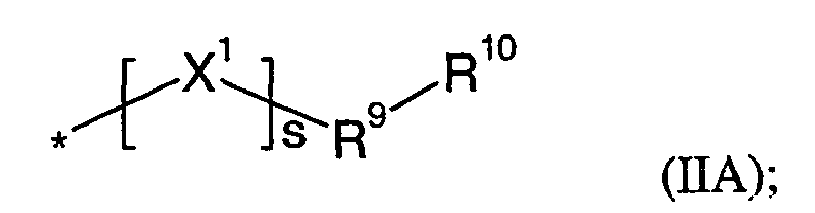
- s is 0 or 1;
- X1 is a group >N-R11 wherein R11 is hydrogen or a C1-4 alkyl group;
- R9 represents a bond or a C1-5 alkylene group optionally substituted by hydroxyl;
- R10 represents a group -WR23, or R10 represents a 4- to 9-membered carbocyclic or heterocyclic ring which heterocyclic ring comprises 1 or 2 nitrogen atoms, and which carbocyclic or heterocyclic ring is substituted by at least one substituent -W'R24 and may further be optionally substituted by at least one substituent selected from halogen or C1-C6 alkyl;
- W and W' independently represent a bond; and
- R23 and R24 independently represent a group selected from: tetrazolyl;
- a 5- to 6- membered carbocyclic or heterocyclic ring comprising from 1 to 3 heteroatoms selected from nitrogen, oxygen and sulphur, which carbocyclic or heterocyclic ring is substituted by at least one substituent selected from hydroxyl, =O, and =S and which carbocyclic or heterocyclic ring may further be optionally substituted by at least one substituent selected from halogen, nitro, cyano, -SO2C1-6 alkyl, C1-6 alkylcarbonyl, C1-6 alkoxycarbonyl, and a C1-6 alkyl group which C1-6 alkyl group can be optionally substituted by at least one substituent selected from halogen and hydroxyl;
- a 1,2,3-triazolyl or 1,2,4 triazolyl group which triazolyl group can be optionally substituted by at least one substituent selected from halogen, nitro, cyano, -SO2C1-6 alkyl, C1-6 alkylcarbonyl, C1-6 alkoxycarbonyl and C1-6 alkyl;
- a phenyl group or a 5- to 6- membered unsaturated heterocyclic ring comprising from 1 to 2 nitrogen atoms, which phenyl group or heterocyclic ring is substituted by a group -NR69 SO2NR70R71 or a group -SO2R72, wherein R69, R70, R71 and R72 each independently represent a hydrogen atom or a C1-6, preferably C1-4, alkyl group which C1-6 alkyl group can be optionally substituted by at least one substituent (e.g. one, two or three substituents) selected from halogen (e.g. chlorine, fluorine, bromine or iodine), and hydroxyl.
- In a further embodiment of the invention, there is provided a compound of formula (IA) or a pharmaceutically acceptable salt, prodrug or solvate thereof, wherein:
- p is 0 or 1;
- R1 represents halogen or methyl;
- q is 0;
- X is -C(O)NH- or -NHC(O)-;
- n is 1 or 2,
- m is 0;
- within each grouping CR5R6, R5 and R6 each independently represent hydrogen or a C1-4 alkyl group;
- R2 represents a 5 or 6-membered cycloalkyl ring optionally substituted with a C1-4 alkyl group;
- Y is nitrogen and Z is a group CR3 wherein R3 is a group of formula (IIA)

- s is 0;
- R9 represents a bond; and
- R10 represents a 4- to 9-membered heterocyclic ring, which heterocyclic ring comprises 1 or 2 nitrogen atoms, and which heterocyclic ring can be optionally substituted by at least one substituent selected from hydroxyl, cyano, carboxyl, methyl, -NH2, -NHCH3, -NHCH2CH2OH -CH2C(O)OH, -NHCH2C(O)OH, -NHCH2CH2C(O)OH, -CH2NHCH3, -CH2NHCH2CH2OH, -SO2CH2CH2OH, -N(CH2CH2OH)C(O)OC(CH3)3, -NHSO2CF3, -NHC(O)NHSO2CH3.
- In a further embodiment of the invention the compound of formula (IA) is
- N-[6-Chloro-2-(4-piperidinylmethyl)-5-quinolinyl]-cylohexaneacetamide, dihydrochloride,
- N-[6-Chloro,2-(1-piperazinyl)-5-quinolinyl]-cylohexaneacetamide, dihydrochloride,
- N-[6-Chloro-2-[methyl[3-(methylamino)propyl]amino]-5-quinolinyl]-cyclohexaneacetamide, dihydrochloride,
- 6-Chloro-N-(cyclohexylmethyl)-2-methyl-5-quinolinecarboxamide, hydrochloride,
- N-[6-Chloro-2-[(3-hydroxypropyl)amino]-5-quinolinyl]-cyclohexaneacetamide, hydrochloride,
- N-[6-Chloro-2-[[(2R)-2,3-dihydroxypropyl]amino]-5-quinolinyl]-cyclohexaneacetamide,
- 4-[[6-Chloro-5-[(cyclohexylacetyl)amino]-2-quinolinyl]amino]-butanoic acid,
- N-[6-Chloro-2-[methyl[3-(methylamino)propyl]amino]-5-quinolinyl]-4-(trifluoromethyl)-cyclohexaneacetamide, dihydrochloride,
- N-[6-Chloro-2-(1-piperazinyl)-5-quinolinyl]-4-(trifluoromethyl)-cyclohexaneacetamide,
- N-[6-Chloro-2-(hexahydro-1H-1,4-diazepin-1-yl)-5-quinolinyl]-cyclohexaneacetamide,
- N-[6-Chloro-2-[(cis-3,5-dimethyl-1-piperazinyl]-5-quinolinyl]-cyclohexaneacetamide,
- N-[6-Chloro-2-(4-methyl-1-piperazinyl)-5-quinolinyl]-cyclohexaneacetamide, dihydrochloride,
- N-[6-Chloro-2-[(1S,4S)-2,5-diazabicyclo[2.2.1]hept-2-yl]-5-quinolinyl]-cyclohexaneacetamide, acetate,
- N-[6-Chloro-2-[(3R)-3-pyrrolidinylamino]-5-quinolinyl]-cyclohexaneacetamide, dihydrochloride,
- N-[2-[3-(Ethylamino)propyl]-6-methyl-5-quinolinyl]-cyclohexaneacetamide, dihydrochloride,
- N-[6-Chloro-2-[3-(ethylamino)propyl]-5-quinolinyl]-cyclohexaneacetamide, dihydrochloride,
- N-[6-Chloro-2-[[2-[(2-hydroxyethyl)amino]ethyl]amino]-5-quinolinyl]-cyclohexaneacetamide, dihydrochloride,
- N-5-Quinolinyl-cyclohexaneacetamide,
- 1-Methyl-N-5-quinolinyl-cyclohexaneacetamide,
- 4-Methyl-N-5-quinolinyl-cyclohexaneacetamide,
- N-5-Quinolinyl-cyclopentanepropanamide,
- N-[6-Chloro-2-[3-[(3-hydroxypropyl)amino]propyl]-5-quinolinyl]-cyclohexaneacetamide,
- N-[2-(3-Aminopropyl)-6-chloro-5-quinolinyl]-cyclohexaneacetamide,
- N-[6-Chloro-2-[3-[[[(methylsulfonyl)aminolcarbonyl]amino]propyl]-5-quinolinyl]-cyclohexaneacetamide,
- N-[2-[3-(Butylamino)propyl]-6-chloro-5-quinolinyl]-cyclohexaneacetamide dihydrochloride,
- N-[6-Chloro-2-[methyl[3-(methylamino)propyl]amino]-5-quinolinyl]-1-cyclohexyl-cyclopropanecarboxamide, hydrochloride,
- N-[6-Chloro-2-(1-piperazinyl)-5-quinolinyl]-1-cyclohexyl-cyclopropanecarboxamide,
- N-[6-Chloro-2-[(3R)-3-hydroxy-1-pyrrolidinyl]-5-quinolinyl]-cyclohexaneacetamide,
- N-[6-Chloro-2-[(3S)-3-hydroxy-1-pyrrolidinyl]-5-quinolinyl]-cyclohexaneacetamide,
- N-[2-[(3R)-3-Amino-1-pyrrolidinyl]-6-chloro-5-quinolinyl]-cyclohexaneacetamide,
- N-[2-[(3S)-3-Amino-1-pyrrolidinyl]-6-chloro-5-quinolinyl]-cyclohexaneacetamide,
- N-[2-(4-Amino-1-piperidinyl)-6-chloro-5-quinolinyl]-cyclohexaneacetamide,
- N-[6-Chloro-2-[(3R)-3-(methylamino)-1-pyrrolidinyl]-5-quinolinyl]-cyclohexaneacetamide,
- N-[6-Chloro-2-[(3R)-3-[(2-hydroxyethyl)amino]-1-pyrrolidinyl]-5-quinolinyl]-cyclohexaneacetamide,
- N-[6-Chloro-2-[(3S)-3-(methylamino)-1-pyrrolidinyl]-5-quinolinyl]-cyclohexaneacetamide,
- N-[6-Chloro-2-[(3S)-3-[(2-hydroxyethyl)amino]-1-pyrrolidinyl]-5-quinolinyl]-cyclohexaneacetamide,
- N-[6-Chloro-2-[(3R)-3-hydroxy-1-piperidinyl]-5-quinolinyl]-cyclohexaneacetamide,
- N-[2-[(3S)-3-Amino-1-pyrrolidinyl]-6-methyl-5-quinolinyl]-cyclohexaneacetamide,
- N-[6-Methyl-2-(1-piperazinyl)-5-quinolinyl]-cyclohexaneacetamide,
- N-[6-Chloro-5-[(cyclohexylacetyl)amino]-2-quinolinyl]-glycine,
- N-[6-Chloro-5-[(cyclohexylacetyl)amino]-2-quinolinyl]-β-alanine,
- 6-Chloro-N-(cyclohexylmethyl)quinoline-5-carboxamide,
- 6-Chloro-N-(cyclohexylmethyl)-2-(1-piperazinyl)-5-quinolinecarboxanaide, dihydrochloride,
- 2-[(3S)-3-Amino-1-pyrrolidinyl]-6-chloro-N-(cyclohexylmethyl)-5-quinolinecarboxamide,
- 6-Chloro-N-(cydohexylmethyl)-2-[methyl[3-(methylanfino)propyl]amino]-5-quinoline carboxamide, dihydrochloride,
- 6-Chloro-N-(cyclohexylmethyl)-2-[methyl[2-(methylamino)ethyl]amino] -5-quinolinecarboxamide, dihydrochloride,
- 6-Chloro-N-(cyclohexylmethyl)-2-[3-[(3-hydroxypropyl)amino]propyl]-5-quinolinecarboxamide,
- 2-[(3R)-3-Amino-1-pyrrolidinyl]-6-chloro-N-(cyclohexylmethyl)-5-quinolinecarboxamide, dihydrochloride,
- N-(2-Amino-6-chloro-5-quinolinyl)-cyclohexaneacetamide, trifluoroacetate,
- 6-Chloro-N-(cyclohexylmethyl)-2-[(3S)-3-[(2-hydroxyethyl)amino]-1-pyrrolidinyl]-5-quinolinecarboxamide, hydrochloride,
- 2-[(3S)-3-Amino-1-piperidinyl]-6-chloro-N-(cyclohexylmethyl)-5-quinolinecarboxamide,
- 6-Chloro-N-(cyclohexylmethyl)-2-[(3S)-3-[(2-hydroxyethyl)amino]-1-piperidinyl]-5-quinolinecarboxamide, hydrochloride,
- 6-Chloro-N-(cyclohexylmethyl)-2-(3-hydroxy-1-azetidinyl)- 5-quinolinecarboxamide,
- 2-[(3S)-3-Amino-1-pyrrolidinyl]-N-(cyclohexylmethyl)-5-quinolinecarboxamide,
- 6-Chloro-N-(cyclohexylmethyl)-2-[3-[(2-hydroxyethyl)amino]-1-azetidinyl]- 5 quinolinecarboxamide,
- [1-[6-Chloro-5-[(cyclohexylacetyl)amino]-2-quinolinyl]-3-pyrrolidinyl](2-hydroxyethyl)-carbamic acid 1,1-dimethylethyl ester,
- N-(Cylohexylmethyl)-6-methyl-5-quinolinecarboxamide,
- 2-[(3S)-3-Amino-1-pyrrolidinyl]-N-(cyclohexylmethyl)-6-methyl-5-quinolinecarboxamide, acetate,
- N-[2-[[(3S)-3-Amino-1-pyrrolidinyl]methyl]-6-chloro-5-quinolinyl]-cyclohexaneacetamide,
- N-[2-[(3S)-3-Amino-1-piperidinyl]-6-chloro-5-quinolinyl]-cyclohexaneacetamide,
- N-[6-Chloro-2-[(3S)-3-[(2-hydroxyethyl)amino]-1-piperidinyl]-5-quinolinyl]-cyclohexaneacetamide,
- N-[2-[(3S)-3-Amino-1-pyrrolidinyl]-6-chloro-5-quinolinyl]-cyclopentanepropanamide,
- N-[6-Chloro-2-[(3S)-3-[(2-hydroxyethyl)amino]-1-pyrrolidinyl]-5-quinolinyl]-cyclopentanepropanamide,
- N-[6-Chloro-2-[4-(1,5-dihydro-5-oxo-4H-1,2,4-triazol-4-yl)-1-piperidinyl]-5-quinolinyl]-cyclohexaneacetamide,
- 1-[6-Chloro-5-[(cyclohexylacetyl)amino]-2-quinolinyl]-D-proline, trifluoroacetate,
- 1-[6-Chloro-5-[(cyclohexylacetyl)amino]-2-quinolinyl]-4-piperidinecarboxylic acid, lithium salt,
- 6-Chloro-5-[(cyclohexylacetyl)amino]-2-quinolinebutanoic acid,
- 1-[6-Chloro-5-[(cyclohexylacetyl)amino]-2-quinolinyl]-4-piperidineacetic acid,
- 4-[6-Chloro-5-[(cyclohexylacetyl)amino]-2-quinolinyl]-1-piperazineacetic acid, lithium salt,
- 6-Chloro-5-[(cyclohexylacetyl)amino]-2-quinolinepentanoic acid, 1-[6-chloro-5-[[(cyclohexylmethyl)amino]carbonyl]-2-quinolinyl]-D-proline,
- 1-[6-Chloro-5-[[(cyclohexylmethyl)amino]carbonyl]-2-quinolinyl]-L-proline, trifluoroacetate,
- 4-[6-chloro-5-[[(cyclohexylmethyl)amino]carbonyl]-2-quinolinyl]-1-piperazineacetic acid, acetate,
- 1-[6-Chloro-5-[[(cyclohexylmethyl)amino]carbonyl]-2-quinolinyl]-4-piperidinecarboxylic acid, sodium salt,
- 1-[6-Chloro-5-[[(cyclohexylmethyl)amino]carbonyl]-2-quinolinyl]-4-piperidineacetic acid, trifluoroacetate,
- 1-[6-Chloro-5-[[(2-cyclohexylethyl)amino]carbonyl]-2-quinolinyl]-4-piperidinecarboxylic acid,
- 1-[6-Chloro-5-[(3-cyclopentyl-1-oxopropyl)amino]-2-quinolinyl]-4-piperidinecarboxylic acid,
- 1-[6-Chloro-5-[(3-cyclohexyl-1-oxopropyl)amino]-2-quinolinyl]-4-piperidinecarboxylic acid, potassium salt,
- 1-[6-Chloro-5-[[(1-methylcylohexyl)acetyl]amino]-2-quinolinyl]-4-piperidinecarboxylic acid,
- N-[6-Chloro-2-[3-[(2-hydroxyethyl)amino]-1-piperidinyl]-5-quinolinyl]-cyclohexaneacetamide,
- N-[6-chloro-2-[2-[[(2-hydroxyethyl)amino]methyl]-1-pyrrolidinyl]-5-quinolinyl]-cyclohexaneacetamide,
- N-[6-Chloro-2-[3-(methylamino)-1-piperidinyl]-5-quinolinyl]-cyclohexaneacetamide,
- N-[6-Chloro-2-[2-[(methylamino)methyl]-1-pyrrolidinyl]-5-quinolinyl]-cyclohexaneacetamide,
- N-[2-[(3R)-3-Hydroxy-1-pyrrolidinyl]-6-methyl-5-quinolinyl]-cyclohexaneacetamide,
- N-[(3S)-1-[6-Chloro-5-[(cyclohexylacetyl)amino]-2-quinolinyl]-3-pyrrolidinyl]-glycine,
- N-[2-[(3S)-3-[(2-Hydroxyethyl)amino]-1-pyrrolidinyl]-6-methyl-5-quinolinyl]-cyclohexaneacetamide,
- N-[(3S)-1-[6-Chloro-5-[(cyclohexylacetyl)amino]-2-quinolinyl]-3-pyrrolidinyl]-β-alanine,
- N-[6-Chloro-2-[(3S)-3-[[(trifluoromethyl)sulfonyl]amino]-1-pyrrolidinyl]-5-quinolinyl]-cyclohexaneacetamide,
- N-[6-Chloro-2-[(3S)-3-[[[(methylsulfonyl)amino]carbonyl]amino]-1-pyrrolidinyl]-5-quinolinyl]-cyclohexaneacetamide,
- N-[2-[(3S)-3-Amino-1-pyrrolidinyl]-6-chloro-5-quinolinyl]-cyclohexanepropanamide,
- N-[6-Chloro-2-[methyl[3-(methylamino)propyl]amino]-5-quinolinyl]-cyclohexanepropanamide,
- N-[6-Chloro-2-(1-piperazinyl)-5-quinolinyl]-cyclohexanepropanamide,
- N-[6-Chloro-2-[(3S)-3-[(2-hydroxyethyl)amino]-1-pyrrolidinyl]-5-quinolinyl]-cyclohexanepropanamide,
- 2-[(3S)-3-Amino-1-pyrrolidinyl]-6-chloro-N-(2-cyclohexylethyl)- 5-quinolinecarboxamide, ditrifluoroacetate,
- N-[6-Chloro-2-[(3S)-3-[(2-hydroxyethyl)sulfonyl]-1-pyrrolidinyl]-5-quinolinyl]-cyclohexaneacetamide,
- N-[6-Chloro-2-[(3S)-3-cyano-1-pyrrolidinyl]-5-quinolinyl]-cyclohexaneacetamide,
- N-[1-[6-Chloro-5-[[(cyclohexylmethyl)amino]carbonyl]-2-quinolinyl]-3-azetidinyl]-β-alanine,
- 6-Chloro-N-(cyclohexylmethyl)-2-[3-(1H-tetrazol-5-yl)-1-azetidinyl]-5-quinolinecarboxamide,
- N-[6-Chloro-2-[(3S)-3-(1H-tetrazol-5-yl)-1-pyrrolidinyl]-5-quinolinyl]-cyclohexaneacetamide,
- N-[6-Chloro-2-[(3R)-3-(1H-tetrazol-5-yl)-1-pyrrolidinyl]-5-quinolinyl]-cyclohexaneacetamide,
- N-[6-Chloro-2-[(3S)-3-[[2-(2H-tetrazol-5-yl)ethyl]amino]-1-pyrrolidinyl]-5-quinolinyl]-cyclohexaneacetamide,
- N-[6-Chloro-2-[4-(4,5-dihydro-5-oxo-1,2,4-oxadiazol-3-yl)-1-piperidinyl]-5-quinolinyl]-cyclohexaneacetamide,
- N-[6-Chloro-2-[4-(4,5-dihydro-5-oxo-1,2,4-thiadiazol-3-yl)-1-piperidinyl]-5-quinolinyl]-cyclohexaneacetamide,
- N-[6-Chloro-2-[3-(1H-tetrazol-5-yl)propyl]-5-quinolinyl]-cyclohexaneacetamide, trifluoroacetate,
- N-[6-Chloro-2-[4-(1H-tetrazol-5-yl)butyl]-5-quinolinyl]-cyclohexaneacetamide,
- 6-Chloro-N-(cyclohexylmethyl)-2-[4-(1H-tetrazol-5-yl)butyl]-5-quinolinecarboxamide,
- N-[6-Chloro-2-[(3S)-3-[2-(1H-tetrazol-5-yl)ethoxyl-1-pyrrolidinyl]-5-quinolinyl]-cyclohexaneacetamide,
- N-[6-Chloro-2-[(3S)-3-[2-(4,5-dihydro-5-oxo-1,2,4-oxadiazol-3-yl)ethoxy]-1-pyrrolidinyl]-5-quinolinyl]-cyclohexaneacetamide,
- N-[6-Chloro-2-[4-(1H-tetrazol-5-yl)-1-piperidinyl]-5-quinolinyl]cyclohexaneacetamide,
- 6-Chloro-N-(cyclohexylmethyl)-2-[4-(1H-tetrazol-5-yl)-1-piperidinyl]-5-quinolinecarboxamide,
- 6-Chloro-N-(2-cyclohexylethyl)-2-[4-(1H-tetrazol-5-yl)-1-piperidinyl]-5-quinolinecarboxamide,
- 6-Chloro-N-(cylohexylmethyl)-2-[(3S)-3-(1,1-dioxido-4-oxo-1,2,5-thiadiazolidin-2-yl)-1-pyrrolidinyl]-5-quinolinecarboxamide,
- N-[6-Chloro-2-(4-cyano-1-piperidinyl)-5-quinolinyl]-cyclohexaneacetamide, or N-[6-Chloro-2-[4-[[(trifluoromethyl)sulfonyl]amino]-1-piperidinyl]-5-quinolinyl]-cyclohexaneacetamide.
- Pharmaceutically acceptable salts of compounds of formula (IA) that may conveniently be employed include base salts such as an alkali metal salt for example sodium, an alkaline earth metal salt for example calcium or magnesium, an organic amine salt for example triethylamine, morpholine, N-methylpiperidine, N-ethylpiperidine, procaine, dibenzylamine, N,N-dibenzylethylamine or amino acids for example lysine. In another aspect, where the compound is sufficiently basic, suitable salts include acid addition salts such as methanesulphonate, fumarate, hydrochloride, hydrobromide, citrate, maleate and salts formed with phosphoric and sulphuric acid. There may be more than one cation or anion depending on the number of charged functions and the valency of the cations or anions. A preferred pharmaceutically acceptable salt is a hydrochloride or sodium salt.
- The present invention further provides a process for the preparation of a compound of formula (IA) as defined above, or a pharmaceutically acceptable salt or solvate thereof, which comprises either:
- (a) reacting a compound of formula (IVA)

H2N- (CR5R6)n-R2 (VA)
R2, R5, R6 and n are as defined in formula (IA); or - (b) reacting a compound of formula (VIA)

L2C(O) -(CR5R6)n-R2 (VIIA)
wherein L2 represents a leaving group (e.g. hydroxyl or halogen) and R2, R5, R6 and n are as defined in formula (IA); or - (c) when Y is N and Z is CR3, and R3 represents a group of formula (IIA) above where s is 1 and X is >NR11, reacting a compound of formula (VIIIA)

- (d) when Y is N and Z is CR3, and R3 is a group formula (IIA) wherein s is 0 and R9 is a C1-C5 alkylene group which may be optionally substituted as defined herein above with respect to formula (IA), reacting a compound of formula (VillA) as defined in (c) above with a compound of formula (XA) or (XIA)

- (e) when Y is N and Z is CR3 and R3 is a group of formula (IIA) where s is 0, R9 is (CH2)2 and R10 is -NR21R22, reacting a compound of formula (VIIA) as defined in (c) above with a compound of formula (XIIA)
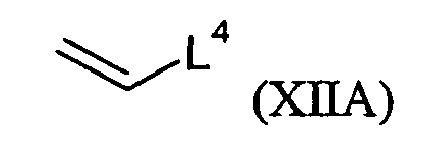
- (f) when Y is N and Z is CR3, and R3 is a group of formula (IIA) where s is 0, R9 is (CH2) and R10 is -NR19R20, reacting a compound of formula (VIIIA) as defined in (c) above with a compound of formula (XIIA) as defined in (e) above, followed by an oxidation reaction and then by reaction with a compound of formula (XIIIA) as defined in (e) above under reductive amination conditions; or
- (g) when Y is N and Z is CR3, and R3 is a group of formula (IIA) where s is 0, reacting a compound of formula (VIIIA) as defined in (c) above with a compound of formula (XIVA)

- (h) when Y is N and Z = CR3, and R23 or R24 represent tetrazolyl, reacting a compound of formula IIA1 or IIA2

- (i) when Y is N and Z = CR3, and R23 or R24 represent a group of formula (XVA)

- (j) when Y is N and Z = CR3, and R23 or R24 represent a group of formula (XVIA)


- (k) when Y is N and Z = CR3, and R23 or R24 represent a group of formula (XVIIA)

- (l) when Y is N, X is NHC(O) and m is 0, compounds of the formula (VIIIA) as defined above in (c) can be derived by reacting a compound of formula (XVIIIA)


- (m) when Y is N, X is C(O)NH and m is 0, compounds of the formula (VIIIA) as defined above in (c) can be derived by reacting a compound of formula (XXA)


- (n) when Y is N, X is C(O)NH and m is 0, compounds of the formula (VIIIA) as defined above in (c) can be derived by reacting a compound of formula (XXIIA)

and optionally after (a), (b), (c), (d), (e), (f), (g), (h), (i), (j), (k), (I), (m) or (n) carrying out one or more of the following:- converting the compound obtained to a further compound of the invention
- forming a pharmaceutically acceptable salt or solvate of the compound.
- In processes (a), (b), (1) and (m) the coupling reaction is conveniently carried out in an organic solvent such as dichloromethane, N,N-dimethylformamide or 1-methyl-2-pyrrolidinone.
If L1 or L2 represent a hydroxyl group, it may be necessary or desirable to use a coupling agent such as bromo-tris-pyrrolidino-phosphonium hexafluorophosphate (PyBroP). If L1 or L2 are chloride, such compounds may be conveniently prepared by treatment of the corresponding carboxylic acid derivative under standard conditions (such as thionyl chloride in dichloromethane with additional N,N-dimethylformamide) and used in a solvent such as acetone or dichloromethane with a suitable base such as potassium carbonate or triethylamine. - In process (c) the reaction may be performed in an organic solvent such as acetonitrile, N,N-dimethylformamide or 1-methyl-2-pyrrolidinone, and in the presence of a suitable base such as sodium hydride, triethylamine or potassium carbonate at a temperature in the range from, e.g. 50°C to 150°C, in particular from 80°C to 120°C, either in a microwave or conventional thermal conditions.
- In process (d), if the compound of formula (VIIIA) is reacted with a compound of formula (XA), then the reaction is conveniently carried out in an organic solvent such as acetonitrile, e.g. at ambient temperature (20°C), in the presence of catalytic bistriphenylphosphine dichloride palladium(0), copper (I) iodide and a base (e.g. triethylamine). The subsequent hydrogenation reaction may use hydrogen gas with a catalyst such as 5% rhodium on carbon in a solvent, for example, ethyl acetate or ethanol, and at a pressure of 3 bar.
- Alternatively, if the compound of formula (VIIIA) is reacted with a compound of formula (XIA), then it is preferred if the compound of formula (XIA) is pre-treated by reaction with a hydroborating reagent (e.g. 9-borabicyclo[3.3.1]nonane or catecholborane) in an organic solvent such as diethyl ether or tetrahydrofuran at a temperature in the range from, e.g. 0°C to 80°C, in particular from 60°C to 70°C, for about 2 to 3 hours. The pre-treated compound is then reacted with the compound of formula (VIIIA) in the presence of a suitable base (e.g. sodium hydroxide or tri-potassium orthophosphate) and a palladium catalyst (e.g. dichloro[1,1'-bis(diphenylphosphino)ferrocene]palladium (II) dichloromethane adduct), typically at a temperature in the range from 25°C to 90°C, particularly from 60°C to 70°C, for about 2 to 24 hours.
- In process (e), the reaction with the vinyl compound of formula (XIIA) may conveniently be carried out in a solvent such as N,N-dimethylformamide and in the presence of catalytic dichlorobis(triphenylphosphine) palladium, at elevated temperature, e.g. at about 70°C. The subsequent addition reaction with the compound of formula (XIIIA) may be performed under acidic or basic conditions, for example, in acetic acid in a solvent such as methanol or isopropanol at elevated temperature, e.g. at about 100°C.
- In process (f), the reaction of the vinyl compound of formula (XVIIIA) may be performed by procedures analogous to those outlined in the previous paragraph on process (e). The subsequent oxidation reaction may be carried out under standard conditions, for example, by using ozone followed by treatment with dimethylsulfide or triphenylphosphine in a suitable solvent such as dichloromethane, or, by using osmium tetroxide and sodium periodate in a suitable solvent such as 1,4-dioxane and water. The reductive amination step may be conveniently carried out in the presence of a reducing agent such as sodium cyanoborohydride, triacetoxyborohydride or sodium borohydride, in a polar solvent such as methanol, ethanol or dichloromethane either alone or in combination with acetic acid.
- In process (g), the compound of formula (XIVA) is pre-treated by reaction with a hydroborating reagent (such as 9-borabicyclo[3.3.1]nonane or catecholborane) in a solvent (such as diethyl ether or tetrahydrofuran) at a temperature in the range from 0°C to 80°C (in particular from 60°C to 70°C) for about 2 to 3 hours, then cooling the reaction mixture to room temperature and adding a solution of a base (such as sodium hydroxide in water or tri-potassium orthophosphate in water) followed by a solution of the compound of formula (VIIIA) in a solvent (such as N,N-dimethylformamide) and a palladium catalyst (such as tetrakis(triphenylphosphine)palladium (II)). The resulting reaction mixture is stirred at a temperature in the range from 25°C to 90°C (particularly from 60°C to 70°C) for about 2 to 24 hours to yield the desired compounds of formula (IA).
- In process (h), the compound of formula IIA1 or IIA2 is treated with a compound of the formula PN3 in a solvent (such as toluene, N,N-dimethylformamide or 1-methyl-2-pyrrolidinone) optionally in the presence of catalyst (such as dibutyltin oxide) at a temperature in the range from 70°C to 120°C.
- In process (i), the compound of formula IIA1 or IIA2 wherein IIA1 or IIA2 are defined as in (h) and J = O, is treated with hydroxylamine in a suitable solvent (such as methanol or ethanol) at a temperature in the range from 70°C to 130°C. The resulting intermediate is treated with a suitable chloroformate (such as 2-ethylhexylchloroformate) in a suitable solvent (such as dichloromethane) and heated at a temperature in the range from 70°C to 150°C to give the desired compounds of the formula (IA). Alternatively, when J = S, treatment of the hydroxylamine adduct with 1,1'-thiocarbonyldiimidazole in a suitable solvent (such as tetrahydrofuran) and addition of silica yields the desired compounds of the formula (IA).
- In process (j), the compound of formula IIA3 or IIA4 is treated with phosgene or a phosgene equivalent (such as triphosgene) in a suitable solvent (such as dichloromethane) with a suitable base (such as triethylamine). The resulting compound is further treated with formyl hydrazine and this subsequently with a base (such as potassium hydroxide) in a suitable solvent (such as methanol) at a temperature in the range from 50°C to 130°C to give the desired compounds of the formula (IA).
- In process (k), the compound of formula IIA3 or IIA4 wherein IIA3 or IIA4 are as defined above in (j) is treated with ethyl chloroacetate in a suitable solvent (such as acetonitrile) with a suitable base (such as triethylamine) at a temperature in the range from 50°C to 130°C. Treatment of this adduct with (chlorosulfonyl)-carbamic acid, 1,1-dimethylethyl ester in a suitable solvent (such as dichloromethane) and subsequent treatment with a suitable acid (such as trifluoroacetic acid) and a suitable base (such as sodium methoxide) to give the desired compounds of the formula (IA).
- In process (n), suitable palladium catalysts include dichlorobis(triphenylphosphine)palladium(II) and the reaction may be carried out in an inert solvent such as N-methyl pyrrolidinone, at a temperature between 25°C and 150°C, preferably 100°C and under a 1-15 bar pressure of carbon monoxide, preferably 6 bar to give the desired compounds of the formula (VIIIA).
- Compounds of formulae (IVA), (VA), (VIA), (VIIA), (IXA), (XA), (XIA), (XIIA), (XIIIA), (XIVA), (XIXA), (XXIA) and (XXIIA) are either commercially available, are known in the literature or may be prepared using known techniques.
- Compounds of formula (VIIIA) are novel compounds and form a further aspect of the invention. Examples of preparation methods for certain of these compounds are given hereinafter in the examples. Other examples can be prepared by analogous methods. In particular, compounds of formula (VIIIA) or analogues where Y is CL3 and Z is N can be prepared by either
- (i) reacting a compound of formula (XVA)

- (ii) reacting a compound of formula (XVIA)

- Compounds of formula (XVA) and (XVIA) are either commercially available, are known in the literature or may be prepared using known techniques.
- Compounds of formula (XVIIIA) are either known in the literature or may be prepared by nitration of the corresponding 2-chloroquinoline under standard conditions (such as nitric acid and sulfuric acid at a temperature in the range of 0°C to 100°C) followed by subsequent reduction to the corresponding aniline derivative under standard conditions (such as iron powder, acetic acid, hydrochloric acid, water and ethanol at a temperature in the range of 20°C to 100°C). Alternatively, a suitable nitro derivative with no substitution at the 2-position may be functionalised to compounds of formula (XVIIIA) by N-oxidation of the quinoline nitrogen under standard conditions (such as peracetic acid in acetic acid at a temperature in the range of 0°C to 60°C) and further conversion to its 2-chloro derivative by treatment with a suitable chlorinating agent (such as phosphorus oxychloride at a temperature in the range of 0°C to 100°C). 2-Hydroxy compounds may be similarly converted to the 2-chloro derivatives by treatment with similar chlorinating agents.
- Compounds of formula (XXA) may be prepared from an appropriately substituted 5-bromo-2-halo-quinoline, such as 5-bromo-2,6-dichloroquinoline, by treatment with a Grignard reagent followed carbon dioxide. Suitable Grignard reagents include isopropylmagnesium chloride and the reaction may be carried out in an inert solvent such as tetrahydrofuran or diethyl ether, at a temperature from -30°C to 30°C, but preferentially at 0°C. The reaction may be poured onto solid carbon dioxide or more preferably CO2 gas may be bubbled through the reaction mixture.
- The appropriately substituted 5-bromo-2-halo-quinoline may be prepared by bromination of an appropriately substituted 2-haloquinoline such as 2,6-dichloroquinoline. The reaction may be carried by treatment with bromine in the presence of a Lewis acid such as aluminium trichloride at temperatures between -10°C to 150°C, preferably at 120°C, in the absence of solvent.
- Compounds of formula (VIIIA) where Y is N and Z is C-L3, where L3 is a leaving group such as halogen, R1, R4, p and q are as defined in formula (IA) and m is 0, may be prepared from an appropriately substituted 5-bromo-quinoline by treatment with an amine of formula (XXIA), where R5, R6, n and R2 are as defined in formula (IA), in the presence of carbon monoxide and a palladium catalyst, followed by introduction of the 2-chlorine by treatment with an oxidising agent then a chlorinating agent. Suitable palladium catalysts include dichlorobis(triphenylphosphine)palladium (II) and the reaction may be carried out in an inert solvent such as N-methyl pyrrolidinone, at a temperature between 25°C and 150°C, preferably 100°C and under a 1-15 bar pressure of carbon monoxide, preferably 6 bar. The 2-chlorine may be introduced by treatment with an oxidant such as hydrogen peroxide in a solvent such as acetic acid at 65°C followed by treatment with a chlorinating agent such as thionyl chloride or preferably phosphorous oxychloride at a temperature of 120°C.
- The appropriately substituted 5-bromo-quinolines may be prepared by literature methods (J Heterocyclic Chem., 1967, 4, 410, Khimiya Geterotsiklicheskikh Soedinenii, 1988, 8, 1084).
- Compounds of formula (IA) can be converted into further compounds of formula (IA) using standard procedures. For example, compounds of formula (IA) in which R2 represents a halogen atom may be converted to a corresponding compound of formula (IA) in which
R2 represents a C1-C6 alkyl group by reaction with an alkyl Grignard reagent (e.g. methyl magnesium bromide) in the presence of a catalyst such as [1,3-bis(diphenylphosphino)propane]dichloronickel (II) in a solvent such as tetrahydrofuran. - In a further example of the conversion of a compound of formula (IA) to another compound of formula (IA); a compound of formula (IA) where the group NR13R14 represents NH2 may be converted into another compound of formula (IA) wherein R13 represents H and R14 is as defined in formula (IIIA), by treatment with an appropriate aldehyde (for example a suitably protected hydroxyl-acetaldehyde) in a reductive amination reaction. Suitable reducing agents include sodium cyanoborohydride, triacetoxyborohydride or sodium borohydride and the reaction may be carried out in a polar solvent such as methanol, ethanol or dichloromethane either alone or in combination with acetic acid.
- It will be appreciated by those skilled in the art that in the processes of the present invention certain functional groups such as hydroxyl or amino groups in the starting reagents or intermediate compounds may need to be protected by protecting groups. Thus, the preparation of the compounds of formula (IA) above may involve, at various stages, the addition and removal of one or more protecting groups. The protection and deprotection of functional groups is described in 'Protective Groups in Organic Chemistry', edited by J.W.F. McOmie, Plenum Press (1973) and 'Protective Groups in Organic Synthesis', 2nd edition, T.W. Greene and P.G.M. Wuts, Wiley-Interscience (1991).
- The compounds of formula (IA) above may be converted to a pharmaceutically acceptable salt or solvate thereof, preferably an acid addition salt such as a hydrochloride, hydrobromide, phosphate, acetate, fumarate, maleate, tartrate, citrate, oxalate, methanesulphonate or p-toluenesulphonate, or an alkali metal salt such as a sodium or potassium salt. Other pharmaceutically acceptable salts, as well as prodrugs such as pharmaceutically acceptable esters and pharmaceutically acceptable amides may be prepared using conventional methods.
- In a further aspect the invention provides a compound of formula (IB)

wherein p is 0, 1 or 2;
each R1 is independently selected from halogen, or optionally substituted C1-6 alkyl,
m is 0, 1,2 or 3;
X is C(O)NH or NHC(O);
n is 1 or 2 ;
each R5 and each R6 are independently selected from hydrogen or C1-3alkyl, or R5 and R6 together with the carbon atom to which they are both attached forms a C3-6cycloalkyl ring, R2 is all optionally substituted C3-8cycloalkyl group;
one of Y or Z is nitrogen and the other is a groups CR3 where R3 is hydrogen, or a group R7 OR7, SR7, NR7R8, where R7 and R8 are independently selected from hydrogen, optionally substituted C1-10alkyl, an optionally substituted cycloalkyl or an optionally substituted heterocyclic group, or R7 and R8 together with the nitrogen to which they are attached form an optionally substituted heterocyclic ring which may contain additional heteroatoms, and may further comprise bridging groups;
q is 0, 1 or 2,
and each R4 is independently selected from halogen or optionally substituted C1-6alkyl. - Certain compounds of formula (IB) are capable of existing in stereoisomeric forms. It will be understood that the invention encompasses all geometric and optical isomers of the compounds of formula (IB) and mixtures thereof including racemates. Tautomers and mixtures thereof also form an aspect of the present invention.
- For the avoidance of doubt, it is hereby noted that the numbering and definition of groups and substituents provided herein in respect of formula (IB) is distinct and separated from that provided herein above in respect of formula (IA).
- In an embodiment of the invention, in formule (IB) Y is nitrogen and Z is a group CR3
- In an embodiment of the invention, in formula (TB) p is 0 or 1. Where p is 1, R1 is preferably arranged ortho to group -(CH2)mX(CH2)nR2 on the ring.
- Preferred groups R1 in formula (IB) include halogen, such as chloro, fluoro or C1-C6 alkyl such as methyl, optionally substituted by a substituent selected from hydroxyl, halogen and C1-C6 alkoxy. Preferably R1 is chloro or methyl.
- In an embodiment of the invention, in formula (IB) m is 0 or 1 and preferably m is 0.
- In formula (IB) n is 1 or 2. and preferably n is 1.
- In formula (IB), where R5 and R6 together with the carbon atom to which they are both attached forms a cycloalkyl ring, it is preferably a cyclopropyl ring.
- In an embodiment of the invention, in formula (IB) each R5 and R6 is hydrogen.
- In formula (IB) R2 represents a C3-8cycloalkyl group, more preferably a C5-7 cycloalkyl ring, e.g. a C5 or C6 cycloalkyl ring. Most preferably R2 is an optionally substituted, cyclohexyl ring.
- Optional substituents for the ring R2 in formula (IB) include one or more groups selected from halogen, haloC1-6alkyl, C1-6 alkyl or S(O)rR50, where f is 0, 1 or 2 and R50 is C1-6alkyl. In particular, R2 may carry one or two substitutcnts which arc in particular, fluoro, methyl or trifluoromethyl.
- In formula (IB), where R2 is cyclohexyl, substitutents where present are preferably situated at the 1 and/or 4 positions of the ring.
- Preferred optional substituents for C1-6alkyl groups R4 in formula (IB) include halogen, hydroxy and C1-6alkoxy, such as methoxy.
- In an embodiment of the invention, in formula (IB) q is 0.
- In an embodiment of the invention, the compounds of formula (IB) arc selected from compounds of formula (IIIB)

- In an embodiment of the invention, in formula (IB) R3 is a group R7, OR7, SR7, NR7R8, where R7 and R8 are as defined above with respect to formula (IB).
- In an embodiment of the invention, in formula (IB) where R7 and R8 includes bridging groups, these preferably form a fused 5/6 membered ring system, for example a diazabicyclo[2.2.1]hept-2-yl group.
- In formula (IB), optional substitutents for C1-10alkyl groups R7 and R8, include halogen, nitro, cyano, OR13, OC(O)R13, C(O)OR13, C(O)NR13, SR13, S(O)R13, S(O2)R13, NR13R14,-NR13C(O)-, -NR13S(O)rR14, -S(O)rNR13R14, NR15C(O)NR13R14, or NR13C(O)NR14S(O)rR15, optionally substituted cycloalkyl, optionally substituted aryl, optionally/ substituted aryloxy or optionally substituted heterocyclic groups, where r is 0, 1 or 2, and preferably 2, and R13, R14 and R15 are independently selected from hydrogen or C1-7 alkyl, aryl, cycloalkyl or a heterocyclic group, any of which may be optionally substituted, and where appropriatae, R13 and R14 together with the nitrogen atom to which they are attached may form an optionally subsituted heterocyclic ring, which may contain additional heteroatoms.
- In formula (IB), optional substituents for cycloalkyl or heterocyclic groups R7 and R8 , as well as for rings formed by R7 and R8 include those groups listed above for C1-10alkyl groups, as well as alkyl substituted by any of said groups, and in particular by groups of formula -(CH2)dR30 where d is 1 to 10, and preferably 1-6 and R30 is halogen, nitro, cyano, OR13, OC(O)R13, C(O)OR13, C(O)NR13, SR13, S(O)R13, S(O2)R13, NR13R14, -NR13C(O)-, -NR13S(O)rR14, -S(O)rNR13R14, NR15C(O)NR13R14, or NR13C(O)NR14S(O)rR15 where r is 0, 1 or 2, where R13, R14 and R15 are as defined above. A particular group R30 is NR13R14.
- In formula (IB), optional substitutents for alkyl groups R13, R14 and R15 include halogen, nitro, cyano, OR16, OC(O)R16, C(O)OR16, SR16, S(O)R16, S(O2)R16, NR16R17, -NR16C(O)-, -NR16S(O)rR17, -S(O)rNR16R17, NR18C(O)NR16R17, or NR16C(O)NR17S(O)rR18 where R16, R17 and R18 are independently selected from hydrogen or C1-7 alkyl, aryl, cycloalkyl or heterocyclic groups, or where appropriate, R16 and R17 together with the nitrogen atom to which they are attached form a heterocyclic group, which optionally contains further heteroatoms.
- In formula (IB), where R13 , R14 and R15 are aryl, cycloalkyl or heterocyclic groups, or where R13 and R14 together with the nitrogen atom to which they are attached form a heterocyclic group, they may be optionally substituted by a groups -(CH2)eR31 where e is 0 or an integer of from 1 to 10, preferably from 1-6, and R31 is halogen, nitro, cyano, OR16, OC(O)R16, C(O)OR16, C(O)NR16, SR16, S(O)R16, S(O2)R16, NR16R17, -NR16C(O)-, -NR16S(O)rR17, -S(O)rNR16R17, NR18C(O)NR16R17, or NR16C(O)NR17S(O)rR18, cycloalkyl, aryl, aryloxy or heterocyclic groups, where r is as defined above, and R16, R17 and R18 are as defined above. A particular group for R31 is NR16R17.
- In an embodiment of the invention, in formula (IB) preferred substitutents for R7 or R8 include halogen, hydroxy and C1-6alkoxy.
- In formula (IB), suitable substituents for aryl groups R13, R14 or R15 include halogen, hydroxy or C1-6alkylsulphonylamino,
- In formula (IB), preferred examples of R3 include groups of formula (IIB)

s is 0 or 1;
R9 represents a bond or a C1-C5 alkylene group, which may be optionally substituted,
R10 represents hydrogen, hydroxyl, carboxy, a group -NR19R20, an optionally substituted carbocyclic or an optionally substituted heterocyclic ring, either or which may include bridging groups,
where R19 and R20 are independently selected from hydrogen, pyrrolidine, piperazine, piperidine, C1-6alkylcarbonyl, C2-7alkenyl, optionally substituted C1-7alkyl, or C(O)NHS(O2)R21 where R21 is C1-5alkyl, provided that when s is 1 and R9 is a bond, R10 is other than hydroxy, carboxy or a group -NR19R20. - In formula (IIB), optional substituents for C1-7 alkyl groups R19 and R20 include at least one substituent selected from halogen, carboxyl, hydroxyl, C1-C6 alkylamino, di-C1-C6 alkylamino, -NH(CH2)2-4OH, C1-C6 alkoxy, C1-C6 alkylthio, C1-C6 alkoxycarbonyl, -NR37R38 and -CONR38R37, -NR37COR38 and an optionally substituted saturated or unsaturated 3- to 10-membered ring system which may comprise at least one ring heteroatom selected from nitrogen, oxygen and sulphur; where R37 and R38 are independently selected from hydrogen atom or a C1-C6 alkyl, C2-C6 hydroxyalkyl or C3-C8 cycloalkyl group, or R37 and R38 together with the nitrogen atom to which they are attached form a 3- to 8-membered saturated heterocyclic ring;
- In formula (IIB), where R19 and R20 carries a substituent which is a ring system as described above, this is suitably optionally substituted by at least one substituent selected from halogen, hydroxyl, oxo, carboxyl, cyano, C1-C6 alkyl, C1-C6 hydroxyalkyl, -(CH2)tNR22R23, -(CH2)tCONR24R25, -(CH2)t NR26COR27, or -(CH2)tR29 where R22 and R23 each independently represent a hydrogen atom or a C1-C6 alkyl, C2-C6 hydroxyalkyl or C3-C8 cycloalkyl group, or R22 and R23 together with the nitrogen atom to which they are attached form a 3- to 8-membered saturated heterocyclic ring;
R24 and R25 each independently represent a hydrogen atom or a C1-C6 alkyl,
C2-C6 hydroxyalkyl or C3-C8 cycloalkyl group, or R24 and R25 together with the nitrogen atom to which they are attached form a 3- to 8-membered saturated heterocyclic ring;
R26 and R27 each independently represent a hydrogen atom or a C1-C6 alkyl,
C2-C6 hydroxyalkyl or C3-C8 cycloalkyl group;
R29 is aryl such as phenyl, and
t is 0, 1, 2, 3, 4, 5 or 6. - In formula (IIB), where R10 is an optionally substituted carbocyclic or an optionally substituted heterocyclic ring, suitable substituents include those listed above for ring substitutents on R19 and R20 as described in the paragraph above.
- In formula (IIB), optional substituents for C1-5alkylene groups R9 include one or more substituents selected from hydroxyl, halogen, C1-C6 alkoxy, C1-C6 alkylthio, C1-C6 hydroxyalkyl, C1-C6 hydroxyalkyloxy, C1-C6 alkoxycarbonyl, C3-C8 cycloalkyl, phenyl (optionally substituted by at least one substituent selected from halogen, hydroxyl and C1-C6 alkylsulphonylamino), benzyl, indolyl (optionally substituted by at least one substituent selected from C1-C6 alkoxy), oxopyrrolidinyl, phenoxy, benzodioxolyl, phenoxyphenyl, piperidinyl and benzyloxy.
- In formula (IIB), any hydroxyl groups will not normally be attached to a carbon atom adjacent a nitrogen atom. Further, when R9 is other than a bond, the group R10 may be attached to the C1-C5 alkyl moiety of R9 at any suitable point; thus R10 may be attached to an internal or terminal carbon atom of the C1-C5 alkyl moiety of R9.
- In formula (IIB), R11 represents a hydrogen atom or a C1-C5 alkyl group which may be optionally substituted by at least one substituent (e.g. one, two or three substituents independently) selected from hydroxyl, halogen (e.g. fluorine, chlorine, bromine or iodine) and C1-C6, or C1-C4, alkoxy.
- In an embodiment of the invention, in formula (IIB) R11 represents a hydrogen atom or a C1-C5 alkyl group which may be optionally substituted by at least one hydroxyl group.
- In formula (IIB), s is preferably 0.
- In an embodiment of the invention, in formula (IIB) where s is 0, R9 is a C1-5 alkylene group such as methylene, and R10 is a heterocyclic group such as a saturated nitrogen containing ring, for instance piperidine. In an alternative embodiment, in formula (IIB) s is 1 and X1 is a group >NR11 where R11 is hydrogen or a C1-5alkyl group such as methyl.
- In formula (IIB), preferred groups R9 include a bond or a C1-C5 alkyl group which may be optionally substituted by at least one substituent (e.g. one, two or three substituents independently) selected from hydroxyl, halogen (e.g. fluorine, chlorine, bromine or iodine), C1-C6, or C1-C4, alkoxy, C1-C6, or C1-C4, alkylthio, C1-C6, or C1-C4, hydroxyalkyl, C1-C6, or C1-C4, hydroxyalkyloxy, C1-C6, or C1-C4, alkoxycarbonyl, C3-C8 cycloalkyl, phenyl (optionally substituted by at least one substituent, e.g. one, two or three substituents independently, selected from halogen, hydroxyl and C1-C6, or C1-C4, alkylsulphonylamino), benzyl, indolyl (optionally substituted by at least one substituent, e.g. one, two or three substituents independently, selected from C1-C6, or C1-C4, alkoxy), oxopyrrolidinyl, phenoxy, 1,3-benzodioxolyl, phenoxyphenyl, piperidinyl and benzyloxy.
- In an embodiment of the invention, in formula (IIB) R9 represents a bond or a C1-C4 alkyl group which may be optionally substituted by one, two or three substituents independently selected from hydroxyl, C1-C2 alkoxy, methylthio, C1-C2 hydroxyalkyl, C1-C2 hydroxyalkyloxy, methoxycarbonyl, C3-C6 cycloalkyl, phenyl (optionally substituted by at least one substituent selected from halogen, hydroxyl and methylsulphonylamino), benzyl, indolyl (optionally substituted by at least one methoxy), oxopyrrolidinyl, phenoxy, benzodioxolyl, phenoxyphenyl, piperidinyl and benzyloxy.
- In another embodiment of the invention, in formula (IIB) R9 represents a bond or a C1-C4 alkyl group which may be optionally substituted by one, two or three substituents independently selected from hydroxyl, C1-C2 alkoxy, methylthio, C1-C2 hydroxyalkyl, C1-C2 hydroxyalkyloxy, methoxycarbonyl, cyclopropyl, phenyl (optionally substituted by at least one substituent selected from chlorine, hydroxyl and methylsulphonylamino), benzyl, indolyl (optionally substituted by at least one methoxy), oxopyrrolidinyl, phenoxy, benzodioxolyl, phenoxyphenyl, piperidinyl and benzyloxy.
- In a preferred embodiment of the invention, in formula (IIB) R9 represents a bond or a C1-4alkyl group which is unsubstituted.
- In an embodiment of the invention, in formula (IIB) R10 represents hydrogen, hydroxyl, carboxy or a group -NR19R20.
- In formula (IIB), preferably R19 and R20 each independently represent hydrogen, pyrrolidinyl, C1-C6, or C1-C4, alkylcarbonyl, C2-C7 alkenyl, or C1-C7 alkyl optionally substituted with at least one substituent (e.g. one, two, three or four substituents independently) selected from carboxyl, hydroxyl, NR45R46, OR45, SR45, OC(O)R45 and C(O)OR45 (where R45 and R46 are independently selected from hydrogen or C1-6alkyl, and preferably C1-4alkyl,) and a saturated or unsaturated 3- to 10-membered ring system which may comprise at least one ring heteroatom (e.g. one, two, three or four ring heteroatoms independently) selected from nitrogen, oxygen and sulphur, the ring system being optionally substituted by at least one substituent (e.g. one, two, three or four substituents independently) selected from halogen (e.g. fluorine, chlorine, bromine or iodine), hydroxyl, oxo, carboxyl, cyano, C1-C6, or C1-C4, alkyl, C1-C6, or C1-C4, hydroxyalkyl, -NR22R23, -(CH2)tNR24R25 and -CONR26R27, where R22, R23, R24, R25, R26, R27 and t are as defined above.
- For instance, in formula (IIB) R19 and R20 each independently represent hydrogen, pyrrolidinyl, C1-C2 alkylcarbonyl, C5-C7 alkenyl, or C1-C7 alkyl optionally substituted with one or two substituents independently selected from carboxyl, hydroxyl, amino, C1-C2 alkylamino, di-C1-C2 alkylamino, -NH(CH2)2-4OH, C1-C2 alkoxy, C1-C2 alkylthio, C1-C2 alkoxycarbonyl, and a saturated or unsaturated 3- to 10-membered ring system which may comprise at least one ring heteroatom (e.g. one, two, three or four ring heteroatoms independently) selected from nitrogen, oxygen and sulphur, the ring system being optionally substituted by at least one substituent (e.g. one, two, three or four substituents independently) selected from fluorine, hydroxyl, oxo, carboxyl, cyano, C1-C2 alkyl, C1-C2 hydroxyalkyl, -NR22R23, -(CH2)tNR24R25 and -CONR26R27 where R22, R23, R24, R25, R26, R27 and t are as defined above.
- Specific examples of R19 and R20 in formula (IIB) include hydrogen, pyrrolidinyl, methylcarbonyl, C7 alkenyl, or C1-C7 alkyl optionally substituted with one or two substituents independently selected from carboxyl, hydroxyl, methylamino, di-methylamino, -NH(CH2)2OH, methylthio, C1-C2 alkoxycarbonyl, and a saturated or unsaturated 3- to 10-membered ring system which may comprise one, two or three ring heteroatoms independently selected from nitrogen, oxygen and sulphur, the ring system being optionally substituted by one or two substituents independently selected from fluorine, hydroxyl, oxo, C1-C2 alkyl and hydroxymethyl.
- The saturated or unsaturated 3- to 10-membered ring system defined above in respect of R19 and R20 in formula (IIB), may be monocyclic or polycyclic (e.g. bicyclic) and may have alicyclic or aromatic properties. An unsaturated ring system will be partially or fully unsaturated. Examples of ring systems that may be used include cyclopropyl, cyclobutyl, cyclopentyl, cyclohexyl, cycloheptyl, cyclopentenyl, cyclohexenyl, bicyclo[2.2.1]hept-2-yl, bicyclo[2.2.1]hept-5-en-2-yl, homopiperazinyl, phenyl, 3,4-dihydro-2H-pyranyl, pyrrolidinyl, piperidinyl, piperazinyl, phenyl, pyrazolyl, thiazolidinyl, indanyl, thienyl, isoxazolyl, thiadiazolyl, pyrrolyl, furyl, thiazolyl, indolyl, imidazolyl, benzimidazolyl, triazolyl, tetrazolyl and pyridinyl.
- In one aspect of the invention , the saturated or unsaturated 3- to 10-membered ring system of R19 and R20 in formula (IIB) is selected from cyclopropyl, cyclohexenyl, phenyl, thienyl, pyridinyl, furyl, bicyclo[2.2.1]hept-5-en-2-yl, 3,4-dihydro-2H-pyranyl, thiazolyl, pyrrolyl, pyrazolyl, imidazolyl and thiadiazolyl.
- In formula (IIB), where R10 is an optionally substituted carbocyclic or heterocyclic ring, it is preferably a saturated or unsaturated 4- to 9-membered ring system which is optionally substituted.
- Optional substituents for where R10 in formula (IIB) is an optionally substituted carbocyclic or heterocyclic ring, include those listed above for ring substituents on R19 and R20 i.e. at least one substituent selected from halogen, hydroxyl, oxo, carboxyl, cyano, C1-C6 alkyl, C1-C6 hydroxyalkyl, -(CH2)tNR22R23, -(CH2)tCONR24R25, -(CH2)t NR26COR27 or -(CH2)tR29 where R22 and R23 each independently represent a hydrogen atom or a C1-C6 alkyl, C2-C6 hydroxyalkyl or C3-C8 cycloalkyl group, or R22 and R23 together with the nitrogen atom to which they are attached form a 3- to 8-membered saturated heterocyclic ring;
R24 and R25 each independently represent a hydrogen atom or a C1-C6 alkyl,
C2-C6 hydroxyalkyl or C3-C8 cycloalkyl group, or R24 and R25 together with the nitrogen atom to which they are attached form a 3- to 8-membered saturated heterocyclic ring;
R26 and R27 each independently represent a hydrogen atom or a C1-C6 alkyl,
C2-C6 hydroxyalkyl or C3-C8 cycloalkyl group;
R29 is aryl such as phenyl; and
tis 0,1, 2, 3,4,5 or 6. - Preferred optional substituents for R10 in formula (IIIB) include one or more groups selected from, amino, C1-C6 alkyl, C1-C6 alkylamino, -NH(CH2)2OH, -NH(CH2)3OH, C1-C6 hydroxyalkyl, benzyl and

- In formula (IIB) preferred rings R10 are saturated or unsaturated 4- to 9-membered ring systems which may comprise one or two ring heteroatoms independently selected from nitrogen, oxygen and sulphur, the ring system being optionally substituted by at least one substituent (e.g. one, two, three or four substituents independently) selected from hydroxyl, amino (-NH2), C1-C2 alkyl, C1-C2 alkylamino, -NH(CH2)2OH, -NH(CH2)3OH, C1-C2 hydroxyalkyl, benzyl and

- In formula (IIB), when R10 represents a saturated or unsaturated 4- to 9-membered ring system, the ring system may be monocyclic or polycyclic (e.g. bicyclic) and may have alicyclic or aromatic properties. An unsaturated ring system will be partially or fully unsaturated. Examples of ring systems that may be used include cyclobutyl, cyclopentyl, cyclohexyl, cycloheptyl, cyclopentenyl, cyclohexenyl, bicyclo[2.2.1]hept-2-yl, bicyclo[2.2.1]hept-5-en-2-yl, 2,3-dihydro-1H-indenyl, homopiperazinyl, phenyl, pyrrolidinyl, piperidinyl, piperazinyl, pyrazolyl, thiazolidinyl, indanyl, thienyl, isoxazolyl, thiadiazolyl, pyrrolyl, furyl, thiazolyl, indolyl, imidazolyl, benzimidazolyl, triazolyl, tetrazolyl and pyridinyl.
- In one embodiment of the invention, in formula (IIB) the saturated or unsaturated 4- to 9-membered ring system R10 is selected from cyclobutyl, cyclohexyl, bicyclo[2.2.1]hept-2-yl, 2,3-dihydro-1H-indenyl, pyrrolidinyl, piperidinyl and piperazinyl.
- Particular examples of heterocyclic rings R10 in formula (IIB) are groups of formula NR33R34 where R33 and R34 together with the nitrogen atom to which they are attached forms a C4-9 heterocyclic ring which may contain additional heteroatoms and which may be optionally substituted, and may optionally contain bridging groups. Examples of such groups R10 in formula (IIB) are groups of formula (iii), (iv), (v) and (vi)


- In formula (IIB),when R10 is a group NR33R34, it is preferably a saturated five or six-membered heterocyclic ring which may comprise a second ring heteroatom selected from nitrogen and oxygen. The ring is optionally substituted for example with at least one substituent selected from those listed above for ring substitutents on R19 and R20.
- Particular substituents however include hydroxyl, halogen, C1-C6 alkyl, amino, mono or di-C1-4alkylamino and hydroxyC1-C6alkyl.
- In another embodiment of the invention, when R10 in formula (IIB) is NR33R34, R33 and R34 together with the nitrogen atom to which they are attached may form a saturated five or six-membered heterocyclic ring which may comprise a second ring heteroatom selected from nitrogen and oxygen, and may further comprise bridging groups; the ring being optionally substituted by at least one substituent (e.g. one, two, three or four substituents independently) selected from hydroxyl, amino, mono- or di-C1-4alkylamino, hydroxyC1-3alkylamino, halogen (e.g. fluorine, chlorine, bromine or iodine), C1-C6, or C1-C4, alkyl and C1-C6, or C1-C4, hydroxyalkyl. Examples of heterocyclic rings that may be formed include piperidinyl, piperazinyl and morpholinyl.
- Where in formula (IIB) is R10 is a group NR33R34 wherein R33 and R34 together with the nitrogen atom to which they are attached may form a saturated five or six-membered heterocyclic ring which includes bridging groups, these preferably form a fused 5/6 membered ring system such as a diazabicyclo[2.2.1]hept-2-yl group.
- For instance, where in formula (IIB) is R10 is a group NR33R34, R33 and R34 together with the nitrogen atom to which they are attached may form a saturated five or six-membered heterocyclic ring which may comprise a second ring heteroatom selected from nitrogen and oxygen, the ring being optionally substituted by one or two substituents independently selected from , amino, hydroxy, hydroxyC1-3alkylamino, C1-C2 alkyl and C1-C2 hydroxyalkyl.
- In a preferred embodiment of the invention, in formula (IIB) where s is 0, R9 is a bond and R10 is a group NR33R34 where R33 and R34 together with the nitrogen atom to which they are attached form a saturated five or six-membered heterocyclic ring optionally substituted as described above.
- In formula (IB), preferred R22 and R23 groups are independently hydrogen atom or a C1-C6, or C1-C4, alkyl, C2-C6, or C2-C4, hydroxyalkyl or C3-C8, or C5-C6, cycloalkyl group, or R22 and R23 together with the nitrogen atom to which they are attached form a 3- to 8-membered saturated heterocyclic ring (e.g. pyrrolidinyl or piperidinyl).
- In formula (IIB), R24 and R25 preferably each independently represent a hydrogen atom or a C1-C6, or C1-C4, alkyl, C2-C6, or C2-C4, hydroxyalkyl or C3-C8, or C5-C6, cycloalkyl group, or R24 and R25 together with the nitrogen atom to which they are attached form a 3-to 8-membered saturated heterocyclic ring (e.g. pyrrolidinyl or piperidinyl).
- In formula (IIB), R26 and R27 each independently represent a hydrogen atom or a C1-C6, or C1-C4, alkyl, C2-C6, or C2-C4, hydroxyalkyl or C3-C8, or C5-C6, cycloalkyl group, or R26 and R27 together with the nitrogen atom to which they are attached form a 3- to 8-membered saturated heterocyclic ring (e.g. pyrrolidinyl or piperidinyl).
- In a preferred embodiment of the present invention, R3 in formula (IB) is a group of sub-formula (ii) or (ii)

- Particular compounds of the present invention according to formula (IB) are as follows:
- N-[6-Chloro-2-(4-piperidinylmethyl)-5-quinolinyl]-cyclohexaneacetamide, dihydrochloride;
- N-[6-Chloro-2-(1-piperazinyl)-5-quinolinyl]-cyclohexaneacetamide, dihydrochloride;
- N-[6-Chloro-2-[methyl[3-(methylamino)propyl]amino]-5-quinolinyl]-cyclohexaneacetamide, dihydrochloride;
- 6-Chloro-N-(cyclohexylmethyl)-2-methyl-5-quinolinecarboxamide, hydrochloride;
- N-[6-Chloro-2-[(3-hydroxypropyl)amino]-5-quinolinyl]-cyclohexaneacetamide, hydrochloride;
- N-[6-Chloro-2-[[(2R)-2,3-dihydroxypropyl]amino]-5-quinolinyl]-cyclohexaneacetamide;
- 4-[[6-Chloro-5-[(cyclohexylacetyl)amino]-2-quinolinyl]amino]-butanoic acid;
- N-[6-Chloro-2-[methyl[3-(methylamino)propyl]amino]-5-quinolinyl]-4-(trifluoromethyl)-cyclohexaneacetamide, dihydrochloride;
- N-[6-Chloro-2-(1-piperazinyl)-5-quinolinyl]-4-(trifluoromethyl)-cyclohexaneacetamide;
- N-[6-Chloro-2-(hexahydro-1H-1,4-diazepin-1-yl)-5-quinolinyl]-cyclohexaneacetamide;
- N-[6-Chloro-2-[(cis-3,5-dimethyl-1-piperazinyl]-5-quinolinyl]-cyclohexaneacetamide;
- N-(6-Chloro-2-(4-methyl-1-piperazinyl)-5-quinolinyl]-cyclohexaneacetamide, dihydrochloride;
- N-[6-Chloro-2-[(1S,4S)-2,5-diazabicyclo[2.2.1]hept-2-yl]-5-quinolinyl]-cyclohexaneacetamide, acetate;
- N-[6-Chloro-2-[(3R)-3-pyrrolidinylamino]-5-quinolinyl]-cyclohexaneacetamide, dihydrochloride;
- N-[2-[3-(Ethylamino)propyl]-6-methyl-5-quinolinyl]-cyclohexaneacetamide, dihydrochloride;
- N-[6-Chloro-2-[3-(ethylamino)propyl]-5-quinolinyl]-cyclohexaneacetamide, dihydrochloride;
- N-[6-Chloro-2-[[2-[(2-hydroxyethyl)amino]ethyl]amino]-5-quinolinyl]-cyclohexaneacetamide, dihydrochloride;
- N-5-Quinolinyl-cyclohexaneacetamide;
- 1-Methyl-N-5-quinolinyl-cyclohexaneacetamide;
- 4-Methyl-N-5-quinolinyl-cyclohexaneacetamide;
- N-5-Quinolinyl-cyclopentanepropanamide;
- N-[6-Chloro-2-[3-[(3-hydroxypropyl)amino]propyl]-5-quinolinyl]-cyclohexaneacetamide;
- N-[2-(3-Aminopropyl)-6-chloro-5-quinolinyl]-cyclohexaneacetamide;
- N-[6-Chloro-2-[3-[[[(methylsulfonyl)amino]carbonyl]amino]propyl]-5-quinolinyl]-cyclohexaneacetamide;
- N-[2-[3-(Butylamino)propyl]-6-chloro-5-quinolinyl]-cyaohexaneacetamide dihydrochloride ;
- N-[6-Chloro-2-[methyl[3-(methylamino)propyl]amino]-5-quinolinyl]-1-cyclohexyl-cyclopropanecarboxamide, hydrochloride;
- N-[6-Chloro-2-(1-piperazinyl)-5-quinolinyl]-1-cyclohexyl-cyclopropanecarboxamide;
- N-[6-Chloro-2-[(3R)-3-hydroxy-1-pyrrolidinyl]-5-quinolinyl]-cyclohexaneacetamide;N-[6-Chloro-2-[(3S)-3-hydroxy-1-pyrrolidinyl]-5-quinolinyl]-cyclohexaneacetamide;
- N-[2-[(3R)-3-Amino-1-pyrrolidinyl]-6-chloro-5-quinolinyl]-cyclohexaneacetamide;
- N-[2-[(3S)-3-Amino-1-pyrrolidinyl]-6-chloro-5-quinolinyl]-cyclohexaneacetamide;
- N-[2-(4-Amino-1-piperidinyl)-6-chloro-5-quinolinyl]-cyclohexaneacetamide;
- N-[6-Chloro-2-[(3R)-3-(methylamino)-1-pyrrolidinyl]-5-quinolinyl]-cyclohexaneacetamide;
- N-[6-Chloro-2-[(3R)-3-[(2-hydroxyethyl)amino]-1-pyrrolidinyl]-5-quinolinyl]-cyclohexaneacetamide;
- N-[6-Chloro-2-[(3S)-3-(methylamino)-1-pyrrolidinyl]-5-quinolinyl]-cyclohexaneacetamide;
- N-[6-Chloro-2-[(3S)-3-[(2-hydroxyethyl)amino]-1-pyrrolidinyl]-5-quinolinyl]-cyclohexaneacetamide;
- N-[6-Chloro-2-[(3R)-3-hydroxy-1-piperidinyl]-5-quinolinyl]-cylohexaneacetamide;
- N-[2-[(3S)-2-Amino-1-pyrrolidinyl]-6-methyl-5-quinolinyl]-cylohexaneacetamide;
- N-[6-Methyl-2-(1-piperazinyl)-5-quinolinyl]-cyclohexaneacetamide;
- N-[6-Chloro-5-[(cylohexylacetyl)amino]-2-quinolinyl]-glycine;
- N-[6-Chloro-5-[(cyclohexylacetyl)amino]-2-quinolinyl]-β-alanine; and
- 6-Chloro-N-(cyclohexylmethyl)-2-(1-piperazinyl)-5-quinolinecarboxamide, dihydrochloride.
- Suitable pharmaceutically acceptable salts of compounds of formula (IB) include base salts such as an alkali metal salt for example sodium, an alkaline earth metal salt for example calcium or magnesium, an organic amine salt for example triethylamine, morpholine, N-methylpiperidine, N-ethylpiperidine, procaine, dibenzylamine, N,N-dibenzylethylamine or amino acids for example lysine. In another aspect, where the compound is sufficiently basic, suitable salts include acid addition salts such as methanesulphonate, fumarate, hydrochloride, hydrobromide, citrate, maleate and salts formed with phosphoric and sulphuric acid. There may be more than one cation or anion depending on the number of charged functions and the valency of the cations or anions. A preferred pharmaceutically acceptable salt is a hydrochloride salt.
- Suitable prodrugs of compounds of formula (IB) are compounds which are hydrolysed in vivo to form compounds of formula (IB). Thus for example where compounds of formula (IB) include a carboxy group, these may be in the form of pharmaceutically acceptable esters or amides.
- Suitable pharmaceutically acceptable esters of formula (IB) for carboxy groups include C1-6alkyl esters, for example methyl or ethyl; C1-6alkoxymethyl esters, for example methoxymethyl; C1-6alkanoyloxymethyl esters, for example pivaloyloxymethyl; phthalidyl esters; C3-8cycloalkoxycarbonyloxyC1-6alkyl esters, for example 1-cyclohexylcarbonyloxyethyl; 1,3-dioxolan-2-ylmethyl esters, for example 5-methyl-1,3-dioxolan-2-ylmethyl; C1-6alkoxycarbonyloxyethyl esters, for example 1-methoxycarbonyloxyethyl; aminocarbonylmethyl esters and mono- or di-N-(C1-6alkyl) versions thereof, for example N,N-dimethylaminocarbonylmethyl esters and N-ethylaminocarbonylmethyl esters; and may be formed at any carboxy group in the compounds of this invention. An in vivo cleavable ester of a compound of the invention containing a hydroxy group is, for example, a pharmaceutically-acceptable ester which is cleaved in the human or animal body to produce the parent hydroxy group. Suitable pharmaceutically acceptable esters for hydroxy include C1-6alkanoyl esters, for example acetyl esters; and benzoyl esters wherein the phenyl group may be substituted with aminomethyl or N- substituted mono- or di- C1-6alkyl aminomethyl, for example 4-aminomethylbenzoyl esters and 4-N,N-dimethylaminomethylbenzoyl esters.
- Pharmaceutically acceptable amides are similarly in-vivo hydrolysable to yield the parent acid, and include C1-6alkylamides such as acetamide.
- The present invention further provides a process for the preparation of a compound of formula (IB) as defined above, or a pharmaceutically acceptable salt, prodrug or solvate thereof, which comprises either:
- (a) reacting a compound of formula (IVB)

H2N-(CR5R6)n-R2 (VB)
R2, R5, R6 and n are as defined in formula (IB); or - (b) reacting a compound of formula (VIB)

L2C(O) - (CR5R6)n - R2 (VIIB)
wherein L2 represents a leaving group (e.g. hydroxyl or halogen) and R2, R5, R6 and n are as defined in formula (IB); or - (c) when Y is N and Z is CR3, and R3 represents a group of formula (IIB) above where s is 1 and X is >NR11, reacting a compound of formula (VIIIB)

- (d) when Y is N and Z is CR3, and R3 is a group R7 where R7 is optionally substituted C3-C10 alkyl group, reacting a compound of formula (VIIIB) as defined in (c) above with a compound of formula (XB) or (XIB)

- (e) when Y is N and Z is CR3, and R3 is a group of formula (IIB) where s is 0, R9 is (CH2)2 and R10 is -NR19R20, reacting a compound of formula (VIIB) as defined in (c) above with a compound of formula (XIIB)

- (f) when Y is N and Z is CR3, and R3 is a group of formula (IIB) where s is 0, R9 is (CH2) and R10 is -NR19R20, reacting a compound of formula (VIIIB) as defined in (c) above with a compound of formula (XIIB) as defined in (e) above, followed by an oxidation reaction and then by reaction with a compound of formula (XIIIB) as defined in (e) above under reductive amination conditions; or
- (g) when Y is N and Z is CR3, and R3 is a group of formula (IIB) where s is 0, reacting a compound of formula (VIIIB) as defined in (c) above with a compound of formula (XIVB)

and optionally after (a), (b), (c), (d), (e), (f) or (g) carrying out one or more of the following:- converting the compound obtained to a further compound of the invention
- forming a pharmaceutically acceptable salt, prodrug or solvate of the compound.
- In processes (a) and (b) the coupling reaction is conveniently carried out in an organic solvent such as dichloromethane, N,N-dimethylformamide or 1-methyl-2-pyrrolidinone. If L1 or L2 represent a hydroxyl group, it may be necessary or desirable to use a coupling agent such as bromo-tris-pyrrolidino-phosphonium hexafluorophosphate (PyBroP).
- In process (c) the reaction may be performed in an organic solvent such as acetonitrile, N,N-dimethylformamide or 1-methyl-2-pyrrolidinone, and in the presence of a suitable base such as sodium hydride, triethylamine or potassium carbonate.
- In process (d), if the compound of formula (VIIIB) is reacted with a compound of formula (XB), then the reaction is conveniently carried out in an organic solvent such as acetonitrile, e.g. at ambient temperature (20°C), in the presence of catalytic bistriphenylphosphine dichloride palladium(0), copper (I) iodide and a base (e.g. triethylamine). The subsequent hydrogenation reaction may use hydrogen gas with a catalyst such as 5% rhodium on carbon in a solvent, for example, ethyl acetate or ethanol, and at a pressure of 3 bar.
- Alternatively, if the compound of formula (VIIIB) is reacted with a compound of formula (XIB), then it is preferred if the compound of formula (XIB) is pre-treated by reaction with a hydroborating reagent (e.g. 9-borabicyclo[3.3.1]nonane or catecholborane) in an organic solvent such as diethyl ether or tetrahydrofuran at a temperature in the range from, e.g. 0°C to 80°C, in particular from 60°C to 70°C, for about 2 to 3 hours. The pre-treated compound is then reacted with the compound of formula (VIIIB) in the presence of a suitable base (e.g. sodium hydroxide or tri-potassium orthophosphate) and a palladium catalyst (e.g. dichloro[1,1'-bis(diphenylphosphino)ferrocene]palladium (II) dichloromethane adduct), typically at a temperature in the range from 25°C to 90°C, particularly from 60°C to 70°C, for about 2 to 24 hours.
- In process (e), the reaction with the vinyl compound of formula (XIIB) may conveniently be carried out in a solvent such as N,N-dimethylformamide and in the presence of catalytic dichlorobis(triphenylphosphine) palladium, at elevated temperature, e.g. at about 70°C. The subsequent addition reaction with the compound of formula (XIIIB) may be performed under acidic or basic conditions, for example, in acetic acid in a solvent such as methanol or isopropanol at elevated temperature, e.g. at about 100°C.
- In process (f), the reaction of the vinyl compound of formula (XVIIIB) may be performed by procedures analogous to those outlined in the previous paragraph on process (e). The subsequent oxidation reaction may be carried out under standard conditions, for example, by using ozone followed by treatment with dimethylsulfide or triphenylphosphine in a suitable solvent such as dichloromethane, or, by using osmium tetroxide and sodium periodate in a suitable solvent such as 1,4-dioxane and water. The reductive amination step may be conveniently carried out in the presence of a reducing agent such as sodium cyanoborohydride, triacetoxyborohydride or sodium borohydride, in a polar solvent such as methanol, ethanol or dichloromethane either alone or in combination with acetic acid.
- In process (g), the compound of formula (XIVB) is pre-treated by reaction with a hydroborating reagent (such as 9-borabicyclo[3.3.1]nonane or catecholborane) in a solvent (such as diethyl ether or tetrahydrofuran) at a temperature in the range from 0°C to 80°C (in particular from 60°C to 70°C) for about 2 to 3 hours, then cooling the reaction mixture to room temperature and adding a solution of a base (such as sodium hydroxide in water or tri-potassium orthophosphate in water) followed by a solution of the compound of formula (VIII) in a solvent (such as N,N-dimethylformamide) and a palladium catalyst (such as tetrakis(triphenylphosphine)palladium (II)). The resulting reaction mixture is stirred at a temperature in the range from 25°C to 90°C (particularly from 60°C to 70°C) for about 2 to 24 hours to yield the desired compounds of formula (IB).
- Compounds of formulae (IVB), (VB), (VIB), (VIIB), (IXB), (XB), (XIB), (XIIB), (XIIIB) and (XIVB) are either commercially available, are known in the literature or may be prepared using known techniques.
- Compounds of formula (VIIIB) are novel compounds and are described by the invention. Examples of preparation methods for certain of these compounds are given hereinafter in the examples. Other examples can be prepared by analogous methods. In particular, compounds of formula (VIIIB) or analogues where Y is CL3 and Z is N can be prepared by either
- (i) reacting a compound of formula (XVB)

- (ii) reacting a compound of formula (XVIB)

- Compounds of formula (XVB) and (XVIB) are either commercially available, are known in the literature or may be prepared using known techniques.
- Compounds of formula (IB) can be converted into further compounds of formula (IB) using standard procedures. For example, compounds of formula (IB) in which R2 represents a halogen atom may be converted to a corresponding compound of formula (IB) in which
R2 represents a C1-C6 alkyl group by reaction with an alkyl Grignard reagent (e.g. methyl magnesium bromide) in the presence of a catalyst such as [1,3-bis(diphenylphosphino)propane]dichloronickel (II) in a solvent such as tetrahydrofuran. - In a further example of the conversion of a compound of formula (IB) to another compound of formula (IB); a compound of formula (IB) where the group NR13R14 represents NH2 may be converted into another compound of formula (IB) wherein R13 represents H and R14 is as defined in formula (IIIB), by treatment with an appropriate aldehyde (for example a suitably protected hydroxyl-acetaldehyde) in a reductive amination reaction. Suitable reducing agents include sodium cyanoborohydride, triacetoxyborohydride or sodium borohydride and the reaction may be carried out in a polar solvent such as methanol, ethanol or dichloromethane either alone or in combination with acetic acid.
- It will be appreciated by those skilled in the art that in the processes of the present invention certain functional groups such as hydroxyl or amino groups in the starting reagents or intermediate compounds may need to be protected by protecting groups. Thus, the preparation of the compounds of formula (IB) above may involve, at various stages, the addition and removal of one or more protecting groups.
- The protection and deprotection of functional groups is described in 'Protective Groups in Organic Chemistry', edited by J.W.F. McOmie, Plenum Press (1973) and 'Protective Groups in Organic Synthesis', 2nd edition, T.W. Greene and P.G.M. Wuts, Wiley-Interscience (1991).
- The compounds of formula (IB) above may be converted to a pharmaceutically acceptable salt or solvate thereof, preferably an acid addition salt such as a hydrochloride, hydrobromide, phosphate, acetate, fumarate, maleate, tartrate, citrate, oxalate, methanesulphonate or p-toluenesulphonate, or an alkali metal salt such as a sodium or potassium salt. Other pharmaceutically acceptable salts, as well as prodrugs such as pharmaceutically acceptable esters and pharmaceutically acceptable amides may be prepared using conventional methods.
- The compounds of the present invention are advantageous in that they possess pharmacological activity. They are therefore indicated as pharmaceuticals for use in the treatment of rheumatoid arthritis, osteoarthritis, psoriasis, allergic dermatitis, asthma, chronic obstructive pulmonary disease (COPD), hyperresponsiveness of the airway, septic shock, glomerulonephritis, inflammatory bowel disease, Crohn's disease, ulcerative colitis, atherosclerosis, growth and metastases of malignant cells, myoblastic leukaemia, diabetes, Alzheimer's disease, meningitis, osteoporosis, burn injury, ischaemic heart disease, stroke, varicose veins, sarcoidosis, rhinitis, acute and chronic pain, multiple sclerosis, myeloma, bone loss associated with malignancy and inflammatory and neurodegenerative diseases of the eye such as scleritis, episcleritis, uveitis, Sjogrens syndrome-keratoconjuctivitis, sclerokeratitis, optic neuritis, diabetic retinopathy, retinitis pigmentosa, antimalarial - induced retinopathy.
- Accordingly, the present invention provides a compound of formula (IA) and/or (IB) or a pharmaceutically acceptable salt or solvate thereof, as hereinbefore defined for use in therapy.
- In another aspect, the invention provides the use of a compound of formula (IA) and/or (IB) or a pharmaceutically acceptable salt or solvate thereof, as hereinbefore defined in the manufacture of a medicament for use in therapy.
- In the context of the present specification, the term "therapy" also includes "prophylaxis" unless there are specific indications to the contrary. The terms "therapeutic" and "therapeutically" should be construed accordingly.
- The compounds of the invention may be used in a method of effecting immunosuppression (e.g. in the treatment of rheumatoid arthritis, osteoarthritis, irritable bowel disease, atherosclerosis or psoriasis) which comprises administering a therapeutically effective amount of a compound of formula (IA) and/or (IB) or a pharmaceutically acceptable salt or solvate thereof, as hereinbefore defined to a patient.
- The compounds of the invention may be used in a method of treating an obstructive airways disease (e.g. asthma or COPD) which comprises administering to a patient a therapeutically effective amount of a compound of formula (IA) and/or (IB) or a pharmaceutically acceptable salt or solvate thereof, as hereinbefore defined to a patient.
- For the above-mentioned therapeutic uses the dosage administered will, of course, vary with the compound employed, the mode of administration, the treatment desired and the disorder indicated. The daily dosage of the compound of formula (IA) and/or (IB))/salt/solvate (active ingredient) may be in the range from 0.001 mg/kg to 30 mg/kg.
- The compounds of formula (IA) and/or (IB) and pharmaceutically acceptable salts and solvates thereof may be used on their own but will generally be administered in the form of a pharmaceutical composition in which the formula (IA) and/or
(IB)compound/salt/solvate (active ingredient) is in association with a pharmaceutically acceptable adjuvant, diluent or carrier. Depending on the mode of administration, the pharmaceutical composition will preferably comprise from 0.05 to 99 %w (per cent by weight), more preferably from 0.10 to 70 %w, of active ingredient, and, from 1 to 99.95 %w, more preferably from 30 to 99.90 %w, of a pharmaceutically acceptable adjuvant, diluent or carrier, all percentages by weight being based on total composition. - Thus, the present invention also provides a pharmaceutical composition comprising a compound of formula (IA) and/or (IB)or a pharmaceutically acceptable salt or solvate thereof, as hereinbefore defined in association with a pharmaceutically acceptable adjuvant, diluent or carrier.
- The pharmaceutical composition of the invention may be administered topically (e.g. to the lung and/or airways or to the skin) in the form of solutions, suspensions, heptafluoroalkane aerosols and dry powder formulations; or systemically, e.g. by oral administration in the form of tablets, capsules, syrups, powders or granules, or by parenteral administration in the form of solutions or suspensions, or by subcutaneous administration or by rectal administration in the form of suppositories or transdermally.
- The invention further relates to combination therapies for the treatment of any one of rheumatoid arthritis, osteoarthritis, osteoporosis, psoriasis, inflammatory bowel diseases, COPD, asthma, allergic rhinitis or cancer or the neurodegenerative diseases such as multiple sclerosis, Alzheimer's disease or stroke.
- For the treatment of rheumatoid arthritis, the compounds of the invention may be combined with "biological agents" such as TNF-α inhibitors such as anti-TNF monoclonal antibodies (such as Remicade, CDP-870 and Humira) and TNF receptor immunoglobulin molecules (such as Enbrel.reg.). IL-1 receptor antagonist (such as Anakinra) and IL-1 trap, IL-18 receptor, anti-IL-6 Ab, anti-CD20 Ab, anti-IL-15 Ab and CTLA4Ig.
- Suitable agents to be used in combination include standard non-steroidal anti-inflammatory agents (hereinafter NSAID's) such as piroxicam, diclofenac, propionic acids such as naproxen, flubiprofen, fenoprofen, ketoprofen and ibuprofen, fenamates such as mefenamic acid, indomethacin, sulindac, apazone, pyrazolones such as phenylbutazone, salicylates such as aspirin. The COX-2 inhibitors (such as meloxicam, celecoxib , rofecoxib, valdecoxib and etoricoxib) and the cylco-oxygenase inhibiting nitric oxide donors (CINOD's) and the "disease modifying agents" (DMARDs) such as methotrexate, sulphasalazine, cyclosporine A, lefunomide; ciclesonide; hydroxychloroquine, d-penicillamine, auranofin or parenteral or oral gold.
- The present invention still further relates to the combination of a compound of the invention together with a leukotriene biosynthesis inhibitor, 5-lipoxygenase (5-LO) inhibitor or 5-lipoxygenase activating protein (FLAP) antagonist selected from the group consisting of zileuton; ABT-761; fenleuton; tepoxalin; Abbott-79175; Abbott-85761; N-(5-substituted)-thiophene-2-alkylsulfonamides; 2,6-di-tert-butylphenol hydrazones; methoxytetrahydropyrans such as Zeneca ZD-2138; the compound SB-210661; pyridinyl-substituted 2n cyanonaphthalene compounds such as L-739,010; 2-cyanoquinoline compounds such as L-746,530; indole and quinoline compounds such as MK-591, MK-886, and BAY x 1005.
- The present invention still further relates to the combination of a compound of the invention together with a receptor antagonists for leukotrienes LTB4, LTC4, LTD4, and LTE4 selected from the group consisting of the phenothiazin-3-ones such as L-651,392; amidino compounds such as CGS-25019c; benzoxalamines such as ontazolast; benzenecarboximidamides such as BIIL 284/260; and compounds such as zafirlukast, ablukast, montelukast, pranlukast, verlukast (MK-679), RG-12525, Ro-245913, iralukast (CGP 45715A), and BAY x 7195.
- The present invention still further relates to the combination of a compound of the invention together with a PDE4 inhibitor including inhibitors of the isoform PDE4D.
- The present invention still further relates to the combination of a compound of the invention together with a antihistaminic H1 receptor antagonists including cetirizine, loratadine, desloratadine, fexofenadine, astemizole, azelastine, and chlorpheniramine.
- The present invention still further relates to the combination of a compound of the invention together with a gastroprotective H2 receptor antagonist or the proton pump inhibitors (such as omeprazole)
- The present invention still further relates to the combination of a compound of the invention together with an α1- and α2-adrenoceptor agonist vasoconstrictor sympathomimetic agent, including propylhexedrine, phenylephrine, phenylpropanolamine, pseudoephedrine, naphazoline hydrochloride, oxymetazoline hydrochloride, tetrahydrozoline hydrochloride, xylometazoline hydrochloride, and ethylnorepinephrine hydrochloride.
- The present invention still further relates to the combination of a compound of the invention together with anticholinergic agents including ipratropium bromide; tiotropium bromide; oxitropium bromide; pirenzepine; and telenzepine.
- The present invention still further relates to the combination of a compound of the invention together with a β1- to β4-adrenoceptor agonists including metaproterenol isoproterenol, isoprenaline, albuterol, salbutamol, formoterol, salmeterol, terbutaline, orciprenaline, bitolterol mesylate, and pirbuterol; or methylxanthanines including theophylline and aminophylline; sodium cromoglycate; or muscarinic receptor M1, M2, and M3) antagonist.
- The present invention still further relates to the combination of a compound of the invention together with other modulators of chemokine receptor function such as CCR1, CCR2, CCR2A, CCR2B, CCR3, CCR4, CCR5, CCR6, CCR7, CCR8, CCR9, CCR10 and CCR11 (for the C-C family); CXCR1, CXCR3, CXCR4 and CXCR5 (for the C-X-C family) and CX3CR1 for the C-X3-C family.
- The present invention still further relates to the combination of a compound of the invention together with an insulin-like growth factor type I (IGF-1) mimetic.
- The present invention still further relates to the combination of compound of the invention together with an inhaled glucocorticoid with reduced systemic side effects, including prednisone, prednisolone, flunisolide, triamcinolone acetonide, beclomethasone dipropionate, budesonide, fluticasone propionate, and mometasone furoate.
- The present invention still further relates to the combination of a compound of the invention together with (a) tryptase inhibitors; (b) platelet activating factor (PAF) antagonists; (c) interleukin converting enzyme (ICE) inhibitors; (d) IMPDH inhibitors; (e) adhesion molecule inhibitors including VLA-4 antagonists; (f) cathepsins; (g) MAP kinase inhibitors; (h) glucose-6 phosphate dehydrogenase inhibitors; (i) kinin-B1 - and B2 - receptor antagonists; (j) anti-gout agents, e.g., colchicine; (k) xanthine oxidase inhibitors, e.g., allopurinol; (I) uricosuric agents, e.g., probenecid, sulfinpyrazone, and benzbromarone; (m) growth hormone secretagogues; (n) transforming growth factor (TGFβ); (o) platelet-derived growth factor (PDGF); (p) fibroblast growth factor, e.g., basic fibroblast growth factor (bFGF); (q) granulocyte macrophage colony stimulating factor (GM-CSF); (r) capsaicin cream; (s) Tachykinin NK1 and NK3 receptor antagonists selected from the group consisting of NKP-608C; SB-233412 (talnetant); and D-4418; and (t) elastase inhibitors selected from the group consisting of UT-77 and ZD-0892 (u) induced nitric oxide synthase inhibitors (iNOS) or (v) chemoattractant receptor-homologous molecule expressed on TH2 cells, (CRTH2 antagonists).
- The present invention still further relates to the combination of a compound of the invention together with an inhibitor of matrix metalloproteases (MMPs), i.e., the stromelysins, the collagenases, and the gelatinases, as well as aggrecanase; especially collagenase-1 (MMP-1), collagenase-2 (MMP-8), collagenase-3 (MMP-13), stromelysin-1 (MMP-3), stromelysin-2 (MMP-10), and stromelysin-3 (MMP-11).
- The compounds of the invention can also be used in combination with existing therapeutic agents for the treatment of osteoarthritis. Suitable agents to be used in combination include standard non-steroidal anti-inflammatory agents (hereinafter NSAID's) such as piroxicam, diclofenac, propionic acids such as naproxen, flubiprofen, fenoprofen, ketoprofen and ibuprofen, fenamates such as mefenamic acid, indomethacin, sulindac, apazone, pyrazolones such as phenylbutazone, salicylates such as aspirin, induced nitric oxide synthase inhibitors (iNOS inhibitors), COX-2 inhibitors such as celecoxib, valdecoxib, rofecoxib and etoricoxib, and the cylco-oxygenase inhibiting nitric oxide donors (CINOD's) analgesics (such as paracetamol and tramadol), cartilage sparing agents such as diacerein, doxycyline and glucosamine, and intra-articular therapies such as corticosteroids and hyaluronic acids such as hyalgan and synvisc.
- The compounds of the invention can also be used in combination with existing therapeutic agents for the treatment of inflammatory bowel diseases (Ulcerative colitis and Crohn's disease). Suitable agents to be used include sulphasalazine, 5-amino-salicylates, the thiopurines, azathioprine and 6-mecaptorurine and corticosteroids such as budesonide.
- The compounds of the present invention may also be used in combination with anticancer agents such as endostatin and angiostatin or cytotoxic drugs such as adriamycin, daunomycin, cis-platinum, etoposide, taxol, taxotere and farnesyl transferase inhibitors, VegF inhibitors, COX-2 inhibitors and antimetabolites such as methotrexate, antineoplastic agents, especially antimitotic drugs including the vinca alkaloids such as vinblastine and vincristine.
- The compounds of the invention may also be used in combination with antiviral agents such as Viracept, AZT, aciclovir and famciclovir, and antisepsis compounds such as Valant.
- The compounds of the present invention may also be used in combination with cardiovascular agents such as calcium channel blockers, lipid lowering agents such as statins, fibrates, beta-blockers, Ace inhibitors, Angiotensin-2 receptor antagonists and platelet aggregation inhibitors.
- The compounds of the present invention may also be used in combination with CNS agents such as antidepressants (such as sertraline), anti-Parkinsonian drugs (such as deprenyl, L-dopa, Requip, Mirapex, MAOB inhibitors such as selegine and rasagiline, comP inhibitors such as Tasmar, A-2 inhibitors, dopamine reuptake inhibitors, NMDA antagonists, Nicotine agonists, Dopamine agonists and inhibitors of neuronal nitric oxide synthase), and anti Alzheimer's drugs such as donepezil, tacrine, COX-2 inhibitors, propentofylline or metryfonate.
- The compounds of the present invention may also be used in combination with osteoporosis agents such as roloxifene, droloxifene, lasofoxifene or fosomax and immunosuppressant agents such as FK-506, rapamycin, cyclosporine, azathioprine, and methotrexate.
- The present invention will now be further explained by reference to the following illustrative examples. In the examples the NMR spectra were measured on a Varian Unity spectrometer at a proton frequency of either 300 or 400 MHz. The MS spectra were measured on either an Agilent 1100 MSD G1946D spectrometer or a Hewlett Packard HP1100 MSD G1946A spectrometer. Preparative HPLC separations were performed using a Waters Symmetry® or Xterra® column using 0.1% aqueous trifluoroacetic acid: acetonitrile, 0.1% aqueous ammonia: acetonitrile or 0.1% ammonium acetate: acetonitrile as the eluent.
- The present invention will now be further explained by reference to the following illustrative examples. In the examples the NMR spectra were measured on a Varian Unity spectrometer at a proton frequency of either 300 or 400 MHz. The MS spectra were measured on either an Agilent 1100 MSD G1946D spectrometer or a Hewlett Packard HP1100 MSD G1946A spectrometer. Preparative HPLC separations were performed using a Waters Symmetry® or Xterra® column using 0.1% aqueous trifluoroacetic acid: acetonitrile, 0.1% aqueous ammonia: acetonitrile or 0.1% ammonium acetate: acetonitrile as the eluent. Microwave reactions were performed in a CEM Discover single mode microwave.
-

- To a stirred solution of 2,6-dichloroquinolin-5-amine (prepared as described in (d) below) (1g) in N-methyl pyrrolidinone (12 mL) was added 4-N,N-dimethylaminopyridine (1.2 g), cyclohexaneacetic acid (1 g) and PyBroP (4.4 g). The reaction mixture was heated to 50°C for 10 hours. The mixture was cooled to room temperature and poured into water (10 mL) which was subsequently acidified to pH1 with aqueous 2M hydrochloric acid. The resulting solution was extracted with dichloromethane (3x20 mL). The combined organic extracts were dried, filtered and partially concentrated to give a white precipitate which was removed by filtration. Purification by chromatography (SiO2, methanol:dichloromethane 1:10 as eluant) gave the sub-title compound (490 mg).
- 1H NMR (400 MHz, d6-DMSO) δ 10.07 (1H, s), 8.25 (1H, d), 7.94 (2H, s), 7.70 (1H, d), 2.37 (2H, d), 1.83-1.63 (6H, m), 1.33-1.00 (5H, m).
MS: APCI(+ve) 337/339 (M+H+). - 9-Borabicyclo[3.3.1]nonane dimer solution (3.5 mL, 2M in tetrahydrofuran) was added to 4-methylene-1-piperidinecarboxylic acid, 1,1-dimethylethyl ester (prepared according to the method of Journal of Medicinal Chemistry 2002, 45, 3143) (345 mg) at room temperature under nitrogen. The mixture was refluxed for 3 hours after which it was cooled to room temperature. Potassium phosphate (1 g) in water (1 mL) was added and the mixture stirred for 30 minutes. N-(2,6-Dichloro-5-quinolinyl)-cydohexaneacetamide (Example 1 (a)) (300 mg) in N,N-dimethylformamide (2 mL) was added followed by tetrakis(triphenylphosphine)palladium(0) (20 mg). The reaction mixture was heated to 80-90°C for 4 hours under nitrogen. On cooling to room temperature the reaction mixture was filtered through diatomaceous earth and the tetrahydrofuran removed under vacuum. The resulting mixture was poured into water and extracted with ethyl acetate. The combined organic extracts were dried, filtered and evaporated. Purification (SiO2, ethyl acetate:isohexane 20:80 as eluant) gave the sub-titled compound (200 mg).
- MS: APCI(+ve) 500/502 (M+H+).
- 4-[[6-Chloro-5-[(cyclohexylacetyl)amino]-2-quinolinyl]methyl]-1-piperidinecarboxylic acid, 1,1-dimethylethyl ester (Example 1(b)) was dissolved in methanol (0.5 mL) and dichloromethane (3 mL). HCl in 1,4-dioxane (4M, 1 mL) was added and the mixture stirred for 1 hour. The resultant suspension was evaporated to dryness and recrystallised from methanol / ethyl acetate to give the title compound as a colourless solid (120 mg).
- 1H NMR (400 MHz, CD3OD) δ 8.89 (1H, d), 8.25 (2H, s), 8.08 (1H, d), 3.42 (2H, m), 3.01 (2H, dt), 2.52 (2H, d), 2.35 (1H, m), 2.00-1.84 (6H, m), 1.82-1.60 (6H, m), 1.43-1.09 (5H, m).
MS: APCI(+ve) 400/402 (M+H+).
m.p. 170-175 °C - 6-Chloro-5-nitroquinoline 1-oxide (4 g) was added to phosphorus oxychloride (15 mL) at 0°C. The solution was allowed to warm to room temperature and stirred for 12 hours. The excess phosphorus oxychloride was evaporated in vacuo and the residue dissolved in water (100 mL) / dichloromethane (100 mL). The layers were separated and the aqueous layer extracted with dichloromethane (2x50 mL). The combined extracts were dried over anhydrous magnesium sulfate, filtered and concentrated to give an oil. The residue was dissolved in ethanol/water (1:1, 80 mL), ammonium chloride (2.8 g) and iron (2.8 g) added. The mixture was stirred at 65°C for 4 hours, cooled to room temperature and filtered. The resulting solid was suspended in dimethylsulfoxide (50 mL), methanol (50 mL) and aqueous hydrochloric acid added (2M, 100 mL). The resulting solid was removed by filtration and then treated with ether (50 mL) and isohexane (50 mL). Evaporation of the mixture afforded the sub-title compound as a solid (1 g).
- 1H NMR (400 MHz, DMSO-d6) δ 8.73 (1H, dd,); 7.62 (1H, d); 7.51 (1H, d); 7.13 (1H, dd); 6.36 (2H, s).
MS: APCI(+ve) 213/215 (M+H+) -

- To a stirred solution of N-(2,6-dichloro-5-quinolinyl)-cyclohexaneacetamide (Example 1 (a)) (170 mg) and potassium carbonate (350 mg) in N-methyl pyrrolidinone (4 mL) was added piperazine (600 mg). The mixture was heated at 120°C for 3 hours after which it was cooled and poured into water. The mixture was extracted with dichloromethane and the combined extracts evaporated to give a residue which was then partitioned between water and ethyl acetate. The organic layer was separated and the aqueous layer further extracted with ethyl acetate. The combined organic extracts were concentrated to give a residue which was purified by chromatography (SiO2, methanol:dichloromethane:ammonium hydroxide solution 19:80:1 as eluant) and the resultant product was converted to its hydrochloride salt by treatment with hydrochloric acid (4M in 1,4-dioxane).
Recrystallisation (methanol / ethyl acetate) afforded the title compound as a solid (80 mg). - 1H NMR (400 MHz, d6-DMSO) δ 9.92 (1H, s), 9.30 (2H, s), 7.97 (1H, d), 7.70-7.59 (2H, m), 7.41 (1H, d), 4.01-3.92 (4H, m), 3.27-3.17 (4H, m), 2.35 (2H, d), 1.89-1.60 (6H, m), 1.33-0.98 (5H,m).
MS: APCI(+ve) 387/389 (M+H+).
m.p. >250°C -

- Prepared according to the method of example 2, using N-(2,6-dichloro-5-quinolinyl)-cyclohexaneacetamide (Example 1 (a)) (100 mg) and N,N'-dimethyl-1,3-propanediamine (300 mg). Further purification by HPLC (Symmetry - 0.1% aqueous trifluoroacetic acid / acetonitrile) followed by conversion to its hydrochloride salt as described in example 2, afforded the title compound as a solid (56 mg).
- 1H NMR (400 MHz, CD3OD) δ 7.95 (1H, d), 7:61 (2H, s), 7.17 (1H, d), 3.63 (1H, t), 3.16 (3H, s), 2.93 (2H, t), 2.81 (2H, t), 2.58 (3H, s), 2.34 (2H, d), 2.02 (2H, t), 1.80-1.77 (1H, m), 1.70 (2H, d), 1.62 (1H, d), 1.30-1.13 (4H, m), 1.04 (2H, q).
MS: APCI(+ve) 403/405 (M+H+).
m.p. 231-233°C -

- To a stirred solution of 6-chloro-2-methyl-5-quinolinecarboxylic acid (prepared as described in example 4 (b)) (250 mg) in dichloromethane (5 mL) at 0°C under nitrogen, was added N,N-dimethylformamide (1 drop) and oxalyl chloride (0.4 mL). The reaction mixture was stirred at room temperature for 1 hour, then evaporated to dryness and redissolved in dichloromethane (3 mL). This solution was cooled to 0°C and a mixture of cyclohexanemethylamine (128 mg) and triethylamine (1 mL) in dichloromethane (2 mL) was added dropwise. The reaction mixture was stirred at room temperature for 1 hour then poured into saturated aqueous sodium hydrogen carbonate (20 mL). The mixture was extracted with dichloromethane (3×20 mL) and the combined extracts were dried, filtered and evaporated. Purification (SiO2, ethyl acetate:isohexane 3:2 as eluant) gave the title compound as a solid (35 mg).
- 1H NMR (400 MHz, d6-DMSO) δ 8.85 (1H, t), 8.33 (1H, d), 8.23 (1H, d), 7.99 (1H, d), 7.80 (1H, d), 3.22 (2H, t), 2.84 (3H, s), 1.85-1.52 (6H, m,), 1.30-1.10 (3H, m), 1.06-0.93 (2H, m).
MS: APCI(+ve) 317/319 (M+H+).
m.p. 210-213°C - Crotonaldehyde (1.5 mL) was added dropwise over a period of 1 hour to a mixture of 5-amino-2-chlorobenzoic acid (1.7 g), ferrous sulphate heptahydrate (0.77 g), sodium m-nitrobenzenesulphonate (1.2 g) and concentrated hydrochloric acid (11 mL) at 95°C. The reaction mixture was heated for a further 15 minutes then filtered whilst still hot. The collected solid was extracted with boiling 2M aqueous hydrochloric acid solution (20 mL) and the extract combined with the filtrate. Ammonium acetate was then added to give a solution of pH 4, which was cooled in ice and the resultant precipitate collected by filtration and washed with water. The product was converted to its hydrochloride salt by treatment with hydrochloric acid (4M in 1,4-dioxane) and the solid dried in vacuo to give the sub-title compound (0.5 g) as a solid.
- MS: APCI(+ve) 222/224 (M+1)
-

- Prepared according to the method of example 2, using N-(2,6-dichloro-5-quinolinyl)-cyclohexaneacetamide (Example 1 (a)) (200 mg) and 3-amino-1-propanol (540 mg). Water was added to the residue and the product was collected by filtration. The product was converted to its hydrochloride salt by treatment with hydrochloric acid (4M in 1,4-dioxane). Recrystallisation (methanol / ethyl acetate) afforded the title compound as a solid (98 mg).
- 1H NMR (400 MHz, d6-DMSO) δ 10.10 (1H, s), 8.11-7.97 (2H, m), 7.86 (1H, d), 7.22 (1H, d), 3.64 (2H, d), 3.56 (2H, t), 2.35 (2H, d), 1.91-1.57 (8H, m), 1.34-1.13 (3H, m), 1.04 (2H, q).
MS: APCI(+ve) 376/378 (M+H+).
m.p. 240-244°C -

- Prepared according to the method of example 2, using N-(2,6-dichloro-5-quinolinyl)-cyclohexaneacetamide (Example 1 (a)) (200 mg) and 3-amino-(2R)-1,2-propanediol (655 mg). Purification (SiO2, dichloromethane:methanol 9:1 as eluant) gave the title compound (20 mg).
- 1H NMR (400 MHz, d6-DMSO) δ 9.74 (1H, s), 7.72 (1H, d), 7.54 (1H, d), 7.40 (1H, d), 6.91 (1H, d), 3.71-3.64 (1H, m), 3.59-3.50 (1H, m), 3.43-3.27 (3H, m), 2.31 (2H, d), 1.89-1.76 (3H, m), 1.75-1.58 (3H, m), 1.32-1.11 (3H, m), 1.10-0.97 (2H, m).
MS: APCI(+ve) 392/394 (M+H+).
m.p. 155-159°C -

- To a stirred solution of N-(2,6-dichloro-5-quinolinyl)-cylohexaneacetamide (Example 1 (a)) (200 mg), potassium carbonate (410 mg) and tetrabutylammonium bromide (2 mg) in N-methyl pyrrolidinone (5 mL) was added 4-amino-butanoic acid 1,1-dimethylethyl ester (1 g). The mixture was heated at 130°C for 72 hours after which it was cooled and poured into water. The mixture was extracted with dichloromethane (3×20 mL) and the combined extracts dried, filtered and evaporated. Purification (SiO2, ethyl acetate:isohexane 3:7 as eluant) gave the sub-title compound (200 mg).
- 1H NMR (400 MHz, d6-DMSO) δ 9.71 (1H, s), 7.71 (1H, d), 7.52 (1H, d), 7.41 (1H, d), 6.80 (1H, d), 3.48-3.24 (2H, m), 2.38-2.23 (4H, m), 1.96-1.55 (8H, m), 1.40 (9H, s), 1.33-0.97 (5H, m).
- 4-[[6-Chloro-5-[(cyclohexylacetyl)amino]-2-quinolinyl]amino]-butanoic acid 1,1-dimethylethyl ester (Example 7 (a)) (200 mg) was dissolved in dichloromethane (3 mL). Trifluoroacetic acid (1 mL) was added and the mixture stirred for 3 hours. The resultant suspension was evaporated to dryness and recrystallised from acetonitrile to give the title compound (20 mg).
- 1H NMR (400 MHz, d6-DMSO) δ 12.06 (1H, s), 9.72 (1H, s), 7.71 (1H, d), 7.51 (1H, d), 7.42 (1H, d), 7.21 (1H, t), 6.80 (1H, d), 3.48-3.23 (2H, m), 2.37-2.27 (4H, m), 1.87-1.58 (8H, m), 1.33-1.12 (3H, m), 1.09-0.97 (2H, m).
MS: APCI(+ve) 404/406 (M+H+).
m.p. 248-250°C -

- A suspension of sodium hydride (60 % in oil, 277 mg) in hexane was stirred under nitrogen for 10 minutes and the solvent was decanted. The residue was then suspended in tetrahydrofuran (10 mL) and cooled to 0°C. Triethyl phosphonoacetate (1.5 mL) in tetrahydrofuran (10 mL) was added dropwise and the reaction mixture stirred at room temperature for 30 minutes. The mixture was then cooled to 0°C and 4-(trifluoromethyl)-cyclohexanone (1 g) in tetrahydrofuran (2 mL) was added dropwise. The reaction was stirred at room temperature for 16 hours. The mixture was then quenched by careful addition of saturated aq. NH4Cl solution. The resulting solution was extracted with ether (3x15 mL). The combined organic extracts were washed with brine (2x10 mL), dried, filtered and evaporated. Purification (SiO2, ethyl acetate:isohexane 2:98 as eluant) gave the sub-title compound as a colourless oil (1 g).
- 1H NMR (400 MHz, d6-DMSO) δ 5.70 (1H, s), 4.07 (2H, q), 3.84-3.73 (1H, m), 2.70-2.48 (1H, m), 2.38 (1H, d), 2.26 (1H, td), 2.08-1.92 (3H, m), 1.42-1.22 (2H, m), 1.19 (3H, t).
- To a stirred solution of [4-(trifluoromethyl)cyclohexylidene]-acetic acid, ethyl ester (Example 8 (a)) (1 g) in ethyl acetate (20 mL) was added 5 % palladium on carbon (450 mg). The mixture was stirred at room temperature under a 2 bar atmosphere of hydrogen. The reaction mixture was then filtered through diatomaceous earth and concentrated. Purification (SiO2, ethyl acetate:isohexane 1:19 as eluant) gave 4-(trifluoromethyl)-cyclohexaneacetic acid, ethyl ester (800 mg), which was dissolved in methanol (3 mL). Potassium hydroxide (1 g) in water (3 mL) was added and the mixture was stirred at room temperature for 16 hours. The reaction mixture was concentrated and subsequently acidified to pH1 with aqueous 2M hydrochloric acid. The resulting solution was extracted with dichloromethane (3x10 mL) and the combined organic extracts dried, filtered and evaporated to give the sub-title compound as an oil (660 mg).
- GCMS: 210 (M+)
- Prepared according to the method of example 1(a), using 2,6-dichloroquinolin-5-amine (prepared as described in Example 1(d) above) (400 mg) and 4-(trifluoromethyl)-cyclohexaneacetic acid (Example 8 (b)) (436 mg). Purification (SiO2, dichloromethane:methanol 99:1 as eluant) gave the sub-title compound (350 mg).
- 1H NMR (400 MHz, d6-DMSO) δ 10.11 (1H, s), 8.27 (1H, d), 7.94 (2H, s), 7.70 (1H, d), 3.36-3.28 (1H, m), 2.40 (2H, d), 1.98-1.56 (5H, m), 1.38-1.06 (4H, m).
- Prepared according to the method of example 2 using N-(2,6-dichloro-5-quinolinyl)-4-(trifluoromethyl)-cyclohexaneacetamide (Example 8 (c)) (150 mg) and N,N'-dimethyl-1,3-propanediamine (450 mg). The product was converted to its hydrochloride salt by treatment with hydrochloric acid (4M in 1,4-dioxane). Recrystallisation (methanol /ethyl acetate) afforded the title compound as a solid (40 mg).
- 1H NMR (400 MHz, d6-DMSO) δ 8.12 (1H, d), 7.88 (1H, s), 7.79 (1H, d), 7.42 (1H, s), 3.85 (2H, t), 3.35 (3H, s), 3.04 (2H, t), 2.64 (3H, s), 2.40 (2H, d), 2.10-1.98 (2H, m), 1.98-1.86 (3H, m), 1.86-1.75 (1H, m), 1.70-1.61 (1H, m), 1.36-1.04 (5H, m).
MS: APCI(+ve) 471/473 (M+H+).
m.p. 250°C dec. -

- Prepared according to the method of example 2 using N-(2,6-dichloro-5-quinolinyl)-4-(trifluoromethyl)-cyclohexaneacetamide (Example 8 (c)) (200 mg) and piperazine (420 mg). Purification (SiO2, dichloromethane:methanol 95:5 as eluant) afforded the title compound as a solid (55 mg).
- 1H NMR (400 MHz, d6-DMSO) δ 9.82 (1H, s), 7.85 (1H, d), 7.57 (1H, d), 7.48 (1H, d), 7.28 (1H, d), 3.66-3.56 (4H, m), 2.85-2.73 (4H, m), 2.35 (2H, d), 2.30-2.15 (1H, m), 1.98-1.55 (5H, m), 1.36-1.04 (4H, m).
MS: APCI(+ve) 455/457 (M+H+).
m.p. 186-190°C -

- Prepared according to the method of example 2 using N-(2,6-dichloro-5-quinolinyl)-cyclohexaneacetamide (Example 1 (a)) (200 mg) and homopiperazine (600 mg). Recrystallisation from acetonitrile afforded the title compound as a solid (96 mg).
- 1H NMR (400 MHz, d6-DMSO) δ 9.75 (1H, s), 7.81 (1H, d), 7.53 (1H, d), 7.44 (1H, d), 7.14 (1H, d), 3.94-3.65 (4H, m), 2.87 (2H, t), 2.65 (2H, t), 2.32 (2H, d), 1.92-1.59 (8H, m), 1.34-0.97 (5H, m).
MS: APCI(+ve) 401/403 (M+H+).
m.p. 186-188°C -

- Prepared according to the method of example 2 using N-(2,6-dichloro-5-quinolinyl)-cyclohexaneacetamide (Example 1 (a)) (150 mg) and cis-2,6-dimethylpiperazine (500 mg). Purification (SiO2, dichloromethane:methanol 95:5 as eluant) and recrystallisation from methanol afforded the title compound as a solid (32 mg).
- 1H NMR (400 MHz, d6-DMSO) δ 9.77 (1H, s), 7.83 (1H, d), 7.56 (1H, d), 7.48 (1H, d), 7.31 (1H, d), 4.40 (2H, d), 2.80-2.69 (2H, m), 2.42-2.27 (4H, m), 1.90-1.58 (6H, m), 1.34-0.95 (11H, m).
MS: APCI(+ve) 415/417 (M+H+).
m.p. 250-252°C -

- Prepared according to the method of example 2 using N-(2,6-dichloro-5-quinolinyl)-cyclohexaneacetamide (Example 1 (a)) (150 mg) and 1-methyl-piperazine (380 mg). The product was purified by chromatography (SiO2, dichloromethane:methanol 95:5 as eluant), converted to its hydrochloride salt by treatment with hydrochloric acid (4M in 1,4-dioxane) and recrystallised (methanol / ethyl acetate) to give the title compound as a solid (40 mg).
- 1H NMR (400 MHz, d6-DMSO) δ 11.14 (1H, s), 9.97 (1H, s), 8.02 (1H, d), 7.83-7.65 (2H, m), 7.47 (1H, d), 4.71 (2H, d), 3.51 (4H, t), 3.20-3.05 (2H, m), 2.79 (3H, d), 2.35 (2H, d), 1.90-1.59 (6H, m), 1.34-0.99 (5H, m).
MS: APCI(+ve) 401/403 (M+H+).
m.p. 270°C dec. -

- Prepared according to the method of example 2 using N-(2,6-dichloro-5-quinolinyl)-cyclohexaneacetamide (Example 1 (a)) (200 mg) and (1S,4S)-2,5-diazabicyclo[2.2.1]heptane (540 mg). Purification by chromatography (SiO2, dichloromethane:methanol 90:10 as eluant) and further purification by HPLC (Symmetry -0.1% aqueous ammonium acetate / acetonitrile) afforded the title product (12 mg).
- 1H NMR (400 MHz, d6-DMSO) δ 9.43 (1H, s), 7.82 (1H, d), 7.50 (1H, d), 7.43 (1H, d), 6.89 (1H, d), 4.85 (1H, s), 3.70 (1H, s), 3.54 (1H, dd), 3.35 (1H, d), 2.97 (1H, d), 2.83 (1H, d), 2.36-2.27 (2H, m), 1.92-1.59 (8H, m), 1.34-0.99 (5H, m).
MS: APCI(+ve) 399/401 (M+H+).
m.p. 120 °C dec. -

- To a stirred solution of N-(2,6-dichloro-5-quinolinyl)-cyclohexaneacetamide (Example 1 (a)) (200 mg) and tetra-butylammonium bromide (750 mg) in N-methyl pyrrolidinone (2 mL) was added 1-(phenylmethyl)-(3R)-3-pyrrolidinamine (1 g). The mixture was heated at 130 °C for 72 hours before being cooled to room temperature and partitioned between water and ethyl acetate. The aqueous layer was further extracted with ethyl acetate. The combined organic extracts were concentrated and the residue was purified (SiO2, methanol:dichloromethane 7:93 as eluant) to give a brown oil containing N-[6-chloro-2-[[(3R)-1-(phenylmethyl)-3-pyrrolidinyl]amino]-5-quinolinyl]-cyclohexaneacetamide. The oil was dissolved in dichloroethane (2 mL). 1-Chloroethyl chloroformate (0.03 mL) was added and the reaction heated to reflux for 6 hours. The mixture was then allowed to cool and evaporated to dryness. The residue was dissolved in methanol and heated to reflux for 2 hours. The solution was cooled, filtered through sodium hydrogen carbonate and concentrated. Purification by chromatography (SiO2, dichloromethane:methanol: ammonium hydroxide solution 80:20:1 as eluant) and then by HPLC (Symmetry - 0.1 % aqueous ammonium acetate / acetonitrile) afforded the product which was converted to its hydrochloride salt by treatment with hydrochloric acid (4M in 1,4-dioxane) and recrystallised (methanol / ethyl acetate) to give the title product (18 mg).
- 1H NMR (400 MHz, d6-DMSO) δ 9.62 (1H, s), 9.36 (1H, s), 7.92 (1H, d), 7.87-7.76 (1H, m), 7.66 (1H, d), 7.03 (1H, d), 4.86 (1H, s), 3.66-3.17 (6H, m), 2.40-2.27 (2H, m), 2.12-2.00 (1H, m), 1.93-1.57 (5H, m), 1.43-0.98 (5H, m).
MS: APCI(+ve) 387/389 (M+H+).
m.p. 193-198°C -

- To a solution of cyclohexaneacetyl chloride (prepared according to the method of J. Am. Chem. Soc. 1986, 108, 7686) (560 mg) in dichloromethane (5 mL) was added a mixture of 2-chloro-6-methyl-5-quinolinamine (prepared according to the method of Journal of the American Chemical Society 1947, 69, 179) (350 mg) and triethylamine (1 mL) in dichloromethane (5 mL) at 0°C. The mixture was allowed to warm to room temperature and stirred overnight. The mixture was poured into saturated sodium bicarbonate solution and extracted with dichloromethane (3x20 mL). The combined organic extracts were dried, filtered and evaporated to afford the sub-title compound (400 mg).
- MS: APCI(+ve) 317/319 (M+H+).
- Sodium hydride (60%, 0.25g) was added to tert-butyl allylcarbamate (1.0g) in anhydrous N-methylpyrrolidinone (4 ml) followed by ethyl iodide (1.6 ml). The crude product was purified by chromatography (SiO2, isohexane:ethyl acetate 19:1 as eluant) to afford the sub-title compound (0.53 g) as a colourless oil.
- 1H NMR (400MHz, CDCl3) δ 5.78 (1H, m); 5.12 (2H, m); 3.80 (2H, s); 3.22 (2H, d); 1.46 (9H, s); 1.08 (3H, t).
- Prepared according to the method of example 1(b), using N-(2-chloro-6-methyl-5-quinolinyl)-cyclohexaneacetamide (Example 15 (a)) (400 mg) and ethyl(2-propenyl)-carbamic acid, 1,1-dimethylethyl ester (Example 15 (b)) (277 mg). Purification (SiO2, ethyl acetate: isohexane 20:80 as eluant) gave the sub-title compound (260 mg).
- MS: APCI(+ve) 468 (M+H+).
- Prepared according to the method of example 1(c), using [3-[5-[(cyclohexylacetyl)amino]-, 6-methyl-2-quinolinyl]propyl]ethyl-carbamic acid, 1,1-dimethylethyl ester (Example 15 (c)) (250 mg) to afford the title compound (260 mg).
- 1H NMR (400 MHz, d6-DMSO) δ 9.70 (1H, s), 8.86 (2H, s), 8.38 (1H, d), 8.00 (1H, d), - 7.75 (1H, d), 7.63 (1H, d), 3.18 (2H, t), 3.05-2.90 (4H, m), 2.47-2.39 (2H, m), 2.36 (3H, s), 2.21 (2H, quint.), 1.93-1.59 (6H, m), 1.39-1.06 (8H, m).
MS: APCI(+ve) 368 (M+H+).
m.p. 231-234°C -
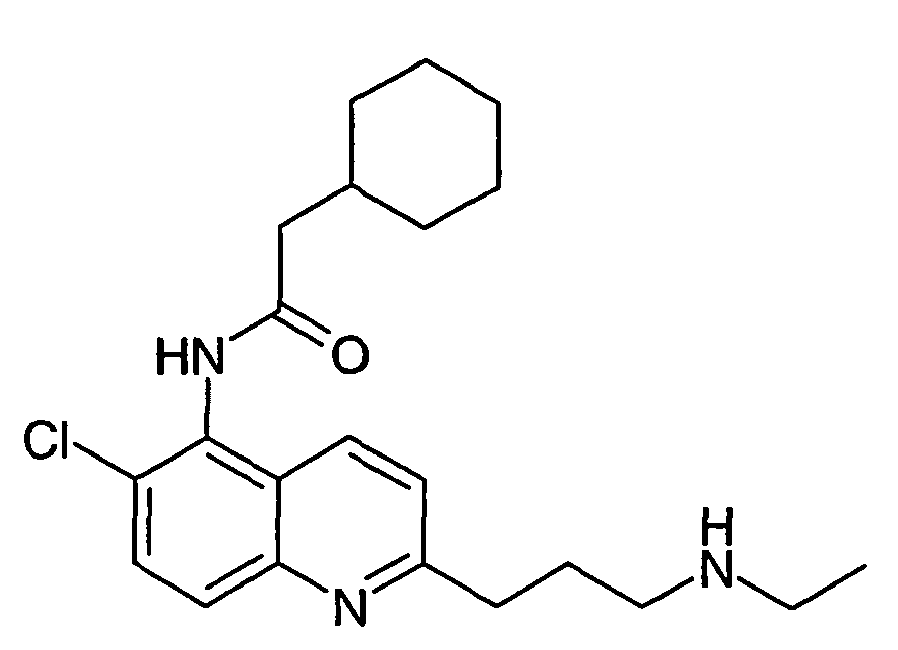
- Prepared according to the method of example 15, using N-(2,6-dichloro-5-quinolinyl)-cyclohexaneacetamide (Example 1(a)) (500 mg) and ethyl(2-propenyl)-carbamic acid 1,1-dimethylethyl ester (330 mg). Recrystallisation (methanol / ethyl acetate) afforded the title compound as a solid (195 mg).
- 1H NMR (400 MHz, d6-DMSO) δ 10.18 (1H, s), 8.92 (2H, s), 8.37 (1H, d), 8.08 (1H, d), 7.96 (1H, d), 7.73 (1H, d), 3.21-3.09 (2H, m), 3.03-2.85 (4H, m), 2.39 (2H, d), 2.17 (2H, quint.), 1.94-1.55 (6H, m), 1.35-0.99 (8H, m).
MS: APCI(+ve) 388/390 (M+H+).
m.p. 152-155°C -

- To a stirred solution of N-(2,6-dichloro-5-quinolinyl)-cyclohexaneacetamide (Example 1 (a)) (170 mg) and potassium carbonate (350 mg) in N-methyl pyrrolidinone (4 mL) was added 2-[(2-aminoethyl)amino]-ethanol (500 µL). The mixture was heated at 120°C for 5 hours after which it was cooled and poured into water. The resulting solid was isolated by filtration, dried and suspended in dichloromethane (5 mL). The suspension was then treated with di-tert-butyl dicarbonate (220 mg) and triethylamine (200 µL) and stirred for 2 hours. The mixture was poured into water and extracted with dichloromethane (3x20 mL). The combined organic layers were dried, filtered and concentrated. Purification (SiO2, methanol:dichloromethane solution 2.5:97.5 as eluant) yielded the desired isomer which was then dissolved in dichloromethane (5 mL) and methanol (0.5 mL), and treated with hydrochloric acid in 1,4-dioxane (4M, 1 mL) for 1 hour. The resultant suspension was evaporated to dryness and recrystallised from methanol / ethyl acetate to give the title compound as a colourless solid (65 mg).
- 1H NMR (400 MHz, d6-DMSO/D2O) δ 8.04 (1H, d), 7.94 (1H, d), 7.86 (1H, d), 7.16 (1H, d), 3.91 (2H, t), 3.75-3.65 (2H, m), 3.32 (2H, t), 3.11 (2H, t), 2.37 (2H, d), 1.90-1.60 (6H, m), 1.35-0.95 (5H, m).
MS: APCI(+ve) 405/407 (M+H+).
m.p. 238-240°C -

- To a stirred solution of cyclohexaneacetic acid (250 mg) in dichloromethane (5 mL) at 0°C under nitrogen, was added N,N-dimethylformamide (1 drop) and oxalyl chloride (1 mL). The reaction mixture was stirred at room temperature for 1 hour, then evaporated to dryness and redissolved in dichloromethane (3 mL). This solution was cooled to 0°C and a mixture of 5-quinolinamine (200 mg) and triethylamine (1 mL) in dichloromethane (2 mL) was added dropwise. The reaction mixture was stirred at room temperature for 1 hour then poured into saturated NaHCO3 aq. (20 mL). The mixture was extracted with dichloromethane (3×10 mL) and the combined extracts were dried, filtered and evaporated. Purification (SiO2, ethyl acetate:isohexane 3:2 as eluant) gave the title compound (30 mg).
- 1H NMR (400 MHz, d6-DMSO) δ 9.97 (1H, s), 8.92 (1H, dd), 8.45 (1H, m), 7.85 (1H, m), 7.79-7.70 (2H, m), 7.57 (1H, dd), 2.37 (2H, d), 1.92-1.58 (6H, m), 1.35-0.95 (5H, m).
MS: APCI(+ve) 269 (M+H+).
m.p. 183-184°C -

- Prepared according to the method of example 18, using 5-quinolinamine (230 mg) and 1-methyl-cyclohexaneacetic acid (250 mg). Purification (SiO2, methanol:dichloromethane 1:9 as eluant) followed by recrystallisation from methanol / ethyl acetate gave the title compound as a colourless solid (80 mg).
- 1H NMR (400 MHz, d6-DMSO) δ 9.93 (1H, s), 8.91 (1H, dd), 8.45 (1H, d), 7.85 (1H, d), 7.78-7.70 (2H, m), 7.57 (1H, dd), 2.41 (2H, s), 1.60-1.30 (10H, m), 1.10 (3H, s).
MS: APCI(+ve) 283 (M+H+).
m.p. 133-135°C -

- Prepared according to the method of example 18, using 5-quinolinamine (250 mg) and 4-methyl-cyclohexaneacetic acid (270 mg). Purification (HPLC, Symmetry - 0.1% aqueous trifluoroacetic acid / acetonitrile) followed by recrystallisation from methanol / ethyl acetate gave the title compound as a colourless solid (84 mg).
- 1H NMR (300 MHz, d6-DMSO) δ 9.97 (1H, m), 8.80 (1H, dd), 8.44 (1H, d), 7.85 (1H, m), 7.80-7.68 (2H, m), 7.57 (1H, ddd), 2.50-2.35 (2H, m), 1.85-1.20 (6H, m), 1.17-0.90 (4H, m), 0.87 (3H, d).
MS: APCI(+ve) 283 (M+H+).
m.p. 181-183°C -

- Prepared according to the method of example 18, using 5-quinolinamine (250 mg) and cyclopentanepropanoic acid (270 mg). Purification (HPLC, Symmetry - 0.1% aqueous trifluoroacetic acid / acetonitrile) followed by recrystallisation from methanol / ethyl acetate gave the title compound as a colourless solid (112 mg).
- 1H NMR (400 MHz, d6-DMSO) δ 10.13 (1H, s), 9.05 (1H, dd), 8.71 (1H, d), 7.94-7.82 (3H, m), 7.74 (1H, dd), 2.53 (2H, m), 1.90-1.45 (9H, m), 1.15 (2H, m).
MS: APCI(+ve) 269 (M+H+).
m.p. 135-138°C -

- Prepared according to the method of example 15(b) using (2-bromopropoxy)-tert-butyldimethylsilane.
- MS: APCI(+ve) 230 ((M-boc)+H+).
- Prepared according to the method of example 1(b)/(c), using N-(2,6-dichloro-5-quinolinyl)-cyclohexaneacetamide (Example 1(a)) (130 mg) and [3-[[(1,1-dimethylethyl)dimethylsilyl]oxy]propyl]-2-propenyl-carbamic acid, 1,1-dimethylethyl ester (example 22(a)) (152 mg). Purification (SiO2, methanol:dichloromethane 1:9 as eluant) gave the title compound as a colourless solid (21 mg).
- 1H NMR (400 MHz, CD3OD) δ 8.12 (1H, d), 7.87 (1H, d), 7.74 (1H, d), 7.44 (1H, d), 3.60 (2H, t), 3.05-3.01 (6H, m), 2.36 (2H, d), 2.15-2.09 (2H, m), 1.84-1.78 (4H, m), 1.69 (2H, d), 1.62 (1H, d), 1.32-1.02 (6H, m).
MS: APCI(+ve) 418/420 (M+H+).
m.p. 159-163°C -

- To 2-propenyl-carbamic acid 1,1-dimethylethyl ester under nitrogen was added 9-borabicyclo[3.3.1]nonane (0.5M in tetrahydrofuran, 7.1 mL) and the mixture refluxed for 2 hours. The reaction was allowed to cool to room temperature and potassium phosphate (1.02 g) in water (1.8 mL) added. The resultant mixture was stirred for 15 minutes. N-(2,6-Dichloro-5-quinolinyl)-cyclohexaneacetamide (prepared as described in Example la) (0.5 g) was added followed by tetrakis(triphenylphosphine)palladium(0) (17 mg) in dimethylformamide (2.8 mL). The reaction was heated at 70°C under nitrogen for 4 hours. To the cooled solution was added brine (30 mL) and the mixture extracted with ethyl acetate (3x30 mL). The combined organics were dried, filtered and concentrated to give the sub-title compound (0.9 g).
- MS: APCI(-ve) 458 (M-H+).
- Trifluoroacetic acid (5 mL) was added to a solution of [3-[6-chloro-5-[(cyclohexylacetyl)amino]-2-quinolinyl]propyl]-carbamic acid, 1,1-dimethylethyl ester (Example 23(a)) (0.9 g) in dichloromethane (15 mL). After stirring for 2 hours the solvent was removed under reduced pressure and the resulting residue was purified (Varian Chem elute cartridge with dichloromethane as eluant). Further purification (Varian SCX cartridge using methanol (100 mL) and then 10% ammonia in methanol (100 mL) as eluant) afforded the title compound (300 mg).
- 1H NMR (400 MHz, CD3OD) δ 8.21 (1H, d), 7.95 (1H, d), 7.82 (1H, d), 7.54 (1H, d), 3.04 (2H, t), 2.83 (2H, t), 2.46 (2H, d), 2.04 (2H, quint.), 1.99-1.89 (3H, m), 1.83-1.76 (2H, m), 1.75-1.68 (1H, m), 1.43-1.22 (3H, m), 1.21-1.09 (2H, m).
MS: APCI(+ve) 360 (M+H+).
m.p. 121-130 °C -

- To a stirred solution of para-nitrophenylchloroformate (0.050 g) in dichloromethane was added dimethylaminopyridine (0.031 g), the mixture was stirred under nitrogen for 5 minutes and then triethylamine (0.035 mL) and methanesulphonamide (0.024 g) were added. The reaction was stirred for 1 hour before N-[2-(3-aminopropyl)-6-chloro-5-quinolinyl]-cyclohexaneacetamide (Example 23 (b)) (0.080 g) was added and the mixture was stirred for 1 hour under nitrogen. The solvent was removed under reduced pressure and the residue purified (MAX Waters cartridge, using methanol (30 mL) and 10% acetic acid in methanol (50 mL) as eluant). Removal of the solvent afforded the title compound (0.020 g).
- 1H NMR (400 MHz, CD3OD) δ 8.31 (1H, d), 7.67 (2H, s), 7.42 (1H, d), 3.19 (2H, t), 2.99-2.92 (5H, m), 2.37-2.31 (2H, m), 2.02-1.88 (4H, m), 1.81-1.74 (2H, m), 1.73-1.66 (1H, m), 1.41-1.20 (4H, m), 1.20-1.06 (2H, m).
MS: APCI(-ve) 479 (M-H+).
m.p. 151-1.52°C -

- A solution of N-[2-(3-aminopropyl)-6-chloro-5-quinolinyl]-cyclohexaneacetamide(0.2 g) (Example 23), acetic acid (1 drop) and butanal (0.074 mL) in tetrahydrofuran was placed in a 10 mL vial and heated at 100°C for 30 minutes within a microwave. Once the reaction had cooled to room temperature sodium triacetoxyborohydride (0.236 g) was added and the mixture stirred for 12 hours. The solvent was removed and the residue taken up in dimethylsulfoxide (3 mL). The residue was purified by HPLC (Waters Symmetry column using 25% to 95% acetonitrile in 0.1% aqueous trifluoroacetic acid). Further purification (SiO2, ammonia: methanol: dichloromethane, 1:4:95 as eluant) followed by removal of solvent and conversion to its hydrochloride salt with 4M hydrogen chloride in 1,4-dioxane (5 mL) afforded the title product (0.021 g).
- 1H NMR (400 MHz, d6-DMSO) δ 10.08 (1H, s), 8.73 (2H, s), 8.25 (1H, d), 7.98 (1H, d), 7.89 (1H, d), 7.63 (1H, d), 3.08 (2H, t), 3.03-2.94 (2H, m), 2.93-2.84 (2H, m), 2.38 (2H, d), 2.16 (2H, quintet), 1.90-1.77 (3H, m), 1.76-1.68 (2H, m), 1.67-1.54 (3H, m), 1.38-1.14 (6H, m), 1.13-1.00 (2H, m), 0.89 (3H, t).
MS: APCI(+ve) 416 (M+H+).
m.p. 219-221°C -

- To 1-phenyl-cyclopropanecarboxylic acid (0.500 g) in acetic acid (2 mL) was added Adams catalyst (0.050 g) in ethanol (0.3 mL). The reaction was left to stir for 48 hours under 5 bar of hydrogen. The reaction was filtered, washing with ethanol (10 mL) and water (10 mL). The resulting solid was collected by filtration and subsequently washed with water (10 mL) to afford the sub-titled compound (0.3 g).
- 1H NMR (400 MHz, CD3OD) δ 1.77-1.71 (2H, m), 1.68-1.62 (3H, m), 1.43-1.12 (6H, m), 1.07 (2H, q), 0.73 (2H, q).
MS: APCI(-ve) 167 (M-H+). - Prepared according to the method of example 1(a), using 2,6-dichloro-5-quinolinamine (prepared as described in Example 1(d)) (0.3 g) and 1-cyclohexyl cyclopropanecarboxylic acid (Example 26(a)) (0.28 g) at 100°C for 15 hours. Purification by chromatography (SiO2, dichloromethane as eluant) afforded the sub-title compound (0.26 g).
- 1H NMR (400 MHz, CD3OD) δ 8.15 (1H, d), 7.91 (1H, d), 7.87 (1H, d), 7.59 (1H, d), 1.95-1.88 (2H, m), 1.87-1.75 (2H, m), 1.74-1.68 (1H, m), 1.42-1.17 (6H, m), 1.14 (2H, dd), 0.89 (2H, dd).
MS: APCI(-ve) 361 (M-H+). - To a 10 mL vial was added 1-cyclohexyl-N-(2,6-dichloro-5-quinolinyl)-cyclopropanecarboxamide (example 26 (b)) (0.13 g), N,N'-dimethyl-1,3-propanediamine (0.13 mL) and acetonitrile (3 mL). The vial was sealed and heated at 100°C in a microwave for 20 minutes followed by 30 minutes at 110°C. The solvent was removed from the cooled reaction under reduced pressure, saturated aqueous sodium hydrogen carbonate solution (30 mL) was added and the mixture was extracted with dichloromethane (3 x 50 mL). The combined organics were washed with water (50 mL) and brine (50 mL) before being dried, filtered and concentrated. Purification (Varian SCX cartridge, using methanol and 10% ammonia in methanol as eluant) gave a crude product which was further purified by chromatography (SiO2, ammonia: methanol: dichloromethane, 1:2.5:96.5 as eluant). The product was converted to its hydrochloride salt by dissolution in dichloromethane and treatment with 4M hydrogen chloride in 1,4-dioxane (5 mL). Removal of volatiles and recrystallisation from methanol / acetonitrile afforded the title compound (0.075 g).
- 1H NMR (400 MHz, CD3OD) δ 8.03 (1H, d), 7.94 (1H, s), 7.81 (1H, d), 7.47 (1H, d), 3.86 (2H, t), 3.38 (3H, s), 3.06 (2H, t), 2.65 (3H, s), 2.06 (2H, quint.), 1.80 (2H, d), 1.76-1.65 (2H, m), 1.62 (2H, d), 1.33-1.19 (3H, m), 1.18-1.06 (2H, m), 1.04 (2H, dd), 0.82 (2H, dd). MS: APCI(+ve) 428 (M+H+).
m.p. 215-218°C -

- To a 10 mL vial was added 1-cyclohexyl-N-(2,6-dichloro-5-quinolinyl)-cyclopropanecarboxamide (Example 26 (b)) (0.13 g), piperazine (0.091 g) and acetonitrile (3 mL). The vial was sealed and heated in a microwave at 110°C for 40 minutes. The solvent was removed from the cooled reaction and the residue taken up in dichloromethane and purified (SiO2, ammonia: methanol: dichloromethane, 1:2:97 as eluant). The solvent was removed from the combined fractions and the product recrystallised from ethanol to afford the title compound (0.050 g).
- 1H NMR (400 MHz, CD3OD) δ 7.77 (1H, d), 7.48 (2H, d), 7.12 (1H, d), 3.63 (4H, t), 2.83 (4H, t), 1.85-1.78 (2H, m), 1.76-1.69 (2H, m), 1.66-1.58 (2H, m), 1.31-1.04 (5H, m), 1.00 (2H, dd), 0.77-0.73 (2H, m).
MS: APCI(+ve) 413 (M+H+).
m.p. 219°C -

- Prepared according to the method of example 27, using N-(2,6-dichloro-5-quinolinyl)-cyclohexaneacetamide (Example 1(a)) (0.05 g) and (3R)-3-pyrrolidinol (0.052 g) to afford the title compound (0.01 g).
- 1H NMR (400 MHz,d6-DMSO) δ 9.76 (1H, s), 7.84 (1H, d), 7.51 (2H, dd), 6.95 (1H, d), 5.01-4.97 (1H, m), 4.42 (1H, s), 3.67-3.53 (3H, m), 3.52-3.42 (1H, m), 2.32 (2H, d), 2.09-1.98 (1H, m), 1.97-1.88 (1H, m), 1.87-1.77 (3H, m), 1.75-1.67 (2H, m), 1.67-1.60 (1H, m), 1.33-1.12 (3H, m), 1.11-0.99 (2H, m).
MS: APCI(+ve) 388 (M+H+).
m.p. 226-227°C -

- Prepared according to the method of example 27, using N-(2,6-dichloro-5-quinolinyl)-cyclohexaneacetamide (Example 1(a)) (0.533 g) and (3S)-3-pyrrolidinol (0.365 g) to afford the title compound (0.48 g).
- 1H NMR (400 MHz, d6-DMSO) δ 9.76 (1H, s), 7.84 (1H, d), 7.54 (1H, d), 7.47 (1H, d), 6.94 (1H, d), 5.02-4.96 (1H, m), 4.42 (1H, s), 3.69-3.53 (3H, m), 3.52-3.41 (1H, m), 2.32 (2H, d), 2.10-1.99 (1H, m), 1.98-1.88 (1H, m), 1.87-1.76 (3H, m), 1.75-1.67 (2H, m), 1.67-1.60 (1H, m), 1.33-1.13 (3H, m), 1.12-0.99 (2H, m).
MS: APCI(+ve) 388 (M+H+).
m.p.219-221°C -

- To a 10 mL vial was added N-(2,6-dichloro-5-quinolinyl)-cyclohexaneacetamide (Example 1(a)) (0.166 g), (3R)-3-pyrrolidinamine (0.127 g), triethylamine (0.083 mL) and acetonitrile (5 mL). The vial was sealed and heated at 100°C for 30 minutes within a microwave. The reaction was cooled to room temperature and the resulting solid removed by filtration. This solid was purified (Varian SCX cartridge, using methanol and 10% ammonia in methanol as eluant) to afford the title compound (0.102 g).
- 1H NMR (400 MHz, d6-DMSO) δ 9.75 (1H, s), 7.83 (1H, d), 7.54 (1H, d), 7.46 (1H, d), 6.92 (1H, d), 3.70-3.48 (4H, m), 3.26-3.18 (1H, m), 2.32 (2H, d), 2.11-2.02 (1H, m), 1.89-1.60 (9H, m), 1.33-1.13 (3H, m), 1.11-0.97 (2H, m).
MS: APCI(+ve) 387 (M+H+).
m.p. 201-206°C -
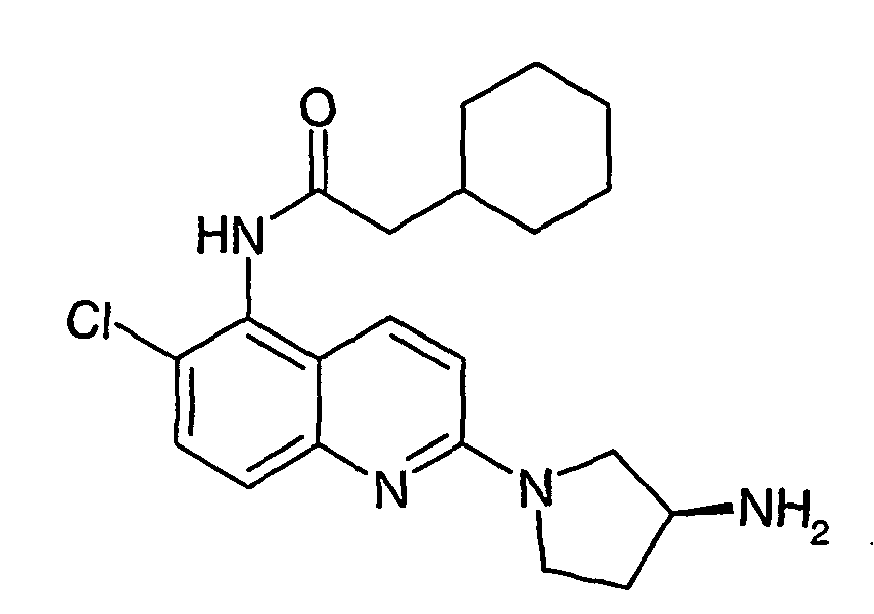
- Prepared according to the method of example 30, using N-(2,6-dichloro-5-quinolinyl)-cyclohexaneacetamide (Example 1(a)) (0.166 g) and (3S)-3-pyrrolidinamine (0.127 g) to afford the title compound (0.113 g).
- 1H NMR (400 MHz, d6-DMSO) δ 9.76 (1H, s), 7.84 (1H, d), 7.54 (1H, d), 7.46 (1H, d), 6.93 (1H, d), 3.70-3.58 (3H, m), 3.58-3.49 (1H, m), 3.28-3.21 (1H, m), 2.32 (2H, d), 2.14-2.04 (1H, m), 1.88-1.76 (4H, m), 1.76-1.67 (4H, m), 1.67-1.60 (1H, m), 1.32-1.11 (3H, m), 1.11-0.99 (2H, m).
MS: APCI(+ve) 387 (M+H+).
m.p. 219-226°C -

- Prepared according to the method of example 30, using N-(2,6-dichloro-5-quinolinyl)-cyclohexaneacetamide (Example 1 (a)) (0.113 g) and 4-piperidinamine (0.152 mL) to afford the title compound (0.109 g).
- 1H NMR (400 MHz, d6-DMSO) δ 9.82 (1H, s), 7.87 (1H, d), 7.59 (1H, d), 7.49 (1H, d), 7.35 (1H, d), 4.57-4.49 (2H, m), 3.27-3.18 (2H, m), 3.08-2.99 (3H, m), 2.35-2.31 (2H, m), 1.97-1.90 (2H, m), 1.84-1.77 (4H, m), 1.75-1.67 (2H, m), 1.67-1.61 (1H, m), 1.48-1.33 (3H, m), 1.32-1.15 (2H, m), 1.11-0.99 (1H, m).
MS: APCI(+ve) 401 (M+H+).
m.p. 333-334°C -

- To a stirred solution of N-[6-chloro-2-[(3S)-3-hydroxy-1-pyrrolidinyl]-5-quinolinyl]-cyclohexaneacetamide (Example 29) (0.4 g) in dichloromethane was added methanesulphonyl chloride (0.104 mL) and triethylamine (0.215 mL). The reaction was stirred for 12 hours under nitrogen and then purified (Varian Chem elute cartridge, saturated sodium hydrogen carbonate solution and dichloromethane as eluant) to afford the sub-title compound (0.45 g).
- MS: APCI(+ve) 466 (M+H+).
- To a 10 mL vial was added N-[6-Chloro-2-[(3S)-3-[(methylsulfonyl)oxy]-1-pyrrolidinyl]-5-quinolinyl]-cyclohexaneacetamide (Example 33(a)) (225 mg) and 8M methylamine in ethanol (6 mL). The vial was sealed and heated at 80°C for 120 minutes within a microwave. The solvent was removed under vacuum and purified (SiO2, ammonia: methanol: dichloromethane, 1:2:97 as eluant) to afford the titled compound (0.033 g).
- 1H NMR (400 MHz,d6-DMSO) δ 9.75 (1H, s), 7.83 (1H, d), 7.54 (1H, d), 7.46 (1H, d), 6.93 (1H, d), 3.69-3.63 (1H, m), 3.63-3.48 (2H, m), 3.36-3.23 (4H, m), 2.30 (3H, s), 2.14-2.04 (1H, m), 1.89-1.75 (4H, m), 1.75-1.67 (2H, m), 1.67-1.59 (1H, m), 1.32-1.12 (3H, m), 1.11-0.97 (2H, m).
MS: APCI(+ve) 401 (M+H+).
m.p. 169°C -
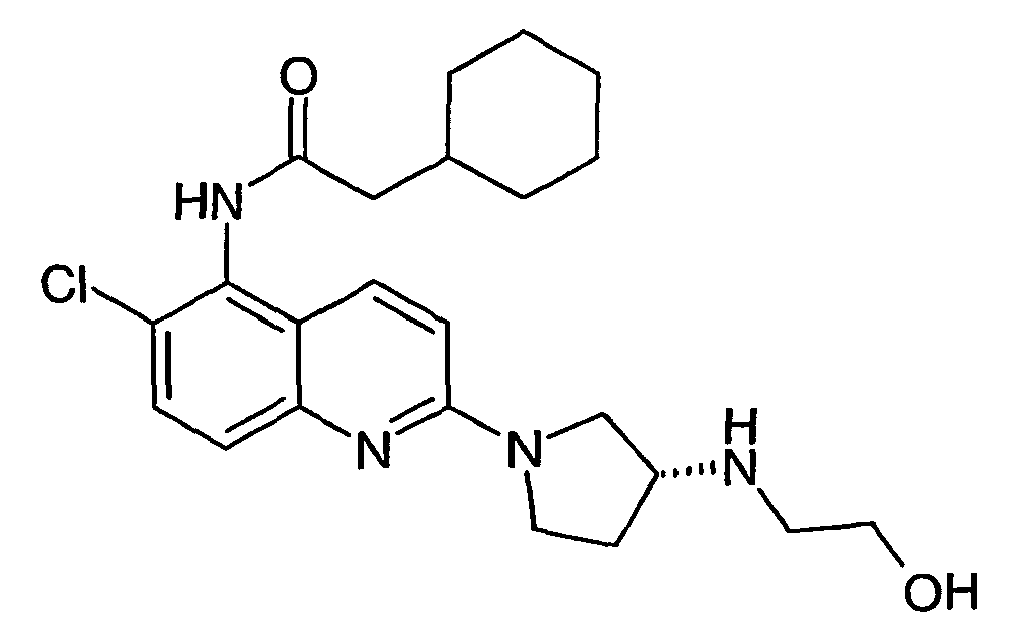
- Prepared according to the method of example 33(b), using N-[6-Chloro-2-[(3S)-3-[(methylsulfonyl)oxy]-1-pyrrolidinyl]-5-quinolinyl]-cyclohexancacetamide (Example 33(a)) (0.225 g) and ethanolamine (2 mL) to afford the title compound (0.052 g).
- 1H NMR (400 MHz,d6-DMSO) δ 9.75 (1H, s), 7.83 (1H, d), 7.54 (1H, d), 7.46 (1H, d), 6.93 (1H, d), 3.72-3.66 (1H, m), 3.66-3.57 (1H, m), 3.57-3.49 (1H, m), 3.48-3.44 (2H, m), 3.42-3.36 (2H, m), 2.69-2.59 (2H, m), 2.32 (2H, d), 2.16-2.07 (1H, m), 1.88-1.76 (4H, m), 1.75-1.67 (2H, m), 1.67-1.60 (1H, m), 1.33-1.13 (3H, m), 1.10-0.99 (2H, m).
MS: APCI(+ve) 431 (M+H+).
m.p. 197-199°C -

- Prepared according to the method of example 33(a), using N-[6-chloro-2-[(3R)-3-hydroxy-1-pyrrolidinyl]-5-quinolinyl]-cyclohexaneacetamide (Example 28) (0.46 g) and methanesulphonyl chloride (0.183 mL) to afford the sub-title compound (0.47 g).
- MS: APCI(+ve) 466 (M+H+).
- Prepared according to the method of example 33(b), using N-[6-Chloro-2-[(3R)-3-[(methylsulfonyl)oxy]-1-pyrrolidinyl]-5-quinolinyl]-cyclohexaneacetamide (Example 35(a)) (0.2 g) and 8M methylamine in ethanol (3 mL) to afford the title compound (0.063 g).
- 1H NMR (400 MHz, d6-DMSO) δ 9.75 (1H, s), 7.83 (1H, d), 7.54 (1H, d), 7.46 (1H, d), 6.93 (1H, d), 3.66 (1H, dd), 3.63-3.48 (2H, m), 3.4-3.22 (4H, m), 2.31 (3H, s), 2.15-2.04 (1H, m), 1.88-1.76 (4H, m), 1.75-1.67 (2H, m), 1.67-1.60 (1H, m), 1.32-1.12 (3H, m), 1.10-0.99 (2H, m).
MS: APCI(+ve) 401 (M+H+).
m.p. 164-165°C -

- Prepared according to the method of example 33(b), using N-[6-Chloro-2-[(3R)-3-[(methylsulfonyl)oxy]-1-pyrrolidinyl]-5-quinolinyl]-cyclohexaneacetamide (Example 35(a)) (0.2 g) and ethanolamine (0.8 mL) to afford the title compound (0.068 g).
- 1H NMR (400 MHz,d6-DMSO) δ 9.75 (1H, s), 7.83 (1H, d), 7.54 (1H, d), 7.46 (1H, d), 6.93 (1H, d), 4.48 (1H, t), 3.72-3.57 (2H, m), 3.56-3.49 (1H, m), 3.49-3.36 (4H, m), 2.68-2.62 (2H, m), 2.32 (2H, d), 2.17-2.07 (1H, m), 1.87-1.77 (4H, m), 1.75-1.67 (2H, m), 1.67-1.60 (1H, m), 1.33-1.12 (3H, m), 1.10-0.98 (2H, m).
MS: APCI(+ve) 431 (M+H+).
m.p. 194-196°C -
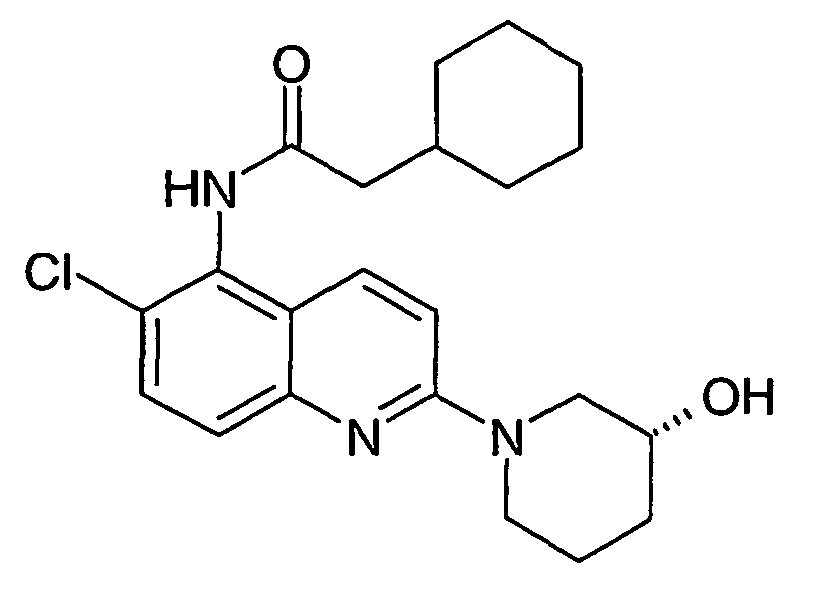
- N-(2,6-Dichloro-5-quinolinyl)-cyclohexaneacetamide (Example 1(a)) (1 g), (3R)-3-piperidinol hydrochloride (0.424 g) and triethylamine (1.2 mL) were placed into a 10 mL microwave vial followed by the addition of acetonitrile (3 mL). The vial was sealed and heated at 120 °C in a single mode microwave for 45 minutes. On cooling a solid crystallised from the reaction mixture which was filtered and washed with acetonitrile (10 mL) to afford the sub-title compound (0.7 g).
- 1H NMR (400 MHz,d6-DMSO) δ 9.77 (1H, s), 7.83 (1H, d), 7.56 (1H, d), 7.46 (1H, d), 7.29 (1H, d), 4.89 (1H, s), 4.33 (1H, d), 4.12 (1H, d), 3.52 (1H, s), 3.21-3.11 (1H, m), 2.94 (1H, t), 2.32 (2H, d), 1.96-1.88 (1H, m), 1.87-1.75 (4H, m), 1.75-1.67 (2H, m), 1.67-1.59 (1H, m), 1.50-1.38 (2H, m), 1.33-1.11 (3H, m), 1.10-0.98 (2H, m).
MS: APCI(+ve) 402 (M+H+).
m.p. 209-214°C -

- Prepared according to the method of example 30, using N-(2-Chloro-6-methyl-5-quinolinyl)-cyclohexaneacetamide (Example 15(a)) (0.2 g) and (3S)-3-pyrrolidinamine (0.163 g) which after recrystallisation from ethanol afforded the title compound (0.159 g).
- 1H NMR (400 MHz,d6-DMSO) δ 9.53 (1H, s), 7.85 (1H, d), 7.42-7.32 (2H, m), 6.83 (1H, d), 3.69-3.56 (3H, m), 3.55-3.40 (2H, m), 3.25-3.15 (1H, m), 2.31 (2H, d), 2.20 (3H, s), 2.12-2.03 (1H, m), 1.88-1.60 (8H, m), 1.33-1.13 (3H, m), 1.11-0.98 (2H, m).
MS: APCI(+ve) 367 (M+H+).
m.p. 223-224°C -

- Prepared according to the method of example 2, using N-(2-Chloro-6-methyl-5-quinolinyl)-cyclohexaneacetamide (Example 15(a)) (0.2 g) and piperazine (0.163 g). The reaction was cooled to room temperature, the resulting solid collected by filtration and recrystallised from methanol to afford the title compound (0.102 g).
- 1H NMR (400 MHz, CD3OD/TFA) δ 8.35 (1H, d), 7.81 (2H, dd), 7.54 (1H, d), 4.25-4.14 (4H, m), 3.56-3.46 (4H, m), 2.46 (2H, d), 2.40 (3H, s), 1.99 - 1.67 (6H, m), 1.43-1.08 (5H, m).
MS: APCI(+ve) 367 (M+H+). -

- Prepared according to the method of example 7 (a), using N-(2,6-dichloro-5-quinolinyl)-cyclohexaneacetamide (Example 1 (a)) (400 mg) and glycine tert-butyl ester hydrochloride (1.5 g) to afford the sub-title compound (63 mg).
- MS: APCI(+ve) 432/434 (M+H+).
- Prepared according to the method of example 7 (b), using N-[6-chloro-5-[(cyclohexylacetyl)amino]-2-quinolinyl]-glycine, 1,1-dimethylethyl ester (Example 40(a)) (63 mg) and trifluoroacetic acid (2 mL). Purification by HPLC (Symmetry - 0.1% aqueous ammonium acetate / acetonitrile) afforded the title product (27 mg).
- 1H NMR (400 MHz, d6-DMSO) δ 9.42 (1H, br s), 7.77 (1H, d), 7.50 (1H, d), 7.42 (1H, d), 7.09 (1H, br s), 6.92 (1H, d), 4.08 (2H, br s), 2.31 (2H, br m), 1.91-1.59 (6H, m), 1.34-1.00 (5H, m).
MS: APCI(-ve) 374/376 (M-H+).
m.p. 222-225°C dec. -
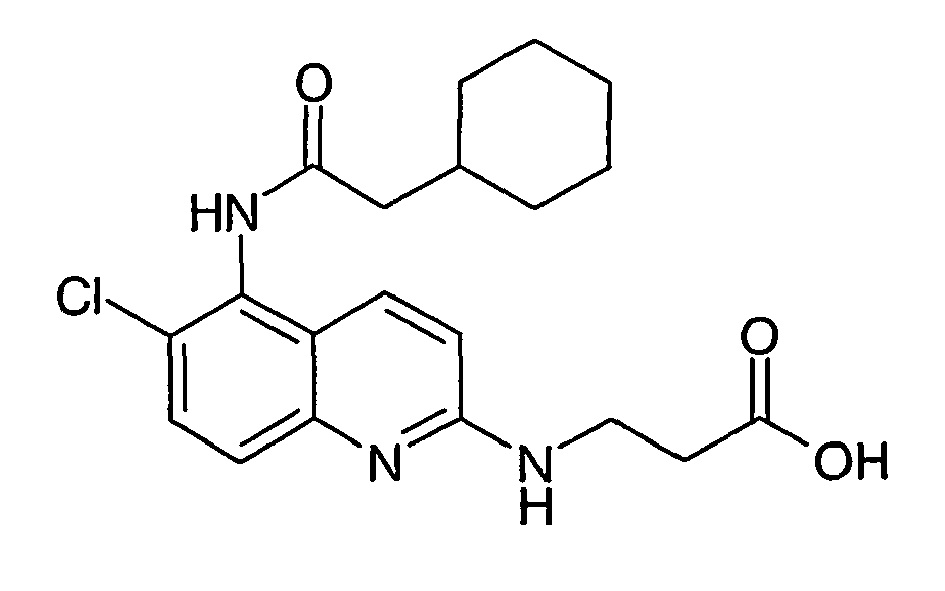
- Prepared according to the method of example 7 (a), using N-(2,6-dichloro-5-quinolinyl)-cyclohexaneacetamide (Example 1 (a)) (400 mg) and β-alanine tert-butyl ester hydrochloride (1.6 g) to afford the sub-title compound (150 mg).
- MS: APCI(+ve) 446/448 (M+H+).
- Prepared according to the method of example 7 (b), using N-[6-chloro-5-[(cyclohexylacetyl)amino]-2-quinolinyl]-β-alanine, 1,1-dimethylethyl ester (Example 41 (a)) (150 mg) and trifluoroacetic acid (2 mL). Purification by HPLC (Symmetry - 0.1% aqueous ammonium acetate / acetonitrile) afforded the title product (39 mg).
1H NMR (400 MHz, d6-DMSO) δ 12.23 (1H, s), 9.73 (1H, s), 7.71 (1H, d), 7.53 (1H, d), 7.45 (1H, d), 7.27 (1H, t), 6.82 (1H, d), 3.59 (2H, td), 2.58 (2H, t), 2.31 (2H, d), 1.89-1.59 (6H, m), 0.97-1.33 (5H, m).
MS: APCI(-ve) 388/390 (M-H+).
m.p. 222-224°C dec. -

- To a solution of 5-bromo-6-chloroquinoline (prepared according to the method of Journal of Heterocyclic Chemistry 1967,4,410) (4.0 g), cyclohexanemethylamine (4.2 mL) and triethylamine (2.4 mL) in N-methyl pyrrolidinone (40 mL) was added dichlorobis(triphenylphosphine)palladium(II) (1.6 g). The mixture was heated with stirring at 100°C under a 6 bar pressure of carbon monoxide for 18 hours after which it was cooled and filtered through diatomaceous earth, washing with methanol. The combined organics were concentrated to give a residue which was purified (SiO2, isohexane:ethyl acetate: ammonia in methanol (7 M) 49:49:2 as eluant) to yield the title compound as a solid (4.6 g).
- 1H NMR (300 MHz, d6-DMSO) δ 8.97 (1H, dd), 8.75 (1H, t), 8.10 (1H, dd), 8.07 (1H, d), 7.82 (1H, d), 7.65 (1H, dd), 3.21 (2H, dd), 1.50-1.86 (6H, m), 0.91-1.32 (5H, m).
MS: APCI(+ve) 303/305 (M+H+).
m.p. 193-194°C -

- To a solution of 6-chloro-N-(cyclohexylmethyl)quinoline-5-carboxamide (Example 42) (1.0 g) was added a mixture of aqueous hydrogen peroxide (5 mL, 27 %) and glacial acetic acid (8 mL) over 10 minutes. The mixture was heated with stirring at 65°C for 3 hours after which it was cooled to room temperature and partitioned between dichloromethane and water. The organic layer was separated and the aqueous layer was further extracted with dichloromethane. The combined organic extracts were washed with aqueous saturated sodium bicarbonate before being dried, filtered and evaporated to give a residue to which phosphorous oxychloride (5 mL) was added over 10 minutes. The mixture was heated with stirring at 120°C under an atmosphere of nitrogen for 3 hours after which it was cooled to room temperature and the volatile components were removed in vacuo to leave a residue which was partitioned between dichloromethane and water. The organic layer was separated, the aqueous layer was further extracted with dichloromethane and the combined organic extracts were washed with aqueous saturated sodium bicarbonate before being dried, filtered and evaporated to yield the sub-titled compound as a solid (0.90 g).
- MS: APCI(+ve) 337/339 (M+H+).
- A stirred solution of 2,6-dichloro-N-(cyclohexylmethyl)quinoline-5-carboxamide (Example 43 (a)) (200 mg) and piperazine (160 mg) in acetonitrile (2 mL) was heated at 80°C in a CEM Discover microwave for 1 hour after which it was cooled to room temperature and concentrated. The residue was purified (Waters' SCX resin, ammonia in methanol (7 M) as eluant) and the resultant product was converted to the dihydrochloride salt by treatment with hydrochloric acid (4M in 1,4-dioxane). Recrystallisation (methanol ethyl acetate) afforded the title compound as a solid (110 mg).
- 1H NMR (300 MHz, d6-DMSO) δ 9.35 (1H, br s), 8.72 (1H, t), 7.87 (1H, d), 7.75 (1H, br d), 7.65 (1H, d), 7.46 (1H, d), 4.00 (4H, br s), 3.23-3.19 (6H, m), 1.81-1.65 (6H, m), 1.24-0.92 (5H, m).
MS: APCI(+ve) 387/389 (M+H+).
m.p. 305-306°C. -
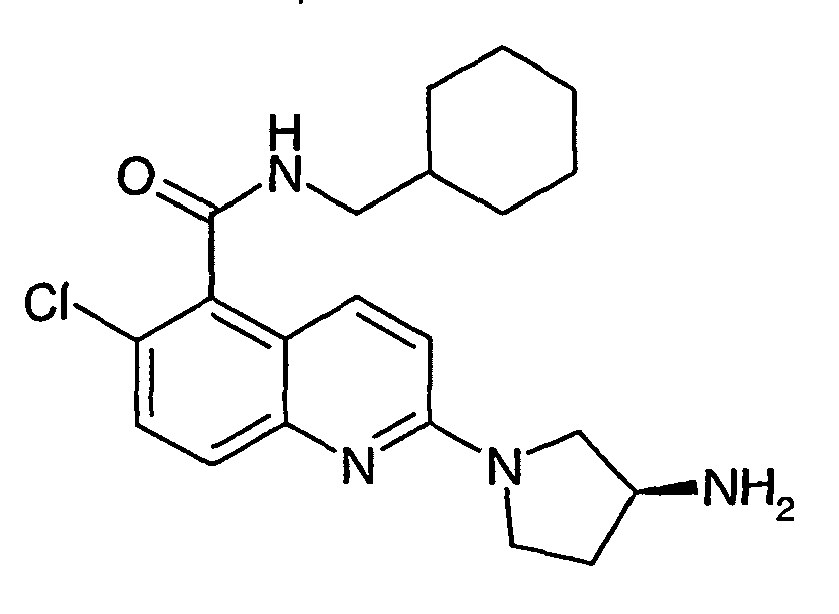
- A stirred suspension of 2,6-dichloro-N-(cyclohexylmethyl)quinoline-5-carboxamide (Example 43(a)) (500 mg) and (3S)-3-pyrrolidinamine (0.60 mL) in acetonitrile (3 mL) was heated at 100°C in a microwave for 40 minutes after which it was cooled to room temperature and concentrated. Purification by chromatography (SiO2, dichloromethane: methanol: ammonia in methanol (7 M) 95:5:0.5 as eluant) and subsequent recrystallisation (acetonitrile) afforded the title compound as a solid (280 mg).
- 1H NMR (400 MHz, d6-DMSO, 90°C) δ 8.26 (1H, br s), 7.74 (1H, d), 7.51 (1H, d), 7.44 (1H, d), 6.90 (1H, d), 3.72-3.59 (3H, m), 3.58-3.49 (1H, m), 3.26-3.16 (3H, m), 2.15-2.06 (1H, m), 1.83-1.56 (7H, m), 1.30-1.12 (3H, m), 1.08-0.96 (2H, m).
MS: APCI(+ve) 387/389 (M+H+). -

- A stirred suspension of 2,6-dichloro-N-(cyclohexylmethyl)quinoline-5-carboxamide (Example 43 (a)) (250 mg) and N,N'-dimethyl-1,3-propanediamine (0.80 mL) in acetonitrile (3 mL) was heated at 100°C in a microwave for 2 hours after which it was cooled to room temperature and concentrated. The residue was purified by recrystallisation (methanol:ethyl acetate). The resultant product was converted to the dihydrochloride salt by treatment with hydrochloric acid (4M in 1,4-dioxane). Recrystallisation (methanol / ethyl acetate) afforded the title compound as a solid (110 mg).
- 1H NMR (400 MHz, d6-DMSO, 90°C) δ 9.09 (2H, br), 8.44 (1H, br), 8.07 (1H, br), 7.88 (1H, d), 7.64 (1H, d), 7.39 (1H, d), 3.90 (2H, t), 3.30 (3H, s), 3.22-3.19 (2H, m), 3.01-2.92 (2H, m), 2.55-2.50 (3H, m), 2.08-2.00 (2H, quin), 1.83-1.54 (6H, m), 1.31-0.97 (5H, m).
MS: APCI(+ve) 403/405 (M+H+). -

- A stirred suspension of 2,6-dichloro-N-(cyclohexylmethyl)quinoline-5-carboxamide (Example 43 (a)) (200 mg) and N,N'-dimethyl-1,2-ethanediamine (0.30 mL) in acetonitrile (2 mL) was heated at 100°C in a microwave for 90 minutes after which it was cooled to room temperature and concentrated. Purification (SiO2, dichloromethane: methanol: ammonia in methanol (7 M) 95:5:0.5), conversion to the dihydrochloride salt by treatment with hydrochloric acid (4M in 1,4-dioxane) and recrystallisation (methanol / ethyl acetate) afforded the title compound as a solid (160 mg).
- 1H NMR (400 MHz, d6-DMSO, 90°C) δ 9.23 (2H, br), 8.42 (1H, br), 7.95 (1H, br d), 7.88 (1H, d), 7.62 (1H, d), 7.39 (1H, d), 4.09 (2H, t), 3.28 (3H, s), 3.22-3.19 (4H, m), 2.59 (3H, s), 1.83-1.55 (6H, m), 1.31-0.96 (5H, m).
- MS: APCI(+ve) 389/391 (M+H+).
-

- Prepared according to the method of Example 1(b), using 2,6-dichloro-N-(cyclohexylmethyl)quinoline-5-carboxamide (Example 43 (a)) (300 mg) and [3-[[(1,1-dimethylethyl)dimethylsilyl]oxy]propyl]2-propenyl-carbamic acid, 1,1-dimethylethyl ester (Example 22(a)) (600 mg). Purification (SiO2 methanol: dichloromethane 1:9) gave the title compound as a colourless oil (510 mg).
- MS: APCI(+ve) 633/635 (M+H+).
- HCl in 1,4-dioxane (4M, 3 mL) was added to 3-[6-chloro-5-[[(cyclohexylmethyl)amino] carbonyl]-2-quinolinyl]propyl][3-[[(1,1-dimethylethyl)dimethylsilyl]oxy]propyl]-carbamic acid, 1,1-dimethyl ester (Example 47(a)) (500 mg) and the mixture was stirred for 4 hours at room temperature before being concentrated. Purification (SiO2, dichloromethane: methanol: ammonia in methanol (7 M) 97:3:0.5) and recrystallisation (methanol / ethyl acetate) afforded the title compound as a solid (90 mg).
- 1H NMR (400 MHz, d6-DMSO) δ 8.72 (1H, t), 8.00 (1H, d), 7.97 (1H, d), 7.76 (1H, d), 7.56 (1H, d), 3.46 (2H, t), 3.22-3.18 (2H, m), 2.97 (2H, t), 2.68-2.62 (4H, m), 1.93 (2H, quin), 1.83-1.67 (4H, m), 1.66-1.53 (4H, m), 1.29-0.93 (5H, m).
MS: APCI(+ve) 418/420 (M+H+). -

- A stirred suspension of 2,6-dichloro-N-(cyclohexylmethyl)quinoline-5-carboxamide (Example 43(a)) (200 mg) and (3R)-3-pyrrolidinamine (0.20 mL) in acetonitrile (2 mL) was heated at 100°C in a microwave for 1 hour after which it was cooled to room temperature and concentrated. The residue was purified by chromatography (SiO2, dichloromethane: methanol: ammonia in methanol (7 M) (95:5:1), and then by HPLC (Symmetry - 0.1% aqueous trifluoroacetic acid / acetonitrile). Conversion to the dihydrochloride salt by treatment with hydrochloric acid (4M in 1,4-dioxane) and subsequent recrystallisation (methanol / ethyl acetate) afforded the title compound as a solid (46 mg).
- 1H NMR (400 MHz, d6-DMSO, 90°C) δ 8.70-8.29 (3H, m), 8.04 (1H, d), 7.92 (1H, d), 7.67 (1H, d), 7.18 (1H, d), 4.07-3.87 (4H, m), 3.85-3.75 (1H, m), 3.24-3.18 (2H, m), 2.46-2.35 (1H, m), 2.33-2.23 (1H, m), 1.85-1.54 (6H, m), 1.33-0.95 (5H, m).
MS: APCI(+ve) 387/389 (M+H+). -

- A stirred suspension of N-(2,6-dichloro-5-quinolinyl)-cyclohexaneacetamide (Example 1 (a)) (200 mg) and tetrabutylammonium bromide (20 mg) in ammonium hydroxide (28% NH3 in water) (1.0 mL) was heated at 180°C in a microwave for 3 hours after which it was cooled to room temperature and concentrated. Purification by HPLC (Symmetry - 0.1% aqueous trifluoroacetic acid / acetonitrile) gave the title compound as a solid (44 mg).
- 1H NMR (400 MHz, d6-DMSO) δ 10.03 (2H, s), 8.60 (1H, br), 8.10 (1H, d), 7.86 (1H, d), 7.59 (1H, d), 7.10 (1H, d), 2.35 (2H, d), 1.88-1.57 (6H, m), 1.31-0.97 (5H, m).
MS: APCI(+ve) 318/320 (M+H+). -

- A suspension of 2-[(3S)-3-amino-1-pyrrolidinyl]-6-chloro-N-(cyclohexylmethyl)- 5-quinolinecarboxamide (Example 44) (0.16 g) and activated 3Å molecular sieves (0.16g) in anhydrous, degassed dichloromethane (7 mL) was treated with (tert-butyldimethylsilyloxy)acetaldehyde (0.078 mL) and the resulting mixture stirred at room temperature for 6 hours. To this mixture was added sodium triacetoxyborohydride (0.17g) and stirring continued for 16 hours. The reaction mixture was filtered and concentrated to dryness. Purification (SiO2, Ethyl acetate:isohexane 4:1 as eluant) gave the sub-titled compound (0.17g).
- 1H NMR (300 MHz, d6-DMSO, 120°C) δ 8.05 (1H, s), 7.76 (1H, d), 7.51 (1H, d), 7.42 (1H, d), 6.89 (1H, d), 3.66 (2H, t), 3.76-3.42 (3H, m), 3.33-3.27 (1H, m), 3.21 (2H, t), 2.72 (2H, t), 2.19-2.08 (1H, m), 1.91-1.58 (8H, m), 1.33-0.98 (5H, m), 0.88 (9H, s), 0.05 (6H, s).
- A mixture of 6-Chloro-N-(cyclohexylmethyl)-2-[(3S)-3-[[2-[[(1,1-dimethylethyl)dimethylsilyl]oxy]ethyl]amino]-1-pyrrolidinyl]-5-quinolinecarboxamide (Example 50(a)) (0.16 g) in 1,4-dioxane (1 mL) was treated with 4M HCl in 1,4-dioxane (1 mL) and stirred at room temperature for 16 hours. The reaction mixture was concentrated to dryness. Purification (HPLC, Symmetry - 0.1% aqueous trifluoroacetic acid / acetonitrile) followed by conversion of the resultant product to its hydrochloride salt by treatment with hydrochloric acid (4M in 1,4-dioxane) afforded the title product (0.05 g).
- 1H NMR (300 MHz, d6-DMSO, 120°C) δ 7.76 (1H, d), 7.52 (1H, d), 7.43 (1H, d), 6.90 (1H, d), 3.77-3.28 (6H, m), 3.20 (2H, d), 2.72-2.66 (2H, m), 2.20-2.08 (1H, m), 1.89-1.56 (8H, m), 1.32-0.96 (5H, m).
MS: APCI(+ve) 431/433 (M+H+).
m.p. 211-220°C -

- A stirred suspension of 2,6-dichloro-N-(cyclohexylmethyl)quinoline-5-carboxamide (Example 43(a)) (250 mg), (3S)-3-piperidinamine dihydrochloride (260 mg) and tetrabutylammonium bromide (20 mg) in acetonitrile (2 mL) was heated at 130°C in a microwave for 90 minutes after which it was cooled to room temperature and concentrated. The residue was purified by chromatography (SiO2, dichloromethane: methanol: ammonia in methanol (7 M) 96:3:1 as eluant) and subsequent recrystallisation (acetonitrile) gave the title compound as a solid (120 mg).
- 1H NMR (400 MHz, d6-DMSO) δ 8.64 (1H, t), 8.19 (2H, br s), 7.80 (1H, d), 7.57 (2H, s), 7.37 (1H, d), 4.55-4.47 (1H, m), 4.12.-4.05 (1H, m), 3.30-3.14 (5H, m), 2.09-2.00 (1H, m), 1.89-1.49 (9H, m), 1.29-1.11 (3H, m), 1.04-0.91 (2H, m).
MS: APCI(+ve) 401/403 (M+H+). -

- Prepared according to the method of example 50(a) using 2-[(3S)-3-amino-1-piperidinyl]-6-chloro-N-(cyclohexylmethyl)-5-quinolinecarboxamide (Example 51) (200 mg), activated 3Å molecular sieves (0.20g), (tert-butyldimethylsilyloxy)acetaldehyde (0.085 mL), dichloromethane (5.0 mL) and sodium triacetoxyborohydride (210 mg). Purification (SiO2, ethyl acetate:isohexane 1:1) gave the sub-titled compound (190 mg).
- MS: APCI(+ve) 560/562 (M+H+).
- Prepared according to the method of example 50(b) using 6-chloro-N-(cyclohexylmethyl)-2-[(3S)-3-[[2-[[(1,1-dimethylethyl)dimethylsilyl] oxy]ethyl]amino]-1-piperidinyl]-5-quinolinecarboxamide (Example 52(a)) (190 mg) and hydrochloric acid (4M in 1,4-dioxane) (2.0 mL). Purification (SiO2, dichloromethane: methanol: ammonia in methanol (7 M) 96:3:1) and subsequent recrystallisation (acetonitrile) gave the title compound as a solid (53 mg).
- 1H NMR (400 MHz, d6-DMSO) δ 8.61 (1H, t), 7.72 (1H, d), 7.52-7.50 (2H, m), 7.34 (1H, d), 4.50 (1H, t), 4.46-4.37 (1H, d), 4.30-4.22 (1H, d), 3.45 (2H, app q), 3.19-3.14 (2H, m), 3.13 - 3.04 (1H, m), 2.90-2.82 (1H, m), 2.73-2.65 (2H, m), 2.58-2.52 (1H, m), 1.95 (1H, m), 1.83-1.29 (9H, m), 1.28-1.09 (3H, m), 1.04-0.91 (2H, m).
MS: APCI(+ve) 445/447 (M+H+). -

- Prepared according to the method of example 30, using 2,6-dichloro-N-(cyclohexylmethyl)quinoline-5-carboxamide (Example 43(a)) (0.10 g), and hydroxy azetidine hydrochloride (0.30 g). Purification (HPLC, Symmetry - 0.1% aqueous trifluoroacetic acid / acetonitrile) afforded the title compound (0.04 g).
- 1H NMR (400 MHz, CD3OD) δ 7.76 (1H, d), 7.56 (1H, d), 7.44 (1H, d), 6.70 (1H, d), 4.63 (1H, tt), 4.32 (2H, dd), 3.87 (2H, dd), 3.19 (2H, d), 1.82-1.49 (6H, m), 1.28-0.91 (5H, m).
MS: APCI(+ve) 374/376 (M+H+).
m.p. 206-208°C -

- A suspension of 2-[(3S)-3-amino-1-pyrrolidinyl]-6-chloro-N-(cyclohexylmethyl)- 5-quinolinecarboxamide (Example 44) (0.10 g) and triethylamine (0.04 mL) in ethanol (20 mL) was treated with 5% palladium on charcoal (0.05 g) and stirred under 2 atmospheres of hydrogen at ambient temperature for 16 hours. The reaction mixture was filtered through Celite and the liquors concentrated to dryness. Recrystallisation from methanol/ethyl acetate afforded to title compound (0.05 g).
- 1H NMR (300 MHz, CD3OD) δ 8.28 (1H, dd), 7.78 (1H, d), 7.47 (1H, dt), 7.26 (1H, d), 6.89 (1H, dd), 4.02-3.94 (1H, m), 3.91-3.85 (1H, m), 3.77-3.61 (3H, m), 3.18 (2H, d), 2.50-2.37, (1H, m), 2.19-2.08 (1H, m), 1.82-1.49 (6H, m), 1.32-0.88 (5H, m).
MS: APCI(+ve) 353 (M+H+).
m.p. 127-128°C -

- Prepared according to the method of example 33(a), using 6-chloro-N-(cyclohexylmethyl)-2-(3-hydroxy-1-azetidinyl)-5-quinolinecarboxamide (Example 53) (0.55 g) to afford the title compound (0.18 g).
- MS: APCI(+ve) 453/455 (M+H+).
- Prepared according to the method of example 33(b), using 6-chloro-N-(cyclohexylmethyl)-2-[3-[[2-[(methylsulfonyl)oxy]ethyl]amino]-1-azetidinyl]-5-quinolinecarboxamide (Example 55(a)) (0.10 g) and ethanolamine (0.3 mL) to afford the title compound (0.03 g).
- 1H NMR (300 MHz, CD3OD) δ 7.76 (1H, d), 7.56 (1H, d), 7.44 (1H, d), 6.70 (1H, d), 4.29 (2H, t), 3.84 (2H, dd), 3.76 (1H, tt), 3.56 (2H, t), 3.22 (2H, d), 2.65 (2H, t), 1.83-1.48 (6H, m), 1.31-0.89 (5H, m).
MS: APCI(+ve) 417/419 (M+H+).
m.p. 150-151°C -

- To a stirred solution of N-[6-chloro-2-[(3S)-3-[(2-hydroxyethyl)amino]-1-pyrrolidinyl]-5-quinolinyl]-cyclohexaneacetamide (Example 36) (1 g) in dichloromethane (5 mL) and methanol (2 mL) was added di-tert-butyl-carbonate (1 g). The mixture was stirred at room temperature for 18 hours and absorbed onto silica. Purification (SiO2, methanol:dichloromethane 5:95 as eluant) gave the title compound as a solid (400 mg).
- 1H NMR (300 MHz, d6-DMSO/ CD3OD, major rotamer) δ 7.84 (1H, d), 7.60 (1H, d), 7.53 (1H, d), 6.76 (1H, d), 4.68 (1H, m), 3.90-3.75 (2H, m), 3.74-3.63 (2H, m), 3.59-3.49 (4H, m), 3.42-3.27 (2H, m), 2.40 (2H, d), 2.31-2.18 (2H, m), 2.00-1.87 (2H, m), 1.71-1.65 (2H, m), 1.49 (9H, s), 1.40-1.01 (5H, m).
MS: APCI(+ve) 531.5/533.5 (M+H+).
m.p. 115-120°C. -

- Prepared according to the method of example 42, using 5-bromo-6-methylquinoline (prepared according to the method of Khimiya Geterotsiklicheskikh Soedinenii 1988, 8, 1084) (4.0 g), cyclohexanemethylamine (4.2 mL), triethylamine (2.4 mL), dichlorobis(triphenylphosphine)palladium(II) (1.6 g) in N-methyl pyrrolidinone (40 mL) to afford the title compound (3.9 g)
- 1H NMR (300 MHz, d6-DMSO) δ 8.86 (1H, dd), 8.58 (1H, t), 8.07 (1H, d), 7.95 (1H, d), 7.64 (1H, d), 7.54 (1H, dd), 3.21 (2H, t), 2.43 (3H, s), 1.83-1.52 (6H, m), 1.31-1.09 (3H, m), 1.05-0.91 (2H, m).
MS: APCI(+ve) 283.1 (M+H+).
m.p. 165°C. -

- Prepared according to the method of example 43(a), using N-(cyclohexylmethyl)-6-methyl-5-quinolinecarboxamide (Example 57) (3 g), peracetic acid (3.3 g, 45% in acetic acid), glacial acetic acid (20 mL) and subsequently phosphorous oxychloride (20 mL) to afford the sub-titled compound (1.5 g).
- MS: APCI(+ve) 317.3/319.1 (M+H+).
- Prepared according to the method of example 30, using 2-chloro-N-(cyclohexylmethyl)-6-methyl-5-quinolinecarboxamide (Example 58(a)) (0.450 g) and (3S)-3-pyrrolidinamine (0.500 g). Purification (HPLC, Symmetry - 0.1% aqueous ammonium acetate / acetonitrile) afforded the title compound (0.110 g).
- 1H NMR (400 MHz, d6-DMSO) δ 8.43 (1H, t), 7.73 (1H, d), 7.45 (1H, d), 7.32 (1H, d), 6.84 (1H, d), 3.69-3.56 (3H, m), 3.51 (1H, m), 3.22 (1H, m), 3.16 (2H, t), 2.30 (3H, s), 2.08 (1H, m), 1.87 (3H, s), 1.81-1.66 (5H, m), 1.66-1.49 (2H, m), 1.30-1.08 (3H, m), 1.04-0.89 (2H, m).
MS: APCI(+ve) 367.3 (M+H+).
m.p. 154-155°C -

- To a solution of N-(2,6-dichloro-5-quinolinyl)-cyclohexaneacetamide (Example 1(a)) (2 g) in dimethylformamide (6 mL) was added tributyl(vinyl)tin (3.63 g), 2,6-di-tert-butyl-4-methylphenol (50 mg) and dichlorobis(triphenylphosphine)palladium (0.25 g). The reaction was heated at 80°C under nitrogen for 6 hours and then cooled to room temperature. The mixture was filtered through diatomaceous earth and poured into water and dichloromethane. The organic layer was separated and the aqueous was further extracted with dichloromethane. The combined organic layers were dried, filtered and evaporated. Purification (SiO2, methanol:dichloromethane 5:95 as eluant) gave the sub-titled compound (1.2 g).
- MS: APCI(+ve) 329.4/331.2 (M+H+).
- Ozone was bubbled through a solution of N-(6-chloro-2-ethenyl-5-quinolinyl)-cyclohexaneacetamide (Example 59(a)) (1.2 g) in dichloromethane (40 mL) and acetic acid (1 mL) at -78°C for 2 hours. Dimethylsulfide (2 mL) was added and the solution allowed to warm to room temperature overnight. Saturated aqueous sodium bicarbonate was added and the mixture stirred rapidly. The aqueous phase was separated and further extracted with dichloromethane. The combined organic extracts were dried, filtered and evaporated to yield the sub-titled compound (0.7 g).
- MS: APCI(+ve) 331/333 (M+H+).
- To a solution of N-(6-chloro-2-formyl-5-quinolinyl)-cyclohexaneacetamide (Example 59 (b)) (0.68 g) in dichloromethane (10 mL) and methanol (1 mL) was added (3S)-3-pyrrolidinyl-carbamic acid, 1,1-dimethylethyl ester (1.1 g). The mixture was stirred for 2 hours and then sodium triacetoxyborohydride (1.2 g) added. The mixture was stirred overnight and then poured into water. The product was filtered off and suspended in methanol (2 mL). Treatment with hydrochloric acid (4M in 1,4-dioxane) yielded the crude product which was purified by HPLC (Symmetry - 0.1% aqueous ammonium acetate / acetonitrile) to afford the titled product (29 mg).
- 1H NMR (400 MHz, d6-DMSO) δ 11.31 (1H, s), 10.14 (1H, s), 8.64 (3H, s), 8.33 (1H), 8.04 (1H, d), 7.96 (1H, d), 7.78 (1H, d), 4.9 (2H, s), 4.12-3.50 (5H, m), 2.40 (2H, d), 2.19 (1H, m), 1.93-1.58 (7H, m), 1.35-1.00 (5H, m).
MS: APCI(+ve) 401.2/403.2 (M+H+).
m.p. 160°C dec -

- N-(2,6-Dichloro-5-quinolinyl)-cyclohexaneacetamide (Example 1(a)) (0.2 g), (3S)-3-piperidinamine (0.089 g) and triethylamine (0.25 mL) were placed into a 10 mL microwave vial followed by the addition of acetonitrile (5mL). The vial was sealed and heated at 120°C in a single mode microwave for 30 minutes, and a further 60 minutes at 150°C. The product crystallised from the reaction on cooling and was subsequently filtered and washed with acetonitrile (10 mL). Purification (SiO2, 7M ammonia in methanol:methanol:dichloromethane 1:4:95) gave the title compound (0.055 g).
- 1H NMR (400 MHz, CD3OD) δ 7.91 (1H, d), 7.56 (2H, s), 7.22 (1H, d), 4.47-4.42 (1H, m), 4.33-4.25 (1H, m), 3.14-3.06 (1H, m), 2.92-2.78 (2H, m), 2.41 (2H, d), 2.07-1.99 (1H, m), 1.98-1.88 (3H, m), 1.87-1.75 (3H, m), 1.75-1.67 (1H, m), 1.66-1.53 (1H, m), 1.47-1.21 (4H, m), 1.19-1.08 (2H, m).
MS: APCI(+ve) 401.2 (M+H+).
m.p. 173-176 °C -

- Prepared according to the method of example 50(a), using N-[2-[(3S)-3-amino-1-piperidinyl]-6-chloro-5-quinolinyl]-cyclohexaneacetamide (Example 60) (200 mg), (tert-butyldimethylsilyloxy)acetaldehyde (0.086 mL) and sodium triacetoxyborohydride (0.212 g) to afford the sub-title compound (0.2 g).
- MS: APCI(+ve) 559.5/561.5 (M+H+).
- Prepared according to the method of example 50(b), using N-[6-chloro-2-[(3S)-3-[[2-[[(1,1-dimethylethyl)dimethylsilyl]oxy]ethyl]amino]-1-piperidinyl]-5-quinolinyl]-cyclohexaneacetamide (Example 61 (a)) (200 mg) and 4M hydrogen chloride in 1,4-dioxane (2 mL). Purification (SiO2, methanol:dichloromethane 5:95 as eluant) gave the title compound as a solid (56 mg).
- 1H NMR (400 MHz, CD3OD) δ 7.96 (1H, d), 7.60 (2H, s), 7.27 (1H, d), 4.54 (1H, d), 4.02 (1H, d), 3.77 (2H, t), 3.58-3.49 (1H, m), 3.42-3.31 (2H, m), 3.24-3.16 (3H, m), 2.34 (2H, d), 2.23-2.14 (1H, m), 1.93-1.57 (8H, m), 1.33-0.98 (5H, m).
MS: APCI(+ve) 445.2/447.1 (M+H+).
m.p. 182-183°C -

- To a stirred solution of cyclopentanepropanoic acid (1 g) in dichloromethane (5 mL) at 0°C under nitrogen, was added N,N-dimethylformamide (1 drop) and oxalyl chloride (2 mL). The reaction mixture was stirred at room temperature for 2 hours, then evaporated to dryness and redissolved in dichloromethane (2 mL). The solution was added to a mixture of 2,6-dichloroquinolin-5-amine (Example 1(d)) (500 mg) and potassium carbonate (650 mg) in acetone (10 mL). The reaction mixture was stirred at room temperature for 16 hours. The resulting solid was collected by filtration and subsequently washed with water (10 mL) to afford the sub-title compound (530 mg).
- 1H NMR (400 MHz, d6-DMSO) δ 8.27 (1H, d), 7.96-7.85 (2H, m), 7.66 (1H, d), 2.57-2.40 (2H, m), 1.93-1.44 (9H, m), 1.21-1.07 (2H, m).
MS: APCI(+ve) 337.2/339.2 (M+H+). - Prepared according to the method of example 30, using N-(2,6-dichloro-5-quinolinyl)-cyclopentanepropanamide (Example 62(a)) (500 mg) and (3S)-3-pyrrolidinamine (390 mg). Purification (SiO2, methanol:dichloromethane:ammonium hydroxide solution 7:93:1 as eluant) gave the title compound as a solid (400 mg).
- 1H NMR (400 MHz, d6-DMSO) δ 9.76 (1H, s), 7.83 (1H, d), 7.54 (1H, d), 7.46 (1H, d), 6.90 (1H, d), 3.74-3.45 (4H, m), 3.39-3.15 (1H, m), 2.44 (2H, t), 2.07 (1H, td), 1.92-1.45 (12H, m), 1.22-1.07 (2H, m).
MS: APCI(+ve) 387.1/389.1 (M+H+).
m.p. 192-194°C. -

- Prepared according to the method of example 50(a), using N-[2-[(3S)-3-amino-1-pyrrolidinyl]-6-chloro-5-quinolinyl]-cyclopentanepropanamide (Example 62) (300 mg) and [[(1,1-dimethylethyl)dimethylsilyl]oxy]-acetaldehyde (133 µl). Purification (SiO2, methanol:dichloromethane 3:97 as eluant) gave the sub-title compound as a solid (200 mg).
- 1H NMR (400 MHz, d6-DMSO) δ 9.80 (1H, s), 7.88 (1H, d), 7.58 (1H, d), 7.50 (1H, d), 6.96 (1H, d), 3.85-3.16 (9H, m), 2.77-2.68 (2H, m), 2.48 (2H, t), 2.22-2.10 (1H, m), 1.95-1.48 (9H, m), 1.24-1.12 (2H, m), 0.90 (9H, s), 0.08 (6H, s).
MS: APCI(+ve) 545.5/547.5 (M+H+). - To a stirred solution of N-[6-chloro-2-[(3S)-3-[[2-[[(1,1-dimethylethyl)dimethylsilyl]oxy]ethyl]amino]-1-pyrrolidinyl]-5-quinolinyl]-cyclopentanepropanamide (Example 63(a)) (200 mg) in dichloromethane:methanol 1:1 (3 mL) under nitrogen, was added HCl (1 mL, 4M solution in dioxane).The reaction mixture was stirred at room temperature for 30 minutes, then evaporated to dryness. Purification (HPLC, Symmetry - 0.1 % aqueous trifluoroacetic acid / acetonitrile) gave the title compound as a solid (35 mg).
- 1H NMR (400 MHz, d6-DMSO) δ 9.77 (1H, s), 7.84 (1H, d), 7.54 (1H, d), 7.47 (1H, d), 6.92 (1H, d), 4.54 (1H, s), 3.75-3.40 (6H, m), 2.72-2.61 (2H, m), 2.44 (2H, t), 2.20-2.06 (1H, m), 1.92-1.74 (4H, m), 1.71-1.45 (6H, m), 1.22-1.06 (2H, m).
MS: APCI(+ve) 431.2/433.2 (M+H+).
m.p. 186-188 °C -

- 1-(Phenylmethyl)-4-piperidinamine (3 g) in dichloromethane (10 mL) and triethylamine (4.5 mL) were added dropwise to a stirred solution of triphosgene (1.55 g) in dichloromethane (20 mL) at 0°C under nitrogen. The reaction mixture was allowed to warm to room temperature and stirred for 30 minutes. The mixture was cooled to 0°C and formyl hydrazine (1.4 g) and triethylamine (4.5 mL) were added. The reaction was stirred at room temperature for 1 hour and then evaporated to dryness. Purification (SiO2, methanol:dichloromethane:ammonium hydroxide solution 5:95:1 as eluant) gave the sub-title compound (2.5 g).
- MS: APCI(+ve) 277.2 (M+H+).
- 2-Formyl-N-[1-(phenylmethyl)-4-piperidinyl]-hydrazinecarboxamide (Example 64(a)) (2.5 g) was divided between 5 x 10 mL vials. Potassium hydroxide (5 mL, 1 M solution in methanol) was added to each vial and the reactions were heated at 90°C for 35 minutes within a microwave. The combined products were acidified to pH6 with aqueous 2M hydrochloric acid and were then evaporated to dryness. Purification (SiO2, methanol:dichloromethane:acetic acid 15:85:1 as eluant) gave the sub-title compound as an oil (2.2 g).
- MS: APCI(+ve) 259.2 (M+H+).
- 2,4-Dihydro-4-[1-(phenylmethyl)-4-piperidinyl]-3H-1,2,4-triazol-3-one (Example 64(b)) (2.2 g) was divided between 2, 10 mL vials. 1,4-Cyclohexadiene (5 mL) and palladium hydroxide (270 mg, 20 wt. % on carbon) were added to each vial and the reactions were heated at 100°C for 30 minutes within a microwave. The reaction mixtures were combined, ethanol (50 mL) and water (50 mL) were added and the mixture was filtered through diatomaceous earth and evaporated to give the sub-title compound as a solid (720 mg).
- MS: APCI(+ve) 169.2 (M+H+).
- Prepared according to the method of example 30, using N-(2,6-dichloro-5-quinolinyl)-cyclohexaneacetamide (Example 1(a)) (150 mg) and 2,4-dihydro-4-(4-piperidinyl)-3H-1,2,4-triazol-3-one (Example 64 (c)) (225 mg). Methanol (10 mL) and dichloromethane (10 mL) were added to the reaction mixture and the solid was collected by filtration to afford the title compound (40 mg).
- 1H NMR (400 MHz, d6-DMSO) 11.64 (1H, s), 9.80 (1H, s), 7.99 (1H, s), 7.87 (1H, d), 7.59 (1H, d), 7.50 (1H, d), 7.39 (1H, d), 4.71 (2H, d), 4.13-4.01 (1H, m), 3.05 (2H, t), 2.33 (2H, d), 1.99-1.59 (10H, m), 1.34-0.98 (5H, m).
MS: APCI(+ve) 469.1/471.1 (M+H+).
m.p. 310-313 °C -

- Prepared according to the method of example 30, using N-(2,6-dichloro-5-quinolinyl)-cyclohexaneacetamide (Example 1 (a)) (200 mg) and 1,1-dimethylethyl ester D-proline (308 mg). Purification (SiO2, ethyl acetate:isohexane 25:75 as eluant) gave the sub-title compound as an oily solid (200 mg).
- MS: APCI(+ve) 472.5/474.5 (M+H+).
- Trifluoroacetic acid (1 mL) was added to a stirred solution of 1-[6-chloro-5-[(cyclohexylacetyl)amino]-2-quinolinyl]- D-proline 1,1-dimethylethyl ester (Example 65(a)) (200 mg) in dichloromethane (3 mL). The reaction was stirred at room temperature for 3 hours and then evaporated to dryness. Purification (SiO2, methanol:dichloromethane 10:90 as eluant) gave the title compound as a solid (150 mg).
- 1H NMR (400 MHz, d6-DMSO) 9.58 (1H, s), 7.97 (1H, d), 7.67 - 7.56 (2H, m), 7.02 (1H, d), 4.74 (1H, dd), 3.78 - 3.62 (2H, m), 2.42 - 2.26 (3H, m), 2.22 - 1.96 (3H, m), 1.93 - 1.57 (6H, m), 1.36 - 1.01 (5H, m).
MS: APCI(+ve) 416.1/418.1 (M+H+).
m.p. 170-173 °C -

- Prepared according to the method of example 30, using N-(2,6-dichloro-5-quinolinyl)-cyclohexaneacetamide (Example 1(a)) (200 mg) and 4-piperidinecarboxylic acid, ethyl ester (280 mg). Purification (SiO2, ethyl acetate:isohexane 25:75 as eluant) gave the sub-title compound as an oil (200 mg).
- MS: APCI(+ve)-458.5/460.5 (M+H+).
- To a stirred suspension of 1-[6-chloro-5-[(cyclohexylacetyl)amino]-2-quinolinyl]-4-piperidinecarboxylic acid ethyl ester (Example 66(a)) (200 mg) in methanol (2 mL) was added lithium hydroxide (30 mg) in water (2 mL). The mixture was stirred at 50°C for 6 hours and then allowed to cool to room temperature. The solid was collected by filtration and subsequently washed with water (10 mL) to afford the titled compound (40 mg).
- 1H NMR (400 MHz, d6-DMSO) δ 9.78 (1H, s), 7.85 (1H, d), 7.57 (1H, d), 7.48 (1H, d), 7.32 (1H, d), 4.41 (2H, d), 3.08 (2H, t), 2.58-2.45 (1H, m), 2.32 (2H, d), 1.97-1.46 (10H, m), 1.35-0.95 (5H, m).
MS: APCI(+ve) 430.2/432.2 (M+H+). -

- Bromo(3-cyanopropyl)-zinc (30 mL, 0.5 M in tetrahydrofuran) and tetrakis(triphenylphosphine)palladium(0) (86 mg) were added to N-(2,6-dichloro-5-quinolinyl)-cyclohexaneacetamide (Example 1(a)) (500 mg). The reaction mixture was heated to reflux for 30 minutes. The mixture was cooled to room temperature and then poured into aqueous saturated ammonium chloride solution (50 mL) and extracted with ethyl acetate (3 x 50 mL). The combined organic extracts were dried, filtered and evaporated. Purification (SiO2, methanol:dichloromethane 3:97 as eluant) gave the sub-title compound as a solid (490 mg).
- 1H NMR (500 MHz, d6-DMSO) δ 9.96 (1H, s), 8.13 (1H, d), 7.92 (1H, d), 7.82 (1H, d), 7.56 (1H, d), 3.04 (2H, t), 2.61 (2H, t), 2.37 (2H, d), 2.09 (2H, quintet), 1.90-1.78 (2H, m), 1.76-1.60 (4H, m), 1.33-1.12 (3H, m), 1.11-1.01 (2H, m).
MS: APCI(+ve) 370.4/372.4 (M+H+). - Potassium hydroxide (2 mL, 50 % solution in water) was added to a stirred solution of N-[6-chloro-2-(3-cyanopropyl)-5-quinolinyl]-cyclohexaneacetamide (Example 67(a)) (190 mg) in methanol (2 mL). The reaction mixture was heated to 50°C for 6 hours then allowed to cool. The mixture was acidified with aqueous 2M hydrochloric acid until a precipitate formed which was collected by filtration. Purification by HPLC (Symmetry - 0.1% aqueous ammonium acetate / acetonitrile) afforded the title compound as a solid (45 mg).
- 1H NMR (400 MHz, d6-DMSO) δ 9.99 (1H, s), 8.11 (1H, d), 7.90 (1H, d), 7.80 (1H, d), 7.51 (1H, d), 2.92 (2H, t), 2.36 (2H, d), 2.20 (2H, t), 1.96 (2H, quintet), 1.90-1.58 (6H, m), 1.34 0.98 (5H, m).
MS: APCI(+ve) 389.1/391.1 (M+H+).
m.p. 216-220 °C -

- Prepared according to the method of example 30, using N-(2,6-dichloro-5-quinolinyl)-cyclohexaneacetamide (prepared as in Example 1(a)) (200 mg) and 4-piperidineacetic acid, ethyl ester (305 mg). The reaction mixture was evaporated to dryness, the residue was suspended in methanol and the solid collected by filtration to afford the sub-title compound (150 mg).
- 1H NMR (400 MHz, d6-DMSO) δ 9.77 (1H, s), 7.83 (1H, d), 7.56 (1H, d), 7.47 (1H, d), 7.31 (1H, d), 4.52 (2H, d), 4.07 (2H, q), 2.94 (2H, t), 2.36-2.19 (4H, m), 2.07-1.94 (1H, m), 1.89-1.58 (8H, m), 1.37-0.97 (10H, m).
MS: APCI(+ve) 472.5/474.5 (M+H+). - Prepared according to the method of Example 66(b), using 1-[6-chloro-5-[(cyclohexylacetyl)amino]-2-quinolinyl]-4-piperidineacetic acid, ethyl ester (Example 68(a)) (150 mg). Purification by HPLC (Symmetry - 0.1% aqueous ammonium acetate / acetonitrile) afforded the title compound as a solid (15 mg).
- 1H NMR (400 MHz, d6-DMSO) δ 9.78 (1H, s), 7.83 (1H, d), 7.56 (1H, d), 7.47 (1H, d), 7.30 (1H, d), 4.52 (2H, d), 2.93 (2H, t), 2.32 (2H, d), 2.14 (2H, d), 2.04-1.58 (9H, m), 1.35-0.95 (7H, m).
MS: APCI(+ve) 444.1/446.1 (M+H+).
m.p. 242-244°C -

- Prepared according to the method of example 30, using N-(2,6-dichloro-5-quinolinyl)-cyclohexaneacetamide (Example 1 (a)) (200 mg) and 1-piperazineacetic acid, ethyl ester (310 mg) to afford the sub-title compound as a solid (180 mg).
- 1H NMR (400 MHz, d6-DMSO) δ 9.48 (1H, s), 7.88 (1H, d), 7.55 (1H, d), 7.48 (1H, d), 7.24 (1H, d), 4.11 (2H, q), 3.71 (4H, t), 3.27 (2H, s), 2.65 (4H, t), 2.37-2.26 (2H, m), 1.94-1.57 (6H, m), 1.35-0.97 (8H, m).
MS: APCI(+ve) 473.5/475.5 (M+H+). - Prepared according to the method of Example 66(b), using 4-[6-chloro-5-[(cyclohexylacetyl)amino]-2-quinolinyl]-1-piperazineacetic acid ethyl ester (Example 69(a)) (180 mg) to afford the title compound as a solid (80 mg).
- 1H NMR (400 MHz, d6-DMSO) δ 8.02 (1H, d), 7.28 (1H, d), 6.97 (1H, d), 6.91 (1H, d), 3.61 (4H, s), 2.75 (2H, s), 2.51 (4H, s), 1.99 (2H, d), 1.91-1.55 (6H, m), 1.30-1.05 (3H, m), 0.99-0.85 (2H, m).
MS: APCI(+ve) 445.1/447.1 (M+H+).
m.p. 320-326 °C -

- Prepared according to the method of example 67(a), using N-(2,6-dichloro-5-quinolinyl)-cyclohexaneacetamide (Example 1 (a)) (500 mg) and bromo(4-cyanobutyl)-zinc (30 mL, 0.5 M solution in tetrahydrofuran). Purification (SiO2, methanol:dichloromethane 1:99 as eluant) gave the sub-title compound (600 mg).
- 1H NMR (400 MHz, d6-DMSO) δ 9.95 (1H, s), 8.12 (1H, d), 7.91 (1H, d), 7.81 (1H, d), 7.54 (1H, d), 2.96 (2H, t), 2.56 (2H, t), 2.36 (2H, d), 1.91-1.54 (10H, m), 1.34-0.98 (5H, m).
- MS: APCI(+ve) 384.5/386.5 (M+H+).
- Prepared according to the method of example 67(b), using N-[6-chloro-2-(4-cyanobutyl)-5-quinolinyl]-cyclohexaneacetamide (Example 70(a)) (200 mg). Purification by HPLC (Symmetry - 0.1 % aqueous ammonium acetate / acetonitrile) afforded the title compound as a solid (25 mg).
- 1H NMR (400 MHz, d6-DMSO) δ 9.96 (1H, s), 8.11 (1H, d), 7.90 (1H, d), 7.80 (1H, d), 7.52 (1H, d), 2.92 (2H, t), 2.36 (2H, d), 2.23 (2H, t), 1.93-1.50 (10H, m), 1.34-0.98 (5H, m).
MS: APCI(-ve) 401.2/403.2 (M-H+).
m.p. 199-201 °C -

- Prepared according to the method of example 30, using 2,6-dichloro-N-(cyclohexylmethyl)-5-quinolinecarboxamide (Example 43(a)) (200 mg) and D-proline, 1,1-dimethylethyl ester (310 mg). Purification (SiO2, ethyl acetate:isohexane 30:70 as eluant) gave the sub-title compound as an oil (250 mg).
- MS: APCI(+ve) 472.5/474.5 (M+H+).
- Prepared according to the method of example 65(b), using 1-[6-chloro-5-[[(cyclohexylmethyl)amino]carbonyl]-2-quinolinyl]-D-proline 1,1-dimethylethyl ester (Example 71(a)) (250 mg). Purification (SiO2, methanol:dichloromethane 5:95 as eluant) gave the title compound as a solid (144 mg).
- 1H NMR (300 MHz, d6-DMSO) δ 8.66 (1H, t), 7.80 (1H, d), 7.56 (2H, s), 7.05 (1H, d), 4.67 (1H, d), 3.83-3.50 (2H, m), 3.17 (2H, t), 2.40-2.23 (1H, m), 2.18-1.90 (3H, m), 1.85-1.46 (6H, m), 1.34-0.86 (5H, m).
MS: APCI(+ve) 416.1/418.1 (M+H+).
m.p. 157-160 °C -

- Prepared according to the method of example 30, using 2,6-dichloro-N-(cyclohexylmethyl)-5-quinolinecarboxamide (Example 43(a)) (200 mg) and L-proline, 1,1-dimethylethyl ester (305 mg). Purification (SiO2, ethyl acetate:isohexane 20:80 as eluant) gave the sub-title compound as an oil (200 mg).
- MS: APCI(+ve) 472.5/474.5 (M+H+).
- Prepared according to the method of example 65(b), using 1-[6-chloro-5-[[(cyclohexylmethyl)amino]carbonyl]-2-quinolinyl]-L-proline 1,1-dimethylethyl ester (Example 72(a)) (200 mg). Purification (SiO2 methanol:dichloromethane 5:95 as eluant followed by HPLC - Symmetry - 0.1% aqueous trifluoroacetic acid / acetonitrile) gave the title compound as a solid (85 mg).
- 1H NMR (400 MHz, d6-DMSO) δ 8.32 (1H, s), 7.81 (1H, d), 7.56-7.46 (2H, m), 6.98 (1H, d), 4.65 (1H, dd), 3.72-3.59 (2H, m), 3.19 (2H, t), 2.36-2.25 (1H, m), 2.16-1.98 (3H, m), 1.84-1.54 (6H, m), 1.34-0.93 (5H, m).
MS: APCI(+ve) 416.1/418.1 (M+H+).
m.p. 168-170°C -

- Prepared according to the method of example 30, using 2,6-dichloro-N-(cyclohexylmethyl)-5-quinolinecarboxamide (Example 43(a)) (200 mg) and 1-piperazineacetic acid, ethyl ester (500 mg) to afford the sub-title compound as a solid (200 mg).
- 1H NMR (400 MHz, d6-DMSO) δ 8.63 (1H, t), 7.75 (1H, d), 7.58-7.52 (2H, m), 7.35 (1H, d), 4.15-4.04 (2H, m), 3.77-3.65 (4H, m), 3.20-3.14 (4H, m), 2.66-2.58 (4H, m), 1.84-1.51 (6H, m), 1.29-1.09 (6H, m), 1.05-0.90 (2H, m).
MS: APCI(+ve) 473.5/475.5 (M+H+). - To a stirred suspension of 4-[6-chloro-5-[[(cyclohexylmethyl)amino]carbonyl]-2-quinolinyl]-1-piperazineacetic acid, ethyl ester (Example 73(a)) (200 mg) in methanol (2 mL) was added sodium hydroxide (2 mL, 1 M solution in water). The mixture was stirred at 50°C for 3 hours and then allowed to cool to room temperature. Reaction mixture was concentrated and then acidified to pH7 with aqueous 2M hydrochloric acid. The resulting precipitate was collected by filtration. Purification (Varian NH2 cartridge using methanol (100 mL) and then 10 % acetic acid in methanol (100 mL) as eluant) afforded the title compound as a solid (18 mg).
- 1H NMR (400 MHz, d6-DMSO) δ 8.63 (1H, t), 7.75 (1H, d), 7.59-7.50 (2H, m), 7.34 (1H, d), 3.71 (4H, s), 3.22-3.07 (4H, m), 2.63 (4H, s), 1.84-1.50 (6H, m), 1.30-1.10 (3H, m), 1.04-0.90 (2H, m).
MS: APCI(-ve) 443.2/445.2 (M-H+).
m.p. 185-190°C -

- Prepared according to the method of example 30, using 2,6-dichloro-N-(cyclohexylmethyl)-5-quinolinecarboxamide (Example 43(a)) (200 mg) and 4-piperidinecarboxylic acid, ethyl ester (470 mg) to afford the sub-titled compound as a solid (200 mg).
- 1H NMR (400 MHz, d6-DMSO) δ 8.62 (1H, t), 7.75 (1H, d), 7.57-7.50 (2H, m), 7.36 (1H, d), 4.43 (2H, d), 4.07 (2H, q), 3.21-3.05 (4H, m), 2.72-2.61 (1H, m), 1.92 (2H, d), 1.85-1.39 (8H, m), 1.28-1.12 (6H, m), 1.03-0.91 (2H, m).
MS: APCI(+ve) 458.5/460.5 (M+H+). - Prepared according to the method of example 73(b), using 1-[6-chloro-5-[[(cyclohexylmethyl)amino]carbonyl]-2-quinolinyl]-4-piperidinecarboxylic acid ethyl ester (Example 74(a)) (200 mg). The reaction mixture was concentrated and the precipitate was collected by filtration and washed with water to afford the title compound as a solid (130 mg).
- 1H NMR (400 MHz, d6-DMSO) δ 8.62 (1H, t), 7.70 (1H, d), 7.55-7.45 (2H, m), 7.31 (1H, d), 4.29 (2H, d), 3.16 (2H, t), 3.07 (2H, t), 2.12-2.00 (1H, m), 1.85-1.43 (10H, m), 1.28-1.10 (3H, m), 1.04-0.91 (2H, m).
MS: APCI(-ve) 428.2/430.2 (M-H+).
m.p. 320-324 °C -

- Prepared according to the method of example 30, using 2,6-dichloro-N (cyclohexylmethyl)-5-quinolinecarboxamide (Example 43(a)) (200 mg) and 4-piperidineacetic acid, ethyl ester (470 mg) to afford the sub-titled compound as a solid (200 mg).
- 1H NMR (300 MHz, d6-DMSO) δ 8.61 (1H, t), 7.72 (1H, d), 7.52 (2H, s), 7.34 (1H, d), 4.52 (2H, d), 4.07 (2H, q), 3.21-3.12 (2H, m), 2.95 (2H, t), 2.26 (2H, d), 2.09-1.93 (1H, m), 1.87-1.48 (8H, m), 1.32-0.88 (10H, m).
MS: APCI(+ve) 472.5/474.5 (M+H+). - Prepared according to the method of example 73(b), using 1-[6-chloro-5-[[(cyclohexylmethyl)amino]carbonyl]-2-quinolinyl]-4-piperidineacetic acid ethyl ester (Example 75(a)) (200 mg). Purification by HPLC (Symmetry - 0.1% aqueous trifluoroacetic acid / acetonitrile) afforded the title compound as a solid (90 mg).
- 1H NMR (400 MHz, d6-DMSO) δ 8.71 (1H, t), 7.82 (1H, d), 7.77-7.60 (2H, m), 7.50 (1H, d), 4.48 (2H, d), 3.27-3.05 (4H, m), 2.20 (2H, d), 2.11-1.96 (1H, m), 1.88-1.51 (8H, m), 1.35-1.08 (5H, m), 1.05-0.90 (2H, m).
MS: APCI(-ve) 442.2/444.2 (M-H+).
m.p. 79-83°C -

- 2,6-Dichloroquinoline (30 g) and aluminium trichloride (60 g) were heated to 120°C with stirring under a nitrogen atmosphere. Bromine (9.2 mL) was added dropwise over 1 hour and the mixture was then stirred at 120°C for 1 hour before being cooled to room temperature. A methanol / deionised water mixture (150 mL, 1:1) was then slowly added and the mixture was concentrated in vacuo. Dichloromethane (500 mL) and deionised water (250 mL) were added, the layers were separated and the aqueous fraction was extracted with dichloromethane (2 x 250 mL). The combined organic extracts were washed with saturated aqueous sodium hydrogen carbonate (250 mL) before being dried, filtered and concentrated. Purification by chromatography (SiO2, isohexane: dichloromethane 7:3 as eluant) gave the title compound as a solid (27 g).
- 1H NMR (400 MHz, CDCl3) δ 8.53 (1H, d), 7.94 (1H, d), 7.78 (1H, d), 7.50 (1H, d).
MS: APCI(+ve) 276/278/280/282 (M+H+). - To a stirred solution of 5-bromo-2,6-dichloro-quinoline (23 g) in tetrahydrofuran (300 mL) at 0°C was added iso-propylmagnesium chloride (2M in tetrahydrofuran, 42 mL) over 2 hours. CO2 was bubbled through the solution for 20 minutes and then methanol (20 mL) was added. The mixture was poured into water (500 mL) and extracted with ethyl acetate. The aqueous layer was acidified with hydrochloric acid (2M in water) to pH2-3 and the resulting solid collected by filtration. The solid was washed with water and dried to afford the sub-titled compound (11.5g).
- 1H NMR (400 MHz, d6-DMSO) δ 8.29 (1H, d), 8.07 (1H, d), 7.94 (1H, d), 7.74 (1H, d).
- Prepared according to the method of example 30, using 2,6-dichloro-5-quinolinecarboxylic acid (Example 76(b)) (800 mg) and 4-piperidinecarboxylic acid, ethyl ester (2.7 g). Purification (Varian NH2 cartridge using methanol (100 mL) and then 2 % acetic acid in methanol (100 mL) as eluant) afforded the title compound as a solid (900 mg).
- MS: APCI(+ve) 363.2/365.2 (M+H+).
- Prepared according to the method of example 4(a), using 6-chloro-2-[4-(ethoxycarbonyl)-1-piperidinyl]-5-quinolinecarboxylic acid (Example 76(c)) (217 mg) and cyclohexaneethanamine (277 mg). Purification (SiO2, methanol:dichloromethane 1:99 as eluant) gave the title compound as a solid (200 mg).
- MS: APCI(+ve) 472.3/474.3 (M+H+).
- To a 10 mL vial was added 1-[6-chloro-5-[[(2-cyclohexylethyl)amino]carbonyl]-2-quinolinyl]-4-piperidinecarboxylic acid ethyl ester (Example 76(d)) (200 mg), methanol (2 mL) and potassium hydroxide (100 mg) in water (1 mL)). The vial was sealed and heated at 70°C in a microwave for 10 minutes. The mixture was concentrated and the residue was acidified to pH 5 with aqueous 2 M hydrochloric acid. The resulting solid was collected by filtration. Purification (Varian NH2 cartridge using methanol:dichloromethane 1:1 (100 mL) and then 2 % acetic acid in methanol:dichloromethane 1:1(100 ML) as eluant) afforded the title compound (150 mg).
- 1H NMR (400 MHz, d6-DMSO) δ 8.58 (1H, s), 7.75 (1H, d), 7.61-7.47 (2H, m), 7.35 (1H, d), 4.41 (2H, d), 3.35 (2H, d), 3.09 (2H, t), 2.61-2.41 (1H, m), 1.98-1.85 (2H, m), 1.81-1.33 (10H, m), 1.30-1.06 (3H, m), 1.01-0.82 (2H, m).
MS: APCI(+ve) 444.1/446.1 (M+H+).
m.p. 253-256 °C -

- Prepared according to the method of example 30, using 2,6-dichloroquinolin-5-amine (Example 1(d)) (800 mg) and 4-piperidinecarboxylic acid, ethyl ester (1.8 g). Purification (SiO2, methanol:dichloromethane 1:99 as eluant) gave the sub-title compound as a solid (900 mg).
- 1H NMR (400 MHz, d6-DMSO) δ 8.34 (1H, d), 7.29 (1H, d), 7.14 (1H, d), 6.78 (1H, d), 5.84 (2H, s), 4.40 (2H, d), 4.07 (2H, q), 3.03 (2H, t), 2.69-2.58 (1H, m), 1.90 (2H, d), 1.55 (2H, q), 1.19 (3H, t).
MS: APCI(+ve) 334.2/336.2 (M+H+). - Prepared according to the method of example 62(a), using cyclopentanepropanoic acid (256 mg) and 1-(5-amino-6-chloro-2-quinolinyl)-4-piperidinecarboxylic acid, ethyl ester (Example 77(a)) (200 mg), to afford the sub-titled compound (240 mg).
- 1H NMR (400 MHz, d6-DMSO) δ 9.80 (1H, s), 7.86 (1H, d), 7.58 (1H, d), 7.49 (1H, d), 7.32 (1H, d), 4.43 (2H, d), 4.08 (2H, q), 3.10 (2H, t), 2.72-2.61 (1H, m), 2.45 (2H, t), 1.98-1.44 (13H, m), 1.24-1.08 (5H, m).
- Prepared according to the method of example 73(b), using 1-[6-chloro-5-[(3-cyclopentyl-1-oxopropyl)amino]-2-quinolinyl]-4-piperidinecarboxylic acid, ethyl ester (Example 77(b)) (240 mg), to afford the titled compound (160 mg).
- 1H NMR (400 MHz, d6-DMSO) δ 9.83 (1H, s), 7.84 (1H, d), 7.55 (1H, d), 7.47 (1H, d), 7.29 (1H, d), 4.37 (2H, d), 3.05 (2H, t), 2.45 (2H, t), 2.41-2.32 (1H, m), 1.92-1.75 (5H, m), 1.72-1.45 (8H, m), 1.22-1.08 (2H, m).
MS: APCI(-ve) 428.2/430.2 (M-H+). -

- Prepared according to the method of example 62(a), using cyclohexanepropanoic acid (280 mg) and 1-(5-amino-6-chloro-2-quinolinyl)-4-piperidinecarboxylic acid, ethyl ester (Example 77(a)) (200 mg), to afford the sub-titled compound (240 mg).
- 1H NMR (400 MHz, d6-DMSO) δ 9.87 (1H, s), 7.98-7.83 (1H, m), 7.72-7.51 (2H, m), 7.43-7.30 (1H, m), 4.43 (2H, d), 4.08 (2H, q), 3.16 (2H, s), 2.76-2.63 (1H, m), 2.46 (2H, t), 1.95 (2H, d), 1.82-1.50 (9H, m), 1.38-1.07 (7H, m), 0.92 (2H, q).
MS: APCI(+ve) 458.2/460.2 (M+H+). - Prepared according to the method of example 76(e), using 1-[6-chloro-5-[(3-cyclohexyl-1-oxopropyl)amino]-2-quinolinyl]-4-piperidinecarboxylic acid, ethyl ester (Example 78(b)) (240 mg). The reaction mixture was concentrated, water was added to the residue and the solid was collected by filtration and washed with water to afford the titled compound (160 mg).
- 1H NMR (300 MHz, d6-DMSO) δ 9.95 (1H, s), 7.82 (1H, d), 7.53 (1H, d), 7.44 (1H, d), 7.24 (1H, d), 4.27 (2H, d), 3.03 (2H, t), 2.48-2.40 (1H, m), 2.04-1.91 (1H, m), 1.86-1.40 (12H, m), 1.39-1.11 (4H, m), 0.92 (2H, q).
MS: APCI(-ve) 442.2/444.2 (M-H+). -
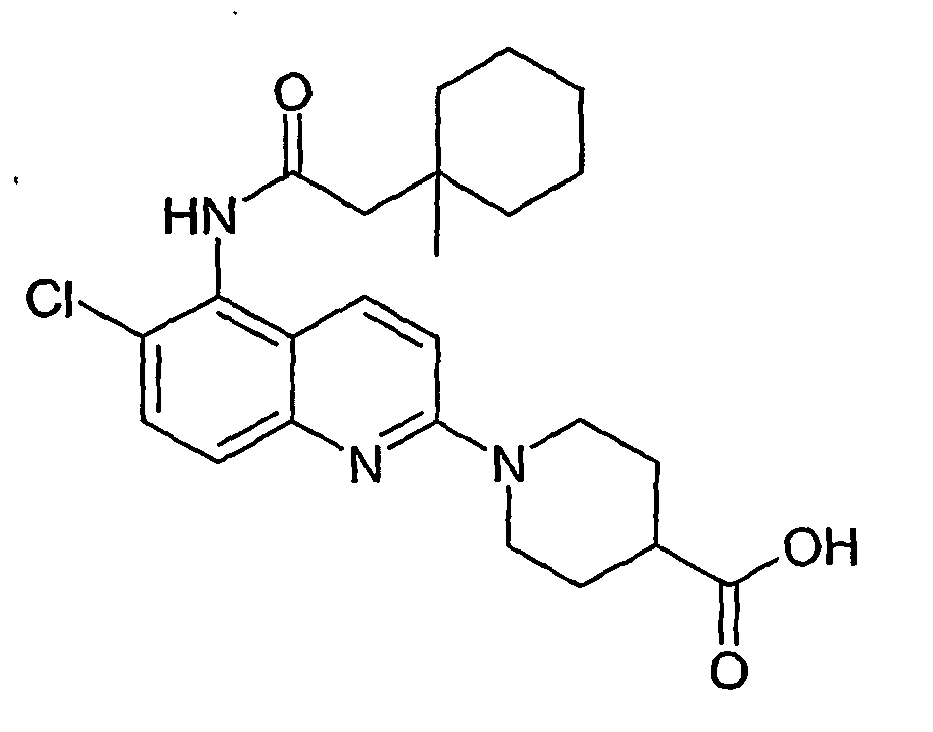
- Prepared according to the method of example 62(a), using 1-methyl-cyclohexaneacetic acid (280 mg) and 1-(5-amino-6-chloro-2-quinolinyl)-4-piperidinecarboxylic acid, ethyl ester (Example 77(a)) (200 mg), to afford the sub-titled compound (200 mg).
- MS: APCI(+ve) 472.2/474.2 (M+H+).
- Prepared according to the method of example 76 (e), using) 1-[6-chloro-5-[[(1-methylcyclohexyl)acetyl]amino]-2-quinolinyl]-4-piperidinecarboxylic acid, ethyl ester (Example 79(b)) (200 mg). Recrystallisation (ethanol/water) afforded the title compound (160 mg).
- 1H NMR (300 MHz, d6-DMSO) δ 9.43 (1H, s), 7.91 (1H, d), 7.61-7.45 (2H, m), 7.26 (1H, d), 4.35 (2H, d), 3.17 (2H, t), 2.64-2.52 (1H, m), 2.38 (2H, s), 2.00-1.88 (2H, m), 1.73-1.29 (12H, m), 1.13 (3H, s).
MS: APCI(-ve) 442.2/444.2 (M-H+).
m.p. 210-212°C -

- To a stirred solution of -N-[6-chloro-2-[(3R)-3-hydroxy-1-piperidinyl]-5-quinolinyl] cyclohexaneacetamide (Example 37) (0.715g) in dichloromethane (10 mL) was added triethylamine (0.99 mL) followed by methanesulfonyl chloride (0.275 mL). The reaction was stirred under nitrogen for 24 hours followed by the removal of volatiles under vacuum. The resulting mixture was taken up in methanol (20 mL) and placed down a Varian® SCX cartridge, washed with methanol (50 mL) and eluted with ammonia in methanol (0.7M, 50 mL). The solvent was removed to afford the sub-titled compound (0.64 g).
- MS: APCI(+ve) 480.4 (M+H+).
- N-[6-Chloro-2-[(3R)-3-[(methylsulfonyl)oxy]-1-piperidinyl]-5-quinolinyl]-cyclohexaneacetamide (Example 80(a)) (0.2g), 2-amino-ethanol (0.075ml) and acetonitrile (3ml) were loaded into a 10ml microwave reaction vial, capped and heated at 80 °C for 90 minutes within a single mode microwave. The solvent was removed under vacuum and the residue was purified by chromatography (SiO2, 7M ammonia in methanol: dichloromethane 1:99 as eluant) to give the title compound as a solid (0.018g).
- 1H NMR (400 MHz, CD3OD) δ 7.91 (1H, d), 7.56 (2H, s), 7.23 (1H, d), 4.60-4.54 (1H, m), 4.31-4.24 (1H, m), 3.68 (2H, t), 3.18-3.10 (1H, m), 2.99-2.92 (1H, m), 2.87-2.82 (2H, m), 2.75-2.67 (1H, m), 2.41 (2H, d), 2.12-2.03 (1H, m), 1.98-1.88 (3H, m), 1.87-1.75 (3H, m), 1.75-1.67 (1H, m), 1.67-1.54 (1H, m), 1.53-1.44 (1H, m), 1.42-1.21 (3H, m), 1.20-1.08 (2H, m).
MS: APCI(+ve) 445 (M+H+).
m.p. 185-186°C -

- The title compound was isolated from the previous reaction mixture (Example 80(b)) as a late eluting by-product (30 mg).
- 1H NMR (400 MHz, CD3OD) δ 7.93 (1H, d), 7.64 (1H, d), 7.56 (1H, d), 6.99 (1H, d), 4.48-4.41 (1H, m), 3.72-3.66 (3H, m), 3.55-3.47 (1H, m), 3.04-2.98 (1H, m), 2.89-2.76 (3H, m), 2.42 (2H, d), 2.18-1.99 (4H, m), 1.98-1.88 (3H, m), 1.82-1.75 (2H, m), 1.75-1.68 (1H, m), 1.42-1.20 (3H, m), 1.21-1.08 (2H, m).
MS: APCI(+ve) 445 (M+H+).
m.p. 157-158°C -

- N-[6-Chloro-2-[(3R)-3-[(methylsulfonyl)oxy]-1-piperidinyl]-5-quinolinyl]-cyclohexaneacetamide (Example 80(a)) (0.2g) and 8M methylamine in ethanol (5ml) were placed into a 10ml microwave vial and heated at 80°C for 60 minutes within a single mode microwave. The reaction was pre-absorbed onto silica and purified (SiO2, 7M ammonia in methanol:methanol:dichloromethane 1:3:96 as eluant). The resulting product was recrystallised from acetonitrile to afford the title compound (0.007g).
- 1H NMR (400 MHz, CD3OD) δ 7.91 (1H, d), 7.56 (2H, s), 7.22 (1H, d), 4.56-4.50 (1H, m), 4.28-4.21 (1H, m), 3.20-3.12 (1H, m), 3.02-2.95 (1H, m), 2.63-2.55 (1H, m), 2.46 (3H, s), 2.41 (2H, d), 2.12-2.04 (1H, m), 1.96-1.88 (3H, m), 1.86-1.75 (3H, m), 1.75-1.67 (1H, m), 1.66-1.52 (1H, m), 1.51-1.21 (4H, m), 1.21-1.08 (2H, m).
MS: APCI(+ve) 415.2 (M+H+).
m.p. 158-159 °C -

- The title compound was isolated from the previous reaction mixture (Example 82) as a late eluting by-product (36 mg).
- 1H NMR (400 MHz, CD3OD) δ 7.94 (1H, d), 7.59 (2H, d), 6.99 (1H, d), 4.48 - 4.41 (1H, m), 3.72 - 3.67 (1H, m), 3.55 - 3.47 (1H, m), 2.96 (1H, dd), 2.79 (1H, dd), 2.53 (3H, s), 2.42 (2H, d), 2.17 - 2.03 (3H, m), 2.03 - 1.97 (1H, m), 1.97 - 1.88 (3H, m), 1.83 - 1.75 (2H, m), 1.75 - 1.67 (1H, m), 1.42 - 1.21 (3H, m), 1.20 - 1.08 (2H, m).
MS: APCI(+ve) 415.2 (M+H+).
m.p. 138-145 °C -

- Prepared according to the method of example 27, using N-(2-chloro-6-methyl-5-quinolinyl)-cyclohexaneacetamide (Example 15(a)) (0.7 g), (3R)-3-pyrrolidinol (0.577 g) and acetonitrile (6 mL). Purification (SiO2, 7M ammonia in methanol:methanol:dichloromethane 1:3:96 as eluant) gave the title compound (0.57g)
- 1H NMR (400 MHz, CD3OD) δ 7.95 (1H, d), 7.59 (1H, d), 7.43 (1H, d), 6.89 (1H, d), 4.58-4.53 (1H, m), 3.75-3.68 (3H, m), 3.63-3.57 (1H, m), 2.42 (2H, d), 2.30 (3H, s), 2.22-2.12 (1H, m), 2.11-2.03 (1H, m), 1.99-1.86 (3H, m), 1.83-1.76 (2H, m), 1.75-1.68 (1H, m), 1.43-1.22 (3H, m), 1.22-1.09 (2H, m).
MS: APCI(+ve) 386.2 (M+H+).
m.p. 248-249 °C -

- N-[2-[(3S)-3-Amino-1-pyrrolidinyl]-6-chloro-5-quinolinyl]-cyclohexaneacetamide (Example 31) (0.25 g), 3Å molecular sieves (0.2 g) and oxo-acetic acid, ethyl ester (4.9M in toluene) (0.131 mL) were stirred in dichloromethane (5 mL) under nitrogen for 2 hours followed by the addition of sodium triacetoxyborohydride (0.27 g). After 24 hours 1M sodium hydroxide (20 mL) was added with the formation of a precipitate which was filtered and washed with dichloromethane. The organic layer was separated and the aqueous phase extracted twice with dichloromethane. The combined organic phases were washed with brine, dried, filtered and solvent removed under vacuum to afford the sub-titled compound (0.1 g).
- MS: APCI(+ve) 473 (M+H+).
- N-[(3S)-1-[6-Chloro-5-[(cyclohexylacetyl)amino]-2-quinolinyl]-3-pyrrolidinyl]-glycine ethyl ester (Example 85(a)) (100 mg), 1M sodium hydroxide (0.422 mL) and methanol (5 mL) were stirred for 12 hours before reaction was acidified with 1M hydrochloric acid and volatiles removed under vacuum. Purification (SiO2, 7M ammonia in methanol:methanol:dichloromethane 1:4:95) gave the title compound (0.028 g)
- 1H NMR (400 MHz, CD3O plus 1 drop of NaOD (40% in D2O)) δ 7.95 (1H, d), 7.57 (1H, d), 7.52 (1H, d), 6.91 (1H, d), 3.85-3.73 (2H, m), 3.65-3.57 (1H, m), 3.55-3.43 (2H, m), 3.24 (2H, s), 2.40 (2H, d), 2.32-2.23 (1H, m), 2.01-1.89 (4H, m), 1.82-1.74 (2H, m), 1.74-1.67 (1H, m), 1.42-1.20 (3H, m), 1.19-1.08 (2H, m).
MS: APCI(-ve) 443.4 (M-H+).
m.p. 257-259°C -

- Prepared according to the method of example 33(a), using N-[2-[(3R)-3-hydroxy-1-pyrrolidinyl]-6-methyl-5-quinolinyl]-cyclohexaneacetamide (Example 84) (0.545 g), methanesulfonyl chloride (0.23 mL), triethylamine (0.62 mL) and dichloromethane (20 mL) to afford the sub-title compound (0.4 g).
- MS: APCI(+ve) 446 (M+H+).
- Prepared according to the method of example 33(b), using N-[6-methyl-2-[(3R)-3-[(methylsulfonyl)oxy]-1-pyrrolidinyl]-5-quinolinyl]-cyclohexaneacetamide (Example 86(a)) (0.16 g), 2-amino-ethanol (0.065 mL), and acetonitrile (4 mL). Purification (SiO2, 7M ammonia in methanol:methanol: dichloromethane 1:2:99 as eluant) gave the title compound (0.06 g).
- 1H NMR (400 MHz, CD3OD) δ 7.95 (1H, d), 7.59 (1H, d), 7.43 (1H, d), 6.89 (1H, d), 3.87 (1H, dd), 3.80-3.73 (1H, m), 3.69 (2H, t), 3.64-3.57 (1H, m), 3.53 (1H, quintet), 3.46-3.41 (1H, m), 2.82 (2H, td), 2.41 (2H, d), 2.36-2.26 (1H, m), 2.30 (3H, s), 2.00-1.86 (4H, m), 1.83-1.76 (2H, m), 1.75-1.68 (1H, m), 1.43-1.22 (3H, m), 1.22-1.09 (2H, m)
MS: APCI(+ve) 411.2 (M+H+).
m.p. 204-207 °C -

- 3-[[(3S)-1-(Phenylmethyl)-3-pyrrolidinyl]amino]-propanenitrile (as described in
WO2000075137 ) (0.6 g), 20% palladium hydroxide on carbon (0.15 g), 1,4 cyclohexadiene (3 mL) and ethanol (2 mL) were loaded into a 10 mL microwave vial, capped and heated at 100 °C for 90 minutes within a single mode microwave. The reaction mixture was filtered and the volatiles removed under vacuum to afford the sub-title compound (0.304 g).
MS: APCI(+ve) 140.3 (M+H+). - N-(2,6-Dichloro-5-quinolinyl)-cyclohexaneacetamide (Example 1 (a)) (0.4 g), 3-[(3S)-3-pyrrolidinylamino]-propanenitrile (Example 87(a)) (0.3 g) and triethylamine (0.6 mL) were heated within a microwave in a sealed 10 mL vial for 60 minutes at 120 °C. The volatiles were removed under vacuum and the mixture purified (SiO2, methanol: dichloromethane 1:99 as eluant) to give the sub-titled compound (0.25 g).
- MS: APCI(+ve) 440.5 (M+H+).
- N-[6-Chloro-2-[(3S)-3-[(2-cyanoethyl)amino]-1-pyrrolidinyl]-5-quinolinyl]-cyclohexaneacetamide (0.1 g), potassium hydroxide (0.051 g), water (1 mL) and methanol (2 mL) were heated within a single mode microwave in a sealed 10 mL vial for 100 minutes at 90°C. The resulting mixture was dissolved in methanol (20 mL) and purified on a Varian® SCX cartridge, washed with methanol (50 mL) and eluted with ammonia in methanol (0.7M, 50 mL). The residue was further purified on a Varian® NH2 cartridge washed with methanol (50 mL) and eluted with acetic acid:methanol (10:90). The solvent was removed under vacuum and the residue triturated with hot methanol, cooled and filtered to afford the title compound (7 mg).
- 1H NMR (400 MHz, d6-DMSO) δ 9.76 (1H, s), 7.84 (1H, d), 7.55 (1H, d), 7.47 (1H, d), 6.95 (1H, d), 3.75-3.68 (1H, m), 3.67-3.58 (1H, m), 3.57-3.49 (1H, m), 3.48-3.41 (2H, m), 2.85-2.80 (2H, m), 2.36-2.30 (4H, m), 2.19-2.10 (1H, m), 1.91-1.77 (4H, m), 1.74-1.67 (2H, m), 1.67-1.60 (1H, m), 1.32-1.13 (4H, m), 1.10-0.99 (2H, m).
MS: APCI(-ve) 457.2 (M-H+). -

- N-[2-[(3S)-3-Amino-1-pyrrolidinyl]-6-chloro-5-quinolinyl]-cyclohexaneacetamide (Example 31) (0.15 g), triethylamine (0.108 mL) and dichloromethane (15 mL) were cooled to 0°C followed by the addition of trifluoroacetic anhydride (0.078 mL). The reaction was allowed to warm to room temperature and stirred for 1 hour. Water (10 mL) was added and the organic phase separated. The combined organic layers were concentrated and the residue purified by HPLC (Symmetry - 0.1% aqueous ammonium acetate / acetonitrile). Further purification on a Varian® NH2 cartridge, eluting with methanol (50 mL) and then with acetic acid:methanol (10:90), afforded the title product (0.018g).
- 1H NMR (400 MHz, d6-DMSO) δ 9.77 (1H, s), 7.85 (1H, d), 7.56 (1H, d), 7.49 (1H, d), 6.96 (1H, d), 4.21-4.13 (1H, m), 3.83-3.75 (1H, m), 3.71-3.63 (1H, m), 3.58-3.50 (1H, m), 3.43-3.35 (1H, m), 2.32 (2H, d), 2.27-2.17 (1H, m), 2.00-1.89 (1H, m), 1.86-1.77 (3H, m), 1.75-1.67 (2H, m), 1.67-1.60 (1H, m), 1.32-1.11 (4H, m), 1.10-0.98 (2H, m).
MS: APCI(+ve) 519.1 (M+H+).
m.p. 178-200 °C -

- N-[2-[(3S)-3-Amino-1-pyrrolidinyl]-6-chloro-5-quinolinyl]-cyclohexaneacetamide (Example 31) (0.15 g) and (methylsulfonyl)-carbamic acid ethyl ester (0.065 g) were heated with a single mode microwave in a sealed 10 mL vial for 30 minutes at 130°C. The residue was purified on a Varian® NH2 cartridge washed with methanol (50 mL) and eluted with acetic acid:methanol (10:90) to afford the title product (0.016 g).
- 1H NMR (400 MHz, d6-DMSO) δ 9.77 (1H, s), 7.86 (1H, d), 7.56 (1H, d), 7.49 (1H, d), 6.97 (1H, d), 6.83-6.76 (1H, m), 4.33-4.25 (1H, m), 3.80-3.74 (1H, m), 3.66-3.55 (2H, m), 3.47-3.39 (1H, m), 3.18 (3H, s), 2.32 (2H, d), 2.27-2.17 (1H, m), 2.01-1.90 (1H, m), 1.88-1.77 (3H, m), 1.75-1.67 (2H, m), 1.67-1.60 (1H, m), 1.32-1.14 (4H, m), 1.13-0.98 (2H, m).
MS: APCI(+ve) 508.1 (M+H+).
m.p. 303-307°C -

- Prepared according to the method of example 62(a), using 2,6-dichloroquinolin-5-amine (example 1(d)) (0.5 g) and cyclohexanepropionic acid (1.2 mL). The resulting precipitate was filtered and washed with acetone. The precipitate was further washed with water and then ether to give the sub-title compound as a solid (0.248 g)
- 1H NMR (300 MHz, DMSO) δ 8.28-8.25 (1H, d), 7.93 (2H, s), 7.69-7.66 (1H, d), 1.78-1.53 (8H, m), 1.31-1.12 (5H, m), 0.98-0.86 (2H, m).
MS: APCI(+ve) 351.2 (M+H+). - N-(2,6-Dichloro-5-quinolinyl)-cyclohexanepropanamide (Example 90(a)) (0.24 g), (S)-3-aminopyrrolidine (0.18 g) and triethylamine (0.1 mL) were suspended in acetonitrile and heated at 100°C in a microwave for 1 hour. The resulting precipitate was filtered and then washed with acetonitrile to give a brown solid. Purification (SiO2, methanol:dichloromethane:triethylamine 3:97:0.5) gave the title compound as a colourless solid (230 mg).
- 1H NMR (400 MHz, DMSO) δ 9.77 (1H, s), 7.86-7.83 (1H, d), 7.56-7.54 (1H, d), 7.48-7.46 (1H, d), 6.93-6.91 (1H, d), 3.70-3.64 (3H, m), 3.56-3.55 (1H, m), 2.46-2.42 (2H, t), 2.16-2.14 (1H, m), 1.85-1.53 (8H, m), 1.32-1.1(5H, m), 0.96-0:85 (2H, m).
MS: APCI(+ve) 401.2 (M+H+) -

- Prepared according to the method of example 90(b), using N-(2,6-dichloro-5-quinolinyl)-cyclohexanepropanamide (Example 90(a)) (0.16 g), N,N'-dimethylpropanediamine (0.3 mL) and triethylamine (0.1 mL). Purification (SiO2, methanol:dichloromethane: triethylamine 5:95:0.5 followed by HPLC, Symmetry - 0.1% aqueous trifluoroacetic acid:acetonitrile) gave the title compound as a solid (70 mg).
- 1H NMR (400 MHz, d6-DMSO) δ 9.85(1H, s), 8.43 (2H, bs), 7.91-7.89 (1H, d), 7.65-7.63 (1H, d), 7.59 (1H, bs), 7.22-7.2 (1H, d), 3.77-3.74 (1H, t), 2.93-2.91 (1H,), 2.58-2.55 (2H, t), 2.52 (6H, m), 2.48-2.44 (2H, t), 1.96-1.93 (2H, t), 1.89-1.62(5H, m), 1.59-1.53 (2H, q), 1.33-1.10(4H, m), 0.96-0.85 (2H, m).
MS: APCI(+ve) 417.2 (M+H+). -
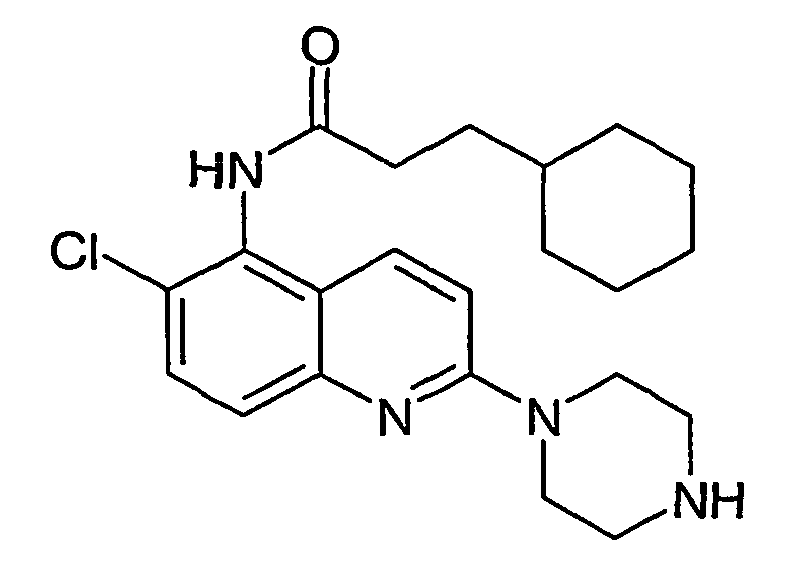
- N-(2,6-Dichloro-5-quinolinyl)-cyclohexanepropanamide (Example 90(a)) (0.16 g), 1-piperazinecarboxylic acid, 1,1-dimethylethyl ester (0.34 g,), triethylamine (0.15 mL) and tetra-butyl ammonium bromide (80 mg) were heated at 140°C for 1 hour in a microwave. The resulting precipitate was filtered and then washed with acetonitrile to give a solid. This solid was dissolved in dichloromethane and trifluoroacetic acid (1 mL) was added. The reaction mixture was stirred at room temperature for 3 hours, then concentrated under vacuum to dryness. Purification (HPLC, Symmetry - 0.1 % aqueous trifluoroacetic acid:acetonitrile followed by Varian SCX cartridge using methanol and then 10% ammonia in methanol as eluant) gave the title compound as a white solid (30 mg).
- 1H NMR (400 MHz, DMSO) δ 9.79 (1H, s), 7.86-7.83 (1H, d), 7.58-7.56 (1H, d), 7.48-7.46 (2H, d), 7.28-7.26 (1H, d), 3.61 (4H, t), 2.8 (4H, m), 2.49-2.42 (2H, t), 1.79-1.53 (7H, m), 1.36-1.1 (4H, m), 0.96-0.85 (2H, m).
MS: APCI(+ve) 401.2 (M+H+). -

- Prepared according to method of example 50(a), using N-[2-(3-amino-1-pyrrolidinyl)-6-chloro-5-quinolinyl]-cyclohexanepropanamide (Example 90(b)) (0.12 g), (tert-butyldimethylsilyloxy)acetaldehyde (51 µL) and sodium triacetoxyborohydride (0.13 g). The crude mixture was purified (SiO2, methanol:dichloromethane 2:98) and the product dissolved in dichloromethane. Trifluoroacetic acid (0.2 mL) was added and the reaction mixture stirred at room temperature for 48 hours. The reaction mixture was concentrated under vacuum and the residue purified (Varian SCX cartridge using methanol and then 10% ammonia in methanol, HPLC Symmetry, 0.1 % aqueous ammonium acetate:acetonitrile) to give the title compound as a solid (0.018 g).
- 1HNMR (400 MHz, d6-DMSO) δ 9.76 (1H, s), 7.84-7.82 (1H, d), 7.55-7.52 (1H, d), 7.47-7.45 (1H, d), 6.92-6.90 (1H, d), 3.6-3.4 (6H, m), 2.6 (2H, m), 2.46-2.42 (2H, t,), 2.15-2.07 (1H, m), 1.89-1.53 (8H, m), 1.36-1.1(5H, m), 0.96-0.83(2H, m).
MS: APCI(+ve) 445.2 (M+H+). -
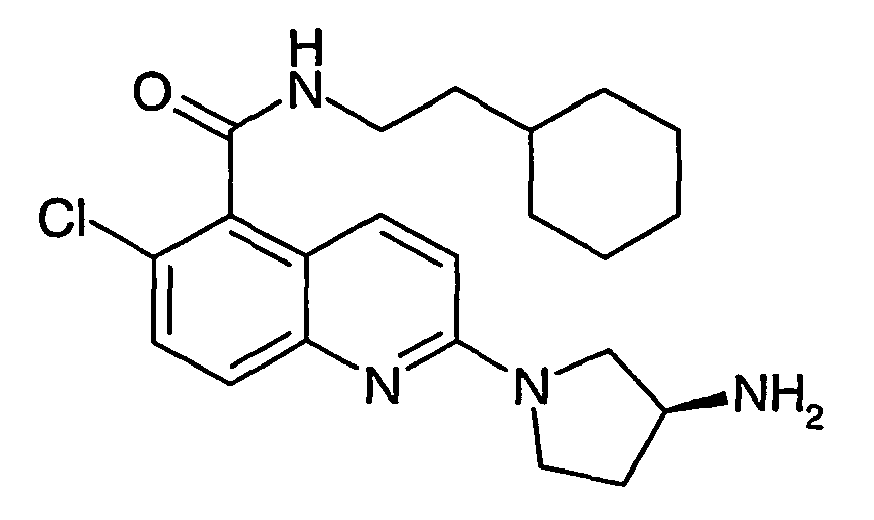
- tert-Butyllithium (1.6 mL, 1.7 M in pentane) was added to a solution of 5-bromo-6-chloro-quinoline (prepared according to the method of Journal of Heterocyclic Chemistry 1967, 4, 410) (0.3 g) in dry tetrahydrofuran at -78°C under nitrogen. The reaction mixture was stirred at -78°C for 10 minutes and then carbon dioxide bubbled through for one minute. The reaction mixture was stirred at -78°C for another 10 minutes and then water (3 mL) added. The reaction mixture was allowed to warm up to room temperature, concentrated under vacuum and the residue was partitioned between water and ethyl acetate. The aqueous layer was freeze dried to give the sub-titled compound as a solid (0.3 g).
- 1H NMR (300 MHz, d6-DMSO) δ 8.84-8.82 (1H, d), 8.29-8.27 (1H, d), 7.77-7.74 (1H, d), 7.61-7.58 (1H, d), 7.51-7.47 (1H, m).
MS: APCI(+ve) 208 (M+H+). - Oxalyl chloride (0.3 mL) was added to a suspension of 6-chloro-5-quinolinecarboxylic acid (example 94(a)) (0.3 g) in dichloromethane and 2 drops of N,N'-dimethylformamide. The reaction mixture was stirred at room temperature for 1 hour then evaporated to an oil. The residue was added to cyclohexylethylamine hydrochloride (0.33 g) and triethylamine (0.6 mL) in dichloromethane and then stirred at room temperature for 1 hour. Water was added and the reaction mixture was extracted with dichloromethane. The combined organics were dried and concentrated. Purification (SiO2, ethyl acetate:isohexane 50:50) gave the sub titled compound as a solid (0.115 g).
- 1H NMR (300 MHz, d6-DMSO) δ 8.97-8.96 (1H, m), 8.73-8.70 (1H, t), 8.11-8.04 (2H, m), 7.84-7.81 (1H, d), 7.67-7.63 (1H, m), 3.39-3.36 (2H, q), 1.76-1.62 (5H, m), 1.50-1.35 (3H, m), 1.30-1.07 (3H, m), 0.96-0.85 (2H, m).
MS: APCI(+ve) 317.3 (M+H+). - Peracetic acid (1.3 mL, 36-40% in acetic acid) was added to 6-chloro-N-(2-cyclohexylethyl)-5-quinolinecarboxamide (Example 94(b)) (0.115 g) in acetic acid and the reaction mixture stirred at room temperature overnight. The reaction mixture was washed with a 10% sodium sulfite solution and then extracted with dichloromethane. The organics were washed with water, dried and concentrated. Purification (SiO2, methanol:ethylacetate 5:95) gave the sub titled compound as a solid (0.05 g).
- 1H NMR (300 MHz, d6-DMSO) δ 8.80-8.77 (1H, t), 8.64-8.63 (1H, d), 8.57-8.55 (1H, d), 7.89-7.86 (1H, d), 7.61-7.55 (2H, m), 3.4 (2H, q), 1.90-1.62 (5H, m), 1.50-1.35 (3H, m), 1.25-1.09 (3H, m), 0.96-0.85 (2H, m).
MS: APCI(+ve) 333.3 (M+H+). - Phosphorous oxychloride (2 mL) was added to 6-chloro-5-[[(2-cyclohexylethyl)amino]carbonyl]-1-hydroxy-quinolinium (Example 94(c)) (0.089g) and the mixture heated at 60°C for 2 hours. The reaction mixture was concentrated under reduced pressure and added to water. The aqueous was extracted with ethyl acetate and the combined organics dried filtered and evaporated give the sub titled compound as a solid (0.079 g).
MS: APCI(+ve) 351.4 (M+H+). - Prepared according to the method of example 90(b), using 2,6-dichloro-N-(2-cyclohexylethyl)-5-quinolinecarboxamide (Example 94(d)) (0.079 g), (S)-3-aminopyrrolidine (0.05 g) and triethylamine (0.031 mL). The reaction mixture was concentrated under reduced pressure and purified (HPLC Symmetry, 0.1% aqueous trifluoroacetic acid:acetonitrile as eluant) to give the title compound (0.014 g).
- 1H NMR (300 MHz, d6-DMSO) δ 8.65 (1H, bs), 8.11 (3H, bs), 7.84-7.82(1H, d), 7.65-7.62 (2H, m), 7.11-7.09 (1H, d), 4.12-3.56(4H, range of ppm), 3.36-3.34(2H, d), 2.38-2.32(1H, m), 2.14(1H, m), 1.76-1.64(5H, m),1.46-1.4(3H, m), 1.23-1.12(4H, m), 0.93-0.90(2H, m).
MS: APCI(+ve) 401.2 (M+H+). -

- Mercaptoethanol (0.073 mL) was added to N-[6-chloro-2-[(3S)-3-[(methylsulfonyl)oxy]-1-pyrrolidinyl]-5-quinolinyl]-cyclohexaneacetamide (Example 33(a)) (0.1 g) and potassium carbonate (0.24 g) in dry N,N-dimethylformamide. The reaction mixture was heated at 60°C in a microwave for 2 hours and then partitioned between water and ethyl acetate. The combined organics were washed with brine, dried and concentrated. Purification (SiO2, methanol:dichloromethane 3:97 as eluant) gave the sub-titled compound as a solid (0.05 g).
- MS: APCI(+ve) 448.1 (M+H+).
- Hydrogen peroxide (0.57 mL, 1.25M in methanol) and p-toluenesulfonylimidazole (0.081 g) were added to N-[6-chloro-2-[(3S)-3-[(2-hydroxyethyl)thio]-1-pyrrolidinyl]-5-quinolinyl]-cyclohexaneacetamide (Example 95(a)) (0.034 g) in methanol. The reaction mixture was cooled down to 0°C and 1M sodium hydroxide (0.36 mL) was carefully added. The reaction mixture was allowed to warm up to room temperature overnight and 10 mL of 10% sodium metabisulfite solution added. Methanol was removed under reduced pressure and the aqueous layer extracted with dichloromethane. The combined organics were concentrated under vacuum. Purification (SiO2, methanol:dichloromethane 2:98 as eluant) gave the title compound as a solid (0.004 g).
- 1H NMR (300 MHz, d6-DMSO) δ 9.78 (1H, s), 7.90-7.87 (1H, d), 7.60-7.57 (1H, d), 7.53-7.50 (1H, d), 7.04-7.00 (1H, d), 5.22-5.18 (1H, t), 4.19-4.14 (1H, q), 3.87-3.60 (7H, m), 3.37-3.33 (1H, m), 2.4 (2H, m), 2.33-2.31 (2H, d), 1.83-1.62 (6H, m), 1.29-1.02 (5H, m).
MS: APCI(+ve) 480.1 (M+H+). -

- Lithium cyanide (4 mL, 0.5M in DMF) was added to N-[6-chloro-2-[(3R)-3-hydroxy-1-pyrrolidinyl]-5-quinolinyl]-cyclohexaneacetamide (Example 33(a)) (0.21 g) in N,N'-dimethylformamide. The reaction mixture was heated at 60°C for 10 hours. A saturated solution of sodium bicarbonate was added and the reaction mixture extracted with ethyl acetate. The combined organics were washed with brine, dried and concentrated. Purification (SiO2, iso-hexane:ethyl acetate 1:1 as eluant) gave the title compound as a solid (0.066 g).
- 1H NMR (300 MHz, d6-DMSO) δ 9.78 (1H, s), 7.90-7.87 (1H, d), 7.60-7.57 (1H, d), 7.53-7.50 (1H, d), 7.02-6.99 (1H, d), 3.92-3.57 (5H, m), 2.44-2.25 (4H, m), 1.83-1.62 (6H, m), 1.29-1.02 (5H, m).
MS: APCI(+ve) 397.1 (M+H+). -

- 3-Azetidinyl-carbamic acid, 1,1-dimethylethyl ester (0.5 g) was added to 2,6-dichloro-N-(cyclohexylmethyl)quinoline-5-carboxamide (Example 43(a)) (0.28 g), tetra-butylammonium bromide (0.28 g) and triethylamine (0.5 mL) in acetonitrile (4 mL). The reaction mixture was heated at 120°C in a microwave for 1 hour, concentrated under reduced pressure and purified (SiO2, methanol:dichloromethane 4:96 as eluant). The residue (0.24 g) was dissolved in dichloromethane and trifluoroacetic acid (1 mL) added. The reaction mixture was stirred at room temperature for 1 hour, concentrated and then treated with 7M ammonia in methanol. Purification (Varian SCX cartridge using methanol and then 10% ammonia in methanol) gave the sub-titled compound as a solid (0.1 g).
- 1H NMR (400 MHz, d6-DMSO) δ 8.64-8.60 (1H, t), 7.73-7.70 (1H, d), 7.57-7.57 (2H, m), 6.82-6.79 (1H, d), 4.28-4.23 (2H, t), 3.89-3.80 (1H, q), 3.71-3.66 (2H, m), 3.18-3.14 (2H, t), 1.80-1.34 (6H, m), 1.28-0.91 (5H, m).
- To a stirred solution of 2-(3-amino-1-azetidinyl)-6-chloro-N-(cyclohexylmethyl)-5-quinolinecarboxamide (Example 97(a)) (0.1 g) in methanol (1 mL) was added ethyl acrylate (0.032 mL). The mixture was stirred at room temperature for 20 hours. Sodium hydroxide (1 mL, 1M) was added and the reaction mixture was stirred for 72 hours. Hydrochloric acid (0.5 mL, 2M) was added and the reaction mixture was concentrated under vacuum. Purification (HPLC - Symmetry, 0.1% aqueous ammonium acetate: acetonitrile as eluant) gave the title compound as a solid (0.026 g).
- 1H NMR (400 MHz, d6-DMSO) δ 8.64-8.60 (1H, t), 7.74-7.71 (1H, d), 7.57-7.49 (2H, m), 6.82-6.79 (1H, d), 4.26-4.21 (2H, t), 3.78-3.68 (3H, m), 3.18-3.13 (2H, t), 2.74-2.69 (2H, t), 2.34-2.27 (2H, m), 1.80-1.60 (6H, m), 1.23-0.85 (5H, m).
MS: APCI(-ve) 443.2 (M-H+). -

- A mixture of 2,6-dichloro-N-(cyclohexylmethyl)-5-quinolinecarboxamide (example 43(a)) (0.25 g, 0.74 mmol), 3-azetidinecarbonitrile (prepared according to the method of
JP 2001172257A - MS: APCI(+ve) 383.2 (M+H+).
- To a stirred solution of 6-chloro-2-(3-cyano-1-azetidinyl)-N-(cyclohexylmethyl)-5-quinolinecarboxamide (Example 98(a)) (0.08 g) and dibutyltin oxide (0.017 g) in toluene (5 mL) was added azidotrimethylsilane (0.08 mL). The mixture was heated at 100°C for 20 hours after which it was cooled and then methanol added. The solvent was evaporated under reduced pressure, methanol was added and the mixture stirred for 5 minutes before being concentrated under vacuum. The residue was purified (HPLC, Symmetry - 0.1% aqueous trifluoroacetic acid:acetonitrile) to give the title compound as a solid (0.033 g).
- 1H NMR (400 MHz, d6-DMSO) δ 10.51 (1H, s), 8.88-8.87 (1H, t), 8.06-8.03 (1H, d), 7.95-7.91 (2H, m), 7.18 (1H, d), 4.80 (2H, m), 4.20 (1H, m), 4.00 (1H, m), 3.85-3.81 (1H, m), 3.19-3.16 (2H, q), 1.79-1.54 (6H, m), 1.24-0.93 (5H, m).
MS: APCI(+ve) 426.1 (M+H+). -

- Prepared according to the method of example 98(b), using N-[6-chloro-2-[(3S)-3-cyano-1-pyrrolidinyl]-5-quinolinyl]-cyclohexaneacetamide (example 96) (0.036 g). Purification (Varian NH2 cartridge, methanol then 2% acetic acid in methanol as eluant) gave the title compound as a solid (0.028 g).
- 1H NMR (300 MHz, d6-DMSO) δ 9.77 (1H, s), 7.88-7.85 (1H, d), 7.58-7.55 (1H, d), 7.50-7.47 (1H, d), 7.01-6.98 (1H, d), 4.10-3.61 (5H, m), 2.33-2.25 (3H, m), 1.91-0.98 (11H, m), 0.87-0.82 (1H, t).
MS: APCI(+ve) 440.1 (M+H+). -

- Prepared according to the method of example 96, using N-[6-chloro-2-[(3S)-3-[(methylsulfonyl)oxy]-1-pyrrolidinyl]-5-quinolinyl]-cyclohexaneacetamide (example 33 (a)) (0.33 g) and lithium cyanide in N,N-dimethylformamide (6 mL, 0.5M). Purification (SiO2, isohexane:ethyl acetate 60:40, as eluant) gave the sub-title compound as a solid (0.066 g).
- 1H NMR (300 MHz, d6-DMSO) δ 9.79 (1H, d), 7.91-7.88 (1H, d), 7.61-7.58 (1H, d), 7.53-7.55 (1H, d), 7.03-7.00 (1H, d), 3.90-3.57 (5H, m), 2.44-2.20 (4H, m), 1.83-1.63 (6H, m), 1.29-0.90 (5H, m).
MS: APCI(+ve) 397.5 (M+H+). - Prepared according to the method of example 98 (b), using N-[6-chloro-2-[(3R)-3-cyano-1-pyrrolidinyl]-5-quinolinyl]-cyclohexaneacetamide (example 100 (a)) (66 mg), dibutyltin oxide (9 mg) and azidotrimethylsilane ( 0.06 mL). The residue was purified by ion exchange column (Varian NH2 cartridge, methanol then 3% acetic acid in methanol as eluant). Further purification by ion exchange column (Varian SCX cartridge, methanol then 7N ammonia in methanol as eluant) gave the title compound as a solid (11 mg).
- 1H NMR (400 MHz, CD3OD) δ 9.78 (1H, s), 7.89-7.86 (1H, d), 7.58-7.56 (1H, d), 7.50-7.49 (1H, d), 7.01-6.99 (1H, d), 4.20-3.60 (5H, m), 2.29-2.25 (3H, m), 1.86-1.57 (6H, m), 1.31-0.99 (6H, m).
MS: APCI(+ve) 440.1 (M+H+). -

- N-[6-Chloro-2-[(3S)-3-[(2-cyanoethyl)amino]-1-pyrrolidinyl]-5-quinolinyl]-cyclohexaneacetamide (example 87 (b)) (0.15 g), trimethylsilylazide (0.091ml), dibutyltin oxide (0.009g) and toluene (5ml) were heated within a single mode microwave in a sealed 10ml vial at 100 °C for 30 minutes and then at 120 °C for 120 minutes. The reaction was cooled to room temperature, filtered and washed with toluene. The solid was then triturated with methanol and filtered before being dissolved in hot methanol and purified by Varian SCX cartridge (methanol (50ml) and then ammonia in methanol (0.7M, 50ml) as eluant). to afford the title compound (0.025g).
- 1H NMR (400 MHz, d6-DMSO) δ 9.78 (1H, s), 7.86 (1H, d), 7.57 (1H, d), 7.49 (1H, d), 6.98 (1H, d), 3.85 - 3.62 (3H, m), 3.61 - 3.49 (2H, m), 3.19 - 3.12 (2H, m), 3.07 - 3.00 (2H, m), 2.32 (2H, d), 2.30 - 2.19 (1H, m), 2.09 - 1.96 (1H, m), 1.89 - 1.76 (3H, m), 1.76 - 1.59 (3H, m), 1.35 - 1.13 (3H, m), 1.12 - 0.97 (2H, m).
MS: APCI(+ve) 483.5 (M+H+).
m.p: 220-221 °C -

- N-[6-Chloro-2-(4-cyano-1-piperidinyl)-5-quinolinyl]-cyclohexaneacetamide (Example 113) (0.2g), hydroxylamine (50% w/v in H2O) (0.23 mL) and ethanol (2.5 mL) were heated within a microwave in a sealed 10 mL vial at 90 °C for 100 minutes. The reaction was cooled to room temperature and the resulting precipitate was filtered and washed with ethanol to afford the sub-title compound as a solid (0.18 g).
- 1H NMR (400 MHz, d6-DMSO) δ 9.77 (1H, s), 8.79 (1H, s), 7.84 (1H, d), 7.56 (1H, d), 7.48 (1H, d), 7.33 (1H, d), 5.33 (2H, s), 4.58 (2H, d), 2.93 (2H, t), 2.36-2.27 (3H, m), 1.87-1.76 (5H, m), 1.75-1.67 (2H, m), 1.66-1.53 (3H, m), 1.32-1.12 (3H, m), 1.10-0.98 (2H, m).
MS: APCI(+ve) 444 (M+H+).
m.p. 246-247°C - To a stirred solution of N-[2-[4-[amino(hydroxyimino)methyl]-1-piperidinyl]-6-chloro-5-quinolinyl]-cyclohexaneacetamide (example 102(a)) (0.1 g) and pyridine (0.02 mL) in dichloromethane (5 mL) at 0 °C was added 2-ethylhexylchloroformate (0.064 mL). After 10 minutes the reaction was allowed to warm to room temperature and was then stirred for 2 hours. The solvent was removed under vacuum and the resulting solid was transferred to a 10 mL microwave vial with isohexane (3 mL) and heated within a microwave at 140 °C for 20 minutes. The reaction mixture was filtered and the solid was taken up in boiling methanol (20 mL) and purified by Varian NH2 cartridge (methanol (50 mL) and then acetic acid:methanol 10:90 as eluant) to afford the title product (0.042 g).
- 1H NMR (400 MHz, d6-DMSO) δ 9.79 (s, 1H), 7.86 (1H, d), 7.58 (1H, d), 7.50 (1H, d), 7.36 (1H, d), 4.55 (2H, d), 3.12 (2H, t), 3.00-2.91 (1H, m), 2.33 (2H, d), 1.95 (2H, d), 1.81 (3H, d), 1.75-1.57 (5H, m), 1.32-1.13 (3H, m), 1.12-0.97 (2H, m).
MS: APCI(+ve) 470.2 (M+H+).
m.p. 233-235 °C -
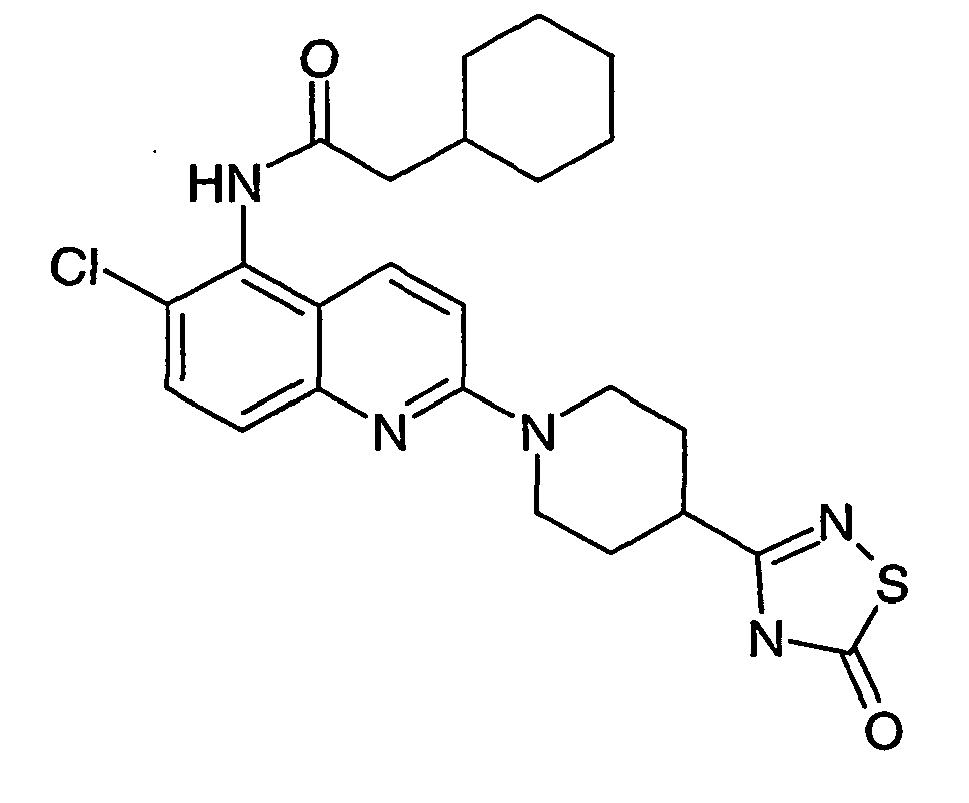
- To a stirred solution of N-[2-[4-[amino(hydroxyimino)methyl]-1-piperidinyl]-6-chloro-5-quinolinyl]-cyclohexaneacetamide (Example 102(a)) (0.1 g) in tetrahydrofuran (2 mL) was added 1,1'-thiocarbonyldiimidazole (0.042 g). After stirring for 1 hour, silica (1 g) in chloroform: methanol (5:1) (12 mL) was added and the mixture was stirred for a further 12 hours. The solvent was removed under vacuum, the resulting solid was taken up in methanol (20 mL) and was purified by Varian NH2 cartridge (methanol (50 mL) and then acetic acid:methanol 10:90 as eluant) to afford the title product (0.041 g).
- 1H NMR (400 MHz, d6-DMSO) δ 9.79 (1H, s), 7.86 (1H, d), 7.58 (1H, d), 7.49 (1H, d), 7.35 (1H, d), 4.57 (2H, d), 3.06 (2H, t), 2.96-2.86 (1H, m), 2.33 (2H, d), 2.02-1.94 (2H, m), 1.88-1.77 (3H, m), 1.75-1.60 (5H, m), 1.32-1.11 (3H, m), 1.11-0.99 (2H, m).
MS: APCI(+ve) 486.2 (M+H+).
m.p. 275 °C -

- To a stirred solution of N-[6-chloro-2-(3-cyanopropyl)-5-quinolinyl]-cyclohexaneacetamide (prepared as in example 67 (a)) (100 mg) in toluene (2 mL) was added trimethylsilyl azide (0.07 mL) and dibutyltin oxide (6 mg). The mixture was heated to 100°C for 6 hours then allowed to cool and evaporated. Purification (HPLC, Symmetry - 0.1 % aqueous trifluoroacetic acid / acetonitrile) gave the title compound as a solid (35 mg).
- 1H NMR (400 MHz, d6-DMSO) δ 10.00 (1H, s), 8.19 (1H, d), 7.93 (1H, d), 7.85 (1H, d), 7.59 (1H, d), 3.09-2.94 (4H, m), 2.37 (2H, d), 2.23 (2H, quintet), 1.91-1.59 (6H, m), 1.35-0.99 (5H, m).
MS: APCI(+ve) 413.1/415.1 (M+H+).
m.p. 140-145 °C. -

- Prepared according to the method of example 104, using N-[6-chloro-2-(4-cyanobutyl)-5-quinolinyl]-cyclohexaneacetamide (prepared as in example 70 (a)) (300 mg). Purification by HPLC (Symmetry - 0.1% aqueous ammonium acetate / acetonitrile) gave the title compound as a solid (70 mg).
- 1H NMR (400 MHz, d6-DMSO) δ 9.96 (1H, s), 8.11 (1H, d), 7.89 (1H, d), 7.80 (1H, d), 7.52 (1H, d), 3.01-2.86 (4H, m), 2.36 (2H, d), 1.93-1.58 (10H, m), 1.34-0.98 (5H, m).
MS: APCI(+ve) 427.1/429.1 (M+H+).
m.p. 192-195 °C. -
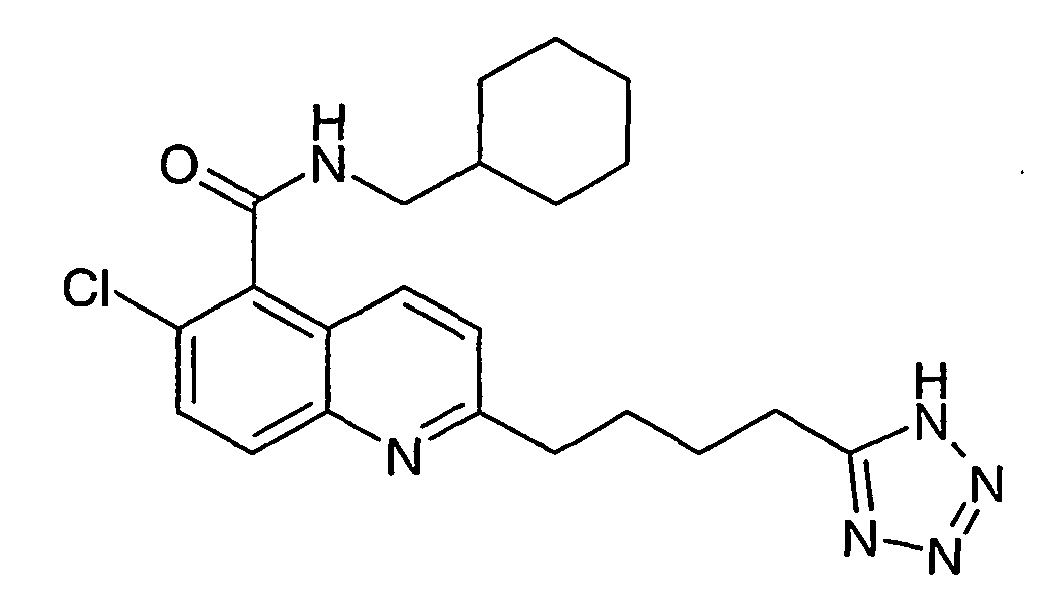
- Prepared according to the method of example 67 (a) using 2,6-dichloro-N-(cyclohexylmethyl)-5-quinolinecarboxamide (prepared as in Example 43 (a)) (500 mg) and bromo(4-cyanobutyl)-zinc (30 mL, 0.5 M solution in tetrahydrofuran). Purification (SiO2, methanol:dichloromethane 1:200 as eluant) gave the sub-title compound as a solid (600 mg).
- MS: APCI(+ve) 384.5/386.5 (M+H+).
- Prepared according to the method of example 104, using 6-chloro-2-(4-cyanobutyl)-N-(cyclohexylmethyl)-5-quinolinecarboxamide (Example 106 (a)) (300 mg). Purification (Varian NH2 cartridge using methanol (100 mL) and then 10 % acetic acid in methanol (100 mL) as eluant) and further purification (SiO2, methanol:dichloromethane 5:95 as eluant) gave the title compound as a solid (80 mg).
- 1H NMR (300 MHz, d6-DMSO) δ 8.71 (1H, t), 8.04 - 7.90 (2H, m), 7.75 (1H, d), 7.56 (1H, d), 3.20 (2H, t), 3.03-2.86 (4H, m), 1.90-1.49 (10H, m), 1.33-0.88 (5H, m).
MS: APCI(+ve) 427.1/429.1 (M+H+).
m.p. 90-93 °C. -
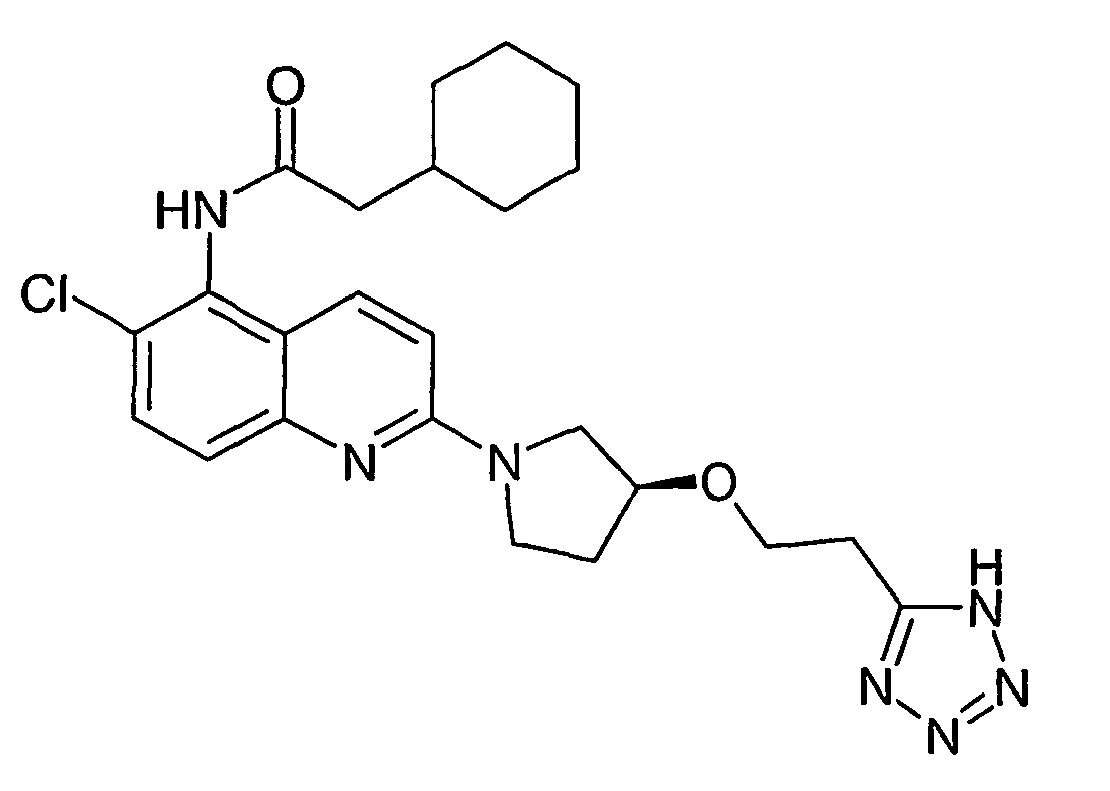
- Sodium methoxide (1.2 g) was carefully added portionwise to a stirred mixture of (3S)-3-hydroxy-1-pyrrolidinecarboxylic acid, 1,1-dimethylethyl ester (prepared according to the method of Bioorganic and Medicinal Chemistry Letters 2003, 13, 3317) (2 g) and acrylonitrile (5 mL) at 0°C under nitrogen. The reaction mixture was stirred at room temperature for 15 hours and then poured into water (50 mL). The mixture was extracted with dichloromethane (2x50 mL) and the combined extracts were washed with water (50 mL) before being dried, filtered and evaporated. Purification (SiO2, methanol:dichloromethane 2:98 as eluant) gave the sub-title compound as a colourless oil (1g).
- 1H NMR (400 MHz, d6-DMSO) δ 4.10 (1H, s), 3.70-3.51 (2H, m), 3.39-3.15 (4H, m), 2.77-2.69 (2H, m), 1.96-1.83 (2H, m), 1.42 (9H, s).
- To a stirred solution of (3S)-3-(2-cyanoethoxy)-1-pyrrolidinecarboxylic acid, 1,1-dimethylethyl ester (Example 107(a)) (1 g) in dichloromethane (10 mL) was added trifluoroacetic acid (3 mL). The mixture was stirred at room temperature for 30 minutes and then concentrated. Purification (Varian SCX cartridge, using methanol and then 10% ammonia in methanol as eluant) gave the sub-title compound (350 mg).
- 1H NMR (400 MHz, d6-DMSO) δ 4.04 - 3.94 (1H, m), 3.58 - 3.45 (2H, m), 2.84 - 2.59 (6H, m), 1.82 - 1.54 (2H, m), 1.23 (1H, s).
- Prepared according to the method of example 30, using N-(2,6-dichloro-5-quinolinyl)-cyclohexaneacetamide (prepared as in Example 1(a)) (400 mg) and 3-[(3S)-3-pyrrolidinyloxy]-propanenitrile (Example 107 (b)) (350 mg). The resulting precipitate was collected by filtration and washed with acetonitrile to give the sub-title compound as a solid (370 mg).
- 1H NMR (400 MHz, d6-DMSO) δ 9.77 (1H, s), 7.85 (1H, d), 7.55 (1H, d), 7.48 (1H, d), 6.97 (1H, d), 4.30 (1H, s), 3.75-3.45 (6H, m), 2.76 (2H, t), 2.32 (2H, d), 2.18-2.04 (2H, m), 1.90-1.59 (6H, m), 1.34-0.96 (5H, m).
- Prepared according to the method of example 104, using N-[6-chloro-2-[(3S)-3-(2-cyanoethoxy)-1-pyrrolidinyl]-5-quinolinyl]-cyclohexaneacetamide (Example 101 (c)) (200 mg). Purification by Varian NH2 cartridge (methanol and then 10 % acetic acid in methanol as eluant) and then by Varian SCX cartridge (methanol and 10% ammonia in methanol) gave the title compound as a solid (110 mg).
- 1H NMR (400 MHz, d6-DMSO) δ 9.77 (1H, s), 7.84 (1H, d), 7.55 (1H, d), 7.47 (1H, d), 6.93 (1H, d), 4.25 (1H, s), 3.87-3.74 (2H, m), 3.68-3.52 (3H, m), 3.49-3.36 (1H, m), 3.07 (2H, t), 2.32 (2H, d), 2.05 (2H, s), 1.92-1.58 (6H, m), 1.34-0.96 (5H, m).
MS: APCI(+ve) 484.2/486.2 (M+H+).
m.p. 177-181 °C. -

- Prepared according to the method of example 102 (a) using N-[6-chloro-2-[(3S)-3-(2-cyanoethoxy)-1-pyrrolidinyl]-5-quinolinyl]-cyclohexaneacetamide (prepared as in Example 107 (c)) (200 mg). The reaction mixture was concentrated and water was added to the residue. Filtration of the resulting suspension gave the sub-title compound as a solid (200 mg).
- 1H NMR (300 MHz, d6-DMSO) δ 9.76 (1H, s), 8.77 (1H, s), 7.84 (1H, d), 7.55 (1H, d), 7.48 (1H, d), 6.96 (1H, d), 5.34 (2H, s), 4.23 (1H, s), 3.77-3.43 (6H, m), 2.32 (2H, d), 2.21 (2H, t), 2.15-2.03 (2H, m), 1.90-1.58 (6H, m), 1.37-0.95 (5H, m).
- Prepared according to the method of Example 102 (b) using N-[2-[(3S)-3-[[3-amino-3-(hydroxyimino)propyl]oxy]-1-pyrrolidinyl]-6-chloro-5-quinolinyl]-cyclohexaneacetamide (Example 108 (a)) (200 mg). Purification (SiO2, methanol:dichloromethane 2:98 as eluant) gave the title compound as a solid (20 mg).
- 1H NMR (300 MHz, d6-DMSO) δ 9.63 (1H, s), 7.99 (1H, d), 7.82 (1H, d), 7.69 (1H, d), 7.11 (1H, d), 4.38 - 4.30 (1H, m), 3.86 - 3.61 (6H, m), 2.76 (2H, t), 2.34 (2H, d), 2.21 - 2.10 (2H, m), 1.96 -1.56 (6H, m), 1.41 - 0.98 (5H, m).
MS: APCI(+ve) 500.2/502.2 (M+H+).
m.p. 185-190 °C. -

- Prepared according to the method of example 98(b), using N-[6-chloro-2-(4-cyano-1-piperidinyl)-5-quinolinyl]-cyclohexaneacetamide (example 113) (0.07 g) to afford the title compound (0.02 g).
- 1H NMR (300 MHz, CD3OD δ 7.83 (1H, d), 7.51-7.43 (2H, m), 7.17 (1H, d), 4.54 (2H, d), 3.27-3.02 (3H, m), 2.32 (2H, d), 2.06-1.57 (10H, m), 1.36-0.93 (5H, m).
MS: APCI(+ve) 454/456 (M+H+).
m.p. 295-300 °C -

- Prepared according to the method of example 51, using 2,6-dichloro-N-(cyclohexylmethyl)-5-quinolinecarboxamide (Example 43(a)) (0.25 g), and 4-cyanopiperidine hydrochloride (0.25 g) to afford the title compound (0.27 g).
- 1H NMR (300 MHz, CD3OD), δ 7.78 (1H, d), 7.54 (1H, d), 7.42 (1H, d), 7.17 (1H, d),4.00 (2H, ddd), 3.51 (2H, ddd), 3.19 (2H, s), 2.99 (1H, dt), 1.99-1.89 (2H, m), 1.82-1.49 (8H, m), 1.30-1.10 (3H, m), 1.04-0.90 (2H, m).
MS: APCI(+ve) 411/413 (M+H+). - Prepared according to the method of example 98 (b), using 6-chloro-2-(4-cyano-1-piperidinyl)-N-(cyclohexylmethyl)-5-quinolinecarboxamide (Example 110 (a)) (0.25 g) to afford the title compound (0.15 g).
- 1H NMR (300 MHz, CD3OD δ 7.79 (1H, d), 7.54 (1H, d), 7.42 (1H, d), 7.21 (1H, d), 4.57 (2H, d), 3.30 (1H, tt), 3.13 (2H, t), 2.08 (2H, d), 1.79 (4H, d), 1.73-0.89 (11H, m).
MS: APCI(+ve) 454/456 (M+H+).
m.p. 255-257 °C -

- Prepared according to the method of example 51, using 2,6-dichloro-N-(cyclohexylethyl)-5-quinolinecarboxamide (Example 94 (d)) (0.35 g), and 4-cyanopiperidine hydrochloride (0.25 g) to afford the title compound (0.12 g).
- 1H NMR (400 MHz, d6-DMSO) δ 8.59 (1H, t), 7.76 (1H, d), 7.57 (1H, d), 7.53 (1H, d), 7.37 (1H, d),4.08-3.98 (2H, m), 3.53 (2H, t), 3.36 (2H, t), 3.21-3.13 (1H, m), 2.02-1.93 (2H, m), 1.81-1.58 (7H, m), 1.49-1.39 (3H, m), 1.27-1.11 (3H, m), 0.97-0.86 (2H, m).
MS: APCI(+ve) 425/427 (M+H+). - Prepared according to the method of example 98 (b), using 6-chloro-2-(4-cyano-1-piperidinyl)-N-(2-cyclohexylethyl)-5-quinolinecarboxamide (Example 111 (a)) (0.12 g) to afford the title compound (0.07g).
- 1H NMR (400 MHz, d6-DMSO) δ 8.59 (1H, t), 7.77 (1H, d), 7.57 (1H, d), 7.53 (1H, d), 7.41 (1H, d), 4.57 (2H, d), 3.43-3.32 (3H, m), 3.20 (1H, t), 2.09 (2H, d), 1.79-1.59 (7H, m), 1.49-1.35 (3H, m), 1.27-1.11 (3H, m), 0.97-0.86 (2H, m).
MS: APCI(+ve) 468/470 (M+H+).
m.p. 252-255 °C -

- A stirred solution of 2-[(3S)-3-Amino-1-pyrrolidinyl]-6-chloro-N-(cyclohexylmethyl)-5-quinolinecarboxamide (prepared as in Example 44) (450 mg), ethyl chloroacetate (0.21 mL) and triethylamine (0.33 mL) in acetonitrile (3 mL) was heated at 100°C in a microwave for 1 hour after which it was cooled to room temperature and concentrated. Purification by chromatography (SiO2, dichloromethane: methanol: ammonia in methanol (7 M) 96:3:1 as eluant) gave the sub-title compound as a solid (490 mg).
- MS: APCI(+ve) 473 (M+H+).
- A solution of 2-methyl-2-propanol (140 mg) in dichloromethane 2 mL) was added over 15 minutes to a stirred solution of chlorosulfonyl isocyanate (0.17 mL) in dichloromethane (16 mL) under nitrogen at 0°C. The mixture was allowed to warm to room temperature over 2 hours and was then added over 20 minutes to a stirred solution of N-[(3S)-1-[6-chloro-5-[[(cyclohexylmethyl)amino]carbonyl]-2-quinolinyl]-3-pyrrolidinyl]-glycine, ethyl ester (Example 112 (a)) (490 mg) and triethylamine (0.25 mL) in dichloromethane (10 mL) under nitrogen at 0°C. After 3 hours, deionised water (10 mL) was added, the layers were separated and the aqueous fraction was extracted with dichloromethane (2 x 10 mL). The combined organic extracts were dried over anhydrous magnesium sulfate, filtered and concentrated to give an oil. Purification by chromatography (SiO2, dichloromethane: methanol 99:1 as eluant) gave the sub-title compound as a solid (670 mg).
- MS: APCI(+ve) 653/655 (M+H+).
- N-[(35)-1-[6-Chloro-5-[[(cyclohexylmethyl)amino]carbonyl]-2-quinolinyl]-3-pyrrolidinyl]-N-[[[(1,1-dimethylethoxy)carbonyl]amino]sulfonyl]-glycine, ethyl ester (Example 112 (b)) (670 mg) was dissolved in dichloromethane (5 mL). Trifluoroacetic acid (1 mL) was added and the mixture stirred for 3 hours before being concentrated. Sodium methoxide (25% in methanol, 3 mL) was added and the mixture was stirred under nitrogen for 2 hours. The products were concentrated onto silica gel and purified by chromatography (SiO2, dichloromethane: methanol 92:8 as eluant). Further purification by HPLC (Symmetry - 0.1% aqueous trifluoroacetic acid / acetonitrile) gave the title compound as a solid (20 mg).
- 1H NMR (400 MHz, d6-DMSO) δ 8.80 (1H, t), 8.01-7.88 (2H, m), 7.83-7.76 (1H, m), 7.36-7.27 (1H, m), 7.18-6.95 (1H, m), 3.89-3.68 (7H, m), 3.19 (2H, m), 2.38-2.22 (2H, m), 1.88-1.49 (6H, m), 1.35-1.11 (3H, m), 1.09-0.87 (2H, m).
MS: APCI(+ve) 506/508 (M+H+). -

- Prepared according to the method of example 51, using N-(2,6-dichloro-5-quinolinyl)-cyclohexaneacetamide (Example 1(a)) (0.10 g), and 4-cyanopiperidine hydrochloride (0.21 g) to afford the title compound (0.08 g).
- 1H NMR (300 MHz, CD3OD δ 7.98 (1H, d), 7.62 (2H, s), 7.28 (1H, d), 4.17-4.07 (2H, m), 3.70-3.59 (2H, m), 3.17-3.07 (1H, m), 2.44 (2H, d), 2.13-1.69 (10H, m), 1.47-1.09 (5H, m).
MS: APCI(+ve) 411/413 (M+H+).
m.p. = 235-237°C -

- To a solution of N-[2-(4-amino-1-piperidinyl)-6-chloro-5-quinolinyl]-cyclohexaneacetamide (Example 32) (0.05 g) in dichloromethane (5 mL) cooled to -78°C and under a nitrogen atmosphere, was added triethylamine (0.10 mL) followed by triflic anhydride (0.12 mL). The mixture was allowed to warm to room temperature and then quenched by the addition of water (5 mL). Saturated sodium bicarbonate solution (5 mL) was added and the organics collected, dried and concentrated. Purification (NH2 ion-exchange cartridge, 1%AcOH in acetonitrile as eluant), followed by trituration with diethylether gave the title compound (0.02 g).
- 1H NMR (300 MHz, CD3OD δ 7.83 (1H, d), 7.47 (2H, s), 7.14 (1H, d), 4.45 (2H, d), 3.66-3.53 (1H, m), 3.02 (2H, t), 2.37 (2H, d), 1.97-1.44 (8H, m), 1.35-0.93 (7H, m).
MS: APCI(+ve) 533/535 (M+H+).
m.p. =187-189°C - Certain compounds such as benzoylbenzoyl adenosine triphosphate (bbATP) are known to be agonists of the P2X7 receptor, effecting the formation of pores in the plasma membrane (Drug Development Research (1996), 37(3), p.126). Consequently, when the receptor is activated using bbATP in the presence of ethidium bromide (a fluorescent DNA probe), an increase in the fluorescence of intracellular DNA-bound ethidium bromide is observed. The increase in fluorescence can be used as a measure of P2X7 receptor activation and therefore to quantify the effect of a compound on the P2X7 receptor.
- In this manner, each of the title compounds of the Examples was tested for antagonist activity at the P2X7 receptor. Thus, the test was performed in 96-well flat bottomed microtitre plates, the wells being filled with 250 µl of test solution comprising 200 µl of a suspension of THP-1 cells (2.5 x 10⁶ cells/ml) containing 10-4M ethidium bromide, 25 µl of a high potassium buffer solution containing 10-5M bbATP, and 25 µl of the high potassium buffer solution containing 3 x 10⁻⁵M test compound. The plate was covered with a plastics sheet and incubated at 37 °C for one hour. The plate was then read in a Perkin-Elmer fluorescent plate reader, excitation 520 nm, emission 595 nm, slit widths: Ex 15 nm, Em 20 nm. For the purposes of comparison, bbATP (a P2X7 receptor agonist) and pyridoxal 5-phosphate (a P2X7 receptor antagonist) were used separately in the test as controls. From the readings obtained, a pIC50 figure was calculated for each test compound, this figure being the negative logarithm of the concentration of test compound necessary to reduce the bbATP agonist activity by 50%. Each of the compounds of the Examples demonstrated antagonist activity, having a pIC50 figure > 5.5. For example; the following table shows the pIC50 figures for a representative selection of compounds:
Compound of Example No. pIC50 5 6.9 17 7.6 20 6.9 28 7.4 33 7.6 37 7.3 42 6.5 73 6.4 102 6.7 112 6.5 24 6.3
Claims (23)
- A compound of formula (1A)

wherein
p is 0,1 or 2;
each R1 independently represents halogen or C1-6 alkyl optionally substituted by at least one substituent selected from hydroxyl, halogen and C1-6 alkoxy;
q is 0,1 or 2;
each R4 independently represents halogen or C1-6 alkyl optionally substituted by at least one substituent selected from hydroxyl, halogen and C1-6 alkoxy;
m is 0, 1, 2 or 3;
X is -C(O)NH- or -NHC(O)-;
n is 1 or 2;
within each grouping CR5R6, R5 and R6 each independently represent hydrogen, C1-6alkyl or R5 and R6 together with the carbon atom to which they are both attached can form a 3-to 6- membered cycloalkyl ring;
R2 represents a 4- to 9-membered cycloalkyl ring system, which cycloakyl ring system can be optionally substituted by at least one substituent independently selected from halogen, hydroxyl, -S(O)f C1-6alkyl, - NR7R8, -C(O)OR12, -OC(O)R13, -C(O)NR14R15, -SO2NR16 R17, -NR18SO2R19, C1-6 alkoxy, C1-6hydroxyalkyl or a C1-6alkyl group which C1-6alkyl group can be optionally substituted by at least one halogen; f is 0, 1 or 2;
one of Y or Z is nitrogen and the other is a group CR3 wherein R3 is a group or formula (IIA)
R9 represents a bond or a C1-5 alkylene group, which can be optionally substituted by at least one substituent selected from hydroxyl, halogen and C1-C6 alkoxy;
R10 represents hydrogen, hydroxyl, carboxyl, -C(O)OR20, -NR21R22, -C(O)NOH, or a group -WR23;
or R10 represents a 4- to 9-membered carbocyclic or heterocyclic ring, either of which may include bridging groups, which carbocyclic and heterocyclic ring can be optionally substituted by at least one substituent selected from halogen, hydroxyl, =O, carboxyl, cyano, C1-C6 alkyl, C1-C6 hydroxyalkyl, a group -W'R24, -C(O)NOH, -(CH2)tNR25R26 . -(CH2)tC(O)NR27R28, -(CH2)tR29 -(CH2)tNR30(C(O)R31, -S(O)rR32, NR33SO2R34, NR35C(O)NR36S(O)rR37, -S(O)r(CH2)tNR38R39, -NR40S(O)rNR41R42, -S(O)r (CH2)tC(O)OR43, or -M(CH2)tC(O)OR44 wherein M represent a bond, O, or a group >NR45;
t is 0, 1, 2, 3, 4, 5 or 6;
r is 0, 1 or 2;
R21 and R22 are independently selected from hydrogen, C27 alkenyl, C1-6 alkylcarbonyl, -SO2R46, -C(O)NHSO2R47, a 3- to 8-membered carbocyclic or heterocyclic ring which carbocyclic or heterocyclic ring can be optionally substituted by at least one substituent selected from halogen, hydroxyl and carboxyl,
or R21 and R22 may independently represent a C1-7 alkyl group which C1-7alkyl group can be optionally substituted by at least one substituent independently selected from halogen, carboxyl, hydroxyl, NH(CH2)2-4OH, C1-6alkoxy, C1-6alkylthio, C1-6alkoxycarbonyl,-NR48R49, -C(O)NR50R51, -NR52C(O)R53, -NR54SO2R55 and -NR63C(O)NR68SO2R56;
W and W' independently represent a bond, O, S(O)p, -NR57C(O)-, -C(O)NR58-, -SO2NR59, -NR60SO2-, >NR61, C1-6 alkylene, or a group -O(CH2)1-6-, -S(O)p(CH2)1-6-, -NR62(CH2)1-6-, -(CH2)1-3O(CH2)1-3-, -(CH2)1-3 S(O)p (CH2)1-3-, -(CH2)1-3NR63(CH2)1-3-, -(CH2)1-3NR64C(O)(CH2)0-3-, -(CH2)1-3C(O)NR65(CH2)0-3-, or -S(O)p(CH2)1-6NR66-; p is 0, 1 or 2;
R23 and R24 independently represents a 3- to 10-membered carbocyclic or heterocyclic ring comprising from 1 to 5 heteroatoms independently selected from nitrogen, oxygen and sulphur, which carbocyclic or heterocyclic ring can be optionally substituted with at least one substituent selected from hydroxyl, =O, =S, nitro, cyano, amino, halogen -SO2C1-6, alkyl, C1-6 alkylcarbonyl, C1-6 alkoxycarbonyl, C1-6 alkylamino, di-C1-6 alkylamino, and a C1-6 alkyl group which C1-6 alkyl group can he optionally substituted by at least one substituent selected from halogen and hydroxyl;
R7, R8, R12, R13, R14, R15, R16, R17, R18 and R19 each independently represent a hydrogen atom or C1-6 alkyl group optionally substituted by at least one substituent selected from hydroxyl, halogen and C1-6 alkoxy, or any of R7 and R8, R14 and R15, R16 and R17 together with the nitrogen atom to which they are both attached can form a 3- to 8-membered saturated heterocyclic ring;
R20, R34, R17, R46, R47, R54, R55, R56, R57, R58, R59, R60, R61, R62, R63, R64, R65 R66, R67 and R68 each independently represent hydrogen or a C1-6 alkyl group which can be optionally substituted by at least one substituent selected from halogen and hydroxyl:
R25, R26 R27, R28, R30 R31 R32, R33, R35, R36, R38 R39, R40 R41, R42, R43, R44 R45, R48 R49 , R50, R51, R52 and R53 each independently represent a hydrogen atom or a C1-6, alkyl, C2-6 hydroxyakyl or a C3-8 cycloalkyl group, or any of R25 and R26, R27 and R28, R38 and R39, R41 and R42, R48 and R49, R50 and R51 together with the nitrogen atom to which they are both attached can form a 3- to 8-membered saturated heterocyclic ring; and R29 is aryl. - A compound according to claim 1 wherein Y is nitrogen and Z is a group CR3.
- A compound according to claim 1 or claim 2, wherein n is 1 or 2.
- A compound according to any one of claims 1 to 3, wherein R2 represents a 4- to 9-membered cycloalkyl ring system, which cycloakyl ring system can be optionally substituted by at least one substituent independently selected from halogen, hydroxyl, -S(O)f C1-6alkyl and a C1-6alkyl group.
- A compound according to any one of claims 1 to 4, wherein R2 represents a cyclopentyl or cyclohexyl ring optionally substituted with a C1-4 alkyl group.
- A compound according to any one of claims 1 to 5, wherein in formula (IIA) s is 0; R9 represents a bond; and R10 represents an optionally substituted 4- to 9-membered carbocyclic or heterocyclic ring.
- A compound according to claim 6, wherein in formula (IIA) s is 0; R9 represents a bond; and R10 represents a pyrrolidinyl, piperidinyl, piperazinyl or homopiperidinyl group, which can be optionally substituted by at least one substituent selected from hydroxyl, cyano, carboxyl, methyl, -NH2, -NHCH3 , -NHCH2CH2OH, -CH2C(O)OH, -NHCH2C(O)OH, -NHCH2CH2C(O)OH, -CH2NHCH3, -CH2NHCH2CH2OH, -SO2CH2CH2OH -N(CH2CH2OH)C(O)OC(CH3)3, -NH SO2CF3, -NHC(O)NHSO2CH3.
- A compound according to any one of claims 1 to 5, wherein in formula (IIA) R9 represents a C1-5 alkylene group which can be optionally substituted by at least one hydroxyl; and R10 represents hydrogen, hydroxyl, carboxyl, -C(O)OR20, -NR21R22, -C(O)NOH, or a group -WR23.
- A compound according to any one of claims 1 to 5, wherein R10 represents -WR23 or R10 represents a 4- to 9-membered carbocyclic or heterocyclic ring, either of which may include bridging groups, which carbocyclic and heterocyclic ring is substituted by at least one substituent -W'R24.
- A compound of formula (IA), or pharmaceutically acceptable salt or solvate therof, according to claim 1 being:N-[6-Chloro-2-(4-piperidinylmethyl)-5-quinolinyl]-cyclohexaneacetamide, dihydrochloride,N-[6-Chloro-2-(1-piperazinyl)-5-quinolinyl]-cyclohexaneacetamide, dihydrochloride,N-[6-Chloro-2-[methyl[3-(methylamino)propyl]amino]-5-quinolinyl]-cyclohexaneacetamide, dihydrochloride,6-Chloro-N-(cyclohexylmethyl)-2-methyl-5-quinolinecarboxamide, hydrochloride,N-[6-Chloro-2-[(3-hydroxypropyl)amino]-5-quinolinyl]-cyclohexaneacetamide, hydrochloride,N-[6-Chloro-2-[[(2R)-2,3-dihydroxypropyl]amino]-5-quinolinyl]-cyclohexaneacetamide,4-[[6-Chloro-5-[(cyclohexylacetyl)amino]-2-quinolinyl]amino]-butanoic acid,N-[6-Chloro-2-[methyl[3-(methylamino)propyl]amino]-5-quinolinyl]-4-(trifluoromethyl)-cyclohexaneacetamide, dihydrochloride,N-[6-Chloro-2-(1-piperazinyl)-5-quinolinyl]-4-(trifluoromethyl)-cyclohexaneacetamide,N-[6-Chloro-2-(hexahydro-1H-1,4-diazepin-1-yl)-5-quinolinyl]-cyclohexaneacetamide,N-[6-Chloro-2-[(cis-3,5-dimethyl-1-piperazinyl]-5-quinolinyl]-cyclohexaneacetamide,N-[6-Chloro-2-(4-methyl-1-piperazinyl)-5-quinolinyl]-cyclohexaneacetamide, dihydrochloride,N-[6-Chloro-2-[(1S,4S)-2,5-diazabicyclo[2.2.1]hept-2-yl]-5-quinolinyl]-cyclohexaneacetamide, acetate,N-[6-Chloro-2-[(3R)-3-pyrrolidinylamino]-5-quinolinyl]-cyclohexaneacetamide, dihydrochloride,N-[2-[3-(Ethylamino)propyl]-6-methyl-5-quinolinyl]-cyclohexaneacetamide, dihydrochloride,N-[6-Chloro-2-[3-(ethylamino)propyl]-5-quinolinyl]-cyclohexaneacetamide, dihydrochloride,N-[6-Chloro-2-[[2-[(2-hydroxyethyl)amino]ethyl]amino]-5-quinolinyl]-cyclohexaneacetamide, dihydrochloride,N-5-Quinolinyl-cyclohexaneacetamide,1-Methyl-N-5-quinolinyl-cyclohexaneacetamide,4-Methyl-N-5-quinolinyl-cyclohexaneacetamide,N-5-Quinolinyl-cyclopentanepropanamide,N-[6-Chloro-2-[3-[(3-hydroxypropyl)amino]propyl]-5-quinolinyl]-cyclohexaneacetamide,N-[2-(3-Aminopropyl)-6-chloro-5-quinolinyl]-cyclohexaneacetamide,N-[6-Chloro-2-[3-[[[(methylsulfonyl)amino]carbonyl]amino]propyl]-5-quinolinyl]-cyclohexaneacetamide,N-[2-[3-(Butylamino)propyl]-6-chloro-5-quinolinyl]-cyclohexaneacetamide dihydrochloride,N-[6-Chloro-2-[methyl[3-(methylamino)propyl]amino]-5-quinolinyl]-1-cyclohexyl-cyclopropanecarboxamide, hydrochloride,N-[6-Chloro-2-(1-piperazinyl)-5-quinolinyl]-1-cyclohexyl-cyclopropanecarboxamide,N-[6-Chloro-2-[(3R)-3-hydroxy-1-pyrrolidinyl]-5-quinolinyl]-cyclohexaneacetamide,N-[6-Chloro-2-[(3S)-3-hydroxy-1-pyrrolidinyl]-5-quinolinyl]-cyclohexaneacetamide,N-[2-[(3R)-3-Amino-1-pyrrolidinyl]-6-chloro-5-quinolinyl]-cyclohexaneacetamide,N-[2-[(3S)-3-Amino-1-pyrrolidinyl]-6-chloro-5-quinolinyl]-cyclohexaneacetamide,N-[2-(4-Amino-1-piperidinyl)-6-chloro-5-quinolinyl]-cyclohexaneacetamide,N-[6-Chloro-2-[(3R)-3-(methylamino)-1-pyrrolidinyl]-5-quinolinyl]-cyclohexaneacetamide,N-[6-Chloro-2-[(3R)-3-[(2-hydroxyethyl)amino]-1-pyrrolidinyl]-5-quinolinyl]-cyclohexaneacetamide,N-[6-Chloro-2-[(3S)-3-(methylamino)-1-pyrrolidinyl]-5-quinolinyl]-cyclohexaneacetamide,N-[6-Chloro-2-[(3S)-3-[(2-hydroxyethyl)amino]-1-pyrrolidinyl]-5-quinolinyl]-cyclohexaneacetamide,N-[6-Chloro-2-[(3R)-3-hydroxy-1-piperidinyl]-5-quinolinyl]-cyclohexaneacetamide,N-[2-[(3S)-3-Amino-1-pyrrolidinyl]-6-methyl-5-quinolinyl]-cyclohexaneacetamide,N-[6-Methyl-2-(1-piperazinyl)-5-quinolinyl]-cyclohexaneacetamide,N-[6-Chloro-5-[(cyclohexylacetyl)amino]-2-quinolinyl]-glycine,N-[6-Chloro-5-[(cyclohexylacetyl)amino]-2-quinolinyl]-β-alanine,6-Chloro-N-(cyclohexylmethyl)quinoline-5-carboxamide,6-Chloro-N-(cyclohexylmethyl)-2-(1-piperazinyl)-5-quinolinecarboxamide, dihydrochloride,2-[(3S)-3-Amino-1-pyrrolidinyl]-6-chloro-N-(cyclohexylmethyl)-5-quinolinecarboxamide,6-Chloro-N-(cyclohexylmethyl)-2-[methyl[3-(methylamino)propyl]amino]-5-quinoline carboxamide, dihydrochloride,6-Chloro-N-(cyclohexylmethyl)-2-[methyl [2-(methylamino)ethyl]amino]-5-quinolinecarboxamide, dihydrochloride,6-Chloro-N-(cyclohexylmethyl)-2-[3-[(3-hydroxypropyl)amino]propyl]-5-quinolinecarboxamide,2-[(3R)-3-Amino-1-pyrrolidinyl]-6-chloro-N-(cyclohexylmethyl)-5-quinolinecarboxamide, dihydrochloride,N-(2-Amino-6-chloro-5-quinolinyl)-cyclohexaneacetamide, trifluoroacetate,6-Chloro-N-(cyclohexylmethyl)-2-[(3S)-3-[(2-hydroxyethyl)amino]-1-pyrrolidinyl]-5-quinolinecarboxamide, hydrochloride,2-[(3S)-3-Amino-1-piperidinyl]-6-chloro-N-(cyclohexylmethyl)-5-quinolinecarboxamide,6-Chloro-N-(cyclohexylmethyl)-2-[(3S)-3-[(2-hydroxyethyl)amino]-1-piperidinyl]-5-quinolinecarboxamide, hydrochloride,6-Chloro-N-(cyclohexylmethyl)-2-(3-hydroxy-1-azetidinyl)- 5-quinolinecarboxamide,2-[(3S)-3-Amino-1-pyrrolidinyl]-N-(cyclohexylmethyl)-5-quinolinecarboxamide,6-Chloro-N-(cyclohexylmethyl)-2-[3-[(2-hydroxyethyl)amino]-1-azetidinyl)- 5 quinolinecarboxamide,[1-[6-Chloro-5-[(cyclohexylacetyl)amino]-2-quinolinyl]-3-pyrrolidinyl](2-hydroxyethyl)-carbamic acid 1,1-dimethylethyl ester,N-(Cyclohexylmethyl)-6-methyl-5-quinolinecarboxamide,2-[(3S)-3-Amino-1-pyrrolidinyl]-N-(cyclohexylmethyl)-6-methyl-5-quinolinecarboxamide, acetate,N-[2-[[(3S)-3-Amino-1-pyrrolidinyl]methyl]-6-chloro-5-quinolinyl]-cyclohexaneacetamide,N-[2-[(3S)-3-Amino-1-piperidinyl]-6-chloro-5-quinolinyl]-cyclohexaneacetamide,N-[6-Chloro-2-[(3S)-3-[(2-hydroxyethyl)amino]-1-piperidinyl]-5-quinolinyl]-cyclohexaneacetamide,N-[2-[(3S)-3-Amino-1-pyrrolidinyl]-6-chloro-5-quinolinyl]-cyclopentanepropanamide,N-[6-Chloro-2-[(3S)-3-[(2-hydroxyethyl)amino]-1-pyrrolidinyl]-5-quinolinyl]-cyclopentanepropanamide,N-[6-Chloro-2-[4-(1,5-dihydro-5-oxo-4H-1,2,4-triazol-4-yl)-1-piperidinyl]-5-quinolinyl]-cyclohexaneacetamide,1-[6-Chloro-5-[(cyclohexylacetyl)amino]-2-quinolinyl)-D-proline, trifluoroacetate,1-[6-Chloro-5-[(cyclohexylacetyl)amino]-2-quinolinyl]-4-piperidinecarboxylic acid, lithium salt,6-Chloro-5-[(cyclohexylacetyl)amino]-2-quinolinebutanoic acid,1-[6-Chloro-5-[(cyclohexylacetyl)amino]-2-quinolinyl]-4-piperidineacetic acid,4-[6-Chloro-5-[(cyclohexylacetyl)amino]-2-quinolinyl]-1-piperazineacetic acid, lithium salt,6-Chloro-5-[(cyclohexylacetyl)amino]-2-quinolinepentanoic acid,1-[6-Chloro-5-[[(cyclohexylmethyl)amino]carbonyl]-2-quinolinyl]-D-proline,1-[6-Chloro-5-[[(cyclohexylmethyl)amino]carbonyl]-2-quinolinyl]-L-proline, trifluoroacetate,4-[6-Chloro-5-[[(cyclohexylmethyl)amino]carbonyl]-2-quinolinyl]-1-piperazineacetic acid, acetate,1-[6-Chloro-5-[[(cyclohexylmethyl)amino]carbonyl]-2-quinolinyl]-4-piperidinecarboxylic acid, sodium salt,1-[6-Chloro-5-[[(cyclohexylmethyl)amino]carbonyl]-2-quinolinyl]-4-piperidineacetic acid, trifluoroacetate,1-[6-Chloro-5-[[(2-cyclohexylethyl)amino]carbonyl]-2-quinolinyl]-4-piperidinecarboxylic acid,1-[6-Chloro-5-[(3-cyclopentyl-1-oxopropyl)aminol-2-quinolinyl]-4-piperidinecarboxylic acid,1-[6-Chloro-5-[(3-cyclohexyl-1-oxopropyl)amino]-2-quinolinyl]-4-piperidinecarboxylic acid, potassium salt,1-[6-Chloro-5-[[(1-methylcyclohexyl)acetyl]amino]-2-quinolinyl]-4-piperidinecarboxylic acid,N-[6-Chloro-2-[3-[(2-hydroxyethyl)amino]-1-piperidinyl]-5-quinolinyl]-cyclohexaneacetamide,N-[6-Chloro-2-[2-[[(2-hydroxyethyl)amino]methyl]-1-pyrrolidinyl]-5-quinolinyl]-cyclohexaneacetamide,N-[6-Chloro-2-[3-(methylamino)-1-piperidinyl]-5-quinolinyl]-cyclohexaneacetamide,N-[6-Chloro-2-[2-[(methylamino)methyl]-1-pyrrolidinyl]-5-quinolinyl]-cyclohexaneacetamide,N-[2-[(3R)-3-Hydroxy-1-pyrrolidinyl]-6-methyl-5-quinolinyl]-cyclohexaneacetamide,N-[(3S)-1-[6-Chloro-5-[(cyclohexylacetyl)amino]-2-quinolinyl]-3-pyrrolidinyl]-glycine,N-[2-[(3S)-3-[(2-Hydroxyethyl)anvno]-1-pyrrolidinyl]-6-methyl-5-quinolinyl]-cyclohexaneacetamide,N-[(3S)-1-[6-Chloro-5-[(cyclohexylacetyl)amino]-2-quinolinyl]-3-pyrrolidinyl]-β-alanine,N-[6-Chloro-2-[(3S)-3-[[(trifluoromethyl)sulfonyl]amino]-1-pyrrolidinyl]-5-quinolinyl]-cyclohexaneacetamide,N-[6-Chloro-2-[(3S)-3-[[[(methylsulfonyl)amino]carbonyl]amino]-1-pyrrolidinyl]-5-quinolinyl]-cyclohexaneacetamide,N-[2-[(3S)-3-Amino-1-pyrrolidinyl]-6-chloro-5-quinolinyl]-cyclohexanepropanamide,N-[6-Chloro-2-[methyl[3-(methylamino)propyl]amino]-5-quinolinyl]-cyclohexanepropanamide,N-[6-Chloro-2-(1-piperazinyl)-5-quinolinyl]-cyclohexanepropanamide,N-[6-Chloro-2-[(3S)-3-[(2-hydroxyethyl)amino]-1-pyrrolidinyl]-5-quinolinyl]-cyclohexanepropanamide,2-[(3S)-3-Amino-1-pyrrolidinyl]-6-chloro-N-(2-cyclohexylethyl)- 5-quinolinecarboxamide, ditrifluoroacetate,N-[6-Chloro-2-[(3S)-3-[(2-hydroxyethyl)sulfonyl]-1-pyrrolidinyl]-5-quinolinyl]-cyclohexaneacetamide,N-[6-Chloro-2-[(3S)-3-cyano-1-pyrrolidinyl]-5-quinolinyl]-cyclohexaneacetamide,N-[1-[6-Chloro-5-[[(cyclohexylmethyl)amino]carbonyl]-2-quinolinyl]-3-azetidinyl]-β-alanine,6-Chloro-N-(cyclohexylmethyl)-2-[3-(1H-tetrazol-5-yl)-1-azetidinyl]-5-quinolinecarboxamide,N-[6-Chloro-2-[(3S)-3-(1H-tetrazol-5-yl)-1-pyrrolidinyl]-5-quinolinyl]-cyclohexaneacetamide,N-[6-Chloro-2-[(3R)-3-(1H-tetrazol-5-yl)-1-pyrrolidinyl]-5-quinolinyl]-cyclohexaneacetamide,N-[6-Chloro-2-[(3S)-3-[[2-(2H-tetrazol-5-yl)ethyl]amino]-1-pyrrolidinyl]-5-quinolinyl]-cyclohexaneacetamide,N-[6-Chloro-2-[4-(4,5-dihydro-5-oxo-1,2,4-oxadiazol-3-yl)-1-piperidinyl]-5-quinolinyl]-cyclohexaneacetamide,N-[6-Chloro-2-[4-(4,5-dihydro-5-oxo-1,2,4-thiadiazol-3-yl)-1-piperidinyl]-5-quinolinyl]-cyclohexaneacetamide,N-[6-Chloro-2-[3-(1H-tetrazol-5-yl)propyl]-5-quinolinyl]-cyclohexaneacetamide, trifluoroacetate,N-[6-Chloro-2-[4-(1H-tetrazol-5-yl)butyl]-5-quinolinyl]-cyclohexaneacetamide,6-Chloro-N-(cyclohexylmethyl)-2-[4-(1H-tetrazol-5-yl)butyl]-5-quinolinecarboxamide,N-[6-Chloro-2-[(3S)-3-[2-(1H-tetrazol-5-yl)ethoxy]-1-pyrrolidinyl]-5-quinolinyl] cyclohexaneacetamide,N-[6-Chloro-2-[(3S)-3-[2-(4,5-dihydro-5-oxo-1,2,4-oxadiazol-3-yl)ethoxy]-1-pyrrolidinyl]-5-quinolinyl]-cyclohexaneacetamide,N-[6-Chloro-2-[4-(1H-tetrazol-5-yl)-1-piperidinyl]-5-quinolinyl]cyclohexaneacetamide,6-Chloro-N-(cyclohexylmethyl)-2-[4-(1H-tetrazol-5-yl)-1-piperidinyl]-5-quinolinecarboxamide,6-Chloro-N-(2-cyclohexylethyl)-2-[4-(1H-tetrazol-5-yl)-1-piperidinyl]-5-quinolinecarboxamide,6-Chloro-N-(cyclohexylmethyl)-2-[(3S)-3-(1,1-dioxido-4-oxo-1,2,5-thiadiazolidin-2-yl)-1-pyrrolidinyl]-5-quinolinecarboxamide,N-[6-Chloro-2-(4-cyano-1-piperidinyl)-5-quinolinyl]-cyclohexaneacetamide, or N-[6-Chloro-2-[4-[[(trifluoromethyl)sulfonyl]amino]-1-piperidinyl]-5-quinolinyl]-cyclohexaneacetamide.
- A compound of formula (IB)

wherein p is 0, 1 or 2;
each R1 is independently selected from halogen, or optionally substituted C1-6 alkyl,
m is 0, 1, 2 or 3;
X is C(O)NH or NHC(O);
n is 1 or 2;
each R5 and each R6 are independently selected from hydrogen or C1-3alkyl, or R5 and R6 together with the carbon atom to which they are both attached forms a C3-6cycloalkyl ring, R2 is an optionally substituted C3-8cycloalkyl group;
one of Y or Z is nitrogen and the other is a group CR3 where R3 is hydrogen, or a group R7, OR7, SR7, NR7R8, where R7 and R8 are independently selected from hydrogen, optionally substituted C1-10alkyl, an optionally substituted cycloalkyl or an optionally substituted heterocyclic group, or R7 and R8 together with the nitrogen to which they are attached form an optionally substituted heterocyclic ring which may contain additional heteroatoms, and may further comprise bridging groups;
q is 0, 1 or 2,
and each R4 is independently selected from halogen or optionally substituted C1-6alkyl. - A pharmaceutical composition comprising a compound of formula (IA), or a pharmaceutically acceptable salt or solvate thereof, as claimed in any one of claims 1 to 10 in association with a pharmaceutically acceptable adjuvant, diluent or carrier.
- A process for the preparation of a pharmaceutical composition as claimed in claim 12 which comprises mixing a compound of formula (IA), or a pharmaceutically acceptable salt or solvate thereof, as defined in any one of claims 1 to 10 with a pharmaceutically acceptable adjuvant, diluent or carrier.
- A compound of formula (IA), or a pharmaceutically acceptable salt or solvate thereof, as claimed in any one of claims 1 to 10 for use in therapy.
- Use of a compound of formula (IA), or a pharmaceutically acceptable salt or solvate thereof, as claimed in any one of claims 1 to 10 in the manufacture of a medicament for use in the treatment of rheumatoid arthritis.
- Use of a compound of formula (IA) or a pharmaceutically acceptable salt or solvate thereof as claimed in any one of claims 1 to 10 in the manufacture of a medicament for use in the treatment of an obstructive airways disease.
- Use according to claim 16, wherein the obstructive airways disease is asthma or chronic obstructive pulmonary disease.
- Use of a compound of formula (IA) or a pharmaceutically acceptable salt or solvate thereof as claimed in any one of claims 1 to 10 in the manufacture of a medicament for use in the treatment of osteoarthritis.
- Use of a compound of formula (IA) or a pharmaceutically acceptable salt or solvate thereof as claimed in any one of claims 1 to 10 in the manufacture of a medicament for use in the treatment of rheumatoid arthritis
- Use of a compound of formula (IA) or a pharmaceutically acceptable salt or solvate thereof as claimed in any one of claims 1 to 10 in the manufacture of a medicament for use in the treatment of atherosclerosis.
- Use of a compound of formula (IA) or a pharmaceutically acceptable salt or solvate thereof as claimed in any one of claims 1 to 10 in the manufacture of a medicament for use in the treatment of inflammatory bowel disease.
- Use of a compound of formula (IA) or a pharmaceutically acceptable salt or solvate thereof as claimed in any one of claims 1 to 10 in the manufacture of a medicament for use in the treatment of Crohn's disease.
- A process for the preparation of a compound of formula (IA) as defined in claim 1, or a pharmaceutically acceptable salt or solvate thereof, which comprises either:(a) reacting a compound of formula (IVA)

H2N- (CR5R6)n -R2 (VA)
R2, R5, R6 and n are as defined in formula (IA); or(b) reacting a compound of formula (VIA)
L2C(O)-(CR5R6)n-R2 (VIIA)
wherein L2 represents a leaving group (e.g. hydroxyl or halogen) and R2, R5, R6 and n are as defined in formula (IA); or(c) when Y is N and Z is CR3, and R3 represents a group of formula (IIA) above where s is 1 and X is >NR11, reacting a compound of formula (VIIIA) (d) when Y is N and Z is CR3, and R3 is a group formula (IIA) wherein s is 0 and R9 is a C1-C5 alkylene group which may be optionally substituted as defined herein above with respect to formula (IA), reacting a compound of formula (VIIIA) as defined in (c) above with a compound of formula (XA) or (XIA)
 (e) when Y is N and Z is CR3, and R3 is a group of formula (IIA) where s is 0, R9 is (CH2)2 and R10 is -NR21R22, reacting a compound of formula (VIIA) as defined in (c) above with a compound of formula (XIIA)
 (f) when Y is N and Z is CR3, and R3 is a group of formula (IIA) where s is 0, R9 is (CH2) and R10 is -NR19R20, reacting a compound of formula (VIIIA) as defined in (c) above with a compound of formula (XIIA) as defined in (e) above, followed by an oxidation reaction and then by reaction with a compound of formula (XIIIA) as defined in (e) above under reductive amination conditions; or(g) when Y is N and Z is CR3, and R3 is a group of formula (IIA) where s is 0, reacting a compound of formula (VIIIA) as defined in (c) above with a compound of formula (XIVA)
 (h) when Y is N and Z = CR3, and R23 or R24 represent tetrazolyl, reacting a compound of formula IIA1 or IIA2
 (i) when Y is N and Z = CR3, and R23 or R24 represent a group of formula (XVA)
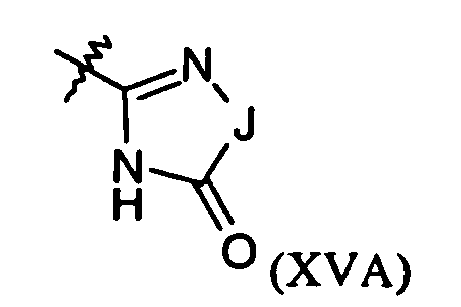 (j) when Y is N and Z = CR3, and R23 or R24 represent a group of formula (XVIA)
 (k) when Y is N and Z = CR3, and R23 or R24 represent a group of formula (XVIIA)
 (l) when Y is N, X is NHC(O) and m is 0, compounds of the formula (VIIIA) as defined above in (c) can be derived by reacting a compound of formula (XVIIIA)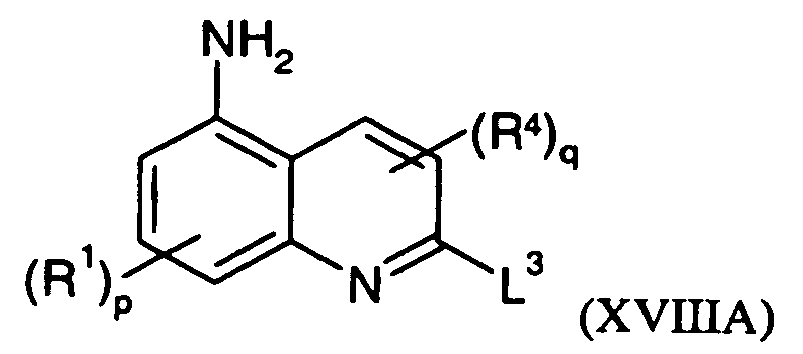
 (m) when Y is N, X is C(O)NH and m is 0, compounds of the formula (VIIIA) as defined above in (c) can be derived by reacting a compound of formula (XXA)
 (n) when Y is N, X is C(O)NH and m is 0, compounds of the formula (VIIIA) as defined above in (c) can be derived by reacting a compound of formula (XXIIA)
and optionally after (a), (b), (c), (d), (e), (f), (g), (h), (i), (j), (k), (l), (m) or (n) carrying out one or more of the following:• converting the compound obtained to a further compound of the invention• forming a pharmaceutically acceptable salt or solvate of the compound.
Applications Claiming Priority (3)
| Application Number | Priority Date | Filing Date | Title |
|---|---|---|---|
| GBGB0312609.1A GB0312609D0 (en) | 2003-06-02 | 2003-06-02 | Novel compounds |
| SE0301700A SE0301700D0 (en) | 2003-06-02 | 2003-06-10 | Novel compounds |
| PCT/SE2004/000836 WO2004106305A1 (en) | 2003-06-02 | 2004-06-01 | New p2x7 receptor antagonists and their use |
Publications (2)
| Publication Number | Publication Date |
|---|---|
| EP1633717A1 EP1633717A1 (en) | 2006-03-15 |
| EP1633717B1 true EP1633717B1 (en) | 2009-10-28 |
Family
ID=38812906
Family Applications (1)
| Application Number | Title | Priority Date | Filing Date |
|---|---|---|---|
| EP04735697A Expired - Lifetime EP1633717B1 (en) | 2003-06-02 | 2004-06-01 | P2x7 receptor antagonists and their use |
Country Status (25)
| Country | Link |
|---|---|
| US (2) | US7408065B2 (en) |
| EP (1) | EP1633717B1 (en) |
| JP (1) | JP4682128B2 (en) |
| KR (1) | KR101244971B1 (en) |
| CN (1) | CN1832925B (en) |
| AR (1) | AR045691A1 (en) |
| AT (1) | ATE446953T1 (en) |
| AU (1) | AU2004242626B2 (en) |
| BR (1) | BRPI0410933A (en) |
| CA (1) | CA2526884C (en) |
| CO (1) | CO5700720A2 (en) |
| DE (1) | DE602004023840D1 (en) |
| ES (1) | ES2333721T3 (en) |
| GB (1) | GB0312609D0 (en) |
| IS (1) | IS8190A (en) |
| MX (1) | MXPA05012883A (en) |
| NO (1) | NO20060001L (en) |
| RU (1) | RU2347778C2 (en) |
| SA (1) | SA04250155B1 (en) |
| SE (1) | SE0301700D0 (en) |
| TW (1) | TW200508214A (en) |
| UA (1) | UA83659C2 (en) |
| UY (1) | UY28342A1 (en) |
| WO (1) | WO2004106305A1 (en) |
| ZA (1) | ZA200509706B (en) |
Families Citing this family (57)
| Publication number | Priority date | Publication date | Assignee | Title |
|---|---|---|---|---|
| GB0312609D0 (en) | 2003-06-02 | 2003-07-09 | Astrazeneca Ab | Novel compounds |
| US7141596B2 (en) | 2003-10-08 | 2006-11-28 | Incyte Corporation | Inhibitors of proteins that bind phosphorylated molecules |
| WO2006032851A1 (en) * | 2004-09-20 | 2006-03-30 | Biolipox Ab | Pyrazole compounds useful in the treatment of inflammation |
| WO2006073361A1 (en) * | 2005-01-06 | 2006-07-13 | Astrazeneca Ab | Novel pyridine compounds |
| US7297700B2 (en) * | 2005-03-24 | 2007-11-20 | Renovis, Inc. | Bicycloheteroaryl compounds as P2X7 modulators and uses thereof |
| WO2006110516A1 (en) * | 2005-04-11 | 2006-10-19 | Abbott Laboratories | Acylhydrazide p2x7 antagonists and uses thereof |
| EP1904474A4 (en) * | 2005-07-13 | 2010-06-16 | Astrazeneca Ab | New pyridine analogues |
| CN101232890A (en) * | 2005-08-01 | 2008-07-30 | 芬诺密克斯公司 | Method for preparing heterocyclic boronic acid and derivatives thereof |
| US7547782B2 (en) | 2005-09-30 | 2009-06-16 | Bristol-Myers Squibb Company | Met kinase inhibitors |
| TW200800911A (en) * | 2005-10-20 | 2008-01-01 | Biolipox Ab | Pyrazoles useful in the treatment of inflammation |
| EA200801108A1 (en) * | 2005-10-31 | 2008-10-30 | Биолипокс Аб | TRIAZOLE, SUITABLE FOR THE TREATMENT OF INFLAMMATION |
| TW200732320A (en) * | 2005-10-31 | 2007-09-01 | Biolipox Ab | Pyrazoles useful in the treatment of inflammation |
| EP1943225A1 (en) * | 2005-11-01 | 2008-07-16 | Biolipox AB | Pyrazoles useful in the treatment of inflammation |
| US8007849B2 (en) | 2005-12-14 | 2011-08-30 | International Flavors & Fragrances Inc. | Unsaturated cyclic and acyclic carbamates exhibiting taste and flavor enhancement effect in flavor compositions |
| US20090298825A1 (en) * | 2006-03-16 | 2009-12-03 | Kelly Michael G | Bicycloheteroaryl Compounds as P2x7 Modulators and Uses Thereof |
| TWI464148B (en) * | 2006-03-16 | 2014-12-11 | Evotec Us Inc | Bicycloheteroaryl compounds as p2x7 modulators and uses thereof |
| DK2001474T3 (en) * | 2006-03-16 | 2016-05-09 | Second Genome Inc | BICYCLOHETEROARYL COMPOUNDS AS P2X7 MODULATORS AND APPLICATIONS THEREOF |
| CA2645551C (en) * | 2006-03-16 | 2016-06-28 | Renovis, Inc. | Bicycloheteroaryl compounds as p2x7 modulators and uses thereof |
| US20080058309A1 (en) * | 2006-07-27 | 2008-03-06 | Astrazeneca Ab | Novel Compounds 171 |
| WO2008037626A1 (en) * | 2006-09-28 | 2008-04-03 | F. Hoffmann-La Roche Ag | Quinoline derivatives with 5-ht-binding properties |
| CA2670636A1 (en) | 2006-11-27 | 2008-06-05 | H. Lundbeck A/S | Heteroaryl amide derivatives |
| MX2009005509A (en) * | 2006-12-07 | 2009-06-03 | Hoffmann La Roche | 2-aminoquinolines as 5-ht(5a) receptor antagonists. |
| WO2008114002A1 (en) * | 2007-03-22 | 2008-09-25 | Astrazeneca Ab | Quinoline derivatives for the treatment of inflammatory diseases |
| AU2008236649B2 (en) * | 2007-04-10 | 2013-05-02 | H. Lundbeck A/S | Heteroaryl amide analogues as P2X7 antagonists |
| US8106073B2 (en) | 2007-11-30 | 2012-01-31 | Astrazeneca Ab | Quinoline derivatives 057 |
| WO2009108551A2 (en) * | 2008-02-25 | 2009-09-03 | H. Lundbeck A/S | Heteroaryl amide analogues |
| BRPI0910253A2 (en) | 2008-03-07 | 2015-09-29 | Hoffmann La Roche | 2-aminoquinoline derivatives |
| NZ587799A (en) | 2008-03-25 | 2012-06-29 | Affectis Pharmaceuticals Ag | Novel p2x7r antagonists and their use |
| KR101598397B1 (en) * | 2008-04-22 | 2016-02-29 | 얀센 파마슈티카 엔.브이. | Quinoline or isoquinoline substituted p2x7 antagonists |
| ES2380908T3 (en) | 2009-04-14 | 2012-05-21 | Affectis Pharmaceuticals Ag | Novelty p2x7r antagonists and their use |
| CN105254557A (en) * | 2009-05-29 | 2016-01-20 | 拉夸里亚创药株式会社 | Aryl substituted carboxamide derivatives as calcium or sodium channel blockers |
| JP2013526496A (en) | 2010-05-14 | 2013-06-24 | アフェクティス ファーマシューティカルズ アーゲー | Novel preparation method of P2X7R antagonist |
| WO2012110190A1 (en) | 2011-02-17 | 2012-08-23 | Affectis Pharmaceuticals Ag | Novel p2x7r antagonists and their use |
| WO2012163792A1 (en) | 2011-05-27 | 2012-12-06 | Affectis Pharmaceuticals Ag | Novel p2x7r antagonists and their use |
| WO2012163456A1 (en) | 2011-05-27 | 2012-12-06 | Affectis Pharmaceuticals Ag | Novel p2x7r antagonists and their use |
| KR101995088B1 (en) | 2011-07-22 | 2019-07-02 | 이도르시아 파마슈티컬스 리미티드 | Heterocyclic amide derivatives as p2x7 receptor antagonists |
| NZ628910A (en) | 2012-01-20 | 2016-02-26 | Actelion Pharmaceuticals Ltd | Heterocyclic amide derivatives as p2x7 receptor antagonists |
| PL2931717T3 (en) | 2012-12-12 | 2017-05-31 | Actelion Pharmaceuticals Ltd. | Indole carboxamide derivatives as p2x7 receptor antagonists |
| US9556117B2 (en) | 2012-12-18 | 2017-01-31 | Actelion Pharmaceuticals Ltd. | Indole carboxamide derivatives as P2X7 receptor antagonists |
| KR102222220B1 (en) | 2013-01-22 | 2021-03-03 | 이도르시아 파마슈티컬스 리미티드 | Heterocyclic amide derivatives as p2x7 receptor antagonists |
| WO2014115078A1 (en) | 2013-01-22 | 2014-07-31 | Actelion Pharmaceuticals Ltd | Heterocyclic amide derivatives as p2x7 receptor antagonists |
| US9040534B2 (en) | 2013-03-14 | 2015-05-26 | Janssen Pharmaceutica Nv | [1,2,4]triazolo[4,3-a]pyrazines as P2X7 modulators |
| TWI599567B (en) | 2013-03-14 | 2017-09-21 | 健生藥品公司 | P2X7 regulator |
| EP2970271B1 (en) | 2013-03-14 | 2017-11-08 | Janssen Pharmaceutica NV | P2x7 modulators |
| TWI627174B (en) | 2013-03-14 | 2018-06-21 | 比利時商健生藥品公司 | P2x7 modulators |
| AU2015269598B2 (en) * | 2014-06-05 | 2019-11-14 | Merck Patent Gmbh | Novel quinoline derivatives and their use in neurodegenerative diseases |
| WO2016039977A1 (en) | 2014-09-12 | 2016-03-17 | Janssen Pharmaceutica Nv | P2x7 modulators |
| JP6625616B2 (en) | 2014-09-12 | 2019-12-25 | ヤンセン ファーマシューティカ エヌ.ベー. | P2X7 regulated N-acyl-triazolopyrazine |
| CN106084068B (en) * | 2016-06-16 | 2019-07-16 | 郑州大学第一附属医院 | A Group of Enterobactin-Antibiotic Derivatives and Their Applications |
| LT3609868T (en) | 2017-03-13 | 2023-12-11 | Raqualia Pharma Inc. | TETRAHYDROQUINOLINE DERIVATIVES AS P2X7 RECEPTOR ANTAGONISTS |
| EP3398941A1 (en) * | 2017-05-03 | 2018-11-07 | AXXAM S.p.A. | Heterocyclic p2x7 antagonists |
| MY205440A (en) | 2018-09-28 | 2024-10-21 | Janssen Pharmaceutica Nv | Monoacylglycerol lipase modulators |
| TW202035409A (en) | 2018-09-28 | 2020-10-01 | 比利時商健生藥品公司 | Monoacylglycerol lipase modulators |
| AU2020358948A1 (en) | 2019-09-30 | 2022-05-26 | Janssen Pharmaceutica Nv | Radiolabelled MGL PET ligands |
| BR112022019077A2 (en) | 2020-03-26 | 2022-12-27 | Janssen Pharmaceutica Nv | MONOACYLGLYCEROL LIPASE MODULATORS |
| CN115305282A (en) * | 2022-08-04 | 2022-11-08 | 烟台毓璜顶医院 | Target point for AR-induced OD diagnosis and prognosis discrimination and treatment method |
| WO2025180517A1 (en) * | 2024-03-01 | 2025-09-04 | 武汉人福创新药物研发中心有限公司 | Sf5-containing quinoline derivatives and use thereof as p2x7 antagonists |
Family Cites Families (28)
| Publication number | Priority date | Publication date | Assignee | Title |
|---|---|---|---|---|
| US3352912A (en) | 1963-07-24 | 1967-11-14 | Du Pont | Adamantanes and tricyclo[4. 3. 1. 1 3.8] undecanes |
| US3471491A (en) * | 1967-08-28 | 1969-10-07 | Squibb & Sons Inc | Adamantyl-s-triazines |
| US3464998A (en) * | 1968-03-04 | 1969-09-02 | Searle & Co | Adamantyl esters and amides of pyridinecarboxylic acids |
| GB1274652A (en) | 1968-08-27 | 1972-05-17 | Lilly Industries Ltd | Adamantanyl-alkylamine derivatives and their preparation |
| US3741491A (en) * | 1971-11-29 | 1973-06-26 | Leesona Corp | Apparatus for winding yarn |
| IL53441A0 (en) | 1977-11-22 | 1978-01-31 | Teva Pharma | Methyladamantyl hydrazines their preparation and pharmaceutical compositions containing them |
| US4751292A (en) * | 1985-07-02 | 1988-06-14 | The Plant Cell Research Institute, Inc. | Adamantyl purines |
| ATE148098T1 (en) | 1991-02-21 | 1997-02-15 | Sankyo Co | BENZOLE DERIVATIVES TO PROMOTE THE PRODUCTION OF NERVE GROWTH FACTOR |
| PT720601E (en) | 1993-08-10 | 2001-02-28 | Black James Foundation | GASTRINE AND CCK RECEIVER LIGANDS |
| RO114445B1 (en) | 1994-05-27 | 1999-04-30 | Smithkline Beecham S.P.A. | Quinoline derivatives, antagonists of nk3 tachiquinine receptor, process for preparation, pharmaceutical compositions containing the same and method of treatment |
| AR004735A1 (en) | 1995-11-24 | 1999-03-10 | Smithkline Beecham Spa | CHINOLEIN 4-AMIDO SUBSTITUTED, A PROCEDURE FOR ITS PREPARATION, A PHARMACEUTICAL COMPOSITION THAT CONTAINS THEM AND THE USE OF THE SAME FOR THE PREPARATION OF A MEDICINAL PRODUCT. |
| NZ332341A (en) * | 1996-05-20 | 2000-05-26 | Darwin Discovery Ltd | Quinoline carboxamides as TNF inhibitors and as PDE-IV inhibitors |
| FR2761358B1 (en) | 1997-03-27 | 1999-05-07 | Adir | NOVEL N-ARYL PIPERIDINE COMPOUNDS, PROCESS FOR THEIR PREPARATION AND PHARMACEUTICAL COMPOSITIONS CONTAINING THEM |
| WO1999026927A2 (en) | 1997-11-21 | 1999-06-03 | Nps Pharmaceuticals, Inc. | Metabotropic glutamate receptor antagonists for treating central nervous system diseases |
| SE9704544D0 (en) | 1997-12-05 | 1997-12-05 | Astra Pharma Prod | Novel compounds |
| SE9704545D0 (en) | 1997-12-05 | 1997-12-05 | Astra Pharma Prod | Novel compounds |
| HUP0202214A3 (en) | 1999-04-09 | 2002-12-28 | Astrazeneca Ab | Adamantane derivatives, preparation and use thereof |
| CN1361768A (en) | 1999-06-02 | 2002-07-31 | Nps药物有限公司 | Metabolic glutamate receptor antagonists and their use in the treatment of central nervous system disorders |
| WO2001037826A1 (en) * | 1999-11-26 | 2001-05-31 | Shionogi & Co., Ltd. | Npyy5 antagonists |
| GB0013737D0 (en) | 2000-06-07 | 2000-07-26 | Astrazeneca Ab | Novel compounds |
| RU2347570C2 (en) * | 2001-07-02 | 2009-02-27 | Н.В.Органон | Tetrahydroquinoline derivatives |
| WO2003042190A1 (en) | 2001-11-12 | 2003-05-22 | Pfizer Products Inc. | N-alkyl-adamantyl derivatives as p2x7-receptor antagonists |
| SE0103836D0 (en) * | 2001-11-16 | 2001-11-16 | Astrazeneca Ab | Novel compounds |
| CA2468015A1 (en) | 2001-11-27 | 2003-06-05 | Merck & Co., Inc. | 2-aminoquinoline compounds |
| SE0200920D0 (en) | 2002-03-25 | 2002-03-25 | Astrazeneca Ab | Novel compounds |
| GB0312609D0 (en) | 2003-06-02 | 2003-07-09 | Astrazeneca Ab | Novel compounds |
| SE0302139D0 (en) | 2003-07-28 | 2003-07-28 | Astrazeneca Ab | Novel compounds |
| SE0402925D0 (en) | 2004-11-30 | 2004-11-30 | Astrazeneca Ab | Novel Compounds |
-
2003
- 2003-06-02 GB GBGB0312609.1A patent/GB0312609D0/en not_active Ceased
- 2003-06-10 SE SE0301700A patent/SE0301700D0/en unknown
-
2004
- 2004-01-06 UA UAA200510608A patent/UA83659C2/en unknown
- 2004-05-27 TW TW093115168A patent/TW200508214A/en unknown
- 2004-06-01 BR BRPI0410933-3A patent/BRPI0410933A/en not_active IP Right Cessation
- 2004-06-01 KR KR1020057023022A patent/KR101244971B1/en not_active Expired - Fee Related
- 2004-06-01 US US10/558,898 patent/US7408065B2/en not_active Expired - Fee Related
- 2004-06-01 AU AU2004242626A patent/AU2004242626B2/en not_active Ceased
- 2004-06-01 AT AT04735697T patent/ATE446953T1/en not_active IP Right Cessation
- 2004-06-01 RU RU2005136130/04A patent/RU2347778C2/en not_active IP Right Cessation
- 2004-06-01 WO PCT/SE2004/000836 patent/WO2004106305A1/en not_active Ceased
- 2004-06-01 CN CN2004800222482A patent/CN1832925B/en not_active Expired - Fee Related
- 2004-06-01 JP JP2006508566A patent/JP4682128B2/en not_active Expired - Fee Related
- 2004-06-01 MX MXPA05012883A patent/MXPA05012883A/en active IP Right Grant
- 2004-06-01 DE DE602004023840T patent/DE602004023840D1/en not_active Expired - Lifetime
- 2004-06-01 ES ES04735697T patent/ES2333721T3/en not_active Expired - Lifetime
- 2004-06-01 EP EP04735697A patent/EP1633717B1/en not_active Expired - Lifetime
- 2004-06-01 CA CA2526884A patent/CA2526884C/en not_active Expired - Fee Related
- 2004-06-02 UY UY28342A patent/UY28342A1/en unknown
- 2004-06-02 AR ARP040101893A patent/AR045691A1/en unknown
- 2004-06-09 SA SA04250155A patent/SA04250155B1/en unknown
-
2005
- 2005-11-29 CO CO05120983A patent/CO5700720A2/en not_active Application Discontinuation
- 2005-11-30 ZA ZA200509706A patent/ZA200509706B/en unknown
- 2005-12-21 IS IS8190A patent/IS8190A/en unknown
-
2006
- 2006-01-02 NO NO20060001A patent/NO20060001L/en not_active Application Discontinuation
-
2008
- 2008-05-02 US US12/114,126 patent/US20090143354A1/en not_active Abandoned
Also Published As
Similar Documents
| Publication | Publication Date | Title |
|---|---|---|
| US7408065B2 (en) | P2X7 receptor antagonists and their use | |
| US11958837B2 (en) | Quinazolinones as PARP14 inhibitors | |
| JP2007500187A (en) | Quinoline derivatives and their use in therapy | |
| JP2019508467A (en) | 2-Cyanoisoindoline derivatives for cancer treatment | |
| TW201217340A (en) | JAK1 inhibitors | |
| CA3142002A1 (en) | Targeted protein degradation of parp14 for use in therapy | |
| CN101111488A (en) | new compound | |
| EP3415509A1 (en) | Novel 2,5-substituted pyrimidines as pde inhibitors | |
| JP5400759B2 (en) | Novel compounds and their use 707 | |
| JP6605121B2 (en) | Janus kinase 1 selective inhibitor and pharmaceutical use thereof | |
| DE60309206T2 (en) | NEW PIPERIDINE DERIVATIVES AS MODULATORS OF CHEMOKIN RECEPTOR CCR5 | |
| EP3484867B1 (en) | Inhibitors of tryptophan 2,3-dioxygenase | |
| HK1085736B (en) | P2x7 receptor antagonists and their use | |
| DE602004006424T2 (en) | Piperidin derivatives as CCR5 receptor modulators | |
| KR20110067051A (en) | Isoquinolinone derivative | |
| EP4532014A1 (en) | Heterobicyclic amides as inhibitors of cd38 |
Legal Events
| Date | Code | Title | Description |
|---|---|---|---|
| PUAI | Public reference made under article 153(3) epc to a published international application that has entered the european phase |
Free format text: ORIGINAL CODE: 0009012 |
|
| 17P | Request for examination filed |
Effective date: 20060102 |
|
| AK | Designated contracting states |
Kind code of ref document: A1 Designated state(s): AT BE BG CH CY CZ DE DK EE ES FI FR GB GR HU IE IT LI LU MC NL PL PT RO SE SI SK TR |
|
| AX | Request for extension of the european patent |
Extension state: AL HR LT LV MK |
|
| REG | Reference to a national code |
Ref country code: HK Ref legal event code: DE Ref document number: 1085736 Country of ref document: HK |
|
| 17Q | First examination report despatched |
Effective date: 20061123 |
|
| GRAP | Despatch of communication of intention to grant a patent |
Free format text: ORIGINAL CODE: EPIDOSNIGR1 |
|
| RTI1 | Title (correction) |
Free format text: P2X7 RECEPTOR ANTAGONISTS AND THEIR USE |
|
| GRAS | Grant fee paid |
Free format text: ORIGINAL CODE: EPIDOSNIGR3 |
|
| GRAA | (expected) grant |
Free format text: ORIGINAL CODE: 0009210 |
|
| AK | Designated contracting states |
Kind code of ref document: B1 Designated state(s): AT BE BG CH CY CZ DE DK EE ES FI FR GB GR HU IE IT LI LU MC NL PL PT RO SE SI SK TR |
|
| AX | Request for extension of the european patent |
Extension state: AL HR LT LV MK |
|
| REG | Reference to a national code |
Ref country code: GB Ref legal event code: FG4D |
|
| REG | Reference to a national code |
Ref country code: CH Ref legal event code: EP |
|
| REG | Reference to a national code |
Ref country code: IE Ref legal event code: FG4D |
|
| REF | Corresponds to: |
Ref document number: 602004023840 Country of ref document: DE Date of ref document: 20091210 Kind code of ref document: P |
|
| REG | Reference to a national code |
Ref country code: HK Ref legal event code: GR Ref document number: 1085736 Country of ref document: HK |
|
| REG | Reference to a national code |
Ref country code: SE Ref legal event code: TRGR |
|
| REG | Reference to a national code |
Ref country code: ES Ref legal event code: FG2A Ref document number: 2333721 Country of ref document: ES Kind code of ref document: T3 |
|
| LTIE | Lt: invalidation of european patent or patent extension |
Effective date: 20091028 |
|
| PG25 | Lapsed in a contracting state [announced via postgrant information from national office to epo] |
Ref country code: FI Free format text: LAPSE BECAUSE OF FAILURE TO SUBMIT A TRANSLATION OF THE DESCRIPTION OR TO PAY THE FEE WITHIN THE PRESCRIBED TIME-LIMIT Effective date: 20091028 Ref country code: PT Free format text: LAPSE BECAUSE OF FAILURE TO SUBMIT A TRANSLATION OF THE DESCRIPTION OR TO PAY THE FEE WITHIN THE PRESCRIBED TIME-LIMIT Effective date: 20100301 |
|
| PG25 | Lapsed in a contracting state [announced via postgrant information from national office to epo] |
Ref country code: SI Free format text: LAPSE BECAUSE OF FAILURE TO SUBMIT A TRANSLATION OF THE DESCRIPTION OR TO PAY THE FEE WITHIN THE PRESCRIBED TIME-LIMIT Effective date: 20091028 Ref country code: CY Free format text: LAPSE BECAUSE OF FAILURE TO SUBMIT A TRANSLATION OF THE DESCRIPTION OR TO PAY THE FEE WITHIN THE PRESCRIBED TIME-LIMIT Effective date: 20091028 Ref country code: PL Free format text: LAPSE BECAUSE OF FAILURE TO SUBMIT A TRANSLATION OF THE DESCRIPTION OR TO PAY THE FEE WITHIN THE PRESCRIBED TIME-LIMIT Effective date: 20091028 |
|
| PG25 | Lapsed in a contracting state [announced via postgrant information from national office to epo] |
Ref country code: AT Free format text: LAPSE BECAUSE OF FAILURE TO SUBMIT A TRANSLATION OF THE DESCRIPTION OR TO PAY THE FEE WITHIN THE PRESCRIBED TIME-LIMIT Effective date: 20091028 Ref country code: BE Free format text: LAPSE BECAUSE OF FAILURE TO SUBMIT A TRANSLATION OF THE DESCRIPTION OR TO PAY THE FEE WITHIN THE PRESCRIBED TIME-LIMIT Effective date: 20091028 |
|
| PG25 | Lapsed in a contracting state [announced via postgrant information from national office to epo] |
Ref country code: BG Free format text: LAPSE BECAUSE OF FAILURE TO SUBMIT A TRANSLATION OF THE DESCRIPTION OR TO PAY THE FEE WITHIN THE PRESCRIBED TIME-LIMIT Effective date: 20100128 Ref country code: DK Free format text: LAPSE BECAUSE OF FAILURE TO SUBMIT A TRANSLATION OF THE DESCRIPTION OR TO PAY THE FEE WITHIN THE PRESCRIBED TIME-LIMIT Effective date: 20091028 Ref country code: EE Free format text: LAPSE BECAUSE OF FAILURE TO SUBMIT A TRANSLATION OF THE DESCRIPTION OR TO PAY THE FEE WITHIN THE PRESCRIBED TIME-LIMIT Effective date: 20091028 Ref country code: RO Free format text: LAPSE BECAUSE OF FAILURE TO SUBMIT A TRANSLATION OF THE DESCRIPTION OR TO PAY THE FEE WITHIN THE PRESCRIBED TIME-LIMIT Effective date: 20091028 |
|
| PG25 | Lapsed in a contracting state [announced via postgrant information from national office to epo] |
Ref country code: SK Free format text: LAPSE BECAUSE OF FAILURE TO SUBMIT A TRANSLATION OF THE DESCRIPTION OR TO PAY THE FEE WITHIN THE PRESCRIBED TIME-LIMIT Effective date: 20091028 Ref country code: CZ Free format text: LAPSE BECAUSE OF FAILURE TO SUBMIT A TRANSLATION OF THE DESCRIPTION OR TO PAY THE FEE WITHIN THE PRESCRIBED TIME-LIMIT Effective date: 20091028 |
|
| PLBE | No opposition filed within time limit |
Free format text: ORIGINAL CODE: 0009261 |
|
| STAA | Information on the status of an ep patent application or granted ep patent |
Free format text: STATUS: NO OPPOSITION FILED WITHIN TIME LIMIT |
|
| 26N | No opposition filed |
Effective date: 20100729 |
|
| PG25 | Lapsed in a contracting state [announced via postgrant information from national office to epo] |
Ref country code: GR Free format text: LAPSE BECAUSE OF FAILURE TO SUBMIT A TRANSLATION OF THE DESCRIPTION OR TO PAY THE FEE WITHIN THE PRESCRIBED TIME-LIMIT Effective date: 20100129 |
|
| PG25 | Lapsed in a contracting state [announced via postgrant information from national office to epo] |
Ref country code: MC Free format text: LAPSE BECAUSE OF NON-PAYMENT OF DUE FEES Effective date: 20100630 |
|
| PG25 | Lapsed in a contracting state [announced via postgrant information from national office to epo] |
Ref country code: IE Free format text: LAPSE BECAUSE OF NON-PAYMENT OF DUE FEES Effective date: 20100601 |
|
| PG25 | Lapsed in a contracting state [announced via postgrant information from national office to epo] |
Ref country code: HU Free format text: LAPSE BECAUSE OF FAILURE TO SUBMIT A TRANSLATION OF THE DESCRIPTION OR TO PAY THE FEE WITHIN THE PRESCRIBED TIME-LIMIT Effective date: 20100429 Ref country code: LU Free format text: LAPSE BECAUSE OF NON-PAYMENT OF DUE FEES Effective date: 20100601 |
|
| PGFP | Annual fee paid to national office [announced via postgrant information from national office to epo] |
Ref country code: ES Payment date: 20120726 Year of fee payment: 9 |
|
| PGFP | Annual fee paid to national office [announced via postgrant information from national office to epo] |
Ref country code: DE Payment date: 20130529 Year of fee payment: 10 Ref country code: GB Payment date: 20130529 Year of fee payment: 10 Ref country code: CH Payment date: 20130612 Year of fee payment: 10 Ref country code: SE Payment date: 20130612 Year of fee payment: 10 |
|
| PGFP | Annual fee paid to national office [announced via postgrant information from national office to epo] |
Ref country code: FR Payment date: 20130624 Year of fee payment: 10 Ref country code: NL Payment date: 20130615 Year of fee payment: 10 Ref country code: IT Payment date: 20130514 Year of fee payment: 10 Ref country code: TR Payment date: 20130509 Year of fee payment: 10 |
|
| REG | Reference to a national code |
Ref country code: DE Ref legal event code: R119 Ref document number: 602004023840 Country of ref document: DE |
|
| REG | Reference to a national code |
Ref country code: NL Ref legal event code: V1 Effective date: 20150101 |
|
| PG25 | Lapsed in a contracting state [announced via postgrant information from national office to epo] |
Ref country code: SE Free format text: LAPSE BECAUSE OF NON-PAYMENT OF DUE FEES Effective date: 20140602 |
|
| REG | Reference to a national code |
Ref country code: CH Ref legal event code: PL |
|
| REG | Reference to a national code |
Ref country code: SE Ref legal event code: EUG |
|
| GBPC | Gb: european patent ceased through non-payment of renewal fee |
Effective date: 20140601 |
|
| REG | Reference to a national code |
Ref country code: DE Ref legal event code: R119 Ref document number: 602004023840 Country of ref document: DE Effective date: 20150101 |
|
| REG | Reference to a national code |
Ref country code: FR Ref legal event code: ST Effective date: 20150227 |
|
| PG25 | Lapsed in a contracting state [announced via postgrant information from national office to epo] |
Ref country code: NL Free format text: LAPSE BECAUSE OF NON-PAYMENT OF DUE FEES Effective date: 20150101 |
|
| PG25 | Lapsed in a contracting state [announced via postgrant information from national office to epo] |
Ref country code: CH Free format text: LAPSE BECAUSE OF NON-PAYMENT OF DUE FEES Effective date: 20140630 Ref country code: LI Free format text: LAPSE BECAUSE OF NON-PAYMENT OF DUE FEES Effective date: 20140630 Ref country code: IT Free format text: LAPSE BECAUSE OF NON-PAYMENT OF DUE FEES Effective date: 20140601 Ref country code: DE Free format text: LAPSE BECAUSE OF NON-PAYMENT OF DUE FEES Effective date: 20150101 |
|
| PG25 | Lapsed in a contracting state [announced via postgrant information from national office to epo] |
Ref country code: GB Free format text: LAPSE BECAUSE OF NON-PAYMENT OF DUE FEES Effective date: 20140601 Ref country code: FR Free format text: LAPSE BECAUSE OF NON-PAYMENT OF DUE FEES Effective date: 20140630 |
|
| REG | Reference to a national code |
Ref country code: ES Ref legal event code: FD2A Effective date: 20160111 |
|
| PG25 | Lapsed in a contracting state [announced via postgrant information from national office to epo] |
Ref country code: ES Free format text: LAPSE BECAUSE OF NON-PAYMENT OF DUE FEES Effective date: 20140602 |
|
| PG25 | Lapsed in a contracting state [announced via postgrant information from national office to epo] |
Ref country code: TR Free format text: LAPSE BECAUSE OF NON-PAYMENT OF DUE FEES Effective date: 20140601 |