EP1632744A1 - A simulation system - Google Patents
A simulation system Download PDFInfo
- Publication number
- EP1632744A1 EP1632744A1 EP04021190A EP04021190A EP1632744A1 EP 1632744 A1 EP1632744 A1 EP 1632744A1 EP 04021190 A EP04021190 A EP 04021190A EP 04021190 A EP04021190 A EP 04021190A EP 1632744 A1 EP1632744 A1 EP 1632744A1
- Authority
- EP
- European Patent Office
- Prior art keywords
- signals
- soldier
- type
- transmitter
- hit
- Prior art date
- Legal status (The legal status is an assumption and is not a legal conclusion. Google has not performed a legal analysis and makes no representation as to the accuracy of the status listed.)
- Granted
Links
Images

Classifications
-
- F—MECHANICAL ENGINEERING; LIGHTING; HEATING; WEAPONS; BLASTING
- F41—WEAPONS
- F41G—WEAPON SIGHTS; AIMING
- F41G3/00—Aiming or laying means
- F41G3/26—Teaching or practice apparatus for gun-aiming or gun-laying
- F41G3/2616—Teaching or practice apparatus for gun-aiming or gun-laying using a light emitting device
- F41G3/2622—Teaching or practice apparatus for gun-aiming or gun-laying using a light emitting device for simulating the firing of a gun or the trajectory of a projectile
- F41G3/2655—Teaching or practice apparatus for gun-aiming or gun-laying using a light emitting device for simulating the firing of a gun or the trajectory of a projectile in which the light beam is sent from the weapon to the target
Definitions
- the present invention relates to a simulation system for use in military exercise of combat in an area having at least one building, said system comprising for a soldier participating in said exercise a shot firing simulating transmitter, such as a laser pulse generator, to be arranged on a firearm and means to be arranged on the body of a said soldier for detecting a hit by a shot simulated by a said transmitter on a firearm of another soldier, as well as a method for simulating combat in an area having at least one building during a military exercise according to the preamble of the appended method claim.
- a shot firing simulating transmitter such as a laser pulse generator
- “Combat in an area having at least one building” normally means combat in a village, city or any type of gathering of buildings, but this definition has to be interpreted broadly and includes also combat in an area having only one building. Furthermore, this building does not have to be a conventional house, but it may be for instance a shelter in a rock having openings to the outside, a cave and the like. The important thing is that soldiers participating in the combat may be located and firing their firearms indoors as well as outdoors.
- “Firearms” may be any type of firearm that may be carried along by a person, such as a rifle, a pistol and a machine gun, and it may be an automatic, semi-automatic or non-automatic weapon.
- a said transmitter used in a simulation system of this type is either simulating the firing of a shot synchronized with the firing of a blank by said firearm or without any such firing by carrying out a transmission of a signal simulating a projectile fired by the firearm.
- This transmitter normally emits a laser pulse for such a simulation and this particular case will hereinafter be described for illustrative purpose, but such a transmitter may emit any type of signal suitable for the task, such as maybe any type of radio signal, non-audible sound pulse or the like.
- the signal such as the laser pulse
- the signal may ricochet, i.e. be reflected or deflected, and create unnormal situations, so that a shot missing the target may erroneously be detected as a hit.
- the beam width or the side lobes of the laser pulses will be too large, so that at short distances a soldier may be hit by such light within such a side lobe being strong enough for detection of a real hit although the target was missed by the shot.
- An approach to solving this problem is to reduce the range of the firearm by making the detecting means less sensitive or by lowering the power of said signals, such as the laser pulses. Furthermore, in a combat of this type soldiers are often fighting at short distances, perhaps as short as 1,5 m, and said laser pulse generators (transmitters) are normally made to shoot accurately at larger distances, so that it is desired to shorten the range thereof.
- the object of the present invention is to provide a simulation system and a method of the type defined in the introduction, which makes it possible to simulate a combat in an area having at least one building during a military exercise to be closer to a combat with live ammunition in a real situation than such systems and methods already known.
- said detecting means are located indoors or outdoors and adapting the function of said transmitter and detecting means thereto. Accordingly, a soldier located outdoors will be able to reach and hit a soldier located in a building through firing through for example a window, since he is firing with normal power and the detecting means of the soldier indoors will detect such a signal coded to come from outdoors. Furthermore, the soldier located indoors may shoot against and hit the soldier located outdoors, since the signals of said second type having a normal power may reach the detecting means of the soldier located outdoors and be detected thereby.
- such signals of the second type having normal power may not be considered as a hit when a soldier located indoors is firing against another soldier located indoors and missing the latter even if such signals ricochet against said detecting means, since the code thereof will tell the detecting means to disregard this signal.
- the soldier located indoors may only hit another soldier located indoors by a real hit obtained by a signal of said third type being of a substantially lower power, since said side lobes are also reduced in width with reduced power also avoiding erroneous detection of hits through side lobe signals reaching the detector of a soldier shot at.. This all together creates a situation in the military exercise of combat in an area having at least one building being very realistic.
- said transmitter is adapted to code also said signals of said third type to coming from the soldier located indoors. This may be important for a later evaluation of the military exercise through data processing, since this improves the possibilities to discriminate between hits emanating from firearms of different soldiers.
- the simulation system comprises a central network that is arranged to receive/send/store and/or communicate information concerning the state of participants in a said military exercise by communicating with said transmitters and/or detecting means included in said simulation system.
- a central network is advantageous for governing the military exercise as well as for later evaluation thereof for learning thereby.
- the simulation system comprises calculation means associated with said detecting means to provide an assessment of injury/damage that would have been caused by a said hit detected by the detecting means in a real situation, which makes it possible to determine the result of said hit, which may be that the soldier in question is considered as dead, unable to move but still firing or the like.
- said calculation means contain a range of action data for each said firearm versus distance of participants in a military exercise from such a firearm in order to assess the degree of injury/damage that would have been caused by a said hit detected by the detecting means in a real situation for making the exercise more realistic.
- the invention also comprises a computer program to be used in a simulation system according to the invention as well as a use of a simulation system according to the invention in a military exercise of combat according to the corresponding appended claims.
- FIG. 1 A military exercise taking place in an area having at least one building, in this case a village, while using a simulation system according to the invention is schematically illustrated in Fig 1.
- a simulation system according to the invention.
- Each soldier 1-3 participating in the exercise has here a firearm 4 onto which a transmitter 5, in this case a laser pulse generator, is arranged for emitting a shot firing simulating signal when a blank is shot by the firearm.
- the transmitter is connected to means 6 adapted to sense whether the transmitter is located indoors or outdoors.
- the means 6 adapted to sense whether the transmitter is located indoors or outdoors is in one example arranged to sense a signal sequence from a transmitter arranged indoors, wherein the transmitter can include a light source such as a laser whose generated light lies in a wavelength range being adapted to the application in question and whose generated light is delimited in space by the walls defining the indoor area.
- a light source such as a laser whose generated light lies in a wavelength range being adapted to the application in question and whose generated light is delimited in space by the walls defining the indoor area.
- Arbitrary other signal format with similar characteristics may of course likewise be used.
- the means 6 are arranged to sense radio signals from at least two radio transmitters and to perform position determination based on said radio signals using known triangulation methods.
- the transmitter 5 is upon firing of a shot by a firearm 4 adapted to emit signals of a first type being of normal power and coded to coming from a soldier located outdoors, when the sensor indicates that the transmitter is located outdoors, and when located indoors emit signals of a second type being of normal power as well as of a third type being of a substantially lower power. At least the signals of the second type are coded to coming from a soldier located indoors.
- the soldiers are also provided with means 7 in the form of a target vest to be arranged on the body of a soldier for detecting a hit by a shot simulated by a said transmitter 5 on a firearm 4 of another soldier.
- Means 8 adapted to sense whether said detecting means is located indoors or outdoors are also associated with each detecting means.
- the detecting means is adapted to decode signals received from any transmitter 5 and when located outdoors detect at least signals of said first and said second type, i.e. signals of normal power emitted outdoors or indoors, as a hit and when located indoors only signals of said first and third type, i.e. signals of normal power emitted outdoors or signals of a substantially lower power emitted indoors, as a hit and disregard signals of said second type, i.e. signals of normal power emitted indoors.
- the table following below indicates this function of the transmitter and the detector.
- the numbers 1, 2 and 3 correspond to signals of said first, second and third type, respectively.
- said detecting means 7 is adapted to only detect signals having a power/intensity above a predetermined threshold for excluding signals reflected by objects near a soldier to be detected as a hit.
- a substantially lower power means in this context a power being at least less than 50% of said normal power, preferably less than 10% of the normal power.
- the transmitters are preferably adapted to emit signals in the form of light pulses, such as laser pulses, within the infrared range, so that they may not be seen by the soldiers.
- the simulation system may comprise a central network indicated by 9 arranged to receive/send/store and/or communicate information concerning the state of participants in a said military exercise by communicating with said transmitters 5 and/or detecting 7 means included in the simulation system.
- the system also comprises calculation means 10 associated with the detecting means 7 to provide an assessment of injury/damage that would have been caused by a said hit detected by the detecting means in a real situation.
- Such means adapted to evaluate an injury/damage assessment are arranged to be carried by the participants in a said military exercise carrying a detecting means.
- the function of the detecting means and/or the calculation means is preferably accomplished by means of a computer program according to the invention.
- the soldier 2 located indoors is also attacked by a soldier 3 located indoors and these are shooting towards each other.
- the detecting means 7 of these soldiers will disregard signals of normal power coded to coming from a soldier located indoors and among signals emitted from a transmitter located indoors only detect such signals of a substantially lower power as a hit when hit thereby. This means that a direct hit is necessary for detecting a hit, and it is not possible to obtain a hit by ricocheting of signals of normal power missing the target.
- a very realistic combat in an area having at least one building with soldiers located indoors as well as outdoors may be simulated in a military exercise using the simulation system according to the invention.
- the key of the present invention is:
- the sensing means for the transmitter and the detecting means of one and the same soldier may often be the same, normally a sensor in common arranged on a vest carried by the soldier.
- coded to coming from a soldier located outdoors is to be interpreted to also comprise that these signals do not have any code, but since the signals of said second type are coded to coming from a solider located indoors the signals of the first type may be distinguished therefrom and may after all be considered to be coded to coming from a soldier located outdoors.
- signals of said second type may be distinguished from signals of said first and third type by a detecting means of a soldier located indoors. Accordingly, this may also be achieved by coding said first and third type signals but not the second type signals being then indirectly coded.
Landscapes
- Engineering & Computer Science (AREA)
- Radar, Positioning & Navigation (AREA)
- General Engineering & Computer Science (AREA)
- Aiming, Guidance, Guns With A Light Source, Armor, Camouflage, And Targets (AREA)
- Radar Systems Or Details Thereof (AREA)
Abstract
Description
- The present invention relates to a simulation system for use in military exercise of combat in an area having at least one building, said system comprising for a soldier participating in said exercise a shot firing simulating transmitter, such as a laser pulse generator, to be arranged on a firearm and means to be arranged on the body of a said soldier for detecting a hit by a shot simulated by a said transmitter on a firearm of another soldier, as well as a method for simulating combat in an area having at least one building during a military exercise according to the preamble of the appended method claim.
- "Combat in an area having at least one building" normally means combat in a village, city or any type of gathering of buildings, but this definition has to be interpreted broadly and includes also combat in an area having only one building. Furthermore, this building does not have to be a conventional house, but it may be for instance a shelter in a rock having openings to the outside, a cave and the like. The important thing is that soldiers participating in the combat may be located and firing their firearms indoors as well as outdoors.
- "Firearms" may be any type of firearm that may be carried along by a person, such as a rifle, a pistol and a machine gun, and it may be an automatic, semi-automatic or non-automatic weapon.
- As always in a military exercise it is desired to obtain conditions and results of the exercise being as close to a real situation as possible for obtaining a good training result. This requires an adaptation of a simulation system used for a military exercise to the conditions prevailing on the place of the exercise, such as if the exercise takes place in an open landscape, in a city or the like. Thus, it is important to adapt the simulation system to combat in an area having at least one building, such as in a village, when such a combat is a part of a military exercise.
- A said transmitter used in a simulation system of this type is either simulating the firing of a shot synchronized with the firing of a blank by said firearm or without any such firing by carrying out a transmission of a signal simulating a projectile fired by the firearm. This transmitter normally emits a laser pulse for such a simulation and this particular case will hereinafter be described for illustrative purpose, but such a transmitter may emit any type of signal suitable for the task, such as maybe any type of radio signal, non-audible sound pulse or the like.
- A number of problems arise when using a transmitter of this type for simulating combat in an area having at least one building, i.e. in which soldiers may be located indoors as well as outdoors. The signal, such as the laser pulse, may ricochet, i.e. be reflected or deflected, and create unnormal situations, so that a shot missing the target may erroneously be detected as a hit. Furthermore, the beam width or the side lobes of the laser pulses will be too large, so that at short distances a soldier may be hit by such light within such a side lobe being strong enough for detection of a real hit although the target was missed by the shot. An approach to solving this problem is to reduce the range of the firearm by making the detecting means less sensitive or by lowering the power of said signals, such as the laser pulses. Furthermore, in a combat of this type soldiers are often fighting at short distances, perhaps as short as 1,5 m, and said laser pulse generators (transmitters) are normally made to shoot accurately at larger distances, so that it is desired to shorten the range thereof.
- However, a number of non-realistic effects occur when the power of said signals emitted is simply reduced or the sensitiveness of the detecting means is simply lowered. This is the case when soldiers located indoors are fighting against soldiers located outdoors. For example, when a soldier located indoors is shooting with such a reduced power towards a soldier located outdoors at a distance from a building a hit may not be detected.
- The object of the present invention is to provide a simulation system and a method of the type defined in the introduction, which makes it possible to simulate a combat in an area having at least one building during a military exercise to be closer to a combat with live ammunition in a real situation than such systems and methods already known.
- This object is according to the invention obtained by providing a simulation system and a method according to the appended independent corresponding claims.
- Thus, the invention rely on sensing whether said transmitter and
- said detecting means are located indoors or outdoors and adapting the function of said transmitter and detecting means thereto. Accordingly, a soldier located outdoors will be able to reach and hit a soldier located in a building through firing through for example a window, since he is firing with normal power and the detecting means of the soldier indoors will detect such a signal coded to come from outdoors. Furthermore, the soldier located indoors may shoot against and hit the soldier located outdoors, since the signals of said second type having a normal power may reach the detecting means of the soldier located outdoors and be detected thereby. At the same time, such signals of the second type having normal power may not be considered as a hit when a soldier located indoors is firing against another soldier located indoors and missing the latter even if such signals ricochet against said detecting means, since the code thereof will tell the detecting means to disregard this signal. This means that the soldier located indoors may only hit another soldier located indoors by a real hit obtained by a signal of said third type being of a substantially lower power, since said side lobes are also reduced in width with reduced power also avoiding erroneous detection of hits through side lobe signals reaching the detector of a soldier shot at.. This all together creates a situation in the military exercise of combat in an area having at least one building being very realistic.
- Although it would mostly be appropriate to provide all the participants of a said military exercise with both a said transmitter and a said detecting means, normally in the form of a vest carried by a person, it is also within the scope of the invention to let some of the participants being unarmed and only carrying a said detecting means.
- According to an embodiment of the present invention said transmitter is adapted to code also said signals of said third type to coming from the soldier located indoors. This may be important for a later evaluation of the military exercise through data processing, since this improves the possibilities to discriminate between hits emanating from firearms of different soldiers.
- According to another embodiment of the invention the simulation system comprises a central network that is arranged to receive/send/store and/or communicate information concerning the state of participants in a said military exercise by communicating with said transmitters and/or detecting means included in said simulation system. Such a central network is advantageous for governing the military exercise as well as for later evaluation thereof for learning thereby.
- According to another embodiment of the invention the simulation system comprises calculation means associated with said detecting means to provide an assessment of injury/damage that would have been caused by a said hit detected by the detecting means in a real situation, which makes it possible to determine the result of said hit, which may be that the soldier in question is considered as dead, unable to move but still firing or the like.
- According to another embodiment of the invention said calculation means contain a range of action data for each said firearm versus distance of participants in a military exercise from such a firearm in order to assess the degree of injury/damage that would have been caused by a said hit detected by the detecting means in a real situation for making the exercise more realistic.
- The function of the method according to the appended independent method claim as well as the goals obtained thereby appear from the above description of the simulation system according to the invention.
- The invention also comprises a computer program to be used in a simulation system according to the invention as well as a use of a simulation system according to the invention in a military exercise of combat according to the corresponding appended claims.
- Further advantages as well as advantageous features of the invention will appear from the following description and the other dependent claims.
- With reference to the appended drawings, below follows a specific description of an embodiment of the present invention cited as an example. In the drawings:
- Fig 1 is a very schematic view illustrating a combat in an area having at least one building in a military exercise using a simulation system according to the invention, and
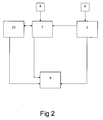
- Fig 2 is a schematic diagram illustrating the function of a simulation system according to the invention.
- A military exercise taking place in an area having at least one building, in this case a village, while using a simulation system according to the invention is schematically illustrated in Fig 1. In the following, reference is also made to Fig 2. Each soldier 1-3 participating in the exercise has here a firearm 4 onto which a
transmitter 5, in this case a laser pulse generator, is arranged for emitting a shot firing simulating signal when a blank is shot by the firearm. The transmitter is connected tomeans 6 adapted to sense whether the transmitter is located indoors or outdoors. - The
means 6 adapted to sense whether the transmitter is located indoors or outdoors is in one example arranged to sense a signal sequence from a transmitter arranged indoors, wherein the transmitter can include a light source such as a laser whose generated light lies in a wavelength range being adapted to the application in question and whose generated light is delimited in space by the walls defining the indoor area. Arbitrary other signal format with similar characteristics may of course likewise be used. In one alternative example themeans 6 are arranged to sense radio signals from at least two radio transmitters and to perform position determination based on said radio signals using known triangulation methods. - The
transmitter 5 is upon firing of a shot by a firearm 4 adapted to emit signals of a first type being of normal power and coded to coming from a soldier located outdoors, when the sensor indicates that the transmitter is located outdoors, and when located indoors emit signals of a second type being of normal power as well as of a third type being of a substantially lower power. At least the signals of the second type are coded to coming from a soldier located indoors. - The soldiers are also provided with
means 7 in the form of a target vest to be arranged on the body of a soldier for detecting a hit by a shot simulated by a saidtransmitter 5 on a firearm 4 of another soldier.Means 8 adapted to sense whether said detecting means is located indoors or outdoors are also associated with each detecting means. The detecting means is adapted to decode signals received from anytransmitter 5 and when located outdoors detect at least signals of said first and said second type, i.e. signals of normal power emitted outdoors or indoors, as a hit and when located indoors only signals of said first and third type, i.e. signals of normal power emitted outdoors or signals of a substantially lower power emitted indoors, as a hit and disregard signals of said second type, i.e. signals of normal power emitted indoors. - The table following below indicates this function of the transmitter and the detector. The numbers 1, 2 and 3 correspond to signals of said first, second and third type, respectively.

- Furthermore, said
detecting means 7 is adapted to only detect signals having a power/intensity above a predetermined threshold for excluding signals reflected by objects near a soldier to be detected as a hit. - "A substantially lower power" means in this context a power being at least less than 50% of said normal power, preferably less than 10% of the normal power.
- The transmitters are preferably adapted to emit signals in the form of light pulses, such as laser pulses, within the infrared range, so that they may not be seen by the soldiers.
- It is schematically illustrated in Fig 2 how the simulation system may comprise a central network indicated by 9 arranged to receive/send/store and/or communicate information concerning the state of participants in a said military exercise by communicating with said
transmitters 5 and/or detecting 7 means included in the simulation system. The system also comprises calculation means 10 associated with the detecting means 7 to provide an assessment of injury/damage that would have been caused by a said hit detected by the detecting means in a real situation. Such means adapted to evaluate an injury/damage assessment are arranged to be carried by the participants in a said military exercise carrying a detecting means. The function of the detecting means and/or the calculation means is preferably accomplished by means of a computer program according to the invention. - The features of a simulation system according to the invention as described above will in a combat situation illustrated in Fig 1 have the following result: when the soldier 1 located outdoors is shooting through a
window 11 of thebuilding 12 towards a soldier 2 located indoors signals of the normal power will be emitted by thetransmitter 5 and detected as a hit by the detectingmeans 7 of the soldier 2 when this is hit thereby. When the soldier 2 located indoors is shooting through thewindow 11 towards the soldier 1 located outdoors signals of normal power and signals of a substantially lower power will be emitted by the transmitter of the soldier 2, and these signals will be coded to coming from a soldier located indoors. The signals of normal power will be detected as a hit when the detecting means of the soldier 1 outdoors will be hit. Furthermore, the soldier 2 located indoors is also attacked by a soldier 3 located indoors and these are shooting towards each other. The detecting means 7 of these soldiers will disregard signals of normal power coded to coming from a soldier located indoors and among signals emitted from a transmitter located indoors only detect such signals of a substantially lower power as a hit when hit thereby. This means that a direct hit is necessary for detecting a hit, and it is not possible to obtain a hit by ricocheting of signals of normal power missing the target. - Accordingly, a very realistic combat in an area having at least one building with soldiers located indoors as well as outdoors may be simulated in a military exercise using the simulation system according to the invention. The key of the present invention is:
- 1. To enabling discriminating between normal power signals fired from outdoors and indoors by said detecting means, and
- 2. To emit shot firing simulating signals of reduced power for indoors fighting.
- The invention is of course not in any way restricted to the embodiment shown and described above.
- It is pointed out that the sensing means for the transmitter and the detecting means of one and the same soldier may often be the same, normally a sensor in common arranged on a vest carried by the soldier.
- It is also within the scope of the invention to let some of the participants of a military exercise carry firearms only used outdoors and for that sake not provided with any indoors/outdoors-sensor or any possibility to code the signals emitted by the transmitter thereof.
- "coded to coming from a soldier located outdoors" is to be interpreted to also comprise that these signals do not have any code, but since the signals of said second type are coded to coming from a solider located indoors the signals of the first type may be distinguished therefrom and may after all be considered to be coded to coming from a soldier located outdoors. The important thing is that signals of said second type may be distinguished from signals of said first and third type by a detecting means of a soldier located indoors. Accordingly, this may also be achieved by coding said first and third type signals but not the second type signals being then indirectly coded.
Claims (11)
- A simulation system for use in military exercise of combat in an area having at least one building (12), said system comprising for a soldier (1-3) participating in said exercise a shot firing simulating transmitter (5), such as a laser pulse generator, to be arranged on a firearm (4) and means (7) to be arranged on the body of a said soldier for detecting a hit by a shot simulated by a said transmitter on a firearm of another soldier, characterized in that the system further comprises means (6, 8) adapted to sense whether said transmitter (5) and said detecting means are located indoors or outdoors, that said transmitter is upon firing of a shot by a said firearm adapted to emit signals of a first type being of normal power and coded to coming from a soldier located outdoors when located outdoors and when located indoors emit signals of a second type being of normal power as well as of a third type being of a substantially lower power, at least said signals of said second type being coded to coming from a soldier located indoors, and that said detecting means (7) is adapted to decode said signals received from said transmitters and when located outdoors detect at least signals of said first and said second type as a hit and when located indoors only signals of said first and third type as a hit and disregard signals of said second type.
- A simulation system according to claim 1, characterized in that said transmitter (5) is adapted to code also said signals of said third type to coming from a soldier located indoors.
- A simulation system according to claim 1 or 2, characterized in that said transmitter (5) is adapted to emit signals in the form of light pulses within the infrared range.
- A simulation system according to any of the preceding claims, characterized in that said transmitter (5) is adapted to emit signals in the form of laser pulses.
- A simulation system according to any of the preceding claims, characterized in that said detecting means (7) is adapted to only detect said signals having a power/intensity above a predetermined threshold for excluding signals reflected by objects near a soldier, to be detected as a hit.
- A simulation system according to any of the preceding claims, characterized in that it comprises a central network (9) that is arranged to receive/send/store and/or communicate information concerning the state of participants in a said military exercise by communicating with said transmitters (5) and/or detecting means (7) included in said simulation system.
- A simulation system according to any of the preceding claims, characterized in that it comprises calculation means (10) associated with said detecting means (7) to provide an assessment of injury/ damage that would have being caused by a said hit detected by the detecting means in a real situation.
- A system according to claim 7, characterized in that means (10) to evaluate an injury/damage assessment are arranged to be carried by any or all of the participants in a said military exercise.
- A method for simulating combat in an area having at least one building (12) during a military exercise, in which shot firing simulating signals are transmitted from a firearm carried by a soldier (1-3) participating in said exercise and a hit of a body of a said soldier by a shot simulated through a said transmission from a firearm (4) of another soldier is detected, characterized in that it is sensed whether said transmission and said detection take place indoors or outdoors, when located outdoors upon firing of a shot by a said firearm signals of a first type being of normal power coded to coming from a soldier located outdoors are emitted and when carrying out said transmission indoors signals of a second type being of normal power as well as of a third type being a substantial lower power are emitted, at least said signals of said second type being coded to coming from a soldier located indoors, and said signals received from said transmission are decoded upon detection and when detected outdoors at least signals of said first and said second type are detected as a hit and when located indoors only signals of said first and third type are detected as a hit and signals of said second type are disregarded.
- A computer program containing computer program code means for making a computer or processor execute processing of signals emitted by a said transmitter (5) and received by a said detecting means (7) in a simulation system according to any of claims 1-8 in order to determine whether a soldier carrying said detecting means has been hit.
- A use of a simulation system according to any of claims 1-8 in a military exercise of combat in an area having at least one building with soldiers fighting indoors as well as outdoors during said exercise.
Priority Applications (2)
| Application Number | Priority Date | Filing Date | Title |
|---|---|---|---|
| EP20040021190 EP1632744B1 (en) | 2004-09-07 | 2004-09-07 | A simulation system |
| US11/185,687 US9057582B2 (en) | 2004-09-07 | 2005-07-21 | Simulation system |
Applications Claiming Priority (1)
| Application Number | Priority Date | Filing Date | Title |
|---|---|---|---|
| EP20040021190 EP1632744B1 (en) | 2004-09-07 | 2004-09-07 | A simulation system |
Publications (2)
| Publication Number | Publication Date |
|---|---|
| EP1632744A1 true EP1632744A1 (en) | 2006-03-08 |
| EP1632744B1 EP1632744B1 (en) | 2014-08-20 |
Family
ID=34926441
Family Applications (1)
| Application Number | Title | Priority Date | Filing Date |
|---|---|---|---|
| EP20040021190 Expired - Lifetime EP1632744B1 (en) | 2004-09-07 | 2004-09-07 | A simulation system |
Country Status (2)
| Country | Link |
|---|---|
| US (1) | US9057582B2 (en) |
| EP (1) | EP1632744B1 (en) |
Cited By (3)
| Publication number | Priority date | Publication date | Assignee | Title |
|---|---|---|---|---|
| WO2008074082A1 (en) * | 2006-12-21 | 2008-06-26 | Pathfinder Events Pty Ltd | Live combat simulation |
| US8366525B2 (en) | 2008-10-15 | 2013-02-05 | Rick Jensen | Combat simulation gaming system |
| CN103279587A (en) * | 2013-04-02 | 2013-09-04 | 北京航空航天大学 | Fighting simulation system based on imaginary description |
Families Citing this family (8)
| Publication number | Priority date | Publication date | Assignee | Title |
|---|---|---|---|---|
| US8406341B2 (en) * | 2004-01-23 | 2013-03-26 | The Nielsen Company (Us), Llc | Variable encoding and detection apparatus and methods |
| US10885543B1 (en) | 2006-12-29 | 2021-01-05 | The Nielsen Company (Us), Llc | Systems and methods to pre-scale media content to facilitate audience measurement |
| EP2276993A4 (en) * | 2008-04-11 | 2014-05-21 | Military Wraps Res & Dev | Immersive training scenario systems and related methods |
| US10330441B2 (en) | 2008-08-19 | 2019-06-25 | Military Wraps, Inc. | Systems and methods for creating realistic immersive training environments and computer programs for facilitating the creation of same |
| US8764456B2 (en) * | 2008-08-19 | 2014-07-01 | Military Wraps, Inc. | Simulated structures for urban operations training and methods and systems for creating same |
| US8247302B2 (en) * | 2008-12-04 | 2012-08-21 | Micron Technology, Inc. | Methods of fabricating substrates |
| WO2018185723A1 (en) * | 2017-04-07 | 2018-10-11 | Tyco Fire & Security Gmbh | System and method for identifying and locating sensed events |
| CN113834373B (en) * | 2021-09-27 | 2023-01-17 | 上海亿湾特训练设备科技有限公司 | Real person deduction virtual reality indoor and outdoor attack and defense fight training system and method |
Citations (3)
| Publication number | Priority date | Publication date | Assignee | Title |
|---|---|---|---|---|
| DE19611209A1 (en) | 1996-03-21 | 1997-09-25 | Industrieanlagen Betriebsges | Method and device for determining the position of moving objects |
| EP0859243A1 (en) | 1997-02-18 | 1998-08-19 | Oerlikon Contraves Ag | Laser identification system |
| US6579097B1 (en) | 2000-11-22 | 2003-06-17 | Cubic Defense Systems, Inc. | System and method for training in military operations in urban terrain |
Family Cites Families (33)
| Publication number | Priority date | Publication date | Assignee | Title |
|---|---|---|---|---|
| US3898747A (en) * | 1974-06-24 | 1975-08-12 | Us Navy | Laser system for weapon fire simulation |
| US4063368A (en) * | 1976-08-16 | 1977-12-20 | Manned Systems Sciences, Inc. | Laser weapons simulation system |
| US4195422A (en) * | 1976-12-20 | 1980-04-01 | Laspo Ag | System for simulating weapon firing |
| US4203232A (en) * | 1977-02-02 | 1980-05-20 | Australasian Training Aids Pty. Ltd. | Night effects simulator |
| US4223454A (en) * | 1978-09-18 | 1980-09-23 | The United States Of America As Represented By The Secretary Of The Navy | Marksmanship training system |
| GB2062821B (en) * | 1979-05-25 | 1983-05-18 | Solartron Electronic Group | Weapon effect simulators |
| US4695058A (en) * | 1984-01-31 | 1987-09-22 | Photon Marketing Limited | Simulated shooting game with continuous transmission of target identification signals |
| US4629427A (en) * | 1985-11-08 | 1986-12-16 | Loral Electro-Optical Systems, Inc. | Laser operated small arms transmitter with near field reflection inhibit |
| US4804325A (en) * | 1986-05-15 | 1989-02-14 | Spartanics, Ltd. | Weapon training simulator system |
| USH1451H (en) * | 1991-04-18 | 1995-06-06 | The United States Of America As Represented By The Secretary Of The Army | Audible explosive device simulator system for miles |
| US5199874A (en) * | 1991-04-18 | 1993-04-06 | The United States Of America As Represented By The Secretary Of The Army | Apparatus and method for interfacing indirect-fire devices with MILES |
| US5426295A (en) * | 1994-04-29 | 1995-06-20 | Cubic Defense Systems, Inc. | Multiple integrated laser engagement system employing fiber optic detection signal transmission |
| US5596509A (en) * | 1994-05-12 | 1997-01-21 | The Regents Of The University Of California | Passive infrared bullet detection and tracking |
| US5816817A (en) * | 1995-04-21 | 1998-10-06 | Fats, Inc. | Multiple weapon firearms training method utilizing image shape recognition |
| US5788500A (en) * | 1995-12-04 | 1998-08-04 | Oerlikon-Contraves Ag | Continuous wave laser battlefield simulation system |
| US5984788A (en) * | 1997-06-09 | 1999-11-16 | Toymax Inc. | Interactive toy shooting game having a target with a feelable output |
| US6174169B1 (en) * | 1997-11-27 | 2001-01-16 | Oerlikon Contraves Ag | Laser identification system |
| DE19729475C1 (en) * | 1997-07-10 | 1998-04-30 | C O E L Entwicklungsgesellscha | Firing simulator for military training |
| US6254394B1 (en) * | 1997-12-10 | 2001-07-03 | Cubic Defense Systems, Inc. | Area weapons effect simulation system and method |
| US5993215A (en) * | 1998-05-15 | 1999-11-30 | Kotsiopoulos; Thomas G. | Training weapon with trigger actuated indicator light |
| US6638070B1 (en) * | 1998-08-07 | 2003-10-28 | Fritz W. Healy | Laser frequency modulation tactical training system |
| EP1014605B1 (en) * | 1998-12-24 | 2005-12-14 | Oerlikon Contraves Ag | Optical coding system for a series of impulses |
| US6863532B1 (en) * | 1999-03-10 | 2005-03-08 | Franco Ambrosoli | Equipment for detecting that a target has received a direct hit from a simulated weapon |
| AU2001237945A1 (en) * | 2000-01-13 | 2001-07-24 | Beamhit, L.L.C. | Firearm laser training system and method employing modified blank cartridges forsimulating operation of a firearm |
| IL135493A0 (en) * | 2000-04-05 | 2003-06-24 | Rafael Armament Dev Authority | Tracking device and system for simulated combat and related civilian applications |
| CH694668A5 (en) * | 2000-05-12 | 2005-05-31 | Ruag Electronics | Identification and simulation system and method for simulating a shot. |
| US6569011B1 (en) * | 2000-07-17 | 2003-05-27 | Battlepaint, Inc. | System and method for player tracking |
| SE521874C2 (en) * | 2001-01-10 | 2003-12-16 | Saab Ab | battle Simulation |
| US20020111201A1 (en) * | 2001-02-13 | 2002-08-15 | Lang Brook W. | Location-based game system |
| US20030027103A1 (en) * | 2001-06-04 | 2003-02-06 | Preston Steven G. | Simulated weapon training and sensor system and associated methods |
| EP1577678B1 (en) * | 2004-03-09 | 2019-05-01 | Saab Ab | A system and method for determining the location of a moving object in a secluded space |
| US7734313B2 (en) * | 2005-08-31 | 2010-06-08 | Motorola, Inc. | Wirelessly networked gaming system having true targeting capability |
| US20100092925A1 (en) * | 2008-10-15 | 2010-04-15 | Matvey Lvovskiy | Training simulator for sharp shooting |
-
2004
- 2004-09-07 EP EP20040021190 patent/EP1632744B1/en not_active Expired - Lifetime
-
2005
- 2005-07-21 US US11/185,687 patent/US9057582B2/en active Active
Patent Citations (3)
| Publication number | Priority date | Publication date | Assignee | Title |
|---|---|---|---|---|
| DE19611209A1 (en) | 1996-03-21 | 1997-09-25 | Industrieanlagen Betriebsges | Method and device for determining the position of moving objects |
| EP0859243A1 (en) | 1997-02-18 | 1998-08-19 | Oerlikon Contraves Ag | Laser identification system |
| US6579097B1 (en) | 2000-11-22 | 2003-06-17 | Cubic Defense Systems, Inc. | System and method for training in military operations in urban terrain |
Cited By (5)
| Publication number | Priority date | Publication date | Assignee | Title |
|---|---|---|---|---|
| WO2008074082A1 (en) * | 2006-12-21 | 2008-06-26 | Pathfinder Events Pty Ltd | Live combat simulation |
| US8282486B2 (en) | 2006-12-21 | 2012-10-09 | Pathfinder Events Pty Ltd | Live combat simulation |
| US8366525B2 (en) | 2008-10-15 | 2013-02-05 | Rick Jensen | Combat simulation gaming system |
| US9011223B2 (en) | 2008-10-15 | 2015-04-21 | Universal Electronics, Inc. | Combat simulation gaming system |
| CN103279587A (en) * | 2013-04-02 | 2013-09-04 | 北京航空航天大学 | Fighting simulation system based on imaginary description |
Also Published As
| Publication number | Publication date |
|---|---|
| US20070020585A1 (en) | 2007-01-25 |
| US9057582B2 (en) | 2015-06-16 |
| EP1632744B1 (en) | 2014-08-20 |
Similar Documents
| Publication | Publication Date | Title |
|---|---|---|
| US8616882B2 (en) | Method and device for detecting a fire shot event in a weapon | |
| US4662845A (en) | Target system for laser marksmanship training devices | |
| US8888491B2 (en) | Optical recognition system and method for simulated shooting | |
| US20030136900A1 (en) | Network-linked laser target firearm training system | |
| US8678824B2 (en) | Shooting simulation system and method using an optical recognition system | |
| EP1752729A2 (en) | System and method for training in military operations in urban terrain | |
| US20030027103A1 (en) | Simulated weapon training and sensor system and associated methods | |
| US9057582B2 (en) | Simulation system | |
| US9103629B2 (en) | Weapon firing and target simulator and methods thereof | |
| KR100914320B1 (en) | Howitzer simulation training apparatus and method | |
| JP2014145531A (en) | Shooting training system | |
| EP1398595A1 (en) | Network-linked laser target firearm training system | |
| AU754674B2 (en) | Shooting simulation method | |
| KR101229872B1 (en) | Claymore simulator using LED light and a mock battle system using the claymore simulator | |
| KR100527338B1 (en) | Simulated Engagement System and Method Against Tank | |
| EP1840496A1 (en) | A shoot-back unit and a method for shooting back at a shooter missing a target | |
| CN105135937A (en) | Actual combat shooting training system | |
| KR102091278B1 (en) | Apparatus and method for interfacing indirect-fire devices | |
| US20060035201A1 (en) | Device for improving performance and improving assessment in a combat training center | |
| TR2022001799A1 (en) | Blank, dry trigger range shooting system with laser image processing. | |
| CN115930675A (en) | Individual rocket launcher simulation terminal and individual equipment used in conjunction with it | |
| TR2023005629U5 (en) | TANK TRAINING FIRING SYSTEM | |
| JPH09273896A (en) | Shooting training equipment | |
| KR101492418B1 (en) | MCC signal decoding method by Time BIN revision | |
| CN104492076A (en) | Photoelectric gunfight game hit detection method and system |
Legal Events
| Date | Code | Title | Description |
|---|---|---|---|
| PUAI | Public reference made under article 153(3) epc to a published international application that has entered the european phase |
Free format text: ORIGINAL CODE: 0009012 |
|
| AK | Designated contracting states |
Kind code of ref document: A1 Designated state(s): AT BE BG CH CY CZ DE DK EE ES FI FR GB GR HU IE IT LI LU MC NL PL PT RO SE SI SK TR |
|
| AX | Request for extension of the european patent |
Extension state: AL HR LT LV MK |
|
| 17P | Request for examination filed |
Effective date: 20060829 |
|
| AKX | Designation fees paid |
Designated state(s): AT BE BG CH CY CZ DE DK EE ES FI FR GB GR HU IE IT LI LU MC NL PL PT RO SE SI SK TR |
|
| 17Q | First examination report despatched |
Effective date: 20131206 |
|
| GRAP | Despatch of communication of intention to grant a patent |
Free format text: ORIGINAL CODE: EPIDOSNIGR1 |
|
| INTG | Intention to grant announced |
Effective date: 20140311 |
|
| GRAS | Grant fee paid |
Free format text: ORIGINAL CODE: EPIDOSNIGR3 |
|
| GRAA | (expected) grant |
Free format text: ORIGINAL CODE: 0009210 |
|
| AK | Designated contracting states |
Kind code of ref document: B1 Designated state(s): AT BE BG CH CY CZ DE DK EE ES FI FR GB GR HU IE IT LI LU MC NL PL PT RO SE SI SK TR |
|
| REG | Reference to a national code |
Ref country code: GB Ref legal event code: FG4D |
|
| REG | Reference to a national code |
Ref country code: CH Ref legal event code: EP |
|
| REG | Reference to a national code |
Ref country code: AT Ref legal event code: REF Ref document number: 683696 Country of ref document: AT Kind code of ref document: T Effective date: 20140915 Ref country code: CH Ref legal event code: NV Representative=s name: ARNOLD AND SIEDSMA AG, CH |
|
| REG | Reference to a national code |
Ref country code: IE Ref legal event code: FG4D |
|
| REG | Reference to a national code |
Ref country code: DE Ref legal event code: R096 Ref document number: 602004045663 Country of ref document: DE Effective date: 20141002 |
|
| REG | Reference to a national code |
Ref country code: SE Ref legal event code: TRGR |
|
| REG | Reference to a national code |
Ref country code: AT Ref legal event code: MK05 Ref document number: 683696 Country of ref document: AT Kind code of ref document: T Effective date: 20140820 |
|
| REG | Reference to a national code |
Ref country code: NL Ref legal event code: VDEP Effective date: 20140820 |
|
| PG25 | Lapsed in a contracting state [announced via postgrant information from national office to epo] |
Ref country code: ES Free format text: LAPSE BECAUSE OF FAILURE TO SUBMIT A TRANSLATION OF THE DESCRIPTION OR TO PAY THE FEE WITHIN THE PRESCRIBED TIME-LIMIT Effective date: 20140820 Ref country code: FI Free format text: LAPSE BECAUSE OF FAILURE TO SUBMIT A TRANSLATION OF THE DESCRIPTION OR TO PAY THE FEE WITHIN THE PRESCRIBED TIME-LIMIT Effective date: 20140820 Ref country code: GR Free format text: LAPSE BECAUSE OF FAILURE TO SUBMIT A TRANSLATION OF THE DESCRIPTION OR TO PAY THE FEE WITHIN THE PRESCRIBED TIME-LIMIT Effective date: 20141121 Ref country code: BG Free format text: LAPSE BECAUSE OF FAILURE TO SUBMIT A TRANSLATION OF THE DESCRIPTION OR TO PAY THE FEE WITHIN THE PRESCRIBED TIME-LIMIT Effective date: 20141120 Ref country code: PT Free format text: LAPSE BECAUSE OF FAILURE TO SUBMIT A TRANSLATION OF THE DESCRIPTION OR TO PAY THE FEE WITHIN THE PRESCRIBED TIME-LIMIT Effective date: 20141222 |
|
| PG25 | Lapsed in a contracting state [announced via postgrant information from national office to epo] |
Ref country code: AT Free format text: LAPSE BECAUSE OF FAILURE TO SUBMIT A TRANSLATION OF THE DESCRIPTION OR TO PAY THE FEE WITHIN THE PRESCRIBED TIME-LIMIT Effective date: 20140820 |
|
| PG25 | Lapsed in a contracting state [announced via postgrant information from national office to epo] |
Ref country code: NL Free format text: LAPSE BECAUSE OF FAILURE TO SUBMIT A TRANSLATION OF THE DESCRIPTION OR TO PAY THE FEE WITHIN THE PRESCRIBED TIME-LIMIT Effective date: 20140820 |
|
| PG25 | Lapsed in a contracting state [announced via postgrant information from national office to epo] |
Ref country code: RO Free format text: LAPSE BECAUSE OF FAILURE TO SUBMIT A TRANSLATION OF THE DESCRIPTION OR TO PAY THE FEE WITHIN THE PRESCRIBED TIME-LIMIT Effective date: 20140820 Ref country code: EE Free format text: LAPSE BECAUSE OF FAILURE TO SUBMIT A TRANSLATION OF THE DESCRIPTION OR TO PAY THE FEE WITHIN THE PRESCRIBED TIME-LIMIT Effective date: 20140820 Ref country code: IT Free format text: LAPSE BECAUSE OF FAILURE TO SUBMIT A TRANSLATION OF THE DESCRIPTION OR TO PAY THE FEE WITHIN THE PRESCRIBED TIME-LIMIT Effective date: 20140820 Ref country code: DK Free format text: LAPSE BECAUSE OF FAILURE TO SUBMIT A TRANSLATION OF THE DESCRIPTION OR TO PAY THE FEE WITHIN THE PRESCRIBED TIME-LIMIT Effective date: 20140820 Ref country code: CZ Free format text: LAPSE BECAUSE OF FAILURE TO SUBMIT A TRANSLATION OF THE DESCRIPTION OR TO PAY THE FEE WITHIN THE PRESCRIBED TIME-LIMIT Effective date: 20140820 Ref country code: SK Free format text: LAPSE BECAUSE OF FAILURE TO SUBMIT A TRANSLATION OF THE DESCRIPTION OR TO PAY THE FEE WITHIN THE PRESCRIBED TIME-LIMIT Effective date: 20140820 |
|
| REG | Reference to a national code |
Ref country code: DE Ref legal event code: R097 Ref document number: 602004045663 Country of ref document: DE |
|
| PG25 | Lapsed in a contracting state [announced via postgrant information from national office to epo] |
Ref country code: MC Free format text: LAPSE BECAUSE OF FAILURE TO SUBMIT A TRANSLATION OF THE DESCRIPTION OR TO PAY THE FEE WITHIN THE PRESCRIBED TIME-LIMIT Effective date: 20140820 Ref country code: PL Free format text: LAPSE BECAUSE OF FAILURE TO SUBMIT A TRANSLATION OF THE DESCRIPTION OR TO PAY THE FEE WITHIN THE PRESCRIBED TIME-LIMIT Effective date: 20140820 |
|
| REG | Reference to a national code |
Ref country code: IE Ref legal event code: MM4A |
|
| PLBE | No opposition filed within time limit |
Free format text: ORIGINAL CODE: 0009261 |
|
| STAA | Information on the status of an ep patent application or granted ep patent |
Free format text: STATUS: NO OPPOSITION FILED WITHIN TIME LIMIT |
|
| PG25 | Lapsed in a contracting state [announced via postgrant information from national office to epo] |
Ref country code: BE Free format text: LAPSE BECAUSE OF NON-PAYMENT OF DUE FEES Effective date: 20140930 |
|
| 26N | No opposition filed |
Effective date: 20150521 |
|
| PG25 | Lapsed in a contracting state [announced via postgrant information from national office to epo] |
Ref country code: IE Free format text: LAPSE BECAUSE OF NON-PAYMENT OF DUE FEES Effective date: 20140907 |
|
| PG25 | Lapsed in a contracting state [announced via postgrant information from national office to epo] |
Ref country code: SI Free format text: LAPSE BECAUSE OF FAILURE TO SUBMIT A TRANSLATION OF THE DESCRIPTION OR TO PAY THE FEE WITHIN THE PRESCRIBED TIME-LIMIT Effective date: 20140820 |
|
| PG25 | Lapsed in a contracting state [announced via postgrant information from national office to epo] |
Ref country code: CY Free format text: LAPSE BECAUSE OF FAILURE TO SUBMIT A TRANSLATION OF THE DESCRIPTION OR TO PAY THE FEE WITHIN THE PRESCRIBED TIME-LIMIT Effective date: 20140820 |
|
| PG25 | Lapsed in a contracting state [announced via postgrant information from national office to epo] |
Ref country code: TR Free format text: LAPSE BECAUSE OF FAILURE TO SUBMIT A TRANSLATION OF THE DESCRIPTION OR TO PAY THE FEE WITHIN THE PRESCRIBED TIME-LIMIT Effective date: 20140820 Ref country code: LU Free format text: LAPSE BECAUSE OF NON-PAYMENT OF DUE FEES Effective date: 20140907 Ref country code: HU Free format text: LAPSE BECAUSE OF FAILURE TO SUBMIT A TRANSLATION OF THE DESCRIPTION OR TO PAY THE FEE WITHIN THE PRESCRIBED TIME-LIMIT; INVALID AB INITIO Effective date: 20040907 Ref country code: BE Free format text: LAPSE BECAUSE OF FAILURE TO SUBMIT A TRANSLATION OF THE DESCRIPTION OR TO PAY THE FEE WITHIN THE PRESCRIBED TIME-LIMIT Effective date: 20140820 |
|
| REG | Reference to a national code |
Ref country code: FR Ref legal event code: PLFP Year of fee payment: 13 |
|
| REG | Reference to a national code |
Ref country code: FR Ref legal event code: PLFP Year of fee payment: 14 |
|
| REG | Reference to a national code |
Ref country code: FR Ref legal event code: PLFP Year of fee payment: 15 |
|
| PGFP | Annual fee paid to national office [announced via postgrant information from national office to epo] |
Ref country code: SE Payment date: 20230315 Year of fee payment: 20 |
|
| PGFP | Annual fee paid to national office [announced via postgrant information from national office to epo] |
Ref country code: FR Payment date: 20230619 Year of fee payment: 20 |
|
| PGFP | Annual fee paid to national office [announced via postgrant information from national office to epo] |
Ref country code: GB Payment date: 20230707 Year of fee payment: 20 |
|
| PGFP | Annual fee paid to national office [announced via postgrant information from national office to epo] |
Ref country code: DE Payment date: 20230621 Year of fee payment: 20 |
|
| PGFP | Annual fee paid to national office [announced via postgrant information from national office to epo] |
Ref country code: CH Payment date: 20231001 Year of fee payment: 20 |
|
| REG | Reference to a national code |
Ref country code: DE Ref legal event code: R071 Ref document number: 602004045663 Country of ref document: DE |
|
| REG | Reference to a national code |
Ref country code: CH Ref legal event code: PL |
|
| REG | Reference to a national code |
Ref country code: GB Ref legal event code: PE20 Expiry date: 20240906 |
|
| PG25 | Lapsed in a contracting state [announced via postgrant information from national office to epo] |
Ref country code: GB Free format text: LAPSE BECAUSE OF EXPIRATION OF PROTECTION Effective date: 20240906 |
|
| REG | Reference to a national code |
Ref country code: SE Ref legal event code: EUG |
|
| PG25 | Lapsed in a contracting state [announced via postgrant information from national office to epo] |
Ref country code: GB Free format text: LAPSE BECAUSE OF EXPIRATION OF PROTECTION Effective date: 20240906 |