EP1632654A1 - Exhaust gas purifier - Google Patents
Exhaust gas purifier Download PDFInfo
- Publication number
- EP1632654A1 EP1632654A1 EP04745270A EP04745270A EP1632654A1 EP 1632654 A1 EP1632654 A1 EP 1632654A1 EP 04745270 A EP04745270 A EP 04745270A EP 04745270 A EP04745270 A EP 04745270A EP 1632654 A1 EP1632654 A1 EP 1632654A1
- Authority
- EP
- European Patent Office
- Prior art keywords
- exhaust
- temperature
- control device
- emission control
- plasma
- Prior art date
- Legal status (The legal status is an assumption and is not a legal conclusion. Google has not performed a legal analysis and makes no representation as to the accuracy of the status listed.)
- Withdrawn
Links
Images


Classifications
-
- F—MECHANICAL ENGINEERING; LIGHTING; HEATING; WEAPONS; BLASTING
- F01—MACHINES OR ENGINES IN GENERAL; ENGINE PLANTS IN GENERAL; STEAM ENGINES
- F01N—GAS-FLOW SILENCERS OR EXHAUST APPARATUS FOR MACHINES OR ENGINES IN GENERAL; GAS-FLOW SILENCERS OR EXHAUST APPARATUS FOR INTERNAL-COMBUSTION ENGINES
- F01N3/00—Exhaust or silencing apparatus having means for purifying, rendering innocuous, or otherwise treating exhaust
- F01N3/02—Exhaust or silencing apparatus having means for purifying, rendering innocuous, or otherwise treating exhaust for cooling, or for removing solid constituents of, exhaust
- F01N3/021—Exhaust or silencing apparatus having means for purifying, rendering innocuous, or otherwise treating exhaust for cooling, or for removing solid constituents of, exhaust by means of filters
- F01N3/033—Exhaust or silencing apparatus having means for purifying, rendering innocuous, or otherwise treating exhaust for cooling, or for removing solid constituents of, exhaust by means of filters in combination with other devices
-
- B—PERFORMING OPERATIONS; TRANSPORTING
- B01—PHYSICAL OR CHEMICAL PROCESSES OR APPARATUS IN GENERAL
- B01D—SEPARATION
- B01D46/00—Filters or filtering processes specially modified for separating dispersed particles from gases or vapours
- B01D46/42—Auxiliary equipment or operation thereof
-
- B—PERFORMING OPERATIONS; TRANSPORTING
- B01—PHYSICAL OR CHEMICAL PROCESSES OR APPARATUS IN GENERAL
- B01D—SEPARATION
- B01D53/00—Separation of gases or vapours; Recovering vapours of volatile solvents from gases; Chemical or biological purification of waste gases, e.g. engine exhaust gases, smoke, fumes, flue gases, aerosols
-
- B—PERFORMING OPERATIONS; TRANSPORTING
- B01—PHYSICAL OR CHEMICAL PROCESSES OR APPARATUS IN GENERAL
- B01D—SEPARATION
- B01D53/00—Separation of gases or vapours; Recovering vapours of volatile solvents from gases; Chemical or biological purification of waste gases, e.g. engine exhaust gases, smoke, fumes, flue gases, aerosols
- B01D53/34—Chemical or biological purification of waste gases
- B01D53/92—Chemical or biological purification of waste gases of engine exhaust gases
- B01D53/94—Chemical or biological purification of waste gases of engine exhaust gases by catalytic processes
-
- F—MECHANICAL ENGINEERING; LIGHTING; HEATING; WEAPONS; BLASTING
- F01—MACHINES OR ENGINES IN GENERAL; ENGINE PLANTS IN GENERAL; STEAM ENGINES
- F01N—GAS-FLOW SILENCERS OR EXHAUST APPARATUS FOR MACHINES OR ENGINES IN GENERAL; GAS-FLOW SILENCERS OR EXHAUST APPARATUS FOR INTERNAL-COMBUSTION ENGINES
- F01N13/00—Exhaust or silencing apparatus characterised by constructional features
- F01N13/009—Exhaust or silencing apparatus characterised by constructional features having two or more separate purifying devices arranged in series
-
- F—MECHANICAL ENGINEERING; LIGHTING; HEATING; WEAPONS; BLASTING
- F01—MACHINES OR ENGINES IN GENERAL; ENGINE PLANTS IN GENERAL; STEAM ENGINES
- F01N—GAS-FLOW SILENCERS OR EXHAUST APPARATUS FOR MACHINES OR ENGINES IN GENERAL; GAS-FLOW SILENCERS OR EXHAUST APPARATUS FOR INTERNAL-COMBUSTION ENGINES
- F01N3/00—Exhaust or silencing apparatus having means for purifying, rendering innocuous, or otherwise treating exhaust
- F01N3/02—Exhaust or silencing apparatus having means for purifying, rendering innocuous, or otherwise treating exhaust for cooling, or for removing solid constituents of, exhaust
-
- F—MECHANICAL ENGINEERING; LIGHTING; HEATING; WEAPONS; BLASTING
- F01—MACHINES OR ENGINES IN GENERAL; ENGINE PLANTS IN GENERAL; STEAM ENGINES
- F01N—GAS-FLOW SILENCERS OR EXHAUST APPARATUS FOR MACHINES OR ENGINES IN GENERAL; GAS-FLOW SILENCERS OR EXHAUST APPARATUS FOR INTERNAL-COMBUSTION ENGINES
- F01N3/00—Exhaust or silencing apparatus having means for purifying, rendering innocuous, or otherwise treating exhaust
- F01N3/02—Exhaust or silencing apparatus having means for purifying, rendering innocuous, or otherwise treating exhaust for cooling, or for removing solid constituents of, exhaust
- F01N3/021—Exhaust or silencing apparatus having means for purifying, rendering innocuous, or otherwise treating exhaust for cooling, or for removing solid constituents of, exhaust by means of filters
- F01N3/033—Exhaust or silencing apparatus having means for purifying, rendering innocuous, or otherwise treating exhaust for cooling, or for removing solid constituents of, exhaust by means of filters in combination with other devices
- F01N3/035—Exhaust or silencing apparatus having means for purifying, rendering innocuous, or otherwise treating exhaust for cooling, or for removing solid constituents of, exhaust by means of filters in combination with other devices with catalytic reactors
-
- F—MECHANICAL ENGINEERING; LIGHTING; HEATING; WEAPONS; BLASTING
- F01—MACHINES OR ENGINES IN GENERAL; ENGINE PLANTS IN GENERAL; STEAM ENGINES
- F01N—GAS-FLOW SILENCERS OR EXHAUST APPARATUS FOR MACHINES OR ENGINES IN GENERAL; GAS-FLOW SILENCERS OR EXHAUST APPARATUS FOR INTERNAL-COMBUSTION ENGINES
- F01N3/00—Exhaust or silencing apparatus having means for purifying, rendering innocuous, or otherwise treating exhaust
- F01N3/08—Exhaust or silencing apparatus having means for purifying, rendering innocuous, or otherwise treating exhaust for rendering innocuous
- F01N3/0892—Electric or magnetic treatment, e.g. dissociation of noxious components
-
- F—MECHANICAL ENGINEERING; LIGHTING; HEATING; WEAPONS; BLASTING
- F01—MACHINES OR ENGINES IN GENERAL; ENGINE PLANTS IN GENERAL; STEAM ENGINES
- F01N—GAS-FLOW SILENCERS OR EXHAUST APPARATUS FOR MACHINES OR ENGINES IN GENERAL; GAS-FLOW SILENCERS OR EXHAUST APPARATUS FOR INTERNAL-COMBUSTION ENGINES
- F01N3/00—Exhaust or silencing apparatus having means for purifying, rendering innocuous, or otherwise treating exhaust
- F01N3/08—Exhaust or silencing apparatus having means for purifying, rendering innocuous, or otherwise treating exhaust for rendering innocuous
- F01N3/10—Exhaust or silencing apparatus having means for purifying, rendering innocuous, or otherwise treating exhaust for rendering innocuous by thermal or catalytic conversion of noxious components of exhaust
- F01N3/24—Exhaust or silencing apparatus having means for purifying, rendering innocuous, or otherwise treating exhaust for rendering innocuous by thermal or catalytic conversion of noxious components of exhaust characterised by constructional aspects of converting apparatus
- F01N3/28—Construction of catalytic reactors
- F01N3/2882—Catalytic reactors combined or associated with other devices, e.g. exhaust silencers or other exhaust purification devices
-
- F—MECHANICAL ENGINEERING; LIGHTING; HEATING; WEAPONS; BLASTING
- F02—COMBUSTION ENGINES; HOT-GAS OR COMBUSTION-PRODUCT ENGINE PLANTS
- F02D—CONTROLLING COMBUSTION ENGINES
- F02D41/00—Electrical control of supply of combustible mixture or its constituents
- F02D41/02—Circuit arrangements for generating control signals
- F02D41/021—Introducing corrections for particular conditions exterior to the engine
- F02D41/0235—Introducing corrections for particular conditions exterior to the engine in relation with the state of the exhaust gas treating apparatus
- F02D41/024—Introducing corrections for particular conditions exterior to the engine in relation with the state of the exhaust gas treating apparatus to increase temperature of the exhaust gas treating apparatus
- F02D41/0245—Introducing corrections for particular conditions exterior to the engine in relation with the state of the exhaust gas treating apparatus to increase temperature of the exhaust gas treating apparatus by increasing temperature of the exhaust gas leaving the engine
-
- F—MECHANICAL ENGINEERING; LIGHTING; HEATING; WEAPONS; BLASTING
- F01—MACHINES OR ENGINES IN GENERAL; ENGINE PLANTS IN GENERAL; STEAM ENGINES
- F01N—GAS-FLOW SILENCERS OR EXHAUST APPARATUS FOR MACHINES OR ENGINES IN GENERAL; GAS-FLOW SILENCERS OR EXHAUST APPARATUS FOR INTERNAL-COMBUSTION ENGINES
- F01N2240/00—Combination or association of two or more different exhaust treating devices, or of at least one such device with an auxiliary device, not covered by indexing codes F01N2230/00 or F01N2250/00, one of the devices being
- F01N2240/28—Combination or association of two or more different exhaust treating devices, or of at least one such device with an auxiliary device, not covered by indexing codes F01N2230/00 or F01N2250/00, one of the devices being a plasma reactor
-
- F—MECHANICAL ENGINEERING; LIGHTING; HEATING; WEAPONS; BLASTING
- F01—MACHINES OR ENGINES IN GENERAL; ENGINE PLANTS IN GENERAL; STEAM ENGINES
- F01N—GAS-FLOW SILENCERS OR EXHAUST APPARATUS FOR MACHINES OR ENGINES IN GENERAL; GAS-FLOW SILENCERS OR EXHAUST APPARATUS FOR INTERNAL-COMBUSTION ENGINES
- F01N2430/00—Influencing exhaust purification, e.g. starting of catalytic reaction, filter regeneration, or the like, by controlling engine operating characteristics
- F01N2430/08—Influencing exhaust purification, e.g. starting of catalytic reaction, filter regeneration, or the like, by controlling engine operating characteristics by modifying ignition or injection timing
- F01N2430/085—Influencing exhaust purification, e.g. starting of catalytic reaction, filter regeneration, or the like, by controlling engine operating characteristics by modifying ignition or injection timing at least a part of the injection taking place during expansion or exhaust stroke
-
- F—MECHANICAL ENGINEERING; LIGHTING; HEATING; WEAPONS; BLASTING
- F01—MACHINES OR ENGINES IN GENERAL; ENGINE PLANTS IN GENERAL; STEAM ENGINES
- F01N—GAS-FLOW SILENCERS OR EXHAUST APPARATUS FOR MACHINES OR ENGINES IN GENERAL; GAS-FLOW SILENCERS OR EXHAUST APPARATUS FOR INTERNAL-COMBUSTION ENGINES
- F01N2560/00—Exhaust systems with means for detecting or measuring exhaust gas components or characteristics
- F01N2560/06—Exhaust systems with means for detecting or measuring exhaust gas components or characteristics the means being a temperature sensor
-
- F—MECHANICAL ENGINEERING; LIGHTING; HEATING; WEAPONS; BLASTING
- F01—MACHINES OR ENGINES IN GENERAL; ENGINE PLANTS IN GENERAL; STEAM ENGINES
- F01N—GAS-FLOW SILENCERS OR EXHAUST APPARATUS FOR MACHINES OR ENGINES IN GENERAL; GAS-FLOW SILENCERS OR EXHAUST APPARATUS FOR INTERNAL-COMBUSTION ENGINES
- F01N2570/00—Exhaust treating apparatus eliminating, absorbing or adsorbing specific elements or compounds
- F01N2570/04—Sulfur or sulfur oxides
-
- F—MECHANICAL ENGINEERING; LIGHTING; HEATING; WEAPONS; BLASTING
- F01—MACHINES OR ENGINES IN GENERAL; ENGINE PLANTS IN GENERAL; STEAM ENGINES
- F01N—GAS-FLOW SILENCERS OR EXHAUST APPARATUS FOR MACHINES OR ENGINES IN GENERAL; GAS-FLOW SILENCERS OR EXHAUST APPARATUS FOR INTERNAL-COMBUSTION ENGINES
- F01N2900/00—Details of electrical control or of the monitoring of the exhaust gas treating apparatus
- F01N2900/06—Parameters used for exhaust control or diagnosing
- F01N2900/14—Parameters used for exhaust control or diagnosing said parameters being related to the exhaust gas
- F01N2900/1404—Exhaust gas temperature
-
- F—MECHANICAL ENGINEERING; LIGHTING; HEATING; WEAPONS; BLASTING
- F01—MACHINES OR ENGINES IN GENERAL; ENGINE PLANTS IN GENERAL; STEAM ENGINES
- F01N—GAS-FLOW SILENCERS OR EXHAUST APPARATUS FOR MACHINES OR ENGINES IN GENERAL; GAS-FLOW SILENCERS OR EXHAUST APPARATUS FOR INTERNAL-COMBUSTION ENGINES
- F01N3/00—Exhaust or silencing apparatus having means for purifying, rendering innocuous, or otherwise treating exhaust
- F01N3/08—Exhaust or silencing apparatus having means for purifying, rendering innocuous, or otherwise treating exhaust for rendering innocuous
- F01N3/10—Exhaust or silencing apparatus having means for purifying, rendering innocuous, or otherwise treating exhaust for rendering innocuous by thermal or catalytic conversion of noxious components of exhaust
- F01N3/103—Oxidation catalysts for HC and CO only
-
- F—MECHANICAL ENGINEERING; LIGHTING; HEATING; WEAPONS; BLASTING
- F02—COMBUSTION ENGINES; HOT-GAS OR COMBUSTION-PRODUCT ENGINE PLANTS
- F02D—CONTROLLING COMBUSTION ENGINES
- F02D41/00—Electrical control of supply of combustible mixture or its constituents
- F02D41/02—Circuit arrangements for generating control signals
- F02D41/021—Introducing corrections for particular conditions exterior to the engine
- F02D41/0235—Introducing corrections for particular conditions exterior to the engine in relation with the state of the exhaust gas treating apparatus
- F02D41/027—Introducing corrections for particular conditions exterior to the engine in relation with the state of the exhaust gas treating apparatus to purge or regenerate the exhaust gas treating apparatus
- F02D41/029—Introducing corrections for particular conditions exterior to the engine in relation with the state of the exhaust gas treating apparatus to purge or regenerate the exhaust gas treating apparatus the exhaust gas treating apparatus being a particulate filter
-
- Y—GENERAL TAGGING OF NEW TECHNOLOGICAL DEVELOPMENTS; GENERAL TAGGING OF CROSS-SECTIONAL TECHNOLOGIES SPANNING OVER SEVERAL SECTIONS OF THE IPC; TECHNICAL SUBJECTS COVERED BY FORMER USPC CROSS-REFERENCE ART COLLECTIONS [XRACs] AND DIGESTS
- Y02—TECHNOLOGIES OR APPLICATIONS FOR MITIGATION OR ADAPTATION AGAINST CLIMATE CHANGE
- Y02T—CLIMATE CHANGE MITIGATION TECHNOLOGIES RELATED TO TRANSPORTATION
- Y02T10/00—Road transport of goods or passengers
- Y02T10/10—Internal combustion engine [ICE] based vehicles
- Y02T10/12—Improving ICE efficiencies
Definitions
- the present invention relates to an exhaust emission control device.
- Particulates or particulate matter emitted or discharged from a diesel engine is mainly constituted by carbonic soot and a soluble organic fraction (SOF) of high-boiling hydrocarbons, and contains a trace of sulfate (misty sulfuric acid fraction).
- SOF soluble organic fraction
- a particulate filter is conventionally employed and incorporated into an exhaust pipe through which the exhaust gas flows.
- This kind of particulate filter is a porous honeycomb structure made of ceramics such as cordierite and having lattice-like compartmentalized passages; alternate ones of the passages have plugged inlets and the remaining passages with unplugged open inlets are plugged at their outlets. Thus, only the exhaust gas passing through the compartment walls is discharged downstream.
- the particulates in the exhaust gas which are captured by and accumulated on the compartment walls of the particulate filter, require to be burned off to regenerate the particulate filter before exhaust resistance considerably increases due to clogging.
- the exhaust from the diesel engine in a normal operating status rarely has a chance to reach a temperature level at which the particulates ignite by themselves.
- a catalytic regenerative particulate filter which integrally carries oxidation catalyst made from platinum-carrying alumina or in which separate oxidation catalyst is arranged upstream of the particulate filter.
- a post-processing device such as selective reduction or NOx-occlusion reduction catalyst for removal of NO x in exhaust gas has been proposed to be incorporated in an exhaust pipe; in particular, recently, a post-processing device in the form of a combination of a particulate filter with NO x -occlusion reduction catalyst has been developed.
- electrodes of such plasma generator are exposed to exhaust gas flow having the particulates entrained thereon, so that carbonic soot and SOF may be attached to and accumulated on the electrodes to cause leakage of current, resulting in difficulty of applying voltage across the electrodes and in hindrance of generation of plasma.
- the present invention was made in view of the above and hast its object to provide an exhaust emission control device which can properly burn off soot and a soluble organic fraction attached to and accumulated on electrodes of a plasma generator.
- the invention also deals with arrangement of this kind of plasma generator upstream of a post-processing device and provides an optimum contrivance structure which is directed to concurrent reduction in amount of particulates as well as of NO x and which can attain assured regeneration of a particulate filter and satisfactory NO x reduction effect even in a driving state with lower exhaust temperature.
- the invention is directed to an exhaust emission control device with a post-processing device for allowing exhaust gas to pass therethrough for gas purification incorporated in an exhaust pipe of an internal combustion engine, characterized in that it comprises a plasma generator arranged upstream of the post-processing device for discharging electricity into the exhaust gas to generate plasma, flow-through type oxidation catalyst arranged upstream of the plasma generator, fuel adding means arranged upstream of the oxidation catalyst for adding fuel in the exhaust gas and temperature increasing means for increasing exhaust temperature to a level enough for oxidation reaction on the oxidation catalyst of the fuel added by the fuel adding means.
- the plasma generator excites the exhaust gas and changes unburned hydrocarbon, oxygen and NO into activated radical, ozone and NO 2 , respectively, these exhaust gas excited components being active to thereby obtain exhaust emission control effect due to the post-processing device even in a region with exhaust temperature lower than ever before.
- fuel is added upstream of the oxidation catalyst by fuel adding means.
- This added fuel makes oxidation reaction through oxidation catalyst to generate reaction heat which substantially increases the temperature of the exhaust gas passing through the oxidation catalyst; as a result, the exhaust gas increased in temperature through the oxidation catalyst is introduced into the plasma generator, leading to burn-off of the soot and SOF attached to and accumulated on the electrodes of the plasma generator.
- exhaust temperature may be properly increased by the temperature increasing means before fuel is added by the fuel adding means.
- a temperature sensor for detecting the exhaust temperature is arranged between the oxidation catalyst and the plasma generator, fuel being added properly by the fuel adding means only on a condition that a detected value of the temperature sensor exceeds a predetermined threshold.
- the detected value of the temperature sensor is below the threshold, to increase the temperature of the exhaust gas may be properly conducted by the temperature increasing means before the fuel addition by the fuel adding means.
- the fuel adding means is preferably fuel injection control means which may cause a fuel injection unit to conduct post-injection following the main injection and with non-ignition timing after a compressive top dead center.
- the temperature increasing means may be suction throttling means for properly throttling suction flow rate.
- it may be fuel injection control means which may cause the fuel injection unit to conduct the main injection with a timing delayed within a combustible range to a normal injection or which may cause the fuel injection unit to conduct post-injection with a combustible timing just after the main injection.
- the temperature increasing means is the suction throttling means for properly throttling the suction flow rate
- such throttling of the suction flow rate by the suction throttling means in an operating status with lower exhaust temperature causes the working air quantity in the internal combustion engine to be reduced to increase the pumping loss, whereby the exhaust temperature is increased by increasing the injected fuel amount so as to generate any required output.
- Reduction in generated exhaust gas amount by the combustion in the internal combustion engine and resultant lowering of the heat capacity contribute to further increase in the exhaust temperature.
- the temperature increasing means is the fuel injection control means and the fuel injection unit is caused to conduct the main injection with the timing delayed within the combustible range to the normal injection
- fuel of the delayed main injection is burned with timing hardly convertible into output to lower the heat efficiency in the internal combustion engine and increase a heat quantity not used as motive energy among a heat release value of the fuel, thereby increasing the exhaust temperature.
- the temperature increasing means is the fuel injection control means and the fuel injection unit is caused to conduct post-injection with a combustible timing just after the main injection, the fuel of the post-injection is burned with timing hardly convertible into output to lower the heat efficiency of the internal combustion engine and increase a heat quantity not used as motive energy among a heat release value of the fuel, thereby increasing the exhaust temperature.
- a NO x reduction catalyst for reductive purification of NO x in the exhaust gas is provided downstream of the particulate filter and that a plasma generator for generating plasma through electric discharge in the exhaust gas is provided upstream of the particulate filter, the plasma generator being actuated in an operating status with lower exhaust temperature.
- the relatively stable exhaust gas excited components such as NO 2 redundant from the oxidation reaction of the captured particulates flow into the downstream NO x reduction catalyst as they are, NO x being efficiently reduced in the NO x reduction catalyst.
- the NO x reduction catalyst is for example NO x -occlusion reduction catalyst
- electric discharge by the plasma generator causes NO, which occupies the majority of NO x in the exhaust gas, to be changed into highly responsive NO 2 which flows into the NO x -occlusion reduction catalyst; as a result, such NO 2 is effectively occluded in the state of nitrate so that occlusion reaction of NO x in the NO x -occlusion reduction catalyst is remarkably accelerated, resulting in obtaining NO x reduction effect higher than that obtained in a case where no plasma assist is conducted.
- post-injection may be conducted at the engine side to add fuel in the exhaust gas, which will lower the oxygen concentration in the exhaust gas and increase reduction components in the exhaust gas such as unburned hydrocarbon and CO to accelerate decomposition and discharge of NO x .
- the unburned hydrocarbon is reacted with oxygen through the oxidation catalyst on the upstream particulate filter to be thermally decomposed into CO and hydrogen; such increase of CO and hydrogen remarkably accelerates decomposition and discharge reaction of NO x from NO x -occlusion reduction catalyst as well as reductive purification reaction of NO x .
- NO x reduction catalyst When the NO x reduction catalyst is selective reduction catalyst, NO which occupies the majority of NO x in the exhaust gas is changed by electric discharge by the plasma generator into highly reactive NO 2 which flows to the selective reduction catalyst.
- an addition device is arranged upstream of the selective reduction catalyst to add a reducer such as urea into the exhaust gas, NO 2 is effectively reduced into N 2 through selective reduction catalyst; as a result, obtained is NO x reduction effect higher than that obtained in a case where no plasma assist is conducted.
- the controller may be constructed such that it may optimize generated plasma amount depending upon the exhaust temperature upon actuation of the plasma generator.
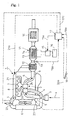
- Figs. 1 to 3 show an embodiment of the invention.
- reference numeral 1 designates a diesel engine (internal combustion engine) with a turbocharger 2.
- Suction air 4 sucked through an air cleaner 3 is guided via a suction pipe 5 to a compressor 2a of the turbocharger 2 so as to compress the same, the compressed suction air 4 being passed through an intercooler 6 and being distributed to respective cylinders of the diesel engine 1.
- Exhaust gas 8 discharged via an exhaust manifold 7 from the respective cylinders of the diesel engine 1 is fed to a turbine 2b of the turbocharger 2; the exhaust gas 8 having driven the turbine 2b is passed through a catalyst regenerative particulate filter 10 (post-processing device) for capturing of particulates and is discharged.
- a catalyst regenerative particulate filter 10 post-processing device
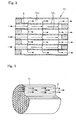
- the particulate filter 10 is a porous honeycomb structure made of ceramics having lattice-like compartmentalized passages 10a; alternate ones of the passages 10a have plugged inlets and the remaining passages 10a with unplugged open inlets are plugged at their outlets. Thus, only the exhaust gas 8 passing through the porous compartment walls 10b is discharged downstream.
- a plasma generator 11 Arranged upstream of the particulate filter 10 is a plasma generator 11 which discharges electricity in the exhaust gas 8 to generate plasma; arranged upstream of the plasma generator 11 is flow-through type oxidation catalyst 12 with a honeycomb structure shown in an enlarged scale in Fig. 3.
- the plasma generator 11 has electrodes 13 and 14 arranged oppositely to each other for possible mutual electric discharge.
- the electrodes 13 and 14 may be of any combination of any shapes such as plate, rod or cylinder, provided that mutual distances between them can be set to be substantially uniform.
- Each of the electrodes 13 and 14 is connected through an electric discharge controller 15 to a power supply 16; particularly in the present embodiment, the power supply 16 is assumed to be an in-vehicle cell, so that the voltage of the power supply 16 is enhanced by the discharge controller 15 to a voltage capable of discharging electricity and is supplied across the respective electrodes 13 and 14; the discharge controller 15 is controlled by a command signal 15a from a controller 17 which is an engine control computer or electronic control unit (ECU).
- ECU electronice control unit
- a temperature sensor 18 Arranged between the oxidation catalyst 12 and the plasma generator 11 is a temperature sensor 18 for detecting exhaust temperature, a detection signal 18a from the sensor 18 being inputted to the controller 17.
- an accelerator stepped-on degree signal 19a from an accelerator stepped-on degree sensor 19 (load sensor) which detects an accelerator stepped-on degree as a load to the diesel engine 1 as well as an engine revolution speed signal 20a from a revolution speed sensor 20 which detects revolution speed of the engine 1.
- the fuel injection unit 21 comprises a plurality of injectors each for each of the cylinders, an electromagnetic valve of each of the injectors being controlled for valve opening by the fuel injection signal 21 a so that fuel injection timing (valve opening timing) and fuel injected amount (valve opening time) are properly controlled.
- a fuel injection signal 21 a in a normal mode is determined on the basis of an accelerator stepped-on degree signal 19a and revolution speed signal 20a.
- the fuel injection signal 21 a is determined such that changeover is effected from the normal mode to electrode regeneration mode where post-injection is conducted with non-ignition timing followed by the main injection conducted near a compressive top dead center (crank angle of 0°).
- this post-injection adds unburned fuel (mainly, hydrocarbon) in the exhaust gas 8, such unburned fuel being oxidized through the oxidation catalyst 12 to generate reaction heat which substantially increases the temperature of the exhaust gas 8 passing through the oxidation catalyst 12.
- unburned fuel mainly, hydrocarbon
- the controller 17 serves for conducting fuel addition in the form of post-injection, based on the detection signal 18a from the temperature sensor 18, only in a condition that the temperature (predetermined threshold) which enables oxidation reaction on the oxidation catalyst 12 of fuel added by the post-injection is exceeded. If not, fuel addition in the form of the post-injection is conducted after the exhaust temperature is increased by the temperature increasing means (referred to hereinafter).
- an action is commanded by the opening degree command signal 22a from the controller 17 to the suction throttling valve 22 (suction throttling means) incorporated in the suction valve 5, which action is different from an inherent action for the suction throttling valve 22 and is for utilization of the valve as temperature increasing means for increasing the exhaust temperature.
- the controller 17, which serves also as fuel injection control means may be utilized as the temperature increasing means for increasing the exhaust temperature. More specifically, the fuel injection unit 21 is caused to conduct the main injection with the timing delayed in a combustible range by the controller 17 to the normal injection; alternatively, the fuel injection unit 21 is caused to conduct a post-injection with the combustible timing just after the main injection.
- the fuel of the post-injection is burned with a timing hardly convertible into an output so that heat efficiency of the diesel engine 1 is lowered and heat quantity not utilized as motive energy among the heat release value of fuel is increased to increase the exhaust temperature.
- the above-mentioned temperature increasing means is controlled on the basis of the detection signal 18 indicative of whether exceeded is a threshold or critical temperature above which added fuel cannot be oxidized on the oxidation catalyst 12.
- the temperature increasing mode is conducted to actuate the temperature increasing means before the electrode regeneration mode for conducting the post-injection; whereas, on the condition that the detected value of the temperature sensor 18 exceeds the predetermined threshold, changeover is effected to the electrode regeneration mode where the post-injection is conducted.
- the electrode regeneration mode is selected on the condition that the detected value of the temperature sensor 18 exceeds the predetermined threshold,; that is, fuel injection pattern is changed over by the controller 17 from the normal mode to the electrode regeneration mode so that adopted is an injector pattern according to which post-injection follows the main injection and with non-ignition timing later than a compressive top dead center.
- the fuel added by the post-injection to the exhaust gas 8 while being unburned is oxidized on the oxidation catalyst 12 to generate reaction heat.
- This reaction heat substantially increases the temperature of the exhaust gas 8 passing through the oxidation catalyst 12; the exhaust gas 8 increased in temperature while passing through the oxidation catalyst 12 is introduced in the plasma generator 11 so that the soot and SOF attached to and accumulated on the electrodes 13 and 14 of the plasma generator 11 are burned off.
- the controller 17 which receives the detection signal 18a from the temperature sensor 18, the temperature increasing mode is conducted before the electrode regeneration mode, so that the suction throttling valve 22 is throttled to increase the temperature of the exhaust gas 8 passing to the oxidation catalyst 12; alternatively, the main injection may be delayed within a combustible range to the ordinary injection or post-injection may be conducted with a combustible timing just after the main injection of the fuel.
- soot and SOF attached to the electrodes 13 and 14 of the plasma generator 11 require to be removed or not, for example, voltage and/or current upon plasma generation by the plasma generator 11 may be always monitored by the controller 17 as the judging means to determine whether the leakage is generated or not; alternatively, post-injection may be conducted regularly on the basis of for example operating time.
- the exhaust temperature may be increased by the temperature increasing means such as a suction throttling valve 22 as needs demand; and fuel is added to the exhaust gas 8 by post-injection.
- the added fuel is oxidized on the oxidation catalyst 12 so that the resultant reaction heat substantially increases the temperature of the exhaust gas 8 passing through the oxidation catalyst 12.
- the exhaust gas 8 is introduced into the plasma generator 11 to burn off the soot and SOF attached to and accumulated on the electrodes 13 and 14, so that preliminarily prevented is leakage of current due to the soot and SOF attached and accumulated, whereby proper voltage is applied with no hindrance across the electrodes 13 and 14 to maintain well generation of plasma.
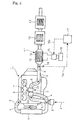
- Figs. 4-7 show a further embodiment of the invention wherein a catalyst regenerative particulate filter 10 is incorporated as post-processing device into an exhaust pipe 9.
- a catalyst regenerative particulate filter 10 is incorporated as post-processing device into an exhaust pipe 9.
- flow-through type NO x -occlusion reduction catalyst 23 as NO x reduction catalyst for reductive purification of NO x in the exhaust gas 8 (for example, alumina catalyst carrying platinum and barium or alumina catalyst carrying iridium, platinum and barium is known as this kind of NO x -occlusion reduction catalyst 23);
- a plasma generator 11 arranged upstream of the particulate filter 10 is a plasma generator 11 similar to that shown in the embodiment of Figs. 1 to 3.
- the plasma generator 11 is actuated by the electric discharge controller 15 which receives the command signal 15a from the controller 17. Inputted into the controller 17 is the detection signal 18a from the temperature sensor 18 which detects the exhaust temperature at an entry side of the plasma generator 11; the plasma generator 11 is actuated on the basis of the detection signal 18a when the exhaust temperature is below the predetermined value.
- actuation of the plasma generator 11 with the exhaust temperature being below the predetermined value is not necessarily requisite; for example, pressure loss of the particulate filter 10 is detected by a pressure sensor to determine a particulate accumulated amount and, only on an occasion that the accumulated amount is judged to be much, the plasma generator 11 may be activated with the exhaust temperature below the predetermined value.
- the accumulated particulate amount may be momentarily determined by calculation from generated and dealt amounts assumed on the basis of the operating status, or may be judged on the basis of the operating time.
- the generated plasma amount is optimized depending upon the exhaust temperature; more specifically, as shown in the graph of Fig. 5, optimization is carried out in the controller 17 by adjusting voltage, current or frequency so as to increase the generated plasma amount as the exhaust temperature lowers relative to the predetermined value x, whereby superfluous or undue plasma generation is suppressed to suppress electricity consumption to requisite minimum.
- the command signal 15a is outputted from the controller 17 on the basis of the detection signal 18a from the temperature sensor 18.
- the electric discharge controller 15 which receives the command signal 15a causes the plasma generator 11 to be actuated to discharge electricity in the exhaust gas 8 so that the exhaust gas 8 is excited to generate active radical and change NO into NO 2; because of these exhaust gas excited components being active, the oxidation reaction of the particulates captured on the particulate filter 10 is accelerated by the exhaust gas excited components, whereby the particulates are satisfactorily burned off even in the operating status with lower exhaust temperature.
- Relatively stable exhaust gas excited components such as NO 2 redundant from the oxidation reaction of the captured particulates on the particulate filter 10 flow to the downstream NO x -occlusion reduction catalyst 23 as they are, whereby reduction of NO x is effected on the NO x -occlusion reduction catalyst 23.
- post-injection or the like may be effected on the side of diesel engine 1 to add fuel in the exhaust gas 8, which lowers the oxygen concentration in the exhaust gas 8 and increases the reduction components in the exhaust gas 8 such as unburned hydrocarbon and CO, thereby accelerating the decomposition and discharge of NO x .
- the plasma generator 11 is actuated in the operating status with lower exhaust temperature, so that electric discharge by the plasma generator 11 generates highly active exhaust gas excited component in the exhaust gas 8; these exhaust excited components remarkably accelerates the oxidation reaction of the captured particulates as well as NO x occlusion reaction on the NOx-occlusion reduction catalyst 23, so that even in the operating status with lower exhaust temperature, the particulate filter 10 can be surely regenerated and favorable NO x reduction effect can be obtained by the NO x -occlusion reduction catalyst 23.
- the plasma generator 11 is actuated only in the operating status with lower exhaust temperature; moreover, at such actuation, the generated plasma amount is optimized depending upon exhaust temperature. As a result, any and all superfluous and unduly plasma generation is averted to substantially suppress the electricity consumption.
- NO x- occlusion reduction catalyst 23 has been adopted as the NO x reduction catalyst.
- selective reduction catalyst with elevated response selectivity between urea and NO x may be employed; then, electric discharge by the plasma generator 11 causes NO occupying the majority of NO x in the exhaust gas 8 to be changed into highly reactive NO 2 which flows to the selective reduction catalyst.
- urea into the exhaust gas 8 by for example an urea adding device (not shown) arranged upstream of the selective reduction catalyst causes NO 2 to be effectively reduced into N 2 with the urea being utilized as reducing agent, so that obtained is NO x reduction effect higher than that in a case where no plasma assist is conducted.
- an exhaust emission control device is not limited to the above-mentioned embodiments and that various changes and modifications may be made within the gist of the invention.
- selective reduction catalyst or NO x- occlusion reduction catalyst for removal of NO x in the exhaust gas may be adopted as the post-processing device.
- the fuel adding means may be in the form of an injector passing through an exhaust pipe at an appropriate position thereof (alternatively, it may pass through an exhaust manifold), the fuel being directly injected by the injector into the exhaust gas for addition of the fuel to the exhaust gas.
- the three alternative temperature increasing means disclosed in the above-mentioned embodiments may be employed singly or any combination thereof.
- the embodiments shown in Figs. 4-7 and Fig. 8 in lieu of direct measurement of exhaust temperature, number of revolutions and load of an engine are detected to presume an operating status; and the plasma generator may be operated in an operating status presumed to be in an operating region with lower exhaust temperature.
- selective reduction catalyst is adopted as NO x reduction catalyst, a reducing agent other than urea may be employed.
Landscapes
- Engineering & Computer Science (AREA)
- Chemical & Material Sciences (AREA)
- Combustion & Propulsion (AREA)
- Chemical Kinetics & Catalysis (AREA)
- General Engineering & Computer Science (AREA)
- Mechanical Engineering (AREA)
- Health & Medical Sciences (AREA)
- Toxicology (AREA)
- General Chemical & Material Sciences (AREA)
- Oil, Petroleum & Natural Gas (AREA)
- Analytical Chemistry (AREA)
- Environmental & Geological Engineering (AREA)
- Biomedical Technology (AREA)
- Processes For Solid Components From Exhaust (AREA)
- Exhaust Gas After Treatment (AREA)
Abstract
Provided is an exhaust emission control device which can properly burn off soot and soluble organic fraction attached to and accumulated on electrodes of a plasma generator.
The exhaust emission control device with a post-processing device (catalyst regenerative particulate filter 10) for allowing exhaust gas to pass therethrough for gas purification incorporated in an exhaust pipe 9 of an internal combustion engine (diesel engine (1)) comprises a plasma generator 11 arranged upstream of the post-processing device for discharging electricity in the exhaust gas 8 to generate plasma, flow-through type oxidation catalyst 12 arranged upstream of the plasma generator 11, fuel adding means (controller 17) arranged upstream of the oxidation catalyst 12 for adding fuel into the exhaust gas 8, temperature increasing means (suction throttling valve 22 or controller 17) for increasing the exhaust temperature to a level enough for oxidation reaction on the oxidation catalyst 12 of the fuel added by said fuel adding means.
The exhaust emission control device with a post-processing device (catalyst regenerative particulate filter 10) for allowing exhaust gas to pass therethrough for gas purification incorporated in an exhaust pipe 9 of an internal combustion engine (diesel engine (1)) comprises a plasma generator 11 arranged upstream of the post-processing device for discharging electricity in the exhaust gas 8 to generate plasma, flow-through type oxidation catalyst 12 arranged upstream of the plasma generator 11, fuel adding means (controller 17) arranged upstream of the oxidation catalyst 12 for adding fuel into the exhaust gas 8, temperature increasing means (suction throttling valve 22 or controller 17) for increasing the exhaust temperature to a level enough for oxidation reaction on the oxidation catalyst 12 of the fuel added by said fuel adding means.
Description
- The present invention relates to an exhaust emission control device.
- Particulates or particulate matter emitted or discharged from a diesel engine is mainly constituted by carbonic soot and a soluble organic fraction (SOF) of high-boiling hydrocarbons, and contains a trace of sulfate (misty sulfuric acid fraction). In order to reduce emission of particulates from the engine, a particulate filter is conventionally employed and incorporated into an exhaust pipe through which the exhaust gas flows.
- This kind of particulate filter is a porous honeycomb structure made of ceramics such as cordierite and having lattice-like compartmentalized passages; alternate ones of the passages have plugged inlets and the remaining passages with unplugged open inlets are plugged at their outlets. Thus, only the exhaust gas passing through the compartment walls is discharged downstream.
- The particulates in the exhaust gas, which are captured by and accumulated on the compartment walls of the particulate filter, require to be burned off to regenerate the particulate filter before exhaust resistance considerably increases due to clogging. However, the exhaust from the diesel engine in a normal operating status rarely has a chance to reach a temperature level at which the particulates ignite by themselves. Then, to employ a catalytic regenerative particulate filter has been investigated which integrally carries oxidation catalyst made from platinum-carrying alumina or in which separate oxidation catalyst is arranged upstream of the particulate filter.
- Thus, such employment of the catalyst regenerative particulate filter accelerates the oxidation reaction of the captured particulates and lowers ignition temperature thereof, whereby the particulates can be burned off at an exhaust temperature lower than ever before.
- Other than the above-mentioned particulate filter, a post-processing device such as selective reduction or NOx-occlusion reduction catalyst for removal of NOx in exhaust gas has been proposed to be incorporated in an exhaust pipe; in particular, recently, a post-processing device in the form of a combination of a particulate filter with NOx-occlusion reduction catalyst has been developed.
- However, whenever any of these post-processing devices is employed, exhaust temperature above a predetermined level is required for assured burning-off of particulates and for obtaining enough catalytic activities. Thus, if an operating status with lower exhaust temperature (generally speaking, a region with lower exhaust temperature extends in a light-load operating region) continues, the post-processing device cannot work well; in a case of for example a city shuttle-bus which tends to travel on congested roads, operation with above a predetermined temperature requirement does not continue for a long time, resulting in possibility of insufficiently obtaining the exhaust emission control effect due to provision of a post-processing device.
- To overcome this problem, there has been investigated to arrange a plasma generator upstream of the post-processing device so as to obtain enough exhaust emission control effect due to the post-processing device even in an operating region with lower exhaust temperature. To discharge electricity by such plasma generator in the exhaust gas upstream of the post-processing device to generate plasma excites the exhaust gas and changes unburned hydrocarbon, oxygen and NO into activated radical, ozone and NO2, respectively. Because of these exhaust gas excited components being active, exhaust emission control effect due to the post-processing device can be obtained even in a region with exhaust temperature lower than ever before.
- As to an exhaust emission control device with a plasma generator arranged upstream of a particulate filter, the following Reference 1 is known as the prior art.
- However, electrodes of such plasma generator are exposed to exhaust gas flow having the particulates entrained thereon, so that carbonic soot and SOF may be attached to and accumulated on the electrodes to cause leakage of current, resulting in difficulty of applying voltage across the electrodes and in hindrance of generation of plasma.
- The present invention was made in view of the above and hast its object to provide an exhaust emission control device which can properly burn off soot and a soluble organic fraction attached to and accumulated on electrodes of a plasma generator.
- The invention also deals with arrangement of this kind of plasma generator upstream of a post-processing device and provides an optimum contrivance structure which is directed to concurrent reduction in amount of particulates as well as of NOx and which can attain assured regeneration of a particulate filter and satisfactory NOx reduction effect even in a driving state with lower exhaust temperature.
- The invention is directed to an exhaust emission control device with a post-processing device for allowing exhaust gas to pass therethrough for gas purification incorporated in an exhaust pipe of an internal combustion engine, characterized in that it comprises a plasma generator arranged upstream of the post-processing device for discharging electricity into the exhaust gas to generate plasma, flow-through type oxidation catalyst arranged upstream of the plasma generator, fuel adding means arranged upstream of the oxidation catalyst for adding fuel in the exhaust gas and temperature increasing means for increasing exhaust temperature to a level enough for oxidation reaction on the oxidation catalyst of the fuel added by the fuel adding means.
- Thus, to discharge electricity in the exhaust gas by the plasma generator excites the exhaust gas and changes unburned hydrocarbon, oxygen and NO into activated radical, ozone and NO2, respectively, these exhaust gas excited components being active to thereby obtain exhaust emission control effect due to the post-processing device even in a region with exhaust temperature lower than ever before.
- When the soot and SOF in the exhaust gas attached to and accumulated on the electrodes of the plasma generator are to be removed, fuel is added upstream of the oxidation catalyst by fuel adding means. This added fuel makes oxidation reaction through oxidation catalyst to generate reaction heat which substantially increases the temperature of the exhaust gas passing through the oxidation catalyst; as a result, the exhaust gas increased in temperature through the oxidation catalyst is introduced into the plasma generator, leading to burn-off of the soot and SOF attached to and accumulated on the electrodes of the plasma generator.
- If operation is being conducted in an operating region with too low exhaust temperature to oxidize the fuel on the oxidation catalyst, exhaust temperature may be properly increased by the temperature increasing means before fuel is added by the fuel adding means.
- On an occasion of practicing the exhaust emission control device of the invention more concretely, preferably a temperature sensor for detecting the exhaust temperature is arranged between the oxidation catalyst and the plasma generator, fuel being added properly by the fuel adding means only on a condition that a detected value of the temperature sensor exceeds a predetermined threshold. When the detected value of the temperature sensor is below the threshold, to increase the temperature of the exhaust gas may be properly conducted by the temperature increasing means before the fuel addition by the fuel adding means.
- In the invention, the fuel adding means is preferably fuel injection control means which may cause a fuel injection unit to conduct post-injection following the main injection and with non-ignition timing after a compressive top dead center.
- The temperature increasing means may be suction throttling means for properly throttling suction flow rate. Alternatively, it may be fuel injection control means which may cause the fuel injection unit to conduct the main injection with a timing delayed within a combustible range to a normal injection or which may cause the fuel injection unit to conduct post-injection with a combustible timing just after the main injection.
- When the temperature increasing means is the suction throttling means for properly throttling the suction flow rate, such throttling of the suction flow rate by the suction throttling means in an operating status with lower exhaust temperature causes the working air quantity in the internal combustion engine to be reduced to increase the pumping loss, whereby the exhaust temperature is increased by increasing the injected fuel amount so as to generate any required output. Reduction in generated exhaust gas amount by the combustion in the internal combustion engine and resultant lowering of the heat capacity contribute to further increase in the exhaust temperature.
- When the temperature increasing means is the fuel injection control means and the fuel injection unit is caused to conduct the main injection with the timing delayed within the combustible range to the normal injection, fuel of the delayed main injection is burned with timing hardly convertible into output to lower the heat efficiency in the internal combustion engine and increase a heat quantity not used as motive energy among a heat release value of the fuel, thereby increasing the exhaust temperature.
- When the temperature increasing means is the fuel injection control means and the fuel injection unit is caused to conduct post-injection with a combustible timing just after the main injection, the fuel of the post-injection is burned with timing hardly convertible into output to lower the heat efficiency of the internal combustion engine and increase a heat quantity not used as motive energy among a heat release value of the fuel, thereby increasing the exhaust temperature.
- It is preferable in the invention to provide judgment means for determining whether fuel addition is required or not through monitoring at least either of current and voltage upon generation of plasma by the plasma generator to judge any generation of leakage, which makes it possible to avert any and all wasteful fuel addition.
- When the catalyst regenerative particulate filter is incorporated as post-processing device in the exhaust pipe, it is preferable that a NOx reduction catalyst for reductive purification of NOx in the exhaust gas is provided downstream of the particulate filter and that a plasma generator for generating plasma through electric discharge in the exhaust gas is provided upstream of the particulate filter, the plasma generator being actuated in an operating status with lower exhaust temperature.
- In such a case, electric discharging in the exhaust gas by the plasma generator in an operating status with lower exhaust temperature excites the exhaust gas to generate active radical and change NO into NO2; because of these exhaust gas excited components being active, an oxidation reaction of the particulates captured on the particulate filter is accelerated by the exhaust gas excited components, whereby the particulates are burned off well even in an operating status with lower exhaust temperature.
- Furthermore, the relatively stable exhaust gas excited components such as NO2 redundant from the oxidation reaction of the captured particulates flow into the downstream NOx reduction catalyst as they are, NOx being efficiently reduced in the NOx reduction catalyst.
- When the NOx reduction catalyst is for example NOx-occlusion reduction catalyst, electric discharge by the plasma generator causes NO, which occupies the majority of NOx in the exhaust gas, to be changed into highly responsive NO2 which flows into the NOx-occlusion reduction catalyst; as a result, such NO2 is effectively occluded in the state of nitrate so that occlusion reaction of NOx in the NOx-occlusion reduction catalyst is remarkably accelerated, resulting in obtaining NOx reduction effect higher than that obtained in a case where no plasma assist is conducted.
- When the occluded NOx is to be decomposed and discharged, for example post-injection may be conducted at the engine side to add fuel in the exhaust gas, which will lower the oxygen concentration in the exhaust gas and increase reduction components in the exhaust gas such as unburned hydrocarbon and CO to accelerate decomposition and discharge of NOx.
- In this case, the unburned hydrocarbon is reacted with oxygen through the oxidation catalyst on the upstream particulate filter to be thermally decomposed into CO and hydrogen; such increase of CO and hydrogen remarkably accelerates decomposition and discharge reaction of NOx from NOx-occlusion reduction catalyst as well as reductive purification reaction of NOx.
- When the NOx reduction catalyst is selective reduction catalyst, NO which occupies the majority of NOx in the exhaust gas is changed by electric discharge by the plasma generator into highly reactive NO2 which flows to the selective reduction catalyst. Thus, when an addition device is arranged upstream of the selective reduction catalyst to add a reducer such as urea into the exhaust gas, NO2 is effectively reduced into N2 through selective reduction catalyst; as a result, obtained is NOx reduction effect higher than that obtained in a case where no plasma assist is conducted.
- On an occasion of practicing the invention more concretely, it is preferable to provide a temperature sensor for detecting the exhaust temperature and a controller for actuating the plasma generator on the basis of the detection signal from the temperature sensor when the exhaust temperature detected is below a predetermined value; the controller may be constructed such that it may optimize generated plasma amount depending upon the exhaust temperature upon actuation of the plasma generator.
- According to the above-mentioned exhaust emission control device of the invention, the following various excellent meritorious effects will be obtained:
- (I) According to an aspect of the invention, after the exhaust temperature may be increased as needs demand by temperature increasing means, fuel is added to the exhaust gas by the fuel adding means. The added fuel is oxidized through the oxidation catalyst and a resultant reaction heat substantially increases the temperature of the exhaust gas passing through the oxidation catalyst. This exhaust gas is introduced into the plasma generator to burn off the soot and SOF attached to and accumulated on the electrodes, so that preliminarily prevented is leakage of the current due to the soot and SOF attached to and accumulated on the electrodes, whereby proper voltage is applied with no hindrance across the electrodes to maintain well generation of plasma.
- (II) On the basis of the detected value of the temperature sensor, the fuel adding means and temperature increasing means can be properly operated to efficiently burn off the soot and SOF attached to the electrodes of the plasma generator.
- (III) Merely conducted is controlling the fuel injection unit so as to cause it to conduct post-injection following the main injection and with non-ignition timing later than a compressive top dead center, which make it possible to add unburned fuel to the exhaust gas with no need of new facilities annexed, thereby suppressing runup of cost on fuel adding means.
- (IV) The working air quantity in the internal combustion engine is reduced to increase pumping loss; and exhaust gas to be generated in the combustion in the internal combustion engine is reduced to lower the heat capacity. As a result, the temperature of the exhaust gas to the oxidation catalyst can be surely increased.
- (V) Fuel of the delayed main injection is burned with timing hardly convertible into output, so that the heat efficiency of the internal combustion engine is lowered to increase heat quantity not utilized for motive energy among the heat release value of the fuel, whereby the temperature of the exhaust gas to the oxidation catalyst can be surely increased.
- (VI) The fuel of the post-injection is burned with timing hardly convertible to output, so that the heat efficiency of the internal combustion engine is lowered to increase heat quantity not utilized as motive energy among heat release value of the fuel, whereby the temperature of the exhaust gas to the oxidation catalyst can be surely increased.
- (VII) Any and all wasteful fuel addition is averted so that cost for fuel addition can be suppressed to requisite minimum.
- (VIII) According to a further aspect of the invention, a particulate filter is surely regenerated even in an operating status with lower exhaust temperature and good NOx reduction effect is obtained by the NOx reduction catalyst; moreover, any and all undue wasteful plasma generation is averted to substantially suppress electricity consumption.
- Embodiments of the invention will be described with reference to the drawings.
- Figs. 1 to 3 show an embodiment of the invention. In Fig. 1, reference numeral 1 designates a diesel engine (internal combustion engine) with a
turbocharger 2.Suction air 4 sucked through anair cleaner 3 is guided via asuction pipe 5 to acompressor 2a of theturbocharger 2 so as to compress the same, thecompressed suction air 4 being passed through anintercooler 6 and being distributed to respective cylinders of the diesel engine 1. -
Exhaust gas 8 discharged via anexhaust manifold 7 from the respective cylinders of the diesel engine 1 is fed to a turbine 2b of theturbocharger 2; theexhaust gas 8 having driven the turbine 2b is passed through a catalyst regenerative particulate filter 10 (post-processing device) for capturing of particulates and is discharged. - As shown in Fig. 2 in an enlarged scale, the
particulate filter 10 is a porous honeycomb structure made of ceramics having lattice-likecompartmentalized passages 10a; alternate ones of thepassages 10a have plugged inlets and the remainingpassages 10a with unplugged open inlets are plugged at their outlets. Thus, only theexhaust gas 8 passing through theporous compartment walls 10b is discharged downstream. - Arranged upstream of the
particulate filter 10 is aplasma generator 11 which discharges electricity in theexhaust gas 8 to generate plasma; arranged upstream of theplasma generator 11 is flow-throughtype oxidation catalyst 12 with a honeycomb structure shown in an enlarged scale in Fig. 3. - The
plasma generator 11 haselectrodes electrodes - Each of the
electrodes electric discharge controller 15 to apower supply 16; particularly in the present embodiment, thepower supply 16 is assumed to be an in-vehicle cell, so that the voltage of thepower supply 16 is enhanced by thedischarge controller 15 to a voltage capable of discharging electricity and is supplied across therespective electrodes discharge controller 15 is controlled by acommand signal 15a from acontroller 17 which is an engine control computer or electronic control unit (ECU). - Arranged between the
oxidation catalyst 12 and theplasma generator 11 is atemperature sensor 18 for detecting exhaust temperature, adetection signal 18a from thesensor 18 being inputted to thecontroller 17. - The
controller 17, which serves as ECU, also takes control of fuel injection. More specifically, afuel injection signal 21 a is outputted to afuel injection unit 21 which injects fuel to respective cylinders of the diesel engine 1 on the basis of an accelerator stepped-ondegree signal 19a from an accelerator stepped-on degree sensor 19 (load sensor) which detects an accelerator stepped-on degree as a load to the diesel engine 1 as well as an enginerevolution speed signal 20a from arevolution speed sensor 20 which detects revolution speed of the engine 1. - The
fuel injection unit 21 comprises a plurality of injectors each for each of the cylinders, an electromagnetic valve of each of the injectors being controlled for valve opening by thefuel injection signal 21 a so that fuel injection timing (valve opening timing) and fuel injected amount (valve opening time) are properly controlled. - In the
controller 17, afuel injection signal 21 a in a normal mode is determined on the basis of an accelerator stepped-ondegree signal 19a andrevolution speed signal 20a. When fuel addition by post-injection is required, thefuel injection signal 21 a is determined such that changeover is effected from the normal mode to electrode regeneration mode where post-injection is conducted with non-ignition timing followed by the main injection conducted near a compressive top dead center (crank angle of 0°). - Thus, when the post-injection is conducted with non-ignition timing later than the compressive top dead center after the main injection, this post-injection adds unburned fuel (mainly, hydrocarbon) in the
exhaust gas 8, such unburned fuel being oxidized through theoxidation catalyst 12 to generate reaction heat which substantially increases the temperature of theexhaust gas 8 passing through theoxidation catalyst 12. - The
controller 17 serves for conducting fuel addition in the form of post-injection, based on thedetection signal 18a from thetemperature sensor 18, only in a condition that the temperature (predetermined threshold) which enables oxidation reaction on theoxidation catalyst 12 of fuel added by the post-injection is exceeded. If not, fuel addition in the form of the post-injection is conducted after the exhaust temperature is increased by the temperature increasing means (referred to hereinafter). - More specifically, in the example illustrated, an action is commanded by the opening
degree command signal 22a from thecontroller 17 to the suction throttling valve 22 (suction throttling means) incorporated in thesuction valve 5, which action is different from an inherent action for thesuction throttling valve 22 and is for utilization of the valve as temperature increasing means for increasing the exhaust temperature. When the throttling of the suction flow rate is conducted by thesuction throttling valve 22 in the driving state with lower exhaust temperature, the working air quantity in the diesel engine 1 is reduced to increase pumping loss, whereby the exhaust temperature is increased by increasing the injected fuel amount so as to generate any required output. Reduction in generatedexhaust gas 8 amount by the combustion in the diesel engine 1 and resultant lowering of the heat capacity contribute to further increase in the exhaust temperature. - Alternatively, the
controller 17, which serves also as fuel injection control means, may be utilized as the temperature increasing means for increasing the exhaust temperature. More specifically, thefuel injection unit 21 is caused to conduct the main injection with the timing delayed in a combustible range by thecontroller 17 to the normal injection; alternatively, thefuel injection unit 21 is caused to conduct a post-injection with the combustible timing just after the main injection. - More specifically, when the main injection is conducted with timing delayed within the combustible range to the normal injection, fuel in the delayed main injection is burned with a timing hardly convertible into an output so that the heat efficiency of the diesel engine 1 is lowered and heat quantity not utilized as motive energy among the heat release value of the fuel is increased to increase the exhaust temperature.
- When the post-injection is conducted with the combustible timing just after the main injection, the fuel of the post-injection is burned with a timing hardly convertible into an output so that heat efficiency of the diesel engine 1 is lowered and heat quantity not utilized as motive energy among the heat release value of fuel is increased to increase the exhaust temperature.
- The above-mentioned temperature increasing means is controlled on the basis of the
detection signal 18 indicative of whether exceeded is a threshold or critical temperature above which added fuel cannot be oxidized on theoxidation catalyst 12. When the threshold is not exceeded, the temperature increasing mode is conducted to actuate the temperature increasing means before the electrode regeneration mode for conducting the post-injection; whereas, on the condition that the detected value of thetemperature sensor 18 exceeds the predetermined threshold, changeover is effected to the electrode regeneration mode where the post-injection is conducted. - Thus, with the exhaust emission control device constructed in this manner, electricity is discharged into the
exhaust gas 8 by theplasma generator 11 to excite theexhaust gas 8 so that unburned hydrocarbon, oxygen and NO are changed into activated radical, ozone and NO2, respectively. With these exhaust excited components being active, the oxidation reaction of particulates captured on theparticulate filter 10 is accelerated by the exhaust excited components, whereby the particulates may be ignited to be burned off even with exhaust temperature lower than ever before. - When the soot and SOF entrained in the
exhaust gas 8 are attached to and accumulated on theelectrodes plasma generator 11 and the soot and SOF attached thereon are to be removed, the electrode regeneration mode is selected on the condition that the detected value of thetemperature sensor 18 exceeds the predetermined threshold,; that is, fuel injection pattern is changed over by thecontroller 17 from the normal mode to the electrode regeneration mode so that adopted is an injector pattern according to which post-injection follows the main injection and with non-ignition timing later than a compressive top dead center. As a result, the fuel added by the post-injection to theexhaust gas 8 while being unburned is oxidized on theoxidation catalyst 12 to generate reaction heat. This reaction heat substantially increases the temperature of theexhaust gas 8 passing through theoxidation catalyst 12; theexhaust gas 8 increased in temperature while passing through theoxidation catalyst 12 is introduced in theplasma generator 11 so that the soot and SOF attached to and accumulated on theelectrodes plasma generator 11 are burned off. - Even if the operation is conducted in an operating region with too lower exhaust temperature to oxidize the added fuel on the
oxidation catalyst 12, by thecontroller 17 which receives thedetection signal 18a from thetemperature sensor 18, the temperature increasing mode is conducted before the electrode regeneration mode, so that thesuction throttling valve 22 is throttled to increase the temperature of theexhaust gas 8 passing to theoxidation catalyst 12; alternatively, the main injection may be delayed within a combustible range to the ordinary injection or post-injection may be conducted with a combustible timing just after the main injection of the fuel. - When the detected value of the
temperature sensor 18 exceeds the predetermined threshold and changeover is effected to the electrode regeneration mode, the added fuel can be surely oxidized on theoxidation catalyst 12; theexhaust gas 8 substantially increased in temperature by the reaction heat burns off the soot and SOF attached to and accumulated on theelectrodes plasma generator 11. - As to whether soot and SOF attached to the
electrodes plasma generator 11 require to be removed or not, for example, voltage and/or current upon plasma generation by theplasma generator 11 may be always monitored by thecontroller 17 as the judging means to determine whether the leakage is generated or not; alternatively, post-injection may be conducted regularly on the basis of for example operating time. - Thus, according to the above-mentioned embodiment, the exhaust temperature may be increased by the temperature increasing means such as a
suction throttling valve 22 as needs demand; and fuel is added to theexhaust gas 8 by post-injection. The added fuel is oxidized on theoxidation catalyst 12 so that the resultant reaction heat substantially increases the temperature of theexhaust gas 8 passing through theoxidation catalyst 12. Theexhaust gas 8 is introduced into theplasma generator 11 to burn off the soot and SOF attached to and accumulated on theelectrodes electrodes - Figs. 4-7 show a further embodiment of the invention wherein a catalyst regenerative
particulate filter 10 is incorporated as post-processing device into anexhaust pipe 9. Arranged downstream of theparticulate filter 10 is flow-through type NOx-occlusion reduction catalyst 23 as NOx reduction catalyst for reductive purification of NOx in the exhaust gas 8 (for example, alumina catalyst carrying platinum and barium or alumina catalyst carrying iridium, platinum and barium is known as this kind of NOx-occlusion reduction catalyst 23); arranged upstream of theparticulate filter 10 is aplasma generator 11 similar to that shown in the embodiment of Figs. 1 to 3. - More specifically, the
plasma generator 11 is actuated by theelectric discharge controller 15 which receives thecommand signal 15a from thecontroller 17. Inputted into thecontroller 17 is thedetection signal 18a from thetemperature sensor 18 which detects the exhaust temperature at an entry side of theplasma generator 11; theplasma generator 11 is actuated on the basis of thedetection signal 18a when the exhaust temperature is below the predetermined value. - However, actuation of the
plasma generator 11 with the exhaust temperature being below the predetermined value is not necessarily requisite; for example, pressure loss of theparticulate filter 10 is detected by a pressure sensor to determine a particulate accumulated amount and, only on an occasion that the accumulated amount is judged to be much, theplasma generator 11 may be activated with the exhaust temperature below the predetermined value. The accumulated particulate amount may be momentarily determined by calculation from generated and dealt amounts assumed on the basis of the operating status, or may be judged on the basis of the operating time. - Moreover, particularly in the present embodiment, when the
plasma generator 11 is actuated, the generated plasma amount is optimized depending upon the exhaust temperature; more specifically, as shown in the graph of Fig. 5, optimization is carried out in thecontroller 17 by adjusting voltage, current or frequency so as to increase the generated plasma amount as the exhaust temperature lowers relative to the predetermined value x, whereby superfluous or undue plasma generation is suppressed to suppress electricity consumption to requisite minimum. - Thus, in the operating status with lower exhaust temperature, the
command signal 15a is outputted from thecontroller 17 on the basis of thedetection signal 18a from thetemperature sensor 18. Theelectric discharge controller 15 which receives thecommand signal 15a causes theplasma generator 11 to be actuated to discharge electricity in theexhaust gas 8 so that theexhaust gas 8 is excited to generate active radical and change NO into NO2; because of these exhaust gas excited components being active, the oxidation reaction of the particulates captured on theparticulate filter 10 is accelerated by the exhaust gas excited components, whereby the particulates are satisfactorily burned off even in the operating status with lower exhaust temperature. - In fact, verification experiments by the inventor revealed that, as shown in solid line in the graph of Fig. 6, when no plasma assist (no electric discharge by the plasma generator 11) is conducted, at least 230°C or so of exhaust temperature is required for combustion of the captured particulates; as shown in dotted line in the graph of Fig. 6, when plasma assist is conducted, even the exhaust temperature lower than 230°C will suffice for burning-off of the captured particulates with required combustion rate.
- Relatively stable exhaust gas excited components such as NO2 redundant from the oxidation reaction of the captured particulates on the
particulate filter 10 flow to the downstream NOx-occlusion reduction catalyst 23 as they are, whereby reduction of NOx is effected on the NOx-occlusion reduction catalyst 23. - More specifically, electric discharge by the
plasma generator 11 changes NO, which occupies the majority of NOx in theexhaust gas 8, into highly reactive NO2 which flows to the NOx-occlusion reduction catalyst 23, so that NO2 is efficiently occluded in the form of nitrite; as a result, occlusion reaction of NOx on the NOx-occlusion reduction catalyst 23 is remarkably accelerated, whereby obtained is NOx reduction effect higher than that in a case where no plasma assist is effected. - In fact, verification experiments by the inventor revealed that, as shown in solid line in the graph of Fig. 7, when no plasma assist is conducted, at least 250°C-300°C of exhaust temperature is required for development of NOx reduction ratio; as shown in dotted line in the graph of Fig. 7, when plasma assist is conducted, NOx reduction ratio is developed even at considerably low exhaust temperature substantially less than 250°C-300°C.
- In order to decompose and discharge the occluded NOx, post-injection or the like may be effected on the side of diesel engine 1 to add fuel in the
exhaust gas 8, which lowers the oxygen concentration in theexhaust gas 8 and increases the reduction components in theexhaust gas 8 such as unburned hydrocarbon and CO, thereby accelerating the decomposition and discharge of NOx. - In this case, unburned hydrocarbon is reacted with oxygen on the oxidation catalyst carried by the upstream
particulate filter 10 to be thermally decomposed, thereby generating CO and hydrogen. Such increase of CO and hydrogen remarkably accelerates decomposing and discharging reactions of NOx from the NOx-occlusion reduction catalyst 23 as well as reductive purification reaction of NOx. - Thus, according to the above-mentioned embodiment, the
plasma generator 11 is actuated in the operating status with lower exhaust temperature, so that electric discharge by theplasma generator 11 generates highly active exhaust gas excited component in theexhaust gas 8; these exhaust excited components remarkably accelerates the oxidation reaction of the captured particulates as well as NOx occlusion reaction on the NOx-occlusion reduction catalyst 23, so that even in the operating status with lower exhaust temperature, theparticulate filter 10 can be surely regenerated and favorable NOx reduction effect can be obtained by the NOx-occlusion reduction catalyst 23. - The
plasma generator 11 is actuated only in the operating status with lower exhaust temperature; moreover, at such actuation, the generated plasma amount is optimized depending upon exhaust temperature. As a result, any and all superfluous and unduly plasma generation is averted to substantially suppress the electricity consumption. - In the above-mentioned embodiment with respect to Figs. 4-7, NOx-
occlusion reduction catalyst 23 has been adopted as the NOx reduction catalyst. In lieu of this NOx-occlusion reduction catalyst 23, selective reduction catalyst with elevated response selectivity between urea and NOx may be employed; then, electric discharge by theplasma generator 11 causes NO occupying the majority of NOx in theexhaust gas 8 to be changed into highly reactive NO2 which flows to the selective reduction catalyst. Thus, addition of urea into theexhaust gas 8 by for example an urea adding device (not shown) arranged upstream of the selective reduction catalyst causes NO2 to be effectively reduced into N2 with the urea being utilized as reducing agent, so that obtained is NOx reduction effect higher than that in a case where no plasma assist is conducted. - In fact, verification experiments by the inventor revealed that, as shown in solid line in the graph of Fig. 8, when no plasma assist is conducted, at least 200°C-250°C or so of exhaust temperature is required for development of NOx reduction ratio; as shown in dotted line in the graph of Fig. 8, when plasma assist is conducted, NOx reduction ratio is developed even considerably lower exhaust temperature substantially less than 200°C-250°C.
- Therefore, even in a case where selective reduction catalyst is employed as NOx reduction catalyst, plasma assist by the
plasma generator 11 results in favorable NOx reduction effect, whereby effects and advantages similar to those obtained in the above embodiments can be obtained. - It is to be understood that an exhaust emission control device according to the invention is not limited to the above-mentioned embodiments and that various changes and modifications may be made within the gist of the invention. For example, with respect to the embodiment shown in Figs. 1-3, other than the catalyst regenerative particulate filter, selective reduction catalyst or NOx-occlusion reduction catalyst for removal of NOx in the exhaust gas may be adopted as the post-processing device. The fuel adding means may be in the form of an injector passing through an exhaust pipe at an appropriate position thereof (alternatively, it may pass through an exhaust manifold), the fuel being directly injected by the injector into the exhaust gas for addition of the fuel to the exhaust gas. The three alternative temperature increasing means disclosed in the above-mentioned embodiments may be employed singly or any combination thereof. With respect to the embodiments shown in Figs. 4-7 and Fig. 8, in lieu of direct measurement of exhaust temperature, number of revolutions and load of an engine are detected to presume an operating status; and the plasma generator may be operated in an operating status presumed to be in an operating region with lower exhaust temperature. When selective reduction catalyst is adopted as NOx reduction catalyst, a reducing agent other than urea may be employed.
-
- [Fig. 1] Schematic view showing an embodiment of the invention;
- [Fig. 2] Sectional view showing particulars of a particulate filter in Fig. 1;
- [Fig. 3] Perspective view partly cut out showing particulars of oxidation catalyst in Fig. 1;
- [Fig. 4] Schematic view showing a further embodiment of the invention;
- [Fig. 5] Graph showing a relationship between exhaust temperature and generated plasma amount.
- [Fig. 6] Graph showing a relationship between exhaust temperature and combustion rate of captured particulates.
- [Fig. 7] Graph showing a relationship between exhaust temperature and NOx reduction ratio with NOx-occlusion reduction catalyst.
- [Fig. 8] Graph showing a relationship between exhaust temperature and NOx reduction ratio with selective reduction catalyst.
-
- 1 diesel engine (internal combustion engine)
- 8 exhaust gas
- 9 exhaust pipe
- 10 particulate filter (post-processing device)
- 11 plasma generator
- 12 oxidation catalyst
- 13 electrode
- 14 electrode
- 17 controller (fuel adding means: temperature increasing means; fuel injection control means: judging means)
- 18 temperature sensor
- 18a detection signal
- 21 fuel injection unit
- 22 suction throttling valve (temperature increasing means)
- 23 NOx-occlusion reduction catalyst (NOx reduction catalyst)
Claims (35)
- An exhaust emission control device with a post-processing device (10) for allowing exhaust gas to pass therethrough for gas purification incorporated in an exhaust pipe (9) of an internal combustion engine (1), comprising a plasma generator (11) arranged upstream of the post-processing device (10) for discharging electricity into the exhaust gas (8) to generate plasma, flow-through type oxidation catalyst (12) arranged upstream of the plasma generator (11), fuel adding means (17) arranged upstream of the oxidation catalyst (12) for adding fuel in the exhaust gas (8) and temperature increasing means (17, 22) for increasing exhaust temperature to a level enough for oxidation reaction on the oxidation catalyst (12) of the fuel added by the fuel adding means (17).
- The exhaust emission control device according to claim 1, further comprising a temperature sensor (18) arranged between the oxidation catalyst (12) and the plasma generator (11) for detecting exhaust temperature, fuel being added properly by the fuel adding means (17) only on a condition that a detected value of the temperature sensor (18) exceeds a predetermined threshold, the temperature of the exhaust gas (8) being increased by the temperature increasing means (17, 22) before the fuel addition by the fuel adding means (17) on a condition that the detected vale of the temperature sensor (18) is below the predetermined threshold.
- The exhaust emission control device according to claim 1, wherein fuel adding means is fuel injection control means (17) which causes the fuel injection unit (21) to conduct post-injection following the main injection and with non-ignition timing later than a compressive top dead center.
- The exhaust emission control device according to claim 2, wherein fuel adding means is fuel injection control means (17) which causes the fuel injection unit (21) to conduct post-injection following the main injection and with non-ignition timing later than a compressive top dead center.
- The exhaust emission control device according to claim 1, wherein the temperature increasing means for increasing the exhaust (8) temperature is suction throttling means (22) for properly throttling suction (4) flow rate.
- The exhaust emission control device according to claim 2, wherein the temperature increasing means for increasing the exhaust (8) temperature is suction throttling means (22) for properly throttling suction (4) flow rate.
- The exhaust emission control device according to claim 3, wherein the temperature increasing means for increasing the exhaust (8) temperature is suction throttling means (22) for properly throttling suction (4) flow rate.
- The exhaust emission control device according to claim 4, wherein the temperature increasing means for increasing the exhaust (8) temperature is suction throttling means (22) for properly throttling suction (4) flow rate.
- The exhaust emission control device according to claim 1, wherein the temperature increasing means for increasing the exhaust (8) temperature is fuel injection control means (17) for causing the fuel injection unit (21) to conduct main injection delayed within a combustible range to the normal injection.
- The exhaust emission control device according to claim 2, wherein the temperature increasing means for increasing the exhaust temperature is fuel injection control means (17) for causing the fuel injection unit (21) to conduct main injection delayed within a combustible range to the normal injection.
- The exhaust emission control device according to claim 3, wherein the temperature increasing means for increasing the exhaust (8) temperature is fuel injection control means (17) for causing the fuel injection unit (21) to conduct main injection delayed within a combustible range to the normal injection.
- The exhaust emission control device according to claim 4, wherein the temperature increasing means for increasing the exhaust (8) temperature is fuel injection control means (17) for causing the fuel injection unit (21) to conduct main injection delayed within a combustible range to the normal injection.
- The exhaust emission control device according to claim 1, wherein the temperature increasing means for increasing the exhaust (8) temperature is fuel injection control means (17) for causing the fuel injection unit (21) to conduct post injection with a combustible timing just after the main injection.
- The exhaust emission control device according to claim 2, wherein the temperature increasing means for increasing the exhaust (8) temperature is fuel injection control means (17) for causing the fuel injection unit (21) to conduct post injection with a combustible timing just after the main injection.
- The exhaust emission control device according to claim 3, wherein the temperature increasing means for increasing the exhaust (8) temperature is fuel injection control means (17) for causing the fuel injection unit (21) to conduct post injection with a combustible timing just after the main injection.
- The exhaust emission control device according to claim 4, wherein the temperature increasing means for increasing the exhaust (8) temperature is fuel injection control means (17) for causing the fuel injection unit (21) to conduct post injection with a combustible timing just after the main injection.
- The exhaust emission control device according to claim 1, further comprising judging means (17) for determining whether fuel addition is required or not through monitoring at least either of current and voltage upon generation of plasma in the plasma generator (11).
- The exhaust emission control device according to claim 2, further comprising judging means (17) for determining whether fuel addition is required or not through monitoring at least either of current and voltage upon generation of plasma in the plasma generator (11).
- The exhaust emission control device according to claim 3, further comprising judging means (17) for determining whether fuel addition is required or not through monitoring at least either of current and voltage upon generation of plasma in the plasma generator (11).
- The exhaust emission control device according to claim 4, further comprising judging means (17) for determining whether fuel addition is required or not through monitoring at least either of current and voltage upon generation of plasma in the plasma generator (11).
- The exhaust emission control device according to claim 5, further comprising judging means (17) for determining whether fuel addition is required or not through monitoring at least either of current and voltage upon generation of plasma in the plasma generator (11).
- The exhaust emission control device according to claim 6, further comprising judging means (17) for determining whether fuel addition is required or not through monitoring at least either of current and voltage upon generation of plasma in the plasma generator (11).
- The exhaust emission control device according to claim 7, further comprising judging means (17) for determining whether fuel addition is required or not through monitoring at least either of current and voltage upon generation of plasma in the plasma generator (11).
- The exhaust emission control device according to claim 8, further comprising judging means (17) for determining whether fuel addition is required or not through monitoring at least either of current and voltage upon generation of plasma in the plasma generator (11).
- The exhaust emission control device according to claim 9, further comprising judging means (17) for determining whether fuel addition is required or not through monitoring at least either of current and voltage upon generation of plasma in the plasma generator (11).
- The exhaust emission control device according to claim 10, further comprising judging means (17) for determining whether fuel addition is required or not through monitoring at least either of current and voltage upon generation of plasma in the plasma generator (11).
- The exhaust emission control device according to claim 11, further comprising judging means (17) for determining whether fuel addition is required or not through monitoring at least either of current and voltage upon generation of plasma in the plasma generator (11).
- The exhaust emission control device according to claim 12, further comprising judging means (17) for determining whether fuel addition is required or not through monitoring at least either of current and voltage upon generation of plasma in the plasma generator (11).
- The exhaust emission control device according to claim 13, further comprising judging means (17) for determining whether fuel addition is required or not through monitoring at least either of current and voltage upon generation of plasma in the plasma generator (11).
- The exhaust emission control device according to claim 14, further comprising judging means (17) for determining whether fuel addition is required or not through monitoring at least either of current and voltage upon generation of plasma in the plasma generator (11).
- The exhaust emission control device according to claim 15, further comprising judging means (17) for determining whether fuel addition is required or not through monitoring at least either of current and voltage upon generation of plasma in the plasma generator (11).
- The exhaust emission control device according to claim 16, further comprising judging means (17) for determining whether fuel addition is required or not through monitoring at least either of current and voltage upon generation of plasma in the plasma generator (11).
- An exhaust emission control device with a catalyst regenerative particulate filter (10) as a post-processing device incorporated into an exhaust pipe (9), comprising NOx reduction catalyst (23) arranged downstream of the particulate filter (10) for reductive purification of NOx in exhaust gas (8) and a plasma generator (11) arranged upstream of the particulate filter (10) for discharging electricity into the exhaust gas (8) to generate plasma, said plasma generator (11) being constructed to be actuated in an operating status with lower exhaust temperature.
- The exhaust emission control device according to claim 33, characterized in that it comprises a temperature sensor (18) for detecting exhaust temperature and a controller (17) for causing the plasma generator (11) to be actuated on the basis of a detection signal from the temperature sensor (18) and when the exhaust temperature is below a predetermined value.
- The exhaust emission control device according to claim 34, wherein the controller (17) is constructed such that a generated plasma amount is optimized upon actuation of the plasma generator (11) and depending upon the exhaust (8) temperature.
Applications Claiming Priority (3)
| Application Number | Priority Date | Filing Date | Title |
|---|---|---|---|
| JP2003144716A JP2004346828A (en) | 2003-05-22 | 2003-05-22 | Exhaust gas purification device |
| JP2003154155A JP4210555B2 (en) | 2003-05-30 | 2003-05-30 | Exhaust purification equipment |
| PCT/JP2004/006959 WO2004104385A1 (en) | 2003-05-22 | 2004-05-21 | Exhaust gas purifier |
Publications (1)
| Publication Number | Publication Date |
|---|---|
| EP1632654A1 true EP1632654A1 (en) | 2006-03-08 |
Family
ID=33478969
Family Applications (1)
| Application Number | Title | Priority Date | Filing Date |
|---|---|---|---|
| EP04745270A Withdrawn EP1632654A1 (en) | 2003-05-22 | 2004-05-21 | Exhaust gas purifier |
Country Status (4)
| Country | Link |
|---|---|
| US (1) | US7331170B2 (en) |
| EP (1) | EP1632654A1 (en) |
| KR (1) | KR20060012642A (en) |
| WO (1) | WO2004104385A1 (en) |
Cited By (9)
| Publication number | Priority date | Publication date | Assignee | Title |
|---|---|---|---|---|
| EP1712752A3 (en) * | 2005-04-12 | 2009-03-25 | Toyota Jidosha Kabushiki Kaisha | Exhaust gas purifying apparatus and method thereof |
| US7685814B2 (en) | 2006-07-12 | 2010-03-30 | Cummins Filtration, Inc. | Systems, apparatuses, and methods of determining plugging or deplugging of a diesel oxidation catalyst device |
| EP2233196A1 (en) * | 2005-10-10 | 2010-09-29 | Korea Institute Of Machinery & Materials | Apparatus for decreasing NOx by occlusion catalyst using plasma reactor |
| WO2011029728A1 (en) * | 2009-09-14 | 2011-03-17 | Emitec Gesellschaft Für Emissionstechnologie Mbh | Exhaust gas treatment device having two honeycomb bodies for generating an electric potential |
| EP2181755A3 (en) * | 2008-10-31 | 2011-08-31 | NGK Insulators, Ltd. | Honeycomb structure and reactor using honeycomb structure |
| US8042328B2 (en) * | 2005-03-29 | 2011-10-25 | Yanmar Co., Ltd. | Exhaust gas purifier |
| US8158202B2 (en) | 2006-06-23 | 2012-04-17 | Ngk Insulators, Ltd. | Honeycomb structure and method for manufacturing same |
| WO2013095796A1 (en) * | 2011-12-20 | 2013-06-27 | Caterpillar Inc. | Pulsed plasma regeneration of a particulate filter |
| CN107939532A (en) * | 2016-10-13 | 2018-04-20 | 北京福田康明斯发动机有限公司 | A kind of control method and system of the vehicle-mounted method discharge of auxiliary diesel |
Families Citing this family (28)
| Publication number | Priority date | Publication date | Assignee | Title |
|---|---|---|---|---|
| US7765800B2 (en) * | 2004-08-23 | 2010-08-03 | Hino Motors, Ltd. | Exhaust gas purification apparatus |
| EP1835137B1 (en) * | 2004-12-08 | 2009-08-05 | Hino Motors, Ltd. | Exhaust emission device |
| KR100981338B1 (en) * | 2005-10-18 | 2010-09-10 | 도요타 지도샤(주) | Exhaust purifier of internal combustion engine |
| TWI423848B (en) * | 2006-07-13 | 2014-01-21 | 優美科觸媒日本有限公司 | Internal combustion engine exhaust purification method |
| US7591132B2 (en) * | 2006-09-20 | 2009-09-22 | Gm Global Technology Operations, Inc. | Apparatus and method to inject a reductant into an exhaust gas feedstream |
| US8006481B2 (en) * | 2006-09-20 | 2011-08-30 | GM Global Technology Operations LLC | Method and apparatus to selectively reduce NOx in an exhaust gas feedstream |
| JP2008240698A (en) * | 2007-03-28 | 2008-10-09 | Mitsubishi Electric Corp | Exhaust gas purification device |
| KR100769571B1 (en) * | 2007-05-29 | 2007-10-23 | 한국기계연구원 | Hazardous Substance Reduction System for Diesel Engine |
| JP2008309080A (en) | 2007-06-15 | 2008-12-25 | Denso Corp | Exhaust gas purification device for internal combustion engine |
| US7950222B2 (en) * | 2007-07-27 | 2011-05-31 | Cummins, Inc. | System and method for cleaning combustion soot from exhaust gas treatment sensors |
| JP4807338B2 (en) * | 2007-08-08 | 2011-11-02 | トヨタ自動車株式会社 | Diesel engine control device |
| JP5018325B2 (en) * | 2007-08-08 | 2012-09-05 | トヨタ自動車株式会社 | Exhaust gas purification device for internal combustion engine |
| US8141348B2 (en) * | 2007-12-21 | 2012-03-27 | Detroit Diesel Corporation | Engine after-treatment controls using dosing below catalyst light-off temperature |
| JP2009156063A (en) * | 2007-12-25 | 2009-07-16 | Toyota Industries Corp | Exhaust gas treatment system of internal combustion engine |
| JP2011518655A (en) * | 2008-03-25 | 2011-06-30 | エンバイロメンタル エナジー テクノロジーズ, インコーポレイテッド | Non-thermal plasma particulate matter reduction system and method of use thereof |
| US20100018850A1 (en) * | 2008-07-28 | 2010-01-28 | Caterpillar Inc. | System for removing particulate matter from exhaust streams |
| US20110072805A1 (en) * | 2009-09-25 | 2011-03-31 | International Engine Intellectual Property Company Llc | Electrically heated diesel oxidation catalyst |
| JP5136694B2 (en) | 2010-05-20 | 2013-02-06 | トヨタ自動車株式会社 | Exhaust gas purification device for internal combustion engine |
| US9062569B2 (en) | 2010-10-29 | 2015-06-23 | General Electric Company | Systems, methods, and apparatus for regenerating a catalytic material |
| DE102010051655A1 (en) * | 2010-11-17 | 2012-05-24 | Emitec Gesellschaft Für Emissionstechnologie Mbh | Device for the treatment of soot particles containing exhaust gas |
| JP2016173092A (en) * | 2015-03-18 | 2016-09-29 | いすゞ自動車株式会社 | Exhaust purification system |
| US9677448B2 (en) | 2015-04-17 | 2017-06-13 | Ford Global Technologies, Llc | Method and system for reducing engine exhaust emissions |
| US9903248B2 (en) * | 2016-04-13 | 2018-02-27 | GM Global Technology Operations LLC | Method and apparatus for exhaust purification for an internal combustion engine |
| US9926825B2 (en) * | 2016-04-19 | 2018-03-27 | GM Global Technology Operations LLC | Method and apparatus for exhaust purification for an internal combustion engine |
| CN108643990B (en) * | 2018-04-04 | 2020-10-30 | 南京理工大学 | A diesel engine smoke suppression device based on low temperature plasma technology |
| CN109611230A (en) * | 2018-10-19 | 2019-04-12 | 北汽福田汽车股份有限公司 | Dissolved organic matter sweep-out method and device |
| CN113047934A (en) * | 2021-03-24 | 2021-06-29 | 河北师范大学 | Diesel engine exhaust aftertreatment device |
| JP7838465B2 (en) * | 2022-12-20 | 2026-04-01 | トヨタ自動車株式会社 | Fuel supply system control device |
Family Cites Families (12)
| Publication number | Priority date | Publication date | Assignee | Title |
|---|---|---|---|---|
| US6038854A (en) * | 1996-08-19 | 2000-03-21 | The Regents Of The University Of California | Plasma regenerated particulate trap and NOx reduction system |
| US6775972B2 (en) * | 1998-10-09 | 2004-08-17 | Johnson Matthey Public Limited Company | Purification of exhaust gases |
| DE10130163B4 (en) * | 2000-11-21 | 2012-01-12 | Siemens Ag | Arrangement for reducing carbonaceous particulate emissions from diesel engines |
| DE60212079T2 (en) * | 2001-02-20 | 2006-12-07 | Isuzu Motors Ltd. | Method for controlling fuel injection for diesel engines and regeneration control method for exhaust aftertreatment device |
| JP3642032B2 (en) | 2001-03-02 | 2005-04-27 | トヨタ自動車株式会社 | Exhaust gas purification device for internal combustion engine |
| JP3551156B2 (en) * | 2001-03-08 | 2004-08-04 | トヨタ自動車株式会社 | Exhaust gas purification device for internal combustion engine |
| JP2002276333A (en) * | 2001-03-22 | 2002-09-25 | Mitsubishi Heavy Ind Ltd | Discharge type exhaust gas purification device |
| JP4672180B2 (en) * | 2001-05-18 | 2011-04-20 | 三菱重工業株式会社 | Engine exhaust gas treatment method and apparatus |
| JP2002349240A (en) * | 2001-05-29 | 2002-12-04 | Toyota Motor Corp | Exhaust gas purification device for internal combustion engine |
| JP4360048B2 (en) | 2001-06-07 | 2009-11-11 | 株式会社デンソー | Exhaust gas purification system for internal combustion engine |
| US6959542B2 (en) * | 2002-01-25 | 2005-11-01 | Arvin Technologies, Inc. | Apparatus and method for operating a fuel reformer to regenerate a DPNR device |
| US7043902B2 (en) * | 2003-03-07 | 2006-05-16 | Honda Motor Co., Ltd. | Exhaust gas purification system |
-
2004
- 2004-05-21 WO PCT/JP2004/006959 patent/WO2004104385A1/en not_active Ceased
- 2004-05-21 EP EP04745270A patent/EP1632654A1/en not_active Withdrawn
- 2004-05-21 KR KR1020057022276A patent/KR20060012642A/en not_active Withdrawn
- 2004-05-21 US US10/557,850 patent/US7331170B2/en not_active Expired - Fee Related
Non-Patent Citations (1)
| Title |
|---|
| See references of WO2004104385A1 * |
Cited By (13)
| Publication number | Priority date | Publication date | Assignee | Title |
|---|---|---|---|---|
| US8042328B2 (en) * | 2005-03-29 | 2011-10-25 | Yanmar Co., Ltd. | Exhaust gas purifier |
| EP1712752A3 (en) * | 2005-04-12 | 2009-03-25 | Toyota Jidosha Kabushiki Kaisha | Exhaust gas purifying apparatus and method thereof |
| EP2233196A1 (en) * | 2005-10-10 | 2010-09-29 | Korea Institute Of Machinery & Materials | Apparatus for decreasing NOx by occlusion catalyst using plasma reactor |
| US8158202B2 (en) | 2006-06-23 | 2012-04-17 | Ngk Insulators, Ltd. | Honeycomb structure and method for manufacturing same |
| US7685814B2 (en) | 2006-07-12 | 2010-03-30 | Cummins Filtration, Inc. | Systems, apparatuses, and methods of determining plugging or deplugging of a diesel oxidation catalyst device |
| EP2181755A3 (en) * | 2008-10-31 | 2011-08-31 | NGK Insulators, Ltd. | Honeycomb structure and reactor using honeycomb structure |
| WO2011029728A1 (en) * | 2009-09-14 | 2011-03-17 | Emitec Gesellschaft Für Emissionstechnologie Mbh | Exhaust gas treatment device having two honeycomb bodies for generating an electric potential |
| RU2496012C1 (en) * | 2009-09-14 | 2013-10-20 | Эмитек Гезельшафт Фюр Эмиссионстехнологи Мбх | Exit gas cleaning device with two honeycomb bodies for creation of electric potential |
| US8628606B2 (en) | 2009-09-14 | 2014-01-14 | Emitec Gesellschaft Fuer Emissionstechnologie Mbh | Exhaust gas treatment device having two honeycomb bodies for generating an electric potential, method for treating exhaust gas and motor vehicle having the device |
| WO2013095796A1 (en) * | 2011-12-20 | 2013-06-27 | Caterpillar Inc. | Pulsed plasma regeneration of a particulate filter |
| US8679209B2 (en) | 2011-12-20 | 2014-03-25 | Caterpillar Inc. | Pulsed plasma regeneration of a particulate filter |
| CN107939532A (en) * | 2016-10-13 | 2018-04-20 | 北京福田康明斯发动机有限公司 | A kind of control method and system of the vehicle-mounted method discharge of auxiliary diesel |
| CN107939532B (en) * | 2016-10-13 | 2019-10-11 | 北京福田康明斯发动机有限公司 | A kind of control method and system of the vehicle-mounted method discharge of auxiliary diesel |
Also Published As
| Publication number | Publication date |
|---|---|
| US20060288689A1 (en) | 2006-12-28 |
| KR20060012642A (en) | 2006-02-08 |
| US7331170B2 (en) | 2008-02-19 |
| WO2004104385A1 (en) | 2004-12-02 |
Similar Documents
| Publication | Publication Date | Title |
|---|---|---|
| US7331170B2 (en) | Exhaust emission control device | |
| CN100408834C (en) | Exhaust purification device | |
| JP5293811B2 (en) | Engine exhaust purification system | |
| US8006486B2 (en) | Method for regenerating particulate filter | |
| JP4263711B2 (en) | Exhaust gas purification device for internal combustion engine | |
| US8191353B2 (en) | Device and method for controlling internal combustion engine | |
| JP2009228589A (en) | Exhaust emission control system and its control device for exhaust emission control | |
| EP1669563B1 (en) | Exhaust gas purifying device | |
| JP2003193824A (en) | Exhaust gas purification device | |
| KR101231132B1 (en) | Exhaust Gas Reducing Device for Vehicles with Burner to Improve Purification Performance | |
| EP2075422A1 (en) | Exhaust gas treatment system for an internal combustion engine | |
| JP2004204699A (en) | Exhaust gas purification device | |
| CN101512132A (en) | Power source thermal management and emissions reduction system | |
| JPWO2012066606A1 (en) | Exhaust gas purification device for internal combustion engine | |
| JPWO2011145143A1 (en) | Internal combustion engine | |
| JP4432917B2 (en) | Exhaust gas purification device for internal combustion engine | |
| US20150113963A1 (en) | Control of regeneration in a diesel after-treatment system | |
| JP4210555B2 (en) | Exhaust purification equipment | |
| US20170175655A1 (en) | Method for operating an engine | |
| JP2006242020A (en) | Exhaust purification device | |
| JP4736724B2 (en) | Exhaust gas purification device for internal combustion engine | |
| JP5534011B2 (en) | Exhaust temperature raising device and method for removing clogging of fuel supply valve | |
| JP2005155574A (en) | Exhaust purification equipment | |
| JP2009299617A (en) | Exhaust emission control device for internal combustion engine | |
| EP1835137B1 (en) | Exhaust emission device |
Legal Events
| Date | Code | Title | Description |
|---|---|---|---|
| PUAI | Public reference made under article 153(3) epc to a published international application that has entered the european phase |
Free format text: ORIGINAL CODE: 0009012 |
|
| 17P | Request for examination filed |
Effective date: 20051116 |
|
| AK | Designated contracting states |
Kind code of ref document: A1 Designated state(s): DE FR GB |
|
| DAX | Request for extension of the european patent (deleted) | ||
| RBV | Designated contracting states (corrected) |
Designated state(s): DE FR GB |
|
| STAA | Information on the status of an ep patent application or granted ep patent |
Free format text: STATUS: THE APPLICATION IS DEEMED TO BE WITHDRAWN |
|
| 18D | Application deemed to be withdrawn |
Effective date: 20091201 |