EP1632398A2 - Headliner and method of manufacturing the same - Google Patents
Headliner and method of manufacturing the same Download PDFInfo
- Publication number
- EP1632398A2 EP1632398A2 EP05015313A EP05015313A EP1632398A2 EP 1632398 A2 EP1632398 A2 EP 1632398A2 EP 05015313 A EP05015313 A EP 05015313A EP 05015313 A EP05015313 A EP 05015313A EP 1632398 A2 EP1632398 A2 EP 1632398A2
- Authority
- EP
- European Patent Office
- Prior art keywords
- headliner
- layer
- set forth
- urethane
- chopped
- Prior art date
- Legal status (The legal status is an assumption and is not a legal conclusion. Google has not performed a legal analysis and makes no representation as to the accuracy of the status listed.)
- Granted
Links
- 238000004519 manufacturing process Methods 0.000 title description 6
- JOYRKODLDBILNP-UHFFFAOYSA-N urethane group Chemical group NC(=O)OCC JOYRKODLDBILNP-UHFFFAOYSA-N 0.000 claims abstract description 32
- 239000011159 matrix material Substances 0.000 claims abstract description 20
- -1 polypropylene Polymers 0.000 claims abstract description 18
- 239000000463 material Substances 0.000 claims abstract description 13
- 239000004698 Polyethylene Substances 0.000 claims abstract description 9
- 239000004743 Polypropylene Substances 0.000 claims abstract description 9
- 229920000573 polyethylene Polymers 0.000 claims abstract description 9
- 229920001155 polypropylene Polymers 0.000 claims abstract description 9
- 239000000835 fiber Substances 0.000 claims abstract description 4
- 239000011152 fibreglass Substances 0.000 claims description 26
- 239000002657 fibrous material Substances 0.000 claims description 14
- 239000006260 foam Substances 0.000 claims description 4
- 244000198134 Agave sisalana Species 0.000 claims description 2
- 244000025254 Cannabis sativa Species 0.000 claims description 2
- 235000012766 Cannabis sativa ssp. sativa var. sativa Nutrition 0.000 claims description 2
- 235000012765 Cannabis sativa ssp. sativa var. spontanea Nutrition 0.000 claims description 2
- 240000000491 Corchorus aestuans Species 0.000 claims description 2
- 235000011777 Corchorus aestuans Nutrition 0.000 claims description 2
- 235000010862 Corchorus capsularis Nutrition 0.000 claims description 2
- 235000009120 camo Nutrition 0.000 claims description 2
- 235000005607 chanvre indien Nutrition 0.000 claims description 2
- 239000011487 hemp Substances 0.000 claims description 2
- 238000000034 method Methods 0.000 abstract description 10
- 238000000465 moulding Methods 0.000 abstract description 4
- 230000000694 effects Effects 0.000 abstract description 2
- 239000011230 binding agent Substances 0.000 description 9
- 239000011521 glass Substances 0.000 description 4
- 239000000853 adhesive Substances 0.000 description 3
- 230000001070 adhesive effect Effects 0.000 description 3
- 239000000843 powder Substances 0.000 description 2
- 239000007921 spray Substances 0.000 description 2
- 238000010521 absorption reaction Methods 0.000 description 1
- 230000004888 barrier function Effects 0.000 description 1
- 238000007872 degassing Methods 0.000 description 1
- 238000009413 insulation Methods 0.000 description 1
- 238000012986 modification Methods 0.000 description 1
- 230000004048 modification Effects 0.000 description 1
- 239000012466 permeate Substances 0.000 description 1
- 229920000728 polyester Polymers 0.000 description 1
- 239000000047 product Substances 0.000 description 1
- 230000003014 reinforcing effect Effects 0.000 description 1
- 238000007493 shaping process Methods 0.000 description 1
- 238000005507 spraying Methods 0.000 description 1
- 239000000758 substrate Substances 0.000 description 1
- 230000002195 synergetic effect Effects 0.000 description 1
Images


Classifications
-
- B—PERFORMING OPERATIONS; TRANSPORTING
- B60—VEHICLES IN GENERAL
- B60R—VEHICLES, VEHICLE FITTINGS, OR VEHICLE PARTS, NOT OTHERWISE PROVIDED FOR
- B60R13/00—Elements for body-finishing, identifying, or decorating; Arrangements or adaptations for advertising purposes
- B60R13/02—Internal Trim mouldings ; Internal Ledges; Wall liners for passenger compartments; Roof liners
- B60R13/0212—Roof or head liners
- B60R13/0225—Roof or head liners self supporting head liners
Definitions
- the present invention relates to a headliner for use with a motor vehicle and, more particularly, to a headliner formed of multiple layers to provide shape stability and a method of manufacturing the same.
- Headliners are used with motor vehicles to provide a pleasing finish to the interior of a vehicle compartment. Headliners also provide for sound absorption and insulation and accordingly increase the quality of environment in the vehicle compartment.
- Headliners typically include a number of different layers of material. Typically, they are formed of a foam or urethane core sprayed between two reinforcing layers. The layers of material are assembled and then molded into the desired shape, normally the shape of the vehicle ceiling. Current urethane headliners tend to warp shortly after demolding and often retain the distorted shape permanently.
- a headliner is formed of top and bottom layers having a urethane matrix sprayed between the layers to form the core.
- the headliner includes a separate scrim layer, a film layer, and a chopped fiber material randomly distributed between the film layer and the urethane core.
- a binder material may be used to increase adherence of the chopped fiber material to the film layer.
- the film layer is perforated to allow for degassing of the urethane matrix.
- a method for forming a headliner for an automotive vehicle includes the steps of providing a top layer and bottom layer of laminated non-woven polypropylene scrim and polyethylene film, providing a layer of fiberglass mat between the top and bottom layers, dispensing a urethane matrix onto the layer of fiberglass mat between the top and bottom layers, and randomly dispersing a chopped fiber material between at least one of the top and bottom layers and the urethane matrix to provide internal structural rigidity to the headliner.
- the combination of the chopped fiber material and a non-woven film provide a synergistic effect that eliminates headliner warpage.
- the combination of stiffness and mechanical bond between the film layer and chopped fiber material randomly distributed between the film layer and urethane core provides this effect.
- the headliner 10 conforms and fits to the ceiling of the passenger compartment of a motor vehicle.
- the headliner 10 is formed as a laminate including a top layer 12, a urethane core 14 and a bottom layer 16.
- each of the top and bottom layers 12, 16 include a non-woven polypropylene scrim 18 and a polyethylene film 20 combined to form a laminate 21.
- the non-woven polypropylene scrim 18 is preferably supplied by weight, specifically, 0.1 to 2.0 ounces per square yard, while the polyethylene film 20 is preferably 0.0005 to 0.003 inches thick.
- the scrim 18 and film 20 are laminated by a combination of heat and pressure through nip rolls.
- Nip rolls are a pair of opposed rollers having a small gap therebetween.
- the rollers are heated to a temperature of about 160 degrees Fahrenheit and the scrim 18 and film 20 are run through the heated rollers to create a bond and laminate the scrim 18 and film 20.
- the laminate 21 is then perforated. Perforation of the laminate 21 allows air and gas to permeate through the laminate 21 during the step of forming the core 14.
- the core 14 is formed from a layer of a fiberglass mat 42 embedded in a urethane matrix of foam 44.
- a chopped fiberglass roving 22 is randomly distributed between the film 20 of the top layer 12 and the core 14.
- the chopped fiberglass roving 22 is randomly distributed on the film 20.
- a binder material 24 is also distributed on the film 20 and operates to adhere the chopped fiberglass roving 22 to the film 20.
- the binder material 24 may be distributed on the film 20 along with the chopped fiberglass roving 22.
- the binder material 24 is a polyester powder adhesive that can be purchased from Bostick of Middleton, Massachusetts.
- the binder material 24 When used, the binder material 24 is applied by weight, specifically, 1 to 20 percent, by means of a shaker box that distributes at random a specific amount of the adhesive.
- the weight of the chopped fiberglass roving 22 determines the amount of binder 24 required; e.g., 40 grams per square meter requires 5 grams of powder adhesive or approximately 12 percent by weight.
- the fiberglass roving 22 is formed of fiberglass strands having a diameter of .03 inches chopped into two-inch lengths. As set forth above, the chopped fiberglass is randomly distributed on either the polyethylene film 20 or the urethane core 14 at a density of 5 to150 grams per square meter. It should be appreciate that the fiberglass roving 22 may alternatively be randomly distributed between the polyethylene film 20 of the bottom layer 16 and the core 14 or between both the top and bottom layers 12, 16 and the core 14.
- FIG. 3 there is shown an apparatus for use with the method for forming the headliner panel 10.
- the apparatus includes a forming tool or die 30 shown with an upper platen 32 attached to a press head 34 and a lower platen 36 attached to a press bed 38.
- the laminate 21 forms both the top 12 and bottom 16 layers of the headliner 10 and is supplied as a rolled good from supply rollers 40, 41.
- the fiberglass mat 42 is supplied as a rolled good from supply roller 48.
- the urethane matrix 44 is sprayed onto the glass mat 42 by a urethane spray head 46.
- the chopped fiberglass roving 22 is distributed from a hopper 50 onto the urethane matrix 44, after which the entire assembly including the top layer 12, chopped fiberglass roving 22, urethane matrix 44, glass mat 42, and bottom layer 16 are placed in the forming tool 30 which operates, through a molding cycle, to form the headliner 10.
- no binder 24 is used.
- additional glass or other fibers can be added as rolled goods prior to spraying the urethane matrix 44.
- additional chopped fiber materials such as jute, sisal, or hemp may be used in place of the chopped fiberglass roving 22.
- a forming tool or die 30 receives the headliner 10 components from a plurality of supply rollers.
- the lower or bottom layer 16 is the laminate 21 supplied as a rolled good drawn from supply roller 40.
- a fiberglass mat 42 is also supplied from a supply roll 48.
- a urethane matrix 44 is deposited on the fiberglass mat 42 by a urethane spray head 46.
- the top layer 12 includes the laminate 21 with the chopped fiberglass roving 22 already secured thereto by a binder material 24.
- the top layer 12 is supplied as a rolled good from a supply roller 52.
- the chopped fiberglass roving 22 gives internal structure to the headliner 10 as the urethane matrix 44 adheres to the chopped fiberglass roving 22 to prevent the headliner 10 from warping after shaping and molding in the forming tool 30.
- the film 20, while perforated to allow the air and gas to escape therethrough, provides a barrier that prevents the urethane matrix 44 from leaking through to the outer surface of the headliner 10.
- the scrim 18 provides an anti-squeak and smooth surface quality to the outer surface of the headliner 10.
- the chopped fiber material combines with the polypropylene non-woven material and polyethylene film to prevent warpage in headliners and similar products.
- various chopped fiber materials may be used.
- the invention teaches inline random distribution of the chopped fiber material during introduction directly onto the urethane matrix.
- the chopped fiber material is randomly distributed on and attached to the polypropylene non-woven material and polyethylene film laminate by a binder material prior to layering with the urethane matrix.
Landscapes
- Engineering & Computer Science (AREA)
- Mechanical Engineering (AREA)
- Laminated Bodies (AREA)
- Vehicle Interior And Exterior Ornaments, Soundproofing, And Insulation (AREA)
Abstract
Description
- The present invention relates to a headliner for use with a motor vehicle and, more particularly, to a headliner formed of multiple layers to provide shape stability and a method of manufacturing the same.
- Headliners are used with motor vehicles to provide a pleasing finish to the interior of a vehicle compartment. Headliners also provide for sound absorption and insulation and accordingly increase the quality of environment in the vehicle compartment.
- Headliners typically include a number of different layers of material. Typically, they are formed of a foam or urethane core sprayed between two reinforcing layers. The layers of material are assembled and then molded into the desired shape, normally the shape of the vehicle ceiling. Current urethane headliners tend to warp shortly after demolding and often retain the distorted shape permanently.
- Therefore, it is desirable to provide a multi-layer headliner, and method of manufacturing same, such that the headliner will retain its molded shaped and not warp after being removed from the mold.
- The present invention provides a headliner and method of making the same that overcomes the problem of permanent warpage normally occurring shortly after demold. According to one aspect of the invention a headliner is formed of top and bottom layers having a urethane matrix sprayed between the layers to form the core. The headliner includes a separate scrim layer, a film layer, and a chopped fiber material randomly distributed between the film layer and the urethane core. In some instances, a binder material may be used to increase adherence of the chopped fiber material to the film layer. The film layer is perforated to allow for degassing of the urethane matrix.
- According to another aspect of the invention a method is provided for forming a headliner for an automotive vehicle. The method includes the steps of providing a top layer and bottom layer of laminated non-woven polypropylene scrim and polyethylene film, providing a layer of fiberglass mat between the top and bottom layers, dispensing a urethane matrix onto the layer of fiberglass mat between the top and bottom layers, and randomly dispersing a chopped fiber material between at least one of the top and bottom layers and the urethane matrix to provide internal structural rigidity to the headliner.
- Accordingly, the combination of the chopped fiber material and a non-woven film provide a synergistic effect that eliminates headliner warpage. The combination of stiffness and mechanical bond between the film layer and chopped fiber material randomly distributed between the film layer and urethane core provides this effect.
- Other features and advantages of the present invention will be readily appreciated as the same becomes better understood after reading the subsequent description when considered in connection with the accompanying drawings wherein:
- Fig. 1 is a top view of an automotive headliner according to the present invention;
- Fig. 2 is an enlarged partial cross-sectional view of the headliner of Fig. 1 taken along line 2-2 of Fig. 1;
- Fig. 3 is a schematic side view of an apparatus using a method of forming the headliner of the present invention with the press shown in the open position; and
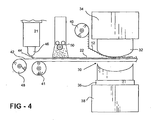
- Fig. 4 is a schematic side view of an alternative embodiment of an apparatus using a method of forming the headliner of the present invention with the press shown in the open position.
- Referring to Fig. 1, there is illustrated a headliner 10 of the present invention. The headliner 10 conforms and fits to the ceiling of the passenger compartment of a motor vehicle. The headliner 10 is formed as a laminate including a
top layer 12, aurethane core 14 and abottom layer 16. - As shown in Fig. 2, each of the top and
bottom layers non-woven polypropylene scrim 18 and apolyethylene film 20 combined to form alaminate 21. Thenon-woven polypropylene scrim 18 is preferably supplied by weight, specifically, 0.1 to 2.0 ounces per square yard, while thepolyethylene film 20 is preferably 0.0005 to 0.003 inches thick. - The
scrim 18 andfilm 20 are laminated by a combination of heat and pressure through nip rolls. Nip rolls are a pair of opposed rollers having a small gap therebetween. The rollers are heated to a temperature of about 160 degrees Fahrenheit and thescrim 18 andfilm 20 are run through the heated rollers to create a bond and laminate thescrim 18 andfilm 20. Thelaminate 21 is then perforated. Perforation of thelaminate 21 allows air and gas to permeate through thelaminate 21 during the step of forming thecore 14. - The
core 14 is formed from a layer of afiberglass mat 42 embedded in a urethane matrix offoam 44. - A chopped fiberglass roving 22 is randomly distributed between the
film 20 of thetop layer 12 and thecore 14. In one embodiment of the invention, the chopped fiberglass roving 22 is randomly distributed on thefilm 20. When the chopped fiberglass roving 22 is distributed on thefilm 20 prior to forming the substrate; i.e. when thelaminate 21 includes the chopped fiberglass roving 22, abinder material 24 is also distributed on thefilm 20 and operates to adhere the chopped fiberglass roving 22 to thefilm 20. Thebinder material 24 may be distributed on thefilm 20 along with the chopped fiberglass roving 22. Thebinder material 24 is a polyester powder adhesive that can be purchased from Bostick of Middleton, Massachusetts. When used, thebinder material 24 is applied by weight, specifically, 1 to 20 percent, by means of a shaker box that distributes at random a specific amount of the adhesive. The weight of the chopped fiberglass roving 22 determines the amount ofbinder 24 required; e.g., 40 grams per square meter requires 5 grams of powder adhesive or approximately 12 percent by weight. The fiberglass roving 22 is formed of fiberglass strands having a diameter of .03 inches chopped into two-inch lengths. As set forth above, the chopped fiberglass is randomly distributed on either thepolyethylene film 20 or theurethane core 14 at a density of 5 to150 grams per square meter. It should be appreciate that the fiberglass roving 22 may alternatively be randomly distributed between thepolyethylene film 20 of thebottom layer 16 and thecore 14 or between both the top andbottom layers core 14. - Turning now to Fig. 3, there is shown an apparatus for use with the method for forming the headliner panel 10. The apparatus includes a forming tool or die 30 shown with an
upper platen 32 attached to apress head 34 and alower platen 36 attached to apress bed 38. Thelaminate 21 forms both thetop 12 andbottom 16 layers of the headliner 10 and is supplied as a rolled good fromsupply rollers fiberglass mat 42 is supplied as a rolled good fromsupply roller 48. During the manufacturing process, as theglass mat 42 is rolled or pulled into the formingtool 30, theurethane matrix 44 is sprayed onto theglass mat 42 by aurethane spray head 46. Next, the chopped fiberglass roving 22 is distributed from ahopper 50 onto theurethane matrix 44, after which the entire assembly including thetop layer 12, chopped fiberglass roving 22,urethane matrix 44,glass mat 42, andbottom layer 16 are placed in the formingtool 30 which operates, through a molding cycle, to form the headliner 10. In this method or process, nobinder 24 is used. If required, additional glass or other fibers can be added as rolled goods prior to spraying theurethane matrix 44. Also, additional chopped fiber materials such as jute, sisal, or hemp may be used in place of the chopped fiberglass roving 22. - Turning now to Fig. 4, an alternative embodiment of an apparatus and method for manufacturing a headliner 10 is shown. Again, a forming tool or die 30 receives the headliner 10 components from a plurality of supply rollers. The lower or
bottom layer 16 is thelaminate 21 supplied as a rolled good drawn fromsupply roller 40. Afiberglass mat 42 is also supplied from asupply roll 48. Once again, prior to the molding process, aurethane matrix 44 is deposited on thefiberglass mat 42 by aurethane spray head 46. Thetop layer 12 includes thelaminate 21 with the chopped fiberglass roving 22 already secured thereto by abinder material 24. Thetop layer 12 is supplied as a rolled good from asupply roller 52. - Accordingly, the chopped fiberglass roving 22 gives internal structure to the headliner 10 as the
urethane matrix 44 adheres to the chopped fiberglass roving 22 to prevent the headliner 10 from warping after shaping and molding in the formingtool 30. It should be understood that thefilm 20, while perforated to allow the air and gas to escape therethrough, provides a barrier that prevents theurethane matrix 44 from leaking through to the outer surface of the headliner 10. Finally, thescrim 18 provides an anti-squeak and smooth surface quality to the outer surface of the headliner 10. - Pursuant to the present invention, the chopped fiber material combines with the polypropylene non-woven material and polyethylene film to prevent warpage in headliners and similar products. As disclosed herein, various chopped fiber materials may be used. The invention teaches inline random distribution of the chopped fiber material during introduction directly onto the urethane matrix. Alternatively, the chopped fiber material is randomly distributed on and attached to the polypropylene non-woven material and polyethylene film laminate by a binder material prior to layering with the urethane matrix.
- The present invention has been described in an illustrative manner. It is to be understood that the terminology, which has been used, is intended to be in the nature of words of description rather than of limitation.
- Many modifications and variations of the present invention are possible in light of the above teachings. Therefore, within the scope of the appended claims, the present invention may be practiced other than as specifically described.
Claims (11)
- A headliner (10) for use in an automotive vehicle comprising:a top layer (12) and a bottom layer (16),a urethane matrix disposed between said top layer (12) and said bottom layer (16) and forming a urethane core (14), anda chopped fiber material (22) randomly distributed between at least one of said top layer (12) and said bottom layer (16) and said urethane matrix (14), characterized in thateach of said top and bottom layers (12, 16) include a laminated scrim layer (18) and film layer (20).
- A headliner (10) as set forth in claim 1 wherein said urethane matrix includes a layer of fiberglass mat (42) and a layer of urethane foam (44).
- A headliner (10) as set forth in claim 2 wherein said top layer (12) includes a non-woven polypropylene scrim (18).
- A headliner (10) as set forth in claim 3 wherein said top layer (12) includes a polyethylene film (20) bonded to said scrim (18) to form a top laminate (21).
- A headliner (10) as set forth in claim 4 wherein said bottom layer (16) includes a non-woven polypropylene scrim (18).
- A headliner (10) as set forth in claim 5 wherein said bottom layer (16) includes a polypropylene film (20) bonded to said scrim (18) to form a bottom laminate (21).
- A headliner (10) as set forth in claim 6 wherein said urethane matrix (14) includes a fiberglass mat embedded in a layer of urethane foam (44) between said top and bottom layers (12, 16).
- A headliner (10) as set forth in claim 7 wherein said chopped fiber material includes strands of chopped fiberglass roving (22) randomly distributed between one of said top and bottom layers (12, 16) and said urethane matrix.
- A headliner (10) as set forth in claim 8 wherein said chopped fiber material (22) includes jute.
- A headliner (10) as set forth in claim 8 wherein said chopped fibre material (22) includes sisal.
- A headliner (10) as set forth in claim 8 wherein said chopped fiber material (22) includes hemp.
Applications Claiming Priority (2)
| Application Number | Priority Date | Filing Date | Title |
|---|---|---|---|
| US21675700P | 2000-07-07 | 2000-07-07 | |
| EP01951280A EP1299264A1 (en) | 2000-07-07 | 2001-07-06 | Method of manufacturing a headliner |
Related Parent Applications (2)
| Application Number | Title | Priority Date | Filing Date |
|---|---|---|---|
| EP01951280.5 Division | 2001-07-06 | ||
| EP01951280A Division EP1299264A1 (en) | 2000-07-07 | 2001-07-06 | Method of manufacturing a headliner |
Publications (3)
| Publication Number | Publication Date |
|---|---|
| EP1632398A2 true EP1632398A2 (en) | 2006-03-08 |
| EP1632398A3 EP1632398A3 (en) | 2009-02-04 |
| EP1632398B1 EP1632398B1 (en) | 2010-03-24 |
Family
ID=35810022
Family Applications (1)
| Application Number | Title | Priority Date | Filing Date |
|---|---|---|---|
| EP05015313A Expired - Lifetime EP1632398B1 (en) | 2000-07-07 | 2001-07-06 | Headliner and method of manufacturing the same |
Country Status (1)
| Country | Link |
|---|---|
| EP (1) | EP1632398B1 (en) |
Families Citing this family (1)
| Publication number | Priority date | Publication date | Assignee | Title |
|---|---|---|---|---|
| DE102014206797A1 (en) | 2014-04-08 | 2015-10-08 | Bayerische Motoren Werke Aktiengesellschaft | Interior trim element for the interior of a motor vehicle |
Family Cites Families (7)
| Publication number | Priority date | Publication date | Assignee | Title |
|---|---|---|---|---|
| US5007976A (en) * | 1989-10-16 | 1991-04-16 | Process Bonding, Inc. | Method of making a headliner |
| US5549776A (en) * | 1991-02-20 | 1996-08-27 | Indian Head Industries | Self-supporting impact resistant laminate |
| US5441675A (en) * | 1993-11-01 | 1995-08-15 | Davidson Textron, Inc. | Forming method and apparatus |
| US5486256A (en) * | 1994-05-17 | 1996-01-23 | Process Bonding, Inc. | Method of making a headliner and the like |
| US5804262A (en) * | 1996-08-16 | 1998-09-08 | United Technologies Automotive Inc. | Vehicle trim panel with natural fiber layers |
| US5942321A (en) * | 1997-09-29 | 1999-08-24 | Findlay Industries, Inc. | Headliner |
| BR0009909A (en) * | 1999-04-22 | 2002-01-08 | Magna Interior Sys Inc | Ceiling lining mountable against a vehicle roof to form a part of the interior of a vehicle, vehicle, and process to produce a roof lining |
-
2001
- 2001-07-06 EP EP05015313A patent/EP1632398B1/en not_active Expired - Lifetime
Non-Patent Citations (1)
| Title |
|---|
| None |
Also Published As
| Publication number | Publication date |
|---|---|
| EP1632398A3 (en) | 2009-02-04 |
| EP1632398B1 (en) | 2010-03-24 |
Similar Documents
| Publication | Publication Date | Title |
|---|---|---|
| US6297176B1 (en) | Non-fiberglass sound absorbing moldable thermoplastic structure | |
| US6156682A (en) | Laminated structures with multiple denier polyester core fibers, randomly oriented reinforcement fibers, and methods of manufacture | |
| US5942321A (en) | Headliner | |
| US6793747B2 (en) | Method and apparatus for fabricating chopped fiberglass laminate for automotive headliners | |
| US20110315310A1 (en) | Single press mold process for forming a finished light weight structural component | |
| CN100450823C (en) | Molded interior trim installation materials for automobiles | |
| US9950679B2 (en) | Fabrication method for making an equipment device for an automotive vehicle and associated equipment device for an automotive vehicle comprising a composite body | |
| US20030100232A1 (en) | Headliner and method of manufacturing the same | |
| US20040235378A1 (en) | Vehicle interior trim component of basalt fibers and thermosetting resin and method of manufacturing the same | |
| JP2011143763A (en) | Automobile exterior material | |
| US20060289230A1 (en) | Acoustical insulation for motor vehicles | |
| EP0832787A1 (en) | Headliner and method of manufacturing | |
| US4983442A (en) | Composite article and method of making same | |
| JP2002144976A (en) | Molded ceiling for car and its manufacturing method | |
| EP0908303A2 (en) | Vehicle interior panel and method of manufacture | |
| DE2307590A1 (en) | PROCESS FOR THE PRODUCTION OF SPHERICALLY DEFORMABLE, LOAD-BEARING FLAT FORMATS FROM ORGANIC MATERIALS | |
| EP1632398B1 (en) | Headliner and method of manufacturing the same | |
| EP1299264A1 (en) | Method of manufacturing a headliner | |
| EP1171325B1 (en) | Vehicle headliner including a polyurethane substrate and multi-layered laminate, and method of making the same | |
| US20040235377A1 (en) | Vehicle interior trim component of basalt fibers and polypropylene binder and method of manufacturing the same | |
| US20240286397A1 (en) | Method for producing sound insulation | |
| JP2721820B2 (en) | Fiber reinforced thermoplastic resin laminate | |
| US12565025B2 (en) | Nonwoven laminate | |
| KR20240076070A (en) | Vehicle Trunk Luggage Covering Mat Using A Single Material And Its Manufacturing Method | |
| US20050136756A1 (en) | Laminated article and method of manufacturing same |
Legal Events
| Date | Code | Title | Description |
|---|---|---|---|
| PUAI | Public reference made under article 153(3) epc to a published international application that has entered the european phase |
Free format text: ORIGINAL CODE: 0009012 |
|
| AC | Divisional application: reference to earlier application |
Ref document number: 1299264 Country of ref document: EP Kind code of ref document: P |
|
| AK | Designated contracting states |
Kind code of ref document: A2 Designated state(s): DE FR GB |
|
| 17P | Request for examination filed |
Effective date: 20060421 |
|
| DET | De: translation of patent claims | ||
| PUAL | Search report despatched |
Free format text: ORIGINAL CODE: 0009013 |
|
| AK | Designated contracting states |
Kind code of ref document: A3 Designated state(s): DE FR GB |
|
| AKX | Designation fees paid |
Designated state(s): DE FR GB |
|
| GRAP | Despatch of communication of intention to grant a patent |
Free format text: ORIGINAL CODE: EPIDOSNIGR1 |
|
| GRAS | Grant fee paid |
Free format text: ORIGINAL CODE: EPIDOSNIGR3 |
|
| GRAA | (expected) grant |
Free format text: ORIGINAL CODE: 0009210 |
|
| AC | Divisional application: reference to earlier application |
Ref document number: 1299264 Country of ref document: EP Kind code of ref document: P |
|
| AK | Designated contracting states |
Kind code of ref document: B1 Designated state(s): DE FR GB |
|
| REG | Reference to a national code |
Ref country code: GB Ref legal event code: FG4D |
|
| REF | Corresponds to: |
Ref document number: 60141656 Country of ref document: DE Date of ref document: 20100506 Kind code of ref document: P |
|
| PLBE | No opposition filed within time limit |
Free format text: ORIGINAL CODE: 0009261 |
|
| STAA | Information on the status of an ep patent application or granted ep patent |
Free format text: STATUS: NO OPPOSITION FILED WITHIN TIME LIMIT |
|
| 26N | No opposition filed |
Effective date: 20101228 |
|
| GBPC | Gb: european patent ceased through non-payment of renewal fee |
Effective date: 20100706 |
|
| REG | Reference to a national code |
Ref country code: FR Ref legal event code: ST Effective date: 20110331 |
|
| PG25 | Lapsed in a contracting state [announced via postgrant information from national office to epo] |
Ref country code: FR Free format text: LAPSE BECAUSE OF NON-PAYMENT OF DUE FEES Effective date: 20100802 |
|
| PG25 | Lapsed in a contracting state [announced via postgrant information from national office to epo] |
Ref country code: GB Free format text: LAPSE BECAUSE OF NON-PAYMENT OF DUE FEES Effective date: 20100706 |
|
| REG | Reference to a national code |
Ref country code: DE Ref legal event code: R082 Ref document number: 60141656 Country of ref document: DE Representative=s name: MUELLER & SCHUBERT PATENTANWAELTE, DE Ref country code: DE Ref legal event code: R082 Ref document number: 60141656 Country of ref document: DE Representative=s name: SCHUBERT, KLEMENS, DIPL.-CHEM. DR.RER.NAT., DE Ref country code: DE Ref legal event code: R082 Ref document number: 60141656 Country of ref document: DE Representative=s name: GLAWE DELFS MOLL PARTNERSCHAFT MBB VON PATENT-, DE |
|
| REG | Reference to a national code |
Ref country code: DE Ref legal event code: R082 Ref document number: 60141656 Country of ref document: DE Representative=s name: MUELLER & SCHUBERT PATENTANWAELTE, DE Ref country code: DE Ref legal event code: R082 Ref document number: 60141656 Country of ref document: DE Representative=s name: SCHUBERT, KLEMENS, DIPL.-CHEM. DR.RER.NAT., DE Ref country code: DE Ref legal event code: R081 Ref document number: 60141656 Country of ref document: DE Owner name: GRUPO ANTOLIN-IRAUSA, S.A., ES Free format text: FORMER OWNER: MAGNA INTERIOR SYSTEMS INC., AURORA, ONTARIO, CA |
|
| PGFP | Annual fee paid to national office [announced via postgrant information from national office to epo] |
Ref country code: DE Payment date: 20190730 Year of fee payment: 19 |
|
| REG | Reference to a national code |
Ref country code: DE Ref legal event code: R082 Ref document number: 60141656 Country of ref document: DE Representative=s name: SCHUBERT, KLEMENS, DIPL.-CHEM. DR.RER.NAT., DE |
|
| REG | Reference to a national code |
Ref country code: DE Ref legal event code: R119 Ref document number: 60141656 Country of ref document: DE |
|
| PG25 | Lapsed in a contracting state [announced via postgrant information from national office to epo] |
Ref country code: DE Free format text: LAPSE BECAUSE OF NON-PAYMENT OF DUE FEES Effective date: 20210202 |