EP1632229A1 - Medicaments for the treatment of urinary tract disorders comprising anticholinergic agents - Google Patents
Medicaments for the treatment of urinary tract disorders comprising anticholinergic agents Download PDFInfo
- Publication number
- EP1632229A1 EP1632229A1 EP04019003A EP04019003A EP1632229A1 EP 1632229 A1 EP1632229 A1 EP 1632229A1 EP 04019003 A EP04019003 A EP 04019003A EP 04019003 A EP04019003 A EP 04019003A EP 1632229 A1 EP1632229 A1 EP 1632229A1
- Authority
- EP
- European Patent Office
- Prior art keywords
- denotes
- hydroxy
- methyl
- alkyl
- denote
- Prior art date
- Legal status (The legal status is an assumption and is not a legal conclusion. Google has not performed a legal analysis and makes no representation as to the accuracy of the status listed.)
- Granted
Links
- 208000026723 Urinary tract disease Diseases 0.000 title claims abstract description 20
- 239000003814 drug Substances 0.000 title claims abstract description 20
- 208000014001 urinary system disease Diseases 0.000 title claims abstract description 20
- 239000000812 cholinergic antagonist Substances 0.000 title description 11
- 229940121948 Muscarinic receptor antagonist Drugs 0.000 title description 7
- 230000001078 anti-cholinergic effect Effects 0.000 claims abstract description 29
- 238000002360 preparation method Methods 0.000 claims abstract description 25
- 150000003839 salts Chemical class 0.000 claims description 63
- 150000001875 compounds Chemical class 0.000 claims description 49
- -1 methyloxy, ethyloxy Chemical group 0.000 claims description 47
- 239000001257 hydrogen Substances 0.000 claims description 43
- 229910052739 hydrogen Inorganic materials 0.000 claims description 43
- 125000002496 methyl group Chemical group [H]C([H])([H])* 0.000 claims description 40
- CPELXLSAUQHCOX-UHFFFAOYSA-M Bromide Chemical compound [Br-] CPELXLSAUQHCOX-UHFFFAOYSA-M 0.000 claims description 32
- 239000000203 mixture Substances 0.000 claims description 32
- PXGOKWXKJXAPGV-UHFFFAOYSA-N Fluorine Chemical group FF PXGOKWXKJXAPGV-UHFFFAOYSA-N 0.000 claims description 29
- 239000011737 fluorine Chemical group 0.000 claims description 29
- 229910052731 fluorine Chemical group 0.000 claims description 29
- 125000002887 hydroxy group Chemical group [H]O* 0.000 claims description 29
- 125000002023 trifluoromethyl group Chemical group FC(F)(F)* 0.000 claims description 28
- 125000001495 ethyl group Chemical group [H]C([H])([H])C([H])([H])* 0.000 claims description 25
- 229910052736 halogen Chemical group 0.000 claims description 25
- 150000002431 hydrogen Chemical class 0.000 claims description 22
- 150000001450 anions Chemical class 0.000 claims description 21
- VZCYOOQTPOCHFL-UHFFFAOYSA-N trans-butenedioic acid Natural products OC(=O)C=CC(O)=O VZCYOOQTPOCHFL-UHFFFAOYSA-N 0.000 claims description 21
- VEXZGXHMUGYJMC-UHFFFAOYSA-M Chloride anion Chemical compound [Cl-] VEXZGXHMUGYJMC-UHFFFAOYSA-M 0.000 claims description 20
- UFHFLCQGNIYNRP-UHFFFAOYSA-N Hydrogen Chemical compound [H][H] UFHFLCQGNIYNRP-UHFFFAOYSA-N 0.000 claims description 19
- AFVFQIVMOAPDHO-UHFFFAOYSA-M Methanesulfonate Chemical compound CS([O-])(=O)=O AFVFQIVMOAPDHO-UHFFFAOYSA-M 0.000 claims description 19
- 150000002367 halogens Chemical group 0.000 claims description 19
- FEWJPZIEWOKRBE-JCYAYHJZSA-N Dextrotartaric acid Chemical compound OC(=O)[C@H](O)[C@@H](O)C(O)=O FEWJPZIEWOKRBE-JCYAYHJZSA-N 0.000 claims description 18
- WKBOTKDWSSQWDR-UHFFFAOYSA-N Bromine atom Chemical compound [Br] WKBOTKDWSSQWDR-UHFFFAOYSA-N 0.000 claims description 13
- GDTBXPJZTBHREO-UHFFFAOYSA-N bromine Substances BrBr GDTBXPJZTBHREO-UHFFFAOYSA-N 0.000 claims description 13
- 229910052794 bromium Inorganic materials 0.000 claims description 13
- ZAMOUSCENKQFHK-UHFFFAOYSA-N Chlorine atom Chemical compound [Cl] ZAMOUSCENKQFHK-UHFFFAOYSA-N 0.000 claims description 12
- VZCYOOQTPOCHFL-OWOJBTEDSA-N Fumaric acid Chemical compound OC(=O)\C=C\C(O)=O VZCYOOQTPOCHFL-OWOJBTEDSA-N 0.000 claims description 12
- 206010046543 Urinary incontinence Diseases 0.000 claims description 12
- 239000000460 chlorine Substances 0.000 claims description 12
- 229910052801 chlorine Inorganic materials 0.000 claims description 12
- XMBWDFGMSWQBCA-UHFFFAOYSA-N hydrogen iodide Chemical compound I XMBWDFGMSWQBCA-UHFFFAOYSA-N 0.000 claims description 12
- JOXIMZWYDAKGHI-UHFFFAOYSA-M toluene-4-sulfonate Chemical compound CC1=CC=C(S([O-])(=O)=O)C=C1 JOXIMZWYDAKGHI-UHFFFAOYSA-M 0.000 claims description 12
- QAOWNCQODCNURD-UHFFFAOYSA-L Sulfate Chemical compound [O-]S([O-])(=O)=O QAOWNCQODCNURD-UHFFFAOYSA-L 0.000 claims description 11
- ANGKOCUUWGHLCE-HKUYNNGSSA-N [(3s)-1,1-dimethylpyrrolidin-1-ium-3-yl] (2r)-2-cyclopentyl-2-hydroxy-2-phenylacetate Chemical class C1[N+](C)(C)CC[C@@H]1OC(=O)[C@](O)(C=1C=CC=CC=1)C1CCCC1 ANGKOCUUWGHLCE-HKUYNNGSSA-N 0.000 claims description 11
- 229910021653 sulphate ion Inorganic materials 0.000 claims description 11
- QTBSBXVTEAMEQO-UHFFFAOYSA-M Acetate Chemical compound CC([O-])=O QTBSBXVTEAMEQO-UHFFFAOYSA-M 0.000 claims description 10
- KRKNYBCHXYNGOX-UHFFFAOYSA-K Citrate Chemical compound [O-]C(=O)CC(O)(CC([O-])=O)C([O-])=O KRKNYBCHXYNGOX-UHFFFAOYSA-K 0.000 claims description 10
- 229910002651 NO3 Inorganic materials 0.000 claims description 10
- NHNBFGGVMKEFGY-UHFFFAOYSA-N Nitrate Chemical compound [O-][N+]([O-])=O NHNBFGGVMKEFGY-UHFFFAOYSA-N 0.000 claims description 10
- MUBZPKHOEPUJKR-UHFFFAOYSA-N Oxalic acid Chemical compound OC(=O)C(O)=O MUBZPKHOEPUJKR-UHFFFAOYSA-N 0.000 claims description 10
- 229910019142 PO4 Inorganic materials 0.000 claims description 10
- WPYMKLBDIGXBTP-UHFFFAOYSA-N benzoic acid Chemical compound OC(=O)C1=CC=CC=C1 WPYMKLBDIGXBTP-UHFFFAOYSA-N 0.000 claims description 10
- VZCYOOQTPOCHFL-UPHRSURJSA-N maleic acid Chemical compound OC(=O)\C=C/C(O)=O VZCYOOQTPOCHFL-UPHRSURJSA-N 0.000 claims description 10
- NBIIXXVUZAFLBC-UHFFFAOYSA-K phosphate Chemical compound [O-]P([O-])([O-])=O NBIIXXVUZAFLBC-UHFFFAOYSA-K 0.000 claims description 10
- 239000010452 phosphate Substances 0.000 claims description 10
- KDYFGRWQOYBRFD-UHFFFAOYSA-L succinate(2-) Chemical compound [O-]C(=O)CCC([O-])=O KDYFGRWQOYBRFD-UHFFFAOYSA-L 0.000 claims description 10
- 229940095064 tartrate Drugs 0.000 claims description 10
- 125000004178 (C1-C4) alkyl group Chemical group 0.000 claims description 9
- KRHYYFGTRYWZRS-UHFFFAOYSA-M Fluoride anion Chemical compound [F-] KRHYYFGTRYWZRS-UHFFFAOYSA-M 0.000 claims description 9
- LERNTVKEWCAPOY-DZZGSBJMSA-N tiotropium Chemical class O([C@H]1C[C@@H]2[N+]([C@H](C1)[C@@H]1[C@H]2O1)(C)C)C(=O)C(O)(C=1SC=CC=1)C1=CC=CS1 LERNTVKEWCAPOY-DZZGSBJMSA-N 0.000 claims description 9
- 210000001635 urinary tract Anatomy 0.000 claims description 8
- 238000009472 formulation Methods 0.000 claims description 7
- 150000004677 hydrates Chemical class 0.000 claims description 7
- OYYDSUSKLWTMMQ-JKHIJQBDSA-N trospium Chemical class [N+]12([C@@H]3CC[C@H]2C[C@H](C3)OC(=O)C(O)(C=2C=CC=CC=2)C=2C=CC=CC=2)CCCC1 OYYDSUSKLWTMMQ-JKHIJQBDSA-N 0.000 claims description 7
- JNCMHMUGTWEVOZ-UHFFFAOYSA-N F[CH]F Chemical compound F[CH]F JNCMHMUGTWEVOZ-UHFFFAOYSA-N 0.000 claims description 5
- 208000000921 Urge Urinary Incontinence Diseases 0.000 claims description 5
- 125000006527 (C1-C5) alkyl group Chemical group 0.000 claims description 4
- 125000005913 (C3-C6) cycloalkyl group Chemical group 0.000 claims description 4
- CTCCHKSGCBWINA-UHFFFAOYSA-N 2-methoxyethoxy hypofluorite Chemical compound COCCOOF CTCCHKSGCBWINA-UHFFFAOYSA-N 0.000 claims description 4
- 206010066218 Stress Urinary Incontinence Diseases 0.000 claims description 4
- 239000002671 adjuvant Substances 0.000 claims description 4
- 125000001449 isopropyl group Chemical group [H]C([H])([H])C([H])(*)C([H])([H])[H] 0.000 claims description 4
- 125000000956 methoxy group Chemical group [H]C([H])([H])O* 0.000 claims description 4
- 125000004123 n-propyl group Chemical group [H]C([H])([H])C([H])([H])C([H])([H])* 0.000 claims description 4
- 206010007027 Calculus urinary Diseases 0.000 claims description 3
- 231100000252 nontoxic Toxicity 0.000 claims description 3
- 230000003000 nontoxic effect Effects 0.000 claims description 3
- 208000008281 urolithiasis Diseases 0.000 claims description 3
- 239000003981 vehicle Substances 0.000 claims description 3
- 208000007101 Muscle Cramp Diseases 0.000 claims description 2
- 208000005392 Spasm Diseases 0.000 claims description 2
- 208000031513 cyst Diseases 0.000 claims description 2
- 239000003937 drug carrier Substances 0.000 claims description 2
- 125000004672 ethylcarbonyl group Chemical group [H]C([H])([H])C([H])([H])C(*)=O 0.000 claims description 2
- 125000004435 hydrogen atom Chemical group [H]* 0.000 claims description 2
- 125000004029 hydroxymethyl group Chemical group [H]OC([H])([H])* 0.000 claims description 2
- 125000004674 methylcarbonyl group Chemical group CC(=O)* 0.000 claims description 2
- 239000012453 solvate Substances 0.000 claims description 2
- 238000011200 topical administration Methods 0.000 claims description 2
- 230000000699 topical effect Effects 0.000 claims description 2
- 239000002253 acid Substances 0.000 claims 1
- FAPWRFPIFSIZLT-UHFFFAOYSA-M Sodium chloride Chemical compound [Na+].[Cl-] FAPWRFPIFSIZLT-UHFFFAOYSA-M 0.000 description 44
- 239000004615 ingredient Substances 0.000 description 41
- XLYOFNOQVPJJNP-UHFFFAOYSA-N water Substances O XLYOFNOQVPJJNP-UHFFFAOYSA-N 0.000 description 34
- FIMXSEMBHGTNKT-UHFFFAOYSA-N Scopine Natural products CN1C2CC(O)CC1C1C2O1 FIMXSEMBHGTNKT-UHFFFAOYSA-N 0.000 description 25
- LXCFILQKKLGQFO-UHFFFAOYSA-N methylparaben Chemical compound COC(=O)C1=CC=C(O)C=C1 LXCFILQKKLGQFO-UHFFFAOYSA-N 0.000 description 22
- 239000000546 pharmaceutical excipient Substances 0.000 description 22
- 239000000843 powder Substances 0.000 description 21
- 239000011780 sodium chloride Substances 0.000 description 21
- 239000000829 suppository Substances 0.000 description 17
- JCXJVPUVTGWSNB-UHFFFAOYSA-N Nitrogen dioxide Chemical compound O=[N]=O JCXJVPUVTGWSNB-UHFFFAOYSA-N 0.000 description 16
- VYPSYNLAJGMNEJ-UHFFFAOYSA-N Silicium dioxide Chemical compound O=[Si]=O VYPSYNLAJGMNEJ-UHFFFAOYSA-N 0.000 description 16
- GWEVSGVZZGPLCZ-UHFFFAOYSA-N Titan oxide Chemical compound O=[Ti]=O GWEVSGVZZGPLCZ-UHFFFAOYSA-N 0.000 description 16
- HBAQYPYDRFILMT-UHFFFAOYSA-N 8-[3-(1-cyclopropylpyrazol-4-yl)-1H-pyrazolo[4,3-d]pyrimidin-5-yl]-3-methyl-3,8-diazabicyclo[3.2.1]octan-2-one Chemical class C1(CC1)N1N=CC(=C1)C1=NNC2=C1N=C(N=C2)N1C2C(N(CC1CC2)C)=O HBAQYPYDRFILMT-UHFFFAOYSA-N 0.000 description 14
- 239000008194 pharmaceutical composition Substances 0.000 description 13
- QELSKZZBTMNZEB-UHFFFAOYSA-N propylparaben Chemical compound CCCOC(=O)C1=CC=C(O)C=C1 QELSKZZBTMNZEB-UHFFFAOYSA-N 0.000 description 13
- FIMXSEMBHGTNKT-RZVDLVGDSA-N scopine Chemical compound C([C@@H]1N2C)[C@H](O)C[C@@H]2[C@@H]2[C@H]1O2 FIMXSEMBHGTNKT-RZVDLVGDSA-N 0.000 description 13
- 239000003380 propellant Substances 0.000 description 12
- PUPWRKQSVGUBQS-UHFFFAOYSA-N 9-methylfluorene-9-carboxylic acid Chemical compound C1=CC=C2C(C)(C(O)=O)C3=CC=CC=C3C2=C1 PUPWRKQSVGUBQS-UHFFFAOYSA-N 0.000 description 11
- CZMRCDWAGMRECN-UGDNZRGBSA-N Sucrose Chemical compound O[C@H]1[C@H](O)[C@@H](CO)O[C@@]1(CO)O[C@@H]1[C@H](O)[C@@H](O)[C@H](O)[C@@H](CO)O1 CZMRCDWAGMRECN-UGDNZRGBSA-N 0.000 description 11
- 229930006000 Sucrose Natural products 0.000 description 11
- 239000004480 active ingredient Substances 0.000 description 11
- 235000010270 methyl p-hydroxybenzoate Nutrition 0.000 description 11
- 235000010232 propyl p-hydroxybenzoate Nutrition 0.000 description 11
- 229960003415 propylparaben Drugs 0.000 description 11
- 229960004793 sucrose Drugs 0.000 description 11
- 239000003708 ampul Substances 0.000 description 10
- 239000008187 granular material Substances 0.000 description 10
- 238000000034 method Methods 0.000 description 10
- 239000000243 solution Substances 0.000 description 10
- 239000005720 sucrose Substances 0.000 description 10
- 229920002261 Corn starch Polymers 0.000 description 9
- 240000007472 Leucaena leucocephala Species 0.000 description 9
- 235000010643 Leucaena leucocephala Nutrition 0.000 description 9
- 235000021355 Stearic acid Nutrition 0.000 description 9
- 239000013543 active substance Substances 0.000 description 9
- 235000013871 bee wax Nutrition 0.000 description 9
- 239000012166 beeswax Substances 0.000 description 9
- 239000007789 gas Substances 0.000 description 9
- QIQXTHQIDYTFRH-UHFFFAOYSA-N octadecanoic acid Chemical compound CCCCCCCCCCCCCCCCCC(O)=O QIQXTHQIDYTFRH-UHFFFAOYSA-N 0.000 description 9
- OQCDKBAXFALNLD-UHFFFAOYSA-N octadecanoic acid Natural products CCCCCCCC(C)CCCCCCCCC(O)=O OQCDKBAXFALNLD-UHFFFAOYSA-N 0.000 description 9
- 239000008117 stearic acid Substances 0.000 description 9
- 239000000725 suspension Substances 0.000 description 9
- 239000000454 talc Substances 0.000 description 9
- 235000012222 talc Nutrition 0.000 description 9
- 229910052623 talc Inorganic materials 0.000 description 9
- LERNTVKEWCAPOY-VOGVJGKGSA-N C[N+]1(C)[C@H]2C[C@H](C[C@@H]1[C@H]1O[C@@H]21)OC(=O)C(O)(c1cccs1)c1cccs1 Chemical compound C[N+]1(C)[C@H]2C[C@H](C[C@@H]1[C@H]1O[C@@H]21)OC(=O)C(O)(c1cccs1)c1cccs1 LERNTVKEWCAPOY-VOGVJGKGSA-N 0.000 description 8
- 235000019759 Maize starch Nutrition 0.000 description 8
- 229920003080 Povidone K 25 Polymers 0.000 description 8
- 229920002472 Starch Polymers 0.000 description 8
- FEWJPZIEWOKRBE-UHFFFAOYSA-N Tartaric acid Natural products [H+].[H+].[O-]C(=O)C(O)C(O)C([O-])=O FEWJPZIEWOKRBE-UHFFFAOYSA-N 0.000 description 8
- 239000000443 aerosol Substances 0.000 description 8
- XAAHAAMILDNBPS-UHFFFAOYSA-L calcium hydrogenphosphate dihydrate Chemical compound O.O.[Ca+2].OP([O-])([O-])=O XAAHAAMILDNBPS-UHFFFAOYSA-L 0.000 description 8
- 125000004432 carbon atom Chemical group C* 0.000 description 8
- 239000004203 carnauba wax Substances 0.000 description 8
- 235000013869 carnauba wax Nutrition 0.000 description 8
- 235000019700 dicalcium phosphate Nutrition 0.000 description 8
- 229940095079 dicalcium phosphate anhydrous Drugs 0.000 description 8
- 229940116364 hard fat Drugs 0.000 description 8
- 229940100487 povidone k25 Drugs 0.000 description 8
- 239000000377 silicon dioxide Substances 0.000 description 8
- 239000008107 starch Substances 0.000 description 8
- 235000019698 starch Nutrition 0.000 description 8
- 229940032147 starch Drugs 0.000 description 8
- 235000002906 tartaric acid Nutrition 0.000 description 8
- 239000011975 tartaric acid Substances 0.000 description 8
- 229960000257 tiotropium bromide Drugs 0.000 description 8
- 239000004408 titanium dioxide Substances 0.000 description 8
- 150000001768 cations Chemical class 0.000 description 7
- 229960002462 glycopyrronium bromide Drugs 0.000 description 7
- BHEFSGMUMYBJRZ-UHFFFAOYSA-N 9-fluorofluorene-9-carboxylic acid Chemical compound C1=CC=C2C(C(=O)O)(F)C3=CC=CC=C3C2=C1 BHEFSGMUMYBJRZ-UHFFFAOYSA-N 0.000 description 6
- VTYYLEPIZMXCLO-UHFFFAOYSA-L Calcium carbonate Chemical compound [Ca+2].[O-]C([O-])=O VTYYLEPIZMXCLO-UHFFFAOYSA-L 0.000 description 6
- 229920000858 Cyclodextrin Polymers 0.000 description 6
- DNIAPMSPPWPWGF-UHFFFAOYSA-N Propylene glycol Chemical compound CC(O)CO DNIAPMSPPWPWGF-UHFFFAOYSA-N 0.000 description 6
- 125000004106 butoxy group Chemical group [*]OC([H])([H])C([H])([H])C(C([H])([H])[H])([H])[H] 0.000 description 6
- 239000000796 flavoring agent Substances 0.000 description 6
- 239000007788 liquid Substances 0.000 description 6
- 239000003765 sweetening agent Substances 0.000 description 6
- 229940110309 tiotropium Drugs 0.000 description 6
- 239000000080 wetting agent Substances 0.000 description 6
- GXAMYUGOODKVRM-UHFFFAOYSA-M 9-hydroxyfluorene-9-carboxylate Chemical compound C1=CC=C2C(O)(C([O-])=O)C3=CC=CC=C3C2=C1 GXAMYUGOODKVRM-UHFFFAOYSA-M 0.000 description 5
- 125000000217 alkyl group Chemical group 0.000 description 5
- 125000000484 butyl group Chemical group [H]C([*])([H])C([H])([H])C([H])([H])C([H])([H])[H] 0.000 description 5
- 239000007859 condensation product Substances 0.000 description 5
- 235000014113 dietary fatty acids Nutrition 0.000 description 5
- 239000002270 dispersing agent Substances 0.000 description 5
- 239000002552 dosage form Substances 0.000 description 5
- 239000000839 emulsion Substances 0.000 description 5
- 150000002148 esters Chemical class 0.000 description 5
- 239000000194 fatty acid Substances 0.000 description 5
- 229930195729 fatty acid Natural products 0.000 description 5
- 150000004665 fatty acids Chemical class 0.000 description 5
- 230000003287 optical effect Effects 0.000 description 5
- 239000002245 particle Substances 0.000 description 5
- 239000003755 preservative agent Substances 0.000 description 5
- 239000000375 suspending agent Substances 0.000 description 5
- DTZDZCNXNYMMOW-UHFFFAOYSA-N 9-hydroxyxanthene-9-carboxylic acid Chemical compound C1=CC=C2C(C(=O)O)(O)C3=CC=CC=C3OC2=C1 DTZDZCNXNYMMOW-UHFFFAOYSA-N 0.000 description 4
- CBNOKZSYCBHRAD-UHFFFAOYSA-N 9-methylxanthene-9-carboxylic acid Chemical compound C1=CC=C2C(C)(C(O)=O)C3=CC=CC=C3OC2=C1 CBNOKZSYCBHRAD-UHFFFAOYSA-N 0.000 description 4
- IAYPIBMASNFSPL-UHFFFAOYSA-N Ethylene oxide Chemical compound C1CO1 IAYPIBMASNFSPL-UHFFFAOYSA-N 0.000 description 4
- ATUOYWHBWRKTHZ-UHFFFAOYSA-N Propane Chemical compound CCC ATUOYWHBWRKTHZ-UHFFFAOYSA-N 0.000 description 4
- 125000003545 alkoxy group Chemical group 0.000 description 4
- 229940065524 anticholinergics inhalants for obstructive airway diseases Drugs 0.000 description 4
- 239000007900 aqueous suspension Substances 0.000 description 4
- 235000003599 food sweetener Nutrition 0.000 description 4
- 239000003921 oil Substances 0.000 description 4
- 239000004006 olive oil Substances 0.000 description 4
- 235000008390 olive oil Nutrition 0.000 description 4
- 125000001436 propyl group Chemical group [H]C([*])([H])C([H])([H])C([H])([H])[H] 0.000 description 4
- 239000002904 solvent Substances 0.000 description 4
- 229960001491 trospium Drugs 0.000 description 4
- GUBGYTABKSRVRQ-XLOQQCSPSA-N Alpha-Lactose Chemical compound O[C@@H]1[C@@H](O)[C@@H](O)[C@@H](CO)O[C@H]1O[C@@H]1[C@@H](CO)O[C@H](O)[C@H](O)[C@H]1O GUBGYTABKSRVRQ-XLOQQCSPSA-N 0.000 description 3
- FBPFZTCFMRRESA-FSIIMWSLSA-N D-Glucitol Natural products OC[C@H](O)[C@H](O)[C@@H](O)[C@H](O)CO FBPFZTCFMRRESA-FSIIMWSLSA-N 0.000 description 3
- FBPFZTCFMRRESA-JGWLITMVSA-N D-glucitol Chemical compound OC[C@H](O)[C@@H](O)[C@H](O)[C@H](O)CO FBPFZTCFMRRESA-JGWLITMVSA-N 0.000 description 3
- PEDCQBHIVMGVHV-UHFFFAOYSA-N Glycerine Chemical compound OCC(O)CO PEDCQBHIVMGVHV-UHFFFAOYSA-N 0.000 description 3
- GUBGYTABKSRVRQ-QKKXKWKRSA-N Lactose Natural products OC[C@H]1O[C@@H](O[C@H]2[C@H](O)[C@@H](O)C(O)O[C@@H]2CO)[C@H](O)[C@@H](O)[C@H]1O GUBGYTABKSRVRQ-QKKXKWKRSA-N 0.000 description 3
- 239000002585 base Substances 0.000 description 3
- 239000001202 beta-cyclodextrine Substances 0.000 description 3
- 229910000019 calcium carbonate Inorganic materials 0.000 description 3
- 239000002775 capsule Substances 0.000 description 3
- 239000003086 colorant Substances 0.000 description 3
- 229940079593 drug Drugs 0.000 description 3
- 239000003995 emulsifying agent Substances 0.000 description 3
- 235000013355 food flavoring agent Nutrition 0.000 description 3
- 235000010979 hydroxypropyl methyl cellulose Nutrition 0.000 description 3
- 229920003088 hydroxypropyl methyl cellulose Polymers 0.000 description 3
- 239000003701 inert diluent Substances 0.000 description 3
- 239000008101 lactose Substances 0.000 description 3
- 229940057995 liquid paraffin Drugs 0.000 description 3
- 239000000463 material Substances 0.000 description 3
- 235000019198 oils Nutrition 0.000 description 3
- 235000013855 polyvinylpyrrolidone Nutrition 0.000 description 3
- 239000007787 solid Substances 0.000 description 3
- 239000000600 sorbitol Substances 0.000 description 3
- 235000010356 sorbitol Nutrition 0.000 description 3
- 239000006188 syrup Substances 0.000 description 3
- 235000020357 syrup Nutrition 0.000 description 3
- 239000003826 tablet Substances 0.000 description 3
- 235000015112 vegetable and seed oil Nutrition 0.000 description 3
- 239000008158 vegetable oil Substances 0.000 description 3
- HDTRYLNUVZCQOY-UHFFFAOYSA-N α-D-glucopyranosyl-α-D-glucopyranoside Natural products OC1C(O)C(O)C(CO)OC1OC1C(O)C(O)C(O)C(CO)O1 HDTRYLNUVZCQOY-UHFFFAOYSA-N 0.000 description 2
- PUPZLCDOIYMWBV-UHFFFAOYSA-N (+/-)-1,3-Butanediol Chemical compound CC(O)CCO PUPZLCDOIYMWBV-UHFFFAOYSA-N 0.000 description 2
- IIZPXYDJLKNOIY-JXPKJXOSSA-N 1-palmitoyl-2-arachidonoyl-sn-glycero-3-phosphocholine Chemical compound CCCCCCCCCCCCCCCC(=O)OC[C@H](COP([O-])(=O)OCC[N+](C)(C)C)OC(=O)CCC\C=C/C\C=C/C\C=C/C\C=C/CCCCC IIZPXYDJLKNOIY-JXPKJXOSSA-N 0.000 description 2
- ODELFXJUOVNEFZ-UHFFFAOYSA-N 2,2-diphenylpropanoic acid Chemical compound C=1C=CC=CC=1C(C(O)=O)(C)C1=CC=CC=C1 ODELFXJUOVNEFZ-UHFFFAOYSA-N 0.000 description 2
- 244000215068 Acacia senegal Species 0.000 description 2
- 235000006491 Acacia senegal Nutrition 0.000 description 2
- 235000003911 Arachis Nutrition 0.000 description 2
- 244000105624 Arachis hypogaea Species 0.000 description 2
- CIWBSHSKHKDKBQ-JLAZNSOCSA-N Ascorbic acid Chemical compound OC[C@H](O)[C@H]1OC(=O)C(O)=C1O CIWBSHSKHKDKBQ-JLAZNSOCSA-N 0.000 description 2
- 241000416162 Astragalus gummifer Species 0.000 description 2
- FBPFZTCFMRRESA-KVTDHHQDSA-N D-Mannitol Chemical compound OC[C@@H](O)[C@@H](O)[C@H](O)[C@H](O)CO FBPFZTCFMRRESA-KVTDHHQDSA-N 0.000 description 2
- WQZGKKKJIJFFOK-GASJEMHNSA-N Glucose Natural products OC[C@H]1OC(O)[C@H](O)[C@@H](O)[C@@H]1O WQZGKKKJIJFFOK-GASJEMHNSA-N 0.000 description 2
- 229920000084 Gum arabic Polymers 0.000 description 2
- 229930195725 Mannitol Natural products 0.000 description 2
- 229920000881 Modified starch Polymers 0.000 description 2
- WHNWPMSKXPGLAX-UHFFFAOYSA-N N-Vinyl-2-pyrrolidone Chemical compound C=CN1CCCC1=O WHNWPMSKXPGLAX-UHFFFAOYSA-N 0.000 description 2
- 229920001615 Tragacanth Polymers 0.000 description 2
- HDTRYLNUVZCQOY-WSWWMNSNSA-N Trehalose Natural products O[C@@H]1[C@@H](O)[C@@H](O)[C@@H](CO)O[C@@H]1O[C@@H]1[C@H](O)[C@@H](O)[C@@H](O)[C@@H](CO)O1 HDTRYLNUVZCQOY-WSWWMNSNSA-N 0.000 description 2
- 235000010489 acacia gum Nutrition 0.000 description 2
- 230000009471 action Effects 0.000 description 2
- 125000002947 alkylene group Chemical group 0.000 description 2
- HDTRYLNUVZCQOY-LIZSDCNHSA-N alpha,alpha-trehalose Chemical compound O[C@@H]1[C@@H](O)[C@H](O)[C@@H](CO)O[C@@H]1O[C@@H]1[C@H](O)[C@@H](O)[C@H](O)[C@@H](CO)O1 HDTRYLNUVZCQOY-LIZSDCNHSA-N 0.000 description 2
- 239000003963 antioxidant agent Substances 0.000 description 2
- 235000006708 antioxidants Nutrition 0.000 description 2
- WQZGKKKJIJFFOK-VFUOTHLCSA-N beta-D-glucose Chemical compound OC[C@H]1O[C@@H](O)[C@H](O)[C@@H](O)[C@@H]1O WQZGKKKJIJFFOK-VFUOTHLCSA-N 0.000 description 2
- 239000001506 calcium phosphate Substances 0.000 description 2
- 229910000389 calcium phosphate Inorganic materials 0.000 description 2
- 235000011010 calcium phosphates Nutrition 0.000 description 2
- 125000001559 cyclopropyl group Chemical group [H]C1([H])C([H])([H])C1([H])* 0.000 description 2
- 239000003085 diluting agent Substances 0.000 description 2
- 150000002016 disaccharides Chemical class 0.000 description 2
- 230000001804 emulsifying effect Effects 0.000 description 2
- 125000004185 ester group Chemical group 0.000 description 2
- 239000008103 glucose Substances 0.000 description 2
- BXWNKGSJHAJOGX-UHFFFAOYSA-N hexadecan-1-ol Chemical compound CCCCCCCCCCCCCCCCO BXWNKGSJHAJOGX-UHFFFAOYSA-N 0.000 description 2
- 239000001866 hydroxypropyl methyl cellulose Substances 0.000 description 2
- UFVKGYZPFZQRLF-UHFFFAOYSA-N hydroxypropyl methyl cellulose Chemical compound OC1C(O)C(OC)OC(CO)C1OC1C(O)C(O)C(OC2C(C(O)C(OC3C(C(O)C(O)C(CO)O3)O)C(CO)O2)O)C(CO)O1 UFVKGYZPFZQRLF-UHFFFAOYSA-N 0.000 description 2
- NNPPMTNAJDCUHE-UHFFFAOYSA-N isobutane Chemical compound CC(C)C NNPPMTNAJDCUHE-UHFFFAOYSA-N 0.000 description 2
- 235000010445 lecithin Nutrition 0.000 description 2
- 239000000787 lecithin Substances 0.000 description 2
- 229940067606 lecithin Drugs 0.000 description 2
- 239000000314 lubricant Substances 0.000 description 2
- HQKMJHAJHXVSDF-UHFFFAOYSA-L magnesium stearate Chemical compound [Mg+2].CCCCCCCCCCCCCCCCCC([O-])=O.CCCCCCCCCCCCCCCCCC([O-])=O HQKMJHAJHXVSDF-UHFFFAOYSA-L 0.000 description 2
- 239000000594 mannitol Substances 0.000 description 2
- 235000010355 mannitol Nutrition 0.000 description 2
- 238000004519 manufacturing process Methods 0.000 description 2
- 239000002480 mineral oil Substances 0.000 description 2
- 235000010446 mineral oil Nutrition 0.000 description 2
- 238000002156 mixing Methods 0.000 description 2
- 150000002772 monosaccharides Chemical class 0.000 description 2
- IJDNQMDRQITEOD-UHFFFAOYSA-N n-butane Chemical compound CCCC IJDNQMDRQITEOD-UHFFFAOYSA-N 0.000 description 2
- 239000000346 nonvolatile oil Substances 0.000 description 2
- 239000008188 pellet Substances 0.000 description 2
- 229920001223 polyethylene glycol Polymers 0.000 description 2
- 235000010482 polyoxyethylene sorbitan monooleate Nutrition 0.000 description 2
- 239000000244 polyoxyethylene sorbitan monooleate Substances 0.000 description 2
- 229920000053 polysorbate 80 Polymers 0.000 description 2
- 229920000036 polyvinylpyrrolidone Polymers 0.000 description 2
- 125000002572 propoxy group Chemical group [*]OC([H])([H])C(C([H])([H])[H])([H])[H] 0.000 description 2
- 208000024891 symptom Diseases 0.000 description 2
- 230000001225 therapeutic effect Effects 0.000 description 2
- QORWJWZARLRLPR-UHFFFAOYSA-H tricalcium bis(phosphate) Chemical compound [Ca+2].[Ca+2].[Ca+2].[O-]P([O-])([O-])=O.[O-]P([O-])([O-])=O QORWJWZARLRLPR-UHFFFAOYSA-H 0.000 description 2
- LNAZSHAWQACDHT-XIYTZBAFSA-N (2r,3r,4s,5r,6s)-4,5-dimethoxy-2-(methoxymethyl)-3-[(2s,3r,4s,5r,6r)-3,4,5-trimethoxy-6-(methoxymethyl)oxan-2-yl]oxy-6-[(2r,3r,4s,5r,6r)-4,5,6-trimethoxy-2-(methoxymethyl)oxan-3-yl]oxyoxane Chemical compound CO[C@@H]1[C@@H](OC)[C@H](OC)[C@@H](COC)O[C@H]1O[C@H]1[C@H](OC)[C@@H](OC)[C@H](O[C@H]2[C@@H]([C@@H](OC)[C@H](OC)O[C@@H]2COC)OC)O[C@@H]1COC LNAZSHAWQACDHT-XIYTZBAFSA-N 0.000 description 1
- WRIDQFICGBMAFQ-UHFFFAOYSA-N (E)-8-Octadecenoic acid Natural products CCCCCCCCCC=CCCCCCCC(O)=O WRIDQFICGBMAFQ-UHFFFAOYSA-N 0.000 description 1
- DNIAPMSPPWPWGF-GSVOUGTGSA-N (R)-(-)-Propylene glycol Chemical compound C[C@@H](O)CO DNIAPMSPPWPWGF-GSVOUGTGSA-N 0.000 description 1
- YFMFNYKEUDLDTL-UHFFFAOYSA-N 1,1,1,2,3,3,3-heptafluoropropane Chemical compound FC(F)(F)C(F)C(F)(F)F YFMFNYKEUDLDTL-UHFFFAOYSA-N 0.000 description 1
- LVGUZGTVOIAKKC-UHFFFAOYSA-N 1,1,1,2-tetrafluoroethane Chemical compound FCC(F)(F)F LVGUZGTVOIAKKC-UHFFFAOYSA-N 0.000 description 1
- ZORQXIQZAOLNGE-UHFFFAOYSA-N 1,1-difluorocyclohexane Chemical compound FC1(F)CCCCC1 ZORQXIQZAOLNGE-UHFFFAOYSA-N 0.000 description 1
- IXPNQXFRVYWDDI-UHFFFAOYSA-N 1-methyl-2,4-dioxo-1,3-diazinane-5-carboximidamide Chemical compound CN1CC(C(N)=N)C(=O)NC1=O IXPNQXFRVYWDDI-UHFFFAOYSA-N 0.000 description 1
- OWEGMIWEEQEYGQ-UHFFFAOYSA-N 100676-05-9 Natural products OC1C(O)C(O)C(CO)OC1OCC1C(O)C(O)C(O)C(OC2C(OC(O)C(O)C2O)CO)O1 OWEGMIWEEQEYGQ-UHFFFAOYSA-N 0.000 description 1
- LQJBNNIYVWPHFW-UHFFFAOYSA-N 20:1omega9c fatty acid Natural products CCCCCCCCCCC=CCCCCCCCC(O)=O LQJBNNIYVWPHFW-UHFFFAOYSA-N 0.000 description 1
- ZCYVEMRRCGMTRW-UHFFFAOYSA-N 7553-56-2 Chemical compound [I] ZCYVEMRRCGMTRW-UHFFFAOYSA-N 0.000 description 1
- XMOAAORIXBPOCZ-UHFFFAOYSA-N 9-(difluoromethyl)xanthene-9-carboxylic acid Chemical compound C1=CC=C2C(C(=O)O)(C(F)F)C3=CC=CC=C3OC2=C1 XMOAAORIXBPOCZ-UHFFFAOYSA-N 0.000 description 1
- ZRDOWGBNGIHJTG-UHFFFAOYSA-N 9-(hydroxymethyl)xanthene-9-carboxylic acid Chemical compound C1=CC=C2C(CO)(C(O)=O)C3=CC=CC=C3OC2=C1 ZRDOWGBNGIHJTG-UHFFFAOYSA-N 0.000 description 1
- QSBYPNXLFMSGKH-UHFFFAOYSA-N 9-Heptadecensaeure Natural products CCCCCCCC=CCCCCCCCC(O)=O QSBYPNXLFMSGKH-UHFFFAOYSA-N 0.000 description 1
- QPVQJRWUNUHSJL-UHFFFAOYSA-N 9-ethylxanthene-9-carboxylic acid Chemical compound C1=CC=C2C(CC)(C(O)=O)C3=CC=CC=C3OC2=C1 QPVQJRWUNUHSJL-UHFFFAOYSA-N 0.000 description 1
- 239000005995 Aluminium silicate Substances 0.000 description 1
- OOGJQPCLVADCPB-UHFFFAOYSA-N CC(C)N(CCC(c1ccccc1)c(cc(C)cc1)c1O)C(C)C Chemical compound CC(C)N(CCC(c1ccccc1)c(cc(C)cc1)c1O)C(C)C OOGJQPCLVADCPB-UHFFFAOYSA-N 0.000 description 1
- OKTJSMMVPCPJKN-UHFFFAOYSA-N Carbon Chemical compound [C] OKTJSMMVPCPJKN-UHFFFAOYSA-N 0.000 description 1
- 229920002785 Croscarmellose sodium Polymers 0.000 description 1
- PMPVIKIVABFJJI-UHFFFAOYSA-N Cyclobutane Chemical class C1CCC1 PMPVIKIVABFJJI-UHFFFAOYSA-N 0.000 description 1
- LVZWSLJZHVFIQJ-UHFFFAOYSA-N Cyclopropane Chemical class C1CC1 LVZWSLJZHVFIQJ-UHFFFAOYSA-N 0.000 description 1
- 229920002307 Dextran Polymers 0.000 description 1
- LVGKNOAMLMIIKO-UHFFFAOYSA-N Elaidinsaeure-aethylester Natural products CCCCCCCCC=CCCCCCCCC(=O)OCC LVGKNOAMLMIIKO-UHFFFAOYSA-N 0.000 description 1
- OTMSDBZUPAUEDD-UHFFFAOYSA-N Ethane Chemical class CC OTMSDBZUPAUEDD-UHFFFAOYSA-N 0.000 description 1
- 239000001856 Ethyl cellulose Substances 0.000 description 1
- ZZSNKZQZMQGXPY-UHFFFAOYSA-N Ethyl cellulose Chemical compound CCOCC1OC(OC)C(OCC)C(OCC)C1OC1C(O)C(O)C(OC)C(CO)O1 ZZSNKZQZMQGXPY-UHFFFAOYSA-N 0.000 description 1
- 108010010803 Gelatin Proteins 0.000 description 1
- 244000068988 Glycine max Species 0.000 description 1
- 235000010469 Glycine max Nutrition 0.000 description 1
- 239000004354 Hydroxyethyl cellulose Substances 0.000 description 1
- 229920000663 Hydroxyethyl cellulose Polymers 0.000 description 1
- 229920002153 Hydroxypropyl cellulose Polymers 0.000 description 1
- 206010020853 Hypertonic bladder Diseases 0.000 description 1
- 206010021639 Incontinence Diseases 0.000 description 1
- GUBGYTABKSRVRQ-PICCSMPSSA-N Maltose Natural products O[C@@H]1[C@@H](O)[C@H](O)[C@@H](CO)O[C@@H]1O[C@@H]1[C@@H](CO)OC(O)[C@H](O)[C@H]1O GUBGYTABKSRVRQ-PICCSMPSSA-N 0.000 description 1
- 229920000168 Microcrystalline cellulose Polymers 0.000 description 1
- 206010027566 Micturition urgency Diseases 0.000 description 1
- 239000005642 Oleic acid Substances 0.000 description 1
- ZQPPMHVWECSIRJ-UHFFFAOYSA-N Oleic acid Natural products CCCCCCCCC=CCCCCCCCC(O)=O ZQPPMHVWECSIRJ-UHFFFAOYSA-N 0.000 description 1
- 235000019483 Peanut oil Nutrition 0.000 description 1
- 206010036018 Pollakiuria Diseases 0.000 description 1
- 229920003171 Poly (ethylene oxide) Polymers 0.000 description 1
- 239000002202 Polyethylene glycol Substances 0.000 description 1
- DTQVDTLACAAQTR-UHFFFAOYSA-M Trifluoroacetate Chemical compound [O-]C(=O)C(F)(F)F DTQVDTLACAAQTR-UHFFFAOYSA-M 0.000 description 1
- TVXBFESIOXBWNM-UHFFFAOYSA-N Xylitol Natural products OCCC(O)C(O)C(O)CCO TVXBFESIOXBWNM-UHFFFAOYSA-N 0.000 description 1
- WERKSKAQRVDLDW-ANOHMWSOSA-N [(2s,3r,4r,5r)-2,3,4,5,6-pentahydroxyhexyl] (z)-octadec-9-enoate Chemical compound CCCCCCCC\C=C/CCCCCCCC(=O)OC[C@H](O)[C@@H](O)[C@H](O)[C@H](O)CO WERKSKAQRVDLDW-ANOHMWSOSA-N 0.000 description 1
- 238000010521 absorption reaction Methods 0.000 description 1
- VJHCJDRQFCCTHL-UHFFFAOYSA-N acetic acid 2,3,4,5,6-pentahydroxyhexanal Chemical compound CC(O)=O.OCC(O)C(O)C(O)C(O)C=O VJHCJDRQFCCTHL-UHFFFAOYSA-N 0.000 description 1
- DPXJVFZANSGRMM-UHFFFAOYSA-N acetic acid;2,3,4,5,6-pentahydroxyhexanal;sodium Chemical compound [Na].CC(O)=O.OCC(O)C(O)C(O)C(O)C=O DPXJVFZANSGRMM-UHFFFAOYSA-N 0.000 description 1
- IYKJEILNJZQJPU-UHFFFAOYSA-N acetic acid;butanedioic acid Chemical compound CC(O)=O.OC(=O)CCC(O)=O IYKJEILNJZQJPU-UHFFFAOYSA-N 0.000 description 1
- 229940081735 acetylcellulose Drugs 0.000 description 1
- 229960005012 aclidinium bromide Drugs 0.000 description 1
- XLAKJQPTOJHYDR-QTQXQZBYSA-M aclidinium bromide Chemical class [Br-].C([C@@H](C(CC1)CC2)OC(=O)C(O)(C=3SC=CC=3)C=3SC=CC=3)[N+]21CCCOC1=CC=CC=C1 XLAKJQPTOJHYDR-QTQXQZBYSA-M 0.000 description 1
- 235000010443 alginic acid Nutrition 0.000 description 1
- 229920000615 alginic acid Polymers 0.000 description 1
- 239000000783 alginic acid Substances 0.000 description 1
- 229960001126 alginic acid Drugs 0.000 description 1
- 150000004781 alginic acids Chemical class 0.000 description 1
- 125000002723 alicyclic group Chemical group 0.000 description 1
- 150000001335 aliphatic alkanes Chemical class 0.000 description 1
- 235000012211 aluminium silicate Nutrition 0.000 description 1
- 230000003078 antioxidant effect Effects 0.000 description 1
- 239000007864 aqueous solution Substances 0.000 description 1
- 239000003125 aqueous solvent Substances 0.000 description 1
- 239000008135 aqueous vehicle Substances 0.000 description 1
- PYMYPHUHKUWMLA-WDCZJNDASA-N arabinose Chemical compound OC[C@@H](O)[C@@H](O)[C@H](O)C=O PYMYPHUHKUWMLA-WDCZJNDASA-N 0.000 description 1
- PYMYPHUHKUWMLA-UHFFFAOYSA-N arabinose Natural products OCC(O)C(O)C(O)C=O PYMYPHUHKUWMLA-UHFFFAOYSA-N 0.000 description 1
- 235000010323 ascorbic acid Nutrition 0.000 description 1
- 229960005070 ascorbic acid Drugs 0.000 description 1
- 239000011668 ascorbic acid Substances 0.000 description 1
- SRBFZHDQGSBBOR-UHFFFAOYSA-N beta-D-Pyranose-Lyxose Natural products OC1COC(O)C(O)C1O SRBFZHDQGSBBOR-UHFFFAOYSA-N 0.000 description 1
- WHGYBXFWUBPSRW-FOUAGVGXSA-N beta-cyclodextrin Chemical compound OC[C@H]([C@H]([C@@H]([C@H]1O)O)O[C@H]2O[C@@H]([C@@H](O[C@H]3O[C@H](CO)[C@H]([C@@H]([C@H]3O)O)O[C@H]3O[C@H](CO)[C@H]([C@@H]([C@H]3O)O)O[C@H]3O[C@H](CO)[C@H]([C@@H]([C@H]3O)O)O[C@H]3O[C@H](CO)[C@H]([C@@H]([C@H]3O)O)O3)[C@H](O)[C@H]2O)CO)O[C@@H]1O[C@H]1[C@H](O)[C@@H](O)[C@@H]3O[C@@H]1CO WHGYBXFWUBPSRW-FOUAGVGXSA-N 0.000 description 1
- 235000011175 beta-cyclodextrine Nutrition 0.000 description 1
- GUBGYTABKSRVRQ-QUYVBRFLSA-N beta-maltose Chemical compound OC[C@H]1O[C@H](O[C@H]2[C@H](O)[C@@H](O)[C@H](O)O[C@@H]2CO)[C@H](O)[C@@H](O)[C@@H]1O GUBGYTABKSRVRQ-QUYVBRFLSA-N 0.000 description 1
- 239000011230 binding agent Substances 0.000 description 1
- 239000001273 butane Chemical class 0.000 description 1
- 235000019437 butane-1,3-diol Nutrition 0.000 description 1
- 235000010216 calcium carbonate Nutrition 0.000 description 1
- 229910052799 carbon Inorganic materials 0.000 description 1
- 125000002915 carbonyl group Chemical group [*:2]C([*:1])=O 0.000 description 1
- 239000001768 carboxy methyl cellulose Substances 0.000 description 1
- 229920002301 cellulose acetate Polymers 0.000 description 1
- 229960000541 cetyl alcohol Drugs 0.000 description 1
- 239000003795 chemical substances by application Substances 0.000 description 1
- 229940110456 cocoa butter Drugs 0.000 description 1
- 235000019868 cocoa butter Nutrition 0.000 description 1
- 239000003240 coconut oil Substances 0.000 description 1
- 235000019864 coconut oil Nutrition 0.000 description 1
- 235000008504 concentrate Nutrition 0.000 description 1
- 239000012141 concentrate Substances 0.000 description 1
- 229920001577 copolymer Polymers 0.000 description 1
- 229920001531 copovidone Polymers 0.000 description 1
- 239000002285 corn oil Substances 0.000 description 1
- 235000005687 corn oil Nutrition 0.000 description 1
- 239000008120 corn starch Substances 0.000 description 1
- 229940099112 cornstarch Drugs 0.000 description 1
- 239000006071 cream Substances 0.000 description 1
- 229960005168 croscarmellose Drugs 0.000 description 1
- 229960000913 crospovidone Drugs 0.000 description 1
- 239000001767 crosslinked sodium carboxy methyl cellulose Substances 0.000 description 1
- 125000000753 cycloalkyl group Chemical group 0.000 description 1
- 125000001995 cyclobutyl group Chemical group [H]C1([H])C([H])([H])C([H])(*)C1([H])[H] 0.000 description 1
- 125000000113 cyclohexyl group Chemical group [H]C1([H])C([H])([H])C([H])([H])C([H])(*)C([H])([H])C1([H])[H] 0.000 description 1
- 125000001511 cyclopentyl group Chemical group [H]C1([H])C([H])([H])C([H])([H])C([H])(*)C1([H])[H] 0.000 description 1
- HSDBULQDKRYING-UHFFFAOYSA-N cyclopropyltropine benzilate Chemical compound C1C(C2C3C2)N(C)C3CC1OC(=O)C(O)(C=1C=CC=CC=1)C1=CC=CC=C1 HSDBULQDKRYING-UHFFFAOYSA-N 0.000 description 1
- 230000003111 delayed effect Effects 0.000 description 1
- VILAVOFMIJHSJA-UHFFFAOYSA-N dicarbon monoxide Chemical compound [C]=C=O VILAVOFMIJHSJA-UHFFFAOYSA-N 0.000 description 1
- 235000013681 dietary sucrose Nutrition 0.000 description 1
- 239000006196 drop Substances 0.000 description 1
- 235000019325 ethyl cellulose Nutrition 0.000 description 1
- 229920001249 ethyl cellulose Polymers 0.000 description 1
- LVGKNOAMLMIIKO-QXMHVHEDSA-N ethyl oleate Chemical compound CCCCCCCC\C=C/CCCCCCCC(=O)OCC LVGKNOAMLMIIKO-QXMHVHEDSA-N 0.000 description 1
- 229940093471 ethyl oleate Drugs 0.000 description 1
- 239000003889 eye drop Substances 0.000 description 1
- 238000011049 filling Methods 0.000 description 1
- 238000001914 filtration Methods 0.000 description 1
- 239000012458 free base Substances 0.000 description 1
- 235000011087 fumaric acid Nutrition 0.000 description 1
- 239000001530 fumaric acid Substances 0.000 description 1
- 210000001035 gastrointestinal tract Anatomy 0.000 description 1
- 239000008273 gelatin Substances 0.000 description 1
- 229920000159 gelatin Polymers 0.000 description 1
- 239000007903 gelatin capsule Substances 0.000 description 1
- 235000019322 gelatine Nutrition 0.000 description 1
- 235000011852 gelatine desserts Nutrition 0.000 description 1
- 238000000227 grinding Methods 0.000 description 1
- 150000005826 halohydrocarbons Chemical class 0.000 description 1
- 239000007902 hard capsule Substances 0.000 description 1
- 230000036541 health Effects 0.000 description 1
- 238000010438 heat treatment Methods 0.000 description 1
- FBPFZTCFMRRESA-UHFFFAOYSA-N hexane-1,2,3,4,5,6-hexol Chemical compound OCC(O)C(O)C(O)C(O)CO FBPFZTCFMRRESA-UHFFFAOYSA-N 0.000 description 1
- 229930195733 hydrocarbon Natural products 0.000 description 1
- 150000002430 hydrocarbons Chemical class 0.000 description 1
- 235000019447 hydroxyethyl cellulose Nutrition 0.000 description 1
- 229940071826 hydroxyethyl cellulose Drugs 0.000 description 1
- 235000010977 hydroxypropyl cellulose Nutrition 0.000 description 1
- 239000001863 hydroxypropyl cellulose Substances 0.000 description 1
- AQYSYJUIMQTRMV-UHFFFAOYSA-N hypofluorous acid Chemical group FO AQYSYJUIMQTRMV-UHFFFAOYSA-N 0.000 description 1
- 239000007943 implant Substances 0.000 description 1
- 229940102223 injectable solution Drugs 0.000 description 1
- 229940102213 injectable suspension Drugs 0.000 description 1
- 238000002347 injection Methods 0.000 description 1
- 239000007924 injection Substances 0.000 description 1
- 238000007918 intramuscular administration Methods 0.000 description 1
- 238000007912 intraperitoneal administration Methods 0.000 description 1
- 238000010253 intravenous injection Methods 0.000 description 1
- 239000011630 iodine Substances 0.000 description 1
- 229910052740 iodine Inorganic materials 0.000 description 1
- 230000001678 irradiating effect Effects 0.000 description 1
- 239000001282 iso-butane Substances 0.000 description 1
- 125000002510 isobutoxy group Chemical group [H]C([H])([H])C([H])(C([H])([H])[H])C([H])([H])O* 0.000 description 1
- 125000000959 isobutyl group Chemical group [H]C([H])([H])C([H])(C([H])([H])[H])C([H])([H])* 0.000 description 1
- QXJSBBXBKPUZAA-UHFFFAOYSA-N isooleic acid Natural products CCCCCCCC=CCCCCCCCCC(O)=O QXJSBBXBKPUZAA-UHFFFAOYSA-N 0.000 description 1
- 235000015110 jellies Nutrition 0.000 description 1
- NLYAJNPCOHFWQQ-UHFFFAOYSA-N kaolin Chemical compound O.O.O=[Al]O[Si](=O)O[Si](=O)O[Al]=O NLYAJNPCOHFWQQ-UHFFFAOYSA-N 0.000 description 1
- 239000000865 liniment Substances 0.000 description 1
- 239000008297 liquid dosage form Substances 0.000 description 1
- 239000006210 lotion Substances 0.000 description 1
- 239000007937 lozenge Substances 0.000 description 1
- 235000019359 magnesium stearate Nutrition 0.000 description 1
- 238000012423 maintenance Methods 0.000 description 1
- 229940057917 medium chain triglycerides Drugs 0.000 description 1
- HEBKCHPVOIAQTA-UHFFFAOYSA-N meso ribitol Natural products OCC(O)C(O)C(O)CO HEBKCHPVOIAQTA-UHFFFAOYSA-N 0.000 description 1
- VNWKTOKETHGBQD-UHFFFAOYSA-N methane Chemical class C VNWKTOKETHGBQD-UHFFFAOYSA-N 0.000 description 1
- MEQKIBIRCVJSRK-UHFFFAOYSA-N methyl 2,2-bis(4-fluorophenyl)-2-hydroxyacetate Chemical compound C=1C=C(F)C=CC=1C(O)(C(=O)OC)C1=CC=C(F)C=C1 MEQKIBIRCVJSRK-UHFFFAOYSA-N 0.000 description 1
- 229920000609 methyl cellulose Polymers 0.000 description 1
- UCFFGYASXIPWPD-UHFFFAOYSA-N methyl hypochlorite Chemical compound COCl UCFFGYASXIPWPD-UHFFFAOYSA-N 0.000 description 1
- 235000010981 methylcellulose Nutrition 0.000 description 1
- 239000001923 methylcellulose Substances 0.000 description 1
- 229940016286 microcrystalline cellulose Drugs 0.000 description 1
- 235000019813 microcrystalline cellulose Nutrition 0.000 description 1
- 239000008108 microcrystalline cellulose Substances 0.000 description 1
- OFBQJSOFQDEBGM-UHFFFAOYSA-N n-pentane Chemical class CCCCC OFBQJSOFQDEBGM-UHFFFAOYSA-N 0.000 description 1
- 231100000344 non-irritating Toxicity 0.000 description 1
- 239000012457 nonaqueous media Substances 0.000 description 1
- GYCKQBWUSACYIF-UHFFFAOYSA-N o-hydroxybenzoic acid ethyl ester Natural products CCOC(=O)C1=CC=CC=C1O GYCKQBWUSACYIF-UHFFFAOYSA-N 0.000 description 1
- 239000007764 o/w emulsion Substances 0.000 description 1
- 239000002674 ointment Substances 0.000 description 1
- ZQPPMHVWECSIRJ-KTKRTIGZSA-N oleic acid Chemical compound CCCCCCCC\C=C/CCCCCCCC(O)=O ZQPPMHVWECSIRJ-KTKRTIGZSA-N 0.000 description 1
- 150000002482 oligosaccharides Polymers 0.000 description 1
- 150000002895 organic esters Chemical class 0.000 description 1
- 125000004430 oxygen atom Chemical group O* 0.000 description 1
- 239000012188 paraffin wax Substances 0.000 description 1
- 238000007911 parenteral administration Methods 0.000 description 1
- 239000006072 paste Substances 0.000 description 1
- 239000000312 peanut oil Substances 0.000 description 1
- 239000002304 perfume Substances 0.000 description 1
- 239000008177 pharmaceutical agent Substances 0.000 description 1
- 230000000144 pharmacologic effect Effects 0.000 description 1
- 229960000540 polacrilin potassium Drugs 0.000 description 1
- 229940068917 polyethylene glycols Drugs 0.000 description 1
- 229920001282 polysaccharide Polymers 0.000 description 1
- 239000005017 polysaccharide Substances 0.000 description 1
- 150000004804 polysaccharides Chemical class 0.000 description 1
- 229920000523 polyvinylpolypyrrolidone Polymers 0.000 description 1
- 235000013809 polyvinylpolypyrrolidone Nutrition 0.000 description 1
- 239000001267 polyvinylpyrrolidone Substances 0.000 description 1
- WVWZXTJUCNEUAE-UHFFFAOYSA-M potassium;1,2-bis(ethenyl)benzene;2-methylprop-2-enoate Chemical compound [K+].CC(=C)C([O-])=O.C=CC1=CC=CC=C1C=C WVWZXTJUCNEUAE-UHFFFAOYSA-M 0.000 description 1
- 229940069328 povidone Drugs 0.000 description 1
- 230000002335 preservative effect Effects 0.000 description 1
- 230000008569 process Effects 0.000 description 1
- 239000000047 product Substances 0.000 description 1
- 230000002035 prolonged effect Effects 0.000 description 1
- 239000001294 propane Chemical class 0.000 description 1
- 210000000664 rectum Anatomy 0.000 description 1
- 230000004044 response Effects 0.000 description 1
- CVHZOJJKTDOEJC-UHFFFAOYSA-N saccharin Chemical compound C1=CC=C2C(=O)NS(=O)(=O)C2=C1 CVHZOJJKTDOEJC-UHFFFAOYSA-N 0.000 description 1
- 229940081974 saccharin Drugs 0.000 description 1
- 235000019204 saccharin Nutrition 0.000 description 1
- 239000000901 saccharin and its Na,K and Ca salt Substances 0.000 description 1
- 239000008159 sesame oil Substances 0.000 description 1
- 235000011803 sesame oil Nutrition 0.000 description 1
- 238000007493 shaping process Methods 0.000 description 1
- 235000010413 sodium alginate Nutrition 0.000 description 1
- 239000000661 sodium alginate Substances 0.000 description 1
- 229940005550 sodium alginate Drugs 0.000 description 1
- 229910001467 sodium calcium phosphate Inorganic materials 0.000 description 1
- 235000019812 sodium carboxymethyl cellulose Nutrition 0.000 description 1
- 229920001027 sodium carboxymethylcellulose Polymers 0.000 description 1
- 239000001488 sodium phosphate Substances 0.000 description 1
- 229920003109 sodium starch glycolate Polymers 0.000 description 1
- 239000008109 sodium starch glycolate Substances 0.000 description 1
- 229940079832 sodium starch glycolate Drugs 0.000 description 1
- 239000007901 soft capsule Substances 0.000 description 1
- 239000008247 solid mixture Substances 0.000 description 1
- 235000011069 sorbitan monooleate Nutrition 0.000 description 1
- 239000001593 sorbitan monooleate Substances 0.000 description 1
- 229940035049 sorbitan monooleate Drugs 0.000 description 1
- 239000003381 stabilizer Substances 0.000 description 1
- 239000008223 sterile water Substances 0.000 description 1
- 239000003206 sterilizing agent Substances 0.000 description 1
- 238000010254 subcutaneous injection Methods 0.000 description 1
- 239000007929 subcutaneous injection Substances 0.000 description 1
- 239000000126 substance Substances 0.000 description 1
- 150000005846 sugar alcohols Polymers 0.000 description 1
- 239000004094 surface-active agent Substances 0.000 description 1
- 230000002459 sustained effect Effects 0.000 description 1
- 238000013268 sustained release Methods 0.000 description 1
- 239000012730 sustained-release form Substances 0.000 description 1
- 125000000383 tetramethylene group Chemical group [H]C([H])([*:1])C([H])([H])C([H])([H])C([H])([H])[*:2] 0.000 description 1
- 239000002562 thickening agent Substances 0.000 description 1
- MQLXPRBEAHBZTK-SEINRUQRSA-M tiotropium bromide hydrate Chemical compound O.[Br-].C[N+]1(C)[C@H]2C[C@@H](C[C@@H]1[C@H]1O[C@@H]21)OC(=O)C(O)(c1cccs1)c1cccs1 MQLXPRBEAHBZTK-SEINRUQRSA-M 0.000 description 1
- 239000000606 toothpaste Substances 0.000 description 1
- RYFMWSXOAZQYPI-UHFFFAOYSA-K trisodium phosphate Chemical compound [Na+].[Na+].[Na+].[O-]P([O-])([O-])=O RYFMWSXOAZQYPI-UHFFFAOYSA-K 0.000 description 1
- 239000007762 w/o emulsion Substances 0.000 description 1
- 238000009736 wetting Methods 0.000 description 1
- 239000000811 xylitol Substances 0.000 description 1
- 235000010447 xylitol Nutrition 0.000 description 1
- HEBKCHPVOIAQTA-SCDXWVJYSA-N xylitol Chemical compound OC[C@H](O)[C@@H](O)[C@H](O)CO HEBKCHPVOIAQTA-SCDXWVJYSA-N 0.000 description 1
- 229960002675 xylitol Drugs 0.000 description 1
Classifications
-
- A—HUMAN NECESSITIES
- A61—MEDICAL OR VETERINARY SCIENCE; HYGIENE
- A61K—PREPARATIONS FOR MEDICAL, DENTAL OR TOILETRY PURPOSES
- A61K31/00—Medicinal preparations containing organic active ingredients
- A61K31/13—Amines
- A61K31/14—Quaternary ammonium compounds, e.g. edrophonium, choline
-
- A—HUMAN NECESSITIES
- A61—MEDICAL OR VETERINARY SCIENCE; HYGIENE
- A61K—PREPARATIONS FOR MEDICAL, DENTAL OR TOILETRY PURPOSES
- A61K31/00—Medicinal preparations containing organic active ingredients
- A61K31/33—Heterocyclic compounds
- A61K31/395—Heterocyclic compounds having nitrogen as a ring hetero atom, e.g. guanethidine or rifamycins
- A61K31/435—Heterocyclic compounds having nitrogen as a ring hetero atom, e.g. guanethidine or rifamycins having six-membered rings with one nitrogen as the only ring hetero atom
- A61K31/44—Non condensed pyridines; Hydrogenated derivatives thereof
- A61K31/4427—Non condensed pyridines; Hydrogenated derivatives thereof containing further heterocyclic ring systems
- A61K31/4439—Non condensed pyridines; Hydrogenated derivatives thereof containing further heterocyclic ring systems containing a five-membered ring with nitrogen as a ring hetero atom, e.g. omeprazole
-
- A—HUMAN NECESSITIES
- A61—MEDICAL OR VETERINARY SCIENCE; HYGIENE
- A61K—PREPARATIONS FOR MEDICAL, DENTAL OR TOILETRY PURPOSES
- A61K31/00—Medicinal preparations containing organic active ingredients
- A61K31/33—Heterocyclic compounds
- A61K31/395—Heterocyclic compounds having nitrogen as a ring hetero atom, e.g. guanethidine or rifamycins
- A61K31/435—Heterocyclic compounds having nitrogen as a ring hetero atom, e.g. guanethidine or rifamycins having six-membered rings with one nitrogen as the only ring hetero atom
- A61K31/46—8-Azabicyclo [3.2.1] octane; Derivatives thereof, e.g. atropine, cocaine
-
- A—HUMAN NECESSITIES
- A61—MEDICAL OR VETERINARY SCIENCE; HYGIENE
- A61P—SPECIFIC THERAPEUTIC ACTIVITY OF CHEMICAL COMPOUNDS OR MEDICINAL PREPARATIONS
- A61P13/00—Drugs for disorders of the urinary system
- A61P13/02—Drugs for disorders of the urinary system of urine or of the urinary tract, e.g. urine acidifiers
Definitions
- the present invention relates to a the use of one or more, preferably one long acting anticholinergic for the preparation of a medicament for the treatment of urinary tract disorders.
- Urinary tract disorders as for instance urinary incontinence (UI) caused by e.g. unstable detrusor /detrusor instability causes significant morbidity in sufferers and a great financial expense to health care providers.
- the condition is associated with symptoms of increased urinary frequency, urgency and urge incontinence.
- the embarrassing nature of these symptoms means patients are often reluctant to seek medical help and as a consequence there is under-reporting.
- Prevalence of UI is up to 30-40 % in male and female patients.
- the present invention targets these receptors by administration of long acting anticholinergic agents via various routes of administration to attain prolonged maintenance of bladder control in otherwise incontinent patients. Furthermore, it is the object of the present invention to provide for alternative, advantageous methods for the treatment of urinary tract disorders, as for instance urinary incontinence.
- the present invention relates to the use of one or more, preferably one long acting anticholinergic 1 for the preparation of a medicament for the treatment of urinary tract disorders.
- long acting anticholinergic defines anticholinergic agents that show a long duration of action. These long acting anticholinergics show a pharmacokinetic profile that allows administration once or twice, preferably once per day.
- the present invention relates to the use of one or more, preferably one long acting anticholinergic 1 for the preparation of a medicament for the treatment of urinary tract disorders selected from among urinary incontinence, urge urinary incontinence, stress urinary incontinence, mixed urinary incontinence, spasms of the urinary tract, urolithiasis, urinary tract cysts, urinary tract polyps, preparation for diagnostic and curative interventions in the urinary tract.
- urinary tract disorders selected from among urinary incontinence, urge urinary incontinence, stress urinary incontinence, mixed urinary incontinence, spasms of the urinary tract, urolithiasis, urinary tract cysts, urinary tract polyps, preparation for diagnostic and curative interventions in the urinary tract.
- the present invention relates to the use of one or more, preferably one long acting anticholinergic 1 for the preparation of a medicament for the treatment of urinary tract disorders selected from among urinary incontinence, urge urinary incontinence, stress urinary incontinence, mixed urinary incontinence and urolithiasis.
- the present invention relates to the use of one or more, preferably one long acting anticholinergic 1 for the preparation of a medicament for the treatment of urinary tract disorders selected from among urinary incontinence, urge urinary incontinence, stress urinary incontinence and mixed urinary incontinence.
- the invention relates to the use of one or more, preferably one long acting anticholinergic 1 for the preparation of a medicament for the treatment of the urinary tract disorders mentioned hereinbefore, wherein the long acting anticholinergic 1 is selected from among tiotropium salts, glycopyrronium salts and trospium salts.
- the long acting anticholinergic 1 is selected from among tiotropium salts, glycopyrronium salts and trospium salts.
- the cations tiotropium, glycopyrronium and trospium are the pharmacologically active components.
- an explicit reference to the above cations is indicated by the use of the number 1' . Any reference to the aforementioned salts 1 naturally also includes a reference to the ingredients 1' (tiotropium, glycopyrronium or trospium).
- Glycopyrronium salts are preferably used in their enantiomerically pure form. From the various diastereomers known for glycopyrronium salts the R,R-glycopyrronium salts are of outstanding importance.
- the salts 1 which may be used within the scope of the present invention are meant the compounds which contain, in addition to tiotropium, glycopyrronium or trospium as counter-ion (anion), chloride, bromide, iodide, sulphate, phosphate, methanesulphonate, nitrate, maleate, acetate, citrate, fumarate, tartrate, oxalate, succinate, benzoate or p-toluenesulphonate, wherein chloride, bromide, iodide, sulphate, methanesulphonate or para-toluenesulphonate are preferred.
- the methanesulphonate, chloride, bromide and iodide are preferred of all the salts 1 .
- the chloride is of particular importance.
- the methanesulphonate and bromide are of particular importance.
- salts 1 selected from among enantiomerically pure glycopyrronium salts and tiotropium salts.
- tiotropium bromide is particularly preferred.
- the aforementioned salts may be optionally present in form of their solvates or hydrates, preferably in form of their hydrates.
- tiotropium bromide is used it is preferably present in form of its crystalline tiotropium bromide monohydrate as disclosed in WO 02/30928. In case tiotropium bromide is used in anhydrous form, it is preferably present in form of the crystalline tiotropium bromide anhydrate disclosed in WO 03/000265.
- the long acting anticholinergic agents mentioned hereinbefore possess chiral carbon centers.
- the pharmaceutical compositions according to the invention may contain the long acting anticholinergic agents in form of their enantiomers, mixtures of enantiomers or racemats.
- chiral long acting anticholinergics are present in form of one of their pure enantiomers.
- the invention relates to the use of one or more, preferably one long acting anticholinergic 1 for the preparation of a medicament for the treatment of the urinary tract disorders mentioned hereinbefore, wherein the long acting anticholinergic 1 is selected from among the salts of LAS 34273, being characterized by the formula 1a wherein
- the invention relates to the use of one or more, preferably one long acting anticholinergic 1 for the preparation of a medicament for the treatment of the urinary tract disorders mentioned hereinbefore, wherein the long acting anticholinergic 1 is selected from the compounds of formula 1b wherein R is either methyl or ethyl and wherein X - may have the meanings as mentioned hereinbefore.
- the compound according to formula 1b may be present in form of its free base according to formula 1b-base
- the long acting anticholinergic agents of formula 1b may be applied in form of their enantiomers, mixtures of enantiomers or racemats.
- the long acting anticholinergic agent of formula 1b (or 1b-base ) is applied in form of its R-enantiomer.
- the invention relates to the use of one or more, preferably one long acting anticholinergic 1 for the preparation of a medicament for the treatment of the urinary tract disorders mentioned hereinbefore, wherein the long acting anticholinergic 1 is selected from the compounds of formula 1c wherein
- the compounds of formula 1c may optionally be administered in the form of the individual optical isomers, mixtures of the individual enantiomers or racemates thereof.
- the invention relates to the use of one or more, preferably one long acting anticholinergic 1 for the preparation of a medicament for the treatment of the urinary tract disorders mentioned hereinbefore, wherein the long acting anticholinergic 1 is selected from the compounds of formula 1d wherein
- the invention relates to the aforementioned use of compounds of formula 1d , wherein
- compositions according to the invention may contain the compounds of formula 1d optionally in the form of the individual optical isomers, mixtures of the individual enantiomers or racemates thereof.
- the invention relates to the use of one or more, preferably one long acting anticholinergic 1 for the preparation of a medicament for the treatment of the urinary tract disorders mentioned hereinbefore, wherein the long acting anticholinergic 1 is selected from the compounds of formula 1e wherein A and X - may have the meanings as mentioned hereinbefore, and wherein
- the invention relates to the aforementioned use of compounds of formula 1e , wherein
- the invention relates to the aforementioned use of compounds of formula 1e , wherein
- compositions according to the invention may contain the compounds of formula 1e optionally in the form of the individual optical isomers, mixtures of the individual enantiomers or racemates thereof.
- the invention relates to the use of one or more, preferably one long acting anticholinergic 1 for the preparation of a medicament for the treatment of the urinary tract disorders mentioned hereinbefore, wherein the long acting anticholinergic 1 is selected from the compounds of formula 1f wherein X - may have the meanings as mentioned hereinbefore, and wherein
- the invention relates to the use of compounds of formula 1f wherein
- the invention relates to the aforementioned use of compounds of formula 1f , wherein
- the invention relates to the aforementioned use of compounds of formula 1f, wherein
- compositions according to the invention may contain the compounds of formula 1f optionally in the form of the individual optical isomers, mixtures of the individual enantiomers or racemates thereof.
- the invention relates to the use of one or more, preferably one long acting anticholinergic 1 for the preparation of a medicament for the treatment of the urinary tract disorders mentioned hereinbefore, wherein the long acting anticholinergic 1 is selected from the compounds of formula 1g wherein X - may have the meanings as mentioned hereinbefore, and wherein
- the invention relates to the aforementioned use of compounds of formula 1g wherein
- the invention relates to the aforementioned use of compounds of formula 1g wherein
- compositions according to the invention may contain the compounds of formula 1g optionally in the form of the individual optical isomers, mixtures of the individual enantiomers or racemates thereof.
- alkyl groups used are branched and unbranched alkyl groups having 1 to 5 carbon atoms. Examples include: methyl, ethyl, propyl or butyl. The groups methyl, ethyl, propyl or butyl may optionally also be referred to by the abbreviations Me, Et, Prop or Bu. Unless otherwise stated, the definitions propyl and butyl also include all possible isomeric forms of the groups in question. Thus, for example, propyl includes n-propyl and iso-propyl, butyl includes iso-butyl, sec. butyl and tert.-butyl, etc.
- cycloalkyl groups used are alicyclic groups with 3 to 6 carbon atoms. These are the cyclopropyl, cyclobutyl, cyclopentyl and cyclohexyl groups. According to the invention cyclopropyl is of particular importance within the scope of the present invention.
- alkylene groups used are branched and unbranched double-bonded alkyl bridges with 1 to 5 carbon atoms. Examples include: methylene, ethylene, propylene or butylene.
- alkylene-halogen groups used are branched and unbranched double-bonded alkyl bridges with 1 to 4 carbon atoms which may be mono-, di- or trisubstituted, preferably disubstituted, by a halogen.
- alkylene-OH groups denotes branched and unbranched double-bonded alkyl bridges with 1 to 4 carbon atoms which may be mono-, di- or trisubstituted, preferably monosubstituted, by a hydroxy.
- alkyloxy groups used are branched and unbranched alkyl groups with 1 to 5 carbon atoms which are linked via an oxygen atom.
- the following may be mentioned, for example: methyloxy, ethyloxy, propyloxy or butyloxy.
- the groups methyloxy, ethyloxy, propyloxy or butyloxy may optionally also be referred to by the abbreviations MeO, EtO, PropO or BuO.
- the definitions propyloxy and butyloxy also include all possible isomeric forms of the groups in question.
- propyloxy includes n-propyloxy and iso-propyloxy
- butyloxy includes iso-butyloxy, sec.
- the word alkoxy may also possibly be used within the scope of the present invention instead of the word alkyloxy.
- the groups methyloxy, ethyloxy, propyloxy or butyloxy may optionally also be referred to as methoxy, ethoxy, propoxy or butoxy.
- alkylene-alkyloxy groups used are branched and unbranched double-bonded alkyl bridges with 1 to 5 carbon atoms which may be mono-, di- or trisubstituted, preferably monosubstituted, by an alkyloxy group.
- the -O-CO-alkyl groups used are branched and unbranched alkyl groups with 1 to 4 carbon atoms which are bonded via an ester group.
- the alkyl groups are bonded directly to the carbonylcarbon of the ester group.
- the term -O-CO-alkyl-halogen group should be understood analogously.
- the group -O-CO-CF 3 denotes trifluoroacetate.
- halogen denotes fluorine, chlorine, bromine or iodine. Unless otherwise stated, fluorine and bromine are the preferred halogens.
- the group CO denotes a carbonyl group.
- the invention in another preferred embodiment relates to a method for the treatment of urinary tract disorders as mentioned hereinbefore comprising the administrationm of a therapeutically effective amount of one or more, preferably one long acting anticholinergic 1 .
- a therapeutically effective amount shall mean that amount of a drug or pharmaceutical agent that will elicit the biological or medical response of a tissue, system, animal or human that is being sought by a researcher or clinician.
- the long acting anticholinergic 1 may be administered by oral, parenteral (e.g., intramuscular,intraperitoneal, intravenous or subcutaneous injection, or implant), buccal, nasal, vaginal, rectal, sublingual, topical (e.a.. ocular eyedrop) or inhalative routes of administration and may be formulated in suitable dosage unit formulations containing conventional non-toxic pharmaceutically acceptable carriers, adjuvants and vehicles appropriate for each route of administration.
- parenteral e.g., intramuscular,intraperitoneal, intravenous or subcutaneous injection, or implant
- buccal nasal, vaginal, rectal, sublingual
- topical e.a.. ocular eyedrop
- suitable dosage unit formulations containing conventional non-toxic pharmaceutically acceptable carriers, adjuvants and vehicles appropriate for each route of administration.
- compositions for the administration of the long acting anticholinergics 1 of this invention may conveniently be presented in dosage unit form and may be prepared by any of the methods well known in the art of pharmacy. All methods include the step of bringing the active ingredient into association with the carrier which is constituted of one or more accessory ingredients. In general, the pharmaceutical compositions are prepared by uniformly and intimately bringing the active ingredients into association with a liquid carrier or a finely divided solid carrier or both, and then, if necessary, shaping the product into the desired dosage form. In the pharmaceutical compositions the active compounds are included in an amount sufficient to produce the desired pharmacologic effect.
- compositions containing the active ingredients 1 that are suitable for oral administration may be in the form of discrete units such as hard or soft capsules, tablets, troches or lozenges, each containing a predetermined amount of the active ingredients; in the form of a dispersible powder or granules; in the form of a solution or a suspension in an aqueous liquid or non-aqueous liquid; in the form of syrups or elixirs; or in the form of an oil-in-water emulsion or a water-in-oil emulsion.
- Dosage forms intended for oral use may be prepared according to any method known to the art for the manufacture of pharmaceutical formulations and such compositions.
- excipients used may be for example, (a) inert diluents such as mannitol, sorbitol, calcium carbonate, pregelatinized starch, lactose, calcium phosphate or sodium phosphate; (b) granulating and disintegrating agents, such as povidone, copovidone, hydroxypropylmethylcellulose, corn starch, alginic acid, crospovidone, sodiumstarchglycolate, croscarmellose, or polacrilin potassium ; (c) binding agents such as microcrystalline cellulose or acacia ; and (d) lubricating agents such as magnesium stearate, stearic acid, fumaric acid or talc.
- inert diluents such as mannitol, sorbitol, calcium carbonate, pregelatinized starch, lactose, calcium phosphate or sodium phosphate
- granulating and disintegrating agents such as povidone, copovidone
- formulations for oral use may be in the form of hardgelatin or HPMC capsules wherein the active ingredient 1 is mixed with an inert solid diluent, for example pregelatinized starch, calcium carbonate, calcium phosphate or kaolin, or dispensed via a pellet formulation. They may also be in the form of soft gelatin capsules wherein the active ingredient is mixed with water or an oil medium, for example peanut oil, liquid paraffin, medium chain triglycerides or olive oil.
- an oil medium for example peanut oil, liquid paraffin, medium chain triglycerides or olive oil.
- the tablets, capsules or pellets may be uncoated or they may be coated by known techniques to delay disintegration and absorption in the gastrointestinal tract and thereby provide a delayed action or sustained action over a longer period.
- a time delay material such as celluloseacetate phtalate or hydroxypropylcellulose acetate succinate or sustained release material such as ethylcellulose or ammoniomethacrylate copolymer (type B) may be employed.
- Liquid dosage forms for oral administration include pharmaceutically acceptable emulsions, solutions, suspensions, syrups, and elixirs containing inert diluents commonly used in the art, such as water. Besides such inert diluents, compositions can also include adjuvants, such as wetting agents, emulsifying and suspending agents, and sweetening, flavoring, perfuming and preserving agents.
- adjuvants such as wetting agents, emulsifying and suspending agents, and sweetening, flavoring, perfuming and preserving agents.
- Aqueous suspensions normally contain the active ingredient 1 in admixture with excipients suitable for the manufacture of aqueous suspensions.
- excipients may be (a) suspending agents such as hydroxy ethylcellulose, sodium carboxymethylcellulose, methylcellulose, hydroxypropylmethylcellulose, sodium alginate, polyvinylpyrrolidone, gum tragacanth and gum acacia; (b) dispersing or wetting agents which may be (b.1) a naturally-occurring phosphatide such as lecithin, (b.2) a condensation product of an alkylene oxide with a fatty acid, for example, polyoxyethylene stearate, (b.3) a condensation product of ethylene oxide with a long chain aliphatic alcohol, for example heptadecaethyleneoxycetanol, (b.4) a condensation product of ethylene oxide with a partial ester derived from a fatty acid and a hexitol such as polyoxyethylene sorbitol mono
- the aqueous suspensions may also contain one or more preservatives, for example, ethyl or n-propyl p-hydroxybenzoate; one or more coloring agents; one or more flavoring agents; and one or more sweetening agents, such as sucrose or saccharin.
- preservatives for example, ethyl or n-propyl p-hydroxybenzoate
- coloring agents for example, ethyl or n-propyl p-hydroxybenzoate
- flavoring agents such as sucrose or saccharin.
- sweetening agents such as sucrose or saccharin.
- Oily suspensions may be formulated by suspending the active ingredients 1 in a vegetable oil, for example arachis oil, olive oil, sesame oil or coconut oil, or in a mineral oil such as liquid paraffin.
- the oily suspensions may contain a thickening agent, for example beeswax, hard paraffin or cetyl alcohol. Sweetening agents and flavoring agents may be added to provide a palatable oral preparation.
- These compositions may be prepared by the addition of an antioxidant such as ascorbic acid.
- Dispersible powders and granules are suitable for the preparation of an aqueous suspension. They provide the active ingredients 1 in admixture with a dispersing or wetting agent, a suspending agent and one or more preservatives. Suitable dispersing or wetting agents and suspending agents are exemplified by those already mentioned above. Additional excipients, for example, those sweetening, flavoring and coloring agents described above may also be present.
- compositions of the invention may also be in the form of oil-in-water emulsions.
- the oily phase may be a vegetable oil such as olive oil or arachis oils, or a mineral oil such as liquid paraffin or a mixture thereof.
- Suitable emulsifying agents may be (a) naturally-occurring gums such as gum acacia and gum tragacanth, (b) naturally-occurring phosphatides such as soybean and lecithin, (c) esters or partial esters derived from fatty acids and hexitol anhydrides, for example, sorbitan monooleate, (d) condensation products of said partial esters with ethylene oxide, for example polyoxyethylene sorbitan monooleate.
- the emulsions may also contain sweetening and flavoring agents.
- Syrups and elixirs may be formulated with sweetening agents, for example, glycerol, propylene glycol, sorbitol or sucrose. Such formulations may also contain a preservative and flavoring and coloring agents.
- the pharmaceutical compositions containing 1 may be in the form of a sterile injectable aqueous or oleagenous suspension or solution.
- the suspension may be formulated according to known methods using those suitable dispersing or wetting agents and suspending agents which have been mentioned above.
- the sterile injectable preparation may also be a sterile injectable solution or suspension in a non toxic parenterally-acceptable diluent or solvent, for example as a solution in 1,3-butane-diol.
- the acceptable vehicles and solvents that may be employed are water, Ringer's solution and isotonic sodium chloride solution.
- sterile, fixed oils are conventionally employed as a solvent or suspending medium.
- any bland fixed oil may be employed including synthetic mono-or diglycerides.
- fatty acids such as oleic acid find use in the preparation of injectables.
- Preparations according to this invention containing 1 for parenteral administration include sterile aqueous or non-aqueous solutions, suspension, or emulsions.
- non-aqueous solvents or vehicles examples include propylene glycol, polyethylene glycol, vegetable oils, such as olive oil and corn oil, gelatin, and injectable organic esters such as ethyl oleate.
- Such dosage forms may also contain adjuvants such as preserving, wetting, emulsifying, and dispersing agents. They may be sterilized by, for example, filtration through a bacteria-retaining filter, by incorporating sterilizing agents into the compositions, by irradiating the compositions, or by heating the compositions. They can also be manufactured in the form of sterile solid compositions which can be reconstituted in sterile water, or some other sterile injectable medium immediately before use.
- compositions for rectal administration may also be administered in the form of suppositories for rectal administration.
- This composition can be prepared by mixing the drugs with a suitable nonirritating excipient which is solid at ordinary temperatures but liquid at the rectal temperature and will therefore melt in the rectum to release the drug.
- suitable nonirritating excipient which is solid at ordinary temperatures but liquid at the rectal temperature and will therefore melt in the rectum to release the drug.
- suitable nonirritating excipient which is solid at ordinary temperatures but liquid at the rectal temperature and will therefore melt in the rectum to release the drug.
- Such materials are cocoa butter, hard fat, and polyethylene glycols.
- Compositions for buccal, nasal or sublingual administration are also prepared with standard excipients well known in the art.
- compositions according to this invention containing 1 may be formulated in liquid or semi-liquid preparations such as liniments, lotions, applications; oil-in-water or water-in-oil emulsions such as creams, ointments, jellies or pastes, including tooth-pastes; or solutions or suspensions such as drops, and the like.
- the dosage of the active ingredients in the compositions of this invention may be varied. However, it is necessary that the amount of the active ingredients 1 be such that a suitable dosage form is obtained.
- the selected dosage and the dosage form depend upon the desired therapeutic effect, on the route of administration and on the duration of the treatment. Dosage ranges in the combination are approximately one tenth to one times the clinically effective ranges required to induce the desired therapeutic effect, respectively when the compounds are used singly.
- the invention relates to the pharmaceutical compositions mentioned hereinbefore.
- Inhalable preparations according to the invention include inhalable powders, propellant-containing metered dose aerosols or propellant-free inhalable solutions.
- Inhalable powders according to the invention containing the active substances may consist of the active substances on their own or of a mixture of the active substances with physiologically acceptable excipients.
- the term carrier may optionally be used instead of the term excipient.
- propellant-free inhalable solutions also includes concentrates or sterile inhalable solutions ready for use.
- Inhalable powders may contain 1 either alone or in admixture with suitable physiologically acceptable excipients. If the active substance 1 is present in admixture with physiologically acceptable excipients, the following physiologically acceptable excipients may be used to prepare these inhalable powders according to the invention: monosaccharides (e.g. glucose or arabinose), disaccharides (e.g. lactose, saccharose, maltose, trehalose), oligo- and polysaccharides (e.g. dextran), polyalcohols (e.g. sorbitol, mannitol, xylitol), cyclodextrines (e.g.
- monosaccharides e.g. glucose or arabinose
- disaccharides e.g. lactose, saccharose, maltose, trehalose
- oligo- and polysaccharides e.g. dextran
- polyalcohols e.g.
- ⁇ -cyclodextrine ⁇ -cyclodextrine, ⁇ -cyclodextrine, ⁇ -cyclodextrine, methyl- ⁇ -cyclodextrine, hydroxypropyl- ⁇ -cyclodextrine
- salts e.g. sodium chloride, calcium carbonate
- mono- or disaccharides are used, while the use of lactose, trehalose or glucose is preferred, particularly, but not exclusively, in the form of their hydrates.
- Inhalable powders preferably contain excipients with a maximum average particle size of up to 250 ⁇ m, preferably between 10 and 150 ⁇ m, most preferably between 15 and 80 ⁇ m. It may sometimes seem appropriate to add finer excipient fractions with an average particle size of 1 to 9 ⁇ m to the excipient mentioned above. These finer excipients are also selected from the group of possible excipients listed hereinbefore. Finally, in order to prepare the inhalable powders according to the invention, micronised active substance, preferably with an average particle size of 0.5 to 10 ⁇ m, more preferably from 1 to 6 ⁇ m, is added to the excipient mixture. Processes for producing the inhalable powders according to the invention by grinding and micronising and by finally mixing the ingredients together are known from the prior art.
- the inhalable powders according to the invention may be administered using inhalers known from the prior art.
- Inhalable powders according to the invention which contain one or more physiologically acceptable excipients in addition to 1 may be administered, for example, by means of inhalers which deliver a single dose from a supply using a measuring chamber as described in US 4570630, or by other means as described in DE 36 25 685.
- the inhalable powders according to the invention which contain 1 optionally in conjunction with a physiologically acceptable excipient may be administered, for example, using the inhaler known by the name Turbuhaler® or using inhalers as disclosed for example in EP 237507.
- the inhalable powders according to the invention which contain physiologically acceptable excipient in addition to 1 are packed into capsules (to produce so-called inhalettes) which are used in inhalers as described, for example, in WO 94/28958.
- Inhalation aerosols containing propellant gas may contain substance 1 dissolved in the propellant gas or in dispersed form.
- the propellant gases which may be used to prepare the inhalation aerosols according to the invention are known from the prior art. Suitable propellant gases are selected from among hydrocarbons such as n-propane, n-butane or isobutane and halohydrocarbons such as fluorinated derivatives of methane, ethane, propane, butane, cyclopropane or cyclobutane.
- the propellant gases mentioned above may be used on their own or in mixtures thereof.
- Particularly preferred propellant gases are halogenated alkane derivatives selected from TG11, TG12, TG134a (1,1,1,2-tetrafluoroethane) and TG227 (1,1,1,2,3,3,3-heptafluoropropane) and mixtures thereof, of which the propellant gases TG134a, TG227 and mixtures thereof are preferred.
- the propellant-driven inhalation aerosols according to the invention may also contain other ingredients such as co-solvents, stabilisers, surfactants, antioxidants, lubricants and pH adjusters. All these ingredients are known in the art.
- the inhalation aerosols containing propellant gas according to the invention may contain up to 5 wt.-% of active substance 1 .
- Aerosols according to the invention contain, for example, 0.002 to 5 wt.-%, 0.01 to 3 wt.-%, 0.015 to 2 wt.-%, 0.1 to 2 wt.-%, 0.5 to 2 wt.-% or 0.5 to 1 wt.-% of active substance 1 .
- the particles of active substance preferably have an average particle size of up to 10 ⁇ m, preferably from 0.1 to 6 ⁇ m, more preferably from 1 to 5 ⁇ m.
- tiotropium may be administered for instance in such amounts that each individual dose contains preferably 0.1 - 100 ⁇ g.
- 2.5 ⁇ g, 5 ⁇ g, 10 ⁇ g, 18 ⁇ g, 20 ⁇ g, 36 ⁇ g or 40 ⁇ g of tiotropium (calculation based on cation) may be administered per single dose.
- glycopyrronium preferably R,R-glycopyrronium may be administered for instance in such amounts that each individual dose contains preferably 1 - 300 ⁇ g.
- 25 ⁇ g, 35 ⁇ g, 45 ⁇ g, 55 ⁇ g, 65 ⁇ g, 75 ⁇ g, 85 ⁇ g, 95 ⁇ g, 105 ⁇ g, 115 ⁇ g, 125 ⁇ g, 135 ⁇ g, 145 ⁇ g, 155 ⁇ g, 165 ⁇ g, 175 ⁇ g, 185 ⁇ g or 195 ⁇ g of glycopyrronium (calculation based on cation) may be administered per single dose.
- the aforementioned doses are administered once, twice or three times per day, preferably twice or three times per day.
- each individual dose contains preferably 100 - 1800 ⁇ g.
- 100 ⁇ g, 2005 ⁇ g, 300 ⁇ g, 400 ⁇ g, 500 ⁇ g, 600 ⁇ g, 700 ⁇ g, 800 ⁇ g, 1000 ⁇ g, 1100 ⁇ g, 1200 ⁇ g, 1300 ⁇ g, 1400 ⁇ g, 1500 ⁇ g, 1600 ⁇ g or 1700 ⁇ g 1a' may be administered per single dose.
- the aforementioned doses are administered once or twice per day, preferably once per day.
- each individual dose contains preferably 1 - 500 ⁇ g.
- 25 ⁇ g, 35 ⁇ g, 45 ⁇ g, 55 ⁇ g, 65 ⁇ g, 75 ⁇ g, 85 ⁇ g, 95 ⁇ g, 105 ⁇ g, 115 ⁇ g, 125 ⁇ g, 135 ⁇ g, 145 ⁇ g, 155 ⁇ g, 165 ⁇ g, 175 ⁇ g, 185 ⁇ g or 195 ⁇ g of 1c' may be administered per single dose.
- the aforementioned doses are administered once or twice per day, preferably once per day.
- each individual dose contains preferably 1 - 300 ⁇ g.
- 25 ⁇ g, 35 ⁇ g, 45 ⁇ g, 55 ⁇ g, 65 ⁇ g, 75 ⁇ g, 85 ⁇ g, 95 ⁇ g, 105 ⁇ g, 115 ⁇ g, 125 ⁇ g, 135 ⁇ g, 145 ⁇ g, 155 ⁇ g, 165 ⁇ g, 175 ⁇ g, 185 ⁇ g or 195 ⁇ g of 1d' may be administered per single dose.
- the aforementioned doses are administered once or twice per day, preferably once per day.
- compounds of formula 1e may be administered for instance in such amounts that each individual dose contains preferably 1 - 300 ⁇ g.
- each individual dose contains preferably 1 - 300 ⁇ g.
- 15 ⁇ g, 25 ⁇ g, 35 ⁇ g, 45 ⁇ g, 55 ⁇ g, 65 ⁇ g, 75 ⁇ g, 85 ⁇ g or 95 ⁇ g of 1e' may be administered per single dose.
- the aforementioned doses are administered once or twice per day, preferably once per day.
- each individual dose contains 1 - 300 ⁇ g, preferably 5 - 250 ⁇ g, most preferably about 20 - 200 ⁇ g.
- 25 ⁇ g, 35 ⁇ g, 45 ⁇ g, 55 ⁇ g, 65 ⁇ g, 75 ⁇ g, 85 ⁇ g, 95 ⁇ g, 105 ⁇ g, 115 ⁇ g, 125 ⁇ g, 135 ⁇ g, 145 ⁇ g, 155 ⁇ g, 165 ⁇ g, 175 ⁇ g, 185 ⁇ g or 195 ⁇ g of 1f' may be administered per single dose.
- the aforementioned doses are administered once or twice per day, preferably once per day.
- compounds of formula 1g may be administered for instance in such amounts that each individual dose contains 1 - 250 ⁇ g, preferably 5-150 ⁇ g, most preferably about 10 - 100 ⁇ g.
- 15 ⁇ g, 25 ⁇ g, 35 ⁇ g, 45 ⁇ g, 55 ⁇ g, 65 ⁇ g, 75 ⁇ g, 85 ⁇ g or 95 ⁇ g of 1g' may be administered per single dose.
- the aforementioned doses are administered once or twice per day, preferably once per day.
- any reference to the compounds 1' is to be regarded as a reference to the pharmacologically active cations contained in the salts 1 .
- These are the cations tiotropium, glycopyrronium, trospium or the cations of the following formulae or
Landscapes
- Health & Medical Sciences (AREA)
- Veterinary Medicine (AREA)
- Public Health (AREA)
- General Health & Medical Sciences (AREA)
- Pharmacology & Pharmacy (AREA)
- Animal Behavior & Ethology (AREA)
- Chemical & Material Sciences (AREA)
- Medicinal Chemistry (AREA)
- Life Sciences & Earth Sciences (AREA)
- Epidemiology (AREA)
- Bioinformatics & Cheminformatics (AREA)
- Nuclear Medicine, Radiotherapy & Molecular Imaging (AREA)
- General Chemical & Material Sciences (AREA)
- Chemical Kinetics & Catalysis (AREA)
- Urology & Nephrology (AREA)
- Organic Chemistry (AREA)
- Engineering & Computer Science (AREA)
- Emergency Medicine (AREA)
- Pharmaceuticals Containing Other Organic And Inorganic Compounds (AREA)
- Medicines That Contain Protein Lipid Enzymes And Other Medicines (AREA)
Abstract
Description
- The present invention relates to a the use of one or more, preferably one long acting anticholinergic for the preparation of a medicament for the treatment of urinary tract disorders.
- Urinary tract disorders as for instance urinary incontinence (UI) caused by e.g. unstable detrusor /detrusor instability causes significant morbidity in sufferers and a great financial expense to health care providers. The condition is associated with symptoms of increased urinary frequency, urgency and urge incontinence. The embarrassing nature of these symptoms means patients are often reluctant to seek medical help and as a consequence there is under-reporting. Prevalence of UI is up to 30-40 % in male and female patients.
- The present invention targets these receptors by administration of long acting anticholinergic agents via various routes of administration to attain prolonged maintenance of bladder control in otherwise incontinent patients. Furthermore, it is the object of the present invention to provide for alternative, advantageous methods for the treatment of urinary tract disorders, as for instance urinary incontinence.
- The present invention relates to the use of one or more, preferably one long acting anticholinergic 1 for the preparation of a medicament for the treatment of urinary tract disorders.
- The term "long acting anticholinergic" defines anticholinergic agents that show a long duration of action. These long acting anticholinergics show a pharmacokinetic profile that allows administration once or twice, preferably once per day.
- Preferably, the present invention relates to the use of one or more, preferably one long acting anticholinergic 1 for the preparation of a medicament for the treatment of urinary tract disorders selected from among urinary incontinence, urge urinary incontinence, stress urinary incontinence, mixed urinary incontinence, spasms of the urinary tract, urolithiasis, urinary tract cysts, urinary tract polyps, preparation for diagnostic and curative interventions in the urinary tract. More preferably, the present invention relates to the use of one or more, preferably one long acting anticholinergic 1 for the preparation of a medicament for the treatment of urinary tract disorders selected from among urinary incontinence, urge urinary incontinence, stress urinary incontinence, mixed urinary incontinence and urolithiasis. Preferably, the present invention relates to the use of one or more, preferably one long acting anticholinergic 1 for the preparation of a medicament for the treatment of urinary tract disorders selected from among urinary incontinence, urge urinary incontinence, stress urinary incontinence and mixed urinary incontinence.
- In a preferred embodiment the invention relates to the use of one or more, preferably one long acting anticholinergic 1 for the preparation of a medicament for the treatment of the urinary tract disorders mentioned hereinbefore, wherein the long acting anticholinergic 1 is selected from among tiotropium salts, glycopyrronium salts and trospium salts. In the above-mentioned salts the cations tiotropium, glycopyrronium and trospium are the pharmacologically active components. Within the scope of the present patent application, an explicit reference to the above cations is indicated by the use of the number 1' . Any reference to the aforementioned salts 1 naturally also includes a reference to the ingredients 1' (tiotropium, glycopyrronium or trospium). Glycopyrronium salts are preferably used in their enantiomerically pure form. From the various diastereomers known for glycopyrronium salts the R,R-glycopyrronium salts are of outstanding importance. By the salts 1 which may be used within the scope of the present invention are meant the compounds which contain, in addition to tiotropium, glycopyrronium or trospium as counter-ion (anion), chloride, bromide, iodide, sulphate, phosphate, methanesulphonate, nitrate, maleate, acetate, citrate, fumarate, tartrate, oxalate, succinate, benzoate or p-toluenesulphonate, wherein chloride, bromide, iodide, sulphate, methanesulphonate or para-toluenesulphonate are preferred. Within the scope of the present invention, the methanesulphonate, chloride, bromide and iodide are preferred of all the salts 1 . If trospium salts are used the chloride is of particular importance. From the other salts mentioned hereinbefore the methanesulphonate and bromide are of particular importance. Of particular importance according to the invention are salts 1 selected from among enantiomerically pure glycopyrronium salts and tiotropium salts. In the use according to the invention tiotropium bromide is particularly preferred. The aforementioned salts may be optionally present in form of their solvates or hydrates, preferably in form of their hydrates. If tiotropium bromide is used it is preferably present in form of its crystalline tiotropium bromide monohydrate as disclosed in WO 02/30928. In case tiotropium bromide is used in anhydrous form, it is preferably present in form of the crystalline tiotropium bromide anhydrate disclosed in WO 03/000265.
- Optionally the long acting anticholinergic agents mentioned hereinbefore possess chiral carbon centers. In this case the pharmaceutical compositions according to the invention may contain the long acting anticholinergic agents in form of their enantiomers, mixtures of enantiomers or racemats. Preferably chiral long acting anticholinergics are present in form of one of their pure enantiomers.
- In another preferred embodiment the invention relates to the use of one or more, preferably one long acting anticholinergic 1 for the preparation of a medicament for the treatment of the urinary tract disorders mentioned hereinbefore, wherein the long acting anticholinergic 1 is selected from among the salts of LAS 34273, being characterized by the formula 1a

wherein - X -
- denotes an anion with a single negative charge, preferably an anion selected from the group consisting of fluoride, chloride, bromide, iodide, sulphate, phosphate, methanesulphonate, nitrate, maleate, acetate, citrate, fumarate, tartrate, oxalate, succinate, benzoate and p-toluenesulphonate,
- Within the use according to the invention, preferably the salts of formula 1a are used wherein
- X -
- denotes an anion with a single negative charge selected from among the fluoride, chloride, bromide, 4-toluenesulphonate and methanesulphonate, preferably bromide,
- More preferably, the salts of formula 1a are used wherein
- X-
- denotes an anion with a single negative charge selected from among the chloride, bromide and methanesulphonate, preferably bromide,
- Particularly preferred according to the invention is the salt of formula 1a wherein X- denotes bromide.
- Of particular interest in the use according to the invention are the enantiomers of formula 1a-en

wherein X- may have the meanings as mentioned hereinbefore. - In another preferred embodiment the invention relates to the use of one or more, preferably one long acting anticholinergic 1 for the preparation of a medicament for the treatment of the urinary tract disorders mentioned hereinbefore, wherein the long acting anticholinergic 1 is selected from the compounds of formula 1b

wherein R is either methyl or ethyl and wherein X- may have the meanings as mentioned hereinbefore. In the alternative the compound according to formula 1b may be present in form of its free base according to formula 1b-base
- In the use according to the invention the long acting anticholinergic agents of formula 1b (or 1b-base ) may be applied in form of their enantiomers, mixtures of enantiomers or racemats. Preferably, the long acting anticholinergic agent of formula 1b (or 1b-base ) is applied in form of its R-enantiomer.
- In another preferred embodiment the invention relates to the use of one or more, preferably one long acting anticholinergic 1 for the preparation of a medicament for the treatment of the urinary tract disorders mentioned hereinbefore, wherein the long acting anticholinergic 1 is selected from the compounds of formula 1c

wherein - A
- denotes a double-bonded group selected from among

- X-
- may have the meanings as mentioned hereinbefore, preferably chloride, bromide or methansulphonate,
- R1 and R2
- which may be identical or different denote a group selected from among methyl, ethyl, n-propyl and iso-propyl, which may optionally be substituted by hydroxy or fluorine, preferably unsubstituted methyl;
- R3, R4, R5 and R6,
- which may be identical or different, denote hydrogen, methyl, ethyl, methyloxy, ethyloxy, hydroxy, fluorine, chlorine, bromine, CN, CF3 or NO2;
- R7
- denotes hydrogen, methyl, ethyl, methyloxy, ethyloxy, -CH2-F, -CH2-CH2-F, -O-CH2-F, -O-CH2-CH2-F, -CH2-OH, -CH2-CH2-OH, CF3, -CH2-OMe, -CH2-CH2-OMe, -CH2-OEt, -CH2-CH2-OEt, -O-COMe, -O-COEt, -O-COCF3, -O-COCF3, fluorine, chlorine or bromine.
- The compounds of formula 1c are known in the art (WO 02/32899).
- In a preferred embodiment of the invention the compounds of formula 1c are used, wherein
- X-
- denotes bromide;
- R1 and R2
- which may be identical or different denote a group selected from methyl and ethyl, preferably methyl;
- R3, R4, R5 and R6,
- which may be identical or different, denote hydrogen, methyl, methyloxy, chlorine or fluorine;
- R7
- denotes hydrogen, methyl or fluorine.
- Of particular importance within the use according to the invention are compounds of general formula 1c , wherein
- A
- denotes a double-bonded group selected from among

- The compounds of formula 1c , may optionally be administered in the form of the individual optical isomers, mixtures of the individual enantiomers or racemates thereof.
- Of particular importance for the use according to the invention are the following compounds of formula 1c :
- tropenol 2,2-diphenylpropionic acid ester methobromide,
- scopine 2,2-diphenylpropionic acid ester methobromide,
- scopine 2-fluoro-2,2-diphenylacetic acid ester methobromide and
- tropenol 2-fluoro-2,2-diphenylacetic acid ester methobromide.
- In a yet another preferred embodiment the invention relates to the use of one or more, preferably one long acting anticholinergic 1 for the preparation of a medicament for the treatment of the urinary tract disorders mentioned hereinbefore, wherein the long acting anticholinergic 1 is selected from the compounds of formula 1d

wherein - A, X -, R1 and R2
- may have the meanings as mentioned hereinbefore and wherein
- R7, R8, R9, R10, R11 and R12,
- which may be identical or different, denote hydrogen, methyl, ethyl, methyloxy, ethyloxy, hydroxy, fluorine, chlorine, bromine, CN, CF3 or NO2, with the proviso that at least one of the groups R7, R8, R9, R10, R11 and R12 is not hydrogen.
- The compounds of formula 1d are known in the art (WO 02/32898).
- In a preferred embodiment the invention relates to the aforementioned use of compounds of formula 1d, wherein
- A
- denotes a double-bonded group selected from among

- X-
- denotes bromide;
- R1 and R2
- which may be identical or different denote methyl or ethyl, preferably methyl;
- R7, R8, R9, R10, R11 and R12,
- which may be identical or different, denote hydrogen, fluorine, chlorine or bromine, preferably fluorine with the proviso that at least one of the groups R7, R8, R9, R10, R11 and R12 not hydrogen.
- Of particular importance within the use according to the invention are the following compounds of formula 1d :
- tropenol 3,3',4,4'-tetrafluorobenzilic acid ester methobromide,
- scopine 3,3',4,4'-tetrafluorobenzilic acid ester methobromide,
- scopine 4,4'-difluorobenzilic acid ester methobromide,
- tropenol 4,4'-difluorobenzilic acid ester methobromide,
- scopine 3,3'-difluorobenzilic acid ester methobromide, and
- tropenol 3,3'-difluorobenzilic acid ester methobromide.
- The pharmaceutical compositions according to the invention may contain the compounds of formula 1d optionally in the form of the individual optical isomers, mixtures of the individual enantiomers or racemates thereof.
- In a yet another preferred embodiment the invention relates to the use of one or more, preferably one long acting anticholinergic 1 for the preparation of a medicament for the treatment of the urinary tract disorders mentioned hereinbefore, wherein the long acting anticholinergic 1 is selected from the compounds of formula 1e

wherein A and X - may have the meanings as mentioned hereinbefore, and wherein - R15
- denotes hydrogen, hydroxy, methyl, ethyl, -CF3, CHF2 or fluorine;
- R1' and R2'
- which may be identical or different denote C1-C5-alkyl which may optionally be substituted by C3-C6-cycloalkyl, hydroxy or halogen, or
R1' and R2' together denote a -C3-C5-alkylene-bridge; - R13, R14, R13' and R14'
- which may be identical or different denote hydrogen, -C1-C4-alkyl, -C1-C4-alkyloxy, hydroxy, -CF3, -CHF2, CN, NO2 or halogen,
- The compounds of formula 1e are known in the art (WO 03/064419).
- In a preferred embodiment the invention relates to the aforementioned use of compounds of formula 1e , wherein
- A
- denotes a double-bonded group selected from among

- X-
- denotes an anion selected from among chloride, bromide and methanesulphonate, preferably bromide;
- R15
- denotes hydroxy, methyl or fluorine, preferably methyl or hydroxy;
- R1' and R2'
- which may be identical or different represent methyl or ethyl, preferably methyl;
- R13, R14, R13' and R14'
- which may be identical or different represent hydrogen, -CF3, -CHF2 or fluorine, preferably hydrogen or fluorine.
- In another preferred embodiment the invention relates to the aforementioned use of compounds of formula 1e , wherein
- A
- denotes a double-bonded group selected from among

- X-
- denotes bromide;
- R15
- denotes hydroxy or methyl, preferably methyl;
- R1' and R2'
- which may be identical or different represent methyl or ethyl, preferably methyl;
- R13, R14, R13' and R14'
- which may be identical or different represent hydrogen or fluorine.
- Of particular importance within the use according to the invention are the following compounds of formula 1e :
- tropenol 9-hydroxy-fluorene-9-carboxylate methobromide ;
- tropenol 9-fluoro-fluorene-9-carboxylate methobromide ;
- scopine 9-hydroxy-fluorene-9-carboxylate methobromide ;
- scopine 9-fluoro-fluorene-9-carboxylate methobromide ;
- tropenol 9-methyl-fluorene-9-carboxylate methobromide ;
- scopine 9-methyl-fluorene-9-carboxylate methobromide .
- The pharmaceutical compositions according to the invention may contain the compounds of formula 1e optionally in the form of the individual optical isomers, mixtures of the individual enantiomers or racemates thereof.
- In a yet another preferred embodiment the invention relates to the use of one or more, preferably one long acting anticholinergic 1 for the preparation of a medicament for the treatment of the urinary tract disorders mentioned hereinbefore, wherein the long acting anticholinergic 1 is selected from the compounds of formula 1f
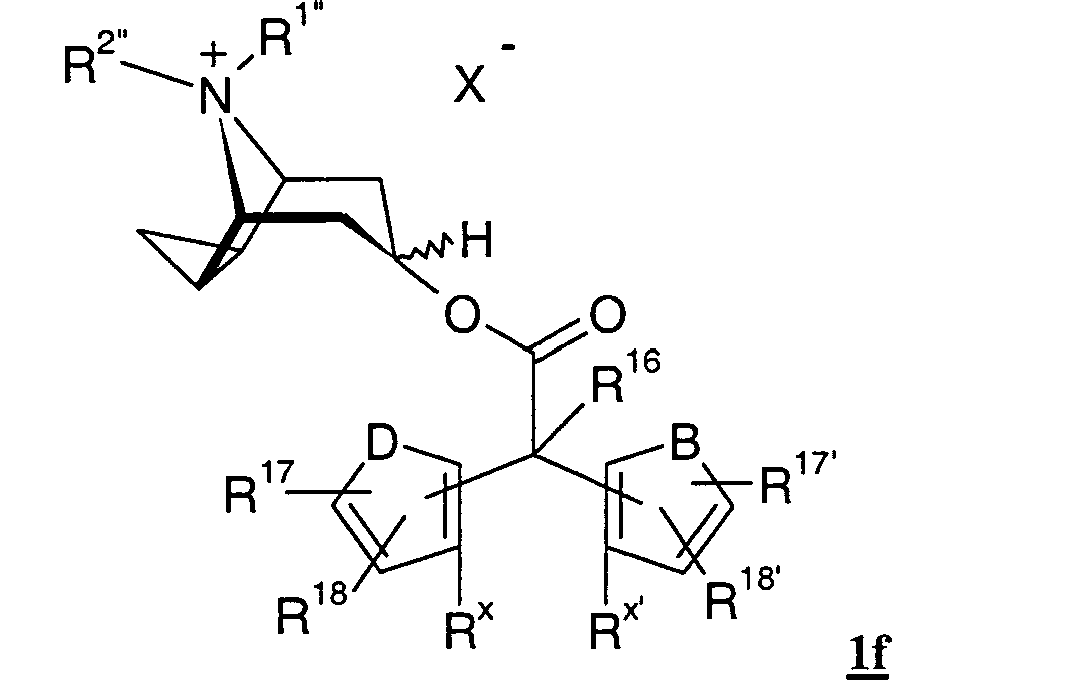
wherein X - may have the meanings as mentioned hereinbefore, and wherein - D and B
- which may be identical or different, preferably identical, denote -O, -S, -NH, -CH2, -CH=CH, or -N(C1-C4-alkyl)-;
- R16
- denotes hydrogen, hydroxy, -C1-C4-alkyl, -C1-C4-alkyloxy, -C1-C4-alkylene-Halogen, -O-C1-C4-alkylene-halogen, -C1-C4-alkylene-OH, -CF3, CHF2, -C1-C4-alkylene-C1-C4-alkyloxy, -O-COC1-C4-alkyl, -O-COC1-C4-alkylene-halogen, -C1-C4-alkylene-C3-C6-cycloalkyl, -O-COCF3 or halogen;
- R1" and R2"
- which may be identical or different, denote -C1-C5-alkyl, which may optionally be substituted by -C3-C6-cycloalkyl, hydroxy or halogen, or
R1" and R2" together denote a -C3-C5-alkylene bridge; - R17, R18, R17' and R18',
- which may be identical or different, denote hydrogen, C1-C4-alkyl, C1-C4-alkyloxy, hydroxy, -CF3, -CHF2, CN, NO2 or halogen;
- Rx and Rx'
- which may be identical or different, denote hydrogen, C1-C4-alkyl, C1-C4-alkyloxy, hydroxy, -CF3, -CBF2, CN, NO2 or halogen
or
Rx and Rx' together denote a single bond or a bridging group selected from among the bridges -O, -S, -NH, -CH2, -CH2-CH2-, -N(C1-C4-alkyl), -CH(C1-C4-alkyl)- and -C(C1-C4-alkyl)2. - The compounds of formula 1f are known in the art (WO 03/064418).
- In another preferred embodiment the invention relates to the use of compounds of formula 1f wherein
- X-
- denotes chloride, bromide, or methanesulphonate, preferably bromide;
- D and B
- which may be identical or different, preferably identical, denote -O, -S, -NH or -CH=CH-;
- R16
- denotes hydrogen, hydroxy, -C1-C4-alkyl, -C1-C4-alkyloxy, -CF3, -CBF2, fluorine, chlorine or bromine;
- R1" and R2"
- which may be identical or different, denote C1-C4-alkyl, which may optionally be substituted by hydroxy, fluorine, chlorine or bromine, or
R1" and R2" together denote a -C3-C4-alkylene-bridge; - R17, R18, R17' and R18',
- which may be identical or different, denote hydrogen, C1-C4-alkyl, C1-C4-alkyloxy, hydroxy, -CF3, -CHF2, CN, NO2, fluorine, chlorine or bromine;
- Rx and Rx'
- which may be identical or different, denote hydrogen, C1-C4-alkyl, C1-C4-alkyloxy, hydroxy, -CF3, -CEF2, CN, NO2, fluorine, chlorine or bromine
or
RX and RX' together denote a single bond or a bridging group selected from among the bridges -O, -S, -NH- and -CH2-. - In another preferred embodiment the invention relates to the aforementioned use of compounds of formula 1f , wherein
- X-
- denotes chloride, bromide, or methanesulphonate, preferably bromide;
- D and B
- which may be identical or different, preferably identical, denote -S or -CH=CH-;
- R16
- denotes hydrogen, hydroxy or methyl;
- R1" and R2"
- which may be identical or different, denote methyl or ethyl;
- R17, R18, R17' and R18',
- which may be identical or different, denote hydrogen, -CF3 or fluorine, preferably hydrogen;
- Rx and Rx'
- which may be identical or different, denote hydrogen, -CF3 or fluorine, preferably hydrogen or
Rx and Rx' together denote a single bond or the bridging group -O-. - In another preferred embodiment the invention relates to the aforementioned use of compounds of formula 1f, wherein
- X-
- denotes bromide;
- D and B
- denote -CH=CH-;
- R16
- denotes hydrogen, hydroxy or methyl;
- R1" and R2"
- denote methyl;
- R17, R18, R17' and R18',
- which may be identical or different, denote hydrogen or fluorine, preferably hydrogen;
- Rx and RX'
- which may be identical or different, denote hydrogen or fluorine, preferably hydrogen or
RX and RX' together denote a single bond or the bridging group -O-. - Of particular importance within the use according to the invention are the following compounds of formula 1f :
- cyclopropyltropine benzilate methobromide;
- cyclopropyltropine 2,2-diphenylpropionate methobromide;
- cyclopropyltropine 9-hydroxy-xanthene-9-carboxylate methobromide;
- cyclopropyltropine 9-methyl-fluorene-9-carboxylate methobromide;
- cyclopropyltropine 9-methyl-xanthene-9-carboxylate methobromide;
- cyclopropyltropine 9-hydroxy-fluorene-9-carboxylate methobromide ;
- cyclopropyltropine methyl 4,4'-difluorobenzilate methobromide.
- The pharmaceutical compositions according to the invention may contain the compounds of formula 1f optionally in the form of the individual optical isomers, mixtures of the individual enantiomers or racemates thereof.
- In a yet another preferred embodiment the invention relates to the use of one or more, preferably one long acting anticholinergic 1 for the preparation of a medicament for the treatment of the urinary tract disorders mentioned hereinbefore, wherein the long acting anticholinergic 1 is selected from the compounds of formula 1g

wherein X- may have the meanings as mentioned hereinbefore, and wherein - A'
- denotes a double-bonded group selected from among

- R19
- denotes hydroxy, methyl, hydroxymethyl, ethyl, -CF3, CHF2 or fluorine;
- R1''' and R2'''
- which may be identical or different denote C1-C5-alkyl which may optionally be substituted by C3-C6-cycloalkyl, hydroxy or halogen, or
R1'" and R2'" together denote a -C3-C5-alkylene-bridge; - R20, R21, R20' and R21'
- which may be identical or different denote hydrogen, -C1-C4-alkyl, -C1-C4-alkyloxy, hydroxy, -CF3, -CBF2, CN, NO2 or halogen.
- The compounds of formula 1g are known in the art (WO 03/064417).
- In another preferred embodiment the invention relates to the aforementioned use of compounds of formula 1g wherein
- A'
- denotes a double-bonded group selected from among

- X-
- denotes chloride, bromide or methanesulphonate, preferably bromide;
- R19
- denotes hydroxy or methyl;
- R1'" and R2'"
- which may be identical or different represent methyl or ethyl, preferably methyl;
- R20, R21, R20' and R21'
- which may be identical or different represent hydrogen, -CF3, - CHF2 or fluorine, preferably hydrogen or fluorine.
- In another preferred embodiment the invention relates to the aforementioned use of compounds of formula 1g wherein
- A'
- denotes a double-bonded group selected from among

- X-
- denotes bromide;
- R19
- denotes hydroxy or methyl, preferably methyl;
- R1''' and R2'''
- which may be identical or different represent methyl or ethyl, preferably methyl;
- R3, R4, R3' and R4'
- which may be identical or different represent hydrogen or fluorine.
- Of particular importance within the use according to the invention are the following compounds of formula 1g:
- tropenol 9-hydroxy-xanthene-9-carboxylate methobromide ;
- scopine 9-hydroxy-xanthene-9-carboxylate methobromide ;
- tropenol 9-methyl-xanthene-9-carboxylate methobromide ;
- scopine 9-methyl-xanthene-9-carboxylate methobromide ;
- tropenol 9-ethyl-xanthene-9-carboxylate methobromide ;
- tropenol 9-difluoromethyl-xanthene-9-carboxylate methobromide ;
- scopine 9-hydroxymethyl-xanthene-9-carboxylate methobromide .
- The pharmaceutical compositions according to the invention may contain the compounds of formula 1g optionally in the form of the individual optical isomers, mixtures of the individual enantiomers or racemates thereof.
- The alkyl groups used, unless otherwise stated, are branched and unbranched alkyl groups having 1 to 5 carbon atoms. Examples include: methyl, ethyl, propyl or butyl. The groups methyl, ethyl, propyl or butyl may optionally also be referred to by the abbreviations Me, Et, Prop or Bu. Unless otherwise stated, the definitions propyl and butyl also include all possible isomeric forms of the groups in question. Thus, for example, propyl includes n-propyl and iso-propyl, butyl includes iso-butyl, sec. butyl and tert.-butyl, etc.
- The cycloalkyl groups used, unless otherwise stated, are alicyclic groups with 3 to 6 carbon atoms. These are the cyclopropyl, cyclobutyl, cyclopentyl and cyclohexyl groups. According to the invention cyclopropyl is of particular importance within the scope of the present invention.
- The alkylene groups used, unless otherwise stated, are branched and unbranched double-bonded alkyl bridges with 1 to 5 carbon atoms. Examples include: methylene, ethylene, propylene or butylene.
- The alkylene-halogen groups used, unless otherwise stated, are branched and unbranched double-bonded alkyl bridges with 1 to 4 carbon atoms which may be mono-, di- or trisubstituted, preferably disubstituted, by a halogen. Accordingly, unless otherwise stated, the term alkylene-OH groups denotes branched and unbranched double-bonded alkyl bridges with 1 to 4 carbon atoms which may be mono-, di- or trisubstituted, preferably monosubstituted, by a hydroxy.
- The alkyloxy groups used, unless otherwise stated, are branched and unbranched alkyl groups with 1 to 5 carbon atoms which are linked via an oxygen atom. The following may be mentioned, for example: methyloxy, ethyloxy, propyloxy or butyloxy. The groups methyloxy, ethyloxy, propyloxy or butyloxy may optionally also be referred to by the abbreviations MeO, EtO, PropO or BuO. Unless otherwise stated, the definitions propyloxy and butyloxy also include all possible isomeric forms of the groups in question. Thus, for example, propyloxy includes n-propyloxy and iso-propyloxy, butyloxy includes iso-butyloxy, sec. butyloxy and tert.-butyloxy, etc. The word alkoxy may also possibly be used within the scope of the present invention instead of the word alkyloxy. The groups methyloxy, ethyloxy, propyloxy or butyloxy may optionally also be referred to as methoxy, ethoxy, propoxy or butoxy.
- The alkylene-alkyloxy groups used, unless otherwise stated, are branched and unbranched double-bonded alkyl bridges with 1 to 5 carbon atoms which may be mono-, di- or trisubstituted, preferably monosubstituted, by an alkyloxy group.
- The -O-CO-alkyl groups used, unless otherwise stated, are branched and unbranched alkyl groups with 1 to 4 carbon atoms which are bonded via an ester group. The alkyl groups are bonded directly to the carbonylcarbon of the ester group. The term -O-CO-alkyl-halogen group should be understood analogously. The group -O-CO-CF3 denotes trifluoroacetate.
- Within the scope of the present invention halogen denotes fluorine, chlorine, bromine or iodine. Unless otherwise stated, fluorine and bromine are the preferred halogens. The group CO denotes a carbonyl group.
- In another preferred embodiment the invention relates to a method for the treatment of urinary tract disorders as mentioned hereinbefore comprising the administrationm of a therapeutically effective amount of one or more, preferably one long acting anticholinergic 1 . The term "therapeutically effective amount" shall mean that amount of a drug or pharmaceutical agent that will elicit the biological or medical response of a tissue, system, animal or human that is being sought by a researcher or clinician.
- Within the use of the present invention, the long acting anticholinergic 1 may be administered by oral, parenteral (e.g., intramuscular,intraperitoneal, intravenous or subcutaneous injection, or implant), buccal, nasal, vaginal, rectal, sublingual, topical (e.a.. ocular eyedrop) or inhalative routes of administration and may be formulated in suitable dosage unit formulations containing conventional non-toxic pharmaceutically acceptable carriers, adjuvants and vehicles appropriate for each route of administration.
- The pharmaceutical compositions for the administration of the long acting anticholinergics 1 of this invention may conveniently be presented in dosage unit form and may be prepared by any of the methods well known in the art of pharmacy. All methods include the step of bringing the active ingredient into association with the carrier which is constituted of one or more accessory ingredients. In general, the pharmaceutical compositions are prepared by uniformly and intimately bringing the active ingredients into association with a liquid carrier or a finely divided solid carrier or both, and then, if necessary, shaping the product into the desired dosage form. In the pharmaceutical compositions the active compounds are included in an amount sufficient to produce the desired pharmacologic effect.
- The pharmaceutical compositions containing the active ingredients 1 that are suitable for oral administration may be in the form of discrete units such as hard or soft capsules, tablets, troches or lozenges, each containing a predetermined amount of the active ingredients; in the form of a dispersible powder or granules; in the form of a solution or a suspension in an aqueous liquid or non-aqueous liquid; in the form of syrups or elixirs; or in the form of an oil-in-water emulsion or a water-in-oil emulsion.
- Dosage forms intended for oral use may be prepared according to any method known to the art for the manufacture of pharmaceutical formulations and such compositions.
- The excipients used may be for example, (a) inert diluents such as mannitol, sorbitol, calcium carbonate, pregelatinized starch, lactose, calcium phosphate or sodium phosphate; (b) granulating and disintegrating agents, such as povidone, copovidone, hydroxypropylmethylcellulose, corn starch, alginic acid, crospovidone, sodiumstarchglycolate, croscarmellose, or polacrilin potassium ; (c) binding agents such as microcrystalline cellulose or acacia ; and (d) lubricating agents such as magnesium stearate, stearic acid, fumaric acid or talc.
- In some cases, formulations for oral use may be in the form of hardgelatin or HPMC capsules wherein the active ingredient 1 is mixed with an inert solid diluent, for example pregelatinized starch, calcium carbonate, calcium phosphate or kaolin, or dispensed via a pellet formulation. They may also be in the form of soft gelatin capsules wherein the active ingredient is mixed with water or an oil medium, for example peanut oil, liquid paraffin, medium chain triglycerides or olive oil.
- The tablets, capsules or pellets may be uncoated or they may be coated by known techniques to delay disintegration and absorption in the gastrointestinal tract and thereby provide a delayed action or sustained action over a longer period. For example, a time delay material such as celluloseacetate phtalate or hydroxypropylcellulose acetate succinate or sustained release material such as ethylcellulose or ammoniomethacrylate copolymer (type B) may be employed.
- Liquid dosage forms for oral administration include pharmaceutically acceptable emulsions, solutions, suspensions, syrups, and elixirs containing inert diluents commonly used in the art, such as water. Besides such inert diluents, compositions can also include adjuvants, such as wetting agents, emulsifying and suspending agents, and sweetening, flavoring, perfuming and preserving agents.
- Aqueous suspensions normally contain the active ingredient 1 in admixture with excipients suitable for the manufacture of aqueous suspensions. Such excipients may be (a) suspending agents such as hydroxy ethylcellulose, sodium carboxymethylcellulose, methylcellulose, hydroxypropylmethylcellulose, sodium alginate, polyvinylpyrrolidone, gum tragacanth and gum acacia; (b) dispersing or wetting agents which may be (b.1) a naturally-occurring phosphatide such as lecithin, (b.2) a condensation product of an alkylene oxide with a fatty acid, for example, polyoxyethylene stearate, (b.3) a condensation product of ethylene oxide with a long chain aliphatic alcohol, for example heptadecaethyleneoxycetanol, (b.4) a condensation product of ethylene oxide with a partial ester derived from a fatty acid and a hexitol such as polyoxyethylene sorbitol monooleate, or (b.5) a condensation product of ethylene oxide with a partial ester derived from a fatty acid and a hexitol anhydride, for example polyoxyethylene sorbitan monooleate.
- The aqueous suspensions may also contain one or more preservatives, for example, ethyl or n-propyl p-hydroxybenzoate; one or more coloring agents; one or more flavoring agents; and one or more sweetening agents, such as sucrose or saccharin.
- Oily suspensions may be formulated by suspending the active ingredients 1 in a vegetable oil, for example arachis oil, olive oil, sesame oil or coconut oil, or in a mineral oil such as liquid paraffin. The oily suspensions may contain a thickening agent, for example beeswax, hard paraffin or cetyl alcohol. Sweetening agents and flavoring agents may be added to provide a palatable oral preparation. These compositions may be prepared by the addition of an antioxidant such as ascorbic acid.
- Dispersible powders and granules are suitable for the preparation of an aqueous suspension. They provide the active ingredients 1 in admixture with a dispersing or wetting agent, a suspending agent and one or more preservatives. Suitable dispersing or wetting agents and suspending agents are exemplified by those already mentioned above. Additional excipients, for example, those sweetening, flavoring and coloring agents described above may also be present.
- The pharmaceutical compositions of the invention may also be in the form of oil-in-water emulsions. The oily phase may be a vegetable oil such as olive oil or arachis oils, or a mineral oil such as liquid paraffin or a mixture thereof.
- Suitable emulsifying agents may be (a) naturally-occurring gums such as gum acacia and gum tragacanth, (b) naturally-occurring phosphatides such as soybean and lecithin, (c) esters or partial esters derived from fatty acids and hexitol anhydrides, for example, sorbitan monooleate, (d) condensation products of said partial esters with ethylene oxide, for example polyoxyethylene sorbitan monooleate. The emulsions may also contain sweetening and flavoring agents.
- Syrups and elixirs may be formulated with sweetening agents, for example, glycerol, propylene glycol, sorbitol or sucrose. Such formulations may also contain a preservative and flavoring and coloring agents.
- The pharmaceutical compositions containing 1 may be in the form of a sterile injectable aqueous or oleagenous suspension or solution. The suspension may be formulated according to known methods using those suitable dispersing or wetting agents and suspending agents which have been mentioned above. The sterile injectable preparation may also be a sterile injectable solution or suspension in a non toxic parenterally-acceptable diluent or solvent, for example as a solution in 1,3-butane-diol. Among the acceptable vehicles and solvents that may be employed are water, Ringer's solution and isotonic sodium chloride solution. In addition, sterile, fixed oils are conventionally employed as a solvent or suspending medium. For this purpose any bland fixed oil may be employed including synthetic mono-or diglycerides. In addition, fatty acids such as oleic acid find use in the preparation of injectables.
- Preparations according to this invention containing 1 for parenteral administration include sterile aqueous or non-aqueous solutions, suspension, or emulsions.
- Examples of non-aqueous solvents or vehicles are propylene glycol, polyethylene glycol, vegetable oils, such as olive oil and corn oil, gelatin, and injectable organic esters such as ethyl oleate. Such dosage forms may also contain adjuvants such as preserving, wetting, emulsifying, and dispersing agents. They may be sterilized by, for example, filtration through a bacteria-retaining filter, by incorporating sterilizing agents into the compositions, by irradiating the compositions, or by heating the compositions. They can also be manufactured in the form of sterile solid compositions which can be reconstituted in sterile water, or some other sterile injectable medium immediately before use. The combination of this invention may also be administered in the form of suppositories for rectal administration. This composition can be prepared by mixing the drugs with a suitable nonirritating excipient which is solid at ordinary temperatures but liquid at the rectal temperature and will therefore melt in the rectum to release the drug. Such materials are cocoa butter, hard fat, and polyethylene glycols. Compositions for buccal, nasal or sublingual administration are also prepared with standard excipients well known in the art.
- For topical administration the compositions according to this invention containing 1 may be formulated in liquid or semi-liquid preparations such as liniments, lotions, applications; oil-in-water or water-in-oil emulsions such as creams, ointments, jellies or pastes, including tooth-pastes; or solutions or suspensions such as drops, and the like.
- The dosage of the active ingredients in the compositions of this invention may be varied. However, it is necessary that the amount of the active ingredients 1 be such that a suitable dosage form is obtained. The selected dosage and the dosage form depend upon the desired therapeutic effect, on the route of administration and on the duration of the treatment. Dosage ranges in the combination are approximately one tenth to one times the clinically effective ranges required to induce the desired therapeutic effect, respectively when the compounds are used singly.
- In a yet another prefered embodiment the invention relates to the pharmaceutical compositions mentioned hereinbefore.
- Within the use according to the invention the long acting anticholinergics 1 may also be administered by inhalation. Inhalable preparations according to the invention include inhalable powders, propellant-containing metered dose aerosols or propellant-free inhalable solutions. Inhalable powders according to the invention containing the active substances may consist of the active substances on their own or of a mixture of the active substances with physiologically acceptable excipients. Within the scope of the present invention, the term carrier may optionally be used instead of the term excipient. Within the scope of the present invention, the term propellant-free inhalable solutions also includes concentrates or sterile inhalable solutions ready for use.
- Inhalable powders may contain 1 either alone or in admixture with suitable physiologically acceptable excipients. If the active substance 1 is present in admixture with physiologically acceptable excipients, the following physiologically acceptable excipients may be used to prepare these inhalable powders according to the invention: monosaccharides (e.g. glucose or arabinose), disaccharides (e.g. lactose, saccharose, maltose, trehalose), oligo- and polysaccharides (e.g. dextran), polyalcohols (e.g. sorbitol, mannitol, xylitol), cyclodextrines (e.g. α-cyclodextrine, β-cyclodextrine, χ-cyclodextrine, methyl-β-cyclodextrine, hydroxypropyl-β-cyclodextrine), salts (e.g. sodium chloride, calcium carbonate) or mixtures of these excipients with one another. Preferably, mono- or disaccharides are used, while the use of lactose, trehalose or glucose is preferred, particularly, but not exclusively, in the form of their hydrates.
- Inhalable powders preferably contain excipients with a maximum average particle size of up to 250µm, preferably between 10 and 150µm, most preferably between 15 and 80µm. It may sometimes seem appropriate to add finer excipient fractions with an average particle size of 1 to 9µm to the excipient mentioned above. These finer excipients are also selected from the group of possible excipients listed hereinbefore. Finally, in order to prepare the inhalable powders according to the invention, micronised active substance, preferably with an average particle size of 0.5 to 10µm, more preferably from 1 to 6µm, is added to the excipient mixture. Processes for producing the inhalable powders according to the invention by grinding and micronising and by finally mixing the ingredients together are known from the prior art.
- The inhalable powders according to the invention may be administered using inhalers known from the prior art. Inhalable powders according to the invention which contain one or more physiologically acceptable excipients in addition to 1 may be administered, for example, by means of inhalers which deliver a single dose from a supply using a measuring chamber as described in US 4570630, or by other means as described in DE 36 25 685. The inhalable powders according to the invention which contain 1 optionally in conjunction with a physiologically acceptable excipient may be administered, for example, using the inhaler known by the name Turbuhaler® or using inhalers as disclosed for example in EP 237507. Preferably, the inhalable powders according to the invention which contain physiologically acceptable excipient in addition to 1 are packed into capsules (to produce so-called inhalettes) which are used in inhalers as described, for example, in WO 94/28958.
- Inhalation aerosols containing propellant gas may contain substance 1 dissolved in the propellant gas or in dispersed form. The propellant gases which may be used to prepare the inhalation aerosols according to the invention are known from the prior art. Suitable propellant gases are selected from among hydrocarbons such as n-propane, n-butane or isobutane and halohydrocarbons such as fluorinated derivatives of methane, ethane, propane, butane, cyclopropane or cyclobutane. The propellant gases mentioned above may be used on their own or in mixtures thereof. Particularly preferred propellant gases are halogenated alkane derivatives selected from TG11, TG12, TG134a (1,1,1,2-tetrafluoroethane) and TG227 (1,1,1,2,3,3,3-heptafluoropropane) and mixtures thereof, of which the propellant gases TG134a, TG227 and mixtures thereof are preferred.
- The propellant-driven inhalation aerosols according to the invention may also contain other ingredients such as co-solvents, stabilisers, surfactants, antioxidants, lubricants and pH adjusters. All these ingredients are known in the art.
- The inhalation aerosols containing propellant gas according to the invention may contain up to 5 wt.-% of active substance 1 . Aerosols according to the invention contain, for example, 0.002 to 5 wt.-%, 0.01 to 3 wt.-%, 0.015 to 2 wt.-%, 0.1 to 2 wt.-%, 0.5 to 2 wt.-% or 0.5 to 1 wt.-% of active substance 1 .
- If the active substances 1 are present in dispersed form, the particles of active substance preferably have an average particle size of up to 10µm, preferably from 0.1 to 6µm, more preferably from 1 to 5µm.
- The propellant-driven inhalation aerosols according to the invention mentioned above may be administered using inhalers known in the art (MDIs = metered dose inhalers). Suitable cartridges and methods of filling these cartridges with the inhalable aerosols containing propellant gas according to the invention are known from the prior art.
- For example, and without restricting the scope of the invention thereto, in the use according to the invention tiotropium may be administered for instance in such amounts that each individual dose contains preferably 0.1 - 100µg. For example, and without restricting the scope of the invention thereto, 2.5µg, 5µg, 10µg, 18µg, 20µg, 36µg or 40µg of tiotropium (calculation based on cation) may be administered per single dose.
- For example, and without restricting the scope of the invention thereto, in the use according to the invention glycopyrronium, preferably R,R-glycopyrronium may be administered for instance in such amounts that each individual dose contains preferably 1 - 300µg. For example, and without restricting the scope of the invention thereto, 25µg, 35µg, 45µg, 55µg, 65µg, 75µg, 85µg, 95µg, 105µg, 115µg, 125µg, 135µg, 145µg, 155µg, 165µg, 175µg, 185µg or 195µg of glycopyrronium (calculation based on cation) may be administered per single dose. Preferably the aforementioned doses are administered once, twice or three times per day, preferably twice or three times per day.
- For example, and without restricting the scope of the invention thereto, in the use according to the invention compounds of formula 1a may be administered for instance in such amounts that each individual dose contains preferably 100 - 1800µg. For example, and without restricting the scope of the invention thereto, 100µg, 2005µg, 300µg, 400µg, 500µg, 600µg, 700µg, 800µg, 1000µg, 1100µg, 1200µg, 1300µg, 1400µg, 1500µg, 1600µg or 1700µg 1a' may be administered per single dose. Preferably the aforementioned doses are administered once or twice per day, preferably once per day.
- For example, and without restricting the scope of the invention thereto, in the use according to the invention compounds of formula 1c may be administered for instance in such amounts that each individual dose contains preferably 1 - 500µg. For example, and without restricting the scope of the invention thereto, 25µg, 35µg, 45µg, 55µg, 65µg, 75µg, 85µg, 95µg, 105µg, 115µg, 125µg, 135µg, 145µg, 155µg, 165µg, 175µg, 185µg or 195µg of 1c' may be administered per single dose. Preferably the aforementioned doses are administered once or twice per day, preferably once per day.
- For example, and without restricting the scope of the invention thereto, in the use according to the invention compounds of formula 1d may be administered for instance in such amounts that each individual dose contains preferably 1 - 300µg. For example, and without restricting the scope of the invention thereto, 25µg, 35µg, 45µg, 55µg, 65µg, 75µg, 85µg, 95µg, 105µg, 115µg, 125µg, 135µg, 145µg, 155µg, 165µg, 175µg, 185µg or 195µg of 1d' may be administered per single dose. Preferably the aforementioned doses are administered once or twice per day, preferably once per day.
- For example, and without restricting the scope of the invention thereto, in the use according to the invention compounds of formula 1e may be administered for instance in such amounts that each individual dose contains preferably 1 - 300µg. For example, and without restricting the scope of the invention thereto, 15µg, 25µg, 35µg, 45µg, 55µg, 65µg, 75µg, 85µg or 95µg of 1e' may be administered per single dose. Preferably the aforementioned doses are administered once or twice per day, preferably once per day.
- For example, and without restricting the scope of the invention thereto, in the use according to the invention compounds of formula 1f may be administered for instance in such amounts that each individual dose contains 1 - 300µg, preferably 5 - 250 µg, most preferably about 20 - 200µg. For example, and without restricting the scope of the invention thereto, 25µg, 35µg, 45µg, 55µg, 65µg, 75µg, 85µg, 95µg, 105µg, 115µg, 125µg, 135µg, 145µg, 155µg, 165µg, 175µg, 185µg or 195µg of 1f' may be administered per single dose. Preferably the aforementioned doses are administered once or twice per day, preferably once per day.
- For example, and without restricting the scope of the invention thereto, in the use according to the invention compounds of formula 1g may be administered for instance in such amounts that each individual dose contains 1 - 250µg, preferably 5-150 µg, most preferably about 10 - 100µg. For example, and without restricting the scope of the invention thereto, 15µg, 25µg, 35µg, 45µg, 55µg, 65µg, 75µg, 85µg or 95µg of 1g' may be administered per single dose. Preferably the aforementioned doses are administered once or twice per day, preferably once per day.
- Within the scope of the present invention, any reference to the compounds 1' is to be regarded as a reference to the pharmacologically active cations contained in the salts 1 . These are the cations tiotropium, glycopyrronium, trospium or the cations of the following formulae
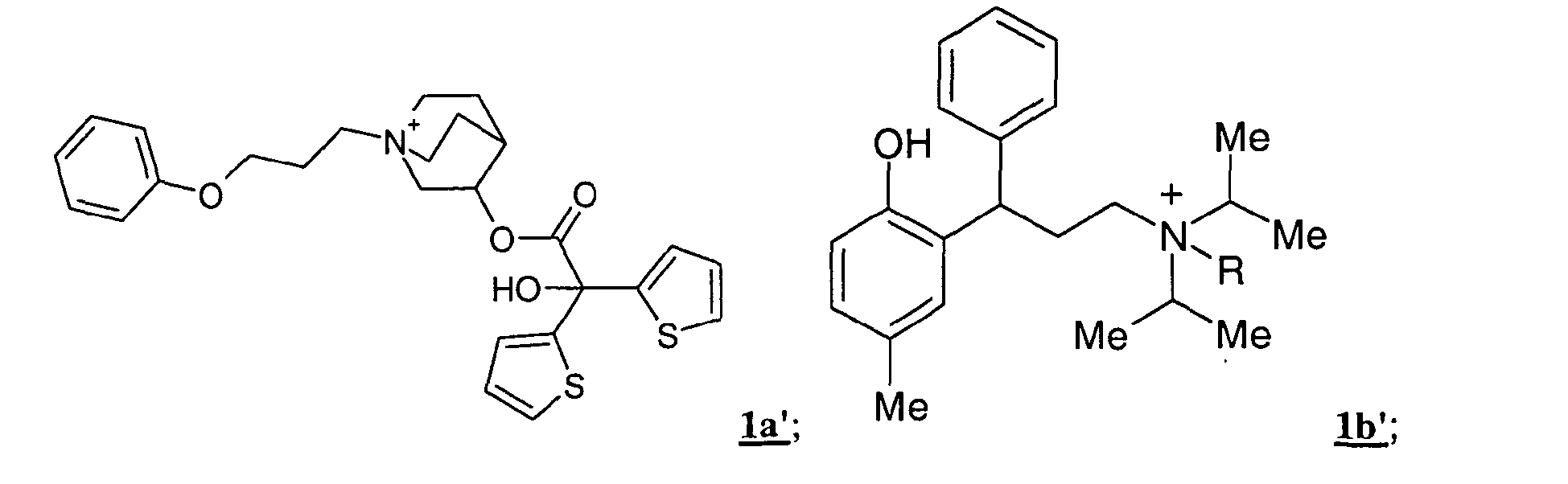


- The Examples which follow serve to illustrate the present invention in more detail without restricting the scope of the invention to the following embodiments by way of example.
- The following examples of formulations, which may be obtained analogously to methods known in the art, serve to illustrate the present invention more fully without restricting it to the contents of these examples.
-
1) Ingredients mg per suppository tiotropium bromide 3.3 dibasic calcium phosphate, anhydrous 33 maize starch dried 30 starch, soluble 2 silica colloidal 4 tartaric acid granule 0.5 stearic acid powder 0.5 povidone K25 0.505 sucrose refined 41.194 talc 405 23.671 acacia powdered 2.761 titanium dioxide 1.802 macrogel 6000 0.04 carnauba wax 0.018 beeswax white 0.009 2) Ingredients mg per suppository scopine 2,2-diphenylpropionic acid ester methobromide 33 dibasic calcium phosphate, anhydrous 33 maize starch dried 30 starch, soluble 2 silica colloidal 4 tartaric acid granule 0.5 stearic acid powder 0.5 povidone K25 0.505 sucrose refined 41.194 talc 405 23.671 acacia powdered 2.761 titanium dioxide 1.802 macrogel 6000 0.04 carnauba wax 0.018 beeswax white 0.009 3) Ingredients mg per suppository tropenol 2,2-diphenylpropionic acid ester methobromide 33 dibasic calcium phosphate, anhydrous 33 maize starch dried 30 starch, soluble 2 silica colloidal 4 tartaric acid granule 0.5 stearic acid powder 0.5 povidone K25 0.505 sucrose refined 41.194 talc 405 23.671 acacia powdered 2.761 titanium dioxide 1.802 macrogel 6000 0.04 carnauba wax 0.018 beeswax white 0.009 4) Ingredients mg per suppository tropenol 2-fluoro-2,2-diphenylacetic acid ester methobromide 33 dibasic calcium phosphate, anhydrous 33 maize starch dried 30 starch, soluble 2 silica colloidal 4 tartaric acid granule 0.5 stearic acid powder 0.5 povidone K25 0.505 sucrose refined 41.194 talc 405 23.671 acacia powdered 2.761 titanium dioxide 1.802 macrogel 6000 0.04 carnauba wax 0.018 beeswax white 0.009 5) Ingredients mg per suppository tropenol 9-fluoro-fluorene-9-carboxylate methobromide 10 dibasic calcium phosphate, anhydrous 33 maize starch dried 30 starch, soluble 2 silica colloidal 4 tartaric acid granule 0.5 stearic acid powder 0.5 povidone K25 0.505 sucrose refined 41.194 talc 405 23.671 acacia powdered 2.761 titanium dioxide 1.802 macrogel 6000 0.04 carnauba wax 0.018 beeswax white 0.009 6) Ingredients mg per suppository scopine 9-fluoro-fluorene-9-carboxylate methobromide 10 dibasic calcium phosphate, anhydrous 33 maize starch dried 30 starch, soluble 2 silica colloidal 4 tartaric acid granule 0.5 stearic acid powder 0.5 povidone K25 0.505 sucrose refined 41.194 talc 405 23.671 acacia powdered 2.761 titanium dioxide 1.802 macrogel 6000 0.04 carnauba wax 0.018 beeswax white 0.009 7) Ingredients mg per suppository tropenol 9-methyl-fluorene-9-carboxylate methobromide 10 dibasic calcium phosphate, anhydrous 33 maize starch dried 30 starch, soluble 2 silica colloidal 4 tartaric acid granule 0.5 stearic acid powder 0.5 povidone K25 0.505 sucrose refined 41.194 talc 405 23.671 acacia powdered 2.761 titanium dioxide 1.802 macrogel 6000 0.04 carnauba wax 0.018 beeswax white 0.009 8) Ingredients mg per suppository scopine 9-methyl-fluorene-9-carboxylate methobromide 10 dibasic calcium phosphate, anhydrous 33 maize starch dried 30 starch, soluble 2 silica colloidal 4 tartaric acid granule 0.5 stearic acid powder 0.5 povidone K25 0.505 sucrose refined 41.194 talc 405 23.671 acacia powdered 2.761 titanium dioxide 1.802 macrogel 6000 0.04 carnauba wax 0.018 beeswax white 0.009 -
1) Ingredients content per ampoule tiotropium bromide 0.17 mg NaCl 6 mg water purified ad 1 ml 2) Ingredients content per ampoule scopine 2,2-diphenylpropionic acid ester methobromide 1.7 mg NaCl 6 water purified ad 1 ml 3) Ingredients content per ampoule tropenol 2,2-diphenylpropionic acid ester methobromide 1.7 mg NaCl 6 water purified ad 1 ml 4) Ingredients content per ampoule scopine 4,4'-difluorobenzilic acid ester methobromide 1.7 mg NaCl 6 water purified ad 1 ml 5) Ingredients content per ampoule tropenol 4,4'-difluorobenzilic acid ester methobromide 1.7 mg NaCl 6 water purified ad 1 ml 6) Ingredients content per ampoule scopine 9-methyl-fluorene-9-carboxylate methobromide 0.5 mg NaCl 6 mg water purified ad 1 ml 7) Ingredients content per ampoule tropenol 9-methyl-fluorene-9-carboxylate methobromide 0.5 mg NaCl 6 mg water purified ad 1 ml 8) Ingredients content per ampoule cyclopropyltropine 2,2-diphenylpropionate methobromide 0.5 mg Nacl 6 mg water purified ad 1 ml 9) Ingredients content per ampoule cyclopropyltropine 9-hydroxy-xanthene-9-carboxylate methobromide 0.5 mg NaCl 6 mg water purified ad 1 ml 10) Ingredients content per ampoule cyclopropyltropine 9-methyl-xanthene-9-carboxylate methobromide 0.5 mg NaCl 6 mg water purified ad 1 ml -
1) Ingredients content tiotropium bromide 0.17 mg methyl-4-hydroxybenzoate 18 mg Propyl-4-hydroxybenzoate 2 mg NaCl 60 mg water purified ad 10 ml 2) Ingredients content tropenol 2,2-diphenylpropionic acid ester methobromide 1.7 mg methyl-4-hydroxybenzoate 18 mg Propyl-4-hydroxybenzoate 2 mg NaCl 60 mg water purified ad 10 ml 3) Ingredients content scopine 2,2-diphenylpropionic acid ester methobromide 1.7 mg methyl-4-hydroxybenzoate 18 mg Propyl-4-hydroxybenzoate 2 mg NaCl 60 mg water purified ad 10 ml 4) Ingredients content scopine 2-fluoro-2,2-diphenylacetic acid ester methobromide 1.7 mg methyl-4-hydroxybenzoate 18 mg Propyl-4-hydroxybenzoate 2 mg NaCl 60 mg water purified ad 10 ml 5) Ingredients content tropenol 2-fluoro-2,2-diphenylacetic acid ester methobromide) 1.7 mg methyl-4-hydroxybenzoate 18 mg Propyl-4-hydroxybenzoate 2 mg NaCl 60 mg water purified ad 10 ml 6) Ingredients content tropenol 9-hydroxy-fluorene-9-carboxylate methobromide 0.5 mg methyl-4-hydroxybenzoate 18 mg Propyl-4-hydroxybenzoate 2 mg NaCl 60 mg water purified ad 10 ml 7) Ingredients content tropenol 9-fluoro-fluorene-9-carboxylate methobromide 0.5 mg methyl-4-hydroxybenzoate 18 mg Propyl-4-hydroxybenzoate 2 mg NaCl 60 mg water purified ad 10 ml 8) Ingredients content scopine 9-hydroxy-fluorene-9-carboxylate methobromide 0.5 mg methyl-4-hydroxybenzoate 18 mg Propyl-4-hydroxybenzoate 2 mg NaCl 60 mg water purified ad 10 ml 9) Ingredients content scopine 9-fluoro-fluorene-9-carboxylate methobromide 0.5 mg methyl-4-hydroxybenzoate 18 mg Propyl-4-hydroxybenzoate 2 mg NaCl 60 mg water purified ad 10 ml 10) Ingredients content tropenol 9-methyl-fluorene-9-carboxylate methobromide 0.5 mg methyl-4-hydroxybenzoate 18 mg Propyl-4-hydroxybenzoate 2 mg NaCl 60 mg water purified ad 10 ml 11) Ingredients content scopine 9-methyl-fluorene-9-carboxylate methobromide 0.5 mg methyl-4-hydroxybenzoate 18 mg Propyl-4-hydroxybenzoate 2 mg NaCl 60 mg water purified ad 10 ml -
1) Ingredients I mg per suppository tiotropium bromide 3.3 water purified 10 hard fat 1626.7 Total 1640 2) Ingredients mg per suppository tropenol 2,2-diphenylpropionic acid ester methobromide 30 water purified 30 hard fat 1580 Total 1640 3) Ingredients mg per suppository scopine 2,2-diphenylpropionic acid ester methobromide 30 water purified 30 hard fat 1580 Total 1640 4) Ingredients mg per suppository tropenol 3,3',4,4'-tetrafluorobenzilic acid ester methobromide 10 water purified 10 hard fat 1620 Total 1640 5) Ingredients mg per suppository scopine 3,3',4,4'-tetrafluorobenzilic acid ester methobromide) 10 water purified 10 hard fat 1620 Total 1640 6) Ingredients mg per suppository tropenol 9-methyl-fluorene-9-carboxylate methobromide 10 water purified 10 hard fat 1620 Total 1640 7) Ingredients mg per suppository scopine 9-methyl-fluorene-9-carboxylate methobromide 10 water purified 10 hard fat 1620 Total 1640
Claims (16)
- Use of one or more, preferably one long acting anticholinergic 1 for the preparation of a medicament for the treatment of urinary tract disorders.
- Use according to claim 1 wherein the urinary tract disorder is selected from among urinary incontinence, urge urinary incontinence, stress urinary incontinence, mixed urinary incontinence, spasms of the urinary tract, urolithiasis, urinary tract cysts, urinary tract polyps, preparation for diagnostic and curative interventions in the urinary tract.
- Use according to claim 1 or 2 wherein the long acting anticholinergic 1 is selected from among tiotropium salts, glycopyrronium salts and trospium salts, optionally in the form of its diasteromers, mixtures of its diasteromers, racemats or physiologically acceptable acid addition salts thereof, and optionally in form of the hydrates or solvates thereof.
- Use according to claim 3 characterised in that the salts 1 contain as counter-ion (anion), chloride, bromide, iodide, sulphate, phosphate, methanesulphonate, nitrate, maleate, acetate, citrate, fumarate, tartrate, oxalate, succinate, benzoate or p-toluenesulphonate.
- Use according to claim 1 or 2 characterised in that 1 is a salt of formula 1a

whereinX- denotes an anion with a single negative charge, preferably an anion selected from the group consisting of fluoride, chloride, bromide, iodide, sulphate, phosphate, methanesulphonate, nitrate, maleate, acetate, citrate, fumarate, tartrate, oxalate, succinate, benzoate and p-toluenesulphonate. - Use according to claim 5 characterised in that 1 is present in form of the enantiomer formula 1a-en

- Use according to claim 1 or 2 characterised in that 1 is a compound of formula 1b

wherein R is either methyl or ethyl and whereinX- denotes an anion with a single negative charge, preferably an anion selected from the group consisting of fluoride, chloride, bromide, iodide, sulphate, phosphate, methanesulphonate, nitrate, maleate, acetate, citrate, fumarate, tartrate, oxalate, succinate, benzoate and p-toluenesulphonate. - Use according to claim 1 or 2 characterised in that 1 is a compound of formula 1b-base

- Use according to claim 7 or 8, characterised in that 1b or 1b-base are present in form of its R-enantiomer.
- Use according to claim 1 or 2 characterised in that 1 is present in form of a compound of formula 1c

whereinA denotes a double-bonded group selected from among X- denotes an anion with a single negative charge, preferably an anion selected from the group consisting of fluoride, chloride, bromide, iodide, sulphate, phosphate, methanesulphonate, nitrate, maleate, acetate, citrate, fumarate, tartrate, oxalate, succinate, benzoate and p-toluenesulphonate;R1 and R2 which may be identical or different denote a group selected from among methyl, ethyl, n-propyl and iso-propyl, which may optionally be substituted by hydroxy or fluorine, preferably unsubstituted methyl;R3, R4, R5 and R6, which may be identical or different, denote hydrogen, methyl, ethyl, methyloxy, ethyloxy, hydroxy, fluorine, chlorine, bromine, CN, CF3 or NO2;R7 denotes hydrogen, methyl, ethyl, methyloxy, ethyloxy, -CH2-F, -CH2-CH2-F, -O-CH2-F, -O-CH2-CH2-F, -CH2-OH, -CH2-CH2-OH, CF3, -CH2-OMe, -CH2-CH2-OMe, -CH2-OEt, -CH2-CH2-OEt, -O-COMe, -O-COEt, -O-COCF3, -O-COCF3, fluorine, chlorine or bromine.
 - Use according to claim 1 or 2 characterised in that 1 is present in form of a compound of formula 1d

whereinA denotes a double-bonded group selected from among X - denotes an anion with a single negative charge, preferably an anion selected from the group consisting of fluoride, chloride, bromide, iodide, sulphate, phosphate, methanesulphonate, nitrate, maleate, acetate, citrate, fumarate, tartrate, oxalate, succinate, benzoate and p-toluenesulphonate;R1 and R2 which may be identical or different denote a group selected from among methyl, ethyl, n-propyl and iso-propyl, which may optionally be substituted by hydroxy or fluorine, preferably unsubstituted methyl;R7, R8, R9, R10, R11 and R12 , which may be identical or different, denote hydrogen, methyl, ethyl, methyloxy, ethyloxy, hydroxy, fluorine, chlorine, bromine, CN, CF3 or NO2, with the proviso that at least one of the groups R7, R8, R9, R10, R11 and R12 is not hydrogen.
 - Use according to claim 1 or 2 characterised in that 1 is present in form of a compound of formula 1e

whereinA denotes a double-bonded group selected from among X- denotes an anion with a single negative charge, preferably an anion selected from the group consisting of fluoride, chloride, bromide, iodide, sulphate, phosphate, methanesulphonate, nitrate, maleate, acetate, citrate, fumarate, tartrate, oxalate, succinate, benzoate and p-toluenesulphonate;R15 denotes hydrogen, hydroxy, methyl, ethyl, -CF3, CBF2 or fluorine;R1' and R2' which may be identical or different denote C1-C5-alkyl which may optionally be substituted by C3-C6-cycloalkyl, hydroxy or halogen,
or
R1' and R2' together denote a -C3-C5-alkylene-bridge;R13, R14, R13' and R14' which may be identical or different denote hydrogen, -C1-C4-alkyl, -C1-C4-alkyloxy, hydroxy, -CF3, -CHF2, CN, NO2 or halogen. - Use according to claim 1 or 2 characterised in that 1 is present in form of a compound of formula 1f

whereinX- denotes an anion with a single negative charge, preferably an anion selected from the group consisting of fluoride, chloride, bromide, iodide, sulphate, phosphate, methanesulphonate, nitrate, maleate, acetate, citrate, fumarate, tartrate, oxalate, succinate, benzoate and p-toluenesulphonate;D and B which may be identical or different, preferably identical, denote -O, -S, -NH, -CH2, -CH=CH, or -N(C1-C4-alkyl)-;R16 denotes hydrogen, hydroxy, -C1-C4-alkyl, -C1-C4-alkyloxy, -C1-C4-alkylene-Halogen, -O-C1-C4-alkylene-halogen, -C1-C4-alkylene-OH, -CF3, CHF2, -C1-C4-alkylene-C1-C4-alkyloxy, -O-COC1-C4-alkyl, -O-COC1-C4-alkylene-halogen, -C1-C4-alkylene-C3-C6-cycloalkyl, -O-COCF3 or halogen;R1" and R2" which may be identical or different, denote -C1-C5-alkyl, which may optionally be substituted by -C3-C6-cycloalkyl, hydroxy or halogen,
or
R1" and R2" together denote a -C3-C5-alkylene bridge;R17, R18, R17' and R18', which may be identical or different, denote hydrogen, C1-C4-alkyl, C1-C4-alkyloxy, hydroxy, -CF3, -CHF2, CN, NO2 or halogen;RX and RX' which may be identical or different, denote hydrogen, C1-C4-alkyl, C1-C4-alkyloxy, hydroxy, -CF3, -CHF2, CN, NO2 or halogen
or
RX and RX' together denote a single bond or a bridging group selected from among the bridges -O, -S, -NH, -CH2, -CH2-CH2-, -N(C1-C4-alkyl), -CH(C1-C4-alkyl)- and -C(C1-C4-alkyl)2. - Use according to claim 1 or 2 characterised in that 1 is present in form of a compound of formula 1g

whereinX - denotes an anion with a single negative charge, preferably an anion selected from the group consisting of fluoride, chloride, bromide, iodide, sulphate, phosphate, methanesulphonate, nitrate, maleate, acetate, citrate, fumarate, tartrate, oxalate, succinate, benzoate and p-toluenesulphonate;A' denotes a double-bonded group selected from among R19 denotes hydroxy, methyl, hydroxymethyl, ethyl, -CF3, CHF2 or fluorine;R1'" and R2 which may be identical or different denote C1-C5-alkyl which may optionally be substituted by C3-C6-cycloalkyl, hydroxy or halogen,
or
R1'" and R2'" together denote a -C3-C5-alkylene-bridge;R20, R21, R20' and R21' which may be identical or different denote hydrogen, -C1-C4-alkyl, -C1-C4-alkyloxy, hydroxy, -CF3, -CBF2, CN, NO2 or halogen. - Use according to one of claims 1 to 14 wherein the long acting anticholinergic 1 is used for the preparation of a medicament suitable for oral, parenteral, buccal, nasal, vaginal, rectal, sublingual, topical or inhalative administration.
- Dosage unit formulations for oral, parenteral, buccal, nasal, vaginal, rectal, sublingual or topical administration containing conventional non-toxic pharmaceutically acceptable carriers, adjuvants and vehicles in combination with a long acting anticholinergic as specified in one of claims 3 to 14.
Priority Applications (4)
| Application Number | Priority Date | Filing Date | Title |
|---|---|---|---|
| EP04019003A EP1632229B1 (en) | 2004-08-11 | 2004-08-11 | Medicaments for the treatment of urinary tract disorders comprising anticholinergic agents |
| AT04019003T ATE427108T1 (en) | 2004-08-11 | 2004-08-11 | MEDICINAL PRODUCTS CONTAINING ANTICHOLINERGICS FOR THE TREATMENT OF DISEASES OF THE URINARY TRACT |
| DE602004020337T DE602004020337D1 (en) | 2004-08-11 | 2004-08-11 | Anticholinergic drugs for the treatment of urinary tract disorders |
| ES04019003T ES2322148T3 (en) | 2004-08-11 | 2004-08-11 | MEDICINES CONTAINING ANTI-POLINERGIC FOR TREATMENT IN URINARY ROADS. |
Applications Claiming Priority (1)
| Application Number | Priority Date | Filing Date | Title |
|---|---|---|---|
| EP04019003A EP1632229B1 (en) | 2004-08-11 | 2004-08-11 | Medicaments for the treatment of urinary tract disorders comprising anticholinergic agents |
Publications (2)
| Publication Number | Publication Date |
|---|---|
| EP1632229A1 true EP1632229A1 (en) | 2006-03-08 |
| EP1632229B1 EP1632229B1 (en) | 2009-04-01 |
Family
ID=34926124
Family Applications (1)
| Application Number | Title | Priority Date | Filing Date |
|---|---|---|---|
| EP04019003A Expired - Lifetime EP1632229B1 (en) | 2004-08-11 | 2004-08-11 | Medicaments for the treatment of urinary tract disorders comprising anticholinergic agents |
Country Status (4)
| Country | Link |
|---|---|
| EP (1) | EP1632229B1 (en) |
| AT (1) | ATE427108T1 (en) |
| DE (1) | DE602004020337D1 (en) |
| ES (1) | ES2322148T3 (en) |
Cited By (2)
| Publication number | Priority date | Publication date | Assignee | Title |
|---|---|---|---|---|
| US7250426B2 (en) | 2002-11-29 | 2007-07-31 | Boehringer Ingelheim Pharma Gmbh & Co Kg | Tiotropium-containing pharmaceutical combination for inhalation |
| US11464734B2 (en) | 2018-08-01 | 2022-10-11 | Taris Biomedical Llc | Methods of treating overactive bladder using trospium |
Families Citing this family (1)
| Publication number | Priority date | Publication date | Assignee | Title |
|---|---|---|---|---|
| EP2897616A1 (en) | 2012-09-18 | 2015-07-29 | TARIS Biomedical LLC | Drug delivery systems and methods for treatment of bladder voiding dysfunction!and other lower urinary tract disorders by using trospium |
Citations (13)
| Publication number | Priority date | Publication date | Assignee | Title |
|---|---|---|---|---|
| US5998430A (en) * | 1996-11-27 | 1999-12-07 | Dr. R. Pfleger Chemische Fabrik Gmbh | Use of trospium chloride and 2-component system for the same |
| WO2001017480A2 (en) * | 1999-09-09 | 2001-03-15 | Androsolutions, Inc. | Methods and compositions for preventing and treating urinary tract disorders |
| WO2002030928A1 (en) | 2000-10-12 | 2002-04-18 | Boehringer Ingelheim Pharma Gmbh & Co. Kg | Crystalline monohydrate, method for producing the same and the use thereof in the production of a medicament |
| WO2002032898A2 (en) * | 2000-10-14 | 2002-04-25 | Boehringer Ingelheim Pharma Gmbh & Co. Kg | Novel anticholinergics, method for the production thereof and use thereof as medicaments |
| WO2002032899A1 (en) * | 2000-10-14 | 2002-04-25 | Boehringer Ingelheim Pharma Gmbh & Co. Kg | Novel anticholinergic agents that can be used as medicaments and method for the production thereof |
| US6482837B1 (en) * | 1998-04-24 | 2002-11-19 | University Of Rochester | Antimuscarinic compounds and methods for treatment of bladder diseases |
| WO2003000265A1 (en) | 2001-06-22 | 2003-01-03 | Boehringer Ingelheim Pharma Gmbh & Co.Kg | Crystalline anticholinergic, method for its production, and use thereof in the production of a drug |
| WO2003002059A2 (en) * | 2001-06-29 | 2003-01-09 | Bridge Pharma, Inc. | Tolterodine metabolites |
| WO2003064419A1 (en) * | 2002-01-31 | 2003-08-07 | Boehringer Ingelheim Pharma Gmbh & Co. Kg | Novel fluorene carboxylic acid esters, methods for the production thereof, and use of the same as pharmaceuticals |
| WO2003064417A1 (en) * | 2002-01-31 | 2003-08-07 | Boehringer Ingelheim Pharma Gmbh & Co. Kg | Xanthene-carboxylic acid esters of tropenol and scopine as m3 antagonists, method for producing the same and use thereof as medicaments |
| WO2003064418A1 (en) * | 2002-01-31 | 2003-08-07 | Boehringer Ingelheim Pharma Gmbh & Co. Kg | Anticholinergic agents, method for producing the same and use thereof as medicaments |
| WO2004064789A2 (en) * | 2003-01-16 | 2004-08-05 | University Of Rochester | Quaternary antimuscarinic compounds for the treatment of bladder diseases |
| WO2004064821A1 (en) * | 2003-01-22 | 2004-08-05 | Pfizer Health Ab | Reduced dose of tolterodine and other antimuscarinic agents for treating urinary disorders |
-
2004
- 2004-08-11 DE DE602004020337T patent/DE602004020337D1/en not_active Expired - Lifetime
- 2004-08-11 AT AT04019003T patent/ATE427108T1/en active
- 2004-08-11 EP EP04019003A patent/EP1632229B1/en not_active Expired - Lifetime
- 2004-08-11 ES ES04019003T patent/ES2322148T3/en not_active Expired - Lifetime
Patent Citations (13)
| Publication number | Priority date | Publication date | Assignee | Title |
|---|---|---|---|---|
| US5998430A (en) * | 1996-11-27 | 1999-12-07 | Dr. R. Pfleger Chemische Fabrik Gmbh | Use of trospium chloride and 2-component system for the same |
| US6482837B1 (en) * | 1998-04-24 | 2002-11-19 | University Of Rochester | Antimuscarinic compounds and methods for treatment of bladder diseases |
| WO2001017480A2 (en) * | 1999-09-09 | 2001-03-15 | Androsolutions, Inc. | Methods and compositions for preventing and treating urinary tract disorders |
| WO2002030928A1 (en) | 2000-10-12 | 2002-04-18 | Boehringer Ingelheim Pharma Gmbh & Co. Kg | Crystalline monohydrate, method for producing the same and the use thereof in the production of a medicament |
| WO2002032898A2 (en) * | 2000-10-14 | 2002-04-25 | Boehringer Ingelheim Pharma Gmbh & Co. Kg | Novel anticholinergics, method for the production thereof and use thereof as medicaments |
| WO2002032899A1 (en) * | 2000-10-14 | 2002-04-25 | Boehringer Ingelheim Pharma Gmbh & Co. Kg | Novel anticholinergic agents that can be used as medicaments and method for the production thereof |
| WO2003000265A1 (en) | 2001-06-22 | 2003-01-03 | Boehringer Ingelheim Pharma Gmbh & Co.Kg | Crystalline anticholinergic, method for its production, and use thereof in the production of a drug |
| WO2003002059A2 (en) * | 2001-06-29 | 2003-01-09 | Bridge Pharma, Inc. | Tolterodine metabolites |
| WO2003064419A1 (en) * | 2002-01-31 | 2003-08-07 | Boehringer Ingelheim Pharma Gmbh & Co. Kg | Novel fluorene carboxylic acid esters, methods for the production thereof, and use of the same as pharmaceuticals |
| WO2003064417A1 (en) * | 2002-01-31 | 2003-08-07 | Boehringer Ingelheim Pharma Gmbh & Co. Kg | Xanthene-carboxylic acid esters of tropenol and scopine as m3 antagonists, method for producing the same and use thereof as medicaments |
| WO2003064418A1 (en) * | 2002-01-31 | 2003-08-07 | Boehringer Ingelheim Pharma Gmbh & Co. Kg | Anticholinergic agents, method for producing the same and use thereof as medicaments |
| WO2004064789A2 (en) * | 2003-01-16 | 2004-08-05 | University Of Rochester | Quaternary antimuscarinic compounds for the treatment of bladder diseases |
| WO2004064821A1 (en) * | 2003-01-22 | 2004-08-05 | Pfizer Health Ab | Reduced dose of tolterodine and other antimuscarinic agents for treating urinary disorders |
Non-Patent Citations (1)
| Title |
|---|
| SCHELFHOUT V.J. ET AL.: "Activity of LAS 34273, a new Long Acting Anticholinergic Agent, in COPD Patients", 19 May 2004 (2004-05-19), XP002298563, Retrieved from the Internet <URL:http://www.abstracts2view.com/atsall/search.php?query=Schelfhout&where[]=authors&search=do> [retrieved on 20040928] * |
Cited By (3)
| Publication number | Priority date | Publication date | Assignee | Title |
|---|---|---|---|---|
| US7250426B2 (en) | 2002-11-29 | 2007-07-31 | Boehringer Ingelheim Pharma Gmbh & Co Kg | Tiotropium-containing pharmaceutical combination for inhalation |
| US11464734B2 (en) | 2018-08-01 | 2022-10-11 | Taris Biomedical Llc | Methods of treating overactive bladder using trospium |
| US12133913B2 (en) | 2018-08-01 | 2024-11-05 | Taris Biomedical Llc | Methods of treating overactive bladder using trospium |
Also Published As
| Publication number | Publication date |
|---|---|
| ATE427108T1 (en) | 2009-04-15 |
| DE602004020337D1 (en) | 2009-05-14 |
| ES2322148T3 (en) | 2009-06-17 |
| EP1632229B1 (en) | 2009-04-01 |
Similar Documents
| Publication | Publication Date | Title |
|---|---|---|
| JP4097285B2 (en) | Compositions useful in the manufacture of a medicament for the treatment of various stubborn diseases | |
| EP1496912B9 (en) | Combination of brimonidine and timolol for topical ophthalmic use | |
| US20110076238A1 (en) | Compounds for the treatment of proliferative processes | |
| US20100093754A1 (en) | Pharmaceutical Compositions Comprising Flibanserin and a Further Agent in the Treatment of Sexual Disorders | |
| IL164291A (en) | Propellant-free inhalable solution or suspention comprising an anticholinesterase and a betamimietic drug and use thereof for the manufacture of a medicament for treating inflammatory or obstructive respiratory disorders | |
| EP1651224A1 (en) | Medicaments for inhalation comprising anticholinergics and a betamimetic | |
| CN104800196A (en) | Paediatric compositions for treating1 multiple sclerosis | |
| US20060247265A1 (en) | Therapies for treating disorders of the eye | |
| US20260000635A1 (en) | THERAPEUTIC AGENT FOR GLAUCOMA COMPRISING FP AGONIST AND ß BLOCKER | |
| WO2004039321A2 (en) | Combinative nicotinic/d1 agonism therapy for the treatment of alzheimer’s disease | |
| EP1632229B1 (en) | Medicaments for the treatment of urinary tract disorders comprising anticholinergic agents | |
| Cheng | To market, to market-1995 | |
| CA2582207A1 (en) | Inhalation medicament containing an anticholinesterase drug, salmeterol and a steroid selected from the ciclesonide or mometasone furoate group | |
| WO2003063879A1 (en) | Remedies for glaucoma comprising bunazosin and prostaglandins | |
| JP4300347B2 (en) | Glaucoma treatment agent consisting of bunazosin and prostaglandins | |
| EP1651221A1 (en) | Medicaments for inhalation comprising betamimetics and an anticholinergic agent | |
| CN1930123A (en) | Medicinal composition for prevention or treatment of overactive bladder accompanying nervous disorder | |
| JP2013035873A (en) | Use of selective opiate receptor modulator in treatment of neuropathy | |
| WO2006079625A2 (en) | Medicaments for the prevention or treatment of heart failure comprising administration of an anticholinergic | |
| WO2004035056A1 (en) | Use of skca channel blocking drugs for combating parkinson's disease | |
| JP2005306882A (en) | Composition useful for preparation of medicine for treating emotional instability | |
| AU2006225278B2 (en) | Combination of brimonidine and timolol for topical ophthalmic use | |
| JP4372723B2 (en) | Compositions useful in the manufacture of a medicament for the treatment of chronic pain | |
| US20060183726A1 (en) | Pharmaceutical compositions based on anticholinergics and etiprednol | |
| CA2617897A1 (en) | Method for the treatment of dyspnea comprising combined administration of tiotropium salts and salts of salmeterol |
Legal Events
| Date | Code | Title | Description |
|---|---|---|---|
| PUAI | Public reference made under article 153(3) epc to a published international application that has entered the european phase |
Free format text: ORIGINAL CODE: 0009012 |
|
| AK | Designated contracting states |
Kind code of ref document: A1 Designated state(s): AT BE BG CH CY CZ DE DK EE ES FI FR GB GR HU IE IT LI LU MC NL PL PT RO SE SI SK TR |
|
| AX | Request for extension of the european patent |
Extension state: AL HR LT LV MK |
|
| 17P | Request for examination filed |
Effective date: 20060908 |
|
| AKX | Designation fees paid |
Designated state(s): AT BE BG CH CY CZ DE DK EE ES FI FR GB GR HU IE IT LI LU MC NL PL PT RO SE SI SK TR |
|
| AXX | Extension fees paid |
Extension state: LV Payment date: 20060908 Extension state: MK Payment date: 20060908 Extension state: LT Payment date: 20060908 Extension state: AL Payment date: 20060908 |
|
| 17Q | First examination report despatched |
Effective date: 20061208 |
|
| GRAP | Despatch of communication of intention to grant a patent |
Free format text: ORIGINAL CODE: EPIDOSNIGR1 |
|
| GRAP | Despatch of communication of intention to grant a patent |
Free format text: ORIGINAL CODE: EPIDOSNIGR1 |
|
| GRAS | Grant fee paid |
Free format text: ORIGINAL CODE: EPIDOSNIGR3 |
|
| GRAA | (expected) grant |
Free format text: ORIGINAL CODE: 0009210 |
|
| AK | Designated contracting states |
Kind code of ref document: B1 Designated state(s): AT BE BG CH CY CZ DE DK EE ES FI FR GB GR HU IE IT LI LU MC NL PL PT RO SE SI SK TR |
|
| AX | Request for extension of the european patent |
Extension state: AL LT LV MK |
|
| REG | Reference to a national code |
Ref country code: GB Ref legal event code: FG4D |
|
| REG | Reference to a national code |
Ref country code: CH Ref legal event code: EP |
|
| REG | Reference to a national code |
Ref country code: IE Ref legal event code: FG4D |
|
| REF | Corresponds to: |
Ref document number: 602004020337 Country of ref document: DE Date of ref document: 20090514 Kind code of ref document: P |
|
| REG | Reference to a national code |
Ref country code: ES Ref legal event code: FG2A Ref document number: 2322148 Country of ref document: ES Kind code of ref document: T3 |
|
| PG25 | Lapsed in a contracting state [announced via postgrant information from national office to epo] |
Ref country code: SI Free format text: LAPSE BECAUSE OF FAILURE TO SUBMIT A TRANSLATION OF THE DESCRIPTION OR TO PAY THE FEE WITHIN THE PRESCRIBED TIME-LIMIT Effective date: 20090401 |
|
| NLV1 | Nl: lapsed or annulled due to failure to fulfill the requirements of art. 29p and 29m of the patents act | ||
| LTIE | Lt: invalidation of european patent or patent extension |
Effective date: 20090401 |
|
| PG25 | Lapsed in a contracting state [announced via postgrant information from national office to epo] |
Ref country code: EE Free format text: LAPSE BECAUSE OF FAILURE TO SUBMIT A TRANSLATION OF THE DESCRIPTION OR TO PAY THE FEE WITHIN THE PRESCRIBED TIME-LIMIT Effective date: 20090401 Ref country code: FI Free format text: LAPSE BECAUSE OF FAILURE TO SUBMIT A TRANSLATION OF THE DESCRIPTION OR TO PAY THE FEE WITHIN THE PRESCRIBED TIME-LIMIT Effective date: 20090401 Ref country code: PT Free format text: LAPSE BECAUSE OF FAILURE TO SUBMIT A TRANSLATION OF THE DESCRIPTION OR TO PAY THE FEE WITHIN THE PRESCRIBED TIME-LIMIT Effective date: 20090902 |
|
| PG25 | Lapsed in a contracting state [announced via postgrant information from national office to epo] |
Ref country code: SE Free format text: LAPSE BECAUSE OF FAILURE TO SUBMIT A TRANSLATION OF THE DESCRIPTION OR TO PAY THE FEE WITHIN THE PRESCRIBED TIME-LIMIT Effective date: 20090701 Ref country code: PL Free format text: LAPSE BECAUSE OF FAILURE TO SUBMIT A TRANSLATION OF THE DESCRIPTION OR TO PAY THE FEE WITHIN THE PRESCRIBED TIME-LIMIT Effective date: 20090401 Ref country code: NL Free format text: LAPSE BECAUSE OF FAILURE TO SUBMIT A TRANSLATION OF THE DESCRIPTION OR TO PAY THE FEE WITHIN THE PRESCRIBED TIME-LIMIT Effective date: 20090401 |
|
| PG25 | Lapsed in a contracting state [announced via postgrant information from national office to epo] |
Ref country code: RO Free format text: LAPSE BECAUSE OF FAILURE TO SUBMIT A TRANSLATION OF THE DESCRIPTION OR TO PAY THE FEE WITHIN THE PRESCRIBED TIME-LIMIT Effective date: 20090401 Ref country code: CZ Free format text: LAPSE BECAUSE OF FAILURE TO SUBMIT A TRANSLATION OF THE DESCRIPTION OR TO PAY THE FEE WITHIN THE PRESCRIBED TIME-LIMIT Effective date: 20090401 Ref country code: DK Free format text: LAPSE BECAUSE OF FAILURE TO SUBMIT A TRANSLATION OF THE DESCRIPTION OR TO PAY THE FEE WITHIN THE PRESCRIBED TIME-LIMIT Effective date: 20090401 |
|
| PLBE | No opposition filed within time limit |
Free format text: ORIGINAL CODE: 0009261 |
|
| STAA | Information on the status of an ep patent application or granted ep patent |
Free format text: STATUS: NO OPPOSITION FILED WITHIN TIME LIMIT |
|
| PG25 | Lapsed in a contracting state [announced via postgrant information from national office to epo] |
Ref country code: SK Free format text: LAPSE BECAUSE OF FAILURE TO SUBMIT A TRANSLATION OF THE DESCRIPTION OR TO PAY THE FEE WITHIN THE PRESCRIBED TIME-LIMIT Effective date: 20090401 Ref country code: BE Free format text: LAPSE BECAUSE OF FAILURE TO SUBMIT A TRANSLATION OF THE DESCRIPTION OR TO PAY THE FEE WITHIN THE PRESCRIBED TIME-LIMIT Effective date: 20090401 |
|
| 26N | No opposition filed |
Effective date: 20100105 |
|
| PG25 | Lapsed in a contracting state [announced via postgrant information from national office to epo] |
Ref country code: BG Free format text: LAPSE BECAUSE OF FAILURE TO SUBMIT A TRANSLATION OF THE DESCRIPTION OR TO PAY THE FEE WITHIN THE PRESCRIBED TIME-LIMIT Effective date: 20090701 Ref country code: MC Free format text: LAPSE BECAUSE OF NON-PAYMENT OF DUE FEES Effective date: 20090831 |
|
| REG | Reference to a national code |
Ref country code: IE Ref legal event code: MM4A |
|
| PG25 | Lapsed in a contracting state [announced via postgrant information from national office to epo] |
Ref country code: IE Free format text: LAPSE BECAUSE OF NON-PAYMENT OF DUE FEES Effective date: 20090811 |
|
| PG25 | Lapsed in a contracting state [announced via postgrant information from national office to epo] |
Ref country code: GR Free format text: LAPSE BECAUSE OF FAILURE TO SUBMIT A TRANSLATION OF THE DESCRIPTION OR TO PAY THE FEE WITHIN THE PRESCRIBED TIME-LIMIT Effective date: 20090702 |
|
| PG25 | Lapsed in a contracting state [announced via postgrant information from national office to epo] |
Ref country code: LU Free format text: LAPSE BECAUSE OF NON-PAYMENT OF DUE FEES Effective date: 20090811 |
|
| PG25 | Lapsed in a contracting state [announced via postgrant information from national office to epo] |
Ref country code: HU Free format text: LAPSE BECAUSE OF FAILURE TO SUBMIT A TRANSLATION OF THE DESCRIPTION OR TO PAY THE FEE WITHIN THE PRESCRIBED TIME-LIMIT Effective date: 20091002 |
|
| PG25 | Lapsed in a contracting state [announced via postgrant information from national office to epo] |
Ref country code: TR Free format text: LAPSE BECAUSE OF FAILURE TO SUBMIT A TRANSLATION OF THE DESCRIPTION OR TO PAY THE FEE WITHIN THE PRESCRIBED TIME-LIMIT Effective date: 20090401 |
|
| PG25 | Lapsed in a contracting state [announced via postgrant information from national office to epo] |
Ref country code: CY Free format text: LAPSE BECAUSE OF FAILURE TO SUBMIT A TRANSLATION OF THE DESCRIPTION OR TO PAY THE FEE WITHIN THE PRESCRIBED TIME-LIMIT Effective date: 20090401 |
|
| PGFP | Annual fee paid to national office [announced via postgrant information from national office to epo] |
Ref country code: CH Payment date: 20140820 Year of fee payment: 11 Ref country code: DE Payment date: 20140821 Year of fee payment: 11 |
|
| PGFP | Annual fee paid to national office [announced via postgrant information from national office to epo] |
Ref country code: GB Payment date: 20140820 Year of fee payment: 11 Ref country code: FR Payment date: 20140821 Year of fee payment: 11 Ref country code: AT Payment date: 20140619 Year of fee payment: 11 Ref country code: ES Payment date: 20140821 Year of fee payment: 11 |
|
| PGFP | Annual fee paid to national office [announced via postgrant information from national office to epo] |
Ref country code: IT Payment date: 20140827 Year of fee payment: 11 |
|
| REG | Reference to a national code |
Ref country code: DE Ref legal event code: R119 Ref document number: 602004020337 Country of ref document: DE |
|
| REG | Reference to a national code |
Ref country code: CH Ref legal event code: PL |
|
| REG | Reference to a national code |
Ref country code: AT Ref legal event code: MM01 Ref document number: 427108 Country of ref document: AT Kind code of ref document: T Effective date: 20150811 |
|
| GBPC | Gb: european patent ceased through non-payment of renewal fee |
Effective date: 20150811 |
|
| PG25 | Lapsed in a contracting state [announced via postgrant information from national office to epo] |
Ref country code: LI Free format text: LAPSE BECAUSE OF NON-PAYMENT OF DUE FEES Effective date: 20150831 Ref country code: CH Free format text: LAPSE BECAUSE OF NON-PAYMENT OF DUE FEES Effective date: 20150831 Ref country code: IT Free format text: LAPSE BECAUSE OF NON-PAYMENT OF DUE FEES Effective date: 20150811 |
|
| PG25 | Lapsed in a contracting state [announced via postgrant information from national office to epo] |
Ref country code: AT Free format text: LAPSE BECAUSE OF NON-PAYMENT OF DUE FEES Effective date: 20150811 |
|
| REG | Reference to a national code |
Ref country code: FR Ref legal event code: ST Effective date: 20160429 |
|
| PG25 | Lapsed in a contracting state [announced via postgrant information from national office to epo] |
Ref country code: DE Free format text: LAPSE BECAUSE OF NON-PAYMENT OF DUE FEES Effective date: 20160301 Ref country code: GB Free format text: LAPSE BECAUSE OF NON-PAYMENT OF DUE FEES Effective date: 20150811 |
|
| PG25 | Lapsed in a contracting state [announced via postgrant information from national office to epo] |
Ref country code: FR Free format text: LAPSE BECAUSE OF NON-PAYMENT OF DUE FEES Effective date: 20150831 |
|
| REG | Reference to a national code |
Ref country code: ES Ref legal event code: FD2A Effective date: 20160928 |
|
| PG25 | Lapsed in a contracting state [announced via postgrant information from national office to epo] |
Ref country code: ES Free format text: LAPSE BECAUSE OF NON-PAYMENT OF DUE FEES Effective date: 20150812 |