EP1630783A1 - Character graphic display device, character graphic display method, program and recording medium - Google Patents
Character graphic display device, character graphic display method, program and recording medium Download PDFInfo
- Publication number
- EP1630783A1 EP1630783A1 EP04745381A EP04745381A EP1630783A1 EP 1630783 A1 EP1630783 A1 EP 1630783A1 EP 04745381 A EP04745381 A EP 04745381A EP 04745381 A EP04745381 A EP 04745381A EP 1630783 A1 EP1630783 A1 EP 1630783A1
- Authority
- EP
- European Patent Office
- Prior art keywords
- character
- characters
- display
- size
- graphics
- Prior art date
- Legal status (The legal status is an assumption and is not a legal conclusion. Google has not performed a legal analysis and makes no representation as to the accuracy of the status listed.)
- Withdrawn
Links
Images








Classifications
-
- G—PHYSICS
- G09—EDUCATION; CRYPTOGRAPHY; DISPLAY; ADVERTISING; SEALS
- G09G—ARRANGEMENTS OR CIRCUITS FOR CONTROL OF INDICATING DEVICES USING STATIC MEANS TO PRESENT VARIABLE INFORMATION
- G09G5/00—Control arrangements or circuits for visual indicators common to cathode-ray tube indicators and other visual indicators
- G09G5/22—Control arrangements or circuits for visual indicators common to cathode-ray tube indicators and other visual indicators characterised by the display of characters or indicia using display control signals derived from coded signals representing the characters or indicia, e.g. with a character-code memory
- G09G5/24—Generation of individual character patterns
- G09G5/26—Generation of individual character patterns for modifying the character dimensions, e.g. double width, double height
Definitions
- the present invention relates to a character/graphic display apparatus including a display device having a display area for displaying a plurality of characters or graphics and also including a control section for controlling the display device, a character/graphic display method, a program, and a recording medium.
- a mobile information device includes modification means for modifying character sizes, inter-character spaces, and the like.
- the user operates the modification means to modify, for example, the character size or the inter-character space provided by the display device to a desired character size or a desired inter-character space.
- Figure 18 shows a display screen which displays characters.
- a display screen 18A shows an example in which the characters are displayed densely. It is difficult to read the characters displayed densely.
- a display screen 18B shows an example in which the characters are displayed less densely.
- the user of a mobile information device reads the characters displayed by a display device included therein.
- the user operates the mobile information device so as to enlarge the inter-character space on the display screen 18A for the purpose of easily reading the characters.
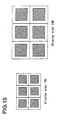
- Figure 19 shows an example of a display area which displays characters, the space between which is enlarged by method (1).
- a display area 19A is a display area before the inter-character space is enlarged.
- a display area 19B is a display area after the inter-character space is enlarged. It is assumed herein that in each of the hatched zones in the display areas, a character having the same size as that of the corresponding hatched zone is displayed.
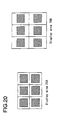
- Figure 20 shows an example of a display area which displays characters, the space between which is enlarged by method (2).
- a display area 20A is a display area before the inter-character space in a length direction is enlarged.
- a display area 20B is a display area after the inter-character space in the length direction is enlarged. It is assumed herein that in each of the hatched zones in the display areas, a character having the same size as that of the corresponding hatched zone is displayed.
- Figure 21 shows an example of a display area which displays characters, the space between which is enlarged by method (2).
- a display area 21A is a display area before the inter-character space in the width direction is enlarged.
- a display area 21B is a display area after the inter-character space in a width direction is enlarged. It is assumed herein that in each of the hatched zones in the display areas, a character having the same size as that of the corresponding hatched zone is displayed.
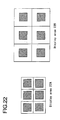
- Figure 22 shows an example of a display area which displays characters, the space between which is enlarged by method (2) .
- a display area 22A is a display area before the inter-character space in the width direction and the length direction is enlarged.
- a display area 22B is a display area after the inter-character space in the width direction and the length direction is enlarged. It is assumed herein that in each of the hatched zones in the display areas, a character having the same size as that of the corresponding hatched zone is displayed.
- Japanese Laid-Open Publication No. 2002-171457 discloses a method for prohibiting the characters from being displayed and a method for displaying the characters in an enlarged state, both when the characters displayed by the display device are difficult to read as a result of being reduced (see Patent Document 1).
- Japanese Laid-Open Publication No. 2001-265480 discloses a method for modifying the character size in compliance with the size of the display area (see Patent Document 2).
- Japanese Laid-Open Publication No. 4-177295 discloses a method for first enlarging a plurality of characters and then reducing the inter-character space (see Patent Document 3).
- Japanese Laid-Open Publication No. 5-257450 discloses a method for modifying the enlargement ratio of a character and a virtual area (see Patent Document 4).
- Patent Document 1 Japanese Laid-Open Publication No. 2002-171457
- Patent Document 2 Japanese Laid-Open Publication No. 2001-265480
- Patent Document 3 Japanese Laid-Open Publication No. 4-177295
- Patent Document 4 Japanese Laid-Open Publication No. 5-257450
- Figure 23 shows exemplary display areas which display the characters, the space between which is enlarged by method (1).
- a display area 23A and a display area 23B are display areas before the inter-character space is enlarged.
- a display area 23A' and a display area 23B' are display areas after the inter-charaoter space is enlarged.
- the positions of the characters have been changed as a result of the size of the characters in the display area 23A being enlarged and the inter-character space being enlarged.
- the positions of the characters have been changed as a result of the size of the characters in the display area 23B being enlarged and the inter-character space being enlarged.
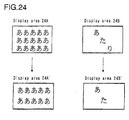
- Figure 24 shows exemplary display areas which display the characters, the space between which is enlarged by method (2).
- a display area 24A and a display area 24B are display areas before the inter-character space is enlarged.
- a display area 24A' and a display area 24B' are display areas after the inter-character space is enlarged.
- the positions of the characters have been changed as a result of the inter-character space in the length direction being enlarged.
- the positions of the characters have been changed as a result of the inter-character space in the length direction being enlarged.
- Figure 25 shows exemplary display areas which display the characters, the space between which is enlarged by method (2).
- a display area 25A and a display area 25B are display areas before the inter-character space is enlarged.
- a display area 25A' and a display area 25B' are display areas after the inter-character space is enlarged.
- the positions of the characters have been changed as a result of the inter-character space in the width direction being enlarged.
- the positions of the characters have been changed as a result of the inter-character space in the width direction being enlarged.
- Figure 26 shows exemplary display areas which display the characters, the space between which is enlarged by method (2).
- a display area 26A and a display area 26B are display areas before the inter-character space is enlarged.
- a display area 26A' and a display area 26B' are display areas after the inter-character space is enlarged.
- the positions of the characters have been changed as a result of the inter-character space in the width direction and the length direction being enlarged.
- the positions of the characters have been changed as a result of the inter-character space in the width direction and the length direction being enlarged.
- the present invention made in light of the above-described situation, has an objective of providing a character/graphic display apparatus, a character/graphic display method, a program, and a recording medium for improving the visual recognizability (ease of reading, or ease of recognition through reading) of characters or graphics, without changing the layout of the characters or graphics.
- a oharaoter/graphic display apparatus includes a display device including a display area for displaying a plurality of characters or graphics; and a control section for controlling the display device.
- the display area includes a plurality of virtual areas .
- the control section modifies the size of each of the plurality of characters or graphics while maintaining the size of each of the plurality of virtual areas included in the display area.
- the control section controls the display device, such that each of the plurality of characters or graphics having the modified size is displayed in the respective virtual area among the plurality of virtual areas.
- the size of each of the plurality of characters or graphics may be defined by a length and a width thereof.
- the control section may modify the size of each of the plurality of characters or graphics such that at least one of the length and the width is modified.
- the control section may modify the size of each of the plurality of characters or graphics such that the ratio of the length and the width is maintained.
- the control section may modify the size of each of the plurality of characters or graphics such that the ratio of the length and the width is changed.
- the display area may include a plurality of pixels. Each of the plurality of pixels may be divided into a plurality of sub-pixels.
- the control section may modify the size of each of the plurality of characters or graphics sub-pixel by sub-pixel.
- the character/graphic display apparatus may further include a storage section for storing a character/graphic modification information table.
- the oharacter/graphic modification information table may include a plurality of pieces of oharacter/graphic modification information. Each of the plurality of pieces of charaoter/graphic modification information may be information for modifying the size of each of the plurality of characters or graphics.
- the control section may select at least one piece of character/graphic modification information from the character/graphic modification information table including the plurality of pieces of character/graphic modification information.
- the control section may modify the size of each of the plurality of characters or graphics in accordance with the selected at least one piece of character/graphic modification information.
- a character/graphic display method is for displaying a plurality of characters or graphics by a display device including a display area.
- the display area includes a plurality of virtual areas.
- the character/graphic display method includes the steps of modifying the size of each of the plurality of characters or graphics while maintaining the size of each of the plurality of virtual areas included in the display area; and controlling the display device so as to display each of the plurality of characters or graphics having the modified size in the respective virtual area among the plurality of virtual areas.
- a program according to the present invention is for allowing a character/graphic display apparatus, which includes a display device having a display area for displaying a plurality of characters or graphics and also includes a control section for controlling the display device, to execute character/graphic display processing.
- the display area includes a plurality of virtual areas.
- the character/graphic display processing includes the steps of modifying the size of each of the plurality of characters or graphics while maintaining the size of each of the plurality of virtual areas included in the display area; and controlling the display device so as to display each of the plurality of characters or graphics having the modified size in the respective virtual area among the plurality of virtual areas.
- a recording medium is readable by a character/graphic display apparatus which includes a display device having a display area for displaying a plurality of characters or graphics and also includes a control section for controlling the display device.
- the display area includes a plurality of virtual areas.
- the recording medium has a program recorded thereon for allowing the control section to execute processing which includes the steps of modifying the size of each of the plurality of characters or graphics while maintaining the size of each of the plurality of virtual areas included in the display area; and controlling the display device so as to display each of the plurality of characters or graphics having the modified size in the respective virtual area among the plurality of virtual areas.
- control section modifies the size of each of the plurality of characters or graphics while maintaining the size of each of the plurality of virtual areas included in the display area, and displays each of the plurality of characters or graphics having the modified size in the respective virtual area among the plurality of virtual areas.
- the character/graphic display apparatus modifies the size of each of a plurality of characters or graphics while maintaining the size of each of a plurality of virtual areas.
- the size of each of the plurality of characters or graphics is enlarged, or inter-character spaces, spaces between characters and graphics, and inter-graphic spaces are enlarged.
- the visual recognizability (ease of reading, or ease of recognition through reading) of characters or graphics is improved.
- the character/graphic display apparatus maintains the size of each of the plurality of virtual areas included in the display area.
- the position of each of the plurality of virtual areas included in the display area is maintained.
- Each of the plurality of characters or graphics is displayed in the respective virtual area among the plurality of virtual areas. Therefore, the position at which each of the plurality of characters or graphics is displayed is kept within the respective virtual area among the plurality of virtual areas. Accordingly, the layout of the plurality of characters or graphics is prevented from being changed.
- the visual recognizability (ease of readability, or ease of recognition through reading) of characters or graphics can be improved without changing the layout of the characters or graphics.
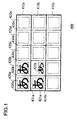
- Figure 1 shows a display screen 400 of a display device included in a character display apparatus according to the present invention.
- the display screen 400 includes display areas 410a, 410b and 410c.
- a plurality of characters are to be displayed.
- the size of each of the display areas 410a, 410b and 410c is defined by the logical product of the length and the width of the respective display area. Characters include, for example, "hiragana” Japanese phonetic letters, "katakana” Japanese phonetic letters, Chinese characters, alphabets, pictographs, and numerals.
- the display area 410a includes character areas 420a, 420b, 420c, 420d and 420e. In each of the character areas 420a, 420b, 420c, 420d and 420e, one character is to be displayed.
- the display area 410b includes character areas 421a and 421b. In each of the character areas 421a and 421b, one character is to be displayed.
- each of the character areas 420a, 420b, 420c, 420d and 420e is defined by the logical product of the length and the width of the respective character area.
- the expression "the size of a character” means the size of a character area in which the character is displayed. For example, where a character area in which one character is displayed has a length x and a width y, the size of the character is xy. According to this definition, a space representing a blank space and having a prescribed size, hiragana “ “ and hiragana “ “ (contracted sound) have the same size as long as they are displayed in character areas of an identical size.
- the display areas 410a, 410b and 410c each include a plurality of character areas arranged in a width direction. However, the plurality of character areas are not limited to be arranged in the width direction.
- the display areas 410a, 410b and 410c may include a plurality of character areas arranged in a length direction.
- the display area 410a includes virtual areas 430a, 430b, 430c, 430d and 430e.
- the virtual areas 430a, 430b, 430c, 430d and 430e are spread in the display area 410a without overlapping each other.
- Each virtual area includes a character area.
- the character areas 420a, 420b, 420c, 420d and 420e are included in, and correspond to, the virtual areas 430a, 430b, 430c, 430d and 430e, respectively.
- the display area 410b includes virtual areas 431a and 431b.
- the character areas 421a and 421b are included in, and correspond to, the virtual areas 431a and 431b, respectively.
- each of the virtual areas 430a, 430b, 430c, 430d and 430e is defined by the logical product of the length and the width of the respective virtual area.
- Figure 2 shows the positional relationship between a virtual area and a character area.
- the character area 420a and the character area 420b are adjacent to each other and arranged in the width direction.
- the character area 421a and the character area 420a are ad jaoent to each other and arranged in the length direction.
- inter-character space the distance between two adjacent character areas.
- inter-row space the inter-character space of those character areas.
- inter-column space the inter-character space of those character areas.
- the character areas 420a, 420b and 421a each have a width of x and a length of y.
- the distance between the character areas 420a and 420b is an inter-column space (a+b).
- the distance between the character areas 420a and 421a is an inter-row space (c+d).
- each of frames having the width x and the length y matches an outer perimeter of each of the character areas 420a, 420b and 421a. Accordingly, when the inter-row space and the inter-column space are both 0, the virtual area 430a and the character area 420a are the same area, the virtual area 430b and the character area 420b are the same area, and the virtual area 431a and the character area 421a are the same area.
- the size of the character (width: x'; length: y') displayed in the character area 421b is smaller than the size of the character (width: x; length: y) displayed in the character area 421a.
- Figure 3 shows a structure of a character display apparatus 100 in one example according to the present invention.
- the character display apparatus 100 may be, for example, a personal computer.
- a personal computer any type of computer such as, for example, a deek-top type or lap-top type computer is usable.
- the character display apparatus 100 may be a wordprocessor.
- the character display apparatus 100 may be any information display apparatus such as, for example, an electronic device or an information device including a display device.
- the character display apparatus 100 may be an electronic device, a mobile information terminal used as a mobile information tool, a cellular phone or a PHS terminal, a communication device such as a general telephone/facsimile machine, a game machine, a TV, a PDA or the like, which includes a liquid display device.
- the character display apparatus 100 includes a display device 110 for displaying a plurality of characters, a control section 120 for controlling the display device 110, an input device 130, and an assisting memory device 140.
- the control section 120 is connected with the display device 110, the input device 130 and the assisting memory device 140.
- the display device 110 includes a display area having a plurality of pixels.
- the display device 110 also includes a display screen 400 (not shown in Figure 3; see Figures 1 and 2).
- any display device having a function of displaying characters is usable.
- the display device 110 is, for example, a liquid crystal display device.
- the input device 130 is used for supplying the control section 120 with character information representing a character to be displayed by the display device 110 and an instruction to the display device 110.
- the character information includes, for example, a character code for identifying a character.
- any type of input device capable of inputting character information is usable.
- a keyboard including cursor keys, ten keys and function keys is preferably usable as the input device 130.
- the assisting memory device 140 stores a character display program 141, character data 142, a character basic information table 143, a display screen information table 144, and a character modification information table 145.
- any type of memory device capable of storing the character display program 141, the character data 142, the character basic information table 143, the display screen information table 144, and the character modification information table 145 is usable.
- any recording medium is usable as a recording medium for storing the character display program 141, the character data 142, the character basic information table 143, the display screen information table 144 , and the character modification information table 145. Recording mediums such as, for example, hard discs, GD-ROMs , MOs, MDs, DVDs , IC cards, and optical cards are preferably usable.
- the character display program 141, the character data 142, the character basic information table 143, the display screen information table 144, and the character modifioation information table 145 are not limited to being stored on a recording medium in the assisting memory device 140.
- the character display program 141, the character data 142, the character basic information table 143, the display screen information table 144, and the character modification information table 145 may be stored in a main memory 122 or a ROM (not shown).
- the ROM may be, for example, a mask ROM, an EPROM, an EEPROM, or a flash ROM.
- ROM system In the case of a ROM system of storing information in a ROM, various types of processing can be realized simply by exchanging ROMs.
- the ROM system is preferably applicable when, for example, the character display apparatus 100 is a mobile terminal or a cellular phone.
- the recording medium for storing the character display program 141, the character data 142, the character basic information table 143, the display screen information table 144, and the character modification information table 145 may be a medium such as a disc, card, other memory devices or a semiconductor memory, for fixedly carrying a program or data.
- the recording medium may be a medium for fluidly carrying a program or data, for example, a communication medium used for carrying a program or data in a communication network.
- the character display apparatus 100 includes means for connection with a communication line including the Internet
- the character display program 141, the character data 142, the character basic information table 143, the display screen information table 144, and the character modification information table 145 can be downloaded from the communication line.
- a loader program necessary for downloading may be pre-stored in the ROM (not shown) or installed into the control section 120 from the assisting memory device 140.
- the control section 120 includes a CPU 121 and a main memory 122.
- the CPU 121 controls and monitors the entirety of the character display apparatus 100 and also executes the character display program 141 stored in the assisting memory device 140.
- the main memory 122 temporarily stores data input from the input device 130, data to be displayed by the display device 110, and data necessary for executing the character display program 141.
- the main memory 122 is accessed by the CPU 121.
- the CPU 121 executes the character display program 141 based on various types of data stored in the main memory 122, so as to modify the size of each of the plurality of characters while maintaining the size of each of the plurality of virtual areas included in the display area.
- Each of the plurality of modified characters is once stored in the main memory 122 and then output to the display device 110.
- Each of the plurality of characters modified to correspond to the respective virtual area among the plurality of virtual areas is displayed in the respective virtual area.
- the character data 142 defines the shape of a character.
- the character data 142 is, for example, vector data defining the shape of a vector font.
- the character data 142 may be outline data defining the shape of an outline font.
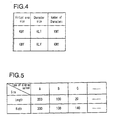
- Figure 4 shows the character basic information table 143.
- the character basic information table 143 includes-data indicating lengths of the virtual areas (KBT), data indicating widths of the virtual areas (KBY), data indicating lengths of the characters (KLT), and data indicating widths of the characters (KLY). However, data included in the character basic information table 143 is not limited to such data.
- the character basic information table 143 may include data indicating the number of characters which can be displayed on the display screen 400 in the length direction (KMT) and data indicating the number of characters which can be displayed on the display screen 400 in the width direction (KMY).
- Figure 5 shows a display screen information table 144.
- the display screen information table 144 includes data indicating the lengths of a plurality of types of display screens, and data indicating the widths of the plurality of types of display screens.
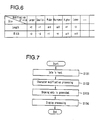
- Figure 6 shows a character modification information table 145.
- the character modification information table 145 includes a plurality of pieces of character modification information.
- the character modification information is information for modifying the size of characters.
- the character modification information indicates how much the size of a character is to be modified.
- the character modification information labeled “larger” indicates that the length of the character is to be extended by 2 and the width of the character is to be extended by 3.
- the character modification information labeled “smaller” indicates that the length of the character is to be shortened by 1 and the width of the character is to be shortened by 2.
- the character modification information labeled “wider” indicates that the length of the character is not to be modified and the width of the character is to be extended by 1.
- the character modification information labeled “narrower” indicates that the length of the character is not to be modified and the width of the character is to be shortened by 4.
- the character modification information labeled "higher” indicates that the length of the character is to be extended by 4 and the width of the character is not to be modified.
- the character modification information labeled “lower” indicates that the length of the character is to be shortened by 3 and the width of the character is not to be modified.
- the character modification information is not limited to indicating how much the size of a character is to be modified.
- the character modification information may indicate post-modification length and width of the character.
- the character modification information may indicate that at least one of the length and width of the character is to be modified.
- the character modification information may indicate that the size of the character is to be modified such that the ratio of the length and the width of the character is maintained even after the modification.
- the character modification information may indicate that the size of the character is to be modified such that the ratio of the length and the width of the character is changed after the modification.
- the CPU 121 uses the character data 142, the data included in the character basic information table 143, the data included in the display screen information table 144, and the data included in the character modifioation information table 145, to execute the character display program 141.
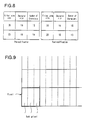
- Figure 7 is a flowchart illustrating a processing procedure of the character display program 141.
- the character display program 141 is executed by the CPU 121.
- Step S101 Character information indicating a character to be displayed by the display device 130 is input to the main memory 122 via the input device 130.
- the CPU 121 reads the character data 142 stored in the assisting memory device 140 from the assisting memory device 140 and inputs the character data 142 to the main memory 122.
- the CPU 121 reads the data included in the character basic information table 143 and the data included in the display screen information table 144 from the assisting memory device 140, and inputs the read data to the main memory 122.
- the CPU 121 selects at least one piece of character modification information from the plurality of pieces of character modification information included in the character modification information table 145, and inputs the selected at least one piece of character modification information to the main memory 122.
- the character modification information is not limited to being pre-stored in the character modification information table 145.
- the user may input desired character modification information to the main memory 122 via the input device 130.
- the CPU 121 After the CPU 121 inputs the data included in the character basic information table 143, the data included in the display screen information table 144, and the character modification information selected by the CPU 121, to the main memory 122, the CPU 121 proceeds with the processing step S102.
- Step S102 The CPU 121 determines the size of the display screen based on the data included in the display screen information table 144. Based on the selected character modification information, the CPU 121 modifies the data indicating the length of the character area and the data indicating the width of the character area which are included in the character basic information table 143. The modification of such data is executed by the CPU 121 while the size of the virtual area is maintained.
- Figure 8 shows an example of the character basic information table before the modifioation by the CPU 121 and an example of the character basic information table after the modification by the CPU 121.
- the character basic information table is modified such that the width of the character is shortened by 4 without the length of the character being modified.
- the data indicating the length of the character remains 19 whereas the data indicating the width of the character is modified from 19 to 15.
- the data indicating the length of the virtual area before the character size is modified is 20, and the data indicating the width of the virtual area before the character size is modified is 20 .
- the data indicating the length of the virtual area after the character size is modified is 20, and the data indicating the width of the virtual area after the character size is modified is 20.
- the CPU 121 maintains the data indicating the length of the virtual area even after the modification of the character size.
- the CPU 121 maintains the data indicating the width of the virtual area even after the modification of the character size.
- the data indicating the number of characters which can be displayed on the display screen 400 in the length direction before the modification of the character size is 15, and the data indicating the number of characters which can be displayed on the display screen 400 in the width direction before the modification of the character size is 10.
- the data indicating the number of characters which can be displayed on the display screen 400 in the length direction after the modification of the character size is 15, and the data indicating the number of characters which can be displayed on the display screen 400 in the width direction after the modification of the character size is 10.
- the CPU 121 does not necessarily modify both of the data indicating the length of the character area and the data indicating the width of the character area.
- the CPU 121 may modify either the data indicating the length of the character area or the data indicating the width of the character area. In this case, the CPU 121 generates data having a character having the modified size based on the modified data and non-modified data.
- step S103 After modifying the character basic information table, the CPU 121 proceeds with the processing to step S103.
- Step S103 The CPU 121 generates drawing data from the data indicating the character having the modified size , such that the data indicating the character having the modified size can be displayed by the display device.
- the CPU 121 generates drawing data from the data indicating the character having the modified size using a straight line drawing program or a curve drawing program such as a spline or the like.
- the generated drawing data is stored in the main memory 122.
- the CPU 121 generates drawing data based on the post-modification character basic Information table shown in Figure 8.
- the drawing data is generated from the data indicating the character having the modified size (the data indicating the length of the character is 19 and the data indicating the width of the character is 15).
- step S104 After storing the generated drawing data in the main memory 122, the CPU 121 proceeds with the processing to step S104.
- Step S104 Based on the drawing data generated in step S103, the CPU 121 controls the display device 110 such that the character having the modified size is displayed in the virtual area included in the display screen 400 of the display device 110.
- the CPU 121 modifies the data included in the character basic information table shown in Figure 8 before the characters are displayed.
- the CPU 121 determines the size of the characters, the size of the virtual areas, and the number of characters.
- the data included in the character basic information table shown in Figure 8 is modified such that the width of the characters is shortened, without modifying the data indicating the size of the virtual areas.
- the data indicating the width of the characters is modified from 19 to 15.
- the display device is a liquid crystal display device
- a plurality of pixels are provided in the display screen of the display device.
- Each of the plurality of pixels is divided into a plurality of sub-pixels.
- a respective color element is assigned among a plurality of color elements (for example, R(red), G (green) and B (blue)).
- the CPU 121 can control the character size pixel by pixel, but is not limited to this .
- the display device is a liquid crystal display device
- the CPU 121 may control the character size sub-pixel by sub-pixel.
- the CPU 121 can control the display device so as to modify the character size sub-pixel by sub-pixel. In this case, the character size can be controlled more precisely than the case where the CPU 121 modifies the character size pixel by pixel.
- Figure 9 shows the relationship between the shape of a pixel and the shape of a sub-pixel.
- the sub-pixel is made by dividing the pixel into three and has a shape of a strip longer in the length direction.
- the sub-pixel is not limited to being strip-shaped longer in the length direction.
- the sub-pixel may have a shape of a strip longer in the width direction.
- the sub-pixel may have any shape which can be made by dividing the pixel.
- Figure 10 shows exemplary display areas which displays characters having a reduced size.
- a display area 10A and a display area 10B are display areas before the character size is reduced.
- a display area 10A' and a display area 10B' are display areas after the character size is reduced.
- the positions of the characters are kept within the virtual areas since the width of the characters is reduced while the size of the virtual areas is maintained.
- the positions of the characters are kept within the virtual areas since the width of the characters is reduced while the size of the virtual areas is maintained.
- Figure 11 shows the relationship between the size of virtual areas A through M and the size of characters a through m displayed in the virtual areas A through M.
- each of the virtual areas A through M are any one of the virtual areas 430a through 430e shown in Figure 1.
- the virtual areas A through M have all the same size.
- the character a is displayed in the virtual area A.
- the size of the character a is the same as that of the virtual area A.
- the character b is displayed in the virtual area B.
- the length of the character b is shorter than the length of the character a.
- the width of the character b is equal to the width of the character a.
- the character o is displayed in the virtual area C.
- the length of the character c is shorter than the length of the character b.
- the width of the character c is equal to the width of the character a.
- the character d is displayed in the virtual area D.
- the length of the character d is shorter than the length of the character c.
- the width of the character d is equal to the width of the character a.
- the character e is displayed in the virtual area E.
- the length of the character e is shorter than the length of the character d.
- the width of the character e is equal to the width of the character a.
- the character f is displayed.
- the length of the character f is equal to the length of the character a.
- the width of the character f is shorter than the width of the character a.
- the character g is displayed in the virtual area G.
- the length of the character g is equal to the length of the character a.
- the width of the character g is shorter than the width of the character f.
- the character h is displayed in the virtual area H.
- the length of the character h is equal to the length of the character a.
- the width of the character h is shorter than the width of the character g.
- the character i is displayed in the virtual area I.
- the length of the character I is equal to the length of the character a.
- the width of the character i is shorter than the width of the character h.
- the character j is displayed.
- the length of the character j is equal to the length of the character b.
- the width of the character j is equal to the width of the character f.
- the character k is displayed.
- the length of the character k is equal to the length of the character c.
- the width of the character k is equal to the width of the character g.
- the character 1 is displayed in the virtual area L.
- the length of the character 1 is equal to the length of the character d.
- the width of the character 1 is equal to the width of the character h.
- the character m is displayed in the virtual area M.
- the length of the character m is equal to the length of the character e.
- the width of the character m is equal to the width of the character i.
- Figure 12 shows exemplary display screens including the virtual areas shown in Figure 11.
- a display screen AA includes the virtual areas A shown in Figure 11.
- a display screen FF includes the virtual areas F shown in Figure 11.
- a display screen GG includes the virtual areas G shown in Figure 11.
- a display screen HH includes the virtual areas H shown in Figure 11.
- a display screen II includes the virtual areas I shown in Figure 11.
- Figure 13 shows exemplary display screens including the virtual areas shown in Figure 11.
- a display screen AA includes the virtual areas A shown in Figure 11.
- a display screen BB includes the virtual areas B shown in Figure 11.
- a display screen CC includes the virtual areas C shown in Figure 11.
- a display screen DD includes the virtual areas D shown in Figure 11.
- a display screen EE includes the virtual areas E shown in Figure 11.
- Figure 14 shows exemplary display screens including the virtual areas shown in Figure 11.
- a display screen AA includes the virtual areas A shown in Figure 11.
- a display screen JJ includes the virtual areas J shown in Figure 11.
- a display screen KK includes the virtual areas K shown in Figure 11.
- a display screen LL includes the virtual areas L shown in Figure 11.
- a display screen MM includes the virtual areas M shown in Figure 11.
- step S102 corresponds to "the step of modifying the size of each of the plurality of characters or graphics while maintaining the size of each of the plurality of virtual areas included in the display area”
- step S104 corresponds to "the step of controlling the display device so as to display each of the plurality of characters or graphics having the modified size in the respective virtual area among the plurality of virtual areas”.
- the processing procedure of the character display program 141 is not limited to the one shown in Figure 7.
- the character display program 141 may have any processing procedure which has the functions of "the step of modifying the size of each of the plurality of characters or graphics while maintaining the size of each of the plurality of virtual areas included in the display area” and "the step of controlling the display device so as to display each of the plurality of characters or graphics having the modified size in the respective virtual area among the plurality of virtual areas".
- the size of each of the plurality of characters or graphics is modified while the size of each of the plurality of virtual areas included in the display area is maintained, and each of the plurality of characters or graphics having the modified size is displayed in the respective virtual area among the plurality of virtual areas.
- the present invention is not limited to this.
- the present invention is also applicable to the case where the size of each of a plurality of graphics, instead of, or in addition to, characters while the size of each of the plurality of virtual areas included in the display area is maintained, and then each of the plurality of graphics having the modified size is displayed in the respective virtual area among the plurality of virtual areas.
- a graphic display program is usable instead of, or in addition to, the character display program 141.
- Graphic data is usable instead of, or in addition to, the character data 142.
- a graphic basic information table is usable instead of, or in addition to, the character basic information table 143.
- a graphic modification information table is usable instead of, or in addition to, the character modification information table 145.
- the graphic display program may also include substantially the same steps as those of the character display program 141.
- a graphic modification program may also include substantially the same steps as those of a character modification program.
- the graphics may include, for example, part of characters, patterns, and symbols.
- control section modifies the size of each of a plurality of characters or graphics while maintaining the size of each of a plurality of virtual areas included in a display area, and displays each of the plurality of characters or graphics having the modified size in the respective virtual area.
- the character/graphic display apparatus modifies the size of each of a plurality of characters or graphics while maintaining the size of each of a plurality of virtual areas.
- the size of each of the plurality of characters or graphics is enlarged, or inter-character spaces, spaces between characters and graphics, and inter-graphic spaces are enlarged.
- the visual recognizability (ease of reading, or ease of recognition through reading) of characters or graphics is improved.
- the character/graphic display apparatus maintains the size of each of the plurality of virtual areas included in a display area.
- the position of each of the plurality of virtual areas included in the display area is maintained.
- Each of the plurality of characters or graphics is displayed in the respective virtual area among the plurality of virtual areas. Therefore, the position at which each of the plurality of characters or graphics is displayed is kept within the respective virtual area among the plurality of virtual areas. Accordingly, the layout of the plurality of characters or graphics is prevented from being changed.
- the visual recognizability (ease of readability, or ease of recognition through reading) of characters or graphics can be improved without changing the layout of the characters or graphics.
- Figure 15 shows an operation procedure to be followed by the user of the character display apparatus 100 shown in Figure 3.
- Step S201 The user uses the input device 130 to send a signal for modifying the inter-character space to the character display apparatus 100.
- Figure 16 shows a plurality of characters displayed by the display device.
- the plurality of characters displayed by the display device may be a plurality of characters which has been stored in the assisting memory device 140, or a plurality of characters which has been input to the character display apparatus 100 via the input device 130.
- the plurality of characters stored in the assisting memory device 140 may be, for example, an electronic mail message received by the character display apparatus 100 via a communication line (not shown).
- Step S202 The user checks the display screen on which the inter-character space has been modified.
- Step S203 The user determines whether or not the layout is maintained.
- step S203 the user may have the CPU 121 determine whether or not the layout is maintained based on the character basic information table 143 and the display screen information table 144.
- step S203 When “Yes” in step S203, the processing is terminated.
- step S203 When "No" in step S203, the processing proceeds to step S204.
- Step S204 The user determines whether or not the layout is to be maintained.
- step S204 When “Yes” in step S204, the processing proceeds to step S205.
- step S204 the processing is terminated.
- Step S205 The user uses the input device 130 to send a signal to the character display apparatus 100, the signal being for allowing the control section 120 included in the character display apparatus 100 to execute the character display program 141.
- Figure 17 shows a plurality of characters displayed by the display device after the character display program 141 is executed.
- Each of the plurality of characters is displayed on the respective virtual area among the plurality of virtual areas. Therefore, the position at which each of the plurality of characters is displayed is kept within the respective virtual area among the plurality of virtual areas. Ae a result, the visual recognizability (ease of reading, or ease of recognition through reading) of characters is improved without changing the layout of the characters or graphics.
- control section modifies the size of each of the plurality of characters or graphics while maintaining the size of each of the plurality of virtual areas included in the display area, and displays each of the plurality of characters or graphics having the modified size in the respective virtual area among the plurality of virtual areas.
- the character/graphic display apparatus modifies the size of each of a plurality of characters or graphics while maintaining the size of each of a plurality of virtual areas.
- the size of each of the plurality of characters or graphics is enlarged, or inter-character spaces, spaces between characters and graphics, and inter-graphic spaces are enlarged.
- the visual recognizability (ease of reading, or ease of recognition through reading) of characters or graphics is improved.
- the character/graphic display apparatus maintains the size of each of the plurality of virtual areas included in the display area.
- the position of each of the plurality of virtual areas included in the display area is maintained.
- Each of the plurality of characters or graphics is displayed in the respective virtual area among the plurality of virtual areas. Therefore, the position at which each of the plurality of characters or graphics is displayed is kept within the respective virtual area among the plurality of virtual areas. Accordingly, the layout of the plurality of characters or graphics is prevented from being changed.
- the visual recognizability (ease of readability, or ease of recognition through reading) of characters or graphics can be improved without changing the layout of the characters or graphics.
Landscapes
- Engineering & Computer Science (AREA)
- Physics & Mathematics (AREA)
- Computer Hardware Design (AREA)
- General Physics & Mathematics (AREA)
- Theoretical Computer Science (AREA)
- Controls And Circuits For Display Device (AREA)
- User Interface Of Digital Computer (AREA)
- Digital Computer Display Output (AREA)
Abstract
The size of each of the plurality of characters or graphics is modified while the size of each of the plurality of virtual areas included in the display area is maintained, so that the visual recognizability (ease of reading, or ease of recognition through reading) of characters or graphics is improved without changing the layout thereof. A character/graphic display apparatus of the present invention includes a display device including a display area for displaying a plurality of characters or graphics; and a control section for controlling the display device. The display area includes a plurality of virtual areas. The control sectionmodifies the size of each of the plurality of characters or graphics while maintaining the size of each virtual area included in the display area; and controls the display device to display each of the plurality of characters or graphics having the modified size in the respective virtual area.
Description
- The present invention relates to a character/graphic display apparatus including a display device having a display area for displaying a plurality of characters or graphics and also including a control section for controlling the display device, a character/graphic display method, a program, and a recording medium.
- Recently, there have been more and more opportunities for reading characters displayed by a display device included in a mobile information device. A mobile information device includes modification means for modifying character sizes, inter-character spaces, and the like. The user operates the modification means to modify, for example, the character size or the inter-character space provided by the display device to a desired character size or a desired inter-character space.
- Figure 18 shows a display screen which displays characters.
- A
display screen 18A shows an example in which the characters are displayed densely. It is difficult to read the characters displayed densely. - A
display screen 18B shows an example in which the characters are displayed less densely. The user of a mobile information device reads the characters displayed by a display device included therein. The user operates the mobile information device so as to enlarge the inter-character space on thedisplay screen 18A for the purpose of easily reading the characters. - There are two methods (1) and (2) usable by the user to enlarge the inter-character space for easily reading the characters. With method (1), the character size is enlarged and the inter-character space is enlarged. With method (2), the character size is not changed and the inter-character space is enlarged.
- Figure 19 shows an example of a display area which displays characters, the space between which is enlarged by method (1). A
display area 19A is a display area before the inter-character space is enlarged. A display area 19B is a display area after the inter-character space is enlarged. It is assumed herein that in each of the hatched zones in the display areas, a character having the same size as that of the corresponding hatched zone is displayed. - Figure 20 shows an example of a display area which displays characters, the space between which is enlarged by method (2). A
display area 20A is a display area before the inter-character space in a length direction is enlarged. Adisplay area 20B is a display area after the inter-character space in the length direction is enlarged. It is assumed herein that in each of the hatched zones in the display areas, a character having the same size as that of the corresponding hatched zone is displayed. - Figure 21 shows an example of a display area which displays characters, the space between which is enlarged by method (2). A
display area 21A is a display area before the inter-character space in the width direction is enlarged. Adisplay area 21B is a display area after the inter-character space in a width direction is enlarged. It is assumed herein that in each of the hatched zones in the display areas, a character having the same size as that of the corresponding hatched zone is displayed. - Figure 22 shows an example of a display area which displays characters, the space between which is enlarged by method (2) . A
display area 22A is a display area before the inter-character space in the width direction and the length direction is enlarged. Adisplay area 22B is a display area after the inter-character space in the width direction and the length direction is enlarged. It is assumed herein that in each of the hatched zones in the display areas, a character having the same size as that of the corresponding hatched zone is displayed. - Japanese Laid-Open Publication No. 2002-171457 discloses a method for prohibiting the characters from being displayed and a method for displaying the characters in an enlarged state, both when the characters displayed by the display device are difficult to read as a result of being reduced (see Patent Document 1).
- Japanese Laid-Open Publication No. 2001-265480 discloses a method for modifying the character size in compliance with the size of the display area (see Patent Document 2).
- Japanese Laid-Open Publication No. 4-177295 discloses a method for first enlarging a plurality of characters and then reducing the inter-character space (see Patent Document 3).
- Japanese Laid-Open Publication No. 5-257450 discloses a method for modifying the enlargement ratio of a character and a virtual area (see Patent Document 4).
Patent Document 1: Japanese Laid-Open Publication No. 2002-171457
Patent Document 2: Japanese Laid-Open Publication No. 2001-265480
Patent Document 3: Japanese Laid-Open Publication No. 4-177295
Patent Document 4: Japanese Laid-Open Publication No. 5-257450 - However, conventional character display apparatuses have the drawback that the positions at which the characters are displayed are changed and so the layout is not maintained. The reason is that when a conventional character display apparatus is used to enlarge the inter-character space, it is necessary to modify the positions at which the characters are displayed. In the case where the layout is not maintained, it is difficult to grasp the positions at which the characters are displayed and to understand the intention of the sender of the message.
- Figure 23 shows exemplary display areas which display the characters, the space between which is enlarged by method (1).
- A
display area 23A and adisplay area 23B are display areas before the inter-character space is enlarged. Adisplay area 23A' and adisplay area 23B' are display areas after the inter-charaoter space is enlarged. As displayed in thedisplay area 23A', the positions of the characters have been changed as a result of the size of the characters in thedisplay area 23A being enlarged and the inter-character space being enlarged. As displayed in thedisplay area 23B', the positions of the characters have been changed as a result of the size of the characters in thedisplay area 23B being enlarged and the inter-character space being enlarged. - Figure 24 shows exemplary display areas which display the characters, the space between which is enlarged by method (2).
- A
display area 24A and adisplay area 24B are display areas before the inter-character space is enlarged. Adisplay area 24A' and adisplay area 24B' are display areas after the inter-character space is enlarged. As displayed in thedisplay area 24A', the positions of the characters have been changed as a result of the inter-character space in the length direction being enlarged. As displayed in thedisplay area 24B', the positions of the characters have been changed as a result of the inter-character space in the length direction being enlarged. - Figure 25 shows exemplary display areas which display the characters, the space between which is enlarged by method (2).
- A
display area 25A and adisplay area 25B are display areas before the inter-character space is enlarged. Adisplay area 25A' and adisplay area 25B' are display areas after the inter-character space is enlarged. As displayed in thedisplay area 25A', the positions of the characters have been changed as a result of the inter-character space in the width direction being enlarged. As displayed in thedisplay area 25B', the positions of the characters have been changed as a result of the inter-character space in the width direction being enlarged. - Figure 26 shows exemplary display areas which display the characters, the space between which is enlarged by method (2).
- A
display area 26A and adisplay area 26B are display areas before the inter-character space is enlarged. Adisplay area 26A' and adisplay area 26B' are display areas after the inter-character space is enlarged. As displayed in thedisplay area 26A' , the positions of the characters have been changed as a result of the inter-character space in the width direction and the length direction being enlarged. As displayed in thedisplay area 26B', the positions of the characters have been changed as a result of the inter-character space in the width direction and the length direction being enlarged. - The present invention, made in light of the above-described situation, has an objective of providing a character/graphic display apparatus, a character/graphic display method, a program, and a recording medium for improving the visual recognizability (ease of reading, or ease of recognition through reading) of characters or graphics, without changing the layout of the characters or graphics.
- A oharaoter/graphic display apparatus according to the present invention includes a display device including a display area for displaying a plurality of characters or graphics; and a control section for controlling the display device. The display area includes a plurality of virtual areas . The control section modifies the size of each of the plurality of characters or graphics while maintaining the size of each of the plurality of virtual areas included in the display area. The control section controls the display device, such that each of the plurality of characters or graphics having the modified size is displayed in the respective virtual area among the plurality of virtual areas. The above-described objective can be achieved by this.
- The size of each of the plurality of characters or graphics may be defined by a length and a width thereof. The control section may modify the size of each of the plurality of characters or graphics such that at least one of the length and the width is modified.
- The control section may modify the size of each of the plurality of characters or graphics such that the ratio of the length and the width is maintained.
- The control section may modify the size of each of the plurality of characters or graphics such that the ratio of the length and the width is changed.
- The display area may include a plurality of pixels. Each of the plurality of pixels may be divided into a plurality of sub-pixels. The control section may modify the size of each of the plurality of characters or graphics sub-pixel by sub-pixel.
- The character/graphic display apparatus may further include a storage section for storing a character/graphic modification information table. The oharacter/graphic modification information table may include a plurality of pieces of oharacter/graphic modification information. Each of the plurality of pieces of charaoter/graphic modification information may be information for modifying the size of each of the plurality of characters or graphics. The control section may select at least one piece of character/graphic modification information from the character/graphic modification information table including the plurality of pieces of character/graphic modification information. The control section may modify the size of each of the plurality of characters or graphics in accordance with the selected at least one piece of character/graphic modification information.
- A character/graphic display method according to the present invention is for displaying a plurality of characters or graphics by a display device including a display area. The display area includes a plurality of virtual areas. The character/graphic display method includes the steps of modifying the size of each of the plurality of characters or graphics while maintaining the size of each of the plurality of virtual areas included in the display area; and controlling the display device so as to display each of the plurality of characters or graphics having the modified size in the respective virtual area among the plurality of virtual areas. The above-described objective can be achieved by this.
- A program according to the present invention is for allowing a character/graphic display apparatus, which includes a display device having a display area for displaying a plurality of characters or graphics and also includes a control section for controlling the display device, to execute character/graphic display processing. The display area includes a plurality of virtual areas. The character/graphic display processing includes the steps of modifying the size of each of the plurality of characters or graphics while maintaining the size of each of the plurality of virtual areas included in the display area; and controlling the display device so as to display each of the plurality of characters or graphics having the modified size in the respective virtual area among the plurality of virtual areas. The above-described objective can be achieved by this.
- A recording medium according to the present invention is readable by a character/graphic display apparatus which includes a display device having a display area for displaying a plurality of characters or graphics and also includes a control section for controlling the display device. The display area includes a plurality of virtual areas. The recording medium has a program recorded thereon for allowing the control section to execute processing which includes the steps of modifying the size of each of the plurality of characters or graphics while maintaining the size of each of the plurality of virtual areas included in the display area; and controlling the display device so as to display each of the plurality of characters or graphics having the modified size in the respective virtual area among the plurality of virtual areas. The above-described objective can be achieved by this.
- According to the present invention, the control section modifies the size of each of the plurality of characters or graphics while maintaining the size of each of the plurality of virtual areas included in the display area, and displays each of the plurality of characters or graphics having the modified size in the respective virtual area among the plurality of virtual areas.
- In this manner, the character/graphic display apparatus according to the present invention modifies the size of each of a plurality of characters or graphics while maintaining the size of each of a plurality of virtual areas. Thus, the size of each of the plurality of characters or graphics is enlarged, or inter-character spaces, spaces between characters and graphics, and inter-graphic spaces are enlarged. As a result, the visual recognizability (ease of reading, or ease of recognition through reading) of characters or graphics is improved.
- The character/graphic display apparatus according to the present invention maintains the size of each of the plurality of virtual areas included in the display area. Thus, the position of each of the plurality of virtual areas included in the display area is maintained. Each of the plurality of characters or graphics is displayed in the respective virtual area among the plurality of virtual areas. Therefore, the position at which each of the plurality of characters or graphics is displayed is kept within the respective virtual area among the plurality of virtual areas. Accordingly, the layout of the plurality of characters or graphics is prevented from being changed.
- As a result, the visual recognizability (ease of readability, or ease of recognition through reading) of characters or graphics can be improved without changing the layout of the characters or graphics.
-
- Figure 1 shows a
display screen 400 of a display device included in a character display apparatus according to the present invention. - Figure 2 shows the positional relationship between the virtual areas and the character areas.
- Figure 3 shows a structure of a
character display apparatus 100 according to an example of the present invention. - Figure 4 shows a character basic information table 143.
- Figure 5 shows a display screen information table 144.
- Figure 6 shows a character modification information table 145.
- Figure 7 is a flowchart illustrating a processing procedure of a
character display program 141. - Figure 8 shows an exemplary character basic information table before the modification by the
CPU 121, and an exemplary character basic information table after the modification by theCPU 121. - Figure 9 shows the relationship of the shape of a pixel and the shape of a sub-pixel.
- Figure 10 shows exemplary display areas which display characters having a reduced size.
- Figure 11 shows the relationship between the sizes of virtual areas A through M and the sizes of characters a through m.
- Figure 12 shows exemplary display screens including the virtual areas shown in Figure 11.
- Figure 13 shows exemplary display screens including the virtual areas shown in Figure 11.
- Figure 14 shows exemplary display screens including the virtual areas shown in Figure 11.
- Figure 15 shows an operation procedure to be followed by the user of the
character display apparatus 100 shown in Figure 3. - Figure 16 shows a plurality of characters displayed by the display device.
- Figure 17 shows a plurality of characters displayed by the display device after the
character display program 141 is executed. - Figure 18 shows display screens which display characters.
- Figure 19 shows an exemplary display area which displays characters, the space between which is enlarged by method (1).
- Figure 20 shows an exemplary display area which displays characters, the space between which is enlarged by method (2).
- Figure 21 shows an exemplary display area which displays characters, the space between which is enlarged by method (2).
- Figure 22 shows an exemplary display area which displays characters, the space between which is enlarged by method (2).
- Figure 23 shows exemplary display areas which display characters, the space between which is enlarged by method (1).
- Figure 24 shows exemplary display areas which display characters, the space between which is enlarged by method (2).
- Figure 25 shows exemplary display areas which display characters, the space between which is enlarged by method (2).
- Figure 26 shows exemplary display areas which display characters, the space between which is enlarged by method (2).
-
- 100 Character display apparatus
- 110 Display device
- 120 Control section
- 121 CPU
- 122 Main memory
- 130 Input device
- 140 Assisting memory device
- 141 Character display program
- 142 Character data
- 143 Character basic information table
- 144 Display screen information table
- 145 Character modification information table
- Figure 1 shows a
display screen 400 of a display device included in a character display apparatus according to the present invention. - The
display screen 400 includesdisplay areas display areas display areas - The
display area 410a includescharacter areas character areas display area 410b includescharacter areas character areas - The size of each of the
character areas - In this specification, the expression "the size of a character" means the size of a character area in which the character is displayed. For example, where a character area in which one character is displayed has a length x and a width y, the size of the character is xy. According to this definition, a space representing a blank space and having a prescribed size, hiragana "" and hiragana "
 " (contracted sound) have the same size as long as they are displayed in character areas of an identical size.
- The
display areas display areas - The
display area 410a includesvirtual areas virtual areas display area 410a without overlapping each other. Each virtual area includes a character area. Thecharacter areas virtual areas - The
display area 410b includesvirtual areas character areas virtual areas - The size of each of the
virtual areas - Figure 2 shows the positional relationship between a virtual area and a character area.
- The
character area 420a and thecharacter area 420b are adjacent to each other and arranged in the width direction. Thecharacter area 421a and thecharacter area 420a are ad jaoent to each other and arranged in the length direction. - In this specification, the distance between two adjacent character areas is referred to as a "inter-character space". In the case where two adjacent character areas are arranged in the length direction, the inter-character space of those character areas will be specifically referred to as an "inter-row space". In the case where two adjacent character areas are arranged in the width direction, the inter-character space of those character areas will be specifically referred to as an "inter-column space".
- The
character areas character areas character areas virtual areas virtual areas character areas virtual area 430a and thecharacter area 420a are the same area, thevirtual area 430b and thecharacter area 420b are the same area, and thevirtual area 431a and thecharacter area 421a are the same area. - The size of the character (width: x'; length: y') displayed in the
character area 421b is smaller than the size of the character (width: x; length: y) displayed in thecharacter area 421a. This means that there is the relationship x'·y' < x·y. For example, any of the following relationships is applicable: x' < x and y' < y; x' < x and y' = y; and x' - x and y' < y. - Figure 3 shows a structure of a
character display apparatus 100 in one example according to the present invention. - The
character display apparatus 100 may be, for example, a personal computer. As the personal computer, any type of computer such as, for example, a deek-top type or lap-top type computer is usable. Alternatively, thecharacter display apparatus 100 may be a wordprocessor. - The
character display apparatus 100 may be any information display apparatus such as, for example, an electronic device or an information device including a display device. For example, thecharacter display apparatus 100 may be an electronic device, a mobile information terminal used as a mobile information tool, a cellular phone or a PHS terminal, a communication device such as a general telephone/facsimile machine, a game machine, a TV, a PDA or the like, which includes a liquid display device. - The
character display apparatus 100 includes adisplay device 110 for displaying a plurality of characters, acontrol section 120 for controlling thedisplay device 110, aninput device 130, and an assistingmemory device 140. Thecontrol section 120 is connected with thedisplay device 110, theinput device 130 and the assistingmemory device 140. - The
display device 110 includes a display area having a plurality of pixels. Thedisplay device 110 also includes a display screen 400 (not shown in Figure 3; see Figures 1 and 2). As thedisplay device 110, any display device having a function of displaying characters is usable. Thedisplay device 110 is, for example, a liquid crystal display device. - The
input device 130 is used for supplying thecontrol section 120 with character information representing a character to be displayed by thedisplay device 110 and an instruction to thedisplay device 110. The character information includes, for example, a character code for identifying a character. As theinput device 130, any type of input device capable of inputting character information is usable. For example, a keyboard including cursor keys, ten keys and function keys is preferably usable as theinput device 130. - The assisting
memory device 140 stores acharacter display program 141,character data 142, a character basic information table 143, a display screen information table 144, and a character modification information table 145. As the assistingmemory device 140, any type of memory device capable of storing thecharacter display program 141, thecharacter data 142, the character basic information table 143, the display screen information table 144, and the character modification information table 145 is usable. In the assistingmemory device 140, any recording medium is usable as a recording medium for storing thecharacter display program 141, thecharacter data 142, the character basic information table 143, the display screen information table 144 , and the character modification information table 145. Recording mediums such as, for example, hard discs, GD-ROMs , MOs, MDs, DVDs , IC cards, and optical cards are preferably usable. - The
character display program 141, thecharacter data 142, the character basic information table 143, the display screen information table 144, and the character modifioation information table 145 are not limited to being stored on a recording medium in the assistingmemory device 140. For example, thecharacter display program 141, thecharacter data 142, the character basic information table 143, the display screen information table 144, and the character modification information table 145 may be stored in amain memory 122 or a ROM (not shown). The ROM may be, for example, a mask ROM, an EPROM, an EEPROM, or a flash ROM. In the case of a ROM system of storing information in a ROM, various types of processing can be realized simply by exchanging ROMs. The ROM system is preferably applicable when, for example, thecharacter display apparatus 100 is a mobile terminal or a cellular phone. - The recording medium for storing the
character display program 141, thecharacter data 142, the character basic information table 143, the display screen information table 144, and the character modification information table 145 may be a medium such as a disc, card, other memory devices or a semiconductor memory, for fixedly carrying a program or data. Alternatively, the recording medium may be a medium for fluidly carrying a program or data, for example, a communication medium used for carrying a program or data in a communication network. In the case where thecharacter display apparatus 100 includes means for connection with a communication line including the Internet, thecharacter display program 141, thecharacter data 142, the character basic information table 143, the display screen information table 144, and the character modification information table 145 can be downloaded from the communication line. In this case, a loader program necessary for downloading may be pre-stored in the ROM (not shown) or installed into thecontrol section 120 from the assistingmemory device 140. - The
control section 120 includes aCPU 121 and amain memory 122. - The
CPU 121 controls and monitors the entirety of thecharacter display apparatus 100 and also executes thecharacter display program 141 stored in the assistingmemory device 140. - The
main memory 122 temporarily stores data input from theinput device 130, data to be displayed by thedisplay device 110, and data necessary for executing thecharacter display program 141. Themain memory 122 is accessed by theCPU 121. - The
CPU 121 executes thecharacter display program 141 based on various types of data stored in themain memory 122, so as to modify the size of each of the plurality of characters while maintaining the size of each of the plurality of virtual areas included in the display area. Each of the plurality of modified characters is once stored in themain memory 122 and then output to thedisplay device 110. Each of the plurality of characters modified to correspond to the respective virtual area among the plurality of virtual areas is displayed in the respective virtual area. - The function of the
character display program 141 will be described later in detail. - The
character data 142 defines the shape of a character. Thecharacter data 142 is, for example, vector data defining the shape of a vector font. Thecharacter data 142 may be outline data defining the shape of an outline font. - Figure 4 shows the character basic information table 143.
- The character basic information table 143 includes-data indicating lengths of the virtual areas (KBT), data indicating widths of the virtual areas (KBY), data indicating lengths of the characters (KLT), and data indicating widths of the characters (KLY). However, data included in the character basic information table 143 is not limited to such data. The character basic information table 143 may include data indicating the number of characters which can be displayed on the
display screen 400 in the length direction (KMT) and data indicating the number of characters which can be displayed on thedisplay screen 400 in the width direction (KMY). - Figure 5 shows a display screen information table 144.
- The display screen information table 144 includes data indicating the lengths of a plurality of types of display screens, and data indicating the widths of the plurality of types of display screens.
- Figure 6 shows a character modification information table 145. The character modification information table 145 includes a plurality of pieces of character modification information. The character modification information is information for modifying the size of characters.
- For example, the character modification information indicates how much the size of a character is to be modified. The character modification information labeled "larger" indicates that the length of the character is to be extended by 2 and the width of the character is to be extended by 3. The character modification information labeled "smaller" indicates that the length of the character is to be shortened by 1 and the width of the character is to be shortened by 2. The character modification information labeled "wider" indicates that the length of the character is not to be modified and the width of the character is to be extended by 1. The character modification information labeled "narrower" indicates that the length of the character is not to be modified and the width of the character is to be shortened by 4. The character modification information labeled "higher" indicates that the length of the character is to be extended by 4 and the width of the character is not to be modified. The character modification information labeled "lower" indicates that the length of the character is to be shortened by 3 and the width of the character is not to be modified.
- The character modification information is not limited to indicating how much the size of a character is to be modified. The character modification information may indicate post-modification length and width of the character. The character modification information may indicate that at least one of the length and width of the character is to be modified. The character modification information may indicate that the size of the character is to be modified such that the ratio of the length and the width of the character is maintained even after the modification. The character modification information may indicate that the size of the character is to be modified such that the ratio of the length and the width of the character is changed after the modification.
- The
CPU 121 uses thecharacter data 142, the data included in the character basic information table 143, the data included in the display screen information table 144, and the data included in the character modifioation information table 145, to execute thecharacter display program 141. - Figure 7 is a flowchart illustrating a processing procedure of the
character display program 141. Thecharacter display program 141 is executed by theCPU 121. - Hereinafter, the processing procedure of the
character display program 141 will be described step by step with reference to Figure 7. - Step S101: Character information indicating a character to be displayed by the
display device 130 is input to themain memory 122 via theinput device 130. Based on the input character information, theCPU 121 reads thecharacter data 142 stored in the assistingmemory device 140 from the assistingmemory device 140 and inputs thecharacter data 142 to themain memory 122. TheCPU 121 reads the data included in the character basic information table 143 and the data included in the display screen information table 144 from the assistingmemory device 140, and inputs the read data to themain memory 122. TheCPU 121 selects at least one piece of character modification information from the plurality of pieces of character modification information included in the character modification information table 145, and inputs the selected at least one piece of character modification information to themain memory 122. The character modification information is not limited to being pre-stored in the character modification information table 145. The user may input desired character modification information to themain memory 122 via theinput device 130. - After the
CPU 121 inputs the data included in the character basic information table 143, the data included in the display screen information table 144, and the character modification information selected by theCPU 121, to themain memory 122, theCPU 121 proceeds with the processing step S102. - Step S102: The
CPU 121 determines the size of the display screen based on the data included in the display screen information table 144. Based on the selected character modification information, theCPU 121 modifies the data indicating the length of the character area and the data indicating the width of the character area which are included in the character basic information table 143. The modification of such data is executed by theCPU 121 while the size of the virtual area is maintained. - Figure 8 shows an example of the character basic information table before the modifioation by the
CPU 121 and an example of the character basic information table after the modification by theCPU 121. - In the case where the character modification information selected by the
CPU 121 is, for example, "narrower", the character basic information table is modified such that the width of the character is shortened by 4 without the length of the character being modified. Among the data included in the character basic information table, the data indicating the length of the character remains 19 whereas the data indicating the width of the character is modified from 19 to 15. - Among the data included in the character basic information table, the data indicating the length of the virtual area before the character size is modified is 20, and the data indicating the width of the virtual area before the character size is modified is 20 . The data indicating the length of the virtual area after the character size is modified is 20, and the data indicating the width of the virtual area after the character size is modified is 20. The
CPU 121 maintains the data indicating the length of the virtual area even after the modification of the character size. TheCPU 121 maintains the data indicating the width of the virtual area even after the modification of the character size. - Among the data included in the character basic information table, the data indicating the number of characters which can be displayed on the
display screen 400 in the length direction before the modification of the character size is 15, and the data indicating the number of characters which can be displayed on thedisplay screen 400 in the width direction before the modification of the character size is 10. The data indicating the number of characters which can be displayed on thedisplay screen 400 in the length direction after the modification of the character size is 15, and the data indicating the number of characters which can be displayed on thedisplay screen 400 in the width direction after the modification of the character size is 10. - The
CPU 121 does not necessarily modify both of the data indicating the length of the character area and the data indicating the width of the character area. TheCPU 121 may modify either the data indicating the length of the character area or the data indicating the width of the character area. In this case, theCPU 121 generates data having a character having the modified size based on the modified data and non-modified data. - After modifying the character basic information table, the
CPU 121 proceeds with the processing to step S103. - Step S103: The
CPU 121 generates drawing data from the data indicating the character having the modified size , such that the data indicating the character having the modified size can be displayed by the display device. For example, theCPU 121 generates drawing data from the data indicating the character having the modified size using a straight line drawing program or a curve drawing program such as a spline or the like. The generated drawing data is stored in themain memory 122. - For example, the
CPU 121 generates drawing data based on the post-modification character basic Information table shown in Figure 8. The drawing data is generated from the data indicating the character having the modified size (the data indicating the length of the character is 19 and the data indicating the width of the character is 15). - After storing the generated drawing data in the
main memory 122, theCPU 121 proceeds with the processing to step S104. - Step S104: Based on the drawing data generated in step S103, the
CPU 121 controls thedisplay device 110 such that the character having the modified size is displayed in the virtual area included in thedisplay screen 400 of thedisplay device 110. - For example, the
CPU 121 modifies the data included in the character basic information table shown in Figure 8 before the characters are displayed. In accordance with the modified data, theCPU 121 determines the size of the characters, the size of the virtual areas, and the number of characters. For example, in the case where the width of the characters is to be narrowed while the size of the virtual areas is maintained, the data included in the character basic information table shown in Figure 8 is modified such that the width of the characters is shortened, without modifying the data indicating the size of the virtual areas. In the example shown in Figure 8, the data indicating the width of the characters is modified from 19 to 15. - In the case where the display device is a liquid crystal display device, a plurality of pixels are provided in the display screen of the display device. Each of the plurality of pixels is divided into a plurality of sub-pixels. To each of the plurality of sub-pixels, a respective color element is assigned among a plurality of color elements (for example, R(red), G (green) and B (blue)). The
CPU 121 can control the character size pixel by pixel, but is not limited to this . In the case where the display device is a liquid crystal display device, theCPU 121 may control the character size sub-pixel by sub-pixel. TheCPU 121 can control the display device so as to modify the character size sub-pixel by sub-pixel. In this case, the character size can be controlled more precisely than the case where theCPU 121 modifies the character size pixel by pixel. - Figure 9 shows the relationship between the shape of a pixel and the shape of a sub-pixel.
- The sub-pixel is made by dividing the pixel into three and has a shape of a strip longer in the length direction. However, the sub-pixel is not limited to being strip-shaped longer in the length direction. The sub-pixel may have a shape of a strip longer in the width direction. The sub-pixel may have any shape which can be made by dividing the pixel.
- Figure 10 shows exemplary display areas which displays characters having a reduced size.
- A
display area 10A and adisplay area 10B are display areas before the character size is reduced. Adisplay area 10A' and adisplay area 10B' are display areas after the character size is reduced. As displayed in thedisplay area 10A' , the positions of the characters are kept within the virtual areas since the width of the characters is reduced while the size of the virtual areas is maintained. As displayed in thedisplay area 10B', the positions of the characters are kept within the virtual areas since the width of the characters is reduced while the size of the virtual areas is maintained. - Figure 11 shows the relationship between the size of virtual areas A through M and the size of characters a through m displayed in the virtual areas A through M. For example, each of the virtual areas A through M are any one of the
virtual areas 430a through 430e shown in Figure 1. - It is assumed herein that in the hatched zones in the virtual areas A through M, the characters a through m having the same size as that of the corresponding hatched zone are displayed, respectively.
- The virtual areas A through M have all the same size.
- In the virtual area A, the character a is displayed. The size of the character a is the same as that of the virtual area A.
- In the virtual area B, the character b is displayed. The length of the character b is shorter than the length of the character a. The width of the character b is equal to the width of the character a.
- In the virtual area C, the character o is displayed. The length of the character c is shorter than the length of the character b. The width of the character c is equal to the width of the character a.
- In the virtual area D, the character d is displayed. The length of the character d is shorter than the length of the character c. The width of the character d is equal to the width of the character a.
- In the virtual area E, the character e is displayed. The length of the character e is shorter than the length of the character d. The width of the character e is equal to the width of the character a.
- In the virtual area F, the character f is displayed. The length of the character f is equal to the length of the character a. The width of the character f is shorter than the width of the character a.
- In the virtual area G, the character g is displayed. The length of the character g is equal to the length of the character a. The width of the character g is shorter than the width of the character f.
- In the virtual area H, the character h is displayed. The length of the character h is equal to the length of the character a. The width of the character h is shorter than the width of the character g.
- In the virtual area I, the character i is displayed. The length of the character I is equal to the length of the character a. The width of the character i is shorter than the width of the character h.
- In the virtual area J, the character j is displayed. The length of the character j is equal to the length of the character b. The width of the character j is equal to the width of the character f.
- In the virtual area K, the character k is displayed. The length of the character k is equal to the length of the character c. The width of the character k is equal to the width of the character g.
- In the virtual area L, the
character 1 is displayed. The length of thecharacter 1 is equal to the length of the character d. The width of thecharacter 1 is equal to the width of the character h. - In the virtual area M, the character m is displayed. The length of the character m is equal to the length of the character e. The width of the character m is equal to the width of the character i.
- Figure 12 shows exemplary display screens including the virtual areas shown in Figure 11.
- A display screen AA includes the virtual areas A shown in Figure 11. A display screen FF includes the virtual areas F shown in Figure 11. A display screen GG includes the virtual areas G shown in Figure 11. A display screen HH includes the virtual areas H shown in Figure 11. A display screen II includes the virtual areas I shown in Figure 11.
- Figure 13 shows exemplary display screens including the virtual areas shown in Figure 11.
- A display screen AA includes the virtual areas A shown in Figure 11. A display screen BB includes the virtual areas B shown in Figure 11. A display screen CC includes the virtual areas C shown in Figure 11. A display screen DD includes the virtual areas D shown in Figure 11. A display screen EE includes the virtual areas E shown in Figure 11.
- Figure 14 shows exemplary display screens including the virtual areas shown in Figure 11.
- A display screen AA includes the virtual areas A shown in Figure 11. A display screen JJ includes the virtual areas J shown in Figure 11. A display screen KK includes the virtual areas K shown in Figure 11. A display screen LL includes the virtual areas L shown in Figure 11. A display screen MM includes the virtual areas M shown in Figure 11.
- For example, in the example shown in Figure 7, step S102 corresponds to "the step of modifying the size of each of the plurality of characters or graphics while maintaining the size of each of the plurality of virtual areas included in the display area", and step S104 corresponds to "the step of controlling the display device so as to display each of the plurality of characters or graphics having the modified size in the respective virtual area among the plurality of virtual areas". However, the processing procedure of the
character display program 141 is not limited to the one shown in Figure 7. Thecharacter display program 141 may have any processing procedure which has the functions of "the step of modifying the size of each of the plurality of characters or graphics while maintaining the size of each of the plurality of virtual areas included in the display area" and "the step of controlling the display device so as to display each of the plurality of characters or graphics having the modified size in the respective virtual area among the plurality of virtual areas". - In the above example, the size of each of the plurality of characters or graphics is modified while the size of each of the plurality of virtual areas included in the display area is maintained, and each of the plurality of characters or graphics having the modified size is displayed in the respective virtual area among the plurality of virtual areas. However, the present invention is not limited to this. The present invention is also applicable to the case where the size of each of a plurality of graphics, instead of, or in addition to, characters while the size of each of the plurality of virtual areas included in the display area is maintained, and then each of the plurality of graphics having the modified size is displayed in the respective virtual area among the plurality of virtual areas. In this case, a graphic display program is usable instead of, or in addition to, the
character display program 141. Graphic data is usable instead of, or in addition to, thecharacter data 142. A graphic basic information table is usable instead of, or in addition to, the character basic information table 143. A graphic modification information table is usable instead of, or in addition to, the character modification information table 145. The graphic display program may also include substantially the same steps as those of thecharacter display program 141. A graphic modification program may also include substantially the same steps as those of a character modification program. The graphics may include, for example, part of characters, patterns, and symbols. - According to the present invention, the control section modifies the size of each of a plurality of characters or graphics while maintaining the size of each of a plurality of virtual areas included in a display area, and displays each of the plurality of characters or graphics having the modified size in the respective virtual area.
- In this manner, the character/graphic display apparatus according to the present invention modifies the size of each of a plurality of characters or graphics while maintaining the size of each of a plurality of virtual areas. Thus, the size of each of the plurality of characters or graphics is enlarged, or inter-character spaces, spaces between characters and graphics, and inter-graphic spaces are enlarged. As a result, the visual recognizability (ease of reading, or ease of recognition through reading) of characters or graphics is improved.
- The character/graphic display apparatus according to the present invention maintains the size of each of the plurality of virtual areas included in a display area. Thus, the position of each of the plurality of virtual areas included in the display area is maintained. Each of the plurality of characters or graphics is displayed in the respective virtual area among the plurality of virtual areas. Therefore, the position at which each of the plurality of characters or graphics is displayed is kept within the respective virtual area among the plurality of virtual areas. Accordingly, the layout of the plurality of characters or graphics is prevented from being changed.
- As a result, the visual recognizability (ease of readability, or ease of recognition through reading) of characters or graphics can be improved without changing the layout of the characters or graphics.
- Figure 15 shows an operation procedure to be followed by the user of the
character display apparatus 100 shown in Figure 3. - Step S201: The user uses the
input device 130 to send a signal for modifying the inter-character space to thecharacter display apparatus 100. - Figure 16 shows a plurality of characters displayed by the display device.
- At this point, the plurality of characters displayed by the display device may be a plurality of characters which has been stored in the assisting
memory device 140, or a plurality of characters which has been input to thecharacter display apparatus 100 via theinput device 130. The plurality of characters stored in the assistingmemory device 140 may be, for example, an electronic mail message received by thecharacter display apparatus 100 via a communication line (not shown). - Step S202: The user checks the display screen on which the inter-character space has been modified.
- Step S203: The user determines whether or not the layout is maintained.
- In step S203, the user may have the
CPU 121 determine whether or not the layout is maintained based on the character basic information table 143 and the display screen information table 144. - When "Yes" in step S203, the processing is terminated.
- When "No" in step S203, the processing proceeds to step S204.
- Step S204: The user determines whether or not the layout is to be maintained.
- When "Yes" in step S204, the processing proceeds to step S205.
- When "No" in step S204, the processing is terminated.
- Step S205; The user uses the
input device 130 to send a signal to thecharacter display apparatus 100, the signal being for allowing thecontrol section 120 included in thecharacter display apparatus 100 to execute thecharacter display program 141. - Figure 17 shows a plurality of characters displayed by the display device after the
character display program 141 is executed. - Each of the plurality of characters is displayed on the respective virtual area among the plurality of virtual areas. Therefore, the position at which each of the plurality of characters is displayed is kept within the respective virtual area among the plurality of virtual areas. Ae a result, the visual recognizability (ease of reading, or ease of recognition through reading) of characters is improved without changing the layout of the characters or graphics.
- The present invention has been described by way of preferable examples thereof. It is not intended that the present invention is limited to these examples. It is understood that the scope of the present invention is construed as being only limited by the claims. It is understood that those skilled in the art can work the equivalents of the present invention based on the description of the present invention and the technological common knowledge. The patents, patent applications and documents referred to in this specification are herein incorporated by reference and construed as being specifically described in this specification.
- According to the present invention, the control section modifies the size of each of the plurality of characters or graphics while maintaining the size of each of the plurality of virtual areas included in the display area, and displays each of the plurality of characters or graphics having the modified size in the respective virtual area among the plurality of virtual areas.
- In this manner, the character/graphic display apparatus according to the present invention modifies the size of each of a plurality of characters or graphics while maintaining the size of each of a plurality of virtual areas. Thus, the size of each of the plurality of characters or graphics is enlarged, or inter-character spaces, spaces between characters and graphics, and inter-graphic spaces are enlarged. As a result, the visual recognizability (ease of reading, or ease of recognition through reading) of characters or graphics is improved.
- The character/graphic display apparatus according to the present invention maintains the size of each of the plurality of virtual areas included in the display area. Thus, the position of each of the plurality of virtual areas included in the display area is maintained. Each of the plurality of characters or graphics is displayed in the respective virtual area among the plurality of virtual areas. Therefore, the position at which each of the plurality of characters or graphics is displayed is kept within the respective virtual area among the plurality of virtual areas. Accordingly, the layout of the plurality of characters or graphics is prevented from being changed.
- As a result, the visual recognizability (ease of readability, or ease of recognition through reading) of characters or graphics can be improved without changing the layout of the characters or graphics.
Claims (9)
- A character/graphic display apparatus, comprising:a display device including a display area for displaying a plurality of characters or graphics; anda control section for controlling the display device;wherein:the display area includes a plurality of virtual areas;the control section modifies the size of each of the plurality of characters or graphics while maintaining the size of each of the plurality of virtual areas included in the display area; andthe control section controls the display device, such that each of the plurality of characters or graphics having the modified size is displayed in the respective virtual area among the plurality of virtual areas.
- A character/graphic display apparatus according to claim 1, wherein:the size of each of the plurality of characters or graphics is defined by a length and a width thereof; andthe control section modifies the size of each of the plurality of characters or graphics such that at least one of the length and the width is modified.
- A character/graphic display apparatus according to claim 2, wherein the control section modifies the size of each of the plurality of characters or graphics such that the ratio of the length and the width is maintained.
- A character/graphic display apparatus according to claim 2, wherein the control section modifies the size of each of the plurality of characters or graphics such that the ratio of the length and the width is changed.
- A character/graphic display apparatus according to claim 1, wherein:the display area includes a plurality of pixels;each of the plurality of pixels is divided into a plurality of sub-pixels; andthe control section modifies the size of each of the plurality of characters or graphics sub-pixel by sub-pixel.
- A oharacter/graphic display apparatus according to claim 1, further comprising a storage section for storing a charaoter/graphic modification information table, wherein:the character/graphic modification information table includes a plurality of pieces of character/graphic modification information;each of the plurality of pieces of character/graphic modification information is information for modifying the size of each of the plurality of characters or graphics;the control section selects at least one piece of character/graphic modification information from the character/graphic modification information table including the plurality of pieces of character/graphic modification information; andthe control section modifies the size of each of the plurality of characters or graphics in accordance with the selected at least one piece of character/graphic modification information.
- A character/graphic display method for displaying a plurality of characters or graphics by a display device including a display area, wherein the display area includes a plurality of virtual areas, the character/graphic display method comprising the steps of:modifying the size of each of the plurality of characters or graphics while maintaining the size of each of the plurality of virtual areas included in the display area; andcontrolling the display device so as to display each of the plurality of characters or graphics having the modified size in the respective virtual area among the plurality of virtual areas.
- A program for allowing a character/graphic display apparatus, which includes a display device having a display area for displaying a plurality of characters or graphics and also includes a control section for controlling the display device, to execute character/graphic display processing; wherein the display area includes a plurality of virtual areas, the character/graphic display processing comprising the steps of:modifying the size of each of the plurality of characters or graphics while maintaining the size of each of the plurality of virtual areas included in the display area; andcontrolling the display device so as to display each of the plurality of characters or graphics having the modified size in the respective virtual area among the plurality of virtual areas.
- A recording medium readable by a character/graphic display apparatus, which includes a display device having a display area for displaying a plurality of characters or graphics and also includes a control section for controlling the display device, wherein the display area includes a plurality of virtual areas, and the recording medium has a program recorded thereon for allowing the control section to execute processing comprising the steps of:modifying the size of each of the plurality of characters or graphics while maintaining the size of each of the plurality of virtual areas included in the display area; andcontrolling the display device so as to display each of the plurality of characters or graphics having the modified size in the respective virtual area among the plurality of virtual areas.
Applications Claiming Priority (2)
| Application Number | Priority Date | Filing Date | Title |
|---|---|---|---|
| JP2003153322A JP2004354767A (en) | 2003-05-29 | 2003-05-29 | Character / graphic display device, character / graphic display method, program, and recording medium |
| PCT/JP2004/007275 WO2004107310A1 (en) | 2003-05-29 | 2004-05-27 | Character graphic display device, character graphic display method, program and recording medium |
Publications (2)
| Publication Number | Publication Date |
|---|---|
| EP1630783A1 true EP1630783A1 (en) | 2006-03-01 |
| EP1630783A4 EP1630783A4 (en) | 2006-08-30 |
Family
ID=33487291
Family Applications (1)
| Application Number | Title | Priority Date | Filing Date |
|---|---|---|---|
| EP04745381A Withdrawn EP1630783A4 (en) | 2003-05-29 | 2004-05-27 | Character graphic display device, character graphic display method, program and recording medium |
Country Status (6)
| Country | Link |
|---|---|
| US (1) | US7714879B2 (en) |
| EP (1) | EP1630783A4 (en) |
| JP (1) | JP2004354767A (en) |
| CN (1) | CN100505036C (en) |
| TW (1) | TWI276041B (en) |
| WO (1) | WO2004107310A1 (en) |
Families Citing this family (10)
| Publication number | Priority date | Publication date | Assignee | Title |
|---|---|---|---|---|
| US7710422B2 (en) * | 2004-07-26 | 2010-05-04 | Microsoft Corporation | Font representations |
| JP4363371B2 (en) * | 2005-07-08 | 2009-11-11 | ブラザー工業株式会社 | Image forming data generation apparatus, method thereof, and program thereof |
| JP5519065B2 (en) * | 2012-09-27 | 2014-06-11 | シャープ株式会社 | Contour line width setting device, contour gradation number setting device, contour line width setting method, and contour gradation number setting method |
| US9516271B2 (en) | 2012-10-31 | 2016-12-06 | Microsoft Technology Licensing, Llc | Auto-adjusting content size rendered on a display |
| WO2014157887A1 (en) * | 2013-03-25 | 2014-10-02 | Samsung Electronics Co., Ltd. | Display apparatus and method of outputting text thereof |
| US20160246763A1 (en) * | 2013-10-18 | 2016-08-25 | Mitsubishi Electric Corporation | Character string display device |
| KR102224338B1 (en) * | 2013-12-10 | 2021-03-08 | 삼성전자 주식회사 | Method and apparatus for control cursor in portable device with touch device |
| US10062147B1 (en) | 2014-09-16 | 2018-08-28 | American Megatrends, Inc. | Scaling a fixed font used by a firmware interface |
| CN107544743B (en) * | 2017-08-21 | 2020-04-14 | 广州视源电子科技股份有限公司 | A method, device and electronic device for adjusting text |
| JP7090894B2 (en) * | 2018-07-26 | 2022-06-27 | 武蔵エンジニアリング株式会社 | Character string display device and character string display method |
Family Cites Families (36)
| Publication number | Priority date | Publication date | Assignee | Title |
|---|---|---|---|---|
| US4283724A (en) * | 1979-02-28 | 1981-08-11 | Computer Operations | Variable size dot matrix character generator in which a height signal and an aspect ratio signal actuate the same |
| DE3134282A1 (en) * | 1981-08-29 | 1983-03-10 | Olympia Werke Ag, 2940 Wilhelmshaven | METHOD FOR PRESENTING IDEOGRAPHIC SIGNS AND COMPARABLE GRAPHICS |
| DE3148685A1 (en) * | 1981-12-09 | 1983-06-16 | Olympia Werke Ag, 2940 Wilhelmshaven | METHOD FOR CHANGING THE CHARACTER OF CHARACTERS OF AN IDEOGRAPHIC TYPEWRITER |
| EP0121015B1 (en) * | 1983-03-31 | 1990-03-07 | International Business Machines Corporation | Presentation space management and viewporting on a multifunction virtual terminal |
| JPS59195759A (en) * | 1983-04-22 | 1984-11-06 | Hitachi Ltd | Enlarging and contracting method of picture |
| JPS6039978A (en) * | 1983-08-15 | 1985-03-02 | Nippon Telegr & Teleph Corp <Ntt> | Character pattern reducing system |
| US4670841A (en) * | 1985-07-23 | 1987-06-02 | Kostopoulos George K | Composite character generator |
| US5347624A (en) * | 1987-03-05 | 1994-09-13 | Hitachi, Ltd. | Method and apparatus for display control |
| US5001697A (en) * | 1988-02-10 | 1991-03-19 | Ibm Corp. | Method to automatically vary displayed object size with variations in window size |
| JPH01229649A (en) * | 1988-03-11 | 1989-09-13 | Toshiba Corp | Printing method using vector font data |
| US5241653A (en) * | 1990-04-12 | 1993-08-31 | Adobe Systems Incorporated | Apparatus and method for adjusting and displaying scaled, rasterized characters |
| JPH04168488A (en) * | 1990-10-31 | 1992-06-16 | Nec Off Syst Ltd | Character generating device |
| JPH04177295A (en) | 1990-11-09 | 1992-06-24 | Nec Off Syst Ltd | Character generating device |
| JP3101402B2 (en) * | 1992-02-05 | 2000-10-23 | 三洋電機株式会社 | Document editing method and document editing device |
| JP2806679B2 (en) | 1992-03-12 | 1998-09-30 | 日本電気オフィスシステム株式会社 | Character generator |
| JP2620576B2 (en) * | 1993-04-15 | 1997-06-18 | インターナショナル・ビジネス・マシーンズ・コーポレイション | Method and system for adjusting a graphical user interface according to a font requested by a user |
| US5864332A (en) * | 1994-06-29 | 1999-01-26 | Canon Business Machines, Inc. | Scalable edit window and displayable position indicators for an electronic typewriter |
| JP3428759B2 (en) * | 1994-12-28 | 2003-07-22 | 大日本スクリーン製造株式会社 | Typesetting equipment |
| US5751283A (en) * | 1996-07-17 | 1998-05-12 | Microsoft Corporation | Resizing a window and an object on a display screen |
| US5973692A (en) * | 1997-03-10 | 1999-10-26 | Knowlton; Kenneth Charles | System for the capture and indexing of graphical representations of files, information sources and the like |
| US5886694A (en) * | 1997-07-14 | 1999-03-23 | Microsoft Corporation | Method for automatically laying out controls in a dialog window |
| US6236390B1 (en) * | 1998-10-07 | 2001-05-22 | Microsoft Corporation | Methods and apparatus for positioning displayed characters |
| JP4203779B2 (en) * | 1999-03-15 | 2009-01-07 | ソニー株式会社 | Display element three-dimensional apparatus and method |
| US6414698B1 (en) * | 1999-04-13 | 2002-07-02 | International Business Machines Corporation | Method for enabling adaptive sizing of display elements |
| US6504544B1 (en) * | 1999-07-30 | 2003-01-07 | Curl Corporation | Processing layout of text graphical objects |
| US6282327B1 (en) * | 1999-07-30 | 2001-08-28 | Microsoft Corporation | Maintaining advance widths of existing characters that have been resolution enhanced |
| JP2001265480A (en) | 2000-01-14 | 2001-09-28 | Nippon Telegr & Teleph Corp <Ntt> | Terminal display method, terminal device, and recording medium recording the method |
| WO2001059576A1 (en) * | 2000-02-12 | 2001-08-16 | Adobe Systems Incorporated | Text grid creation tools |
| JP3747737B2 (en) * | 2000-05-10 | 2006-02-22 | 日本電気株式会社 | Wide-area fine image generation method and system, and computer-readable recording medium |
| JP4672856B2 (en) | 2000-12-01 | 2011-04-20 | キヤノン株式会社 | Multi-screen display device and multi-screen display method |
| JP4180814B2 (en) | 2001-10-22 | 2008-11-12 | 松下電器産業株式会社 | Bold display method and display device using the same |
| JP2003140628A (en) * | 2001-11-05 | 2003-05-16 | Hitachi Ltd | Information processing equipment |
| US7257776B2 (en) * | 2002-02-05 | 2007-08-14 | Microsoft Corporation | Systems and methods for scaling a graphical user interface according to display dimensions and using a tiered sizing schema to define display objects |
| JP4125249B2 (en) * | 2004-01-30 | 2008-07-30 | キヤノン株式会社 | Information processing method, information processing apparatus, and computer-readable program |
| JP4700940B2 (en) * | 2004-08-27 | 2011-06-15 | キヤノン株式会社 | Information processing apparatus, control method therefor, and program |
| US7831908B2 (en) * | 2005-05-20 | 2010-11-09 | Alexander Vincent Danilo | Method and apparatus for layout of text and image documents |
-
2003
- 2003-05-29 JP JP2003153322A patent/JP2004354767A/en active Pending
-
2004
- 2004-05-27 CN CNB2004800149294A patent/CN100505036C/en not_active Expired - Fee Related
- 2004-05-27 EP EP04745381A patent/EP1630783A4/en not_active Withdrawn
- 2004-05-27 WO PCT/JP2004/007275 patent/WO2004107310A1/en not_active Ceased
- 2004-05-27 US US10/558,293 patent/US7714879B2/en not_active Expired - Fee Related
- 2004-05-28 TW TW093115429A patent/TWI276041B/en not_active IP Right Cessation
Also Published As
| Publication number | Publication date |
|---|---|
| TW200504677A (en) | 2005-02-01 |
| US7714879B2 (en) | 2010-05-11 |
| WO2004107310A1 (en) | 2004-12-09 |
| US20070070089A1 (en) | 2007-03-29 |
| JP2004354767A (en) | 2004-12-16 |
| EP1630783A4 (en) | 2006-08-30 |
| CN1799088A (en) | 2006-07-05 |
| CN100505036C (en) | 2009-06-24 |
| TWI276041B (en) | 2007-03-11 |
Similar Documents
| Publication | Publication Date | Title |
|---|---|---|
| CN100407289C (en) | Character display device and display method thereof | |
| US7006096B2 (en) | Character display apparatus, character display method, and recording medium | |
| EP1630783A1 (en) | Character graphic display device, character graphic display method, program and recording medium | |
| JP3552106B2 (en) | Character display device, character display method, program, and recording medium | |
| CN100365700C (en) | Character display device and character display method | |
| CN100437746C (en) | Character display device and character display method | |
| US20050219261A1 (en) | Display apparatus, information display method, information display program, readable recording medium, and information apparatus | |
| US8671125B2 (en) | Electronic calculator and computer-readable medium | |
| US20050162427A1 (en) | Font processor, terminal device, font processing method, and font processing program | |
| JP4726017B2 (en) | Character data generating apparatus, electronic information device, character data generating program, and readable recording medium | |
| KR100257531B1 (en) | Method for emboding osp function in vdp system | |
| HK1115469B (en) | Display apparatus and information apparatus | |
| JP3961174B2 (en) | Character input device and recording medium recording character input program | |
| HK1093591B (en) | Character display apparatus and character display method | |
| HK1089543A (en) | Character display apparatus, character display method, character display program, and recording medium | |
| HK1050583A (en) | Character display apparatus, character display method, character display program, and recording medium therefor | |
| JP2002215128A (en) | Character display device, character display method, and recording medium | |
| HK1081313B (en) | Character display apparatus and character display method | |
| JP2010244313A (en) | DATA DISPLAY DEVICE, DATA DISPLAY METHOD, COMPUTER PROGRAM FOR THE SAME, AND RECORDING MEDIUM CONTAINING THE COMPUTER PROGRAM | |
| JP2009237429A (en) | Electronic apparatus and method of controlling the same | |
| HK1119818B (en) | Character data generation device, electronic information device, character data generation program, and readable recording medium | |
| JPH04180089A (en) | Character display device |
Legal Events
| Date | Code | Title | Description |
|---|---|---|---|
| PUAI | Public reference made under article 153(3) epc to a published international application that has entered the european phase |
Free format text: ORIGINAL CODE: 0009012 |
|
| 17P | Request for examination filed |
Effective date: 20051128 |
|
| AK | Designated contracting states |
Kind code of ref document: A1 Designated state(s): AT BE BG CH CY CZ DE DK EE ES FI FR GB GR HU IE IT LI LU MC NL PL PT RO SE SI SK TR |
|
| A4 | Supplementary search report drawn up and despatched |
Effective date: 20060728 |
|
| DAX | Request for extension of the european patent (deleted) | ||
| 17Q | First examination report despatched |
Effective date: 20110228 |
|
| STAA | Information on the status of an ep patent application or granted ep patent |
Free format text: STATUS: THE APPLICATION IS DEEMED TO BE WITHDRAWN |
|
| 18D | Application deemed to be withdrawn |
Effective date: 20120628 |