EP1630698B1 - Robust detector of fuzzy duplicate records in a database - Google Patents
Robust detector of fuzzy duplicate records in a database Download PDFInfo
- Publication number
- EP1630698B1 EP1630698B1 EP05107743A EP05107743A EP1630698B1 EP 1630698 B1 EP1630698 B1 EP 1630698B1 EP 05107743 A EP05107743 A EP 05107743A EP 05107743 A EP05107743 A EP 05107743A EP 1630698 B1 EP1630698 B1 EP 1630698B1
- Authority
- EP
- European Patent Office
- Prior art keywords
- tuples
- tuple
- neighborhood
- dataset
- partition
- Prior art date
- Legal status (The legal status is an assumption and is not a legal conclusion. Google has not performed a legal analysis and makes no representation as to the accuracy of the status listed.)
- Expired - Lifetime
Links
Images


Classifications
-
- G—PHYSICS
- G06—COMPUTING OR CALCULATING; COUNTING
- G06F—ELECTRIC DIGITAL DATA PROCESSING
- G06F16/00—Information retrieval; Database structures therefor; File system structures therefor
- G06F16/20—Information retrieval; Database structures therefor; File system structures therefor of structured data, e.g. relational data
- G06F16/21—Design, administration or maintenance of databases
- G06F16/215—Improving data quality; Data cleansing, e.g. de-duplication, removing invalid entries or correcting typographical errors
-
- G—PHYSICS
- G06—COMPUTING OR CALCULATING; COUNTING
- G06F—ELECTRIC DIGITAL DATA PROCESSING
- G06F11/00—Error detection; Error correction; Monitoring
-
- G—PHYSICS
- G06—COMPUTING OR CALCULATING; COUNTING
- G06F—ELECTRIC DIGITAL DATA PROCESSING
- G06F12/00—Accessing, addressing or allocating within memory systems or architectures
-
- Y—GENERAL TAGGING OF NEW TECHNOLOGICAL DEVELOPMENTS; GENERAL TAGGING OF CROSS-SECTIONAL TECHNOLOGIES SPANNING OVER SEVERAL SECTIONS OF THE IPC; TECHNICAL SUBJECTS COVERED BY FORMER USPC CROSS-REFERENCE ART COLLECTIONS [XRACs] AND DIGESTS
- Y10—TECHNICAL SUBJECTS COVERED BY FORMER USPC
- Y10S—TECHNICAL SUBJECTS COVERED BY FORMER USPC CROSS-REFERENCE ART COLLECTIONS [XRACs] AND DIGESTS
- Y10S707/00—Data processing: database and file management or data structures
- Y10S707/99931—Database or file accessing
- Y10S707/99932—Access augmentation or optimizing
-
- Y—GENERAL TAGGING OF NEW TECHNOLOGICAL DEVELOPMENTS; GENERAL TAGGING OF CROSS-SECTIONAL TECHNOLOGIES SPANNING OVER SEVERAL SECTIONS OF THE IPC; TECHNICAL SUBJECTS COVERED BY FORMER USPC CROSS-REFERENCE ART COLLECTIONS [XRACs] AND DIGESTS
- Y10—TECHNICAL SUBJECTS COVERED BY FORMER USPC
- Y10S—TECHNICAL SUBJECTS COVERED BY FORMER USPC CROSS-REFERENCE ART COLLECTIONS [XRACs] AND DIGESTS
- Y10S707/00—Data processing: database and file management or data structures
- Y10S707/99931—Database or file accessing
- Y10S707/99933—Query processing, i.e. searching
-
- Y—GENERAL TAGGING OF NEW TECHNOLOGICAL DEVELOPMENTS; GENERAL TAGGING OF CROSS-SECTIONAL TECHNOLOGIES SPANNING OVER SEVERAL SECTIONS OF THE IPC; TECHNICAL SUBJECTS COVERED BY FORMER USPC CROSS-REFERENCE ART COLLECTIONS [XRACs] AND DIGESTS
- Y10—TECHNICAL SUBJECTS COVERED BY FORMER USPC
- Y10S—TECHNICAL SUBJECTS COVERED BY FORMER USPC CROSS-REFERENCE ART COLLECTIONS [XRACs] AND DIGESTS
- Y10S707/00—Data processing: database and file management or data structures
- Y10S707/99931—Database or file accessing
- Y10S707/99937—Sorting
-
- Y—GENERAL TAGGING OF NEW TECHNOLOGICAL DEVELOPMENTS; GENERAL TAGGING OF CROSS-SECTIONAL TECHNOLOGIES SPANNING OVER SEVERAL SECTIONS OF THE IPC; TECHNICAL SUBJECTS COVERED BY FORMER USPC CROSS-REFERENCE ART COLLECTIONS [XRACs] AND DIGESTS
- Y10—TECHNICAL SUBJECTS COVERED BY FORMER USPC
- Y10S—TECHNICAL SUBJECTS COVERED BY FORMER USPC CROSS-REFERENCE ART COLLECTIONS [XRACs] AND DIGESTS
- Y10S707/00—Data processing: database and file management or data structures
- Y10S707/99941—Database schema or data structure
- Y10S707/99942—Manipulating data structure, e.g. compression, compaction, compilation
-
- Y—GENERAL TAGGING OF NEW TECHNOLOGICAL DEVELOPMENTS; GENERAL TAGGING OF CROSS-SECTIONAL TECHNOLOGIES SPANNING OVER SEVERAL SECTIONS OF THE IPC; TECHNICAL SUBJECTS COVERED BY FORMER USPC CROSS-REFERENCE ART COLLECTIONS [XRACs] AND DIGESTS
- Y10—TECHNICAL SUBJECTS COVERED BY FORMER USPC
- Y10S—TECHNICAL SUBJECTS COVERED BY FORMER USPC CROSS-REFERENCE ART COLLECTIONS [XRACs] AND DIGESTS
- Y10S707/00—Data processing: database and file management or data structures
- Y10S707/99941—Database schema or data structure
- Y10S707/99943—Generating database or data structure, e.g. via user interface
-
- Y—GENERAL TAGGING OF NEW TECHNOLOGICAL DEVELOPMENTS; GENERAL TAGGING OF CROSS-SECTIONAL TECHNOLOGIES SPANNING OVER SEVERAL SECTIONS OF THE IPC; TECHNICAL SUBJECTS COVERED BY FORMER USPC CROSS-REFERENCE ART COLLECTIONS [XRACs] AND DIGESTS
- Y10—TECHNICAL SUBJECTS COVERED BY FORMER USPC
- Y10S—TECHNICAL SUBJECTS COVERED BY FORMER USPC CROSS-REFERENCE ART COLLECTIONS [XRACs] AND DIGESTS
- Y10S707/00—Data processing: database and file management or data structures
- Y10S707/99941—Database schema or data structure
- Y10S707/99944—Object-oriented database structure
- Y10S707/99945—Object-oriented database structure processing
Definitions
- This invention generally relates to technology related to databases and data warehouses.
- the problem of detection and elimination of duplicated tuples in a database is one of the major problems in the broad area of data cleaning and data quality. It is often the case that the same logical, real-world entity may have multiple representations in the data warehouse.
- Such duplicated information can significantly increase direct mailing costs because several customers, like Isabel, may receive multiple catalogs.
- errors can be the difference between success and failure of the campaign.
- errors can cause incorrect query results (e.g., How many SuperMegaMarket customers are there in Seattle?) as well as erroneous analysis model creation.
- US 2004/003005 A1 relates to detecting duplicate records in databases.
- a process for duplicate detection is implemented based on interpreting records from multiple dimensional tables in a data warehouse, which are associated with hierarchies specified through key - foreign key relationships in a snowflake schema.
- the technique exploits the extra knowledge available from the table hierarchy to develop a high-quality, scalable duplicate detection process.
- At least one implementation, described herein detects fuzzy duplicates and eliminates such duplicates. Fuzzy duplicates are multiple, seemingly distinct tuples (i.e., records) in a database that represent the same real-world entity or phenomenon.
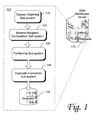
- Fig. 1 is a block diagram of an implementation described herein.
- Fig. 2 is a flow diagram showing a methodological implementation described herein.
- Fig. 3 is an example of a computing operating environment capable of (wholly or partially) implementing at least one embodiment described herein.
- the following description sets forth techniques that facilitate the detection and elimination of fuzzy duplicate tuples in a database.
- the techniques may be implemented in many ways, including (but not limited to) program modules, general- and special-purpose computing systems, dedicated electronics, and as part of one or more computer networks.
- exemplary fuzzy duplicate detector An exemplary implementation of these techniques may be referred to as an "exemplary fuzzy duplicate detector" and is described below.
- fuzzy duplicate detector addresses the fuzzy duplicate elimination problem.
- fuzzy duplicates are seemingly distinct tuples (i.e., records) that are not exact matches but yet represent the same real world entity or phenomenon nonetheless. Detecting and eliminating fuzzy duplicates is the fuzzy duplicate elimination problem.
- the exemplary fuzzy duplicate detector utilizes at least two new constraints that conventional approaches do not use.
- these two new criteria are called the compact set (CS) and the sparse neighborhood (SN). These criteria explicitly capture local structural properties of the data to characterize groups of duplicate tuples.
- Tuples that satisfy these criteria may be grouped together as duplicates even though they are far from each other, while tuples that are closer but do not satisfy these criteria may not be grouped together. These localized structural properties differentiate the duplicate elimination problem from standard clustering formulations. Table 1 Examples from a media database. Tuples tagged with asterisks are duplicate tuples.
- Table 1 provides an example of a typical music database.
- the first six tuples (tagged with an asterisk "*") are duplicate tuples , while the remaining tuples (7-14) are unique.
- the Compact Set (CS) criterion is that a set of duplicates is a compact set of mutual nearest neighbors.
- the premise behind this criterion is that duplicate tuples are closer to each other than they are to other distinct tuples. That is, duplicate tuples are usually mutually nearest neighbors.
- tuple 1 is the nearest neighbor of tuple 2 and vice-versa.
- tuple 8 may be the nearest neighbor of tuple 7 and tuple 9 that of tuple 8.
- the premise behind the sparse neighborhood (SN) criterion is that the local neighborhood of a group of duplicates is sparse. For instance, this criterion is not met around the unique tuples 7-14 in Table 1, which occur in larger (4, for this example) groups than sets of duplicates.
- the local neighborhood of a group of tuples is the immediate vicinity defined in terms of a surrounding region of size, dependent on the local distribution of tuples.
- it may be a sphere of radius 2 ⁇ nn(v), where nn(v) is the nearest neighbor distance of the tuple v.
- the rate of growth-the number of tuples in the outer sphere-around a tuple is small, its local neighborhood is called “sparse.”
- This notion is extended to a group of tuples, and their joint local neighborhood is called “sparse,” if an aggregate of individual growth rates of tuples is small (e.g., less than a threshold c).
- the aggregation function max requires that the neighborhood values of all tuples in the group be less than the threshold, whereas the function average only requires the average of all growth rates to be small. The maximum function is more constraining than the average function.
- R be a relation (i.e., dataset) and d: R x R ⁇ [0, 1] be a symmetric distance function over tuples in R..
- R x R ⁇ [0, 1] be a symmetric distance function over tuples in R.
- a set S of tuples from R is a compact set if,for every tuple ⁇ in S , the distance d( ⁇ , ⁇ ' ) between v and any other tuple ⁇ ' in S is less than the distance d( ⁇ , ⁇ ") between ⁇ and any other ⁇ " in R-S .
- SN Criterion For a tuple ⁇ , consider two concentric spheres: the smaller sphere has a radius nn ( ⁇ ), the distance between ⁇ and its nearest neighbor, and the larger sphere a radius of g(nn( ⁇ )) (>nn( ⁇ )) .
- g(x) 2x is used.
- the neighborhood growth ratio ng( ⁇ ) is the number of points in the larger sphere around ⁇ .
- AGG : 2 R ⁇ R be an aggregation function and c (>0) be a constant.
- a set of tuples S is an SN(AGG, c) group if (i)
- 1, or (ii) the aggregated value of neighborhood growth ratios of all tuples in S is less than c (i.e., AGG( ⁇ ng( ⁇ ): ⁇ in S ⁇ ) ⁇ c).
- the exemplary fuzzy duplicate detector partitions input relation R (e.g., a dataset of a database) into the minimum number of "valid" groups where a group is valid if it is small and satisfies the CS and SN criteria.
- R e.g., a dataset of a database
- this is the Duplicate Elimination (DE) Problem: Given a relation R, a distance function d , a positive integer K (>1), an aggregation function AGG, and a positive real number c, the exemplary fuzzy duplicate detector partitions R into the minimum number of groups ⁇ G 1 ,...,G m ⁇ such that for all 1 ⁇ i ⁇ m:
- Fig. 1 illustrates a fuzzy duplicate detection and elimination (FDDE) system 100.
- the exemplary fuzzy duplicate detector may be implemented by the FDDE system 100, described herein.
- the components of the FDDE system 100 may be implemented in software, hardware, or in a mixture of both.
- the FDDE system 100 determines tuple pairs whose nearest neighbor sets are equal and then extends the pair equality to groups of tuples.
- the FDDE system 100 may be part of a server or a client.
- This FDDE system 100 may be implemented on a general purpose computer, a specific purpose computer, a portable computer, a personal digital assistant (PDA), an appliance, special purpose electronics, or other such computing and electronics equipment that are capable of managing a database.
- PDA personal digital assistant
- the components of FDDE system 100 are shown inside the dashed line in Fig. 1 .
- the depicted system 100 includes a Dataset Obtaining sub-system 110, a Nearest-Neighbor Computation sub-system 120, a Partitioning sub-system 130, and a Duplicate Elimination sub-system 140.
- the system 100 is coupled (e.g., via a direction connection or via a network, such as the Internet) to a data warehouse server 160.
- a data warehouse server 160 On such server 160, is a database 170.
- the system 100 and database 170 may reside in the same computing device (such as server 160) or across multiple devices.
- the obtainer 110 obtains a dataset from the database 170.
- This dataset is the subject of the operations of the system 100.
- This dataset may also be called a "relation” and/or simply "R.” Examples of such obtaining include receiving a data packet with a set of tuples, accessing a stored file containing tuples, and/or submitting a query and receiving the results of that query.
- the Nearest-Neighbor Computation sub-system 120 determines the K nearest neighbors of every tuple in the obtained relation.
- the sub-system 120 either generates an index or utilizes an existing index that allows for the efficient answering of the following query: for any given tuple v in R, fetch its K nearest neighbors.
- the Nearest-Neighbor Computation sub-system 120 determines its nearest K neighbors and its neighborhood growth ratio.
- the output of this sub-system is a relation NN_Reln[ID, ID1, ..., IDK, NG] where ID1, ..., IDK are the identifiers of the K nearest neighbors of a tuple v with identifier ID and neighbor growth ratio NG.
- this sub-system scans the input relation R and, for each tuple v in R, looks up the index and writes the tuple [v, v1,...,vK ng(v)] to the output.
- the Partitioning sub-system 130 partitions the relation into the minimum number of valid groups of duplicates.
- this sub-system utilizes standard database (e.g., SQL) queries.
- SQL standard database
- the Partitioning sub-system 130 exploits efficient query processing abilities of database systems and avoids moving large amounts of data between a client and a server.
- the Partitioning sub-system 130 uses the output of the first phase to partition the input relation into the minimum number of compact SN sets.
- the resulting partition is the solution to the DE problem.
- the Duplicate Elimination sub-system 140 cleans the database by removing the superfluous duplicate tuples. This sub-system modifies the database 170 to remove these identified duplicates.
- index structures typically used for fetching K nearest neighbors are disk-based. In other words, they access data stored on slower secondary storage systems (like hard disks) rather than data stored in quickly accessible primary memory (e.g., random-access memory).
- the exemplary fuzzy duplicate detector utilizes a look-up order that can be implemented efficiently.
- the exemplary fuzzy duplicate detector adopts a breadth first (BF) order, which satisfies two properties of a good look-up order: First, tuples immediately preceding any tuple in the order must be close to it. Second, the procedure for ordering input tuples has to be efficient.
- BF breadth first
- the order corresponds to a breadth first traversal of a tree T constructed as follows: Any input tuple is selected to be the root of the tree. The children of any node in the tree are its K nearest neighbors, which have not already been inserted into the tree. Note that the exemplary fuzzy duplicate detector does not actually need to build such a tree but just fetch input tuples in the appropriate order.
- Each tuple (except the root) in the BF order is always preceded by its siblings or the children of its parent's sibling. These tuples are much closer to each other than arbitrary pairs of tuples. Therefore, all tuples in the lookup order are preceded by tuples that are very close to them. Consequently, the look-up algorithm makes localized index accesses.
- references to nearest neighbor indexes contemplate use of either exact or probabilistic nearest neighbor indexes.
- Those of ordinary skill in the art are familiar with many conventional indexes that utilize approximation and probabilities based upon standard distance functions (e.g., cosine metric, edit distance, and fuzzy match similarity).
- Fig. 2 shows a methodological implementation of the FDDE system 100. This methodological implementation may be performed in software, hardware, or a combination thereof.
- the method steps are delineated as separate steps; however, these separately delineated steps should not be construed as necessarily order dependent in their performance.
- the description of this methodological implementation discusses its application to a particular example.
- the group ⁇ 10, 50, 100, 150 ⁇ forms a compact SN set. It is enough to know, besides the neighborhood growth (NG) values of each tuple, that the 4 nearest neighbor sets of the pairs ⁇ 10, 50 ⁇ , ⁇ 10, 100 ⁇ , ⁇ 10, 150 ⁇ are all equal. It may be deduced from the pair equality and the transitivity of set equality that the group ⁇ 10, 50, 100, 150 ⁇ is a compact set.
- NG neighborhood growth
- the FDDE system 100 obtains a dataset (i.e., a relation) from the database 170.
- the FDDE system 100 calculates the K nearest neighbors of every tuple in the obtained relation. To do this, it may utilize an existing index or generate its own.
- the FDDE system 100 computes equality of neighbor sets of varying sizes between tuple pairs. That is, for a tuple pair (10, 100), the system determines whether their 2-nearest neighbor sets, 3-nearest neighbor sets, and so on, through K-nearest neighbor sets, are equal. Such a comparison between tuples v1 and v2 yields the following Boolean results CS2, ..., CSK, along with their neighbor growth ratios ng(v1) and ng(v2). The value CS i (2 ⁇ i ⁇ K) denotes whether the i-neighbor sets of v1 and v2 are equal. The result may be stored in a temporary relation CSPairs.
- the FDDE system 100 may issue a database query (e.g., SQL (select into) query) against the output (NN_Reln) of the first phase to compute the CSPairs relation.
- the query involves a self-join of NN_Reln (e.g., FROM NN_Reln1, NN_Reln2) on the predicate that a tuple NN Relnl.ID is less than NN_Reln2.ID and that it is in the K-nearest neighbor set of NN_Reln2.ID and vice-versa.
- the selected column list has the following two parts: (i) NN_Reln1.ID, NN_Reln2.ID, NN_Reln1.NG, NN_Reln2.NG, and (ii) for each j between 2 and K, a case statement which returns 1 if the set of j-nearest neighbors of NN_Rcln 1.ID equals the set of j-nearest neighbors of NN_Reln2.ID. Observe that this query may be expressed using standard SQL and perform all of the computation at the database server.
- the FDDE system 100 partitions the relation into the minimum number of valid groups of duplicates.
- the resulting valid groups of duplicates satisfy each of these criteria:
- the FDDE system 100 extends the equality between neighbor sets of tuple pairs to sets of tuples and determines whether a set of neighbors is compact and satisfies the SN criterion.
- the 4-neighbor sets of tuple pairs (10, 50), (10, 100), and (10, 150) are equal and, therefore, form a compact set of size 4.
- the set ⁇ 10, 50, 100, 150 ⁇ can be output as a group of duplicates provided, (i) the aggregate SN value of this group is less than the threshold c, and (ii) it cannot be extended to a larger compact SN group.
- the FDDE system 100 processes the CSPairs relation (output of block 214) by issuing the following CS-group query: "select * from CSPairs order by ID” to group all neighbor set comparison results between a tuple v and its neighbors v' where v.ID ⁇ v'.ID. Observe that in the result of the CS-group query, each compact SN set G will be grouped together under the tuple with the minimum ID in G.
- the FDDE system 100 cleans the database 170 by removing the superfluous duplicate tuples where the identification of these duplicate tuples is based upon the results of block 216.
- the solution to the fuzzy duplicate elimination problem offered by the exemplary fuzzy duplicate detector is more accurate and efficient than the existing conventional approaches. It is scale invariant such that the scale of a distance function does impact the local structural properties of tuples. It is split/merge consistent in that shrinking distances between tuples in a group of duplicates and expanding distances between tuples across groups may only change the partition in limited ways. It has a constrained richness such that the range of a duplicate elimination function allows all groupings that would be useful in practice.
- the user must specify the sparse neighborhood threshold c. However, that calculation may be done automatically or may provide assistance to the user in her calculation of the threshold c.
- Fig. 3 illustrates an example of a suitable computing environment 300 within which an exemplary fuzzy duplicate detector, as described herein, may be implemented (either fully or partially).
- the computing environment 300 may be utilized in the computer and network architectures described herein.
- the exemplary computing environment 300 is only one example of a computing environment and is not intended to suggest any limitation as to the scope of use or functionality of the computer and network architectures. Neither should the computing environment 300 be interpreted as having any dependency or requirement relating to any one or combination of components illustrated in the exemplary computing environment 300.
- the exemplary fuzzy duplicate detector may be implemented with numerous other general purpose or special purpose computing system environments or configurations.
- Examples of well known computing systems, environments, and/or configurations that may be suitable for use include, but are not limited to, personal computers, server computers, thin clients, thick clients, hand-held or laptop devices, multiprocessor systems, microprocessor-based systems, set top boxes, personal digital assistants (PDA), appliances, special-purpose electronics (e.g., a DVD player), programmable consumer electronics, network PCs, minicomputers, mainframe computers, distributed computing environments that include any of the above systems or devices, and the like.
- PDA personal digital assistants
- special-purpose electronics e.g., a DVD player
- the exemplary fuzzy duplicate detector may be described in the general context of processor-executable instructions, such as program modules, being executed by a computer.
- program modules include routines, programs, objects, components, data structures, etc. that perform particular tasks or implement particular abstract data types.
- the exemplary fuzzy duplicate detector may also be practiced in distributed computing environments where tasks are performed by remote processing devices that are linked through a communications network.
- program modules may be located in both local and remote computer storage media including memory storage devices.
- the computing environment 300 includes a general-purpose computing device in the form of a computer 302.
- the components of computer 302 may include, but are not limited to, one or more processors or processing units 304, a system memory 306, and a system bus 308 that couples various system components, including the processor 304, to the system memory 306.
- the system bus 308 represents one or more of any of several types of bus structures, including a memory bus or memory controller, a peripheral bus, an accelerated graphics port, and a processor or local bus using any of a variety of bus architectures.
- bus architectures can include a CardBus, Personal Computer Memory Card International Association (PCMCIA), Accelerated Graphics Port (AGP), Small Computer System Interface (SCSI), Universal Serial Bus (USB), IEEE 1394, a Video Electronics Standards Association (VESA) local bus, and a Peripheral Component Interconnects (PCI) bus, also known as a Mezzanine bus.
- Computer 302 typically includes a variety of processor-readable media. Such media may be any available media that is accessible by computer 302 and includes both volatile and non-volatile media, removable and non-removable media.
- the system memory 306 includes processor-readable media in the form of volatile memory, such as random access memory (RAM) 310, and/or non-volatile memory, such as read only memory (ROM) 312.
- RAM random access memory
- ROM read only memory
- BIOS basic input/output system
- RAM 310 typically contains data and/or program modules that are immediately accessible to and/or presently operated on by the processing unit 304.
- Computer 302 may also include other removable/non-removable, volatile/non-volatile computer storage media.
- Fig. 3 illustrates a hard disk drive 316 for reading from and writing to a non-removable, non-volatile magnetic media (not shown), a magnetic disk drive 318 for reading from and writing to a removable, non-volatile magnetic disk 320 (e.g., a "floppy disk"), and an optical disk drive 322 for reading from and/or writing to a removable, non-volatile optical disk 324 such as a CD-ROM, DVD-ROM, or other optical media.
- a hard disk drive 316 for reading from and writing to a non-removable, non-volatile magnetic media (not shown)
- a magnetic disk drive 318 for reading from and writing to a removable, non-volatile magnetic disk 320 (e.g., a "floppy disk")
- an optical disk drive 322 for reading from and/or writing to a removable, non-volatile optical
- the hard disk drive 316, magnetic disk drive 318, and optical disk drive 322 are each connected to the system bus 308 by one or more data media interfaces 325.
- the hard disk drive 316, magnetic disk drive 318, and optical disk drive 322 may be connected to the system bus 308 by one or more interfaces (not shown).
- the disk drives and their associated processor-readable media provide non-volatile storage of computer readable instructions, data structures, program modules, and other data for computer 302.
- a hard disk 316 a removable magnetic disk 320, and a removable optical disk 324
- processor-readable media which may store data that is accessible by a computer, such as magnetic cassettes or other magnetic storage devices, flash memory cards, CD-ROM, digital versatile disks (DVD) or other optical storage, random access memories (RAM), read only memories (ROM), electrically erasable programmable read-only memory (EEPROM), and the like, may also be utilized to implement the exemplary computing system and environment.
- Any number of program modules may be stored on the hard disk 316 magnetic disk 320, optical disk 324, ROM 312, and/or RAM 310, including, by way of example, an operating system 326, one or more application programs 328, other program modules 330, and program data 332.
- a user may enter commands and information into computer 302 via input devices such as a keyboard 334 and a pointing device 336 (e.g., a "mouse").
- Other input devices 338 may include a microphone, joystick, game pad, satellite dish, serial port, scanner, and/or the like.
- input/output interfaces 340 that are coupled to the system bus 308, but may be connected by other interface and bus structures, such as a parallel port, game port, or a universal serial bus (USB).
- a monitor 342 or other type of display device may also be connected to the system bus 308 via an interface, such as a video adapter 344.
- other output peripheral devices may include components, such as speakers (not shown) and a printer 346, which may be connected to computer 302 via the input/output interfaces 340.
- Computer 302 may operate in a networked environment using logical connections to one or more remote computers, such as a remote computing device 348.
- the remote computing device 348 may be a personal computer, a portable computer, a server, a router, a network computer, a peer device or other common network node, and the like.
- the remote computing device 348 is illustrated as a portable computer that may include many or all of the elements and features described herein, relative to computer 302.
- Logical connections between computer 302 and the remote computer 348 are depicted as a local area network (LAN) 350 and a general wide area network (WAN) 352.
- LAN local area network
- WAN wide area network
- Such networking environments are commonplace in offices, enterprise-wide computer networks, intranets, and the Internet. Such networking environments may be wired or wireless.
- the computer 302 When implemented in a LAN networking environment, the computer 302 is connected to a local network 350 via a network interface or adapter 354. When implemented in a WAN networking environment, the computer 302 typically includes a modem 356 or other means for establishing communications over the wide network 352.
- the modem 356, which may be internal or external to computer 302, may be connected to the system bus 308 via the input/output interfaces 340 or other appropriate mechanisms. It is to be appreciated that the illustrated network connections are exemplary and that other means of establishing communication link(s) between the computers 302 and 348 may be employed.
- remote application programs 358 reside on a memory device of remote computer 348.
- application programs and other executable program components such as the operating system, are illustrated herein as discrete blocks, although it is recognized that such programs and components reside at various times in different storage components of the computing device 302, and are executed by the data processor(s) of the computer.
- An implementation of an exemplary fuzzy duplicate detector may be described in the general context of processor-executable instructions, such as program modules, executed by one or more computers or other devices.
- program modules include routines, programs, objects, components, data structures, etc. that perform particular tasks or implement particular abstract data types.
- the functionality of the program modules may be combined or distributed as desired in various embodiments.
- Fig. 3 illustrates an example of a suitable operating environment 300 in which an exemplary fuzzy duplicate detector may be implemented.
- the exemplary fuzzy duplicate detector(s) described herein may be implemented (wholly or in part) by any program modules 328-330 and/or operating system 326 in Fig. 3 or a portion thereof.
- the operating environment is only an example of a suitable operating environment and is not intended to suggest any limitation as to the scope or use of functionality of the exemplary fuzzy duplicate detector(s) described herein.
- Other well known computing systems, environments, and/or configurations that are suitable for use include, but are not limited to, personal computers (PCs), server computers, hand-held or laptop devices, multiprocessor systems, microprocessor-based systems, programmable consumer electronics, wireless phones and equipment, general and special-purpose appliances, application-specific integrated circuits (ASICs), network PCs, minicomputers, mainframe computers, distributed computing environments that include any of the above systems or devices, and the like.
- processor-readable media may be any available media that may be accessed by a computer.
- processor-readable media may comprise, but is not limited to, "computer storage media” and "communications media.”
- Computer storage media include volatile and non-volatile, removable and non-removable media implemented in any method or technology for storage of information such as computer readable instructions, data structures, program modules, or other data.
- Computer storage media includes, but is not limited to, RAM, ROM, EEPROM, flash memory or other memory technology, CD-ROM, digital versatile disks (DVD) or other optical storage, magnetic cassettes, magnetic tape, magnetic disk storage or other magnetic storage devices, or any other medium which may be used to store the desired information and which may be accessed by a computer.
- Communication media typically embodies processor-readable instructions, data structures, program modules, or other data in a modulated data signal, such as carrier wave or other transport mechanism. Communication media also includes any information delivery media.
- modulated data signal means a signal that has one or more of its characteristics set or changed in such a manner as to encode information in the signal.
- communication media may comprise, but is not limited to, wired media such as a wired network or direct-wired connection, and wireless media such as acoustic, RF, infrared, and other wireless media. Combinations of any of the above are also included within the scope of processor-readable media.
Landscapes
- Engineering & Computer Science (AREA)
- Theoretical Computer Science (AREA)
- Physics & Mathematics (AREA)
- General Engineering & Computer Science (AREA)
- General Physics & Mathematics (AREA)
- Databases & Information Systems (AREA)
- Quality & Reliability (AREA)
- Data Mining & Analysis (AREA)
- Information Retrieval, Db Structures And Fs Structures Therefor (AREA)
- Stereo-Broadcasting Methods (AREA)
- Circuits Of Receivers In General (AREA)
Applications Claiming Priority (1)
| Application Number | Priority Date | Filing Date | Title |
|---|---|---|---|
| US10/929,514 US7516149B2 (en) | 2004-08-30 | 2004-08-30 | Robust detector of fuzzy duplicates |
Publications (2)
| Publication Number | Publication Date |
|---|---|
| EP1630698A1 EP1630698A1 (en) | 2006-03-01 |
| EP1630698B1 true EP1630698B1 (en) | 2009-01-07 |
Family
ID=35219700
Family Applications (1)
| Application Number | Title | Priority Date | Filing Date |
|---|---|---|---|
| EP05107743A Expired - Lifetime EP1630698B1 (en) | 2004-08-30 | 2005-08-24 | Robust detector of fuzzy duplicate records in a database |
Country Status (7)
| Country | Link |
|---|---|
| US (1) | US7516149B2 (https=) |
| EP (1) | EP1630698B1 (https=) |
| JP (1) | JP4814570B2 (https=) |
| KR (1) | KR101153113B1 (https=) |
| CN (1) | CN100520776C (https=) |
| AT (1) | ATE420406T1 (https=) |
| DE (1) | DE602005012192D1 (https=) |
Families Citing this family (42)
| Publication number | Priority date | Publication date | Assignee | Title |
|---|---|---|---|---|
| US8732004B1 (en) | 2004-09-22 | 2014-05-20 | Experian Information Solutions, Inc. | Automated analysis of data to generate prospect notifications based on trigger events |
| US20070016501A1 (en) | 2004-10-29 | 2007-01-18 | American Express Travel Related Services Co., Inc., A New York Corporation | Using commercial share of wallet to rate business prospects |
| US8326672B2 (en) | 2004-10-29 | 2012-12-04 | American Express Travel Related Services Company, Inc. | Using commercial share of wallet in financial databases |
| US7822665B2 (en) | 2004-10-29 | 2010-10-26 | American Express Travel Related Services Company, Inc. | Using commercial share of wallet in private equity investments |
| US8630929B2 (en) | 2004-10-29 | 2014-01-14 | American Express Travel Related Services Company, Inc. | Using commercial share of wallet to make lending decisions |
| US7792732B2 (en) | 2004-10-29 | 2010-09-07 | American Express Travel Related Services Company, Inc. | Using commercial share of wallet to rate investments |
| US8204774B2 (en) * | 2004-10-29 | 2012-06-19 | American Express Travel Related Services Company, Inc. | Estimating the spend capacity of consumer households |
| US8086509B2 (en) | 2004-10-29 | 2011-12-27 | American Express Travel Related Services Company, Inc. | Determining commercial share of wallet |
| US7912770B2 (en) * | 2004-10-29 | 2011-03-22 | American Express Travel Related Services Company, Inc. | Method and apparatus for consumer interaction based on spend capacity |
| US7788147B2 (en) | 2004-10-29 | 2010-08-31 | American Express Travel Related Services Company, Inc. | Method and apparatus for estimating the spend capacity of consumers |
| US8543499B2 (en) | 2004-10-29 | 2013-09-24 | American Express Travel Related Services Company, Inc. | Reducing risks related to check verification |
| US8131614B2 (en) | 2004-10-29 | 2012-03-06 | American Express Travel Related Services Company, Inc. | Using commercial share of wallet to compile marketing company lists |
| US20070244732A1 (en) | 2004-10-29 | 2007-10-18 | American Express Travel Related Services Co., Inc., A New York Corporation | Using commercial share of wallet to manage vendors |
| US7840484B2 (en) | 2004-10-29 | 2010-11-23 | American Express Travel Related Services Company, Inc. | Credit score and scorecard development |
| US8326671B2 (en) | 2004-10-29 | 2012-12-04 | American Express Travel Related Services Company, Inc. | Using commercial share of wallet to analyze vendors in online marketplaces |
| US20080243680A1 (en) * | 2005-10-24 | 2008-10-02 | Megdal Myles G | Method and apparatus for rating asset-backed securities |
| US20080033852A1 (en) * | 2005-10-24 | 2008-02-07 | Megdal Myles G | Computer-based modeling of spending behaviors of entities |
| US8036979B1 (en) | 2006-10-05 | 2011-10-11 | Experian Information Solutions, Inc. | System and method for generating a finance attribute from tradeline data |
| US8239250B2 (en) | 2006-12-01 | 2012-08-07 | American Express Travel Related Services Company, Inc. | Industry size of wallet |
| US8606666B1 (en) | 2007-01-31 | 2013-12-10 | Experian Information Solutions, Inc. | System and method for providing an aggregation tool |
| US8606626B1 (en) | 2007-01-31 | 2013-12-10 | Experian Information Solutions, Inc. | Systems and methods for providing a direct marketing campaign planning environment |
| US7827153B2 (en) * | 2007-12-19 | 2010-11-02 | Sap Ag | System and method to perform bulk operation database cleanup |
| US20110004578A1 (en) * | 2008-02-22 | 2011-01-06 | Michinari Momma | Active metric learning device, active metric learning method, and program |
| US20100161542A1 (en) * | 2008-12-22 | 2010-06-24 | International Business Machines Corporation | Detecting entity relevance due to a multiplicity of distinct values for an attribute type |
| US9910875B2 (en) | 2008-12-22 | 2018-03-06 | International Business Machines Corporation | Best-value determination rules for an entity resolution system |
| US8200640B2 (en) | 2009-06-15 | 2012-06-12 | Microsoft Corporation | Declarative framework for deduplication |
| US8176407B2 (en) * | 2010-03-02 | 2012-05-08 | Microsoft Corporation | Comparing values of a bounded domain |
| US9652802B1 (en) | 2010-03-24 | 2017-05-16 | Consumerinfo.Com, Inc. | Indirect monitoring and reporting of a user's credit data |
| US9361008B2 (en) * | 2010-05-12 | 2016-06-07 | Moog Inc. | Result-oriented configuration of performance parameters |
| US8473410B1 (en) | 2012-02-23 | 2013-06-25 | American Express Travel Related Services Company, Inc. | Systems and methods for identifying financial relationships |
| US8781954B2 (en) | 2012-02-23 | 2014-07-15 | American Express Travel Related Services Company, Inc. | Systems and methods for identifying financial relationships |
| US9477988B2 (en) | 2012-02-23 | 2016-10-25 | American Express Travel Related Services Company, Inc. | Systems and methods for identifying financial relationships |
| US8538869B1 (en) | 2012-02-23 | 2013-09-17 | American Express Travel Related Services Company, Inc. | Systems and methods for identifying financial relationships |
| US9336302B1 (en) | 2012-07-20 | 2016-05-10 | Zuci Realty Llc | Insight and algorithmic clustering for automated synthesis |
| CN104516900A (zh) * | 2013-09-29 | 2015-04-15 | 国际商业机器公司 | 用于多个序列数据的聚类方法及其装置 |
| US9892158B2 (en) * | 2014-01-31 | 2018-02-13 | International Business Machines Corporation | Dynamically adjust duplicate skipping method for increased performance |
| US10262362B1 (en) | 2014-02-14 | 2019-04-16 | Experian Information Solutions, Inc. | Automatic generation of code for attributes |
| US10387389B2 (en) * | 2014-09-30 | 2019-08-20 | International Business Machines Corporation | Data de-duplication |
| US10445152B1 (en) | 2014-12-19 | 2019-10-15 | Experian Information Solutions, Inc. | Systems and methods for dynamic report generation based on automatic modeling of complex data structures |
| US11205103B2 (en) | 2016-12-09 | 2021-12-21 | The Research Foundation for the State University | Semisupervised autoencoder for sentiment analysis |
| US11055327B2 (en) | 2018-07-01 | 2021-07-06 | Quadient Technologies France | Unstructured data parsing for structured information |
| US11301440B2 (en) | 2020-06-18 | 2022-04-12 | Lexisnexis Risk Solutions, Inc. | Fuzzy search using field-level deletion neighborhoods |
Family Cites Families (39)
| Publication number | Priority date | Publication date | Assignee | Title |
|---|---|---|---|---|
| US5924090A (en) | 1997-05-01 | 1999-07-13 | Northern Light Technology Llc | Method and apparatus for searching a database of records |
| US5940821A (en) * | 1997-05-21 | 1999-08-17 | Oracle Corporation | Information presentation in a knowledge base search and retrieval system |
| US5950186A (en) | 1997-08-15 | 1999-09-07 | Microsoft Corporation | Database system index selection using cost evaluation of a workload for multiple candidate index configurations |
| US5913207A (en) | 1997-08-15 | 1999-06-15 | Microsoft Corporation | Database system index selection using index configuration enumeration for a workload |
| US5960423A (en) | 1997-08-15 | 1999-09-28 | Microsoft Corporation | Database system index selection using candidate index selection for a workload |
| US5926813A (en) | 1997-08-15 | 1999-07-20 | Microsoft Corporation | Database system index selection using cost evaluation of a workload for multiple candidate index configurations |
| US5913206A (en) | 1997-08-15 | 1999-06-15 | Microsoft Corporation | Database system multi-column index selection for a workload |
| US5966702A (en) | 1997-10-31 | 1999-10-12 | Sun Microsystems, Inc. | Method and apparatus for pre-processing and packaging class files |
| US6182066B1 (en) * | 1997-11-26 | 2001-01-30 | International Business Machines Corp. | Category processing of query topics and electronic document content topics |
| US6169983B1 (en) | 1998-05-30 | 2001-01-02 | Microsoft Corporation | Index merging for database systems |
| US6223171B1 (en) | 1998-08-25 | 2001-04-24 | Microsoft Corporation | What-if index analysis utility for database systems |
| US6460045B1 (en) | 1999-03-15 | 2002-10-01 | Microsoft Corporation | Self-tuning histogram and database modeling |
| US6374241B1 (en) | 1999-03-31 | 2002-04-16 | Verizon Laboratories Inc. | Data merging techniques |
| US6363371B1 (en) | 1999-06-29 | 2002-03-26 | Microsoft Corporation | Identifying essential statistics for query optimization for databases |
| US6529901B1 (en) | 1999-06-29 | 2003-03-04 | Microsoft Corporation | Automating statistics management for query optimizers |
| US6691108B2 (en) | 1999-12-14 | 2004-02-10 | Nec Corporation | Focused search engine and method |
| US6266658B1 (en) | 2000-04-20 | 2001-07-24 | Microsoft Corporation | Index tuner for given workload |
| US6356890B1 (en) | 2000-04-20 | 2002-03-12 | Microsoft Corporation | Merging materialized view pairs for database workload materialized view selection |
| US6356891B1 (en) | 2000-04-20 | 2002-03-12 | Microsoft Corporation | Identifying indexes on materialized views for database workload |
| US6513029B1 (en) | 2000-04-20 | 2003-01-28 | Microsoft Corporation | Interesting table-subset selection for database workload materialized view selection |
| US6366903B1 (en) | 2000-04-20 | 2002-04-02 | Microsoft Corporation | Index and materialized view selection for a given workload |
| US7007008B2 (en) | 2000-08-08 | 2006-02-28 | America Online, Inc. | Category searching |
| GB0029159D0 (en) * | 2000-11-29 | 2001-01-17 | Calaba Ltd | Data storage and retrieval system |
| US20020124214A1 (en) | 2001-03-01 | 2002-09-05 | International Business Machines Corporation | Method and system for eliminating duplicate reported errors in a logically partitioned multiprocessing system |
| US20040128282A1 (en) | 2001-03-07 | 2004-07-01 | Paul Kleinberger | System and method for computer searching |
| AU2002309152A1 (en) | 2001-03-25 | 2002-10-08 | Exiqon A/S | Systems for analysis of biological materials |
| US6912549B2 (en) * | 2001-09-05 | 2005-06-28 | Siemens Medical Solutions Health Services Corporation | System for processing and consolidating records |
| JP3812818B2 (ja) * | 2001-12-05 | 2006-08-23 | 日本電信電話株式会社 | データベース生成装置、データベース生成方法及びデータベース生成処理プログラム |
| JP3803961B2 (ja) * | 2001-12-05 | 2006-08-02 | 日本電信電話株式会社 | データベース生成装置、データベース生成処理方法及びデータベース生成プログラム |
| US7523127B2 (en) * | 2002-01-14 | 2009-04-21 | Testout Corporation | System and method for a hierarchical database management system for educational training and competency testing simulations |
| US7139749B2 (en) | 2002-03-19 | 2006-11-21 | International Business Machines Corporation | Method, system, and program for performance tuning a database query |
| US7152060B2 (en) * | 2002-04-11 | 2006-12-19 | Choicemaker Technologies, Inc. | Automated database blocking and record matching |
| US6961721B2 (en) * | 2002-06-28 | 2005-11-01 | Microsoft Corporation | Detecting duplicate records in database |
| US7953694B2 (en) * | 2003-01-13 | 2011-05-31 | International Business Machines Corporation | Method, system, and program for specifying multidimensional calculations for a relational OLAP engine |
| US20050027717A1 (en) * | 2003-04-21 | 2005-02-03 | Nikolaos Koudas | Text joins for data cleansing and integration in a relational database management system |
| US7774312B2 (en) | 2003-09-04 | 2010-08-10 | Oracle International Corporation | Self-managing performance statistics repository for databases |
| US20050125401A1 (en) * | 2003-12-05 | 2005-06-09 | Hewlett-Packard Development Company, L. P. | Wizard for usage in real-time aggregation and scoring in an information handling system |
| WO2005057364A2 (en) | 2003-12-08 | 2005-06-23 | Ebay Inc. | Custom caching |
| US7281004B2 (en) | 2004-02-27 | 2007-10-09 | International Business Machines Corporation | Method, system and program for optimizing compression of a workload processed by a database management system |
-
2004
- 2004-08-30 US US10/929,514 patent/US7516149B2/en not_active Expired - Lifetime
-
2005
- 2005-07-12 KR KR1020050062656A patent/KR101153113B1/ko not_active Expired - Fee Related
- 2005-07-29 CN CNB2005100885171A patent/CN100520776C/zh not_active Expired - Lifetime
- 2005-07-29 JP JP2005221802A patent/JP4814570B2/ja not_active Expired - Fee Related
- 2005-08-24 AT AT05107743T patent/ATE420406T1/de not_active IP Right Cessation
- 2005-08-24 EP EP05107743A patent/EP1630698B1/en not_active Expired - Lifetime
- 2005-08-24 DE DE602005012192T patent/DE602005012192D1/de not_active Expired - Lifetime
Also Published As
| Publication number | Publication date |
|---|---|
| KR20060050069A (ko) | 2006-05-19 |
| US20060053129A1 (en) | 2006-03-09 |
| JP4814570B2 (ja) | 2011-11-16 |
| EP1630698A1 (en) | 2006-03-01 |
| KR101153113B1 (ko) | 2012-06-04 |
| CN1744083A (zh) | 2006-03-08 |
| US7516149B2 (en) | 2009-04-07 |
| ATE420406T1 (de) | 2009-01-15 |
| JP2006072985A (ja) | 2006-03-16 |
| CN100520776C (zh) | 2009-07-29 |
| DE602005012192D1 (de) | 2009-02-26 |
Similar Documents
| Publication | Publication Date | Title |
|---|---|---|
| EP1630698B1 (en) | Robust detector of fuzzy duplicate records in a database | |
| US6470333B1 (en) | Knowledge extraction system and method | |
| US7567962B2 (en) | Generating a labeled hierarchy of mutually disjoint categories from a set of query results | |
| Berlin et al. | Autoplex: Automated discovery of content for virtual databases | |
| Gravano et al. | Text joins in an RDBMS for web data integration | |
| US7296011B2 (en) | Efficient fuzzy match for evaluating data records | |
| Jain et al. | Online metric learning and fast similarity search | |
| US6389436B1 (en) | Enhanced hypertext categorization using hyperlinks | |
| US5978788A (en) | System and method for generating multi-representations of a data cube | |
| US12079181B2 (en) | Efficient indexing for querying arrays in databases | |
| US20050004904A1 (en) | Exposing multidimensional calculations through structured query language | |
| Kang et al. | Tasti: Semantic indexes for machine learning-based queries over unstructured data | |
| CN107506490B (zh) | 滑动窗口下基于位置top-k关键词查询的优先查询算法及系统 | |
| CN110334290B (zh) | 一种基于MF-Octree的时空数据快速检索方法 | |
| Kang et al. | Task-agnostic indexes for deep learning-based queries over unstructured data | |
| CN111581479B (zh) | 一站式数据处理的方法、装置、存储介质及电子设备 | |
| Kang et al. | Semantic indexes for machine learning-based queries over unstructured data | |
| Haas et al. | Discovering and exploiting statistical properties for query optimization in relational databases: A survey | |
| US7917462B1 (en) | Materializing subsets of a multi-dimensional table | |
| Goldstein et al. | Indexing high dimensional rectangles for fast multimedia identification | |
| Scott et al. | EBS kd tree: An entropy balanced statistical kd tree for image databases with ground-truth labels | |
| CN117216216A (zh) | 基于PostgreSQL的非结构化数据查询方法及装置 | |
| Yen et al. | The analysis of relationships in databases for rule derivation | |
| Friedman et al. | Box queries over multi-dimensional streams | |
| US20240386002A1 (en) | Relating data in data lakes |
Legal Events
| Date | Code | Title | Description |
|---|---|---|---|
| PUAI | Public reference made under article 153(3) epc to a published international application that has entered the european phase |
Free format text: ORIGINAL CODE: 0009012 |
|
| AK | Designated contracting states |
Kind code of ref document: A1 Designated state(s): AT BE BG CH CY CZ DE DK EE ES FI FR GB GR HU IE IS IT LI LT LU LV MC NL PL PT RO SE SI SK TR |
|
| AX | Request for extension of the european patent |
Extension state: AL BA HR MK YU |
|
| 17P | Request for examination filed |
Effective date: 20060822 |
|
| 17Q | First examination report despatched |
Effective date: 20060925 |
|
| AKX | Designation fees paid |
Designated state(s): AT BE BG CH CY CZ DE DK EE ES FI FR GB GR HU IE IS IT LI LT LU LV MC NL PL PT RO SE SI SK TR |
|
| GRAP | Despatch of communication of intention to grant a patent |
Free format text: ORIGINAL CODE: EPIDOSNIGR1 |
|
| GRAS | Grant fee paid |
Free format text: ORIGINAL CODE: EPIDOSNIGR3 |
|
| GRAA | (expected) grant |
Free format text: ORIGINAL CODE: 0009210 |
|
| AK | Designated contracting states |
Kind code of ref document: B1 Designated state(s): AT BE BG CH CY CZ DE DK EE ES FI FR GB GR HU IE IS IT LI LT LU LV MC NL PL PT RO SE SI SK TR |
|
| REG | Reference to a national code |
Ref country code: GB Ref legal event code: FG4D |
|
| REG | Reference to a national code |
Ref country code: CH Ref legal event code: EP |
|
| REG | Reference to a national code |
Ref country code: IE Ref legal event code: FG4D |
|
| REF | Corresponds to: |
Ref document number: 602005012192 Country of ref document: DE Date of ref document: 20090226 Kind code of ref document: P |
|
| PG25 | Lapsed in a contracting state [announced via postgrant information from national office to epo] |
Ref country code: NL Free format text: LAPSE BECAUSE OF FAILURE TO SUBMIT A TRANSLATION OF THE DESCRIPTION OR TO PAY THE FEE WITHIN THE PRESCRIBED TIME-LIMIT Effective date: 20090107 Ref country code: SI Free format text: LAPSE BECAUSE OF FAILURE TO SUBMIT A TRANSLATION OF THE DESCRIPTION OR TO PAY THE FEE WITHIN THE PRESCRIBED TIME-LIMIT Effective date: 20090107 |
|
| NLV1 | Nl: lapsed or annulled due to failure to fulfill the requirements of art. 29p and 29m of the patents act | ||
| PG25 | Lapsed in a contracting state [announced via postgrant information from national office to epo] |
Ref country code: LT Free format text: LAPSE BECAUSE OF FAILURE TO SUBMIT A TRANSLATION OF THE DESCRIPTION OR TO PAY THE FEE WITHIN THE PRESCRIBED TIME-LIMIT Effective date: 20090107 Ref country code: FI Free format text: LAPSE BECAUSE OF FAILURE TO SUBMIT A TRANSLATION OF THE DESCRIPTION OR TO PAY THE FEE WITHIN THE PRESCRIBED TIME-LIMIT Effective date: 20090107 Ref country code: ES Free format text: LAPSE BECAUSE OF FAILURE TO SUBMIT A TRANSLATION OF THE DESCRIPTION OR TO PAY THE FEE WITHIN THE PRESCRIBED TIME-LIMIT Effective date: 20090418 |
|
| PG25 | Lapsed in a contracting state [announced via postgrant information from national office to epo] |
Ref country code: SE Free format text: LAPSE BECAUSE OF FAILURE TO SUBMIT A TRANSLATION OF THE DESCRIPTION OR TO PAY THE FEE WITHIN THE PRESCRIBED TIME-LIMIT Effective date: 20090407 Ref country code: PT Free format text: LAPSE BECAUSE OF FAILURE TO SUBMIT A TRANSLATION OF THE DESCRIPTION OR TO PAY THE FEE WITHIN THE PRESCRIBED TIME-LIMIT Effective date: 20090608 Ref country code: PL Free format text: LAPSE BECAUSE OF FAILURE TO SUBMIT A TRANSLATION OF THE DESCRIPTION OR TO PAY THE FEE WITHIN THE PRESCRIBED TIME-LIMIT Effective date: 20090107 Ref country code: AT Free format text: LAPSE BECAUSE OF FAILURE TO SUBMIT A TRANSLATION OF THE DESCRIPTION OR TO PAY THE FEE WITHIN THE PRESCRIBED TIME-LIMIT Effective date: 20090107 Ref country code: IS Free format text: LAPSE BECAUSE OF FAILURE TO SUBMIT A TRANSLATION OF THE DESCRIPTION OR TO PAY THE FEE WITHIN THE PRESCRIBED TIME-LIMIT Effective date: 20090507 Ref country code: LV Free format text: LAPSE BECAUSE OF FAILURE TO SUBMIT A TRANSLATION OF THE DESCRIPTION OR TO PAY THE FEE WITHIN THE PRESCRIBED TIME-LIMIT Effective date: 20090107 |
|
| PG25 | Lapsed in a contracting state [announced via postgrant information from national office to epo] |
Ref country code: BE Free format text: LAPSE BECAUSE OF FAILURE TO SUBMIT A TRANSLATION OF THE DESCRIPTION OR TO PAY THE FEE WITHIN THE PRESCRIBED TIME-LIMIT Effective date: 20090107 |
|
| PG25 | Lapsed in a contracting state [announced via postgrant information from national office to epo] |
Ref country code: EE Free format text: LAPSE BECAUSE OF FAILURE TO SUBMIT A TRANSLATION OF THE DESCRIPTION OR TO PAY THE FEE WITHIN THE PRESCRIBED TIME-LIMIT Effective date: 20090107 Ref country code: CZ Free format text: LAPSE BECAUSE OF FAILURE TO SUBMIT A TRANSLATION OF THE DESCRIPTION OR TO PAY THE FEE WITHIN THE PRESCRIBED TIME-LIMIT Effective date: 20090107 Ref country code: DK Free format text: LAPSE BECAUSE OF FAILURE TO SUBMIT A TRANSLATION OF THE DESCRIPTION OR TO PAY THE FEE WITHIN THE PRESCRIBED TIME-LIMIT Effective date: 20090107 |
|
| PLBE | No opposition filed within time limit |
Free format text: ORIGINAL CODE: 0009261 |
|
| STAA | Information on the status of an ep patent application or granted ep patent |
Free format text: STATUS: NO OPPOSITION FILED WITHIN TIME LIMIT |
|
| PG25 | Lapsed in a contracting state [announced via postgrant information from national office to epo] |
Ref country code: SK Free format text: LAPSE BECAUSE OF FAILURE TO SUBMIT A TRANSLATION OF THE DESCRIPTION OR TO PAY THE FEE WITHIN THE PRESCRIBED TIME-LIMIT Effective date: 20090107 Ref country code: RO Free format text: LAPSE BECAUSE OF FAILURE TO SUBMIT A TRANSLATION OF THE DESCRIPTION OR TO PAY THE FEE WITHIN THE PRESCRIBED TIME-LIMIT Effective date: 20090107 |
|
| 26N | No opposition filed |
Effective date: 20091008 |
|
| PG25 | Lapsed in a contracting state [announced via postgrant information from national office to epo] |
Ref country code: BG Free format text: LAPSE BECAUSE OF FAILURE TO SUBMIT A TRANSLATION OF THE DESCRIPTION OR TO PAY THE FEE WITHIN THE PRESCRIBED TIME-LIMIT Effective date: 20090407 |
|
| PG25 | Lapsed in a contracting state [announced via postgrant information from national office to epo] |
Ref country code: MC Free format text: LAPSE BECAUSE OF NON-PAYMENT OF DUE FEES Effective date: 20090831 |
|
| REG | Reference to a national code |
Ref country code: CH Ref legal event code: PL |
|
| PG25 | Lapsed in a contracting state [announced via postgrant information from national office to epo] |
Ref country code: LI Free format text: LAPSE BECAUSE OF NON-PAYMENT OF DUE FEES Effective date: 20090831 Ref country code: CH Free format text: LAPSE BECAUSE OF NON-PAYMENT OF DUE FEES Effective date: 20090831 |
|
| PG25 | Lapsed in a contracting state [announced via postgrant information from national office to epo] |
Ref country code: IE Free format text: LAPSE BECAUSE OF NON-PAYMENT OF DUE FEES Effective date: 20090824 |
|
| PG25 | Lapsed in a contracting state [announced via postgrant information from national office to epo] |
Ref country code: GR Free format text: LAPSE BECAUSE OF FAILURE TO SUBMIT A TRANSLATION OF THE DESCRIPTION OR TO PAY THE FEE WITHIN THE PRESCRIBED TIME-LIMIT Effective date: 20090408 |
|
| PG25 | Lapsed in a contracting state [announced via postgrant information from national office to epo] |
Ref country code: LU Free format text: LAPSE BECAUSE OF NON-PAYMENT OF DUE FEES Effective date: 20090824 |
|
| PG25 | Lapsed in a contracting state [announced via postgrant information from national office to epo] |
Ref country code: HU Free format text: LAPSE BECAUSE OF FAILURE TO SUBMIT A TRANSLATION OF THE DESCRIPTION OR TO PAY THE FEE WITHIN THE PRESCRIBED TIME-LIMIT Effective date: 20090708 |
|
| PG25 | Lapsed in a contracting state [announced via postgrant information from national office to epo] |
Ref country code: TR Free format text: LAPSE BECAUSE OF FAILURE TO SUBMIT A TRANSLATION OF THE DESCRIPTION OR TO PAY THE FEE WITHIN THE PRESCRIBED TIME-LIMIT Effective date: 20090107 |
|
| PG25 | Lapsed in a contracting state [announced via postgrant information from national office to epo] |
Ref country code: CY Free format text: LAPSE BECAUSE OF FAILURE TO SUBMIT A TRANSLATION OF THE DESCRIPTION OR TO PAY THE FEE WITHIN THE PRESCRIBED TIME-LIMIT Effective date: 20090107 |
|
| REG | Reference to a national code |
Ref country code: DE Ref legal event code: R082 Ref document number: 602005012192 Country of ref document: DE Representative=s name: GRUENECKER, KINKELDEY, STOCKMAIR & SCHWANHAEUS, DE |
|
| REG | Reference to a national code |
Ref country code: GB Ref legal event code: 732E Free format text: REGISTERED BETWEEN 20150115 AND 20150121 |
|
| REG | Reference to a national code |
Ref country code: DE Ref legal event code: R082 Ref document number: 602005012192 Country of ref document: DE Representative=s name: GRUENECKER PATENT- UND RECHTSANWAELTE PARTG MB, DE Effective date: 20150126 Ref country code: DE Ref legal event code: R081 Ref document number: 602005012192 Country of ref document: DE Owner name: MICROSOFT TECHNOLOGY LICENSING, LLC, REDMOND, US Free format text: FORMER OWNER: MICROSOFT CORP., REDMOND, WASH., US Effective date: 20150126 |
|
| REG | Reference to a national code |
Ref country code: FR Ref legal event code: TP Owner name: MICROSOFT TECHNOLOGY LICENSING, LLC, US Effective date: 20150724 |
|
| REG | Reference to a national code |
Ref country code: FR Ref legal event code: PLFP Year of fee payment: 12 |
|
| REG | Reference to a national code |
Ref country code: FR Ref legal event code: PLFP Year of fee payment: 13 |
|
| REG | Reference to a national code |
Ref country code: FR Ref legal event code: PLFP Year of fee payment: 14 |
|
| REG | Reference to a national code |
Ref country code: DE Ref legal event code: R079 Ref document number: 602005012192 Country of ref document: DE Free format text: PREVIOUS MAIN CLASS: G06F0017300000 Ipc: G06F0016000000 |
|
| P01 | Opt-out of the competence of the unified patent court (upc) registered |
Effective date: 20230505 |
|
| PGFP | Annual fee paid to national office [announced via postgrant information from national office to epo] |
Ref country code: IT Payment date: 20230720 Year of fee payment: 19 Ref country code: GB Payment date: 20230720 Year of fee payment: 19 |
|
| PGFP | Annual fee paid to national office [announced via postgrant information from national office to epo] |
Ref country code: FR Payment date: 20230720 Year of fee payment: 19 Ref country code: DE Payment date: 20230720 Year of fee payment: 19 |
|
| REG | Reference to a national code |
Ref country code: DE Ref legal event code: R119 Ref document number: 602005012192 Country of ref document: DE |
|
| GBPC | Gb: european patent ceased through non-payment of renewal fee |
Effective date: 20240824 |
|
| PG25 | Lapsed in a contracting state [announced via postgrant information from national office to epo] |
Ref country code: DE Free format text: LAPSE BECAUSE OF NON-PAYMENT OF DUE FEES Effective date: 20250301 |
|
| PG25 | Lapsed in a contracting state [announced via postgrant information from national office to epo] |
Ref country code: GB Free format text: LAPSE BECAUSE OF NON-PAYMENT OF DUE FEES Effective date: 20240824 |
|
| PG25 | Lapsed in a contracting state [announced via postgrant information from national office to epo] |
Ref country code: IT Free format text: LAPSE BECAUSE OF NON-PAYMENT OF DUE FEES Effective date: 20240824 |
|
| PG25 | Lapsed in a contracting state [announced via postgrant information from national office to epo] |
Ref country code: FR Free format text: LAPSE BECAUSE OF NON-PAYMENT OF DUE FEES Effective date: 20240831 |