EP1630552B1 - Mineral acid detection tape, its use and formula solution for impregnation thereof - Google Patents
Mineral acid detection tape, its use and formula solution for impregnation thereof Download PDFInfo
- Publication number
- EP1630552B1 EP1630552B1 EP05255286.6A EP05255286A EP1630552B1 EP 1630552 B1 EP1630552 B1 EP 1630552B1 EP 05255286 A EP05255286 A EP 05255286A EP 1630552 B1 EP1630552 B1 EP 1630552B1
- Authority
- EP
- European Patent Office
- Prior art keywords
- formula solution
- tape
- coupling agent
- acid
- solvent
- Prior art date
- Legal status (The legal status is an assumption and is not a legal conclusion. Google has not performed a legal analysis and makes no representation as to the accuracy of the status listed.)
- Expired - Lifetime
Links
Images


Classifications
-
- G—PHYSICS
- G01—MEASURING; TESTING
- G01N—INVESTIGATING OR ANALYSING MATERIALS BY DETERMINING THEIR CHEMICAL OR PHYSICAL PROPERTIES
- G01N31/00—Investigating or analysing non-biological materials by the use of the chemical methods specified in the subgroup; Apparatus specially adapted for such methods
- G01N31/22—Investigating or analysing non-biological materials by the use of the chemical methods specified in the subgroup; Apparatus specially adapted for such methods using chemical indicators
-
- G—PHYSICS
- G01—MEASURING; TESTING
- G01N—INVESTIGATING OR ANALYSING MATERIALS BY DETERMINING THEIR CHEMICAL OR PHYSICAL PROPERTIES
- G01N31/00—Investigating or analysing non-biological materials by the use of the chemical methods specified in the subgroup; Apparatus specially adapted for such methods
- G01N31/22—Investigating or analysing non-biological materials by the use of the chemical methods specified in the subgroup; Apparatus specially adapted for such methods using chemical indicators
- G01N31/223—Investigating or analysing non-biological materials by the use of the chemical methods specified in the subgroup; Apparatus specially adapted for such methods using chemical indicators for investigating presence of specific gases or aerosols
- G01N31/224—Investigating or analysing non-biological materials by the use of the chemical methods specified in the subgroup; Apparatus specially adapted for such methods using chemical indicators for investigating presence of specific gases or aerosols for investigating presence of dangerous gases
-
- G—PHYSICS
- G01—MEASURING; TESTING
- G01N—INVESTIGATING OR ANALYSING MATERIALS BY DETERMINING THEIR CHEMICAL OR PHYSICAL PROPERTIES
- G01N31/00—Investigating or analysing non-biological materials by the use of the chemical methods specified in the subgroup; Apparatus specially adapted for such methods
- G01N31/22—Investigating or analysing non-biological materials by the use of the chemical methods specified in the subgroup; Apparatus specially adapted for such methods using chemical indicators
- G01N31/221—Investigating or analysing non-biological materials by the use of the chemical methods specified in the subgroup; Apparatus specially adapted for such methods using chemical indicators for investigating pH value
-
- G—PHYSICS
- G01—MEASURING; TESTING
- G01N—INVESTIGATING OR ANALYSING MATERIALS BY DETERMINING THEIR CHEMICAL OR PHYSICAL PROPERTIES
- G01N33/00—Investigating or analysing materials by specific methods not covered by groups G01N1/00 - G01N31/00
- G01N33/0004—Gaseous mixtures, e.g. polluted air
-
- G—PHYSICS
- G01—MEASURING; TESTING
- G01N—INVESTIGATING OR ANALYSING MATERIALS BY DETERMINING THEIR CHEMICAL OR PHYSICAL PROPERTIES
- G01N21/00—Investigating or analysing materials by the use of optical means, i.e. using sub-millimetre waves, infrared, visible or ultraviolet light
- G01N21/75—Systems in which material is subjected to a chemical reaction, the progress or the result of the reaction being investigated
- G01N21/77—Systems in which material is subjected to a chemical reaction, the progress or the result of the reaction being investigated by observing the effect on a chemical indicator
- G01N21/78—Systems in which material is subjected to a chemical reaction, the progress or the result of the reaction being investigated by observing the effect on a chemical indicator producing a change of colour
- G01N21/783—Systems in which material is subjected to a chemical reaction, the progress or the result of the reaction being investigated by observing the effect on a chemical indicator producing a change of colour for analysing gases
-
- Y—GENERAL TAGGING OF NEW TECHNOLOGICAL DEVELOPMENTS; GENERAL TAGGING OF CROSS-SECTIONAL TECHNOLOGIES SPANNING OVER SEVERAL SECTIONS OF THE IPC; TECHNICAL SUBJECTS COVERED BY FORMER USPC CROSS-REFERENCE ART COLLECTIONS [XRACs] AND DIGESTS
- Y10—TECHNICAL SUBJECTS COVERED BY FORMER USPC
- Y10T—TECHNICAL SUBJECTS COVERED BY FORMER US CLASSIFICATION
- Y10T436/00—Chemistry: analytical and immunological testing
- Y10T436/17—Nitrogen containing
- Y10T436/173845—Amine and quaternary ammonium
Definitions
- the present invention relates to a mineral acid detection tape for detecting mineral acids in a gas (especially air) stream and to a formula solution for its manufacture by impregnation of a suitable tape material.
- the mineral acid detection tape possesses uniform gas sensitivity and acceptable background color for at least a three-month time period when placed in usage.
- mineral acid detection tapes are available based upon several types of chemistry.
- One acid detection system utilizes a mineral acid detection tape containing a pH indicator dye.
- the acid-based stains on the detector tape are not stable and the pH indicator dyes themselves are toxic.
- the relationship between the acid gas concentration and the stain color intensity is non-linear, thereby requiring the need of complex optical monitor assemblies.
- a limited number of pH indicating dyes are available for use with such optical monitor assemblies, and such detection tapes have a limited useful life of approximately a one-month time period.
- Another known mineral acid detector tape system relies upon a diazo-coupling reaction in an acid phase to provide an intense red color indicative of the presence of acid gases. Although such a system is sensitive to acid gases, it has a limited useful lifetime. Also, the sensitivity and tape background colors of such a system are unstable to chemicals, such as primary amines and coupling reagents in the tape formula which possess temperature and light sensitivities. Over time, the background of such mineral acid gas detection tape darkens, and, as the tape background darkens, the sensitivity of the tape decreases. For example, such tapes exhibit significant background drops within a 4-6 week period of use. Also, under room temperature conditions, such tape darkening results in a 30-40% optic reading drop within a 30-day period.
- such detection systems possess unstable tape sensitivities and reduction in sensitivity of between 10-20% within a 30-day period and between 40-60% within a 90-day period. Accordingly, the useful life of such mineral acid detection tape systems is limited to at most a 30-day period of time after they are placed in service. Thus, such tapes must be replaced after a 30-day period of use to provide acceptable monitoring of acid gases.
- reaction rate between the acid gas concentration and the tape color intensity is non-linear at low concentrations of acid gas detections.
- the resultant reaction curves are S-shaped, which results in a slow response and a narrow detection range for such mineral acid detection tapes.
- the present invention seeks to provide an alternative mineral acid detection tape, especially an improved one, desirably having an extended lifetime, at least in preferred embodiments.
- the tapes preferably employ diazo-coupling reagents possessing low toxicity and reduced dependency on temperature and light to thereby provide an improved mineral acid detection tape possessing a useful life of at least 3 months.
- an acid gas detection tape for detecting mineral acid gases, such as hydrochloric acid, hydrobromic acid, hydrofluoric acid, hydriodic acid, nitric acid, sulphuric acid, phosphoric acid and acetic acid, is provided which is capable of extending the useful life of the mineral acid detecting tape up to at least a three-month period of time when placed in use.
- mineral acid gases such as hydrochloric acid, hydrobromic acid, hydrofluoric acid, hydriodic acid, nitric acid, sulphuric acid, phosphoric acid and acetic acid
- the mineral acid detection tape can be obtained by passing a cellulose paper substrate through a bath containing a formula solution as defined in claim 1 to saturate it.
- the formula solution includes a pH buffer, preferably an alkalized buffer, at between about 8 - 9% by volume of the total volume of solvent, and between 0.07 - 0.10% by weight of the total weight of solvent of reagent grade chromotropic acid is added to the composition as a coupling agent.
- Sodium nitrite within the composition range of about 0.25 - 0.38% by weight of the total weight of solvent, is added to the formula composition as preferred source of nitrite ions to facilitate the diazotization reaction.
- a stabilizer preferably sodium bromide, desirably of between about 0.3 - 0.5% by weight of the total weight of the solvent, is desirably added to the composition, and a diazotization coupling agent, such as reagent grade sulphanilic acid, at a weight percent between 0.15 - 0.35% of the total weight of the solvent, is added to the composition.
- a diazotization coupling agent such as reagent grade sulphanilic acid
- a pH indicator preferably containing 0.1 % ethyl red, of between 4 - 4.5% by volume of the total volume of solvent, is added to the composition, and a humectant, preferably comprised of a polyalcohol, suitably at between about 4 - 5.5% by volume of the total volume of solvent, is desirably added to the composition to improve moisture and sample gas trapping efficiency.
- a humectant preferably comprised of a polyalcohol, suitably at between about 4 - 5.5% by volume of the total volume of solvent, is desirably added to the composition to improve moisture and sample gas trapping efficiency.
- Each of the reagents is preferably dissolved in the order mentioned in the solvent, which is preferably methyl alcohol, suitably used in amounts of between about 3.3 to 3.5 litres.
- a tape substrate e.g. a paper tape
- the coated tape substrate is then dried, such as by being passed through an oven, for example one meter in length, that is preferably maintained within a temperature range of about 70 - 80°C.
- the coated tape suitably travels at a speed of between about 2.2 to 3.4 meters per minute through such an oven.
- the dried mineral acid detection tape exiting the drying oven usually possesses a light or faint yellow tinge of color.
- FIG. 1 is a graph of the background stability of an extended-life mineral acid detection tape in accordance with the present invention under room-temperature conditions as compared to the background stability of a conventional mineral acid detection tape;
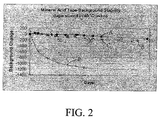
- FIG. 2 is a graph of the tape sensitivity stability of an extended-life mineral acid detection tape in accordance with the present invention under elevated temperature conditions as compared to the background stability of a conventional mineral acid detection tape;
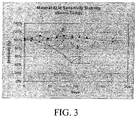
- FIG. 3 is a graph of the sensitivity stability of an extended-life mineral acid detection tape in accordance with the present invention under room temperature conditions as compared to the sensitivity stability of a conventional mineral acid detection tape;
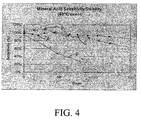
- FIG. 4 is a graph of the sensitivity stability of an extended-life mineral acid detection tape in accordance with the present invention under elevated temperature conditions as compared to the sensitivity stability of a conventional mineral acid detection tape;
- FIG. 5 is a graph of the response time at a low end gas concentration of an extended-life mineral acid detection tape in accordance with the present invention as compared to the response time of a conventional mineral acid detection tape.
- cellulose tape paper substrate for example the one identified as Chroma-1 from Whatman, Inc.
- cellulose tape paper substrate is saturated with the formula solution in accordance with the present invention to provide a detection tape that possesses in preferred embodiments an extended life of at least 90 days.
- the formula solution may contain a pH buffer of 0.26 M sodium hydroxide plus 0.009 M borax, which preferably amounts to 8 - 9% by volume of the total volume of solvent.
- the pH buffer may be 0.28 M sodium hydroxide plus 0.15 M 3-(cyclohexylamino)-1-propanesulfonic acid (hereinafter referred to as CAPS), or 0.26M sodium hydroxide plus 0.012M sodium bicarbonate, at 8 - 9% by volume of the total volume of the solvent.
- CAPS 3-(cyclohexylamino)-1-propanesulfonic acid
- 0.26M sodium hydroxide plus 0.012M sodium bicarbonate at 8 - 9% by volume of the total volume of the solvent.
- a coupling agent preferably reagent-grade chromotropic acid, at between 0.07 - 0.1 % by weight of the total weight of the solvent, is added to the formula solution. Increasing the amount of this coupling agent above the preferred range accelerates the background darkening of the tape background due to the excess amount of coupling agent, which causes self-coupling of the coupling agent.
- the formula solution may optionally or additionally contain a third coupling agent, preferably reagent grade N-naphthylethylenediamine dihydrochloride (hereinafter referred to as NED), preferably at about 0.05 - 0.11% by weight of the total weight of the solvent.
- NED reagent grade N-naphthylethylenediamine dihydrochloride
- the NED is used to increase the sensitivity to hydrochloric acid gas. The background darkening is accelerated faster in the presence of an excess amount of coupling agent, which causes self-coupling of the reaction mechanism.
- the optional third coupling agent may alternatively be selected from the group of N,N dimethylaniline, iminodibenzyl and gentisic acid.
- the formula solution further includes a source of nitrite ions, preferably sodium nitrite, for the diazotization reaction.
- a source of nitrite ions preferably sodium nitrite
- the amount of sodium nitrite is preferably between 0.25 - 0.38% by weight of the total weight of solvent.
- the formula solution preferably utilizes a stabilizer comprised of sodium bromide.
- the amount of stabilizer is preferably between 0.032 - 0.05% or 0.3 - 0.5% by weight of the total weight of the solvent.
- the formula solution further preferably includes reagent grade sulphanilic acid as a diazotization coupling agent.
- the amount of the coupling agent is preferably between 0.15 - 0.35% by weight of the total weight of the solvent.
- the diazotization coupling agent may alternatively be selected from other low toxicity materials, especially from the group of metanilic acid, anthranilic acid, m-aminoacetanilide and p-nitroaniline.
- the formula solution additionally includes a pH indicator, preferably containing 0.1% ethyl red, preferably at between 4 - 4.5% by volume of the total volume of the solvent.
- This pH indicator is red at a pH of approximately 4.5 and is yellow at a pH of 6.5.
- Alternative pH indicators acceptable for use in the formula solution may be selected from the group of non-toxic indicators, especially ethyl orange, methyl red and metanil yellow.
- a humectant which is a polyalcohol, preferably comprised of one part ethylene glycol and one part glycerol propoxylate, preferably at between 4 - 5.5% by volume of the total volume of solvent, is added to the formula solution.
- a humectant which is a polyalcohol, preferably comprised of one part ethylene glycol and one part glycerol propoxylate, preferably at between 4 - 5.5% by volume of the total volume of solvent, is added to the formula solution.
- Each of the reagents including the pH buffer and the coupling agent, the nitrite for diazotization, the stabilizer, the diazotization coupling agent, the pH indicator and the humectant, is preferably dissolved in the order described in 3.3 - 3.5 litres of the solvent, which is preferably methyl alcohol. Although ethyl alcohol may be used as the solvent, this solvent results in lower sensitivity and lower gas trapping efficiency.
- the formula solution conveniently consists essentially of the ingredients mentioned.
- the nitrite ions present in the formula solution and the aromatic amine react with an acid gas present in a sample gas stream to form an intermediate diazonium salt, as shown by (1).
- This diazonium salt is characterized by containing diazonium ions, which are electrophiles that seek out species of electrons which can be shared to reach equilibrium.
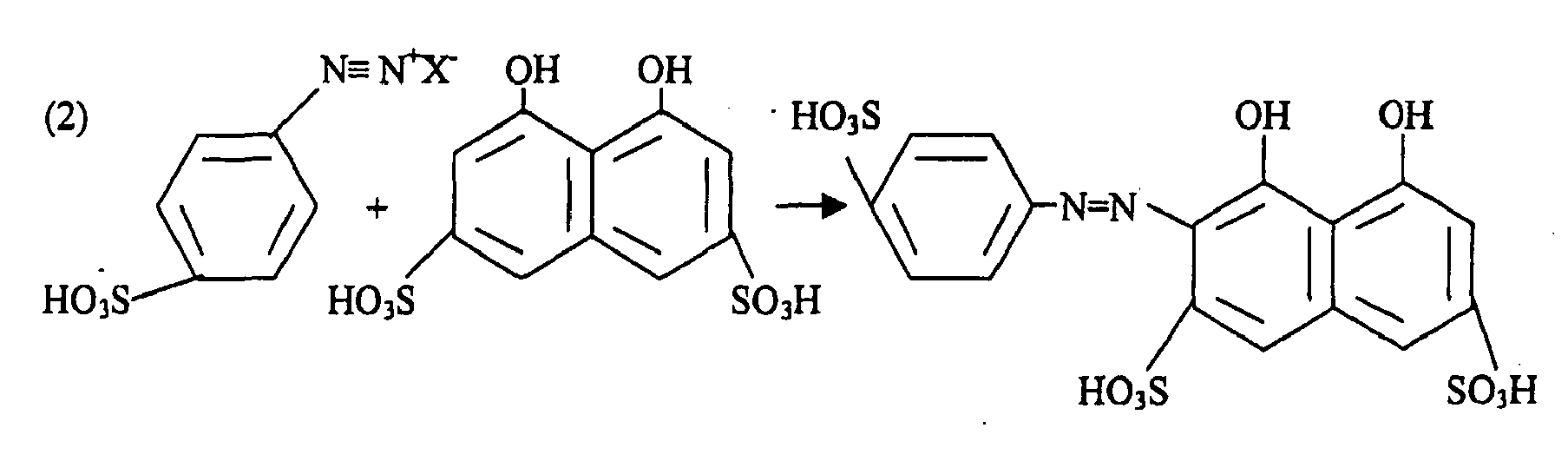
- the diazonium salt couples with the aromatic coupling compound, the chromotropic acid, to form the red-orange colored azo complexes, as shown by (2). These complexes are evident as a visible color stain on the saturated and extended life mineral acid detection tape. The intensity of the color stain on the tape relates to the amount of the toxic gas present in the sample stream.
- the mineral acids that can be detected utilizing this acid detection tape include hydrogen bromide, hydrogen chloride, hydrogen fluoride, hydrogen iodide, nitric acid, sulphuric acid, phosphoric acid and acetic acid.
- the detection tape is preferably comprised of a cellulose paper substrate, which is commercially available as Chroma-1.
- the paper detection tape is saturated with the formula solution by passing the paper tape through a bath containing the formula solution.
- the tape is then passed through an oven having a length of approximately one meter and which is maintained between 70-80°C.
- the saturated tape is advanced through the oven at a speed to provide a residence time within the oven of between about 45 to 75 seconds.
- the tape Upon exiting the oven, the tape has a light yellow colour and is wound onto the cassette.
- Sample A is the standard formula solution utilizing the pH buffer containing borax and the polyalcohol (humectant) of one part ethylene glycol and one part glycerol propoxylate, with those and the other ingredients in the preferred ranges using the preferred humectant materials.
- Sample B is the standard formula solution of Sample A wherein the humectant contains 10% less glycerol propoxylate
- Sample C is the standard formula solution of Sample A wherein the pH buffer includes 3-(cyclohexylamino)-1-propanesulfonic acid (CAPS)
- Sample D is a paper detection tape representative of the prior art which contains p-nitroaniline (an aromatic amine), which reacts to provide the diazonium salt, which in turn reacts with the coupling compound N-naphthylethylene dihydrochloride.
- the paper detection tapes, Sample A-C are treated with the formula solution and provide a stable background well in excess of 90 days.
- the background changes within 100 optics, a 5% drop within 90 days, under room temperature conditions, and within 100-300 optics reading a 10% drop under high temperature conditions, as shown in FIG. 2 .
- the paper detection tapes, Samples A-C are treated with the formula solution under room temperature ( FIG. 3 ) and high temperature ( FIG. 4 ) and provide a sensitivity of within ⁇ 10% over at least 90 days while the conventional acid detecting tape, represented by Sample D, results in a sensitivity drop of between about 40-60%.
- the paper detection tapes, Samples A and C, treated with the formula solution provide increased response times for low acid gas concentration levels when compared to an existing acid detection tape.
- Sample D the paper detection tapes, Samples A and C, treated with the formula solution provide increased response times for low acid gas concentration levels when compared to an existing acid detection tape.
Landscapes
- Life Sciences & Earth Sciences (AREA)
- Health & Medical Sciences (AREA)
- Chemical & Material Sciences (AREA)
- Immunology (AREA)
- Physics & Mathematics (AREA)
- Analytical Chemistry (AREA)
- Biochemistry (AREA)
- General Health & Medical Sciences (AREA)
- General Physics & Mathematics (AREA)
- Pathology (AREA)
- Molecular Biology (AREA)
- Biophysics (AREA)
- Engineering & Computer Science (AREA)
- Toxicology (AREA)
- Dispersion Chemistry (AREA)
- Combustion & Propulsion (AREA)
- Food Science & Technology (AREA)
- Medicinal Chemistry (AREA)
- Investigating Or Analyzing Non-Biological Materials By The Use Of Chemical Means (AREA)
- Investigating Or Analysing Materials By The Use Of Chemical Reactions (AREA)
Abstract
Description
- The present invention relates to a mineral acid detection tape for detecting mineral acids in a gas (especially air) stream and to a formula solution for its manufacture by impregnation of a suitable tape material. In preferred embodiments the mineral acid detection tape possesses uniform gas sensitivity and acceptable background color for at least a three-month time period when placed in usage.
- At present, mineral acid detection tapes are available based upon several types of chemistry. One acid detection system utilizes a mineral acid detection tape containing a pH indicator dye. However, the acid-based stains on the detector tape are not stable and the pH indicator dyes themselves are toxic. Also in such a system, the relationship between the acid gas concentration and the stain color intensity is non-linear, thereby requiring the need of complex optical monitor assemblies. Moreover, a limited number of pH indicating dyes are available for use with such optical monitor assemblies, and such detection tapes have a limited useful life of approximately a one-month time period.
- Another known mineral acid detector tape system relies upon a diazo-coupling reaction in an acid phase to provide an intense red color indicative of the presence of acid gases. Although such a system is sensitive to acid gases, it has a limited useful lifetime. Also, the sensitivity and tape background colors of such a system are unstable to chemicals, such as primary amines and coupling reagents in the tape formula which possess temperature and light sensitivities. Over time, the background of such mineral acid gas detection tape darkens, and, as the tape background darkens, the sensitivity of the tape decreases. For example, such tapes exhibit significant background drops within a 4-6 week period of use. Also, under room temperature conditions, such tape darkening results in a 30-40% optic reading drop within a 30-day period. Additionally, such detection systems possess unstable tape sensitivities and reduction in sensitivity of between 10-20% within a 30-day period and between 40-60% within a 90-day period. Accordingly, the useful life of such mineral acid detection tape systems is limited to at most a 30-day period of time after they are placed in service. Thus, such tapes must be replaced after a 30-day period of use to provide acceptable monitoring of acid gases.
- Also, the reaction rate between the acid gas concentration and the tape color intensity is non-linear at low concentrations of acid gas detections. The resultant reaction curves are S-shaped, which results in a slow response and a narrow detection range for such mineral acid detection tapes.
- The present invention seeks to provide an alternative mineral acid detection tape, especially an improved one, desirably having an extended lifetime, at least in preferred embodiments. The tapes preferably employ diazo-coupling reagents possessing low toxicity and reduced dependency on temperature and light to thereby provide an improved mineral acid detection tape possessing a useful life of at least 3 months.
- It would be particularly desirable to provide a mineral acid detection tape which possesses a uniform tape background stability under room temperature conditions over an extended period of time of at least 90 days and/or one that is sensitive to low acid concentration levels in a gas (air) stream over an extended period of time.
- It would also be desirable to provide an alkalized mineral acid detection tape which is stable over an extended pH range and/or to provide a tape possessing moisture and sample gas trapping efficiency for at least 90 days.
- In accordance with the present invention, an acid gas detection tape for detecting mineral acid gases, such as hydrochloric acid, hydrobromic acid, hydrofluoric acid, hydriodic acid, nitric acid, sulphuric acid, phosphoric acid and acetic acid, is provided which is capable of extending the useful life of the mineral acid detecting tape up to at least a three-month period of time when placed in use. The present invention is defined by the claims which follow.
- The mineral acid detection tape can be obtained by passing a cellulose paper substrate through a bath containing a formula solution as defined in claim 1 to saturate it. The formula solution includes a pH buffer, preferably an alkalized buffer, at between about 8 - 9% by volume of the total volume of solvent, and between 0.07 - 0.10% by weight of the total weight of solvent of reagent grade chromotropic acid is added to the composition as a coupling agent. Sodium nitrite, within the composition range of about 0.25 - 0.38% by weight of the total weight of solvent, is added to the formula composition as preferred source of nitrite ions to facilitate the diazotization reaction. A stabilizer, preferably sodium bromide, desirably of between about 0.3 - 0.5% by weight of the total weight of the solvent, is desirably added to the composition, and a diazotization coupling agent, such as reagent grade sulphanilic acid, at a weight percent between 0.15 - 0.35% of the total weight of the solvent, is added to the composition. A pH indicator, preferably containing 0.1 % ethyl red, of between 4 - 4.5% by volume of the total volume of solvent, is added to the composition, and a humectant, preferably comprised of a polyalcohol, suitably at between about 4 - 5.5% by volume of the total volume of solvent, is desirably added to the composition to improve moisture and sample gas trapping efficiency. Each of the reagents is preferably dissolved in the order mentioned in the solvent, which is preferably methyl alcohol, suitably used in amounts of between about 3.3 to 3.5 litres.
- When the formula solution is properly mixed, a tape substrate, e.g. a paper tape, is then passed through a bath containing the formula solution. The coated tape substrate is then dried, such as by being passed through an oven, for example one meter in length, that is preferably maintained within a temperature range of about 70 - 80°C. The coated tape suitably travels at a speed of between about 2.2 to 3.4 meters per minute through such an oven. The dried mineral acid detection tape exiting the drying oven usually possesses a light or faint yellow tinge of color.
- In the accompanying drawings
FIG. 1 is a graph of the background stability of an extended-life mineral acid detection tape in accordance with the present invention under room-temperature conditions as compared to the background stability of a conventional mineral acid detection tape; -
FIG. 2 is a graph of the tape sensitivity stability of an extended-life mineral acid detection tape in accordance with the present invention under elevated temperature conditions as compared to the background stability of a conventional mineral acid detection tape; -
FIG. 3 is a graph of the sensitivity stability of an extended-life mineral acid detection tape in accordance with the present invention under room temperature conditions as compared to the sensitivity stability of a conventional mineral acid detection tape; -
FIG. 4 is a graph of the sensitivity stability of an extended-life mineral acid detection tape in accordance with the present invention under elevated temperature conditions as compared to the sensitivity stability of a conventional mineral acid detection tape; and -
FIG. 5 is a graph of the response time at a low end gas concentration of an extended-life mineral acid detection tape in accordance with the present invention as compared to the response time of a conventional mineral acid detection tape. - Preferably, cellulose tape paper substrate (for example the one identified as Chroma-1 from Whatman, Inc.) is saturated with the formula solution in accordance with the present invention to provide a detection tape that possesses in preferred embodiments an extended life of at least 90 days.
- For optimum results the formula solution may contain a pH buffer of 0.26 M sodium hydroxide plus 0.009 M borax, which preferably amounts to 8 - 9% by volume of the total volume of solvent. Alternatively, the pH buffer may be 0.28 M sodium hydroxide plus 0.15 M 3-(cyclohexylamino)-1-propanesulfonic acid (hereinafter referred to as CAPS), or 0.26M sodium hydroxide plus 0.012M sodium bicarbonate, at 8 - 9% by volume of the total volume of the solvent. If the amount of the pH buffer is reduced below the preferred range, the tape sensitivity is increased while the background darkening is increased. Increasing the amount of the buffer solution above this range results in the sensitivity of the formula solution being lowered. The pH buffer material and the humectant operate for stabilization of the detection tape.
- A coupling agent, preferably reagent-grade chromotropic acid, at between 0.07 - 0.1 % by weight of the total weight of the solvent, is added to the formula solution. Increasing the amount of this coupling agent above the preferred range accelerates the background darkening of the tape background due to the excess amount of coupling agent, which causes self-coupling of the coupling agent.
- The formula solution may optionally or additionally contain a third coupling agent, preferably reagent grade N-naphthylethylenediamine dihydrochloride (hereinafter referred to as NED), preferably at about 0.05 - 0.11% by weight of the total weight of the solvent. The NED is used to increase the sensitivity to hydrochloric acid gas. The background darkening is accelerated faster in the presence of an excess amount of coupling agent, which causes self-coupling of the reaction mechanism. Instead of NED the optional third coupling agent may alternatively be selected from the group of N,N dimethylaniline, iminodibenzyl and gentisic acid.
- The formula solution further includes a source of nitrite ions, preferably sodium nitrite, for the diazotization reaction. The amount of sodium nitrite is preferably between 0.25 - 0.38% by weight of the total weight of solvent.
- Also, the formula solution preferably utilizes a stabilizer comprised of sodium bromide. The amount of stabilizer is preferably between 0.032 - 0.05% or 0.3 - 0.5% by weight of the total weight of the solvent.
- The formula solution further preferably includes reagent grade sulphanilic acid as a diazotization coupling agent. The amount of the coupling agent is preferably between 0.15 - 0.35% by weight of the total weight of the solvent. The diazotization coupling agent may alternatively be selected from other low toxicity materials, especially from the group of metanilic acid, anthranilic acid, m-aminoacetanilide and p-nitroaniline.
- The formula solution additionally includes a pH indicator, preferably containing 0.1% ethyl red, preferably at between 4 - 4.5% by volume of the total volume of the solvent. This pH indicator is red at a pH of approximately 4.5 and is yellow at a pH of 6.5. By increasing the amount of the pH indicator, the linearity at the beginning of detection is enhanced. It is desired that a color change occur from colorless/yellow to red or blue when the indicator is contacted with the acid gas. Alternative pH indicators acceptable for use in the formula solution may be selected from the group of non-toxic indicators, especially ethyl orange, methyl red and metanil yellow.
- Finally, a humectant, which is a polyalcohol, preferably comprised of one part ethylene glycol and one part glycerol propoxylate, preferably at between 4 - 5.5% by volume of the total volume of solvent, is added to the formula solution. By decreasing the amount of glycerol propoxylate in the polyalcohol, the sensitivity of the detection tape is increased upon exposure to the target gas. However, the darkening of the tape background occurs more rapidly. By increasing the amount of this humectant material above the preferred range, the sensitivity is lowered. Alternative humectants that may be utilized are polyethylene glycol or glycerol, suitably with the ethylene glycol, suitably in equal amounts.
- Each of the reagents, including the pH buffer and the coupling agent, the nitrite for diazotization, the stabilizer, the diazotization coupling agent, the pH indicator and the humectant, is preferably dissolved in the order described in 3.3 - 3.5 litres of the solvent, which is preferably methyl alcohol. Although ethyl alcohol may be used as the solvent, this solvent results in lower sensitivity and lower gas trapping efficiency. The formula solution conveniently consists essentially of the ingredients mentioned.
- The nitrite ions present in the formula solution and the aromatic amine react with an acid gas present in a sample gas stream to form an intermediate diazonium salt, as shown by (1). This diazonium salt is characterized by containing diazonium ions, which are electrophiles that seek out species of electrons which can be shared to reach equilibrium.

- The diazonium salt couples with the aromatic coupling compound, the chromotropic acid, to form the red-orange colored azo complexes, as shown by (2).
- The mineral acids that can be detected utilizing this acid detection tape include hydrogen bromide, hydrogen chloride, hydrogen fluoride, hydrogen iodide, nitric acid, sulphuric acid, phosphoric acid and acetic acid.
- The detection tape is preferably comprised of a cellulose paper substrate, which is commercially available as Chroma-1. In a preferred embodiment, the paper detection tape is saturated with the formula solution by passing the paper tape through a bath containing the formula solution. The tape is then passed through an oven having a length of approximately one meter and which is maintained between 70-80°C. The saturated tape is advanced through the oven at a speed to provide a residence time within the oven of between about 45 to 75 seconds. Upon exiting the oven, the tape has a light yellow colour and is wound onto the cassette.
- As shown in
FIGS. 1-5 , the paper detection tape is saturated with variations of the formula solution to provide various samples A-C which are compared with a sample detection tape D in accordance with the prior art. InFIGS. 1-5 , Sample A is the standard formula solution utilizing the pH buffer containing borax and the polyalcohol (humectant) of one part ethylene glycol and one part glycerol propoxylate, with those and the other ingredients in the preferred ranges using the preferred humectant materials. Sample B is the standard formula solution of Sample A wherein the humectant contains 10% less glycerol propoxylate, Sample C is the standard formula solution of Sample A wherein the pH buffer includes 3-(cyclohexylamino)-1-propanesulfonic acid (CAPS), and Sample D is a paper detection tape representative of the prior art which contains p-nitroaniline (an aromatic amine), which reacts to provide the diazonium salt, which in turn reacts with the coupling compound N-naphthylethylene dihydrochloride. - Specifically, in
FIGS. 1 and2 , the paper detection tapes, Sample A-C, are treated with the formula solution and provide a stable background well in excess of 90 days. Specifically, inFIG. 1 the background changes within 100 optics, a 5% drop within 90 days, under room temperature conditions, and within 100-300 optics reading a 10% drop under high temperature conditions, as shown inFIG. 2 . Also, as shown inFIGS. 3 and4 , the paper detection tapes, Samples A-C, are treated with the formula solution under room temperature (FIG. 3 ) and high temperature (FIG. 4 ) and provide a sensitivity of within ∀ 10% over at least 90 days while the conventional acid detecting tape, represented by Sample D, results in a sensitivity drop of between about 40-60%. - Additionally, as shown in
FIG. 5 , the paper detection tapes, Samples A and C, treated with the formula solution provide increased response times for low acid gas concentration levels when compared to an existing acid detection tape. Sample D.
Claims (17)
- A formula solution for impregnation of a detector tape for detecting mineral acids in an air stream, the formula solution comprising, dissolved in a solvent, a diazotization coupling agent capable of reacting with mineral acids in an air stream and with nitrite ions to form a diazonium salt,
a source of nitrite ions, preferably sodium nitrite,
a further coupling agent for the diazonium salt,
a pH indicator, and
a pH buffer material,
wherein the formula contains, based on the total weight of solvent, from 0.15 to 0.3% by weight of diazotization coupling agent, from 0.25 to 0.38% by weight of the source of nitrite ions and from 0.07 to 0.10% by weight of the further coupling agent, and based on the total volume of solvent, from 8 to 9% by volume of the pH buffer material in liquid form and from 4 to 4½% by volume of the pH indicator in liquid form. - A formula solution as claimed in claim 1, wherein the diazotization coupling agent is selected from sulfanilic acid, metanilic acid, anthranilic acid, m-amino acetanilide and p-nitroaniline.
- A formula solution as claimed in claim 1 or 2, wherein the further coupling agent is chromotropic acid.
- A formula solution as claimed in any of claims 1 to 3, wherein the pH indicator is selected from ethyl red, ethyl orange, methyl red and metanil yellow.
- A formula solution as claimed in any of claims 1 to 4, wherein the pH buffer material is sodium hydroxide with either sodium borate or 3-(cyclohexylamino)-1-propanesulfonic acid or sodium bicarbonate.
- A formula solution as claimed in any of claims 1 to 5, which additionally contains a humectant.
- A formula solution as claimed in claim 6, wherein the humectant is a mixture of ethylene glycol with polyethylene glycol, with glycerol or with glycerol propoxylate.
- A formula solution as claimed in any of claims 1 to 7, which additionally contains a stabilizer.
- A formula solution as claimed in claim 8 when dependent on claim 6 or 7, which contains from 0.3 to 0.5% by weight of the stabilizer, based on the total weight of solvent, and from 4 to 5½% by volume of the humectant, based on the total volume of solvent.
- A formula solution as claimed in claim 8 or 9, which additionally contains a third coupling agent added to the solution after the incorporation of the stabilizer.
- A formula solution as claimed in claim 10, wherein the third coupling agent is selected from N-(1-naphthyl)-ethyl-enediamine dihydrochloride, N,N-dimethylaniline, iminodibenzyl and gentisic acid.
- A detector tape for detecting mineral acids in an air stream, the tape being obtainable by impregnation of tape material with a formula solution as claimed in any of claims 1 to 11.
- The use of a paper detector tape as claimed in claim 12 for detecting mineral acids such as HCl, HBr, Hl, HF, HNO3, H2SO4, H3PO4 and CH3COOH in an air stream.
- A formula solution as claimed in claim 1, wherein the solvent is either methanol or ethanol.
- A formula solution as claimed in claim 6, wherein the humectant is a polyalcohol.
- A formula solution as claimed in claim 7, wherein the mixture is equal amounts on a weight or molar basis of ethylene glycol, polyethylene glycol and glycerol or glycerol propoxylate.
- A formula solution as claimed in claim 8, wherein the stabilizer is sodium bromide.
Applications Claiming Priority (1)
| Application Number | Priority Date | Filing Date | Title |
|---|---|---|---|
| US60494504P | 2004-08-27 | 2004-08-27 |
Publications (3)
| Publication Number | Publication Date |
|---|---|
| EP1630552A2 EP1630552A2 (en) | 2006-03-01 |
| EP1630552A3 EP1630552A3 (en) | 2006-05-24 |
| EP1630552B1 true EP1630552B1 (en) | 2013-12-18 |
Family
ID=35229953
Family Applications (1)
| Application Number | Title | Priority Date | Filing Date |
|---|---|---|---|
| EP05255286.6A Expired - Lifetime EP1630552B1 (en) | 2004-08-27 | 2005-08-26 | Mineral acid detection tape, its use and formula solution for impregnation thereof |
Country Status (9)
| Country | Link |
|---|---|
| US (1) | US7718123B2 (en) |
| EP (1) | EP1630552B1 (en) |
| JP (1) | JP4668006B2 (en) |
| KR (1) | KR101199248B1 (en) |
| CN (1) | CN100510719C (en) |
| AU (1) | AU2005204249B2 (en) |
| CA (1) | CA2516605A1 (en) |
| SG (1) | SG120277A1 (en) |
| TW (1) | TWI337256B (en) |
Families Citing this family (7)
| Publication number | Priority date | Publication date | Assignee | Title |
|---|---|---|---|---|
| US20100151115A1 (en) * | 2008-12-17 | 2010-06-17 | Honeywell International Inc. | Method and system for producing a gas-sensitive substrate |
| US20090246883A1 (en) * | 2008-03-31 | 2009-10-01 | Honeywell International Inc. | Paper Tapes Sensitive To Multiple Gases |
| KR101224086B1 (en) * | 2009-08-06 | 2013-01-21 | 손홍래 | Chemical sensor for inorganic acids containing organometallic compound, strip-type sensoring apparatus and sensoring system using the same |
| KR101396268B1 (en) * | 2013-06-28 | 2014-05-16 | 이종구 | Method of manufacture compound |
| US20150017732A1 (en) * | 2013-07-12 | 2015-01-15 | Tsunghsueh Wu | Colorimetric method to detect illicit drugs |
| GB2543569B (en) * | 2015-10-23 | 2021-12-15 | Bryce Richard | H-shaped spirit level |
| CN113454454A (en) * | 2019-01-25 | 2021-09-28 | 生物统计股份有限公司 | System and method for processing gas for analysis |
Family Cites Families (20)
| Publication number | Priority date | Publication date | Assignee | Title |
|---|---|---|---|---|
| US2440526A (en) * | 1942-12-23 | 1948-04-27 | Nellie W Solomon | Fibrous sheet material for the electrolytic formation of an azo dyestuff thereon |
| US3585001A (en) * | 1969-02-17 | 1971-06-15 | Miles Lab | Stabilized test device and process for detecting couplable compounds |
| BE787605A (en) * | 1971-08-19 | 1973-02-16 | Merck Patent Gmbh | NITRITE CLEARANCE AGENT |
| US3838972A (en) * | 1973-04-27 | 1974-10-01 | L Richards | Method and apparatus for sulfuric acid aerosol analysis |
| US4174292A (en) * | 1978-03-20 | 1979-11-13 | J. T. Baker Chemical Company | Spill control composition and use thereof |
| US4190419A (en) * | 1978-09-22 | 1980-02-26 | Miles Laboratories, Inc. | Device for detecting serum bilirubin |
| IL61951A (en) * | 1981-01-21 | 1984-01-31 | Univ Ben Gurion | Method and apparatus for detecting nitrite ions in fluids |
| US4420567A (en) * | 1981-10-22 | 1983-12-13 | Mda Scientific, Inc. | Hydride gas detecting tape |
| JPS63221243A (en) * | 1987-03-10 | 1988-09-14 | Dainippon Printing Co Ltd | Test compositions and test pieces |
| JPH0677010B2 (en) * | 1987-12-28 | 1994-09-28 | 富士写真フイルム株式会社 | Integrated multi-layer analysis element |
| JP2883253B2 (en) * | 1992-12-18 | 1999-04-19 | 理研計器株式会社 | Silane gas detection tape |
| US5250441A (en) | 1993-01-08 | 1993-10-05 | Vogt Peter F | Method for kit for estimating the amount of methyl anthranilate |
| JP3206697B2 (en) | 1993-06-25 | 2001-09-10 | 理研計器株式会社 | Acid gas detection paper |
| GB2292805B (en) * | 1994-08-26 | 1998-09-09 | Mil Ram Techn Inc | Method and apparatus for the detection of toxic gases |
| EP0860695B1 (en) | 1995-10-30 | 2006-01-04 | Arkray, Inc. | Method for measuring an analyte and corresponding device |
| JPH1062350A (en) * | 1996-08-14 | 1998-03-06 | Ebara Corp | Gas detecting method and gas detecting device using gas-reactive pigment |
| US6217827B1 (en) * | 1999-03-25 | 2001-04-17 | Zellweger Analytics, Inc. | Hydride gas detecting tape |
| JP2002003893A (en) * | 2000-06-26 | 2002-01-09 | Hakuto Co Ltd | Mold stain cleaner |
| KR20010093340A (en) * | 2001-03-30 | 2001-10-29 | 전영관 | The method of detection for dangerous gas leakage |
| WO2006038028A1 (en) * | 2004-10-08 | 2006-04-13 | Honeywell Analytics Ag | Gas detection system |
-
2005
- 2005-08-18 SG SG200505263A patent/SG120277A1/en unknown
- 2005-08-23 US US11/210,125 patent/US7718123B2/en active Active
- 2005-08-23 CA CA002516605A patent/CA2516605A1/en not_active Abandoned
- 2005-08-25 KR KR1020050078083A patent/KR101199248B1/en not_active Expired - Fee Related
- 2005-08-25 AU AU2005204249A patent/AU2005204249B2/en not_active Ceased
- 2005-08-25 JP JP2005244217A patent/JP4668006B2/en not_active Expired - Fee Related
- 2005-08-26 CN CNB2005100935772A patent/CN100510719C/en not_active Expired - Lifetime
- 2005-08-26 EP EP05255286.6A patent/EP1630552B1/en not_active Expired - Lifetime
- 2005-08-26 TW TW094129406A patent/TWI337256B/en not_active IP Right Cessation
Also Published As
| Publication number | Publication date |
|---|---|
| TW200624805A (en) | 2006-07-16 |
| EP1630552A3 (en) | 2006-05-24 |
| CN100510719C (en) | 2009-07-08 |
| AU2005204249B2 (en) | 2010-03-25 |
| KR101199248B1 (en) | 2012-11-09 |
| TWI337256B (en) | 2011-02-11 |
| KR20060050633A (en) | 2006-05-19 |
| US7718123B2 (en) | 2010-05-18 |
| JP2006071636A (en) | 2006-03-16 |
| SG120277A1 (en) | 2006-03-28 |
| CA2516605A1 (en) | 2006-02-27 |
| US20060073071A1 (en) | 2006-04-06 |
| AU2005204249A1 (en) | 2006-03-16 |
| EP1630552A2 (en) | 2006-03-01 |
| JP4668006B2 (en) | 2011-04-13 |
| CN1789986A (en) | 2006-06-21 |
Similar Documents
| Publication | Publication Date | Title |
|---|---|---|
| Gottlieb et al. | Quantitative determination of phenolic fungicides | |
| US9228986B2 (en) | Simultaneous determination of multiple analytes in industrial water system | |
| EP1630552A2 (en) | Mineral acid detection tape and formula solution for impregnation thereof | |
| JPS58899A (en) | Stabilized reagent for detecting h2o2 or h2o2 donor system | |
| EP1166106A1 (en) | Reagent and method for detecting an adulterant in an aqueous sample | |
| US5171536A (en) | Colorimetric testing and measuring device for gases | |
| Bridges et al. | Fluorescence of some substituted benzenes | |
| JP2000111541A (en) | Oxidizing gas detection sheet | |
| CA2132413C (en) | Basic-gas detection paper | |
| JPS62291564A (en) | Ozone detection element | |
| KR102394893B1 (en) | Colorimetric analysis reagent, method for manufacturing colorimetric analysis reagent and method for manufacturing colorimetric analysis tape | |
| JP3828427B2 (en) | Reagent for measuring formaldehyde and method for measuring formaldehyde using the same | |
| Nakano et al. | Development of a monitoring tape for hydrogen chloride gas using metanil yellow | |
| Martin et al. | 13-Hydroxyacenaphato [1, 2-b] quinolizinium bromide as a new flouorescence indicator | |
| Nakano et al. | Development of a monitoring tape for ammonia gas in air by fluorescence detection | |
| GB2350188A (en) | Colorimetric test element | |
| Nakano et al. | Development of a monitoring tape for ammonia gas in air using Rose Bengal | |
| CN112005102A (en) | Method for measuring pH of test water | |
| Bark et al. | New reagents for the colorimetric determination of microgram quantities of nitrite | |
| Al-Zamil et al. | Indirect determination of amino acids by molecular emission cavity analysis | |
| JP3792898B2 (en) | Method for measuring peroxidase activity | |
| Kar et al. | Fiber-optic chlorine probe based on fluorescence decay of N-(6-methoxyquinolyl) acetoethyl ester | |
| Novak et al. | 4, 4′-Bis (Dimethylamino) Thiobenzophenone as a 2-Chloroethylethylsulfide Vapor-Sensing Coating for Optical Based Microsensors | |
| JP4263125B2 (en) | Test piece for reducing substance measurement and test solution for reducing substance measurement | |
| EP0936466A2 (en) | Reagent composition for measuring hydrogen sulfide and method for measuring hydrogen sulfide |
Legal Events
| Date | Code | Title | Description |
|---|---|---|---|
| PUAI | Public reference made under article 153(3) epc to a published international application that has entered the european phase |
Free format text: ORIGINAL CODE: 0009012 |
|
| AK | Designated contracting states |
Kind code of ref document: A2 Designated state(s): AT BE BG CH CY CZ DE DK EE ES FI FR GB GR HU IE IS IT LI LT LU LV MC NL PL PT RO SE SI SK TR |
|
| AX | Request for extension of the european patent |
Extension state: AL BA HR MK YU |
|
| PUAL | Search report despatched |
Free format text: ORIGINAL CODE: 0009013 |
|
| AK | Designated contracting states |
Kind code of ref document: A3 Designated state(s): AT BE BG CH CY CZ DE DK EE ES FI FR GB GR HU IE IS IT LI LT LU LV MC NL PL PT RO SE SI SK TR |
|
| AX | Request for extension of the european patent |
Extension state: AL BA HR MK YU |
|
| RAP1 | Party data changed (applicant data changed or rights of an application transferred) |
Owner name: HONEYWELL ANALYTICS AG |
|
| 17P | Request for examination filed |
Effective date: 20061122 |
|
| 17Q | First examination report despatched |
Effective date: 20061222 |
|
| AKX | Designation fees paid |
Designated state(s): AT BE BG CH CY CZ DE DK EE ES FI FR GB GR HU IE IS IT LI LT LU LV MC NL PL PT RO SE SI SK TR |
|
| GRAP | Despatch of communication of intention to grant a patent |
Free format text: ORIGINAL CODE: EPIDOSNIGR1 |
|
| GRAJ | Information related to disapproval of communication of intention to grant by the applicant or resumption of examination proceedings by the epo deleted |
Free format text: ORIGINAL CODE: EPIDOSDIGR1 |
|
| INTG | Intention to grant announced |
Effective date: 20130808 |
|
| RIN1 | Information on inventor provided before grant (corrected) |
Inventor name: YAMAGUCHI, TAMAMI |
|
| GRAP | Despatch of communication of intention to grant a patent |
Free format text: ORIGINAL CODE: EPIDOSNIGR1 |
|
| INTG | Intention to grant announced |
Effective date: 20130910 |
|
| GRAS | Grant fee paid |
Free format text: ORIGINAL CODE: EPIDOSNIGR3 |
|
| GRAA | (expected) grant |
Free format text: ORIGINAL CODE: 0009210 |
|
| AK | Designated contracting states |
Kind code of ref document: B1 Designated state(s): AT BE BG CH CY CZ DE DK EE ES FI FR GB GR HU IE IS IT LI LT LU LV MC NL PL PT RO SE SI SK TR |
|
| REG | Reference to a national code |
Ref country code: GB Ref legal event code: FG4D |
|
| REG | Reference to a national code |
Ref country code: CH Ref legal event code: EP |
|
| REG | Reference to a national code |
Ref country code: AT Ref legal event code: REF Ref document number: 645838 Country of ref document: AT Kind code of ref document: T Effective date: 20140115 |
|
| REG | Reference to a national code |
Ref country code: IE Ref legal event code: FG4D |
|
| REG | Reference to a national code |
Ref country code: DE Ref legal event code: R096 Ref document number: 602005042186 Country of ref document: DE Effective date: 20140213 |
|
| REG | Reference to a national code |
Ref country code: NL Ref legal event code: VDEP Effective date: 20131218 |
|
| PG25 | Lapsed in a contracting state [announced via postgrant information from national office to epo] |
Ref country code: FI Free format text: LAPSE BECAUSE OF FAILURE TO SUBMIT A TRANSLATION OF THE DESCRIPTION OR TO PAY THE FEE WITHIN THE PRESCRIBED TIME-LIMIT Effective date: 20131218 Ref country code: LT Free format text: LAPSE BECAUSE OF FAILURE TO SUBMIT A TRANSLATION OF THE DESCRIPTION OR TO PAY THE FEE WITHIN THE PRESCRIBED TIME-LIMIT Effective date: 20131218 Ref country code: SE Free format text: LAPSE BECAUSE OF FAILURE TO SUBMIT A TRANSLATION OF THE DESCRIPTION OR TO PAY THE FEE WITHIN THE PRESCRIBED TIME-LIMIT Effective date: 20131218 |
|
| REG | Reference to a national code |
Ref country code: AT Ref legal event code: MK05 Ref document number: 645838 Country of ref document: AT Kind code of ref document: T Effective date: 20131218 |
|
| REG | Reference to a national code |
Ref country code: LT Ref legal event code: MG4D |
|
| PG25 | Lapsed in a contracting state [announced via postgrant information from national office to epo] |
Ref country code: LV Free format text: LAPSE BECAUSE OF FAILURE TO SUBMIT A TRANSLATION OF THE DESCRIPTION OR TO PAY THE FEE WITHIN THE PRESCRIBED TIME-LIMIT Effective date: 20131218 |
|
| PG25 | Lapsed in a contracting state [announced via postgrant information from national office to epo] |
Ref country code: EE Free format text: LAPSE BECAUSE OF FAILURE TO SUBMIT A TRANSLATION OF THE DESCRIPTION OR TO PAY THE FEE WITHIN THE PRESCRIBED TIME-LIMIT Effective date: 20131218 Ref country code: BE Free format text: LAPSE BECAUSE OF FAILURE TO SUBMIT A TRANSLATION OF THE DESCRIPTION OR TO PAY THE FEE WITHIN THE PRESCRIBED TIME-LIMIT Effective date: 20131218 Ref country code: IS Free format text: LAPSE BECAUSE OF FAILURE TO SUBMIT A TRANSLATION OF THE DESCRIPTION OR TO PAY THE FEE WITHIN THE PRESCRIBED TIME-LIMIT Effective date: 20140418 |
|
| PG25 | Lapsed in a contracting state [announced via postgrant information from national office to epo] |
Ref country code: PL Free format text: LAPSE BECAUSE OF FAILURE TO SUBMIT A TRANSLATION OF THE DESCRIPTION OR TO PAY THE FEE WITHIN THE PRESCRIBED TIME-LIMIT Effective date: 20131218 Ref country code: NL Free format text: LAPSE BECAUSE OF FAILURE TO SUBMIT A TRANSLATION OF THE DESCRIPTION OR TO PAY THE FEE WITHIN THE PRESCRIBED TIME-LIMIT Effective date: 20131218 Ref country code: RO Free format text: LAPSE BECAUSE OF FAILURE TO SUBMIT A TRANSLATION OF THE DESCRIPTION OR TO PAY THE FEE WITHIN THE PRESCRIBED TIME-LIMIT Effective date: 20131218 Ref country code: PT Free format text: LAPSE BECAUSE OF FAILURE TO SUBMIT A TRANSLATION OF THE DESCRIPTION OR TO PAY THE FEE WITHIN THE PRESCRIBED TIME-LIMIT Effective date: 20140418 Ref country code: AT Free format text: LAPSE BECAUSE OF FAILURE TO SUBMIT A TRANSLATION OF THE DESCRIPTION OR TO PAY THE FEE WITHIN THE PRESCRIBED TIME-LIMIT Effective date: 20131218 Ref country code: ES Free format text: LAPSE BECAUSE OF FAILURE TO SUBMIT A TRANSLATION OF THE DESCRIPTION OR TO PAY THE FEE WITHIN THE PRESCRIBED TIME-LIMIT Effective date: 20131218 Ref country code: SK Free format text: LAPSE BECAUSE OF FAILURE TO SUBMIT A TRANSLATION OF THE DESCRIPTION OR TO PAY THE FEE WITHIN THE PRESCRIBED TIME-LIMIT Effective date: 20131218 Ref country code: CY Free format text: LAPSE BECAUSE OF FAILURE TO SUBMIT A TRANSLATION OF THE DESCRIPTION OR TO PAY THE FEE WITHIN THE PRESCRIBED TIME-LIMIT Effective date: 20131218 Ref country code: CZ Free format text: LAPSE BECAUSE OF FAILURE TO SUBMIT A TRANSLATION OF THE DESCRIPTION OR TO PAY THE FEE WITHIN THE PRESCRIBED TIME-LIMIT Effective date: 20131218 |
|
| REG | Reference to a national code |
Ref country code: DE Ref legal event code: R097 Ref document number: 602005042186 Country of ref document: DE |
|
| PLBE | No opposition filed within time limit |
Free format text: ORIGINAL CODE: 0009261 |
|
| STAA | Information on the status of an ep patent application or granted ep patent |
Free format text: STATUS: NO OPPOSITION FILED WITHIN TIME LIMIT |
|
| PG25 | Lapsed in a contracting state [announced via postgrant information from national office to epo] |
Ref country code: DK Free format text: LAPSE BECAUSE OF FAILURE TO SUBMIT A TRANSLATION OF THE DESCRIPTION OR TO PAY THE FEE WITHIN THE PRESCRIBED TIME-LIMIT Effective date: 20131218 |
|
| 26N | No opposition filed |
Effective date: 20140919 |
|
| REG | Reference to a national code |
Ref country code: DE Ref legal event code: R097 Ref document number: 602005042186 Country of ref document: DE Effective date: 20140919 |
|
| PG25 | Lapsed in a contracting state [announced via postgrant information from national office to epo] |
Ref country code: MC Free format text: LAPSE BECAUSE OF FAILURE TO SUBMIT A TRANSLATION OF THE DESCRIPTION OR TO PAY THE FEE WITHIN THE PRESCRIBED TIME-LIMIT Effective date: 20131218 Ref country code: LU Free format text: LAPSE BECAUSE OF FAILURE TO SUBMIT A TRANSLATION OF THE DESCRIPTION OR TO PAY THE FEE WITHIN THE PRESCRIBED TIME-LIMIT Effective date: 20140826 |
|
| REG | Reference to a national code |
Ref country code: CH Ref legal event code: PL |
|
| PG25 | Lapsed in a contracting state [announced via postgrant information from national office to epo] |
Ref country code: CH Free format text: LAPSE BECAUSE OF NON-PAYMENT OF DUE FEES Effective date: 20140831 Ref country code: LI Free format text: LAPSE BECAUSE OF NON-PAYMENT OF DUE FEES Effective date: 20140831 |
|
| REG | Reference to a national code |
Ref country code: IE Ref legal event code: MM4A |
|
| PG25 | Lapsed in a contracting state [announced via postgrant information from national office to epo] |
Ref country code: SI Free format text: LAPSE BECAUSE OF FAILURE TO SUBMIT A TRANSLATION OF THE DESCRIPTION OR TO PAY THE FEE WITHIN THE PRESCRIBED TIME-LIMIT Effective date: 20131218 |
|
| PG25 | Lapsed in a contracting state [announced via postgrant information from national office to epo] |
Ref country code: IE Free format text: LAPSE BECAUSE OF NON-PAYMENT OF DUE FEES Effective date: 20140826 |
|
| PG25 | Lapsed in a contracting state [announced via postgrant information from national office to epo] |
Ref country code: BG Free format text: LAPSE BECAUSE OF FAILURE TO SUBMIT A TRANSLATION OF THE DESCRIPTION OR TO PAY THE FEE WITHIN THE PRESCRIBED TIME-LIMIT Effective date: 20131218 |
|
| PG25 | Lapsed in a contracting state [announced via postgrant information from national office to epo] |
Ref country code: IT Free format text: LAPSE BECAUSE OF FAILURE TO SUBMIT A TRANSLATION OF THE DESCRIPTION OR TO PAY THE FEE WITHIN THE PRESCRIBED TIME-LIMIT Effective date: 20131218 Ref country code: GR Free format text: LAPSE BECAUSE OF FAILURE TO SUBMIT A TRANSLATION OF THE DESCRIPTION OR TO PAY THE FEE WITHIN THE PRESCRIBED TIME-LIMIT Effective date: 20140319 |
|
| REG | Reference to a national code |
Ref country code: FR Ref legal event code: PLFP Year of fee payment: 12 |
|
| PG25 | Lapsed in a contracting state [announced via postgrant information from national office to epo] |
Ref country code: HU Free format text: LAPSE BECAUSE OF FAILURE TO SUBMIT A TRANSLATION OF THE DESCRIPTION OR TO PAY THE FEE WITHIN THE PRESCRIBED TIME-LIMIT; INVALID AB INITIO Effective date: 20050826 Ref country code: TR Free format text: LAPSE BECAUSE OF FAILURE TO SUBMIT A TRANSLATION OF THE DESCRIPTION OR TO PAY THE FEE WITHIN THE PRESCRIBED TIME-LIMIT Effective date: 20131218 |
|
| REG | Reference to a national code |
Ref country code: FR Ref legal event code: PLFP Year of fee payment: 13 |
|
| REG | Reference to a national code |
Ref country code: FR Ref legal event code: PLFP Year of fee payment: 14 |
|
| PGFP | Annual fee paid to national office [announced via postgrant information from national office to epo] |
Ref country code: FR Payment date: 20180824 Year of fee payment: 14 |
|
| PG25 | Lapsed in a contracting state [announced via postgrant information from national office to epo] |
Ref country code: FR Free format text: LAPSE BECAUSE OF NON-PAYMENT OF DUE FEES Effective date: 20190831 |
|
| REG | Reference to a national code |
Ref country code: DE Ref legal event code: R082 Ref document number: 602005042186 Country of ref document: DE Representative=s name: HL KEMPNER PATENTANWAELTE, SOLICITORS (ENGLAND, DE Ref country code: DE Ref legal event code: R082 Ref document number: 602005042186 Country of ref document: DE Representative=s name: HL KEMPNER PATENTANWALT, RECHTSANWALT, SOLICIT, DE Ref country code: DE Ref legal event code: R082 Ref document number: 602005042186 Country of ref document: DE Representative=s name: HL KEMPNER PARTG MBB, DE |
|
| PGFP | Annual fee paid to national office [announced via postgrant information from national office to epo] |
Ref country code: DE Payment date: 20240828 Year of fee payment: 20 |
|
| PGFP | Annual fee paid to national office [announced via postgrant information from national office to epo] |
Ref country code: GB Payment date: 20240827 Year of fee payment: 20 |
|
| REG | Reference to a national code |
Ref country code: DE Ref legal event code: R071 Ref document number: 602005042186 Country of ref document: DE |