EP1630202A2 - One-part organopolysiloxane gel compositions, their preparation and use - Google Patents
One-part organopolysiloxane gel compositions, their preparation and use Download PDFInfo
- Publication number
- EP1630202A2 EP1630202A2 EP05255188A EP05255188A EP1630202A2 EP 1630202 A2 EP1630202 A2 EP 1630202A2 EP 05255188 A EP05255188 A EP 05255188A EP 05255188 A EP05255188 A EP 05255188A EP 1630202 A2 EP1630202 A2 EP 1630202A2
- Authority
- EP
- European Patent Office
- Prior art keywords
- sio
- group
- organohydrogenpolysiloxane
- organopolysiloxane
- units
- Prior art date
- Legal status (The legal status is an assumption and is not a legal conclusion. Google has not performed a legal analysis and makes no representation as to the accuracy of the status listed.)
- Granted
Links
- 239000000203 mixture Substances 0.000 title claims abstract description 80
- 229920001296 polysiloxane Polymers 0.000 title claims abstract description 55
- 238000002360 preparation method Methods 0.000 title description 3
- BASFCYQUMIYNBI-UHFFFAOYSA-N platinum Chemical compound [Pt] BASFCYQUMIYNBI-UHFFFAOYSA-N 0.000 claims abstract description 57
- 238000007259 addition reaction Methods 0.000 claims abstract description 56
- 229920006136 organohydrogenpolysiloxane Polymers 0.000 claims abstract description 45
- 239000007809 chemical reaction catalyst Substances 0.000 claims abstract description 27
- 125000003342 alkenyl group Chemical group 0.000 claims abstract description 24
- 229910052697 platinum Inorganic materials 0.000 claims abstract description 23
- 239000003054 catalyst Substances 0.000 claims abstract description 18
- 150000001451 organic peroxides Chemical class 0.000 claims abstract description 18
- OJMIONKXNSYLSR-UHFFFAOYSA-N phosphorous acid Chemical compound OP(O)O OJMIONKXNSYLSR-UHFFFAOYSA-N 0.000 claims abstract description 16
- 230000032683 aging Effects 0.000 claims abstract description 15
- BLRPTPMANUNPDV-UHFFFAOYSA-N Silane Chemical compound [SiH4] BLRPTPMANUNPDV-UHFFFAOYSA-N 0.000 claims abstract description 5
- 239000003446 ligand Substances 0.000 claims abstract description 5
- 125000005375 organosiloxane group Chemical group 0.000 claims abstract description 5
- 229910000077 silane Inorganic materials 0.000 claims abstract description 5
- 125000002496 methyl group Chemical group [H]C([H])([H])* 0.000 claims description 49
- 125000004435 hydrogen atom Chemical group [H]* 0.000 claims description 31
- 229910004674 SiO0.5 Inorganic materials 0.000 claims description 24
- 125000001183 hydrocarbyl group Chemical group 0.000 claims description 21
- XUIMIQQOPSSXEZ-UHFFFAOYSA-N Silicon Chemical group [Si] XUIMIQQOPSSXEZ-UHFFFAOYSA-N 0.000 claims description 15
- 125000001997 phenyl group Chemical group [H]C1=C([H])C([H])=C(*)C([H])=C1[H] 0.000 claims description 13
- 229910052710 silicon Inorganic materials 0.000 claims description 13
- 125000004430 oxygen atom Chemical group O* 0.000 claims description 12
- 125000001931 aliphatic group Chemical group 0.000 claims description 8
- 125000000391 vinyl group Chemical group [H]C([*])=C([H])[H] 0.000 claims description 8
- 238000010438 heat treatment Methods 0.000 claims description 7
- 238000000034 method Methods 0.000 claims description 7
- 125000004437 phosphorous atom Chemical group 0.000 claims description 7
- 125000005010 perfluoroalkyl group Chemical group 0.000 claims description 6
- 239000004615 ingredient Substances 0.000 claims description 3
- 238000013006 addition curing Methods 0.000 claims 1
- -1 sulfoxide compounds Chemical class 0.000 description 26
- 125000004432 carbon atom Chemical group C* 0.000 description 15
- 230000035515 penetration Effects 0.000 description 9
- 229920001577 copolymer Polymers 0.000 description 8
- 230000002401 inhibitory effect Effects 0.000 description 8
- 230000007774 longterm Effects 0.000 description 8
- 230000000052 comparative effect Effects 0.000 description 7
- 229910020381 SiO1.5 Inorganic materials 0.000 description 6
- 229910020485 SiO4/2 Inorganic materials 0.000 description 6
- 239000004205 dimethyl polysiloxane Substances 0.000 description 6
- 235000013870 dimethyl polysiloxane Nutrition 0.000 description 6
- 150000002978 peroxides Chemical group 0.000 description 6
- 229920000435 poly(dimethylsiloxane) Polymers 0.000 description 6
- 229910020388 SiO1/2 Inorganic materials 0.000 description 5
- VYPSYNLAJGMNEJ-UHFFFAOYSA-N Silicium dioxide Chemical compound O=[Si]=O VYPSYNLAJGMNEJ-UHFFFAOYSA-N 0.000 description 5
- 125000000217 alkyl group Chemical group 0.000 description 5
- 125000003118 aryl group Chemical group 0.000 description 5
- 238000006555 catalytic reaction Methods 0.000 description 5
- 239000002683 reaction inhibitor Substances 0.000 description 5
- ILLOBGFGKYTZRO-UHFFFAOYSA-N tris(2-ethylhexyl) phosphite Chemical compound CCCCC(CC)COP(OCC(CC)CCCC)OCC(CC)CCCC ILLOBGFGKYTZRO-UHFFFAOYSA-N 0.000 description 5
- 239000007983 Tris buffer Substances 0.000 description 4
- 125000000484 butyl group Chemical group [H]C([*])([H])C([H])([H])C([H])([H])C([H])([H])[H] 0.000 description 4
- 150000001875 compounds Chemical class 0.000 description 4
- 238000001723 curing Methods 0.000 description 4
- 125000001495 ethyl group Chemical group [H]C([H])([H])C([H])([H])* 0.000 description 4
- 239000011256 inorganic filler Substances 0.000 description 4
- 229910003475 inorganic filler Inorganic materials 0.000 description 4
- 229910052698 phosphorus Inorganic materials 0.000 description 4
- 229920002554 vinyl polymer Polymers 0.000 description 4
- 125000003710 aryl alkyl group Chemical group 0.000 description 3
- 125000004429 atom Chemical group 0.000 description 3
- 125000001797 benzyl group Chemical group [H]C1=C([H])C([H])=C(C([H])=C1[H])C([H])([H])* 0.000 description 3
- 125000004122 cyclic group Chemical group 0.000 description 3
- 125000000113 cyclohexyl group Chemical group [H]C1([H])C([H])([H])C([H])([H])C([H])(*)C([H])([H])C1([H])[H] 0.000 description 3
- 238000000354 decomposition reaction Methods 0.000 description 3
- 229920001843 polymethylhydrosiloxane Polymers 0.000 description 3
- 230000001737 promoting effect Effects 0.000 description 3
- 125000001436 propyl group Chemical group [H]C([*])([H])C([H])([H])C([H])([H])[H] 0.000 description 3
- 125000003944 tolyl group Chemical group 0.000 description 3
- HVLLSGMXQDNUAL-UHFFFAOYSA-N triphenyl phosphite Chemical compound C=1C=CC=CC=1OP(OC=1C=CC=CC=1)OC1=CC=CC=C1 HVLLSGMXQDNUAL-UHFFFAOYSA-N 0.000 description 3
- KWEKXPWNFQBJAY-UHFFFAOYSA-N (dimethyl-$l^{3}-silanyl)oxy-dimethylsilicon Chemical compound C[Si](C)O[Si](C)C KWEKXPWNFQBJAY-UHFFFAOYSA-N 0.000 description 2
- HSLFISVKRDQEBY-UHFFFAOYSA-N 1,1-bis(tert-butylperoxy)cyclohexane Chemical compound CC(C)(C)OOC1(OOC(C)(C)C)CCCCC1 HSLFISVKRDQEBY-UHFFFAOYSA-N 0.000 description 2
- XKZGIJICHCVXFV-UHFFFAOYSA-N 2-ethylhexyl diphenyl phosphite Chemical compound C=1C=CC=CC=1OP(OCC(CC)CCCC)OC1=CC=CC=C1 XKZGIJICHCVXFV-UHFFFAOYSA-N 0.000 description 2
- VTYYLEPIZMXCLO-UHFFFAOYSA-L Calcium carbonate Chemical compound [Ca+2].[O-]C([O-])=O VTYYLEPIZMXCLO-UHFFFAOYSA-L 0.000 description 2
- 239000004971 Cross linker Substances 0.000 description 2
- WSFSSNUMVMOOMR-UHFFFAOYSA-N Formaldehyde Chemical compound O=C WSFSSNUMVMOOMR-UHFFFAOYSA-N 0.000 description 2
- UQSXHKLRYXJYBZ-UHFFFAOYSA-N Iron oxide Chemical compound [Fe]=O UQSXHKLRYXJYBZ-UHFFFAOYSA-N 0.000 description 2
- GWEVSGVZZGPLCZ-UHFFFAOYSA-N Titan oxide Chemical compound O=[Ti]=O GWEVSGVZZGPLCZ-UHFFFAOYSA-N 0.000 description 2
- XLOMVQKBTHCTTD-UHFFFAOYSA-N Zinc monoxide Chemical compound [Zn]=O XLOMVQKBTHCTTD-UHFFFAOYSA-N 0.000 description 2
- 229910052799 carbon Inorganic materials 0.000 description 2
- 238000013329 compounding Methods 0.000 description 2
- 125000002704 decyl group Chemical group [H]C([H])([H])C([H])([H])C([H])([H])C([H])([H])C([H])([H])C([H])([H])C([H])([H])C([H])([H])C([H])([H])C([H])([H])* 0.000 description 2
- BITPLIXHRASDQB-UHFFFAOYSA-N ethenyl-[ethenyl(dimethyl)silyl]oxy-dimethylsilane Chemical compound C=C[Si](C)(C)O[Si](C)(C)C=C BITPLIXHRASDQB-UHFFFAOYSA-N 0.000 description 2
- 230000002349 favourable effect Effects 0.000 description 2
- 239000000945 filler Substances 0.000 description 2
- 238000013007 heat curing Methods 0.000 description 2
- 125000004051 hexyl group Chemical group [H]C([H])([H])C([H])([H])C([H])([H])C([H])([H])C([H])([H])C([H])([H])* 0.000 description 2
- 150000002432 hydroperoxides Chemical class 0.000 description 2
- 239000003112 inhibitor Substances 0.000 description 2
- 125000000959 isobutyl group Chemical group [H]C([H])([H])C([H])(C([H])([H])[H])C([H])([H])* 0.000 description 2
- 125000001449 isopropyl group Chemical group [H]C([H])([H])C([H])(*)C([H])([H])[H] 0.000 description 2
- 239000007788 liquid Substances 0.000 description 2
- UIUXUFNYAYAMOE-UHFFFAOYSA-N methylsilane Chemical compound [SiH3]C UIUXUFNYAYAMOE-UHFFFAOYSA-N 0.000 description 2
- 238000000465 moulding Methods 0.000 description 2
- 125000001624 naphthyl group Chemical group 0.000 description 2
- 125000001971 neopentyl group Chemical group [H]C([*])([H])C(C([H])([H])[H])(C([H])([H])[H])C([H])([H])[H] 0.000 description 2
- 125000001400 nonyl group Chemical group [H]C([*])([H])C([H])([H])C([H])([H])C([H])([H])C([H])([H])C([H])([H])C([H])([H])C([H])([H])C([H])([H])[H] 0.000 description 2
- 125000002347 octyl group Chemical group [H]C([*])([H])C([H])([H])C([H])([H])C([H])([H])C([H])([H])C([H])([H])C([H])([H])C([H])([H])[H] 0.000 description 2
- 125000001147 pentyl group Chemical group C(CCCC)* 0.000 description 2
- 125000000286 phenylethyl group Chemical group [H]C1=C([H])C([H])=C(C([H])=C1[H])C([H])([H])C([H])([H])* 0.000 description 2
- 125000004344 phenylpropyl group Chemical group 0.000 description 2
- PARWUHTVGZSQPD-UHFFFAOYSA-N phenylsilane Chemical compound [SiH3]C1=CC=CC=C1 PARWUHTVGZSQPD-UHFFFAOYSA-N 0.000 description 2
- 150000008301 phosphite esters Chemical class 0.000 description 2
- 239000011574 phosphorus Substances 0.000 description 2
- 238000006116 polymerization reaction Methods 0.000 description 2
- 239000000843 powder Substances 0.000 description 2
- 125000000999 tert-butyl group Chemical group [H]C([H])([H])C(*)(C([H])([H])[H])C([H])([H])[H] 0.000 description 2
- BDZBKCUKTQZUTL-UHFFFAOYSA-N triethyl phosphite Chemical compound CCOP(OCC)OCC BDZBKCUKTQZUTL-UHFFFAOYSA-N 0.000 description 2
- 125000005023 xylyl group Chemical group 0.000 description 2
- HCXVPNKIBYLBIT-UHFFFAOYSA-N (2-methylpropan-2-yl)oxy 3,5,5-trimethylhexaneperoxoate Chemical compound CC(C)(C)CC(C)CC(=O)OOOC(C)(C)C HCXVPNKIBYLBIT-UHFFFAOYSA-N 0.000 description 1
- QEQBMZQFDDDTPN-UHFFFAOYSA-N (2-methylpropan-2-yl)oxy benzenecarboperoxoate Chemical compound CC(C)(C)OOOC(=O)C1=CC=CC=C1 QEQBMZQFDDDTPN-UHFFFAOYSA-N 0.000 description 1
- 0 *(O1)O*11OC2=*C2O1 Chemical compound *(O1)O*11OC2=*C2O1 0.000 description 1
- 125000002030 1,2-phenylene group Chemical group [H]C1=C([H])C([*:1])=C([*:2])C([H])=C1[H] 0.000 description 1
- UICXTANXZJJIBC-UHFFFAOYSA-N 1-(1-hydroperoxycyclohexyl)peroxycyclohexan-1-ol Chemical compound C1CCCCC1(O)OOC1(OO)CCCCC1 UICXTANXZJJIBC-UHFFFAOYSA-N 0.000 description 1
- XZZWOTQMUOIIFX-UHFFFAOYSA-N 1-(2-diphenoxyphosphanyloxypropoxy)propan-2-yl diphenyl phosphite Chemical compound C=1C=CC=CC=1OP(OC=1C=CC=CC=1)OC(C)COCC(C)OP(OC=1C=CC=CC=1)OC1=CC=CC=C1 XZZWOTQMUOIIFX-UHFFFAOYSA-N 0.000 description 1
- QZYOLNVEVYIPHV-UHFFFAOYSA-N 1-methyl-3-(3-methylphenyl)peroxybenzene Chemical compound CC1=CC=CC(OOC=2C=C(C)C=CC=2)=C1 QZYOLNVEVYIPHV-UHFFFAOYSA-N 0.000 description 1
- VMAWODUEPLAHOE-UHFFFAOYSA-N 2,4,6,8-tetrakis(ethenyl)-2,4,6,8-tetramethyl-1,3,5,7,2,4,6,8-tetraoxatetrasilocane Chemical compound C=C[Si]1(C)O[Si](C)(C=C)O[Si](C)(C=C)O[Si](C)(C=C)O1 VMAWODUEPLAHOE-UHFFFAOYSA-N 0.000 description 1
- WZJUBBHODHNQPW-UHFFFAOYSA-N 2,4,6,8-tetramethyl-1,3,5,7,2$l^{3},4$l^{3},6$l^{3},8$l^{3}-tetraoxatetrasilocane Chemical compound C[Si]1O[Si](C)O[Si](C)O[Si](C)O1 WZJUBBHODHNQPW-UHFFFAOYSA-N 0.000 description 1
- DMWVYCCGCQPJEA-UHFFFAOYSA-N 2,5-bis(tert-butylperoxy)-2,5-dimethylhexane Chemical compound CC(C)(C)OOC(C)(C)CCC(C)(C)OOC(C)(C)C DMWVYCCGCQPJEA-UHFFFAOYSA-N 0.000 description 1
- 125000001731 2-cyanoethyl group Chemical group [H]C([H])(*)C([H])([H])C#N 0.000 description 1
- MIRQGKQPLPBZQM-UHFFFAOYSA-N 2-hydroperoxy-2,4,4-trimethylpentane Chemical compound CC(C)(C)CC(C)(C)OO MIRQGKQPLPBZQM-UHFFFAOYSA-N 0.000 description 1
- WFUGQJXVXHBTEM-UHFFFAOYSA-N 2-hydroperoxy-2-(2-hydroperoxybutan-2-ylperoxy)butane Chemical compound CCC(C)(OO)OOC(C)(CC)OO WFUGQJXVXHBTEM-UHFFFAOYSA-N 0.000 description 1
- 125000003903 2-propenyl group Chemical group [H]C([*])([H])C([H])=C([H])[H] 0.000 description 1
- KFGFVPMRLOQXNB-UHFFFAOYSA-N 3,5,5-trimethylhexanoyl 3,5,5-trimethylhexaneperoxoate Chemical compound CC(C)(C)CC(C)CC(=O)OOC(=O)CC(C)CC(C)(C)C KFGFVPMRLOQXNB-UHFFFAOYSA-N 0.000 description 1
- FRIBMENBGGCKPD-UHFFFAOYSA-N 3-(2,3-dimethoxyphenyl)prop-2-enal Chemical compound COC1=CC=CC(C=CC=O)=C1OC FRIBMENBGGCKPD-UHFFFAOYSA-N 0.000 description 1
- OKTJSMMVPCPJKN-UHFFFAOYSA-N Carbon Chemical compound [C] OKTJSMMVPCPJKN-UHFFFAOYSA-N 0.000 description 1
- 239000004215 Carbon black (E152) Substances 0.000 description 1
- 239000005046 Chlorosilane Substances 0.000 description 1
- 239000005909 Kieselgur Substances 0.000 description 1
- KWYHDKDOAIKMQN-UHFFFAOYSA-N N,N,N',N'-tetramethylethylenediamine Chemical compound CN(C)CCN(C)C KWYHDKDOAIKMQN-UHFFFAOYSA-N 0.000 description 1
- AFCARXCZXQIEQB-UHFFFAOYSA-N N-[3-oxo-3-(2,4,6,7-tetrahydrotriazolo[4,5-c]pyridin-5-yl)propyl]-2-[[3-(trifluoromethoxy)phenyl]methylamino]pyrimidine-5-carboxamide Chemical compound O=C(CCNC(=O)C=1C=NC(=NC=1)NCC1=CC(=CC=C1)OC(F)(F)F)N1CC2=C(CC1)NN=N2 AFCARXCZXQIEQB-UHFFFAOYSA-N 0.000 description 1
- MOABYHZDQQELLG-UHFFFAOYSA-N OP(O)OP(O)O.C(CCCCCCCCCCCC)C(O)(C(CO)(CO)CO)CCCCCCCCCCCCC Chemical compound OP(O)OP(O)O.C(CCCCCCCCCCCC)C(O)(C(CO)(CO)CO)CCCCCCCCCCCCC MOABYHZDQQELLG-UHFFFAOYSA-N 0.000 description 1
- LZNWGSIDNAGRAJ-UHFFFAOYSA-N P(O)(O)OC(C(C(OP(O)O)(CCCCCCCCCCCCC)C1=CC=CC=C1)(C(OP(O)O)(CCCCCCCCCCCCC)C1=CC=CC=C1)C(OP(O)O)(CCCCCCCCCCCCC)C1=CC=CC=C1)(CCCCCCCCCCCCC)C1=CC=CC=C1 Chemical compound P(O)(O)OC(C(C(OP(O)O)(CCCCCCCCCCCCC)C1=CC=CC=C1)(C(OP(O)O)(CCCCCCCCCCCCC)C1=CC=CC=C1)C(OP(O)O)(CCCCCCCCCCCCC)C1=CC=CC=C1)(CCCCCCCCCCCCC)C1=CC=CC=C1 LZNWGSIDNAGRAJ-UHFFFAOYSA-N 0.000 description 1
- JKIJEFPNVSHHEI-UHFFFAOYSA-N Phenol, 2,4-bis(1,1-dimethylethyl)-, phosphite (3:1) Chemical compound CC(C)(C)C1=CC(C(C)(C)C)=CC=C1OP(OC=1C(=CC(=CC=1)C(C)(C)C)C(C)(C)C)OC1=CC=C(C(C)(C)C)C=C1C(C)(C)C JKIJEFPNVSHHEI-UHFFFAOYSA-N 0.000 description 1
- OAICVXFJPJFONN-UHFFFAOYSA-N Phosphorus Chemical compound [P] OAICVXFJPJFONN-UHFFFAOYSA-N 0.000 description 1
- FMRLDPWIRHBCCC-UHFFFAOYSA-L Zinc carbonate Chemical compound [Zn+2].[O-]C([O-])=O FMRLDPWIRHBCCC-UHFFFAOYSA-L 0.000 description 1
- YRKCREAYFQTBPV-UHFFFAOYSA-N acetylacetone Natural products CC(=O)CC(C)=O YRKCREAYFQTBPV-UHFFFAOYSA-N 0.000 description 1
- 239000002253 acid Substances 0.000 description 1
- 230000002411 adverse Effects 0.000 description 1
- 125000002947 alkylene group Chemical group 0.000 description 1
- WNROFYMDJYEPJX-UHFFFAOYSA-K aluminium hydroxide Chemical compound [OH-].[OH-].[OH-].[Al+3] WNROFYMDJYEPJX-UHFFFAOYSA-K 0.000 description 1
- 125000000732 arylene group Chemical group 0.000 description 1
- 229920005601 base polymer Polymers 0.000 description 1
- 238000009835 boiling Methods 0.000 description 1
- HQABUPZFAYXKJW-UHFFFAOYSA-N butan-1-amine Chemical compound CCCCN HQABUPZFAYXKJW-UHFFFAOYSA-N 0.000 description 1
- 239000001273 butane Substances 0.000 description 1
- 229910000019 calcium carbonate Inorganic materials 0.000 description 1
- 239000006229 carbon black Substances 0.000 description 1
- 230000015556 catabolic process Effects 0.000 description 1
- 230000003197 catalytic effect Effects 0.000 description 1
- 238000006243 chemical reaction Methods 0.000 description 1
- 125000004218 chloromethyl group Chemical group [H]C([H])(Cl)* 0.000 description 1
- KOPOQZFJUQMUML-UHFFFAOYSA-N chlorosilane Chemical class Cl[SiH3] KOPOQZFJUQMUML-UHFFFAOYSA-N 0.000 description 1
- 238000009833 condensation Methods 0.000 description 1
- 230000005494 condensation Effects 0.000 description 1
- 229910002026 crystalline silica Inorganic materials 0.000 description 1
- 125000004093 cyano group Chemical group *C#N 0.000 description 1
- 125000000753 cycloalkyl group Chemical group 0.000 description 1
- 238000006731 degradation reaction Methods 0.000 description 1
- 238000006356 dehydrogenation reaction Methods 0.000 description 1
- LSXWFXONGKSEMY-UHFFFAOYSA-N di-tert-butyl peroxide Chemical compound CC(C)(C)OOC(C)(C)C LSXWFXONGKSEMY-UHFFFAOYSA-N 0.000 description 1
- 239000012933 diacyl peroxide Substances 0.000 description 1
- ZFTFAPZRGNKQPU-UHFFFAOYSA-N dicarbonic acid Chemical compound OC(=O)OC(O)=O ZFTFAPZRGNKQPU-UHFFFAOYSA-N 0.000 description 1
- 239000000975 dye Substances 0.000 description 1
- 238000011067 equilibration Methods 0.000 description 1
- 239000003063 flame retardant Substances 0.000 description 1
- 238000005187 foaming Methods 0.000 description 1
- 229910021485 fumed silica Inorganic materials 0.000 description 1
- 239000003365 glass fiber Substances 0.000 description 1
- 125000005843 halogen group Chemical group 0.000 description 1
- 125000004836 hexamethylene group Chemical group [H]C([H])([*:2])C([H])([H])C([H])([H])C([H])([H])C([H])([H])C([H])([H])[*:1] 0.000 description 1
- 229930195733 hydrocarbon Natural products 0.000 description 1
- 150000002430 hydrocarbons Chemical class 0.000 description 1
- 238000006459 hydrosilylation reaction Methods 0.000 description 1
- 238000007373 indentation Methods 0.000 description 1
- ZLNQQNXFFQJAID-UHFFFAOYSA-L magnesium carbonate Chemical compound [Mg+2].[O-]C([O-])=O ZLNQQNXFFQJAID-UHFFFAOYSA-L 0.000 description 1
- 239000001095 magnesium carbonate Substances 0.000 description 1
- 229910000021 magnesium carbonate Inorganic materials 0.000 description 1
- 239000000395 magnesium oxide Substances 0.000 description 1
- CPLXHLVBOLITMK-UHFFFAOYSA-N magnesium oxide Inorganic materials [Mg]=O CPLXHLVBOLITMK-UHFFFAOYSA-N 0.000 description 1
- AXZKOIWUVFPNLO-UHFFFAOYSA-N magnesium;oxygen(2-) Chemical compound [O-2].[Mg+2] AXZKOIWUVFPNLO-UHFFFAOYSA-N 0.000 description 1
- 239000010445 mica Substances 0.000 description 1
- 229910052618 mica group Inorganic materials 0.000 description 1
- 238000002156 mixing Methods 0.000 description 1
- 239000003607 modifier Substances 0.000 description 1
- KYCGURZGBKFEQB-UHFFFAOYSA-N n',n'-dibutylpropane-1,3-diamine Chemical compound CCCCN(CCCC)CCCN KYCGURZGBKFEQB-UHFFFAOYSA-N 0.000 description 1
- IJDNQMDRQITEOD-UHFFFAOYSA-N n-butane Chemical compound CCCC IJDNQMDRQITEOD-UHFFFAOYSA-N 0.000 description 1
- OFBQJSOFQDEBGM-UHFFFAOYSA-N n-pentane Natural products CCCCC OFBQJSOFQDEBGM-UHFFFAOYSA-N 0.000 description 1
- 150000003961 organosilicon compounds Chemical class 0.000 description 1
- 125000006551 perfluoro alkylene group Chemical group 0.000 description 1
- 125000000864 peroxy group Chemical group O(O*)* 0.000 description 1
- 150000004978 peroxycarbonates Chemical class 0.000 description 1
- AQSJGOWTSHOLKH-UHFFFAOYSA-N phosphite(3-) Chemical class [O-]P([O-])[O-] AQSJGOWTSHOLKH-UHFFFAOYSA-N 0.000 description 1
- 239000000049 pigment Substances 0.000 description 1
- 150000003057 platinum Chemical class 0.000 description 1
- BWJUFXUULUEGMA-UHFFFAOYSA-N propan-2-yl propan-2-yloxycarbonyloxy carbonate Chemical compound CC(C)OC(=O)OOC(=O)OC(C)C BWJUFXUULUEGMA-UHFFFAOYSA-N 0.000 description 1
- 125000004368 propenyl group Chemical group C(=CC)* 0.000 description 1
- 239000000376 reactant Substances 0.000 description 1
- 239000000377 silicon dioxide Substances 0.000 description 1
- 235000012239 silicon dioxide Nutrition 0.000 description 1
- 229920002050 silicone resin Polymers 0.000 description 1
- 229920002379 silicone rubber Polymers 0.000 description 1
- 239000004945 silicone rubber Substances 0.000 description 1
- 239000000243 solution Substances 0.000 description 1
- DLSMLZRPNPCXGY-UHFFFAOYSA-N tert-butylperoxy 2-ethylhexyl carbonate Chemical compound CCCCC(CC)COC(=O)OOOC(C)(C)C DLSMLZRPNPCXGY-UHFFFAOYSA-N 0.000 description 1
- NZTSTZPFKORISI-UHFFFAOYSA-N tert-butylperoxy propan-2-yl carbonate Chemical compound CC(C)OC(=O)OOOC(C)(C)C NZTSTZPFKORISI-UHFFFAOYSA-N 0.000 description 1
- CIHOLLKRGTVIJN-UHFFFAOYSA-N tert‐butyl hydroperoxide Chemical compound CC(C)(C)OO CIHOLLKRGTVIJN-UHFFFAOYSA-N 0.000 description 1
- 239000013008 thixotropic agent Substances 0.000 description 1
- 239000004408 titanium dioxide Substances 0.000 description 1
- 239000011667 zinc carbonate Substances 0.000 description 1
- 229910000010 zinc carbonate Inorganic materials 0.000 description 1
- 235000004416 zinc carbonate Nutrition 0.000 description 1
- 239000011787 zinc oxide Substances 0.000 description 1
Classifications
-
- C—CHEMISTRY; METALLURGY
- C08—ORGANIC MACROMOLECULAR COMPOUNDS; THEIR PREPARATION OR CHEMICAL WORKING-UP; COMPOSITIONS BASED THEREON
- C08K—Use of inorganic or non-macromolecular organic substances as compounding ingredients
- C08K5/00—Use of organic ingredients
- C08K5/04—Oxygen-containing compounds
- C08K5/14—Peroxides
-
- C—CHEMISTRY; METALLURGY
- C08—ORGANIC MACROMOLECULAR COMPOUNDS; THEIR PREPARATION OR CHEMICAL WORKING-UP; COMPOSITIONS BASED THEREON
- C08G—MACROMOLECULAR COMPOUNDS OBTAINED OTHERWISE THAN BY REACTIONS ONLY INVOLVING UNSATURATED CARBON-TO-CARBON BONDS
- C08G77/00—Macromolecular compounds obtained by reactions forming a linkage containing silicon with or without sulfur, nitrogen, oxygen or carbon in the main chain of the macromolecule
- C08G77/04—Polysiloxanes
- C08G77/38—Polysiloxanes modified by chemical after-treatment
- C08G77/382—Polysiloxanes modified by chemical after-treatment containing atoms other than carbon, hydrogen, oxygen or silicon
- C08G77/398—Polysiloxanes modified by chemical after-treatment containing atoms other than carbon, hydrogen, oxygen or silicon containing boron or metal atoms
-
- C—CHEMISTRY; METALLURGY
- C08—ORGANIC MACROMOLECULAR COMPOUNDS; THEIR PREPARATION OR CHEMICAL WORKING-UP; COMPOSITIONS BASED THEREON
- C08K—Use of inorganic or non-macromolecular organic substances as compounding ingredients
- C08K5/00—Use of organic ingredients
- C08K5/49—Phosphorus-containing compounds
- C08K5/51—Phosphorus bound to oxygen
- C08K5/52—Phosphorus bound to oxygen only
- C08K5/527—Cyclic esters
-
- C—CHEMISTRY; METALLURGY
- C08—ORGANIC MACROMOLECULAR COMPOUNDS; THEIR PREPARATION OR CHEMICAL WORKING-UP; COMPOSITIONS BASED THEREON
- C08L—COMPOSITIONS OF MACROMOLECULAR COMPOUNDS
- C08L83/00—Compositions of macromolecular compounds obtained by reactions forming in the main chain of the macromolecule a linkage containing silicon with or without sulfur, nitrogen, oxygen or carbon only; Compositions of derivatives of such polymers
- C08L83/04—Polysiloxanes
-
- C—CHEMISTRY; METALLURGY
- C08—ORGANIC MACROMOLECULAR COMPOUNDS; THEIR PREPARATION OR CHEMICAL WORKING-UP; COMPOSITIONS BASED THEREON
- C08G—MACROMOLECULAR COMPOUNDS OBTAINED OTHERWISE THAN BY REACTIONS ONLY INVOLVING UNSATURATED CARBON-TO-CARBON BONDS
- C08G77/00—Macromolecular compounds obtained by reactions forming a linkage containing silicon with or without sulfur, nitrogen, oxygen or carbon in the main chain of the macromolecule
- C08G77/04—Polysiloxanes
- C08G77/12—Polysiloxanes containing silicon bound to hydrogen
-
- C—CHEMISTRY; METALLURGY
- C08—ORGANIC MACROMOLECULAR COMPOUNDS; THEIR PREPARATION OR CHEMICAL WORKING-UP; COMPOSITIONS BASED THEREON
- C08G—MACROMOLECULAR COMPOUNDS OBTAINED OTHERWISE THAN BY REACTIONS ONLY INVOLVING UNSATURATED CARBON-TO-CARBON BONDS
- C08G77/00—Macromolecular compounds obtained by reactions forming a linkage containing silicon with or without sulfur, nitrogen, oxygen or carbon in the main chain of the macromolecule
- C08G77/04—Polysiloxanes
- C08G77/20—Polysiloxanes containing silicon bound to unsaturated aliphatic groups
-
- C—CHEMISTRY; METALLURGY
- C08—ORGANIC MACROMOLECULAR COMPOUNDS; THEIR PREPARATION OR CHEMICAL WORKING-UP; COMPOSITIONS BASED THEREON
- C08G—MACROMOLECULAR COMPOUNDS OBTAINED OTHERWISE THAN BY REACTIONS ONLY INVOLVING UNSATURATED CARBON-TO-CARBON BONDS
- C08G77/00—Macromolecular compounds obtained by reactions forming a linkage containing silicon with or without sulfur, nitrogen, oxygen or carbon in the main chain of the macromolecule
- C08G77/70—Siloxanes defined by use of the MDTQ nomenclature
Definitions
- This invention relates to a one-part organopolysiloxane gel composition and more particularly, to a one-part organopolysiloxane gel composition which has good long-term storage stability at room temperature, yet cures at moderate temperature within a short time, e.g. as compared with the prior art
- Addition reaction curable organopolysiloxane compositions simply referred to as compositions, are known in the art comprising an organopolysiloxane having an alkenyl group (typically vinyl) bonded to a silicon atom, an organohydrogenpolysiloxane having a hydrogen atom bonded to a silicon atom (SiH group), and a platinum group catalyst wherein the compositions cure through addition reaction (hydrosilylation reaction) of SiH groups to vinyl groups.
- addition reaction inhibitors in the compositions along with the platinum group catalysts for inhibiting the progress of curing through addition reaction at room temperature for improving long-term storage stability, yet allowing the compositions on use to cure by heating to accelerate the addition reaction.
- Exemplary addition reaction inhibitors known to be compounded in such compositions include acetylenic compounds (USP 3,445,420), sulfoxide compounds (USP 3,453,234), and hydroperoxide compounds (USP 4,061,609).
- organohydrogenpolysiloxane having an SiH group at the end of the molecular chain when used, compounding of the above-described inhibitors fails to effectively inhibit the progress of curing of the compositions through addition reaction at room temperature.
- the compositions are thus insufficient in storage stability.
- organohydrogenpolysiloxane having an SiH group at the end of the molecular chain is combined with an alkenyl-containing organopolysiloxane of branched structure, more difficulties arise in imparting long-term storage stability at room temperature to such compositions.
- USP 4,584,361 describes the use of amine compounds such as n-butylamine, N,N-dibutylaminopropylamine and N,N,N',N'-tetramethylethylenediamine as the inhibitor for inhibiting addition reaction at room temperature of a composition comprising a vinyl-containing branched organopolysiloxane and an SiH group-terminated organohydrogenpolysiloxane.
- these amine compounds are less storage stable in open systems because of their low boiling point. If the compositions are loaded with inorganic fillers, the amine compounds are adsorbed to the surface of inorganic fillers so that the addition reaction-inhibiting effect is substantially negated.
- USP 3,188,300, USP 6,300,455 (WO 98/29497 or JP-A 2001-508096), and JP-A 2001-527111 corresponding to USP 6,346,562 disclose compositions having phosphite esters compounded as the addition reaction inhibitor.
- JP-A 56-20051 corresponding to USP 4,329,275 describes the use of a phosphorus compound and an organic peroxide as the addition reaction inhibitor.
- JP-A 2004-204225 corresponding to EP 1437382 A discloses that a combination of a phosphite with an organic peroxide is effective for controlling addition reaction at room temperature of a composition comprising a SiH group-terminated organohydrogenpolysiloxane and an alkenyl group-containing branched structure organopolysiloxane.
- This composition exhibits long-term storage stability, but is still insufficient with respect to brief cure at moderate temperature.
- the present invention addresses a composition comprising a SiH group-terminated organohydrogenpolysiloxane, an alkenyl group-containing branched structure organopolysiloxane.
- An aim in the present proposals is to provide such a one part organopolysiloxane gel composition which effectively inhibits addition reaction at room temperature even when the composition is loaded with an inorganic filler, maintains storage stability over a long period of time, yet cures at moderate temperature within a short time, e.g. as compared with known compositions.
- organopolysiloxane gel composition comprising an alkenyl group-containing branched structure organopolysiloxane, an organohydrogenpolysiloxane having a silicon-bonded hydrogen atom at the end of the molecular chain, and a platinum group catalyst for promoting addition reaction
- the inventors have discovered that the use as the addition catalyst of a product obtained or obtainable by heating and aging at a temperature of 30 to 120°C a mixture of a platinum complex having an alkenyl group-containing silane or alkenyl group-containing organosiloxane as a ligand, a phosphite, and an organohydrogenpolysiloxane having a silicon-bonded hydrogen atom in specific amounts and the concomitant use of an organic peroxide ensure that the composition inhibits addition reaction at room temperature, maintains storage stability over a long period of time, yet can cure at moderate temperature within a short time, as compared with known compositions.
- compositions per se the preparation thereof by combining the specified ingredients, the preparation of the catalyst as described, the use of a catalyst obtained/obtainable as described for catalysing the addition reaction between the reactants as described above or according to any other definition herein, and methods in which the compositions are addition-cured, in particular with decomposition of the peroxide.
- a one-part organopolysiloxane gel composition comprising
- C 1 -C 20 is a carbon number range ranging from 1 to 20.
- organopolysiloxane gel composition comprising a branched organopolysiloxane having a silicon-bonded aliphatic unsaturated group, an organohydrogenpolysiloxane having a silicon-bonded hydrogen atom at an end of the molecular chain, and a platinum group catalyst for promoting addition reaction cannot be stored at room temperature for a long term in the prior art, we find compositions embodying the present proposals to be successful in demonstrating long-term storage stability while also showing good curability as compared with the prior art.
- Component (A) is an organopolysiloxane which is used as a base polymer in the inventive composition.
- R which may be the same or different is methyl, phenyl or a group of the formula: RfCH 2 CH 2 - wherein Rf is a perfluoroalkyl group which may have an ether-bonding oxygen atom in the chain.
- the perfluoroalkyl group Rf preferably has 1 to 12 carbon atoms, more preferably 1 to 8 carbon atoms when it does not contain an ether-bonding oxygen atom in the chain.
- CF 3 - , C 4 F 9 - and C 8 F 17 - are exemplary.
- Rf contains an ether-bonding oxygen atom in the chain
- it is typically a group having the general formula (i): R'O-(R"O-) e R" '- (i) wherein R' is a perfluoroalkyl group of 1 to 4 carbon atoms, R" and R"' are independently perfluoroalkylene groups of 1 to 3 carbon atoms, and e is an integer of 0 to 10.
- Exemplary are groups of the formulae: C 2 F 5 O-(CF 2 CF 2 O) f -CF 2 - , C 3 F 7 O-(CF 2 CF 2 CF 2 O) g -CF 2 CF 2 -, and C 3 F 7 O-[CF(CF 3 )CF 2 O] g -CF(CF 3 )- wherein f is an integer of 0 to 4, and g is an integer of 0 to 10.
- the trifunctional unit represented by the formula RSiO 1.5 is important in providing a branched structure to the organopolysiloxane and imparting moderate temperature behavior and fast curability to the inventive composition.
- the content of the trifunctional unit is 1.0 to 10.0 mol%, preferably 1.5 to 10.0 mol%. If the content of the trifunctional unit is too low, component (A) contains more straight structure and is thus provided with less of the above-described behavior and curability. If the content is too high, it becomes difficult to control the viscosity.
- the content of the former unit is 0.1 to 4.0 mol%, preferably 0.5 to 3.0 mol%. If this content is too low, the organopolysiloxane becomes less curable by addition reaction. If this content is too high, the cured product becomes less resistant to heat.
- the content of the latter unit is 0.5 to 10.0 mol%, preferably 0.8 to 8.0 mol%.
- the total content of the former and latter units is auto-determined by the content of the trifunctional unit of the formula RSiO 1.5 (that is, branched structure in component (A)).
- the organopolysiloxane (A) may be prepared by any well-known method. For example, it is prepared by combining chlorosilanes corresponding to the respective units in a suitable molar ratio, and subjecting the mixture to cohydrolysis and condensation, or by effecting equilibration reaction among polysiloxanes and/or cyclic siloxane compounds having the structures of the respective units.
- the organopolysiloxane (A) should preferably have a viscosity at 25°C of 100 to 100,000 mPa ⁇ s, more preferably 300 to 10,000 mPa ⁇ s, even more preferably 400 to 5,000 mPa ⁇ s, most preferably 500 to 3,000 mPa ⁇ s. It is noted that the viscosity is measured at 25°C by a rotational viscometer.
- organopolysiloxane (A) is given below.
- [(CH 3 ) 2 (CH 2 CH)SiO 0.5 ] h [(CH 3 ) 3 SiO 0.5 ] j [(CH 3 ) 2 SiO] k [CH 3 SiO 1.5 ] m
- [(CH 3 ) 2 (CH 2 CH)SiO 0.5 ] h [(CH 3 ) 3 SiO 0.5 ] j [(CH 3 ) 2 SiO] k [CH 3 SiO 1.5 ] m
- organopolysiloxanes may be used alone or in admixture of two or more.
- Component (B) is an organohydrogenpolysiloxane having per molecule at least one hydrogen atom directly bonded to a silicon atom at an end of the molecular chain, preferably at each of opposite ends of the molecular chain (that is, hydrogen atom bonded to a silicon atom (SiH group) in R 1 2 (H)SiO 1/2 unit wherein R 1 is defined later), the number of silicon-bonded hydrogen atoms being preferably at least two (generally 2 to about 300), more preferably 2 to about 150. It serves as a crosslinker. Except the above-described condition, its molecular structure is not particularly limited.
- silicon-bonded hydrogen atom at the end of the molecular chain may contain a hydrogen atom bonded to a silicon atom positioned midway the molecular chain (a SiH group at a non-terminal position).
- a SiH group at a non-terminal position There can be used various structures including straight, branched and three-dimensional network (resinous) structures as is well known in the art.
- the total number of silicon-bonded hydrogen atoms (SiH groups) in component (B) is generally 1 to about 300, preferably 2 to about 300, and more preferably 2 to about 150 per molecule.
- the preferred organohydrogenpolysiloxane is represented by the average compositional formula (1).
- R 1 a H b SiO (4-a-b)/2
- R 1 is a substituted or unsubstituted monovalent hydrocarbon group bonded to a silicon atom, preferably of 1 to 10 carbon atoms, the hydrocarbon group being free of aliphatic unsaturation.
- the hydrocarbon group are alkyl (which may be or include cyclic) e.g.
- a is a positive number of 0.7 to 2.2
- b is a positive number of 0.001 to 1.0
- a+b is from 0.8 to 3.0.
- a is a positive number of 1.0 to 2.1, especially 1.0 to 2.0
- b is a positive number of 0.005 to 1.0, especially 0.01 to 1.0
- a+b is from 1.0 to 2.5, especially 1.5 to 2.2.
- the molecular structure of the organohydrogenpolysiloxane may be straight, branched or three-dimensional network structure.
- the number of silicon atoms per molecule is generally about 3 to about 1,000, preferably about 5 to about 400, more preferably about 10 to about 300.
- an organohydrogenpolysiloxane which has a viscosity of about 1 to about 10,000 mPa ⁇ s, preferably about 3 to about 5,000 mPa ⁇ s, more preferably about 5 to about 3,000 mPa ⁇ s at 25°C, and which is liquid at room temperature (25°C).
- Illustrative, non-limiting examples of the organohydrogenpolysiloxane having the average compositional formula (2) include 1,1,3,3-tetramethyldisiloxane, tris(dimethylhydrogensiloxy)methylsilane, tris(dimethylhydrogensiloxy)phenylsilane, both end dimethylhydrogensiloxy-blocked dimethylpolysiloxane, both end dimethylhydrogensiloxy-blocked dimethylsiloxane-methylhydrogensiloxane copolymers, both end dimethylhydrogensiloxy-blocked methylhydrogensiloxane-dimethylsiloxane-diphenylsiloxane copolymers, copolymers composed of (CH 3 ) 2 HSiO 1/2 units, (CH 3 ) 3 SiO 1/2 units and SiO 4/2 units, copolymers composed of (CH 3 ) 2 HSiO 1/2 units and SiO 4/2 units, and copolymers composed of (CH 3
- Component (B) is added in an amount to provide 0.1 to 5 silicon-bonded hydrogen atoms (i.e., SiH groups) per alkenyl group in component (A), preferably 0.3 to 3 SiH groups per alkenyl group. If the number of SiH groups is less than 0.1, the composition will not cure, the crosslink density is too low, or the heat resistance of cured product is deleteriously affected. If the number of SiH groups is more than 5, a foaming problem arises from dehydrogenation and the heat resistance is deleteriously affected.
- SiH groups silicon-bonded hydrogen atoms
- Component (C) is an addition reaction catalyst which is obtained by heating and aging a mixture of components (C-1) to (C-3), prior to compounding with the other components of the composition.
- the catalyst promotes addition reaction of vinyl groups in component (A) and SiH groups in component (B), causing the composition to cure.
- the catalyst is an essential component to find a good compromise between long-term storage at room temperature and curability at moderate temperature.
- Component (C-1) is a platinum complex which is per se known. It is a platinum complex having an alkenyl group-containing silane or alkenyl group-containing organosiloxane as a ligand, as disclosed, for example, in JP-B 46-28795 corresponding to DE 1668159, JP-B 51-8926, JP-B 55-423 corresponding to USP 3,814,730, and JP-A 56-136655 corresponding to USP 4,288,345.
- platinum/1,3-divinyl-1,1,3,3-tetramethyldisiloxane complex examples include, but are not limited to, platinum/1,3-divinyl-1,1,3,3-tetramethyldisiloxane complex, and platinum/1,3,5,7-tetramethyl-1,3,5,7-tetravinylcyclotetrasiloxane complex. These platinum complexes may be used alone or in admixture of two or more.
- Component (C-2) is a phosphite ester, typically a phosphite triester having the general formula (2) or (2').
- the phosphite functions to inhibit the catalysis of the catalyst (platinum or platinum group compound) on addition reaction at room temperature.
- R 2 is independently at least one group selected from among substituted or unsubstituted monovalent hydrocarbon groups and groups of the formula: -R 3 -[O-P(OR 6 ) 2 ] x wherein R 6 is independently a substituted or unsubstituted monovalent hydrocarbon group, x is an integer of 1 to 3, R 3 is a di- to tetra-valent hydrocarbon group of 2 to 20 carbon atoms, preferably 2 to 15 carbon atoms, more preferably 2 to 12 carbon atoms, which may have an ether-bonding oxygen atom in the chain.
- R 4 is a tetravalent C 1 -C 20 hydrocarbon group which may have an ether-bonding oxygen atom in the chain.
- the monovalent hydrocarbon groups represented by R 2 and R 6 are preferably those of 1 to 20 carbon atoms, more preferably 1 to 15 carbon atoms, for example, alkyl groups such as methyl, ethyl, propyl and butyl, alkenyl groups such as vinyl, allyl and propenyl, cycloalkyl groups such as cyclohexyl, aryl groups such as phenyl and tolyl, aralkyl groups such as benzyl and ⁇ -phenylpropyl, and substituted forms of the foregoing groups in which some or all of the hydrogen atoms bonded to carbon atoms are replaced by halogen atoms, cyano groups or the like, such as chloromethyl, 3,3,3-trifluoropropyl and 2-cyanoethyl.
- alkyl groups such as methyl, ethyl, propyl and butyl
- alkenyl groups such as vinyl, allyl and propenyl
- exemplary divalent hydrocarbon groups include alkylene groups such as methylene, ethylene, propylene, butylene, and hexylene, and arylene groups such as 1,2-phenylene and 1,8-naphthylene.
- R 4 is a tetravalent hydrocarbon group of 1 to 20 carbon atoms, preferably 5 to 20 carbon atoms, more preferably 5 to 15 carbon atoms, which may have an ether-bonding oxygen atom in the chain.
- triethyl phosphite (EtO) 3 P tris(2-ethylhexyl) phosphite: [MeC 3 H 6 CH(Et)CH 2 O] 3 P triphenyl phosphite: (PhO) 3 P diphenyl mono(2-ethylhexyl) phosphite: (PhO) 2 (MeC 3 CH 6 (Et)CH 2 O)P tris(2,4-di-tert-butylphenyl) phosphite: tetraphenyl dipropylene glycol diphosphite: (PhO) 2 PO-[CH(Me)-CH 2 O] 2 -P(OPh) 2 tetraphenyl tetra(tridecyl)pentaerythritol tetraphosphite: [(PhO) 3 P tris(2-ethylhexyl) phosphit
- phosphites may be used alone or in admixture of two or more.
- the phosphite is used in an amount of 1 to 10 equivalents, preferably 1.5 to 6 equivalents of phosphorus (P) atoms per equivalent of platinum atoms (that is, 1 to 10 moles, preferably 1.5 to 6 moles of P atoms per mole of Pt atoms).
- P phosphorus
- the phosphite is used in an amount of 1 to 10 equivalents, preferably 1.5 to 6 equivalents of phosphorus (P) atoms per equivalent of platinum atoms (that is, 1 to 10 moles, preferably 1.5 to 6 moles of P atoms per mole of Pt atoms).
- P phosphorus
- Component (C-3) is an organohydrogenpolysiloxane. Unlike the organohydrogenpolysiloxane (B) serving as a crosslinker, this organohydrogenpolysiloxane (C-3) is previously admixed with components (C-1) and (C-2) and heat aged together with them, so that it previously acts on platinum or platinum group compound for promoting addition reaction. In this sense, this organohydrogenpolysiloxane is essential to accomplish the desired brief cure at moderate temperature.
- the organohydrogenpolysiloxane used herein has the average compositional formula (3): R 5 c H d SiO (4-c-d)/2 (3) wherein R 5 is a substituted or unsubstituted monovalent hydrocarbon group free of aliphatic unsaturation, c is a positive number of 0.7 to 2.2, d is a positive number of 0.001 to 1.0, and c+d is from 0.8 to 3.0.
- the organohydrogenpolysiloxane has at least one hydrogen atom bonded to a silicon atom (SiH group) per molecule, the number of SiH groups being preferably at least 2 (generally 2 to about 300), more preferably at least 3 (especially 3 to about 150).
- R 5 is a substituted or unsubstituted monovalent hydrocarbon group bonded to a silicon atom, preferably of 1 to 10 carbon atoms, the hydrocarbon group being free of aliphatic unsaturation.
- the hydrocarbon include alkyl groups (which may be or include cyclic) e.g.
- c is a positive number of 0.7 to 2.2
- d is a positive number of 0.001 to 1.0
- c+d is from 0.8 to 3.0.
- c is a positive number of 1.0 to 2.1, especially 1.0 to 2.0
- d is a positive number of 0.005 to 1.0, especially 0.01 to 1.0
- c+d is from 1.0 to 2.5, especially 1.5 to 2.2.
- the molecular structure of the organohydrogenpolysiloxane may be straight, cyclic, branched or three-dimensional network structure.
- the number of silicon atoms per molecule is generally about 3 to about 1,000, preferably about 5 to about 400, more preferably about 10 to about 300.
- an organohydrogenpolysiloxane which has a viscosity of about 1 to about 10,000 mPa ⁇ s, preferably about 3 to about 5,000 mPa ⁇ s, more preferably about 5 to about 3,000 mPa ⁇ s at 25°C, and which is liquid at room temperature (25°C).
- the silicon-bonded hydrogen atom (SiH group) may be positioned at an end or a midway (non-terminal) position of the molecular chain or both.
- Illustrative, non-limiting examples of the organohydrogenpolysiloxane having the average compositional formula (3) include 1,1,3,3-tetramethyldisiloxane, 1,3,5,7-tetramethylcyclotetrasiloxane, tris(dimethylhydrogensiloxy)methylsilane, tris(dimethylhydrogensiloxy)phenylsilane, both end dimethylhydrogensiloxy-blocked dimethylpolysiloxane, both end dimethylhydrogensiloxy-blocked dimethylsiloxane-methylhydrogensiloxane copolymers, both end dimethylhydrogensiloxy-blocked methylhydrogensiloxane-dimethylsiloxane-diphenylsiloxane copolymers, both end trimethylsiloxy-blocked methylhydrogenpolysiloxane, both end trimethylsiloxy-blocked dimethylsiloxane-methylhydrogensiloxane copolymers,
- organohydrogenpolysiloxanes may be used alone or in admixture of two or more.
- an organohydrogenpolysiloxane having a silicon-bonded hydrogen atom (SiH group) at the end of the molecular chain is desirable.
- the organohydrogenpolysiloxane (C-3) may be the same as or different from the organohydrogenpolysiloxane (B).
- the organohydrogenpolysiloxane (C-3) is used in an amount to provide 1 to 100 equivalents, preferably 1.5 to 50 equivalents of silicon-bonded hydrogen atoms (SiH groups) per equivalent of platinum atoms in component (C-1) (that is, 1 to 100 moles, preferably 1.5 to 50 moles of SiH groups per mole of Pt atoms). Less than 1 equivalent of SiH groups per equivalent of platinum atoms fails to insure the cure at moderate temperature of the composition whereas more than 100 equivalents of SiH groups per equivalent of platinum atoms adversely affects the storage stability at room temperature of composition.
- SiH groups silicon-bonded hydrogen atoms
- the addition reaction catalyst (C) is obtained by combining predetermined amounts of components (C-1), (C-2) and (C-3), and heating and aging the mixture at a temperature of 30 to 120°C, preferably 40 to 100°C.
- This addition reaction catalyst ensures that the composition exhibits storage stability at room temperature and brief cure at moderate temperature. If the heat aging temperature is below 30°C, the catalyst is less effective for allowing the composition to cure.
- a heat aging temperature above 120°C can deactivate the platinum complex itself.
- the heat aging time is preferably about 1 to about 200 hours, more preferably about 4 to about 100 hours. With too short a heat aging time, the addition reaction catalyst may become less stable on storage. With too long a heat aging time, the composition may become less stable on storage.
- the amount of component (C) compounded in the inventive composition may be a catalytic amount, and generally in a range of about 0.1 to about 1,000 ppm, preferably about 0.5 to about 100 ppm, more preferably about 1 to about 50 ppm of platinum atoms based on the total weight of components (A) and (B). If the amount of component (C) is too small, the addition reaction may be retarded or may not take place. If the amount of component (C) is too large, the cured polysiloxane composition becomes less resistant to heat and uneconomical because of the expensiveness of platinum.
- Component (D) is an organic peroxide.
- the organic peroxide During long-term storage of the composition at room temperature, the organic peroxide has a function of effectively inhibiting the catalysis of the platinum catalyst for addition reaction along with component (C-2).
- the organic peroxide decomposes at its decomposition temperature, losing its own inhibitory action, and oxidizes component (C-2), thus causing component (C-2) to lose the inhibitory action. This ensures that the composition cures rapidly with the aid of the platinum group catalyst.
- organic peroxides include, but are not limited to, ketone peroxides such as methyl ethyl ketone peroxide, cyclohexanone peroxide, methyl acetoacetate peroxide, and acetylacetone peroxide; peroxyketals such as 1,1-di(t-butylperoxy)cyclohexane, 1,1-bis(t-tubylperoxy)-3,3,5-trimethylcyclohexane, and 2,2-bis(t-tubylperoxy)butane; hydroperoxides such as 1,1,3,3-tetramethylbutyl hydroperoxide, cumene hydroperoxide, and t-butyl hydroperoxide; dialkyl peroxides such as 2,5-dimethyl-2,5-bis(t-butylperoxy)hexane and di-t-butyl peroxide; diacyl peroxides such as 3,5,5-trimethylhexanoyl peroxid
- the amount of organic peroxide (D) compounded is to provide at least 2 equivalents, preferably at least 3 equivalents of peroxide linkage (-OO- linkage) per equivalent of phosphite (C-2).
- an organic peroxide having one -OO- linkage is compounded in an amount of at least 2 moles, preferably at least 3 moles per mole of phosphorus atom
- an organic peroxide having two -OO- linkages is compounded in an amount of at least 1 mole, preferably at least 3/2 moles per mole of phosphorus atom.
- the amount of organic peroxide is less than 2 equivalents, it fails to inhibit the catalysis of the platinum group catalyst on addition reaction at room temperature and also fails to cause component (C-2) to deactivate or lose its catalysis inhibitory effect at the heat curing stage.
- the upper limit of the amount of organic peroxide is not critical and is usually about 500 equivalents because decomposition resides can affect the curing properties.
- various optional components may be compounded in the inventive composition.
- Typical are inorganic fillers including fumed silica, crystalline silica, precipitated silica, hollow fillers, silsesquioxane, fumed titanium dioxide, magnesium oxide, zinc oxide, iron oxide, aluminum hydroxide, magnesium carbonate, calcium carbonate, zinc carbonate, laminar mica, carbon black, diatomaceous earth, and glass fibers.
- These fillers may be surface treated with organosilicon compounds such as organoalkoxysilane compounds, organochlorosilane compounds, organosilazane compounds, and low-molecular-weight siloxane compounds. Silicone rubber powder and silicone resin powder may also be compounded.
- optional components include linear organopolysiloxanes containing alkenyl groups, organopolysiloxanes free of silicon-bonded hydrogen atoms and alkenyl groups, heat resistance modifiers, flame retardants, thixotropic agents, pigments and dyes. These optional components are compounded so long as they do not compromise the objects of the invention.
- the organopolysiloxane gel composition of the invention may be obtained by mixing the above-described components (A) to (D) and various optional components in a conventional manner.
- the method of molding the organopolysiloxane gel composition of the invention is not particularly limited. Conventional molding methods may be used. Preferred curing conditions include (independently) temperatures of from 60 to 200°C, especially 80 to 160°C and times of from 0.1 to 48 hours, especially 0.5 to 24 hours.
- An addition reaction catalyst was prepared by combining 5 parts of a dimethylpolysiloxane solution containing 1% (calculated as platinum atoms) of a chloroplatinic acid/1,3-divinyltetramethyldisiloxane complex, 0.21 part (2 equivalents per equivalent of platinum atoms) of tris(2-ethylhexyl) phosphite, and 0.5 part (2.6 equivalents of silicon-bonded hydrogen atoms per equivalent of platinum atoms) of a both end dimethylhydrogensiloxy-blocked dimethylpolysiloxane represented by the general formula (4): and having a viscosity of 20 mPa ⁇ s at 25°C, and heat aging the mixture at 80°C for 24 hours.
- organohydrogenpolysiloxane of formula (4) the ratio of silicon-bonded hydrogen atoms to silicon-bonded alkenyl groups, [SiH groups/alkenyl groups], is 1.0
- 0.03 part of 1,1-di(tert-butylperoxy)cyclohexane 0.03 part of 1,1-di(tert-butylperoxy)cyclohexane, and an amount (to provide 5 ppm of platinum atoms) of the above addition reaction catalyst.
- the ingredients were uniformly mixed to form a silicone gel composition.
- the silicone gel composition was cured under three sets of conditions: 100°C/1 hr, 120°C/30 min, and 150°C/30 min.
- the cured samples were measured for hardness (indentation) according to the consistency test of JIS K-2220 using a 1/4 cone. Also the composition was held at 40°C for 3 weeks, after which it was examined for storage stability.
- An addition reaction catalyst was prepared as in Example 1 except that 0.4 part (19 equivalents of silicon-bonded hydrogen atoms per equivalent of platinum atoms) of a both end trimethylsiloxy-blocked methylhydrogenpolysiloxane represented by the general formula (5): and having a viscosity of 5 mPa ⁇ s at 25°C was used instead of 0.5 part of the both end dimethylhydrogensiloxy-blocked dimethylpolysiloxane of formula (4) as component (C-3).
- a uniform silicone gel composition was similarly prepared using this addition reaction catalyst. It was examined for penetration and storage stability.
- An addition reaction catalyst was prepared as in Example 1 except that 0.27 part (3 equivalents per equivalent of platinum atoms) of diphenyl mono(2-ethylhexyl) phosphite was used instead of the tris(2-ethylhexyl) phosphite and the mixture was heat aged at 40°C for 6 days.
- a uniform silicone gel composition was similarly prepared using this addition reaction catalyst. It was examined for penetration and storage stability.
- An addition reaction catalyst was prepared as in Example 1 except that the mixture was allowed to stand in a room temperature (25°C) atmosphere for 24 hours instead of the heat aging at 80°C.
- a uniform silicone gel composition was similarly prepared using this addition reaction catalyst. It was examined for penetration and storage stability.
- An addition reaction catalyst was prepared as in Example 1 except that the mixture was heat aged at 150°C for 4 hours.
- a uniform silicone gel composition was similarly prepared using this addition reaction catalyst. It was examined for penetration and storage stability.
- An addition reaction catalyst was prepared as in Example 1 except that the both end dimethylhydrogensiloxy-blocked dimethylpolysiloxane of formula (4) as component (C-3) was omitted.
- a uniform silicone gel composition was similarly prepared using this addition reaction catalyst. It was examined for penetration and storage stability.
- An addition reaction catalyst was prepared as in Example 1 except that the tris(2-ethylhexyl) phosphite was omitted.
- a uniform silicone gel composition was similarly prepared using this addition reaction catalyst. It was examined for penetration and storage stability.
- An addition reaction catalyst was prepared as in Example 1 except that the amount of tris(2-ethylhexyl) phosphite was 1.5 parts (14 equivalents per equivalent of platinum atoms).
- a uniform silicone gel composition was similarly prepared using this addition reaction catalyst. It was examined for penetration and storage stability.
- An addition reaction catalyst was prepared as in Example 2 except that the amount of both end trimethylsiloxy-blocked methylhydrogenpolysiloxane of formula (5) was 3.0 parts (146 equivalents of silicon-bonded hydrogen atoms per equivalent of platinum atoms).
- a uniform silicone gel composition was similarly prepared using this addition reaction catalyst. It was examined for penetration and storage stability.
Landscapes
- Chemical & Material Sciences (AREA)
- Health & Medical Sciences (AREA)
- Chemical Kinetics & Catalysis (AREA)
- Medicinal Chemistry (AREA)
- Polymers & Plastics (AREA)
- Organic Chemistry (AREA)
- General Chemical & Material Sciences (AREA)
- Compositions Of Macromolecular Compounds (AREA)
Abstract
Description
- This invention relates to a one-part organopolysiloxane gel composition and more particularly, to a one-part organopolysiloxane gel composition which has good long-term storage stability at room temperature, yet cures at moderate temperature within a short time, e.g. as compared with the prior art
- Addition reaction curable organopolysiloxane compositions, simply referred to as compositions, are known in the art comprising an organopolysiloxane having an alkenyl group (typically vinyl) bonded to a silicon atom, an organohydrogenpolysiloxane having a hydrogen atom bonded to a silicon atom (SiH group), and a platinum group catalyst wherein the compositions cure through addition reaction (hydrosilylation reaction) of SiH groups to vinyl groups. It is well known to compound various addition reaction inhibitors in the compositions along with the platinum group catalysts for inhibiting the progress of curing through addition reaction at room temperature for improving long-term storage stability, yet allowing the compositions on use to cure by heating to accelerate the addition reaction. Exemplary addition reaction inhibitors known to be compounded in such compositions include acetylenic compounds (USP 3,445,420), sulfoxide compounds (USP 3,453,234), and hydroperoxide compounds (USP 4,061,609).
- However, when an organohydrogenpolysiloxane having an SiH group at the end of the molecular chain is used, compounding of the above-described inhibitors fails to effectively inhibit the progress of curing of the compositions through addition reaction at room temperature. The compositions are thus insufficient in storage stability. In the event the organohydrogenpolysiloxane having an SiH group at the end of the molecular chain is combined with an alkenyl-containing organopolysiloxane of branched structure, more difficulties arise in imparting long-term storage stability at room temperature to such compositions.
- To solve these problems, USP 4,584,361 describes the use of amine compounds such as n-butylamine, N,N-dibutylaminopropylamine and N,N,N',N'-tetramethylethylenediamine as the inhibitor for inhibiting addition reaction at room temperature of a composition comprising a vinyl-containing branched organopolysiloxane and an SiH group-terminated organohydrogenpolysiloxane. However, these amine compounds are less storage stable in open systems because of their low boiling point. If the compositions are loaded with inorganic fillers, the amine compounds are adsorbed to the surface of inorganic fillers so that the addition reaction-inhibiting effect is substantially negated.
- USP 3,188,300, USP 6,300,455 (WO 98/29497 or JP-A 2001-508096), and JP-A 2001-527111 corresponding to USP 6,346,562 disclose compositions having phosphite esters compounded as the addition reaction inhibitor. JP-A 56-20051 corresponding to USP 4,329,275 describes the use of a phosphorus compound and an organic peroxide as the addition reaction inhibitor.
- JP-A 2004-204225 corresponding to EP 1437382 A discloses that a combination of a phosphite with an organic peroxide is effective for controlling addition reaction at room temperature of a composition comprising a SiH group-terminated organohydrogenpolysiloxane and an alkenyl group-containing branched structure organopolysiloxane. This composition exhibits long-term storage stability, but is still insufficient with respect to brief cure at moderate temperature.
- The present invention addresses a composition comprising a SiH group-terminated organohydrogenpolysiloxane, an alkenyl group-containing branched structure organopolysiloxane. An aim in the present proposals is to provide such a one part organopolysiloxane gel composition which effectively inhibits addition reaction at room temperature even when the composition is loaded with an inorganic filler, maintains storage stability over a long period of time, yet cures at moderate temperature within a short time, e.g. as compared with known compositions.
- Regarding a one part organopolysiloxane gel composition comprising an alkenyl group-containing branched structure organopolysiloxane, an organohydrogenpolysiloxane having a silicon-bonded hydrogen atom at the end of the molecular chain, and a platinum group catalyst for promoting addition reaction, the inventors have discovered that the use as the addition catalyst of a product obtained or obtainable by heating and aging at a temperature of 30 to 120°C a mixture of a platinum complex having an alkenyl group-containing silane or alkenyl group-containing organosiloxane as a ligand, a phosphite, and an organohydrogenpolysiloxane having a silicon-bonded hydrogen atom in specific amounts and the concomitant use of an organic peroxide ensure that the composition inhibits addition reaction at room temperature, maintains storage stability over a long period of time, yet can cure at moderate temperature within a short time, as compared with known compositions.
- Aspects to be protected herein include the compositions per se, the preparation thereof by combining the specified ingredients, the preparation of the catalyst as described, the use of a catalyst obtained/obtainable as described for catalysing the addition reaction between the reactants as described above or according to any other definition herein, and methods in which the compositions are addition-cured, in particular with decomposition of the peroxide.
- None of the above-cited patents describe that when a phosphite is used as the addition reaction inhibitor, it is effective for inhibiting addition reaction at room temperature of a composition comprising an SiH group-terminated organohydrogenpolysiloxane. Likewise, none of the patents describe that for a composition comprising a SiH group-terminated organohydrogenpolysiloxane in combination with an alkenyl group-containing branched structure organopolysiloxane, a phosphite or a combination of a phosphite with an organic peroxide can inhibit addition reaction at room temperature.
- According to one aspect herein, there is provided a one-part organopolysiloxane gel composition comprising
- (A) 100 parts by weight of an organopolysiloxane consisting of 80.0 to 97.0 mol% of R2SiO units, 1.0 to 10.0 mol% of RSiO1.5 units, 0.1 to 4.0 mol% of (CH3)2(CH2=CH)SiO0.5 units, and 0.5 to 10.0 mol% of (CH3)3SiO0.5 units, a total of these units being 100 mol%, wherein R is methyl, phenyl or a group of the formula: RfCH2CH2-, Rf is a perfluoroalkyl group which may have an ether-bonding oxygen atom in the chain, a plurality of R's in one molecule may be the same or different,
- (B) an organohydrogenpolysiloxane represented by the average compositional formula (1):
R1 aHbSiO(4-a-b)/2 (1)
wherein R1 is a substituted or unsubstituted monovalent hydrocarbon group free of aliphatic unsaturation, a is a positive number of 0.7 to 2.2, b is a positive number of 0.001 to 1.0, and a+b is from 0.8 to 3.0, said organohydrogenpolysiloxane having at least one hydrogen atom directly bonded to a silicon atom at an end of the molecular chain, in an amount to provide 0.1 to 5 silicon-bonded hydrogen atoms per vinyl group in component (A), - (C) an addition reaction catalyst obtained by heating and aging a mixture of components (C-1) to (C-3) at a temperature of 30 to 120°C, in an amount to provide 0.1 to 1,000 ppm of platinum atoms based on the total weight of components (A) and (B),
- (C-1) a platinum complex having an alkenyl group-containing silane or alkenyl group-containing organosiloxane as a ligand, in an amount of 1 equivalent of platinum atoms in the platinum complex,
- (C-2) a phosphite having the general formula (2):
P(OR2)3 (2)
wherein R2 is independently at least one group selected from the class consisting of a substituted or unsubstituted monovalent hydrocarbon group and a group of the formula: -R3-[O-P(OR6)2]x wherein R6 is independently a substituted or unsubstituted monovalent hydrocarbon group, x is an integer of 1 to 3, R3 is a di- to tetra-valent C2-C20 hydrocarbon group which may have an ether-bonding oxygen atom in the chain, or the general formula (2'):
wherein R2 is as defined above, R4 is a tetravalent C1-C20 hydrocarbon group which may have an ether-bonding oxygen atom in the chain, in an amount of 1 to 10 equivalents of phosphorus atoms, and - (C-3) an organohydrogenpolysiloxane represented by the average compositional formula (3):
R5 cHdSiO(4-c-d)/2 (3)
wherein R5 is a substituted or unsubstituted monovalent hydrocarbon group free of aliphatic unsaturation, c is a positive number of 0.7 to 2.2, d is a positive number of 0.001 to 1.0, and c+d is from 0.8 to 3.0, said organohydrogenpolysiloxane having at least one hydrogen atom bonded to a silicon atom, in an amount of 1 to 100 equivalents of silicon-bonded hydrogen atoms, and - (D) an organic peroxide in an amount of at least 2 equivalents per equivalent of the phosphite in component (C).
- It is noted that the phrase "C1-C20" as used herein, for example, is a carbon number range ranging from 1 to 20.
- Although a one-part organopolysiloxane gel composition comprising a branched organopolysiloxane having a silicon-bonded aliphatic unsaturated group, an organohydrogenpolysiloxane having a silicon-bonded hydrogen atom at an end of the molecular chain, and a platinum group catalyst for promoting addition reaction cannot be stored at room temperature for a long term in the prior art, we find compositions embodying the present proposals to be successful in demonstrating long-term storage stability while also showing good curability as compared with the prior art.
- Component (A) is an organopolysiloxane which is used as a base polymer in the inventive composition. The organopolysiloxane consists of 80.0 to 97.0 mol% of R2SiO units, 1.0 to 10.0 mol% of RSiO1.5 units, 0.1 to 4.0 mol% of (CH3)2(CH2=CH)SiO0.5 units, and 0.5 to 10.0 mol% of (CH3)3SiO0.5 units, a total of these units being 100 mol%.
- R which may be the same or different is methyl, phenyl or a group of the formula: RfCH2CH2- wherein Rf is a perfluoroalkyl group which may have an ether-bonding oxygen atom in the chain.
- The perfluoroalkyl group Rf preferably has 1 to 12 carbon atoms, more preferably 1 to 8 carbon atoms when it does not contain an ether-bonding oxygen atom in the chain. CF3- , C4F9- and C8F17- are exemplary.
- When the perfluoroalkyl group Rf contains an ether-bonding oxygen atom in the chain, it is typically a group having the general formula (i):
R'O-(R"O-)eR" '- (i)
wherein R' is a perfluoroalkyl group of 1 to 4 carbon atoms, R" and R"' are independently perfluoroalkylene groups of 1 to 3 carbon atoms, and e is an integer of 0 to 10. Exemplary are groups of the formulae:
C2F5O-(CF2CF2O)f-CF2- ,
C3F7O-(CF2CF2CF2O)g-CF2CF2-, and
C3F7O-[CF(CF3)CF2O]g-CF(CF3)-
wherein f is an integer of 0 to 4, and g is an integer of 0 to 10. - In component (A), the trifunctional unit represented by the formula RSiO1.5 is important in providing a branched structure to the organopolysiloxane and imparting moderate temperature behavior and fast curability to the inventive composition. The content of the trifunctional unit is 1.0 to 10.0 mol%, preferably 1.5 to 10.0 mol%. If the content of the trifunctional unit is too low, component (A) contains more straight structure and is thus provided with less of the above-described behavior and curability. If the content is too high, it becomes difficult to control the viscosity.
- The monofunctional units represented by the formulae (CH3)2(CH2=CH)SiO0.5 and (CH3)3SiO0.5 become terminal groups. The content of the former unit is 0.1 to 4.0 mol%, preferably 0.5 to 3.0 mol%. If this content is too low, the organopolysiloxane becomes less curable by addition reaction. If this content is too high, the cured product becomes less resistant to heat. The content of the latter unit is 0.5 to 10.0 mol%, preferably 0.8 to 8.0 mol%. The total content of the former and latter units is auto-determined by the content of the trifunctional unit of the formula RSiO1.5 (that is, branched structure in component (A)).
- The organopolysiloxane (A) may be prepared by any well-known method. For example, it is prepared by combining chlorosilanes corresponding to the respective units in a suitable molar ratio, and subjecting the mixture to cohydrolysis and condensation, or by effecting equilibration reaction among polysiloxanes and/or cyclic siloxane compounds having the structures of the respective units.
- The organopolysiloxane (A) should preferably have a viscosity at 25°C of 100 to 100,000 mPa·s, more preferably 300 to 10,000 mPa·s, even more preferably 400 to 5,000 mPa·s, most preferably 500 to 3,000 mPa·s. It is noted that the viscosity is measured at 25°C by a rotational viscometer.
- Illustrative, non-limiting examples of the organopolysiloxane (A) are given below.
[(CH3)2(CH2=CH)SiO0.5]h[(CH3)3SiO0.5]j[(CH3)2SiO]k[CH3SiO1.5]m,
[(CH3)2(CH2=CH)SiO0.5]h[(CH3)3SiO0.5]j[(CH3)2SiO]k[CH3SiO1.5]m [Ph2SiO]n,
[(CH3)2(CH2=CH)SiO0.5]h[(CH3)3SiO0.5]j[(CH3)2SiO]k[CH3SiO1.5]m [(CH3)PhSiO]p,
[(CH3)2(CH2=CH)SiO0.5]h[(CH3)3SiO0.5]j[(CH3)2SiO]k[PhSiO1.5]q,
[(CH3)2(CH2=CH)SiO0.5]h[(CH3)3SiO0.5]j[CH3SiO1.5]m[(CH3)(CF3CH2 CH2)SiO]r,
[(CH3)2(CH2=CH)SiO0.5]h[(CH3)3SiO0.5]j[CH3SiO1.5]m[(CH3)(C3F7O -{CF(CF3)CF2O}s-CF(CF3)-CH2CH2)SiO]t, and
[(CH3)2(CH2=CH)SiO0.5]h[(CH3)3SiO0.5]j[(CH3)2SiO]k[PhSiO1.5]q
Note that h, j, k, m, n, p, q, r, s, and t each are a positive integer selected so as to provide a viscosity within the above-described range, and Ph is phenyl (C6H5). - These organopolysiloxanes may be used alone or in admixture of two or more.
- Component (B) is an organohydrogenpolysiloxane having per molecule at least one hydrogen atom directly bonded to a silicon atom at an end of the molecular chain, preferably at each of opposite ends of the molecular chain (that is, hydrogen atom bonded to a silicon atom (SiH group) in R1 2(H)SiO1/2 unit wherein R1 is defined later), the number of silicon-bonded hydrogen atoms being preferably at least two (generally 2 to about 300), more preferably 2 to about 150. It serves as a crosslinker. Except the above-described condition, its molecular structure is not particularly limited. In addition to the silicon-bonded hydrogen atom at the end of the molecular chain, it may contain a hydrogen atom bonded to a silicon atom positioned midway the molecular chain (a SiH group at a non-terminal position). There can be used various structures including straight, branched and three-dimensional network (resinous) structures as is well known in the art. The total number of silicon-bonded hydrogen atoms (SiH groups) in component (B) is generally 1 to about 300, preferably 2 to about 300, and more preferably 2 to about 150 per molecule. The preferred organohydrogenpolysiloxane is represented by the average compositional formula (1).
R1 aHbSiO(4-a-b)/2 (1)
Herein R1 is a substituted or unsubstituted monovalent hydrocarbon group bonded to a silicon atom, preferably of 1 to 10 carbon atoms, the hydrocarbon group being free of aliphatic unsaturation. Examples of the hydrocarbon group are alkyl (which may be or include cyclic) e.g. methyl, ethyl, propyl, isopropyl, butyl, isobutyl, tert-butyl, pentyl, neopentyl, hexyl, cyclohexyl, octyl, nonyl, and decyl; aryl groups such as phenyl, tolyl, xylyl and naphthyl; aralkyl groups such as benzyl, phenylethyl, and phenylpropyl; and the substituted alkyl 3,3,3-trifluoropropyl. Of these, alkyl groups, aryl groups and 3,3,3-trifluoropropyl are preferred, with methyl, phenyl and 3,3,3-trifluoropropyl being more preferred. In formula (1), a is a positive number of 0.7 to 2.2, b is a positive number of 0.001 to 1.0, and a+b is from 0.8 to 3.0. Preferably, a is a positive number of 1.0 to 2.1, especially 1.0 to 2.0, b is a positive number of 0.005 to 1.0, especially 0.01 to 1.0, and a+b is from 1.0 to 2.5, especially 1.5 to 2.2. - The molecular structure of the organohydrogenpolysiloxane may be straight, branched or three-dimensional network structure. In view of the characteristics of the resulting silicone gel and ease of handling of the composition, the number of silicon atoms per molecule (or degree of polymerization) is generally about 3 to about 1,000, preferably about 5 to about 400, more preferably about 10 to about 300. Favorable use is often made of an organohydrogenpolysiloxane which has a viscosity of about 1 to about 10,000 mPa·s, preferably about 3 to about 5,000 mPa·s, more preferably about 5 to about 3,000 mPa·s at 25°C, and which is liquid at room temperature (25°C).
- Illustrative, non-limiting examples of the organohydrogenpolysiloxane having the average compositional formula (2) include 1,1,3,3-tetramethyldisiloxane, tris(dimethylhydrogensiloxy)methylsilane, tris(dimethylhydrogensiloxy)phenylsilane, both end dimethylhydrogensiloxy-blocked dimethylpolysiloxane, both end dimethylhydrogensiloxy-blocked dimethylsiloxane-methylhydrogensiloxane copolymers, both end dimethylhydrogensiloxy-blocked methylhydrogensiloxane-dimethylsiloxane-diphenylsiloxane copolymers, copolymers composed of (CH3)2HSiO1/2 units, (CH3)3SiO1/2 units and SiO4/2 units, copolymers composed of (CH3)2HSiO1/2 units and SiO4/2 units, and copolymers composed of (CH3)2HSiO1/2 units, SiO4/2 units and (C6H5)3SiO1/2 units. These organohydrogenpolysiloxanes may be used alone or in admixture of two or more.
- Component (B) is added in an amount to provide 0.1 to 5 silicon-bonded hydrogen atoms (i.e., SiH groups) per alkenyl group in component (A), preferably 0.3 to 3 SiH groups per alkenyl group. If the number of SiH groups is less than 0.1, the composition will not cure, the crosslink density is too low, or the heat resistance of cured product is deleteriously affected. If the number of SiH groups is more than 5, a foaming problem arises from dehydrogenation and the heat resistance is deleteriously affected.
- Component (C) is an addition reaction catalyst which is obtained by heating and aging a mixture of components (C-1) to (C-3), prior to compounding with the other components of the composition. The catalyst promotes addition reaction of vinyl groups in component (A) and SiH groups in component (B), causing the composition to cure. The catalyst is an essential component to find a good compromise between long-term storage at room temperature and curability at moderate temperature.
- Component (C-1) is a platinum complex which is per se known. It is a platinum complex having an alkenyl group-containing silane or alkenyl group-containing organosiloxane as a ligand, as disclosed, for example, in JP-B 46-28795 corresponding to DE 1668159, JP-B 51-8926, JP-B 55-423 corresponding to USP 3,814,730, and JP-A 56-136655 corresponding to USP 4,288,345. Examples include, but are not limited to, platinum/1,3-divinyl-1,1,3,3-tetramethyldisiloxane complex, and platinum/1,3,5,7-tetramethyl-1,3,5,7-tetravinylcyclotetrasiloxane complex. These platinum complexes may be used alone or in admixture of two or more.
- Component (C-2) is a phosphite ester, typically a phosphite triester having the general formula (2) or (2'). The phosphite functions to inhibit the catalysis of the catalyst (platinum or platinum group compound) on addition reaction at room temperature.
P(OR2)3 (2)
Herein R2 is independently at least one group selected from among substituted or unsubstituted monovalent hydrocarbon groups and groups of the formula: -R3-[O-P(OR6)2]x wherein R6 is independently a substituted or unsubstituted monovalent hydrocarbon group, x is an integer of 1 to 3, R3 is a di- to tetra-valent hydrocarbon group of 2 to 20 carbon atoms, preferably 2 to 15 carbon atoms, more preferably 2 to 12 carbon atoms, which may have an ether-bonding oxygen atom in the chain.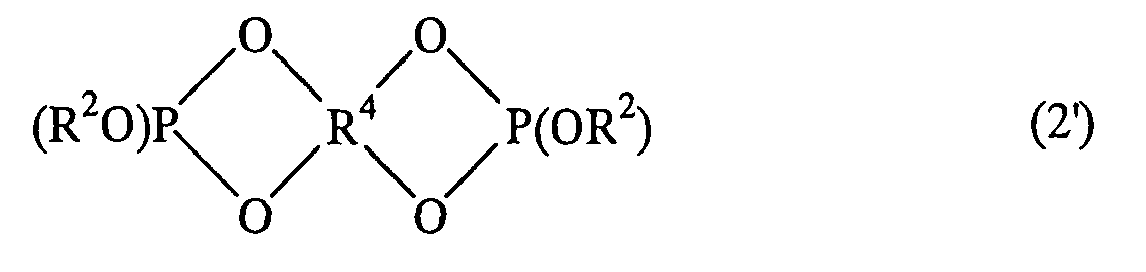
- In formulae (2) and (2'), the monovalent hydrocarbon groups represented by R2 and R6 are preferably those of 1 to 20 carbon atoms, more preferably 1 to 15 carbon atoms, for example, alkyl groups such as methyl, ethyl, propyl and butyl, alkenyl groups such as vinyl, allyl and propenyl, cycloalkyl groups such as cyclohexyl, aryl groups such as phenyl and tolyl, aralkyl groups such as benzyl and β-phenylpropyl, and substituted forms of the foregoing groups in which some or all of the hydrogen atoms bonded to carbon atoms are replaced by halogen atoms, cyano groups or the like, such as chloromethyl, 3,3,3-trifluoropropyl and 2-cyanoethyl. Of the di- to tetra-valent hydrocarbon groups represented by R3, exemplary divalent hydrocarbon groups include alkylene groups such as methylene, ethylene, propylene, butylene, and hexylene, and arylene groups such as 1,2-phenylene and 1,8-naphthylene. R4 is a tetravalent hydrocarbon group of 1 to 20 carbon atoms, preferably 5 to 20 carbon atoms, more preferably 5 to 15 carbon atoms, which may have an ether-bonding oxygen atom in the chain.
- Illustrative, non-limiting examples of the phosphite are given below.
triethyl phosphite: (EtO)3P
tris(2-ethylhexyl) phosphite: [MeC3H6CH(Et)CH2O]3P
triphenyl phosphite: (PhO)3P
diphenyl mono(2-ethylhexyl) phosphite: (PhO)2(MeC3CH6(Et)CH2O)P
tris(2,4-di-tert-butylphenyl) phosphite:
tetraphenyl dipropylene glycol diphosphite: (PhO)2PO-[CH(Me)-CH2O]2-P(OPh)2
tetraphenyl tetra(tridecyl)pentaerythritol tetraphosphite: [(PhO) (C13H27O)P-OCH2]4C
tetra(tridecyl)-4,4'-isopropylidene diphenyl diphosphite: (C13H27O)2PO-Ph-C(Me)2-Ph-OP(OC13H27)2 bis(tridecyl)pentaerythritol diphosphite:
- These phosphites may be used alone or in admixture of two or more.
- The phosphite is used in an amount of 1 to 10 equivalents, preferably 1.5 to 6 equivalents of phosphorus (P) atoms per equivalent of platinum atoms (that is, 1 to 10 moles, preferably 1.5 to 6 moles of P atoms per mole of Pt atoms). On this basis, less than 1 equivalent of P atoms fails to inhibit the catalysis of the platinum group catalyst on addition reaction. More than 10 equivalents of P atoms fail to accomplish the desired brief cure at moderate temperature.
- Component (C-3) is an organohydrogenpolysiloxane. Unlike the organohydrogenpolysiloxane (B) serving as a crosslinker, this organohydrogenpolysiloxane (C-3) is previously admixed with components (C-1) and (C-2) and heat aged together with them, so that it previously acts on platinum or platinum group compound for promoting addition reaction. In this sense, this organohydrogenpolysiloxane is essential to accomplish the desired brief cure at moderate temperature.
- The organohydrogenpolysiloxane used herein has the average compositional formula (3):
R5 cHdSiO(4-c-d)/2 (3)
wherein R5 is a substituted or unsubstituted monovalent hydrocarbon group free of aliphatic unsaturation, c is a positive number of 0.7 to 2.2, d is a positive number of 0.001 to 1.0, and c+d is from 0.8 to 3.0. The organohydrogenpolysiloxane has at least one hydrogen atom bonded to a silicon atom (SiH group) per molecule, the number of SiH groups being preferably at least 2 (generally 2 to about 300), more preferably at least 3 (especially 3 to about 150). - In formula (3), R5 is a substituted or unsubstituted monovalent hydrocarbon group bonded to a silicon atom, preferably of 1 to 10 carbon atoms, the hydrocarbon group being free of aliphatic unsaturation. Examples of the hydrocarbon include alkyl groups (which may be or include cyclic) e.g. methyl, ethyl, propyl, isopropyl, butyl, isobutyl, tert-butyl, pentyl, neopentyl, hexyl, cyclohexyl, octyl, nonyl, and decyl; aryl groups such as phenyl, tolyl, xylyl and naphthyl; aralkyl groups such as benzyl, phenylethyl, and phenylpropyl; and 3,3,3-trifluoropropyl. Of these, alkyl groups, aryl groups and 3,3,3-trifluoropropyl are preferred, with methyl, phenyl and 3,3,3-trifluoropropyl being more preferred. In formula (3), c is a positive number of 0.7 to 2.2, d is a positive number of 0.001 to 1.0, and c+d is from 0.8 to 3.0. Preferably, c is a positive number of 1.0 to 2.1, especially 1.0 to 2.0, d is a positive number of 0.005 to 1.0, especially 0.01 to 1.0, and c+d is from 1.0 to 2.5, especially 1.5 to 2.2.
- The molecular structure of the organohydrogenpolysiloxane may be straight, cyclic, branched or three-dimensional network structure. In view of the characteristics of the resulting silicone gel and ease of handling of the composition, the number of silicon atoms per molecule (or degree of polymerization) is generally about 3 to about 1,000, preferably about 5 to about 400, more preferably about 10 to about 300. Favorable use is often made of an organohydrogenpolysiloxane which has a viscosity of about 1 to about 10,000 mPa·s, preferably about 3 to about 5,000 mPa·s, more preferably about 5 to about 3,000 mPa·s at 25°C, and which is liquid at room temperature (25°C). The silicon-bonded hydrogen atom (SiH group) may be positioned at an end or a midway (non-terminal) position of the molecular chain or both.
- Illustrative, non-limiting examples of the organohydrogenpolysiloxane having the average compositional formula (3) include 1,1,3,3-tetramethyldisiloxane, 1,3,5,7-tetramethylcyclotetrasiloxane, tris(dimethylhydrogensiloxy)methylsilane, tris(dimethylhydrogensiloxy)phenylsilane, both end dimethylhydrogensiloxy-blocked dimethylpolysiloxane, both end dimethylhydrogensiloxy-blocked dimethylsiloxane-methylhydrogensiloxane copolymers, both end dimethylhydrogensiloxy-blocked methylhydrogensiloxane-dimethylsiloxane-diphenylsiloxane copolymers, both end trimethylsiloxy-blocked methylhydrogenpolysiloxane, both end trimethylsiloxy-blocked dimethylsiloxane-methylhydrogensiloxane copolymers, copolymers composed of (CH3)2HSiO1/2 units, (CH3)3SiO1/2 units and SiO4/2 units, copolymers composed of (CH3)2HSiO1/2 units and SiO4/2 units, and copolymers composed of (CH3)2HSiO1/2 units, SiO4/2 units and (C6H5)3SiO1/2 units. These organohydrogenpolysiloxanes may be used alone or in admixture of two or more. Among others, an organohydrogenpolysiloxane having a silicon-bonded hydrogen atom (SiH group) at the end of the molecular chain is desirable.
- The organohydrogenpolysiloxane (C-3) may be the same as or different from the organohydrogenpolysiloxane (B).
- The organohydrogenpolysiloxane (C-3) is used in an amount to provide 1 to 100 equivalents, preferably 1.5 to 50 equivalents of silicon-bonded hydrogen atoms (SiH groups) per equivalent of platinum atoms in component (C-1) (that is, 1 to 100 moles, preferably 1.5 to 50 moles of SiH groups per mole of Pt atoms). Less than 1 equivalent of SiH groups per equivalent of platinum atoms fails to insure the cure at moderate temperature of the composition whereas more than 100 equivalents of SiH groups per equivalent of platinum atoms adversely affects the storage stability at room temperature of composition.
- The addition reaction catalyst (C) is obtained by combining predetermined amounts of components (C-1), (C-2) and (C-3), and heating and aging the mixture at a temperature of 30 to 120°C, preferably 40 to 100°C. This addition reaction catalyst ensures that the composition exhibits storage stability at room temperature and brief cure at moderate temperature. If the heat aging temperature is below 30°C, the catalyst is less effective for allowing the composition to cure. A heat aging temperature above 120°C can deactivate the platinum complex itself. The heat aging time is preferably about 1 to about 200 hours, more preferably about 4 to about 100 hours. With too short a heat aging time, the addition reaction catalyst may become less stable on storage. With too long a heat aging time, the composition may become less stable on storage.
- The amount of component (C) compounded in the inventive composition may be a catalytic amount, and generally in a range of about 0.1 to about 1,000 ppm, preferably about 0.5 to about 100 ppm, more preferably about 1 to about 50 ppm of platinum atoms based on the total weight of components (A) and (B). If the amount of component (C) is too small, the addition reaction may be retarded or may not take place. If the amount of component (C) is too large, the cured polysiloxane composition becomes less resistant to heat and uneconomical because of the expensiveness of platinum.
- Component (D) is an organic peroxide. During long-term storage of the composition at room temperature, the organic peroxide has a function of effectively inhibiting the catalysis of the platinum catalyst for addition reaction along with component (C-2). At the heat curing stage, the organic peroxide decomposes at its decomposition temperature, losing its own inhibitory action, and oxidizes component (C-2), thus causing component (C-2) to lose the inhibitory action. This ensures that the composition cures rapidly with the aid of the platinum group catalyst.
- Examples of suitable organic peroxides include, but are not limited to, ketone peroxides such as methyl ethyl ketone peroxide, cyclohexanone peroxide, methyl acetoacetate peroxide, and acetylacetone peroxide; peroxyketals such as 1,1-di(t-butylperoxy)cyclohexane, 1,1-bis(t-tubylperoxy)-3,3,5-trimethylcyclohexane, and 2,2-bis(t-tubylperoxy)butane; hydroperoxides such as 1,1,3,3-tetramethylbutyl hydroperoxide, cumene hydroperoxide, and t-butyl hydroperoxide; dialkyl peroxides such as 2,5-dimethyl-2,5-bis(t-butylperoxy)hexane and di-t-butyl peroxide; diacyl peroxides such as 3,5,5-trimethylhexanoyl peroxide and m-toluyl peroxide; peroxy carbonates such as diisopropylperoxy dicarbonate and di-2-ethylhexylperoxy dicarbonate; and peroxy esters such as t-butylperoxy 3,5,5-trimethylhexanoate, t-butylperoxy isopropyl monocarbonate, t-butylperoxy 2-ethylhexyl monocarbonate, and t-butyl peroxybenzoate. These peroxides may be used alone or in admixture of two or more.
- The amount of organic peroxide (D) compounded is to provide at least 2 equivalents, preferably at least 3 equivalents of peroxide linkage (-OO- linkage) per equivalent of phosphite (C-2). Specifically, an organic peroxide having one -OO- linkage is compounded in an amount of at least 2 moles, preferably at least 3 moles per mole of phosphorus atom, and an organic peroxide having two -OO- linkages is compounded in an amount of at least 1 mole, preferably at least 3/2 moles per mole of phosphorus atom. If the amount of organic peroxide is less than 2 equivalents, it fails to inhibit the catalysis of the platinum group catalyst on addition reaction at room temperature and also fails to cause component (C-2) to deactivate or lose its catalysis inhibitory effect at the heat curing stage. The upper limit of the amount of organic peroxide is not critical and is usually about 500 equivalents because decomposition resides can affect the curing properties.
- In addition to the above-described components (A) to (D), various optional components may be compounded in the inventive composition. Typical are inorganic fillers including fumed silica, crystalline silica, precipitated silica, hollow fillers, silsesquioxane, fumed titanium dioxide, magnesium oxide, zinc oxide, iron oxide, aluminum hydroxide, magnesium carbonate, calcium carbonate, zinc carbonate, laminar mica, carbon black, diatomaceous earth, and glass fibers. These fillers may be surface treated with organosilicon compounds such as organoalkoxysilane compounds, organochlorosilane compounds, organosilazane compounds, and low-molecular-weight siloxane compounds. Silicone rubber powder and silicone resin powder may also be compounded.
- Other optional components include linear organopolysiloxanes containing alkenyl groups, organopolysiloxanes free of silicon-bonded hydrogen atoms and alkenyl groups, heat resistance modifiers, flame retardants, thixotropic agents, pigments and dyes. These optional components are compounded so long as they do not compromise the objects of the invention.
- The organopolysiloxane gel composition of the invention may be obtained by mixing the above-described components (A) to (D) and various optional components in a conventional manner. The method of molding the organopolysiloxane gel composition of the invention is not particularly limited. Conventional molding methods may be used. Preferred curing conditions include (independently) temperatures of from 60 to 200°C, especially 80 to 160°C and times of from 0.1 to 48 hours, especially 0.5 to 24 hours.
- Examples are given below by way of illustration and not by way of limitation. Note that all parts (pbw) and % are by weight. The viscosity is measured at 25°C by a rotational viscometer.
- An addition reaction catalyst was prepared by combining 5 parts of a dimethylpolysiloxane solution containing 1% (calculated as platinum atoms) of a chloroplatinic acid/1,3-divinyltetramethyldisiloxane complex, 0.21 part (2 equivalents per equivalent of platinum atoms) of tris(2-ethylhexyl) phosphite, and 0.5 part (2.6 equivalents of silicon-bonded hydrogen atoms per equivalent of platinum atoms) of a both end dimethylhydrogensiloxy-blocked dimethylpolysiloxane represented by the general formula (4):

- To 100 parts of an organopolysiloxane consisting of CH2=CH(CH3)2SiO0.5, (CH3)3SiO0.5, (CH3)2SiO and CH3SiO1.5 units in a molar ratio of 0.75/1.75/95/2.5 mol% and having a viscosity of 900 mPa·s at 25°C were added 8 parts of the organohydrogenpolysiloxane of formula (4) (the ratio of silicon-bonded hydrogen atoms to silicon-bonded alkenyl groups, [SiH groups/alkenyl groups], is 1.0), 0.03 part of 1,1-di(tert-butylperoxy)cyclohexane, and an amount (to provide 5 ppm of platinum atoms) of the above addition reaction catalyst. The ingredients were uniformly mixed to form a silicone gel composition.
- The silicone gel composition was cured under three sets of conditions: 100°C/1 hr, 120°C/30 min, and 150°C/30 min. The cured samples were measured for hardness (indentation) according to the consistency test of JIS K-2220 using a 1/4 cone. Also the composition was held at 40°C for 3 weeks, after which it was examined for storage stability.
- An addition reaction catalyst was prepared as in Example 1 except that 0.4 part (19 equivalents of silicon-bonded hydrogen atoms per equivalent of platinum atoms) of a both end trimethylsiloxy-blocked methylhydrogenpolysiloxane represented by the general formula (5):

- An addition reaction catalyst was prepared as in Example 1 except that 0.27 part (3 equivalents per equivalent of platinum atoms) of diphenyl mono(2-ethylhexyl) phosphite was used instead of the tris(2-ethylhexyl) phosphite and the mixture was heat aged at 40°C for 6 days. A uniform silicone gel composition was similarly prepared using this addition reaction catalyst. It was examined for penetration and storage stability.
- An addition reaction catalyst was prepared as in Example 1 except that the mixture was allowed to stand in a room temperature (25°C) atmosphere for 24 hours instead of the heat aging at 80°C. A uniform silicone gel composition was similarly prepared using this addition reaction catalyst. It was examined for penetration and storage stability.
- An addition reaction catalyst was prepared as in Example 1 except that the mixture was heat aged at 150°C for 4 hours. A uniform silicone gel composition was similarly prepared using this addition reaction catalyst. It was examined for penetration and storage stability.
- An addition reaction catalyst was prepared as in Example 1 except that the both end dimethylhydrogensiloxy-blocked dimethylpolysiloxane of formula (4) as component (C-3) was omitted. A uniform silicone gel composition was similarly prepared using this addition reaction catalyst. It was examined for penetration and storage stability.
- An addition reaction catalyst was prepared as in Example 1 except that the tris(2-ethylhexyl) phosphite was omitted. A uniform silicone gel composition was similarly prepared using this addition reaction catalyst. It was examined for penetration and storage stability.
- An addition reaction catalyst was prepared as in Example 1 except that the amount of tris(2-ethylhexyl) phosphite was 1.5 parts (14 equivalents per equivalent of platinum atoms). A uniform silicone gel composition was similarly prepared using this addition reaction catalyst. It was examined for penetration and storage stability.
- An addition reaction catalyst was prepared as in Example 2 except that the amount of both end trimethylsiloxy-blocked methylhydrogenpolysiloxane of formula (5) was 3.0 parts (146 equivalents of silicon-bonded hydrogen atoms per equivalent of platinum atoms). A uniform silicone gel composition was similarly prepared using this addition reaction catalyst. It was examined for penetration and storage stability.
- The cured property and storage stability of the nine silicone gel compositions are summarized in Table 1.
Table 1 Example Comparative Example 1 2 3 1 2 3 4 5 6 Equivalent1) of phosphite 2 2 3 2 2 2 - 14 2 Equivalent1) of SiH in catalyst 2.6 19 2.6 2.6 2.6 - 2.6 2.6 146 Aging conditions Temp. 80°C 80°C 40°C 25°C 150°C 80°C 80°C 80°C 80°C Time 24hr 24hr 144hr 24hr 4hr 24hr 24hr 24hr 24hr Equivalent2) of peroxide 46 46 29 46 46 46 - 6.6 46 Test results Hardness3) Cured @150° C/30 min 85 78 88 85 90 85 83 uncured 71 Cured @120°C/30min 85 80 87 uncured uncured uncured 83 uncured 73 Cured @100°C/1 hr 88 81 87 uncured uncured uncured 83 uncured 77 Storage stability4) @40°C/3 weeks OK OK OK OK OK OK NG OK NG 1) per equivalent of platinum atoms 2) number of peroxide linkages per equivalent of phosphite 3) hardness (penetration) according to the consistency test (1/4 cone) of JIS K-2220 4) viscosity buildup by accelerated degradation at 40°C
OK: viscosity after storage is 1.0 to less than 2 times the initial viscosity
NG: viscosity after storage is at least 2 times the initial viscosity
Claims (6)
- A one-part organopolysiloxane gel composition comprising(A) 100 parts by weight of organopolysiloxane consisting of 80.0 to 97.0 mol% of R2SiO units, 1.0 to 10.0 mol% of RSiO1.5 units, 0.1 to 4.0 mol% of (CH3)2(CH2=CH)SiO0.5 units, and 0.5 to 10.0 mol% of (CH3)3SiO0.5 units, a total of these units being 100 mol%, wherein R is methyl, phenyl or a group of the formula: RfCH2CH2-, Rf is a perfluoroalkyl group which may have an ether-bond oxygen atom in the chain, a plurality of R's in one molecule may be the same or different,(B) organohydrogenpolysiloxane represented by the average compositional formula (1):
R1 aHbSiO(4-a-b)/2 (1)
wherein R1 is a substituted or unsubstituted monovalent hydrocarbon group free of aliphatic unsaturation, a is a positive number of 0.7 to 2.2, b is a positive number of 0.001 to 1.0, and a+b is from 0.8 to 3.0, said organohydrogenpolysiloxane having at least one hydrogen atom directly bonded to a silicon atom at an end of the molecular chain, in an amount to provide 0.1 to 5 silicon-bonded hydrogen atoms per vinyl group in component (A),(C) addition reaction catalyst, in an amount to provide 0.1 to 1,000 ppm of platinum atoms based on the total weight of components (A) and (B), obtainable by heating and aging a mixture of components (C-1) to (C-3) at a temperature of 30 to 120°C:(C-1) platinum complex having an alkenyl group-containing silane or alkenyl group-containing organosiloxane as a ligand, in an amount of 1 equivalent of platinum atoms in the platinum complex,(C-2) phosphite having the general formula (2):
P(OR2)3 (2)
wherein R2 is independently at least one group selected from the class consisting of a substituted or unsubstituted monovalent hydrocarbon group and a group of the formula: -R3-[O-P(OR6)2]x wherein R6 is independently a substituted or unsubstituted monovalent hydrocarbon group, x is an integer of 1 to 3, R3 is a di- to tetra-valent C2-C20 hydrocarbon group which may have an ether-bonding oxygen atom in the chain, or the general formula (2'):
wherein R2 is as defined above, R4 is a tetravalent C1-C20 hydrocarbon group which may have an ether-bonding oxygen atom in the chain, in an amount of 1 to 10 equivalents of phosphorus atoms, and(C-3) organohydrogenpolysiloxane represented by the average compositional formula (3):
R5 cHdSiO(4-c-d)/2 (3)
wherein R5 is a substituted or unsubstituted monovalent hydrocarbon group free of aliphatic unsaturation, c is a positive number of 0.7 to 2.2, d is a positive number of 0.001 to 1.0, and c+d is from 0.8 to 3.0, said organohydrogenpolysiloxane having at least one hydrogen atom bonded to a silicon atom, in an amount of 1 to 100 equivalents of silicon-bonded hydrogen atoms, and(D) organic peroxide in an amount of at least 2 equivalents per equivalent of the phosphite in component (C). - The organopolysiloxane gel composition of claim 1 wherein in component (C), the organohydrogenpolysiloxane of formula (3) has a hydrogen atom bonded to a silicon atom at an end of the molecular chain.
- A method of preparing an addition-curable organopolysiloxane gel composition, comprising combining ingredients (A), (B), (C) and (D) as defined in claim 1 or 2.
- Method according to claim 3 comprising a preliminary step of obtaining the catalyst (C) by said heating and aging process.
- Method comprising addition-curing a composition according to claim 1 or 2 to make an organopolysiloxane article or element.
- Use of an addition-reaction catalyst (C) as defined in claim 1 or 2 in conjunction with (D) organic peroxide to confer storage stability in conjunction with addition-curability on an organopolysiloxane composition comprising(A) alkenyl group-containing branched organopolysiloxane and(B) organohydrogenpolysiloxane having Si-bonded H atom at the molecular chain end(s).
Applications Claiming Priority (1)
| Application Number | Priority Date | Filing Date | Title |
|---|---|---|---|
| JP2004245345A JP4530147B2 (en) | 2004-08-25 | 2004-08-25 | One-part organopolysiloxane gel composition |
Publications (3)
| Publication Number | Publication Date |
|---|---|
| EP1630202A2 true EP1630202A2 (en) | 2006-03-01 |
| EP1630202A3 EP1630202A3 (en) | 2007-12-05 |
| EP1630202B1 EP1630202B1 (en) | 2012-08-01 |
Family
ID=35445805
Family Applications (1)
| Application Number | Title | Priority Date | Filing Date |
|---|---|---|---|
| EP05255188A Ceased EP1630202B1 (en) | 2004-08-25 | 2005-08-24 | One-part organopolysiloxane gel compositions, their preparation and use |
Country Status (3)
| Country | Link |
|---|---|
| US (1) | US7452955B2 (en) |
| EP (1) | EP1630202B1 (en) |
| JP (1) | JP4530147B2 (en) |
Cited By (2)
| Publication number | Priority date | Publication date | Assignee | Title |
|---|---|---|---|---|
| EP1688463A1 (en) * | 2005-02-04 | 2006-08-09 | Shin-Etsu Chemical Co., Ltd. | Liquid silicone rubber coating agent composition and curtain air bag |
| US8847414B2 (en) | 2010-12-31 | 2014-09-30 | Cheil Industries, Inc. | Resin for transparent encapsulation material, and associated encapsulation material and electronic device |
Families Citing this family (25)
| Publication number | Priority date | Publication date | Assignee | Title |
|---|---|---|---|---|
| EP1499660A2 (en) * | 2002-04-29 | 2005-01-26 | Rhodia Chimie | Assembly for hydrosylilation, method for preparing same and silicone compositions incorporating same |
| JP5123177B2 (en) * | 2005-06-22 | 2013-01-16 | スリーエム イノベイティブ プロパティズ カンパニー | Hydrophilized curable silicone impression material with improved storage properties |
| JP2007308581A (en) * | 2006-05-18 | 2007-11-29 | Shin Etsu Chem Co Ltd | Method of curing addition curable silicone rubber composition and addition curable silicone rubber composition |
| JP5168732B2 (en) * | 2007-09-21 | 2013-03-27 | 信越化学工業株式会社 | Silicone gel composition providing a cured product having displacement durability |
| JP2009091403A (en) * | 2007-10-04 | 2009-04-30 | Shin Etsu Chem Co Ltd | Addition-curable silicone rubber composition and method for curing the same |
| US7932342B2 (en) * | 2008-01-16 | 2011-04-26 | International Business Machines Corporation | Method to improve wettability by reducing liquid polymer macromolecule mobility through forming polymer blend system |
| US20110027584A1 (en) * | 2008-03-04 | 2011-02-03 | Bianxiao Zhong | Silicone Composition, Silicone Adhesive, Coated and Laminated Substrates |
| JP2009220384A (en) * | 2008-03-17 | 2009-10-01 | Shin Etsu Chem Co Ltd | Method of forming silicone rubber thin film coating layer and silicone rubber thin film coated article |
| JP5024552B2 (en) * | 2008-07-14 | 2012-09-12 | 信越化学工業株式会社 | Addition reaction catalyst and addition-curable organopolysiloxane composition |
| JP2010120979A (en) * | 2008-11-17 | 2010-06-03 | Taika:Kk | Thermally conductive silicone gel cured product |
| JP2010144130A (en) * | 2008-12-22 | 2010-07-01 | Taika:Kk | Curable organopolysiloxane composition |
| KR101466273B1 (en) * | 2010-12-31 | 2014-11-28 | 제일모직주식회사 | Transparent resin for encapsulation material and encapsulation material and electronic device including the same |
| KR101851423B1 (en) * | 2011-05-31 | 2018-04-23 | 모멘티브 파포만스 마테리아루즈 쟈판 고도가이샤 | Silicone composition for sealing semiconductor |
| JPWO2014188872A1 (en) * | 2013-05-22 | 2017-02-23 | 信越化学工業株式会社 | One-part organopolysiloxane gel composition and method for curing the same |
| JP6260519B2 (en) * | 2014-11-25 | 2018-01-17 | 信越化学工業株式会社 | Method for storing and curing one-component addition-curable silicone composition |
| JP6977786B2 (en) * | 2018-01-15 | 2021-12-08 | 信越化学工業株式会社 | Silicone composition |
| JP6966411B2 (en) * | 2018-11-02 | 2021-11-17 | 信越化学工業株式会社 | Additive-curable silicone resin composition, cured product thereof, and optical semiconductor device |
| EP4006093B1 (en) | 2019-07-25 | 2024-09-18 | Shin-Etsu Chemical Co., Ltd. | One-pack type curable silicone gel composition and cured silicone gel |
| CN111171577B (en) * | 2020-02-10 | 2022-08-30 | 江西蓝星星火有机硅有限公司 | Single-component liquid silicone rubber and preparation method thereof |
| KR20220154742A (en) * | 2020-03-16 | 2022-11-22 | 신에쓰 가가꾸 고교 가부시끼가이샤 | Organopolysiloxane composition for release paper or release film |
| CN116075551B (en) * | 2020-09-03 | 2025-11-04 | 信越化学工业株式会社 | Curable silicone gel composition and cured silicone gel |
| CN117836373A (en) | 2021-08-02 | 2024-04-05 | 信越化学工业株式会社 | Hydrosilylation catalyst containing platinum-phosphite complex, method for producing the same, method for inhibiting crystallization of hydrosilylation catalyst containing platinum-phosphite complex, curable organopolysiloxane composition, and article |
| KR20240116822A (en) * | 2021-12-16 | 2024-07-30 | 신에쓰 가가꾸 고교 가부시끼가이샤 | Curable liquid silicone composition and method of curing the composition |
| CN114437550A (en) * | 2022-01-26 | 2022-05-06 | 青岛科技大学 | Single-component addition type liquid silicone rubber |
| EP4703431A1 (en) | 2023-04-28 | 2026-03-04 | Shin-Etsu Chemical Co., Ltd. | Curable liquid silicone composition and cured product thereof |
Family Cites Families (19)
| Publication number | Priority date | Publication date | Assignee | Title |
|---|---|---|---|---|
| US3188300A (en) * | 1963-02-28 | 1965-06-08 | Gen Electric | Preparation of stable copolymerizable organosilicon compositions containing a platinum catalyst and a phosphorus ligand |
| NL129346C (en) * | 1966-06-23 | |||
| US3453234A (en) * | 1968-01-31 | 1969-07-01 | Dow Corning | Latent catalyst containing platinum and sulfoxide |
| US3814730A (en) * | 1970-08-06 | 1974-06-04 | Gen Electric | Platinum complexes of unsaturated siloxanes and platinum containing organopolysiloxanes |
| GB1428552A (en) | 1972-02-16 | 1976-03-17 | Gen Electric | Platinum complexes of unsaturated siloxanes and platinum containing organopolysiloxanes |
| JPS518926A (en) | 1974-07-12 | 1976-01-24 | Tdk Electronics Co Ltd | Takojishakuban oyobi sonoseizoho |
| US4061609A (en) * | 1976-04-09 | 1977-12-06 | General Electric Company | Inhibitor for platinum catalyzed silicone rubber compositions |
| US4329275A (en) * | 1979-07-27 | 1982-05-11 | Toshiba Silicone Co., Ltd. | Heat-curable polysiloxane composition |
| JPS5950256B2 (en) * | 1979-07-27 | 1984-12-07 | 東芝シリコ−ン株式会社 | Curable polysiloxane composition |
| US4288345A (en) * | 1980-02-06 | 1981-09-08 | General Electric Company | Platinum complex |
| JPS57136655A (en) | 1981-02-19 | 1982-08-23 | Canon Inc | Electrophotographic receptor |
| US4584361A (en) * | 1985-06-03 | 1986-04-22 | Dow Corning Corporation | Storage stable, one part polyorganosiloxane compositions |
| JP2564208B2 (en) * | 1990-12-27 | 1996-12-18 | 信越化学工業株式会社 | Method for producing one-part organopolysiloxane composition |
| US5204384A (en) * | 1991-01-23 | 1993-04-20 | Dow Corning Toray Silicone Co., Ltd. | One-part curable organosiloxane composition |
| DE4324685A1 (en) * | 1993-07-22 | 1995-01-26 | Wacker Chemie Gmbh | Organosiloxane-bound transition metal complexes |
| US6300455B1 (en) | 1996-12-30 | 2001-10-09 | Ge Bayer Silicones Gmbh & Co. Kg | Cross-linkable mixtures and method for producing same |
| DE19757221A1 (en) * | 1997-12-22 | 1999-06-24 | Ge Bayer Silicones Gmbh & Co | Polysiloxane mixture stabilized at room temperature without inhibiting vulcanization on heating |
| JP4520137B2 (en) * | 2002-12-10 | 2010-08-04 | 信越化学工業株式会社 | One-part organopolysiloxane gel composition |
| US7067570B2 (en) | 2002-12-10 | 2006-06-27 | Shin-Etsu Chemical Co., Ltd. | One-part organopolysiloxane gel composition |
-
2004
- 2004-08-25 JP JP2004245345A patent/JP4530147B2/en not_active Expired - Fee Related
-
2005
- 2005-08-24 US US11/209,768 patent/US7452955B2/en not_active Expired - Fee Related
- 2005-08-24 EP EP05255188A patent/EP1630202B1/en not_active Ceased
Cited By (4)
| Publication number | Priority date | Publication date | Assignee | Title |
|---|---|---|---|---|
| EP1688463A1 (en) * | 2005-02-04 | 2006-08-09 | Shin-Etsu Chemical Co., Ltd. | Liquid silicone rubber coating agent composition and curtain air bag |
| US7699337B2 (en) | 2005-02-04 | 2010-04-20 | Shin-Etsu Chemical Co., Ltd. | Liquid silicone rubber coating agent composition and curtain air bag |
| US8847414B2 (en) | 2010-12-31 | 2014-09-30 | Cheil Industries, Inc. | Resin for transparent encapsulation material, and associated encapsulation material and electronic device |
| US9147626B2 (en) | 2010-12-31 | 2015-09-29 | Cheil Industries, Inc. | Resin for transparent encapsulation material, and associated encapsulation material and electronic device |
Also Published As
| Publication number | Publication date |
|---|---|
| US20060047097A1 (en) | 2006-03-02 |
| EP1630202B1 (en) | 2012-08-01 |
| JP4530147B2 (en) | 2010-08-25 |
| EP1630202A3 (en) | 2007-12-05 |
| JP2006063142A (en) | 2006-03-09 |
| US7452955B2 (en) | 2008-11-18 |
Similar Documents
| Publication | Publication Date | Title |
|---|---|---|
| EP1630202B1 (en) | One-part organopolysiloxane gel compositions, their preparation and use | |
| EP1437382B1 (en) | One-part organopolysiloxane gel composition | |
| JP2749148B2 (en) | High consistency organosiloxane elastomer composition | |
| JP3734840B2 (en) | High consistency curable organosiloxane composition | |
| EP0305073A2 (en) | Curable organosiloxane compositions | |
| KR101553456B1 (en) | Hydrosilylation reaction inhibitors and use thereof for preparing stable curable silicone compositions | |
| EP0358370A2 (en) | Optically clear reinforced organosiloxane compositions | |
| EP0785236B2 (en) | Curable silicone compositions | |
| EP1424364B1 (en) | Flame retardant silicone compositions | |
| JP7626222B2 (en) | Method for preparing platinum catalyst mixture | |
| JP4520137B2 (en) | One-part organopolysiloxane gel composition | |
| EP0545590B1 (en) | Heat curable organopolysiloxane compositions | |
| EP0794217A1 (en) | Fast curing organosiloxane compositions with inhibitor | |
| EP1605020B1 (en) | Curable organopolysiloxane composition | |
| EP0802232B1 (en) | Compositions comprising fluorinated and non-fluorinated polyorganosiloxanes with high tear strength and consistency | |
| JPWO2014188872A1 (en) | One-part organopolysiloxane gel composition and method for curing the same | |
| EP0695787A2 (en) | Curable alkenyl-terminal polydiorganosiloxane compositions | |
| JP7772090B2 (en) | Method for producing a curable liquid silicone composition and method for curing said composition | |
| JP2009191155A (en) | Method for producing liquid silicone rubber base and method for producing addition curable liquid silicone rubber composition | |
| EP1717274B1 (en) | Silicone gel composition | |
| JP2004323591A (en) | Thermosetting silicone rubber composition | |
| KR20190128725A (en) | Heavy-weight cross-linked silicone composition useful for overmolding parts | |
| JP2008150445A (en) | Method for producing liquid silicone rubber base, addition curable liquid silicone rubber composition, and cured silicone rubber |
Legal Events
| Date | Code | Title | Description |
|---|---|---|---|
| PUAI | Public reference made under article 153(3) epc to a published international application that has entered the european phase |
Free format text: ORIGINAL CODE: 0009012 |
|
| AK | Designated contracting states |
Kind code of ref document: A2 Designated state(s): AT BE BG CH CY CZ DE DK EE ES FI FR GB GR HU IE IS IT LI LT LU LV MC NL PL PT RO SE SI SK TR |
|
| AX | Request for extension of the european patent |
Extension state: AL BA HR MK YU |
|
| PUAL | Search report despatched |
Free format text: ORIGINAL CODE: 0009013 |
|
| AK | Designated contracting states |
Kind code of ref document: A3 Designated state(s): AT BE BG CH CY CZ DE DK EE ES FI FR GB GR HU IE IS IT LI LT LU LV MC NL PL PT RO SE SI SK TR |
|
| AX | Request for extension of the european patent |
Extension state: AL BA HR MK YU |
|
| 17P | Request for examination filed |
Effective date: 20080410 |
|
| 17Q | First examination report despatched |
Effective date: 20080527 |
|
| AKX | Designation fees paid |
Designated state(s): DE FR GB |
|
| GRAP | Despatch of communication of intention to grant a patent |
Free format text: ORIGINAL CODE: EPIDOSNIGR1 |
|
| GRAS | Grant fee paid |
Free format text: ORIGINAL CODE: EPIDOSNIGR3 |
|
| GRAA | (expected) grant |
Free format text: ORIGINAL CODE: 0009210 |
|
| AK | Designated contracting states |
Kind code of ref document: B1 Designated state(s): DE FR GB |
|
| REG | Reference to a national code |
Ref country code: GB Ref legal event code: FG4D |
|
| REG | Reference to a national code |
Ref country code: DE Ref legal event code: R096 Ref document number: 602005035360 Country of ref document: DE Effective date: 20121011 |
|
| PLBE | No opposition filed within time limit |
Free format text: ORIGINAL CODE: 0009261 |
|
| STAA | Information on the status of an ep patent application or granted ep patent |
Free format text: STATUS: NO OPPOSITION FILED WITHIN TIME LIMIT |
|
| 26N | No opposition filed |
Effective date: 20130503 |
|
| REG | Reference to a national code |
Ref country code: DE Ref legal event code: R097 Ref document number: 602005035360 Country of ref document: DE Effective date: 20130503 |
|
| REG | Reference to a national code |
Ref country code: FR Ref legal event code: PLFP Year of fee payment: 12 |
|
| REG | Reference to a national code |
Ref country code: FR Ref legal event code: PLFP Year of fee payment: 13 |
|
| REG | Reference to a national code |
Ref country code: FR Ref legal event code: PLFP Year of fee payment: 14 |
|
| PGFP | Annual fee paid to national office [announced via postgrant information from national office to epo] |
Ref country code: FR Payment date: 20210715 Year of fee payment: 17 |
|
| PGFP | Annual fee paid to national office [announced via postgrant information from national office to epo] |
Ref country code: GB Payment date: 20210714 Year of fee payment: 17 Ref country code: DE Payment date: 20210713 Year of fee payment: 17 |
|
| REG | Reference to a national code |
Ref country code: DE Ref legal event code: R119 Ref document number: 602005035360 Country of ref document: DE |
|
| GBPC | Gb: european patent ceased through non-payment of renewal fee |
Effective date: 20220824 |
|
| PG25 | Lapsed in a contracting state [announced via postgrant information from national office to epo] |
Ref country code: FR Free format text: LAPSE BECAUSE OF NON-PAYMENT OF DUE FEES Effective date: 20220831 Ref country code: DE Free format text: LAPSE BECAUSE OF NON-PAYMENT OF DUE FEES Effective date: 20230301 |
|
| PG25 | Lapsed in a contracting state [announced via postgrant information from national office to epo] |
Ref country code: GB Free format text: LAPSE BECAUSE OF NON-PAYMENT OF DUE FEES Effective date: 20220824 |